EP0487857B1 - Amélioration de l'adhésion de polyimide aux métaux réactifs - Google Patents
Amélioration de l'adhésion de polyimide aux métaux réactifs Download PDFInfo
- Publication number
- EP0487857B1 EP0487857B1 EP91116498A EP91116498A EP0487857B1 EP 0487857 B1 EP0487857 B1 EP 0487857B1 EP 91116498 A EP91116498 A EP 91116498A EP 91116498 A EP91116498 A EP 91116498A EP 0487857 B1 EP0487857 B1 EP 0487857B1
- Authority
- EP
- European Patent Office
- Prior art keywords
- monomer
- carbon atoms
- saturated hydrocarbon
- hydrocarbon residue
- arylalkoxysilane
- Prior art date
- Legal status (The legal status is an assumption and is not a legal conclusion. Google has not performed a legal analysis and makes no representation as to the accuracy of the status listed.)
- Expired - Lifetime
Links
Classifications
-
- H—ELECTRICITY
- H10—SEMICONDUCTOR DEVICES; ELECTRIC SOLID-STATE DEVICES NOT OTHERWISE PROVIDED FOR
- H10P—GENERIC PROCESSES OR APPARATUS FOR THE MANUFACTURE OR TREATMENT OF DEVICES COVERED BY CLASS H10
- H10P14/00—Formation of materials, e.g. in the shape of layers or pillars
- H10P14/60—Formation of materials, e.g. in the shape of layers or pillars of insulating materials
- H10P14/66—Formation of materials, e.g. in the shape of layers or pillars of insulating materials characterised by the type of materials
- H10P14/668—Formation of materials, e.g. in the shape of layers or pillars of insulating materials characterised by the type of materials the materials being characterised by the deposition precursor materials
- H10P14/6681—Formation of materials, e.g. in the shape of layers or pillars of insulating materials characterised by the type of materials the materials being characterised by the deposition precursor materials the precursor containing a compound comprising Si
- H10P14/6687—Formation of materials, e.g. in the shape of layers or pillars of insulating materials characterised by the type of materials the materials being characterised by the deposition precursor materials the precursor containing a compound comprising Si the compound comprising silicon and nitrogen
- H10P14/6689—Formation of materials, e.g. in the shape of layers or pillars of insulating materials characterised by the type of materials the materials being characterised by the deposition precursor materials the precursor containing a compound comprising Si the compound comprising silicon and nitrogen the compound being a silazane
-
- H—ELECTRICITY
- H05—ELECTRIC TECHNIQUES NOT OTHERWISE PROVIDED FOR
- H05K—PRINTED CIRCUITS; CASINGS OR CONSTRUCTIONAL DETAILS OF ELECTRIC APPARATUS; MANUFACTURE OF ASSEMBLAGES OF ELECTRICAL COMPONENTS
- H05K3/00—Apparatus or processes for manufacturing printed circuits
- H05K3/38—Improvement of the adhesion between the insulating substrate and the metal
- H05K3/386—Improvement of the adhesion between the insulating substrate and the metal by the use of an organic polymeric bonding layer, e.g. adhesive
-
- H—ELECTRICITY
- H10—SEMICONDUCTOR DEVICES; ELECTRIC SOLID-STATE DEVICES NOT OTHERWISE PROVIDED FOR
- H10P—GENERIC PROCESSES OR APPARATUS FOR THE MANUFACTURE OR TREATMENT OF DEVICES COVERED BY CLASS H10
- H10P14/00—Formation of materials, e.g. in the shape of layers or pillars
- H10P14/60—Formation of materials, e.g. in the shape of layers or pillars of insulating materials
- H10P14/66—Formation of materials, e.g. in the shape of layers or pillars of insulating materials characterised by the type of materials
- H10P14/668—Formation of materials, e.g. in the shape of layers or pillars of insulating materials characterised by the type of materials the materials being characterised by the deposition precursor materials
- H10P14/6681—Formation of materials, e.g. in the shape of layers or pillars of insulating materials characterised by the type of materials the materials being characterised by the deposition precursor materials the precursor containing a compound comprising Si
- H10P14/6682—Formation of materials, e.g. in the shape of layers or pillars of insulating materials characterised by the type of materials the materials being characterised by the deposition precursor materials the precursor containing a compound comprising Si the compound being a silane, e.g. disilane, methylsilane or chlorosilane
-
- H—ELECTRICITY
- H10—SEMICONDUCTOR DEVICES; ELECTRIC SOLID-STATE DEVICES NOT OTHERWISE PROVIDED FOR
- H10P—GENERIC PROCESSES OR APPARATUS FOR THE MANUFACTURE OR TREATMENT OF DEVICES COVERED BY CLASS H10
- H10P14/00—Formation of materials, e.g. in the shape of layers or pillars
- H10P14/60—Formation of materials, e.g. in the shape of layers or pillars of insulating materials
- H10P14/69—Inorganic materials
- H10P14/692—Inorganic materials composed of oxides, glassy oxides or oxide-based glasses
- H10P14/6921—Inorganic materials composed of oxides, glassy oxides or oxide-based glasses containing silicon
- H10P14/6922—Inorganic materials composed of oxides, glassy oxides or oxide-based glasses containing silicon the material containing Si, O and at least one of H, N, C, F or other non-metal elements, e.g. SiOC, SiOC:H or SiONC
-
- H—ELECTRICITY
- H05—ELECTRIC TECHNIQUES NOT OTHERWISE PROVIDED FOR
- H05K—PRINTED CIRCUITS; CASINGS OR CONSTRUCTIONAL DETAILS OF ELECTRIC APPARATUS; MANUFACTURE OF ASSEMBLAGES OF ELECTRICAL COMPONENTS
- H05K1/00—Printed circuits
- H05K1/02—Details
- H05K1/03—Use of materials for the substrate
- H05K1/0313—Organic insulating material
- H05K1/0353—Organic insulating material consisting of two or more materials, e.g. two or more polymers, polymer + filler, + reinforcement
- H05K1/036—Multilayers with layers of different types
-
- H—ELECTRICITY
- H05—ELECTRIC TECHNIQUES NOT OTHERWISE PROVIDED FOR
- H05K—PRINTED CIRCUITS; CASINGS OR CONSTRUCTIONAL DETAILS OF ELECTRIC APPARATUS; MANUFACTURE OF ASSEMBLAGES OF ELECTRICAL COMPONENTS
- H05K2201/00—Indexing scheme relating to printed circuits covered by H05K1/00
- H05K2201/01—Dielectrics
- H05K2201/0137—Materials
- H05K2201/0154—Polyimide
-
- H—ELECTRICITY
- H05—ELECTRIC TECHNIQUES NOT OTHERWISE PROVIDED FOR
- H05K—PRINTED CIRCUITS; CASINGS OR CONSTRUCTIONAL DETAILS OF ELECTRIC APPARATUS; MANUFACTURE OF ASSEMBLAGES OF ELECTRICAL COMPONENTS
- H05K2201/00—Indexing scheme relating to printed circuits covered by H05K1/00
- H05K2201/01—Dielectrics
- H05K2201/0137—Materials
- H05K2201/0162—Silicon containing polymer, e.g. silicone
-
- H—ELECTRICITY
- H05—ELECTRIC TECHNIQUES NOT OTHERWISE PROVIDED FOR
- H05K—PRINTED CIRCUITS; CASINGS OR CONSTRUCTIONAL DETAILS OF ELECTRIC APPARATUS; MANUFACTURE OF ASSEMBLAGES OF ELECTRICAL COMPONENTS
- H05K2201/00—Indexing scheme relating to printed circuits covered by H05K1/00
- H05K2201/01—Dielectrics
- H05K2201/0183—Dielectric layers
- H05K2201/0195—Dielectric or adhesive layers comprising a plurality of layers, e.g. in a multilayer structure
-
- H—ELECTRICITY
- H05—ELECTRIC TECHNIQUES NOT OTHERWISE PROVIDED FOR
- H05K—PRINTED CIRCUITS; CASINGS OR CONSTRUCTIONAL DETAILS OF ELECTRIC APPARATUS; MANUFACTURE OF ASSEMBLAGES OF ELECTRICAL COMPONENTS
- H05K2201/00—Indexing scheme relating to printed circuits covered by H05K1/00
- H05K2201/03—Conductive materials
- H05K2201/0332—Structure of the conductor
- H05K2201/0335—Layered conductors or foils
- H05K2201/0355—Metal foils
-
- H—ELECTRICITY
- H05—ELECTRIC TECHNIQUES NOT OTHERWISE PROVIDED FOR
- H05K—PRINTED CIRCUITS; CASINGS OR CONSTRUCTIONAL DETAILS OF ELECTRIC APPARATUS; MANUFACTURE OF ASSEMBLAGES OF ELECTRICAL COMPONENTS
- H05K2201/00—Indexing scheme relating to printed circuits covered by H05K1/00
- H05K2201/03—Conductive materials
- H05K2201/0332—Structure of the conductor
- H05K2201/0335—Layered conductors or foils
- H05K2201/0358—Resin coated copper [RCC]
-
- H—ELECTRICITY
- H05—ELECTRIC TECHNIQUES NOT OTHERWISE PROVIDED FOR
- H05K—PRINTED CIRCUITS; CASINGS OR CONSTRUCTIONAL DETAILS OF ELECTRIC APPARATUS; MANUFACTURE OF ASSEMBLAGES OF ELECTRICAL COMPONENTS
- H05K2203/00—Indexing scheme relating to apparatus or processes for manufacturing printed circuits covered by H05K3/00
- H05K2203/07—Treatments involving liquids, e.g. plating, rinsing
- H05K2203/0756—Uses of liquids, e.g. rinsing, coating, dissolving
- H05K2203/0759—Forming a polymer layer by liquid coating, e.g. a non-metallic protective coating or an organic bonding layer
-
- H—ELECTRICITY
- H05—ELECTRIC TECHNIQUES NOT OTHERWISE PROVIDED FOR
- H05K—PRINTED CIRCUITS; CASINGS OR CONSTRUCTIONAL DETAILS OF ELECTRIC APPARATUS; MANUFACTURE OF ASSEMBLAGES OF ELECTRICAL COMPONENTS
- H05K3/00—Apparatus or processes for manufacturing printed circuits
- H05K3/46—Manufacturing multilayer circuits
- H05K3/4644—Manufacturing multilayer circuits by building the multilayer layer by layer, i.e. build-up multilayer circuits
-
- H—ELECTRICITY
- H10—SEMICONDUCTOR DEVICES; ELECTRIC SOLID-STATE DEVICES NOT OTHERWISE PROVIDED FOR
- H10P—GENERIC PROCESSES OR APPARATUS FOR THE MANUFACTURE OR TREATMENT OF DEVICES COVERED BY CLASS H10
- H10P14/00—Formation of materials, e.g. in the shape of layers or pillars
- H10P14/60—Formation of materials, e.g. in the shape of layers or pillars of insulating materials
- H10P14/63—Formation of materials, e.g. in the shape of layers or pillars of insulating materials characterised by the formation processes
- H10P14/6326—Deposition processes
- H10P14/6342—Liquid deposition, e.g. spin-coating, sol-gel techniques or spray coating
Definitions
- the present invention relates to a process for improving the adhesion of a polyimide layer to an underlying metal surface, such as a substrate containing a pattern of metallization, e.g. copper.
- polyimides formed by the thermal curing of polyimide precursors can be used as passivation dielectrics on semiconductor devices. See, for example, U.S. Pat. No. 4,590,258, issued to Linde, et al., on May 20, 1986.
- silsesquioxane polymers for use as insulating layers in semiconductor devices.
- an insulating layer is formed by applying to a substrate a prepolymer, and then heating it at a temperature above 400°C in the presence of oxygen.
- the prepolymer is prepared by hydrolyzing and polycondensating a mixture of a tetraalkoxysilane, a trialkoxysilane and a dialkoxysilane in a select mole ratio.
- an organic solution is first applied to the underlying metal surface, the solution being prepared by reacting water an aminoalkoxysilane monomer, and either an arylalkoxysilane or arylsilazane monomer in a solvent. After that, a heating step is performed to form a partially cured layer, and then a solution comprising a polyimide precursor is applied.
- Another heating step is carried out to simultaneously form a layer of cured silsesquioxane copolymer and a polyimide layer.
- a cured structure is obtained in which there is a strong bonding between the polyimide and the underlying layers, which is moisture-resistant and resistant to oxidation of the metal, while also providing a high degree of thermal stability.
- the process also allows application of the polyimide without the need for a separate, full curing step for the adhesion-enhancing layer.
- said organic solution is prepared by first dissolving said arylalkoxysilane or arylsilazane monomer in the solvent, adding water and then adding said aminoalkoxy-silane monomer.
- the solvent is preferably selected from methanol ethanol and isopropanol, and the solution is preferably allowed to age for at least 2 hours prior to application to the substrate.
- an organic solution is applied to an underlying metal surface, such as a metal film or a processed semiconductor substrate, containing a pattern of metallization.
- the substrate typically comprises an insulator layer which includes a pattern of metal.
- the insulator layer commonly comprises silicon dioxide, silicon nitride, reflowed phosphosilicate glass or a polyimide, such as polyimides formed from pyromellitic dianhydride and oxydianiline, or benzophenone tetracarboxylic acid dianhydride and oxydianiline and/or m-phenylene diamine or other aromatic polyimides or polyamide-imides known to those skilled in the art.
- Typical metals include transition metals or alloys of transition metals, refractory metals or silicides of refractory metals, etc., for example, copper, aluminum, silver, chromium, lead, tin, gold, the Groups IV A, V A and VI A metals, such as titanium and tungsten, and so forth.
- the organic solution is applied to the underlying surface in a conventional fashion, such as spin coating, at a spin speed of about 2,000-5,000 min ⁇ 1, depending upon the desired thickness.
- the organic solution is prepared by reacting an aminoalkoxysilane monomer, an arylalkoxysilane or arylsilazane monomer and water in a solvent.
- Suitable aminoalkoxysilane monomers include aminotrialkoxysilanes represented by the formula: wherein R1 is a hydrogen atom; a saturated hydrocarbon residue or an amino-substituted, preferably di- or tri-amino-substituted saturated hydrocarbon residue, preferably having 1 to 5 carbon atoms more preferably 2 or 3 carbon atoms; or an alkyl-substituted phenyl group or derivatives thereof, the alkyl group preferably having 1 to 5 carbon atoms; wherein R2 is a saturated hydrocarbon residue, preferably having 2 to 6 carbon atoms more preferably 3 to 6 carbon atoms or an alkyl-substituted, preferably dialkyl-substituted, phenyl group or derivatives thereof, each alkyl group preferably having 1 to 5 carbon atoms; and wherein R3 is a saturated hydrocarbon residue, preferably having 1 to 8 carbon atoms more preferably 1 to 4 carbon atoms. Also, mixtures of such
- Representative aminoalkoxysilane monomers include the following: ⁇ -aminopropyltrimethoxysilane, ⁇ -aminopropyltriethoxysilane, N- ⁇ -(aminoethyl)- ⁇ -aminopropyltrimethoxysilane, N- ⁇ -(aminoethyl)- ⁇ -aminopropyltriethoxysilane, N- ⁇ -aminoethyl- ⁇ -aminopropyltris-( ⁇ -ethylhexoxy) silane, trimethoxysilylpropyldiethylenetriamine, (aminoethylaminomethyl) phenethyltrimethoxysilane and ⁇ -trimethoxysilyl- ⁇ -(p-m-aminomethyl)-phenylethane.
- Preferred aminoalkoxysilane monomers include aminotrialkoxysilanes represented by the above formula (A), wherein R1 is a hydrogen atom or a saturated hydro-carbon residue or an amino-substituted, saturated hydrocarbon residue, having 2 or 3 carbon atoms; wherein R2 is a saturated hydrocarbon residue having 3 to 6 carbon atoms; and wherein R3 is a saturated hydrocarbon residue having 1 to 4 carbon atoms.
- A aminotrialkoxysilanes represented by the above formula (A), wherein R1 is a hydrogen atom or a saturated hydro-carbon residue or an amino-substituted, saturated hydrocarbon residue, having 2 or 3 carbon atoms; wherein R2 is a saturated hydrocarbon residue having 3 to 6 carbon atoms; and wherein R3 is a saturated hydrocarbon residue having 1 to 4 carbon atoms.
- a particularly preferred group of aminoalkoxysilane monomers includes the following aminotrialkoxysilanes: ⁇ -aminopropyltrimethoxysilane, ⁇ -aminopropyltriethoxysilane, N- ⁇ -(aminoethyl)- ⁇ -aminopropyltrimethoxysilane and N- ⁇ -(aminoethyl)- ⁇ -aminopropyltriethoxysilane.
- Y is (OR6) or N(R7)2, wherein R6 is a saturated hydrocarbon residue having 1 to 5 carbon atoms preferably 1 to 4 carbon atoms and R7 is a hydrogen atom or a saturated hydrocarbon residue having 1 to 5 carbon atoms preferably 1 to 4 carbon atoms. Also, mixtures of such arylalkoxysilanes and arylsilazanes can be used.
- arylalkoxysilane and arylsilazane monomers include the following: phenyltriethoxysilane, tris (dimethylamino) phenylsilane, bis (dimethylamino) diphenylsilane and bis (dimethylamino) methylphenylsilane.
- arylalkoxysilane and arylsilazane monomers include those in which R4 is an unsubstituted or substituted phenyl group, and R6 is a saturated hydrocarbon residue having 1 to 4 carbon atoms or R7 is a hydrogen atom or a saturated hydrocarbon residue having 1 to 4 carbon atoms.
- Arylalkoxysilane monomers are most preferred, such as phenyltrialkoxysilane, e.g. phenyltriethoxysilane.
- Any suitable solvent which can dissolve the aminoalkoxysilane and the arylalkoxysilane or arylsilazane and is miscible with water can be employed.
- Typical solvents include, for example, alcohols, such as methanol, ethanol, propanol, isopropanol, butanol, isobutanol, isoamyl alcohol, and the like; ethers, such as the cellosolves, e.g.
- methyl cellosolve diglyme, dioxane, butyl carbitol, tetrahydrofuran, and the like; aromatic alcohols, such as phenol, and the like; polyhydric alcohols, such as ethylene glycol, tetramethylene glycol, and the like; ketones, such as methyl ethyl ketone, methyl isobutyl ketone, diethyl ketone, and the like; etc., as well as mixtures thereof, as will be apparent to those skilled in the art.
- Preferred solvents include methanol, ethanol and isopropanol.
- the reaction is carried out by employing a mole ratio of arylalkoxysilane monomer to aminoalkoxysilane monomer in the range from about 1:3 to about 4:1, more preferably from about 2:3 to about 2.5:1, and a mole ratio of water/total monomer in the range from about 0.5:1 to about 2:1, more preferably from about 0.9:1 to about 1.7:1.
- the organic solution is prepared by reacting, in addition to the aminoalkoxysilane and arylalkoxysilane or arylsilazane monomers and water, a tetraalkoxysilane monomer, such as tetraethoxysilane.
- a tetraalkoxysilane monomer such as tetraethoxysilane.
- the tetraalkoxysilane monomer is employed in a proportion up to about 50 percent, more preferably up to about 45 percent, and most preferably about 20 to about 45 percent, based on the moles of total monomer.
- the coated surface is then heated at a temperature which is sufficient to drive off the solvent and form a partially cured layer. It is not necessary to fully cure the layer at this point; in fact, it is only desired to cure the layer to the extent that it has sufficient integrity for application of the solution in the next step.
- the temperature will usually range from about 85 o to about 150 o C, preferably from about 90 o to about 110 o C, for a time ranging from about 0.5 to about 20 minutes, preferably from about 5 to about 10 minutes.
- the actual conditions of partial curing may vary broadly depending upon a number of factors, such as the particular monomers employed in the organic solution, as well as their molar ratios, etc., as should be apparent to those skilled in the art.
- Suitable polyimide precursor materials include polyamic acid polymers which are based on the condensation of aromatic dianhydrides with diamines, more preferably aromatic diamines, and the corresponding polyamic ester polymers.
- Suitable aromatic dianhydrides include pyromellitic dianhydride, 2,2-bis(3,4-dicarboxyphenyl) propane dianhydride, 2,3,6,7-naphthalene tetracarboxylic dianhydride, 2,2',3,3'-diphenyl tetracarboxylic dianhydride, and benzophenone tetracarboxylic dianhydride.
- Suitable diamines include m-phenylene diamine, p-phenylene diamine, and 4,4'-diaminophenyl ether.
- Illustrative polyimide precursor materials useful for the purposes of this invention and their methods of preparation are disclosed in U.S. Patent Nos. 3,179,614, 3,264,250 and 4,612,210.
- a solution comprising biphenylenedianhydride-p-phenylene-diamine polyamic acid or ester, or one comprising pyromellitic dianhydride-oxydianiline polyamic acid or ester is applied to the partially cured layer.
- the polyimide precursor is dissolved in a suitable inert solvent, and then the solution is applied to the partially cured layer by spin coating, at a spin speed of about 1000-7000 min ⁇ 1, depending upon the desired thickness.
- the solvents are not unduly limited, and a number of solvents or solvent mixtures can be used, for example, N-methyl pyrrolidinone (NMP), dimethyl acetamide (DMAc), dimethyl formamide (DMF), dimethyl sulfoxide (DMSO) or suitable mixtures of these solvents with various conventional hydrocarbon solvents.
- the surface is heated to simultaneously cure the partially cured layer and the polyimide precursor material.
- the partially cured layer is cured to form a silsesquioxane copolymer and the polyimide precursor material is converted to the corresponding polyimide.
- the actual curing conditions i.e. temperature, pressure and time, may vary over wide ranges and are generally dependent on the monomers employed in the organic solution and their molar ratios, the polyimide precursor material employed, the desired thicknesses of the cured layers being produced, as well as other factors which should be apparent to those skilled in the art. In general, however, temperatures in excess of about 200 o C, for a period of about 15-60 minutes at atmospheric pressure are typical.
- the heat treatment is performed in a series of steps at atmospheric pressure.
- the substrate is exposed to a temperature of about 85-160 o C, or sequential temperatures within that range, to drive off solvent, and then to a high temperature, in excess of about 350 o C to form the final cured layers.
- the copolymer coordinates to the underlying metal through the amino groups, and it further serves to passivate the metal surface.
- the copolymer seems to further react with the polyimide precursor to form an amine salt which imidizes in the usual fashion, forming a covalent attachment through the amino groups.
- the layer of cured silsesquioxane copolymer provides a strong bond between the polyimide layer and the metal surface, and which is moisture-resistant and oxidation resistant.
- it has been found to demonstrate enhanced thermal stability characteristics over conventionally used adhesion promoters, while providing desirable electrical properties, such as low dielectric constant.
- the adhesion promoting layer is formed without requiring a separate, full curing step.
- a 490 ml aliquot of dry ( ⁇ 0.01% H2O) methanol was transferred into a clean, dry Nalgene (polyethylene) bottle.
- a 10 ml aliquot of high purity1 3-aminopropyltriethoxysilane was added to the methanol, and the solution was thoroughly mixed with the cap in place to control exposure to the atmosphere.
- a 1 ml aliquot of deionized, distilled H2O was then added with swirling of the silane/methanol solution, the bottle was capped, and the mixture was shaken vigorously for 10-20 seconds.
- the closed container was placed on a roller mill and mixed for about 16 hours at room temperature.
- the aged solution was filtered using a 0.2 ⁇ m polypropylene filter under conditions ensuring minimal atmospheric exposure.
- a 490 ml aliquot of dry ( ⁇ 0.01% H2O) methanol was transferred into a clean, dry Nalgene (polyethylene) bottle.
- a 5 ml aliquot of high purity1 phenyltriethoxysilane was added to the methanol, and the solution was thoroughly mixed with the cap in place to control exposure to the atmosphere.
- a 1 ml aliquot of deionised, H2O was then added with swirling of the silane/methanol solution, the bottle was capped, and the mixture was shaken vigorously for 10-20 seconds.
- a magnetic stir bar was placed in the solution and the bottle placed on a magnetic stirrer.
- a 490 ml aliquot of dry ( ⁇ 0.01% H2O) methanol was transferred into a clean, dry Nalgene (polypropylene) bottle.
- a 10 ml aliquot of high purity1 N- ⁇ -aminoethyl- ⁇ aminopropyltrimethoxysilane was added to the methanol, and the solution was thoroughly mixed with the cap in place to control exposure to the atmosphere.
- a 1 ml aliquot of deionized, distilled H2O was then added with swirling of the silane/methanol solution, the bottle was capped, and the mixture was shaken vigorously for 10-20 seconds.
- the closed container was placed on a roller mill and mixed for about 16 hours at room temperature.
- the aged solution was filtered using a 0.2 ⁇ m polypropylene filter under conditions ensuring minimal atmospheric exposure.
- a 490 ml aliquot of dry ( ⁇ 0.01% H2O) methanol was transferred into a clean, dry Nalgene (polyethylene) bottle.
- a 5 ml aliquot of high purity1 phenyltriethoxysilane was added to the methanol, and the solution was thoroughly mixed with the cap in place to control exposure to the atmosphere.
- a 1 ml aliquot of deionized, H2O was then added with swirling of the silane/methanol solution, the bottle was capped, and the mixture was shaken vigorously for 10-20 seconds.
- a magnetic stir bar was placed in the solution and the bottle placed on a magnetic stirrer.
- a 385 ml aliquot of dry ( ⁇ 0.01% H2O) methanol was transferred into a clean, dry Nalgene (polyethylene) bottle.
- a 5 ml aliquot of high purity1 phenyltriethoxysilane was added to the methanol, and the solution was thoroughly mixed with the cap in place to control exposure to the atmosphere.
- a 1.25 ml aliquot of deionized, H2O was then slowly added with swirling of the silane/methanol solution, the bottle was capped, and the mixture was shaken vigorously for 10-20 seconds.
- a magnetic stir bar was placed in the solution and the bottle placed on a magnetic stirrer.
- 2.4 ml of high purity1 3-aminopropyltriethoxysilane was placed in a polypropylene addition funnel with 100 ml of dry methanol and connected to the bottle, and the solution was added over the course of 1 hour with good stirring. Then, 4.6 ml of tetraethoxysilane (TEOS) was added over the course of a few minutes with good stirring. After addition the bottle was placed on a roller mill and mixed for about 16 hours. The aged solution was filtered using a 0.2 ⁇ m polypropylene filter under conditions ensuring minimal atmospheric exposure.
- TEOS tetraethoxysilane
- the organic solutions prepared above were then applied to silicon substrate wafers.
- the wafers were prepared by evaporating a layer 500 nm (5,000 ⁇ ) of titanium on to the surface, followed by a layer 1 ⁇ m (10,000 ⁇ ) of copper.
- the coated wafers were then annealed in forming gas (10% hydrogen/90% nitrogen) at 400 o C for 30 minutes.
- the organic solutions were applied to the copper-coated wafers and let stand for 15 sec., then spun at a speed of 3,000 min ⁇ 1 for 30 seconds.
- the substrates were then heated at a temperature of 100 o C for 10 minutes to remove excess methanol and to form a partially cured layer on the substrate.
- a solution of polyamic acid (11% solids, based on biphenylene tetracarboxylic dianydride and p-phenylene diamine in NMP was spin applied to the partially cured layer, at an initial spin speed of 500 min ⁇ 1 for 15 seconds, followed by a final spin speed of 4,000 min ⁇ 1 for 30 seconds.
- the wafers were then baked in air on an 8-position hotplate at temperatures of 95 o C/105 o C/105 o C/115 o C/115 o C/ 135 o C/135 o C/135 o C/135 o C for 2.5 minutes each at ambient pressure.
- the wafers were subjected to a final cure step at a temperature of 400 o C for 45 minutes in an oven, with a flow of dry nitrogen, filtered to eliminate particulates >0.2 ⁇ m in diameter, maintained to minimize substrate oxidation by controlling the oxygen content to ⁇ 10 ppm.
- the tests were conducted after exposing the wafers to moisture (85 o C/80% relative humidity for 14 days). The following criteria were used: full peel, where the polyimide film across the entire width debonded from the silsesquioxane copolymer surface; partial peel, where the polyimide film did not completely debond across the entire width from the silsesquioxane copolymer surface; and no peel, where the polyimide film did not debond at all from the silsesquioxane copolymer surface.
- Corrosion resistance was determined by measuring the reflectivity of the copper surfaces, in each cured structure, employing a UV visible spectrophotometer with reflectance accessory using absorbance at 800 nm with an aluminum mirror standard to zero the instrument.
- Examples 4-6 showed low absorbance values, demonstrating that the silsesquioxane polymer layer provided excellent protection against corrosion of the underlying copper.
Landscapes
- Engineering & Computer Science (AREA)
- Microelectronics & Electronic Packaging (AREA)
- Manufacturing & Machinery (AREA)
- Laminated Bodies (AREA)
- Formation Of Insulating Films (AREA)
- Paints Or Removers (AREA)
- Macromolecular Compounds Obtained By Forming Nitrogen-Containing Linkages In General (AREA)
- Manufacture Of Macromolecular Shaped Articles (AREA)
Claims (13)
- Procédé d'amélioration de l'adhésion d'une couche de polyimide à une surface métallique, comprenant les étapes consistant :à appliquer sur ladite surface une solution organique, préparée en mettant en réaction de l'eau, un monomère aminoalkoxysilane et un monomère soit arylalkoxysilane soit arysilazane dans un solvant;à chauffer ladite surface, pour éliminer le solvant et former une couche partiellement polymérisée sur ladite surface;à appliquer à ladite couche partiellement polymérisée une solution comprenant un matériau précurseur du polyimide; età chauffer ladite surface afin de former simultanément une couche de copolymère silsesquioxane polymérisé et une couche de polyimide.
- Procédé selon la revendication 1, dans lequel :ledit monomère aminoalkoxysilane est un aminotrialkoxysilane représenté par la formule :
 R₁ est un atome d'hydrogène; un résidu d'hydrocarbure saturé ou un résidu d'hydrocarbure saturé, amino-substitué, ayant de 1 à 5 atomes de carbone, ou un groupe phényl alkyl substitué ou des dérivés de ces produits, le groupe alkyl ayant de 1 à 5 atomes de carbone;R₂ est un résidu d'hydrocarbure saturé ayant de 2 à 6 atomes de carbone ou un groupe phényl substitué en alkyl, chaque groupe alkyl ayant de 1 à 5 atomes de carbone; etR₃ est un résidu d'hydrocarbure saturé ayant de 1 à 8 atomes de carbone;ou un mélange de ces produits; etledit monomère arylalkoxysilane ou arylsilazane est représenté par la formule R₄-Si-(Y)₃, dans lequel R₄ est un résidu aromatique non substitué ou substitué, et Y est (OR₆) ou N(R₇)₂, dans lequel R₆ est un résidu hydrocarbure saturé ayant de 1 à 5 atomes de carbone et R₇ est un atome d'hydrogène ou un résidu d'hydrocarbure saturé ayant de 1 à 5 atomes de carbone.
 - Procédé selon la revendication 2, dans lequel ladite réaction est conduite en employant un rapport molaire, entre le monomère arylalkoxysilane et le monomère aminoalkoxysilane, situé dans la plage allant de à peu près 1:3 à à peu près 4:1, et un rapport molaire d'eau/monomère total dans la plage allant d'à peu près 0,5:1 à à peu près 2:1, de préférence en utilisant un rapport molaire entre monomère arylalkoxysilane et monomère aminoalkoxysilane situé dans la plage allant d'à peu près 2:3 à à peu près 2,5:1 et un rapport molaire d'eau/monomère total dans la plage allant d'à peu près 0,9:1 à à peu près 1,7:1.
- Procédé selon la revendication 2, dans lequel :ladite solution organique est préparée en dissolvant d'abord ledit monomère arylalkoxysilane ou arylsilazane dans ledit solvant, en ajoutant de l'eau, puis en ajoutant ledit monomère aminoalkoxysilane;ledit solvant est choisi dans le groupe composé du méthanol, de l'éthanol et de l'isopropanol; etladite solution est laissée vieillir pendant une durée d'au moins à peu près 2 heures, avant application sur ladite surface.
- Procédé d'amélioration de l'adhésion d'une couche de polyimide sur un substrat de semi-conducteur contenant un motif de métallisation, comprenant les étapes consistant :à appliquer audit substrat une solution organique, préparée en faisant réagir de l'eau, un monomère aminoalkoxysilane et un monomère soit arylalkoxysilane soit arylsilazane, dans un solvant, dans lequel ledit monomère aminoalkoxysilane est représenté par la formule :
 R₁ est un atome d'hydrogène ou un résidu hydrocarbure saturé ou un résidu hydrocarbure saturé, aminosubstitué, ayant de 2 à 3 atomes de carbone;R₂ est un résidu hydrocarbure saturé ayant de 3 à 6 atomes de carbone; etR₃ est un résidu hydrocarbure saturé ayant de 1 à 4 atomes de carbone;ou un mélange de ces produits;ledit monomère arylalkoxysilane ou arylsilazane est représenté par la formule R₄-Si-(Y)₃, dans laquelle R₄ est un groupe phényl non substitué ou substitué et Y est OR₆ ou N(R₇)₂, dans lequel R₆ est un résidu hydrocarbure saturé ayant de 1 à 4 atomes de carbone et R₇ est un atome d'hydrogène ou un résidu d'hydrocarbure saturé ayant de 1 à 4 atomes de carbone; etladite réaction est conduite en employant un rapport molaire, entre monomère arylalkoxysilane et monomère aminoalkoxysilane, dans la plage allant d'à peu près 1:3 à à peu près 4:1 et un rapport molaire eau/monomère total dans la plage d'à peu près 0,5:1 à à peu près 2:1;à chauffer ledit substrat à une température comprise entre à peu près 85° et à peu près 150 °C pendant une durée allant d'à peu près 0,5 à à peu près 20 minutes, pour former ladite couche partiellement polymérisée;à appliquer à ladite couche partiellement polymérisée une solution comprenant un matériau précurseur du polyimide; età chauffer ledit substrat à une température suffisante, de façon à former une couche de copolymère silsesquioxane polymérisée et une couche de polyimide.
 - Procédé selon la revendication 2 ou la revendication 5, dans lequel ladite solution organique est préparée en faisant réagir ledit monomère aminoalkoxysilane et ledit monomère arylalkoxysilane ou arylsilazane, avec un monomère tetraalkoxysilane, de préférence le tetraalkoxysilane, utilisé de préférence en une proportion d'à peu près 20 à à peu près 45 pour-cent en se basant sur les moles de monomère total et d'eau dans un solvant.
- Procédé selon la revendication 2, dans lequelledit monomère aminotrialkoxysilane est représenté par la formule :
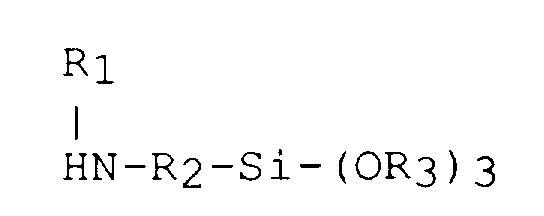 R₁ est un atome hydrogène ou un résidu hydrocarbure saturé ou un résidu hydrocarbure saturé, aminosubstitué, ayant de 2 ou 3 atomes de carbone;R₂ est un résidu hydrocarbure saturé ayant de 3 à 6 atomes de carbone; etR₃ est un résidu hydrocarbure saturé ayant de 1 à 4 atomes de carbone;ou un mélange de ces produits; etledit monomère arylalkoxysilane ou arylsilazane est représenté par la formule R₄-Si-(Y)₃, dans laquelle R₄ est un groupe phényl non substitué ou substitué et Y est OR₆ ou N(R₇)₂, dans lequel R₆ est un résidu hydrocarbure saturé ayant de 1 à 4 atomes de carbone et R₇ est un atome hydrogène ou un résidu hydrocarbure saturé ayant de 1 à 4 atomes de carbone.
 - Procédé selon la revendication 5 ou la revendication 7, dans lequel ledit monomère aminotrialkoxysilane est choisi dans le groupe composé de γ-aminopropyltriméthoxysilane, γ-amino-propyltriéthoxysilane, N-β-(aminoéthyl)-γ-aminopropyltriméthoxysilane et N-β-(aminoéthyl)-γ-aminopropyltriéthoxysilane, et ledit monomère arylakkoxysilane est le phényltriéthoxysilane.
- Procédé selon la revendication 1 ou la revendication 7, dans lequel ladite surface est chauffée à une température comprise entre à peu près 85° et à peu près 150 °C pendant une période de temps d'à peu près 0,5 à à peu près 20 minutes, pour former ladite couche partiellement polymérisée, de préférence à une température comprise entre à peu près 90° et à peu près 110 °C, pendant une période d'à peu près 5 à à peu près 10 minutes, afin de former ladite couche partiellement polymérisée.
- Processus selon la revendication 1, dans lequel une solution comprenant de l'acide ou un ester polyamique biphénylènedianhydride-p-phénylènediamine est appliqué sur ladite couche partiellement polymérisée.
- Procédé selon la revendication 1, dans lequel une solution comprenant de l'acide ou un ester pyromellitique dianhydride-oxydianiline polyamique est appliqué à ladite couche partiellement polymérisée.
- Procédé selon la revendication 1 ou la revendication 5, dans lequel ladite étape de polymérisation simultanée est effectuée à une température dépassant à peu près 200 °C.
- Procédé selon la revendication 1, dans lequel ledit métal est choisi dans le groupe constitué du cuivre, aluminium, argent, chrome, plomb, étain, or, titane et tungstène.
Applications Claiming Priority (2)
| Application Number | Priority Date | Filing Date | Title |
|---|---|---|---|
| US07/604,702 US5114757A (en) | 1990-10-26 | 1990-10-26 | Enhancement of polyimide adhesion on reactive metals |
| US604702 | 1990-10-26 |
Publications (3)
| Publication Number | Publication Date |
|---|---|
| EP0487857A2 EP0487857A2 (fr) | 1992-06-03 |
| EP0487857A3 EP0487857A3 (en) | 1992-10-07 |
| EP0487857B1 true EP0487857B1 (fr) | 1996-03-20 |
Family
ID=24420676
Family Applications (1)
| Application Number | Title | Priority Date | Filing Date |
|---|---|---|---|
| EP91116498A Expired - Lifetime EP0487857B1 (fr) | 1990-10-26 | 1991-09-27 | Amélioration de l'adhésion de polyimide aux métaux réactifs |
Country Status (8)
| Country | Link |
|---|---|
| US (1) | US5114757A (fr) |
| EP (1) | EP0487857B1 (fr) |
| JP (1) | JPH0757814B2 (fr) |
| KR (1) | KR950000709B1 (fr) |
| CN (2) | CN1051169C (fr) |
| CA (1) | CA2051174C (fr) |
| DE (1) | DE69118119T2 (fr) |
| TW (1) | TW273566B (fr) |
Families Citing this family (52)
| Publication number | Priority date | Publication date | Assignee | Title |
|---|---|---|---|---|
| US5194928A (en) * | 1991-01-14 | 1993-03-16 | International Business Machines Corporation | Passivation of metal in metal/polyimide structure |
| US5397741A (en) * | 1993-03-29 | 1995-03-14 | International Business Machines Corporation | Process for metallized vias in polyimide |
| JP3395269B2 (ja) * | 1993-07-16 | 2003-04-07 | チッソ株式会社 | 低熱伝導率ポリイミドシロキサンフィルム |
| US5474956A (en) * | 1995-03-14 | 1995-12-12 | Hughes Aircraft Company | Method of fabricating metallized substrates using an organic etch block layer |
| US5614324A (en) * | 1995-07-24 | 1997-03-25 | Gould Electronics Inc. | Multi-layer structures containing a silane adhesion promoting layer |
| US5760480A (en) * | 1995-09-20 | 1998-06-02 | Advanced Micro Devics, Inc. | Low RC interconnection |
| SE508280C2 (sv) * | 1997-01-31 | 1998-09-21 | Cuptronic Ab | Förfarande för att öka vidhäftningsförmågan hos ledande material till ytskikt av polymermaterial |
| US6303278B1 (en) | 1997-01-31 | 2001-10-16 | Cuptronic Ab | Method of applying metal layers in distinct patterns |
| US6121159A (en) * | 1997-06-19 | 2000-09-19 | Lsi Logic Corporation | Polymeric dielectric layers having low dielectric constants and improved adhesion to metal lines |
| US6303525B1 (en) * | 2000-08-18 | 2001-10-16 | Philips Electronics No. America Corp. | Method and structure for adhering MSQ material to liner oxide |
| US20040161545A1 (en) * | 2000-11-28 | 2004-08-19 | Shipley Company, L.L.C. | Adhesion method |
| US6585607B2 (en) * | 2001-06-20 | 2003-07-01 | Spalding Sports Worldwide, Inc. | Adhesion process |
| JP3952196B2 (ja) * | 2003-06-25 | 2007-08-01 | 信越化学工業株式会社 | フレキシブル金属箔ポリイミド積層板の製造方法 |
| JP4734837B2 (ja) * | 2004-03-23 | 2011-07-27 | 宇部興産株式会社 | 接着性の改良されたポリイミドフィルム、その製造方法および積層体 |
| KR100652863B1 (ko) * | 2005-01-20 | 2006-12-01 | 부산대학교 산학협력단 | 실리카-폴리이미드 하이브리드 및 그 제조방법 |
| DK2004907T3 (da) * | 2006-04-10 | 2009-10-19 | Linea Tergi Ltd | Fremgangsmåde til påföring af et metal på papir |
| DE602007001344D1 (de) * | 2006-04-10 | 2009-07-30 | Linea Tergi Ltd | Verfahren zur applizierung eines metalls auf ein substrat |
| TWI443167B (zh) * | 2008-02-19 | 2014-07-01 | Lintec Corp | And a polyorganosiloxane compound as a main component |
| KR101543478B1 (ko) * | 2010-12-31 | 2015-08-10 | 코오롱인더스트리 주식회사 | 투명 폴리이미드 필름 및 그 제조방법 |
| US9517966B2 (en) | 2011-10-25 | 2016-12-13 | Corning Incorporated | Glass compositions with improved chemical and mechanical durability |
| US11707408B2 (en) | 2011-10-25 | 2023-07-25 | Corning Incorporated | Delamination resistant pharmaceutical glass containers containing active pharmaceutical ingredients |
| MX366947B (es) | 2011-10-25 | 2019-07-30 | Corning Inc | Composiciones de vidrio de aluminosilicato alcalinoterreo con durabilidad quimica y mecanica mejorada. |
| US10350139B2 (en) | 2011-10-25 | 2019-07-16 | Corning Incorporated | Pharmaceutical glass packaging assuring pharmaceutical sterility |
| EP3305737B1 (fr) | 2011-10-25 | 2020-02-12 | Corning Incorporated | Compositions de verre présentant une meilleure durabilité chimique et mécanique |
| US10737973B2 (en) | 2012-02-28 | 2020-08-11 | Corning Incorporated | Pharmaceutical glass coating for achieving particle reduction |
| BR112014021321B1 (pt) | 2012-02-28 | 2021-05-25 | Corning Incorporated | artigos de vidro com revestimento de baixa fricção |
| US11497681B2 (en) | 2012-02-28 | 2022-11-15 | Corning Incorporated | Glass articles with low-friction coatings |
| US10273048B2 (en) | 2012-06-07 | 2019-04-30 | Corning Incorporated | Delamination resistant glass containers with heat-tolerant coatings |
| TWI600626B (zh) | 2012-06-07 | 2017-10-01 | 康寧公司 | 抗脫層的玻璃容器 |
| US9034442B2 (en) | 2012-11-30 | 2015-05-19 | Corning Incorporated | Strengthened borosilicate glass containers with improved damage tolerance |
| US10117806B2 (en) | 2012-11-30 | 2018-11-06 | Corning Incorporated | Strengthened glass containers resistant to delamination and damage |
| US9717649B2 (en) | 2013-04-24 | 2017-08-01 | Corning Incorporated | Delamination resistant pharmaceutical glass containers containing active pharmaceutical ingredients |
| US9849066B2 (en) | 2013-04-24 | 2017-12-26 | Corning Incorporated | Delamination resistant pharmaceutical glass containers containing active pharmaceutical ingredients |
| US9700486B2 (en) | 2013-04-24 | 2017-07-11 | Corning Incorporated | Delamination resistant pharmaceutical glass containers containing active pharmaceutical ingredients |
| US9707155B2 (en) | 2013-04-24 | 2017-07-18 | Corning Incorporated | Delamination resistant pharmaceutical glass containers containing active pharmaceutical ingredients |
| US9707154B2 (en) | 2013-04-24 | 2017-07-18 | Corning Incorporated | Delamination resistant pharmaceutical glass containers containing active pharmaceutical ingredients |
| US9700485B2 (en) | 2013-04-24 | 2017-07-11 | Corning Incorporated | Delamination resistant pharmaceutical glass containers containing active pharmaceutical ingredients |
| US9717648B2 (en) | 2013-04-24 | 2017-08-01 | Corning Incorporated | Delamination resistant pharmaceutical glass containers containing active pharmaceutical ingredients |
| US9707153B2 (en) | 2013-04-24 | 2017-07-18 | Corning Incorporated | Delamination resistant pharmaceutical glass containers containing active pharmaceutical ingredients |
| US9839579B2 (en) | 2013-04-24 | 2017-12-12 | Corning Incorporated | Delamination resistant pharmaceutical glass containers containing active pharmaceutical ingredients |
| US9713572B2 (en) | 2013-04-24 | 2017-07-25 | Corning Incorporated | Delamination resistant pharmaceutical glass containers containing active pharmaceutical ingredients |
| US9603775B2 (en) | 2013-04-24 | 2017-03-28 | Corning Incorporated | Delamination resistant pharmaceutical glass containers containing active pharmaceutical ingredients |
| CN104261344B (zh) * | 2014-09-04 | 2016-06-29 | 北方广微科技有限公司 | 聚酰亚胺涂布及烘烤方法 |
| MX2017002898A (es) | 2014-09-05 | 2017-10-11 | Corning Inc | Artículos de vidrio y métodos para mejorar la confiabilidad de artículos de vidrio. |
| US10065884B2 (en) | 2014-11-26 | 2018-09-04 | Corning Incorporated | Methods for producing strengthened and durable glass containers |
| JP6479463B2 (ja) * | 2014-12-26 | 2019-03-06 | 日鉄ケミカル&マテリアル株式会社 | ポリイミドフィルム積層体 |
| RU2709088C2 (ru) * | 2015-04-30 | 2019-12-13 | Колопласт А/С | Адгезивная композиция |
| EP3150564B1 (fr) | 2015-09-30 | 2018-12-05 | Corning Incorporated | Compositions chimiques à base de polyimide-siloxane halogéné et articles en verre avec des revêtements à faible frottement en polylmide-siloxane halogéné |
| TWI825443B (zh) | 2015-10-30 | 2023-12-11 | 美商康寧公司 | 具有混合的聚合物及金屬氧化物塗層的玻璃製品 |
| CN110859029B (zh) * | 2018-08-23 | 2022-04-01 | 鹏鼎控股(深圳)股份有限公司 | 柔性电路板及该柔性电路板制作方法 |
| JP7822561B2 (ja) | 2020-09-04 | 2026-03-03 | コーニング インコーポレイテッド | 紫外光を遮断するコーティングされた医薬品包装 |
| CN120209298B (zh) * | 2025-05-26 | 2025-08-29 | 烟台泰和新材高分子新材料研究院有限公司 | 一种改性对位芳纶原液、制备方法及其对位芳纶纤维 |
Family Cites Families (17)
| Publication number | Priority date | Publication date | Assignee | Title |
|---|---|---|---|---|
| US473978A (en) * | 1892-05-03 | Hame-tug clip | ||
| US494006A (en) * | 1893-03-21 | Shutter-worker | ||
| US3179614A (en) * | 1961-03-13 | 1965-04-20 | Du Pont | Polyamide-acids, compositions thereof, and process for their preparation |
| US3264250A (en) * | 1963-12-18 | 1966-08-02 | Du Pont | Copolymeric polyamide-acids and polyimides |
| US3520683A (en) * | 1967-05-19 | 1970-07-14 | Bell Telephone Labor Inc | Photoresist method and products produced thereby |
| US3684592A (en) * | 1969-09-30 | 1972-08-15 | Westinghouse Electric Corp | Passivated surfaces and protective coatings for semiconductor devices and processes for producing the same |
| US4103045A (en) * | 1972-07-31 | 1978-07-25 | Rhone-Poulenc, S.A. | Process for improving the adhesion of coatings made of photoresistant polymers to surfaces of inorganic oxides |
| US4030948A (en) * | 1975-07-21 | 1977-06-21 | Abe Berger | Polyimide containing silicones as protective coating on semiconductor device |
| DE3278567D1 (en) * | 1981-10-03 | 1988-07-07 | Japan Synthetic Rubber Co Ltd | Solvent-soluble organopolysilsesquioxanes, processes for producing the same, and compositions and semiconductor devices using the same |
| NL8203980A (nl) * | 1982-10-15 | 1984-05-01 | Philips Nv | Werkwijze voor de fotolithografische behandeling van een substraat. |
| US4590258A (en) * | 1983-12-30 | 1986-05-20 | International Business Machines Corporation | Polyamic acid copolymer system for improved semiconductor manufacturing |
| US4758476A (en) * | 1984-12-12 | 1988-07-19 | Hitachi Chemical Company, Ltd. | Polyimide precursor resin composition and semiconductor device using the same |
| US4612210A (en) * | 1985-07-25 | 1986-09-16 | International Business Machines Corporation | Process for planarizing a substrate |
| US4786569A (en) * | 1985-09-04 | 1988-11-22 | Ciba-Geigy Corporation | Adhesively bonded photostructurable polyimide film |
| US4723978A (en) * | 1985-10-31 | 1988-02-09 | International Business Machines Corporation | Method for a plasma-treated polysiloxane coating |
| JPH0791509B2 (ja) * | 1985-12-17 | 1995-10-04 | 住友化学工業株式会社 | 半導体用絶縁膜形成塗布液 |
| US4782009A (en) * | 1987-04-03 | 1988-11-01 | General Electric Company | Method of coating and imaging photopatternable silicone polyamic acid |
-
1990
- 1990-10-26 US US07/604,702 patent/US5114757A/en not_active Expired - Fee Related
-
1991
- 1991-07-03 JP JP3162836A patent/JPH0757814B2/ja not_active Expired - Fee Related
- 1991-09-11 CA CA002051174A patent/CA2051174C/fr not_active Expired - Fee Related
- 1991-09-27 EP EP91116498A patent/EP0487857B1/fr not_active Expired - Lifetime
- 1991-09-27 DE DE69118119T patent/DE69118119T2/de not_active Expired - Fee Related
- 1991-09-30 KR KR1019910017070A patent/KR950000709B1/ko not_active Expired - Fee Related
- 1991-10-12 CN CN91109639A patent/CN1051169C/zh not_active Expired - Fee Related
-
1992
- 1992-03-21 TW TW081102146A patent/TW273566B/zh active
-
1998
- 1998-11-06 CN CN98123868A patent/CN1087761C/zh not_active Expired - Fee Related
Non-Patent Citations (1)
| Title |
|---|
| IBM TECHNICAL DISCLOSURE BULLETIN. vol. 24, no. 11B, April 1982, NEW YORK US page 4720; ANDERSON ET AL.:'Thermal stability enhacement of solution-deposited aminosilanes' page 592; ANDERSON et al.:'Thermal stability enhancement of solution-deposited aminosilanes" * |
Also Published As
| Publication number | Publication date |
|---|---|
| CN1231319A (zh) | 1999-10-13 |
| CA2051174C (fr) | 1994-05-31 |
| DE69118119T2 (de) | 1996-10-02 |
| EP0487857A3 (en) | 1992-10-07 |
| US5114757A (en) | 1992-05-19 |
| JPH05222193A (ja) | 1993-08-31 |
| DE69118119D1 (de) | 1996-04-25 |
| TW273566B (fr) | 1996-04-01 |
| KR950000709B1 (ko) | 1995-01-27 |
| JPH0757814B2 (ja) | 1995-06-21 |
| CN1060861A (zh) | 1992-05-06 |
| CN1087761C (zh) | 2002-07-17 |
| CN1051169C (zh) | 2000-04-05 |
| EP0487857A2 (fr) | 1992-06-03 |
| CA2051174A1 (fr) | 1992-04-27 |
| KR920008165A (ko) | 1992-05-27 |
Similar Documents
| Publication | Publication Date | Title |
|---|---|---|
| US5114757A (en) | Enhancement of polyimide adhesion on reactive metals | |
| US5194928A (en) | Passivation of metal in metal/polyimide structure | |
| US5043789A (en) | Planarizing silsesquioxane copolymer coating | |
| US5137751A (en) | Process for making thick multilayers of polyimide | |
| US5145723A (en) | Process for coating a substrate with silica | |
| US4981530A (en) | Planarizing ladder-type silsesquioxane polymer insulation layer | |
| JPH04224824A (ja) | 低tceポリイミド | |
| JPH06191970A (ja) | シリカ含有セラミックコーティングの形成方法 | |
| US5114754A (en) | Passivation of metal in metal/polyimide structures | |
| JP2001098224A (ja) | シリカ系被膜、シリカ系被膜の形成方法及びシリカ系被膜を有する電子部品 | |
| JP2001098218A (ja) | シリカ系被膜、シリカ系被膜の形成方法及びシリカ系被膜を有する電子部品 | |
| US6656313B2 (en) | Structure and method for improved adhesion between two polymer films | |
| EP0448248B1 (fr) | Procédé de fabrication de multicouches épais de polyimide | |
| US5286572A (en) | Planarizing ladder-type silsequioxane polymer insulation layer | |
| US5063115A (en) | Electronic device coated with a polyimide coating composition | |
| JP2631878B2 (ja) | ポリイミドシロキサン組成物および膜 | |
| JPH07307114A (ja) | ポリイミド絶縁膜の形成方法 | |
| JPH07116360B2 (ja) | ポリイミドコ−テイング剤組成物 | |
| JPH0834957A (ja) | 酸化物被膜形成用塗布液、酸化物被膜の製造法および半導体装置 | |
| KR100230729B1 (ko) | 폴리이미드-형성 출발물질의 용액 | |
| JP2013193229A (ja) | ポリイミド積層体の製造方法 | |
| JP2001118840A (ja) | 半導体装置用樹脂膜およびその形成方法 | |
| JPH0834202B2 (ja) | 半導体素子の製造方法 | |
| JPH1020498A (ja) | 多層配線構造の製造法および半導体装置 | |
| JPH03243624A (ja) | 半導体保護用樹脂 |
Legal Events
| Date | Code | Title | Description |
|---|---|---|---|
| PUAI | Public reference made under article 153(3) epc to a published international application that has entered the european phase |
Free format text: ORIGINAL CODE: 0009012 |
|
| AK | Designated contracting states |
Kind code of ref document: A2 Designated state(s): DE FR GB IT |
|
| PUAL | Search report despatched |
Free format text: ORIGINAL CODE: 0009013 |
|
| AK | Designated contracting states |
Kind code of ref document: A3 Designated state(s): DE FR GB IT |
|
| 17P | Request for examination filed |
Effective date: 19920817 |
|
| 17Q | First examination report despatched |
Effective date: 19940829 |
|
| GRAA | (expected) grant |
Free format text: ORIGINAL CODE: 0009210 |
|
| AK | Designated contracting states |
Kind code of ref document: B1 Designated state(s): DE FR GB IT |
|
| PG25 | Lapsed in a contracting state [announced via postgrant information from national office to epo] |
Ref country code: IT Free format text: LAPSE BECAUSE OF FAILURE TO SUBMIT A TRANSLATION OF THE DESCRIPTION OR TO PAY THE FEE WITHIN THE PRESCRIBED TIME-LIMIT;WARNING: LAPSES OF ITALIAN PATENTS WITH EFFECTIVE DATE BEFORE 2007 MAY HAVE OCCURRED AT ANY TIME BEFORE 2007. THE CORRECT EFFECTIVE DATE MAY BE DIFFERENT FROM THE ONE RECORDED. Effective date: 19960320 |
|
| REF | Corresponds to: |
Ref document number: 69118119 Country of ref document: DE Date of ref document: 19960425 |
|
| ET | Fr: translation filed | ||
| PLBE | No opposition filed within time limit |
Free format text: ORIGINAL CODE: 0009261 |
|
| STAA | Information on the status of an ep patent application or granted ep patent |
Free format text: STATUS: NO OPPOSITION FILED WITHIN TIME LIMIT |
|
| 26N | No opposition filed | ||
| PG25 | Lapsed in a contracting state [announced via postgrant information from national office to epo] |
Ref country code: DE Effective date: 19970603 |
|
| PG25 | Lapsed in a contracting state [announced via postgrant information from national office to epo] |
Ref country code: FR Effective date: 19970630 |
|
| REG | Reference to a national code |
Ref country code: FR Ref legal event code: ST |
|
| REG | Reference to a national code |
Ref country code: FR Ref legal event code: ST |
|
| PGFP | Annual fee paid to national office [announced via postgrant information from national office to epo] |
Ref country code: GB Payment date: 19990826 Year of fee payment: 9 |
|
| PG25 | Lapsed in a contracting state [announced via postgrant information from national office to epo] |
Ref country code: GB Free format text: LAPSE BECAUSE OF NON-PAYMENT OF DUE FEES Effective date: 20000927 |
|
| GBPC | Gb: european patent ceased through non-payment of renewal fee |
Effective date: 20000927 |