EP0488414A1 - Toner pour développer une image électrostatique et procédé pour sa fabrication - Google Patents
Toner pour développer une image électrostatique et procédé pour sa fabrication Download PDFInfo
- Publication number
- EP0488414A1 EP0488414A1 EP91120620A EP91120620A EP0488414A1 EP 0488414 A1 EP0488414 A1 EP 0488414A1 EP 91120620 A EP91120620 A EP 91120620A EP 91120620 A EP91120620 A EP 91120620A EP 0488414 A1 EP0488414 A1 EP 0488414A1
- Authority
- EP
- European Patent Office
- Prior art keywords
- molecular weight
- binder resin
- toner
- resin
- toner according
- Prior art date
- Legal status (The legal status is an assumption and is not a legal conclusion. Google has not performed a legal analysis and makes no representation as to the accuracy of the status listed.)
- Granted
Links
- 238000000034 method Methods 0.000 title claims description 35
- 230000008569 process Effects 0.000 title claims description 20
- 238000004519 manufacturing process Methods 0.000 title abstract description 23
- 229920005989 resin Polymers 0.000 claims abstract description 183
- 239000011347 resin Substances 0.000 claims abstract description 183
- 239000011230 binding agent Substances 0.000 claims abstract description 102
- 239000002253 acid Substances 0.000 claims abstract description 69
- 239000000203 mixture Substances 0.000 claims abstract description 52
- WYURNTSHIVDZCO-UHFFFAOYSA-N Tetrahydrofuran Chemical compound C1CCOC1 WYURNTSHIVDZCO-UHFFFAOYSA-N 0.000 claims abstract description 49
- 238000009826 distribution Methods 0.000 claims abstract description 32
- YLQBMQCUIZJEEH-UHFFFAOYSA-N tetrahydrofuran Natural products C=1C=COC=1 YLQBMQCUIZJEEH-UHFFFAOYSA-N 0.000 claims abstract description 24
- 238000004898 kneading Methods 0.000 claims abstract description 18
- 239000003086 colorant Substances 0.000 claims abstract description 17
- 229920001577 copolymer Polymers 0.000 claims description 60
- 239000011342 resin composition Substances 0.000 claims description 41
- 125000000391 vinyl group Chemical group [H]C([*])=C([H])[H] 0.000 claims description 32
- PPBRXRYQALVLMV-UHFFFAOYSA-N Styrene Natural products C=CC1=CC=CC=C1 PPBRXRYQALVLMV-UHFFFAOYSA-N 0.000 claims description 31
- 229910052751 metal Inorganic materials 0.000 claims description 29
- 150000002736 metal compounds Chemical class 0.000 claims description 29
- 229920002554 vinyl polymer Polymers 0.000 claims description 29
- 239000002184 metal Substances 0.000 claims description 25
- -1 azo metal complex Chemical class 0.000 claims description 17
- 125000003178 carboxy group Chemical group [H]OC(*)=O 0.000 claims description 17
- 229920006163 vinyl copolymer Polymers 0.000 claims description 15
- 238000010438 heat treatment Methods 0.000 claims description 11
- 239000000696 magnetic material Substances 0.000 claims description 11
- 125000004018 acid anhydride group Chemical group 0.000 claims description 10
- 125000000217 alkyl group Chemical group 0.000 claims description 10
- 239000001257 hydrogen Substances 0.000 claims description 9
- 229910052739 hydrogen Inorganic materials 0.000 claims description 9
- 238000010008 shearing Methods 0.000 claims description 9
- MYRTYDVEIRVNKP-UHFFFAOYSA-N 1,2-Divinylbenzene Chemical compound C=CC1=CC=CC=C1C=C MYRTYDVEIRVNKP-UHFFFAOYSA-N 0.000 claims description 8
- QGZKDVFQNNGYKY-UHFFFAOYSA-O Ammonium Chemical compound [NH4+] QGZKDVFQNNGYKY-UHFFFAOYSA-O 0.000 claims description 8
- 125000004435 hydrogen atom Chemical class [H]* 0.000 claims description 8
- 238000010298 pulverizing process Methods 0.000 claims description 8
- 230000009471 action Effects 0.000 claims description 7
- 229910021645 metal ion Inorganic materials 0.000 claims description 7
- 239000003431 cross linking reagent Substances 0.000 claims description 6
- 125000003118 aryl group Chemical group 0.000 claims description 5
- 238000001816 cooling Methods 0.000 claims description 5
- 150000002500 ions Chemical class 0.000 claims description 5
- 229910052742 iron Inorganic materials 0.000 claims description 5
- 238000002156 mixing Methods 0.000 claims description 5
- 229910052759 nickel Inorganic materials 0.000 claims description 5
- DGAQECJNVWCQMB-PUAWFVPOSA-M Ilexoside XXIX Chemical compound C[C@@H]1CC[C@@]2(CC[C@@]3(C(=CC[C@H]4[C@]3(CC[C@@H]5[C@@]4(CC[C@@H](C5(C)C)OS(=O)(=O)[O-])C)C)[C@@H]2[C@]1(C)O)C)C(=O)O[C@H]6[C@@H]([C@H]([C@@H]([C@H](O6)CO)O)O)O.[Na+] DGAQECJNVWCQMB-PUAWFVPOSA-M 0.000 claims description 4
- ZLMJMSJWJFRBEC-UHFFFAOYSA-N Potassium Chemical compound [K] ZLMJMSJWJFRBEC-UHFFFAOYSA-N 0.000 claims description 4
- 125000001931 aliphatic group Chemical group 0.000 claims description 4
- 125000004432 carbon atom Chemical group C* 0.000 claims description 4
- 229910052804 chromium Inorganic materials 0.000 claims description 4
- 229910052736 halogen Inorganic materials 0.000 claims description 4
- 150000002367 halogens Chemical class 0.000 claims description 4
- 125000000449 nitro group Chemical group [O-][N+](*)=O 0.000 claims description 4
- 239000011591 potassium Substances 0.000 claims description 4
- 229910052700 potassium Inorganic materials 0.000 claims description 4
- 239000011734 sodium Substances 0.000 claims description 4
- 229910052708 sodium Inorganic materials 0.000 claims description 4
- 125000001424 substituent group Chemical group 0.000 claims description 4
- 229910052727 yttrium Inorganic materials 0.000 claims description 4
- 239000006229 carbon black Substances 0.000 claims description 3
- 239000011874 heated mixture Substances 0.000 claims description 3
- 239000011148 porous material Substances 0.000 claims description 3
- 229910052719 titanium Inorganic materials 0.000 claims description 3
- 229910052720 vanadium Inorganic materials 0.000 claims description 3
- 125000003342 alkenyl group Chemical group 0.000 claims description 2
- 125000003545 alkoxy group Chemical group 0.000 claims description 2
- 150000003931 anilides Chemical class 0.000 claims description 2
- 125000001624 naphthyl group Chemical group 0.000 claims description 2
- 125000001997 phenyl group Chemical group [H]C1=C([H])C([H])=C(*)C([H])=C1[H] 0.000 claims description 2
- 229910052706 scandium Inorganic materials 0.000 claims description 2
- 239000000126 substance Substances 0.000 claims description 2
- DTCCVIYSGXONHU-CJHDCQNGSA-N (z)-2-(2-phenylethenyl)but-2-enedioic acid Chemical compound OC(=O)\C=C(C(O)=O)\C=CC1=CC=CC=C1 DTCCVIYSGXONHU-CJHDCQNGSA-N 0.000 claims 3
- 238000001914 filtration Methods 0.000 claims 2
- PYSRRFNXTXNWCD-UHFFFAOYSA-N 3-(2-phenylethenyl)furan-2,5-dione Chemical compound O=C1OC(=O)C(C=CC=2C=CC=CC=2)=C1 PYSRRFNXTXNWCD-UHFFFAOYSA-N 0.000 claims 1
- 229920000147 Styrene maleic anhydride Polymers 0.000 claims 1
- 229920000642 polymer Polymers 0.000 description 47
- 239000000178 monomer Substances 0.000 description 43
- YXFVVABEGXRONW-UHFFFAOYSA-N Toluene Chemical compound CC1=CC=CC=C1 YXFVVABEGXRONW-UHFFFAOYSA-N 0.000 description 42
- 238000005227 gel permeation chromatography Methods 0.000 description 38
- RWGFKTVRMDUZSP-UHFFFAOYSA-N cumene Chemical compound CC(C)C1=CC=CC=C1 RWGFKTVRMDUZSP-UHFFFAOYSA-N 0.000 description 35
- 238000006243 chemical reaction Methods 0.000 description 29
- 239000000843 powder Substances 0.000 description 26
- 238000004132 cross linking Methods 0.000 description 23
- XLYOFNOQVPJJNP-UHFFFAOYSA-N water Substances O XLYOFNOQVPJJNP-UHFFFAOYSA-N 0.000 description 22
- 238000010528 free radical solution polymerization reaction Methods 0.000 description 20
- 239000002245 particle Substances 0.000 description 20
- 238000010557 suspension polymerization reaction Methods 0.000 description 20
- 239000007788 liquid Substances 0.000 description 18
- 238000010992 reflux Methods 0.000 description 18
- IJGRMHOSHXDMSA-UHFFFAOYSA-N Atomic nitrogen Chemical compound N#N IJGRMHOSHXDMSA-UHFFFAOYSA-N 0.000 description 16
- VYPSYNLAJGMNEJ-UHFFFAOYSA-N Silicium dioxide Chemical compound O=[Si]=O VYPSYNLAJGMNEJ-UHFFFAOYSA-N 0.000 description 16
- 150000008064 anhydrides Chemical class 0.000 description 16
- 230000015572 biosynthetic process Effects 0.000 description 16
- 239000003795 chemical substances by application Substances 0.000 description 15
- 150000001875 compounds Chemical class 0.000 description 15
- 239000000047 product Substances 0.000 description 15
- 239000000523 sample Substances 0.000 description 15
- 239000000725 suspension Substances 0.000 description 15
- 239000000243 solution Substances 0.000 description 14
- 238000006116 polymerization reaction Methods 0.000 description 13
- OFOBLEOULBTSOW-UHFFFAOYSA-N Malonic acid Chemical compound OC(=O)CC(O)=O OFOBLEOULBTSOW-UHFFFAOYSA-N 0.000 description 10
- 239000002904 solvent Substances 0.000 description 10
- 239000004372 Polyvinyl alcohol Substances 0.000 description 9
- 238000005259 measurement Methods 0.000 description 9
- 229920002451 polyvinyl alcohol Polymers 0.000 description 9
- LFQSCWFLJHTTHZ-UHFFFAOYSA-N Ethanol Chemical compound CCO LFQSCWFLJHTTHZ-UHFFFAOYSA-N 0.000 description 8
- 150000007513 acids Chemical class 0.000 description 8
- 239000008119 colloidal silica Substances 0.000 description 8
- 125000001142 dicarboxylic acid group Chemical group 0.000 description 8
- 239000004615 ingredient Substances 0.000 description 8
- 229910052757 nitrogen Inorganic materials 0.000 description 8
- 239000011369 resultant mixture Substances 0.000 description 8
- 238000012662 bulk polymerization Methods 0.000 description 7
- 125000004386 diacrylate group Chemical group 0.000 description 7
- 238000011156 evaluation Methods 0.000 description 7
- 230000006872 improvement Effects 0.000 description 7
- 238000010186 staining Methods 0.000 description 7
- 150000008065 acid anhydrides Chemical class 0.000 description 6
- 150000004696 coordination complex Chemical class 0.000 description 6
- 239000000975 dye Substances 0.000 description 6
- 238000007720 emulsion polymerization reaction Methods 0.000 description 6
- 239000011572 manganese Substances 0.000 description 6
- 239000000463 material Substances 0.000 description 6
- 239000000049 pigment Substances 0.000 description 6
- 238000003786 synthesis reaction Methods 0.000 description 6
- UHOVQNZJYSORNB-UHFFFAOYSA-N Benzene Chemical compound C1=CC=CC=C1 UHOVQNZJYSORNB-UHFFFAOYSA-N 0.000 description 5
- NIXOWILDQLNWCW-UHFFFAOYSA-M acrylate group Chemical group C(C=C)(=O)[O-] NIXOWILDQLNWCW-UHFFFAOYSA-M 0.000 description 5
- 239000000654 additive Substances 0.000 description 5
- 238000004140 cleaning Methods 0.000 description 5
- 229920006037 cross link polymer Polymers 0.000 description 5
- 230000000694 effects Effects 0.000 description 5
- 230000009477 glass transition Effects 0.000 description 5
- XEEYBQQBJWHFJM-UHFFFAOYSA-N iron Substances [Fe] XEEYBQQBJWHFJM-UHFFFAOYSA-N 0.000 description 5
- 238000002844 melting Methods 0.000 description 5
- PXHVJJICTQNCMI-UHFFFAOYSA-N nickel Substances [Ni] PXHVJJICTQNCMI-UHFFFAOYSA-N 0.000 description 5
- 239000003505 polymerization initiator Substances 0.000 description 5
- VZCYOOQTPOCHFL-OWOJBTEDSA-N Fumaric acid Chemical compound OC(=O)\C=C\C(O)=O VZCYOOQTPOCHFL-OWOJBTEDSA-N 0.000 description 4
- 239000004793 Polystyrene Substances 0.000 description 4
- 238000010521 absorption reaction Methods 0.000 description 4
- YRKCREAYFQTBPV-UHFFFAOYSA-N acetylacetone Chemical compound CC(=O)CC(C)=O YRKCREAYFQTBPV-UHFFFAOYSA-N 0.000 description 4
- 238000011161 development Methods 0.000 description 4
- 239000006185 dispersion Substances 0.000 description 4
- 150000002148 esters Chemical class 0.000 description 4
- 230000007062 hydrolysis Effects 0.000 description 4
- 238000006460 hydrolysis reaction Methods 0.000 description 4
- 230000008018 melting Effects 0.000 description 4
- CERQOIWHTDAKMF-UHFFFAOYSA-M methacrylate group Chemical group C(C(=C)C)(=O)[O-] CERQOIWHTDAKMF-UHFFFAOYSA-M 0.000 description 4
- KJFMBFZCATUALV-UHFFFAOYSA-N phenolphthalein Chemical compound C1=CC(O)=CC=C1C1(C=2C=CC(O)=CC=2)C2=CC=CC=C2C(=O)O1 KJFMBFZCATUALV-UHFFFAOYSA-N 0.000 description 4
- 229920002223 polystyrene Polymers 0.000 description 4
- 238000003825 pressing Methods 0.000 description 4
- 238000007639 printing Methods 0.000 description 4
- 238000007142 ring opening reaction Methods 0.000 description 4
- YGSDEFSMJLZEOE-UHFFFAOYSA-N salicylic acid Chemical compound OC(=O)C1=CC=CC=C1O YGSDEFSMJLZEOE-UHFFFAOYSA-N 0.000 description 4
- 150000003839 salts Chemical class 0.000 description 4
- 239000000377 silicon dioxide Substances 0.000 description 4
- 241000894007 species Species 0.000 description 4
- VZCYOOQTPOCHFL-UHFFFAOYSA-N trans-butenedioic acid Natural products OC(=O)C=CC(O)=O VZCYOOQTPOCHFL-UHFFFAOYSA-N 0.000 description 4
- 238000012546 transfer Methods 0.000 description 4
- KFZMGEQAYNKOFK-UHFFFAOYSA-N Isopropanol Chemical compound CC(C)O KFZMGEQAYNKOFK-UHFFFAOYSA-N 0.000 description 3
- OKKJLVBELUTLKV-UHFFFAOYSA-N Methanol Chemical compound OC OKKJLVBELUTLKV-UHFFFAOYSA-N 0.000 description 3
- 150000001252 acrylic acid derivatives Chemical class 0.000 description 3
- 239000012736 aqueous medium Substances 0.000 description 3
- 229940018560 citraconate Drugs 0.000 description 3
- RTZKZFJDLAIYFH-UHFFFAOYSA-N ether Substances CCOCC RTZKZFJDLAIYFH-UHFFFAOYSA-N 0.000 description 3
- 125000000524 functional group Chemical group 0.000 description 3
- 239000002609 medium Substances 0.000 description 3
- 150000002739 metals Chemical class 0.000 description 3
- 239000012071 phase Substances 0.000 description 3
- 238000002360 preparation method Methods 0.000 description 3
- 230000009257 reactivity Effects 0.000 description 3
- 239000012488 sample solution Substances 0.000 description 3
- UAJRSHJHFRVGMG-UHFFFAOYSA-N 1-ethenyl-4-methoxybenzene Chemical compound COC1=CC=C(C=C)C=C1 UAJRSHJHFRVGMG-UHFFFAOYSA-N 0.000 description 2
- LEJBBGNFPAFPKQ-UHFFFAOYSA-N 2-(2-prop-2-enoyloxyethoxy)ethyl prop-2-enoate Chemical compound C=CC(=O)OCCOCCOC(=O)C=C LEJBBGNFPAFPKQ-UHFFFAOYSA-N 0.000 description 2
- INQDDHNZXOAFFD-UHFFFAOYSA-N 2-[2-(2-prop-2-enoyloxyethoxy)ethoxy]ethyl prop-2-enoate Chemical compound C=CC(=O)OCCOCCOCCOC(=O)C=C INQDDHNZXOAFFD-UHFFFAOYSA-N 0.000 description 2
- HCLJOFJIQIJXHS-UHFFFAOYSA-N 2-[2-[2-(2-prop-2-enoyloxyethoxy)ethoxy]ethoxy]ethyl prop-2-enoate Chemical compound C=CC(=O)OCCOCCOCCOCCOC(=O)C=C HCLJOFJIQIJXHS-UHFFFAOYSA-N 0.000 description 2
- KUDUQBURMYMBIJ-UHFFFAOYSA-N 2-prop-2-enoyloxyethyl prop-2-enoate Chemical compound C=CC(=O)OCCOC(=O)C=C KUDUQBURMYMBIJ-UHFFFAOYSA-N 0.000 description 2
- ZGHFDIIVVIFNPS-UHFFFAOYSA-N 3-Methyl-3-buten-2-one Chemical compound CC(=C)C(C)=O ZGHFDIIVVIFNPS-UHFFFAOYSA-N 0.000 description 2
- CSCPPACGZOOCGX-UHFFFAOYSA-N Acetone Chemical compound CC(C)=O CSCPPACGZOOCGX-UHFFFAOYSA-N 0.000 description 2
- 239000004342 Benzoyl peroxide Substances 0.000 description 2
- OMPJBNCRMGITSC-UHFFFAOYSA-N Benzoylperoxide Chemical compound C=1C=CC=CC=1C(=O)OOC(=O)C1=CC=CC=C1 OMPJBNCRMGITSC-UHFFFAOYSA-N 0.000 description 2
- KAKZBPTYRLMSJV-UHFFFAOYSA-N Butadiene Chemical compound C=CC=C KAKZBPTYRLMSJV-UHFFFAOYSA-N 0.000 description 2
- SOGAXMICEFXMKE-UHFFFAOYSA-N Butylmethacrylate Chemical compound CCCCOC(=O)C(C)=C SOGAXMICEFXMKE-UHFFFAOYSA-N 0.000 description 2
- UQSXHKLRYXJYBZ-UHFFFAOYSA-N Iron oxide Chemical compound [Fe]=O UQSXHKLRYXJYBZ-UHFFFAOYSA-N 0.000 description 2
- CERQOIWHTDAKMF-UHFFFAOYSA-N Methacrylic acid Chemical class CC(=C)C(O)=O CERQOIWHTDAKMF-UHFFFAOYSA-N 0.000 description 2
- BAPJBEWLBFYGME-UHFFFAOYSA-N Methyl acrylate Chemical compound COC(=O)C=C BAPJBEWLBFYGME-UHFFFAOYSA-N 0.000 description 2
- CTQNGGLPUBDAKN-UHFFFAOYSA-N O-Xylene Chemical compound CC1=CC=CC=C1C CTQNGGLPUBDAKN-UHFFFAOYSA-N 0.000 description 2
- 239000002033 PVDF binder Substances 0.000 description 2
- 229920003171 Poly (ethylene oxide) Polymers 0.000 description 2
- 239000002202 Polyethylene glycol Substances 0.000 description 2
- JUJWROOIHBZHMG-UHFFFAOYSA-N Pyridine Chemical compound C1=CC=NC=C1 JUJWROOIHBZHMG-UHFFFAOYSA-N 0.000 description 2
- 239000006087 Silane Coupling Agent Substances 0.000 description 2
- FAPWRFPIFSIZLT-UHFFFAOYSA-M Sodium chloride Chemical compound [Na+].[Cl-] FAPWRFPIFSIZLT-UHFFFAOYSA-M 0.000 description 2
- XLOMVQKBTHCTTD-UHFFFAOYSA-N Zinc monoxide Chemical compound [Zn]=O XLOMVQKBTHCTTD-UHFFFAOYSA-N 0.000 description 2
- NIXOWILDQLNWCW-UHFFFAOYSA-N acrylic acid group Chemical group C(C=C)(=O)O NIXOWILDQLNWCW-UHFFFAOYSA-N 0.000 description 2
- 229910052782 aluminium Inorganic materials 0.000 description 2
- XAGFODPZIPBFFR-UHFFFAOYSA-N aluminium Chemical compound [Al] XAGFODPZIPBFFR-UHFFFAOYSA-N 0.000 description 2
- 239000008346 aqueous phase Substances 0.000 description 2
- 239000012298 atmosphere Substances 0.000 description 2
- 235000019400 benzoyl peroxide Nutrition 0.000 description 2
- 238000012661 block copolymerization Methods 0.000 description 2
- 238000011088 calibration curve Methods 0.000 description 2
- 229910017052 cobalt Inorganic materials 0.000 description 2
- 239000010941 cobalt Substances 0.000 description 2
- GUTLYIVDDKVIGB-UHFFFAOYSA-N cobalt atom Chemical compound [Co] GUTLYIVDDKVIGB-UHFFFAOYSA-N 0.000 description 2
- 230000008094 contradictory effect Effects 0.000 description 2
- 230000007423 decrease Effects 0.000 description 2
- 239000003995 emulsifying agent Substances 0.000 description 2
- FJKIXWOMBXYWOQ-UHFFFAOYSA-N ethenoxyethane Chemical compound CCOC=C FJKIXWOMBXYWOQ-UHFFFAOYSA-N 0.000 description 2
- 239000010419 fine particle Substances 0.000 description 2
- 239000001530 fumaric acid Substances 0.000 description 2
- NKHAVTQWNUWKEO-UHFFFAOYSA-N fumaric acid monomethyl ester Natural products COC(=O)C=CC(O)=O NKHAVTQWNUWKEO-UHFFFAOYSA-N 0.000 description 2
- 238000010559 graft polymerization reaction Methods 0.000 description 2
- 230000005415 magnetization Effects 0.000 description 2
- VZCYOOQTPOCHFL-UPHRSURJSA-N maleic acid Chemical compound OC(=O)\C=C/C(O)=O VZCYOOQTPOCHFL-UPHRSURJSA-N 0.000 description 2
- 239000011976 maleic acid Substances 0.000 description 2
- 229910052748 manganese Inorganic materials 0.000 description 2
- 150000002734 metacrylic acid derivatives Chemical class 0.000 description 2
- NYGZLYXAPMMJTE-UHFFFAOYSA-M metanil yellow Chemical group [Na+].[O-]S(=O)(=O)C1=CC=CC(N=NC=2C=CC(NC=3C=CC=CC=3)=CC=2)=C1 NYGZLYXAPMMJTE-UHFFFAOYSA-M 0.000 description 2
- 150000002894 organic compounds Chemical class 0.000 description 2
- FJKROLUGYXJWQN-UHFFFAOYSA-N papa-hydroxy-benzoic acid Natural products OC(=O)C1=CC=C(O)C=C1 FJKROLUGYXJWQN-UHFFFAOYSA-N 0.000 description 2
- 230000000704 physical effect Effects 0.000 description 2
- 229920001223 polyethylene glycol Polymers 0.000 description 2
- 229920001296 polysiloxane Polymers 0.000 description 2
- 229920002981 polyvinylidene fluoride Polymers 0.000 description 2
- SMQUZDBALVYZAC-UHFFFAOYSA-N salicylaldehyde Chemical compound OC1=CC=CC=C1C=O SMQUZDBALVYZAC-UHFFFAOYSA-N 0.000 description 2
- 229960004889 salicylic acid Drugs 0.000 description 2
- 229920002545 silicone oil Polymers 0.000 description 2
- 238000003756 stirring Methods 0.000 description 2
- 238000003860 storage Methods 0.000 description 2
- VEALVRVVWBQVSL-UHFFFAOYSA-N strontium titanate Chemical compound [Sr+2].[O-][Ti]([O-])=O VEALVRVVWBQVSL-UHFFFAOYSA-N 0.000 description 2
- KDYFGRWQOYBRFD-UHFFFAOYSA-N succinic acid Chemical compound OC(=O)CCC(O)=O KDYFGRWQOYBRFD-UHFFFAOYSA-N 0.000 description 2
- 239000010936 titanium Substances 0.000 description 2
- 239000002966 varnish Substances 0.000 description 2
- 238000004804 winding Methods 0.000 description 2
- 239000008096 xylene Substances 0.000 description 2
- 229910000859 α-Fe Inorganic materials 0.000 description 2
- WBYWAXJHAXSJNI-VOTSOKGWSA-M .beta-Phenylacrylic acid Natural products [O-]C(=O)\C=C\C1=CC=CC=C1 WBYWAXJHAXSJNI-VOTSOKGWSA-M 0.000 description 1
- QLLUAUADIMPKIH-UHFFFAOYSA-N 1,2-bis(ethenyl)naphthalene Chemical compound C1=CC=CC2=C(C=C)C(C=C)=CC=C21 QLLUAUADIMPKIH-UHFFFAOYSA-N 0.000 description 1
- BJQFWAQRPATHTR-UHFFFAOYSA-N 1,2-dichloro-4-ethenylbenzene Chemical compound ClC1=CC=C(C=C)C=C1Cl BJQFWAQRPATHTR-UHFFFAOYSA-N 0.000 description 1
- RYHBNJHYFVUHQT-UHFFFAOYSA-N 1,4-Dioxane Chemical compound C1COCCO1 RYHBNJHYFVUHQT-UHFFFAOYSA-N 0.000 description 1
- QOVCUELHTLHMEN-UHFFFAOYSA-N 1-butyl-4-ethenylbenzene Chemical compound CCCCC1=CC=C(C=C)C=C1 QOVCUELHTLHMEN-UHFFFAOYSA-N 0.000 description 1
- KTZVZZJJVJQZHV-UHFFFAOYSA-N 1-chloro-4-ethenylbenzene Chemical compound ClC1=CC=C(C=C)C=C1 KTZVZZJJVJQZHV-UHFFFAOYSA-N 0.000 description 1
- DMADTXMQLFQQII-UHFFFAOYSA-N 1-decyl-4-ethenylbenzene Chemical compound CCCCCCCCCCC1=CC=C(C=C)C=C1 DMADTXMQLFQQII-UHFFFAOYSA-N 0.000 description 1
- WJNKJKGZKFOLOJ-UHFFFAOYSA-N 1-dodecyl-4-ethenylbenzene Chemical compound CCCCCCCCCCCCC1=CC=C(C=C)C=C1 WJNKJKGZKFOLOJ-UHFFFAOYSA-N 0.000 description 1
- OZCMOJQQLBXBKI-UHFFFAOYSA-N 1-ethenoxy-2-methylpropane Chemical compound CC(C)COC=C OZCMOJQQLBXBKI-UHFFFAOYSA-N 0.000 description 1
- OEVVKKAVYQFQNV-UHFFFAOYSA-N 1-ethenyl-2,4-dimethylbenzene Chemical compound CC1=CC=C(C=C)C(C)=C1 OEVVKKAVYQFQNV-UHFFFAOYSA-N 0.000 description 1
- NVZWEEGUWXZOKI-UHFFFAOYSA-N 1-ethenyl-2-methylbenzene Chemical compound CC1=CC=CC=C1C=C NVZWEEGUWXZOKI-UHFFFAOYSA-N 0.000 description 1
- JZHGRUMIRATHIU-UHFFFAOYSA-N 1-ethenyl-3-methylbenzene Chemical compound CC1=CC=CC(C=C)=C1 JZHGRUMIRATHIU-UHFFFAOYSA-N 0.000 description 1
- WHFHDVDXYKOSKI-UHFFFAOYSA-N 1-ethenyl-4-ethylbenzene Chemical compound CCC1=CC=C(C=C)C=C1 WHFHDVDXYKOSKI-UHFFFAOYSA-N 0.000 description 1
- LCNAQVGAHQVWIN-UHFFFAOYSA-N 1-ethenyl-4-hexylbenzene Chemical compound CCCCCCC1=CC=C(C=C)C=C1 LCNAQVGAHQVWIN-UHFFFAOYSA-N 0.000 description 1
- LUWBJDCKJAZYKZ-UHFFFAOYSA-N 1-ethenyl-4-nonylbenzene Chemical compound CCCCCCCCCC1=CC=C(C=C)C=C1 LUWBJDCKJAZYKZ-UHFFFAOYSA-N 0.000 description 1
- HLRQDIVVLOCZPH-UHFFFAOYSA-N 1-ethenyl-4-octylbenzene Chemical compound CCCCCCCCC1=CC=C(C=C)C=C1 HLRQDIVVLOCZPH-UHFFFAOYSA-N 0.000 description 1
- RCSKFKICHQAKEZ-UHFFFAOYSA-N 1-ethenylindole Chemical compound C1=CC=C2N(C=C)C=CC2=C1 RCSKFKICHQAKEZ-UHFFFAOYSA-N 0.000 description 1
- CTXUTPWZJZHRJC-UHFFFAOYSA-N 1-ethenylpyrrole Chemical compound C=CN1C=CC=C1 CTXUTPWZJZHRJC-UHFFFAOYSA-N 0.000 description 1
- QEDJMOONZLUIMC-UHFFFAOYSA-N 1-tert-butyl-4-ethenylbenzene Chemical compound CC(C)(C)C1=CC=C(C=C)C=C1 QEDJMOONZLUIMC-UHFFFAOYSA-N 0.000 description 1
- IGGDKDTUCAWDAN-UHFFFAOYSA-N 1-vinylnaphthalene Chemical class C1=CC=C2C(C=C)=CC=CC2=C1 IGGDKDTUCAWDAN-UHFFFAOYSA-N 0.000 description 1
- GZBSIABKXVPBFY-UHFFFAOYSA-N 2,2-bis(hydroxymethyl)propane-1,3-diol;prop-2-enoic acid Chemical compound OC(=O)C=C.OC(=O)C=C.OC(=O)C=C.OC(=O)C=C.OCC(CO)(CO)CO GZBSIABKXVPBFY-UHFFFAOYSA-N 0.000 description 1
- BJELTSYBAHKXRW-UHFFFAOYSA-N 2,4,6-triallyloxy-1,3,5-triazine Chemical compound C=CCOC1=NC(OCC=C)=NC(OCC=C)=N1 BJELTSYBAHKXRW-UHFFFAOYSA-N 0.000 description 1
- FFRBMBIXVSCUFS-UHFFFAOYSA-N 2,4-dinitro-1-naphthol Chemical compound C1=CC=C2C(O)=C([N+]([O-])=O)C=C([N+]([O-])=O)C2=C1 FFRBMBIXVSCUFS-UHFFFAOYSA-N 0.000 description 1
- SMZOUWXMTYCWNB-UHFFFAOYSA-N 2-(2-methoxy-5-methylphenyl)ethanamine Chemical compound COC1=CC=C(C)C=C1CCN SMZOUWXMTYCWNB-UHFFFAOYSA-N 0.000 description 1
- JAHNSTQSQJOJLO-UHFFFAOYSA-N 2-(3-fluorophenyl)-1h-imidazole Chemical compound FC1=CC=CC(C=2NC=CN=2)=C1 JAHNSTQSQJOJLO-UHFFFAOYSA-N 0.000 description 1
- OEPOKWHJYJXUGD-UHFFFAOYSA-N 2-(3-phenylmethoxyphenyl)-1,3-thiazole-4-carbaldehyde Chemical compound O=CC1=CSC(C=2C=C(OCC=3C=CC=CC=3)C=CC=2)=N1 OEPOKWHJYJXUGD-UHFFFAOYSA-N 0.000 description 1
- SJIXRGNQPBQWMK-UHFFFAOYSA-N 2-(diethylamino)ethyl 2-methylprop-2-enoate Chemical compound CCN(CC)CCOC(=O)C(C)=C SJIXRGNQPBQWMK-UHFFFAOYSA-N 0.000 description 1
- JKNCOURZONDCGV-UHFFFAOYSA-N 2-(dimethylamino)ethyl 2-methylprop-2-enoate Chemical compound CN(C)CCOC(=O)C(C)=C JKNCOURZONDCGV-UHFFFAOYSA-N 0.000 description 1
- GOXQRTZXKQZDDN-UHFFFAOYSA-N 2-Ethylhexyl acrylate Chemical compound CCCCC(CC)COC(=O)C=C GOXQRTZXKQZDDN-UHFFFAOYSA-N 0.000 description 1
- FWLHAQYOFMQTHQ-UHFFFAOYSA-N 2-N-[8-[[8-(4-aminoanilino)-10-phenylphenazin-10-ium-2-yl]amino]-10-phenylphenazin-10-ium-2-yl]-8-N,10-diphenylphenazin-10-ium-2,8-diamine hydroxy-oxido-dioxochromium Chemical compound O[Cr]([O-])(=O)=O.O[Cr]([O-])(=O)=O.O[Cr]([O-])(=O)=O.Nc1ccc(Nc2ccc3nc4ccc(Nc5ccc6nc7ccc(Nc8ccc9nc%10ccc(Nc%11ccccc%11)cc%10[n+](-c%10ccccc%10)c9c8)cc7[n+](-c7ccccc7)c6c5)cc4[n+](-c4ccccc4)c3c2)cc1 FWLHAQYOFMQTHQ-UHFFFAOYSA-N 0.000 description 1
- WYGWHHGCAGTUCH-UHFFFAOYSA-N 2-[(2-cyano-4-methylpentan-2-yl)diazenyl]-2,4-dimethylpentanenitrile Chemical compound CC(C)CC(C)(C#N)N=NC(C)(C#N)CC(C)C WYGWHHGCAGTUCH-UHFFFAOYSA-N 0.000 description 1
- WHBAYNMEIXUTJV-UHFFFAOYSA-N 2-chloroethyl prop-2-enoate Chemical compound ClCCOC(=O)C=C WHBAYNMEIXUTJV-UHFFFAOYSA-N 0.000 description 1
- SVONRAPFKPVNKG-UHFFFAOYSA-N 2-ethoxyethyl acetate Chemical compound CCOCCOC(C)=O SVONRAPFKPVNKG-UHFFFAOYSA-N 0.000 description 1
- WDQMWEYDKDCEHT-UHFFFAOYSA-N 2-ethylhexyl 2-methylprop-2-enoate Chemical compound CCCCC(CC)COC(=O)C(C)=C WDQMWEYDKDCEHT-UHFFFAOYSA-N 0.000 description 1
- RUMACXVDVNRZJZ-UHFFFAOYSA-N 2-methylpropyl 2-methylprop-2-enoate Chemical compound CC(C)COC(=O)C(C)=C RUMACXVDVNRZJZ-UHFFFAOYSA-N 0.000 description 1
- CFVWNXQPGQOHRJ-UHFFFAOYSA-N 2-methylpropyl prop-2-enoate Chemical compound CC(C)COC(=O)C=C CFVWNXQPGQOHRJ-UHFFFAOYSA-N 0.000 description 1
- ABPSJVSWZJJPOQ-UHFFFAOYSA-N 3,4-ditert-butyl-2-hydroxybenzoic acid Chemical compound CC(C)(C)C1=CC=C(C(O)=O)C(O)=C1C(C)(C)C ABPSJVSWZJJPOQ-UHFFFAOYSA-N 0.000 description 1
- AYKYXWQEBUNJCN-UHFFFAOYSA-N 3-methylfuran-2,5-dione Chemical compound CC1=CC(=O)OC1=O AYKYXWQEBUNJCN-UHFFFAOYSA-N 0.000 description 1
- OFNISBHGPNMTMS-UHFFFAOYSA-N 3-methylideneoxolane-2,5-dione Chemical compound C=C1CC(=O)OC1=O OFNISBHGPNMTMS-UHFFFAOYSA-N 0.000 description 1
- FQMIAEWUVYWVNB-UHFFFAOYSA-N 3-prop-2-enoyloxybutyl prop-2-enoate Chemical compound C=CC(=O)OC(C)CCOC(=O)C=C FQMIAEWUVYWVNB-UHFFFAOYSA-N 0.000 description 1
- VPWNQTHUCYMVMZ-UHFFFAOYSA-N 4,4'-sulfonyldiphenol Chemical class C1=CC(O)=CC=C1S(=O)(=O)C1=CC=C(O)C=C1 VPWNQTHUCYMVMZ-UHFFFAOYSA-N 0.000 description 1
- JLBJTVDPSNHSKJ-UHFFFAOYSA-N 4-Methylstyrene Chemical compound CC1=CC=C(C=C)C=C1 JLBJTVDPSNHSKJ-UHFFFAOYSA-N 0.000 description 1
- 125000004203 4-hydroxyphenyl group Chemical group [H]OC1=C([H])C([H])=C(*)C([H])=C1[H] 0.000 description 1
- OIYTYGOUZOARSH-UHFFFAOYSA-N 4-methoxy-2-methylidene-4-oxobutanoic acid Chemical compound COC(=O)CC(=C)C(O)=O OIYTYGOUZOARSH-UHFFFAOYSA-N 0.000 description 1
- JHWGFJBTMHEZME-UHFFFAOYSA-N 4-prop-2-enoyloxybutyl prop-2-enoate Chemical compound C=CC(=O)OCCCCOC(=O)C=C JHWGFJBTMHEZME-UHFFFAOYSA-N 0.000 description 1
- XAMCLRBWHRRBCN-UHFFFAOYSA-N 5-prop-2-enoyloxypentyl prop-2-enoate Chemical compound C=CC(=O)OCCCCCOC(=O)C=C XAMCLRBWHRRBCN-UHFFFAOYSA-N 0.000 description 1
- JTHZUSWLNCPZLX-UHFFFAOYSA-N 6-fluoro-3-methyl-2h-indazole Chemical compound FC1=CC=C2C(C)=NNC2=C1 JTHZUSWLNCPZLX-UHFFFAOYSA-N 0.000 description 1
- FIHBHSQYSYVZQE-UHFFFAOYSA-N 6-prop-2-enoyloxyhexyl prop-2-enoate Chemical compound C=CC(=O)OCCCCCCOC(=O)C=C FIHBHSQYSYVZQE-UHFFFAOYSA-N 0.000 description 1
- QTBSBXVTEAMEQO-UHFFFAOYSA-M Acetate Chemical compound CC([O-])=O QTBSBXVTEAMEQO-UHFFFAOYSA-M 0.000 description 1
- HRPVXLWXLXDGHG-UHFFFAOYSA-N Acrylamide Chemical compound NC(=O)C=C HRPVXLWXLXDGHG-UHFFFAOYSA-N 0.000 description 1
- NLHHRLWOUZZQLW-UHFFFAOYSA-N Acrylonitrile Chemical compound C=CC#N NLHHRLWOUZZQLW-UHFFFAOYSA-N 0.000 description 1
- RGCKGOZRHPZPFP-UHFFFAOYSA-N Alizarin Natural products C1=CC=C2C(=O)C3=C(O)C(O)=CC=C3C(=O)C2=C1 RGCKGOZRHPZPFP-UHFFFAOYSA-N 0.000 description 1
- 238000004438 BET method Methods 0.000 description 1
- 229930185605 Bisphenol Natural products 0.000 description 1
- CNWDCXJSNRJZRC-UHFFFAOYSA-N CC(C)(C)C.OC(=O)C=C.OC(=O)C=C.OC(=O)C=C Chemical compound CC(C)(C)C.OC(=O)C=C.OC(=O)C=C.OC(=O)C=C CNWDCXJSNRJZRC-UHFFFAOYSA-N 0.000 description 1
- OYPRJOBELJOOCE-UHFFFAOYSA-N Calcium Chemical compound [Ca] OYPRJOBELJOOCE-UHFFFAOYSA-N 0.000 description 1
- OKTJSMMVPCPJKN-UHFFFAOYSA-N Carbon Chemical compound [C] OKTJSMMVPCPJKN-UHFFFAOYSA-N 0.000 description 1
- WBYWAXJHAXSJNI-SREVYHEPSA-N Cinnamic acid Chemical compound OC(=O)\C=C/C1=CC=CC=C1 WBYWAXJHAXSJNI-SREVYHEPSA-N 0.000 description 1
- RYGMFSIKBFXOCR-UHFFFAOYSA-N Copper Chemical compound [Cu] RYGMFSIKBFXOCR-UHFFFAOYSA-N 0.000 description 1
- JIGUQPWFLRLWPJ-UHFFFAOYSA-N Ethyl acrylate Chemical compound CCOC(=O)C=C JIGUQPWFLRLWPJ-UHFFFAOYSA-N 0.000 description 1
- XLYMOEINVGRTEX-ARJAWSKDSA-N Ethyl hydrogen fumarate Chemical compound CCOC(=O)\C=C/C(O)=O XLYMOEINVGRTEX-ARJAWSKDSA-N 0.000 description 1
- YCKRFDGAMUMZLT-UHFFFAOYSA-N Fluorine atom Chemical compound [F] YCKRFDGAMUMZLT-UHFFFAOYSA-N 0.000 description 1
- VQTUBCCKSQIDNK-UHFFFAOYSA-N Isobutene Chemical group CC(C)=C VQTUBCCKSQIDNK-UHFFFAOYSA-N 0.000 description 1
- FYYHWMGAXLPEAU-UHFFFAOYSA-N Magnesium Chemical compound [Mg] FYYHWMGAXLPEAU-UHFFFAOYSA-N 0.000 description 1
- VVQNEPGJFQJSBK-UHFFFAOYSA-N Methyl methacrylate Chemical compound COC(=O)C(C)=C VVQNEPGJFQJSBK-UHFFFAOYSA-N 0.000 description 1
- WHNWPMSKXPGLAX-UHFFFAOYSA-N N-Vinyl-2-pyrrolidone Chemical compound C=CN1CCCC1=O WHNWPMSKXPGLAX-UHFFFAOYSA-N 0.000 description 1
- 239000004698 Polyethylene Substances 0.000 description 1
- 239000004743 Polypropylene Substances 0.000 description 1
- XBDQKXXYIPTUBI-UHFFFAOYSA-M Propionate Chemical compound CCC([O-])=O XBDQKXXYIPTUBI-UHFFFAOYSA-M 0.000 description 1
- SKZKKFZAGNVIMN-UHFFFAOYSA-N Salicilamide Chemical compound NC(=O)C1=CC=CC=C1O SKZKKFZAGNVIMN-UHFFFAOYSA-N 0.000 description 1
- BUGBHKTXTAQXES-UHFFFAOYSA-N Selenium Chemical compound [Se] BUGBHKTXTAQXES-UHFFFAOYSA-N 0.000 description 1
- ATJFFYVFTNAWJD-UHFFFAOYSA-N Tin Chemical compound [Sn] ATJFFYVFTNAWJD-UHFFFAOYSA-N 0.000 description 1
- GWEVSGVZZGPLCZ-UHFFFAOYSA-N Titan oxide Chemical compound O=[Ti]=O GWEVSGVZZGPLCZ-UHFFFAOYSA-N 0.000 description 1
- RTAQQCXQSZGOHL-UHFFFAOYSA-N Titanium Chemical compound [Ti] RTAQQCXQSZGOHL-UHFFFAOYSA-N 0.000 description 1
- XTXRWKRVRITETP-UHFFFAOYSA-N Vinyl acetate Chemical compound CC(=O)OC=C XTXRWKRVRITETP-UHFFFAOYSA-N 0.000 description 1
- BZHJMEDXRYGGRV-UHFFFAOYSA-N Vinyl chloride Chemical compound ClC=C BZHJMEDXRYGGRV-UHFFFAOYSA-N 0.000 description 1
- QYKIQEUNHZKYBP-UHFFFAOYSA-N Vinyl ether Chemical class C=COC=C QYKIQEUNHZKYBP-UHFFFAOYSA-N 0.000 description 1
- HCHKCACWOHOZIP-UHFFFAOYSA-N Zinc Chemical compound [Zn] HCHKCACWOHOZIP-UHFFFAOYSA-N 0.000 description 1
- FXEDRSGUZBCDMO-PHEQNACWSA-N [(e)-3-phenylprop-2-enoyl] (e)-3-phenylprop-2-enoate Chemical compound C=1C=CC=CC=1/C=C/C(=O)OC(=O)\C=C\C1=CC=CC=C1 FXEDRSGUZBCDMO-PHEQNACWSA-N 0.000 description 1
- VJDDQSBNUHLBTD-GGWOSOGESA-N [(e)-but-2-enoyl] (e)-but-2-enoate Chemical compound C\C=C\C(=O)OC(=O)\C=C\C VJDDQSBNUHLBTD-GGWOSOGESA-N 0.000 description 1
- HVVWZTWDBSEWIH-UHFFFAOYSA-N [2-(hydroxymethyl)-3-prop-2-enoyloxy-2-(prop-2-enoyloxymethyl)propyl] prop-2-enoate Chemical compound C=CC(=O)OCC(CO)(COC(=O)C=C)COC(=O)C=C HVVWZTWDBSEWIH-UHFFFAOYSA-N 0.000 description 1
- 239000006230 acetylene black Substances 0.000 description 1
- 238000005054 agglomeration Methods 0.000 description 1
- 230000002776 aggregation Effects 0.000 description 1
- HFVAFDPGUJEFBQ-UHFFFAOYSA-M alizarin red S Chemical compound [Na+].O=C1C2=CC=CC=C2C(=O)C2=C1C=C(S([O-])(=O)=O)C(O)=C2O HFVAFDPGUJEFBQ-UHFFFAOYSA-M 0.000 description 1
- 229910045601 alloy Inorganic materials 0.000 description 1
- 239000000956 alloy Substances 0.000 description 1
- XYLMUPLGERFSHI-UHFFFAOYSA-N alpha-Methylstyrene Chemical compound CC(=C)C1=CC=CC=C1 XYLMUPLGERFSHI-UHFFFAOYSA-N 0.000 description 1
- 229920005603 alternating copolymer Polymers 0.000 description 1
- 229910021417 amorphous silicon Inorganic materials 0.000 description 1
- 238000004458 analytical method Methods 0.000 description 1
- 239000001000 anthraquinone dye Substances 0.000 description 1
- 229910052787 antimony Inorganic materials 0.000 description 1
- WATWJIUSRGPENY-UHFFFAOYSA-N antimony atom Chemical compound [Sb] WATWJIUSRGPENY-UHFFFAOYSA-N 0.000 description 1
- 229910000410 antimony oxide Inorganic materials 0.000 description 1
- 239000007864 aqueous solution Substances 0.000 description 1
- 239000000987 azo dye Substances 0.000 description 1
- 229910052790 beryllium Inorganic materials 0.000 description 1
- ATBAMAFKBVZNFJ-UHFFFAOYSA-N beryllium atom Chemical compound [Be] ATBAMAFKBVZNFJ-UHFFFAOYSA-N 0.000 description 1
- 230000008033 biological extinction Effects 0.000 description 1
- 229910052797 bismuth Inorganic materials 0.000 description 1
- JCXGWMGPZLAOME-UHFFFAOYSA-N bismuth atom Chemical compound [Bi] JCXGWMGPZLAOME-UHFFFAOYSA-N 0.000 description 1
- 229920001400 block copolymer Polymers 0.000 description 1
- 230000000903 blocking effect Effects 0.000 description 1
- INLLPKCGLOXCIV-UHFFFAOYSA-N bromoethene Chemical compound BrC=C INLLPKCGLOXCIV-UHFFFAOYSA-N 0.000 description 1
- CQEYYJKEWSMYFG-UHFFFAOYSA-N butyl acrylate Chemical compound CCCCOC(=O)C=C CQEYYJKEWSMYFG-UHFFFAOYSA-N 0.000 description 1
- UTOVMEACOLCUCK-PLNGDYQASA-N butyl maleate Chemical compound CCCCOC(=O)\C=C/C(O)=O UTOVMEACOLCUCK-PLNGDYQASA-N 0.000 description 1
- 229910052793 cadmium Inorganic materials 0.000 description 1
- BDOSMKKIYDKNTQ-UHFFFAOYSA-N cadmium atom Chemical compound [Cd] BDOSMKKIYDKNTQ-UHFFFAOYSA-N 0.000 description 1
- 229910052791 calcium Inorganic materials 0.000 description 1
- 239000011575 calcium Substances 0.000 description 1
- 239000001506 calcium phosphate Substances 0.000 description 1
- 229910000389 calcium phosphate Inorganic materials 0.000 description 1
- 235000011010 calcium phosphates Nutrition 0.000 description 1
- 150000001732 carboxylic acid derivatives Chemical class 0.000 description 1
- 150000001734 carboxylic acid salts Chemical class 0.000 description 1
- 150000001735 carboxylic acids Chemical class 0.000 description 1
- 239000004203 carnauba wax Substances 0.000 description 1
- 235000013869 carnauba wax Nutrition 0.000 description 1
- 239000000969 carrier Substances 0.000 description 1
- 230000003197 catalytic effect Effects 0.000 description 1
- 125000002091 cationic group Chemical group 0.000 description 1
- 229910000420 cerium oxide Inorganic materials 0.000 description 1
- 239000013522 chelant Substances 0.000 description 1
- 229930016911 cinnamic acid Natural products 0.000 description 1
- 235000013985 cinnamic acid Nutrition 0.000 description 1
- FXEDRSGUZBCDMO-UHFFFAOYSA-N cinnamic acid anhydride Natural products C=1C=CC=CC=1C=CC(=O)OC(=O)C=CC1=CC=CC=C1 FXEDRSGUZBCDMO-UHFFFAOYSA-N 0.000 description 1
- HNEGQIOMVPPMNR-IHWYPQMZSA-N citraconic acid Chemical compound OC(=O)C(/C)=C\C(O)=O HNEGQIOMVPPMNR-IHWYPQMZSA-N 0.000 description 1
- 229940018557 citraconic acid Drugs 0.000 description 1
- 239000011362 coarse particle Substances 0.000 description 1
- 239000011248 coating agent Substances 0.000 description 1
- 238000000576 coating method Methods 0.000 description 1
- 230000000052 comparative effect Effects 0.000 description 1
- 238000007796 conventional method Methods 0.000 description 1
- 229910052802 copper Inorganic materials 0.000 description 1
- 239000010949 copper Substances 0.000 description 1
- XCJYREBRNVKWGJ-UHFFFAOYSA-N copper(II) phthalocyanine Chemical compound [Cu+2].C12=CC=CC=C2C(N=C2[N-]C(C3=CC=CC=C32)=N2)=NC1=NC([C]1C=CC=CC1=1)=NC=1N=C1[C]3C=CC=CC3=C2[N-]1 XCJYREBRNVKWGJ-UHFFFAOYSA-N 0.000 description 1
- LDHQCZJRKDOVOX-NSCUHMNNSA-N crotonic acid Chemical compound C\C=C\C(O)=O LDHQCZJRKDOVOX-NSCUHMNNSA-N 0.000 description 1
- 238000005520 cutting process Methods 0.000 description 1
- 230000003247 decreasing effect Effects 0.000 description 1
- 230000006866 deterioration Effects 0.000 description 1
- LSXWFXONGKSEMY-UHFFFAOYSA-N di-tert-butyl peroxide Chemical compound CC(C)(C)OOC(C)(C)C LSXWFXONGKSEMY-UHFFFAOYSA-N 0.000 description 1
- 150000005690 diesters Chemical class 0.000 description 1
- 235000014113 dietary fatty acids Nutrition 0.000 description 1
- LDCRTTXIJACKKU-ONEGZZNKSA-N dimethyl fumarate Chemical compound COC(=O)\C=C\C(=O)OC LDCRTTXIJACKKU-ONEGZZNKSA-N 0.000 description 1
- 229960004419 dimethyl fumarate Drugs 0.000 description 1
- LDCRTTXIJACKKU-ARJAWSKDSA-N dimethyl maleate Chemical compound COC(=O)\C=C/C(=O)OC LDCRTTXIJACKKU-ARJAWSKDSA-N 0.000 description 1
- 239000002270 dispersing agent Substances 0.000 description 1
- GMSCBRSQMRDRCD-UHFFFAOYSA-N dodecyl 2-methylprop-2-enoate Chemical compound CCCCCCCCCCCCOC(=O)C(C)=C GMSCBRSQMRDRCD-UHFFFAOYSA-N 0.000 description 1
- 238000010556 emulsion polymerization method Methods 0.000 description 1
- 238000005265 energy consumption Methods 0.000 description 1
- 230000007613 environmental effect Effects 0.000 description 1
- 125000004185 ester group Chemical group 0.000 description 1
- 230000032050 esterification Effects 0.000 description 1
- 238000005886 esterification reaction Methods 0.000 description 1
- UIWXSTHGICQLQT-UHFFFAOYSA-N ethenyl propanoate Chemical compound CCC(=O)OC=C UIWXSTHGICQLQT-UHFFFAOYSA-N 0.000 description 1
- SUPCQIBBMFXVTL-UHFFFAOYSA-N ethyl 2-methylprop-2-enoate Chemical compound CCOC(=O)C(C)=C SUPCQIBBMFXVTL-UHFFFAOYSA-N 0.000 description 1
- 239000000194 fatty acid Substances 0.000 description 1
- 229930195729 fatty acid Natural products 0.000 description 1
- 150000004665 fatty acids Chemical class 0.000 description 1
- 239000000706 filtrate Substances 0.000 description 1
- 229910052731 fluorine Inorganic materials 0.000 description 1
- 239000011737 fluorine Substances 0.000 description 1
- XUCNUKMRBVNAPB-UHFFFAOYSA-N fluoroethene Chemical compound FC=C XUCNUKMRBVNAPB-UHFFFAOYSA-N 0.000 description 1
- XLYMOEINVGRTEX-UHFFFAOYSA-N fumaric acid monoethyl ester Natural products CCOC(=O)C=CC(O)=O XLYMOEINVGRTEX-UHFFFAOYSA-N 0.000 description 1
- 229920000578 graft copolymer Polymers 0.000 description 1
- 229910052595 hematite Inorganic materials 0.000 description 1
- 239000011019 hematite Substances 0.000 description 1
- PBZROIMXDZTJDF-UHFFFAOYSA-N hepta-1,6-dien-4-one Chemical compound C=CCC(=O)CC=C PBZROIMXDZTJDF-UHFFFAOYSA-N 0.000 description 1
- NDOGLIPWGGRQCO-UHFFFAOYSA-N hexane-2,4-dione Chemical compound CCC(=O)CC(C)=O NDOGLIPWGGRQCO-UHFFFAOYSA-N 0.000 description 1
- 229920006158 high molecular weight polymer Polymers 0.000 description 1
- 230000002209 hydrophobic effect Effects 0.000 description 1
- 239000012535 impurity Substances 0.000 description 1
- UHOKSCJSTAHBSO-UHFFFAOYSA-N indanthrone blue Chemical compound C1=CC=C2C(=O)C3=CC=C4NC5=C6C(=O)C7=CC=CC=C7C(=O)C6=CC=C5NC4=C3C(=O)C2=C1 UHOKSCJSTAHBSO-UHFFFAOYSA-N 0.000 description 1
- 239000003999 initiator Substances 0.000 description 1
- LIKBJVNGSGBSGK-UHFFFAOYSA-N iron(3+);oxygen(2-) Chemical compound [O-2].[O-2].[O-2].[Fe+3].[Fe+3] LIKBJVNGSGBSGK-UHFFFAOYSA-N 0.000 description 1
- SZVJSHCCFOBDDC-UHFFFAOYSA-N iron(II,III) oxide Inorganic materials O=[Fe]O[Fe]O[Fe]=O SZVJSHCCFOBDDC-UHFFFAOYSA-N 0.000 description 1
- JEIPFZHSYJVQDO-UHFFFAOYSA-N iron(III) oxide Inorganic materials O=[Fe]O[Fe]=O JEIPFZHSYJVQDO-UHFFFAOYSA-N 0.000 description 1
- PBOSTUDLECTMNL-UHFFFAOYSA-N lauryl acrylate Chemical compound CCCCCCCCCCCCOC(=O)C=C PBOSTUDLECTMNL-UHFFFAOYSA-N 0.000 description 1
- 239000011133 lead Substances 0.000 description 1
- 239000003446 ligand Substances 0.000 description 1
- 239000000314 lubricant Substances 0.000 description 1
- 229910052749 magnesium Inorganic materials 0.000 description 1
- 239000011777 magnesium Substances 0.000 description 1
- 230000005389 magnetism Effects 0.000 description 1
- FPYJFEHAWHCUMM-UHFFFAOYSA-N maleic anhydride Chemical compound O=C1OC(=O)C=C1 FPYJFEHAWHCUMM-UHFFFAOYSA-N 0.000 description 1
- WPBNNNQJVZRUHP-UHFFFAOYSA-L manganese(2+);methyl n-[[2-(methoxycarbonylcarbamothioylamino)phenyl]carbamothioyl]carbamate;n-[2-(sulfidocarbothioylamino)ethyl]carbamodithioate Chemical compound [Mn+2].[S-]C(=S)NCCNC([S-])=S.COC(=O)NC(=S)NC1=CC=CC=C1NC(=S)NC(=O)OC WPBNNNQJVZRUHP-UHFFFAOYSA-L 0.000 description 1
- HNEGQIOMVPPMNR-NSCUHMNNSA-N mesaconic acid Chemical compound OC(=O)C(/C)=C/C(O)=O HNEGQIOMVPPMNR-NSCUHMNNSA-N 0.000 description 1
- 125000001434 methanylylidene group Chemical group [H]C#[*] 0.000 description 1
- YDKNBNOOCSNPNS-UHFFFAOYSA-N methyl 1,3-benzoxazole-2-carboxylate Chemical compound C1=CC=C2OC(C(=O)OC)=NC2=C1 YDKNBNOOCSNPNS-UHFFFAOYSA-N 0.000 description 1
- 125000002496 methyl group Chemical group [H]C([H])([H])* 0.000 description 1
- NKHAVTQWNUWKEO-IHWYPQMZSA-N methyl hydrogen fumarate Chemical compound COC(=O)\C=C/C(O)=O NKHAVTQWNUWKEO-IHWYPQMZSA-N 0.000 description 1
- WBYWAXJHAXSJNI-UHFFFAOYSA-N methyl p-hydroxycinnamate Natural products OC(=O)C=CC1=CC=CC=C1 WBYWAXJHAXSJNI-UHFFFAOYSA-N 0.000 description 1
- XJRBAMWJDBPFIM-UHFFFAOYSA-N methyl vinyl ether Chemical compound COC=C XJRBAMWJDBPFIM-UHFFFAOYSA-N 0.000 description 1
- LVHBHZANLOWSRM-UHFFFAOYSA-N methylenebutanedioic acid Natural products OC(=O)CC(=C)C(O)=O LVHBHZANLOWSRM-UHFFFAOYSA-N 0.000 description 1
- HNEGQIOMVPPMNR-UHFFFAOYSA-N methylfumaric acid Natural products OC(=O)C(C)=CC(O)=O HNEGQIOMVPPMNR-UHFFFAOYSA-N 0.000 description 1
- 239000004200 microcrystalline wax Substances 0.000 description 1
- 235000019808 microcrystalline wax Nutrition 0.000 description 1
- 150000005673 monoalkenes Chemical class 0.000 description 1
- NKHAVTQWNUWKEO-NSCUHMNNSA-N monomethyl fumarate Chemical compound COC(=O)\C=C\C(O)=O NKHAVTQWNUWKEO-NSCUHMNNSA-N 0.000 description 1
- 229940005650 monomethyl fumarate Drugs 0.000 description 1
- PSHKMPUSSFXUIA-UHFFFAOYSA-N n,n-dimethylpyridin-2-amine Chemical compound CN(C)C1=CC=CC=N1 PSHKMPUSSFXUIA-UHFFFAOYSA-N 0.000 description 1
- KKFHAJHLJHVUDM-UHFFFAOYSA-N n-vinylcarbazole Chemical compound C1=CC=C2N(C=C)C3=CC=CC=C3C2=C1 KKFHAJHLJHVUDM-UHFFFAOYSA-N 0.000 description 1
- HILCQVNWWOARMT-UHFFFAOYSA-N non-1-en-3-one Chemical compound CCCCCCC(=O)C=C HILCQVNWWOARMT-UHFFFAOYSA-N 0.000 description 1
- KPRZOPQOBJRYSW-UHFFFAOYSA-N o-hydroxybenzylamine Natural products NCC1=CC=CC=C1O KPRZOPQOBJRYSW-UHFFFAOYSA-N 0.000 description 1
- HMZGPNHSPWNGEP-UHFFFAOYSA-N octadecyl 2-methylprop-2-enoate Chemical compound CCCCCCCCCCCCCCCCCCOC(=O)C(C)=C HMZGPNHSPWNGEP-UHFFFAOYSA-N 0.000 description 1
- NZIDBRBFGPQCRY-UHFFFAOYSA-N octyl 2-methylprop-2-enoate Chemical compound CCCCCCCCOC(=O)C(C)=C NZIDBRBFGPQCRY-UHFFFAOYSA-N 0.000 description 1
- ANISOHQJBAQUQP-UHFFFAOYSA-N octyl prop-2-enoate Chemical compound CCCCCCCCOC(=O)C=C ANISOHQJBAQUQP-UHFFFAOYSA-N 0.000 description 1
- 239000003921 oil Substances 0.000 description 1
- 229920002601 oligoester Polymers 0.000 description 1
- 230000003287 optical effect Effects 0.000 description 1
- TWNQGVIAIRXVLR-UHFFFAOYSA-N oxo(oxoalumanyloxy)alumane Chemical compound O=[Al]O[Al]=O TWNQGVIAIRXVLR-UHFFFAOYSA-N 0.000 description 1
- BMMGVYCKOGBVEV-UHFFFAOYSA-N oxo(oxoceriooxy)cerium Chemical compound [Ce]=O.O=[Ce]=O BMMGVYCKOGBVEV-UHFFFAOYSA-N 0.000 description 1
- VTRUBDSFZJNXHI-UHFFFAOYSA-N oxoantimony Chemical compound [Sb]=O VTRUBDSFZJNXHI-UHFFFAOYSA-N 0.000 description 1
- HDBWAWNLGGMZRQ-UHFFFAOYSA-N p-Vinylbiphenyl Chemical compound C1=CC(C=C)=CC=C1C1=CC=CC=C1 HDBWAWNLGGMZRQ-UHFFFAOYSA-N 0.000 description 1
- 239000012188 paraffin wax Substances 0.000 description 1
- 239000011049 pearl Substances 0.000 description 1
- UCUUFSAXZMGPGH-UHFFFAOYSA-N penta-1,4-dien-3-one Chemical class C=CC(=O)C=C UCUUFSAXZMGPGH-UHFFFAOYSA-N 0.000 description 1
- PNJWIWWMYCMZRO-UHFFFAOYSA-N pent‐4‐en‐2‐one Natural products CC(=O)CC=C PNJWIWWMYCMZRO-UHFFFAOYSA-N 0.000 description 1
- 150000002989 phenols Chemical class 0.000 description 1
- QIWKUEJZZCOPFV-UHFFFAOYSA-N phenyl 2-methylprop-2-enoate Chemical compound CC(=C)C(=O)OC1=CC=CC=C1 QIWKUEJZZCOPFV-UHFFFAOYSA-N 0.000 description 1
- WRAQQYDMVSCOTE-UHFFFAOYSA-N phenyl prop-2-enoate Chemical compound C=CC(=O)OC1=CC=CC=C1 WRAQQYDMVSCOTE-UHFFFAOYSA-N 0.000 description 1
- FSDNTQSJGHSJBG-UHFFFAOYSA-N piperidine-4-carbonitrile Chemical compound N#CC1CCNCC1 FSDNTQSJGHSJBG-UHFFFAOYSA-N 0.000 description 1
- 229920000767 polyaniline Polymers 0.000 description 1
- 150000004291 polyenes Chemical class 0.000 description 1
- 229920000573 polyethylene Polymers 0.000 description 1
- 230000000379 polymerizing effect Effects 0.000 description 1
- 229920001155 polypropylene Polymers 0.000 description 1
- 229920001343 polytetrafluoroethylene Polymers 0.000 description 1
- 239000004810 polytetrafluoroethylene Substances 0.000 description 1
- 238000001556 precipitation Methods 0.000 description 1
- NHARPDSAXCBDDR-UHFFFAOYSA-N propyl 2-methylprop-2-enoate Chemical compound CCCOC(=O)C(C)=C NHARPDSAXCBDDR-UHFFFAOYSA-N 0.000 description 1
- PNXMTCDJUBJHQJ-UHFFFAOYSA-N propyl prop-2-enoate Chemical compound CCCOC(=O)C=C PNXMTCDJUBJHQJ-UHFFFAOYSA-N 0.000 description 1
- 229920005653 propylene-ethylene copolymer Polymers 0.000 description 1
- UMJSCPRVCHMLSP-UHFFFAOYSA-N pyridine Natural products COC1=CC=CN=C1 UMJSCPRVCHMLSP-UHFFFAOYSA-N 0.000 description 1
- 150000003254 radicals Chemical group 0.000 description 1
- 239000011541 reaction mixture Substances 0.000 description 1
- 239000012260 resinous material Substances 0.000 description 1
- PYWVYCXTNDRMGF-UHFFFAOYSA-N rhodamine B Chemical compound [Cl-].C=12C=CC(=[N+](CC)CC)C=C2OC2=CC(N(CC)CC)=CC=C2C=1C1=CC=CC=C1C(O)=O PYWVYCXTNDRMGF-UHFFFAOYSA-N 0.000 description 1
- 238000007363 ring formation reaction Methods 0.000 description 1
- 229960000581 salicylamide Drugs 0.000 description 1
- 229910052711 selenium Inorganic materials 0.000 description 1
- 239000011669 selenium Substances 0.000 description 1
- HBMJWWWQQXIZIP-UHFFFAOYSA-N silicon carbide Chemical compound [Si+]#[C-] HBMJWWWQQXIZIP-UHFFFAOYSA-N 0.000 description 1
- 229910010271 silicon carbide Inorganic materials 0.000 description 1
- 150000003377 silicon compounds Chemical class 0.000 description 1
- 229920002050 silicone resin Polymers 0.000 description 1
- 239000011780 sodium chloride Substances 0.000 description 1
- 238000001179 sorption measurement Methods 0.000 description 1
- 239000012086 standard solution Substances 0.000 description 1
- 229920001909 styrene-acrylic polymer Polymers 0.000 description 1
- 150000003440 styrenes Chemical class 0.000 description 1
- 239000001384 succinic acid Substances 0.000 description 1
- 239000004094 surface-active agent Substances 0.000 description 1
- 238000010558 suspension polymerization method Methods 0.000 description 1
- WYKYCHHWIJXDAO-UHFFFAOYSA-N tert-butyl 2-ethylhexaneperoxoate Chemical compound CCCCC(CC)C(=O)OOC(C)(C)C WYKYCHHWIJXDAO-UHFFFAOYSA-N 0.000 description 1
- GJBRNHKUVLOCEB-UHFFFAOYSA-N tert-butyl benzenecarboperoxoate Chemical compound CC(C)(C)OOC(=O)C1=CC=CC=C1 GJBRNHKUVLOCEB-UHFFFAOYSA-N 0.000 description 1
- SGGROIVRVHNDJL-UHFFFAOYSA-N tert-butyl hexaneperoxoate Chemical compound CCCCCC(=O)OOC(C)(C)C SGGROIVRVHNDJL-UHFFFAOYSA-N 0.000 description 1
- 238000012360 testing method Methods 0.000 description 1
- 229910052718 tin Inorganic materials 0.000 description 1
- 239000011135 tin Substances 0.000 description 1
- XOLBLPGZBRYERU-UHFFFAOYSA-N tin dioxide Chemical compound O=[Sn]=O XOLBLPGZBRYERU-UHFFFAOYSA-N 0.000 description 1
- 229910001887 tin oxide Inorganic materials 0.000 description 1
- OGIDPMRJRNCKJF-UHFFFAOYSA-N titanium oxide Inorganic materials [Ti]=O OGIDPMRJRNCKJF-UHFFFAOYSA-N 0.000 description 1
- LDHQCZJRKDOVOX-UHFFFAOYSA-N trans-crotonic acid Natural products CC=CC(O)=O LDHQCZJRKDOVOX-UHFFFAOYSA-N 0.000 description 1
- VJDDQSBNUHLBTD-UHFFFAOYSA-N trans-crotonic acid-anhydride Natural products CC=CC(=O)OC(=O)C=CC VJDDQSBNUHLBTD-UHFFFAOYSA-N 0.000 description 1
- QORWJWZARLRLPR-UHFFFAOYSA-H tricalcium bis(phosphate) Chemical compound [Ca+2].[Ca+2].[Ca+2].[O-]P([O-])([O-])=O.[O-]P([O-])([O-])=O QORWJWZARLRLPR-UHFFFAOYSA-H 0.000 description 1
- GRPURDFRFHUDSP-UHFFFAOYSA-N tris(prop-2-enyl) benzene-1,2,4-tricarboxylate Chemical compound C=CCOC(=O)C1=CC=C(C(=O)OCC=C)C(C(=O)OCC=C)=C1 GRPURDFRFHUDSP-UHFFFAOYSA-N 0.000 description 1
- WFKWXMTUELFFGS-UHFFFAOYSA-N tungsten Chemical compound [W] WFKWXMTUELFFGS-UHFFFAOYSA-N 0.000 description 1
- 229910052721 tungsten Inorganic materials 0.000 description 1
- 239000010937 tungsten Substances 0.000 description 1
- GPPXJZIENCGNKB-UHFFFAOYSA-N vanadium Chemical compound [V]#[V] GPPXJZIENCGNKB-UHFFFAOYSA-N 0.000 description 1
- KOZCZZVUFDCZGG-UHFFFAOYSA-N vinyl benzoate Chemical compound C=COC(=O)C1=CC=CC=C1 KOZCZZVUFDCZGG-UHFFFAOYSA-N 0.000 description 1
- 229920001567 vinyl ester resin Polymers 0.000 description 1
- FUSUHKVFWTUUBE-UHFFFAOYSA-N vinyl methyl ketone Natural products CC(=O)C=C FUSUHKVFWTUUBE-UHFFFAOYSA-N 0.000 description 1
- 239000001993 wax Substances 0.000 description 1
- 239000001018 xanthene dye Substances 0.000 description 1
- 229910052725 zinc Inorganic materials 0.000 description 1
- 239000011701 zinc Substances 0.000 description 1
- 239000011787 zinc oxide Substances 0.000 description 1
- XOOUIPVCVHRTMJ-UHFFFAOYSA-L zinc stearate Chemical compound [Zn+2].CCCCCCCCCCCCCCCCCC([O-])=O.CCCCCCCCCCCCCCCCCC([O-])=O XOOUIPVCVHRTMJ-UHFFFAOYSA-L 0.000 description 1
Images
Classifications
-
- G—PHYSICS
- G03—PHOTOGRAPHY; CINEMATOGRAPHY; ANALOGOUS TECHNIQUES USING WAVES OTHER THAN OPTICAL WAVES; ELECTROGRAPHY; HOLOGRAPHY
- G03G—ELECTROGRAPHY; ELECTROPHOTOGRAPHY; MAGNETOGRAPHY
- G03G9/00—Developers
- G03G9/08—Developers with toner particles
-
- G—PHYSICS
- G03—PHOTOGRAPHY; CINEMATOGRAPHY; ANALOGOUS TECHNIQUES USING WAVES OTHER THAN OPTICAL WAVES; ELECTROGRAPHY; HOLOGRAPHY
- G03G—ELECTROGRAPHY; ELECTROPHOTOGRAPHY; MAGNETOGRAPHY
- G03G9/00—Developers
- G03G9/08—Developers with toner particles
- G03G9/087—Binders for toner particles
- G03G9/08702—Binders for toner particles comprising macromolecular compounds obtained by reactions only involving carbon-to-carbon unsaturated bonds
- G03G9/08706—Polymers of alkenyl-aromatic compounds
- G03G9/08708—Copolymers of styrene
-
- G—PHYSICS
- G03—PHOTOGRAPHY; CINEMATOGRAPHY; ANALOGOUS TECHNIQUES USING WAVES OTHER THAN OPTICAL WAVES; ELECTROGRAPHY; HOLOGRAPHY
- G03G—ELECTROGRAPHY; ELECTROPHOTOGRAPHY; MAGNETOGRAPHY
- G03G9/00—Developers
- G03G9/08—Developers with toner particles
- G03G9/087—Binders for toner particles
- G03G9/08702—Binders for toner particles comprising macromolecular compounds obtained by reactions only involving carbon-to-carbon unsaturated bonds
- G03G9/08706—Polymers of alkenyl-aromatic compounds
-
- G—PHYSICS
- G03—PHOTOGRAPHY; CINEMATOGRAPHY; ANALOGOUS TECHNIQUES USING WAVES OTHER THAN OPTICAL WAVES; ELECTROGRAPHY; HOLOGRAPHY
- G03G—ELECTROGRAPHY; ELECTROPHOTOGRAPHY; MAGNETOGRAPHY
- G03G9/00—Developers
- G03G9/08—Developers with toner particles
- G03G9/087—Binders for toner particles
- G03G9/08784—Macromolecular material not specially provided for in a single one of groups G03G9/08702 - G03G9/08775
- G03G9/08793—Crosslinked polymers
-
- G—PHYSICS
- G03—PHOTOGRAPHY; CINEMATOGRAPHY; ANALOGOUS TECHNIQUES USING WAVES OTHER THAN OPTICAL WAVES; ELECTROGRAPHY; HOLOGRAPHY
- G03G—ELECTROGRAPHY; ELECTROPHOTOGRAPHY; MAGNETOGRAPHY
- G03G9/00—Developers
- G03G9/08—Developers with toner particles
- G03G9/087—Binders for toner particles
- G03G9/08784—Macromolecular material not specially provided for in a single one of groups G03G9/08702 - G03G9/08775
- G03G9/08795—Macromolecular material not specially provided for in a single one of groups G03G9/08702 - G03G9/08775 characterised by their chemical properties, e.g. acidity, molecular weight, sensitivity to reactants
Definitions
- the present invention relates to a toner for developing electrostatic images used in image forming methods such as electrophotography and a process for production thereof, particularly a toner which has been improved in respects of hot roller-fixability and developing performances for electrophotographic images and a process for production thereof.
- a sheet carrying a toner image to be fixed (hereinafter called “fixation sheet”) is passed through hot rollers, while a surface of a hot roller having a releasability with the toner is caused to contact the toner image surface of the fixation sheet under pressure, to fix the toner image.
- fixation sheet a sheet carrying a toner image to be fixed
- a surface of a hot roller having a releasability with the toner is caused to contact the toner image surface of the fixation sheet under pressure, to fix the toner image.
- a latent image for a high definition image part electric lines of force are concentrated at a boundary between an exposed part and a non-exposed part to provide an apparent local increase in surface potential.
- a latent image is composed of ON-OFF binary picture elements to cause an intensive concentration of electric lines of force at the boundary between an exposed part and a non-exposed part, so that the amount of toner attached to a unit area of a latent line image composed of picture elements in the development step is larger than that for constituting an ordinary analog image. Accordingly, in the fixation of such an image, a toner having further better fixing and anti-offset characteristics is required at present.
- a printer is generally used to provide 3 - 5 times as many copies as prepared by a copying machine of the same level and requires a toner having further better fixing and anti-offset performances.
- a toner using a crosslinked polymer as the binder resin has been proposed, e.g., in Japanese Patent Publication JP-B 51-23854.
- Such a toner using a crosslinked polymer shows improved anti-offset characteristic and anti-winding characteristic but is caused to have an increased fixing temperature as the degree of crosslinking is increased. Accordingly, it is difficult to have a toner showing a low fixing temperature, good anti-offset and anti-winding characteristic and also good fixability.
- it is generally required to use a lower molecular-weight binder resin having a lower softening point. This is contradictory to an improvement in anti-offset characteristic. Further, a lowering in glass transition point for providing a low softening point leads to an undesirable phenomenon of toner blocking during storage.
- JP-A 58-86558 for example has proposed a toner comprising a low-molecular weight polymer and a non-fusible polymer as principal resin components.
- the fixability actually tends to be improved, but it is difficult to satisfy the fixability and the anti-offset characteristic at high performances because the weight-average molecular weight/number-average molecular weight ratio (Mw/Mn) is as low as 3.5 or below and the non-fusible polymer content is as much as 40 - 90 wt. %.
- Mw/Mn weight-average molecular weight/number-average molecular weight ratio
- the non-fusible polymer content is as much as 40 - 90 wt. %.
- it has been very difficult to provide a toner with sufficient fixability and anti-offset characteristic unless it is used in a fixing device equipped with a means for supplying an offset-preventing liquid.
- JP-A 60-166958 has proposed a toner comprising a resin component prepared by polymerization in the presence of a low-molecular weight poly- ⁇ -methylstyrene having a number-average molecular weight (Mn) of 500 - 1,500.
- Mn number-average molecular weight
- JP-A 56-16144 has proposed a toner comprising a binder resin having at least a maximum in each of the molecular weight ranges of 103 - 8x10⁴ and 105 - 2x10⁶ in the molecular weight distribution according to GPC (gel permeation chromatography).
- the toner exhibits excellent performances in respects of pulverizability, anti-offset characteristic, fixability, anti-filming or anti-melting characteristic on a photosensitive member and image forming characteristic but further improvement in anti-offset characteristic and fixability is desired. Particularly, it is desired to further improve the fixability while maintaining or even improving the other performances so as to meet strict demands in these days.
- binder resins including: crosslinking by reaction of a polymer comprising a carboxylic acid with a metal compound (JP-A 57-178249, JP-A 57-178250, etc.) and reaction of a binder comprising a vinyl monomer and a specific half-ester compound as essential composition units with a polyvalent metal compound to cause crosslinking with the metal (JP-A 61-110155, JP-A 61-110156).
- JP-A 63-214760, JP-A 63-217362, JP-A 63-217363 and JP-A 63-217364 disclose reaction of a polymer having a molecular weight distribution including two portions of a low-molecular weight portion and a high-molecular weight portion with the low-molecular weight portion including a carboxyl group and a polyvalent metal ion to cause crosslinking (more specifically adding a liquid dispersion of a metal compound into a solution after solution polymerization, followed by heating for the reaction).
- the reaction between the binder resin and the metal compound or the dispersion of the metal compound in the binder resin is not sufficient, so that the physical properties required of a toner, particularly the fixing characteristic and the anti-offset characteristic, are not satisfied.
- the metal compound in a large amount is formulated with the binder resin, the metal compound can show a catalytic action to the binder resin depending on the condition to cause gellation of the binder resin. Accordingly, it is difficult to determine the production condition for formulating the metal compound to obtain a desired toner. Even if the production conditions are determined, it is difficult to produce a toner with a good reproducibility.
- a binder resin contains a carboxyl group capable of reacting with a metal compound, its crosslinking reactivity is weak if the carboxyl group is in the form of an anhydride structure (i.e., a closed ring structure). As a result, the crosslinking intensity becomes insufficient, thus failing to provide satisfactory anti-offset characteristic and fixability.
- JP-A 63-216063 proposes the combination of ionic crosslinking with a metal in the binder resin and an offset-preventing agent
- JP-A 62-280757 proposes reaction of an acid anhydride group and a cationic component to form a polar functional group in the binder resin to improve the charging characteristic of a toner. It is however still difficult by these methods to provide a toner with all required properties, such as anti-offset characteristic, fixability and developing characteristic.
- JP-A 59-214860 proposes a toner comprising a resin having a specific range of viscoelasticity for improvement in fixing characteristic and anti-offset characteristic.
- This toner shows some effect in respect of anti-offset characteristic, the combination of a low-temperature fixability and the anti-offset characteristic has not been fully satisfactory because of too high elasticity and viscosity and too high a frequency-dependence thereof.
- JP-A 63-223662 discloses a binder resin having a THF-insoluble content of 10 - 60 parts and a THF-soluble content showing two peaks in its molecular weight distribution for improved anti-offset characteristic.
- further improved low-temperature fixability, anti-blocking characteristic and anti-offset characteristic are desired so as to be applicable to both high-speed and low-speed image forming apparatus.
- the pulverizability in toner production is an important factor in view of a direction of recent demands for a smaller toner size so to realize high quality, high resolution and excellent thin-line reproducibility.
- the improvement in pulverizability is also important in respect of economization of energy consumption as the pulverization step requires a very high energy.
- a cleaning step is involved in a copying cycle so as to remove a toner on a photosensitive member after a transfer step in another copying cycle.
- a blade cleaning system so as to provide a compact and light apparatus and in view of its reliability.
- a photosensitive member with an extended life a photosensitive drum with a smaller diameter and a high speed system, anti-sticking and anti-filming properties against a photosensitive member are strictly demanded of the toner.
- an amorphous silicon photosensitive member recently developed has a high durability and an OPC (organic photoconductor) photosensitive member is also provided with an extended life, so that higher performances are required of the toner accordingly.
- the fixing roller is required to have a smaller diameter and exert a lower pressure. Further, there has been desired a toner which does not cause roller staining but has a sufficient anti-offset characteristic even in case of using a fixing roller cleaning member.
- JP-A 1-172843 and JP-A 1-172844 have proposed toners which have peaks in molecular weight ranges of 3x10³ - 5x10³ and 1.5x10⁵ - 2.0x10⁶ and have a peak area percentage of 40 - 60 % in a molecular weight region of 1.5x10⁵ - 2x10⁶ or a gel content of 1 - 10 %.
- a further improvement has been desired.
- An object of the present invention is to provide a toner having solved the above-mentioned problems and a process for production thereof.
- An object of the present invention is to provide a toner which can be fixed at a low temperature and does not cause melt-sticking or filming onto a toner-carrying member or a photosensitive member in a long period of use, and a process for production thereof.
- An object of the present invention is to provide a toner which can be fixed at a low temperature and is excellent in anti-blocking characteristic, thus being able to be used in a high temperature atmosphere of a small-size apparatus, and a process for production thereof.
- An object of the present invention is to provide a toner which results in little coarse powder at the time of producing toner particles because of good pulverizability and causes little scattering around a toner image during development, thus being capable of stably providing good developed images, and a process for production thereof.
- An object of the present invention is to provide a small particle size toner capable of forming high-quality images, and a process for production thereof.
- a further object of the present invention is to provide a toner which is excellent in anti-blocking characteristic and free from agglomeration in circulation and storage, thus being excellent in storability, and a process for production thereof.
- a toner for developing an electrostatic image comprising: a binder resin and a colorant, wherein the binder resin shows a molecular weight distribution on a GPC chromatogram of its tetrahydrofuran (THF)-soluble resin content including at least 15 % and below 35 % of a resin component in a molecular weight region of at most 5000 and at least 3 wt. % of a resin component in a molecular weight region of at least 105 and showing a main peak in a molecular weight region of 5000 to 5x10⁶, and the binder resin has an acid value of 2 - 100 mg KOH/g.
- THF tetrahydrofuran
- a process for producing a toner comprising: mixing a resin composition, a colorant and an organic metal compound to obtain a mixture, the resin composition containing a crosslinkage formed with a crosslinking agent having at least two vinyl groups and a carboxyl group; heating said mixture; melt-kneading the heated mixture while exerting a shearing force to the mixture, so as to sever molecular chains of a high molecular weight component in the resin composition under the action of the shearing force and form an electrostatic linkage between the carboxylic group and the organic metal compound or a metal ion in the organic metal compound under heating; cooling the resultant kneaded product; pulverizing the cooled kneaded product; and classifying the resultant pulverized product to obtain a toner; the toner comprising a binder resin and a colorant; wherein the binder resin shows a molecular weight distribution on a GPC chromatogram of its
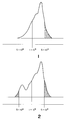
- Figure 1 is a GPC (gel permeation chromatography) chromatogram of a resin composition A.
- Figure 2 is a GPC chromatogram of a resin composition obtained by kneading the resin composition A.
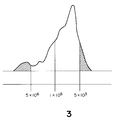
- Figure 3 is a GPC chromatogram of a resin composition obtained by kneading the resin composition A and an organic metal compound.
- the molecular weight distribution of the THF (tetrahydrofuran)-soluble content of a binder resin or other resins used in the present invention may be measured based on a chromatogram obtained by GPC (gel permeation chromatography) in the following manner.
- a GPC sample is prepared as follows.
- a resinous sample is placed in THF and left standing for several hours (e.g., 5 - 6 hours). Then, the mixture is sufficiently shaked until a lump of the resinous sample disappears and then further left standing for more than 12 hours (e.g., 24 hours) at room temperature. In this instance, a total time of from the mixing of the sample with THF to the completion of the standing in THF is taken for at least 24 hours (e.g., 24 - 30 hours).
- the mixture is caused to pass through a sample treating filter having a pore size of 0.45 - 0.5 micron (e.g., "Maishoridisk H-25-5", available from Toso K.K.; and "Ekikurodisk 25CR", available from German Science Japan K.K.) to recover the filtrate as a GPC sample.
- the sample concentration is adjusted to provide a resin concentration within the range of 0.5 - 5 mg/ml.
- the binder resin contained in the toner of the present invention may preferably have a THF-insoluble resin content, as recovered by the above filter treatment, of at most 10 wt. %, further preferably at most 5 wt. % most preferably substantially zero, as measured at a concentration of 5 mg/ml at room temperature, so as to exhibit the effect of the present invention.
- a column is stabilized in a heat chamber at 40 o C, tetrahydrofuran (THF) solvent is caused to flow through the column at that temperature at a rate of 1 ml/min., and about 100 ⁇ l of a GPC sample solution is injected.
- THF tetrahydrofuran
- the identification of sample molecular weight and its molecular weight distribution is performed based on a calibration curve obtained by using several monodisperse polystyrene samples and having a logarithmic scale of molecular weight versus count number.
- the standard polystyrene samples for preparation of a calibration curve may be those having molecular weights in the range of about 102 to 107 available from, e.g., Toso K.K.
- the detector may be an RI (refractive index) detector.
- RI reffractive index
- a preferred example thereof may be a combination of Shodex KF-801, 802, 803, 804, 805, 806, 807 and 800P; or a combination of TSK gel G1000H (H XL ), G2000H (H XL ), G3000H (H XL ), G4000H (H XL ), G5000H (H XL ), G6000H (H XL ), G7000H (H XL ) and TSK guardcolumn available from Toso K.K.
- the contents of a component having a molecular weight of 5000 or below and a component having a molecular weight of 5x10⁶ or above on a GPC chromatogram measured by calculating ratios of the integrated values of a molecular weight region of 5000 or below and a molecular weight region of 5x10⁶ or above, respectively, to the integrated value of the entire molecular weight region of a sample resin.
- the content of resin components having molecular weights of at most 5000 and at least 5x10⁶ may be respectively obtained.
- the binder resin of the present invention is characterized by containing at least 15 % and below 35 %, preferably 18 - 32 %, of a resin component having a molecular weight of at most 5000 in terms of molecular weight distribution based on the GPC chromatogram so as to provide an improved anti-blocking characteristic.
- the toner binder resin prevents excessive pulverization to suppress occurrence of ultra-fine powder and coarse powder and increase the production efficiency at the time of toner production, and further provides a toner showing good developing characteristic.
- the resin component having a molecular weight of at most 5000 is contained in 35 % or more, there are observed tendencies that melt-sticking or filming of the toner onto a toner-carrying member (development sleeve) having a diameter of at most 20 mm and a photosensitive drum having a diameter of at most 50 mm is pronounced in a small-size apparatus, and the storability of the toner becomes worse.
- the resin component having a molecular weight of at most 5000 is liable to have a glass transition point (Tg) showing a noticeable molecular weight-dependence. Accordingly, if the resin component is contained in excess of 35 %, the binder resin is caused to show a thermal behavior as if it has a lower Tg than its ordinarily measured Tg and is liable to cause melt-sticking and filming.
- Tg glass transition point
- the resin component having a molecular weight of at most 5000 has a functions of providing a melt-kneaded product with a particularly improved pulverizability at the time of toner production but provides an excessive pulverizability in production of a toner having a volume-average particle size of 4 - 8 microns to result in much ultra-fine powder and a lower classification efficiency if it is contained in excess of 35 %.
- a toner containing insufficiently classified ultra-fine powder is caused to have a gradually increased content of such ultra-fine powder through repetition of toner replenishment, and the increased ultra-fine powder is attached to a triboelectric toner-charging member due to an electrostatic force to hinder the triboelectric charging of the toner, thus causing a lowering in image density and fog.
- the toner binder resin it is necessary to improve the toner binder resin in order to maintain the fixability and anti-offset characteristic.
- the toner binder resin used in the present invention is characterized by containing a resin component having a molecular weight of at least 5x10⁶ in a proportion of at least 3 %, preferably 3 - 20 %, particularly preferably 3 - 10 %.
- the resin component having a molecular weight of at least 5x10⁶ shows excellent releasability and appropriately suppresses the fluidity of the toner at a high temperature, so that the component effectively functions to improve the anti-offset characteristic.
- the resin component having a molecular weight of at least 5x10⁶ is below 3 %, the anti-offset characteristic is liable to be insufficient. In excess of 20 %, the toner cannot be readily deformed on melting to disfavor the fixing, and also the component in a suitable molecular weight region for fixing is relatively decreased to again disfavor the improvement in fixability.
- a gel component i.e., a component which cannot pass a screen of 80 mesh or 200 mesh when the binder resin is dissolved or dispersed in toluene because of a dense crosslinked network structure or large molecular weight
- the resin component having a molecular weight of at least 5x10⁶ used in the present invention has a larger crosslinked network structure and less crosslinkage than such a gel component, so that the polymer molecules are in a rather mobile state and do not excessively resist the deformation of the toner or hinder the fixation.
- a resin component having a molecular weight in the range of 105 to 5x10⁶ is at most 35 %, particularly 10 - 30 %.
- the component in this molecular weight region functions as a component effective for improving the anti-offset characteristic resisting a high-temperature offset (toner sticking onto fixing rollers at a high temperature).
- the resin component having a molecular weight in the range of 105 to 5x10⁶ principally functions as a component linking a medium molecular weight component and the ultra-high molecular weight component having a molecular weight of at least 5x10⁶ and functions to uniformize the anti-offset component and the fixing component in the binder resin and aid the dispersion of internal additives to the toner, such as a colorant and a charge control agent in the toner.
- the binder resin of the present invention is characterized by showing a main peak (the highest peak) in a molecular weight region of 5000 to 105, particularly in a region of 104 to 5 x 10⁴.
- a sub-peak having a height which is a half or more of that of the main peak is in the molecular weight range of 5000 - 105.
- a component having a molecular weight of at most 104 functions as a component for improving the pulverizability of a toner material at the time of toner production, and the component in the molecular weight region of 5000 - 105 is a component for improving the fixability of the toner.
- the binder resin is required to show a main peak in the above-mentioned molecular weight region.
- the component in the molecular weight region of 5000 to 105 may preferably be contained in a proportion of at least 40 %, further preferably at least 45 %. It is also a preferred mode that a single peak in this region is present in the region of 104 to 5 x 10⁴.
- the main peak is at a molecular weigh of below 5000, the same difficulties as in the abovementioned case of the component having a molecular weight of at most 5000 being 35 % or more are encountered. If the main peak is present at a molecular weight in excess of 105, it becomes impossible to attain a sufficient fixability and pulverizability. As the molecular weight giving the main peak exceeds about 5x10⁴, the pulverizability of the toner material begins to be gradually lowered.
- a vinyl copolymer As a method of obtaining a vinyl polymer satisfying the characteristic features of the present invention, it is possible to obtain a vinyl copolymer by using a vinyl monomer having an acid group, such as a dicarboxylic acid, a dicarboxylic anhydride or a dicarboxylic acid monoester with another vinyl monomer and subjecting the monomers to bulk polymerization or solution polymerization.
- a vinyl monomer having an acid group such as a dicarboxylic acid, a dicarboxylic anhydride or a dicarboxylic acid monoester with another vinyl monomer and subjecting the monomers to bulk polymerization or solution polymerization.
- the solution polymerization it is possible to convert a part of the dicarboxylic acid groups or dicarboxylic acid monoester groups in the vinyl copolymer into anhydride groups by adjusting the conditions for distilling off the solvent after the polymerization.
- dicarboxylic acid monoester groups of a vinyl copolymer obtained by suspension polymerization or emulsion polymerization using a vinyl monomer including such a dicarboxylic acid monoester group into anhydride groups by heat-treatment or into dicarboxylic acid groups by hydrolysis If such a vinyl copolymer obtained by bulk polymerization or solution polymerization is dissolved in a vinyl monomer and the resultant mixture is subjected to suspension polymerization or emulsion polymerization, a part of the anhydride groups can cause ring-opening to leave dicarboxylic acid groups in the polymer. In this instance, it is possible to mix another resin in the vinyl monomer.
- the resultant resin can be treated by heating, weak alkaline water or an alcohol for anhydrization, ring-opening or esterification.
- a vinyl monomer having a dicarboxylic acid group and a vinyl monomer having a dicarboxylic anhydride group have a strong tendency to form an alternating copolymer. For this reason, in order to obtain a vinyl copolymer containing functional groups, such as anhydride groups or dicarboxylic acid groups, at random therein, the following method may be adopted as a suitable measure. That is, a vinyl copolymer is obtained through solution polymerization by using a vinyl monomer having a dicarboxylic acid monoester group and another vinyl monomer, and a solution of the vinyl copolymer in a vinyl monomer is subjected to suspension polymerization to obtain a binder resin. In this method, it is possible to anhydrize the dicarboxylic monoester part through de-alcohol cyclization by controlling the conditions for distilling-off of the solvent after the solution polymerization to obtain a vinyl copolymer having anhydride groups.
- the anhydride groups cause ring-opening through hydrolysis to provide a vinyl copolymer having dicarboxylic acid groups.
- an ahydride group in a polymer may be confirmed by an IR analysis because an anhydride group provides an IR absorption peak which has been shifted from those of the corresponding acid group and ester group toward a higher wave number side.
- the binder resin used in the present invention has an acid value measured according to JIS K-0070 (hereinafter referred to as "JIS acid value” or simply as “acid value”) of 2 - 100 mgKOH/g, preferably 5 - 70 mgKOH/g. If the acid value is below 2 mgKOH/g, re-crosslinking as described hereinafter cannot be sufficiently caused. If the acid value exceeds 100 mgKOH/g, it becomes difficult to effect the toner charge control, thus being liable to cause a fluctuation in developing characteristic depending on environmental conditions. It is preferred that an acid value attributable to the acid anhydride group is at most 10 mgKOH/g, further preferably below 6 mgKOH/g.
- the binder resin Because of its acid value, the binder resin provides a toner with an increased releasability with respect to the fixing rollers.
- the polar group providing the acid group in the polymer chain can form a weak bond due to affinity given by a hydrogen bond with polar groups in magnetic material, pigment and/or dye internally added to the toner, it becomes possible to compatibly satisfy the anti-offset characteristic and fixability of the toner. If the acid anhyde group is contained excessively, the crosslinking is promoted to provide an insoluble content which cannot pass through the filter for preparing a GPC sample solution and thus cannot be observed on a GPC chromatogram.
- the acid value attributable to an acid anhydride group may for example be measure by combining the JIS acid value measurement and the acid value measurement through hydrolysis (total acid value measurement).
- the JIS acid value measurement provides an acid value of an acid anhydride which is about 50 % of the theoretical value (based on an assumption that a mol of an acid anhydride provides an acid value identical to the corresponding dicarboxylic acid).
- the total acid value measurement provides an acid value which is almost identical to the theoretical value. Accordingly, the difference between the total acid value and the JIS acid value is almost 50 % for an acid anhydride.
- the acid value attributable to an acid anhydride group per g of a resin can be obtained by doubling the difference between the total acid value and the JIS acid value of the resin.
- the total acid value of a binder resin used herein is measured in the following manner.
- a sample resin in an amount of 2 g is dissolved in 30 ml of dioxane, and 10 ml of pyridine, 20 mg of dimethylaminopyridine and 3.5 ml of water are added thereto, followed by 4 hours of heat refluxing. After cooling, the resultant solution is titrated with 1/10 N-KOH solution in THF (tetrahydrofuran) to neutrality with phenolphthalein as the indicator to measure the acid value, which is a total acid value (B).
- THF tetrahydrofuran
- the above-mentioned 1/10 N-KOH solution in THF is prepared as follows. First, 1.5 g of KOH is dissolved in about 3 ml of water, and 200 ml of THF and 30 ml of water are added thereto, followed by stirring. After standing, a uniform clear solution is formed, if necessary, by adding a small amount of methanol if the solution is separated or by adding a small amount of water if the solution is turbid. Then, the factor of the 1/10 N-KOH/THF solution thus obtained is standardized by a 1/10 N-HCl standard solution.
- the binder resin used in the present invention may for example be prepared in following manner.
- a polymer or copolymer (A-1) having a main peak in a molecular weight region of 2000 - 2x10⁴ is prepared through solution polymerization, bulk polymerization, suspension polymerization, emulsion polymerization, block copolymerization or graft polymerization.
- the polymer or copolymer (A-1) is dissolved in a polymerizable monomer mixture containing 0.5 - 20 wt. %, preferably 1 - 15 wt. %, of a carboxyl group-containing vinyl monomer, followed by suspension polymerization to prepare a polymer or copolymer (B-1) which shows a main peak in a molecular weight region of 5000 - 105 on a GPC chromatogram but can contain a gel content (THF-insoluble).
- the polymer or copolymer is melt-kneaded together with a metal-containing compound reactive with the carboxyl group in the polymer or copolymer under the action of a shearing force so as to sever a highly crosslinked polymer portion in the resin and cause a reaction with the metal-containing compound for re-crosslinking to provide a molecular weight distribution characteristic to the present invention.
- This process may be performed simultaneously at the time of toner production and thus the melt-kneading can be performed in the presence of a magnetic material or colorant. It is possible to effectively cause the re-crosslinking under the action of a heat evolved due to the severance of the polymer network.
- the severance may be effected by kneading the mixture in a low-temperature melting state so as to apply a high shearing force to the mixture. Then, the re-crosslinking with a metal-containing component, etc., under the action of a heat to result in a component having a molecular weight of at least 5x10⁶.
- a GPC chromatogram (chart) of a resin composition A used in Example 1 appearing hereinafter is reproduced herein as Figure 1.
- the resin composition contains a THF-insoluble content which is removed by a filter when a GPC sample solution is prepared and thus cannot be observed by GPC.
- a GPC chromatogram of a resin composition obtained by kneading the resin composition A by a kneader used in Example 1 is reproduced as Figure 2.
- the resin composition does not contain a THF-insoluble resin component and the severed high-molecular weight component appears as a peak on the chromatogram.
- a polymer or copolymer (B-2) capable of containing a gel content having a main peak in the molecular weight region of 5000 - 105 on a GPC chromatogram by suspension polymerization of a polymerizable monomer mixture containing 0.5 - 20 wt. %, preferably 1 - 15 wt.
- % of a carboxylic group-containing vinyl monomer, and a polymer or copolymer (A-2) having a main peak in the molecular weight region of 2000 - 105 by solution polymerization, bulk polymerization, suspension polymerization, block copolymerization or graft polymerization, and blending the polymer or copolymer (B-2) and the polymer or copolymer (A-2) by melt-kneading.
- a polymer or copolymer (B-3) having a carboxyl group or a carboxyl derivative group and comprising a principal component in the molecular weight region of at least 105 obtained by bulk polymerization, suspension polymerization, emulsion polymerization, etc. with the polymer or copolymer (A-1) or the polymer or copolymer (A-2) in a solvent after solution polymerization, and melt-knead the blend.
- the respective polymers or copolymers in the above-mentioned resins have main peaks in the range of 5000 - 5x10⁴, it is also a preferred mode that the polymers or copolymers are prepared so as to have peaks overlapping each other.
- polymer or copolymer (A-1) and/or the polymer or copolymer (A-2) contain a carboxyl group or a derivative group thereof.
- the polymer or copolymer(s) used in the present invention may preferably be a vinyl resin and can be a mixture of two resins, or assume a block copolymer or a graft copolymer.
- the solution polymerization it is possible to obtain a low-molecular weight polymer by performing the polymerization at a high temperature so as to accelerate the termination reaction, but there is a difficulty that the reaction control is difficult.
- the solution polymerization it is possible to obtain a low-molecular weight polymer or copolymer under moderate conditions by utilizing a radical chain transfer function depending on a solvent used or by selecting the polymerization initiator or the reaction temperature. Accordingly, the solution polymerization is preferred for preparation of a low-molecular weight polymer or copolymer used in the binder resin of the present invention.
- the solvent used in the solution polymerization may for example include xylene, toluene, cumene, cellosolve acetate, isopropyl alcohol, and benzene. It is preferred to use xylene, toluene or cumene for a styrene monomer mixture.
- the solvent may be appropriately selected depending on the polymer produced by the polymerization.
- the polymerization initiator may for example include: di-tert-butyl peroxide, tert-butyl peroxybenzoate, benzoyl peroxide and 2,2'-azobis(2,4-dimethylvaleronitrile), one or more species of which may be used in a proportion of at least 0.05 wt.
- the reaction temperature may depend on the solvent and initiator used and the polymer or copolymer to be produced but may suitably be in the range of 70 - 230 o C.
- the emulsion polymerization or suspension polymerization may preferably be adopted.
- a vinyl monomer almost insoluble in water is dispersed as minute particles in an aqueous phase with the aid of an emulsifier and is polymerized by using a water-soluble polymerization initiator.
- the control of the reaction temperature is easy, and the termination reaction velocity is small because the polymerization phase (an oil phase of the vinyl monomer possibly containing a polymer therein) constitute a separate phase from the aqueous phase.
- the polymerization velocity becomes large and a polymer having a high polymerization degree can be prepared easily.
- the polymerization process is relatively simple, the polymerization product is obtained in fine particles, and additives such as a colorant, a charge control agent and others can be blended easily for toner production. Therefore, this method can be advantageously used for production of a toner binder resin.
- the emulsifier added is liable to be incorporated as an impurity in the polymer produced, and it is necessary to effect a post-treatment such as salt-precipitation in order to recover the product polymer.
- the suspension polymerization is more convenient in this respect.
- the suspension polymerization method it is possible to obtain a product resin composition in a uniform state of pearls containing a medium- or high-molecular weight component uniformly mixed with a low-molecular weight component and a crosslinked component by polymerizing a vinyl monomer (mixture) containing a low-molecular weight polymer together with a crosslinking agent in a suspension state.
- the suspension polymerization may preferably be performed by using at most 100 wt. parts, preferably 10 - 90 wt. parts, of a vinyl monomer (mixture) per 100 wt. parts of water or an aqueous medium.
- the dispersing agent may include polyvinyl alcohol, partially saponified form of polyvinyl alcohol, and calcium phosphate, and may preferably be used in an amount of 0.05 - 1 wt. part per 100 wt. parts of the aqueous medium while the amount is affected by the amount of the monomer relative to the aqueous medium.
- the polymerization temperature may suitably be in the range of 50 - 95 o C and selected depending on the polymerization initiator used and the objective polymer.
- the polymerization initiator should be insoluble or hardly soluble in water, may for example include benzoyl peroxide and tert-butyl peroxyhexanoate and may be used in an amount of 0.5 - 10 wt. parts per 100 wt. parts of the vinyl monomer (mixture).
- Examples of the vinyl monomer to be used for providing the binder resin of the present invention may include: styrene; styrene derivatives, such as o-methylstyrene, m-methylstyrene, p-methylstyrene, p-methoxystyrene, p-phenylstyrene, p-chlorostyrene, 3,4-dichlorostyrene, p-ethylstyrene, 2,4-dimethylstyrene, p-n-butylstyrene, p-tert-butylstyrene, p-n-hexylstyrene, p-n-octylstyrene, p-n-nonylstyrene, p-n-decylstyrene, and p-n-dodecylstyrene; ethylen
- a combination of monomers providing styrene-type copolymers and styrene-acrylic type copolymers may be particularly preferred.
- two or more species of acrylic monomers such as acrylate esters and methacrylate esters, are used, and particularly these are preferentially contained in the resin component having a molecular weight of at least 5x10⁶, so as to promote the toner deformation in a hot roller fixer.
- Examples of the carboxyl group-containing vinyl monomer or carboxyl derivative group-containing vinyl monomer may include: unsaturated dibasic acids, such as maleic acid, citraconic acid, itaconic acid, alkenylsuccinic acid, fumaric acid, and mesaconic acid; unsaturated dibasic acid anhydrides, such as maleic anhydride, citraconic anhydride, itaconic anhydride, and alkenylsuccinic anhydride; half esters of unsaturated dibasic acids, such as monomethyl maleate, monoethyl maleate, monobutyl maleate, monomethyl citraconate, monoethyl citraconate, monobutyl citraconate, monomethyl itaconate, monomethyl alkenylsuccinate, monomethyl fumarate, and monomethyl mesaconate; and unsaturated dibasic acid esters, such as dimethyl maleate and dimethyl fumarate.
- unsaturated dibasic acids such as maleic acid, citrac
- ⁇ , ⁇ -unsaturated acids such as acrylic acid, methacrylic acid, crotonic acid, and cinnamic acid
- ⁇ , ⁇ -unsaturated acid anhydrides such as crotonic anhydride and cinnamic anhydride
- anhydes between such ⁇ , ⁇ -unsaturated acids and lower fatty acids alkenylmalonic acid, alkenylglutaric acid, alkenyladipic acid, and anhydrides and monoesters of these acids.
- monoesters of ⁇ , ⁇ -unsaturated dibasic acids such as maleic acid, fumaric acid and succinic acid
- monoesters of ⁇ , ⁇ -unsaturated dibasic acids such as maleic acid, fumaric acid and succinic acid
- the crosslinking monomer may principally be a monomer having two or more polymerizable double bonds.
- the binder resin used in the present invention may preferably include a crosslinking structure obtained by using a crosslinking monomer, examples of which are enumerated hereinbelow.
- Aromatic divinyl compounds such as divinylbenzene and divinylnaphthalene
- diacrylate compounds connected with an alkyl chain such as ethylene glycol diacrylate, 1,3-butylene glycol diacrylate, 1,4-butanediol diacrylate, 1,5-pentanediol diacrylate, 1,6-hexanediol diacrylate, and neopentyl glycol diacrylate, and compounds obtained by substituting methacrylate groups for the acrylate groups in the above compounds
- diacrylate compounds connected with an alkyl chain including an ether bond such as diethylene glycol diacrylate, triethylene glycol diacrylate, tetraethylene glycol diacrylate, polyethylene glycol #400 diacrylate, polyethylene glycol #600 diacrylate, dipropylene glycol diacrylate and compounds obtained by substituting methacrylate groups for the acrylate groups in the above compounds
- diacrylate compounds connected with a chain including an aromatic group and an ether bond such
- Polyfunctional crosslinking agents such as pentaerythritol triacrylate, trimethylethane triacrylate, tetramethylolmethane tetracrylate, oligoester acrylate, and compounds obtained by substituting methacrylate groups for the acrylate groups in the above compounds; triallyl cyanurate and triallyl trimellitate.
- crosslinking agents may preferably be used in a proportion of about 0.01 - 5 wt. parts, particularly about 0.03 - 3 wt. parts, per 100 wt. parts of the other vinyl monomer components.
- aromatic divinyl compounds particularly, divinylbenzene
- diacrylate compounds connected with a chain including an aromatic group and an ether bond may suitably be used in a toner resin in view of fixing characteristic and anti-offset characteristic.
- the metal-containing compound reactive with the resin component in the present invention may be those containing metal ions as follows: divalent metal ions, such as Ba2+, Mg2+, Ca2+, Hg2+, Sn2+, Pb2+, Fe2+, Co2+, Ni2+ and Zn2+; and trivalent ions, such as Al3+, Sc3+, Fe3+, Ce3+, Ni3+, Cr3+ and Y3+.
- divalent metal ions such as Ba2+, Mg2+, Ca2+, Hg2+, Sn2+, Pb2+, Fe2+, Co2+, Ni2+ and Zn2+
- trivalent ions such as Al3+, Sc3+, Fe3+, Ce3+, Ni3+, Cr3+ and Y3+.
- organic metal compounds provide excellent results because they are rich in compatibility with or dispersibility in a polymer and cause a crosslinking reaction uniformly in the polymer or copolymer.
- organic metal compounds those containing an organic compound, which is rich in vaporizability or sublimability, as a ligand or a counter ion, are advantageously used.
- organic compounds forming coordinate bonds or ion pairs with metal ions examples of those having the above property may include: salicylic acid and its derivatives, such as salicylic acid, salicylamide, salicylamine, salicylaldehyde, salicylosalicylic acid, and di-tert-butylsalicylic acid; ⁇ -diketones, such as acetylacetone and propionylacetone; and low-molecular weight carboxylic acid salts, such as acetate and propionate.
- salicylic acid and its derivatives such as salicylic acid, salicylamide, salicylamine, salicylaldehyde, salicylosalicylic acid, and di-tert-butylsalicylic acid
- ⁇ -diketones such as acetylacetone and propiony
- the organic metal complex is a metal complex, it can also function as a charge control agent for toner particles.
- a metal complex include azo metal complexes represented by the following formula [I]: wherein M denotes a coordination center metal, inclusive of metal elements having a coordination number of 6, such as Sc, Ti, V, Cr, Co, Ni, Mn and Fe; Ar denotes an aryl group, such as phenyl or naphthyl, capable of having a substituent, examples of which may include: nitro, halogen, carboxyl, anilide, and alkyl and alkoxy having 1 - 18 carbon atoms; X, X', Y and Y' independently denote -O-, -CO-, -NH-, or -NR- (wherein R denotes an alkyl having 1 - 4 carbon atoms; and A ⁇ denotes hydrogen, sodium, potassium, ammonium or aliphatic ammonium.
- Organic metal complexes represented by the following formula [II] impart a negative chargeability and may be used as the organic metal compound in the present invention.
- M denotes a coordination center metal, inclusive of metal elements having a coordination number of 6, such as Cr, Co, Ni, Mn and Fe
- A denotes (capable of having a substituent, such as an alkyl)
- X denotes hydrogen, halogen, alkyl or nitro
- R denotes hydrogen, C1 - C18 alkyl or C1 - C18 alkenyl
- Y ⁇ denotes a counter ion, such as hydrogen, sodium, potassium, ammonium, or aliphatic ammonium
- Z denotes -O- or -CO ⁇ O-.
- the above organic metal compounds may be used singly or in combination of two or more species.
- the addition amount of the organic metal compounds to the toner particles may be varied depending on the specific binder resin used, the use or nonuse of a carrier, the colorant for the toner and the reactivity of the metal compounds with the resin but may generally be 0.1 - 10 wt. %, preferably 0.1 - 1 wt. %, of the binder resin including the non-reacted portion thereof.
- the amount of the reactive metal compound may preferably be below 1 wt. % of the binder resin.
- the above-mentioned organic metal complex or organic metal salt shows excellent compatibility and dispersibility to provide a toner with a stable chargeability, particularly when it is reacted with the binder resin at the time of melt-kneading.
- the organic metal complex or organic metal salt as a crosslinking component can be also used as a charge control agent, but it is also possible to use another charge control agent, as desired, in combination.
- another charge control agent may for example be a known negative charge control agent.
- Examples of such known negative charge control agent may include: organic metal complexes and chelate compounds inclusive of monoazo metal complexes as described above, acetylacetone metal complexes, and organometal complexes of aromatic hydroxycarboxylic acids and aromatic dicarboxylic acids.
- Other examples may include: aromatic hydroxycarboxylic acids, aromatic mono- and poly-carboxylic acids, and their metal salts, anhydrides and esters, and phenol derivatives, such as bisphenols.
- monoazo metal complexes are preferred.
- the toner according to the present invention may preferably have a volume-average particle size of 4 - 8 microns so as to faithfully reproduce small size digital latent images.
- toner according to the present invention together with silica fine powder blended therewith in order to improve the charge stability, developing characteristic and fluidity.
- the silica fine powder used in the present invention provides good results if it has a specific surface area of 30 m2/g or larger, preferably 50 - 400 m2/g, as measured by nitrogen adsorption according to the BET method.
- the silica fine powder may be added in a proportion of 0.01 - 8 wt. parts, preferably 0.1 - 5 wt. parts, per 100 wt. parts of the toner.
- the silica fine powder may well have been treated with a treating agent, such as silicone varnish, modified silicone varnish, silicone oil, modified silicone oil, silane coupling agent, silane coupling agent having functional group or other organic silicon compounds. It is also preferred to use two or more treating agents in combination.
- a treating agent such as silicone varnish, modified silicone varnish, silicone oil, modified silicone oil, silane coupling agent, silane coupling agent having functional group or other organic silicon compounds. It is also preferred to use two or more treating agents in combination.
- additives may be added as desired, inclusive of: a lubricant, such as polytetrafluoroethylene, zinc stearate or polyvinylidene fluoride, of which polyvinylidene fluoride is preferred; an abrasive, such as cerium oxide, silicon carbide or strontium titanate, of which strontium titanate is preferred; a flowability-imparting agent, such as titanium oxide or aluminum oxide, of which a hydrophobic one is preferred; an anti-caking agent, and an electroconductivity-imparting agent, such as carbon black, zinc oxide, antimony oxide, or tin oxide. It is also possible to use a small amount of white or black fine particles having a polarity opposite to that of the toner as a development characteristic improver.
- a lubricant such as polytetrafluoroethylene, zinc stearate or polyvinylidene fluoride, of which polyvinylidene fluoride is preferred
- an abrasive such as ce
- a waxy substance such as low-molecular weight polyethylene, low-molecular weight polypropylene, low-molecular weight propylene-ethylene copolymer, microcrystalline wax, carnauba wax, sasol wax or paraffin wax, to the toner for the purpose of improving the releasability of the toner at the time of hot roller fixation.
- the toner according to the present invention can be mixed with carrier powder to be used as a two-component developer.
- the toner and the carrier powder may be mixed with each other so as to provide a toner concentration of 0.1 - 50 wt. %, preferably 0.5 - 10 wt. %, further preferably 3 - 5 wt. %.
- the carrier used for this purpose may be a known one, examples of which may include: powder having magnetism, such as iron powder, ferrite powder, and nickel powder and carriers obtained by coating these powders with a resin, such as a fluorine-containing resin, a vinyl resin or a silicone resin.
- a resin such as a fluorine-containing resin, a vinyl resin or a silicone resin.
- the toner according to the present invention can be constituted as a magnetic toner containing a magnetic material in its particles.
- the magnetic material can also function as a colorant.
- the magnetic material may include: iron oxide, such as magnetite, hematite, and ferrite; metals, such as iron, cobalt and nickel, and alloys of these metals with other metals, such as aluminum, cobalt, copper, lead, magnesium, tin, zinc, antimony, beryllium, bismuth, cadmium, calcium, manganese, selenium, titanium, tungsten and vanadium; and mixtures of these materials.
- the magnetic material may have an average particle size of 0.1 - 2 micron, preferably 0.1 - 0.5 micron.
- the magnetic material may preferably show magnetic properties under application of 10 kilo-Oersted, inclusive of: a coercive force of 20 - 30 Oersted, a saturation magnetization of 50 - 200 emu/g, and a residual magnetization of 2 - 20 emu/g.
- the magnetic material may be contained in the toner in a proportion of 20 - 200 wt. parts, preferably 40 - 150 wt. parts, per 100 wt. parts of the resin component.
- the toner according to the present invention can contain a colorant which may be an appropriate pigment or dye.
- the pigment may include: carbon black, aniline black, acetylene black, Naphthol Yellow, Hansa Yellow, Rhodamine Lake, Alizarin Lake, red iron oxide, Phthalocyanine Blue, and Indanthrene Blue. These pigments are used in an amount sufficient to provide a required optical density of the fixed images, and may be added in a proportion of 0.1 - 20 wt. parts, preferably 2 - 10 wt. parts, per 100 wt. parts of the binder resin.
- the dye may include: azo dyes, anthraquinone dyes, xanthene dyes, and methine dyes, which may be added in a proportion of 0.1 - 20 wt. parts, preferably 0.3 - 10 wt. parts, per 100 wt. parts of the binder resin.
- the toner according to the present invention may be prepared through a process including: sufficiently blending the binder resin, the organic metal compound such as the metal salt or metal complex, a colorant, such as pigment, dye and/or a magnetic material, and an optional charge control agent and other additives, as desired, by means of a blender such as a Henschel mixer or a ball mill, melting and kneading the blend by means of hot kneading means, such as hot rollers, a kneader or an extruder to cause melting of the resinous materials and disperse or dissolve the magnetic material, pigment or dye therein, and cooling and solidifying the kneaded product, followed by pulverization and classification.
- a blender such as a Henschel mixer or a ball mill
- melting and kneading the blend by means of hot kneading means, such as hot rollers, a kneader or an extruder to cause melting of the resinous materials and dis
- the thus obtained toner may be further blended with other external additives, as desired, sufficiently by means of a mixer such as a Henschel mixer to provide a developer for developing electrostatic images.
- a mixer such as a Henschel mixer to provide a developer for developing electrostatic images.
- a sample resin in an amount of 5 - 20 mg, preferably about 10 mg, is accurately weighed and placed in an aluminum pan (an empty pan being used as a reference).
- the measurement is performed in a normal temperature - normal humidity environment at a temperature raising rate of 10 o C/min within a temperature range of 30 o C to 200 o C.
- a heat absorption main peak is generally found in the range of 40 - 100 o C.
- a first base line as drawn along an initial shape before the main peak and a second base line is drawn along a final slope after the main peak.
- a medium line is drawn substantially in parallel with and with equal distances from the first and second lines, whereby the medium line and the heat absorption curve form an intersection with each other.
- the temperature at the intersection is taken as the glass transition temperature (Tg o C).
- the thus obtained resin composition provided a molecular weight distribution showing a main peak at a molecular weight of 7500 and a shoulder at a molecular weight of 3.5x10⁴, a Tg of 60 o C and a JIS acid value of 22.0 mgKOH/g.
- the above mixture was added dropwise in 4 hours to 200 wt. parts of cumene heated to a reflux temperature. Further, the solution polymerization was completed under cumene refluxing (146 - 156 o C), followed by removal of the cumene, to recover a styrene copolymer.
- the styrene copolymer showed a main peak at a molecular weight of 5000 on its GPC chromatogram and a Tg of 65 o C.
- the THF-soluble content of the thus-obtained resin composition provided a molecular weight distribution showing a main peak at a molecular weight of about 5200 and a shoulder at a molecular weight of about 3.4x10⁴.
- the resin composition showed a Tg of 58 o C and a JIS acid value of 14.0 mgKOH/g.
- the above mixture was added dropwise in 4 hours to 150 wt. parts of cumene heated to a reflux temperature. Further, the solution polymerization was completed under cumene refluxing (146 - 156 o C), followed by removal of the cumene, to recover a styrene copolymer.
- the styrene copolymer showed a main peak at a molecular weight of 5500 and a Tg of 65 o C.
- the THF-soluble content of the thus-obtained resin composition provided a molecular weight distribution showing a main peak at a molecular weight of about 5800 and a shoulder at a molecular weight of about 5.0x10⁴.
- the resin composition showed a Tg of 59 o C and a JIS acid value of 40.0 mgKOH/g.
- styrene copolymer provided a molecular weight distribution showing a main peak at a molecular weight of 3.0x10⁴, a Tg of 61 o C and a JIS acid value of 20.0.
- the polymerization was completed under toluene to form an un-crosslinked styrene copolymer.
- the toluene was distilled off at an elevated temperature (120 o C) under vacuum to obtain a resin composition containing the crosslinked and un-crosslinked styrene copolymers.
- the resin composition provided a molecular weight distribution showing peaks at molecular weights of 7000 and 8x10⁴, a Tg of 60 o C and a JIS acid value of 25.0.
- the above mixture was added dropwise in 4 hours to 200 wt. parts of toluene heated to a reflux temperature. Further, the solution polymerization was completed under toluene refluxing (120 - 130 o C), followed by removal of the toluene, to recover a styrene copolymer.
- the styrene copolymer showed a main peak at a molecular weight of 1.2x10⁴ and a Tg of 60 o C.
- the thus-obtained resin composition provided a molecular weight distribution showing a main peak at a molecular weight of about 1.5x10⁴ and a shoulder at a molecular weight of about 5.0x10⁴.
- the resin composition showed a Tg of 54 o C and a JIS acid value of 22.0 mgKOH/g.
- the above mixture was added dropwise in 4 hours to 150 wt. parts of cumene heated to a reflux temperature. Further, the solution polymerization was completed under cumene refluxing (146 - 156 o C), followed by removal of the cumene, to recover a styrene copolymer.
- the styrene copolymer showed a main peak at a molecular weight of 4000 and a Tg of 58 o C.
- the resultant mixture was subjected to suspension polymerization in the same manner as in Synthesis Example 1 to obtain a resin composition, which showed a JIS acid value of 25.0 mgKOH/g.
- the THF-soluble content of the resin composition provided a molecular weight distribution showing a main peak at a molecular weight of about 4200 on its GPC chromatogram, and a Tg of 59 o C.
- the above mixture was added dropwise in 4 hours to 200 wt. parts of cumene heated to a reflux temperature. Further, the solution polymerization was completed under cumene refluxing (146 - 156 o C), followed by removal of the cumene, to recover a styrene copolymer.
- the styrene copolymer showed a main peak at a molecular weight of 5000 on its GPC chromatogram and a Tg of 65 o C.
- the THF-soluble content of the thus-obtained resin composition provided a molecular weight distribution showing a sub-peak at a molecular weight of about 5200 and a main peak at a molecular weight of about 7.2x10⁴.
- the resin composition showed a Tg of 64 o C and a JIS acid value of 13.0 mgKOH/g.
- the above mixture was added dropwise in 4 hours to 200 wt. parts of cumene heated to a reflux temperature. Further, the solution polymerization was completed under cumene refluxing (146 - 156 o C), followed by removal of the cumene, to recover a styrene copolymer.
- the styrene copolymer showed a main peak at a molecular weight of 5000 on its GPC chromatogram and a Tg of 62 o C.
- the THF-soluble content of the thus-obtained resin composition provided a molecular weight distribution showing peaks at molecular weights of about 6000, and about 3.5x10⁴, respectively.
- the resin composition showed a Tg of 56 o C and a JIS acid value of 1.5 mgKOH/g.
- the above ingredients were sufficiently blended in a blender and melt-kneaded through a twin-screw kneading extruder set at 110 o C.
- the kneaded product was cooled, coarsely crushed by a cutter mill, and finely pulverized by means of a pulverizer using jet air stream.
- the resultant finely pulverized powder was classified by means of a multi-division classifier utilizing a Coanda effect (Elbow Jet Classifier available from Nittetsu Kogyo K.K.), whereby ultra fine powder and coarse powder were simultaneously and precisely removed to obtain a magnetic toner having a volume-average particle size of 6.0 microns.
- the above particle size was measured by using a Coulter counter ("TA-II", available from Coulter Electronics, Co.) by using a 100 micron-aperture after dispersion in 1 % NaCl aqueous solution in the presence of a surfactant.
- TA-II Coulter Counter
- the above-prepared magnetic toner was subjected to preparation of a GPC sample having a resin concentration of 5 mg/ml, and no binder resin component was found to remain on the filter at that time.
- the GPC sample was subjected to measurement of molecular weight distribution by GPC using a high-speed liquid chromatograph ("150C", available from Waters Co.) and a combination of columns ("Shodex GPC KF-801, 802, 803, 804, 805, 806, 807 and 800P", available from Showa Denko K.K.).
- the measured molecular weight distribution data are shown in Table 2 appearing hereinafter.
- the image formation was performed by using a printer prepared by re-modeling a commercially available small-size laser beam printer ("LBP-8II", available from Canon K.K.) so as to provide a printing speed of 16 sheets (A4-vertical)/min., remove the fixing pad and be capable of forming latent images comprising minute spots of down to 50 microns by improving the scanner part.
- LBP-8II small-size laser beam printer
- the evaluation was performed with respect to the initial image quality and fixability, and anti-offset characteristic and staining of hot fixing rollers after 5000 sheets of printing.
- the fixability evaluation was performed as follows.
- the test apparatus was placed in an environment of normal temperature and normal humidity (temperature: 23 o C, humidity: 60 %). After the apparatus and the fixing device therein were fully adapted to the environment, a power was supplied. Immediately after the waiting time was up, a pattern of 200 micron-wide transverse lines (line width: 200 microns, spacing: 200 microns) was printed on a first sheet, which was used for evaluation of the fixability.
- the fixability was evaluated by rubbing the printed image with a lens cleaning paper ("Dusper" (trade name), made by OZU Paper Co. Ltd.) for 5 reciprocations under a weight of 100 g and then evaluating the degree of peeling of the toner image in terms of a decrease (%) in reflection density.
- Dusper trade name
- a character pattern with a dot ratio of 4 % was printed continuously on 5000 sheets (A4-vertical) by using a fresh fixing roller cleaning pad and thereafter the staining on the surface of the hot fixing roller was observed with eyes.
- a 100 micron-wide transverse line pattern was continuously printed on 300 sheets (A4-vertical), then the printing was paused for 30 seconds and then the printing was resumed so as to print an image comprising an upper half area including a pattern of 100 micron-wide transverse lines and a lower half area in white. Then, the front face staining on a first sheet after the resumption was observed for evaluation of the anti-offset characteristic.
- bond paper having a surface smoothness of 10 [sec] or below was used as the transfer paper.
- a magnetic toner having a volume-average particle size of 4.5 microns was prepared from the above ingredients otherwise in the same manner as in Example 1.
- the properties of the magnetic toner are shown in Table 2.
- the magnetic toner in an amount of 100 wt. parts was blended with 0.8 wt. part of colloidal silica fine powder to prepare a developer, which was then evaluated for image formation in the same manner as in Example 1. The results are shown in Table 3.
- a magnetic toner having a volume-average particle size of 7.7 microns was prepared from the above ingredients otherwise in the same manner as in Example 1.
- the properties of the magnetic toner are shown in Table 2.
- the magnetic toner in an amount of 100 wt. parts was blended with 1.1 wt. parts of colloidal silica fine powder to prepare a developer, which was then evaluated for image formation in the same manner as in Example 1. The results are shown in Table 3.
- a magnetic toner having a volume-average particle size of 6.8 microns was prepared from the above ingredients otherwise in the same manner as in Example 1.
- the properties of the magnetic toner are shown in Table 2.
- the magnetic toner in an amount of 100 wt. parts was blended with 1.1 wt. parts of colloidal silica fine powder to prepare a developer, which was then evaluated for image formation in the same manner as in Example 1. The results are shown in Table 3.
- a magnetic toner having a volume-average particle size of 4.5 microns was prepared from the above ingredients otherwise in the same manner as in Example 1.
- the properties of the magnetic toner are shown in Table 2.
- the magnetic toner in an amount of 100 wt. parts was blended with 0.8 wt. part of colloidal silica fine powder to prepare a developer, which was then evaluated for image formation in the same manner as in Example 1. The results are shown in Table 3.
- a magnetic toner having a volume-average particle size of 6.0 microns was prepared from the above ingredients otherwise in the same manner as in Example 1.
- the properties of the magnetic toner are shown in Table 2.
- the magnetic toner in an amount of 100 wt. parts was blended with 1.0 wt. part of colloidal silica fine powder to prepare a developer, which was then evaluated for image formation in the same manner as in Example 1. The results are shown in Table 3.
- a magnetic toner having a volume-average particle size of 11 microns was prepared from the above ingredients otherwise in the same manner as in Example 1.
- the properties of the magnetic toner are shown in Table 2.
- the magnetic toner in an amount of 100 wt. parts was blended with 0.5 wt. part of colloidal silica fine powder to prepare a developer, which was then evaluated for image formation in the same manner as in Example 1. The results are shown in Table 3.
- a magnetic toner having a volume-average particle size of 9.5 microns was prepared from the above ingredients otherwise in the same manner as in Example 1.
- the properties of the magnetic toner are shown in Table 2.
- the magnetic toner in an amount of 100 wt. parts was blended with 1.1 wt. parts of colloidal silica fine powder to prepare a developer, which was then evaluated for image formation in the same manner as in Example 1. The results are shown in Table 3.
- the present invention there is provided a toner capable of forming high-quality images with improved performances in respects of anti-offset characteristic and fixing-roller staining.
- the toner according to the present invention shows the following advantageous properties.
- a toner for developing an electrostatic image is provided as a pulverized mixture including a binder resin and a colorant.
- the binder resin is characterized by a molecular weight distribution on a GPC chromatogram of its tetrahydrofuran (THF)-soluble resin content including at least 15 % and below 35 % of a resin component in a molecular weight region of at most 5000 and at least 3 wt. % of a resin component in a molecular weight region of at least 5x10⁶ and showing a main peak in a molecular weight region of 5000 to 105.
- the binder resin also has an acid value of 2 - 100 mg KOH/g.
- the THF-soluble resin component in the molecular weight region of at least 5x10⁶ is enriched during a melt-kneading step during the toner production.
Landscapes
- Physics & Mathematics (AREA)
- Spectroscopy & Molecular Physics (AREA)
- General Physics & Mathematics (AREA)
- Chemical & Material Sciences (AREA)
- Chemical Kinetics & Catalysis (AREA)
- Developing Agents For Electrophotography (AREA)
Applications Claiming Priority (2)
| Application Number | Priority Date | Filing Date | Title |
|---|---|---|---|
| JP332693/90 | 1990-11-29 | ||
| JP33269390 | 1990-11-29 |
Publications (2)
| Publication Number | Publication Date |
|---|---|
| EP0488414A1 true EP0488414A1 (fr) | 1992-06-03 |
| EP0488414B1 EP0488414B1 (fr) | 1998-08-12 |
Family
ID=18257829
Family Applications (1)
| Application Number | Title | Priority Date | Filing Date |
|---|---|---|---|
| EP91120620A Expired - Lifetime EP0488414B1 (fr) | 1990-11-29 | 1991-11-29 | Toner pour développer une image électrostatique et procédé pour sa fabrication |
Country Status (7)
| Country | Link |
|---|---|
| US (1) | US5338638A (fr) |
| EP (1) | EP0488414B1 (fr) |
| JP (1) | JP2962908B2 (fr) |
| KR (1) | KR950011513B1 (fr) |
| CN (1) | CN1040802C (fr) |
| DE (1) | DE69129973T2 (fr) |
| SG (1) | SG45455A1 (fr) |
Cited By (4)
| Publication number | Priority date | Publication date | Assignee | Title |
|---|---|---|---|---|
| EP0686882A1 (fr) * | 1994-05-13 | 1995-12-13 | Canon Kabushiki Kaisha | Révélateur pour le développement d'images électrostatiques, cartouche de traitement et méthode de production d'images |
| EP0709743A4 (fr) * | 1994-05-10 | 1998-02-11 | Mitsubishi Rayon Co | Resine pour toner et procede de production de ladite resine |
| EP0834778A4 (fr) * | 1995-06-19 | 1998-09-09 | Mitsubishi Rayon Co | Resine de liaison pour toner et toner ainsi obtenu |
| US6002895A (en) * | 1994-05-13 | 1999-12-14 | Canon Kabushiki Kaisha | Process cartridge |
Families Citing this family (19)
| Publication number | Priority date | Publication date | Assignee | Title |
|---|---|---|---|---|
| US6090515A (en) * | 1994-05-13 | 2000-07-18 | Canon Kabushiki Kaisha | Toner for developing electrostatic image, image forming method and process cartridge |
| US5462828A (en) * | 1994-06-22 | 1995-10-31 | Xerox Corporation | Styrene/n-butyl acrylate toner resins with excellent gloss and fix properties |
| US6017670A (en) * | 1996-02-29 | 2000-01-25 | Dainippon Ink And Chemicals, Inc. | Electrophotographic toner and process for the preparation thereof |
| JP3347646B2 (ja) * | 1996-07-31 | 2002-11-20 | キヤノン株式会社 | 静電荷潜像現像用磁性黒色トナー及びマルチカラー又はフルカラー画像形成方法 |
| JP3671549B2 (ja) * | 1996-10-14 | 2005-07-13 | コニカミノルタホールディングス株式会社 | 静電荷潜像現像用トナー、現像剤及びそのトナーを用いた画像形成方法 |
| US5948584A (en) * | 1997-05-20 | 1999-09-07 | Canon Kabushiki Kaisha | Toner for developing electrostatic images and image forming method |
| US6331372B1 (en) * | 1999-10-08 | 2001-12-18 | Lexmark International, Inc. | Toner particulates comprising an ethylene propylene wax |
| CN100492188C (zh) * | 2002-08-08 | 2009-05-27 | 三井化学株式会社 | 调色剂用粘结剂树脂和调色剂 |
| EP1403723B1 (fr) * | 2002-09-27 | 2013-02-20 | Canon Kabushiki Kaisha | Révélateur |
| US7615327B2 (en) * | 2004-11-17 | 2009-11-10 | Xerox Corporation | Toner process |
| US20070254231A1 (en) * | 2006-04-27 | 2007-11-01 | Kyocera Mita Corporation | Toner for Electrophotography |
| EP2196864B1 (fr) * | 2008-12-12 | 2019-02-27 | Canon Kabushiki Kaisha | Élément d'étanchéité et cartouche de procédé |
| JP5473354B2 (ja) * | 2009-02-23 | 2014-04-16 | キヤノン株式会社 | 電子写真用トナー容器及び画像形成方法 |
| CN102449555B (zh) | 2009-05-28 | 2014-08-13 | 佳能株式会社 | 调色剂的生产方法和调色剂 |
| JP2012042930A (ja) * | 2010-07-22 | 2012-03-01 | Konica Minolta Business Technologies Inc | トナーの製造方法 |
| US10151990B2 (en) | 2016-11-25 | 2018-12-11 | Canon Kabushiki Kaisha | Toner |
| JP7327993B2 (ja) | 2019-05-13 | 2023-08-16 | キヤノン株式会社 | トナー及びトナーの製造方法 |
| JP7757029B2 (ja) | 2020-03-24 | 2025-10-21 | キヤノン株式会社 | トナー |
| JP7599914B2 (ja) | 2020-11-06 | 2024-12-16 | キヤノン株式会社 | トナー |
Citations (2)
| Publication number | Priority date | Publication date | Assignee | Title |
|---|---|---|---|---|
| EP0331393A2 (fr) * | 1988-02-29 | 1989-09-06 | Canon Kabushiki Kaisha | Révélateur magnétique pour le développement d'images électrostatiques |
| EP0393592A2 (fr) * | 1989-04-17 | 1990-10-24 | Canon Kabushiki Kaisha | Toner coloré et procédé pour sa fixation |
Family Cites Families (26)
| Publication number | Priority date | Publication date | Assignee | Title |
|---|---|---|---|---|
| US2297691A (en) * | 1939-04-04 | 1942-10-06 | Chester F Carlson | Electrophotography |
| US4071361A (en) * | 1965-01-09 | 1978-01-31 | Canon Kabushiki Kaisha | Electrophotographic process and apparatus |
| JPS4223910B1 (fr) * | 1965-08-12 | 1967-11-17 | ||
| JPS5123354A (ja) * | 1974-08-20 | 1976-02-24 | Silver Seiko | Amiki |
| JPS5616144A (en) * | 1979-07-17 | 1981-02-16 | Canon Inc | Developing powder |
| JPS57178250A (en) * | 1981-04-27 | 1982-11-02 | Canon Inc | Manufacture of toner |
| JPS57178249A (en) * | 1981-04-27 | 1982-11-02 | Canon Inc | Toner |
| JPS5886558A (ja) * | 1981-11-18 | 1983-05-24 | Nippon Carbide Ind Co Ltd | 静電荷像現像用トナ− |
| JPH0715594B2 (ja) * | 1983-05-23 | 1995-02-22 | 株式会社東芝 | 静電荷像現像用トナー |
| JPS60166958A (ja) * | 1984-02-10 | 1985-08-30 | Dainippon Ink & Chem Inc | 静電荷像現像用トナ− |
| US4702986A (en) * | 1984-08-30 | 1987-10-27 | Canon Kabushiki Kaisha | Electrophotographic method uses toner of polyalkylene and non-magnetic inorganic fine powder |
| JPS61110155A (ja) * | 1984-11-05 | 1986-05-28 | Sekisui Chem Co Ltd | 静電荷像現像用乾式トナー用樹脂組成物 |
| JPS61110156A (ja) * | 1984-11-05 | 1986-05-28 | Sekisui Chem Co Ltd | 静電荷像現像用乾式トナー用樹脂組成物 |
| JPH0740143B2 (ja) * | 1986-05-30 | 1995-05-01 | 富士ゼロックス株式会社 | 現像剤組成物 |
| JPH0778646B2 (ja) * | 1987-03-12 | 1995-08-23 | キヤノン株式会社 | 静電荷像現像用トナ− |
| JP2554070B2 (ja) * | 1987-03-03 | 1996-11-13 | コニカ株式会社 | 静電荷像現像用トナ− |
| JPH083665B2 (ja) * | 1987-03-04 | 1996-01-17 | コニカ株式会社 | 静電荷像現像用トナ− |
| JPS63217362A (ja) * | 1987-03-05 | 1988-09-09 | Konica Corp | 塩基性有機酸金属錯体を含有する静電潜像現像トナ− |
| JPS63217364A (ja) * | 1987-03-05 | 1988-09-09 | Konica Corp | 第4級アンモニウム塩を含有する静電潜像現像トナ− |
| JPS63217363A (ja) * | 1987-03-05 | 1988-09-09 | Konica Corp | アゾ系金属錯体を含有する静電潜像現像トナ− |
| JP2865201B2 (ja) * | 1987-07-10 | 1999-03-08 | 三井化学株式会社 | 電子写真用トナー |
| JP2668906B2 (ja) * | 1987-12-26 | 1997-10-27 | 富士ゼロックス株式会社 | 磁性トナー |
| JP2621269B2 (ja) * | 1987-12-26 | 1997-06-18 | 富士ゼロックス株式会社 | 磁性トナー |
| JPH02176668A (ja) * | 1988-12-28 | 1990-07-09 | Mita Ind Co Ltd | 電子写真用トナー及びその製法 |
| CA2029468C (fr) * | 1989-11-09 | 1997-01-28 | Tsutomu Kukimoto | Toner, appareil d'imagerie et telecopieur |
| US5156937A (en) * | 1991-06-10 | 1992-10-20 | Eastman Kodak Company | Reduced viscosity polyester composition for toner powders |
-
1991
- 1991-11-26 US US07/797,992 patent/US5338638A/en not_active Expired - Lifetime
- 1991-11-29 EP EP91120620A patent/EP0488414B1/fr not_active Expired - Lifetime
- 1991-11-29 JP JP3316484A patent/JP2962908B2/ja not_active Expired - Lifetime
- 1991-11-29 DE DE69129973T patent/DE69129973T2/de not_active Expired - Lifetime
- 1991-11-29 SG SG1996009211A patent/SG45455A1/en unknown
- 1991-11-29 CN CN91111191A patent/CN1040802C/zh not_active Expired - Fee Related
- 1991-11-29 KR KR1019910021730A patent/KR950011513B1/ko not_active Expired - Fee Related
Patent Citations (2)
| Publication number | Priority date | Publication date | Assignee | Title |
|---|---|---|---|---|
| EP0331393A2 (fr) * | 1988-02-29 | 1989-09-06 | Canon Kabushiki Kaisha | Révélateur magnétique pour le développement d'images électrostatiques |
| EP0393592A2 (fr) * | 1989-04-17 | 1990-10-24 | Canon Kabushiki Kaisha | Toner coloré et procédé pour sa fixation |
Non-Patent Citations (1)
| Title |
|---|
| PATENT ABSTRACTS OF JAPAN vol. 14, no. 415 (P-1102)(4358) 7 September 1990 & JP-A-02 161 464 ( CANON INC. ) 21 June 1990 * |
Cited By (6)
| Publication number | Priority date | Publication date | Assignee | Title |
|---|---|---|---|---|
| EP0709743A4 (fr) * | 1994-05-10 | 1998-02-11 | Mitsubishi Rayon Co | Resine pour toner et procede de production de ladite resine |
| EP0686882A1 (fr) * | 1994-05-13 | 1995-12-13 | Canon Kabushiki Kaisha | Révélateur pour le développement d'images électrostatiques, cartouche de traitement et méthode de production d'images |
| US5736288A (en) * | 1994-05-13 | 1998-04-07 | Canon Kabushiki Kaisha | Toner for developing electrostatic images, process cartridge, and image forming method |
| US6002895A (en) * | 1994-05-13 | 1999-12-14 | Canon Kabushiki Kaisha | Process cartridge |
| EP0834778A4 (fr) * | 1995-06-19 | 1998-09-09 | Mitsubishi Rayon Co | Resine de liaison pour toner et toner ainsi obtenu |
| US6140002A (en) * | 1995-06-19 | 2000-10-31 | Mitsubishi Rayon Co., Ltd. | Binder resin for toners and toners |
Also Published As
| Publication number | Publication date |
|---|---|
| CN1062218A (zh) | 1992-06-24 |
| DE69129973D1 (de) | 1998-09-17 |
| EP0488414B1 (fr) | 1998-08-12 |
| DE69129973T2 (de) | 1999-03-18 |
| US5338638A (en) | 1994-08-16 |
| CN1040802C (zh) | 1998-11-18 |
| JPH056031A (ja) | 1993-01-14 |
| KR920010358A (ko) | 1992-06-26 |
| SG45455A1 (en) | 1998-01-16 |
| JP2962908B2 (ja) | 1999-10-12 |
| KR950011513B1 (ko) | 1995-10-05 |
Similar Documents
| Publication | Publication Date | Title |
|---|---|---|
| US5268248A (en) | Toner for developing electrostatic image and process for production thereof | |
| EP0488414B1 (fr) | Toner pour développer une image électrostatique et procédé pour sa fabrication | |
| US5500318A (en) | Toner for developing electrostatic image and fixing method | |
| US5384224A (en) | Toner for developing electrostatic image | |
| CA2029468C (fr) | Toner, appareil d'imagerie et telecopieur | |
| US5744276A (en) | Toner for developing electrostatic image containing higher and lower molecular weight polymer components | |
| US5962176A (en) | Toner for developing electrostatic image, image forming method and process-cartridge | |
| US5500046A (en) | Toner for developing electrostatic images, image forming apparatus, apparatus unit and facsimile apparatus | |
| EP0427278B1 (fr) | Résine de liant et procédé pour sa fabrication | |
| JP2984562B2 (ja) | 静電荷像現像用トナー、画像形成方法、プロセスカートリッジ、トナー用樹脂組成物及びその製造方法 | |
| US4917984A (en) | Electrophotographic toner composition comprising polymers having specified molecular weights | |
| JP2756367B2 (ja) | 静電像現像用トナー | |
| JP2630972B2 (ja) | 静電荷像現像用トナー | |
| CA2056348C (fr) | Toner de developpement d'images electrostatiques et methode de fixation | |
| JPH0782249B2 (ja) | トナー | |
| JP3261565B2 (ja) | 画像形成方法及び静電荷像現像用トナー | |
| JP3450634B2 (ja) | 静電荷像現像用トナー | |
| JP2693082B2 (ja) | 静電荷像現像用トナー、画像形成装置、装置ユニット及びファクシミリ装置 | |
| JP2835969B2 (ja) | 加熱定着用トナー | |
| JP2789253B2 (ja) | トナー用樹脂組成物及びこれを用いた静電荷像現像用トナー | |
| JPH03288161A (ja) | トナー用樹脂組成物及びこれを用いた静電荷像現像用トナー | |
| JPH02311851A (ja) | トナー用結着樹脂の製造方法 | |
| JPH07128902A (ja) | 静電荷像現像用トナー |
Legal Events
| Date | Code | Title | Description |
|---|---|---|---|
| PUAI | Public reference made under article 153(3) epc to a published international application that has entered the european phase |
Free format text: ORIGINAL CODE: 0009012 |
|
| 17P | Request for examination filed |
Effective date: 19911129 |
|
| AK | Designated contracting states |
Kind code of ref document: A1 Designated state(s): DE FR GB IT |
|
| 17Q | First examination report despatched |
Effective date: 19950906 |
|
| GRAG | Despatch of communication of intention to grant |
Free format text: ORIGINAL CODE: EPIDOS AGRA |
|
| GRAG | Despatch of communication of intention to grant |
Free format text: ORIGINAL CODE: EPIDOS AGRA |
|
| GRAG | Despatch of communication of intention to grant |
Free format text: ORIGINAL CODE: EPIDOS AGRA |
|
| GRAH | Despatch of communication of intention to grant a patent |
Free format text: ORIGINAL CODE: EPIDOS IGRA |
|
| GRAH | Despatch of communication of intention to grant a patent |
Free format text: ORIGINAL CODE: EPIDOS IGRA |
|
| GRAA | (expected) grant |
Free format text: ORIGINAL CODE: 0009210 |
|
| AK | Designated contracting states |
Kind code of ref document: B1 Designated state(s): DE FR GB IT |
|
| REF | Corresponds to: |
Ref document number: 69129973 Country of ref document: DE Date of ref document: 19980917 |
|
| ET | Fr: translation filed | ||
| PLBE | No opposition filed within time limit |
Free format text: ORIGINAL CODE: 0009261 |
|
| STAA | Information on the status of an ep patent application or granted ep patent |
Free format text: STATUS: NO OPPOSITION FILED WITHIN TIME LIMIT |
|
| 26N | No opposition filed | ||
| REG | Reference to a national code |
Ref country code: GB Ref legal event code: IF02 |
|
| PGFP | Annual fee paid to national office [announced via postgrant information from national office to epo] |
Ref country code: IT Payment date: 20081119 Year of fee payment: 18 |
|
| PGFP | Annual fee paid to national office [announced via postgrant information from national office to epo] |
Ref country code: FR Payment date: 20081124 Year of fee payment: 18 |
|
| PGFP | Annual fee paid to national office [announced via postgrant information from national office to epo] |
Ref country code: GB Payment date: 20091204 Year of fee payment: 19 |
|
| PGFP | Annual fee paid to national office [announced via postgrant information from national office to epo] |
Ref country code: DE Payment date: 20091130 Year of fee payment: 19 |
|
| REG | Reference to a national code |
Ref country code: FR Ref legal event code: ST Effective date: 20100730 |
|
| PG25 | Lapsed in a contracting state [announced via postgrant information from national office to epo] |
Ref country code: FR Free format text: LAPSE BECAUSE OF NON-PAYMENT OF DUE FEES Effective date: 20091130 |
|
| PG25 | Lapsed in a contracting state [announced via postgrant information from national office to epo] |
Ref country code: IT Free format text: LAPSE BECAUSE OF NON-PAYMENT OF DUE FEES Effective date: 20091129 |
|
| GBPC | Gb: european patent ceased through non-payment of renewal fee |
Effective date: 20101129 |
|
| REG | Reference to a national code |
Ref country code: DE Ref legal event code: R119 Ref document number: 69129973 Country of ref document: DE Effective date: 20110601 Ref country code: DE Ref legal event code: R119 Ref document number: 69129973 Country of ref document: DE Effective date: 20110531 |
|
| PG25 | Lapsed in a contracting state [announced via postgrant information from national office to epo] |
Ref country code: DE Free format text: LAPSE BECAUSE OF NON-PAYMENT OF DUE FEES Effective date: 20110531 |
|
| PG25 | Lapsed in a contracting state [announced via postgrant information from national office to epo] |
Ref country code: GB Free format text: LAPSE BECAUSE OF NON-PAYMENT OF DUE FEES Effective date: 20101129 |