EP0506780B2 - Stabile integration von dna in bakterielle genome - Google Patents
Stabile integration von dna in bakterielle genome Download PDFInfo
- Publication number
- EP0506780B2 EP0506780B2 EP91901587A EP91901587A EP0506780B2 EP 0506780 B2 EP0506780 B2 EP 0506780B2 EP 91901587 A EP91901587 A EP 91901587A EP 91901587 A EP91901587 A EP 91901587A EP 0506780 B2 EP0506780 B2 EP 0506780B2
- Authority
- EP
- European Patent Office
- Prior art keywords
- replication
- origin
- plasmid
- vector
- dna
- Prior art date
- Legal status (The legal status is an assumption and is not a legal conclusion. Google has not performed a legal analysis and makes no representation as to the accuracy of the status listed.)
- Expired - Lifetime
Links
- 230000001580 bacterial effect Effects 0.000 title claims abstract description 44
- 230000010354 integration Effects 0.000 title claims description 32
- 230000010076 replication Effects 0.000 claims abstract description 236
- 108020004414 DNA Proteins 0.000 claims abstract description 151
- 108090000623 proteins and genes Proteins 0.000 claims abstract description 89
- 108091028043 Nucleic acid sequence Proteins 0.000 claims abstract description 75
- 230000003362 replicative effect Effects 0.000 claims abstract description 17
- 239000013612 plasmid Substances 0.000 claims description 167
- 239000013598 vector Substances 0.000 claims description 138
- 238000000034 method Methods 0.000 claims description 63
- 239000013600 plasmid vector Substances 0.000 claims description 29
- 101150066583 rep gene Proteins 0.000 claims description 24
- 235000014469 Bacillus subtilis Nutrition 0.000 claims description 23
- 241000194108 Bacillus licheniformis Species 0.000 claims description 15
- 241000894006 Bacteria Species 0.000 claims description 15
- 229920001184 polypeptide Polymers 0.000 claims description 15
- 108090000765 processed proteins & peptides Proteins 0.000 claims description 15
- 102000004196 processed proteins & peptides Human genes 0.000 claims description 15
- 241000193830 Bacillus <bacterium> Species 0.000 claims description 14
- 230000006801 homologous recombination Effects 0.000 claims description 13
- 238000002744 homologous recombination Methods 0.000 claims description 13
- 239000003550 marker Substances 0.000 claims description 13
- 241000193422 Bacillus lentus Species 0.000 claims description 12
- 230000015572 biosynthetic process Effects 0.000 claims description 12
- 238000012258 culturing Methods 0.000 claims description 10
- 238000012217 deletion Methods 0.000 claims description 10
- 230000037430 deletion Effects 0.000 claims description 10
- 244000063299 Bacillus subtilis Species 0.000 claims description 9
- 230000001965 increasing effect Effects 0.000 claims description 8
- 230000008569 process Effects 0.000 claims description 8
- 238000003780 insertion Methods 0.000 claims description 6
- 230000037431 insertion Effects 0.000 claims description 6
- 241000193385 Geobacillus stearothermophilus Species 0.000 claims description 5
- 239000002773 nucleotide Substances 0.000 claims description 5
- 125000003729 nucleotide group Chemical group 0.000 claims description 5
- 238000006467 substitution reaction Methods 0.000 claims description 5
- 230000002103 transcriptional effect Effects 0.000 claims description 5
- 241000193744 Bacillus amyloliquefaciens Species 0.000 claims description 4
- 241000193749 Bacillus coagulans Species 0.000 claims description 4
- 241000193764 Brevibacillus brevis Species 0.000 claims description 4
- 102000004190 Enzymes Human genes 0.000 claims description 4
- 108090000790 Enzymes Proteins 0.000 claims description 4
- 229940054340 bacillus coagulans Drugs 0.000 claims description 4
- 230000001131 transforming effect Effects 0.000 claims description 4
- 108091005804 Peptidases Proteins 0.000 claims description 3
- 239000004365 Protease Substances 0.000 claims description 3
- 102100037486 Reverse transcriptase/ribonuclease H Human genes 0.000 claims description 3
- 241000187747 Streptomyces Species 0.000 claims description 3
- 241000187398 Streptomyces lividans Species 0.000 claims description 3
- 238000004519 manufacturing process Methods 0.000 claims description 3
- 239000004382 Amylase Substances 0.000 claims description 2
- 108010065511 Amylases Proteins 0.000 claims description 2
- 102000013142 Amylases Human genes 0.000 claims description 2
- 102000004882 Lipase Human genes 0.000 claims description 2
- 108090001060 Lipase Proteins 0.000 claims description 2
- 239000004367 Lipase Substances 0.000 claims description 2
- 235000019418 amylase Nutrition 0.000 claims description 2
- 235000019421 lipase Nutrition 0.000 claims description 2
- 235000019419 proteases Nutrition 0.000 claims description 2
- 229940012229 genone Drugs 0.000 abstract 1
- 210000004027 cell Anatomy 0.000 description 99
- 229930027917 kanamycin Natural products 0.000 description 37
- 229960000318 kanamycin Drugs 0.000 description 37
- SBUJHOSQTJFQJX-NOAMYHISSA-N kanamycin Chemical compound O[C@@H]1[C@@H](O)[C@H](O)[C@@H](CN)O[C@@H]1O[C@H]1[C@H](O)[C@@H](O[C@@H]2[C@@H]([C@@H](N)[C@H](O)[C@@H](CO)O2)O)[C@H](N)C[C@@H]1N SBUJHOSQTJFQJX-NOAMYHISSA-N 0.000 description 37
- 229930182823 kanamycin A Natural products 0.000 description 37
- 239000012634 fragment Substances 0.000 description 24
- 241000588724 Escherichia coli Species 0.000 description 23
- 102000053602 DNA Human genes 0.000 description 20
- 230000009466 transformation Effects 0.000 description 18
- 102000004169 proteins and genes Human genes 0.000 description 16
- 108010025880 Cyclomaltodextrin glucanotransferase Proteins 0.000 description 15
- 229960005091 chloramphenicol Drugs 0.000 description 14
- WIIZWVCIJKGZOK-RKDXNWHRSA-N chloramphenicol Chemical compound ClC(Cl)C(=O)N[C@H](CO)[C@H](O)C1=CC=C([N+]([O-])=O)C=C1 WIIZWVCIJKGZOK-RKDXNWHRSA-N 0.000 description 14
- 108020004682 Single-Stranded DNA Proteins 0.000 description 12
- 210000000349 chromosome Anatomy 0.000 description 11
- 210000001938 protoplast Anatomy 0.000 description 9
- 229960000723 ampicillin Drugs 0.000 description 8
- AVKUERGKIZMTKX-NJBDSQKTSA-N ampicillin Chemical compound C1([C@@H](N)C(=O)N[C@H]2[C@H]3SC([C@@H](N3C2=O)C(O)=O)(C)C)=CC=CC=C1 AVKUERGKIZMTKX-NJBDSQKTSA-N 0.000 description 8
- 230000003115 biocidal effect Effects 0.000 description 8
- 230000007246 mechanism Effects 0.000 description 8
- UIIMBOGNXHQVGW-UHFFFAOYSA-M Sodium bicarbonate Chemical compound [Na+].OC([O-])=O UIIMBOGNXHQVGW-UHFFFAOYSA-M 0.000 description 6
- 239000003242 anti bacterial agent Substances 0.000 description 6
- 238000010276 construction Methods 0.000 description 6
- 239000002609 medium Substances 0.000 description 6
- 238000005096 rolling process Methods 0.000 description 6
- 238000000246 agarose gel electrophoresis Methods 0.000 description 5
- 238000002474 experimental method Methods 0.000 description 5
- 108010020132 microbial serine proteinases Proteins 0.000 description 5
- 238000007747 plating Methods 0.000 description 5
- 101000583086 Bunodosoma granuliferum Delta-actitoxin-Bgr2b Proteins 0.000 description 4
- ULGZDMOVFRHVEP-RWJQBGPGSA-N Erythromycin Chemical compound O([C@@H]1[C@@H](C)C(=O)O[C@@H]([C@@]([C@H](O)[C@@H](C)C(=O)[C@H](C)C[C@@](C)(O)[C@H](O[C@H]2[C@@H]([C@H](C[C@@H](C)O2)N(C)C)O)[C@H]1C)(C)O)CC)[C@H]1C[C@@](C)(OC)[C@@H](O)[C@H](C)O1 ULGZDMOVFRHVEP-RWJQBGPGSA-N 0.000 description 4
- 241000282326 Felis catus Species 0.000 description 4
- 108091034117 Oligonucleotide Proteins 0.000 description 4
- 108020004511 Recombinant DNA Proteins 0.000 description 4
- 239000013611 chromosomal DNA Substances 0.000 description 4
- 230000029087 digestion Effects 0.000 description 4
- 230000006798 recombination Effects 0.000 description 4
- 238000005215 recombination Methods 0.000 description 4
- 229920001817 Agar Polymers 0.000 description 3
- 108700039691 Genetic Promoter Regions Proteins 0.000 description 3
- 108020005091 Replication Origin Proteins 0.000 description 3
- HEMHJVSKTPXQMS-UHFFFAOYSA-M Sodium hydroxide Chemical compound [OH-].[Na+] HEMHJVSKTPXQMS-UHFFFAOYSA-M 0.000 description 3
- 230000009471 action Effects 0.000 description 3
- 239000008272 agar Substances 0.000 description 3
- 229940041514 candida albicans extract Drugs 0.000 description 3
- 238000004520 electroporation Methods 0.000 description 3
- 239000000203 mixture Substances 0.000 description 3
- 238000012986 modification Methods 0.000 description 3
- 230000004048 modification Effects 0.000 description 3
- 238000013492 plasmid preparation Methods 0.000 description 3
- 229910000030 sodium bicarbonate Inorganic materials 0.000 description 3
- 238000013518 transcription Methods 0.000 description 3
- 230000035897 transcription Effects 0.000 description 3
- 239000007160 ty medium Substances 0.000 description 3
- 239000012138 yeast extract Substances 0.000 description 3
- FAPWRFPIFSIZLT-UHFFFAOYSA-M Sodium chloride Chemical compound [Na+].[Cl-] FAPWRFPIFSIZLT-UHFFFAOYSA-M 0.000 description 2
- 101100301564 Staphylococcus aureus repF gene Proteins 0.000 description 2
- 108090000637 alpha-Amylases Proteins 0.000 description 2
- 230000003321 amplification Effects 0.000 description 2
- 229940088710 antibiotic agent Drugs 0.000 description 2
- 238000006243 chemical reaction Methods 0.000 description 2
- 239000003795 chemical substances by application Substances 0.000 description 2
- 230000002759 chromosomal effect Effects 0.000 description 2
- 230000001419 dependent effect Effects 0.000 description 2
- 229940088598 enzyme Drugs 0.000 description 2
- 229960003276 erythromycin Drugs 0.000 description 2
- 238000000855 fermentation Methods 0.000 description 2
- 230000004151 fermentation Effects 0.000 description 2
- 238000011534 incubation Methods 0.000 description 2
- WSSMOXHYUFMBLS-UHFFFAOYSA-L iron dichloride tetrahydrate Chemical compound O.O.O.O.[Cl-].[Cl-].[Fe+2] WSSMOXHYUFMBLS-UHFFFAOYSA-L 0.000 description 2
- 238000002955 isolation Methods 0.000 description 2
- WRUGWIBCXHJTDG-UHFFFAOYSA-L magnesium sulfate heptahydrate Chemical compound O.O.O.O.O.O.O.[Mg+2].[O-]S([O-])(=O)=O WRUGWIBCXHJTDG-UHFFFAOYSA-L 0.000 description 2
- 238000003199 nucleic acid amplification method Methods 0.000 description 2
- 230000008929 regeneration Effects 0.000 description 2
- 238000011069 regeneration method Methods 0.000 description 2
- 108091008146 restriction endonucleases Proteins 0.000 description 2
- 239000013605 shuttle vector Substances 0.000 description 2
- 108010050327 trypticase-soy broth Proteins 0.000 description 2
- ZCYVEMRRCGMTRW-UHFFFAOYSA-N 7553-56-2 Chemical compound [I] ZCYVEMRRCGMTRW-UHFFFAOYSA-N 0.000 description 1
- QNAYBMKLOCPYGJ-UHFFFAOYSA-N Alanine Chemical compound CC([NH3+])C([O-])=O QNAYBMKLOCPYGJ-UHFFFAOYSA-N 0.000 description 1
- 244000144725 Amygdalus communis Species 0.000 description 1
- 241000276408 Bacillus subtilis subsp. subtilis str. 168 Species 0.000 description 1
- 108010076119 Caseins Proteins 0.000 description 1
- 102000011632 Caseins Human genes 0.000 description 1
- 206010061764 Chromosomal deletion Diseases 0.000 description 1
- 108090000204 Dipeptidase 1 Proteins 0.000 description 1
- 241000192125 Firmicutes Species 0.000 description 1
- 240000005979 Hordeum vulgare Species 0.000 description 1
- 235000007340 Hordeum vulgare Nutrition 0.000 description 1
- 239000006142 Luria-Bertani Agar Substances 0.000 description 1
- YJQPYGGHQPGBLI-UHFFFAOYSA-N Novobiocin Natural products O1C(C)(C)C(OC)C(OC(N)=O)C(O)C1OC1=CC=C(C(O)=C(NC(=O)C=2C=C(CC=C(C)C)C(O)=CC=2)C(=O)O2)C2=C1C YJQPYGGHQPGBLI-UHFFFAOYSA-N 0.000 description 1
- 206010034759 Petit mal epilepsy Diseases 0.000 description 1
- 239000002202 Polyethylene glycol Substances 0.000 description 1
- 101710150114 Protein rep Proteins 0.000 description 1
- 102000004879 Racemases and epimerases Human genes 0.000 description 1
- 108090001066 Racemases and epimerases Proteins 0.000 description 1
- 101710152114 Replication protein Proteins 0.000 description 1
- 238000002105 Southern blotting Methods 0.000 description 1
- 241000191967 Staphylococcus aureus Species 0.000 description 1
- 229920002472 Starch Polymers 0.000 description 1
- 241000186338 Thermoanaerobacter sp. Species 0.000 description 1
- 108091023040 Transcription factor Proteins 0.000 description 1
- JLCPHMBAVCMARE-UHFFFAOYSA-N [3-[[3-[[3-[[3-[[3-[[3-[[3-[[3-[[3-[[3-[[3-[[5-(2-amino-6-oxo-1H-purin-9-yl)-3-[[3-[[3-[[3-[[3-[[3-[[5-(2-amino-6-oxo-1H-purin-9-yl)-3-[[5-(2-amino-6-oxo-1H-purin-9-yl)-3-hydroxyoxolan-2-yl]methoxy-hydroxyphosphoryl]oxyoxolan-2-yl]methoxy-hydroxyphosphoryl]oxy-5-(5-methyl-2,4-dioxopyrimidin-1-yl)oxolan-2-yl]methoxy-hydroxyphosphoryl]oxy-5-(6-aminopurin-9-yl)oxolan-2-yl]methoxy-hydroxyphosphoryl]oxy-5-(6-aminopurin-9-yl)oxolan-2-yl]methoxy-hydroxyphosphoryl]oxy-5-(6-aminopurin-9-yl)oxolan-2-yl]methoxy-hydroxyphosphoryl]oxy-5-(6-aminopurin-9-yl)oxolan-2-yl]methoxy-hydroxyphosphoryl]oxyoxolan-2-yl]methoxy-hydroxyphosphoryl]oxy-5-(5-methyl-2,4-dioxopyrimidin-1-yl)oxolan-2-yl]methoxy-hydroxyphosphoryl]oxy-5-(4-amino-2-oxopyrimidin-1-yl)oxolan-2-yl]methoxy-hydroxyphosphoryl]oxy-5-(5-methyl-2,4-dioxopyrimidin-1-yl)oxolan-2-yl]methoxy-hydroxyphosphoryl]oxy-5-(5-methyl-2,4-dioxopyrimidin-1-yl)oxolan-2-yl]methoxy-hydroxyphosphoryl]oxy-5-(6-aminopurin-9-yl)oxolan-2-yl]methoxy-hydroxyphosphoryl]oxy-5-(6-aminopurin-9-yl)oxolan-2-yl]methoxy-hydroxyphosphoryl]oxy-5-(4-amino-2-oxopyrimidin-1-yl)oxolan-2-yl]methoxy-hydroxyphosphoryl]oxy-5-(4-amino-2-oxopyrimidin-1-yl)oxolan-2-yl]methoxy-hydroxyphosphoryl]oxy-5-(4-amino-2-oxopyrimidin-1-yl)oxolan-2-yl]methoxy-hydroxyphosphoryl]oxy-5-(6-aminopurin-9-yl)oxolan-2-yl]methoxy-hydroxyphosphoryl]oxy-5-(4-amino-2-oxopyrimidin-1-yl)oxolan-2-yl]methyl [5-(6-aminopurin-9-yl)-2-(hydroxymethyl)oxolan-3-yl] hydrogen phosphate Polymers Cc1cn(C2CC(OP(O)(=O)OCC3OC(CC3OP(O)(=O)OCC3OC(CC3O)n3cnc4c3nc(N)[nH]c4=O)n3cnc4c3nc(N)[nH]c4=O)C(COP(O)(=O)OC3CC(OC3COP(O)(=O)OC3CC(OC3COP(O)(=O)OC3CC(OC3COP(O)(=O)OC3CC(OC3COP(O)(=O)OC3CC(OC3COP(O)(=O)OC3CC(OC3COP(O)(=O)OC3CC(OC3COP(O)(=O)OC3CC(OC3COP(O)(=O)OC3CC(OC3COP(O)(=O)OC3CC(OC3COP(O)(=O)OC3CC(OC3COP(O)(=O)OC3CC(OC3COP(O)(=O)OC3CC(OC3COP(O)(=O)OC3CC(OC3COP(O)(=O)OC3CC(OC3COP(O)(=O)OC3CC(OC3COP(O)(=O)OC3CC(OC3CO)n3cnc4c(N)ncnc34)n3ccc(N)nc3=O)n3cnc4c(N)ncnc34)n3ccc(N)nc3=O)n3ccc(N)nc3=O)n3ccc(N)nc3=O)n3cnc4c(N)ncnc34)n3cnc4c(N)ncnc34)n3cc(C)c(=O)[nH]c3=O)n3cc(C)c(=O)[nH]c3=O)n3ccc(N)nc3=O)n3cc(C)c(=O)[nH]c3=O)n3cnc4c3nc(N)[nH]c4=O)n3cnc4c(N)ncnc34)n3cnc4c(N)ncnc34)n3cnc4c(N)ncnc34)n3cnc4c(N)ncnc34)O2)c(=O)[nH]c1=O JLCPHMBAVCMARE-UHFFFAOYSA-N 0.000 description 1
- 239000011543 agarose gel Substances 0.000 description 1
- 238000004458 analytical method Methods 0.000 description 1
- 238000013459 approach Methods 0.000 description 1
- 102000006635 beta-lactamase Human genes 0.000 description 1
- 101150055766 cat gene Proteins 0.000 description 1
- 230000032823 cell division Effects 0.000 description 1
- 238000012512 characterization method Methods 0.000 description 1
- 238000010367 cloning Methods 0.000 description 1
- 239000013599 cloning vector Substances 0.000 description 1
- 230000002950 deficient Effects 0.000 description 1
- 239000012895 dilution Substances 0.000 description 1
- 238000010790 dilution Methods 0.000 description 1
- BNIILDVGGAEEIG-UHFFFAOYSA-L disodium hydrogen phosphate Chemical compound [Na+].[Na+].OP([O-])([O-])=O BNIILDVGGAEEIG-UHFFFAOYSA-L 0.000 description 1
- 229910000397 disodium phosphate Inorganic materials 0.000 description 1
- 238000009826 distribution Methods 0.000 description 1
- 238000005516 engineering process Methods 0.000 description 1
- 230000007613 environmental effect Effects 0.000 description 1
- 238000001976 enzyme digestion Methods 0.000 description 1
- 239000013604 expression vector Substances 0.000 description 1
- 235000013312 flour Nutrition 0.000 description 1
- 230000004927 fusion Effects 0.000 description 1
- 238000001502 gel electrophoresis Methods 0.000 description 1
- 238000007429 general method Methods 0.000 description 1
- 230000002068 genetic effect Effects 0.000 description 1
- 108010061330 glucan 1,4-alpha-maltohydrolase Proteins 0.000 description 1
- 239000001963 growth medium Substances 0.000 description 1
- 125000001475 halogen functional group Chemical group 0.000 description 1
- 230000036541 health Effects 0.000 description 1
- 238000009396 hybridization Methods 0.000 description 1
- 230000001976 improved effect Effects 0.000 description 1
- 230000000977 initiatory effect Effects 0.000 description 1
- 229910052740 iodine Inorganic materials 0.000 description 1
- 239000011630 iodine Substances 0.000 description 1
- 238000011031 large-scale manufacturing process Methods 0.000 description 1
- 238000012423 maintenance Methods 0.000 description 1
- CDUFCUKTJFSWPL-UHFFFAOYSA-L manganese(II) sulfate tetrahydrate Chemical compound O.O.O.O.[Mn+2].[O-]S([O-])(=O)=O CDUFCUKTJFSWPL-UHFFFAOYSA-L 0.000 description 1
- 239000000463 material Substances 0.000 description 1
- 230000001404 mediated effect Effects 0.000 description 1
- 230000002906 microbiologic effect Effects 0.000 description 1
- 244000005700 microbiome Species 0.000 description 1
- 239000000178 monomer Substances 0.000 description 1
- 238000002703 mutagenesis Methods 0.000 description 1
- 231100000350 mutagenesis Toxicity 0.000 description 1
- 229960002950 novobiocin Drugs 0.000 description 1
- YJQPYGGHQPGBLI-KGSXXDOSSA-N novobiocin Chemical compound O1C(C)(C)[C@H](OC)[C@@H](OC(N)=O)[C@@H](O)[C@@H]1OC1=CC=C(C(O)=C(NC(=O)C=2C=C(CC=C(C)C)C(O)=CC=2)C(=O)O2)C2=C1C YJQPYGGHQPGBLI-KGSXXDOSSA-N 0.000 description 1
- 229920001983 poloxamer Polymers 0.000 description 1
- 229920001223 polyethylene glycol Polymers 0.000 description 1
- 229920001592 potato starch Polymers 0.000 description 1
- 238000002360 preparation method Methods 0.000 description 1
- 230000001737 promoting effect Effects 0.000 description 1
- 101150096833 repF gene Proteins 0.000 description 1
- 238000012552 review Methods 0.000 description 1
- 238000012216 screening Methods 0.000 description 1
- 229940080237 sodium caseinate Drugs 0.000 description 1
- 239000011780 sodium chloride Substances 0.000 description 1
- 238000000638 solvent extraction Methods 0.000 description 1
- 238000010186 staining Methods 0.000 description 1
- 238000010561 standard procedure Methods 0.000 description 1
- 235000019698 starch Nutrition 0.000 description 1
- 239000008107 starch Substances 0.000 description 1
- 230000004083 survival effect Effects 0.000 description 1
- 239000012137 tryptone Substances 0.000 description 1
- 241001515965 unidentified phage Species 0.000 description 1
- 238000011144 upstream manufacturing Methods 0.000 description 1
Images











Classifications
-
- C—CHEMISTRY; METALLURGY
- C12—BIOCHEMISTRY; BEER; SPIRITS; WINE; VINEGAR; MICROBIOLOGY; ENZYMOLOGY; MUTATION OR GENETIC ENGINEERING
- C12N—MICROORGANISMS OR ENZYMES; COMPOSITIONS THEREOF; PROPAGATING, PRESERVING, OR MAINTAINING MICROORGANISMS; MUTATION OR GENETIC ENGINEERING; CULTURE MEDIA
- C12N15/00—Mutation or genetic engineering; DNA or RNA concerning genetic engineering, vectors, e.g. plasmids, or their isolation, preparation or purification; Use of hosts therefor
- C12N15/09—Recombinant DNA-technology
- C12N15/63—Introduction of foreign genetic material using vectors; Vectors; Use of hosts therefor; Regulation of expression
- C12N15/74—Vectors or expression systems specially adapted for prokaryotic hosts other than E. coli, e.g. Lactobacillus, Micromonospora
- C12N15/76—Vectors or expression systems specially adapted for prokaryotic hosts other than E. coli, e.g. Lactobacillus, Micromonospora for Actinomyces; for Streptomyces
-
- C—CHEMISTRY; METALLURGY
- C12—BIOCHEMISTRY; BEER; SPIRITS; WINE; VINEGAR; MICROBIOLOGY; ENZYMOLOGY; MUTATION OR GENETIC ENGINEERING
- C12N—MICROORGANISMS OR ENZYMES; COMPOSITIONS THEREOF; PROPAGATING, PRESERVING, OR MAINTAINING MICROORGANISMS; MUTATION OR GENETIC ENGINEERING; CULTURE MEDIA
- C12N15/00—Mutation or genetic engineering; DNA or RNA concerning genetic engineering, vectors, e.g. plasmids, or their isolation, preparation or purification; Use of hosts therefor
- C12N15/09—Recombinant DNA-technology
- C12N15/63—Introduction of foreign genetic material using vectors; Vectors; Use of hosts therefor; Regulation of expression
- C12N15/74—Vectors or expression systems specially adapted for prokaryotic hosts other than E. coli, e.g. Lactobacillus, Micromonospora
- C12N15/75—Vectors or expression systems specially adapted for prokaryotic hosts other than E. coli, e.g. Lactobacillus, Micromonospora for Bacillus
-
- C—CHEMISTRY; METALLURGY
- C12—BIOCHEMISTRY; BEER; SPIRITS; WINE; VINEGAR; MICROBIOLOGY; ENZYMOLOGY; MUTATION OR GENETIC ENGINEERING
- C12N—MICROORGANISMS OR ENZYMES; COMPOSITIONS THEREOF; PROPAGATING, PRESERVING, OR MAINTAINING MICROORGANISMS; MUTATION OR GENETIC ENGINEERING; CULTURE MEDIA
- C12N15/00—Mutation or genetic engineering; DNA or RNA concerning genetic engineering, vectors, e.g. plasmids, or their isolation, preparation or purification; Use of hosts therefor
- C12N15/09—Recombinant DNA-technology
- C12N15/87—Introduction of foreign genetic material using processes not otherwise provided for, e.g. co-transformation
- C12N15/90—Stable introduction of foreign DNA into chromosome
- C12N15/902—Stable introduction of foreign DNA into chromosome using homologous recombination
Definitions
- the present invention relates to a bacterial cell which comprises a DNA construct integrated in its genome, a plasmid vector comprising the DNA construct, and methods of integrating the DNA construct into bacterial genomes.
- plasmids When, for the purpose of producing a desired polypeptide by recombinant DNA procedures, bacterial cells are transformed with a recombinant plasmid vector which carries inserted genetic information coding for said polypeptide, it has often been observed that such plasmids become unstable even though they may, in themselves, be stably inherited in the cell. This instability may either take the form of unstable maintenance of the plasmid in the cells so that the plasmid will eventually be lost from a cell population, or so that the DNA coding for the protein in question may be deleted from the plasmid.
- a traditional way of solving the former problem has been to grow the transformed cells under selection pressure, that is, typically in the presence of an antibiotic to which the cells in question have been made resistant due to the presence of a gene coding for a product mediating resistance to that antibiotic on the plasmid transformed to the cells.
- This approach is neither economically feasible in large-scale production due to the high cost of the antibiotics in question, nor is it desirable for environmental reasons.
- the use of antibiotics in culture media also makes it more difficult to obtain product approval from health authorities and the like.
- the plasmid vector is provided with a DNA sequence which is homologous to a region on the bacterial genome, or alternatively with two homologous sequences placed on either side of the heterologous DNA sequence to be integrated.
- the homologous sequence and adjacent sequences on the vector are integrated into the host genome at the region of homology.
- Kallio et al., Appl. Microbiol Biotechnol (1987), Vol. 27, P. 64-71 discloses the integration of an ⁇ -amylase gene into the genome of Bacillus subtilis by use of this technique.
- the present invention is based on the finding that stable integration of DNA sequences into the genome of host bacteria may be obtained by avoiding the presence of a functional plasmid replication system in the integrated DNA.
- the present invention relates to a bacterial cell belonging to the genus Bacillus and which cannot be transformed by being made competent, and which in its genome carries an integrated non-replicative DNA construct comprising (1) a DNA sequence of interest, (2) a DNA sequence which is homologous with a region of the genome of the cell, and (3) an origin of replication, wherein the DNA construct has been deleted of a gene coding for a factor required to initiate replication from said origin of replication or wherein the gene encoding the replication factor has been modified so as to encode an inactive replication factor.
- any plasmids which replicate by a mechanism where one or more trans -acting factors (i.e. RNA or protein factors) are required to initiate replication from cis -acting sequences on the plasmid (such cis -acting DNA sequences are collectively termed the origin of replication) will be useful for the present purpose.
- Factors which are necessary for plasmid replication will be termed replication factors in the following.
- the first DNA vector may also be provided with a gene coding for a replication factor required to initiate replication from the second origin of replication.
- replication of the second DNA vector depends on the second replication factor produced from the first DNA vector, and the second vector becomes non-replicative when the first vector is lost from the cell.
- the first and second origin of replication may also be derived from the same plasmid, in which case only one gene coding for an intact replication factor is required on the first vector.
- the bacterial cell into which the plasmid vector or the first and second DNA vector are transformed may be both gram-negative and gram-positive, it is preferably a cell of a gram-positive bacterium as it is generally easier to obtain extracellular expression of polypeptides from gram-positive organisms than from gram-negative ones.
- This bacterial cell may be constructed by the method of the invention using a parental plasmid vector which comprises a first plus origin of replication from a single-strand DNA plasmid and a second plus origin of replication from a single-strand DNA plasmid in the same orientation as the first plus origin, the first and second plus origins of replication dividing the vector into two parts, a first part comprising the first plus origin of replication and a functional rep gene encoding a factor required for replication from the first and second plus origin of replication, and a second part comprising the second plus origin of replication, a DNA sequence of interest, and a DNA sequence which is homologous with a region of the genome of a cell intended for introduction of the plasmid vector.
- the Rep protein proceeds from the second plus origin to make a nick at the first plus origin thus forming, on religation of the displaced strand and conversion of the single-stranded DNA to double-stranded DNA, a second progeny vector comprising a second plus origin of replication from a single-stranded DNA plasmid lacking a functional rep gene cognate to the second plus origin of replication, as well as a DNA sequence of interest, and a DNA sequence which is homologous with a region of the genome of said cell.
- the second progeny vector does not comprise a functional rep gene, replication of this molecule depends entirely on the Rep protein supplied in trans from either the first progeny vector or from the parental vector.
- a second progeny vector without a functional replication origin may be formed if the first plus origin in the parental plasmid described above is replaced by a small DNA fragment derived from the origin region which is sufficient to ensure termination of plasmid replication but too small to constitute a functional origin.
- Such fragments have been identified in pUB110 (Boe et al., 1989, J. Bacteriol., 171, 3366-3372) and in pC194 (Gros et al., 1987, EMBO J., 6, 3863-3869).
- the present invention provides a bacterial cell in which amplified copies of integrated DNA sequences may be stably maintained in host cells because, as explained above, the integrated DNA is non-replicative.
- the present invention has mainly been described above as suitable for the integration of heterologous DNA sequences, it should be noted that the present method is also suitable for obtaining an amplified copy number of a gene which is homologous to the host cell in order to increase its production of a specific gene product.
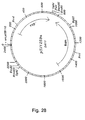
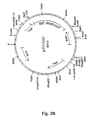
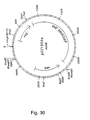
- replicational origins (+ ori pUB110, + ori pE194, ori pUC19) are indicated by the actual start site for replication, even though a functional origin consists of a larger DNA region.
- the invention is further described in the following examples which are not intended to be in any way limiting to the scope and spirit of the invention as claimed.
- pBD64 described in Gryczan et al., 1980.
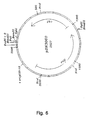
- pDN3060 A cloning vector derived from the Bacillus plasmid pDN1050 (Diderichsen, B., 1986) by insertion of synthetic oligonucleotides containing a number of useful restriction sites. The restriction map is shown in Fig. 6.
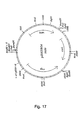
- pDN2904 A derivative of the Bacillus plasmid pUB110 (Gryczan et al., 1978), containing both a chloramphenicol resistance gene and a kanamycin resistance gene. The restriction map is shown in Fig. 17.
- pPL1484 A pUC19 (Yanisch-Perron et al., 1985) derivative containing a modified polylinker region into which was inserted a 1.4 kb BamHI fragment from pDN2904 containing the kanamycin resistance gene.
- the restriction map is shown in Fig. 13.
- pPL1878 pDN1380 (described in Diderichsen and Christiansen, 1988) containing a 2.4 kb HaelI-SphI fragment encoding a Cyclodextrin Glycosyl Transferase (CGTase) originating from Thermoanaerobacter sp. ATCC 53627.
- the gene was initially cloned into the E. coli plasmid pBR322 on a 12.8 kb EcoRI fragment (Starnes et al., 1989).
- the restriction map is shown in Fig. 22.
- Competent cells were prepared and transformed as described by Yasbin et al., 1975.
- subtilisin 309 The gene coding for the protease designated subtilisin 309 was cloned from an isolate of the B.lentus strain NCIB 10309 as described in WO 89/06279. Further subcloning resulted in the plasmid pSX120, which contains the replication origin of pUB110, the chloramphenicol resistance gene ( cat ) from pC194, two promoters P AmyM and P AmyQ and the gene encoding for the subtilisin 309 protease. (See Fig.4 and International Patent Application No. PCT/DK90/00164)
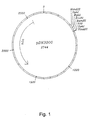
- Plasmid pDN3000 was constructed by restricting pUC19 (Yanisch-Perron et. al. ) with EcoRI and inserting the following oligonucleotide sequence (prepared by the phosphoamidite method described by Beaucage and Caruthers, Tetrehedron letters 22 , 1981, pp. 1859-1869, on an automatic DNA synthesizer) into the linearized pUC19 followed by ligation.
- the ligation mixture was then used to transform competent E.coli SJ6 cells and transformants were selected on LB plates containing 100 ug/ml ampicillin.
- the orientation of the inserted linker in pDN3000 is as indicated by the orientation of the restriction sites in Fig.1.
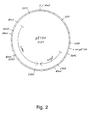
- Plasmid pPL1975 was constructed by restricting pDN3000 with BgIII followed by ligation of this linearized plasmid to the Mbol fragment containing the DNA from position 1 to 1585 resulting from restriction of pE194 (Fig.2, Horinouchi and Weisblum) with Mbol. The ligation mixture was then used to transform competent E.coli SJ6 cells and transformants were selected on LB plates containing 100 ug/ml ampicillin. The orientation of the connection of these two fragments is as indicated in Fig.3.
- pPL1975 thus contains a functional E. coli replication origin and a pE194 DNA fragment comprising an intact plus origin (+ ori pE194) and a truncated repF gene (repF') ( Villafane et al., 1987 ).
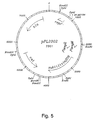
- Plasmid pPL2002 (Fig.5) was constructed by restricting pPL1975 (Fig.3) by EcoRI and BamHI and ligating the linearized plasmid to the 3.3kb EcoRI (partial) , BgIII fragment from pSX120 (Fig. 4) containing the subtilisin 309 gene and the cat resistance gene. The ligation mixture was then used to transform competent E. coli SJ6 cells and transformants were selected on LB plates containing 100 ug/ml ampicillin.
- PL2156 was then protoplast transformed with the plasmid pPL2002 selecting for chloramphenicol resistance (8ug/ml) and erythromycin resistance (5ug/ml) at 30°C resulting in the strain PL2157 containing the two plasmids pE194 and pPL2002.
- the replication of the plasmid pPL2002 completely depends on the presence of the plasmid pE194 which encodes the for the pPL2002 replication, indispensable replication protein repF.
- the strain PL2157 was grown overnight in TY9 medium and dilutions were plated on TY9 plates at 45 °C (nonpermissive temperature) selecting for chloramphenicol restance (10ug/ml).
- PL2158 Southern hybridization showed that, in the strain PL2158, the plasmid pPL2002 was integrated into the chromosome by homologous recombination between the plasmid-borne and chromosomal subtilisin 309 genes and thereafter amplified to approx. 4 copies. No evidence of complete pE194 plasmid sequences was detected.
- Plasmid pSJ1085 (Fig. 7) was constructed by restricting pDN3060 (containing an origin of replication (+ ori pUB110) and rep gene ( rep ) from pUB110, and a chloramphenicol resistance gene ( cat ) from pC194) with BamHI and EcoRI and inserting the following oligonucleotide sequence (prepared by the phosphoamidite method described by Beaucage and Caruthers, Tetrahedron Letters 22 , 1981, pp. 1859-1869, on an automatic DNA synthesizer) into the linearized pDN3060 followed by ligation and transformation of B. subtilis DN1885.
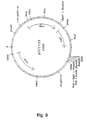
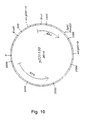
- Plasmid pSJ1130 (Fig. 10) was derived from pSJ1103 (Fig. 9) by deleting a 1.6 kb NsiI-PstI fragment , essentially resulting in a pUC19 plasmid containing a pUB110 plus-origin and a truncated rep gene ( rep '). The plasmid was transformed into E. coli SJ6.
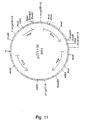
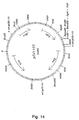
- kanamycin resistance was excised from plasmid pPL1484 (Fig. 13) on a 1.4 kb SphI fragment and inserted in each of the two possible orientations into the Sphl site of pSJ1137 (Fig. 12), followed by transformation of E. coli SJ6, resulting in pSJ1155 (Fig. 14) and pSJ1157 (Fig. 15), respectively .
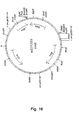
- pSJ1157 contained the kan gene in two tandem copies. One copy was excised with BamHI, and the 6.5 kb fragment religated and transformed into E. coli SJ6 to form pSJ1259 (Fig. 16).
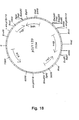
- Plasmid pSJ1139(Fig. 18) was constructed in the following way : The Bacillus plasmid pDN2904 (Fig. 17), containing a chloramphenicol resistance gene ( cat ), a kanamycin resistance gene ( kan ) and the pUB110 plus-origin with the corresponding rep gene was digested with Sphl and ligated to pSJ1130 (Fig. 10) which had also been digested with Sphl. The resulting plasmid pSJ1139 contains a pUB110 origin associated with a truncated rep gene and a pUB110 origin associated with an intact rep gene.
- Plasmid pSJ1139 (Fig. 18) (prepared from E. coli SJ1139 in a manner known per se ) was transformed into B. subtilis DN1885 selecting for kanamycin resistance (10 ⁇ g/ml), and plasmid DNA was prepared from several transformants. Agarose gel electrophoresis of these plasmids, whether undigested or digested with a variety of restriction enzymes, showed the presence of two smaller DNA molecules of 5.1 kb and 2.4 kb, respectively, as well as a small amount of the full-length plasmid pSJ1139 of 7.5 kb. The restriction patterns obtained were the expected ones for formation of the two progeny vectors pSJ1139a (Fig.
- Plasmid pPL1896 was transformed into B. subtilis strain DN1686. When selecting solely for Dal + transformants, several strains were obtained that were chloramphenicol sensitive, CGTase + . They were formed by a double homologous crossing-over between pPL1896 and the DN1686 chromosome, as described in Diderichsen, 1986. One such strain is PL1897, containing a chromosomally integrated copy of the CGTase gene.
- a 4 kb BgIII fragment from pSJ993 was inserted into the BgIII site of pSJ1155 (described in Example 1 above, Fig. 14), the resulting plasmid was transformed into E . coli strain SJ6, and ampicillin-resistant, CGTase-producing transformants of E. coli SJ6 were isolated by plating transformants on LB plates containing 100 ⁇ g/ml ampicillin and 0.5% soluble starch, screening for the formation of a clear halo around the colonies after staining the plates with iodine vapour.
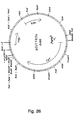
- a transformant harbouring the plasmid pSJ1163 (Fig. 25) in which the kanamycin resistance gene had been regenerated was kept for further experiments.
- pSJ1163 (Fig. 25) was transformed into DN1885 and vector DNA was prepared from kanamycin-resistant transformants and analyzed by agarose gel electrophoresis. This showed traces of a 10.5 kb plasmid molecule, corresponding to pSJ1163, and two progeny vector molecules pSJ1163b of 4.1 kb (Fig. 27) and pSJ1163a of 6.4 kb (Fig. 26) in approximately equal and in far larger amounts, respectively, corresponding to progeny vectors derived either by homologous recombination between the two rep -sequences of pSJ1163 or by the action of the Rep protein at each plus origin in rolling circle replication as described above. The formation of progeny vectors as described above was also observed when pSJ1163 was transformed into PL1897, and two such transformants were kept for further experiments as strains SJ1168 and SJ1170.
- Plasmid pSJ1260 is identical to pSJ1259 shown in Fig. 16. Chromosomal DNA from B. licheniformis ATCC 9789 was digested with PstI + BamHI and fragments between 2 and 4 kb were isolated from an agarose gel. These fragments were ligated into pSJ1260 digested with Pstl + BamHI, and transformed into E. coli SJ6 selecting ampicillin resistance. One transformant obtained contained an insert of 2.1 kb and the plasmid was denoted pSJ1555 (Fig. 29). E. coli SJ6 containing pSJ1555 was deposited at the National Collection of Industrial and Marine Bacteria Ltd, 23 St.
- This plasmid has the capacity to form the two progeny molecules pSJ1555a (Fig. 30) and pSJ1555b (Fig. 31).
Landscapes
- Health & Medical Sciences (AREA)
- Genetics & Genomics (AREA)
- Life Sciences & Earth Sciences (AREA)
- Engineering & Computer Science (AREA)
- Wood Science & Technology (AREA)
- Biomedical Technology (AREA)
- Organic Chemistry (AREA)
- Biotechnology (AREA)
- General Engineering & Computer Science (AREA)
- Chemical & Material Sciences (AREA)
- Bioinformatics & Cheminformatics (AREA)
- Zoology (AREA)
- Molecular Biology (AREA)
- Biophysics (AREA)
- Microbiology (AREA)
- Plant Pathology (AREA)
- Biochemistry (AREA)
- General Health & Medical Sciences (AREA)
- Physics & Mathematics (AREA)
- Mycology (AREA)
- Micro-Organisms Or Cultivation Processes Thereof (AREA)
- Measuring Or Testing Involving Enzymes Or Micro-Organisms (AREA)
- Saccharide Compounds (AREA)
- Pharmaceuticals Containing Other Organic And Inorganic Compounds (AREA)
Claims (40)
- Verfahren zur Herstellung einer bakteriellen Zelle, die in ihrem Genom ein integriertes nicht-replikatives DNA-Konstrukt trägt, das (1) eine DNA-Sequenz von Interesse, (2) eine DNA-Sequenz, die homolog zu einer Region des Genoms, der Zelle ist, und (3) einen Replikationursprung umfasst, wobei dem DNA Konstrukt ein funktionelles Gen fehlt, das für einen Faktor kodiert, der erforderlich ist, um die Replikation vom Replikationsursprung zu initiieren,
wobei das Verfahren Folgendes umfasst:wobei die Replikation des Elternplasmidvektors zur Bildung eines ersten Nachkommenvektors, der den ersten Replikationsursprung und ein oder mehrere funktionelle Gene, die für dem/die für die Plasmidreplikation von dem ersten und dem zweiten Replikationsursprung erforderlichen Replikationsfaktor(en) kodieren, umfasst, und eines zweiten Nachkommenvektors führt, der den zweiten Replikationsursprung umfasst, dem jedoch ein funktionelles Gen, das für den Replikationsfaktor kodiert, fehlt, und der außerdem eine DNA-Sequenz, die homolog zu einer Region des Genoms der Zelle ist, umfasst, sowie fortgesetztes Kultivieren der transformierten Zellen unter selektiven Bedingungen, die zur Integration des zweiten Nachkommenvektors in das bakterielle Genom durch homologe Rekombination und zum Verlust des ersten Nachkommenvektors sowie des Elternvektors aus den Zellen führen.(a) Transformation von bakteriellen Zellen mit einem Elternplasmidvektor, der einen ersten Replikationsursprung und einen zweiten Replikationsursprung in der gleichen Orientierung wie der erste Replikationsursprung umfasst, wobei der erste und der zweite Replikationsursprung ausreichend ähnlich sind, um ihre Funktion mit dem/den gleichen Replikationsfaktor(en) zu erfüllen,
wobei der erste und der zweite Replikationsursprung den Vektor in zwei Teile teilen, und zwar (i) einen ersten Teil, der den ersten Replikationsursprung und ein oder mehrere funktionelle Gene, die für den/die für die Plasmidreplikation von dem ersten und dem zweiten Replikationsursprung erforderlichen Replikationsfaktor(en) kodieren, umfasst, und (ii) einen zweiten Teil der den zweiten Replikationsursprung, eine DNA-Sequenz von Interesse und eine DNA-Sequenz, die homolog zu einer Region des Genoms der für die Einführung des Vektors vorgesehenen Zelle ist, umfasst, und(b) Kultivieren der transformierten Zellen unter selektiven Bedingungen, - Verfahren nach Anspruch 1, wobei der zweite Replikationsursprung vom gleichen Plasmid wie der erste Replikationsursprung stammt
- Verfahren nach Anspruch 1, wobei ein für den Replikationsfaktor, der mit dem zweiten Replikationsursprung assoziiert ist, kodierendes Gen deletiert worden ist.
- Verfahren nach Anspruch 1, wobei ein für den Replikationsfaktor, der, mit dem zweiten Replikationsursprung assoziiert ist, kodierendes Gen modifiziert worden ist.
- Verfahren nach Anspruch 4, wobei das Gen durch Deletion, Insertion oder Substitution eines oder mehrerer Nukleotide der DNA-Sequenz des Gens oder durch Deletion des transkriptionalen oder translationalen Start- oder Stoppsignals modifiziert worden ist.
- Verfahren nach Anspruch 1, wobei es sich bei dem Elternplasmidvektor um einen Vektor handelt, der nicht zur Replikation bei erhöhten Temperaturen imstande ist, der jedoch ein Wachstum der Wirtszelle erlaubt, wobei die bakteriellen Zellen zunächst bei einer Temperatur kultiviert werden, die eine Replikation des Plasmids erlaubt, und anschließend, nach der Integration des zweiten Nachkommenvektors in das bakterielle Genom, bei einer Temperatur kultiviert werden, die die Replikation des Plasmids nicht erlaubt, so dass der erste Nachkommenvektor sowie der Elternvektor aus den Zellen verloren gehen.
- Verfahren nach einem der Ansprüche 1 bis 6, wobei der Elternvektor einen ersten Plus-Replikationsursprung von einem einzelsträngigen DNA-Plasmid und einen zweiten Plus-Replikationsursprung den Vektor in zwei Teile teilen, und zwar (i) einen ersten Teil, der den ersten Plus-Replikationsursprung und ein funktionelles rep-Gen, das für einen Faktor kodiert, der für die Replikation vom ersten und zweiten Plus-Replikationsursprung erforderlich ist, umfasst, und (ü) einen zweiten Teil, der den zweiten Replikationsursprung, eine DNA-Sequenz von Interesse und eine DNA-Sequenz, die homolog zu einer Region des Genoms der für die Einführung des Plasmidvektors vorgesehenen Zelle ist, umfasst.
- Verfahren nach Anspruch 7, wobei der zweite Plus-Replikationsursprung vom gleichen einzelsträngigen DNA-Plasmid wie der erste Plus-Replikationsursprung stammt.
- Verfahren nach einem der Ansprüche 1 bis 8, wobei es sich bei der bakteriellen Zelle um die Zelle eines grampositiven Bakteriums handelt.
- Verfahren nach Anspruch 9, wobei es sich bei dem grampositiven Bakterium um einen Stamm handelt, der zur Gattung Bacillus oder Streptomyces gehört.
- Verfahren nach Anspruch 10, wobei es sich bei dem Bakterium um einen Stamm von Bacillus lichenifomis, Bacillus lentus, Bacillus brevis, Bacillus stearothermophilus. Bacillus alkalophilus, Bacillus amyloliquefaciens, Bacillus coagluans, Bacillus subtilis oder Streptomyces lividans handelt.
- Verfahren zur Herstellung einer bakteriellen Zelle, die in ihrem Genom ein integriertes nicht-replikatives DNA-Konstrukt trägt, das (1) eine DNA-Sequenz von Interesse, (2) eine DNA-Sequenz, die homolog zu einer Region des Genoms der Zelle ist, und (3) einen Replikationsursprung umfasst, wobei dem DNA-Konstrukt ein funktionelles Gen fehlt, das für einen Faktor kodiert, der zur Initiation der Replikation von dem Replikationsursprung erforderlich ist,
wobei das Verfahren folgendes umfasst:(a) Transformation bakterieller Zellen mit (i) einem ersten DNA-Vektor, der einen ersten Replikationsursprung und ein oder mehrere funktionelle Gene, die für den/die für die Plasmidreplikation von dem ersten Replikationsursprung erforderlichen Faktor(en) kodieren, umfasst, und mit (ii) einem zweiten DNA-Vektor, der einen zweiten Replikationsursprung umfasst, dem jedoch ein funktionelles Gen, das für einen Faktor kodiert, der für die Plasmidreplikation von dem zweiten Replikationsursprung erforderlich ist, fehlt, und der außerdern eine DNA-Sequenz von Interesse und eine DNA-Sequenz, die homolog zu einer Region des Genoms der Zelle ist, umfasst,
wobei der erste und der zweite Replikationsursprung ausreichend ähnlich sind, um mit dem/den gleichen Replikationsfaktor(en) ihre Funktion zu erfüllen, so dass die Replikation des zweiten DNA-Vektors vom zweiten Replikationsursprung durch den/die Replikationsfaktor(en) initiiert wird, der/die von dem/den auf dem ersten DNA-Vektor vorhandenen Gen(en) kodiert wird/werden, und(b) Kultivieren der erhaltenen Zellen unter selektiven Bedingungen, die zur Integration des zweiten DNA-Vektors in das bakterielle Genom durch homologe Rekombination und Verlust des ersten DNA-Faktors führen. - Verfahren nach Anspruch 12, wobei der zweite Replikationsursprung vom gleichen Plasmid wie der erste Replikationsursprung stammt.
- Verfahren nach Anspruch 12, wobei aus dem zweiten DNA-Vektor das Gen deletiert worden ist, das für den Replikationsfaktor kodiert, der mit dem zweiten Replikationsursprung assoziiert ist.
- Verfahren nach Anspruch 12, wobei das Gen, das für den Replikationsfaktor kodiert, der mit dem zweiten Replikationsursprung assoziiert ist, modifiziert worden ist.
- Verfahren nach Anspruch 15, wobei das Gen durch Deletion, Insertion oder Substitution eines oder mehrerer Nukleotide der DNA-Sequenz des Gens oder durch Deletion des transkriptionalen oder translationalen Start- oder Stoppsignals modifiziert worden ist.
- Verfahren nach Anspruch 12, wobei der erste DNA-Vektor ferner ein funktionelles Gen umfasst, das für den Replikationsfaktor kodiert, der mit dem zweiten Replikationsursprung assoziiert ist.
- Verfahren nach Anspruch 12, wobei der zweite DNA-Vektor ferner einen selektierbaren Marker umfasst.
- Verfahren nach einem der Ansprüche 12 bis 18, wobei der erste DNA-Vektor einen ersten Plus-Replikationsursprung aus einem einzelsträngigen DNA-Plasmid und ein funktionelles rep-Gen umfasst, ihm jedoch ein funktionelles rep-Gen, das zum zweiten Plus-Replikationsursprung gehört, fehlt; und er außerdem eine DNA-Sequenz von Interesse und eine DNA-Sequenz, die homolog zu einer Region des Genoms der Zelle ist, umfasst.
- Verfahren nach Anspruch 19, wobei der zweite Plus-Replikationsursprung aus dem gleichen einzelsträngigen DNA-Plasmid wie der erste Plus-Replikationsursprung stammt.
- Verfahren nach Anspruch 12, wobei es sich bei dem ersten DNA-Vektor um einen Vektor handelt, der nicht zur Replikation bei erhöhten Temperaturen imstande ist, der jedoch ein Wachstum der Wirtszellen erlaubt, wobei die bakteriellen Zellen zunächst bei einer Temperatur kultiviert werden, die eine Plasmidreplikation erlaubt, und anschließend, nach der Integration des zweiten DNA-Vektors in das bakterielle Genom, bei einer Temperatur kultiviert werden, die eine Plasmidreplikation nicht erlaubt, so dass der erste DNA-Vektor aus den Zellen verloren geht.
- Verfahren nach einem der Ansprüche 12 bis 21, wobei sich bei der Zelle um ein grampositives Bakterium handelt.
- Verfahren nach Anspruch 22, wobei es sich bei dem grampositiven Bakterium um einen Stamm handelt, der zur Gattung Bacillus oder Streptomyces gehört.
- Verfahren nach Anspruch 23, wobei es sich bei dem Bakterium um einen Stamm von Bacillus licheniformis, Bacillus lentus, Bacillus brevis, Bacillus stearothermophilus, Bacillus alkalophilus, Bacillus amyloliquefaciens, Bacillus coagulans, Bacillus subtilis oder Streptomyces lividans handelt.
- Elternplasmidvektor, der einen ersten Replikationsursprung und einen zweiten Replikationsursprung in der gleichen Orientierung wie der erste Replikationsursprung umfasst, wobei der erste und der zweite Replikationsursprung ausreichend ähnlich sind, um mit dem/den gleichen Replikationsfaktor(en) ihre Funktion erfüllen, wobei der erste und der zweite Replikationsursprung den Vektor in zwei Teile teilen, und zwar (i) einen ersten Teil, der den ersten Replikationsursprung und ein oder mehrere funktionelle Gene, die für den/die für die Plasmidreplikation von dem ersten und dem zweiten Replikationsursprung erforderlichen Replikationsfaktor(en) kodieren, umfasst, und (ii) einen zweiten Teil, der den zweiten Replikationsursprung, eine DNA-Sequenz von Interesse und eine DNA-Sequenz, die homolog zu einer Region des Genoms der für die Einführung des Vektors vorgesehenen Zelle ist, umfasst.
- Plasmidvektor nach Anspruch 25, bei dem das Gen, wobei der zweite Replikationsursprung vom gleichen Plasmid wie der erste Replikationsursprung stammt.
- Plasmidvektor nach Anspruch 25, bei dem das Gen, das für den Replikationsfaktor, der mit dem zweiten Replikationsursprung assoziiert ist, kodiert, deletiert worden ist.
- Plasmidvektor nach Anspruch 25, wobei ein Gen, das für den Replikationsfaktor kodiert, der mit dem zweiten Replikationsursprung assoziiert ist, modifiziert worden ist.
- Plasmidvektor nach Anspruch 28, wobei das Gen durch Deletion, Insertion oder Substitution eines oder mehrerer Nukleotide der DNA-Sequenz des Gens oder durch Deletion des transkriptionalen oder translationalen Start- oder Stoppsignals modifiziert worden ist.
- Plasmidvektor nach einem der Ansprüche 25 bis 29, der einen ersten Plus-Replikationsursprung von einem einzelsträngigen DNA-Plasmid und einen zweiten Plus-Replikationsursprung von einem einzelsträngigen DNA-Plasmid in der gleichen Orientierung wie der erste Plus-Ursprung umfasst, wobei der erste und der zweite Plus-Replikationsursprung den Vektor in zwei Teile teilen, und zwar einen ersten Teil, der den ersten Plus-Replikationsursprung und ein funktionelles rep-Gen, das für einen Faktor kodiert, der für die Replikation von dem ersten und dem zweiten Plus-Replikationsursprung erforderliche ist, umfasst, und einen zweiten Teil, der den zweiten Plus-Replikationsursprung, eine DNA-Sequenz von Interesse und eine DNA-Sequenz, die homolog zu einer Region des Genoms der für die Einführung des Plasmidvektors vorgesehenen Zelle ist, umfasst.
- Plasmidvektor nach Anspruch 30, wobei der zweite Plus-Replikationsursprung vom gleichen einzelsträngigen DNA-Plasmid wie der erste Plus-Replikationsursprung stammt.
- Plasmidvektor nach einem der Ansprüche 25 bis 31, der ferner einen selektierbaren Marker umfasst.
- Bakterielle Zelle, die zur Gattung Bacillus gehört und nicht durch Kompetentmachung transformiert werden kann, und die in ihrem Genom ein integriertes nicht-replikatives DNA-Konstrukt trägt, das (1) eine DNA-Sequenz von Interesse, (2) eine DNA-Sequenz, die homolog zu einer Region des Genoms der Zelle ist, und (3) einen Replikationsursprung umfasst, wobei aus dem DNA-Konstrukt ein Gen, das für einen Faktor kodiert, der zur Initiation der Replikation von dem Replikationsursprung erforderlich ist, deletiert worden ist, oder wobei das Gen, das für den Replikationsfaktor kodiert, modifiziert worden ist, so dass es für einen inaktiven Replikationsfaktor kodiert.
- Zelle nach Anspruch 33, wobei das Gen durch Deletion, Insertion oder Substitution eines oder mehrerer Nukleotide der DNA-Sequenz des Gens oder durch Deletion des transkriptionalen oder translationalen Start- oder Stoppsignals modifiziert worden ist.
- Zelle nach einem der Ansprüche 33 oder 34, wobei das DNA-Konstrukt eine DNA-Sequenz von Interesse, eine DNA-Sequenz, die homolog zu einer Region des Genoms der Zelle ist, und einen Plus-Replikationsursprung von einem einzelsträngigen DNA-Plasmid umfasst, wobei dem DNA-Konstrukt eine funktionelles rep-Gen fehlt, das zu dem Plus-Replikationsursprung gehört.
- Zelle nach einem der Ansprüche 33 bis 35, wobei das DNA-Konstrukt zusätzlich einen selektierbaren Marker umfasst.
- Zelle nach einem der Ansprüche 33 bis 36, wobei es sich bei dem Bakterium um einen Stamm von Bacillus licheniformis, Bacillus lentus, Bacillus brevis, Bacillus stearothermophilus, Bacillus alkalophilus, Bacillus amyloliquefaciens, Bacillus coagulans oder Bacillus subtilis handelt.
- Verfahren zur Herstellung eines Polypeptids von Interesse, umfassend das Kultivieren einer bakteriellen Zelle nach einem der Ansprüche 33 bis 37, die eine integrierte DNA-Sequenz enthält, die für das Polypeptid kodiert, unter Bedingungen, die günstig für die Bildung des Polypeptids sind, und die Gewinnung des erhaltenen Polypeptids aus der Kultur.
- Verfahren nach Anspruch 38, wobei es sich bei dem Polypeptid um ein Enzym handelt.
- Verfahren nach Anspruch 39, wobei es sich bei dem Enzym um eine Protease, eine Amylase oder eine Lipase handelt.
Applications Claiming Priority (4)
| Application Number | Priority Date | Filing Date | Title |
|---|---|---|---|
| DK6396/89 | 1989-12-18 | ||
| DK639689 | 1989-12-18 | ||
| DK639689A DK639689D0 (da) | 1989-12-18 | 1989-12-18 | Indfoering af dna i celler |
| PCT/DK1990/000332 WO1991009129A1 (en) | 1989-12-18 | 1990-12-18 | Stable integration of dna in bacterial genomes |
Publications (3)
| Publication Number | Publication Date |
|---|---|
| EP0506780A1 EP0506780A1 (de) | 1992-10-07 |
| EP0506780B1 EP0506780B1 (de) | 1994-10-19 |
| EP0506780B2 true EP0506780B2 (de) | 2004-01-02 |
Family
ID=8148687
Family Applications (1)
| Application Number | Title | Priority Date | Filing Date |
|---|---|---|---|
| EP91901587A Expired - Lifetime EP0506780B2 (de) | 1989-12-18 | 1990-12-18 | Stabile integration von dna in bakterielle genome |
Country Status (11)
| Country | Link |
|---|---|
| EP (1) | EP0506780B2 (de) |
| JP (1) | JP3162707B2 (de) |
| AT (1) | ATE113077T1 (de) |
| AU (1) | AU643741B2 (de) |
| CA (1) | CA2070676A1 (de) |
| DE (1) | DE69013520T3 (de) |
| DK (2) | DK639689D0 (de) |
| ES (1) | ES2064077T5 (de) |
| FI (1) | FI112502B (de) |
| NO (1) | NO922381L (de) |
| WO (1) | WO1991009129A1 (de) |
Families Citing this family (43)
| Publication number | Priority date | Publication date | Assignee | Title |
|---|---|---|---|---|
| FR2665711B1 (fr) * | 1990-08-08 | 1993-08-13 | Centre Nat Rech Scient | Integron de corynebacterie, procede de transformation d'une corynebacterie par ledit integron et corynebacterie obtenue. |
| IL110299A0 (en) | 1993-07-15 | 1994-10-21 | Novo Nordisk Entotech Inc | Formation of and methods for the production of large bacillus thuringiensis crystals with increased pesticidal activity |
| AU5001496A (en) * | 1995-03-22 | 1996-10-08 | Novo Nordisk A/S | Introduction of dna into bacillus strains by conjugation |
| EP0756007A3 (de) * | 1995-06-30 | 1997-10-29 | Ajinomoto Kk | Genvermerungsverfahren mit kunstlichen Transposon |
| EP0878552A1 (de) | 1997-05-13 | 1998-11-18 | Erasmus Universiteit Rotterdam | Molekularer Nachweis von chromosomalen Veränderungen |
| AU753578B2 (en) | 1997-12-22 | 2002-10-24 | Novozymes A/S | Carbohydrate oxidase and use thereof in baking |
| AU3516899A (en) | 1998-05-04 | 1999-11-23 | Dako A/S | Method and probes for the detection of chromosome aberrations |
| EP2284272B1 (de) | 1998-06-10 | 2014-08-13 | Novozymes A/S | Mannanasen |
| JP3958884B2 (ja) | 1998-09-11 | 2007-08-15 | 株式会社林原生物化学研究所 | 非還元性糖質生成酵素及びトレハロース遊離酵素ならびに該酵素を用いる糖質の製造方法 |
| AU6188599A (en) | 1998-10-26 | 2000-05-15 | Novozymes A/S | Constructing and screening a dna library of interest in filamentous fungal cells |
| JP2004501651A (ja) | 2000-06-23 | 2004-01-22 | ノボザイムス アクティーゼルスカブ | 遺伝子の安定した染色体多コピー組み込みのための方法 |
| JP4242761B2 (ja) | 2001-06-06 | 2009-03-25 | ノボザイムス アクティーゼルスカブ | エンド−β−1,4−グルカナーゼ |
| EP2213745A1 (de) | 2002-04-10 | 2010-08-04 | Novozymes A/S | Verbesserte Bacillus-Wirtszelle |
| EP1995319B1 (de) | 2002-04-10 | 2011-08-31 | Novozymes A/S | Mutierte Bacillus licheniformis Wirtszelle |
| WO2003095658A1 (en) * | 2002-05-07 | 2003-11-20 | Novozymes A/S | Homologous recombination into bacterium for the generation of polynucleotide libraries |
| US20060035800A1 (en) | 2002-12-11 | 2006-02-16 | Novozymes A/S | Detergent composition |
| DK1694846T3 (en) | 2003-12-10 | 2014-11-17 | Novozymes As | Cell with enhanced secretion mediated by MrgA protein or a homolog |
| CN101006174B (zh) | 2004-06-21 | 2010-05-26 | 诺维信公司 | 以相同取向稳定保持的至少两个orf的多拷贝 |
| EP2089516B1 (de) | 2006-11-29 | 2011-11-16 | Novozymes Inc. | Verfahren zur verbesserten einführung von dna in bakterienzellen |
| WO2008140615A2 (en) | 2006-12-21 | 2008-11-20 | Novozymes, Inc. | Modified messenger rna stabilizing sequences for expressing genes in bacterial cells |
| US20120329090A1 (en) | 2009-12-21 | 2012-12-27 | Novozymes A/S | Methods for Producing Heterologous Polypeptides in Thiol-Disulfide Oxidoreductase-Deficient Bacterial Mutant Cells |
| CN109804072A (zh) | 2016-10-25 | 2019-05-24 | 诺维信公司 | 地衣芽孢杆菌中flp介导的基因组整合 |
| EP3655422B1 (de) | 2017-07-21 | 2023-03-29 | Basf Se | Promotor zur heterologen expression |
| CN110892066A (zh) | 2017-07-21 | 2020-03-17 | 巴斯夫欧洲公司 | 转化细菌细胞的方法 |
| EP3707252A1 (de) | 2017-11-10 | 2020-09-16 | Novozymes A/S | Temperaturempfindliches cas9-protein |
| US20210017544A1 (en) | 2017-12-22 | 2021-01-21 | Novozymes A/S | Counter-Selection by Inhibition of Conditionally Essential Genes |
| WO2020156903A1 (en) | 2019-01-30 | 2020-08-06 | Novozymes A/S | Cognate foldase co-expression |
| WO2020169563A1 (en) | 2019-02-20 | 2020-08-27 | Basf Se | Industrial fermentation process for bacillus using defined medium and magnesium feed |
| US20220186234A1 (en) | 2019-02-20 | 2022-06-16 | Basf Se | Industrial Fermentation Process for Bacillus Using Defined Medium and Trace Element Feed |
| WO2020182552A1 (en) | 2019-03-08 | 2020-09-17 | Novozymes A/S | Means and methods for improving protease expression |
| WO2020229191A1 (en) | 2019-05-15 | 2020-11-19 | Novozymes A/S | Temperature-sensitive rna-guided endonuclease |
| EP3990629A1 (de) | 2019-06-25 | 2022-05-04 | Novozymes A/S | Gegenauswahl durch hemmung von bedingt essenziellen genen |
| EP3994273A1 (de) | 2019-07-02 | 2022-05-11 | Basf Se | Verfahren zur herstellung eines fermentationsmediums |
| EP4189104A1 (de) | 2020-07-28 | 2023-06-07 | Basf Se | Industrielles fermentationsverfahren für bacillus unter verwendung von partieller ernte |
| MX2023001272A (es) | 2020-07-28 | 2023-03-03 | Basf Se | Proceso de fermentacion industrial para bacillus mediante el uso de cambio de temperatura. |
| KR20230042509A (ko) | 2020-07-28 | 2023-03-28 | 바스프 에스이 | 공급 속도 이동을 이용한 바실러스의 산업적 발효 방법 |
| EP4225779A2 (de) | 2020-10-07 | 2023-08-16 | Basf Se | Bacilluszelle mit reduzierter lipase- und/oder esteraseseitenaktivität |
| US20240294894A1 (en) | 2021-06-24 | 2024-09-05 | Basf Se | Improved bacillus host cell with altered rema/remb protein |
| EP4359423A1 (de) | 2021-06-24 | 2024-05-01 | Basf Se | Bacillus licheniformis-wirtszelle zur herstellung einer verbindung von interesse mit erhöhter reinheit |
| EP4370534A1 (de) | 2021-07-13 | 2024-05-22 | Novozymes A/S | Rekombinante cutinase-expression |
| WO2023247514A1 (en) | 2022-06-22 | 2023-12-28 | Novozymes A/S | Recombinant mannanase expression |
| US20260062690A1 (en) | 2022-08-02 | 2026-03-05 | Basf Se | Stabilized protein production process using bacillus host cells |
| WO2025132815A1 (en) | 2023-12-20 | 2025-06-26 | Novozymes A/S | Novel cas nucleases and polynucleotides encoding the same |
Family Cites Families (2)
| Publication number | Priority date | Publication date | Assignee | Title |
|---|---|---|---|---|
| US4631257A (en) * | 1978-12-26 | 1986-12-23 | Cetus Corporation | Stable high copy number plasmids |
| US4401761A (en) * | 1981-01-26 | 1983-08-30 | The Upjohn Company | Process for stabilizing plasmids by deletion of DNA |
-
1989
- 1989-12-18 DK DK639689A patent/DK639689D0/da not_active Application Discontinuation
-
1990
- 1990-12-18 AU AU70312/91A patent/AU643741B2/en not_active Expired
- 1990-12-18 WO PCT/DK1990/000332 patent/WO1991009129A1/en not_active Ceased
- 1990-12-18 ES ES91901587T patent/ES2064077T5/es not_active Expired - Lifetime
- 1990-12-18 JP JP50181391A patent/JP3162707B2/ja not_active Expired - Lifetime
- 1990-12-18 CA CA002070676A patent/CA2070676A1/en not_active Abandoned
- 1990-12-18 AT AT91901587T patent/ATE113077T1/de not_active IP Right Cessation
- 1990-12-18 EP EP91901587A patent/EP0506780B2/de not_active Expired - Lifetime
- 1990-12-18 DK DK91901587T patent/DK0506780T4/da active
- 1990-12-18 DE DE69013520T patent/DE69013520T3/de not_active Expired - Lifetime
-
1992
- 1992-06-17 FI FI922812A patent/FI112502B/fi active
- 1992-06-17 NO NO92922381A patent/NO922381L/no unknown
Also Published As
| Publication number | Publication date |
|---|---|
| FI922812A0 (fi) | 1992-06-17 |
| JP3162707B2 (ja) | 2001-05-08 |
| WO1991009129A1 (en) | 1991-06-27 |
| AU643741B2 (en) | 1993-11-25 |
| DE69013520D1 (de) | 1994-11-24 |
| FI112502B (fi) | 2003-12-15 |
| DE69013520T3 (de) | 2004-09-23 |
| DE69013520T2 (de) | 1995-05-04 |
| EP0506780A1 (de) | 1992-10-07 |
| ES2064077T3 (es) | 1995-01-16 |
| NO922381L (no) | 1992-08-17 |
| FI922812L (fi) | 1992-06-17 |
| CA2070676A1 (en) | 1991-06-19 |
| DK0506780T4 (da) | 2004-04-26 |
| DK0506780T3 (da) | 1995-04-18 |
| ES2064077T5 (es) | 2004-09-01 |
| EP0506780B1 (de) | 1994-10-19 |
| JPH05502162A (ja) | 1993-04-22 |
| ATE113077T1 (de) | 1994-11-15 |
| DK639689D0 (da) | 1989-12-18 |
| AU7031291A (en) | 1991-07-18 |
| NO922381D0 (no) | 1992-06-17 |
Similar Documents
| Publication | Publication Date | Title |
|---|---|---|
| EP0506780B1 (de) | Stabile integration von dna in bakterielle genome | |
| EP0805867B1 (de) | Dna-integration durch transposition | |
| US5733753A (en) | Amplification of genomic DNA by site specific integration of a selectable marker construct | |
| EP0675959B1 (de) | Dna - amplifikation | |
| JP3529774B2 (ja) | バシラス・リヘニフォルミスx−アミラーゼのプロモーターの変異体由来のバシラス属細菌のプロモーター | |
| EP0127328A2 (de) | Verwendung einer Integration in Chromosomen zur Stabilisierung heterologer Gene | |
| JP2004501651A (ja) | 遺伝子の安定した染色体多コピー組み込みのための方法 | |
| US5695976A (en) | Stable integration of DNA in bacterial genomes | |
| EP0817856A1 (de) | Einfuhrung von dna in bacillus subtilis durch konjugation | |
| WO2010084349A1 (en) | Method of double crossover homologous recombination in clostridia | |
| Haima et al. | An improved β-galactosidase α-complementation system for molecular cloning in Bacillus subtilis | |
| US6100063A (en) | Procaryotic cell comprising at least two copies of a gene | |
| JP2020527951A (ja) | 望ましい遺伝子発現を促進するためのプラスミドアディクションシステム | |
| US5925544A (en) | Method of homologous recombination followed by in vivo selection of DNA amplification | |
| JP4350894B2 (ja) | 異なる方向に転写される2コピーの遺伝子を含有する原核細胞 | |
| Mann et al. | Transformation of Bacillus spp.: an examination of the transformation of Bacillus protoplasts by plasmids pUB110 and pHV33 | |
| SEKI et al. | An improved method of prophage transformation in Bacillus subtilis | |
| Tangney et al. | A new method for integration and stable DNA amplification in poorly transformable bacilli | |
| JP2002508669A (ja) | 所望の遺伝子の複数コピー、及び選択マーカーではなく、スクリーニング可能マーカーを含むタンパク質産生細胞 | |
| IE851287L (en) | CLONED ß-AMYLASE. | |
| JP2005237335A (ja) | ストレプトミセス属細菌用組換え体プラスミド | |
| DE69008959T2 (de) | Verfahren zur Produktion von Protein mit Stämmen von Bacillus subtilis und Verfahren zur Vorbereitung dieser Stämme. |
Legal Events
| Date | Code | Title | Description |
|---|---|---|---|
| PUAI | Public reference made under article 153(3) epc to a published international application that has entered the european phase |
Free format text: ORIGINAL CODE: 0009012 |
|
| 17P | Request for examination filed |
Effective date: 19920514 |
|
| AK | Designated contracting states |
Kind code of ref document: A1 Designated state(s): AT BE CH DE DK ES FR GB GR IT LI LU NL SE |
|
| 17Q | First examination report despatched |
Effective date: 19921116 |
|
| GRAA | (expected) grant |
Free format text: ORIGINAL CODE: 0009210 |
|
| RIN1 | Information on inventor provided before grant (corrected) |
Inventor name: JORGENSEN, STEEN, TROELS Inventor name: DIDERICHSEN, BORGE, KRAG Inventor name: JORGENSEN, PER, LINA |
|
| AK | Designated contracting states |
Kind code of ref document: B1 Designated state(s): AT BE CH DE DK ES FR GB GR IT LI LU NL SE |
|
| PG25 | Lapsed in a contracting state [announced via postgrant information from national office to epo] |
Ref country code: GR Free format text: LAPSE BECAUSE OF FAILURE TO SUBMIT A TRANSLATION OF THE DESCRIPTION OR TO PAY THE FEE WITHIN THE PRESCRIBED TIME-LIMIT Effective date: 19941019 |
|
| REF | Corresponds to: |
Ref document number: 113077 Country of ref document: AT Date of ref document: 19941115 Kind code of ref document: T |
|
| REF | Corresponds to: |
Ref document number: 69013520 Country of ref document: DE Date of ref document: 19941124 |
|
| PG25 | Lapsed in a contracting state [announced via postgrant information from national office to epo] |
Ref country code: LU Free format text: LAPSE BECAUSE OF NON-PAYMENT OF DUE FEES Effective date: 19941231 |
|
| REG | Reference to a national code |
Ref country code: ES Ref legal event code: FG2A Ref document number: 2064077 Country of ref document: ES Kind code of ref document: T3 |
|
| ITF | It: translation for a ep patent filed | ||
| EAL | Se: european patent in force in sweden |
Ref document number: 91901587.5 |
|
| ET | Fr: translation filed | ||
| REG | Reference to a national code |
Ref country code: DK Ref legal event code: T3 |
|
| PLBI | Opposition filed |
Free format text: ORIGINAL CODE: 0009260 |
|
| 26 | Opposition filed |
Opponent name: SOLVAY (SOCIETE ANONYME), BRUXELLES Effective date: 19950719 |
|
| NLR1 | Nl: opposition has been filed with the epo |
Opponent name: SOLVAY (SOCIETE ANONYME), BRUXELLES |
|
| PLBF | Reply of patent proprietor to notice(s) of opposition |
Free format text: ORIGINAL CODE: EPIDOS OBSO |
|
| PLBF | Reply of patent proprietor to notice(s) of opposition |
Free format text: ORIGINAL CODE: EPIDOS OBSO |
|
| PLBF | Reply of patent proprietor to notice(s) of opposition |
Free format text: ORIGINAL CODE: EPIDOS OBSO |
|
| PLBF | Reply of patent proprietor to notice(s) of opposition |
Free format text: ORIGINAL CODE: EPIDOS OBSO |
|
| PLBF | Reply of patent proprietor to notice(s) of opposition |
Free format text: ORIGINAL CODE: EPIDOS OBSO |
|
| PLBQ | Unpublished change to opponent data |
Free format text: ORIGINAL CODE: EPIDOS OPPO |
|
| PLAB | Opposition data, opponent's data or that of the opponent's representative modified |
Free format text: ORIGINAL CODE: 0009299OPPO |
|
| R26 | Opposition filed (corrected) |
Opponent name: SOLVAY (SOCIETE ANONYME), BRUXELLES Effective date: 19950719 |
|
| NLR1 | Nl: opposition has been filed with the epo |
Opponent name: SOLVAY (SOCIETE ANONYME), BRUXELLES |
|
| PLAB | Opposition data, opponent's data or that of the opponent's representative modified |
Free format text: ORIGINAL CODE: 0009299OPPO |
|
| R26 | Opposition filed (corrected) |
Opponent name: GENENCOR INTERNATIONAL, INC. Effective date: 19950719 |
|
| NLR1 | Nl: opposition has been filed with the epo |
Opponent name: GENENCOR INTERNATIONAL, INC. |
|
| PLAW | Interlocutory decision in opposition |
Free format text: ORIGINAL CODE: EPIDOS IDOP |
|
| APAC | Appeal dossier modified |
Free format text: ORIGINAL CODE: EPIDOS NOAPO |
|
| APAE | Appeal reference modified |
Free format text: ORIGINAL CODE: EPIDOS REFNO |
|
| APAC | Appeal dossier modified |
Free format text: ORIGINAL CODE: EPIDOS NOAPO |
|
| RAP2 | Party data changed (patent owner data changed or rights of a patent transferred) |
Owner name: NOVOZYMES A/S |
|
| REG | Reference to a national code |
Ref country code: CH Ref legal event code: PUE Owner name: NOVO NORDISK A/S TRANSFER- NOVOZYMES A/S |
|
| NLT2 | Nl: modifications (of names), taken from the european patent patent bulletin |
Owner name: NOVOZYMES A/S |
|
| REG | Reference to a national code |
Ref country code: FR Ref legal event code: TP |
|
| REG | Reference to a national code |
Ref country code: GB Ref legal event code: 732E |
|
| NLS | Nl: assignments of ep-patents |
Owner name: NOVOZYMES A/S |
|
| REG | Reference to a national code |
Ref country code: GB Ref legal event code: IF02 |
|
| APAC | Appeal dossier modified |
Free format text: ORIGINAL CODE: EPIDOS NOAPO |
|
| APAC | Appeal dossier modified |
Free format text: ORIGINAL CODE: EPIDOS NOAPO |
|
| PLAW | Interlocutory decision in opposition |
Free format text: ORIGINAL CODE: EPIDOS IDOP |
|
| PUAH | Patent maintained in amended form |
Free format text: ORIGINAL CODE: 0009272 |
|
| STAA | Information on the status of an ep patent application or granted ep patent |
Free format text: STATUS: PATENT MAINTAINED AS AMENDED |
|
| 27A | Patent maintained in amended form |
Effective date: 20040102 |
|
| AK | Designated contracting states |
Kind code of ref document: B2 Designated state(s): AT BE CH DE DK ES FR GB GR IT LI LU NL SE |
|
| REG | Reference to a national code |
Ref country code: CH Ref legal event code: AEN Free format text: AUFRECHTERHALTUNG DES PATENTES IN GEAENDERTER FORM |
|
| NLR2 | Nl: decision of opposition |
Effective date: 20040102 |
|
| REG | Reference to a national code |
Ref country code: SE Ref legal event code: RPEO |
|
| REG | Reference to a national code |
Ref country code: DK Ref legal event code: T4 |
|
| NLR3 | Nl: receipt of modified translations in the netherlands language after an opposition procedure | ||
| REG | Reference to a national code |
Ref country code: ES Ref legal event code: DC2A Date of ref document: 20040323 Kind code of ref document: T5 |
|
| ET3 | Fr: translation filed ** decision concerning opposition | ||
| APAH | Appeal reference modified |
Free format text: ORIGINAL CODE: EPIDOSCREFNO |
|
| PGFP | Annual fee paid to national office [announced via postgrant information from national office to epo] |
Ref country code: SE Payment date: 20091207 Year of fee payment: 20 Ref country code: CH Payment date: 20091215 Year of fee payment: 20 Ref country code: DK Payment date: 20091208 Year of fee payment: 20 Ref country code: AT Payment date: 20091211 Year of fee payment: 20 |
|
| PGFP | Annual fee paid to national office [announced via postgrant information from national office to epo] |
Ref country code: NL Payment date: 20091204 Year of fee payment: 20 |
|
| PGFP | Annual fee paid to national office [announced via postgrant information from national office to epo] |
Ref country code: GB Payment date: 20091216 Year of fee payment: 20 Ref country code: ES Payment date: 20100113 Year of fee payment: 20 Ref country code: FR Payment date: 20091221 Year of fee payment: 20 Ref country code: IT Payment date: 20091215 Year of fee payment: 20 |
|
| PGFP | Annual fee paid to national office [announced via postgrant information from national office to epo] |
Ref country code: DE Payment date: 20091222 Year of fee payment: 20 Ref country code: BE Payment date: 20091224 Year of fee payment: 20 |
|
| REG | Reference to a national code |
Ref country code: NL Ref legal event code: V4 Effective date: 20101218 |
|
| BE20 | Be: patent expired |
Owner name: *NOVOZYMES A/S Effective date: 20101218 |
|
| REG | Reference to a national code |
Ref country code: CH Ref legal event code: PL |
|
| REG | Reference to a national code |
Ref country code: GB Ref legal event code: PE20 Expiry date: 20101217 |
|
| REG | Reference to a national code |
Ref country code: DK Ref legal event code: EUP |
|
| EUG | Se: european patent has lapsed | ||
| PG25 | Lapsed in a contracting state [announced via postgrant information from national office to epo] |
Ref country code: GB Free format text: LAPSE BECAUSE OF EXPIRATION OF PROTECTION Effective date: 20101217 Ref country code: NL Free format text: LAPSE BECAUSE OF EXPIRATION OF PROTECTION Effective date: 20101218 |
|
| PG25 | Lapsed in a contracting state [announced via postgrant information from national office to epo] |
Ref country code: DE Free format text: LAPSE BECAUSE OF EXPIRATION OF PROTECTION Effective date: 20101218 |
|
| REG | Reference to a national code |
Ref country code: ES Ref legal event code: FD2A Effective date: 20130719 |
|
| PG25 | Lapsed in a contracting state [announced via postgrant information from national office to epo] |
Ref country code: ES Free format text: LAPSE BECAUSE OF EXPIRATION OF PROTECTION Effective date: 20101219 |