EP0508426A2 - Alliage d'aluminium frité à bonne ductilité, son utilisation et procédé pour sa fabrication - Google Patents
Alliage d'aluminium frité à bonne ductilité, son utilisation et procédé pour sa fabrication Download PDFInfo
- Publication number
- EP0508426A2 EP0508426A2 EP92106168A EP92106168A EP0508426A2 EP 0508426 A2 EP0508426 A2 EP 0508426A2 EP 92106168 A EP92106168 A EP 92106168A EP 92106168 A EP92106168 A EP 92106168A EP 0508426 A2 EP0508426 A2 EP 0508426A2
- Authority
- EP
- European Patent Office
- Prior art keywords
- alloy
- sintered
- less
- particles
- weight
- Prior art date
- Legal status (The legal status is an assumption and is not a legal conclusion. Google has not performed a legal analysis and makes no representation as to the accuracy of the status listed.)
- Granted
Links
Images




Classifications
-
- C—CHEMISTRY; METALLURGY
- C22—METALLURGY; FERROUS OR NON-FERROUS ALLOYS; TREATMENT OF ALLOYS OR NON-FERROUS METALS
- C22C—ALLOYS
- C22C21/00—Alloys based on aluminium
- C22C21/02—Alloys based on aluminium with silicon as the next major constituent
-
- F—MECHANICAL ENGINEERING; LIGHTING; HEATING; WEAPONS; BLASTING
- F04—POSITIVE - DISPLACEMENT MACHINES FOR LIQUIDS; PUMPS FOR LIQUIDS OR ELASTIC FLUIDS
- F04C—ROTARY-PISTON, OR OSCILLATING-PISTON, POSITIVE-DISPLACEMENT MACHINES FOR LIQUIDS; ROTARY-PISTON, OR OSCILLATING-PISTON, POSITIVE-DISPLACEMENT PUMPS
- F04C18/00—Rotary-piston pumps specially adapted for elastic fluids
- F04C18/02—Rotary-piston pumps specially adapted for elastic fluids of arcuate-engagement type, i.e. with circular translatory movement of co-operating members, each member having the same number of teeth or tooth-equivalents
- F04C18/0207—Rotary-piston pumps specially adapted for elastic fluids of arcuate-engagement type, i.e. with circular translatory movement of co-operating members, each member having the same number of teeth or tooth-equivalents both members having co-operating elements in spiral form
- F04C18/0246—Details concerning the involute wraps or their base, e.g. geometry
- F04C18/0269—Details concerning the involute wraps
- F04C18/0276—Different wall heights
-
- B—PERFORMING OPERATIONS; TRANSPORTING
- B22—CASTING; POWDER METALLURGY
- B22F—WORKING METALLIC POWDER; MANUFACTURE OF ARTICLES FROM METALLIC POWDER; MAKING METALLIC POWDER; APPARATUS OR DEVICES SPECIALLY ADAPTED FOR METALLIC POWDER
- B22F3/00—Manufacture of workpieces or articles from metallic powder characterised by the manner of compacting or sintering; Apparatus specially adapted therefor ; Presses and furnaces
- B22F3/12—Both compacting and sintering
- B22F3/16—Both compacting and sintering in successive or repeated steps
-
- C—CHEMISTRY; METALLURGY
- C22—METALLURGY; FERROUS OR NON-FERROUS ALLOYS; TREATMENT OF ALLOYS OR NON-FERROUS METALS
- C22C—ALLOYS
- C22C32/00—Non-ferrous alloys containing at least 5% by weight but less than 50% by weight of oxides, carbides, borides, nitrides, silicides or other metal compounds, e.g. oxynitrides, sulfides, whether added as such or formed in situ
-
- F—MECHANICAL ENGINEERING; LIGHTING; HEATING; WEAPONS; BLASTING
- F02—COMBUSTION ENGINES; HOT-GAS OR COMBUSTION-PRODUCT ENGINE PLANTS
- F02F—CYLINDERS, PISTONS OR CASINGS, FOR COMBUSTION ENGINES; ARRANGEMENTS OF SEALINGS IN COMBUSTION ENGINES
- F02F3/00—Pistons
-
- F—MECHANICAL ENGINEERING; LIGHTING; HEATING; WEAPONS; BLASTING
- F16—ENGINEERING ELEMENTS AND UNITS; GENERAL MEASURES FOR PRODUCING AND MAINTAINING EFFECTIVE FUNCTIONING OF MACHINES OR INSTALLATIONS; THERMAL INSULATION IN GENERAL
- F16D—COUPLINGS FOR TRANSMITTING ROTATION; CLUTCHES; BRAKES
- F16D65/00—Parts or details
- F16D65/02—Braking members; Mounting thereof
- F16D65/12—Discs; Drums for disc brakes
- F16D65/125—Discs; Drums for disc brakes characterised by the material used for the disc body
-
- B—PERFORMING OPERATIONS; TRANSPORTING
- B22—CASTING; POWDER METALLURGY
- B22F—WORKING METALLIC POWDER; MANUFACTURE OF ARTICLES FROM METALLIC POWDER; MAKING METALLIC POWDER; APPARATUS OR DEVICES SPECIALLY ADAPTED FOR METALLIC POWDER
- B22F2301/00—Metallic composition of the powder or its coating
- B22F2301/05—Light metals
- B22F2301/052—Aluminium
-
- F—MECHANICAL ENGINEERING; LIGHTING; HEATING; WEAPONS; BLASTING
- F05—INDEXING SCHEMES RELATING TO ENGINES OR PUMPS IN VARIOUS SUBCLASSES OF CLASSES F01-F04
- F05B—INDEXING SCHEME RELATING TO WIND, SPRING, WEIGHT, INERTIA OR LIKE MOTORS, TO MACHINES OR ENGINES FOR LIQUIDS COVERED BY SUBCLASSES F03B, F03D AND F03G
- F05B2230/00—Manufacture
- F05B2230/30—Manufacture with deposition of material
-
- F—MECHANICAL ENGINEERING; LIGHTING; HEATING; WEAPONS; BLASTING
- F05—INDEXING SCHEMES RELATING TO ENGINES OR PUMPS IN VARIOUS SUBCLASSES OF CLASSES F01-F04
- F05B—INDEXING SCHEME RELATING TO WIND, SPRING, WEIGHT, INERTIA OR LIKE MOTORS, TO MACHINES OR ENGINES FOR LIQUIDS COVERED BY SUBCLASSES F03B, F03D AND F03G
- F05B2280/00—Materials; Properties thereof
- F05B2280/10—Inorganic materials, e.g. metals
-
- F—MECHANICAL ENGINEERING; LIGHTING; HEATING; WEAPONS; BLASTING
- F05—INDEXING SCHEMES RELATING TO ENGINES OR PUMPS IN VARIOUS SUBCLASSES OF CLASSES F01-F04
- F05C—INDEXING SCHEME RELATING TO MATERIALS, MATERIAL PROPERTIES OR MATERIAL CHARACTERISTICS FOR MACHINES, ENGINES OR PUMPS OTHER THAN NON-POSITIVE-DISPLACEMENT MACHINES OR ENGINES
- F05C2201/00—Metals
- F05C2201/02—Light metals
- F05C2201/021—Aluminium
-
- F—MECHANICAL ENGINEERING; LIGHTING; HEATING; WEAPONS; BLASTING
- F05—INDEXING SCHEMES RELATING TO ENGINES OR PUMPS IN VARIOUS SUBCLASSES OF CLASSES F01-F04
- F05C—INDEXING SCHEME RELATING TO MATERIALS, MATERIAL PROPERTIES OR MATERIAL CHARACTERISTICS FOR MACHINES, ENGINES OR PUMPS OTHER THAN NON-POSITIVE-DISPLACEMENT MACHINES OR ENGINES
- F05C2201/00—Metals
- F05C2201/04—Heavy metals
- F05C2201/0433—Iron group; Ferrous alloys, e.g. steel
- F05C2201/0448—Steel
-
- F—MECHANICAL ENGINEERING; LIGHTING; HEATING; WEAPONS; BLASTING
- F05—INDEXING SCHEMES RELATING TO ENGINES OR PUMPS IN VARIOUS SUBCLASSES OF CLASSES F01-F04
- F05C—INDEXING SCHEME RELATING TO MATERIALS, MATERIAL PROPERTIES OR MATERIAL CHARACTERISTICS FOR MACHINES, ENGINES OR PUMPS OTHER THAN NON-POSITIVE-DISPLACEMENT MACHINES OR ENGINES
- F05C2203/00—Non-metallic inorganic materials
- F05C2203/06—Silicon
-
- F—MECHANICAL ENGINEERING; LIGHTING; HEATING; WEAPONS; BLASTING
- F05—INDEXING SCHEMES RELATING TO ENGINES OR PUMPS IN VARIOUS SUBCLASSES OF CLASSES F01-F04
- F05C—INDEXING SCHEME RELATING TO MATERIALS, MATERIAL PROPERTIES OR MATERIAL CHARACTERISTICS FOR MACHINES, ENGINES OR PUMPS OTHER THAN NON-POSITIVE-DISPLACEMENT MACHINES OR ENGINES
- F05C2251/00—Material properties
- F05C2251/04—Thermal properties
- F05C2251/042—Expansivity
Definitions
- the present invention relates to a novel sintered Al alloy of high strength and wear resistance and in particular to a sintered aluminum-silicon based alloy which improves damage and wear resistance and plastic workability and machinability of opposite materials to be worked, and a method for producing the alloy and uses of the alloy.
- Al-Si-Fe, Al-Si-Mn and Al-Si-Ni based sintered alloys have been developed using powder metallurgy technique.
- a method for production of these alloy powders comprises melting an alloy of a given composition, making quenched and solidified powders by gas atomization or the like, compacting the powders and then sintering or hot plastic working the compacting to produce the desired alloy.
- the quenched and solidified powders contain finely divided and uniformly dispersed proeutectic Si crystals and hence obtained is a high Si material higher in strength than those made by conventional melt casting method.
- the sintered alloys of Japanese Patent Kokai (Laid-Open) Nos. 64-56806 and 63-183148 produced by a quenched and solidified powder-sintering method have high strength, but are very low in toughness, which is about 1.96-9.61 N-m/cm2 (0.2-0.98 kg-m/cm2) in Charpy impact strength.
- Japanese Patent Kokai No. 60-131944 discloses a mixture of quenched and solidified Al alloy powders and 0.5-10 vol% of carbon powders, in which high strength cannot be obtained.
- Japanese Patent Koaki Nos. 63-183148, 1-159345, 2-61023, 2-61024 and 2-70036 disclose to produce alloys by compacting alloy powders containing 5-40% of Si and Cu, Mg, Mn, Fe, W, Ni, Cr, Co, Ce, Ti, Zr, V, Mo and the like and then subjecting the compacted alloy to hot plastic working, but the resulting alloys do not have a sufficient strength and toughness.
- the conventional Al-Si-Fe, Al-Si-Mn, and Al-Si-Ni based sintered alloys are high in strength, but low in toughness. Further, the sintered Al alloys containing solid lubricants are also considerably low in strength and toughness. Therefore, they have a limit in use as members to which impact force is repeatedly applied and as sliding wear members used under high loading.
- the object of the present invention is to provide sintered Al alloys having a high strength and high toughness, a method for producing them, and various uses thereof.
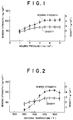
- Fig. 1 is a graph which shows relations between compacting pressure and bending strength and density for the alloy of the present invention.
- Fig. 2 is a graph which shows relations between sintering temperature and bending strength and density for the alloy of the present invention.
- Fig. 3 is a graph which shows relations between repressing compacting pressure and bending strength and density for the alloy of the present invention.
- Fig. 4 is a graph which shows relations between repressing temperature and bending strength and density for the alloy of the present invention.
- Fig. 5 shows the structure of the Al alloy powders of the present invention.
- Fig. 6 shows the structure of the sintered Al alloy of the present invention.
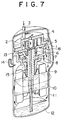
- Fig. 7 is a perspective cross-sectional view of a partial section of a closed scroll compressor according to the present invention.
- Fig. 8 is a cross-sectional view of a scroll for closed scroll compressors according to the present invention.
- Fig. 9 is a cross-sectional view of a scroll compressor for car air conditioners according to the present invention.
- Fig. 10 is a cross-sectional view of a scroll for scroll compressors for car air conditioners according to the present invention.
- the present invention relates to a highly ductile sintered Al alloy, which comprises by comprising, by weight, 1-45% of Si, 0.1-20% of an element of Group IIIa, 0.01-5% of at least one element of Groups IVa and Va and the balance of substantially Al.
- the alloy may additionally contain 0.1-5% of Cu and 0.1-5% of Mg and may further contain at least one of 2.0% or less of Fe, 1.5% or less of Mn and 1.5% or less of Co.
- the present invention relates to a highly ductile sintered Al alloy, which comprises, by weight, 0.1-20% of an element of Group IIIa, 0.01-5% of at least one element of Groups IVa and Va, 0.15 or less of oxygen and the balance of substantially Al.
- This alloy as a base may contain 1-45% of Si and in addition may contain 5% or less of Mg, 10% or less of Cu, 20% or less of Fe, 10% or less of Mn, 8% or less of Co, 5% or less of W, and 5% or less of Mo.
- a less content of oxygen brings about improvement of ductility, but a content of 5 ppm or more is preferred from the point of strength.
- a silicon content of 50-500 ppm which can provide a high strength and ductility is preferred.
- the present invention also relates to a highly ductile sintered Al alloy, which comprises, by weight, Si in an amount of from that forming a hyper-eutectoid to 45%, the number of Si particles having a particle size of 1 ⁇ m or less being 50-80%, that of Si particles having a particle size of more than 1 ⁇ m and 2.5 ⁇ m or less being 15-35%, that of Si particles having a particle size of more than 2.5 ⁇ m and 5 ⁇ m or less being 5-20% and that of Si particles having a particle size of more than 5 ⁇ m being 5% or less based on the total Si particles and the balance of substantially Al.
- This alloy as a base may contain 0.1-20% of an element of Group IIIa and 0.01-2% of at least one element of Groups IVa and Va and further may contain at least one of 5% or less of Mg, 10% or less of Cu, 20% or less of Fe, 10% or less of Mn, 8% or less of Co, 5% or less of W and 5% or less of Mo.
- the present invention relates to a method of producing a highly ductile sintered Al alloy, which comprises the steps of sintering a compact of alloy powders comprising, by weight, 1-45% of Si, 0.1-20% of an element of Group IIIa and the balance of substantially Al in a non-oxidizing atmosphere of 2 x 10 ⁇ 3 mmHg or lower at a partial pressure of oxygen. It is preferred to carry out the sintering step in the above method under a high vacuum of 1.33 ⁇ 10 ⁇ 2 h Pa (10 ⁇ 2 mmHg) or lower.
- the sintering method of the present invention can be applied to all of the alloys and can obtain a sintered body of a very low oxygen content.
- the present invention relates to a method of producing a highly ductile sintered Al alloy, which comprises the steps of subjecting a compact of alloy powders comprising, by weight, 1-45% of Si, 0.1-20% of an element of Group IIIa and the balance of substantially Al to the high-temperature vacuum degassing treatment at a pressure of 1.33 ⁇ 10 ⁇ 2 h Pa (10 ⁇ 2 mmHg) or lower at a temperature of 350°C or higher and then to the sintering and/or hot plastic working in a non-oxidizing atmosphere.
- the vacuum sintering as mentioned above can be combined with this method as a basic method and further this method can also be applied to the production of various alloys.
- the present invention relates to a method of producing a highly ductile sintered Al alloy, which comprises the steps of sintering a compact of alloy powders comprising, by weight, 1-45% of Si, 0.1-20% of an element of Group IIIa, 0.1-5% of Cu, 0.1-5% of Mg and the balance of substantially Al under vacuum, subjecting the sintered compact to the high-temperature plastic working, then solution treatment and ageing treatment.
- the alloy composition of the present invention can be used as it is sintered or as it is sintered and then subjected to the hot plastic working, or can be used after subjected to the steps of subsequent solution treatment and ageing treatment where Si particles and particles of an intermetallic compound are formed.
- the Si particles are precipitated in a eutectic form in the hypo-eutectic composition and in a pro-eutectic form and eutectic form in the hyper-eutectic composition.
- the present invention relates to Al alloy powders which comprise, by weight, 1-45% of Si, 0.1-20% of an element of Group IIIa, 0.01-2% of at least one element of Groups IVa and Va and the balance of substantially Al, featured by having a chrysanthemum pattern structure and net-like structure formed by thickening the elements of Groups IIIa, IVa and Va around the Si particles. It is necessary that the content of the element of Group IIIa is more than those of the elements of Groups IVa and Va in the above powders as a base.
- the alloy powders can additionally contain the Cu, Mg, Fe, Mn, Co, W and Mo in the same amounts as mentioned above.
- the sintered Al alloy of the present invention which is especially subjected to the hot working after the sintering and to the solution treatment and ageing treatment is applied to automobile parts such as a cylinder block, cylinder liner, piston, rocker arm, connecting rod, valve retainer, cylinder head, bucket, shift fork, brake drum, valve spool, and brake master cylinder, vane, rotor and oldhamring for compressor, and guide cylinder for VTR tapes.
- the present invention relates to a compressor which is provided with a fixed scroll and a turning scroll, featured in that at least one of them is composed of a sintered alloy comprising, by weight, 1-45% of Si, 0.1-20% of an element of Group IIIa, 0.01-5% of at least one element of Groups IVa and Va and the balance of substantially Al.
- the turning scroll can be made of the Al alloy and the fixed scroll can be made of a cast iron and high-speed starting can be attained by using the Al alloy for the turning scroll.
- This scroll is provided with a helical tooth portion on a pedestal.
- this scroll preferably has a tensile strength of 392.4-588.6 N/mm2 (40-60 kg/mm2) and an elongation of 1.5-10% at 150°C and an average thermal expansion coefficient of 14-22 x 10 ⁇ 6/°C, more preferably 15-17 x 10 ⁇ 6/°C at 20-300°C.
- the alloy subjected to the hot plastic working after the sintering and to the solution treatment and ageing treatment is applied to the parts as mentioned above.
- the inventors have found that the reduction of the strength of conventional Al-Si-Fe, Al-Si-Mn and Al-Si-Ni based sintered alloys comprising quenched and solidified powders is due to weak interparticle binding power caused by retaining an oxide film on the surface of the particles.
- the inventors have found that the combination of an element of Group IIIa, especially Ce as rare earth element and at least one of Groups IVa and Va, especially Zr as component for enhancing interparticle binding power is most effective for improvement of strength and toughness.
- the present invention has been accomplished.
- Si improves wear resistance, but if the content of Si is less than 1% by weight, the effect is not enough and high strength is also not obtained. If it is more than 45% by weight, the wear resistance is high, but the compactability and plastic workability considerably deteriorate.
- the alloys of the present invention can be classified into those of some stages depending on the amount of Si according to demands on strength and wear resistance.
- the respective Si amounts can be classified into the following stages and are employed according to the demands on strength and wear resistance. (1) 1-6%, (2) more than 6% and 12% or less, (3) more than 12% and 18% or less, (4) more than 18% and 30% or less, (5) more than 30% and 45% or less.
- the sintered alloy of the present invention can contain Cu, Mg, Fe, Mn, Co, W, and Mo mentioned hereinafter based on the above Si contents.
- the element of Group IIIa is effective for improvement of strength, but the effect of improvement of strength is insufficient if it is contained in an amount outside the range of 0.1-20% by weight. Moreover, the total amount of Si and this element is preferably 65% by weight or less and if it exceeds 65% by weight, plastic workability of the alloy considerably deteriorates. It is preferably 0.5-10%, more preferably 1-5%.
- the elements of Group IIIa include Sc, Y, lanthanide elements (La, Ce, Pr, Nd, Pm, Sm, Eu, Gd, Tb, Dy, Ho, Er, Tm, Yb, Lu) and actinide elements (Ac, Th, Pa, U, Np, Pu, Am, Cm, Bk, Cf, Es, Fm, Md, No) and at least one of them can be used.
- rare earth elements are especially preferred and these elements have the action to form most of Si particles in a state of very small particle size of 1 ⁇ m or less in solidification from molten state.
- misch metal an alloy of about 50% La and about 50% Ce
- P and alkali metals are effective in an amount similar to that of the elements of Group IIIa.
- the elements of Group IVa Ti, Zr, Hf and those of Group Va (V, Nb, Ta) are contained in an amount of 0.01% or more in order to form, in combination with the element of Group IIIa, fine Si particles in solidification of an Si-containing Al alloy from a molten state.
- the amount exceeds 5%, no further increase of the effect is seen and rather ductility decreases and hence, the amount is 5% or less.
- Preferred is 0.1-3% and more preferred is 0.5-2%.
- Elements of Group IVa are preferred and Zr is especially preferred.
- the combination of the element of Group IIIa and the elements of Groups IVa and Va has the effect to form fine Si particles in solidification of an Si-containing Al alloy from a molten state and besides, to inhibit growth of Si particles in a sintering step. It can provide the distribution of Si particles comprising, in the ratio of the number of particles, 50-80% of the particles of 1 ⁇ m or less in particle size, 15-30% of those of 1-2.5 ⁇ m, 5-20% of those of 2.5-5 ⁇ m and 5% or less of those of 5-10 ⁇ m.
- These elements are formed as a structure of chrysanthemum pattern around the Si particles which is considered to be formed as a result of thickening of these elements as alloy powders. This is considered to be cause for inhibition of growth of the Si particles in solidification and sintering and simultaneously prevent the cleavage rupture of the Si particles to enhance ductility.
- the Si particles comprise 60-80% of those of 1 ⁇ m or less in particle size, 22-30% of those of 1-2.5 ⁇ m, 7-15% of those of 2.5-5 ⁇ m, and 2% or less of those of 5-10 ⁇ m.
- the Si particles are made finer, higher ductility can be obtained and compactability is also improved. Further, there are a little amount of rupture at the Si particles by bending and hence the formed cross-section is dimpled.
- the chrysanthemum pattern around Si particles of Al alloy powders is obtained by combination of the above-mentioned elements with amount of Si and is obtained when amount of the element of Group IIIa is more than that of the elements of Group IVa and Va and amount of the elements of Groups IVa and Va is 0.20% or less of the amount of Si.
- oxygen content is markedly reduced, namely, is reduced to 0.15% or less by combination of the element of Group IIIa and the element of Groups IVa and Va and by carrying out degassing and/or sintering under vacuum or a non-oxidizing atmosphere of 2.67 x 10 ⁇ 3 h Pa (2 x 10 ⁇ 3 mmHg) or lower in oxygen partial pressure at 350°C or higher, whereby a high ductility can be obtained.
- the oxygen content may be 0.15% or less and is preferably 0.10% or less, more preferably 0.05% or less.
- the above aluminum powder alloy is produced by air and nitrogen or argon gas atomizing method.
- Si particles become coarse to give adverse effects on strength and wear resistance and so, the atomizing method is proper for finely dispersing the Si particles.
- Such aluminum powder alloy is compression compacted into a billet by cold isostatic pressing (CIP) and this billet is subjected to solid-phase sintering under vacuum or in an inert gas such as nitrogen or argon, preferably at 460-500°C to carry out densification.
- CIP cold isostatic pressing
- an inert gas such as nitrogen or argon
- the sintered alloy is densified by carrying out repressing by hot compact compression at 250-450°C under 44.1 ⁇ 103 N/cm2 (4.5 ton/cm2) or higher, especially preferably 49.1-88.3 ⁇ 103 N/cm2 (5-9 ton/cm2).
- the sintered alloy obtained through such production steps becomes from a metastable precipitate in which solid solution is formed in supersaturated state to a stable precipitate or an intermetallic compound and even when it undergoes thermal history of lower than the heating temperature of the repressing, the precipitate does not again form solid solution or does not reprecipitate and so straining deformation occurs with difficulty.
- the sintered alloy is subjected to solution treatment which comprises heating the alloy at 400-520°C and then cooling it with water and then to aging treatment at 100-200°C, especially 150-200°C, whereby higher strength can be attained.
- solution treatment comprises heating the alloy at 400-520°C and then cooling it with water and then to aging treatment at 100-200°C, especially 150-200°C, whereby higher strength can be attained.
- the ageing treatment is preferably carried out for the alloy containing Cu and Mg.
- the alloy powders of the present invention is especially preferably those solidified at a cooling rate of 50°C/sec or higher.
- the particle size of the powders is preferably 350 meshes or less, especially 30 ⁇ m or less.
- the compacting before sintering is carried out preferably under 24.5 ⁇ 103 N/cm2 (2.5 ton/cm2) or higher, especially preferably under 29.4-49.1 ⁇ 103 N/cm2 (3-5 ton/cm2).
- Cu and Mg are added respectively in an amount of 0.1% or more as age-hardening elements which precipitate a intermetallic compound by aging treatment to improve strength of matrix.
- the amount exceeds 5%, toughness is lowered and so the amount of each of them should be 5% or less. Therefore, addition of Cu in an amount of 0.1-5% by weight and Mg in an amount of 0.1-5% by weight most highly increases the hardness of matrix and improves the strength.
- 2-5% Cu and 0.1-1% Mg is particularly preferred.
- Cu can be contained in an amount of up to 10%.
- the alloy of the present invention which contains Cu and Mg can additionally contain at least one of 2.0% or less of Fe, 1.5% or less of Mn and 1.5% or less of Co.
- These elements produce intermetallic compounds with Al to improve strength and heat resistance of the alloy.
- each of these elements is preferably in an amount of 0.01% or more and if each of them is contained in an amount of more than the upper limit, strength of alloy decreases and the alloy becomes brittle.
- the alloy of the present invention when the oxygen content is 0.15% or less can contain 20% or less of Fe, 10% or less of Mn, 8% or less of Co, 5% or less of W and 5% or less of Mo and the total amount of these elements is preferably at most 20%. Especially preferred are 5-13% Fe, 2-5% Mn, 0.5-3% Co, 1-3% W, and 1-3% Mo.
- the present invention relates to a scroll for compressor provided with a helical tooth portion on a pedestal, characterized in that said tooth portion is formed nearly perpendicularly to said pedestal and curvature of the base portion of the pedestal and that of angular portion of the end of the tooth portion are 0.1-0.5 mm and elongation at room temperature is 1% or more.
- thickness of the tooth portion can be 1-5 mm and can be 0.015-0.05 mm per 1 mm of the outer diameter of the scroll.
- Especially preferred is a thickness of 0.02-0.04 mm per 1 mm of the outer diameter.
- the height of the tooth portion is preferably 0.1-0.3 mm, especially preferably 0.15-0.25 mm per 1 mm of the outer diameter of the scroll.
- Table 1 shows chemical compositions (% by weight) in Examples and Comparative Examples.
- the powders were prepared by rapidly cooling molten metal by gas atomizing method using air. The particle size of the powders was 350 meshes or less.
- the present alloy Nos. 1-18 and comparative alloy Nos. 19-23 were prepared by compacting the powders of the respective components by cold isostatic pressing method (CIP) under a pressure of 35.3 ⁇ 103 N/cm2 (3.6 ton/cm2) and sintering the compacting at a sintering temperature of 480°C for a sintering time of 120 minutes.
- CIP cold isostatic pressing method
- the compacting was subjected to the repressing at 350°C under 68.7 ⁇ 103 N/cm2 (7 ton/cm2) and then subjected to the solution treatment by keeping it at 490°C for 30 minutes and then cooling it with water. Thereafter, aging treatment was carried out at 160°C for 20 hours.
- the sintering was effected under a vacuum of 1.33 ⁇ 10 ⁇ 3 h Pa, (10 ⁇ 3 mmHg).
- each of the thus obtained sintered alloys was worked into test pieces for tensile test, bending test (thickness: 5 mm, width: 20 nm, length: 40 mm) and impact test, which were subjected to tensile test, three-point bending test, and 49.1 N (5 kg) Charpy impact test.
- the Al-Si-Ce sintered alloys of the present invention had tensile strength equal to or higher than that of the comparative alloys.
- impact strength of the alloys of the present invention was 8.04 N-m/cm2 (0.82 kg-m/cm2) or higher while that of the comparative alloys was 3.83 N-m/cm2 (0.39 kg-m/cm2) and bending strength of the former was 883 N/mm2 (90 kg/mm2) or higher while that of the latter was 706 N/mm2 (72 kg/mm2) when comparison was made on alloys of 25% Si.
- critical seizing surface pressure was obtained on the above sintered alloys. Frictional conditions were as follows: Opposite material was flake graphite cast iron (FC25) and atmosphere was refrigerating machine oil (mixture of lubricating oil and refrigerant). As is clear from the results, when comparison was made on the present alloy Nos. 2, 5, 8, 11, 14, 16 and 17 with the comparative alloy Nos. 19, 20, 21 and 22 which contained 25% of Si, the critical seizing surface pressure of the alloys of the present invention was 2138.6 N/cm2 (218 kg/cm2) or more which was higher than that of all comparative alloys.
- Figs. 1-4 show the production method and characteristics of the present alloy, No. 16 shown in Table 1. Powders used were the same as above.
- Fig. 1 shows bending strength and density of the product obtained when the condition in compacting step was changed from 9.81-45.1 ⁇ 103 N/cm2 (1 to 5 tons/cm2) in the production steps of compacting ⁇ sintering (480°C x 120 minutes) ⁇ repressing (350°C, 68.7 ⁇ 103 N/cm2 (7 tons/cm2)) ⁇ heat treatment (490°C x 30 minutes and water cooling ⁇ 160°C x 20 hours aging treatment).
- Fig. 2 shows the bending strength and density when the sintering temperature was changed from 350°C to 525°C in the production steps of compacting (35.3 ⁇ 103 N/cm2 (3.6 tons/cm2)) ⁇ sintering ⁇ repressing 350°C, (68.7 ⁇ 103 N/cm2 (7 tons/cm2)) ⁇ heat treatment (490°C x 30 minutes and water cooling ⁇ 160°C x 20 hours aging).
- the sintering temperature was 400°C or lower, the alloy is low in strength and density and was low in reliability and thus, the sintering temperature is preferably higher than that temperature.
- the sintering temperature was higher than 525°C, strength and density slightly decrease.
- Fig. 3 shows the bending strength and density when the pressure in repressing was changed from 39.2 ⁇ 103 to 78.5 ⁇ 103 N/cm2 (4 to 8 tons/cm2)in the production steps of compacting (35.3 ⁇ 103 N/cm2 (3.6 ton/cm2)) ⁇ sintering (480°C x 120 min) ⁇ repressing ⁇ heat treating (490°C x 30 minutes and water cooling ⁇ 160°C x 20 hours aging).
- the pressure of repressing was lower than 49.1 ⁇ 103 N/cm2 (5 ton/cm2), bending strength and density were low and the higher pressure is preferred.
- Fig. 4 shows the bending strength and density when the temperature in repressing was changed from 200 to 400°C in the production steps of compacting (35.3 ⁇ 103 N/cm2 (3.6 ton/cm2)) ⁇ sintering (480°C x 120 minutes) ⁇ repressing (68.7 ⁇ 103 N/cm2 (7 ton/cm2)) ⁇ heat treatment (490°C x 30 minutes and water cooling ⁇ 160°C x 20 hours aging). Bending strength and density linearly increase with increase from 200°C to 350°C in repressing temperature. Especially, bending strength and density were stable and stable properties were obtained. Therefore, a temperature of higher than 350°C is preferred for repressing.
- Alloy powders as shown in Table 3 were prepared by the gas atomizing method as in Example 1. Si particles in these alloy powders were nearly the same as in example 1. Alloys were prepared using these alloy powders under the same conditions as in those of Table 2 in Example 1.
- the particle size distribution of the Al alloy powders was that those of 45 ⁇ m or less occupied 50% or higher, those of more than 45 ⁇ m and 150 ⁇ m or less occupied 45% or less and those of up to 200 ⁇ m occupied the remainder of 5% or less. Those of 50, 60, 100 and 150 ⁇ m in particle size occupied 5-12%, respectively.
- Table 4 Particle size of Si particles ( ⁇ m) Proportion of the number of particles (%) 1 ⁇ m or less 0.1 26.0 60 0.5 17.5 0.9 16.5 More than 1 ⁇ m and 2.5 ⁇ m or less 1.3 11.0 27.5 1.7 9.5 2.1 7.0 2.5 2.0 More than 2.5 ⁇ m and 5 ⁇ m or less 2.9 2.5 11.5 3.3 3.0 3.7 2.5 4.1 0.5 4.5 0.5 4.9 0.5 More than 5 ⁇ m 5.6 0.5 1.0 7.6 0.5
- Table 4 shows the particle size distribution of Si particles of the alloy No. 27.
- the particle sizes of Si particles shown in the table were obtained by measuring the size of totally 200 Si particles and the relation between size and number was examined.
- Table 5 shows the tensile strength, elongation and bending strength of the resulting alloys at room temperature and 150°C and thermal expansion coefficient at room temperature - 200°C.
- the tensile strength of the alloys of the present invention was 461.1 N/mm 2 (47 kg/mm2) or higher at room temperature and 392.4 N/mm2 (40 kg/mm2) or higher at 150°C and elongation was 0.4-0.5% and 2.0-3.0%, respectively and were all higher than those of conventional alloys.
- Fig. 5 shows results of tracing of microphotograph (x 850) of section of atomized powders of No. 26.
- structures of chrysanthemum pattern (the hatched portion) where Cu, Mg, Fe, Ce and Zr were thickened were formed around Si particles in the atomized powders of the present invention.
- Si particles were very finely formed by containing Ce and Zr and Si particles were finely kept also in sintering and repressing at high temperatures.
- Individual Si particles may gather and may be seen in the form of large particles, but individual particles are 10 ⁇ m or less as mentioned above.
- the relatively large particles are proeutectic Si.
- Fine particles, narrow particles and cotton-like particles are eutectic Si.
- Structures formed by thickening of Cu, Mg, Fe, Ce and Zr were also partially formed in the form of narrow particles around the eutectic Si.
- the eutectic Si and the thickened structure were formed in a net-like form.
- the thickened portions in the narrow particle form are indicated by oblique lines.
- Fig. 6 shows results of tracing a microphotograph (x 1200) of the alloy of No. 26 subjected to repressing after the sintering under vacuum and thereafter, subjected to heat treatment.
- Particles observed in the photograph were Si particles and an intermetallic compound was formed with two or three or more of al, Si, Cu, Mg, Fe, Ce and Zr by aging treatment, but this cannot be seen in optical structure.
- the distribution of Si particles was nearly the same as that of No. 27 mentioned above, but Si particles were formed in somewhat larger size.
- the structure as sintered under vacuum was nearly the same as shown in Fig. 6 in distribution and size of Si particles except that intermetallic compound was not formed.
- the alloy powders which corresponded to No. 24 in Example 2 except that one of Ti, Hf and Nb was contained in place of Zr in the same amount as that of Zr and one of Y and Sm was contained in place of Ce in the same amount as that of Ce with respect to each of Ti, Hf and Nb were prepared in the same manner as in Example 2 and subjected to the sintering, repressing, solution treatment and aging treatment under the same conditions as in Example 2.
- the microstructure of the alloy powders was observed to find that chrysanthemum patterns were formed around the Si particles as above. It is considered that the alloy phases of these elements were formed.
- the number of the Si particles having a particle size of 2.5 ⁇ m or less occupied at least 80% of the total Si particles and the particle size was at most 10 ⁇ m.
- the final products obtained had also nearly the same distribution of the Si particles as mentioned above.
- Actinide elements have the same action as rare earth elements.
- Fig. 7 is an oblique view of a partial section of a closed scroll compressor.
- This compressor comprises mainly turning scroll 1, fixed scroll 2, suction pipe 3, discharge chamber 4, discharge passage 5, intermediate pressure chamber 6, turning bearing 8, motor chamber 9, motor 10, chamber 11, refrigerating machine oil 12, frame 13, discharge pipe 14, crankshaft 15 and Oldhamring 16.
- This compressor is for domestic or business use.
- a scroll of 80-130 mm in diameter is used for domestic purpose and that of 200-300 mm in diameter is used for business purpose.
- the turning scroll 1 and fixed scroll 2 shown in Fig. 8 were made of the alloy of No. 27 in Example 2.
- the numbers 16 and 19 indicate pedestals and 17 and 18 indicate tooth portions.
- sintering was similarly carried out and the resulting sintered material was molded by a mold at 350°C.
- the height of the tooth was 15 mm and thickness of the tooth was 2.7 mm.
- the diameter of the turning scroll was about 80 mm and the tooth portion was nearly straight with no taper.
- the curvature of the root portion of the tooth was 0.5 mm.
- the molded article was then similarly subjected to the solution treatment (490°C x 30 minutes and water cooling) and aging treatment (160°C x 20 hours) and thereafter finished by mechanical working.
- the fixed scroll was somewhat larger than the turning scroll and these were allowed to contact with each other at a slight gap by rotation to cause sliding.
- the curvature of the root portion of the tooth in the fixed scroll was also 0.5 mm.
- the gap was 10-20 ⁇ m.
- the thickness of the tooth portion was 0.034 mm per 1 mm of outer diameter and 0.18 mm per 1 mm of the height of the tooth portion.
- the height of the tooth portion was 0.19 mm per 1 mm of outer diameter of the scroll.
- Fig. 9 is a cross-sectional view of a scroll compressor for car air conditioners.
- This compressor comprises mainly turning scroll 1, fixed scroll 2, discharge valve 23, discharge opening 24, bearing ball 25, rotation inhibitor 26, suction opening 27, chip seal 28, ring 29, sliding clutch 30, magnetic clutch 31 and balanced weight 32.
- FIG. 10 Turning scroll 1 and fixed scroll 2 shown in Fig. 10 were made of the alloy of No. 27 in Example 2.
- the production conditions were the same as in Example 4.
- the height of the tooth of the scroll was 15 mm and the thickness was 2.7 mm and the curvature of the root portion of the tooth was 0.5 mm. Thus, the tooth was straight.
- the compressor was actually driven to obtain compression of high efficiency.
- the present invention can provide Al-Si based sintered alloys high in strength and excellent in the high-temperature ductility. Therefore, it has become possible to use the alloys for members to which impact and high load are applied and for which conventional Al-Si-Fe based sintered alloys cannot be used.
Landscapes
- Engineering & Computer Science (AREA)
- Mechanical Engineering (AREA)
- General Engineering & Computer Science (AREA)
- Chemical & Material Sciences (AREA)
- Combustion & Propulsion (AREA)
- Materials Engineering (AREA)
- Metallurgy (AREA)
- Organic Chemistry (AREA)
- Manufacturing & Machinery (AREA)
- Powder Metallurgy (AREA)
Applications Claiming Priority (2)
| Application Number | Priority Date | Filing Date | Title |
|---|---|---|---|
| JP79643/91 | 1991-04-12 | ||
| JP3079643A JPH0625782A (ja) | 1991-04-12 | 1991-04-12 | 高延性アルミニウム焼結合金とその製造法及びその用途 |
Publications (3)
| Publication Number | Publication Date |
|---|---|
| EP0508426A2 true EP0508426A2 (fr) | 1992-10-14 |
| EP0508426A3 EP0508426A3 (en) | 1993-05-19 |
| EP0508426B1 EP0508426B1 (fr) | 1998-09-30 |
Family
ID=13695793
Family Applications (1)
| Application Number | Title | Priority Date | Filing Date |
|---|---|---|---|
| EP92106168A Expired - Lifetime EP0508426B1 (fr) | 1991-04-12 | 1992-04-09 | Alliage d'aluminium frité à bonne ductilité, son utilisation et procédé pour sa fabrication |
Country Status (5)
| Country | Link |
|---|---|
| US (2) | US5387272A (fr) |
| EP (1) | EP0508426B1 (fr) |
| JP (1) | JPH0625782A (fr) |
| KR (1) | KR100218984B1 (fr) |
| DE (1) | DE69227141T2 (fr) |
Cited By (14)
| Publication number | Priority date | Publication date | Assignee | Title |
|---|---|---|---|---|
| EP0668433A1 (fr) * | 1994-02-22 | 1995-08-23 | Carrier Corporation | Elément à spirales à poids léger pour compresseur à spirales |
| FR2726212A1 (fr) * | 1994-10-28 | 1996-05-03 | Daimler Benz Ag | Chemise de cylindre en alliage d'aluminium/silicium hypereutectique a incorporer a la coulee dans un bati de moteur a piston alternatif et procede de fabrication d'une telle chemise |
| EP0724077A1 (fr) * | 1995-01-24 | 1996-07-31 | Kabushiki Kaisha Toyoda Jidoshokki Seisakusho | Compresseur à spirales et procédé de production d'un élément à spirale |
| FR2734195A1 (fr) * | 1995-05-18 | 1996-11-22 | Montupet Sa | Procede de fabrication d'une piece en alliage d'aluminium presentant une surface de frottement, et pieces realisees conformement au procede |
| EP0907023A1 (fr) * | 1997-10-03 | 1999-04-07 | Sumitomo Electric Industries, Ltd. | Elément coulissant composé d'alliage d'aluminium fritté et pompe à huile |
| US5916390A (en) * | 1995-10-30 | 1999-06-29 | Mercedes-Benz Ag | Cylinder liner comprising a supereutectic aluminum/silicon alloy for sealing into a crankcase of a reciprocating piston engine and method of producing such a cylinder liner |
| EP0833057A3 (fr) * | 1996-09-27 | 1999-06-30 | SANYO ELECTRIC Co., Ltd. | Compresseur à spirales |
| US5993576A (en) * | 1995-11-29 | 1999-11-30 | The Furukawa Electric Co., Ltd. | Wear resistant wrought aluminum alloy and scroll of wear-resistant wrought aluminum alloy |
| US6096143A (en) * | 1994-10-28 | 2000-08-01 | Daimlerchrysler Ag | Cylinder liner of a hypereutectic aluminum/silicon alloy for use in a crankcase of a reciprocating piston engine and process for producing such a cylinder liner |
| US6418901B2 (en) | 2000-02-12 | 2002-07-16 | Bayerische Motoren Werke Aktiengesellschaft | Method of producing a metal component interacting by way of a sliding surface with a friction partner for a drive assembly |
| EP1065382A3 (fr) * | 1999-06-29 | 2002-07-24 | DaimlerChrysler AG | Roue denteé pour pompe à huile fabriqueé à partir de poudre d' aluminium |
| EP1371740A4 (fr) * | 2001-03-23 | 2004-07-21 | Sumitomo Electric Industries | Alliage d'aluminium resistant a la chaleur et au fluage, et son procede de fabrication |
| US20210108292A1 (en) * | 2019-07-12 | 2021-04-15 | Lawrence Livermore National Security, Llc | Rare earth element-aluminum alloys |
| CN113652592A (zh) * | 2021-07-22 | 2021-11-16 | 中国科学院金属研究所 | 一种高强度高弹性应变的TiNbHfFeNi共晶高熵合金及其制备方法 |
Families Citing this family (24)
| Publication number | Priority date | Publication date | Assignee | Title |
|---|---|---|---|---|
| EP0657553A1 (fr) * | 1993-11-10 | 1995-06-14 | Sumitomo Electric Industries, Ltd. | Alliage de métallurgie des poudres d'aluminium-silicium azoté |
| GB9517045D0 (en) * | 1995-08-19 | 1995-10-25 | Gkn Sankey Ltd | Method of manufacturing a cylinder block |
| US5885379A (en) * | 1997-03-28 | 1999-03-23 | The Landover Company | Tempered powdered metallurgical construct and method |
| JP3771666B2 (ja) * | 1997-04-10 | 2006-04-26 | サンデン株式会社 | スクロール型流体機械用スクロール部材 |
| IT1299077B1 (it) * | 1997-04-16 | 2000-02-07 | Luk Fahrzeug Hydraulik | Pompa rotativa a palette |
| CA2265098A1 (fr) * | 1998-03-12 | 1999-09-12 | Abdelouahab Ziani | Methode servant a produire des briquettes de poudre d'alliage d'aluminium |
| US6332906B1 (en) | 1998-03-24 | 2001-12-25 | California Consolidated Technology, Inc. | Aluminum-silicon alloy formed from a metal powder |
| US5965829A (en) * | 1998-04-14 | 1999-10-12 | Reynolds Metals Company | Radiation absorbing refractory composition |
| US6705848B2 (en) * | 2002-01-24 | 2004-03-16 | Copeland Corporation | Powder metal scrolls |
| DE10203285C1 (de) * | 2002-01-29 | 2003-08-07 | Gkn Sinter Metals Gmbh | Sinterfähige Pulvermischung zur Herstellung gesinterter Bauteile |
| JP2005529239A (ja) * | 2002-06-07 | 2005-09-29 | ヘラエウス インコーポレーテッド | 処理従順な金属間化合物スパッタリングターゲットの製造方法 |
| US20050155208A1 (en) * | 2004-01-15 | 2005-07-21 | Schneider Raymond L.Iii | Card and paper money retainer |
| US7988430B2 (en) * | 2006-01-16 | 2011-08-02 | Lg Electronics Inc. | Linear compressor |
| JP4999157B2 (ja) * | 2006-12-28 | 2012-08-15 | アネスト岩田株式会社 | 磁気カップリングを介して駆動源に結合した流体機械 |
| US7963752B2 (en) * | 2007-01-26 | 2011-06-21 | Emerson Climate Technologies, Inc. | Powder metal scroll hub joint |
| WO2009055009A2 (fr) | 2007-10-24 | 2009-04-30 | Emerson Climate Technologies, Inc. | Compresseur à spirale pour réfrigérant à dioxyde de carbone |
| US8955220B2 (en) * | 2009-03-11 | 2015-02-17 | Emerson Climate Technologies, Inc. | Powder metal scrolls and sinter-brazing methods for making the same |
| JP2011247183A (ja) * | 2010-05-27 | 2011-12-08 | Sanden Corp | スクロール型流体機械 |
| GB2482880B (en) * | 2010-08-18 | 2014-01-29 | Vacuumschmelze Gmbh & Co Kg | An article for magnetic heat exchange and a method of fabricating a working component for magnetic heat exchange |
| CN105063438B (zh) * | 2015-08-14 | 2017-01-04 | 中南大学 | 一种高硅铜镁系粉末冶金铝合金的制备方法 |
| KR101687357B1 (ko) * | 2015-10-14 | 2016-12-16 | 대한소결금속 주식회사 | 치형제작용 알루미늄 분말 조성물 및 상기 치형의 제조방법 |
| US11185923B2 (en) | 2017-05-26 | 2021-11-30 | Hamilton Sundstrand Corporation | Method of manufacturing aluminum alloy articles |
| US11192188B2 (en) | 2017-05-26 | 2021-12-07 | Hamilton Sundstrand Corporation | Method of manufacturing aluminum alloy articles |
| JPWO2024157424A1 (fr) * | 2023-01-26 | 2024-08-02 |
Family Cites Families (31)
| Publication number | Priority date | Publication date | Assignee | Title |
|---|---|---|---|---|
| US3964935A (en) * | 1972-04-03 | 1976-06-22 | Southwire Company | Aluminum-cerium-iron electrical conductor and method for making same |
| US3954458A (en) * | 1973-11-12 | 1976-05-04 | Kaiser Aluminum & Chemical Corporation | Degassing powder metallurgical products |
| US4135922A (en) * | 1976-12-17 | 1979-01-23 | Aluminum Company Of America | Metal article and powder alloy and method for producing metal article from aluminum base powder alloy containing silicon and manganese |
| JPS5855222B2 (ja) * | 1980-09-04 | 1983-12-08 | エヌオーケー株式会社 | アルミニウム系焼結含油軸受の製造方法 |
| JPS5757855A (en) * | 1980-09-22 | 1982-04-07 | Hitachi Ltd | Aluminum material for sintering |
| US4436495A (en) * | 1981-03-02 | 1984-03-13 | Arthur D. Little, Inc. | Method of fabricating two-piece scroll members for scroll apparatus and resulting scroll members |
| JPS58126492A (ja) * | 1982-01-22 | 1983-07-27 | Sharp Corp | スクロ−ル圧縮機 |
| JPS5963389A (ja) * | 1982-10-05 | 1984-04-11 | Hitachi Ltd | 容積形スクロ−ル式流体機械 |
| JPS6098186A (ja) * | 1983-11-04 | 1985-06-01 | Sanden Corp | スクロ−ル型圧縮機 |
| JPS60131944A (ja) * | 1983-12-19 | 1985-07-13 | Sumitomo Electric Ind Ltd | 超耐熱耐摩耗アルミニウム合金およびその製造用複合粉末 |
| US4696084A (en) * | 1985-06-14 | 1987-09-29 | Mitsubishi Jukogyo Kabushiki Kaisha | Method for forming scroll members used in a scroll type fluid machine |
| JPS6296603A (ja) * | 1985-10-22 | 1987-05-06 | Honda Motor Co Ltd | 耐熱高強度Al焼結合金製構造用部材の製造方法 |
| DE3601048A1 (de) * | 1986-01-16 | 1987-07-23 | Hoechst Ag | 1,2-disubstituierte piperidine, verfahren zu ihrer herstellung sowie ihre verwendung im pflanzenschutz |
| CH673240A5 (fr) * | 1986-08-12 | 1990-02-28 | Bbc Brown Boveri & Cie | |
| FR2604186A1 (fr) * | 1986-09-22 | 1988-03-25 | Peugeot | Procede de fabrication de pieces en alliage d'aluminium hypersilicie obtenu a partir de poudres refroidies a tres grande vitesse de refroidissement |
| JP2542603B2 (ja) * | 1987-01-23 | 1996-10-09 | 住友電気工業株式会社 | 耐摩耗性Al−Si−Mn系焼結合金 |
| JPS63243245A (ja) * | 1987-03-30 | 1988-10-11 | Toyota Motor Corp | 鍛造性に優れたアルミニウム合金部材 |
| DE3817350A1 (de) * | 1987-05-23 | 1988-12-22 | Sumitomo Electric Industries | Verfahren zur herstellung von spiralfoermigen teilen sowie verfahren zur herstellung einer aluminiumpulverschmiedelegierung |
| JPS6465242A (en) * | 1987-09-04 | 1989-03-10 | Nippon Light Metal Co | Scroll made of aluminum alloy |
| CA1330400C (fr) * | 1987-12-01 | 1994-06-28 | Seiichi Koike | Alliage d'aluminium fritte thermoresistant et methode de production |
| JPH01159345A (ja) * | 1987-12-15 | 1989-06-22 | Furukawa Alum Co Ltd | 耐熱耐摩耗性アルミニウム合金粉末成形体およびその製造方法 |
| US4834942A (en) * | 1988-01-29 | 1989-05-30 | The United States Of America As Represented By The Secretary Of The Navy | Elevated temperature aluminum-titanium alloy by powder metallurgy process |
| JPH01319644A (ja) * | 1988-06-18 | 1989-12-25 | Furukawa Alum Co Ltd | 耐熱性アルミニウム合金材及びその製造方法 |
| JPH0234738A (ja) * | 1988-07-25 | 1990-02-05 | Furukawa Alum Co Ltd | 耐熱性アルミニウム合金材及びその製造方法 |
| JP2810057B2 (ja) * | 1988-08-05 | 1998-10-15 | 日産自動車株式会社 | アルミニウム系軸受合金 |
| JPH0261021A (ja) * | 1988-08-26 | 1990-03-01 | Furukawa Alum Co Ltd | 耐熱、耐摩耗性アルミニウム合金材及びその製造方法 |
| US4989556A (en) * | 1988-10-07 | 1991-02-05 | Honda Giken Kogyo Kabushiki Kaisha | Valve spring retainer for valve operating mechanism for internal combustion engine |
| US4990181A (en) * | 1989-03-14 | 1991-02-05 | Corning Incorporated | Aluminide structures and method |
| JPH02277992A (ja) * | 1989-04-20 | 1990-11-14 | Toyota Autom Loom Works Ltd | ベーン圧縮機 |
| EP0436952B1 (fr) * | 1989-12-29 | 1997-04-02 | Showa Denko Kabushiki Kaisha | Poudre d'alliage d'aluminium, alliage d'aluminium fritté et méthode de préparation de cet alliage fritté |
| US5167480A (en) * | 1991-02-04 | 1992-12-01 | Allied-Signal Inc. | Rapidly solidified high temperature aluminum base alloy rivets |
-
1991
- 1991-04-12 JP JP3079643A patent/JPH0625782A/ja active Pending
-
1992
- 1992-04-08 US US07/865,264 patent/US5387272A/en not_active Expired - Lifetime
- 1992-04-09 EP EP92106168A patent/EP0508426B1/fr not_active Expired - Lifetime
- 1992-04-09 DE DE69227141T patent/DE69227141T2/de not_active Expired - Lifetime
- 1992-04-10 KR KR1019920005968A patent/KR100218984B1/ko not_active Expired - Fee Related
-
1994
- 1994-09-23 US US08/310,991 patent/US5478220A/en not_active Expired - Lifetime
Cited By (20)
| Publication number | Priority date | Publication date | Assignee | Title |
|---|---|---|---|---|
| EP0668433A1 (fr) * | 1994-02-22 | 1995-08-23 | Carrier Corporation | Elément à spirales à poids léger pour compresseur à spirales |
| US5478219A (en) * | 1994-02-22 | 1995-12-26 | Carrier Corporation | Lightweight scroll element and method of making |
| FR2726212A1 (fr) * | 1994-10-28 | 1996-05-03 | Daimler Benz Ag | Chemise de cylindre en alliage d'aluminium/silicium hypereutectique a incorporer a la coulee dans un bati de moteur a piston alternatif et procede de fabrication d'une telle chemise |
| US6096143A (en) * | 1994-10-28 | 2000-08-01 | Daimlerchrysler Ag | Cylinder liner of a hypereutectic aluminum/silicon alloy for use in a crankcase of a reciprocating piston engine and process for producing such a cylinder liner |
| EP0724077A1 (fr) * | 1995-01-24 | 1996-07-31 | Kabushiki Kaisha Toyoda Jidoshokki Seisakusho | Compresseur à spirales et procédé de production d'un élément à spirale |
| US5755898A (en) * | 1995-01-24 | 1998-05-26 | Kabushiki Kaisha Toyoda Jidoshokki Seisakusho | Scroll type compressor and method for manufacturing the same |
| FR2734195A1 (fr) * | 1995-05-18 | 1996-11-22 | Montupet Sa | Procede de fabrication d'une piece en alliage d'aluminium presentant une surface de frottement, et pieces realisees conformement au procede |
| US5916390A (en) * | 1995-10-30 | 1999-06-29 | Mercedes-Benz Ag | Cylinder liner comprising a supereutectic aluminum/silicon alloy for sealing into a crankcase of a reciprocating piston engine and method of producing such a cylinder liner |
| US5993576A (en) * | 1995-11-29 | 1999-11-30 | The Furukawa Electric Co., Ltd. | Wear resistant wrought aluminum alloy and scroll of wear-resistant wrought aluminum alloy |
| EP0833057A3 (fr) * | 1996-09-27 | 1999-06-30 | SANYO ELECTRIC Co., Ltd. | Compresseur à spirales |
| US6089843A (en) * | 1997-10-03 | 2000-07-18 | Sumitomo Electric Industries, Ltd. | Sliding member and oil pump |
| EP0907023A1 (fr) * | 1997-10-03 | 1999-04-07 | Sumitomo Electric Industries, Ltd. | Elément coulissant composé d'alliage d'aluminium fritté et pompe à huile |
| EP1065382A3 (fr) * | 1999-06-29 | 2002-07-24 | DaimlerChrysler AG | Roue denteé pour pompe à huile fabriqueé à partir de poudre d' aluminium |
| US6418901B2 (en) | 2000-02-12 | 2002-07-16 | Bayerische Motoren Werke Aktiengesellschaft | Method of producing a metal component interacting by way of a sliding surface with a friction partner for a drive assembly |
| EP1371740A4 (fr) * | 2001-03-23 | 2004-07-21 | Sumitomo Electric Industries | Alliage d'aluminium resistant a la chaleur et au fluage, et son procede de fabrication |
| US6962673B2 (en) | 2001-03-23 | 2005-11-08 | Sumitomo Electric Sintered Alloy, Ltd. | Heat-resistant, creep-resistant aluminum alloy and billet thereof as well as methods of preparing the same |
| US20210108292A1 (en) * | 2019-07-12 | 2021-04-15 | Lawrence Livermore National Security, Llc | Rare earth element-aluminum alloys |
| US11718898B2 (en) * | 2019-07-12 | 2023-08-08 | Lawrence Livermore National Security, Llc | Rare Earth Element—Aluminum Alloys |
| CN113652592A (zh) * | 2021-07-22 | 2021-11-16 | 中国科学院金属研究所 | 一种高强度高弹性应变的TiNbHfFeNi共晶高熵合金及其制备方法 |
| CN113652592B (zh) * | 2021-07-22 | 2022-03-18 | 中国科学院金属研究所 | 一种高强度高弹性应变的TiNbHfFeNi共晶高熵合金及其制备方法 |
Also Published As
| Publication number | Publication date |
|---|---|
| DE69227141D1 (de) | 1998-11-05 |
| EP0508426A3 (en) | 1993-05-19 |
| JPH0625782A (ja) | 1994-02-01 |
| EP0508426B1 (fr) | 1998-09-30 |
| KR920019957A (ko) | 1992-11-20 |
| US5387272A (en) | 1995-02-07 |
| US5478220A (en) | 1995-12-26 |
| KR100218984B1 (ko) | 1999-09-01 |
| DE69227141T2 (de) | 1999-04-15 |
Similar Documents
| Publication | Publication Date | Title |
|---|---|---|
| US5478220A (en) | Compressor scroll made of silicon containing aluminum alloy | |
| EP0669404B1 (fr) | Alliage d'aluminium fritté résistant à l'usure et méthode de fabrication de celui-ci | |
| US4838936A (en) | Forged aluminum alloy spiral parts and method of fabrication thereof | |
| US5976214A (en) | Slide member of sintered aluminum alloy and method of manufacturing the same | |
| EP0577062B1 (fr) | Pompe à huile en alliages d'aluminium | |
| EP0821072B1 (fr) | Alliage composite à base d'aluminium à haute résistance d'usure et pièces résistant à l'usure | |
| US5466277A (en) | Starting powder for producing sintered-aluminum alloy, method for producing sintered parts, and sintered aluminum alloy | |
| EP0561204A2 (fr) | Poudre d'alliage d'aluminium résistant à la chaleur, alliage d'aluminium résistant à la chaleur et matériau composite à base d'alliage d'aluminium résistant à la chaleur et à l'usure | |
| EP0600474B1 (fr) | Alliage d'aliminium résistant à la chaleur et à l'abrasion | |
| JPH0551684A (ja) | 高力耐摩耗性アルミニウム合金およびその加工方法 | |
| JPH0120215B2 (fr) | ||
| EP1362654B1 (fr) | Procédé de fabrication d'alliage fritté de Al | |
| US6706126B2 (en) | Aluminum alloy for sliding bearing and its production method | |
| EP0202886A1 (fr) | Procédé de travail à chaud sans récipient de poudres atomisées par un gaz | |
| JPH0625386B2 (ja) | アルミニウム合金粉末及びその焼結体の製造方法 | |
| JPH06122933A (ja) | 高延性Al焼結塑性流動合金とその製造法及びその用途 | |
| JPH029099B2 (fr) | ||
| JPH02247348A (ja) | 引張強度、延性および疲労強度にすぐれた耐熱性アルミニウム合金 | |
| US6899844B2 (en) | Production method of aluminum alloy for sliding bearing | |
| JPH05340364A (ja) | スクロール圧縮機 | |
| JP3128041B2 (ja) | シリンダーブロックとその製造方法 | |
| JP2787703B2 (ja) | 極低熱膨張係数を有するA▲l▼―Si系合金粉末鍛造部材 | |
| JP2790807B2 (ja) | 複合ピストン | |
| JP2921114B2 (ja) | 高強度および高靭性を有する過共晶Al―Si系合金部材の製造法 | |
| JPH06228697A (ja) | 高温特性のすぐれた急冷凝固Al合金 |
Legal Events
| Date | Code | Title | Description |
|---|---|---|---|
| PUAI | Public reference made under article 153(3) epc to a published international application that has entered the european phase |
Free format text: ORIGINAL CODE: 0009012 |
|
| AK | Designated contracting states |
Kind code of ref document: A2 Designated state(s): DE FR GB |
|
| 17P | Request for examination filed |
Effective date: 19921016 |
|
| PUAL | Search report despatched |
Free format text: ORIGINAL CODE: 0009013 |
|
| AK | Designated contracting states |
Kind code of ref document: A3 Designated state(s): DE FR GB |
|
| 17Q | First examination report despatched |
Effective date: 19950406 |
|
| GRAG | Despatch of communication of intention to grant |
Free format text: ORIGINAL CODE: EPIDOS AGRA |
|
| GRAG | Despatch of communication of intention to grant |
Free format text: ORIGINAL CODE: EPIDOS AGRA |
|
| GRAH | Despatch of communication of intention to grant a patent |
Free format text: ORIGINAL CODE: EPIDOS IGRA |
|
| GRAG | Despatch of communication of intention to grant |
Free format text: ORIGINAL CODE: EPIDOS AGRA |
|
| GRAH | Despatch of communication of intention to grant a patent |
Free format text: ORIGINAL CODE: EPIDOS IGRA |
|
| GRAG | Despatch of communication of intention to grant |
Free format text: ORIGINAL CODE: EPIDOS AGRA |
|
| GRAH | Despatch of communication of intention to grant a patent |
Free format text: ORIGINAL CODE: EPIDOS IGRA |
|
| GRAH | Despatch of communication of intention to grant a patent |
Free format text: ORIGINAL CODE: EPIDOS IGRA |
|
| GRAA | (expected) grant |
Free format text: ORIGINAL CODE: 0009210 |
|
| AK | Designated contracting states |
Kind code of ref document: B1 Designated state(s): DE FR GB |
|
| REF | Corresponds to: |
Ref document number: 69227141 Country of ref document: DE Date of ref document: 19981105 |
|
| REG | Reference to a national code |
Ref country code: GB Ref legal event code: 746 Effective date: 19981027 |
|
| ET | Fr: translation filed | ||
| PLBE | No opposition filed within time limit |
Free format text: ORIGINAL CODE: 0009261 |
|
| STAA | Information on the status of an ep patent application or granted ep patent |
Free format text: STATUS: NO OPPOSITION FILED WITHIN TIME LIMIT |
|
| 26N | No opposition filed | ||
| REG | Reference to a national code |
Ref country code: GB Ref legal event code: IF02 |
|
| PGFP | Annual fee paid to national office [announced via postgrant information from national office to epo] |
Ref country code: GB Payment date: 20100329 Year of fee payment: 19 |
|
| PGFP | Annual fee paid to national office [announced via postgrant information from national office to epo] |
Ref country code: FR Payment date: 20100415 Year of fee payment: 19 |
|
| PGFP | Annual fee paid to national office [announced via postgrant information from national office to epo] |
Ref country code: DE Payment date: 20100609 Year of fee payment: 19 |
|
| GBPC | Gb: european patent ceased through non-payment of renewal fee |
Effective date: 20110409 |
|
| REG | Reference to a national code |
Ref country code: FR Ref legal event code: ST Effective date: 20111230 |
|
| PG25 | Lapsed in a contracting state [announced via postgrant information from national office to epo] |
Ref country code: FR Free format text: LAPSE BECAUSE OF NON-PAYMENT OF DUE FEES Effective date: 20110502 Ref country code: DE Free format text: LAPSE BECAUSE OF NON-PAYMENT OF DUE FEES Effective date: 20111101 |
|
| PG25 | Lapsed in a contracting state [announced via postgrant information from national office to epo] |
Ref country code: GB Free format text: LAPSE BECAUSE OF NON-PAYMENT OF DUE FEES Effective date: 20110409 |
|
| REG | Reference to a national code |
Ref country code: DE Ref legal event code: R119 Ref document number: 69227141 Country of ref document: DE Effective date: 20111101 |