EP0540250B1 - Composition de résine de maléimide, prépreg et matériaux plastiques renforcés par des fibres - Google Patents
Composition de résine de maléimide, prépreg et matériaux plastiques renforcés par des fibres Download PDFInfo
- Publication number
- EP0540250B1 EP0540250B1 EP92309685A EP92309685A EP0540250B1 EP 0540250 B1 EP0540250 B1 EP 0540250B1 EP 92309685 A EP92309685 A EP 92309685A EP 92309685 A EP92309685 A EP 92309685A EP 0540250 B1 EP0540250 B1 EP 0540250B1
- Authority
- EP
- European Patent Office
- Prior art keywords
- maleimide
- resin composition
- maleimide resin
- resin
- formula
- Prior art date
- Legal status (The legal status is an assumption and is not a legal conclusion. Google has not performed a legal analysis and makes no representation as to the accuracy of the status listed.)
- Expired - Lifetime
Links
- 0 C1C**CC1 Chemical compound C1C**CC1 0.000 description 3
- WKDNYTOXBCRNPV-UHFFFAOYSA-N O=C(c(c1c2)ccc2-c(cc2)cc(C(O3)=O)c2C3=O)OC1=O Chemical compound O=C(c(c1c2)ccc2-c(cc2)cc(C(O3)=O)c2C3=O)OC1=O WKDNYTOXBCRNPV-UHFFFAOYSA-N 0.000 description 1
Images
Classifications
-
- C—CHEMISTRY; METALLURGY
- C08—ORGANIC MACROMOLECULAR COMPOUNDS; THEIR PREPARATION OR CHEMICAL WORKING-UP; COMPOSITIONS BASED THEREON
- C08L—COMPOSITIONS OF MACROMOLECULAR COMPOUNDS
- C08L79/00—Compositions of macromolecular compounds obtained by reactions forming in the main chain of the macromolecule a linkage containing nitrogen with or without oxygen or carbon only, not provided for in groups C08L61/00 - C08L77/00
- C08L79/04—Polycondensates having nitrogen-containing heterocyclic rings in the main chain; Polyhydrazides; Polyamide acids or similar polyimide precursors
- C08L79/08—Polyimides; Polyester-imides; Polyamide-imides; Polyamide acids or similar polyimide precursors
-
- C—CHEMISTRY; METALLURGY
- C08—ORGANIC MACROMOLECULAR COMPOUNDS; THEIR PREPARATION OR CHEMICAL WORKING-UP; COMPOSITIONS BASED THEREON
- C08G—MACROMOLECULAR COMPOUNDS OBTAINED OTHERWISE THAN BY REACTIONS ONLY INVOLVING UNSATURATED CARBON-TO-CARBON BONDS
- C08G73/00—Macromolecular compounds obtained by reactions forming a linkage containing nitrogen with or without oxygen or carbon in the main chain of the macromolecule, not provided for in groups C08G12/00 - C08G71/00
- C08G73/06—Polycondensates having nitrogen-containing heterocyclic rings in the main chain of the macromolecule
- C08G73/10—Polyimides; Polyester-imides; Polyamide-imides; Polyamide acids or similar polyimide precursors
- C08G73/12—Unsaturated polyimide precursors
-
- C—CHEMISTRY; METALLURGY
- C08—ORGANIC MACROMOLECULAR COMPOUNDS; THEIR PREPARATION OR CHEMICAL WORKING-UP; COMPOSITIONS BASED THEREON
- C08J—WORKING-UP; GENERAL PROCESSES OF COMPOUNDING; AFTER-TREATMENT NOT COVERED BY SUBCLASSES C08B, C08C, C08F, C08G or C08H
- C08J5/00—Manufacture of articles or shaped materials containing macromolecular substances
- C08J5/04—Reinforcing macromolecular compounds with loose or coherent fibrous material
- C08J5/0405—Reinforcing macromolecular compounds with loose or coherent fibrous material with inorganic fibres
- C08J5/042—Reinforcing macromolecular compounds with loose or coherent fibrous material with inorganic fibres with carbon fibres
-
- C—CHEMISTRY; METALLURGY
- C08—ORGANIC MACROMOLECULAR COMPOUNDS; THEIR PREPARATION OR CHEMICAL WORKING-UP; COMPOSITIONS BASED THEREON
- C08J—WORKING-UP; GENERAL PROCESSES OF COMPOUNDING; AFTER-TREATMENT NOT COVERED BY SUBCLASSES C08B, C08C, C08F, C08G or C08H
- C08J5/00—Manufacture of articles or shaped materials containing macromolecular substances
- C08J5/24—Impregnating materials with prepolymers which can be polymerised in situ, e.g. manufacture of prepregs
- C08J5/241—Impregnating materials with prepolymers which can be polymerised in situ, e.g. manufacture of prepregs using inorganic fibres
- C08J5/243—Impregnating materials with prepolymers which can be polymerised in situ, e.g. manufacture of prepregs using inorganic fibres using carbon fibres
-
- C—CHEMISTRY; METALLURGY
- C08—ORGANIC MACROMOLECULAR COMPOUNDS; THEIR PREPARATION OR CHEMICAL WORKING-UP; COMPOSITIONS BASED THEREON
- C08K—Use of inorganic or non-macromolecular organic substances as compounding ingredients
- C08K5/00—Use of organic ingredients
- C08K5/01—Hydrocarbons
-
- C—CHEMISTRY; METALLURGY
- C08—ORGANIC MACROMOLECULAR COMPOUNDS; THEIR PREPARATION OR CHEMICAL WORKING-UP; COMPOSITIONS BASED THEREON
- C08K—Use of inorganic or non-macromolecular organic substances as compounding ingredients
- C08K7/00—Use of ingredients characterised by shape
- C08K7/02—Fibres or whiskers
- C08K7/04—Fibres or whiskers inorganic
- C08K7/06—Elements
-
- C—CHEMISTRY; METALLURGY
- C08—ORGANIC MACROMOLECULAR COMPOUNDS; THEIR PREPARATION OR CHEMICAL WORKING-UP; COMPOSITIONS BASED THEREON
- C08L—COMPOSITIONS OF MACROMOLECULAR COMPOUNDS
- C08L79/00—Compositions of macromolecular compounds obtained by reactions forming in the main chain of the macromolecule a linkage containing nitrogen with or without oxygen or carbon only, not provided for in groups C08L61/00 - C08L77/00
- C08L79/04—Polycondensates having nitrogen-containing heterocyclic rings in the main chain; Polyhydrazides; Polyamide acids or similar polyimide precursors
- C08L79/08—Polyimides; Polyester-imides; Polyamide-imides; Polyamide acids or similar polyimide precursors
- C08L79/085—Unsaturated polyimide precursors
-
- C—CHEMISTRY; METALLURGY
- C08—ORGANIC MACROMOLECULAR COMPOUNDS; THEIR PREPARATION OR CHEMICAL WORKING-UP; COMPOSITIONS BASED THEREON
- C08J—WORKING-UP; GENERAL PROCESSES OF COMPOUNDING; AFTER-TREATMENT NOT COVERED BY SUBCLASSES C08B, C08C, C08F, C08G or C08H
- C08J2379/00—Characterised by the use of macromolecular compounds obtained by reactions forming in the main chain of the macromolecule a linkage containing nitrogen with or without oxygen, or carbon only, not provided for in groups C08J2361/00 - C08J2377/00
- C08J2379/04—Polycondensates having nitrogen-containing heterocyclic rings in the main chain; Polyhydrazides; Polyamide acids or similar polyimide precursors
- C08J2379/08—Polyimides; Polyester-imides; Polyamide-imides; Polyamide acids or similar polyimide precursors
Definitions
- This invention relates to a maleimide resin composition, as well as to a prepreg and a fiber-reinforced plastics material prepared therefrom.
- maleimide resin compositions are widely used in various industrial fields such as the fields of molded articles, laminated articles and adhesives by virtue of their excellent mechanical properties, chemical resistance and thermal resistance.
- maleimide resin compositions are widely used for fiber-reinforced composite materials containing reinforcing fibers and matrix resins as indispensable constituents.
- maleimide resin compositions have a drawback in that they are brittle, so that the cured materials thereof have low impact resistance. In particular, when such a material is used as a structural material in aircraft, the low impact resistance is a serious problem.
- tough and hurt resistant moulded articles can be obtained by heat curing a maleimide composition containing a polyimide having units derived from 3,3',4,4'-benzophenonetetracarboxylic dianhydride (RDTA), bis[4-(3-aminophenoxy)phenyl] sulphone (m-APPS) and 2,4-diamino-toluene (2,4-DAT).
- RDTA 3,3',4,4'-benzophenonetetracarboxylic dianhydride
- m-APPS bis[4-(3-aminophenoxy)phenyl] sulphone
- 2,4-DAT 2,4-diamino-toluene
- EP A-0311349 discloses the addition of an amine-terminated polyarylsulfone to the maleimide resin.
- the resulting maleimide resin composition gives a plastic having a homogeneous single phase structure; a plastic in which the polyarylsulfone phase and the maleimide resin phase are separated and both phases are continuous; or a plastic in which the polyarylsulfone constitutes a continuous phase and the maleimide constitutes dispersed phase, depending on the skeleton structure of the polyarylsulfone. It is also disclosed that the highest toughness is attained when both the polyarylsulfone phase and the maleimide resin phase are continuous. However, with this method, the thermal resistance of the maleimide resin is somewhat reduced.
- the high toughness of the cured maleimide resin can only be attained at the sacrifice of elastic modulus, moldability or thermal resistance.
- the present invention seeks to provide a maleimide resin composition which gives a cured plastic having high toughness and high elastic modulus, as well as high thermal resistance, high thermal decomposition resistance, low water absorption and high solvent resistance.
- the present invention also seeks to provide a prepreg and a fiber-reinforced plastic having such a maleimide resin composition as a matrix resin.
- the present invention provides a maleimide resin composition
- a maleimide resin composition comprising:
- the present invention also provides a prepreg comprising the maleimide resin composition of the present invention as a matrix resin and reinforcing fibers.
- the present invention also provides a fiber-reinforced plastics material prepared by curing the prepreg of the present invention.
- maleimide resin compositions within the present invention may exhibit good processability when preparing a prepreg therefrom, and give a cured plastic having high toughness, high elastic modulus, high thermal resistance, low water absorption and high solvent resistance, as well as high stability.
- a prepreg comprising the resin composition of the present invention as a matrix resin may have good tackiness and drapability.
- Reinforced composite materials comprising the cured maleimide resin compositions of the present invention may have high toughness, high impact resistance, high strength, high elongation, high thermal resistance, low water absorption and high solvent resistance.
- the maleimide resin composition of the present invention comprises as a first element the maleimide resin [A].
- the maleimide resin is generally a compound having not less than two maleimide groups in its molecule on average.
- the maleimide resin which is employed as one variant in the present invention includes those represented by the formula [VI]: (wherein R 1 represents a divalent hydrocarbon group such as a C 1 - C 5 alkylene group, C 6 to C 10 cycloalkylene group, monocyclic or polycyclic arylene group,or such a divalent hydrocarbon groups bonded through a divalent group such as -CH 2 -, -CO-, -SO 2 -, -O-, -C(CH 3 ) 2 - or -CONH-).
- the maleimide resin which is employed as another variant in the present invention includes a maleimide compound obtained by reacting a mixed polyamine of the formula [VII]: (wherein n represents 0 or a positive number, preferably 0 to 2) with maleic anhydride.
- the preferred maleimide resin are N,N'-phenylenebismaleimide, N,N'-hexamethylenebismaleimide, N,N'-methylene-di-p-phenylenebismaleimide, N,N'-oxy-di-p-phenylenebismaleimide, N,N'-4,4'-benzophenonebismaleimide, N,N'-diphenylsulfonebismaleimide, N,N'-(3,3'-dimethyl)methylene-di-p-phenylenebismaleimide, N,N'-4,4'-dicyclohexylmethanebismaleimide, N,N'-m(or p)-xylylene-bismaleimide, N,N'-(3,3'-diethyl)-methylene-di-pphenylenebismaleimide, N,N'-m-tolylene-di-maleimide and bis(aminophenoxy)benzenebismaleimide.
- maleimide resin may contain monomaleimide compounds such as N-allylmaleimide, N-propylmaleimide, N-hexylmaleimide and N-phenylmaleimide, in an amount of preferably 1 to 5 wt% with respect to the maleimide resin [A].
- the maleimide resin may preferably be employed in combination with a reactive diluent.
- a reactive diluent compounds having active groups (especially two such active groups) which may react with the maleimide group may be employed.
- Compounds having an amino group, alkenyl group such as an allyl group, benzocyclobutene group, allylnadicimide group, isocyanate group, cyanate group or epoxy group are preferred.
- a preferred example of the reactive diluent having an amino group is diaminodiphenylmethane and preferred examples of the reactive diluent having an alkenyl group are O,O'-diallylbisphenol A and bis(propenyl phenoxy)sulfone.
- Bismaleimide triazine resins prepared by the reaction between a bismaleimide and a cyanate of the formula [VIII]: (wherein R 1 has the same meaning as in formula [VI]) is also used as another variant of the maleimide resin [A].
- This maleimide resin gives a cured resin having a low water absorption.
- the maleimide resins conventionally used in this field may be employed in the present invention.
- the maleimide resin [A] can be prepared according to conventional methods.
- the maleimide resin composition of the present invention comprises as a second element the polyimide resin [B] containing a recurring unit of the above-described formula [I] and/or [II].
- Z represents a tetracarboxylic acid dianhydride residue; i.e. the moiety of the tetracarboxylic acid dianhydride used for the preparation of the polyimide, from which the acid anhydride groups are removed.
- the tetracarboxylic acid dianhydride residue Z is represented by the following formula.
- a preferred group Z is represented by the formula [V]: (wherein Y represents -CO-, -SO 2 -, -O-, or -C(M) 2 -(wherein M represents hydrogen, C 1 - C 5 alkyl, allyl or C 1 - C 5 haloalkyl), and n is 0 or 1.
- Y represents -CO-, -SO 2 -, -O-, or -C(M) 2 -(wherein M represents hydrogen, C 1 - C 5 alkyl, allyl or C 1 - C 5 haloalkyl)
- n is 0 or 1.
- Those which are represented by the formulae [IX], [X] and [XI], respectively, are particularly preferred because high toughness of the cured resin may be attained.
- the polyimide resin [B] has amino groups and/or maleimide groups at the termini of the polyimide molecules. By virtue of the amino groups or maleimide groups, the polyimide resin [B] can react with the maleimide resin [A]. If the polyimide resin does not have amino groups or maleimide groups at their termini, the polyimide cannot react with the maleimide resin [A], so that the adhesiveness at the interface between the maleimide resin and the polyimide cannot be improved and so the toughness and solvent resistance of the cured resin cannot be promoted.
- the polyimide resin [B] may be soluble in the maleimide resin monomer or the above-described reactive diluent such as diallylbisphenol A before curing.
- the solubility of the polyimide resin [B] in the maleimide resin [A] is surprisingly increased by the fact that the polyimide [B] contains the above-described structure of the formula [I] and/or [II].
- the effect of this increasing of the solubility is attained if the polyimide resin [B] contains the diamine component giving the structure of the formula [I] and/or [II] in an amount of only 5 wt% of the total diamine components in the polyimide resin [B].
- the ratio of the copolymerized diamine component giving the structure of the formula [I] and/or [II] is preferably 5 - 70% by weight of the total diamine components.
- the polyimide resin [B] can be prepared by reacting a polyamine of the formula [XII] and/or [XIII] with one or more tetracarboxylic acid dianhydrides, preferably those which give the tetracarboxylic acid dianhydride residue of the above-described formula [V], especially the above-described formula [IX], [X] or [XI].
- the polycondensation process per se can be carried out according to the conventional process, and specific examples of the production of the polyimide resin [B] are presented later in the Examples.
- the diamine may be used in excess of the stoichiometric amount.
- the polyimide molecules having maleimide groups at their ends can be prepared by adding maleic anhydride in the polycondensation reaction system.
- the polyimide resin [B] may contain other copolymerization components.
- Preferred diamines which may be copolymerized in the polyimide resin [B] are represented by the formula [XIV] or [XV]: wherein X represents -CO-, -SO 2 -, -O-, -S- or -C(M) 2 - (wherein M represents hydrogen, C 1 - C 5 alkyl, allyl or C 1 - C 5 haloalkyl) wherein X has the same meaning as in formula [XIV] .
- these diamines By copolymerizing these diamines in the polyimide resin [B], these diamines give the units represented by the formula [III] and [IV], respectively. wherein X has the same meaning as in formula [XIV] wherein X has the same meaning as in formula [XIV] .
- These diamines are preferred because the toughness of the cured resin may be promoted. This effect is especially prominent when the symbol X in the formulae [III] and [IV] (hence in the formulae [XIV] and [XV]) is -O-, -SO 2 - or -C(CH 3 ) 2 -.
- diamines represented by the formulae [XIV] and [XV] include those represented by the formulae [XVI] to [XXII]: Although not included in those represented by the formulae [XIV] and [XV], the diamine represented by the formula [XXIII] may also preferably be employed as a copolymerization component.
- the amount of the above-described diamine which may be copolymerized in the polyimide resin [B] may preferably be 100 to 2000% by weight with respect to the above-described diamines of the formulae [XII] and [XIII].
- tetracarboxylic acid dianhydride component in addition to those which give the tetracarboxylic acid dianhydride residue represented by the above-described formula [IX], [X] or [XI], those represented by the formulae [XXIV] to [XXX] may also be employed.
- the amount of the polyimide resin [B] is preferably 5 - 40% by weight, more preferably 10 - 30% by weight of the total maleimide resin composition because within this range, the toughness of the cured resin may be largely promoted while any increase in the viscosity of the resin and reduction in the moldability may be made small, so that the coating of the resin and the impregnation of the resin when a prepreg is prepared may be easily carried out and the reduction in the processability of the prepreg may be prevented while not decreasing the tackiness and drapability.
- the polyimide resin [B] preferably has a number average molecular weight of 2,000 to 20,000, more preferably 3,000 to 10,000 because within this range, the toughness of the cured resin may be largely promoted while any increase in the viscosity of the resin and the reduction in the moldability may be made small, so that the coating of the resin and the impregnation of the resin when a prepreg is prepared may be easily carried out and reduction in the processability of the prepreg may be prevented while not decreasing the tackiness and drapability.
- the prepreg When preparing a resin for producing a prepreg by adding the polyimide resin [B] to the maleimide resin [A], the prepreg may be prepared after dissolving the polyimide resin [B] in the maleimide resin [A], or may be prepared after dispersing the particles of the polyimide resin [B] in the maleimide resin [A].
- Polyimide resins have especially high thermal resistance and solvent resistance among the aromatic thermoplastic resins.
- the thermal resistance of the cured maleimide resin is not decreased.
- the thermal resistance of the polyimide resin [B] is higher than that of the maleimide resin [A]
- the overall thermal resistance of the cured resin is promoted.
- the high elastic modulus and high solvent resistance which the maleimide resin [A] intrinsically has are not deteriorated by the polyimide resin [B].
- the polyamide [B] and the maleimide resin [A] are separated, and exhibit a micro-phase separated morphology.
- the cured resin has the micro-phase separated morphology having a continuous phase (sea phase) constituted mainly by the polyimide resin [B] and a dispersed phase (island phase) constituted mainly by the maleimide resin [A].
- the cured resin has high toughness which the conventional maleimide resins cannot attain.
- the diameter of the dispersed phase (island phase) constituted mainly by the maleimide resin [A] may preferably be 0.01 to 50 ⁇ m, more preferably 0.1 to 10 ⁇ m because within this range, the depth of the irregularities on the broken surface is made sufficient so as to increase the energy-absorption effect, so that high toughness is attained.
- a cured resin prepared by curing such a maleimide resin composition of the present invention may have extremely high toughness, high thermal resistance, high thermal decomposition resistance, low water absorption and high solvent resistance.
- the polyimide resin [B] has the structure represented by the formula [I], especially low water absorption intrinsic to the fluorine-contained compounds may be attained.
- the present invention also provides a prepreg comprising the maleimide resin composition of the present invention as a matrix resin and reinforcing fibers, as well as fiber-reinforced plastic prepared by curing the prepreg.
- the reinforcing fibers are preferably those having high thermal resistance and high tensile strength, which are generally employed in the advanced composite materials.
- Preferred examples of the reinforcing fibers are carbon fibers, graphite fibers, aramide fibers, silicon carbide fibers, alumina fibers, boron fibers, tungsten carbide fibers and glass fibers.
- carbon fibers and graphite fibers are especially preferred because they have high specific strength and high specific elastic modulus, so that they contribute to the light weight of the fiber-reinforced plastic.
- any of these fibers may be employed depending on the use of the fiber-reinforced plastic, those having a tensile strength of not less than 450 kgf/mm 2 and having a tensile elongation of not less than 1.7% are especially preferred.
- the reinforcing fibers may consist of one type of fiber or may be a mixture of a plurality of types of fiber .
- the shapes of the reinforcing fibers and their arrangement are not restricted at all.
- the fibers may be arranged in a single direction or random directions, or in the form of a sheet, mat, cloth or braid.
- fiber-reinforced plastics in which the fibers are arranged in one direction are suitable.
- fiber-reinforced plastics in which the fibers are arranged in the form of a cloth, which have good ease of handling may preferably be employed.
- the optimum diameter of the dispersed phase may be 0. 01 to 10 ⁇ m, especially 0.01 to 5 ⁇ m.
- micro-phase separated morphology may be attained. Further, surprisingly, most of the reinforcing fibers are enclosed by the dispersed phase mainly composed of the maleimide resin [A]. With this structure, the adhesiveness between the reinforcing fibers and the matrix resin is promoted.
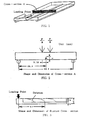
- Figs. 1-3 are respective schematic views illustrating the double tension (DT) method of measurement.
- the velocity of the cross head by which the load is applied was 1 mm/min.
- a vacuum pump was connected to the beaker and the mixture was defoamed in vacuum.
- the mixture was then poured into a mold having an inner size of 120 mm x 120 mm x 3 mm) preliminarily heated at 120°C, on which a releasing treatment was preliminarily performed.
- the mold was then placed in an oven and the resin composition was cured at 120°C for 3 hours, 180°C for 2 hours and then at 230°C for 16 hours to obtain a cured resin plate with a thickness of 3 mm.
- the glass transition temperature Tg of the thus obtained cured resin was 292°C. From this plate, the above-mentioned sample was cut out and the strain energy release rate G IC was measured, which was 610 J/m 2 .
- the bending elastic modulus of the resin plate was 380 kg/mm 2 .
- a resin plate sizing 60 mm x 10 mm x 3 mm was boiled for 20 hours and the water absorption was measured, which was 3.30%.
- a polished surface of the cured resin was stained with osmic acid and its reflected electron image was observed with a scanning electron microscope.
- a micro-phase separated morphology was observed in which one phase had a continuous structure and spherical dispersed phase existed therein.
- the diameter of the dispersed phase was 1 - 6 ⁇ m.
- the same visual field was subjected to elemental analysis by using an X-ray microanalyzer. As a result, fluorine atoms were found to be densely distributed in the black continuous phase which had high contrast. Thus, it was revealed that the continuous phase is the polyimide-rich phase.
- the resin composition having the composition described above was kneaded by a kneader and coated to a constant thickness on a releasing paper preliminarily coated with a silicone-based releasing agent.
- Carbon fibers (Torayca T800H, trademark, commercially available from Toray Industries, Inc., Tokyo, Japan) were aligned in one direction and sandwiched between a pair of the thus coated papers to obtain a prepreg.
- the weight ratio of the resin in the prepreg was 35% and the weight of the carbon fibers was 145 g/m 2 .
- Thirty two plies of the thus prepared prepreg were laminated quasi-isotropically ((+45°/90°/-45°/0°) 4 s).
- the resultant was heated at 180°C for 2 hours under a pressure of 6 kg/cm 2 by an ordinary bag autoclave molding method and then subjected to after cure at 230°C for 16 hours to obtain a cured plate.
- the volume of the fibers in the thus prepared fiber-reinforced plastic was 56 ⁇ 2%.
- a sample sizing 4" x 6" (10.16cm x 15.24 cm) was cut out and an impact energy of 1500 in. lb/in (6.7KJ/m) was given to the sample. Thereafter, a compression test was carried out. As a result, the fiber-reinforced plastic showed a residual compression strength of 41 ksi (283 MPa).
- the maleimide resin phase was unevenly located at the interfaces between the carbon fibers and the resin, and the high contrast phase (imide oligomer phase) densely distributed with fluorine atoms scarcely contacted the carbon fibers.
- a vacuum pump was connected to the beaker and the mixture was defoamed in vacuum.
- the mixture was then poured into a mold having an inner size of 120 mm x 120 mm x 3 mm) preliminarily heated at 120°C, on which a releasing treatment was preliminarily performed.
- the mold was then placed in an oven and the resin composition was cured at 130°C for 2 hours, 180°C for 2 hours and then at 230°C for 16 hours to obtain a cured resin plate with a thickness of 3 mm.
- the glass transition temperature Tg of the thus obtained cured resin was 296°C. From this plate, the above-mentioned sample was cut out and the strain energy release rate G IC was measured, which was 560 J/m 2 .
- the bending elastic modulus of the resin plate was 400 kg/mm 2 .
- a resin plate sizing 60 mm x 10 mm x 2 mm was boiled for 20 hours and the water absorption was measured, which was 3.40%.
- a polished surface of the cured resin was stained with osmic acid and its reflected electron image was observed with a scanning electron microscope. As a result, a micro-phase separated morphology was observed in which one phase had a continuous structure and spherical dispersed phase existed therein.
- NMP N-methyl-2-pyrrolidone
- BAPP 2,2-bis[4-(4-aminophenoxy)phenyl]propane
- FDA 9,9-bis(4-aminophenyl)fluorene
- S-BPDA solid biphenyltetracarboxylic acid dianhydride
- the number average molecular weight (Mn) of the oligomer was determined by gel permeation chromatography (GPC) using dimethylformamide (DMF) solvent, which was 5200 in terms of polyethylene glycol.
- the glass transition temperature of the polyimide oligomer determined by differential scanning calorimeter (DSC) was 310°C. Analysis of the polyimide oligomer by NMR spectrum revealed that the conversion rate to imide was about 94% and the percentage of the maleimide terminals were about 90%.
- a vacuum pump was connected to the beaker and the mixture was defoamed in vacuum.
- the mixture was then poured into a mold having an inner size of 120 mm x 120 mm x 3 mm) preliminarily heated at 120°C, on which a releasing treatment was preliminarily performed.
- the mold was then placed in an oven and the resin composition was cured at 120°C for 3 hours, 180°C for 2 hours and then at 230°C for 16 hours to obtain a cured resin plate with a thickness of 3 mm.
- the glass transition temperature Tg of the thus obtained cured resin was 301°C. From this plate, the above-mentioned sample was cut out and the strain energy release rate G IC was measured, which was 550 J/m 2 .
- the bending elastic modulus of the resin plate was 380 kg/mm 2 .
- a resin plate sizing 60 mm x 10 mm x 3 mm was boiled for 20 hours and the water absorption was measured, which was 3.50%.
- a reflected electron image of rupture cross-section of the cured resin was observed with a scanning electron microscope. As a result, a spherical dispersed phase with a diameter of 1 - 5 ⁇ m was observed.
- Example 2 The same procedure as in Example 1 was repeated except that the imide oligomer [B] was not added to prepare a cured maleimide resin plate.
- the glass transition temperature of the obtained cured resin was 294°C.
- the strain energy release rate G IC was measured, which was 100 J/m 2 .
- the bending elastic modulus of the resin plate was 380 kg/mm 2 , and the water absorption after boiling for 20 hours was 4.12%.
- a prepreg was prepared in the same manner as in Example 1 using the thus obtained maleimide resin as a matrix resin.
- the content of the resin in the prepreg was 35% by weight, and the weight of the prepreg was 145 g/m 2 .
- Thirty two plies of the thus prepared prepreg were laminated quasi-isotropically ((+45°/90°/-45°/0°) 4 s).
- the resultant was heated at 180°C for 2 hours under a pressure of 6 kg/cm 2 by an ordinary bag autoclave molding method to obtain a cured plate.
- the volume of the fibers in the thus prepared fiber-reinforced plastic was 56 ⁇ 2%.
- Example 2 The same procedure as in Example 2 was repeated except that the polyimide resin [B] was not added to prepare a maleimide resin plate.
- the glass transition temperature Tg of the thus obtained cured resin was 296°C.
- the strain energy release rate G IC was measured, which was 90 J/m 2 .
- the bending elastic modulus of the resin plate was 395 kg/mm 2 , and the water absorption after boiling for 20 hours was 4.2%.
Landscapes
- Chemical & Material Sciences (AREA)
- Organic Chemistry (AREA)
- Health & Medical Sciences (AREA)
- Chemical Kinetics & Catalysis (AREA)
- Medicinal Chemistry (AREA)
- Polymers & Plastics (AREA)
- Engineering & Computer Science (AREA)
- Materials Engineering (AREA)
- Manufacturing & Machinery (AREA)
- Inorganic Chemistry (AREA)
- Reinforced Plastic Materials (AREA)
- Macromolecular Compounds Obtained By Forming Nitrogen-Containing Linkages In General (AREA)
- Compositions Of Macromolecular Compounds (AREA)
- Macromonomer-Based Addition Polymer (AREA)
Claims (12)
- Composition de résine de maléimide, comprenant :(A) une résine de maléimide [A] ayant un composant de maléimide sélectionné parmi(i) un maléimide de la formule [VI] :
 (ii) un maléimide obtenu par réaction d'une polyamine mixte de la formule [VII] :
 (iii) une bismaléimide triazine obtenue par réaction entre un bismaléimide et un cyanate de la formule [VIII] :
 (B) une résine de polyimide [B] contenant en poids de la teneur en résidu de diamine totale de la résine de polyimide, au moins 5% d'une unité récurrente de la formule [I] :

- Composition de résine de maléimide selon la revendication 1, où la résine de polyimide [B] contient comme composant copolymérisé une unité d'amine, représentée par la formule [III] et/ou [IV] :


- Composition de résine de maléimide selon la revendication 1 ou 2, où le résidu Z est représenté par la formule [V]

- Composition de résine de maléimide selon la revendication 1, 2 ou 3, où la résine de maléimide [A] comprend du diaminodiphénylméthanebismaléimide et/ou du m-phénylène-dimaléimide.
- Composition de résine de maléimide selon toute revendication précédente, comprenant de plus un composé d'allyle aromatique comme diluant réactif de la résine de maléimide [A].
- Composition de résine de maléimide selon toute revendication précédente, où la résine de polyimide [B] est présente en une quantité de 5 - 40% en poids de la composition de résine de maléimide.
- Composition de résine de maléimide selon toute revendication précédente, où la résine de polyimide [B] a un poids moléculaire moyen en nombre de 2000 à 20 000.
- Prépreg comprenant une composition de résine de maléimide selon l'une des revendications 1 - 7 et des fibres de renforcement.
- Prépreg selon la revendication 8, où les fibres de renforcement sont des fibres de carbone et/ou des fibres de graphite.
- Matière plastique renforcée de fibres, préparée en durcissant le prépreg de la revendication 8.
- Matière plastique renforcée de fibres selon la revendication 10, où la résine de polyimide [B] constitue une phase continue tridimensionnelle dans la composition de résine de maléimide durcie.
- Matière plastique renforcée de fibres, obtenue en durcissant le prépreg de la revendication 9.
Applications Claiming Priority (2)
| Application Number | Priority Date | Filing Date | Title |
|---|---|---|---|
| JP274268/91 | 1991-10-22 | ||
| JP27426891 | 1991-10-22 |
Publications (2)
| Publication Number | Publication Date |
|---|---|
| EP0540250A1 EP0540250A1 (fr) | 1993-05-05 |
| EP0540250B1 true EP0540250B1 (fr) | 1997-04-16 |
Family
ID=17539298
Family Applications (1)
| Application Number | Title | Priority Date | Filing Date |
|---|---|---|---|
| EP92309685A Expired - Lifetime EP0540250B1 (fr) | 1991-10-22 | 1992-10-22 | Composition de résine de maléimide, prépreg et matériaux plastiques renforcés par des fibres |
Country Status (5)
| Country | Link |
|---|---|
| US (1) | US5438104A (fr) |
| EP (1) | EP0540250B1 (fr) |
| JP (1) | JPH05255564A (fr) |
| KR (1) | KR930008022A (fr) |
| DE (1) | DE69219065D1 (fr) |
Families Citing this family (9)
| Publication number | Priority date | Publication date | Assignee | Title |
|---|---|---|---|---|
| US20110281126A1 (en) * | 2008-12-26 | 2011-11-17 | Mitsuru Nozaki | Resin composite copper foil |
| GB201121304D0 (en) * | 2011-12-12 | 2012-01-25 | Hexcel Composites Ltd | Improved composite materials |
| US9783631B2 (en) * | 2014-12-19 | 2017-10-10 | The University Of Akron | Synthesis and characterization of UV-curable maleimide-terminated imide oligomers |
| KR102614450B1 (ko) * | 2017-09-13 | 2023-12-15 | 미쯔비시 가스 케미칼 컴파니, 인코포레이티드 | 폴리이미드, 폴리이미드 바니시, 및 폴리이미드 필름 |
| JP6750645B2 (ja) | 2018-05-22 | 2020-09-02 | ダイキン工業株式会社 | ポリテトラフルオロエチレン組成物 |
| JP6645606B2 (ja) | 2018-05-22 | 2020-02-14 | ダイキン工業株式会社 | 樹脂組成物 |
| JP6872081B2 (ja) * | 2019-03-15 | 2021-05-19 | 日本化薬株式会社 | ポリアミック酸樹脂、ポリイミド樹脂およびこれらを含む樹脂組成物 |
| JP7387235B2 (ja) * | 2020-11-12 | 2023-11-28 | 信越化学工業株式会社 | 熱硬化性マレイミド樹脂組成物、並びにその樹脂組成物からなる未硬化樹脂フィルム及び硬化樹脂フィルム |
| JP7330648B2 (ja) * | 2020-11-12 | 2023-08-22 | 信越化学工業株式会社 | 熱硬化性マレイミド樹脂組成物、並びにその樹脂組成物からなる未硬化樹脂フィルム及び硬化樹脂フィルム |
Family Cites Families (6)
| Publication number | Priority date | Publication date | Assignee | Title |
|---|---|---|---|---|
| CH615935A5 (fr) * | 1975-06-19 | 1980-02-29 | Ciba Geigy Ag | |
| JPS59191726A (ja) * | 1983-04-15 | 1984-10-30 | Mitsubishi Electric Corp | 熱硬化性樹脂組成物 |
| US4985509A (en) * | 1985-04-18 | 1991-01-15 | Hitachi, Ltd. | Heat curable resin composition |
| JP2625689B2 (ja) * | 1985-11-18 | 1997-07-02 | 淑夫 今井 | 単分子又は単分子累積膜の製造方法 |
| US5112924A (en) * | 1987-07-15 | 1992-05-12 | Hercules Incorporated | Bismaleimide compositions containing high glass transition temperature and soluble reactive oligomers and composites prepared therefrom |
| US5194518A (en) * | 1989-09-01 | 1993-03-16 | Nitto Denko Corporation | Thermosetting resin composition comprising perfluoro containing amine terminated oligomer and polymaleimide |
-
1992
- 1992-10-21 JP JP4283131A patent/JPH05255564A/ja active Pending
- 1992-10-22 KR KR1019920019490A patent/KR930008022A/ko not_active Withdrawn
- 1992-10-22 EP EP92309685A patent/EP0540250B1/fr not_active Expired - Lifetime
- 1992-10-22 DE DE69219065T patent/DE69219065D1/de not_active Expired - Lifetime
- 1992-10-22 US US07/964,854 patent/US5438104A/en not_active Expired - Fee Related
Also Published As
| Publication number | Publication date |
|---|---|
| US5438104A (en) | 1995-08-01 |
| JPH05255564A (ja) | 1993-10-05 |
| KR930008022A (ko) | 1993-05-20 |
| EP0540250A1 (fr) | 1993-05-05 |
| DE69219065D1 (de) | 1997-05-22 |
Similar Documents
| Publication | Publication Date | Title |
|---|---|---|
| EP0383174B1 (fr) | Matériaux de construction thermodurcissant tenaces | |
| US5476908A (en) | Thermosetting resin composition, cured resin product, prepreg and fiber-reinforced plastic | |
| Stenzenberger | Recent advances in thermosetting polyimides | |
| CA2480144C (fr) | Resines polyimides pouvant etre traitees par les procedes rtm (moulage par injection de resine) et ri (infusion de resine) | |
| EP0377194B1 (fr) | Matériaux de structure thermodurcissables et résistant au choc | |
| US6313248B1 (en) | Thermosetting polymers with improved thermal and oxidative stability for composite and adhesive applications | |
| EP0540250B1 (fr) | Composition de résine de maléimide, prépreg et matériaux plastiques renforcés par des fibres | |
| JPH0741575A (ja) | プリプレグおよび繊維強化複合材料 | |
| US5331063A (en) | Tough high performance composite matrix | |
| JPH0741576A (ja) | プリプレグおよび繊維強化樹脂 | |
| EP0266986A2 (fr) | Compositions résineuses contenant des esters aromatiques, des polyépoxydes et des polymères thermoplastiques et préimprégnés qui en sont préparés | |
| JPWO1994016003A1 (ja) | プリプレグ,その製造方法および積層複合体 | |
| US5460746A (en) | Terminal-modified imide oligomer composition | |
| US5120823A (en) | Toughened thermosetting structural materials | |
| JPH09235397A (ja) | プリプレグおよび繊維強化プラスチック | |
| JPH07149952A (ja) | 熱硬化性樹脂組成物、樹脂硬化物、プリプレグおよび繊維強化プラスチック | |
| JPH0641332A (ja) | プリプレグおよび複合材料 | |
| EP0632087B1 (fr) | Preimpregne, son procede de production et composite stratifie | |
| JP3345951B2 (ja) | プリプレグおよび複合材料 | |
| JPH07150042A (ja) | 樹脂組成物、樹脂硬化物、プリプレグおよび繊維強化プラスチック | |
| JPH0832765B2 (ja) | エポキシ樹脂組成物、プリプレグ、その硬化物および複合材料 | |
| CA2025039C (fr) | Systemes de resines thermodurcissables a tres grande resistance, a base de bis-maleimide | |
| JPH0753742A (ja) | プリプレグ | |
| US7605223B1 (en) | Low melt viscosity imide oligomers and polyimides therefrom |
Legal Events
| Date | Code | Title | Description |
|---|---|---|---|
| PUAI | Public reference made under article 153(3) epc to a published international application that has entered the european phase |
Free format text: ORIGINAL CODE: 0009012 |
|
| AK | Designated contracting states |
Kind code of ref document: A1 Designated state(s): DE FR GB IT |
|
| 17P | Request for examination filed |
Effective date: 19931021 |
|
| 17Q | First examination report despatched |
Effective date: 19950818 |
|
| GRAG | Despatch of communication of intention to grant |
Free format text: ORIGINAL CODE: EPIDOS AGRA |
|
| GRAH | Despatch of communication of intention to grant a patent |
Free format text: ORIGINAL CODE: EPIDOS IGRA |
|
| GRAH | Despatch of communication of intention to grant a patent |
Free format text: ORIGINAL CODE: EPIDOS IGRA |
|
| GRAA | (expected) grant |
Free format text: ORIGINAL CODE: 0009210 |
|
| RAP1 | Party data changed (applicant data changed or rights of an application transferred) |
Owner name: TORAY INDUSTRIES, INC. |
|
| AK | Designated contracting states |
Kind code of ref document: B1 Designated state(s): DE FR GB IT |
|
| PG25 | Lapsed in a contracting state [announced via postgrant information from national office to epo] |
Ref country code: IT Free format text: LAPSE BECAUSE OF FAILURE TO SUBMIT A TRANSLATION OF THE DESCRIPTION OR TO PAY THE FEE WITHIN THE PRE;WARNING: LAPSES OF ITALIAN PATENTS WITH EFFECTIVE DATE BEFORE 2007 MAY HAVE OCCURRED AT ANY TIME BEFORE 2007. THE CORRECT EFFECTIVE DATE MAY BE DIFFERENT FROM THE ONE RECORDED.SCRIBED TIME-LIMIT Effective date: 19970416 Ref country code: FR Effective date: 19970416 |
|
| REF | Corresponds to: |
Ref document number: 69219065 Country of ref document: DE Date of ref document: 19970522 |
|
| PG25 | Lapsed in a contracting state [announced via postgrant information from national office to epo] |
Ref country code: DE Effective date: 19970717 |
|
| EN | Fr: translation not filed | ||
| PG25 | Lapsed in a contracting state [announced via postgrant information from national office to epo] |
Ref country code: GB Free format text: LAPSE BECAUSE OF NON-PAYMENT OF DUE FEES Effective date: 19971022 |
|
| PLBE | No opposition filed within time limit |
Free format text: ORIGINAL CODE: 0009261 |
|
| 26N | No opposition filed | ||
| GBPC | Gb: european patent ceased through non-payment of renewal fee |
Effective date: 19971022 |