EP0543367B1 - Farbphotographisches Silberhalogenidmaterial - Google Patents
Farbphotographisches Silberhalogenidmaterial Download PDFInfo
- Publication number
- EP0543367B1 EP0543367B1 EP92119711A EP92119711A EP0543367B1 EP 0543367 B1 EP0543367 B1 EP 0543367B1 EP 92119711 A EP92119711 A EP 92119711A EP 92119711 A EP92119711 A EP 92119711A EP 0543367 B1 EP0543367 B1 EP 0543367B1
- Authority
- EP
- European Patent Office
- Prior art keywords
- group
- silver halide
- photographic material
- color photographic
- halide color
- Prior art date
- Legal status (The legal status is an assumption and is not a legal conclusion. Google has not performed a legal analysis and makes no representation as to the accuracy of the status listed.)
- Expired - Lifetime
Links
- -1 Silver halide Chemical class 0.000 title claims description 75
- 229910052709 silver Inorganic materials 0.000 title claims description 48
- 239000004332 silver Substances 0.000 title claims description 48
- 239000000463 material Substances 0.000 title claims description 38
- 239000010410 layer Substances 0.000 claims description 102
- 239000000839 emulsion Substances 0.000 claims description 67
- 150000001875 compounds Chemical class 0.000 claims description 62
- 239000004593 Epoxy Substances 0.000 claims description 46
- 125000000217 alkyl group Chemical group 0.000 claims description 36
- 125000004432 carbon atom Chemical group C* 0.000 claims description 26
- 125000001424 substituent group Chemical group 0.000 claims description 25
- 125000003118 aryl group Chemical group 0.000 claims description 23
- 125000004435 hydrogen atom Chemical group [H]* 0.000 claims description 19
- 125000001997 phenyl group Chemical group [H]C1=C([H])C([H])=C(*)C([H])=C1[H] 0.000 claims description 19
- 125000000623 heterocyclic group Chemical group 0.000 claims description 16
- MCSKRVKAXABJLX-UHFFFAOYSA-N pyrazolo[3,4-d]triazole Chemical compound N1=NN=C2N=NC=C21 MCSKRVKAXABJLX-UHFFFAOYSA-N 0.000 claims description 15
- 125000004104 aryloxy group Chemical group 0.000 claims description 14
- 125000005843 halogen group Chemical group 0.000 claims description 14
- XLYOFNOQVPJJNP-UHFFFAOYSA-N water Substances O XLYOFNOQVPJJNP-UHFFFAOYSA-N 0.000 claims description 13
- 229910052799 carbon Inorganic materials 0.000 claims description 12
- 125000003545 alkoxy group Chemical group 0.000 claims description 11
- 125000000547 substituted alkyl group Chemical group 0.000 claims description 11
- 125000002252 acyl group Chemical group 0.000 claims description 10
- 125000005420 sulfonamido group Chemical group S(=O)(=O)(N*)* 0.000 claims description 10
- 125000004442 acylamino group Chemical group 0.000 claims description 7
- 125000004453 alkoxycarbonyl group Chemical group 0.000 claims description 7
- 125000004429 atom Chemical group 0.000 claims description 7
- 239000003795 chemical substances by application Substances 0.000 claims description 7
- 229910052801 chlorine Inorganic materials 0.000 claims description 7
- 229910052717 sulfur Inorganic materials 0.000 claims description 7
- SJOOOZPMQAWAOP-UHFFFAOYSA-N [Ag].BrCl Chemical compound [Ag].BrCl SJOOOZPMQAWAOP-UHFFFAOYSA-N 0.000 claims description 6
- 125000001309 chloro group Chemical group Cl* 0.000 claims description 6
- 125000000472 sulfonyl group Chemical group *S(*)(=O)=O 0.000 claims description 6
- 125000000999 tert-butyl group Chemical group [H]C([H])([H])C(*)(C([H])([H])[H])C([H])([H])[H] 0.000 claims description 6
- 238000005859 coupling reaction Methods 0.000 claims description 5
- 125000001449 isopropyl group Chemical group [H]C([H])([H])C([H])(*)C([H])([H])[H] 0.000 claims description 5
- 229910021607 Silver chloride Inorganic materials 0.000 claims description 4
- 125000004390 alkyl sulfonyl group Chemical group 0.000 claims description 4
- 125000003277 amino group Chemical group 0.000 claims description 4
- 239000000084 colloidal system Substances 0.000 claims description 4
- 125000005842 heteroatom Chemical group 0.000 claims description 4
- 125000001183 hydrocarbyl group Chemical group 0.000 claims description 4
- 230000003647 oxidation Effects 0.000 claims description 4
- 238000007254 oxidation reaction Methods 0.000 claims description 4
- 229910052760 oxygen Inorganic materials 0.000 claims description 4
- HKZLPVFGJNLROG-UHFFFAOYSA-M silver monochloride Chemical compound [Cl-].[Ag+] HKZLPVFGJNLROG-UHFFFAOYSA-M 0.000 claims description 4
- 125000004391 aryl sulfonyl group Chemical group 0.000 claims description 3
- 239000011229 interlayer Substances 0.000 claims description 3
- 125000000962 organic group Chemical group 0.000 claims description 3
- 125000000951 phenoxy group Chemical group [H]C1=C([H])C([H])=C(O*)C([H])=C1[H] 0.000 claims description 3
- 229910052698 phosphorus Inorganic materials 0.000 claims description 3
- 125000001931 aliphatic group Chemical group 0.000 claims description 2
- 125000000843 phenylene group Chemical group C1(=C(C=CC=C1)*)* 0.000 claims description 2
- 102100021267 Anion exchange protein 4 Human genes 0.000 claims 2
- 101710160272 Anion exchange protein 4 Proteins 0.000 claims 2
- JKFYKCYQEWQPTM-UHFFFAOYSA-N 2-azaniumyl-2-(4-fluorophenyl)acetate Chemical compound OC(=O)C(N)C1=CC=C(F)C=C1 JKFYKCYQEWQPTM-UHFFFAOYSA-N 0.000 claims 1
- 125000002373 5 membered heterocyclic group Chemical group 0.000 claims 1
- 229910021612 Silver iodide Inorganic materials 0.000 claims 1
- 229940045105 silver iodide Drugs 0.000 claims 1
- 239000000975 dye Substances 0.000 description 24
- 239000000243 solution Substances 0.000 description 21
- 239000000203 mixture Substances 0.000 description 20
- 239000002904 solvent Substances 0.000 description 18
- 239000003381 stabilizer Substances 0.000 description 18
- 238000009835 boiling Methods 0.000 description 12
- AJDUTMFFZHIJEM-UHFFFAOYSA-N n-(9,10-dioxoanthracen-1-yl)-4-[4-[[4-[4-[(9,10-dioxoanthracen-1-yl)carbamoyl]phenyl]phenyl]diazenyl]phenyl]benzamide Chemical compound O=C1C2=CC=CC=C2C(=O)C2=C1C=CC=C2NC(=O)C(C=C1)=CC=C1C(C=C1)=CC=C1N=NC(C=C1)=CC=C1C(C=C1)=CC=C1C(=O)NC1=CC=CC2=C1C(=O)C1=CC=CC=C1C2=O AJDUTMFFZHIJEM-UHFFFAOYSA-N 0.000 description 12
- 230000001235 sensitizing effect Effects 0.000 description 12
- 239000001043 yellow dye Substances 0.000 description 12
- 238000002845 discoloration Methods 0.000 description 11
- 239000003960 organic solvent Substances 0.000 description 11
- 239000011248 coating agent Substances 0.000 description 10
- 238000000576 coating method Methods 0.000 description 10
- 239000006185 dispersion Substances 0.000 description 7
- 230000002349 favourable effect Effects 0.000 description 7
- 229920000642 polymer Polymers 0.000 description 7
- XEKOWRVHYACXOJ-UHFFFAOYSA-N Ethyl acetate Chemical compound CCOC(C)=O XEKOWRVHYACXOJ-UHFFFAOYSA-N 0.000 description 6
- 108010010803 Gelatin Proteins 0.000 description 6
- 239000000470 constituent Substances 0.000 description 6
- 125000004122 cyclic group Chemical group 0.000 description 6
- 229920000159 gelatin Polymers 0.000 description 6
- 239000008273 gelatin Substances 0.000 description 6
- 235000019322 gelatine Nutrition 0.000 description 6
- 235000011852 gelatine desserts Nutrition 0.000 description 6
- 125000002496 methyl group Chemical group [H]C([H])([H])* 0.000 description 6
- BQCADISMDOOEFD-UHFFFAOYSA-N Silver Chemical compound [Ag] BQCADISMDOOEFD-UHFFFAOYSA-N 0.000 description 5
- GWEVSGVZZGPLCZ-UHFFFAOYSA-N Titan oxide Chemical compound O=[Ti]=O GWEVSGVZZGPLCZ-UHFFFAOYSA-N 0.000 description 5
- 125000004423 acyloxy group Chemical group 0.000 description 5
- 125000004397 aminosulfonyl group Chemical group NS(=O)(=O)* 0.000 description 5
- 125000001495 ethyl group Chemical group [H]C([H])([H])C([H])([H])* 0.000 description 5
- 229910052757 nitrogen Inorganic materials 0.000 description 5
- IJGRMHOSHXDMSA-UHFFFAOYSA-N Atomic nitrogen Chemical compound N#N IJGRMHOSHXDMSA-UHFFFAOYSA-N 0.000 description 4
- 239000004698 Polyethylene Substances 0.000 description 4
- 125000005161 aryl oxy carbonyl group Chemical group 0.000 description 4
- 125000003917 carbamoyl group Chemical group [H]N([H])C(*)=O 0.000 description 4
- 239000013078 crystal Substances 0.000 description 4
- 125000004093 cyano group Chemical group *C#N 0.000 description 4
- 230000000694 effects Effects 0.000 description 4
- 230000006872 improvement Effects 0.000 description 4
- 239000004615 ingredient Substances 0.000 description 4
- 230000002401 inhibitory effect Effects 0.000 description 4
- 229920000573 polyethylene Polymers 0.000 description 4
- GZTPJDLYPMPRDF-UHFFFAOYSA-N pyrrolo[3,2-c]pyrazole Chemical compound N1=NC2=CC=NC2=C1 GZTPJDLYPMPRDF-UHFFFAOYSA-N 0.000 description 4
- 230000003595 spectral effect Effects 0.000 description 4
- 101100221809 Neurospora crassa (strain ATCC 24698 / 74-OR23-1A / CBS 708.71 / DSM 1257 / FGSC 987) cpd-7 gene Proteins 0.000 description 3
- HEMHJVSKTPXQMS-UHFFFAOYSA-M Sodium hydroxide Chemical compound [OH-].[Na+] HEMHJVSKTPXQMS-UHFFFAOYSA-M 0.000 description 3
- NINIDFKCEFEMDL-UHFFFAOYSA-N Sulfur Chemical compound [S] NINIDFKCEFEMDL-UHFFFAOYSA-N 0.000 description 3
- 230000002745 absorbent Effects 0.000 description 3
- 239000002250 absorbent Substances 0.000 description 3
- 125000005110 aryl thio group Chemical group 0.000 description 3
- 125000001951 carbamoylamino group Chemical group C(N)(=O)N* 0.000 description 3
- 238000006243 chemical reaction Methods 0.000 description 3
- KRKNYBCHXYNGOX-UHFFFAOYSA-N citric acid Chemical compound OC(=O)CC(O)(C(O)=O)CC(O)=O KRKNYBCHXYNGOX-UHFFFAOYSA-N 0.000 description 3
- 239000003086 colorant Substances 0.000 description 3
- GVGUFUZHNYFZLC-UHFFFAOYSA-N dodecyl benzenesulfonate;sodium Chemical compound [Na].CCCCCCCCCCCCOS(=O)(=O)C1=CC=CC=C1 GVGUFUZHNYFZLC-UHFFFAOYSA-N 0.000 description 3
- 238000000034 method Methods 0.000 description 3
- 125000000449 nitro group Chemical group [O-][N+](*)=O 0.000 description 3
- 239000011241 protective layer Substances 0.000 description 3
- ADZWSOLPGZMUMY-UHFFFAOYSA-M silver bromide Chemical compound [Ag]Br ADZWSOLPGZMUMY-UHFFFAOYSA-M 0.000 description 3
- 229940080264 sodium dodecylbenzenesulfonate Drugs 0.000 description 3
- 239000011593 sulfur Substances 0.000 description 3
- 125000002023 trifluoromethyl group Chemical group FC(F)(F)* 0.000 description 3
- ALAVMPYROHSFFR-UHFFFAOYSA-N 1-methyl-3-[3-(5-sulfanylidene-2h-tetrazol-1-yl)phenyl]urea Chemical compound CNC(=O)NC1=CC=CC(N2C(=NN=N2)S)=C1 ALAVMPYROHSFFR-UHFFFAOYSA-N 0.000 description 2
- GRFNBEZIAWKNCO-UHFFFAOYSA-N 3-pyridinol Chemical compound OC1=CC=CN=C1 GRFNBEZIAWKNCO-UHFFFAOYSA-N 0.000 description 2
- CPELXLSAUQHCOX-UHFFFAOYSA-M Bromide Chemical compound [Br-] CPELXLSAUQHCOX-UHFFFAOYSA-M 0.000 description 2
- FZERHIULMFGESH-UHFFFAOYSA-N N-phenylacetamide Chemical compound CC(=O)NC1=CC=CC=C1 FZERHIULMFGESH-UHFFFAOYSA-N 0.000 description 2
- 238000010521 absorption reaction Methods 0.000 description 2
- 239000000654 additive Substances 0.000 description 2
- 125000004466 alkoxycarbonylamino group Chemical group 0.000 description 2
- 125000003282 alkyl amino group Chemical group 0.000 description 2
- 125000005278 alkyl sulfonyloxy group Chemical group 0.000 description 2
- 125000004414 alkyl thio group Chemical group 0.000 description 2
- 230000002421 anti-septic effect Effects 0.000 description 2
- IRERQBUNZFJFGC-UHFFFAOYSA-L azure blue Chemical compound [Na+].[Na+].[Na+].[Na+].[Na+].[Na+].[Na+].[Na+].[Al+3].[Al+3].[Al+3].[Al+3].[Al+3].[Al+3].[S-]S[S-].[O-][Si]([O-])([O-])[O-].[O-][Si]([O-])([O-])[O-].[O-][Si]([O-])([O-])[O-].[O-][Si]([O-])([O-])[O-].[O-][Si]([O-])([O-])[O-].[O-][Si]([O-])([O-])[O-] IRERQBUNZFJFGC-UHFFFAOYSA-L 0.000 description 2
- 230000008901 benefit Effects 0.000 description 2
- 125000003236 benzoyl group Chemical group [H]C1=C([H])C([H])=C(C([H])=C1[H])C(*)=O 0.000 description 2
- IISBACLAFKSPIT-UHFFFAOYSA-N bisphenol A Chemical compound C=1C=C(O)C=CC=1C(C)(C)C1=CC=C(O)C=C1 IISBACLAFKSPIT-UHFFFAOYSA-N 0.000 description 2
- ZUIVNYGZFPOXFW-UHFFFAOYSA-N chembl1717603 Chemical compound N1=C(C)C=C(O)N2N=CN=C21 ZUIVNYGZFPOXFW-UHFFFAOYSA-N 0.000 description 2
- 239000000460 chlorine Substances 0.000 description 2
- 230000008878 coupling Effects 0.000 description 2
- 238000010168 coupling process Methods 0.000 description 2
- 125000000113 cyclohexyl group Chemical group [H]C1([H])C([H])([H])C([H])([H])C([H])(*)C([H])([H])C1([H])[H] 0.000 description 2
- 229910052731 fluorine Inorganic materials 0.000 description 2
- 125000005844 heterocyclyloxy group Chemical group 0.000 description 2
- 125000002887 hydroxy group Chemical group [H]O* 0.000 description 2
- 238000002844 melting Methods 0.000 description 2
- 230000008018 melting Effects 0.000 description 2
- 125000000956 methoxy group Chemical group [H]C([H])([H])O* 0.000 description 2
- 125000002950 monocyclic group Chemical group 0.000 description 2
- 125000004108 n-butyl group Chemical group [H]C([H])([H])C([H])([H])C([H])([H])C([H])([H])* 0.000 description 2
- 125000004123 n-propyl group Chemical group [H]C([H])([H])C([H])([H])C([H])([H])* 0.000 description 2
- 125000004433 nitrogen atom Chemical group N* 0.000 description 2
- 229920002401 polyacrylamide Polymers 0.000 description 2
- 239000004848 polyfunctional curative Substances 0.000 description 2
- 238000002360 preparation method Methods 0.000 description 2
- 125000004469 siloxy group Chemical group [SiH3]O* 0.000 description 2
- 159000000000 sodium salts Chemical class 0.000 description 2
- 125000005156 substituted alkylene group Chemical group 0.000 description 2
- 239000012463 white pigment Substances 0.000 description 2
- YQTCQNIPQMJNTI-UHFFFAOYSA-N 2,2-dimethylpropan-1-one Chemical group CC(C)(C)[C]=O YQTCQNIPQMJNTI-UHFFFAOYSA-N 0.000 description 1
- XRZDIHADHZSFBB-UHFFFAOYSA-N 3-oxo-n,3-diphenylpropanamide Chemical compound C=1C=CC=CC=1NC(=O)CC(=O)C1=CC=CC=C1 XRZDIHADHZSFBB-UHFFFAOYSA-N 0.000 description 1
- CPHGOBGXZQKCKI-UHFFFAOYSA-N 4,5-diphenyl-1h-imidazole Chemical compound N1C=NC(C=2C=CC=CC=2)=C1C1=CC=CC=C1 CPHGOBGXZQKCKI-UHFFFAOYSA-N 0.000 description 1
- OYPRJOBELJOOCE-UHFFFAOYSA-N Calcium Chemical compound [Ca] OYPRJOBELJOOCE-UHFFFAOYSA-N 0.000 description 1
- OKTJSMMVPCPJKN-UHFFFAOYSA-N Carbon Chemical compound [C] OKTJSMMVPCPJKN-UHFFFAOYSA-N 0.000 description 1
- VEXZGXHMUGYJMC-UHFFFAOYSA-M Chloride anion Chemical compound [Cl-] VEXZGXHMUGYJMC-UHFFFAOYSA-M 0.000 description 1
- MYMOFIZGZYHOMD-UHFFFAOYSA-N Dioxygen Chemical compound O=O MYMOFIZGZYHOMD-UHFFFAOYSA-N 0.000 description 1
- BRLQWZUYTZBJKN-UHFFFAOYSA-N Epichlorohydrin Chemical compound ClCC1CO1 BRLQWZUYTZBJKN-UHFFFAOYSA-N 0.000 description 1
- LFQSCWFLJHTTHZ-UHFFFAOYSA-N Ethanol Chemical compound CCO LFQSCWFLJHTTHZ-UHFFFAOYSA-N 0.000 description 1
- UFHFLCQGNIYNRP-UHFFFAOYSA-N Hydrogen Chemical compound [H][H] UFHFLCQGNIYNRP-UHFFFAOYSA-N 0.000 description 1
- JLVVSXFLKOJNIY-UHFFFAOYSA-N Magnesium ion Chemical compound [Mg+2] JLVVSXFLKOJNIY-UHFFFAOYSA-N 0.000 description 1
- CERQOIWHTDAKMF-UHFFFAOYSA-M Methacrylate Chemical compound CC(=C)C([O-])=O CERQOIWHTDAKMF-UHFFFAOYSA-M 0.000 description 1
- BXUURYQQDJGIGA-UHFFFAOYSA-N N1C=NN2N=CC=C21 Chemical compound N1C=NN2N=CC=C21 BXUURYQQDJGIGA-UHFFFAOYSA-N 0.000 description 1
- 206010070834 Sensitisation Diseases 0.000 description 1
- 235000010724 Wisteria floribunda Nutrition 0.000 description 1
- 241000212749 Zesius chrysomallus Species 0.000 description 1
- 229960001413 acetanilide Drugs 0.000 description 1
- 125000002777 acetyl group Chemical group [H]C([H])([H])C(*)=O 0.000 description 1
- 125000003647 acryloyl group Chemical group O=C([*])C([H])=C([H])[H] 0.000 description 1
- 125000003342 alkenyl group Chemical group 0.000 description 1
- 125000006193 alkinyl group Chemical group 0.000 description 1
- 125000003368 amide group Chemical group 0.000 description 1
- 125000002490 anilino group Chemical group [H]N(*)C1=C([H])C([H])=C([H])C([H])=C1[H] 0.000 description 1
- 239000007864 aqueous solution Substances 0.000 description 1
- 150000004982 aromatic amines Chemical class 0.000 description 1
- 125000002029 aromatic hydrocarbon group Chemical group 0.000 description 1
- 125000001769 aryl amino group Chemical group 0.000 description 1
- 125000005162 aryl oxy carbonyl amino group Chemical group 0.000 description 1
- 125000005142 aryl oxy sulfonyl group Chemical group 0.000 description 1
- 125000005279 aryl sulfonyloxy group Chemical group 0.000 description 1
- 125000000751 azo group Chemical group [*]N=N[*] 0.000 description 1
- 125000003943 azolyl group Chemical group 0.000 description 1
- 125000001797 benzyl group Chemical group [H]C1=C([H])C([H])=C(C([H])=C1[H])C([H])([H])* 0.000 description 1
- 239000011230 binding agent Substances 0.000 description 1
- 230000015572 biosynthetic process Effects 0.000 description 1
- 229910052794 bromium Inorganic materials 0.000 description 1
- 239000011575 calcium Substances 0.000 description 1
- 229910001424 calcium ion Inorganic materials 0.000 description 1
- 125000003178 carboxy group Chemical group [H]OC(*)=O 0.000 description 1
- 230000008859 change Effects 0.000 description 1
- 125000003016 chromanyl group Chemical group O1C(CCC2=CC=CC=C12)* 0.000 description 1
- 229920001577 copolymer Polymers 0.000 description 1
- 125000006165 cyclic alkyl group Chemical group 0.000 description 1
- 125000004210 cyclohexylmethyl group Chemical group [H]C([H])(*)C1([H])C([H])([H])C([H])([H])C([H])([H])C([H])([H])C1([H])[H] 0.000 description 1
- 230000000994 depressogenic effect Effects 0.000 description 1
- 230000006866 deterioration Effects 0.000 description 1
- 239000000539 dimer Substances 0.000 description 1
- 125000003700 epoxy group Chemical group 0.000 description 1
- 239000003822 epoxy resin Substances 0.000 description 1
- 125000000816 ethylene group Chemical group [H]C([H])([*:1])C([H])([H])[*:2] 0.000 description 1
- 125000001153 fluoro group Chemical group F* 0.000 description 1
- 125000002541 furyl group Chemical group 0.000 description 1
- PCHJSUWPFVWCPO-UHFFFAOYSA-N gold Chemical compound [Au] PCHJSUWPFVWCPO-UHFFFAOYSA-N 0.000 description 1
- 229910052737 gold Inorganic materials 0.000 description 1
- 239000010931 gold Substances 0.000 description 1
- LNEPOXFFQSENCJ-UHFFFAOYSA-N haloperidol Chemical compound C1CC(O)(C=2C=CC(Cl)=CC=2)CCN1CCCC(=O)C1=CC=C(F)C=C1 LNEPOXFFQSENCJ-UHFFFAOYSA-N 0.000 description 1
- 125000004468 heterocyclylthio group Chemical group 0.000 description 1
- 229920001519 homopolymer Polymers 0.000 description 1
- 229910052739 hydrogen Inorganic materials 0.000 description 1
- 239000001257 hydrogen Substances 0.000 description 1
- 125000002883 imidazolyl group Chemical group 0.000 description 1
- 125000001841 imino group Chemical group [H]N=* 0.000 description 1
- 125000001041 indolyl group Chemical group 0.000 description 1
- 239000003112 inhibitor Substances 0.000 description 1
- 229910052740 iodine Inorganic materials 0.000 description 1
- 125000002346 iodo group Chemical group I* 0.000 description 1
- 238000005342 ion exchange Methods 0.000 description 1
- 125000000959 isobutyl group Chemical group [H]C([H])([H])C([H])(C([H])([H])[H])C([H])([H])* 0.000 description 1
- 239000004816 latex Substances 0.000 description 1
- 229920000126 latex Polymers 0.000 description 1
- 229910001425 magnesium ion Inorganic materials 0.000 description 1
- HRDXJKGNWSUIBT-UHFFFAOYSA-N methoxybenzene Chemical group [CH2]OC1=CC=CC=C1 HRDXJKGNWSUIBT-UHFFFAOYSA-N 0.000 description 1
- 125000001570 methylene group Chemical group [H]C([H])([*:1])[*:2] 0.000 description 1
- 125000004170 methylsulfonyl group Chemical group [H]C([H])([H])S(*)(=O)=O 0.000 description 1
- 125000004573 morpholin-4-yl group Chemical group N1(CCOCC1)* 0.000 description 1
- 125000001624 naphthyl group Chemical group 0.000 description 1
- 125000004957 naphthylene group Chemical group 0.000 description 1
- 230000003287 optical effect Effects 0.000 description 1
- 239000001301 oxygen Substances 0.000 description 1
- 125000004430 oxygen atom Chemical group O* 0.000 description 1
- 125000003170 phenylsulfonyl group Chemical group C1(=CC=CC=C1)S(=O)(=O)* 0.000 description 1
- 125000005499 phosphonyl group Chemical group 0.000 description 1
- 239000004033 plastic Substances 0.000 description 1
- 229920003023 plastic Polymers 0.000 description 1
- 229920000647 polyepoxide Polymers 0.000 description 1
- 230000008569 process Effects 0.000 description 1
- JEXVQSWXXUJEMA-UHFFFAOYSA-N pyrazol-3-one Chemical compound O=C1C=CN=N1 JEXVQSWXXUJEMA-UHFFFAOYSA-N 0.000 description 1
- 125000003072 pyrazolidinyl group Chemical group 0.000 description 1
- 125000003226 pyrazolyl group Chemical group 0.000 description 1
- 125000004076 pyridyl group Chemical group 0.000 description 1
- 125000000168 pyrrolyl group Chemical group 0.000 description 1
- 230000009467 reduction Effects 0.000 description 1
- 239000011347 resin Substances 0.000 description 1
- 229920005989 resin Polymers 0.000 description 1
- 239000012487 rinsing solution Substances 0.000 description 1
- 229910052711 selenium Inorganic materials 0.000 description 1
- 230000008313 sensitization Effects 0.000 description 1
- 238000000926 separation method Methods 0.000 description 1
- 238000007086 side reaction Methods 0.000 description 1
- ZUNKMNLKJXRCDM-UHFFFAOYSA-N silver bromoiodide Chemical compound [Ag].IBr ZUNKMNLKJXRCDM-UHFFFAOYSA-N 0.000 description 1
- 230000006641 stabilisation Effects 0.000 description 1
- 238000011105 stabilization Methods 0.000 description 1
- 125000005650 substituted phenylene group Chemical group 0.000 description 1
- 238000006467 substitution reaction Methods 0.000 description 1
- 125000000475 sulfinyl group Chemical group [*:2]S([*:1])=O 0.000 description 1
- 125000000020 sulfo group Chemical group O=S(=O)([*])O[H] 0.000 description 1
- 125000004434 sulfur atom Chemical group 0.000 description 1
- 238000004381 surface treatment Methods 0.000 description 1
- 239000004094 surface-active agent Substances 0.000 description 1
- 238000001308 synthesis method Methods 0.000 description 1
- 229910052714 tellurium Inorganic materials 0.000 description 1
- OGIDPMRJRNCKJF-UHFFFAOYSA-N titanium oxide Inorganic materials [Ti]=O OGIDPMRJRNCKJF-UHFFFAOYSA-N 0.000 description 1
- 125000005147 toluenesulfonyl group Chemical group C=1(C(=CC=CC1)S(=O)(=O)*)C 0.000 description 1
- 125000004306 triazinyl group Chemical group 0.000 description 1
- QXJQHYBHAIHNGG-UHFFFAOYSA-N trimethylolethane Chemical compound OCC(C)(CO)CO QXJQHYBHAIHNGG-UHFFFAOYSA-N 0.000 description 1
- JOYRKODLDBILNP-UHFFFAOYSA-N urethane group Chemical group NC(=O)OCC JOYRKODLDBILNP-UHFFFAOYSA-N 0.000 description 1
- 238000004078 waterproofing Methods 0.000 description 1
Classifications
-
- G—PHYSICS
- G03—PHOTOGRAPHY; CINEMATOGRAPHY; ANALOGOUS TECHNIQUES USING WAVES OTHER THAN OPTICAL WAVES; ELECTROGRAPHY; HOLOGRAPHY
- G03C—PHOTOSENSITIVE MATERIALS FOR PHOTOGRAPHIC PURPOSES; PHOTOGRAPHIC PROCESSES, e.g. CINE, X-RAY, COLOUR, STEREO-PHOTOGRAPHIC PROCESSES; AUXILIARY PROCESSES IN PHOTOGRAPHY
- G03C7/00—Multicolour photographic processes or agents therefor; Regeneration of such processing agents; Photosensitive materials for multicolour processes
- G03C7/30—Colour processes using colour-coupling substances; Materials therefor; Preparing or processing such materials
- G03C7/3003—Materials characterised by the use of combinations of photographic compounds known as such, or by a particular location in the photographic element
- G03C7/3005—Combinations of couplers and photographic additives
-
- G—PHYSICS
- G03—PHOTOGRAPHY; CINEMATOGRAPHY; ANALOGOUS TECHNIQUES USING WAVES OTHER THAN OPTICAL WAVES; ELECTROGRAPHY; HOLOGRAPHY
- G03C—PHOTOSENSITIVE MATERIALS FOR PHOTOGRAPHIC PURPOSES; PHOTOGRAPHIC PROCESSES, e.g. CINE, X-RAY, COLOUR, STEREO-PHOTOGRAPHIC PROCESSES; AUXILIARY PROCESSES IN PHOTOGRAPHY
- G03C7/00—Multicolour photographic processes or agents therefor; Regeneration of such processing agents; Photosensitive materials for multicolour processes
- G03C7/30—Colour processes using colour-coupling substances; Materials therefor; Preparing or processing such materials
- G03C7/32—Colour coupling substances
- G03C7/36—Couplers containing compounds with active methylene groups
-
- G—PHYSICS
- G03—PHOTOGRAPHY; CINEMATOGRAPHY; ANALOGOUS TECHNIQUES USING WAVES OTHER THAN OPTICAL WAVES; ELECTROGRAPHY; HOLOGRAPHY
- G03C—PHOTOSENSITIVE MATERIALS FOR PHOTOGRAPHIC PURPOSES; PHOTOGRAPHIC PROCESSES, e.g. CINE, X-RAY, COLOUR, STEREO-PHOTOGRAPHIC PROCESSES; AUXILIARY PROCESSES IN PHOTOGRAPHY
- G03C7/00—Multicolour photographic processes or agents therefor; Regeneration of such processing agents; Photosensitive materials for multicolour processes
- G03C7/30—Colour processes using colour-coupling substances; Materials therefor; Preparing or processing such materials
- G03C7/32—Colour coupling substances
- G03C7/36—Couplers containing compounds with active methylene groups
- G03C7/38—Couplers containing compounds with active methylene groups in rings
Definitions
- the present invention relates to a silver halide color photographic material which can provide excellent color reproducibility and, more particularly, to a silver halide color photographic material which contains an epoxy compound slightly soluble in water to effect an improvement in fastness of color images to light, heat and moisture and a reduction of magenta color stain upon long-range storage.
- JP-B-58-45017 the term “JP-B” as used herein means an "examined Japanese patent publication”
- JP-A-62-75447 the term “JP-A” as used herein means an "unexamined published Japanese patent application” JP-A-62-129853.
- Concrete compounds disclosed in those patents were able to achieve some effect in improving dark discoloration, but failed to bring about a satisfactory solution.
- it occurred occasionally that the density of magenta color in a yellow image area was increased with a decrease of the density of yellow dye image.
- Generation of magenta color stain as described above presented a problem that it spoiled considerably a yellow dye image, which originally possessed excellent color reproducibility. Therefore, further heightening the keeping quality of yellow images is necessary also for retaining excellent color reproducibility over a long period of time.
- yellow couplers of the benzoyl and pivaloyl types which contain acetanilide as basic skeleton are known generally.
- the cycloalkanecarbonyl group-containing yellow couplers disclosed in EP-A-0447969 can produce yellow dye images having excellent spectral absorption characteristics and high density by the coupling reaction with the oxidation product of an aromatic primary amine developing agent.
- they are inferior to conventional yellow couplers in image keeping quality under high temperature and high humidity conditions.
- pyrazoloazole type magenta couplers are now used practically in place of pyrazolone type couplers because the images formed therefrom are superior in hue.
- 1H-pyrazolo[1,5-b][1,2,4] triazole type couplers disclosed in JP-A-03-141350 form magenta dye images excellent in spectral absorption characteristics, color reproducibility and fastness by the reaction with the oxidation product of an aromatic primary amine developing agent, and are appreciably reduced in a change for yellow in the white area (yellow stain) with the lapse of time.
- magenta coupler of the above-described kind have problems of their generating magenta color stain in a yellow image area upon storage under high temperature and high humidity, particularly when used in combination with the above-cited cycloalkanecarbonyl group-containing yellow couplers.
- An object of the present invention is to provide a silver halide color photographic material which can form images excellent in color reproducibility, can effect an improvement in dark discoloration of color images upon long-range storage and can provide images formed therein with excellent keeping quality.
- the object of the present invention consists in providing a silver halide color photographic material into which is introduced an improvement in dark discoloration of yellow dye images excellent in hue and which hardly causes magenta color stain in the yellow dye images.
- the object of the present invention is effectively attained with a silver halide color photographic material comprising on a support a yellow coupler-containing light-sensitive silver halide emulsion layer, a magenta coupler-containing light-sensitive silver halide emulsion layer, a cyan coupler-containing light-sensitive silver halide emulsion layer and a light-insensitive hydrophilic colloid layer, said photographic material comprising (i) at least one epoxy compound which is slightly soluble in water and contains at least one epoxy moiety represented by the following general formula (AO), (ii) an acylacetamide type yellow coupler containing the acyl group represented by the general formula (I) and (iii) a pyrazolotriazole type magenta coupler of the general formula (II) or (III): wherein R1, R2, R3, R4 and R5 are same or different, and each represents a hydrogen atom, an alkyl group or an aryl group; R represents a substituent group; n
- R1 represents a monovalent group
- Q represents nonmetallic atoms necessary to form a 3- to 5-membered hydrocarbon ring or a 3- to 5-membered hetero ring which contains at least one hetero atom selected from N, O, S and P in the ring; provided that R1 is neither a hydrogen atom nor atoms completing a ring by combining with Q: wherein R1 and R3 each represent an alkyl group; R2 and R4 each represent an alkyl group or an aryl group; and X1 and X2 each represent a hal
- the dye images formed have high keeping quality, that is, they suffer little from discoloration and magenta color stain upon storage under a high temperature and high humidity condition.
- epoxy compounds of the present invention which are slightly soluble in water and contain the moiety represented by the general formula (AO), are described below in detail.
- epoxy compounds slightly soluble in water refers to those having solubility of no greater than 10 % in water at 25°C, wherein the total number of carbon atoms contained is at least 9, preferably at least 18, and more preferably at least 30.
- An alkyl group used in the description of the general formula (AO) is intended to include straight chain, branched and cyclic ones (e.g., methyl, ethyl, n-propyl, i-propyl, n-butyl, t-butyl, cyclohexyl, n-octyl, t-octyl, n-decyl, sec-dodecyl, n-hexadecyl, n-octadecyl), which may have substituent groups.
- aryl group used in the description or the general formula (AO) is intended to include aromatic hydrocarbon residues (e.g., phenyl, naphthyl), which may have substituent groups.
- a heterocyclic group used in the description of the general formula (AO) is intended to include 5- to 7-membered cyclic groups which contain oxygen, nitrogen or sulfur atom as at least one of the ring constituting atoms, which may be aromatic ones. Further. they may have substituent groups. Examples of such a heterocyclic group includethienyl, furyl, imidazolyl, pyrazolyl, pyrrolyl, indolyl, pyridyl, chromanyl, pyrazolidinyl, piperadinyl, 4-morpholinyl, triazinyl and so on.
- Substituent groups used in the description of the general formula (AO) are intended to include an alkyl group, an alkenyl group, an alkinyl group, an aryl group, a heterocyclic group, an alkoxy group, an aryloxy group, an alkylthio group, an arylthio group, a hydroxyl group, a halogen atom, a cyano group, a nitro group, an acyl group, an acyloxy group, a silyloxy group, a sulfonyl group, a sulfonyloxy group, an alkoxycarbonyl group, an aryloxycarbonyl group, an amido group, an imido group, a carbamoyl group, a sulfamoyl group, an ureido group, an urethane group, an aminosulfamoyl group, an amino group, an alkylamino group, an arylamino group, a
- R1, R2, R3, R4 and R5 may be same or different, and each represents a hydrogen atom, an alkyl group or an aryl group.
- R represents a substituent group
- n represents an integer of 1 to 4.
- Y- represents a divalent linkage group (e.g., a single bond, -O-, -S-, -SO2-, -O-CO2-, -S-, an optionally substituted imino group, an optionally substituted alkylene group, an optionally substituted phenylene group, naphthylene group, a divalent heterocyclic group).
- R′ represents a hydrogen atom, an acyl group (e.g., acetyl, acryloyl, benzoyl), an alkylsulfonyl group (e.g., methanesulfonyl, ethanesulfonyl, dodecanesulfonyl), an arylsulfonyl group (e.g., benzenesulfonyl, toluenesulfonyl), an aryl group, a heterocyclyl group, or -C(R6)(R7)(R8).
- an acyl group e.g., acetyl, acryloyl, benzoyl
- an alkylsulfonyl group e.g., methanesulfonyl, ethanesulfonyl, dodecanesulfonyl
- an arylsulfonyl group e.g., benz
- the moiety represented by general formula (AO) may be bound to a hydrogen atom, or attached to another moiety via any of carbon, nitrogen, sulfur or oxygen atom thereof.
- epoxy compounds containing the moiety represented by general formula (AO) those containing at least 3, preferably at least 4, and more preferably at least 5, epoxy moieties represented by the general formula (AO) are desirable with respect to the effects of the present invention.
- the epoxy compound contains at least 2 more preferably at least 3, and furthermore preferably at least 4, benzene rings in all.
- E represents the following general formula (AO-2).
- R in the general formulae from (AE-1) to (AE-4) represents the groups as defined in general formula (AO).
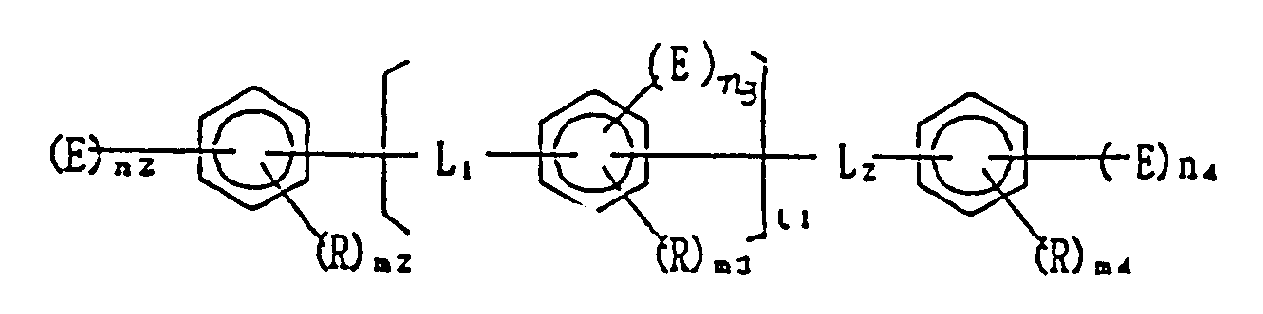
- L1, L2 and L3 may be the same or different, and each represents a divalent linkage group.
- Examples of a linkage group preferred as L1, L2 and L3 include optionally substituted alkylene groups, such as those having the following structural formulae, respectively:
- n1 represents an integer of 3 to 6, m1 an integer of 0 to 3, n2 an integer of 1 to 5, n3 an integer of 1 to 4, n4 an integer of 1 to 5, m2 an integer of 0 to 4, m3 an integer of 0 to 3, m4 an integer of 0 to 4, n5 an integer of 1 to 5, m5 an integer of 0 to 4, and m6 to m9 each an integer of 0 to 4.
- l1 and x each represent a real number from 0 to 20.
- l2 represents an integer 3 or 4
- A represents a tri- or tetravalent organic group. Examples of the organic group represented by A include those having the following structural formulae, respectively:
- those E's may be the same or different and those R's also may be the same or different.
- Those represented by general formula (AE-2) may include mixtures of those differing in value of l1 alone, and those represented by the general formula (AE-3) may also include mixtures of those differing in value of l2 alone.
- E is represented by general formula (AO-2)
- -X- is -O-
- l1 ranges from 1 to 20, preferably from 2 to 20, more preferably from 3 to 20 and particularly preferably from 4 to 20
- n2, n3 and n4 each is 1 or 2
- m2, m3 and m4 each 0, 1, 2 or 3, preferably 1 or 2
- R is an alkyl group, a halogen atom or an alkoxy group.
- variables x and y in the foregoing structural formulae are each a real number, and they each may be any one as far as it ranges from 0 to 20.
- the reason for x and y each being not necessarily an integer is that since several epoxy compounds having, respectively, different integral numbers of constitutional repeating units are present in a condition of their being mixed in a certain ratio, x and y each represent a mean value of those integral numbers. These epoxy compounds may be used individually or in combination of two or more thereof.
- the epoxy compounds of the present invention are incorporated in a yellow coupler containing layer, a magenta coupler containing layer or an interlayer disposed therebetween, especially in a yellow coupler containing layer.
- the epoxy compounds of the present invention can be used in the form of emulsified dispersion prepared by dispersing them into a hydrophilic binder, such as a water solution of gelatin, with the aid of a surfactant.
- a hydrophilic binder such as a water solution of gelatin
- the present epoxy compounds themselves may be used as high boiling organic solvent, while they may be used together with other conventional high boiling organic solvents which are slightly soluble in water and have a boiling point of no lower than 160°C, auxiliary organic solvents having a low boiling point or/and polymers soluble in both water and an organic solvent.
- couplers and other additives may be present together therewith.
- Suitable examples of high boiling organic solvents and polymers as described above include those disclosed in JP-A-64-537.
- a dispersion of the present epoxy compound(s) having slight solubility in water and a coupler dispersion may be incorporated in separate layers.
- the present epoxy compound(s) and a coupler are incorporated in the same layer, especially in the form of emulsified dispersion wherein individual oil droplets contain both of them.
- epoxy compounds used in the present invention can be obtained e.g., by allowing bisphenol A to react with epichlorohydrin in the presence of sodium hydroxide (for details of such a reaction a book entitled “Lectures on Plastic Materials (5) Epoxy Resins", written by Naoshiro Oh-ishi et al., published by Nikkan Kogyo Shinbunsha, can be referred to).
- the epoxy compounds of the present invention are used in a proportion of preferably 3 to 100 % by weight, much preferably 5 to 30 % by weight, to yellow couplers used in association therewith.
- the proportion range described above is also applicable to the case in which the epoxy compounds are incorporated in a layer different from one which contains the yellow couplers.
- Acylacetamide type yellow couplers of the present invention are preferably represented by the following general formula [Y]:
- R1 and Q have the same meanings as those in general formula (I), respectively;
- R2 represents a hydrogen atom, a halogen atom (including F, Cl, Br and I, which is the same in the subsequent description of [Y]), an alkoxy group, an aryloxy group, an alkyl group or an amino group;
- R3 represents a group by which a hydrogen on a benzene ring may be replaced;
- X represents a hydrogen atom, or a group splitable by the coupling reaction with an oxidation product of an aromatic primary amine developing agent (abbreviated as a splitting-off group, hereinafter);
- r represents an integer of 0 to 4.
- R3's may be same or different.
- R3 examples include a halogen atom, an alkyl group, an aryl group, an alkoxy group, an aryloxy group, an alkoxycarbonyl group, an aryloxycarbonyl group, a carbonamido group, a sulfonamido group, a carbamoyl group, a sulfamoyl group, an alkylsulfonyl group, an ureido group, a sulfamoylamino group, an alkoxycarbonylamino group, an aryloxysulfonyl group, an acyloxy group, a nitro group, a heterocyclic group, a cyano group, an acyl group, an acyloxy group, an alkylsulfonyloxy group and an alrylsulfonyloxy group.
- Examples of a splitting-off group include a heterocyclic group which is attached to the coupling active site via a nitrogen atom thereof, an aryloxy group, an arylthio group, an acyloxy group, an alkylsulfonyloxy group, an arylsulfonyloxy group, a heterocyclyloxy group and a halogen atom.
- alkyl group present as a substituent group in the general formula [Y] and an alkyl moiety contained in a substituent group present therein are intended to include straight-chain, branched and cyclic ones which may be substituted or/and may contain an unsaturated bond, provided that any particular definition is not given thereto.
- aryl group or moiety is intended to include those derived from optionally substituted monocyclic and condensed rings, provided that any particular definition is not given thereto.
- a substituent group present in the formula [Y] is a heterocyclic group or contains a heterocyclic moiety
- the heterocyclic group or moiety is intended to include those derived from optionally substituted, 3- to 8-membered, monocyclic and condensed rings which contain in a ring thereof at least one hetero atom selected from O, N, S, P, Se and Te atoms, provided that any particular definition is not given thereto.
- X in the formula [Y] represents preferably a heterocyclic group attached to the coupling active site via a nitrogen atom thereof, or an aryloxy group.
- groups preferably applied to X include the heterocyclic groups and aryloxy groups described in EP-A1-0447969, at pages 7, 8 and from 13 to 17.
- alkyl groups containing 1 to 30 carbon atoms e.g., methyl, ethyl, n-propyl, n-butyl, isobutyl, n-octyl, n-dodecyl, phenoxymethyl, phenylthiomethyl, p-toluenesulfonylmethyl, benzyl, cyclohexylmethyl, methoxyethyl
- those containing 1 to 4 carbon atoms are most favorable.
- nonmetallic atoms forming a 3- to 5-membered hydrocarbon ring together with the carbon atom such as an optionally substituted ethylene, trimethylene or teteramethylene group, are preferred in particular.
- Suitable examples of a substituent which may be present on the hydrocarbon ring formed include an alkyl group, an alkoxy group, an aryl group and a halogen atom.
- a group most favorable to Q is a substituted or unsubstituted ethylene group.
- substituent groups represented by R2 chlorine atom, fluorine atom, alkyl groups containing 1 to 6 carbon atoms (e.g., methyl, trifluoromethyl, ethyl, isopropyl, t-butyl), alkoxy groups containing 1 to 8 carbon atoms (e.g., methoxy, ethoxy, methoxyethoxy, butoxy) and aryloxy groups containing 6 to 24 carbon atoms (e.g., phenoxy, p-tolyloxy, p-methoxyphenoxy) are preferred in particular.
- chlorine atom, methoxy group and trifluoromethyl group are most favorable.
- a halogen atom, a cyano group, a trifluoromethyl group, an alkoxy group, an alkoxycarbonyl group, an aryloxycarbonyl group, a carbonamido group, a sulfonamido group, a carbamoyl group and a sulfamoyl group are preferred in particular.
- a chlorine atom, an alkoxy group, an alkoxycarbonyl group, a sulfamoyl group, a carbonamido group and a sulfonamido group are most favorable.
- the couplers represented by the formula [Y] may form a dimer or a polymerized compound of higher order by no less than two molecules thereof being combined with each other via a substituent group thereof, namely R1, R2, R3, Q or X, by the aid of a bonding hand or a divalent or a higher valent linkage group.
- a substituent group thereof namely R1, R2, R3, Q or X
- the yellow couplers represented by the formula [Y] can be prepared in accordance with known synthesis methods, e.g., those disclosed in EP-A1-0447969.
- the couplers represented by formula [Y] can be used in any constituent layer the photographic material has. More specifically, they may be used in any of light-sensitive layers (including blue-sensitive, green-sensitive, red-sensitive and infrared-sensitive emulsion layers) and light-insensitive layers (such as a protective layer, a yellow filter layer, an interlayer and an antihalation layer). However, it is desirable in particular that the coupler should be used in a blue-sensitive emulsion layer or a light-insensitive layer adjacent thereto.
- the coupler represented by formula [Y] is preferably used in an amount of 0.05 to 5.0 mmol, particularly 0.2 to 2.0 mmol, per square meter.
- a suitable ratio of the coupler to silver halide ranges from 1:0.1 to 1:200 by mole, preferably from 1:2 to 1:200 by mole.
- the coupler is used in a light-insensitive layer, on the other hand, it is used in an amount of from 2.0 to 0.01 mole per mole or silver halide contained in the adjacent silver halide emulsion layer.
- coupler represented by formula [Y] may be used alone or together with another yellow coupler (e.g., a benzoylacetanilide type yellow coupler or a pivaloylacetanilide type yellow coupler).
- another yellow coupler e.g., a benzoylacetanilide type yellow coupler or a pivaloylacetanilide type yellow coupler.
- a pyrazolotriazole type magenta coupler used in the present invention is represented by the foregoing general formula (II) or (III).
- R1 and R3 each represent an alkyl group.
- the alkyl group includes 1-32 C substituted or unsubstituted, straight-chain, branched or cyclic ones. Of these groups, 1-10 C unsubstituted straight-chain, branched or cyclic alkyl groups are preferable. Therein, methyl, ethyl, isopropyl, t-butyl, cyclohexyl are much preferable, In particular, isopropyl and t-butyl groups are preferred over others.
- R2 and R4 each represent an alkyl group or an aryl group.
- the alkyl group includes 1-32 C substituted or unsubstituted, straight-chain, branched or cyclic ones
- the aryl group include substituted or unsubstituted phenyl groups.
- Those preferable as R2 and R4 include 1-10 C substituted or unsubstituted straight-chain or branched alkyl groups and substituted phenyl groups.
- R2 is a substituted alkyl group having one or no hydrogen atom on the carbon atom attached to the pyrazolotriazole skeleton, or a substituted phenyl group containing at least one acylamino or sulfonamido group.
- R4 is a substituted alkyl group containing at least two carbon atoms, a substituted alkyl group having one or no hydrogen atom on the carbon atom attached to the pyrazolotriazole skeleton, or a substituted phenyl group having at least one substituent at the o-position with respect to the carbon atom attached to the pyrazolotriazole skeleton.
- a group especially favorable to R2 is a substituted alkyl group of the formula, -CH(CH3)CH2NHR5 or -C(CH3)2CH2NHR5, wherein R5 represents an aliphatic or aromatic, acyl or sulfonyl group, or a substituted phenyl group having an acylamino or sulfonamido group at the m- or p-position with respect to the carbon atom attached to the pyrazolotriazole skeleton.
- a group especially favorable to R4 is a substituted alkyl group of the formula, -(CH2) n -SO2R6, wherein n is an integer of at least 2 and R6 represents an unsubstituted straight-chain or branched alkyl group or a substituted phenyl group, -CH(CH3)-NHR7, -C(CH3)2NHR7, -CH(CH3) CH2NHR7 or -C(CH3)2CH2NHR7, wherein R7 has the same meaning as R5, or a phenyl group having alkyl groups at both the o-positions with respect to the carbon atom attached to the pyrazolotriazole skeleton and further having at least one acylamino or sulfonamido group at the m- or p-position.
- X1 and X2 each represent a halogen atom or an aryloxy group.
- the halogen atom a chlorine atom is preferred over the others.
- the aryloxy group substituted phenoxy groups are preferable, and those having a substituent at the p-position are more preferable.
- phenoxy groups having at the p-position a substituted or unsubstituted alkyl, alkoxycarbonyl or sulfonyl group are favorable to the aryloxy group.
- substituted alkyl groups and substituted phenyl groups are not particularly limited as to their respective substituents.
- substituents include a halogen atom, an alkyl group, an aryl group, a heterocyclic group, cyano group, hydroxyl group, nitro group, carboxyl group, sulfo group, an amino group, an alkoxy group, an aryloxy group, an acylamino group, an alkylamino group, an anilino group, an ureido group, a sulfamoylamino group, an alkylthio group, an arylthio group, an alkoxycarbonylamino group, a sulfonamido group, a carbamoyl group, a sulfamoyl group, a sulfonyl group, an alkoxycarbonyl group, a heterocyclyloxy group, an azo group, an acyloxy group, a
- magenta couplers represented by general formulae (II) and (III) are illustrated below. However, the invention should not be construed as being limited to these examples.
- the compounds of the formula (II) can be synthesized using the method disclosed, e.g., in U.S. Patent 4,500,630, while those of the formula (III) can be synthesized according to the methods disclosed, e.g., in U.S. Patents 4,540,654 and 4,705,863 JP-A-61-65245, JP-A-62-209457 and JP-A-62-249155.
- Silver halides which can be used in the present invention include silver chloride, silver bromide, silver (iodo)chlorobromide, silver iodobromide and so on.
- substantially iodide-free silver chlorobromide emulsions which have a chloride content of at least 90 mole %, preferably at least 95 mol%, particularly preferably at least 98 mol%, or silver chloride emulsions.
- dyes of the kind which can be decolored during processing are added to a hydrophilic colloid layer in such an amount as to give an optical reflection density of at least 0.70 at the wavelength of 680 nm to the resulting photographic materials and at least 12 wt% (preferably at least 14 wt%) of titanium oxide previously received a surface treatment with a di- to tetrahydric alcohol (e.g., trimethylol ethane) is incorporated in a waterproofing resin layer which is provided on the support.
- a di- to tetrahydric alcohol e.g., trimethylol ethane
- High boiling organic solvents for photographic additives including cyan, magenta and yellow couplers which can be used in the present invention are water-immiscible compounds having a melting point of 100°C or lower and a boiling point of 120°C or higher. Such compounds can be used so far as they are good solvents for couplers.
- a preferable melting point of high boiling organic solvents is below 80 °C. As for the boiling point thereof, it is preferably not lower than 160 °C and much preferably not lower than 170 °C.
- a cyan, magenta or yellow coupler which is previously impregnated into a loadable latex polymer (as disclosed in U.S. Patent 4,203,716) in the presence or absence of a high boiling organic solvent as described above or dissolved in a high boiling organic solvent as described above together with a polymer which is insoluble in water but soluble in an organic solvent can be dispersed into an aqueous solution of hydrophilic colloid solution in the form of emulsion.
- Suitable examples of such a polymer include the homopolymers and copolymers disclosed in U.S. Patent 4,857,449, in columns 7-15, and WO 88/00723, at pages 12-30. Of these polymers, methacrylate polymers and acrylamide polymers, especially acrylamide polymers, are preferred over others with respect to color image stabilization and so on.
- the compounds capable of improving the keeping quality of color images are used together with couplers, especially with the pyrazoloazole couplers.
- the combined or individual use of compounds of the kind which can produce chemically inert, substantially colorless compounds by combining chemically with an aromatic amine developing agent remaining after the color development-processing (Compounds F) and/or compounds of the kind which can produce chemically inert, substantially colorless compounds by combining chemically with an oxidized aromatic primary amine developing agent remaining after the color development-processing (Compounds G) has an advantage in that the generation of stains upon storage after photographic processing, which are due to the formation of dyes by the reaction between couplers and an unoxidized or oxidized color developing agent remaining in the photographic film after the photographic processing, and the occurrence of other side reactions can be prevented effectively.
- the so-called blue-shift couplers disclosed in JP-A-63-231451, JP-A-63-123047, JP-A-63-241547, JP-A-01-173499, JP-A-01-213648 and JP-A-01-250944 are preferably used as well as those cited in JP-A-62-215272, JP-A-02-33144 and EP-A-0 355 660.
- cyan couplers not only diphenylimidazole type cyan couplers disclosed in JP-A-02-33144 but also 3-hydroxypyridine type cyan couplers disclosed in EP-A2-0333185 (especially one which is prepared by introducing a chlorine atom as a splitting-off group into Coupler (42) cited as a specific example to render the coupler two-equivalent, and couplers (6) and (9) cited as specific examples) and cyclic active methylene type cyan couplers disclosed in JP-A-64-32260 (especially Couplers 3, 8 and 34 cited as specific examples) are preferably used in addition to those cited in JP-A-62-215272, JP-A-02-33144 and EP-A-0 355 660.
- a paper support laminated with polyethylene on both sides were coated with constituent layers described below to prepare a multilayer color photographic paper, Sample 1A (for comparison). Coating solutions used were prepared in the manner described below.
- a mixture of 19.1 g of an yellow coupler (ExY), 4.4 g of a color image stabilizer (Cpd-1) and 0.7 g of a color image stabilizer (Cpd-7) were dissolved in a mixture of 27.2 ml of ethyl acetate with 8.2 g of a solvent (Solv-1), and then dispersed in an emulsified condition into 185 ml of a 10% aqueous gelatin solution containing 8 ml of a 10% solution of sodium dodecylbenzenesulfonate.
- Blue-sensitive sensitizing dyes illustrated below were each added to the emulsion of large grain size in the amount of 2.0 ⁇ 10 ⁇ 4 mole/mole Ag and to the emulsion of small grain size in the amount of 2.5 ⁇ 10 ⁇ 4 mole/mole Ag. Further, both of the emulsions were subjected to sulfur sensitization. Then, the large grain size emulsion and the small grain size emulsion were mixed in a ratio of 3:7 on a silver basis.
- the resulting emulsion was mixed homogeneously with the foregoing emulsified dispersion, and thereto were added other ingredients described below so as to obtain the coating solution for the first layer having the composition described below.
- Coating solutions for from the second to seventh layers were prepared respectively in the same manner as that for the first layer.
- sodium salt of 1-oxy-3,5-dichloro-s-triazine was used as gelatin hardener.
- the following compounds were added to every coating solution for forming from the first to the seventh layer in order to keep it from rotting and getting moldy.
- Spectral sensitizing dyes illustrated below were used for light-sensitive emulsion layers, respectively.
- Sensitizing dyes for blue-sensitive emulsion layer
- Sensitizing dyes for green-sensitive emulsion layer Sensitizing dyes for green-sensitive emulsion layer:
- Sensitizing dye for red-sensitive emulsion layer
- the compound illustrated below was further added in the amount of 2.6 ⁇ 10 ⁇ 3 mole/mole Ag.
- 1-(5-methylureidophenyl)-5-mercaptotetrazole was incorporated into the blue-sensitive, the green-sensitive and the red-sensitive emulsion layers in the amounts of 8.5 ⁇ 10 ⁇ 5 mole/mole Ag, 7.7 ⁇ 10 ⁇ 4 mole/mole Ag and 2.5 ⁇ 10 ⁇ 4 mole/mole Ag, respectively.
- 4-hydroxy-6-methyl-1,3,3a,7-tetrazaindene was incorporated into the blue-sensitive and the green-sensitive emulsion layers in the amounts of 1 ⁇ 10 ⁇ 4 mole/mole Ag and 2 ⁇ 10 ⁇ 4 mole/mole Ag, respectively.
- each figure on the right side represents the coverage (g/m2) of the ingredient corresponding thereto.
- the figure represents the coverage based on silver.
- Polyethylene-laminated paper which contained white pigment (TiO2) and a bluish dye (ultramarine) in the polyethylene laminate on the side of the first layer
- color photographic papers Samples 1F to 1Q, were prepared so as to have the same constitution as that of Sample 1A, except that the solvent (Solv-1) used in the first layer (blue-sensitive layer) was replaced in a prescribed proportion by some of the present epoxy compounds set forth in Table 4 and the yellow coupler (ExY) used in the first layer (blue-sensitive layer) was replaced by some of the present yellow couplers set forth in Table 4.
- Each of the thus prepared samples was subjected to wedgewise exposure through separation filters for sensitometry by using a sensitometer (Model FWH, produced by Fuji Photo Film Co., Ltd., with a light source having a color temperature of 3200° K). Therein, the exposure time was 0.1 second and the amount of exposure was adjusted to 250 CMS.
- a sensitometer Model FWH, produced by Fuji Photo Film Co., Ltd., with a light source having a color temperature of 3200° K.
- Ion exchange water concentration of calcium and magnesium ions each were below 3 ppm.
- the yellow dye images formed in the color photographic papers from 1F to 1Q which each used one of the present epoxy compounds and one of the present yellow couplers, were superior to the samples from 1A to 1E, 1R and 1S (for comparison) in fastness to moisture and heat and, what is more, the present photographic papers succeeded in inhibiting magenta color stain from increasing due to moisture and heat in the yellow image area.
- Example 2A The surface of a paper support laminated with polyethylene on both sides was subjected to corona discharge, and then provided with a gelatin subbing layer in which sodium dodecylbenzenesulfonate was incorporated. Thereon, various constituent layers described below were further coated to prepare a multilayer color photographic paper(Sample 2A). Coating solutions used were prepared in the manner described below.
- An emulsified dispersion A was prepared by dissolving 153.0 g of a yellow coupler (ExY-2), 15.0 g of a color image stabilizer (Cpd-7) and 7.5 g of a color image stabilizer (Cpd-9) into a mixture of 25 g of a solvent (Solv-1), 25 g of a solvent (Solv-3) and 180 ml of ethyl acetate, and then dispersing the resulting solution in an emulsified condition into 1,000 ml of a 10% aqueous gelatin solution containing 60 ml of a 10% solution of sodium dodecylbenzenesulfonate and 10 g of citric acid.
- Blue-sensitive sensitizing dyes A and B illustrated below were each added to the emulsion of large grain size in the amount of 2.0 ⁇ 10 ⁇ 4 mole/mole Ag and to the emulsion of small grain size in the amount of 2.5 ⁇ 10 ⁇ 4 mole/mole Ag. Then, the large-sized emulsion and the small-sized emulsion were mixed in a ratio of 3:7 on a silver basis to prepare a silver chlorobromide emulsion A. Further, the emulsion A was chemically ripened by adding thereto sulfur and gold sensitizers. The resulting emulsion A was mixed homogeneously with the foregoing emulsified dispersion A, and thereto were added other ingredients described below so as to obtain the coating solution for the first layer having the composition described below.
- Coating solutions for from the second to seventh layers were prepared respectively in the same manner as that for the first layer.
- sodium salt of 1-oxy-3,5-dichloro-s-triazine was used as gelatin hardener.
- Spectral sensitizing dyes illustrated below were added to silver chlorobromide emulsions used for the corresponding light-sensitive emulsion layers.
- 1-(5-methylureidophenyl)-5-mercaptotetrazole was incorporated into the blue-sensitive, the green-sensitive and the red-sensitive emulsion layers in the amounts of 8.5 ⁇ 10 ⁇ 5 mole/mole Ag, 7.7 ⁇ 10 ⁇ 4 mole/mole Ag and 2.5 ⁇ 10 ⁇ 4 mole/mole Ag, respectively.
- 4-hydroxy-6-methyl-1,3,3a,7-tetrazaindene was incorporated into the blue-sensitive and the green-sensitive emulsion layers in the amounts of 1 ⁇ 10 ⁇ 4 mole/mole Ag and 2 ⁇ 10 ⁇ 4 mole/mole Ag, respectively.
- each figure on the right side represents a coverage (g/m2) of the ingredient corresponding thereto.
- the figure represents a coverage based on silver.
- Polyethylene-laminated paper which contained white pigment (TiO2) and a bluish dye (ultramarine) in the polyethylene laminate on the side of the first layer]
- Samples 2F to 2Q were prepared in the same manner as Sample 2A, except that as shown in Table 6 the present yellow couplers were used in place of the yellow coupler (ExY-2), those to which a preference was given among the present magenta couplers were used in place of the magenta coupler (ExM-2) and the present epoxy compounds were added to any one of the constituent layers.
- Samples 2B to 2E were prepared as shown in Table 6 in order to compare with the color photographic papers of the present invention. Each of these samples was exposed and processed in the same manner as in Example 1, and then allowed to stand for 16 days under a condition of 80 °C-70% RH.
- the yellow dye images formed in the photographic papers from 2F to 2Q which each used one of the present epoxy compounds, one of the present yellow couplers and one of the present magenta couplers, were superior in fastness to moisture and heat and, what is more, an increase of magenta color stain in the yellow image area due to moisture and heat was markedly depressed in the present photographic papers, compared with those for comparison.
Landscapes
- Physics & Mathematics (AREA)
- General Physics & Mathematics (AREA)
- Silver Salt Photography Or Processing Solution Therefor (AREA)
Claims (22)
- Silberhalogenidmaterial für Farbphotographie umfassend auf einem Träger eine einen Gelb-Kuppler enthaltende lichtempfindliche Silberhalogenidemulsionsschicht, eine einen Rot-Kuppler enthaltende lichtempfindliche Silberhalogenidemulsionsschicht, eine einen Blau-Kuppler enthaltende lichtempfindliche Silberhalogenidemulsionsschicht und eine lichtunempfindliche hydrophile Kolloidschicht, wobei das photographische Material umfaßt (i) wenigstens eine Expoy-Verbindung, die etwas in Wasser löslich ist und wenigstens eine Epoxy-Gruppe mit der folgenden allgemeinen Formel (AO) enthält, (ii) einen Acylacetamid Gelb-Kuppler, umfassend eine Acyl-Gruppe mit der allgemeinen Formel (I) und (iii) einen Pyrazoltriazol Rot-Kuppler mit der Formel (II) oder (III):


- Silberhalogenidmaterial für Farbphotographien gemäß Anspruch 1, in dem die Epoxy-Verbindung eine Löslichkeit von höchstens 10 % in Wasser bei 25°C hat.
- Silberhalogenidmaterial für Farbphotographien gemäß Anspruch 1, in dem die Epoxy-Verbindung wenigstens 3 Epoxy-Gruppen mit der allgemeinen Formel (AO) hat.
- Silberhalogenidmaterial für Farbphotographien gemäß Anspruch 1, in dem die Epoxy-Verbindung die folgende allgemeine Formel (AE-1), (AE-2), (AE-3) oder (AE-4) hat:(AE-1)
 (AE-2)
 (AE-3)
 (AE-4)worin E für die folgende allgemeine Formel (AO-2) steht:

- Silberhalogenidmaterial für Farbphotographien gemäß Anspruch 1, in dem der Acylacetamid Gelb-Kuppler die folgende allgemeine Formel [Y] hat:

- Silberhalogenidmaterial für Farbphotographien gemäß Anspruch 1, in dem wenigstens einer von R₂ und R₄ im Pyrazoltriazol Rot-Kuppler mit der allgemeinen Formel (II) oder (III) eine substituierte oder unsubstituierte gradkettige oder verzweigte Alkyl-Gruppe mit 1 bis 10 Kohlenstoffatomen oder eine substituierte Phenyl-Gruppe ist.
- Silberhalogenidmaterial für Farbphotographien gemäß Anspruch 1, in dem R₂ in der Formel (II) eine substituierte Alkyl-Gruppe mit einem oder keinem Wasserstoffatom, der an den Kohlenstoff, der mit dem Pyrazoltriazol-Gerüst verbunden ist, gebunden ist oder eine substituierte Phenyl-Gruppe mit wenigstens einer Acylamino- oder Sulfonamido-Gruppe ist.
- Silberhalogenidmaterial für Farbphotographien gemäß Anspruch 1, in dem R₄ in Formel (III) eine substituierte Alkyl-Gruppe mit einem oder keinem Wasserstoffatom an dem mit dem Pyrzoltriazol-Gerüst verbundenen Kohlenstoffatom, oder eine substituierte Phenyl-Gruppe mit wenigstens einem Substituenten in ortho-Position bezogen auf das mit dem Pyrazoltriazol-Gerüst verbundenen Kohlenstoffatom ist.
- Silberhalogenidmaterial für Farbphotographien gemäß Anspruch 1, in dem R₂ in Formel (II) eine substituierte Alkyl-Gruppe mit der Formel -CH(CH₃)CH₂NHR₅ oder -C(CH₃)₂CH₂NHR₅ ist, worin R₅ eine aliphatische- oder aromatische-, eine Acyl- oder Sulfonyl-Gruppe oder eine substituierte Phenyl-Gruppe mit einer Acylamino- oder Sulfonamido-Gruppe in m- oder p-Position, bezogen auf das mit dem Pyrazoltriazol-Gerüst verbundene Kohlenstoffatom, ist.
- Silberhalogenidmaterial für Farbphotographien gemäß Anspruch 1, in dem R₄ in Formel (III) eine substituierte Alkyl-Gruppe mit der Formel -(CH₂)n-SO₂R₆ ist, worin n eine ganze Zahl von wenigstens 2 und R₆ eine unsubstituierte gradkettige oder verzweigte Alkyl-Gruppe oder eine Phenyl-Gruppe, -CH(CH₃)-NHR₇, -C(CH₃)₂NHR₇, -CH(CH₃)CH₂NHR₇ oder -C(CH₃)₂CH₂NHR₇ ist, worin R₇ die gleiche Bedeutung hat wie R₅ oder eine Phenyl-Gruppe mit Alkyl-Gruppen in beiden ortho-Positionen bezogen auf das mit dem Pyrazoltriazol-Gerüst verbundenen Kohlenstoffatom ist und darüber hinaus wenigstens eine Acylamino- oder Sulfonamido-Gruppe in m- oder P-Position hat.
- Silberhalogenidmaterial für Farbphotographien gemäß Anspruch 1, in dem X₁ oder X₂ des Pyrazoltriazol Rot-Kupplers mit der allgemeinen Formel (II) oder (III) ein Chloratom oder eine Phenoxy-Gruppe mit einer substituierten oder unsubstituierten Alkyl-, Alkoxycarbonyl oder Sulfonyl-Gruppe in para-Position ist.
- Silberhalogenidmaterial für Farbphotographien gemäß Anspruch 1, in dem die Epoxy-Verbindung in wenigstens einer den Gelb-Kuppler enthaltenden Schicht, einer den Rot-Kuppler enthaltenden Schicht oder der dazwischen angeordneten Zwischenschicht eingearbeitet ist.
- Silberhalogenidmaterial für Farbphotographien gemäß Anspruch 12, in dem die Epoxy-Verbindung in der Gelb-Kupplerschicht enthalten ist.
- Silberhalogenidmaterial für Farbphotographien gemäß Anspruch 12, in dem die Epoxy-Verbindung in einer Menge von 3 bis 100 Gew.-%, bezogen auf den in das Silberhalogenidmaterial für Farbphotographien eingearbeiteten Gelb-Kuppler verwendet wird.
- Silberhalogenidmaterial für Farbphotographien gemäß Anspruch 5, in dem der Gelb-Kuppler mit der Formel [Y] in eine blauempfindliche Schicht oder in eine dazu benachbarte lichtunempfindliche Schicht eingearbeitet ist.
- Silberhalogenidmaterial für Farbphotographien gemäß Anspruch 5, in dem die Bedeckung mit Gelb-Kuppler von 0,05 bis 5,0 mmol/m² ist.
- Silberhalogenidmaterial für Farbphotographien gemäß Anspruch 1, in dem die Epoxy-Verbindung wenigstens zwei Benzol-Ringe hat.
- Silberhalogenidmaterial für Farbphotographien gemäß Anspruch 1, in dem die Epoxy-Verbindung insgesamt wenigstens 9 Kohlenstoffatome enthält.
- Silberhalogenidmaterial für Farbphotographien gemäß Anspruch 4, in dem die Epoxy-Verbindung durch Formel (AE-2) dargestellt ist, worin E, R₁, L₁, L₂, ℓ₁, m₂, m₃, m₄, n₂, n₃ und n₄ die gleiche Bedeutung wie in Anspruch 4 haben.
- Silberhalogenidmaterial für Farbphotographien gemäß Anspruch 19, in dem -X- in der Formel (AO-2) dargestellt durch B -O- ist, ℓ₁ eine reelle Zahl von 1 bis 20 ist, n₂ oder n₄ oder 1 oder 2 sind, m₂, m₃ oder m₄ eine ganze Zahl von 0 bis 3 sind und R eine Alkyl-Gruppe, ein Halogenatom oder eine Alkoxy-Gruppe ist.
- Silberhalogenidmaterial für Farbphotographien gemäß Anspruch 1, in dem R₁ oder R₂ in der Formel (II) oder (III) eine Isopropyl-Gruppe oder eine t-Butyl-Gruppe ist.
- Silberhalogenidmaterial für Farbphotographien gemäß Anspruch 1, in dem wenigstens eine der lichtempfindlichen Silberhalogenidemulsionsschichten Silberhalogenidkörner, ausgewählt aus Silberchloridkörnern und Silberchloridbromidkörnern, die im wesentlichen frei von Silberjodid sind und einen Silberchlorid-Gehalt von nicht weniger als 90 Mol.% haben, enthält.
Applications Claiming Priority (2)
| Application Number | Priority Date | Filing Date | Title |
|---|---|---|---|
| JP329892/91 | 1991-11-19 | ||
| JP3329892A JPH05142727A (ja) | 1991-11-19 | 1991-11-19 | ハロゲン化銀カラー写真感光材料 |
Publications (2)
| Publication Number | Publication Date |
|---|---|
| EP0543367A1 EP0543367A1 (de) | 1993-05-26 |
| EP0543367B1 true EP0543367B1 (de) | 1995-11-15 |
Family
ID=18226423
Family Applications (1)
| Application Number | Title | Priority Date | Filing Date |
|---|---|---|---|
| EP92119711A Expired - Lifetime EP0543367B1 (de) | 1991-11-19 | 1992-11-19 | Farbphotographisches Silberhalogenidmaterial |
Country Status (3)
| Country | Link |
|---|---|
| US (1) | US5298375A (de) |
| EP (1) | EP0543367B1 (de) |
| JP (1) | JPH05142727A (de) |
Families Citing this family (2)
| Publication number | Priority date | Publication date | Assignee | Title |
|---|---|---|---|---|
| JP2670943B2 (ja) * | 1992-05-26 | 1997-10-29 | 富士写真フイルム株式会社 | 写真用カプラー及びハロゲン化銀カラー写真感光材料 |
| US5508147A (en) * | 1993-01-04 | 1996-04-16 | Eastman Kodak Company | Color photographic element with improved resistance to thermal and photochemical yellowing and method thereof |
Family Cites Families (11)
| Publication number | Priority date | Publication date | Assignee | Title |
|---|---|---|---|---|
| US3679630A (en) * | 1970-12-11 | 1972-07-25 | Dow Chemical Co | Curable compositions comprising a polyepoxide,a polyisocyanato silane and a catalyst therefor |
| CH628161A5 (de) * | 1976-12-24 | 1982-02-15 | Ciba Geigy Ag | Farbphotographisches material. |
| JPS5499433A (en) * | 1978-01-20 | 1979-08-06 | Konishiroku Photo Ind Co Ltd | Dye image formation method |
| US4540657A (en) * | 1984-06-06 | 1985-09-10 | Eastman Kodak Company | Photographic coupler solvents and photographic elements employing same |
| JPH0833634B2 (ja) * | 1987-08-20 | 1996-03-29 | 富士写真フイルム株式会社 | ハロゲン化銀カラ−写真感光材料 |
| JPH0833633B2 (ja) * | 1987-08-20 | 1996-03-29 | 富士写真フイルム株式会社 | ハロゲン化銀カラ−写真感光材料 |
| JPH03141350A (ja) * | 1989-10-27 | 1991-06-17 | Fuji Photo Film Co Ltd | ハロゲン化銀カラー写真感光材料 |
| JPH03223755A (ja) * | 1989-12-14 | 1991-10-02 | Fuji Photo Film Co Ltd | ハロゲン化銀カラー写真感光材料 |
| EP0447969B1 (de) * | 1990-03-15 | 1997-01-15 | Fuji Photo Film Co., Ltd. | Gelbkuppler und farbenphotographisches Silberhalogenidmaterial, diesen enthaltend |
| EP0471347B1 (de) * | 1990-08-16 | 1997-11-05 | Fuji Photo Film Co., Ltd. | Epoxy-Kupplerlösungsmittel |
| DE69124870T2 (de) * | 1990-08-20 | 1997-10-02 | Fuji Photo Film Co Ltd | Farbphotographisches Silberhalogenidmaterial |
-
1991
- 1991-11-19 JP JP3329892A patent/JPH05142727A/ja active Pending
-
1992
- 1992-11-17 US US07/977,838 patent/US5298375A/en not_active Expired - Lifetime
- 1992-11-19 EP EP92119711A patent/EP0543367B1/de not_active Expired - Lifetime
Also Published As
| Publication number | Publication date |
|---|---|
| JPH05142727A (ja) | 1993-06-11 |
| US5298375A (en) | 1994-03-29 |
| EP0543367A1 (de) | 1993-05-26 |
Similar Documents
| Publication | Publication Date | Title |
|---|---|---|
| EP0384393B1 (de) | Farbphotographische Silberhalogenidmaterialien | |
| EP0286431A1 (de) | Lichtempfindliches farbphotographisches Silberhalogenidmaterial | |
| EP0524540B1 (de) | Farbphotographisches Silberhalogenidmaterial | |
| EP0399541B1 (de) | Farbphotographisches Silberhalogenidmaterial | |
| JPH0799428B2 (ja) | ハロゲン化銀カラー写真感光材料 | |
| EP0422595A1 (de) | Farbphotographisches, lichtempfindliches Silberhalogenidmaterial | |
| US5104781A (en) | Silver halide color photographic light-sensitive material containing pyrazoloazole coupler | |
| EP0543367B1 (de) | Farbphotographisches Silberhalogenidmaterial | |
| US5021328A (en) | Silver halide color photographic materials | |
| US5009989A (en) | Silver halide photographic material | |
| US5342746A (en) | Method for the formation of color photographic materials with high coupling reactivity and reduced color developer PH sensitivity | |
| US5162197A (en) | Silver halide photographic material | |
| EP0538862B1 (de) | Farbphotographisches Silberhalogenidmaterial | |
| US5104774A (en) | Image forming method | |
| US4954431A (en) | Silver halide photographic light-sensitive material | |
| US5096805A (en) | Silver halide color photographic material containing 5-pyrazolone magenta coupler and amine-type stain preventing agent | |
| EP0255730B1 (de) | Farbphotographisches Silberhalogenidmaterial | |
| JPH03266836A (ja) | 色素画像の堅牢性が改良されたハロゲン化銀写真感光材料 | |
| US5399473A (en) | Silver halide color photographic material | |
| US5962208A (en) | Silver halide color photographic material containing a yellow coupler and a mercapto compound | |
| JPH03251840A (ja) | ハロゲン化銀写真感光材料 | |
| US6096492A (en) | Color photographic material | |
| EP0510535B1 (de) | Farbphotographisches Silberhalogenidmaterial | |
| JP2673059B2 (ja) | ハロゲン化銀カラー写真感光材料 | |
| US5376512A (en) | Silver halide color photographic material |
Legal Events
| Date | Code | Title | Description |
|---|---|---|---|
| PUAI | Public reference made under article 153(3) epc to a published international application that has entered the european phase |
Free format text: ORIGINAL CODE: 0009012 |
|
| AK | Designated contracting states |
Kind code of ref document: A1 Designated state(s): FR GB NL |
|
| 17P | Request for examination filed |
Effective date: 19930824 |
|
| 17Q | First examination report despatched |
Effective date: 19940714 |
|
| GRAA | (expected) grant |
Free format text: ORIGINAL CODE: 0009210 |
|
| AK | Designated contracting states |
Kind code of ref document: B1 Designated state(s): FR GB NL |
|
| PG25 | Lapsed in a contracting state [announced via postgrant information from national office to epo] |
Ref country code: NL Free format text: LAPSE BECAUSE OF FAILURE TO SUBMIT A TRANSLATION OF THE DESCRIPTION OR TO PAY THE FEE WITHIN THE PRESCRIBED TIME-LIMIT Effective date: 19951115 |
|
| ET | Fr: translation filed | ||
| NLV1 | Nl: lapsed or annulled due to failure to fulfill the requirements of art. 29p and 29m of the patents act | ||
| PLBE | No opposition filed within time limit |
Free format text: ORIGINAL CODE: 0009261 |
|
| STAA | Information on the status of an ep patent application or granted ep patent |
Free format text: STATUS: NO OPPOSITION FILED WITHIN TIME LIMIT |
|
| 26N | No opposition filed | ||
| REG | Reference to a national code |
Ref country code: GB Ref legal event code: IF02 |
|
| PGFP | Annual fee paid to national office [announced via postgrant information from national office to epo] |
Ref country code: FR Payment date: 20031113 Year of fee payment: 12 |
|
| PGFP | Annual fee paid to national office [announced via postgrant information from national office to epo] |
Ref country code: GB Payment date: 20031114 Year of fee payment: 12 |
|
| PG25 | Lapsed in a contracting state [announced via postgrant information from national office to epo] |
Ref country code: GB Free format text: LAPSE BECAUSE OF NON-PAYMENT OF DUE FEES Effective date: 20041119 |
|
| GBPC | Gb: european patent ceased through non-payment of renewal fee |
Effective date: 20041119 |
|
| PG25 | Lapsed in a contracting state [announced via postgrant information from national office to epo] |
Ref country code: FR Free format text: LAPSE BECAUSE OF NON-PAYMENT OF DUE FEES Effective date: 20050729 |
|
| REG | Reference to a national code |
Ref country code: FR Ref legal event code: ST |