EP0548662B1 - Photographische Elemente mit Sulfoxid-Kuppler-Lösungsmitteln und Zusätzen zur Verminderung von Sensibilisierungsfarbstoff-Veränderungen - Google Patents
Photographische Elemente mit Sulfoxid-Kuppler-Lösungsmitteln und Zusätzen zur Verminderung von Sensibilisierungsfarbstoff-Veränderungen Download PDFInfo
- Publication number
- EP0548662B1 EP0548662B1 EP92120916A EP92120916A EP0548662B1 EP 0548662 B1 EP0548662 B1 EP 0548662B1 EP 92120916 A EP92120916 A EP 92120916A EP 92120916 A EP92120916 A EP 92120916A EP 0548662 B1 EP0548662 B1 EP 0548662B1
- Authority
- EP
- European Patent Office
- Prior art keywords
- groups
- group
- coupler
- dye
- alkoxy
- Prior art date
- Legal status (The legal status is an assumption and is not a legal conclusion. Google has not performed a legal analysis and makes no representation as to the accuracy of the status listed.)
- Expired - Lifetime
Links
- 239000002904 solvent Substances 0.000 title claims description 36
- 150000003462 sulfoxides Chemical class 0.000 title claims description 27
- 230000001235 sensitizing effect Effects 0.000 title description 18
- -1 silver halide Chemical class 0.000 claims description 60
- 229910052709 silver Inorganic materials 0.000 claims description 45
- 239000004332 silver Substances 0.000 claims description 45
- 239000000839 emulsion Substances 0.000 claims description 39
- 125000000217 alkyl group Chemical group 0.000 claims description 22
- 125000003545 alkoxy group Chemical group 0.000 claims description 19
- 125000004432 carbon atom Chemical group C* 0.000 claims description 19
- 239000003795 chemical substances by application Substances 0.000 claims description 18
- 229920000642 polymer Polymers 0.000 claims description 18
- 125000001424 substituent group Chemical group 0.000 claims description 18
- 125000004104 aryloxy group Chemical group 0.000 claims description 15
- 125000004423 acyloxy group Chemical group 0.000 claims description 14
- 125000003118 aryl group Chemical group 0.000 claims description 14
- 229910052736 halogen Inorganic materials 0.000 claims description 13
- 150000002367 halogens Chemical class 0.000 claims description 13
- 229910052739 hydrogen Inorganic materials 0.000 claims description 12
- 239000001257 hydrogen Substances 0.000 claims description 12
- 125000004453 alkoxycarbonyl group Chemical group 0.000 claims description 11
- 125000005161 aryl oxy carbonyl group Chemical group 0.000 claims description 11
- 125000003917 carbamoyl group Chemical group [H]N([H])C(*)=O 0.000 claims description 11
- 238000000034 method Methods 0.000 claims description 11
- 125000005843 halogen group Chemical group 0.000 claims description 10
- 125000001997 phenyl group Chemical group [H]C1=C([H])C([H])=C(*)C([H])=C1[H] 0.000 claims description 10
- 125000003342 alkenyl group Chemical group 0.000 claims description 7
- 125000002947 alkylene group Chemical group 0.000 claims description 7
- ISWSIDIOOBJBQZ-UHFFFAOYSA-N phenol group Chemical group C1(=CC=CC=C1)O ISWSIDIOOBJBQZ-UHFFFAOYSA-N 0.000 claims description 6
- 150000002431 hydrogen Chemical class 0.000 claims description 5
- 125000000129 anionic group Chemical group 0.000 claims description 4
- UFHFLCQGNIYNRP-UHFFFAOYSA-N Hydrogen Chemical compound [H][H] UFHFLCQGNIYNRP-UHFFFAOYSA-N 0.000 claims description 3
- 125000004414 alkyl thio group Chemical group 0.000 claims description 3
- 125000005110 aryl thio group Chemical group 0.000 claims description 3
- 125000000623 heterocyclic group Chemical group 0.000 claims description 3
- 125000004435 hydrogen atom Chemical group [H]* 0.000 claims description 3
- QJGQUHMNIGDVPM-UHFFFAOYSA-N nitrogen group Chemical group [N] QJGQUHMNIGDVPM-UHFFFAOYSA-N 0.000 claims description 3
- 125000005420 sulfonamido group Chemical group S(=O)(=O)(N*)* 0.000 claims description 3
- 125000000547 substituted alkyl group Chemical group 0.000 claims description 2
- 125000003107 substituted aryl group Chemical group 0.000 claims description 2
- 125000001273 sulfonato group Chemical group [O-]S(*)(=O)=O 0.000 claims description 2
- 229920000620 organic polymer Polymers 0.000 claims 1
- 239000000975 dye Substances 0.000 description 39
- 239000010410 layer Substances 0.000 description 29
- 239000000203 mixture Substances 0.000 description 22
- 238000011160 research Methods 0.000 description 13
- 108010010803 Gelatin Proteins 0.000 description 12
- 229920000159 gelatin Polymers 0.000 description 12
- 239000008273 gelatin Substances 0.000 description 12
- 235000019322 gelatine Nutrition 0.000 description 12
- 235000011852 gelatine desserts Nutrition 0.000 description 12
- 150000001875 compounds Chemical class 0.000 description 10
- 239000006185 dispersion Substances 0.000 description 10
- XEKOWRVHYACXOJ-UHFFFAOYSA-N Ethyl acetate Chemical compound CCOC(C)=O XEKOWRVHYACXOJ-UHFFFAOYSA-N 0.000 description 9
- 239000000463 material Substances 0.000 description 8
- 230000000717 retained effect Effects 0.000 description 8
- 238000011161 development Methods 0.000 description 7
- 125000002496 methyl group Chemical group [H]C([H])([H])* 0.000 description 7
- 238000010186 staining Methods 0.000 description 7
- VNWKTOKETHGBQD-UHFFFAOYSA-N methane Chemical compound C VNWKTOKETHGBQD-UHFFFAOYSA-N 0.000 description 6
- 239000000178 monomer Substances 0.000 description 6
- 230000009467 reduction Effects 0.000 description 5
- 238000006243 chemical reaction Methods 0.000 description 4
- 239000004848 polyfunctional curative Substances 0.000 description 4
- 239000011241 protective layer Substances 0.000 description 4
- QTBSBXVTEAMEQO-UHFFFAOYSA-M Acetate Chemical compound CC([O-])=O QTBSBXVTEAMEQO-UHFFFAOYSA-M 0.000 description 3
- CERQOIWHTDAKMF-UHFFFAOYSA-M Methacrylate Chemical compound CC(=C)C([O-])=O CERQOIWHTDAKMF-UHFFFAOYSA-M 0.000 description 3
- BQCADISMDOOEFD-UHFFFAOYSA-N Silver Chemical compound [Ag] BQCADISMDOOEFD-UHFFFAOYSA-N 0.000 description 3
- 229910021607 Silver chloride Inorganic materials 0.000 description 3
- 239000007844 bleaching agent Substances 0.000 description 3
- 125000001309 chloro group Chemical group Cl* 0.000 description 3
- 239000011248 coating agent Substances 0.000 description 3
- 238000000576 coating method Methods 0.000 description 3
- 229920001577 copolymer Polymers 0.000 description 3
- FQPSGWSUVKBHSU-UHFFFAOYSA-N methacrylamide Chemical compound CC(=C)C(N)=O FQPSGWSUVKBHSU-UHFFFAOYSA-N 0.000 description 3
- 229920001451 polypropylene glycol Polymers 0.000 description 3
- ZUNKMNLKJXRCDM-UHFFFAOYSA-N silver bromoiodide Chemical compound [Ag].IBr ZUNKMNLKJXRCDM-UHFFFAOYSA-N 0.000 description 3
- HKZLPVFGJNLROG-UHFFFAOYSA-M silver monochloride Chemical compound [Cl-].[Ag+] HKZLPVFGJNLROG-UHFFFAOYSA-M 0.000 description 3
- 238000001228 spectrum Methods 0.000 description 3
- XLYOFNOQVPJJNP-UHFFFAOYSA-N water Substances O XLYOFNOQVPJJNP-UHFFFAOYSA-N 0.000 description 3
- 239000001043 yellow dye Substances 0.000 description 3
- QSLPNSWXUQHVLP-UHFFFAOYSA-N $l^{1}-sulfanylmethane Chemical compound [S]C QSLPNSWXUQHVLP-UHFFFAOYSA-N 0.000 description 2
- HFCUBKYHMMPGBY-UHFFFAOYSA-N 2-methoxyethyl prop-2-enoate Chemical compound COCCOC(=O)C=C HFCUBKYHMMPGBY-UHFFFAOYSA-N 0.000 description 2
- PIRPEUWCTMKABH-UHFFFAOYSA-N 4-methoxy-2-methylidenebutanamide Chemical compound COCCC(=C)C(N)=O PIRPEUWCTMKABH-UHFFFAOYSA-N 0.000 description 2
- NIXOWILDQLNWCW-UHFFFAOYSA-M Acrylate Chemical compound [O-]C(=O)C=C NIXOWILDQLNWCW-UHFFFAOYSA-M 0.000 description 2
- 241001479434 Agfa Species 0.000 description 2
- 229910021612 Silver iodide Inorganic materials 0.000 description 2
- 230000001133 acceleration Effects 0.000 description 2
- 238000004061 bleaching Methods 0.000 description 2
- 229910052801 chlorine Inorganic materials 0.000 description 2
- 230000000052 comparative effect Effects 0.000 description 2
- JHIVVAPYMSGYDF-UHFFFAOYSA-N cyclohexanone Chemical compound O=C1CCCCC1 JHIVVAPYMSGYDF-UHFFFAOYSA-N 0.000 description 2
- DOIRQSBPFJWKBE-UHFFFAOYSA-N dibutyl phthalate Chemical compound CCCCOC(=O)C1=CC=CC=C1C(=O)OCCCC DOIRQSBPFJWKBE-UHFFFAOYSA-N 0.000 description 2
- 238000007720 emulsion polymerization reaction Methods 0.000 description 2
- 125000001301 ethoxy group Chemical group [H]C([H])([H])C([H])([H])O* 0.000 description 2
- 125000001495 ethyl group Chemical group [H]C([H])([H])C([H])([H])* 0.000 description 2
- 238000010528 free radical solution polymerization reaction Methods 0.000 description 2
- 238000004128 high performance liquid chromatography Methods 0.000 description 2
- XMBWDFGMSWQBCA-UHFFFAOYSA-N hydrogen iodide Chemical compound I XMBWDFGMSWQBCA-UHFFFAOYSA-N 0.000 description 2
- 239000003112 inhibitor Substances 0.000 description 2
- 230000000873 masking effect Effects 0.000 description 2
- AJDUTMFFZHIJEM-UHFFFAOYSA-N n-(9,10-dioxoanthracen-1-yl)-4-[4-[[4-[4-[(9,10-dioxoanthracen-1-yl)carbamoyl]phenyl]phenyl]diazenyl]phenyl]benzamide Chemical compound O=C1C2=CC=CC=C2C(=O)C2=C1C=CC=C2NC(=O)C(C=C1)=CC=C1C(C=C1)=CC=C1N=NC(C=C1)=CC=C1C(C=C1)=CC=C1C(=O)NC1=CC=CC2=C1C(=O)C1=CC=CC=C1C2=O AJDUTMFFZHIJEM-UHFFFAOYSA-N 0.000 description 2
- 229910000510 noble metal Inorganic materials 0.000 description 2
- 150000004989 p-phenylenediamines Chemical class 0.000 description 2
- 239000012071 phase Substances 0.000 description 2
- 150000002989 phenols Chemical class 0.000 description 2
- 150000003142 primary aromatic amines Chemical class 0.000 description 2
- 230000008569 process Effects 0.000 description 2
- 238000012545 processing Methods 0.000 description 2
- JEXVQSWXXUJEMA-UHFFFAOYSA-N pyrazol-3-one Chemical compound O=C1C=CN=N1 JEXVQSWXXUJEMA-UHFFFAOYSA-N 0.000 description 2
- ADZWSOLPGZMUMY-UHFFFAOYSA-M silver bromide Chemical compound [Ag]Br ADZWSOLPGZMUMY-UHFFFAOYSA-M 0.000 description 2
- 241000894007 species Species 0.000 description 2
- 230000003595 spectral effect Effects 0.000 description 2
- 239000003381 stabilizer Substances 0.000 description 2
- 125000000391 vinyl group Chemical group [H]C([*])=C([H])[H] 0.000 description 2
- 229920002554 vinyl polymer Polymers 0.000 description 2
- GVEYRUKUJCHJSR-UHFFFAOYSA-N (4-azaniumyl-3-methylphenyl)-ethyl-(2-hydroxyethyl)azanium;sulfate Chemical compound OS(O)(=O)=O.OCCN(CC)C1=CC=C(N)C(C)=C1 GVEYRUKUJCHJSR-UHFFFAOYSA-N 0.000 description 1
- ILKZXYARHQNMEF-UHFFFAOYSA-N (4-azaniumyl-3-methylphenyl)-ethyl-(2-methoxyethyl)azanium;4-methylbenzenesulfonate Chemical compound CC1=CC=C(S(O)(=O)=O)C=C1.CC1=CC=C(S(O)(=O)=O)C=C1.COCCN(CC)C1=CC=C(N)C(C)=C1 ILKZXYARHQNMEF-UHFFFAOYSA-N 0.000 description 1
- 229920002818 (Hydroxyethyl)methacrylate Polymers 0.000 description 1
- KJCVRFUGPWSIIH-UHFFFAOYSA-N 1-naphthol Chemical compound C1=CC=C2C(O)=CC=CC2=C1 KJCVRFUGPWSIIH-UHFFFAOYSA-N 0.000 description 1
- SMZOUWXMTYCWNB-UHFFFAOYSA-N 2-(2-methoxy-5-methylphenyl)ethanamine Chemical compound COC1=CC=C(C)C=C1CCN SMZOUWXMTYCWNB-UHFFFAOYSA-N 0.000 description 1
- HZMXJTJBSWOCQB-UHFFFAOYSA-N 2-(2-methoxyethoxy)ethyl prop-2-enoate Chemical compound COCCOCCOC(=O)C=C HZMXJTJBSWOCQB-UHFFFAOYSA-N 0.000 description 1
- NIXOWILDQLNWCW-UHFFFAOYSA-N 2-Propenoic acid Natural products OC(=O)C=C NIXOWILDQLNWCW-UHFFFAOYSA-N 0.000 description 1
- JKFYKCYQEWQPTM-UHFFFAOYSA-N 2-azaniumyl-2-(4-fluorophenyl)acetate Chemical compound OC(=O)C(N)C1=CC=C(F)C=C1 JKFYKCYQEWQPTM-UHFFFAOYSA-N 0.000 description 1
- FWWXYLGCHHIKNY-UHFFFAOYSA-N 2-ethoxyethyl prop-2-enoate Chemical compound CCOCCOC(=O)C=C FWWXYLGCHHIKNY-UHFFFAOYSA-N 0.000 description 1
- XRZDIHADHZSFBB-UHFFFAOYSA-N 3-oxo-n,3-diphenylpropanamide Chemical class C=1C=CC=CC=1NC(=O)CC(=O)C1=CC=CC=C1 XRZDIHADHZSFBB-UHFFFAOYSA-N 0.000 description 1
- XJSGZWVMSQZECC-UHFFFAOYSA-N 4-ethoxy-2-methylidenebutanamide Chemical compound CCOCCC(=C)C(N)=O XJSGZWVMSQZECC-UHFFFAOYSA-N 0.000 description 1
- HCXJFMDOHDNDCC-UHFFFAOYSA-N 5-$l^{1}-oxidanyl-3,4-dihydropyrrol-2-one Chemical group O=C1CCC(=O)[N]1 HCXJFMDOHDNDCC-UHFFFAOYSA-N 0.000 description 1
- HRPVXLWXLXDGHG-UHFFFAOYSA-N Acrylamide Chemical compound NC(=O)C=C HRPVXLWXLXDGHG-UHFFFAOYSA-N 0.000 description 1
- ZAMOUSCENKQFHK-UHFFFAOYSA-N Chlorine atom Chemical compound [Cl] ZAMOUSCENKQFHK-UHFFFAOYSA-N 0.000 description 1
- RYGMFSIKBFXOCR-UHFFFAOYSA-N Copper Chemical compound [Cu] RYGMFSIKBFXOCR-UHFFFAOYSA-N 0.000 description 1
- WOBHKFSMXKNTIM-UHFFFAOYSA-N Hydroxyethyl methacrylate Chemical compound CC(=C)C(=O)OCCO WOBHKFSMXKNTIM-UHFFFAOYSA-N 0.000 description 1
- CERQOIWHTDAKMF-UHFFFAOYSA-N Methacrylic acid Chemical compound CC(=C)C(O)=O CERQOIWHTDAKMF-UHFFFAOYSA-N 0.000 description 1
- DBTDEFJAFBUGPP-UHFFFAOYSA-N Methanethial Chemical compound S=C DBTDEFJAFBUGPP-UHFFFAOYSA-N 0.000 description 1
- 229910019142 PO4 Inorganic materials 0.000 description 1
- BUGBHKTXTAQXES-UHFFFAOYSA-N Selenium Chemical compound [Se] BUGBHKTXTAQXES-UHFFFAOYSA-N 0.000 description 1
- NINIDFKCEFEMDL-UHFFFAOYSA-N Sulfur Chemical compound [S] NINIDFKCEFEMDL-UHFFFAOYSA-N 0.000 description 1
- MPLZNPZPPXERDA-UHFFFAOYSA-N [4-(diethylamino)-2-methylphenyl]azanium;chloride Chemical compound [Cl-].CC[NH+](CC)C1=CC=C(N)C(C)=C1 MPLZNPZPPXERDA-UHFFFAOYSA-N 0.000 description 1
- SJOOOZPMQAWAOP-UHFFFAOYSA-N [Ag].BrCl Chemical compound [Ag].BrCl SJOOOZPMQAWAOP-UHFFFAOYSA-N 0.000 description 1
- HOLVRJRSWZOAJU-UHFFFAOYSA-N [Ag].ICl Chemical compound [Ag].ICl HOLVRJRSWZOAJU-UHFFFAOYSA-N 0.000 description 1
- 239000000654 additive Substances 0.000 description 1
- 230000000996 additive effect Effects 0.000 description 1
- 229910052783 alkali metal Inorganic materials 0.000 description 1
- 125000004397 aminosulfonyl group Chemical group NS(=O)(=O)* 0.000 description 1
- 239000002216 antistatic agent Substances 0.000 description 1
- 239000008346 aqueous phase Substances 0.000 description 1
- 239000000987 azo dye Substances 0.000 description 1
- 229910052797 bismuth Inorganic materials 0.000 description 1
- JCXGWMGPZLAOME-UHFFFAOYSA-N bismuth atom Chemical compound [Bi] JCXGWMGPZLAOME-UHFFFAOYSA-N 0.000 description 1
- 238000009835 boiling Methods 0.000 description 1
- CQEYYJKEWSMYFG-UHFFFAOYSA-N butyl acrylate Chemical compound CCCCOC(=O)C=C CQEYYJKEWSMYFG-UHFFFAOYSA-N 0.000 description 1
- 229910052793 cadmium Inorganic materials 0.000 description 1
- BDOSMKKIYDKNTQ-UHFFFAOYSA-N cadmium atom Chemical compound [Cd] BDOSMKKIYDKNTQ-UHFFFAOYSA-N 0.000 description 1
- 125000005521 carbonamide group Chemical group 0.000 description 1
- 229910052798 chalcogen Inorganic materials 0.000 description 1
- 150000001787 chalcogens Chemical class 0.000 description 1
- 239000000460 chlorine Substances 0.000 description 1
- 239000008199 coating composition Substances 0.000 description 1
- 239000000084 colloidal system Substances 0.000 description 1
- 238000004040 coloring Methods 0.000 description 1
- 229910052802 copper Inorganic materials 0.000 description 1
- 239000010949 copper Substances 0.000 description 1
- 238000012937 correction Methods 0.000 description 1
- 239000006184 cosolvent Substances 0.000 description 1
- 230000008878 coupling Effects 0.000 description 1
- 238000010168 coupling process Methods 0.000 description 1
- 238000005859 coupling reaction Methods 0.000 description 1
- 125000004093 cyano group Chemical group *C#N 0.000 description 1
- 230000009034 developmental inhibition Effects 0.000 description 1
- 238000009792 diffusion process Methods 0.000 description 1
- 238000004090 dissolution Methods 0.000 description 1
- 238000001035 drying Methods 0.000 description 1
- 230000000694 effects Effects 0.000 description 1
- 239000000284 extract Substances 0.000 description 1
- 239000010946 fine silver Substances 0.000 description 1
- 125000001153 fluoro group Chemical group F* 0.000 description 1
- 125000003827 glycol group Chemical group 0.000 description 1
- PCHJSUWPFVWCPO-UHFFFAOYSA-N gold Chemical compound [Au] PCHJSUWPFVWCPO-UHFFFAOYSA-N 0.000 description 1
- 229910052737 gold Inorganic materials 0.000 description 1
- 239000010931 gold Substances 0.000 description 1
- 150000004820 halides Chemical class 0.000 description 1
- 125000002883 imidazolyl group Chemical group 0.000 description 1
- 238000010348 incorporation Methods 0.000 description 1
- 239000011229 interlayer Substances 0.000 description 1
- 239000004816 latex Substances 0.000 description 1
- 229920000126 latex Polymers 0.000 description 1
- 239000000314 lubricant Substances 0.000 description 1
- 239000006224 matting agent Substances 0.000 description 1
- 125000004170 methylsulfonyl group Chemical group [H]C([H])([H])S(*)(=O)=O 0.000 description 1
- 238000003801 milling Methods 0.000 description 1
- 238000002156 mixing Methods 0.000 description 1
- 238000012986 modification Methods 0.000 description 1
- 230000004048 modification Effects 0.000 description 1
- 239000003607 modifier Substances 0.000 description 1
- UXCRNHLLEJICTB-UHFFFAOYSA-N n'-(4-amino-2-ethyl-3-methylphenyl)-n'-ethylmethanesulfonohydrazide;sulfuric acid;hydrate Chemical compound O.OS(O)(=O)=O.CS(=O)(=O)NN(CC)C1=CC=C(N)C(C)=C1CC UXCRNHLLEJICTB-UHFFFAOYSA-N 0.000 description 1
- FECCTLUIZPFIRN-UHFFFAOYSA-N n-[2-[2-amino-5-(diethylamino)phenyl]ethyl]methanesulfonamide;hydrochloride Chemical compound Cl.CCN(CC)C1=CC=C(N)C(CCNS(C)(=O)=O)=C1 FECCTLUIZPFIRN-UHFFFAOYSA-N 0.000 description 1
- 239000002667 nucleating agent Substances 0.000 description 1
- 239000003960 organic solvent Substances 0.000 description 1
- 235000021317 phosphate Nutrition 0.000 description 1
- 150000003013 phosphoric acid derivatives Chemical class 0.000 description 1
- 239000004014 plasticizer Substances 0.000 description 1
- 238000006116 polymerization reaction Methods 0.000 description 1
- 238000001556 precipitation Methods 0.000 description 1
- 125000002924 primary amino group Chemical group [H]N([H])* 0.000 description 1
- MCSKRVKAXABJLX-UHFFFAOYSA-N pyrazolo[3,4-d]triazole Chemical compound N1=NN=C2N=NC=C21 MCSKRVKAXABJLX-UHFFFAOYSA-N 0.000 description 1
- 125000003226 pyrazolyl group Chemical group 0.000 description 1
- 230000005855 radiation Effects 0.000 description 1
- 230000009257 reactivity Effects 0.000 description 1
- 229910052711 selenium Inorganic materials 0.000 description 1
- 239000011669 selenium Substances 0.000 description 1
- 238000000926 separation method Methods 0.000 description 1
- 229940045105 silver iodide Drugs 0.000 description 1
- 230000007480 spreading Effects 0.000 description 1
- 239000007858 starting material Substances 0.000 description 1
- 125000005504 styryl group Chemical group 0.000 description 1
- 239000000126 substance Substances 0.000 description 1
- 239000000758 substrate Substances 0.000 description 1
- 125000000565 sulfonamide group Chemical group 0.000 description 1
- 125000003375 sulfoxide group Chemical group 0.000 description 1
- 229910052717 sulfur Inorganic materials 0.000 description 1
- 239000011593 sulfur Substances 0.000 description 1
- 229910052714 tellurium Inorganic materials 0.000 description 1
- PORWMNRCUJJQNO-UHFFFAOYSA-N tellurium atom Chemical compound [Te] PORWMNRCUJJQNO-UHFFFAOYSA-N 0.000 description 1
- 229910052716 thallium Inorganic materials 0.000 description 1
- BKVIYDNLLOSFOA-UHFFFAOYSA-N thallium Chemical compound [Tl] BKVIYDNLLOSFOA-UHFFFAOYSA-N 0.000 description 1
- 125000002023 trifluoromethyl group Chemical group FC(F)(F)* 0.000 description 1
- 238000010792 warming Methods 0.000 description 1
- 238000005406 washing Methods 0.000 description 1
Classifications
-
- G—PHYSICS
- G03—PHOTOGRAPHY; CINEMATOGRAPHY; ANALOGOUS TECHNIQUES USING WAVES OTHER THAN OPTICAL WAVES; ELECTROGRAPHY; HOLOGRAPHY
- G03C—PHOTOSENSITIVE MATERIALS FOR PHOTOGRAPHIC PURPOSES; PHOTOGRAPHIC PROCESSES, e.g. CINE, X-RAY, COLOUR, STEREO-PHOTOGRAPHIC PROCESSES; AUXILIARY PROCESSES IN PHOTOGRAPHY
- G03C1/00—Photosensitive materials
- G03C1/005—Silver halide emulsions; Preparation thereof; Physical treatment thereof; Incorporation of additives therein
- G03C1/06—Silver halide emulsions; Preparation thereof; Physical treatment thereof; Incorporation of additives therein with non-macromolecular additives
- G03C1/08—Sensitivity-increasing substances
- G03C1/10—Organic substances
- G03C1/12—Methine and polymethine dyes
-
- G—PHYSICS
- G03—PHOTOGRAPHY; CINEMATOGRAPHY; ANALOGOUS TECHNIQUES USING WAVES OTHER THAN OPTICAL WAVES; ELECTROGRAPHY; HOLOGRAPHY
- G03C—PHOTOSENSITIVE MATERIALS FOR PHOTOGRAPHIC PURPOSES; PHOTOGRAPHIC PROCESSES, e.g. CINE, X-RAY, COLOUR, STEREO-PHOTOGRAPHIC PROCESSES; AUXILIARY PROCESSES IN PHOTOGRAPHY
- G03C7/00—Multicolour photographic processes or agents therefor; Regeneration of such processing agents; Photosensitive materials for multicolour processes
- G03C7/30—Colour processes using colour-coupling substances; Materials therefor; Preparing or processing such materials
- G03C7/388—Processes for the incorporation in the emulsion of substances liberating photographically active agents or colour-coupling substances; Solvents therefor
- G03C7/3885—Processes for the incorporation in the emulsion of substances liberating photographically active agents or colour-coupling substances; Solvents therefor characterised by the use of a specific solvent
Definitions
- This invention relates to coupler compositions used in silver halide photographic films, particularly to color photographic films which utilize coupler solvents or addenda in combination with sensitizing dyes.
- Sulfoxide groups have been used as coupler substituents. See, for example, Aoki and others. US-A-4,557,999, issued December 10, 1985, and Sasaki and others. US-A-4,774,166, issued September 27, 1989. The latter patent also describes sulfoxide-substituted non-coloring phenol compounds.
- the invention provides a method of forming color in a silver halide photographic element wherein the silver halide is sensitized with a dye.
- An oxidized developing agent is reacted with a cyan or yellow dye-forming coupler in a sulfoxide coupler solvent.
- the sulfoxide solvent reduces sensitizer dye staining in processed photographic materials (films and papers) due to retained sensitizing dye.
- a coupler composition according to the invention which may be employed in a developer or as part of a photosensitive element, preferably comprises a phenol or naphthol cyan dye-forming coupler, or an acylacetamide yellow dye-forming coupler, in a solvent comprising a sulfoxide, alone or in combination with one or more organic cosolvents.
- a composition can be used to make a photosensitive element comprising a layer of a silver halide photosensitive emulsion disposed on a support in combination with a dye-forming coupler.
- the coupler reacts with an oxidized developing agent such as a p-phenylenediamine derivative to form a colored image which corresponds to a pattern of exposure of the silver halide.
- the silver halide is sensitized with a dye
- the photosensitive layer contains a phenolic, naphtholic or acylacetamide coupler in a sulfoxide solvent effective for reducing staining caused by the dye.
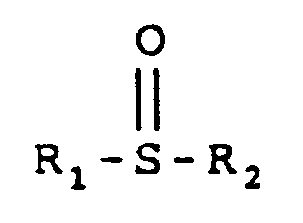
- Sulfoxide compounds useful for the practice of this invention are of the following formula: wherein R1 and R2 are individually selected from the group consisting of straight and branched chain alkyl groups, alkylene groups and alkenyl groups, any of which may be substituted with one or more substituents selected from the group consisting of alkoxy, aryloxy, aryl, alkoxycarbonyl, aryloxycarbonyl, acyloxy, carbonamido and carbamoyl groups, and halogen atoms; a phenyl group; and a phenyl group having at least one substituent selected from alkyl, alkoxy, aryloxy, aryl, alkoxycarbonyl, aryloxycarbonyl, acyloxy, carbonamido and carbamoyl groups and halogen atoms; and wherein R1 and R2 combined have at least 12 carbon atoms, preferably from 12 to 26 carbon atoms. In preferred embodiments, R1 and R2 are individually selected from un
- the sulfoxide compound employed in the coupler compositions of the invention may act as a solvent for the dye-forming coupler.
- One or more additional organic (and preferably non-volatile, high boiling) solvents for the coupler compound may also be employed in the compositions of the invention.
- conventional organic coupler solvents such as those described in Research Disclosure , December, 1989, Item 308119, page 993, are known in the art and may be employed when the sulfoxide compound of the invention is used in an additive amount which is not sufficient to result in a solution of the coupler compound.
- Illustrative organic solvents are described in the examples below.
- the sulfoxide compound is employed in the coupler compositions of the invention in an amount sufficient to reduce sensitizing dye stain. In most applications, it is preferred that the dye-forming coupler and the sulfoxide compound are employed in a weight ratio of from about 1:0.1 to about 1:10.
- a preferred coupler coating composition according to the invention may contain weight ratios of coupler to sulfoxide of from 1:0.2 to 1:5 and of sulfoxide to optional coupler solvent of from 1:0 to 1:5.
- the dye-forming coupler included in the present coupler compositions comprises a cyan-forming coupler or a yellow dye-forming coupler.
- Couplers which form cyan dyes upon reaction with oxidized color developing agents are well known in the art and are described in such representative patents and publications as: US-A-2,772,162; 3,476,563; 4,526,864; 4,500,635; 4,254,212; 4,296,200; 4,457,559; 2,895,826; 3,002,836; 3,034,892; 2,474,293; 2,801,171; 2,423,730; 2,367,531; 3,041,236; 4,443,536; 4,333,999; 4,124,396; 4,775,616; 3,779,763; 3,772,002; 3,419,390; 4,690,889; 3,996,253 and "Farbkuppler-eine Literaturü bersicht,” published in Agfa Mitanderen,
- the cyan dye-forming coupler comprises a phenol or naphthol compound which forms a cyan dye on reaction with an oxidized color developing agent.
- the cyan dye-forming coupler may be a compound selected from the following formulae: wherein m is from 1 to 3, and R3 is a ballast substituent having at least 10 carbon atoms, or a group which links to a polymer forming a so-called polymeric coupler. Ballast substituents include alkyl, substituted alkyl, aryl and substituted aryl groups.
- Each R4 is individually selected from hydrogen, halogens (for example, chloro, fluoro), alkyl groups of 1 to 4 carbon atoms and alkoxy groups of 1 to 4 carbon atoms.
- R5 is selected from the group consisting of substituted and unsubstituted alkyl and aryl groups, wherein the substituents comprise one or more electron-withdrawing substituents, for example, cyano, halogen, methylsulfonyl or trifluoromethyl groups.
- X is hydrogen or a coupling-off group.
- Coupling-off groups are well known to those skilled in the art. Generally, such groups determine the equivalency of the coupler and modify the reactivity of the coupler. Coupling-off groups can also advantageously affect the layer in which the coupler is coated or other layers in the photographic material by performing, after release from the coupler, such functions as development inhibition, bleach acceleration, color correction, development acceleration and the like.
- Representative coupling-off groups X include halogens (for example, chloro), alkoxy, aryloxy, alkylthio, arylthio, acyloxy, sulfonamido, carbonamido, arylazo, nitrogen-containing heterocyclic groups such as pyrazolyl and imidazolyl, and imido groups such as succinimido and hydantoinyl groups. Except for the halogens, these groups may be substituted if desired.
- Coupling-off groups are described in further detail in US-A-2,355,169; 3,227,551; 3,432,521; 3,476,563; 3,617,291; 3,880,661; 4,052,212 and 4,134,766, and in British Patent Publication Nos. 1,466,728; 1,531,927; 1,533,039; 2,006,755A and 2,017,704A.
- a coupler compound should be nondiffusible when incorporated in a photographic element. That is, the coupler compound should be of such a molecular size and configuration that it will exhibit substantially no diffusion from the layer in which it is coated.
- the substituent R3 should contain at least 10 carbon atoms, or should be a group which is linked to or forms part of a polymer chain.
- Couplers which form yellow dyes upon reaction with an oxidized color developing agent are described in such representative patents and publications as US-A-3,384,657; 3,415,652; 3,542,840; 4,046,575; 3,894,875; 4,095,983; 4,182,630; 2,875,057; 2,407,210; 3,265,506; 2,298,443; 3,408,194; 3,447,928; 4,587,207; 4,617,256; 4,587,205; 4,529,691; 4,443,536; 4,326,024; 4,203,768; 4,221,860; 3,933,501; 4,022,620; 4,401,752; European Patent Application 296,793 and "Farbkupplereine Literaturü bersicht,” published in Agfa Mitanderen, Band III, pp.
- yellow-dye forming couplers are acylacetamides, such as benzoylacetanilides (Y-A) and pivaloylacetanilides (Y-B): wherein R6 is a ballast group having at least 10 carbon atoms, or may be hydrogen or a halogen if R7 or R8 contains sufficient ballast ( ⁇ 10 carbon atoms), or may be a group which links to a polymer.
- R7 may be hydrogen, halogen (for example, a chlorine atom), an alkyl group, an alkoxy group or an aryloxy group.
- R8 may be hydrogen, or one or more halogen (for example, chlorine), alkyl or alkoxy groups or a ballast group.
- X is as defined above for cyan couplers.
- Ballast groups suitable for R6 or R8 include, for example, acyloxy groups, alkoxycarbonyl groups, aryloxycarbonyl groups, carbonamide groups, carbamoyl groups, sulfonamide groups and sulfamoyl groups which may themselves be substituted.
- cyan dye-forming couplers useful for the practice of this invention include, but are not limited to compounds c-i to c-x below, which represent species based on generic formulas C-A to C-E above:
- the spectral sensitizer used in the photosensitive element according to the invention depends on the desired color and structure of the element, for example, the number of layers.
- Sensitizing dyes useful in the practice of the invention include those types noted in Research Disclosure , December 1989, Item 308119, p.933.
- Anionic sensitizing dyes, particularly heterocyclic mercapto compounds having anionic sulfonate groups, are preferred, insofar as staining has been a problem with such dyes.
- Silver halide emulsions of the invention can also be spectrally sensitized with dyes from a variety of classes, including the polymethine dye class, which includes the cyanines, merocyanines, complex cyanines and merocyanines (that is, tri-, tetra-, and polynuclear cyanines and merocyanines), oxonols, hemioxonols, styryls, merostyryls, and streptocyanines.
- Illustrative spectral sensitizing dyes are disclosed in Research Disclosure , cited above, Item 17643, Section IV.
- the sulfoxide compound may also be used in combination with polymeric addenda.
- polymeric addenda With respect to the use of sulfoxides in combination with polymers, Example 2 below demonstrates that further reduction in retained sensitizing dye can be obtained by using polymeric addenda and sulfoxide coupler solvents in combination.
- the polymer preferably is incorporated in the element in the same layer as the silver halide emulsion. It can be present in an amount that will vary depending upon the particular effect desired.
- the repeating units represented by Z are derived from one or more acid- or salt- containing vinyl monomers.
- Examples of monomers useful in preparing polymers of this invention are methoxyethylacrylate or methacrylate, ethoxyethylacrylate or methacrylate, methoxyethoxyethyl-acrylate or methacrylate, methoxyethylacrylamide or methacrylamide, ethoxyethylacrylamide or methacrylamide, butyl acrylate, acrylic acid, methacrylic acid, hydroxyethylmethacrylate, hydroxyethylmethacrylamide, 2-methyl-2-[(1)-oxo-2-propenyl)amino]-1-propane sulfonic acid, or its alkali metal salt, polypropyleneglycol monomethacrylate, polypropylene glycol monomethacrylamide.
- the polypropylene glycol monomers contain from 1 to 20 glycol units.
- the copolymers useful in the invention are free of repeating units containing dye-forming coupler moieties.
- Copolymers containing methoxyethylacrylate, methoxyethylacrylamide or methacrylamide are especially preferred.
- Highly preferred polymers useful in this invention can be represented by the structure: wherein G, R9, R10 and R12 are as defined above, x is 35 to 85 weight percent, y is 10 to 60 weight percent, z1 is 3 to 10 weight percent, z2 is 2 to 5 weight percent, and n is 1 to 20.
- These polymers can be prepared by known polymerization processes, such as emulsion and solution polymerization, using known starting materials. Polymers prepared by emulsion polymerization can be mixed with gelatin and coated directly. Polymers prepared by solution polymerization can be dispersed in two different ways.
- the first way is to disperse the polymer in the same way that a ballasted coupler is dispersed, with or without a coupler solvent.
- the thus-formed dispersion is mixed with gelatin and coated.
- the second way is to disperse the polymer directly into water if enough units derived from ionizable monomers are present.
- the dispersion obtained is then mixed with gelatin and coated.
- a photographic element of the invention generally comprises at least one layer containing a conventional silver halide photosensitive emulsion such as AgCl, AgBr, AgI, AgBrI or the like, in combination with a dye-forming coupler.
- the photographic coupler plus sulfoxide compositions of the invention are employed in color photographic materials in a manner well known in the photographic art.
- a supporting substrate may be coated with a silver halide emulsion and a coupler plus sulfoxide composition of the invention.
- the photographic material may then be imagewise exposed and then developed in a solution containing a primary aromatic amine color developing agent.
- the primary aromatic amine developing agent is oxidized in an imagewise manner by reaction with exposed silver halide grains, and the oxidized developer reacts with coupler to form dye.
- the development step is followed by bleaching and fixing steps or a bleach-fix step to remove silver and silver halide from the coating.
- Couplers likely to be used in combination with the couplers of this invention include inhibitor releasing couplers, commonly referred to as DIR couplers, and switched or timed inhibitor releasing couplers, referred to as DIAR couplers, such as those described in US-A-3,148,062, 3,227,554, 3,733,201, 4,409,323 and 4,248,962.
- the couplers of this invention may also be used in combination with so-called masking couplers or with bleach accelerator releasing couplers (BARCs) as further described below and in Item 308119 in Research Disclosure , December 1989, page 993.
- BARCs bleach accelerator releasing couplers
- Photographic materials in which the coupler plus sulfoxide compositions of this invention are incorporated may be simple elements or multilayer, multicolor elements.
- Multicolor elements contain dye image-forming units sensitive to each of the primary regions of the spectrum.
- Each unit can be comprised of a single emulsion layer or of multiple emulsion layers sensitive to a given region of the spectrum.
- the layers of the element and the layers of the unit can be arranged in various orders, as known in the art.
- the coupler plus sulfoxide compositions of this invention may be coated on a transparent support or a reflective support, such as a paper support, and may be used in color negative, reversal or color print materials.
- a typical multicolor photographic element of the invention comprises a support bearing a cyan dye image-forming unit comprising at least one red-sensitive silver halide emulsion layer having associated therewith at least one cyan dye-forming coupler, a magenta image-forming unit comprising at least one green-sensitive silver halide emulsion layer having associated therewith at least one magenta dye-forming coupler, and a yellow dye image-forming unit comprising at least one blue-sensitive silver halide emulsion layer having associated therewith at lest one yellow dye-forming coupler.
- the element can contain additional layers, such as filter layers, interlayers, overcoat layers, subbing layers, and the like.
- the element typically will have a total thickness (excluding the support) of from 5 to 30 microns.
- the silver halide emulsions employed in the elements of this invention can be comprised of silver bromide, silver chloride, silver iodide, silver chlorobromide, silver chloroiodide, silver bromoiodide, silver chlorobromoiodide or mixtures thereof.
- the emulsions can include silver halide grains of any conventional shape or size. Specifically, the emulsions can include coarse, medium or fine silver halide grains.
- High aspect ratio tabular grain emulsions are specifically contemplated, such as those disclosed by Wilgus and others US-A-4,434,226, Daubendiek and others US-A-4,424,310, Wey US-A-4,399,215, Solberg and others US-A-4,433,048, Mignot US-A-4,386,156, Evans and others US-A-4,504,570, Maskasky US-A-4,400,463, Wey and others US-A-4,414,306, Maskasky US-A-4,435,501 and 4,414,966 and Daubendiek and others US-A-4,672,027 and 4,693,964.
- silver bromoiodide grains with a higher molar proportion of iodide in the core of the grain than in the periphery of the grain such as those described in GB 1,027,146; JA 54/48,521; US-A-4,379,837, 4,444,877; 4,665,012; 4,686,178; 4,565,778; 4,728,602; 4,668,614 and 4,636,461; and in EP 264,954.
- the silver halide emulsions can be either monodisperse or polydisperse as precipitated.
- the grain size distribution of the emulsions can be controlled by silver halide grain separation techniques or by blending silver halide emulsions of differing grain sizes.
- Sensitizing compounds such as compounds of copper, thallium, lead, bismuth, cadmium and group VIII noble metals, can be present during precipitation of the silver halide emulsion.
- the emulsions can be surface-sensitive emulsions, that is, emulsions that form latent images primarily on the surfaces of the silver halide grains, or internal latent image-forming emulsions, that is, emulsions that form latent images predominantly in the interior of the silver halide grains.
- the emulsions can be negative-working emulsions, such as surface-sensitive emulsions or unfogged internal latent image-forming emulsions, or direct-positive emulsions of the unfogged, internal latent image-forming type, which are positive-working when development is conducted with uniform light exposure or in the presence of a nucleating agent.
- the silver halide emulsions can be surface sensitized.
- Noble metal for example, gold
- middle chalcogen for example, sulfur, selenium, or tellurium
- reduction sensitizers employed individually or in combination, are specifically contemplated.
- Typical chemical sensitizers are listed in Research Disclosure , Item 17643, cited above, Section III.
- Suitable vehicles for the emulsions layers and other layers of elements of this invention are described in Research Disclosure Item 17643, Section IX and the publications cited therein.
- the photographic elements can be coated on a variety of supports as described in Research Disclosure , Section XVII and the references described therein.
- the elements of this invention can include additional couplers as described in Research Disclosure Section VII, paragraphs D, E, F and G and the publications cited therein. These additional couplers can be incorporated as described in Research Disclosure , Section VII, paragraph C and the publications cited therein.
- the coupler combinations of this invention can be used with colored masking couplers as described in US-A-4,883,746 or with couplers that release bleach accelerators as described in European Patent Application 193,389.
- the photographic elements of this invention can contain brighteners ( Research Disclosure , Section V), antifoggants and stabilizers ( Research Disclosure Section VI), antistain agents and image dye stabilizer ( Research Disclosure Section VII, paragraphs I and J), light absorbing and scattering materials (Section VIII), hardeners (Section XI), plasticizers and lubricants (Section XII), antistatic agents (Section XIII), matting agents (Sections XII and XVI) and development modifiers (Section XXI).
- Photographic elements can be exposed to actinic radiation, typically in the visible region of the spectrum, to form a latent image and then processed to form a visible dye image.
- Processing to form a visible dye image includes the step of contacting the element with a color developing agent to reduce developable silver halide and oxidize the color developing agent. Oxidized color developing agent in turn reacts with the coupler to yield a dye.
- Preferred color developing agents are p-phenylenediamines.
- 4-amino-3-methyl-N,N-diethylaniline hydrochloride 4-amino-3-methyl-N-ethyl-N--(methanesulfonamido)-ethylaniline sulfate hydrate, 4-amino-3-methyl-N-ethyl-N-hydroxyethylaniline sulfate, 4-amino-3-(methanesulfonamido)ethyl-N,N-diethylaniline hydrochloride and 4-amino-N-ethyl-N-(2-methoxy-ethyl)-m-toluidine di-p-toluenesulfonic acid.
- the processing step described above provides a negative image.
- the described elements are preferably processed in the known C-41 color process as described in, for example, the British Journal of Photography Annual of 1988 , pages 196-198.
- the color development step can be preceded by development with a non-chromogenic developing agent to develop exposed silver halide, but not form dye, and then uniformly fogging the element to render unexposed silver halide developable.
- a direct positive emulsion can be employed to obtain a positive image.
- Development is followed by the conventional steps of bleaching, fixing, or bleach-fixing, to remove silver or silver halide, washing, and drying.
- compositions and methods of the invention are demonstrated by the following examples, in which references are to parts by weight unless otherwise specified.
- S1 refers to the comparative conventional coupler solvent consisting of a mixture of tritolyl phosphates
- S2 refers to the conventional coupler solvent dibutyl phthalate
- S3 refers to 1,4-cyclohexylene dimethylene bis(2-ethylhexanoate)
- Roman numerals refer to sulfoxide solvents according to the invention as designated above.
- Dispersions of the cyan dye-forming coupler c-i were prepared in a series of coupler solvents as follows.
- An oil phase was prepared by warming a mixture of 2.0 g of coupler, 2.0 g of coupler solvent (1:1) and 6.0 g of the auxiliary solvent cyclohexanone until dissolution was complete. This solution was added to an aqueous phase consisting of 19.2 g of 12.5% aqueous gelatin, 2.4 g of aqueous 10% ALKANOL XC and 8.4 g of water.
- the oil phase was dispersed by pouring the mixture throngh a colloid mill.
- Coupler dispersions were then coated on acetate support at a laydown of 1.50 x 10⁻³ moles/m2 (1.39 x 10⁻⁴ moles/ft2) (0.899 g/m2; 83.2 mg/ft2) of c-i, together with a dye-sensitized tabular grain silver bromoiodide emulsion (3% iodide).
- the auxiliary solvent evaporated on coating.
- the resulting photosensitive layer had laydown amounts as follows: A protective layer of gelatin 2.16 g/m2 (200 mg/ft2) and a bis(vinylsufonyl)methane hardener at 1.75% of total gelatin in the protective layer was then overcoated on the photosensitive layer.
- the silver halide emulsion used had been spectrally sensitized with dye A, shown below:
- Coupler solvent dispersions were prepared by milling 3.0 g of coupler solvent and 1.1 g of ethyl acetate with 15 ml of 12.5% aqueous gelatin, 1.9 ml of 10% aqueous ALKANOL XC and 9.1 ml of water.
- the various coupler solvent dispersions were added to a mixture containing a c-i dispersion, latex polymer B, gelatin, spreading agent and tetraazaindine in quantities required to yield coated levels as indicated below. The mixtures were stirred for three hours at 40° C to achieve intermixing of the coupler, coupler solvent and polymer.
- the silver halide emulsion sensitized with dye A referred to in Example 1 was added to the mixtures in the necessary amount prior to coating on an acetate support as in Example 1.
- the resulting photosensitive layer had laydown amounts as follows: A protective layer of gelatin 2.16 g/m2 (200 mg/ft2) and a bis(vinylsufonyl)methane hardener at 1.75% of total gelatin in the protective layer was then overcoated on the photosensitive layer.
- dispersions of the yellow dye-forming coupler y-i were prepared in a series of coupler solvents in a manner similar to the procedure used in Example 1.
- ethyl acetate was used as the auxiliary solvent and the weight ratio of coupler to coupler solvent to ethyl acetate was 1:0.5:3.
- the dispersions of coupler y-i were coated on acetate support at a coupler laydown of 1.62 g/m2 (150 mg/ft2) (0.186 mmoles/ft2), together with a 0.2 micron silver chloride emulsion sensitized with dye C:
- the resulting photosensitive layer had laydown amounts as follows: A layer of gelatin 2.70 g/m2 (250 mg/ft2) and a bis(vinylsufonyl) methane hardener in an amount of 1.85% of total gelatin was then overcoated on the photosensitive layer.
Landscapes
- Physics & Mathematics (AREA)
- Chemical & Material Sciences (AREA)
- General Physics & Mathematics (AREA)
- Spectroscopy & Molecular Physics (AREA)
- Chemical Kinetics & Catalysis (AREA)
- Engineering & Computer Science (AREA)
- Materials Engineering (AREA)
- Silver Salt Photography Or Processing Solution Therefor (AREA)
Claims (12)
- Verfahren zur Erzeugung einer Farbe in einem photographischen Silberhalogenidelement, in dem das Silberhalogenid mit einem Farbstoff sensibilisiert ist, bei dem eine oxidierte Entwicklerverbindung umgesetzt wird mit einem phenolischen oder naphtholischen, einen blaugrünen Farbstoff liefernden Kuppler in einem Sulfoxid-Kupplerlösungsmittel der Formel:
- Verfahren nach Anspruch 1, in dem der Kuppler ein einen blaugrünen Farbstoff liefernder Kuppler der folgenden Formel ist:


- Verfahren zur Erzeugung einer Farbe in einem photographischen Silberhalogenidelement, in dem das Silberhalogenid mit einem Farbstoff sensibilisiert ist, bei dem man eine oxidierte Entwicklerverbindung mit einem einen gelben Farbstoff bildenden Acylacetamid-Kuppler in einem Sulfoxid-Kupplerlösungsmittel umsetzt, der die folgende Formel hat:

- Verfahren nach Anspruch 1 oder 3, in dem R₁ und R₂ zusammen 12 bis 26 Kohlenstoffatome aufweisen.
- Verfahren nach Anspruch 4, bei dem der Kuppler ein einen gelben Farbstoff liefernder Kuppler mit der folgenden Formel ist:


- In einem photosensitiven Element mit einer Schicht aus einer photosensitiven Silberhalogenidemulsion, die auf einem Träger abgeschieden ist in Kombination mit einem einen Farbstoff liefernden Kuppler, der mit oxidierter Entwicklerverbindung unter Erzeugung eines farbigen Bildes reagiert, das einem Exponierungsmuster des Silberhalogenides entspricht, die Verbesserung, die umfaßt:
das Silberhalogenid ist mit einem Farbstoff sensibilisiert und die photosensitive Schicht enthält einen phenolischen oder naphtholischen, einen blaugrünen Farbstoff liefernden Kuppler in einem Sulfoxid-Lösungsmittel mit der Formel:
- Photosensitives Element nach Anspruch 6, in dem der Kuppler und die Sulfoxid-Verbindung in einem Gewichtsverhältnis von etwa 1:0,1 bis etwa 1:10 verwendet werden.
- In einem photosensitiven Element mit einer Schicht aus einer photosensitiven Silberhalogenidemulsion, die auf einem Träger abgeschieden ist in Kombination mit einem einen Farbstoff liefernden Kuppler, der mit einer oxidierten Entwicklerverbindung unter Erzeugung eines farbigen Bildes reagiert, das einem Exponierungsmuster des Silberhalogenides entspricht, die Verbesserung, die umfaßt:
das Silberhalogenid ist mit einem Farbstoff sensibilisiert, und die photosensitive Schicht enthält einen einen gelben Farbstoff liefernden Acylacetamidkuppler in einem Sulfoxid-Lösungsmittel der Formel:
- Photosensitives Element nach Anspruch 6 oder 8, worin R₁ und R₂ zusammen 12 bis 26 Kohlenstoffatome aufweisen, und worin R₁ und R₂ ausgewählt sind aus unsubstituierten geradkettigen und verzweigtkettigen Alkylgruppen, Alkenylgruppen und Alkylengruppen.
- Photosensitives Element nach Ansprüchen 6, 8 oder 9, worin der Kuppler und die Sulfoxid-Verbindung in einem Gewichtsverhältnis von etwa 1:0,1 bis etwa 1:10 verwendet werden.
- Photosensitives Element nach Anspruch 6, in dem der Farbstoff im wesentlichen aus einem anionischen Farbstoff mit einer anionischen Sulfonatgruppe besteht.
- Photosensitives Element nach Anspruch 11, in dem der Farbstoff im wesentlichen aus einer heterocyclischen Mercaptoverbindung besteht.
Applications Claiming Priority (2)
| Application Number | Priority Date | Filing Date | Title |
|---|---|---|---|
| US07/804,787 US5192646A (en) | 1991-12-09 | 1991-12-09 | Photographic elements having sulfoxide coupler solvents and addenda to reduce sensitizing dye stain |
| US804787 | 1991-12-09 |
Publications (2)
| Publication Number | Publication Date |
|---|---|
| EP0548662A1 EP0548662A1 (de) | 1993-06-30 |
| EP0548662B1 true EP0548662B1 (de) | 1995-07-26 |
Family
ID=25189836
Family Applications (1)
| Application Number | Title | Priority Date | Filing Date |
|---|---|---|---|
| EP92120916A Expired - Lifetime EP0548662B1 (de) | 1991-12-09 | 1992-12-08 | Photographische Elemente mit Sulfoxid-Kuppler-Lösungsmitteln und Zusätzen zur Verminderung von Sensibilisierungsfarbstoff-Veränderungen |
Country Status (4)
| Country | Link |
|---|---|
| US (1) | US5192646A (de) |
| EP (1) | EP0548662B1 (de) |
| JP (1) | JPH05249635A (de) |
| DE (1) | DE69203706T2 (de) |
Families Citing this family (5)
| Publication number | Priority date | Publication date | Assignee | Title |
|---|---|---|---|---|
| JPH09500984A (ja) * | 1994-05-16 | 1997-01-28 | イーストマン コダック カンパニー | 色素汚染の減少した写真要素 |
| US6555306B1 (en) | 2001-12-21 | 2003-04-29 | Eastman Kodak Company | Photographic element with dye-forming coupler and image dye stabilizing compound |
| US6555305B1 (en) | 2001-12-21 | 2003-04-29 | Eastman Kodak Company | Photographic element with spectrally sensitized tabular grain emulsion and retained dye stain reducing compound |
| US7122299B2 (en) * | 2002-11-06 | 2006-10-17 | Fuji Photo Film Co., Ltd. | Silver halide photographic light-sensitive material |
| US6846620B1 (en) * | 2003-06-27 | 2005-01-25 | Albert J. Mura, Jr. | Photographic element with dye-forming coupler and image dye stabilizing coupler solvent |
Family Cites Families (11)
| Publication number | Priority date | Publication date | Assignee | Title |
|---|---|---|---|---|
| US3050394A (en) * | 1959-09-30 | 1962-08-21 | Gen Aniline & Film Corp | Method of incorporating color couplers in hydrophlic colloids |
| DE2042659A1 (de) * | 1970-08-28 | 1972-03-02 | Agfa-Gevaert Ag, 5090 Leverkusen | Einlagerungsverfahren |
| JPS5942301B2 (ja) * | 1975-05-13 | 1984-10-13 | 富士写真フイルム株式会社 | カラ−写真色画像耐光堅牢化方法 |
| JPS5784449A (en) * | 1980-11-14 | 1982-05-26 | Fuji Photo Film Co Ltd | Photographic image formation method |
| JPS59146050A (ja) * | 1983-02-09 | 1984-08-21 | Fuji Photo Film Co Ltd | ハロゲン化銀カラ−写真感光材料 |
| JPH0621949B2 (ja) * | 1986-01-23 | 1994-03-23 | 富士写真フイルム株式会社 | カラ−画像形成法 |
| JPH0656483B2 (ja) * | 1986-01-29 | 1994-07-27 | 富士写真フイルム株式会社 | カラ−画像形成法 |
| JPH077186B2 (ja) * | 1987-10-15 | 1995-01-30 | 富士写真フイルム株式会社 | ハロゲン化銀写真感光材料 |
| JP2916683B2 (ja) * | 1988-09-27 | 1999-07-05 | コニカ株式会社 | 新規なマゼンタカプラーを含有するハロゲン化銀カラー写真感光材料 |
| US5232821A (en) * | 1991-04-01 | 1993-08-03 | Eastman Kodak Company | Photographic coupler compositions containing ballasted sulfoxides and sulfones and methods |
| US5298368A (en) * | 1991-04-23 | 1994-03-29 | Eastman Kodak Company | Photographic coupler compositions and methods for reducing continued coupling |
-
1991
- 1991-12-09 US US07/804,787 patent/US5192646A/en not_active Expired - Lifetime
-
1992
- 1992-12-07 JP JP4326314A patent/JPH05249635A/ja active Pending
- 1992-12-08 EP EP92120916A patent/EP0548662B1/de not_active Expired - Lifetime
- 1992-12-08 DE DE69203706T patent/DE69203706T2/de not_active Expired - Fee Related
Also Published As
| Publication number | Publication date |
|---|---|
| DE69203706D1 (de) | 1995-08-31 |
| US5192646A (en) | 1993-03-09 |
| JPH05249635A (ja) | 1993-09-28 |
| EP0548662A1 (de) | 1993-06-30 |
| DE69203706T2 (de) | 1996-04-11 |
Similar Documents
| Publication | Publication Date | Title |
|---|---|---|
| EP0356925B1 (de) | Photographisches Element sowie Verfahren mit einem einen Entwicklunsinhibitor freisetzenden Kuppler und einem einen gelben Farbstoff liefernden Kuppler | |
| JP3283917B2 (ja) | マゼンタカプラー、抑制剤放出カプラー及びカルボンアミド化合物を含有するカラー写真材料 | |
| US5188926A (en) | Photographic elements having carbonamide coupler solvents and addenda to reduce sensitizing dye stain | |
| EP0349331B1 (de) | Farbphotographisches Material | |
| EP0649056B1 (de) | Photographisches Element und Verfahren in dem den Farbton korrigerende Kuppler verwendet werden | |
| EP0631181B1 (de) | Farbphotographische Elemente enthaltend eine Kombination von Pyrazolon- und Pyrazoloazol-Kupplern | |
| US5200309A (en) | Color photographic materials including magenta coupler, carbonamide compound and aniline or amine compound, and methods | |
| EP0548662B1 (de) | Photographische Elemente mit Sulfoxid-Kuppler-Lösungsmitteln und Zusätzen zur Verminderung von Sensibilisierungsfarbstoff-Veränderungen | |
| US5387500A (en) | Color photographic elements containing a combination of pyrazoloazole couplers | |
| US5451496A (en) | Color photographic materials and methods containing DIR or DIAR couplers and phenolic coupler solvents | |
| US5021555A (en) | Color photographic material | |
| US5360713A (en) | Yellow dye-forming couplers and color photographic elements containing these couplers | |
| JP2001305687A (ja) | スピード改良ポリマーを含有しているカラー写真要素 | |
| JPH08220711A (ja) | ハロゲン化銀写真要素 | |
| US5288594A (en) | Photographic element and process comprising a development inhibitor releasing coupler and a yellow dye-forming coupler | |
| US5378593A (en) | Color photographic materials and methods containing DIR or DIAR couplers and carbonamide coupler solvents | |
| EP0600561B1 (de) | Gelbkuppler mit ionisierbare und/oder auflösbare Aryloxy freisetzbare Gruppen | |
| WO1992003762A1 (en) | Photographic material | |
| JPH07175189A (ja) | 色濁りが低減した写真要素 | |
| JPH0750318B2 (ja) | ハロゲン化銀カラ−写真感光材料 | |
| EP0443159A1 (de) | Blaugrüne Farbstoffe bildende Kuppler sowie photographische Aufzeichnungsmaterialien, die diese enthalten |
Legal Events
| Date | Code | Title | Description |
|---|---|---|---|
| PUAI | Public reference made under article 153(3) epc to a published international application that has entered the european phase |
Free format text: ORIGINAL CODE: 0009012 |
|
| AK | Designated contracting states |
Kind code of ref document: A1 Designated state(s): BE CH DE FR GB IT LI NL |
|
| 17P | Request for examination filed |
Effective date: 19931210 |
|
| 17Q | First examination report despatched |
Effective date: 19940215 |
|
| RBV | Designated contracting states (corrected) |
Designated state(s): DE FR GB NL |
|
| GRAA | (expected) grant |
Free format text: ORIGINAL CODE: 0009210 |
|
| AK | Designated contracting states |
Kind code of ref document: B1 Designated state(s): DE FR GB NL |
|
| REF | Corresponds to: |
Ref document number: 69203706 Country of ref document: DE Date of ref document: 19950831 |
|
| ET | Fr: translation filed | ||
| PLBE | No opposition filed within time limit |
Free format text: ORIGINAL CODE: 0009261 |
|
| STAA | Information on the status of an ep patent application or granted ep patent |
Free format text: STATUS: NO OPPOSITION FILED WITHIN TIME LIMIT |
|
| 26N | No opposition filed | ||
| PGFP | Annual fee paid to national office [announced via postgrant information from national office to epo] |
Ref country code: NL Payment date: 20000929 Year of fee payment: 9 |
|
| PGFP | Annual fee paid to national office [announced via postgrant information from national office to epo] |
Ref country code: GB Payment date: 20011102 Year of fee payment: 10 |
|
| PGFP | Annual fee paid to national office [announced via postgrant information from national office to epo] |
Ref country code: FR Payment date: 20011203 Year of fee payment: 10 |
|
| REG | Reference to a national code |
Ref country code: GB Ref legal event code: IF02 |
|
| PG25 | Lapsed in a contracting state [announced via postgrant information from national office to epo] |
Ref country code: NL Free format text: LAPSE BECAUSE OF NON-PAYMENT OF DUE FEES Effective date: 20020701 |
|
| NLV4 | Nl: lapsed or anulled due to non-payment of the annual fee |
Effective date: 20020701 |
|
| PG25 | Lapsed in a contracting state [announced via postgrant information from national office to epo] |
Ref country code: GB Free format text: LAPSE BECAUSE OF NON-PAYMENT OF DUE FEES Effective date: 20021208 |
|
| GBPC | Gb: european patent ceased through non-payment of renewal fee | ||
| PG25 | Lapsed in a contracting state [announced via postgrant information from national office to epo] |
Ref country code: FR Free format text: LAPSE BECAUSE OF NON-PAYMENT OF DUE FEES Effective date: 20030901 |
|
| REG | Reference to a national code |
Ref country code: FR Ref legal event code: ST |
|
| PGFP | Annual fee paid to national office [announced via postgrant information from national office to epo] |
Ref country code: DE Payment date: 20041230 Year of fee payment: 13 |
|
| PG25 | Lapsed in a contracting state [announced via postgrant information from national office to epo] |
Ref country code: DE Free format text: LAPSE BECAUSE OF NON-PAYMENT OF DUE FEES Effective date: 20060701 |