EP0554005B1 - Constituants photopolymérisables de compositions sensibles aux radiations - Google Patents
Constituants photopolymérisables de compositions sensibles aux radiations Download PDFInfo
- Publication number
- EP0554005B1 EP0554005B1 EP93300422A EP93300422A EP0554005B1 EP 0554005 B1 EP0554005 B1 EP 0554005B1 EP 93300422 A EP93300422 A EP 93300422A EP 93300422 A EP93300422 A EP 93300422A EP 0554005 B1 EP0554005 B1 EP 0554005B1
- Authority
- EP
- European Patent Office
- Prior art keywords
- compound
- formula
- ethylenically unsaturated
- polyunsaturated
- formulae
- Prior art date
- Legal status (The legal status is an assumption and is not a legal conclusion. Google has not performed a legal analysis and makes no representation as to the accuracy of the status listed.)
- Expired - Lifetime
Links
- 0 CCC1Ic2ccc(*)cc2S[C@]1N=Ic(cc1)ccc1I** Chemical compound CCC1Ic2ccc(*)cc2S[C@]1N=Ic(cc1)ccc1I** 0.000 description 6
Classifications
-
- G—PHYSICS
- G03—PHOTOGRAPHY; CINEMATOGRAPHY; ANALOGOUS TECHNIQUES USING WAVES OTHER THAN OPTICAL WAVES; ELECTROGRAPHY; HOLOGRAPHY
- G03F—PHOTOMECHANICAL PRODUCTION OF TEXTURED OR PATTERNED SURFACES, e.g. FOR PRINTING, FOR PROCESSING OF SEMICONDUCTOR DEVICES; MATERIALS THEREFOR; ORIGINALS THEREFOR; APPARATUS SPECIALLY ADAPTED THEREFOR
- G03F7/00—Photomechanical, e.g. photolithographic, production of textured or patterned surfaces, e.g. printing surfaces; Materials therefor, e.g. comprising photoresists; Apparatus specially adapted therefor
- G03F7/004—Photosensitive materials
- G03F7/027—Non-macromolecular photopolymerisable compounds having carbon-to-carbon double bonds, e.g. ethylenic compounds
- G03F7/028—Non-macromolecular photopolymerisable compounds having carbon-to-carbon double bonds, e.g. ethylenic compounds with photosensitivity-increasing substances, e.g. photoinitiators
- G03F7/031—Organic compounds not covered by group G03F7/029
-
- C—CHEMISTRY; METALLURGY
- C07—ORGANIC CHEMISTRY
- C07C—ACYCLIC OR CARBOCYCLIC COMPOUNDS
- C07C271/00—Derivatives of carbamic acids, i.e. compounds containing any of the groups, the nitrogen atom not being part of nitro or nitroso groups
- C07C271/06—Esters of carbamic acids
- C07C271/08—Esters of carbamic acids having oxygen atoms of carbamate groups bound to acyclic carbon atoms
- C07C271/24—Esters of carbamic acids having oxygen atoms of carbamate groups bound to acyclic carbon atoms with the nitrogen atom of at least one of the carbamate groups bound to a carbon atom of a ring other than a six-membered aromatic ring
-
- C—CHEMISTRY; METALLURGY
- C07—ORGANIC CHEMISTRY
- C07C—ACYCLIC OR CARBOCYCLIC COMPOUNDS
- C07C271/00—Derivatives of carbamic acids, i.e. compounds containing any of the groups, the nitrogen atom not being part of nitro or nitroso groups
- C07C271/06—Esters of carbamic acids
- C07C271/08—Esters of carbamic acids having oxygen atoms of carbamate groups bound to acyclic carbon atoms
- C07C271/26—Esters of carbamic acids having oxygen atoms of carbamate groups bound to acyclic carbon atoms with the nitrogen atom of at least one of the carbamate groups bound to a carbon atom of a six-membered aromatic ring
- C07C271/28—Esters of carbamic acids having oxygen atoms of carbamate groups bound to acyclic carbon atoms with the nitrogen atom of at least one of the carbamate groups bound to a carbon atom of a six-membered aromatic ring to a carbon atom of a non-condensed six-membered aromatic ring
-
- C—CHEMISTRY; METALLURGY
- C08—ORGANIC MACROMOLECULAR COMPOUNDS; THEIR PREPARATION OR CHEMICAL WORKING-UP; COMPOSITIONS BASED THEREON
- C08G—MACROMOLECULAR COMPOUNDS OBTAINED OTHERWISE THAN BY REACTIONS ONLY INVOLVING UNSATURATED CARBON-TO-CARBON BONDS
- C08G18/00—Polymeric products of isocyanates or isothiocyanates
- C08G18/06—Polymeric products of isocyanates or isothiocyanates with compounds having active hydrogen
- C08G18/28—Polymeric products of isocyanates or isothiocyanates with compounds having active hydrogen characterised by the compounds used containing active hydrogen
- C08G18/30—Low-molecular-weight compounds
- C08G18/32—Polyhydroxy compounds; Polyamines; Hydroxyamines
- C08G18/3271—Hydroxyamines
- C08G18/329—Hydroxyamines containing aromatic groups
-
- C—CHEMISTRY; METALLURGY
- C08—ORGANIC MACROMOLECULAR COMPOUNDS; THEIR PREPARATION OR CHEMICAL WORKING-UP; COMPOSITIONS BASED THEREON
- C08G—MACROMOLECULAR COMPOUNDS OBTAINED OTHERWISE THAN BY REACTIONS ONLY INVOLVING UNSATURATED CARBON-TO-CARBON BONDS
- C08G18/00—Polymeric products of isocyanates or isothiocyanates
- C08G18/06—Polymeric products of isocyanates or isothiocyanates with compounds having active hydrogen
- C08G18/70—Polymeric products of isocyanates or isothiocyanates with compounds having active hydrogen characterised by the isocyanates or isothiocyanates used
- C08G18/81—Unsaturated isocyanates or isothiocyanates
- C08G18/8141—Unsaturated isocyanates or isothiocyanates masked
- C08G18/815—Polyisocyanates or polyisothiocyanates masked with unsaturated compounds having active hydrogen
- C08G18/8158—Polyisocyanates or polyisothiocyanates masked with unsaturated compounds having active hydrogen with unsaturated compounds having only one group containing active hydrogen
-
- G—PHYSICS
- G03—PHOTOGRAPHY; CINEMATOGRAPHY; ANALOGOUS TECHNIQUES USING WAVES OTHER THAN OPTICAL WAVES; ELECTROGRAPHY; HOLOGRAPHY
- G03F—PHOTOMECHANICAL PRODUCTION OF TEXTURED OR PATTERNED SURFACES, e.g. FOR PRINTING, FOR PROCESSING OF SEMICONDUCTOR DEVICES; MATERIALS THEREFOR; ORIGINALS THEREFOR; APPARATUS SPECIALLY ADAPTED THEREFOR
- G03F7/00—Photomechanical, e.g. photolithographic, production of textured or patterned surfaces, e.g. printing surfaces; Materials therefor, e.g. comprising photoresists; Apparatus specially adapted therefor
- G03F7/004—Photosensitive materials
- G03F7/027—Non-macromolecular photopolymerisable compounds having carbon-to-carbon double bonds, e.g. ethylenic compounds
-
- Y—GENERAL TAGGING OF NEW TECHNOLOGICAL DEVELOPMENTS; GENERAL TAGGING OF CROSS-SECTIONAL TECHNOLOGIES SPANNING OVER SEVERAL SECTIONS OF THE IPC; TECHNICAL SUBJECTS COVERED BY FORMER USPC CROSS-REFERENCE ART COLLECTIONS [XRACs] AND DIGESTS
- Y10—TECHNICAL SUBJECTS COVERED BY FORMER USPC
- Y10S—TECHNICAL SUBJECTS COVERED BY FORMER USPC CROSS-REFERENCE ART COLLECTIONS [XRACs] AND DIGESTS
- Y10S522/00—Synthetic resins or natural rubbers -- part of the class 520 series
- Y10S522/904—Monomer or polymer contains initiating group
-
- Y—GENERAL TAGGING OF NEW TECHNOLOGICAL DEVELOPMENTS; GENERAL TAGGING OF CROSS-SECTIONAL TECHNOLOGIES SPANNING OVER SEVERAL SECTIONS OF THE IPC; TECHNICAL SUBJECTS COVERED BY FORMER USPC CROSS-REFERENCE ART COLLECTIONS [XRACs] AND DIGESTS
- Y10—TECHNICAL SUBJECTS COVERED BY FORMER USPC
- Y10S—TECHNICAL SUBJECTS COVERED BY FORMER USPC CROSS-REFERENCE ART COLLECTIONS [XRACs] AND DIGESTS
- Y10S522/00—Synthetic resins or natural rubbers -- part of the class 520 series
- Y10S522/904—Monomer or polymer contains initiating group
- Y10S522/905—Benzophenone group
Definitions
- This invention relates to photopolymerisable components of radiation sensitive compositions and is concerned with such components which include a plurality of polymerisable ethylenic double bonds.
- Radiation sensitive plates for use in the production of lithographic printing plates comprise a substrate, e.g. of suitably treated aluminium, coated with a radiation sensitive composition.
- the composition is image-wise exposed to actinic radiation which changes the solubility of the areas struck by the radiation. Thereafter, the more soluble areas are selectively removed by means of a developer liquid to leave an image constituted by the less soluble areas.
- Photopolymerisable compositions have widely been employed as the radiation sensitive compositions in negative-working lithographic plates. Generally, such printing plates have high durability enabling long printing runs to be completed. Also such printing plates often have high sensitivity allowing very short exposure times to be employed.
- a photopolymerisable composition for use in negative lithographic plates typically comprises a photopolymerisable ethylenically unsaturated monomer, a photoinitiator or sensitizer and other non-polymerisable components such as a polymeric binder resin, a colorant such as a dye and, optionally, a diazonium compound to prevent oxygen inhibition of photopolymerisation. In the compositions without a diazonium compound, an oxygen barrier layer is often required.
- the non-polymerisable components of the composition with a compound having the important features of i) containing a plurality of photopolymerisable ethylenic double bonds enabling efficient photopolymerisation to be effected on exposure to actinic radiation; and ii) being substantially free of impurities ensuring the stability of the compositions.
- the components are thereby chemically bonded to the image matrix after exposure, thus providing improved properties such as enhanced colour contrast after development and increased wear resistance.
- the compound also possesses a similar physical form to that of the polymerisable monomer in the composition to improve the homogeneity of the physical form of the composition.
- the molecular weight of the compounds should preferably be sufficiently high to prevent migration of components such as the photoinitiator or sensitizer.
- UK patent specification 2,038,849 discloses a 'structurally coloured compound' derived from the reaction between a reactive hydrogen atom-containing dye, a polyisocyanate and a hydroxyl compound containing a plurality of ethylenically unsaturated double bonds.
- An 'in-situ' method of synthesis is described whereby the dye is first reacted with a polyisocyanate such as tolylene-2,4-diisocyanate and, without isolating the intermediatory product, an ethylenically unsaturated hydroxyl compound is added to the reaction mixture.
- the final product obtained is a mixture, typically containing up to 15% by-products.
- European patent specification No. 136452 and US patent specification No. 4,722,947 both disclose polymeric materials containing polymerisable ethylenic double bonds. These polymers are characterized by a single ethylenic double bond attached to one reactive site (such as an OH group) and therefore the total content of such double bonds in relation to the polymer is low. It is known that polymers of this type have low efficiency of photopolymerisation.
- Japanese patent application 8939698 discloses a novolak epoxy resin modified with a compound containing a number of ethylenic double bonds, pentaerythritol triacrylate and a diisocyanate using an 'in-situ' method. A consequence of such a method is a large increase in the molecular weight of the product or, in some cases, gelation.
- US Patent Specification No. 4316949 provides a photosensitive composition for use in lithographic printing plates, the composition comprising an ethylenically unsaturated oligomer, a diazonium resin, a film forming binder and a photoinitiator.
- the ethylenically unsaturated oligomer is typically obtained by reaction of a polyol with a polyisocyanate and subsequent reaction of the isocyanate endcapped intermediate with a polyethylenically unsaturated hydroxy compound. Inevitably, however, such syntheses are difficult to control and the quality of the products obtained is usually poor.
- Preferred compounds include those derived from colorants, polymeric binder resins, photoinitiators, photosensitisers, colour-change agents, anti-halation agents, stabilisers, and other components of radiation sensitive compositions for lithographic printing plate production and the like.
- This object can be achieved by providing a pure intermediate compound which includes, in a single molecule, a single isocyanate group and a plurality of photopolymerisable ethylenically unsaturated groups.
- the isocyanate group the compound can be reacted with any component containing a reactive hydrogen group, such as a hydroxy, mercapto or amino group, whereby the photopolymerisable groups are introduced into the component and thereby such components are bonded to the image on exposure as a result of polymerization of the photopolymerisable groups.
- a polyunsaturated compound having the general formula 1 where ⁇ represents the residue of an active hydrogen containing compound of the formula ⁇ -(XH)r where XH is a hydroxyl group, a mercapto group or a primary or secondary amino group; r is an integer ranging from 1 to 10 for a simple molecule and from 1 to 10,000 for a polymeric macromolecule; Z represents the residue of a polyisocyanate OCN-Z-(NCO)n where n is 1 or 2; and Y is the residue of a monohydroxyl compound of the formula comprises reacting a compound of the formula ⁇ -(XH) r with an ethylenically unsaturated mono isocyanate compound of the formula: wherein ⁇ represents the residue of an active hydrogen containing compound of the formula ⁇ -(XH) r where XH is a hydroxyl group, a mercapto group or a primary or secondary amino group, and Y, Z,
- Z may be, for example, an aromatic, alicyclic, or heterocyclic ring. It may also be an alkylene group. Examples of such polyisocyanates are shown by formulae 42 to 52.
- ethylenically unsaturated monohydroxy compound of the formula YOH may be of the following detailed general formula: where:
- the ethylenically unsaturated monohydroxy compound of formula 29 is preferably prepared from a saturated polyol by reacting all except one of the hydroxy groups with an ethylenicallly unsaturated compound including a functional group capable of reacting with a hydroxy group.
- a saturated polyol by reacting all except one of the hydroxy groups with an ethylenicallly unsaturated compound including a functional group capable of reacting with a hydroxy group.
- Such polyols are abundant and suitable examples are glycerol, trimethylolethane, trimethylolpropane, pentaerythritol, dipentaerythritol or polyhydroxyl compounds resulting from the oxyalkylation of polyols with alkylene oxide, in particular ethylene oxide or propylene oxide.
- the reaction between the polyisocyanate of formula 28 and the polyunsaturated mono hydroxy compound of formula YOH is effected in such a way that the ethylenically unsaturated mono isocyanate compound of formula 27 is produced in a manner such as to avoid the formation of the large amount of by-products which are ordinarily produced when polyisocyanates are reacted with reactive hydrogen-containing compounds.
- the reaction is carried out in a medium in which the reactants are miscible but in which the ethylenically unsaturated mono isocyanate compound is immiscible.
- Compound 31 (a polyacrylate mono isocyanate compound derived from tetra(hydroxypropyl)pentaerythritol triacrylate (THPT) and tolylene-2,4-diisocyanate (TDI))
- a liquid chromatographic method was used to determine the residual tolylene diisocyanate, and the total isocyanate content of the product was analyzed by titration. A total isocyanate content of 6.3% w/w was found against a theoretical value of 6.4% w/w. Therefore, the purity of the product was 98%.
- dipentaerythritol pentaacrylate (OH value 110) was reacted with TDI (20 g, 0.12 mole, 20% excess) in a mixture of petroleum ether (b.p. 40-60°C) and diethyl ether according to the method of Example 1.
- TDI dipentaerythritol pentaacrylate
- a total isocyanate value of 5.8% w/w was found against a theoretical value of 6.1% w.w. Therefore, the purity of the product was 95%.
- a commercial epoxy Bisphenol A polymer marketed as Epikote 1004 by Shell with an average hydroxy value of 148 (10.0g) was dissolved in 100 mls of dry methyl ethyl ketone, with the addition of 0.05 g of hydroquinone and a catalytic amount of dibutylin dilaurate.
- Compound 31 (7.4g) was dissolved in 20 mls of methyl ethyl ketone and added to the polymer solution dropwise over a period of 10 minutes. On completion of the addition, the reaction mixture was heated to reflux until all residual isocyanate groups had disappeared. The solution was sprayed into 1 litre of water and a white powdery resin isolated. It was further washed with water in a blender twice and dried. 1 H NMR indicated a total of 50% of the hydroxy groups had been modified as intended.
- the epoxy Bisphenol A polymer, Epikote 1004 (10.0g) was dissolved in dry methyl ethyl ketone (100 mls) with the addition of a catalytic amount of dibutylin dilaurate. Tolylene diisocyanate (4.6 g) was added and the reaction mixture stirred at 40°C in order to react 50% of the isocyanate groups. After 10 minutes, it was observed that gelation occurred, indicating premature crosslinking. The reaction was abandoned.
- a commercial liquid blue dye marketed by Milliken as Reactint Blue X3 with a hydroxy value of 205 and an average molecular weight of 550 (5.0g) was dissolved in 100 mls of dry methyl ethyl ketone, with the addition of 0.05 g of hydroquinone and a catalytic amount of dibutylin dilaurate.
- 10.0g of an isocyanate polyacrylate (compound 32) was dissolved in 20 mls of dry methyl ethyl ketone and added to the dye solution dropwise over 10 minutes. On completion of the addition, the reaction temperature was raised to reflux. The completion of the reaction was indicated by IR showing all isocyanate groups had disappeared. The solvent was then removed in vacuo to obtain the photocrosslinkable dye as a viscous liquid.
- the chemical structure of the product was determined by 1 H NMR and infrared spectroscopy.
- the hydroxy containing liquid dye (5.0g) was dissolved in 50 mls of dry N,N-dimethyl formamide. 4.0g of isophorone-diisocyanate were added and the mixture heated to 90°C. The reaction was effected with the addition of dibutylin dilaurate. When 50% of the isocyanate groups had reacted as indicated by titration, 10.0 g of tetra(hydroxypropyl) pentaerythritol triacrylate and 0.05 g of hydroquinone were added and the reaction continued until all isocyanate groups had disappeared. The solvent was removed in vacuo and a solid coloured material was obtained. Further tests showed the solid to be no longer soluble in common solvents indicating premature crosslinking during the reaction.
- a monoazo dye of formula 4 (10.0g) was reacted with 21.4g of a monoisocyanate polyacrylate (compound 32) according to the method of Example 8.
- the product obtained was a viscous liquid and its chemical structure was confirmed by 1 H NMR and infrared spectroscopy.
- the photocrosslinkable monoazo dye of Example 10 was synthesised according to the method in GB 2,038,849.
- monoazo dye of formula 4 (10.0g) was reacted with isophorone diisocyanate (6.1g) and tetra (hydroxypropyl) pentaerythritol triacrylate (20.0g) using the method of Example 9.
- the product obtained was in viscous liquid form with some insoluble particles.
- a pH-sensitive colour change dye of formula 2 (5.0g) was reacted with 8.25g of a monoisocyanate polyacrylate (compound 34) according to the method of Example 8 to obtain the product as a viscous liquid.
- the chemical structure of the product was confirmed by 1 H NMR and infrared spectroscopy.
- a pH-sensitive colour-change dye of formula 3 (5.0g) was reacted with 10.1g of a monoisocyanate polyacrylate (compound 34) according to the method of Example 8 to afford the product as a viscous liquid.
- the chemical structure of the product was confirmed by 1 H NMR and infrared spectroscopy.
- a solution in methyl ethyl ketone comprising:
- a comparative radiation sensitive plate was made using a solution in methyl ethyl ketone comprising:
- the two radiation sensitive plates were exposed through a continuous tone Stouffer stepwedge to ultraviolet light (246 mJ/cm 2 from a Berkey-Ascor printing down frame) and then developed with a solution comprising butyrolactone, methoxy ethoxy ethanol and a surfactant. Both plates produced a stepwedge reading of solid 4, tail 8.
- the plate in accordance with the invention achieved 200,000 satisfactory impressions and the comparative plate achieved 125,000 satisfactory impressions.
- the resultant radiation sensitive plates were exposed through a continuous tone Stouffer stepwedge to ultra-violet light (246 mJ/cm 2 from a Berkey-Ascor printing down frame) and then developed with an aqueous solution containing sodium propanoate, sodium benzoate and a surfactant.
- the developed image of the resultant lithographic printing plates had the solid stepwedge steps indicated in Table I.
- a solution in ethyl methyl ketone of a photopolymerisable composition comprising:
- the radiation sensitive plate was exposed through a continuous tone Stouffer stepwedge to ultraviolet light (20 mJ/cm 2 from a Berkey-Ascor printing down frame) and then developed with an aqueous solution containing sodium propanoate, sodium benzoate and a surfactant.
- the developed image had a step wedge of solid 4, tail 8.
- a comparative plate was made using the above composition except that 0.15 parts by weight of ethyl Michler's ketone was used in place of Compound 41.
- the radiation sensitive plate was processed and developed using the same method as above to give a step wedge of solid 4, tail 8.
- a solution in ethyl methyl ketone of a photopolymerisable composition comprising:
- a comparative example was made using the above formulation, but 0.1g of the commercial Reactint Blue X3 was used in place of Compound 37.
- the resultant plate was processed in the same manner as above.
- the developed image had a stepwedge of solid 4, tail 10.
- the colour difference between the unexposed plate and the image area of the developed plate was 22.
Landscapes
- Chemical & Material Sciences (AREA)
- Organic Chemistry (AREA)
- Physics & Mathematics (AREA)
- Chemical Kinetics & Catalysis (AREA)
- General Physics & Mathematics (AREA)
- Health & Medical Sciences (AREA)
- Spectroscopy & Molecular Physics (AREA)
- Medicinal Chemistry (AREA)
- Polymers & Plastics (AREA)
- Macromonomer-Based Addition Polymer (AREA)
- Compositions Of Macromolecular Compounds (AREA)
- Polymerisation Methods In General (AREA)
- Polyurethanes Or Polyureas (AREA)
Claims (7)
- Composé polyinsaturé répondant à la formule généraledans laquelle © représente le résidu d'un composé contenant un ou plusieurs atomes d'hydrogène actifs répondant à la formule ©-(XH)r, où XH représente un groupe hydroxyle, un groupe mercapto ou un groupe amino primaire ou secondaire; r représente un entier se situant dans le domaine de 1 à 10 pour une molécule simple et de 1 à 10,000 pour une molécule macropolymère; Z représente le résidu d'un polyisocyanate OCN-Z-(NCO)n où n représente 1 ou 2; et Y représente le résidu d'un composé monohydroxylé répondant à la formule YOH où Y contient au moins deux liaisons doubles à insaturation éthylénique; et dans laquelle le composé contenant un ou plusieurs atomes d'hydrogène actifs répondant à la formule ©-(XH)r est un réactif antihalo, un sensibilisateur, un matériau photo-actif de type azide, un photoinitiateur de type cétone ou un agent de blocage de type isocyanate à savoir un oxime, un phénol ou un caprolactame, avec cette réserve que le composé contenant un ou plusieurs atomes d'hydrogène actifs ne représente pas un sel de diazonium.

- Composé polyinsaturé selon la revendication 1, dans lequel le réactif antihalo ou le sensibilisateur est un dérivé d'un composé monoazoïque, de méthine ou d'un composé polycyclique.
- Procédé pour préparer un composé polyinsaturé répondant à la formule généraleledit procédé comprenant la mise en réaction du composé répondant à la formule ©-(XH)rx avec un composé de monoisocyanate à insaturation éthylénique répondant à la formule:
 dans laquelle © représente le résidu d'un composé contenant un ou plusieurs atomes d'hydrogène actifs répondant à la formule ©-(XH)r, où XH représente un groupe hydroxyle, un groupe mercapto ou un groupe amino primaire ou secondaire; et Y, z, n et r ont les significations indiquées à la revendication 1: et dans lequel le composé répondant à la formule ©-(XH)r est un colorant organique, un chromophore faisant office de colorant de nuançage ou un colorant de changement de couleur, un réactif antihalo, un sensibilisateur, un matériau photoactif de type azide, un photoinitiateur de type cétone, une résine de liant polymàre ou un agent de blocage de type isocyanate à savoir un oxime, un phénol ou un caprolactame, avec cette réserve que le composé contenant un ou plusieurs atomes d'hydrogène actifs ne représente pas un sel de diazonium et caractérisé en ce qu'on obtient ledit composé de monoisocyanate en faisant réagir un polyisocyanate répondant à la formule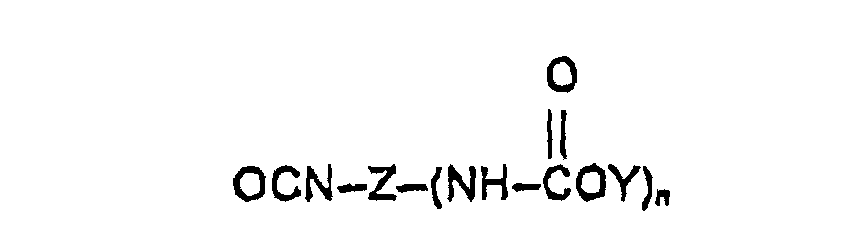
- Procédé selon la revendication 3, dans lequel le colorant organique, le chromophore, l'agent antihalo ou le sensibilisateur représente un dérivé d'un composé monoazoïque, as méthine ou d'un composé polycyclique.
- Procédé selon la revendication 3 ou 4, dans lequel le composé monohydroxylé à insaturation éthylénique répondant à la formule YOH répond à la formule générale développée:dans laquelle :
 et D possède la structurea = 2 ou 3 R1 = H ou un groupe alkyleb = 0 ou 1 I = 0 ou 1c = 0 ou 1dans laquelle
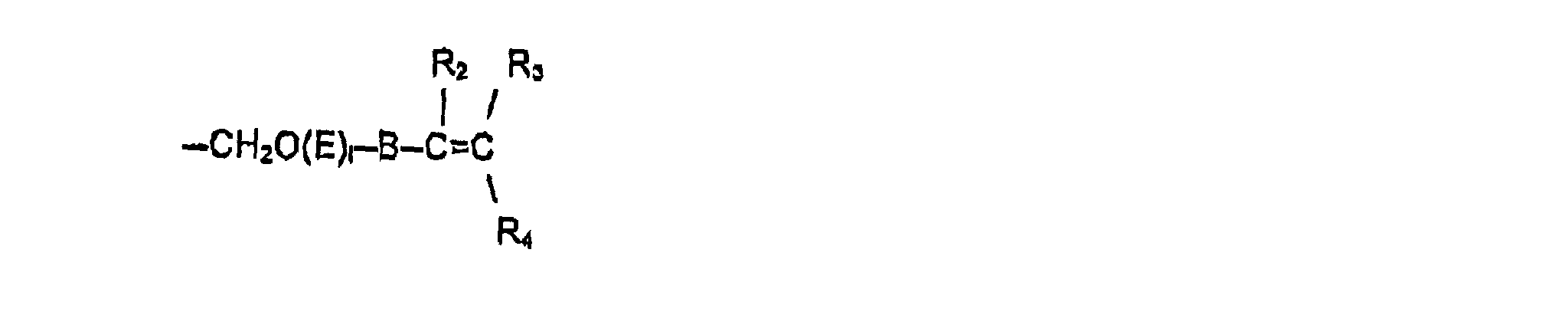 B représente une liaison simple,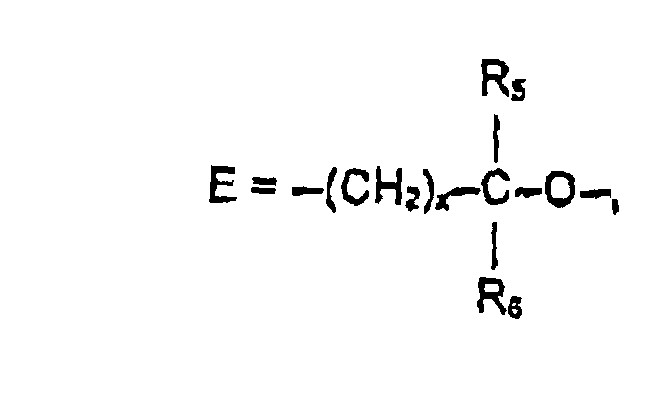
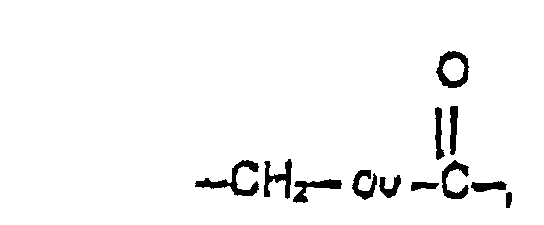 x = 1 ou 3R2 = H ou CH3R3 = H ou CH3R4 = H ou CH3R5 = H ou CH3R6 = H ou CH3.
 - Procédé selon la revendication 3, 4 ou 5, dans lequel le polyisocyanate est le toluylène-diisocyanate ou l'isophorone-diisocyanate.
- Procédé selon l'une quelconque des revendications 3 à 7, dans lequel le composé monohydroxylé à insaturation éthylénique est le diacrylate de glycérol, le diacrylate de triméthylolpropane, le triacrylate de pentaérythritol, le triacrylate de ditriméthylolpropane, le triacrylate de tétra(hydroxypropyl)pentaérythritol, le penta-acrylate de dipentaérythritol ou l'éther triallylique de penta-érythritol.
Applications Claiming Priority (2)
| Application Number | Priority Date | Filing Date | Title |
|---|---|---|---|
| GB9201269 | 1992-01-21 | ||
| GB9201269A GB2263909B (en) | 1992-01-21 | 1992-01-21 | Improvements in or relating to photopolymerisable components of radiation sensitive compositions |
Publications (2)
| Publication Number | Publication Date |
|---|---|
| EP0554005A1 EP0554005A1 (fr) | 1993-08-04 |
| EP0554005B1 true EP0554005B1 (fr) | 2002-01-30 |
Family
ID=10708983
Family Applications (1)
| Application Number | Title | Priority Date | Filing Date |
|---|---|---|---|
| EP93300422A Expired - Lifetime EP0554005B1 (fr) | 1992-01-21 | 1993-01-21 | Constituants photopolymérisables de compositions sensibles aux radiations |
Country Status (6)
| Country | Link |
|---|---|
| US (1) | US5710193A (fr) |
| EP (1) | EP0554005B1 (fr) |
| JP (1) | JP3391832B2 (fr) |
| CA (1) | CA2087635A1 (fr) |
| DE (1) | DE69331502T2 (fr) |
| GB (2) | GB2298209B (fr) |
Families Citing this family (11)
| Publication number | Priority date | Publication date | Assignee | Title |
|---|---|---|---|---|
| GB2280905A (en) * | 1993-08-06 | 1995-02-15 | Coates Brothers Plc | Ethylenically unsaturated photoinitiator |
| US5436112A (en) * | 1994-04-01 | 1995-07-25 | Hoechst Celanese Corporation | Method for producing a negative image with color proofing element containing a urethane monomer |
| JP2001290267A (ja) * | 2000-02-01 | 2001-10-19 | Mitsubishi Chemicals Corp | 光重合性組成物、感光性平版印刷版及び印刷版の製版方法 |
| JP2003122002A (ja) * | 2001-10-18 | 2003-04-25 | Mitsubishi Chemicals Corp | 光重合性組成物、感光性平版印刷版及び印刷版の製版方法 |
| JP2007114604A (ja) * | 2005-10-21 | 2007-05-10 | Fujifilm Electronic Materials Co Ltd | 感光性組成物及びカラーフィルタ |
| JP5218127B2 (ja) * | 2008-03-26 | 2013-06-26 | Jsr株式会社 | 硬化性組成物、硬化膜及び積層体 |
| GB2476275A (en) | 2009-12-17 | 2011-06-22 | Dublin Inst Of Technology | Photosensitive holographic recording medium comprising glycerol |
| WO2015080220A1 (fr) * | 2013-11-29 | 2015-06-04 | Dic株式会社 | Composé polymérisable, composition, polymère, corps anisotrope optique, élément d'affichage à cristaux liquides et élément el organique |
| CN107567466B (zh) | 2015-01-05 | 2020-10-09 | Igm集团公司 | Led可固化的低迁移性光引发剂 |
| CN116768742B (zh) * | 2022-03-07 | 2025-07-29 | 艾坚蒙(安庆)科技发展有限公司 | 一种二苯甲酮衍生物、制备方法及其用途 |
| CN115558069B (zh) * | 2022-09-26 | 2023-08-29 | 上海交通大学 | 一种pH敏感聚氨酯材料及其在构建二维表面图案及力致结构色信息储存中的应用 |
Family Cites Families (23)
| Publication number | Priority date | Publication date | Assignee | Title |
|---|---|---|---|---|
| US2718516A (en) * | 1952-11-08 | 1955-09-20 | Rohm & Haas | Isocyanato esters of acrylic, methacrylic, and crotonic acids |
| US2821544A (en) * | 1954-04-26 | 1958-01-28 | Bayer Ag | Production of alkylisocyanate esters of 2-alkenoic acids |
| US2882259A (en) * | 1955-12-27 | 1959-04-14 | Rohm & Haas | Segmented polymers having a linear polymeric backbone with linear polymer branches attached thereto through ureido groups and process for preparing the same |
| NL137857C (fr) * | 1963-08-31 | |||
| JPS4857620A (fr) * | 1971-11-19 | 1973-08-13 | ||
| GB1432202A (en) * | 1972-05-05 | 1976-04-14 | Grace W R & Co | Derivatives of a styrene/thylenically unsaturated alcohol copolymer |
| US3825479A (en) * | 1972-08-21 | 1974-07-23 | Sun Chemical Corp | Radiation curable printing ink compositions comprising an isocyanate-modified polyfunctional ester and a photoiniator |
| US3759809A (en) * | 1972-11-14 | 1973-09-18 | Sun Chemical Corp | Radiation curable compositions comprising an isocyanate modified polyfunctional ester and a photoinitiator |
| DE2631030A1 (de) * | 1976-07-09 | 1978-01-12 | Bayer Ag | Kationische farbstoffe |
| CH629520A5 (de) * | 1977-08-12 | 1982-04-30 | Sandoz Ag | Verfahren zur herstellung von azofarbstoffen. |
| US4192762A (en) * | 1978-04-20 | 1980-03-11 | Union Carbide Corporation | Radiation curable urethane compositions |
| FR2442257A1 (fr) * | 1978-11-21 | 1980-06-20 | Ugine Kuhlmann | Composes structurellement colores reticulables, leur preparation et leur utilisation dans des compositions pour revetements |
| US4316949A (en) * | 1979-12-14 | 1982-02-23 | Minnesota Mining And Manufacturing Company | Photoreactive oligomer composition and printing plate |
| BR8101674A (pt) * | 1980-03-25 | 1981-09-29 | Goodrich Co B F | Processo para a preparacao de polimeros liquidos reativos terminados em vinila e polimero reativo terminado em vinila |
| DE3048502A1 (de) | 1980-12-22 | 1982-07-22 | Hoechst Ag, 6000 Frankfurt | Durch strahlung polymerisierbares gemisch und daraus hergestelltes strahlungsempfindliches aufzeichnungsmaterial |
| US4358476A (en) * | 1981-06-24 | 1982-11-09 | Lord Corporation | Radiation-curable compositions containing water |
| JPS5863760A (ja) * | 1981-10-09 | 1983-04-15 | Nippon Paint Co Ltd | 光硬化性被覆組成物 |
| US4722947A (en) * | 1985-08-05 | 1988-02-02 | Pony Industries, Inc. | Production of radiation curable partial esters of anhydride-containing copolymers |
| US4665146A (en) * | 1986-05-22 | 1987-05-12 | Desoto, Inc. | Amine-functional monoethylenic monomers, acrylic copolymers and aqueous coating compositions containing the same |
| DE3703130A1 (de) * | 1986-07-25 | 1988-01-28 | Bayer Ag | Urethangruppen enthaltende (meth)-acrylsaeurederivate |
| GB8622266D0 (en) * | 1986-09-16 | 1986-10-22 | Vickers Plc | Printing plate precursors |
| DE3710279A1 (de) * | 1987-03-28 | 1988-10-06 | Hoechst Ag | Polymerisierbare verbindungen und diese enthaltendes durch strahlung polymerisierbares gemisch |
| GB8719730D0 (en) * | 1987-08-20 | 1987-09-30 | Vickers Plc | Radiation sensitive compounds |
-
1992
- 1992-01-21 GB GB9601268A patent/GB2298209B/en not_active Expired - Fee Related
- 1992-01-21 GB GB9201269A patent/GB2263909B/en not_active Expired - Fee Related
-
1993
- 1993-01-20 CA CA002087635A patent/CA2087635A1/fr not_active Abandoned
- 1993-01-21 EP EP93300422A patent/EP0554005B1/fr not_active Expired - Lifetime
- 1993-01-21 JP JP00866593A patent/JP3391832B2/ja not_active Expired - Fee Related
- 1993-01-21 DE DE69331502T patent/DE69331502T2/de not_active Expired - Fee Related
-
1996
- 1996-05-21 US US08/646,808 patent/US5710193A/en not_active Expired - Fee Related
Also Published As
| Publication number | Publication date |
|---|---|
| GB2263909A (en) | 1993-08-11 |
| GB9201269D0 (en) | 1992-03-11 |
| GB2298209A (en) | 1996-08-28 |
| CA2087635A1 (fr) | 1993-07-22 |
| GB9601268D0 (en) | 1996-03-27 |
| DE69331502D1 (de) | 2002-03-14 |
| DE69331502T2 (de) | 2002-08-22 |
| JP3391832B2 (ja) | 2003-03-31 |
| JPH0693193A (ja) | 1994-04-05 |
| EP0554005A1 (fr) | 1993-08-04 |
| US5710193A (en) | 1998-01-20 |
| GB2263909B (en) | 1996-09-11 |
| GB2298209B (en) | 1996-11-06 |
Similar Documents
| Publication | Publication Date | Title |
|---|---|---|
| DE69402871T2 (de) | Photo-härtbare überzugszusammensetzungen | |
| US4316949A (en) | Photoreactive oligomer composition and printing plate | |
| EP0554005B1 (fr) | Constituants photopolymérisables de compositions sensibles aux radiations | |
| CA2265658C (fr) | Polyurethanne-methacrylate photosensible et developpable dans l'eau | |
| EP0678201B1 (fr) | Plaques d'impression lithographique a liants polymeres photoreactifs | |
| CA1267478A (fr) | Composition radiopolymerisable | |
| EP0260823B1 (fr) | Précurseurs pour plaques d'impression | |
| US20040224259A1 (en) | Functionalized polymer | |
| JPH0426687A (ja) | チオキサントン系化合物、及び感光性組成物 | |
| JP2755743B2 (ja) | 放射線重合性混合物およびそれから製造された複写材料 | |
| US5534623A (en) | Process for preparing a polyunsaturated diazonium compounds | |
| EP0554006B1 (fr) | Composés diazonium polyinsaturés | |
| JPH11286475A (ja) | 画像形成系に適用可能な光活性材料 | |
| US5466789A (en) | Polyunsaturated diazonium compounds | |
| JP2805802B2 (ja) | 感光性組成物用ポリウレタン樹脂の製造方法 | |
| US4994530A (en) | Polymeric compounds | |
| EP0414100A2 (fr) | Mélange photosensible de type positif | |
| CA2023661A1 (fr) | Reactif, methode de preparation et melange radiosensible prepare a l'aidr de ce produit | |
| CA2023668A1 (fr) | Melange radiosensible | |
| JP2005257924A (ja) | ドライフィルムフォトレジスト |
Legal Events
| Date | Code | Title | Description |
|---|---|---|---|
| PUAI | Public reference made under article 153(3) epc to a published international application that has entered the european phase |
Free format text: ORIGINAL CODE: 0009012 |
|
| AK | Designated contracting states |
Kind code of ref document: A1 Designated state(s): DE ES FR GB IT NL |
|
| 17P | Request for examination filed |
Effective date: 19940118 |
|
| 17Q | First examination report despatched |
Effective date: 19970630 |
|
| RAP1 | Party data changed (applicant data changed or rights of an application transferred) |
Owner name: AGFA-GEVAERT N.V. |
|
| GRAG | Despatch of communication of intention to grant |
Free format text: ORIGINAL CODE: EPIDOS AGRA |
|
| GRAG | Despatch of communication of intention to grant |
Free format text: ORIGINAL CODE: EPIDOS AGRA |
|
| GRAH | Despatch of communication of intention to grant a patent |
Free format text: ORIGINAL CODE: EPIDOS IGRA |
|
| GRAH | Despatch of communication of intention to grant a patent |
Free format text: ORIGINAL CODE: EPIDOS IGRA |
|
| GRAG | Despatch of communication of intention to grant |
Free format text: ORIGINAL CODE: EPIDOS AGRA |
|
| GRAG | Despatch of communication of intention to grant |
Free format text: ORIGINAL CODE: EPIDOS AGRA |
|
| GRAH | Despatch of communication of intention to grant a patent |
Free format text: ORIGINAL CODE: EPIDOS IGRA |
|
| GRAA | (expected) grant |
Free format text: ORIGINAL CODE: 0009210 |
|
| REG | Reference to a national code |
Ref country code: GB Ref legal event code: IF02 |
|
| AK | Designated contracting states |
Kind code of ref document: B1 Designated state(s): DE ES FR GB IT NL |
|
| PG25 | Lapsed in a contracting state [announced via postgrant information from national office to epo] |
Ref country code: NL Free format text: LAPSE BECAUSE OF FAILURE TO SUBMIT A TRANSLATION OF THE DESCRIPTION OR TO PAY THE FEE WITHIN THE PRESCRIBED TIME-LIMIT Effective date: 20020130 Ref country code: IT Free format text: LAPSE BECAUSE OF FAILURE TO SUBMIT A TRANSLATION OF THE DESCRIPTION OR TO PAY THE FEE WITHIN THE PRE;WARNING: LAPSES OF ITALIAN PATENTS WITH EFFECTIVE DATE BEFORE 2007 MAY HAVE OCCURRED AT ANY TIME BEFORE 2007. THE CORRECT EFFECTIVE DATE MAY BE DIFFERENT FROM THE ONE RECORDED.SCRIBED TIME-LIMIT Effective date: 20020130 |
|
| RAP2 | Party data changed (patent owner data changed or rights of a patent transferred) |
Owner name: AGFA-GEVAERT |
|
| REF | Corresponds to: |
Ref document number: 69331502 Country of ref document: DE Date of ref document: 20020314 |
|
| NLT2 | Nl: modifications (of names), taken from the european patent patent bulletin |
Owner name: AGFA-GEVAERT |
|
| ET | Fr: translation filed | ||
| NLV1 | Nl: lapsed or annulled due to failure to fulfill the requirements of art. 29p and 29m of the patents act | ||
| PG25 | Lapsed in a contracting state [announced via postgrant information from national office to epo] |
Ref country code: ES Free format text: LAPSE BECAUSE OF FAILURE TO SUBMIT A TRANSLATION OF THE DESCRIPTION OR TO PAY THE FEE WITHIN THE PRESCRIBED TIME-LIMIT Effective date: 20020730 |
|
| PLBE | No opposition filed within time limit |
Free format text: ORIGINAL CODE: 0009261 |
|
| PGFP | Annual fee paid to national office [announced via postgrant information from national office to epo] |
Ref country code: FR Payment date: 20021210 Year of fee payment: 11 |
|
| PGFP | Annual fee paid to national office [announced via postgrant information from national office to epo] |
Ref country code: DE Payment date: 20021212 Year of fee payment: 11 |
|
| PGFP | Annual fee paid to national office [announced via postgrant information from national office to epo] |
Ref country code: GB Payment date: 20021216 Year of fee payment: 11 |
|
| 26N | No opposition filed | ||
| PG25 | Lapsed in a contracting state [announced via postgrant information from national office to epo] |
Ref country code: GB Free format text: LAPSE BECAUSE OF NON-PAYMENT OF DUE FEES Effective date: 20040121 |
|
| PG25 | Lapsed in a contracting state [announced via postgrant information from national office to epo] |
Ref country code: DE Free format text: LAPSE BECAUSE OF NON-PAYMENT OF DUE FEES Effective date: 20040803 |
|
| GBPC | Gb: european patent ceased through non-payment of renewal fee |
Effective date: 20040121 |
|
| PG25 | Lapsed in a contracting state [announced via postgrant information from national office to epo] |
Ref country code: FR Free format text: LAPSE BECAUSE OF NON-PAYMENT OF DUE FEES Effective date: 20040930 |
|
| REG | Reference to a national code |
Ref country code: FR Ref legal event code: ST |