EP0564827A2 - Schema zur Fehlerkorrektur-Nachbearbeitung mit Wörterbuch für On-Line-Handschrifterkennung - Google Patents
Schema zur Fehlerkorrektur-Nachbearbeitung mit Wörterbuch für On-Line-Handschrifterkennung Download PDFInfo
- Publication number
- EP0564827A2 EP0564827A2 EP93103640A EP93103640A EP0564827A2 EP 0564827 A2 EP0564827 A2 EP 0564827A2 EP 93103640 A EP93103640 A EP 93103640A EP 93103640 A EP93103640 A EP 93103640A EP 0564827 A2 EP0564827 A2 EP 0564827A2
- Authority
- EP
- European Patent Office
- Prior art keywords
- word
- character
- block
- dictionary
- score
- Prior art date
- Legal status (The legal status is an assumption and is not a legal conclusion. Google has not performed a legal analysis and makes no representation as to the accuracy of the status listed.)
- Granted
Links
Images




Classifications
-
- G—PHYSICS
- G06—COMPUTING OR CALCULATING; COUNTING
- G06V—IMAGE OR VIDEO RECOGNITION OR UNDERSTANDING
- G06V30/00—Character recognition; Recognising digital ink; Document-oriented image-based pattern recognition
- G06V30/10—Character recognition
- G06V30/26—Techniques for post-processing, e.g. correcting the recognition result
- G06V30/262—Techniques for post-processing, e.g. correcting the recognition result using context analysis, e.g. lexical, syntactic or semantic context
- G06V30/268—Lexical context
-
- G—PHYSICS
- G06—COMPUTING OR CALCULATING; COUNTING
- G06V—IMAGE OR VIDEO RECOGNITION OR UNDERSTANDING
- G06V30/00—Character recognition; Recognising digital ink; Document-oriented image-based pattern recognition
- G06V30/10—Character recognition
Definitions
- the invention is in the field of handwriting recognition, and specifically is directed to post-processing error correction.
- the error correction is accomplished using a dictionary.
- any on-line recognition of handwriting letters cannot avoid producing errors.
- these errors and errors caused by other sources are corrected utilizing a dictionary-driven error correction post-processing technique for handwriting recognition.
- U.S. Patent 4,653,107 to Shojima et al discloses a system in which coordinates of a "handwritten" pattern drawn on a tablet are sequentially sampled by a pattern "recognition" unit to prepare pattern coordinate data. Based on an area encircled by segments created by the sampled pattern coordinate data of one stroke and a line connecting a start point and an end point of the one-stroke coordinate data, the sampled pattern coordinate data of the one stroke is converted to a straight line and/or curved line segments. The converted segments are quantized and normalized. The segments of the normalized input pattern are rearranged so that the input pattern is drawn in a predetermined sequence. Differences between direction angles for the rearranged segments are calculated.
- U.S. Patent 5,034,991 to Hagimae et al discloses a character "recognition" method and system in which a character indicated in a printed, stamped, carved or other form is two-dimensionally imaged and stored as image data and the stored image data is subjected to an image processing to "recognize" the character.
- the "recognition" of the character is preformed in such a manner that each time the comparison of plural kinds of feature vectors extracted from the character to be “recognized” and a "dictionary" vector of each candidate character in a group of candidate characters preliminarily prepared is made for one of the plural kinds of feature vectors, a candidate character having its "dictionary” vector away from the extracted feature vector by a distance not smaller than a predetermined value is excluded from the candidate character group.
- the "dictionary" vector for each candidate character is defined as an average vector for a variety of fonts: A difference between the "dictionary" vector and the feature vector extracted from the character to be “recognized” is estimated by virtue of a deviation vector for the variety of fonts to produce an estimated value. The exclusion from the candidate character group is judged on the basis of the estimated values each of which is cumulatively produced each time the estimation for the difference is made.
- U. S. Patent 5,020,117 to Ooi et al discloses a system in which "recognition" character candidates and their similarities for each character obtained by a character "recognition” section from an input character string are stored in a first "recognition” result memory, and "recognition” character candidates obtained by rotating the corresponding characters through 180 degrees and their similarities are stored in a second "recognition” result memory. Address pointers for accessing the first and second "recognition" result memories are stored in an address pointer memory.
- the first "recognition” result memory is accessed in accordance with the address pointers read out from the address pointer memory in an ascending order
- the second “recognition” result memory is accessed in accordance with the address pointers read out from the address pointer memory in a descending order.
- Coincidences between "recognition” candidates read out from the first and second “recognition” result memories and character strings of "dictionary” words read out from a "dictionary” memory are computed by a coincidence computing section.
- a "recognition" result of the input character string is obtained based on the coincidence.
- U.S. Patent 5,010,579 to Yoshida et al discloses a hand-written, on-line character “recognition” apparatus, and the method employed by it, in which the structure of a "dictionary” for “recognition” is formed as a sub-routine type, whereby the "dictionary” can be made small in size and a time necessary for "recognition” can be reduced.
- Fujisaki discloses a method and apparatus for identifying a valid symbol or a string of valid symbols from a sequence of handwritten strokes.
- a method includes the steps of (a) generating in response to one or more handwritten strokes a plurality of stroke labels each having an associated score; (b) processing the plurality of stroke labels in accordance with a beam search-like technique to identify those stroke labels indicative of a valid symbol or portion of a valid symbol; and (c) associating together identified stroke labels to determine an identity of a valid symbol or a string of valid symbols therefrom.
- An aspect of the invention is that each of the constraint validation filters is switchably coupled into a serial filter chain.
- the switches function to either couple a filter input to a stroke label or decouple the input and provide a path around the filter block.
- An application writer has available a plurality of constraint filters. The application writer specifies which one or ones of the constraint filters are to be applied for a specific sequence of strokes. Fujisaki is incorporated herein by reference.
- the present invention utilizes a dictionary for post-processing error correction in an on-line handwriting recognition.
- the just discussed patents do not teach or suggest the use of a dictionary for such a purpose.
- a dictionary based post-processing technique for an on-line handwriting recognition system.
- An input word has all punctuation removed, and the word is checked against a word processing dictionary. If any word matches against the dictionary, it is verified as a valid word. If it does not verify, a stroke match function and a spell-aid dictionary are used to construct a list of possible words. In some cases, the list is appended with possible words based on changing the first character of the originally recognized word.
- a character-match score, a substitution score and a word length are assigned to the items on the list.
- a word hypothesis is constructed from the list with each such word being assigned a score. The word with the best score is chosen as the output word for the processor.
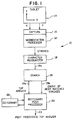
- FIG. 1 there is shown in block diagram form a character recognition system 10 that includes a segmentation processor 12 coupled between an electronic tablet 14 and a character recognizer 18.
- Tablet 14 can be any of a number of suitable commercially available electronic tablets.
- the tablet 14 has an associated stylus or pen 15 with which, in a pen-down position, a user forms symbols, such as block printing or script alphanumeric characters, on a surface of the tablet 14.
- the tablet 14 has x-axis and y-axis output signals expressive of the position of the pen 15 on an x-y tablet coordinate system.
- a stroke capture means 16 may be a software task which intercepts the x-y outputs from the tablet to generate x-y position pair data for the segmentation processor 12.
- An output of the segmentation processor 12 is data expressive of connected strokes and unconnected strokes which is input to the character recognizer 18 of the invention.
- the character recognizer 18 operates to determine an identity of a connected group of segmented strokes and has an output 18a expressive of identified symbols such as alphanumeric characters.
- the invention is applicable to the recognition of a number of hand-drawn symbols wherein a given symbol is composed of at least one segmented stroke.
- the system 10 readily recognizes symbols associated with written characters of various languages and also mathematical and other types of symbols.
- the output of character recognizer 18 on line 18a is provided to search block 19 which provides a top answer on line 19a and a cache of best matched strokes on line 19b.
- search block 19 provides a top answer on line 19a and a cache of best matched strokes on line 19b.
- a more detailed description of blocks 14-19 can be found in Fujisaki, U.S. 5,029,233 which has been incorporated herein by reference.
- Dictionary post-processing is then accomplished in post-processing block 20 which compares the top answer words on line 19a with words in a dictionary 22 to produce an output word on line 23.
- the top answer is a result of a search which results in the best candidate for a recognized word, and is an input word to the post-processor 20.
- the cache of best matched strokes is a result of a search of the best strokes to form a word.
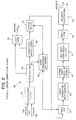
- FIG. 2 is a block diagram of the dictionary post-processor 20 of FIG. 1.
- a punctuation filter 24 receives the top word on line 19a and the cache of different paths signal on line 19b and removes all punctuation from the word.
- a verification block 26 a recognized sequence of characters is matched against the dictionary in block 28 to see if any word exists with that spelling. This match is cache insensitive. If there is a match, the word is provided to the unified cache block 30 and an output word is provided on line 31. If on the other hand there is no verification, a character match score is computed at block 32, and if the score per character is at a predetermined level, the word is output to block 30, and an output word is provided on line 31 at block 34 a stroke match is computed.
- the top match hypotheses are kept in a cache along with their scores.
- the objective of this module is to generate all the possible words from the strokes in this cache and to calculate the total matching score of each of these words. Then the end word hypotheses with the best matching scores are inserted into a global word hypotheses list.
- the output of the match 34 is then provided to a spell-aid block 36 which takes the recognition output and tries to find a word in the dictionary which resembles this sequence of characters and inserts them in the global word hypotheses list.
- This model's output is very dependent on the initial characters. Therefore, most of the time, the first character is retained. Therefore, if the match score of the first character is worse than other characters in the word, then it is replaced in block 38.
- FIG. 3 is a more detailed block diagram of the dictionary post-processor 20.
- the top answer is provided on input line 19a and the cache of best matched strokes signal is provided on line 19b, and the punctuation is removed from the top answer input at block 24.
- decision block 26 a determination is made whether the word is verified in the dictionary. If so, the word is provided to the unified cache block 30 and an output word is provided on line 31. If on the other hand, the word does not exist in the dictionary, proceed to character match score block 32 which is comprised of blocks 50 and 52. In block 50, scores are calculated for each character in the top answer word.
- a determination is made whether or not the worse character score is better than a predetermined threshold.
- first character replacement block 38 in FIG. 3B which is comprised of blocks 54 and 56.
- decision block 54 a determination is made whether or not the first character in the top answer has the worst character match score among all the characters in the top answer. If so, proceed to block 56 and get a hypothesis by changing the first character using statistics of first characters in a word. Proceed then to block 40 and assign a character-match score to the top answer and substitution scores and word length scores to all hypotheses.
- block 42 find the hypothesis with the best of all relative scores based on the following precedent: 1. word length 2. substitution 3. relative character-match. After this determination, proceed to block 44 and unify the case with the hypothesized word which is then provided to block 46 where punctuation is reinserted and an output word is provided on line 48.
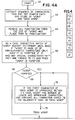
- FIG. 4 is a detailed flow chart of the operation of the post-processor block 20.
- the flow chart starts at block 60 of FIG. 4A, and at block 62, a sequence of characters is extracted from the top search path and are stored in "word” and "original word”.
- all punctuation is removed from the "word” and the punctuation is stored.
- a case insensitive match of "word” is made against the dictionary database. If “word” is made up of non-alphabetical characters only, then it is verified. If it has any special characters such as punctuation marks etc, they are separated and kept in a separate portion called “punctuation”.
- decision blocks 68 a determination is made if the "word” is verified.
- decision blocks 68 If in decision blocks 68 the word is not verified, go to block 74 of FIG. 4B where the shape matching score for each character in the word is looked up.
- decision block 76 it is determined if the sum of scores is less then a threshold times the length of the "word". If so, return to block 70 (FIG. 4A) and generate an output word on line 72. If the determination is that the sum of scores is not less than the threshold times the length of the word, proceed to block 78 where a linear transformation of the scores is performed such that the highest score is mapped to zero and zero is mapped to the highest score. Call the new scores "character-match" scores.
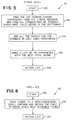
- FIG. 5 is a detailed flow chart of the stroke match block 34 shown in FIGS. 2 and 3.
- the flow chart begins at 140.
- the top score stroke hypothesis is taken from the stroke matcher and all combinations of strokes are found which make valid words in the dictionary.
- all these scores for the strokes in each word hypotheses are added.
- a list of "N" hypotheses with the best total score is made and a return list is made at block 148.
- FIG. 6 is a detailed flow chart of the spell-aid block 36 of FIGS. 2 and 3.
- the flow chart is started at block 150, and at block 152, the "word” is passed to word processor spell checker to obtain the first six words which most resemble the "word” and these are returned to the list at block 154.
Landscapes
- Engineering & Computer Science (AREA)
- Computational Linguistics (AREA)
- Computer Vision & Pattern Recognition (AREA)
- Physics & Mathematics (AREA)
- General Physics & Mathematics (AREA)
- Multimedia (AREA)
- Theoretical Computer Science (AREA)
- Character Discrimination (AREA)
Applications Claiming Priority (2)
| Application Number | Priority Date | Filing Date | Title |
|---|---|---|---|
| US86555092A | 1992-04-09 | 1992-04-09 | |
| US865550 | 1992-04-09 |
Publications (3)
| Publication Number | Publication Date |
|---|---|
| EP0564827A2 true EP0564827A2 (de) | 1993-10-13 |
| EP0564827A3 EP0564827A3 (en) | 1994-08-10 |
| EP0564827B1 EP0564827B1 (de) | 1999-05-19 |
Family
ID=25345760
Family Applications (1)
| Application Number | Title | Priority Date | Filing Date |
|---|---|---|---|
| EP93103640A Expired - Lifetime EP0564827B1 (de) | 1992-04-09 | 1993-03-08 | Schema zur Fehlerkorrektur-Nachbearbeitung mit Wörterbuch für On-Line-Handschrifterkennung |
Country Status (4)
| Country | Link |
|---|---|
| US (1) | US5787197A (de) |
| EP (1) | EP0564827B1 (de) |
| JP (1) | JPH0684006A (de) |
| DE (1) | DE69324957D1 (de) |
Cited By (3)
| Publication number | Priority date | Publication date | Assignee | Title |
|---|---|---|---|---|
| US5940533A (en) * | 1994-04-20 | 1999-08-17 | U.S. Philips Corporation | Method for analyzing cursive writing |
| US6408091B1 (en) | 1995-04-28 | 2002-06-18 | Canon Kabushiki Kaisha | Information processing method and apparatus with mixing of processing command input strokes and input strokes for patterns |
| WO2018103128A1 (en) * | 2016-12-09 | 2018-06-14 | Hong Kong Applied Science and Technology Research Institute Company Limited | System and method for organizing and processing feature based data structures |
Families Citing this family (25)
| Publication number | Priority date | Publication date | Assignee | Title |
|---|---|---|---|---|
| US5880411A (en) | 1992-06-08 | 1999-03-09 | Synaptics, Incorporated | Object position detector with edge motion feature and gesture recognition |
| US6239389B1 (en) | 1992-06-08 | 2001-05-29 | Synaptics, Inc. | Object position detection system and method |
| US6028271A (en) | 1992-06-08 | 2000-02-22 | Synaptics, Inc. | Object position detector with edge motion feature and gesture recognition |
| JP2734386B2 (ja) * | 1994-12-20 | 1998-03-30 | 日本電気株式会社 | 文字列読み取り装置 |
| TW421764B (en) | 1996-05-21 | 2001-02-11 | Hitachi Ltd | Input character string estimation and identification apparatus |
| US5926566A (en) * | 1996-11-15 | 1999-07-20 | Synaptics, Inc. | Incremental ideographic character input method |
| JPH11102414A (ja) * | 1997-07-25 | 1999-04-13 | Kuraritec Corp | ヒートマップを用いて光学式文字認識の訂正を行うための方法および装置、並びに、ocr出力の誤りを発見するための一連の命令を記録したコンピュータ読み取り可能な記録媒体 |
| US6272243B1 (en) * | 1997-09-15 | 2001-08-07 | Motorola, Inc. | Method and apparatus for entering characters into a writing recognizer |
| US6640006B2 (en) | 1998-02-13 | 2003-10-28 | Microsoft Corporation | Word segmentation in chinese text |
| US6694055B2 (en) * | 1998-07-15 | 2004-02-17 | Microsoft Corporation | Proper name identification in chinese |
| US6678409B1 (en) | 2000-01-14 | 2004-01-13 | Microsoft Corporation | Parameterized word segmentation of unsegmented text |
| US20020057842A1 (en) * | 2000-06-02 | 2002-05-16 | Yuen Henry C. | Smart handwriting recognition apparatus and methods |
| US20060285749A1 (en) * | 2005-06-17 | 2006-12-21 | Microsoft Corporation | User-initiated reporting of handwriting recognition errors over the internet |
| KR100814909B1 (ko) * | 2007-02-21 | 2008-03-19 | 에스케이 텔레콤주식회사 | 전자펜 시스템에서의 정확한 문자 입력 지원 방법과 이를위한 전자펜 시스템 및 이동통신 단말기 |
| JP4672692B2 (ja) * | 2007-03-14 | 2011-04-20 | 株式会社東芝 | 単語認識システムおよび単語認識プログラム |
| US8005263B2 (en) * | 2007-10-26 | 2011-08-23 | Honda Motor Co., Ltd. | Hand sign recognition using label assignment |
| US20100104189A1 (en) * | 2008-10-23 | 2010-04-29 | Aravamudhan Bharath | Handwriting Identification Method, Program And Electronic Device |
| JP5488077B2 (ja) * | 2010-03-15 | 2014-05-14 | オムロン株式会社 | 文字列検知装置、文字評価装置、画像処理装置、文字列検知方法、文字評価方法、制御プログラムおよび記録媒体 |
| KR102166266B1 (ko) * | 2013-03-13 | 2020-10-15 | 삼성전자주식회사 | 단말기의 문자변환 장치 및 방법 |
| US9305245B2 (en) * | 2013-05-07 | 2016-04-05 | Xerox Corporation | Methods and systems for evaluating handwritten documents |
| US9594740B1 (en) * | 2016-06-21 | 2017-03-14 | International Business Machines Corporation | Forms processing system |
| CN108846089B (zh) * | 2018-06-12 | 2021-10-19 | 南京师范大学 | 一种面向城市供水专业管线与综合管线的空间数据匹配方法 |
| CN108959638B (zh) * | 2018-07-26 | 2021-10-19 | 南京师范大学 | 一种面向城市燃气专业管线与综合管线的空间数据匹配方法 |
| CN109885828A (zh) * | 2019-01-14 | 2019-06-14 | 平安科技(深圳)有限公司 | 基于语言模型的词语纠错方法、装置、计算机设备及介质 |
| US12340070B2 (en) * | 2023-07-20 | 2025-06-24 | Wacom Co., Ltd. | Providing selectable quick actions on handwritten data in a handwritten document |
Family Cites Families (15)
| Publication number | Priority date | Publication date | Assignee | Title |
|---|---|---|---|---|
| US3969700A (en) * | 1974-04-10 | 1976-07-13 | International Business Machines Corporation | Regional context maximum likelihood error correction for OCR, keyboard, and the like |
| JPS57113187A (en) * | 1980-12-19 | 1982-07-14 | Ibm | Method of processing text |
| JPS60136892A (ja) * | 1983-12-26 | 1985-07-20 | Hitachi Ltd | オンライン手書き図形認識装置 |
| JPH0642268B2 (ja) * | 1986-10-31 | 1994-06-01 | 日本電気株式会社 | 文字認識装置 |
| JPS63204490A (ja) * | 1987-02-20 | 1988-08-24 | Nec Corp | 光学文字読み取り装置 |
| ATE75552T1 (de) * | 1987-10-16 | 1992-05-15 | Computer Ges Konstanz | Verfahren zur automatischen zeichenerkennung. |
| DE68916978T2 (de) * | 1988-01-18 | 1994-11-17 | Toshiba Kawasaki Kk | Zeichenkettenerkennungssystem. |
| JP2847715B2 (ja) * | 1988-08-30 | 1999-01-20 | ソニー株式会社 | 文字認識装置及び文字認識方法 |
| JPH02249087A (ja) * | 1989-03-23 | 1990-10-04 | Seiko Epson Corp | 英単語検索装置 |
| JPH02264388A (ja) * | 1989-04-04 | 1990-10-29 | N T T Data Tsushin Kk | 文字認識後処理装置 |
| JPH02268388A (ja) * | 1989-04-10 | 1990-11-02 | Hitachi Ltd | 文字認識方法 |
| JPH07117995B2 (ja) * | 1989-07-21 | 1995-12-18 | セイコーエプソン株式会社 | 文字認識装置 |
| US5029223A (en) * | 1990-02-02 | 1991-07-02 | International Business Machines Corporation | Constraint driven-on line recognition of handwritten characters and symbols |
| JPH04115383A (ja) * | 1990-09-05 | 1992-04-16 | Nec Corp | オンライン手書き文字認識装置の文字認識方式 |
| US5151950A (en) * | 1990-10-31 | 1992-09-29 | Go Corporation | Method for recognizing handwritten characters using shape and context analysis |
-
1993
- 1993-02-08 JP JP4319393A patent/JPH0684006A/ja active Pending
- 1993-03-08 DE DE69324957T patent/DE69324957D1/de not_active Expired - Lifetime
- 1993-03-08 EP EP93103640A patent/EP0564827B1/de not_active Expired - Lifetime
-
1994
- 1994-03-28 US US08/218,996 patent/US5787197A/en not_active Expired - Fee Related
Cited By (4)
| Publication number | Priority date | Publication date | Assignee | Title |
|---|---|---|---|---|
| US5940533A (en) * | 1994-04-20 | 1999-08-17 | U.S. Philips Corporation | Method for analyzing cursive writing |
| US6408091B1 (en) | 1995-04-28 | 2002-06-18 | Canon Kabushiki Kaisha | Information processing method and apparatus with mixing of processing command input strokes and input strokes for patterns |
| WO2018103128A1 (en) * | 2016-12-09 | 2018-06-14 | Hong Kong Applied Science and Technology Research Institute Company Limited | System and method for organizing and processing feature based data structures |
| US10127219B2 (en) | 2016-12-09 | 2018-11-13 | Hong Kong Applied Science and Technoloy Research Institute Company Limited | System and method for organizing and processing feature based data structures |
Also Published As
| Publication number | Publication date |
|---|---|
| JPH0684006A (ja) | 1994-03-25 |
| DE69324957D1 (de) | 1999-06-24 |
| US5787197A (en) | 1998-07-28 |
| EP0564827A3 (en) | 1994-08-10 |
| EP0564827B1 (de) | 1999-05-19 |
Similar Documents
| Publication | Publication Date | Title |
|---|---|---|
| EP0564827B1 (de) | Schema zur Fehlerkorrektur-Nachbearbeitung mit Wörterbuch für On-Line-Handschrifterkennung | |
| US9665768B2 (en) | Process of handwriting recognition and related apparatus | |
| Lee et al. | A new methodology for gray-scale character segmentation and recognition | |
| US7756335B2 (en) | Handwriting recognition using a graph of segmentation candidates and dictionary search | |
| Bag et al. | A survey on optical character recognition for Bangla and Devanagari scripts | |
| JP2000353215A (ja) | 文字認識装置および文字認識プログラムを記録した記録媒体 | |
| WO2002037933A2 (en) | System, process and software arrangement for recognizing handwritten characters | |
| US5659633A (en) | Character recognition method utilizing compass directions and torsion points as features | |
| EP2138959B1 (de) | Worterkennungsverfahren und worterkennungsprogramm | |
| CN112949523A (zh) | 从身份证影像图片中提取关键信息的方法与系统 | |
| Hakro et al. | A study of sindhi related and arabic script adapted languages recognition | |
| JP4194020B2 (ja) | 文字認識方法、該方法の実行に用いるプログラム及び文字認識装置 | |
| Lay et al. | On-line Chinese character recognition with effective candidate radical and candidate character selections | |
| JP3812719B2 (ja) | 文書検索装置 | |
| KR20070090188A (ko) | 수기 패턴을 인식하기 위한 방법 및 장치 | |
| JP2671984B2 (ja) | 情報認識装置 | |
| KR100301216B1 (ko) | 온라인문자인식장치 | |
| Garain et al. | On machine understanding of online handwritten mathematical expressions | |
| JP2903779B2 (ja) | 文字列認識方法及びその装置 | |
| Lee et al. | On-line cursive script recognition using an island-driven search technique | |
| JPH08287188A (ja) | 文字列認識装置 | |
| Senior | O-line cursive handwriting recognition using recurrent neural networks | |
| Favata | Recognition of cursive, discrete and mixed handwritten words using character, lexical and spatial constraints | |
| LEE | Chinese character recognition in Taiwan | |
| JP2906758B2 (ja) | 文字読取装置 |
Legal Events
| Date | Code | Title | Description |
|---|---|---|---|
| PUAI | Public reference made under article 153(3) epc to a published international application that has entered the european phase |
Free format text: ORIGINAL CODE: 0009012 |
|
| AK | Designated contracting states |
Kind code of ref document: A2 Designated state(s): DE FR GB |
|
| 17P | Request for examination filed |
Effective date: 19931227 |
|
| PUAL | Search report despatched |
Free format text: ORIGINAL CODE: 0009013 |
|
| AK | Designated contracting states |
Kind code of ref document: A3 Designated state(s): DE FR GB |
|
| 17Q | First examination report despatched |
Effective date: 19970709 |
|
| GRAG | Despatch of communication of intention to grant |
Free format text: ORIGINAL CODE: EPIDOS AGRA |
|
| GRAG | Despatch of communication of intention to grant |
Free format text: ORIGINAL CODE: EPIDOS AGRA |
|
| GRAH | Despatch of communication of intention to grant a patent |
Free format text: ORIGINAL CODE: EPIDOS IGRA |
|
| GRAH | Despatch of communication of intention to grant a patent |
Free format text: ORIGINAL CODE: EPIDOS IGRA |
|
| GRAA | (expected) grant |
Free format text: ORIGINAL CODE: 0009210 |
|
| AK | Designated contracting states |
Kind code of ref document: B1 Designated state(s): DE FR GB |
|
| PG25 | Lapsed in a contracting state [announced via postgrant information from national office to epo] |
Ref country code: FR Free format text: LAPSE BECAUSE OF FAILURE TO SUBMIT A TRANSLATION OF THE DESCRIPTION OR TO PAY THE FEE WITHIN THE PRESCRIBED TIME-LIMIT Effective date: 19990519 |
|
| REF | Corresponds to: |
Ref document number: 69324957 Country of ref document: DE Date of ref document: 19990624 |
|
| PG25 | Lapsed in a contracting state [announced via postgrant information from national office to epo] |
Ref country code: DE Free format text: LAPSE BECAUSE OF FAILURE TO SUBMIT A TRANSLATION OF THE DESCRIPTION OR TO PAY THE FEE WITHIN THE PRESCRIBED TIME-LIMIT Effective date: 19990820 |
|
| EN | Fr: translation not filed | ||
| PLBE | No opposition filed within time limit |
Free format text: ORIGINAL CODE: 0009261 |
|
| 26N | No opposition filed | ||
| PGFP | Annual fee paid to national office [announced via postgrant information from national office to epo] |
Ref country code: GB Payment date: 20010301 Year of fee payment: 9 |
|
| REG | Reference to a national code |
Ref country code: GB Ref legal event code: IF02 |
|
| PG25 | Lapsed in a contracting state [announced via postgrant information from national office to epo] |
Ref country code: GB Free format text: LAPSE BECAUSE OF NON-PAYMENT OF DUE FEES Effective date: 20020308 |
|
| GBPC | Gb: european patent ceased through non-payment of renewal fee |
Effective date: 20020308 |