EP0576183B1 - Dispositif synchrone de commande d'affichage - Google Patents
Dispositif synchrone de commande d'affichage Download PDFInfo
- Publication number
- EP0576183B1 EP0576183B1 EP93304602A EP93304602A EP0576183B1 EP 0576183 B1 EP0576183 B1 EP 0576183B1 EP 93304602 A EP93304602 A EP 93304602A EP 93304602 A EP93304602 A EP 93304602A EP 0576183 B1 EP0576183 B1 EP 0576183B1
- Authority
- EP
- European Patent Office
- Prior art keywords
- data
- time delay
- unit
- display
- intervals
- Prior art date
- Legal status (The legal status is an assumption and is not a legal conclusion. Google has not performed a legal analysis and makes no representation as to the accuracy of the status listed.)
- Expired - Lifetime
Links
Images



Classifications
-
- H—ELECTRICITY
- H04—ELECTRIC COMMUNICATION TECHNIQUE
- H04M—TELEPHONIC COMMUNICATION
- H04M11/00—Telephonic communication systems specially adapted for combination with other electrical systems
- H04M11/06—Simultaneous speech and data transmission, e.g. telegraphic transmission over the same conductors
- H04M11/066—Telephone sets adapted for data transmision
-
- H—ELECTRICITY
- H04—ELECTRIC COMMUNICATION TECHNIQUE
- H04L—TRANSMISSION OF DIGITAL INFORMATION, e.g. TELEGRAPHIC COMMUNICATION
- H04L9/00—Cryptographic mechanisms or cryptographic arrangements for secret or secure communications; Network security protocols
- H04L9/40—Network security protocols
-
- H—ELECTRICITY
- H04—ELECTRIC COMMUNICATION TECHNIQUE
- H04L—TRANSMISSION OF DIGITAL INFORMATION, e.g. TELEGRAPHIC COMMUNICATION
- H04L67/00—Network arrangements or protocols for supporting network services or applications
- H04L67/01—Protocols
- H04L67/131—Protocols for games, networked simulations or virtual reality
Definitions
- This invention relates to a synchronous display control apparatus used in an intercommunication system for interchanging image information or plotting (writing) information among a plurality of communication terminals, and to the communication terminals used therein.
- plotting data on a transmitting terminal display which is being drawn by a sender, is transmitted to an receiver and displayed on a receiving terminal display, so that both the parties can watch the same picture while talking to each other.
- a data which has been outputted by the transmitting terminal but not reached the receiving terminal yet and another data which has been already received by the receiving terminal are displayed distinguishably from each other on the transmitting terminal display, so that the parties can be freed from inconvenience caused by the disagreement about the plotting data on the display.
- Another intercommunication system which is provided with a telephone set and a display unit, is disclosed in Japanese Laid-open Patent Application No.2-084860. According to the system, various data processing programs can be used with the telephone set among a plurality of workstations or telecommunication terminals each provided with the multi-window system, so that intercommunication conference system can be realized.
- a first object of this invention is to provide a synchronous display control apparatus capable of preventing inconvenience caused by the time delay between the display of data on a transmitting terminal and the display the same data on a receiving terminal.
- a second object of this invention is to provide a transmitting terminal capable of preventing inconvenience caused by the time delay between the display of data on the transmitting terminal and the display the same data on a receiving terminal.
- a third object of this invention is to provide a training method effective for preventing inconvenience caused by the time delay between the display of data on a transmitting terminal and the display the same data on a receiving terminal.
- the first object can be achieved by an apparatus for controlling synchronous display of data to be transmitted among a plurality of terminals interconnected over a communication line.
- the apparatus comprises a data segmenting device for, in a transmitting operation, segmenting the data into a plurality of parts at predetermined intervals; a communication device for, in a transmitting operation, transmitting the segmented data to the receiving terminal and then receiving a reply therefrom every time a part of the segmented data has been visible on the receiving terminal display, and for, in a receiving operation, receiving the segmented data from the transmitting terminal and then transmitting a reply thereto every time a part of the segmented data has been visible thereon; a display device for visualizing the data; a display control device for, in a transmitting operation, controlling the display device to visualize the same part as is transmitted to the receiving terminal at first distinguishably from the other parts which are already visualized and then indistinguishably therefrom when the communication device receives a reply from the receiving terminal that the same part has been visible thereon
- the data segment device may be composed of a division unit for dividing the data at predetermined intervals and a marker addition unit for adding a marker between each part of the segmented data.
- the data to be displayed may be data string encoded by a predetermined encoding system, and the marker is a unique bit string different from the encoded data string.
- the data to be displayed may be either plotting coordinate data string inputted through a coordinate input device or image data read out by an image reader device.
- the apparatus may further comprise a one-part length determination device including the following units: a training data storage unit for storing training data; a one-part display time delay detection unit for detecting the time period from when one part of the training data that is added markers at a certain length of intervals is visualized on the transmitting terminal until the transitting terminal receives the reply from the receiving terminal that the same part as visualized on the transmitting terminal has been visible on the receiving terminal; a one-part display time delay judgement unit for judging whether the detected display time delay is within a permissible range or not; an interval shortening unit for shortening the intervals to add the markers when the display time delay is detected to be out of the permissible range; and a one-part interval control unit for controlling all- of the one-part display time delay detection unit, the one-part display time delay judgement unit, and the interval shortening unit so as to display training data which is added markers at different length of intervals both on the transmitting and receiving terminals, the control being continued until the display time delay detected comes to be in the permis
- the one-part length determination device may further comprising the following units: an entire data display time delay judgement unit for judging whether the time delay for the entire training data is within a permissible range or not after the time delay detected by the one-part display time delay judgement unit is within the permissible range; an interval expansion unit for expanding the intervals to add the markers when the time delay for the entire training data is judged to be out of the permissible range; and a feedback control unit for controlling the training to adjust the intervals for adding markers to the training data at expanded intervals to be continued until both the one-part display time delay judgement unit and the entire data display time delay judgement unit judge the intervals to be optimum.
- the one-part length determination device may be driven to transmit the training data prior to the data after the connection between the transmitting and receiving terminals is established.
- the data segment device may own the same information on the intervals to add markers to data as the data segment device in the other terminal, and the data segment device, in a transmitting operation, may use the information only for the data to be transmitted to the display control unit of its own terminal, while in a receiving operation, it may use the information for the data transmitted from the transmitting terminal.
- the display control device may control the display device to visualize the same part as is transmitted to the receiving terminal distinguishably from the other parts which are already visible by differentiating either tones or colors between them.
- the second object can be achieved by a transmitting terminal connected with a receiving terminal over a communication line in a synchronous display system for displaying data to be displayed synchronously both on the transmitting terminal and the receiving terminal.
- the transmitting terminal comprises: a data segment device for segmenting the data into a plurality of parts at predetermined intervals; a communication device for transmitting the segmented data to the receiving terminal and then receiving a reply therefrom every time a part of the segmented data has been visible on the receiving terminal display; a display device for visualizing the data; and a display control device for controlling the display device to visualize the same part as is transmitted to the receiving terminal at first distinguishably from the other parts which are already visualized and then indistinguishably therefrom when the communication device receives a reply from the receiving terminal that the same part has been visible thereon.
- display data is segmented into a plurality of parts.
- the transmitting terminal controls displaying a part by receiving a reply from a receiving terminal after the part has been visible on the display of the receiving terminal.
- synchronous display of common data can be realized between the transmitting terminal and the receiving terminal.
- the third object can be achieved by a training apparatus for setting intervals at which markers are added to data to be displayed, the apparatus being used in a synchronous display system for displaying the data synchronously both on a transmitting terminal and a receiving terminal among a plurality of terminals interconnected over a communication line.
- the training apparatus comprises the following units: a training data storage unit for storing training data; a one-part display time delay detection unit for detecting the time period from when one part of the training data that is added markers at a certain length of intervals is visualized on the transmitting terminal until the transitting terminal receives the reply from the receiving terminal that the same part as visualized on the transmitting terminal has been visible on the receiving terminal; a one-part display time delay judgement unit for judging whether the detected display time delay is within a permissible range or not; an interval shortening unit for shortening the intervals to add the markers when the display time delay is detected to be out of the permissible range; and a one-part interval control unit for controlling all of the one-part display time delay detection unit, the one-part display time delay judgement unit, and the interval shortening unit so as to display training data which is added markers at different length of intervals both on the transmitting and receiving terminals, the control being continued until the display time delay detected comes to be in the permissible range.
- the training apparatus may further comprise the following units: an entire data display time delay judgement unit for judging whether the time delay for the entire training data is within a permissible range or not after the time delay detected by the one-part display time delay judgement unit is within the permissible range; an interval expansion unit for expanding the intervals to add the markers when the time delay for the entire training data is judged to be out of the permissible range; and a feedback control unit for controlling the training to adjust the intervals for adding markers to the training data at expanded intervals to be continued until both the one-part display time delay judgement unit and the entire data display time delay judgement unit judge the intervals to be optimum.
- a marker can be added to each end of the individual part of the segmented data at the optimum intervals, thereby further enhancing synchronism of data display.
- FIG. 1 shows the construction of the synchronous display control apparatus of this invention.
- a transmitting terminal A and a receiving terminal B are both composed of the same units, so that the units of the transmitting terminal A only are described as follows:
- a plot input unit 101 can be a key board, mouse, or electronic pen.
- An image data storage unit 102 stores image data such as training data or still picture for transmission.
- a telephone set 103 is used as a voice input/output device for users to intercommunicate via a communication unit 106.
- a marker addition unit 104 at first segments the training data into a plurality of parts, adding a marker to each end of the individual part, and then outputs the marker-added training data to a data distribution unit 105. These marker addition/marker-added training data transmission are repeated using information on marker addition intervals sent from an appearance change permitting unit 109 as a parameter until the marker addition unit 104 receives a reply from the unit 109 that the training is over.
- the marker addition unit 104 adds markers at the intervals used as the parameter to data to be transmitted.
- the marker which indicates a boundary between each part of the data, can be a unique bit string which does not exist or defined in sign format for data to be transmitted.
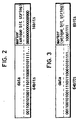
- FIG. 2 shows a 64-bit data added 16 consecutive zeros as the marker.
- the data to be transmitted can be image data as well as plotting coordinate data, and the image data may have a more than 16-bit null pattern.
- the marker addition unit 104 may input a "1" after 15 consecutive zeros, while the marker addition unit 104 and the appearance change permitting unit 109 both on the receiving terminal B may have a function of ignoring the bit value 1 inputted after the appearance of 15 consecutive zeros, thus avoiding confusion in distinguishing between the markers and the main data.
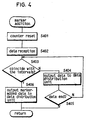
- FIG. 3 shows another type of marker for which an undefined bit string (10001111) is used as the operation code whose length is fixed to 8 bits. Even if variable-length plotting coordinate data incidentally has the same bit pattern as the marker, the confusion can be avoided in such a manner that the marker addition unit 104 on the transmitting terminal A outputs the bit pattern twice, while the equivalent units on the receiving terminal B ignore the second bit pattern. Image data can be coped with in the same manner as plotting coordinate data.
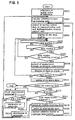
- the marker addition unit 104 operates as follows:
- the unit 104 resets a data counter (S401), and receives data either bit by bit or in predetermined bit groups from either the plot input unit 101 or the image data storage unit 102 (S402). Then the unit 104 counts the bit number of the data received and outputs each bit of the data to the data distribution unit 105 (S404) until the count value reaches the intervals (64 bits, for example) for adding markers (S403). When the count value comes to coincide with the intervals in the mean time, the unit 104 adds markers to the data and outputs the marker-added data to the data distribution unit 105 (S406). This process is repeated every time it is required. If the input of data to be transmitted ends before the count value reaches the intervals for adding markers (S405), then the unit 104 terminates its operation without adding a marker.
- Data to be added markers by the marker addition unit 104 includes training data stored in the image data storage unit 102 besides data to be transmitted such as still picture stored in the image data storage unit 102 and plotting coordinate data inputted from the plot input unit 101.
- the data distribution unit 105 outputs the marker-added data received from the marker addition unit 104 intact to both the communication unit 106 and a distinguishable display control unit 107.
- the same unit 105 receives marker-added data from the communication unit 106 and outputs it intact to the distinguishable display control unit 107. It is preferable that the unit 105 outputs the marker-added data to both units 106 and 107 at the same timing.
- the communication unit 106 connects a plurality of communication terminals over transmission paths to form intercommunication of data/control signals and audio signals.
- the distinguishable display control unit 107 makes a display unit 108 display the marker-added data received from the data distribution unit 105 in changed display appearance; for example, when the data is supposed to be displayed in black, a part of the data is displayed in gray. And every time the same part as displayed in gray on the transmitting terminal A has become visible on the receiving terminal B, it is notified to the appearance change permitting unit 109 by the distinguishable display control unit 107. And every time the unit 107 receives permitting to change the appearance of the data on display from the unit 109, each part displayed in gray on the transmitting terminal A is sequentially returned to black. When no more gray display data is left, the distinguishable display control unit 107 notifies it to the appearance change permitting unit 109.
- the same unit 107 outputs marker-added data received from the data distribution unit 105 to the display unit 108, and every time one part of the segmented data becomes visible on the receiving terminal B, it is notified to the appearance change permitting unit 109 by the unit 107.
- the appearance change permitting unit 109 waits for a reply that a part has become visible on the display unit 108 which should be sent from the distinguishable display control unit 107 and another reply that the same part as has become visible on the display unit 108 has become visible on the receiving terminal B which should be sent from the communication unit 106. When both the replys are acquired, the unit 109 outputs appearance change permitting information to the distinguishable display control unit 107.
- the appearance change permitting unit 109 judges whether the difference between a time required to get the reply that a part of the segmented training data has become visible on the display unit 108 and another time required to get the other reply that the same part of the data has become visible on the receiving terminal B is within the permissible range or not.
- the unit 109 also judges whether a time required for transmitting/receiving the entire training data depending on the number of the markers to be added thereto is within a permissible range or not.
- the unit 109 notifies the marker addition unit 104 that the training is over, and otherwise outputs information on adding markers at the intervals considered to be better for synchronization to the marker addition unit 104 in a manner described later.
- the same unit 109 outputs a reply to the communication unit 106 that a part of data has become visible on the display, which is received from the distinguishable display control unit 107.
- the following is a method for determining the best intervals for adding markers.
- the appearance change permitting unit 109 waits for a reply at a part of training data has become visible on its own terminal display which is sent from the distinguishable display control unit 107 and another reply that the same part has become visible on the receiving terminal B which is sent from the communication unit 106. When both the replys are acquired, the unit 109 outputs appearance change permitting information to the distinguishable display control unit 107. Receiving a reply that one part of the training data is visible on the receiving terminal B, the unit 109 finds the difference between the time X and the time Y, or
- the unit 109 outputs information on adding markers at shorter intervals to the marker addition unit 104. This output of training data is continued until the time difference is judged to be within the permissible range.
- transmission of data is processed as follows:
- the marker addition unit 104 refers to the initial value of the intervals for adding markers predetermined as a parameter (S501).
- the unit 104 then segments image data, which is held as training data in the image data storage unit 102, into a plurality of parts and adds a marker between each part at the predetermined intervals and outputs a part of the data to the data distribution unit 105 (S502).
- the data distribution unit 105 outputs a part with a marker to the receiving terminal B and outputs the part to the distinguishable display control unit 107 and the receiving terminal B simultaneously (S503).
- the distinguishable display control unit 107 makes the display unit 108 to display the marker-added part in gray (S504) and also seeks a marker (S505).
- the unit 107 detects the marker, then it is judged whether the part has become visible on the display unit 108 or not. When it has, it is notified to the appearance change permitting unit 109 (S506). After this, the unit 109 waits for a reply that the part has become visible on the receiving terminal B to be sent therefrom (S507). Receiving the reply, the appearance change permitting unit 109 outputs appearance change permitting information to the distinguishable display control unit 107 (S508), and then returns the part displayed in gray to black (S509).
- the above-mentioned process is carried out for the marker-added entire training data. If the marker detected is the last added, no more part displayed in gray being left (S510), then it is notified to the appearance change permitting unit 109 (S511). The unit 109 confirms the reply to be for the training data (S512), and then judges whether or not the
- the appearance change permitting unit 109 outputs information on adding markers at shorter intervals to the marker addition unit 104 (S515) and resumes the operations in S502-S512 for the training data which is added markers at the shortened intervals. This is repeated until the requirement
- T) * the number of markers (n) is within the allowable time range ⁇ 2 or not (S517). If T*n> ⁇ 2, then the unit 109 outputs information on adding markers at expanded intervals to the marker addition unit 104 (S518).
- the marker addition unit 104 adds markers to plotting data or image data at the intervals determined by the marker addition interval information of the unit 109 and outputs the marker-added data to the data distribution unit 105 (S521).
- the operations in S503-S511 are repeated the same number of times as the number of markers to add to data so as to complete the transmission operation.
- the communication unit 106 receives marker-added data from the transmitting terminal A (S601) and then outputs the received data to the data distribution unit 105.
- This unit 105 outputs the data to the distinguishable display control unit 107 (S602).
- This unit 107 outputs the data to the display unit 108 (S603), and simultaneously seeks the marker to judge whether a part of the data has been visible on the display unit 108 (S604-S605). After it is visualized, it is notified to the appearance change permitting unit 109.
- This unit 109 outputs this reply to the transmitting terminal A via the communication unit 106 (S605).
- the operations in S604-S605 are repeated until the part added the last marker has been visible (S607).
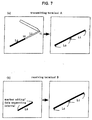
- FIG. 7 (a) and (b) respectively show the transition of display appearance at the transmitting terminal A and the receiving terminal B when the sender drew a straight line L.
- the portion L 1 is displayed in gray on the transmitting terminal A as shown in FIG. 7(a)(left).
- the first portion L 0 already displayed on the receiving terminal B is displayed in black.
- the receiving terminal B has not received the part of the data corresponding to the portion L 1 yet so that only the first portion L 0 is visible on the receiving terminal B as shown in FIG. 7 (b)(left).
- the time Y in the equation (2) elapses from the time t 0 , the part corresponding to the portion L 1 reaches the receiving terminal B and as a result, the portion L 1 is displayed in black as shown in FIG. 7 (b)(right).
- the portion L 1 becomes visible on the receiving terminal B, it is notified to the transmitting terminal A and the portion L 1 is displayed in black on the transmitting terminal A as shown in FIG. 7 (a)(right).
- the portion L 1 is changed from gray to black on the transmitting terminal A shown in FIG. 7 (a)(right) and the same portion L 1 becomes visible on the receiving terminal B shown in FIG. 7 (b)(right); the former is delayed because of the time required for the transmitting terminal A to receive a reply that the part has become visible on the receiving terminal B.
- the portion L 1 is displayed in gray from the start point of being drawn on the transmitting terminal A, so that the conformity of display on both terminals can be confirmed at latest when the portion L 1 has been changed to black as mentioned.
- inconvenience caused by the time delay between the display of data on a transmitting terminal A and the display of the same data on a receiving terminal B can be eliminated.
- FIG. 8 (a) and (b) respectively show the transition of display appearance at the transmitting terminal A and the receiving terminal B when image data is transmitted. Time proceeds from the reference numbers 1 to 4 in both (a) and (b). The comparison between (a) and (b) proves the guarantee of the conformity.
- the data is actually sent with markers in the embodiment, information on intervals to add markers may be predetermined instead and commonly owned by both terminals.
- the data is segmented into parts using the information and each part is displayed in gray until the transmitting terminal A receives a reply that each part has become visible on the receiving terminal B.
- the receiving terminal B receives the data added no marker from the transmitting terminal A and segments the data using the information. And every time a part becomes visible on the receiving terminal B, it is notified to the transmitting terminal A.
- the distinguishable display control unit 107 changes display tones between already visualized data and not visualized data yet on the receiving terminal B even for training data in the embodiment, the appearance for each of them does not need to be distinguished and only a reply may be received every time a part has been visible.
- plot data consecutively inputted from the plot input unit 101 may be used instead.
- each one part of training data added markers at different length of intervals may be transmitted by turns, so that it may be judged whether the first requirement is met or not for each one part and then one having the best interval among them may be selected.
Landscapes
- Engineering & Computer Science (AREA)
- Computer Security & Cryptography (AREA)
- Computer Networks & Wireless Communication (AREA)
- Signal Processing (AREA)
- Controls And Circuits For Display Device (AREA)
- Communication Control (AREA)
- Facsimiles In General (AREA)
- Facsimile Transmission Control (AREA)
- Electrically Operated Instructional Devices (AREA)
Claims (20)
- Terminal de transmission (A) connecté à un terminal de réception (B) par l'intermédiaire d'une ligne de communication dans un système d'affichage synchrone pour afficher des données à afficher de manière synchrone à la fois sur le terminal de transmission et le terminal de réception, comprenant :des moyens de segmentation de données (104) pour segmenter les données en une pluralité de parties à intervalles prédéterminées ;des moyens de communication (106) pour transmettre les données segmentées au terminal de réception (B) et ensuite recevoir une réponse de celui-ci à chaque fois qu'une partie des données segmentées à été visible sur l'affichage du terminal de réception ;des moyens d'affichage (108) pour visualiser les données ; etdes moyens de commande d'affichage (107) pour commander les moyens d'affichage (108) pour visualiser la même partie lorsqu'elle est transmise au terminal de réception (B) d'abord de manière discernable à partir des autres parties qui ont déjà été visualisées et ensuite de manière indiscernable à partir de celui-ci lorsque les moyens de communication (106) reçoivent une réponse du terminal de réception (B) comme quoi la même partie y a été visible.
- Terminal de transmission selon la revendication 1, dans lequel les moyens de segmentation de données (104) comprennent une unité de division pour diviser les données à des intervalles prédéterminées et une unité d'ajout de marques pour ajouter une marque entre chaque partie des données segmentées.
- Terminal de transmission selon la revendication 2, dans lequel les données à afficher sont une chaíne de données encodées par un système d'encodage prédéterminé, et la marque est une chaíne à bit unique différents de la chaíne de données encodées.
- Terminal de transmission selon la revendication 3, dans lequel les données à afficher sont choisies parmi une chaíne de données de coordonnées de traçage alimentée à travers des moyens d'entrée de coordonnées et des données d'images lues par des moyens de lecture d'images.
- Terminal de transmission selon la revendication 4, comprenant en outre des moyens de détermination de la longueur d'une partie comprenant :une unité de stockage de données de formation (102) pour stocker des données de formation ;une unité de détection de retard temporel d'affichage d'une partie pour détecter la période de temps commençant lorsqu'une partie des données de formation à laquelle a été ajoutées des marques à une certaine longueur d'intervalle et visualisées sur le terminal de transmission (A) et qui termine lorsque le terminal de transmission reçoit une réponse du terminal de réception (B) comme quoi la même partie que celle visualisée sur le terminal de transmission (A) a été visible sur le terminal de réception (B) ;une unité d'évaluation de retard temporel d'affichage d'une partie pour évaluer si le retard d'affichage détecté est situé dans un domaine acceptable ou non ;une unité de raccourcissement d'intervalles pour raccourcir les intervalles pour ajouter les marques lorsque le retard d'affichage est détecté comme étant hors du domaine acceptable ; etune unité de commande d'intervalles d'une partie pour commander toutes les unités constituées par l'unité de détection de retard temporel d'affichage d'une partie, l'unité d'évaluation de retard temporel d'affichage d'une partie, et l'unité de raccourcissement d'intervalles de manière à afficher des données de formation auxquelles ont été ajoutées des marques à des longueurs d'intervalles différentes à la fois sur les terminaux de transmission et de réception, le contrôle étant continu jusqu'à ce que le retard d'affichage rentre dans le domaine acceptable.
- Terminal de transmission selon la revendication 5, dans lequel les moyens de détermination de la longueur d'une partie comprennent en outre :une unité d'évaluation de retard temporel d'affichage de données entières pour évaluer si le retard pour les données de formation entières sont situées à l'intérieur d'un domaine acceptable ou non après que le retard détecté par l'unité d'évaluation de retard temporel d'affichage d'une partie est situé dans le domaine acceptable ;une unité d'extension d'intervalles pour étendre les intervalles pour ajouter les marques lorsque le retard pour les données de formation entières sont évaluées comme étant situées hors du domaine acceptable ; etune unité de contrôle de retour pour contrôler la formation pour ajuster les intervalles afin d'ajouter des marques aux données de formation à des intervalles étendues à continuer jusqu'à ce que l'unité d'évaluation de retard temporel d'affichage d'une partie et l'unité d'évaluation de retard temporel d'affichage de données entières évaluent les intervalles comme étant optimums.
- Terminal de transmission selon la revendication 6, dans lequel les moyens de détermination de la longueur d'une partie fonctionne pour transmettre les données de formation avant les données après que la connexion entre les terminaux de transmission et de réception est établie.
- Terminal de transmission selon la revendication 1, dans lequel les moyens de commande d'affichage (107) commandent les moyens d'affichage (108) pour visualiser la même partie que celle transmise sur le terminal de réception (B) de manière discernable à partir des autres parties qui sont déjà visibles en différenciant les tons ou les couleurs entre eux.
- Appareil pour commander un affichage synchrone de données à transmettre parmi une pluralité de terminaux interconnectés par une ligne de communication, comprenant :des moyens de segmentation de données (104) pour, dans une opération de transmission, segmenter les données en une pluralité de parties avec des intervalles prédéterminées ;des moyens de communication (106) pour, dans une opération de transmission, transmettre les données segmentées au terminal de réception (B) et ensuite recevoir une réponse de celui-ci à chaque fois qu'une partie des données segmentées a été visible sur l'affichage du terminal de réception (108), et pour, dans une opération de réception, recevoir les données segmentées du terminal de transmission (A) et ensuite transmettre une réponse à celui-ci à chaque fois qu'une partie des données segmentées y a été visible ;des moyens d'affichage (108) pour visualiser les données ;des moyens de commande d'affichage (107) pour, dans une opération de transmission, commander les moyens d'affichage (108) pour visualiser la même partie que celle transmise au terminal de réception (B) d'abord de manière discernable à partir des autres parties qui sont déjà visualisées et ensuite de manière indiscernable à partir de celles-ci lorsque les moyens de communication (106) reçoivent une réponse du terminal de réception (B) comme quoi la même partie y a été visible, et pour, dans une opération de réception, commander les moyens d'affichage (108) pour visualiser la partie des données segmentées reçues par l'intermédiaire des moyens de communication (106) du terminal de transmission (A) ; etdes moyens d'envoi de réponses pour, dans une opération de réception, envoyer une réponse au terminal de transmission (A) via les moyens de communication (106) à chaque fois qu'une partie des données segmentées transmises par le terminal de transmission (A) y a été visible.
- Appareil selon la revendication 9, dans lequel les moyens de segmentation de données (104) comprennent une unité de division pour diviser les données à des intervalles prédéterminées et une unité d'ajout de marques pour ajouter une marque entre chaque partie des données segmentées.
- Appareil selon la revendication 10, dans lequel les données à afficher sont une chaíne de données encodées par un système d'encodage prédéterminé, et la marque est une chaíne à bit unique différents de la chaíne de données encodées.
- Appareil selon la revendication 11, dans lequel les données à afficher sont choisies parmi une chaíne de données de coordonnées de traçage alimentée à travers des moyens d'entrée de coordonnées et des données d'images lues par des moyens de lecture d'images.
- Appareil selon 1a revendication 12, comprenant en outre des moyens de détermination de la longueur d'une partie comprenant :une unité de stockage de données de formation (102) pour stocker des données de formation ;une unité de détection de retard temporel d'affichage d'une partie pour détecter la période de temps commençant lorsqu'une partie des données de formation à laquelle a été ajoutées des marques à une certaine longueur d'intervalle et visualisées sur le terminal de transmission (A) et qui terminent' lorsque le terminal de transmission reçoit une réponse du terminal de réception (B) comme quoi la même partie que celle visualisée sur le terminal de transmission (A) a été visible sur le terminal de réception (B) ;une unité d'évaluation de retard temporel d'affichage d'une partie pour évaluer si le retard d'affichage détecté est situé dans un domaine acceptable ou non ;une unité de raccourcissement d'intervalles pour raccourcir les intervalles pour ajouter les marques lorsque le retard d'affichage est détecté comme étant hors du domaine acceptable ; etune unité de commande d'intervalles d'une partie pour commander toutes les unités constituées par l'unité de détection de retard temporel d'affichage d'une partie, l'unité d'évaluation de retard temporel d'affichage d'une partie, et l'unité de raccourcissement d'intervalles de manière à afficher des données de formation auxquelles ont été ajoutées des marques à des longueurs d'intervalles différentes à la fois sur les terminaux de transmission et de réception, le contrôle étant continu jusqu'à ce que le retard d'affichage rentre dans le domaine acceptable.
- Appareil selon 1a revendication 13, dans lequel les moyens de détermination de la longueur d'une partie comprennent en outre :une unité d'évaluation de retard temporel d'affichage de données entières pour évaluer si le retard pour les données de formation entières sont situées à l'intérieur d'un domaine acceptable ou non après que le retard détecté par l'unité d'évaluation de retard temporel d'affichage d'une partie est situé dans le domaine acceptable ;une unité d'extension d'intervalles pour étendre les intervalles pour ajouter les marques lorsque le retard pour les données de formation entières sont évaluées comme étant situées hors du domaine acceptable ; etune unité de contrôle de retour pour contrôler la formation pour ajuster les intervalles afin d'ajouter des marques aux données de formation à des intervalles étendues à continuer jusqu'à ce que l'unité d'évaluation de retard temporel d'affichage d'une partie et l'unité d'évaluation de retard temporel d'affichage de données entières évaluent les intervalles comme étant optimums.
- Appareil selon la revendication 14, dans lequel les moyens de détermination de la longueur d'une partie fonctionne pour transmettre les données de formation avant les données après que la connexion entre les terminaux de transmission et de réception est établie.
- Appareil selon la revendication 9, dans lequel les moyens de segmentation de données (104) possèdent les mêmes informations sur les intervalles pour ajouter des marques aux données que les moyens de segmentation de données dans l'autre terminal, et les moyens de segmentation de données (104), dans une opération de transmission, utilisent les informations uniquement pour les données à transmettre à l'unité de commande d'affichage de son propre terminal, alors que dans une opération de réception, ils utilisent les informations pour les données transmises à partir du terminal de transmission (A).
- Appareil selon la revendication 16, dans lequel les données à afficher sont choisies parmi une chaíne de données de coordonnées de traçage alimentée à travers des moyens d'entrée de coordonnées et des données d'images lues par des moyens de lecture d'images.
- Appareil selon la revendication 9, dans lequel les moyens de commande d'affichage (107) commandent les moyens d'affichage (108) pour visualiser la même partie que celle transmise sur le terminal de réception (B) de manière discernable à partir des autres parties qui sont déjà visibles en différenciant les tons ou les couleurs entre eux.
- Appareil de formation pour fixer des intervalles auxquelles des marques sont ajoutées à des données à afficher, l'appareil étant utilisé dans un' système d'affichage synchrone pour afficher les données de manière synchrone à la fois sur un terminal de transmission (A) et sur un terminal de réception (B) parmi une pluralité de terminaux interconnectés par l'intermédiaire d'une ligne de communication, comprenant :une unité de stockage de données de formation (102) pour stocker des données de formation ;une unité de détection de retard temporel d'affichage d'une partie pour détecter la période de temps commençant lorsqu'une partie des données de formation à laquelle a été ajoutées des marques à une certaine longueur d'intervalle et visualisées sur le terminal de transmission (A) et qui terminent lorsque le terminal de transmission reçoit une réponse du terminal de réception (B) comme quoi la même partie que celle visualisée sur le terminal de transmission (A) a été visible sur le terminal de réception (B) ;une unité de dévaluation de retard temporel d'affichage d'une partie pour évaluer si le retard d'affichage détecté est situé dans un domaine acceptable ou non ;une unité de raccourcissement d'intervalles pour raccourcir les intervalles pour ajouter les marques lorsque le retard d'affichage est détecté comme étant hors du domaine acceptable ; etune unité de commande d'intervalles d'une partie pour commander toutes les unités de détection de retard temporel d'affichage d'une partie, l'unité d'évaluation de retard temporel d'affichage d'une partie, et l'unité de raccourcissement d'intervalles de manière à afficher des données de formation auxquelles ont été ajoutées des marques à des longueurs d'intervalles différentes à la fois sur les terminaux de transmission et de réception, le contrôle étant continu jusqu'à ce que le retard d'affichage rentre dans le domaine acceptable.
- Appareil selon la revendication 19, comprenant en outre :une unité d'évaluation de retard temporel d'affichage de données entières pour évaluer si le retard pour les données de formation entières sont situées à l'intérieur d'un domaine acceptable ou non après que le retard détecté par l'unité d'évaluation de retard temporel d'affichage d'une partie est situé dans le domaine acceptable ;une unité d'extension d'intervalles pour étendre les intervalles pour ajouter les marques lorsque le retard pour les données de formation entières sont évaluées comme étant situées hors du domaine acceptable ; etune unité de contrôle de retour pour contrôler la formation pour ajuster les intervalles afin d'ajouter des marques aux données de formation à des intervalles étendues à continuer jusqu'à ce que l'unité d'évaluation de retard temporel d'affichage d'une partie et l'unité d'évaluation de retard temporel d'affichage de données entières évaluent les intervalles comme étant optimums.
Applications Claiming Priority (3)
| Application Number | Priority Date | Filing Date | Title |
|---|---|---|---|
| JP4153875A JPH05347674A (ja) | 1992-06-12 | 1992-06-12 | 同期表示制御装置 |
| JP15387592 | 1992-06-12 | ||
| JP153875/92 | 1992-06-12 |
Publications (2)
| Publication Number | Publication Date |
|---|---|
| EP0576183A1 EP0576183A1 (fr) | 1993-12-29 |
| EP0576183B1 true EP0576183B1 (fr) | 2002-09-25 |
Family
ID=15572028
Family Applications (1)
| Application Number | Title | Priority Date | Filing Date |
|---|---|---|---|
| EP93304602A Expired - Lifetime EP0576183B1 (fr) | 1992-06-12 | 1993-06-14 | Dispositif synchrone de commande d'affichage |
Country Status (4)
| Country | Link |
|---|---|
| US (1) | US5469183A (fr) |
| EP (1) | EP0576183B1 (fr) |
| JP (1) | JPH05347674A (fr) |
| DE (1) | DE69332326T2 (fr) |
Cited By (1)
| Publication number | Priority date | Publication date | Assignee | Title |
|---|---|---|---|---|
| US7747953B2 (en) | 2006-06-15 | 2010-06-29 | Citrix Online, Llc | Methods and systems for receiving feedback from a scalable number of participants of an on-line presentation |
Families Citing this family (22)
| Publication number | Priority date | Publication date | Assignee | Title |
|---|---|---|---|---|
| US20020091850A1 (en) * | 1992-10-23 | 2002-07-11 | Cybex Corporation | System and method for remote monitoring and operation of personal computers |
| JP3019178B2 (ja) * | 1993-05-27 | 2000-03-13 | インターナショナル・ビジネス・マシーンズ・コーポレイション | 画面表示共用システム |
| WO1996014119A1 (fr) * | 1994-11-04 | 1996-05-17 | Catapult Entertainment | Procede et appareil de synchronisation approximative de dispositifs d'affichage par trame fermes non synchronises |
| US5604509A (en) * | 1995-04-14 | 1997-02-18 | Advent Design, Inc. | Remote display monitor system |
| US5721842A (en) | 1995-08-25 | 1998-02-24 | Apex Pc Solutions, Inc. | Interconnection system for viewing and controlling remotely connected computers with on-screen video overlay for controlling of the interconnection switch |
| JPH09237354A (ja) * | 1996-02-29 | 1997-09-09 | Chokosoku Network Computer Gijutsu Kenkyusho:Kk | 3次元形状データ転送表示方法 |
| US6195086B1 (en) * | 1996-09-12 | 2001-02-27 | Hearme | Method and apparatus for loosely synchronizing closed free running raster displays |
| US5990852A (en) * | 1996-10-31 | 1999-11-23 | Fujitsu Limited | Display screen duplication system and method |
| US6199104B1 (en) | 1997-04-28 | 2001-03-06 | Sabre Inc. | Server-based host monitor |
| US6356934B1 (en) | 1997-04-28 | 2002-03-12 | Sabre Inc. | Intermediate server having control program for storing content accessed during browsing sessions and playback program for asynchronously replaying browsing sessions |
| US6286029B1 (en) | 1997-04-28 | 2001-09-04 | Sabre Inc. | Kiosk controller that retrieves content from servers and then pushes the retrieved content to a kiosk in the order specified in a run list |
| WO1999026191A1 (fr) * | 1997-11-14 | 1999-05-27 | Inmotion, Inc. | Dispositif servant au rendu d'un dessin |
| JPH11215126A (ja) * | 1998-01-28 | 1999-08-06 | Sharp Corp | 情報処理装置 |
| WO2000017766A2 (fr) | 1998-09-22 | 2000-03-30 | Cybex Computer Products Corporation | Systeme et procede permettant l'acces et l'exploitation a distance sur ordinateur personnel |
| US6686933B1 (en) * | 2000-01-07 | 2004-02-03 | Sun Microsystems, Inc. | Lightweight indicator of divergence of views for collaboratively shared user interface elements |
| US6522309B1 (en) * | 2000-02-28 | 2003-02-18 | Savry Stuff Property Trust | Multiscreen personal computer display method and apparatus |
| JP2004133733A (ja) * | 2002-10-11 | 2004-04-30 | Sony Corp | 表示装置および方法、並びにプログラム |
| US9572754B2 (en) | 2004-03-04 | 2017-02-21 | L'oreal | Transparent self-tanning gels containing a water-soluble/dispersible acrylamido-2-methylpropanesulfonic acid polymer |
| US8677252B2 (en) | 2006-04-14 | 2014-03-18 | Citrix Online Llc | Systems and methods for displaying to a presenter visual feedback corresponding to visual changes received by viewers |
| US7585210B2 (en) * | 2007-01-26 | 2009-09-08 | Mike Yurcak | Negative air supplied (NAS) crawlspace system |
| JP5901221B2 (ja) * | 2011-10-21 | 2016-04-06 | キヤノン株式会社 | 印刷制御装置、方法及びプログラム |
| KR20130111072A (ko) * | 2012-03-30 | 2013-10-10 | 삼성전자주식회사 | 디스플레이 시스템 및 그것의 디스플레이 장치 |
Family Cites Families (7)
| Publication number | Priority date | Publication date | Assignee | Title |
|---|---|---|---|---|
| JPS54145435A (en) * | 1978-05-08 | 1979-11-13 | Nec Corp | Data transfer system between master and slave of cathod- ray tube display units |
| US4794634A (en) * | 1985-12-24 | 1988-12-27 | Kabushiki Kaisha Komatsu Seisakusho | Position-sensitive photodetector and light transmissive tablet and light-emitting pen |
| JPS6467061A (en) * | 1987-09-07 | 1989-03-13 | Sharp Kk | Telewriting equipment |
| JPH01270091A (ja) * | 1988-04-22 | 1989-10-27 | Canon Inc | 画像表示システム |
| JP2791097B2 (ja) * | 1988-05-13 | 1998-08-27 | 株式会社日立製作所 | 対話通信方法およびシステム |
| JPH0329991A (ja) * | 1989-06-27 | 1991-02-07 | Seiko Instr Inc | 表示メモリ装置 |
| US5103446A (en) * | 1990-11-09 | 1992-04-07 | Moses Computers, Inc. | Local area network adaptive throughput control for instantaneously matching data transfer rates between personal computer nodes |
-
1992
- 1992-06-12 JP JP4153875A patent/JPH05347674A/ja active Pending
-
1993
- 1993-06-14 US US08/077,250 patent/US5469183A/en not_active Expired - Lifetime
- 1993-06-14 DE DE69332326T patent/DE69332326T2/de not_active Expired - Fee Related
- 1993-06-14 EP EP93304602A patent/EP0576183B1/fr not_active Expired - Lifetime
Cited By (1)
| Publication number | Priority date | Publication date | Assignee | Title |
|---|---|---|---|---|
| US7747953B2 (en) | 2006-06-15 | 2010-06-29 | Citrix Online, Llc | Methods and systems for receiving feedback from a scalable number of participants of an on-line presentation |
Also Published As
| Publication number | Publication date |
|---|---|
| US5469183A (en) | 1995-11-21 |
| DE69332326D1 (de) | 2002-10-31 |
| DE69332326T2 (de) | 2003-01-23 |
| JPH05347674A (ja) | 1993-12-27 |
| EP0576183A1 (fr) | 1993-12-29 |
Similar Documents
| Publication | Publication Date | Title |
|---|---|---|
| EP0576183B1 (fr) | Dispositif synchrone de commande d'affichage | |
| US5654726A (en) | Screen display sharing system | |
| EP0183273B1 (fr) | Système interface sériel applicable avec flexibilité à une connexion entre une et plusieurs unités | |
| US4733303A (en) | Facsimile apparatus | |
| US4841521A (en) | Method and system for bidirectionally transmitting data | |
| CN1084002A (zh) | 信号传递的方法和装置 | |
| JP3149202B2 (ja) | 時分割無線通信システムで送信器アンテナの選択に関する異なる指令を送信する方法 | |
| JP2016092445A (ja) | シリアル通信システム | |
| EP1391827B1 (fr) | Dispositif et procede de transmission | |
| US5787356A (en) | Cordless telephone system and generation method of a unique word thereof | |
| DE68914831T2 (de) | Terminalanpassungseinrichtung mit Empfänger von mehreren HDLC-Kommunikationskanälen zur Bearbeitung der Netzsteuerungsrahmen. | |
| US5260977A (en) | Communication terminal equipment | |
| EP0358625B1 (fr) | Procédé pour former un champ de vecteurs de mouvement pour la transmission d'informations se rapportant à des images mobiles | |
| CN110278171B (zh) | 一种帧同步头检测方法及装置 | |
| JP2623189B2 (ja) | 無線回線における秘匿送受信方法及びそれを使用した装置 | |
| JPH0897816A (ja) | データ受信装置 | |
| JPH065831B2 (ja) | 信号フレ−ムの伝送方式 | |
| KR19990035427A (ko) | 단일 프로세스 그룹에서의 멀티캐스팅을 위한 인과관계 순서화방법 | |
| EP0358624A2 (fr) | Système de transmission d'informations concernant des images mobiles | |
| JPS61177600A (ja) | 手書き図形伝送電話 | |
| JPH09200746A (ja) | 同期復旧方式 | |
| JPS6173456A (ja) | 情報送受信方式 | |
| JPH05260002A (ja) | 計算機システムにおけるデータ伝送方法 | |
| JPH0642668B2 (ja) | データ交換システム | |
| JPH03254539A (ja) | データ伝送方式 |
Legal Events
| Date | Code | Title | Description |
|---|---|---|---|
| PUAI | Public reference made under article 153(3) epc to a published international application that has entered the european phase |
Free format text: ORIGINAL CODE: 0009012 |
|
| AK | Designated contracting states |
Kind code of ref document: A1 Designated state(s): DE FR GB |
|
| 17P | Request for examination filed |
Effective date: 19940629 |
|
| GRAG | Despatch of communication of intention to grant |
Free format text: ORIGINAL CODE: EPIDOS AGRA |
|
| 17Q | First examination report despatched |
Effective date: 20010824 |
|
| GRAG | Despatch of communication of intention to grant |
Free format text: ORIGINAL CODE: EPIDOS AGRA |
|
| GRAH | Despatch of communication of intention to grant a patent |
Free format text: ORIGINAL CODE: EPIDOS IGRA |
|
| GRAH | Despatch of communication of intention to grant a patent |
Free format text: ORIGINAL CODE: EPIDOS IGRA |
|
| GRAH | Despatch of communication of intention to grant a patent |
Free format text: ORIGINAL CODE: EPIDOS IGRA |
|
| GRAA | (expected) grant |
Free format text: ORIGINAL CODE: 0009210 |
|
| AK | Designated contracting states |
Kind code of ref document: B1 Designated state(s): DE FR GB |
|
| REG | Reference to a national code |
Ref country code: GB Ref legal event code: FG4D |
|
| REF | Corresponds to: |
Ref document number: 69332326 Country of ref document: DE Date of ref document: 20021031 |
|
| ET | Fr: translation filed | ||
| PLBE | No opposition filed within time limit |
Free format text: ORIGINAL CODE: 0009261 |
|
| STAA | Information on the status of an ep patent application or granted ep patent |
Free format text: STATUS: NO OPPOSITION FILED WITHIN TIME LIMIT |
|
| 26N | No opposition filed |
Effective date: 20030626 |
|
| PGFP | Annual fee paid to national office [announced via postgrant information from national office to epo] |
Ref country code: DE Payment date: 20070607 Year of fee payment: 15 |
|
| PGFP | Annual fee paid to national office [announced via postgrant information from national office to epo] |
Ref country code: GB Payment date: 20070613 Year of fee payment: 15 |
|
| PGFP | Annual fee paid to national office [announced via postgrant information from national office to epo] |
Ref country code: FR Payment date: 20070608 Year of fee payment: 15 |
|
| GBPC | Gb: european patent ceased through non-payment of renewal fee |
Effective date: 20080614 |
|
| REG | Reference to a national code |
Ref country code: FR Ref legal event code: ST Effective date: 20090228 |
|
| PG25 | Lapsed in a contracting state [announced via postgrant information from national office to epo] |
Ref country code: DE Free format text: LAPSE BECAUSE OF NON-PAYMENT OF DUE FEES Effective date: 20090101 |
|
| PG25 | Lapsed in a contracting state [announced via postgrant information from national office to epo] |
Ref country code: GB Free format text: LAPSE BECAUSE OF NON-PAYMENT OF DUE FEES Effective date: 20080614 |
|
| PG25 | Lapsed in a contracting state [announced via postgrant information from national office to epo] |
Ref country code: FR Free format text: LAPSE BECAUSE OF NON-PAYMENT OF DUE FEES Effective date: 20080630 |