EP0586504B1 - Traitement de feuille d'aluminium - Google Patents
Traitement de feuille d'aluminium Download PDFInfo
- Publication number
- EP0586504B1 EP0586504B1 EP92911798A EP92911798A EP0586504B1 EP 0586504 B1 EP0586504 B1 EP 0586504B1 EP 92911798 A EP92911798 A EP 92911798A EP 92911798 A EP92911798 A EP 92911798A EP 0586504 B1 EP0586504 B1 EP 0586504B1
- Authority
- EP
- European Patent Office
- Prior art keywords
- sheet
- biased
- bias
- way
- cathodic
- Prior art date
- Legal status (The legal status is an assumption and is not a legal conclusion. Google has not performed a legal analysis and makes no representation as to the accuracy of the status listed.)
- Expired - Lifetime
Links
- 238000000034 method Methods 0.000 claims abstract description 30
- 238000007788 roughening Methods 0.000 claims abstract description 20
- 230000015572 biosynthetic process Effects 0.000 claims abstract description 14
- 239000003792 electrolyte Substances 0.000 claims description 27
- 238000011282 treatment Methods 0.000 claims description 11
- GRYLNZFGIOXLOG-UHFFFAOYSA-N Nitric acid Chemical compound O[N+]([O-])=O GRYLNZFGIOXLOG-UHFFFAOYSA-N 0.000 claims description 6
- 229910017604 nitric acid Inorganic materials 0.000 claims description 6
- 230000009471 action Effects 0.000 claims description 3
- 229910052782 aluminium Inorganic materials 0.000 abstract description 20
- XAGFODPZIPBFFR-UHFFFAOYSA-N aluminium Chemical compound [Al] XAGFODPZIPBFFR-UHFFFAOYSA-N 0.000 abstract description 20
- 239000004411 aluminium Substances 0.000 abstract description 19
- 239000003990 capacitor Substances 0.000 abstract description 4
- 239000011888 foil Substances 0.000 abstract description 4
- 238000002474 experimental method Methods 0.000 description 14
- VEXZGXHMUGYJMC-UHFFFAOYSA-N Hydrochloric acid Chemical compound Cl VEXZGXHMUGYJMC-UHFFFAOYSA-N 0.000 description 8
- 230000008569 process Effects 0.000 description 7
- 229910045601 alloy Inorganic materials 0.000 description 6
- 239000000956 alloy Substances 0.000 description 6
- 230000000694 effects Effects 0.000 description 6
- 238000004140 cleaning Methods 0.000 description 5
- 229910052751 metal Inorganic materials 0.000 description 4
- 239000002184 metal Substances 0.000 description 4
- 230000008859 change Effects 0.000 description 3
- 239000010936 titanium Substances 0.000 description 3
- 229910000838 Al alloy Inorganic materials 0.000 description 2
- OKTJSMMVPCPJKN-UHFFFAOYSA-N Carbon Chemical compound [C] OKTJSMMVPCPJKN-UHFFFAOYSA-N 0.000 description 2
- 229910001069 Ti alloy Inorganic materials 0.000 description 2
- 230000002378 acidificating effect Effects 0.000 description 2
- 238000007743 anodising Methods 0.000 description 2
- 238000007796 conventional method Methods 0.000 description 2
- 230000005611 electricity Effects 0.000 description 2
- 229910002804 graphite Inorganic materials 0.000 description 2
- 239000010439 graphite Substances 0.000 description 2
- 239000007788 liquid Substances 0.000 description 2
- 238000004519 manufacturing process Methods 0.000 description 2
- 239000000463 material Substances 0.000 description 2
- 239000000203 mixture Substances 0.000 description 2
- 101100165186 Caenorhabditis elegans bath-34 gene Proteins 0.000 description 1
- 235000010724 Wisteria floribunda Nutrition 0.000 description 1
- 239000003082 abrasive agent Substances 0.000 description 1
- 239000002253 acid Substances 0.000 description 1
- 239000000654 additive Substances 0.000 description 1
- 229910052910 alkali metal silicate Inorganic materials 0.000 description 1
- 238000005275 alloying Methods 0.000 description 1
- 230000004888 barrier function Effects 0.000 description 1
- 239000002585 base Substances 0.000 description 1
- KGBXLFKZBHKPEV-UHFFFAOYSA-N boric acid Chemical compound OB(O)O KGBXLFKZBHKPEV-UHFFFAOYSA-N 0.000 description 1
- 239000004327 boric acid Substances 0.000 description 1
- 229920002678 cellulose Polymers 0.000 description 1
- 239000001913 cellulose Substances 0.000 description 1
- 239000011248 coating agent Substances 0.000 description 1
- 238000000576 coating method Methods 0.000 description 1
- 238000011161 development Methods 0.000 description 1
- 238000010586 diagram Methods 0.000 description 1
- 230000002349 favourable effect Effects 0.000 description 1
- 238000007654 immersion Methods 0.000 description 1
- 230000006872 improvement Effects 0.000 description 1
- 239000012535 impurity Substances 0.000 description 1
- 238000011221 initial treatment Methods 0.000 description 1
- 238000009533 lab test Methods 0.000 description 1
- 238000001000 micrograph Methods 0.000 description 1
- 230000007935 neutral effect Effects 0.000 description 1
- 230000003287 optical effect Effects 0.000 description 1
- 150000007524 organic acids Chemical class 0.000 description 1
- 235000005985 organic acids Nutrition 0.000 description 1
- 230000003647 oxidation Effects 0.000 description 1
- 238000007254 oxidation reaction Methods 0.000 description 1
- 238000012545 processing Methods 0.000 description 1
- 230000001681 protective effect Effects 0.000 description 1
- 238000010561 standard procedure Methods 0.000 description 1
- 239000000126 substance Substances 0.000 description 1
- 238000002604 ultrasonography Methods 0.000 description 1
Images
Classifications
-
- B—PERFORMING OPERATIONS; TRANSPORTING
- B41—PRINTING; LINING MACHINES; TYPEWRITERS; STAMPS
- B41N—PRINTING PLATES OR FOILS; MATERIALS FOR SURFACES USED IN PRINTING MACHINES FOR PRINTING, INKING, DAMPING, OR THE LIKE; PREPARING SUCH SURFACES FOR USE AND CONSERVING THEM
- B41N3/00—Preparing for use and conserving printing surfaces
- B41N3/03—Chemical or electrical pretreatment
- B41N3/034—Chemical or electrical pretreatment characterised by the electrochemical treatment of the aluminum support, e.g. anodisation, electro-graining; Sealing of the anodised layer; Treatment of the anodic layer with inorganic compounds; Colouring of the anodic layer
-
- C—CHEMISTRY; METALLURGY
- C25—ELECTROLYTIC OR ELECTROPHORETIC PROCESSES; APPARATUS THEREFOR
- C25F—PROCESSES FOR THE ELECTROLYTIC REMOVAL OF MATERIALS FROM OBJECTS; APPARATUS THEREFOR
- C25F3/00—Electrolytic etching or polishing
- C25F3/02—Etching
- C25F3/04—Etching of light metals
-
- Y—GENERAL TAGGING OF NEW TECHNOLOGICAL DEVELOPMENTS; GENERAL TAGGING OF CROSS-SECTIONAL TECHNOLOGIES SPANNING OVER SEVERAL SECTIONS OF THE IPC; TECHNICAL SUBJECTS COVERED BY FORMER USPC CROSS-REFERENCE ART COLLECTIONS [XRACs] AND DIGESTS
- Y10—TECHNICAL SUBJECTS COVERED BY FORMER USPC
- Y10S—TECHNICAL SUBJECTS COVERED BY FORMER USPC CROSS-REFERENCE ART COLLECTIONS [XRACs] AND DIGESTS
- Y10S204/00—Chemistry: electrical and wave energy
- Y10S204/09—Wave forms
Definitions
- This invention relates to a method of electrochemically roughening an Al sheet, mainly for use as a lithographic plate support or a capacitor foil.
- the surface needs to be roughened or grained.
- Standard techniques for this include: mechanical graining by the use of balls or abrasives or wire brushes; electrochemical graining, by the application of an AC current in an acidic electrolyte; and chemical graining, by simple immersion in an etch.
- Roughening is carried out in order to enhance the adhesion of a photosensitive coating on the support, and to improve the water retention properties of the uncoated support surface. Irradiation and development of a lithographic plate generally result in ink-receptive image areas and water-retaining non-image areas, the latter generally being the uncovered support surface.
- the aluminium sheet needs to be roughened on a scale of approximately 1 - 15 ⁇ m.
- This invention is concerned with an improvement in the electrochemical graining or roughening technique. It is known to subject the Al sheet to AC, the current being biased in the anodic direction. It is also known to subject the Al sheet to AC with the current biased in the cathodic direction. Different advantages are claimed for the two alternatives. But neither alternative is effective to achieve uniform graining of the Al sheet on a desired scale, and in the shortest possible time. In the economics of this industry, time considerations are of paramount importance. In commercial electrochemical graining, sheet is passed continuously through a long bath of electrolyte; treatment time determines the speed of passage of the sheet, and the length of the bath and hence the amount of electrolyte used.
- US Patent 4,561,944 (Fuji) describes a two-step or three-step graining treatment. Al sheet is first mechanically roughened, then optionally chemically etched, and finally electrochemically roughened by means of AC biased on the cathodic side. Because several roughening steps are involved, this treatment is relatively expensive.
- U.S. Patent 4,897,168 describes a process for the production of a roughened aluminium printing plate support by means of a pulsed direct current in an acidic electrolyte. During roughening the plate is mainly anodic. The roughened plate may thereafter be subjected to the cathodic half of the power supply which may exert a cleaning effect.
- the invention provides a method of electrochemically roughening a surface of an Al sheet, by subjecting the sheet in an aqueous electrolyte to the action of an alternating electric current, characterised in that the AC is initially biased in a first way for a time sufficient at least to initiate formation of a first pitting structure on the surface, and is then biased in a second way for a time sufficient at least to initiate formation of a second pitting structure on the surface, wherein the bias in the cathodic direction is of limited extent, such that the ratio of the areas, on opposite sides of a zero potential line under the curve of a voltage/time plot, is no greater than about 3:1.
- the inventors also performed experiments in which a direct current was superimposed on the alternating current being used for electrochemical roughening. They observed two effects:-
- Treatment with AC having an anodic bias rapidly produces a structure of relatively large pits.
- Treatment with AC having a cathodic bias more slowly produces a surface completely covered with smaller pits.
- the Al sheet is subjected to the action of an alternating electric current.
- the wave shape in a graph of voltage against time
- the voltage is usually chosen to be as high as possible, while avoiding localised hot spots, so as to effect treatment in the shortest possible time.
- a typical continuous commercial line may operate at 30 to 60V and 50-200 A/dm 2 .
- the alternating current is initially biased in a first way, and is then biased in a second way.
- the Al sheet passes from a first region in which its potential is biased in a first way, to a second region in which its potential is biased in a second way.
- the bias may be effected by superimposing a direct current on the alternating current.
- the bias can be effected by any means which ensures that the amount of electricity passed in one half of the AC cycle is different from the amount passed in the other half. For example, one half of the cycle can be made shorter or have a lower voltage than the other.
- a natural bias is set up on the aluminium surface that results from the forward and reverse components of the current being only approximately equal.
- the bias in terms of a direct current superimposed on the alternating current.
- the direct current voltage will most usually be from about 0.25V to about 10V and no more than about 70% of the rms voltage of the alternating current; and this is particularly so when the bias is in a cathodic direction, i.e. the potential of the Al sheet is made more cathodic than would normally be the case.
- 7V AC the inventors have found it convenient to superimpose a DC bias of from +4V to -2V on the alternating current. With commercial production lines operating at 30 - 60V AC, the required DC bias is expected to be somewhat greater.
- the alternating current is biased further in an anodic direction, that is to say as the aluminium sheet is made more anodic, i.e. as the overlying electrode is made more cathodic, then the rate of graining is increased. More importantly, as the current is biased further and further in the cathodic direction, then the formation of a pitting structure on the surface slows down and eventually stops. In this state, the (mainly) cathodic AC is cleaning the surface of loose debris but is no longer removing metal to form pits.
- a convenient way of measuring bias is to plot the potential of the Al sheet, or alternatively the alternating current applied to the electrodes, against time, and compare the areas under the curves on each side of the zero (potential or current) line. With no bias, the areas are equal. With a bias, the areas are unequal. It is preferred that the bias be of limited extent, particularly in the cathodic direction, such that the ratio of the areas is no greater than about 3:1.
- the method of this invention involves biasing the AC, for a time sufficient at least to initiate formation of a pitting structure on the Al surface. For the above reason, this time may depend on the extent of the bias.
- the alternating current be initially biased in an anodic direction, and then biased in a cathodic direction.
- the AC may be initially biased in a cathodic direction and then biased in an anodic direction.
- the initial bias may be by a relatively larger direct current in the anodic direction and the second bias may be by a relatively smaller direct current also in the anodic direction.
- the statement that the AC is biased in a particular way includes the possibility of applying no bias at all in one part of the electrochemical roughening operation.
- the invention also includes the possibility of changing the bias more than once, e.g.
- the initial bias is continued for a time sufficient at least to initiate formation of a first pitting structure on the surface.
- the AC is then biased in the second way for a time sufficient at least to initiate formation of a second pitting structure on the surface of the Al sheet.
- the pitting structure is a function of the DC bias. When the initial DC bias is in an anodic direction, a period of from 1 to 15 seconds is likely to be sufficient to initiate and grow pits in a relatively coarse structure on the surface of the Al sheet.
- the aqueous electrolyte used in the method of this invention can be one used in conventional electrochemical roughening processes. Electrolytes based on nitric acid are preferred, but those based on hydrochloric acid are also possible. In a nitric acid electrolyte, an initial anodic bias forms relatively large pits, and a subsequent cathodic bias allows the subsequent fine pitting to decorate the bases of the large pits. Conventional additives to such electrolytes include boric acid with nitric acid, and acetic, tartaric, formic and other organic acids with hydrochloric acid. Electrolyte concentration is preferably in the range 1-250 g/l, preferably 5-100 g/l, and electrolyte temperature is preferably from 20-60°C. Temperature has only a small influence on graining speed.
- Al sheet is used herein to include sheets of pure aluminium and of alloys containing a major proportion of aluminium. Alloys conventionally used to make lithographic plate supports by electrochemical roughening, are suitable for use. The method of this invention should make it possible to use other Al alloys, e.g. those containing Ti, which have desirable properties (resistance to bake softening) but which are difficult to electrograin under conventional conditions by virtue of forming a protective surface film. Suitable alloys are found in the 1000, 3000, 5000 and 6000 series, e.g. 1050A of the Aluminum Association designation ( May 1987).
- Electrograining equipment comprises a series of baths containing electrolyte, each supplied with one electrode generally of graphite; or a single elongated bath of electrolyte containing a series of electrodes.
- a strip of Al sheet is passed continuously through the electrolyte and successively facing the electrodes.
- the strip may be contacted by a conducting roll and also passes through the electrolyte facing one or more counter-electrodes.
- barriers are provided between the electrodes to prevent short-circuiting through the electrolyte.
- the electrodes may be connected in one or more pairs, with alternating current passing from a first electrode to the Al sheet and thence to the second electrode.
- the first electrode may be biased in a cathodic direction (so that the adjacent portion of the Al sheet is anodically biased) with the second electrode being correspondingly biased in an anodic direction.
- the AC is supplied in three separate phases R, S and T, it may be convenient to provide two pairs of electrodes in series R-S and T-R, with the first electrode of each pair being cathodically biased.
- RST or RSTR can be used.
- the DC bias can be changed on each electrode individually in a cascade or even in a more variable manner.
- the treated sheets are suitable as supports for lithographic plates, by virtue of having an average roughness R a (measured by an optical technique) in the range 0.5 ⁇ m to 2.5 ⁇ m depending on intended use.
- the lithographic plate supports may be further treated in a conventional way, e.g. by anodic oxidation, treatment with alkali metal silicates or cellulose derivatives, etc. Then a photosensitive layer is applied, and the plate is ready for use.
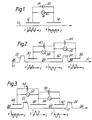
- aluminium sheet in the form of a continuous strip 10 is passed continuously under a pair of graphite electrodes 12, 14.
- the strip and the electrodes are immersed in a bath of electrolyte not shown.
- Applied to the electrodes is an alternating current from a power source 16.
- a direct current from a further power source comprising a negative terminal 18 and a positive terminal 20.
- a small plot of the potential of the strip at that point against time The line of the time axis represents zero potential. It can be seen that the areas under the curves above this horizontal line are larger than those below it; thus the aluminium strip is anodically biased at this point.
- a corresponding plot under the electrode 14 shows that the aluminium strip is cathodically biased at that point. The whole operation is performed in a single bath and is symmetrical.
- the aluminium strip is again shown as 10, with jinks at 22 and 24 to indicate passage from one bath of electrolyte to another.
- the aluminium strip passes through a cleaning bath 26, with no external power supply; a graining bath 28 containing electrodes 30 and 32; and an anodising bath 34 containing an electrode 36.
- a power supply 38 supplies alternating current to electrodes 30 and 32.
- a further power supply 40 superimposes a direct current on that alternating current.
- Further power supplies 42 and 44 supply respectively alternating and direct current between electrodes 32 and 36.
- the aluminium strip is anodically biased below electrode 30; cathodically biased below electrode 32; and anodically biased again below electrode 36.
- the extent of cathodic bias is greater than the extent of anodic bias.
- FIG. 3 shows a similar system.
- the aluminium strip 10 passes through a cleaning bath 26 containing an electrode 46; an electrograining bath 28 containing electrodes 48 and 50; and an anodising bath with no power source shown.
- Power sources 52 and 54 impose alternating current and direct current respectively on electrodes 46 and 48.
- Power sources 56 and 58 impose alternating current and direct current respectively on electrodes 48 and 50.
- the result is that the aluminium strip is anodically biased under the electrode 48 and cathodically biased under the electrode 50.
- the extent of anodic bias is greater than the extent of cathodic bias in the graining bath.
- the balance of cathodic bias is used up in the cleaning bath 26.
- Figures 2 and 3 show how the anodic and cathodic bias of the aluminium strip in the electrograining bath (or baths) can each be varied independently of the other.
- the alloy used was AA1050A (Fe, 0.38; Si, 0.08; Ti, 0.01; balance Al plus normal impurities). Samples were grained in a laboratory cell that had been shown to produce surfaces similar to those produced commercially. The electrolyte was 1% nitric acid. The voltage applied was 7V AC and the electrode spacing was 15mm. On this alternating current, a direct current was superimposed whose size was fixed for each experiment but different between different experiments. The following table reports the time taken to pass 34 positive kCoulombs m -2 (sufficient to effect electrochemical roughening of the surface), against the imposed DC; positive values indicate that the Al sheet sample was made more anodic by the superimposed DC.
- microstructures of the samples grained with a +1 to +4V bias showed mainly large pits above 10 ⁇ m diameter with substantial flat plateaus in between.
- Samples grained with a -2 to 0V bias showed a uniform structure of pits mainly below 10 ⁇ m diameter, typical of the surfaces conventionally produced when electrograining under these conditions. Under the particular conditions of this experiment, the dividing line between the two types of structures appears to lie between 0 and +1V bias.
- Example 1 the time required for electrograining is substantially reduced by increasing the anodic bias.
- An anodic bias gave deeper single pits resulting from cubic attack, while a cathodic bias gave normal graining. In this case, the boundary between the two graining regimes appeared to be in the region of -2 to 0V.
- This experiment was performed using a nitric acid electrolyte under the conditions of Example 1. But the imposed DC bias was changed once during the electrograining operation. Specifically, the sample was treated for 4 seconds with a 7V alternating current on which was superimposed a 1V DC bias, the sample being biased in the anodic direction. Then the direct current was reversed, so that the sample was biased by 1V in a cathodic direction, and electrochemical roughening continued for a further 11 seconds.
- the treated sample had a microstructure completely covered with pits, comprising a mixture of larger pits around 10 ⁇ m average diameter, and a superimposed structure of smaller pits, and was very suitable for use as a lithographic plate support.
- treatment was effected in 15 seconds, and the charge density used was 52 kCoulombs m -2 .
- Table in Example 1 shows, there is no single set of conditions by which treatment can be effected in less than about 27 seconds.
- Conventional graining which was only influenced by the natural bias would use approximately 89 kCoulombs m -2 .
- the 3103 material again exhibited a similar surface to the above but had less plateau thus causing the pits to have thinner side walls and leading to a satisfactory more open structure.
Landscapes
- Chemical & Material Sciences (AREA)
- Chemical Kinetics & Catalysis (AREA)
- Electrochemistry (AREA)
- Engineering & Computer Science (AREA)
- Materials Engineering (AREA)
- Metallurgy (AREA)
- Organic Chemistry (AREA)
- Printing Plates And Materials Therefor (AREA)
Abstract
Claims (8)
- Procédé électrochimique pour rendre rugueuse une surface d'une feuille d'aluminium, en soumettant la feuille dans un électrolyte aqueux à l'action d'un courant électrique alternatif, caractérisé en ce que le courant alternatif est polarisé initialement d'une première façon pendant une durée suffisante au moins pour initier la formation d'une première structure de piqûres sur la surface, et est polarisé ensuite d'une deuxième façon pendant une durée suffisante au moins pour initier la formation d'une deuxième structure de piqûres sur la surface, dans lequel la polarisation dans le sens cathodique est d'une ampleur limitée, telle que le rapport des superficies, de côtés opposés d'une ligne de potentiel zéro sous la courbe d'un relevé de la tension en fonction de temps, n'est pas plus important qu'environ 3 : 1.
- Procédé tel que revendiqué dans la revendication 1, dans lequel l'électrolyte aqueux est à base de HNO3.
- Procédé tel que revendiqué dans la revendication 1, dans lequel l'électrolyte aqueux est à base de HCI.
- Procédé tel que revendiqué dans l'une quelconque des revendications 1 à 3, dans lequel un morceau allongé de la feuille d'aluminium passe en continu dans l'électrolyte aqueux d'au moins une cellule de grenage électrochimique, chaque portion de la feuille étant soumise d'abord à un courant alternatif polarisé de ladite première façon et ensuite à un courant alternatif polarisé de la deuxième façon.
- Procédé tel que revendiqué dans l'une quelconque des revendications 1 à 4, dans lequel le courant alternatif est polarisé d'abord dans un sens anodique et est polarisé ensuite dans un sens cathodique.
- Procédé tel que revendiqué dans la revendication 5, dans lequel le courant alternatif est polarisé dans un sens anodique pendant une durée de 1 à 15 secondes.
- Procédé tel que revendiqué dans l'une quelconque des revendications 1 à 5, dans lequel la polarisation du courant alternatif est changée par deux ou plusieurs reprises lors du traitement de la feuille d'aluminium.
- L'utilisation comme plaque de support d'impression lithographique de la feuille d'aluminium rendue rugueuse selon le procédé de l'une quelconque des revendications 1 à 7.
Applications Claiming Priority (3)
| Application Number | Priority Date | Filing Date | Title |
|---|---|---|---|
| GB919112211A GB9112211D0 (en) | 1991-06-06 | 1991-06-06 | Treating a1 sheet |
| GB91122119 | 1991-06-06 | ||
| PCT/EP1992/001264 WO1992021795A1 (fr) | 1991-06-06 | 1992-06-05 | Traitement de feuille d'aluminium |
Publications (2)
| Publication Number | Publication Date |
|---|---|
| EP0586504A1 EP0586504A1 (fr) | 1994-03-16 |
| EP0586504B1 true EP0586504B1 (fr) | 1996-12-18 |
Family
ID=10696220
Family Applications (1)
| Application Number | Title | Priority Date | Filing Date |
|---|---|---|---|
| EP92911798A Expired - Lifetime EP0586504B1 (fr) | 1991-06-06 | 1992-06-05 | Traitement de feuille d'aluminium |
Country Status (7)
| Country | Link |
|---|---|
| US (1) | US5449441A (fr) |
| EP (1) | EP0586504B1 (fr) |
| JP (1) | JPH06507678A (fr) |
| AU (1) | AU1905392A (fr) |
| DE (1) | DE69216089T2 (fr) |
| GB (1) | GB9112211D0 (fr) |
| WO (1) | WO1992021795A1 (fr) |
Families Citing this family (10)
| Publication number | Priority date | Publication date | Assignee | Title |
|---|---|---|---|---|
| US20030032879A1 (en) * | 1997-07-07 | 2003-02-13 | Steven Quay | Microbubble formation using ultrasound |
| US6195251B1 (en) * | 1997-10-29 | 2001-02-27 | Asahi Glass Company Ltd. | Electrode assembly and electric double layer capacitor having the electrode assembly |
| DE60211426T2 (de) * | 2001-07-06 | 2007-05-16 | Fuji Photo Film Co., Ltd., Minami-Ashigara | Vorsensibilisierte Platte zur Herstellung einer lithographischen Druckplatte |
| US20030047464A1 (en) * | 2001-07-27 | 2003-03-13 | Applied Materials, Inc. | Electrochemically roughened aluminum semiconductor processing apparatus surfaces |
| KR100559933B1 (ko) * | 2002-11-29 | 2006-03-13 | 엘에스전선 주식회사 | 저조도 동박의 전해연마방법 및 전해연마장치와 동박 |
| BRPI0709691A2 (pt) * | 2006-03-31 | 2011-07-19 | Alcoa Inc | folha litográfica |
| US8023250B2 (en) * | 2008-09-12 | 2011-09-20 | Avx Corporation | Substrate for use in wet capacitors |
| US8279585B2 (en) | 2008-12-09 | 2012-10-02 | Avx Corporation | Cathode for use in a wet capacitor |
| JP2013049259A (ja) * | 2011-07-29 | 2013-03-14 | Fujifilm Corp | 電解粗面化処理方法及び装置並びに平版印刷版原版の製造方法及び製造装置 |
| CN119663395A (zh) * | 2020-05-20 | 2025-03-21 | 苹果公司 | 非水性铝阳极化 |
Family Cites Families (8)
| Publication number | Priority date | Publication date | Assignee | Title |
|---|---|---|---|---|
| DE1621187A1 (de) * | 1967-03-15 | 1971-06-03 | Elektronische Bauelemente Veb | Verfahren zum elektrolytischen AEtzen von Metalloberflaechen,insbesondere von Aluminiumfolien |
| DE3217499A1 (de) * | 1982-05-10 | 1983-11-10 | Hoechst Ag, 6230 Frankfurt | Verfahren zur elektrochemischen aufrauhung von aluminium fuer druckplattentraeger |
| DE3217552A1 (de) * | 1982-05-10 | 1983-11-10 | Hoechst Ag, 6230 Frankfurt | Verfahren zur elektrochemischen aufrauhung von aluminium fuer druckplattentraeger |
| JPS59227494A (ja) * | 1983-06-09 | 1984-12-20 | Fuji Photo Film Co Ltd | 平版印刷版用支持体の製造方法 |
| US4545875A (en) * | 1984-08-06 | 1985-10-08 | Polychrome Corporation | Electrolytic graining |
| DE3715791A1 (de) * | 1987-05-12 | 1988-11-24 | Hoechst Ag | Druckplattentraeger sowie verfahren und vorrichtung zu dessen herstellung |
| JPH0729507B2 (ja) * | 1987-10-30 | 1995-04-05 | 富士写真フイルム株式会社 | 印刷版用アルミニウム支持体の製造方法 |
| US5264110A (en) * | 1990-03-06 | 1993-11-23 | Dupont-Howson Ltd. Of Coal Road | Electrolytic square wave graining |
-
1991
- 1991-06-06 GB GB919112211A patent/GB9112211D0/en active Pending
-
1992
- 1992-06-05 DE DE69216089T patent/DE69216089T2/de not_active Expired - Fee Related
- 1992-06-05 WO PCT/EP1992/001264 patent/WO1992021795A1/fr not_active Ceased
- 1992-06-05 JP JP4510708A patent/JPH06507678A/ja active Pending
- 1992-06-05 US US08/157,071 patent/US5449441A/en not_active Expired - Fee Related
- 1992-06-05 AU AU19053/92A patent/AU1905392A/en not_active Abandoned
- 1992-06-05 EP EP92911798A patent/EP0586504B1/fr not_active Expired - Lifetime
Also Published As
| Publication number | Publication date |
|---|---|
| WO1992021795A1 (fr) | 1992-12-10 |
| EP0586504A1 (fr) | 1994-03-16 |
| DE69216089T2 (de) | 1997-04-03 |
| DE69216089D1 (de) | 1997-01-30 |
| JPH06507678A (ja) | 1994-09-01 |
| AU1905392A (en) | 1993-01-08 |
| US5449441A (en) | 1995-09-12 |
| GB9112211D0 (en) | 1991-07-24 |
Similar Documents
| Publication | Publication Date | Title |
|---|---|---|
| EP0659909B1 (fr) | Procédé de grainage électrochimique | |
| EP0181173B1 (fr) | Couche d'oxyde d'aluminium anodique et procédé de formation | |
| EP0586504B1 (fr) | Traitement de feuille d'aluminium | |
| EP0701908A2 (fr) | Support en aluminium pour plaque lithographique, procédé pour sa fabrication et grainage | |
| WO2003008672A1 (fr) | Feuille d'alliage d'aluminium presentant une surface rendue rugueuse | |
| JPH0754111A (ja) | 平版印刷版用支持体の製造方法 | |
| JPH01148592A (ja) | 印刷版用アルミニウム支持体の製造方法 | |
| US4735696A (en) | Method of electrolytically graining aluminum metal sheets suitable for lithographic plate supports | |
| US5651871A (en) | Process for graining and anodizing a metal plate | |
| EP0958412B1 (fr) | Traitement de pieces en aluminium | |
| JPH02240292A (ja) | 耐食性に優れたアルミニウム材料の陽極酸化処理方法 | |
| WO1992022688A1 (fr) | Traitement de plaque d'aluminium | |
| JPH07132689A (ja) | 平版印刷版用アルミニウム合金基材 | |
| US5213666A (en) | Method of preparing support for printing plate | |
| JP2614112B2 (ja) | 印刷版用アルミニウム支持体の電解処理方法 | |
| JP2000318338A (ja) | 印刷版製造方法 | |
| JP3162115B2 (ja) | オフセット印刷版用アルミニウム支持体の連続電解粗面化方法 | |
| JP2715344B2 (ja) | 印刷版用アルミニウム支持体の電解処理方法 | |
| JP2715346B2 (ja) | 印刷版用アルミニウム支持体の電解処理方法 | |
| JPH0382800A (ja) | 印刷版用アルミニウム支持体の電解処理方法 | |
| JP2759382B2 (ja) | 平版印刷版用支持体の製造方法 | |
| JPS63176188A (ja) | 印刷版用支持体のスマツト除去方法 | |
| JPH0798427B2 (ja) | 印刷版用アルミニウム支持体の製造方法 | |
| JPH01259993A (ja) | 印刷版用アルミニウム支持体の製造方法 | |
| JPS63307990A (ja) | 印刷版用支持体の製造方法 |
Legal Events
| Date | Code | Title | Description |
|---|---|---|---|
| PUAI | Public reference made under article 153(3) epc to a published international application that has entered the european phase |
Free format text: ORIGINAL CODE: 0009012 |
|
| 17P | Request for examination filed |
Effective date: 19931126 |
|
| AK | Designated contracting states |
Kind code of ref document: A1 Designated state(s): BE DE FR GB IT NL |
|
| 17Q | First examination report despatched |
Effective date: 19940915 |
|
| GRAH | Despatch of communication of intention to grant a patent |
Free format text: ORIGINAL CODE: EPIDOS IGRA |
|
| GRAA | (expected) grant |
Free format text: ORIGINAL CODE: 0009210 |
|
| ITF | It: translation for a ep patent filed | ||
| AK | Designated contracting states |
Kind code of ref document: B1 Designated state(s): BE DE FR GB IT NL |
|
| REF | Corresponds to: |
Ref document number: 69216089 Country of ref document: DE Date of ref document: 19970130 |
|
| ET | Fr: translation filed | ||
| PLBE | No opposition filed within time limit |
Free format text: ORIGINAL CODE: 0009261 |
|
| STAA | Information on the status of an ep patent application or granted ep patent |
Free format text: STATUS: NO OPPOSITION FILED WITHIN TIME LIMIT |
|
| 26N | No opposition filed | ||
| REG | Reference to a national code |
Ref country code: GB Ref legal event code: IF02 |
|
| PGFP | Annual fee paid to national office [announced via postgrant information from national office to epo] |
Ref country code: NL Payment date: 20030522 Year of fee payment: 12 |
|
| PGFP | Annual fee paid to national office [announced via postgrant information from national office to epo] |
Ref country code: FR Payment date: 20030619 Year of fee payment: 12 |
|
| PG25 | Lapsed in a contracting state [announced via postgrant information from national office to epo] |
Ref country code: NL Free format text: LAPSE BECAUSE OF NON-PAYMENT OF DUE FEES Effective date: 20050101 |
|
| PG25 | Lapsed in a contracting state [announced via postgrant information from national office to epo] |
Ref country code: FR Free format text: LAPSE BECAUSE OF NON-PAYMENT OF DUE FEES Effective date: 20050228 |
|
| NLV4 | Nl: lapsed or anulled due to non-payment of the annual fee |
Effective date: 20050101 |
|
| REG | Reference to a national code |
Ref country code: FR Ref legal event code: ST |
|
| PGFP | Annual fee paid to national office [announced via postgrant information from national office to epo] |
Ref country code: GB Payment date: 20050602 Year of fee payment: 14 |
|
| PG25 | Lapsed in a contracting state [announced via postgrant information from national office to epo] |
Ref country code: IT Free format text: LAPSE BECAUSE OF NON-PAYMENT OF DUE FEES;WARNING: LAPSES OF ITALIAN PATENTS WITH EFFECTIVE DATE BEFORE 2007 MAY HAVE OCCURRED AT ANY TIME BEFORE 2007. THE CORRECT EFFECTIVE DATE MAY BE DIFFERENT FROM THE ONE RECORDED. Effective date: 20050605 |
|
| PGFP | Annual fee paid to national office [announced via postgrant information from national office to epo] |
Ref country code: BE Payment date: 20050725 Year of fee payment: 14 |
|
| PGFP | Annual fee paid to national office [announced via postgrant information from national office to epo] |
Ref country code: DE Payment date: 20050801 Year of fee payment: 14 |
|
| REG | Reference to a national code |
Ref country code: GB Ref legal event code: 732E |
|
| PG25 | Lapsed in a contracting state [announced via postgrant information from national office to epo] |
Ref country code: GB Free format text: LAPSE BECAUSE OF NON-PAYMENT OF DUE FEES Effective date: 20060605 |
|
| PG25 | Lapsed in a contracting state [announced via postgrant information from national office to epo] |
Ref country code: BE Free format text: LAPSE BECAUSE OF NON-PAYMENT OF DUE FEES Effective date: 20060630 |
|
| PG25 | Lapsed in a contracting state [announced via postgrant information from national office to epo] |
Ref country code: DE Free format text: LAPSE BECAUSE OF NON-PAYMENT OF DUE FEES Effective date: 20070103 |
|
| GBPC | Gb: european patent ceased through non-payment of renewal fee |
Effective date: 20060605 |
|
| BERE | Be: lapsed |
Owner name: *NOVELIS INC. Effective date: 20060630 |