EP0590739B1 - Mélanges de polyéthylène et préparation de feuilles - Google Patents
Mélanges de polyéthylène et préparation de feuilles Download PDFInfo
- Publication number
- EP0590739B1 EP0590739B1 EP93203174A EP93203174A EP0590739B1 EP 0590739 B1 EP0590739 B1 EP 0590739B1 EP 93203174 A EP93203174 A EP 93203174A EP 93203174 A EP93203174 A EP 93203174A EP 0590739 B1 EP0590739 B1 EP 0590739B1
- Authority
- EP
- European Patent Office
- Prior art keywords
- film
- temperature
- copolymer
- polyethylene
- heat
- Prior art date
- Legal status (The legal status is an assumption and is not a legal conclusion. Google has not performed a legal analysis and makes no representation as to the accuracy of the status listed.)
- Expired - Lifetime
Links
Images



Classifications
-
- C—CHEMISTRY; METALLURGY
- C08—ORGANIC MACROMOLECULAR COMPOUNDS; THEIR PREPARATION OR CHEMICAL WORKING-UP; COMPOSITIONS BASED THEREON
- C08F—MACROMOLECULAR COMPOUNDS OBTAINED BY REACTIONS ONLY INVOLVING CARBON-TO-CARBON UNSATURATED BONDS
- C08F210/00—Copolymers of unsaturated aliphatic hydrocarbons having only one carbon-to-carbon double bond
-
- C—CHEMISTRY; METALLURGY
- C08—ORGANIC MACROMOLECULAR COMPOUNDS; THEIR PREPARATION OR CHEMICAL WORKING-UP; COMPOSITIONS BASED THEREON
- C08J—WORKING-UP; GENERAL PROCESSES OF COMPOUNDING; AFTER-TREATMENT NOT COVERED BY SUBCLASSES C08B, C08C, C08F, C08G or C08H
- C08J5/00—Manufacture of articles or shaped materials containing macromolecular substances
- C08J5/18—Manufacture of films or sheets
-
- C—CHEMISTRY; METALLURGY
- C08—ORGANIC MACROMOLECULAR COMPOUNDS; THEIR PREPARATION OR CHEMICAL WORKING-UP; COMPOSITIONS BASED THEREON
- C08F—MACROMOLECULAR COMPOUNDS OBTAINED BY REACTIONS ONLY INVOLVING CARBON-TO-CARBON UNSATURATED BONDS
- C08F210/00—Copolymers of unsaturated aliphatic hydrocarbons having only one carbon-to-carbon double bond
- C08F210/02—Ethene
-
- C—CHEMISTRY; METALLURGY
- C08—ORGANIC MACROMOLECULAR COMPOUNDS; THEIR PREPARATION OR CHEMICAL WORKING-UP; COMPOSITIONS BASED THEREON
- C08F—MACROMOLECULAR COMPOUNDS OBTAINED BY REACTIONS ONLY INVOLVING CARBON-TO-CARBON UNSATURATED BONDS
- C08F210/00—Copolymers of unsaturated aliphatic hydrocarbons having only one carbon-to-carbon double bond
- C08F210/16—Copolymers of ethene with alpha-alkenes, e.g. EP rubbers
-
- C—CHEMISTRY; METALLURGY
- C08—ORGANIC MACROMOLECULAR COMPOUNDS; THEIR PREPARATION OR CHEMICAL WORKING-UP; COMPOSITIONS BASED THEREON
- C08F—MACROMOLECULAR COMPOUNDS OBTAINED BY REACTIONS ONLY INVOLVING CARBON-TO-CARBON UNSATURATED BONDS
- C08F297/00—Macromolecular compounds obtained by successively polymerising different monomer systems using a catalyst of the ionic or coordination type without deactivating the intermediate polymer
- C08F297/06—Macromolecular compounds obtained by successively polymerising different monomer systems using a catalyst of the ionic or coordination type without deactivating the intermediate polymer using a catalyst of the coordination type
- C08F297/08—Macromolecular compounds obtained by successively polymerising different monomer systems using a catalyst of the ionic or coordination type without deactivating the intermediate polymer using a catalyst of the coordination type polymerising mono-olefins
-
- C—CHEMISTRY; METALLURGY
- C08—ORGANIC MACROMOLECULAR COMPOUNDS; THEIR PREPARATION OR CHEMICAL WORKING-UP; COMPOSITIONS BASED THEREON
- C08L—COMPOSITIONS OF MACROMOLECULAR COMPOUNDS
- C08L23/00—Compositions of homopolymers or copolymers of unsaturated aliphatic hydrocarbons having only one carbon-to-carbon double bond; Compositions of derivatives of such polymers
- C08L23/02—Compositions of homopolymers or copolymers of unsaturated aliphatic hydrocarbons having only one carbon-to-carbon double bond; Compositions of derivatives of such polymers not modified by chemical after-treatment
- C08L23/04—Homopolymers or copolymers of ethene
- C08L23/08—Copolymers of ethene
- C08L23/0807—Copolymers of ethene with unsaturated hydrocarbons only containing four or more carbon atoms
- C08L23/0815—Copolymers of ethene with unsaturated hydrocarbons only containing four or more carbon atoms with aliphatic 1-olefins containing one carbon-to-carbon double bond
-
- C—CHEMISTRY; METALLURGY
- C08—ORGANIC MACROMOLECULAR COMPOUNDS; THEIR PREPARATION OR CHEMICAL WORKING-UP; COMPOSITIONS BASED THEREON
- C08F—MACROMOLECULAR COMPOUNDS OBTAINED BY REACTIONS ONLY INVOLVING CARBON-TO-CARBON UNSATURATED BONDS
- C08F110/00—Homopolymers of unsaturated aliphatic hydrocarbons having only one carbon-to-carbon double bond
- C08F110/02—Ethene
-
- C—CHEMISTRY; METALLURGY
- C08—ORGANIC MACROMOLECULAR COMPOUNDS; THEIR PREPARATION OR CHEMICAL WORKING-UP; COMPOSITIONS BASED THEREON
- C08J—WORKING-UP; GENERAL PROCESSES OF COMPOUNDING; AFTER-TREATMENT NOT COVERED BY SUBCLASSES C08B, C08C, C08F, C08G or C08H
- C08J2323/00—Characterised by the use of homopolymers or copolymers of unsaturated aliphatic hydrocarbons having only one carbon-to-carbon double bond; Derivatives of such polymers
- C08J2323/02—Characterised by the use of homopolymers or copolymers of unsaturated aliphatic hydrocarbons having only one carbon-to-carbon double bond; Derivatives of such polymers not modified by chemical after treatment
- C08J2323/04—Homopolymers or copolymers of ethene
- C08J2323/08—Copolymers of ethene
-
- C—CHEMISTRY; METALLURGY
- C08—ORGANIC MACROMOLECULAR COMPOUNDS; THEIR PREPARATION OR CHEMICAL WORKING-UP; COMPOSITIONS BASED THEREON
- C08L—COMPOSITIONS OF MACROMOLECULAR COMPOUNDS
- C08L23/00—Compositions of homopolymers or copolymers of unsaturated aliphatic hydrocarbons having only one carbon-to-carbon double bond; Compositions of derivatives of such polymers
- C08L23/02—Compositions of homopolymers or copolymers of unsaturated aliphatic hydrocarbons having only one carbon-to-carbon double bond; Compositions of derivatives of such polymers not modified by chemical after-treatment
- C08L23/04—Homopolymers or copolymers of ethene
- C08L23/06—Polyethylene
-
- Y—GENERAL TAGGING OF NEW TECHNOLOGICAL DEVELOPMENTS; GENERAL TAGGING OF CROSS-SECTIONAL TECHNOLOGIES SPANNING OVER SEVERAL SECTIONS OF THE IPC; TECHNICAL SUBJECTS COVERED BY FORMER USPC CROSS-REFERENCE ART COLLECTIONS [XRACs] AND DIGESTS
- Y10—TECHNICAL SUBJECTS COVERED BY FORMER USPC
- Y10T—TECHNICAL SUBJECTS COVERED BY FORMER US CLASSIFICATION
- Y10T428/00—Stock material or miscellaneous articles
- Y10T428/31504—Composite [nonstructural laminate]
- Y10T428/31855—Of addition polymer from unsaturated monomers
-
- Y—GENERAL TAGGING OF NEW TECHNOLOGICAL DEVELOPMENTS; GENERAL TAGGING OF CROSS-SECTIONAL TECHNOLOGIES SPANNING OVER SEVERAL SECTIONS OF THE IPC; TECHNICAL SUBJECTS COVERED BY FORMER USPC CROSS-REFERENCE ART COLLECTIONS [XRACs] AND DIGESTS
- Y10—TECHNICAL SUBJECTS COVERED BY FORMER USPC
- Y10T—TECHNICAL SUBJECTS COVERED BY FORMER US CLASSIFICATION
- Y10T428/00—Stock material or miscellaneous articles
- Y10T428/31504—Composite [nonstructural laminate]
- Y10T428/31855—Of addition polymer from unsaturated monomers
- Y10T428/31938—Polymer of monoethylenically unsaturated hydrocarbon
Definitions
- This invention relates to a polyethylene mixture, which highly satisfies the performance properties required for use as packaging films, such as heat-sealing properties, transparency, gloss, nerve, impact strength and tearing strength.
- Low-density polyethylene exhibits excellent water- and moisture-resistance, moderate softness, relatively good transparency and relatively satisfactory strength, and has therefore been used widely in the form of a film.
- the low-density polyethylene is heat-sealable at temperatures of from a relatively low temperature and exhibits satisfactory heat-sealing strength, it is in widespread use as a single-layer packaging film or a packaging film laminate.
- the nerve of a low density polyethylene film as a lamina is an important factor for achieving high-speed processing in that a lack of nerve easily causes wrinkles. Further, transparency and gloss are of importance for addition of a display effect to the content of package. Resistance to impact or tearing in any direction is also important as well for improving the essential packaging function of protection of the contents.
- Low-density polyethylene can be classified into two large groups according to the process for production or molecular structure.
- One group is an ethylene polymer produced by free radical polymerization under high pressure and high temperature conditions, which essentially has short-chain branches and long-chain branches. It is considered that the short-chain branches and long-chain branches are formed through intramolecular rearrangement reaction and intermolecular rearrangement reaction, respectively, of a polymer radical under propagation. Since an ⁇ -olefin exhibits a high chain transfer constant in radical polymerization, it is present in a copolymerized state in high-molecular weight low-density polyethylene to be used as a synthetic resin in only a small copolymerised amount, if any.
- the other group is an ethylene- ⁇ -olefin copolymer produced by copolymerization in the presence of a transition metal catalyst, typically by a Ziegler process.
- a transition metal catalyst typically by a Ziegler process.
- L-LDPE linear low-density polyethylene
- B-LDPE branched low-density polyethylene
- a high-molecular weight substance is a mixture of various molecules, and it is widely accepted that various physical properties vary depending on a distribution mode of the molecules.
- analysis of the distribution mode, quantitative and structural elucidation of the relation between the distribution mode and various physical properties, and discoveries of high-molecular weight substances having a novel distribution mode and thereby exhibiting improved physical properties constitute one of the central aspects of high polymer science for both learning and industry.
- the molecular weight distribution and the distribution of short-chain branching coefficient are important factors for physical properties. It is known that B-LDPE has a broad molecular weight distribution and a relatively narrow short-chain branching coefficient distribution while L-LDPE generally has a relatively broad short-chain branching coefficient distribution as reported, e.g., in S. Hosoda, Polymer J., Vol. 20, p. 383 (1988). Since the short-chain branching in L-LDPE arises through copolymerization of an ⁇ -olefin as a comonomer, the short-chain branching coefficient distribution of L-LDPE is sometimes referred to as a comonomer distribution or (copolymerization) composition distribution.
- JP-B-56-21212 (the term "JP-B” as used herein means an "examined Japanese publication") is one of the earliest publications showing the importance of comonomer distribution in partially crystalline ethylene- ⁇ -olefin copolymers.
- an extruded film of a copolymer having uniform comonomer distribution among molecules is superior to that of a non-uniform copolymer in terms of haze, impact strength, and balance of physical properties between the machine direction and the cross direction as demonstrated in the working examples in which films obtained by blow molding of uniform or non-uniform copolymers having a melt index of around 2 and a density of around 0.919 are evaluated for physical properties.
- the copolymers having a uniform comonomer distribution used therein are obtained by copolymerizing ethylene and an ⁇ -olefin in the presence of a catalyst prepared by mixing a specific organic aluminum compound and a specific vanadium compound.
- uniformity of comonomer distribution can be distinguished by a relationship between density and melting point of the copolymer as depicted by the accompanying drawing. That is, the density of the uniform copolymer is lower than that of the non-uniform copolymer having the same comonomer content.
- the publication nevertheless gives no description about heat-sealing properties and hot tack as important properties of a low-density polyethylene film. Neither does it refer to utility in composite films.
- a uniform copolymer has an extremely narrow range of heat-sealing temperature within which satisfactory hot tack is obtained and is also insufficient in heat-sealability at low temperatures in spite of low rigidity. Notwithstanding the above-described relatively excellent properties, the uniform copolymer is of virtually no practical use as packaging film.
- JP-A-59-66405 discloses that a copolymer film comprising ethylene and an ⁇ -olefin having 4 or more carbon atoms and having plural melting points exhibits excellent heat-sealability at low temperatures and still possesses high heat resistance. All the copolymers described in the working examples of this publication have three melting points but their maximum melting point does not exceed 124°C, with the minimum melting point being between 104°C and 106°C. However, there is given no description of hot tack or utility as composite films.
- JP-A-60-88016 describes that an ethylene- ⁇ -olefin random copolymer specified in composition distribution, branching coefficient distribution, randomness, DSC (differential scanning calorimetry) melting point, crystallinity, and molecular weight distribution is excellent in mechanical characteristics, optical characteristics, anti-blocking properties, heat resistance, and low-temperature heat-sealability, in a good balance.
- composition distribution it is made an essential condition that a composition distribution parameter derived from a specific means should not exceed a specific value, which condition means that the composition distribution must be sufficiently narrow.
- a composition distribution parameter derived from a specific means should not exceed a specific value, which condition means that the composition distribution must be sufficiently narrow.
- the maximum melting point should be in a specific range not high than 125°C; the difference between the maximum melting point and the minimum melting point should be in a specific range; the difference between the maximum melting point and the second maximum melting point should be in a specific range; and the quantity of heat of crystal fusion at the maximum melting point is below a specific ratio to the total quantity of heat of crystal fusion.
- the copolymer is the non-uniform copolymer as designated in JP-B-46-21212 but should be near to the uniform copolymer. It is also described that the film properties, such as low-temperature heat-sealability, would be reduced if the maximum melting point exceeds 125°C or if the ratio of the quantity of heat of crystal fusion at the maximum melting point is too large. Moreover, there is no description either on hot tack nor on utility as composite films. Such an ethylene copolymer is unsatisfactory in film properties, such as low-temperature heat-sealability and hot tack, as shown in the Comparative Examples of the present specification hereinafter given.
- Composition distribution is also changeable by uniformly mixing with an ethylene copolymer having a different comonomer content, inclusive of an ethylene homopolymer.
- an arbitrary composition distribution could be obtained, in principle, by mixing two or more uniform copolymers.
- JP-B-57-37616 discloses a packaging polyolefin film comprising from 50 to 95 parts by weight, preferably from 70 to 90 parts by weight, of highdensity polyethylene having a density of from 0.94 to 0.97 g/cm 3 and from 5 to 50 parts by weight, preferably from 10 to 30 parts by weight, of a specific ethylene-1-butene random copolymer having a density of from 0.86 to 0.91 g/cm 3 , preferably from 0.88 to 0.90 g/cm 3 , which is obtained by copolymerization in the presence of a vanadium catalyst.
- the film disclosed however, has considerably higher nerve (rigidity) as compared with a film comprising B-LDPE and therefore cannot be referred to as a low-density polyethylene film.
- the publication also refers to a film obtained from a mixture containing an ethylene-1-butene random copolymer (density: 0.889 g/cm 3 ) in a proportion higher than the above-specified range so as to exhibit rigidity equal to a B-LDPE film, but such a film suffers from blocking to an unmeasurable extent. It gives no specific description concerning heat-sealing properties, neither does it on hot tack.
- packaging films are essentially required to have excellent heat-sealing properties, and particularly hot tack. They are additionally required to have transparency and gloss for increasing display effects and high impact strength and tearing strength in any direction for protection of the content, a primary function for use as packaging material as stated above.
- none of the state-of-the-art low-density polyethylene films satisfies these physical properties entirely.
- One object of this invention is to provide a low-density polyethylene film which highly satisfies all the above-described physical requirements and is suitable for use as packaging film.
- Another object of this invention is to provide a material from which the above-described low-density polyethylene film is produced.
- a heat sealing process comprises a heating step in which the temperature of a film is elevated by the heat from heat-sealing jaws previously heated to a prescribed temperature and a cooling step in which the sealed surface is relieved from the heat-sealing jaws and allowed to cool.
- the present invention relates to a polyethylene mixture having a density of from 0.900 to 0.930 g/cm 3 and a melt flow rate of from 0.1 to 100 g/10 min, which comprises (I) from 60 to 99 parts by weight of an ethylene- ⁇ -olefin random copolymer comprising ethylene and an ⁇ -olefin having from 3 to 10 carbon atoms, the copolymer having an ⁇ -olefin content of from 2.0 to 10 mol% and a density of from 0.895 to 0.915 g/cm 3 , the programmed-temperature thermogram of said copolymer (I) as determined with a differential scanning calorimeter after being completely melted and then gradually cooled showing an endothermic peak (a) at a temperature in a range of from 75°C to 100°C, with the ratio of ( ⁇ Ha/ ⁇ Ht1) of an endotherm at said peak ( ⁇ Ha) to the total endotherm ( ⁇ Ht1) being at least 0.8, and (II)
- the present invention additionally relates to a film comprising the above-described polyethylene mixture and a composite film containing said polyethylene mixture film on at least one side thereof.
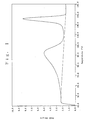
- Figure 1 is a programmed-temperature thermogram of Example 2, which was determined after temperature reduction at a rate of 1°C/min followed by temperature rise at a rate of 10°C/min.
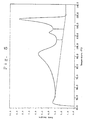
- Figure 2 is a programmed-temperature thermogram of Comparative Example 4, which was determined after temperature reduction at a rate of 1°C/min followed by temperature rise at a rate of 10°C/min.
- Figure 3 is a programmed-temperature thermogram of Example 2, which was determined after temperature reduction at a rate of 10°C/min followed by temperature rise at a rate of 10°C/min.
- Figure 4 is a programmed-temperature thermogram of Comparative Example 4, which was determined after temperature reduction at a rate of 10°C/min followed by temperature rise at a rate of 10°C/min.
- Figure 5 is a programmed-temperature thermogram of Example 2, which was determined directly from a film at a rate of temperature rise of 10°C/min.
- Figure 6 is a programmed-temperature thermogram of Comparative Example 4, which was determined directly from a film at a rate of temperature rise of 10°C/min.
- linear low-density polyethylene having a uniform or nearly uniform composition with a narrow composition distribution has been believed to provide a film excellent in transparency, impact strength, and low-temperature heat-sealing properties.
- the low-density polyethylene has plural melting points in thermal analysis with a DSC, it has been considered favorable to film properties that the maximum melting point should not be too high and the amount of heat of crystal fusion at the maximum melting point should be small.
- the film according to the present invention is characterized by strong nerve (high rigidity), excellent transparency and gloss, high impact strength, high tearing strength in both machine and cross directions, low heat-sealing temperature, and hot tack at low temperatures in a broad range. That is, the film of the invention is superior in all of the properties important as packaging film.
- ⁇ -olefin examples include propylene, butene-1, pentene-1, hexene-1, heptene-1, octene-1, nonene-1, decene-1, 4-methylpentene-1, 4-methylhexene-1 and 4,4-dimethylpentene-1.
- propylene produces relatively small improving effects, and those having 4 or more carbon atoms are preferred.
- butene-1, pentene-1, hexene-1, octene-1 and 4-methylpentene-1 are more preferred in view of availability and quality of the resulting copolymers.
- these ⁇ -olefins may be used in combination of two or more thereof.
- thermogram A diagram of exothermic or endothermic reaction rate vs. temperature, called a thermogram, reflects a distribution of lamellar thickness of the polymer.
- the lamellar thickness distribution is known to be influenced by the composition distribution and thermal history of the polymer as described, e.g., in S. Hosoda, Polymer J. , Vol. 20, p. 383 (1988).
- Determination of thermal transition behavior as referred to in the present invention is divided into two cases, one for obtaining information regarding composition distribution of a polymer per se , and the other for obtaining information regarding lamella thickness distribution of a film obtained from the polymer.
- a programmed-temperature thermogram is determined after a polymer is completely melted and then gradually cooled. Since the thermal transition behavior of polymers changes according to their thermal history, the determination should be done after removing the influences of the thermal history. As shown in the accompanying drawings and Reference Example hereinafter described, if the rate of cooling is not sufficiently low, a seeming splitting of the peak may sometimes be found in the subsequent temperature rise. This is probably because lamellar crystals which have not been allowed to sufficiently grow under rapid cooling undergo fusion-recrystallization during the temperature rise.
- a sample is kept in a DSC at 150°C for 5 minutes (premelting) and then cooled to 40°C at a rate of 1°C/min to obtain a thermogram under temperature drop and, thereafter, the sample is heated up to 150°C at a rate of 10°C/min to obtain a thermogram under temperature rise.
- a straight line is drawn between the point at which heat generation initiates and the points of 50°C or between the point of 50°C and the point at which the endothermic reaction comes to the end. This line is a base line for calculating amounts of heat.
- peak means one revealing a clear maximum in the endothermic side, excluding both a shoulder merely discernible by an inflection point or a small peak representing a small change of less than 1/10th the maximum peak intensity.
- minute changes of a thermogram are of no concern of the present invention.
- the endotherm ⁇ Ha is a quantity of heat of absorption in the peak area between temperatures at each of which the thermogram falls to the minimum (the endothermic side being taken as positive) between endothermic peaks each observed in the higher or lower temperature side than the range in which the endothermic peak (a) should be present.
- the level at 50°C is used as a boundary.
- the endotherm ⁇ Hb is a quantity of heat of absorption in the peak area between the temperature at which the thermogram falls to the minimum between the endothermic peak (b) and an endothermic peak observed in the lower temperature side than the range in which the endothermic peak (b) should be present and a temperature at which endothermic reaction comes to an end.
- the central temperature in that range is taken as a boundary.
- the endothermic peak (a) of the copolymer (I) is present at a temperature range of from 75 to 100°C, and the ratio of the endotherm at this peak to the total endotherm is at least 0.8.
- thermogram is obtained using the polyethylene in the form of a film.
- the crystal fusion behavior of a molded article is decided not only by a composition distribution of the starting polymer per se but by the thermal history of the molded article during or after processing. Therefore, when it is intended to know the heat fusion behavior of the film of itself, it is necessary to determine the thermogram without subjecting the film to any thermal treatment prior to the determination.
- the film is placed in a DSC measuring pan and heated from 40°C to 150°C at a rate of 10°C per minute to obtain a programed-temperature thermogram.
- the resulting thermogram is analyzed for temperature, quantity of heat, and half width of the fusion peaks in the same manner as described above. In this case, however, since the lamella thickness distribution assigned to the thermal history carries weight, any change of 5% or more of the maximum peak intensity of the thermogram is regarded as a peak.
- Films obtained from the conventional L-LDPE by the molding methods hereinafter described have a programmed-temperature thermogram showing an essentially single broad endothermic peak, whereas the films of the present invention are characterized by their programmed-temperature thermogram showing plural clear endothermic peaks as illustrated below.
- the programmed-temperature thermogram of the polyethylene film according to the present invention is required to have an endothermic peak (a) in a range of from 75 to 100°C, preferably from 80° to 95°C.
- the thermogram may have two or more endothermic peaks (a) within the above-specified range. If the near temperature of the endothermic peak (a) is higher than 100°C, sufficient heat-sealability and hot tack cannot be exerted from a low temperature.
- the programmed-temperature thermogram of the polyethylene film must also have an endothermic peak (b) in a temperature range of 120°C or higher. If there in only the endothermic peak (a), the temperature at which hot tack and heat-sealability can be manifested is not sufficiently lowered and, in addition, the temperature range in which hot tack is exhibited is extremely narrow, making the film virtually useless.
- the ratio of an endotherm ( ⁇ Hb) at the peak (b) to an endotherm ( ⁇ Ha) at the peak (a), i.e., a ⁇ Hb/ ⁇ Ha ratio, must be at least 0.03, preferably 0.05 or more, more preferably 0.10 or more.
- the ⁇ Hb/ ⁇ Ha ratio is larger than 2.0, the temperature at which hot tack and heat-sealability are exhibited becomes unfavorably high. Accordingly, the ⁇ Hb/ ⁇ Ha ratio must not exceed 2.0, preferably not exceed 1.5, more preferably not exceed 1.0.
- the temperature range for manifestation of hot tack becomes narrow.
- a preferred endothermic peak (b) is present at 122°C or higher. From the fact that the melting point of polyethylene does not exceed 140°C, the peak temperature of the endothermic peak (b) is not higher than 140°C.
- Plural endothermic peaks (b) may be present within the above-recited temperature range.
- the endothermic peak (a) of the polyethylene film preferably has a half width (Wa 1/2 ) of not more than 27°C, more preferably not more than 25°C, most preferably not more than 23°C.
- Wa 1/2 is a temperature difference between two intersections of (i) the line extending from the middle point of a perpendicular drawn from the peak (a) down to the base line in parallel to the base line and (ii) the thermogram. In cases where the line (i) intersects the borderline from the neighboring peak before intersecting the thermogram, Wa 1/2 is a temperature difference between the temperature at this intersection and the other intersection. If Wa 1/2 exceeds 27°C, the heat-sealing strength or peel length while hot-tack in a low temperature side becomes unfavorably high.
- the ethylene- ⁇ -olefin copolymer used in the present invention can be synthesized by copolymerizing ethylene and an ⁇ -olefin having from 3 to 10 carbon atoms in a polymerization vessel.
- the ethylene- ⁇ -olefin copolymer used in present invention can be obtained by polymerizing ethylene in the presence of a catalyst composed of (a) a transition metal component and (b) an organometallic compound and then feeding an ⁇ -olefin and (c) a third component to the polymerization system.
- the density and ⁇ -olefin content of the ethylene- ⁇ -olefin copolymer can be controlled by adjusting the amounts of the ⁇ -olefin and the third component (c) to be fed. Since these amounts depend on the kinds of the components (a), (b) and (c), the polymerization temperature, and the polymerization pressure, they should be experimentally determined as specifically shown in the Examples hereinafter described.
- the polyethylene mixture according to the present invention is obtained by mixing (I) from 60 to 99 parts by weight of a random copolymer comprising ethylene and an ⁇ -olefin having from 3 to 10 carbon atoms and having a density of from 0.895 to 0.915 g/cm 3 , preferably from 0.900 to 0.910 g/cm 3 , and an ⁇ -olefin content of from 2.0 to 10.0 mol%, the DSC programmed-temperature thermogram of which reveals an endothermic peak in a range of from 75 to 100 °C, preferably from 80 to 95°C, with the ratio of an endotherm at the peak to the total endotherm ( ⁇ Ht1) being at least 0.8, and (II) from 1 to 40 parts by weight of high-density polyethylene having a density of at least 0.945 g/cm 3 , the DSC programmed-temperature thermogram of which reveals an endothermic peak at 125°C or higher, preferably 130°C or higher,
- the copolymer (I) can also be obtained by the process disclosed in JP-A-60-226514, in which copolymerization is carried out in the same manner as described above, except for using a vanadium compound prepared by reacting vanadium trichloride and an alcohol as the transition metal component (a).
- the copolymer (I) may also be obtained by the process described in JP-B-46-21212.
- the ⁇ -olefin to be used preferably contains from 4 to 10 carbon atoms.
- the polymerization is preferably effected by using the above-described vanadium compound according to JP-A-60-226514.
- the high-density polyethylene (II) is an ethylene homopolymer and/or a copolymer of ethylene and an ⁇ -olefin having from 3 to 10 carbon atoms and is selected from those commercially available as high-density polyethylene.
- the MFR of each of the copolymer (I) and the high-density polyethylene (II) is arbitrarily selected from a range of from 0.01 to 1000 g/10 min. as far as the MFR of the mixture thereof falls within a range of from 0.1 to 100 g/10 min.
- the fact that MFR logarithms substantially have an additive property can be made a guide.
- the weight mixing ratio of the copolymer (I) to the high-density polyethylene (II) preferably ranges from 98/2 to 70/30, more preferably from 97/3 to 80/20.
- the copolymer (I) and the high-density polyethylene (II) are blended at temperatures above the point at which both of them are fused to obtain a uniform mixture. Blending can be carried out with any of the known kneading machines, either batch or continuous types or single- or multi-screw types, as well as an extruder of a film producing apparatus.
- the polyethylene film according to the present invention can be produced from the above-described polyethylene mixture at a temperature of fusing the resins by known techniques, such as inflation or T-die extrusion.
- the inflation is called blown-film extrusion and comprises extruding a molten resin from an extruder through a circular slit of a ring die and blowing a gas (usually air) into the inside of the extruded tubular film at a controlled blow pressure to obtain a film having a desired width selected from a broad range.
- the ratio of the diameter of the blown tubular film to the diameter of the circular slit is called a blow-up ratio (BUR).
- BUR blow-up ratio
- the film thickness can be adjusted by selecting the extrusion rate and BUR.
- the extruded and blown tubular film is cooled with a gas (usually air) and/or a liquid (usually water) from the outside.
- the technique including cooling with water is useful for producing films having excellent transparency but a thickness alteration is troublesome to make.
- various devices and methods for cooling in the technique including cooling with air called air-cooling inflation have been proposed.
- the air-cooling inflation is divided into a single-stage air-cooling system and a multi-stage air-cooling system. Since conventional films produced by single-stage air-cooling inflation of L-LDPE exhibit insufficient transparency, the multi-stage air-cooling system was proposed to solve this problem.
- the latter system involves difficulty in altering a film thickness similarly to the water-cooling inflation technique and hence loses the merit of inflation that several kinds of films can be produced in the same machine.
- the polyethylene mixture according to the present invention provides films having very excellent transparency even by the single-stage air-cooling inflation. It is a matter of course that films excellent in transparency can also be obtained by water-cooling inflation or multi-stage air-cooling inflation as well.
- the resin temperature on film extrusion is usually selected from the range of from a complete fusion temperature to 250°C.
- T-die extrusion is called a cast film process, in which a resin kneaded and melted in an extruder is extruded through a parallel slit of a lot die and cooled on contact with a chill roll through which a cooling medium such as water is circulated to obtain films generally excellent in transparency and thickness accuracy.
- the thickness of the cast film can be adjusted by selecting a rate of extrusion and a take-off speed.
- the resin temperature on casting is usually selected from the range of from a complete fusion temperature to 350°C.
- a single-layer film comprising the low-density polyethylene of the present invention usually has a thickness of from 5 to 500 ⁇ m, preferably from 10 to 100 ⁇ m. If the film thickness is less than 5 ⁇ m, processing becomes difficult and also handling of the film on lamination becomes difficult. If the thickness is too large, not only processing becomes difficult but heat-sealing properties are hardly manifested.
- the low-density polyethylene film of the invention be combined with other bases in the form of a composite film, in which the low-density polyethylene film preferably constitutes a surface layer on at least one side thereof.
- the bases to be combined can be selected arbitrarily from among film-forming polymers, regenerated cellulose, paper, paperboard, fabric and aluminium foil.
- the film-forming polymers include polyamide resins, e.g., nylon 6, nylon 66, nylon 11, and nylon 12; polyester resins, e.g., polyethylene terephthalate and polybutylene terephthalate; polyolefin resins, e.g., polypropylene, poly-1-butene, poly-4-methyl-1-pentene, polyethylene, an ethylene-vinyl acetate copolymer, an ethylene-methacrylate copolymer, an ethylene-acrylate copolymer, an ethylene-methacrylic acid copolymer, and ionomers; polyvinylidene chloride; polyvinyl chloride; polystyrene; and polyvinyl alcohol; an ethylene-vinyl alcohol copolymer.
- film-forming polymers can be chosen according to the end use of a composite film taking into consideration gas barrier properties, printability, transparency, rigidity, adhesion, or the like factor.
- stretchable bases particularly those which are stretched to provide improved film characteristics, such as polyamide resins, polyester resins and polypropylene, the base may be uniaxially or biaxially stretched, if desired.
- the low-density polyethylene film layer of the present invention usually has a thickness of from 1 to 500 ⁇ m, preferably from 10 to 100 ⁇ m.
- the thickness of the base is arbitrary and can be decided depending on the end use. It is well known to produce a composite film containing several bases in various layer structures, and such a technique is applicable to the present invention.
- the composite films composed of two or more layers can be produced by known processes, such as lamination processes including dry lamination, wet lamination, sandwich lamination, and hot-melt lamination; co-extrusion, extrusion coating (called extrusion lamination), and a combination thereof.
- the film of the present invention obtained by the above-described process or the composite film herein described is laminated with another base using a solvent type adhesive, an aqueous adhesive, a hot-melt adhesive, a molten polymer, etc.
- the low-density polyethylene of the present invention and other polymer are separately melted and extruded and brought into contact with each other in the inside and/or outside of an extrusion die.
- the extrusion coating process the low-density polyethylene film of the present invention or a molten polymer film obtained by the above-described co-extrusion is coated on at least one side of a base or the composite film herein described.
- Laminate Kako Binran published by Kako Gijutsu Kenkyukai, Japan.
- those having a uniaxially or biaxially stretchable base may be subjected to uniaxial or biaxial stretching. Stretching would provide a stretched composite film having its low-density polyethylene layer reduced to a thickness of about 1 ⁇ m.
- the stretching of the composite film can be carried out under heating to a temperature at which the base used can be stretched by any known technique, such as tentering, inflation, and rolling. If desired, the stretched composite film may be subjected to heat setting.
- the film or mixture according to the present invention can contain various known additives such as antioxidants, weathering agents, lubricants, anti-block agents, antistatic agents, anti-fogging agents, anti-water drop agents, pigments and fillers.
- additives such as antioxidants, weathering agents, lubricants, anti-block agents, antistatic agents, anti-fogging agents, anti-water drop agents, pigments and fillers.
- the film according to the present invention exhibits excellency in all the properties required for use as packaging film. That is, it has strong nerve (high rigidity), excellent transparency and gloss, high impact strength, and well-balanced tearing strength in the machine and cross directions and exhibits heat-sealability at low temperatures and hot tack at low temperatures of a broad range. Therefore, the film, either in the form of a single-layer film or a composite film, can be used for packaging a wide variety of contents, such as foods to be packed together with water; liquid foods, e.g., milk and soups; dry foods, e.g., confectionary; and processed meat products, e.g., ham and sausage.
- Two 15 mm-wide composite films are contacted in such a manner that the polyethylene layers face each other, and a load of 30 g is applied on one of the films via a pulley.
- the films are heat sealed to a width of 20 mm by means of a heat sealer manufactured by Tester Sangyo K.K. at a jaw pressure of 1.3 kg/cm 2 for a sealing time of 0.3 second with a jaw temperature (heat sealing temperature) being varied from 100°C to 170°C by 5°C.
- the load is dropped thereby applying a peel force due to the load on the sealed surface in 0.14 second from the completion of heat sealing.
- the length actually peeled apart (peel length) is measured.
- a blown film and a composite film were produced in the same manner as in Example 2-(3) and (4), except for replacing the uniform polyethylene mixture as used in Example 2 with polyethylene of a Sumikathene® -L series experimentally prepared by Sumitomo Chemical Co., Ltd. having a density of 0.913 g/cm 3 and an MFR of 1.9 (identified as an ethylene-1-butene copolymer by infrared analysis).
- the DSC thermogram of this copolymer as determined after complete fusion and gradual cooling showed endothermic peaks at 103.0°C and 120.4°C and a minimum at 112.0°C between these endothermic peaks.
- thermogram obtained by directly heating the film obtained from the copolymer showed a single peak at 116.0°C, with its half width being 29.8°C.
- a blown film and a composite film were produced in the same manner as in Example 2-(3) and (4), except for replacing the uniform polyethylene mixture as used in Example 2 with Ultzex® 1520L produced by Mitsui Petrochemical Industries, Ltd. (density: 0.913 g/cm 3 ; MFR: 2.5; identified as an ethylene-4-methyl-1-pentene copolymer having a 4-methyl-1-pentene content of 9.1% by infrared absorption analysis).
- the copolymer pellets were found to contain 0.15 part of an anti-block agent per 100 parts of the copolymer, no anti-block agent was externally added.
- the DSC thermogram of the copolymer as determined after complete fusion and gradual cooling showed endothermic peaks at 102.3°C and 119.3°C and a minimum at 115.4°C between these endothermic peaks.
- the ratio of the endotherm in the higher temperature side to the endotherm in the lower temperature side divided on the boundary at 115.4°C was found to be 0.19, and the half width of the peak in the lower temperature side was found to be 31.4°C.
- the thermogram obtained by directly heating the film obtained from the copolymer showed a broad distribution, revealing a single peak at 109.4°C, with its half width being 27.6°C.
- the DSC thermogram of the above-described copolymer as determined after complete fusion and gradual cooling revealed endothermic peaks at 101.4°C and 120.3°C and the minimum at 111.8°C between these endothermic peaks.
- the ratio of the endotherm in the lower temperature side to that in the higher temperature side on the boundary at this temperature of the minimum was 0.33, and the half width of the peak in the lower temperature side was 31.6°C.
- the DSC thermogram of the film showed a single peak at 109.5°C, the half width of which was 27.8°C.
- Example 12-(4) The procedure of Example 12-(4) was repeated, except for replacing the uniform mixture as used in Example 13 with a compounded resin obtained by melt-kneading polyethylene of a Sumikathene® ⁇ series experimentally prepared by Sumitomo Chemical Co., Ltd. (density: 0.913 g/cm 3 ; MFR: 2.0; identified as an ethylene-1-hexene copolymer by infrared absorption analysis) and 0.40 part of a silica type anti-block agent per 100 parts of the copolymer.
- the DSC thermogram of the above-described copolymer as determined after complete fusion and gradual cooling revealed endothermic peaks at 103.6°C and 121.0°C and the minimum at 114.0°C between these endothermic peaks.
- the ratio of the endotherm in the lower temperature side to that in the higher temperature side on the boundary at this temperature of the minimum was 0.30, and the half width of the peak in the lower temperature side was 33.4°C.
- the DSC thermogram of the film showed a single peak at 109.4°C, the half width of which was 29.2°C.
- thermograms In order to examine the influence of a rate of temperature reduction preceding determination of DSC thermograms, A programmed-temperature thermogram was determined for each of the uniform mixtures of Examples 1 to 3 and Ultzex® 1520L used in Comparative Example 4 in the same manner as described above, except that the rate of temperature reduction preceding the determination was set at 10°C/min.
- the peak temperatures of the endothermic peaks of each thermogram are shown in Table 9.
- the peak temperatures of the thermograms of the same mixtures and Ultzex® 1520L as determined in the foregoing examples are also shown in Table 9.
- thermograms of Example 2 and Comparative Example 4 are shown in Figures 1 and 2, respectively, in which the temperature reduction rate was 1°C/min, and in Figures 3 and 4, respectively, in which the temperature reduction rate was 10°C/min.
- Figures 1 and 2 the temperature reduction rate was 1°C/min
- Figures 3 and 4 the temperature reduction rate was 10°C/min.
- the peak in the higher temperature region which is single-headed when the temperature reduction rate is 1°C/min, is split up in some cases when the temperature is reduced at rate of 10°C/min. This splitting of peak seems to be because the lamellar crystals which have not been allowed to sufficiently grow under such rapid cooling undergo fusion-recrystallization in the subsequent temperature rise.
- Example 2 The DSC programmed-temperature thermograms of the films obtained in Example 2 and Comparative Example 4 are shown in Figures 5 and 6, respectively. As is shown, the film of Example 2 shows clear peaks at 92.2°C and 125.8°C, whereas the film of Comparative Example 4 shows a broad fusion pattern having a peak at 109.0°C.
- Example 2 and Comparative Examples 3 and 4 in Tables 5 and 6, between Examples 5 to 10 and 12 and Comparative Example 6 in Tables 7 and 8, and between Example 12 and Comparative Example 9 in Tables 7 and 8, it can be seen that the films according to the present invention begin to exhibit heat-sealing properties and hot tack at lower temperatures and also the temperature range in which hot tack can be exhibited is markedly broader as compared with the comparative films. It can further be seen from Table 8 that the composite film of Comparative Example 5, in which the density of the polyethylene mixture is substantially equal to those of the polyethylene mixtures of Examples 4 and 5, shows a longer minimum peel length, i.e., lower strength, than Examples 4 and 5.
- the films of the Examples are incomparably superior to the films obtained from the conventional L-LDPE in transparency (haze), gloss, and impact strength as well as nerve (expressed in terms of secant modulus at 1% strain).
- the films according to the present invention are decidedly excellent as packaging film as compared with the conventional films.
- the present invention provides low-density polyethylene films which highly satisfy all the physical properties required for use as packaging film, i.e., heat-sealing properties, hot tack, transparency, gloss, nerve, impact strength, and tear strength, and are therefore suitable as packaging film.
- the present invention also provides materials for providing such excellent films.
Landscapes
- Chemical & Material Sciences (AREA)
- Organic Chemistry (AREA)
- Health & Medical Sciences (AREA)
- Chemical Kinetics & Catalysis (AREA)
- Medicinal Chemistry (AREA)
- Polymers & Plastics (AREA)
- Manufacturing & Machinery (AREA)
- Engineering & Computer Science (AREA)
- Inorganic Chemistry (AREA)
- Materials Engineering (AREA)
- Manufacture Of Macromolecular Shaped Articles (AREA)
- Laminated Bodies (AREA)
- Compositions Of Macromolecular Compounds (AREA)
- Addition Polymer Or Copolymer, Post-Treatments, Or Chemical Modifications (AREA)
- Transition And Organic Metals Composition Catalysts For Addition Polymerization (AREA)
Claims (5)
- Mélange de polyéthylènes ayant une densité de 0,900 à 0,930 g/cm3 et une vitesse d'écoulement de masse fondue de 0,1 à 100 g/10 min, qui comprend (I) de 60 à 99 parties en masse d'un copolymère statistique éthylène-α-oléfine comprenant de l'éthylène et une α-oléfine ayant de 3 à 10 atomes de carbone, le copolymère ayant une teneur en α-oléfine de 2,0 à 10 mol% et une densité de 0,895 à 0,915 g/cm3, le thermogramme programmé en fonction de la température dudit copolymère (I), déterminé avec un calorimètre à balayage différentiel après avoir été totalement fondu puis refroidi progressivement, montrant un pic endothermique (a) à une température dans un domaine de 75°C à 100°C, le rapport (ΔHa/ΔHt1) d'une endothermie audit pic (ΔHa) à l'endothermie totale (ΔHt1) étant d'au moins 0,8, et (II) de 1 à 40 parties en masse d'un polyéthylène haute densité ayant une densité d'au moins 0,945 g/cm3, le thermogramme programmé en fonction de la température dudit polyéthylène haute densité, déterminé avec un calorimètre à balayage différentiel après avoir été totalement fondu et mis à refroidir, montrant un pic endothermique (b) à 125°C ou plus, où la somme des composants (I) et (II) est égale à 100 parties en masse.
- Mélange selon la revendication 1 où le pic endothermique (a) du composant (I) est à 80 à 95°C.
- Mélange selon la revendication 1 ou 2 où le pic endothermique (b) du composant (II) est à 130°C ou plus.
- Film comprenant un mélange de polyéthylènes selon l'une quelconque des revendications précédentes.
- Film composite composé d'une base munie sur au moins l'une de ses surfaces d'un film selon la revendication 4.
Applications Claiming Priority (4)
| Application Number | Priority Date | Filing Date | Title |
|---|---|---|---|
| JP17314888 | 1988-07-11 | ||
| JP173148/88 | 1988-07-11 | ||
| JP17314888 | 1988-07-11 | ||
| EP89307029A EP0351189B1 (fr) | 1988-07-11 | 1989-07-11 | Copolymères d'éthylène et d'alpha-oléfines et préparation de feuilles |
Related Parent Applications (2)
| Application Number | Title | Priority Date | Filing Date |
|---|---|---|---|
| EP89307029A Division EP0351189B1 (fr) | 1988-07-11 | 1989-07-11 | Copolymères d'éthylène et d'alpha-oléfines et préparation de feuilles |
| EP89307029.2 Division | 1989-07-11 |
Publications (2)
| Publication Number | Publication Date |
|---|---|
| EP0590739A1 EP0590739A1 (fr) | 1994-04-06 |
| EP0590739B1 true EP0590739B1 (fr) | 2001-11-28 |
Family
ID=15954995
Family Applications (2)
| Application Number | Title | Priority Date | Filing Date |
|---|---|---|---|
| EP89307029A Expired - Lifetime EP0351189B1 (fr) | 1988-07-11 | 1989-07-11 | Copolymères d'éthylène et d'alpha-oléfines et préparation de feuilles |
| EP93203174A Expired - Lifetime EP0590739B1 (fr) | 1988-07-11 | 1989-07-11 | Mélanges de polyéthylène et préparation de feuilles |
Family Applications Before (1)
| Application Number | Title | Priority Date | Filing Date |
|---|---|---|---|
| EP89307029A Expired - Lifetime EP0351189B1 (fr) | 1988-07-11 | 1989-07-11 | Copolymères d'éthylène et d'alpha-oléfines et préparation de feuilles |
Country Status (12)
| Country | Link |
|---|---|
| US (1) | US4981760A (fr) |
| EP (2) | EP0351189B1 (fr) |
| JP (1) | JP2800283B2 (fr) |
| KR (1) | KR0171191B1 (fr) |
| CN (2) | CN1030200C (fr) |
| BR (1) | BR8903393A (fr) |
| CA (1) | CA1334472C (fr) |
| DE (2) | DE68925441T2 (fr) |
| ES (1) | ES2083383T3 (fr) |
| FI (1) | FI893348A7 (fr) |
| NO (1) | NO176667C (fr) |
| SG (1) | SG48991A1 (fr) |
Families Citing this family (69)
| Publication number | Priority date | Publication date | Assignee | Title |
|---|---|---|---|---|
| GB8914703D0 (en) * | 1989-06-27 | 1989-08-16 | Dow Europ Sa | Bioriented film |
| MY106664A (en) * | 1990-02-27 | 1995-07-31 | Mitsui Chemicals Inc | Ethylene-pentene-1 copolymer, process for the preparation of the same, and ethylene/pentene-1 copolymer composition. |
| CA2037025C (fr) * | 1990-02-27 | 1996-12-03 | Mitsui Chemicals, Incorporated | Copolymere d'ethylene et de pent-1-ene; methode de preparation; composition a base de ce copolymere |
| JP3045548B2 (ja) * | 1990-12-28 | 2000-05-29 | 日本石油化学株式会社 | ポリエチレン組成物 |
| US5231151A (en) * | 1991-01-18 | 1993-07-27 | The Dow Chemical Company | Silica supported transition metal catalyst |
| US5395471A (en) | 1991-10-15 | 1995-03-07 | The Dow Chemical Company | High drawdown extrusion process with greater resistance to draw resonance |
| US5847053A (en) * | 1991-10-15 | 1998-12-08 | The Dow Chemical Company | Ethylene polymer film made from ethylene polymer blends |
| US5582923A (en) | 1991-10-15 | 1996-12-10 | The Dow Chemical Company | Extrusion compositions having high drawdown and substantially reduced neck-in |
| US5562958A (en) * | 1991-10-15 | 1996-10-08 | The Dow Chemical Company | Packaging and wrapping film |
| US5674342A (en) | 1991-10-15 | 1997-10-07 | The Dow Chemical Company | High drawdown extrusion composition and process |
| US5677383A (en) * | 1991-10-15 | 1997-10-14 | The Dow Chemical Company | Fabricated articles made from ethylene polymer blends |
| US6316549B1 (en) | 1991-10-15 | 2001-11-13 | The Dow Chemical Company | Ethylene polymer fiber made from ethylene polymer blends |
| US6034196A (en) * | 1992-06-18 | 2000-03-07 | Montell Technology Company Bv | Super random copolymers of ethylene with olefinic monomers |
| EP0588208A3 (en) * | 1992-09-12 | 1994-07-06 | Hoechst Ag | Polyolefin moulding composition with broad melt range, process and use therefore |
| US5344884A (en) * | 1992-10-08 | 1994-09-06 | Phillips Petroleum Company | Polyethylene blends |
| US5378764A (en) * | 1992-10-08 | 1995-01-03 | Phillips Petroleum Company | Polyethylene blends |
| US5308900A (en) * | 1992-11-24 | 1994-05-03 | Phillips Petroleum Company | Polyethylene compositions |
| US5420220A (en) * | 1993-03-25 | 1995-05-30 | Mobil Oil Corporation | LLDPE films |
| CA2152937A1 (fr) * | 1992-12-28 | 1994-07-07 | Subrahmanyam Cheruvu | Pellicule de polyethylene lineaire faible densite |
| US6448341B1 (en) | 1993-01-29 | 2002-09-10 | The Dow Chemical Company | Ethylene interpolymer blend compositions |
| BR9405715A (pt) * | 1993-01-29 | 1995-11-28 | Dow Chemical Co | Processo para preparar um composição de interpolímero de etileno/a-olefina e composição de interpolímero de etileno/a-olefina |
| US5408004A (en) * | 1993-08-17 | 1995-04-18 | The Dow Chemical Company | Polyolefin blends and their solid state processing |
| JP3399476B2 (ja) * | 1993-08-23 | 2003-04-21 | 出光石油化学株式会社 | エチレン系共重合体 |
| US5399622A (en) * | 1993-11-17 | 1995-03-21 | Phillips Petroleum Company | System of chromium catalyst and yttrium catalyst, olefin polymerization process, and polymer |
| JPH07256838A (ja) * | 1994-03-22 | 1995-10-09 | Sekisui Chem Co Ltd | 柔軟性フィルム |
| JP3463818B2 (ja) * | 1994-03-24 | 2003-11-05 | 出光石油化学株式会社 | エチレン系共重合体及びそれを用いてなるフィルム |
| US5792534A (en) * | 1994-10-21 | 1998-08-11 | The Dow Chemical Company | Polyolefin film exhibiting heat resistivity, low hexane extractives and controlled modulus |
| US6287613B1 (en) | 1994-12-12 | 2001-09-11 | Cryovac Inc | Patch bag comprising homogeneous ethylene/alpha-olefin copolymer |
| CZ291970B6 (cs) * | 1995-03-29 | 2003-06-18 | Univation Technologies Llc | Ethylenový polymer, způsob jeho výroby a použití tohoto ethylenového polymeru |
| US5869575A (en) * | 1995-08-02 | 1999-02-09 | The Dow Chemical Company | Ethylene interpolymerizations |
| CA2188086A1 (fr) * | 1995-10-18 | 1997-04-19 | Mutsuhiro Tanaka | Doublure interieure en resine de polyethylene pour caisse-outre, emballage utilisant ladite doublure interieure, et methode de transport de materiau fluide |
| DE29609414U1 (de) * | 1996-05-25 | 1996-10-31 | Rein-Plastik KG, 21465 Reinbek | Folie für die Herstellung von Innenverpackungen |
| US5846620A (en) * | 1997-02-06 | 1998-12-08 | W. R. Grace & Co.-Conn. | High strength flexible film package |
| US6117553A (en) * | 1996-11-28 | 2000-09-12 | Sumitomo Chemical Company, Limited | Multi-layer self-tack wrapping film |
| WO1998057996A1 (fr) * | 1997-06-14 | 1998-12-23 | The Board Of Trustees Of The Leland Stanford, Jr. University | AMELIORATION MISE EN OEUVRE AU MOYEN D'ETHYLENE, DE PROCEDES DE SYNTHESE DE POLYMERES D'α-OLEFINE ELASTOMERES THERMOPLASTIQUES A POINT DE FUSION ELEVE |
| US6153551A (en) | 1997-07-14 | 2000-11-28 | Mobil Oil Corporation | Preparation of supported catalyst using trialkylaluminum-metallocene contact products |
| US6479685B2 (en) | 1998-01-09 | 2002-11-12 | The Board Of Trustees Of The Leland Standard Junior University | Metallocene catalysts for synthesis of high-melting polyolefin copolymer elastomers |
| US6169151B1 (en) | 1998-01-09 | 2001-01-02 | The Board Of Trustees Of The Leland Stanford Junior University | High-melting polyolefin copolymer elastomers, catalysts and methods of synthesis |
| US6518378B2 (en) | 1998-01-09 | 2003-02-11 | The Board Of Trustees Of The Leland Stanford Junior University | High-melting polyolefin copolymer elastomers, catalysts and methods of synthesis |
| JP4139472B2 (ja) * | 1998-06-10 | 2008-08-27 | シーアイ化成株式会社 | 咬合具及び咬合具付袋体 |
| US6579584B1 (en) | 1998-12-10 | 2003-06-17 | Cryovac, Inc. | High strength flexible film package utilizing thin film |
| DE60016011T2 (de) | 1999-09-07 | 2005-11-24 | E.I. Du Pont De Nemours And Co., Wilmington | Heisssiegelbare polyolefine und daraus hergestellte artikel |
| US6632911B1 (en) * | 1999-11-05 | 2003-10-14 | Japan Polychem Corporation | Ethylene/α-olefin copolymer and film made thereof |
| TWI297344B (en) | 2001-01-17 | 2008-06-01 | Mitsui Chemicals Inc | Soft resin composition for injection molding and uses thereof |
| JP2003176321A (ja) * | 2001-12-12 | 2003-06-24 | Sumitomo Chem Co Ltd | ポリプロピレン系延伸フィルム |
| US7273271B2 (en) * | 2002-02-28 | 2007-09-25 | Seiko Epson Corporation | Liquid supplying member, method of manufacturing the same, and liquid ejection apparatus incorporating the same |
| US7201475B2 (en) * | 2002-02-28 | 2007-04-10 | Seiko Epson Corporation | Liquid supplying member, method of manufacturing the same, and liquid ejection apparatus incorporating the same |
| JP3573151B2 (ja) * | 2002-02-28 | 2004-10-06 | セイコーエプソン株式会社 | 液体噴射装置用液体供給チューブおよび液体噴射装置 |
| US7370949B2 (en) * | 2002-02-28 | 2008-05-13 | Seiko Epson Corporation | Liquid supplying member, method of manufacturing the same, and liquid ejection apparatus incorporating the same |
| US7223822B2 (en) * | 2002-10-15 | 2007-05-29 | Exxonmobil Chemical Patents Inc. | Multiple catalyst and reactor system for olefin polymerization and polymers produced therefrom |
| US7541402B2 (en) * | 2002-10-15 | 2009-06-02 | Exxonmobil Chemical Patents Inc. | Blend functionalized polyolefin adhesive |
| US7550528B2 (en) * | 2002-10-15 | 2009-06-23 | Exxonmobil Chemical Patents Inc. | Functionalized olefin polymers |
| US7700707B2 (en) | 2002-10-15 | 2010-04-20 | Exxonmobil Chemical Patents Inc. | Polyolefin adhesive compositions and articles made therefrom |
| WO2004046214A2 (fr) * | 2002-10-15 | 2004-06-03 | Exxonmobil Chemical Patents Inc. | Systeme catalyseur multiple pour la polymerisation d'olefines et polymeres ainsi produits |
| US7405009B2 (en) * | 2003-01-24 | 2008-07-29 | H.B. Fuller Licensing & Financing, Inc. | Moisture vapor permeable film including ethylene copolymer and articles including the same |
| US7147930B2 (en) * | 2003-12-16 | 2006-12-12 | Curwood, Inc. | Heat-shrinkable packaging films with improved sealing properties and articles made thereof |
| GB2417230B (en) * | 2004-08-20 | 2008-01-09 | Mars Inc | Manufacture of packaged stabilized foodstuffs |
| JP2006116769A (ja) * | 2004-10-20 | 2006-05-11 | C I Kasei Co Ltd | 表面保護フィルム |
| BRPI0517210B1 (pt) * | 2004-12-17 | 2017-01-24 | Dow Global Technologies Inc | composição adequada para tubos, composição adequada para películas sopradas, composição adequada para artigos moldados soprados, tubo, película, artigo moldado por sopro e método para melhorar o comportamento de fluxo de fluência de uma resina |
| WO2008051824A2 (fr) | 2006-10-23 | 2008-05-02 | Dow Global Technologies Inc. | Compositions de polyéthylène, leurs procédés de fabrication et articles préparés à partir de ces compositions |
| EP2480597A1 (fr) * | 2009-09-24 | 2012-08-01 | Basell Poliolefine Italia S.r.l. | Films en polyoléfines thermoscellables |
| CN102139552B (zh) * | 2010-01-29 | 2014-03-12 | 何凌 | 聚丙烯双向拉伸薄膜及其制备方法 |
| CN102863919B (zh) * | 2011-07-04 | 2014-07-09 | 孟孟 | 无底涂聚丙烯双向拉伸薄膜及其制备方法 |
| JP5915321B2 (ja) * | 2012-03-29 | 2016-05-11 | 日本ポリエチレン株式会社 | 圧力容器ライナー用積層体、圧力容器及びその製造方法 |
| ES2621271T3 (es) * | 2012-08-13 | 2017-07-03 | Borealis Ag | Películas |
| ES2598302T3 (es) * | 2013-11-21 | 2017-01-26 | Borealis Ag | Película orientada en la dirección de la máquina |
| CA2937602A1 (fr) * | 2014-02-10 | 2015-08-13 | Tesa Se | Ruban adhesif |
| EP3397477B1 (fr) * | 2015-12-28 | 2024-08-07 | SIG Services AG | Composite liquide, en particulier, pour conteneurs alimentaires dimensionnement stables, ayant une couche interne polymerique caracterisee par calorimetrie differentielle de balayage |
| EP3397480B1 (fr) * | 2015-12-28 | 2025-07-16 | SIG Services AG | Composite liquide, en particulier, pour conteneurs alimentaires dimensionnement stables, ayant une couche intermediaire polymerique caracterisee par calorimetrie differentielle de balayage |
Family Cites Families (13)
| Publication number | Priority date | Publication date | Assignee | Title |
|---|---|---|---|---|
| DE1720643A1 (de) * | 1967-04-05 | 1971-06-16 | Bunawerke Huels Gmbh | Verfahren zur Herstellung von amorphen Copolymeren aus AEthylen und hoeheren alpha-Olefinen in Suspensionen mit modifizierten metallorganischen Mischkatalysatoren |
| JPS5666405A (en) * | 1979-11-02 | 1981-06-04 | Hitachi Ltd | Cover for turbine movable vane |
| JPS5692937A (en) * | 1979-12-26 | 1981-07-28 | Nippon Oil Co Ltd | Resin composition for molding polyethylene film |
| JPS5737616A (en) * | 1980-08-13 | 1982-03-02 | Matsushita Electric Ind Co Ltd | Gas combustion equipment |
| JPS57105411A (en) * | 1980-12-23 | 1982-06-30 | Mitsubishi Petrochem Co Ltd | Ethylenic copolymer |
| US4438238A (en) * | 1981-01-30 | 1984-03-20 | Sumitomo Chemical Company, Limited | Low density copolymer composition of two ethylene-α-olefin copolymers |
| JPS5966405A (ja) * | 1982-10-07 | 1984-04-14 | Mitsui Petrochem Ind Ltd | エチレン共重合体フイルム |
| JPS6088016A (ja) * | 1983-10-21 | 1985-05-17 | Mitsui Petrochem Ind Ltd | エチレン共重合体 |
| JPH072812B2 (ja) * | 1986-07-11 | 1995-01-18 | 日本合成ゴム株式会社 | エチレン系共重合体およびその製造法 |
| FR2603291B1 (fr) * | 1986-09-02 | 1992-10-16 | Bp Chimie Sa | Composition a base de polyethylene de basse densite lineaire, destinee a la fabrication de film |
| NL8702902A (nl) * | 1987-04-06 | 1988-11-01 | Stamicarbon | Etheencopolymeer. |
| JPH0777754B2 (ja) * | 1987-07-07 | 1995-08-23 | 三井石油化学工業株式会社 | ストレッチ包装用フィルム |
| JPH0688016A (ja) * | 1992-09-08 | 1994-03-29 | Cosmo Sogo Kenkyusho:Kk | ポリマー組成物およびその製造方法 |
-
1989
- 1989-07-10 FI FI893348A patent/FI893348A7/fi not_active Application Discontinuation
- 1989-07-10 JP JP1178641A patent/JP2800283B2/ja not_active Expired - Lifetime
- 1989-07-11 ES ES89307029T patent/ES2083383T3/es not_active Expired - Lifetime
- 1989-07-11 DE DE68925441T patent/DE68925441T2/de not_active Expired - Lifetime
- 1989-07-11 DE DE68929349T patent/DE68929349T3/de not_active Expired - Lifetime
- 1989-07-11 EP EP89307029A patent/EP0351189B1/fr not_active Expired - Lifetime
- 1989-07-11 EP EP93203174A patent/EP0590739B1/fr not_active Expired - Lifetime
- 1989-07-11 SG SG1996004959A patent/SG48991A1/en unknown
- 1989-07-11 US US07/378,000 patent/US4981760A/en not_active Expired - Lifetime
- 1989-07-11 CA CA000605321A patent/CA1334472C/fr not_active Expired - Fee Related
- 1989-07-11 KR KR1019890009833A patent/KR0171191B1/ko not_active Expired - Fee Related
- 1989-07-11 NO NO892868A patent/NO176667C/no unknown
- 1989-07-11 CN CN89107316A patent/CN1030200C/zh not_active Expired - Fee Related
- 1989-07-11 BR BR898903393A patent/BR8903393A/pt not_active IP Right Cessation
-
1993
- 1993-12-10 CN CN93120937A patent/CN1030993C/zh not_active Expired - Fee Related
Also Published As
| Publication number | Publication date |
|---|---|
| JP2800283B2 (ja) | 1998-09-21 |
| DE68929349D1 (de) | 2002-01-10 |
| CN1030993C (zh) | 1996-02-14 |
| EP0351189A2 (fr) | 1990-01-17 |
| CN1042367A (zh) | 1990-05-23 |
| DE68925441D1 (de) | 1996-02-29 |
| EP0351189A3 (fr) | 1991-10-23 |
| CN1030200C (zh) | 1995-11-01 |
| JPH02153908A (ja) | 1990-06-13 |
| KR900001735A (ko) | 1990-02-27 |
| EP0351189B1 (fr) | 1996-01-17 |
| FI893348L (fi) | 1990-01-12 |
| US4981760A (en) | 1991-01-01 |
| EP0590739A1 (fr) | 1994-04-06 |
| NO176667B (no) | 1995-01-30 |
| DE68929349T3 (de) | 2003-04-17 |
| SG48991A1 (en) | 1998-05-18 |
| KR0171191B1 (ko) | 1999-03-30 |
| FI893348A0 (fi) | 1989-07-10 |
| FI893348A7 (fi) | 1990-01-12 |
| BR8903393A (pt) | 1990-02-13 |
| NO892868D0 (no) | 1989-07-11 |
| NO176667C (no) | 1995-05-10 |
| DE68925441T2 (de) | 1996-05-09 |
| ES2083383T3 (es) | 1996-04-16 |
| CN1092085A (zh) | 1994-09-14 |
| CA1334472C (fr) | 1995-02-14 |
| NO892868L (no) | 1990-01-12 |
Similar Documents
| Publication | Publication Date | Title |
|---|---|---|
| EP0590739B1 (fr) | Mélanges de polyéthylène et préparation de feuilles | |
| KR100262833B1 (ko) | 물성이개선된연성필름 | |
| EP0298700B1 (fr) | Feuille pour emballage sous tension | |
| JP3582836B2 (ja) | 高いドローダウンと実質的に低下したネックインを示す押出し加工用組成物 | |
| US7951873B2 (en) | Linear low density polymer blends and articles made therefrom | |
| JP2013503756A (ja) | 多層ポリプロピレンフィルムおよびこれの製造方法および使用方法 | |
| EP0876255B1 (fr) | Films multicouches etirables a base de polyethylene basse densite, lineaire | |
| AU2004274295B2 (en) | Resin composition and stretched film obtained by using the same | |
| JP4844091B2 (ja) | プロピレン系樹脂組成物およびそのフィルム | |
| EP1552921A1 (fr) | Film lamine pour emballage sous film tirable | |
| DE69410948T2 (de) | Harzzusammensetzung für Strangpressen | |
| KR101693057B1 (ko) | 다층 열수축성 필름 | |
| JP3132462B2 (ja) | 低密度ポリエチレンフィルム、ポリエチレン混合物およびそのフィルム | |
| US6827807B2 (en) | Process for producing multilayer structures having a layer formed from a blend of an ethylene-alpha-olefin interpolymer and an ethylene-alkyl acrylate interpolymer | |
| KR0173848B1 (ko) | 폴리에틸렌 혼합물 및 이로부터 수득한 필름 | |
| JP2000177083A (ja) | 積層体、フィルムまたはシート、及びその用途 | |
| EP1608506A1 (fr) | Films multicouches | |
| JP3399476B2 (ja) | エチレン系共重合体 | |
| JPH10225949A (ja) | 耐白化性に優れたプロピレン共重合体からカレンダー成型されたフィルム又はシート | |
| JPH03207736A (ja) | ポリエチレン組成物 |
Legal Events
| Date | Code | Title | Description |
|---|---|---|---|
| PUAI | Public reference made under article 153(3) epc to a published international application that has entered the european phase |
Free format text: ORIGINAL CODE: 0009012 |
|
| AC | Divisional application: reference to earlier application |
Ref document number: 351189 Country of ref document: EP |
|
| AK | Designated contracting states |
Kind code of ref document: A1 Designated state(s): BE DE ES FR GB IT NL SE |
|
| RIN1 | Information on inventor provided before grant (corrected) |
Inventor name: SUGIMORI, KIYOYUKI Inventor name: IMAI, AKIO Inventor name: HAMBA, MASASHI Inventor name: GOTOH, YUJI Inventor name: MIYAZAKI, KOHZOH Inventor name: NAITO, YUKIO |
|
| 17P | Request for examination filed |
Effective date: 19940930 |
|
| 17Q | First examination report despatched |
Effective date: 19951027 |
|
| GRAG | Despatch of communication of intention to grant |
Free format text: ORIGINAL CODE: EPIDOS AGRA |
|
| GRAG | Despatch of communication of intention to grant |
Free format text: ORIGINAL CODE: EPIDOS AGRA |
|
| GRAH | Despatch of communication of intention to grant a patent |
Free format text: ORIGINAL CODE: EPIDOS IGRA |
|
| GRAH | Despatch of communication of intention to grant a patent |
Free format text: ORIGINAL CODE: EPIDOS IGRA |
|
| GRAA | (expected) grant |
Free format text: ORIGINAL CODE: 0009210 |
|
| AC | Divisional application: reference to earlier application |
Ref document number: 351189 Country of ref document: EP |
|
| AK | Designated contracting states |
Kind code of ref document: B1 Designated state(s): BE DE ES FR GB IT NL SE |
|
| PG25 | Lapsed in a contracting state [announced via postgrant information from national office to epo] |
Ref country code: BE Free format text: LAPSE BECAUSE OF FAILURE TO SUBMIT A TRANSLATION OF THE DESCRIPTION OR TO PAY THE FEE WITHIN THE PRESCRIBED TIME-LIMIT Effective date: 20011128 |
|
| REG | Reference to a national code |
Ref country code: GB Ref legal event code: IF02 |
|
| REF | Corresponds to: |
Ref document number: 68929349 Country of ref document: DE Date of ref document: 20020110 |
|
| PG25 | Lapsed in a contracting state [announced via postgrant information from national office to epo] |
Ref country code: SE Free format text: LAPSE BECAUSE OF FAILURE TO SUBMIT A TRANSLATION OF THE DESCRIPTION OR TO PAY THE FEE WITHIN THE PRESCRIBED TIME-LIMIT Effective date: 20020228 |
|
| ET | Fr: translation filed | ||
| PG25 | Lapsed in a contracting state [announced via postgrant information from national office to epo] |
Ref country code: ES Free format text: LAPSE BECAUSE OF FAILURE TO SUBMIT A TRANSLATION OF THE DESCRIPTION OR TO PAY THE FEE WITHIN THE PRESCRIBED TIME-LIMIT Effective date: 20020530 |
|
| PLBE | No opposition filed within time limit |
Free format text: ORIGINAL CODE: 0009261 |
|
| 26N | No opposition filed | ||
| PGFP | Annual fee paid to national office [announced via postgrant information from national office to epo] |
Ref country code: NL Payment date: 20050703 Year of fee payment: 17 |
|
| PGFP | Annual fee paid to national office [announced via postgrant information from national office to epo] |
Ref country code: GB Payment date: 20050706 Year of fee payment: 17 |
|
| PGFP | Annual fee paid to national office [announced via postgrant information from national office to epo] |
Ref country code: FR Payment date: 20050708 Year of fee payment: 17 |
|
| PG25 | Lapsed in a contracting state [announced via postgrant information from national office to epo] |
Ref country code: GB Free format text: LAPSE BECAUSE OF NON-PAYMENT OF DUE FEES Effective date: 20060711 |
|
| PGFP | Annual fee paid to national office [announced via postgrant information from national office to epo] |
Ref country code: IT Payment date: 20060731 Year of fee payment: 18 |
|
| PG25 | Lapsed in a contracting state [announced via postgrant information from national office to epo] |
Ref country code: NL Free format text: LAPSE BECAUSE OF NON-PAYMENT OF DUE FEES Effective date: 20070201 |
|
| GBPC | Gb: european patent ceased through non-payment of renewal fee |
Effective date: 20060711 |
|
| NLV4 | Nl: lapsed or anulled due to non-payment of the annual fee |
Effective date: 20070201 |
|
| REG | Reference to a national code |
Ref country code: FR Ref legal event code: ST Effective date: 20070330 |
|
| PG25 | Lapsed in a contracting state [announced via postgrant information from national office to epo] |
Ref country code: FR Free format text: LAPSE BECAUSE OF NON-PAYMENT OF DUE FEES Effective date: 20060731 |
|
| PGFP | Annual fee paid to national office [announced via postgrant information from national office to epo] |
Ref country code: DE Payment date: 20080717 Year of fee payment: 20 |
|
| PG25 | Lapsed in a contracting state [announced via postgrant information from national office to epo] |
Ref country code: IT Free format text: LAPSE BECAUSE OF NON-PAYMENT OF DUE FEES Effective date: 20070711 |