EP0594465B1 - Thermotrope Kunstharz-Zusammensetzung - Google Patents
Thermotrope Kunstharz-Zusammensetzung Download PDFInfo
- Publication number
- EP0594465B1 EP0594465B1 EP93308459A EP93308459A EP0594465B1 EP 0594465 B1 EP0594465 B1 EP 0594465B1 EP 93308459 A EP93308459 A EP 93308459A EP 93308459 A EP93308459 A EP 93308459A EP 0594465 B1 EP0594465 B1 EP 0594465B1
- Authority
- EP
- European Patent Office
- Prior art keywords
- thermotropic
- weight
- parts
- resin composition
- graphite
- Prior art date
- Legal status (The legal status is an assumption and is not a legal conclusion. Google has not performed a legal analysis and makes no representation as to the accuracy of the status listed.)
- Expired - Lifetime
Links
Classifications
-
- C—CHEMISTRY; METALLURGY
- C09—DYES; PAINTS; POLISHES; NATURAL RESINS; ADHESIVES; COMPOSITIONS NOT OTHERWISE PROVIDED FOR; APPLICATIONS OF MATERIALS NOT OTHERWISE PROVIDED FOR
- C09K—MATERIALS FOR MISCELLANEOUS APPLICATIONS, NOT PROVIDED FOR ELSEWHERE
- C09K19/00—Liquid crystal materials
- C09K19/04—Liquid crystal materials characterised by the chemical structure of the liquid crystal components, e.g. by a specific unit
- C09K19/38—Polymers
-
- C—CHEMISTRY; METALLURGY
- C08—ORGANIC MACROMOLECULAR COMPOUNDS; THEIR PREPARATION OR CHEMICAL WORKING-UP; COMPOSITIONS BASED THEREON
- C08K—Use of inorganic or non-macromolecular organic substances as compounding ingredients
- C08K3/00—Use of inorganic substances as compounding ingredients
- C08K3/02—Elements
- C08K3/04—Carbon
Definitions
- the present invention relates to a thermotropic resin composition capable of giving a shaped article having superior heat resistance, moldability, and mechanical properties and, especially having a balance of an excellent dimensional stability and an excellent wear resistance.
- thermotropic polymers with optical anisotropy which feature parallel arrays of molecular chains, are drawing attention due to their having superior flowability and mechanical properties.
- thermotropic polymer comprising p-hydroxybenzoic acid copolymerized with polyethylene terephthalate (JP-A-49-072393), the thermotropic polymer comprising p-hydroxybenzoic acid and 6-hydroxy-2-naphthoic acid copolymerized together (JP-A-54-077691), and the thermotropic polymer comprising p-hydroxybenzoic acid copolymerized with each of 4,4'-dihydroxydiphenyl, terephthalic acid and isophthalic acid (JP-A-57-024407).
- thermotropic polymers have had low mechanical properties in a direction transverse to the machine direction and further have had a large mold shrinkage factor and otherwise extremely great mechanical anisotropy and dimensional anisotropy.
- thermotropic polymers have molecular chains which are easily oriented and easily form fibrils, so have a large coefficient of dynamic friction and insufficient wear resistance and thus it is extremely difficult to use them in applications requiring large wear resistance.
- JP-A-58-019397 disclosed a composition for a lubricating material comprising an oxybenzoyl polyester, natural flake graphite and polytetrafluoroethylene, but while the coefficient of dynamic friction was small, the amount of wear at high PV value increased and the impact resistance was reduced.
- US-A-4889886 disclosed a method of blending into the thermotropic polymer a plate-like powder such as mica, talc, or graphite for the purpose of reducing the anisotropy, but there were still problems in attaining the desired lubricating properties, which were not sufficiently good.
- US-A-5124397, GB-A-2233661 and EP-A-0572911 discloses moulding compositions containing a thermotropic polyester and graphite
- US-A-5131527 discloses a resin composition, specifically for a scroll compressor, comprising a thermotropic polymer (which may be a polyester), whisker fibres, heat resistant fibres and a finely divided solid lubricant which may be graphite.
- wear resistance is improved by including an amorphous glassy carbon, but graphite may be added as a filler.
- GB-A-2233661 discloses a wear-resistant article made by injection moulding a matrix of liquid crystal polymer in which are distributed fine particles of an amorphous coke and a solid lubricant which may be graphite, while EP-A-0572911 discloses a liquid crystal polyester resin moulding composition containing each of graphite and talc.
- the present invention seeks to eliminate the above-mentioned problems and to provide a thermotropic resin composition capable of giving a shaped article having superior heat resistance, moldability, and mechanical properties and, in particular, a balance of an excellent dimensional stability and an excellent wear resistance.
- thermotropic resin composition as defined in claim 1.
- thermotropic resin composition preferably the thermotropic polyester, the thermotropic polyesteramide or a mixture thereof, forming an isotropic molten phase (A) is at least one thermotropic polyester or thermotropic polyesteramide selected from fully aromatic thermotropic polyesters or fully aromatic thermotropic polyesteramides, thermotropic polyesters having ethylene dioxy units and thermotropic polyesteramides having ethylene dioxy units.
- thermotropic polyester of (A) comprises structural units of the following (I), (II), and (IV) or (I), (II), (III), and (IV): (O-R 1 -O) (O-CH 2 CH 2 -O) (OC-R 2 -CO) wherein, R 1 in the formulae represents at least one group selected from : and R 2 repesent at least one group selected from: Further, in the formulae, X represents a hydrogen atom or a chlorine atom and the total number of moles of the structural units (II) and (III) and the number of moles of the structural units (IV) are substantially equal.
- thermotropic resin composition may have, blended into it, 0.5 to 60 parts by weight of an organic bromide based upon 100 parts by weight of the thermotropic polyester and/or a thermotropic polyesterforming an anisotropic molten phase.
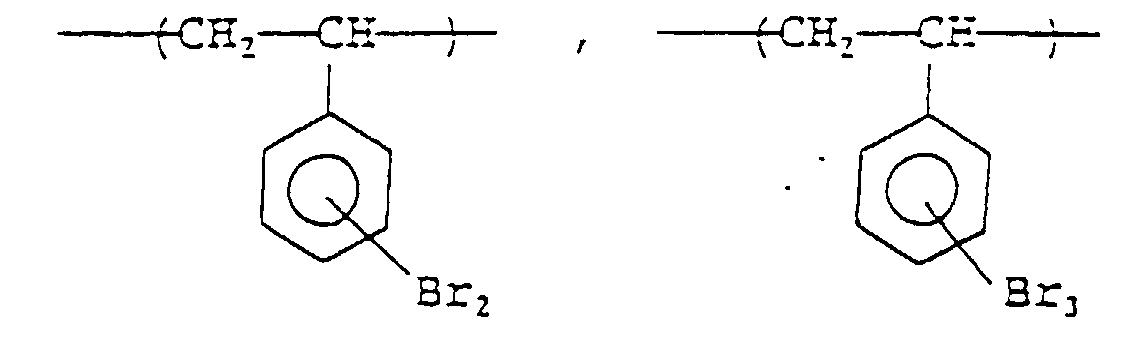
- the organic bromide is a poly(bromostyrene) of a weight average molecular weight of 1 x 10 3 to 120 x 10 4 comprising as its main component at least one type of the following structural units produced from a bromostyrene monomer:
- thermotropic resin composition preferably there is further included not more than 200 parts by weight of a filler with respect to 100 parts by weight of the thermotropic resin composition.
- the "thermotropic polyester” may be a polyester forming an anisotropic molten phase which comprises structural units selected, for example, from an aromatic oxycarbonyl unit, aromatic dioxy unit, aromatic dicarbonyl unit or ethylenedioxy unit.
- the "thermotropic polyesteramide” may be a polyesteramide forming an anisotropic molten phase which comprises structural units selected from the above-mentioned structural units and aromatic iminocarbonyl units, aromatic diimino units and aromatic iminophenoxy units.
- thermotropic polyester and/or thermotropic polyesteramide used in the present invention may be a fully aromatic thermotropic polyester, preferably one having a naphthalene ring, a fully aromatic thermotropic polyesteramide, preferably one having a naphthalene ring, a thermotropic polyester having ethylenedioxy units, or a thermotropic polyesteramide having ethylenedioxy units.
- thermotropic polyester As a preferable example of a thermotropic polyester, mention may be made of a polyester comprising the structural units of (I), (II), and (V) or (I), (II), (III), and (IV).
- the above-mentioned structural unit (I) is a structural unit of a polyester produced from p-hydroxybenzoic acid
- the structural unit (II) is a structural unit which may be derived from an aromatic dihydroxy compound selected from 4,4'-dihydroxydiphenyl, 3,3',5,5'-tetramethyl-4,4'-dihydroxydiphenyl, hydroquinone, t-butylhydroquinone, phenylhydroquinone, 2,6-dihydroxynaphthalene, 2,7-dihydroxynapthalene, 2,2-bis(4-hydroxyphenyl)propane, and 4,4-dihydroxydiphenylether
- the structural unit (III) is a structural unit which may be derived from ethylene glycol
- the structural unit (IV) is a structural unit which may be derived from an aromatic dicarboxylic acid selected from terephthalic acid, isophthalic acid, 4,4'-diphenyldicarboxylic acid, 2,
- thermotropic polyesteramide a polyesteramide forming an anisotropic molten phase which includes p-iminophenoxy units derivable from p-aminophenol other than the above-mentioned structural units (I) to (IV) are preferable.
- thermotropic polyester preferably used in the present invention is a copolymer comprising the above-mentioned structural units (I), (II), and (IV) or (I), (II), (III), and (IV).
- the respective amounts of copolymerized structural units (I), (II), (III), and (IV) are not limited. However, the following copolymerized amounts are preferable when considering the flowability property thereof.
- the molar fraction of the total of the structural units (I) and (II) to the total of the above-mentioned structural units (I), (II) and (III) is preferably 60 to 95 mol%, particularly preferably 75 to 93 mol%, and more particularly preferably 82 to 92 mol% when considering the heat resistance, flame resistance and mechanical properties thereof.
- the molar fraction of the structural unit (III) to the total of the structural units (I), (II) and (III) is preferably 40 to 5 mol%, particularly preferably 25 to 7 mol% and more particularly preferably 18 to 8 mol%.
- the molar fraction of the structural unit (I) to the total of the structural unit (I) and (II) is preferably 75 to 95 mol%, and particularly preferably 78 to 93 mol% when considering the balance between the heat resistance and the flowability. Furthermore, the total number of moles of the structural unit (II) and the structural unit (III) is substantially equal to the total number of moles of the structural unit (IV).
- the molar fraction of the structural unit (I) to the total of the structural units (I) and (II) is preferably 40 to 90 mol%, and particularly preferably 60 to 88 mol%.
- the number of moles of the structural unit (II) is substantially equal to the number of moles of the structural unit (IV).
- thermotropic polyesters preferably used in the present invention when performing condensation polymerization to obtain the above-mentioned thermotropic polyesters preferably used in the present invention, using components forming the abovementioned structural units (I) to (IV), or (I), (II) and (IV), it is possible to further copolymerize, in a range of a small amounts to an extent not impairing the desired properties of a composition of the present invention, at least one additional component capable of providing an additional structural unit other than (I) to (IV).
- Examples of such components are 3,3'-diphenyldicarboxylic acid, 2,2'-diphenyldicarboxylic acid, and other aromatic dicarboxylic acids, adipic acid, azelaic acid, sebacic acid, dodecanedionic acid, and other aliphatic dicarboxylic acids, hexahydroterephthalic acid and other alicyclic dicarboxylic acids, chlorohydroquinone, methylhydroquinone, 4,4'-dihydroxydiphenylsulfone, 4,4'-dihydroxydiphenylsulfide, 4,4'-dihydroxybenzophenone, and other aromatic diols, 1,4-butanediols, 1,6-hexanediols, neopentyl glycol, 1,4-cyclohexanediol, 1,4-cyclohexanedimethanol, and other aliphatic and alicyclic diols
- thermotropic polyester and/or thermotropic polyester amide preferably used in the present invention is not particularly limited. It may be made in accordance with the known methods of condensation polymerization of polyesters.
- thermotropic polyesters may be produced by the following methods of production, namely method (1) or (2) for a polyester not containing the above-mentioned structural units (III), and method (3) for a polyester containing the structural units (III).
- condensation polymerization reactions may proceed without a catalyst, but sometimes it is preferable to add a catalyst selected, for example, from stannous acetate, tetrabutyl titanate, potassium acetate, sodium acetate, antimony trioxide, metal magnesium, and other metal compounds.
- a catalyst selected, for example, from stannous acetate, tetrabutyl titanate, potassium acetate, sodium acetate, antimony trioxide, metal magnesium, and other metal compounds.
- thermotropic polyester and/or thermotropic polyester amide preferably used in the present invention is one which enables measurement of its inherent viscosity (logarithmic viscosity) in pentafluorophenol.
- the value measured at a concentration of 0.1 g/dl and 60°C is preferably 0.5 dl/g or more; in particular, for those containing the above-mentioned structural units (III), preferably 1.0 to 3.0 dl/g and, for those not containing the above-mentioned structural units (III), preferably 2.0 to 10.0 dl/g.
- melt viscosity of the thermotropic polyester and/or polyesteramide in the present invention is preferably 1 to 2,000 Pa ⁇ s, particularly preferably 2 to 1,000 Pa ⁇ s.
- melt viscosity is the value measured by a Koka type flow tester under conditions of a melting point (Tm) plus 10°C and conditions of a shear rate of 1,000 (1/second).
- the melting point (Tm) indicates the endothermic peak temperature measured after measuring the endothermic peak temperature Tm 1 measured when measuring the polymer by differential calorimetric measurement from room temperature at a rate of rise of 20°C/min, then raising it to a temperature of Tm 1 + 20°C, holding at that temperature for 5 minutes, then cooling once to room temperature at a rate of temperature drop of 20°C/min, then once again raising at a rate of 20°C/min.
- graphite (B) used in the present invention it is important to use graphite with a fixed carbon content of 98% or more, a crystallinity in the range of from 80 to 95%, and an average particle size of 1 to 200 ⁇ m.
- the content of fixed carbon is at least 98%, preferably at least 99%. If the content of fixed carbon is less than 98%, the amount of wear of the resin becomes greater when it is lubricated and the effect of improvement of the wear resistance becomes poorer.
- the crystallinity is 80 to 95%, preferably 82 to 94%. If less than 80%, the coefficient of dynamic friction becomes larger when it is lubricated and the effect of improvement of the wear resistance is poor and, also, no effect of improvement in anisotropy appears. Further, if over 95%, the impact resistance of the resin falls. None of these is preferable.
- the average particle size of the graphite must be 1 to 200 ⁇ m, preferably 1 to 20 ⁇ m, more preferably 2 to 10 ⁇ m. If the average particle size is less than 1 ⁇ m, aggregation occurs and the dispersion becomes poor, while if over 200 ⁇ m, the physical properties become impaired. Neither of these is preferable.
- Graphite can be roughly divided into natural graphite and synthetic graphite.
- use is particularly preferably made of synthetic graphite made, for example, by the method of using oil-based coke or coal-based coke as a material, adding tar pitch to this and subjecting the mixture to primary sintering at about 800°C and further heating to about 2400 to 3000°C to graphitize it.
- the average interlayer distance (d 0 ) of the graphite crystals is found by X-ray diffraction. Specifically, it is the value obtained by packing graphite powder in an aluminium test holder of 20 mm x 18 mm x 2 mm and measuring by the reflectance method using an X-ray diffraction apparatus made by Rigaku Denki using silicon as a standard sample.
- the amount of the above-mentioned graphite added is 1 to 200 parts by weight, preferably 3 to 100 parts by weight, particularly preferably 5 to 80 parts by weight based upon 100 parts by weight of the thermotropic polyester and/or thermotropic polyesteramide. If the amount added is less than 1 part by weight, no effect of improvement of the wear resistance can be expected, while if over 200 parts by weight, not only is the outer appearance of the shaped article detracted from, but also the mechanical properties fall. Neither of these cases is preferable.
- the above-mentioned graphite used in the present invention may be treated on its surface with a known coupling agent (for example, a silane coupling agent or titanate coupling agent).
- a known coupling agent for example, a silane coupling agent or titanate coupling agent.
- the organic bromides usable as the component (C) in the present invention include known organic bromides used ordinarily as flame retardants. In particular, those having a bromine content of at least 20% by weight are preferable. Specifically, hexabromobenzene, pentabromotoluene, hexabromobiphenyl, decabromobiphenyl, hexabromocyclodecane, decabromodiphenylether, octabromodiphenylether, hexabromodiphenylether, bis(pentabromophenoxy)ethane, ethylene-bis(tetrabromophthalimide), tetrabromobisphenol A, and other lower molecular weight organic bromine compounds, brominated polycarbonate (for example, polycarbonate oligomer produced using bromobisphenol A or their copolymers with bisphenol A), bromoepoxy compounds (for example, an epoxy compound produced by a reaction between bromobis
- ethylene bis(tetrabromophthalimide), bromoepoxy oligomers or polymers, bromopolystyrene, crosslinked bromopolystyrene, bromopolyphenylene ether, and bromopolycarbonate are preferable, with bromopolystyrene being most preferably used.
- the degree of polymerization n in the above general formula (i) is preferably at least 15, more preferably 50 to 80.
- bromopolystyrene As the bromopolystyrene usable in the present invention, mention may be made of bromopolystyrene produced by bromination of polystyrene obtained by radical polymerization or anionic polymerization, cross-linked bromopolystyrene, or poly(bromostyrene) having bromostyrene units expressed by the formula (ii) and/or (iii) produced by radical polymerization or anionic polymerization, preferably radical polymerization, of bromostyrene monomers, but a poly(bromostyrene) having a weight average molecular weight of 1 x 10 3 to 120 x 10 4 having as its main components the structural units expressed by the following formulae (ii) and/or (iii) produced from bromostyrene monomers is preferable.
- bromostyrene monomer is preferably one wherein 2 to 3 bromine atoms are introduced by a substitution reaction into the aromatic ring per one styrene monomer and may include monobromostyrene in addition to dibromostyrene and/or tribromostyrene.
- the above-mentioned poly(bromostyrene) preferably includes at least 60% by weight of dibromostyrene and/or tribromostyrene units, more preferably at least 70% by weight. It may be a poly(bromostyrene) obtained by copolymerizing up to 40% by weight of monobromostyrene, preferably up to 30% by weight, in addition to the dibromostyrene and/or tribromostyrene.
- the weight average molecular weight of the poly(bromostyrene) is more preferably 1 x 10 4 to 15 x 10 4 . Note that the weight average molecular weight is a value measured using a gel permeation chromatograph and is a relative value based on a standard of the molecular weight of polystyrene.
- cross-linked bromopolystyrene preferably polystyrene obtained by bromination of porous polystyrene cross-linked by divinylbenzene is used.
- R 3 and R 4 independently represent a substituted or unsubstituted aryl group, among which a p-t-butylphenyl group is most preferable.
- n in the general formula (iv) at least 4 is preferable and 8 or more, in particular 8 to 25, is more preferable.
- the amount of these organic bromides (C) which may be blended in is preferably 0.5 to 60 parts by weight, particularly 1 to 30 parts by weight, based upon 100 parts by weight of thermotropic polyester and/or thermotropic polyesteramide.
- the organic bromine compound is preferably dispersed in the composition at an average size of not more than 2.5 ⁇ m, more preferably dispersed at one not more than 2.0 ⁇ m.
- Compositions of the present invention preferably contain fillers, examples of which are glass fiber, carbon fiber, aromatic polyamide fiber, potassium titanate fiber, gypsum fiber, brass fiber, steel (for example stainless steel) fiber, ceramic fiber, boron whisker fiber, asbestos fiber, mica, talc, silica, calcium carbonate, glass beads, glass flakes, glass microballoons, clay, wollastonite, titanium oxide, molybdenum disulfide, and other fibrous, powder, granular, or plate-like inorganic fillers.
- fillers and reinforcers use may be made of those treated by a silane type titanate type, or other coupling agent or other surface treatment agent.
- the amount added is preferably not more than 200 parts by weight based upon 100 parts by weight of total amount of (A) thermotropic polyester and/or thermotropic polyesteramide and (B) graphite, more preferably 5 to 150 parts by weight, particularly preferably 10 to 100 parts by weight.
- thermotropic resin composition of the present invention is preferably produced by melting and mixing.
- Use may be made of a known method for this melting and mixing.
- use may be made of a Banbury mixer, rubber roller, kneader, monoaxial or biaxial extrusion machine, and the melting and mixing performed at a temperature of 200 to 400°C to make the composition.
- thermotropic resin composition of the present invention obtained in this way may be used to make three-dimensional shaped articles, sheets, containers and pipes having superior heat resistance, moldability, mechanical properties, and outside appearance by ordinary shaping methods such as injection molding, extrusion, and blow molding, in particular having mechanical properties with a small anisotrophy.
- a 994 part by weight amount of p-hydroxybenzoic acid, 126 parts by weight of 4,4'-dihydroxybiphenyl, 112 parts by weight of terephthalic acid, 216 parts by weight of polyethylene terephthalate with an intrinsic viscosity of about 0.6 dl/g, and 960 parts by weight of acetic anhydride were charged into a reactor equipped with an agitating blade and distillation tube. Condensation polymerization was performed and the condensation polymerization was completed to obtain the resin (A-1).
- the melting point (Tm) of the resin was 314°C.
- the melt viscosity at 324°C and a shear rate of 1000/second was 40 Pa ⁇ sec.
- a 994 part by weight amount of p-hydroxybenzoic acid, 222 parts by weight of 4,4'-dihydroxybiphenyl, 147 parts by weight of 2,6-diacetoxynaphthalene, 1078 parts by weight of acetic anhydride, and 299 parts by weight of terephthalic acid were charged into a reactor equipped with an agitating blade and distillation tube. Condensation polymerization was performed to obtain the resin (A-2).
- the melting point (Tm) of the resin was 336°C.
- the melt viscosity at 346°C and a shear rate of .1000/second was 52 Pa ⁇ sec.
- the melting point (Tm) of the resin was 283°C.
- the melt viscosity at 293°C and a shear rate of 1000/second was 120 Pa ⁇ sec.
- the melting point (Tm) of the resin was 283°C.
- the melt viscosity at 293°C and a shear rate of 1000/second was 200 Pa ⁇ sec.
- the structure of the organic bromine compounds used in the following Examples 13-23 is shown in Table 1.
- Type Structure FR-1 Poly(bromostyrene) obtained by polymerizing monomers including 80 wt% of dibromostyrene, 15 wt% of monobromostyrene, and 5 wt% of tribromostyrene (59% bromine content). Weight average molecular weight of 30 x 10 4 .
- FR-2 Poly(bromostyrene) obtained by polymerization of tribromostyrene monomer (68% bromine content). Weight average molecular weight of 30 x 10 4 .
- FR-3 Dibrominated polystyrene obtained by bromination of polystyrene (60% bromine content). Weight average molecular weight of 26 x 10 4 .
- FR-4 Tribrominated polystyrene obtained by bromination of polystyrene (68% brome content). Weight average molecular weight of 25 x 10 4 .
- FR-5 Bromoepoxy polymer
- FR-6 Bromopolycarbonate
- thermotropic resins obtained in Reference Examples 1 to 4 and the various types of graphite shown in Table 1 were dry blended in the ratios of Table 1, then were melted, mixed, and pelletized using a biaxial extrusion machine of 30 mm ⁇ set to a cylinder temperature of the melting points of the thermotropic resins.
- the pellets were fed to a Sumitomo Nestar injection molding machine Promat 40/25 (made by Sumitomo Heavy Industries) to form square plates of 30 x 30 x 3.2 (thickness) mm, square plates of 70 x 70 x 2 (thickness) mm, and Izod impact strength pieces of 12.5 x 125 x 3.2 (thickness) mm under conditions of a cylinder temperature of the melting point plus 10°C and a mold temperature of 90°C.
- a Sumitomo Nestar injection molding machine Promat 40/25 made by Sumitomo Heavy Industries
- the 70 x 70 x 2 (thickness) mm square plate was shaped and then the mold shrinkage in the machine direction (MD) of the square plate and the transverse direction (TD) to the machine direction were measured.
- Izod impact test piece was used to evaluate the impact resistance in according with ASTM D256.
- Example 3 The same procedure was followed as in Example 2 except that joint use was made of the additives shown in Table 3 as other additives. The results are shown in Table 3.
- thermotropic resins obtained in Reference Examples 1 and 3, the graphites shown in Table 4, and the various organic bromine compounds shown in Table 1 were dry blended in the ratios of Table 4, then were melted, mixed, and pelletized using a biaxial extrusion machine of 30 mm ⁇ set to a cylinder temperature of the melting points of the thermotropic resins.
- the pellets were fed to a Sumitomo Nestar injection molding machine Promat 40/25 (made by Sumitomo Heavy Industries) to form square plates of 30 x 30 x 3.2 (thickness) mm, square plates of 70 x 70 x 2 (thickness) mm, Izod impact strength pieces of 12.5 x 125 x 3.2 (thickness) mm, and combustion test pieces of 0.5 mm (thickness) x 12.7 mm x 127 mm under conditions of a cylinder temperature of the melting point plus 10°C and a mold temperature of 90°C.
- combustion test piece was used for a vertical type combustion test according to the specifications of UL-94 to evaluate the flame retardancy.
- Example 14 The same procedure was followed as in Example 14 except that joint use was made of the additives shown in Table 5 as other additives. The results are shown in Table 5.
- thermotropic resin compositions embodying the present invention can provide a shaped article which does not impair the superior heat resistance, flowability, moldability, and mechanical properties of the thermotropic polymer.
- it can provide a shaped article with a balance of a superior dimensional stability and wear resistance, and is therefore a material suitable for various applications such as the production of electrical and electronic equipment, precision machinery related equipment, office equipment, and automobile and vehicular related equipment.
Landscapes
- Chemical & Material Sciences (AREA)
- Organic Chemistry (AREA)
- Health & Medical Sciences (AREA)
- Chemical Kinetics & Catalysis (AREA)
- Medicinal Chemistry (AREA)
- Polymers & Plastics (AREA)
- Crystallography & Structural Chemistry (AREA)
- Engineering & Computer Science (AREA)
- Materials Engineering (AREA)
- Compositions Of Macromolecular Compounds (AREA)
Claims (9)
- Thermotrope Harzzusammensetzung, welche umfaßt:(A) 100 Gewichtsteile eines thermotropen Polyesters, eines thermotropen Polyesteramids oder einer Mischung davon, die eine anisotrope geschmolzene Phase bilden können, und (B) 1 bis 200 Gewichtsteile Graphit mit einem Gehalt an festem Kohlenstoff von 98% oder mehr, einer Kristallinität (P) von 80 bis 95% und einer mittleren Partikelgröße von 1 bis 200 µm, wobei die Kristallinität P(%) der Kristallinitätsgrad für eine Gitterkonstante c0 von 2xd0 ist, worin d0 der mittlere Zwischenschichtabstand (Å) der Graphitkristalle ist, und
- Thermotrope Harzzusammensetzung nach Anspruch 1, wobei der Graphit (B) ein Graphit mit einem Gehalt an festem Kohlenstoff von mindestens 99% ist.
- Thermotrope Harzzusammensetzung nach Anspruch 1 oder 2, wobei der Graphit (B) Graphit mit einer Kristallinität von 82 bis 94% ist.
- Thermotrope Harzzusammensetzung nach Anspruch 1, 2 oder 3, wobei der Graphit (B) Graphit mit einer mittleren Partikelgröße von 1 bis 20 µm ist.
- Thermotrope Harzzusammensetzung nach einem der vorstehenden Ansprüche, wobei der thermotrope Polyester, das thermotrope Polyesteramid oder die Mischung davon, die eine anisotrope geschmolzene Phase (A) bilden, mindestens ein thermotroper Polyester oder ein thermotropes Polyesteramid ist, ausgewählt aus vollkommen aromatischen thermotropen Polyestern, vollkommen aromatischen thermotropen Polyesteramiden, thermotropen Polyestern mit Ethylendioxy-Einheiten und thermotropen Polyesteramiden mit Ethylendioxy-Einheiten.
- Thermotrope Harzzusammensetzung nach Anspruch 5, wobei der thermotrope Polyester Struktureinheiten der folgenden Formeln (I), (II), und (IV) oder (I), (II), (III) und (IV) aufweist:


 ausgewählt ist, und R2 mindestens eine Gruppe darstellt, die aus:
 ausgewählt ist, wobei in den oben genannten Formeln X ein Wasserstoffatom oder ein Chloratom darstellt, und die Gesamtzahl der Mole der Struktureinheiten (II) und (III) und die Anzahl der Mole der Struktureinheit (IV) im wesentlichen gleich sind.
- Thermotrope Harzzusammensetzung nach einem der vorstehenden Ansprüche, die außerdem bezogen auf 100 Gewichtsteile (A) 0,5 bis 60 Gewichtsteile eines organischen Bromids umfaßt.
- Thermotrope Harzzusammensetzung nach Anspruch 7, wobei das organische Bromid (C) ein Poly(bromstyrol) ist, das ein Gewichtsmittel-Molekulargewicht von 1 x 10³ bis 120 x 104 aufweist und als Hauptbestandteil mindestens eine der folgenden Struktureinheiten hat, die aus einem Bromstyrolmonomer hergestellt sind:
- Thermotrope Harzzusammensetzung nach einem der vorstehenden Ansprüche, die außerdem bezogen auf 100 Gewichtsteile der Komponenten (A) und (B) 200 Gewichtsteile oder weniger eines Füllstoffs umfaßt.
Applications Claiming Priority (8)
| Application Number | Priority Date | Filing Date | Title |
|---|---|---|---|
| JP284549/92 | 1992-10-22 | ||
| JP28454992 | 1992-10-22 | ||
| JP8484/93 | 1993-01-21 | ||
| JP848493 | 1993-01-21 | ||
| JP152419/93 | 1993-06-23 | ||
| JP15241893A JP3265719B2 (ja) | 1992-10-22 | 1993-06-23 | 液晶性樹脂組成物 |
| JP152418/93 | 1993-06-23 | ||
| JP5152419A JPH06184414A (ja) | 1992-10-22 | 1993-06-23 | 難燃液晶性樹脂組成物 |
Publications (2)
| Publication Number | Publication Date |
|---|---|
| EP0594465A1 EP0594465A1 (de) | 1994-04-27 |
| EP0594465B1 true EP0594465B1 (de) | 1998-12-23 |
Family
ID=27454954
Family Applications (1)
| Application Number | Title | Priority Date | Filing Date |
|---|---|---|---|
| EP93308459A Expired - Lifetime EP0594465B1 (de) | 1992-10-22 | 1993-10-22 | Thermotrope Kunstharz-Zusammensetzung |
Country Status (4)
| Country | Link |
|---|---|
| US (1) | US5432225A (de) |
| EP (1) | EP0594465B1 (de) |
| KR (1) | KR0175686B1 (de) |
| DE (1) | DE69322735T2 (de) |
Families Citing this family (8)
| Publication number | Priority date | Publication date | Assignee | Title |
|---|---|---|---|---|
| JP3307047B2 (ja) * | 1994-01-17 | 2002-07-24 | 三菱電機株式会社 | 車両用交流発電機 |
| ZA957192B (en) * | 1994-09-06 | 1996-03-15 | Scapa Group Plc | Pintle wire |
| US5942561A (en) * | 1995-03-03 | 1999-08-24 | Tosoh Corporation | Fire-retardant polymer composition |
| US5760115A (en) * | 1995-03-03 | 1998-06-02 | Tosoh Corporation | Fire-retardant polymer composition |
| US6124394A (en) * | 1996-08-13 | 2000-09-26 | Tosoh Corporation | Fire-retardant tablet, and fire-retarding method, fire-retardant polymer composition and molded article employing the same |
| JP2001207054A (ja) * | 2000-01-24 | 2001-07-31 | Polyplastics Co | 液晶性ポリマー成形品 |
| KR101770826B1 (ko) * | 2011-01-05 | 2017-08-23 | 심천 워트 어드밴스드 머티리얼즈 주식회사 | 섬유웹, 이의 제조방법 및 이를 구비하는 필터 |
| CN108431682A (zh) * | 2015-11-24 | 2018-08-21 | Iqlp有限责任公司 | 用于高温半导体工艺的液晶聚合物制品 |
Citations (2)
| Publication number | Priority date | Publication date | Assignee | Title |
|---|---|---|---|---|
| US5131827A (en) * | 1987-05-29 | 1992-07-21 | Otsuka Kagaku Kabushiki Kaisha | Fiber- and whisker-reinforced injection moldable resin composition for scroll compressor parts and method of manufacturing scroll compressor parts |
| EP0572911A1 (de) * | 1992-06-02 | 1993-12-08 | Sumitomo Chemical Company, Limited | Flüssigkristalline Polyesterharzzusammensetzung und geformter Gegenstand |
Family Cites Families (7)
| Publication number | Priority date | Publication date | Assignee | Title |
|---|---|---|---|---|
| US4489190A (en) * | 1980-06-11 | 1984-12-18 | Celanese Corporation | Blend of polyalkylene terephthalate and wholly aromatic polyester |
| JPH0629367B2 (ja) * | 1985-12-02 | 1994-04-20 | ポリプラスチックス株式会社 | 導電性樹脂組成物 |
| JPH0739533B2 (ja) * | 1986-12-10 | 1995-05-01 | ポリプラスチックス株式会社 | 液晶性ポリエステル樹脂組成物 |
| GB2233661B (en) * | 1989-07-06 | 1992-10-07 | T & N Technology Ltd | Wear resistant articles |
| US5124397A (en) * | 1990-04-19 | 1992-06-23 | Nippon Petrochemicals Company, Limited | Resin composition for sliding movement and sealing member comprising same |
| US5221705A (en) * | 1990-06-21 | 1993-06-22 | Toray Industries, Inc. | Flame-retardant thermotropic polyester composition and its shaped article |
| DE69128868T2 (de) * | 1990-11-07 | 1998-10-08 | Teijin Ltd | Laser-beschriftbare Polyesterharzzusammensetzung |
-
1993
- 1993-10-20 US US08/139,917 patent/US5432225A/en not_active Expired - Lifetime
- 1993-10-22 EP EP93308459A patent/EP0594465B1/de not_active Expired - Lifetime
- 1993-10-22 DE DE69322735T patent/DE69322735T2/de not_active Expired - Lifetime
- 1993-10-22 KR KR1019930021993A patent/KR0175686B1/ko not_active Expired - Lifetime
Patent Citations (2)
| Publication number | Priority date | Publication date | Assignee | Title |
|---|---|---|---|---|
| US5131827A (en) * | 1987-05-29 | 1992-07-21 | Otsuka Kagaku Kabushiki Kaisha | Fiber- and whisker-reinforced injection moldable resin composition for scroll compressor parts and method of manufacturing scroll compressor parts |
| EP0572911A1 (de) * | 1992-06-02 | 1993-12-08 | Sumitomo Chemical Company, Limited | Flüssigkristalline Polyesterharzzusammensetzung und geformter Gegenstand |
Also Published As
| Publication number | Publication date |
|---|---|
| DE69322735T2 (de) | 1999-05-06 |
| DE69322735D1 (de) | 1999-02-04 |
| KR940009316A (ko) | 1994-05-20 |
| KR0175686B1 (ko) | 1999-04-01 |
| US5432225A (en) | 1995-07-11 |
| EP0594465A1 (de) | 1994-04-27 |
Similar Documents
| Publication | Publication Date | Title |
|---|---|---|
| CA2228069C (en) | Liquid-crystalline resin composition and precision moldings of the composition | |
| US5830940A (en) | Shaped article of liquid crystalline polymer | |
| EP0565353B1 (de) | Flüssigkristalline Polymerzusammensetzung | |
| KR100390087B1 (ko) | 액정수지조성물및그것의성형품 | |
| JPH06172619A (ja) | 液晶性樹脂組成物 | |
| EP0594465B1 (de) | Thermotrope Kunstharz-Zusammensetzung | |
| JP3265721B2 (ja) | 液晶性樹脂組成物 | |
| KR19980064615A (ko) | 액정수지와 그것의 성형품 | |
| JP3612905B2 (ja) | 液晶性樹脂組成物および成形品 | |
| JP3362489B2 (ja) | 液晶性樹脂組成物および成形品 | |
| JP3265719B2 (ja) | 液晶性樹脂組成物 | |
| JP3564824B2 (ja) | 樹脂組成物の製造方法 | |
| JP3632341B2 (ja) | 液晶性樹脂組成物および成形品 | |
| JP3409469B2 (ja) | 液晶性樹脂およびその射出成形品 | |
| JP4048591B2 (ja) | 液晶性樹脂組成物および成形品 | |
| JP3111593B2 (ja) | 液晶ポリマ組成物 | |
| JPH09221582A (ja) | 液晶性樹脂組成物および成形品 | |
| JPH11209590A (ja) | 液晶性樹脂組成物およびその精密成形品 | |
| JP3111586B2 (ja) | 液晶性樹脂組成物 | |
| JP3564860B2 (ja) | 液晶性樹脂組成物および液晶性樹脂成形品 | |
| JP3487053B2 (ja) | 液晶性樹脂、液晶性樹脂組成物およびその成形品 | |
| JPH11116664A (ja) | 液晶性樹脂および熱可塑性樹脂組成物 | |
| JP4207267B2 (ja) | 液晶性樹脂組成物および成形品 | |
| JPH06184414A (ja) | 難燃液晶性樹脂組成物 | |
| JP2005248052A (ja) | 液晶性ポリエステル組成物 |
Legal Events
| Date | Code | Title | Description |
|---|---|---|---|
| PUAI | Public reference made under article 153(3) epc to a published international application that has entered the european phase |
Free format text: ORIGINAL CODE: 0009012 |
|
| AK | Designated contracting states |
Kind code of ref document: A1 Designated state(s): DE FR GB |
|
| 17P | Request for examination filed |
Effective date: 19941004 |
|
| 17Q | First examination report despatched |
Effective date: 19960122 |
|
| GRAG | Despatch of communication of intention to grant |
Free format text: ORIGINAL CODE: EPIDOS AGRA |
|
| GRAG | Despatch of communication of intention to grant |
Free format text: ORIGINAL CODE: EPIDOS AGRA |
|
| GRAH | Despatch of communication of intention to grant a patent |
Free format text: ORIGINAL CODE: EPIDOS IGRA |
|
| GRAH | Despatch of communication of intention to grant a patent |
Free format text: ORIGINAL CODE: EPIDOS IGRA |
|
| GRAA | (expected) grant |
Free format text: ORIGINAL CODE: 0009210 |
|
| AK | Designated contracting states |
Kind code of ref document: B1 Designated state(s): DE FR GB |
|
| REF | Corresponds to: |
Ref document number: 69322735 Country of ref document: DE Date of ref document: 19990204 |
|
| ET | Fr: translation filed | ||
| PLBE | No opposition filed within time limit |
Free format text: ORIGINAL CODE: 0009261 |
|
| 26N | No opposition filed | ||
| REG | Reference to a national code |
Ref country code: GB Ref legal event code: IF02 |
|
| PGFP | Annual fee paid to national office [announced via postgrant information from national office to epo] |
Ref country code: GB Payment date: 20081022 Year of fee payment: 16 |
|
| PG25 | Lapsed in a contracting state [announced via postgrant information from national office to epo] |
Ref country code: GB Free format text: LAPSE BECAUSE OF NON-PAYMENT OF DUE FEES Effective date: 20091022 |
|
| PGFP | Annual fee paid to national office [announced via postgrant information from national office to epo] |
Ref country code: FR Payment date: 20121018 Year of fee payment: 20 Ref country code: DE Payment date: 20121017 Year of fee payment: 20 |
|
| REG | Reference to a national code |
Ref country code: DE Ref legal event code: R071 Ref document number: 69322735 Country of ref document: DE |
|
| PG25 | Lapsed in a contracting state [announced via postgrant information from national office to epo] |
Ref country code: DE Free format text: LAPSE BECAUSE OF EXPIRATION OF PROTECTION Effective date: 20131023 |