EP0596654B1 - Modifiziertes Polyolefin - Google Patents
Modifiziertes Polyolefin Download PDFInfo
- Publication number
- EP0596654B1 EP0596654B1 EP93308613A EP93308613A EP0596654B1 EP 0596654 B1 EP0596654 B1 EP 0596654B1 EP 93308613 A EP93308613 A EP 93308613A EP 93308613 A EP93308613 A EP 93308613A EP 0596654 B1 EP0596654 B1 EP 0596654B1
- Authority
- EP
- European Patent Office
- Prior art keywords
- polyolefin
- modified polyolefin
- component
- glycidyl
- monomer
- Prior art date
- Legal status (The legal status is an assumption and is not a legal conclusion. Google has not performed a legal analysis and makes no representation as to the accuracy of the status listed.)
- Expired - Lifetime
Links
- 0 CNC(C(*)=C)=O Chemical compound CNC(C(*)=C)=O 0.000 description 2
Images


Classifications
-
- C—CHEMISTRY; METALLURGY
- C08—ORGANIC MACROMOLECULAR COMPOUNDS; THEIR PREPARATION OR CHEMICAL WORKING-UP; COMPOSITIONS BASED THEREON
- C08F—MACROMOLECULAR COMPOUNDS OBTAINED BY REACTIONS ONLY INVOLVING CARBON-TO-CARBON UNSATURATED BONDS
- C08F255/00—Macromolecular compounds obtained by polymerising monomers on to polymers of hydrocarbons as defined in group C08F10/00
Definitions
- This invention relates to a modified polyolefin useful as a modifier for engineering plastics and the like. More particularly, this invention relates to a modified polyolefin useful as modifier for engineering plastics such as polyesters, polyamides, etc., and as an adhesion improver for improving adhesion of such engineering plastics with fillers to be compounded therein.
- Polyolefins are used widely in various applications as films, fibers, molded articles, etc. since they are produced industrially at low cost and are superior in molding properties, insulating properties, resistance to chemicals, mechanical strength, etc.
- resin compositions having compounded therein polyolefins themselves suffer poor compatibility because of the polyolefins being non-polar. More particularly, the polyolefins do not disperse uniformly when they are kneaded simply and conversely their rigidity, impact strength, elasticity, etc. decrease so that no resin compositions can be obtained that have desired physical properties.
- modified polyolefins or modified polyolefin elastomers have some disadvantages. That is, upon their preparation reaction, a decomposition reaction of the polyolefin main chain proceeds simultaneously so that there can be obtained only low molecular weight modified products.
- maleic anhydride and other substances used for modification are sublimating monomers which have irritating odors, and hence their working efficiencies upon melting reaction are not so high.
- the modified polyolefin and modified polyolefin elastomers thus obtained are not always sufficient as a compatible plasticizer since it is difficult to increase the graft ratio of maleic anhydride or tne like therein to a high enough a level.
- modified polyolefins and modified polyolefin elastomers have been proposed in which glycidyl esters of acrylic acid or methacrylic acid are used as a modifier.
- resin compositions composed of polyamides, polyesters or the like blended with polyolefins or polyolefin elastomers modified with unsaturated glycidyl compounds represented by general formula (I) below wherein R is a hydrogen atom or an alkyl group having 1 to 6 carbon atoms; Ar is an aromatic hydrocarbon group having 6 to 20 carbon atoms and having at least one glycidyl group; and n is an integer of 1 to 4 (WO91/14717, Japanese Patent Application Laid-open Nos. 23814/1992, 43764/1993, 86276/1993, etc.)
- glycidyl acrylate (GA), glycidyl methacrylate (GMA) and the compound of general formula (I) above used as a modifier have high reactivity and high reaction efficiency, and hence these modifiers give high graft ratio upon modification and the resin compositions obtained by melt-mixing the resulting modified polyolefin with the various engineering plastics described above have good dispersion compatibility and excellent physical properties.
- modifiers are highly homopolymerizable so that in the graft reaction upon the modification, they do not disperse in the polyolefin as monomer units but graft on the polyolefin as a polymer.
- reaction sites concentrate on certain points on the polymer, and the modified polyolefin as a whole has decreased reactivity and reaction efficiency.
- an object of this invention is to increase dispersability of the aforementioned modifier monomer in polyolefins and provide a modified polyolefin having improved reactivity and reaction efficiency.
- This invention provides a modified polyolefin comprising:
- the polyolefin (A), which is one of the starting materials of the modified polyolefin of this invention includes homopolymers of ⁇ -olefins (inclusive of ethylene); random-, block-, graft-copolymers of two or more of such ⁇ -olefins, and mixtures thereof; random-, block-, graft-copolymers of such ⁇ -olefins as a main component with one or more other unsaturated monomers; and olefin elastomers.
- examples of the ⁇ -olefins include ethylene, propylene, butene-1, hexene-1, 3-methylbutene-1, 4-methylpentene-1, heptene-1, octene-1, decene-1, etc.
- polystyrene resin preferred are homopolymers of ethylene or propylene, ethylene/propylene copolymers, copolymers of ethylene or propylene with other ⁇ -olefins, and olefin elastomers.
- polyethylene there can be used low density polyethylene (LDPE), high density polyethylene (HDPE), linear low density polyethylene (LLDPE), etc.
- LDPE low density polyethylene
- HDPE high density polyethylene
- LLDPE linear low density polyethylene
- Polypropylenes are not limited to homopolymers of propylene but include block- or random-copolymers of propylene with ethylene.
- the copolymers may be ethylene/propylene copolymers having an ethylene content of not higher than 20% by weight.
- Such polypropylenes have a melt flow rate (MFR, JISK7210, load: 2.16kg, 230°C) of usually about 0.1 to 200g/10 minutes.
- the polyethylenes or polypropylenes may contain up to about 40% by weight of the olefin elastomers described hereinbelow.
- olefin elastomers copolymer rubbers made from ethylene and one or more a-olefins other than ethylene such as propylene, butene-1, hexene-1, 4-methylpentene-1, etc.
- Typical examples of the copolymer rubbers made from ethylene and one or more ⁇ -olefins other than ethylene include ethylene/propylene copolymer rubber (EPR), ethylene/butene copolymer rubber (EBR), ethylene/propylene/diene terpolymer rubber (EPDM), etc.
- the diene used in ethylene/propylene/diene terpolymer rubber may be unconjugated dienes such as dicyclopentadiene, 1,4-hexadiene, cyclooctadiene, and methylenenorbornene, or conjugated dienes such as butadiene and isoprene.
- EPR, EBR and EPDM may contain repeating units derived from other ⁇ -olefins such as 4-methylpentene-1 in amounts of not higher than 10% by mole.
- the unsaturated glycidyl compound is a compound having an acrylamide or methacrylamide group, and saturated glycidyl compounds represented by general formula (I) below are used preferably.
- R is a hydrogen atom or an alkyl group having 1 to 6 carbon atoms
- Ar is an aromatic hydrocarbon group having 6 to 20 carbon atoms and having at least one glycidyl group
- n is an integer of 1 to 4.
- Such glycidyl compounds can be prepared by the method disclosed in, for example, Japanese Patent Application Laid-open No. 130580/1985.
- the polymerizable compounds may usually be used alone but two or more them may be used in combination.
- the monomer (b-2) which is different from the glycidyl moieties of (b-1) and which has high compatibility with the reactive monomers (b-1), there can be cited, for example, acrylamide monomers, N-vinyl-N-containing heterocyclic compounds, acrylic acid ester monomers, methacrylic acid ester monomers.
- Examples of the acrylamide monomers include dialkylacrylamides, dialkylmethacrylamdides, monoalkylacrylamides, monoalkylmethacrylamides, etc.
- Examples of the N-vinyl-N-containing heterocyclic compounds include N-vinylpyrrolidones (1-vinyl-2-pyrrolidone), N-vinylphthalimide, etc.
- the acrylic acid ester monomers include, for example, alkyl acrylates such as 2-hydroxyethyl acrylate, the methacrylic acid monomer includes, for example, 2-hydroxyethyl methacrylate, etc. These monomers may be used alone or in combination with each other.
- monomers preferred are 1-vinyl-2-pyrrolidone, dimethylacrylamide, diethylacrylamide, 2-hydroxyethyl methacrylate, etc.
- proportion of the component (b-1), i.e., the reactive monomer, to the other monomer (b-2) is 5 to 50% by mole, preferably 10 to 30% by mole, of (b-1) to 95 to 50% by mole, preferably 90 to 70% by mole, of (b-2).
- the component (b-1) is less than 5% by mole (the component (b-2) is more than 95% by mole), reactivity becomes poor while if the component (b-1) exceeds 50% by mole (the component (b-2) becomes less than 50% by mole), the component (b-1) homopolymerizes to decrease the reaction efficiency.
- the modifier mixture (B) consisting of the components (b-1) and (b-2) is graft-copolymerized to the polyolefin (A).
- Proportion of the component (B), i.e., the modifier mixture, to the component (A) is 0.01 to 10 parts by weight, preferably 0.1 to 5 parts by weight, of the component (B) to 100 parts by weight of the component (A). If the component (B) is less than 0.01 part by weight, the effects of the modifier monomers are difficult to exhibit while the use of the component (B) above 10 parts by weight decreases the graft efficiency considerably.
- the modified polyolefins of this invention can be obtained by conventional graft polymerization such as a solution method or a melt kneading method.
- the polyolefin (A), the modifier monomer (B) consisting of the components (b-1) and (b-2) mixed in advance, and optionally a catalyst are charged in an extruder, double-screw kneader or the like, and kneaded for 0.1 to 20 minutes while heating at 150 to 250°C for melting to obtain a modified polyolefin.
- the aforementioned starting materials are dissolved in an organic solvent such as xylene and a catalyst is added to the solution, which is allowed to react in the presence of a catalyst at 50 to 200°C for 0.1 to 100 hours with stirring.
- a catalyst is added to the solution, which is allowed to react in the presence of a catalyst at 50 to 200°C for 0.1 to 100 hours with stirring.
- the resulting modified polymer can be collected by a conventional method, e.g., by pouring the polymer solution in a non-solvent.
- the modified polyolefin resin thus obtained has a graft ratio of about 0.01 to 10% by weight.
- the catalyst used may be ordinary radical polymerization catalysts such as peroxides, for example, benzoyl peroxide, lauroyl peroxide, di-t-butyl peroxide, acetyl peroxide, t-butyl perbenzoate, dicumyl peroxide, perbenzoic acid, peracetic acid, t-butyl perpivalate, 2,5-dimethyl-2,5-di-t-butylperoxyhexine, etc. and azo compounds, for example, azobisisobutyronitrile, etc.
- peroxides for example, benzoyl peroxide, lauroyl peroxide, di-t-butyl peroxide, acetyl peroxide, t-butyl perbenzoate, dicumyl peroxide, perbenzoic acid, peracetic acid, t-butyl perpivalate, 2,5-dimethyl-2,5-di-t-butylperoxyhex
- Amount of the catalyst to be added is about 0.1 to 50 parts by weight per 100 parts by weight of the total monomers used for modification. It is possible to add a phenol based antioxidant upon the graft reaction.
- modified polyolefins of this invention are excellent in reactivity and reaction efficiency since the reactive monomer disperses well in the polyolefin before it is grafted thereto.
- the polyolefins of this invention have uniformly distributed modified sites (reaction sites) which could influence the compatibility with other polymers when blended with other polymers to prepare resin compositions, and this means that when the polyolefins of this invention are used in the formation of polymer alloys with other polymers, the compatibilities increase due to uniform distribution of reaction sites, so that the resulting resin compositions have physical properties which are combinations of the excellent features of component polymers.
- the modified polyolefins thus obtained were measured for their melt flow rate (MFR), and evaluated of compatibilities with polyester and polyamide. The results are shown in Table 1.
- the projected area mean particle diameter of dispersed particles of each resin composition obtained was measured using a scanning electron microscope (SEM).
- the projected area mean particle diameter of dispersed particles of each resin composition obtained was measured using a scanning electron microscope in the same manner as in (1) above.
- the modified polyolefin of this invention consisting of a polyolefin; GMA or AXE; and DMAA, DEAA or 2-VP is dispersed uniformly as small particles in the polymer alloy formation with polyester and polyamide.
- the modified polyolefins (Comparative Examples 1, 4, 7, 10, 12 and 14) in which GMA or AXE alone were radical graft-polymerized in amounts equal to that of GMA or AXE used in the examples, or the modified polyolefins (Comparative Examples 2, 5, 8, 11, 13 and 15) in which GMA or AXE alone were radical graft-polymerized in amounts more than that of the reactive monomers used in the examples, dispersed polyolefin particles in the products of melt-kneading with the polyester and polyamides, respectively, have a particle diameter larger than that of the dispersed polyolefin particles obtained in the products of the examples, which indicates that the modified polyolefins of this invention are superior in compatibility to the conventional modified products modified with GMA or AXE alone.
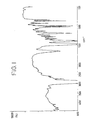
- Fig. 1 shows an infrared absorption spectrogram of the modified polyolefin thus obtained.
- Fig. 3 shows an infrared absorption spectrogram of the modified polyolefin thus obtained.
Landscapes
- Chemical & Material Sciences (AREA)
- Health & Medical Sciences (AREA)
- Chemical Kinetics & Catalysis (AREA)
- Medicinal Chemistry (AREA)
- Polymers & Plastics (AREA)
- Organic Chemistry (AREA)
- Graft Or Block Polymers (AREA)
Claims (9)
- Modifiziertes Polyolefin bestehend aus oder enthaltend:(A) 100 Gewichtsteile eines Polyolefins(B) 0,01 bis 20 Gewichtsteile eines Monomerengemischs bestehend aus:wobei das Monomerengemisch mit dem Polyolefin pfropfcopolymerisiert ist.(b-1) 5 bis 50 Mol% Glycidylacrylat, Glycidylmethacrylat oder einer ungesättigten Glycidylverbindung, dargestellt durch die allgemeine Formel (I)
 (b-2) 95 bis 50 Mol% von mindestens einem Monomer, das sich von den in (b-1) genannten Glycidylanteilen unterscheidet und ausgewählt ist aus der Gruppe bestehend aus Acrylamidmonomeren, N-vinyl-N-haltigen, heterozyklischen Verbindungen, Acrylsäureestern und Methacrylsäureestern,
 - Modifiziertes Polyolefin gemäß Anspruch 1, wobei die Komponente (b-1) Glycidylacrylat ist.
- Modifiziertes Polyolefin gemäß Anspruch 1, wobei die Komponente (b-1) Glycidylmethacrylat ist.
- Modifiziertes Polyolefin gemäß Anspruch 1, wobei die Komponente (b-1) die durch die allgemeine Formel (I) dargestellte Verbindung ist.
- Modifiziertes Polyolefin gemäß Anspruch 4, wobei die Komponente (b-1) eine durch die allgemeine Formel (II) dargestellte Verbindung ist

- Polyolefin nach einem der Ansprüche 1 bis 5, wobei das Polyolefin (A) mindestens ein Mitglied ausgewählt aus der Gruppe bestehend aus Homopolymeren von α-Olefinen (einschließlich Ethylen); statistischen -, Block-, Pfropfcopolymeren aus zwei oder mehreren dieser α-Olefine sowie deren Gemischen; statistischen -, Block-, Pfropfcopolymeren dieser α-Olefine als Hauptkomponente mit einem oder mehreren anderen ungesättigten Monomeren; und Olefinelastomeren ist.
- Modifiziertes Polyolefin gemäß Anspruch 1, wobei die Komponente (b-2) ein Acrylamidmonomer und dieses Acrylamidmonomer mindestens ein Mitglied ausgewählt aus der Gruppe bestehend aus Dialkylacrylamiden, Dialkylmethacrylamiden, Monoalkylacrylamiden und Monoalkylmethacrylamiden ist.
- Modifiziertes Polyolefin gemäß Anspruch 1, wobei die Komponente (b-2) eine N-vinyl-N-haltige, heterozyklische Verbindung und diese N-vinyl-N-haltige, heterozyklische Verbindung mindestens ein Mitglied ausgewählt aus der Gruppe bestehend aus N-vinylpyrrolidon, (1-vinyl-2-pyrrolidon) und N-vinylphthalimid ist.
- Modifiziertes Polyolefin gemäß Anspruch 1, wobei die Komponente (b-2) ein Acrylsäuremonomer und dieses Acrylsäuremonomer ein Alkylacrylat ist.
Applications Claiming Priority (4)
| Application Number | Priority Date | Filing Date | Title |
|---|---|---|---|
| JP315697/92 | 1992-10-30 | ||
| JP315698/92 | 1992-10-30 | ||
| JP4315698A JPH06145261A (ja) | 1992-10-30 | 1992-10-30 | 変性ポリオレフィン |
| JP4315697A JPH06145260A (ja) | 1992-10-30 | 1992-10-30 | 変性ポリオレフィン |
Publications (2)
| Publication Number | Publication Date |
|---|---|
| EP0596654A1 EP0596654A1 (de) | 1994-05-11 |
| EP0596654B1 true EP0596654B1 (de) | 1997-07-16 |
Family
ID=26568402
Family Applications (1)
| Application Number | Title | Priority Date | Filing Date |
|---|---|---|---|
| EP93308613A Expired - Lifetime EP0596654B1 (de) | 1992-10-30 | 1993-10-28 | Modifiziertes Polyolefin |
Country Status (3)
| Country | Link |
|---|---|
| US (1) | US5436297A (de) |
| EP (1) | EP0596654B1 (de) |
| DE (1) | DE69312222D1 (de) |
Families Citing this family (4)
| Publication number | Priority date | Publication date | Assignee | Title |
|---|---|---|---|---|
| JPH07149960A (ja) * | 1993-12-01 | 1995-06-13 | Kanegafuchi Chem Ind Co Ltd | グラフト変性ポリオレフィン系樹脂組成物及びこれを含有してなる熱可塑性樹脂組成物 |
| KR100396205B1 (ko) * | 1994-12-22 | 2003-11-28 | 시바 스페셜티 케미칼스 홀딩 인크. | 피롤리디논-함유상용제 |
| CN101065450B (zh) * | 2004-11-30 | 2014-05-07 | 阿科玛股份有限公司 | 用于流体运输器件的合金组合物 |
| GB2439728B (en) * | 2006-07-03 | 2010-07-21 | Fuji Seal Int Inc | Heat-shrinkable film |
Family Cites Families (25)
| Publication number | Priority date | Publication date | Assignee | Title |
|---|---|---|---|---|
| NL111106C (de) * | 1958-01-29 | |||
| US3699186A (en) * | 1971-03-30 | 1972-10-17 | Dart Ind Inc | Polyolefins modified with unsaturated glycidyl compounds and polyacrylate compounds |
| BE791036R (fr) * | 1972-07-05 | 1973-05-07 | Dart Ind Inc | Melanges synergiques de polyolefines modifiees et de polyolefines non |
| JPS5052156A (de) * | 1973-08-31 | 1975-05-09 | ||
| JPS52105993A (en) * | 1976-03-04 | 1977-09-06 | Idemitsu Kosan Co Ltd | Preparation of modified polypropylene |
| JPS5550040A (en) * | 1978-10-05 | 1980-04-11 | Idemitsu Kosan Co Ltd | Polyolefin resin composition |
| JPS5862765A (ja) * | 1981-10-08 | 1983-04-14 | Canon Inc | 電子機器 |
| JPS6011981B2 (ja) * | 1981-10-19 | 1985-03-29 | 株式会社トクヤマ | 変性ポリプロピレン組成物 |
| JPS60130580A (ja) * | 1983-12-15 | 1985-07-12 | Kanegafuchi Chem Ind Co Ltd | 新規グリシジル化合物及びその製造方法 |
| JPS60248778A (ja) * | 1984-04-20 | 1985-12-09 | Sanyo Kokusaku Pulp Co Ltd | 塗料組成物 |
| JPS62241941A (ja) * | 1986-04-14 | 1987-10-22 | Tonen Sekiyukagaku Kk | 熱可塑性樹脂組成物 |
| JPS6390523A (ja) * | 1986-10-06 | 1988-04-21 | Chisso Corp | 改質ポリプロピレン粒子の製造方法 |
| JPH0816137B2 (ja) * | 1986-11-18 | 1996-02-21 | 三菱化学株式会社 | 不飽和共重合体樹脂複合体 |
| US4880857A (en) * | 1986-12-17 | 1989-11-14 | Nippon Shokubai Kagaku Kogyo Co., Ltd. | Carbon black-graft polymer, method for production thereof, and use thereof |
| JP2643388B2 (ja) * | 1987-11-20 | 1997-08-20 | 住友化学工業株式会社 | 変性ポリオレフィン樹脂組成物 |
| CA1326093C (en) * | 1987-11-20 | 1994-01-11 | Yoshiki Toyoshima | Modified polyolefin resin |
| EP0443736A3 (en) * | 1990-02-02 | 1992-04-22 | Tonen Corporation | Thermoplastic resin composition |
| EP0522163B1 (de) * | 1990-03-28 | 1996-06-05 | MITSUI TOATSU CHEMICALS, Inc. | Modifizierte polyolefinharzzusammensetzung |
| DE69122645T2 (de) * | 1990-04-06 | 1997-04-17 | Tonen Corp | Verfahren zur Herstellung einer modifizierten Polyolefine |
| JPH03290417A (ja) * | 1990-04-06 | 1991-12-20 | Tonen Corp | 変性ポリプロピレン組成物 |
| JPH0423814A (ja) * | 1990-05-18 | 1992-01-28 | Tonen Corp | 変性オレフィン系エラストマーの製造方法 |
| CA2063265A1 (en) * | 1990-04-28 | 1991-10-29 | Kanegafuchi Kagaku Kogyo Kabushiki Kaisha | Modified polyolefin polymer, its manufacturing method and resin composition containing it |
| JPH04356530A (ja) * | 1991-02-20 | 1992-12-10 | Mitsui Petrochem Ind Ltd | 変性ポリオレフィン粒子の製造方法 |
| JPH0543764A (ja) * | 1991-08-13 | 1993-02-23 | Tonen Corp | 熱可塑性樹脂組成物 |
| JPH0680835A (ja) * | 1992-09-01 | 1994-03-22 | Kanegafuchi Chem Ind Co Ltd | 耐衝撃性および耐熱性に優れた熱可塑性樹脂組成物 |
-
1993
- 1993-10-27 US US08/141,569 patent/US5436297A/en not_active Expired - Fee Related
- 1993-10-28 EP EP93308613A patent/EP0596654B1/de not_active Expired - Lifetime
- 1993-10-28 DE DE69312222T patent/DE69312222D1/de not_active Expired - Lifetime
Also Published As
| Publication number | Publication date |
|---|---|
| US5436297A (en) | 1995-07-25 |
| DE69312222D1 (de) | 1997-08-21 |
| EP0596654A1 (de) | 1994-05-11 |
Similar Documents
| Publication | Publication Date | Title |
|---|---|---|
| KR100196968B1 (ko) | 프로필렌 중합체 물질의 그라프트 공중합체와 올레핀계 고무 물질의 그라프트 공중합체의 블렌드 | |
| CA2097110C (en) | Concentrates suitable for the preparation of functionalized polyolefins and functionalization process using said concentrates | |
| EP0601635B1 (de) | Thermoplastische Zusammensetzung, Verfahren zur deren Herstellung und deren Anwendung | |
| JPH08509772A (ja) | グラフト改質した実質的に線状であるエチレンポリマー類と他の熱可塑性ポリマー類とのブレンド物 | |
| KR100350174B1 (ko) | 헤테로상올레핀중합체물질로내충격성이개질된프로필렌중합체물질의그래프트공중합체를포함하는폴리올레핀조성물 | |
| US5298557A (en) | Thermoplastic resin composition | |
| US5436297A (en) | Modified polyolefin | |
| KR100258892B1 (ko) | 내충격성 수지조성물 | |
| KR100468641B1 (ko) | 화학적 개질에 의한 폴리올레핀 탄성체 조성물 | |
| JPH06145261A (ja) | 変性ポリオレフィン | |
| JPH06145260A (ja) | 変性ポリオレフィン | |
| JPS62158740A (ja) | 熱可塑性樹脂組成物の製造法 | |
| JPH06287222A (ja) | 変性ポリオレフィンの製造方法 | |
| JPS6099148A (ja) | 耐衝撃性ポリプロピレン組成物 | |
| JP3086357B2 (ja) | ポリアセタール樹脂組成物 | |
| JPH07173229A (ja) | 変性ポリオレフィンの製造方法 | |
| JPH0987477A (ja) | 熱可塑性重合体組成物 | |
| EP0593254A2 (de) | Thermoplastische Zusammensetzung und Verfahren zu deren Herstellung | |
| JPH0593020A (ja) | ポリプロピレン系組成物の変性方法 | |
| JPH0517646A (ja) | 熱可塑性樹脂組成物 | |
| JPH0543765A (ja) | 熱可塑性樹脂組成物 | |
| JP3243827B2 (ja) | 熱可塑性樹脂組成物 | |
| JPH04202457A (ja) | ポリエステル樹脂組成物 | |
| JPH0543764A (ja) | 熱可塑性樹脂組成物 | |
| JPH0543767A (ja) | 熱可塑性樹脂組成物 |
Legal Events
| Date | Code | Title | Description |
|---|---|---|---|
| PUAI | Public reference made under article 153(3) epc to a published international application that has entered the european phase |
Free format text: ORIGINAL CODE: 0009012 |
|
| AK | Designated contracting states |
Kind code of ref document: A1 Designated state(s): DE FR GB |
|
| 17P | Request for examination filed |
Effective date: 19941017 |
|
| 17Q | First examination report despatched |
Effective date: 19960318 |
|
| GRAG | Despatch of communication of intention to grant |
Free format text: ORIGINAL CODE: EPIDOS AGRA |
|
| GRAH | Despatch of communication of intention to grant a patent |
Free format text: ORIGINAL CODE: EPIDOS IGRA |
|
| GRAH | Despatch of communication of intention to grant a patent |
Free format text: ORIGINAL CODE: EPIDOS IGRA |
|
| GRAA | (expected) grant |
Free format text: ORIGINAL CODE: 0009210 |
|
| AK | Designated contracting states |
Kind code of ref document: B1 Designated state(s): DE FR GB |
|
| PG25 | Lapsed in a contracting state [announced via postgrant information from national office to epo] |
Ref country code: FR Effective date: 19970716 |
|
| REF | Corresponds to: |
Ref document number: 69312222 Country of ref document: DE Date of ref document: 19970821 |
|
| PGFP | Annual fee paid to national office [announced via postgrant information from national office to epo] |
Ref country code: FR Payment date: 19970917 Year of fee payment: 5 |
|
| PGFP | Annual fee paid to national office [announced via postgrant information from national office to epo] |
Ref country code: GB Payment date: 19971014 Year of fee payment: 5 |
|
| PG25 | Lapsed in a contracting state [announced via postgrant information from national office to epo] |
Ref country code: DE Effective date: 19971017 |
|
| EN | Fr: translation not filed | ||
| PLBE | No opposition filed within time limit |
Free format text: ORIGINAL CODE: 0009261 |
|
| 26N | No opposition filed | ||
| PG25 | Lapsed in a contracting state [announced via postgrant information from national office to epo] |
Ref country code: GB Free format text: LAPSE BECAUSE OF NON-PAYMENT OF DUE FEES Effective date: 19981028 |
|
| GBPC | Gb: european patent ceased through non-payment of renewal fee |
Effective date: 19981028 |