EP0602015A1 - Optisches Abtastgerät - Google Patents
Optisches Abtastgerät Download PDFInfo
- Publication number
- EP0602015A1 EP0602015A1 EP94103005A EP94103005A EP0602015A1 EP 0602015 A1 EP0602015 A1 EP 0602015A1 EP 94103005 A EP94103005 A EP 94103005A EP 94103005 A EP94103005 A EP 94103005A EP 0602015 A1 EP0602015 A1 EP 0602015A1
- Authority
- EP
- European Patent Office
- Prior art keywords
- power transmission
- transmission mechanism
- wire
- optical element
- optical device
- Prior art date
- Legal status (The legal status is an assumption and is not a legal conclusion. Google has not performed a legal analysis and makes no representation as to the accuracy of the status listed.)
- Ceased
Links
- 230000003287 optical effect Effects 0.000 title claims abstract description 115
- 230000005540 biological transmission Effects 0.000 claims abstract description 76
- 230000007246 mechanism Effects 0.000 claims abstract description 70
- 230000000712 assembly Effects 0.000 claims abstract description 21
- 238000000429 assembly Methods 0.000 claims abstract description 21
- 238000004873 anchoring Methods 0.000 claims abstract description 13
- 238000010618 wire wrap Methods 0.000 abstract description 9
- 238000000034 method Methods 0.000 description 6
- 239000000470 constituent Substances 0.000 description 4
- 238000000638 solvent extraction Methods 0.000 description 4
- 238000004140 cleaning Methods 0.000 description 2
- 229920003002 synthetic resin Polymers 0.000 description 2
- 239000000057 synthetic resin Substances 0.000 description 2
- 229920006364 Rulon (plastic) Polymers 0.000 description 1
- 238000005299 abrasion Methods 0.000 description 1
- 230000003247 decreasing effect Effects 0.000 description 1
- 239000000463 material Substances 0.000 description 1
- 238000012986 modification Methods 0.000 description 1
- 230000004048 modification Effects 0.000 description 1
- 238000005192 partition Methods 0.000 description 1
- 239000007787 solid Substances 0.000 description 1
- 238000011144 upstream manufacturing Methods 0.000 description 1
Images



Classifications
-
- H—ELECTRICITY
- H04—ELECTRIC COMMUNICATION TECHNIQUE
- H04N—PICTORIAL COMMUNICATION, e.g. TELEVISION
- H04N1/00—Scanning, transmission or reproduction of documents or the like, e.g. facsimile transmission; Details thereof
- H04N1/04—Scanning arrangements, i.e. arrangements for the displacement of active reading or reproducing elements relative to the original or reproducing medium, or vice versa
- H04N1/10—Scanning arrangements, i.e. arrangements for the displacement of active reading or reproducing elements relative to the original or reproducing medium, or vice versa using flat picture-bearing surfaces
- H04N1/1013—Scanning arrangements, i.e. arrangements for the displacement of active reading or reproducing elements relative to the original or reproducing medium, or vice versa using flat picture-bearing surfaces with sub-scanning by translatory movement of at least a part of the main-scanning components
- H04N1/1026—Scanning arrangements, i.e. arrangements for the displacement of active reading or reproducing elements relative to the original or reproducing medium, or vice versa using flat picture-bearing surfaces with sub-scanning by translatory movement of at least a part of the main-scanning components using a belt or cable
-
- G—PHYSICS
- G03—PHOTOGRAPHY; CINEMATOGRAPHY; ANALOGOUS TECHNIQUES USING WAVES OTHER THAN OPTICAL WAVES; ELECTROGRAPHY; HOLOGRAPHY
- G03B—APPARATUS OR ARRANGEMENTS FOR TAKING PHOTOGRAPHS OR FOR PROJECTING OR VIEWING THEM; APPARATUS OR ARRANGEMENTS EMPLOYING ANALOGOUS TECHNIQUES USING WAVES OTHER THAN OPTICAL WAVES; ACCESSORIES THEREFOR
- G03B27/00—Photographic printing apparatus
- G03B27/32—Projection printing apparatus, e.g. enlarger, copying camera
- G03B27/52—Details
- G03B27/522—Projection optics
- G03B27/525—Projection optics for slit exposure
- G03B27/526—Projection optics for slit exposure in which the projection optics move
-
- G—PHYSICS
- G03—PHOTOGRAPHY; CINEMATOGRAPHY; ANALOGOUS TECHNIQUES USING WAVES OTHER THAN OPTICAL WAVES; ELECTROGRAPHY; HOLOGRAPHY
- G03G—ELECTROGRAPHY; ELECTROPHOTOGRAPHY; MAGNETOGRAPHY
- G03G15/00—Apparatus for electrographic processes using a charge pattern
- G03G15/04—Apparatus for electrographic processes using a charge pattern for exposing, i.e. imagewise exposure by optically projecting the original image on a photoconductive recording material
-
- H—ELECTRICITY
- H04—ELECTRIC COMMUNICATION TECHNIQUE
- H04N—PICTORIAL COMMUNICATION, e.g. TELEVISION
- H04N1/00—Scanning, transmission or reproduction of documents or the like, e.g. facsimile transmission; Details thereof
- H04N1/04—Scanning arrangements, i.e. arrangements for the displacement of active reading or reproducing elements relative to the original or reproducing medium, or vice versa
- H04N1/10—Scanning arrangements, i.e. arrangements for the displacement of active reading or reproducing elements relative to the original or reproducing medium, or vice versa using flat picture-bearing surfaces
- H04N1/1013—Scanning arrangements, i.e. arrangements for the displacement of active reading or reproducing elements relative to the original or reproducing medium, or vice versa using flat picture-bearing surfaces with sub-scanning by translatory movement of at least a part of the main-scanning components
-
- H—ELECTRICITY
- H04—ELECTRIC COMMUNICATION TECHNIQUE
- H04N—PICTORIAL COMMUNICATION, e.g. TELEVISION
- H04N1/00—Scanning, transmission or reproduction of documents or the like, e.g. facsimile transmission; Details thereof
- H04N1/04—Scanning arrangements, i.e. arrangements for the displacement of active reading or reproducing elements relative to the original or reproducing medium, or vice versa
- H04N1/10—Scanning arrangements, i.e. arrangements for the displacement of active reading or reproducing elements relative to the original or reproducing medium, or vice versa using flat picture-bearing surfaces
- H04N1/1013—Scanning arrangements, i.e. arrangements for the displacement of active reading or reproducing elements relative to the original or reproducing medium, or vice versa using flat picture-bearing surfaces with sub-scanning by translatory movement of at least a part of the main-scanning components
- H04N1/1039—Movement of the main scanning components
- H04N1/1052—Movement of the main scanning components of a mirror
- H04N1/1056—Movement of the main scanning components of a mirror of two or more separate mirror arrangements
-
- G—PHYSICS
- G03—PHOTOGRAPHY; CINEMATOGRAPHY; ANALOGOUS TECHNIQUES USING WAVES OTHER THAN OPTICAL WAVES; ELECTROGRAPHY; HOLOGRAPHY
- G03G—ELECTROGRAPHY; ELECTROPHOTOGRAPHY; MAGNETOGRAPHY
- G03G15/00—Apparatus for electrographic processes using a charge pattern
- G03G15/04—Apparatus for electrographic processes using a charge pattern for exposing, i.e. imagewise exposure by optically projecting the original image on a photoconductive recording material
- G03G15/043—Apparatus for electrographic processes using a charge pattern for exposing, i.e. imagewise exposure by optically projecting the original image on a photoconductive recording material with means for controlling illumination or exposure
- G03G15/0435—Apparatus for electrographic processes using a charge pattern for exposing, i.e. imagewise exposure by optically projecting the original image on a photoconductive recording material with means for controlling illumination or exposure by introducing an optical element in the optical path, e.g. a filter
-
- H—ELECTRICITY
- H04—ELECTRIC COMMUNICATION TECHNIQUE
- H04N—PICTORIAL COMMUNICATION, e.g. TELEVISION
- H04N2201/00—Indexing scheme relating to scanning, transmission or reproduction of documents or the like, and to details thereof
- H04N2201/04—Scanning arrangements
- H04N2201/0402—Arrangements not specific to a particular one of the scanning methods covered by groups H04N1/04 - H04N1/207
- H04N2201/0446—Constructional details not otherwise provided for, e.g. mounting of scanning components
Definitions
- This invention relates to a scanning optical device used in an image-forming machine such as an electrostatic copying machine or an image reader device such as a device for reading a transmitted document in facsimile.
- a typical example of the scanning optical device used in image-forming machines or image reader devices is a scanning optical device of the type disclosed in Japanese Laid-Open Patent Publication No. 95762/1983.
- This scanning optical device comprises a first optical element assembly and a second optical element assembly supported reciprocably on a pair of supporting rails, and driving means for reciprocating the two optical element assemblies.
- the first optical element assembly has a document illuminating lamp and a first reflecting mirror
- the second optical element assembly has a second reflecting mirror and a third reflecting mirror. While the first optical element assembly is moved for scanning at a predetermined speed and the second optical element assembly, at a speed half of the above speed, the light reflected from a document illuminated by the document illuminating lamp is projected via the first, second and third reflecting mirrors and other optical elements such as a stationary lens onto image receiving means which may be an electrophotographic plate or image pick-up means composed of many solid image pick-up elements such as CCD.
- the driving means is comprised of a driving source and a power transmission mechanism drivingly connecting the driving source to the first and second optical element assemblies.
- the above-cited Japanese patent document discloses that to stabilize the reciprocating movement of the first and second optical element assemblies, it is desirable to drivingly connect the first and second optical element assemblies both at their front and rear sides to the driving source.
- the power transmission mechanism includes a front power transmission mechanism drivingly connecting the front sides of the first and second optical element assemblies to the driving source and a rear power transmission mechanism drivingly connecting the rear sides of the first and second optical element assemblies to the driving source.
- the power transmission mechanisms themselves may be so-called wire wrapping-type power transmission mechanisms including an input wire drum, pulleys and a wire.
- the conventional scanning optical device however, has problems to be solved.
- the scanning optical device usually has a front upstanding base plate and a rear upstanding base plate spaced from each other in the width direction, and the first and second optical element assemblies are reciprocably mounted between the front and rear upstanding base plates.
- the front and rear power transmission mechanism is disposed outside of the front or rear upstanding base plate (i.e., frontwardly of the front upstanding base plate or the rearwardly of the rear upstanding base plate).
- the so-called wire wrapping-type power transmission mechanism must contain pulleys and a wire as well as an input wire drum around which the wire is wrapped through a plurality of turns, for example 10 turns.
- a single common input wire drum is provided both for the front transmission mechanism connecting the driving source to the front sides of the first and second optical element assemblies and for the rear power transmission mechanism for drivingly connecting the driving source to the rear sides of the first and second optical element assemblies.
- the following wire wrapping operation should be carried out in the wire wrapping-type power transmission mechanism.
- One end of a wire is fixed at a predetermined point, and then wrapped around one or more pulleys.
- the wire is wrapped around the input wire drum through a plurality of turns and further wrapped around one or more pulleys, and finally, the other end of the wire is fixed at a predetermined point.
- the remainder of the wire should be wrapped while that portion of the wire which has been wrapped around the input wire drum is prevented from loosing and getting out of the drum in the axial direction.
- the vertical positions of optical elements such as reflecting mirrors are generally adjusted by changing the relative positions of support portions provided in the first and/or second optical element assembly and supporting rails slidably supporting the support portions.
- the optical element assemblies are provided with a supporting frame on which the optical elements are mounted, and the support portions are provided on both end portions of the supporting frame (for example, as a one-piece unit or by means of a fixing screw).
- Power transmission means such as a power transmission wire for moving the optical element assemblies is connected to the support portions so provided. Accordingly, it will be easily understood that when the relative positions of the support portions and the supporting rails are changed in order to adjust the vertical positions of the optical elements, the connecting position of the power transmission wire at the support portions also changes vertically.
- An object of this invention is to provide an excellent scanning optical device in which a wire wrapping operation is not hampered by electrical accessories mounted on the outside of a front upstanding base plate and/or a rear upstanding base plate, and the need to form openings in the front and/or rear upstanding base plate in the moving direction of a first and a second optical element assembly is circumvented.
- Another object of this invention is to provide an excellent scanning optical device which does not require an element having an excessively large height as compared with other constituent elements, and in which no imbalance substantially exists between a front power transmission mechanism and a rear power transmission mechanism.
- a further object of this invention is to provide an excellent scanning optical device in which loosening of a wire wrapped around an input wire drum through a plurality of turns can be accurately prevented by a very simple operation without the need for holding the wire with one hand or with a special jig, and therefore, the wire wrapping operation can be carried out with increased ease and efficiency.
- FIG. 1 illustrates, in a simplified form, an electrostatic copying machine provided with one embodiment of the scanning optical device of this invention.
- the electrostatic copying machine has a housing shown generally at 2.
- the housing 2 has a nearly rectangular lower portion 4 and a nearly rectangular elongate upper portion 6 which projects beyond the lower portion 4 at its left and right sides.
- a rotating drum 8 having an electrophotographic material on its surface is rotatably disposed within the lower portion 4.
- Around the rotating drum 8 are arranged a charging corona discharger 12, a selective charge eliminating lamp assembly 14, a developing device 16, a transferring corona discharger 18, a peeling corona discharger 20, a cleaning blade assembly 22 and a charge eliminating lamp assembly 24 in this sequence viewed in the drum rotating direction shown by an arrow 10.
- Copying paper conveying means shown generally at 28 are also provided in the lower portion 4 so as to convey a copying sheet, which may be plain paper, through a transfer zone 26 in which the surface of the rotating drum 8 faces the transferring corona discharge 18.
- the paper conveying means 28 comprises cassette-type paper feed means 30 disposed at its right end, hand insertion-type paper feed means 32 disposed above the cassette-type paper feed means 30, a pair of resist rollers 34 disposed upstream of the transfer zone 26, a conveyor belt mechanism 36 disposed downstream of the transfer zone 26, a pair of fixing rollers 38 and a pair of discharge rollers 40 disposed downstream of the conveying belt mechanism 36, and a receiving tray 41 disposed at the left side end.
- a transparent plate 42 on which to place a document to be copied and an openable and closable document cover 44 for covering the document on the transparent plate 42 are provided on the upper surface of the upper portion 6 of the housing 2.
- a scanning optical device shown generally at 48 is set up within the upper portion 6 of the housing 2 for scanning the document on the transparent plate 42 and projecting its image onto the rotating drum 8 in an exposure zone shown at 46.
- the scanning optical device 48 includes a first optical element assembly 54 comprising a document illuminating lamp 50 and a first reflecting mirror 52, a second optical element assembly 60 comprising a second reflecting mirror 56 and a third reflecting mirror 58, a lens assembly 62 and a stationary reflecting mirror 64.
- the first optical element assembly 54 reciprocates between a position shown by a solid line and a position shown by a two-dot chain line
- the second optical element assembly 60 reciprocates between a position shown by a solid line and a position shown by a two-dot chain line at a speed half of the moving speed of the first optical element assembly 54, as will be described in detail hereafter.
- the charging corona discharger 12 uniformly charges the surface of the rotating drum 8 to a specific polarity. Then, a plurality of lamps arranged in the selective charge eliminating lamp assembly 14 in the width direction (the direction perpendicular to the sheet surface in Figure 1) are selectively energized in correspondence to the width of the document (or copying paper) to erase the charge on a non-used area in one or both side portions of the surface of the rotating drum 8. Then, in the exposure zone 46, the image of the document placed on the transparent plate 42 is exposed and projected onto the surface of the rotating drum 8 by the scanning optical device 48. As a result, a latent electrostatic image corresponding to the document is formed on the surface of the rotating drum 8.
- the first optical element assembly 54 is moved from a start-of-scan position shown by the solid line to the right at a predetermined speed
- the second optical element assembly 60 from a start-of-scan position shown by the solid line to the right at a speed half of the above predetermined speed, in the scanning optical device 48. Consequently, the document placed on the transparent plate 42 is scanned, and the light reflected from the document illuminated by the document illuminating lamp 50 is projected onto the surface of the rotating drum 8 via the first reflecting mirror 52, the second reflecting mirror 56, the third reflecting mirror 58, the lens assembly 62 and the stationary reflecting mirror 64.
- a partitioning plate 66 is disposed within the housing 2 to partition it partially into the lower portion 4 and the upper portion 6.
- An opening 68 is formed in the inclined part of the partitioning plate 66, and the reflecting light from the stationary reflecting mirror 64 passes through this opening 68 and arrives at the surface of the rotating drum 8.
- the latent electrostatic image on the rotating drum 8 is developed to a toner image by the developing device 16.
- a copying paper sheet fed from the paper feed means 30 or 32 is brought into intimate contact with the surface of the rotating drum 8 in the transfer zone 26, and by the action of the transferring corona discharge 18, the toner image on the drum 8 is transferred to the copying paper sheet.
- the copying paper sheet bearing the toner image is peeled from the rotating drum 8 by the action of the peeling corona discharger 20, and while it passes between the pair of fixing rollers 38, the toner image is fixed. Subsequently the paper is discharged onto the receiving tray 41. In the meantime, the rotating drum 8 continues to rotate, and the toner remaining on it is removed by the cleaning blade assembly 22, and the charge eliminating lamp assembly 24 erases the residual charge on the rotating drum 8.
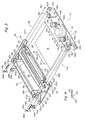
- a front upstanding base plate 70 and a rear upstanding base plate 72 spaced from each other in the width direction (direction perpendicular to the sheet surface in Figure 1) are disposed within the upper portion 6 of the housing 2.
- Supporting plates 74 and 76 having an L-shaped cross-section are fixed respectively to both ends of the base plates 70 and 72 by a suitable method.
- supporting plates 78 and 80 are respectively fixed to the upper sides of both end portions of the base plates 70 and 72 by a suitable method.
- the transparent plate 42 is fixed to the supporting plates 78 and 80 by a suitable method.
- the partitioning plate 66 ( Figure 1) is also fixed to the base plates 70 and 72 although this is not shown in Figure 2.
- a cover plate 81 covering the stationary reflecting mirror 64 and part of the lens assembly 62 is fixed to the partitioning plate 66 ( Figure 1).
- Guiding members 82 and 84 having an L-shaped cross-section are fixed by a suitable method to the inside surfaces of the upstanding base plates 70 and 72 respectively.
- Each of the guiding members 82 and 84 constituting supporting means have substantially horizontally extending guiding rails 86 and 88 (see both Figures 2 and 3).
- Various electrical accessories such as a circuit base board and a connecting plug assembly are mounted on the outside surfaces of the front and rear upstanding base plates 70 and 72 although not shown.
- the first optical element assembly 54 and the second optical element assembly 60 in the scanning optical device 48 are slidably mounted on the guiding rails 86 and 88 of the guiding members 82 and 84.
- the first optical element assembly 54 has a supporting frame 90 to which the document illuminating lamp 50 and the first reflecting mirror 52 ( Figure 1) are fixed.
- a nearly T-shaped forwardly projecting piece 92 (constituting one support portion) is provided in the front side of the supporting frame 90, and a rearwardly projecting support member 94 (constituting another support portion) is provided in the rear side of the supporting frame 90.
- sliding pieces 100 spaced from each other in the moving direction (shown by arrows 96 and 98) of the first optical element assembly 54 are fixed to the projecting piece 92, and one sliding piece 100, to the support member 94. It is understood from Figure 4 that the sliding piece 100 has a downwardly projecting hemispherical protrusion 102. Conveniently, the sliding piece 100 is formed from a synthetic resin having high abrasion resistance and a low coefficient of friction, such as a synthetic resin commercially available under the tradename "Rulon".
- the first optical element assembly 54 is mounted on the guiding rails 86 and 88 so as to slide along them by contacting the protrusions 102 of the two sliding pieces 100 provided at its front side with the upper surface of a rail portion 86a in the guiding rail 86 and contacting the protrusion 102 of the sliding piece 100 provided at the rear side of the assembly 54 with a rail portion 88a in the guiding rail 88 ( Figure 8).
- the second optical element assembly 60 has a supporting frame 104 to which the second reflecting mirror 56 and the third reflecting mirror 58 are fixed.
- a forwardly projecting support member 106 (constituting a support portion) is provided in the front side of the supporting frame 104, and a rearwardly projecting nearly T-shaped projecting piece 108 (constituting another support portion) is provided in the rear side of the supporting frame 104.
- One sliding piece 100 is fixed to the support member 106, and two sliding pieces 100 (only one of which is shown in Figure 3) spaced from each in the moving direction (shown by arrows 96 and 98) of the second optical element assembly 60 are fixed to the projecting piece 108.
- These sliding pieces 100 may be the same as the sliding pieces 100 in the first optical element assembly 54 and each have a downwardly projecting hemispherical protrusion 102 ( Figure 4).
- the second optical element assembly 60 is mounted on the guiding rails 86 and 88 so as to slide along them by contacting the protrusion 102 of the sliding piece 100 provided at its front side with the upper surface of a rail portion 86a in the guiding rail 86 and contacting the protrusions 102 of the two sliding pieces 100 provided at the rear side of the assembly 60 with a rail portion 88a in the guiding rail 88.
- the scanning optical device 48 is provided with driving means shown generally at 110 for reciprocating the first optical element assembly 54 and the second optical element assembly 60 as described above.
- the driving means 110 includes one common driving source 112 which may be an electric motor, a front power transmission mechanism 114a and a rear power transmission mechanism 114b.
- the front power transmission mechanism 114a comprises an input wire drum 116a, pulleys 118a, 120a, 122a and 124a and a wire 126a, and drivingly connects the front sides of the first and second optical element assemblies 54 and 60 to the common driving source 112.
- the rear power transmission mechanism 114b includes an input drum 116b, pulleys 118b, 120b, 122b and 124b, and a wire 126b, and drivingly connects the rear sides of the first and second optical element assemblies 54 and 60 to the common driving source 112.
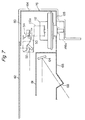
- the supporting plate 76 (see Figure 2 also) has a horizontal portion 128 and the common driving source 112 is mounted centrally in the horizontal portion 128 in its width direction (the left-right direction in Figures 5 and 6).
- the common driving source 112 is comprised of an electric motor having a casing 130, and the cylindrical lower end portion 132 of the casing 130 is fixed to the horizontal portion 128 of the supporting plate 76 by a suitable method.
- the rotating output shaft 134 of the common driving source 112 projects downwardly substantially vertically from the casing 130.
- Securing bracket pieces 136a and 136b positioned symmetrically with respect to the front side and the rear side of the common driving source 112 are fixed also to the horizontal portion 128 of the supporting plate 76.
- the bracket pieces 136a and 136b have securing parts 138a and 138b extending substantially horizontally above the horizontal portion 128.
- a rotating shaft 140a is rotatably mounted extending substantially vertically through the securing portion 138a of the bracket piece 136a and the horizontal portion 128 of the supporting plate 76
- a rotating shaft 140b is rotatably mounted extending substantially vertically through the securing portion 138b of the bracket piece 136b and the horizontal portion 128 of the supporting plate 76.
- the input wire drums 116a and 116b are fixed respectively to the upper end portions of the rotating shafts 140a and 140b which projects upwardly beyond the securing portions 138a and 138b of the bracket pieces 136a and 136b.
- Gears 142a and 142b are fixed respectively to the lower end portions of the rotating shafts 140a and 140b which projects downwardly beyond the horizontal portion 128 of the supporting plate 76.
- To the horizontal portion 128 are fixed the upper end of a short rod 144a positioned between the common driving source 112 and the rotating shaft 140a and the upper end of a short rod 144b positioned between the common driving source 112 and the rotating shaft 140b.
- Gears 146a and 146b are rotatably mounted respectively to the lower ends of the substantially vertically extending short rods 144a and 144b. Teeth are formed in the rotating output shaft 134 of the common driving source 112.
- the gear 146a is in mesh with both the rotating output shaft 134 and the gear 142a, and the gear 146a is in mesh with both the rotating output shaft 134 and the gear 142b.
- the input wire drum 116a of the front power transmission mechanism 114a is drivingly connected to the rotating output shaft 134 of the common driving source 112 via the gears 142a and 146a
- the input wire drum 116b of the rear power transmission mechanism 114b is drivingly connected to the rotating output shaft 134 of the common driving source 112 via the gears 142b and 146b.
- notches 148a and 148b for provisional anchoring of wires are formed in the horizontal portion 128 of the supporting plate 76 in relation to the input wire drums 116a and 116b respectively.
- the notch 148a is disposed adjacent to, and above the left of, the input wire drum 116a, and has two parallel leg portions 150a and 152a and a connecting portion 154a connecting the upper end parts of the leg portions 150a and 152a. Between the two leg portions 150a and 152a is left an anchoring projecting piece 156a extending toward the connecting portion 154a.
- the notch 148b is disposed adjacent to, and below the right of, the input wire drum 116b, and has two parallel leg portions 150b and 152b and a connecting portion 154b connecting the lower end parts of the leg portions 150b and 152b, and an anchoring projecting piece 156b extending toward the connecting portion 154b is left between the two leg portions 150b and 152b.
- the purpose and action of these notches 148a and 148b for provisional wire anchorage will be described later on.
- securing bracket pieces 158a and 158b are secured also to the front end portion and rear end portion (the left end portion and the right end portion in Figure 5) of the horizontal portion 128 of the supporting plate 76.
- These securing bracket pieces 158a and 158b respectively have securing portions 160a and 160b extending substantially horizontally above the horizontal portion 128.
- Short rods 162a and 162b projecting upwardly substantially vertically are fixed to the securing portions 160a and 160b respectively of the bracket pieces 158a and 158b.
- the pulley 118a of the front power transmission mechanism 114a and the pulley 118b of the rear power transmission mechanism 114b are rotatably mounted on the short rods 162a and 162b respectively.
- the supporting plate 76 also has an upstanding portion 164 (see Figure 2 also) projecting upwardly substantially vertically from one edge (the lower edge in Figure 6) of the horizontal portion 128. As shown in Figure 6, projecting pieces 166a and 166b extending inwardly are formed in the front end parts and rear end part (the left end part and right end part in Figure 6) of the upstanding portion 164. Short rods 168a and 168b are fixed to the projecting pieces 166a and 166b.
- the pulley 120a of the front power transmission mechanism 114 and the pulley 120b of the rear power transmission mechanism 114b are rotatably mounted on the short rods 168a and 168b.
- the short rod 168a (therefore the axis of rotation of the pulley 120a) extend inclinedly downwardly in the forward direction, and the short rod 168b (and therefore the axis of rotation of the pulley 120b) extend inclinedly downwardly in the rearward direction.
- the supporting frame 104 of the second optical element assembly 60 has an upstanding front wall 170a and an upstanding rear wall 170b to which short rods 172a and 172b projecting forwardly and rearwardly substantially horizontally are fixed.
- the pulley 122a of the front power transmission mechanism 114a and the pulley 122b of the rear power transmission mechanism 114b are rotatably mounted on the short rods 172a and 172b respectively. Furthermore, short rods 174a and 174b projecting rearwardly and forwardly substantially horizontally are fixedly secured to the front upstanding base plate 70 and the rear upstanding base plate 72 ( Figure 2).
- the pulley 124a of the front power transmission mechanism 114a and the pulley 124b of the rear power transmission mechanism 114b are rotatably mounted on the short rods 174a and 174b respectively.
- the short rods 174a and 174b and the pulleys 124a and 124b mounted on them are positioned below the guiding members 82 and 84 fixed to the inside surfaces of the front upstanding base plate 70 and the rear upstanding base plate 72.
- the wire 126a in the front power transmission mechanism 114a is wrapped about the input wire drum 116a and the pulleys 118a, 120a, 122a and 124a.
- the wire 126b in the rear power transmission mechanism 114b is wrapped about the input wire drum 116b and the pulleys 118b, 120b, 122b and 124b. More specifically, the wrapping of the wire 126a in the front power transmission mechanism 114a is as follows: An anchoring piece 176a is fixed to the inside surface of the one end portion (the left end portion in Figure 1) of the front upstanding base plate 70 ( Figure 2), and one end of elastic means 178a which may be a tension coil spring is anchored at the anchoring piece 176a.
- the wrapping operation of the wire 126 can be started by fixing one end of the wire 126a to the other end of the elastic means 178a. Then, the wire 126a is wrapped along a guiding portion having an arcuate sectional shape formed in the upper end portion of the guiding plate 180a fixed at its lower end portion to the supporting plate 74.
- the wire 126a is wrapped around the pulley 122a over an angular range of about 180 degrees clockwise when viewed from ahead, then around the pulley 124a over an angular range of about 180 degrees when viewed counterclockwise from ahead, and further around the pulley 118a over an angular range of about 90 degrees when viewed counterclockwise from above.
- the wire 126a is wound around the input wire drum 116a counterclockwise when viewed from above through a plurality of turns, for example about 10 turns, plus a half turn (i.e., over an angular range of n x 360 + about 180 degrees in which n is a positive integer) over a length corresponding to the reciprocating moving distances of the first optical element assembly 54 and the second optical element assembly 60. Then, before the wire 126a is further wrapped, it is provisionally anchored at the notch 148a.
- the provisional anchorage is achieved, as shown by a tow-dot chain line in Figure 6, by introducing the wire 126a extending from the input wire drum 116a into a site beneath the anchoring projecting piece 156a through the connecting portion 154a of the notch 148a and thus causing the wire 126a to advance from one leg portion 150a of the notch 148a, then below the anchoring projecting piece 156a and finally upwardly from the other leg portion 152a.
- the wire 126a extends while detouring around the anchoring projecting piece 156a and is accurately anchored provisionally owing to the flexural rigidity of the wire 126a itself and the engagement of the wire 126a with the anchoring projecting piece 156a.
- the wire 126a in the subsequent wrapping operation of the wire 126a, the wire 126a once wrapped around the input wire drum 116a is exactly prevented from loosening accidentally and coming off upwardly from the wire drum 116a.
- the wire 126a is further wrapped around the pulley 118a over an angular range of about 90 degrees counterclockwise when viewed from above, then around the pulley 120a over an angular range of about 180 degrees counterclockwise when viewed from ahead, and further around the pulley 122a over an angular range of about 180 degrees clockwise as viewed from ahead.
- the provisional anchorage of the wire 126a at the notch 148a is cancelled, and the wire 126a is maintained sufficiently taut.
- a linking member 182a fixed to the other end of the wire 126a is linked by a suitable method to an anchoring bracket (not shown) fixed to the other end portion (the right end portion in Figure 1) of the inside surface of the front upstanding base plate 70 ( Figure 2).
- Cancelling of the provisional anchorage can be achieved by forcibly drawing the wire 126a upwardly from below the anchoring projecting piece 156a through the connecting portion 154a of the notch 148a. Then, to prevent exactly the occurrence of slippage between the wire 126a and the input wire drum 116a, the wrapping starting end portion of the wire 126a is fixed to the input wire drum 116a by a set screw (not shown).
- a wire fixing piece 186a is fixed by a set screw 184a to the projecting piece 92 formed in the front side of the frame 90 of the first optical element assembly 54, and the wire 126a extending along the upper surface of the projecting piece 92 is firmly held by the projecting piece 92 and the fixing piece 186a.
- the wire 126a is fixed to the frame 90 of the first optical element assembly 54. This completes the wrapping of the wire 126a in the front power transmission mechanism 114a.
- This wire wrapping operation can be carried out by inserting hands between the front upstanding base plate 70 and the rear upstanding base plate 72 from above while the supporting plates 78 and 80 to be disposed on the upper surfaces of the front upstanding base plate 70 and the rear upstanding base plate 72 and the transparent plate 42 to be fixed thereto are still in the non-mounted state.
- the wrapping of the wire 126b in the rear power transmission mechanism 114b is substantially the same as the wrapping of the wire 126a in the front power transmission mechanism 114a described above.
- the wire 126b is wrapped around the pulley 118b over an angular range of about degrees clockwise when viewed from above, and then wound around the input wire drum 116b counterclockwise when viewed from above through a plurality of turns, for example about 10 turns, plus a half turn (i.e., over an angular range of n x 360 + about 180 degrees, in which n is a positive integer). Then, the wire 126b is anchored provisionally at the notch 148b, and then wrapped around the pulley 118b over an angular range of about 90 degrees clockwise when viewed from above.
- the wrapping of the wire 126b between the input wire drum 116b and the pulley 118b is not open but closed.
- the wire 126b is fixed to the frame 90 of the first optical element assembly 54 by fixing a wire fixing piece 186b with a set screw 184b to the support member 94 provided on the rear side of the frame 90 and firmly holding the wire 126b extending along the upper surface of the support member 94 with the support member 94 and the fixing piece 186b (see Figure 8).
- the common driving source 112 when in the scanning optical device 48 described above, the common driving source 112 is energized to rotate its rotating output shaft 134 in the direction of arrow 96, the input wire drums 116a and 116b are rotated in the direction of arrow 96 (namely, both the input wire drums 116a and 116b are rotated clockwise when viewed from above), and the pulleys 118a and 118b are also rotated in the direction of arrow 96 (namely, the pulley 118 is rotated clockwise when viewed from above, and the pulley 118b is rotated counterclockwise when viewed from above).
- the first optical element assembly 54 is moved for scanning at a predetermined speed in the direction of arrow 96
- the second optical element assembly 90 is moved for scanning at a speed half of the above predetermined speed in the direction of arrow 96.
- the common driving source 112 When, on the other hand, the common driving source 112 is energized to rotate its rotating output shaft 134 in a direction opposite to the above direction, namely in the direction shown by an arrow 98, the input wire drums 116a and 116b are rotated in the direction of arrow 98 (namely, both the input wire durms 116a and 116b are rotated counterclockwise when viewed from above) and the pulleys 118a and 118b are also rotated in the direction of arrow 98 (namely, the pulley 118a is rotated counterclockwise when viewed from above, and the pulley 118b, clockwise when viewed from above).
- the first optical element assembly 54 is returned at a predetermined speed in the direction of arrow 98, and the second optical element assembly 60, at a speed half of the above speed in the direction of arrow 98.
- the first optical element assembly 54, the second optical element assembly 60, and the driving means 110 more specifically the common driving source 112
- almost all constituent elements of the front power transmission mechanism 114a and almost all constituent elements of the rear power transmission mechanism 114 are arranged between the front upstanding base plate 70 and the rear upstanding base plate 72 in the width direction.
- electrical accessories mounted on the outside surface of the front upstanding base plate 70 and/or the rear upstanding base plate 72 do not hamper the operations of wrapping the wires 126a and 126b.
- the input wire drums 116a and 116b are provided respectively in the front power transmission mechanism 114a and the rear power transmission mechanism 114b.
- the vertical sizes of the input wire drums 116a and 116b can be decreased nearly to half. This can accordingly reduce the required vertical sizes of the front power transmission mechanism 114a and the rear power transmission mechanism 114b as a whole and make the scanning optical device 48 compact. It is not necessary to cause deviation between the front power transmission mechanism 114a and the rear power transmission mechanism 114b in the vertical direction. Hence, no imbalance is produced between the power transmission in the front side and the power transmission in the rear side, and they can be made substantially equal to each other.
- notches 148a and 148b for provisional wire anchorage are provided adjacent to the input wire drums 116a and 116b. Accordingly, after the wires 126a and 126b have been wound around the input wire drums 116a and 116b through a plurality of turns, the wires can be provisionally anchored by a very simple operation, and the operations of wrapping the wires 126a and 126b can be carried out highly efficiently without any likelihood of accidental loosening of the wires 126a and 126b off the wire drums 116a and 116b around which they have once been wrapped.
- the invention has been described with reference to a scanning optical device in an electrostatic copying machine. But the invention may also be applied to a scanning optical device of another image-forming machine or an image reader device such as a device for reading a transmitted document in facsimile.
Landscapes
- Physics & Mathematics (AREA)
- Engineering & Computer Science (AREA)
- Multimedia (AREA)
- Signal Processing (AREA)
- Optics & Photonics (AREA)
- General Physics & Mathematics (AREA)
- Optical Systems Of Projection Type Copiers (AREA)
- Mechanical Optical Scanning Systems (AREA)
Applications Claiming Priority (7)
| Application Number | Priority Date | Filing Date | Title |
|---|---|---|---|
| JP62161284A JP2537367B2 (ja) | 1987-06-30 | 1987-06-30 | 走査光学装置 |
| JP161284/87 | 1987-06-30 | ||
| JP16705287 | 1987-07-06 | ||
| JP167052/87 | 1987-07-06 | ||
| JP261791/87 | 1987-10-19 | ||
| JP62261791A JPH0830853B2 (ja) | 1987-07-06 | 1987-10-19 | 走査光学装置 |
| EP19880110496 EP0297591A3 (de) | 1987-06-30 | 1988-06-30 | Optische Abtastvorrichtung |
Related Parent Applications (2)
| Application Number | Title | Priority Date | Filing Date |
|---|---|---|---|
| EP19880110496 Division EP0297591A3 (de) | 1987-06-30 | 1988-06-30 | Optische Abtastvorrichtung |
| EP88110496.2 Division | 1988-06-30 |
Publications (1)
| Publication Number | Publication Date |
|---|---|
| EP0602015A1 true EP0602015A1 (de) | 1994-06-15 |
Family
ID=27321830
Family Applications (2)
| Application Number | Title | Priority Date | Filing Date |
|---|---|---|---|
| EP19880110496 Ceased EP0297591A3 (de) | 1987-06-30 | 1988-06-30 | Optische Abtastvorrichtung |
| EP94103005A Ceased EP0602015A1 (de) | 1987-06-30 | 1988-06-30 | Optisches Abtastgerät |
Family Applications Before (1)
| Application Number | Title | Priority Date | Filing Date |
|---|---|---|---|
| EP19880110496 Ceased EP0297591A3 (de) | 1987-06-30 | 1988-06-30 | Optische Abtastvorrichtung |
Country Status (2)
| Country | Link |
|---|---|
| US (1) | US4931836A (de) |
| EP (2) | EP0297591A3 (de) |
Cited By (1)
| Publication number | Priority date | Publication date | Assignee | Title |
|---|---|---|---|---|
| EP1317129A1 (de) * | 2001-11-30 | 2003-06-04 | Ricoh Company, Ltd. | Antriebsmechanismus zum genauen Bildlesen |
Families Citing this family (11)
| Publication number | Priority date | Publication date | Assignee | Title |
|---|---|---|---|---|
| DE69023066T2 (de) * | 1989-07-25 | 1996-03-21 | Victor Company Of Japan | Bildabtastgerät. |
| US5243386A (en) * | 1990-04-19 | 1993-09-07 | Matsushita Electric Industrial Co., Ltd. | Optical system housing structure for image forming apparatus |
| US5283614A (en) * | 1990-10-31 | 1994-02-01 | Mita Industrial Co., Ltd. | Optical system moving frame unit for use in an exposure device of an optical system movement type |
| JPH10257252A (ja) * | 1997-03-11 | 1998-09-25 | Fuji Photo Optical Co Ltd | 画像処理装置のキャリア駆動用ワイヤの止着機構 |
| JPH10257253A (ja) * | 1997-03-11 | 1998-09-25 | Fuji Photo Optical Co Ltd | 画像処理装置のキャリアの摺動案内機構 |
| DE29805117U1 (de) * | 1998-03-20 | 1998-05-28 | Silitek Corporation, Taipeh | Antriebsmechanismus für Flachbettscanner |
| US6879413B1 (en) | 1999-09-20 | 2005-04-12 | Fuji Photo Film Optical Co., Ltd. | Carriage driving mechanism in image processor |
| JP3981230B2 (ja) * | 2000-01-21 | 2007-09-26 | シャープ株式会社 | 画像形成装置 |
| JP4239633B2 (ja) * | 2003-03-20 | 2009-03-18 | 富士ゼロックス株式会社 | 電子写真装置 |
| JP2005195814A (ja) * | 2004-01-06 | 2005-07-21 | Nec Access Technica Ltd | 画像読取装置 |
| JP6349717B2 (ja) * | 2013-10-31 | 2018-07-04 | 株式会社リコー | 読取装置および画像形成装置 |
Citations (3)
| Publication number | Priority date | Publication date | Assignee | Title |
|---|---|---|---|---|
| JPS5895762A (ja) * | 1981-12-02 | 1983-06-07 | Minolta Camera Co Ltd | 複写機等における走査光学系駆動機構 |
| JPS59154434A (ja) * | 1983-02-21 | 1984-09-03 | Minolta Camera Co Ltd | 電子複写機 |
| EP0191279A1 (de) * | 1985-02-14 | 1986-08-20 | International Business Machines Corporation | Abtastgerät für Kopiergerät und Ausrichtungsverfahren |
Family Cites Families (6)
| Publication number | Priority date | Publication date | Assignee | Title |
|---|---|---|---|---|
| US4256399A (en) * | 1978-04-10 | 1981-03-17 | Minolta Camera Kabushiki Kaisha | Electrophotographic copying apparatus equipped with improved braking device for scanning system |
| US4402595A (en) * | 1980-03-25 | 1983-09-06 | Canon Kabushiki Kaisha | Scanning type image formation apparatus |
| US4401384A (en) * | 1980-08-08 | 1983-08-30 | Konishiroku Photo Industry Co., Ltd. | Mirror device of copying machine or the like |
| JPS6032034A (ja) * | 1983-08-01 | 1985-02-19 | Minolta Camera Co Ltd | 走査装置 |
| DE3521514A1 (de) * | 1984-06-18 | 1985-12-19 | Kabushiki Kaisha Toshiba, Kawasaki, Kanagawa | Bildinformation-lesevorrichtung |
| US4862218A (en) * | 1986-09-30 | 1989-08-29 | Mita Industrial Co., Ltd. | Support and adjusting apparatus for an optical unit |
-
1988
- 1988-06-28 US US07/213,288 patent/US4931836A/en not_active Expired - Lifetime
- 1988-06-30 EP EP19880110496 patent/EP0297591A3/de not_active Ceased
- 1988-06-30 EP EP94103005A patent/EP0602015A1/de not_active Ceased
Patent Citations (3)
| Publication number | Priority date | Publication date | Assignee | Title |
|---|---|---|---|---|
| JPS5895762A (ja) * | 1981-12-02 | 1983-06-07 | Minolta Camera Co Ltd | 複写機等における走査光学系駆動機構 |
| JPS59154434A (ja) * | 1983-02-21 | 1984-09-03 | Minolta Camera Co Ltd | 電子複写機 |
| EP0191279A1 (de) * | 1985-02-14 | 1986-08-20 | International Business Machines Corporation | Abtastgerät für Kopiergerät und Ausrichtungsverfahren |
Non-Patent Citations (2)
| Title |
|---|
| PATENT ABSTRACTS OF JAPAN vol. 7, no. 196 (P - 219)<1341> 26 August 1983 (1983-08-26) * |
| PATENT ABSTRACTS OF JAPAN vol. 9, no. 6 (P - 326)<1729> 11 January 1985 (1985-01-11) * |
Cited By (1)
| Publication number | Priority date | Publication date | Assignee | Title |
|---|---|---|---|---|
| EP1317129A1 (de) * | 2001-11-30 | 2003-06-04 | Ricoh Company, Ltd. | Antriebsmechanismus zum genauen Bildlesen |
Also Published As
| Publication number | Publication date |
|---|---|
| EP0297591A3 (de) | 1991-05-29 |
| US4931836A (en) | 1990-06-05 |
| EP0297591A2 (de) | 1989-01-04 |
Similar Documents
| Publication | Publication Date | Title |
|---|---|---|
| JP3278198B2 (ja) | プロセスカートリッジ、及び、前記プロセスカートリッジを着脱可能な画像形成装置 | |
| US4931836A (en) | Scanning optical device having at least one reciprocating optical assembly | |
| US4585324A (en) | Shell-type electrostatic copying apparatus | |
| EP0082254A2 (de) | Bilderzeugungsgerät | |
| US4620234A (en) | Electronic visual image forming apparatus | |
| JP2839504B2 (ja) | 自動原稿送り装置 | |
| EP0296308B1 (de) | Elektrostatisches Kopiergerät | |
| US4645328A (en) | Apparatus for scanning an original | |
| EP0245880A2 (de) | Elektrostatisches Kopiergerät mit veränderbarer Vergrösserung | |
| US4650317A (en) | Image forming apparatus with a unidirectional magnification function | |
| US4951936A (en) | Separation unit | |
| US4579440A (en) | Copying machine with a common image exposure and optical discharge device | |
| US4891669A (en) | Scanning apparatus | |
| US4564288A (en) | Electrostatic recording apparatus | |
| US4432633A (en) | Electrophotographic reproducing apparatus | |
| JP2537367B2 (ja) | 走査光学装置 | |
| JPH0419533B2 (de) | ||
| JPH01105270A (ja) | 走査光学装置 | |
| JPH0119141Y2 (de) | ||
| US5155526A (en) | Electrophotographic copying apparatus having axially aligned developing elements | |
| JPH05333448A (ja) | 駆 動 装 置 | |
| JPH0631476Y2 (ja) | 画像形成装置 | |
| EP0029953B1 (de) | Elektrophotographisches Kopiergerät mit einer Photoleiterbahn | |
| JPH11212185A (ja) | 走査光学装置 | |
| JPH0219867A (ja) | 原稿移動型の複写機 |
Legal Events
| Date | Code | Title | Description |
|---|---|---|---|
| PUAI | Public reference made under article 153(3) epc to a published international application that has entered the european phase |
Free format text: ORIGINAL CODE: 0009012 |
|
| AC | Divisional application: reference to earlier application |
Ref document number: 297591 Country of ref document: EP |
|
| AK | Designated contracting states |
Kind code of ref document: A1 Designated state(s): DE FR GB NL |
|
| 17P | Request for examination filed |
Effective date: 19940712 |
|
| GRAG | Despatch of communication of intention to grant |
Free format text: ORIGINAL CODE: EPIDOS AGRA |
|
| 17Q | First examination report despatched |
Effective date: 19960202 |
|
| STAA | Information on the status of an ep patent application or granted ep patent |
Free format text: STATUS: THE APPLICATION HAS BEEN REFUSED |
|
| 18R | Application refused |
Effective date: 19960926 |