EP0605331B1 - Bleichen von Farbstoffen in lichtempfindlichen Systemen - Google Patents
Bleichen von Farbstoffen in lichtempfindlichen Systemen Download PDFInfo
- Publication number
- EP0605331B1 EP0605331B1 EP93403209A EP93403209A EP0605331B1 EP 0605331 B1 EP0605331 B1 EP 0605331B1 EP 93403209 A EP93403209 A EP 93403209A EP 93403209 A EP93403209 A EP 93403209A EP 0605331 B1 EP0605331 B1 EP 0605331B1
- Authority
- EP
- European Patent Office
- Prior art keywords
- carbon atoms
- dye
- photoresist
- group
- process according
- Prior art date
- Legal status (The legal status is an assumption and is not a legal conclusion. Google has not performed a legal analysis and makes no representation as to the accuracy of the status listed.)
- Expired - Lifetime
Links
- 238000004061 bleaching Methods 0.000 title claims description 20
- 239000000975 dye Substances 0.000 title description 77
- -1 aromatic iodonium salt Chemical class 0.000 claims description 85
- 230000001235 sensitizing effect Effects 0.000 claims description 43
- 238000000034 method Methods 0.000 claims description 34
- 229920002120 photoresistant polymer Polymers 0.000 claims description 28
- 230000008569 process Effects 0.000 claims description 28
- 125000004432 carbon atom Chemical group C* 0.000 claims description 27
- 230000005855 radiation Effects 0.000 claims description 24
- 238000010438 heat treatment Methods 0.000 claims description 20
- 150000003918 triazines Chemical class 0.000 claims description 17
- 239000000203 mixture Substances 0.000 claims description 16
- 125000003118 aryl group Chemical group 0.000 claims description 14
- 125000000217 alkyl group Chemical group 0.000 claims description 9
- DZBUGLKDJFMEHC-UHFFFAOYSA-N acridine Chemical compound C1=CC=CC2=CC3=CC=CC=C3N=C21 DZBUGLKDJFMEHC-UHFFFAOYSA-N 0.000 claims description 8
- 150000002896 organic halogen compounds Chemical class 0.000 claims description 7
- CZZYITDELCSZES-UHFFFAOYSA-N diphenylmethane Chemical compound C=1C=CC=CC=1CC1=CC=CC=C1 CZZYITDELCSZES-UHFFFAOYSA-N 0.000 claims description 5
- GJCOSYZMQJWQCA-UHFFFAOYSA-N 9H-xanthene Chemical compound C1=CC=C2CC3=CC=CC=C3OC2=C1 GJCOSYZMQJWQCA-UHFFFAOYSA-N 0.000 claims description 4
- XSQUKJJJFZCRTK-UHFFFAOYSA-N Urea Chemical compound NC(N)=O XSQUKJJJFZCRTK-UHFFFAOYSA-N 0.000 claims description 4
- QDLAGTHXVHQKRE-UHFFFAOYSA-N lichenxanthone Natural products COC1=CC(O)=C2C(=O)C3=C(C)C=C(OC)C=C3OC2=C1 QDLAGTHXVHQKRE-UHFFFAOYSA-N 0.000 claims description 4
- AGIJRRREJXSQJR-UHFFFAOYSA-N 2h-thiazine Chemical compound N1SC=CC=C1 AGIJRRREJXSQJR-UHFFFAOYSA-N 0.000 claims description 3
- WKBOTKDWSSQWDR-UHFFFAOYSA-N Bromine atom Chemical group [Br] WKBOTKDWSSQWDR-UHFFFAOYSA-N 0.000 claims description 3
- UFHFLCQGNIYNRP-UHFFFAOYSA-N Hydrogen Chemical compound [H][H] UFHFLCQGNIYNRP-UHFFFAOYSA-N 0.000 claims description 3
- JUJWROOIHBZHMG-UHFFFAOYSA-N Pyridine Chemical compound C1=CC=NC=C1 JUJWROOIHBZHMG-UHFFFAOYSA-N 0.000 claims description 3
- FZWLAAWBMGSTSO-UHFFFAOYSA-N Thiazole Chemical compound C1=CSC=N1 FZWLAAWBMGSTSO-UHFFFAOYSA-N 0.000 claims description 3
- 125000003342 alkenyl group Chemical group 0.000 claims description 3
- 150000001450 anions Chemical group 0.000 claims description 3
- GDTBXPJZTBHREO-UHFFFAOYSA-N bromine Chemical group BrBr GDTBXPJZTBHREO-UHFFFAOYSA-N 0.000 claims description 3
- 229910052794 bromium Chemical group 0.000 claims description 3
- 229910052801 chlorine Inorganic materials 0.000 claims description 3
- 239000000460 chlorine Substances 0.000 claims description 3
- 125000001309 chloro group Chemical group Cl* 0.000 claims description 3
- 229930195733 hydrocarbon Natural products 0.000 claims description 3
- 229910052739 hydrogen Inorganic materials 0.000 claims description 3
- 239000001257 hydrogen Substances 0.000 claims description 3
- 125000001434 methanylylidene group Chemical group [H]C#[*] 0.000 claims description 3
- 150000004032 porphyrins Chemical class 0.000 claims description 2
- RDAFNSMYPSHCBK-UHFFFAOYSA-N 3-phenylprop-2-en-1-amine Chemical class NCC=CC1=CC=CC=C1 RDAFNSMYPSHCBK-UHFFFAOYSA-N 0.000 claims 2
- 239000000463 material Substances 0.000 description 20
- 238000000576 coating method Methods 0.000 description 17
- 239000000523 sample Substances 0.000 description 17
- 239000011248 coating agent Substances 0.000 description 14
- 238000010276 construction Methods 0.000 description 13
- 238000003384 imaging method Methods 0.000 description 13
- 239000000243 solution Substances 0.000 description 12
- 206010073306 Exposure to radiation Diseases 0.000 description 11
- 239000000049 pigment Substances 0.000 description 11
- 229920005989 resin Polymers 0.000 description 11
- 239000011347 resin Substances 0.000 description 11
- ZYGHJZDHTFUPRJ-UHFFFAOYSA-N coumarin Chemical compound C1=CC=C2OC(=O)C=CC2=C1 ZYGHJZDHTFUPRJ-UHFFFAOYSA-N 0.000 description 10
- JHIVVAPYMSGYDF-UHFFFAOYSA-N cyclohexanone Chemical compound O=C1CCCCC1 JHIVVAPYMSGYDF-UHFFFAOYSA-N 0.000 description 10
- 239000010408 film Substances 0.000 description 7
- 239000003999 initiator Substances 0.000 description 7
- HEMHJVSKTPXQMS-UHFFFAOYSA-M Sodium hydroxide Chemical compound [OH-].[Na+] HEMHJVSKTPXQMS-UHFFFAOYSA-M 0.000 description 6
- 239000011230 binding agent Substances 0.000 description 6
- 239000007844 bleaching agent Substances 0.000 description 6
- 150000001875 compounds Chemical class 0.000 description 5
- 229960000956 coumarin Drugs 0.000 description 5
- 235000001671 coumarin Nutrition 0.000 description 5
- 230000000694 effects Effects 0.000 description 5
- MGFYSGNNHQQTJW-UHFFFAOYSA-N iodonium Chemical compound [IH2+] MGFYSGNNHQQTJW-UHFFFAOYSA-N 0.000 description 5
- 229920002037 poly(vinyl butyral) polymer Polymers 0.000 description 5
- 238000007639 printing Methods 0.000 description 5
- LETDRANQSOEVCX-UHFFFAOYSA-N 2-methyl-4,6-bis(trichloromethyl)-1,3,5-triazine Chemical compound CC1=NC(C(Cl)(Cl)Cl)=NC(C(Cl)(Cl)Cl)=N1 LETDRANQSOEVCX-UHFFFAOYSA-N 0.000 description 4
- ARSRBNBHOADGJU-UHFFFAOYSA-N 7,12-dimethyltetraphene Chemical compound C1=CC2=CC=CC=C2C2=C1C(C)=C(C=CC=C1)C1=C2C ARSRBNBHOADGJU-UHFFFAOYSA-N 0.000 description 4
- VFZRZRDOXPRTSC-UHFFFAOYSA-N DMBA Natural products COC1=CC(OC)=CC(C=O)=C1 VFZRZRDOXPRTSC-UHFFFAOYSA-N 0.000 description 4
- 230000008901 benefit Effects 0.000 description 4
- IISBACLAFKSPIT-UHFFFAOYSA-N bisphenol A Chemical compound C=1C=C(O)C=CC=1C(C)(C)C1=CC=C(O)C=C1 IISBACLAFKSPIT-UHFFFAOYSA-N 0.000 description 4
- 125000005520 diaryliodonium group Chemical group 0.000 description 4
- 239000006185 dispersion Substances 0.000 description 4
- 229920000728 polyester Polymers 0.000 description 4
- 238000006116 polymerization reaction Methods 0.000 description 4
- 239000000843 powder Substances 0.000 description 4
- XOFYZVNMUHMLCC-ZPOLXVRWSA-N prednisone Chemical compound O=C1C=C[C@]2(C)[C@H]3C(=O)C[C@](C)([C@@](CC4)(O)C(=O)CO)[C@@H]4[C@@H]3CCC2=C1 XOFYZVNMUHMLCC-ZPOLXVRWSA-N 0.000 description 4
- 238000002360 preparation method Methods 0.000 description 4
- JADVWWSKYZXRGX-UHFFFAOYSA-M thioflavine T Chemical compound [Cl-].C1=CC(N(C)C)=CC=C1C1=[N+](C)C2=CC=C(C)C=C2S1 JADVWWSKYZXRGX-UHFFFAOYSA-M 0.000 description 4
- MYWOJODOMFBVCB-UHFFFAOYSA-N 1,2,6-trimethylphenanthrene Chemical compound CC1=CC=C2C3=CC(C)=CC=C3C=CC2=C1C MYWOJODOMFBVCB-UHFFFAOYSA-N 0.000 description 3
- XEKOWRVHYACXOJ-UHFFFAOYSA-N Ethyl acetate Chemical compound CCOC(C)=O XEKOWRVHYACXOJ-UHFFFAOYSA-N 0.000 description 3
- WSFSSNUMVMOOMR-UHFFFAOYSA-N Formaldehyde Chemical compound O=C WSFSSNUMVMOOMR-UHFFFAOYSA-N 0.000 description 3
- YXFVVABEGXRONW-UHFFFAOYSA-N Toluene Chemical compound CC1=CC=CC=C1 YXFVVABEGXRONW-UHFFFAOYSA-N 0.000 description 3
- ZMANZCXQSJIPKH-UHFFFAOYSA-N Triethylamine Chemical compound CCN(CC)CC ZMANZCXQSJIPKH-UHFFFAOYSA-N 0.000 description 3
- 230000015572 biosynthetic process Effects 0.000 description 3
- 238000011161 development Methods 0.000 description 3
- OZLBDYMWFAHSOQ-UHFFFAOYSA-N diphenyliodanium Chemical compound C=1C=CC=CC=1[I+]C1=CC=CC=C1 OZLBDYMWFAHSOQ-UHFFFAOYSA-N 0.000 description 3
- XMBWDFGMSWQBCA-UHFFFAOYSA-N hydrogen iodide Chemical class I XMBWDFGMSWQBCA-UHFFFAOYSA-N 0.000 description 3
- 239000000178 monomer Substances 0.000 description 3
- 229920001610 polycaprolactone Polymers 0.000 description 3
- 239000004632 polycaprolactone Substances 0.000 description 3
- 229920000139 polyethylene terephthalate Polymers 0.000 description 3
- 239000005020 polyethylene terephthalate Substances 0.000 description 3
- 229920002451 polyvinyl alcohol Polymers 0.000 description 3
- 239000000080 wetting agent Substances 0.000 description 3
- UBOXGVDOUJQMTN-UHFFFAOYSA-N 1,1,2-trichloroethane Chemical compound ClCC(Cl)Cl UBOXGVDOUJQMTN-UHFFFAOYSA-N 0.000 description 2
- ZWEHNKRNPOVVGH-UHFFFAOYSA-N 2-Butanone Chemical compound CCC(C)=O ZWEHNKRNPOVVGH-UHFFFAOYSA-N 0.000 description 2
- 239000001856 Ethyl cellulose Substances 0.000 description 2
- ZZSNKZQZMQGXPY-UHFFFAOYSA-N Ethyl cellulose Chemical compound CCOCC1OC(OC)C(OCC)C(OCC)C1OC1C(O)C(O)C(OC)C(CO)O1 ZZSNKZQZMQGXPY-UHFFFAOYSA-N 0.000 description 2
- 239000004952 Polyamide Substances 0.000 description 2
- BQCADISMDOOEFD-UHFFFAOYSA-N Silver Chemical compound [Ag] BQCADISMDOOEFD-UHFFFAOYSA-N 0.000 description 2
- OKKRPWIIYQTPQF-UHFFFAOYSA-N Trimethylolpropane trimethacrylate Chemical compound CC(=C)C(=O)OCC(CC)(COC(=O)C(C)=C)COC(=O)C(C)=C OKKRPWIIYQTPQF-UHFFFAOYSA-N 0.000 description 2
- 239000002253 acid Substances 0.000 description 2
- 239000000853 adhesive Substances 0.000 description 2
- 230000001070 adhesive effect Effects 0.000 description 2
- 239000012670 alkaline solution Substances 0.000 description 2
- 239000007864 aqueous solution Substances 0.000 description 2
- 229940106691 bisphenol a Drugs 0.000 description 2
- 230000008859 change Effects 0.000 description 2
- 239000003086 colorant Substances 0.000 description 2
- 239000013039 cover film Substances 0.000 description 2
- 238000002845 discoloration Methods 0.000 description 2
- 235000019325 ethyl cellulose Nutrition 0.000 description 2
- 229920001249 ethyl cellulose Polymers 0.000 description 2
- 239000011521 glass Substances 0.000 description 2
- 238000010030 laminating Methods 0.000 description 2
- 229910052751 metal Inorganic materials 0.000 description 2
- 239000002184 metal Substances 0.000 description 2
- 150000002739 metals Chemical class 0.000 description 2
- 238000002156 mixing Methods 0.000 description 2
- BASFCYQUMIYNBI-UHFFFAOYSA-N platinum Chemical compound [Pt] BASFCYQUMIYNBI-UHFFFAOYSA-N 0.000 description 2
- 229920003229 poly(methyl methacrylate) Polymers 0.000 description 2
- 229920002647 polyamide Polymers 0.000 description 2
- 229920001225 polyester resin Polymers 0.000 description 2
- 239000004645 polyester resin Substances 0.000 description 2
- 229920001470 polyketone Polymers 0.000 description 2
- 229920000642 polymer Polymers 0.000 description 2
- 239000004926 polymethyl methacrylate Substances 0.000 description 2
- BDERNNFJNOPAEC-UHFFFAOYSA-N propan-1-ol Chemical compound CCCO BDERNNFJNOPAEC-UHFFFAOYSA-N 0.000 description 2
- 150000003254 radicals Chemical class 0.000 description 2
- 150000003839 salts Chemical class 0.000 description 2
- 238000000926 separation method Methods 0.000 description 2
- 229910052709 silver Inorganic materials 0.000 description 2
- 239000004332 silver Substances 0.000 description 2
- 239000000126 substance Substances 0.000 description 2
- 239000000758 substrate Substances 0.000 description 2
- 230000003685 thermal hair damage Effects 0.000 description 2
- 239000010409 thin film Substances 0.000 description 2
- 230000000007 visual effect Effects 0.000 description 2
- JWTSVUUPJIIXTO-UHFFFAOYSA-N 1,5-bis[4-(dimethylamino)phenyl]penta-1,4-dien-3-one Chemical compound C1=CC(N(C)C)=CC=C1C=CC(=O)C=CC1=CC=C(N(C)C)C=C1 JWTSVUUPJIIXTO-UHFFFAOYSA-N 0.000 description 1
- DYBIGIADVHIODH-UHFFFAOYSA-N 2-nonylphenol;oxirane Chemical compound C1CO1.CCCCCCCCCC1=CC=CC=C1O DYBIGIADVHIODH-UHFFFAOYSA-N 0.000 description 1
- CDSULTPOCMWJCM-UHFFFAOYSA-N 4h-chromene-2,3-dione Chemical compound C1=CC=C2OC(=O)C(=O)CC2=C1 CDSULTPOCMWJCM-UHFFFAOYSA-N 0.000 description 1
- 229920008347 Cellulose acetate propionate Polymers 0.000 description 1
- VYZAMTAEIAYCRO-UHFFFAOYSA-N Chromium Chemical compound [Cr] VYZAMTAEIAYCRO-UHFFFAOYSA-N 0.000 description 1
- RYGMFSIKBFXOCR-UHFFFAOYSA-N Copper Chemical compound [Cu] RYGMFSIKBFXOCR-UHFFFAOYSA-N 0.000 description 1
- 229910000599 Cr alloy Inorganic materials 0.000 description 1
- LFQSCWFLJHTTHZ-UHFFFAOYSA-N Ethanol Chemical compound CCO LFQSCWFLJHTTHZ-UHFFFAOYSA-N 0.000 description 1
- IMROMDMJAWUWLK-UHFFFAOYSA-N Ethenol Chemical compound OC=C IMROMDMJAWUWLK-UHFFFAOYSA-N 0.000 description 1
- 108010010803 Gelatin Proteins 0.000 description 1
- 229920000084 Gum arabic Polymers 0.000 description 1
- FYYHWMGAXLPEAU-UHFFFAOYSA-N Magnesium Chemical compound [Mg] FYYHWMGAXLPEAU-UHFFFAOYSA-N 0.000 description 1
- NTIZESTWPVYFNL-UHFFFAOYSA-N Methyl isobutyl ketone Chemical compound CC(C)CC(C)=O NTIZESTWPVYFNL-UHFFFAOYSA-N 0.000 description 1
- 239000004677 Nylon Substances 0.000 description 1
- 239000004698 Polyethylene Substances 0.000 description 1
- 229920002396 Polyurea Polymers 0.000 description 1
- 239000004372 Polyvinyl alcohol Substances 0.000 description 1
- 229920001328 Polyvinylidene chloride Polymers 0.000 description 1
- 241000978776 Senegalia senegal Species 0.000 description 1
- 229910000831 Steel Inorganic materials 0.000 description 1
- HCHKCACWOHOZIP-UHFFFAOYSA-N Zinc Chemical compound [Zn] HCHKCACWOHOZIP-UHFFFAOYSA-N 0.000 description 1
- UKLDJPRMSDWDSL-UHFFFAOYSA-L [dibutyl(dodecanoyloxy)stannyl] dodecanoate Chemical compound CCCCCCCCCCCC(=O)O[Sn](CCCC)(CCCC)OC(=O)CCCCCCCCCCC UKLDJPRMSDWDSL-UHFFFAOYSA-L 0.000 description 1
- 238000010521 absorption reaction Methods 0.000 description 1
- 239000000205 acacia gum Substances 0.000 description 1
- 235000010489 acacia gum Nutrition 0.000 description 1
- 239000000999 acridine dye Substances 0.000 description 1
- 150000003926 acrylamides Chemical class 0.000 description 1
- NIXOWILDQLNWCW-UHFFFAOYSA-N acrylic acid group Chemical group C(C=C)(=O)O NIXOWILDQLNWCW-UHFFFAOYSA-N 0.000 description 1
- 239000000654 additive Substances 0.000 description 1
- 125000004183 alkoxy alkyl group Chemical group 0.000 description 1
- 229910052782 aluminium Inorganic materials 0.000 description 1
- XAGFODPZIPBFFR-UHFFFAOYSA-N aluminium Chemical compound [Al] XAGFODPZIPBFFR-UHFFFAOYSA-N 0.000 description 1
- 239000003963 antioxidant agent Substances 0.000 description 1
- 239000003125 aqueous solvent Substances 0.000 description 1
- 239000004841 bisphenol A epoxy resin Substances 0.000 description 1
- 244000309464 bull Species 0.000 description 1
- 229920002678 cellulose Polymers 0.000 description 1
- 229920002301 cellulose acetate Polymers 0.000 description 1
- 229920006217 cellulose acetate butyrate Polymers 0.000 description 1
- 238000006243 chemical reaction Methods 0.000 description 1
- 229910052804 chromium Inorganic materials 0.000 description 1
- 239000011651 chromium Substances 0.000 description 1
- 239000000788 chromium alloy Substances 0.000 description 1
- 238000004891 communication Methods 0.000 description 1
- 239000013068 control sample Substances 0.000 description 1
- 229920001577 copolymer Polymers 0.000 description 1
- 229910052802 copper Inorganic materials 0.000 description 1
- 239000010949 copper Substances 0.000 description 1
- 238000004132 cross linking Methods 0.000 description 1
- 230000006378 damage Effects 0.000 description 1
- 238000000354 decomposition reaction Methods 0.000 description 1
- 230000001419 dependent effect Effects 0.000 description 1
- 125000000664 diazo group Chemical group [N-]=[N+]=[*] 0.000 description 1
- BMVKUJNZGICSPS-UHFFFAOYSA-N diazomercury Chemical compound [N-]=[N+]=[Hg] BMVKUJNZGICSPS-UHFFFAOYSA-N 0.000 description 1
- 239000012954 diazonium Substances 0.000 description 1
- 239000012975 dibutyltin dilaurate Substances 0.000 description 1
- 238000001035 drying Methods 0.000 description 1
- 239000000839 emulsion Substances 0.000 description 1
- 238000005516 engineering process Methods 0.000 description 1
- 125000004185 ester group Chemical group 0.000 description 1
- 238000011156 evaluation Methods 0.000 description 1
- 239000004744 fabric Substances 0.000 description 1
- 239000011888 foil Substances 0.000 description 1
- 229920000159 gelatin Polymers 0.000 description 1
- 239000008273 gelatin Substances 0.000 description 1
- 235000019322 gelatine Nutrition 0.000 description 1
- 235000011852 gelatine desserts Nutrition 0.000 description 1
- PCHJSUWPFVWCPO-UHFFFAOYSA-N gold Chemical compound [Au] PCHJSUWPFVWCPO-UHFFFAOYSA-N 0.000 description 1
- 229910052737 gold Inorganic materials 0.000 description 1
- 239000010931 gold Substances 0.000 description 1
- 125000002887 hydroxy group Chemical group [H]O* 0.000 description 1
- 238000005286 illumination Methods 0.000 description 1
- 239000004615 ingredient Substances 0.000 description 1
- 239000003112 inhibitor Substances 0.000 description 1
- 239000000976 ink Substances 0.000 description 1
- 229910052740 iodine Inorganic materials 0.000 description 1
- 239000011630 iodine Substances 0.000 description 1
- 238000003475 lamination Methods 0.000 description 1
- 239000011777 magnesium Substances 0.000 description 1
- 229910052749 magnesium Inorganic materials 0.000 description 1
- 238000005259 measurement Methods 0.000 description 1
- 125000005395 methacrylic acid group Chemical group 0.000 description 1
- 238000013508 migration Methods 0.000 description 1
- 230000005012 migration Effects 0.000 description 1
- 229920005615 natural polymer Polymers 0.000 description 1
- 239000002736 nonionic surfactant Substances 0.000 description 1
- 229920003986 novolac Polymers 0.000 description 1
- 229920001778 nylon Polymers 0.000 description 1
- 239000003960 organic solvent Substances 0.000 description 1
- 230000003647 oxidation Effects 0.000 description 1
- 238000007254 oxidation reaction Methods 0.000 description 1
- NAHBVNMACPIHAH-HLICZWCASA-N p-ii Chemical compound C([C@H]1C(=O)N[C@@H](CCCNC(N)=N)C(=O)N[C@H](C(N[C@H]2CSSC[C@H](NC(=O)[C@H](CC=3C=CC=CC=3)NC(=O)CNC(=O)[C@H](CCCCN)NC(=O)[C@H](CC=3C=CC(O)=CC=3)NC2=O)C(=O)N[C@@H](CC=2C=CC(O)=CC=2)C(=O)N[C@@H](CCCNC(N)=N)C(=O)N[C@@H](CCCCN)C(=O)N[C@@H](CSSC[C@@H](C(=O)N1)NC(=O)[C@H](CC=1C2=CC=CC=C2NC=1)NC(=O)[C@H](CCCNC(N)=N)NC(=O)[C@@H](N)CCCNC(N)=N)C(=O)N[C@@H](CCCNC(N)=N)C(N)=O)=O)C(C)C)C1=CC=CC=C1 NAHBVNMACPIHAH-HLICZWCASA-N 0.000 description 1
- ISWSIDIOOBJBQZ-UHFFFAOYSA-N phenol group Chemical group C1(=CC=CC=C1)O ISWSIDIOOBJBQZ-UHFFFAOYSA-N 0.000 description 1
- 239000004014 plasticizer Substances 0.000 description 1
- 229910052697 platinum Inorganic materials 0.000 description 1
- 229920000058 polyacrylate Polymers 0.000 description 1
- 229920000515 polycarbonate Polymers 0.000 description 1
- 239000004417 polycarbonate Substances 0.000 description 1
- 229920000647 polyepoxide Polymers 0.000 description 1
- 229920006267 polyester film Polymers 0.000 description 1
- 229920000573 polyethylene Polymers 0.000 description 1
- 229920000193 polymethacrylate Polymers 0.000 description 1
- 229920002635 polyurethane Polymers 0.000 description 1
- 239000004814 polyurethane Substances 0.000 description 1
- 229920002689 polyvinyl acetate Polymers 0.000 description 1
- 235000019422 polyvinyl alcohol Nutrition 0.000 description 1
- PFZCOWLKXHIVII-UHFFFAOYSA-N pyridin-1-ium-1-amine Chemical compound N[N+]1=CC=CC=C1 PFZCOWLKXHIVII-UHFFFAOYSA-N 0.000 description 1
- 230000008707 rearrangement Effects 0.000 description 1
- 230000009467 reduction Effects 0.000 description 1
- 210000001525 retina Anatomy 0.000 description 1
- 238000012552 review Methods 0.000 description 1
- 239000004576 sand Substances 0.000 description 1
- 229910000077 silane Inorganic materials 0.000 description 1
- 239000002195 soluble material Substances 0.000 description 1
- 239000002904 solvent Substances 0.000 description 1
- 239000003381 stabilizer Substances 0.000 description 1
- 239000010959 steel Substances 0.000 description 1
- 239000004094 surface-active agent Substances 0.000 description 1
- 229920001059 synthetic polymer Polymers 0.000 description 1
- 229920003002 synthetic resin Polymers 0.000 description 1
- 239000000057 synthetic resin Substances 0.000 description 1
- 238000010998 test method Methods 0.000 description 1
- 239000012085 test solution Substances 0.000 description 1
- 229920001169 thermoplastic Polymers 0.000 description 1
- 239000004416 thermosoftening plastic Substances 0.000 description 1
- 238000012546 transfer Methods 0.000 description 1
- 239000012780 transparent material Substances 0.000 description 1
- 239000001003 triarylmethane dye Substances 0.000 description 1
- 125000005409 triarylsulfonium group Chemical group 0.000 description 1
- WFKWXMTUELFFGS-UHFFFAOYSA-N tungsten Chemical compound [W] WFKWXMTUELFFGS-UHFFFAOYSA-N 0.000 description 1
- 229910052721 tungsten Inorganic materials 0.000 description 1
- 239000010937 tungsten Substances 0.000 description 1
- XLYOFNOQVPJJNP-UHFFFAOYSA-N water Substances O XLYOFNOQVPJJNP-UHFFFAOYSA-N 0.000 description 1
- 239000001018 xanthene dye Substances 0.000 description 1
- 229910052725 zinc Inorganic materials 0.000 description 1
- 239000011701 zinc Substances 0.000 description 1
Classifications
-
- G—PHYSICS
- G03—PHOTOGRAPHY; CINEMATOGRAPHY; ANALOGOUS TECHNIQUES USING WAVES OTHER THAN OPTICAL WAVES; ELECTROGRAPHY; HOLOGRAPHY
- G03C—PHOTOSENSITIVE MATERIALS FOR PHOTOGRAPHIC PURPOSES; PHOTOGRAPHIC PROCESSES, e.g. CINE, X-RAY, COLOUR, STEREO-PHOTOGRAPHIC PROCESSES; AUXILIARY PROCESSES IN PHOTOGRAPHY
- G03C1/00—Photosensitive materials
- G03C1/675—Compositions containing polyhalogenated compounds as photosensitive substances
-
- G—PHYSICS
- G03—PHOTOGRAPHY; CINEMATOGRAPHY; ANALOGOUS TECHNIQUES USING WAVES OTHER THAN OPTICAL WAVES; ELECTROGRAPHY; HOLOGRAPHY
- G03C—PHOTOSENSITIVE MATERIALS FOR PHOTOGRAPHIC PURPOSES; PHOTOGRAPHIC PROCESSES, e.g. CINE, X-RAY, COLOUR, STEREO-PHOTOGRAPHIC PROCESSES; AUXILIARY PROCESSES IN PHOTOGRAPHY
- G03C7/00—Multicolour photographic processes or agents therefor; Regeneration of such processing agents; Photosensitive materials for multicolour processes
- G03C7/02—Direct bleach-out processes; Materials therefor; Preparing or processing such materials
-
- G—PHYSICS
- G03—PHOTOGRAPHY; CINEMATOGRAPHY; ANALOGOUS TECHNIQUES USING WAVES OTHER THAN OPTICAL WAVES; ELECTROGRAPHY; HOLOGRAPHY
- G03F—PHOTOMECHANICAL PRODUCTION OF TEXTURED OR PATTERNED SURFACES, e.g. FOR PRINTING, FOR PROCESSING OF SEMICONDUCTOR DEVICES; MATERIALS THEREFOR; ORIGINALS THEREFOR; APPARATUS SPECIALLY ADAPTED THEREFOR
- G03F7/00—Photomechanical, e.g. photolithographic, production of textured or patterned surfaces, e.g. printing surfaces; Materials therefor, e.g. comprising photoresists; Apparatus specially adapted therefor
- G03F7/20—Exposure; Apparatus therefor
- G03F7/2022—Multi-step exposure, e.g. hybrid; backside exposure; blanket exposure, e.g. for image reversal; edge exposure, e.g. for edge bead removal; corrective exposure
- G03F7/2024—Multi-step exposure, e.g. hybrid; backside exposure; blanket exposure, e.g. for image reversal; edge exposure, e.g. for edge bead removal; corrective exposure of the already developed image
-
- G—PHYSICS
- G03—PHOTOGRAPHY; CINEMATOGRAPHY; ANALOGOUS TECHNIQUES USING WAVES OTHER THAN OPTICAL WAVES; ELECTROGRAPHY; HOLOGRAPHY
- G03F—PHOTOMECHANICAL PRODUCTION OF TEXTURED OR PATTERNED SURFACES, e.g. FOR PRINTING, FOR PROCESSING OF SEMICONDUCTOR DEVICES; MATERIALS THEREFOR; ORIGINALS THEREFOR; APPARATUS SPECIALLY ADAPTED THEREFOR
- G03F7/00—Photomechanical, e.g. photolithographic, production of textured or patterned surfaces, e.g. printing surfaces; Materials therefor, e.g. comprising photoresists; Apparatus specially adapted therefor
- G03F7/26—Processing photosensitive materials; Apparatus therefor
- G03F7/40—Treatment after imagewise removal, e.g. baking
Definitions
- This invention relates to a process for producing an imaged article and in particular it relates to such a process whereby sensitizing dye is bleached by the simultaneous exposure to heat and radiation.
- photolyzable organic halogen compounds such as diaryliodonium salts and triarylsulfonium salts (e.g., "onium” salts) and halogenated triazines
- diaryliodonium salts and triarylsulfonium salts e.g., "onium” salts
- halogenated triazines can be sensitized with a variety of dyes (e.g., diphenylmethane, xanthene, aminoketones, etc.) in imaging systems involving polymerization of negative-acting, free-radically polymerizable monomers. See, for example, U.S. Patent No. 3,729,313.
- photosensitive compositions can be employed in positive-acting imaging systems, whereby, for example, a polymer which has been rendered insoluble by the presence of a solubility inhibitor is solubilized upon the exposure of a combination of sensitizing dye and diaryliodonium salt or halogenated triazine to radiation.
- Such sensitizers also sometimes function as anti-halation or acutance dyes.
- such dyes serve to absorb incidental or scattered light in light-sensitive imaging layers. By absorbing the scattered light, a reduction in image sharpness is avoided.
- Dye bleaching is well known in the art and typically involves the use of heat or light or combinations thereof.
- U.S. Patent No. 3,658,521 discloses the simultaneous use of light and heat to bleach 1-aminopyridinium dyes which are useful for sensitizing photoconductive compositions used in electrophotographic layers. Bleaching of the dye eliminates undesirable color imparted to background areas of an image-bearing element, thereby increasing the visual contrast of the bleached element. The bleaching of dyes in conjunction with either aromatic iodonium or halogenated triazine compounds is not disclosed.
- U.S. Patent No. 3,788,849 discloses a process for forming visible images by exposing a thin film of a dye (e.g., diphenylmethane, triarylmethane, acridine, and xanthene dyes) having an absorption in the visible wavelength region to light which will be absorbed by the dye and heating the thin film simultaneously, or immediately after the exposure, whereby the dye is faded in the areas which have not been exposed to light.
- a dye e.g., diphenylmethane, triarylmethane, acridine, and xanthene dyes
- aromatic iodonium salts or halogenated triazine compounds are not disclosed.
- U.S. Patent No. 4,548,896 discloses an imagewise bleachable composition containing a dye in reactive association with a mesoionic compound.
- the composition may be bleached upon exposure to radiation having a wavelength in the range of about 200 to 1100 nm and/or upon heating to at least 70°C.
- Aromatic iodonium salts and halogenated triazines are not disclosed.
- U.S. Patent No. 4,594,312 discloses heat-bleachable polymethine dyes used as acutance/antihalation dyes in dry silver materials. The use of aromatic iodonium salts or halogenated triazine photoinitiators is not disclosed.
- U.S. Patent No. 4,632,895 discloses the formation of a positive dye image by bleaching of a dye with iodonium ion.
- the iodonium ion is exposed to radiation in order to initiate the bleaching process.
- U.S. Patent No. 4,701,402 discloses a radiation-sensitive element capable of recording an image upon image-wise exposure to radiation of selected wavelength.
- the element contains an effective amount of a bleachable dye in reactive association with an iodonium ion as the image-forming components.
- Suitable dyes include polymethine dyes having an oxidation potential between 0 and +1 volt.
- European Patent Office Publication No. 424,124 discloses a positive-acting photoresist composition containing: (i) an alkali-soluble binder having a plurality of phenol groups; (ii) a diaryl iodonium salt; and (iii) an acid cleavable compound.
- a sensitizer for the diaryl iodonium salt is also disclosed.
- Light-sensitive articles have been employed in the preparation of overlay or surprint color proofing sheets, which are used to verify the accuracy, with respect to color, of separation films used in the preparation of printing plates.
- a single-sheet, four color proof (a surprint) must duplicate with great accuracy the colored image and background to be achieved on a printing press using printing plates made with the same separation films.
- Such articles are well known in the graphic arts and typically comprise a photoreaction initiator, a photoreactive (polymerizable or depolymerizable) compound, a sensitizing dye for the photoreaction initiator, and a pigment. Processes and methods of color proofing are described in M. H. Bruno, Principles of Color Proofing: Gama Communications; Salem, NH; 1986 .
- the purpose of the photoreaction initiator i.e., photoinitiator
- the sensitizing dye serves to sensitize the photoinitiator to the radiation of the light sources used.
- the pigment is a colored material that very closely matches the color of the inks that will be used in printing. Thus, the final color of the pigment is the desired final color of the proof.
- One common method of developing such an image uses the solubility difference created between the photoreacted and unphotoreacted material.
- the photoreacted material may be less soluble in the exposed regions and more soluble in the unexposed regions. Removal of the soluble material with an appropriate solvent results in an image of photoreacted material in the exposed regions.
- Another common method of developing such an image uses a laminate construction.
- the material in the exposed region preferentially adheres to one of the layers in the laminate and can be separated from the material in the unexposed region by peeling the laminate apart.
- a general review of photopolymerization and development techniques is described in C. G. Roffey, Photopolymerization of Surface Coatings: John Wiley & Sons; New York, NY; Chapters 4 and 6, 1982 .
- a layer of a photoreactive material that is a component of a proofing sheet construction comes into contact with a layer of resin (such as is present in a laminate peel-apart construction) it is possible for one or more of the colored components of the photoreactive layer, in addition to the pigment, to migrate into the layer of the laminate and cause discoloration of the transferred pigment. An "off-color" proof then results.
- U.S. Patent No. 4,933,452 discloses triazine derivatives of polymeric or oligomeric compounds having a reduced tendancy for migration.
- these triazine compounds require a sensitizing dye be incorporated into the photoreactive construction in order for the photoinitiator to be responsive to the radiation of the light sources used in graphic arts applications.
- This sensitizing dye can migrate into the laminating layer and cause discoloration of the subsequent proof. Unless this sensitizing dye can be bleached after imaging or after transfer to the proof, an "off-color" proof can result.
- a typical imaging construction employing sensitizing dyes for iodonium salts and halogenated triazines, generally at least about ten percent of the actinic light to which the construction is exposed will be absorbed by the dye in the wavelength range of about 400 to 600 nm.
- an exposure fluence i.e., average exposure of radiant energy per unit area expressed in Joules/cm 2
- visible light energy on the order of 20 to 200 J/cm 2 to render a bleachable dye colorless or subject to no further color change in a commercially practical period of time.
- the present invention provides a process for producing an imaged article with little residual dye stain and which is color stable comprising the steps of:
- the present invention provides a process for producing an imaged article with little residual dye stain and which is color stable comprising the steps of:
- Step (c) can either immediately precede step (d) or can occur simultaneously therewith.
- the first exposure step utilizes radiation having a wavelength in the range of from about 300 to 800 nm.
- the second exposure utilizes radiation having a wavelength in the range of from about 300 to 500 nm.
- the second radiation exposure step utilizes a fluence of from about 0.5 to 1.0 J/cm 2 , and more preferably is about 1.0 J/cm 2 .
- fluence refers to average exposure of radiant energy per unit area, typically expressed in Joules/cm 2 .
- heating in the final step with simultaneous exposure of sensitizing dye to radiation is preferably conducted at a temperature in the range of about 40° to 150°C, and more preferably in the range of about 60° to 100°C.
- the time for heating is about 0.5-10 minutes, more preferably about 1-3 minutes.
- the weight ratio of sensitizing dye to aromatic iodonium or halogenated triazine compound in the first radiation exposure step is in the range of about 1:1 to 1:50 and more preferably is in the range of about 1:2 to 1:10.
- the inventive process offers numerous advantages over conventional imaging processes which involve dye bleaching. Relatively lower dye bleach radiation exposure rates (J/cm 2 /sec) and heating conditions (time and temperature) are required. Additionally, thermal damage to conventional photographic substrates such as paper or films is either greatly reduced or eliminated. Effective dye bleaching occurs such that a high quality image without objectionable residual dye stain is produced. Also, a stable color image is formed.
- the photoresist used in the present invention can be any positive- or negative-acting photoresist known in the art.
- Negative-acting photoresists comprise photosensitive compositions which undergo photochemically-induced polymerization or crosslinking in light-exposed regions, thereby becoming insoluble in developer solutions.
- Non-limiting examples of photosensitive compositions used in negative-acting photoresists are aromatic diazonium salts and ethylenically unsaturated, free-radically polymerizable monomers such as acrylic esters, methacrylic esters, and acrylamides.
- Positive-acting photoresists comprise photosensitive compositions which undergo photochemically-induced decomposition or rearrangement in light exposed regions, thereby becoming soluble in developer solutions.
- Non-limiting examples of positive-acting systems include diazo-quinone/novolak resins; polymers containing acid-sensitive pendant alkoxyalkyl ester groups; etc.
- Any dye capable of sensitizing a photolyzable organic halogen compound such as 2-methyl-4,6-bis(trichloromethyl)-s-triazine, can be used in the present invention.
- Non-limiting classes of such dyes include diphenylmethane, xanthene, acridine, methine, polymethine, thiazole, thiazine, azine, aminoketone, porphyrin, colored aromatic polycyclic hydrocarbons, p -(substitutedamino)styryl dyes and aminotriarylmethanes .
- a standard test solution is prepared with the following composition:
- ButvarTM B-76 poly(vinylbutyral); 0.3 parts of trimethylolpropane trimethacrylate; and 0.03 parts of 2-methyl-4,6-bis(trichloromethyl)-s-triazine is prepared.
- "Butvar B-76" is a polyvinylbutyral resin having a molecular weight of 45,000-55,000, a hydroxyl content of 9.0-13.0%, and is sold by Monsanto Chemical Company, St. Louis, MO.
- 2-methyl-4,6-bis(trichloromethyl)-s-triazine see Bull. Chem. Soc. Japan, 1969 , 42, pp. 2924-2930.
- Exposure is made through a stencil (e.g., template or mask) so as to provide exposed and unexposed areas in the construction.
- a finely divided colored powder such as a colored toner powder of the type conventionally used in xerography.
- the tested material is a sensitizer, the trimethylolpropane trimethacrylate monomer in the light-exposed areas will have been polymerized by the light generated free radicals from the photolyzable organic halogen compound, i.e., the 2-methyl-4,6-bis(trichloromethyl)-s-triazine.
- the colored powder will selectively adhere only to the tacky, unexposed areas of the coating, thus providing a visual image corresponding to that in the stencil. In the polymerized, essentially tack-free, areas, no color toner powder will adhere.
- Any diaromatic iodonium salt or halogenated triazine can be used in the present invention.
- the diaromatic iodonium salt is one selected from the group consisting of: wherein:
- halogenated triazine is represented by the following formula: wherein:
- the sensitizing dye and aromatic iodonium salt or halogenated triazine are in reactive association on a suitable support.
- "Reactive association” is defined as such physical proximity between the compounds as to enable a chemical reaction to take place between them upon exposure to light.
- the dye and aromatic iodonium salt or halogenated triazine are in the same layer or in adjacent layers on the support.
- the weight ratio of bleachable, sensitizing dye to aromatic iodonium salt or halogenated triazine compound used in the first radiation exposure step of the inventive processes is in the range of from about 1:1 to 1:50, more preferably in the range from about 1:2 to 1:10.
- the photosensitive composition, bleachable sensitizing dye, and aromatic iodonium salt or halogenated triazine compound may be applied to the support in a binder.
- Suitable binders are transparent to translucent, are generally colorless, and include natural polymers, e.g., gelatin, gum arabic, synthetic resins, polymers, and copolymers, e.g., poly(vinylacetals), cellulose esters, polyamides, polyacrylates, polymethacrylates, polyurethanes, polyepoxides, polycarbonates, polyvinylacetates, poly(vinylbutyral), poly(vinylalcohol), poly(vinylpyrrolidone), poly(vinylidenechloride), poly(4-vinyl-N-alkylpyridinium salts), and other film-forming media.
- the binders may range from thermoplastic to highly crosslinked, and may be coated from aqueous or organic solvents or emulsions.
- any suitable photographic support can be used in the present invention.
- exemplary supports include materials such as paper, polyethylene-coated paper, polypropylene-paper, parchment, cloth, and the like; sheets and foils of metals such as aluminum, copper, magnesium, and zinc; glass and glass coated with metals such as chromium, chromium alloys, steel, silver, gold, and platinum; synthetic polymeric materials such as poly(alkylmethacrylates), e.g., poly(methylmethacrylate), polyesters, e.g., poly(ethyleneterephthalate), poly(vinylacetals), polyamides, e.g., nylon, cellulose acetate, cellulose acetate propionate, cellulose acetate butyrate, and the like.
- Transparent materials especially poly(ethyleneterephthalate) are preferred.
- a variety of conventional additives such as surfactants, antioxidants, stabilizers, plasticizers, coating aids, etc., may be used to prepare the photoresists used in the inventive process, to achieve benefit of their known properties.
- the first radiation exposure step of the inventive process utilizes radiation having a wavelength in the range of from about 300 to 800 nm.
- the resulting image is subtractively developed by any means known to those of ordinary skill in the art, e.g., use of aqueous alkaline solutions such as aqueous sodium hydroxide, etc.; aqueous alcohol solutions, e.g., water and n-propanol (80/20 blend), and organic solutions (e.g., toluene/ethyl acetate, 50/50 blend).
- aqueous alkaline solutions such as aqueous sodium hydroxide, etc.
- aqueous alcohol solutions e.g., water and n-propanol (80/20 blend)
- organic solutions e.g., toluene/ethyl acetate, 50/50 blend.
- subtractive developing means selectively removing (i.e., subtracting) a layer from either the exposed or unexposed areas of a photosensitive construction.
- the remaining sensitizing dye in the photoresist can be brought into reactive association with additional aromatic iodonium salt or halogenated triazine compound.
- the additional aromatic iodonium salt or halogenated triazine compound can be brought into reactive association with the remaining sensitizing dye by any convenient method. Preferably, it is done by placing the aromatic iodonium salt or halogenated triazine compound into a layer adjacent to the layer containing the remaining sensitizing dye and then thermally diffusing the aromatic iodonium salt or halogenated triazine into the layer containing the remaining sensitizing dye.
- the addition of further aromatic iodonium salt or halogenated triazine to the remaining sensitizing dye can be done either preceding or concurrently with the bleaching/heating of the sensitizing dye.
- concentration of additional aromatic iodonium salt or halogenated triazine compound to remaining sensitizing dye will be at least about a 1:1 molar ratio with the upper concentration dictated by physical constraints on the imaging system such as formation of a yellowish tint or haze due to an overloading of initiator.
- the remaining dye is bleached by simultaneously heating and exposing the sensitizing dye and aromatic iodonium salt or halogenated triazine compound to radiation having a wavelength in the range of from about 300 to about 700 nm at a temperature of at least about 40°C.
- the second exposure step utilizes radiation having a wavelength in the range of from about 300 to 500 nm.
- the radiation exposure fluence in the second exposure step is in the range of about 0.5 to 1.0 J/cm 2 and more preferably is about 1.0 J/cm 2 .
- heating is preferably conducted at a temperature in the range of about 40° to 150°C, and more preferably in the range of about 60° to 100°C.
- the time for heating is about 0.5-10 minutes, more preferably about 1-3 minutes.
- inventive processes of the present invention may be used for various graphics applications, such as pre-press color proof materials. Additionally, the inventive process can be utilized in the construction of printing plates and printed circuit boards.
- the colors of the samples used in the Examples were determined and evaluated using a Macbeth Color-Eye Spectrophotometer.
- One method of color measurement is to determine the color's position in color space.
- One color space system is the CIE Color System. In this system three mutually perpendicular axes (L*, a*, and b*) are needed to define a color.
- L* (the +z axis) represents the color intensity
- a* (the x axis) represents the amount of red or green (+a* is red, -a* is green);
- b*" y axis
- the color of one sample can be compared with that of other samples.
- ⁇ E* [(L 2 * - L 1 *) 2 + (a 2 * - a 1 *) 2 + (b 2 * - b 1 *) 2 ] 1 ⁇ 2
- the color of a sample is also dependent upon the color temperature of the illuminating source, the angle at which the sample is illuminated, the angle at which the illumination is reflected, and the angle of the retina illuminated, these all need to be specified.
- Many instruments have been developed to record these values.
- One such instrument is the Macbeth Color-Eye Spectrophotometer (available from the Macbeth Division of Kollmorgen Instruments, Newburgh, NY). This instrument is capable of automatically determining the L*, a*, and b* values for a given sample, and was used for the following examples. For a discussion of L*a*b* color notation, CIE color space, and ⁇ E* see R. W. G.
- Examples 1-3 demonstrate the effect of simultaneous exposure to light while heating.
- the following photosensitive solutions were prepared.
- Material Ex.1 Ex.2 Ex.3 Elvacite R 2010 (E.I. DuPont Co.) 10.0 g 10.0 g 10.0 g 2-Butanone 45.0 g 45.0 g 45.0 g Cyclohexanone 45.0 g 45.0 g 45.0 g Coumarin Sensitizer 0.05g DMBA Sensitizer 0.05 g Thioflavin-T Sensitizer 0.05 g Diphenyliodonium + PF 6 - Initiator 0.4 g 0.4 g g 0.4 0.4 g
- Elvacite R 2010 is a poly(methylmethacrylate) binder available from E. I. DuPont Co., Wilmington, DE.
- the sensitizer used and referred to herein as "Coumarin” or "Keto-coumarin” is 3,3'-carbonylbis(7-diethylamino)coumarin [CAS# 63226-13-1]. It has the following structure:
- the sensitizer used and referred to herein as "DMBA” is 1,5-bis[4-(dimethylamino)phenyl]-1,4-pentadiene-3-one [CAS# 6673-14-9]. It has the following structure:
- the sensitizer used and referred to herein as Thioflavin-T is also known as Basic Yellow 1 [CAS# 2390-54-7] and has a Color Index No 49005. It has the following structure: Samples were prepared from each coating of Examples 1-3 and their bleaching evaluated with different combinations of heat and light. "Heat only" treatment consisted of heating the sample at 190°F (88°C) for a specified time (see Table I below).
- Light only treatment consisted of exposing the sample for the specified time at about one joule per square centimeter per minute (1500 watt diazo mercury bulb at a distance of about 0.5 meter in a NuArc exposure unit).
- Light and heat treatment consisted of simultaneous heating and light exposure using the conditions used above for “heat only” and “light only.” To show the effect of combined, but not simultaneous heating and light exposure, the samples were heated and then light-exposed, as well as light-exposed and then heated.
- Table I shows the delta E ( ⁇ E) values calculated from L* a* b* measured by a Macbeth Color-Eye Spectrophotometer according to the CIE 1976 color space standard. As the dye is destroyed, delta E ( ⁇ E) increases, indicating bleaching and destruction of the sensitizing dye. As the data in Table I show, heat alone has little effect in changing delta E. Light alone has a small, but somewhat greater effect. The simultaneously light-exposed and heated material unexpectedly shows a much greater effect, especially at the short exposure times of from 1 to 2 minutes. Furthermore, the data also shows that either light followed by heat, or heat followed by light, do not achieve the same change in delta E as the simultaneous light-heat exposure.
- Examples 4-7 demonstrate the use of the bleaching process of the invention in an actual proofing system.
- constructions, imagewise exposure, subtractive development process, and lamination are similar to those described in U.S. Patent Nos. 4,710,445 and 4,746,595.
- the photobleaching properties of two sensitizing dyes, "DMBA”, and "Coumarin" were evaluated. Both of these dyes are included in the dye groups described in U.S. Patent No. 3,729,313.
- a polyurea subbing layer was prepared as shown below.
- the binder ethyl cellulose
- the binder ethyl cellulose
- the remaining ingredients were then added in the order shown below (all parts are by weight):
- Material Parts Ethyl cellulose (N22, Hercules) 40 1,1,2-trichloroethane 1,800 dodecyldiisocyanate (DDI-1410, Henkel) 180 polyamine-silane (A-1130, Union Carbide) 20 dibutyltin dilaurate 10
- This solution was coated onto unprimed 2 mil (50.8 ⁇ m) poly(ethyleneterephthalate) film to provide a subbing layer with a dry coating weight of 150 mg/m 2 .
- photosensitive coating solutions were made by mixing (all parts are by weight): Parts Material Examples 4-5 Examples 6-7 2-methyl-4-pentanone 350 700 pentaerythritol tetraacrylate (SR-295) 130 87 cyclohexanone 600 40 magenta pigment dispersion 1,100 cyan pigment dispersion 500 Oligomer as described in U.S. Patent No. 4,228,232; Preparation No.
- P-II and Example 1 84 56 polyketone resin (Lawter 1717-B) 96 64 polycaprolactone resin (Tone-201) 20 13 diphenyliodonium + PF 6 - initiator 30 20 triethylamine 2 2 FC-430 coating aid 0.05 0.05 sensitizing dye (DMBA or Coumarin) 6 2.5
- the pigment dispersions were 10 wt% of pigment, 1.5% ButvarTM B-76, and cyclohexanone. The dispersion was made in a sand mill.
- the magenta pigment used in Examples 4 and 5 was Watchung Red RT 698-D, available from Heubach Chemical Co., Newark, NJ.
- the cyan pigment used in Examples 6 and 7 was Sun Blue 1282, available from Sun Chemical, Cincinnati, OH.
- ButvarTM B-76 is a poly(vinylbutyral) resin available from Monsanto Chemical Co., St. Louis, MO.
- SR-295 is a pentaerythritol tetraacrylate available from Sartomer Co., West Chester, PA.
- Lawter 1717-B polyketone resin is believed to be the polymerization product of cyclohexanone and formaldehyde and is available from Lawter Chemical Co., Chicago, IL.
- ICI 382-ES is believed to be a bisphenol-A polyester resin available from ICI.
- Tone 201 is believed to be a polycaprolactone resin available from Union Carbide.
- FC-430 is believed to be a coating aid available from 3M Company, St. Paul, MN.
- This photosensitive solution was coated onto the subbed polyester and dried in an oven for 1 minute at 70°C.
- the dried coating was overcoated with a polyvinylalcohol topcoat at a coating weight of 70 mg/ft 2 (753 mg/m 2 ) by using an aqueous solution of 5% Monsanto Gelvatol 20-30 poly(vinylalcohol).
- the aqueous solution also contained 0.05% by weight of Rohm & Haas X-200 wetting agent.
- the dried photosensitive film was contact imaged through a photographic negative, developed in an aqueous alkaline solution containing 1.5% by weight sodium hydroxide and 0.2% of Rohm &Haas X-100 wetting agent, and air dried.
- Rohm & Haas X-100 is believed to be nonylphenol ethylene oxide adduct non-ionic surfactant wetting agent.
- a thermal adhesive coated paper was prepared by mixing the materials shown below (all parts are by weight), coating them onto 3M MatchprintTM Commercial Negative proofing paper, and drying. A dry coating weight of 1 g/ft 2 (10.8 g/m 2 ) was achieved.
- Shell EponTM 1004 EF resin is believed to be Bisphenol-A epoxy resin available from Shell Chemical Co., Houston, TX.
- the developed film was placed image side in contact with the thermal adhesive on the paper and laminated using the heated rolls of a 3M Model 447 Proofing Laminator.
- the roll set temperatures were 240°F (116°C) for the top roll and 150°F (66°C) for the bottom roll.
- the laminating speed was 20 in/min (50.8 cm/min).
- Table II compares the L*a*b* values for each of Examples 4-7. Because the dyes are yellow, the b* values are the most important.
- the data compares the samples with no post exposure, samples with a two-minute post exposure at room temperature (i.e., no heat), samples with a two-minute post exposure while at 190°F (88°C), and a four-minute post exposure while the sample was at 190°F (88°C). In all cases, the sample that had been irradiated and heated for 4 minutes was considered fully bleached. The difference in b* between the control sample and those that had been irradiated and/or heated for various periods of time was measured and is given as ⁇ b*.
Landscapes
- Physics & Mathematics (AREA)
- General Physics & Mathematics (AREA)
- Chemical & Material Sciences (AREA)
- Engineering & Computer Science (AREA)
- Materials Engineering (AREA)
- Photosensitive Polymer And Photoresist Processing (AREA)
- Non-Silver Salt Photosensitive Materials And Non-Silver Salt Photography (AREA)
Claims (11)
- Verfahren zur Herstellung eines mit einer Abbildung versehenen Gegenstands bei geringer Verfärbung durch Farbstoffreste und mit einem stabilen Farbbild, umfassend die Schritte:(a) Belichten eines positiv oder negativ arbeitenden Photoresists mit Strahlung einer Wellenlänge im Bereich von etwa 300 bis 1100 nm, wobei der Photoresist(i) eine lichtempfindliche Zusammensetzung und(ii) einen Farbstoff, der eine durch Licht zersetzbare organische Halogenverbindung sensibilisieren kann, in reaktiver Assoziation mit einem aromatischen Iodoniumsalz oder einer halogenierten Triazinverbindung umfaßt,wodurch in den belichteten oder unbelichteten Bereichen des Photoresists ein Bild erzeugt wird;(b) subtraklives Entwickeln des in Schritt (a) erhaltenen Bildes; und(c) Bleichen des verbleibenden Sensibilisierungsfarbstoffes im Photoresist durch gleichzeitiges Erhitzen und Belichten des Sensibilisierungsfarbstoffes und des aromatischen Iodoniumsalzes oder der halogenierten Triazinverbindung mit Strahlung einer Wellenlänge im Bereich von etwa 300 bis etwa 700 nm bei einer Temperatur von mindestens etwa 40°C.
- Verfahren nach Anspruch 1, wobei der Photoresist negativ arbeitet.
- Verfahren nach Anspruch 1, wobei der Farbstoff ausgewählt ist aus: Diphenylmethan-, Xanthen-, Acridin-, Methin-, Polymethin-, Thiazol-, Thiazin-, Azin-, Aminoketon-, Cumarin- und Porphyrinverbindungen, farbigen polycyclischen Kohlenwasserstoffverbindungen, p-substituierten Aminostyrylverbindungen und Aminostyrylmethanverbindungen.
- Verfahren nach Anspruch 1, wobei das aromatische Iodoniumsalz ausgewählt ist aus:
 Ar1 und Ar2 aromatische Reste mit 4 bis 20 Kohlenstoffatomen bedeuten; undW ausgewählt ist aus: einer Einfachbindung,
 R1 einen Arylrest mit 6 bis 20 Kohlenstoffatomen bedeutet und R2 und R3 unabhängig voneinander Wasserstoffatome oder Alkylreste mit 1 bis 4 Kohlenstoffatomen bedeuten; undQ ein Anion bedeutet.
 - Verfahren nach Anspruch 1, wobei das halogenierte Triazin die folgende Formel:
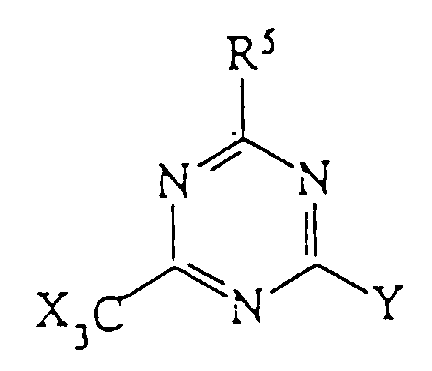 X ein Chlor- oder Bromatom bedeutet;Y einen Rest -CX3, -NH2, NHR4, -N(R4)2, oder -OR4 bedeutet, wobei R4 einen Alkylrest mit 1 bis 4 Kohlenstoffatomen oder einen Arylrest mit 6 bis 10 Kohlenstoffatomen bedeutet; undR5 einen Rest -CX3, einen Alkylrest mit 1 bis 12 Kohlenstoffatomen, einen Arylrest mit 6 bis 12 Kohlenstoffatomen, einen Alkenylrest mit 2 bis 12 Kohlenstoffatomen oder einen Aralkenylrest mit 8 bis 20 Kohlenstoffatomen bedeutet.
 - Verfahren zur Herstellung eines mit einer Abbildung versehenen Gegenstands bei geringer Verfärbung durch Farbstoff und mit einem stabilen Farbbild, umfassend die Schritte:(a) Belichten eines positiv oder negativ arbeitenden Photoresists mit Strahlung einer Wellenlänge im Bereich von etwa 300 bis 1100 nm, wobei der Photoresist(i) eine lichtempfindliche Zusammensetzung und(ii) einen Farbstoff, der eine durch Licht zersetzbare organische Halogenverbindung sensibilisieren kann, in reaktiver Assoziation mit einem aromatischen Iodoniumsalz oder einer halogenierten Triazinverbindung umfaßt,wodurch in den belichteten oder unbelichteten Bereichen des Photoresists ein Bild erzeugt wird;(b) subtraktives Entwickeln des in Schritt (a) erhaltenen Bildes;(c) in reaktive Assoziation bringen des verbleibenden Sensibilisierungsfarbstoffes im Photoresist aus Schritt (b) mit zusätzlichem, aromatischem Iodoniumsalz oder zusätzlicher halogenierter Triazinverbindung; und(c) Bleichen des verbleibenden Sensibilisierungsfarbstoffes im Photoresist durch gleichzeitiges Erhitzen und Belichten des Sensibilisierungsfarbstoffes und des aromatischen Iodoniumsalzes oder der halogenierten Triazinverbindung mit Strahlung einer Wellenlänge im Bereich von etwa 300 bis 700 nm bei einer Temperatur von mindestens etwa 40°C.
- Verfahren nach Anspruch 6, wobei der Photoresist negativ arbeitet.
- Verfahren nach Anspruch 6, wobei der Farbstoff ausgewählt ist aus: Diphenylmethan-, Xanthen-, Acridin-, Methin-, Polymethin-, Thiazol-, Thiazin-, Azin-, Aminoketon- und Porphyrinverbindungen, farbigen polycyclischen Kohlenwasserstoffverbindungen, p-substituierten Aminostyrylverbindungen und Aminostyrylmethanverbindungen.
- Verfahren nach Anspruch 6, wobei das aromatische Iodoniumsalz ausgewählt ist aus:
 Ar1 und Ar2 aromatische Reste mit 4 bis 20 Kohlenstoffatomen bedeuten; und W ausgewählt ist aus: einer Einfachbindung,
 R1 einen Arylrest mit 6 bis 20 Kohlenstoffatomen bedeutet und R2 und R3 unabhängig voneinander Wasserstoffatome oder Alkylreste mit 1 bis 4 Kohlenstoffatomen bedeuten; undQ ein Anion bedeutet.
 - Verfahren nach Anspruch 6, wobei des halogenierte Triazin die folgende Formel:
 X ein Chlor- oder Bromatom bedeutet;Y einen Rest -CX3, -NH2, NHR4, -N(R4)2, oder -OR4 bedeutet, wobei R4 einen Alkylrest mit 1 bis 4 Kohlenstoffatomen oder einen Arylrest mit 6 bis 10 Kohlenstoffatomen bedeutet; undR5 einen Rest -CX3, einen Alkylrest mit 1 bis 12 Kohlenstoffatomen, einen Arylrest mit 6 bis 12 Kohlenstoffatomen, einen Alkenylrest mit 2 bis 12 Kohlenstoffatomen oder einen Aralkenylrest mit 8 bis 20 Kohlenstoffatomen bedeutet.
 - Verfahren nach Anspruch 6, wobei die Schritte c) und d) gleichzeitig stattfinden.
Applications Claiming Priority (2)
| Application Number | Priority Date | Filing Date | Title |
|---|---|---|---|
| US99844392A | 1992-12-30 | 1992-12-30 | |
| US998443 | 1992-12-30 |
Publications (2)
| Publication Number | Publication Date |
|---|---|
| EP0605331A1 EP0605331A1 (de) | 1994-07-06 |
| EP0605331B1 true EP0605331B1 (de) | 1996-08-14 |
Family
ID=25545213
Family Applications (1)
| Application Number | Title | Priority Date | Filing Date |
|---|---|---|---|
| EP93403209A Expired - Lifetime EP0605331B1 (de) | 1992-12-30 | 1993-12-29 | Bleichen von Farbstoffen in lichtempfindlichen Systemen |
Country Status (4)
| Country | Link |
|---|---|
| US (1) | US5364740A (de) |
| EP (1) | EP0605331B1 (de) |
| JP (1) | JP2696059B2 (de) |
| DE (1) | DE69304033T2 (de) |
Families Citing this family (18)
| Publication number | Priority date | Publication date | Assignee | Title |
|---|---|---|---|---|
| TW460509B (en) * | 1996-07-12 | 2001-10-21 | Ciba Sc Holding Ag | Curing process for cationically photocurable formulations |
| US6437348B1 (en) * | 1999-10-21 | 2002-08-20 | Advanced Micro Devices, Inc. | Simultaneous heating and exposure of reticle with pattern placement correction |
| US7336422B2 (en) | 2000-02-22 | 2008-02-26 | 3M Innovative Properties Company | Sheeting with composite image that floats |
| US7147801B2 (en) * | 2003-03-13 | 2006-12-12 | Videojet Technologies Inc. | Ink jet ink composition and method for security marking |
| JP2005099500A (ja) * | 2003-09-25 | 2005-04-14 | Harison Toshiba Lighting Corp | レジストおよびリソグラフィー方法 |
| JP4594024B2 (ja) * | 2004-10-04 | 2010-12-08 | サカタインクス株式会社 | カラーフィルター用顔料分散レジスト組成物 |
| US7616332B2 (en) | 2004-12-02 | 2009-11-10 | 3M Innovative Properties Company | System for reading and authenticating a composite image in a sheeting |
| JP4526425B2 (ja) * | 2005-03-23 | 2010-08-18 | 三菱製紙株式会社 | 感光性組成物及び感光性平版印刷版の製造方法 |
| US7981499B2 (en) | 2005-10-11 | 2011-07-19 | 3M Innovative Properties Company | Methods of forming sheeting with a composite image that floats and sheeting with a composite image that floats |
| US7586685B2 (en) | 2006-07-28 | 2009-09-08 | Dunn Douglas S | Microlens sheeting with floating image using a shape memory material |
| US20080027199A1 (en) | 2006-07-28 | 2008-01-31 | 3M Innovative Properties Company | Shape memory polymer articles with a microstructured surface |
| US7951319B2 (en) | 2006-07-28 | 2011-05-31 | 3M Innovative Properties Company | Methods for changing the shape of a surface of a shape memory polymer article |
| US7800825B2 (en) | 2006-12-04 | 2010-09-21 | 3M Innovative Properties Company | User interface including composite images that float |
| BRPI0811820A2 (pt) | 2007-07-11 | 2014-11-04 | 3M Innovative Properties Co | "material laminado com imagem compósita que flutua" |
| WO2009070434A1 (en) | 2007-11-27 | 2009-06-04 | 3M Innovative Properties Company | Methods for forming sheeting with a composite image that floats and a master tooling |
| US7995278B2 (en) | 2008-10-23 | 2011-08-09 | 3M Innovative Properties Company | Methods of forming sheeting with composite images that float and sheeting with composite images that float |
| US8111463B2 (en) | 2008-10-23 | 2012-02-07 | 3M Innovative Properties Company | Methods of forming sheeting with composite images that float and sheeting with composite images that float |
| CN113168096B (zh) * | 2018-12-10 | 2024-05-24 | 易客发有限公司 | Uv或紫色敏化的平版印刷版的在机加工 |
Family Cites Families (32)
| Publication number | Priority date | Publication date | Assignee | Title |
|---|---|---|---|---|
| BE540601A (de) * | 1950-12-06 | |||
| DE1572079A1 (de) * | 1965-05-13 | 1970-02-19 | Keuffel & Esser Co | Kopierverfahren und Reproduktionsmaterial zur Verwendung in dem Verfahren |
| BE757069A (fr) * | 1969-10-03 | 1971-03-16 | Eastman Kodak Co | Composition photoconductrice contenant un colorant sensibilisateur et produit la comprenant |
| JPS4926584B1 (de) * | 1970-11-26 | 1974-07-10 | ||
| US3729313A (en) * | 1971-12-06 | 1973-04-24 | Minnesota Mining & Mfg | Novel photosensitive systems comprising diaryliodonium compounds and their use |
| US3925077A (en) * | 1974-03-01 | 1975-12-09 | Horizons Inc | Photoresist for holography and laser recording with bleachout dyes |
| US4304923A (en) * | 1979-02-27 | 1981-12-08 | Minnesota Mining And Manufacturing Company | Photopolymerizable oligomer |
| US4228232A (en) * | 1979-02-27 | 1980-10-14 | Minnesota Mining And Manufacturing Company | Photopolymerizable composition containing ethylenically unsaturated oligomers |
| US4460677A (en) * | 1981-03-26 | 1984-07-17 | Minnesota Mining And Manufacturing Company | Visible light sensitive, thermally developable imaging systems |
| GB8307023D0 (en) * | 1983-03-15 | 1983-04-20 | Minnesota Mining & Mfg | Dye bleach system |
| GB2136590B (en) * | 1983-03-15 | 1986-01-02 | Minnesota Mining & Mfg | Dye-bleach materials and process |
| US4685783A (en) * | 1983-09-07 | 1987-08-11 | The Plessey Company P.L.C. | Polychromic tetracyclo-spiro-adamatylidene derivatives, and polychromic lens incorporating said compounds |
| US4701402A (en) * | 1984-02-13 | 1987-10-20 | Minnesota Mining And Manufacturing Company | Oxidative imaging |
| US4587198A (en) * | 1984-07-16 | 1986-05-06 | Minnesota Mining And Manufacturing Company | Dye transfer image process |
| US4632895A (en) * | 1984-08-23 | 1986-12-30 | Minnesota Mining And Manufacturing Company | Diffusion or sublimation transfer imaging system |
| CA1293407C (en) * | 1984-10-09 | 1991-12-24 | Paul Clinton Adair | Imaging systems employing photosensitive microcapsules containing 3-substituted coumarins and other photobleachable sensitizers |
| JPS61120143A (ja) * | 1984-11-15 | 1986-06-07 | Fuji Photo Film Co Ltd | 画像の形成方法および画像形成材料 |
| US4746595A (en) * | 1986-04-22 | 1988-05-24 | Minnesota Mining And Manufacturing Company | Subbed supports for imaging materials |
| US4755450A (en) * | 1986-04-22 | 1988-07-05 | Minnesota Mining And Manufacturing Company | Spectral sensitizing dyes in photopolymerizable systems |
| US4710445A (en) * | 1986-04-22 | 1987-12-01 | Minnesota Mining And Manufacturing Company | Resist imageable photopolymerizable compositions |
| JPS63194253A (ja) * | 1987-01-29 | 1988-08-11 | ザ・ミード・コーポレーション | イオン染料−対イオン錯体を使用した透明または半透明材料の積層方法 |
| CA1323949C (en) * | 1987-04-02 | 1993-11-02 | Michael C. Palazzotto | Ternary photoinitiator system for addition polymerization |
| GB8719730D0 (en) * | 1987-08-20 | 1987-09-30 | Vickers Plc | Radiation sensitive compounds |
| JPS6478247A (en) * | 1987-09-18 | 1989-03-23 | Toray Industries | Photopolymerizable composition |
| GB8728389D0 (en) * | 1987-12-04 | 1988-01-13 | Cookson Group Plc | Photopolymerisable composition |
| DE3742275A1 (de) * | 1987-12-12 | 1989-06-22 | Hoechst Ag | Verfahren zur nachbehandlung von entwickelten reliefdruckformen fuer den flexodruck |
| US4876175A (en) * | 1988-05-09 | 1989-10-24 | Eastman Kodak Company | Dye sensitized photographic imaging systems |
| US4869993A (en) * | 1988-08-29 | 1989-09-26 | Wahib Farahat | Optical brightener containing positive working color proofing system |
| JPH02289856A (ja) * | 1989-01-18 | 1990-11-29 | Fuji Photo Film Co Ltd | 感光・感熱性組成物、それを用いた記録材料及び画像形成方法 |
| GB8923459D0 (en) * | 1989-10-18 | 1989-12-06 | Minnesota Mining & Mfg | Positive-acting photoresist compositions |
| US5153104A (en) * | 1990-06-18 | 1992-10-06 | Minnesota Mining And Manufacturing Company | Thermally developable light-sensitive layers containing photobleachable sensitizers |
| CA2039668A1 (en) * | 1990-06-20 | 1991-12-21 | Steven T. Hedrick | Photosensitive composition and printing plate |
-
1993
- 1993-11-09 US US08/150,237 patent/US5364740A/en not_active Expired - Fee Related
- 1993-12-24 JP JP5327526A patent/JP2696059B2/ja not_active Expired - Lifetime
- 1993-12-29 EP EP93403209A patent/EP0605331B1/de not_active Expired - Lifetime
- 1993-12-29 DE DE69304033T patent/DE69304033T2/de not_active Expired - Fee Related
Also Published As
| Publication number | Publication date |
|---|---|
| EP0605331A1 (de) | 1994-07-06 |
| US5364740A (en) | 1994-11-15 |
| DE69304033T2 (de) | 1997-02-20 |
| JPH06230564A (ja) | 1994-08-19 |
| JP2696059B2 (ja) | 1998-01-14 |
| DE69304033D1 (de) | 1996-09-19 |
Similar Documents
| Publication | Publication Date | Title |
|---|---|---|
| EP0605331B1 (de) | Bleichen von Farbstoffen in lichtempfindlichen Systemen | |
| US4598036A (en) | Print-out compositions | |
| US3729313A (en) | Novel photosensitive systems comprising diaryliodonium compounds and their use | |
| US3854950A (en) | Halation protection for multilayer imaging of photopolymers | |
| US5773170A (en) | UV-absorbing media bleachable by IR-radiation | |
| EP0228175B1 (de) | Vorsensibilisierte Farbprüffolie | |
| JPH02135351A (ja) | 光重合性混合物、それから作製された記録材料、及びコピーの製造方法 | |
| JPH0549977B2 (de) | ||
| US4950577A (en) | Pre-press light-sensitive color proofing article incorporating antihalation layer | |
| CA1079565A (en) | Dot-etchable photopolymerizable elements and image reproduction process | |
| JPH06214381A (ja) | 剥離プルーフィングシステム | |
| JPH02178660A (ja) | 改良された着色画像の形成法とそれに用いる感光性エレメント | |
| JPH02236551A (ja) | 変質性シート材料上にカラー画像を形成する方法 | |
| EP0522616B1 (de) | Verfahren zur Herstellung von Bildern mittels einer photopolymerisierbaren Zusammensetzung | |
| EP0502562A1 (de) | Verfahren zur Herstellung von Bildern | |
| US5609945A (en) | Partially translucent white film having metallized surface | |
| US5395730A (en) | Image formation by thermal transfer | |
| JP2538229B2 (ja) | 画像形成方法 | |
| JPS6116967B2 (de) | ||
| CA2000712A1 (en) | Negative-working, photopolymerizable color proofing film without triplet oxygen quenching | |
| US5534373A (en) | Peel-apart process for the production of a colored image and imaged product produced through the process | |
| JPH08248639A (ja) | 画像形成材料 | |
| JPH07168352A (ja) | 乾式カラープルーフプロセスに用いるドナー要素およびカラープルーフの製造方法 | |
| EP0587213B1 (de) | Mittels Wärmeübertragung erzeugtes Bild | |
| JPH0627672A (ja) | 色校正フィルム用複合黒色および白色基材 |
Legal Events
| Date | Code | Title | Description |
|---|---|---|---|
| PUAI | Public reference made under article 153(3) epc to a published international application that has entered the european phase |
Free format text: ORIGINAL CODE: 0009012 |
|
| AK | Designated contracting states |
Kind code of ref document: A1 Designated state(s): DE FR GB IT |
|
| 17P | Request for examination filed |
Effective date: 19941205 |
|
| 17Q | First examination report despatched |
Effective date: 19950320 |
|
| GRAH | Despatch of communication of intention to grant a patent |
Free format text: ORIGINAL CODE: EPIDOS IGRA |
|
| GRAA | (expected) grant |
Free format text: ORIGINAL CODE: 0009210 |
|
| GRAH | Despatch of communication of intention to grant a patent |
Free format text: ORIGINAL CODE: EPIDOS IGRA |
|
| AK | Designated contracting states |
Kind code of ref document: B1 Designated state(s): DE FR GB IT |
|
| REF | Corresponds to: |
Ref document number: 69304033 Country of ref document: DE Date of ref document: 19960919 |
|
| ITF | It: translation for a ep patent filed | ||
| ET | Fr: translation filed | ||
| PGFP | Annual fee paid to national office [announced via postgrant information from national office to epo] |
Ref country code: FR Payment date: 19961115 Year of fee payment: 4 |
|
| PGFP | Annual fee paid to national office [announced via postgrant information from national office to epo] |
Ref country code: DE Payment date: 19961122 Year of fee payment: 4 |
|
| PLBE | No opposition filed within time limit |
Free format text: ORIGINAL CODE: 0009261 |
|
| STAA | Information on the status of an ep patent application or granted ep patent |
Free format text: STATUS: NO OPPOSITION FILED WITHIN TIME LIMIT |
|
| 26N | No opposition filed | ||
| PG25 | Lapsed in a contracting state [announced via postgrant information from national office to epo] |
Ref country code: GB Free format text: LAPSE BECAUSE OF NON-PAYMENT OF DUE FEES Effective date: 19971229 |
|
| PG25 | Lapsed in a contracting state [announced via postgrant information from national office to epo] |
Ref country code: FR Free format text: THE PATENT HAS BEEN ANNULLED BY A DECISION OF A NATIONAL AUTHORITY Effective date: 19971231 |
|
| GBPC | Gb: european patent ceased through non-payment of renewal fee |
Effective date: 19971229 |
|
| PG25 | Lapsed in a contracting state [announced via postgrant information from national office to epo] |
Ref country code: DE Free format text: LAPSE BECAUSE OF NON-PAYMENT OF DUE FEES Effective date: 19980901 |
|
| REG | Reference to a national code |
Ref country code: FR Ref legal event code: ST |
|
| PG25 | Lapsed in a contracting state [announced via postgrant information from national office to epo] |
Ref country code: IT Free format text: LAPSE BECAUSE OF NON-PAYMENT OF DUE FEES;WARNING: LAPSES OF ITALIAN PATENTS WITH EFFECTIVE DATE BEFORE 2007 MAY HAVE OCCURRED AT ANY TIME BEFORE 2007. THE CORRECT EFFECTIVE DATE MAY BE DIFFERENT FROM THE ONE RECORDED. Effective date: 20051229 |