EP0607899B1 - Composition pour photoréserve positive - Google Patents
Composition pour photoréserve positive Download PDFInfo
- Publication number
- EP0607899B1 EP0607899B1 EP94100582A EP94100582A EP0607899B1 EP 0607899 B1 EP0607899 B1 EP 0607899B1 EP 94100582 A EP94100582 A EP 94100582A EP 94100582 A EP94100582 A EP 94100582A EP 0607899 B1 EP0607899 B1 EP 0607899B1
- Authority
- EP
- European Patent Office
- Prior art keywords
- group
- photoresist composition
- positive photoresist
- pattern
- following formula
- Prior art date
- Legal status (The legal status is an assumption and is not a legal conclusion. Google has not performed a legal analysis and makes no representation as to the accuracy of the status listed.)
- Expired - Lifetime
Links
- 0 *C(CCCC1)(CC1S(S(C(CCCC1)CC1(*)*1CCCCCCC1)(=O)=O)(=O)=O)*1CCCCC1 Chemical compound *C(CCCC1)(CC1S(S(C(CCCC1)CC1(*)*1CCCCCCC1)(=O)=O)(=O)=O)*1CCCCC1 0.000 description 1
Classifications
-
- G—PHYSICS
- G03—PHOTOGRAPHY; CINEMATOGRAPHY; ANALOGOUS TECHNIQUES USING WAVES OTHER THAN OPTICAL WAVES; ELECTROGRAPHY; HOLOGRAPHY
- G03F—PHOTOMECHANICAL PRODUCTION OF TEXTURED OR PATTERNED SURFACES, e.g. FOR PRINTING, FOR PROCESSING OF SEMICONDUCTOR DEVICES; MATERIALS THEREFOR; ORIGINALS THEREFOR; APPARATUS SPECIALLY ADAPTED THEREFOR
- G03F7/00—Photomechanical, e.g. photolithographic, production of textured or patterned surfaces, e.g. printing surfaces; Materials therefor, e.g. comprising photoresists; Apparatus specially adapted therefor
- G03F7/004—Photosensitive materials
- G03F7/04—Chromates
-
- G—PHYSICS
- G03—PHOTOGRAPHY; CINEMATOGRAPHY; ANALOGOUS TECHNIQUES USING WAVES OTHER THAN OPTICAL WAVES; ELECTROGRAPHY; HOLOGRAPHY
- G03F—PHOTOMECHANICAL PRODUCTION OF TEXTURED OR PATTERNED SURFACES, e.g. FOR PRINTING, FOR PROCESSING OF SEMICONDUCTOR DEVICES; MATERIALS THEREFOR; ORIGINALS THEREFOR; APPARATUS SPECIALLY ADAPTED THEREFOR
- G03F7/00—Photomechanical, e.g. photolithographic, production of textured or patterned surfaces, e.g. printing surfaces; Materials therefor, e.g. comprising photoresists; Apparatus specially adapted therefor
- G03F7/004—Photosensitive materials
- G03F7/039—Macromolecular compounds which are photodegradable, e.g. positive electron resists
-
- G—PHYSICS
- G03—PHOTOGRAPHY; CINEMATOGRAPHY; ANALOGOUS TECHNIQUES USING WAVES OTHER THAN OPTICAL WAVES; ELECTROGRAPHY; HOLOGRAPHY
- G03F—PHOTOMECHANICAL PRODUCTION OF TEXTURED OR PATTERNED SURFACES, e.g. FOR PRINTING, FOR PROCESSING OF SEMICONDUCTOR DEVICES; MATERIALS THEREFOR; ORIGINALS THEREFOR; APPARATUS SPECIALLY ADAPTED THEREFOR
- G03F7/00—Photomechanical, e.g. photolithographic, production of textured or patterned surfaces, e.g. printing surfaces; Materials therefor, e.g. comprising photoresists; Apparatus specially adapted therefor
- G03F7/004—Photosensitive materials
- G03F7/0045—Photosensitive materials with organic non-macromolecular light-sensitive compounds not otherwise provided for, e.g. dissolution inhibitors
-
- Y—GENERAL TAGGING OF NEW TECHNOLOGICAL DEVELOPMENTS; GENERAL TAGGING OF CROSS-SECTIONAL TECHNOLOGIES SPANNING OVER SEVERAL SECTIONS OF THE IPC; TECHNICAL SUBJECTS COVERED BY FORMER USPC CROSS-REFERENCE ART COLLECTIONS [XRACs] AND DIGESTS
- Y10—TECHNICAL SUBJECTS COVERED BY FORMER USPC
- Y10S—TECHNICAL SUBJECTS COVERED BY FORMER USPC CROSS-REFERENCE ART COLLECTIONS [XRACs] AND DIGESTS
- Y10S430/00—Radiation imagery chemistry: process, composition, or product thereof
- Y10S430/1053—Imaging affecting physical property or radiation sensitive material, or producing nonplanar or printing surface - process, composition, or product: radiation sensitive composition or product or process of making binder containing
- Y10S430/1055—Radiation sensitive composition or product or process of making
- Y10S430/106—Binder containing
-
- Y—GENERAL TAGGING OF NEW TECHNOLOGICAL DEVELOPMENTS; GENERAL TAGGING OF CROSS-SECTIONAL TECHNOLOGIES SPANNING OVER SEVERAL SECTIONS OF THE IPC; TECHNICAL SUBJECTS COVERED BY FORMER USPC CROSS-REFERENCE ART COLLECTIONS [XRACs] AND DIGESTS
- Y10—TECHNICAL SUBJECTS COVERED BY FORMER USPC
- Y10S—TECHNICAL SUBJECTS COVERED BY FORMER USPC CROSS-REFERENCE ART COLLECTIONS [XRACs] AND DIGESTS
- Y10S430/00—Radiation imagery chemistry: process, composition, or product thereof
- Y10S430/1053—Imaging affecting physical property or radiation sensitive material, or producing nonplanar or printing surface - process, composition, or product: radiation sensitive composition or product or process of making binder containing
- Y10S430/1055—Radiation sensitive composition or product or process of making
- Y10S430/106—Binder containing
- Y10S430/111—Polymer of unsaturated acid or ester
Definitions
- the present invention relates to a positive photoresist composition suitable for use in lithographies using far ultraviolet ray (including excimer laser.
- MDPR mono-disperse polyvinyl phenol based positive resist
- KrF excimer laser lithography dataBASE INSPEC INSTITUTE OF ELECTRICAL ENGINEERS, STEVENAGE, GB Inspec No. 4369457.
- MDPR is an alkali developable single layer resist, composed of partially t-butyloxycarbonyloxylated polyvinylphenol, a dissolution inhibitor and a photoacid generator.
- Spence C A, et al. described the silylation of poly(t-butyloxycarbonyloxyy)styrene resists in respect of performance and mechanisms (ADVANCES IN RESIST TECHNOLOGY AND PROCESSING VII, SAN JOSE, CA, USA 5-6 MARCH 1990, 344-357).
- the investigated resists comprise an acid precursor and a copolymer of para-t-butoxycarbonyloxystyrene and styrene whereby the ratio of styrene to para-t-butoxycarbonyloxystyrene ranges from 0% to 33% styrene.
- the copolymer of p-vinylphenol or a derivative thereof and styrene preferably has a weight average molecular weight of from 1,000 to 6,000, and more preferably from 2,000 to 5,000.
- the p-vinylphenol/styrene copolymer used in the invention can easily be produced by a radical or ionic polymerization of a mixture of 4-acetoxystyrene and styrene, followed by hydrolysis of the resulting copolymer under an alkaline condition.
- Partially p-t-butoxycarbonyloxylated styrene is prepared by replacing a part of the hydroxyl group of p-vinylphenol with t-butoxy-carbonyloxy group.
- a copolymer of the partially butoxycarbonyloxylated styrene and styrene can be produced by, for example, reacting the above-mentioned p-vinylphenol/styrene copolymer with di-t-butyl dicarbonate in a hydrophilic organic solvent such as acetone or tetrahydrofuran in the presence of an alkali such as potassium carbonate. Preferably, this reaction is carried out in the presence of a phase transfer catalyst such as crown ether.
- the molar ratio of p-vinylphenol to styrene is preferably from 50:50 to 95:5, and more preferably from 65:35 to 85:15.
- the p-vinylphenol/styrene copolymer preferably has a weight average molecular weight of from 1,000 to 5,000 and more preferably from 2,000 to 4,000.
- Examples of the photo-induced acid precursor include the esters represented by the following formula (III): wherein R 10 represents an optionally substituted arylene, alkylene or alkenylene group and R 11 represents an optionally substituted alkyl or aryl group; the disulfone compounds represented by the following formula (IV): wherein R 12 and R 13 independently of one another each represents hydrogen atom, alkyl group or alkoxyl group; the esters represented by the following formula (V): wherein R 14 represents an optionally substituted alkyl or aryl group and R 15 represents hydrogen atom, alkyl group, alkoxyl group or alkylcarbonyloxy group.
- examples of the arylene group represented by R 10 include monocyclic and bicyclic arylene groups, among which preferable are phenylene, and naphthylene.
- arylene group halogen atom, nitro group, and acetylamino group can be referred to.
- Examples of the alkenylene group represented by R 10 include those having 2 to 4 carbon atoms, among which vinylidene is preferred. As the preferable substituent present on the alkenylene group and monocyclic aryl groups can be referred to.
- Examples of the alkyl group represented by R 11 include straight chain, branched chain and cyclic alkyl groups, among which straight chain alkyl groups having 1 to 8 carbon atoms are preferred.
- As the preferable substituent present on the alkyl group halogen atom, and lower alkoxy group can be referred to.
- Examples of the aryl group represented by R 11 include monocyclic and bicyclic aryl groups, among which monocyclic aryl groups are preferred and phenyl group are particularly preferred.
- As the preferable substituent present on the aryl group lower alkyl group, lower alkoxy group, and halogen atom can be referred to.
- examples of the alkyl group or the alkyl residue of the alkoxy group represented by R 12 or R 13 include straight chain, branched chain and cyclic alkyl groups, among which straight chain alkyl groups having 1 to 8 carbon atoms are preferred.
- examples of the alkyl group represented by R 14 and of the alkyl group or the alkyl residue of the alkoxy group or the alkylcarbonyloxy group represented by R 15 include straight chain, branched chain and cyclic alkyl groups, among which straight chain alkyl groups having 1 to 8 carbon atoms are preferred.
- halogen atoms, and lower alkoxy groups can be referred to.
- Examples of the aryl group represented by R 14 include monocyclic and bicyclic aryl groups, among which monocyclic aryl groups are preferred and phenyl groups and the like are particularly preferred.
- As the preferable substituent present on the aryl group lower alkyl groups, lower alkoxy groups, and halogen atoms can be referred to.
- ester represented by the formula (III) As preferable examples of the ester represented by the formula (III), the following can be referred to.
- esters represented by the above-presented formula (III) can be produced by reacting a cyclic N-hydroxyimide compound represented by the following formula (IIIa): wherein R 10 is as defined above, which can be produced according to the method mentioned in, for example, G. F. Jaubert, Ber., 28 , 360 (1985), D. E. Ames et al., J. Chem. Soc., 3518 (1955) or M. A. Stolberg et al., J. Amer. Chem. Soc., 79 , 2615 (1957), with a sulfonyl chloride compound represented by the formula R 11 -SO 2 Cl wherein R 11 is as defined above, under basic conditions [L. Bauer et al., J. Org. Chem., 24 , 1293 (1959)].
- the ester represented by the formula (III) may be used either independently or in the form of a mixture of two or more compounds.
- the disulfone compound represented by the formula (IV) can be produced according to the method mentioned in, for example, Japanese Patent Application KOKAI No. 1-284554, J. Org. Chem., 31 , 3418 (1966), J. Chem. Soc., 93 , 1524 (1908), Ber., 49 , 2593 (1916), etc., namely according to a method which comprises producing a disulfone compound from sulfinic acid by the use of cobalt (III) sulfate in aqueous sulfuric acid, a method which comprises producing a disulfone compound from sulfonyl chloride by the use of ethyl xanthogenate, a method which comprises producing a disulfone compound by reacting sulfinic acid and sulfonyl chloride under basic conditions, etc.
- the ester represented by the formula (V) can be produced, for example, according to the method mentioned in Japanese Patent Application KOKAI No. 2-245756, namely by reacting a corresponding phenol compound with sulfonyl chloride under a basic condition.
- ester represented by the formula (V) As preferable examples of the ester represented by the formula (V), the following can be referred to.
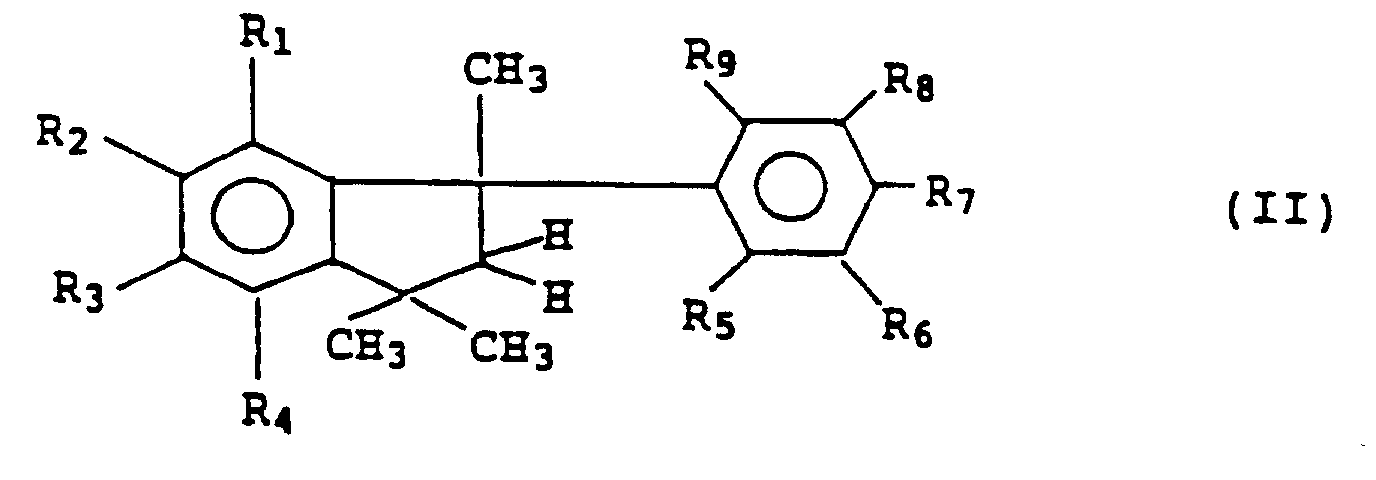
- dissolution inhibitor examples include the compounds having a benzene ring substituted with t-butoxy-carbonyloxy group mentioned in European Patent Application No. 0564997A2; the compounds represented by the following formula (II): wherein R 1 to R 9 each represents hydrogen atom, alkyl group, t-butoxycarbonyloxy group or hydroxyl group, provided that at least one of R 1 to R 4 is t-butoxycarbonyloxy group and at least one of R 5 to R 9 is t-butoxycarbonyloxy group.
- Examples of the alkyl group represented by R 1 to R 9 include those having 1 to 4 carbon atoms, among which methyl is most preferred.
- dissolution inhibitors are used either independently or in the form of a mixture of two or more compounds.
- the mixing ratio of the ingredients is usually as follows: alkali-soluble resin from 30 to 90% by weight, dissolution inhibitor from 2 to 50% by weight, photo-induced acid precursor from 0.1 to 20% by weight; and preferably as follows: alkali-soluble resin from 50 to 85%, dissolution inhibitor from 12 to 40% by weight, photo-induced acid precursor from 1 to 15% by weight.
- various additives conventionally used in this field of the art such as sensitizer, dye, and adhesion improver, may be added, if desired.
- a photoresist solution is usually prepared by mixing the above-mentioned positive photoresist composition into a solvent so that the concentration of the composition in the total mixture comes to 1 to 50% by weight.
- the solvents usable for this purpose include, for example, ethyl cellosolve acetate, methyl cellosolve acetate, ethyl cellosolve, methyl cellosolve, propylene glycol monomethyl ether acetate, propylene glycol monoethyl ether acetate, propylene glycol monomethyl ether, propylene glycol monoethyl ether, diethylene glycol dimethyl ether, ethyl lactate, butyl acetate, ethyl pyruvate, 2-heptanone, cyclohexanone, methyl isobutyl ketone, and xylene. These solvents are used either independently or in combination of two or more members.
- the diglyme solution thus obtained was concentrated to remove small quantities of remaining water and ethyl acetate.
- a solution of resin B in diglyme (the concentration of solid component is 33% by weight) was obtained.
- 20% of the total hydroxyl group in the starting resin was protected by t-butoxy-carbonyloxy group.
- a silicon wafer washed in the conventional manner was coated with the resist solution by means of a spinner so as to give a coating thickness of 0.7 ⁇ m. Then, the silicon wafer was pre-baked on a hot plate at 100°C for one minute. Then, the pre-baked coating film was exposed to light through a patterned reticle with KrF Excimer Laser Stepper (NSR-1755, EX8A, NA 0.45, manufactured by Nicon Co.) having an exposure wavelength of 248 nm. After the exposure, the wafer was heated on a hot plate at 80°C for 90 seconds, and developed with a 2.38% aqueous solution of tetramethylammonium hydroxide to obtain a positive pattern. No peeling of pattern was observed. Observation of the pattern thus formed by means of electron microscope revealed that a 0.30 ⁇ m line-and-space pattern could be resolved with a good profile and the sensitivity was 70 mJ/cm 2 .
- a positive pattern was formed by repeating Example 1, except that the resin A was replaced with resin B.
- a positive pattern was formed by repeating Example 2, except that the N-hydroxysuccinimide benzenesulfonate was replaced with 1.5 parts of N-hydroxysuccinimide 2-propanesulfonate.
- a positive pattern was formed by repeating Example 3, except that the N-hydroxysuccinimide 2-propanesulfonate was replaced with N-hydroxysuccinimide chloromethanesulfonate.
- a positive pattern was formed by repeating Example 3, except that the N-hydroxysuccinimide 2-propanesulfonate was replaced with diphenyl disulfone.
- a positive pattern was formed by repeating Example 3, except that the N-hydroxysuccinimide 2-propanesulfonate was replaced with pyrogallol trimethanesulfonate. No peeling of pattern was observed. Observation of the pattern thus formed by means of electron microscope revealed that a 0.45 ⁇ m line-and-space pattern could be resolved with a good profile and the sensitivity was 178 mJ/cm 2 .
- a positive pattern was formed by repeating Example 3, except that the N-hydroxysuccinimide 2-propanesulfonate was replaced with phloroglucin trimethanesulfonate. No peeling of pattern was observed. Observation of the pattern thus formed by means of electron microscope revealed that a 0.50 ⁇ m line-and-space pattern could be resolved with a good profile and the sensitivity was 200 mJ/cm 2 .
- a positive pattern was formed by repeating Example 3, except that the N-hydroxysuccinimide 2-propanesulfonate was replaced with tri-methanesulfonic acid ester of ethyl gallate. No peeling of pattern was observed. Observation of the pattern thus formed by means of electron microscope revealed that a 0.50 ⁇ m line-and-space pattern could be resolved with a good profile and the sensitivity was 240 mJ/cm 2 .
- a positive pattern was formed by repeating Example 1, except that the resin A was replaced with MARUKA LYNCUR CST-70 (manufactured by Maruzen Peterochemical Co.; weight average molecular weight 2,300). No peeling of pattern was observed. Observation of the pattern thus formed by means of electron microscope revealed that a 0.50 ⁇ m line-and-space pattern could be resolved with a good profile and the sensitivity was 85 mJ/cm 2 .
Landscapes
- Physics & Mathematics (AREA)
- General Physics & Mathematics (AREA)
- Spectroscopy & Molecular Physics (AREA)
- Materials For Photolithography (AREA)
- Organic Low-Molecular-Weight Compounds And Preparation Thereof (AREA)
- Paints Or Removers (AREA)
- Addition Polymer Or Copolymer, Post-Treatments, Or Chemical Modifications (AREA)
- Compositions Of Macromolecular Compounds (AREA)
Claims (5)
- Composition de photorésist positif comprenant une résine soluble dans les bases contenant un copolymère de p-vinylphénol ou un de ses dérivés et de styrène, un inhibiteur de dissolution et un précurseur d'acide photoinduit, dans laquelle ledit copolymère de p-vinylphénol ou un de ses dérivés et de styrène contient un groupe représenté par la formule suivante (Ia) ou (Ib):dans lesquelles m, n et p sont des nombres satisfaisant les relations suivantes:
 (m+p):n= de 50:50 à 95:5; etp:(m+p)= de 1:50 à 45:50.
 - Composition de photorésist positif selon la revendication 1, dans laquelle ledit inhibiteur de dissolution est un composé représenté par la formule suivante (II):dans laquelle R1 à R9 représentent chacun un atome d'hydrogène, un groupe alkyle, un groupe t-butoxycarbonyloxy ou un groupe hydroxyle, à condition qu'au moins un élément de R1 à R4 soit le groupe t-butoxycarbonyloxy et au moins un élément de R5 à R9 soit le groupe t-butoxycarbonyloxy.
- Composition de photorésist positif selon l'une quelconque des revendications 1 ou 2, dans laquelle ledit précurseur d'acide photo-induit est un ester représenté par la formule suivante (III):dans laquelle R10 représente un groupe arylène, alkylène ou alcénylène éventuellement substitué et R11 représente un groupe alkyle ou aryle éventuellement substitué.

- Composition de photorésist positif selon l'une quelconque des revendications 1 ou 2, dans laquelle ledit précurseur d'acide photo-induit est un composé disulfone représenté par la formule suivante (IV):dans laquelle R12 et R13, indépendamment l'un de l'autre, représentent chacun un atome d'hydrogène, un groupe alkyle ou un groupe alcoxyle.

- Composition de photorésist positif selon l'une quelconque des revendications 1 ou 2, dans laquelle ledit précurseur d'acide photo-induit est un ester représenté par la formule suivante (V):dans laquelle R14 représente un groupe alkyle ou aryle éventuellement substitué et R15 représente un atome d'hydrogène, un groupe alkyle, un groupe alcoxyle ou un groupe alkylcarbonyloxy.

Applications Claiming Priority (3)
| Application Number | Priority Date | Filing Date | Title |
|---|---|---|---|
| JP5005795A JPH06214395A (ja) | 1993-01-18 | 1993-01-18 | ポジ型フォトレジスト組成物 |
| JP5795/93 | 1993-01-18 | ||
| JP579593 | 1993-01-18 |
Publications (3)
| Publication Number | Publication Date |
|---|---|
| EP0607899A2 EP0607899A2 (fr) | 1994-07-27 |
| EP0607899A3 EP0607899A3 (fr) | 1995-02-01 |
| EP0607899B1 true EP0607899B1 (fr) | 2000-06-14 |
Family
ID=11621021
Family Applications (1)
| Application Number | Title | Priority Date | Filing Date |
|---|---|---|---|
| EP94100582A Expired - Lifetime EP0607899B1 (fr) | 1993-01-18 | 1994-01-17 | Composition pour photoréserve positive |
Country Status (6)
| Country | Link |
|---|---|
| US (1) | US6156476A (fr) |
| EP (1) | EP0607899B1 (fr) |
| JP (1) | JPH06214395A (fr) |
| KR (1) | KR100239185B1 (fr) |
| CA (1) | CA2112285A1 (fr) |
| DE (1) | DE69424884T2 (fr) |
Families Citing this family (18)
| Publication number | Priority date | Publication date | Assignee | Title |
|---|---|---|---|---|
| JP2942167B2 (ja) * | 1994-09-02 | 1999-08-30 | 和光純薬工業株式会社 | レジスト材料及びこれを用いたパターン形成方法 |
| JPH0934112A (ja) * | 1995-05-12 | 1997-02-07 | Sumitomo Chem Co Ltd | フォトレジスト組成物 |
| KR970028845A (ko) * | 1995-11-21 | 1997-06-24 | 김광호 | 화학 증폭형 레지스트용 베이스 수지 및 그 제조 방법 |
| JPH09166871A (ja) * | 1995-12-15 | 1997-06-24 | Sumitomo Chem Co Ltd | フォトレジスト組成物 |
| US5861231A (en) * | 1996-06-11 | 1999-01-19 | Shipley Company, L.L.C. | Copolymers and photoresist compositions comprising copolymer resin binder component |
| KR100225948B1 (ko) * | 1996-06-29 | 1999-10-15 | 김영환 | 감광막 조성물 및 감광막 조성물 제조방법과 감광막 패턴 형성방법 |
| JP3814961B2 (ja) † | 1996-08-06 | 2006-08-30 | 三菱化学株式会社 | ポジ型感光性印刷版 |
| US6207353B1 (en) | 1997-12-10 | 2001-03-27 | International Business Machines Corporation | Resist formulation which minimizes blistering during etching |
| KR100316972B1 (ko) * | 1999-02-19 | 2001-12-22 | 주식회사 동진쎄미켐 | 화학 증폭 레지스트 수지 |
| KR100316974B1 (ko) * | 1999-02-19 | 2001-12-22 | 주식회사 동진쎄미켐 | 화학 증폭 레지스트 수지 |
| KR100316971B1 (ko) * | 1999-02-19 | 2001-12-22 | 주식회사 동진쎄미켐 | 화학 증폭 레지스트 수지 |
| KR100316973B1 (ko) * | 1999-02-19 | 2001-12-22 | 주식회사 동진쎄미켐 | 화학 증폭 레지스트 수지 |
| KR100557606B1 (ko) * | 1999-08-31 | 2006-03-10 | 주식회사 하이닉스반도체 | 유기 난반사 방지용 중합체 |
| JP3589139B2 (ja) * | 2000-02-14 | 2004-11-17 | 株式会社日立製作所 | 回転電機 |
| KR20010085191A (ko) * | 2000-02-23 | 2001-09-07 | 윤종용 | 포토레지스트용 중합체, 이의 제조방법 및 이를 사용한포토레지스트 조성물 |
| JP2001264968A (ja) * | 2000-03-23 | 2001-09-28 | Sumitomo Chem Co Ltd | ポジ型レジスト組成物 |
| KR100840635B1 (ko) | 2001-11-30 | 2008-06-24 | 와코 쥰야꾸 고교 가부시키가이샤 | 비스이미드 화합물, 이것을 이용한 산 발생제 및 레지스트조성물 및 해당 조성물을 이용한 패턴 형성 방법 |
| JP4588551B2 (ja) * | 2005-06-16 | 2010-12-01 | 富士通株式会社 | レジスト組成物、レジストパターンの形成方法、半導体装置及びその製造方法 |
Family Cites Families (16)
| Publication number | Priority date | Publication date | Assignee | Title |
|---|---|---|---|---|
| US4491628A (en) * | 1982-08-23 | 1985-01-01 | International Business Machines Corporation | Positive- and negative-working resist compositions with acid generating photoinitiator and polymer with acid labile groups pendant from polymer backbone |
| DE3406927A1 (de) * | 1984-02-25 | 1985-08-29 | Hoechst Ag, 6230 Frankfurt | Strahlungsempfindliches gemisch auf basis von saeurespaltbaren verbindungen |
| JPS62266537A (ja) * | 1986-05-14 | 1987-11-19 | Fuji Photo Film Co Ltd | マイクロカプセル及びそれを使用した感光性記録材料 |
| EP0366590B2 (fr) * | 1988-10-28 | 2001-03-21 | International Business Machines Corporation | Composition photoréserve positive à haute sensibilité |
| DE69027799T2 (de) * | 1989-03-14 | 1997-01-23 | Ibm | Chemisch amplifizierter Photolack |
| JP2661671B2 (ja) * | 1989-03-20 | 1997-10-08 | 株式会社日立製作所 | パタン形成材料とそれを用いたパタン形成方法 |
| DE69125634T2 (de) * | 1990-01-30 | 1998-01-02 | Wako Pure Chem Ind Ltd | Chemisch verstärktes Photolack-Material |
| JP2847413B2 (ja) * | 1990-01-30 | 1999-01-20 | 和光純薬工業株式会社 | レジスト材料 |
| DE69130701T2 (de) * | 1990-10-29 | 1999-08-26 | Toyo Gosei Kogyo Co. Ltd. | Lichtempfindliches gefärbtes Harz, farbiges Bild, Verfahren zur Herstellung von Farbfiltern und Verfahren zur Herstellung einer Schwarzmatrix |
| DE4112968A1 (de) * | 1991-04-20 | 1992-10-22 | Hoechst Ag | Saeurespaltbare verbindungen, diese enthaltendes positiv arbeitendes strahlungsempfindliches gemisch und daraus hergestelltes strahlungsempfindliches aufzeichnungsmaterial |
| DE4121199A1 (de) * | 1991-06-27 | 1993-01-07 | Basf Ag | Positiv arbeitendes strahlungsempfindliches gemisch und verfahren zur herstellung von reliefmustern |
| US5332650A (en) * | 1991-09-06 | 1994-07-26 | Japan Synthetic Rubber Co., Ltd. | Radiation-sensitive composition |
| US5258257A (en) * | 1991-09-23 | 1993-11-02 | Shipley Company Inc. | Radiation sensitive compositions comprising polymer having acid labile groups |
| JP2655384B2 (ja) * | 1991-11-08 | 1997-09-17 | 富士写真フイルム株式会社 | ポジ型レジスト組成物 |
| CA2092774A1 (fr) * | 1992-04-10 | 1993-10-11 | Yuji Ueda | Resine photosensible positive |
| JPH0692909A (ja) * | 1992-04-10 | 1994-04-05 | Sumitomo Chem Co Ltd | 炭酸エステル環状化合物、その製造方法及びそれを用いてなるポジ型フォトレジスト組成物 |
-
1993
- 1993-01-18 JP JP5005795A patent/JPH06214395A/ja active Pending
- 1993-12-23 CA CA002112285A patent/CA2112285A1/fr not_active Abandoned
-
1994
- 1994-01-10 US US08/179,196 patent/US6156476A/en not_active Expired - Lifetime
- 1994-01-14 KR KR1019940000568A patent/KR100239185B1/ko not_active Expired - Lifetime
- 1994-01-17 EP EP94100582A patent/EP0607899B1/fr not_active Expired - Lifetime
- 1994-01-17 DE DE69424884T patent/DE69424884T2/de not_active Expired - Fee Related
Also Published As
| Publication number | Publication date |
|---|---|
| EP0607899A2 (fr) | 1994-07-27 |
| DE69424884T2 (de) | 2001-01-11 |
| US6156476A (en) | 2000-12-05 |
| CA2112285A1 (fr) | 1994-07-19 |
| KR100239185B1 (ko) | 2000-01-15 |
| EP0607899A3 (fr) | 1995-02-01 |
| JPH06214395A (ja) | 1994-08-05 |
| DE69424884D1 (de) | 2000-07-20 |
| KR940018701A (ko) | 1994-08-18 |
Similar Documents
| Publication | Publication Date | Title |
|---|---|---|
| EP0607899B1 (fr) | Composition pour photoréserve positive | |
| US6239231B1 (en) | Chemical amplifying type positive resist composition | |
| EP0881539B1 (fr) | Composition pour photoréserve | |
| US6495306B2 (en) | Chemically amplified positive resist composition | |
| US5585218A (en) | Photoresist composition containing alkyletherified polyvinylphenol | |
| US5962184A (en) | Photoresist composition comprising a copolymer of a hydroxystyrene and a (meth)acrylate substituted with an alicyclic ester substituent | |
| JP2000137327A (ja) | 化学増幅型ポジ型レジスト組成物 | |
| KR100562180B1 (ko) | 화학증폭형포지티브레지스트조성물 | |
| US5314782A (en) | Deep UV sensitive resistant to latent image decay comprising a diazonaphthoquinone sulfonate of a nitrobenzyl derivative | |
| EP0881540B1 (fr) | Composition pour photoréserve | |
| US5397679A (en) | Cyclic carbonate compounds, method for producing the same and positive photoresist composition using the same | |
| JPH07128859A (ja) | レジスト組成物 | |
| US5846690A (en) | Radiation-sensitive composition containing plasticizer | |
| EP0589451B1 (fr) | Composition formant photoréserve | |
| KR100520163B1 (ko) | 니트로기를 포함하는 신규의 포토레지스트 중합체 및 이를함유하는 포토레지스트 조성물 | |
| JPH07219216A (ja) | ポジ型感放射線性樹脂組成物及びそれを用いるパターン形成法 | |
| KR100504706B1 (ko) | 포지티브레지스트조성물및그것을사용한패턴형성방법 | |
| EP0827025A1 (fr) | Composition pour réserve de type négatif | |
| KR100458398B1 (ko) | 화학증폭형포지티브레지스트조성물 | |
| JPH1138604A (ja) | 感放射線性組成物 | |
| EP0886182A1 (fr) | Composition pour photoréserve de type positif | |
| JPH1195434A (ja) | ポジ型フォトレジスト組成物 | |
| JPH06214392A (ja) | ネガ型フォトレジスト組成物 | |
| KR20090061267A (ko) | 화학증폭형 포지티브 포토레지스트 조성물 및 이를 이용한패턴형성방법 | |
| KR20030001784A (ko) | 신규의 포토레지스트 중합체 및 이를 함유하는포토레지스트 조성물 |
Legal Events
| Date | Code | Title | Description |
|---|---|---|---|
| PUAI | Public reference made under article 153(3) epc to a published international application that has entered the european phase |
Free format text: ORIGINAL CODE: 0009012 |
|
| AK | Designated contracting states |
Kind code of ref document: A2 Designated state(s): BE DE FR GB IT NL |
|
| PUAL | Search report despatched |
Free format text: ORIGINAL CODE: 0009013 |
|
| 17P | Request for examination filed |
Effective date: 19941202 |
|
| AK | Designated contracting states |
Kind code of ref document: A3 Designated state(s): BE DE FR GB IT NL |
|
| 17Q | First examination report despatched |
Effective date: 19980515 |
|
| GRAG | Despatch of communication of intention to grant |
Free format text: ORIGINAL CODE: EPIDOS AGRA |
|
| GRAG | Despatch of communication of intention to grant |
Free format text: ORIGINAL CODE: EPIDOS AGRA |
|
| GRAG | Despatch of communication of intention to grant |
Free format text: ORIGINAL CODE: EPIDOS AGRA |
|
| GRAH | Despatch of communication of intention to grant a patent |
Free format text: ORIGINAL CODE: EPIDOS IGRA |
|
| GRAH | Despatch of communication of intention to grant a patent |
Free format text: ORIGINAL CODE: EPIDOS IGRA |
|
| GRAA | (expected) grant |
Free format text: ORIGINAL CODE: 0009210 |
|
| ITF | It: translation for a ep patent filed | ||
| AK | Designated contracting states |
Kind code of ref document: B1 Designated state(s): BE DE FR GB IT NL |
|
| REF | Corresponds to: |
Ref document number: 69424884 Country of ref document: DE Date of ref document: 20000720 |
|
| ET | Fr: translation filed | ||
| PLBE | No opposition filed within time limit |
Free format text: ORIGINAL CODE: 0009261 |
|
| STAA | Information on the status of an ep patent application or granted ep patent |
Free format text: STATUS: NO OPPOSITION FILED WITHIN TIME LIMIT |
|
| 26N | No opposition filed | ||
| REG | Reference to a national code |
Ref country code: GB Ref legal event code: IF02 |
|
| PGFP | Annual fee paid to national office [announced via postgrant information from national office to epo] |
Ref country code: FR Payment date: 20020110 Year of fee payment: 9 |
|
| PGFP | Annual fee paid to national office [announced via postgrant information from national office to epo] |
Ref country code: NL Payment date: 20020131 Year of fee payment: 9 |
|
| PGFP | Annual fee paid to national office [announced via postgrant information from national office to epo] |
Ref country code: GB Payment date: 20030115 Year of fee payment: 10 |
|
| PGFP | Annual fee paid to national office [announced via postgrant information from national office to epo] |
Ref country code: DE Payment date: 20030130 Year of fee payment: 10 |
|
| PGFP | Annual fee paid to national office [announced via postgrant information from national office to epo] |
Ref country code: BE Payment date: 20030313 Year of fee payment: 10 |
|
| PG25 | Lapsed in a contracting state [announced via postgrant information from national office to epo] |
Ref country code: NL Free format text: LAPSE BECAUSE OF NON-PAYMENT OF DUE FEES Effective date: 20030801 |
|
| PG25 | Lapsed in a contracting state [announced via postgrant information from national office to epo] |
Ref country code: FR Free format text: LAPSE BECAUSE OF NON-PAYMENT OF DUE FEES Effective date: 20030930 |
|
| NLV4 | Nl: lapsed or anulled due to non-payment of the annual fee |
Effective date: 20030801 |
|
| REG | Reference to a national code |
Ref country code: FR Ref legal event code: ST |
|
| PG25 | Lapsed in a contracting state [announced via postgrant information from national office to epo] |
Ref country code: GB Free format text: LAPSE BECAUSE OF NON-PAYMENT OF DUE FEES Effective date: 20040117 |
|
| PG25 | Lapsed in a contracting state [announced via postgrant information from national office to epo] |
Ref country code: BE Free format text: LAPSE BECAUSE OF NON-PAYMENT OF DUE FEES Effective date: 20040131 |
|
| BERE | Be: lapsed |
Owner name: *SUMITOMO CHEMICAL CY LTD Effective date: 20040131 |
|
| PG25 | Lapsed in a contracting state [announced via postgrant information from national office to epo] |
Ref country code: DE Free format text: LAPSE BECAUSE OF NON-PAYMENT OF DUE FEES Effective date: 20040803 |
|
| GBPC | Gb: european patent ceased through non-payment of renewal fee |
Effective date: 20040117 |
|
| PG25 | Lapsed in a contracting state [announced via postgrant information from national office to epo] |
Ref country code: IT Free format text: LAPSE BECAUSE OF NON-PAYMENT OF DUE FEES;WARNING: LAPSES OF ITALIAN PATENTS WITH EFFECTIVE DATE BEFORE 2007 MAY HAVE OCCURRED AT ANY TIME BEFORE 2007. THE CORRECT EFFECTIVE DATE MAY BE DIFFERENT FROM THE ONE RECORDED. Effective date: 20050117 |