EP0610816A2 - Feuille rigide de copolymère cyclo-oléfine - Google Patents
Feuille rigide de copolymère cyclo-oléfine Download PDFInfo
- Publication number
- EP0610816A2 EP0610816A2 EP94101640A EP94101640A EP0610816A2 EP 0610816 A2 EP0610816 A2 EP 0610816A2 EP 94101640 A EP94101640 A EP 94101640A EP 94101640 A EP94101640 A EP 94101640A EP 0610816 A2 EP0610816 A2 EP 0610816A2
- Authority
- EP
- European Patent Office
- Prior art keywords
- film according
- film
- cycloolefin copolymer
- films
- elasticity
- Prior art date
- Legal status (The legal status is an assumption and is not a legal conclusion. Google has not performed a legal analysis and makes no representation as to the accuracy of the status listed.)
- Granted
Links
Images


Classifications
-
- C—CHEMISTRY; METALLURGY
- C08—ORGANIC MACROMOLECULAR COMPOUNDS; THEIR PREPARATION OR CHEMICAL WORKING-UP; COMPOSITIONS BASED THEREON
- C08J—WORKING-UP; GENERAL PROCESSES OF COMPOUNDING; AFTER-TREATMENT NOT COVERED BY SUBCLASSES C08B, C08C, C08F, C08G or C08H
- C08J5/00—Manufacture of articles or shaped materials containing macromolecular substances
- C08J5/18—Manufacture of films or sheets
-
- B—PERFORMING OPERATIONS; TRANSPORTING
- B29—WORKING OF PLASTICS; WORKING OF SUBSTANCES IN A PLASTIC STATE IN GENERAL
- B29C—SHAPING OR JOINING OF PLASTICS; SHAPING OF MATERIAL IN A PLASTIC STATE, NOT OTHERWISE PROVIDED FOR; AFTER-TREATMENT OF THE SHAPED PRODUCTS, e.g. REPAIRING
- B29C55/00—Shaping by stretching, e.g. drawing through a die; Apparatus therefor
- B29C55/02—Shaping by stretching, e.g. drawing through a die; Apparatus therefor of plates or sheets
- B29C55/04—Shaping by stretching, e.g. drawing through a die; Apparatus therefor of plates or sheets uniaxial, e.g. oblique
-
- B—PERFORMING OPERATIONS; TRANSPORTING
- B29—WORKING OF PLASTICS; WORKING OF SUBSTANCES IN A PLASTIC STATE IN GENERAL
- B29C—SHAPING OR JOINING OF PLASTICS; SHAPING OF MATERIAL IN A PLASTIC STATE, NOT OTHERWISE PROVIDED FOR; AFTER-TREATMENT OF THE SHAPED PRODUCTS, e.g. REPAIRING
- B29C55/00—Shaping by stretching, e.g. drawing through a die; Apparatus therefor
- B29C55/02—Shaping by stretching, e.g. drawing through a die; Apparatus therefor of plates or sheets
- B29C55/10—Shaping by stretching, e.g. drawing through a die; Apparatus therefor of plates or sheets multiaxial
- B29C55/12—Shaping by stretching, e.g. drawing through a die; Apparatus therefor of plates or sheets multiaxial biaxial
-
- C—CHEMISTRY; METALLURGY
- C08—ORGANIC MACROMOLECULAR COMPOUNDS; THEIR PREPARATION OR CHEMICAL WORKING-UP; COMPOSITIONS BASED THEREON
- C08L—COMPOSITIONS OF MACROMOLECULAR COMPOUNDS
- C08L45/00—Compositions of homopolymers or copolymers of compounds having no unsaturated aliphatic radicals in side chain, and having one or more carbon-to-carbon double bonds in a carbocyclic or in a heterocyclic ring system; Compositions of derivatives of such polymers
-
- C—CHEMISTRY; METALLURGY
- C08—ORGANIC MACROMOLECULAR COMPOUNDS; THEIR PREPARATION OR CHEMICAL WORKING-UP; COMPOSITIONS BASED THEREON
- C08J—WORKING-UP; GENERAL PROCESSES OF COMPOUNDING; AFTER-TREATMENT NOT COVERED BY SUBCLASSES C08B, C08C, C08F, C08G or C08H
- C08J2345/00—Characterised by the use of homopolymers or copolymers of compounds having no unsaturated aliphatic radicals in side chain, and having one or more carbon-to-carbon double bonds in a carbocyclic or in a heterocyclic ring system; Derivatives of such polymers
-
- C—CHEMISTRY; METALLURGY
- C08—ORGANIC MACROMOLECULAR COMPOUNDS; THEIR PREPARATION OR CHEMICAL WORKING-UP; COMPOSITIONS BASED THEREON
- C08L—COMPOSITIONS OF MACROMOLECULAR COMPOUNDS
- C08L2314/00—Polymer mixtures characterised by way of preparation
- C08L2314/06—Metallocene or single site catalysts
-
- Y—GENERAL TAGGING OF NEW TECHNOLOGICAL DEVELOPMENTS; GENERAL TAGGING OF CROSS-SECTIONAL TECHNOLOGIES SPANNING OVER SEVERAL SECTIONS OF THE IPC; TECHNICAL SUBJECTS COVERED BY FORMER USPC CROSS-REFERENCE ART COLLECTIONS [XRACs] AND DIGESTS
- Y10—TECHNICAL SUBJECTS COVERED BY FORMER USPC
- Y10S—TECHNICAL SUBJECTS COVERED BY FORMER USPC CROSS-REFERENCE ART COLLECTIONS [XRACs] AND DIGESTS
- Y10S428/00—Stock material or miscellaneous articles
- Y10S428/91—Product with molecular orientation
Definitions
- the invention relates to rigid films made of cycloolefin copolymers, a process for producing such films and their use, in particular for producing deep-drawn parts.
- DD-A 224 538 and DD-A 241 971 describe cast films made from ethylene-norbornene copolymers.
- EP-A 0 384 694 also describes films made from cyclic copolymers.
- the other cycloolefinic starting materials mentioned there are comparatively expensive and therefore uneconomical.
- a disadvantage of all previously known films made from cycloolefin copolymers is the modulus of elasticity, which is still too low for the production of thin films, in particular the modulus of elasticity, which is too low.
- the modulus of elasticity has a direct influence on the winding properties of a film. The smaller the modulus of elasticity, the greater the risk that irreversible expansion will occur when the film is wound due to tensile stresses.
- cycloolefin copolymers with a special microstructure allow the production of oriented cycloolefin copolymer films with a particularly high modulus of elasticity.
- the special microstructure is characterized by a relatively high stereotacticity with regard to the cycloolefins.
- the resulting preferred conformation of the chain prevents chains from sliding past each other at small stretches. This in turn results in a higher stiffness (a higher modulus of elasticity) than the material property.
- Cycloolefin copolymers are only suitable for the production of films according to the invention if these polymers meet the above-mentioned condition.
- the E i value serves as a possible proof of the microstructure of the polymers required according to the invention.
- the 13 C-NMR spectrum of the cycloolefin copolymer which makes up at least one layer of the film according to the invention, has, among other differences, a characteristic peak at 40.8 ppm.
- R1, R2, R3, R4 and R5 are preferably H.
- monomers which contain at least two double bonds, ie at least one of the radicals R6 to R14 is unsaturated.
- a suitable choice of the polymerization conditions can result in long chain branching - by incorporating a second double bond in a side chain.
- Such Polymers are suitable for the production of blown films.
- the polymerization conditions are chosen so that unreacted double bonds remain in the polymer, ie that one or more of the radicals R8 to R14 are unsaturated, these double bonds can be used for subsequent branching or for crosslinking, for example for fixing the dimension of the film or the deep-drawn part or also for chemical modification, eg for the introduction of polar groups (eg hydroxyl, carboxyl groups) by oxidation of the double bond.
- polar groups eg hydroxyl, carboxyl groups
- the content of repeating units of the formula (I) in the cycloolefin copolymer is 5-95 mol%, preferably 20-70 mol%.
- the content of repeating units of the formula (II) in the cycloolefin copolymer is 95-5 mol%, preferably 30-80 mol%.
- the repeating unit of the formula (III) is not mandatory and is therefore present in the polymer in an amount of 0-5 mol%, preferably 0-3 mol%.
- the repeating unit of the formula (IV) is also not absolutely necessary and is therefore present in the polymer in an amount of 0-5 mol%, preferably 0-3 mol%.
- the repeating unit of the formula (V) is likewise not absolutely necessary and is consequently present in the polymer in an amount of 0-5 mol%, preferably 0-3 mol%. All of the above mol% data relate to the weight of the cycloolefin copolymer used. The sum of all mol% of the repeating units (I), (II), (III), (IV) and (V) is 100 mol%.
- the molar proportions of structures (I), (II), (III), (IV) and (V) influence the glass transition temperature (T g ) of the cycloolefin copolymers obtained.
- T g glass transition temperature
- copolymers which consist exclusively of the repeating units of the formulas (I) and (II) where (II) is ethylene, a molar fraction of 25% by weight of (I) leads to a T g of approximately 50 ° C .; a molar proportion of 65% by weight of (I) leads to a T g of approx. 200 ° C.
- Other monomer compositions behave similarly ie higher molar proportions of repeating units of the formula (I) lead to higher glass transition temperatures.
- Some selected bridged metallocene catalyst systems can be used to produce the polymer, as described in DE-A 40 36 264 and EP-A 0 407 870.
- the choice of the catalyst and the polymerization conditions are critical for achieving the microstructure according to the invention.
- Methylaluminoxane / diphenylmethylene (cyclopentadienyl) - (9-fluorenyl) zirconium dichloride or isopropylene (cyclopentadienyl) - (9-fluorenyl) zirconium dichloride systems have proven to be suitable.
- other catalysts are also suitable for the production of the polymers, as long as the microstructure according to the invention is obtained.
- catalysts which do not lead to the desired microstructure are rac-dimethylsilyl-bis- (1-indenyl) zirconium dichloride and isopropylene (cyclopentadienyl) - (1-indenyl) zirconium dichloride.
- the cycloolefin copolymers are expediently prepared by the process described in DE-A 40 36 264. The best way to do this is to place the cycloolefin and the olefin in a polymerization reactor and to add the dissolved or suspended catalyst system and bring it to the reaction temperature.
- the incorporation ratio of the monomers into the polymer and thus the glass transition temperature of the polymer can be controlled by a suitable choice of the reaction temperature.
- the pressure of the mostly gaseous olefin is expediently kept constant during the polymerization.
- the catalyst is deactivated, for example by adding an alcohol, and separated from the polymer.
- the microstructure according to the invention can be detected either via the intrinsic modulus of elasticity (E i ) or by means of 13 C-NMR spectrum.
- the microstructure is demonstrated by the mechanical properties of the polymer in a tensile test. It is important that the sample contains no more than 2% additives or other polymers, that it is sufficiently thick and completely isotropic, ie that it has no orientation. If there are too many foreign substances, the intrinsic tensile modulus of elasticity of the cycloolefin copolymer is not measured, but the properties of the mixture.
- the intrinsic modulus of elasticity, E i is determined at very low strains (below 0.1%, preferably from 0.03 to 0.05%).
- the E i value should be determined on samples with a minimum thickness of 1 mm. Since the orientation of the samples can increase the tensile modulus values, these must be converted to the isotropic state before the intrinsic properties are measured. This isotropization can be carried out by annealing at 20 ° C. above T g for at least 30 minutes. As an alternative to annealing film samples, non-oriented injection moldings can also be produced from the polymer, which serve as E i measurement samples.
- the intrinsic elastic modulus, E i is an elastic modulus value that is determined according to DIN 53 547 at an elongation ⁇ 0.1%.
- the strain sufficiently accurate that Switzerlanddehnungsprüfmaschine with sufficiently accurate displacement transducers must (about 1 ⁇ m resolution) be equipped.
- Optical or groping displacement sensors can be suitable for this, as are usually not traverse displacement sensors.
- the intrinsic tensile modulus of elasticity of a cycloolefin copolymer is determined by the microstructure of the chain structure, similar to how the tacticity of other polymers affects their mechanical properties. At the same T g , which means approximately equal molar proportions of the monomers, the polymers according to the invention have a higher intrinsic tensile modulus of elasticity.
- the increased rigidity can only be recognized by the E i value and hardly in the tensile modulus value, while in the case of oriented foils or molded parts the rigidity can also be measured in the tensile modulus of elasticity.
- the films according to the invention also show improved modulus values in the heat.
- the stiffness of an oriented film is usually also given as the modulus of elasticity, but this is not identical to the values that are referred to here as intrinsic modulus of elasticity (E i ).
- E i intrinsic modulus of elasticity
- the modulus of elasticity on the film samples is determined between 0.3 and 0.5% elongation, ie at ten times the elongation compared to the intrinsic modulus of elasticity. Basically, these modulus of elasticity measurements, which are measured at higher strains on oriented samples, give different values than the intrinsic values, which are measured at low strains on non-oriented samples.
- film values are higher or lower than the intrinsic values depends on the degree of orientation. With high orientation (as can be obtained, for example, with stretch ratios of approximately> 1.5), the film value is higher than the intrinsic value that is measured on non-oriented samples. If the orientation is low (such as approx. 1.0-1.5), the intrinsic value is higher than the foil value.
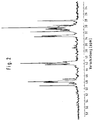
- the microstructure according to the invention causes some characteristic peaks in the 13 C-NMR spectrum.
- Figure 1 shows a typical spectrum of cycloolefin copolymers with the microstructure according to the invention
- Fig. 2 shows a comparison of a spectrum of a cycloolefin copolymer without the microstructure according to the invention.
- the spectra have some common peaks and differences, the differences probably being due to a different steric structure of the polymers ("tacticity").
- the special microstructure gives some characteristic peaks: Common peaks Characteristic peaks (ppm) (ppm) 47.5 49.8 46.8 41.7 40.8 32.8 33.3 30.1 29.3
- peaks common in all spectra can serve as reference points.
- the heights of the respective peaks vary depending on the monomer composition, but the layers are characteristic.
- the peaks at 29.3, 33.3, 40.8 and 49.8 ppm are clear for the microstructure according to the invention. (The peaks mentioned are characteristic of the special microstructure, but the spectra usually also contain other peaks). Additives or impurities can lead to additional peaks in a spectrum. Therefore, spectra of the polymers to be used according to the invention can also contain additional peaks.
- the advantage of the present invention is that, at a given degree of orientation, the above-mentioned microstructure results in stiffer films than corresponding films made of cycloolefin copolymers with a different microstructure or no microstructure.
- the film contains fine, inert particles which improve the slip and winding behavior.
- particles which can be contained in amounts of 0-1% are, for example: SiO2, AI2O3, silicates with an SiO2 content of at least 30% by weight, amorphous and crystalline clay minerals, aluminosilicates, oxides of Mg, Zn, Zr and Ti, sulfates of Ca, Mg and Ba, phosphates of Li, Na and Ca.
- the film can also contain suitable additives such as e.g. Contain stabilizers, lubricants or antioxidants.
- suitable additives such as e.g. Contain stabilizers, lubricants or antioxidants.
- additives that are used for polyolefins such as polyethylene or polypropylene are also suitable for the cycloolefin copolymer films.
- UV stabilizers which can be used are absorbers such as hydroxyphenylbenzotriazoles, hydroxybenzophenones, formamidine or benzylidene-camphor, quenchers such as cinnamic acid esters or nickel chelates, radical scavengers such as sterically hindered phenols, hydroperoxide decomposers such as nickel or zinc complexes of sulfur-containing compounds or light stabilizers, and HAL type stabilizers whose mixtures are used.
- lubricants that can be used are: fatty acids and their esters, amides and salts, silicones or waxes such as PP or PE waxes.
- Free radical scavengers such as substituted phenols and aromatic amines and / or peroxide decomposers such as phosphites, phosphonates and thio compounds can be added as antioxidants, for example.
- the film according to the invention can have one or more layers. At least one layer consists predominantly, ie at least 85% by weight, preferably 90-100% by weight, of the cycloolefin copolymers described above. A preferred embodiment is the monofilm.
- the main layer according to the invention carries one or two thin polymer cover layers with lower glass transition temperatures than the main layer, preferably at least 20 ° lower.
- Cycloolefin copolymers are particularly preferred as the cover layer, but these cover layers do not have to have the special microstructure.
- the film can be coated to modify the properties.
- the film according to the invention can contain other compatible or incompatible polymers. These polymers can form separate layers or can be mixed with the cycloolefin copolymer. Examples of such polymers are: polyethylene, polypropylene, polymethylbutene-1, poly (4-methylpentene-1), polybutene-1 and polystyrene, polyvinyl chloride, polyvinylidene chloride, polyvinyl fluoride, polytetrafluoroethylene, polychloroprene, polyacrylate, polymethacrylate, polyacrylamide, polyacrylonitrile, acrylonitrile / butadiene / Styrene copolymers, acrylonitrile / styrene copolymers and acrylonitrile / styrene / acrylate copolymers, polyvinyl alcohol, polyvinyl acetate, polyvinyl stearate, polyvinyl benzoate, polyvinyl maleate, polyvinyl
- the films can be produced by various methods. Pouring from solution is possible, but the thermoplastic processing is in the Usually more advantageous. Plate presses are well suited for experiments, but continuous processes such as extrusion or calendering are more economical for industrial production.
- Extruded films can be formed as a tube or flat film. Coextrusion is recommended for the production of multilayer films.
- the films are often oriented to further improve the mechanical properties. This is done by stretching.
- the stretching temperatures should expediently be in a temperature interval of 40 ° C. below the glass temperature (T g -40 ° C.) to 50 ° C. above the glass temperature (T g + 50 ° C.).
- the orientation can be uniaxial or biaxial.
- Stretching temperatures above T g are suitable for industrial production because this allows faster production because of the higher achievable stretching speeds.
- the temperature, stretching rate and stretching ratio must be coordinated so that the film does not tear.
- the stretching speed is preferably 1 - 500000% / min.
- the stretching ratios in the longitudinal and transverse directions are 1.1: 1 - 10: 1, preferably 1.5: 1 - 4: 1.
- the area stretch ratio should preferably be 3-20.
- Oriented amorphous films can be used as shrink films.
- Films that are not or only slightly oriented can be used for the production of deep-drawn parts.
- the surfaces of the foils can be used to achieve e.g. Adhesion mediation or printability or antistatic or non-stick properties can be modified. This modification can be carried out either by treatment methods such as corona, flame, plasma or oxidation treatment or by applying a coating from solution or dispersion.
- the glass temperature (T g ) was determined as a sudden increase in the heat capacity in the DSC diagram.
- the DSC diagrams were recorded with a Perkin-Elmer DSC 7.
- VZ viscosity number
- the mechanical properties of the films were tested on a Zwick tensile testing machine from Zwick on 15 mm wide samples with a clamping length of 100 mm.
- the tensile modulus was in the stretch range from 0.3 to 0.5% determined at an elongation rate of 10 mm / min.
- the tensile strength and elongation were determined at 100 mm / min.
- E i value (intrinsic module) was determined on injection molded parts in accordance with DIN 53 457 in a tensile testing machine from Zwick with a mechanically sensing longitudinal change transducer. E i was determined as the modulus of elasticity between 0.03 and 0.05% elongation.
- a clean and dry 75 dm3 polymerization reactor with stirrer was purged with nitrogen and then with ethylene and filled with 22,000 g of norbornene melt at 50 ° C. The reactor was then kept at a temperature of 50 ° C. with stirring and 15 bar of ethylene (excess pressure) were injected.
- toluene methylaluminoxane solution (MAO solution, 10.1% by weight of methylaluminoxane with a molecular weight of 1300 g / mol after cryoscopic determination) were metered into the reactor and the mixture was stirred at 50 ° C. for 15 minutes, during which the ethylene pressure was kept at 15 bar by subsequent metering.
- MAO solution 10.1% by weight of methylaluminoxane with a molecular weight of 1300 g / mol after cryoscopic determination
- the solution of the complex was metered into the reactor and immediately afterwards - for regulating the molecular weight - 3.5 l of hydrogen were metered in via a lock.
- the mixture was then polymerized at 50 ° C. for 45 minutes with stirring (750 rpm), the ethylene pressure being kept at 15 bar by metering in further quantities.
- the reactor contents were quickly drained into a stirred vessel containing 200 cc of isopropanol were presented.
- the mixture was dropped into 500 dm3 of acetone, stirred for 10 minutes and then the suspended polymeric solid was filtered off.
- the filtered polymer was then placed in 2 dm3 of a mixture of 2 parts of 3-normal hydrochloric acid and one part of ethanol and this suspension was stirred for 2 hours.
- the polymer was then filtered off again, washed neutral with water and dried at 80 ° C. and 0.2 bar for 15 hours.
- a product amount of 4500 g was obtained.
- a viscosity number (VZ) of 103 cm3 / g and a glass transition temperature (T g ) of 123 ° C. were measured on the product.
- Example 4 Analogously to Example 1, polymers with different glass transition temperatures were produced, with the addition of hydrogen being dispensed with.
- Example 2 Analogously to Example 1, a polymer was produced without the special microstructure. Instead of diphenylmethylene (cyclopentadienyl) - (9-fluorenyl) zirconium dichloride, rac -dimethylsilyl-bis- (1-indenyl) zirconium dichloride was used as the metallocene catalyst. Table 2 summarizes the reaction conditions. The 13 C-NMR spectrum of the polymer according to Example 5 is shown in Fig. 2. The peaks characteristic of the special microstructure at 29.3, 33.3, 40.8 and 49.8 ppm are missing. Table 2 example Amount of norbornene Temp. Ethylene printing Amount of metallocene Cat. Solution time yield Day VZ (G) (° C) (bar) (mg) (ml) (min) (G) (° C) (cm3 / g) 5 24800 70 15 3000 1000 220 5100 147 90,
- the polymer from Example 3 was pressed in a plate press at 250 ° C. to form a 350 ⁇ m thick film.
- the film was transparent and colorless.
- the mechanical properties of the film were: E-module 2.6 GPa Tensile strength 30 MPa Elongation at break 2%
- the polymer from Example 5 was pressed in a plate press at 250 ° C. to form a 320 ⁇ m thick film.
- the film was transparent and colorless.
- the mechanical properties of the film were: E-module 2.6 GPa Tensile strength 50 MPa Elongation at break 3%
- the non-oriented film from Example 8 was stretched longitudinally and transversely by a factor of 2.3 in a film stretching apparatus (Karo III from Brückner, Siegsdorf) at 180 ° C.
- the mechanical properties of the film were: E-module 3.6 GPa Tensile strength 47 MPa Elongation at break 2%
- Example 9 The non-oriented film from Example 9 was stretched analogously to Example 10.
- the mechanical properties were: E-module 3.2 GPa Tensile strength 60 MPa Elongation at break 2%
- Example 8 The film from Example 8 was heated in a vacuum deep-drawing machine to approximately 180 ° C. and then shaped into a conical cup in a cold deep-drawing mold. The stiffness of the cup was checked. Strips from the bottom of the cup showed a modulus of elasticity of 3.5 GPa.
- Example 9 The film from Example 9 was shaped into a cup analogously to Example 12. An examination of the rigidity showed an elastic modulus value of 3.1 GPa.
Landscapes
- Chemical & Material Sciences (AREA)
- Engineering & Computer Science (AREA)
- Manufacturing & Machinery (AREA)
- Health & Medical Sciences (AREA)
- Chemical Kinetics & Catalysis (AREA)
- Medicinal Chemistry (AREA)
- Polymers & Plastics (AREA)
- Organic Chemistry (AREA)
- Materials Engineering (AREA)
- Mechanical Engineering (AREA)
- Manufacture Of Macromolecular Shaped Articles (AREA)
- Addition Polymer Or Copolymer, Post-Treatments, Or Chemical Modifications (AREA)
- Laminated Bodies (AREA)
- Fixed Capacitors And Capacitor Manufacturing Machines (AREA)
- Compositions Of Macromolecular Compounds (AREA)
- Organic Insulating Materials (AREA)
- Devices For Indicating Variable Information By Combining Individual Elements (AREA)
- Wrappers (AREA)
- Shaping By String And By Release Of Stress In Plastics And The Like (AREA)
- Polarising Elements (AREA)
Applications Claiming Priority (2)
| Application Number | Priority Date | Filing Date | Title |
|---|---|---|---|
| DE4304308 | 1993-02-12 | ||
| DE4304308A DE4304308A1 (de) | 1993-02-12 | 1993-02-12 | Steife Cycloolefincopolymer-Folie |
Publications (3)
| Publication Number | Publication Date |
|---|---|
| EP0610816A2 true EP0610816A2 (fr) | 1994-08-17 |
| EP0610816A3 EP0610816A3 (en) | 1995-10-11 |
| EP0610816B1 EP0610816B1 (fr) | 1999-12-29 |
Family
ID=6480347
Family Applications (1)
| Application Number | Title | Priority Date | Filing Date |
|---|---|---|---|
| EP94101640A Expired - Lifetime EP0610816B1 (fr) | 1993-02-12 | 1994-02-03 | Feuille rigide de copolymère cyclo-oléfine |
Country Status (10)
| Country | Link |
|---|---|
| US (1) | US5534606A (fr) |
| EP (1) | EP0610816B1 (fr) |
| JP (1) | JP3539999B2 (fr) |
| KR (1) | KR100287603B1 (fr) |
| CN (1) | CN1053207C (fr) |
| AU (1) | AU670653B2 (fr) |
| CA (1) | CA2115190C (fr) |
| DE (2) | DE4304308A1 (fr) |
| MX (1) | MX9401120A (fr) |
| TW (1) | TW304966B (fr) |
Cited By (5)
| Publication number | Priority date | Publication date | Assignee | Title |
|---|---|---|---|---|
| EP0733474A3 (fr) * | 1995-03-20 | 1996-12-11 | Hoechst Ag | Feuille multicouche scellable en polyoléfine avec des particles creuses, procédé pour sa fabrication, et utilisation |
| US6071598A (en) * | 1995-05-31 | 2000-06-06 | Hoechst Aktiengesellschaft | Biaxially oriented polyproylene film having a high surface modulus |
| US6551653B1 (en) | 1995-10-20 | 2003-04-22 | Ticona Gmbh | Metalized polyolefin film |
| US8063163B2 (en) | 2005-11-24 | 2011-11-22 | Polypastics Co., Ltd. | Cycloolefin copolymer |
| EP3799087A1 (fr) * | 2019-09-26 | 2021-03-31 | Siemens Energy Global GmbH & Co. KG | Condensateur de puissance, procédé de fabrication d'un condenseur de puissance et convertisseur |
Families Citing this family (53)
| Publication number | Priority date | Publication date | Assignee | Title |
|---|---|---|---|---|
| US6964798B2 (en) | 1993-11-16 | 2005-11-15 | Baxter International Inc. | Multi-layered polymer based thin film structure for medical grade products |
| DE4425408A1 (de) | 1994-07-13 | 1996-01-18 | Hoechst Ag | Cycloolefinpolymere |
| JP3534127B2 (ja) * | 1995-01-20 | 2004-06-07 | 日本ゼオン株式会社 | ノルボルネン系付加型共重合体 |
| DE19647954A1 (de) * | 1996-11-20 | 1998-06-04 | Hoechst Ag | Biaxial orientierte Folie aus cycloolefinischen Polymeren, Verfahren zu deren Herstellung und deren Verwendung |
| US6426050B1 (en) | 1997-05-16 | 2002-07-30 | Aurora Biosciences Corporation | Multi-well platforms, caddies, lids and combinations thereof |
| US6229603B1 (en) | 1997-06-02 | 2001-05-08 | Aurora Biosciences Corporation | Low background multi-well plates with greater than 864 wells for spectroscopic measurements |
| US5910287A (en) * | 1997-06-03 | 1999-06-08 | Aurora Biosciences Corporation | Low background multi-well plates with greater than 864 wells for fluorescence measurements of biological and biochemical samples |
| US6171780B1 (en) | 1997-06-02 | 2001-01-09 | Aurora Biosciences Corporation | Low fluorescence assay platforms and related methods for drug discovery |
| US6063338A (en) * | 1997-06-02 | 2000-05-16 | Aurora Biosciences Corporation | Low background multi-well plates and platforms for spectroscopic measurements |
| US6517781B1 (en) | 1997-06-02 | 2003-02-11 | Aurora Biosciences Corporation | Low fluorescence assay platforms and related methods for drug discovery |
| US6861035B2 (en) | 1998-02-24 | 2005-03-01 | Aurora Discovery, Inc. | Multi-well platforms, caddies, lids and combinations thereof |
| KR100576117B1 (ko) * | 1998-12-04 | 2006-08-30 | 삼성전자주식회사 | 액정표시장치용 픽셀 구동 시스템 |
| US6613187B1 (en) | 1999-09-09 | 2003-09-02 | Baxter International Inc | Solvent bonding method for polyolefin materials |
| US6255396B1 (en) | 1999-09-09 | 2001-07-03 | Baxter International Inc. | Cycloolefin blends and method for solvent bonding polyolefins |
| US6297322B1 (en) | 1999-09-09 | 2001-10-02 | Baxter International Inc. | Cycloolefin blends and method for solvent bonding polyolefins |
| US6590033B2 (en) | 1999-09-09 | 2003-07-08 | Baxter International Inc. | Cycloolefin blends and method for solvent bonding polyolefins |
| US6632318B1 (en) | 1999-09-09 | 2003-10-14 | Baxter International Inc. | Method for solvent bonding polyolefins |
| ATE416927T1 (de) | 1999-09-10 | 2008-12-15 | Renolit Ag | Verwendung von kunststofffolien zum bedrucken mit organischen tinten im inkjet-verfahren |
| DE19943330C2 (de) * | 1999-09-10 | 2002-03-07 | Renolit Werke Gmbh | Mit organischen Tinten per Inkjet bedruckbare Folie |
| US6497676B1 (en) | 2000-02-10 | 2002-12-24 | Baxter International | Method and apparatus for monitoring and controlling peritoneal dialysis therapy |
| US6372848B1 (en) | 2000-10-10 | 2002-04-16 | Baxter International Inc. | Blend of ethylene and α-olefin copolymers obtained using a metallocene catalyst for fabricating medical films and tubings |
| DE10121150A1 (de) * | 2001-04-30 | 2002-11-07 | Trespaphan Gmbh | Opake Folie aus PLA |
| WO2003020488A1 (fr) | 2001-08-30 | 2003-03-13 | Zeptosens Ag | Procede de fabrication de corps moules, en particulier de structures optiques, et leur utilisation |
| US20030125662A1 (en) | 2002-01-03 | 2003-07-03 | Tuan Bui | Method and apparatus for providing medical treatment therapy based on calculated demand |
| US7238164B2 (en) | 2002-07-19 | 2007-07-03 | Baxter International Inc. | Systems, methods and apparatuses for pumping cassette-based therapies |
| JP4391523B2 (ja) | 2003-04-30 | 2009-12-24 | オーロラ ディスカバリー インコーポレイティッド | 高密度保存およびアッセイプラットフォームを提供するマルチウェルプレート |
| US20040219338A1 (en) * | 2003-05-01 | 2004-11-04 | Hebrink Timothy J. | Materials, configurations, and methods for reducing warpage in optical films |
| US20050186373A1 (en) * | 2004-02-20 | 2005-08-25 | Honeywell International Inc. | Multilayer sheets and films composed of polypropylene and cyclic olefin copolymer |
| MXPA06011837A (es) | 2004-04-27 | 2007-01-16 | Baxter Int | Sistema de reactor de tanque agitado. |
| JP2008518280A (ja) * | 2004-10-29 | 2008-05-29 | スリーエム イノベイティブ プロパティズ カンパニー | 環状オレフィンコポリマーを組み入れた光学フィルム |
| US7329465B2 (en) * | 2004-10-29 | 2008-02-12 | 3M Innovative Properties Company | Optical films incorporating cyclic olefin copolymers |
| US20060159888A1 (en) * | 2004-10-29 | 2006-07-20 | Hebrink Timothy J | Optical films incorporating cyclic olefin copolymers |
| US20060093809A1 (en) * | 2004-10-29 | 2006-05-04 | Hebrink Timothy J | Optical bodies and methods for making optical bodies |
| AT501412A1 (de) | 2004-11-29 | 2006-08-15 | Ebert Folien Ndl Der Haendler | Dreheinschlagfolie sowie deren verwendung als verpackungsfolie |
| US8394474B2 (en) * | 2005-04-07 | 2013-03-12 | Cryovac, Inc. | Sterilizable coextruded film for aseptic packaging |
| US7935401B2 (en) * | 2005-10-27 | 2011-05-03 | Cryovac, Inc. | Shrink sleeve label |
| US20070110853A1 (en) * | 2005-11-17 | 2007-05-17 | Solomon Bekele | Dimensionally stable sterilizable coextruded film for aseptic packaging |
| US8206796B2 (en) * | 2006-04-27 | 2012-06-26 | Cryovac, Inc. | Multilayer film comprising polylactic acid |
| US9163141B2 (en) * | 2006-04-27 | 2015-10-20 | Cryovac, Inc. | Polymeric blend comprising polylactic acid |
| US8558964B2 (en) | 2007-02-15 | 2013-10-15 | Baxter International Inc. | Dialysis system having display with electromagnetic compliance (“EMC”) seal |
| US7998115B2 (en) | 2007-02-15 | 2011-08-16 | Baxter International Inc. | Dialysis system having optical flowrate detection |
| US8870812B2 (en) | 2007-02-15 | 2014-10-28 | Baxter International Inc. | Dialysis system having video display with ambient light adjustment |
| US7731689B2 (en) | 2007-02-15 | 2010-06-08 | Baxter International Inc. | Dialysis system having inductive heating |
| US8361023B2 (en) | 2007-02-15 | 2013-01-29 | Baxter International Inc. | Dialysis system with efficient battery back-up |
| US8114491B2 (en) * | 2007-02-15 | 2012-02-14 | Cryovac, Inc. | Shrink sleeve label |
| KR101495346B1 (ko) * | 2007-04-27 | 2015-02-24 | 후지필름 가부시키가이샤 | 환형 올레핀 중합체, 광학 재료, 편광판 및 액정디스플레이 |
| US20090123611A1 (en) * | 2007-11-09 | 2009-05-14 | Cryovac, Inc. | Printed sterilizable laminate for aseptic packaging |
| CN102015522B (zh) * | 2008-02-22 | 2013-07-03 | 弗卢迪格姆公司 | 用于微流体器件的集成载体 |
| EP3332961B1 (fr) | 2015-08-03 | 2020-02-19 | Toray Industries, Inc. | Film multicouche d'oléfine et condensateur à film |
| JP6926827B2 (ja) * | 2016-08-30 | 2021-08-25 | 東レ株式会社 | オレフィン系積層フィルムおよびフィルムコンデンサ |
| US11179516B2 (en) | 2017-06-22 | 2021-11-23 | Baxter International Inc. | Systems and methods for incorporating patient pressure into medical fluid delivery |
| CN111552130A (zh) * | 2020-06-17 | 2020-08-18 | 苏州绘格光电科技有限公司 | 调光膜及其制备方法 |
| CN118698603B (zh) * | 2024-07-09 | 2025-11-14 | 安徽大学 | 一种自漂浮三嗪基聚合物纳米片光催化剂及其制备方法与应用 |
Family Cites Families (9)
| Publication number | Priority date | Publication date | Assignee | Title |
|---|---|---|---|---|
| DE241971C (fr) * | ||||
| DE224538C (fr) * | ||||
| CA2010320C (fr) * | 1989-02-20 | 2001-04-17 | Yohzoh Yamamoto | Feuille ou pellicule d'un polymere d'olefine cyclique |
| DE3922546A1 (de) * | 1989-07-08 | 1991-01-17 | Hoechst Ag | Verfahren zur herstellung von cycloolefinpolymeren |
| WO1992006123A1 (fr) * | 1990-10-05 | 1992-04-16 | Idemitsu Kosan Co., Ltd. | Procede de production de polymere de cycloolefine et de copolymere de cycloolefine et composition et moulage prepares a partir de ces composes |
| TW227005B (fr) * | 1990-11-14 | 1994-07-21 | Hoechst Ag | |
| DE59209568D1 (de) * | 1991-02-27 | 1999-01-07 | Ticona Gmbh | Verfahren zur Herstellung von Cycloolefin(co)polymeren mit enger Molekulargewichtsverteilung |
| ATE223440T1 (de) * | 1991-03-09 | 2002-09-15 | Basell Polyolefine Gmbh | Metallocen und katalysator |
| TW212809B (fr) * | 1991-09-03 | 1993-09-11 | Hoechst Ag |
-
1993
- 1993-02-12 DE DE4304308A patent/DE4304308A1/de not_active Withdrawn
-
1994
- 1994-02-03 DE DE59409024T patent/DE59409024D1/de not_active Expired - Lifetime
- 1994-02-03 EP EP94101640A patent/EP0610816B1/fr not_active Expired - Lifetime
- 1994-02-08 CN CN94101361A patent/CN1053207C/zh not_active Expired - Fee Related
- 1994-02-08 CA CA002115190A patent/CA2115190C/fr not_active Expired - Fee Related
- 1994-02-10 AU AU55049/94A patent/AU670653B2/en not_active Ceased
- 1994-02-10 JP JP01648494A patent/JP3539999B2/ja not_active Expired - Fee Related
- 1994-02-11 MX MX9401120A patent/MX9401120A/es unknown
- 1994-02-12 KR KR1019940002496A patent/KR100287603B1/ko not_active Expired - Fee Related
- 1994-02-14 US US08/195,084 patent/US5534606A/en not_active Expired - Lifetime
- 1994-02-18 TW TW083101321A patent/TW304966B/zh active
Cited By (5)
| Publication number | Priority date | Publication date | Assignee | Title |
|---|---|---|---|---|
| EP0733474A3 (fr) * | 1995-03-20 | 1996-12-11 | Hoechst Ag | Feuille multicouche scellable en polyoléfine avec des particles creuses, procédé pour sa fabrication, et utilisation |
| US6071598A (en) * | 1995-05-31 | 2000-06-06 | Hoechst Aktiengesellschaft | Biaxially oriented polyproylene film having a high surface modulus |
| US6551653B1 (en) | 1995-10-20 | 2003-04-22 | Ticona Gmbh | Metalized polyolefin film |
| US8063163B2 (en) | 2005-11-24 | 2011-11-22 | Polypastics Co., Ltd. | Cycloolefin copolymer |
| EP3799087A1 (fr) * | 2019-09-26 | 2021-03-31 | Siemens Energy Global GmbH & Co. KG | Condensateur de puissance, procédé de fabrication d'un condenseur de puissance et convertisseur |
Also Published As
| Publication number | Publication date |
|---|---|
| US5534606A (en) | 1996-07-09 |
| AU5504994A (en) | 1994-08-18 |
| CA2115190C (fr) | 2004-09-21 |
| JPH06336526A (ja) | 1994-12-06 |
| KR100287603B1 (ko) | 2001-04-16 |
| AU670653B2 (en) | 1996-07-25 |
| MX9401120A (es) | 1994-08-31 |
| DE59409024D1 (de) | 2000-02-03 |
| CN1053207C (zh) | 2000-06-07 |
| DE4304308A1 (de) | 1994-08-18 |
| TW304966B (fr) | 1997-05-11 |
| CA2115190A1 (fr) | 1994-08-13 |
| CN1099774A (zh) | 1995-03-08 |
| KR940019772A (ko) | 1994-09-15 |
| JP3539999B2 (ja) | 2004-07-07 |
| EP0610816B1 (fr) | 1999-12-29 |
| EP0610816A3 (en) | 1995-10-11 |
Similar Documents
| Publication | Publication Date | Title |
|---|---|---|
| EP0610816B1 (fr) | Feuille rigide de copolymère cyclo-oléfine | |
| EP0610815B1 (fr) | Film copolymère de cyclo-olefine | |
| EP0610814B1 (fr) | Feuille semi-cristalline de copolymère cyclo-oléfine | |
| EP0844077B1 (fr) | Feuille en polymères de cyclooléfines orientée biaxialement, son procédé d'obtention et son utilisation | |
| US4514534A (en) | Modified polypropylene for film | |
| EP1958973B1 (fr) | Copolymere de cyclo-olefine | |
| KR101537210B1 (ko) | 콘덴서용 이축연신 폴리프로필렌 필름 및 그것을 이용한 증착 필름 및 콘덴서 | |
| EP1268661B1 (fr) | Melange de polymeres contenant un polymere cycloolefinique et un polymere cycloolefinique amorphe | |
| DE69502893T2 (de) | Thermoplastische Massen aus ataktischem und syndiotaktischem Polypropylen | |
| EP0769371B1 (fr) | Film en polyoléfine métallisé | |
| KR20100130957A (ko) | 콘덴서용 이축연신 폴리프로필렌 필름, 그 금속 증착 필름 및 캐스트 원반 시트 | |
| EP0988329B1 (fr) | Electrets | |
| EP1110976B1 (fr) | Compositions de polymères de propylène partiellement cristallins adaptées à la production des films à orientation biaxiale | |
| DE60012145T2 (de) | Statistische propylen/alpha-olefin copolymerzusammensetzung | |
| DE69023575T2 (de) | Neue extrudierte Filme und Folien aus Polypropylen. | |
| EP0849074A2 (fr) | Feuilles orientées et scellables comprenant au moins un copolymère cyclooléfinique | |
| US20250361369A1 (en) | Method for producing crystalline resin sheet | |
| DE19540356A1 (de) | Polymere Schäume | |
| DE19725253A1 (de) | Elektrete | |
| KR19990040267A (ko) | 노광장치 |
Legal Events
| Date | Code | Title | Description |
|---|---|---|---|
| PUAI | Public reference made under article 153(3) epc to a published international application that has entered the european phase |
Free format text: ORIGINAL CODE: 0009012 |
|
| AK | Designated contracting states |
Kind code of ref document: A2 Designated state(s): DE FR GB IT LU NL |
|
| PUAL | Search report despatched |
Free format text: ORIGINAL CODE: 0009013 |
|
| AK | Designated contracting states |
Kind code of ref document: A3 Designated state(s): DE FR GB IT LU NL |
|
| 17P | Request for examination filed |
Effective date: 19960411 |
|
| 17Q | First examination report despatched |
Effective date: 19970915 |
|
| RAP1 | Party data changed (applicant data changed or rights of an application transferred) |
Owner name: TICONA GMBH |
|
| RAP1 | Party data changed (applicant data changed or rights of an application transferred) |
Owner name: TICONA GMBH |
|
| GRAG | Despatch of communication of intention to grant |
Free format text: ORIGINAL CODE: EPIDOS AGRA |
|
| GRAG | Despatch of communication of intention to grant |
Free format text: ORIGINAL CODE: EPIDOS AGRA |
|
| GRAH | Despatch of communication of intention to grant a patent |
Free format text: ORIGINAL CODE: EPIDOS IGRA |
|
| GRAH | Despatch of communication of intention to grant a patent |
Free format text: ORIGINAL CODE: EPIDOS IGRA |
|
| GRAA | (expected) grant |
Free format text: ORIGINAL CODE: 0009210 |
|
| AK | Designated contracting states |
Kind code of ref document: B1 Designated state(s): DE FR GB IT LU NL |
|
| REF | Corresponds to: |
Ref document number: 59409024 Country of ref document: DE Date of ref document: 20000203 |
|
| GBT | Gb: translation of ep patent filed (gb section 77(6)(a)/1977) |
Effective date: 20000124 |
|
| ITF | It: translation for a ep patent filed | ||
| ET | Fr: translation filed | ||
| PLBE | No opposition filed within time limit |
Free format text: ORIGINAL CODE: 0009261 |
|
| STAA | Information on the status of an ep patent application or granted ep patent |
Free format text: STATUS: NO OPPOSITION FILED WITHIN TIME LIMIT |
|
| 26N | No opposition filed | ||
| REG | Reference to a national code |
Ref country code: GB Ref legal event code: IF02 |
|
| PGFP | Annual fee paid to national office [announced via postgrant information from national office to epo] |
Ref country code: FR Payment date: 20110302 Year of fee payment: 18 Ref country code: NL Payment date: 20110216 Year of fee payment: 18 Ref country code: IT Payment date: 20110221 Year of fee payment: 18 Ref country code: LU Payment date: 20110225 Year of fee payment: 18 Ref country code: DE Payment date: 20110218 Year of fee payment: 18 |
|
| PGFP | Annual fee paid to national office [announced via postgrant information from national office to epo] |
Ref country code: GB Payment date: 20110217 Year of fee payment: 18 |
|
| REG | Reference to a national code |
Ref country code: NL Ref legal event code: V1 Effective date: 20120901 |
|
| GBPC | Gb: european patent ceased through non-payment of renewal fee |
Effective date: 20120203 |
|
| REG | Reference to a national code |
Ref country code: FR Ref legal event code: ST Effective date: 20121031 |
|
| PG25 | Lapsed in a contracting state [announced via postgrant information from national office to epo] |
Ref country code: IT Free format text: LAPSE BECAUSE OF NON-PAYMENT OF DUE FEES Effective date: 20120203 |
|
| REG | Reference to a national code |
Ref country code: DE Ref legal event code: R119 Ref document number: 59409024 Country of ref document: DE Effective date: 20120901 |
|
| PG25 | Lapsed in a contracting state [announced via postgrant information from national office to epo] |
Ref country code: NL Free format text: LAPSE BECAUSE OF NON-PAYMENT OF DUE FEES Effective date: 20120901 Ref country code: FR Free format text: LAPSE BECAUSE OF NON-PAYMENT OF DUE FEES Effective date: 20120229 Ref country code: GB Free format text: LAPSE BECAUSE OF NON-PAYMENT OF DUE FEES Effective date: 20120203 |
|
| PG25 | Lapsed in a contracting state [announced via postgrant information from national office to epo] |
Ref country code: DE Free format text: LAPSE BECAUSE OF NON-PAYMENT OF DUE FEES Effective date: 20120901 |
|
| PG25 | Lapsed in a contracting state [announced via postgrant information from national office to epo] |
Ref country code: LU Free format text: LAPSE BECAUSE OF NON-PAYMENT OF DUE FEES Effective date: 20120203 |