EP0632329B1 - Photoinitiateur fonctionnalisé, macromères et leur usage - Google Patents
Photoinitiateur fonctionnalisé, macromères et leur usage Download PDFInfo
- Publication number
- EP0632329B1 EP0632329B1 EP94810380A EP94810380A EP0632329B1 EP 0632329 B1 EP0632329 B1 EP 0632329B1 EP 94810380 A EP94810380 A EP 94810380A EP 94810380 A EP94810380 A EP 94810380A EP 0632329 B1 EP0632329 B1 EP 0632329B1
- Authority
- EP
- European Patent Office
- Prior art keywords
- groups
- alkyl
- polymer
- oligomer
- methyl
- Prior art date
- Legal status (The legal status is an assumption and is not a legal conclusion. Google has not performed a legal analysis and makes no representation as to the accuracy of the status listed.)
- Expired - Lifetime
Links
- 0 CC1CC(C)*C1 Chemical compound CC1CC(C)*C1 0.000 description 5
- SGBSICSFUUZDAL-VVIYDGDNSA-N CC(CC(C)[C@H](C1)N=C=O)C1NC Chemical compound CC(CC(C)[C@H](C1)N=C=O)C1NC SGBSICSFUUZDAL-VVIYDGDNSA-N 0.000 description 1
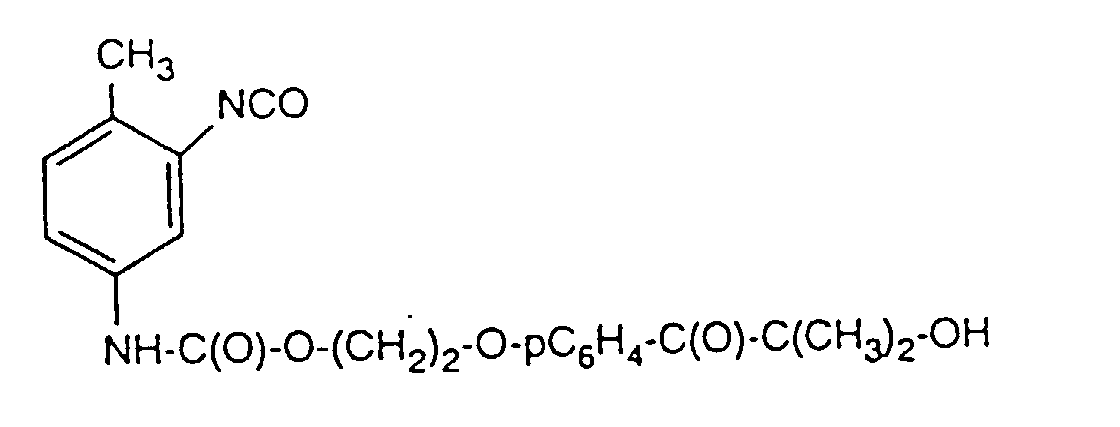
- ORDARJLGXYEFJN-UHFFFAOYSA-N Cc(c(N=C=O)c1)ccc1NCl Chemical compound Cc(c(N=C=O)c1)ccc1NCl ORDARJLGXYEFJN-UHFFFAOYSA-N 0.000 description 1
Classifications
-
- G—PHYSICS
- G03—PHOTOGRAPHY; CINEMATOGRAPHY; ANALOGOUS TECHNIQUES USING WAVES OTHER THAN OPTICAL WAVES; ELECTROGRAPHY; HOLOGRAPHY
- G03F—PHOTOMECHANICAL PRODUCTION OF TEXTURED OR PATTERNED SURFACES, e.g. FOR PRINTING, FOR PROCESSING OF SEMICONDUCTOR DEVICES; MATERIALS THEREFOR; ORIGINALS THEREFOR; APPARATUS SPECIALLY ADAPTED THEREFOR
- G03F7/00—Photomechanical, e.g. photolithographic, production of textured or patterned surfaces, e.g. printing surfaces; Materials therefor, e.g. comprising photoresists; Apparatus specially adapted therefor
- G03F7/004—Photosensitive materials
- G03F7/075—Silicon-containing compounds
-
- C—CHEMISTRY; METALLURGY
- C07—ORGANIC CHEMISTRY
- C07C—ACYCLIC OR CARBOCYCLIC COMPOUNDS
- C07C271/00—Derivatives of carbamic acids, i.e. compounds containing any of the groups, the nitrogen atom not being part of nitro or nitroso groups
- C07C271/06—Esters of carbamic acids
- C07C271/08—Esters of carbamic acids having oxygen atoms of carbamate groups bound to acyclic carbon atoms
- C07C271/10—Esters of carbamic acids having oxygen atoms of carbamate groups bound to acyclic carbon atoms with the nitrogen atoms of the carbamate groups bound to hydrogen atoms or to acyclic carbon atoms
- C07C271/20—Esters of carbamic acids having oxygen atoms of carbamate groups bound to acyclic carbon atoms with the nitrogen atoms of the carbamate groups bound to hydrogen atoms or to acyclic carbon atoms to carbon atoms of hydrocarbon radicals substituted by nitrogen atoms not being part of nitro or nitroso groups
-
- C—CHEMISTRY; METALLURGY
- C07—ORGANIC CHEMISTRY
- C07C—ACYCLIC OR CARBOCYCLIC COMPOUNDS
- C07C271/00—Derivatives of carbamic acids, i.e. compounds containing any of the groups, the nitrogen atom not being part of nitro or nitroso groups
- C07C271/06—Esters of carbamic acids
- C07C271/08—Esters of carbamic acids having oxygen atoms of carbamate groups bound to acyclic carbon atoms
- C07C271/24—Esters of carbamic acids having oxygen atoms of carbamate groups bound to acyclic carbon atoms with the nitrogen atom of at least one of the carbamate groups bound to a carbon atom of a ring other than a six-membered aromatic ring
-
- C—CHEMISTRY; METALLURGY
- C07—ORGANIC CHEMISTRY
- C07C—ACYCLIC OR CARBOCYCLIC COMPOUNDS
- C07C271/00—Derivatives of carbamic acids, i.e. compounds containing any of the groups, the nitrogen atom not being part of nitro or nitroso groups
- C07C271/06—Esters of carbamic acids
- C07C271/08—Esters of carbamic acids having oxygen atoms of carbamate groups bound to acyclic carbon atoms
- C07C271/26—Esters of carbamic acids having oxygen atoms of carbamate groups bound to acyclic carbon atoms with the nitrogen atom of at least one of the carbamate groups bound to a carbon atom of a six-membered aromatic ring
- C07C271/28—Esters of carbamic acids having oxygen atoms of carbamate groups bound to acyclic carbon atoms with the nitrogen atom of at least one of the carbamate groups bound to a carbon atom of a six-membered aromatic ring to a carbon atom of a non-condensed six-membered aromatic ring
-
- C—CHEMISTRY; METALLURGY
- C07—ORGANIC CHEMISTRY
- C07C—ACYCLIC OR CARBOCYCLIC COMPOUNDS
- C07C271/00—Derivatives of carbamic acids, i.e. compounds containing any of the groups, the nitrogen atom not being part of nitro or nitroso groups
- C07C271/06—Esters of carbamic acids
- C07C271/32—Esters of carbamic acids having oxygen atoms of carbamate groups bound to carbon atoms of rings other than six-membered aromatic rings
- C07C271/38—Esters of carbamic acids having oxygen atoms of carbamate groups bound to carbon atoms of rings other than six-membered aromatic rings with the nitrogen atom of at least one of the carbamate groups bound to a carbon atom of a six-membered aromatic ring
-
- C—CHEMISTRY; METALLURGY
- C08—ORGANIC MACROMOLECULAR COMPOUNDS; THEIR PREPARATION OR CHEMICAL WORKING-UP; COMPOSITIONS BASED THEREON
- C08B—POLYSACCHARIDES; DERIVATIVES THEREOF
- C08B37/00—Preparation of polysaccharides not provided for in groups C08B1/00 - C08B35/00; Derivatives thereof
- C08B37/0006—Homoglycans, i.e. polysaccharides having a main chain consisting of one single sugar, e.g. colominic acid
- C08B37/0009—Homoglycans, i.e. polysaccharides having a main chain consisting of one single sugar, e.g. colominic acid alpha-D-Glucans, e.g. polydextrose, alternan, glycogen; (alpha-1,4)(alpha-1,6)-D-Glucans; (alpha-1,3)(alpha-1,4)-D-Glucans, e.g. isolichenan or nigeran; (alpha-1,4)-D-Glucans; (alpha-1,3)-D-Glucans, e.g. pseudonigeran; Derivatives thereof
- C08B37/0012—Cyclodextrin [CD], e.g. cycle with 6 units (alpha), with 7 units (beta) and with 8 units (gamma), large-ring cyclodextrin or cycloamylose with 9 units or more; Derivatives thereof
-
- C—CHEMISTRY; METALLURGY
- C08—ORGANIC MACROMOLECULAR COMPOUNDS; THEIR PREPARATION OR CHEMICAL WORKING-UP; COMPOSITIONS BASED THEREON
- C08B—POLYSACCHARIDES; DERIVATIVES THEREOF
- C08B37/00—Preparation of polysaccharides not provided for in groups C08B1/00 - C08B35/00; Derivatives thereof
- C08B37/006—Heteroglycans, i.e. polysaccharides having more than one sugar residue in the main chain in either alternating or less regular sequence; Gellans; Succinoglycans; Arabinogalactans; Tragacanth or gum tragacanth or traganth from Astragalus; Gum Karaya from Sterculia urens; Gum Ghatti from Anogeissus latifolia; Derivatives thereof
- C08B37/0063—Glycosaminoglycans or mucopolysaccharides, e.g. keratan sulfate; Derivatives thereof, e.g. fucoidan
- C08B37/0072—Hyaluronic acid, i.e. HA or hyaluronan; Derivatives thereof, e.g. crosslinked hyaluronic acid (hylan) or hyaluronates
-
- C—CHEMISTRY; METALLURGY
- C08—ORGANIC MACROMOLECULAR COMPOUNDS; THEIR PREPARATION OR CHEMICAL WORKING-UP; COMPOSITIONS BASED THEREON
- C08F—MACROMOLECULAR COMPOUNDS OBTAINED BY REACTIONS ONLY INVOLVING CARBON-TO-CARBON UNSATURATED BONDS
- C08F2/00—Processes of polymerisation
- C08F2/46—Polymerisation initiated by wave energy or particle radiation
- C08F2/48—Polymerisation initiated by wave energy or particle radiation by ultraviolet or visible light
- C08F2/50—Polymerisation initiated by wave energy or particle radiation by ultraviolet or visible light with sensitising agents
-
- C—CHEMISTRY; METALLURGY
- C08—ORGANIC MACROMOLECULAR COMPOUNDS; THEIR PREPARATION OR CHEMICAL WORKING-UP; COMPOSITIONS BASED THEREON
- C08F—MACROMOLECULAR COMPOUNDS OBTAINED BY REACTIONS ONLY INVOLVING CARBON-TO-CARBON UNSATURATED BONDS
- C08F8/00—Chemical modification by after-treatment
- C08F8/30—Introducing nitrogen atoms or nitrogen-containing groups
-
- C—CHEMISTRY; METALLURGY
- C08—ORGANIC MACROMOLECULAR COMPOUNDS; THEIR PREPARATION OR CHEMICAL WORKING-UP; COMPOSITIONS BASED THEREON
- C08G—MACROMOLECULAR COMPOUNDS OBTAINED OTHERWISE THAN BY REACTIONS ONLY INVOLVING UNSATURATED CARBON-TO-CARBON BONDS
- C08G77/00—Macromolecular compounds obtained by reactions forming a linkage containing silicon with or without sulfur, nitrogen, oxygen or carbon in the main chain of the macromolecule
- C08G77/04—Polysiloxanes
- C08G77/38—Polysiloxanes modified by chemical after-treatment
-
- C—CHEMISTRY; METALLURGY
- C08—ORGANIC MACROMOLECULAR COMPOUNDS; THEIR PREPARATION OR CHEMICAL WORKING-UP; COMPOSITIONS BASED THEREON
- C08J—WORKING-UP; GENERAL PROCESSES OF COMPOUNDING; AFTER-TREATMENT NOT COVERED BY SUBCLASSES C08B, C08C, C08F, C08G or C08H
- C08J7/00—Chemical treatment or coating of shaped articles made of macromolecular substances
- C08J7/12—Chemical modification
-
- C—CHEMISTRY; METALLURGY
- C08—ORGANIC MACROMOLECULAR COMPOUNDS; THEIR PREPARATION OR CHEMICAL WORKING-UP; COMPOSITIONS BASED THEREON
- C08J—WORKING-UP; GENERAL PROCESSES OF COMPOUNDING; AFTER-TREATMENT NOT COVERED BY SUBCLASSES C08B, C08C, C08F, C08G or C08H
- C08J7/00—Chemical treatment or coating of shaped articles made of macromolecular substances
- C08J7/12—Chemical modification
- C08J7/16—Chemical modification with polymerisable compounds
- C08J7/18—Chemical modification with polymerisable compounds using wave energy or particle radiation
-
- G—PHYSICS
- G02—OPTICS
- G02B—OPTICAL ELEMENTS, SYSTEMS OR APPARATUS
- G02B1/00—Optical elements characterised by the material of which they are made; Optical coatings for optical elements
- G02B1/04—Optical elements characterised by the material of which they are made; Optical coatings for optical elements made of organic materials, e.g. plastics
- G02B1/041—Lenses
- G02B1/043—Contact lenses
-
- G—PHYSICS
- G03—PHOTOGRAPHY; CINEMATOGRAPHY; ANALOGOUS TECHNIQUES USING WAVES OTHER THAN OPTICAL WAVES; ELECTROGRAPHY; HOLOGRAPHY
- G03F—PHOTOMECHANICAL PRODUCTION OF TEXTURED OR PATTERNED SURFACES, e.g. FOR PRINTING, FOR PROCESSING OF SEMICONDUCTOR DEVICES; MATERIALS THEREFOR; ORIGINALS THEREFOR; APPARATUS SPECIALLY ADAPTED THEREFOR
- G03F7/00—Photomechanical, e.g. photolithographic, production of textured or patterned surfaces, e.g. printing surfaces; Materials therefor, e.g. comprising photoresists; Apparatus specially adapted therefor
- G03F7/004—Photosensitive materials
- G03F7/027—Non-macromolecular photopolymerisable compounds having carbon-to-carbon double bonds, e.g. ethylenic compounds
- G03F7/028—Non-macromolecular photopolymerisable compounds having carbon-to-carbon double bonds, e.g. ethylenic compounds with photosensitivity-increasing substances, e.g. photoinitiators
- G03F7/031—Organic compounds not covered by group G03F7/029
-
- C—CHEMISTRY; METALLURGY
- C07—ORGANIC CHEMISTRY
- C07C—ACYCLIC OR CARBOCYCLIC COMPOUNDS
- C07C2601/00—Systems containing only non-condensed rings
- C07C2601/12—Systems containing only non-condensed rings with a six-membered ring
- C07C2601/14—The ring being saturated
-
- Y—GENERAL TAGGING OF NEW TECHNOLOGICAL DEVELOPMENTS; GENERAL TAGGING OF CROSS-SECTIONAL TECHNOLOGIES SPANNING OVER SEVERAL SECTIONS OF THE IPC; TECHNICAL SUBJECTS COVERED BY FORMER USPC CROSS-REFERENCE ART COLLECTIONS [XRACs] AND DIGESTS
- Y10—TECHNICAL SUBJECTS COVERED BY FORMER USPC
- Y10S—TECHNICAL SUBJECTS COVERED BY FORMER USPC CROSS-REFERENCE ART COLLECTIONS [XRACs] AND DIGESTS
- Y10S522/00—Synthetic resins or natural rubbers -- part of the class 520 series
- Y10S522/904—Monomer or polymer contains initiating group
-
- Y—GENERAL TAGGING OF NEW TECHNOLOGICAL DEVELOPMENTS; GENERAL TAGGING OF CROSS-SECTIONAL TECHNOLOGIES SPANNING OVER SEVERAL SECTIONS OF THE IPC; TECHNICAL SUBJECTS COVERED BY FORMER USPC CROSS-REFERENCE ART COLLECTIONS [XRACs] AND DIGESTS
- Y10—TECHNICAL SUBJECTS COVERED BY FORMER USPC
- Y10S—TECHNICAL SUBJECTS COVERED BY FORMER USPC CROSS-REFERENCE ART COLLECTIONS [XRACs] AND DIGESTS
- Y10S522/00—Synthetic resins or natural rubbers -- part of the class 520 series
- Y10S522/904—Monomer or polymer contains initiating group
- Y10S522/905—Benzophenone group
-
- Y—GENERAL TAGGING OF NEW TECHNOLOGICAL DEVELOPMENTS; GENERAL TAGGING OF CROSS-SECTIONAL TECHNOLOGIES SPANNING OVER SEVERAL SECTIONS OF THE IPC; TECHNICAL SUBJECTS COVERED BY FORMER USPC CROSS-REFERENCE ART COLLECTIONS [XRACs] AND DIGESTS
- Y10—TECHNICAL SUBJECTS COVERED BY FORMER USPC
- Y10T—TECHNICAL SUBJECTS COVERED BY FORMER US CLASSIFICATION
- Y10T428/00—Stock material or miscellaneous articles
- Y10T428/31504—Composite [nonstructural laminate]
- Y10T428/31551—Of polyamidoester [polyurethane, polyisocyanate, polycarbamate, etc.]
- Y10T428/31645—Next to addition polymer from unsaturated monomers
-
- Y—GENERAL TAGGING OF NEW TECHNOLOGICAL DEVELOPMENTS; GENERAL TAGGING OF CROSS-SECTIONAL TECHNOLOGIES SPANNING OVER SEVERAL SECTIONS OF THE IPC; TECHNICAL SUBJECTS COVERED BY FORMER USPC CROSS-REFERENCE ART COLLECTIONS [XRACs] AND DIGESTS
- Y10—TECHNICAL SUBJECTS COVERED BY FORMER USPC
- Y10T—TECHNICAL SUBJECTS COVERED BY FORMER US CLASSIFICATION
- Y10T428/00—Stock material or miscellaneous articles
- Y10T428/31504—Composite [nonstructural laminate]
- Y10T428/31652—Of asbestos
- Y10T428/31663—As siloxane, silicone or silane
-
- Y—GENERAL TAGGING OF NEW TECHNOLOGICAL DEVELOPMENTS; GENERAL TAGGING OF CROSS-SECTIONAL TECHNOLOGIES SPANNING OVER SEVERAL SECTIONS OF THE IPC; TECHNICAL SUBJECTS COVERED BY FORMER USPC CROSS-REFERENCE ART COLLECTIONS [XRACs] AND DIGESTS
- Y10—TECHNICAL SUBJECTS COVERED BY FORMER USPC
- Y10T—TECHNICAL SUBJECTS COVERED BY FORMER US CLASSIFICATION
- Y10T428/00—Stock material or miscellaneous articles
- Y10T428/31504—Composite [nonstructural laminate]
- Y10T428/31652—Of asbestos
- Y10T428/31667—Next to addition polymer from unsaturated monomers, or aldehyde or ketone condensation product
-
- Y—GENERAL TAGGING OF NEW TECHNOLOGICAL DEVELOPMENTS; GENERAL TAGGING OF CROSS-SECTIONAL TECHNOLOGIES SPANNING OVER SEVERAL SECTIONS OF THE IPC; TECHNICAL SUBJECTS COVERED BY FORMER USPC CROSS-REFERENCE ART COLLECTIONS [XRACs] AND DIGESTS
- Y10—TECHNICAL SUBJECTS COVERED BY FORMER USPC
- Y10T—TECHNICAL SUBJECTS COVERED BY FORMER US CLASSIFICATION
- Y10T428/00—Stock material or miscellaneous articles
- Y10T428/31504—Composite [nonstructural laminate]
- Y10T428/31855—Of addition polymer from unsaturated monomers
-
- Y—GENERAL TAGGING OF NEW TECHNOLOGICAL DEVELOPMENTS; GENERAL TAGGING OF CROSS-SECTIONAL TECHNOLOGIES SPANNING OVER SEVERAL SECTIONS OF THE IPC; TECHNICAL SUBJECTS COVERED BY FORMER USPC CROSS-REFERENCE ART COLLECTIONS [XRACs] AND DIGESTS
- Y10—TECHNICAL SUBJECTS COVERED BY FORMER USPC
- Y10T—TECHNICAL SUBJECTS COVERED BY FORMER US CLASSIFICATION
- Y10T428/00—Stock material or miscellaneous articles
- Y10T428/31504—Composite [nonstructural laminate]
- Y10T428/31971—Of carbohydrate
Definitions
- the present invention relates to acetophenones containing hydroxyl groups functionalized with organic diisocyanates; Oligomers and polymers to which such functionalized acetophenones are bound; polymerizable photoinitiators; via a bifunctional diisocyanate linker ethylenically unsaturated acetophenones; and their use as photoinitiators; coated materials; and the use of the functionalized acetophenones to modify surfaces.
- the compounds of the alkylphenone type or hydroxyalkylphenone type with the structural element of the formula (A) are excellent photoinitiators for the radiation-induced polymerization of ethylenically unsaturated monomeric, oligomeric or polymeric compounds.
- discoloration (yellowing) of the polymers formed and the toxic properties of the low-molecular-weight fragments formed, which can reduce the performance properties of the polymers thus produced are perceived as a particular disadvantage.
- Isocyanate groups are also generally mentioned for this purpose as functional groups which are bonded to the phenyl nucleus via a spacer group, for example a linear alkylene group.
- a spacer group for example a linear alkylene group.
- JP (A) 1-230603 describes reaction products of a photoinitiator containing a structural element of the formula (A) given above with two different diisocyanates are known, which are not uniform due to the selected manufacturing conditions, but each represent a compound mixture which contains the monoisocyanato compound only to a small extent.
- Chemical Abstracts 89: 180747 (1994) discloses oligomeric polyurethanes which can be obtained by reacting a polyalkylene glycol with a mixture of (i) the reaction product of benzoin and a diisocyanate and (ii) an ethylenically unsaturated isocyanate.
- the invention relates to compounds of the formula in pure form, where YO, NH or NR 6 ; Y 1 represents O; Y 2 is -O-, -O- (O) C-, -C (O) -O- or -OC (O) -O-; the n are independently 0 or 1; RH represents C 1 -C 12 alkyl, C 1 -C 12 alkoxy or C 1 -C 12 alkylNH-; R 1 and R 2 independently of one another represent H, linear or branched C 1 -C 8 alkyl, C 1 -C 8 hydroxyalkyl or C 6 -C 10 aryl, or two groups R 1 - (Y 1 ) n - together - (CH 2 ) x -, or the groups R 1 - (Y 1 ) n - and R 2 - (Y 1 ) n - together form a radical of the formula form; R 3 represents a direct bond or linear or branched C 1 -C
- Y is O.
- R 6 as alkyl can be, for example, methyl, ethyl, n- or i-propyl, n-, i- or t-butyl, pentyl or hexyl.
- R 6 is preferably methyl.
- the group R contains as alkyl, alkoxy or alkylNH- preferably 1 to 6 and particularly preferably 1 to 4 carbon atoms. Some examples are methyl, ethyl, n- or i-propyl, n-, i- or t-butyl, pentyl, hexyl, octyl, decyl, dodecyl, methoxy, ethoxy, propoxy, butoxy, and methylNH-. R particularly preferably stands for H.
- R 1 is preferably linear and preferably contains 1 to 4 carbon atoms. Some examples are methyl, ethyl, n- or i-propyl, n-, i- or t-butyl, pentyl, hexyl, heptyl and octyl. R 1 is particularly preferably methyl or ethyl. R 1 can mean, for example, naphthyl and especially phenyl as aryl. If both groups R 1 - (Y 1 ) n - stand for - (CH 2 ) x -, x is preferably 4 and particularly preferably 5. R 1 is preferably linear as hydroxyalkyl and preferably contains 1 to 4 carbon atoms. Some examples are hydroxymethyl and 2-hydroxyeth-1-yl.
- R 2 particularly preferably represents H, methyl or ethyl.
- R a and R b are preferably independently of one another H or C 1 -C 4 -alkyl, for example methyl or ethyl.
- R 1 preferably denotes ethyl and particularly preferably methyl or the two groups R 1 - (Y 1 ) n - together pentamethylene, n in the group - (Y 1 ) n -R 2 preferably represents 0, R 2 preferably represents methyl, hydroxmethyl or H and R represents H.
- n is 1 and R 2 is H.
- n is in the groups R 1 - (Y 1 ) n - for 0.
- R 3 preferably contains 1 to 6 and particularly preferably 1 to 4 carbon atoms, and the alkylene is preferably linear. Some examples are methylene, ethylene, 1,2- or 1,3-propylene, 1,2-, 1,3- or 1,4-butylene, pentylene, hexylene, heptylene and octylene. Methylene, ethylene, 1,3-propylene and 1,4-butylene are preferred. R 3 very particularly preferably represents ethylene; or a direct bond, where n in the group - (Y 2 ) n - is 0.
- R 3 as alkylene substituted with hydroxy can be, for example, in particular 2-hydroxy-1,3-propylene or else 2-hydroxy-1,3- or 1,4-butylene.
- Alkylene interrupted with -O- and optionally substituted with -OH is, for example, -CH 2 CH 2 -O-CH 2 CH 2 -, -CH 2 CH 2 -O-CH 2 CH 2 -O-CH 2 CH 2 -, -CH 2 CH 2 -O-CH 2 CH 2 -O-CH 2 CH 2 -, [-CH (CH 3 ) CH 2 -O-CH (CH 3 ) CH 2 -], -CH (CH 3 ) CH 2 -O-CH 2 CH 2 -, -CH (C 2 H 5 ) CH 2 -O-CH 2 CH 2 -, [-CH (C 2 H 5 ) CH 2 -O- CH (C 2 H 5 ) CH 2 -] or -CH 2 CH 2 CH 2 CH 2 -O-O-
- Alkylene interrupted with -OC (O) - or -C (O) -O- is, for example, -CH 2 CH 2 -C (O) -O-CH 2 - or -CH 2 CH 2 -OC (O) -CH 2 -.
- Alkylene interrupted with -OC (O) -O- is, for example, -CH 2 CH 2 -OC (O) -O-CH 2 CH 2 - or -CH 2 CH 2 -OC (O) -O-CH 2 -.
- the substituents C 1 -C 4 alkyl and C 1 -C 4 alkoxy are preferably methyl, ethyl, methoxy or ethoxy.
- R 4 preferably contains 3 to 14 and particularly preferably 4 to 10 C atoms.
- alkylene are 1,2-propylene, 2-methyl- or 2,2-dimethyl-1,3-propylene, 1,2-, 1,3- and 2,3-butylene, 2-methyl- or 2, 3-dimethyl-1,4-butylene, 1,2-, 1,3-or 1,4-pentylene, 2-methyl- or 3-methyl- or 4-methyl- or 2,3-dimethyl- or 2, 4-dimethyl or 3,4-dimethyl- or 2,3,4-trimethyl or 2,2,3-trimethyl-2,2,4-trimethyl- or 2,2,3,3-tetramethyl- or 2,2 , 3,4-tetramethyl-1,5-pentylene, 1,2-, 1 1,3-, 1,4- or 1,5-hexylene, 2-methyl- or 3-methyl or 4-methyl- or 2 , 2-dimethyl or 3,3-dimethyl or 2,3-dimethyl or 2,4-dimethyl or 3,4-dimethyl
- Some preferred branched alkylene radicals are 2,2-dimethyl-1,4-butylene, 2,2-dimethyl-1,5-pentylene, 2,2,3- or 2,2,4-trimethyl-1,5-pentylene, 2,2-dimethyl-1,6-hexylene, 2,2,3-or 2,2,4- or 2,2,5-trimethyl-1,6-hexylene, 1,6-hexylene, 2,2- Dimethyl-1,7-heptylene, 2,2,3- or 2,2,4- or 2,2,5- or 2,2,6-trimethyl-1,7-heptylene, 2,2-dimethyl-1 , 8-octylene, 2,2,3- or 2,2,4- or 2,2,5- or 2,2,6- or 2,2,7-trimethyl-1,8-octylene.
- R 4 is arylene, it is preferably a naphthylene radical and particularly preferably a phenylene radical.
- the arylene is substituted, and preferably one substituent is ortho to an isocyanate group. Examples of substituted arylene are 1-methyl-2,4-phenylene, 1,5-dimethyl-2,4-phenylene, 1-methoxy-2,4-phenylene and 1-methyl-2,7-naphthylene.
- R 4 as aralkylene is preferably naphthylalkylene and particularly preferably phenylalkylene.
- the alkylene group in aralkylene preferably contains 1 to 12, particularly preferably 1 to 6 and particularly preferably 1 to 4 carbon atoms.
- the alkylene group in the aralkylene is very particularly preferably methylene or ethylene.
- Some examples are 1,3- or 1,4-benzylene, naphth-2-yl-7-methylene, 6-methyl-1,3- or 1,4- benzylene, 6-methoxy-1,3- or 1,4-benzylene.
- R 4 is cycloalkylene, it is preferably C 5 or C 6 cycloalkylene which is substituted by methyl.
- Some examples are 4-methyl-1,3-cyclopentylene, 4-methyl-1,3-cyclohexylene, 4,4-dimethyl-1,3-cyclohexylene, 3-methyl or 3,3-dimethyl-1,4- Cyclohexylene, 3,5-dimethyl-1,3-cyclohexylene, 2,4-dimethyl-1,4-cyclohexylene.
- R 4 is cycloalkylene-C y H 2y - it is preferably cyclopentylene-C y H 2y - and especially cyclohexylene-C y H 2y - which is unsubstituted or preferably 1 to 3 C 1 -C 4 alkyl , particularly preferably methyl, is substituted.
- group -C y H 2y - y preferably represents integers from 1 to 4.
- the group -C y H 2y - more preferably represents ethylene and particularly preferably methylene.
- Some examples are cyclopent-1-yl-3-methylene, 3-methyl-cyclopent-1-yl-3-methylene, 3,4-dimethylcyclopent-1-yl-3-methylene, 3,4,4-trimethyl-cyclopent-1-yl-3-methylene, cyclohex-1- yl-3- or -4-methylene, 3- or 4- or 5-methyl-cyclohex-1-yl-3- or -4-methylene, 3,4- or 3,5-dimethyl-cyclohex-1-yl -3- or -4-methylene, 3,4,5- or 3,4,4- or 3,5,5-trimethyl-cyclohex1-yl-3- or -4-methylene.
- R 4 is -C y H 2y -cycloalkylene-C y H 2y - it is preferably -C y H 2y -cyclopentylene-C y H 2y - and especially -C y H 2y -C y H 2y - Cyclohexylene-C y H 2y -, which is preferably substituted with 1 to 3 C 1 -C 4 alkyl, particularly preferably methyl.
- the groups -C y H 2y - y preferably represents integers from 1 to 4.
- the groups -C y H 2y - more preferably represent ethylene and particularly preferably methylene.
- Some examples are 3-methyl-cyclopentane -1,3- dimethylene, 3,4-dimethyl-cyclopentane-1,3-dimethylene, 3,4,4-trimethyl-cyclopentane-1,3-dimethylene, 3- or 4- or 5-methyl-cyclohexane-1,3-or - 1,4-dimethylene, 3,4- or 3,5-dimethyl-cyclohexane-1,3- or -1,4-dimethylene, 3,4,5- or 3,4,4- or 3,5,5 -Trimethyl-cyclohexane-1,3- or -1,4-dimethylene.
- a preferred subgroup of compounds of the formula I are those in which R 1 - (Y 1 ) n - n is 0, Y, Y 2 and Y 1 in the group R 2 - (Y 1 ) n - each O mean, n in the group R 2 - (Y 1 ) n - is 0 or 1, R 1 is C 1 -C 4 -alkyl or phenyl or the groups R 1 - (Y 1 ) n - together represent tetramethylene or pentamethylene , R 2 is C 1 -C 4 alkyl or H, R is hydrogen, n in the group - (Y 2 ) - n is 0 or 1, R 3 is linear or branched C 2 -C 4 alkylene or one direct bond means, where n in the group - (Y 2 ) - n is 0, R 4 is branched C 5 -C 10 alkylene, phenylene substituted with 1 to 3 methyl groups, benzylene or benzy
- a particularly preferred subgroup of compounds of the formula I are those in which the groups R 1 - (Y 1 ) n - and - (Y 2 ) - n n stand for 0, Y, Y 2 and Y 1 in the group R 2 - (Y 1 ) n - each represent O, n in the group R 2 - (Y 1 ) n - is 0 or 1, R 1 is methyl or phenyl or the groups R 1 - (Y 1 ) n - together are pentamethylene represent, R 2 represents methyl or H, R represents hydrogen, n in the group - (Y 2 ) - n represents 1 and R 3 represents ethylene or n in the group - (Y 2 ) - n represents 0 and R 3 is a direct bond and R 4 is branched C 6 -C 10 -alkylene, phenylene substituted with 1 to 3 methyl groups, benzylene or benzylene substituted with 1 to 3 methyl groups, cyclohe
- the group R 4 is in particular those which reduce the reactivity of the OCN group, which is essentially achieved by steric hindrance on at least one adjacent C atom.
- R 4 is therefore preferably alkylene which is branched in the ⁇ or, in particular, ⁇ position to the OCN group, or a cyclic hydrocarbon radical which is substituted in at least one ⁇ position as defined.
- the compounds of the formula I can be prepared in a manner known per se by reacting diisocyanates with the corresponding H-acidic photoinitiators.
- the compounds are obtained in high yields and purities, even if two differently reactive H-acidic groups are present simultaneously in the photoinitiator, for example 2 OH groups.
- the different reactivity can, for example, be brought about by a steric hindrance as described above.
- the different reactivity can also be achieved by capping an isocyanate group in the diisocyanate, for example with carboxylic acids or hydroxylamine.
- Another object of the invention is a process for the preparation of the compounds of formula I, which is characterized in that a compound of formula II wherein Y, Y 1 , Y 2 , R, R 1 , R 2 , R 3 and n have the meanings given above, in an inert organic solvent with a diisocyanate of the formula III or such a diisocyanate which may be mono-capped, OCN-R 4 -NCO (III), wherein R 4 has the meanings given above, at a temperature of up to 40 ° C, preferably at room temperature.
- Capping agents are known from urethane chemistry. For example, phenols (cresol, xylenol), lactams ( ⁇ -caprolactam), oximes (acetoxime, benzophenone oxime), H-active methylene compounds (diethylmalonate, ethyl acetoacetate), pyrazoles or benzotriazoles. Capping agents are described, for example, by W.Wicks, Jr. in Pro-gress in Organic Coatings, 9 (1981), pages 3-28.
- the compounds of formula II are known photoinitiators of the hydroxyalkylphenone type and are described in the literature [see for example HF Gruber, Prog. Polym. SCI., Vol. 17, pages 953 to 1044 (1992), Pergamon Press Ltd.].
- the isocyanates are compounds well known from polyurethane chemistry.
- Suitable inert solvents are aprotic, preferably polar, solvents such as, for example, hydrocarbons (petroleum ether, methylcyclohexane, benzene, toluene, xylene), halogenated hydrocarbons (chloroform, methylene chloride, trichloroethane, tetrachloroethane, chlorobenzene), ether (diethyl ether, dibutyl ether, ethylene glycol dimethyl ether, diethylene glycol, diethylene glycol, diethylene glycol, diethylene glycol, diethylene glycol, diethylene glycol, diethylene glycol, diethylene glycol, diethylene glycol, diethylene glycol, diethylene glycol, diethylene glycol, diethylene glycol, diethylene glycol, diethylene glycol, diethylene glycol, diethylene glycol, diethylene glycol, diethylene glycol, diethylene glycol, diethylene glycol, diethylene glycol, diethylene glycol, diethylene glycol, di
- the reactants are advantageously used in equimolar amounts.
- the reaction temperature can be, for example, from 0 to 200 ° C.
- the temperatures can expediently be in the range from 0 to 50 ° C., preferably at room temperature.
- Suitable catalysts are, for example, metal salts such as alkali metal salts of carboxylic acids, tertiary amines, for example (C 1 -C 6 alkyl) 3 N (triethylamine, tri-n-butylamine), N-methylpyrrolidine, N-methylmorpholine, N, N-dimethylpiperidine , Pyridine and 1,4-diazabicyclooctane.
- Tin salts have proven to be particularly effective, especially alkyl tin salts of carboxylic acids such as dibutyltin dilaurate and tin dioctoate. If the compounds of the formulas II and IIa contain at least two hydroxyl groups, the reaction is expediently carried out at room temperature for reasons of selectivity.
- the compounds produced are isolated and purified by known methods, such as extraction, crystallization, recrystallization or chromatographic purification methods.
- the compounds are obtained in high yields and purities.
- the yields in non-optimized processes can be over 85% of theory.
- the compounds of the formula I are outstandingly suitable as photoinitiators for ethylenically unsaturated, free-radically polymerizable compounds, especially those which additionally contain H-active groups such as, for example, OH, -COOH, -CONH or NH groups.
- the photoinitiators are largely covalently bound to the polymers formed via the isocyanate group and the photochemical decomposition products (radical starters or chain terminators) and an associated reduction in the properties of use is effectively prevented.
- Another object of the invention is the use of the compounds of formula I as photoinitiators for ethylenically unsaturated radical-polymerizable compounds, especially those which additionally contain H-active groups.
- the compounds of the formula I are also outstandingly suitable for the preparation of oligomeric or polymeric photoinitiators by reaction with functional oligomers or polymers which contain active H atoms, for example OH or NH groups.
- These macromeric photoinitiators are characterized by good compatibility and high efficacies, the photochemical decomposition products, as already mentioned, being covalently integrated in the polymers formed, for example as chain starters or terminators, so that a long service life is ensured.
- Another advantage is the special structure of the photopolymer, since the polymer chains grow on the macromeric photoinitiator, which results in further advantageous performance properties. With the choice of the oligomers or polymers, desired properties can be set specifically in the photopolymer.
- the invention further relates to oligomers and polymers with H-active groups -OH and / or -NH-, optionally bonded to the oligomer or polymer backbone via a bridging group, or with H-active -NH groups bonded in the oligomer or polymer backbone, the H atoms of which are partly or wholly by residues of the formula IV are substituted, wherein R, R 1 , R 2 , R 3 , R 4 , Y, Y 1 , Y 2 and n have the meanings given above.
- the H-active groups are preferably -COOH, OH or -NH groups.
- the oligomers can have an average molecular weight of 300 to 10,000 daltons and preferably contain at least 3, more preferably 3 to 50 and particularly preferably 5 to 20 structural units. As is known, the transition between oligomers and polymers is fluid and cannot be delimited precisely.
- the polymers can contain 50 to 10,000, more preferably 50 to 5,000 structural units and have an average molecular weight of 10,000 to 1,000,000, preferably 10,000 to 5,000,000.
- the oligomers and polymers can also contain up to 95 mol%, more preferably 5 to 90 mol%, of comonomeric structural units without H-active groups, based on the polymer.
- the oligomers and polymers with H-active groups can be natural or synthetic oligomers or polymers.
- Natural oligomers and polymers are, for example, oligo- and polysaccharides or their derivatives, proteins, glycoproteins, enzymes and growth factors. Some examples are cyclodextrins, starch, hyaluronic acid, deacetylated hyaluronic acid, chitosan, trehalose, cellobiose, maltotriose, maltohexaose, chitohexaose, agarose, chitin 50, amylose, glucane, heparin, xylan, pectin, galactan, glycosaminanextran, cellulose Hydroxyalkyl celluloses, carboxylalkyl celluloses, heparin, fucoidan, chondroitin sulfate, sulfated polysaccharides, mucopolysaccharides, gelatin, zein, collagen, albumin, globulin, bilirubin, ovalbumin,
- the synthetic oligomers and polymers can be substances containing the groups -COOH, -OH, -NH 2 or -NHR 7 , where R 7 is C 1 -C 6 -alkyl.
- saponified polymers of vinyl esters or ethers (polyvinyl alcohol) hydroxylated polydiolefins such as polybutadiene, polyisoprene or chloroprene; Polyacrylic acid and polymethacrylic acid and polyacrylates, polymethacrylates, polyacrylamides or polymethacrylamides with hydroxyalkyl or aminoalkyl radicals in the ester group or amide group; Polysiloxanes with hydroxyalkyl or aminoalkyl groups; Polyethers from epoxides or glycidyl compounds and diols; Polyvinylphenols or copolymers of vinylphenol and olefinic comonomers; and copolymers of at least one monomer from the group consisting of vinyl alcohol,
- Preferred oligomers and polymers are, for example, cyclodextrins with a total of 6 to 8 ring-forming glucose structural units or hydroxyalkyl or aminoalkyl derivatives or glucose or maltose-substituted derivatives, of which at least one structural unit corresponds to the formula XVI, wherein R 8 , R 9 and R 10 independently of one another are H, C 1 -C 4 -alkyl, especially methyl, C 2 -C 6 -acyl, especially acetyl, C 1 -C 4 -hydroxyalkyl, especially hydroxymethyl or 2-hydroxyeth- 1-yl, C 2 -C 10 aminoalkyl and especially C 2 -C 4 aminoalkyl, for example 2-aminoeth-1-yl or 3-aminoprop-yl or 4-aminobut-1-yl, and at least one of the R 8 , R 9 and R 10 are a radical of the formula V represent, wherein R, R 1 , R 2 , R
- At least half of the glucose units contain at least one radical of the formula V up to every 6 to 8 of the glucose units.
- R 11 preferably represents a direct bond, -CH 2 -O-, -CH 2 CH 2 -O-, -CH 2 CH 2 -NH- or -CH 2 CH 2 CH 2 -NH-.
- Preferred oligomeric or polymeric siloxanes are also those of the formula VIII wherein R 12 represents C 1 -C 4 alkyl, vinyl, allyl or phenyl, preferably methyl, which is optionally partially or completely substituted by F, R 13 is C 2 -C 6 alkylene, preferably 1,3-propylene, R 15 is the meaning of R 12 or represents -R 13 -X 1 -H or -R 13 -X 1 -R 16 -H, X 1 represents -O- or -NH-, and R 14 represents a radical of formula VII, wherein R, R 1 , R 2 , R 3 , R 4 , Y, Y 1 , Y 2 and n have the meanings given above, and R 16 is a direct bond or a group -C (O) - (CHOH) r - CH 2 represents -O-, in which r represents 0 or an integer from 1 to 4.
- R 12 represents C 1 -C 4 alkyl,
- oligomers and polymers are those based on oligo- and polyvinyl alcohol, in which the H atoms in the OH groups are partially or completely substituted by a radical of the formula V. They can be homopolymers with —CH 2 CH (OH) structural units or copolymers with other mono- or bivalent structural units of olefins.
- R 18 preferably represents H. If R 18 is alkyl, it is preferably methyl or ethyl. If R 18 is -COOR 21 , R 21 is preferably C 1 -C 12 -, especially C 1 -C 6 -alkyl.
- R 19 is alkyl, it is preferably C 1 -C 4 alkyl, for example methyl, ethyl, n-propyl and n-butyl. R 19 preferably represents H, Cl or C 1 -C 4 alkyl.
- R 21 preferably represents C 1 -C 12 -, especially C 1 -C 6 -alkyl. If R 20 represents alkyl, it preferably contains 1 to 6, particularly 1 to 4 C atoms. If R 20 represents the group -COOR 21 , R 21 preferably represents C 1 -C 12 -, particularly C 1 -C 6 -alkyl, cyclopentyl or cyclohexyl. If R 20 represents the group -OCO-R 21 , R 21 represents preferably C 1 -C 12 -, especially C 1 -C 6 alkyl, phenyl or benzyl.
- R 18 is H
- R 19 is H, F, Cl, methyl or ethyl
- R 20 is H, OH, F, Cl, CN, C 1 -C 4 alkyl, C 1 -C 6 -Alkoxy, C 1 -C 6 -hydroxyalkoxy, -COO-C 1 -C 6 -alkyl, -OOC-C 1 -C 6 -alkyl or phenyl.
- oligomers and polymers are partially or completely hydroxyalkylated oligo- or polyacrylates or -methacrylates or -acrylamides or -methacrylamides in which the primary hydroxyl group or amino group are substituted by radicals of the formula VII.
- R 24 , R 18 , R 19 and R 20 have the same meaning as R 20 or means -C (O) X 2 R 23 X 3 H.
- the preferences given above apply to R 24 , R 18 , R 19 and R 20 .
- the preferences given above apply to X 2 and X 3 .
- oligomers and polymers are those made from polyalkylene oxides, in which the H atoms of the terminal OH or —NH 2 groups are partially or completely substituted with radicals of the formula VII.
- they can be those of the formula XIII with identical or different recurring structural units - [CH 2 CH (R 27 ) -O] -, wherein R 26 represents the group R 29 -X 4 - or the v-valent radical of an alcohol or polyol having 1 to 20 C atoms, R 27 H, C 1 -C 8 alkyl, preferably C 1 -C 4 - Alkyl and particularly preferably methyl means R 28 together with X 4 is a direct bond or R 28 is C 2 -C 6 -alkylene, preferably C 3 -C 6 -alkylene and particularly preferably 1,3-propylene, X 4 for -O - or -NH-, R 29 represents a radical of formula VII, u for a numerical value of 3 to 10,000, preferably 5
- R 26 can be the mono- to tetravalent radical of an alcohol or polyol. If R 26 is the remainder of an alcohol, R 26 is preferably linear or branched C 3 -C 20 alkyl or alkenyl, C 3 -C 8 - and especially C 5 -C 6 cycloalkyl, -CH 2 - (C 5 -C 6 cycloalkyl), C 6 -C 10 aryl and especially phenyl and naphthyl, C 7 -C 16 aralkyl and especially benzyl and 1-phenyleth-2-yl.
- the cyclic or aromatic radicals can be substituted by C 1 -C 18 alkyl or C 1 -C 18 alkoxy.
- R 26 is preferably branched and particularly linear C 3 -C 20 alkylene or alkenylene and more preferably C 3 -C 12 alkylene, C 3 -C 8 - and especially C. 5 -C 6 cycloalkylene, -CH 2 - (C 5 -C 6 cycloalkyl) -, -CH 2 - (C 5 -C 6 cycloalkyl) -CH 2 -, C 7 -C 16 aralkylene and especially benzylene , -CH 2 - (C 6 -C 10 aryl) -CH 2 - and especially xylylene.
- the cyclic or aromatic radicals can be substituted with C 1 -C 12 alkyl or C 1 -C 12 alkoxy.
- R 26 is a trivalent radical, it is derived from aliphatic or aromatic triols.
- R 26 is preferably a trivalent aliphatic radical having 3 to 12 carbon atoms, which is derived in particular from triols with preferably primary hydroxyl groups.
- R 26 particularly preferably represents -CH 2 (CH-) CH 2 -, HC (CH 2 -) 3 or CH 3 C (CH 2 -) 3 .
- R 26 is a tetravalent radical, these are preferably derived from aliphatic triols. In this case, R 26 is preferably C (CH 2 -) 4 .
- Fluorinated polyethers of the formula XIIIa are also suitable correspond in which R 28 , R 29 , X 4 , u and v have the meanings given above, R 26 has the meaning given above or the monovalent radical of a partially or perfluorinated alcohol with 1 to 20, preferably 1 to 12 and particularly preferably 1 to 6 carbon atoms, or the divalent radical of a partially or perfluorinated diol having 2 to 6, preferably 2 to 4 and particularly preferably 2 or 3 carbon atoms, and R d F or perfluoroalkyl having 1 to 12, preferably 1 to 6 and particularly preferably 1 to 4 carbon atoms. R d particularly preferably represents -CF 3 .
- Suitable oligomers and polymers are, for example, polyethyleneimines in which H atoms of the NH groups are substituted by radicals of the formula V, including the preferences already mentioned.
- Poly- ⁇ -lysine is also suitable.
- oligomers and polymers according to the invention can be prepared simply and in a manner known per se by reacting compounds of the formula I with HO- or NH-functional oligomers and polymers.
- a large number of NH-functional oligomers and polymers are known and commercially available; their reaction with sugar acids gives the corresponding esters and amides with a terminal polyhydroxyalkyl radical.
- the compounds of the formulas I are outstandingly suitable as initiators for the radiation-induced polymerization of ethylenically unsaturated compounds.
- the oligomers and polymers according to the invention are also suitable excellent as initiators, graft polymers being formed or, depending on the content of initiator groups in the macroinitiator, penetrating and not or only partially interconnected polymer networks can be formed.
- the compounds of the formula I can also be bonded to surfaces of inorganic or organic materials (hereinafter referred to as substrates) which contain H-active -COOH, HO, HS or -NH groups. Suitable processes for this are known, for example dipping, spraying, brushing, knife coating, casting, rolling and in particular centrifugal casting or vacuum evaporation processes.
- substrates inorganic or organic materials
- Suitable processes for this are known, for example dipping, spraying, brushing, knife coating, casting, rolling and in particular centrifugal casting or vacuum evaporation processes.
- the compounds of formula I are firmly anchored on the surface by reaction with the isocyanate groups. This reaction can be carried out, for example, at elevated temperatures, for example at 40 to 100 ° C. After the reaction, excess compounds can be removed with solvents, for example.
- Photopolymerizable substances can now be applied to the modified surfaces, which are then polymerized under the action of radiation, and are firmly connected to the substrate by graft polymerization via the photoinitiators. This forms a tentacle-like or brush-like polymer structure on the substrate surface.
- Suitable substrates are, for example, glasses, silicate minerals (silica gels), metal oxides and especially natural or synthetic plastics, which are known in large numbers.
- plastics are polyaddition and polycondensation plastics (polyurethanes, epoxy resins, polyethers, polyesters, polyamides, polyimides); Vinyl polymers (polyacrylates, polymethacrylates, polystyrene, polyethylene and its halogenated derivatives, polyvinyl acetate and polyacrylonitrile); Elastomers (silicones, polybutadiene and polyisoprene); optionally modified biopolymers (collagen, cellulose, chitosan and the aforementioned biopolymers).
- the substrate surface can be modified using methods known per se, for example plasma processes, and functional groups such as -OH, -NH 2 or -CO 2 H can be generated.
- Particularly preferred substrates are contact lenses.
- the invention further relates to a material composed of (a) an inorganic or preferably organic substrate, on which (b) at least one compound of the formula I is bonded as a photoinitiator, via O atoms, S atoms, NC 1 -C 6 -Alkyl groups or NH groups on the one hand and the isocyanate group of the photoinitiators on the other hand is firmly attached to the substrate, and optionally (c) a thin layer of a polymer on the photoinitiator layer, which polymer by applying a thin Layer of photopolymerizable ethylenically unsaturated substances on the substrate surface provided with photoinitiator residues and polymerization of the layer of ethylenically unsaturated substances can be obtained by irradiation, preferably with UV radiation.
- This material is preferably an ophthalmic molded body made of a transparent organic base material, such as e.g. a contact lens or an intraocular lens, particularly preferably around a contact lens.
- a transparent organic base material such as e.g. a contact lens or an intraocular lens, particularly preferably around a contact lens.
- the layer thickness of the ethylenically unsaturated substances depends primarily on the desired properties. It can be 0.001 ⁇ m to 1000 ⁇ m, preferably 0.01 ⁇ m to 500 ⁇ m, particularly preferably 0.01 to 100 ⁇ m, particularly preferably 0.5 to 50 ⁇ m and very particularly preferably 1 to 20 ⁇ m. A layer thickness of 0.5 to 5 ⁇ m is particularly desirable for the production of contact lenses.
- the layers can be produced by the previously mentioned coating processes.
- Photopolymerizable substances are, for example, acrylic and especially methacrylic acid esters of alcohols and polyols, or acrylic and especially methacrylic acid amides of amines and polyamines, for example C 1 -C 18 -alkanols, ethylene glycol, propanediol, butanediol, hexanediol, di (hydroxymethyl) cyclohexane, polyoxyalkylene diols such as e.g.
- di-, tri- or tetraethylene glycol di- or tri-1,2-propylene glycol, trimethylolmethane, ethane or propane and pentaerythritol, C 1 -C 18 alkylamines, ethylenediamine, diethylenetriamine and triethylene tetramine, alone, in mixtures and in Mixing with binders can be used.
- mono-, oligo- and polysiloxanes with acrylic and especially methacrylic acid residues which are bonded to side or terminal hydroxy (C 2 -C 12 alkyl) or amino (C 2 -C 12 alkyl) groups for example 1-trimethylsilyl-3-methacroyloxypropane, 1-pentamethyldisiloxanyl-3-methacryloxypropane and 3- [tris (trimethylsiloxy) silyl] propyl methacrylate.
- Perfluoroalkyl acrylates and methacrylates are also suitable.
- ethylenically unsaturated compounds are non-volatile substituted polyolefins, especially acrylic acid and methacrylic acid and their esters and amides, for example acrylic or methacrylic acid-C 1 -C 12 -alkyl or -oligooxaalkylenester or -C 1 -C 12 hydroxyalkyl esters or amides ( 2,3-dihydroxypropyl methacrylate, N, N-dimethyl-acrylamide, acrylamide, N, N-diethylaminoethyl methacrylate, Oligoethylene oxide acrylates and methacrylates, 2-hydroxyethyl methacrylic acid esters), and N-vinylpyrrolidone.
- acrylic acid and methacrylic acid and their esters and amides for example acrylic or methacrylic acid-C 1 -C 12 -alkyl or -oligooxaalkylenester or -C 1 -C 12 hydroxyalkyl esters or
- Any non-covalently bound polymers formed can be removed after the polymerization, for example by treatment with suitable solvents.
- the surfaces can be modified in a variety of ways and the surfaces can be given special properties for different purposes.
- mechanical properties such as surface hardness, scratch resistance, wettability, abrasion resistance and writeability, as well as physical properties such as the coefficient of friction, the permeability to gases, liquids and dissolved inorganic or organic substances with low to high molecular weight, and the light transmittance can be specifically improved, with a particularly strong adhesion of the polymer layers being a particular advantage.
- the photoinitiators according to the invention or substrates modified with the photoinitiators are notable for high chemical and photochemical reactivity. They can be used for the construction of photoreactive materials which can be used as coating materials, photostructurable materials, for composite materials and in particular as materials for biomedical applications, for example contact lenses and surgical materials.
- the materials are particularly suitable for producing hydrophilic and biocompatible surfaces on contact lenses by graft polymerization to form a tentacle structure (brush structure) which is particularly favorable for the required properties.
- the modified materials according to the invention are particularly suitable for the production of contact lenses.
- the following property improvements are particularly important with regard to contact lenses: high wettability (small contact angle), high tear resistance, good lubricating effect, high abrasion resistance, no or only insignificant enzymatic degradation, no deposition of components from the tear fluid (proteins, lipids, salts, cell degradation products), no affinity for cosmetics, volatile chemicals such as solvents, dirt and dust, no attachment or nesting of microorganisms.
- the materials modified according to the invention are also suitable for the production of artificial blood vessels and other biomedical materials for prostheses, for surgery and for diagnostics, it being particularly advantageous that they can be overgrown with endothelial cells.
- Another object of the invention is a contact lens made of (a) a transparent organic base material with functional groups, in particular hydroxyl, mercapto, amino, alkylamino or carboxy groups, and (b) at least one thin layer on the surface of (b1) a photoinitiator of the formula I and (b2) a graft polymer formed by photopolymerizing a non-volatile or low-volatility olefin.
- Suitable base materials are, for example, optionally modified natural polymers such as collagen, chitosan, hyaluronic acid and cellulose esters such as cellulose acetate or cellulose butyrate.
- Suitable base materials are, for example, optionally modified synthetic polymers such as, for example, polyvinyl alcohol, polyhydroxyethyl methacrylate, polyglyceryl methacrylate, and copolymers based on these polymers.
- Natural and synthetic polymers are also suitable, for example polymers with silicone, perfluoroalkyl and / or alkyl acrylate structural units, in which functional groups are generated on the surface using suitable processes such as plasma treatment, etching or oxidation.
- Suitable non-volatile or low-volatility olefins are, for example, acrylamide, N, N-dimethylacrylamide, methacrylamide, hydroxyethyl methacrylate, glyceryl methacrylate, oligoethylene oxide mono- and bisacrylates, ethylene glycol dimethacrylate, methylenebisacrylamide, vinyl caprolactam, acrylic acid, methacrylic acid, fumaric acid monovinyl ester, vinyl trifluoroacetate and vinylene carbonate.
- the isocyanate content of the product is determined by titration with dibutylamine in toluene: calculated 2.242 mVal / g, found 2.25 mVal / g.
- Example A1 Analogously to Example A1, 10.5 g (0.05 mol) of 1,6-diisocyanato-2,2,4-trimethyl-hexane (TMDI) with 11.1 g (0.05 mol) of Darocure 2959® in 400 ml of dry Methylene chloride reacted at room temperature under nitrogen for 40 hours. 14.5 g (67% of theory) of a white crystalline product with a melting point of 41-43 ° C. are obtained. NCO titration: calculated 2.30 mVal / g, found 2.36 mVal / g.
- TMDI 1,6-diisocyanato-2,2,4-trimethyl-hexane
- Example B8 Reaction of hyaluronic acid with the reactive photoinitiator according to Example A1.
- Example B7 Analogously to Example B7, 444 mg of hyaluronic acid (Denki Kagaku Kogyo, M ⁇ n ⁇ 1.2x10 6 ) dissolved in 100 ml of dry dimethyl sulfoxide (DMSO) with a solution of 200 mg of the compound described in Example 1 in 10 ml of dry DMSO at 50 ° C. 534 mg (82.7% of theory) of a white product are obtained which, at about 30% of the sugar residues in the main polymer chain, carry a photoinitiator group bound as urethane or carboxamide, as the evaluation of the 1 H NMR spectrum shows.
- 1 H chemical shifts of aromatic protons of the photoinitiators bound to hyaluronic acid ⁇ 7.00-7.10 (d, 2H); ⁇ 8.15-8.25 (d, 2H).
- Example B8 Analogously to Example B8, the reactive photoinitiator described in Example A1 is reacted with some hydroxyalkyl-substituted poly-dimethylsiloxanes in dichloromethane as the solvent. The results are shown in Table 4.
- Cyclodextrins are cyclic oligosaccharides of the formula where n is a number from 6 to 8. They are commercially available, as are hydroxyalkylated derivatives with a degree of substitution of 0.6 and 1.6 per dextrin unit.
- the reaction with the photoinitiators according to the invention generally gives mixtures which comprise derivatives with different substitution patterns and different degrees of substitution.
- the preferred place of substitution is the primary hydroxyl group.
- the mixtures can be separated by chromatography, with 6 to 8 photoinitiators at C 6 being able to easily separate monosubstituted derivatives.
- 5 g (4.4053 mmol) of dry ⁇ -cyclodextrin and 0.094 g of dibutyltin laurate are dissolved in 50 ml of dry dimethyl sulfoxide under dry nitrogen.
- a solution of 13.77 g (3.084 mmol) of the compound according to Example A1 in 50 ml of dry dimethyl sulfoxide is added dropwise to this solution at room temperature.
- the mixture is first at 3 hours at room temperature and then at 15.5 hours 50 ° C stirred. Thereafter, unreacted ⁇ -cyclodextrin can no longer be detected by chromatography.
- the reaction mixture is cooled and the product is precipitated by adding 1000 ml of dry diethyl ether.
- the isolated viscous product is dissolved in 25 ml of acetone and precipitated again with 500 ml of diethyl ether, a white suspension being formed.
- the product is filtered off and the white powder obtained is washed twice with 100 ml of diethyl ether and then dried in vacuo with the exclusion of light. 13.04 is obtained g (53.5% of theory) product.
- the nitrogen content of 3.73% corresponds to an average degree of substitution of 5.6 per cyclodextrin ring.
- the product is fractionated by flash chromatography (column 60 cm long, 5 cm diameter) on silica gel (Merck 60 F, grain size 0.04 to 0.063 mm) with methano / toluene (2: 8) as the eluent.
- fractions are obtained with 13 g of crude product, fraction 2 being eluted with pure methanol and fraction 3 with methanol / water (1: 1): fraction Quantity (g) N content (%) Average degree of substitution 1 1.3 4.25 6.4 2nd 3.59 3.59 5.4 3rd 1.36 1.36 2.0
- Films made of different polymer materials that have reactive groups are wetted on the surface with the solution of the photoinitiator prepared according to Example A1 in a suitable solvent (conc. ⁇ 20% by weight), dipping, spraying and brushing being used as the technique.
- a suitable solvent conc. ⁇ 20% by weight
- the films treated in this way are heated to 60 ° C. under dry sweetener for 24 hours and then freed of unreacted photoinitiator by washing with acetone.
- Example C6 Surface reaction of a contact lens
- Contact lenses made of cross-linked polyhydroxyethyl methacrylates are wetted on the surface with a solution of the compound Al in tetrahydrofuran (concentration 5%) or diethyl ether.
- the treated contact lenses are stored under dry nitrogen for 16 hours at room temperature.
- the contact lenses are then washed with acetone for 8 hours and then dried under high vacuum.
- the polymer films according to Examples C1-C4 are wetted by dipping, spraying or brushing with freshly distilled N-vinyl-2-pyrrolidone, freed from oxygen by repeated evacuation and relieving with N 2 gas and in an N 2 atmosphere of UV radiation exposed to an Hg high pressure lamp (photoresist platesetter 82420, Oriel).
- the films are then washed several times with methanol in order to remove unpolymerized N-vinyl-2-pyrrolidone and unbound homopolymer.
- the films are dried in vacuo and analyzed by FTIR spectroscopy (IR bands from NVP).
- Example D6 Modification of the surface of a contact lens.
- Contact lenses treated according to example C6 are immersed in an aqueous solution of acrylamide and then freed of oxygen by repeated evacuation and relieving with nitrogen. The mixture is then irradiated with a high-pressure mercury lamp (photoresist exposure unit 82420, Oniel, 2000 W) under nitrogen 2 times for 2 minutes. The contact lenses are then washed with distilled water and dried in a high vacuum. The contact lenses show the following values for the contact angle and the contact angle hysteresis before (Poly-HEMA) and after the treatment. The numerical values show the good reproducibility.
Landscapes
- Chemical & Material Sciences (AREA)
- Organic Chemistry (AREA)
- Health & Medical Sciences (AREA)
- Chemical Kinetics & Catalysis (AREA)
- Polymers & Plastics (AREA)
- Medicinal Chemistry (AREA)
- Physics & Mathematics (AREA)
- General Chemical & Material Sciences (AREA)
- General Physics & Mathematics (AREA)
- Life Sciences & Earth Sciences (AREA)
- Engineering & Computer Science (AREA)
- Materials Engineering (AREA)
- Biochemistry (AREA)
- Molecular Biology (AREA)
- General Health & Medical Sciences (AREA)
- Spectroscopy & Molecular Physics (AREA)
- Toxicology (AREA)
- Optics & Photonics (AREA)
- Organic Low-Molecular-Weight Compounds And Preparation Thereof (AREA)
- Macromonomer-Based Addition Polymer (AREA)
- Polyurethanes Or Polyureas (AREA)
- Addition Polymer Or Copolymer, Post-Treatments, Or Chemical Modifications (AREA)
- Immobilizing And Processing Of Enzymes And Microorganisms (AREA)
- Polymerisation Methods In General (AREA)
- Dental Preparations (AREA)
- Eyeglasses (AREA)
- Steroid Compounds (AREA)
- Polysaccharides And Polysaccharide Derivatives (AREA)
- Paints Or Removers (AREA)
- Pharmaceuticals Containing Other Organic And Inorganic Compounds (AREA)
- Chemically Coating (AREA)
Claims (61)
- Composé de formule


- Composés selon la revendication 1, caractérisés en ce que Y représente 0.
- Composés selon la revendication 1, caractérisés en ce que Y2 représente 0.
- Composés selon la revendication 1, caractérisés en ce que R est un alkyle en C1-C6 ou un alcoxy en C1-C6.
- Composés selon la revendication 1, caractérisés en ce que R est un alkyle en C1-C4 ou un alcoxy en C1-C4.
- Composés selon la revendication 1, caractérisés en ce que R représente H.
- Composés selon la revendication 1, caractérisés en ce que les substituants alkyles et alcoxy sont le méthyle, l'éthyle, le méthoxy ou l'éthoxy.
- Composés selon la revendication 1, caractérisés en ce que R1, comme aryle, est un alkyle en C1-C4 linéaire.
- Composés selon la revendication 8, caractérisés en ce que R1 est le méthyle ou l'éthyle.
- Composés selon la revendication 1, caractérisés en ce que R1, comme aryle, représente le phényle.
- Composés selon la revendication 1, caractérisés en ce que les deux groupes R1-(Y1)n-représentent -(CH2)x-, x étant égal à 4 ou 5.
- Composés selon la revendication 1, caractérisés en ce que R2 représente H, le méthyle ou l'éthyle.
- Composés selon la revendication 1, caractérisés en ce que R1 représente l'éthyle ou le méthyle ou les deux groupes R1-(Y1)n- représentent ensemble le pentaméthylène, n dans le groupe -(Y1)n-R2 est égal à 0, R2 représente le méthyle ou H et R représente H.
- Composés selon la revendication 1, caractérisés en ce dans le groupe -(Y1)n-R2 Y1 représente 0, n est égal à 1 et R2 représente H.
- Composés selon la revendication 1, caractérisés en ce dans le groupe -(Y1)n-R2 Y1 représente 0, n est égal à 1 et R2 représente H, et n dans les groupes R1-(Y1)n- est égal à 0.
- Composés selon la revendication 1, caractérisés en ce que R3, comme alkylène, contient 1 à 4 atomes de C.
- Composés selon la revendication 1, caractérisés en ce que R3 représente l'éthylène ou R3 est une liaison directe et n dans le groupe -(Y2)n- est égal à 0.
- Composés selon la revendication 1, caractérisés en ce que R4 représente un alkylène en C4-C10 ramifié.
- Composés selon la revendication 16, caractérisés en ce que R4 représente le 2,2-diméthyl-1,4-butylène, le 2,2-diméthyl-1,5-pentylène, le 2,2,3 ou 2,2,4-triméthyi-1,5-pentylène, le 2,2-diméthyl-1,6-hexylène, le 2,2,3- ou 2,2,4- ou 2,2,5-triméthyl-1,6-hexylène, le 2,2-diméthyl-1,7-heptylène, le 2,2,3- ou 2,2,4- ou 2,2,5- ou 2,2,6-triméthyl-1,7-heptylène, le 2,2-diméthyl-1,8-octylène, le 2,2,3- ou 2,2,4- ou 2,2,5- ou 2,2,6- ou 2,2,7-triméthyl-1,8-octylène.
- Composés selon la revendication 1, caractérisés en ce que R4, comme arylène, est un phénylène substitué en position ortho par rapport au groupe OCN.
- Composés selon la revendication 1, caractérisés en ce que R4, comme arylène, représente le 1-méthyl-2,4-phénylène, le 1,5-diméthyl-2,4-phénylène, le 1-méthoxy-2,4-phénylène ou le 1-méthyl-2,7-naphtylène.
- Composés selon la revendication 1, caractérisés en ce que R4, comme aralkylène, représente un phénylalkylène comportant 1 à 6 atomes de C dans le groupe alkylène.
- Composés selon la revendication 1, caractérisés en ce que R4, comme cycloalkylène, représente un cycloalkyle en C5 ou un cycloalkyle en C6 substitué par le méthyle.
- Composés selon la revendication 23, caractérisés en ce que R4 représente le 4-méthyl-1,3-cyclopentylène, le 4-méthyl-1,3-cyclohexylène, le 4,4-diméthyl-1,3-cyclohexylène, le 3-méthyl- ou 3,3-diméthyl-1,4-cyclohexylène, le 3,5-diméthyl-1,3-cyclohexylène ou le 2,4-diméthyl-1,4-cyclohexylène.
- Composés selon la revendication 1, caractérisés en ce que R4, comme cycloalkylène-CyH2y-, représente un cyclohexylène-CyH2y- substitué par 1 à 3 alkyles en C1-C4.
- Composés selon la revendication 25, caractérisés en ce que le groupe -CyH2y- représente le méthylène.
- Composés selon la revendication 1, caractérisés en ce que R4, comme cycloalkylène-CyH2y-, représente le cyclopent-1-yl-3-méthylène, le 3-méthylcyclopent-1-yl-3-méthylène, le 3,4-diméthylcyclcpent-1-yl-3-méthylène, le 3,4,4-triméthylcyclopent-1-yl-3-méthylène, le cyclohex-1-yl-3-méthylène ou le cyclohex-1-yl-4-méthylène, le 3- ou 4- ou 5-méthylcyclohex-1-yl-3-méthylène ou le 3- ou 4- ou 5-méthylcyclohex-1-yl-4-méthylène, le 3,4- ou 3,5-diméthylcyclohex-1-yl-3-méthylène ou le 3,4- ou 3,5-diméthylcyclohex-1-yl-4-méthylène, le 3,4,5- ou 3,4,4- ou 3,5,5-triméthylcyclohex-1-yl-3-méthylène ou le 3,4,5- ou 3,4,4- ou 3,5,5-triméthylcyclohex-1-yl-4-méthylène.
- Composés selon la revendication 1, caractérisés en ce que R4, comme -CyH2y-cycloalkylène-CyH2y-, représente un -CyH2y-cycloalkylène-CyH2y- substitué par 1 à 3 alkyles en C1-C4.
- Composés selon la revendication 28, caractérisés en ce que le groupe -CyH2y- représente le méthylène.
- Composés selon la revendication 28, caractérisés en ce que R4 représente le 3- ou 4- ou 5-méthylcyclohexane-1,3-diméthylène ou le 3- ou 4- ou 5-méthylcyclohexane-1,4-diméthylène, le 3,4- ou 3,5-diméthylcyclohexane-1,3-diméthylène ou le 3,4- ou 3,5-diméthylcyclohexane-1,4-diméthylène, le 3,4,5- ou 3,4,4- ou 3,5,5-triméthylcyclohexane-1,3-diméthylène ou le 3,4,5- ou 3,4,4- ou 3,5,5-triméthylcyclohexane-1,4-diméthylène.
- Composés selon la revendication 1, caractérisés en ce que R4 représente un alkylène ramifié en position a ou, en particulier, en position β par rapport au groupe OCN ou un reste hydrocarboné cyclique substitué en au moins une position a, comme il a été défini.
- Composés selon la revendication 1, caractérisés en ce que les composés de formule I sont des composés où dans les groupes R1-(Y1)n- n est égal à 0, Y, Y2 et Y1 dans le groupe R2-(Y1)n- représente 0, n dans le groupe R2-(Y1)n- est égal à 0 ou 1, R1 représente un alkyle en C1-C4 ou le phényle ou les groupes R1-(Y1)n-représentent ensemble le tétraméthylène ou le pentaméthylène, R2 représente un alkyle en C1-C4 ou H, R représente l'hydrogène, n dans le groupe -(Y2)n- est égal à 0 ou 1, R3 représente un alkylène en C2-C4 linéaire ou ramifié ou une liaison directe, n dans le groupe -(Y2)n- étant égal à 0, R4 représente un alkylène en C5-C10 ramifié, un phénylène substitué par 1 à 3 groupes méthyles, le benzylène ou le benzylène substitué par 1 à 3 groupes méthyles, le cyclohexylène substitué par 1 à 3 groupes méthyls, un cyclohexyl-CyH2y-ou un cyclohexyl-CyH2y- substitué par 1 à 3 groupes méthyles ou un -CyH2y-cyclohexyl-CyH2y- et y est égal à 1 ou 2.
- Composés selon la revendication 1, caractérisés en ce que les composés de formule I sont des composés où dans les groupes R1-(Y1)n- et -(Y2)- n est égal à 0, Y, Y2 et Y1 dans le groupe R2-(Y1)n-représente 0, n dans le groupe R2-(Y1)n- est égal à 0 ou 1, R1 représente le méthyle ou le phényle ou les groupes R1-(Y1)n- représentent ensemble le pentaméthylène, R2 représente le méthyle ou H, R représente l'hydrogène, n dans le groupe -(Y2)n- est égal à 1 et R3 représente l'éthylène ou n dans le groupe -(Y2)n- est égal à 0, R3 représente une liaison directe et R4 représente un alkylène en C6-C10 ramifié, le phénylène substitué par 1 à 3 groupes méthyles, le benzylène ou le benzylène substitué par 1 à 3 groupes méthyles, le cyclohexylène substitué par 1 à 3 groupes méthyles, un cyclohexyl-CH2-ou un cyclohexyl-CH2- substitué par 1 à 3 groupes méthyles.
- Composés selon la revendication 1, caractérisés en ce qu'ils sont des composés de formules


- Procédé de préparation des composés de formule I, caractérisé en ce que l'on fait réagir un composé de formule II

OCN-R4-NCO (III),
où R4 a les significations indiquées dans la revendication 1. - Oligomères ou polymères comportant des groupes OH et/ou -NH- H actifs liés à la chaîne principale de l'oligomère ou du polymère éventuellement par un groupe pontal ou comportant des groupes -NH- H actifs liés à la chaîne principale de l'oligomère ou du polymère, dont les atomes d'hydrogène sont, en partie ou en totalité, substitués par des restes de formule IV


- Oligomères ou polymères selon la revendication 36, caractérisés en ce que les oligomères présentent un poids moléculaire moyen compris entre 300 et 10 000 Daltons et les polymères présentent un poids moléculaire moyen supérieur à 10 000 et allant jusqu'à 1 000 000.
- Oligomères ou polymères selon la revendication 32, caractérisé en ce que les oligomères ou polymères sont les cyclodextrines, l'amidon, l'acide hyaluronique, l'acide hyaluronique désacétylé, le chitosane, le tréhalose, le cellobiose, le maltotriose, le maltohexaose, le chitohexaose, l'agarose, la chitine 50, l'amylose, le glucane, l'héparine, le xylane, la pectine, le galactane, le glycosaminoglycane, le dextrane, le dextrane aminé, la cellulose, les hydroxyalkylcelluloses, les carboxyalkylcelluloses, le fucoïdane, le sulfate de chondroïtine, les polysaccharides sulfatés, les mucopolysaccharides, la gélatine, le collagène, l'albumine, la globuline, la bilirubine, l'ovalbumine, la kératine, la fibronectine ou la vitronectine, la pepsine, la trypsine et les lysozymes.
- Oligomères ou polymères selon la revendication 38, caractérisés en ce qu'il s'agit de cyclodextrines comportant 6 à 8 unités structurales glucose formant un cycle ou des dérivés hydroxyalkyles ou aminoalkyles ou des dérivés substitués par le glucose ou maltose dont au moins une unité structurale correspond à la formule XVI


- Oligomères et polymères selon la revendication 36, caractérisés en ce que les oligomères ou polymères sont des oligo- ou polysiloxanes comportant des groupes OH ou NH2 dans les groupes terminaux ou les chaînes latérales, dont les atomes d'hydrogène sont substitués par un photoinitiateur selon la revendication 1.
- Oligomères et polymères selon la revendication 40, caractérisés en ce qu'il s'agit d'oligomères ou de polymères contenanta) 5 à 100 % en mole d'éléments structuraux de formule VI
 b) 95 à 0 % en mole d'éléments structuraux de formule VIa

- Oligomères ou polymères selon la revendication 40, caractérisés en ce qu'il s'agit de siloxanes oligomères ou polymères de formule VIII


- Oligomères ou polymères selon la revendication 36, caractérisés en ce qu'il s'agit d'oxydes de polyoxaalkylène de formule XIII comportant des unités structurales de récurrence identiques ou différents -[CH2CH(R27)-O]-

- Matériau constitué (a) d'un substrat anorganique ou organique auquel est lié (b), comme photoinitiateur, au moins un composé de formule I tel que défini dans la revendication 1, solidement lié au substrat par des atomes d'oxygène, des atomes de soufre, des groupes N-alkyles en C1-C6 ou des groupes NH et les groupes isocyanates des photoinitiateurs.
- Matériau selon la revendication 44, constitué d'un matériau de base organique, transparent, ledit matériau de base étant une pièce moulée ophtalmique, en particulier une lentille de contact.
- Matériau selon la revendication 44, caractérisé en ce qu'il présente sur la couche du photoinitiateur en plus (c) une mince couche de polymère externe, obtenue par application d'une mince couche de substances à insaturation éthylénique photopolymérisables sur la surface du substrat munie des restes du photoinitiateur et par polymérisation de la couche de substances à insaturation éthylénique par rayonnement, de préférence par rayonnement UV.
- Matériau selon la revendication 46, ledit matériau étant une lentille de contact.
- Procédé pour modifier les surfaces de substrats anorganiques ou organiques contenant des groupes HO, HS, -NH-alkyle en C1-C6 ou des groupes -NH2 H actifs comprenant les étapesa) d'application sur le substrat d'une mince couche d'au moins un composé de formule I, comme photoinitiateur,b) de fixation du photoinitiateur éventuellement en chauffant le matériau revêtu et de lavage du photoinitiateur en excès,c) d'application d'une mince couche de substances à insaturation éthylénique photopolymérisables sur la surface du substrat munie des restes du photoinitiateur, etd) de polymérisation de la couche de substances à insaturation éthylénique par rayonnement, de préférence par rayonnement UV.
- Lentille de contact constituée (a) d'un matériau de base organique, transparent, comportant des groupes fonctionnels et (b) d'une mince couche sur la surface du matériau, constituée (b1) d'au moins un photoinitiateur de formule I et (b2) d'un polymère greffé, formé par photopolymérisation d'une oléfine non volatile ou difficilement volatile.
- Lentille de contact contenant un oligomère ou un polymère comportant des groupes -OH et/ou -NH- H actifs liés à la chaîne principale de l'oligomère ou du polymère éventuellement par un groupe pontal ou comportant des groupes -NH- H actifs liés à la chaîne principale de l'oligomère ou du polymère, dont les atomes d'hydrogène sont, en partie ou en totalité, substitués par les restes de formule IV

- Lentille de contact selon la revendication 50, caractérisée en ce que les oligomères présentent un poids moléculaire moyen compris entre 300 et 10 000 Daltons et les polymères présentent un poids moléculaire moyen supérieur à 10 000 et allant jusqu'à 1 000 000 Daltons.
- Lentille de contact selon la revendication 50, caractérisée en ce que l'oligomère ou le polymère est un oligomère ou un polymère naturel ou synthétique.
- Lentille de contact selon la revendication 50, caractérisée en ce que l'oligomère ou le polymère est un oligomère ou un polymère selon la revendication 38.
- Lentille de contact selon la revendication 50, caractérisée en ce que l'oligomère ou le polymère est un polymérisat saponifié d'esters ou d'éthers vinyliques (alcool polyvinylique) polydioléfines hydroxylées ; de l'acide polyacrylique, de l'acide polyméthacrylique, des polyacrylates, des polyméthacrylates, des polyacrylamides ou des polyméthacrylamides comportant des restes hydroxyalkyles ou aminoalkyles dans le groupe ester ou le groupe amide ; des polysiloxanes comportant des groupes hydroxyalkyles ou des groupes aminoalkyles ; des polyéthers d'époxydes ou de composés glycidyliques et de diols ; des phénols polyvinyliques ou des copolymères de phénol vinylique et de comonomères oléfiniques ; un copolymérisat d'au moins un monomère provenant du groupe constitué par l'alcool vinylique, les acrylates contenant des hydroxyalkyles ou aminoalkyles, les méthacrylates, l'acrylamide, le méthacrylamide, l'acide acrylique, l'acide méthacrylique, les dioléfines hydroxylées avec des comonomères à insaturation éthylénique ; ou des polyoxaalkylènes comportant des groupes OH ou aminoalkyloxy terminaux.
- Lentille de contact selon la revendication 50, caractérisée en ce que l'oligomère ou le polymère est un oligomère ou un polymère selon la revendication 39.
- Lentille de contact selon la revendication 50, caractérisée en ce que l'oligomère ou le polymère est un oligomère ou un polymère selon la revendication 40.
- Lentille de contact selon la revendication 50, caractérisée en ce que l'oligomère ou le polymère est un oligomère ou un polymère selon la revendication 41.
- Lentille de contact selon la revendication 50, caractérisée en ce que l'oligomère ou le polymère est un oligomère ou un polymère selon la revendication 42.
- Lentille de contact selon la revendication 50, caractérisée en ce que l'oligomère ou le polymère est un oligomère ou un polymère contenanta) 5 à 100 % en mole d'unités structurales de formule IX
 b) 95 à 0 % en mole d'unités structurales de formule X

- Lentille de contact selon la revendication 54, caractérisée en ce que l'oligomère ou le polymère est un oligomère ou un polymère contenanta) 5 à 100 % en mole d'unités structurales de formule XI.


- Lentille de contact selon la revendication 50, caractérisée en ce que l'oligomère ou le polymère est un oligomère ou un polymère selon la revendication 43.
Applications Claiming Priority (2)
| Application Number | Priority Date | Filing Date | Title |
|---|---|---|---|
| CH2006/93 | 1993-07-02 | ||
| CH200693 | 1993-07-02 |
Publications (2)
| Publication Number | Publication Date |
|---|---|
| EP0632329A1 EP0632329A1 (fr) | 1995-01-04 |
| EP0632329B1 true EP0632329B1 (fr) | 1997-12-03 |
Family
ID=4223706
Family Applications (1)
| Application Number | Title | Priority Date | Filing Date |
|---|---|---|---|
| EP94810380A Expired - Lifetime EP0632329B1 (fr) | 1993-07-02 | 1994-06-24 | Photoinitiateur fonctionnalisé, macromères et leur usage |
Country Status (23)
| Country | Link |
|---|---|
| US (4) | US5527925A (fr) |
| EP (1) | EP0632329B1 (fr) |
| JP (1) | JP4053612B2 (fr) |
| KR (1) | KR950003265A (fr) |
| CN (1) | CN1102825A (fr) |
| AT (1) | ATE160888T1 (fr) |
| AU (1) | AU683256B2 (fr) |
| CA (1) | CA2127200A1 (fr) |
| CZ (1) | CZ161094A3 (fr) |
| DE (1) | DE59404708D1 (fr) |
| DK (1) | DK0632329T3 (fr) |
| ES (1) | ES2109647T3 (fr) |
| FI (1) | FI943129A7 (fr) |
| GR (1) | GR3025768T3 (fr) |
| HK (1) | HK1003846A1 (fr) |
| HU (1) | HU219502B (fr) |
| IL (1) | IL110171A (fr) |
| MX (1) | MX9404973A (fr) |
| NO (1) | NO302026B1 (fr) |
| NZ (1) | NZ260892A (fr) |
| PL (1) | PL180201B1 (fr) |
| TW (1) | TW328535B (fr) |
| ZA (1) | ZA944758B (fr) |
Cited By (14)
| Publication number | Priority date | Publication date | Assignee | Title |
|---|---|---|---|---|
| US8131333B2 (en) | 2003-08-07 | 2012-03-06 | Eyesense Ag | Ophthalmic sensor |
| US8377672B2 (en) | 2010-02-18 | 2013-02-19 | 3M Innovative Properties Company | Ligand functionalized polymers |
| US8435776B2 (en) | 2010-03-03 | 2013-05-07 | 3M Innovative Properties Company | Ligand functionalized polymers |
| US8586338B2 (en) | 2008-05-30 | 2013-11-19 | 3M Innovative Properties Company | Ligand functionalized substrates |
| US8652582B2 (en) | 2008-05-30 | 2014-02-18 | 3M Innovative Properties Company | Method of making ligand functionalized substrates |
| WO2014095690A1 (fr) | 2012-12-17 | 2014-06-26 | Novartis Ag | Procédé de fabrication de lentilles ophtalmiques absorbant les uv améliorées |
| US9890234B2 (en) | 2012-03-22 | 2018-02-13 | Momentive Performance Materials Inc. | Organo-modified silicone polymers and hydrogels comprising the same |
| US9913926B2 (en) | 2008-01-24 | 2018-03-13 | University Of Utah Research Foundation | Adhesive complex coacervates and method of making and using thereof |
| WO2018092038A1 (fr) | 2016-11-18 | 2018-05-24 | Novartis Ag | Procédé de fabrication de lentilles ophtalmiques |
| US9999700B1 (en) | 2010-11-12 | 2018-06-19 | University Of Utah Research Foundation | Simple coacervates and methods of use thereof |
| US10077324B2 (en) | 2013-02-06 | 2018-09-18 | Kci Licensing, Inc. | Polymers, preparation and use thereof |
| US10830923B2 (en) | 2017-12-13 | 2020-11-10 | Alcon Inc. | Method for producing MPS-compatible water gradient contact lenses |
| US12391014B2 (en) | 2022-05-25 | 2025-08-19 | Alcon Inc. | Method for making embedded hydrogel contact lenses |
| US12570784B2 (en) | 2022-05-09 | 2026-03-10 | Alcon Inc. | Method for making embedded hydrogel contact lenses |
Families Citing this family (183)
| Publication number | Priority date | Publication date | Assignee | Title |
|---|---|---|---|---|
| US5760100B1 (en) | 1994-09-06 | 2000-11-14 | Ciba Vision Corp | Extended wear ophthalmic lens |
| JP3647093B2 (ja) * | 1994-11-17 | 2005-05-11 | 株式会社メニコン | 親水性化酸素透過性コンタクトレンズ及びその製造法 |
| TW353086B (en) * | 1994-12-30 | 1999-02-21 | Novartis Ag | Method for multistep coating of a surface |
| TW434456B (en) * | 1994-12-30 | 2001-05-16 | Novartis Ag | A compound as functionalized photoinitiator, its production process, its corresponding oligomers or polymers and its application in coating a substrate |
| ATE176915T1 (de) * | 1994-12-30 | 1999-03-15 | Novartis Ag | Siloxanhaltige netzwerke |
| DE69604784T2 (de) * | 1995-02-03 | 2000-05-18 | Novartis Ag, Basel | Vernetzbare polymere enthaltend photoinitiatoren |
| EP0763754B1 (fr) * | 1995-09-13 | 2003-01-08 | Seikagaku Kogyo Kabushiki Kaisha (Seikagaku Corporation) | Lentille de contact à base d'acide hyaluronique photoréticulé |
| GB9522683D0 (en) * | 1995-11-06 | 1996-01-10 | Coates Brothers Plc | Photoinitiator |
| US6579596B1 (en) * | 1997-04-15 | 2003-06-17 | Fuji Xerox Co., Ltd. | Composite material and process for production thereof |
| DE19727554A1 (de) * | 1997-06-28 | 1999-01-07 | Huels Chemische Werke Ag | Verfahren zur Hydrophilierung der Oberfläche polymerer Substrate mit einem Makroinitiator als Primer |
| JP4616473B2 (ja) * | 1997-09-16 | 2011-01-19 | ノバルティス アーゲー | 架橋結合可能なポリ尿素ポリマー類 |
| AU9627298A (en) | 1997-09-23 | 1999-04-12 | Novartis Ag | Method for hydrogel surface treatment and article formed therefrom |
| US5981617A (en) * | 1998-01-20 | 1999-11-09 | Kim; Hee Jung | Irradiation of gas permeable contact lenses by far infrared light |
| US7547445B2 (en) * | 1998-03-19 | 2009-06-16 | Surmodics, Inc. | Crosslinkable macromers |
| US6007833A (en) * | 1998-03-19 | 1999-12-28 | Surmodics, Inc. | Crosslinkable macromers bearing initiator groups |
| US6410044B1 (en) * | 1998-03-19 | 2002-06-25 | Surmodics, Inc. | Crosslinkable macromers |
| TW473488B (en) | 1998-04-30 | 2002-01-21 | Novartis Ag | Composite materials, biomedical articles formed thereof and process for their manufacture |
| US6509323B1 (en) | 1998-07-01 | 2003-01-21 | California Institute Of Technology | Linear cyclodextrin copolymers |
| US7091192B1 (en) | 1998-07-01 | 2006-08-15 | California Institute Of Technology | Linear cyclodextrin copolymers |
| EP1002807A1 (fr) * | 1998-11-20 | 2000-05-24 | Novartis AG | Résine fonctionnalisée, dérivée de polyallylamine |
| SE9900935D0 (sv) * | 1999-03-16 | 1999-03-16 | Pharmacia & Upjohn Bv | Macromolecular compounds |
| EP1177182B1 (fr) * | 1999-05-10 | 2006-11-29 | Ciba SC Holding AG | Nouveaux photoamorceurs et leurs applications |
| WO2001002032A1 (fr) * | 1999-06-30 | 2001-01-11 | Novartis Ag | Moulage ophtalmique |
| US6376568B1 (en) * | 1999-07-29 | 2002-04-23 | Ciba Specialty Chemicals Corporation | Surface-active photoinitiators |
| GB2352718A (en) * | 1999-08-04 | 2001-02-07 | Coates Brothers Plc | Photoinitiators |
| DE69918568T2 (de) * | 1999-09-22 | 2005-08-25 | SurModics, Inc., Eden Prairie | Initiationsgruppentragendes wasserlösliches beschichtungsmittel und beschichtungsverfahren |
| JP2001158813A (ja) * | 1999-10-27 | 2001-06-12 | Novartis Ag | 材料表面を被覆する方法 |
| JP2001163932A (ja) | 1999-10-27 | 2001-06-19 | Novartis Ag | 材料表面を改質する方法 |
| EP1095711B1 (fr) * | 1999-10-27 | 2004-01-28 | Novartis AG | Procédé pour revêtir la surface d'un matériau |
| EP1095966B1 (fr) * | 1999-10-27 | 2006-01-11 | Novartis AG | Procédé de modification de surfaces de matériaux |
| JP2001163933A (ja) * | 1999-10-27 | 2001-06-19 | Novartis Ag | 材料表面を改質する方法 |
| KR100595404B1 (ko) * | 2000-04-06 | 2006-07-03 | 삼성토탈 주식회사 | 방충필름용 수지 조성물 및 방충필름 |
| US6613703B1 (en) | 2000-04-27 | 2003-09-02 | Kimberly-Clark Worldwide, Inc. | Thermoplastic nonwoven web chemically reacted with a cyclodextrin compound |
| SK2152003A3 (en) * | 2000-08-24 | 2003-08-05 | Novartis Ag | Process for surface modifying substrates and modified substrates resulting therefrom |
| US6448301B1 (en) | 2000-09-08 | 2002-09-10 | 3M Innovative Properties Company | Crosslinkable polymeric compositions and use thereof |
| ATE279267T1 (de) * | 2000-10-16 | 2004-10-15 | Novartis Pharma Gmbh | Verfahren für die oberflächenbeschichtung von materialien |
| JP2002182166A (ja) * | 2000-12-11 | 2002-06-26 | Toray Ind Inc | プラスチック成形品およびそれからなるコンタクトレンズ |
| US6774178B2 (en) | 2001-01-05 | 2004-08-10 | Novartis Ag | Tinted, high Dk ophthalmic molding and a method for making same |
| DE10132506A1 (de) | 2001-07-05 | 2003-01-23 | Wacker Polymer Systems Gmbh | Lösungsmittelfrei herstellbare Beschichtungsmittel für verschmutzungsresistente Beschichtungen |
| US6596786B2 (en) | 2001-08-17 | 2003-07-22 | Alcatel | Radiation-curable coating composition including oligomeric photoinitiator and/or oligomeric adhesion promoter |
| TW200407367A (en) * | 2001-11-13 | 2004-05-16 | Novartis Ag | Method for modifying the surface of biomedical articles |
| US7348055B2 (en) * | 2001-12-21 | 2008-03-25 | Surmodics, Inc. | Reagent and method for providing coatings on surfaces |
| TWI255224B (en) * | 2002-01-09 | 2006-05-21 | Novartis Ag | Polymeric articles having a lubricious coating and method for making the same |
| ES2259413T3 (es) * | 2002-04-26 | 2006-10-01 | Ciba Specialty Chemicals Holding Inc. | Fotoiniciador incorporable. |
| EP2277551B1 (fr) | 2002-09-06 | 2013-05-08 | Cerulean Pharma Inc. | Polymeres a base de cyclodextrine pour l'administration de medicament lies par liaison covalente |
| DE10316890A1 (de) * | 2003-04-12 | 2004-11-04 | Basf Coatings Ag | Mit aktinischer Strahlung aktivierbare Initiatoren enthaltende Mischungen sowie Zwei- und Mehrkomponentensysteme, Verfahren zu ihrer Herstellung und ihre Verwendung |
| US7247387B1 (en) | 2003-07-24 | 2007-07-24 | Sepax Technologies Inc. | Material and process for controlled thin polymeric coatings on plastic surface |
| US20050056954A1 (en) * | 2003-09-12 | 2005-03-17 | Devlin Brian Gerrard | Method for making contact lenses |
| US7524565B2 (en) * | 2004-04-21 | 2009-04-28 | Ashland Licensing And Intellectual Property Llc | Radiation curable Michael addition resins having built-in photoinitiators |
| US20060004165A1 (en) | 2004-06-30 | 2006-01-05 | Phelan John C | Silicone hydrogels with lathability at room temperature |
| US20070037897A1 (en) | 2005-08-12 | 2007-02-15 | Guigui Wang | Method for making contact lenses |
| US20070077498A1 (en) * | 2005-09-30 | 2007-04-05 | Fuji Photo Film Co., Ltd. | Optical recording composition, optical recording medium and production method thereof, optical recording method and optical recording apparatus |
| AR064286A1 (es) | 2006-12-13 | 2009-03-25 | Quiceno Gomez Alexandra Lorena | Produccion de dispositivos oftalmicos basados en la polimerizacion por crecimiento escalonado fotoinducida |
| US20080176958A1 (en) | 2007-01-24 | 2008-07-24 | Insert Therapeutics, Inc. | Cyclodextrin-based polymers for therapeutics delivery |
| US8071658B2 (en) | 2007-03-22 | 2011-12-06 | Novartis Ag | Prepolymers with dangling polysiloxane-containing polymer chains |
| RU2009138703A (ru) | 2007-03-22 | 2011-04-27 | Новартис АГ (CH) | Силиконсодержащие форполимеры с висящими гидрофильными полимерными цепями |
| US8044111B2 (en) | 2007-11-30 | 2011-10-25 | Novartis Ag | Actinically-crosslinkable silicone-containing block copolymers |
| WO2009085902A1 (fr) | 2007-12-20 | 2009-07-09 | Novartis Ag | Procédé de fabrication de lentilles de contact |
| CA2712843A1 (fr) | 2008-01-24 | 2009-07-30 | University Of Utah Research Foundation | Coacervats adhesifs complexes, leurs methodes de fabrication et leur utilisation |
| CA2731159A1 (fr) | 2008-07-21 | 2010-01-28 | Novartis Ag | Lentilles de contact en hydrogel de silicone a agents de confort convertibles |
| US8079703B2 (en) | 2008-07-21 | 2011-12-20 | Novartis Ag | Silicone-containing polymeric materials with hydrolyzable groups |
| NZ591769A (en) * | 2008-11-13 | 2012-06-29 | Novartis Ag | Polysiloxane copolymers with terminal hydrophilic polymer chains |
| EP3598181B1 (fr) | 2008-11-13 | 2021-06-23 | Alcon Inc. | Monomère vinylique et prépolymère le comprenant |
| TWI506333B (zh) | 2008-12-05 | 2015-11-01 | Novartis Ag | 用以傳遞疏水性舒適劑之眼用裝置及其製造方法 |
| US8163206B2 (en) * | 2008-12-18 | 2012-04-24 | Novartis Ag | Method for making silicone hydrogel contact lenses |
| CA2761218C (fr) | 2009-05-22 | 2016-06-28 | Novartis Ag | Copolymeres contenant du siloxane reticulables actiniquement |
| CA2760747C (fr) * | 2009-05-22 | 2016-12-13 | Novartis Ag | Copolymeres contenant un siloxane reticulable par voie actinique |
| MX2012003140A (es) | 2009-09-15 | 2012-04-20 | Novartis Ag | Prepolimeros adecuados para hacer lentes de contacto que absorben la radiacion ultravioleta. |
| EP2503888A4 (fr) * | 2009-11-23 | 2015-07-29 | Cerulean Pharma Inc | Polymères à base de cyclodextrine pour une administration thérapeutique |
| US8507571B2 (en) * | 2009-12-02 | 2013-08-13 | Xerox Corporation | Macro-photoinitiator via enzymatic polymerization |
| TWI483996B (zh) * | 2009-12-08 | 2015-05-11 | Novartis Ag | 具有共價貼合塗層之聚矽氧水凝膠鏡片 |
| JP5471598B2 (ja) * | 2010-03-02 | 2014-04-16 | ソニー株式会社 | 非水電解質電池 |
| WO2011149907A1 (fr) | 2010-05-24 | 2011-12-01 | University Of Utah Research Foundation | Coacervats complexes adhésifs renforcés et leurs procédés de production et d'utilisation |
| RU2576622C2 (ru) | 2010-07-30 | 2016-03-10 | Новартис Аг | Амфифильные полисилоксановые преполимеры и их применение |
| ES2980213T3 (es) | 2010-07-30 | 2024-09-30 | Alcon Inc | Lentes de hidrogel de silicona con superficies ricas en agua |
| US8273560B2 (en) * | 2010-07-30 | 2012-09-25 | Ecology Coatings, Inc. | Coated substrates and methods of preparing the same |
| CA2813469C (fr) | 2010-10-06 | 2016-01-12 | Novartis Ag | Polysiloxanes a chaine allongee polymerisables comportant des groupes hydrophiles pendants |
| CA2811013C (fr) | 2010-10-06 | 2016-01-19 | Novartis Ag | Agents de reticulation de polysiloxane a chaine etendue avec des chaines de polymere hydrophile pendantes |
| RU2576317C2 (ru) | 2010-10-06 | 2016-02-27 | Новартис Аг | Подвергаемые водной переработке силиконсодержащие форполимеры и варианты их использования |
| WO2012064699A1 (fr) | 2010-11-10 | 2012-05-18 | Novartis Ag | Procédé pour fabriquer des lentilles de contact |
| EP2648896B1 (fr) | 2010-12-06 | 2014-09-17 | Novartis AG | Procédé de fabrication de lentilles de contact d'hydrogel de silicone |
| MY158272A (en) | 2010-12-13 | 2016-09-30 | Novartis Ag | Ophthalmic lenses modified with functional groups and methods of making thereof |
| CN103597378B (zh) | 2011-06-09 | 2017-02-15 | 诺瓦提斯公司 | 具有纳米纹理化表面的硅氧烷水凝胶透镜 |
| CA2851668C (fr) | 2011-10-12 | 2016-08-16 | Novartis Ag | Procede de fabrication de lentilles ophtalmiques absorbant les uv par revetement |
| US20150119353A1 (en) | 2012-02-22 | 2015-04-30 | Kci Licensing, Inc. | Antimicrobial compositions, the preparation and use thereof |
| US20130273145A1 (en) | 2012-03-06 | 2013-10-17 | Kci Licensing, Inc. | Compositions, the preparation and use thereof |
| EP2828337B1 (fr) | 2012-03-22 | 2023-08-02 | Momentive Performance Materials Inc. | Macromères hydrophiles et hydrogels les comprenant |
| CN104272142B (zh) | 2012-03-22 | 2019-06-14 | 莫门蒂夫性能材料股份有限公司 | 亲水大分子单体和包含所述单体的水凝胶 |
| KR101820276B1 (ko) | 2012-05-30 | 2018-01-19 | 아이지엠 그룹 비.브이. | 방사선-경화성 화합물 |
| US9296907B2 (en) | 2012-05-30 | 2016-03-29 | Basf Se | Radiation-curable compounds |
| US20140094432A1 (en) | 2012-10-02 | 2014-04-03 | Cerulean Pharma Inc. | Methods and systems for polymer precipitation and generation of particles |
| EP2909230B1 (fr) | 2012-10-19 | 2019-05-22 | Danisco US Inc. | Stabilisation de membranes biométriques |
| US9097840B2 (en) | 2012-12-14 | 2015-08-04 | Novartis Ag | Amphiphilic siloxane-containing (meth)acrylamides and uses thereof |
| JP6220404B2 (ja) | 2012-12-14 | 2017-10-25 | ノバルティス アーゲー | 両親媒性シロキサン含有ビニルモノマー及びこれらの使用 |
| US9151873B2 (en) | 2012-12-14 | 2015-10-06 | Novartis Ag | Actinically-crosslinkable amphiphilic prepolymers |
| WO2014093772A1 (fr) | 2012-12-14 | 2014-06-19 | Novartis Ag | Monomères vinyliques de tris(triméthylsiloxy)silane et utilisations correspondantes |
| US9486311B2 (en) | 2013-02-14 | 2016-11-08 | Shifamed Holdings, Llc | Hydrophilic AIOL with bonding |
| CA3193600A1 (fr) | 2013-03-21 | 2014-09-25 | Shifamed Holdings, Llc | Mise en place de lentille intraoculaire |
| US10195018B2 (en) | 2013-03-21 | 2019-02-05 | Shifamed Holdings, Llc | Accommodating intraocular lens |
| CN103275249B (zh) * | 2013-05-24 | 2015-04-22 | 郑州大学 | 含单乙烯基醚或单丙烯基醚基团的自由基光引发剂及其制备方法 |
| HUE040618T2 (hu) | 2013-10-31 | 2019-03-28 | Novartis Ag | Eljárás szemészeti lencsék elõállítására |
| MY183117A (en) | 2013-12-13 | 2021-02-15 | Alcon Inc | Method for making contact lenses |
| MY180543A (en) | 2013-12-17 | 2020-12-01 | Novartis Ag | A silicone hydrogel lens with a crosslinked hydrophilic coating |
| EP3134461B1 (fr) | 2014-04-25 | 2018-02-14 | Novartis AG | Monomères vinyliques de carbosiloxane rendus hydrophiles |
| EP3134420B1 (fr) | 2014-04-25 | 2019-01-30 | Novartis AG | Monomères vinyliques de carbosiloxane |
| JP6742297B2 (ja) | 2014-07-14 | 2020-08-19 | ユニヴァーシティ オブ ユタ リサーチ ファンデーション | その場凝固複合コアセルベートならびにその製造および使用方法 |
| AU2015306613B2 (en) | 2014-08-26 | 2018-01-25 | Shifamed Holdings, Llc | Accommodating intraocular lens |
| EP3186070B1 (fr) | 2014-08-26 | 2019-09-25 | Novartis AG | Procédé pour appliquer un revêtement stable sur des lentilles de contact en hydrogel de silicone |
| EP3197940B1 (fr) | 2014-09-26 | 2023-02-15 | Alcon Inc. | Polysiloxanes polymerisables avec substituants hydrophiles |
| US10723842B2 (en) | 2015-03-11 | 2020-07-28 | University Of Florida Research Foundation, Inc. | Mesh size control of lubrication in gemini hydrogels |
| US9851472B2 (en) | 2015-03-27 | 2017-12-26 | Momentive Performance Materials Inc. | Silicone-based hydrophilic copolymer and hydrogel compositions comprising the same |
| JP6766067B2 (ja) | 2015-04-07 | 2020-10-07 | シュミット リナー アーゲー | 官能化された光開始剤 |
| CN107532038B (zh) | 2015-05-07 | 2020-08-11 | 爱尔康公司 | 用于生产在其上具有耐用润滑涂层的接触镜片的方法 |
| EP3344302B1 (fr) | 2015-09-04 | 2022-04-13 | Alcon Inc. | Dispositifs médicaux en silicone souple recouverts de revêtements lubrifiants durables |
| US11141263B2 (en) | 2015-11-18 | 2021-10-12 | Shifamed Holdings, Llc | Multi-piece accommodating intraocular lens |
| CN108472129B (zh) | 2015-11-18 | 2021-09-24 | 施菲姆德控股有限责任公司 | 组合的调节性人工晶状体 |
| US10322993B2 (en) | 2015-12-02 | 2019-06-18 | Novartis Ag | Water-soluble UV-absorbing compounds and uses thereof |
| CA3003986C (fr) | 2015-12-15 | 2020-07-21 | Novartis Ag | Polysiloxanes polymerisables avec substituants hydrophiles |
| CN113480736A (zh) | 2015-12-15 | 2021-10-08 | 爱尔康公司 | 亲水化的聚二有机硅氧烷乙烯基交联剂以及其用途 |
| EP3392232B1 (fr) | 2015-12-15 | 2021-02-17 | Changzhou Tronly Advanced Electronic Materials Co., Ltd. | Photo-initiateur de fluorène multifonctionnel et préparation et utilisation associées et composition de résine photosensible contenant ledit photo-initiateur de fluorène et son utilisation |
| EP3390026A1 (fr) | 2015-12-15 | 2018-10-24 | Novartis AG | Procédé de production de lentilles de contact ayant une surface lubrifiante |
| HUE051613T2 (hu) | 2015-12-15 | 2021-03-01 | Alcon Inc | Eljárás szilíciumhidrogél-kontaktlencsékre stabil kivonat felvitelére |
| JP6615349B2 (ja) | 2015-12-15 | 2019-12-04 | ノバルティス アーゲー | 両親媒性分枝鎖状ポリジオルガノシロキサンマクロマー |
| US10377933B2 (en) | 2016-01-14 | 2019-08-13 | Momentive Performance Materials Inc. | Antifog coating composition and method of making thereof |
| WO2017145023A1 (fr) | 2016-02-22 | 2017-08-31 | Novartis Ag | Dispositifs médicaux en silicone souple |
| CA3010570C (fr) | 2016-02-22 | 2020-11-03 | Novartis Ag | Monomeres vinyliques absorbant les uv et la lumiere visible, et leurs utilisations |
| EP3419966B1 (fr) | 2016-02-22 | 2020-03-25 | Alcon Inc. | Monomères vinyliques absorbant les uv et leurs utilisations |
| US11021558B2 (en) | 2016-08-05 | 2021-06-01 | Johnson & Johnson Vision Care, Inc. | Polymer compositions containing grafted polymeric networks and processes for their preparation and use |
| WO2018049976A1 (fr) | 2016-09-13 | 2018-03-22 | 常州强力先端电子材料有限公司 | Photo-initiateur de fluorène, son procédé de préparation, composition photopolymérisable le comprenant et son utilisation dans le domaine de la photopolymérisation |
| US10676575B2 (en) * | 2016-10-06 | 2020-06-09 | Johnson & Johnson Vision Care, Inc. | Tri-block prepolymers and their use in silicone hydrogels |
| CA3033595C (fr) | 2016-10-11 | 2021-06-29 | Novartis Ag | Agents de reticulation vinyliques de polydimethylsiloxane a chaine etendue et utilisations associees |
| JP6839295B2 (ja) | 2016-10-11 | 2021-03-03 | アルコン インク. | 重合性ポリジメチルシロキサン−ポリオキシアルキレンブロックコポリマー |
| EP3532519B1 (fr) | 2016-10-26 | 2026-01-21 | Alcon Inc. | Macromères amphiphiles de type polydiorganosiloxane ramifié |
| US10350056B2 (en) | 2016-12-23 | 2019-07-16 | Shifamed Holdings, Llc | Multi-piece accommodating intraocular lenses and methods for making and using same |
| CN120000379A (zh) | 2016-12-23 | 2025-05-16 | 施菲姆德控股有限责任公司 | 多片式调节性人工晶状体及其制造和使用方法 |
| WO2018149370A1 (fr) | 2017-02-17 | 2018-08-23 | 常州强力先端电子材料有限公司 | Photoinitiateur de fluorenylaminocétone, son procédé de préparation et composition photodurcissable aux uv le contenant |
| AU2018277037B2 (en) | 2017-05-30 | 2024-04-18 | Shifamed Holdings, Llc | Surface treatments for accommodating intraocular lenses and associated methods and devices |
| MY196735A (en) | 2017-06-07 | 2023-05-03 | Novartis Ag | Silicone hydrogel contact lenses |
| HUE055667T2 (hu) | 2017-06-07 | 2021-12-28 | Alcon Inc | Eljárás szilikon hidrogél kontaktlencsék elõállítására |
| JP6831020B2 (ja) | 2017-06-07 | 2021-02-17 | アルコン インク. | シリコーンヒドロゲルコンタクトレンズ |
| AU2018279101B2 (en) | 2017-06-07 | 2023-07-13 | Shifamed Holdings, Llc | Adjustable optical power intraocular lenses |
| CN107325288B (zh) * | 2017-06-23 | 2021-02-12 | 武汉长盈鑫科技有限公司 | 一种提高表面固化效果的有机硅改性光引发剂及其制备方法 |
| US10809181B2 (en) | 2017-08-24 | 2020-10-20 | Alcon Inc. | Method and apparatus for determining a coefficient of friction at a test site on a surface of a contact lens |
| US11896234B2 (en) | 2018-01-26 | 2024-02-13 | Fluidx Medical Technology, Llc | Apparatus and method of using in situ solidifying complex coacervates for vascular occlusion |
| US10961341B2 (en) * | 2018-01-30 | 2021-03-30 | Johnson & Johnson Vision Care, Inc. | Ophthalmic devices derived from grafted polymeric networks and processes for their preparation and use |
| US11034789B2 (en) | 2018-01-30 | 2021-06-15 | Johnson & Johnson Vision Care, Inc. | Ophthalmic devices containing localized grafted networks and processes for their preparation and use |
| EP3759528B1 (fr) | 2018-02-26 | 2026-03-04 | Alcon Inc. | Lentilles de contact en hydrogel de silicone |
| TWI772616B (zh) * | 2018-03-01 | 2022-08-01 | 日商日本化藥股份有限公司 | 新穎化合物、含有該化合物之光聚合起始劑及含有該光聚合起始劑的感光性樹脂組成物 |
| WO2019186426A1 (fr) | 2018-03-28 | 2019-10-03 | Alcon Inc. | Procédé de fabrication de lentilles de contact en hydrogel de silicone |
| MY202143A (en) | 2018-06-04 | 2024-04-05 | Alcon Inc | Method for producing silicone hydrogel contact lenses |
| US11061169B2 (en) | 2018-11-15 | 2021-07-13 | Alcon Inc. | Contact lens with phosphorylcholine-modified polyvinylalcohols therein |
| US11459479B2 (en) | 2018-12-03 | 2022-10-04 | Alcon Inc. | Method for making coated silicone hydrogel contact lenses |
| US11099300B2 (en) | 2018-12-03 | 2021-08-24 | Alcon Inc. | Method for producing coated silicone hydrogel contact lenses |
| HUE072921T2 (hu) | 2019-04-10 | 2025-12-28 | Alcon Inc | Eljárás bevont kontaktlencsék elõállítására |
| US11602910B2 (en) | 2019-05-28 | 2023-03-14 | Alcon Inc. | Pad transfer printing method for making colored contact lenses |
| WO2021007535A1 (fr) | 2019-07-11 | 2021-01-14 | Shifamed Holdings, Llc | Lentilles intraoculaires adaptatives et procédés associés |
| US11891526B2 (en) | 2019-09-12 | 2024-02-06 | Johnson & Johnson Vision Care, Inc. | Ink composition for cosmetic contact lenses |
| US12072556B2 (en) | 2019-11-04 | 2024-08-27 | Alcon Inc. | Contact lenses with surfaces having different softness |
| ES3039534T3 (en) | 2019-12-16 | 2025-10-22 | Alcon Inc | Method for producing an ophthalmic product |
| WO2021181307A1 (fr) | 2020-03-11 | 2021-09-16 | Alcon Inc. | Agents de réticulation vinyliques de polydiorganosiloxane photochromique |
| WO2021186380A1 (fr) | 2020-03-19 | 2021-09-23 | Alcon Inc. | Procédé de production de lentilles de contact en hydrogel de silicone intégrées ou hybrides |
| WO2021186383A1 (fr) | 2020-03-19 | 2021-09-23 | Alcon Inc. | Lentilles de contact en hydrogel de silicone incorporées |
| TWI779526B (zh) | 2020-03-19 | 2022-10-01 | 瑞士商愛爾康公司 | 具有高透氧係數和高折射率之插入物材料 |
| CN115298573B (zh) | 2020-03-19 | 2024-09-06 | 爱尔康公司 | 用于嵌入式接触镜片的高折射率硅氧烷插入物材料 |
| EP4149922B1 (fr) * | 2020-05-14 | 2026-03-25 | 3M Innovative Properties Company | Composés comprenant un groupe perfluoré, un groupe photo-initiateur et un groupe à liaison amide |
| EP4189469B1 (fr) | 2020-07-28 | 2024-09-25 | Alcon Inc. | Lentilles de contact à surfaces de lentilles plus souples |
| WO2022172154A1 (fr) | 2021-02-09 | 2022-08-18 | Alcon Inc. | Agents de réticulation vinyliques de polydiorganosiloxane hydrophilisé |
| WO2022201013A1 (fr) | 2021-03-23 | 2022-09-29 | Alcon Inc. | Agents de réticulation vinyliques à base de polysiloxane à indice de réfraction élevé |
| HUE071263T2 (hu) | 2021-03-24 | 2025-08-28 | Alcon Inc | Eljárás beágyazott hidrogél kontaktlencse elõállítására |
| WO2022208450A1 (fr) | 2021-04-01 | 2022-10-06 | Alcon Inc. | Procédé de fabrication de lentilles de contact photochromes |
| KR20230144622A (ko) | 2021-04-01 | 2023-10-16 | 알콘 인코포레이티드 | 내장형 히드로겔 콘택트 렌즈 |
| KR20230144635A (ko) | 2021-04-01 | 2023-10-16 | 알콘 인코포레이티드 | 내장형 히드로겔 콘택트 렌즈의 제조 방법 |
| KR102927446B1 (ko) | 2021-06-14 | 2026-02-13 | 알콘 인코포레이티드 | 다초점 회절성 실리콘 하이드로겔 콘택트렌즈 |
| EP4396617A1 (fr) | 2021-09-01 | 2024-07-10 | Alcon Inc. | Procédé de production de lentilles de contact à base d'hydrogel de silicone mouillables |
| US11912800B2 (en) | 2021-09-29 | 2024-02-27 | Johnson & Johnson Vision Care, Inc. | Amide-functionalized polymerization initiators and their use in the manufacture of ophthalmic lenses |
| TW202408775A (zh) | 2022-04-26 | 2024-03-01 | 瑞士商愛爾康公司 | 用於製造嵌入式水凝膠接觸鏡片之方法 |
| EP4514594A1 (fr) | 2022-04-26 | 2025-03-05 | Alcon Inc. | Procédé de fabrication de lentilles de contact en hydrogel incorporées |
| US12595368B2 (en) * | 2022-05-23 | 2026-04-07 | Alcon Inc. | UV/HEVL-filtering contact lenses |
| WO2024038390A1 (fr) | 2022-08-17 | 2024-02-22 | Alcon Inc. | Lentille de contact avec un revêtement d'hydrogel sur celle-ci |
| EP4683790A1 (fr) | 2023-03-22 | 2026-01-28 | Alcon Inc. | Méthode de fabrication de lentilles de contact en hydrogel incorporé |
| EP4720728A1 (fr) | 2023-05-25 | 2026-04-08 | Alcon Inc. | Lentilles de contact en hydrogel de silicone revêtues et leur procédé de fabrication |
| TW202513284A (zh) | 2023-06-01 | 2025-04-01 | 瑞士商愛爾康公司 | 嵌入式水凝膠接觸鏡片 |
| US20260104598A1 (en) | 2024-10-15 | 2026-04-16 | Alcon Inc. | Composite contact lenses with ultrathin objects |
Family Cites Families (18)
| Publication number | Priority date | Publication date | Assignee | Title |
|---|---|---|---|---|
| US4200762A (en) * | 1976-10-29 | 1980-04-29 | Thiokol Corporation | Actinic radiation curable polymers |
| US4224454A (en) * | 1978-10-13 | 1980-09-23 | Lord Corporation | Photoinitiation systems for free radical polymerization reactions |
| US4303484A (en) * | 1979-08-22 | 1981-12-01 | Shin-Etsu Chemical Co., Ltd. | Photocurable organopolysiloxane compositions |
| CA1187645A (fr) * | 1981-01-12 | 1985-05-21 | Kyoichi Tanaka | Lentille corneenne, et sa preparation |
| JPS58102809A (ja) * | 1981-12-11 | 1983-06-18 | フオ−ド・モ−タ−・カンパニ− | 液圧弁 |
| DE3586531T2 (de) * | 1984-12-12 | 1993-03-25 | Daikin Ind Ltd | Kontaktlinsenmaterial. |
| US4666953A (en) * | 1985-03-28 | 1987-05-19 | Loctite Corporation | Silicone polyphotoinitiators |
| US4668240A (en) * | 1985-05-03 | 1987-05-26 | Schering Corporation | Pigment colored contact lenses and method for making same |
| JP2546237B2 (ja) * | 1986-08-25 | 1996-10-23 | 富士ゼロックス株式会社 | トナ−の製造方法 |
| JPS6357038A (ja) * | 1986-08-27 | 1988-03-11 | 株式会社東芝 | 超音波画像表示装置 |
| DE3738567A1 (de) * | 1987-03-12 | 1988-09-22 | Merck Patent Gmbh | Coreaktive fotoinitiatoren |
| JPH01109086A (ja) * | 1987-10-22 | 1989-04-26 | Oomikku:Kk | レンチ |
| JPH01230603A (ja) * | 1988-03-10 | 1989-09-14 | Mitsubishi Rayon Co Ltd | 光硬化性組成物 |
| US4983702A (en) * | 1988-09-28 | 1991-01-08 | Ciba-Geigy Corporation | Crosslinked siloxane-urethane polymer contact lens |
| DE3844445A1 (de) * | 1988-12-31 | 1990-07-19 | Basf Ag | Uv-vernetzbare massen auf basis von (meth)-acrylesterpolymerisaten |
| US5039769A (en) * | 1989-10-11 | 1991-08-13 | Ciba-Geigy Coproation | Wettable, flexible, oxygen permeable, substantially non-swellable contact lens containing polyoxyalkylene backbone units, and use thereof |
| US5210111A (en) * | 1991-08-22 | 1993-05-11 | Ciba-Geigy Corporation | Crosslinked hydrogels derived from hydrophilic polymer backbones |
| DK0586332T3 (da) * | 1992-08-05 | 1997-04-14 | Max Planck Gesellschaft | Kontaktlinser af lipofiliserede cyclodextriner |
-
1994
- 1994-06-17 TW TW083105582A patent/TW328535B/zh active
- 1994-06-24 EP EP94810380A patent/EP0632329B1/fr not_active Expired - Lifetime
- 1994-06-24 DE DE59404708T patent/DE59404708D1/de not_active Expired - Lifetime
- 1994-06-24 DK DK94810380.9T patent/DK0632329T3/da active
- 1994-06-24 US US08/265,597 patent/US5527925A/en not_active Expired - Lifetime
- 1994-06-24 AT AT94810380T patent/ATE160888T1/de not_active IP Right Cessation
- 1994-06-24 ES ES94810380T patent/ES2109647T3/es not_active Expired - Lifetime
- 1994-06-28 AU AU66039/94A patent/AU683256B2/en not_active Ceased
- 1994-06-29 FI FI943129A patent/FI943129A7/fi unknown
- 1994-06-30 PL PL94304064A patent/PL180201B1/pl unknown
- 1994-06-30 NZ NZ260892A patent/NZ260892A/en unknown
- 1994-06-30 CA CA002127200A patent/CA2127200A1/fr not_active Abandoned
- 1994-06-30 IL IL11017194A patent/IL110171A/xx not_active IP Right Cessation
- 1994-06-30 MX MX9404973A patent/MX9404973A/es not_active IP Right Cessation
- 1994-07-01 JP JP15108794A patent/JP4053612B2/ja not_active Expired - Fee Related
- 1994-07-01 ZA ZA944758A patent/ZA944758B/xx unknown
- 1994-07-01 CN CN94108127A patent/CN1102825A/zh active Pending
- 1994-07-01 NO NO942495A patent/NO302026B1/no not_active IP Right Cessation
- 1994-07-01 HU HU9402005A patent/HU219502B/hu not_active IP Right Cessation
- 1994-07-01 CZ CZ941610A patent/CZ161094A3/cs unknown
- 1994-07-02 KR KR1019940015819A patent/KR950003265A/ko not_active Abandoned
-
1995
- 1995-06-06 US US08/465,993 patent/US5612389A/en not_active Expired - Lifetime
- 1995-06-06 US US08/469,410 patent/US5621018A/en not_active Expired - Lifetime
- 1995-06-06 US US08/469,399 patent/US5612391A/en not_active Expired - Lifetime
-
1997
- 1997-12-23 GR GR970403419T patent/GR3025768T3/el unknown
-
1998
- 1998-04-01 HK HK98102732A patent/HK1003846A1/xx not_active IP Right Cessation
Cited By (20)
| Publication number | Priority date | Publication date | Assignee | Title |
|---|---|---|---|---|
| US8131333B2 (en) | 2003-08-07 | 2012-03-06 | Eyesense Ag | Ophthalmic sensor |
| US9913926B2 (en) | 2008-01-24 | 2018-03-13 | University Of Utah Research Foundation | Adhesive complex coacervates and method of making and using thereof |
| US8586338B2 (en) | 2008-05-30 | 2013-11-19 | 3M Innovative Properties Company | Ligand functionalized substrates |
| US8652582B2 (en) | 2008-05-30 | 2014-02-18 | 3M Innovative Properties Company | Method of making ligand functionalized substrates |
| US8846203B2 (en) | 2008-05-30 | 2014-09-30 | 3M Innovative Properties Company | Method of making ligand functionalized substrates |
| US8377672B2 (en) | 2010-02-18 | 2013-02-19 | 3M Innovative Properties Company | Ligand functionalized polymers |
| US8945896B2 (en) | 2010-02-18 | 2015-02-03 | 3M Innovative Properties Company | Ligand functionalized polymers |
| US9296847B2 (en) | 2010-02-18 | 2016-03-29 | 3M Innovative Properties Company | Ligand functionalized polymers |
| US8435776B2 (en) | 2010-03-03 | 2013-05-07 | 3M Innovative Properties Company | Ligand functionalized polymers |
| US9999700B1 (en) | 2010-11-12 | 2018-06-19 | University Of Utah Research Foundation | Simple coacervates and methods of use thereof |
| US9890234B2 (en) | 2012-03-22 | 2018-02-13 | Momentive Performance Materials Inc. | Organo-modified silicone polymers and hydrogels comprising the same |
| US9944742B2 (en) | 2012-03-22 | 2018-04-17 | Momentive Performance Materials Inc. | Organo-modified silicone polymers |
| WO2014095690A1 (fr) | 2012-12-17 | 2014-06-26 | Novartis Ag | Procédé de fabrication de lentilles ophtalmiques absorbant les uv améliorées |
| US10077324B2 (en) | 2013-02-06 | 2018-09-18 | Kci Licensing, Inc. | Polymers, preparation and use thereof |
| WO2018092038A1 (fr) | 2016-11-18 | 2018-05-24 | Novartis Ag | Procédé de fabrication de lentilles ophtalmiques |
| US10830923B2 (en) | 2017-12-13 | 2020-11-10 | Alcon Inc. | Method for producing MPS-compatible water gradient contact lenses |
| US11029446B2 (en) | 2017-12-13 | 2021-06-08 | Alcon Inc. | Method for producing MPS-compatible water gradient contact lenses |
| US11256003B2 (en) | 2017-12-13 | 2022-02-22 | Alcon Inc. | Weekly and monthly disposable water gradient contact lenses |
| US12570784B2 (en) | 2022-05-09 | 2026-03-10 | Alcon Inc. | Method for making embedded hydrogel contact lenses |
| US12391014B2 (en) | 2022-05-25 | 2025-08-19 | Alcon Inc. | Method for making embedded hydrogel contact lenses |
Also Published As
| Publication number | Publication date |
|---|---|
| ZA944758B (en) | 1995-01-03 |
| US5612389A (en) | 1997-03-18 |
| IL110171A0 (en) | 1994-10-07 |
| JP4053612B2 (ja) | 2008-02-27 |
| HUT69305A (en) | 1995-09-28 |
| ATE160888T1 (de) | 1997-12-15 |
| FI943129A7 (fi) | 1995-01-03 |
| US5527925A (en) | 1996-06-18 |
| PL180201B1 (pl) | 2001-01-31 |
| US5612391A (en) | 1997-03-18 |
| GR3025768T3 (en) | 1998-03-31 |
| JPH0789925A (ja) | 1995-04-04 |
| IL110171A (en) | 1999-04-11 |
| CZ161094A3 (en) | 1995-01-18 |
| US5621018A (en) | 1997-04-15 |
| MX9404973A (es) | 1995-01-31 |
| TW328535B (en) | 1998-03-21 |
| DE59404708D1 (de) | 1998-01-15 |
| NO942495L (no) | 1995-01-03 |
| HK1003846A1 (en) | 1998-11-06 |
| KR950003265A (ko) | 1995-02-16 |
| AU683256B2 (en) | 1997-11-06 |
| CA2127200A1 (fr) | 1995-01-03 |
| CN1102825A (zh) | 1995-05-24 |
| NZ260892A (en) | 1996-02-27 |
| PL304064A1 (en) | 1995-01-09 |
| HU219502B (hu) | 2001-04-28 |
| NO302026B1 (no) | 1998-01-12 |
| HU9402005D0 (en) | 1994-09-28 |
| AU6603994A (en) | 1995-02-23 |
| ES2109647T3 (es) | 1998-01-16 |
| FI943129A0 (fi) | 1994-06-29 |
| NO942495D0 (no) | 1994-07-01 |
| DK0632329T3 (da) | 1998-05-04 |
| EP0632329A1 (fr) | 1995-01-04 |
Similar Documents
| Publication | Publication Date | Title |
|---|---|---|
| EP0632329A1 (fr) | Photoinitiateur fonctionnalisé, macromères et leur usage | |
| AU701751B2 (en) | NCO-terminated vinyl telomers | |
| EP0800511B1 (fr) | Photoamorceurs fonctionnalises, leurs derives et macromeres et leur utilisation | |
| DE69509801T2 (de) | Verfahren zur fuktionalisierung von oberflächen | |
| HK1003846B (en) | Functionalised photoinitiator, macromeres and their use | |
| DE69604285T2 (de) | Polysiloxan-polyol makromere, deren herstellung und verwendung | |
| DE60103621T2 (de) | Vernetzbare oder polymerisierbare präpolymere | |
| JPH10512239A5 (fr) | ||
| DE60014611T2 (de) | Organische verbindungen | |
| MXPA97004921A (en) | Process for the funcionalization of superfic | |
| MXPA97004917A (en) | Vinyl telomeros nco-termina | |
| MXPA97004919A (en) | Polymers based on copolymers of blo |
Legal Events
| Date | Code | Title | Description |
|---|---|---|---|
| PUAI | Public reference made under article 153(3) epc to a published international application that has entered the european phase |
Free format text: ORIGINAL CODE: 0009012 |
|
| AK | Designated contracting states |
Kind code of ref document: A1 Designated state(s): AT BE CH DE DK ES FR GB GR IE IT LI LU NL PT SE |
|
| 17P | Request for examination filed |
Effective date: 19950511 |
|
| 17Q | First examination report despatched |
Effective date: 19960530 |
|
| GRAG | Despatch of communication of intention to grant |
Free format text: ORIGINAL CODE: EPIDOS AGRA |
|
| RAP1 | Party data changed (applicant data changed or rights of an application transferred) |
Owner name: NOVARTIS AG |
|
| GRAH | Despatch of communication of intention to grant a patent |
Free format text: ORIGINAL CODE: EPIDOS IGRA |
|
| GRAH | Despatch of communication of intention to grant a patent |
Free format text: ORIGINAL CODE: EPIDOS IGRA |
|
| GRAA | (expected) grant |
Free format text: ORIGINAL CODE: 0009210 |
|
| AK | Designated contracting states |
Kind code of ref document: B1 Designated state(s): AT BE CH DE DK ES FR GB GR IE IT LI LU NL PT SE |
|
| REF | Corresponds to: |
Ref document number: 160888 Country of ref document: AT Date of ref document: 19971215 Kind code of ref document: T |
|
| REG | Reference to a national code |
Ref country code: CH Ref legal event code: EP |
|
| REF | Corresponds to: |
Ref document number: 59404708 Country of ref document: DE Date of ref document: 19980115 |
|
| REG | Reference to a national code |
Ref country code: ES Ref legal event code: FG2A Ref document number: 2109647 Country of ref document: ES Kind code of ref document: T3 |
|
| ET | Fr: translation filed | ||
| ITF | It: translation for a ep patent filed | ||
| GBT | Gb: translation of ep patent filed (gb section 77(6)(a)/1977) |
Effective date: 19980226 |
|
| REG | Reference to a national code |
Ref country code: DK Ref legal event code: T3 |
|
| REG | Reference to a national code |
Ref country code: PT Ref legal event code: SC4A Free format text: AVAILABILITY OF NATIONAL TRANSLATION Effective date: 19980219 |
|
| PLBE | No opposition filed within time limit |
Free format text: ORIGINAL CODE: 0009261 |
|
| STAA | Information on the status of an ep patent application or granted ep patent |
Free format text: STATUS: NO OPPOSITION FILED WITHIN TIME LIMIT |
|
| 26N | No opposition filed | ||
| PGFP | Annual fee paid to national office [announced via postgrant information from national office to epo] |
Ref country code: GR Payment date: 20010514 Year of fee payment: 8 |
|
| PGFP | Annual fee paid to national office [announced via postgrant information from national office to epo] |
Ref country code: IE Payment date: 20010515 Year of fee payment: 8 |
|
| PGFP | Annual fee paid to national office [announced via postgrant information from national office to epo] |
Ref country code: PT Payment date: 20010516 Year of fee payment: 8 Ref country code: LU Payment date: 20010516 Year of fee payment: 8 |
|
| REG | Reference to a national code |
Ref country code: GB Ref legal event code: IF02 |
|
| PGFP | Annual fee paid to national office [announced via postgrant information from national office to epo] |
Ref country code: BE Payment date: 20020507 Year of fee payment: 9 |
|
| PGFP | Annual fee paid to national office [announced via postgrant information from national office to epo] |
Ref country code: NL Payment date: 20020513 Year of fee payment: 9 Ref country code: DK Payment date: 20020513 Year of fee payment: 9 |
|
| PGFP | Annual fee paid to national office [announced via postgrant information from national office to epo] |
Ref country code: CH Payment date: 20020521 Year of fee payment: 9 |
|
| PGFP | Annual fee paid to national office [announced via postgrant information from national office to epo] |
Ref country code: AT Payment date: 20020522 Year of fee payment: 9 |
|
| PG25 | Lapsed in a contracting state [announced via postgrant information from national office to epo] |
Ref country code: LU Free format text: LAPSE BECAUSE OF NON-PAYMENT OF DUE FEES Effective date: 20020624 Ref country code: IE Free format text: LAPSE BECAUSE OF NON-PAYMENT OF DUE FEES Effective date: 20020624 |
|
| PG25 | Lapsed in a contracting state [announced via postgrant information from national office to epo] |
Ref country code: PT Free format text: LAPSE BECAUSE OF NON-PAYMENT OF DUE FEES Effective date: 20021231 Ref country code: GR Free format text: LAPSE BECAUSE OF NON-PAYMENT OF DUE FEES Effective date: 20021231 |
|
| REG | Reference to a national code |
Ref country code: PT Ref legal event code: MM4A Free format text: LAPSE DUE TO NON-PAYMENT OF FEES Effective date: 20021231 |
|
| REG | Reference to a national code |
Ref country code: IE Ref legal event code: MM4A |
|
| PG25 | Lapsed in a contracting state [announced via postgrant information from national office to epo] |
Ref country code: AT Free format text: LAPSE BECAUSE OF NON-PAYMENT OF DUE FEES Effective date: 20030624 |
|
| PG25 | Lapsed in a contracting state [announced via postgrant information from national office to epo] |
Ref country code: LI Free format text: LAPSE BECAUSE OF NON-PAYMENT OF DUE FEES Effective date: 20030630 Ref country code: DK Free format text: LAPSE BECAUSE OF NON-PAYMENT OF DUE FEES Effective date: 20030630 Ref country code: CH Free format text: LAPSE BECAUSE OF NON-PAYMENT OF DUE FEES Effective date: 20030630 Ref country code: BE Free format text: LAPSE BECAUSE OF NON-PAYMENT OF DUE FEES Effective date: 20030630 |
|
| BERE | Be: lapsed |
Owner name: *NOVARTIS A.G. Effective date: 20030630 |
|
| PG25 | Lapsed in a contracting state [announced via postgrant information from national office to epo] |
Ref country code: NL Free format text: LAPSE BECAUSE OF NON-PAYMENT OF DUE FEES Effective date: 20040101 |
|
| REG | Reference to a national code |
Ref country code: CH Ref legal event code: PL |
|
| NLV4 | Nl: lapsed or anulled due to non-payment of the annual fee |
Effective date: 20040101 |
|
| REG | Reference to a national code |
Ref country code: DK Ref legal event code: EBP |
|
| PGFP | Annual fee paid to national office [announced via postgrant information from national office to epo] |
Ref country code: SE Payment date: 20040518 Year of fee payment: 11 |
|
| PGFP | Annual fee paid to national office [announced via postgrant information from national office to epo] |
Ref country code: ES Payment date: 20040604 Year of fee payment: 11 |
|
| PG25 | Lapsed in a contracting state [announced via postgrant information from national office to epo] |
Ref country code: SE Free format text: LAPSE BECAUSE OF NON-PAYMENT OF DUE FEES Effective date: 20050625 Ref country code: ES Free format text: LAPSE BECAUSE OF NON-PAYMENT OF DUE FEES Effective date: 20050625 |
|
| EUG | Se: european patent has lapsed | ||
| REG | Reference to a national code |
Ref country code: ES Ref legal event code: FD2A Effective date: 20050625 |
|
| PGFP | Annual fee paid to national office [announced via postgrant information from national office to epo] |
Ref country code: IT Payment date: 20090609 Year of fee payment: 16 Ref country code: FR Payment date: 20090615 Year of fee payment: 16 |
|
| REG | Reference to a national code |
Ref country code: FR Ref legal event code: TP |
|
| REG | Reference to a national code |
Ref country code: FR Ref legal event code: ST Effective date: 20110228 |
|
| PG25 | Lapsed in a contracting state [announced via postgrant information from national office to epo] |
Ref country code: IT Free format text: LAPSE BECAUSE OF NON-PAYMENT OF DUE FEES Effective date: 20100624 |
|
| PG25 | Lapsed in a contracting state [announced via postgrant information from national office to epo] |
Ref country code: FR Free format text: LAPSE BECAUSE OF NON-PAYMENT OF DUE FEES Effective date: 20100630 |
|
| PGFP | Annual fee paid to national office [announced via postgrant information from national office to epo] |
Ref country code: GB Payment date: 20110622 Year of fee payment: 18 |
|
| PGFP | Annual fee paid to national office [announced via postgrant information from national office to epo] |
Ref country code: DE Payment date: 20110622 Year of fee payment: 18 |
|
| GBPC | Gb: european patent ceased through non-payment of renewal fee |
Effective date: 20120624 |
|
| PG25 | Lapsed in a contracting state [announced via postgrant information from national office to epo] |
Ref country code: DE Free format text: LAPSE BECAUSE OF NON-PAYMENT OF DUE FEES Effective date: 20130101 Ref country code: GB Free format text: LAPSE BECAUSE OF NON-PAYMENT OF DUE FEES Effective date: 20120624 |
|
| REG | Reference to a national code |
Ref country code: DE Ref legal event code: R119 Ref document number: 59404708 Country of ref document: DE Effective date: 20130101 |