EP0637641A1 - Non-tissé à base de polymères dérivés de l'acide lactique, procédé de fabrication et utilisation d'un tel non-tissé - Google Patents
Non-tissé à base de polymères dérivés de l'acide lactique, procédé de fabrication et utilisation d'un tel non-tissé Download PDFInfo
- Publication number
- EP0637641A1 EP0637641A1 EP94470018A EP94470018A EP0637641A1 EP 0637641 A1 EP0637641 A1 EP 0637641A1 EP 94470018 A EP94470018 A EP 94470018A EP 94470018 A EP94470018 A EP 94470018A EP 0637641 A1 EP0637641 A1 EP 0637641A1
- Authority
- EP
- European Patent Office
- Prior art keywords
- filaments
- nonwoven
- extruder
- die
- polymers
- Prior art date
- Legal status (The legal status is an assumption and is not a legal conclusion. Google has not performed a legal analysis and makes no representation as to the accuracy of the status listed.)
- Granted
Links
- 229920000642 polymer Polymers 0.000 title claims abstract description 40
- 238000000034 method Methods 0.000 title claims description 24
- 230000008569 process Effects 0.000 title claims description 11
- 239000002253 acid Substances 0.000 title 1
- JVTAAEKCZFNVCJ-UHFFFAOYSA-N lactic acid Chemical compound CC(O)C(O)=O JVTAAEKCZFNVCJ-UHFFFAOYSA-N 0.000 claims abstract description 38
- 235000014655 lactic acid Nutrition 0.000 claims abstract description 20
- 239000004310 lactic acid Substances 0.000 claims abstract description 18
- 239000000203 mixture Substances 0.000 claims abstract description 14
- 238000004519 manufacturing process Methods 0.000 claims abstract description 12
- 239000000463 material Substances 0.000 claims abstract description 6
- 239000004745 nonwoven fabric Substances 0.000 claims description 20
- 239000012768 molten material Substances 0.000 claims description 10
- 238000005470 impregnation Methods 0.000 claims description 8
- 238000010438 heat treatment Methods 0.000 claims description 7
- 238000005507 spraying Methods 0.000 claims description 7
- 239000013529 heat transfer fluid Substances 0.000 claims description 6
- 239000004094 surface-active agent Substances 0.000 claims description 5
- 230000015572 biosynthetic process Effects 0.000 claims description 4
- 238000001816 cooling Methods 0.000 claims description 4
- 230000000694 effects Effects 0.000 claims description 4
- 230000009477 glass transition Effects 0.000 claims description 4
- 230000002209 hydrophobic effect Effects 0.000 claims description 4
- 238000002844 melting Methods 0.000 claims description 4
- 230000008018 melting Effects 0.000 claims description 4
- JVTAAEKCZFNVCJ-REOHCLBHSA-N L-Lactic acid Natural products C[C@H](O)C(O)=O JVTAAEKCZFNVCJ-REOHCLBHSA-N 0.000 claims description 3
- 238000003490 calendering Methods 0.000 claims description 3
- 239000000470 constituent Substances 0.000 claims description 3
- 238000000151 deposition Methods 0.000 claims description 3
- 238000007654 immersion Methods 0.000 claims description 3
- 239000002362 mulch Substances 0.000 claims description 3
- 239000007787 solid Substances 0.000 claims description 3
- 230000004888 barrier function Effects 0.000 claims description 2
- 238000006073 displacement reaction Methods 0.000 claims description 2
- 239000012530 fluid Substances 0.000 claims description 2
- 230000001681 protective effect Effects 0.000 claims description 2
- 230000000737 periodic effect Effects 0.000 claims 2
- 229930182843 D-Lactic acid Natural products 0.000 claims 1
- JVTAAEKCZFNVCJ-UWTATZPHSA-N D-lactic acid Chemical compound C[C@@H](O)C(O)=O JVTAAEKCZFNVCJ-UWTATZPHSA-N 0.000 claims 1
- 229940022769 d- lactic acid Drugs 0.000 claims 1
- 101100495270 Caenorhabditis elegans cdc-26 gene Proteins 0.000 description 4
- 241000196324 Embryophyta Species 0.000 description 3
- 238000010521 absorption reaction Methods 0.000 description 3
- 244000005700 microbiome Species 0.000 description 3
- 230000035699 permeability Effects 0.000 description 3
- 229920001059 synthetic polymer Polymers 0.000 description 3
- 238000012360 testing method Methods 0.000 description 3
- 230000004913 activation Effects 0.000 description 2
- 239000011248 coating agent Substances 0.000 description 2
- 238000000576 coating method Methods 0.000 description 2
- 239000002361 compost Substances 0.000 description 2
- 239000004009 herbicide Substances 0.000 description 2
- 235000013311 vegetables Nutrition 0.000 description 2
- 241000208822 Lactuca Species 0.000 description 1
- 239000004952 Polyamide Substances 0.000 description 1
- 239000004698 Polyethylene Substances 0.000 description 1
- 229920000331 Polyhydroxybutyrate Polymers 0.000 description 1
- 229920002472 Starch Polymers 0.000 description 1
- 239000000654 additive Substances 0.000 description 1
- 239000003054 catalyst Substances 0.000 description 1
- 230000008859 change Effects 0.000 description 1
- 239000003795 chemical substances by application Substances 0.000 description 1
- 238000000354 decomposition reaction Methods 0.000 description 1
- 230000008020 evaporation Effects 0.000 description 1
- 238000001704 evaporation Methods 0.000 description 1
- 239000010794 food waste Substances 0.000 description 1
- 239000003864 humus Substances 0.000 description 1
- 239000000155 melt Substances 0.000 description 1
- 238000012986 modification Methods 0.000 description 1
- 230000004048 modification Effects 0.000 description 1
- 238000007539 photo-oxidation reaction Methods 0.000 description 1
- 239000005015 poly(hydroxybutyrate) Substances 0.000 description 1
- 229920000218 poly(hydroxyvalerate) Polymers 0.000 description 1
- 229920002647 polyamide Polymers 0.000 description 1
- 229920001610 polycaprolactone Polymers 0.000 description 1
- 229920000728 polyester Polymers 0.000 description 1
- -1 polyethylene Polymers 0.000 description 1
- 229920000573 polyethylene Polymers 0.000 description 1
- QQONPFPTGQHPMA-UHFFFAOYSA-N propylene Natural products CC=C QQONPFPTGQHPMA-UHFFFAOYSA-N 0.000 description 1
- 125000004805 propylene group Chemical group [H]C([H])([H])C([H])([*:1])C([H])([H])[*:2] 0.000 description 1
- 239000002689 soil Substances 0.000 description 1
- 238000009987 spinning Methods 0.000 description 1
- 239000003381 stabilizer Substances 0.000 description 1
- 235000019698 starch Nutrition 0.000 description 1
- 239000008107 starch Substances 0.000 description 1
- 239000000126 substance Substances 0.000 description 1
- 238000006467 substitution reaction Methods 0.000 description 1
- 229920001169 thermoplastic Polymers 0.000 description 1
- KSBAEPSJVUENNK-UHFFFAOYSA-L tin(ii) 2-ethylhexanoate Chemical compound [Sn+2].CCCCC(CC)C([O-])=O.CCCCC(CC)C([O-])=O KSBAEPSJVUENNK-UHFFFAOYSA-L 0.000 description 1
- 210000002700 urine Anatomy 0.000 description 1
- 238000004804 winding Methods 0.000 description 1
Images



Classifications
-
- D—TEXTILES; PAPER
- D04—BRAIDING; LACE-MAKING; KNITTING; TRIMMINGS; NON-WOVEN FABRICS
- D04H—MAKING TEXTILE FABRICS, e.g. FROM FIBRES OR FILAMENTARY MATERIAL; FABRICS MADE BY SUCH PROCESSES OR APPARATUS, e.g. FELTS, NON-WOVEN FABRICS; COTTON-WOOL; WADDING ; NON-WOVEN FABRICS FROM STAPLE FIBRES, FILAMENTS OR YARNS, BONDED WITH AT LEAST ONE WEB-LIKE MATERIAL DURING THEIR CONSOLIDATION
- D04H3/00—Non-woven fabrics formed wholly or mainly of yarns or like filamentary material of substantial length
- D04H3/08—Non-woven fabrics formed wholly or mainly of yarns or like filamentary material of substantial length characterised by the method of strengthening or consolidating
- D04H3/16—Non-woven fabrics formed wholly or mainly of yarns or like filamentary material of substantial length characterised by the method of strengthening or consolidating with bonds between thermoplastic filaments produced in association with filament formation, e.g. immediately following extrusion
-
- D—TEXTILES; PAPER
- D04—BRAIDING; LACE-MAKING; KNITTING; TRIMMINGS; NON-WOVEN FABRICS
- D04H—MAKING TEXTILE FABRICS, e.g. FROM FIBRES OR FILAMENTARY MATERIAL; FABRICS MADE BY SUCH PROCESSES OR APPARATUS, e.g. FELTS, NON-WOVEN FABRICS; COTTON-WOOL; WADDING ; NON-WOVEN FABRICS FROM STAPLE FIBRES, FILAMENTS OR YARNS, BONDED WITH AT LEAST ONE WEB-LIKE MATERIAL DURING THEIR CONSOLIDATION
- D04H1/00—Non-woven fabrics formed wholly or mainly of staple fibres or like relatively short fibres
- D04H1/40—Non-woven fabrics formed wholly or mainly of staple fibres or like relatively short fibres from fleeces or layers composed of fibres without existing or potential cohesive properties
- D04H1/42—Non-woven fabrics formed wholly or mainly of staple fibres or like relatively short fibres from fleeces or layers composed of fibres without existing or potential cohesive properties characterised by the use of certain kinds of fibres insofar as this use has no preponderant influence on the consolidation of the fleece
Definitions
- the present invention relates to the field of nonwovens, in particular nonwovens at least partially degradable, and relates to a nonwoven which is completely degradable and assimilable by the environment, its manufacturing process and its various uses.
- nonwovens produced are made from synthetic polymers, such as propylene, polyethylene, polyesters or polyamides, which are practically non-degradable, in particular non-biodegradable, all the more so since they Often incorporate stabilizers or other additives that extend their life.
- synthetic polymers such as propylene, polyethylene, polyesters or polyamides
- thermoplastic polymers derived from starch or else based on polycaprolactones or polyhydroxybutyrates / polyhydroxyvalerates It has also been proposed to produce nonwovens from thermoplastic polymers derived from starch or else based on polycaprolactones or polyhydroxybutyrates / polyhydroxyvalerates.
- the nonwoven products obtained do not have sufficiently satisfactory properties (mechanical strengths, physicochemical properties) allowing their use and, moreover, their cost price is too high compared to synthetic polymers.
- the filaments obtained from these materials always have high titers, rarely less than 10 dtex, due to the nature and characteristics of the materials used.
- the problem posed in the present invention therefore consists in designing a fully biodegradable, compostable and assimilable by the environment nonwoven, the filaments of which have a very low titer and the production costs of which are low and the mechanical and physico-chemical properties substantially equivalent to those of synthetic polymers.
- the present invention relates to a nonwoven consisting of filaments of a polymeric material, characterized in that all of the filaments which compose it are made entirely of a polymer or of a mixture of polymers, derived from 'Lactic acid.
- the subject of the invention is also a process for producing a nonwoven as mentioned above, characterized in that it essentially consists in introducing a solid mass of polymers or a mixture of polymers, derivative ( s) lactic acid, in a heated extruder, to heat said mass in a controlled manner by working it, in order to obtain a homogeneous melt and having a determined viscosity, then to transport said melt to a device die for the formation of filaments, to cool and stretch the filaments thus obtained, to deposit said filaments, without preferential orientation, on a circulating collecting mat, so as to form a sheet or a non-woven veil and, finally, the case where appropriate, to secure said filaments of said web or of said web to each other at at least part of their mutual crossing points and / or to treat said filaments of said e tablecloth by immersion, coating, impregnation or spraying.
- all the filaments making up the nonwoven are produced entirely (100% of their composition) in a polymer or in a mixture of polymers, derived from lactic acid.
- said polymer or polymers constituting said filaments is (are) derived from lactic acid L or lactic acid D or from a mixture of lactic acids L and D.
- Said polymer or said mixture of polymers derived from lactic acid advantageously has a molecular mass of between 100,000 g / mol and 200,000 g / mol and a polydispersity index of between approximately 1 and approximately 3.
- said polymer (s) derived from lactic acid has a glass transition temperature between 45 ° C and 55 ° C and a melting temperature between 165 ° C and 180 ° C.
- a polymer A which can be used for the production of a nonwoven according to the invention, can be obtained by reacting in a lactic acid reactor with a catalyst, under the form of stannous octoate mixed with said lactic acid at a rate of 0.11% by weight.
- the above polymer having at the outlet of the reactor a temperature of 209 ° C., has a weight-average molecular mass of 132,000 g / mol, a polydispersity index of 1.9, a glass transition temperature of 51, 5 ° C and a melting temperature of 170.3 ° C.
- a polymer B derived from lactic acid and which can be used for the production of a nonwoven according to the invention, said polymer B having a weight average molecular weight of 158,000 g / mol, a polydispersity index of 2.1, a glass transition temperature of 49 ° C and a melting temperature of 171.6 ° C.
- the titer of the filaments constituting the nonwoven is between 0.5 and 10 dtex, advantageously between 1 and 5 dtex and preferably between 2.5 and 4.5 dtex
- said non woven fabric which, moreover, with a view to increasing the mechanical strength and the resistance of the web or of the nonwoven web, may include welds of different geometries between filaments over approximately 5% to 50% of its surface, obtained by calendering hot, preferably on 12%, 24% or 48%.
- the filaments constituting the nonwoven according to the invention can also be treated with a view to acquiring specific physicochemical properties and, for example, having hydrophilic or hydrophobic properties, obtained by impregnation or spraying. surfactants.
- the nonwoven fabric according to the invention may advantageously be used as a partial component or as a single constituent of a disposable article, in particular for single use, and more particularly, following treatment.
- a hydrophilic component in particular a surface veil
- a hydrophobic component in particular a barrier surface
- a product disposable hygiene for example a diaper or a disposable sanitary napkin
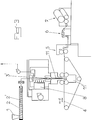
- the subject of the invention is also, as shown in FIGS. 1, 2 and 3 of the appended drawings, a process for producing a nonwoven as described above, said process essentially consisting in introducing, from a reservoir, for example, and in granular or powdery form, a solid mass of polymers or of a mixture of polymers, derived from lactic acid, in a heated extruder 2, to heat said mass in a controlled manner working it, in order to obtain a homogeneous melt and having a determined viscosity, then transporting said melt to a spinneret device 3, 3 ′ for the formation of filaments, cooling and drawing the filaments thus obtained, depositing said filaments, without preferential orientation, on a circulating collecting mat 4, so as to form a sheet or a non-woven veil and, finally, if necessary, securing said filaments of said sheet e ntre them at at least part of their mutual crossing points and / or to treat said filaments of said web by immersion, coating, impregnation or spraying,
- the fleece or the nonwoven web is finally made in width and rolled up at a suitable winding station 7.
- the extruder 2 used advantageously has a single screw 2 ′ (see FIGS. 2 and 3) and its body is surrounded by a plurality of heating collars delimiting, in said body, heating zones Z1 to Z5 (see figure 1) which may have increasing values of temperature between the feed inlet of the extruder 2, connected to the reservoir 1, and the outlet of said extruder 2.
- the method consists in pushing the molten material coming from the extruder 2 through a die 3 composed of several fields, advantageously seven, then to cool the filaments from each field by an air flow 8, then to stretch said filaments, by Venturi effect, in nozzles 9 and, finally, to deposit the drawn filaments on a collecting mat 4 circulating without preferential orientation and homogeneously, using separators 10.
- Such a process is more generally known under the designation LURGI in the production of conventional nonwovens.
- the extruder 2 is preferably maintained at a temperature between 185 ° C and 204 ° C, giving the mass of polymer (s) derived from lactic acid a determined viscosity allowing its handling and its transport, without however altering the constituent (s).
- the method can also consist in pushing the molten material coming from the extruder 2 through a monobloc die 3 ′, then in cooling the filaments obtained by means of an air flow 8 and in stretching them in a slot 11 and, finally, in depositing said stretched filaments on said collecting mat 4 or scrolling, without preferential orientation and in a homogeneous manner.
- a suction device 11 ' is located under the collecting mat 4, creating a suction effect at the level of the latter, intended to press the filaments against it.
- Such a process is more generally known under the designation S-Tex for the production of synthetic nonwovens.
- the temperature of the extruder 2 is advantageously included, for this second embodiment, between 245 ° C and 295 ° C.
- the method according to the invention may also consist in pushing the molten material through a die having a multitude of holes in line, then in drawing the filaments obtained by means of hot air currents circulating around the die and in the direction of the collecting mat, and, finally, projecting said filaments, without preferential orientation and homogeneously, onto said moving collecting mat.
- the temperature of the molten material from the extruder 2 is fixed, on the one hand, by a first heating circuit 12 comprising a first heat transfer fluid, during its transport from the extruder 2 to the die 3 , 3 'and, on the other hand, by a second heating circuit 13 comprising a second heat transfer fluid, distinct from said first devices and fluids, at the level of the die 3, 3', said molten material thus being able to be brought to temperatures different depending on the operations to be performed.
- the first heat transfer fluid for example of the type known under the designation marlo
- marlo can give the melt a sufficient temperature for its transfer from the extruder 2 to the die 3, 3 '
- the second heat transfer fluid for example type known under the designation dyphil, will bring said melt to a higher temperature allowing its spinning.
- the rate of stretching of the filaments is advantageously between 100% and 1000%, and the veil or the sheet of nonwoven obtained can be treated by impregnation or by spraying of surfactants.
- samples having the characteristics mentioned in table 3, intended more particularly for hygiene articles were mixed with vegetable food waste and transformed into compost and humus in a reactor of the composter type.
- the temperature in the reactor was fixed at 55 ° C., the humidity of the mixture maintained at 50% and the supply of air ensured.
- the compost was then extracted from the reactor and spread in the open air for 10 weeks. At the end of this second period no more filament was visible and the decomposition of the nonwoven was complete.
- nonwovens having the characteristics mentioned in Table 4 were used as mulch sails in vegetable and horticultural crops to control weeds, in place of phytosanitary products.
- the degradability of the nonwoven is ensured by watering, rain and the activity of microorganisms.
Landscapes
- Engineering & Computer Science (AREA)
- Textile Engineering (AREA)
- Nonwoven Fabrics (AREA)
- Biological Depolymerization Polymers (AREA)
- Materials For Medical Uses (AREA)
- Absorbent Articles And Supports Therefor (AREA)
- Organic Low-Molecular-Weight Compounds And Preparation Thereof (AREA)
- Compositions Of Macromolecular Compounds (AREA)
- Artificial Filaments (AREA)
- Multicomponent Fibers (AREA)
- Woven Fabrics (AREA)
Abstract
Description
- La présente invention concerne le domaine des non-tissés, notamment des non-tissés au moins partiellement dégradable, et a pour objet un non-tissé totalement dégradable et assimilable par l'environnement, son procédé de fabrication et ses différentes utilisations.
- Actuellement, la plupart des non-tissés produits sont réalisés à base de polymères synthétiques, tels que le propylène, le polyéthylène, les polyesters ou encore les polyamides, qui sont pratiquement non dégradables, notamment non biodégradables, ce d'autant plus qu'ils intègrent souvent des stabilisants ou d'autres additifs qui prolongent leur durée de vie.
- En vue de tenter de pallier cet inconvénient, il a été proposé d'inclure des agents photosensibles dans la composition des filaments des non-tissés afin de déclencher une réaction de photo-oxydation.
- Il a également été proposé de produire des non-tissés à partir de polymères thermoplastiques dérivés de l'amidon ou encore à base de polycaprolactones ou de polyhydroxybutyrates/polyhydroxyvalerates.
- Toutefois, les produits non-tissés obtenus ne présentent pas de propriétés suffisamment satisfaisantes (résistances mécaniques, propriétés physico-chimiques) permettant leur mise en oeuvre et, en outre, leur prix de revient est trop élevé en regard des polymères synthétiques.
- De plus, les filaments obtenus en ces matériaux présentent toujours des titres importants, rarement inférieurs à 10 dtex, du fait de la nature et des caractéristiques des matériaux utilisés.
- Le problème posé à la présente invention consiste donc à concevoir un non-tissé entièrement biodégradable, compostable et assimilable par l'environnement, dont les filaments présentent un très faible titre et dont les coûts de revient sont faibles et les propriétés mécaniques et physico-chimiques sensiblement équivalentes à celles des polymères synthétiques.
- A cet effet la présente invention a pour objet un non-tissé constitué de filaments en un matériau polymère, caractérisé en ce que tous les filaments qui le composent sont réalisés entièrement en un polymère ou en un mélange de polymères, dérivé(s) de l'acide lactique.
- L'invention a également pour objet un procédé pour la réalisation d'un non-tissé tel que mentionné ci-dessus, caractérisé en ce qu'il consiste essentiellement à introduire une masse solide de polymères ou d'un mélange de polymères, dérivé(s) de l'acide lactique, dans une extrudeuse chauffée, à chauffer de manière contrôlée ladite masse en la travaillant, afin d'obtenir une masse fondue homogène et présentant une viscosité déterminée, à transporter ensuite ladite masse fondue jusqu'à un dispositif de filière pour la formation de filaments, à refroidir et à étirer les filaments ainsi obtenus, à déposer lesdits filaments, sans orientation préférentielle, sur un tapis collecteur circulant, de manière à former une nappe ou un voile non-tissé et, enfin, le cas échéant, à solidariser lesdits filaments de ladite nappe ou dudit voile entre eux au niveau d'au moins une partie de leurs points de croisement mutuels et/ou à traiter lesdits filaments de ladite nappe par immersion, enduction, imprégnation ou pulvérisation.
- L'invention sera mieux comprise grâce à la description ci-après, qui se rapporte à des modes de réalisation préférés, donnés à titre d'exemples non limitatifs, et expliqués avec référence aux dessins schématiques annexés, dans lesquels:
- la figure 1 représente schématiquement un ensemble extrudeuse-filière pour la mise en oeuvre du procédé conforme à l'invention;
- la figure 2 représente un dispositif pour la mise en oeuvre du procédé selon un premier mode de réalisation de l'invention;
- la figure 3 représente un dispositif pour la mise en oeuvre du procédé selon un second mode de réalisation de l'invention;
- les figures 4 et 5 représentent des courbes montrant, respectivement, l'évolution de la viscosité et de la contrainte de cisaillement en fonction du taux de cisaillement pour deux polymères dérivés de l'acide lactique et utilisés pour la réalisation d'un non-tissé selon l'invention.
- Conformément à cette dernière, tous les filaments composant le non-tissé sont réalisés entièrement (à 100% de leur composition) en un polymère ou en un mélange de polymères, dérivé(s) de l'acide lactique.
- Selon une première caractéristique de l'invention, ledit ou lesdits polymères constituant lesdits filaments est (sont) dérivé(s) d'acide lactique L ou d'acide lactique D ou encore d'un mélange d'acides lactiques L et D.
- Ledit polymère ou ledit mélange de polymères dérivé(s) de l'acide lactique présente avantageusement une masse moléculaire comprise entre 100 000 g/mol et 200 000 g/mol et un indice de polydispersité compris entre environ 1 et environ 3.
- De plus, ledit ou lesdits polymères dérivé(s) de l'acide lactique possédent une température de transition vitreuse comprise entre 45°C et 55°C et une température de fusion comprise entre 165°C et 180°C.
- A titre d'exemple, un polymère A, pouvant être mis en oeuvre pour la réalisation d'un non-tissé conforme à l'invention, peut être obtenu en faisant réagir dans un réacteur de l'acide lactique avec un catalyseur, sous la forme d'octoate stanneux mélangé audit acide lactique avec un taux de 0,11% en poids.
- Le polymère ci-dessus, ayant à la sortie du réacteur une température de 209°C, présente une masse moléculaire moyenne en poids de 132 000 g/mol, un indice de polydispersité de 1,9, une température de transition vitreuse de 51,5°C et une température de fusion de 170,3°C.
- Il est également possible d'obtenir, avec les conditions opératoires indiquées ci-dessus, un polymère B, dérivé de l'acide lactique et pouvant être utilisé pour la réalisation d'un non-tissé conforme à l'invention, ledit polymère B présentant une masse moléculaire moyenne en poids de 158 000 g/mol, un indice de polydispersité de 2,1, une température de transition vitreuse de 49°C et une température de fusion de 171,6°C.
- Certaines autres caractéristiques des polymères A et B apparaîtront à l'homme du métier à la vue des figures 4 et 5 des dessins annexés.
- Les polymères A et B précités, ainsi que d'autres polymères dérivés de l'acide lactique et susceptibles de servir de matériau de base pour la réalisation de non-tissés conformes à l'invention, sont décrits plus en détail, en ce qui concerne leur obtention et leurs caractéristiques, dans la demande de brevet finlandais n° 923167 déposée le 9 juillet 1992 par la société Nesté Oy.
- Conformément à une autre caractéristique de l'invention, le titre des filaments constituant le non-tissé est compris entre 0,5 et 10 dtex, avantageusement entre 1 et 5 dtex et préférentiellement entre 2,5 et 4,5 dtex, ledit non-tissé pouvant, en outre, en vue d'augmenter la tenue mécanique et la résistance du voile ou de la nappe non-tissée, comporter des soudures de géométries différentes entre filaments sur environ 5% à 50% de sa surface, obtenue par calandrage à chaud, préférentiellement sur 12%, 24% ou 48%.
- Par ailleurs les filaments constituant le non-tissé selon l'invention, peuvent également être traités en vue d'acquérir des propriétés physico-chimiques particulières et, par exemple, présenter des propriétés d'hydrophilie ou d'hydrophobie, obtenues par imprégnation ou pulvérisation d'agents tensio-actifs.
- Le non-tissé selon l'invention, tel que décrit ci-dessus, pourra être avantageusement utilisé en tant que composant partiel ou en tant que constituant unique d'un article jetable, notamment à usage unique, et plus particulièrement, suite à un traitement adapté, en tant que composant hydrophile, notamment voile de surface, d'un produit d'hygiène jetable, par exemple d'une couche ou d'une serviette périodique à usage unique ou en tant que composant hydrophobe, notamment surface barrière, d'un produit d'hygiène jetable, par exemple d'une couche ou d'une serviette périodique à usage unique, ce en réalisant un non-tissé sur la base du polymère A précité.
- A l'aide du polymère B précité, il sera possible de réaliser un non-tissé pouvant être mis en oeuvre en tant que paillage ou voile de protection pour des cultures.
- L'invention a également pour objet, comme le montrent les figures 1, 2 et 3 des dessins annexés, un procédé de réalisation d'un non-tissé tel que décrit ci-dessus, ledit procédé consistant essentiellement à introduire, à partir d'un réservoir, par exemple, et sous forme granuleuse ou poudreuse, une masse solide de polymères ou d'un mélange de polymères, dérivé(s) de l'acide lactique, dans une extrudeuse 2 chauffée, à chauffer de manière contrôlée ladite masse en la travaillant, afin d'obtenir une masse fondue homogène et présentant une viscosité déterminée, à transporter ensuite ladite masse fondue jusqu'à un dispositif de filière 3, 3' pour la formation de filaments, à refroidir et à étirer les filaments ainsi obtenus, à déposer lesdits filaments, sans orientation préférentielle, sur un tapis collecteur 4 circulant, de manière à former une nappe ou un voile non-tissé et, enfin, le cas échéant, à solidariser lesdits filaments de ladite nappe entre eux au niveau d'au moins une partie de leurs points de croisement mutuels et/ou à traiter lesdits filaments de ladite nappe par immersion, enduction, imprégnation ou pulvérisation, ce par l'intermédiaire, le cas échéant, d'un poste de calandrage 5 et/ou d'un poste de traitement 6 correspondant à travers lesquels le voile ou la nappe non-tissée peut passer après sa formation.
- Bien entendu, le voile ou la nappe non-tissée est finalement mis en laize et enroulé(e) au niveau d'un poste à enrouleuse 7 adapté.
- L'extrudeuse 2 mise en oeuvre présente avantageusement une seule vis 2' (voir figures 2 et 3) et son corps est entouré d'une pluralité de colliers de chauffage délimitant, dans ledit corps, des zones de chauffage Z1 à Z5 (voir figure 1) pouvant présenter des valeurs croissantes de température entre l'entrée d'alimentation de l'extrudeuse 2, reliée au réservoir 1, et la sortie de ladite extrudeuse 2.
- Selon une première variante de réalisation de l'invention, et comme le montre la figure 2 des dessins annexés, le procédé consiste à pousser la matière fondue issue de l'extrudeuse 2 à travers une filière 3 composée de plusieurs champs, avantageusement sept, puis à refroidir les filaments issus de chaque champ par un flux d'air 8, à étirer ensuite lesdits filaments, par effet Venturi, dans des buses 9 et, enfin, à déposer les filaments étirés sur un tapis collecteur 4 circulant sans orientation préférentielle et de manière homogène, par I'intermédiaire de séparateurs 10.
- Un tel procédé est plus généralement connu sous la désignation LURGI dans les réalisations de non-tissés usuels.
- Conformément à l'invention, l'extrudeuse 2 est préférentiellement maintenue à une température comprise entre 185°C et 204°C, conférant à la masse de polymère(s) dérivé(s) de l'acide lactique une viscosité déterminée autorisant sa manipulation et son transport, sans toutefois en altérer le ou les constituants.
- Selon une deuxième variante de réalisation de l'invention, et comme le montre la figure 3 des dessins annexés, le procédé peut également consister à pousser la matière fondue issue de l'extrudeuse 2 à travers une filière 3' monobloc, puis à refroidir les filaments obtenus au moyen d'un flux d'air 8 et à les étirer dans une fente 11 et, enfin, à déposer lesdits filaments étirés sur ledit tapis collecteur 4 ou défilement, sans orientation préférentielle et de manière homogène.
- En outre, un dispositif d'aspiration 11' est situé sous le tapis collecteur 4, créant un effet de succion au niveau de ce dernier, destiné à plaquer les filaments contre lui.
- Un tel procédé est plus généralement connu sous la désignation S-Tex pour les réalisations de non-tissés synthétiques.
- Conformément à une caractéristique de l'invention, la température de l'extrudeuse 2 est avantageusement compris, pour ce second mode de réalisation, entre 245°C et 295°C.
- Selon une troisième variante de réalisation de l'invention, non représentée aux dessins annexés, le procédé conforme à l'invention peut également consister à pousser la matière fondue à travers une filière présentant une multitude de trous en ligne, puis à étirer les filaments obtenus par l'intermédiaire de courants d'air chauds circulant autour de la filière et en direction du tapis collecteur, et, enfin, à projeter lesdits filament, sans orientation préférentielle et de manière homogène, sur ledit tapis collecteur en déplacement.
- De manière avantageuse, la température de la matière fondue issue de l'extrudeuse 2 est fixée, d'une part, par un premier circuit de chauffage 12 comprenant un premier fluide caloporteur, lors de son transport de l'extrudeuse 2 vers la filière 3, 3' et, d'autre part, par un deuxième circuit de chauffage 13 comprenant un deuxième fluide caloporteur, distincts desdits premiers dispositifs et fluides, au niveau de la filière 3, 3', ladite matière fondue pouvant ainsi être portée à des températures différentes en fonction des opérations à subir.
- Le premier fluide caloporteur, par exemple du type connu sous la désignation marlo, pourra conférer à la masse fondue une température suffisante pour son transfert de l'extrudeuse 2 vers la filière 3, 3', alors que le second fluide caloporteur, par exemple du type connu sous la désignation dyphil, portera ladite masse fondue à une température plus important permettant son filage.
- En vue de garantir une qualité constante du voile ou de la nappe de non-tissé, il est préférable d'alimenter la filière 3, 3' au moyen de pompes volumétriques 14 reliés à la sortie de l'extrudeuse 2 (figure 2 et 3) ou par l'intermédiaire d'un pompe de surpression 15 (figure 1).
- Conformément à une caractéristique de l'invention, le taux d'étirage des filaments est avantageusement compris entre 100% et 1000%, et le voile ou la nappe de non-tissé obtenu(e) peut être traité(e) par imprégnation ou par pulvérisation d'agents tensio-actifs.
- A titre d'exemple pratique de mise en oeuvre du procédé conforme à l'invention, il est indiqué ci-après les valeurs des différents paramètres opératoires essentiels intervenant dans le procédé de fabrication des non-tissés selon l'invention obtenus selon la première variante de réalisation (Tableau 1) ou selon la seconde variante de réalisation, mentionnées ci-dessus (tableau 2), mentionnées ci-dessus.

TABLEAU 2 Nature des paramètres Lieu/objet concerné Unités Valeurs vitesse extrudeuse (vis) t/mn 15 à 80 pompes volumét. t/mn 4 à 22 tapis m/mn 5 à 200 débit Kg/h < 140 température zone 1 °C 250±5 zone 2 °C 290±5 zone 3 °C 290±5 zone 4 °C 290±5 zone 5 °C 290±5 1° circ. chauffe °C 200±5 filière °C 240±5 2° circ. chauffe °C 245±5 pression extrudeuse bars 37 surpression bars 46 pompes volum. bars 24 filière bars 18 aspiration mm de CE 50 vit. filament. étirage m/s 2 < < 30 taux d'étirage % 150 < < 900 T° picots °C 132±5 T° lisse calandre °C 132±5 pression daN/cm 50 vitesse gommage traitement m/mn 3 taux prod. actif imprégnation % 12 type / silvet - Les valeurs médianes des paramètres opératoires indiqués dans le tableau 1 permettent d'obtenir des non-tissés pouvant être utilisés pour des applications en agriculture et en hygiène et présentant les caractéristiques mentionnées dans les tableaux 3 et 4 ci-après, ce en fonction du polymère, respectivement A (tableau 3) et B (tableau 4), utilisé pour leur réalisation.
TABLEAU 3 poids g/m² 20 25 tension md N/5cm 22 26,5 cd N/5cm 8,5 10 élongation md % 2.5 2.5 cd % 2.5 2.4 perméabilité air (10 pa) 1/m²/s 1500 1300 absorption temps s <3 <3 filament titre dtex 2.2 2.5 mfr (I2 190°C) / / 400 TABLEAU 4 poids g/m² 50 100 tension md N/5cm 60.2 110.5 cd N/5cm 23.5 40.5 élongation md % 3.1 3.5 cd % 2.9 3.5 perméabilité air (10 pa) 1/m²/s 650 300 absorption temps s <3 <3 filaments titre dtex 2.2 2.2 mfr (I2 190°C) / 400 400 - Les tableaux 3 et 4 ci-dessus indiquent, outre les caractéristiques classiques telles que poids, tension de rupture et élongation (suivant la direction machine:md et perpendiculairement à cette dernière:cd) et titre des filaments du non-tissé obtenu, certaines caractéristiques particulières dudit non-tissé telles que perméabilité à l'air (sous une dépression de 10 Pascal), coefficient d'absorption (temps de passage de 5 cm³ d'urine à travers le voile ou la nappe de non-tissé - norme Edam 150-1-90) ou encore indice de fluidité (mfr - Norme ISO 1133 à T = 190°C).
- Les quatre non-tissés décrits dans les tableaux 3 et 4 ont été traités, comme le montre le tableau 1 précédent, au moyen d'un tensio-actif connu sous la désignation SILVET (marque) par la société Union Carbide.
- Afin de tester le degré et la vitesse de dégradabilité des non-tissés conformes à l'invention, des échantillons présentant les caractéristiques mentionnées dans le tableau 3, destinés plus particulièrement à des articles d'hygiène, ont été mélangés à des déchets végétaux alimentaires et transformés en compost et humus dans un réacteur du type composteur.
- Pendant huit jours, la température dans le réacteur était fixée à 55°C, I'humidité du mélange maintenue à 50 % et l'alimentation en air assurée.
- Après cette période, il a été constaté que le non-tissé s'était considérablement dégradé et que seuls quelques filaments étaient encore visibles.
- Le compost a ensuite été extrait du réacteur et étalé à l'air libre pendant 10 semaines. A la fin de cette deuxième période plus aucun filament n'était apparent et la décomposition du non-tissé était totale.
- De même, des non-tissés présentant les caractéristiques mentionnées au tableau 4 ont été utilisés comme voiles de paillage en cultures maraîchères et horticoles pour lutter contre les mauvaises herbes, en remplacement des produits phytosanitaires.
- En testant ces non-tissés sur des jeunes plants de conifères et de laitues, il a été constaté les propriétés suivantes:
- contrôle des mauvaises herbes sans utilisation d'herbicides (examen du nombre d'adventices et de leur taille),
- activation des microorganismes du sol, les non-tissés constituant un excellent substrat de culture,
- limitation de l'évaporation (hygrométrie supérieure à 80% à 22°C).
- La dégradabilité du non-tissé est assurée à la fois par l'arrosage, les pluies et l'activité des microorganismes.
- Les prélèvements effectués sur les voiles en test ont permis de constater que les propriétés mécaniques chutaient de 10% en 2 mois.
- Bien entendu, l'invention n'est pas limitée aux modes de réalisation décrits et représentés aux dessins annexés. Des modifications restent possibles, notamment du point de vue de la constitution des divers éléments, ou par substitution d'équivalents techniques, sans sortir pour autant du domaine de protection de l'invention.
Claims (22)
- Non-tissé constitué de filaments en un matériau polymère, caractérisé en ce que tous les filaments qui le composent sont réalisés entièrement en un polymère ou en un mélange de polymères, dérivé(s) de l'acide lactique.
- Non-tissé selon la revendication 1, caractérisé en ce que ledit ou lesdits polymères constituant lesdits filaments est (sont) dérivé(s) d'acide lactique L ou D.
- Non-tissé selon la revendication 1, caractérisé en ce que ledit ou lesdits polymères constituant lesdits filaments sont obtenus à partir d'un mélange d'acides lactiques L et D.
- Non-tissé selon l'une quelconque des revendications 1 à 3, caractérisé en ce que ledit polymère ou ledit mélange de polymères dérivé(s) de l'acide lactique présente une masse moléculaire comprise entre 100 000 g/mol et 200 000 g/mol et un indice de polydispersité compris entre environ 1 et environ 3.
- Non-tissé selon l'une quelconque des revendications 1 à 4, caractérisé en ce que ledit ou lesdits polymères présente(nt) une température de transition vitreuse comprise entre 45°C et 55°C et une température de fusion comprise entre 165°C et 180°C.
- Non-tissé selon l'une quelconque des revendications 1 à 5, caractérisé en ce que le titre des filaments constituant ledit non-tissé est compris entre 0,5 et 10 dtex, avantageusement entre 1 et 5 dtex et préférentiellement entre 2,5 et 4,5 dtex.
- Non-tissé selon l'une quelconque des revendications 1 à 6, caractérisé en ce qu'il comporte des soudures de géométries différentes entre filaments sur environ 5% à 50% de sa surface, obtenue par calandrage à chaud.
- Non-tissé selon l'une quelconque des revendications 1 à 7, caractérisé en ce que les filaments présentent des propriétés d'hydrophilie ou d'hydrophobie, obtenues par imprégnation ou pulvérisation d'agents tensio-actifs.
- Procédé de fabrication d'un non-tissé selon l'une quelconque des revendications 1 à 8, caractérisé en ce qu'il consiste essentiellement à introduire une masse solide de polymères ou d'un mélange de polymères, dérivé(s) de l'acide lactique, dans une extrudeuse (2) chauffée, à chauffer de manière contrôlée ladite masse en la travaillant, afin d'obtenir une masse fondue homogène et présentant une viscosité déterminée, à transporter ensuite ladite masse fondue jusqu'à un dispositif de filière (3, 3') pour la formation de filaments, à refroidir et à étirer les filaments ainsi obtenus, à déposer lesdits filaments, sans orientation préférentielle, sur un tapis collecteur (4) circulant, de manière à former une nappe ou un voile non-tissé et, enfin, le cas échéant, à solidariser lesdits filaments de ladite nappe entre eux au niveau d'au moins une partie de leurs points de croisement mutuels et/ou à traiter lesdits filaments de ladite nappe par immersion, enduction, imprégnation ou pulvérisation.
- Procédé selon la revendication 9, caractérisé en ce qu'il consiste à pousser la matière fondue issue de l'extrudeuse (2) à travers une filière (3) composée de plusieurs champs, avantageusement sept, puis à refroidir les filaments issus de chaque champ par un flux d'air (8), à étirer ensuite lesdits filaments, par effet Venturi, dans des buses (9) et, enfin, à déposer les filaments étirés sur un tapis collecteur (4) circulant sans orientation préférentielle et de manière homogène, par l'intermédiaire de séparateurs (10).
- Procédé selon la revendication 10, caractérisé en ce qu'il consiste à maintenir l'extrudeuse (2) à une température comprise entre 185°C et 205°C.
- Procédé selon la revendication 9, caractérisé en ce qu'il consiste à pousser la matière fondue issue de l'extrudeuse (2) à travers une filière (3') monobloc, puis à refroidir les filaments obtenus au moyen d'un flux d'air (8) et à les étirer dans une fente (11) sous l'action d'une aspiration générée par un dispositif (14) adapté sous le tapis collecteur (4) au niveau de la fente (11) et, enfin, à déposer lesdits filaments étirés sur ledit tapis collecteur (4) ou défilement, sans orientation préférentielle et de manière homogène.
- Procédé selon la revendication 12, caractérisé en ce qu'il consiste à maintenir l'extrudeuse (2) à une température comprise entre 245°C et 295°C.
- Procédé selon la revendication 9, caractérisé en ce qu'il consiste à pousser la matière fondue à travers une filière présentant une multitude de trous en ligne, puis à étirer les filaments obtenus par l'intermédiaire de courants d'air chauds circulant autour de la filière et en direction du tapis collecteur, et, enfin, à projeter lesdits filament, sans orientation préférentielle et de manière homogène, sur ledit tapis collecteur en déplacement.
- Procédé selon l'une quelconque des revendications 9 à 14, caractérisé en ce que la température de la matière fondue issue de l'extrudeuse (2) est fixée, d'une part, par un premier circuit de chauffage (12) comprenant un premier fluide caloporteur, lors de son transport de l'extrudeuse (2) vers la filière (3, 3') et, d'autre part, par un deuxième circuit de chauffage (13) comprenant un deuxième fluide caloporteur, distincts desdits premiers dispositifs et fluides, au niveau de la filière (3, 3'), ladite matière fondue pouvant ainsi être portée à des températures différentes en fonction des opérations à subir.
- Procédé selon l'une quelconque des revendications 9 à 15, caractérisé en ce qu'il consiste à alimenter la filière (3, 3') au moyen de pompes volumétriques (14) reliés à la sortie de l'extrudeuse (2) ou par l'intermédiaire d'un pompe de surpression (15).
- Procédé selon l'une quelconque des revendications 9 à 16, caractérisé en ce que le taux d'étirage des filaments est compris entre 100% et 1000%.
- Procédé selon l'une quelconque des revendications 9 à 17, caractérisé en ce que la nappe de non-tissé obtenue est traitée par imprégnation ou par pulvérisation d'agents tensio-actifs.
- Utilisation d'un non-tissé selon l'une quelconque des revendications 1 à 8 en tant que composant partiel ou en tant que constituant unique d'un article jetable, notamment à usage unique.
- Utilisation d'un non-tissé selon l'une quelconque des revendications 1 à 8 en tant que composant hydrophile, notamment voile de surface, d'un produit d'hygiène jetable, par exemple d'une couche ou d'une serviette périodique à usage unique.
- Utilisation d'un non-tissé selon l'une quelconque des revendications 1 à 8 en tant que composant hydrophobe, notamment surface barrière, d'un produit d'hygiène jetable, par exemple d'une couche ou d'une serviette périodique à usage unique.
- Utilisation d'un non-tissé selon l'une quelconque des revendications 1 à 8 en tant que paillage ou voile de protection pour des cultures.
Applications Claiming Priority (3)
| Application Number | Priority Date | Filing Date | Title |
|---|---|---|---|
| FR9309649 | 1993-08-02 | ||
| FR9309649A FR2709500B1 (fr) | 1993-08-02 | 1993-08-02 | Non-tissé à base de polymères dérivés de l'acide lactique, procédé de fabrication et utilisation d'un tel non-tissé. |
| JP6200107A JPH08246320A (ja) | 1993-08-02 | 1994-08-02 | 乳酸に由来した重合体に基づく不織布、その製造方法及びそのような不織布の使用 |
Publications (2)
| Publication Number | Publication Date |
|---|---|
| EP0637641A1 true EP0637641A1 (fr) | 1995-02-08 |
| EP0637641B1 EP0637641B1 (fr) | 1998-09-02 |
Family
ID=26230539
Family Applications (1)
| Application Number | Title | Priority Date | Filing Date |
|---|---|---|---|
| EP94470018A Revoked EP0637641B1 (fr) | 1993-08-02 | 1994-06-10 | Non-tissé à base de polymères dérivés de l'acide lactique, procédé de fabrication et utilisation d'un tel non-tissé |
Country Status (8)
| Country | Link |
|---|---|
| EP (1) | EP0637641B1 (fr) |
| JP (1) | JPH08246320A (fr) |
| AT (1) | ATE170575T1 (fr) |
| CA (1) | CA2127754C (fr) |
| DE (1) | DE69412948T2 (fr) |
| DK (1) | DK0637641T3 (fr) |
| ES (1) | ES2122205T3 (fr) |
| FR (1) | FR2709500B1 (fr) |
Cited By (10)
| Publication number | Priority date | Publication date | Assignee | Title |
|---|---|---|---|---|
| FR2732196A1 (fr) * | 1995-03-28 | 1996-10-04 | Fiberweb Sodoca Sarl | Filtre a cigarette fabrique a partir d'une nappe de non-tisse |
| EP0765959A1 (fr) * | 1995-09-29 | 1997-04-02 | Unitika Ltd. | Etoffes non-tissée de filaments et sa méthode de fabrication |
| EP0767263A1 (fr) * | 1995-10-06 | 1997-04-09 | Fiberweb France Sa | Non-tissé hydrophile à base de polylactides |
| FR2762332A1 (fr) * | 1997-04-18 | 1998-10-23 | Fiberweb France Sa | Filiere pour l'obtention en continu de filaments, filaments ainsi obtenus et produits en non-tisse obtenus par la mise en oeuvre desdits filaments |
| US5833787A (en) * | 1994-10-12 | 1998-11-10 | Fiberweb Sodoca Sarl | Process for making a nonwoven web derived from lactic acid, web produced thereby, and apparatus therefor |
| US6506873B1 (en) | 1997-05-02 | 2003-01-14 | Cargill, Incorporated | Degradable polymer fibers; preparation product; and, methods of use |
| FR2843523A1 (fr) | 2002-08-13 | 2004-02-20 | Ahlstrom Research & Services | Support fibreux biodegradable pour paillage de sol |
| FR2843525A1 (fr) | 2002-08-13 | 2004-02-20 | Ahlstrom Research & Services | Support fibreux biodegradable pour paillage de sol |
| US6787493B1 (en) | 1995-09-29 | 2004-09-07 | Unitika, Ltd. | Biodegradable formable filament nonwoven fabric and method of producing the same |
| EP1493555A1 (fr) * | 2003-07-01 | 2005-01-05 | Rieter Perfojet (S.A.) | Nontissé biodégradable |
Families Citing this family (7)
| Publication number | Priority date | Publication date | Assignee | Title |
|---|---|---|---|---|
| US5851937A (en) * | 1997-03-27 | 1998-12-22 | Clopay Plastic Products Company, Inc. | Cloth-like totally biodegradable and/or compostable composites and method of manufacture |
| DE19947582C1 (de) * | 1999-10-02 | 2001-08-02 | Hartmann Paul Ag | Verbundwerkstoff zur Bildung einer körperzugewandten Lage bei einem Hygieneartikel sowie Hygieneartikel |
| JP2002065079A (ja) * | 2000-08-30 | 2002-03-05 | Unitika Ltd | 幼木保護シート |
| US7994078B2 (en) | 2002-12-23 | 2011-08-09 | Kimberly-Clark Worldwide, Inc. | High strength nonwoven web from a biodegradable aliphatic polyester |
| US7700500B2 (en) * | 2002-12-23 | 2010-04-20 | Kimberly-Clark Worldwide, Inc. | Durable hydrophilic treatment for a biodegradable polymeric substrate |
| US20070172651A1 (en) * | 2004-03-16 | 2007-07-26 | Takanori Miyoshi | Ultrafine polyactic acid fibers and fiber structure, and process for their production |
| JP6499429B2 (ja) * | 2014-12-02 | 2019-04-10 | 倉敷繊維加工株式会社 | 農業用被覆シート及びその製造方法 |
Citations (7)
| Publication number | Priority date | Publication date | Assignee | Title |
|---|---|---|---|---|
| FR2083552A1 (en) * | 1970-03-25 | 1971-12-17 | Metallgesellschaft Ag | Multi-component non-woven fabric |
| US4045418A (en) * | 1975-01-28 | 1977-08-30 | Gulf Oil Corporation | Copolymers of D,L-lactide and epsilon caprolactone |
| EP0150024A2 (fr) * | 1984-01-19 | 1985-07-31 | Hoechst Aktiengesellschaft | Dispositif pour la fabrication d'une nappe de fibres filée |
| JPH02222421A (ja) * | 1989-02-23 | 1990-09-05 | Chuko Kasei Kogyo Kk | 生分解性複合材料 |
| JPH04168150A (ja) * | 1990-10-30 | 1992-06-16 | Shimadzu Corp | 生分解性プラスチック |
| EP0510999A1 (fr) * | 1991-04-24 | 1992-10-28 | MITSUI TOATSU CHEMICALS, Inc. | Réseau de polymère dégradable |
| EP0530987A1 (fr) * | 1991-08-08 | 1993-03-10 | MITSUI TOATSU CHEMICALS, Inc. | Composition de polymère dégradable |
-
1993
- 1993-08-02 FR FR9309649A patent/FR2709500B1/fr not_active Expired - Lifetime
-
1994
- 1994-06-10 EP EP94470018A patent/EP0637641B1/fr not_active Revoked
- 1994-06-10 DE DE69412948T patent/DE69412948T2/de not_active Expired - Fee Related
- 1994-06-10 AT AT94470018T patent/ATE170575T1/de not_active IP Right Cessation
- 1994-06-10 DK DK94470018T patent/DK0637641T3/da active
- 1994-06-10 ES ES94470018T patent/ES2122205T3/es not_active Expired - Lifetime
- 1994-07-11 CA CA002127754A patent/CA2127754C/fr not_active Expired - Lifetime
- 1994-08-02 JP JP6200107A patent/JPH08246320A/ja active Pending
Patent Citations (7)
| Publication number | Priority date | Publication date | Assignee | Title |
|---|---|---|---|---|
| FR2083552A1 (en) * | 1970-03-25 | 1971-12-17 | Metallgesellschaft Ag | Multi-component non-woven fabric |
| US4045418A (en) * | 1975-01-28 | 1977-08-30 | Gulf Oil Corporation | Copolymers of D,L-lactide and epsilon caprolactone |
| EP0150024A2 (fr) * | 1984-01-19 | 1985-07-31 | Hoechst Aktiengesellschaft | Dispositif pour la fabrication d'une nappe de fibres filée |
| JPH02222421A (ja) * | 1989-02-23 | 1990-09-05 | Chuko Kasei Kogyo Kk | 生分解性複合材料 |
| JPH04168150A (ja) * | 1990-10-30 | 1992-06-16 | Shimadzu Corp | 生分解性プラスチック |
| EP0510999A1 (fr) * | 1991-04-24 | 1992-10-28 | MITSUI TOATSU CHEMICALS, Inc. | Réseau de polymère dégradable |
| EP0530987A1 (fr) * | 1991-08-08 | 1993-03-10 | MITSUI TOATSU CHEMICALS, Inc. | Composition de polymère dégradable |
Non-Patent Citations (2)
| Title |
|---|
| DATABASE WPI Section Ch Week 9042, Derwent World Patents Index; Class A94, AN 90-3153322 * |
| DATABASE WPI Section Ch Week 9230, Derwent World Patents Index; Class A23, AN 92-247298 * |
Cited By (15)
| Publication number | Priority date | Publication date | Assignee | Title |
|---|---|---|---|---|
| US5833787A (en) * | 1994-10-12 | 1998-11-10 | Fiberweb Sodoca Sarl | Process for making a nonwoven web derived from lactic acid, web produced thereby, and apparatus therefor |
| FR2732196A1 (fr) * | 1995-03-28 | 1996-10-04 | Fiberweb Sodoca Sarl | Filtre a cigarette fabrique a partir d'une nappe de non-tisse |
| EP0949371A3 (fr) * | 1995-09-29 | 2004-05-12 | Unitika Ltd. | Etoffes non tissées de filaments et méthode de fabrication |
| EP0765959A1 (fr) * | 1995-09-29 | 1997-04-02 | Unitika Ltd. | Etoffes non-tissée de filaments et sa méthode de fabrication |
| EP1612314B2 (fr) † | 1995-09-29 | 2014-01-08 | Unitika Ltd. | Etoffes non tissées de filaments et méthode de fabrication |
| EP1612314A3 (fr) * | 1995-09-29 | 2006-11-22 | Unitika Ltd. | Etoffes non tissées de filaments et méthode de fabrication |
| US6787493B1 (en) | 1995-09-29 | 2004-09-07 | Unitika, Ltd. | Biodegradable formable filament nonwoven fabric and method of producing the same |
| FR2739632A1 (fr) * | 1995-10-06 | 1997-04-11 | Fiberweb Dodoca Sarl | Non-tisse hydrophile a base de polylactides |
| EP0767263A1 (fr) * | 1995-10-06 | 1997-04-09 | Fiberweb France Sa | Non-tissé hydrophile à base de polylactides |
| FR2762332A1 (fr) * | 1997-04-18 | 1998-10-23 | Fiberweb France Sa | Filiere pour l'obtention en continu de filaments, filaments ainsi obtenus et produits en non-tisse obtenus par la mise en oeuvre desdits filaments |
| US6506873B1 (en) | 1997-05-02 | 2003-01-14 | Cargill, Incorporated | Degradable polymer fibers; preparation product; and, methods of use |
| FR2843525A1 (fr) | 2002-08-13 | 2004-02-20 | Ahlstrom Research & Services | Support fibreux biodegradable pour paillage de sol |
| FR2843523A1 (fr) | 2002-08-13 | 2004-02-20 | Ahlstrom Research & Services | Support fibreux biodegradable pour paillage de sol |
| EP1493555A1 (fr) * | 2003-07-01 | 2005-01-05 | Rieter Perfojet (S.A.) | Nontissé biodégradable |
| FR2856952A1 (fr) * | 2003-07-01 | 2005-01-07 | Rieter Perfojet | Nontisse biodegradable |
Also Published As
| Publication number | Publication date |
|---|---|
| FR2709500A1 (fr) | 1995-03-10 |
| JPH08246320A (ja) | 1996-09-24 |
| DE69412948T2 (de) | 1999-05-12 |
| EP0637641B1 (fr) | 1998-09-02 |
| CA2127754A1 (fr) | 1995-02-03 |
| DK0637641T3 (da) | 1999-05-31 |
| CA2127754C (fr) | 2005-09-06 |
| FR2709500B1 (fr) | 1996-02-16 |
| DE69412948D1 (de) | 1998-10-08 |
| ATE170575T1 (de) | 1998-09-15 |
| ES2122205T3 (es) | 1998-12-16 |
Similar Documents
| Publication | Publication Date | Title |
|---|---|---|
| EP0637641B1 (fr) | Non-tissé à base de polymères dérivés de l'acide lactique, procédé de fabrication et utilisation d'un tel non-tissé | |
| EP0747065B1 (fr) | Structure composite biodégradable non-tissé/film | |
| EP0767263B1 (fr) | Non-tissé hydrophile à base de polylactides | |
| RU2149931C1 (ru) | Скрепляемое термопластичное полимерное волокно и нетканый материал, выполненный из него | |
| RU2561122C2 (ru) | Упрочненные волокна полимолочной кислоты | |
| US5653930A (en) | Spray processes using a gaseous flow for preparing biodegradable fibrils, nonwoven fabrics comprising biodegradable fibrils, and articles comprising such nonwoven fabrics | |
| US5466517A (en) | Spundbonded fabrics comprising biodegradable polycaprolactone filaments and process for its manufacture | |
| KR101526636B1 (ko) | 폴리락트산 섬유 | |
| US6710135B2 (en) | Resin composition and use thereof | |
| US5985776A (en) | Nonwoven based on polymers derived from lactic acid, process for manufacture and use of such a nonwoven | |
| CN1175291A (zh) | 制造非织造纤维网的方法 | |
| US20030145518A1 (en) | Agricultural items and agricultural methods comprising biodegradable copolymers | |
| KR20000062781A (ko) | 전분 섬유를 포함하는 흡수성, 가요성 구조재 | |
| CN1437666A (zh) | 用于控制流体的生物降解热塑性非织造纤维网 | |
| EP0723043B1 (fr) | Structure composite formée de dérivés d'acide lactique. | |
| CA2160313A1 (fr) | Procede de fabrication d'un non-tisse a base d'acide lactique et non-tisse obtenu | |
| JP3694192B2 (ja) | 抗菌防黴性ポリ乳酸構造体及びその製造方法 | |
| KR20110051707A (ko) | 생분해 조절이 가능한 맞춤형 농업용 부직포 멀칭재 제조방법 | |
| JP3434628B2 (ja) | ポリ乳酸系長繊維不織布およびその製造方法 | |
| JP3573612B2 (ja) | 生分解性防草シート | |
| JP3939156B2 (ja) | 樹脂組成物およびその用途 | |
| JP4000022B2 (ja) | ポリ乳酸系長繊維不織布の製造方法 | |
| JP2002088630A (ja) | 耐候性長繊維不織布 | |
| JP2000096416A (ja) | 生分解性不織布 | |
| JP2000045164A (ja) | 生分解性マルチシート |
Legal Events
| Date | Code | Title | Description |
|---|---|---|---|
| PUAI | Public reference made under article 153(3) epc to a published international application that has entered the european phase |
Free format text: ORIGINAL CODE: 0009012 |
|
| AK | Designated contracting states |
Kind code of ref document: A1 Designated state(s): AT BE CH DE DK ES GB GR IT LI LU NL SE |
|
| 17P | Request for examination filed |
Effective date: 19950227 |
|
| RAP1 | Party data changed (applicant data changed or rights of an application transferred) |
Owner name: FIBERWEB FRANCE SA |
|
| 17Q | First examination report despatched |
Effective date: 19970610 |
|
| GRAG | Despatch of communication of intention to grant |
Free format text: ORIGINAL CODE: EPIDOS AGRA |
|
| GRAG | Despatch of communication of intention to grant |
Free format text: ORIGINAL CODE: EPIDOS AGRA |
|
| GRAH | Despatch of communication of intention to grant a patent |
Free format text: ORIGINAL CODE: EPIDOS IGRA |
|
| GRAH | Despatch of communication of intention to grant a patent |
Free format text: ORIGINAL CODE: EPIDOS IGRA |
|
| GRAA | (expected) grant |
Free format text: ORIGINAL CODE: 0009210 |
|
| AK | Designated contracting states |
Kind code of ref document: B1 Designated state(s): AT BE CH DE DK ES GB GR IT LI LU NL SE |
|
| PG25 | Lapsed in a contracting state [announced via postgrant information from national office to epo] |
Ref country code: GR Free format text: LAPSE BECAUSE OF NON-PAYMENT OF DUE FEES Effective date: 19980902 |
|
| REF | Corresponds to: |
Ref document number: 170575 Country of ref document: AT Date of ref document: 19980915 Kind code of ref document: T |
|
| REG | Reference to a national code |
Ref country code: CH Ref legal event code: EP |
|
| REF | Corresponds to: |
Ref document number: 69412948 Country of ref document: DE Date of ref document: 19981008 |
|
| REG | Reference to a national code |
Ref country code: CH Ref legal event code: NV Representative=s name: PIETER SPIERENBURG PATENTANWALT DIPL. PHYS. |
|
| REG | Reference to a national code |
Ref country code: ES Ref legal event code: FG2A Ref document number: 2122205 Country of ref document: ES Kind code of ref document: T3 |
|
| GBT | Gb: translation of ep patent filed (gb section 77(6)(a)/1977) |
Effective date: 19981201 |
|
| REG | Reference to a national code |
Ref country code: DK Ref legal event code: T3 |
|
| PG25 | Lapsed in a contracting state [announced via postgrant information from national office to epo] |
Ref country code: LU Free format text: LAPSE BECAUSE OF NON-PAYMENT OF DUE FEES Effective date: 19990610 |
|
| PLBQ | Unpublished change to opponent data |
Free format text: ORIGINAL CODE: EPIDOS OPPO |
|
| PLBI | Opposition filed |
Free format text: ORIGINAL CODE: 0009260 |
|
| PLBF | Reply of patent proprietor to notice(s) of opposition |
Free format text: ORIGINAL CODE: EPIDOS OBSO |
|
| 26 | Opposition filed |
Opponent name: CARGILL DOW POLYMER L.L.C. Effective date: 19990602 |
|
| PLBF | Reply of patent proprietor to notice(s) of opposition |
Free format text: ORIGINAL CODE: EPIDOS OBSO |
|
| PLBF | Reply of patent proprietor to notice(s) of opposition |
Free format text: ORIGINAL CODE: EPIDOS OBSO |
|
| PLBF | Reply of patent proprietor to notice(s) of opposition |
Free format text: ORIGINAL CODE: EPIDOS OBSO |
|
| PGFP | Annual fee paid to national office [announced via postgrant information from national office to epo] |
Ref country code: AT Payment date: 20000626 Year of fee payment: 7 |
|
| PGFP | Annual fee paid to national office [announced via postgrant information from national office to epo] |
Ref country code: DK Payment date: 20000627 Year of fee payment: 7 |
|
| PGFP | Annual fee paid to national office [announced via postgrant information from national office to epo] |
Ref country code: ES Payment date: 20000719 Year of fee payment: 7 |
|
| PG25 | Lapsed in a contracting state [announced via postgrant information from national office to epo] |
Ref country code: DK Free format text: LAPSE BECAUSE OF NON-PAYMENT OF DUE FEES Effective date: 20010610 Ref country code: AT Free format text: LAPSE BECAUSE OF NON-PAYMENT OF DUE FEES Effective date: 20010610 |
|
| PG25 | Lapsed in a contracting state [announced via postgrant information from national office to epo] |
Ref country code: ES Free format text: LAPSE BECAUSE OF NON-PAYMENT OF DUE FEES Effective date: 20010611 |
|
| REG | Reference to a national code |
Ref country code: GB Ref legal event code: IF02 |
|
| REG | Reference to a national code |
Ref country code: DK Ref legal event code: EBP |
|
| PGFP | Annual fee paid to national office [announced via postgrant information from national office to epo] |
Ref country code: GB Payment date: 20020605 Year of fee payment: 9 |
|
| PGFP | Annual fee paid to national office [announced via postgrant information from national office to epo] |
Ref country code: SE Payment date: 20020611 Year of fee payment: 9 |
|
| PGFP | Annual fee paid to national office [announced via postgrant information from national office to epo] |
Ref country code: CH Payment date: 20020617 Year of fee payment: 9 |
|
| PGFP | Annual fee paid to national office [announced via postgrant information from national office to epo] |
Ref country code: DE Payment date: 20020619 Year of fee payment: 9 |
|
| PGFP | Annual fee paid to national office [announced via postgrant information from national office to epo] |
Ref country code: NL Payment date: 20020628 Year of fee payment: 9 |
|
| PGFP | Annual fee paid to national office [announced via postgrant information from national office to epo] |
Ref country code: BE Payment date: 20020829 Year of fee payment: 9 |
|
| RDAH | Patent revoked |
Free format text: ORIGINAL CODE: EPIDOS REVO |
|
| REG | Reference to a national code |
Ref country code: ES Ref legal event code: FD2A Effective date: 20030203 |
|
| RDAG | Patent revoked |
Free format text: ORIGINAL CODE: 0009271 |
|
| STAA | Information on the status of an ep patent application or granted ep patent |
Free format text: STATUS: PATENT REVOKED |
|
| REG | Reference to a national code |
Ref country code: CH Ref legal event code: PL |
|
| 27W | Patent revoked |
Effective date: 20021119 |
|
| REG | Reference to a national code |
Ref country code: SE Ref legal event code: ECNC |
|
| NLR2 | Nl: decision of opposition |
Effective date: 20021119 |