EP0651455B1 - Herstellungsverfahren eines Separators für eine Lithium-Sekundärbatterie und eine Lithium-Sekundärbatterie mit organischem Elektrolyt, die einen solchen Separator verwendet - Google Patents
Herstellungsverfahren eines Separators für eine Lithium-Sekundärbatterie und eine Lithium-Sekundärbatterie mit organischem Elektrolyt, die einen solchen Separator verwendet Download PDFInfo
- Publication number
- EP0651455B1 EP0651455B1 EP94307362A EP94307362A EP0651455B1 EP 0651455 B1 EP0651455 B1 EP 0651455B1 EP 94307362 A EP94307362 A EP 94307362A EP 94307362 A EP94307362 A EP 94307362A EP 0651455 B1 EP0651455 B1 EP 0651455B1
- Authority
- EP
- European Patent Office
- Prior art keywords
- separator
- organic electrolyte
- electrolyte
- secondary battery
- lithium
- Prior art date
- Legal status (The legal status is an assumption and is not a legal conclusion. Google has not performed a legal analysis and makes no representation as to the accuracy of the status listed.)
- Expired - Lifetime
Links
Images

Classifications
-
- H—ELECTRICITY
- H01—ELECTRIC ELEMENTS
- H01M—PROCESSES OR MEANS, e.g. BATTERIES, FOR THE DIRECT CONVERSION OF CHEMICAL ENERGY INTO ELECTRICAL ENERGY
- H01M10/00—Secondary cells; Manufacture thereof
- H01M10/05—Accumulators with non-aqueous electrolyte
- H01M10/052—Li-accumulators
-
- H—ELECTRICITY
- H01—ELECTRIC ELEMENTS
- H01M—PROCESSES OR MEANS, e.g. BATTERIES, FOR THE DIRECT CONVERSION OF CHEMICAL ENERGY INTO ELECTRICAL ENERGY
- H01M10/00—Secondary cells; Manufacture thereof
- H01M10/05—Accumulators with non-aqueous electrolyte
- H01M10/056—Accumulators with non-aqueous electrolyte characterised by the materials used as electrolytes, e.g. mixed inorganic/organic electrolytes
- H01M10/0564—Accumulators with non-aqueous electrolyte characterised by the materials used as electrolytes, e.g. mixed inorganic/organic electrolytes the electrolyte being constituted of organic materials only
- H01M10/0565—Polymeric materials, e.g. gel-type or solid-type
-
- H—ELECTRICITY
- H01—ELECTRIC ELEMENTS
- H01M—PROCESSES OR MEANS, e.g. BATTERIES, FOR THE DIRECT CONVERSION OF CHEMICAL ENERGY INTO ELECTRICAL ENERGY
- H01M50/00—Constructional details or processes of manufacture of the non-active parts of electrochemical cells other than fuel cells, e.g. hybrid cells
- H01M50/40—Separators; Membranes; Diaphragms; Spacing elements inside cells
- H01M50/409—Separators, membranes or diaphragms characterised by the material
- H01M50/411—Organic material
- H01M50/414—Synthetic resins, e.g. thermoplastics or thermosetting resins
- H01M50/417—Polyolefins
-
- H—ELECTRICITY
- H01—ELECTRIC ELEMENTS
- H01M—PROCESSES OR MEANS, e.g. BATTERIES, FOR THE DIRECT CONVERSION OF CHEMICAL ENERGY INTO ELECTRICAL ENERGY
- H01M50/00—Constructional details or processes of manufacture of the non-active parts of electrochemical cells other than fuel cells, e.g. hybrid cells
- H01M50/40—Separators; Membranes; Diaphragms; Spacing elements inside cells
- H01M50/489—Separators, membranes, diaphragms or spacing elements inside the cells, characterised by their physical properties, e.g. swelling degree, hydrophilicity or shut down properties
- H01M50/491—Porosity
-
- H—ELECTRICITY
- H01—ELECTRIC ELEMENTS
- H01M—PROCESSES OR MEANS, e.g. BATTERIES, FOR THE DIRECT CONVERSION OF CHEMICAL ENERGY INTO ELECTRICAL ENERGY
- H01M50/00—Constructional details or processes of manufacture of the non-active parts of electrochemical cells other than fuel cells, e.g. hybrid cells
- H01M50/40—Separators; Membranes; Diaphragms; Spacing elements inside cells
- H01M50/489—Separators, membranes, diaphragms or spacing elements inside the cells, characterised by their physical properties, e.g. swelling degree, hydrophilicity or shut down properties
- H01M50/497—Ionic conductivity
-
- H—ELECTRICITY
- H01—ELECTRIC ELEMENTS
- H01M—PROCESSES OR MEANS, e.g. BATTERIES, FOR THE DIRECT CONVERSION OF CHEMICAL ENERGY INTO ELECTRICAL ENERGY
- H01M2300/00—Electrolytes
- H01M2300/0085—Immobilising or gelification of electrolyte
-
- Y—GENERAL TAGGING OF NEW TECHNOLOGICAL DEVELOPMENTS; GENERAL TAGGING OF CROSS-SECTIONAL TECHNOLOGIES SPANNING OVER SEVERAL SECTIONS OF THE IPC; TECHNICAL SUBJECTS COVERED BY FORMER USPC CROSS-REFERENCE ART COLLECTIONS [XRACs] AND DIGESTS
- Y02—TECHNOLOGIES OR APPLICATIONS FOR MITIGATION OR ADAPTATION AGAINST CLIMATE CHANGE
- Y02E—REDUCTION OF GREENHOUSE GAS [GHG] EMISSIONS, RELATED TO ENERGY GENERATION, TRANSMISSION OR DISTRIBUTION
- Y02E60/00—Enabling technologies; Technologies with a potential or indirect contribution to GHG emissions mitigation
- Y02E60/10—Energy storage using batteries
-
- Y—GENERAL TAGGING OF NEW TECHNOLOGICAL DEVELOPMENTS; GENERAL TAGGING OF CROSS-SECTIONAL TECHNOLOGIES SPANNING OVER SEVERAL SECTIONS OF THE IPC; TECHNICAL SUBJECTS COVERED BY FORMER USPC CROSS-REFERENCE ART COLLECTIONS [XRACs] AND DIGESTS
- Y10—TECHNICAL SUBJECTS COVERED BY FORMER USPC
- Y10T—TECHNICAL SUBJECTS COVERED BY FORMER US CLASSIFICATION
- Y10T29/00—Metal working
- Y10T29/49—Method of mechanical manufacture
- Y10T29/49002—Electrical device making
- Y10T29/49108—Electric battery cell making
- Y10T29/49115—Electric battery cell making including coating or impregnating
Definitions
- the present invention relates generally to an organic electrolyte lithium secondary battery of which the negative electrode consists of metallic lithium or lithium alloy and using lithium as an active material, and more particularly, to a separator of the same battery.
- the lithium secondary battery of which negative electrode consists of metallic lithium or lithium alloy and using lithium as an active material and organic electrolyte draws attention to the point of a light-weight and compact power source, for the same battery has a higher energy density due to a higher voltage, and shows a better performance at low temperatures than general secondary batteries having an electrolyte of an aqueous solution.
- the lithium secondary batteries thus are devised to have a less charge current density:
- the thin electrode plates are scrolled with a separator in between.
- the such electrode plate group and organic electrolyte have been studied to comprise the battery. However, since the plate surface is not smooth enough, a reaction occurs at some particular places, which forms dendrited lithium.
- the dendrited lithium thus formed on a negative electrode of lithium penetrates through a separator made of microporous membrane, and produces internal shortcircuit, which results in not only damaging battery performance as well as shortening a battery life, but also, in the worst case, generating heat to start burning.
- Japanese Laid-Open No. Hei. 3-129678 bulletin proposes that a wider positive electrode than that of a negative be used, and also, fringe part of a positive electrode be shielded with an insulating material having the same thickness of the positive electrode before facing to the counterpart of a negative electrode.
- the bulletin of Japanese Laid-Open No. Hei 4-51473 proposes that the fringe part of positive electrode be shielded with an electrically insulating material which is insoluble in electrolyte.
- these inventions cannot show a practically satisfied result, for they have such problems as require a complicated manufacturing process, and have less capacity for active material being filled.
- Japanese Laid-Open No. Hei 1-319250 bulletin proposes that ion-permeable polymer such as polyacrylamid be coated to a separator in order to avoid penetration of fine particle of positive mixture into a separator.
- polyacrylamid is easy to solve in organic electrolyte, and forming a high density polymer-layer results in high internal resistance of the battery. These factors lower the battery performance.
- the bulletin of Japanese Laid-Open No. Hei 2-162651 proposes that the battery wherein electrode plate groups are wound have electrode plates on which solid polymer electrolyte film is formed.
- JP-61/214364 and JP-2/82457 disclose batteries of this type.
- the present invention is to overcome those problems as mentioned above and is embodied in a lithium secondary battery wherein the following four items are shielded: a) a negative electrode consisting of metallic lithium or lithium alloy and using lithium as an active material, b) a positive electrode consisting of metal oxide etc. as an active material, c) organic electrolyte, d) a separator using an ionic conductive material wherein a matrix is made of microporous membrane.
- the separator according to the present invention is made of an unified body of a microporous membrane and ionic conductive gel electrolyte, more specifically, the pores of the membrane are filled and closed with ionic conductive gel electrolyte, and at least one face conctacting the negative electrode forms ionic conductive gel electrolyte layer.
- This structure of the separator according to the present invention prevents the dendrited lithium formed on the negative electrode from penetrating through the separator and producing internal shortcircuits of the battery, which assures to offer a reliable secondary battery free from danger.
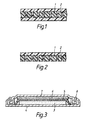
- Fig. 1 is a typical cross-section view of a separator according to Example 1 of the present invention.
- Fig. 2 is a typical cross-section view of a separator according to another example of the present invention.
- Fig. 3 is a typical cross section view of a coin type organic electrolyte lithium secondary battery.
- Fig. 4 is a charge-discharge cycle life characteristic curve of an organic electrolyte lithium secondary battery according to the present invention.
- Fig. 5 is a curve showing a relation between content ratio of organic electrolyte in gel electrolyte and ionic conductivity.
- Organic electrolyte and ultraviolet curing resin are mixed at 80:20 weight ratio to form ionic conductive gel electrolyte. The details of each component is this:
- the organic electrolyte consists of, for example, a mixed solvent of propylene carbonate and ethylene carbonate at volume ratio of 50:50 and lithiumperchlorate LiClO4 which is added as an electrolyte salt so that the organic electrolyte becomes 1 mol/dm 3 concentration.
- the ultraviolet curing resin is made of a mixture wherein fat group polyether oligomer is mixed with monomer of which frame is polyethylene oxide whose both ends have acrylate group at a weight ratio of 50:50, and photo polymerization initiator 1.0 wt% is added therein.
- the above polyethylene membrane is processed with polyethylene glycol alkyl ether of nonionic surface-active agent in order to gain enough lyophilic property, and then the above mixed solution is coated and impregnated to this membrane with a volume of 2.5 ⁇ l/cm 2 .
- ultraviolet ray is applied to the membrane to form ionic conductive gel electrolyte.
- oxygen acts as a polymerization prohibitor, which causes problems.
- applying ultraviolet ray raises temperature to distort the membrane as well as close the pores.
- the membrane impregnated by the mixture is contacted by a glass board coated by fluoroplastics as a release agent so that influences of oxygen and temperature rise can be prevented. Then ultra violet ray is applied.
- the micropores of the polyethylene microporous membrane 1 are filled with gel electrolyte, and also on the both faces of the membrane, the gel electrolyte layers 2 are formed.
- the separator of which thickness is 40 ⁇ m is produced, wherein microporous polyethylene membrane as a matrix is unified with ionic conductive gel electrolyte. This separator is called "a" hereinafter.
- This membrane is processed in a plasma irradiation equipment (Type Number EP4759 produced by Japan Vacuum Technology Co.,) under the condition of no more than 200 Pa vacuum value for five minutes in order to oxidize the separator for improving lyophilic property.
- this separator material is unified with the ionic conductive gel electrolyte to produce a separator "b" of which thickness is 45 ⁇ m.
- This separator "c" has a thickness of 30 ⁇ m.
- the microporous polyethylene membrane (Celgard k878) used in the 1st embodiment is used to be a conventional separator "d".
- a positive electrode 3 is a disc of which diameter is made by this process: Electrolytic manganese dioxide goes under heat treatment at 400 °C to turn into MnO 2 as a positive active material. This MnO 2 , carbon black as a conductive material and polytetrafluoroethylene as a binder are mixed at a weight ratio of 90: 5: 5 to produce positive mixture. This positive mixture is molded into a disc having a diameter of 14.2 mm.
- Electrolyte is made of a mixed solvent of propylene carbonate and 1, 2-dimethoxyethan at a volume ratio of 50:50 wherein lithium perchlorate is added so that a concentration of 1 mol/dm 3 is achieved. A specified amount of this electrolyte is applied to.
- the batteries are tested under this condition: The batteries are charged with 1.8 mA constant current upto 3.8V, then discharged with 1.8 mA for 3 hours (5.4 mAh), and repeat this operation. When a discharging voltage reaches 2.0V within 3 hours, discharge is stopped then.
- Fig. 4 shows the result of this charge and discharge test.
- the batteries “A”, “B” and “C” according to the present invention show better performances than the conventinal battery “D".
- the battery “A”, among others, shows the highest number of charge and discharge cycles because of the separator "a” processed with a surface-active agent.
- the pores of the separator matrix are filled with ionic conductive gel electrolyte completely as well as evenly so that dendrited lithium formed on the negative electrode can be prevented from penetrating through the pores of the separator matrix into the positive electrode, which avoids weak intnar shortcircuits.
- the batteries “B” and “C” show also great improvements in a characteristic of charge and discharge comparing with that of the conventional battery "D", for the separator matrix wherein lyophilic property is given by plasma application is filled completely by ionic conductive gel electrolyte into the pores, thus the shortening of battery cycle life due to internal shortcircuits is avoided as the battery "A" tells.
- Fig. 5 shows the ionic conductivity of the gel electrolyte measured at 25°C wherein a weight ratio of organic electrolyte and ultra violet curing resin is changed.
- a weight ratio of organic electrolyte and ultra violet curing resin is changed.
- the ionic conductivity of gel electrolyte depends on the content ratio of organic electrolyte. Since the lowering of the ratio sharply reduces the ionic conductivity, the content ratio of organic electrolyte hopefully maintains 50 wt% or more, and 80 wt% or less is preferable for the gel electrolyte having sufficient mechanical strength.
- the viscosity of the gel electrolyte also depends on the weight ratio of monomer and oligomer, both comprising the ultra violet curing resin.
- the weight ratio can be adjusted without affecting the forming of the gel electrolyte layer.
- adjusting a mixing ratio and a thickness of the gel electrolyte can vary an internal resistance of the battery, which makes it possible to change an internal resistance without changing the surface of electrode or cell structure. Therefore, a safety on the battery can be achieved even when a shortcircuit occurs outside.
- a coin type battery is used in the above embodiment, however, a cylindrical battery can be also used, for the separator according to the present invention is so flexible and thin that fits to the structure of spiral electrode plate group formed by wound positive and negative electrodes with a separator in between.
- LiAsF6, LiCF3SO3, LiN(CF3SO2)2 and so on can be used as an electrolyte salt.
- ⁇ -butyrolactone( ⁇ -BL), ⁇ -valerolactone( ⁇ -VL), dimethylsulfoxide(DMSO), 2-methyltetrahydofuran(2Me-THF), 1,4-dioxane, dimethoxyethane(DME), diethoxyethane(DEE), ethylacetate(EA), ethylpropionate(EP), diethylcarbonate(DEC) and so on can be used.
- LiCoO2, LiNiO2, LiMn2O4, LiV3O8, V2O5, V6O13 and so on can be used as an positive electrode.
- the separator according to the present invention proves that the dendrited lithium which is deposited on the negative electrode during charging is prevented from penetrating through the separator so that internal shortcircuits can be avoided. Further, adjusting the composition of gel electrolyte and thickness can control internal resistance, which can reduce danger when outside shortcircuits occur.
- the present invention thus offers a lithium secondary battery having high reliability and safety as well as having a scarce chance for an internal shortcircuit to occur.
Landscapes
- Chemical & Material Sciences (AREA)
- Chemical Kinetics & Catalysis (AREA)
- Electrochemistry (AREA)
- General Chemical & Material Sciences (AREA)
- Engineering & Computer Science (AREA)
- Manufacturing & Machinery (AREA)
- Physics & Mathematics (AREA)
- Condensed Matter Physics & Semiconductors (AREA)
- Dispersion Chemistry (AREA)
- General Physics & Mathematics (AREA)
- Inorganic Chemistry (AREA)
- Secondary Cells (AREA)
Claims (9)
- Ein Verfahren zur Herstellung eines Separators für eine Lithium-Sekundärbatterie, einschließend:eine lyophilische Verarbeitungsbehandlung mit einem Netzmittel auf einer mikroporösen Membrane als einer Separatormatrix, die aus Polyolefin hergestellt ist, das Polyethylen und/oder Polypropylen umfaßt,Imprägnieren der genannten Separatormatrix mit einer gemischten Lösung, worin die genannte gemischte Lösung hergestellt wird, indem organischer Elektrolyt und ultravioletthärtender Kunststoff vermischt werden, dessen Hauptbestandteile Oligomer und Monomer sind,und Entwickeln der genannten Separatormatrix auf einer Glasplattenoberfläche, die mit Fluorkunststoff beschichtet ist, dann Bestrahlen mit Ultraviolettstrahlung durch die genannte Glasplatte hindurch, um die genannte Mischung zu polymerisieren, wobei ein ionenleitfähiger Gelelektrolyt gebildet wird, der von der genannten Separatormatrix gehalten wird.
- Ein Verfahren zur Herstellung eines Separators für eine Lithium-Sekundärbatterie einschließend:liophilische Behandlung durch Oxidierung der Oberfläche der genannten Membrane durch Plasmabestrahlung auf einer mikroporösen Membrane als eine Separatormatrix, die aus Polyolefin hergestellt ist, das Polyethylen und/oder Polypropylen umfaßt,Imprägnieren der genannten Separatormatrix mit einer gemischten Lösung, worin die genannte gemischte Lösung hergestellt wird, indem organischer Elektrolyt und ultravioletthärtender Kunststoff vermischt werden, dessen Hauptbestandteile Oligomer und Monomer sind,und Entwickeln der genannten Separatormatrix auf einer Glasplattenoberfläche, die mit Fluorkunststoff beschichtet ist, dann Bestrahlen mit Ultraviolettstrahlung durch die genannte Glasplatte hindurch, um die genannte Mischung zu polymerisieren, wobei ein ionenleitfähiger Gelelektrolyt gebildet wird, der von der genannten Separatormatrix gehalten wird.
- Eine Lithium-Sekundärbatterie mit organischem Elektrolyten, umfassend:
eine Elektrodengruppe, die eine negative Elektrode, die aus entweder metallischem Lithium oder Lithiumlegierung hergestellt ist, worin Lithium als ein aktives Material arbeitet, und einer positiven Elektrode und einem Separator dazwischen, und organischen Elektrolyt einschließlich Lithiumsalz umfaßt, worin der genannte Separator aus einer Separatormatrix gebildet ist, die aus einer mikroporösen Polyolefinmembrane hergestellt ist, die den ionenleitenden Gelelektrolyten hält. - Eine Lithium-Sekundärbatterie mit organischem Elektrolyten, umfassend:
eine Elektrodengruppe, die eine negative Elektrode, die aus entweder metallischem Lithium oder Lithiumlegierung hergestellt ist, worin Lithium als ein aktives Material arbeitet, eine positive Elektrode und einem Separator dazwischen, und organischen Elektrolyt einschließlich Lithiumsalz umfaßt, worin der genannte Separator aus einer Separatormatrix gebildet ist, die aus einer mikroporösen Polyolefinmembrane hergestellt ist, deren Poren mit ionenleitendem Gelelektrolyt gefüllt und geschlossen sind, und die genannte Separatormatrix ein Flächenelement hat, bei dem wenigstens auf der die negative Elektrode berührenden Seite die genannte Gelelektrolytschicht gebildet ist. - Eine Lithium-Sekundärbatterie mit organischem Elektrolyten, gemäß Anspruch 3, worin der genannte Separator besteht aus:
einer mikroporösen Polyolefinmembrane und ionenleitendem Elektrolyten, der organischen Elektrolyten und ultravioletthärtendes Kunstharz umfaßt. - Eine Lithium-Sekundärbatterie mit organischem Elektrolyten, gemäß Anspruch 4, worin der genannte Separator besteht aus:
einer mikroporösen Polyolefinmembrane und ionenleitendem Elektrolyten, der organischen Elektrolyten und ultravioletthärtendes Kunstharz umfaßt. - Eine Lithium-Sekundärbatterie mit organischem Elektrolyten, gemäß Anspruch 3, 4, 5 oder 6, worin der genannte Separator besteht aus:
einer mikroporösen Polyolefinmembran und ionenleitendem Elektrolyt, der 80-20 Gew.-% organischen Elektrolyten und 20-50 Gew.-% organischen Elektrolyten und 20-50 Gew.-% ultravioletthärtendes Kunstharz umfaßt. - Eine Lithium-Sekundärbatterie mit organischem Elektrolyten, gemäß Anspruch 3, 4, 5 oder 6, worin der genannte Separator besteht aus:
einer mikroporösen Polyolefinmembran und ionenleitendem Gelelektrolyten, der organischen Elektrolyten von Lithiumsalz einschließt. - Eine Lithium-Sekundärbatterie mit organischem Elektrolyten, gemäß Anspruch 7, worin der genannte Separator besteht aus:
einer mikroporösen Polyolefinmembran und ionenleitendem Gelelektrolyten, der organischen Elektrolyten von Lithiumsalz einschließt.
Applications Claiming Priority (4)
| Application Number | Priority Date | Filing Date | Title |
|---|---|---|---|
| JP277829/93 | 1993-10-07 | ||
| JP27782993 | 1993-10-07 | ||
| JP306383/93 | 1993-12-07 | ||
| JP30638393 | 1993-12-07 |
Publications (2)
| Publication Number | Publication Date |
|---|---|
| EP0651455A1 EP0651455A1 (de) | 1995-05-03 |
| EP0651455B1 true EP0651455B1 (de) | 1997-07-30 |
Family
ID=26552582
Family Applications (1)
| Application Number | Title | Priority Date | Filing Date |
|---|---|---|---|
| EP94307362A Expired - Lifetime EP0651455B1 (de) | 1993-10-07 | 1994-10-06 | Herstellungsverfahren eines Separators für eine Lithium-Sekundärbatterie und eine Lithium-Sekundärbatterie mit organischem Elektrolyt, die einen solchen Separator verwendet |
Country Status (4)
| Country | Link |
|---|---|
| US (2) | US5597659A (de) |
| EP (1) | EP0651455B1 (de) |
| CA (1) | CA2117730C (de) |
| DE (1) | DE69404602T2 (de) |
Cited By (2)
| Publication number | Priority date | Publication date | Assignee | Title |
|---|---|---|---|---|
| US6849702B2 (en) | 1999-02-26 | 2005-02-01 | Robert W. Callahan | Polymer matrix material |
| US11437649B2 (en) | 2014-11-14 | 2022-09-06 | Medtronic, Inc. | Composite separator and electrolyte for solid state batteries |
Families Citing this family (78)
| Publication number | Priority date | Publication date | Assignee | Title |
|---|---|---|---|---|
| US6254978B1 (en) * | 1994-11-14 | 2001-07-03 | W. L. Gore & Associates, Inc. | Ultra-thin integral composite membrane |
| US5547551A (en) | 1995-03-15 | 1996-08-20 | W. L. Gore & Associates, Inc. | Ultra-thin integral composite membrane |
| US6054230A (en) * | 1994-12-07 | 2000-04-25 | Japan Gore-Tex, Inc. | Ion exchange and electrode assembly for an electrochemical cell |
| AU4253796A (en) * | 1994-12-09 | 1996-06-26 | Danionics A/S | A non-aqueous electrolyte system for use in batteries, capacitors or electrochromic devices and a method for the preparation thereof |
| US5547778A (en) * | 1995-07-13 | 1996-08-20 | Arthur D. Little, Inc. | Cavitand electrolytic cell and electrolytic process |
| JP3262708B2 (ja) * | 1996-03-26 | 2002-03-04 | 日本電信電話株式会社 | 複合高分子電解質膜 |
| US5772934A (en) * | 1996-05-24 | 1998-06-30 | W. R. Grace & Co.-Conn. | Process to produce lithium-polymer batteries |
| US5714278A (en) * | 1996-07-01 | 1998-02-03 | Valence Technology, Inc. | Edge-sealed battery separator |
| JPH1092444A (ja) | 1996-09-13 | 1998-04-10 | Japan Gore Tex Inc | 電気化学反応装置用固体高分子電解質複合体及びそれを用いた電気化学反応装置 |
| US5681357A (en) * | 1996-09-23 | 1997-10-28 | Motorola, Inc. | Gel electrolyte bonded rechargeable electrochemical cell and method of making same |
| US5665265A (en) * | 1996-09-23 | 1997-09-09 | Motorola, Inc., | Non woven gel electrolyte for electrochemical cells |
| US5853916A (en) * | 1996-10-28 | 1998-12-29 | Motorola, Inc. | Multi-layered polymeric gel electrolyte and electrochemical cell using same |
| JP3225864B2 (ja) * | 1996-12-04 | 2001-11-05 | 三菱電機株式会社 | リチウムイオン二次電池及びその製造方法 |
| KR100498563B1 (ko) * | 1996-12-11 | 2005-10-06 | 도넨카가쿠가부시키가이샤 | 비프로톤성전해질박막,고정화액막도전체및폴리머전지 |
| US6280881B1 (en) | 1996-12-20 | 2001-08-28 | Danionics A/S | Lithium secondary battery |
| WO1998037589A1 (en) * | 1997-02-21 | 1998-08-27 | Motorola Inc. | Polymeric electrolyte and electrochemical cell using same |
| US6635384B2 (en) * | 1998-03-06 | 2003-10-21 | Gore Enterprise Holdings, Inc. | Solid electrolyte composite for electrochemical reaction apparatus |
| US5837015A (en) * | 1997-09-26 | 1998-11-17 | Motorola, Inc. | Method of making a multilayered gel electrolyte bonded rechargeable electrochemical cell |
| JP4669980B2 (ja) * | 1997-11-27 | 2011-04-13 | 株式会社Gsユアサ | 薄形リチウム二次電池 |
| US6042965A (en) * | 1997-12-12 | 2000-03-28 | Johnson Research & Development Company, Inc. | Unitary separator and electrode structure and method of manufacturing separator |
| US6153337A (en) | 1997-12-19 | 2000-11-28 | Moltech Corporation | Separators for electrochemical cells |
| US6753114B2 (en) | 1998-04-20 | 2004-06-22 | Electrovaya Inc. | Composite electrolyte for a rechargeable lithium battery |
| US6190426B1 (en) | 1998-12-17 | 2001-02-20 | Moltech Corporation | Methods of preparing prismatic cells |
| US6277514B1 (en) | 1998-12-17 | 2001-08-21 | Moltech Corporation | Protective coating for separators for electrochemical cells |
| US6194098B1 (en) | 1998-12-17 | 2001-02-27 | Moltech Corporation | Protective coating for separators for electrochemical cells |
| JP4193267B2 (ja) * | 1999-02-23 | 2008-12-10 | ソニー株式会社 | 固体電解質電池 |
| US6358651B1 (en) * | 1999-02-26 | 2002-03-19 | Reveo, Inc. | Solid gel membrane separator in rechargeable electrochemical cells |
| US6605391B2 (en) | 1999-02-26 | 2003-08-12 | Reveo, Inc. | Solid gel membrane |
| WO2000060690A1 (en) * | 1999-03-31 | 2000-10-12 | Koninklijke Philips Electronics N.V. | Method of bonding a separator and an electrode, more particularly a cathode or an anode, as well as a battery |
| CN1258830C (zh) * | 1999-11-11 | 2006-06-07 | 皇家菲利浦电子有限公司 | 含凝胶电解质的锂电池 |
| JP4206182B2 (ja) * | 1999-12-27 | 2009-01-07 | 日東電工株式会社 | 微多孔フィルム |
| US6586138B2 (en) | 2000-02-04 | 2003-07-01 | Amtek Research International Llc | Freestanding microporous separator including a gel-forming polymer |
| JP2001229936A (ja) * | 2000-02-16 | 2001-08-24 | Toyota Central Res & Dev Lab Inc | 電解質膜およびその製造方法 |
| US6899967B2 (en) | 2000-04-10 | 2005-05-31 | Excellatron Solid State, Llc | Electrochemical conversion system |
| US6432586B1 (en) | 2000-04-10 | 2002-08-13 | Celgard Inc. | Separator for a high energy rechargeable lithium battery |
| US6709778B2 (en) | 2000-04-10 | 2004-03-23 | Johnson Electro Mechanical Systems, Llc | Electrochemical conversion system |
| US6686076B2 (en) | 2000-04-10 | 2004-02-03 | Excellatron Solid State, Llc | Electrochemical conversion system |
| US6737180B2 (en) | 2000-04-10 | 2004-05-18 | Johnson Electro Mechanical Systems, Llc | Electrochemical conversion system |
| US7943250B1 (en) | 2000-07-28 | 2011-05-17 | Johnson Research & Development Co., Inc. | Electrochemical conversion system for energy management |
| GB0021466D0 (en) | 2000-09-01 | 2000-10-18 | Univ Leeds Innovations Ltd | Extruded battery components |
| JP3858594B2 (ja) * | 2001-01-05 | 2006-12-13 | セイコーエプソン株式会社 | 液晶パネルのコントラストランク分けシステム及び方法 |
| CA2340798A1 (fr) * | 2001-03-13 | 2002-09-13 | Universite De Montreal | Compositions cathodiques et leurs utilisations, notamment dans les generateurs electrochimiques |
| US7501208B2 (en) * | 2001-06-01 | 2009-03-10 | Eveready Battery Company, Inc. | Doped manganese dioxides |
| KR100425585B1 (ko) * | 2001-11-22 | 2004-04-06 | 한국전자통신연구원 | 가교 고분자 보호박막을 갖춘 리튬 고분자 이차 전지 및그 제조 방법 |
| US7960054B2 (en) * | 2002-01-10 | 2011-06-14 | Excellatron Solid State Llc | Packaged thin film batteries |
| US20070094865A1 (en) * | 2002-01-10 | 2007-05-03 | Ji-Guang Zhang | Packaged thin film batteries and methods of packaging thin film batteries |
| JP4315769B2 (ja) * | 2003-09-25 | 2009-08-19 | 三洋電機株式会社 | リチウム二次電池 |
| US7731765B2 (en) | 2004-02-20 | 2010-06-08 | Excellatron Solid State, Llc | Air battery and manufacturing method |
| US10566669B2 (en) | 2004-02-20 | 2020-02-18 | Johnson Ip Holding, Llc | Lithium oxygen batteries having a carbon cloth current collector and method of producing same |
| US7422826B2 (en) * | 2004-04-07 | 2008-09-09 | Greatbatch Ltd. | In situ thermal polymerization method for making gel polymer lithium ion rechargeable electrochemical cells |
| US7901730B2 (en) * | 2004-04-26 | 2011-03-08 | Johnson Research & Development Co., Inc. | Thin film ceramic proton conducting electrolyte |
| MX2007001821A (es) * | 2004-08-13 | 2007-07-16 | Univ Mcmaster | Material compuesto que contiene un polimero en gel no reticulado. |
| US8568921B1 (en) | 2004-08-18 | 2013-10-29 | Excellatron Solid State Llc | Regenerative ion exchange fuel cell |
| US7540886B2 (en) * | 2005-10-11 | 2009-06-02 | Excellatron Solid State, Llc | Method of manufacturing lithium battery |
| KR100686848B1 (ko) * | 2005-10-11 | 2007-02-26 | 삼성에스디아이 주식회사 | 리튬 이차 전지 |
| US8883354B2 (en) | 2006-02-15 | 2014-11-11 | Optodot Corporation | Separators for electrochemical cells |
| US20080118848A1 (en) * | 2006-11-16 | 2008-05-22 | Electronics & Telecommunications Research Institute | Aqeuous electrolyte composition and sealed-type primary film battery including electrolyte layer formed of the aqueous electrolyte composition |
| JP2009199825A (ja) * | 2008-02-20 | 2009-09-03 | Sumitomo Chemical Co Ltd | 電極群を有するデバイス |
| WO2009117496A2 (en) * | 2008-03-20 | 2009-09-24 | Excellatron Solid State, Llc | Oxygen battery system |
| WO2010138177A1 (en) | 2009-05-26 | 2010-12-02 | Steven Allen Carlson | Lithium batteries utilizing nanoporous separator layers |
| WO2011096564A1 (ja) * | 2010-02-05 | 2011-08-11 | ダイキン工業株式会社 | 二次電池用ゲル電解質複合フィルム、及び、二次電池 |
| CN106784556A (zh) | 2010-07-19 | 2017-05-31 | 奥普图多特公司 | 用于电化学电池的隔膜 |
| KR101683200B1 (ko) * | 2012-09-20 | 2016-12-06 | 삼성에스디아이 주식회사 | 리튬 이차 전지용 전해액 및 이를 포함하는 리튬 이차 전지 |
| KR102236436B1 (ko) | 2013-04-29 | 2021-04-06 | 옵토도트 코포레이션 | 증가된 열 전도율을 갖는 나노기공성 복합체 분리기들 |
| EP3158604B1 (de) | 2014-06-17 | 2019-04-24 | Medtronic, Inc. | Halbfeste elektrolyte für batterien |
| US10381623B2 (en) | 2015-07-09 | 2019-08-13 | Optodot Corporation | Nanoporous separators for batteries and related manufacturing methods |
| US12040506B2 (en) | 2015-04-15 | 2024-07-16 | Lg Energy Solution, Ltd. | Nanoporous separators for batteries and related manufacturing methods |
| KR20170041470A (ko) * | 2015-10-07 | 2017-04-17 | 주식회사 엘지화학 | 전극조립체를 구성하는 분리막의 기공 내에 겔화 전해액 성분을 포함하고 있는 전지셀 |
| US10587005B2 (en) | 2016-03-30 | 2020-03-10 | Wildcat Discovery Technologies, Inc. | Solid electrolyte compositions |
| US10804565B2 (en) * | 2017-07-31 | 2020-10-13 | Robert Bosch Gmbh | Batteries with polymer electrolyte composites based on tetrahedral arylborate nodes |
| CN109382291A (zh) * | 2018-09-07 | 2019-02-26 | 珠海恩捷新材料科技有限公司 | 一种油性锂电池隔膜涂布处理方法和装置 |
| EP3787092A4 (de) * | 2018-12-06 | 2021-09-01 | Lg Chem, Ltd. | Festelektrolytmembran, verfahren zur herstellung davon und festkörperbatterie damit |
| US11462804B2 (en) | 2019-01-08 | 2022-10-04 | TeraWatt Technology Inc. | Systems and methods to control lithium plating |
| BR112023022296A2 (pt) | 2021-04-29 | 2023-12-26 | 24M Tech Inc | Células eletroquímicas com múltiplos separadores, e métodos de produção das mesmas |
| CN113540575A (zh) * | 2021-06-24 | 2021-10-22 | 西安交通大学 | 一种改性隔膜-电解液一体化固态电解质的制备方法及电池 |
| JP2025513531A (ja) * | 2022-04-25 | 2025-04-24 | セラニーズ・インターナショナル・コーポレーション | 酸化多孔質フィルム |
| TW202443944A (zh) | 2022-12-16 | 2024-11-01 | 美商24M科技公司 | 用於最小化及預防電化電池中形成枝晶的系統及方法 |
| US12431545B1 (en) | 2024-03-26 | 2025-09-30 | 24M Technologies, Inc. | Systems and methods for minimizing and preventing dendrite formation in electrochemical cells |
Family Cites Families (22)
| Publication number | Priority date | Publication date | Assignee | Title |
|---|---|---|---|---|
| JPS61214364A (ja) * | 1985-03-19 | 1986-09-24 | Hitachi Maxell Ltd | 薄型リチウム電池 |
| US4748542A (en) * | 1985-05-20 | 1988-05-31 | The Mead Corporation | Solid state electrochemical device |
| US4849311A (en) * | 1986-09-24 | 1989-07-18 | Toa Nenryo Kogyo Kabushiki Kaisha | Immobilized electrolyte membrane |
| US4830939B1 (en) * | 1987-10-30 | 1996-10-08 | Mhb Joint Venture | Radiation cured solid electrolytes and electrochemical devices employing the same |
| GB8804860D0 (en) * | 1988-03-01 | 1988-03-30 | Ici Plc | Solid electrolyte devices |
| US5166008A (en) * | 1988-03-31 | 1992-11-24 | Canon Kabushiki Kaisha | Polymer gel-coated conductor, method of producing the same, and electric cell making use of the same |
| JPH01319250A (ja) * | 1988-06-17 | 1989-12-25 | Fuji Elelctrochem Co Ltd | リチウム電池 |
| CA1321617C (en) * | 1988-09-12 | 1993-08-24 | Mhb Joint Venture (A Partnership) | Ultrathin polymer electrolyte having high conductivity |
| JP2715309B2 (ja) * | 1988-09-20 | 1998-02-18 | 宇部興産株式会社 | 半固体高分子電解質膜およびそれを用いたリチウム電池 |
| JPH02162651A (ja) * | 1988-12-16 | 1990-06-22 | Ube Ind Ltd | 円筒型リチウム電池 |
| US4925752A (en) * | 1989-03-03 | 1990-05-15 | Fauteux Denis G | Solid state electrochemical cell having porous cathode current collector |
| JPH0384807A (ja) * | 1989-08-28 | 1991-04-10 | Yuasa Battery Co Ltd | 高分子固体電解質 |
| JPH03129678A (ja) * | 1989-10-13 | 1991-06-03 | Fuji Elelctrochem Co Ltd | 非水電解液二次電池 |
| US5030527A (en) * | 1990-01-08 | 1991-07-09 | Ultracell Incorporated | Radiation cured solid aqueous electrolytes and electrochemical devices employing the same |
| DE4190481C2 (de) * | 1990-03-16 | 1997-05-28 | Ricoh Kk | Fester Elektrolyt, Verfahren zu dessen Herstellung und dessen Verwendung |
| JPH0821390B2 (ja) * | 1990-05-31 | 1996-03-04 | 第一工業製薬株式会社 | 電 池 |
| JPH0451473A (ja) * | 1990-06-18 | 1992-02-19 | Nippon Telegr & Teleph Corp <Ntt> | 非水電解液二次電池 |
| GB2245411A (en) * | 1990-06-20 | 1992-01-02 | Dowty Electronic Components | Folded solid state battery. |
| US5281491A (en) * | 1991-12-20 | 1994-01-25 | W. R. Grace & Co. | Battery separator |
| US5273694A (en) * | 1992-08-28 | 1993-12-28 | E. I. Du Pont De Nemours And Company | Process for making ion exchange membranes and films |
| US5447636A (en) * | 1993-12-14 | 1995-09-05 | E. I. Du Pont De Nemours And Company | Method for making reinforced ion exchange membranes |
| US5554414A (en) * | 1995-04-12 | 1996-09-10 | Millipore Investment Holdings Limited | Process for forming membrane having a hydrophobic fluoropolymer surface |
-
1994
- 1994-10-06 EP EP94307362A patent/EP0651455B1/de not_active Expired - Lifetime
- 1994-10-06 DE DE69404602T patent/DE69404602T2/de not_active Expired - Fee Related
- 1994-10-07 US US08/319,738 patent/US5597659A/en not_active Expired - Lifetime
- 1994-10-07 CA CA002117730A patent/CA2117730C/en not_active Expired - Fee Related
-
1997
- 1997-01-21 US US08/785,093 patent/US5691005A/en not_active Expired - Fee Related
Cited By (3)
| Publication number | Priority date | Publication date | Assignee | Title |
|---|---|---|---|---|
| US6849702B2 (en) | 1999-02-26 | 2005-02-01 | Robert W. Callahan | Polymer matrix material |
| US11437649B2 (en) | 2014-11-14 | 2022-09-06 | Medtronic, Inc. | Composite separator and electrolyte for solid state batteries |
| US12170352B2 (en) | 2014-11-14 | 2024-12-17 | Medtronic, Inc. | Composite separator and electrolyte for electrochemical cells |
Also Published As
| Publication number | Publication date |
|---|---|
| US5597659A (en) | 1997-01-28 |
| DE69404602T2 (de) | 1998-01-29 |
| US5691005A (en) | 1997-11-25 |
| DE69404602D1 (de) | 1997-09-04 |
| EP0651455A1 (de) | 1995-05-03 |
| CA2117730C (en) | 2006-09-19 |
| CA2117730A1 (en) | 1995-04-08 |
Similar Documents
| Publication | Publication Date | Title |
|---|---|---|
| US5691005A (en) | Manufacturing method of a separator for a lithium secondary battery and an organic electrolyte lithium secondary battery using the same separator | |
| KR100759541B1 (ko) | 폴리머 리튬 전지 및 그 제조방법 | |
| US7582388B2 (en) | Non-aqueous solvent secondary battery | |
| US7135254B2 (en) | Multi-layered, UV-cured polymer electrolyte and lithium secondary battery comprising the same | |
| CA2245048C (en) | Method of preparing lithium ion polymer battery | |
| KR100331209B1 (ko) | 비수전해액2차전지 | |
| KR100325868B1 (ko) | 유기전해액 및 이를 채용한 리튬 2차전지 | |
| KR100587437B1 (ko) | 비수 전해질 이차 전지 | |
| KR100573109B1 (ko) | 유기 전해액 및 이를 채용한 리튬 전지 | |
| EP1063720B1 (de) | Batterie mit nichtwässrigen Elektrolyten | |
| JP2002117899A (ja) | リチウムポリマー電池およびその製造法 | |
| KR102755851B1 (ko) | 전기화학 소자 및 이의 제조방법 | |
| KR20200099891A (ko) | 전기화학 소자 및 이의 제조방법 | |
| US5789107A (en) | Nonaqueous polymer battery | |
| EP1176660A2 (de) | Nicht-wässrige Elektrolyt-Sekundärbatterie | |
| KR100306870B1 (ko) | 폴리머전해질및이것을사용한리튬-폴리머전지 | |
| JPH10261437A (ja) | ポリマ電解質およびそれを用いたリチウム・ポリマ電池 | |
| JP2004200122A (ja) | 非水電解質二次電池の製造方法 | |
| KR100404884B1 (ko) | 비수성전해액이차전지 | |
| JPH05303980A (ja) | イオン伝導性高分子化合物及びその製造方法 | |
| CN1194278A (zh) | 聚合物电解质和使用该电解质的锂-聚合物电池 | |
| JP3480873B2 (ja) | 対熱安全性を具備した固体ポリマー電解質二次電池 | |
| JP2001167794A (ja) | 非水電解質電池 | |
| JPH08241733A (ja) | リチウム二次電池 | |
| JP3566858B2 (ja) | 非水電解質電池 |
Legal Events
| Date | Code | Title | Description |
|---|---|---|---|
| PUAI | Public reference made under article 153(3) epc to a published international application that has entered the european phase |
Free format text: ORIGINAL CODE: 0009012 |
|
| AK | Designated contracting states |
Kind code of ref document: A1 Designated state(s): DE FR GB IT |
|
| 17P | Request for examination filed |
Effective date: 19950602 |
|
| 17Q | First examination report despatched |
Effective date: 19951019 |
|
| GRAG | Despatch of communication of intention to grant |
Free format text: ORIGINAL CODE: EPIDOS AGRA |
|
| GRAH | Despatch of communication of intention to grant a patent |
Free format text: ORIGINAL CODE: EPIDOS IGRA |
|
| GRAH | Despatch of communication of intention to grant a patent |
Free format text: ORIGINAL CODE: EPIDOS IGRA |
|
| GRAA | (expected) grant |
Free format text: ORIGINAL CODE: 0009210 |
|
| AK | Designated contracting states |
Kind code of ref document: B1 Designated state(s): DE FR GB IT |
|
| REF | Corresponds to: |
Ref document number: 69404602 Country of ref document: DE Date of ref document: 19970904 |
|
| ET | Fr: translation filed | ||
| PLBE | No opposition filed within time limit |
Free format text: ORIGINAL CODE: 0009261 |
|
| STAA | Information on the status of an ep patent application or granted ep patent |
Free format text: STATUS: NO OPPOSITION FILED WITHIN TIME LIMIT |
|
| 26N | No opposition filed | ||
| REG | Reference to a national code |
Ref country code: GB Ref legal event code: IF02 |
|
| PGFP | Annual fee paid to national office [announced via postgrant information from national office to epo] |
Ref country code: DE Payment date: 20060928 Year of fee payment: 13 |
|
| PGFP | Annual fee paid to national office [announced via postgrant information from national office to epo] |
Ref country code: GB Payment date: 20061004 Year of fee payment: 13 |
|
| PGFP | Annual fee paid to national office [announced via postgrant information from national office to epo] |
Ref country code: IT Payment date: 20061031 Year of fee payment: 13 |
|
| GBPC | Gb: european patent ceased through non-payment of renewal fee |
Effective date: 20071006 |
|
| PG25 | Lapsed in a contracting state [announced via postgrant information from national office to epo] |
Ref country code: DE Free format text: LAPSE BECAUSE OF NON-PAYMENT OF DUE FEES Effective date: 20080501 |
|
| REG | Reference to a national code |
Ref country code: FR Ref legal event code: ST Effective date: 20080630 |
|
| PGFP | Annual fee paid to national office [announced via postgrant information from national office to epo] |
Ref country code: FR Payment date: 20061010 Year of fee payment: 13 |
|
| PG25 | Lapsed in a contracting state [announced via postgrant information from national office to epo] |
Ref country code: GB Free format text: LAPSE BECAUSE OF NON-PAYMENT OF DUE FEES Effective date: 20071006 |
|
| PG25 | Lapsed in a contracting state [announced via postgrant information from national office to epo] |
Ref country code: FR Free format text: LAPSE BECAUSE OF NON-PAYMENT OF DUE FEES Effective date: 20071031 |
|
| PG25 | Lapsed in a contracting state [announced via postgrant information from national office to epo] |
Ref country code: IT Free format text: LAPSE BECAUSE OF NON-PAYMENT OF DUE FEES Effective date: 20071006 |