EP0655647A1 - Farbfilter, Verfahren zu seiner Herstellung, und Flüssigkristallschirm - Google Patents
Farbfilter, Verfahren zu seiner Herstellung, und Flüssigkristallschirm Download PDFInfo
- Publication number
- EP0655647A1 EP0655647A1 EP94118432A EP94118432A EP0655647A1 EP 0655647 A1 EP0655647 A1 EP 0655647A1 EP 94118432 A EP94118432 A EP 94118432A EP 94118432 A EP94118432 A EP 94118432A EP 0655647 A1 EP0655647 A1 EP 0655647A1
- Authority
- EP
- European Patent Office
- Prior art keywords
- color filter
- portions
- resin layer
- substrate
- light irradiation
- Prior art date
- Legal status (The legal status is an assumption and is not a legal conclusion. Google has not performed a legal analysis and makes no representation as to the accuracy of the status listed.)
- Granted
Links
- 239000004973 liquid crystal related substance Substances 0.000 title claims description 126
- 238000000034 method Methods 0.000 title claims description 109
- 238000004519 manufacturing process Methods 0.000 title claims description 51
- 229920005989 resin Polymers 0.000 claims abstract description 198
- 239000011347 resin Substances 0.000 claims abstract description 198
- 239000000758 substrate Substances 0.000 claims abstract description 135
- 239000003086 colorant Substances 0.000 claims abstract description 32
- 239000010410 layer Substances 0.000 claims description 256
- 238000010438 heat treatment Methods 0.000 claims description 105
- 239000011342 resin composition Substances 0.000 claims description 80
- 239000000203 mixture Substances 0.000 claims description 66
- 239000011241 protective layer Substances 0.000 claims description 51
- 150000001875 compounds Chemical class 0.000 claims description 33
- 125000004432 carbon atom Chemical group C* 0.000 claims description 23
- 239000000178 monomer Substances 0.000 claims description 21
- 125000000217 alkyl group Chemical group 0.000 claims description 17
- 125000004435 hydrogen atom Chemical group [H]* 0.000 claims description 17
- WLOQLWBIJZDHET-UHFFFAOYSA-N triphenylsulfonium Chemical class C1=CC=CC=C1[S+](C=1C=CC=CC=1)C1=CC=CC=C1 WLOQLWBIJZDHET-UHFFFAOYSA-N 0.000 claims description 15
- OZLBDYMWFAHSOQ-UHFFFAOYSA-N diphenyliodanium Chemical class C=1C=CC=CC=1[I+]C1=CC=CC=C1 OZLBDYMWFAHSOQ-UHFFFAOYSA-N 0.000 claims description 14
- 239000000463 material Substances 0.000 claims description 13
- 150000003918 triazines Chemical class 0.000 claims description 13
- 229920001577 copolymer Polymers 0.000 claims description 12
- 229910052739 hydrogen Inorganic materials 0.000 claims description 12
- 239000001257 hydrogen Substances 0.000 claims description 12
- 239000004925 Acrylic resin Substances 0.000 claims description 11
- 229920000178 Acrylic resin Polymers 0.000 claims description 11
- 238000004544 sputter deposition Methods 0.000 claims description 10
- 238000007740 vapor deposition Methods 0.000 claims description 8
- 125000000391 vinyl group Chemical group [H]C([*])=C([H])[H] 0.000 claims description 8
- 229920002554 vinyl polymer Polymers 0.000 claims description 8
- 125000001997 phenyl group Chemical group [H]C1=C([H])C([H])=C(*)C([H])=C1[H] 0.000 claims description 7
- 230000007423 decrease Effects 0.000 claims description 6
- 229920001519 homopolymer Polymers 0.000 claims description 6
- 238000009877 rendering Methods 0.000 claims description 6
- 125000002947 alkylene group Chemical group 0.000 claims description 5
- 125000003118 aryl group Chemical group 0.000 claims description 5
- 125000002496 methyl group Chemical group [H]C([H])([H])* 0.000 claims description 5
- 125000000843 phenylene group Chemical group C1(=C(C=CC=C1)*)* 0.000 claims description 5
- 125000003808 silyl group Chemical class [H][Si]([H])([H])[*] 0.000 claims description 5
- 239000002253 acid Substances 0.000 claims description 2
- 239000000976 ink Substances 0.000 description 139
- 125000002887 hydroxy group Chemical group [H]O* 0.000 description 39
- 230000007547 defect Effects 0.000 description 37
- 230000003287 optical effect Effects 0.000 description 36
- 239000011521 glass Substances 0.000 description 34
- 239000010408 film Substances 0.000 description 33
- 239000011159 matrix material Substances 0.000 description 24
- 229920001187 thermosetting polymer Polymers 0.000 description 23
- 238000001035 drying Methods 0.000 description 15
- 238000006243 chemical reaction Methods 0.000 description 12
- 238000000576 coating method Methods 0.000 description 11
- 230000015572 biosynthetic process Effects 0.000 description 10
- 239000011248 coating agent Substances 0.000 description 10
- -1 methylol melamine Chemical class 0.000 description 10
- 238000000862 absorption spectrum Methods 0.000 description 9
- 239000000049 pigment Substances 0.000 description 9
- 102100033806 Alpha-protein kinase 3 Human genes 0.000 description 6
- 101710082399 Alpha-protein kinase 3 Proteins 0.000 description 6
- 238000004043 dyeing Methods 0.000 description 6
- 230000000694 effects Effects 0.000 description 6
- 238000001228 spectrum Methods 0.000 description 6
- 229920002818 (Hydroxyethyl)methacrylate Polymers 0.000 description 5
- WOBHKFSMXKNTIM-UHFFFAOYSA-N Hydroxyethyl methacrylate Chemical compound CC(=C)C(=O)OCCO WOBHKFSMXKNTIM-UHFFFAOYSA-N 0.000 description 5
- 229920002153 Hydroxypropyl cellulose Polymers 0.000 description 5
- 238000004132 cross linking Methods 0.000 description 5
- 239000001863 hydroxypropyl cellulose Substances 0.000 description 5
- 235000010977 hydroxypropyl cellulose Nutrition 0.000 description 5
- 239000003999 initiator Substances 0.000 description 5
- 238000000059 patterning Methods 0.000 description 5
- 239000000126 substance Substances 0.000 description 5
- 229920000663 Hydroxyethyl cellulose Polymers 0.000 description 4
- 239000004354 Hydroxyethyl cellulose Substances 0.000 description 4
- VVQNEPGJFQJSBK-UHFFFAOYSA-N Methyl methacrylate Chemical compound COC(=O)C(C)=C VVQNEPGJFQJSBK-UHFFFAOYSA-N 0.000 description 4
- CNCOEDDPFOAUMB-UHFFFAOYSA-N N-Methylolacrylamide Chemical compound OCNC(=O)C=C CNCOEDDPFOAUMB-UHFFFAOYSA-N 0.000 description 4
- VYPSYNLAJGMNEJ-UHFFFAOYSA-N Silicium dioxide Chemical compound O=[Si]=O VYPSYNLAJGMNEJ-UHFFFAOYSA-N 0.000 description 4
- XUIMIQQOPSSXEZ-UHFFFAOYSA-N Silicon Chemical compound [Si] XUIMIQQOPSSXEZ-UHFFFAOYSA-N 0.000 description 4
- MBHRHUJRKGNOKX-UHFFFAOYSA-N [(4,6-diamino-1,3,5-triazin-2-yl)amino]methanol Chemical compound NC1=NC(N)=NC(NCO)=N1 MBHRHUJRKGNOKX-UHFFFAOYSA-N 0.000 description 4
- 125000003545 alkoxy group Chemical group 0.000 description 4
- IISBACLAFKSPIT-UHFFFAOYSA-N bisphenol A Chemical compound C=1C=C(O)C=CC=1C(C)(C)C1=CC=C(O)C=C1 IISBACLAFKSPIT-UHFFFAOYSA-N 0.000 description 4
- 239000012952 cationic photoinitiator Substances 0.000 description 4
- 238000004040 coloring Methods 0.000 description 4
- 235000019447 hydroxyethyl cellulose Nutrition 0.000 description 4
- 229920003986 novolac Polymers 0.000 description 4
- 239000010703 silicon Substances 0.000 description 4
- 229910052710 silicon Inorganic materials 0.000 description 4
- CERQOIWHTDAKMF-UHFFFAOYSA-M Methacrylate Chemical compound CC(=C)C([O-])=O CERQOIWHTDAKMF-UHFFFAOYSA-M 0.000 description 3
- 229920002678 cellulose Polymers 0.000 description 3
- 239000001913 cellulose Substances 0.000 description 3
- 238000004070 electrodeposition Methods 0.000 description 3
- 239000003822 epoxy resin Substances 0.000 description 3
- 229920000647 polyepoxide Polymers 0.000 description 3
- 230000002265 prevention Effects 0.000 description 3
- KCTAWXVAICEBSD-UHFFFAOYSA-N prop-2-enoyloxy prop-2-eneperoxoate Chemical compound C=CC(=O)OOOC(=O)C=C KCTAWXVAICEBSD-UHFFFAOYSA-N 0.000 description 3
- GHYOCDFICYLMRF-UTIIJYGPSA-N (2S,3R)-N-[(2S)-3-(cyclopenten-1-yl)-1-[(2R)-2-methyloxiran-2-yl]-1-oxopropan-2-yl]-3-hydroxy-3-(4-methoxyphenyl)-2-[[(2S)-2-[(2-morpholin-4-ylacetyl)amino]propanoyl]amino]propanamide Chemical compound C1(=CCCC1)C[C@@H](C(=O)[C@@]1(OC1)C)NC([C@H]([C@@H](C1=CC=C(C=C1)OC)O)NC([C@H](C)NC(CN1CCOCC1)=O)=O)=O GHYOCDFICYLMRF-UTIIJYGPSA-N 0.000 description 2
- JYEUMXHLPRZUAT-UHFFFAOYSA-N 1,2,3-triazine Chemical group C1=CN=NN=C1 JYEUMXHLPRZUAT-UHFFFAOYSA-N 0.000 description 2
- ZTEVZRQIBGJEHG-UHFFFAOYSA-N 2-naphthalen-1-yl-4,6-bis(trichloromethyl)-1,3,5-triazine Chemical compound ClC(Cl)(Cl)C1=NC(C(Cl)(Cl)Cl)=NC(C=2C3=CC=CC=C3C=CC=2)=N1 ZTEVZRQIBGJEHG-UHFFFAOYSA-N 0.000 description 2
- IXAUCVOJRVFRBJ-UHFFFAOYSA-N 4-(trichloromethyl)triazine Chemical compound ClC(Cl)(Cl)C1=CC=NN=N1 IXAUCVOJRVFRBJ-UHFFFAOYSA-N 0.000 description 2
- VVJKKWFAADXIJK-UHFFFAOYSA-N Allylamine Chemical compound NCC=C VVJKKWFAADXIJK-UHFFFAOYSA-N 0.000 description 2
- 229920002134 Carboxymethyl cellulose Polymers 0.000 description 2
- HEDRZPFGACZZDS-UHFFFAOYSA-N Chloroform Chemical compound ClC(Cl)Cl HEDRZPFGACZZDS-UHFFFAOYSA-N 0.000 description 2
- RTZKZFJDLAIYFH-UHFFFAOYSA-N Diethyl ether Chemical compound CCOCC RTZKZFJDLAIYFH-UHFFFAOYSA-N 0.000 description 2
- 238000005033 Fourier transform infrared spectroscopy Methods 0.000 description 2
- 229920001479 Hydroxyethyl methyl cellulose Polymers 0.000 description 2
- BAPJBEWLBFYGME-UHFFFAOYSA-N Methyl acrylate Chemical compound COC(=O)C=C BAPJBEWLBFYGME-UHFFFAOYSA-N 0.000 description 2
- PPBRXRYQALVLMV-UHFFFAOYSA-N Styrene Chemical compound C=CC1=CC=CC=C1 PPBRXRYQALVLMV-UHFFFAOYSA-N 0.000 description 2
- NIXOWILDQLNWCW-UHFFFAOYSA-N acrylic acid group Chemical group C(C=C)(=O)O NIXOWILDQLNWCW-UHFFFAOYSA-N 0.000 description 2
- 125000003277 amino group Chemical group 0.000 description 2
- MWPLVEDNUUSJAV-UHFFFAOYSA-N anthracene Chemical compound C1=CC=CC2=CC3=CC=CC=C3C=C21 MWPLVEDNUUSJAV-UHFFFAOYSA-N 0.000 description 2
- 239000001768 carboxy methyl cellulose Substances 0.000 description 2
- 235000010948 carboxy methyl cellulose Nutrition 0.000 description 2
- 239000008112 carboxymethyl-cellulose Substances 0.000 description 2
- 229910052681 coesite Inorganic materials 0.000 description 2
- 229940125797 compound 12 Drugs 0.000 description 2
- 229910052906 cristobalite Inorganic materials 0.000 description 2
- 239000003431 cross linking reagent Substances 0.000 description 2
- 238000003618 dip coating Methods 0.000 description 2
- SBQIJPBUMNWUKN-UHFFFAOYSA-M diphenyliodanium;trifluoromethanesulfonate Chemical compound [O-]S(=O)(=O)C(F)(F)F.C=1C=CC=CC=1[I+]C1=CC=CC=C1 SBQIJPBUMNWUKN-UHFFFAOYSA-M 0.000 description 2
- 239000006185 dispersion Substances 0.000 description 2
- 125000005843 halogen group Chemical group 0.000 description 2
- 229920003112 high viscosity grade hydroxypropyl cellulose Polymers 0.000 description 2
- 229910010272 inorganic material Inorganic materials 0.000 description 2
- 239000011147 inorganic material Substances 0.000 description 2
- 239000001923 methylcellulose Substances 0.000 description 2
- 235000010981 methylcellulose Nutrition 0.000 description 2
- 238000012986 modification Methods 0.000 description 2
- 230000004048 modification Effects 0.000 description 2
- LSWADWIFYOAQRZ-UHFFFAOYSA-N n-(ethoxymethyl)prop-2-enamide Chemical compound CCOCNC(=O)C=C LSWADWIFYOAQRZ-UHFFFAOYSA-N 0.000 description 2
- 150000002894 organic compounds Chemical class 0.000 description 2
- 238000000206 photolithography Methods 0.000 description 2
- 229920000642 polymer Polymers 0.000 description 2
- 238000004445 quantitative analysis Methods 0.000 description 2
- 150000003839 salts Chemical class 0.000 description 2
- 239000000377 silicon dioxide Substances 0.000 description 2
- 235000012239 silicon dioxide Nutrition 0.000 description 2
- 238000010183 spectrum analysis Methods 0.000 description 2
- 238000004528 spin coating Methods 0.000 description 2
- 238000005507 spraying Methods 0.000 description 2
- 229910052682 stishovite Inorganic materials 0.000 description 2
- 229910052905 tridymite Inorganic materials 0.000 description 2
- 125000000026 trimethylsilyl group Chemical class [H]C([H])([H])[Si]([*])(C([H])([H])[H])C([H])([H])[H] 0.000 description 2
- FAYMLNNRGCYLSR-UHFFFAOYSA-M triphenylsulfonium triflate Chemical compound [O-]S(=O)(=O)C(F)(F)F.C1=CC=CC=C1[S+](C=1C=CC=CC=1)C1=CC=CC=C1 FAYMLNNRGCYLSR-UHFFFAOYSA-M 0.000 description 2
- 238000005406 washing Methods 0.000 description 2
- XLYOFNOQVPJJNP-UHFFFAOYSA-N water Substances O XLYOFNOQVPJJNP-UHFFFAOYSA-N 0.000 description 2
- WJFKNYWRSNBZNX-UHFFFAOYSA-N 10H-phenothiazine Chemical compound C1=CC=C2NC3=CC=CC=C3SC2=C1 WJFKNYWRSNBZNX-UHFFFAOYSA-N 0.000 description 1
- SMZOUWXMTYCWNB-UHFFFAOYSA-N 2-(2-methoxy-5-methylphenyl)ethanamine Chemical compound COC1=CC=C(C)C=C1CCN SMZOUWXMTYCWNB-UHFFFAOYSA-N 0.000 description 1
- DQMOHZLFVGYNAN-UHFFFAOYSA-N 2-(2-phenylethenyl)-4,6-bis(trichloromethyl)-1,3,5-triazine Chemical compound ClC(Cl)(Cl)C1=NC(C(Cl)(Cl)Cl)=NC(C=CC=2C=CC=CC=2)=N1 DQMOHZLFVGYNAN-UHFFFAOYSA-N 0.000 description 1
- QRHHZFRCJDAUNA-UHFFFAOYSA-N 2-(4-methoxyphenyl)-4,6-bis(trichloromethyl)-1,3,5-triazine Chemical compound C1=CC(OC)=CC=C1C1=NC(C(Cl)(Cl)Cl)=NC(C(Cl)(Cl)Cl)=N1 QRHHZFRCJDAUNA-UHFFFAOYSA-N 0.000 description 1
- JENKIIWNWASCFW-VOTSOKGWSA-N 2-[(e)-2-(4-methylphenyl)ethenyl]-4,6-bis(trichloromethyl)-1,3,5-triazine Chemical compound C1=CC(C)=CC=C1\C=C\C1=NC(C(Cl)(Cl)Cl)=NC(C(Cl)(Cl)Cl)=N1 JENKIIWNWASCFW-VOTSOKGWSA-N 0.000 description 1
- JENKIIWNWASCFW-UHFFFAOYSA-N 2-[2-(4-methylphenyl)ethenyl]-4,6-bis(trichloromethyl)-1,3,5-triazine Chemical compound C1=CC(C)=CC=C1C=CC1=NC(C(Cl)(Cl)Cl)=NC(C(Cl)(Cl)Cl)=N1 JENKIIWNWASCFW-UHFFFAOYSA-N 0.000 description 1
- SVONRAPFKPVNKG-UHFFFAOYSA-N 2-ethoxyethyl acetate Chemical compound CCOCCOC(C)=O SVONRAPFKPVNKG-UHFFFAOYSA-N 0.000 description 1
- OMIGHNLMNHATMP-UHFFFAOYSA-N 2-hydroxyethyl prop-2-enoate Chemical compound OCCOC(=O)C=C OMIGHNLMNHATMP-UHFFFAOYSA-N 0.000 description 1
- HAZQZUFYRLFOLC-UHFFFAOYSA-N 2-phenyl-4,6-bis(trichloromethyl)-1,3,5-triazine Chemical compound ClC(Cl)(Cl)C1=NC(C(Cl)(Cl)Cl)=NC(C=2C=CC=CC=2)=N1 HAZQZUFYRLFOLC-UHFFFAOYSA-N 0.000 description 1
- HRPVXLWXLXDGHG-UHFFFAOYSA-N Acrylamide Chemical compound NC(=O)C=C HRPVXLWXLXDGHG-UHFFFAOYSA-N 0.000 description 1
- NLHHRLWOUZZQLW-UHFFFAOYSA-N Acrylonitrile Chemical compound C=CC#N NLHHRLWOUZZQLW-UHFFFAOYSA-N 0.000 description 1
- 229920002284 Cellulose triacetate Polymers 0.000 description 1
- LFQSCWFLJHTTHZ-UHFFFAOYSA-N Ethanol Chemical compound CCO LFQSCWFLJHTTHZ-UHFFFAOYSA-N 0.000 description 1
- JIGUQPWFLRLWPJ-UHFFFAOYSA-N Ethyl acrylate Chemical compound CCOC(=O)C=C JIGUQPWFLRLWPJ-UHFFFAOYSA-N 0.000 description 1
- PXGOKWXKJXAPGV-UHFFFAOYSA-N Fluorine Chemical compound FF PXGOKWXKJXAPGV-UHFFFAOYSA-N 0.000 description 1
- CERQOIWHTDAKMF-UHFFFAOYSA-N Methacrylic acid Chemical compound CC(=C)C(O)=O CERQOIWHTDAKMF-UHFFFAOYSA-N 0.000 description 1
- 239000004372 Polyvinyl alcohol Substances 0.000 description 1
- XTXRWKRVRITETP-UHFFFAOYSA-N Vinyl acetate Chemical compound CC(=O)OC=C XTXRWKRVRITETP-UHFFFAOYSA-N 0.000 description 1
- 235000010724 Wisteria floribunda Nutrition 0.000 description 1
- NNLVGZFZQQXQNW-ADJNRHBOSA-N [(2r,3r,4s,5r,6s)-4,5-diacetyloxy-3-[(2s,3r,4s,5r,6r)-3,4,5-triacetyloxy-6-(acetyloxymethyl)oxan-2-yl]oxy-6-[(2r,3r,4s,5r,6s)-4,5,6-triacetyloxy-2-(acetyloxymethyl)oxan-3-yl]oxyoxan-2-yl]methyl acetate Chemical compound O([C@@H]1O[C@@H]([C@H]([C@H](OC(C)=O)[C@H]1OC(C)=O)O[C@H]1[C@@H]([C@@H](OC(C)=O)[C@H](OC(C)=O)[C@@H](COC(C)=O)O1)OC(C)=O)COC(=O)C)[C@@H]1[C@@H](COC(C)=O)O[C@@H](OC(C)=O)[C@H](OC(C)=O)[C@H]1OC(C)=O NNLVGZFZQQXQNW-ADJNRHBOSA-N 0.000 description 1
- 125000002777 acetyl group Chemical group [H]C([H])([H])C(*)=O 0.000 description 1
- 125000005396 acrylic acid ester group Chemical group 0.000 description 1
- XYLMUPLGERFSHI-UHFFFAOYSA-N alpha-Methylstyrene Chemical compound CC(=C)C1=CC=CC=C1 XYLMUPLGERFSHI-UHFFFAOYSA-N 0.000 description 1
- 230000003321 amplification Effects 0.000 description 1
- 125000000129 anionic group Chemical group 0.000 description 1
- 125000002091 cationic group Chemical group 0.000 description 1
- 150000001768 cations Chemical class 0.000 description 1
- 239000003795 chemical substances by application Substances 0.000 description 1
- 238000007796 conventional method Methods 0.000 description 1
- 230000003247 decreasing effect Effects 0.000 description 1
- 230000006866 deterioration Effects 0.000 description 1
- 238000009792 diffusion process Methods 0.000 description 1
- 239000002659 electrodeposit Substances 0.000 description 1
- 239000003792 electrolyte Substances 0.000 description 1
- 150000002148 esters Chemical class 0.000 description 1
- UYMKPFRHYYNDTL-UHFFFAOYSA-N ethenamine Chemical compound NC=C UYMKPFRHYYNDTL-UHFFFAOYSA-N 0.000 description 1
- UIWXSTHGICQLQT-UHFFFAOYSA-N ethenyl propanoate Chemical compound CCC(=O)OC=C UIWXSTHGICQLQT-UHFFFAOYSA-N 0.000 description 1
- SUPCQIBBMFXVTL-UHFFFAOYSA-N ethyl 2-methylprop-2-enoate Chemical compound CCOC(=O)C(C)=C SUPCQIBBMFXVTL-UHFFFAOYSA-N 0.000 description 1
- 229910052731 fluorine Inorganic materials 0.000 description 1
- 239000011737 fluorine Substances 0.000 description 1
- 238000009499 grossing Methods 0.000 description 1
- LNEPOXFFQSENCJ-UHFFFAOYSA-N haloperidol Chemical compound C1CC(O)(C=2C=CC(Cl)=CC=2)CCN1CCCC(=O)C1=CC=C(F)C=C1 LNEPOXFFQSENCJ-UHFFFAOYSA-N 0.000 description 1
- 230000007062 hydrolysis Effects 0.000 description 1
- 238000006460 hydrolysis reaction Methods 0.000 description 1
- UACSZOWTRIJIFU-UHFFFAOYSA-N hydroxymethyl 2-methylprop-2-enoate Chemical compound CC(=C)C(=O)OCO UACSZOWTRIJIFU-UHFFFAOYSA-N 0.000 description 1
- GJIDOLBZYSCZRX-UHFFFAOYSA-N hydroxymethyl prop-2-enoate Chemical compound OCOC(=O)C=C GJIDOLBZYSCZRX-UHFFFAOYSA-N 0.000 description 1
- 239000007788 liquid Substances 0.000 description 1
- 150000007974 melamines Chemical class 0.000 description 1
- FQPSGWSUVKBHSU-UHFFFAOYSA-N methacrylamide Chemical compound CC(=C)C(N)=O FQPSGWSUVKBHSU-UHFFFAOYSA-N 0.000 description 1
- DNTMQTKDNSEIFO-UHFFFAOYSA-N n-(hydroxymethyl)-2-methylprop-2-enamide Chemical compound CC(=C)C(=O)NCO DNTMQTKDNSEIFO-UHFFFAOYSA-N 0.000 description 1
- YOZHLACIXDCHPV-UHFFFAOYSA-N n-(methoxymethyl)-2-methylprop-2-enamide Chemical compound COCNC(=O)C(C)=C YOZHLACIXDCHPV-UHFFFAOYSA-N 0.000 description 1
- ULYOZOPEFCQZHH-UHFFFAOYSA-N n-(methoxymethyl)prop-2-enamide Chemical compound COCNC(=O)C=C ULYOZOPEFCQZHH-UHFFFAOYSA-N 0.000 description 1
- IFMYKAUQEUJSKT-UHFFFAOYSA-N n-(propan-2-yloxymethyl)prop-2-enamide Chemical compound CC(C)OCNC(=O)C=C IFMYKAUQEUJSKT-UHFFFAOYSA-N 0.000 description 1
- QVEIBLDXZNGPHR-UHFFFAOYSA-N naphthalene-1,4-dione;diazide Chemical compound [N-]=[N+]=[N-].[N-]=[N+]=[N-].C1=CC=C2C(=O)C=CC(=O)C2=C1 QVEIBLDXZNGPHR-UHFFFAOYSA-N 0.000 description 1
- 238000003199 nucleic acid amplification method Methods 0.000 description 1
- QUBQYFYWUJJAAK-UHFFFAOYSA-N oxymethurea Chemical compound OCNC(=O)NCO QUBQYFYWUJJAAK-UHFFFAOYSA-N 0.000 description 1
- 229950005308 oxymethurea Drugs 0.000 description 1
- PNJWIWWMYCMZRO-UHFFFAOYSA-N pent‐4‐en‐2‐one Natural products CC(=O)CC=C PNJWIWWMYCMZRO-UHFFFAOYSA-N 0.000 description 1
- 125000002080 perylenyl group Chemical group C1(=CC=C2C=CC=C3C4=CC=CC5=CC=CC(C1=C23)=C45)* 0.000 description 1
- CSHWQDPOILHKBI-UHFFFAOYSA-N peryrene Natural products C1=CC(C2=CC=CC=3C2=C2C=CC=3)=C3C2=CC=CC3=C1 CSHWQDPOILHKBI-UHFFFAOYSA-N 0.000 description 1
- 229950000688 phenothiazine Drugs 0.000 description 1
- 239000002861 polymer material Substances 0.000 description 1
- 229920002451 polyvinyl alcohol Polymers 0.000 description 1
- 229920000036 polyvinylpyrrolidone Polymers 0.000 description 1
- 239000001267 polyvinylpyrrolidone Substances 0.000 description 1
- 235000013855 polyvinylpyrrolidone Nutrition 0.000 description 1
- 150000003254 radicals Chemical class 0.000 description 1
- 230000001235 sensitizing effect Effects 0.000 description 1
- 239000007787 solid Substances 0.000 description 1
- 239000002904 solvent Substances 0.000 description 1
- 229920003051 synthetic elastomer Polymers 0.000 description 1
- 125000000999 tert-butyl group Chemical group [H]C([H])([H])C(*)(C([H])([H])[H])C([H])([H])[H] 0.000 description 1
- 239000010409 thin film Substances 0.000 description 1
- 238000002834 transmittance Methods 0.000 description 1
- 125000003866 trichloromethyl group Chemical group ClC(Cl)(Cl)* 0.000 description 1
- 239000012953 triphenylsulfonium Substances 0.000 description 1
Images



Classifications
-
- B—PERFORMING OPERATIONS; TRANSPORTING
- B41—PRINTING; LINING MACHINES; TYPEWRITERS; STAMPS
- B41M—PRINTING, DUPLICATING, MARKING, OR COPYING PROCESSES; COLOUR PRINTING
- B41M5/00—Duplicating or marking methods; Sheet materials for use therein
- B41M5/50—Recording sheets characterised by the coating used to improve ink, dye or pigment receptivity, e.g. for ink-jet or thermal dye transfer recording
- B41M5/52—Macromolecular coatings
-
- B—PERFORMING OPERATIONS; TRANSPORTING
- B41—PRINTING; LINING MACHINES; TYPEWRITERS; STAMPS
- B41J—TYPEWRITERS; SELECTIVE PRINTING MECHANISMS, i.e. MECHANISMS PRINTING OTHERWISE THAN FROM A FORME; CORRECTION OF TYPOGRAPHICAL ERRORS
- B41J2/00—Typewriters or selective printing mechanisms characterised by the printing or marking process for which they are designed
- B41J2/005—Typewriters or selective printing mechanisms characterised by the printing or marking process for which they are designed characterised by bringing liquid or particles selectively into contact with a printing material
- B41J2/01—Ink jet
-
- B—PERFORMING OPERATIONS; TRANSPORTING
- B41—PRINTING; LINING MACHINES; TYPEWRITERS; STAMPS
- B41M—PRINTING, DUPLICATING, MARKING, OR COPYING PROCESSES; COLOUR PRINTING
- B41M3/00—Printing processes to produce particular kinds of printed work, e.g. patterns
- B41M3/003—Printing processes to produce particular kinds of printed work, e.g. patterns on optical devices, e.g. lens elements; for the production of optical devices
-
- B—PERFORMING OPERATIONS; TRANSPORTING
- B41—PRINTING; LINING MACHINES; TYPEWRITERS; STAMPS
- B41M—PRINTING, DUPLICATING, MARKING, OR COPYING PROCESSES; COLOUR PRINTING
- B41M7/00—After-treatment of prints, e.g. heating, irradiating, setting of the ink, protection of the printed stock
- B41M7/0045—After-treatment of prints, e.g. heating, irradiating, setting of the ink, protection of the printed stock using protective coatings or film forming compositions cured by mechanical wave energy, e.g. ultrasonics, cured by electromagnetic radiation or waves, e.g. ultraviolet radiation, electron beams, or cured by magnetic or electric fields, e.g. electric discharge, plasma
-
- B—PERFORMING OPERATIONS; TRANSPORTING
- B41—PRINTING; LINING MACHINES; TYPEWRITERS; STAMPS
- B41M—PRINTING, DUPLICATING, MARKING, OR COPYING PROCESSES; COLOUR PRINTING
- B41M7/00—After-treatment of prints, e.g. heating, irradiating, setting of the ink, protection of the printed stock
- B41M7/0054—After-treatment of prints, e.g. heating, irradiating, setting of the ink, protection of the printed stock using protective coatings or film forming compositions cured by thermal means, e.g. infrared radiation, heat
-
- G—PHYSICS
- G02—OPTICS
- G02B—OPTICAL ELEMENTS, SYSTEMS OR APPARATUS
- G02B5/00—Optical elements other than lenses
- G02B5/20—Filters
- G02B5/201—Filters in the form of arrays
-
- G—PHYSICS
- G03—PHOTOGRAPHY; CINEMATOGRAPHY; ANALOGOUS TECHNIQUES USING WAVES OTHER THAN OPTICAL WAVES; ELECTROGRAPHY; HOLOGRAPHY
- G03F—PHOTOMECHANICAL PRODUCTION OF TEXTURED OR PATTERNED SURFACES, e.g. FOR PRINTING, FOR PROCESSING OF SEMICONDUCTOR DEVICES; MATERIALS THEREFOR; ORIGINALS THEREFOR; APPARATUS SPECIALLY ADAPTED THEREFOR
- G03F7/00—Photomechanical, e.g. photolithographic, production of textured or patterned surfaces, e.g. printing surfaces; Materials therefor, e.g. comprising photoresists; Apparatus specially adapted therefor
- G03F7/0005—Production of optical devices or components in so far as characterised by the lithographic processes or materials used therefor
- G03F7/0007—Filters, e.g. additive colour filters; Components for display devices
-
- G—PHYSICS
- G03—PHOTOGRAPHY; CINEMATOGRAPHY; ANALOGOUS TECHNIQUES USING WAVES OTHER THAN OPTICAL WAVES; ELECTROGRAPHY; HOLOGRAPHY
- G03F—PHOTOMECHANICAL PRODUCTION OF TEXTURED OR PATTERNED SURFACES, e.g. FOR PRINTING, FOR PROCESSING OF SEMICONDUCTOR DEVICES; MATERIALS THEREFOR; ORIGINALS THEREFOR; APPARATUS SPECIALLY ADAPTED THEREFOR
- G03F7/00—Photomechanical, e.g. photolithographic, production of textured or patterned surfaces, e.g. printing surfaces; Materials therefor, e.g. comprising photoresists; Apparatus specially adapted therefor
- G03F7/004—Photosensitive materials
- G03F7/0045—Photosensitive materials with organic non-macromolecular light-sensitive compounds not otherwise provided for, e.g. dissolution inhibitors
-
- G—PHYSICS
- G03—PHOTOGRAPHY; CINEMATOGRAPHY; ANALOGOUS TECHNIQUES USING WAVES OTHER THAN OPTICAL WAVES; ELECTROGRAPHY; HOLOGRAPHY
- G03F—PHOTOMECHANICAL PRODUCTION OF TEXTURED OR PATTERNED SURFACES, e.g. FOR PRINTING, FOR PROCESSING OF SEMICONDUCTOR DEVICES; MATERIALS THEREFOR; ORIGINALS THEREFOR; APPARATUS SPECIALLY ADAPTED THEREFOR
- G03F7/00—Photomechanical, e.g. photolithographic, production of textured or patterned surfaces, e.g. printing surfaces; Materials therefor, e.g. comprising photoresists; Apparatus specially adapted therefor
- G03F7/004—Photosensitive materials
- G03F7/038—Macromolecular compounds which are rendered insoluble or differentially wettable
- G03F7/0382—Macromolecular compounds which are rendered insoluble or differentially wettable the macromolecular compound being present in a chemically amplified negative photoresist composition
-
- G—PHYSICS
- G03—PHOTOGRAPHY; CINEMATOGRAPHY; ANALOGOUS TECHNIQUES USING WAVES OTHER THAN OPTICAL WAVES; ELECTROGRAPHY; HOLOGRAPHY
- G03F—PHOTOMECHANICAL PRODUCTION OF TEXTURED OR PATTERNED SURFACES, e.g. FOR PRINTING, FOR PROCESSING OF SEMICONDUCTOR DEVICES; MATERIALS THEREFOR; ORIGINALS THEREFOR; APPARATUS SPECIALLY ADAPTED THEREFOR
- G03F7/00—Photomechanical, e.g. photolithographic, production of textured or patterned surfaces, e.g. printing surfaces; Materials therefor, e.g. comprising photoresists; Apparatus specially adapted therefor
- G03F7/004—Photosensitive materials
- G03F7/039—Macromolecular compounds which are photodegradable, e.g. positive electron resists
-
- B—PERFORMING OPERATIONS; TRANSPORTING
- B41—PRINTING; LINING MACHINES; TYPEWRITERS; STAMPS
- B41J—TYPEWRITERS; SELECTIVE PRINTING MECHANISMS, i.e. MECHANISMS PRINTING OTHERWISE THAN FROM A FORME; CORRECTION OF TYPOGRAPHICAL ERRORS
- B41J2202/00—Embodiments of or processes related to ink-jet or thermal heads
- B41J2202/01—Embodiments of or processes related to ink-jet heads
- B41J2202/09—Ink jet technology used for manufacturing optical filters
-
- B—PERFORMING OPERATIONS; TRANSPORTING
- B41—PRINTING; LINING MACHINES; TYPEWRITERS; STAMPS
- B41M—PRINTING, DUPLICATING, MARKING, OR COPYING PROCESSES; COLOUR PRINTING
- B41M5/00—Duplicating or marking methods; Sheet materials for use therein
- B41M5/50—Recording sheets characterised by the coating used to improve ink, dye or pigment receptivity, e.g. for ink-jet or thermal dye transfer recording
- B41M5/52—Macromolecular coatings
- B41M5/5227—Macromolecular coatings characterised by organic non-macromolecular additives, e.g. UV-absorbers, plasticisers, surfactants
-
- B—PERFORMING OPERATIONS; TRANSPORTING
- B41—PRINTING; LINING MACHINES; TYPEWRITERS; STAMPS
- B41M—PRINTING, DUPLICATING, MARKING, OR COPYING PROCESSES; COLOUR PRINTING
- B41M5/00—Duplicating or marking methods; Sheet materials for use therein
- B41M5/50—Recording sheets characterised by the coating used to improve ink, dye or pigment receptivity, e.g. for ink-jet or thermal dye transfer recording
- B41M5/52—Macromolecular coatings
- B41M5/5254—Macromolecular coatings characterised by the use of polymers obtained by reactions only involving carbon-to-carbon unsaturated bonds, e.g. vinyl polymers
Definitions
- the present invention relates to a color filter suitable for a color liquid crystal display which can be used in a color television, a personal computer or the like, a method for manufacturing the color filter, and a liquid crystal panel equipped with the color filter. More specifically, it relates to a color filter for liquid crystal displays manufactured by the utilization of an ink jet recording technique, a method for manufacturing the color filter, and a liquid crystal panel equipped with the color filter.
- a first method which has most often been used is a dyeing method.
- This dyeing method comprises coating a glass substrate with an aqueous polymer material which is a material to be dyed, patterning the material into a desired shape by a photolithography process, and then immersing the thus obtained pattern in a dyeing bath to obtain a colored pattern. This operation is repeated three times to form the colored layers of Red (R), Green (G) and Blue (B).
- Japanese Patent Application Laid-Open No. 5-288913 has described another example of this dyeing method which comprises forming a photosensitive layer, exposing it to light through a pattern, dyeing unexposed portions, and then repeating this process to manufacture a color filter having three colors of R, G and B.
- a second method is a pigment dispersion method, which is now being replaced with the above-mentioned dyeing method.
- This pigment dispersion method comprises first forming, on a substrate, a photosensitive resin layer in which a pigment is dispersed, and then patterning the resin layer to obtain a single-colored pattern. Next, this process is repeated three times to form colored layers having three colors of R, G and B.
- a third method is an electrodeposition method. This method comprises first patterning transparent electrodes on a substrate, and then immersing it in an electrodeposition coating solution containing a pigment, a resin, an electrolyte and the like to electrodeposit a first color. This process is repeated three times to form colored layers of R, G and B, and in the last step, these layers are calcined.
- a fourth method is a printing method. This method comprises dispersing a pigment in a thermosetting resin, repeating a printing operation three times to coat with the colors of R, G and B, and then thermosetting the colored resin layers to form colored layers. In each of these methods, a protective layer is usually formed on the colored layers.
- a point which is common to these methods is that a similar process is required to be repeated three times to give the three colors of R, G and B, which increases the cost.
- these methods having many steps lead to deterioration of a yield.
- the formable patterns are limited, and so it is difficult to apply this method to TFT by an existent technique.
- the printing method has a drawback that resolution properties and smoothing properties are poor, and so it is not suitable for the formation of a pattern having a fine pitch.
- an object of the present invention is to provide a method for manufacturing a color filter at a law cost in which necessary characteristics such as heat resistance, solvent resistance and resolution properties given by a conventional method are kept up, an ink jet suitability is satisfied, and a process for its manufacture is shortened; a highly reliable color filter manufactured by the above-mentioned method; and a liquid crystal panel equipped with the above-mentioned color filter.
- an object of the present invention is to provide a highly precise and reliable color filter for liquid crystals which can prevent color mixing and color skip when ink droplets are ejected by the use of an ink jet system to carry out the arrangement of colorants; and a method for manufacturing the color filter.
- a first aspect of the present invention is directed to a color filter which comprises a substrate and a resin layer on the substrate, the resin layer containing a plurality of colored portions of different colors and non-colored portions.
- a second aspect of the present invention is directed to a color filter which comprises a substrate having shade portions and light-transmittable portions and a resin layer on the substrate, the resin layer on the shade portions containing colored portions and non-colored portions.
- a third aspect of the present invention is directed to a method for manufacturing a color filter which comprises arranging colorants on a substrate by an ink jet system, said method being characterized by comprising:
- a fourth aspect of the present invention is directed to a liquid crystal panel which comprises a color filter described above, a substrate facing to the color filter, and a liquid crystal compound enclosed between both the substrates.
- a fifth aspect of the present invention is directed to a liquid crystal panel which comprises a color filter described above, a substrate having shape portions arranged at a position opposite to the color filter, and a liquid crystal composition enclosed between the color filter and the substrate.
- a sixth aspect of the present invention is directed to a method for manufacturing a color filter which comprises arranging colorants on a substrate by an ink jet system, said method being characterized by comprising:
- a seventh aspect of the present invention is directed to a color filter which comprises a substrate having light-transmittable portions and a resin layer having the colored light-transmittable portions on the substrate, said resin layer being characterized by comprising at least (a) a homopolymer of a monomer comprising a structure unit represented by the following formula (I) and/or a copolymer of the above-mentioned monomer and another vinyl monomer, and (b) a compound selected from the group consisting of halogenated triazine compounds, diphenyliodonium salt derivatives and triphenylsulfonium salt derivatives: wherein R1 is hydrogen or a methyl group; and R2 is a hydrogen atom or an alkyl group having 1 to 5 carbon atoms.
- An eighth aspect of the present invention is directed to a method for manufacturing a color filter which comprises arranging colorants on a substrate having shade portions by an ink jet system, said method comprising:
- a ninth aspect of the present invention is directed to a liquid crystal panel which comprises a color filter described in eighth aspect, a substrate arranged at a position opposite to the color filter, and a liquid crystal composition enclosed between the color filter and the substrate.
- a tenth aspect of the present invention is directed to a method for manufacturing a color filter which comprises arranging colorants on a substrate having light-transmittable portions by an ink jet system, said method being characterized by comprising:
- An eleventh aspect of the present invention is directed to a color filter manufactured by the method described in tenth aspect.
- a twelfth aspect of the present invention is directed to a color filter which comprises a substrate and a resin layer having colored light-transmittable portions on the substrate, said resin layer being characterized by comprising at least (a) an acrylic resin having a structure unit represented by the following formula (V) and (b) a compound selected from the group consisting of halogenated triazine compounds, diphenyliodonium salt derivatives and triphenylsulfonium salt derivatives: wherein R1 is hydrogen or an alkyl group having 1 to 5 carbon atoms; R2 is an alkylene group having 1 to 5 carbon atoms or a phenylene group; R3 is an alkyl group having 1 to 5 carbon atoms, an alkyl-substituted silyl group, a phenyl group or a substituted aromatic group.
- V an acrylic resin having a structure unit represented by the following formula (V)
- a thirteenth aspect of the present invention is directed to a method for manufacturing a color filter which comprises arranging colorants on a substrate by an ink jet system, said method comprising:
- a fourteenth aspect of the present invention is directed to a color filter manufactured by a manufacturing method described in thirteenth aspect.
- a fifteenth aspect of the present invention is directed to a liquid crystal panel which comprises a color filter described in twelfth aspect, a substrate arranged at a position facing to the color filter, and a liquid crystal composition sealed between the color filter and the substrate.
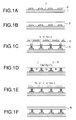
- Figs. 1A to 1E show a flow sheet of a manufacturing process of a color filter in the present invention, and in this drawing, one example of the constitution of the color filter of the present invention is shown.
- a substrate a light-transmittable substrate is preferable, and a glass substrate is usually used.
- the glass substrate is not restrictive, and any material can be used as the substrate, so long as it has necessary characteristics such as transparency and mechanical strength which the color filter for liquid crystals should have.
- Fig. 1A shows a glass substrate 1 having light-transmittable portions 7 and black matrices 2 which are shade portions.
- the substrate 1 provided with the black matrices 2 is coated with a resin composition which can cure by light irradiation or the light irradiation and heating to reduce an ink-acceptable property of the layer, and if necessary, prebaking is then carried out to form a resin layer 3 (Fig. 1B).
- a resin layer 3 Fig. 1B
- spin coating, roll coating, bar coating, spray coating or dip coating can be used, and this coating means is not particularly restrictive.
- portions of the resin layer which are shaded by the black matrices 2 are first pattern-exposed through a photomask 4 to cure these portions of the resin layers, thereby forming sites 8 (non-colored portions) which do not absorb an ink (Fig. 1C). Thereafter, the same layer is colored in colors of R, G and B by the use of an ink jet head 5 (Fig. 1D), and if necessary, the ink is then dried.
- the photomask 4 which can be used at the time of the pattern exposure has holes which permit the portions of the resin layer shaded by the black matrices to cure.
- a relatively large amount of the ink is required to be ejected from ink jet head.
- a dyestuff-type and a pigment-type ink are both usable, and both liquid inks and solid inks are also usable.
- the curable resin composition which can be used in the present invention, any one is acceptable, so long as it has an ink-receptable property and can cure by at least one treatment of light irradiation or the combination of the light irradiation and heating.
- the resin include acrylic resins, epoxy resins, silicon resins, cellulose derivatives such as hydroxypropyl cellulose, hydroxyethyl cellulose, methyl cellulose and carboxymethyl cellulose, and modified resins thereof.
- a photoinitiator (a crosslinking agent) can be used.
- the usable photoinitiator include dichromates, bisazido compounds, radical initiators, cationic initiators and anionic initiators. These photoinitiators can be used in combination, or they can be used with another sensitizer, when used.
- a heat treatment may be carried out after the light irradiation.
- the resin layer containing these components is very excellent in fastnesses to heat, water and the like, and it can sufficiently withstand a high temperature and washing in subsequent steps.
- an ink jet system which can be used in the present invention, there can be used a bubble jet type using an electricity-heat converter as an energy-generating element and a piezo jet type using a piezo-electric element.
- a colored area and a colored pattern can be optionally set.
- the black matrices are formed on the substrate, but they can be formed on the resin layer after the formation of the curable resin composition layer or the coloring without any particular problem. Therefore, the constitution of the black matrices in this embodiment is not restrictive.
- the black matrices can be preferably prepared by forming a metallic thin film on the substrate by sputtering or vapor deposition, and then patterning the film by photolithography, or alternatively patterning a photosensitive black resin. These procedures are not restrictive.
- the protective layer 6 is made of a second resin composition of a photosetting type, a thermosetting type or a photo-thermosetting type, or an inorganic material with the aid of vapor deposition or sputtering.
- any material can be used, so long as it does not impede the transparency of the obtained color filter, and can sufficiently withstand subsequent steps such as an ITO formation step and an orientation film formation step.
- Figs. 2A to 2E show a manufacturing process of the color filter for use in a liquid crystal panel in which the black matrices are provided on the opposite substrate.
- the method in which the black matrices are provided on the opposite substrate instead of the side of the color filter is effective as a technique of improving an aperture ratio.
- a glass substrate 1 shown in Fig. 2A is coated with a composition in which the ink absorbency of light irradiation portions deteriorates by the light irradiation or the combination of the light irradiation and the heat treatment, and if necessary, prebaking is then done to form a composition layer 3 in which the ink absorbency of the light irradiation portions deteriorates by the light irradiation or the combination of the light irradiation and the heat treatment (Fig. 2B).
- pattern exposure is carried out through a photomask 4 to reduce the ink absorbency of the exposed portions of the composition layer 3 (Fig. 2C), and then non-exposed portions of the same layer are colored in the colors of R, G and B by the use of an ink jet head 5 (Fig. 2D), followed by drying, if necessary.
- an ink jet head 5 Fig. 2D
- the colored resin composition layer is cured by the light irradiation and/or the heat treatment (Fig. 2E), and if necessary, a protective layer 6 is formed (Fig. 2F) to obtain a color filter.
- a protective layer there can be used a resin composition of a photosetting type, a thermosetting type or a photo-thermosetting type, or an inorganic material formed by vapor deposition or sputtering.
- any material can be used, so long as it does not impede the transparency of the obtained color filter, and can sufficiently withstand subsequent steps such as an ITO formation step and an oriented film formation step.
- the color filter is manufactured which has the resin layer, the plurality of colored portions having the different colors, and the non-colored portions on the substrate.
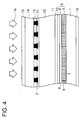
- Figs. 3 and 4 show sectional views of TFT color liquid crystal panels incorporated with the color filter of the present invention. These embodiments are not restrictive.
- the color liquid crystal panel can usually be formed by combining a color filter substrate 1 with a glass substrate 14, and then enclosing a liquid crystal compound 12 therebetween.
- TFT (not shown) and transparent pixel electrodes 13 are formed in the state of matrices.
- a color filter 9 is arranged so that the color materials of R, G and B are placed at a position opposite to the pixel electrodes, and all over the color filter 9, a transparent common electrode 10 is formed.
- Black matrices are formed on the side of the color filter substrate (Fig. 3), but in the case of a BM on-array type liquid crystal panel, they are formed on the faced TFT substrate side (Fig. 4).
- orientation films 11 are formed and then subjected to a rubbing treatment to arrange liquid crystal molecules in a certain direction. Furthermore, polarizing plates 15 adhere to the outsides of the respective glass substrates 1 and 14, and the liquid crystal compound 12 is filled into the space (about 2 to 5 ⁇ m) between these glass substrates.
- a back light 16 a combination of fluorescent lamps (not shown) and a scattering plate (not shown) is usually used, and display is carried out by utilizing the liquid crystal compound as a light shutter for changing the transmittance of the back light.
- Reference numeral 2 is a black matrix
- 3 is an ink receiving layer
- 6 is a protective layer
- 7 is a colored portions
- 8 is non-colored portions.
- a substrate on which black matrices are formed is coated with a resin composition layer which has ink-acceptable property and in which the residue of a hydrophilic group in light irradiation portions decreases by light irradiation or the combination of the light irradiation and heating, thereby forming the resin composition layer which has the ink-acceptable properties and in which the residue of the hydrophilic group in the light irradiation portions decreases by the light irradiation or the combination of the light irradiation and the heating.
- This method intends to prevent the mixing of the inks and the excessive diffusion of the ink by the utilization of a difference of ink absorbency between exposed portions and unexposed portions.
- the resin composition in which the ink absorbency of the light irradiation portions deteriorate by the light irradiation or the combination of the light irradiation and the heating, and in other words, it is preferable to use the resin composition which can give rise to crosslinking via a hydrophilic group such as an hydroxyl group, an alkoxy group or an amino group, or which brings about an additional reaction with the hydrophilic group.
- the absorbency deteriorate only by the light irradiation, but the heat treatment may be used together with the light irradiation to accelerate a crosslinking reaction without any problem.
- the resin composition which can be used in the present invention, a system utilizing the crosslinking reaction by chemical amplification is preferable.
- the basic resin include cellulose derivatives such as hydroxypropyl cellulose and hydroxyethyl cellulose, a high-molecular alcohol such as polyvinyl alcohol and its derivatives, a novolak resin such as cresol-novolak and its derivatives, and an acrylic resin containing an acrylic monomer having a hydroxyl group such as hydroxyethyl methacrylate.
- crosslinking agent includes a melamine derivative such as methylol melamine
- examples of the photoinitiator include an onium salt such as triphenylsulfonium hexafluoroantimonate and a halogenated organic compound such as trichloromethyltriazine. These examples are not restrictive.
- the particularly preferable resin composition which can be used in the present invention comprises at least (a) a homopolymer of a monomer comprising a structure unit represented by the following formula (I) and/or a copolymer of the above-mentioned monomer and another vinyl monomer, and (b) a compound selected from the group consisting of halogenated triazine compounds, diphenyliodonium salt derivatives and triphenylsulfonium salt derivatives: wherein R1 is hydrogen or a methyl group; and R2 is a hydrogen atom or an alkyl group having 1 to 5 carbon atoms.
- Examples of the monomer comprising the structure unit represented by the above formula (I) which is the component (a) include N-methylolacrylamide, N-methoxymethylacrylamide, N-ethoxymethylacrylamide, N-isopropoxymethylacrylamide, N-methylolmethacrylamide, N-methoxymethylmethacrylamide and N-ethoxymethylacrylamide, but they are not restrictive. Each of these monomers is used singly or may be copolymerized with another vinyl monomer.
- Examples of the other vinyl monomer include acrylic acid, methacrylic acid; acrylic acid esters such as methyl acrylate and ethyl acrylate; methacylic acid esters such as methyl methacrylate and ethyl methacrylate; vinyl monomers having a hydroxyl group such as hydroxymethyl methacrylate, hydroxyethyl methacrylate, hydroxymethyl acrylate and hydroxyethyl acrylate; styrene, ⁇ -methylstyrene, acrylamide, methacrylamide, acrylonitrile, allylamine, vinylamine, vinyl acetate and vinyl propionate. Needless to say, they are not restrictive.
- halogenated triazine compounds include compounds represented by the formula (II) wherein Z is a halogen atom; Y is CZ3 (Z is a halogen atom), phenyl, a halogenated phenyl, wherein R7 is an alkyl group having 1 to 5 carbon atoms, and when one group has two R7s, they may be different from each other.
- halogenated triazine compounds function as a photoinitiator, and they are preferably compounds in which a trichloromethyl group is introduced into a triazine ring, as in the compounds represented by the above-mentioned formula (II).
- halogenated triazine compounds include 2-(p-methoxyphenyl)-4,6-bis(trichloromethyl)-s-triazine, 2-styryl-4,6-bis(trichloromethyl)-s-triazine, 2-(p-methylstyryl)-4,6-bis(trichloromethyl)-s-triazine and 2-phenyl-4,6-bis(trichloromethyl)-s-triazine.
- the diphenyliodonium salt derivatives include compounds represented by the formula (III) wherein R4 and R5 are each hydrogen, an alkoxy group having 1 to 5 carbon atoms or t-butyl group; and X ⁇ is BF4 ⁇ , PF6 ⁇ , SbF6 ⁇ or CF3SO3 ⁇ .
- diphenyliodonium salt derivatives function as a photoinitiator, and typical examples thereof include diphenyliodonium hexafluoroantimonate, diphenyliodonium tetrafluoroborate, diphenyliodonium hexafluorophosphate, diphenyliodonium triflate and their derivatives. Needless to say, they are not restrictive.
- triphenylsulfonium salt derivatives include compounds represented by the formula (IV) wherein R6 is hydrogen, an alkyl group or an alkoxy group each having 1 to 5 carbon atoms, or fluorine; and X ⁇ is as defined above.
- triphenylsulfonium salt derivatives function as a photoinitiator, and typical examples thereof include triphenylsulfonium hexafluoroantimonate, triphenylsulfonium tetrafluoroborate, triphenylsulfonium hexafluorophosate, triphenylsulfonium triflate and their derivatives. Needless to say, they are not restrictive.
- the amount of the compound (b) is in the range of from 0.01 to 10 parts by weight, preferably from 0.01 to 5 parts by weight with respect to 100 parts by weight of the polymer which is the compound (a).
- the molecular weight of the above-mentioned polymer is preferably in the range of from 102 to 107.
- the employment of this kind of resin causes a definite difference of ink absorbency between an irradiated portion and a non-irradiated portion to permit the prevention of the color mixing of inks.
- a coating material of portions shaded with the black matrices is first subjected to pattern exposure (Fig. 1C), and the coloring of R, G and B is then made by the use of an ink jet head 5 (Fig. 1C). Afterward, if necessary, inks are dried.
- the residue of a hydrophilic group such as an hydroxyl group, an alkoxy group or an amino group decreases with the progress of the reaction, so that the exposed portions scarcely absorb the ink, whereby the mixture of the inks having the colors can be prevented.
- the residue of the hydrophilic group in the exposed portions is preferably decreased to 70% or less of the amount of the hydrophilic group in the unexposed portions.
- the photomask which can be used at the time of the pattern exposure has openings for exposing the portions shaded by the black matrices.
- the mask provided with the openings having a diameter smaller than the width of the portions shaded by the black matrices.
- a protective layer is then formed (Fig. 1F).
- the protective layer there can be used a resin material of a photosetting type, a thermosetting type or a photo-thermosetting type, or an inorganic film formed by vapor deposition or sputtering.
- any material can be used, so long as it does not impede the transparency of the obtained color filter, and can sufficiently withstand subsequent steps such as an ITO formation step and an oriented film formation step.
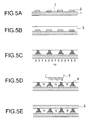
- Fig. 5A shows a glass substrate having black matrices thereon which are shade portions 2.
- the substrate provided with the black matrices is coated with a composition, in which the ink absorbency of light irradiated portions can be improved by light irradiation or the combination of the light irradiation and a heat treatment, and if necessary, prebaking is then carried out to form a resin layer 3 (Fig. 5B).
- this composition layer a coating method such as spin coating, roll coating, bar coating, spray coating or dip coating can be used, and this coating means is not particularly restrictive.
- a compound such as perylene, anthracene or phenothiazine may be added as a sensitizing agent to the composition layer.
- the composition layer is pattern-exposed through the black matrices as a mask to improve the ink absorbency of the irradiated portions of the composition layer (Fig. 5C).
- openings which are the irradiated portions are colored with colors of R, G and B by the use of an ink jet head 5 (Fig. 5D), and if necessary, the inks are then dried.
- the portions of the composition layer having a larger area than the openings of the black matrices are preferably colored, and for this coloring, it is necessary that the portions of the composition layer having a larger area than the black matrices as the mask take part in reaction.
- some means are effective, and for example, diffused light can be used as irradiation light at the time of exposure, a large excess of energy can be irradiated, or a heat treatment is carried out for a long period of time after the exposure to diffuse the reaction.
- the pattern exposure is carried out by the use of the black matrices as the mask, but the pattern exposure may be done from the upside of the resin composition layer by the use of another photomask.
- Figs. 6A to 6E show a method for preparing a color filter for use in a liquid crystal panel in which the black matrices are formed on an opposite substrate.
- the method in which the black matrices are provided on the faced substrates instead of the side of the color filter is effective as a technique of improving an opening ratio.
- a glass substrate 1 shown in Fig. 6A is coated with a composition in which the ink absorbency of light irradiation portions can be improved by the light irradiation or the combination of the light irradiation and the heat treatment, and if necessary, prebaking is then done to form a composition layer 3 (Fig. 6B).
- the pattern exposure is carried out through a photomask 4 to improve the ink absorbency of the exposed portions of the composition layer 3 (Fig. 6C), and these exposed portions of the layer are colored in the colors of R, G and B by the use of an ink jet head 5 (Fig. 6D), followed by drying, if necessary.
- a photomask 4 to improve the ink absorbency of the exposed portions of the composition layer 3 (Fig. 6C), and these exposed portions of the layer are colored in the colors of R, G and B by the use of an ink jet head 5 (Fig. 6D), followed by drying, if necessary.
- the width of non-colored portions 8 is smaller than that of the black matrices (not shown) provided on the opposite substrate.
- the resin composition for use in the present invention which can be rendered ink-acceptable is poor in ink-acceptable properties in itself, but it can be rendered ink-acceptable by at least one of the light irradiation or the combination of the light irradiation and the heat treatment under certain conditions.
- any resin can be used, so long as it can cure under certain conditions, and examples of the resin include a novolak resin such as cresol-novolak, polyparahydroxystyrene and its derivatives in which a hydroxy group is blocked with a trimethylsilyl group, cellulose derivatives such as hydroxypropyl cellulose, hydroxyethyl cellulose, methyl cellulose and carboxymethyl cellulose in which a hydroxyl group is esterified or blocked with an acetyl group, and the like.
- a novolak resin such as cresol-novolak, polyparahydroxystyrene and its derivatives in which a hydroxy group is blocked with a trimethylsilyl group
- cellulose derivatives such as hydroxypropyl cellulose, hydroxyethyl cellulose, methyl cellulose and carboxymethyl cellulose in which a hydroxyl group is esterified or blocked with an acetyl group, and the like.
- an onium salt such as triphenylsulfonium hexafluoroantimonate
- a halogenated organic compound such as trichloromethyltriazine, naphthoquinonediazide and their derivatives.
- the particularly preferable resin composition which can be used in the present invention comprises at least (a) an acrylic resin having a structure unit represented by the following formula (V) and (b) a compound as the photoinitiator selected from the group consisting of halogenated triazine compounds, diphenyliodonium salt derivatives and triphenylsulfonium salt derivatives: wherein R1 is hydrogen or an alkyl group having 1 to 5 carbon atoms; R2 is an alkylene group having 1 to 5 carbon atoms or a phenylene group; R3 is an alkyl group having 1 to 5 carbon atoms, an alkyl-substituted silyl group, a phenyl group or a substituted aromatic group.
- a compound as the photoinitiator selected from the group consisting of halogenated triazine compounds, diphenyliodonium salt derivatives and triphenylsulfonium salt derivatives: wherein R1 is hydrogen or an alkyl group having 1 to
- the acrylic resin (a) having a structure unit represented by the above-mentioned formula (V) preferably gives rise to the hydrolysis of an ether linkage by cations formed from the photoinitiator by light irradiation to produce a hydroxyl group.
- Typical examples of the acrylic resin are as follows:
- the molecular weight of these resins is preferably in the range of from 102 to 107.
- the employment of this kind of resin causes a definite difference of ink absorbency between an irradiated portion and a non-irradiated portion to permit the prevention of the color mixing of inks.
- halogenated triazine compounds the diphenyliodonium salt derivatives and the triphenylsulfonium salt derivatives with respect to compound (b) are as defined above.
- the amount of the compound (b) is in the range of from 0.01 to 10 parts by weight, preferably from 0.01 to 5 parts by weight with respect to 100 parts by weight of the acrylic resin which is the compound (a).
- the amount of a hydroxyl group increases with the progress of the reaction, so that these portions become easy to absorb inks.
- the resin layer is colored, the color mixing of the inks can be prevented.
- the conversion of the resin into the hydrophilic group is preferably 30% or more.
- a spectral analysis utilizing IR, NMR or the like is effective.
- the resin layer comprising these components is very excellent in fastnesses to heat, water and the like, and it can sufficiently withstand a high temperature and washing in subsequent steps.
- a protective layer 6 is formed (Figs. 5E and 6E) to obtain a color filter.
- the protective layer there can be used a resin material of a photosetting type, a thermosetting type or a photo-thermosetting type, or an inorganic film formed by vapor deposition or sputtering.
- any material can be used, so long as it does not impede the transparency of the obtained color filter, and can sufficiently withstand subsequent steps such as an ITO formation step and an oriented film formation step.
- a glass substrate 1 provided with black matrices 2 was spin-coated with a water-soluble negative-type resist comprising polyvinylpyrrolidone and a bisazido compound (photoinitiator) so that the thickness of a film might be 2 ⁇ m, and prebaking was then carried out at 90°C for 20 minutes to form a photocurable resin layer 3.
- a water-soluble negative-type resist comprising polyvinylpyrrolidone and a bisazido compound (photoinitiator) so that the thickness of a film might be 2 ⁇ m
- prebaking was then carried out at 90°C for 20 minutes to form a photocurable resin layer 3.
- portions of the resin layer on the black matrices were pattern-exposed through a photomask provided with openings having a diameter smaller than the width of the black matrices, thereby curing them.
- a matrix pattern of R, G and B was colored with dye inks by the use of an ink jet head 5, and the inks were dried at 90°C for 5 minutes. In succession, overall exposure was carried out to cure the resin layer 3.
- a resin layer 3 colored as in Example 1 was spin-coated with a photosetting resin composition comprising epoxy acrylate and a photoinitiator so that the thickness of a film might be 1 ⁇ m, and prebaking was then carried out at 90°C for 30 minutes to form a protective layer 6. Next, overall exposure was carried out to cure the protective layer 6, thereby preparing a color filter for liquid crystals.
- the thus prepared color filter for liquid crystals was observed by an optical microscope, and as a result, defects such as color mixing, color unevenness and color skip were not confirmed.
- a liquid crystal panel as shown in Fig. 3 was manufactured by the use of this color filter, and when a device using the panel was driven, a highly fine color display was possible.
- a resin layer 3 obtained in Example 1 was roll-coated with a two-pack epoxy acrylate-based thermosetting resin composition so that the thickness of a film might be 1 ⁇ m, and prebaking was then carried out at 90°C for 30 minutes to form a protective layer 6. Next, a heat treatment was carried out at 230°C for 30 minutes to cure the protective layer 6, thereby preparing a color filter for liquid crystal display.
- the thus prepared color filter for liquid crystal display was observed by an optical microscope, and as a result, defects such as color mixing, color unevenness and color skip were not confirmed.
- a liquid crystal panel shown in Fig. 3 was manufactured by the use of this color filter, and when a device using the panel was driven, a highly fine color display was possible.
- a resin layer 3 colored as in Example 1 was spin-coated with a photosetting resin composition comprising bisphenol A type epoxy resin and a photocationic initiator so that the thickness of a film might be 1 ⁇ m, and prebaking was then carried out at 90°C for 30 minutes to form a protective layer 6. Next, overall exposure was carried out, followed by a heat treatment at 230°C for 30 minutes to completely cure the protective layer 6, thereby preparing a color filter for liquid crystal display.
- the thus prepared color filter for liquid crystal display was observed by an optical microscope, and as a result, defects such as color mixing, color unevenness and color skip were not confirmed.
- a liquid crystal panel as shown in Fig. 3 was manufactured by the use of this color filter, and when a device using the panel was driven, a highly fine color display was possible.
- an SiO2 film 6 was formed by sputtering so that the thickness of a film might be 0.5 ⁇ m, to prepare a color filter for liquid crystal display.
- the thus prepared color filter for liquid crystal display was observed by an optical microscope, and as a result, defects such as color mixing, color unevenness and color skip were not confirmed.
- a liquid crystal panel as shown in Fig. 3 was manufactured by the use of this color filter, and when a device using the panel was driven, a highly fine color display was possible.
- a glass substrate 1 on which black matrices 2 were formed was spin-coated with a photosetting resin composition comprising bisphenol A type epoxy resin and a photocationic initiator so that the thickness of a film might be 2 ⁇ m, and prebaking was then carried out at 90°C for 20 minutes to form a photosetting resin composition layer 3.
- a photosetting resin composition comprising bisphenol A type epoxy resin and a photocationic initiator so that the thickness of a film might be 2 ⁇ m
- portions of the resin layer on the black matrices were pattern-exposed through a photomask provided with openings having a diameter smaller than the width of the black matrices, and a heat treatment was carried out at 120°C for 10 minutes, thereby curing them.
- a matrix pattern of R, G and B was colored with pigment inks by the use of an ink jet head 5, and the inks were then dried at 90°C for 5 minutes.
- overall exposure was carried out, followed by a heat treatment at 200°C for 60 minutes to completely cure the resin layer 3.
- a resin layer 3 colored as in Example 6 was spin-coated with a photosetting resin composition comprising epoxy acrylate and a photoinitiator so that the thickness of a film might be 1 ⁇ m, and prebaking was then carried out at 90°C for 30 minutes to form a protective layer 6. Next, overall exposure was carried out to cure the protective layer 6, thereby preparing a color filter for liquid crystal display.
- a photosetting resin composition comprising epoxy acrylate and a photoinitiator so that the thickness of a film might be 1 ⁇ m
- the thus prepared color filter for liquid crystal display was observed by an optical microscope, and as a result, defects such as color mixing, color unevenness and color skip were not confirmed.
- a liquid crystal panel as shown in Fig. 3 was manufactured by the use of this color filter, and when a device using the panel was driven, a highly fine color display was possible.
- a resin layer 3 colored as in Example 6 was spin-coated with a two-pack thermosetting resin composition so that the thickness of a film might be 1 ⁇ m, and prebaking was then carried out at 90°C for 30 minutes to form a protective layer 6. Next, a heat treatment was carried out at 230°C for 30 minutes to cure the protective layer 6, thereby preparing a color filter for liquid crystal display.
- the thus prepared color filter for liquid crystal display was observed by an optical microscope, and as a result, defects such as color mixing, color unevenness and color skip were not confirmed.
- a liquid crystal panel shown in Fig. 3 was manufactured by the use of this color filter, and when a device using the panel was driven, a highly fine color display was possible.
- a resin layer 3 colored as in Example 6 was spin-coated with the same photosetting resin composition as used in Example 6 so that the thickness of a film might be 1 ⁇ m, and prebaking was then carried out at 90°C for 30 minutes to form a protective layer 6. Next, overall exposure was carried out, followed by a heat treatment at 230°C for 30 minutes to completely cure the protective layer 6, thereby preparing a color filter for liquid crystal display.
- the thus prepared color filter for liquid crystal display was observed by an optical microscope, and as a result, defects such as color mixing, color unevenness and color skip were not confirmed.
- a liquid crystal panel shown in Fig. 3 was manufactured by the use of this color filter, and when a device using the panel was driven, a highly fine color display was possible.
- an SiO2 film 6 was formed by sputtering so that the thickness of a film might be 0.5 ⁇ m, to prepare a color filter for liquid crystal display.
- the thus prepared color filter for liquid crystal display was observed by an optical microscope, and as a result, defects such as color mixing, color unevenness and color skip were not confirmed.
- a liquid crystal panel as shown in Fig. 3 was manufactured by the use of this color filter, and when a device using the panel was driven, a highly fine color display was possible.
- a silicon substrate was spin-coated with a resin composition comprising hydroxypropyl cellulose (HPC-H, made by Nippon Soda Co., Ltd.) 5 g methylol melamine derivative (Sumitex M-3, made by Sumitomo Chemicals Inc.) 5 g cationic photoinitiator (SP-170, made by Adeca Co., Ltd.) 0.25 g and having an aqueous ink absorbency which would deteriorate in the light irradiation portions of the resin composition by light irradiation or the combination of the light irradiation and a heat treatment so that the thickness of a film might be 1 ⁇ m, and prebaking was then carried out at 90°C for 20 minutes.
- HPC-H hydroxypropyl cellulose
- M-3 methylol melamine derivative
- SP-170 cationic photoinitiator
- a glass substrate 1 on which black matrices were formed was spin-coated with the above-mentioned resin composition so as to make the thickness of a film of 2 ⁇ m, and prebaking was then carried out at 90°C for 20 minutes.
- portions of the resulting resin layer were subjected to pattern exposure in an exposure of 1 J/cm2 through a photomask provided with openings having a diameter smaller than the width of the black matrices to cure the portions of the resin layer. Furthermore, the unexposed portions of the resin layer were colored with dye inks by the use of an ink jet head 5 to obtain a matrix pattern of R, G and B, followed by drying the inks at 90°C for 5 minutes. In succession, overall exposure was carried out.
- the resin layer was spin-coated with a two-pack thermosetting resin SS-7625 (made by JSR) as a protective layer so as to make the thickness of the layer of 1 ⁇ m, and a heat treatment was carried out at 230°C for 1 hour to cure the protective layer.
- a two-pack thermosetting resin SS-7625 made by JSR
- the thus prepared color filter for liquid crystal display was observed by an optical microscope, and as a result, defects such as color mixing, color unevenness and color skip were not confirmed.
- a silicon substrate was spin-coated with all the same resin composition as in Example 11 so that the thickness of a film might be 1 ⁇ m, and prebaking was then carried out at 90°C for 20 minutes. Next, overall exposure was carried out in an exposure of 1 J/cm2, followed by a heat treatment for 1 minute on a hot plate at 150°C. Afterward, the residue of a hydroxyl group was compared between before and after the exposure in the same manner as in Example 11, and as a result, it was confirmed that the residue of the hydroxyl group was reduced to 50% of that of the hydroxyl group before the exposure.
- a glass substrate on which black matrices were formed was spin-coated with the above-mentioned resin composition so as to make the thickness of a film of 2 ⁇ m, and prebaking was then carried out at 90°C for 20 minutes to form a resin composition layer 3.
- portions of the resin layer were subjected to pattern exposure in an exposure of 1 J/cm2 through a photomask provided with openings having a diameter smaller than the width of the black matrices, followed by a heat treatment at 150°C for 1 minute on the hot plate. Furthermore, a matrix pattern of R, G and B was colored with dye inks by the use of an ink jet head 5, followed by drying the inks at 90°C for 5 minutes. In succession, overall exposure and then a heat treatment at 200°C for 1 hour were carried out to cure the resin layer.
- the resin layer was spin-coated with a two-pack thermosetting resin SS-7625 (made by JSR) as a protective layer so as to make the thickness of the layer of 1 ⁇ m, and a heat treatment was carried out at 230°C for 1 hour to cure the protective layer.
- a two-pack thermosetting resin SS-7625 made by JSR
- the thus prepared color filter for liquid crystal display was observed by an optical microscope, and as a result, defects such as color mixing, color unevenness and color skip were not confirmed.
- a liquid crystal panel as shown in Fig. 3 was manufactured by the use of this color filter, and when a device using the panel was driven, a highly fine color display was possible.
- a glass substrate 1 on which black matrices were formed was spin-coated with all the same resin composition as in Example 11 so as to make the thickness of a film of 2 ⁇ m, and prebaking was then carried out at 90°C for 20 minutes to form a resin composition layer.
- portions of the resin layer were subjected to pattern exposure in an exposure of 1 J/cm2 through a photomask provided with openings having a diameter smaller than the width of the black matrices, followed by a heat treatment at 150°C for 1 minute on a hot plate. Furthermore, a matrix pattern of R, G and B was colored with pigment inks by the use of an ink jet head 5, followed by drying the inks at 90°C for 5 minutes. In succession, a heat treatment was carried out at 230°C for 1 hour to cure the resin layer.
- the resin layer was spin-coated with a two-pack thermosetting resin SS-7625 (made by JSR) as a protective layer so as to make the thickness of the layer of 1 ⁇ m, and a heat treatment was carried out at 230°C for 1 hour to cure the protective layer.
- a two-pack thermosetting resin SS-7625 made by JSR
- the thus prepared color filter for liquid crystal display was observed by an optical microscope, and as a result, defects such as color mixing, color unevenness and color skip were not confirmed.
- the thus measured infrared absorption spectrum was compared with a spectrum before the exposure to inspect the residue of a hydroxyl group. As a result, it was confirmed that the residue of the hydroxyl group was reduced to 65% of that of the hydroxyl group before the exposure.
- a glass substrate 1 on which black matrices 2 were formed was spin-coated with the above-mentioned resin composition so as to make the thickness of a film of 2 ⁇ m, and prebaking was then carried out at 90°C for 20 minutes.
- portions of the resulting resin layer were subjected to pattern exposure in an exposure of 1 J/cm2 through a photomask provided with openings having a diameter smaller than the width of the black matrices to cure the portions of the resin layer 3. Furthermore, the unexposed portions of the resin layer were colored with dye inks by the use of an ink jet head 5 to obtain a matrix pattern of R, G and B, followed by drying the inks at 90°C for 5 minutes. In succession, overall exposure was carried out to cure the resin layer.
- the resin layer was spin-coated with a two-pack thermosetting resin SS-7625 (made by JSR) as a protective layer 6 so as to make the thickness of the layer of 1 ⁇ m, and a heat treatment was carried out at 230°C for 1 hour to cure the protective layer 6.
- a two-pack thermosetting resin SS-7625 made by JSR
- the thus prepared color filter for liquid crystal display was observed by an optical microscope, and as a result, defects such as color mixing, color unevenness and color skip were not confirmed.
- Example 14 The same resin composition as in Example 14 was used, and overall exposure and a heat treatment were then carried out in all the same manner as in Example 12. Furthermore, an infrared absorption spectrum was measured and then compared with a spectrum before the exposure to inspect the residue of a hydroxyl group. As a result, it was confirmed that the residue of the hydroxyl group was reduced to 48% of that of the hydroxyl group before the exposure.
- a glass substrate 1 on which black matrices 2 were formed was spin-coated with the above-mentioned resin composition so as to make the thickness of a film of 2 ⁇ m, and prebaking was then carried out at 90°C for 20 minutes to form a resin composition layer 3.
- portions of the resin layer on the black matrices were subjected to pattern exposure in an exposure of 1 J/cm2 through a photomask provided with openings having a diameter smaller than the width of the black matrices, followed by a heat treatment at 150°C for 1 minute on a hot plate.
- a matrix pattern of R, G and B was colored with dye inks by the use of an ink jet head 5, followed by drying the inks at 90°C for 5 minutes.
- overall exposure and then a heat treatment at 200°C for 1 hour were carried out to cure the resin layer.
- the resin layer was spin-coated with a two-pack thermosetting resin SS-7625 (made by JSR) as a protective layer 6 so as to make the thickness of the layer of 1 ⁇ m, and a heat treatment was carried out at 230°C for 1 hour to cure the protective layer 6.
- a two-pack thermosetting resin SS-7625 made by JSR
- the thus prepared color filter for liquid crystal display was observed by an optical microscope, and as a result, defects such as color mixing, color unevenness and color skip were not confirmed.
- a liquid crystal panel as shown in Fig. 3 was manufactured by the use of this color filter, and when a device using the panel was driven, a highly fine color display was possible.
- a glass substrate 1 on which black matrices 2 were formed was spin-coated with the same resin composition as in Example 14 so as to make the thickness of a film of 2 ⁇ m, and prebaking was then carried out at 90°C for 20 minutes to form a resin composition layer 3.
- portions of the resin layer were subjected to pattern exposure in an exposure of 1 J/cm2 through a photomask provided with openings having a diameter smaller than the width of the black matrices, followed by a heat treatment at 150°C for 1 minute on a hot plate. Furthermore, a matrix pattern of R, G and B was colored with pigment inks by the use of an ink jet head 5, followed by drying the inks at 90°C for 5 minutes. In succession, a heat treatment was carried out at 230°C for 1 hour to cure the resin layer.
- the resin layer was spin-coated with a two-pack thermosetting resin SS-7625 (made by JSR) as a protective layer 6 so as to make the thickness of the layer of 1 ⁇ m, and a heat treatment was carried out at 230°C for 1 hour to cure the protective layer 6.
- a two-pack thermosetting resin SS-7625 made by JSR
- the thus prepared color filter for liquid crystal display was observed by an optical microscope, and as a result, defects such as color mixing, color unevenness and color skip were not confirmed.
- a color filter for liquid crystal display was prepared in all the same manner as in Example 11 and then observed by an optical microscope, and as a result, defects such as color mixing, color unevenness and color skip were not confirmed.
- a liquid crystal panel as shown in Fig. 3 was manufactured by the use of this color filter, and when a device using the panel was driven, a highly fine color display was possible.
- a color filter for liquid crystal display was prepared in all the same manner as in Example 11 and then observed by an optical microscope, and as a result, defects such as color mixing, color unevenness and color skip were not confirmed.
- a liquid crystal panel as shown in Fig. 3 was manufactured by the use of this color filter, and when a device using the panel was driven, a highly fine color display was possible.
- a glass substrate 1 was coated with each composition of Examples 1, 6 and 11 to form a resin composition layer 3.
- pattern exposure was carried out from the side of the resin layer 3 through a photomask 4 to lower the ink absorbency of the exposed portions of the resin.
- the exposed portions were colored with dye inks by the use of an ink jet head 5 to obtain a matrix pattern of R, G and B, and a heat treatment was then carried out under the same conditions as in each example.
- a protective layer 6 is formed in the same manner as in Example 2, thereby preparing a color filter for liquid crystal display.
- the thus prepared color filter for liquid crystal display was observed by an optical microscope, and as a result, defects such as color mixing, color unevenness and color skip were not confirmed.
- a liquid crystal panel as shown in Fig. 4 was manufactured by the use of this color filter, and when a device using the panel was driven, a highly fine color display was possible.
- composition comprising (a) 10 parts by weight of a three-component copolymer of N-methylolacrylamide, methyl methacrylate and hydroxyethyl methacrylate and (b) 0.5 part by weight of a halogenated triazine compound (TAZ-101, made by Midori Chemical Co., Ltd.) having the formula and having aqueous ink absorbency which would deteriorate in the light irradiation portions of the composition by light irradiation or the combination of the light irradiation and a heat treatment.
- TEZ-101 halogenated triazine compound
- a glass substrate 1 on which black matrices 2 were formed was spin-coated with the composition, and prebaking was then carried out at 50°C for 10 minutes to form a composition layer 3 having the ink absorbency which would deteriorate in the light irradiation portions of the composition by the light irradiation or the combination of the light irradiation and the heat treatment.
- the thickness of the layer 3 was 1 ⁇ m.
- the portions of the resin layer 3 on the black matrices 2 were subjected to pattern exposure through a photomask provided with openings having a diameter smaller than the width of the black matrices to deteriorate the ink absorbency of the exposed portions. Furthermore, a matrix pattern of R, G and B was colored with dye inks by the use of an ink jet head 5, followed by drying the inks at 90°C for 5 minutes. In succession, a heat treatment was carried out at 230°C for 1 hour to cure the resin layer, thereby preparing a color filter according to the present invention.
- the thus prepared color filter for liquid crystal display was observed by an optical microscope, and as a result, defects such as color mixing, color unevenness and color skip were not confirmed.
- Example 20 The same procedure as in Example 20 was carried out except that each composition shown in Table 1 was employed, to prepare a color filter according to the present invention. As a result, the same effect as in Example 20 could be confirmed.
- a colored layer 3 obtained in Example 20 was spin-coated with a two-pack thermosetting resin composition so that the thickness of a film might be 1 ⁇ m, and prebaking was then carried out at 90°C for 30 minutes to form a second resin layer 6. Next, a heat treatment was carried out at 230°C for 30 minutes to cure the second resin layer, thereby preparing a color filter for liquid crystal display.
- the thus prepared color filter for liquid crystal display was observed by an optical microscope, and as a result, defects such as color mixing, color unevenness and color skip were not confirmed.
- a liquid crystal panel shown in Fig. 3 was manufactured by the use of this color filter, and when a device using the panel was driven, a highly fine color display was possible.
- portions of the resin layer on the black matrices were subjected to pattern exposure through a photomask provided with openings having a diameter smaller than the width of the black matrices to deteriorate the ink absorbency of the exposed portions. Furthermore, a matrix pattern of R, G and B was colored with dye inks by the use of an ink jet head 5, followed by drying the inks at 90°C for 5 minutes. In succession, a heat treatment was carried out at 230°C for 1 hour to cure the colored resin layer, thereby preparing a color filter according to the present invention.
- the thus prepared color filter for liquid crystal display was observed by an optical microscope, and as a result, defects such as color mixing, color unevenness and color skip were not confirmed.
- Example 31 The same procedure as in Example 31 was carried out except that each composition shown in Table 2 was employed, to prepare a color filter. As a result, the same effect as in Example 31 could be confirmed.
- a colored layer 3 obtained in Example 31 was spin-coated with a two-pack thermosetting resin composition so that the thickness of a film might be 1 ⁇ m, and prebaking was then carried out at 90°C for 30 minutes to form a second resin layer 6. Next, a heat treatment was carried out at 230°C for 30 minutes to cure the second resin layer, thereby preparing a color filter for liquid crystal display.
- the thus prepared color filter for liquid crystal display was observed by an optical microscope, and as a result, defects such as color mixing, color unevenness and color skip were not confirmed.
- a liquid crystal panel shown in Fig. 3 was manufactured by the use of this color filter, and when a device using the panel was driven, a highly fine color display was possible.
- portions of the resin layer on the black matrices were subjected to pattern exposure through a photomask provided with openings having a diameter smaller than the width of the black matrices to deteriorate the ink absorbency of the exposed portions. Furthermore, a matrix pattern of R, G and B was colored with dye inks by the use of an ink jet head 5, followed by drying the inks at 90°C for 5 minutes. In succession, a heat treatment was carried out at 230°C for 1 hour to cure the colored resin layer, thereby preparing a color filter according to the present invention.
- the thus prepared color filter for liquid crystal display was observed by an optical microscope, and as a result, defects such as color mixing, color unevenness and color skip were not confirmed.
- Example 42 The same procedure as in Example 42 was carried out except that each composition shown in Table 3 was employed, to prepare a color filter. As a result, the same effect as in Example 42 could be confirmed.
- a colored layer 3 obtained in Example 42 was spin-coated with a two-pack thermosetting resin composition so as to make the thickness of a film of 1 ⁇ m, and prebaking was then carried out at 90°C for 30 minutes to form a second resin layer 6. Next, a heat treatment was carried out at 230°C for 30 minutes to cure the second resin layer, thereby preparing a color filter for liquid crystal display.
- the thus prepared color filter for liquid crystal display was observed by an optical microscope, and as a result, defects such as color mixing, color unevenness and color skip were not confirmed.
- a liquid crystal panel shown in Fig. 3 was manufactured by the use of this color filter, and when a device using the panel was driven, a highly fine color display was possible.
- a glass substrate 1 was spin-coated with the above-mentioned resin composition so as to make the thickness of a film of 1 ⁇ m, and prebaking was then carried out at 100°C for 15 minutes. Next, overall exposure was done in an exposure of 1.5 J/cm2, and an infrared absorption spectrum was then measured in a reflective mode by the use of FT-IR (Micro FTIR-100, made by Nippon Bunko Kogyo Co., Ltd.). The thus measured infrared absorption spectrum was compared with a spectrum before the exposure to inspect the residue of a hydroxyl group. As a result, it was confirmed that the residue of the hydroxyl group was increased to 700% of that of the hydroxyl group before the exposure.
- a glass substrate 1 on which black matrices 2 were formed was spin-coated with the above-mentioned resin composition so as to make the thickness of a film of 2 ⁇ m, and prebaking was then carried out at 100°C for 15 minutes.
- portions of the resulting resin layer on light-transmittable portions (which partially contained the resin on the black matrices) were subjected to pattern exposure in an exposure of 1.5 J/cm2 through a photomask provided with openings having a diameter larger than the width of the light-transmittable portions to render the resin layer ink-acceptable.
- the ink-acceptable portions of the resin layer were colored with dye inks having a pH 9 by the use of an ink jet head 5 to obtain a matrix pattern of R, G and B, followed by drying the inks at 90°C for 5 minutes. In succession, a heat treatment was carried out at 200°C for 60 minutes to cure the resin layer 3.
- the resin layer 3 was spin-coated with a two-pack thermosetting resin SS-7625 (made by JSR) as a protective layer 6 so as to make the thickness of the layer of 1 ⁇ m, and a heat treatment was carried out at 230°C for 1 hour to cure a protective layer 6.
- a two-pack thermosetting resin SS-7625 made by JSR
- the thus prepared color filter for liquid crystal display was observed by an optical microscope, and as a result, defects such as color mixing, color unevenness and color skip were not confirmed.
- a liquid crystal panel shown in Fig. 3 was manufactured by the use of this color filter, and when a device using the panel was driven, a highly fine color display was possible.
- a silicon substrate was spin-coated with a resin composition prepared in Example 53 so as to make the thickness of a layer of 1 ⁇ m, and prebaking was then carried out at 100°C for 15 minutes. Next, overall exposure was done in an exposure of 1.5 J/cm2, and followed by a heat treatment for 1 minute on a hot plate at 150°C. Afterward, the residue of a hydroxyl group was compared between before and after the exposure in the same manner as in Example 53, and as a result, it was confirmed that the residue of the hydroxyl group was increased to 500% of that of the hydroxyl group before the exposure.
- a glass substrate 1 on which black matrices 2 were formed was spin-coated with the above-mentioned resin composition so as to make the thickness of a layer of 2 ⁇ m, and prebaking was then carried out at 100°C for 15 minutes to form a resin layer 3.
- the portions of the resulting resin layer on light-transmittable portions (partially containing the resin on the black matrices) were subjected to pattern exposure in an exposure of 1.5 J/cm2 through a photomask provided with openings having a diameter larger than the width of the light-transmittable portions, followed by a heat treatment for 1 minute on a hot plate at 150°C, thereby rendering the resin layer ink-acceptable.
- the ink-acceptable portions of the resin layer were colored with dye inks having a pH 9.5 by the use of an ink jet head 5 to obtain a matrix pattern of R, G and B, followed by drying the inks at 90°C for 5 minutes.
- a heat treatment was carried out at 200°C for 1 hour to cure the resin layer 3, and a protective layer 6 was further formed on the resin layer 3 in the same manner as in Example 53.
- the thus prepared color filter for liquid crystal display was observed by an optical microscope, and as a result, defects such as color mixing, color unevenness and color skip were not confirmed.
- a liquid crystal panel shown in Fig. 3 was manufactured by the use of this color filter, and when a device using the panel was driven, contrast is high and a highly fine color display was possible.
- Example 54 The same procedure as in Example 54 was effected except that exposure was done from the side of a substrate 1 by the utilization of black matrices as a photomask, as shown in Figs. 5A to 5E, thereby preparing a color filter.
- the thus prepared color filter for liquid crystal display was observed by an optical microscope, and as a result, defects such as color mixing, color unevenness and color skip were not confirmed.
- a liquid crystal panel shown in Fig. 3 was manufactured by the use of this color filter, and when a device using the panel was driven, a highly fine color display was possible.
- a glass substrate 1 on which black matrices 2 were formed was roll-coated with the above-mentioned resin composition so as to make the thickness of a layer of 2 ⁇ m, and prebaking was then carried out at 90°C for 20 minutes to form a resin layer 3.
- the portions of the resulting resin layer on light-transmittable portions were subjected to pattern exposure in an exposure of 1 J/cm2 through a photomask provided with openings having a diameter larger than the width of the light-transmittable portions, followed by rendering the resin layer ink-acceptable.
- the ink-acceptable portions of the resin layer were colored with dye inks having a pH 8.5 by the use of an ink jet head 5 to obtain a matrix pattern of R, G and B, followed by drying the inks at 90°C for 5 minutes. In succession, a heat treatment was carried out at 200°C for 60 minutes to cure the resin layer 3.
- a protective layer 6 was further formed on the resin layer 3 in the same manner as in Example 53.
- the thus prepared color filter for liquid crystal display was observed by an optical microscope, and as a result, defects such as color mixing, color unevenness and color skip were not confirmed.
- a liquid crystal panel shown in Fig. 3 was manufactured by the use of this color filter, and when a device using the panel was driven, a highly fine color display was possible.
- Example 56 For a resin composition prepared in Example 56, the amount of a hydroxyl group was compared between before and after the exposure in the same manner as in Example 54, and as a result, it was confirmed that the amount of the hydroxyl group after the exposure was increased to 600% of that of the hydroxyl group before the exposure.
- a glass substrate 1 on which black matrices 2 were formed was roll-coated with the above-mentioned resin composition so as to make the thickness of a layer of 2 ⁇ m, and prebaking was then carried out at 90°C for 20 minutes to form a resin layer 3.
- the portions of the resulting resin layer on light-transmittable portions (partially containing the resin on the black matrices) were subjected to pattern exposure in an exposure of 1 J/cm2 through a photomask provided with openings having a diameter larger than the width of the light-transmittable portions, followed by prebaking at 150°C for 1 minute on a hot plate, thereby rendering the resin layer ink-acceptable.
- the ink-acceptable portions of the resin layer were colored with dye inks having a pH 9.3 by the use of an ink jet head 5 to obtain a matrix pattern of R, G and B, followed by drying the inks at 90°C for 5 minutes. In succession, overall exposure was done, and a heat treatment was then carried out at 200°C for 60 minutes to cure the resin layer 3.
- a protective layer 6 was further formed on the resin layer 3 in the same manner as in Example 54.
- the thus prepared color filter for liquid crystal display was observed by an optical microscope, and as a result, defects such as color mixing, color unevenness and color skip were not confirmed.
- a liquid crystal panel shown in Fig. 3 was manufactured by the use of this color filter, and when a device using the panel was driven, a highly fine color display was possible.
- Example 57 The same procedure as in Example 57 was effected except that exposure was done from the side of a substrate 1 by the utilization of black matrices as a photomask, as shown in Figs. 5A to 5E, thereby preparing a color filter.
- the thus prepared color filter for liquid crystal display was observed by an optical microscope, and as a result, defects such as color mixing, color unevenness and color skip were not confirmed.
- Example 57 The same procedure as in Example 57 was effected except that a pigment ink having a pH 9.1 was used as an ink, thereby preparing a color filter.
- the thus prepared color filter for liquid crystal display was observed by an optical microscope, and as a result, defects such as color mixing, color unevenness and color skip were not confirmed.
- a liquid crystal panel shown in Fig. 3 was manufactured by the use of this color filter, and when a device using the panel was driven, a highly fine color display was possible.
- the resin layer 3 was spin-coated with a two-pack thermosetting resin (trade name Optomer SS-6688, made by Japan Synthetic Rubber Co., Ltd.) as a protective layer 6 so as to make the thickness of the layer of 1 ⁇ m, and prebaking was then carried out at 90°C for 30 minutes to form a second resin layer 6, followed by a heat treatment at 230°C for 30 minutes to cure the second resin layer, thereby preparing a color filter for liquid crystal display.
- a two-pack thermosetting resin trade name Optomer SS-6688, made by Japan Synthetic Rubber Co., Ltd.
- the thus prepared color filter for liquid crystal display was observed by an optical microscope, and as a result, defects such as color mixing, color unevenness and color skip were not confirmed.
- a liquid crystal panel shown in Fig. 3 was manufactured by the use of this color filter, and when a device using the panel was driven, a highly fine color display was possible.
- Example 60 The same procedure as in Example 60 was carried out except that each composition shown in Table 4 was employed, to prepare a color filter. As a result, the same effect as in Example 60 could be confirmed.
- a protective layer 6 was formed in the same manner as in Example 60, thereby preparing a color filter for liquid crystal display.
- the thus prepared color filter for liquid crystal display was observed by an optical microscope, and as a result, defects such as color mixing, color unevenness and color skip were not confirmed.
- a liquid crystal panel shown in Fig. 3 was manufactured by the use of this color filter, and when a device using the panel was driven, a highly fine color display was possible.
- Example 64 The same procedure as in Example 64 was carried out except that each composition shown in Table 5 was employed, to prepare a color filter. As a result, the same effect as in Example 64 could be confirmed.
- a protective layer 6 was formed in the same manner as in Example 60 to prepare a color filter for liquid crystal display.
- the thus prepared color filter for liquid crystal display was observed by an optical microscope, and as a result, defects such as color mixing, color unevenness and color skip were not confirmed.
- a liquid crystal panel shown in Fig. 3 was manufactured by the use of this color filter, and when a device using the panel was driven, a highly fine color display was possible.
- Example 68 The same procedure as in Example 68 was carried out except that each composition shown in Table 6 was employed, to prepare a color filter. As a result, the same effect as in Example 68 could be confirmed.
- a glass substrate 1 was coated with a composition in Example 60, as shown in Fig. 6, thereby forming a resin composition layer 3.
- pattern exposure was carried out from the side of the resin layer 3 through a photomask 4 to improve the ink absorbency of the exposed portions of the resin.
- the exposed portions were colored with dye inks by the use of an ink jet head 5 to obtain a matrix pattern of R, G and B, followed by a heat treatment at 90°C for 5 minutes and at 200°C for 30 minutes.
- a protective layer 6 was formed in the same manner as in Example 60 to prepare a color filter for liquid crystal display.
- the thus prepared color filter for liquid crystal display was observed by an optical microscope, and as a result, defects such as color mixing, color unevenness and color skip were not confirmed.
- a liquid crystal panel shown in Fig. 4 was manufactured by the use of this color filter, and when a device using the panel was driven, a highly fine color display was possible.
- a glass substrate 1 was coated with a composition in Example 64, as shown in Fig. 6, thereby forming a resin composition layer 3.
- pattern exposure was carried out from the side of the resin layer 3 through a photomask 4 to improve the ink absorbency of the exposed portions of the resin.
- the exposed portions were colored with dye inks by the use of an ink jet head 5 to obtain a matrix pattern of R, G and B, followed by a heat treatment at 90°C for 5 minutes and at 200°C for 30 minutes.
- a protective layer 6 was formed in the same manner as in Example 60 to prepare a color filter for liquid crystal display.
- the thus prepared color filter for liquid crystal display was observed by an optical microscope, and as a result, defects such as color mixing, color unevenness and color skip were not confirmed.
- a liquid crystal panel shown in Fig. 4 was manufactured by the use of this color filter, and when a device using the panel was driven, a highly fine color display was possible.
- a glass substrate 1 was coated with a composition in Example 68, as shown in Fig. 6, thereby forming a resin composition layer 3.
- pattern exposure was carried out from the side of the resin layer 3 through a photomask 4 to improve the ink absorbency of the exposed portions of the resin.
- the exposed portions were colored with dye inks by the use of an ink jet head 5 to obtain a matrix pattern of R, G and B, followed by a heat treatment at 90°C for 5 minutes and at 200°C for 30 minutes.
- a protective layer 6 was formed in the same manner as in Example 60 to prepare a color filter for liquid crystal display.
- the thus prepared color filter for liquid crystal display was observed by an optical microscope, and as a result, defects such as color mixing, color unevenness and color skip were not confirmed.
- a liquid crystal panel shown in Fig. 4 was manufactured by the use of this color filter, and when a device using the panel was driven, a highly fine color display was possible.
- a highly reliable color filter for liquid crystal display which is free from defects such as color mixing, color unevenness and color skip, and a liquid crystal panel which permits a highly fine color display.
Landscapes
- Physics & Mathematics (AREA)
- General Physics & Mathematics (AREA)
- Spectroscopy & Molecular Physics (AREA)
- Engineering & Computer Science (AREA)
- Plasma & Fusion (AREA)
- Mechanical Engineering (AREA)
- Electromagnetism (AREA)
- Optics & Photonics (AREA)
- Manufacturing & Machinery (AREA)
- Optical Filters (AREA)
- Liquid Crystal (AREA)
- Liquid Crystal Substances (AREA)
- Silver Salt Photography Or Processing Solution Therefor (AREA)
- Solid State Image Pick-Up Elements (AREA)
Priority Applications (2)
| Application Number | Priority Date | Filing Date | Title |
|---|---|---|---|
| EP99110503A EP0942326B1 (de) | 1993-11-24 | 1994-11-23 | Verfahren zur Herstellung eines Farbfilters und eines Flüssigkristall-Schirms |
| EP99110504A EP0942327B1 (de) | 1993-11-24 | 1994-11-23 | Farbfilter |
Applications Claiming Priority (15)
| Application Number | Priority Date | Filing Date | Title |
|---|---|---|---|
| JP29339593 | 1993-11-24 | ||
| JP293395/93 | 1993-11-24 | ||
| JP29339593 | 1993-11-24 | ||
| JP322133/93 | 1993-12-21 | ||
| JP32213393 | 1993-12-21 | ||
| JP32213393 | 1993-12-21 | ||
| JP150874/94 | 1994-07-01 | ||
| JP15087094 | 1994-07-01 | ||
| JP150870/94 | 1994-07-01 | ||
| JP15087094 | 1994-07-01 | ||
| JP15087494 | 1994-07-01 | ||
| JP15087494 | 1994-07-01 | ||
| JP220049/94 | 1994-09-14 | ||
| JP22004994 | 1994-09-14 | ||
| JP22004994 | 1994-09-14 |
Related Child Applications (4)
| Application Number | Title | Priority Date | Filing Date |
|---|---|---|---|
| EP99110504A Division EP0942327B1 (de) | 1993-11-24 | 1994-11-23 | Farbfilter |
| EP99110503A Division EP0942326B1 (de) | 1993-11-24 | 1994-11-23 | Verfahren zur Herstellung eines Farbfilters und eines Flüssigkristall-Schirms |
| EP99110504.0 Division-Into | 1999-05-31 | ||
| EP99110503.2 Division-Into | 1999-05-31 |
Publications (2)
| Publication Number | Publication Date |
|---|---|
| EP0655647A1 true EP0655647A1 (de) | 1995-05-31 |
| EP0655647B1 EP0655647B1 (de) | 2002-02-27 |
Family
ID=27527933
Family Applications (3)
| Application Number | Title | Priority Date | Filing Date |
|---|---|---|---|
| EP99110504A Expired - Lifetime EP0942327B1 (de) | 1993-11-24 | 1994-11-23 | Farbfilter |
| EP99110503A Expired - Lifetime EP0942326B1 (de) | 1993-11-24 | 1994-11-23 | Verfahren zur Herstellung eines Farbfilters und eines Flüssigkristall-Schirms |
| EP94118432A Expired - Lifetime EP0655647B1 (de) | 1993-11-24 | 1994-11-23 | Verfahren zur Herstellung eines Farbfilters bzw. eines Flüssigkristallschirms |
Family Applications Before (2)
| Application Number | Title | Priority Date | Filing Date |
|---|---|---|---|
| EP99110504A Expired - Lifetime EP0942327B1 (de) | 1993-11-24 | 1994-11-23 | Farbfilter |
| EP99110503A Expired - Lifetime EP0942326B1 (de) | 1993-11-24 | 1994-11-23 | Verfahren zur Herstellung eines Farbfilters und eines Flüssigkristall-Schirms |
Country Status (6)
| Country | Link |
|---|---|
| US (2) | US5716740A (de) |
| EP (3) | EP0942327B1 (de) |
| KR (1) | KR0173149B1 (de) |
| AT (3) | ATE242889T1 (de) |
| DE (3) | DE69435160D1 (de) |
| TW (1) | TW417034B (de) |
Cited By (5)
| Publication number | Priority date | Publication date | Assignee | Title |
|---|---|---|---|---|
| EP0704722A3 (de) * | 1994-09-30 | 1996-08-28 | Canon Kk | Farbfilter, Herstellungsverfahren, Flüssigkristallanzeigetafel und mit der Tafel ausgestattetes Informationsverarbeitungsgerät |
| US5736278A (en) * | 1995-06-20 | 1998-04-07 | Canon Kabushiki Kaisha | Color filter having light screening resin layer and filter resin layer |
| EP1376227A1 (de) * | 1997-08-08 | 2004-01-02 | Dai Nippon Printing Co., Ltd. | Konstruktion zum Formen von Mustern, Verfahren zum Formen von Mustern und dessen Anwendung |
| EP1494064A1 (de) * | 1996-10-30 | 2005-01-05 | Seiko Epson Corporation | Farbfilter |
| EP1557719A3 (de) * | 2004-01-26 | 2007-04-18 | Matsushita Electric Industrial Co., Ltd. | Chemisch verstärkter Resist und Verfahren zur Herstellung von Mustern |
Families Citing this family (83)
| Publication number | Priority date | Publication date | Assignee | Title |
|---|---|---|---|---|
| US6686104B1 (en) * | 1993-11-24 | 2004-02-03 | Canon Kabushiki Kaisha | Color filter, method for manufacturing it, and liquid crystal panel |
| DE69523351T2 (de) * | 1994-01-28 | 2002-05-02 | Canon K.K., Tokio/Tokyo | Farbfilter, Verfahren zu seiner Herstellung, und Flüssigkristalltafel |
| TW426806B (en) * | 1994-05-18 | 2001-03-21 | Toshiba Corp | Fabricating method of liquid crystal display apparatus |
| JP3014923B2 (ja) * | 1994-06-24 | 2000-02-28 | キヤノン株式会社 | カラーフィルターおよびその製造方法ならびにそのフィルターを用いた液晶表示装置 |
| JP3133949B2 (ja) * | 1995-08-25 | 2001-02-13 | キヤノン株式会社 | カラーフィルタの製造方法及び製造装置 |
| JPH09171953A (ja) * | 1995-12-20 | 1997-06-30 | Sony Corp | 基板加熱装置、基板加熱方法および半導体集積回路装置、フォトマスクならびに液晶表示装置 |
| US5989945A (en) * | 1996-05-15 | 1999-11-23 | Seiko Epson Corporation | Thin film device provided with coating film, liquid crystal panel and electronic device, and method for making the thin film device |
| CN1173315C (zh) * | 1996-09-19 | 2004-10-27 | 精工爱普生株式会社 | 矩阵式显示元件及其制造方法 |
| US20020075422A1 (en) * | 1996-09-19 | 2002-06-20 | Seiko Epson Corporation | Matrix type display device and manufacturing method thereof |
| US5956487A (en) * | 1996-10-25 | 1999-09-21 | Hewlett-Packard Company | Embedding web access mechanism in an appliance for user interface functions including a web server and web browser |
| JP3899566B2 (ja) | 1996-11-25 | 2007-03-28 | セイコーエプソン株式会社 | 有機el表示装置の製造方法 |
| JP3106110B2 (ja) * | 1997-03-17 | 2000-11-06 | キヤノン株式会社 | カラーフィルタの製造方法及び製造装置及び表示装置の製造方法 |
| JP3302296B2 (ja) * | 1997-05-30 | 2002-07-15 | キヤノン株式会社 | カラーフィルタの製造方法 |
| JPH10332925A (ja) * | 1997-06-02 | 1998-12-18 | Canon Inc | カラーフィルタ基板とその製造方法、該基板を用いた液晶素子 |
| US5948577A (en) * | 1997-06-02 | 1999-09-07 | Canon Kabushiki Kaisha | Color filter substrate, liquid crystal display device using the same and method of manufacturing color filter substrate |
| JPH112716A (ja) * | 1997-06-13 | 1999-01-06 | Canon Inc | カラーフィルタ、これを用いた液晶素子及びこれらの製造方法、並びに該製造方法に用いられるインクジェット用インク |
| JP3332822B2 (ja) * | 1997-09-05 | 2002-10-07 | キヤノン株式会社 | カラーフィルタ基板の製造方法 |
| JP3559697B2 (ja) * | 1997-12-01 | 2004-09-02 | キヤノン株式会社 | インクジェット記録ヘッドの製造方法 |
| JP2000009916A (ja) | 1998-06-18 | 2000-01-14 | Canon Inc | カラーフィルタ、液晶パネル、コンピュータ及びカラーフィルタの製造方法 |
| GB9824818D0 (en) * | 1998-11-12 | 1999-01-06 | Zeneca Ltd | Composition,process and use |
| EP1061383B1 (de) * | 1998-12-21 | 2006-05-17 | Seiko Epson Corporation | Farbfilter und sein herstellungsverfahren |
| US6630274B1 (en) | 1998-12-21 | 2003-10-07 | Seiko Epson Corporation | Color filter and manufacturing method therefor |
| US6309783B1 (en) | 1998-12-22 | 2001-10-30 | Canon Kabushiki Kaisha | Color filter and method of manufacturing the same |
| JP2000189880A (ja) | 1998-12-28 | 2000-07-11 | Canon Inc | 塗布方法および装置ならびにカラ―フィルタの製造方法 |
| JP4377984B2 (ja) | 1999-03-10 | 2009-12-02 | キヤノン株式会社 | カラーフィルタとその製造方法、該カラーフィルタを用いた液晶素子 |
| US6221543B1 (en) | 1999-05-14 | 2001-04-24 | 3M Innovatives Properties | Process for making active substrates for color displays |
| US6501527B1 (en) | 1999-07-29 | 2002-12-31 | Canon Kabushiki Kaisha | Liquid crystal elemental device, production process thereof and spacer-bearing substrate |
| US6245469B1 (en) | 1999-09-09 | 2001-06-12 | Canon Kabushiki Kaisha | Manufacturing method for color filter and liquid crystal element using color filter manufactured thereby |
| EP1160590B1 (de) | 2000-06-02 | 2006-04-26 | Canon Kabushiki Kaisha | Herstellungsverfahren für ein optisches Element |
| JP2002169291A (ja) * | 2000-12-04 | 2002-06-14 | Canon Inc | 感光性樹脂組成物、レジスト組成物、パターン形成方法およびデバイス |
| CN1229655C (zh) * | 2001-06-01 | 2005-11-30 | 精工爱普生株式会社 | 滤色膜层及电光学装置 |
| EP1271243A3 (de) * | 2001-06-19 | 2003-10-15 | Fuji Photo Film Co., Ltd. | Bilderzeugungsmaterial, Farbfilteroriginalschablone und Farbfilter |
| CN100390573C (zh) * | 2002-02-19 | 2008-05-28 | 佳能株式会社 | 光量调节装置、其制造方法以及摄影装置 |
| JP2003288030A (ja) * | 2002-03-27 | 2003-10-10 | Seiko Epson Corp | 電気光学装置とその製造方法及びデバイス並びに電子機器 |
| JP2004212814A (ja) * | 2003-01-07 | 2004-07-29 | Sharp Corp | カラーフィルタ製造方法、カラーフィルタ、及び表示装置 |
| US7514149B2 (en) * | 2003-04-04 | 2009-04-07 | Corning Incorporated | High-strength laminated sheet for optical applications |
| KR100585094B1 (ko) * | 2003-06-26 | 2006-05-30 | 삼성전자주식회사 | 멀티미디어 시스템에서의 효율적인 데이터 저장/재생 방법및 장치 |
| JP2005118769A (ja) * | 2003-10-15 | 2005-05-12 | Rohm & Haas Electronic Materials Llc | パターン形成 |
| US7011529B2 (en) * | 2004-03-01 | 2006-03-14 | Anritsu Company | Hermetic glass bead assembly having high frequency compensation |
| US20050255253A1 (en) * | 2004-05-13 | 2005-11-17 | White John M | Apparatus and methods for curing ink on a substrate using an electron beam |
| US20050253917A1 (en) * | 2004-05-13 | 2005-11-17 | Quanyuan Shang | Method for forming color filters in flat panel displays by inkjetting |
| JP4480141B2 (ja) | 2004-06-28 | 2010-06-16 | キヤノン株式会社 | インクジェット記録ヘッドの製造方法 |
| US7556334B2 (en) * | 2004-11-04 | 2009-07-07 | Applied Materials, Inc. | Methods and apparatus for aligning print heads |
| US7413272B2 (en) * | 2004-11-04 | 2008-08-19 | Applied Materials, Inc. | Methods and apparatus for precision control of print head assemblies |
| US20070042113A1 (en) * | 2004-11-04 | 2007-02-22 | Applied Materials, Inc. | Methods and apparatus for inkjet printing color filters for displays using pattern data |
| US20060109296A1 (en) * | 2004-11-04 | 2006-05-25 | Bassam Shamoun | Methods and apparatus for inkjet printing color filters for displays |
| US20060093751A1 (en) * | 2004-11-04 | 2006-05-04 | Applied Materials, Inc. | System and methods for inkjet printing for flat panel displays |
| US20060092218A1 (en) * | 2004-11-04 | 2006-05-04 | Applied Materials, Inc. | Methods and apparatus for inkjet printing |
| TWI294529B (en) * | 2004-12-22 | 2008-03-11 | Ind Tech Res Inst | Method of forming micro pattern |
| US20060159843A1 (en) * | 2005-01-18 | 2006-07-20 | Applied Materials, Inc. | Method of substrate treatment for manufacturing of color filters by inkjet printing systems |
| US20060185587A1 (en) * | 2005-02-18 | 2006-08-24 | Applied Materials, Inc. | Methods and apparatus for reducing ink conglomerates during inkjet printing for flat panel display manufacturing |
| TWI292069B (en) * | 2005-05-27 | 2008-01-01 | Au Optronics Corp | Liquid crystal display panel and manufacturing method thereof |
| US7460267B2 (en) * | 2005-07-15 | 2008-12-02 | Applied Materials, Inc. | Green printing ink for color filter applications |
| US7544723B2 (en) * | 2005-07-15 | 2009-06-09 | Applied Materials, Inc. | Blue printing ink for color filter applications |
| US20070015847A1 (en) * | 2005-07-15 | 2007-01-18 | Applied Materials, Inc. | Red printing ink for color filter applications |
| TWI318685B (en) * | 2005-07-28 | 2009-12-21 | Applied Materials Inc | Methods and apparatus for concurrent inkjet printing and defect inspection |
| US20070065571A1 (en) * | 2005-09-19 | 2007-03-22 | Applied Materials. Inc. | Method and apparatus for manufacturing a pixel matrix of a color filter for a flat panel display |
| US20070070132A1 (en) * | 2005-09-27 | 2007-03-29 | Fan-Cheung Sze | Inkjet delivery module |
| US20070070109A1 (en) * | 2005-09-29 | 2007-03-29 | White John M | Methods and systems for calibration of inkjet drop positioning |
| US20070068560A1 (en) * | 2005-09-29 | 2007-03-29 | Quanyuan Shang | Methods and apparatus for inkjet print head cleaning |
| US7611217B2 (en) * | 2005-09-29 | 2009-11-03 | Applied Materials, Inc. | Methods and systems for inkjet drop positioning |
| US20070076040A1 (en) * | 2005-09-29 | 2007-04-05 | Applied Materials, Inc. | Methods and apparatus for inkjet nozzle calibration |
| US20080018677A1 (en) * | 2005-09-29 | 2008-01-24 | White John M | Methods and apparatus for inkjet print head cleaning using an inflatable bladder |
| TWI338189B (en) * | 2006-01-13 | 2011-03-01 | Hon Hai Prec Ind Co Ltd | Substrate structure and method of manufacturing thin film pattern layer using the same |
| TWI328520B (en) | 2006-02-07 | 2010-08-11 | Applied Materials Inc | Methods and apparatus for reducing irregularities in color filters |
| KR20070081303A (ko) * | 2006-02-10 | 2007-08-16 | 삼성전자주식회사 | 표시 장치 및 이의 제조 방법 |
| WO2007125917A1 (ja) * | 2006-04-24 | 2007-11-08 | Toyo Ink Manufacturing Co., Ltd. | 非水性インクジェットインキ、インクジェット記録用インク組成物、及びカラーフィルター基板 |
| US20070252863A1 (en) * | 2006-04-29 | 2007-11-01 | Lizhong Sun | Methods and apparatus for maintaining inkjet print heads using parking structures with spray mechanisms |
| US20070256709A1 (en) * | 2006-04-29 | 2007-11-08 | Quanyuan Shang | Methods and apparatus for operating an inkjet printing system |
| US20070263026A1 (en) * | 2006-04-29 | 2007-11-15 | Quanyuan Shang | Methods and apparatus for maintaining inkjet print heads using parking structures |
| US20080024532A1 (en) * | 2006-07-26 | 2008-01-31 | Si-Kyoung Kim | Methods and apparatus for inkjet printing system maintenance |
| WO2008013902A2 (en) * | 2006-07-28 | 2008-01-31 | Applied Materials, Inc. | Methods and apparatus for improved manufacturing of color filters |
| US20080204501A1 (en) * | 2006-12-01 | 2008-08-28 | Shinichi Kurita | Inkjet print head pressure regulator |
| TW200900723A (en) * | 2007-02-27 | 2009-01-01 | 3M Innovative Properties Co | Brightness enhancing film comprising nanocomposite structure having improved crack resistance |
| US7857413B2 (en) | 2007-03-01 | 2010-12-28 | Applied Materials, Inc. | Systems and methods for controlling and testing jetting stability in inkjet print heads |
| US20080221291A1 (en) | 2007-03-07 | 2008-09-11 | 3M Innovative Properties Company | Microstructured optical films comprising biphenyl difunctional monomers |
| WO2008112451A2 (en) * | 2007-03-09 | 2008-09-18 | 3M Innovative Properties Company | Microstructured optical films comprising biphenyl difunctional monomers |
| US8586154B2 (en) * | 2007-03-09 | 2013-11-19 | 3M Innovative Properties Company | Triphenyl monomers suitable for microstructured optical films |
| US7637587B2 (en) * | 2007-08-29 | 2009-12-29 | Applied Materials, Inc. | System and method for reliability testing and troubleshooting inkjet printers |
| US20090141218A1 (en) * | 2007-10-26 | 2009-06-04 | Applied Materials, Inc. | Methods and apparatus for curing pixel matrix filter materials |
| KR101091535B1 (ko) * | 2008-05-16 | 2011-12-13 | 주식회사 엘지화학 | 잉크 조성물, 이를 이용하여 제조된 컬러필터 및 이를 포함하는 표시소자 |
| USD659753S1 (en) * | 2009-04-20 | 2012-05-15 | Panasonic Electric Works Sunx, Co., Ltd. | Light irradiation device for print machine |
| CN102707352A (zh) * | 2011-04-19 | 2012-10-03 | 京东方科技集团股份有限公司 | 彩色滤光片和彩色滤光片的制造方法 |
Citations (5)
| Publication number | Priority date | Publication date | Assignee | Title |
|---|---|---|---|---|
| JPS6177014A (ja) * | 1984-09-25 | 1986-04-19 | Seikosha Co Ltd | カラ−フイルタの製造方法 |
| JPS63294503A (ja) * | 1987-05-27 | 1988-12-01 | Fujitsu Ltd | カラ−フィルタの製造方法 |
| US4818075A (en) * | 1987-01-23 | 1989-04-04 | Canon Kabushiki Kaisha | Color liquid crystal device |
| EP0400738A1 (de) * | 1989-05-31 | 1990-12-05 | Eastman Kodak Company | Herstellungsmethode für ein undurchsichtiges Trenngitter für ein mittels Thermodruck hergestelltes Farbfiltermosaik |
| EP0552035A1 (de) * | 1992-01-14 | 1993-07-21 | Nippon Paint Co., Ltd. | Verfahren zur Herstellung eines Farbmusters |
Family Cites Families (56)
| Publication number | Priority date | Publication date | Assignee | Title |
|---|---|---|---|---|
| US3649268A (en) * | 1969-02-05 | 1972-03-14 | Du Pont | Process for forming images by photohardening and applying a colorant |
| CA1127227A (en) * | 1977-10-03 | 1982-07-06 | Ichiro Endo | Liquid jet recording process and apparatus therefor |
| JPS5936879B2 (ja) * | 1977-10-14 | 1984-09-06 | キヤノン株式会社 | 熱転写記録用媒体 |
| US4330787A (en) * | 1978-10-31 | 1982-05-18 | Canon Kabushiki Kaisha | Liquid jet recording device |
| US4345262A (en) * | 1979-02-19 | 1982-08-17 | Canon Kabushiki Kaisha | Ink jet recording method |
| US4463359A (en) * | 1979-04-02 | 1984-07-31 | Canon Kabushiki Kaisha | Droplet generating method and apparatus thereof |
| US4313124A (en) * | 1979-05-18 | 1982-01-26 | Canon Kabushiki Kaisha | Liquid jet recording process and liquid jet recording head |
| US4388128A (en) * | 1980-03-17 | 1983-06-14 | Matsushita Electric Industrial Co., Ltd. | Solid-state color-image sensor and process for fabricating the same |
| US4558333A (en) * | 1981-07-09 | 1985-12-10 | Canon Kabushiki Kaisha | Liquid jet recording head |
| NL8105071A (nl) * | 1981-11-10 | 1983-06-01 | Philips Nv | Kleurenbeeldopneeminrichting. |
| JPS5975205A (ja) * | 1982-10-25 | 1984-04-27 | Seiko Epson Corp | カラ−フイルタの製造方法 |
| JPS59123670A (ja) * | 1982-12-28 | 1984-07-17 | Canon Inc | インクジエツトヘツド |
| JPS59138461A (ja) * | 1983-01-28 | 1984-08-08 | Canon Inc | 液体噴射記録装置 |
| US4698113A (en) * | 1983-08-11 | 1987-10-06 | Matsushita Electric | Method of curing photocurable and heat-curable compositions and a method of adhering members to each other by using them |
| JPS6071260A (ja) * | 1983-09-28 | 1985-04-23 | Erumu:Kk | 記録装置 |
| US4808501A (en) * | 1985-10-15 | 1989-02-28 | Polaroid Corporation, Patent Dept. | Method for manufacturing an optical filter |
| JPS62124976A (ja) * | 1985-11-26 | 1987-06-06 | Canon Inc | 被記録材 |
| US4864324A (en) * | 1986-08-13 | 1989-09-05 | Canon Kabushiki Kaisha | Color image forming method and ink used therefor |
| DE3788634D1 (de) * | 1986-12-17 | 1994-02-10 | Canon Kk | Verfahren und Gerät zur optischen Aufnahme. |
| JPS63235901A (ja) * | 1987-03-24 | 1988-09-30 | Fujitsu Ltd | カラ−フイルタの形成方法 |
| JPH0721562B2 (ja) * | 1987-05-14 | 1995-03-08 | 凸版印刷株式会社 | カラ−フイルタ |
| JP2637469B2 (ja) * | 1987-06-04 | 1997-08-06 | キヤノン株式会社 | 高分子液晶素子 |
| US4981614A (en) * | 1987-09-21 | 1991-01-01 | Canon Kabushiki Kaisha | Solid solution |
| JP2692833B2 (ja) * | 1988-02-25 | 1997-12-17 | 株式会社東芝 | 液晶セルの製造方法 |
| JPH01235903A (ja) * | 1988-03-16 | 1989-09-20 | Matsushita Electric Ind Co Ltd | カラーフイルターの製造方法 |
| US5011623A (en) * | 1988-07-20 | 1991-04-30 | Canon Kabushiki Kaisha | Nonlinear optical material and nonlinear optical device |
| EP0366937A2 (de) * | 1988-10-31 | 1990-05-09 | International Business Machines Corporation | Verfahren zur Herstellung von Reliefstrukturen und Anwendung |
| ES2053911T3 (es) * | 1988-11-02 | 1994-08-01 | Canon Kk | Sistema de impresion por chorros de tinta y metodo para la impresion por chorros de tinta. |
| EP0368260B1 (de) * | 1988-11-10 | 1995-01-18 | Kabushiki Kaisha Toshiba | Flüssigkristall-Anzeigevorrichtung, Farbfilter hierfür und Verfahren zur Herstellung des Farbfilters |
| JPH02173703A (ja) * | 1988-12-27 | 1990-07-05 | Seiko Epson Corp | カラーフィルタの製造方法 |
| EP0380223A1 (de) * | 1989-01-17 | 1990-08-01 | Konica Corporation | Farbfilter und sein Erzeugungsverfahren |
| JPH02228605A (ja) * | 1989-02-28 | 1990-09-11 | Fujitsu Ltd | カラーフィルタの製造方法 |
| JP2513902B2 (ja) * | 1989-06-02 | 1996-07-10 | 東レ株式会社 | 表面多孔質フィルム |
| JPH0310220A (ja) * | 1989-06-07 | 1991-01-17 | Fujitsu Ltd | 液晶表示装置 |
| US5278009A (en) * | 1990-06-20 | 1994-01-11 | Dai Nippon Printing Co., Ltd. | Color filter and method of producing the same |
| JP3172167B2 (ja) * | 1990-07-12 | 2001-06-04 | セイコーエプソン株式会社 | 電気光学装置および電気光学装置の製造方法 |
| CA2072112C (en) * | 1990-08-31 | 1999-09-21 | Seiichirou Yokoyama | Color filters, their production process, color liquid crystal panels and method of driving the panels |
| US5079214A (en) * | 1990-10-11 | 1992-01-07 | Eastman Kodak Company | Patterned receiver for color filter array |
| JPH04317007A (ja) * | 1991-04-16 | 1992-11-09 | Dainippon Printing Co Ltd | カラーフィルタの製造方法 |
| JPH04349401A (ja) * | 1991-05-28 | 1992-12-03 | Dainippon Printing Co Ltd | カラーフィルタの製造方法 |
| JP2975173B2 (ja) * | 1991-06-06 | 1999-11-10 | 日本化薬株式会社 | カラーフイルターの保護膜用材料及びその硬化物 |
| JP3084824B2 (ja) * | 1991-09-19 | 2000-09-04 | 凸版印刷株式会社 | カラーフィルタ用電子写真感光体組成物およびそれを用いたカラーフィルタ用基板 |
| US5250121A (en) * | 1991-09-26 | 1993-10-05 | Canon Kabushiki Kaisha | Ink-jet textile printing ink and ink-jet textile printing process |
| US5418094A (en) * | 1991-12-17 | 1995-05-23 | Fuji Photo Film Co., Ltd. | Method for forming a light shielding pattern |
| JPH05173010A (ja) * | 1991-12-20 | 1993-07-13 | Toray Ind Inc | カラ−フィルタ |
| US5482803A (en) * | 1992-02-07 | 1996-01-09 | Canon Kabushiki Kaisha | Process for preparing filter |
| JPH05232310A (ja) * | 1992-02-21 | 1993-09-10 | Toppan Printing Co Ltd | カラーフィルタの製造方法 |
| JPH05288913A (ja) * | 1992-04-10 | 1993-11-05 | Konica Corp | カラーフィルターの製造方法 |
| US5281450A (en) * | 1992-06-01 | 1994-01-25 | Zvi Yaniv | Method of making light influencing element for high resolution optical systems |
| JP2803515B2 (ja) * | 1993-02-04 | 1998-09-24 | 信越化学工業株式会社 | 染色ポリシランフィルムの製造方法 |
| US5650251A (en) | 1993-07-07 | 1997-07-22 | Canon Kabushiki Kaisha | Process for producing color filter comprising an ultrasonic wave projected perpendicularly to the substrate |
| US5570120A (en) | 1993-07-16 | 1996-10-29 | Canon Kabushiki Kaisha | Ink-jet recording method and color image forming method |
| US5340619A (en) * | 1993-10-18 | 1994-08-23 | Brewer Science, Inc. | Method of manufacturing a color filter array |
| US5614007A (en) | 1994-03-29 | 1997-03-25 | Canon Kabushiki Kaisha | Ink set, and method and apparatus for image formation employing the same |
| TW426806B (en) | 1994-05-18 | 2001-03-21 | Toshiba Corp | Fabricating method of liquid crystal display apparatus |
| JP3376169B2 (ja) | 1994-06-17 | 2003-02-10 | キヤノン株式会社 | カラーフィルタの製造方法及びその方法により製造されたカラーフィルタ |
-
1994
- 1994-11-22 TW TW083110881A patent/TW417034B/zh not_active IP Right Cessation
- 1994-11-23 DE DE69435160T patent/DE69435160D1/de not_active Expired - Lifetime
- 1994-11-23 AT AT99110503T patent/ATE242889T1/de not_active IP Right Cessation
- 1994-11-23 EP EP99110504A patent/EP0942327B1/de not_active Expired - Lifetime
- 1994-11-23 EP EP99110503A patent/EP0942326B1/de not_active Expired - Lifetime
- 1994-11-23 AT AT99110504T patent/ATE412923T1/de not_active IP Right Cessation
- 1994-11-23 AT AT94118432T patent/ATE213845T1/de not_active IP Right Cessation
- 1994-11-23 DE DE69429969T patent/DE69429969T2/de not_active Expired - Lifetime
- 1994-11-23 EP EP94118432A patent/EP0655647B1/de not_active Expired - Lifetime
- 1994-11-23 DE DE69432824T patent/DE69432824T2/de not_active Expired - Lifetime
- 1994-11-24 KR KR1019940031035A patent/KR0173149B1/ko not_active Expired - Lifetime
-
1996
- 1996-08-08 US US08/695,667 patent/US5716740A/en not_active Expired - Lifetime
-
1997
- 1997-11-06 US US08/965,466 patent/US6180294B1/en not_active Expired - Lifetime
Patent Citations (5)
| Publication number | Priority date | Publication date | Assignee | Title |
|---|---|---|---|---|
| JPS6177014A (ja) * | 1984-09-25 | 1986-04-19 | Seikosha Co Ltd | カラ−フイルタの製造方法 |
| US4818075A (en) * | 1987-01-23 | 1989-04-04 | Canon Kabushiki Kaisha | Color liquid crystal device |
| JPS63294503A (ja) * | 1987-05-27 | 1988-12-01 | Fujitsu Ltd | カラ−フィルタの製造方法 |
| EP0400738A1 (de) * | 1989-05-31 | 1990-12-05 | Eastman Kodak Company | Herstellungsmethode für ein undurchsichtiges Trenngitter für ein mittels Thermodruck hergestelltes Farbfiltermosaik |
| EP0552035A1 (de) * | 1992-01-14 | 1993-07-21 | Nippon Paint Co., Ltd. | Verfahren zur Herstellung eines Farbmusters |
Non-Patent Citations (2)
| Title |
|---|
| PATENT ABSTRACTS OF JAPAN vol. 010, no. 247 (P - 490) 26 August 1986 (1986-08-26) * |
| PATENT ABSTRACTS OF JAPAN vol. 013, no. 125 (P - 847) 28 March 1989 (1989-03-28) * |
Cited By (8)
| Publication number | Priority date | Publication date | Assignee | Title |
|---|---|---|---|---|
| EP0704722A3 (de) * | 1994-09-30 | 1996-08-28 | Canon Kk | Farbfilter, Herstellungsverfahren, Flüssigkristallanzeigetafel und mit der Tafel ausgestattetes Informationsverarbeitungsgerät |
| US5716739A (en) * | 1994-09-30 | 1998-02-10 | Canon Kabushiki Kaisha | Process for producing a color filter |
| US5736278A (en) * | 1995-06-20 | 1998-04-07 | Canon Kabushiki Kaisha | Color filter having light screening resin layer and filter resin layer |
| EP1494064A1 (de) * | 1996-10-30 | 2005-01-05 | Seiko Epson Corporation | Farbfilter |
| EP1376227A1 (de) * | 1997-08-08 | 2004-01-02 | Dai Nippon Printing Co., Ltd. | Konstruktion zum Formen von Mustern, Verfahren zum Formen von Mustern und dessen Anwendung |
| US7575845B2 (en) | 1997-08-08 | 2009-08-18 | Dai Nippon Printing Co., Ltd. | Structure for pattern formation, method for pattern formation, and application thereof |
| US8785108B2 (en) | 1997-08-08 | 2014-07-22 | Dai Nippon Printing Co., Ltd. | Structure for pattern formation, method for pattern formation, and application thereof |
| EP1557719A3 (de) * | 2004-01-26 | 2007-04-18 | Matsushita Electric Industrial Co., Ltd. | Chemisch verstärkter Resist und Verfahren zur Herstellung von Mustern |
Also Published As
| Publication number | Publication date |
|---|---|
| EP0942327A1 (de) | 1999-09-15 |
| US5716740A (en) | 1998-02-10 |
| KR0173149B1 (ko) | 1999-03-20 |
| EP0942327B1 (de) | 2008-10-29 |
| DE69435160D1 (de) | 2008-12-11 |
| DE69429969D1 (de) | 2002-04-04 |
| EP0942326B1 (de) | 2003-06-11 |
| DE69432824T2 (de) | 2004-05-19 |
| US6180294B1 (en) | 2001-01-30 |
| ATE412923T1 (de) | 2008-11-15 |
| TW417034B (en) | 2001-01-01 |
| ATE242889T1 (de) | 2003-06-15 |
| EP0655647B1 (de) | 2002-02-27 |
| ATE213845T1 (de) | 2002-03-15 |
| EP0942326A1 (de) | 1999-09-15 |
| DE69429969T2 (de) | 2002-08-29 |
| DE69432824D1 (de) | 2003-07-17 |
Similar Documents
| Publication | Publication Date | Title |
|---|---|---|
| US6180294B1 (en) | Color filter having substrate and ink absorptive resin layer | |
| US6686104B1 (en) | Color filter, method for manufacturing it, and liquid crystal panel | |
| US5948577A (en) | Color filter substrate, liquid crystal display device using the same and method of manufacturing color filter substrate | |
| US5817441A (en) | Process for preparation of color filter and liquid crystal display device | |
| EP0660159B1 (de) | Verfahren zur Herstellung eines Farbfilters | |
| KR0175420B1 (ko) | 컬러 필터, 그의 제조 방법, 액정 디스플레이 패널 및 그 패널이 장착된 정보 처리 장치 | |
| US6042974A (en) | Production processes of color filter and liquid crystal display device | |
| US5888679A (en) | Production process of color filter, color filter produced thereby and liquid crystal display device using such color filter | |
| JP2000089017A (ja) | カラーフィルタとその製造方法、製造装置、該カラーフィルタを用いた液晶素子 | |
| US6063174A (en) | Ink for use in ink-jet recording, color filter, liquid crystal panel, computer and method for producing color filter | |
| JP2872594B2 (ja) | カラーフィルターの製造方法及び液晶パネルの製造方法 | |
| JP2001083499A (ja) | スペーサー付カラーフィルタとその製造方法、該カラーフィルタを用いた液晶素子 | |
| JPH08230314A (ja) | カラーフィルタの製造方法、カラーフィルタ及びこれを用いた液晶パネル | |
| JP3342242B2 (ja) | 液晶用カラーフィルターおよびその製造方法ならびに液晶パネル | |
| JP2872596B2 (ja) | カラーフィルタの製造方法及び液晶パネルの製造方法 | |
| JP2001109003A (ja) | スペーサー付カラーフィルタとその製造方法、該カラーフィルタを用いた液晶素子 | |
| JP2872595B2 (ja) | カラーフィルタの製造方法及び液晶パネルの製造方法 | |
| JPH10197718A (ja) | 液晶表示用カラーフィルターの製造方法、液晶表示用カラーフィルター、及び該カラーフィルターを具備する液晶パネル | |
| JPH10148708A (ja) | カラーフィルタ及びその製造方法、カラーフィルタ基板、液晶素子 | |
| JP2003043238A (ja) | カラーフィルタとその製造方法、該カラーフィルタを用いた液晶素子 | |
| JP2001108814A (ja) | スペーサー付カラーフィルタとその製造方法、該カラーフィルタを用いた液晶素子 | |
| JP4474025B2 (ja) | カラーフィルタの製造方法 | |
| JPH0915580A (ja) | 液晶用カラーフィルターおよびその製造方法ならびに液晶パネル | |
| JPH1152124A (ja) | カラーフィルタ基板、これを用いた液晶表示装置及びカラーフィルタ基板の製造方法 | |
| JP3241225B2 (ja) | 液晶用カラーフィルタの製造方法、該方法により製造された液晶用カラーフィルタ及び液晶パネル |
Legal Events
| Date | Code | Title | Description |
|---|---|---|---|
| PUAI | Public reference made under article 153(3) epc to a published international application that has entered the european phase |
Free format text: ORIGINAL CODE: 0009012 |
|
| AK | Designated contracting states |
Kind code of ref document: A1 Designated state(s): AT BE CH DE DK ES FR GB GR IE IT LI LU NL PT SE |
|
| 17P | Request for examination filed |
Effective date: 19951124 |
|
| 17Q | First examination report despatched |
Effective date: 19981125 |
|
| GRAG | Despatch of communication of intention to grant |
Free format text: ORIGINAL CODE: EPIDOS AGRA |
|
| RTI1 | Title (correction) |
Free format text: METHOD OF MANUFACTURE OF A COLOUR FILTER AND A LIQUID CRYSTAL PANEL |
|
| RTI1 | Title (correction) |
Free format text: METHOD OF MANUFACTURE OF A COLOUR FILTER AND A LIQUID CRYSTAL PANEL |
|
| GRAG | Despatch of communication of intention to grant |
Free format text: ORIGINAL CODE: EPIDOS AGRA |
|
| GRAH | Despatch of communication of intention to grant a patent |
Free format text: ORIGINAL CODE: EPIDOS IGRA |
|
| GRAH | Despatch of communication of intention to grant a patent |
Free format text: ORIGINAL CODE: EPIDOS IGRA |
|
| REG | Reference to a national code |
Ref country code: GB Ref legal event code: IF02 |
|
| GRAA | (expected) grant |
Free format text: ORIGINAL CODE: 0009210 |
|
| AK | Designated contracting states |
Kind code of ref document: B1 Designated state(s): AT BE CH DE DK ES FR GB GR IE IT LI LU NL PT SE |
|
| PG25 | Lapsed in a contracting state [announced via postgrant information from national office to epo] |
Ref country code: NL Free format text: LAPSE BECAUSE OF FAILURE TO SUBMIT A TRANSLATION OF THE DESCRIPTION OR TO PAY THE FEE WITHIN THE PRESCRIBED TIME-LIMIT Effective date: 20020227 Ref country code: LI Free format text: LAPSE BECAUSE OF FAILURE TO SUBMIT A TRANSLATION OF THE DESCRIPTION OR TO PAY THE FEE WITHIN THE PRESCRIBED TIME-LIMIT Effective date: 20020227 Ref country code: IT Free format text: LAPSE BECAUSE OF FAILURE TO SUBMIT A TRANSLATION OF THE DESCRIPTION OR TO PAY THE FEE WITHIN THE PRESCRIBED TIME-LIMIT;WARNING: LAPSES OF ITALIAN PATENTS WITH EFFECTIVE DATE BEFORE 2007 MAY HAVE OCCURRED AT ANY TIME BEFORE 2007. THE CORRECT EFFECTIVE DATE MAY BE DIFFERENT FROM THE ONE RECORDED. Effective date: 20020227 Ref country code: GR Free format text: LAPSE BECAUSE OF FAILURE TO SUBMIT A TRANSLATION OF THE DESCRIPTION OR TO PAY THE FEE WITHIN THE PRESCRIBED TIME-LIMIT Effective date: 20020227 Ref country code: CH Free format text: LAPSE BECAUSE OF FAILURE TO SUBMIT A TRANSLATION OF THE DESCRIPTION OR TO PAY THE FEE WITHIN THE PRESCRIBED TIME-LIMIT Effective date: 20020227 Ref country code: BE Free format text: LAPSE BECAUSE OF FAILURE TO SUBMIT A TRANSLATION OF THE DESCRIPTION OR TO PAY THE FEE WITHIN THE PRESCRIBED TIME-LIMIT Effective date: 20020227 Ref country code: AT Free format text: LAPSE BECAUSE OF FAILURE TO SUBMIT A TRANSLATION OF THE DESCRIPTION OR TO PAY THE FEE WITHIN THE PRESCRIBED TIME-LIMIT Effective date: 20020227 |
|
| REF | Corresponds to: |
Ref document number: 213845 Country of ref document: AT Date of ref document: 20020315 Kind code of ref document: T |
|
| REG | Reference to a national code |
Ref country code: CH Ref legal event code: EP |
|
| REF | Corresponds to: |
Ref document number: 69429969 Country of ref document: DE Date of ref document: 20020404 |
|
| PG25 | Lapsed in a contracting state [announced via postgrant information from national office to epo] |
Ref country code: PT Free format text: LAPSE BECAUSE OF FAILURE TO SUBMIT A TRANSLATION OF THE DESCRIPTION OR TO PAY THE FEE WITHIN THE PRESCRIBED TIME-LIMIT Effective date: 20020527 Ref country code: DK Free format text: LAPSE BECAUSE OF FAILURE TO SUBMIT A TRANSLATION OF THE DESCRIPTION OR TO PAY THE FEE WITHIN THE PRESCRIBED TIME-LIMIT Effective date: 20020527 |
|
| ET | Fr: translation filed | ||
| NLV1 | Nl: lapsed or annulled due to failure to fulfill the requirements of art. 29p and 29m of the patents act | ||
| PG25 | Lapsed in a contracting state [announced via postgrant information from national office to epo] |
Ref country code: ES Free format text: LAPSE BECAUSE OF FAILURE TO SUBMIT A TRANSLATION OF THE DESCRIPTION OR TO PAY THE FEE WITHIN THE PRESCRIBED TIME-LIMIT Effective date: 20020829 |
|
| REG | Reference to a national code |
Ref country code: CH Ref legal event code: PL |
|
| PG25 | Lapsed in a contracting state [announced via postgrant information from national office to epo] |
Ref country code: LU Free format text: LAPSE BECAUSE OF NON-PAYMENT OF DUE FEES Effective date: 20021123 |
|
| PLBE | No opposition filed within time limit |
Free format text: ORIGINAL CODE: 0009261 |
|
| STAA | Information on the status of an ep patent application or granted ep patent |
Free format text: STATUS: NO OPPOSITION FILED WITHIN TIME LIMIT |
|
| 26N | No opposition filed |
Effective date: 20021128 |
|
| PGFP | Annual fee paid to national office [announced via postgrant information from national office to epo] |
Ref country code: IE Payment date: 20081013 Year of fee payment: 15 |
|
| PGFP | Annual fee paid to national office [announced via postgrant information from national office to epo] |
Ref country code: SE Payment date: 20081028 Year of fee payment: 15 |
|
| EUG | Se: european patent has lapsed | ||
| REG | Reference to a national code |
Ref country code: IE Ref legal event code: MM4A |
|
| PG25 | Lapsed in a contracting state [announced via postgrant information from national office to epo] |
Ref country code: IE Free format text: LAPSE BECAUSE OF NON-PAYMENT OF DUE FEES Effective date: 20091123 |
|
| PG25 | Lapsed in a contracting state [announced via postgrant information from national office to epo] |
Ref country code: SE Free format text: LAPSE BECAUSE OF NON-PAYMENT OF DUE FEES Effective date: 20091124 |
|
| PGFP | Annual fee paid to national office [announced via postgrant information from national office to epo] |
Ref country code: DE Payment date: 20121130 Year of fee payment: 19 |
|
| PGFP | Annual fee paid to national office [announced via postgrant information from national office to epo] |
Ref country code: GB Payment date: 20121128 Year of fee payment: 19 |
|
| PGFP | Annual fee paid to national office [announced via postgrant information from national office to epo] |
Ref country code: FR Payment date: 20121214 Year of fee payment: 19 |
|
| GBPC | Gb: european patent ceased through non-payment of renewal fee |
Effective date: 20131123 |
|
| REG | Reference to a national code |
Ref country code: FR Ref legal event code: ST Effective date: 20140731 |
|
| PG25 | Lapsed in a contracting state [announced via postgrant information from national office to epo] |
Ref country code: DE Free format text: LAPSE BECAUSE OF NON-PAYMENT OF DUE FEES Effective date: 20140603 |
|
| REG | Reference to a national code |
Ref country code: DE Ref legal event code: R119 Ref document number: 69429969 Country of ref document: DE Effective date: 20140603 |
|
| PG25 | Lapsed in a contracting state [announced via postgrant information from national office to epo] |
Ref country code: GB Free format text: LAPSE BECAUSE OF NON-PAYMENT OF DUE FEES Effective date: 20131123 Ref country code: FR Free format text: LAPSE BECAUSE OF NON-PAYMENT OF DUE FEES Effective date: 20131202 |