EP0682363A2 - Structure de via d'un substrat en céramique à interconnexion multicouche - Google Patents
Structure de via d'un substrat en céramique à interconnexion multicouche Download PDFInfo
- Publication number
- EP0682363A2 EP0682363A2 EP95107251A EP95107251A EP0682363A2 EP 0682363 A2 EP0682363 A2 EP 0682363A2 EP 95107251 A EP95107251 A EP 95107251A EP 95107251 A EP95107251 A EP 95107251A EP 0682363 A2 EP0682363 A2 EP 0682363A2
- Authority
- EP
- European Patent Office
- Prior art keywords
- substrate
- conductor
- ceramic substrate
- multilayer interconnection
- ceramic
- Prior art date
- Legal status (The legal status is an assumption and is not a legal conclusion. Google has not performed a legal analysis and makes no representation as to the accuracy of the status listed.)
- Withdrawn
Links
Images

Classifications
-
- H—ELECTRICITY
- H10—SEMICONDUCTOR DEVICES; ELECTRIC SOLID-STATE DEVICES NOT OTHERWISE PROVIDED FOR
- H10W—GENERIC PACKAGES, INTERCONNECTIONS, CONNECTORS OR OTHER CONSTRUCTIONAL DETAILS OF DEVICES COVERED BY CLASS H10
- H10W70/00—Package substrates; Interposers; Redistribution layers [RDL]
- H10W70/60—Insulating or insulated package substrates; Interposers; Redistribution layers
- H10W70/611—Insulating or insulated package substrates; Interposers; Redistribution layers for connecting multiple chips together
-
- H—ELECTRICITY
- H10—SEMICONDUCTOR DEVICES; ELECTRIC SOLID-STATE DEVICES NOT OTHERWISE PROVIDED FOR
- H10W—GENERIC PACKAGES, INTERCONNECTIONS, CONNECTORS OR OTHER CONSTRUCTIONAL DETAILS OF DEVICES COVERED BY CLASS H10
- H10W70/00—Package substrates; Interposers; Redistribution layers [RDL]
- H10W70/01—Manufacture or treatment
- H10W70/05—Manufacture or treatment of insulating or insulated package substrates, or of interposers, or of redistribution layers
- H10W70/092—Adapting interconnections, e.g. making engineering charges, repairing
-
- H—ELECTRICITY
- H10—SEMICONDUCTOR DEVICES; ELECTRIC SOLID-STATE DEVICES NOT OTHERWISE PROVIDED FOR
- H10W—GENERIC PACKAGES, INTERCONNECTIONS, CONNECTORS OR OTHER CONSTRUCTIONAL DETAILS OF DEVICES COVERED BY CLASS H10
- H10W70/00—Package substrates; Interposers; Redistribution layers [RDL]
- H10W70/60—Insulating or insulated package substrates; Interposers; Redistribution layers
- H10W70/62—Insulating or insulated package substrates; Interposers; Redistribution layers characterised by their interconnections
- H10W70/63—Vias, e.g. via plugs
- H10W70/635—Through-vias
Definitions
- the present invention relates to a via-structure of a multilayer interconnection ceramic substrate and, more particularly, to an enforced via-structure of a low cost ceramic substrate for mounting LSI chips and packagings.
- Multilayer interconnection ceramic substrates including, for examples, an insulating substrate, multilayer printed circuit board and ceramic packages for mounting LSIs are used in a large amount in the semiconductor industry.
- Figs. 1 and 2 are partial cross-sectional views each for showing a problem in a conventional multilayer interconnection ceramic substrate having a via-conductor formed in the vicinity of the substrate surface.
- a via-conductor of a multilayer interconnection ceramic substrate which interconnects terminals or bonding posts for inner leads, outer leads, semiconductor chips and packagings, is composed of a metal or an alloy such as W, Mo, Au, Ag, Cu or Ag-Pd. Since a metal has a thermal expansion coefficient higher than that of ceramic, cracks 4 shown in Fig. 1 frequently appear during steps for sintering and for post-treatment. Although adhesive force of the ceramics to the via-conductor may be reduced in order to eliminate the cracks 4 in Fig.
- a multilayer interconnection substrate composed of a ceramic substrate which has a polyimide layer for interconnection layers and is formed on the ceramic substrate.
- the ceramic substrate will have cracks in the vicinity of the substrate surface as shown in Fig. 3.
- another ceramic substrate is proposed, which has thereon a photo-sensitive resin film for covering cracks and having holes only for through-holes, by Patent Publication No. JP-A-90-234456.
- a photo-sensitive resin film has a problem that a manufacturing cost for a semiconductor devices rises high and an additional problem that cracks and peeling-offs formed in the ceramic substrate involve failures such as swelling of the resin.
- Patent Publication No. JP-A-91-145796 that, in a printed circuit board having a through-hole filled with a conductive paste, treatment of a sidewall surface of the through-hole with a silane coupling agent strengthens an affinity between a conductive paste and an insulator layer formed by impregnating a resin into a base material having a sheet form.
- a silane coupling agent strengthens an affinity between a conductive paste and an insulator layer formed by impregnating a resin into a base material having a sheet form.
- such a treatment cannot eliminate any cracks when it is applied to a sintered metallic conductor and a ceramic insulator.
- Patent Publication No. JP-A-91-91992 As a countermeasure to a metallic ion migration, a method for manufacturing a printed circuit board is proposed by Patent Publication No. JP-A-91-91992, wherein a through-hole is filled with an insulating resin and a conductive paste.
- This technology cannot be applied if the substrate is of ceramics or if the conductor is of a sintered metal.
- a multilayer interconnection substrate comprising a ceramic substrate, a via-conductor penetrating the ceramic substrate, a resin layer formed at an interface between the via-conductor and the ceramic substrate and at least in the vicinity of the surface of the ceramic substrate.
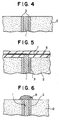
- Fig. 4 is a schematic cross-sectional view showing a via-structure formed in a multilayer interconnection ceramic substrate according to a first embodiment of the present invention.
- the multilayer interconnection substrate has a ceramic substrate 2, a via-conductor 1 penetrating the ceramic substrate 2 and a resin layer 3 formed at the interface of the via-conductor 1 and the ceramic substrate 2.
- the gap, between the via-conductor and the ceramic is provided by controlling an ambient atmosphere for sintering and by controlling a composition in a paste
- the method for providing the gap is not limited to any of those. It is preferable that thermosetting resins to be cured at a temperature between 300 and 500°C, such as polyimide or benzo-cyclo-butene, are employed in the present invention.
- the compositions of the resins are, however, not limited to any of those, but extended to wide varieties of materials. Materials for the substrate and for the conductor are not limited, either.
- substantially no crack is formed in ceramic substrates because the gap is formed and present during a sintering step at the interface between the via-conductor and the ceramic substrate.
- the resin layer is formed in the gap between the via-conductor and the ceramic substrate. Flexibility of tile resin layer can prevent a crack in the ceramic substrate, which would generate in the vicinity of the via-conductor during successive steps because of a difference in thermal expansion coefficient.
- the electric reliability can be improved because the resin layer prevents moisture and others from intrusion.
- failures such as swelling of the resin can be avoided because no crack is generated in the ceramic substrate and the gap is filled with the resin.
- Figs. 5 and 6 each shows a multilayer interconnection substrate according to another embodiment.
- the multilayer interconnection substrate of Fig.5 has a polyimide layer 6 for receiving an interconnection layer 7 and formed on the surface of a ceramic substrate 2.
- the interconnection layer 7 is connected to the via-conductor 1.
- the multilayer interconnection substrate of Fig. 6 has a terminal 8 on the surface of a ceramic substrate 2.
- the terminal 8 is connected to a via-conductor 1 surrounded by a resin layer 3.
- Embodiments 1 to 5 wherein a variety of materials are employed for a substrate, a via-conductor and a resin film and a variety of conditions in ambient atmosphere and temperature for sintering and curing.
- a multilayer interconnection ceramic substrate having a specific permittivity of 7.1 and including a via-conductor made of Ag and a glass-ceramic substrate composed of boro-silicate glass and alumina was formed by sintering in an N2-ambient at 900°C.
- a gap was generated at an interface between a via-conductor 1 and the substrate 2 while no crack was formed in the substrate.
- the resultant substrate was immersed into a polyimide precursor liquid and an ambient atmosphere was evacuated in vacuo . After removal of the substrate from the polyimide precursor liquid, the substrate was subjected to a curing step performed in a nitrogen gas stream at 450°C.
- the PCT result was such that, a terminal pattern is further formed on the substrate surface by employing sputtering and plating technologies. Then, a polyimide layer was formed by spin-coating on the substrate and hardened thermally. The process did not involve any irregularity such as swelling, resulting in formation of an excellent resin layer for multilayer interconnection.
- a multilayer interconnection ceramic substrate similar to Embodiment 1 and having a gap at an interface between a via-conductor 1 and the substrate 2 was formed and immersed in a benzo-cyclo-butene precursor liquid and the ambient atmosphere was evacuated in vacuo .
- the substrate was subjected to curing in a nitrogen gas stream at 300°C after removal from the benzo-cyclo-butene precursor liquid.
- An SEM observation performed both on the substrate surface and a cross-sectional surface of the substrate after mechanical polishing of the substrate surface clarified that a resin layer was formed perfectly between the via-conductor 1 and the ceramic substrate 2 and from the surface to a depth of about 0.5 mm in the gap, as shown in Fig. 4.
- an ink impregnation test performed on the resultant substrate indicated that any ink impregnation was not observed.
- a PCT applied to the substrate after sputter-deposition of an interconnection pattern on the substrate surface did not detect any irregularity even after 1000 hours.
- a step for hardening the benzo-cyclo-butene precursor layer spin-coated on the substrate after formation of a terminal pattern on the substrate surface by employing sputtering and plating technologies did not induce any irregularity such as swelling, resulting in formation of an excellent resin layer for multilayer interconnection.
- a multilayer interconnection ceramic substrate having a specific permittivity of 6.0 and including a via-conductor made of Cu and a glass-ceramic substrate composed of boro-silicate glass and alumina was formed by sintering in an N2-ambient at 950°C.
- a gap was formed at an interface between a via-conductor 1 and the substrate 2 while no crack was generated in the substrate.
- An ambient atmosphere was evacuated in vacuo during immersion of the resultant substrate into a polyimide precursor liquid. After removal of the substrate from the polyimide precursor liquid, the substrate was subjected to curing in a nitrogen gas stream at 450°C.
- a multilayer interconnection ceramic substrate similar to Embodiment 3 and having a gap at an interface between a via-conductor 1 and the substrate 2 was formed and immersed into a benzo-cyclo-butene precursor liquid and the ambient atmosphere was evacuated in vacuo . After removal from the benzo-cyclo-butene precursor liquid, the substrate was subjected to curing in a nitrogen gas stream at 300°C. An SEM observation of the substrate surface and a cross-sectional surface after mechanical polishing of the substrate surface clarified that a resin layer was formed perfectly between the via-conductor 1 and the ceramic substrate 2 and from the surface to a depth of about 0.5 mm in the gap, as shown in Fig. 4.
- an ink impregnation test performed on the resultant substrate did not detect any impregnation.
- a PCT applied to the substrate after formation of an interconnection pattern on the substrate surface by employing a sputter-deposition technology did not exhibit any irregularity even after 1000 hours.
- Hardening a benzo-cyclo-butene precursor layer spin-coated on the substrate after formation of a terminal pattern on the substrate surface by employing sputtering and plating technologies did not provide any irregularity such as swelling, resulting in formation of an excellent resin layer for multilayer interconnection.
- a multilayer interconnection ceramic substrate having a specific permittivity of 4.4 and including a via-conductor made of Ag and a glass-ceramic substrate composed of boro-silicate glass, quartz glass and cordierite was formed by sintering in an N2-ambient at 900°C.
- a gap was generated at an interface between a via-conductor 1 and the substrate 2 while no crack was generated in the ceramic substrate.
- the resultant substrate was immersed into a polyimide precursor liquid and the ambient atmosphere was evacuated in vacuo . After removal of the substrate from the polyimide precursor liquid, the substrate was subjected to curing in a nitrogen gas stream at 450°C.
- a benzo-cyclo-butene precursor layer was spin-coated on the substrate and hardened after formation of a terminal pattern on the substrate surface by employing sputtering and plating technologies did not provide any irregularity such as swelling, resulting in formation of an excellent resin layer for multilayer interconnection.
- a multilayer interconnection ceramic substrate similar to Embodiment 5 and having a gap at an interface between a via-conductor 1 and the substrate 2 was formed and immersed into a benzo-cyclo-butene precursor liquid and an ambient atmosphere was evacuated in vacuo .
- the substrate was subjected to curing in a nitrogen gas stream at 300°C after removal from the benzo-cyclo-butene precursor liquid.
- An SEM observation performed on the substrate surface and a cross-sectional surface after mechanical polishing of the substrate surface clarified that a resin layer was formed perfectly between the via-conductor 1 and the ceramic substrate 2 and from the surface to a depth of about 0.5 mm in the gap, as shown in Fig. 4.
- an ink impregnation test performed on the resultant substrate surface did not detect any impregnation.
- a PCT applied to the substrate after formation of an interconnection pattern on the substrate surface by employing a sputter-deposition technology did not exhibit any irregularity after 1000 hours.
- Hardening a benzo-cyclo-butene layer spin-coated on the substrate after formation of a terminal pattern on the substrate surface by employing sputtering and plating technologies did not provide any irregularity such as swelling, resulting in formation of an excellent resin layer for multilayer interconnection.
- a multilayer interconnection ceramic substrate having a specific permittivity of 7.1 and including a via-conductor made of Ag and a glass-ceramic substrate composed of boro-silicate glass and alumina was formed by sintering in an open-air at 900°C. It was observed that cracks had generated in a portion of the substrate adjacent to a via-conductor.
- a step for hardening a polyimide layer spin-coated on the substrate thus formed after formation of a terminal pattern on the substrate surface by employing sputtering and plating technologies induced an irregularity of swelling.
- I/O pins which were welded onto the resultant substrate by employing an Au-Sn solder, fractured the substrate when a lateral strain was applied to the I/O pins.
- a multilayer interconnection ceramic substrate having a specific permittivity of 7.1 and including a via-conductor made of silver and a glass-ceramic substrate composed of boro-silicate glass and alumina was formed by sintering in an N2-ambient at 900°C. it was observed that a gap had generated at an interface between a via-conductor 1 and the substrate 2.
- a PCT applied to the resultant substrate after formation of an interconnection pattern by employing a sputter-deposition technology indicated a corrosion-induced rise in resistance of the conductor after only 100 hours elapsed.
- Hardening a polyimide layer spin-coated on the substrate after formation of a terminal pattern on the substrate surface by employing sputtering and plating technologies generated an irregularity of swelling.
- a pattern was formed by employing sputtering and plating technologies on a surface of a multilayer interconnection ceramic substrate having cracks similar to Comparative Example 1.
- a step for hardening a benzo-cyclo-butene layer spin-coated on the resultant substrate induced an irregularity of swelling.
- a pattern was formed by employing sputtering and plating technologies on & multilayer interconnection ceramic substrate having a gap at an interface between a via-conductor and the substrate similarly to Comparative Example 2.
- a step for hardening a benzo-cyclo-butene layer coated on the resultant substrate induced an irregularity of swelling.
- the present invention can provide a multilayer interconnection ceramic substrate having a high reliability and a high strength, which can be produced at a low cost.
- a structure enforced in the vicinity of a via-conductor in a multilayer interconnection ceramic substrate, such as an insulating substrate, a multi-chip module substrate and a semiconductor package, according to the present invention is useful as a bonded structure in a semiconductor device for mounting LSI chips and packagings, which has an extremely high industrial value.
Landscapes
- Production Of Multi-Layered Print Wiring Board (AREA)
Applications Claiming Priority (2)
| Application Number | Priority Date | Filing Date | Title |
|---|---|---|---|
| JP6099817A JP2570617B2 (ja) | 1994-05-13 | 1994-05-13 | 多層配線セラミック基板のビア構造及びその製造方法 |
| JP99817/94 | 1994-05-13 |
Publications (2)
| Publication Number | Publication Date |
|---|---|
| EP0682363A2 true EP0682363A2 (fr) | 1995-11-15 |
| EP0682363A3 EP0682363A3 (fr) | 1997-05-14 |
Family
ID=14257401
Family Applications (1)
| Application Number | Title | Priority Date | Filing Date |
|---|---|---|---|
| EP95107251A Withdrawn EP0682363A3 (fr) | 1994-05-13 | 1995-05-12 | Structure de via d'un substrat en céramique à interconnexion multicouche. |
Country Status (3)
| Country | Link |
|---|---|
| US (1) | US5576518A (fr) |
| EP (1) | EP0682363A3 (fr) |
| JP (1) | JP2570617B2 (fr) |
Cited By (2)
| Publication number | Priority date | Publication date | Assignee | Title |
|---|---|---|---|---|
| WO2004064466A1 (fr) * | 2003-01-14 | 2004-07-29 | Matsushita Electric Industrial Co., Ltd. | Element haute frequence a structure stratifiee et procede permettant de produire cet element |
| EP0926931A4 (fr) * | 1997-04-16 | 2006-12-06 | Shinko Electric Ind Co | Tableau de connexions a trous d'interconnexion |
Families Citing this family (17)
| Publication number | Priority date | Publication date | Assignee | Title |
|---|---|---|---|---|
| US6195883B1 (en) * | 1998-03-25 | 2001-03-06 | International Business Machines Corporation | Full additive process with filled plated through holes |
| US6291779B1 (en) * | 1999-06-30 | 2001-09-18 | International Business Machines Corporation | Fine pitch circuitization with filled plated through holes |
| WO2001051580A1 (fr) * | 2000-01-13 | 2001-07-19 | Nitto Denko Corporation | Feuille adhesive poreuse, plaquette a semi-conducteurs munie de la feuille adhesive poreuse, et procede de fabrication associe |
| US6465085B1 (en) * | 2000-04-04 | 2002-10-15 | Fujitsu Limited | Thin film wiring board and method for manufacturing the same, base substrate and method for manufacturing the same |
| DE10150715A1 (de) * | 2001-10-13 | 2003-04-30 | Bosch Gmbh Robert | Grüner keramischer Einsatzkörper, keramischer Einsatzkörper, keramischer Grünkörper oder Grünkörperverbund und damit hergestellter keramischer Schichtverbund |
| US6770822B2 (en) * | 2002-02-22 | 2004-08-03 | Bridgewave Communications, Inc. | High frequency device packages and methods |
| US20050248002A1 (en) * | 2004-05-07 | 2005-11-10 | Michael Newman | Fill for large volume vias |
| US7205486B2 (en) * | 2004-07-16 | 2007-04-17 | Cardiac Pacemakers, Inc. | Thermally isolated via structure |
| JP2006302972A (ja) * | 2005-04-15 | 2006-11-02 | Alps Electric Co Ltd | 配線基板およびその製造方法 |
| US7470863B2 (en) * | 2006-01-24 | 2008-12-30 | International Business Machines Corporation | Microelectronic device with mixed dielectric |
| US8581113B2 (en) | 2007-12-19 | 2013-11-12 | Bridgewave Communications, Inc. | Low cost high frequency device package and methods |
| KR100997989B1 (ko) * | 2008-08-28 | 2010-12-03 | 삼성전기주식회사 | 다층 세라믹 기판 |
| KR100968977B1 (ko) * | 2008-10-17 | 2010-07-14 | 삼성전기주식회사 | 무수축 세라믹 기판 및 무수축 세라믹 기판의 제조 방법 |
| JP5330863B2 (ja) * | 2009-03-04 | 2013-10-30 | パナソニック株式会社 | 半導体装置の製造方法 |
| KR101153492B1 (ko) * | 2010-08-24 | 2012-06-11 | 삼성전기주식회사 | 프로브 카드용 세라믹 기판 제조 방법 및 프로브 카드용 세라믹 기판 |
| US9523715B2 (en) * | 2012-04-13 | 2016-12-20 | Formfactor, Inc. | Wiring substrate with filled vias to accommodate custom terminals |
| CN105628707B (zh) * | 2015-12-30 | 2018-05-08 | 中电环保股份有限公司 | 水处理树脂界面图像识别方法 |
Citations (2)
| Publication number | Priority date | Publication date | Assignee | Title |
|---|---|---|---|---|
| JPH0391992A (ja) | 1989-09-04 | 1991-04-17 | Sharp Corp | 印刷配線基板の製造方法 |
| JPH03145796A (ja) | 1989-10-31 | 1991-06-20 | Shin Kobe Electric Mach Co Ltd | スルーホール印刷配線板の製造法 |
Family Cites Families (17)
| Publication number | Priority date | Publication date | Assignee | Title |
|---|---|---|---|---|
| US3873756A (en) * | 1971-02-10 | 1975-03-25 | Gridcraft Inc | Insulating lining for metallic circuit board terminal holes |
| US4234367A (en) * | 1979-03-23 | 1980-11-18 | International Business Machines Corporation | Method of making multilayered glass-ceramic structures having an internal distribution of copper-based conductors |
| US4318954A (en) * | 1981-02-09 | 1982-03-09 | Boeing Aerospace Company | Printed wiring board substrates for ceramic chip carriers |
| JPS59193095A (ja) * | 1983-04-15 | 1984-11-01 | 株式会社日立製作所 | セラミツク配線基板及びその製造方法 |
| JPS61229389A (ja) * | 1985-04-03 | 1986-10-13 | イビデン株式会社 | セラミツク配線板およびその製造方法 |
| US4740414A (en) * | 1986-11-17 | 1988-04-26 | Rockwell International Corporation | Ceramic/organic multilayer interconnection board |
| US4721831A (en) * | 1987-01-28 | 1988-01-26 | Unisys Corporation | Module for packaging and electrically interconnecting integrated circuit chips on a porous substrate, and method of fabricating same |
| US4880684A (en) * | 1988-03-11 | 1989-11-14 | International Business Machines Corporation | Sealing and stress relief layers and use thereof |
| JPH02234456A (ja) * | 1989-03-08 | 1990-09-17 | Ngk Spark Plug Co Ltd | 集積回路パッケージおよびその製造方法 |
| JPH034592A (ja) * | 1989-06-01 | 1991-01-10 | Fujitsu Ltd | セラミック基板の製造方法 |
| JPH03138806A (ja) * | 1989-10-24 | 1991-06-13 | Narumi China Corp | 充填用導体ペーストおよび多層配線基板 |
| JPH03150894A (ja) * | 1989-11-07 | 1991-06-27 | Fujitsu Ltd | 多層薄膜回路基板の膜厚管理方法 |
| US5121299A (en) * | 1989-12-29 | 1992-06-09 | International Business Machines Corporation | Multi-level circuit structure utilizing conductive cores having conductive protrusions and cavities therein |
| JPH04283993A (ja) * | 1991-03-12 | 1992-10-08 | Fujitsu Ltd | 薄膜多層基板の製造方法 |
| JP3098288B2 (ja) * | 1991-08-08 | 2000-10-16 | 株式会社デンソー | 導体組成物およびそれを用いたセラミック基板 |
| JPH0620516A (ja) * | 1992-07-02 | 1994-01-28 | Nippondenso Co Ltd | 導体組成物,セラミック多層基板及び半導体装置 |
| JPH06104575A (ja) * | 1992-09-22 | 1994-04-15 | Sumitomo Kinzoku Ceramics:Kk | 抵抗体付きセラミックス回路基板 |
-
1994
- 1994-05-13 JP JP6099817A patent/JP2570617B2/ja not_active Expired - Lifetime
-
1995
- 1995-05-12 US US08/439,945 patent/US5576518A/en not_active Expired - Fee Related
- 1995-05-12 EP EP95107251A patent/EP0682363A3/fr not_active Withdrawn
Patent Citations (2)
| Publication number | Priority date | Publication date | Assignee | Title |
|---|---|---|---|---|
| JPH0391992A (ja) | 1989-09-04 | 1991-04-17 | Sharp Corp | 印刷配線基板の製造方法 |
| JPH03145796A (ja) | 1989-10-31 | 1991-06-20 | Shin Kobe Electric Mach Co Ltd | スルーホール印刷配線板の製造法 |
Cited By (3)
| Publication number | Priority date | Publication date | Assignee | Title |
|---|---|---|---|---|
| EP0926931A4 (fr) * | 1997-04-16 | 2006-12-06 | Shinko Electric Ind Co | Tableau de connexions a trous d'interconnexion |
| WO2004064466A1 (fr) * | 2003-01-14 | 2004-07-29 | Matsushita Electric Industrial Co., Ltd. | Element haute frequence a structure stratifiee et procede permettant de produire cet element |
| US7297878B2 (en) | 2003-01-14 | 2007-11-20 | Matsushita Electric Industrial Co., Ltd. | High frequency laminated component and its manufacturing method |
Also Published As
| Publication number | Publication date |
|---|---|
| US5576518A (en) | 1996-11-19 |
| EP0682363A3 (fr) | 1997-05-14 |
| JP2570617B2 (ja) | 1997-01-08 |
| JPH07307573A (ja) | 1995-11-21 |
Similar Documents
| Publication | Publication Date | Title |
|---|---|---|
| US5576518A (en) | Via-structure of a multilayer interconnection ceramic substrate | |
| US5677575A (en) | Semiconductor package having semiconductor chip mounted on board in face-down relation | |
| US5549778A (en) | Manufacturing method for multilayer ceramic substrate | |
| US7820916B2 (en) | Composite ceramic substrate | |
| US6218736B1 (en) | Circuit board and semiconductor device, and method of manufacturing the same | |
| US6933448B2 (en) | Printed circuit board having permanent solder mask | |
| US5760466A (en) | Semiconductor device having improved heat resistance | |
| JP3199637B2 (ja) | 多層配線基板の製造方法 | |
| JP3085649B2 (ja) | 転写シート及びそれを用いた配線基板の製造方法 | |
| JPH0722725A (ja) | 薄膜コンデンサ付回路基板及びその製造方法 | |
| JP3071764B2 (ja) | 金属箔付きフィルム及びそれを用いた配線基板の製造方法 | |
| JP3071723B2 (ja) | 多層配線基板の製造方法 | |
| JP2000252391A (ja) | 半導体素子実装配線基板およびその実装構造 | |
| JP3152852B2 (ja) | 配線基板及びその製造方法 | |
| JP3748283B2 (ja) | 積層ガラスセラミック回路基板の製造方法 | |
| JP3758811B2 (ja) | 転写シート及びそれを用いた配線基板の製造方法 | |
| JP3305574B2 (ja) | 配線基板 | |
| JP3659441B2 (ja) | 配線基板 | |
| JP3292623B2 (ja) | 配線基板及びその製造方法 | |
| JP2002016176A (ja) | 配線基板およびその接続構造 | |
| JP3502759B2 (ja) | 半導体素子の実装構造、並びに配線基板の実装構造 | |
| WO2024154790A1 (fr) | Carte de câblage, dispositif électrique et structure de dispositif électrique | |
| EP0354341B1 (fr) | Structure composite utilisable dans des empaquetages électroniques | |
| WO2024154834A1 (fr) | Substrat de montage d'élément électronique | |
| US20020063325A1 (en) | Substrate structure |
Legal Events
| Date | Code | Title | Description |
|---|---|---|---|
| PUAI | Public reference made under article 153(3) epc to a published international application that has entered the european phase |
Free format text: ORIGINAL CODE: 0009012 |
|
| AK | Designated contracting states |
Kind code of ref document: A2 Designated state(s): DE FR GB |
|
| PUAL | Search report despatched |
Free format text: ORIGINAL CODE: 0009013 |
|
| AK | Designated contracting states |
Kind code of ref document: A3 Designated state(s): DE FR GB |
|
| 17P | Request for examination filed |
Effective date: 19970820 |
|
| 17Q | First examination report despatched |
Effective date: 19990330 |
|
| STAA | Information on the status of an ep patent application or granted ep patent |
Free format text: STATUS: THE APPLICATION IS DEEMED TO BE WITHDRAWN |
|
| 18D | Application deemed to be withdrawn |
Effective date: 19990810 |