EP0683210A2 - Resine composite comprenant une matrice en polyamide contenant des grains dispersés de polyoléfine - Google Patents
Resine composite comprenant une matrice en polyamide contenant des grains dispersés de polyoléfine Download PDFInfo
- Publication number
- EP0683210A2 EP0683210A2 EP95303378A EP95303378A EP0683210A2 EP 0683210 A2 EP0683210 A2 EP 0683210A2 EP 95303378 A EP95303378 A EP 95303378A EP 95303378 A EP95303378 A EP 95303378A EP 0683210 A2 EP0683210 A2 EP 0683210A2
- Authority
- EP
- European Patent Office
- Prior art keywords
- weight
- resin composite
- copolymer
- polyamide
- modified
- Prior art date
- Legal status (The legal status is an assumption and is not a legal conclusion. Google has not performed a legal analysis and makes no representation as to the accuracy of the status listed.)
- Granted
Links
Images



Classifications
-
- C—CHEMISTRY; METALLURGY
- C08—ORGANIC MACROMOLECULAR COMPOUNDS; THEIR PREPARATION OR CHEMICAL WORKING-UP; COMPOSITIONS BASED THEREON
- C08L—COMPOSITIONS OF MACROMOLECULAR COMPOUNDS
- C08L51/00—Compositions of graft polymers in which the grafted component is obtained by reactions only involving carbon-to-carbon unsaturated bonds; Compositions of derivatives of such polymers
- C08L51/06—Compositions of graft polymers in which the grafted component is obtained by reactions only involving carbon-to-carbon unsaturated bonds; Compositions of derivatives of such polymers grafted on to homopolymers or copolymers of aliphatic hydrocarbons containing only one carbon-to-carbon double bond
-
- C—CHEMISTRY; METALLURGY
- C08—ORGANIC MACROMOLECULAR COMPOUNDS; THEIR PREPARATION OR CHEMICAL WORKING-UP; COMPOSITIONS BASED THEREON
- C08L—COMPOSITIONS OF MACROMOLECULAR COMPOUNDS
- C08L77/00—Compositions of polyamides obtained by reactions forming a carboxylic amide link in the main chain; Compositions of derivatives of such polymers
-
- C—CHEMISTRY; METALLURGY
- C08—ORGANIC MACROMOLECULAR COMPOUNDS; THEIR PREPARATION OR CHEMICAL WORKING-UP; COMPOSITIONS BASED THEREON
- C08L—COMPOSITIONS OF MACROMOLECULAR COMPOUNDS
- C08L5/00—Compositions of polysaccharides or of their derivatives not provided for in groups C08L1/00 or C08L3/00
- C08L5/06—Pectin; Derivatives thereof
-
- Y—GENERAL TAGGING OF NEW TECHNOLOGICAL DEVELOPMENTS; GENERAL TAGGING OF CROSS-SECTIONAL TECHNOLOGIES SPANNING OVER SEVERAL SECTIONS OF THE IPC; TECHNICAL SUBJECTS COVERED BY FORMER USPC CROSS-REFERENCE ART COLLECTIONS [XRACs] AND DIGESTS
- Y10—TECHNICAL SUBJECTS COVERED BY FORMER USPC
- Y10T—TECHNICAL SUBJECTS COVERED BY FORMER US CLASSIFICATION
- Y10T428/00—Stock material or miscellaneous articles
- Y10T428/31504—Composite [nonstructural laminate]
- Y10T428/31725—Of polyamide
-
- Y—GENERAL TAGGING OF NEW TECHNOLOGICAL DEVELOPMENTS; GENERAL TAGGING OF CROSS-SECTIONAL TECHNOLOGIES SPANNING OVER SEVERAL SECTIONS OF THE IPC; TECHNICAL SUBJECTS COVERED BY FORMER USPC CROSS-REFERENCE ART COLLECTIONS [XRACs] AND DIGESTS
- Y10—TECHNICAL SUBJECTS COVERED BY FORMER USPC
- Y10T—TECHNICAL SUBJECTS COVERED BY FORMER US CLASSIFICATION
- Y10T428/00—Stock material or miscellaneous articles
- Y10T428/31504—Composite [nonstructural laminate]
- Y10T428/31855—Of addition polymer from unsaturated monomers
Definitions
- the present invention relates to a thermoplastic resin composite, particularly a resin composite comprising a polyamide and polyolefines, which is low in water absorption and superior in dimensional stability, rigidity, toughness and moldability.
- the thermoplastic resin composite of the present invention finds wide applications in mechanical parts, automobile parts, electric or electronic parts, etc.
- Polyamide resins being well balanced in mechanical properties, heat resistance, chemical resistance and moldability, find wide applications in electrical or electronic parts, automobile parts, etc.
- the polyamide resins are prone to absorb moisture.
- the polyamide resins show large dimensional change and large reduction in mechanical properties such as bending strength, modulus of elasticity and the like. Accordingly, the polyamide resins are not suitable in parts requiring dimensional accuracy, and their improvement is desired.
- polypropylene is lightweight, low in water absorption, superior in melt flowability, and low in cost, and is used in a large amount in automobile parts and electrical parts.
- polypropylene has insufficient heat resistance, strength and rigidity.
- Polypropylene tends to crystallize and has a large mold shrinkage coefficient so that upon molding, dimensional accuracy is limited. Hence, polypropylene may per se have limited applications.
- a monomer unit into the main chain of polyamide by copolymerization, and the monomer units consisting of an aromatic dicarboxylic acid, an aromatic diamine or a salt thereof by copolymerization.
- a polyamide may be blended with a polymer having low water absorption.
- the polymer having low water absorption includes crystalline resins and synthetic rubbers, which may be made of one of polypropylene modified by an unsaturated carboxylic acid or a derivative thereof, ethylene, and a copolymer having the propylene units and ethylene units.
- Japanese Patent Application Kokai (Laid-Open) No. 12546/1967 discloses a thermoplastic resin composition comprising 50-99% by weight of a polyamide and 50-1% by weight of an unsaturated carboxylic acid-olefine copolymer, which has improved compatibility.
- the resin composition has excellent mechanical properties, particularly excellent rupture property but does not satisfy all of low water absorption, rigidity and heat resistance.
- Japanese Patent Publication No. 30945/1970 discloses a method of manufacturing a resin composition comprising an olefine polymer, a polyamide and/or a polyester, and a polyolefine modified with at least one of acids, esters, amides, acid anhydrides and epoxy group.
- the resin composition has satisfactory dispersion and is suitable for use in fibers. However, upon injection molding or extrusion, the composition shrinks, thereby the molded article having inferior dimensional accuracy and insufficient impact resistance.
- Japanese Patent Application Kokai (Laid-Open) No. 262853/1985 discloses a polyamide resin composition comprising a polyamide and a modified ethylene-propylene block copolymer, which has low water absorption.
- the water absorption of polyamide is reduced to a certain extent without significantly sacrificing its rigidity and heat resistance.
- the water absorption level of the resin composition is still insufficient.
- Japanese Patent Application Kokai (Laid-Open) No. 223250/1987 discloses a resin composition obtained by kneading a crystalline polyolefine with a polyamide and an unsaturated carboxylic acid derivative and further kneading the resulting modified polyolefine with a polyamide and a polyolefine.
- the resin composition has low water absorption, excellent tensile strength and excellent surface gloss.
- the resin composition does not satisfy both of rigidity and impact resistance.
- Japanese Patent Application Kokai (Laid-Open) No. 223251/1987 discloses a resin composition having excellent impact resistance, obtained by adding, to the above resin composition, an ethylene- ⁇ -olefine copolymer of low crystallinity.
- the resin composition has improved water absorption, but has low rigidity and does not satisfy both of low water absorption and mechanical properties.
- Japanese Patent Application Kokai (Laid-Open) No. 223250/1987 also discloses a resin composition comprising a crystalline polyolefine, a polyamide and a small amount of a crystalline polyolefine modified by an unsaturated carboxylic acid.
- the resin composition does not satisfy all of low water absorption, rigidity and impact resistance.
- Japanese Patent Application Kokai (Laid-Open) No. 51458/1989 discloses a polyamide resin composition comprising a polyamide resin, a crystalline polypropylene modified by unsaturated carboxylic acid and an ethylene- ⁇ -olefine copolymer modified by an unsaturated carboxylic acid.
- the polyamide resin composition gives a small dimensional change upon water absorption and has excellent rigidity and impact resistance.
- the polyamide resin composition being rich in the polyamide component, has excellent mechanical properties, but is still insufficient in water absorption and does not fully satisfy both of low water absorption and mechanical properties.
- Japanese Patent Application Kokai (Laid-Open) No. 87652/1989 discloses a polypropylene resin composition having excellent impact resistance, comprising a partially modified crystalline propylene-ethylene block copolymer, a polyamide and a modified ethylene- ⁇ -olefine copolymer.
- the composition contains a polypropylene as a matrix and a polyamide as a dispersed phase, thereby having improved heat resistance and mechanical properties as compared with the polypropylene.
- the compositions has significantly inferior rigidity and heat resistance as compared with the polyamide.
- compositions each comprising 40-60% by weight of a modified polyolefine copolymer grafted with an unsaturated carboxylic acid or a derivative thereof and 60-40% by weight of a polyamide.
- the incorporation of the modified polyolefine of relatively high molecular weight having an melt flow rate of 2.0 g or less per 10 minutes improves the rigidity, water resistance and weld strength.
- the compositions do not improve impact resistance; the mold shrinkage coefficient is high ; the dimensional stability upon molding is low; and the melt does not sufficiently flow.
- Japanese Patent Application Kokai (Laid-Open) No. 91560/1991 discloses a polyamide resin composition comprising 100 parts by weight of polyamide, 1-100 parts by weight of a modified polyolefine, 5-250 parts by weight of a polypropylene resin, 0.01-3.0 parts by weight of an organic heat stabilizer and 0.1-5.0 parts by weight of a particular carbon black.
- the polyamide resin composition does not age much upon heating.
- the polyamide resin composition however, has insufficient impact resistance and dimensional stability upon molding.
- Japanese Patent Application Kokai (Laid-Open) No. 109452/1991 discloses a resin composition comprising 10-89.9 parts by weight of a polypropylene resin, 10-89.9 parts by weight of a polyamide, 0.1-5 parts by weight of an unsaturated carboxylic acid-modified polyolefine, 0-30 parts by weight of an impact improver and 0-60 parts by weight of a reinforcing agent, wherein the resin composition is 100 parts by weight.
- the resin composition shows excellent toughness, rigidity and heat deformation stability, but has insufficient melt flowability during molding and insufficient lightweightness.
- Japanese Patent Application Kokai (Laid-Open) No. 115342/1991 discloses a resin composition comprising 94-50% by weight of a polypropylene, 1-40% by weight of a modified polyolefine and 5-40% by weight of a polyamide, wherein the ratio of the melt viscosity of the polyamide to the melt viscosity of the polypropylene is 1 or more.
- the resin composition has improved heat resistance as compared with the polypropylene, but has no sufficient improvement in dimensional stability upon molding and rigidity.
- Japanese Patent Application Kokai (Laid-Open) No. 146552/1991 discloses a resin composition comprising 40-80% by weight of a polyamide, 1-40% by weight of a modified polyolefine and 20-60% by weight of a polypropylene.
- the resin composition shows excellent coating property by having a melt viscosity ratio ⁇ PP / ⁇ PA of 0.75 or more at a shear rate of 3,500 sec ⁇ 1 at the molding temperature, but is insufficient in impact resistance and dimensional stability upon molding.
- Japanese Patent Application Kokai (Laid-Open) No. 207735/1991 discloses a resin composition comprising a polyamide, a polyolefine and a modified polyolefine.
- the modified polyolefine having a tensile yield strength of 300 kg/cm2 or more improves mechanical properties, particularly, weld strength of a molded article made of the resin composition.
- the resin composition has high shrinkage coefficient upon solidification during molding, thereby the molded article having insufficient dimensional stability and rigidity.
- Japanese Patent Publication No. 44108/1980 discloses a multi-phase thermoplastic resin composition having a polyamide matrix and particles dispersed therein.
- the particles are made of a polymer having at least one residue selected from ethylene, carbonyl compounds, ⁇ , ⁇ -unsaturated carboxylic acids and derivatives thereof, unsaturated epoxides, carboxylic acids and derivatives thereof, acrylic acid esters, monomers having aromatic side chains and unsaturated carbon-carbon monomers.
- the resin composition has excellent impact resistance and modulus of bending elasticity. However, the resin composition is insufficient in low water absorption; the resin composition does not have both mechanical properties and dimensional stability upon water absorption.
- thermoplastic resin composition having flexibility, comprising (a) a modified ethylene copolymer grafted with 0.05-1.5% by weight of an ⁇ , ⁇ -unsaturated carboxylic acid or a derivative thereof and (b) a polyamide at a ratio of 2/3:1 to 6:1.
- the thermoplastic resin composition has improved flexibility and impact resistance but has reduced rigidity and elongation upon rupture.
- Japanese Patent Application Kokai (Laid-Open) No. 123158/1979 discloses a polyolefine resin composition comprising: a polyolefine resin, including an unsaturated carboxylic acid-added polyolefine resin; a nitrogen-containing resin; and a filler.
- the polyolefine resin is superior in mechanical properties, heat resistance and coating property.
- the resin composition has improved bending strength, heat deformation temperature and coating property.
- the resin composition has problem in rigidity, toughness, lightweightness and dimensional stability.
- Japanese Patent Application Kokai (Laid-Open) No. 232135/1984 discloses a polyolefine resin composition superior in dyeing property, comprising a modified polyolefine, a polyamide and a crystalline polyolefine, wherein the amount of the olefine units is 70% by weight or more of the total.
- the incorporation of a large amount of polyolefines improves, upon injection molding, mechanical strength, rigidity, heat resistance, etc. However, the extent of improvement is limited.
- Japanese Patent Application Kokai (Laid-Open) No. 118735/1985 discloses a resin composition with both mechanical properties and low water absorption, comprising a polyamide and a modified polyolefine.
- the resin composition is insufficient in balance between rigidity and low water absorption.
- Japanese Patent Application Kokai (Laid-Open) No. 8246/1982 discloses a resin composition comprising a polyamide, a polyolefine having a crystallinity of 40% or more and a modified polyolefine obtained by modifying an ethylene- ⁇ -olefine copolymer having a crystallinity of 35% or less with an ⁇ , ⁇ -unsaturated carboxylic acid or a derivative thereof.
- the resin composition has improved impact resistance and appearance, but has no sufficient balance between rigidity and low water absorption.
- Japanese Patent Application Kokai (Laid-Open) No. 149940/1984 Japanese Patent Publication No. 42109/1990
- Japanese Patent Application Kokai (Laid-Open) No. 110740/- 1985 Japanese Patent Publication No. 42379/1990
- the resin composition has a polypropylene matrix, thereby considerably low rigidity expressed by modulus of bending elasticity, as compared with a polyamide matrix.
- polyamide resin compositions are not well balanced between the properties possessed by a polyamide and the properties possessed by a polyolefine.
- the polyamide has favorable properties such as the mechanical properties, heat resistance and moldability, and the polyolefine has favorable properties such as the lightweightness and low water absorption. Neither the polyamide nor the polyolefine has low warpage upon molding, good dimensional stability and good impact resistance.
- An object of the present invention is to provide a thermoplastic resin composite, which has both the properties possessed by a polyamide and the properties possessed by a polyolefine in good balance, and which further has properties that are not sufficiently possessed by the polyamide or polyolefine, specifically, low warpage upon molding, good dimensional stability and good impact resistance.
- polyolefine grains are dispersed in a polyamide matrix, and each of the polyolefine grains has a so called core-shell structure wherein the shell is coated onto the surfaces of the core.
- the core is made of an unmodified polyolefine
- the shell is made of another polyolefine that is modified so as to be compatible with the polyamide matrix.
- the polyolefine for the core has properties different from the other polyolefine for the shell in terms of flexibility.
- One of the polyolefines may be a crystalline polypropylene resin, and the other polyolefine may be a copolymer having ethylene units and ⁇ -olefine units.
- the core is made of a crystalline polypropylene resin (C)
- the shell is made of modified copolymer (B) having ethylene units and ⁇ -olefine units.
- the modified copolymer (B) may have the ⁇ -olefine units as a major component.
- the resin composite has 30 to 80 percents by weight of a polyamide (A), 1 to 30 percents by weight of the modified copolymer (B), and 19 to 69 percents by weight of the crystalline polypropylene resin (C) wherein a sum of the polyamide, the modified copolymer, and the crystalline propylene resin is 100 percents by weight.
- the core is made of an unmodified copolymer (E) having ethylene units and ⁇ -olefine units
- the shell is made of a modified crystalline polypropylene resin (D).
- the copolymer may have the ethylene units as a major component.
- the resin composite has 30 to 80 percents by weight of polyamide (A), 5 to 50 percents by weight of the modified crystalline polypropylene resin (D), and 5 to 65 percents by weight of the copolymer (E) wherein a sum of the polyamide, the modified crystalline polypropylene resin, and the copolymer is 100 percents by weight.
- the modification of the unmodified crystalline polypropylene resin (C) with at least one of ⁇ , ⁇ -unsaturated caboxylic acid and ⁇ , ⁇ -unsaturated caboxylate gives the modified crystalline polypropylene resin (D).
- a method of modifying the crystalline polypropylene resin (C) to give the modified crystalline polypropylene resin (D) is the same as that of modifying the first copolymer to give the modified copolymer (B).
- the resin composite of the present invention contains the polyamide (A) forming the matrix so as to reflect favorable properties of a polyamide resin, such as the heat resistance and mechanical properties, thereby having improved modulus of elasticity, heat resistance and rupture strength. Contrarily, when the polyamide component (A) forms a discontinuous phase, the resulting resin composite has low mechanical properties and heat resistance, being unable to achieve the object of the present invention.
- the core-shell structure in the resin composite of the present invention gives superior mechanical properties (e.g. modulus of bending elasticity, tensile and bending strengths and impact resistance), low viscosity of a melt and superior flow during molding.
- both of the polyolefine components (B) and (C) or (D) and (E) are modified with a chemical having polar group that is compatible with the polyamide (A)
- each of the polyolefines are independently dispersed in the polyamide matrix; some particles are made of one polyolefine, and the other particles are made of another polyolefine.
- thermoplastic resin composite of the present invention has both the properties possessed by a polyamide and the properties possessed by a polyolefine in good balance and further has low warpage upon molding, good dimensional stability and good impact resistance.
- Fig. 1 is a cross section of the resin composite of the present invention.
- Fig. 2 is a photograph of transmission electron microscope of the resin composite of the first aspect of the present invention.
- Fig. 3 is a photograph of transmission electron microscope of the resin composite of the second aspect of the present invention.
- Fig. 4 is a photograph of transmission electron microscope of the resin composite of the first aspect of the present invention wherein a plurality of cores are present.
- a resin composite 10 includes a polyamide matrix 12, and polyolefine grains 14, 24, 34 are dispersed in the polyamide matrix 12.
- Each of the polyolefine grains 14, 24, 34 has a so-called core-shell structure wherein shells 18, 28, 38 are coated onto the surfaces 16s, 26s, 27s, 36s of cores 16, 26, 27, 36, respectively.
- the cores are made of an unmodified polyolefine, while the shells are made of a modified polyolefine.
- Each of the grains 14, 24, 34 has a granular shape.
- Grain 14 has one core 16, while grain 24 has two cores 26, 27.
- the shell 18 has a substantially uniform thickness.
- the shell 38 has an uneven thickness; a part 39a is thicker than another part 39b.
- the grains may have average diameters up to 5 ⁇ m, and further preferably the grains may have average diameters up to 3 ⁇ m. Further preferably the grains may have average diameters up to 2 ⁇ m.
- the cores may have average diameters up to 3 ⁇ m, and further preferably the cores may have average diameters up to 2 ⁇ m. Further preferably the cores may have average diameters up to 1.5 ⁇ m.
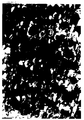
- Figs. 2, 3, and 4 are photographs of transmission electron microscope magnified by 15,000 times. Each grain has a black part, which corresponds to copolymers whether modified or not.
- the copolymers are dyed by ruthenium tetraoxide.
- the core is made of a crystalline polypropylene resin (C)
- the shell is made of modified copolymer (B) having ethylene units and ⁇ -olefine units.
- the modified copolymer (B) has the ⁇ -olefine units as a major component.
- many of the grains have diameters ranging from 2 ⁇ m to 3 ⁇ m.
- the shell can be thicker, depending on an amount of the modified copolymer, an amount of the modifying species, the composition of the modified copolymer, etc.
- a few cores have a plurality of white area, which presumably corresponds to the polyamide incorporated in the cores.
- polyamide it is preferable that polyamide is not incorporated in the cores.
- the black core is made of an unmodified copolymer having ethylene units and ⁇ -olefine units
- the shell is made of a modified crystalline polypropylene resin.
- Fig. 4 many of the grains have a plurality of black cores made of an unmodified copolymer.
- the size of one core can differ from the size of another core in the same grain.
- the polyamide (A) may be obtained by polycondensation between (a) an aliphatic, alicyclic or aromatic diamine [e.g. hexamethylenediamine, decamethylenediamine, dodecamethylenediamine, 2,2,4- or 2,4,4-trimethylhexamethylenediamine, 1,3- or 1,4-bis(aminomethyl)cyclohexane, bis(p-aminocyclohexylmethane) or m- or p-xylylenediamine] and (b) an aliphatic, alicyclic or aromatic dicarboxylic acid (e.g.
- an aliphatic, alicyclic or aromatic dicarboxylic acid e.g.
- the polyamide (A) may be obtained from a lactam, such as, ⁇ -caprolactam and ⁇ -laurolactam.
- the polyamide (A) may be obtained by copolymerization of these chemicals, and the polyamide (A) may be a mixture of the polyamides and/or copolyamides.
- the polyamide (A) may be, for example, nylon 6, nylon 66, nylon 46, nylon 610, nylon 612, nylon 9, nylon 11, nylon 12, nylon 6/66, nylon 66/610, nylon 6/9, nylon 6/11, nylon 6/12, nylon 6/610, nylon 6/612, nylon 6/66/610, nylon 6/66/12, nylon 6T (T: terephthalic acid component), nylon 6I (I: isophthalic acid component), nylon 6/6T, nylon 6/6I, nylon 66/6T and nylon 66/6I.
- nylon 6, nylon 66, nylon 11, nylon 12, nylon 6/66, nylon 6T and nylon 66/6T are preferred in view of the moldability, balance in mechanical properties, and cost.
- the molecular weight of the polyamide (A) has no particular restriction but is preferably 1.0 or more, more preferably 2.0-4.0 in terms of relative viscosity as measured for a solution of 1 g/dl of the polyamide (A) in 98% sulfuric acid.
- the resulting resin composite may have low mechanical strengths.
- the relative viscosity is less than 1.0, the resin composite has significantly low mechanical strengths.
- the relative viscosity is more than 4.0, the resin composite has high melt viscosity and low moldability.
- the modified polyolefine used as the component (B) is a poly- ⁇ -olefine modified with an ⁇ , ⁇ -unsaturated carboxylic acid or a derivative thereof. It is obtained by modifying an ⁇ -olefine copolymer having a modulus of tensile elasticity of 200 MPa or less (obtained by copolymerizing at least two monomers selected from the ⁇ -olefines mentioned later) with an ⁇ , ⁇ -unsaturated carboxylic acid or a derivative thereof.
- the ⁇ , ⁇ -unsaturated carboxylic acid or the derivative thereof includes univalent carboxylic acids such as acrylic acid, methacrylic acid, crotonic acid, isocrotonic acid and the like; divalent carboxylic acids such as maleic acid, fumaric acid, itaconic acid, citraconic acid and the like; and anhydrides or salts thereof.
- univalent carboxylic acids such as acrylic acid, methacrylic acid, crotonic acid, isocrotonic acid and the like
- divalent carboxylic acids such as maleic acid, fumaric acid, itaconic acid, citraconic acid and the like
- anhydrides or salts thereof include acrylic acid, methacrylic acid, maleic anhydride, itaconic anhydride, and zinc salts and sodium salts thereof.
- maleic anhydride and itaconic anhydride particularly preferred are maleic anhydride and itaconic anhydride.
- the content of the ⁇ , ⁇ -unsaturated carboxylic acid or the derivative thereof in the modified polyolefine (B) is preferably 0.05-5% by weight, particularly preferably 0.1-3% by weight.
- the content of the ⁇ , ⁇ -unsaturated carboxylic acid or the derivative thereof is smaller than the above range, the adhesion between the polyamide and the polyolefine phase is insufficient and the resulting resin composite has an unstable dispersion structure and low mechanical strengths.
- the content is larger than the above range, the resin composite gives a melt having high viscosity.
- the modified polyolefine (B) can be obtained by stirring, with heating, a polyolefine of molten state or solution state together with an ⁇ , ⁇ -unsaturated carboxylic acid or its derivative both mentioned above and a radical initiator.
- the radical initiator may include, for example, organic peroxides such as hydroperoxide, dialkyl peroxide, peroxyester and the like. Specific examples thereof are benzoyl peroxide, dichlorobenzoyl peroxide, dicumyl peroxide, cyclohexanone peroxide and t-butylperoxybenzoate.
- the ⁇ -olefine unit constituting the modified polyolefine (B) is an ⁇ -olefine having 2 or more carbon atoms, particularly 2 to about 18 carbon atoms.
- the ⁇ -olefine unit can be, for example, ethylene, propylene, 1-butene, 1-hexene, 1-decene and 1-pentene. They can be used singly or in combination of two or more.
- the unmodified polyolefine used for obtaining the modified polyolefine (B) contains propylene units in an amount of 30-80 mole %, preferably 40-75 mole %, particularly preferably 45-75 mole %.
- the propylene content is smaller than the above lower limit, the compatibility between the component (B) and the component (C) (described later) is insufficient, the dispersion structure of the resulting resin composite is unstable, and the mechanical strengths of the composite are small.
- the propylene content is larger than the above upper limit, the resulting resin composite has small improvement in impact resistance, large shrinkage upon solidification during molding, and gives a molded article having low dimensional stability.
- the probability that propylene units are present in three consecutive units in the polymer chain is preferably 0.1-0.5.
- the probability deviates from the range the resulting resin composite may show no improvement in tensile strength or impact resistance.
- the component (B) is flexible at room temperature and has a tensile modulus of 200 MPa or less at 23°C as measured by ASTM D 638.
- the tensile modulus is larger than 200 MPa, the resulting resin composite has low impact resistance and shows, in some cases, no sufficient improvement in mold shrinkage coefficient or warpage upon molding.
- the unmodified polyolefine, serving as the component (C) is a crystalline polyolefine, particularly a crystalline polypropylene.
- the component (C) preferably has a modulus of bending elasticity at 23°C as measured by ASTM D 790, of 1 GPa or more, preferably 1.5 GPa or more. When the modulus of bending elasticity is less than 1 GPa, the resulting resin composite has low rigidity, being unable to achieve the object of the present invention.
- the crystalline polypropylene resin, serving as the component (C), may be a propylene homopolymer.
- the component (C) may also be a block or random copolymer composed of propylene and 20 mole % or less of an ⁇ -olefine such as ethylene, 1-butene or the like.
- the desired molecular weight of the component (C) is 1 g/10 min or more, preferably 10-100 g/10 min, more preferably 10-50 g/10 min in terms of melt flow rate (MFR) at a load of 2.16 kg at 230°C as measured by ASTM D 1238.
- MFR melt flow rate
- the melt flow rate is smaller than 1 g/10 min, the polyolefine phase dispersed in the thermoplastic resin composite has large sizes and said resin composite has low rupture properties (e.g. low impact resistance). This undesirable phenomenon tends to appear already when the melt flow rate is in the range of 1-10 g/10 min.
- the melt flow rate is larger than 100 g/10 min, the melt viscosity of the component (C) is too small as compared with that of the component (A), the presence of the component (A) in the form of a continuous phase is difficult, and the resulting resin composite has low mechanical strengths. This phenomenon tends to appear already when the melt flow rate is in the range of 50-100 g/10 min.
- the component (C) is not modified with any polar group or any reactive group, unlike the component (B).
- the component (C) is modified with a residue reactive or compatible with the polyamide (A)
- the polyolefine phase fails to take a core-shell structure in the resulting resin composite, and the advantageous properties polyolefine core-shell structure as described later is unobtainable.
- the resin composite contains 30-80% by weight of the polyamide [the component (A)], 1-30% by weight of the modified polyolefine [the component (B)] and 19-69% by weight of the unmodified polyolefine [the component (C)], wherein the sum of the component (A), the component (B) and the component (C) is 100% by weight.
- the proportion of the component (B) is preferably 3-20% by weight, more preferably 5-15% by weight.
- the proportion of the component (C) is preferably 19-50% by weight.
- the proportion of the component (A) is more than 80% by weight, the resulting resin composite does not have sufficient improvement in water absorption, so that a molded article has a large dimensional change upon moisture absorption.
- the proportion of the component (A) is less than 30% by weight, the polyamide phase [the component (A)] fails to remain as a continuous phase so that the resulting resin composite has low mechanical properties and heat resistance.
- the proportion of the component (B) in the resin composite is less than 1% by weight, the compatibility between the polyamide component (A) and the component (B) is poor so that the resulting resin composite has low impact resistance and a large mold shrinkage coefficient.
- the proportion of the component (B) is more than 30% by weight, the resulting resin composite has low modulus of bending elasticity, unable to achieve the object of the present invention.
- the proportion of the component (B) should be in the above-mentioned preferable range, particularly in the above-mentioned more preferable range.
- the proportion of the component (C), i.e. the unmodified polyolefine in the resin composite of the present invention is more than 69% by weight, the component (C) forms a continuous phase, unable to obtain a resin composite superior in mechanical properties and heat resistance, intended by the present invention.
- the proportion of the component (C) is less than 19% by weight, the resulting resin composite fails to have low water absorption and modulus of bending elasticity of intended levels.
- the proportion of the component (C) should be as well in the above-mentioned preferable range.
- the unmodified polyolefine copolymer serving as the component (E) is an ⁇ -olefine copolymer obtained by copolymerizing at least two monomers selected from the ⁇ -olefines mentioned later, and the unmodified polyolefine copolymer has a modulus of tensile elasticity at 23°C of 200 MPa or less as measured by ASTM D 638.
- the ⁇ -olefines constituting the copolymer of the component (E) are at least two ⁇ -olefines having 2 or more carbon atoms, particularly 2-18 carbon atoms, for example, ethylene, propylene, 1-butene, 1-pentene, 1-hexene, 1-heptene, 1-octene, 1-decene, etc.
- ethylene is an essential comonomer and the other comonomer is preferably propylene or 1-butene.
- the unmodified copolymer of component (E) contains 30-85 mole %, preferably 45-85 mole % of ethylene units.
- the ethylene content is lower than the lower limit, the compatibility between the component (D) and the component (E) is insufficient so that the resulting resin composite has an unstable dispersion structure thereby having low mechanical strengths.
- the resulting resin composite has small improvement in impact resistance, shows large shrinkage coefficient upon solidification during molding, and gives a molded article having low dimensional stability.
- the ethylene content should be in the preferable range.
- the probability that ⁇ -olefine units other than ethylene units are present in any three consecutive units in the molecular chain is preferably 0.5 or less.
- the probability deviates from the range, the resulting resin composite may show no improvement in tensile strength or impact resistance.
- the component (E) is flexible at room temperature and has a modulus of tensile elasticity of 200 MPa or less at 23°C as measured by ASTM D 638.
- the modulus of tensile elasticity is higher than 200 MPa, the resulting resin composite may have low impact resistance, a large shrinkage coefficient upon molding and warpage upon molding.
- the molecular weight of the component (E) is 0.5 g/10 min or more, preferably 2-60 g/10 min in terms of melt flow rate at a load of 2.16 kg at 230°C as measured by ASTM D 1238.
- the melt flow rate is smaller than 0.5 g/10 min, the polyolefine phase dispersed in the resin composite has large sizes thereby having low rupture properties (e.g. low impact resistance). This undesirable phenomenon tends to appear already when the melt flow rate is in the range of 0.5-2 g/10 min.
- the melt flow rate is larger than 60 g/10 min, the melt viscosity of the component (E) is too small as compared with that of the component (A), the presence of the component (A) in the form of a continuous phase is difficult, and the resulting resin composite has low mechanical strength.
- the component (E) is not modified with any polar group or any reactive group.
- the component (E) is modified with a residue reactive or compatible with the polyamide (A)
- the polyolefine phase fails to take a core-shell structure in the resulting resin composite and the advantageous properties of polyolefine core-shell structure as described later is unobtainable.
- the resin composite contains 30-80% by weight of the polyamide [the component (A)], 5-50% by weight of the modified polyolefine [the component (D)] and 5-65% by weight of the unmodified polyolefine [the component (E)], wherein the sum of the component (A), the component (D) and the component (E) is 100% by weight.
- the proportion of the component (D) is preferably 10-45% by weight.
- the proportion of the component (E) is preferably 10-40% by weight.
- the proportion of the component (A) is more than 80% by weight, the resulting resin composite does not sufficiently improve water absorption, thereby giving a molded article having a large dimensional change upon moisture absorption.
- the proportion of the component (A) is less than 30% by weight, the polyamide phase [the component (A)] fails to remain as a continuous phase and the resulting resin composite has low mechanical properties and heat resistance.
- the proportion of the component (D) in the resin composite is less than 5% by weight, the compatibility between the polyamide component (A) and the component (D) is poor so that the resulting resin composite fails to have water absorption and modulus of bending elasticity at desired levels.
- the proportion of the component (D) is more than 50% by weight, it is impossible to obtain a resin composite having mechanical properties and heat resistance as intended by the present invention.
- the proportion of the component (D) should be in the above-mentioned preferable range.
- the proportion of the component (E), i.e. the unmodified polyolefine of the resin composite is more than 65% by weight, the component (E) forms a continuous phase so that the resulting resin composite has low modulus of bending elasticity, unable to achieve the object of the present invention.
- the proportion of the component (E) is less than 5% by weight, the resulting resin composite has low impact resistance, thereby giving a large shrinkage coefficient upon molding.
- the resin composite of the present invention can be produced by various conventional processes.
- the components (A), (B) and (C) or the components (A), (D) and (E) are subjected to preliminary mixing at room temperature.
- the mixture is subjected to melt kneading at a temperature at which each component sufficiently melts but at which each component does not decompose.
- the temperature may be 220°C or more, preferably at 240-300°C.
- a high-speed rotary mixer e.g. a Henschel mixer
- a low-speed rotary mixer e.g.
- a cone blender and a tumbler may be used, both of which are used in ordinary mixing.
- a single-screw or double-screw extruder and an ordinary melt-kneading machine e.g. a Banbury mixer or a kneader
- melt-kneading machine e.g. a Banbury mixer or a kneader
- the resin composite of the present invention may contain a reinforcing agent and a filler each having such a shape or state as fiber, powder, flake, mat or the like as long as the moldability and properties of the composite is not impaired.
- the reinforcing agent and the filler include inorganic or metallic fibers such as glass fiber, asbestos fiber, carbon fiber, silica fiber, silica-alumina fiber, alumina fiber, zirconia fiber, boron nitride fiber, silicon nitride fiber, basic magnesium sulfate fiber, boron fiber, stainless steel fiber, aluminum fiber, titanium fiber, copper fiber, brass fiber, magnesium fiber and the like; organic fibers such as polyamide fiber, polyester fiber, polyacrylonitrile fiber, cellulose and the like; powders of metals such as copper, iron, nickel, zinc, tin, lead, stainless steel, aluminum, gold, silver and the like; fumed silica; aluminum silicate; glass beads; carbon black; quartz powder; talc; titanium oxide; iron oxide; calcium carbon
- the reinforcing agent or the filler is a fibrous material, it preferably has an average fiber diameter of 0.1-30 ⁇ m and a fiber length/fiber diameter ratio of 10 or more.
- the reinforcing agent and the filler may have been subjected to a surface treatment with a known silane coupling agent or a titanate coupling agent.
- the amount of the reinforcing agent and the filler used is 1-300 parts by weight, preferably 10-250 parts by weight per 100 parts by weight of the resin composite of the present invention. When the amount is less than 1 part by weight, no addition effect of the reinforcing agent or the filler is obtained. When the amount is more than 300 parts by weight, the resulting resin composite has reduced moldability and mechanical properties.
- the reinforcing agent and the filler may be used singly or in combination of two or more kinds.
- the resin composite of the present invention may further contain, as necessary, at least one additive selected from oxidation inhibitors and heat stabilizers such as hindered phenols, hydroquinone, thioethers, phosphites, amines, derivatives thereof, copper compounds and the like; ultraviolet absorbers such as resorcinol, salicylates, benzotriazole, benzophenone and the like; releasing agents such as stearic acid, salts thereof, stearyl alcohol and the like; inorganic flame retardants such as magnesium hydroxide, calcium hydroxide, hydrotalcite and the like; organic flame retardants of halogen type, phosphoric acid ester type, melamine type or cyanuric acid type; auxiliary flame retardants such as antimony trioxide and the like; antistatic agents such as sodium dodecylbenzenesulfonate, polyalkylene glycol and the like; crystallization accelerators; dyes; pigments; and so forth.
- oxidation inhibitors and heat stabilizers
- the resin composite of the present invention may furthermore contain appropriate amounts of the following thermoplastic resin and the following thermosetting resin as long as the object of the present invention is not impaired.
- the thermoplastic resin includes polyethylene, ethylene-propylene copolymer, ethylene-1-butene copolymer, ethylene-4-methylene-1-pentene copolymer, ethylene-1-octene copolymer, ethylene-vinyl acetate copolymer, ethylene-vinyl alcohol copolymer, vinyl compound polymers (e.g. polyvinyl acetate and polyvinyl chloride), polyolefines (e.g.
- thermosetting resin includes phenolic resin, melamine resin, urea resin, silicone resin, epoxy resin, etc.
- the resin composite of the present invention has no particular restriction in the order that the components are mixed. All of the components may be mixed simultaneously. Alternatively, the components (A), (B) and (C) or the components (A), (D) and (E) may be mixed first to prepare a mixture, followed by addition of other components such as additives and the like.
- the resin composite of the present invention can be subjected to injection molding, compression molding, extrusion or the like to obtain a molded article adapted to various applications.
- Table 1 shows five kinds of ethylene-propylene copolymer rubbers (each of them is hereinafter abbreviated as "EPR"), wherein for each EPR, the propylene content, probability of the three consecutive propylene units, modifying species, amount of modifying species, X-ray crystallinity, melt flow rate and modulus of tensile elasticity are indicated.
- EPR ethylene-propylene copolymer rubber
- Table 2 shows five kinds of crystalline polypropylene resins (each of them is hereinafter abbreviated as "PP"), wherein for each PP, the propylene content, melt flow rate, modulus of bending elasticity and amount of maleic anhydride are indicated.
- PP crystalline polypropylene resins
- the resulting blend was subjected to melt kneading at 280°C by a double screw extruder having a diameter of 30 mm to obtain resin composites.
- the resin composites were dried and then injection-molded to prepare test pieces to be used for property measurements.
- the properties of the resin composites are shown in Table 3.
- a resin composite having properties shown in Table 4 was obtained in the same manner as in Example 1 except that EPR 2 shown in Table 1 was used as component B and that the composite contains 60% by weight of component A, 15% by weight of component B and 25% by weight of component C.
- Resin composites having properties shown in Table 4 were obtained in the same manner as in Example 6 except that EPR 3, EPR 4 and EPR 5 of Table 1 were used as component B in Comparative Examples 1, 2 and 3, respectively.
- Resin composites having properties shown in Table 5 were obtained in the same manner as in Example 6 except that PP 2 (homo PP) and PP 3 (block PP) of Table 2 were used as component C in Examples 7 and 8, respectively.
- Resin composites having properties shown in Table 5 were obtained in the same manner as in Example 6 except that PP 4 (random PP) and PP 5 (maleic anhydride-modified PP) of Table 2 were used as component C in Comparative Examples 4 and 5, respectively.
- a resin composite having properties shown in Table 6 was obtained in the same manner as in Example 1 except that the composite contains 50% by weight of component A, 5% by weight of component B and 45% by weight of component C.
- a resin composite having properties shown in Table 6 was obtained in the same manner as in Example 9 except that the proportion of component B was increased to 50% by weight and that no component C was used.
- a resin composite having properties shown in Table 6 was obtained in the same manner as in Example 9 except that the proportion of component C was increased to 50% by weight and that no component B was used.
- a resin composite having properties shown in Table 6 was obtained in the same manner as in Example 1 except that the proportion of component A was decreased to 25% by weight and that the proportion of component C was increased to 65% by weight.
- Resin composites having properties shown in Table 7 were obtained in the same manner as in Example 1 except that the kinds and proportions of component A, component B and component C shown in Table 7 were employed.
- Table 8 shows five kinds of modified crystalline polypropylene resins (each of these resins is hereinafter abbreviated as "PP"), wherein the propylene content, MFR, modifier, amount of modification and modulus of bending elasticity of each PP are indicated.
- Table 9 shows five kinds of ethylene- ⁇ -olefine copolymer rubbers (each of these rubbers is hereinafter abbreviated as "EPR"), wherein the ethylene content, fraction of three consecutive propylene units, X-ray crystallinity, MFR, tensile modulus, modifier and amount of modification of each EPR are indicated.
- EPR ethylene- ⁇ -olefine copolymer rubbers
- the resulting blend was subjected to melt kneading at 280°C by a 30-mm ⁇ double screw extruder to obtain resin composites.
- the resin composites were dried and then injection-molded to prepare test pieces to be used for property measurements.
- the properties of the resin composites are shown in Table 10.
- Resin composites having properties shown in Table 11 were obtained in the same manner as in Example 14 except that PP 2 (homo PP) and PP 3 (block PP) of Table 8 were used as component D in Examples 18 and 19, respectively and that the proportions of component A, D and E were changed to those shown in Table 11.
- Resin composites having properties shown in Table 11 were obtained in the same manner as in Example 19 except that PP 4 (random PP) and PP 5 (homo PP) of Table 8 were used as component D in Comparative Examples 11 and 12, respectively.
- Resin composites having properties shown in Table 12 were obtained in the same manner as in Example 14 except that EPR 2, EPR 3 and EPR 4 all shown in Table 9 were used as component E in Examples 21, 22 and 23, respectively and that the proportions of component A, D and E were changed to those shown in Table 12.
- a resin composite having properties shown in Table 12 was obtained in the same manner as in Example 21 except that maleic anhydride-modified EPR (EPR 5) shown in Table 9 was used as component E.
- a resin composite having properties shown in Table 13 was obtained in the same manner as in Example 14 except that the proportions of component A, component D and component E were changed to those shown in Table 13.
- a resin composite having properties shown in Table 13 was obtained in the same manner as in Example 24 except that no component D was used and that the proportion of component E was increased to 45% by weight.
- a resin composite having properties shown in Table 13 was obtained in the same manner as in Example 24 except that no component E was used.
- a resin composite having properties shown in Table 13 was obtained in the same manner as in Example 24 except that the proportions of component A, component D and component E were changed to those shown in Table 13.
- the resin composite of the present invention is superior in low water absorption, dimensional stability, lightweightness, mechanical properties (e.g. rigidity and toughness) and moldability.
- the resin composite can be used in mechanical parts, automobile parts, electrical or electronic parts, etc. and is particularly suited for use in electric or electronic parts for automobiles.
- the EPR have propylene content of 23 percents and 50 percents by mole in component (B), respectively. In Examples 31 and 32, the EPR have propylene content of 23 percents and 65 percents by mole in component (E), respectively.
Landscapes
- Chemical & Material Sciences (AREA)
- Health & Medical Sciences (AREA)
- Chemical Kinetics & Catalysis (AREA)
- Medicinal Chemistry (AREA)
- Polymers & Plastics (AREA)
- Organic Chemistry (AREA)
- Compositions Of Macromolecular Compounds (AREA)
Applications Claiming Priority (6)
| Application Number | Priority Date | Filing Date | Title |
|---|---|---|---|
| JP10703294 | 1994-05-20 | ||
| JP6107032A JP3013966B2 (ja) | 1994-05-20 | 1994-05-20 | ポリアミド樹脂組成物 |
| JP107032/94 | 1994-05-20 | ||
| JP171187/94 | 1994-07-22 | ||
| JP17118794 | 1994-07-22 | ||
| JP6171187A JP3013971B2 (ja) | 1994-07-22 | 1994-07-22 | ポリアミド−ポリプロピレン系樹脂組成物 |
Publications (3)
| Publication Number | Publication Date |
|---|---|
| EP0683210A2 true EP0683210A2 (fr) | 1995-11-22 |
| EP0683210A3 EP0683210A3 (fr) | 1996-09-25 |
| EP0683210B1 EP0683210B1 (fr) | 1999-08-25 |
Family
ID=26447104
Family Applications (1)
| Application Number | Title | Priority Date | Filing Date |
|---|---|---|---|
| EP19950303378 Revoked EP0683210B1 (fr) | 1994-05-20 | 1995-05-19 | Resine composite comprenant une matrice en polyamide contenant des grains dispersés de polyoléfine |
Country Status (3)
| Country | Link |
|---|---|
| US (1) | US5874176A (fr) |
| EP (1) | EP0683210B1 (fr) |
| DE (1) | DE69511615T2 (fr) |
Cited By (18)
| Publication number | Priority date | Publication date | Assignee | Title |
|---|---|---|---|---|
| WO1997046620A1 (fr) * | 1996-06-05 | 1997-12-11 | Elf Atochem S.A. | Thermoplastiques a flexibilite et transparence amelioree |
| WO2000058403A1 (fr) * | 1999-03-31 | 2000-10-05 | Atofina | Melanges de polyamide et de polypropylene et pieces injectees produites avec ces melanges |
| EP1452566A4 (fr) * | 2001-05-25 | 2004-09-08 | Nippon Petrochemicals Co Ltd | Composition de resine thermodurcissable, procede de production de la composition, et melange en suspension |
| EP1645412A1 (fr) | 2004-10-11 | 2006-04-12 | Degussa GmbH | Système de tuyauterie pour des liquides et des gaz dans une pile à combustible |
| EP1672030A2 (fr) | 2004-12-07 | 2006-06-21 | Mazda Motor Corporation | Composition de résine thermoplastique, produit moulé et partie extérieure de plaque de véhicule utilisant ce produit moulé. |
| US7175896B2 (en) | 2000-12-21 | 2007-02-13 | Degussa Ag | Composite having two or more layers, including an EVOH layer |
| WO2007136460A1 (fr) * | 2006-05-23 | 2007-11-29 | Exxonmobil Chemical Patents Inc. | Modificateur élastomère et procédé de fabrication |
| DE102007041488A1 (de) | 2007-08-31 | 2009-03-05 | Evonik Degussa Gmbh | Fügen von Formteilen aus unterschiedlichen Polyamidformmassen |
| FR2955585A1 (fr) * | 2010-01-28 | 2011-07-29 | Ass Pour Les Transferts De Technologies Du Mans | Melange polymerique a phase co-continue de polyamide |
| DE202016008382U1 (de) | 2016-09-21 | 2017-09-25 | Evonik Degussa Gmbh | Mehrschichtiger Hohlkörper mit hoher Auswaschbeständigkeit |
| EP3299165A1 (fr) | 2016-09-21 | 2018-03-28 | Evonik Degussa GmbH | Corps creux multicouches tres resistant au lavage |
| CN109642057A (zh) * | 2017-01-30 | 2019-04-16 | 丰田纺织株式会社 | 成型体和其制造方法 |
| EP3640280A1 (fr) | 2018-10-19 | 2020-04-22 | Evonik Operations GmbH | Matières de moulage conductrices |
| EP3824913A1 (fr) | 2019-11-19 | 2021-05-26 | Evonik Operations GmbH | Matière de moulage paek remplie de verre |
| EP4112680A1 (fr) | 2021-06-29 | 2023-01-04 | Evonik Operations GmbH | Matières de moulage en polyamide ignifuge pour l'isolation des composants électriques |
| EP4454877A1 (fr) | 2023-04-24 | 2024-10-30 | Evonik Operations GmbH | Tube en polyamide en mer et en mer à longue chaîne présentant un effet barrière amélioré |
| EP4566806A1 (fr) | 2023-12-08 | 2025-06-11 | Evonik Operations GmbH | Corps creux avec peba dans la couche extérieure |
| EP4624530A1 (fr) | 2024-03-28 | 2025-10-01 | Evonik Operations GmbH | Composition de polyamide multimodale à viscosité élevée |
Families Citing this family (9)
| Publication number | Priority date | Publication date | Assignee | Title |
|---|---|---|---|---|
| US20020086927A1 (en) * | 1999-07-23 | 2002-07-04 | De Schryver Daniel A. | Flame retardant compositions |
| US6670421B1 (en) | 2001-08-03 | 2003-12-30 | Aci Technologies, Llc | Olefin-polyamide thermoplastic alloy and process for making the same |
| DE10316996A1 (de) * | 2003-04-11 | 2004-10-28 | Degussa Ag | Leitungssystem für Fluide und Gase in einer Brennstoffzelle |
| CN1863861B (zh) * | 2003-10-10 | 2011-03-30 | 埃克森美孚化学专利公司 | 聚丙烯和聚酰胺的组合物 |
| EP1727855A2 (fr) * | 2004-03-22 | 2006-12-06 | 3M Innovative Properties Company | Composite thermoplastique rempli et renforce par des fibres |
| US20060000590A1 (en) * | 2004-06-09 | 2006-01-05 | Integral Technologies, Inc. | Low cost vehicle heat exchange devices manufactured from conductive loaded resin-based materials |
| CA2795068C (fr) * | 2010-04-06 | 2018-08-21 | Unitika Ltd. | Composition de resine polyamide et procede de production d'une composition de resine polyamide |
| CN103998512B (zh) | 2011-12-22 | 2017-04-26 | 丰田纺织株式会社 | 热塑性树脂组合物及其制造方法以及成型体 |
| EP3623172A4 (fr) * | 2017-05-11 | 2020-12-02 | Bridgestone Corporation | Pneu |
Family Cites Families (33)
| Publication number | Priority date | Publication date | Assignee | Title |
|---|---|---|---|---|
| US4174358A (en) * | 1975-05-23 | 1979-11-13 | E. I. Du Pont De Nemours And Company | Tough thermoplastic nylon compositions |
| JPS54123158A (en) * | 1978-03-17 | 1979-09-25 | Idemitsu Kosan Co Ltd | Polyolefin resin composition |
| JPS559661A (en) * | 1978-07-07 | 1980-01-23 | Mitsubishi Chem Ind Ltd | Preparation of thermoplastic resin composition |
| JPS601501B2 (ja) * | 1978-09-19 | 1985-01-16 | 日産自動車株式会社 | 自動変速機のライン圧ブ−スタ−弁 |
| JPS569943A (en) * | 1979-07-04 | 1981-01-31 | Mitsubishi Electric Corp | Projection cathode-ray tube |
| JPS578246A (en) * | 1980-06-19 | 1982-01-16 | Mitsubishi Chem Ind Ltd | Polyamide resin composition |
| US4375532A (en) * | 1980-11-03 | 1983-03-01 | Monsanto Company | Multiphase core/shell polymers |
| JPS59149940A (ja) * | 1983-02-16 | 1984-08-28 | Mitsui Petrochem Ind Ltd | プロピレン重合体組成物 |
| JPS59232135A (ja) * | 1983-06-15 | 1984-12-26 | Showa Denko Kk | ポリオレフイン組成物 |
| US4495324A (en) * | 1983-10-24 | 1985-01-22 | Allied Corporation | Glass reinforced polyamide composition containing acrylic core/shell polymer |
| JPS60110740A (ja) * | 1983-11-21 | 1985-06-17 | Mitsui Petrochem Ind Ltd | プロピレン重合体組成物 |
| JPS60118735A (ja) * | 1983-12-01 | 1985-06-26 | Ube Ind Ltd | ポリアミド・ポリオレフィン組成物 |
| JPS60262853A (ja) * | 1984-06-08 | 1985-12-26 | Mitsubishi Chem Ind Ltd | ポリアミド樹脂組成物 |
| JPS6213379A (ja) * | 1985-07-12 | 1987-01-22 | Toshiba Corp | インクジエツト記録方法 |
| JPH0662821B2 (ja) * | 1986-03-25 | 1994-08-17 | 東燃化学株式会社 | 熱可塑性樹脂組成物 |
| JPS62223251A (ja) * | 1986-03-25 | 1987-10-01 | Tonen Sekiyukagaku Kk | 熱可塑性樹脂組成物 |
| EP0235876B1 (fr) * | 1986-01-07 | 1993-04-21 | Tonen Sekiyukagaku K.K. | Composition thermoplastique |
| JPS6353218A (ja) * | 1986-08-25 | 1988-03-07 | Nippon Kokan Kk <Nkk> | 管内外面のレ−ザ表層処理装置 |
| JPS6487652A (en) * | 1987-09-29 | 1989-03-31 | Toyota Motor Corp | Impact-resistant polypropylene resin composition |
| US4788249A (en) * | 1987-11-04 | 1988-11-29 | General Electric Company | Thermoplastic resins and polyamides compatibilized with polyamide-polyester block copolymers |
| JPH01146942A (ja) * | 1987-12-04 | 1989-06-08 | Mitsui Petrochem Ind Ltd | 変性オレフィン系重合体組成物 |
| JPH0242109A (ja) * | 1988-08-01 | 1990-02-13 | Honda Motor Co Ltd | 内燃機関の動弁機構 |
| JPH0242379A (ja) * | 1988-08-03 | 1990-02-13 | Mitsubishi Electric Corp | 位置検出ビーム電流モニター |
| DE3918982A1 (de) * | 1989-06-10 | 1990-12-13 | Basf Ag | Thermoplastische polypropylen-polyamid-formmassen hoher zaehigkeit, steifigkeit und waermeformbestaendigkeit, verfahren zu ihrer herstellung und ihre verwendung |
| JPH0391560A (ja) * | 1989-09-04 | 1991-04-17 | Showa Denko Kk | ポリアミド樹脂組成物 |
| JPH03115342A (ja) * | 1989-09-28 | 1991-05-16 | Showa Denko Kk | ポリプロピレン樹脂組成物 |
| JP2695492B2 (ja) * | 1989-11-02 | 1997-12-24 | 昭和電工株式会社 | ポリアミド・ポリオレフィン樹脂組成物 |
| JPH03207735A (ja) * | 1990-01-10 | 1991-09-11 | Asahi Chem Ind Co Ltd | 機械的特性に優れた樹脂成形品 |
| JP2618547B2 (ja) * | 1991-07-01 | 1997-06-11 | 村田機械 株式会社 | 自動ワインダの解舒補助装置 |
| DE4122211A1 (de) * | 1991-07-04 | 1993-01-21 | Inventa Ag | Thermoplastische formmassen aus semikristallinem und amorphem polyamid, deren verwendung und verfahren zu ihrer herstellung |
| JP3089728B2 (ja) * | 1991-09-13 | 2000-09-18 | 東レ株式会社 | ポリエステル組成物 |
| US5234993A (en) * | 1991-11-08 | 1993-08-10 | E. I. Du Pont De Nemours And Company | Process for making polyamide/polyolefin blends having superior improved toughness and stiffness |
| JP3372298B2 (ja) * | 1993-06-10 | 2003-01-27 | 鐘淵化学工業株式会社 | 改質ポリオレフィン系樹脂組成物およびそれを含有してなるポリオレフィン系樹脂組成物 |
-
1995
- 1995-05-19 DE DE69511615T patent/DE69511615T2/de not_active Expired - Fee Related
- 1995-05-19 EP EP19950303378 patent/EP0683210B1/fr not_active Revoked
-
1997
- 1997-08-20 US US08/915,139 patent/US5874176A/en not_active Expired - Fee Related
Cited By (35)
| Publication number | Priority date | Publication date | Assignee | Title |
|---|---|---|---|---|
| WO1997046621A1 (fr) * | 1996-06-05 | 1997-12-11 | Elf Atochem S.A. | Resines thermoplastiques souples a resistance a la traction amelioree |
| WO1997046619A1 (fr) * | 1996-06-05 | 1997-12-11 | Elf Atochem S.A. | Compositions de resines thermoplastiques multiphases |
| US6121374A (en) * | 1996-06-05 | 2000-09-19 | Elf Atochem Sa | Flexible thermoplastic resins with improved tensile strength |
| US6127456A (en) * | 1996-06-05 | 2000-10-03 | Elf Atochem Sa | Multiphase thermoplastic resin compositions |
| US6239216B1 (en) | 1996-06-05 | 2001-05-29 | Atofina | Thermoplastics with improved flexibility and transparency |
| WO1997046620A1 (fr) * | 1996-06-05 | 1997-12-11 | Elf Atochem S.A. | Thermoplastiques a flexibilite et transparence amelioree |
| WO2000058403A1 (fr) * | 1999-03-31 | 2000-10-05 | Atofina | Melanges de polyamide et de polypropylene et pieces injectees produites avec ces melanges |
| US7175896B2 (en) | 2000-12-21 | 2007-02-13 | Degussa Ag | Composite having two or more layers, including an EVOH layer |
| US8048504B2 (en) | 2000-12-21 | 2011-11-01 | Evonik Degussa Gmbh | Composite having two or more layers, including an EVOH layer |
| EP1452566A4 (fr) * | 2001-05-25 | 2004-09-08 | Nippon Petrochemicals Co Ltd | Composition de resine thermodurcissable, procede de production de la composition, et melange en suspension |
| EP1645412A1 (fr) | 2004-10-11 | 2006-04-12 | Degussa GmbH | Système de tuyauterie pour des liquides et des gaz dans une pile à combustible |
| EP1672030A3 (fr) * | 2004-12-07 | 2008-04-16 | Mazda Motor Corporation | Composition de résine thermoplastique, produit moulé et partie extérieure de plaque de véhicule utilisant ce produit moulé. |
| US7511086B2 (en) | 2004-12-07 | 2009-03-31 | Mazda Motor Corporation | Thermoplastic resin composition, molded product therefrom and outside plate part for vehicle using the molded product |
| EP1672030A2 (fr) | 2004-12-07 | 2006-06-21 | Mazda Motor Corporation | Composition de résine thermoplastique, produit moulé et partie extérieure de plaque de véhicule utilisant ce produit moulé. |
| WO2007136460A1 (fr) * | 2006-05-23 | 2007-11-29 | Exxonmobil Chemical Patents Inc. | Modificateur élastomère et procédé de fabrication |
| DE102007041488A1 (de) | 2007-08-31 | 2009-03-05 | Evonik Degussa Gmbh | Fügen von Formteilen aus unterschiedlichen Polyamidformmassen |
| FR2955585A1 (fr) * | 2010-01-28 | 2011-07-29 | Ass Pour Les Transferts De Technologies Du Mans | Melange polymerique a phase co-continue de polyamide |
| DE202016008382U1 (de) | 2016-09-21 | 2017-09-25 | Evonik Degussa Gmbh | Mehrschichtiger Hohlkörper mit hoher Auswaschbeständigkeit |
| EP3299165A1 (fr) | 2016-09-21 | 2018-03-28 | Evonik Degussa GmbH | Corps creux multicouches tres resistant au lavage |
| CN109642057A (zh) * | 2017-01-30 | 2019-04-16 | 丰田纺织株式会社 | 成型体和其制造方法 |
| CN109642057B (zh) * | 2017-01-30 | 2022-01-04 | 丰田纺织株式会社 | 成型体和其制造方法 |
| US11091616B2 (en) | 2017-01-30 | 2021-08-17 | Toyota Boshoku Kabushiki Kaisha | Molded body and production method thereof |
| EP3640280A1 (fr) | 2018-10-19 | 2020-04-22 | Evonik Operations GmbH | Matières de moulage conductrices |
| WO2020079161A1 (fr) | 2018-10-19 | 2020-04-23 | Evonik Operations Gmbh | Matière à mouler conductrice |
| WO2021099379A1 (fr) | 2019-11-19 | 2021-05-27 | Evonik Operations Gmbh | Composés de moulage à base de paek remplis de verre |
| EP3824913A1 (fr) | 2019-11-19 | 2021-05-26 | Evonik Operations GmbH | Matière de moulage paek remplie de verre |
| US12378387B2 (en) | 2019-11-19 | 2025-08-05 | Evonik Operations Gmbh | Glass-filled PAEK moulding compounds |
| EP4112680A1 (fr) | 2021-06-29 | 2023-01-04 | Evonik Operations GmbH | Matières de moulage en polyamide ignifuge pour l'isolation des composants électriques |
| WO2023274820A1 (fr) | 2021-06-29 | 2023-01-05 | Evonik Operations Gmbh | Matières à mouler à base de polyamide ignifugées pour l'isolation de composants électriques |
| EP4454877A1 (fr) | 2023-04-24 | 2024-10-30 | Evonik Operations GmbH | Tube en polyamide en mer et en mer à longue chaîne présentant un effet barrière amélioré |
| WO2024223378A1 (fr) | 2023-04-24 | 2024-10-31 | Evonik Operations Gmbh | Tube en polyamide à longue chaîne sur terre et en mer présentant un effet de barrière accru |
| EP4566806A1 (fr) | 2023-12-08 | 2025-06-11 | Evonik Operations GmbH | Corps creux avec peba dans la couche extérieure |
| WO2025119635A1 (fr) | 2023-12-08 | 2025-06-12 | Evonik Operations Gmbh | Corps creux comprenant du peba dans la couche externe |
| EP4624530A1 (fr) | 2024-03-28 | 2025-10-01 | Evonik Operations GmbH | Composition de polyamide multimodale à viscosité élevée |
| WO2025202090A1 (fr) | 2024-03-28 | 2025-10-02 | Evonik Operations Gmbh | Composition de polyamide multimodale hautement visqueuse |
Also Published As
| Publication number | Publication date |
|---|---|
| DE69511615T2 (de) | 1999-12-09 |
| DE69511615D1 (de) | 1999-09-30 |
| EP0683210A3 (fr) | 1996-09-25 |
| US5874176A (en) | 1999-02-23 |
| EP0683210B1 (fr) | 1999-08-25 |
Similar Documents
| Publication | Publication Date | Title |
|---|---|---|
| EP0683210B1 (fr) | Resine composite comprenant une matrice en polyamide contenant des grains dispersés de polyoléfine | |
| EP0333518B1 (fr) | Composition polyamide renforcée de fibres et procédé pour sa fabrication | |
| JPH0618929B2 (ja) | ガラス繊維強化ポリプロピレン組成物 | |
| US7989083B2 (en) | Acid-modified polypropylene resin, method for producing same, and resin composition using same | |
| JPH0277459A (ja) | 高メルトフローの繊維補強プロピレン重合体組成物 | |
| WO1997044395A1 (fr) | Composition de resine polyamide aromatique offrant un excellent equilibre entre durete et rigidite | |
| US6346320B2 (en) | Polyester resin composite molded article | |
| JPH0242109B2 (fr) | ||
| JP3013966B2 (ja) | ポリアミド樹脂組成物 | |
| JPH0649295A (ja) | ポリプロピレンーポリフタルアミドブレンド | |
| EP1362079B1 (fr) | Composition de resine de polypropylene dont la durete superficielle et la resistance aux rayures sont ameliorees | |
| EP0292264B1 (fr) | Composition à base de résine thermoplastique renforcée | |
| EP0504742B1 (fr) | Composition de résine | |
| EP0811643A1 (fr) | Resine polyolefinique greffee et composition correspondante | |
| JPS6053550A (ja) | 無機充填剤配合ポリプロピレン組成物 | |
| JP3013971B2 (ja) | ポリアミド−ポリプロピレン系樹脂組成物 | |
| JP3243978B2 (ja) | ポリアミド−ポリオレフィン樹脂組成物 | |
| KR0134305B1 (ko) | 무기물 강화 폴리아미드 수지 조성물 | |
| JP3017234B2 (ja) | 樹脂組成物 | |
| JP3395491B2 (ja) | ポリアミド−ポリオレフィン系樹脂組成物 | |
| JP3092960B2 (ja) | 成形物 | |
| JP3213371B2 (ja) | めっき可能なポリオレフィン樹脂成形体 | |
| JPS6076548A (ja) | 無機充填剤配合ポリプロピレン組成物 | |
| JPH0912872A (ja) | 熱可塑性樹脂組成物 | |
| JPH05170988A (ja) | ポリプロピレン系樹脂組成物 |
Legal Events
| Date | Code | Title | Description |
|---|---|---|---|
| PUAI | Public reference made under article 153(3) epc to a published international application that has entered the european phase |
Free format text: ORIGINAL CODE: 0009012 |
|
| AK | Designated contracting states |
Kind code of ref document: A2 Designated state(s): DE FR GB |
|
| PUAL | Search report despatched |
Free format text: ORIGINAL CODE: 0009013 |
|
| AK | Designated contracting states |
Kind code of ref document: A3 Designated state(s): DE FR GB |
|
| 17P | Request for examination filed |
Effective date: 19970314 |
|
| 17Q | First examination report despatched |
Effective date: 19970602 |
|
| GRAG | Despatch of communication of intention to grant |
Free format text: ORIGINAL CODE: EPIDOS AGRA |
|
| GRAG | Despatch of communication of intention to grant |
Free format text: ORIGINAL CODE: EPIDOS AGRA |
|
| GRAH | Despatch of communication of intention to grant a patent |
Free format text: ORIGINAL CODE: EPIDOS IGRA |
|
| GRAH | Despatch of communication of intention to grant a patent |
Free format text: ORIGINAL CODE: EPIDOS IGRA |
|
| GRAA | (expected) grant |
Free format text: ORIGINAL CODE: 0009210 |
|
| AK | Designated contracting states |
Kind code of ref document: B1 Designated state(s): DE FR GB |
|
| REF | Corresponds to: |
Ref document number: 69511615 Country of ref document: DE Date of ref document: 19990930 |
|
| ET | Fr: translation filed | ||
| PGFP | Annual fee paid to national office [announced via postgrant information from national office to epo] |
Ref country code: FR Payment date: 20000510 Year of fee payment: 6 |
|
| PGFP | Annual fee paid to national office [announced via postgrant information from national office to epo] |
Ref country code: DE Payment date: 20000515 Year of fee payment: 6 |
|
| PGFP | Annual fee paid to national office [announced via postgrant information from national office to epo] |
Ref country code: GB Payment date: 20000517 Year of fee payment: 6 |
|
| PLBQ | Unpublished change to opponent data |
Free format text: ORIGINAL CODE: EPIDOS OPPO |
|
| PLBI | Opposition filed |
Free format text: ORIGINAL CODE: 0009260 |
|
| PLBF | Reply of patent proprietor to notice(s) of opposition |
Free format text: ORIGINAL CODE: EPIDOS OBSO |
|
| 26 | Opposition filed |
Opponent name: DEGUSSA-HUELS AG Effective date: 20000524 |
|
| PLBQ | Unpublished change to opponent data |
Free format text: ORIGINAL CODE: EPIDOS OPPO |
|
| PLAB | Opposition data, opponent's data or that of the opponent's representative modified |
Free format text: ORIGINAL CODE: 0009299OPPO |
|
| PG25 | Lapsed in a contracting state [announced via postgrant information from national office to epo] |
Ref country code: GB Free format text: LAPSE BECAUSE OF NON-PAYMENT OF DUE FEES Effective date: 20010519 |
|
| R26 | Opposition filed (corrected) |
Opponent name: DEGUSSA AG INTELLECTUAL PROPERTY MANAGEMENT STANDO Effective date: 20000524 |
|
| GBPC | Gb: european patent ceased through non-payment of renewal fee |
Effective date: 20010519 |
|
| PG25 | Lapsed in a contracting state [announced via postgrant information from national office to epo] |
Ref country code: FR Free format text: LAPSE BECAUSE OF NON-PAYMENT OF DUE FEES Effective date: 20020131 |
|
| RDAH | Patent revoked |
Free format text: ORIGINAL CODE: EPIDOS REVO |
|
| PG25 | Lapsed in a contracting state [announced via postgrant information from national office to epo] |
Ref country code: DE Free format text: LAPSE BECAUSE OF NON-PAYMENT OF DUE FEES Effective date: 20020301 |
|
| RDAG | Patent revoked |
Free format text: ORIGINAL CODE: 0009271 |
|
| STAA | Information on the status of an ep patent application or granted ep patent |
Free format text: STATUS: PATENT REVOKED |
|
| 27W | Patent revoked |
Effective date: 20020304 |