EP0699478B1 - Vertikale Bleichmaschine - Google Patents
Vertikale Bleichmaschine Download PDFInfo
- Publication number
- EP0699478B1 EP0699478B1 EP94113460A EP94113460A EP0699478B1 EP 0699478 B1 EP0699478 B1 EP 0699478B1 EP 94113460 A EP94113460 A EP 94113460A EP 94113460 A EP94113460 A EP 94113460A EP 0699478 B1 EP0699478 B1 EP 0699478B1
- Authority
- EP
- European Patent Office
- Prior art keywords
- milling
- roll
- grain
- abrasive
- chamber
- Prior art date
- Legal status (The legal status is an assumption and is not a legal conclusion. Google has not performed a legal analysis and makes no representation as to the accuracy of the status listed.)
- Expired - Lifetime
Links
Images


Classifications
-
- B—PERFORMING OPERATIONS; TRANSPORTING
- B02—CRUSHING, PULVERISING, OR DISINTEGRATING; PREPARATORY TREATMENT OF GRAIN FOR MILLING
- B02B—PREPARING GRAIN FOR MILLING; REFINING GRANULAR FRUIT TO COMMERCIAL PRODUCTS BY WORKING THE SURFACE
- B02B3/00—Hulling; Husking; Decorticating; Polishing; Removing the awns; Degerming
- B02B3/04—Hulling; Husking; Decorticating; Polishing; Removing the awns; Degerming by means of rollers
Definitions
- the present invention relates to a vertical milling machine comprising a first milling part and a second milling part.
- the abrasive milling chamber is communicated at one end (right end in Fig. 1) thereof with a supply port of the milling machine, while the friction milling chamber is communicated at one end (left end in Fig. 1) thereof with a discharge port of the milling machine.
- a feed hopper is provided at the supply port, and a resistance board is provided at the discharge port. To the resistance board is attached a weight for adjusting pressing force exerted thereby.
- milling is performed in the following manner.
- the grains to be milled are supplied from the feed hopper to the vicinity of the screw roll through the supply port, the grains are forwarded generally horizontally by the screw roll and, in the abrasive milling chamber, milled under the milling or whitening action by the abrasive milling roll which is being rotated.
- the grains having been milled in the abrasive milling chamber are forwarded to the friction milling chamber by the intermediate screw roll and, in the friction milling chamber, milled still more under the milling action by the friction type milling roll which is being rotated.
- the grains having been milled in the friction milling chamber are discharged through the discharge port to the outside of the machine against the pressing force of the resistance board.
- resistance board is provided only at the discharge port of the friction milling part constituting the second milling part, while a discharge part of the abrasive milling part constituting the first milling part is substantially completely communicated with a supply part of the friction milling part constituting the second milling part, and therefore, it is impossible to adjust the degrees of milling or whitening in two milling parts independently.
- a diameter of the abrasive milling roll is made larger than that of the friction type milling roll. This is for the purpose of making peripheral speed of the abrasive milling roll larger than that of the friction type milling roll.
- a vertical milling machine according to the preamble of claim 1 is known from the document 'Patent Abstracts of Japan, vol. 18, no. 395' and JP-A-06 114 281,
- the present invention aims to solve at least a part of the above-described disadvantages of the conventional milling machine.
- An object of the present invention is to provide a milling machine in which degree of milling or whitening of grain can be easily adjusted.
- Another object of the present invention is to provide a milling machine in which milling roll can be increased in size and milling capacity can be enhanced.
- a vertical milling machine comprising: a first milling part; and a second milling part situated under said first milling part, the first and second milling parts having or sharing a common main shaft extending vertically, wherein the first milling part has a supply part for grain on an upper end side thereof and a discharge part for grain having been milled in said first milling part on a lower end side thereof, characterised in that the second milling part has a supply part for grain to be milled in said second milling part on a lower end side thereof and a discharge part for grain having been milled in said second milling part on an upper end side thereof, and the grain discharge part of the first milling part is communicated with the grain supply part of the second milling part through a grain transfer passage extending therebetween.
- the milling machine of the present invention is a vertical milling machine, size of the milling roll constituting the milling part can be increased easily.
- the grain supply part of the lower second milling part is provided on the lower end side of the second milling part, or since the grain transfer passage communicates the grain discharge part of the first milling part with the grain supply part of the second milling part on the lower end side thereof, resistance means for adjusting the degree of milling (degree of whitening) in the first milling part can be disposed in the grain transfer passage (including the grain discharge part of the first milling part), and accordingly, the degrees of milling (degrees of whitening) in the first and second milling parts can be individually adjusted without difficulty.
- grain supplied to the grain supply part at the upper end of the first milling part flows downward to the grain discharge part at the lower end thereof as being milled in the first milling part, and is then supplied from the grain discharge part of the first milling part to the grain supply part of the second milling part.
- the grain supply part of the second milling part situated under the first milling part is provided at the lower end of the second milling part, it is possible to have a sufficient length of grain transfer passage between the grain discharge part of the first milling part and the grain supply part of the second milling part, and an enough space can be provided at for example the upper end of the grain transfer passage or at the grain discharge part of the first milling part, and accordingly, by disposing in this space resistance means for adjusting pressing force applied to the grain in the first milling part, the degree of milling in the first milling part can be adjusted. Grain sent to the grain supply part of the second milling part is sent upwards as being milled in the second milling part and discharged from the grain discharge part at the upper end of the second milling part. The degree of milling of grain in the second milling part can be adjusted by disposing resistance means for adjusting pressing force applied to the grain in the second milling part at the grain discharge part at the upper end of the second milling part.
- milling machine of the present invention since a plurality of milling parts are disposed in or on one milling machine frame, i.e. one frame, installation area of the whole milling machine can be reduced and manufacturing cost of the milling machine can be reduced.
- the first milling part is provided at the grain discharge part thereof with a first resistance means for adjusting degree of milling of grain in the first milling part
- the second milling part is provided at the grain discharge part thereof with a second resistance means for adjusting degree of milling of grain in the second milling part.
- milling of grain can be performed in the condition that the milling machine is optimized to make the first and second milling parts fulfil their respective milling (whitening) functions at the best.
- the first milling part comprises a first milling roll mounted on an upper part of the main shaft and a first bran-removing, perforated generally cylindrical body cooperating with the first milling roll to form a first milling chamber
- the second milling part comprises a second milling roll mounted on a lower part of the main shaft and a second bran-removing, perforated generally cylindrical body cooperating with the second milling roll to form a second milling chamber.
- Grain supplied from the grain supply part of the first milling part to the first milling chamber is milled by the milling (whitening) action of the rotating first milling roll as it is sent downwards in the first milling chamber.
- the grain thus milled is further sent from the grain discharge part of the first milling part to the grain supply part of the second milling part through the grain transfer passage and, in the second milling chamber, milled by the milling action of the rotating second milling roll as it is sent upwards, and thereafter, discharged from the grain discharge part at the upper end of the second milling chamber to the outside of the milling machine.
- Powdered substance such as bran produced at the time of milling (whitening) grain in the first and second milling chambers is discharged through perforations of the first and second bran-removing, perforated cylindrical bodies, respectively, to the outside of the milling chambers so as to be collected.
- the first milling roll is composed of one of abrasive milling roll and friction milling roll
- the second milling roll is composed of one of abrasive milling roll and friction milling roll.
- the milling roll is composed of abrasive milling roll
- grain is milled by abrasive milling (whitening) action of the rotating abrasive milling roll with respect to the grain
- the milling roll is composed of friction type milling roll
- grain is milled by friction milling (whitening) action of the rotating friction type milling roll with respect to the grain.
- Combination of abrasive milling roll and/or friction milling roll is selected in accordance with various factors such as kind and surface layer condition of grain to be milled, and condition of grain to be obtained by milling.
- the grain transfer passage extends generally vertically downwards from the grain discharge part of the first milling part to the grain supply part of the second milling part
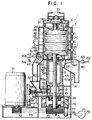
- a vertical milling machine 1 comprises an abrasive milling part 3 as the first milling part disposed in an upper part of a machine frame 2 and a friction milling part 4 as the second milling part disposed in a lower part of the machine frame 2.
- a hollow main shaft 5 with an opening at its lower end is rotatably attached to the machine frame 2 through bearing portions 10, 10, 10.
- the main shaft 5 extends vertically.
- a screw roll 6 and an abrasive milling roll 7 as the first milling roll are mounted on an upper part of the main shaft 5, while a screw roll 8 and a friction type milling roll 9 as the second milling roll are mounted on a lower part of the main shaft 5.
- a rotary bottom member 11 is fixed to the main shaft 5, and a lowermost abrasive milling or whitening roll element 12 fitted on the main shaft 5 is set on and fixed to the rotary bottom member 11 through a setting ring 13.
- the lowermost abrasive milling roll element 12 comprises a large diameter portion 12a, a small diameter portion 12b and an upper inclined portion 12c as shown in Fig. 2.
- the lowermost abrasive milling roll element 12 is supported at a side step portion thereof by the setting ring 13 with flange portion as shown in Figs. 1 and 2.
- An inner peripheral wall of the setting ring 13 is fitted on a small diameter portion of the lowermost abrasive milling roll element 12.
- the lowermost abrasive milling roll element 12 comprises an inner support part 12e made of metal and an outer abrasive part 12f made of abrasive emery particles.
- the inner support part 12e comprises a boss portion 16 having therein round holes 17 and a plurality of arms 14 between which openings 15 are formed.
- the holes 17 of the boss portion 16 are communicated with blast air holes 18 of the hollow main shaft 5 on which the boss portion 16 is fitted.
- a collar 19 fitted on the shaft 5 is set on the lowermost abrasive milling roll element 12.
- On the collar 19 is set on a boss portion 16 of an intermediate abrasive milling roll element 20 having on the whole almost the same structure as the lowermost abrasive milling roll element 12.
- the boss portion 16 is formed with round holes 17 communicating with the blast air holes 18 of the hollow main shaft 5, and openings 15 are formed between arms 14 thereof (Figs. 2 and 3).
- the intermediate abrasive milling roll element 20, more specifically, an outer abrasive part 20f thereof comprises a large diameter portion 20a, a small diameter portion 20b, a lower inclined portion 20d therebetween and a downwardly divergent upper inclined portion 20c formed above the large diameter portion 20a.
- a gap 21 for jet air is formed between the lower end of the small diameter portion 20b of the intermediate abrasive milling roll element 20 and the upper end of the lowermost abrasive milling roll element 12 .
- This intermediate abrasive milling roll element 20 has the same structure as the intermediate abrasive milling roll element 20 on the lowermost abrasive milling roll element 12.
- this intermediate abrasive milling roll element 20 more specifically, an outer abrasive part 20f thereof comprises a large diameter portion 20a, a small diameter portion 20b, an upper inclined portion 20c and a lower inclined portion 20d, and a gap 21 for jet air is formed between the lower end of this small diameter portion 20b and the upper end of the lower intermediate abrasive milling roll element 20 on the lowermost abrasive milling roll element 12.
- On the boss portion 16 of the upper intermediate abrasive milling roll element 20 is set still another collar 19 fitted on the shaft 5. On this collar 19 is set a boss portion 16 of an uppermost abrasive milling roll element 22 fitted on the shaft 5.
- two intermediate abrasive milling roll elements 20 are equipped, and however, the number of the intermediate abrasive milling roll elements 20 to be equipped through collar or spacer 19 may be one or not smaller than three. Further, under certain circumstances, the intermediate abrasive milling roll element 20 may be dispensed with.
- the uppermost abrasive milling roll element 22 comprises an inner support part 22e made of metal and an outer abrasive part 22f made of abrasive emery particles.
- the inner support part 22e comprises the boss portion 16 having round holes 17 and a plurality of arms 14 between which openings 15 are formed.
- the holes 17 of the boss portion 16 are communicated with the blast air holes 18 of the hollow main shaft 5 formed in the vicinity of the upper end thereof, on which shaft 5 is fitted the boss portion 16.
- the outer abrasive part 22f of the uppermost abrasive milling roll element 22 comprises a downwardly slightly divergent or circular truncated cone-shaped large diameter portion 22a, a small diameter portion 22b and a lower inclined portion 22d between the large diameter portion 22a and the small diameter portion 22b, and a gap 21 for jet air is formed between the upper end of the small diameter portion 22b and the upper end of the another intermediate abrasive milling roll element 20 situated just therebelow.
- the screw roll 6 is formed on the outer periphery thereof with a feed screw 6a.
- the screw roll 6 is pressed on and fixed to the uppermost abrasive milling roll element 22 by means of a bolt 23 screwed to the upper end of the hollow main shaft 5.
- bran-removing, generally cylindrical perforated body 24 leaving a small space between them, so that an abrasive milling chamber 25 as the first milling chamber is formed between the bran-removing cylindrical perforated body 24 and the abrasive milling roll elements 12, 20, 22 (Figs. 2 and 3). More specifically, the bran-removing, generally cylindrical perforated body 24 comprises four divided parts 24d each supported at both side edges thereof by associated two of four stanchions 26 provided upright around the abrasive milling roll elements 12, 20, 22.
- Each stanchion 26 is covered with a stanchion cover 27 of a U-letter form cross-section.
- a bran-removing chamber cover 28 of an arcuate cross-section is disposed between each circumferentially adjacent stanchion covers 27, 27, the cover(s) 28 cooperating with corresponding bran-removing cylindrical perforated body 24 or divided parts 24d thereof to form a bran-removing chamber 29.
- a diameter of the large diameter portions 12a, 20a, 22a of the abrasive milling roll elements 12, 20, 22 which depends on amount of grains to be milled per unit period of time is about 40-50 cm for about 8 tons/hr. Since the milling machine 1 of this embodiment is of the vertical shaft type that the main shaft 5 extends vertically, it is possible to increase the outer diameter of the abrasive milling roll 7 or the elements thereof, as compared with the case of the horizontal type machine.
- a feed cylinder 30 surrounding the screw roll 6 and having a supply port 31 at the upper end thereof.
- a hopper cylinder 32 having a charging port 33 at the upper end thereof is fixed to the upper end of the supply port 31.
- a grain feed amount regulating mechanism 34 comprising a fixed plate 34a with a plurality of openings and a rotary plate 34b with a plurality of openings and rotatable by a regulating lever 35.
- An opening 36 is formed through the central portion of the fixed plate 34a and rotary plate 34b.
- a hollow bottomless conical upper guide member 37 is disposed above the opening 36, while a lower guide member 38 of a circular truncated cone shape is disposed below the opening 36. Further, induction pipes 40 are provided for taking atmospheric air into the upper guide member 37 through a plurality of air inlet ports 39 formed circumferentially equidistantly in a peripheral wall of the hopper cylinder 32.
- the screw roll 6 is formed in an upper wall surface thereof with vent holes 41 in the positions below the lower guide member 38.
- the bran-removing cylindrical perforated body 24 is provided on an inner peripheral surface thereof with resistance rings 42a, 42b, 42c.
- the resistance ring 42a is so provided as to protrude into a trough portion 43a formed by the lower inclined portion 22d and small diameter portion 22b of the uppermost abrasive milling roll element 22 and the upper inclined portion 20c of the intermediate abrasive milling roll element 20 situated just below the element 22,
- the resistance ring 42b is so provided as to protrude into a trough portion 43b formed by the lower inclined portion 20d and small diameter portion 20b of the intermediate abrasive milling roll element 20 and the upper inclined portion 20c of the other intermediate abrasive milling roll element 20 just therebelow
- the resistance ring 42c is so provided as to protrude into a trough portion 43c formed by the lower inclined portion 20d and small diameter portion 20b of the lower intermediate abrasive milling roll element 20 and the upper inclined portion 12c of the lowermost a
- the sectional shape of the resistance rings 42a to c is nearly similar to that of the trough portions 43a to c, and the milling chamber 25 formed between the resistance rings 42a to c and the trough portions 43a to c becomes a meandering milling chamber 25a meandering from top to bottom.
- Each of the resistance rings 42a to c is pressed on and fixed to the inner peripheral surface of the bran-removing cylindrical perforated body 24 by knob bolts 45 inserted in through-holes 44 of the respective stanchions 26. Since an inner diameter A of the hole 44 is considerably larger than the diameter of the knob bolt 45, the knob bolt 45 is vertically displaceable with respect to the stanchion 26 by an amount corresponding to this difference in diameter, making it possible to adjust vertical attaching positions of the resistance rings 42a to c and adjust a resistance with respect to the flow of grains in the meandering milling chamber 25a.
- a discharge port 46 is formed at the lower end of the abrasive milling chamber 25, and a discharge chute 47 is provided below the discharge port 46.
- a horizontal shaft 48 is attached to the discharge chute 47, and a weighted lever 49 comprising arm portions 49a, 49b is attached to the horizontal shaft 48 so as to be rotatable about the horizontal shaft 48 with respect to the discharge chute 47.
- a resistance board 50 capable of closing the discharge port 46 is rotatably attached to a distal end of the arm portion 49a of the weighted lever 49, while a weight 51 is set on the arm portion 49b of the weighted lever 49 so as to be displaceable in the longitudinal direction of the arm portion 49b.
- the resistance means capable of adjusting the pressing force applied to the grains in the milling chamber 25 and hence the degree of milling of the grains in the abrasive milling chamber 25 comprises the shaft 48, weighted lever 49, resistance board 50 and weight 51.
- the grain discharge part comprises the discharge port 46 and discharge chute 47 which also serves as the transfer passage.
- the discharge chute 47 is communicated with a supply chute 52 of a friction milling part 4.
- Means for adjusting the pressing force applied to the resistance board 50 may be any force adjusting means in place of a combination of the lever 49 and displaceable weight 51.
- an elastic means 51a such as tension or expansion spring may be provided between the weighted lever 49 and the discharge chute 47.
- elastic force of the elastic means 51a such as modulus of elasticity or elastic coefficient may be made adjustable.
- the weight may be dispensed with.
- the friction milling part 4 comprises the screw roll 8 mounted on the hollow main shaft 5 in the vicinity of the lower end thereof, the friction type milling roll 9 mounted on a lower part of the hollow main shaft 5 to be situated above the screw roll 8, and a bran-removing cylindrical perforated body 53 extending vertically around the friction type milling roll 9 so as to form a friction milling chamber 54.
- the friction milling chamber 54 is communicated with a supply port 55 at a lower end thereof and with a discharge port 56 approximately at an upper end thereof.
- the friction type milling roll 9 stirs the grains in the friction milling chamber 54 by means of a stirring projection 57 provided thereto, making the grains rub each other.
- the hollow main shaft 5 is formed with a large number of vent holes 58 which are communicated with the friction milling chamber 54 and a bran-removing chamber 60 through blast air holes 59 of the friction type milling roll 9.
- the friction milling machine itself has been known as disclosed in for example U.S. Pat. No. 4,843,957, which is incorporated herein by this reference thereto.
- a resistance board 61 for adjusting the degree of milling of grain is provided at the discharge port 56.
- a weight 63 set on a weighted lever 62 rotatable about a horizontal shaft 62a like the weighted lever 49 By adjusting the position of a weight 63 set on a weighted lever 62 rotatable about a horizontal shaft 62a like the weighted lever 49, the degree of milling of the grains in the friction milling chamber 54 can be adjusted.
- a discharge chute 80 is communicated with the discharge port 56, while a conveyor trough 64 is communicated with the supply port 55.
- a horizontally extending screw conveyor 65 is provided in the conveyor trough 64, and a pulley 66 is attached to one end of the conveyor 65.
- bran-collecting chamber 74 communicated with the bran-removing chamber 60.
- a plurality of scraping blades 76 formed on an outer peripheral surface of a blade setting cylinder 75 mounted on the main shaft 5 are positioned in the bran-collecting chamber 74.
- a bran discharge port 77 is formed in the bottom of the bran-collecting chamber 74, and a bran-collecting fan 79 is connected to a distal end of an exhaust pipe 78 extending from the bran discharge port 77.
- the bran-removing chamber 60 of the friction milling part 4 is communicated with the bran-removing chamber 29 of the abrasive milling part 3, and the bran-collecting chamber 74 is communicated with the bran-removing chamber 29 through the bran-removing chamber 60.
- the supply port 55 of the friction milling part 4 as the lower and second milling part is provided at the lower end of the friction milling part 4 , it is easy to provide at the discharge port 46 of the abrasive milling part 3 as the upper and first milling part a space or room large enough to attach the resistance means 46 to 51 for adjusting the degree of milling of the grains in the abrasive milling part 3. Accordingly, the degree of milling or whitening of the grains in the abrasive milling part 3 can be adjusted by the resistance means independently of the degree of milling or whitening of the grains in the friction milling part 4, thereby facilitating fine or delicate adjustment of the degree of whitening of grain.
- the vertical milling machine 1 which is constructed as described above, will be described taking a case of milling rice grain as an example of cereal grain.
- the cereal grain to be milled may be wheat grain or other cereal grain in place of rice grain.
- the force with which the resistance board 61 attached to the distal end of the lever 62 closes the discharge port 56 or the pressing force which the resistance board 61 should apply to the rice grains at the discharge port 56 that is, the pressure applied to the rice grains in the friction milling chamber 54 or the condition of the rice grains filled in the friction milling chamber 54 or, in other words, the degree of whitening is adjusted independently of the degree of whitening in the abrasive milling chamber 25.
- the respective pressing forces of the resistance boards 50, 61 or the respective degrees of whitening in the abrasive milling chamber 25 and the friction milling chamber 54 may be adjusted by the weights 51, 63 during the milling or whitening.
- the screw roll 6, the abrasive milling roll 7, the screw roll 8 and the friction type milling roll 9 are rotated through the hollow main shaft 5 and, as the motor 67 is started, the screw conveyor 65 is rotated. Further, the bran-collecting fan 79 is started.
- Raw material rice grains supplied through a chute (not shown) to the charging port 33 or the rice grains to be milled by the milling machine 1 flow down as being dispersed uniformly in the circumferential direction by the upper guide member 37 and fall into the supply port 31 at an appropriate flow rate adjusted by the regulating lever 35.
- the rice grains having fallen in the supply port 31 are fed successively into the abrasive milling chamber 25 by means of the screw roll 6.
- the rice grains in the abrasive milling chamber 25 actively flow, that is, revolve (rotate around the main shaft 5) and roll or rotates under a relatively low pressure or under the condition that they push to each other with a relatively small pressing force, while being rubbed with the peripheral surfaces of the uppermost, intermediate and lowermost abrasive milling roll elements 22, 20, 20 and 12 of the abrasive milling roll 7, so that surface layers thereof are abraded.
- the rice grains When the rice grains pass through the meandering milling chamber 25a, they move from around the bran-removing cylindrical perforated body 24 toward the abrasive milling roll 7 or, conversely, from around the abrasive milling roll 7 toward the bran-removing cylindrical perforated body 24, and accordingly, the rice grains in the milling chamber 25 can have increased chances of contact with the peripheral surface of the milling roll 7.
- the rice grains flow down through the upper part of the meandering milling chamber 25a defined by the trough portion 43a and the resistance ring 42a while stagnating temperately.
- the extent of stagnation, the average flowing-down speed and the like depend on the magnitude of the pressing force applied by the resistance board 50.
- the rice grains are subjected to the milling action by the large diameter portion 20a, while bran having been removed from the surfaces of the rice grains is discharged through perforations 24b of the bran-removing cylindrical perforated body 24 to the bran-removing chamber 29.
- atmospheric air is also sucked from the lower end of the hollow main shaft 5 and, after passing through the air holes 18 of the main shaft 5 and the holes 17 of the boss portions 16, jetted into the abrasive milling chamber 25 through the jet-air gaps 21 between the adjacent abrasive milling roll elements.
- the atmospheric air to be jetted into the milling chamber 25 through the jet-air gaps 21 may be taken in from merely one of the air inlet ports 39 of the hopper cylinder 32 and the lower end of the hollow main shaft 5.
- the rice grains having been milled uniformly spending a proper stagnation time in the milling chamber 25 pass through around the small diameter portion 12b of the lowermost abrasive milling roll element 12 and are then discharged through the discharge port 46 against the resistance board 50 and, further flow down through the discharge chute 47 to be supplied or transferred to the supply chute 52 of the friction milling part 4.
- the bran having been discharged into the bran removing chamber 29 passes through the bran-removing chamber 60 of the friction milling part 4 and is then discharged by the suction of the bran-collecting fan 79 via the bran-discharge port 77 of the bran-collecting chamber 74 and the exhaust pipe 78.
- the rice grains supplied to the supply chute 52 of the friction milling part 4 are sent to the screw roll 8 by means of the screw conveyor 65 and further sent upwards to the friction milling chamber 54 by means of the screw roll 8.
- the rice grains rub each other under the action of the rotating friction type milling roll 9 so as to be further milled or whitened due to the friction milling action.
- the rice grains are milled to a desired degree of milling or whitening according to the friction milling effect between the rice grains of a magnitude depending on the pressing force applied at the discharge port 56 by the resistance board 61.
- bran is removed from the friction milling chamber 54.
- fine powder such as bran produced by the whitening action in the friction milling chamber 54 is discharged through the holes 53a of the bran-removing cylindrical perforated body 53 to the bran removing chamber 60 together with bran-removing air and, further, discharged through the bran discharge port 77 of the bran-collecting chamber 74 and the exhaust pipe 78 owing to the suction by the bran collecting fan 79.
- the rice grains having been whitened reach the discharge port 56 and flow out against the pressing force of the resistance board 61.
- the rice grains thus flown out flow further down through the discharge chute 80 so as to be discharged to the outside of the milling machine 1.
- a vertical milling machine 1a comprises a first milling part 3a having a grain supply part 33a on the upper end side thereof and a grain discharge part 46a on the lower end side thereof and a second milling part 4a having a grain supply part 55a which is communicated with the grain discharge part 46a of the first milling part 3a through a grain transfer passage 47a, on the lower end side thereof and a grain discharge part 56a on the upper end side thereof, and the first milling part 3a is situated on the upper end side of a vertical main shaft 5 and the second milling part 4a on the lower end side of the main shaft 5, both of the first and second milling parts 3a, 4a may be abrasive milling parts or friction milling parts and, further, the first milling part 3a may be a friction milling part
- the abrasive milling part and/or the friction milling part shown in Figs. 1 - 3 may be individually replaced by corresponding parts of an abrasive milling machine and/or a friction type milling machine such as those disclosed in U.S. Pat. Nos. 3,734,752, 3,960,068, 4,426,922, 4,459,903 and 4,829,893.
- the abrasive milling chamber may be composed of a simple cylindrical or annular milling chamber, in place of the meandering milling chamber 25a. Further, moisture-adding air may be induced into the friction milling chamber 54.
- a plural vertical milling machines 1a may be disposed to be connected in series to pass the rice grains through the plural machines.
Landscapes
- Adjustment And Processing Of Grains (AREA)
- Crushing And Grinding (AREA)
- Disintegrating Or Milling (AREA)
Claims (5)
- Eine vertikale Mahlmaschine (1), die umfaßt:einen ersten Mahlteil (3); undeinen zweiten Mahlteil (4), der sich unter dem genannten ersten Mahlteil befindet,
wobei der erste und der zweite Mahlteil eine gemeinsame sich vertikal erstreckende Hauptwelle (5) aufweisen,
wobei der erste Mahlteil einen Zuführungsteil (33) für Getreide an seiner oberen Endseite und einen Austragsteil (46) für Getreide, das in dem genannten ersten Mahlteil gemahlen worden ist, auf seiner unteren Endseite aufweist, dadurch gekennzeichnet,daß der zweite Mahlteil einen Zuführteil (52) für Getreide, das in dem zweiten Mahlteil gemahlen werden soll, auf seiner unteren Endseite und einen Austragsteil (51) für Getreide, das in dem zweiten Mahlteil gemahlen werden soll, an seiner oberen Endseite aufweist, undder Getreideaustragsteil (46) des ersten Mahlteils mit dem Getreidezuführteil (52) des zweiten Mahlteils über einen Getreideüberführungsdurchgang (47) in Verbindung ist, der sich zwischen ihnen erstreckt. - Eine Mahlmaschine gemäß Anspruch 1, wobei der erste Mahlteil an seinem Getreideaustragsteil mit einer ersten Rückhalteeinrichtung (50) versehen ist, um den Mahlgrad des Getreides in dem ersten Mahlteil einzustellen, und der zweite Mahlteil an seinem Getreideaustragsteil mit einer zweiten Rückhalteeinrichtung (61) versehen ist, um den Mahlgrad des Getreides in dem zweiten Mahlteil einzustellen.
- Eine Mahlmaschine gemäß Anspruch 2, wobei der erste Mahlteil eine erste Mahlwalze (7), die an einem oberen Teil der Hauptwelle angebracht ist, und einen ersten kleieentfernenden gelochten allgemein zylindrischen Körper (24) aufweist, der mit der ersten Mahlwalze zusammenarbeitet, um eine erste Mahlkammer zu bilden, und der zweite Mahlteil eine zweite Mahlwalze (9), die an einem unteren Teil der Hauptwelle angebracht ist, und einen zweiten kleieentferndenden gelochten allgemein zylindrischen Körper (53) umfaßt, der mit der zweiten Mahlwalze zusammenarbeitet, um eine zweite Mahlkammer zu bilden.
- Eine Mahlmaschine gemäß Anspruch 2, wobei die erste Mahlwalze aus einer abrasiven Mahlwalze oder einer Reibungsmahlwalze zusammengesetzt ist und die zweite Mahlwalze aus einer abrasiven Mahlwalze oder einer Reibungsmahlwalze zusammengesetzt ist.
- Eine Mahlmaschine gemäß Anspruch 1, wobei sich der Getreideüberführungsdurchgang allgemein vertikal nach unten von dem Getreideaustragsteil des ersten Mahlteils zu dem Getreidezuführteil des zweiten Mahlteils erstreckt.
Priority Applications (5)
| Application Number | Priority Date | Filing Date | Title |
|---|---|---|---|
| AU70374/94A AU660879B1 (en) | 1994-08-22 | 1994-08-22 | Vertical milling machine |
| US08/294,321 US5419252A (en) | 1994-08-22 | 1994-08-23 | Vertical milling machine |
| DE69419914T DE69419914T2 (de) | 1994-08-22 | 1994-08-29 | Vertikale Bleichmaschine |
| ES94113460T ES2135515T3 (es) | 1994-08-22 | 1994-08-29 | Maquina trituradora vertical. |
| EP94113460A EP0699478B1 (de) | 1994-08-22 | 1994-08-29 | Vertikale Bleichmaschine |
Applications Claiming Priority (3)
| Application Number | Priority Date | Filing Date | Title |
|---|---|---|---|
| AU70374/94A AU660879B1 (en) | 1994-08-22 | 1994-08-22 | Vertical milling machine |
| US08/294,321 US5419252A (en) | 1994-08-22 | 1994-08-23 | Vertical milling machine |
| EP94113460A EP0699478B1 (de) | 1994-08-22 | 1994-08-29 | Vertikale Bleichmaschine |
Publications (2)
| Publication Number | Publication Date |
|---|---|
| EP0699478A1 EP0699478A1 (de) | 1996-03-06 |
| EP0699478B1 true EP0699478B1 (de) | 1999-08-04 |
Family
ID=27155859
Family Applications (1)
| Application Number | Title | Priority Date | Filing Date |
|---|---|---|---|
| EP94113460A Expired - Lifetime EP0699478B1 (de) | 1994-08-22 | 1994-08-29 | Vertikale Bleichmaschine |
Country Status (5)
| Country | Link |
|---|---|
| US (1) | US5419252A (de) |
| EP (1) | EP0699478B1 (de) |
| AU (1) | AU660879B1 (de) |
| DE (1) | DE69419914T2 (de) |
| ES (1) | ES2135515T3 (de) |
Families Citing this family (16)
| Publication number | Priority date | Publication date | Assignee | Title |
|---|---|---|---|---|
| PH31195A (en) * | 1995-05-08 | 1998-04-24 | Satake Eng Co Ltd | Abrasive type vertical grain milling machine. |
| JPH09122510A (ja) * | 1995-11-02 | 1997-05-13 | Satake Eng Co Ltd | 脱ぷ装置 |
| US6409105B1 (en) | 1999-08-19 | 2002-06-25 | The Quaker Oats Company | Corn milling and separating device and method |
| US6234072B1 (en) * | 2000-03-06 | 2001-05-22 | John C. Kooima | Grain husk cracking plate |
| US6327970B1 (en) | 2000-03-06 | 2001-12-11 | John C. Kooima | Grain husk cracking plate |
| DE10341223A1 (de) * | 2003-09-04 | 2005-03-24 | Bühler AG | Schleif- bzw. Poliermaschine |
| JP4849520B2 (ja) * | 2006-02-11 | 2012-01-11 | 独立行政法人農業・食品産業技術総合研究機構 | 表面処理粒状物の製造装置、方法および表面処理粒状物 |
| US7984734B2 (en) * | 2007-08-01 | 2011-07-26 | Robert Bosch Gmbh | Router table with mechanical drive |
| USD606568S1 (en) * | 2009-02-13 | 2009-12-22 | Tormach Llc | Milling machine |
| JP5656006B2 (ja) * | 2010-09-17 | 2015-01-21 | 株式会社サタケ | 研削式竪型精穀機 |
| JP6124192B2 (ja) * | 2012-06-04 | 2017-05-10 | 株式会社サタケ | 精穀機 |
| US20140103153A1 (en) * | 2012-10-17 | 2014-04-17 | Scott Charles Below | Grain Mill |
| CN103447111B (zh) * | 2013-08-30 | 2015-09-09 | 西北农林科技大学 | 一种圆锥筒式苦荞麦脱壳装置 |
| JP6879033B2 (ja) * | 2017-04-25 | 2021-06-02 | 株式会社サタケ | 精米用研削ロール |
| RU2729826C1 (ru) * | 2020-02-26 | 2020-08-12 | Общество с ограниченной ответственностью "БиоВи" (ООО "БиоВи") | Устройство для измельчения пивной дробины и производственная линия для получения продукта с высоким содержанием белка |
| JP7811343B1 (ja) * | 2025-03-28 | 2026-02-05 | 株式会社サタケ | 横軸型精米機 |
Family Cites Families (18)
| Publication number | Priority date | Publication date | Assignee | Title |
|---|---|---|---|---|
| US2618307A (en) * | 1948-10-31 | 1952-11-18 | Keller Bernhard | Abrasion type hulling machine |
| US3485280A (en) * | 1966-06-01 | 1969-12-23 | Toshihiko Satake | Combination of grinding and friction-type rice polishing machine |
| US3734752A (en) * | 1970-09-14 | 1973-05-22 | Cpc International Inc | Processing cereal grains and seeds by a semi-dry milling method |
| US3960068A (en) * | 1975-01-29 | 1976-06-01 | Felipe Salete | Machine for whitening, polishing or pearling grains and cereals and more particularly rice |
| MX147108A (es) * | 1979-01-24 | 1982-10-06 | Felipe Salete Garces | Mejoras a maquina pulidora y blanqueadora de granos |
| US4426922A (en) * | 1981-06-09 | 1984-01-24 | Soichi Yamamoto | Vertical frictionally abrasive roll rice polishing machine |
| JPS57209647A (en) * | 1981-06-19 | 1982-12-23 | Yamamoto Soichi | Vertical grinding type cereal cleaning device |
| JPH0822389B2 (ja) * | 1987-07-27 | 1996-03-06 | 株式会社佐竹製作所 | 竪軸型摩擦切削式精米機 |
| ES2012555A6 (es) * | 1987-10-06 | 1990-04-01 | Buehler Ag Geb | Procedimiento, molino de cilindros e instalacion para la fabricacion de productos de molienda de cereales. |
| JPH0767540B2 (ja) * | 1988-03-31 | 1995-07-26 | 株式会社佐竹製作所 | 堅軸型摩擦切削式精穀機 |
| JPH0771640B2 (ja) * | 1988-06-10 | 1995-08-02 | 株式会社佐竹製作所 | 竪軸型摩擦切削式精穀機 |
| AU599505B2 (en) * | 1988-08-04 | 1990-07-19 | Satake Engineering Co. Ltd. | Cereal-grain polishing apparatus |
| US5048407A (en) * | 1989-11-07 | 1991-09-17 | Salete Garces Felipe | Grain husking and polishing machine |
| JP3012070B2 (ja) * | 1991-12-27 | 2000-02-21 | 株式会社山本製作所 | 精米装置 |
| JP3106444B2 (ja) * | 1992-06-16 | 2000-11-06 | 株式会社佐竹製作所 | 竪型精穀機 |
| US5209158A (en) * | 1992-08-21 | 1993-05-11 | Felipe Salete | Grain cleaning and polishing machine |
| JPH06106080A (ja) * | 1992-09-26 | 1994-04-19 | Satake Eng Co Ltd | 竪軸型精米装置 |
| JPH06114281A (ja) * | 1992-10-01 | 1994-04-26 | Satake Eng Co Ltd | 竪型精米機 |
-
1994
- 1994-08-22 AU AU70374/94A patent/AU660879B1/en not_active Ceased
- 1994-08-23 US US08/294,321 patent/US5419252A/en not_active Expired - Lifetime
- 1994-08-29 ES ES94113460T patent/ES2135515T3/es not_active Expired - Lifetime
- 1994-08-29 DE DE69419914T patent/DE69419914T2/de not_active Expired - Fee Related
- 1994-08-29 EP EP94113460A patent/EP0699478B1/de not_active Expired - Lifetime
Also Published As
| Publication number | Publication date |
|---|---|
| US5419252A (en) | 1995-05-30 |
| EP0699478A1 (de) | 1996-03-06 |
| DE69419914D1 (de) | 1999-09-09 |
| AU660879B1 (en) | 1995-07-06 |
| ES2135515T3 (es) | 1999-11-01 |
| DE69419914T2 (de) | 1999-12-02 |
Similar Documents
| Publication | Publication Date | Title |
|---|---|---|
| EP0699478B1 (de) | Vertikale Bleichmaschine | |
| CA2128382C (en) | Bran-removing perforated cylindrical body of abrasive type grain milling machine | |
| AU679657B2 (en) | Vertical grain milling machine | |
| CA2125819C (en) | Resistance member adjusting mechanism of abrasive type grain milling machine | |
| US5033371A (en) | Process of and system for flouring wheat | |
| CA2142168C (en) | Abrasive type vertical grain milling machine | |
| US5395059A (en) | Spacer for abrasive roll of abrasive type grain milling machine | |
| CA2130614C (en) | Vertical milling machine | |
| US5145117A (en) | Process of and system for flouring wheat | |
| KR0147205B1 (ko) | 종축형 정곡기 | |
| JPH06327989A (ja) | 竪軸型精穀機 | |
| JP3399487B2 (ja) | 竪型精穀機 | |
| US363381A (en) | Grain-scourer | |
| JPH06142533A (ja) | 竪型精米機 | |
| JPH06154627A (ja) | 竪型精米機 | |
| JPH07171427A (ja) | 精穀装置 | |
| JPH0568316B2 (de) | ||
| JPS6320176B2 (de) | ||
| JPS5836686A (ja) | 籾と玄米の選別装置 |
Legal Events
| Date | Code | Title | Description |
|---|---|---|---|
| PUAI | Public reference made under article 153(3) epc to a published international application that has entered the european phase |
Free format text: ORIGINAL CODE: 0009012 |
|
| 17P | Request for examination filed |
Effective date: 19940829 |
|
| AK | Designated contracting states |
Kind code of ref document: A1 Designated state(s): CH DE ES FR GB IT LI NL |
|
| GRAG | Despatch of communication of intention to grant |
Free format text: ORIGINAL CODE: EPIDOS AGRA |
|
| 17Q | First examination report despatched |
Effective date: 19980924 |
|
| GRAG | Despatch of communication of intention to grant |
Free format text: ORIGINAL CODE: EPIDOS AGRA |
|
| GRAG | Despatch of communication of intention to grant |
Free format text: ORIGINAL CODE: EPIDOS AGRA |
|
| GRAH | Despatch of communication of intention to grant a patent |
Free format text: ORIGINAL CODE: EPIDOS IGRA |
|
| GRAH | Despatch of communication of intention to grant a patent |
Free format text: ORIGINAL CODE: EPIDOS IGRA |
|
| GRAA | (expected) grant |
Free format text: ORIGINAL CODE: 0009210 |
|
| AK | Designated contracting states |
Kind code of ref document: B1 Designated state(s): CH DE ES FR GB IT LI NL |
|
| ITF | It: translation for a ep patent filed | ||
| REG | Reference to a national code |
Ref country code: CH Ref legal event code: NV Representative=s name: DIPL.-ING. ETH H. R. WERFFELI PATENTANWALT Ref country code: CH Ref legal event code: EP |
|
| REF | Corresponds to: |
Ref document number: 69419914 Country of ref document: DE Date of ref document: 19990909 |
|
| REG | Reference to a national code |
Ref country code: ES Ref legal event code: FG2A Ref document number: 2135515 Country of ref document: ES Kind code of ref document: T3 |
|
| ET | Fr: translation filed | ||
| PLBE | No opposition filed within time limit |
Free format text: ORIGINAL CODE: 0009261 |
|
| STAA | Information on the status of an ep patent application or granted ep patent |
Free format text: STATUS: NO OPPOSITION FILED WITHIN TIME LIMIT |
|
| 26N | No opposition filed | ||
| REG | Reference to a national code |
Ref country code: GB Ref legal event code: IF02 |
|
| PGFP | Annual fee paid to national office [announced via postgrant information from national office to epo] |
Ref country code: NL Payment date: 20040630 Year of fee payment: 11 |
|
| PG25 | Lapsed in a contracting state [announced via postgrant information from national office to epo] |
Ref country code: NL Free format text: LAPSE BECAUSE OF NON-PAYMENT OF DUE FEES Effective date: 20060301 |
|
| NLV4 | Nl: lapsed or anulled due to non-payment of the annual fee |
Effective date: 20060301 |
|
| PGFP | Annual fee paid to national office [announced via postgrant information from national office to epo] |
Ref country code: ES Payment date: 20070830 Year of fee payment: 14 |
|
| PGFP | Annual fee paid to national office [announced via postgrant information from national office to epo] |
Ref country code: GB Payment date: 20070829 Year of fee payment: 14 |
|
| PGFP | Annual fee paid to national office [announced via postgrant information from national office to epo] |
Ref country code: IT Payment date: 20070809 Year of fee payment: 14 Ref country code: DE Payment date: 20070927 Year of fee payment: 14 |
|
| PGFP | Annual fee paid to national office [announced via postgrant information from national office to epo] |
Ref country code: CH Payment date: 20071127 Year of fee payment: 14 |
|
| PGFP | Annual fee paid to national office [announced via postgrant information from national office to epo] |
Ref country code: FR Payment date: 20070823 Year of fee payment: 14 |
|
| REG | Reference to a national code |
Ref country code: CH Ref legal event code: PL |
|
| GBPC | Gb: european patent ceased through non-payment of renewal fee |
Effective date: 20080829 |
|
| REG | Reference to a national code |
Ref country code: FR Ref legal event code: ST Effective date: 20090430 |
|
| PG25 | Lapsed in a contracting state [announced via postgrant information from national office to epo] |
Ref country code: LI Free format text: LAPSE BECAUSE OF NON-PAYMENT OF DUE FEES Effective date: 20080831 Ref country code: CH Free format text: LAPSE BECAUSE OF NON-PAYMENT OF DUE FEES Effective date: 20080831 |
|
| PG25 | Lapsed in a contracting state [announced via postgrant information from national office to epo] |
Ref country code: IT Free format text: LAPSE BECAUSE OF NON-PAYMENT OF DUE FEES Effective date: 20080829 Ref country code: FR Free format text: LAPSE BECAUSE OF NON-PAYMENT OF DUE FEES Effective date: 20080901 Ref country code: DE Free format text: LAPSE BECAUSE OF NON-PAYMENT OF DUE FEES Effective date: 20090303 |
|
| REG | Reference to a national code |
Ref country code: ES Ref legal event code: FD2A Effective date: 20080830 |
|
| PG25 | Lapsed in a contracting state [announced via postgrant information from national office to epo] |
Ref country code: GB Free format text: LAPSE BECAUSE OF NON-PAYMENT OF DUE FEES Effective date: 20080829 |
|
| PG25 | Lapsed in a contracting state [announced via postgrant information from national office to epo] |
Ref country code: ES Free format text: LAPSE BECAUSE OF NON-PAYMENT OF DUE FEES Effective date: 20080830 |