EP0708106B1 - Nouveaux composés de silacyclohexane, une composition de cristaux liquides les comprenant et un dispositif à cristaux liquides contenant ladite composition - Google Patents
Nouveaux composés de silacyclohexane, une composition de cristaux liquides les comprenant et un dispositif à cristaux liquides contenant ladite composition Download PDFInfo
- Publication number
- EP0708106B1 EP0708106B1 EP95116331A EP95116331A EP0708106B1 EP 0708106 B1 EP0708106 B1 EP 0708106B1 EP 95116331 A EP95116331 A EP 95116331A EP 95116331 A EP95116331 A EP 95116331A EP 0708106 B1 EP0708106 B1 EP 0708106B1
- Authority
- EP
- European Patent Office
- Prior art keywords
- group
- carbon atoms
- liquid crystal
- alkyl group
- trans
- Prior art date
- Legal status (The legal status is an assumption and is not a legal conclusion. Google has not performed a legal analysis and makes no representation as to the accuracy of the status listed.)
- Expired - Lifetime
Links
- 0 *C(CC1)CCC1Oc(cc1N)ccc1N Chemical compound *C(CC1)CCC1Oc(cc1N)ccc1N 0.000 description 7
- RHUFSTHXINYWCH-QXMOYCCXSA-N C/C=C(/C)\C=C(/C(N)=C)\N Chemical compound C/C=C(/C)\C=C(/C(N)=C)\N RHUFSTHXINYWCH-QXMOYCCXSA-N 0.000 description 1
- KNEUJTFLMQRIFD-UHFFFAOYSA-N CC(CC1)CCC1Cl Chemical compound CC(CC1)CCC1Cl KNEUJTFLMQRIFD-UHFFFAOYSA-N 0.000 description 1
- ZMXYNJXDULEQCK-UHFFFAOYSA-N Cc(cc1N)ccc1O Chemical compound Cc(cc1N)ccc1O ZMXYNJXDULEQCK-UHFFFAOYSA-N 0.000 description 1
Classifications
-
- C—CHEMISTRY; METALLURGY
- C09—DYES; PAINTS; POLISHES; NATURAL RESINS; ADHESIVES; COMPOSITIONS NOT OTHERWISE PROVIDED FOR; APPLICATIONS OF MATERIALS NOT OTHERWISE PROVIDED FOR
- C09K—MATERIALS FOR MISCELLANEOUS APPLICATIONS, NOT PROVIDED FOR ELSEWHERE
- C09K19/00—Liquid crystal materials
- C09K19/04—Liquid crystal materials characterised by the chemical structure of the liquid crystal components, e.g. by a specific unit
- C09K19/40—Liquid crystal materials characterised by the chemical structure of the liquid crystal components, e.g. by a specific unit containing elements other than carbon, hydrogen, halogen, oxygen, nitrogen or sulfur, e.g. silicon, metals
- C09K19/406—Liquid crystal materials characterised by the chemical structure of the liquid crystal components, e.g. by a specific unit containing elements other than carbon, hydrogen, halogen, oxygen, nitrogen or sulfur, e.g. silicon, metals containing silicon
-
- C—CHEMISTRY; METALLURGY
- C09—DYES; PAINTS; POLISHES; NATURAL RESINS; ADHESIVES; COMPOSITIONS NOT OTHERWISE PROVIDED FOR; APPLICATIONS OF MATERIALS NOT OTHERWISE PROVIDED FOR
- C09K—MATERIALS FOR MISCELLANEOUS APPLICATIONS, NOT PROVIDED FOR ELSEWHERE
- C09K19/00—Liquid crystal materials
- C09K19/04—Liquid crystal materials characterised by the chemical structure of the liquid crystal components, e.g. by a specific unit
- C09K19/06—Non-steroidal liquid crystal compounds
- C09K19/08—Non-steroidal liquid crystal compounds containing at least two non-condensed rings
- C09K19/30—Non-steroidal liquid crystal compounds containing at least two non-condensed rings containing saturated or unsaturated non-aromatic rings, e.g. cyclohexane rings
-
- C—CHEMISTRY; METALLURGY
- C07—ORGANIC CHEMISTRY
- C07F—ACYCLIC, CARBOCYCLIC OR HETEROCYCLIC COMPOUNDS CONTAINING ELEMENTS OTHER THAN CARBON, HYDROGEN, HALOGEN, OXYGEN, NITROGEN, SULFUR, SELENIUM OR TELLURIUM
- C07F7/00—Compounds containing elements of Groups 4 or 14 of the Periodic Table
- C07F7/02—Silicon compounds
- C07F7/08—Compounds having one or more C—Si linkages
- C07F7/0803—Compounds with Si-C or Si-Si linkages
- C07F7/081—Compounds with Si-C or Si-Si linkages comprising at least one atom selected from the elements N, O, halogen, S, Se or Te
-
- C—CHEMISTRY; METALLURGY
- C07—ORGANIC CHEMISTRY
- C07F—ACYCLIC, CARBOCYCLIC OR HETEROCYCLIC COMPOUNDS CONTAINING ELEMENTS OTHER THAN CARBON, HYDROGEN, HALOGEN, OXYGEN, NITROGEN, SULFUR, SELENIUM OR TELLURIUM
- C07F7/00—Compounds containing elements of Groups 4 or 14 of the Periodic Table
- C07F7/02—Silicon compounds
- C07F7/08—Compounds having one or more C—Si linkages
- C07F7/0896—Compounds with a Si-H linkage
-
- C—CHEMISTRY; METALLURGY
- C07—ORGANIC CHEMISTRY
- C07F—ACYCLIC, CARBOCYCLIC OR HETEROCYCLIC COMPOUNDS CONTAINING ELEMENTS OTHER THAN CARBON, HYDROGEN, HALOGEN, OXYGEN, NITROGEN, SULFUR, SELENIUM OR TELLURIUM
- C07F7/00—Compounds containing elements of Groups 4 or 14 of the Periodic Table
- C07F7/02—Silicon compounds
- C07F7/08—Compounds having one or more C—Si linkages
- C07F7/12—Organo silicon halides
Definitions
- This invention relates to a novel silacyclohexane compound.
- the invention also relates to a liquid crystal composition comprising the silacyclohexane compound and to a device comprising the composition.
- the liquid crystal display devices make use of optical anisotropy and dielectric anisotropy of liquid crystal substances.
- a variety of display systems are known including those of a twisted nematic type (TN type), a supertwisted nematic type (STN type), a super birefringence type (SBE type), a dynamic scattering type (DS type), a guest/host type, a type of deformation of aligned phase (DAP type), a polymer dispersion type (PD type), and an optical mode interference type (OMI type).
- TN type twisted nematic type
- STN type supertwisted nematic type
- SBE type super birefringence type
- DS type dynamic scattering type
- guest/host type a type of deformation of aligned phase
- DAP type type of aligned phase
- PD type polymer dispersion type
- OMI type optical mode interference type
- the most popular display device is one which is based on the Schadt-Helfrich effect and
- liquid crystal substances used in these liquid crystal devices depend, more or less, on the type of display, it is commonly required that the liquid crystal substances have a wide range of temperatures working as a liquid crystal and that they be stable against moisture, air, light, heat, electric field and the like. Moreover, the liquid crystal substances should desirably be low in viscosity and should ensure a short address time, a low threshold voltage and a high contrast in cells.
- R represents an alkyl group having from 1 to 9 carbon atoms as set out in Japanese Patent Publication No. 61-21937.
- R represents an alkyl group having from 1 to 10 carbon atoms as set out in Japanese Patent Publication No. 1-50691.
- R represents an alkyl group from 1 to 10 carbon atoms as set out in Japanese Patent Publication No. 1-50693.
- R is an alkyl group having from 1 to 10 carbon atoms as set out in Japanese Patent Publication No. 1-50694.
- R is an alkyl group having from 1 to 10 carbon atoms as set out in Japanese Patent Publication No. 3-9895.
- R and R' are, respectively, an alkyl group having from 4 to 7 carbon atoms as set out in Japanese Patent Publication No. 60-50177. wherein R and R' are, respectively, an alkyl group having from 1 to 10 carbon atoms as set out in Japanese Patent Publication No. 60-52744.
- liquid crystal compositions should have low viscosity.
- limitation is inevitably placed on a power supply, so that it is necessary that the drive voltage be low or the power consumption be low, i.e. the liquid crystal composition used be low in threshold voltage.
- threshold characteristics should be sharp or the dielectric constant ratio between the dielectric anisotropy, ⁇ , and the dielectric constant along a minor axis, ⁇ , should be small.
- Most liquid crystal compounds have a dielectric anisotropy, ⁇ , which is a positive value or is close to zero. In order to reduce the dielectric constant ratio of a mixed composition of the compounds, liquid crystal compounds whose value of ⁇ is negative are necessary.
- liquid crystal composition which comprises the silacyclohexane compound of the type mentioned above along with a liquid crystal display device which comprises the composition.
- novel compounds of the invention serving as a liquid crystal substance have a trans-silacyclohexane ring structure and are of the formula (I)
- R represents a linear alkyl group having from 1 to 10 carbon atoms, a branched alkyl group having from 3 to 8 carbon atoms, an alkoxyalkyl group having from 2 to 7 carbon atoms, a mono or difluoroalkyl group having from 1 to 10 carbon atoms, or an alkenyl group having from 2 to 8 carbon atoms.
- linear alkyl group having from 1 to 10 carbons atoms represented by R include methyl, ethyl, n-propyl, n-butyl, n-pentyl, n-hexyl, n-heptyl, n-octyl, n-nonyl and n-decyl.
- branched alkyl group having 3 to 8 carbon atoms include isopropyl, sec-butyl, isobutyl, 1-methylbutyl, 2-methylbutyl, 3-methylbutyl, 1-methylpentyl, 2-methylpentyl, 3-methylpentyl, 1-ethylpentyl, 1-methylhexyl, 2-methylhexyl, 3-methylhexyl, 2-ethylhexyl, 3-ethylhexyl, 1-methylheptyl, 2-methylheptyl and 3-methylheptyl.
- alkoxyalkyl group having from 2 to 7 carbon atoms include methoxymethyl, ethoxymethyl, propoxymethyl, butoxymethyl, pentoxymethyl, hexyloxymethyl, methoxyethyl, ethoxyethyl, propoxyethyl, butoxyethyl, pentoxyethyl, methoxypropyl, ethoxypropyl, propoxypropyl, butoxypropyl, methoxybutyl, ethoxybutyl, propoxybutyl, methoxypentyl and ethoxypentyl.
- mono or difluoroalkyl group having from 1 to 10 carbon atoms include fluoromethyl, 1-fluoroethyl, 1-fluoropropyl, 1-fluorobutyl, 1-fluoropentyl, 1-fluorohexyl, 1-fluoroheptyl, 1-fluorooctyl, 1-fluorononyl, 1-fluorodecyl, 2-fluoroethyl, 2-fluoropropyl, 2-fluorobutyl, 2-fluoropentyl, 2-fluorohexyl, 2-fluoroheptyl, 2-fluorooctyl, 2-fluorononyl, 2-fluorodecyl, 3-fluoropropyl, 3-fluorobutyl, 3-fluoropentyl, 3-fluorohexyl, 3-fluoroheptyl, 3-fluorooctyl, 3-fluorononyl, 3-fluorodecyl, 4-
- alkenyl group having from 2 to 8 carbon atoms examples include vinyl, 1-propenyl, allyl, 1-butenyl, 3-butenyl, isoprenyl, 1-pentenyl, 3-pentenyl, 4-pentenyl, dimethylallyl, 1-hexenyl, 3-hexenyl, 5-hexenyl, 1-heptenyl, 3-heptenyl, 6-heptenyl and 7-octenyl.
- W represents H, F, Cl or CH 3.
- linear alkyl group examples include methyl, ethyl, n-propyl, n-butyl, n-pentyl, n-hexyl, n-heptyl, n-octyl, n-nonyl and n-decyl.
- linear alkoxy group examples include methoxy, ethoxy, n-propoxy, n-butoxy, n-pentoxy, n-hexyloxy, n-heptyloxy, n-octyloxy, n-nonyloxy and n-decyloxy.
- alkoxyalkoxy group examples include methoxymethoxy, ethoxymethoxy, propoxymethoxy, butoxymethoxy, pentoxymethoxy, hexyloxymethoxy, methoxyethoxy, ethoxyethoxy, propoxyethoxy, butoxyethoxy, pentoxyethoxy, methoxypropoxy, ethoxypropoxy, propoxypropoxy, butoxypropoxy, methoxybutoxy, ethoxybutoxy, propoxybutoxy, methoxypentoxy, ethoxypentoxy and methoxyhexyloxy.
- Y and Z respectively, represent H, F or Cl.
- silacyclohexane compound of the afore-indicated formula (I) has the following structural moiety of the following formula (1)
- preferred groups represented by R include: linear alkyl groups having from 2 to 7 carbon atoms, such as ethyl, n-propyl, n-butyl, n-pentyl, n-hexyl and n-heptyl; branched alkyl groups having from 3 to 8 carbon atoms, such as isopropyl, 1-methylpropyl, 2-methylpropyl, 1-methylbutyl, 2-methylbutyl, 3-methylbutyl, 1-methylpentyl, 2-methylpentyl and 2-ethylhexyl; alkoxyalkyl groups having from 2 to 6 carbon atoms, such as methoxymethyl, methoxyethyl, methoxypropyl, methoxypentyl, ethoxymethyl, ethoxyethyl, propoxymethyl and pentoxymethyl; mono or difluoroalkyl groups having from 1 to 10 carbon atoms, such as 2-fluoroethy
- Preferred atoms or groups represented by W include H, F or CH 3 .
- Preferred moieties represented by the formula (1) are those indicated below Of these, the compounds having the moieties of the following formulas exhibit a value of ⁇ close to zero Moreover, the compounds having moieties of the following formulas exhibit a negative value of ⁇
- the above-mentioned four compounds are particularly suitable for use in DS type, DAP type or GH (guest-host) type display devices.
- silacyclohexane compound of the formula (I) differ in manner of preparation depending on the type of substituent joined to the silicon atom of the silacyclohexane ring.
- the compounds are prepared by esterification reaction (i.e. condensation reaction through dehydration) between carboxylic acid compounds of the following general formula (2) and the phenols of the following general formula (3) wherein X, Y and Z have, respectively, the same meanings as defined hereinbefore.
- the esterification reaction may be carried out by (1) a method wherein the two compounds are condensed by use of dehydrators and (2) a method wherein the carboxylic acid is first converted to an acid chloride which is then reacted with the phenol compound in the presence of a base.
- the dehydrators used in the method (1) include, for example, diimides such as N, N'-dicyclohexylcarbodiimide, acid anhydrides such as trifluoroacetic anhydride, carbonyldiimidazole, 2-chloropyridinium salts, 3-chloroisooxazolium salts, and combinations of 2,2'-dipyridyldisulfide and phosphines such as methyl phosphine.
- diimides such as N, N'-dicyclohexylcarbodiimide
- acid anhydrides such as trifluoroacetic anhydride
- carbonyldiimidazole 2-chloropyridinium salts
- 3-chloroisooxazolium salts 2-chloroisooxazolium salts
- 2,2'-dipyridyldisulfide and phosphines such as methyl phosphine.
- the reaction is preferably effected under conditions of a temperature of from 0 to 100°C for a time of from 0.5 to 10 hours in a solvent inert to the reaction.
- a solvent inert examples include carbon tetrachloride, methylene chloride, aromatic hydrocarbons such as benzene, toluene, xylene and the like, and ethers such as tetrahydrofuran.
- the reagents used to convert the carboxylic acid to a corresponding acid chloride in the method (2) include thionyl chloride, phosphorus pentachloride, oxalyl chloride, and combinations of carbon tetrachloride and phosphines.
- This reaction proceeds by a usual manner preferably under conditions of a temperature ranging from 0 to 100°C.
- the acid chloride is then reacted with the phenol compound in the presence of a base.
- the base include pyridine, N,N-dimethylaniline, triethylamine, tetramethylurea and the like. This reaction proceeds readily under normal temperature and pressure conditions.
- the compounds of the formula (I) wherein W is chlorine, fluorine or hydrogen, include chlorosilacyclohexane, fluorosilacylohexane and hydrosilacyclohexane compounds.
- arylsilacyclohexane compounds wherein an aryl group such as phenyl or tolyl is attached to the silicon atom of the silacyclohexane ring is used as an intermediate for preparing the chlorosilacyclohexane, fluorosilacylohexane and hydrosilacyclohexane compounds.
- the arylsilacyclohexane compound is of the general formula (I) wherein W is an aryl group such as phenyl or tolyl.
- arylsilacyclohexane intermediate compounds are prepared through esterification or dehydration and condensation between corresponding carboxylic acids of the following formula (4) and phenol compounds of the above-indicated formula (3), like the compounds of the formula (I) wherein W is CH 3 wherein Ar is phenyl or tolyl and R has the same meaning as defined hereinbefore,
- the conversion of the arylsilacyclohexane intermediate compound to an intended chlorosilacyclohexane, fluorosilacylohexane or hydrosilacyclohexane compound is carried out according to the following reaction sequence wherein Ar represents a phenyl or tolyl group.
- a chlorosilacyclohexane compound is obtained through the halo de-silylation reaction.
- the de-silylation reaction may be carried out in a wide range of temperatures.
- the temperature used is in the range of from 0 to 80°C, more preferably from 10 to 40°C.
- chlorosilacyclohexane compound When the resultant chlorosilacyclohexane compound is reacted with a fluoride such as cesium fluoride, copper (I) fluoride, antimony fluoride, calcium fluoride, zinc fluoride, tetra-n-butylammonium fluoride and the like, a fluorosilacyclohexane compound of the formula (I) wherein W is fluorine is obtained.
- the reaction is carried out in a temperature range of from 0 to the boiling point of the system in hydrocarbon solvents such as hexane, heptane, benzene, toluene and the like.
- a hydrosilacyclohexane compound of the formula (I) wherein W is hydrogen is obtained.
- the reducing agent include metal hydrides such as sodium hydride, calcium hydride, trialkylsilanes, boranes, dialkyl aluminium compounds and the like, and complex hydrides such as lithium aluminium hydride, sodium borohydride, lithium borohydride, potassium borohydride, tributylammonium borohydride and the like.
- the reduction of the halosilacyclohexane is carried out preferably at a temperature of from -50 to 100°C, more preferably from -20 to 70°C.
- trans isomer is isolated and purified through known purification procedures such as recrystallization, chromatography and the like.
- each R' represents a linear alkyl group having from 1 to 10 carbon atoms, a branched alkyl group having from 3 to 8 carbon atoms, a mono or difluoroalkyl group having from 1 to 10 carbon atoms, an alkoxyalkyl group having from 2 to 7 carbon atoms or an alkenyl group having from 2 to 8 carbon atoms as defined in the afore-indicated formula (I);
- X' is same as X defined hereinbefore and represents a linear alkyl group having from 1 to 10 carbon atoms, a linear alkoxy group having from 1 to 10 carbon atoms, an alkoxyalkyl group having from 2 to 7 carbon atoms, CN, F, Cl, CF 3 , CF
- M's may be the same or different and are independently selected from the groups (1) to (5) set forth above, and if b is 2, N's may be the same or different.
- the silacyclohexane compounds of the invention which may be used singly or in combination should preferably be present in a liquid crystal phase or composition in an amount of from 1 to 50 mole%, preferably from 5 to 30 mole%.
- the liquid crystal composition may further comprise polychromatic dyes capable of forming colored guest-host systems, and additives capable of imparting dielectric anisotropy, viscosity modifiers, additives for changing the direction of alignment of a nematic phase.
- the liquid crystal phase or composition comprising at least one compound of the invention is used as a liquid crystal display device wherein the composition is hermetically sealed between optically transparent substrates each having an electrode of a desired shape.
- the device may have various types of undercoatings, overcoatings for controlling the alignment, polarizers, filters and reflective layers as is known in the art.
- a multi-layer cell may be used to incorporate the compounds of the invention.
- the liquid crystal display device may be used in combination with other types of display devices, semiconductor substrates, and light sources.
- the liquid crystal display device is driven according to a twisted nematic (TN) system, a super twisted nematic (STN) system or a guest-host (GH) system.
- TN twisted nematic
- STN super twisted nematic
- GH guest-host
- DSM dynamics scattering mode
- EB electrically controlled birefringence
- GH guest-host
- the invention is more particularly described by way of examples.
- N,N'-dicyclohexylcarbodiimide (DCC) was added to a mixture of 25.6 g of trans-4-n-heptyl-4-methyl-4-silacyclohexanecarboxylic acid, 13.5 g of 4-chlorophenol, 14.0 g of 4-dimethylaminopyridine and 350 ml of methylene chloride at room temperature.
- the resultant reaction mixture was agitated for 8 hours at room temperature, after which the resultant N,N'-dicyclohexyl urea was removed by filtration.
- the filtrate was washed with brine, dried and concentrated to obtain a residue, followed by silica gel chromatography to obtain 20.1 g (yield: 55%) of the intended product.
- Example 1 The general procedure of Example 1 was repeated using trans-4-methyl-4-n-pentyl-4-silacyclohexanecarboxylic acid and 4-trifluoromethoxyphenol, thereby obtaining the intended product.
- a mixture of 50 g of 4-n-pentyl-4-phenyl-4-silacyclohexanecarboxylic acid, 50.0 g of triphenylphosphine and 420 ml of carbon tetrachloride was agitated under reflux for 1 hour. Then, a mixture of 32.0 g of 4-trifluoromethoxyphenol and 100 ml of pyridine was added to the mixture, followed by further addition of 1.00 g of 4-dimethylaminopyridine and agitation at room temperature for 9 hours. The resultant reaction mixture was poured into dilute hydrochloric acid, followed by extraction with ethyl acetate.
- Example 3 The general procedure of Example 3 was repeated using 4-cyanophenol, thereby obtaining the intended product.
- Example 3 The general procedure of Example 3 was repeated using 4-chlorophenol, thereby obtaining the intended product.
- Example 3 The general procedure of Example 3 was repeated using 4-cyano-3-fluorophenol, thereby obtaining the intended product.
- Example 3 The general procedure of Example 3 was repeated using 4-n-propoxyphenol, thereby obtaining the intended product.
- the results of IR analysis and measurement of phase transition temperatures are shown below.
- IR (liquid film) ⁇ max : 2914, 2877, 2089, 1755, 1508, 1198, 1124, 987, 895, 837 cm -1
- T CN crystal phase-nematic phase transition temperature
- T CI crystal phase-isotropic phase transition temperature
- Example 3 The general procedure of Example 3 was repeated using 4-ethylphenol, thereby obtaining the intended product.
- Example 3 The general procedure of Example 3 was repeated using 4-fluorophenol, thereby obtaining the intended product.
- the results of IR analysis and measurement of phase transition temperatures are shown below.
- IR (liquid film) ⁇ max : 2924, 2860, 2104, 1757, 1504, 1188, 1122, 987, 829 cm -1
- T CN crystal phase-nematic phase transition temperature
- T CI crystal phase-isotropic phase transition temperature
- Example 3 The general procedure of Example 3 was repeated using 3,4-difluorophenol and 4-n-heptyl-4-phenyl-4-silacyclohexanecarboxylic acid, thereby obtaining the intended product.
- Example 3 The general procedure of Example 3 was repeated using 4-n-heptyl-4-phenyl-4-silacyclohexanecarboxylic acid, thereby obtaining the intended product.
- Example 3 The general procedure of Example 3 was repeated using 4-difluoromethoxyphenol and 4-n-heptyl-4-phenyl-4-silacyclohexanecarboxylic acid, thereby obtaining the intended product.
- Example 3 The general procedure of Example 3 was repeated using 3-fluoro-4-trifluoromethoxyphenol and 4-n-heptyl-4-phenyl-4-silacyclohexanecarboxylic acid, thereby obtaining the intended product.
- Example 3 The general procedure of Example 3 was repeated using 4-chloro-3-fluorophenol and 4-n-heptyl-4-phenyl-4-silacyclohexanecarboxylic acid, thereby obtaining the intended product.
- Example 3 The general procedure of Example 3 was repeated using 3,4,5-trifluorophenol and 4-n-heptyl-4-phenyl-4-silacyclohexanecarboxylic acid, thereby obtaining the intended product.
- Example 3 The general procedure of Example 3 was repeated using 3,5-difluoro-4-difluoromethoxyphenol and 4-n-heptyl-4-phenyl-4-silacyclohexanecarboxylic acid, thereby obtaining the intended product.
- Example 3 The general procedure of Example 3 was repeated using 4-fluoromethoxyphenol and 4-(5-methoxypentyl)-4-phenyl-4-silacyclohexanecarboxylic acid, thereby obtaining the intended product.
- Example 3 The general procedure of Example 3 was repeated using 4-fluorophenol and 4-(4-pentenyl)-4-phenyl-4-silacyclohexanecarboxylic acid, thereby obtaining the intended product.
- Example 3 The general procedure of Example 3 was repeated using 4-(4-fluorobutyl)-4-phenyl-4-silacyclohexanecarboxylic acid, thereby obtaining the intended product.
- Example 3 The general procedure of Example 3 was repeated using 3,4-difluorophenol and 4-(4-fluoropentyl)-4-phenyl-4-silacyclohexanecarboxylic acid, thereby obtaining the intended product.
- Example 3 The general procedure of Example 3 was repeated except that 4-cyanophenol and 4-n-heptyl-4-phenyl-4-silacyclohexanecarboxylic acid, were used and that zinc fluoride was reacted instead of the hydrogenation of the resultant 4-chloro-4-n-heptyl-4-silacylohexanecarboxylate, thereby obtaining the intended product.
- Example 3 The general procedure of Example 3 was repeated using 4-ethoxy-2,3-difluorophenol, thereby obtaining the intended product.
- the results of IR analysis and measurement of phase transition temperatures are shown below.
- T CN crystal phase-nematic phase transition temperature
- T CI crystal phase-isotropic phase transition temperature
- Example 3 The general procedure of Example 3 was repeated using (4-cyanophenol and 4-(3-methylbutyl)-4-phenyl-4-silacyclohexanecarboxylic acid, thereby obtaining the intended product.
- a liquid crystal mixture A was prepared by mixing 40% by mole of 4-(trans-4-(trans-4-ethylcyclohexyl)cyclohexyl)-1,2-difluorobenzene, 35 % by mole of 4-(trans-4-(trans-4-propylcyclohexyl))cyclohexyl)-1,2-difluorobenzene, and 25% by mole of 4-(trans-4-(trans-4-pentylcyclohexyl)cyclohexyl)-1,2-difluorobenzene.
- the mixture had the following characteristic properties.
- V th (threshold voltage at 20°C) 2.45
- V ⁇ (viscosity at 20°C) 25.5 centipoises
- a mixed liquid crystal composed of 85% by mole of the mixture A and 15% by mole of the (4-fluorophenyl) trans-4-n-heptyl-4-silacyclohexanecarboxylate obtained in Example 9 was prepared.
- This mixed liquid crystal had the following threshold voltage and viscosity, revealing that the compound of the invention was able to reduce both the threshold voltage and the viscosity.
- V th (threshold voltage at 20°C) 2.20
- V ⁇ (viscosity at 20°C) 21.0 centipoises
- a mixture composed of 85% by mole of the mixture A of Example 24 and 15% by mole of the (4-ethoxy-2,3-difluorophenyl) trans-4-n-pentyl-4-silacyclohexanecarboxylate obtained in Example 22 was prepared.
- the mixture was found to be effective in reducing the dielectric anisotropy, ⁇ , and the viscosity, ⁇ , as shown below.
- the compounds of the invention are effective in reducing the viscosity and threshold voltage when used as a component or components of liquid crystal compositions.
- the compounds of the formula (I) wherein X is an alkyl, alkoxy or alkoxyalkoxy have the function of reducing the dielectric anisotropy, ⁇ .
- the reduction of the threshold voltage leads to a low drive voltage of a liquid crystal display device.
- the lowering of the viscosity brings about a high response speed and the reduction of the dielectric anisotropy results in an improvement of contrast.
Landscapes
- Chemical & Material Sciences (AREA)
- Organic Chemistry (AREA)
- Crystallography & Structural Chemistry (AREA)
- Engineering & Computer Science (AREA)
- Materials Engineering (AREA)
- Liquid Crystal Substances (AREA)
Claims (8)
- Dérivé de silacyclohexane correspondant à la formule (I) suivante :dans laquelle :
 R est choisi dans l'ensemble que constituent un groupe alkyle linéaire comportant de 1 à 10 atomes de carbone, un groupe alkyle ramifié comportant de 3 à 8 atomes de carbone, un groupe alcoxy-alkyle comportant de 2 à 7 atomes de carbone, un groupe monofluoroalkyle ou difluoroalkyle comportant de 1 à 10 atomes de carbone, et un groupe alcényle comportant de 2 à 8 atomes de carbone ;W représente un atome d'hydrogène, de fluor ou de chlore, ou un groupe méthyle ;X est choisi dans l'ensemble que constituent :un atome de fluor ou de chlore,un groupe cyano CN, trifluorométhyle CF3, trifluorométhoxy OCF3, chlorodifluorométhoxy OCF2Cl, chlorofluorométhoxy OCHFCl ou difluorométhoxy OCHF2,un groupe alkyle linéaire comportant de 1 à 10 atomes de carbone,un groupe alcoxy comportant de 1 à 10 atomes de carbone,un groupe alcoxy-alcoxy comportant de 2 à 7 atomes de carbone,un groupe de formule (O) l CY1=CX1X2 où l vaut 0 ou 1, Y1 et X1 représentent chacun, indépendamment, un atome d'hydrogène, de fluor ou de chlore et X2 représente un atome d'hydrogène, de fluor ou de chlore, ouun groupe de formule O(CH2)r(CF2)sX3 où r et s valent chacun 0, 1 ou 2, pourvu que (r + s) vaille 2, 3 ou 4, et X3 représente un atome d'hydrogène, de fluor ou de chlore ; etY et Z représentent chacun un atome d'hydrogène, de fluor ou de chlore.
 - Dérivé de silacyclohexane conforme à la revendication 1, lequel dérivé comporte un motif correspondant à l'une des formules suivantes :


- Dérivé de silacyclohexane conforme à la revendication 1, lequel dérivé comporte un motif correspondant à l'une des formules suivantes :
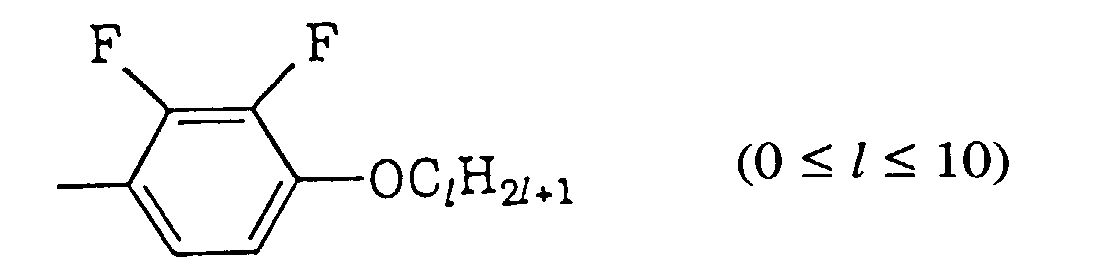
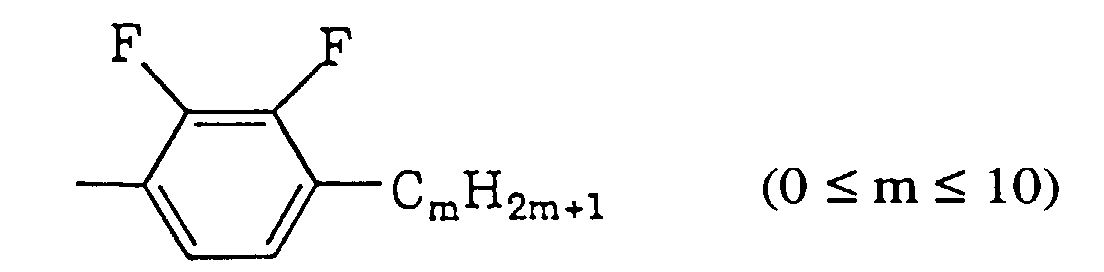
- Dérivé de silacyclohexane conforme à la revendication 1, 2 ou 3, dans lequel X représente un groupe alkyle, alcoxy ou alcoxy-alcoxy.
- Composition de cristaux liquides comprenant au moins un dérivé de silacyclohexane correspondant à la formule (I) suivante :dans laquelle :
 R est choisi dans l'ensemble que constituent un groupe alkyle linéaire comportant de 1 à 10 atomes de carbone, un groupe alkyle ramifié comportant de 3 à 8 atomes de carbone, un groupe alcoxy-alkyle comportant de 2 à 7 atomes de carbone, un groupe monofluoroalkyle ou difluoroalkyle comportant de 1 à 10 atomes de carbone, et un groupe alcényle comportant de 2 à 8 atomes de carbone ;W représente un atome d'hydrogène, de fluor ou de chlore, ou un groupe méthyle ;X représente :un atome de fluor ou de chlore,un groupe cyano CN, trifluorométhyle CF3, trifluorométhoxy OCF3, chlorodifluorométhoxy OCF2Cl, chlorofluorométhoxy OCHFCl ou difluorométhoxy OCHF2,un groupe alkyle linéaire comportant de 1 à 10 atomes de carbone,un groupe alcoxy comportant de 1 à 10 atomes de carbone,un groupe alcoxy-alcoxy comportant de 2 à 7 atomes de carbone,un groupe de formule (O) l CY1=CX1X2 où l vaut 0 ou 1, Y1 et X1 représentent chacun, indépendamment, un atome d'hydrogène, de fluor ou de chlore et X2 représente un atome d'hydrogène, de fluor ou de chlore, ouun groupe de formule O(CH2)r(CF2)sX3 où r et s valent chacun 0, 1 ou 2, pourvu que (r + s) vaille 2, 3 ou 4, et X3 représente un atome d'hydrogène, de fluor ou de chlore ; etY et Z représentent chacun un atome d'hydrogène, de fluor ou de chlore.
 - Composition de cristaux liquides conforme à la revendication 5, dans laquelle ledit ou lesdits dérivé(s) de silacyclohexane se trouve(nt) en une proportion de 1 à 50 % en moles.
- Composition de cristaux liquides conforme à la revendication 5, qui comporte en outre au moins un composé choisi parmi l'ensemble que constituent les composés correspondant à l'une des formules suivantes :
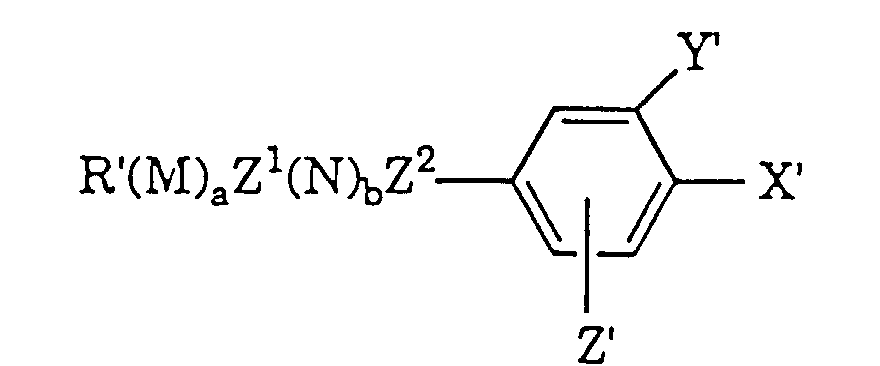 dans lesquelles :
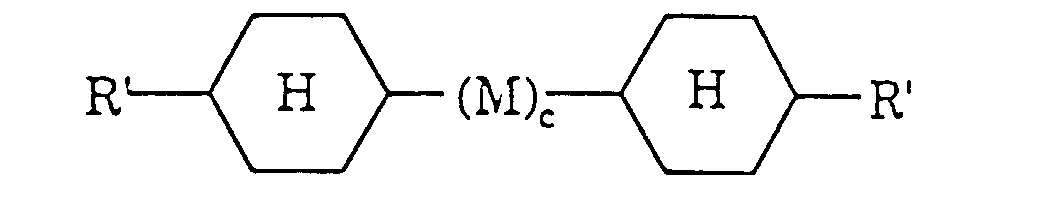 chaque symbole R' représente un groupe alkyle linéaire comportant de 1 à 10 atomes de carbone, un groupe alkyle ramifié comportant de 3 à 8 atomes de carbone, un groupe monofluoroalkyle ou difluoroalkyle comportant de 1 à 10 atomes de carbone, un groupe alcoxy-alkyle comportant de 2 à 7 atomes de carbone, ou un groupe alcényle comportant de 2 à 8 atomes de carbone, groupes déjà définis à propos de la formule (I) indiquée plus haut ;X' représente :un groupe alkyle linéaire comportant de 1 à 10 atomes de carbone,un groupe alcoxy linéaire comportant de 1 à 10 atomes de carbone,un groupe alcoxy-alkyle comportant de 2 à 7 atomes de carbone,un atome de fluor ou de chlore,un groupe cyano CN, trifluorométhyle CF3, chlorodifluorométhyle CF2Cl, chlorofluorométhyle CHFCl, trifluorométhoxy OCF3, chlorodifluorométhoxy OCF2Cl, chlorofluorométhoxy OCHFCl ou difluorométhoxy OCHF2,un groupe de formule (O) l CY1=CX1X2 où l vaut 0 ou 1, Y1 et X1 représentent chacun, indépendamment, un atome d'hydrogène, de fluor ou de chlore et X2 représente un atome d'hydrogène, de fluor ou de chlore, ouun groupe de formule O(CH2)r(CF2)sX3 où r et s valent chacun 0, 1 ou 2, pourvu que (r + s) vaille 2, 3 ou 4, et X3 représente un atome d'hydrogène, de fluor ou de chlore ;Y' et Z' représentent chacun, indépendamment, un atome d'hydrogène ou de fluor ;M et N représentent chacun, indépendamment,1) un groupe trans-1,4-cyclohexylène portant ou non des substituants,2) un groupe trans-1,4-cyclohexylène dont un motif CH2 ou deux motifs CH2 non adjacents du cycle de cyclohexane est ou sont remplacé(s) par un ou des atome(s) d'oxygène ou de soufre,3) un groupe 1,4-cyclohexénylène,4) un groupe 1,4-phénylène portant ou non des substituants, et5) un groupe 1,4-phénylène dont un ou deux motifs CH sont remplacés par un ou deux atomes d'azote ;a et b valent respectivement 0, 1 ou 2, pourvu que (a + b) vaille 1, 2 ou 3 ;c vaut 0, 1 ou 2 ; etZ1 et Z2 représentent chacun une liaison simple ou un raccord -CH2CH2-, -CH=CH-, -C≡C-, -CO2-, -OCO-, -CH2O- ou -OCH2-.
 - Afficheur à cristaux liquides, contenant une composition conforme à la revendication 5, 6 ou 7.
Applications Claiming Priority (3)
| Application Number | Priority Date | Filing Date | Title |
|---|---|---|---|
| JP28274094 | 1994-10-20 | ||
| JP28274094 | 1994-10-20 | ||
| JP282740/94 | 1994-10-20 |
Publications (2)
| Publication Number | Publication Date |
|---|---|
| EP0708106A1 EP0708106A1 (fr) | 1996-04-24 |
| EP0708106B1 true EP0708106B1 (fr) | 2000-08-09 |
Family
ID=17656438
Family Applications (1)
| Application Number | Title | Priority Date | Filing Date |
|---|---|---|---|
| EP95116331A Expired - Lifetime EP0708106B1 (fr) | 1994-10-20 | 1995-10-17 | Nouveaux composés de silacyclohexane, une composition de cristaux liquides les comprenant et un dispositif à cristaux liquides contenant ladite composition |
Country Status (4)
| Country | Link |
|---|---|
| US (1) | US5650092A (fr) |
| EP (1) | EP0708106B1 (fr) |
| KR (1) | KR100191767B1 (fr) |
| DE (1) | DE69518294T2 (fr) |
Families Citing this family (3)
| Publication number | Priority date | Publication date | Assignee | Title |
|---|---|---|---|---|
| EP0699683A1 (fr) * | 1994-09-02 | 1996-03-06 | Shin-Etsu Chemical Co., Ltd. | Nouveaux composés de silacyclohexane, une composition de cristaux liquides les comprenant et un dispositif à cristaux liquides contenant ladite composition |
| CN1136067A (zh) * | 1995-02-22 | 1996-11-20 | 智索公司 | 酯衍生物、液晶组合物和液晶显示元件 |
| JPH09324178A (ja) * | 1996-04-01 | 1997-12-16 | Shin Etsu Chem Co Ltd | 液晶組成物及びそれを含む液晶表示素子 |
Family Cites Families (15)
| Publication number | Priority date | Publication date | Assignee | Title |
|---|---|---|---|---|
| US4548731A (en) * | 1982-05-17 | 1985-10-22 | Chisso Corporation | 2,4-Difluorobenzene derivatives |
| JPS6050177A (ja) | 1983-08-26 | 1985-03-19 | Seiko Instr & Electronics Ltd | 時計用外装部品 |
| JPS6052744A (ja) | 1983-09-02 | 1985-03-26 | Hitachi Ltd | 分光透過率測定装置 |
| JPS6121937A (ja) | 1984-07-11 | 1986-01-30 | Hitachi Cable Ltd | 光フアイバの被覆方法 |
| JPS6450691A (en) | 1987-08-20 | 1989-02-27 | Fuji Photo Film Co Ltd | Dubbing adapter |
| JPS6450694A (en) | 1987-08-21 | 1989-02-27 | Nec Corp | Managing system for call connected state in exchange system |
| JPS6450693A (en) | 1987-08-21 | 1989-02-27 | Hitachi Ltd | Noise reducer |
| DE3827600A1 (de) * | 1988-08-13 | 1990-02-15 | Hoechst Ag | Organosilylalkyl- oder -alkenyl-verbindungen, verfahren zu ihrer herstellung und ihre verwendung in fluessigkristallinen mischungen |
| JPH039895A (ja) | 1989-06-07 | 1991-01-17 | Teiboo Kk | 無機質製ペン先 |
| US4985565A (en) * | 1989-10-16 | 1991-01-15 | Dow Corning Corporation | Silacyclobutanes |
| JP3238526B2 (ja) * | 1992-06-10 | 2001-12-17 | 松下電器産業株式会社 | 基準電位発生回路とそれを用いた半導体集積回路 |
| JPH0639895A (ja) * | 1992-07-23 | 1994-02-15 | Unitika Ltd | ポリエチレンナフタレート樹脂強化シート |
| KR100232045B1 (ko) * | 1993-10-14 | 1999-12-01 | 카나가와 치히로 | 실라시클로헥산화합물, 그의 제조방법 및 이것을 함유하는 액정조성물 |
| US5496501A (en) * | 1993-12-07 | 1996-03-05 | Shin-Etsu Chemical Co., Ltd. | Silacyclohexane compound, a method of preparing it and a liquid crystal composition containing it |
| US5498737A (en) * | 1994-01-28 | 1996-03-12 | Shin-Etsu Chemical Co., Ltd. | Silacyclohexane compound, a method of preparing it and a liquid crystal composition containing it |
-
1995
- 1995-10-17 EP EP95116331A patent/EP0708106B1/fr not_active Expired - Lifetime
- 1995-10-17 DE DE69518294T patent/DE69518294T2/de not_active Expired - Fee Related
- 1995-10-20 KR KR1019950036428A patent/KR100191767B1/ko not_active Expired - Fee Related
- 1995-10-20 US US08/545,889 patent/US5650092A/en not_active Expired - Fee Related
Also Published As
| Publication number | Publication date |
|---|---|
| KR960014294A (ko) | 1996-05-22 |
| US5650092A (en) | 1997-07-22 |
| KR100191767B1 (ko) | 1999-06-15 |
| DE69518294D1 (de) | 2000-09-14 |
| DE69518294T2 (de) | 2000-12-21 |
| EP0708106A1 (fr) | 1996-04-24 |
Similar Documents
| Publication | Publication Date | Title |
|---|---|---|
| US5454977A (en) | Silacyclohexane compound, a method of preparing it and a liquid crystal composition containing it | |
| KR100232043B1 (ko) | 실라시클로헥산 화합물, 그 제조방법 및 이를 함유하는 액정조성물 | |
| US5498737A (en) | Silacyclohexane compound, a method of preparing it and a liquid crystal composition containing it | |
| US5547606A (en) | Silacyclohexane compound, a method of preparing it and a liquid crystal composition containing it | |
| US5523440A (en) | Silacyclohexane compound, a method of preparaing it and a liquid crystal composition containing it | |
| US5659059A (en) | Silacyclohexane compound, a method of preparing it and a liquid crystal composition containing it | |
| EP0708106B1 (fr) | Nouveaux composés de silacyclohexane, une composition de cristaux liquides les comprenant et un dispositif à cristaux liquides contenant ladite composition | |
| KR100236988B1 (ko) | 실라시클로헥산화합물, 그의 제조방법 및 이것을 함유하는 액정조성물 | |
| US5567350A (en) | Silacyclohexane compound, a method of preparing it and a liquid cyrstal composition containing it | |
| US5573705A (en) | Silacyclohexane compound, a method of preparing it and a liquid crystal composition containing it | |
| EP0708107B1 (fr) | Nouveaux composés de silacyclohexane, une composition de cristaux liquides les comprenant et un dispositif à cristaux liquides contenant ladite composition | |
| EP0714899B1 (fr) | Composés de silacyclohexane, leur préparation, compositions à cristaux liquides les contenant, et dispositifs contenant ces compositions | |
| US5868961A (en) | Silacyclohexane compound, a method of preparing it and a liquid crystal composition containing it | |
| US5730902A (en) | Optically active silacyclohexane compounds, liquid crystal compositions comprising the same and liquid crystal display devices comprising the compositions | |
| KR100210226B1 (ko) | 신규의 실라시클로헥산 화합물, 이것을 함유하는 액정 조성물 및 이 조성물을 함유하는 액정소자 | |
| US6004478A (en) | Silacyclohexane compounds, preparation thereof, liquid crystal compositions comprising the same, and liquid crystal devices comprising the composition | |
| EP0742222A2 (fr) | Nouveaux composés de silacyclohexane, leur préparation, compositions de cristaux liquides les contenant, et dispositifs à cristaux liquides contenant les compositions | |
| JPH1129580A (ja) | シラシクロヘキサン化合物、液晶組成物およびそれを含有する液晶表示素子 | |
| JPH08208664A (ja) | シラシクロヘキサン化合物及びこれを含有する液晶組成物 | |
| JPH08239388A (ja) | シラシクロヘキサン化合物、その製造方法及びこれを含有する液晶組成物 | |
| JPH08245650A (ja) | シラシクロヘキサン化合物及びこれを含有する液晶組成物 | |
| JPH09132581A (ja) | 光学活性シラシクロヘキサン化合物及びこれを含有する液晶組成物 | |
| JPH08119975A (ja) | シラシクロヘキサン化合物及びこれを含有する液晶組成物 | |
| JPH08225580A (ja) | シラシクロヘキサン化合物及びこれを含有する液晶組成物 | |
| JPH08245649A (ja) | シラシクロヘキサン化合物及びこれを含有する液晶組成物 |
Legal Events
| Date | Code | Title | Description |
|---|---|---|---|
| PUAI | Public reference made under article 153(3) epc to a published international application that has entered the european phase |
Free format text: ORIGINAL CODE: 0009012 |
|
| AK | Designated contracting states |
Kind code of ref document: A1 Designated state(s): DE FR GB |
|
| RIN1 | Information on inventor provided before grant (corrected) |
Inventor name: KURIHARA, HIDESHI, C/O CORP. RESEARCH CENTER Inventor name: NAKASHIMA, MUTSUO, C/O GOSEI GIJUTSU KENKYU-SHO Inventor name: KANEKO, TATSUSHI, C/O GOSEI GIJUTSU KENKYU-SHO Inventor name: OGIHARA, TSUTOMU, C/O GOSEI GIJUTSU KENKYU-SHO Inventor name: KINSHO, TAKESHI, C/O GOSEI GIJUTSU KENKYU-SHO Inventor name: SHIMIZU, TAKAAKI, C/O GOSEI GIJUTSU KENKYU-SHO |
|
| 17P | Request for examination filed |
Effective date: 19960617 |
|
| GRAG | Despatch of communication of intention to grant |
Free format text: ORIGINAL CODE: EPIDOS AGRA |
|
| 17Q | First examination report despatched |
Effective date: 19990824 |
|
| GRAG | Despatch of communication of intention to grant |
Free format text: ORIGINAL CODE: EPIDOS AGRA |
|
| GRAG | Despatch of communication of intention to grant |
Free format text: ORIGINAL CODE: EPIDOS AGRA |
|
| GRAH | Despatch of communication of intention to grant a patent |
Free format text: ORIGINAL CODE: EPIDOS IGRA |
|
| GRAH | Despatch of communication of intention to grant a patent |
Free format text: ORIGINAL CODE: EPIDOS IGRA |
|
| GRAA | (expected) grant |
Free format text: ORIGINAL CODE: 0009210 |
|
| AK | Designated contracting states |
Kind code of ref document: B1 Designated state(s): DE FR GB |
|
| ET | Fr: translation filed | ||
| PGFP | Annual fee paid to national office [announced via postgrant information from national office to epo] |
Ref country code: FR Payment date: 20000914 Year of fee payment: 6 |
|
| REF | Corresponds to: |
Ref document number: 69518294 Country of ref document: DE Date of ref document: 20000914 |
|
| PGFP | Annual fee paid to national office [announced via postgrant information from national office to epo] |
Ref country code: GB Payment date: 20001010 Year of fee payment: 6 |
|
| PGFP | Annual fee paid to national office [announced via postgrant information from national office to epo] |
Ref country code: DE Payment date: 20001014 Year of fee payment: 6 |
|
| PLBE | No opposition filed within time limit |
Free format text: ORIGINAL CODE: 0009261 |
|
| STAA | Information on the status of an ep patent application or granted ep patent |
Free format text: STATUS: NO OPPOSITION FILED WITHIN TIME LIMIT |
|
| 26N | No opposition filed | ||
| PG25 | Lapsed in a contracting state [announced via postgrant information from national office to epo] |
Ref country code: GB Free format text: LAPSE BECAUSE OF NON-PAYMENT OF DUE FEES Effective date: 20011017 |
|
| REG | Reference to a national code |
Ref country code: GB Ref legal event code: IF02 |
|
| GBPC | Gb: european patent ceased through non-payment of renewal fee |
Effective date: 20011017 |
|
| PG25 | Lapsed in a contracting state [announced via postgrant information from national office to epo] |
Ref country code: FR Free format text: LAPSE BECAUSE OF NON-PAYMENT OF DUE FEES Effective date: 20020628 |
|
| PG25 | Lapsed in a contracting state [announced via postgrant information from national office to epo] |
Ref country code: DE Free format text: LAPSE BECAUSE OF NON-PAYMENT OF DUE FEES Effective date: 20020702 |
|
| REG | Reference to a national code |
Ref country code: FR Ref legal event code: ST |