EP0714899B1 - Composés de silacyclohexane, leur préparation, compositions à cristaux liquides les contenant, et dispositifs contenant ces compositions - Google Patents
Composés de silacyclohexane, leur préparation, compositions à cristaux liquides les contenant, et dispositifs contenant ces compositions Download PDFInfo
- Publication number
- EP0714899B1 EP0714899B1 EP95308675A EP95308675A EP0714899B1 EP 0714899 B1 EP0714899 B1 EP 0714899B1 EP 95308675 A EP95308675 A EP 95308675A EP 95308675 A EP95308675 A EP 95308675A EP 0714899 B1 EP0714899 B1 EP 0714899B1
- Authority
- EP
- European Patent Office
- Prior art keywords
- trans
- group
- compound
- formula
- silacyclohexane
- Prior art date
- Legal status (The legal status is an assumption and is not a legal conclusion. Google has not performed a legal analysis and makes no representation as to the accuracy of the status listed.)
- Expired - Lifetime
Links
- 150000001875 compounds Chemical class 0.000 title claims description 157
- 239000000203 mixture Substances 0.000 title claims description 59
- 239000004973 liquid crystal related substance Substances 0.000 title claims description 55
- 238000002360 preparation method Methods 0.000 title description 66
- -1 methanesulfonyloxy, benzenesulfonyloxy, p-toluenesulfonyloxy Chemical group 0.000 claims description 205
- 238000000034 method Methods 0.000 claims description 70
- 229910052801 chlorine Inorganic materials 0.000 claims description 27
- 229910052731 fluorine Inorganic materials 0.000 claims description 26
- 125000005843 halogen group Chemical group 0.000 claims description 19
- 229910052739 hydrogen Inorganic materials 0.000 claims description 18
- 229910052710 silicon Inorganic materials 0.000 claims description 17
- 125000000008 (C1-C10) alkyl group Chemical group 0.000 claims description 16
- XUIMIQQOPSSXEZ-UHFFFAOYSA-N Silicon Chemical group [Si] XUIMIQQOPSSXEZ-UHFFFAOYSA-N 0.000 claims description 16
- 230000008569 process Effects 0.000 claims description 15
- 125000004183 alkoxy alkyl group Chemical group 0.000 claims description 11
- 229910052736 halogen Inorganic materials 0.000 claims description 9
- 125000004648 C2-C8 alkenyl group Chemical group 0.000 claims description 8
- PQIOSYKVBBWRRI-UHFFFAOYSA-N methylphosphonyl difluoride Chemical group CP(F)(F)=O PQIOSYKVBBWRRI-UHFFFAOYSA-N 0.000 claims description 8
- 125000001997 phenyl group Chemical group [H]C1=C([H])C([H])=C(*)C([H])=C1[H] 0.000 claims description 8
- 125000005407 trans-1,4-cyclohexylene group Chemical group [H]C1([H])C([H])([H])[C@]([H])([*:2])C([H])([H])C([H])([H])[C@@]1([H])[*:1] 0.000 claims description 8
- 125000001424 substituent group Chemical group 0.000 claims description 7
- 125000000229 (C1-C4)alkoxy group Chemical group 0.000 claims description 6
- QZRGKCOWNLSUDK-UHFFFAOYSA-N Iodochlorine Chemical compound ICl QZRGKCOWNLSUDK-UHFFFAOYSA-N 0.000 claims description 6
- 125000003944 tolyl group Chemical group 0.000 claims description 6
- 125000005951 trifluoromethanesulfonyloxy group Chemical group 0.000 claims description 6
- 125000000027 (C1-C10) alkoxy group Chemical group 0.000 claims description 5
- 239000003153 chemical reaction reagent Substances 0.000 claims description 5
- 238000004519 manufacturing process Methods 0.000 claims description 5
- 125000002524 organometallic group Chemical group 0.000 claims description 5
- IJGRMHOSHXDMSA-UHFFFAOYSA-N Atomic nitrogen Chemical compound N#N IJGRMHOSHXDMSA-UHFFFAOYSA-N 0.000 claims description 4
- 125000004786 difluoromethoxy group Chemical group [H]C(F)(F)O* 0.000 claims description 4
- 125000000876 trifluoromethoxy group Chemical group FC(F)(F)O* 0.000 claims description 4
- 125000000113 cyclohexyl group Chemical group [H]C1([H])C([H])([H])C([H])([H])C([H])(*)C([H])([H])C1([H])[H] 0.000 claims description 3
- 125000001140 1,4-phenylene group Chemical group [H]C1=C([H])C([*:2])=C([H])C([H])=C1[*:1] 0.000 claims description 2
- 229910052757 nitrogen Inorganic materials 0.000 claims description 2
- 150000002902 organometallic compounds Chemical class 0.000 claims description 2
- 229910052760 oxygen Inorganic materials 0.000 claims description 2
- 125000000843 phenylene group Chemical group C1(=C(C=CC=C1)*)* 0.000 claims description 2
- 125000005651 substituted 1,4-phenylene group Chemical group 0.000 claims description 2
- 229910052717 sulfur Inorganic materials 0.000 claims description 2
- 235000013350 formula milk Nutrition 0.000 claims 21
- 150000002367 halogens Chemical class 0.000 claims 1
- 239000012071 phase Substances 0.000 description 51
- 239000000047 product Substances 0.000 description 50
- 230000007704 transition Effects 0.000 description 41
- 238000006243 chemical reaction Methods 0.000 description 36
- 239000000460 chlorine Substances 0.000 description 25
- WYURNTSHIVDZCO-UHFFFAOYSA-N Tetrahydrofuran Chemical compound C1CCOC1 WYURNTSHIVDZCO-UHFFFAOYSA-N 0.000 description 24
- 0 NC1CCC(*c(cc2)ccc2F)CC1 Chemical compound NC1CCC(*c(cc2)ccc2F)CC1 0.000 description 20
- 125000002496 methyl group Chemical group [H]C([H])([H])* 0.000 description 16
- 239000013078 crystal Substances 0.000 description 14
- 238000004458 analytical method Methods 0.000 description 13
- 239000007788 liquid Substances 0.000 description 13
- VZGDMQKNWNREIO-UHFFFAOYSA-N tetrachloromethane Chemical compound ClC(Cl)(Cl)Cl VZGDMQKNWNREIO-UHFFFAOYSA-N 0.000 description 12
- 125000000217 alkyl group Chemical group 0.000 description 11
- RTZKZFJDLAIYFH-UHFFFAOYSA-N ether Substances CCOCC RTZKZFJDLAIYFH-UHFFFAOYSA-N 0.000 description 11
- 238000005259 measurement Methods 0.000 description 11
- PVOLYYLQUDHQNP-UHFFFAOYSA-N 4-(bromomethyl)-1-heptyl-1-phenylsilinane Chemical compound C=1C=CC=CC=1[Si]1(CCCCCCC)CCC(CBr)CC1 PVOLYYLQUDHQNP-UHFFFAOYSA-N 0.000 description 9
- ZMXDDKWLCZADIW-UHFFFAOYSA-N N,N-Dimethylformamide Chemical compound CN(C)C=O ZMXDDKWLCZADIW-UHFFFAOYSA-N 0.000 description 9
- 229910052794 bromium Inorganic materials 0.000 description 9
- 125000004432 carbon atom Chemical group C* 0.000 description 9
- 239000000126 substance Substances 0.000 description 9
- 125000003545 alkoxy group Chemical group 0.000 description 7
- 239000002904 solvent Substances 0.000 description 7
- YMWUJEATGCHHMB-UHFFFAOYSA-N Dichloromethane Chemical compound ClCCl YMWUJEATGCHHMB-UHFFFAOYSA-N 0.000 description 6
- YXFVVABEGXRONW-UHFFFAOYSA-N Toluene Chemical compound CC1=CC=CC=C1 YXFVVABEGXRONW-UHFFFAOYSA-N 0.000 description 6
- 238000004587 chromatography analysis Methods 0.000 description 6
- BWHMMNNQKKPAPP-UHFFFAOYSA-L potassium carbonate Chemical compound [K+].[K+].[O-]C([O-])=O BWHMMNNQKKPAPP-UHFFFAOYSA-L 0.000 description 6
- 239000011541 reaction mixture Substances 0.000 description 6
- 230000009467 reduction Effects 0.000 description 6
- 150000001879 copper Chemical class 0.000 description 5
- 239000012043 crude product Substances 0.000 description 5
- 229910052740 iodine Inorganic materials 0.000 description 5
- 239000000463 material Substances 0.000 description 5
- 238000002844 melting Methods 0.000 description 5
- 230000008018 melting Effects 0.000 description 5
- 239000007858 starting material Substances 0.000 description 5
- BNPWVUJOPCGHIK-UHFFFAOYSA-N 3,4-difluorophenol Chemical compound OC1=CC=C(F)C(F)=C1 BNPWVUJOPCGHIK-UHFFFAOYSA-N 0.000 description 4
- LKVFCSWBKOVHAH-UHFFFAOYSA-N 4-Ethoxyphenol Chemical compound CCOC1=CC=C(O)C=C1 LKVFCSWBKOVHAH-UHFFFAOYSA-N 0.000 description 4
- CFKMVGJGLGKFKI-UHFFFAOYSA-N 4-chloro-m-cresol Chemical compound CC1=CC(O)=CC=C1Cl CFKMVGJGLGKFKI-UHFFFAOYSA-N 0.000 description 4
- PKIYFPSPIFCDDB-UHFFFAOYSA-N 4-ethoxy-2,3-difluorophenol Chemical compound CCOC1=CC=C(O)C(F)=C1F PKIYFPSPIFCDDB-UHFFFAOYSA-N 0.000 description 4
- UFWSNOKHHREXAJ-KSPFUINFSA-N BrC[C@@H]1CC[C@H](CC1)C1CC[Si](CC1)(CCCCC)C1=CC=CC=C1 Chemical compound BrC[C@@H]1CC[C@H](CC1)C1CC[Si](CC1)(CCCCC)C1=CC=CC=C1 UFWSNOKHHREXAJ-KSPFUINFSA-N 0.000 description 4
- HEDRZPFGACZZDS-UHFFFAOYSA-N Chloroform Chemical compound ClC(Cl)Cl HEDRZPFGACZZDS-UHFFFAOYSA-N 0.000 description 4
- HEDRZPFGACZZDS-MICDWDOJSA-N Trichloro(2H)methane Chemical compound [2H]C(Cl)(Cl)Cl HEDRZPFGACZZDS-MICDWDOJSA-N 0.000 description 4
- 239000011203 carbon fibre reinforced carbon Substances 0.000 description 4
- 239000000470 constituent Substances 0.000 description 4
- 238000002290 gas chromatography-mass spectrometry Methods 0.000 description 4
- 125000000956 methoxy group Chemical group [H]C([H])([H])O* 0.000 description 4
- YLQBMQCUIZJEEH-UHFFFAOYSA-N tetrahydrofuran Natural products C=1C=COC=1 YLQBMQCUIZJEEH-UHFFFAOYSA-N 0.000 description 4
- DYLIWHYUXAJDOJ-OWOJBTEDSA-N (e)-4-(6-aminopurin-9-yl)but-2-en-1-ol Chemical compound NC1=NC=NC2=C1N=CN2C\C=C\CO DYLIWHYUXAJDOJ-OWOJBTEDSA-N 0.000 description 3
- GOYDNIKZWGIXJT-UHFFFAOYSA-N 1,2-difluorobenzene Substances FC1=CC=CC=C1F GOYDNIKZWGIXJT-UHFFFAOYSA-N 0.000 description 3
- LSXKDWGTSHCFPP-UHFFFAOYSA-N 1-bromoheptane Chemical compound CCCCCCCBr LSXKDWGTSHCFPP-UHFFFAOYSA-N 0.000 description 3
- YZWKKMVJZFACSU-UHFFFAOYSA-N 1-bromopentane Chemical compound CCCCCBr YZWKKMVJZFACSU-UHFFFAOYSA-N 0.000 description 3
- QTIOMCZDDZRQCR-UHFFFAOYSA-N 1-chlorosilinane Chemical compound Cl[SiH]1CCCCC1 QTIOMCZDDZRQCR-UHFFFAOYSA-N 0.000 description 3
- UHOVQNZJYSORNB-UHFFFAOYSA-N Benzene Chemical compound C1=CC=CC=C1 UHOVQNZJYSORNB-UHFFFAOYSA-N 0.000 description 3
- BVTACYITSLQURK-AXBQTCQRSA-N CCC[Si@H]1CC[C@@H](CC1)[C@H]1CC[C@H](COc2ccc(OCC)c(F)c2F)CC1 Chemical compound CCC[Si@H]1CC[C@@H](CC1)[C@H]1CC[C@H](COc2ccc(OCC)c(F)c2F)CC1 BVTACYITSLQURK-AXBQTCQRSA-N 0.000 description 3
- XDTMQSROBMDMFD-UHFFFAOYSA-N Cyclohexane Chemical group C1CCCCC1 XDTMQSROBMDMFD-UHFFFAOYSA-N 0.000 description 3
- 239000007818 Grignard reagent Substances 0.000 description 3
- FYYHWMGAXLPEAU-UHFFFAOYSA-N Magnesium Chemical compound [Mg] FYYHWMGAXLPEAU-UHFFFAOYSA-N 0.000 description 3
- KWYUFKZDYYNOTN-UHFFFAOYSA-M Potassium hydroxide Chemical compound [OH-].[K+] KWYUFKZDYYNOTN-UHFFFAOYSA-M 0.000 description 3
- HEMHJVSKTPXQMS-UHFFFAOYSA-M Sodium hydroxide Chemical compound [OH-].[Na+] HEMHJVSKTPXQMS-UHFFFAOYSA-M 0.000 description 3
- ZMANZCXQSJIPKH-UHFFFAOYSA-N Triethylamine Chemical compound CCN(CC)CC ZMANZCXQSJIPKH-UHFFFAOYSA-N 0.000 description 3
- 238000013019 agitation Methods 0.000 description 3
- 125000004429 atom Chemical group 0.000 description 3
- 238000004440 column chromatography Methods 0.000 description 3
- 125000005448 ethoxyethyl group Chemical group [H]C([H])([H])C([H])([H])OC([H])([H])C([H])([H])* 0.000 description 3
- 125000005745 ethoxymethyl group Chemical group [H]C([H])([H])C([H])([H])OC([H])([H])* 0.000 description 3
- 150000004795 grignard reagents Chemical class 0.000 description 3
- 239000012280 lithium aluminium hydride Substances 0.000 description 3
- 239000011777 magnesium Substances 0.000 description 3
- 229910052749 magnesium Inorganic materials 0.000 description 3
- 125000004184 methoxymethyl group Chemical group [H]C([H])([H])OC([H])([H])* 0.000 description 3
- 125000005815 pentoxymethyl group Chemical group [H]C([H])([H])C([H])([H])C([H])([H])C([H])([H])C([H])([H])OC([H])([H])* 0.000 description 3
- 229910000027 potassium carbonate Inorganic materials 0.000 description 3
- 125000005767 propoxymethyl group Chemical group [H]C([H])([H])C([H])([H])C([H])([H])[#8]C([H])([H])* 0.000 description 3
- DPAIGALEKLSCIC-UHFFFAOYSA-N 1-chloro-4-[(4-chloro-3,5-difluorophenoxy)methyl]silinane Chemical compound Fc1cc(OCC2CC[SiH](Cl)CC2)cc(F)c1Cl DPAIGALEKLSCIC-UHFFFAOYSA-N 0.000 description 2
- OHJGXAUUMKWOMD-UHFFFAOYSA-N 1-chloro-4-[(4-fluorophenoxy)methyl]silinane Chemical compound Fc1ccc(OCC2CC[SiH](Cl)CC2)cc1 OHJGXAUUMKWOMD-UHFFFAOYSA-N 0.000 description 2
- LCBJJSCZJJMYTI-UHFFFAOYSA-N 1-chloro-4-[(4-methoxyphenoxy)methyl]-1-methylsilinane Chemical compound C1=CC(OC)=CC=C1OCC1CC[Si](C)(Cl)CC1 LCBJJSCZJJMYTI-UHFFFAOYSA-N 0.000 description 2
- 125000006039 1-hexenyl group Chemical group 0.000 description 2
- 125000006023 1-pentenyl group Chemical group 0.000 description 2
- 125000006017 1-propenyl group Chemical group 0.000 description 2
- 238000005160 1H NMR spectroscopy Methods 0.000 description 2
- 125000004778 2,2-difluoroethyl group Chemical group [H]C([H])(*)C([H])(F)F 0.000 description 2
- IEEXNJSBAQLMAY-UHFFFAOYSA-N 2,3-difluoro-4-propylphenol Chemical compound CCCC1=CC=C(O)C(F)=C1F IEEXNJSBAQLMAY-UHFFFAOYSA-N 0.000 description 2
- REIVHYDACHXPNH-UHFFFAOYSA-N 2-fluoro-4-hydroxybenzonitrile Chemical compound OC1=CC=C(C#N)C(F)=C1 REIVHYDACHXPNH-UHFFFAOYSA-N 0.000 description 2
- 125000004777 2-fluoroethyl group Chemical group [H]C([H])(F)C([H])([H])* 0.000 description 2
- 125000004493 2-methylbut-1-yl group Chemical group CC(C*)CC 0.000 description 2
- 125000005916 2-methylpentyl group Chemical group 0.000 description 2
- ZRTWIJKGTUGZJY-UHFFFAOYSA-N 3,4,5-trifluorophenol Chemical compound OC1=CC(F)=C(F)C(F)=C1 ZRTWIJKGTUGZJY-UHFFFAOYSA-N 0.000 description 2
- 125000004975 3-butenyl group Chemical group C(CC=C)* 0.000 description 2
- UTFSPWRTXCDUIJ-UHFFFAOYSA-N 3-fluoro-4-(trifluoromethoxy)phenol Chemical compound OC1=CC=C(OC(F)(F)F)C(F)=C1 UTFSPWRTXCDUIJ-UHFFFAOYSA-N 0.000 description 2
- CSDQQAQKBAQLLE-UHFFFAOYSA-N 4-(4-chlorophenyl)-4,5,6,7-tetrahydrothieno[3,2-c]pyridine Chemical compound C1=CC(Cl)=CC=C1C1C(C=CS2)=C2CCN1 CSDQQAQKBAQLLE-UHFFFAOYSA-N 0.000 description 2
- MRFCJNHNOSNQOU-UHFFFAOYSA-N 4-(difluoromethoxy)-3,5-difluorophenol Chemical compound OC1=CC(F)=C(OC(F)F)C(F)=C1 MRFCJNHNOSNQOU-UHFFFAOYSA-N 0.000 description 2
- BNHAYQSUBZKWAG-UHFFFAOYSA-N 4-(difluoromethoxy)phenol Chemical compound OC1=CC=C(OC(F)F)C=C1 BNHAYQSUBZKWAG-UHFFFAOYSA-N 0.000 description 2
- WDRJNKMAZMEYOF-UHFFFAOYSA-N 4-(trifluoromethoxy)phenol Chemical compound OC1=CC=C(OC(F)(F)F)C=C1 WDRJNKMAZMEYOF-UHFFFAOYSA-N 0.000 description 2
- BAYGVMXZJBFEMB-UHFFFAOYSA-N 4-(trifluoromethyl)phenol Chemical compound OC1=CC=C(C(F)(F)F)C=C1 BAYGVMXZJBFEMB-UHFFFAOYSA-N 0.000 description 2
- VHYFNPMBLIVWCW-UHFFFAOYSA-N 4-Dimethylaminopyridine Chemical compound CN(C)C1=CC=NC=C1 VHYFNPMBLIVWCW-UHFFFAOYSA-N 0.000 description 2
- ZKMUKBBWORLNLA-UHFFFAOYSA-N 4-chloro-2-fluorophenol Chemical compound OC1=CC=C(Cl)C=C1F ZKMUKBBWORLNLA-UHFFFAOYSA-N 0.000 description 2
- 125000006043 5-hexenyl group Chemical group 0.000 description 2
- VGJOEOFPGBPQMG-SGNKCFNYSA-N CCCCC[Si@H]1CC[C@H](COc2ccc(F)cc2)CC1 Chemical compound CCCCC[Si@H]1CC[C@H](COc2ccc(F)cc2)CC1 VGJOEOFPGBPQMG-SGNKCFNYSA-N 0.000 description 2
- IGZVRHIFNPQQNU-AXBQTCQRSA-N CCC[Si@H]1CC[C@@H](CC1)[C@H]1CC[C@H](COc2ccc(OC(F)(F)F)cc2)CC1 Chemical compound CCC[Si@H]1CC[C@@H](CC1)[C@H]1CC[C@H](COc2ccc(OC(F)(F)F)cc2)CC1 IGZVRHIFNPQQNU-AXBQTCQRSA-N 0.000 description 2
- XTHFKEDIFFGKHM-UHFFFAOYSA-N Dimethoxyethane Chemical compound COCCOC XTHFKEDIFFGKHM-UHFFFAOYSA-N 0.000 description 2
- VEXZGXHMUGYJMC-UHFFFAOYSA-N Hydrochloric acid Chemical compound Cl VEXZGXHMUGYJMC-UHFFFAOYSA-N 0.000 description 2
- MZRVEZGGRBJDDB-UHFFFAOYSA-N N-Butyllithium Chemical compound [Li]CCCC MZRVEZGGRBJDDB-UHFFFAOYSA-N 0.000 description 2
- IMNFDUFMRHMDMM-UHFFFAOYSA-N N-Heptane Chemical compound CCCCCCC IMNFDUFMRHMDMM-UHFFFAOYSA-N 0.000 description 2
- 238000005481 NMR spectroscopy Methods 0.000 description 2
- 239000004988 Nematic liquid crystal Substances 0.000 description 2
- JUJWROOIHBZHMG-UHFFFAOYSA-N Pyridine Chemical compound C1=CC=NC=C1 JUJWROOIHBZHMG-UHFFFAOYSA-N 0.000 description 2
- KEAYESYHFKHZAL-UHFFFAOYSA-N Sodium Chemical compound [Na] KEAYESYHFKHZAL-UHFFFAOYSA-N 0.000 description 2
- CDBYLPFSWZWCQE-UHFFFAOYSA-L Sodium Carbonate Chemical compound [Na+].[Na+].[O-]C([O-])=O CDBYLPFSWZWCQE-UHFFFAOYSA-L 0.000 description 2
- WQDUMFSSJAZKTM-UHFFFAOYSA-N Sodium methoxide Chemical compound [Na+].[O-]C WQDUMFSSJAZKTM-UHFFFAOYSA-N 0.000 description 2
- 239000000654 additive Substances 0.000 description 2
- 238000006664 bond formation reaction Methods 0.000 description 2
- 125000006226 butoxyethyl group Chemical group 0.000 description 2
- XJHCXCQVJFPJIK-UHFFFAOYSA-M caesium fluoride Chemical compound [F-].[Cs+] XJHCXCQVJFPJIK-UHFFFAOYSA-M 0.000 description 2
- 239000003638 chemical reducing agent Substances 0.000 description 2
- ORTQZVOHEJQUHG-UHFFFAOYSA-L copper(II) chloride Chemical compound Cl[Cu]Cl ORTQZVOHEJQUHG-UHFFFAOYSA-L 0.000 description 2
- OPQARKPSCNTWTJ-UHFFFAOYSA-L copper(ii) acetate Chemical compound [Cu+2].CC([O-])=O.CC([O-])=O OPQARKPSCNTWTJ-UHFFFAOYSA-L 0.000 description 2
- QTMDXZNDVAMKGV-UHFFFAOYSA-L copper(ii) bromide Chemical compound [Cu+2].[Br-].[Br-] QTMDXZNDVAMKGV-UHFFFAOYSA-L 0.000 description 2
- 238000005828 desilylation reaction Methods 0.000 description 2
- SBZXBUIDTXKZTM-UHFFFAOYSA-N diglyme Chemical compound COCCOCCOC SBZXBUIDTXKZTM-UHFFFAOYSA-N 0.000 description 2
- 125000006232 ethoxy propyl group Chemical group [H]C([H])([H])C([H])([H])OC([H])([H])C([H])([H])C([H])([H])* 0.000 description 2
- 125000001495 ethyl group Chemical group [H]C([H])([H])C([H])([H])* 0.000 description 2
- 239000012467 final product Substances 0.000 description 2
- 150000008282 halocarbons Chemical class 0.000 description 2
- 238000010438 heat treatment Methods 0.000 description 2
- 229930195733 hydrocarbon Natural products 0.000 description 2
- 150000002430 hydrocarbons Chemical class 0.000 description 2
- 239000001257 hydrogen Substances 0.000 description 2
- 125000000959 isobutyl group Chemical group [H]C([H])([H])C([H])(C([H])([H])[H])C([H])([H])* 0.000 description 2
- 125000001972 isopentyl group Chemical group [H]C([H])([H])C([H])(C([H])([H])[H])C([H])([H])C([H])([H])* 0.000 description 2
- 125000001449 isopropyl group Chemical group [H]C([H])([H])C([H])(*)C([H])([H])[H] 0.000 description 2
- 229910052987 metal hydride Inorganic materials 0.000 description 2
- 150000004681 metal hydrides Chemical class 0.000 description 2
- 125000004108 n-butyl group Chemical group [H]C([H])([H])C([H])([H])C([H])([H])C([H])([H])* 0.000 description 2
- 125000001280 n-hexyl group Chemical group C(CCCCC)* 0.000 description 2
- 125000000740 n-pentyl group Chemical group [H]C([H])([H])C([H])([H])C([H])([H])C([H])([H])C([H])([H])* 0.000 description 2
- 125000004123 n-propyl group Chemical group [H]C([H])([H])C([H])([H])C([H])([H])* 0.000 description 2
- 230000003287 optical effect Effects 0.000 description 2
- 150000002989 phenols Chemical class 0.000 description 2
- 125000006233 propoxy propyl group Chemical group [H]C([H])([H])C([H])([H])C([H])([H])OC([H])([H])C([H])([H])C([H])([H])* 0.000 description 2
- 125000006225 propoxyethyl group Chemical group [H]C([H])([H])C([H])([H])C([H])([H])OC([H])([H])C([H])([H])* 0.000 description 2
- 238000000746 purification Methods 0.000 description 2
- 238000001953 recrystallisation Methods 0.000 description 2
- 238000010992 reflux Methods 0.000 description 2
- 125000002914 sec-butyl group Chemical group [H]C([H])([H])C([H])([H])C([H])(*)C([H])([H])[H] 0.000 description 2
- 125000003548 sec-pentyl group Chemical group [H]C([H])([H])C([H])([H])C([H])([H])C([H])(*)C([H])([H])[H] 0.000 description 2
- 238000006884 silylation reaction Methods 0.000 description 2
- 239000012312 sodium hydride Substances 0.000 description 2
- 229910000104 sodium hydride Inorganic materials 0.000 description 2
- 239000000758 substrate Substances 0.000 description 2
- FPGGTKZVZWFYPV-UHFFFAOYSA-M tetrabutylammonium fluoride Chemical compound [F-].CCCC[N+](CCCC)(CCCC)CCCC FPGGTKZVZWFYPV-UHFFFAOYSA-M 0.000 description 2
- 125000000391 vinyl group Chemical group [H]C([*])=C([H])[H] 0.000 description 2
- BHHYHSUAOQUXJK-UHFFFAOYSA-L zinc fluoride Chemical compound F[Zn]F BHHYHSUAOQUXJK-UHFFFAOYSA-L 0.000 description 2
- NAWXUBYGYWOOIX-SFHVURJKSA-N (2s)-2-[[4-[2-(2,4-diaminoquinazolin-6-yl)ethyl]benzoyl]amino]-4-methylidenepentanedioic acid Chemical compound C1=CC2=NC(N)=NC(N)=C2C=C1CCC1=CC=C(C(=O)N[C@@H](CC(=C)C(O)=O)C(O)=O)C=C1 NAWXUBYGYWOOIX-SFHVURJKSA-N 0.000 description 1
- 125000006002 1,1-difluoroethyl group Chemical group 0.000 description 1
- BIBSJSMNNIXBPE-UHFFFAOYSA-N 1-(bromomethyl)-4-(5-methoxypentyl)-1-phenylsilinane Chemical compound C1CC(CCCCCOC)CC[Si]1(CBr)C1=CC=CC=C1 BIBSJSMNNIXBPE-UHFFFAOYSA-N 0.000 description 1
- ROASGQNIWXOCCM-UHFFFAOYSA-N 1-(bromomethyl)-4-heptyl-1-phenylsilinane Chemical compound C1CC(CCCCCCC)CC[Si]1(CBr)C1=CC=CC=C1 ROASGQNIWXOCCM-UHFFFAOYSA-N 0.000 description 1
- YECZOHXKWHZAHN-UHFFFAOYSA-N 1-(bromomethyl)-4-pent-4-enyl-1-phenylsilinane Chemical compound C=1C=CC=CC=1[Si]1(CBr)CCC(CCCC=C)CC1 YECZOHXKWHZAHN-UHFFFAOYSA-N 0.000 description 1
- YXZFFTJAHVMMLF-UHFFFAOYSA-N 1-bromo-3-methylbutane Chemical compound CC(C)CCBr YXZFFTJAHVMMLF-UHFFFAOYSA-N 0.000 description 1
- LOKDWBGHLJZYRE-UHFFFAOYSA-N 1-bromo-4-(3-methylbutyl)cyclohexane Chemical compound CC(C)CCC1CCC(Br)CC1 LOKDWBGHLJZYRE-UHFFFAOYSA-N 0.000 description 1
- KZCKOVSBURQMDH-UHFFFAOYSA-N 1-bromo-4-propylcyclohexane Chemical compound CCCC1CCC(Br)CC1 KZCKOVSBURQMDH-UHFFFAOYSA-N 0.000 description 1
- CYNYIHKIEHGYOZ-UHFFFAOYSA-N 1-bromopropane Chemical compound CCCBr CYNYIHKIEHGYOZ-UHFFFAOYSA-N 0.000 description 1
- 125000004973 1-butenyl group Chemical group C(=CCC)* 0.000 description 1
- ALAKXRHZNWMZJD-UHFFFAOYSA-N 1-chloro-1-pentyl-4-[[4-(trifluoromethoxy)phenoxy]methyl]silinane Chemical compound C1C[Si](CCCCC)(Cl)CCC1COC1=CC=C(OC(F)(F)F)C=C1 ALAKXRHZNWMZJD-UHFFFAOYSA-N 0.000 description 1
- KKWIPOPQOLMFKS-UHFFFAOYSA-N 1-chloro-4-[(4-chloro-3-fluorophenoxy)methyl]silinane Chemical compound Fc1cc(OCC2CC[SiH](Cl)CC2)ccc1Cl KKWIPOPQOLMFKS-UHFFFAOYSA-N 0.000 description 1
- ZPKUMENIRLKBDX-UHFFFAOYSA-N 1-chloro-4-[(4-chlorophenoxy)methyl]silinane Chemical compound Cl[SiH]1CCC(COc2ccc(Cl)cc2)CC1 ZPKUMENIRLKBDX-UHFFFAOYSA-N 0.000 description 1
- 125000006219 1-ethylpentyl group Chemical group [H]C([H])([H])C([H])([H])C([H])([H])C([H])([H])C([H])(*)C([H])([H])C([H])([H])[H] 0.000 description 1
- 125000004776 1-fluoroethyl group Chemical group [H]C([H])([H])C([H])(F)* 0.000 description 1
- HNEGJTWNOOWEMH-UHFFFAOYSA-N 1-fluoropropane Chemical group [CH2]CCF HNEGJTWNOOWEMH-UHFFFAOYSA-N 0.000 description 1
- HUEDDQIOEZEXFN-UHFFFAOYSA-N 1-pentyl-1-phenyl-4-[[4-(trifluoromethoxy)phenoxy]methyl]silinane Chemical compound C1C[Si](CCCCC)(C=2C=CC=CC=2)CCC1COC1=CC=C(OC(F)(F)F)C=C1 HUEDDQIOEZEXFN-UHFFFAOYSA-N 0.000 description 1
- RYZFGBZVCSFDMX-UHFFFAOYSA-N 2-[4-(bromomethyl)-1-phenylsilinan-1-yl]-1-pentyl-1-phenylsilinane Chemical compound C=1C=CC=CC=1[Si]1(CCCCC)CCCCC1[Si]1(C=2C=CC=CC=2)CCC(CBr)CC1 RYZFGBZVCSFDMX-UHFFFAOYSA-N 0.000 description 1
- AFGFZBHTWVZMIJ-UHFFFAOYSA-N 2-[4-(bromomethyl)-1-phenylsilinan-1-yl]-1-phenyl-1-propylsilinane Chemical compound C=1C=CC=CC=1[Si]1(CCC)CCCCC1[Si]1(C=2C=CC=CC=2)CCC(CBr)CC1 AFGFZBHTWVZMIJ-UHFFFAOYSA-N 0.000 description 1
- 125000003229 2-methylhexyl group Chemical group [H]C([H])([H])C([H])([H])C([H])([H])C([H])([H])C([H])(C([H])([H])[H])C([H])([H])* 0.000 description 1
- 125000003903 2-propenyl group Chemical group [H]C([*])([H])C([H])=C([H])[H] 0.000 description 1
- SEQAXAJCMUCVNB-UHFFFAOYSA-N 3,5-difluoro-4-(1,1,2,3,3,3-hexafluoropropoxy)phenol Chemical compound OC1=CC(F)=C(OC(F)(F)C(F)C(F)(F)F)C(F)=C1 SEQAXAJCMUCVNB-UHFFFAOYSA-N 0.000 description 1
- XMMJNSWGNIIDIL-UHFFFAOYSA-N 3,5-difluoro-4-(1,2,2-trifluoroethenoxy)phenol Chemical compound OC1=CC(F)=C(OC(F)=C(F)F)C(F)=C1 XMMJNSWGNIIDIL-UHFFFAOYSA-N 0.000 description 1
- MZRKQHQBAZELCL-UHFFFAOYSA-N 3,5-difluoro-4-(2,2,3,3-tetrafluoropropoxy)phenol Chemical compound OC1=CC(F)=C(OCC(F)(F)C(F)F)C(F)=C1 MZRKQHQBAZELCL-UHFFFAOYSA-N 0.000 description 1
- HYMFAFNBMOGJMY-UHFFFAOYSA-N 3-fluoro-4-(2,2,2-trifluoroethoxy)phenol Chemical compound OC1=CC=C(OCC(F)(F)F)C(F)=C1 HYMFAFNBMOGJMY-UHFFFAOYSA-N 0.000 description 1
- 125000006041 3-hexenyl group Chemical group 0.000 description 1
- 125000003469 3-methylhexyl group Chemical group [H]C([H])([H])C([H])([H])C([H])([H])C([H])(C([H])([H])[H])C([H])([H])C([H])([H])* 0.000 description 1
- 125000005917 3-methylpentyl group Chemical group 0.000 description 1
- LUROOSPDJIVYMV-UHFFFAOYSA-N 4-(2,2-difluoroethenyl)phenol Chemical compound OC1=CC=C(C=C(F)F)C=C1 LUROOSPDJIVYMV-UHFFFAOYSA-N 0.000 description 1
- YHPFFZIIALNCCY-UHFFFAOYSA-N 4-(2,2-difluoroethoxy)-3,5-difluorophenol Chemical compound OC1=CC(F)=C(OCC(F)F)C(F)=C1 YHPFFZIIALNCCY-UHFFFAOYSA-N 0.000 description 1
- COZWBFIUWAUILZ-UHFFFAOYSA-N 4-(bromomethyl)-1-(4-fluorobutyl)-1-phenylsilinane Chemical compound C=1C=CC=CC=1[Si]1(CCCCF)CCC(CBr)CC1 COZWBFIUWAUILZ-UHFFFAOYSA-N 0.000 description 1
- MQXARHMYCIXJMK-UHFFFAOYSA-N 4-(bromomethyl)-1-(4-fluoropentyl)-1-phenylsilinane Chemical compound C=1C=CC=CC=1[Si]1(CCCC(F)C)CCC(CBr)CC1 MQXARHMYCIXJMK-UHFFFAOYSA-N 0.000 description 1
- YJSVKTDOCFYKSK-UHFFFAOYSA-N 4-(bromomethyl)-1-pentyl-1-phenylsilinane Chemical compound C=1C=CC=CC=1[Si]1(CCCCC)CCC(CBr)CC1 YJSVKTDOCFYKSK-UHFFFAOYSA-N 0.000 description 1
- KLSLBUSXWBJMEC-UHFFFAOYSA-N 4-Propylphenol Chemical compound CCCC1=CC=C(O)C=C1 KLSLBUSXWBJMEC-UHFFFAOYSA-N 0.000 description 1
- HGPCDPRLJONSPK-UHFFFAOYSA-N 4-[(1-chloro-1-fluorosilinan-4-yl)methoxy]benzonitrile Chemical compound C1C[Si](F)(Cl)CCC1COC1=CC=C(C#N)C=C1 HGPCDPRLJONSPK-UHFFFAOYSA-N 0.000 description 1
- RIZABQMPARKNPT-YZHCLNPPSA-N BrCO[C@@H]1CC[C@H](CC1)C1CC[Si](CC1)(CCCCC)C1=CC=CC=C1 Chemical compound BrCO[C@@H]1CC[C@H](CC1)C1CC[Si](CC1)(CCCCC)C1=CC=CC=C1 RIZABQMPARKNPT-YZHCLNPPSA-N 0.000 description 1
- WUSDEFZRAUOENB-GYXMONNMSA-N BrC[C@@H]1CC[C@H](CC1)C1CC[Si](CC1)(CCC)C1=CC=CC=C1 Chemical compound BrC[C@@H]1CC[C@H](CC1)C1CC[Si](CC1)(CCC)C1=CC=CC=C1 WUSDEFZRAUOENB-GYXMONNMSA-N 0.000 description 1
- RJYDDEICGAMTQA-CRRPOGTDSA-N BrC[C@@H]1CC[C@H](CC1)C1CC[Si](CC1)(CCCC(C)F)C1=CC=CC=C1 Chemical compound BrC[C@@H]1CC[C@H](CC1)C1CC[Si](CC1)(CCCC(C)F)C1=CC=CC=C1 RJYDDEICGAMTQA-CRRPOGTDSA-N 0.000 description 1
- LFTRDZWIGXJFLA-KVEMVDKWSA-N BrC[C@@H]1CC[C@H](CC1)C1CC[Si](CC1)(CCCCF)C1=CC=CC=C1 Chemical compound BrC[C@@H]1CC[C@H](CC1)C1CC[Si](CC1)(CCCCF)C1=CC=CC=C1 LFTRDZWIGXJFLA-KVEMVDKWSA-N 0.000 description 1
- XMGOLTZJDVIFRQ-NMNQWFNZSA-N BrC[C@@H]1CC[C@H](CC1)[Si]1(CCC(CC1)CCCCCOC)C1=CC=CC=C1 Chemical compound BrC[C@@H]1CC[C@H](CC1)[Si]1(CCC(CC1)CCCCCOC)C1=CC=CC=C1 XMGOLTZJDVIFRQ-NMNQWFNZSA-N 0.000 description 1
- ZVOXXUOMKPTARX-VVONHTQRSA-N C(#N)C1=C(C=C(C=C1)OC[C@@H]1CC[Si@H](CC1)CCCCC)F Chemical compound C(#N)C1=C(C=C(C=C1)OC[C@@H]1CC[Si@H](CC1)CCCCC)F ZVOXXUOMKPTARX-VVONHTQRSA-N 0.000 description 1
- UBZGKYWWBYUPOD-OUWPOTQPSA-N C(#N)C1=C(C=C(C=C1)OC[C@@H]1CC[Si@H](CC1)[C@@H]1CC[Si@H](CC1)CCCCC)F Chemical compound C(#N)C1=C(C=C(C=C1)OC[C@@H]1CC[Si@H](CC1)[C@@H]1CC[Si@H](CC1)CCCCC)F UBZGKYWWBYUPOD-OUWPOTQPSA-N 0.000 description 1
- VHWATOBUDWXDNZ-OESDFDSJSA-N C(#N)C1=CC=C(C=C1)OC[C@@H]1CC[C@H](CC1)C1CC[Si](CC1)(Cl)F Chemical compound C(#N)C1=CC=C(C=C1)OC[C@@H]1CC[C@H](CC1)C1CC[Si](CC1)(Cl)F VHWATOBUDWXDNZ-OESDFDSJSA-N 0.000 description 1
- GLWGWGRLYOWQSR-XYWHTSSQSA-N C(CC)C1=CC=C(C=C1)OC[C@@H]1CC[Si@H](CC1)CCCCC Chemical compound C(CC)C1=CC=C(C=C1)OC[C@@H]1CC[Si@H](CC1)CCCCC GLWGWGRLYOWQSR-XYWHTSSQSA-N 0.000 description 1
- DCCOHKNJQHHEHV-SHTZXODSSA-N C1C[C@@H](CCC)CC[C@@H]1C(=O)OC1=CC=C(OCC)C=C1 Chemical compound C1C[C@@H](CCC)CC[C@@H]1C(=O)OC1=CC=C(OCC)C=C1 DCCOHKNJQHHEHV-SHTZXODSSA-N 0.000 description 1
- FSWZOZXLWVWJAH-OPMHRUBESA-N C1C[C@@H](CCC)CC[C@@H]1[C@@H]1CC[C@@H](C=2C=C(F)C(F)=CC=2)CC1 Chemical compound C1C[C@@H](CCC)CC[C@@H]1[C@@H]1CC[C@@H](C=2C=C(F)C(F)=CC=2)CC1 FSWZOZXLWVWJAH-OPMHRUBESA-N 0.000 description 1
- FQZFDALKYRQQTE-VYUAXZJKSA-N C1C[C@@H](CCC)CC[C@@H]1[C@@H]1CC[C@@H](CCC=2C=C(F)C(F)=CC=2)CC1 Chemical compound C1C[C@@H](CCC)CC[C@@H]1[C@@H]1CC[C@@H](CCC=2C=C(F)C(F)=CC=2)CC1 FQZFDALKYRQQTE-VYUAXZJKSA-N 0.000 description 1
- JAYBMJPZPJBTQZ-WKILWMFISA-N C1C[C@@H](CCCC)CC[C@@H]1C(=O)OC1=CC=C(OCC)C=C1 Chemical compound C1C[C@@H](CCCC)CC[C@@H]1C(=O)OC1=CC=C(OCC)C=C1 JAYBMJPZPJBTQZ-WKILWMFISA-N 0.000 description 1
- HJIVFZUPTYADSP-WKILWMFISA-N C1C[C@@H](CCCCC)CC[C@@H]1C(=O)OC1=CC=C(OC)C=C1 Chemical compound C1C[C@@H](CCCCC)CC[C@@H]1C(=O)OC1=CC=C(OC)C=C1 HJIVFZUPTYADSP-WKILWMFISA-N 0.000 description 1
- ZYMOEIZEVBYKFK-WKILWMFISA-N C1C[C@@H](CCCCC)CC[C@@H]1CCC1=CC=C(F)C(F)=C1 Chemical compound C1C[C@@H](CCCCC)CC[C@@H]1CCC1=CC=C(F)C(F)=C1 ZYMOEIZEVBYKFK-WKILWMFISA-N 0.000 description 1
- SBMVBJWNNBXMEC-CQRDJAKCSA-N CC(C)CC[C@H]1CC[C@@H](CC1)[Si@H]1CC[C@H](COc2cc(F)c(Cl)c(F)c2)CC1 Chemical compound CC(C)CC[C@H]1CC[C@@H](CC1)[Si@H]1CC[C@H](COc2cc(F)c(Cl)c(F)c2)CC1 SBMVBJWNNBXMEC-CQRDJAKCSA-N 0.000 description 1
- WQWMZAUWHJBNCL-PJCCXEONSA-N CCCCCCC[Si@H]1CC[C@H](COc2ccc(OCC)c(F)c2F)CC1 Chemical compound CCCCCCC[Si@H]1CC[C@H](COc2ccc(OCC)c(F)c2F)CC1 WQWMZAUWHJBNCL-PJCCXEONSA-N 0.000 description 1
- KDXHTGMIFIMPIT-XCYRUYFBSA-N CCCCC[Si@H]1CC[C@@H](CC1)[C@H]1CC[C@H](COc2ccc(OC(F)(F)F)cc2)CC1 Chemical compound CCCCC[Si@H]1CC[C@@H](CC1)[C@H]1CC[C@H](COc2ccc(OC(F)(F)F)cc2)CC1 KDXHTGMIFIMPIT-XCYRUYFBSA-N 0.000 description 1
- IMSNCESTVDLHSR-XCYRUYFBSA-N CCCCC[Si@H]1CC[C@@H](CC1)[C@H]1CC[C@H](COc2ccc(OCC)c(F)c2F)CC1 Chemical compound CCCCC[Si@H]1CC[C@@H](CC1)[C@H]1CC[C@H](COc2ccc(OCC)c(F)c2F)CC1 IMSNCESTVDLHSR-XCYRUYFBSA-N 0.000 description 1
- GUUVXIXWCJAIDF-BXKSQYSISA-N CCCCC[Si@H]1CC[C@H](COc2cc(F)c(OCC(F)F)c(F)c2)CC1 Chemical compound CCCCC[Si@H]1CC[C@H](COc2cc(F)c(OCC(F)F)c(F)c2)CC1 GUUVXIXWCJAIDF-BXKSQYSISA-N 0.000 description 1
- RTWWVQGNVNVWLU-AOVWKMQPSA-N CCCCC[Si@H]1CC[C@H](COc2ccc(OCC)c(F)c2F)CC1 Chemical compound CCCCC[Si@H]1CC[C@H](COc2ccc(OCC)c(F)c2F)CC1 RTWWVQGNVNVWLU-AOVWKMQPSA-N 0.000 description 1
- KAHJMPPTHOBLCK-AJCBMNDSSA-N CCC[Si@H]1CC[C@@H](CC1)[C@H]1CC[C@H](COc2cc(F)c(F)c(F)c2)CC1 Chemical compound CCC[Si@H]1CC[C@@H](CC1)[C@H]1CC[C@H](COc2cc(F)c(F)c(F)c2)CC1 KAHJMPPTHOBLCK-AJCBMNDSSA-N 0.000 description 1
- SUALVSDPNMAUDP-BZXGEDLFSA-N CCC[Si@H]1CC[C@@H](CC1)[C@H]1CC[C@H](COc2ccc(Cl)c(C)c2)CC1 Chemical compound CCC[Si@H]1CC[C@@H](CC1)[C@H]1CC[C@H](COc2ccc(Cl)c(C)c2)CC1 SUALVSDPNMAUDP-BZXGEDLFSA-N 0.000 description 1
- WCYBRYHRXJTKAM-WZNLCIFOSA-N CCC[Si@H]1CC[C@@H](CC1)[C@H]1CC[C@H](COc2ccc(Cl)c(F)c2)CC1 Chemical compound CCC[Si@H]1CC[C@@H](CC1)[C@H]1CC[C@H](COc2ccc(Cl)c(F)c2)CC1 WCYBRYHRXJTKAM-WZNLCIFOSA-N 0.000 description 1
- FVMOFAGRLMNQFQ-WZNLCIFOSA-N CCC[Si@H]1CC[C@@H](CC1)[C@H]1CC[C@H](COc2ccc(Cl)cc2F)CC1 Chemical compound CCC[Si@H]1CC[C@@H](CC1)[C@H]1CC[C@H](COc2ccc(Cl)cc2F)CC1 FVMOFAGRLMNQFQ-WZNLCIFOSA-N 0.000 description 1
- KLSRYXXFEKQONN-UOTIVHTFSA-N CCC[Si@H]1CC[C@@H](CC1)[C@H]1CC[C@H](COc2ccc(OC(F)(F)F)c(F)c2)CC1 Chemical compound CCC[Si@H]1CC[C@@H](CC1)[C@H]1CC[C@H](COc2ccc(OC(F)(F)F)c(F)c2)CC1 KLSRYXXFEKQONN-UOTIVHTFSA-N 0.000 description 1
- RVZIKLSIQYQPEK-DWUZITEBSA-N CCC[Si@H]1CC[C@@H](CC1)[Si@H]1CC[C@H](COc2ccc(OC(F)F)cc2)CC1 Chemical compound CCC[Si@H]1CC[C@@H](CC1)[Si@H]1CC[C@H](COc2ccc(OC(F)F)cc2)CC1 RVZIKLSIQYQPEK-DWUZITEBSA-N 0.000 description 1
- UKTWQPDQJQULPC-JPRXHZKESA-N CCOc1ccc(OC[Si@H]2CC[C@@H](CC2)[C@H]2CC[C@H](CCCC=C)CC2)cc1 Chemical compound CCOc1ccc(OC[Si@H]2CC[C@@H](CC2)[C@H]2CC[C@H](CCCC=C)CC2)cc1 UKTWQPDQJQULPC-JPRXHZKESA-N 0.000 description 1
- BRVHMKNQXYAFTE-VVOJOOEHSA-N CCOc1ccc(OC[Si@H]2CC[C@H](CCCC=C)CC2)cc1 Chemical compound CCOc1ccc(OC[Si@H]2CC[C@H](CCCC=C)CC2)cc1 BRVHMKNQXYAFTE-VVOJOOEHSA-N 0.000 description 1
- FNVQYWVNGNBPCD-ODAJSGAPSA-N COCCCCC[C@H]1CC[Si@H](COc2ccc(cc2)C(F)(F)F)CC1 Chemical compound COCCCCC[C@H]1CC[Si@H](COc2ccc(cc2)C(F)(F)F)CC1 FNVQYWVNGNBPCD-ODAJSGAPSA-N 0.000 description 1
- 239000004215 Carbon black (E152) Substances 0.000 description 1
- RGMOECAPZLSJFR-KLVBFJTJSA-N ClC1=C(C=C(C=C1)OC[C@@H]1CC[C@H](CC1)C1CC[SiH](CC1)Cl)F Chemical compound ClC1=C(C=C(C=C1)OC[C@@H]1CC[C@H](CC1)C1CC[SiH](CC1)Cl)F RGMOECAPZLSJFR-KLVBFJTJSA-N 0.000 description 1
- LAUGRMQENBCHIE-RXAXNXDRSA-N ClC1=C(C=C(C=C1)OC[C@@H]1CC[Si@H](CC1)CCCCCCC)C Chemical compound ClC1=C(C=C(C=C1)OC[C@@H]1CC[Si@H](CC1)CCCCCCC)C LAUGRMQENBCHIE-RXAXNXDRSA-N 0.000 description 1
- FHFJJNVFZXVZEP-QXONSOMPSA-N ClC1=C(C=C(C=C1)OC[C@@H]1CC[Si@H](CC1)CCCCCCC)F Chemical compound ClC1=C(C=C(C=C1)OC[C@@H]1CC[Si@H](CC1)CCCCCCC)F FHFJJNVFZXVZEP-QXONSOMPSA-N 0.000 description 1
- MJEFYPAAVAWTNW-MRAWUWRDSA-N ClC1=C(C=C(C=C1F)OC[C@@H]1CC[Si@H](CC1)CCC(C)C)F Chemical compound ClC1=C(C=C(C=C1F)OC[C@@H]1CC[Si@H](CC1)CCC(C)C)F MJEFYPAAVAWTNW-MRAWUWRDSA-N 0.000 description 1
- VXRJGFHKUBWJFW-QXONSOMPSA-N ClC1=CC(=C(C=C1)OC[C@@H]1CC[Si@H](CC1)CCCCCCC)F Chemical compound ClC1=CC(=C(C=C1)OC[C@@H]1CC[Si@H](CC1)CCCCCCC)F VXRJGFHKUBWJFW-QXONSOMPSA-N 0.000 description 1
- KJRZUDLGIODBEG-JKYZQXENSA-N ClC1=CC=C(C=C1)OC[C@@H]1CC[C@H](CC1)C1CC[SiH](CC1)Cl Chemical compound ClC1=CC=C(C=C1)OC[C@@H]1CC[C@H](CC1)C1CC[SiH](CC1)Cl KJRZUDLGIODBEG-JKYZQXENSA-N 0.000 description 1
- DUUNCMPXLWOEFB-KCZFKTFASA-N ClC1=CC=C(C=C1)OC[C@@H]1CC[C@H](CC1)[C@@H]1CC[Si@H](CC1)CCCCC Chemical compound ClC1=CC=C(C=C1)OC[C@@H]1CC[C@H](CC1)[C@@H]1CC[Si@H](CC1)CCCCC DUUNCMPXLWOEFB-KCZFKTFASA-N 0.000 description 1
- RQHWTJLWTZKOPA-SGNKCFNYSA-N ClC1=CC=C(C=C1)OC[C@@H]1CC[Si@H](CC1)CCCCC Chemical compound ClC1=CC=C(C=C1)OC[C@@H]1CC[Si@H](CC1)CCCCC RQHWTJLWTZKOPA-SGNKCFNYSA-N 0.000 description 1
- 229910021589 Copper(I) bromide Inorganic materials 0.000 description 1
- 229910021591 Copper(I) chloride Inorganic materials 0.000 description 1
- 229910021593 Copper(I) fluoride Inorganic materials 0.000 description 1
- 229910021595 Copper(I) iodide Inorganic materials 0.000 description 1
- 229910021590 Copper(II) bromide Inorganic materials 0.000 description 1
- 229910021592 Copper(II) chloride Inorganic materials 0.000 description 1
- VMQMZMRVKUZKQL-UHFFFAOYSA-N Cu+ Chemical class [Cu+] VMQMZMRVKUZKQL-UHFFFAOYSA-N 0.000 description 1
- JPVYNHNXODAKFH-UHFFFAOYSA-N Cu2+ Chemical class [Cu+2] JPVYNHNXODAKFH-UHFFFAOYSA-N 0.000 description 1
- DMAPBNPJUAGMIV-OCJBGADMSA-N FC(=CC1=CC=C(C=C1)OC[C@@H]1CC[C@H](CC1)[C@@H]1CC[Si@H](CC1)CCC)F Chemical compound FC(=CC1=CC=C(C=C1)OC[C@@H]1CC[C@H](CC1)[C@@H]1CC[Si@H](CC1)CCC)F DMAPBNPJUAGMIV-OCJBGADMSA-N 0.000 description 1
- RSKCJMVTZXXUBA-QSMWLPPOSA-N FC(C1=CC=C(C=C1)OC[C@@H]1CC[C@H](CC1)[Si@@H]1CC[C@H](CC1)CCCCCOC)(F)F Chemical compound FC(C1=CC=C(C=C1)OC[C@@H]1CC[C@H](CC1)[Si@@H]1CC[C@H](CC1)CCCCCOC)(F)F RSKCJMVTZXXUBA-QSMWLPPOSA-N 0.000 description 1
- IEYAHCXCIXLAPY-YZPFBPMXSA-N FC(OC1=CC=C(C=C1)OC[C@@H]1CC[C@H](CC1)C1CC[Si](CC1)(CCC)C1=CC=CC=C1)(F)F Chemical compound FC(OC1=CC=C(C=C1)OC[C@@H]1CC[C@H](CC1)C1CC[Si](CC1)(CCC)C1=CC=CC=C1)(F)F IEYAHCXCIXLAPY-YZPFBPMXSA-N 0.000 description 1
- XMDWUOHPTGFLOX-AOVWKMQPSA-N FC(OC1=CC=C(C=C1)OC[C@@H]1CC[Si@H](CC1)CCCCC)(F)F Chemical compound FC(OC1=CC=C(C=C1)OC[C@@H]1CC[Si@H](CC1)CCCCC)(F)F XMDWUOHPTGFLOX-AOVWKMQPSA-N 0.000 description 1
- MSJNLIFDDXWARC-PJCCXEONSA-N FC(OC1=CC=C(C=C1)OC[C@@H]1CC[Si@H](CC1)CCCCCCC)(F)F Chemical compound FC(OC1=CC=C(C=C1)OC[C@@H]1CC[Si@H](CC1)CCCCCCC)(F)F MSJNLIFDDXWARC-PJCCXEONSA-N 0.000 description 1
- RWNPYEBTIZERSS-QFMRLBMFSA-N FC(OC1=CC=C(C=C1)OC[Si@@H]1CC[C@H](CC1)CCCCCCC)F Chemical compound FC(OC1=CC=C(C=C1)OC[Si@@H]1CC[C@H](CC1)CCCCCCC)F RWNPYEBTIZERSS-QFMRLBMFSA-N 0.000 description 1
- WPHXSSAAOSMUQZ-ZIURTODJSA-N FC1=C(C=CC(=C1F)CCC)OC[C@@H]1CC[C@H](CC1)[C@@H]1CC[Si@H](CC1)CCC Chemical compound FC1=C(C=CC(=C1F)CCC)OC[C@@H]1CC[C@H](CC1)[C@@H]1CC[Si@H](CC1)CCC WPHXSSAAOSMUQZ-ZIURTODJSA-N 0.000 description 1
- RCMKUMZPIZLBSQ-BCTVQRCUSA-N FC1=C(C=CC(=C1F)CCC)OC[C@@H]1CC[Si@H](CC1)CCCCC Chemical compound FC1=C(C=CC(=C1F)CCC)OC[C@@H]1CC[Si@H](CC1)CCCCC RCMKUMZPIZLBSQ-BCTVQRCUSA-N 0.000 description 1
- BSAJHLBOGMLCJC-PJRQQTPCSA-N FC1=CC=C(C=C1)OC[C@@H]1CC[Si@H](CC1)[C@@H]1CC[C@H](CC1)CCC Chemical compound FC1=CC=C(C=C1)OC[C@@H]1CC[Si@H](CC1)[C@@H]1CC[C@H](CC1)CCC BSAJHLBOGMLCJC-PJRQQTPCSA-N 0.000 description 1
- PSTHRMBAGAZDDC-PFUKBKLASA-N FC=1C=C(C=C(C1F)F)OC[C@@H]1CC[C@H](CC1)C1CC[SiH](CC1)Cl Chemical compound FC=1C=C(C=C(C1F)F)OC[C@@H]1CC[C@H](CC1)C1CC[SiH](CC1)Cl PSTHRMBAGAZDDC-PFUKBKLASA-N 0.000 description 1
- VZPLHEAPXOXENI-TXTUULTBSA-N FC=1C=C(C=C(C1F)F)OC[C@@H]1CC[C@H](CC1)[C@@H]1CC[Si@H](CC1)CCCC(C)F Chemical compound FC=1C=C(C=C(C1F)F)OC[C@@H]1CC[C@H](CC1)[C@@H]1CC[Si@H](CC1)CCCC(C)F VZPLHEAPXOXENI-TXTUULTBSA-N 0.000 description 1
- IWBQQBDZLNZMBT-DIHRPYQPSA-N FC=1C=C(C=C(C1F)F)OC[C@@H]1CC[Si@H](CC1)CCCC(C)F Chemical compound FC=1C=C(C=C(C1F)F)OC[C@@H]1CC[Si@H](CC1)CCCC(C)F IWBQQBDZLNZMBT-DIHRPYQPSA-N 0.000 description 1
- RYGMACQYVDZFHJ-AOVWKMQPSA-N FC=1C=C(C=C(C1F)F)OC[C@@H]1CC[Si@H](CC1)CCCCCCC Chemical compound FC=1C=C(C=C(C1F)F)OC[C@@H]1CC[Si@H](CC1)CCCCCCC RYGMACQYVDZFHJ-AOVWKMQPSA-N 0.000 description 1
- WQVNVHHMYNALAS-LKGQDFNMSA-N FC=1C=C(C=C(C1OC(=C(F)F)F)F)OC[C@@H]1CC[C@H](CC1)[C@@H]1CC[Si@H](CC1)CCCCC Chemical compound FC=1C=C(C=C(C1OC(=C(F)F)F)F)OC[C@@H]1CC[C@H](CC1)[C@@H]1CC[Si@H](CC1)CCCCC WQVNVHHMYNALAS-LKGQDFNMSA-N 0.000 description 1
- GVYNOASENUFRJV-JRTGUBMWSA-N FC=1C=C(C=C(C1OC(C(C(F)(F)F)F)(F)F)F)OC[C@@H]1CC[C@H](CC1)[C@@H]1CC[Si@H](CC1)CCC Chemical compound FC=1C=C(C=C(C1OC(C(C(F)(F)F)F)(F)F)F)OC[C@@H]1CC[C@H](CC1)[C@@H]1CC[Si@H](CC1)CCC GVYNOASENUFRJV-JRTGUBMWSA-N 0.000 description 1
- JDNSCQADAODLQE-ATBHMUOGSA-N FC=1C=C(C=C(C1OC(F)F)F)OC[C@@H]1CC[C@H](CC1)[C@@H]1CC[Si@H](CC1)CCC Chemical compound FC=1C=C(C=C(C1OC(F)F)F)OC[C@@H]1CC[C@H](CC1)[C@@H]1CC[Si@H](CC1)CCC JDNSCQADAODLQE-ATBHMUOGSA-N 0.000 description 1
- CIHLPITWTRNFMS-FOXUTNDOSA-N FC=1C=C(C=C(C1OC(F)F)F)OC[C@@H]1CC[Si@H](CC1)CCCCCCC Chemical compound FC=1C=C(C=C(C1OC(F)F)F)OC[C@@H]1CC[Si@H](CC1)CCCCCCC CIHLPITWTRNFMS-FOXUTNDOSA-N 0.000 description 1
- LZILYJHZGANJEF-UAWAWGSJSA-N FC=1C=C(C=C(C1OCC(C(F)F)(F)F)F)OC[C@@H]1CC[Si@H](CC1)CCCCC Chemical compound FC=1C=C(C=C(C1OCC(C(F)F)(F)F)F)OC[C@@H]1CC[Si@H](CC1)CCCCC LZILYJHZGANJEF-UAWAWGSJSA-N 0.000 description 1
- ODPAZSCQIJGLMR-KLVBFJTJSA-N FC=1C=C(C=CC1F)OC[C@@H]1CC[C@H](CC1)C1CC[SiH](CC1)Cl Chemical compound FC=1C=C(C=CC1F)OC[C@@H]1CC[C@H](CC1)C1CC[SiH](CC1)Cl ODPAZSCQIJGLMR-KLVBFJTJSA-N 0.000 description 1
- YSTQNFOYIJLSMU-WZNLCIFOSA-N FC=1C=C(C=CC1F)OC[C@@H]1CC[C@H](CC1)[C@@H]1CC[Si@H](CC1)CCC Chemical compound FC=1C=C(C=CC1F)OC[C@@H]1CC[C@H](CC1)[C@@H]1CC[Si@H](CC1)CCC YSTQNFOYIJLSMU-WZNLCIFOSA-N 0.000 description 1
- GDUNXQQCDOIEBJ-ZASHTADNSA-N FC=1C=C(C=CC1F)OC[C@@H]1CC[C@H](CC1)[C@@H]1CC[Si@H](CC1)CCCCC Chemical compound FC=1C=C(C=CC1F)OC[C@@H]1CC[C@H](CC1)[C@@H]1CC[Si@H](CC1)CCCCC GDUNXQQCDOIEBJ-ZASHTADNSA-N 0.000 description 1
- AZZPMHVIYXWJCB-WWUWABJQSA-N FC=1C=C(C=CC1F)OC[C@@H]1CC[C@H](CC1)[C@@H]1CC[Si@H](CC1)CCCCF Chemical compound FC=1C=C(C=CC1F)OC[C@@H]1CC[C@H](CC1)[C@@H]1CC[Si@H](CC1)CCCCF AZZPMHVIYXWJCB-WWUWABJQSA-N 0.000 description 1
- JXKQEURRHADJPK-HNSKJHPRSA-N FC=1C=C(C=CC1F)OC[C@@H]1CC[Si@H](CC1)CCCCC Chemical compound FC=1C=C(C=CC1F)OC[C@@H]1CC[Si@H](CC1)CCCCC JXKQEURRHADJPK-HNSKJHPRSA-N 0.000 description 1
- BDEQSEZFDLFONE-QXONSOMPSA-N FC=1C=C(C=CC1F)OC[C@@H]1CC[Si@H](CC1)CCCCCCC Chemical compound FC=1C=C(C=CC1F)OC[C@@H]1CC[Si@H](CC1)CCCCCCC BDEQSEZFDLFONE-QXONSOMPSA-N 0.000 description 1
- GDDZWFAQGREWFB-KIFPSNHUSA-N FC=1C=C(C=CC1F)OC[C@@H]1CC[Si@H](CC1)CCCCF Chemical compound FC=1C=C(C=CC1F)OC[C@@H]1CC[Si@H](CC1)CCCCF GDDZWFAQGREWFB-KIFPSNHUSA-N 0.000 description 1
- BRIWIIFITFQDSM-TZFSONHPSA-N FC=1C=C(C=CC1OC(F)(F)F)OC[C@@H]1CC[Si@H](CC1)CCCCCCC Chemical compound FC=1C=C(C=CC1OC(F)(F)F)OC[C@@H]1CC[Si@H](CC1)CCCCCCC BRIWIIFITFQDSM-TZFSONHPSA-N 0.000 description 1
- ZXHNFGJBPWCUHL-GQGYNHNMSA-N FC=1C=C(C=CC1OCC(C(F)(F)F)(F)F)OC[C@@H]1CC[Si@H](CC1)CCCCCCC Chemical compound FC=1C=C(C=CC1OCC(C(F)(F)F)(F)F)OC[C@@H]1CC[Si@H](CC1)CCCCCCC ZXHNFGJBPWCUHL-GQGYNHNMSA-N 0.000 description 1
- AWTDBTYGHNFTMB-DTSLEXBRSA-N FC=1C=C(C=CC1OCC(F)(F)F)OC[C@@H]1CC[Si@H](CC1)CCCCCCC Chemical compound FC=1C=C(C=CC1OCC(F)(F)F)OC[C@@H]1CC[Si@H](CC1)CCCCCCC AWTDBTYGHNFTMB-DTSLEXBRSA-N 0.000 description 1
- VRWREYMIAHJQTR-UHFFFAOYSA-N Fc1cc(OCC2CC[SiH](Cl)CC2)cc(F)c1F Chemical compound Fc1cc(OCC2CC[SiH](Cl)CC2)cc(F)c1F VRWREYMIAHJQTR-UHFFFAOYSA-N 0.000 description 1
- NTMQIFYHSXIGRH-UHFFFAOYSA-N Fc1ccc(OCC2CC[SiH](Cl)CC2)cc1F Chemical compound Fc1ccc(OCC2CC[SiH](Cl)CC2)cc1F NTMQIFYHSXIGRH-UHFFFAOYSA-N 0.000 description 1
- UFHFLCQGNIYNRP-UHFFFAOYSA-N Hydrogen Chemical compound [H][H] UFHFLCQGNIYNRP-UHFFFAOYSA-N 0.000 description 1
- 239000012448 Lithium borohydride Substances 0.000 description 1
- ZLMJMSJWJFRBEC-UHFFFAOYSA-N Potassium Chemical compound [K] ZLMJMSJWJFRBEC-UHFFFAOYSA-N 0.000 description 1
- 239000004990 Smectic liquid crystal Substances 0.000 description 1
- 125000003342 alkenyl group Chemical group 0.000 description 1
- 150000004703 alkoxides Chemical class 0.000 description 1
- 150000001399 aluminium compounds Chemical class 0.000 description 1
- 229940077746 antacid containing aluminium compound Drugs 0.000 description 1
- GUNJVIDCYZYFGV-UHFFFAOYSA-K antimony trifluoride Chemical compound F[Sb](F)F GUNJVIDCYZYFGV-UHFFFAOYSA-K 0.000 description 1
- 150000004945 aromatic hydrocarbons Chemical class 0.000 description 1
- SLUNEGLMXGHOLY-UHFFFAOYSA-N benzene;hexane Chemical compound CCCCCC.C1=CC=CC=C1 SLUNEGLMXGHOLY-UHFFFAOYSA-N 0.000 description 1
- UORVGPXVDQYIDP-UHFFFAOYSA-N borane Chemical class B UORVGPXVDQYIDP-UHFFFAOYSA-N 0.000 description 1
- 229910000085 borane Inorganic materials 0.000 description 1
- WUKWITHWXAAZEY-UHFFFAOYSA-L calcium difluoride Chemical compound [F-].[F-].[Ca+2] WUKWITHWXAAZEY-UHFFFAOYSA-L 0.000 description 1
- 229910001634 calcium fluoride Inorganic materials 0.000 description 1
- 150000001721 carbon Chemical group 0.000 description 1
- 229910052799 carbon Inorganic materials 0.000 description 1
- 125000001309 chloro group Chemical group Cl* 0.000 description 1
- OXBLHERUFWYNTN-UHFFFAOYSA-M copper(I) chloride Chemical compound [Cu]Cl OXBLHERUFWYNTN-UHFFFAOYSA-M 0.000 description 1
- NKNDPYCGAZPOFS-UHFFFAOYSA-M copper(i) bromide Chemical compound Br[Cu] NKNDPYCGAZPOFS-UHFFFAOYSA-M 0.000 description 1
- DOBRDRYODQBAMW-UHFFFAOYSA-N copper(i) cyanide Chemical compound [Cu+].N#[C-] DOBRDRYODQBAMW-UHFFFAOYSA-N 0.000 description 1
- BMRUOURRLCCWHB-UHFFFAOYSA-M copper(i) fluoride Chemical compound [Cu]F BMRUOURRLCCWHB-UHFFFAOYSA-M 0.000 description 1
- LSXDOTMGLUJQCM-UHFFFAOYSA-M copper(i) iodide Chemical compound I[Cu] LSXDOTMGLUJQCM-UHFFFAOYSA-M 0.000 description 1
- GBRBMTNGQBKBQE-UHFFFAOYSA-L copper;diiodide Chemical compound I[Cu]I GBRBMTNGQBKBQE-UHFFFAOYSA-L 0.000 description 1
- HCJWWBBBSCXJMS-UHFFFAOYSA-J copper;dilithium;tetrachloride Chemical compound [Li+].[Li+].[Cl-].[Cl-].[Cl-].[Cl-].[Cu+2] HCJWWBBBSCXJMS-UHFFFAOYSA-J 0.000 description 1
- 238000005859 coupling reaction Methods 0.000 description 1
- JHIVVAPYMSGYDF-UHFFFAOYSA-N cyclohexyloxide Natural products O=C1CCCCC1 JHIVVAPYMSGYDF-UHFFFAOYSA-N 0.000 description 1
- 125000001028 difluoromethyl group Chemical group [H]C(F)(F)* 0.000 description 1
- 239000004815 dispersion polymer Substances 0.000 description 1
- 239000000975 dye Substances 0.000 description 1
- 230000000694 effects Effects 0.000 description 1
- 230000005684 electric field Effects 0.000 description 1
- 125000001301 ethoxy group Chemical group [H]C([H])([H])C([H])([H])O* 0.000 description 1
- 239000011737 fluorine Substances 0.000 description 1
- 150000002222 fluorine compounds Chemical class 0.000 description 1
- 125000001153 fluoro group Chemical group F* 0.000 description 1
- 125000004216 fluoromethyl group Chemical group [H]C([H])(F)* 0.000 description 1
- 230000004907 flux Effects 0.000 description 1
- 125000002485 formyl group Chemical class [H]C(*)=O 0.000 description 1
- 230000026030 halogenation Effects 0.000 description 1
- 238000005658 halogenation reaction Methods 0.000 description 1
- 150000004678 hydrides Chemical class 0.000 description 1
- 125000004435 hydrogen atom Chemical group [H]* 0.000 description 1
- 230000006872 improvement Effects 0.000 description 1
- 150000007529 inorganic bases Chemical class 0.000 description 1
- 239000007791 liquid phase Substances 0.000 description 1
- WGOPGODQLGJZGL-UHFFFAOYSA-N lithium;butane Chemical compound [Li+].CC[CH-]C WGOPGODQLGJZGL-UHFFFAOYSA-N 0.000 description 1
- 238000002156 mixing Methods 0.000 description 1
- 125000006610 n-decyloxy group Chemical group 0.000 description 1
- 125000003136 n-heptyl group Chemical group [H]C([H])([H])C([H])([H])C([H])([H])C([H])([H])C([H])([H])C([H])([H])C([H])([H])* 0.000 description 1
- 150000007530 organic bases Chemical class 0.000 description 1
- 229910052698 phosphorus Inorganic materials 0.000 description 1
- 229910052700 potassium Inorganic materials 0.000 description 1
- 239000011591 potassium Substances 0.000 description 1
- NTTOTNSKUYCDAV-UHFFFAOYSA-N potassium hydride Chemical compound [KH] NTTOTNSKUYCDAV-UHFFFAOYSA-N 0.000 description 1
- 229910000105 potassium hydride Inorganic materials 0.000 description 1
- LPNYRYFBWFDTMA-UHFFFAOYSA-N potassium tert-butoxide Chemical compound [K+].CC(C)(C)[O-] LPNYRYFBWFDTMA-UHFFFAOYSA-N 0.000 description 1
- 125000001844 prenyl group Chemical group [H]C([*])([H])C([H])=C(C([H])([H])[H])C([H])([H])[H] 0.000 description 1
- 125000006239 protecting group Chemical group 0.000 description 1
- UMJSCPRVCHMLSP-UHFFFAOYSA-N pyridine Natural products COC1=CC=CN=C1 UMJSCPRVCHMLSP-UHFFFAOYSA-N 0.000 description 1
- 239000000376 reactant Substances 0.000 description 1
- 230000004044 response Effects 0.000 description 1
- 239000004065 semiconductor Substances 0.000 description 1
- 239000012279 sodium borohydride Substances 0.000 description 1
- 229910000033 sodium borohydride Inorganic materials 0.000 description 1
- 229910000029 sodium carbonate Inorganic materials 0.000 description 1
- QDRKDTQENPPHOJ-UHFFFAOYSA-N sodium ethoxide Chemical compound [Na+].CC[O-] QDRKDTQENPPHOJ-UHFFFAOYSA-N 0.000 description 1
- 238000006467 substitution reaction Methods 0.000 description 1
- ILMRJRBKQSSXGY-UHFFFAOYSA-N tert-butyl(dimethyl)silicon Chemical group C[Si](C)C(C)(C)C ILMRJRBKQSSXGY-UHFFFAOYSA-N 0.000 description 1
- 125000001981 tert-butyldimethylsilyl group Chemical group [H]C([H])([H])[Si]([H])(C([H])([H])[H])[*]C(C([H])([H])[H])(C([H])([H])[H])C([H])([H])[H] 0.000 description 1
- IMFACGCPASFAPR-UHFFFAOYSA-O tributylazanium Chemical compound CCCC[NH+](CCCC)CCCC IMFACGCPASFAPR-UHFFFAOYSA-O 0.000 description 1
- 229920002554 vinyl polymer Polymers 0.000 description 1
- 239000004034 viscosity adjusting agent Substances 0.000 description 1
Classifications
-
- C—CHEMISTRY; METALLURGY
- C09—DYES; PAINTS; POLISHES; NATURAL RESINS; ADHESIVES; COMPOSITIONS NOT OTHERWISE PROVIDED FOR; APPLICATIONS OF MATERIALS NOT OTHERWISE PROVIDED FOR
- C09K—MATERIALS FOR MISCELLANEOUS APPLICATIONS, NOT PROVIDED FOR ELSEWHERE
- C09K19/00—Liquid crystal materials
- C09K19/04—Liquid crystal materials characterised by the chemical structure of the liquid crystal components, e.g. by a specific unit
- C09K19/40—Liquid crystal materials characterised by the chemical structure of the liquid crystal components, e.g. by a specific unit containing elements other than carbon, hydrogen, halogen, oxygen, nitrogen or sulfur, e.g. silicon, metals
- C09K19/406—Liquid crystal materials characterised by the chemical structure of the liquid crystal components, e.g. by a specific unit containing elements other than carbon, hydrogen, halogen, oxygen, nitrogen or sulfur, e.g. silicon, metals containing silicon
-
- C—CHEMISTRY; METALLURGY
- C07—ORGANIC CHEMISTRY
- C07F—ACYCLIC, CARBOCYCLIC OR HETEROCYCLIC COMPOUNDS CONTAINING ELEMENTS OTHER THAN CARBON, HYDROGEN, HALOGEN, OXYGEN, NITROGEN, SULFUR, SELENIUM OR TELLURIUM
- C07F7/00—Compounds containing elements of Groups 4 or 14 of the Periodic Table
- C07F7/02—Silicon compounds
- C07F7/08—Compounds having one or more C—Si linkages
- C07F7/0803—Compounds with Si-C or Si-Si linkages
- C07F7/081—Compounds with Si-C or Si-Si linkages comprising at least one atom selected from the elements N, O, halogen, S, Se or Te
-
- C—CHEMISTRY; METALLURGY
- C07—ORGANIC CHEMISTRY
- C07F—ACYCLIC, CARBOCYCLIC OR HETEROCYCLIC COMPOUNDS CONTAINING ELEMENTS OTHER THAN CARBON, HYDROGEN, HALOGEN, OXYGEN, NITROGEN, SULFUR, SELENIUM OR TELLURIUM
- C07F7/00—Compounds containing elements of Groups 4 or 14 of the Periodic Table
- C07F7/02—Silicon compounds
- C07F7/08—Compounds having one or more C—Si linkages
- C07F7/0896—Compounds with a Si-H linkage
-
- C—CHEMISTRY; METALLURGY
- C07—ORGANIC CHEMISTRY
- C07F—ACYCLIC, CARBOCYCLIC OR HETEROCYCLIC COMPOUNDS CONTAINING ELEMENTS OTHER THAN CARBON, HYDROGEN, HALOGEN, OXYGEN, NITROGEN, SULFUR, SELENIUM OR TELLURIUM
- C07F7/00—Compounds containing elements of Groups 4 or 14 of the Periodic Table
- C07F7/02—Silicon compounds
- C07F7/08—Compounds having one or more C—Si linkages
- C07F7/12—Organo silicon halides
Definitions
- This invention relates to novel silacyclohexane compounds and the preparation thereof.
- the invention also relates to liquid crystal compositions comprising the silacyclohexane compound or compounds and to devices comprising the compositions.
- the liquid crystal display devices utilize optical anisotropy and dielectric anisotropy of liquid crystal substances.
- different types of display systems are known including those of a twisted nematic type (TN type), a supertwisted nematic type (STN type), a super birefringence type (SBE type), a dynamic scattering type (DS type), a guest/host type, a type of deformation of aligned phase (DAP type), a polymer dispersion type (PD type), and an optical mode interference type (OMI type).
- TN type twisted nematic type
- STN type supertwisted nematic type
- SBE type super birefringence type
- DS type dynamic scattering type
- guest/host type a type of deformation of aligned phase
- DAP type type of aligned phase
- PD type polymer dispersion type
- OMI type optical mode interference type
- the most popular display device is one which is based on the Schadt-Helfrich effect and has a
- liquid crystal substances used in these liquid crystal devices depend, more or less, on the type of display, it is commonly required that the liquid crystal substances have a wide range of temperatures working as a liquid crystal and that they be stable against moisture, air, light, heat, electric field and the like. Moreover, the liquid crystal substances should desirably be low in viscosity and should ensure a short address time, a low threshold voltage and a high contrast in cells.
- Liquid substances which can satisfy all the requirements have never been known when used singly. In practice, several to ten and several liquid compounds and/or latent liquid crystal compounds are used in the form of a mixture. To this end, it is important that constituent components be readily compatible with one another.
- Liquid crystal substances usable as these constituent components can be broadly classified into the following groups depending on the function thereof.
- the compounds classified as (1) above are known including those compounds having a cyclohexane ring-methylene-oxy-benzene ring structure of the following formula having an ether bond wherein R represents an alkyl group having from 1 to 8 carbon atoms as set out in Japanese Patent Publication No. 4-60976.
- those compounds having cyclohexane ring-methylene-oxy-benzene ring structured of the following formulas having an ether bond are known as having a relative high melting point or T NI (nematic-isotropic phase transition temperature) and a wide temperature range wherein the nematic phase is maintained wherein R represents an alkyl group having from 1 to 10 carbon atoms as set out in Japanese Patent Publication No. 63-2246. wherein R is an alkyl group having from 1 to 10 carbon atoms as set out in Japanese Patent Publication No. 63-46740.
- liquid crystal display devices recently have wider utility, the characteristic properties required for the liquid crystal materials become severer. Especially, it is strongly required in the field of portable devices for multi media that batteries be small in size and thus, the power consumption be low. Hence, liquid crystals capable of driving at low voltage are correspondingly required. To realize the low drive potential, liquid crystal materials should have a great dielectric anisotropy ( ⁇ ).
- liquid crystal display devices have wider utility in various fields, the characteristic properties required for liquid crystal materials become severer.
- liquid crystal materials now demanded should have an improved low temperature performance, a wider working temperature satisfying on-vehicle needs and a lower drive voltage on comparison with existing liquid crystal materials or compositions.
- R is a linear C 1 -C 10 alkyl group, a branched C 3 -C 8 alkyl group, a C 2 -C 7 alkoxyalkyl group, a mono or difluoro C 1 -C 10 alkyl group or a C 2 -C 8 alkenyl group; is a trans-1-sila-1,4-cyclohexylene group or trans-4-sila-1,4-cyclohexylene group in which the silicon atom at the 1 or 4 position is substituted by H, F, Cl or CH 3 ; each of L 1 and L 2 , which may be the same or different, is H, F, Cl or CH 3 ; and X is a linear C 1 -C 10 alkyl group, a linear C 1 -C 10 alkoxy group, a C 2 -C 7 alkoxyalkyl group, a mono or difluoro C 1
- both may independently be the trans-1-sila-1,4-cyclohexylene group or the trans-4-sila-1,4-cyclohexylene group as defined above, or one of them may be the trans-1-sila-1,4-cyclohexylene group or trans-4-sila-1,4-cyclohexylene group and the other may be a trans-1,4-cyclohexylene group.
- the compounds of the formulae (I) and (II) can be prepared by a process which comprises: treating an organometallic compound of formula, R-M, wherein R is as defined above and M is Li, MgP or ZnP wherein P is a halogen atom, preferably Cl, Br or I, with a compound of the following formula (1) or (4): wherein L 1 , L 2 and X are as defined above and Q is a halogen, C 1 -C 4 alkoxy, methanesulfonyloxy, benzenesulfonyloxy, p-toluenesulfonyloxy or trifluoromethanesulfonyloxy group
- the compound of the formula (I) or formula (II) may be prepared by another process which comprises: treating a compound of formula (2) wherein L 1 , L 2 and X are as defined above, with a compound of formula (3) or (8): wherein is a trans-1-sila-1,4-cyclohexylene group or trans-4-sila-1,4-cyclohexylene group in which the silicon atom at the 1 or 4 position is substituted by CH 3 and Q is as defined hereinabove, in the presence of a base to obtain a compound of the general formula (I) or (II) as defined above wherein the silicon atom at the 1 or 4 position of the sila-1,4-cyclohexene group is substituted by CH 3 .
- silacyclohexane compound obtained by this process has a moiety having the following a structural formula, i.e. Ar is attached to the silicon atom at the 1 or 4 position, this compound is de-silylated with iodine monochloride to provide a moiety of the following formula followed by reduction to convert into the moiety of the following formula thereby obtaining a hydrosilacyclohexane compound of the general formula (I) wherein the substituent of the trans-1-sia-1,4-cyclohexylene group or trans-4-sila-1,4-cyclohexylene group is converted to hydrogen.
- a hydrosilacyclohexane compound of the general formula (I) wherein the substituent of the trans-1-sia-1,4-cyclohexylene group or trans-4-sila-1,4-cyclohexylene group is converted to hydrogen.
- a compound of formula (II) may also be prepared by a process which comprises reacting an organometallic reagent of formula (5): wherein R and M are as defined above, with a compound of the formula (6): wherein L 1 and L 2 , Q and X are as defined above.
- the invention further provides a process for preparing a compound of formula (I) or formula (II) as defined above, which process comprises treating a compound of formula (I') or (II'): wherein and at least one of has an Ar substituent in the form of with iodine monochloride to convert to moieties of formulae and then reducing the resulting compound to obtain a compound of formula (I) or (II), as defined above, in which moiety is
- the compound of formula (I') or (II') may be prepared by treating a compound of formula (2): wherein L 1 , L 2 and X are as defined above, with a compound of formulae (3') or (4') : wherein is a trans-1-sila-1,4-cyclohexylene group or trans-4-sila-1,4-cyclohexylene group in which the silicon atom at the 1 or 4 position is substituted by Ar wherein Ar is phenyl or tolyl and Q is a halogen or a C 1 -C 4 alkoxy, methanesulfonyloxy, benzenesulfonyloxy, p-toluenesulfonyloxy or trifluoromethanesulfonyloxy group, in the presence of a base.
- the invention also provides a liquid crystal composition which comprises at least one compound of formula (I) or formula (II) as defined above.
- the said compound is present in an amount of from 1 to 50 mole %, more preferably 5 to 30 mole % of the composition.
- the invention provides a liquid crystal display device comprising a liquid crystal composition of the invention as defined above.
- the compounds of both formulas (I) and (II) have the ring structure having an Si atom therein, so that when used as one of constituents of liquid crystal compositions, they can effectively reduce the viscosity of the composition and can improve a response speed along with an improvement in miscibility with other constituents at low temperatures.
- the compounds of the formulas (I) and (II) wherein X is an alkyl or alkoxy group as mentioned above exhibit a dielectric anisotropy close to zero.
- these compounds are employed as a liquid crystal phase of display devices based on the dynamic scattering (DS) type or the type of deformation of aligned phase (DAP type).
- the compounds of the formulas (I) and (II) wherein X is a substituent other than an alkyl or alkoxy group are preferably used to prepare a liquid crystal phase having a great positive dielectric anisotropy which is employed in twisted nematic cells or in display devices based on the cholesteric-nematic phase transition.
- the compound of formula (I) may have one of the following formulae (Ia) and (Ib):
- the compound of formula (II) may have one of the following formulae (IIa) to (IIg) and
- R, X, L, and L 2 are W, W 1 and W 2 , as defined above for formula (I) and each of which may be the same or different.
- C 1 -C 10 linear alkyl group examples include methyl, ethyl, n-propyl, n-butyl, n-pentyl, n-hexyl, a-heptyl, n-octyl, n-nonyl and n-decyl.
- branched C 3 -C 8 alkyl group examples include isopropyl, sec-butyl, isobutyl, 1-methylbutyl, 2-methylbutyl, 3-methylbutyl, 1-methylpentyl, 2-methylpentyl, 3-methylpentyl, 1-ethylpentyl, 1-methylhexyl, 2-methylhexyl, 3-methylhexyl, 2-ethylhexyl, 3-ethylhexyl, 1-methylheptyl, 2-methylheptyl and 3-methylheptyl.
- C 2 -C 7 alkoxyalkyl group examples include methoxymethyl, ethoxymethyl, propoxymethyl, butoxymethyl, pentoxymethyl, hexyloxymethyl, methoxyethyl, ethoxyethyl, propoxyethyl, butoxyethyl, pentoxyethyl, methoxypropyl, ethoxypropyl, propoxypropyl, butoxypropyl, methoxybutyl, ethoxybutyl, propoxybutyl, methoxypentyl, ethoxypentyl, and methoxyhexyl.
- mono or difluoro C 1 -C 10 alkyl group include fluoromethyl, 1-fluoroethyl, 1-fluoropropyl, 1-fluorobutyl, 1-fluoropentyl, 1-fluorohexyl, 1-fluoroheptyl, 1-fluorooctyl, 1-fluorononyl, 1-fluorodecyl, 2-fluoroethyl, 2-fluoropropyl, 2-fluorobutyl, 2-fluoropentyl, 2-fluorohexyl, 2-fluoroheptyl, 2-fluorooctyl, 2-fluorononyl, 2-fluorodecyl, 3-fluoropropyl, 3-fluorobutyl, 3-fluoropentyl, 3-fluorohexyl, 3-fluoroheptyl, 3-fluorooctyl, 3-fluorononyl, 3-fluorodecyl, 4-fluoromethyl, 1-
- C 2 -C 8 alkenyl group examples include vinyl, 1-propenyl, allyl, 1-butenyl, 3-butenyl, isoprenyl, 1-pentenyl, 3-pentenyl, 4-pentenyl, dimethylallyl, 1-hexenyl, 3-hexenyl, 5-hexenyl, 1-heptenyl, 3-heptenyl, 6-heptenyl, and 7-octenyl.
- Examples of the linear alkyl group represented by X are those indicated above with respect to R.
- Examples of the linear C 1 -C 10 alkoxy group include methoxy, ethoxy, n-propoxy, n-butoxy, n-pentoxy, n-hexyloxy, n-heptyloxy, n-octyloxy, n-nonyloxy and n-decyloxy.
- Examples of the C 2 -C 7 alkoxyalkyl group include methoxymethyl, ethoxymethyl, propoxymethyl, butoxymethyl, pentoxymethyl, hexyloxymethyl, methoxyethyl, ethoxyethyl, propoxyethyl, butoxyethyl, pentoxyethyl, methoxypropyl, ethoxypropyl, propoxypropyl, butoxypropyl, methoxybutyl, ethoxybutyl, propoxybutyl, methoxypentyl, ethoxypentyl and methoxyhexyl.
- the mono or difluoro C 1 -C 10 alkyl groups represented by X are those defined with respect to R.
- the C 2 -C 8 alkenyl groups represented by X are those defined with respect to R.
- silacyclohexane compounds of the formulas (I) and (II) essentially have the moiety of the following formula (9)
- Preferred silacyclohexane compounds include those of the afore-indicated formulas (Ia), (IIa), (IIc) and (IIe) shown below: and
- Preferred groups represented by R include: linear alkyl groups having from 2 to 7 carbon atoms, e.g. ethyl, n-propyl, n-butyl, n-pentyl, n-hexyl and n-heptyl; branched alkyl groups having from 3 to 8 carbon atoms, such as isopropyl, 1-methylpropyl, 2-methylpropyl, 1-methylbutyl, 2-methylbutyl, 3-methylbutyl, 1-methylpentyl, 2-methylpentyl and 2-ethylhexyl; alkoxyalkyl groups having from 2 to 6 carbon atoms, such as methoxymethyl, methoxyethyl, methoxypropyl, methoxypentyl, ethoxymethyl, ethoxyethyl, propoxymethyl and pentoxymethyl; mono or difluoroalkyl groups having from 2 to 7 carbon atoms, such as 2-fluoroethyl, 2-
- Preferred atoms or groups represented by W, W 1 and W 2 include H, F or CH 3 .
- the compounds having the moieties of the following formulas exhibit a value of ⁇ close to zero and Moreover, the compounds having moieties of the following formulas exhibit a negative value of ⁇ These compounds are suitable for use in DS-type, DAP-type or GH-type display devices.
- the copper salt examples include copper (I) salts such as copper (I) chloride, copper (I) bromide, copper (I) iodide, copper (I) cyanide and the like, and copper (II) salts such as copper (II) chloride, copper (II) bromide, copper (II) iodide, copper (II) acetate and the like.
- copper complexes such as dilithium tetrachlorocuprate may also be used.
- Q in the formula (1) should preferably be a halogen atom or a sulfonyloxy group. More preferably, Q is Br or I. By this, a high yield of an intended product is expected.
- the reaction is usually carried out in a solvent such as ethyl ether, tetrahydrofuran, dimethoxyethane, diglyme or the like.
- the starting aldehyde compound is set out, for example, in Japanese Patent Application No. 6-123208 (corresponding to United States Patent Application No. 08/434814).
- the ether bond formation reaction is conducted as set out herein.
- the product obtained through the final step is a typical compound.
- This conversion reaction (a-1) is conducted in a manner as set out in Japanese Patent Application No. 6-205931 (corresponding to United States Patent Application No. 08/511816).
- the final product may be alkylated or methylated to provide a methyl-substituted compound.
- the starting cyclohexanone compound is prepared, for example, by a process set out in United States Patent Application No. 408961.
- the conversion reaction (b-1) including halogenation is ccnducted by a procedure as stated in Japanese Patent Application No. 6-205931.
- Ar is phenyl or tolyl
- Q is a halogen or a sulfonyloxy group
- W is H, F, Cl or methyl
- X, L 1 and L 2 are, respectively, as defined hereinbefore.
- Typical of the final product in the above sequence is a compound of the following formula Likewise, if alkylated, a methyl-substituted compound can be obtained.
- the compound of the formula (I) may be prepared from a phenolic compound of the following general formula (2) wherein L 1 , L 2 and X are, respectively, as defined hereinbefore, with a compound of the following general formula (3) in the presence of a base wherein R is as defined hereinbefore, Q is preferably a halogen atom or a sulfonyloxy group as set out hereinbefore, more preferably Br, I, benzenesulfonyloxy, p-toluenesulfonyloxy or the like, and is a trans-1-sila-1,4-cyclohexylene group or trans-4-sila-1,4-cyclohexylene group or trans-4-sila-1,4-cyclohexylene group having methyl or Ar wherein Ar is phenyl or tolyl at the 1 or 4 position, thereby obtaining a compound of the general formula (I).
- Q is preferably a halogen atom or a sul
- the bases used in the above reaction include 1) metal hydrides such as sodium hydride, potassium hydride, calcium hydride and the like, 2) alkoxides such as sodium methoxide, sodium ethoxide, potassium t-butoxide and the like, 3) alkyl lithium compounds such as n-butyl lithium, sec-butyl lithium and the like, 4) inorganic bases such as potassium carbonate, sodium carbonate, sodium hydroxide, potassium hydroxide and the like, and 5) organic bases such as triethylamine, pyridine, 4-dimethylaminopyridine and the like.
- metal hydrides such as sodium hydride, potassium hydride, calcium hydride and the like
- alkoxides such as sodium methoxide, sodium ethoxide, potassium t-butoxide and the like
- alkyl lithium compounds such as n-butyl lithium, sec-butyl lithium and the like
- inorganic bases such as potassium carbonate, sodium carbonate, sodium hydrox
- Chlorosilacylohexanes, fluorosilacyclohexanes and hydrosilacyclohexanes are, respectively, readily derived from corresponding arylsilacyclohexane compounds obtained from the above reaction according to the following reaction sequence (10) wherein only the moiety taking part in the conversion reaction is shown wherein Ar represents a phenyl or tolyl group.
- a chlorosilacyclohexane compound of the formula (Ia) or (Ib) wherein W is Cl is obtained through the halo de-silylation reaction.
- the de-silylation reaction may be caused in a wide range of temperatures. Preferably, the temperature used is in the range of from 0 to 80°C, more preferably from 10 to 40°C.
- the reaction is usually conducted in a halogenated hydrocarbon solvent such as chloroform, carbon tetrachloride, methylene chloride or the like.
- chlorosilacyclohexane compound When the resultant chlorosilacyclohexane compound is reacted with fluorides such as cesium fluoride, copper (I) fluoride, antimony fluoride, zinc fluoride, calcium fluoride, tetra-n-butylammonium fluoride and the like, a fluorosilacyclohexane compound of the formulas (Ia) to (Ib) wherein W is fluorine is obtained.
- This reaction is carried out preferably at a temperature of from 0°C to a refluxing temperature of a solvent used.
- the solvent include hydrocarbons such as heptane, hexane benzene, toluene and the like.
- a hydrosilacyclohexane compound of the formula (Ia) or (Ib) wherein W is hydrogen is obtained.
- the reducing agent include metal hydrides such as sodium hydride, calcium hydride, trialkylsilanes, boranes, dialkyl aluminium compounds and the like, and complex hydrides such as lithium aluminium hydride, sodium borohydride, lithium borohydride, potassium borohydride, tributylammonium borohydride and the like.
- the reduction of the halosilacyclohexane is carried out preferably at a temperature of from -50 to 100°C, more preferably from -20 to 70°C.
- the reaction is usually carried out in a solvent such as ethers diethyl ether, tetrahydrofuran and the like, and aromatic hydrocarbons such as benzene, toluene and the like.
- trans isomer can be isolated and purified through known purification procedures such as recrystallization, chromatography and the like.
- the compound of the above formula (3) can be prepared, for example, according to the following reaction sequences (c) and (d) wherein Ar may be replaced by methyl.
- the starting compound of the above sequence (c) is prepared in the same manner as in sequence (a) according to a procedure as set out in Japanese Patent Application No.6-123208.
- the compound of the formula (3) is subjected to the ether bonding reaction with the compound of the formula (2), followed by conversion to a chlorosilacyclohexane, fluorosilacyclohexane or hydrosilacyclohexane through reaction as shown in the formula (10).
- This conversion reaction may be conducted in a manner as set out, for example, in Japanese Patent Application No. 6-163065 (corresponding to United States Patent Application No. 08/491141).
- an organometallic reagent of the formula, R-M wherein M represents Li, MgP or ZnP wherein P is a halogen atom, and R is as defined hereinbefore, is reacted with a compound of the general formula (4)
- W is H, F, Cl or CH 3
- Q should preferably be a halogen atom or an alkoxy group. More preferably, Q is Cl, Br, OCH 3 or OCH 2 CH 3 , by which the carbon-silicon bonding reaction with R-M readily proceeds in high yield.
- the reaction favorably proceeds under conditions of a temperature preferably ranging from 0 to 150°C for a time of from 1 to 5 hours.
- Q in the formula (4) should preferably be a halogen atom or a sulfonyloxy group. More preferably, Q is Br or I. By this, a high yield of an intended product is expected.
- the reaction is usually carried out in a halogenated hydrocarbon solvent such as chloroform, carbon tetrachloride, methylene chloride or the like.
- a halogenated hydrocarbon solvent such as chloroform, carbon tetrachloride, methylene chloride or the like.
- the starting compound of the formula (4) is prepared in the same manner as in (a) set out hereinbefore. This is schematically shown, for example, in the following reaction sequence (e) wherein Ph is phenyl.
- the starting compound of the sequence (e) is prepared according to the process set out in Japanese Patent Application No. 6-182904 (corresponding to United States Patent Application No. 08/501524). The respective steps proceed substantially in the same manner as in the sequence (a).
- the compound (II) maybe prepared by a process which comprises subjecting the carbon-carbon bonding reaction or carbon-silicon bonding reaction between an organometallic reagent of the following general formula (5) wherein R and M are, respectively, as defined above, and a compound of the following general formula (6) thereby obtaining a silacyclohexane compound of the general formula (II).
- Q should preferably be a halogen atom or an alkoxy group. More preferably, Q is Cl, Br, OCH 3 or OCH 2 CH 3 , by which the carbon-silicon bonding reaction proceeds readily to obtain an intended product in high yield.
- Q in the formula (6) should preferably be a halogen atom or a sulfonyloxy group. More preferably, Q is Br or I. By this, a high yield of an intended product is achieved.
- the reaction is caused to proceed under conditions of a temperature of from 0 to 150°C in a solvent such as ethyl ether, tetrahydrofuran, dimethoxyethane, diglyme or the like.
- a solvent such as ethyl ether, tetrahydrofuran, dimethoxyethane, diglyme or the like.
- the compounds of the formula (6) which have a trans-1-sila-1,4-cyclohexylene ring or a trans-4-sila-1,4-cyclohexylene ring can be prepared according to the processes shown in (a) and (b) illustrated hereinbefore.
- a compound of the following formula having no silicon atom in the structure therein can be prepared, for example, according to the reaction sequence (g).
- the compound of the formula (II) may be prepared from a phenolic compound of the following general formula (7) wherein L 1 , L 2 and X are, respectively, as defined hereinbefore, with a compound of the following general formula (8) wherein R and Q are, respectively, as defined hereinabove, and one of is a trans-1-sila-1,4-cyclohexylene group or trans-4-sila-1,4-cyclohexylene group wherein Si at the 1 or 4 position is substituted with a methyl group or Ar wherein Ar is phenyl or tolyl, and the other is a trans-1-sila-1,4-cyclohexylene group or trans-4-sila-1,4-cyclohexylene trans-1,4-cyclohexylene group substituted as defined above, or a group, in the presence of a base to obtain a compound of the general formula (II).
- Chlorosilacylohexanes, fluorosilacyclohexanes and hydrosilacyclohexanes of the general formula (II) can be readily obtained from those compounds of the formula (II) wherein at least one of in the same manner as in the preparation of the compound (I). More particularly, the chlorosilacyclohexane compounds of the formulas (IIa) to (IIg) wherein W is chlorine can be obtained through halo-desilylation reaction of a corresponding phenyl or tolyl-substituted silacyclohexane compound. Likewise, fluorosilacyclohexane and hydrosilacyclohexane compounds may be prepared as with the compound (I).
- the starting compounds of the formula (8) are prepared according to the following procedures (h) to (n).
- the starting aldehyde is set out in Japanese Patent Application No. 6-182904, from which the final compound of the formula (8) can be readily obtained as shown above.
- TBDMS is a t-butyldimethylsilyl protective group, and Ar may be replaced by methyl in (i) and also in subsequent (j) to (n).
- silacyclohexane compounds of the formula (8) wherein the silicon atom or atoms are positioned at the 1 and/or 4 positions can be prepared. These compounds are subjected to ether bond formation reaction with the compound of the formula (7), followed by halo-desilylation and reduction to obtain hydrosilacyclohexane compounds.
- trans-trans isomer can be isolated and purified through known purification procedures such as recrystallization, chromatography and the like.
- the liquid crystal composition of the invention as defined above further comprises at least one compound of the following formulae: and wherein each R', which may be the same or different, is a linear C 1 -C 10 alkyl group, a branched C 3 -C 8 alkyl group, a mono- or difluoro C 1 -C 10 alkyl group, a C 2 -C 7 alkoxyalkyl group or a C 2 -C 8 alkenyl group; X' is a linear C 1 -C 10 alkyl group, a linear C 1 -C 10 alkoxy group, a C 2 -C 7 alkoxyalkyl group, CN, F, Cl, CF 3 , CF 2 Cl, CHFCl, OCF 3 , OCF 2 Cl, OCHFCl, OCHF 2 ;
- M's and/or N's may be the same or different and are independently selected from the groups (1) to (5) set forth above.
- the silacyclohexane compounds which may be used singly or in combination should preferably be present in a liquid crystal phase or composition in an amount of from 1 to 50 mole%, preferably from 5 to 30 mole%.
- the liquid crystal composition may further comprise polychromatic dyes capable of forming colored guest-host systems, and additives capable of imparting dielectric anisotropy, viscosity modifiers, additives for changing the direction of alignment of a nematic phase.
- the liquid crystal phase or composition comprising at least one compound of the invention is used as a liquid crystal display device wherein the composition is hermetically sealed between transparent substrates each having an electrode of a desired shape.
- the device may have various types of undercoatings, overcoatings for controlling the alignment, a polarizer, a filter and a reflective layer as is known in the art.
- a multi-layer cell may be used to incorporate the compounds of the invention.
- the liquid crystal display device may be used in combination with other types of display devices, semiconductor substrates, and light sources.
- the liquid crystal display device is driven according to a twisted nematic (TN) system, a super twisted nematic (STN) system or a guest-host (GH) system.
- TN twisted nematic
- STN super twisted nematic
- GH guest-host
- DSM dynamics scattering mode
- EB electrically controlled birefringence
- GH guest-host
- the invention is more particularly described by way of examples.
- Example 1 The general procedure of Example 1 was repeated using n-heptyl bromide and 4-(3,4,5-trifluorophenyloxymethyl)-1-chloro-1-silacyclohexane, thereby obtaining the intended product.
- Example 1 The general procedure of Example 1 was repeated using n-heptyl bromide and 4-(4-chloro-3-fluorophenyloxymethyl)-1-chloro-1-silacyclohexane, thereby obtaining the intended product.
- Example 2 The general procedure of Example 1 was repeated using 4-(4-chlorophenyloxymethyl)-1-chloro-1-silacyclohexane, thereby obtaining the intended product.
- T CI crystal phase-isotropic phase transition temperature
- IR liquid film
- Example 1 The general procedure of Example 1 was repeated using 4-(4-cyanophenyloxymethyl)-1-chloro-1-fluoro-1-silacyclohexane, thereby obtaining the intended product.
- Example 2 The general procedure of Example 1 was repeated using 4-(4-fluorophenyloxymethyl)-1-chloro-1-silacyclohexane, thereby obtaining the intended product.
- T CI crystal phase-isotropic phase transition temperature
- T NI nonematic phase-isotropic phase transition temperature
- IR liquid film
- Example 1 The general procedure of Example 1 was repeated using n-heptyl bromide and 4-(4-methoxyphenyloxymethyl)-1-chloro-1-methyl-1-silacyclohexane, thereby obtaining the intended product.
- Example 1 The general procedure of Example 1 was repeated using 3-methylbutyl bromide and 4-(4-chloro-3,5-difluorophenyloxymethyl)-1-chloro-1-silacyclohexane, thereby obtaining the intended product.
- Example 9 The general procedure of Example 9 was repeated using 4-bromomethyl-1-n-heptyl-1-phenyl-1-silacyclohexane, thereby obtaining the intended compound.
- Example 9 The general procedure of Example 9 was repeated using 3,4-difluorophenol and 4-bromomethyl-1-n-heptyl-1-phenyl-1-silacyclohexane, thereby obtaining the intended compound.
- Example 9 The general procedure of Example 9 was repeated using 3-fluoro-4-trifluoromethoxyphenol and 4-bromomethyl-1-n-heptyl-1-phenyl-1-silacyclohexane, thereby obtaining the intended compound.
- Example 9 The general procedure of Example 9 was repeated using 3,5-difluoro-4-difluoromethoxyphenol and 4-bromomethyl-1-n-heptyl-1-phenyl-1-silacyclohexane, thereby obtaining the intended compound.
- Example 9 The general procedure of Example 9 was repeated using 4-n-propyphenol, thereby obtaining the intended compound.
- Example 9 The general procedure of Example 9 was repeated using 2,3-difluoro-4-ethoxyphenol and 4-bromomethyl-1-n-heptyl-1-phenyl-1-silacyclohexane, thereby obtaining the intended compound.
- Example 9 The general procedure of Example 9 was repeated using 2,3-difluoro-4-ethoxyphenol, thereby obtaining the intended compound.
- T CI crystal phase-isotropic phase transition temperature
- IR liquid film
- Example 9 The general procedure of Example 9 was repeated using 4-trifluoromethylphenol and 4-bromomethyl-1-(5-methoxypentyl)-4-phenyl-4-silacyclohexane, thereby obtaining the intended compound.
- Example 9 The general procedure of Example 9 was repeated using 4-ethoxyphenol and 4-bromomethyl-1-(4-pentenyl)-4-phenyl-4-silacyclohexane, thereby obtaining the intended compound.
- Example 9 The general procedure of Example 9 was repeated using 4-difluoromethoxyphenol and 4-bromomethyl-1-n-heptyl-4-phenyl-4-silacyclohexane, thereby obtaining the intended compound.
- Example 9 The general procedure of Example 9 was repeated using 4-cyano-3-fluorophenol, thereby obtaining the intended compound.
- Example 9 The general procedure of Example 9 was repeated using 2,3-difluoro-4-n-propylphenol, thereby obtaining the intended compound.
- Example 9 The general procedure of Example 9 was repeated using 4-chloro-2-fluorophenol and 4-bromomethyl-1-n-heptyl-1-phenyl-1-silacyclohexane, thereby obtaining the intended compound.
- Example 9 The general procedure of Example 9 was repeated using 4-chloro-3-methylphenol and 4-bromomethyl-1-n-heptyl-1-phenyl-1-silacyclohexane, thereby obtaining the intended compound.
- Example 9 The general procedure of Example 9 was repeated using 3,4-difluorophenol and 4-bromomethyl-1-(4-fluorobutyl)-1-phenyl-1-silacyclohexane, thereby obtaining the intended compound.
- Example 9 The general procedure of Example 9 was repeated using 3,4,5-trifluorophenol and 4-bromomethyl-1-(4-fluoropentyl)-1-phenyl-1-silacyclohexane, thereby obtaining the intended compound.
- Example 9 The general procedure of Example 9 was repeated using 3,5-difluoro-4-(2,2-difluoroethoxy)phenol thereby obtaining the intended compound.
- Example 9 The general procedure of Example 9 was repeated using 3-fluoro-4-(2,2,3,3,3-pentafluoropropoxyphenol) and 4-bromomethyl-1-n-heptyl-1-phenyl-1-silacyclohexane, thereby obtaining the intended compound.
- Example 9 The general procedure of Example 9 was repeated using 3-fluoro-4-(2,2,2-trifluoroethoxy)phenol and 4-bromomethyl-1-n-heptyl-1-phenyl-1-silacyclohexane, thereby obtaining the intended compound.
- Example 9 The general procedure of Example 9 was repeated using 3,5-difluoro-4-(2,2,3,3-tetrafluoropropoxy)phenol, thereby obtaining the intended compound.
- a liquid crystal mixture A was prepared by mixing 40% by mole of 4-(4-(trans-4-ethylcyclohexyl)-trans-4-cyclohexyl)-1,2-difluorobenzene, 35% by mole of 4-(4-(trans-4-n-propylcyclohexyl)-trans-4-cyclohexyl)-1,2-difluorobenzene, and 25% by mole of 4-(4-(trans-4-(trans-4-n-pentylcyclohexyl)-trans-4-cyclohexyl)-1,2-difluorobenzene.
- the mixture had the following properties.
- T CN crystal phase-nematic phase transition temperature
- T NI non-isotropic phase transition temperature
- Threshold voltage 2.50 V
- a mixture consisting of 85% by mole of the mixture A and 15 % by mole of trans -4-(4-fluorophenyloxymethyl)-1-n-pentyl-1-silacyclohexane had the following properties.
- T CN crystal phase-nematic phase transition temperature
- T NI nonematic phase-isotropic phase transition temperature
- Threshold voltage 2.35 V
- the compounds of the formula (I) of present invention contribute to the reduction of viscosity and the lowering of melting point of the mixed liquid crystal composition.
- Example 30 The general procedure of Example 30 was repeated using 4-(trans-4-(3,4,5-trifluorophenyloxymethyl)cyclohexyl)-1-chloro-1-silacyclohexane, thereby obtaining the intended compound.
- Example 30 The general procedure of Example 30 was repeated using 4-(trans-4-(4-chloro-3-fluorophenyloxymethyl)cyclohexyl)-1-chloro-1-silacyclohexane, thereby obtaining the intended compound.
- Example 30 The general procedure of Example 30 was repeated using n-pentyl bromide and 4-(trans-4-(4-chlorophenyloxymethyl)cyclohexyl)-1-chloro-1-silacyclohexane, thereby obtaining the intended compound.
- Example 30 The general procedure of Example 30 was repeated using n-pentyl bromide and 4-(trans-4-(4-cyanophenyloxymethyl)cyclohexyl)-1-fluoro-1-chloro-1-silacyclohexane, thereby obtaining the intended compound.
- Example 36 The general procedure of Example 36 was repeated using 4-(4-methoxyphenyloxymethyl)-1-methyl-1-chloro-1-silacyclohexane, thereby obtaining the intended product.
- Example 36 The general procedure of Example 36 was repeated using 4-(3-methylbutyl)cyclohexyl bromide and 4-(4-chloro-3,5-difluorophenyloxymethyl)-1-chloro-1-silacyclohexane, thereby obtaining the intended product.
- reaction mixture was after-treated by a usual manner and purified through chromatography to obtain 7.0 g (yield: 71%) of 4-(trans-4-(4-trifluoromethoxyphenyloxymethyl)cyclohexyl)-1--phenyl-1-n-propyl-1-silacyclohexane.
- T CN crystal phase-nematic phase transition temperature
- T CS crystal phase-smectic phase transition temperature
- 5°C T NI nonematic phase-isotropic phase transition temperature
- IR liquid film
- Example 39 The general procedure of Example 39 was repeated using 4-(trans-4-bromomethylcyclohexyl)-1-phenyl-1-n-pentyl-1-silacyclohexane, thereby obtaining the intended product.
- T CN crystal phase-nematic phase transition temperature
- T NI nonematic phase-isotropic phase transition temperature
- IR liquid film
- Example 39 The general procedure of Example 39 was repeated using 3,4-difluorophenol and 4-(trans-4-bromomethylcyclohexyl)-1-phenyl-1-n-pentyl-1-silacyclohexane, thereby obtaining the intended product.
- T CN crystal phase-nematic phase transition temperature
- T NI nonematic phase-isotropic phase transition temperature
- IR liquid film
- Example 39 The general procedure of Example 39 was repeated using 3-fluoro-4-trifluoromethoxyphenol, thereby obtaining the intended product.
- Example 39 The general procedure of Example 39 was repeated using 3,5-difluoro-4-difluoromethoxyphenol, thereby obtaining the intended product.
- Example 39 The general procedure of Example 39 was repeated using 4-n-propylphenol and 4-(trans-4-bromomethylcyclohexyl)-1-phenyl-1-n-pentyl-1-silacyclohexane, thereby obtaining the intended product.
- Example 39 The general procedure of Example 39 was repeated using 2,3-difluoro-4-ethoxyphenol, thereby obtaining the intended product.
- T CN crystal phase-nematic phase transition temperature
- T NI nonematic phase-isotropic phase transition temperature
- IR KBr, disc
- Example 39 The general procedure of Example 39 was repeated using 2,3-difluoro4-ethoxyphenol and 4-(trans-4-bromomethylcyclohexyl)-1-phenyl-1-n-pentyl-1-silacyclohexane, thereby obtaining the intended product.
- T CN crystal phase-nematic phase transition temperature
- T NI nonematic phase-isotropic phase transition temperature
- IR KBr, disc
- Example 39 The general procedure of Example 39 was repeated using 4-trifluoromethylphenol and 4-(trans-4-bromomethylcyclohexyl)-4-phenyl-1-(5-methoxypentyl)-4--silacyclohexane, thereby obtaining the intended product.
- Example 39 The general procedure of Example 39 was repeated using 4-ethoxyphenol and trans-4-(4-bromomethyl-4-phenyl-4-silacyclohexyl)-1-(4-pentelayl)cyclohexane, thereby obtaining the intended product.
- Example 39 The general procedure of Example 39 was repeated using 4-difluoromethoxyphenol and 4-bromomethyl-1-phenyl-1-silacyclohexyl-1-phenyl-1-n-propyl-1-silacyclohexane, thereby obtaining the intended product.
- Example 39 The general procedure of Example 39 was repeated using 4-cyano-3-fluorophenol and 4-bromomethyl-1-phenyl-1-silacyclohexyl-1-phenyl-1-n-pentyl-1-silacyclohexane, thereby obtaining the intended product.
- Example 39 The general procedure of Example 39 was repeated using 2,3-difluoro-4-n-propylphenol, thereby obtaining the intended product.
- Example 39 The general procedure of Example 39 was repeated using 4-chloro-2-fluorophenol, thereby obtaining the intended product.
- Example 39 The general procedure of Example 39 was repeated using 4-chloro-3-methylphenol, thereby obtaining the intended product.
- Example 39 The general procedure of Example 39 was repeated using 3,4-difluorophenol and 4-(trans-4-bromomethylcyclohexyl)-1-phenyl-1-(4-fluorobutyl)-1-silacyclohexane, thereby obtaining the intended product.
- Example 39 The general procedure of Example 39 was repeated using 3,4,5-trifluorophenol and 4-(trans-4-bromomethylcyclohexyl)-1-phenyl-1-(4-fluoropentyl)-1-silacyclohexane, thereby obtaining the intended product.
- Example 39 The general procedure of Example 39 was repeated using 4-(2,2-difluorovinyl)phenol, thereby obtaining the intended product.
- Example 39 The general procedure of Example 39 was repeated using 3,5-difluoro-4-(1,2,2-trifluorovinyloxy)phenol and 4-(trans-4-bromomethyloxycyclohexyl)-1-phenyl-1-n-pentyl-1-silacyclohexane, thereby obtaining the intended product.
- Example 39 The general procedure of Example 39 was repeated using 3,5-difluoro-4-(1,1,2,3,3,3-hexafluoropropoxy)phenol, thereby obtaining the intended product.
- a mixture B consisting of 23 mole% of p-ethoxyphenyl trans-4-n-propylcyclohexanecarboxylate, 38 mole% of p-ethoxyphenyl trans-4-butylcyclohexanecarboxylate and 39 mole% of p-methoxyphenyl trans-4-n-pentylcyclohexanecarboxylate was prepared.
- the mixture B had the following properties.
- T NI no phase-isotropic phase transition temperature
- T CN crystal phase-nematic phase transition temperature
- 15°C ⁇ dielectric anisotropy
- a liquid crystal mixture consisting of 60 mole% of the mixture B and 40 mole% of trans-4-(trans-4-(2,3-difluoro-4-ethoxyphenyloxymethyl)cyclohexyl)-1-n-propyl-1-silacyclohexane obtained in Example 45 was prepared. This mixture exhibited a significant minus value and a nematic phase extended to a higher temperature range as shown below.
- T NI 90°C
- T CN 20°C ⁇ : -4.6
- the value of ⁇ of the trans-4-(trans-4-(2,3-difluoro-4-ethoxyphenyloxymethyl)cyclohexyl)-1-n-propyl-1-silacyclohexane was -9.5, which is about 1.6 times greater than that of trans-4-(trans-4-(2,3-difluoro-4-ethoxyphenyloxymethyl)cyclohexyl)-1-n-propyl-1-cyclohexane which has a similar hydrocarbon skeletal structure.
- a liquid crystal mixture consisting of 34 mole% of 2-(trans-4-n-pentylcyclohexyl)-1-(3,4-difluorophenyl)ethane, 15 mole% of 1,2-difluoro-4-[trans-4-(trans-4-n-propylcyclohexyl)cyclohexyl]benzene and 51 mole% of 2-[trans-4-(trans-4-n-propylcyclohexyl)cyclohexyl]-1-(3,4-difluorophenyl)ethane exhibited a nematic liquid crystal phase within a temperature range of from -17°C to 63°C.
- the compounds of the general formula (II) of the invention are able to widely vary a dielectric anisotropy ranging from a great negative value to a great positive value by properly selecting the substituents of L 1 , L 2 and X.
- its absolute value of the dielectric anisotropy is significantly greater than those absolute values attained by known liquid crystals substances having similar structures wherein the silicon atom is replaced by a carbon atom. This means that display devices utilizing the liquid crystal compounds of the invention can be driven at lower voltage.
Landscapes
- Chemical & Material Sciences (AREA)
- Organic Chemistry (AREA)
- Crystallography & Structural Chemistry (AREA)
- Engineering & Computer Science (AREA)
- Materials Engineering (AREA)
Claims (11)
- Composé de formule (I) ou de formule (II) :dans laquelle :
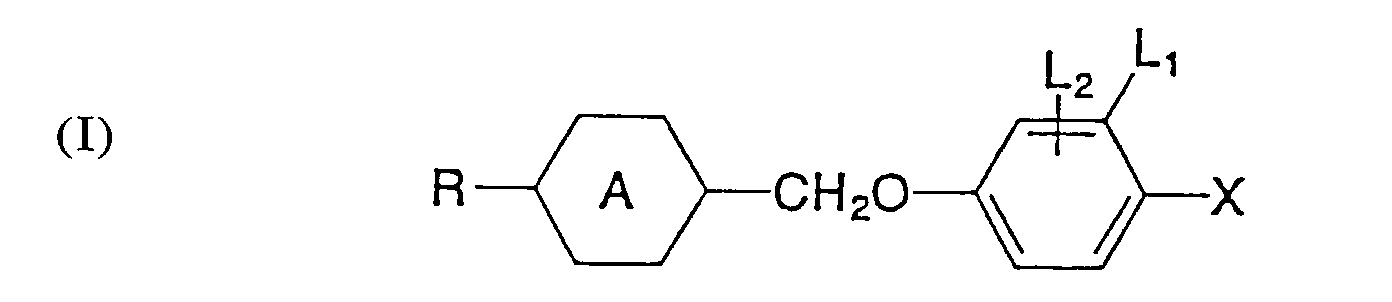 et X représente :R représente un groupe alkyle linéaire en C1-10, un groupe alkyle ramifié en C3-8, un groupe alcoxy-alkyle en C2-7, un groupe monofluoroalkyle ou difluoroalkyle en C1-10, ou un groupe alcényle en C2-8 ;représente un groupe trans-1-sila-1,4-cyclohexylène ou trans-4-sila-1,4-cyclohexylène, dont l'atome de silicium situé en position 1 ou 4 porte un atome d'hydrogène ou, en tant que substituant, un atome de chlore ou de fluor ou un groupe méthyle ;
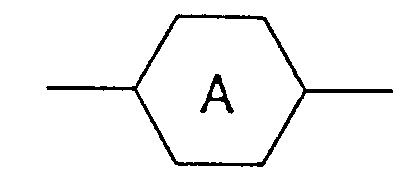 L1 et L2, dont les significations peuvent être identiques ou différentes, représentent chacun un atome d'hydrogène, de fluor ou de chlore ou un groupe méthyle ;un groupe alkyle linéaire en C1-10,un groupe alcoxy linéaire en C1-10,un groupe alcoxy-alkyle en C2-7,un groupe monofluoroalkyle ou difluoroalkyle en C1-10,un groupe alcényle en C2-8,un atome de fluor ou de chlore,un groupe CN, CF3, CF2Cl, CHFCl, OCF3, OCF2Cl, OCHFCl ou OCHF2,un groupe de formule (O)lCY=CX1X2 où 1 vaut 0 ou 1, Y et X1, dont les significations peuvent être identiques ou différentes, représentent chacun un atome d'hydrogène, de fluor ou de chlore et X2 représente un atome de fluor ou de chlore, ouun groupe de formule (O)q(CnFmH2n-m)X3 où q vaut 0 ou 1, n vaut 2, 3 ou 4, m vaut 0 ou un nombre entier de 1 à 2n, et X3 représente un atome d'hydrogène, de fluor ou de chlore ;dans laquelle R, L1, L2 et X ont les significations respectives indiquées ci-dessus, et l'un des cycles
 est un groupe trans-1-sila-1,4-cyclohexylène ou trans-4-sila-1,4-cyclohexylène, dont l'atome de silicium situé en position 1 ou 4 porte un atome d'hydrogène ou, en tant que substituant, un atome de chlore ou de fluor ou un groupe méthyle, et l'autre est un groupe trans-1,4-cyclohexylène ou bien un groupe trans-1-sila-1,4-cyclohexylène ou trans-4-sila-1,4-cyclohexylène tel que défini ci-dessus.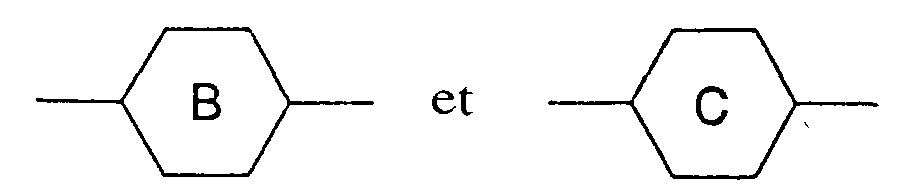
- Composé conforme à la revendication 1, correspondant à l'une des formules (Ia), (Ib) et (IIa) à (IIg) :
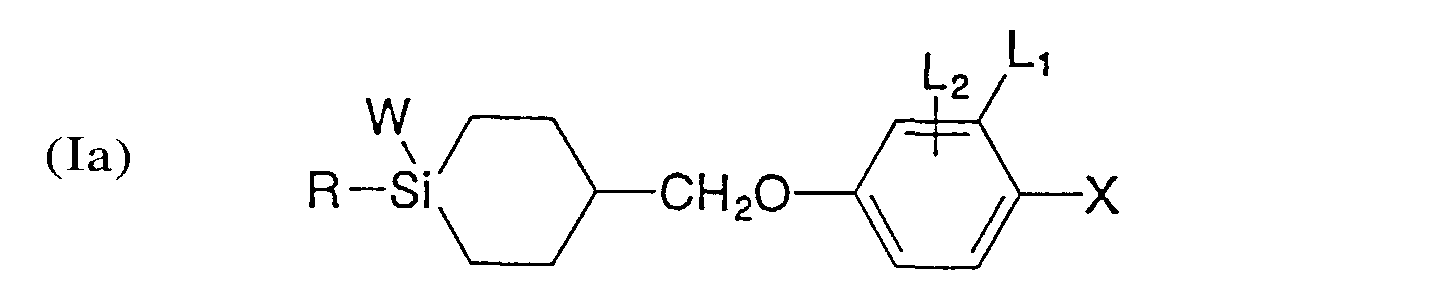


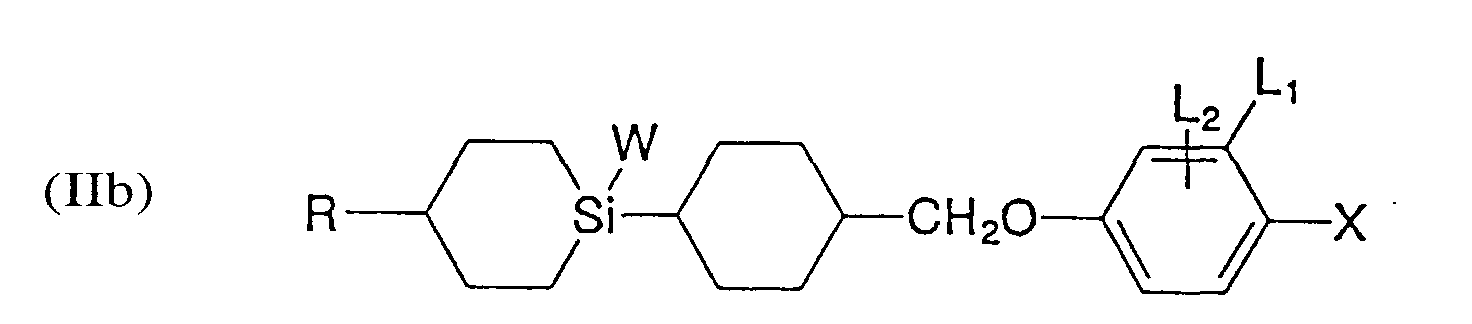

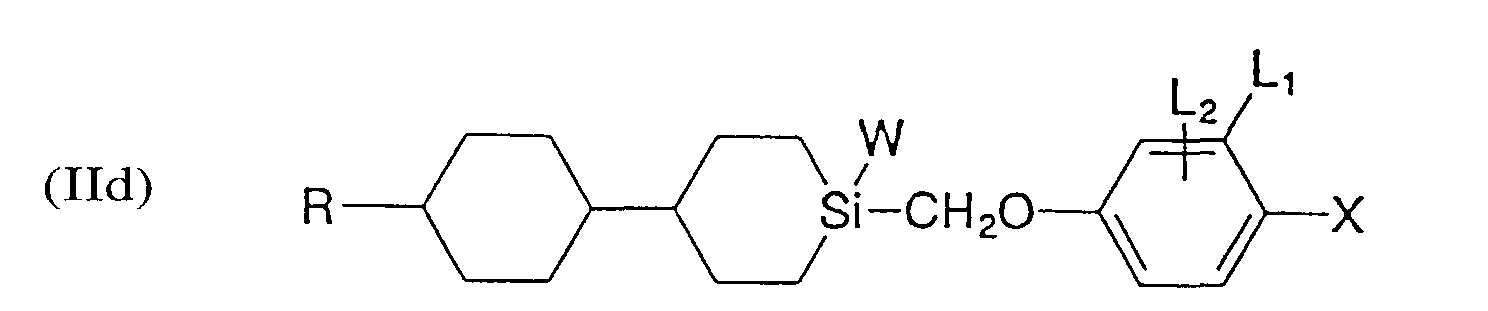

 formules dans lesquelles les symboles W, W1 et W2, dont les significations peuvent être identiques ou différentes, représentent chacun un atome d'hydrogène, de fluor ou de chlore ou un groupe méthyle.
- Procédé de préparation d'un composé de formule (I) ou de formule (II), conforme à la revendication 1, lequel procédé comporte le fait de traiter un composé organométallique de formule
 où
où L1, L2 et X ont les significations indiquées dans la revendication 1 et Q représente un atome d'halogène ou un groupe alcoxy en C1-4, méthanesulfonyloxy, benzènesulfonyloxy, p-toluènesulfonyloxy ou trifluorométhanesulfonyloxy.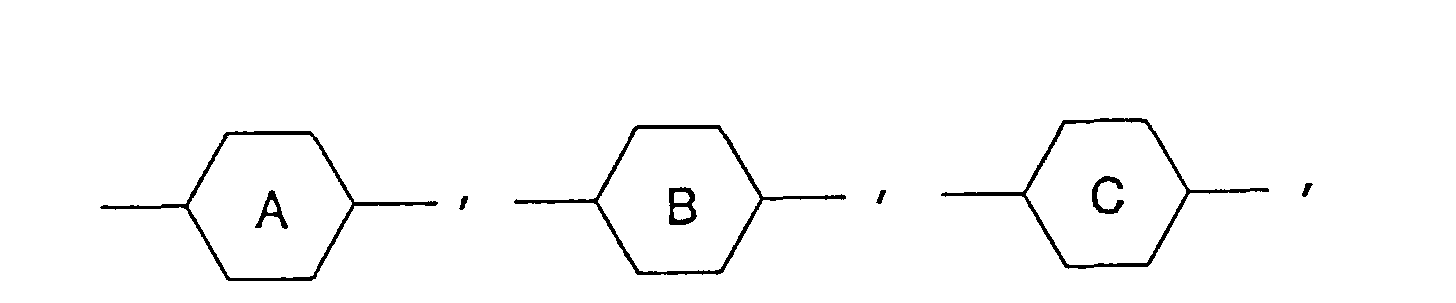
- Procédé de préparation d'un composé de formule (I) ou de formule (II), conforme à la revendication 1, lequel procédé comporte le fait de traiter un composé de formule (2) :dans laquelle L1, L2 et X ont les significations indiquées dans la revendication 1,

avec un composé de formule (3) ou (8) :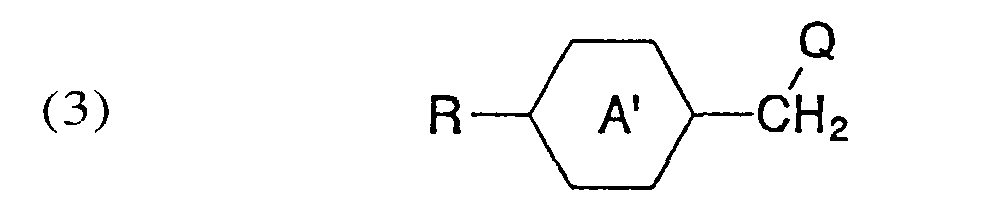 où
où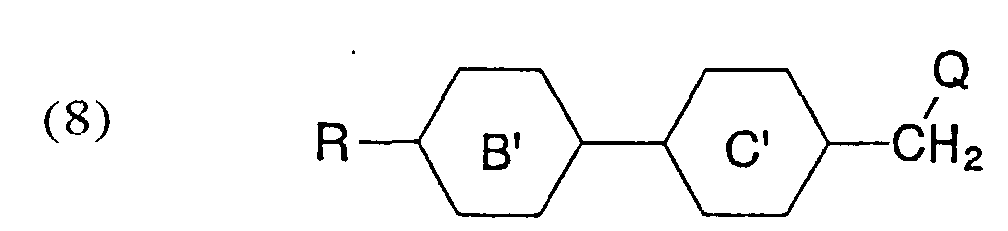 est un groupe trans-1-sila-1,4-cyclohexylène ou trans-4-sila-1,4-cyclohexylène, dont l'atome de silicium situé en position 1 ou 4 porte un substituant méthyle, et Q représente un atome d'halogène ou un groupe alcoxy en C1-4, méthanesulfonyloxy, benzènesulfonyloxy, p-toluènesulfonyloxy ou trifluorométhanesulfonyloxy,
en présence d'une base, pour obtenir un composé de formule (I) ou (II), conforme à la revendication 1, dans lequel l'atome de silicium situé en position 1 ou 4 du groupe trans-1-sila-1,4-cyclohexylène ou trans-4-sila-1,4-cyclo-hexylène porte un substituant méthyle. - Procédé de préparation d'un composé de formule (I) ou de formule (II), conforme à la revendication 1, lequel procédé comporte le fait de traiter un composé de formule (I') ou (II') :
 où
où et au moins l'un des cycles
 porte un substituant Ar et se présente donc sous la forme
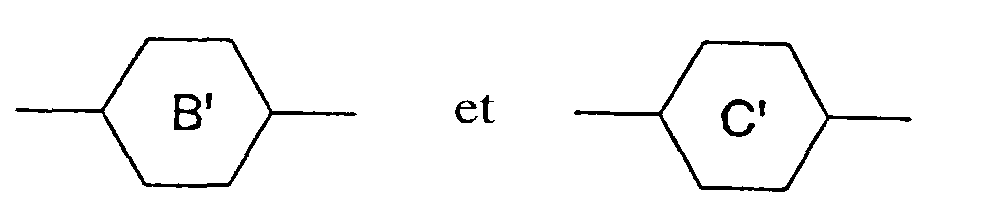 avec du monochlorure d'iode, pour convertir le cycle
 ou l'un des cycles
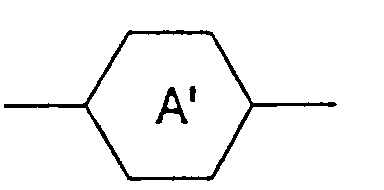 en un cycle de formule
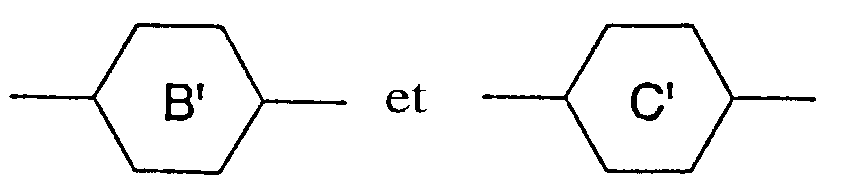 et le fait de réduire ensuite le composé résultant, pour obtenir un composé de formule (I) ou (II), conforme à la revendication 1, dans lequel le cycle
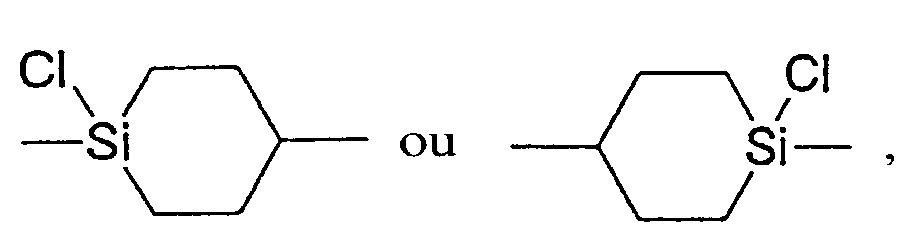 est un cycle

- Procédé conforme à la revendication 5, pour lequel on prépare le composé de formule (I') ou (II') en traitant, en présence d'une base, un composé de formule (2) :dans laquelle L1, L2 et X ont les significations indiquées dans la revendication 1,

avec un composé de formule (3') ou (4') : où
où est un groupe trans-1-sila-1,4-cyclohexylène ou trans-4-sila-1,4-cyclohexylène, dont l'atome de silicium situé en position 1 ou 4 porte un substituant Ar qui est un groupe phényle ou tolyle, et Q représente un atome d'halogène ou un groupe alcoxy en C1-4, méthanesulfonyloxy, benzènesulfonyloxy, p-toluènesulfonyloxy ou trifluorométhanesulfonyloxy.
- Procédé de préparation d'un composé de formule (II), conforme à la revendication 1, lequel procédé comporte le fait de faire réagir un composé organométallique de formule (5)dans laquelle
 et R ont les significations indiquées dans la revendication 1 et M représente Li, MgP ou ZnP où P représente un atome d'halogène,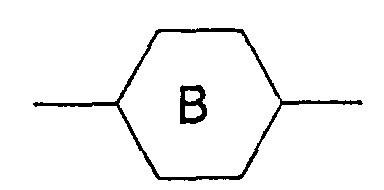
avec un composé de formule (6) :dans laquelle L1, L2 et X ont les significations indiquées dans la revendication 1, et Q représente un atome d'halogène ou un groupe alcoxy en C1-4, méthanesulfonyloxy, benzènesulfonyloxy, p-toluènesulfonyloxy ou trifluorométhanesulfonyloxy.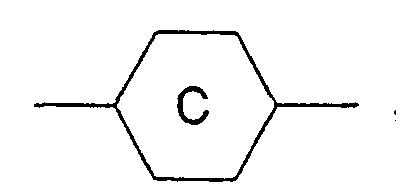
- Composition de cristaux liquides qui comprend au moins un composé de formule (I) ou de formule (II), conforme à la revendication 1.
- Composition conforme à la revendication 8, dans laquelle ledit composé se trouve en une proportion de 1 à 50 % en moles.
- Composition conforme à la revendication 8 ou 9, qui comporte en outre au moins un composé correspondant à l'une des formules suivantes :
 dans lesquelles :
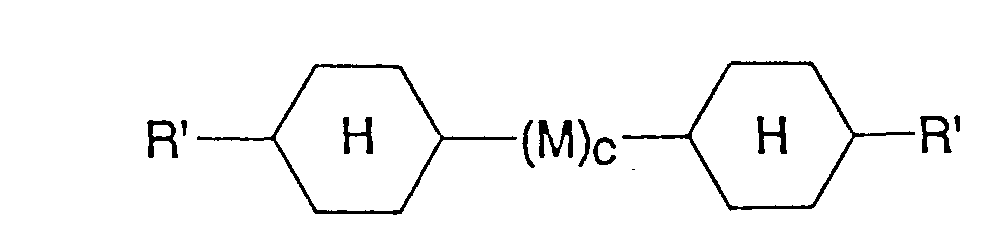 les symboles R', dont les significations peuvent être identiques ou différentes, représentent chacun un groupe alkyle linéaire en C1-10, un groupe alkyle ramifié en C3-8, un groupe alcoxy-alkyle en C2-7, un groupe monofluoroalkyle ou difluoroalkyle en C1-10, ou un groupe alcényle en C2-8 ;X' représente un groupe alkyle linéaire en C1-10, un groupe alcoxy linéaire en C1-10, un groupe alcoxy-alkyle en C2-7, un atome de fluor ou de chlore, ou un groupe CN, CF3, CF2Cl, CHFCl, OCF3, OCF2Cl, OCHFCl ou OCHF2 ;Y' et Z', dont les significations peuvent être identiques ou différentes, représentent chacun un atome d'hydrogène ou de fluor ;M et N, dont les significations peuvent être identiques ou différentes, représentent chacun1) un groupe trans-1,4-cyclohexylène portant ou non des substituants,2) un groupe trans-1,4-cyclohexylène dont un motif CH2 ou deux motifs CH2 non adjacents du cycle de cyclohexane est ou sont remplacé(s) par un ou des atome(s) d'oxygène ou de soufre,3) un groupe 1,4-cyclohexénylène,4) un groupe 1,4-phénylène portant ou non des substituants, ou5) un groupe 1,4-phénylène dont un ou deux motifs CH est ou sont remplacés par un ou deux atomes d'azote ;a et b valent respectivement 0, 1 ou 2, pourvu que (a + b) vaille 1, 2 ou 3 ;c vaut 0, 1 ou 2 ; etZ1 et Z2, dont les significations peuvent être identiques ou différentes, représentent chacun une liaison simple ou un raccord -CH2CH2-, -CH=CH-, -C≡C-, -CO2-, -OCO-, -CH2O- ou -OCH2-.
 - Afficheur à cristaux liquides, contenant une composition conforme à l'une des revendications 8 à 10.
Applications Claiming Priority (6)
| Application Number | Priority Date | Filing Date | Title |
|---|---|---|---|
| JP32931094 | 1994-12-02 | ||
| JP329310/94 | 1994-12-02 | ||
| JP32931094 | 1994-12-02 | ||
| JP37558/95 | 1995-02-02 | ||
| JP3755895 | 1995-02-02 | ||
| JP3755895 | 1995-02-02 |
Publications (2)
| Publication Number | Publication Date |
|---|---|
| EP0714899A1 EP0714899A1 (fr) | 1996-06-05 |
| EP0714899B1 true EP0714899B1 (fr) | 2001-04-18 |
Family
ID=26376680
Family Applications (1)
| Application Number | Title | Priority Date | Filing Date |
|---|---|---|---|
| EP95308675A Expired - Lifetime EP0714899B1 (fr) | 1994-12-02 | 1995-12-01 | Composés de silacyclohexane, leur préparation, compositions à cristaux liquides les contenant, et dispositifs contenant ces compositions |
Country Status (3)
| Country | Link |
|---|---|
| US (1) | US5641430A (fr) |
| EP (1) | EP0714899B1 (fr) |
| DE (1) | DE69520721D1 (fr) |
Families Citing this family (4)
| Publication number | Priority date | Publication date | Assignee | Title |
|---|---|---|---|---|
| US5762826A (en) * | 1994-12-22 | 1998-06-09 | Shin-Etsu Chemical Co., Ltd. | Liquid crystal composition and a liquid crystal display element which contains it |
| KR100234828B1 (ko) * | 1995-10-16 | 1999-12-15 | 카나가와 치히로 | 액정조성물 및 이를 함유하는 액정표시소자 |
| JPH09324178A (ja) * | 1996-04-01 | 1997-12-16 | Shin Etsu Chem Co Ltd | 液晶組成物及びそれを含む液晶表示素子 |
| JPH1180064A (ja) * | 1997-09-11 | 1999-03-23 | Chisso Corp | エ−テル結合を有するフルオロアルコキシベンゼン誘導体、液晶組成物および液晶表示素子 |
Family Cites Families (7)
| Publication number | Priority date | Publication date | Assignee | Title |
|---|---|---|---|---|
| JPS632246A (ja) * | 1986-06-23 | 1988-01-07 | Elna Co Ltd | ボタン形セル収納装置 |
| JPS6346740A (ja) * | 1986-08-15 | 1988-02-27 | Nec Corp | 高周波用高出力トランジスタ |
| US5238913A (en) * | 1992-03-30 | 1993-08-24 | The United States Of America As Represented By The United States Department Of Energy | Superconducting microcircuitry by the microlithgraphic patterning of superconducting compounds and related materials |
| JPH06123208A (ja) * | 1992-10-09 | 1994-05-06 | Nissan Motor Co Ltd | エンジンの弁作動装置 |
| US5454977A (en) * | 1993-06-23 | 1995-10-03 | Shin-Etsu Chemical Co., Ltd. | Silacyclohexane compound, a method of preparing it and a liquid crystal composition containing it |
| US5496501A (en) * | 1993-12-07 | 1996-03-05 | Shin-Etsu Chemical Co., Ltd. | Silacyclohexane compound, a method of preparing it and a liquid crystal composition containing it |
| US5498737A (en) * | 1994-01-28 | 1996-03-12 | Shin-Etsu Chemical Co., Ltd. | Silacyclohexane compound, a method of preparing it and a liquid crystal composition containing it |
-
1995
- 1995-12-01 DE DE69520721T patent/DE69520721D1/de not_active Expired - Lifetime
- 1995-12-01 EP EP95308675A patent/EP0714899B1/fr not_active Expired - Lifetime
- 1995-12-01 US US08/566,392 patent/US5641430A/en not_active Expired - Fee Related
Also Published As
| Publication number | Publication date |
|---|---|
| EP0714899A1 (fr) | 1996-06-05 |
| US5641430A (en) | 1997-06-24 |
| DE69520721D1 (de) | 2001-05-23 |
Similar Documents
| Publication | Publication Date | Title |
|---|---|---|
| EP0657460B1 (fr) | Composé silacyclohexanique, procédé pour sa préparation et composition liquide cristalline le contenant | |
| US5498737A (en) | Silacyclohexane compound, a method of preparing it and a liquid crystal composition containing it | |
| US5547606A (en) | Silacyclohexane compound, a method of preparing it and a liquid crystal composition containing it | |
| EP0668286B1 (fr) | Un composé silacyclohexane, un procédé pour le préparer et une composition liquide cristalline le contenant | |
| US5659059A (en) | Silacyclohexane compound, a method of preparing it and a liquid crystal composition containing it | |
| KR100236728B1 (ko) | 실라시클로헥산 화합물, 그 제조방법 및 이것을 함유하는 액정조성물 | |
| EP0714899B1 (fr) | Composés de silacyclohexane, leur préparation, compositions à cristaux liquides les contenant, et dispositifs contenant ces compositions | |
| KR100236988B1 (ko) | 실라시클로헥산화합물, 그의 제조방법 및 이것을 함유하는 액정조성물 | |
| US5730901A (en) | Silacyclohexane compounds, preparation thereof liquid crystal compositions comprising the same, and liquid crystal devices comprising the composition | |
| EP0668284B1 (fr) | Composé silacyclohexane, procédé de préparation et composition liquide cristalline le contenant | |
| US5573705A (en) | Silacyclohexane compound, a method of preparing it and a liquid crystal composition containing it | |
| US5868961A (en) | Silacyclohexane compound, a method of preparing it and a liquid crystal composition containing it | |
| EP0708106B1 (fr) | Nouveaux composés de silacyclohexane, une composition de cristaux liquides les comprenant et un dispositif à cristaux liquides contenant ladite composition | |
| EP0708107B1 (fr) | Nouveaux composés de silacyclohexane, une composition de cristaux liquides les comprenant et un dispositif à cristaux liquides contenant ladite composition | |
| EP0727428B1 (fr) | Nouveaux composés silacyclohexaniques, leur préparation, compositions de cristaux liquides les contenant et dispositifs à cristaux liquides comprenant lesdites compositions | |
| US5730902A (en) | Optically active silacyclohexane compounds, liquid crystal compositions comprising the same and liquid crystal display devices comprising the compositions | |
| JPH08239388A (ja) | シラシクロヘキサン化合物、その製造方法及びこれを含有する液晶組成物 | |
| US6004478A (en) | Silacyclohexane compounds, preparation thereof, liquid crystal compositions comprising the same, and liquid crystal devices comprising the composition | |
| KR100210226B1 (ko) | 신규의 실라시클로헥산 화합물, 이것을 함유하는 액정 조성물 및 이 조성물을 함유하는 액정소자 | |
| JPH08176161A (ja) | シラシクロヘキサン化合物、その製造方法及びこれを含有する液晶組成物 | |
| JPH1017574A (ja) | シラシクロヘキサン化合物及びこれを含有する液晶組成物 | |
| JPH08208664A (ja) | シラシクロヘキサン化合物及びこれを含有する液晶組成物 | |
| JPH07291978A (ja) | シラシクロヘキサン化合物、その製造方法及びこれを含有する液晶組成物 | |
| JPH10109992A (ja) | シラシクロヘキサン化合物、液晶組成物およびそれを含有する液晶表示素子 | |
| JPH07278157A (ja) | シラシクロヘキサン化合物、その製造方法及びこれを含有する液晶組成物 |
Legal Events
| Date | Code | Title | Description |
|---|---|---|---|
| PUAI | Public reference made under article 153(3) epc to a published international application that has entered the european phase |
Free format text: ORIGINAL CODE: 0009012 |
|
| AK | Designated contracting states |
Kind code of ref document: A1 Designated state(s): DE FR GB |
|
| 17P | Request for examination filed |
Effective date: 19961113 |
|
| 17Q | First examination report despatched |
Effective date: 19990707 |
|
| GRAG | Despatch of communication of intention to grant |
Free format text: ORIGINAL CODE: EPIDOS AGRA |
|
| GRAG | Despatch of communication of intention to grant |
Free format text: ORIGINAL CODE: EPIDOS AGRA |
|
| GRAH | Despatch of communication of intention to grant a patent |
Free format text: ORIGINAL CODE: EPIDOS IGRA |
|
| GRAH | Despatch of communication of intention to grant a patent |
Free format text: ORIGINAL CODE: EPIDOS IGRA |
|
| GRAA | (expected) grant |
Free format text: ORIGINAL CODE: 0009210 |
|
| AK | Designated contracting states |
Kind code of ref document: B1 Designated state(s): DE FR GB |
|
| REF | Corresponds to: |
Ref document number: 69520721 Country of ref document: DE Date of ref document: 20010523 |
|
| ET | Fr: translation filed | ||
| PG25 | Lapsed in a contracting state [announced via postgrant information from national office to epo] |
Ref country code: DE Free format text: LAPSE BECAUSE OF FAILURE TO SUBMIT A TRANSLATION OF THE DESCRIPTION OR TO PAY THE FEE WITHIN THE PRESCRIBED TIME-LIMIT Effective date: 20010719 |
|
| PG25 | Lapsed in a contracting state [announced via postgrant information from national office to epo] |
Ref country code: GB Free format text: LAPSE BECAUSE OF NON-PAYMENT OF DUE FEES Effective date: 20011201 |
|
| REG | Reference to a national code |
Ref country code: GB Ref legal event code: IF02 |
|
| PLBE | No opposition filed within time limit |
Free format text: ORIGINAL CODE: 0009261 |
|
| STAA | Information on the status of an ep patent application or granted ep patent |
Free format text: STATUS: NO OPPOSITION FILED WITHIN TIME LIMIT |
|
| 26N | No opposition filed | ||
| GBPC | Gb: european patent ceased through non-payment of renewal fee |
Effective date: 20011201 |
|
| PG25 | Lapsed in a contracting state [announced via postgrant information from national office to epo] |
Ref country code: FR Free format text: LAPSE BECAUSE OF NON-PAYMENT OF DUE FEES Effective date: 20020830 |
|
| REG | Reference to a national code |
Ref country code: FR Ref legal event code: ST |