EP0708536A1 - Echokompensator und dessen lernverfahren - Google Patents
Echokompensator und dessen lernverfahren Download PDFInfo
- Publication number
- EP0708536A1 EP0708536A1 EP95917503A EP95917503A EP0708536A1 EP 0708536 A1 EP0708536 A1 EP 0708536A1 EP 95917503 A EP95917503 A EP 95917503A EP 95917503 A EP95917503 A EP 95917503A EP 0708536 A1 EP0708536 A1 EP 0708536A1
- Authority
- EP
- European Patent Office
- Prior art keywords
- echo
- learning
- echo canceler
- transmission line
- canceler
- Prior art date
- Legal status (The legal status is an assumption and is not a legal conclusion. Google has not performed a legal analysis and makes no representation as to the accuracy of the status listed.)
- Granted
Links
Images




Classifications
-
- H—ELECTRICITY
- H04—ELECTRIC COMMUNICATION TECHNIQUE
- H04B—TRANSMISSION
- H04B3/00—Line transmission systems
- H04B3/02—Details
- H04B3/20—Reducing echo effects or singing; Opening or closing transmitting path; Conditioning for transmission in one direction or the other
- H04B3/23—Reducing echo effects or singing; Opening or closing transmitting path; Conditioning for transmission in one direction or the other using a replica of transmitted signal in the time domain, e.g. echo cancellers
-
- H—ELECTRICITY
- H04—ELECTRIC COMMUNICATION TECHNIQUE
- H04B—TRANSMISSION
- H04B3/00—Line transmission systems
- H04B3/02—Details
- H04B3/20—Reducing echo effects or singing; Opening or closing transmitting path; Conditioning for transmission in one direction or the other
- H04B3/23—Reducing echo effects or singing; Opening or closing transmitting path; Conditioning for transmission in one direction or the other using a replica of transmitted signal in the time domain, e.g. echo cancellers
- H04B3/238—Reducing echo effects or singing; Opening or closing transmitting path; Conditioning for transmission in one direction or the other using a replica of transmitted signal in the time domain, e.g. echo cancellers using initial training sequence
Definitions
- This invention relates to an echo canceler applicable to a mobile communications network and a long-distance telephone line network. Also, the invention relates to a learning method suited to be employed in such an echo canceler.
- the subscriber's line In a long-distance telephone line via a submarine cable or via a communication satellite, the subscriber's line, in general, connected to both ends of the line is of a two-wire circuit and its long-distance transmission portion is of a four-wire circuit in which transmission and reception are independent of each other in order to amplify a signal or for some other purposes.
- the subscriber's line of an analog telephone is also of a two-wire circuit and its portion from a repeater station for receiving a signal of a mobile telephone to a switch, etc. is also of a four-wire circuit.
- a connection region between the two-wire and the four-wire is provided with a hybrid circuit for performing a four-wire/two-wire conversion.
- the hybrid circuit is designed to match with impedance of the two-wire circuit.
- the impedance of the subscriber's line is irregular and versatile, it is difficult to obtain always a good matching condition. For this reason, a part of signal input into an input terminal of the four-wire side of the hybrid circuit tends to leak toward an output terminal of the four-wire side. As a result, a so-called echo is generated.
- the echo level is lower than the transmitting speech level, speech quality is greatly lowered and a speech hindrance occurs in the case where echo returns to the talker with a delay.
- an echo canceler is developed as effective apparatus for preventing a generation of echo.
- Fig. 1 shows a hardware block diagram of a two-wire/four-wire conversion circuit with an echo canceler.
- the echo canceler 1 is located on a front stage of a hybrid circuit 2.
- the subscriber of an ordinary analog telephone is referred to as the "near-end talker" and the subscriber of a mobile telephone as the "far-end talker".
- a far-end voice signal input into the echo canceler 1 is represented by Rin; a far-end voice signal output from the echo canceler 1, by Rout; a near-end voice signal input into the echo canceler 1, by Sin; and a near-end voice signal output from the echo canceler 1; by Sout, respectively.
- the echo canceler 1 comprises an echo path estimation circuit/echo replica generator 3, a control unit 4, an adder 5, and a non-linear processor 6.
- the echo path estimation circuit/echo replica generator 3 generates the same signal as an echo occurrable to the near-end voice signal Sin, using the far-end voice signal Rout. This signal is referred to as the "echo replica". This echo replica is subtracted from the near-end voice input Sin by the adder 5.
- the echo path estimation circuit/echo replica generator 3 makes a learning of cancellation of echo, using the output signal Rout to the hybrid circuit 2 and a residual echo which could not be canceled by the adder 5.
- a digital signal is transmitted through the transmission line on the side of the far-end talker.
- a D/A conversion (generally, a ⁇ -LAW conversion) is made between the echo canceler 1 for processing a digital signal and the hybrid circuit 2 for making a conversion to an analog line.
- the relation between the far-end voice output Rout and the near-end voice input Sin is not linear. Therefore, a mere linear computation made by the echo path estimation/echo replica generator 3 is not good enough to fully and completely cancel the echo.
- a non-linear processor 6 is employed in order to cancel the residual echo which remains uncanceled.
- the near-end voice output Sout is constituted of an echo alone. Therefore, the non-linear processor 6 makes a switching such that transmission of the near-end voice output Sout is prevented or that the near-end voice output Sout is replaced by a pseudo noise.
- Those operations of the non-linear processor 6 are made under the control of the controller 4. That is, the control unit 4 detects a speechless condition of the far-end talker or detects a double talk condition. Also, the control unit 4 turns on/off the learning function of the echo path estimation, detects a single talk condition of the far-end talker and further controls a switching operation of the non-linear processor 6.
- an echo path is conventionally estimated by detecting the far-end talker's voice appearing to Sin in the form of an echo. That is, in the case where the far-end talker's voice is faint or soundless, it is impossible to detect its echo path. Therefore, in the case where the far-end talker abruptly starts talking, it is difficult for the conventional echo canceler to make a response at a good timing. The result is that an echo is transmitted to the far-end talker.
- a speech hindrance caused by echo becomes more significant as the propagation time of signal is increased.
- echo can be a big problem.
- a low bit rate coding is sometimes carried out for a communication between a base station and a mobile machine or for office-to-office communication, and a lot of exchange procedures are carried out at the repeater station. Therefore, since a significant delay occurs, the echo can be a big problem.
- a difficulty of the echo path estimation in other words, a difficulty of generation of an optimum echo replica is attributable to the conventional echo canceler in which an echo path estimation is carried out based on an actual far-end taker's voice, etc.
- the present invention has been accomplished in view of the above-mentioned background. It is, therefore, an object of the present invention to provide an echo canceler capable of estimating an echo path irrespective of the presence of the far-end talker's voice and without creating a significant hindrance to a speech.
- an echo canceler employed in a communication line network including a first transmission line for transmitting a voice of a four-wire side and a second transmission line for transmitting a voice of a second-wire side, the echo canceler comprising: pilot signal generator means for generating a pilot signal and supplying the same to the first transmission line; and coefficient calculator means for calculating a coefficient necessary for generating an echo replica based on a correlation established between the first pilot signal supplied to the first transmission line and a signal of the second transmission line.
- pilot signal there can be listed a pseudo noise or a filtered pseudo noise.
- the pilot signal is not particularly limited to one which is designed as a pilot signal, and a ring back tone or the like can be used for it.
- a certain pseudo noise is supplied to a first transmission line for transmitting the far-end talker's voice and then a coefficient necessary for generating an echo replica is calculated based on a correlation established between the pseudo noise and a signal of a second transmission line.
- This correlation is established under the condition that the voice level of the far-end talker's can be almost neglected.
- the expression "such a condition that....can be almost neglected” used herein refers to the "time for calculating a correlation being long enough to sufficiently lower a correlation between a noise to be added and a voice on the four-wire side".
- a training for estimating an echo path namely, a training for generating an echo replica can be performed irrespective of the far-end talker's voice.
- the pseudo noise is subjected to filtering depending on the level or frequency characteristic of the near-end talker's voice, so that the characteristic may be varied. The reason is that even if a component of the pseudo noise is transmitted to the near-end talker through a hybrid circuit, no speech hindrance can be created. Further, since an echo replica is generated by adding a component of a pseudo noise, the component of the pseudo noise is eventually canceled and never transmitted to the far-end talker.
- pilot signal different pilot signals may be used depending on a mode of a call connection. For example, in the case where a calling is issued from the two-wire side, a ring back tone may be used as the pilot signal, and in the case where a calling is issued from the four-wire side, a training signal may be used as the pilot signal.
- an echo canceler learning method for carrying out a learning of enhancing an echo cancellation capability of an echo canceler which is adapted to cancel an echo occurred to a communication line at a real time during a communication, the echo canceler learning method comprising the steps of: detecting a fact that a call of the communication line has been set; and setting the learning parameter in accordance with time passed after the detection.
- a learning can be carried out at a high speed immediately after the communication line is set, or at a high accuracy after the passage of a certain time.
- a learning algorithm may be varied in accordance with the time passed after a call is set.
- Fig. 1 is a block diagram showing a construction of a conventional echo canceler.
- Fig. 2 is a block diagram showing an important portion of an echo canceler according to a first embodiment of the present invention.
- Fig. 3 is a block diagram showing an important portion of an echo canceler according to a second embodiment of the present invention.
- Fig. 4 is a graph showing a frequency characteristic, etc. of a filter.
- Fig. 5 is a block diagram of an echo canceler according to a third embodiment of the present invention.
- Fig. 6 is a sequence diagram showing a learning sequence when the near-end talker is making a calling.
- Fig. 7 is a sequence diagram showing a learning sequence when the far-end talker is making a calling.
- Fig. 8 is a graph showing a variation of a parameter ⁇ .
- Fig. 2 is a block diagram showing an important portion of an echo canceler according to the present invention.
- a pseudo noise generator 11 generates a certain pseudo noise and outputs it.
- a noise of a certain level for example, white noise
- This pseudo noise is added to a far-end voice input Rin by an adder 14, and its result is output as a far-end voice output Rout. Therefore, a part of the pseudo noise is mixed with the near-end voice input Sin through the hybrid circuit 2 and supplied to a coefficient calculator 15.
- the coefficient calculator 15 calculates a coefficient (for example, a tap coefficient such as a digital filter) necessary for generating an echo replica based on the near-end voice input Sin.
- a coefficient for example, a tap coefficient such as a digital filter
- S ( t ) 0 ⁇ h ( ⁇ ) n ( t - ⁇ ) d ⁇
- a pseudo noise to be added to Rout is represented by n(t) and a signal to be obtained in Sin is represented by S(t).
- h(t) is an impulse response of an echo.
- n(t) is a noise which is close to white
- a relation shown in the following equation (2) can be established with respect to a sufficiently large value T L .
- N is set as shown by the following equation (3).
- N 0 T L n 2 ( ⁇ ) d ⁇
- the coefficient calculator 15 calculates this coefficient h(t) by means of the above-mentioned calculation procedure and outputs the same to an echo replica generator 16.
- This echo replica generator 16 generates an echo replica based on this coefficient. The details will now be described. Firstly, it is designed such that the echo replica generator 16, as in the case with a known adaptive filter, outputs an echo replica ya, based on the following equation (7).
- ya ha t x
- ha (h 1 , h 2 , ⁇ , h n ) t
- t is a transposition of a vector
- x (x k-1 , x k-2 , ⁇ , x k-n ) t
- x j x(jT)
- T is a sampling interval
- x(hT) is a sampling result of the far-end voice signal Rout at time jT)
- the coefficients h1, h2, ⁇ , h n are set to h(T), h(2T), ⁇ , h(nT), respectively, an echo component contained in the near-end voice input Sin is canceled by an adder 17.
- Fig. 3 is a block diagram showing an important portion of an echo canceler according to a second embodiment of the present invention.
- a pseudo noise generator 11 as in the case with the comparable one of the first embodiment, generates a certain pseudo noise and outputs it.
- a level/frequency characteristic measuring unit 12 measures the level and frequency characteristic of a signal of a near-end voice input Sin. Depending on a result of this measurement, characteristics of filters 13 and 18 are varied.
- Fig. 4(a) shows a frequency characteristic of the above pseudo noise.
- a pseudo noise having a flat characteristic is employed.
- Fig. 4(b) shows a frequency characteristic of the near-end voice input Sin corresponding to the near-end talker's voice measured by the level/frequency characteristic measuring unit 12.
- the characteristic of the filter 13 is varied as shown in Fig. 4(c) in accordance with the measured frequency characteristic.
- the filter characteristic is variably set such that the frequency of the near-end talker's voice is simulated and the difference in level is fixed (in the illustrated example, 20dB).
- the filter 18 is set such that it has an inverse characteristic with respect to that of the filter 13. With this feature, if the filters 13 and 18 are cascaded to each other, input and output signals of the cascaded circuit become equal to each other.
- the filter 13 renders the variable filter characteristic thus set to pseudo noise and then outputs the noise. Consequently, frequency characteristic of the pseudo noise is varied in accordance with the near-end talker's voice. Since the characteristic of the pseudo noise will come to correspond to the near-end talker's voice, adverse effects, if any, to the near-end talker caused by the pseudo noise can be avoided even if such a pseudo noise is admixed with the far-end talker's voice output Rout and transmitted to the near-end talker through the hybrid circuit 2.
- An output from the filter 13 is supplied to the transmission line for transmitting the far-end talker's voice through the adder 14 and served as the fore-mentioned far-end voice output Rout. Therefore, the output from the filter 13 is partly admixed with the near-end voice input Sin through the hybrid circuit 2 and then supplied to the filter 18. Since the filter 18 has an inverse characteristic with respect to that of the filter 13, an output from the filter 18 becomes similar to a signal obtainable when a pseudo noise output from the pseudo noise generator 11 is supplied directly to the hybrid circuit 2.
- the coefficient calculator 15 calculates a coefficient (for example, a tap coefficient of a digital filter or the like) necessary for generating an echo replica based on the far-end voice output Rout and near-end voice input Sin. This principle will now be described in detail.
- frequency characteristic S(f) of the near-end voice signal Sin can be given by the following equation (8).
- S (f) H (f) G (f) N (f)
- an output signal S'(f) of the filter 18 is given by the following equation (9).
- Ha (f) ⁇ H (f) Therefore, in a time area, an impulse response of an echo, namely, a coefficient for generating an echo replica can be obtained from a correlation computation (the under-listed equation (13)) between an output S (t) of the filter 18 and an output n (t) of the noise generator 11.
- ha ( t ) 1/ N ⁇ 0 T L S / ( ⁇ ) n ( t - ⁇ ) d ⁇
- N 0 T L n 2 ( ⁇ ) d ⁇
- the echo replica generator 16 as in the case with the known adaptive filter, outputs an echo replica ya based on the following equation (14) (as in the case with the equation (7) of the first embodiment).
- ya ha t x
- x j x (jT)
- the coefficients h1, h2, ⁇ , h n are set to ha (T), ha (2T), ⁇ , ha (nT), respectively. Therefore, the echo component contained in the near-end voice input Sin is canceled.
- Such an echo replica is generated by adding a pseudo noise which is admixed with the far-end voice output Rout.
- the pseudo noise whose frequency characteristic is variable in accordance with the near-end talker's voice, is forcibly supplied to the transmission line for transmitting the far-end talker's voice, and an echo path is estimated and an echo replica is generated by using the specific pseudo noise. Accordingly, a training for estimating an echo path can be carried out irrespective of the far-end talker's voice.
- an appropriate echo replica can be generated while minimizing a possible deterioration of speech quality of the near-end talker.
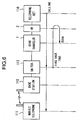
- Fig. 5 shows an echo canceler for practicing the third embodiment of the present invention.
- An echo path estimation/pseudo echo generation circuit 103 detects a response characteristic of a hybrid circuit 2 based both on the far-end voice input Rin and a residual echo, and estimates an equivalent echo path to the hybrid circuit 2.
- a pseudo noise like an echo generated in the hybrid circuit 2 is produced by means of a convolutional operation between a result of the estimation and the far-end voice signal Rin.
- a signal line for transmitting a signal indicative of a calling issued by the near-end talker and a boundary signal indicative of a setting of a calling is connected to the echo path estimation/echo replica generation circuit 103 from a switch 113.
- a control unit 4 makes a judgment as to whether the calling is issued from the near-end talker or from the far-end talker and pursues different procedures in accordance with a result of the judgment.
- An adder 5 cancels an echo by subtracting an echo replica from the far-end voice input Sin.
- the control unit 104 makes a control, in addition to which of the processor 6, as to whether or not a learning of the echo path estimation/echo replica generation circuit 103 should be performed.
- the learning of the echo path estimation/echo replica generation circuit 103 is stopped because there is an unfavorable possibility of an occurrence of mis-learning of the echo path estimation/echo replica generation circuit 103.
- a learning identification algorithm is employed as a learning method of the echo path estimation/echo replica generation circuit 103.
- the learning identification algorithm when compared with other methods, is simple in algorithm and small in computational complexity and has a comparatively favorable echo canceling characteristic.
- the echo canceler comprises a digital circuit.
- a sampling time interval of the echo canceler is represented by T. Presuming that a signal propagation characteristic of the echo path is linear, if an impulse response h(j) and an input signal x(t) at time tT are used, an echo y imp(k) at time kT can be expressed by the following equations.
- H imp(k) H imp X(k) t
- H imp (h(1), h(2), ⁇ ⁇ ⁇ , h(n)
- X(k) (x(k-1), x(k-2), ⁇ ⁇ ⁇ , x(k-n)
- H pre(k) H pre(k) X(k) t
- H pre(k+1) H pre(k) + ⁇ e(k)X(k)/X(k)X(k) t (in case of X(k)X(k) t > n ⁇ 2 )
- H pre(k+1) H pre(k) (in case of X(k)X(k) t ⁇ n ⁇ 2 )
- e(k) y(k) - y pre(k) (where y(k) is an actually measured value of Sin)
- e(k) denotes a residual echo which is remained uncanceled at time kT.
- ⁇ is selected to be a value of about 1/5 to 1/10 of the maximum value of x(t).
- An echo replica y pre(k+1) is generated at the next sampling time (k + 1)T, using H pre(k+1).
- the characteristic of the echo path is greatly varied compared with a case where the talker is engaged in a speech and therefore, the residual echo e(k) is increased. For this reason, it is preferred that the learning is carried out before the far-end talker starts a speech.
- the conventional method there is a fear that the echo path estimation/echo replica generation circuit 103 carries out, even if a new call is set, a learning by mistake when the far-end talker is not engaged in speech. Therefore, the learning must be stopped.
- the learning of the echo path estimation/echo replica generation circuit 103 is carried out before the far-end talker starts a speech, using a ring back tone, etc.
- Fig. 6 shows a communication sequence when the near-end talker makes a call.
- Reference numeral 111 denotes a mobile telephone on the side of the far-end talker; 112, a base station of a wireless zone to which the mobile telephone 111 belongs; 113, a switch connected with the echo canceler 1; and 116, a terrestrial telephone set on the side of the near-end talker, respectively.
- a speech loop on the side of the near-end talker is closed before the call is set and the communication line on the side of the near-end talker is connected to the echo canceler 1.
- a ring back tone is transmitted to the terrestrial telephone set 116 through a transmission line connected to the set 116, and an echo of the ring back tone is returned to the echo canceler 1 from the hybrid circuit 2.
- a calling from the near-end talker can be recognized by the switch 113 in accordance with a known protocol.
- the switch 113 supplies a signal to the echo canceler 1.
- This signal indicates a fact that a calling is issued from the near-end talker.
- the echo path estimation/echo replica generation circuit 103 carries out a learning using the ring back tone and its echo. Since the time required for the learning to be converged is short enough compared with the time during which a ring back tone is usually being transmitted, the learning can be finished by the time a call is set.
- a suitable one for estimating an echo path may be used instead of a ring back tone of the type conventionally used.
- Fig. 7 shows a communication sequence in the case where a calling is issued from the movable telephone 111 on the side of the far-end talker. Since a speech loop on the side of the near-end talker is not formed at the time point a calling is issued from the far-end talker, a learning of the echo path estimation/echo replica generation circuit 103 using a calling tone cannot be carried out. When a calling has been issued, a speech loop on the side of the near-end talker is formed for the first time when a call is set by off-hook means made by the near-end talker.
- a call boundary for a call to be set namely, a call boundary
- the switch 113 Upon detection of a call boundary in the case where a calling is issued from the side of the far-end talker, the switch 113 supplies a signal indicative of the call boundary to the echo canceler 1. Based on this call boundary signal, the echo canceler 1 transmits a training signal of a voice band to the near-end talker side. Then, an echo of the training signal is returned to the echo canceler 1 from the hybrid circuit 2.
- the echo path estimation/echo replica generation circuit 103 can carry out a learning of an echo path estimation path, using the training signal and an echo of the training signal.
- the speed of learning of the echo path estimation/echo replica generation circuit 103 can be increased by varying the parameter used in the learning algorithm when the characteristic of the echo path is greatly varied.
- a parameter ⁇ in the leaning identification algorithm used in the third embodiment is varied. So, a possible effect to the learning caused by the variation of ⁇ will be described first.
- ERLE (k) 10 log 10 (y real(k) electric power/e real(k) electric power)
- y real(k) and e real(k) denote quantities excluding a noise component v(k) from the echo y(k) and residual echo e(k), respectively. They are given by the following equations.
- an S/N ratio of a real echo y real(k) and a noise v(k) is defined by the following equation.
- S/N(k) 10 log 10 (y real(k) electric power/v(k) electric power)
- ⁇ 1
- y pre(k+1) is subjected to variation of the same level with respect to a sum of the noise v(k) and the echo e real(k) in the preceding step.
- a noise of the same level with respect to the noise in the preceding step occurs to the echo replica in each step.
- an average value (hereinafter simply referred to as "ERLE”) of ERLE(k) in each step gradually approaches to an average value (hereinafter referred to simply as "S/N") of S/N(k).
- S/N average value of the respective ERLE(k) and S/N(k) between 10 mS, for example, can be contemplated.
- ⁇ 1 is established, and ⁇ is gradually decreased as ERLE becomes similar to or larger than S/N, the cancellation capability can be increased without greatly lowering the learning speed of the echo canceler. It should be noted, however, that since the real echo real(k) and noise component v(k) cannot be separately measured, ERLE and S/N cannot be calculated based on the actually measured value. Accordingly, ⁇ is varied as follows, using a value having a relativity with respect to ERLE.
- the variation of the characteristic of the echo path at the time when a new call is set is, by far, larger than the variation of the characteristic of the echo path at the time when a speech is undergoing.
- the time when a call is set that is, the call boundary can be judged based on information given by the switch 113, ⁇ is set to a value approximate to 1 within a certain time from the call boundary, and then the value of ⁇ is gradually reduced. For example, by varying ⁇ in a way as set forth below, the cancellation capability can be increased without lowering the learning speed at the time when the characteristic of the echo path is varied.
- the progress of the learning can also be judged based on the average value e of the residual echo e(k).
- the reason why the average value is used is that the level of the residual echo in each step is astable because it depends greatly on the level of a transmitting voice and noise.
- This average value e can be obtained from each residual echo e(k) between 10 mS, for example.
- ⁇ is expressed by the under-listed equations.
- the method for transmitting a training signal may be employed in any of the example 2 to example 4.
- the training signal is transmitted when the near-end talker off-hooks, as in the case with the embodiment 3.
- a ring back tone or its echo may be used for carrying out the learning.
- ⁇ is varied as a parameter of a learning algorithm.
- other parameters having a certain effect on the learning speed may be employed so that they are varied, taking advantage of the fact that a quick learning is requested immediately after the call boundary and thereafter, an accurate learning (namely, learning with no mistake) is requested.
- parameters used in those algorithms can be varied in the same manner as in this embodiment.
- RLS Recursive Least Square
- the learning algorithm can be switched, for example, in accordance with the under-listed methods, using time t, ERLE, or echo level e as in the case with the switching of ⁇ .
- the noise component v(k) is admixed to the echo in the method described in the fourth or fifth embodiment, a correct estimation is impossible to make as to how far the learning of the echo canceler has been progressed.
- the method for analyzing a vocal spectrum can be roughly classified into two; one is a non-parametric analysis (NPA) and the other is a parametric analysis (PA).
- NPA non-parametric analysis
- PA parametric analysis
- non-metric analysis examples include (1) a short term auto-correlation analysis, (2) a short term spectrum analysis, (3) a cepstrum analysis, and (4) a zero crossing analysis.
- parametric analysis examples include (1) an analysis by synthesis (A - b - S method), (2) a linear prediction analysis (LPC), (3) a maximum likelihood spectrum estimation (an auto-correlation method and an inverse filter method), (4) a non-dispersing method, (5) a PARCOR analysis, and (6) an LSP analysis.
- the spectrum analysis method to be used can be switched in the same manner as the learning algorithm being switched in the second embodiment, using time t, ERLE, or echo level e.
Landscapes
- Engineering & Computer Science (AREA)
- Computer Networks & Wireless Communication (AREA)
- Signal Processing (AREA)
- Cable Transmission Systems, Equalization Of Radio And Reduction Of Echo (AREA)
- Networks Using Active Elements (AREA)
Applications Claiming Priority (9)
| Application Number | Priority Date | Filing Date | Title |
|---|---|---|---|
| JP11759494A JP3304609B2 (ja) | 1994-05-07 | 1994-05-07 | エコーキャンセラ学習方法 |
| JP117592/94 | 1994-05-07 | ||
| JP11758894A JP3303524B2 (ja) | 1994-05-07 | 1994-05-07 | エコーキャンセラ学習方法 |
| JP11759294A JPH07303064A (ja) | 1994-05-07 | 1994-05-07 | エコーキャンセラ |
| JP117588/94 | 1994-05-07 | ||
| JP117594/94 | 1994-05-07 | ||
| JP11759394A JP3212796B2 (ja) | 1994-05-07 | 1994-05-07 | エコーキャンセラ |
| JP117593/94 | 1994-05-07 | ||
| PCT/JP1995/000865 WO1995031051A1 (en) | 1994-05-07 | 1995-05-02 | Echo canceler and its learning method |
Publications (4)
| Publication Number | Publication Date |
|---|---|
| EP0708536A1 true EP0708536A1 (de) | 1996-04-24 |
| EP0708536A4 EP0708536A4 (de) | 2004-09-29 |
| EP0708536B1 EP0708536B1 (de) | 2006-07-26 |
| EP0708536B8 EP0708536B8 (de) | 2006-09-13 |
Family
ID=27470447
Family Applications (1)
| Application Number | Title | Priority Date | Filing Date |
|---|---|---|---|
| EP95917503A Expired - Lifetime EP0708536B8 (de) | 1994-05-07 | 1995-05-02 | Echokompensator und dessen lernverfahren |
Country Status (8)
| Country | Link |
|---|---|
| US (1) | US6061444A (de) |
| EP (1) | EP0708536B8 (de) |
| KR (1) | KR100241708B1 (de) |
| CN (4) | CN1284309C (de) |
| AT (1) | ATE334512T1 (de) |
| CA (1) | CA2162571C (de) |
| DE (1) | DE69535121T8 (de) |
| WO (1) | WO1995031051A1 (de) |
Cited By (3)
| Publication number | Priority date | Publication date | Assignee | Title |
|---|---|---|---|---|
| GB2349556A (en) * | 1999-03-11 | 2000-11-01 | Motorola Inc | Echo canceller with adaptive step size |
| WO2000074362A3 (en) * | 1999-05-27 | 2002-03-28 | Ericsson Telefon Ab L M | Methods and apparatus for improving adaptive filter performance by inclusion of inaudible information |
| EP2131504A1 (de) * | 2008-05-28 | 2009-12-09 | Zarlink Semiconductor (U.S.) Inc. | Echokompensierungsausgleich unter Verwendung eines Rauschgenerators und Durchschnittsleistungserfassung |
Families Citing this family (19)
| Publication number | Priority date | Publication date | Assignee | Title |
|---|---|---|---|---|
| JP3579245B2 (ja) * | 1998-03-31 | 2004-10-20 | 三洋電機株式会社 | エコーキャンセラの制御方法およびエコー除去装置 |
| JP3437445B2 (ja) * | 1998-05-22 | 2003-08-18 | 松下電器産業株式会社 | 線形信号予測を用いた受信装置及び方法 |
| JP2000252881A (ja) * | 1999-02-25 | 2000-09-14 | Mitsubishi Electric Corp | ダブルトーク検知装置並びにエコーキャンセラ装置およびエコーサプレッサー装置 |
| US6510224B1 (en) * | 1999-05-20 | 2003-01-21 | Telefonaktiebolaget L M Ericsson | Enhancement of near-end voice signals in an echo suppression system |
| US6301364B1 (en) * | 1999-10-06 | 2001-10-09 | Acoustic Technologies, Inc. | Tagging echoes with low frequency noise |
| KR100336513B1 (ko) * | 1999-12-07 | 2002-05-11 | 서평원 | 무선가입자망의 보코더를 이용한 톤 신호 전송장치 |
| DE19960051A1 (de) * | 1999-12-14 | 2001-06-21 | Alcatel Sa | Verfahren zur Echounterdrückung in einem Telekommunikationssystem und Echounterdrückungseinrichtung zur Durchführung des Verfahrens |
| US6534964B1 (en) * | 2000-09-22 | 2003-03-18 | International Business Machines Corporation | Apparatus and method for determining stiffness properties of an anisotropic electronic substrate using scanning acoustic microscopy |
| KR20030023216A (ko) * | 2001-09-12 | 2003-03-19 | 주식회사 텔루션 | 디지털 이동통신 시스템에서의 반향경로 예측을 이용한반향제거시스템 및 반향제거방법 |
| US7546125B2 (en) * | 2005-10-03 | 2009-06-09 | Divitas Networks, Inc. | Enhancing user experience during handoffs in wireless communication |
| US20090016333A1 (en) * | 2006-06-14 | 2009-01-15 | Derek Wang | Content-based adaptive jitter handling |
| US20080317241A1 (en) * | 2006-06-14 | 2008-12-25 | Derek Wang | Code-based echo cancellation |
| US20080140767A1 (en) * | 2006-06-14 | 2008-06-12 | Prasad Rao | Divitas description protocol and methods therefor |
| US20080101337A1 (en) * | 2006-10-31 | 2008-05-01 | Tsu-Chun Liu | Communications system, local area communications network system, their network interface chipset and physical layer circuit thereof |
| US20100222053A1 (en) * | 2009-02-27 | 2010-09-02 | Girisrinivasarao Athulurutirumala | Arrangement and methods for establishing a telecommunication connection based on a heuristic model |
| JP5668687B2 (ja) | 2009-09-18 | 2015-02-12 | 日本電気株式会社 | 音声品質解析装置、音声品質解析方法およびプログラム |
| JP6011751B1 (ja) * | 2016-02-04 | 2016-10-19 | 三菱電機株式会社 | 音声通話装置 |
| CN105744210B (zh) * | 2016-04-15 | 2018-10-12 | 北京小米移动软件有限公司 | 视频会议的回声消除方法、装置及系统 |
| CN114566176B (zh) * | 2022-02-23 | 2024-07-09 | 宁波蛙声科技有限公司 | 基于深度神经网络的残余回声消除方法及系统 |
Family Cites Families (51)
| Publication number | Priority date | Publication date | Assignee | Title |
|---|---|---|---|---|
| US4144417A (en) * | 1975-03-07 | 1979-03-13 | Kokusai Denshin Denwa Kabushiki Kaisha | Echo cancelling system |
| JPS573441A (en) * | 1980-06-06 | 1982-01-08 | Nippon Telegr & Teleph Corp <Ntt> | Echo eliminator |
| JPS5733844A (en) * | 1980-08-08 | 1982-02-24 | Toshiba Corp | Echo cancelling device |
| JPS5890832A (ja) * | 1981-11-26 | 1983-05-30 | Toshiba Corp | 反響打消し装置 |
| FR2528643A1 (fr) * | 1982-06-14 | 1983-12-16 | Trt Telecom Radio Electr | Procede destine a reduire le temps de convergence d'un annuleur d'echo et dispositif utilise pour mettre en oeuvre ce procede |
| US4582963A (en) * | 1982-07-29 | 1986-04-15 | Rockwell International Corporation | Echo cancelling using adaptive bulk delay and filter |
| JPS5949027A (ja) * | 1982-09-14 | 1984-03-21 | Fujitsu Ltd | エコ−キヤンセラ制御方式 |
| JPS5961233A (ja) * | 1982-09-29 | 1984-04-07 | Nec Corp | 適応型反響消去装置 |
| JPS5970398A (ja) * | 1982-10-15 | 1984-04-20 | Nec Corp | トレ−ニング回路 |
| JPS5980030A (ja) * | 1982-10-30 | 1984-05-09 | Fujitsu Ltd | エコ−キヤンセラ−の制御方法 |
| US4628156A (en) * | 1982-12-27 | 1986-12-09 | International Business Machines Corporation | Canceller trained echo suppressor |
| US4562312A (en) * | 1983-02-17 | 1985-12-31 | At&T Bell Laboratories | Subsampling delay estimator for an echo canceler |
| FR2541837A1 (fr) * | 1983-02-25 | 1984-08-31 | Trt Telecom Radio Electr | Procede de reduction du temps de convergence d'un annuleur d'echo et dispositif pour mettre en oeuvre ce procede |
| US4594479A (en) * | 1983-08-18 | 1986-06-10 | At&T Information Systems Inc. Bell Telephone Laboratories, Inc. | Fast start-up of adaptive echo canceler or echo measurement device |
| JPS6171727A (ja) * | 1984-09-14 | 1986-04-12 | Nippon Telegr & Teleph Corp <Ntt> | エコ−キヤンセラ |
| JPS6172419A (ja) * | 1984-09-17 | 1986-04-14 | Fujitsu Ltd | エコ−キヤンセラ制御方式 |
| JPS6181035A (ja) * | 1984-09-28 | 1986-04-24 | Fujitsu Ltd | エコ−キヤンセル方式 |
| JPS61184934A (ja) * | 1985-02-12 | 1986-08-18 | Nippon Telegr & Teleph Corp <Ntt> | デイジタル加入者線双方向伝送装置 |
| JPS6232727A (ja) * | 1985-08-05 | 1987-02-12 | Fujitsu Ltd | エコ−キヤンセラ装置 |
| JPS6298727A (ja) * | 1985-10-25 | 1987-05-08 | Mitsubishi Electric Corp | エツチング処理装置 |
| JPS62116025A (ja) * | 1985-11-15 | 1987-05-27 | Nippon Telegr & Teleph Corp <Ntt> | 音響エコー消去装置 |
| JP2551171B2 (ja) * | 1988-12-01 | 1996-11-06 | 日本電気株式会社 | 反響消去装置 |
| JP2842607B2 (ja) * | 1989-03-13 | 1999-01-06 | 株式会社日立製作所 | エコーキャンセラ、それを備えた通信装置および信号処理方法 |
| US4987569A (en) * | 1989-04-05 | 1991-01-22 | Codex Corporation | Fast training echo canceller |
| DE68924261T2 (de) * | 1989-06-22 | 1996-03-21 | Ibm | Echokompensationseinrichtung mit Anpassung der Echokompensationskoeffizienten während der Vollduplexübertragung. |
| JPH0344218A (ja) * | 1989-07-12 | 1991-02-26 | Fujitsu Ltd | 適応形エコーキャンセラ |
| DE3929555A1 (de) * | 1989-09-06 | 1991-03-07 | Sueddeutsche Kalkstickstoff | Verfahren zur entfernung von cholesterin bzw. cholesterinestern aus lebensmitteln |
| US5305309A (en) * | 1989-12-06 | 1994-04-19 | Fujitsu Limited | Echo canceller |
| JPH0465922A (ja) * | 1990-07-02 | 1992-03-02 | Fujitsu Ltd | エコーキャンセラー |
| JP2520770B2 (ja) * | 1990-07-06 | 1996-07-31 | 富士通株式会社 | ハイブリッド回路 |
| JPH04120825A (ja) * | 1990-09-11 | 1992-04-21 | Nec Corp | 雑音発生器 |
| JPH04207824A (ja) * | 1990-11-30 | 1992-07-29 | Toshiba Corp | 無線通信システムおよびこのシステムで使用される基地局装置並びに移動局装置 |
| CN1020529C (zh) * | 1990-11-30 | 1993-05-05 | 清华大学 | 双路话路回波抵消方法及抵消器 |
| US5164989A (en) * | 1990-12-11 | 1992-11-17 | Octel Communications Corporation | Echo cancellation methods and apparatus for voice processing systems |
| CA2060250A1 (en) * | 1991-02-04 | 1992-08-05 | John M. Cioffi | Method and apparatus for echo cancellation of a multicarrier signal |
| JP3253646B2 (ja) * | 1991-04-30 | 2002-02-04 | 株式会社東芝 | 音声通信装置および音響エコーキャンセラのトレーニング方法 |
| JP2570011B2 (ja) * | 1991-07-01 | 1997-01-08 | 岩崎通信機株式会社 | 双方向増幅器 |
| US5204854A (en) * | 1991-08-23 | 1993-04-20 | Sierra Semiconductor Corporation | Adaptive hybrid |
| EP0530423B1 (de) * | 1991-09-06 | 1996-12-11 | International Business Machines Corporation | Verfahren zur adaptiven Echokompensation und Einrichtung zur Durchführung des Verfahrens |
| JPH0573441A (ja) * | 1991-09-13 | 1993-03-26 | Toshiba Corp | パーソナルコンピユータ |
| JPH0583036A (ja) * | 1991-09-25 | 1993-04-02 | Nec Corp | 雑音信号発生器 |
| FI915196L (fi) * | 1991-11-04 | 1993-05-05 | Nokia Telecommunications Oy | Foerfarande foer konvergering av en ekoslaeckare i boerjan av ett samtal |
| JPH05268121A (ja) * | 1992-03-19 | 1993-10-15 | Fujitsu Ltd | エコー制御方式 |
| JPH0669834A (ja) * | 1992-08-24 | 1994-03-11 | Mitsubishi Electric Corp | 2線4線変換器 |
| JPH06232957A (ja) * | 1993-01-29 | 1994-08-19 | Toshiba Corp | 音声通信装置 |
| CN1081552A (zh) * | 1993-03-16 | 1994-02-02 | 南京邮电学院 | 电话用户环路距离延伸装置 |
| JPH06338826A (ja) * | 1993-05-28 | 1994-12-06 | Kyocera Corp | 音響反響除去装置 |
| US5327496A (en) * | 1993-06-30 | 1994-07-05 | Iowa State University Research Foundation, Inc. | Communication device, apparatus, and method utilizing pseudonoise signal for acoustical echo cancellation |
| US5477534A (en) * | 1993-07-30 | 1995-12-19 | Kyocera Corporation | Acoustic echo canceller |
| DE69530040T2 (de) * | 1994-05-06 | 2004-02-12 | Ntt Mobile Communications Network Inc. | Verfahren zur echokompensation und echopfadschätzung |
| JP2702423B2 (ja) * | 1994-11-11 | 1998-01-21 | 埼玉日本電気株式会社 | 切替式エコーキャンセラ |
-
1995
- 1995-05-02 CN CNB011377259A patent/CN1284309C/zh not_active Expired - Fee Related
- 1995-05-02 WO PCT/JP1995/000865 patent/WO1995031051A1/ja not_active Ceased
- 1995-05-02 KR KR1019960700008A patent/KR100241708B1/ko not_active Expired - Fee Related
- 1995-05-02 DE DE69535121T patent/DE69535121T8/de active Active
- 1995-05-02 CN CN2004100696989A patent/CN1558563B/zh not_active Expired - Fee Related
- 1995-05-02 AT AT95917503T patent/ATE334512T1/de not_active IP Right Cessation
- 1995-05-02 CN CN95190394A patent/CN1084977C/zh not_active Expired - Fee Related
- 1995-05-02 CA CA002162571A patent/CA2162571C/en not_active Expired - Fee Related
- 1995-05-02 EP EP95917503A patent/EP0708536B8/de not_active Expired - Lifetime
-
1997
- 1997-08-08 US US08/907,174 patent/US6061444A/en not_active Expired - Fee Related
-
2001
- 2001-10-29 CN CNB011377267A patent/CN100349386C/zh not_active Expired - Fee Related
Cited By (6)
| Publication number | Priority date | Publication date | Assignee | Title |
|---|---|---|---|---|
| GB2349556A (en) * | 1999-03-11 | 2000-11-01 | Motorola Inc | Echo canceller with adaptive step size |
| GB2349556B (en) * | 1999-03-11 | 2001-09-05 | Motorola Inc | Echo canceller adaptive step size and method therefor |
| US6707912B2 (en) | 1999-03-11 | 2004-03-16 | Motorola, Inc. | Method and apparatus for setting a step size for an adaptive filter coefficient of an echo canceller |
| WO2000074362A3 (en) * | 1999-05-27 | 2002-03-28 | Ericsson Telefon Ab L M | Methods and apparatus for improving adaptive filter performance by inclusion of inaudible information |
| US7062039B1 (en) | 1999-05-27 | 2006-06-13 | Telefonaktiebolaget Lm Ericsson | Methods and apparatus for improving adaptive filter performance by inclusion of inaudible information |
| EP2131504A1 (de) * | 2008-05-28 | 2009-12-09 | Zarlink Semiconductor (U.S.) Inc. | Echokompensierungsausgleich unter Verwendung eines Rauschgenerators und Durchschnittsleistungserfassung |
Also Published As
| Publication number | Publication date |
|---|---|
| KR100241708B1 (ko) | 2000-02-01 |
| CA2162571C (en) | 2001-03-13 |
| WO1995031051A1 (en) | 1995-11-16 |
| CN1084977C (zh) | 2002-05-15 |
| DE69535121D1 (de) | 2006-09-07 |
| CN1558563B (zh) | 2011-04-20 |
| CN1392677A (zh) | 2003-01-22 |
| EP0708536B8 (de) | 2006-09-13 |
| EP0708536A4 (de) | 2004-09-29 |
| CN1377143A (zh) | 2002-10-30 |
| CN1284309C (zh) | 2006-11-08 |
| KR960704400A (ko) | 1996-08-31 |
| DE69535121T2 (de) | 2007-06-28 |
| CA2162571A1 (en) | 1995-11-16 |
| CN1558563A (zh) | 2004-12-29 |
| CN1128592A (zh) | 1996-08-07 |
| DE69535121T8 (de) | 2007-12-13 |
| EP0708536B1 (de) | 2006-07-26 |
| US6061444A (en) | 2000-05-09 |
| CN100349386C (zh) | 2007-11-14 |
| ATE334512T1 (de) | 2006-08-15 |
Similar Documents
| Publication | Publication Date | Title |
|---|---|---|
| EP0708536B1 (de) | Echokompensator und dessen lernverfahren | |
| EP1184998B1 (de) | Echokompensator und Echopfadschätzungsverfahren | |
| US5587998A (en) | Method and apparatus for reducing residual far-end echo in voice communication networks | |
| US4764955A (en) | Process for determining an echo path flat delay and echo canceler using said process | |
| EP0615674B1 (de) | Netzwerkechokompensator | |
| EP1012996B1 (de) | Verfahren und gerät zur echoschätzung und -unterdrückung | |
| EP0853844B1 (de) | Verbesserter echokompensator mit anwendung in der digitalen telefonie | |
| US6272106B1 (en) | Method and device for detecting double-talk, and echo canceler | |
| US6751313B2 (en) | Method and apparatus for an improved echo canceller | |
| JP3303524B2 (ja) | エコーキャンセラ学習方法 | |
| JP3304609B2 (ja) | エコーキャンセラ学習方法 | |
| US7787597B1 (en) | Automated tools for testing echo cancellers using natural speech excitations | |
| JP3970746B2 (ja) | エコーキャンセラ性能評価試験装置 | |
| JPH07303070A (ja) | ダブルトーク検出方法 | |
| JPH07303071A (ja) | ダブルトーク検出方法 | |
| HK1015215B (en) | Network echo canceller | |
| JP2006108826A (ja) | エコー・キャンセラ制御方法と装置。 |
Legal Events
| Date | Code | Title | Description |
|---|---|---|---|
| PUAI | Public reference made under article 153(3) epc to a published international application that has entered the european phase |
Free format text: ORIGINAL CODE: 0009012 |
|
| 17P | Request for examination filed |
Effective date: 19950831 |
|
| AK | Designated contracting states |
Kind code of ref document: A1 Designated state(s): AT BE CH DE DK ES FR GB GR IE IT LI LU MC NL PT SE |
|
| A4 | Supplementary search report drawn up and despatched |
Effective date: 20040816 |
|
| 17Q | First examination report despatched |
Effective date: 20050203 |
|
| GRAP | Despatch of communication of intention to grant a patent |
Free format text: ORIGINAL CODE: EPIDOSNIGR1 |
|
| GRAS | Grant fee paid |
Free format text: ORIGINAL CODE: EPIDOSNIGR3 |
|
| GRAA | (expected) grant |
Free format text: ORIGINAL CODE: 0009210 |
|
| AK | Designated contracting states |
Kind code of ref document: B1 Designated state(s): AT BE CH DE DK ES FR GB GR IE IT LI LU MC NL PT SE |
|
| PG25 | Lapsed in a contracting state [announced via postgrant information from national office to epo] |
Ref country code: IT Free format text: LAPSE BECAUSE OF FAILURE TO SUBMIT A TRANSLATION OF THE DESCRIPTION OR TO PAY THE FEE WITHIN THE PRESCRIBED TIME-LIMIT;WARNING: LAPSES OF ITALIAN PATENTS WITH EFFECTIVE DATE BEFORE 2007 MAY HAVE OCCURRED AT ANY TIME BEFORE 2007. THE CORRECT EFFECTIVE DATE MAY BE DIFFERENT FROM THE ONE RECORDED. Effective date: 20060726 |
|
| REG | Reference to a national code |
Ref country code: GB Ref legal event code: FG4D |
|
| REG | Reference to a national code |
Ref country code: CH Ref legal event code: EP |
|
| RBV | Designated contracting states (corrected) |
Designated state(s): DE FR GB IT SE |
|
| REG | Reference to a national code |
Ref country code: IE Ref legal event code: FG4D |
|
| REF | Corresponds to: |
Ref document number: 69535121 Country of ref document: DE Date of ref document: 20060907 Kind code of ref document: P |
|
| REG | Reference to a national code |
Ref country code: CH Ref legal event code: PK Free format text: DIE BENENNUNG CH/LI WURDE VOR DER ERTEILUNG VOM 26.07.2006 ZURUECKGENOMMEN. |
|
| REG | Reference to a national code |
Ref country code: SE Ref legal event code: TRGR |
|
| ET | Fr: translation filed | ||
| PLBE | No opposition filed within time limit |
Free format text: ORIGINAL CODE: 0009261 |
|
| STAA | Information on the status of an ep patent application or granted ep patent |
Free format text: STATUS: NO OPPOSITION FILED WITHIN TIME LIMIT |
|
| 26N | No opposition filed |
Effective date: 20070427 |
|
| PGFP | Annual fee paid to national office [announced via postgrant information from national office to epo] |
Ref country code: GB Payment date: 20100329 Year of fee payment: 16 |
|
| PGFP | Annual fee paid to national office [announced via postgrant information from national office to epo] |
Ref country code: FR Payment date: 20100525 Year of fee payment: 16 |
|
| PGFP | Annual fee paid to national office [announced via postgrant information from national office to epo] |
Ref country code: IT Payment date: 20100513 Year of fee payment: 16 Ref country code: DE Payment date: 20100430 Year of fee payment: 16 |
|
| PGFP | Annual fee paid to national office [announced via postgrant information from national office to epo] |
Ref country code: SE Payment date: 20100510 Year of fee payment: 16 |
|
| REG | Reference to a national code |
Ref country code: DE Ref legal event code: R119 Ref document number: 69535121 Country of ref document: DE |
|
| REG | Reference to a national code |
Ref country code: DE Ref legal event code: R119 Ref document number: 69535121 Country of ref document: DE |
|
| REG | Reference to a national code |
Ref country code: SE Ref legal event code: EUG |
|
| GBPC | Gb: european patent ceased through non-payment of renewal fee |
Effective date: 20110502 |
|
| REG | Reference to a national code |
Ref country code: FR Ref legal event code: ST Effective date: 20120131 |
|
| PG25 | Lapsed in a contracting state [announced via postgrant information from national office to epo] |
Ref country code: IT Free format text: LAPSE BECAUSE OF NON-PAYMENT OF DUE FEES Effective date: 20110502 |
|
| PG25 | Lapsed in a contracting state [announced via postgrant information from national office to epo] |
Ref country code: FR Free format text: LAPSE BECAUSE OF NON-PAYMENT OF DUE FEES Effective date: 20110531 |
|
| PG25 | Lapsed in a contracting state [announced via postgrant information from national office to epo] |
Ref country code: GB Free format text: LAPSE BECAUSE OF NON-PAYMENT OF DUE FEES Effective date: 20110502 |
|
| PG25 | Lapsed in a contracting state [announced via postgrant information from national office to epo] |
Ref country code: SE Free format text: LAPSE BECAUSE OF NON-PAYMENT OF DUE FEES Effective date: 20110503 |
|
| PG25 | Lapsed in a contracting state [announced via postgrant information from national office to epo] |
Ref country code: DE Free format text: LAPSE BECAUSE OF NON-PAYMENT OF DUE FEES Effective date: 20111130 |