EP0709712A2 - Glasscheibe mit Intensitätsregelung des Durchlichts - Google Patents
Glasscheibe mit Intensitätsregelung des Durchlichts Download PDFInfo
- Publication number
- EP0709712A2 EP0709712A2 EP95117153A EP95117153A EP0709712A2 EP 0709712 A2 EP0709712 A2 EP 0709712A2 EP 95117153 A EP95117153 A EP 95117153A EP 95117153 A EP95117153 A EP 95117153A EP 0709712 A2 EP0709712 A2 EP 0709712A2
- Authority
- EP
- European Patent Office
- Prior art keywords
- particles
- window
- electrical insulating
- inorganic
- insulating medium
- Prior art date
- Legal status (The legal status is an assumption and is not a legal conclusion. Google has not performed a legal analysis and makes no representation as to the accuracy of the status listed.)
- Withdrawn
Links
- 239000002245 particle Substances 0.000 claims abstract description 143
- 239000012530 fluid Substances 0.000 claims abstract description 40
- 239000007787 solid Substances 0.000 claims abstract description 20
- 239000000203 mixture Substances 0.000 claims abstract description 10
- 239000000463 material Substances 0.000 claims description 61
- 239000002344 surface layer Substances 0.000 claims description 30
- 150000001875 compounds Chemical class 0.000 claims description 26
- 238000004040 coloring Methods 0.000 claims description 20
- 229920000642 polymer Polymers 0.000 claims description 11
- 230000000694 effects Effects 0.000 claims description 10
- 239000011246 composite particle Substances 0.000 claims description 9
- 229910010272 inorganic material Inorganic materials 0.000 claims description 9
- 239000011147 inorganic material Substances 0.000 claims description 9
- 230000001747 exhibiting effect Effects 0.000 claims description 2
- 230000004044 response Effects 0.000 abstract description 6
- 239000002609 medium Substances 0.000 description 50
- 230000005484 gravity Effects 0.000 description 28
- -1 hydrotalcites Substances 0.000 description 20
- 229910001410 inorganic ion Inorganic materials 0.000 description 17
- 229910052751 metal Inorganic materials 0.000 description 17
- 239000002184 metal Substances 0.000 description 17
- 239000010410 layer Substances 0.000 description 14
- 239000003921 oil Substances 0.000 description 14
- LLZRNZOLAXHGLL-UHFFFAOYSA-J titanic acid Chemical class O[Ti](O)(O)O LLZRNZOLAXHGLL-UHFFFAOYSA-J 0.000 description 14
- 230000005684 electric field Effects 0.000 description 12
- 150000004679 hydroxides Chemical class 0.000 description 11
- 150000002739 metals Chemical class 0.000 description 11
- 238000000034 method Methods 0.000 description 10
- 150000003839 salts Chemical class 0.000 description 9
- 239000000758 substrate Substances 0.000 description 9
- VYPSYNLAJGMNEJ-UHFFFAOYSA-N Silicium dioxide Chemical compound O=[Si]=O VYPSYNLAJGMNEJ-UHFFFAOYSA-N 0.000 description 8
- 238000003756 stirring Methods 0.000 description 8
- GWEVSGVZZGPLCZ-UHFFFAOYSA-N Titan oxide Chemical compound O=[Ti]=O GWEVSGVZZGPLCZ-UHFFFAOYSA-N 0.000 description 7
- 239000002253 acid Substances 0.000 description 7
- 230000015572 biosynthetic process Effects 0.000 description 7
- 229910052731 fluorine Inorganic materials 0.000 description 6
- 239000000178 monomer Substances 0.000 description 6
- 239000010936 titanium Substances 0.000 description 6
- 239000011882 ultra-fine particle Substances 0.000 description 6
- YCKRFDGAMUMZLT-UHFFFAOYSA-N Fluorine atom Chemical compound [F] YCKRFDGAMUMZLT-UHFFFAOYSA-N 0.000 description 5
- UQSXHKLRYXJYBZ-UHFFFAOYSA-N Iron oxide Chemical compound [Fe]=O UQSXHKLRYXJYBZ-UHFFFAOYSA-N 0.000 description 5
- 239000002612 dispersion medium Substances 0.000 description 5
- 239000010419 fine particle Substances 0.000 description 5
- 239000011737 fluorine Substances 0.000 description 5
- 239000011521 glass Substances 0.000 description 5
- 238000010438 heat treatment Methods 0.000 description 5
- 238000004519 manufacturing process Methods 0.000 description 5
- 229920001296 polysiloxane Polymers 0.000 description 5
- 229920005989 resin Polymers 0.000 description 5
- 239000011347 resin Substances 0.000 description 5
- 229920002545 silicone oil Polymers 0.000 description 5
- XLYOFNOQVPJJNP-UHFFFAOYSA-N water Substances O XLYOFNOQVPJJNP-UHFFFAOYSA-N 0.000 description 5
- 229910019142 PO4 Inorganic materials 0.000 description 4
- ZLMJMSJWJFRBEC-UHFFFAOYSA-N Potassium Chemical compound [K] ZLMJMSJWJFRBEC-UHFFFAOYSA-N 0.000 description 4
- 230000005540 biological transmission Effects 0.000 description 4
- 239000002734 clay mineral Substances 0.000 description 4
- XLYOFNOQVPJJNP-ZSJDYOACSA-N heavy water Substances [2H]O[2H] XLYOFNOQVPJJNP-ZSJDYOACSA-N 0.000 description 4
- 239000011964 heteropoly acid Substances 0.000 description 4
- 125000002887 hydroxy group Chemical group [H]O* 0.000 description 4
- 238000005342 ion exchange Methods 0.000 description 4
- 150000002500 ions Chemical class 0.000 description 4
- 239000004973 liquid crystal related substance Substances 0.000 description 4
- 229910044991 metal oxide Inorganic materials 0.000 description 4
- 238000005498 polishing Methods 0.000 description 4
- 238000006116 polymerization reaction Methods 0.000 description 4
- 229910052700 potassium Inorganic materials 0.000 description 4
- 239000011591 potassium Substances 0.000 description 4
- XOLBLPGZBRYERU-UHFFFAOYSA-N tin dioxide Chemical compound O=[Sn]=O XOLBLPGZBRYERU-UHFFFAOYSA-N 0.000 description 4
- 229910052719 titanium Inorganic materials 0.000 description 4
- OGIDPMRJRNCKJF-UHFFFAOYSA-N titanium oxide Inorganic materials [Ti]=O OGIDPMRJRNCKJF-UHFFFAOYSA-N 0.000 description 4
- 239000003082 abrasive agent Substances 0.000 description 3
- 238000002347 injection Methods 0.000 description 3
- 239000007924 injection Substances 0.000 description 3
- SZVJSHCCFOBDDC-UHFFFAOYSA-N iron(II,III) oxide Inorganic materials O=[Fe]O[Fe]O[Fe]=O SZVJSHCCFOBDDC-UHFFFAOYSA-N 0.000 description 3
- 230000007246 mechanism Effects 0.000 description 3
- PXHVJJICTQNCMI-UHFFFAOYSA-N nickel Substances [Ni] PXHVJJICTQNCMI-UHFFFAOYSA-N 0.000 description 3
- SOQBVABWOPYFQZ-UHFFFAOYSA-N oxygen(2-);titanium(4+) Chemical class [O-2].[O-2].[Ti+4] SOQBVABWOPYFQZ-UHFFFAOYSA-N 0.000 description 3
- 239000000049 pigment Substances 0.000 description 3
- 230000010287 polarization Effects 0.000 description 3
- 230000008569 process Effects 0.000 description 3
- 238000007789 sealing Methods 0.000 description 3
- 239000000377 silicon dioxide Substances 0.000 description 3
- 241000894007 species Species 0.000 description 3
- 235000010215 titanium dioxide Nutrition 0.000 description 3
- 229910052726 zirconium Inorganic materials 0.000 description 3
- QGZKDVFQNNGYKY-UHFFFAOYSA-O Ammonium Chemical compound [NH4+] QGZKDVFQNNGYKY-UHFFFAOYSA-O 0.000 description 2
- 239000004698 Polyethylene Substances 0.000 description 2
- 239000004743 Polypropylene Substances 0.000 description 2
- 229910010416 TiO(OH)2 Inorganic materials 0.000 description 2
- ATJFFYVFTNAWJD-UHFFFAOYSA-N Tin Chemical compound [Sn] ATJFFYVFTNAWJD-UHFFFAOYSA-N 0.000 description 2
- RTAQQCXQSZGOHL-UHFFFAOYSA-N Titanium Chemical compound [Ti] RTAQQCXQSZGOHL-UHFFFAOYSA-N 0.000 description 2
- QCWXUUIWCKQGHC-UHFFFAOYSA-N Zirconium Chemical compound [Zr] QCWXUUIWCKQGHC-UHFFFAOYSA-N 0.000 description 2
- 150000001298 alcohols Chemical class 0.000 description 2
- 229910052783 alkali metal Inorganic materials 0.000 description 2
- 150000001340 alkali metals Chemical class 0.000 description 2
- PNEYBMLMFCGWSK-UHFFFAOYSA-N aluminium oxide Inorganic materials [O-2].[O-2].[O-2].[Al+3].[Al+3] PNEYBMLMFCGWSK-UHFFFAOYSA-N 0.000 description 2
- 150000001450 anions Chemical class 0.000 description 2
- 229910052787 antimony Inorganic materials 0.000 description 2
- WATWJIUSRGPENY-UHFFFAOYSA-N antimony atom Chemical compound [Sb] WATWJIUSRGPENY-UHFFFAOYSA-N 0.000 description 2
- 125000003118 aryl group Chemical group 0.000 description 2
- 239000001055 blue pigment Substances 0.000 description 2
- 229910052793 cadmium Inorganic materials 0.000 description 2
- BDOSMKKIYDKNTQ-UHFFFAOYSA-N cadmium atom Chemical compound [Cd] BDOSMKKIYDKNTQ-UHFFFAOYSA-N 0.000 description 2
- 229910052791 calcium Inorganic materials 0.000 description 2
- 239000011575 calcium Substances 0.000 description 2
- 239000000969 carrier Substances 0.000 description 2
- 239000003086 colorant Substances 0.000 description 2
- 239000002131 composite material Substances 0.000 description 2
- 229920001577 copolymer Polymers 0.000 description 2
- 239000002270 dispersing agent Substances 0.000 description 2
- 239000006185 dispersion Substances 0.000 description 2
- 238000007720 emulsion polymerization reaction Methods 0.000 description 2
- 239000010408 film Substances 0.000 description 2
- 239000005357 flat glass Substances 0.000 description 2
- 230000006870 function Effects 0.000 description 2
- 239000000499 gel Substances 0.000 description 2
- 238000000227 grinding Methods 0.000 description 2
- 239000001023 inorganic pigment Substances 0.000 description 2
- 238000009434 installation Methods 0.000 description 2
- XEEYBQQBJWHFJM-UHFFFAOYSA-N iron Substances [Fe] XEEYBQQBJWHFJM-UHFFFAOYSA-N 0.000 description 2
- 150000004706 metal oxides Chemical class 0.000 description 2
- 229910052759 nickel Inorganic materials 0.000 description 2
- WPCMRGJTLPITMF-UHFFFAOYSA-I niobium(5+);pentahydroxide Chemical class [OH-].[OH-].[OH-].[OH-].[OH-].[Nb+5] WPCMRGJTLPITMF-UHFFFAOYSA-I 0.000 description 2
- NDLPOXTZKUMGOV-UHFFFAOYSA-N oxo(oxoferriooxy)iron hydrate Chemical compound O.O=[Fe]O[Fe]=O NDLPOXTZKUMGOV-UHFFFAOYSA-N 0.000 description 2
- 239000012188 paraffin wax Substances 0.000 description 2
- 239000004417 polycarbonate Substances 0.000 description 2
- 229920000515 polycarbonate Polymers 0.000 description 2
- 229920000573 polyethylene Polymers 0.000 description 2
- 229920001155 polypropylene Polymers 0.000 description 2
- 235000019355 sepiolite Nutrition 0.000 description 2
- 239000000243 solution Substances 0.000 description 2
- 239000003381 stabilizer Substances 0.000 description 2
- 238000006467 substitution reaction Methods 0.000 description 2
- 238000010557 suspension polymerization reaction Methods 0.000 description 2
- 229920003002 synthetic resin Polymers 0.000 description 2
- 239000000057 synthetic resin Substances 0.000 description 2
- 229910001887 tin oxide Inorganic materials 0.000 description 2
- QHGNHLZPVBIIPX-UHFFFAOYSA-N tin(ii) oxide Chemical class [Sn]=O QHGNHLZPVBIIPX-UHFFFAOYSA-N 0.000 description 2
- QDOIZVITZUBGOQ-UHFFFAOYSA-N 1,1,2,2,3,3,4,4,4-nonafluoro-n,n-bis(1,1,2,2,3,3,4,4,4-nonafluorobutyl)butan-1-amine;1,1,2,2,3,3,4,4,4-nonafluoro-n-(1,1,2,2,3,3,4,4,4-nonafluorobutyl)-n-(trifluoromethyl)butan-1-amine Chemical compound FC(F)(F)C(F)(F)C(F)(F)C(F)(F)N(C(F)(F)F)C(F)(F)C(F)(F)C(F)(F)C(F)(F)F.FC(F)(F)C(F)(F)C(F)(F)C(F)(F)N(C(F)(F)C(F)(F)C(F)(F)C(F)(F)F)C(F)(F)C(F)(F)C(F)(F)C(F)(F)F QDOIZVITZUBGOQ-UHFFFAOYSA-N 0.000 description 1
- KNGHQUFQZLYRKP-UHFFFAOYSA-N 10-butoxy-10-oxodecanoic acid Chemical class CCCCOC(=O)CCCCCCCCC(O)=O KNGHQUFQZLYRKP-UHFFFAOYSA-N 0.000 description 1
- 229920000178 Acrylic resin Polymers 0.000 description 1
- 239000004925 Acrylic resin Substances 0.000 description 1
- 241000251468 Actinopterygii Species 0.000 description 1
- 230000005653 Brownian motion process Effects 0.000 description 1
- BMTAFVWTTFSTOG-UHFFFAOYSA-N Butylate Chemical compound CCSC(=O)N(CC(C)C)CC(C)C BMTAFVWTTFSTOG-UHFFFAOYSA-N 0.000 description 1
- OYPRJOBELJOOCE-UHFFFAOYSA-N Calcium Chemical compound [Ca] OYPRJOBELJOOCE-UHFFFAOYSA-N 0.000 description 1
- 239000004215 Carbon black (E152) Substances 0.000 description 1
- 229910052684 Cerium Inorganic materials 0.000 description 1
- RYGMFSIKBFXOCR-UHFFFAOYSA-N Copper Chemical compound [Cu] RYGMFSIKBFXOCR-UHFFFAOYSA-N 0.000 description 1
- CWYNVVGOOAEACU-UHFFFAOYSA-N Fe2+ Chemical compound [Fe+2] CWYNVVGOOAEACU-UHFFFAOYSA-N 0.000 description 1
- VTLYFUHAOXGGBS-UHFFFAOYSA-N Fe3+ Chemical compound [Fe+3] VTLYFUHAOXGGBS-UHFFFAOYSA-N 0.000 description 1
- CERQOIWHTDAKMF-UHFFFAOYSA-M Methacrylate Chemical compound CC(=C)C([O-])=O CERQOIWHTDAKMF-UHFFFAOYSA-M 0.000 description 1
- ZOKXTWBITQBERF-UHFFFAOYSA-N Molybdenum Chemical compound [Mo] ZOKXTWBITQBERF-UHFFFAOYSA-N 0.000 description 1
- 229920000459 Nitrile rubber Polymers 0.000 description 1
- 239000004677 Nylon Substances 0.000 description 1
- OAICVXFJPJFONN-UHFFFAOYSA-N Phosphorus Chemical compound [P] OAICVXFJPJFONN-UHFFFAOYSA-N 0.000 description 1
- 239000004793 Polystyrene Substances 0.000 description 1
- 239000004113 Sepiolite Substances 0.000 description 1
- XUIMIQQOPSSXEZ-UHFFFAOYSA-N Silicon Chemical compound [Si] XUIMIQQOPSSXEZ-UHFFFAOYSA-N 0.000 description 1
- XTXRWKRVRITETP-UHFFFAOYSA-N Vinyl acetate Chemical compound CC(=O)OC=C XTXRWKRVRITETP-UHFFFAOYSA-N 0.000 description 1
- RPTLFNLRQVWOBF-UHFFFAOYSA-J [Ti+4].[O-][Se]([O-])(=O)=O.[O-][Se]([O-])(=O)=O Chemical class [Ti+4].[O-][Se]([O-])(=O)=O.[O-][Se]([O-])(=O)=O RPTLFNLRQVWOBF-UHFFFAOYSA-J 0.000 description 1
- 238000010521 absorption reaction Methods 0.000 description 1
- 229920000122 acrylonitrile butadiene styrene Polymers 0.000 description 1
- 239000000654 additive Substances 0.000 description 1
- 229910052784 alkaline earth metal Inorganic materials 0.000 description 1
- 150000001342 alkaline earth metals Chemical class 0.000 description 1
- WNROFYMDJYEPJX-UHFFFAOYSA-K aluminium hydroxide Chemical class [OH-].[OH-].[OH-].[Al+3] WNROFYMDJYEPJX-UHFFFAOYSA-K 0.000 description 1
- 239000003963 antioxidant agent Substances 0.000 description 1
- 230000003078 antioxidant effect Effects 0.000 description 1
- 238000000149 argon plasma sintering Methods 0.000 description 1
- 229910052785 arsenic Inorganic materials 0.000 description 1
- RQNWIZPPADIBDY-UHFFFAOYSA-N arsenic atom Chemical compound [As] RQNWIZPPADIBDY-UHFFFAOYSA-N 0.000 description 1
- 230000006399 behavior Effects 0.000 description 1
- 235000012216 bentonite Nutrition 0.000 description 1
- 235000010290 biphenyl Nutrition 0.000 description 1
- 239000004305 biphenyl Substances 0.000 description 1
- TZSXPYWRDWEXHG-UHFFFAOYSA-K bismuth;trihydroxide Chemical class [OH-].[OH-].[OH-].[Bi+3] TZSXPYWRDWEXHG-UHFFFAOYSA-K 0.000 description 1
- 238000005537 brownian motion Methods 0.000 description 1
- CQEYYJKEWSMYFG-UHFFFAOYSA-N butyl acrylate Chemical compound CCCCOC(=O)C=C CQEYYJKEWSMYFG-UHFFFAOYSA-N 0.000 description 1
- 229920005549 butyl rubber Polymers 0.000 description 1
- 150000001768 cations Chemical class 0.000 description 1
- TYAVIWGEVOBWDZ-UHFFFAOYSA-K cerium(3+);phosphate Chemical class [Ce+3].[O-]P([O-])([O-])=O TYAVIWGEVOBWDZ-UHFFFAOYSA-K 0.000 description 1
- 239000003795 chemical substances by application Substances 0.000 description 1
- 150000003841 chloride salts Chemical class 0.000 description 1
- 239000011248 coating agent Substances 0.000 description 1
- 238000000576 coating method Methods 0.000 description 1
- 229910017052 cobalt Inorganic materials 0.000 description 1
- 239000010941 cobalt Substances 0.000 description 1
- GUTLYIVDDKVIGB-UHFFFAOYSA-N cobalt atom Chemical compound [Co] GUTLYIVDDKVIGB-UHFFFAOYSA-N 0.000 description 1
- POZHBATUTSRJNJ-UHFFFAOYSA-N cobalt(2+);iron(3+) Chemical compound [Fe+3].[Co+2] POZHBATUTSRJNJ-UHFFFAOYSA-N 0.000 description 1
- 238000010276 construction Methods 0.000 description 1
- 229910052802 copper Inorganic materials 0.000 description 1
- 239000010949 copper Substances 0.000 description 1
- XCJYREBRNVKWGJ-UHFFFAOYSA-N copper(II) phthalocyanine Chemical compound [Cu+2].C12=CC=CC=C2C(N=C2[N-]C(C3=CC=CC=C32)=N2)=NC1=NC([C]1C=CC=CC1=1)=NC=1N=C1[C]3C=CC=CC3=C2[N-]1 XCJYREBRNVKWGJ-UHFFFAOYSA-N 0.000 description 1
- 230000007423 decrease Effects 0.000 description 1
- 230000003247 decreasing effect Effects 0.000 description 1
- 230000006866 deterioration Effects 0.000 description 1
- 238000011161 development Methods 0.000 description 1
- GDVKFRBCXAPAQJ-UHFFFAOYSA-A dialuminum;hexamagnesium;carbonate;hexadecahydroxide Chemical compound [OH-].[OH-].[OH-].[OH-].[OH-].[OH-].[OH-].[OH-].[OH-].[OH-].[OH-].[OH-].[OH-].[OH-].[OH-].[OH-].[Mg+2].[Mg+2].[Mg+2].[Mg+2].[Mg+2].[Mg+2].[Al+3].[Al+3].[O-]C([O-])=O GDVKFRBCXAPAQJ-UHFFFAOYSA-A 0.000 description 1
- 239000004205 dimethyl polysiloxane Substances 0.000 description 1
- 235000013870 dimethyl polysiloxane Nutrition 0.000 description 1
- 239000003995 emulsifying agent Substances 0.000 description 1
- 239000005038 ethylene vinyl acetate Substances 0.000 description 1
- 239000007789 gas Substances 0.000 description 1
- 229910052732 germanium Inorganic materials 0.000 description 1
- GNPVGFCGXDBREM-UHFFFAOYSA-N germanium atom Chemical compound [Ge] GNPVGFCGXDBREM-UHFFFAOYSA-N 0.000 description 1
- 229910052736 halogen Inorganic materials 0.000 description 1
- 150000002367 halogens Chemical class 0.000 description 1
- 229910001385 heavy metal Inorganic materials 0.000 description 1
- 229930195733 hydrocarbon Natural products 0.000 description 1
- 150000002430 hydrocarbons Chemical class 0.000 description 1
- GPRLSGONYQIRFK-UHFFFAOYSA-N hydron Chemical compound [H+] GPRLSGONYQIRFK-UHFFFAOYSA-N 0.000 description 1
- 230000002209 hydrophobic effect Effects 0.000 description 1
- 229910001701 hydrotalcite Inorganic materials 0.000 description 1
- 229960001545 hydrotalcite Drugs 0.000 description 1
- 229910052588 hydroxylapatite Inorganic materials 0.000 description 1
- AMGQUBHHOARCQH-UHFFFAOYSA-N indium;oxotin Chemical compound [In].[Sn]=O AMGQUBHHOARCQH-UHFFFAOYSA-N 0.000 description 1
- 229910052500 inorganic mineral Inorganic materials 0.000 description 1
- 239000010954 inorganic particle Substances 0.000 description 1
- 238000009413 insulation Methods 0.000 description 1
- 235000014413 iron hydroxide Nutrition 0.000 description 1
- NCNCGGDMXMBVIA-UHFFFAOYSA-L iron(ii) hydroxide Chemical class [OH-].[OH-].[Fe+2] NCNCGGDMXMBVIA-UHFFFAOYSA-L 0.000 description 1
- 239000011133 lead Substances 0.000 description 1
- 230000031700 light absorption Effects 0.000 description 1
- 239000007788 liquid Substances 0.000 description 1
- 229910052749 magnesium Inorganic materials 0.000 description 1
- 239000011777 magnesium Substances 0.000 description 1
- VTHJTEIRLNZDEV-UHFFFAOYSA-L magnesium dihydroxide Chemical class [OH-].[OH-].[Mg+2] VTHJTEIRLNZDEV-UHFFFAOYSA-L 0.000 description 1
- 235000012254 magnesium hydroxide Nutrition 0.000 description 1
- 230000014759 maintenance of location Effects 0.000 description 1
- IPJKJLXEVHOKSE-UHFFFAOYSA-L manganese dihydroxide Chemical class [OH-].[OH-].[Mn+2] IPJKJLXEVHOKSE-UHFFFAOYSA-L 0.000 description 1
- WPBNNNQJVZRUHP-UHFFFAOYSA-L manganese(2+);methyl n-[[2-(methoxycarbonylcarbamothioylamino)phenyl]carbamothioyl]carbamate;n-[2-(sulfidocarbothioylamino)ethyl]carbamodithioate Chemical compound [Mn+2].[S-]C(=S)NCCNC([S-])=S.COC(=O)NC(=S)NC1=CC=CC=C1NC(=S)NC(=O)OC WPBNNNQJVZRUHP-UHFFFAOYSA-L 0.000 description 1
- 150000001455 metallic ions Chemical class 0.000 description 1
- 239000011707 mineral Substances 0.000 description 1
- 235000010755 mineral Nutrition 0.000 description 1
- 238000012986 modification Methods 0.000 description 1
- 230000004048 modification Effects 0.000 description 1
- 229910052750 molybdenum Inorganic materials 0.000 description 1
- 239000011733 molybdenum Substances 0.000 description 1
- GDXTWKJNMJAERW-UHFFFAOYSA-J molybdenum(4+);tetrahydroxide Chemical class [OH-].[OH-].[OH-].[OH-].[Mo+4] GDXTWKJNMJAERW-UHFFFAOYSA-J 0.000 description 1
- 229910052901 montmorillonite Inorganic materials 0.000 description 1
- GKTNLYAAZKKMTQ-UHFFFAOYSA-N n-[bis(dimethylamino)phosphinimyl]-n-methylmethanamine Chemical compound CN(C)P(=N)(N(C)C)N(C)C GKTNLYAAZKKMTQ-UHFFFAOYSA-N 0.000 description 1
- 229910052758 niobium Inorganic materials 0.000 description 1
- 239000010955 niobium Substances 0.000 description 1
- GUCVJGMIXFAOAE-UHFFFAOYSA-N niobium atom Chemical compound [Nb] GUCVJGMIXFAOAE-UHFFFAOYSA-N 0.000 description 1
- 229920001778 nylon Polymers 0.000 description 1
- 239000003960 organic solvent Substances 0.000 description 1
- XYJRXVWERLGGKC-UHFFFAOYSA-D pentacalcium;hydroxide;triphosphate Chemical compound [OH-].[Ca+2].[Ca+2].[Ca+2].[Ca+2].[Ca+2].[O-]P([O-])([O-])=O.[O-]P([O-])([O-])=O.[O-]P([O-])([O-])=O XYJRXVWERLGGKC-UHFFFAOYSA-D 0.000 description 1
- AQZYBQIAUSKCCS-UHFFFAOYSA-N perfluorotripentylamine Chemical compound FC(F)(F)C(F)(F)C(F)(F)C(F)(F)C(F)(F)N(C(F)(F)C(F)(F)C(F)(F)C(F)(F)C(F)(F)F)C(F)(F)C(F)(F)C(F)(F)C(F)(F)C(F)(F)F AQZYBQIAUSKCCS-UHFFFAOYSA-N 0.000 description 1
- 239000003208 petroleum Substances 0.000 description 1
- ZUOUZKKEUPVFJK-UHFFFAOYSA-N phenylbenzene Natural products C1=CC=CC=C1C1=CC=CC=C1 ZUOUZKKEUPVFJK-UHFFFAOYSA-N 0.000 description 1
- 235000021317 phosphate Nutrition 0.000 description 1
- 229910052698 phosphorus Inorganic materials 0.000 description 1
- 239000011574 phosphorus Substances 0.000 description 1
- 229920003023 plastic Polymers 0.000 description 1
- 229920000435 poly(dimethylsiloxane) Polymers 0.000 description 1
- 229920001200 poly(ethylene-vinyl acetate) Polymers 0.000 description 1
- 229920000058 polyacrylate Polymers 0.000 description 1
- 229920005668 polycarbonate resin Polymers 0.000 description 1
- 239000004431 polycarbonate resin Substances 0.000 description 1
- 239000002861 polymer material Substances 0.000 description 1
- 239000003505 polymerization initiator Substances 0.000 description 1
- 229920002223 polystyrene Polymers 0.000 description 1
- 238000012545 processing Methods 0.000 description 1
- 229910052761 rare earth metal Inorganic materials 0.000 description 1
- 150000002910 rare earth metals Chemical class 0.000 description 1
- 239000004576 sand Substances 0.000 description 1
- 230000035807 sensation Effects 0.000 description 1
- 238000000926 separation method Methods 0.000 description 1
- 229910052624 sepiolite Inorganic materials 0.000 description 1
- 239000000741 silica gel Substances 0.000 description 1
- 229910002027 silica gel Inorganic materials 0.000 description 1
- 229910052710 silicon Inorganic materials 0.000 description 1
- 239000010703 silicon Substances 0.000 description 1
- 239000002904 solvent Substances 0.000 description 1
- 230000007480 spreading Effects 0.000 description 1
- 238000003892 spreading Methods 0.000 description 1
- 229910052712 strontium Inorganic materials 0.000 description 1
- CIOAGBVUUVVLOB-UHFFFAOYSA-N strontium atom Chemical compound [Sr] CIOAGBVUUVVLOB-UHFFFAOYSA-N 0.000 description 1
- 239000004094 surface-active agent Substances 0.000 description 1
- 229910052715 tantalum Inorganic materials 0.000 description 1
- GUVRBAGPIYLISA-UHFFFAOYSA-N tantalum atom Chemical compound [Ta] GUVRBAGPIYLISA-UHFFFAOYSA-N 0.000 description 1
- ZIRLXLUNCURZTP-UHFFFAOYSA-I tantalum(5+);pentahydroxide Chemical class [OH-].[OH-].[OH-].[OH-].[OH-].[Ta+5] ZIRLXLUNCURZTP-UHFFFAOYSA-I 0.000 description 1
- 239000010409 thin film Substances 0.000 description 1
- ANRHNWWPFJCPAZ-UHFFFAOYSA-M thionine Chemical compound [Cl-].C1=CC(N)=CC2=[S+]C3=CC(N)=CC=C3N=C21 ANRHNWWPFJCPAZ-UHFFFAOYSA-M 0.000 description 1
- CVNKFOIOZXAFBO-UHFFFAOYSA-J tin(4+);tetrahydroxide Chemical class [OH-].[OH-].[OH-].[OH-].[Sn+4] CVNKFOIOZXAFBO-UHFFFAOYSA-J 0.000 description 1
- QUBMWJKTLKIJNN-UHFFFAOYSA-B tin(4+);tetraphosphate Chemical class [Sn+4].[Sn+4].[Sn+4].[O-]P([O-])([O-])=O.[O-]P([O-])([O-])=O.[O-]P([O-])([O-])=O.[O-]P([O-])([O-])=O QUBMWJKTLKIJNN-UHFFFAOYSA-B 0.000 description 1
- JUWGUJSXVOBPHP-UHFFFAOYSA-B titanium(4+);tetraphosphate Chemical class [Ti+4].[Ti+4].[Ti+4].[O-]P([O-])([O-])=O.[O-]P([O-])([O-])=O.[O-]P([O-])([O-])=O.[O-]P([O-])([O-])=O JUWGUJSXVOBPHP-UHFFFAOYSA-B 0.000 description 1
- 125000003944 tolyl group Chemical group 0.000 description 1
- 229910052723 transition metal Inorganic materials 0.000 description 1
- 150000003624 transition metals Chemical class 0.000 description 1
- QORWJWZARLRLPR-UHFFFAOYSA-H tricalcium bis(phosphate) Chemical compound [Ca+2].[Ca+2].[Ca+2].[O-]P([O-])([O-])=O.[O-]P([O-])([O-])=O QORWJWZARLRLPR-UHFFFAOYSA-H 0.000 description 1
- WFKWXMTUELFFGS-UHFFFAOYSA-N tungsten Chemical compound [W] WFKWXMTUELFFGS-UHFFFAOYSA-N 0.000 description 1
- 229910052721 tungsten Inorganic materials 0.000 description 1
- 239000010937 tungsten Substances 0.000 description 1
- 229910052720 vanadium Inorganic materials 0.000 description 1
- GPPXJZIENCGNKB-UHFFFAOYSA-N vanadium Chemical compound [V]#[V] GPPXJZIENCGNKB-UHFFFAOYSA-N 0.000 description 1
- 229920002554 vinyl polymer Polymers 0.000 description 1
- 239000001052 yellow pigment Substances 0.000 description 1
- LEHFSLREWWMLPU-UHFFFAOYSA-B zirconium(4+);tetraphosphate Chemical class [Zr+4].[Zr+4].[Zr+4].[O-]P([O-])([O-])=O.[O-]P([O-])([O-])=O.[O-]P([O-])([O-])=O.[O-]P([O-])([O-])=O LEHFSLREWWMLPU-UHFFFAOYSA-B 0.000 description 1
- HAIMOVORXAUUQK-UHFFFAOYSA-J zirconium(iv) hydroxide Chemical class [OH-].[OH-].[OH-].[OH-].[Zr+4] HAIMOVORXAUUQK-UHFFFAOYSA-J 0.000 description 1
Images




Classifications
-
- E—FIXED CONSTRUCTIONS
- E06—DOORS, WINDOWS, SHUTTERS, OR ROLLER BLINDS IN GENERAL; LADDERS
- E06B—FIXED OR MOVABLE CLOSURES FOR OPENINGS IN BUILDINGS, VEHICLES, FENCES OR LIKE ENCLOSURES IN GENERAL, e.g. DOORS, WINDOWS, BLINDS, GATES
- E06B3/00—Window sashes, door leaves, or like elements for closing wall or like openings; Layout of fixed or moving closures, e.g. windows in wall or like openings; Features of rigidly-mounted outer frames relating to the mounting of wing frames
- E06B3/66—Units comprising two or more parallel glass or like panes permanently secured together
- E06B3/67—Units comprising two or more parallel glass or like panes permanently secured together characterised by additional arrangements or devices for heat or sound insulation or for controlled passage of light
- E06B3/6715—Units comprising two or more parallel glass or like panes permanently secured together characterised by additional arrangements or devices for heat or sound insulation or for controlled passage of light specially adapted for increased thermal insulation or for controlled passage of light
- E06B3/6722—Units comprising two or more parallel glass or like panes permanently secured together characterised by additional arrangements or devices for heat or sound insulation or for controlled passage of light specially adapted for increased thermal insulation or for controlled passage of light with adjustable passage of light
-
- G—PHYSICS
- G02—OPTICS
- G02F—OPTICAL DEVICES OR ARRANGEMENTS FOR THE CONTROL OF LIGHT BY MODIFICATION OF THE OPTICAL PROPERTIES OF THE MEDIA OF THE ELEMENTS INVOLVED THEREIN; NON-LINEAR OPTICS; FREQUENCY-CHANGING OF LIGHT; OPTICAL LOGIC ELEMENTS; OPTICAL ANALOGUE/DIGITAL CONVERTERS
- G02F1/00—Devices or arrangements for the control of the intensity, colour, phase, polarisation or direction of light arriving from an independent light source, e.g. switching, gating or modulating; Non-linear optics
- G02F1/01—Devices or arrangements for the control of the intensity, colour, phase, polarisation or direction of light arriving from an independent light source, e.g. switching, gating or modulating; Non-linear optics for the control of the intensity, phase, polarisation or colour
- G02F1/17—Devices or arrangements for the control of the intensity, colour, phase, polarisation or direction of light arriving from an independent light source, e.g. switching, gating or modulating; Non-linear optics for the control of the intensity, phase, polarisation or colour based on variable-absorption elements not provided for in groups G02F1/015 - G02F1/169
- G02F1/172—Devices or arrangements for the control of the intensity, colour, phase, polarisation or direction of light arriving from an independent light source, e.g. switching, gating or modulating; Non-linear optics for the control of the intensity, phase, polarisation or colour based on variable-absorption elements not provided for in groups G02F1/015 - G02F1/169 based on a suspension of orientable dipolar particles, e.g. suspended particles displays
Definitions
- the present invention relates to a window such as a skylight and peek-window substantially located horizontally and controllable arbitrarily in transmitted light intensity.
- Skylights have been provided currently for the lighting purposes, and in addition, the role of the skylights is recently spreading out into interior designs for art galleries, museums and hotels, and further into such applications as astronomical observation for enjoying an outdoor view while staying in a room.
- a transparent glass plate or transparent plastic plate is fitted in a ceiling, and for adjustment of the lighting quantity and from the viewpoint of protection of the privacy, a light-shielding device such as a curtain and shade freely openable and closable needs to be set over the skylight.
- a serious problem exists, however, in that there is a need for an additional mechanism for opening and closing such a light shielding device, besides considerable difficulty is experienced in the installation of this opening and closing mechanism, for that the skylight is commonly provided at a relatively high location.
- an electro-optical fluid composition is a fluid produced, for example, by dispersing solid particles in an electrical insulating medium, and in response to application of an electric field thereto, the solid particles establish dielectric polarization, and are aligned with each other and arranged in the field direction due to the electrostatic attractive force caused by the dielectric polarization, thus producing chain bodies (configurations).
- some of solid particles have an electrophoretic property, and in response to application of an electric field thereto, are electrophoretically moved toward electrode sections to be arranged and oriented to take an arranged massive structure.
- EA effect electric alignment effect
- EA particles electric alignment particles
- a window comprising: a hollow housing having two surfaces substantially parallel to each other, at least a portion of each of which is transparent, and which are disposed in opposed relation to each other; first transparent electrode means formed on one of the opposed surfaces of the housing; second transparent electrode means formed on the other surface of the housing; and an electro-optical fluid composition produced by adding electric alignment solid particles into an electrical insulating medium and packed within the housing.
- the electric alignment solid particles are in a floating or sinking state in the electrical insulating medium.
- the first transparent electrode means comprises one or more first line electrodes and one or more second line electrodes
- the second transparent electrode means comprises one plane electrode.
- the electric alignment solid particles are in a floating state in the electrical insulating medium in a state in which the first transparent electrode means is positioned above the second transparent electrode, and the electric alignment solid particles are in a sinking state in the electrical insulating medium when the first transparent electrode means is positioned under the second transparent electrode.
- the solid particles when a voltage is applied to the EA fluid packed in the housing, the solid particles can be aligned so as to control the quantity of light passing into transparent sections of the housing, thus obtaining a desired transmitted light intensity only by the energization control.
- the window can take a transparent state, and the window can take an opaque state in response to the energization to the transparent electrodes being stopped.
- the incident sunlight intensity i.e., the transmitted light intensity of the window, is readily controllable.
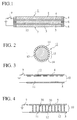
- a window designated at numeral 1
- the upper transparent substrate 2 has, thereon, first and second transparent electrodes 4, 5, respectively.
- the first and second transparent electrodes 4, 5 have plane configurations (layer configurations) to substantially cover the whole inner surfaces of the transparent substrates 2, 3 facing each other.
- an EA fluid 10 which will be described in detail later, is packed between the transparent substrates 2, 3.
- the whole surfaces of the substrates 2, 3 are not always required to be transparent, but it is also acceptable that only the light transmission portions are transparent. For this reason, it is also possible that only the circumferential sections are made with opaque metallic frames, resin frames or the like and glass plates or resin plates are fitted in the frames.
- the window 1 is not particularly limited to its configuration, but commonly take a plate-like configuration.
- the aforementioned EA fluid 10 is basically produced with inorganic and organic composite particles (solid particles, which will be referred hereinafter to as EA particles) 12 which have a structure as shown in Fig. 2 being dispersed in an electrical insulating medium (11).
- EA particles 12 as shown in Fig. 2, is composed of a core body 13 made of a polymer compound and a surface layer 15 made of an inorganic material exhibiting an electric alignment effect (which will be referred hereinafter to as an inorganic EA material) 14 and formed to cover the surface of the core body 13.
- the color of the EA fluid 10 depends upon the colors of the electrical insulating medium 11, core body 13 and inorganic EA material 14.
- the inorganic EA materials 14 there are inorganic ion exchangers such as hydroxides of polyvalent metals, hydrotalcites, acid salts of polyvalent metals, hydroxyapatites, nashicon-type compounds, clay minerals, potassium titanates, heteropolyacid salts and insoluble ferrocyanides, and further silica gels and electrical semiconductive inorganic materials.
- inorganic ion exchangers such as hydroxides of polyvalent metals, hydrotalcites, acid salts of polyvalent metals, hydroxyapatites, nashicon-type compounds, clay minerals, potassium titanates, heteropolyacid salts and insoluble ferrocyanides, and further silica gels and electrical semiconductive inorganic materials.
- polymer compounds usable for the core bodies 13 of the EA particles 12 are polyacrylate, methacrylate, methacrylate-styrene copolymers, polystyrene, polyethylene, polypropylene, nitrile rubber, butyl rubber, ABS resin, nylon, polyvinyl butylate, ionmer, ethylene-vinyl acetate copolymer, vinyl acetate resin, polycarbonate resin and others, mixtures including one or more of these materials, or copolymers.
- the preferable materials suitable for the surface layers 15 of the EA particles 12 there are inorganic ion exchangers, electrical semiconductive inorganic material s and silica gels. If the solid particles made with these materials are dispersed in the electrical insulating medium 11, an excellent electric alignment effect takes place.
- the inorganic ion exchangers there are hydroxides of polyvalent metals, hydrotalcites, acid salts of polyvalent metals, hydroxyapatite, nashicon-type compounds, clay minerals, potassium titanates, heteropolyacid salts and insoluble ferrocyanides.
- MOx(OH)y designates a polyvalent metal, x represents a number above 0, and y denotes a positive number.
- hydroxides of polyvalent metals are titanium hydroxides, zirconium hydroxides, bismuth hydroxides, tin hydroxides, lead hydroxides, aluminum hydroxides, tantalum hydroxides, niobium hydroxides, molybdenum hydroxides, magnesium hydroxides, manganese hydroxides, iron hydroxides and so on.
- the titanium hydroxides include hydrous titanium oxides (another name : metatitanic acid or b titanic acid, TiO(OH)2) and titanium hydroxides (another name : orthotitanic acid or a titanic acid, Ti(OD)4). This also applies to other compounds.
- M depicts a bivalent metal
- a bivalent metal M is Mg, Ca, Ni or others.
- These materials include titanium phosphates, zirconium phosphates, tin phosphates, cerium phosphates, chrome phosphates, zirconium arsenates, titanium arsenates, tin arsenates, cerium arsenates, titanium antimonates, tin antimonates, tantalum antimonates, niobium antimonates, zirconium tungstates, titanium vanadates, zirconium molybdates, titanium selenates, tin molybdates, and so on.
- These materials include, for example, calcium apatites, lead apatites, strontium apatites, cadmium apatites, and so on.
- These materials are, for example, montmorillonites, sepiolites, bentonites, and other minerals. Of these, the sepiolite is particularly preferable.
- aK2O ⁇ bTiO2 ⁇ nH2O (a represents a positive number satisfying 0 ⁇ a ⁇ 1, and b denotes a positive number satisfying 1 ⁇ b ⁇ 6, and n depicts a positive number), for instance, including K2 ⁇ TiO2 ⁇ 2H2O, K2O ⁇ 2TiO2 ⁇ 2H2O, 0.5K2O ⁇ TiO2 ⁇ 2H2O, K2O ⁇ 2.5TiO2 ⁇ 2H2O, and so on.
- the compounds in which a or b is not integer can easily be produced with the compounds in which a or b is an integer being acidificated and K being substituted by H.
- H3AE12O40 ⁇ nH2O (A represents a phosphorus, arsenic, germanium, or silicon, and E denotes a molybdenum, tungsten, or vanadium, and n indicates a positive number), for example, including ammonium molybdophosphates, and ammonium tungstophosphates.
- Mb-pxaA[E(CN)6] M represents an alkali metal or hydrogen ion
- A designates a heavy metal ion such as lead, copper, nickel, cobalt, manganese, cadmium, iron (III) and titanium
- E denotes iron (II), iron (III) cobalt or the like
- b depicts 4 or 3
- a indicates the valency of A
- p stands for a positive number of 0 to b/a, for example including insoluble ferrocyan compounds such as Cs2Zn[Fe(CN)6] and K2Co[Fe(CN)6].
- the above-mentioned inorganic ion exchangers in (1) to (6) have an OH group, and include substitution type ion exchanges in which a portion or all the ions present in the ion exchange site of these inorganic ion exchangers are substituted by another ions. That is, if the aforesaid inorganic ion exchangers are expressed by R-M1 (M1 represents the ionic species in the ion exchange site), this invention includes a substitution type inorganic ion exchanger in which a portion or all of M1 of R-M1 is substituted by an ionic species M2 different from the M1. That is, xR - M1 + yM2 ⁇ Rx - (M2)y + xM1 where x and y represent the valencies of ionic exchange species M2 and M1, respectively.
- M1 is generally H+ in a case where the inorganic ion exchanger shows the cation exchangeability.
- M2 can arbitrarily selected from metallic ions such as an alkali metal, alkaline earth metal, polyvalent typical metal, transition metal, and rare earth metal, other than H+.
- M1 is generally OH ⁇ , and in this case, M2 is arbitrarily selectable from all the anions other than OH ⁇ which include such as I, CI, SCN, NO2, Br, F, CH3COO, SO4, CrO4, composite ions, and so on.
- the inorganic ion exchanger after the high-temperature heating processing is also one of the inorganic ion exchangers usable in this invention, for example, nashicon-type compounds such as the materials obtained by heating, at a high temperature (500 to 700°C), hydrotalcite and HZr2(PO4)3 obtainable by heating (H3O)Zr2(PO4)3.
- nashicon-type compounds such as the materials obtained by heating, at a high temperature (500 to 700°C), hydrotalcite and HZr2(PO4)3 obtainable by heating (H3O)Zr2(PO4)3.
- H3O heating
- the inorganic ion exchangers hydroxides of polyvalent metals or acid salts of polyvalent metals are particularly preferable.
- inorganic EA material s 14 suitable for the surface layers 15 of the EA particles 12 there are metallic oxides, metallic hydroxides, hydroxides of metal oxides, inorganic ion exchangers, one of these materials metal-doped, one of these materials placed as the electrical semiconductive layer on another carrier regardless of metal doping, and so on, which have electric conductivities of 103 ⁇ 1/cm to 10 ⁇ 11 ⁇ 1/cm.
- the surface layer can simultaneously contain the two or more inorganic EA material s mentioned above.
- the inorganic and organic composite particles (EA particles) 12 can be produced in various ways. As one example, there is a way in which the core body particles 13 made of an inorganic and organic composite compound and the fine particles made of an inorganic EA material 14 are carried by means of a jetstream to come into collision with each other. In this case, the inorganic EA fine particles 12 run into the surfaces of the core body particles 13 at a high speed, thus being fixed thereto to form the surface layers 15 thereon. Another way is that the core body particles 13 are treated to float in a gas and a solution containing the inorganic EA material is sprayed toward the floating core body particles 13. In this case, after being adhered thereonto, the solution is dried to form the surface layers 15.
- the core bodies 13 and the surface layers 15 are preferable to be formed simultaneously.
- the monomer of the polymer compound for forming the core bodies 13 is emulsion-polymerized, suspension-polymerized or dispersion-polymerized in a polymerization medium
- the inorganic EA fine particles 14 are add to the monomer or the polymerization medium.
- the polymerization medium is preferable to be water, while a mixture of water and a water soluble organic solvent, and organic lean-solvent are also usable.
- the monomer is polymerized in the polymerization medium to form core body particles, and at the same time the inorganic EA fine particles 14 are aligned on the surfaces of the core body particles 13 so as to form surface layers 15 on the surfaces thereof, thus coating the core body particles 31.
- the inorganic and organic composite particles 12 In producing the inorganic and organic composite particles 12 by means of the emulsion polymerization or suspension polymerization, a combination of the hydrophobic property of the monomer and the hydrophilic property of the inorganic EA material 14 allows most of the inorganic EA materials 14 to be aligned on the surfaces of the core body particles 13. According to the simultaneous formation method for the core bodies 13 and surface layers 15, the inorganic EA particles 14 can strongly and finely be adhered onto the surfaces of the core body particles 13 being made of a polymer compound, resulting in being firm inorganic and organic composite particles 12.
- the EA particles 12 being used is not necessarily limited to spherical configurations, while, by means of the core body particle adjusting emulsion polymerization or suspension polymerization, the resultant EA particles 12 have substantially spherical configurations. If having the spherical configurations, as compared with other configurations it is advantageous in adjusting the transmitted light intensity because light can be scattered omnidirectionally.
- the diameters of the EA particles 12 is not particularly limited, they are preferable to be 0.1 to 500 mm, particularly 5 to 200 mm. Further, although the diameters of the inorganic EA particles 12 are not particularly limited, they are preferable to be 0.005 to 100 mm, more preferably 0.01 to 10 mm.
- the weight rate (%) of the inorganic EA material 14 for formation of the surface layer 15 and the polymer compound for formation of the core body 13 is not particularly limited, while, for example, the weight rate of (inorganic EA material) : (polymer compound) is preferable to be in the range of (1 to 60): (99 to 40), particularly preferable to be in the range of (4 to 30): (96 to 70). If the weight rate of the inorganic EA material 14 is below 1%, the resultant EA fluid 10 does not sufficiently show the EA effect. On the other hand, if exceeding 60%, the resultant EA fluid 10 has a conductive property.
- the specific gravity of the EA particles 12 can relatively be made small as compared with the EA material 14 for the formation of the surface layers 15, for that the polymer compound with a relatively small specific gravity can be used for the core bodies 13.
- the specific gravity of the EA particles 12 is freely adjustable with the kinds and rates of the polymer compound and the inorganic EA material 14, while the specific gravity is generally set to be approximately 1.0 to 2.0 taking the electrical insulating medium to be used into consideration.
- the surface layers 15 or core bodies 13 of the EA particles 12 can contain a coloring material.
- the coloring material usable for the surface layers 15 is a pigment. It is desirable that the pigment is mixed into the inorganic EA material 14 in forming the surface layers 15 being made of inorganic EA material 14 on the core bodies 13 in accordance with the foregoing method.
- the coloring material for the synthetic resin it is possible to use a pigment or dye known as the coloring material for the synthetic resin. This coloring material can be in advance mixed into the monomer for the formation of the core bodies 13 before the monomer is polymerized, or can be put in the synthetic resin for the formation of the core bodies 13.
- the scattering light from the resultant EA fluid 10 at no application of voltage thereto can freely take various colors.
- the EA fluid 10 when a titanium hydroxide or silica gel is mixed thereinto, the EA fluid 10 can be colored in white, and when a copper phthalocyanine blue (produced by Dainichi Seika Kogyo Co., Ltd., cyanine blue S-32) being a blue pigment is mixed thereinto, the EA fluid 10 can be colored in blue, and when a first yellow (NL first yellow 5G(S), produced by Dainichi Seika Kogyo Co., Ltd.) being a yellow pigment is mixed thereinto, the EA fluid 21 can be colored in yellow.
- the EA fluid 10 when a magnetite (Fe3O4) being an electrical semiconductive inorganic material is mixed thereinto, the EA fluid 10 can be colored in black, and when a ferric oxide (Fe2O3) being an electrical semiconductive inorganic material is mixed into, the EA fluid 10 can be colored in red.
- Fe3O4 magnetite
- Fe2O3 ferric oxide
- EA particles 12 produced in the above-mentioned various ways particularly, produced in the method in which the core bodies 13 and surface layers 15 are simultaneously producible, a portion or whole of the surface layers 15 is covered with a polymer material or thin films of additives such as dispersants and emulsifiers used in producing processes, whereby there is the possibility that the EA effect of the inorganic EA material 14 fine particles is unsatisfactorily shown.
- additives such as dispersants and emulsifiers used in producing processes
- the surface polishing of the EA particles 12 can be achieved in various ways.
- the EA particles 12 are dispersed in a dispersion medium such as water before stirred.
- abrasives such as sand particles and small balls are mixed into the dispersion medium and stirred together with EA particles 12, or that the stirring is carried out using grinding stones.
- the EA particles 12 are dry-stirred using the abrasives and grinding stones without using such a dispersion medium.
- a more preferable polishing method is to stir the EA particles 12 by means of a jetstream or the like.
- the particles violently come into collision with each other due to the jetstream.
- this method does not require abrasives, and can easily separate the inert materials peeled from the particle surfaces in classification.
- the stirring speed is 6000 rpm and the stirring time is 5 to 15 minutes.
- the EA fluid 10 in this invention is producible with the EA particles 12 and, it required, other components such as dispersants being stirred and uniformly mixed into the electrical insulating medium 29 described above. Any kind of stirring machine is usable which is generally used in order to disperse solid particles in a liquid dispersion medium.
- the electrical insulating medium of the EA fluid 10 all the materials which have been used for the electric alignment fluids can be employed.
- the EA particles 12 float in the electrical insulating medium, as the electrical insulating medium, a great specific gravity oil or the like is employed which has a greater specific gravity than the EA particles 12.
- fluorine-based oils such as KRYTOX GPL100 manufactured by Dupont Japon
- fluorine-based inert fluids such as FLUORINERT FC-40 or FC-70 manufactured by Sumitomo 3M Limited
- fluorine-containing phosphazene oils such as PHOSPHAZENBE OIL OTSUKA PHOSFAROL NF-36 produced by Otsuka Chemical Co., Ltd.
- halogen-containing great specific gravity media such as flon-based medium.
- an electrical insulating medium with a specific gravity of approximately 1.2 to 1.3 is acceptable.
- electrical insulating media there are listed fluorine-containing silicone oils including a FLUOROSILICONE OIL FL-100 manufactured by Shin-Etsu Chemical Co., Ltd., a NEW FLUOROSILICONE OIL FLS400 manufactured by Asahi Garasu Company. and a FLUOROSILICONE OIL FS1265 by produced by Dow Corning Toray silicone Co., Ltd, and halogen-denatured media including chlorinated paraffin.
- the electrical insulating medium can be colored if required. When coloring it, it is desirable to use an oil soluble dye or dispersion dye which is of the type that is meltable in the selected electrical insulating medium and maintains the electrical characteristics. There is no problem even if a surface active agent, viscosity controlling agent, antioxidant, stabilizer and so on are included in the electrical insulating medium.
- the limitation is not particularly imposed on the concentration of the EA particles 12 in the electrical insulating medium, while it is preferable to be 0.5% to 15% by weight. If the particle concentration is less than 0.5% by weight, the transmitted light control effect is sufficiently unobtainable. When exceeding 15% by weight, the particle density becomes excessively high, with the result that the transparency sensation is not sufficiently obtainable irrespective of the orientation control of the EA particles 12 by the electric field application (which will be described later).
- the kinematic viscosity of this electrical insulating medium is designed to be 1 cSt to 3000 cSt. If the kinematic viscosity is below 1 cSt, the retention stability of the EA fluid 10 lowers because of much volatile component in the dispersion medium, and on the other hand, if the kinematic is more than 3000 cSt, bubbles are generated therein and difficult to remove. If the bubbles remain in the electrical insulating medium, partial discharge occurs in small areas of the bubbles, which can cause the insulation deterioration. For these reasons, the kinematic viscosity is preferable to be 10 cSt to 1000 cSt, particularly 10 cSt to 100 cSt.
- the voltage to be applied to the EA fluid 10 is in the range of 0.1 to 5.0 kV/mm, while a voltage higher than this range can also be applied thereto.
- the voltage being applied is preferable to be in the range of 0.25 to 1.5 kV/mm.
- Fig. 3 diagrammatically and schematically shows a state in which an voltage is not applied to the first and second transparent electrode layers 4, 5.
- an electric insulating medium 11 has a greater specific gravity than the EA particles 12, the EA particles 12 results in floating in the electrical insulating medium 11. If in this state light is incident on the housing 7, the incident light is scattered in various directions due to the presence of the EA particles 12, with the result that the housing 7, i.e., the window 1, gets into an opaque state.
- the housing 7 becomes cloudy. Moreover, If one of, or both, the surface layer 15 and the core body 13 of the EA particle 12 include a coloring material, the housing 7 has a color depending upon that coloring material. If the EA particles 12 have spherical shapes, the scattering of the light occurs in all directions, with the result that there is hardly a possibility that the light is converged in a specific direction.
- the rate of the EA particles 12 dispersed in the electrical insulating medium 11 is approximately 15% as noted above, i.e., small as a whole, and hence, when the EA particles 12 make the chain configurations 30, spaces considerably larger than the diameters of the EA particles 12 are made between the chain configurations 30, whereupon the light incident on the housing 7 in its thickness direction can pass into the housing 7 without substantially attenuating, so that the housing 7 turns into a transparent state.
- the housing 7 can take the variation between the opaque state and the transparent state.
- the window 1 can be driven with a voltage of 0.1 to 5.0 kV/mm and with an extremely small current of a maximum of several mA/m2, a power of 10 W/m2 is enough to drive it, thus constituting an energy-saving system.
- the EA particles 12 can make the chain structures simultaneously with the energization to the first and second transparent electrode layers 4, 5, a sufficient responsibility is obtainable.
- the transmitted light intensity control is made through the EA fluid 10 10, since the transmitted light intensity is uniformly controllable over all the wavelength areas with no occurrence of absorption of specific light, there is no possibility of heating due to the light absorption, thus providing an energy-unwasted window.
- the EA particles 12 remain in the same state for a while even if the application of the voltage is cut off after being once oriented in response to the application of the electric field, it is possible that the voltage is intermittently applied to the first and second transparent electrode layers 4, 5, thus allowing an energy-saving drive accordingly.
- the maintainable time of the orientation of the EA particles 12 at no application of an electric field is appropriately adjustable in accordance with the kind of the EA particles 12 itself, the kinematic viscosity of the electrical insulating medium 11, and the specific gravities thereof, and so on. That is, if the kinematic viscosity of the electrical insulating medium 11 is low, the maintainable time shortens, and on the other hand, if being high, the maintainable time lengthens. In addition, if the specific gravities thereof are optimized, the gravity sinking due to the difference in specific gravity is prevented so as to exceedingly lengthen the maintainable time.
- the wavelength of the visible light is in the range of 380 to 780 nm, that is, 0.38 to 0.78 mm, and for the light with such a wavelength being scattered or reflected for the transmitted light control purposes, the diameters of the EA particles 12 need to be at least more than 0.1 mm, more preferably over 5 mm.
- TiBaO4 particles are considered as the foregoing ultra-fine conductive particles, while the specific gravity of TiBaO4 is as great as being in the range between 4 and 6. Supposing that the TiBaO4 particles are made to be large in diameter for the light reflecting purposes, they gravitationally sink for the difference in specific gravity from the electrical insulating medium 11. Thus, for the ultra-fine particles floating in the electrical insulating medium 11, there is a need for use of an electrical insulating medium 11 with a specific gravity of over 4 to 6, while the electrical insulating medium with such a specific gravity does not exist in the world. For this reason, difficulty is experienced to float the TiBaO4 particles.
- the necessary specific gravity of the EA particles 12 in this invention is readily adjustable to around 1.2 as described above, which allows the utilization of various kinds of electrical insulating media generally known.
- the use of the ultra-fine particles makes only the color of the electrical insulating medium 11 appear. That is, the practicable coloring pattern is just one. For instance, only the variation between transparent red and opaque red is practicable.
- the color variation between cloudy opaque and red transparency is practicable.
- the medium is colorless and transparent and the EA particles are blue in color
- the color variation between blue opaque and colorless transparency is practicable.
- the color variation takes place between purple opaque and red transparency.
- the color variation takes place between yellowish green opaque and light blue transparency.
- the coloring of both the core bodies 13 and surface layers 15 of the EA particles 12 and the electrical insulating medium 11 is possible, and the color variation is easy.
- the surface of the core body 13 of each of the EA particles 12 is covered with an inorganic material , while the color is exposed from the gaps between the inorganic materials, the color of the core body 13 colored is effectively reflective relative to the color of the EA fluid 10.
- a coloring inorganic pigment 35 can be mixed evenly by a necessary quantity into the inorganic and organic composite particles to be used in producing the EA particles 12, thus producing the EA particles 12.
- some of inorganic material particles adhered to the periphery of the core body 13 are replaced with the coloring inorganic pigments 35, ....
- the coloring of the EA particles 12 becomes possible.
- the hollow housing 7 is provided, at least portions of two opposed parallel surfaces of which are made to be transparent and have the first and second transparent electrode layers 4, 5, and the EA fluid 10 is enclosed within the housing 7.
- a plurality of chain configurations 30, ... are vertically arranged to be spaced from each other, which allows the light to pass through the spaces therebetween.
- the EA particles 12 are released from the influence of the electric field and float in the electrical insulating medium 11 due to the difference in specific gravity between the EA particles 12 and the electrical insulating medium 11 so as to cover the transparent portions of the housing 7, with the result that the transmitted light intensity decreases so that the window 1 becomes opaque.
- the transmitted light intensity is easily controllable with no light shielding members such as curtains, curtain rails and blinds.
- the window 1 according to this invention has a simple structure and its manufacturing cost is extremely lower than those of the conventional liquid crystal devices.
- the cost of the aforesaid EA fluid is considered below 1/10 of the cost of the liquid crystal material.
- the liquid crystal device requires various control circuits and LSIs for the liquid crystal driving, while the window 1 according to this invention has a simple structure as described before and the electric circuit around the power supply basically uses only a switch and electric wires.
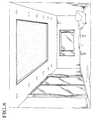
- an opaque state as shown in Fig. 8 can easily be switched to a transparent state as shown in Fig. 9 so that the transmitted light intensity is adjustable.
- the peek window can quickly become transparent when fish gathers or when the boat arrives at a sightseeing spot, which permits the people to see the scenery such as the lake bottoms, river bottoms and sea bottoms.
- the sightseers can enjoy more impressive sightseeing because the scenery suddenly comes into view.
- the difference of this embodiment from the first-mentioned embodiment is that the specific gravity of the EA particles 12 is greater than the specific gravity of the electrical insulating medium 11 so that the EA particles 12 sink in the electrical insulating medium 11 and the first transparent electrode 4 is positioned at the lower side of the second transparent electrode 5. If satisfying the condition that the EA particles 12 have a greater specific gravity than that of the electrical insulating medium 11, any combination of the EA particles 12 and electrical insulating medium 11 to be used is acceptable.
- the specific gravity of the EA particles 12 is approximately 1.2, there are usable methylphenyl polysiloxane based silicone oils, aromatic polycarbonate higher alcohol esters, ester sebacates, and so on. Further, if the specific gravity of the EA particles 12 is approximately 1.0, there are usable small-specific gravity oils such as hydrocarbon based media, petroleum paraffins, polydimethyl siloxane based silicone oils, ring polysiloxane based silicone oils, and transformer oils. The principle of the transparency-opaque operation of this window 1 is the same as that in the aforementioned embodiment.
- a first transparent electrode 51 is composed of first and second comb-like electrodes 51a, 51b located so that the tooth portions 51a' of the first comb-like electrode 51a are alternately placed or inserted into the spaces between the tooth portions 51b' of the second comb-like electrode 51b so as to substantially cover the whole of one inner surface of a housing 7.
- the tooth portions 51a', 51b' of the first and second comb-like electrodes 51a, 51b extend in the width direction of the housing 7 and are alternately arranged successively in the longitudinal direction of the housing 7.
- the first comb-like electrode 51a is connected through a power supply V to one terminal (movable contact) of a switch S, the other terminal (fixed contacts) of the switch S being selectively coupled to a second transparent electrode 5 and the second comb-like electrode 51b.
- the switch S comes into connection with the second transparent electrode 5 side, the EA particles 12 are vertically aligned between the tooth portions 51a' of the first comb-like electrode 51a and the second transparent electrode 5 so as to form chain configurations 30, ... as shown in Fig. 4 or 5. For this reason, the light can pass into the spaces between the chain configurations 30, ..., with the result that the housing 7 changes from an opaque state to a transparent state. This means increase in transmitted light intensity of the housing 7.
- the EA particles 12 can quickly float or sink in the electrical insulating medium 11, in other words, the responsibility of the switching between the opaque state and the transparent state improves.
- An ITO (indium tin oxide) film was formed on each of two window glass plates to produce the first and second transparent electrodes 4, 5 substantially covering the whole window glass plates.
- the two ITO glass plates each having a thickness of 1.0 mm, were disposed in opposed, parallel relation to each other to be spaced by 2 mm from each other so that the first and second transparent electrodes 4, 5 face each other.
- the circumferential sections of the two ITO glass plates were sealed with sealing members 6, ... made of a resin.
- the sealing members 6, ... had an injection hole, through which the EA fluid 10 was injected. The injection hole was closed after the injection, thus producing the window 1 according to this invention.
- a mixture of a titanium hydroxide (common name: hydrous titanium oxide produced by Ishihara Sangyo Co., Ltd., C-II), a butyl acrylate, a 1,3-butylene glycoal dimethacrylate and a polymerization initiator was dispersed in water containing a tertiary calcium phosphate as a dispersing stabilizer and suspension-polymerized while being stirred at a temperature of 60°C for one hour.
- the resultant product was filtered and acid-cleaned before water-cleaned and dried, thus obtaining inorganic and organic composite particles 12.
- the inorganic and organic composite particles obtained were agitated with jet stream, before surface-polished, thereby producing the EA particles 12.
- the specific gravity of the produced particles was 1.157, the average diameter thereof was 13.7 mm.
- the EA particles 12 were put by 4% by weight into silicone oils (produced by Toshiba Silicone Co., Ltd., TSF451 series) with a kinematic viscosity of 10 cSt and a specific gravity of 0.935, thus obtaining the EA fluid 10.
- Fig. 15 shows a wavelength dependency of the transmitted light intensity of the EA fluid 10 taken in accordance with the switching operation of the switch S shown in Fig. 13.
- the EA particles 12 were colored in blue.
- the coloring of the EA particles 12 was achieved in production with 20% by weight of the inorganic EA material 14 for formation of the surface layer 15 being replaced with a blue pigment.
- E 2kV
- the first transparent electrode 51 is constructed with the comb-like electrodes
- the electrode configurations are not limited to those as illustrated, but it is also possible to employ different configurations such as spiral configurations and circular configurations as long as two or more kinds of electrodes are disposed to be adjacent to each other.
- this invention is not limited to the accurately parallel disposition of the transparent substrates 2, 3. It is also acceptable that both are slightly inclined relative to each other.
Landscapes
- Physics & Mathematics (AREA)
- Nonlinear Science (AREA)
- Engineering & Computer Science (AREA)
- Civil Engineering (AREA)
- Structural Engineering (AREA)
- General Physics & Mathematics (AREA)
- Optics & Photonics (AREA)
- Electrochromic Elements, Electrophoresis, Or Variable Reflection Or Absorption Elements (AREA)
Applications Claiming Priority (2)
| Application Number | Priority Date | Filing Date | Title |
|---|---|---|---|
| JP26789094 | 1994-10-31 | ||
| JP267890/94 | 1994-10-31 |
Publications (2)
| Publication Number | Publication Date |
|---|---|
| EP0709712A2 true EP0709712A2 (de) | 1996-05-01 |
| EP0709712A3 EP0709712A3 (de) | 1997-04-23 |
Family
ID=17451051
Family Applications (1)
| Application Number | Title | Priority Date | Filing Date |
|---|---|---|---|
| EP95117153A Withdrawn EP0709712A3 (de) | 1994-10-31 | 1995-10-31 | Glasscheibe mit Intensitätsregelung des Durchlichts |
Country Status (1)
| Country | Link |
|---|---|
| EP (1) | EP0709712A3 (de) |
Cited By (8)
| Publication number | Priority date | Publication date | Assignee | Title |
|---|---|---|---|---|
| DE19907334A1 (de) * | 1999-02-20 | 2000-08-24 | Bayer Ag | Elektrochrome Gradientenblende |
| FR2899199A1 (fr) * | 2006-03-30 | 2007-10-05 | Airbus Sas | Compartiment a bagages, notamment compartiment clos pour cabine d'aeronef |
| US7677495B2 (en) | 2006-03-30 | 2010-03-16 | Airbus | Baggage compartment, in particular an enclosed compartment for an aircraft cabin |
| US8031277B2 (en) | 2004-07-14 | 2011-10-04 | Nodar Maisuradze | Method and device for regulation and control of transparence and translucence of glazing or oilcloth |
| WO2014191233A1 (en) * | 2013-05-31 | 2014-12-04 | Vlyte Innovations Limited | An electrophoretic insulated glass unit |
| WO2016168384A1 (en) * | 2015-04-14 | 2016-10-20 | Face International Corporation | Systems and methods for producing objects incorporating selectably active electromagnetic energy filtering layers |
| US9726791B2 (en) | 2015-04-14 | 2017-08-08 | Face International Corporation | Systems and methods for producing objects incorporating selectably active electromagnetic energy filtering layers and coatings |
| CN117328780A (zh) * | 2023-10-25 | 2024-01-02 | 安徽弘飞新型建材科技有限公司 | 一种透明度可调节组合式门板及生产工艺 |
Family Cites Families (4)
| Publication number | Priority date | Publication date | Assignee | Title |
|---|---|---|---|---|
| GB680246A (en) * | 1950-03-22 | 1952-10-01 | Gen Electric Co Ltd | Improvements in or relating to electrical light valve devices |
| US3848964A (en) * | 1970-06-02 | 1974-11-19 | A Marks | Forced closure dipolar electro-optic shutter and method |
| IL39041A0 (en) * | 1971-04-09 | 1972-05-30 | Research Frontiers Inc | Display device |
| JPH01114829A (ja) * | 1987-10-28 | 1989-05-08 | Nippon Mektron Ltd | 電気泳動表示装置 |
-
1995
- 1995-10-31 EP EP95117153A patent/EP0709712A3/de not_active Withdrawn
Non-Patent Citations (1)
| Title |
|---|
| None |
Cited By (15)
| Publication number | Priority date | Publication date | Assignee | Title |
|---|---|---|---|---|
| DE19907334A1 (de) * | 1999-02-20 | 2000-08-24 | Bayer Ag | Elektrochrome Gradientenblende |
| US8031277B2 (en) | 2004-07-14 | 2011-10-04 | Nodar Maisuradze | Method and device for regulation and control of transparence and translucence of glazing or oilcloth |
| CN101410296B (zh) * | 2006-03-30 | 2012-04-18 | 空中客车公司 | 行李隔间,尤其是航空器舱室用的封闭行李隔间 |
| US7677495B2 (en) | 2006-03-30 | 2010-03-16 | Airbus | Baggage compartment, in particular an enclosed compartment for an aircraft cabin |
| RU2417924C2 (ru) * | 2006-03-30 | 2011-05-10 | Эрбюс | Багажная полка, в частности закрытая багажная полка, предназначенная для салона воздушного судна |
| WO2007118981A1 (fr) * | 2006-03-30 | 2007-10-25 | Airbus | Compartiment a bagages, notamment compartiment clos pour cabine d'aeronef |
| FR2899199A1 (fr) * | 2006-03-30 | 2007-10-05 | Airbus Sas | Compartiment a bagages, notamment compartiment clos pour cabine d'aeronef |
| WO2014191233A1 (en) * | 2013-05-31 | 2014-12-04 | Vlyte Innovations Limited | An electrophoretic insulated glass unit |
| US9651847B2 (en) | 2013-05-31 | 2017-05-16 | Vlyte Innovations Limited | Electrophoretic insulated glass unit |
| WO2016168384A1 (en) * | 2015-04-14 | 2016-10-20 | Face International Corporation | Systems and methods for producing objects incorporating selectably active electromagnetic energy filtering layers |
| US9726791B2 (en) | 2015-04-14 | 2017-08-08 | Face International Corporation | Systems and methods for producing objects incorporating selectably active electromagnetic energy filtering layers and coatings |
| US9726790B2 (en) | 2015-04-14 | 2017-08-08 | Face International Corporation | Systems and methods for implementing selective electromagnetic energy filtering objects and coatings using selectably transmissive energy scattering layers |
| US10345492B2 (en) | 2015-04-14 | 2019-07-09 | Face International Corporation | Systems and methods for producing objects incorporating selectably active electromagnetic energy filtering layers and coatings |
| US10345491B2 (en) | 2015-04-14 | 2019-07-09 | Face International Corporation | Systems and methods for implementing selective electromagnetic energy filtering objects and coatings using selectably transmissive energy scattering layers |
| CN117328780A (zh) * | 2023-10-25 | 2024-01-02 | 安徽弘飞新型建材科技有限公司 | 一种透明度可调节组合式门板及生产工艺 |
Also Published As
| Publication number | Publication date |
|---|---|
| EP0709712A3 (de) | 1997-04-23 |
Similar Documents
| Publication | Publication Date | Title |
|---|---|---|
| EP0709713A2 (de) | Elektrisch gesteuerte Farbanzeigegerät und Verfahren | |
| US12158684B2 (en) | Method for driving two layer variable transmission display | |
| CN107065373B (zh) | 提高电泳显示器的光学性能的添加剂 | |
| US7580180B2 (en) | Magnetophoretic and electromagnetophoretic displays | |
| US7999787B2 (en) | Methods for driving electrophoretic displays using dielectrophoretic forces | |
| CA1147836A (en) | Electrophoretic display device | |
| US20170168370A1 (en) | Methods for driving electrophoretic displays using dielectrophoretic forces | |
| US7113323B2 (en) | Magnetophoretic and electromagnetophoretic displays | |
| JPH08211422A (ja) | 窓 | |
| EP0697615A2 (de) | Anzeigevorrichtung | |
| JPH08137416A (ja) | カラー表示装置およびカラー表示方法 | |
| JPH08190353A (ja) | 透過型カラー表示装置 | |
| WO2004044647A1 (en) | Electrophoretic display | |
| JPH08129194A (ja) | カラー表示装置 | |
| JPH08129346A (ja) | 表示装置 | |
| EP0709719A1 (de) | Elektrisch gesteuerte Reflektiv-Anzeige | |
| JPH08101408A (ja) | 図形表示装置および図形表示方法 | |
| EP0704745A2 (de) | Anzeigevorrichtung und Verfahren basierend auf Steuerung des Intensität des transmittiertes Lichtes | |
| JPH08179704A (ja) | 表示装置 | |
| JPH08122831A (ja) | 車両用日除け装置 | |
| JPH08189103A (ja) | 可変吸音壁 | |
| JPH08158757A (ja) | 防音ガラス窓 | |
| JPH08211416A (ja) | 透過光量の制御装置および制御方法 | |
| JPH08129348A (ja) | 大型カラー表示装置 | |
| JPH08211417A (ja) | 表示装置 |
Legal Events
| Date | Code | Title | Description |
|---|---|---|---|
| PUAI | Public reference made under article 153(3) epc to a published international application that has entered the european phase |
Free format text: ORIGINAL CODE: 0009012 |
|
| 17P | Request for examination filed |
Effective date: 19951031 |
|
| AK | Designated contracting states |
Kind code of ref document: A2 Designated state(s): DE FR GB IT |
|
| PUAL | Search report despatched |
Free format text: ORIGINAL CODE: 0009013 |
|
| RHK1 | Main classification (correction) |
Ipc: G02F 1/17 |
|
| AK | Designated contracting states |
Kind code of ref document: A3 Designated state(s): DE FR GB IT |
|
| STAA | Information on the status of an ep patent application or granted ep patent |
Free format text: STATUS: THE APPLICATION IS DEEMED TO BE WITHDRAWN |
|
| 18D | Application deemed to be withdrawn |
Effective date: 19980206 |