EP0717064B1 - Teilkristalline Block-Copolyesterpolyamide - Google Patents
Teilkristalline Block-Copolyesterpolyamide Download PDFInfo
- Publication number
- EP0717064B1 EP0717064B1 EP95119844A EP95119844A EP0717064B1 EP 0717064 B1 EP0717064 B1 EP 0717064B1 EP 95119844 A EP95119844 A EP 95119844A EP 95119844 A EP95119844 A EP 95119844A EP 0717064 B1 EP0717064 B1 EP 0717064B1
- Authority
- EP
- European Patent Office
- Prior art keywords
- blocks
- block
- mol
- copolyesterpolyamides
- copolyester
- Prior art date
- Legal status (The legal status is an assumption and is not a legal conclusion. Google has not performed a legal analysis and makes no representation as to the accuracy of the status listed.)
- Expired - Lifetime
Links
- 239000004952 Polyamide Substances 0.000 claims abstract description 71
- 229920002647 polyamide Polymers 0.000 claims abstract description 71
- 229920001634 Copolyester Polymers 0.000 claims abstract description 58
- 229920000728 polyester Polymers 0.000 claims abstract description 52
- 150000001991 dicarboxylic acids Chemical class 0.000 claims abstract description 15
- 150000002148 esters Chemical class 0.000 claims abstract description 14
- 239000000178 monomer Substances 0.000 claims abstract description 13
- 150000001408 amides Chemical class 0.000 claims abstract description 12
- -1 aliphatic diamines Chemical class 0.000 claims abstract description 10
- 150000002596 lactones Chemical class 0.000 claims abstract description 10
- KKEYFWRCBNTPAC-UHFFFAOYSA-N Terephthalic acid Chemical compound OC(=O)C1=CC=C(C(O)=O)C=C1 KKEYFWRCBNTPAC-UHFFFAOYSA-N 0.000 claims abstract description 8
- QQVIHTHCMHWDBS-UHFFFAOYSA-N isophthalic acid Chemical compound OC(=O)C1=CC=CC(C(O)=O)=C1 QQVIHTHCMHWDBS-UHFFFAOYSA-N 0.000 claims abstract description 8
- BVKZGUZCCUSVTD-UHFFFAOYSA-N carbonic acid Chemical class OC(O)=O BVKZGUZCCUSVTD-UHFFFAOYSA-N 0.000 claims abstract description 7
- YEJRWHAVMIAJKC-UHFFFAOYSA-N 4-Butyrolactone Chemical compound O=C1CCCO1 YEJRWHAVMIAJKC-UHFFFAOYSA-N 0.000 claims abstract description 6
- 125000003118 aryl group Chemical group 0.000 claims abstract description 6
- 150000001298 alcohols Chemical class 0.000 claims abstract description 4
- 125000001931 aliphatic group Chemical group 0.000 claims abstract description 4
- 125000004122 cyclic group Chemical group 0.000 claims abstract description 4
- PAPBSGBWRJIAAV-UHFFFAOYSA-N ε-Caprolactone Chemical compound O=C1CCCCCO1 PAPBSGBWRJIAAV-UHFFFAOYSA-N 0.000 claims abstract description 4
- 229930188620 butyrolactone Natural products 0.000 claims abstract description 3
- 239000003054 catalyst Substances 0.000 claims description 22
- 125000004432 carbon atom Chemical group C* 0.000 claims description 21
- 229920006149 polyester-amide block copolymer Polymers 0.000 claims description 19
- 238000004519 manufacturing process Methods 0.000 claims description 11
- 238000000034 method Methods 0.000 claims description 10
- 239000004831 Hot glue Substances 0.000 claims description 9
- 238000000465 moulding Methods 0.000 claims description 9
- 229920000642 polymer Polymers 0.000 claims description 8
- 239000002253 acid Substances 0.000 claims description 7
- 238000006068 polycondensation reaction Methods 0.000 claims description 7
- 125000003178 carboxy group Chemical group [H]OC(*)=O 0.000 claims description 3
- 238000001746 injection moulding Methods 0.000 claims description 3
- 150000007513 acids Chemical class 0.000 claims description 2
- 230000001588 bifunctional effect Effects 0.000 claims description 2
- 238000000071 blow moulding Methods 0.000 claims description 2
- 238000001125 extrusion Methods 0.000 claims description 2
- 238000002074 melt spinning Methods 0.000 claims description 2
- 150000003951 lactams Chemical class 0.000 claims 1
- 150000002009 diols Chemical class 0.000 abstract description 23
- JJTUDXZGHPGLLC-UHFFFAOYSA-N lactide Chemical compound CC1OC(=O)C(C)OC1=O JJTUDXZGHPGLLC-UHFFFAOYSA-N 0.000 abstract description 4
- 150000001414 amino alcohols Chemical class 0.000 abstract description 2
- 235000001014 amino acid Nutrition 0.000 abstract 1
- 150000001413 amino acids Chemical class 0.000 abstract 1
- WPYMKLBDIGXBTP-UHFFFAOYSA-N benzoic acid Chemical compound OC(=O)C1=CC=CC=C1 WPYMKLBDIGXBTP-UHFFFAOYSA-N 0.000 abstract 1
- BDJRBEYXGGNYIS-UHFFFAOYSA-N nonanedioic acid Chemical compound OC(=O)CCCCCCCC(O)=O BDJRBEYXGGNYIS-UHFFFAOYSA-N 0.000 description 32
- NAQMVNRVTILPCV-UHFFFAOYSA-N hexane-1,6-diamine Chemical compound NCCCCCCN NAQMVNRVTILPCV-UHFFFAOYSA-N 0.000 description 30
- 229920001610 polycaprolactone Polymers 0.000 description 20
- 239000004632 polycaprolactone Substances 0.000 description 20
- 239000000155 melt Substances 0.000 description 17
- 150000003839 salts Chemical class 0.000 description 16
- 230000032050 esterification Effects 0.000 description 15
- 238000005886 esterification reaction Methods 0.000 description 15
- 239000000203 mixture Substances 0.000 description 15
- 239000012299 nitrogen atmosphere Substances 0.000 description 15
- 238000003756 stirring Methods 0.000 description 11
- 230000015572 biosynthetic process Effects 0.000 description 8
- 238000003786 synthesis reaction Methods 0.000 description 8
- 238000009264 composting Methods 0.000 description 7
- 239000000463 material Substances 0.000 description 7
- 238000005191 phase separation Methods 0.000 description 7
- 238000006243 chemical reaction Methods 0.000 description 6
- 238000002844 melting Methods 0.000 description 6
- 230000008018 melting Effects 0.000 description 6
- 239000002361 compost Substances 0.000 description 5
- 150000004985 diamines Chemical class 0.000 description 5
- 230000007062 hydrolysis Effects 0.000 description 5
- 238000006460 hydrolysis reaction Methods 0.000 description 5
- 101001073193 Homo sapiens Pescadillo homolog Proteins 0.000 description 4
- 102100035816 Pescadillo homolog Human genes 0.000 description 4
- 230000015556 catabolic process Effects 0.000 description 4
- 238000009833 condensation Methods 0.000 description 4
- 230000005494 condensation Effects 0.000 description 4
- 238000006731 degradation reaction Methods 0.000 description 4
- 238000009826 distribution Methods 0.000 description 4
- 239000011888 foil Substances 0.000 description 4
- 101100243456 Arabidopsis thaliana PES2 gene Proteins 0.000 description 3
- LYCAIKOWRPUZTN-UHFFFAOYSA-N Ethylene glycol Chemical compound OCCO LYCAIKOWRPUZTN-UHFFFAOYSA-N 0.000 description 3
- PEDCQBHIVMGVHV-UHFFFAOYSA-N Glycerine Chemical compound OCC(O)CO PEDCQBHIVMGVHV-UHFFFAOYSA-N 0.000 description 3
- 238000006065 biodegradation reaction Methods 0.000 description 3
- MTHSVFCYNBDYFN-UHFFFAOYSA-N diethylene glycol Chemical compound OCCOCCO MTHSVFCYNBDYFN-UHFFFAOYSA-N 0.000 description 3
- 239000000835 fiber Substances 0.000 description 3
- HZAXFHJVJLSVMW-UHFFFAOYSA-N 2-Aminoethan-1-ol Chemical compound NCCO HZAXFHJVJLSVMW-UHFFFAOYSA-N 0.000 description 2
- JJTUDXZGHPGLLC-IMJSIDKUSA-N 4511-42-6 Chemical group C[C@@H]1OC(=O)[C@H](C)OC1=O JJTUDXZGHPGLLC-IMJSIDKUSA-N 0.000 description 2
- HEDRZPFGACZZDS-UHFFFAOYSA-N Chloroform Chemical compound ClC(Cl)Cl HEDRZPFGACZZDS-UHFFFAOYSA-N 0.000 description 2
- AEMRFAOFKBGASW-UHFFFAOYSA-N Glycolic acid Chemical compound OCC(O)=O AEMRFAOFKBGASW-UHFFFAOYSA-N 0.000 description 2
- WNLRTRBMVRJNCN-UHFFFAOYSA-N adipic acid Chemical compound OC(=O)CCCCC(O)=O WNLRTRBMVRJNCN-UHFFFAOYSA-N 0.000 description 2
- 229920001400 block copolymer Polymers 0.000 description 2
- WERYXYBDKMZEQL-UHFFFAOYSA-N butane-1,4-diol Chemical compound OCCCCO WERYXYBDKMZEQL-UHFFFAOYSA-N 0.000 description 2
- 150000001732 carboxylic acid derivatives Chemical class 0.000 description 2
- 239000011248 coating agent Substances 0.000 description 2
- 238000000576 coating method Methods 0.000 description 2
- 239000004744 fabric Substances 0.000 description 2
- 238000011534 incubation Methods 0.000 description 2
- 239000012948 isocyanate Substances 0.000 description 2
- 150000002513 isocyanates Chemical class 0.000 description 2
- 238000002156 mixing Methods 0.000 description 2
- WLJVNTCWHIRURA-UHFFFAOYSA-N pimelic acid Chemical compound OC(=O)CCCCCC(O)=O WLJVNTCWHIRURA-UHFFFAOYSA-N 0.000 description 2
- 229920005862 polyol Polymers 0.000 description 2
- 150000003077 polyols Chemical class 0.000 description 2
- 239000002994 raw material Substances 0.000 description 2
- CXMXRPHRNRROMY-UHFFFAOYSA-N sebacic acid Chemical compound OC(=O)CCCCCCCCC(O)=O CXMXRPHRNRROMY-UHFFFAOYSA-N 0.000 description 2
- 239000000126 substance Substances 0.000 description 2
- 210000002268 wool Anatomy 0.000 description 2
- DNIAPMSPPWPWGF-VKHMYHEASA-N (+)-propylene glycol Chemical compound C[C@H](O)CO DNIAPMSPPWPWGF-VKHMYHEASA-N 0.000 description 1
- JJTUDXZGHPGLLC-QWWZWVQMSA-N (3r,6r)-3,6-dimethyl-1,4-dioxane-2,5-dione Chemical compound C[C@H]1OC(=O)[C@@H](C)OC1=O JJTUDXZGHPGLLC-QWWZWVQMSA-N 0.000 description 1
- GSCLMSFRWBPUSK-GSVOUGTGSA-N (4r)-4-methyloxetan-2-one Chemical compound C[C@@H]1CC(=O)O1 GSCLMSFRWBPUSK-GSVOUGTGSA-N 0.000 description 1
- DNIAPMSPPWPWGF-GSVOUGTGSA-N (R)-(-)-Propylene glycol Chemical compound C[C@@H](O)CO DNIAPMSPPWPWGF-GSVOUGTGSA-N 0.000 description 1
- YPFDHNVEDLHUCE-UHFFFAOYSA-N 1,3-propanediol Substances OCCCO YPFDHNVEDLHUCE-UHFFFAOYSA-N 0.000 description 1
- RTBFRGCFXZNCOE-UHFFFAOYSA-N 1-methylsulfonylpiperidin-4-one Chemical compound CS(=O)(=O)N1CCC(=O)CC1 RTBFRGCFXZNCOE-UHFFFAOYSA-N 0.000 description 1
- WMRCTEPOPAZMMN-UHFFFAOYSA-N 2-undecylpropanedioic acid Chemical compound CCCCCCCCCCCC(C(O)=O)C(O)=O WMRCTEPOPAZMMN-UHFFFAOYSA-N 0.000 description 1
- 239000004953 Aliphatic polyamide Substances 0.000 description 1
- 229920000742 Cotton Polymers 0.000 description 1
- OFOBLEOULBTSOW-UHFFFAOYSA-N Malonic acid Chemical class OC(=O)CC(O)=O OFOBLEOULBTSOW-UHFFFAOYSA-N 0.000 description 1
- 229920002302 Nylon 6,6 Polymers 0.000 description 1
- ALQSHHUCVQOPAS-UHFFFAOYSA-N Pentane-1,5-diol Chemical compound OCCCCCO ALQSHHUCVQOPAS-UHFFFAOYSA-N 0.000 description 1
- WUGQZFFCHPXWKQ-UHFFFAOYSA-N Propanolamine Chemical compound NCCCO WUGQZFFCHPXWKQ-UHFFFAOYSA-N 0.000 description 1
- 206010037660 Pyrexia Diseases 0.000 description 1
- KDYFGRWQOYBRFD-UHFFFAOYSA-N Succinic acid Natural products OC(=O)CCC(O)=O KDYFGRWQOYBRFD-UHFFFAOYSA-N 0.000 description 1
- XSTXAVWGXDQKEL-UHFFFAOYSA-N Trichloroethylene Chemical compound ClC=C(Cl)Cl XSTXAVWGXDQKEL-UHFFFAOYSA-N 0.000 description 1
- ZJCCRDAZUWHFQH-UHFFFAOYSA-N Trimethylolpropane Chemical compound CCC(CO)(CO)CO ZJCCRDAZUWHFQH-UHFFFAOYSA-N 0.000 description 1
- 239000001361 adipic acid Substances 0.000 description 1
- 235000011037 adipic acid Nutrition 0.000 description 1
- 229920003231 aliphatic polyamide Polymers 0.000 description 1
- 229920003232 aliphatic polyester Polymers 0.000 description 1
- 125000003368 amide group Chemical group 0.000 description 1
- 238000004458 analytical method Methods 0.000 description 1
- JFCQEDHGNNZCLN-UHFFFAOYSA-N anhydrous glutaric acid Natural products OC(=O)CCCC(O)=O JFCQEDHGNNZCLN-UHFFFAOYSA-N 0.000 description 1
- 159000000032 aromatic acids Chemical class 0.000 description 1
- 230000004071 biological effect Effects 0.000 description 1
- 244000309464 bull Species 0.000 description 1
- KDYFGRWQOYBRFD-NUQCWPJISA-N butanedioic acid Chemical compound O[14C](=O)CC[14C](O)=O KDYFGRWQOYBRFD-NUQCWPJISA-N 0.000 description 1
- 239000003153 chemical reaction reagent Substances 0.000 description 1
- 150000001805 chlorine compounds Chemical class 0.000 description 1
- 238000001816 cooling Methods 0.000 description 1
- 230000008878 coupling Effects 0.000 description 1
- 238000010168 coupling process Methods 0.000 description 1
- 238000005859 coupling reaction Methods 0.000 description 1
- 238000002425 crystallisation Methods 0.000 description 1
- 230000008025 crystallization Effects 0.000 description 1
- FOTKYAAJKYLFFN-UHFFFAOYSA-N decane-1,10-diol Chemical compound OCCCCCCCCCCO FOTKYAAJKYLFFN-UHFFFAOYSA-N 0.000 description 1
- 238000000354 decomposition reaction Methods 0.000 description 1
- 230000003247 decreasing effect Effects 0.000 description 1
- 230000007547 defect Effects 0.000 description 1
- 125000005442 diisocyanate group Chemical group 0.000 description 1
- SZXQTJUDPRGNJN-UHFFFAOYSA-N dipropylene glycol Chemical compound OCCCOCCCO SZXQTJUDPRGNJN-UHFFFAOYSA-N 0.000 description 1
- 238000001035 drying Methods 0.000 description 1
- 230000002255 enzymatic effect Effects 0.000 description 1
- 239000010408 film Substances 0.000 description 1
- 239000012634 fragment Substances 0.000 description 1
- 235000012055 fruits and vegetables Nutrition 0.000 description 1
- XXMIOPMDWAUFGU-UHFFFAOYSA-N hexane-1,6-diol Chemical compound OCCCCCCO XXMIOPMDWAUFGU-UHFFFAOYSA-N 0.000 description 1
- 230000003301 hydrolyzing effect Effects 0.000 description 1
- 239000002054 inoculum Substances 0.000 description 1
- 238000009434 installation Methods 0.000 description 1
- 238000011835 investigation Methods 0.000 description 1
- DNIAPMSPPWPWGF-UHFFFAOYSA-N monopropylene glycol Natural products CC(O)CO DNIAPMSPPWPWGF-UHFFFAOYSA-N 0.000 description 1
- 238000003541 multi-stage reaction Methods 0.000 description 1
- SLCVBVWXLSEKPL-UHFFFAOYSA-N neopentyl glycol Chemical compound OCC(C)(C)CO SLCVBVWXLSEKPL-UHFFFAOYSA-N 0.000 description 1
- OEIJHBUUFURJLI-UHFFFAOYSA-N octane-1,8-diol Chemical compound OCCCCCCCCO OEIJHBUUFURJLI-UHFFFAOYSA-N 0.000 description 1
- 229920002601 oligoester Polymers 0.000 description 1
- 238000004806 packaging method and process Methods 0.000 description 1
- 238000006116 polymerization reaction Methods 0.000 description 1
- 229920000166 polytrimethylene carbonate Polymers 0.000 description 1
- 238000002360 preparation method Methods 0.000 description 1
- 235000013772 propylene glycol Nutrition 0.000 description 1
- 238000007151 ring opening polymerisation reaction Methods 0.000 description 1
- 238000007142 ring opening reaction Methods 0.000 description 1
- 239000000243 solution Substances 0.000 description 1
- 239000002904 solvent Substances 0.000 description 1
- 230000002269 spontaneous effect Effects 0.000 description 1
- 238000003860 storage Methods 0.000 description 1
- 229920001169 thermoplastic Polymers 0.000 description 1
- 229920002725 thermoplastic elastomer Polymers 0.000 description 1
- 239000004416 thermosoftening plastic Substances 0.000 description 1
- 238000004448 titration Methods 0.000 description 1
- 238000001291 vacuum drying Methods 0.000 description 1
- 239000002699 waste material Substances 0.000 description 1
- XLYOFNOQVPJJNP-UHFFFAOYSA-N water Substances O XLYOFNOQVPJJNP-UHFFFAOYSA-N 0.000 description 1
Classifications
-
- C—CHEMISTRY; METALLURGY
- C08—ORGANIC MACROMOLECULAR COMPOUNDS; THEIR PREPARATION OR CHEMICAL WORKING-UP; COMPOSITIONS BASED THEREON
- C08G—MACROMOLECULAR COMPOUNDS OBTAINED OTHERWISE THAN BY REACTIONS ONLY INVOLVING UNSATURATED CARBON-TO-CARBON BONDS
- C08G69/00—Macromolecular compounds obtained by reactions forming a carboxylic amide link in the main chain of the macromolecule
- C08G69/44—Polyester-amides
Definitions
- the invention relates to new biodegradable, partially crystalline block copolyester polyamides from at least two chemically differently structured segments, including at least one polyester (PES) or copolyester (CoPES) block a number average molecular weight of 340 to 10,000 g / mol and a polyamide (PA) -or a copolyamide (CoPA) block with a number average molecular weight of 400 to 3,000 g / mol.
- copolyesteramide (CoPEA) blocks with a number average Molar mass from 500 to 5,000 g / mol can be used.
- the invention further relates to a polycondensation process for the production of these semi-crystalline block copolyester polyamides and the use of block copolyester polyamides for the production of fibers, foils, moldings and Hot melt adhesive.
- the moldings that can be produced from the polymers according to the invention are organic degradable and compostable and therefore especially e.g. for applications suitable for packaging, hygiene and medical applications.
- Japanese patent applications JP 54 119 593, JP 54 119 594, JP 54 119 595, JP 54 120 727, JP 80 031 207 and EP 0 508 730 describe polyamides, produced by chain exchange reactions of high molecular weight polyesters and Polyamides under the influence of catalysts. Because of the thermodynamic Incompatibility of polyester (PES) and polyamide (PA) and the part fairly short dwell times in the extruder, products are made that are mixtures Represent PA, PES and polyester amide (PEA). The ester or amide bonds are statistically distributed. Expensive production due to high molecular raw materials, undefined structure, especially as a result of non-uniform block length distribution, and mostly insufficient mechanical properties and only moderate biological properties Degradability characterizes these materials.
- EP 0 559 404 describes hydrolysis-sensitive polyamides produced by Extrusion of high molecular weight polyamides with low molecular weight alkyl esters aliphatic carboxylic acids. Statistical polyesteramides also result here with only a very limited concentration of ester bonds.
- WO 93/13814 describes a bioabsorbable PEA for medical applications.
- the strictly alternating sequence of components is a two-stage Synthesis achieved; first a diamine with glycolic acid becomes the corresponding one Diamiddiol reacted, which then with carboxylic acid dichlorides to the high molecular weight PEA is condensed. Both reaction steps are in solution executed.
- the block copolyesteramide described in DE 34 350 53 contains OH-terminated PES block at least 50 mol% terephthalic acid, based on the acid content.
- PEA according to US 41 16 943 contain 100 mol% of aromatic dicarboxylic acids. Such a high proportion of aromatic monomers reduces the speed of biodegradation or leads to bioresistant materials.
- the PEA used as a hot melt adhesive according to DE 42 34 305 are also based on the isocyanate method.
- the hard segments of these polyester amides consist of amide sequences with only two amide groups by reaction the acid end groups of the oligoesters with aliphatic or cycloaliphatic Isocyanates are formed.
- the proportion of ester segments is 80 to 95 % By weight, which essentially dominates the polyester properties.
- PEA or manufacturing processes described above have significant disadvantages or defects.
- the production of PEA based on high molecular PA and PES is cost-intensive and supplies products with an undefined composition and structure. As a rule, this also results in insufficient properties, in particular also lack of biodegradability.
- the use of solvents, Acid chlorides, special reagents and multi-step reactions are complex and deliver expensive products and are only conditionally for industrial ones Suitable for large productions. Reduce higher proportions of aromatic monomers the tendency to degrade or completely prevent it.
- the new block copolyester polyamides are said to have good mechanical properties and distinguish thermal properties.
- a method for Preparation of these block copolyester polyamides can be specified. From the new ones Polymers are to be used to produce molded parts, films, fibers and hot melt adhesives can, which are also due to a defined degradation after their use, i.e. mark in the compost.
- the invention thus relates to segmented block copolyester polyamides consisting of from at least two chemically differently structured segments or Blocks, of which at least one PES or CoPES block with a number average Molar mass from 340 to 10,000 g / mol, preferably 340 to 6000 g / mol, particularly preferably 340 to 3000 g / mol, very preferably 340 to 1500 g / mol and a PA or CoPA block with a number average molecular weight of 400 to 3,000 g / mol, preferably 400 to 2000 g / mol, very preferably 1000 to 2000 g / mol.
- CoPEA blocks with a number average molecular weight of 500 to 5,000 g / mol are used. A maximum number-average molar mass is preferred for the PA segment and a minimum number average molecular weight for the PES segment.
- PA and PES blocks are predominantly made of aliphatic monomer units constructed and contain no more than 20 mol% aromatic monomers, e.g. B. Isophthalic and terephthalic acid units. Linking the telechele takes place through condensation.
- the PA and CoPA blocks used are preferred Carboxyl-terminated and have at least 95% carboxyl end groups, while the PES, CoPES and CoPEA blocks are preferably OH-terminated and have at least 95% OH end groups.
- PES or CoPES or CoPEA blocks have a functionality of at least 2, in particular from 2 to 4. The required blocks are built up from the monomers.
- the invention further relates to a process for the production of block copolyester polyamides.
- the polyamide-forming components become more common Pre-polymerized in a precisely defined number-average molecular weight and after adding defined PES blocks, CoPES blocks or CoPEA blocks in the Melt condensed under vacuum.
- the pressure and temperature control and the catalyst and the catalyst concentration so designed that no exchange reaction take place and thus PA and PES segments before and After the condensation, the same average molecular weights and molecular weight distributions exhibit. Due to the relatively short block lengths of the precondensates A sufficiently good mixing of the Components achieved what is also in the spontaneous implementation of the oligomer components and short response times.
- step a) of the process according to the invention prepolymerization temperatures of 180 to 260 ° C and a pressure in the range from atmospheric pressure to 18 bar.
- step c) of the invention Process temperature is 180 to 260 ° C, the pressure is gradually relaxed and then applied a vacuum (see also claim 25).
- catalyst can be used in amounts of 0.05 to 0.2 % By weight, based on the total batch, are used.
- the required polyamide segments are based on polyamide 6, 6/6, 6/9, 6/10, 6/11, 6/12, 6/36, 11, 12, 12/12 as well as on copolyamides and multipolyamides, based on the dicarboxylic acids C. 2 -C 44 , in particular dicarboxylic acids with 2 to 18 C atoms and dicarboxylic acids with 36 C atoms and with 44 C atoms, and diamines C 2 -C 10 and lactam-6, lactam-12, isophthalic acid (IPS) and terephthalic acid (TPS), the concentration of aromatic acids not exceeding 20 mol%.
- the PA blocks can also be obtained by polycondensation of the corresponding salts of diamine and dicarboxylic acid.
- An excess of dicarboxylic acids terminates carboxyl, and an excess Amino-terminated PA blocks are generated on diamines.
- Essential for the inventive, in particular biodegradable materials is that the number average molar mass of the PA blocks does not exceed 3,000 g / mol, preferably Does not exceed 2000 g / mol.
- the polyester segments become predominantly linear by polycondensation aliphatic dicarboxylic acids or their esters with linear and / or branched aliphatic alcohols and lactones and hydroxycarboxylic acids.
- the polyester and copolyester blocks built up from lactones or hydroxycarboxylic acids and have low Shares in higher functional aliphatic alcohols a functionality of more than 2 on.
- the polyester or copolyester blocks are more preferably made of bifunctional ones Alcohols, especially from those with 2 to 10 carbon atoms and from Dicarboxylic acids, especially from those with 2 to 44 carbon atoms, in particular from such dicarboxylic acids with 2 to 18 carbon atoms and with 36 carbon atoms and with 44 Carbon atoms.
- Suitable dicarboxylic acids for the synthesis of the PES segments are succinic acid, glutaric acid, adipic acid, pimelic acid, azelaic acid, sebacic acid and dodecanedicarboxylic acid
- suitable diols are ethylene glycol, 1,3-propanediol, 1,2-propanediol, 1,4-butanediol, 1.5 Pentanediol, 1,6-hexanediol, 1,8-octanediol, 1,10-decanediol, diethylene glycol, dipropylene glycol and glycerol, trimethylolpropane, neopentyl glycol, suitable lactones are caprolactone, butyrolactone.
- cyclic esters of this type are L, L-dilactide, D, D-dilactide, DL-dilactide, diglycolide or the lactones ⁇ -R-butyrolactone, ⁇ -S-butyrolactone, ⁇ -rac-butyrolactone and ⁇ -caprolactone or mixtures thereof .
- the ring opening takes place with aliphatic alcohols with a functionality of 2 to 4 and a chain length of C 2 -C 8 . The concentration and functionality of the alcohols used determine the molar mass and the functionality of the macroalcohols formed.
- the same monomers that have already been described as components of the PA and PES segments are used for the synthesis of the statistical copolyesteramide segments.
- C 2 -C 8 amino alcohols such as ethanolamine and 1,3-propanolamine are used.
- the monomers mentioned are preferably reacted with an excess of diols in a simultaneous reaction, resulting in statistical OH-terminated copolyesteramides.
- the ratio of amide / ester bonds has a decisive influence on the degree of phase separation between hard and soft segments and thus on the thermal, mechanical and properties relevant to biodegradation.
- the ester / amide ratio of the PEA segments should not be below 1.2, preferably between 1.2 and 20.0.
- the block copolyester polyamides according to the invention consist at least of a PES segment and a PA / CoPA segment and optionally one CoPEA segment.
- the individual segments are preferred by ester bonds connected.
- Segment combinations such as PES1 / PES2, PES1 / CoPEA and PES1 / PES2 / CoPEA used.
- ester blocks PES1 and PES2 within a block copolyester polyamide differ due to the number average molecular weight and / or the chemical Composition and / or functionality or combinations thereof.
- the installation of CoPEA segments is particularly important for property control important. This is a characteristic of the statistical CoPEA segments Ester / amide ratio, since this sets the extent of phase separation can be.
- the ester / amide ratio should not be less than 1.2, preferably are between 1.2 and 20.
- the block copolyester polyamides according to the invention have an ester / amide ratio in the range from 15 to 0.2, preferably between 15 and 0.6, very preferred from 4 to 0.37.
- the polyamide segments form the hard, the polyester segments the soft segments.
- the degree of phase separation can be controlled by installing CoPEA segments become. So that the block copolyester polyamides have the properties according to the invention, especially the biodegradability, the ester / amide ratio within the CoPEA segments are not less than 1.2.
- the crystallite size of the PA microdomain only a little due to the chemical composition and molecular weight of the other segment blocks influenced.
- the melting point of the block copolyesteramides therefore deviates only slightly from the melting point of the pure PA blocks (Pre-condensates). Due to the partial crystallinity of the block copolyesteramides high melting points can be achieved.
- the block copolyester polyamides Due to the structure of the block copolyester polyamides, one occurs during cooling more or less pronounced phase separation, with the PA segments form physical network points by crystallization, and the PES and CoPEA segments predominantly amorphous. The more pronounced the phase separation, the stronger the modulus and hardness of the block copolyester polyamides in comparison reduced to pure PA.
- the soft segments essentially determine the resistance to hydrolysis and the flexibility at low temperatures.
- Linear block copolyester polyamides have the melting point of the pure polyamide blocks (90 to 265 ° C), branched or cross-linked types, the concentration correspondingly at higher functional segment building blocks Melting points.
- the degree of crystallinity of the copolyesteramides strongly depends on the composition the number average molecular weight and the functionality of the PES and used CoPEA blocks. Through an increased coupling of the phases when in use The crystallinity of CoPEA segments increases disproportionately.
- the partially crystalline block copolyester polyamides according to the invention preferred that there be at least two linear polyester or copolyester blocks are, the number average molecular weights of at least 500 g / mol, preferred differentiate by 1,000 g / mol. It is further preferred that at least one linear polyester or copolyester block with a number average molecular weight of 500 to 10,000 g / mol and at least one more functional polyester or Copolyester block with a number average molecular weight of 340 to 3,000 g / mol is available. Furthermore, at least one statistical copolyester block can also be used with a uniform number average molecular weight between 500 and 5,000 g / mol be present.
- the block copolyester polyamides according to the invention have folyamide-like Properties, however, are much better degradable. So that Degradability is ensured, it is necessary to claim the claim Comply with the segments defined there.
- the block copolyester polyamides according to the invention are suitable for the production of Fibers, foils, moldings and hot melt adhesives.
- the moldings can by Blow molding, extruding, injection molding and melt spinning can be produced.
- Of the Hot melt adhesive is made from the semi-crystalline block copolyester polyamides Ready-made in a known manner.
- block copolyester polyamides according to the invention which have very good mechanical and thermal properties and a good one Processability, biodegraded as quickly or faster than the corresponding high molecular weight polyamides, polyesters and statistical Polyester amides.
- the claimed block copolymers allow the unique combination of good ones thermal and mechanical properties, good workmanship and complete biodegradability, and that over a range of variations Properties that have never been described before.
- inventive Block copolyester polyamides in industrial synthesis processes easy to produce starting from commercial monomers.
- the condensation After reaching a desired viscosity (1.4 - 2.0), the condensation broken by breaking the vacuum and discharged the melt.
- the condensation times are usually 1 to 3 hours depending on the final viscosity.
- a mixture was stirred into the melt of the CoPA prepolymer consisting of 153.1 g polycaprolactone diol with an average molecular weight of approx. 1000 g / mol and 306.3 g of a polycaprolactone diol with an average molecular weight of about 2000 g / mol and 0.8 g of an esterification catalyst. It vacuum was applied, the final pressure was approx. 1 mbar.
- a mixture was stirred into the melt of the CoPA prepolymer consisting of 102.0 g polycaprolactone diol with an average molecular weight of approx. 1000 g / mol and 409.0 g of a polycaprolactone diol with an average molecular weight of about 2000 g / mol and 0.8 g of an esterification catalyst. It vacuum was applied, the final pressure was approx. 1 mbar.
- 191.2 g AH salt, 141.2 g hexamethylenediamine (60%) and 176.1 g azelaic acid were under nitrogen atmosphere at temperatures from 180 to 250 ° C condensed a prepolymer.
- a mixture was stirred into the melt of the CoPA prepolymer consisting of 221.8 g polycaprolactone diol with an average molecular weight of approx. 1000 g / mol and 404.1 g of a polycaprolactone diol with an average molecular weight of about 2000 g / mol and 0.8 g of an esterification catalyst. It vacuum was applied, the final pressure was approx. 1 mbar.
- a sieve fraction PO-500 of the copolyestercopolyamide from Example 7 was used as the hot-melt adhesive.
- the fabric was coated with a coating weight of 20 g / m 2 and the coating was sintered using an IR radiator.
- an interlining made of cotton with an outer fabric made of polyester wool with a wool content of approx. 10 to 15% was pressed at 165 ° C. (joint temperature). After 24 hours of storage in the indoor climate, the original liability was determined. It was 6.7 N / 5 cm.
- a mixture was stirred into the melt of the CoPA prepolymer consisting of 380.0 g polycaprolactone diol with an average molecular weight of approx. 1000 g / mol and 10.0 g of a trifunctional polycaprolactone polyol with a average molar mass of about 1000 g / mol and 0.65 g of an esterification catalyst registered. Vacuum was applied, the final pressure was approximately 1 mbar.
- Priplast® 423.6 g were introduced into the melt of the CoPA prepolymer with stirring 3194 with an average molecular weight of approx. 2000 g / mol and 1.6 g of one Esterification catalyst entered. Vacuum was applied, the final pressure was about 1 mbar.
- Priplast® 399.6 g were introduced into the melt of the CoPA prepolymer with stirring 3l92 with an average molecular weight of approx. 2000 g / mol and 1.6 g one Esterification catalyst entered. Vacuum was applied, the final pressure was about 1 mbar.
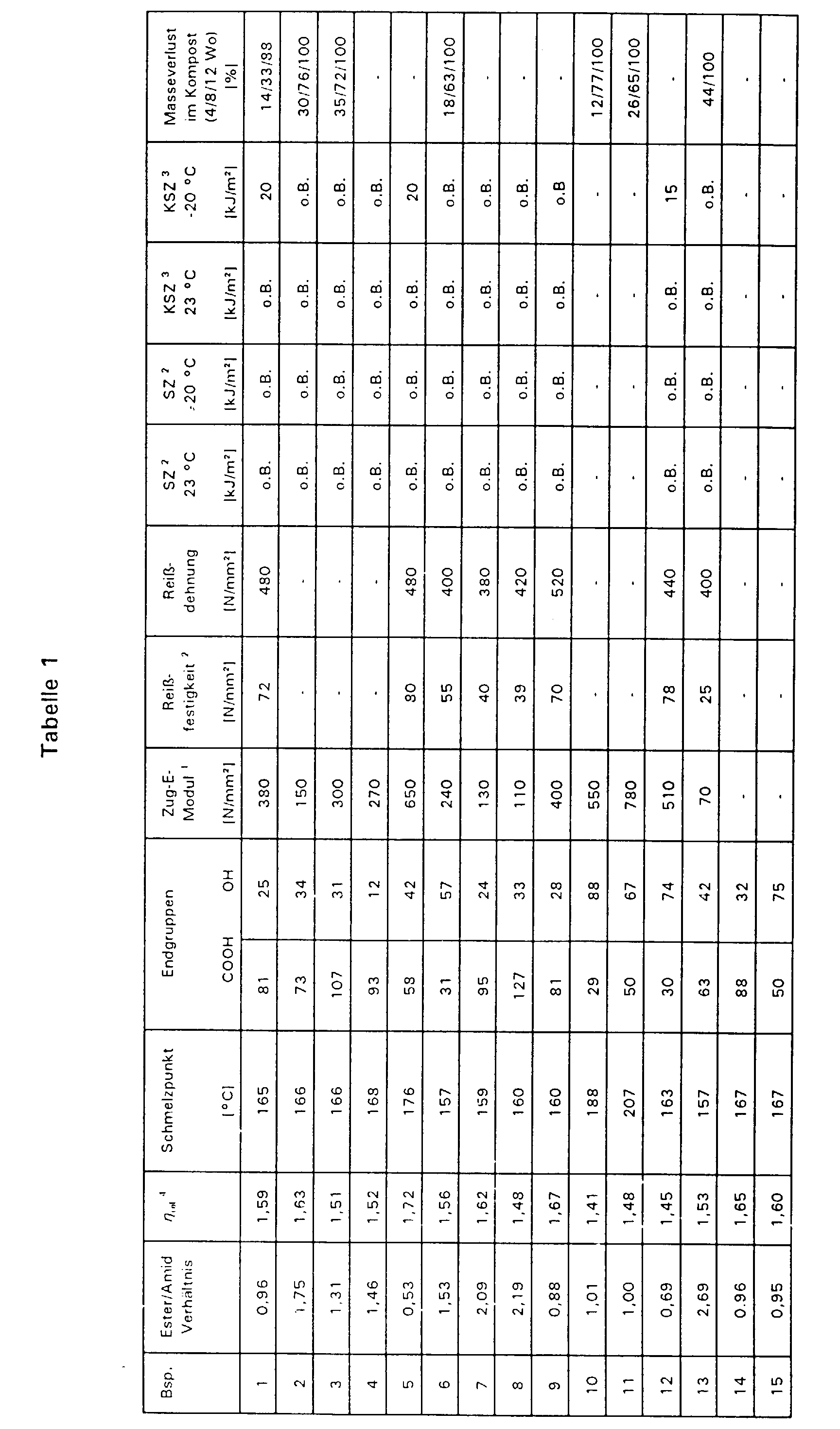
- the molding compositions obtained in Examples 1 to 13 were cooled granulated and before the thermoplastic processing to a water content dried below 0.1%. Drying takes place in a vacuum drying cabinet at 50 ° C and 20 mbar.
- Equipped with a Brabender laboratory extruder with a flat film nozzle and roll take-off flat films with thicknesses of 50 to 200 pm were produced.
- the biodegradability was investigated using foils with an average thickness of 50 ⁇ m and a size of 100 cm 2 in a laboratory composting.
- test films and the compost raw materials were in Dewar containers with a content of approx. 4 l and actively ventilated by a hose system.
- the rise in temperature within the first days of rotting was approximately 10 ° C / day.
- Temperatures of 60 to 67 ° C were measured for 5 to 7 days.
- the compost mass began to cool down again for a further 5 to 7 days reached a temperature of 26 to 32 ° C after a 4-week incubation period. After opening and mixing the compost mass, one could in all cases slight temperature rise can be registered.
- test films turned yellow to brown, mostly losing their transparency and showed cracks and holes over the entire film surface.
- the foils were thinner sharp edges no longer exist, often whole parts were missing.
- the tensile strength and elongation at break decreased dramatically during composting.
Landscapes
- Chemical & Material Sciences (AREA)
- Health & Medical Sciences (AREA)
- Chemical Kinetics & Catalysis (AREA)
- Medicinal Chemistry (AREA)
- Polymers & Plastics (AREA)
- Organic Chemistry (AREA)
- Polyamides (AREA)
- Polyesters Or Polycarbonates (AREA)
- Biological Depolymerization Polymers (AREA)
- Wrappers (AREA)
- Adhesives Or Adhesive Processes (AREA)
Description
| Titrationswerte der in den Beispielen 1 bis 15 eingesetzten Polyole | ||
| µÄqu/g OH | ||
| Polycaprolactpn-Diol mit Molmasse | ca. 780 | 2549 |
| Polycaprolacton-Diol mit Molmasse | ca. 1000 | 1822 |
| Polycaprolacton-Diol mit Molmasse | ca. 2000 | 1040 |
| Polycaprolacton-Triol mit Molmasse | ca. 1000 | 2952 |
| Priplast®3192 mit Molmasse | ca. 2000 | 1059 |
| Priplast®3194 mit Molmasse | ca. 2000 | 996 |
Claims (27)
- Teilkristalline Block-Copolyesterpolyamide aus unterschiedlich strukturierten Segmenten, dadurch gekennzeichnet, daß die Block-Copolyesterpolyamide biologisch abbaubar sind und als Segmentemindestens ein Polyester- oder Copolyester-Block mit einer einheitlichen zahlenmittleren Molmasse zwischen 340 und 10.000 g/Mol undmindestens ein Polyamid- oder Copolyamid-Block mit einer einheitlichen zahlenmittleren Molmasse zwischen 400 und 3.000 g/Mol undwahlweise ein Copolyesteramid-Block mit einer einheitlichen zahlenmittleren Molmasse zwischen 500 und 5.000 g/Mol vorhanden sind.
- Block-Copolyesterpolyamid nach Anspruch 1, dadurch gekennzeichnet, daß die Polyester-, die Copolyester-, die Polyamid-, und die Copolyamid- und Copolyesterpolyamidblöcke aus aliphatischen Monomereinheiten aufgebaut sind, wobei bis zu 20 Mol-% der gesamten Monomeren durch aromatische Einheiten ersetzt sein können.
- Block-Copolyesterpolyamide nach Anspruch 1 und Anspruch 2, dadurch gekennzeichnet, daß die Polyesterblöcke und die Copolyester-blöcke aus Lactonen oder Hydroxycarbonsäuren aufgebaut sind und eine zahlenmittlere Molmasse von 340 bis 6.000 g/Mol, bevorzugt 340 bis 3.000 g/Mol, besonders bevorzugt von 340 bis 1.500 g/Mol, aufweisen.
- Block-Copolyesterpolyamide nach den Ansprüchen 1 und 2, dadurch gekennzeichnet, daß die Polyesterblöcke und die Copolyesterblöcke aus Lactonen oder Hydroxycarbonsäuren aufgebaut sind und durch geringe Anteile an höherfunktionellen aliphatischen Alkoholen eine Funktionalität von mehr als 2, insbesondere von 2 bis 4 aufweisen.
- Block-Copolyesterpolyamide nach den Ansprüchen 3 und 4, dadurch gekennzeichnet, daß die Lactone bevorzugt Caprolacton und Butyrolacton und die Hydroxycarbonsäuren α-, β-, γ- und ω-Hydroxycarbonsäuren, deren Cooligomere sowie deren cyclische Ester, ausgewählt aus der Gruppe der Dilactide und Diglycolide, sind.
- Block-Copolyesterpolyamide nach einem der vorhergehenden Ansprüche, dadurch gekennzeichnet, daß die Polyester oder Copolyesterblökke aus bifunktionellen Alkoholen, insbesondere aus solchen mit 2 bis 10 C-Atomen und aus Dicarbonsäuren, besonders aus solchen mit 2 bis 44 C-Atomen, insbesondere aus solchen Dicarbonsäuren mit 2 bis 18 C-Atomen und mit 36 C-Atomen und mit 44 C-Atomen, aufgebaut sind.
- Block-Copolyesterpolyamide nach den Ansprüchen 1 und 2, dadurch gekennzeichnet, daß die Polyamid- oder Copolyamidblöcke aufgebaut sind aus Monomeren, ausgewählt aus der Gruppe Lactam mit 6 bis 12 C-Atomen, ω-Aminosäuren mit 6 bis 12 C-Atomen, aliphatische Diamine mit 2 bis 10 C-Atomen und Dicarbonsäuren mit 2 bis 44 C-Atomen, insbesondere Dicarbonsäuren mit 2 bis 18 C-Atomen und Dicarbonsäuren mit 36 C-Atomen und mit 44 C-Atomen.
- Block-Copolyesterpolyamide nach den Ansprüchen 1 und 2, dadurch gekennzeichnet, daß die Copolyesteramidblöcke aufgebaut sind aus der Gruppe der Monomere der Polyester-, Copolyester-, Polyamid-, Copolyamidblöcke und aus linearen aliphatischen Aminoalkoholen mit 2 bis 8 C-Atomen.
- Block-Copolyesterpolyamide nach Anspruch 2, dadurch gekennzeichnet, daß die aromatischen Einheiten Isophthalsäure- und Terephthalsäure-Einheiten sind.
- Block-Copolyesterpolyamide nach einem der vorhergehenden Ansprüche 1 bis 9, dadurch gekennzeichnet, daß die Blöcke aus der Gruppe Polyester, Copolyester und Copolyesteramide mindestens 95 % OH-Endgruppen aufweisen.
- Block-Copolyesterpolyamide nach einem der vorhergehenden Ansprüche 1 bis 9, dadurch gekennzeichnet, daß die Blöcke aus der Gruppe Polyamide und Copolyamide mindestens 95 % Carboxyl-Endgruppen aufweisen.
- Block-Copolyesterpolyamide nach einem der vorhergehenden Ansprüche 1 bis 11, dadurch gekennzeichnet, daß die Polyester- oder Copolyester-Blöcke linear sind und eine zahlenmittlere Molmasse zwischen 340 und 2.000 g/Mol aufweisen.
- Block-Copolyesterpolyamide nach einem der vorhergehenden Ansprüche 1 bis 11, dadurch gekennzeichnet, daß die Polyester- oder Copolyester-Blöcke linear sind und eine zahlenmittlere Molmasse zwischen 2.000 und 6.000 g/Mol aufweisen.
- Block-Copolyesterpolyamide nach einem der vorhergehenden Ansprüche 1 bis 11, dadurch gekennzeichnet, daß die Polyamid- oder Copolyamid-Blöcke linear sind und eine zahlenmittlere Molmasse zwischen 400 und 1.000 g/Mol aufweisen.
- Block-Copolyesterpolyamide nach einem der vorhergehenden Ansprüche 1 bis 11, dadurch gekennzeichnet, daß die Polyamid- oder der Copolyamid-Blöcke linear sind und eine zahlenmittlere Molmasse zwischen 1.000 und 2.000 g/Mol aufweisen.
- Block-Copolyesterpolyamide nach einem der vorhergehenden Ansprüche 1 bis 11, dadurch gekennzeichnet, daß mindestens zwei lineare Polyester- oder Copolyester-Blöcke vorhanden sind, deren zahlenmittlere Molmassen sich um mindestens 500 g/Mol, bevorzugt um 1.000 g/Mol unterscheiden.
- Block-Copolyesterpolyamide nach einem der vorhergehenden Ansprüche, dadurch gekennzeichnet, daß die Polyester-, die Copolyester- und die Copolyesteramidblöcke eine Funktionalität von 2 bis 4 aufweisen.
- Block-Copolyesterpolyamide nach einem der vorhergehenden Ansprüchen, dadurch gekennzeichnet, daß mindestens ein linearer Polyester-oder Copolyester-Block mit einer zahlenmittleren Molmasse von 500 bis 10.000 g/Mol und mindestens ein höherfunktioneller Polyester-oder Copolyester-Block mit einer zahlenmittleren Molmasse von 340 bis 3.000 g/Mol vorhanden ist.
- Block-Copolyesterpolyamide nach einem der vorhergehenden Ansprüche, dadurch gekennzeichnet, daß zusätzlich mindestens ein statistischer Copolyester-Block mit einer einheitlichen zahlenmittleren Molmasse zwischen 500 und 5.000 g/Mol vorhanden ist.
- Block-Copolyesterpolyamide nach einem der vorhergehenden Ansprüche, dadurch gekennzeichnet, daß in den Polyesteramid- oder Copolyesteramid-Blöcken das Ester/Amid-Verhältnis über 1,2, bevorzugt zwischen 1,2 und 20,0 liegt.
- Block-Copolyesterpolyamide nach einem der vorhergehenden Ansprüche, dadurch gekennzeichnet, daß das Gesamt-Ester/Amid-Verhältnis des Blockpolymeres über 0,2, bevorzugt zwischen 0.6 und 15,0 liegt.
- Verwendung der biologisch abbaubaren teilkristallinen Block-Copolyesterpolyamide nach den Ansprüchen 1 bis 22 zur Herstellung von Fasern, Folien, Formkörpern und Schmelzkleber.
- Verfahren zur Herstellung von biologisch abbaubaren teilkristallinen Block-Copolyesterpolyamiden nach den Ansprüchen 1 bis 22, dadurch gekennzeichnet, daßa) in einem ersten Polykondensations-Schritt die Polyamid- oder Copolyamid-Blöcke bis zu einer definierten zahlenmittleren Molmasse vorpolymerisiert werden, nachfolgendb) die Polyester-, Copolyester- oder Copolyesteramidblöcke als fertige Ketten-Bausteine zugegeben undc) unter Vakuum in Gegenwart von Katalysatoren in einem zweiten Polykondensationsschritt zum Blockcopolyesterpolyamid fertig kondensiert,d) ausgetragen oder zu Formkörpern weiterverarbeitet werden.
- Verfahren zur Herstellung von teilkristallinen Block-Copolyesterpolyamiden nach Anspruch 23, dadurch gekennzeichnet, daß durch angepaßte Temperatur- und Druckführung sowie Katalysatorkonzentration die zahlenmittleren Molmassen der eingesetzten Polymer-Blockbausteine während des zweiten Polykondensationsschritts nicht verändert werden.
- Verfahren gemäß einem der Ansprüche 23 und 24, dadurch gekennzeichnet, daß man eine Temperatur von 180 bis 260 °C und einen Druck im Bereich von Atmosphärendruck bis zu 18 bar anlegt, dann in Schritt c) langsam entspannt und stufenweise ein Vakuum anlegt.
- Formkörper, hersteilbar aus teilkristallinen Block-Copolyesterpolyamiden nach den Ansprüchen 1 bis 21 durch Blasformen, Extrudieren, Spritzgießen und Schmelzspinnen.
- Schmelzkleber, herstellbar aus teilkristalliunen Block-Copolyesterpolyamiden nach den Ansprüchen 1 bis 22 durch Konfektionieren in bekannter Weise.
Applications Claiming Priority (2)
| Application Number | Priority Date | Filing Date | Title |
|---|---|---|---|
| DE4444948 | 1994-12-16 | ||
| DE4444948A DE4444948C2 (de) | 1994-12-16 | 1994-12-16 | Teilkristalline Block-Copolyesterpolyamide und Verwendung |
Publications (2)
| Publication Number | Publication Date |
|---|---|
| EP0717064A1 EP0717064A1 (de) | 1996-06-19 |
| EP0717064B1 true EP0717064B1 (de) | 1999-03-10 |
Family
ID=6536046
Family Applications (1)
| Application Number | Title | Priority Date | Filing Date |
|---|---|---|---|
| EP95119844A Expired - Lifetime EP0717064B1 (de) | 1994-12-16 | 1995-12-15 | Teilkristalline Block-Copolyesterpolyamide |
Country Status (7)
| Country | Link |
|---|---|
| US (1) | US5703177A (de) |
| EP (1) | EP0717064B1 (de) |
| AT (1) | ATE177446T1 (de) |
| AU (1) | AU697198B2 (de) |
| CA (1) | CA2165354A1 (de) |
| DE (2) | DE4444948C2 (de) |
| NO (1) | NO955089L (de) |
Families Citing this family (15)
| Publication number | Priority date | Publication date | Assignee | Title |
|---|---|---|---|---|
| NL1003459C2 (nl) * | 1996-06-28 | 1998-01-07 | Univ Twente | Copoly(ester-amides) en copoly(ester-urethanen). |
| DE19643143C2 (de) * | 1996-10-18 | 2002-06-20 | Inventa Ag | Haftvermittler für Polyamid-Verbunde, Verfahren zu deren Herstellung sowie deren Verwendung |
| DE19800698A1 (de) * | 1998-01-10 | 1999-07-15 | Bayer Ag | Biologisch abbaubare Polyesteramide mit blockartig aufgebauten Polyester- und Polyamid-Segmenten |
| DE19806930A1 (de) * | 1998-02-19 | 1999-08-26 | Bayer Ag | Biologisch abbaubare Polyesteramide mit aliphatisch-aromatischen Strukturen |
| DE19811226A1 (de) * | 1998-03-18 | 1999-09-30 | Wolff Walsrode Ag | Mehrschichtige, thermoplastische Folien aus Polyesteramid und Verfahren zu deren Herstellung |
| ATE399572T1 (de) * | 2003-10-17 | 2008-07-15 | Invatec Srl | Katheterballon |
| US7511081B2 (en) * | 2004-03-26 | 2009-03-31 | Do-Gyun Kim | Recycled method for a wasted polymer which is mixed polyester polyamide and reclaimed materials thereof |
| BRPI0617034A2 (pt) * | 2005-09-08 | 2011-07-19 | Dow Global Technologies Inc | uso de um polìmero termoplástico de poliéster/amida numa formulação de adesivo hot melt, método para aplicar um adesivo hot melt, método para ligar um primeiro substrato a um segundo substrato, artigo tecido ou não tecido, caixa, caixa de papelão ou bandeja, livro, e melhoramento em artigo |
| KR20090012343A (ko) * | 2006-05-31 | 2009-02-03 | 이 아이 듀폰 디 네모아 앤드 캄파니 | 폴리아미드 블록 공중합체의 제법 |
| FR2909675B1 (fr) | 2006-12-08 | 2012-10-12 | Arkema France | Copolymere a blocs polyamide, polyester et polyether |
| US20100064647A1 (en) * | 2007-02-14 | 2010-03-18 | Brands Gerrit J | Polymer or oligomer fibers by solvent-free electrospinning |
| US20140213738A1 (en) * | 2011-09-02 | 2014-07-31 | Cornell University | Poly(ester amide)s and poly(ester ether amide)s with aliphatic polyesters, method of making same, and uses thereof |
| EP2647718A3 (de) | 2012-04-06 | 2014-12-24 | Metabolic Explorer | Verfahren zur Herstellung von 5-Aminopentanoat unter Verwendung eines rekombinanten Mikroorganismus |
| EP2708569B1 (de) * | 2012-09-12 | 2018-05-23 | Ems-Patent Ag | Transparente polyamidimide |
| FR3102178B1 (fr) * | 2019-10-16 | 2021-11-05 | Polymerexpert Sa | Polyamides gélifiants biosourcés |
Family Cites Families (22)
| Publication number | Priority date | Publication date | Assignee | Title |
|---|---|---|---|---|
| US4042645A (en) * | 1969-11-27 | 1977-08-16 | Mitsui Toatsu Chemicals, Incorporated | Process for producing thermosetting finishing powders |
| US3781379A (en) * | 1971-08-16 | 1973-12-25 | Ford Motor Co | Powdered coating compositions containing glycidyl methacrylate copolymers with anhydride crosslinking agents and flow control agent |
| FR2345476A1 (fr) * | 1976-03-22 | 1977-10-21 | Rhone Poulenc Textile | Nouveaux polyesteramides |
| US4129715A (en) * | 1977-06-03 | 1978-12-12 | The Upjohn Company | Polyester amides suitable for injection molding |
| JPS54119593A (en) * | 1978-03-09 | 1979-09-17 | Agency Of Ind Science & Technol | Biodegradation of copolyester-amide |
| JPS54119594A (en) * | 1978-03-09 | 1979-09-17 | Agency Of Ind Science & Technol | Biodegradable film |
| JPS54119595A (en) * | 1978-03-09 | 1979-09-17 | Agency Of Ind Science & Technol | Biodegradable copolymer and its preparation |
| JPS54120727A (en) * | 1978-03-09 | 1979-09-19 | Agency Of Ind Science & Technol | Biodegradable fiber |
| JPS5531207A (en) * | 1978-08-25 | 1980-03-05 | Toshiba Corp | Method for impregnating washing medium of cleaner for condenser |
| JPS598365B2 (ja) * | 1980-04-21 | 1984-02-24 | 工業技術院長 | 生分解性農業用マルチフィルム |
| DE3435053A1 (de) * | 1984-09-25 | 1986-04-03 | Hüls AG, 4370 Marl | Verwendung von blockcopolyesteramiden als textilschmelzkleber |
| JPS6234952A (ja) * | 1985-08-07 | 1987-02-14 | Daicel Chem Ind Ltd | 高分子感温材料 |
| JPS62135521A (ja) * | 1985-12-10 | 1987-06-18 | Daicel Chem Ind Ltd | 末端にカルボキシル基を有するポリカプロラクトン |
| JPS63182343A (ja) * | 1987-01-23 | 1988-07-27 | Asahi Chem Ind Co Ltd | ポリエ−テルエステルアミドの製造法 |
| DE4024981A1 (de) * | 1990-08-07 | 1992-02-13 | Schering Ag | Verwendung von polyamidharzen fuer den reliefdruck |
| JP3115660B2 (ja) * | 1990-12-07 | 2000-12-11 | キヤノン株式会社 | 分解性プラスチックを構成の一部に用いたインクジェットヘッドカートリッジ、インクタンクカートリッジおよびこれらカートリッジ類が装着される装着部を有したインクジェット装置 |
| US5272221A (en) * | 1991-04-09 | 1993-12-21 | Mitsui Toatsu Chemicals, Incorporated | Nylon composition having increased hydrolyzability and method for increasing hydrolyzability of nylon |
| US5258407A (en) * | 1991-12-31 | 1993-11-02 | Sterling Winthrop Inc. | 3,4-disubstituted phenols-immunomodulating agents |
| CA2125168A1 (en) * | 1992-01-15 | 1993-07-22 | Thomas H. Barrows | Bioabsorbable poly(esteramide) and method for making same |
| CA2090201A1 (en) * | 1992-03-06 | 1993-09-07 | Norman L. Holy | Degradable polyamides |
| DE4234305A1 (de) * | 1992-10-12 | 1994-04-14 | Bayer Ag | Kompostierbarer Schmelzklebstoff |
| US5446109A (en) * | 1993-02-23 | 1995-08-29 | Teijin Limited | Polyamide/aliphatic polyester block copolymer, process for the production thereof, and blend containing the same |
-
1994
- 1994-12-16 DE DE4444948A patent/DE4444948C2/de not_active Expired - Fee Related
-
1995
- 1995-12-14 AU AU40426/95A patent/AU697198B2/en not_active Ceased
- 1995-12-15 US US08/573,058 patent/US5703177A/en not_active Expired - Fee Related
- 1995-12-15 DE DE59505289T patent/DE59505289D1/de not_active Expired - Fee Related
- 1995-12-15 CA CA002165354A patent/CA2165354A1/en not_active Abandoned
- 1995-12-15 AT AT95119844T patent/ATE177446T1/de not_active IP Right Cessation
- 1995-12-15 NO NO955089A patent/NO955089L/no unknown
- 1995-12-15 EP EP95119844A patent/EP0717064B1/de not_active Expired - Lifetime
Also Published As
| Publication number | Publication date |
|---|---|
| AU4042695A (en) | 1996-06-27 |
| DE59505289D1 (de) | 1999-04-15 |
| DE4444948C2 (de) | 2000-02-24 |
| ATE177446T1 (de) | 1999-03-15 |
| EP0717064A1 (de) | 1996-06-19 |
| US5703177A (en) | 1997-12-30 |
| AU697198B2 (en) | 1998-10-01 |
| DE4444948A1 (de) | 1996-06-20 |
| NO955089L (no) | 1996-06-17 |
| CA2165354A1 (en) | 1996-06-17 |
| NO955089D0 (no) | 1995-12-15 |
Similar Documents
| Publication | Publication Date | Title |
|---|---|---|
| EP0717064B1 (de) | Teilkristalline Block-Copolyesterpolyamide | |
| EP0641817B1 (de) | Thermoplastisch verarbeitbare und biologisch abbaubare aliphatische Polyesteramide | |
| EP0802939B1 (de) | Biologisch abbaubare polymere, verfahren zu deren herstellung sowie deren verwendung zur herstellung bioabbaubarer formkörper | |
| EP0802941B1 (de) | Biologisch abbaubare polymere, verfahren zu deren herstellung sowie deren verwendung zur herstellung bioabbaubarer formkörper | |
| US7544746B2 (en) | Hyperbranched polymers | |
| EP1036107A1 (de) | Polyetheresteramide | |
| DE69915772T2 (de) | Copolyester mit verminderter hydrolytischer Instabilität und kristalline absorbierbare Copolymere daraus | |
| DE19753534A1 (de) | Schnell kristallisierende, biologisch abbaubare Polyesteramide | |
| WO1996021691A1 (de) | Biologisch abbaubare polymere, verfahren zu deren herstellung sowie deren verwendung zur herstellung bioabbaubarer formkörper | |
| DE3586414T2 (de) | Zusammensetzung von thermoplastischem elastomer. | |
| JP3387052B2 (ja) | 生分解性ポリエステル樹脂組成物とその用途 | |
| DE10057678A1 (de) | Verfahren zur Herstellung von schmelzfähigen Polyestern | |
| US20090286927A1 (en) | Hyperbranched Polymers | |
| KR0163495B1 (ko) | 지방족 공중합 폴리에스테르로 된 플랫얀의 제조방법 | |
| JP3584579B2 (ja) | 可塑化された脂肪族ポリエステル組成物及びその成型品 | |
| JP2709236B2 (ja) | ポリエステル製マルチフィラメント | |
| JP2709234B2 (ja) | ポリエステル製ステープル | |
| JP2653711B2 (ja) | ポリウレタン | |
| JPH0747599A (ja) | ポリエステル製テープ | |
| JP2709235B2 (ja) | ポリエステル製捲縮繊維 | |
| JP2000327760A (ja) | ポリエステルジオール、それから得られるポリウレタン及びそのスパンデックス(登録商標)フィラメント | |
| JP2004018843A (ja) | 耐水性が改良された樹脂組成物及び成形体 | |
| EP1137831A1 (de) | Verfahren zur verbesserung der standzeit von filamenten, fasern oder folien auf der basis biologisch abbaubarer polymerer | |
| JPH06248510A (ja) | ポリエステル製並び繊維 | |
| DE10018936A1 (de) | Polyetheresteramide zur Herstellung dünner Folien |
Legal Events
| Date | Code | Title | Description |
|---|---|---|---|
| PUAI | Public reference made under article 153(3) epc to a published international application that has entered the european phase |
Free format text: ORIGINAL CODE: 0009012 |
|
| AK | Designated contracting states |
Kind code of ref document: A1 Designated state(s): AT BE CH DE FR GB IT LI NL SE |
|
| 17P | Request for examination filed |
Effective date: 19960715 |
|
| GRAG | Despatch of communication of intention to grant |
Free format text: ORIGINAL CODE: EPIDOS AGRA |
|
| GRAG | Despatch of communication of intention to grant |
Free format text: ORIGINAL CODE: EPIDOS AGRA |
|
| GRAH | Despatch of communication of intention to grant a patent |
Free format text: ORIGINAL CODE: EPIDOS IGRA |
|
| 17Q | First examination report despatched |
Effective date: 19980629 |
|
| GRAH | Despatch of communication of intention to grant a patent |
Free format text: ORIGINAL CODE: EPIDOS IGRA |
|
| GRAA | (expected) grant |
Free format text: ORIGINAL CODE: 0009210 |
|
| AK | Designated contracting states |
Kind code of ref document: B1 Designated state(s): AT BE CH DE FR GB IT LI NL SE |
|
| REF | Corresponds to: |
Ref document number: 177446 Country of ref document: AT Date of ref document: 19990315 Kind code of ref document: T |
|
| REG | Reference to a national code |
Ref country code: CH Ref legal event code: EP |
|
| GBT | Gb: translation of ep patent filed (gb section 77(6)(a)/1977) |
Effective date: 19990310 |
|
| REF | Corresponds to: |
Ref document number: 59505289 Country of ref document: DE Date of ref document: 19990415 |
|
| ET | Fr: translation filed | ||
| ITF | It: translation for a ep patent filed | ||
| PLBE | No opposition filed within time limit |
Free format text: ORIGINAL CODE: 0009261 |
|
| STAA | Information on the status of an ep patent application or granted ep patent |
Free format text: STATUS: NO OPPOSITION FILED WITHIN TIME LIMIT |
|
| 26N | No opposition filed | ||
| PGFP | Annual fee paid to national office [announced via postgrant information from national office to epo] |
Ref country code: GB Payment date: 20001115 Year of fee payment: 6 |
|
| PGFP | Annual fee paid to national office [announced via postgrant information from national office to epo] |
Ref country code: NL Payment date: 20001121 Year of fee payment: 6 |
|
| PGFP | Annual fee paid to national office [announced via postgrant information from national office to epo] |
Ref country code: AT Payment date: 20001122 Year of fee payment: 6 |
|
| PGFP | Annual fee paid to national office [announced via postgrant information from national office to epo] |
Ref country code: BE Payment date: 20001130 Year of fee payment: 6 |
|
| PGFP | Annual fee paid to national office [announced via postgrant information from national office to epo] |
Ref country code: CH Payment date: 20001201 Year of fee payment: 6 |
|
| PGFP | Annual fee paid to national office [announced via postgrant information from national office to epo] |
Ref country code: SE Payment date: 20001204 Year of fee payment: 6 Ref country code: FR Payment date: 20001204 Year of fee payment: 6 |
|
| PGFP | Annual fee paid to national office [announced via postgrant information from national office to epo] |
Ref country code: DE Payment date: 20001213 Year of fee payment: 6 |
|
| PG25 | Lapsed in a contracting state [announced via postgrant information from national office to epo] |
Ref country code: GB Free format text: LAPSE BECAUSE OF NON-PAYMENT OF DUE FEES Effective date: 20011215 Ref country code: AT Free format text: LAPSE BECAUSE OF NON-PAYMENT OF DUE FEES Effective date: 20011215 |
|
| PG25 | Lapsed in a contracting state [announced via postgrant information from national office to epo] |
Ref country code: SE Free format text: LAPSE BECAUSE OF NON-PAYMENT OF DUE FEES Effective date: 20011216 |
|
| PG25 | Lapsed in a contracting state [announced via postgrant information from national office to epo] |
Ref country code: LI Free format text: LAPSE BECAUSE OF NON-PAYMENT OF DUE FEES Effective date: 20011231 Ref country code: CH Free format text: LAPSE BECAUSE OF NON-PAYMENT OF DUE FEES Effective date: 20011231 Ref country code: BE Free format text: LAPSE BECAUSE OF NON-PAYMENT OF DUE FEES Effective date: 20011231 |
|
| REG | Reference to a national code |
Ref country code: GB Ref legal event code: IF02 |
|
| BERE | Be: lapsed |
Owner name: EMS-INVENTA A.G. Effective date: 20011231 |
|
| PG25 | Lapsed in a contracting state [announced via postgrant information from national office to epo] |
Ref country code: NL Free format text: LAPSE BECAUSE OF NON-PAYMENT OF DUE FEES Effective date: 20020701 |
|
| PG25 | Lapsed in a contracting state [announced via postgrant information from national office to epo] |
Ref country code: DE Free format text: LAPSE BECAUSE OF NON-PAYMENT OF DUE FEES Effective date: 20020702 |
|
| EUG | Se: european patent has lapsed |
Ref document number: 95119844.9 |
|
| GBPC | Gb: european patent ceased through non-payment of renewal fee |
Effective date: 20011215 |
|
| REG | Reference to a national code |
Ref country code: CH Ref legal event code: PL |
|
| PG25 | Lapsed in a contracting state [announced via postgrant information from national office to epo] |
Ref country code: FR Free format text: LAPSE BECAUSE OF NON-PAYMENT OF DUE FEES Effective date: 20020830 |
|
| NLV4 | Nl: lapsed or anulled due to non-payment of the annual fee |
Effective date: 20020701 |
|
| REG | Reference to a national code |
Ref country code: FR Ref legal event code: ST |
|
| PG25 | Lapsed in a contracting state [announced via postgrant information from national office to epo] |
Ref country code: IT Free format text: LAPSE BECAUSE OF NON-PAYMENT OF DUE FEES;WARNING: LAPSES OF ITALIAN PATENTS WITH EFFECTIVE DATE BEFORE 2007 MAY HAVE OCCURRED AT ANY TIME BEFORE 2007. THE CORRECT EFFECTIVE DATE MAY BE DIFFERENT FROM THE ONE RECORDED. Effective date: 20051215 |