EP0740182A2 - Flüssigkristall-Anzeigevorrichtung und Verfahren zu ihrer Herstellung - Google Patents
Flüssigkristall-Anzeigevorrichtung und Verfahren zu ihrer Herstellung Download PDFInfo
- Publication number
- EP0740182A2 EP0740182A2 EP96106568A EP96106568A EP0740182A2 EP 0740182 A2 EP0740182 A2 EP 0740182A2 EP 96106568 A EP96106568 A EP 96106568A EP 96106568 A EP96106568 A EP 96106568A EP 0740182 A2 EP0740182 A2 EP 0740182A2
- Authority
- EP
- European Patent Office
- Prior art keywords
- color filter
- region
- electrode
- liquid crystal
- optical modulation
- Prior art date
- Legal status (The legal status is an assumption and is not a legal conclusion. Google has not performed a legal analysis and makes no representation as to the accuracy of the status listed.)
- Granted
Links
Images



Classifications
-
- G—PHYSICS
- G02—OPTICS
- G02F—OPTICAL DEVICES OR ARRANGEMENTS FOR THE CONTROL OF LIGHT BY MODIFICATION OF THE OPTICAL PROPERTIES OF THE MEDIA OF THE ELEMENTS INVOLVED THEREIN; NON-LINEAR OPTICS; FREQUENCY-CHANGING OF LIGHT; OPTICAL LOGIC ELEMENTS; OPTICAL ANALOGUE/DIGITAL CONVERTERS
- G02F1/00—Devices or arrangements for the control of the intensity, colour, phase, polarisation or direction of light arriving from an independent light source, e.g. switching, gating or modulating; Non-linear optics
- G02F1/01—Devices or arrangements for the control of the intensity, colour, phase, polarisation or direction of light arriving from an independent light source, e.g. switching, gating or modulating; Non-linear optics for the control of the intensity, phase, polarisation or colour
- G02F1/13—Devices or arrangements for the control of the intensity, colour, phase, polarisation or direction of light arriving from an independent light source, e.g. switching, gating or modulating; Non-linear optics for the control of the intensity, phase, polarisation or colour based on liquid crystals, e.g. single liquid crystal display cells
- G02F1/133—Constructional arrangements; Operation of liquid crystal cells; Circuit arrangements
- G02F1/1333—Constructional arrangements; Manufacturing methods
- G02F1/1343—Electrodes
- G02F1/134309—Electrodes characterised by their geometrical arrangement
- G02F1/134336—Matrix
-
- G—PHYSICS
- G02—OPTICS
- G02F—OPTICAL DEVICES OR ARRANGEMENTS FOR THE CONTROL OF LIGHT BY MODIFICATION OF THE OPTICAL PROPERTIES OF THE MEDIA OF THE ELEMENTS INVOLVED THEREIN; NON-LINEAR OPTICS; FREQUENCY-CHANGING OF LIGHT; OPTICAL LOGIC ELEMENTS; OPTICAL ANALOGUE/DIGITAL CONVERTERS
- G02F1/00—Devices or arrangements for the control of the intensity, colour, phase, polarisation or direction of light arriving from an independent light source, e.g. switching, gating or modulating; Non-linear optics
- G02F1/01—Devices or arrangements for the control of the intensity, colour, phase, polarisation or direction of light arriving from an independent light source, e.g. switching, gating or modulating; Non-linear optics for the control of the intensity, phase, polarisation or colour
- G02F1/13—Devices or arrangements for the control of the intensity, colour, phase, polarisation or direction of light arriving from an independent light source, e.g. switching, gating or modulating; Non-linear optics for the control of the intensity, phase, polarisation or colour based on liquid crystals, e.g. single liquid crystal display cells
- G02F1/133—Constructional arrangements; Operation of liquid crystal cells; Circuit arrangements
- G02F1/1333—Constructional arrangements; Manufacturing methods
- G02F1/133345—Insulating layers
-
- G—PHYSICS
- G02—OPTICS
- G02F—OPTICAL DEVICES OR ARRANGEMENTS FOR THE CONTROL OF LIGHT BY MODIFICATION OF THE OPTICAL PROPERTIES OF THE MEDIA OF THE ELEMENTS INVOLVED THEREIN; NON-LINEAR OPTICS; FREQUENCY-CHANGING OF LIGHT; OPTICAL LOGIC ELEMENTS; OPTICAL ANALOGUE/DIGITAL CONVERTERS
- G02F1/00—Devices or arrangements for the control of the intensity, colour, phase, polarisation or direction of light arriving from an independent light source, e.g. switching, gating or modulating; Non-linear optics
- G02F1/01—Devices or arrangements for the control of the intensity, colour, phase, polarisation or direction of light arriving from an independent light source, e.g. switching, gating or modulating; Non-linear optics for the control of the intensity, phase, polarisation or colour
- G02F1/13—Devices or arrangements for the control of the intensity, colour, phase, polarisation or direction of light arriving from an independent light source, e.g. switching, gating or modulating; Non-linear optics for the control of the intensity, phase, polarisation or colour based on liquid crystals, e.g. single liquid crystal display cells
- G02F1/133—Constructional arrangements; Operation of liquid crystal cells; Circuit arrangements
- G02F1/1333—Constructional arrangements; Manufacturing methods
- G02F1/1335—Structural association of cells with optical devices, e.g. polarisers or reflectors
- G02F1/133509—Filters, e.g. light shielding masks
- G02F1/133514—Colour filters
-
- G—PHYSICS
- G02—OPTICS
- G02F—OPTICAL DEVICES OR ARRANGEMENTS FOR THE CONTROL OF LIGHT BY MODIFICATION OF THE OPTICAL PROPERTIES OF THE MEDIA OF THE ELEMENTS INVOLVED THEREIN; NON-LINEAR OPTICS; FREQUENCY-CHANGING OF LIGHT; OPTICAL LOGIC ELEMENTS; OPTICAL ANALOGUE/DIGITAL CONVERTERS
- G02F1/00—Devices or arrangements for the control of the intensity, colour, phase, polarisation or direction of light arriving from an independent light source, e.g. switching, gating or modulating; Non-linear optics
- G02F1/01—Devices or arrangements for the control of the intensity, colour, phase, polarisation or direction of light arriving from an independent light source, e.g. switching, gating or modulating; Non-linear optics for the control of the intensity, phase, polarisation or colour
- G02F1/13—Devices or arrangements for the control of the intensity, colour, phase, polarisation or direction of light arriving from an independent light source, e.g. switching, gating or modulating; Non-linear optics for the control of the intensity, phase, polarisation or colour based on liquid crystals, e.g. single liquid crystal display cells
- G02F1/133—Constructional arrangements; Operation of liquid crystal cells; Circuit arrangements
- G02F1/1333—Constructional arrangements; Manufacturing methods
- G02F1/133388—Constructional arrangements; Manufacturing methods with constructional differences between the display region and the peripheral region
-
- G—PHYSICS
- G02—OPTICS
- G02F—OPTICAL DEVICES OR ARRANGEMENTS FOR THE CONTROL OF LIGHT BY MODIFICATION OF THE OPTICAL PROPERTIES OF THE MEDIA OF THE ELEMENTS INVOLVED THEREIN; NON-LINEAR OPTICS; FREQUENCY-CHANGING OF LIGHT; OPTICAL LOGIC ELEMENTS; OPTICAL ANALOGUE/DIGITAL CONVERTERS
- G02F1/00—Devices or arrangements for the control of the intensity, colour, phase, polarisation or direction of light arriving from an independent light source, e.g. switching, gating or modulating; Non-linear optics
- G02F1/01—Devices or arrangements for the control of the intensity, colour, phase, polarisation or direction of light arriving from an independent light source, e.g. switching, gating or modulating; Non-linear optics for the control of the intensity, phase, polarisation or colour
- G02F1/13—Devices or arrangements for the control of the intensity, colour, phase, polarisation or direction of light arriving from an independent light source, e.g. switching, gating or modulating; Non-linear optics for the control of the intensity, phase, polarisation or colour based on liquid crystals, e.g. single liquid crystal display cells
- G02F1/133—Constructional arrangements; Operation of liquid crystal cells; Circuit arrangements
- G02F1/1333—Constructional arrangements; Manufacturing methods
- G02F1/1335—Structural association of cells with optical devices, e.g. polarisers or reflectors
- G02F1/133509—Filters, e.g. light shielding masks
- G02F1/133512—Light shielding layers, e.g. black matrix
Definitions
- the present invention relates a liquid crystal device, particularly a liquid crystal device equipped with a color filter, and a process for producing the liquid crystal device.
- liquid crystal device comprising a pair of substrates each provided with an electrode and a liquid crystal disposed between the substrates.
- the liquid device performs optical modulation by applying a voltage to the liquid crystal to applying a voltage to the liquid crystal to control alignment (or orientation) of liquid crystal molecules.
- liquid crystal display devices wherein alignment of liquid crystal molecules is controlled by applying a voltage in accordance with image data (image information) to form a display image has arrested attention as flat panel displays in place of display devices using a cathode-ray tube (CRT).
- CTR cathode-ray tube
- a color liquid crystal panel including: a pair of substrates on one of which substrates a color filter film portion comprising at least three color films of red (R), green (G) and blue (B); electrodes as light switches each corresponding to respective color films; and a liquid crystal disposed between the substrates.
- Figure 1 shows an embodiment of a color liquid crystal display device 4 including a pair of substrates 41 and 41a disposed opposite to each other with a prescribed gap by means of a spacer 46 and a liquid crystal 42 filling the gap and sandwiched between the substrates 41 and 41a.
- the device 4 has an effective optical modulation region a comprising a plurality of display pixels (picture elements) constituting a display region and also has a peripheral region b located outside of and in contact with the effective optical modulation region a .
- a group of color filter films 43 comprising three color films containing corresponding colored resins of red (R), green (G) and blue (B), respectively and a flat (or even) layer or film 44 comprising a transparent resin as a main component for coating (or covering) the group of color filter films 43 and for flattening the resultant surface are successively formed on at least one of the substrates (on the substrate 41 in this embodiment).
- a group of plural transparent electrodes 45 having a prescribed pattern corresponding to display pixels in order to drive the liquid crystal display device is formed.
- a group of plural transparent electrode 45a having a prescribed pattern corresponding to display pixels are formed.
- display pixels are formed at intersections of the groups of transparent electrodes 45 and 45a constituting an electrode matrix.
- a voltage is applied to the liquid crystal 42 (liquid crystal layer) through the groups of transparent electrodes 45 and 45a, whereby an alignment (orientation) state of liquid crystal molecules can be controlled to appropriately effect optical modulation, thus performing image display etc.
- the peripheral region b is not a region contributing to optical modulation.
- the flat layer 44 is continuously formed on the substrate 41, i.e., extends from the region a to the region b, so that a gap between the substrates 41 and 41a to be filled with the liquid crystal is adjusted as uniform as possible in the regions a and b as a whole.
- the substrates 41 and 41a are sealed with a sealing agent 47 as an end portion (in the region b in this embodiment).
- Figure 2 shows another embodiment of a color liquid crystal display device principally having the similar cell structure as in Figure 1.
- identical structural members (or elements) are shown by identical reference numerals used in the device of Figure 1 described above.
- insulating films (alignment control films) 49 and 49a having been subjected to uniaxial aligning treatment are formed on the groups of transparent electrodes 45 and 45a, respectively, formed on the substrates 41 and 41a, respectively, in the effective optical modulation region a .
- a color filter film portion 43a is formed on the substrate 41.
- the flat film 44 and insulating film 48 are successively formed and each continuously extends from the region a to the region b.
- the insulating film 48a which continuously extends from the region a to the region b is formed.
- the gap between the substrates i.e., cell gap or the thickness of liquid crystal layer
- the gap between the substrates is not uniformized sufficiently in the regions a and b as a whole, thus failing to effect uniform control of an alignment state of liquid crystal molecules over the entire liquid crystal panel.
- the alignment state in the vicinity of an end portion of the effective optical modulation region a is liable to become ununiform.
- liquid crystal devices as shown in Figures 1 and 2 are liable to cause defects resulting from an electrode substrate production process and materials used therefor.
- the production (or preparation) of respective substrate constituting the liquid crystal device particularly that of the substrate 41 equipped with the group of color filter films may be performed as follows.
- a group of color filter films 43 and 43a is formed on a substrate 41 (e.g., sheet of flat glass) and then a flat film 44 is formed on the entire surface of the substrate 41 provided with the group of color filter films 43 and 43a as shown in Figure 2.
- a film of an electroconductive transparent material e.g., ITO film
- a prescribed resist pattern as a mask is formed according to a photolithographic process, followed by etching to form a group of electrodes 45 having a prescribed pattern in a region corresponding to the effective optical modulation region a . Further, an insulating film 48 is formed on the entire electrodes 45, as desired.
- a chlorine ion-containing solution such as a hydroiodic acid-ferric chloride mixture solution or a hydrochloric acid-ferric chloride mixture solution is used as an etchant (etching solution).
- etching solution a chlorine ion-containing solution, such as a hydroiodic acid-ferric chloride mixture solution or a hydrochloric acid-ferric chloride mixture solution.
- sodium ions are provided on the substrate 41 in a heating step after the etching step, e.g., a hot (heat) curing step of forming an insulating film 48 as an upper layer or a heating step at 200 o C or above in the aligning treatment of a liquid crystal material.
- a heating step e.g., a hot (heat) curing step of forming an insulating film 48 as an upper layer or a heating step at 200 o C or above in the aligning treatment of a liquid crystal material.
- the chlorine ion and the sodium ion react with each other to precipitate sodium chloride, whereby the flat film 44 and/or the color filter film 43a located lower than the electrode are liable to be peeled off.
- This phenomenon also adversely affects the layers formed in the effective modulation region a and those formed on the substrate 41a free from the color filter film in case where some film or layer is formed under the electrode according to necessity.
- a high-purity glass plate having a low or no impurity content e.g., sodium content
- a high-purity glass plate having a low or no impurity content e.g., sodium content
- a barrier layer formed under the color filter film or formed on the flat film is tried to prevent the penetration of and reaction of the chlorine ion with the sodium ion.
- An object of the present invention is to provide a liquid crystal device, including a pair of substrates each provided with an electrode and a liquid crystal sandwiched between the substrate, providing a uniform gap or spacing between the substrates (i.e., cell gap or liquid crystal layer thickness) over the entire region of the device to allow uniform and good alignment state of liquid crystal molecules in the entire region and preventing peeling of a layer in lamination layer structure of a substrate, particularly in a region other than an effective optical modulation region, to suppress an occurrence of a defect in a resultant device, such as an alignment defect.
- a uniform gap or spacing between the substrates i.e., cell gap or liquid crystal layer thickness
- Another object of the present invention is to provide a process for producing the liquid crystal device described above.
- a liquid crystal device comprising: a pair of substrates each provided with an electrode, and a liquid crystal disposed between the pair of substrates to provide an effective optical modulation region and a peripheral region, wherein at least one substrate of the pair of substrates comprises an intermediate layer disposed between the substrate and the electrode in the effective optical modulation region and the peripheral region, and the electrode on the intermediate layer comprises a first electrode disposed at least in the effective optical modulation region and a second electrode disposed in the peripheral region, the first and second electrodes being separated from each other.
- a liquid crystal device comprising: a pair of substrates each provided with an electrode, and a liquid crystal disposed between the pair of substrates to provide an effective optical modulation region and a peripheral region, wherein at least one substrate of the pair of substrates has an effective optical modulation region and a peripheral region including a first region and a second region disposed opposite to each other with respect to the effective optical modulation region, and the electrode on said at least one substrate has a first pattern in the form of stripes extending from the effective optical modulation region to a an outside portion via the second region to be connected with an external drive unit and has a second pattern in the first region apart from the first pattern.
- a process for producing a liquid crystal device comprising a pair of substrates each provided with an electrode, and a liquid crystal disposed between the pair of substrates to provide an effective optical modulation region and a peripheral region; including the steps of:
- Figure 1 is a sectional view of an embodiment of a liquid crystal device.
- Figure 2 is a sectional view of another embodiment of a liquid crystal device.
- Figure 3 is a plan view of a liquid crystal device according to a first embodiment of the present invention.
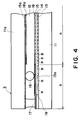
- Figure 4 is a sectional view of the liquid crystal device taken along line A-A in Figure 3.
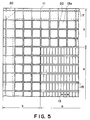
- Figure 5 is a plan view of a liquid crystal device according to a second embodiment of the present invention.
- Figure 6 is a plan view of a liquid crystal device according to a third embodiment of the present invention.
- the liquid crystal device is characterized by providing at least one substrate with a first electrode group at least in an effective optical modulation region and a second electrode (group) in peripheral region, whereby a cell gap is uniformized in the entire region where a liquid crystal material is filled and an alignment state of the liquid crystal material can be controlled uniformly in the entire region including the effective optical modulation region and the peripheral region.
- the second electrode located in the peripheral region is apart (separated) from the first electrode located in the effective optical modulation region.
- the second electrode functions as a dummy electrode which is not actuated or supplied with an voltage, thus failing to contribute to control of alignment (orientation) direction (e.g., switching) of liquid crystal molecules.
- the second (dummy) electrode is effective in preventing an adverse influence of a short-circuit occurred in the peripheral region on the effective optical modulation region since the second electrode is separated (insulated) from the first (or display) electrode formed in the effective optical modulation region.
- an optical modulation region means a display region having a prescribed display area in which a transmittance of a large number of pixels is controlled by using an applied drive signal to effect display in the case of a display device or means a region having a prescribed optical modulation area in which appropriate optical modulation is performed depending on drive signals in the case of a non-display device (a device other than the display device).
- peripheral region means at least one region which does not substantially contribute to optical modulation (e.g., control of transmittance) and disposed outside the effective optical modulation region.
- the peripheral region may preferably comprise two regions opposite to each other via the effective optical modulation.
- the peripheral region may more preferably enclose (surround) the effective optical modulation region on all (four) sides thereof.
- an electrode (group) is formed in not only the effective optical modulation region but also the peripheral region.
- a layer of an electrode material formed in the above manner is patterned by etching treatment in both the regions to provide a prescribed pattern.
- the thus patterned electrode is not removed by the etching treatment but remains in the peripheral region, whereby the penetration of a specific ion, e.g., chlorine ion, contained in the etchant used in the etching treatment into the lower layer(s) closer to the substrate can be suppressed.
- an adverse influence of a (peeling) solution for removing a resist pattern used in the above patterning step of the electrode upon the lower layer(s) can also be prevented.
- an impurity ion such as sodium ion
- the impurity ion is prevented from reacting with an ion (e.g., chlorine ion) contained in the etchant, thus preventing an occurrence of a defect, such as the peeling of the layer(s) located closer to the substrate.
- an electrode (first electrode) formed on a substrate in the effective optical modulation region may preferably have a prescribed pattern corresponding to display pixels.
- an electrode (second electrode) formed on the (identical) substrate in the peripheral region may preferably have a prescribed pattern in view of, e.g., a capacity (or capacitance) between the substrates.
- the electrode patterns in the above two regions may appropriately be formed to have the same or different shapes in view of a degree of control of, e.g., a gap between the substrates.
- the second electrode formed in the peripheral region may preferably have a pattern having a size, with respect to each electrode segment, larger than that of a pattern of the first electrode formed in the effective optical modulation region in order to suppress the peeling of the second electrode.
- the above structural features of the (transparent) electrodes formed on the substrate(s) may also be applied to an auxiliary electrode optionally disposed on or outside of the electrodes in order to control a resistance of the electrodes as a whole (i.e., the auxiliary electrode(s) may be disposed both in the above two regions and may be patterned in a prescribed shape).
- the liquid crystal device may preferably he a color liquid crystal display device.
- An ordinary color liquid crystal display device includes a group of color filter films comprising color filter segments of red (R), green (G) and blue (B), and optional white (transparent) (W) as desired, each containing corresponding colored resins, respectively, in at least the effective optical modulation region (display region) on one of a pair of substrates.
- the color filter segments may appropriately be patterned and combined with each other to constitute one (display) pixel.
- a transparent (flat) layer for flattening an unevenness (irregularity) of the color filter films is formed, and thereon a pattern of a group of transparent electrodes comprising an electroconductive transparent material (e.g., ITO) is formed in accordance with one pixel or the color filter segment(s) constituting one pixel.
- an electroconductive transparent material e.g., ITO
- the color liquid crystal display device has a group of patterned transparent electrodes formed not only in the effective optical modulation region (display region) but also in the peripheral (non-display) region.
- the group of patterned transparent electrode may preferably be formed via a group of color filter films as a dummy color filter and a transparent layer successively formed in this order on the substrate.
- the group of (dummy) color filter films may have a pattern similar to or different from that of the group of color filter films formed within the display region.
- the group of (dummy) color filter films formed in the peripheral region may preferably be patterned so as to have a size, with respect to each of color filter segments, larger than that of a pattern of the group of color filter films formed in the display region.
- the presence of the group of transparent electrodes in the display and peripheral regions is very effective in preventing the peeling of the group of color filter film and/or the transparent layer as described above.
- a liquid crystal material may include a pneumatic liquid crystal, a smectic liquid crystal including a chiral smectic liquid crystal (e.g., a ferroelectric liquid crystal) and other liquid crystals. These materials may be used singly or mixture (composition) of two or more species.
- the above liquid crystal is disposed between the pair of substrate with a prescribed cell gap.
- the above-mentioned layer structure on the substrate may suitably be applied to a liquid crystal device having ai smaller cell gap.
- a liquid crystal device using a chiral smectic (ferroelectric) liquid crystal is set to have a very small cell gap of at most 5 ⁇ m, preferably 0.5 - 2 ⁇ m, particularly about 1 ⁇ m, so that it is important to control uniformity of the cell gap.
- the above layer structure i.e., a layer structure wherein a group of color filter films, transparent layer, and a group of transparent electrodes are formed in this order on a substrate in both of the effective optical modulation region and the peripheral region may preferably be adopted in the present invention.
- Figures 3 and 4 show a first embodiment of the liquid crystal device of the present invention, wherein Figure 3 is a plan view of one substrate and Figure 4 is a sectional view of the entire device structure taken along line A-A in Figure 3.
- a liquid crystal device 3 includes a pair of substrates 11 and 11a each comprising a sheet (or flat) glass.
- a group of color filter films 13 comprising color filter segments of red (R), green (G) and blue (B) each containing respective colored resins is formed in a region corresponding to an effective optical modulation region (display region) a and a group of color filter films 13a comprising color filter segments (R, G and B) is formed in a region which corresponds to a peripheral region b but is inside the periphery of the device where the two substrates 11 and 11b are sealed with a sealing agent 17.
- Examples of a material for the color filter films may include a photosensitive resin (e.g., polyamide or polyimide) containing pigments for respective colors dispersed therein.
- the group of color filter films 13a (in the peripheral region a ) has a dummy pattern different from a pattern of the group of color filter films 13 (in the display region b) in this embodiment but may have a dummy pattern identical to a pattern of the group of color filter films 13.
- a coating (flat) layer 14 comprising a transparent resin is formed to flatten or smooth an unevenness (irregularity) in thickness (height) of respective color filter segments (S, G and B) are recesses therebetween.
- a group of transparent electrodes 15 in the form of stripes for applying a voltage to a liquid crystal layer is formed in the display region a and a grope of transparent electrodes 19 is formed in the peripheral region b and extends to the edge of the substrate 11.
- the group of transparent electrodes 19 is apart (separated) from the group of transparent electrodes 15 so as not to contribute to drive of the device.
- an insulating film 18 comprising a polymeric material or an inorganic material and subjected to uniaxial aligning treatment (e.g., rubbing) is formed.
- a group of transparent electrodes 15 in the form of stripes is formed in the display region a . Further, on the group of transparent electrodes 15 and the substrate 11a, an insulating film 18a (similar to the insulating film 18) is formed.
- a spacer 16 is disposed between the opposite insulating films 18 and 18a to provide a prescribe cell gap filled with a liquid crystal 12.
- a light-interrupting layer may appropriately be disposed in the display region a in a prescribed pattern between or among a prescribed number of color filter segments 13 at the same level in order to prevent unnecessary color mixing therebetween.
- the light-interrupting layer may preferably extend to the peripheral region.
- an auxiliary electrode e.g., comprising a metal material
- the group of transparent electrodes 15 is electrically connected with an external drive unit, such as a driving IC (integrated circuit) disposed outside of the device 3 (not shown in Figures 3 and 4).
- the respective stripe electrodes 15 may be connected with a driving IC on the same side or an different sides each other.
- the stripe electrode 15 is also formed in the peripheral region b, but is not connected, a corresponding transparent electrode 19 apart from the stripe electrode 15 is disposed in the opposite peripheral region b. For this reason, the electrodes 15 and 19 formed on the same substrate 11, as a whole, provided a uniform cell gap between the substrates 11 and 11a over the regions a and b.
- the respective structural members are formed or prepared as follows.
- Each of the group of color filter films 13 and 13a disposed in the regions a and b, respectively, is formed on the glass substrate 11 in the following manner.
- a solution containing a color filter-forming material principally comprising a photosensitive resin for one color filter is applied onto the substrate 11 and pre-dried (pre-baked) on a hot plate.
- the resultant substrate 11 is subjected to photo-curing (or -setting) (exposure with light) with a photomask to cure a necessary part (exposed part) of the photosensitive resin, followed by removal of an unnecessary part (unexposed part) of the photosensitive resin through development.
- the thus treated substrate 11 is further subjected to curing (post-baking) with the hot plate to obtain a single color (e.g., red) color filter film.
- the above steps are repeated two times with respect to photosensitive resins for the remaining two color filters (e.g., green and blue), respectively, in this order, and optionally repeated with respect to a photosensitive resin for white (transparent) color filter, as desired, to provide an objective group of color filter film comprising color filter segments of at least three colors (red (R), green (G), blue (B) and optional white (W)) to the substrate 11.
- a photosensitive resin for white (transparent) color filter as desired, to provide an objective group of color filter film comprising color filter segments of at least three colors (red (R), green (G), blue (B) and optional white (W)) to the substrate 11.
- a solution containing a transparent resin is applied onto the above prepared substrate 11 by spinner coating and dried and cured (baked) with the hot plate to form a coating (flat) layer 14 on the above substrate 11.
- an electroconductive transparent film e.g., ITO film
- a photoresist having prescribed pattern is formed on the electroconductive transparent film by a photolithographic process and subjected to etching with an etchant containing, e.g., chlorine ion, such as a mixture solution of hydroiodic (or hydrochloric) acid and ferric chloride, followed by peeling-off of the photoresist to form a group of transparent electrodes 14 (e.g., in the form of stripes) in the display region a (and partially in the peripheral region b) and a group of transparent electrodes 19 (e.g., in the form of stripes) in the peripheral region b.
- an etchant containing, e.g., chlorine ion, such as a mixture solution of hydroiodic (or hydrochloric) acid and ferric chloride
- an insulating film 18 comprising at least one layer is formed at least on the electrode 15 by using a vacuum film-forming apparatus or according to printing process, optionally followed by uniaxial aligning treatment, such as rubbing.
- a group of transparent electrodes 15a and an insulating film 18a are successively formed on the other substrate 11a in the same manner as above.
- the thus prepared two substrates 11 and 11a are oppositely applied to each other via a spacer 16 by using a sealing agent 17 at the periphery thereof so as to leave an injection port of a liquid crystal.
- a liquid crystal 12 is then injected into a cell gap (a gap between the substrates 11 and 11a) through the injection port, followed by sealing of the injection port.
- a resultant liquid crystal cell is subjected to aligning treatment including heating to prepare a liquid crystal device according to this embodiment as shown in Figure 4.
- liquid crystal device (as shown in Figure 4) is prepared by using the following structural members and under the following conditions.
- the above-prepared liquid crystal device according to this embodiment did not cause a peeling phenomenon of the transparent layer 14 and the color filter films 13 and 13a at all and provided no alignment defect even at the boundary between the display (effective optical modulation) region a and the peripheral region b.
- a liquid crystal device has the same cell structure as that of the first embodiment ( Figure 3) except that a group of transparent electrode 20 is patterned in the form of independent squares each having a size slightly larger than that of each color filter segment 13a.
- the liquid crystal device in this embodiment also has a uniform cell gap over the entire region (including the regions a and b). Further, in the both regions a and b, the liquid crystal shows a uniform alignment state.
- a liquid crystal device has the same cell structure as that of the second embodiment ( Figure 5) except that a light-interrupting layer 21 in the form of stripes as shown in Figure 6 is disposed between the color filter films 13 in a region corresponding to a space between the stripe transparent electrodes 15 in the region a and partially between those 20 in the region b and that a group of transparent electrodes 20 are partially patterned in the form of independent squares similar to those in Figure 5 but having a larger spacing in a region b' and partially patterned in the form of stripes (each including three squares in the figure) in the region b but in a region adjacent to a region corresponding to the region where the light-interrupting layer 21 is formed.
- the liquid crystal device similarly as in the first and second embodiments, has a cell gap with a good uniformity in not only the display region a but also the peripheral regions b and b'. Further, in these regions a , b and b', the liquid crystal shows a uniform alignment state.
- a liquid crystal device having the above-described structure was prepared in the same manner as in the second embodiment except that a light-interrupting layer 21 having a thickness of about 1000 A was additionally formed by using an alloy of Mo-Ta.
- a liquid crystal device having a uniform cell gap and showing a good display characteristic free from defects by providing at least one substrate with a first electrode in an effective optical modulation region and a second electrode in a peripheral region separated from each other.
- the above electrode arrangement is more effective in improving a display quality by suppressing peeling of the color filter film and the coating layer particularly in the peripheral region and providing a uniform liquid crystal layer thickness.
- a liquid crystal device is constituted by disposing a liquid crystal between a pair of substrates each provided with an electrode to provide an effective optical modulation region and a peripheral region.
- At least one substrate of the pair of substrates comprises an intermediate layer disposed between the substrate and the electrode in the effective optical modulation region and the peripheral region, and the electrode on the intermediate layer comprises a first electrode disposed at least in the effective optical modulation region and a second electrode disposed in the peripheral region.
- the first and second electrodes are separated from each other.
- the intermediate layer may preferably include a color filter, a light-interrupting layer and a coating layer.
Landscapes
- Physics & Mathematics (AREA)
- Nonlinear Science (AREA)
- Mathematical Physics (AREA)
- Chemical & Material Sciences (AREA)
- Crystallography & Structural Chemistry (AREA)
- General Physics & Mathematics (AREA)
- Optics & Photonics (AREA)
- Geometry (AREA)
- Liquid Crystal (AREA)
- Optical Filters (AREA)
Priority Applications (1)
| Application Number | Priority Date | Filing Date | Title |
|---|---|---|---|
| EP00120917A EP1069462B1 (de) | 1995-04-26 | 1996-04-25 | Flüssigkristallanzeige |
Applications Claiming Priority (2)
| Application Number | Priority Date | Filing Date | Title |
|---|---|---|---|
| JP102220/95 | 1995-04-26 | ||
| JP10222095 | 1995-04-26 |
Related Child Applications (1)
| Application Number | Title | Priority Date | Filing Date |
|---|---|---|---|
| EP00120917A Division EP1069462B1 (de) | 1995-04-26 | 1996-04-25 | Flüssigkristallanzeige |
Publications (3)
| Publication Number | Publication Date |
|---|---|
| EP0740182A2 true EP0740182A2 (de) | 1996-10-30 |
| EP0740182A3 EP0740182A3 (de) | 1998-03-11 |
| EP0740182B1 EP0740182B1 (de) | 2006-07-05 |
Family
ID=14321589
Family Applications (2)
| Application Number | Title | Priority Date | Filing Date |
|---|---|---|---|
| EP00120917A Expired - Lifetime EP1069462B1 (de) | 1995-04-26 | 1996-04-25 | Flüssigkristallanzeige |
| EP96106568A Expired - Lifetime EP0740182B1 (de) | 1995-04-26 | 1996-04-25 | Flüssigkristall-Anzeigevorrichtung |
Family Applications Before (1)
| Application Number | Title | Priority Date | Filing Date |
|---|---|---|---|
| EP00120917A Expired - Lifetime EP1069462B1 (de) | 1995-04-26 | 1996-04-25 | Flüssigkristallanzeige |
Country Status (3)
| Country | Link |
|---|---|
| US (1) | US5936694A (de) |
| EP (2) | EP1069462B1 (de) |
| DE (1) | DE69636318T2 (de) |
Cited By (3)
| Publication number | Priority date | Publication date | Assignee | Title |
|---|---|---|---|---|
| US6552764B2 (en) | 1998-07-28 | 2003-04-22 | Sharp Kabushiki Kaisha | Reflective LCD whose color filter pattern extends outside display region and whose seal overlaps color filter |
| EP1109052A3 (de) * | 1999-12-14 | 2004-06-09 | Alps Electric Co., Ltd. | Farbfiltersubstrat für reflektive Flüssigkristall-Anzeigevorrichtung und reflektive Flüssigkristall-Anzeigevorrichtung unter Verwendung desselben |
| EP1930768A1 (de) * | 1997-06-12 | 2008-06-11 | Sharp Kabushiki Kaisha | Anzeigevorrichtung mit vertikal ausgerichtetem Flüssigkristall |
Families Citing this family (24)
| Publication number | Priority date | Publication date | Assignee | Title |
|---|---|---|---|---|
| EP0827008A3 (de) * | 1996-08-31 | 1998-11-18 | Samsung Display Devices Co., Ltd. | Eine Flachbildschirmvorrichtung und deren Herstellungsverfahren |
| US6407793B1 (en) * | 2001-05-02 | 2002-06-18 | Giantplus Technology Co., Ltd. | Color liquid crystal display |
| JP4398602B2 (ja) * | 2001-05-18 | 2010-01-13 | 株式会社日立製作所 | 液晶表示装置 |
| EP1388818B1 (de) * | 2002-08-10 | 2011-06-22 | Samsung Electronics Co., Ltd. | Verfahren und Anordnung zur Wiedergabe eines Bildsignals |
| JP4191521B2 (ja) * | 2003-03-28 | 2008-12-03 | アルゼ株式会社 | 遊技機 |
| FR2874447B1 (fr) * | 2004-08-17 | 2007-01-12 | Nemoptic Sa | Dispositif afficheur a cristal liquide comprenant des moyens perfectionnes de commutation a la peripherie de l'afficheur |
| US7898632B2 (en) * | 2005-12-28 | 2011-03-01 | Seiko Epson Corporation | Electro-optical device, manufacturing method thereof, and electronic apparatus |
| JP4207982B2 (ja) * | 2006-06-15 | 2009-01-14 | エプソンイメージングデバイス株式会社 | 液晶表示パネル |
| US7884899B2 (en) * | 2007-02-02 | 2011-02-08 | Tpo Displays Corp. | System for displaying images and method with a peripheral region having a mosaic color filter pattern thereon that has pillars and channels and an opening along its boundary |
| US7679284B2 (en) * | 2007-02-08 | 2010-03-16 | Seiko Epson Corporation | Light emitting device and electronic apparatus |
| US20080251976A1 (en) * | 2007-04-13 | 2008-10-16 | Liquidia Technologies, Inc. | Micro and nano-spacers having highly uniform size and shape |
| US20100110348A1 (en) * | 2007-06-27 | 2010-05-06 | Shinichi Hirato | Liquid crystal display device and method for manufacturing the same |
| DE102007062944B4 (de) * | 2007-12-21 | 2016-03-17 | Leonhard Kurz Stiftung & Co. Kg | Elektronische Schaltung |
| TWI457875B (zh) * | 2009-02-19 | 2014-10-21 | Prime View Int Co Ltd | 顯示裝置及其製造方法 |
| CN101840122B (zh) * | 2009-03-19 | 2012-12-05 | 元太科技工业股份有限公司 | 显示装置及其制造方法 |
| KR20130027189A (ko) * | 2011-09-07 | 2013-03-15 | 삼성디스플레이 주식회사 | 액정 표시 장치 및 그 제조 방법 |
| US8582060B2 (en) | 2011-12-19 | 2013-11-12 | Japan Display West Inc. | Liquid crystal display panel |
| US9341878B2 (en) * | 2012-04-05 | 2016-05-17 | Apple Inc. | Displays with low reflectance border regions |
| JP6120064B2 (ja) * | 2013-04-09 | 2017-04-26 | 日本精機株式会社 | 表示装置 |
| WO2014185894A1 (en) * | 2013-05-14 | 2014-11-20 | Apple Inc. | Displays with color filter material in border regions |
| TWI613492B (zh) | 2017-05-05 | 2018-02-01 | 友達光電股份有限公司 | 彩色濾光片基板及顯示面板 |
| JP7378923B2 (ja) * | 2018-10-31 | 2023-11-14 | キヤノン株式会社 | 半導体装置、モジュール、カメラおよび機器 |
| CN110310576B (zh) * | 2019-06-29 | 2022-07-15 | 武汉天马微电子有限公司 | 一种显示面板和显示装置 |
| WO2021097715A1 (zh) * | 2019-11-20 | 2021-05-27 | 京东方科技集团股份有限公司 | 显示基板、显示面板和显示装置 |
Family Cites Families (14)
| Publication number | Priority date | Publication date | Assignee | Title |
|---|---|---|---|---|
| JPS62210425A (ja) * | 1986-03-12 | 1987-09-16 | Hitachi Ltd | 液晶表示素子 |
| JPS62229233A (ja) * | 1986-03-31 | 1987-10-08 | Seiko Instr & Electronics Ltd | 液晶表示装置 |
| JPH0610702B2 (ja) * | 1987-11-18 | 1994-02-09 | インターナショナル・ビジネス・マシーンズ・コーポレーション | カラー液晶表示装置およびその製造方法 |
| JPH01257823A (ja) * | 1988-04-07 | 1989-10-13 | Dainippon Printing Co Ltd | 液晶表示装置用カラーフィルター基板 |
| DE68921910T3 (de) * | 1988-04-21 | 2000-08-17 | Asahi Glass Co. Ltd., Tokio/Tokyo | Farbflüssigkristall-Anzeigevorrichtung und ihr Ansteuerungsverfahren. |
| US5365357A (en) * | 1988-04-21 | 1994-11-15 | Asahi Glass Company Ltd. | Color liquid crystal display having color filters and light blocking layers in the periphery |
| US5191452A (en) * | 1989-09-20 | 1993-03-02 | Honeywell Inc. | Active matrix liquid crystal display fabrication for grayscale |
| JP2872321B2 (ja) * | 1990-01-17 | 1999-03-17 | 株式会社日立製作所 | 液晶表示素子 |
| FR2679057B1 (fr) * | 1991-07-11 | 1995-10-20 | Morin Francois | Structure d'ecran a cristal liquide, a matrice active et a haute definition. |
| DE69228789T2 (de) * | 1991-11-21 | 1999-07-22 | Fujitsu Ltd., Kawasaki, Kanagawa | Farbige Flüssigkristall-Anzeigevorrichtung |
| JPH05241139A (ja) * | 1992-02-27 | 1993-09-21 | Canon Inc | 液晶表示装置 |
| EP1022604B1 (de) * | 1992-02-27 | 2003-09-03 | Canon Kabushiki Kaisha | Flüssigkristallanzeigevorrichtung |
| CA2121776C (en) * | 1993-04-28 | 1999-05-25 | Yasuto Kodera | Liquid crystal device with a liquid crystal in an optical modulation region having a pretilt angle smaller than the liquid crystal in a peripheral region surrounding the optical modulation region |
| JPH07128640A (ja) * | 1993-10-29 | 1995-05-19 | Sharp Corp | 強誘電性液晶表示装置 |
-
1996
- 1996-04-24 US US08/637,034 patent/US5936694A/en not_active Expired - Lifetime
- 1996-04-25 EP EP00120917A patent/EP1069462B1/de not_active Expired - Lifetime
- 1996-04-25 EP EP96106568A patent/EP0740182B1/de not_active Expired - Lifetime
- 1996-04-25 DE DE69636318T patent/DE69636318T2/de not_active Expired - Lifetime
Cited By (9)
| Publication number | Priority date | Publication date | Assignee | Title |
|---|---|---|---|---|
| EP1930768A1 (de) * | 1997-06-12 | 2008-06-11 | Sharp Kabushiki Kaisha | Anzeigevorrichtung mit vertikal ausgerichtetem Flüssigkristall |
| US7760305B2 (en) | 1997-06-12 | 2010-07-20 | Sharp Kabushiki Kaisha | Liquid crystal display device with multiple alignment structures |
| US7821603B2 (en) | 1997-06-12 | 2010-10-26 | Sharp Kabushiki Kaisha | Vertically-alligned (VA) liquid crystal display device |
| US7965363B2 (en) | 1997-06-12 | 2011-06-21 | Sharp Kabushiki Kaisha | Vertically-aligned (VA) liquid crystal display device |
| USRE43123E1 (en) | 1997-06-12 | 2012-01-24 | Sharp Kabushiki Kaisha | Vertically-aligned (VA) liquid crystal display device |
| US8134671B2 (en) | 1997-06-12 | 2012-03-13 | Sharp Kabushiki Kaisha | Liquid crystal display device |
| US8553188B2 (en) | 1997-06-12 | 2013-10-08 | Sharp Kabushiki Kaisha | Liquid crystal display device |
| US6552764B2 (en) | 1998-07-28 | 2003-04-22 | Sharp Kabushiki Kaisha | Reflective LCD whose color filter pattern extends outside display region and whose seal overlaps color filter |
| EP1109052A3 (de) * | 1999-12-14 | 2004-06-09 | Alps Electric Co., Ltd. | Farbfiltersubstrat für reflektive Flüssigkristall-Anzeigevorrichtung und reflektive Flüssigkristall-Anzeigevorrichtung unter Verwendung desselben |
Also Published As
| Publication number | Publication date |
|---|---|
| DE69636318D1 (de) | 2006-08-17 |
| EP0740182A3 (de) | 1998-03-11 |
| EP1069462B1 (de) | 2011-06-22 |
| EP0740182B1 (de) | 2006-07-05 |
| US5936694A (en) | 1999-08-10 |
| EP1069462A1 (de) | 2001-01-17 |
| DE69636318T2 (de) | 2007-07-05 |
Similar Documents
| Publication | Publication Date | Title |
|---|---|---|
| EP0740182B1 (de) | Flüssigkristall-Anzeigevorrichtung | |
| KR100427500B1 (ko) | 액정 표시 장치 및 그 제조 방법 | |
| KR100647097B1 (ko) | 액정 표시 장치 및 그 제조 방법 | |
| JPH09230124A (ja) | カラーフィルタ | |
| KR930010664B1 (ko) | 액정표시장치의 제조방법 | |
| US20030160916A1 (en) | Color display device | |
| US20050057708A1 (en) | Color filter structure | |
| JP2001133768A (ja) | 液晶素子の製造法及び液晶素子 | |
| JP3384964B2 (ja) | 液晶表示装置およびその製造方法 | |
| JP3155923B2 (ja) | 液晶素子 | |
| KR20080093724A (ko) | 액정 표시 장치용 컬러 필터 기판 및 그의 제조 방법 | |
| JPH06130218A (ja) | カラ−フィルタおよび液晶表示装置 | |
| KR20070077998A (ko) | 컬러 필터 기판과 그 제조 방법 및 이를 포함한 액정 표시패널 | |
| JP2003222881A (ja) | 液晶表示装置及びその製造方法 | |
| JP2003167262A (ja) | 液晶表示装置 | |
| KR100280875B1 (ko) | 칼라필터기판과 그 제조방법 | |
| JPS63226626A (ja) | カラ−液晶表示素子 | |
| JP2001281663A (ja) | 液晶表示装置とその製造方法 | |
| JPH06308319A (ja) | カラーフィルタの製造方法 | |
| JP2001235742A (ja) | 液晶素子 | |
| JP3371457B2 (ja) | カラーフィルター基板およびその製造方法ならびに表示装置 | |
| JPH0980414A (ja) | 液晶表示装置 | |
| JP4675785B2 (ja) | カラーフィルタ基板、液晶表示パネルおよびカラーフィルタ基板の製造方法 | |
| KR960014295B1 (ko) | 액정표시소자용 칼라필터 제조방법 | |
| JPS63226623A (ja) | カラ−液晶表示素子およびその製造方法 |
Legal Events
| Date | Code | Title | Description |
|---|---|---|---|
| PUAI | Public reference made under article 153(3) epc to a published international application that has entered the european phase |
Free format text: ORIGINAL CODE: 0009012 |
|
| 17P | Request for examination filed |
Effective date: 19960425 |
|
| AK | Designated contracting states |
Kind code of ref document: A2 Designated state(s): DE FR GB IT NL |
|
| PUAL | Search report despatched |
Free format text: ORIGINAL CODE: 0009013 |
|
| AK | Designated contracting states |
Kind code of ref document: A3 Designated state(s): DE FR GB IT NL |
|
| 17Q | First examination report despatched |
Effective date: 20020808 |
|
| RTI1 | Title (correction) |
Free format text: LIQUID CRYSTAL DEVICE |
|
| GRAP | Despatch of communication of intention to grant a patent |
Free format text: ORIGINAL CODE: EPIDOSNIGR1 |
|
| GRAS | Grant fee paid |
Free format text: ORIGINAL CODE: EPIDOSNIGR3 |
|
| GRAA | (expected) grant |
Free format text: ORIGINAL CODE: 0009210 |
|
| AK | Designated contracting states |
Kind code of ref document: B1 Designated state(s): DE FR GB IT NL |
|
| PG25 | Lapsed in a contracting state [announced via postgrant information from national office to epo] |
Ref country code: NL Free format text: LAPSE BECAUSE OF FAILURE TO SUBMIT A TRANSLATION OF THE DESCRIPTION OR TO PAY THE FEE WITHIN THE PRESCRIBED TIME-LIMIT Effective date: 20060705 Ref country code: IT Free format text: LAPSE BECAUSE OF FAILURE TO SUBMIT A TRANSLATION OF THE DESCRIPTION OR TO PAY THE FEE WITHIN THE PRESCRIBED TIME-LIMIT;WARNING: LAPSES OF ITALIAN PATENTS WITH EFFECTIVE DATE BEFORE 2007 MAY HAVE OCCURRED AT ANY TIME BEFORE 2007. THE CORRECT EFFECTIVE DATE MAY BE DIFFERENT FROM THE ONE RECORDED. Effective date: 20060705 |
|
| REG | Reference to a national code |
Ref country code: GB Ref legal event code: FG4D |
|
| REF | Corresponds to: |
Ref document number: 69636318 Country of ref document: DE Date of ref document: 20060817 Kind code of ref document: P |
|
| NLV1 | Nl: lapsed or annulled due to failure to fulfill the requirements of art. 29p and 29m of the patents act | ||
| PLBE | No opposition filed within time limit |
Free format text: ORIGINAL CODE: 0009261 |
|
| STAA | Information on the status of an ep patent application or granted ep patent |
Free format text: STATUS: NO OPPOSITION FILED WITHIN TIME LIMIT |
|
| 26N | No opposition filed |
Effective date: 20070410 |
|
| PGFP | Annual fee paid to national office [announced via postgrant information from national office to epo] |
Ref country code: GB Payment date: 20140414 Year of fee payment: 19 |
|
| PGFP | Annual fee paid to national office [announced via postgrant information from national office to epo] |
Ref country code: FR Payment date: 20140428 Year of fee payment: 19 Ref country code: DE Payment date: 20140430 Year of fee payment: 19 |
|
| REG | Reference to a national code |
Ref country code: DE Ref legal event code: R119 Ref document number: 69636318 Country of ref document: DE |
|
| GBPC | Gb: european patent ceased through non-payment of renewal fee |
Effective date: 20150425 |
|
| PG25 | Lapsed in a contracting state [announced via postgrant information from national office to epo] |
Ref country code: DE Free format text: LAPSE BECAUSE OF NON-PAYMENT OF DUE FEES Effective date: 20151103 Ref country code: GB Free format text: LAPSE BECAUSE OF NON-PAYMENT OF DUE FEES Effective date: 20150425 |
|
| REG | Reference to a national code |
Ref country code: FR Ref legal event code: ST Effective date: 20151231 |
|
| PG25 | Lapsed in a contracting state [announced via postgrant information from national office to epo] |
Ref country code: FR Free format text: LAPSE BECAUSE OF NON-PAYMENT OF DUE FEES Effective date: 20150430 |