EP0744401A2 - Verfahren zur Herstellung von optisch aktiven 2-Piperazincarbonsäurederivaten - Google Patents
Verfahren zur Herstellung von optisch aktiven 2-Piperazincarbonsäurederivaten Download PDFInfo
- Publication number
- EP0744401A2 EP0744401A2 EP96108171A EP96108171A EP0744401A2 EP 0744401 A2 EP0744401 A2 EP 0744401A2 EP 96108171 A EP96108171 A EP 96108171A EP 96108171 A EP96108171 A EP 96108171A EP 0744401 A2 EP0744401 A2 EP 0744401A2
- Authority
- EP
- European Patent Office
- Prior art keywords
- nmr
- mhz
- tetrahydro
- optically active
- general formula
- Prior art date
- Legal status (The legal status is an assumption and is not a legal conclusion. Google has not performed a legal analysis and makes no representation as to the accuracy of the status listed.)
- Granted
Links
- 0 *C1N(*)CCN(*)C1 Chemical compound *C1N(*)CCN(*)C1 0.000 description 2
Classifications
-
- B—PERFORMING OPERATIONS; TRANSPORTING
- B01—PHYSICAL OR CHEMICAL PROCESSES OR APPARATUS IN GENERAL
- B01J—CHEMICAL OR PHYSICAL PROCESSES, e.g. CATALYSIS OR COLLOID CHEMISTRY; THEIR RELEVANT APPARATUS
- B01J31/00—Catalysts comprising hydrides, coordination complexes or organic compounds
- B01J31/16—Catalysts comprising hydrides, coordination complexes or organic compounds containing coordination complexes
- B01J31/24—Phosphines, i.e. phosphorus bonded to only carbon atoms, or to both carbon and hydrogen atoms, including e.g. sp2-hybridised phosphorus compounds such as phosphabenzene, phosphole or anionic phospholide ligands
- B01J31/2404—Cyclic ligands, including e.g. non-condensed polycyclic ligands, the phosphine-P atom being a ring member or a substituent on the ring
-
- B—PERFORMING OPERATIONS; TRANSPORTING
- B01—PHYSICAL OR CHEMICAL PROCESSES OR APPARATUS IN GENERAL
- B01J—CHEMICAL OR PHYSICAL PROCESSES, e.g. CATALYSIS OR COLLOID CHEMISTRY; THEIR RELEVANT APPARATUS
- B01J31/00—Catalysts comprising hydrides, coordination complexes or organic compounds
- B01J31/16—Catalysts comprising hydrides, coordination complexes or organic compounds containing coordination complexes
- B01J31/22—Organic complexes
- B01J31/2282—Unsaturated compounds used as ligands
- B01J31/2291—Olefins
-
- B—PERFORMING OPERATIONS; TRANSPORTING
- B01—PHYSICAL OR CHEMICAL PROCESSES OR APPARATUS IN GENERAL
- B01J—CHEMICAL OR PHYSICAL PROCESSES, e.g. CATALYSIS OR COLLOID CHEMISTRY; THEIR RELEVANT APPARATUS
- B01J31/00—Catalysts comprising hydrides, coordination complexes or organic compounds
- B01J31/16—Catalysts comprising hydrides, coordination complexes or organic compounds containing coordination complexes
- B01J31/22—Organic complexes
- B01J31/2282—Unsaturated compounds used as ligands
- B01J31/2295—Cyclic compounds, e.g. cyclopentadienyls
-
- B—PERFORMING OPERATIONS; TRANSPORTING
- B01—PHYSICAL OR CHEMICAL PROCESSES OR APPARATUS IN GENERAL
- B01J—CHEMICAL OR PHYSICAL PROCESSES, e.g. CATALYSIS OR COLLOID CHEMISTRY; THEIR RELEVANT APPARATUS
- B01J31/00—Catalysts comprising hydrides, coordination complexes or organic compounds
- B01J31/16—Catalysts comprising hydrides, coordination complexes or organic compounds containing coordination complexes
- B01J31/24—Phosphines, i.e. phosphorus bonded to only carbon atoms, or to both carbon and hydrogen atoms, including e.g. sp2-hybridised phosphorus compounds such as phosphabenzene, phosphole or anionic phospholide ligands
- B01J31/2404—Cyclic ligands, including e.g. non-condensed polycyclic ligands, the phosphine-P atom being a ring member or a substituent on the ring
- B01J31/2409—Cyclic ligands, including e.g. non-condensed polycyclic ligands, the phosphine-P atom being a ring member or a substituent on the ring with more than one complexing phosphine-P atom
-
- B—PERFORMING OPERATIONS; TRANSPORTING
- B01—PHYSICAL OR CHEMICAL PROCESSES OR APPARATUS IN GENERAL
- B01J—CHEMICAL OR PHYSICAL PROCESSES, e.g. CATALYSIS OR COLLOID CHEMISTRY; THEIR RELEVANT APPARATUS
- B01J31/00—Catalysts comprising hydrides, coordination complexes or organic compounds
- B01J31/26—Catalysts comprising hydrides, coordination complexes or organic compounds containing in addition, inorganic metal compounds not provided for in groups B01J31/02 - B01J31/24
- B01J31/28—Catalysts comprising hydrides, coordination complexes or organic compounds containing in addition, inorganic metal compounds not provided for in groups B01J31/02 - B01J31/24 of the platinum group metals, iron group metals or copper
-
- C—CHEMISTRY; METALLURGY
- C07—ORGANIC CHEMISTRY
- C07D—HETEROCYCLIC COMPOUNDS
- C07D241/00—Heterocyclic compounds containing 1,4-diazine or hydrogenated 1,4-diazine rings
- C07D241/02—Heterocyclic compounds containing 1,4-diazine or hydrogenated 1,4-diazine rings not condensed with other rings
- C07D241/04—Heterocyclic compounds containing 1,4-diazine or hydrogenated 1,4-diazine rings not condensed with other rings having no double bonds between ring members or between ring members and non-ring members
-
- B—PERFORMING OPERATIONS; TRANSPORTING
- B01—PHYSICAL OR CHEMICAL PROCESSES OR APPARATUS IN GENERAL
- B01J—CHEMICAL OR PHYSICAL PROCESSES, e.g. CATALYSIS OR COLLOID CHEMISTRY; THEIR RELEVANT APPARATUS
- B01J2231/00—Catalytic reactions performed with catalysts classified in B01J31/00
- B01J2231/60—Reduction reactions, e.g. hydrogenation
- B01J2231/64—Reductions in general of organic substrates, e.g. hydride reductions or hydrogenations
- B01J2231/641—Hydrogenation of organic substrates, i.e. H2 or H-transfer hydrogenations, e.g. Fischer-Tropsch processes
- B01J2231/645—Hydrogenation of organic substrates, i.e. H2 or H-transfer hydrogenations, e.g. Fischer-Tropsch processes of C=C or C-C triple bonds
-
- B—PERFORMING OPERATIONS; TRANSPORTING
- B01—PHYSICAL OR CHEMICAL PROCESSES OR APPARATUS IN GENERAL
- B01J—CHEMICAL OR PHYSICAL PROCESSES, e.g. CATALYSIS OR COLLOID CHEMISTRY; THEIR RELEVANT APPARATUS
- B01J2531/00—Additional information regarding catalytic systems classified in B01J31/00
- B01J2531/02—Compositional aspects of complexes used, e.g. polynuclearity
- B01J2531/0286—Complexes comprising ligands or other components characterized by their function
-
- B—PERFORMING OPERATIONS; TRANSPORTING
- B01—PHYSICAL OR CHEMICAL PROCESSES OR APPARATUS IN GENERAL
- B01J—CHEMICAL OR PHYSICAL PROCESSES, e.g. CATALYSIS OR COLLOID CHEMISTRY; THEIR RELEVANT APPARATUS
- B01J2531/00—Additional information regarding catalytic systems classified in B01J31/00
- B01J2531/80—Complexes comprising metals of Group VIII as the central metal
- B01J2531/82—Metals of the platinum group
- B01J2531/821—Ruthenium
-
- B—PERFORMING OPERATIONS; TRANSPORTING
- B01—PHYSICAL OR CHEMICAL PROCESSES OR APPARATUS IN GENERAL
- B01J—CHEMICAL OR PHYSICAL PROCESSES, e.g. CATALYSIS OR COLLOID CHEMISTRY; THEIR RELEVANT APPARATUS
- B01J2531/00—Additional information regarding catalytic systems classified in B01J31/00
- B01J2531/80—Complexes comprising metals of Group VIII as the central metal
- B01J2531/82—Metals of the platinum group
- B01J2531/822—Rhodium
-
- B—PERFORMING OPERATIONS; TRANSPORTING
- B01—PHYSICAL OR CHEMICAL PROCESSES OR APPARATUS IN GENERAL
- B01J—CHEMICAL OR PHYSICAL PROCESSES, e.g. CATALYSIS OR COLLOID CHEMISTRY; THEIR RELEVANT APPARATUS
- B01J2531/00—Additional information regarding catalytic systems classified in B01J31/00
- B01J2531/80—Complexes comprising metals of Group VIII as the central metal
- B01J2531/82—Metals of the platinum group
- B01J2531/827—Iridium
Definitions
- the invention further relates to new 1,4,5,6-tetrahydro-2-pyrazinecarboxylic acid derivatives as a starting material for the asymmetric hydrogenation and a process for their preparation.
- C 1-n- alkyl is to be understood in each case as straight-chain or branched primary, secondary or tertiary alkyl groups having 1 to n carbon atoms, that is to say, for example, C 1-6 -alkyl groups such as methyl, ethyl, propyl, butyl, pentyl , Hexyl, isopropyl, isobutyl, tert- butyl, isopentyl and neopentyl.
- C 1 -n-alkoxy and C 1-n -alkoxycarbonyl are understood to mean the groups composed of C 1 -n-alkyl and oxygen or oxygen and carbonyl.
- C 1 -n-alkanoyl is to be understood as straight-chain or branched alkanoyl groups with 1 to n carbon atoms (including carbonyl carbon), which can also carry substituents such as C 1-4 alkoxy groups, for example under C 1-6 alkanoyl groups such as formyl, acetyl, methoxyacetyl, propionyl, butyryl, isobutyryl, valeryl or caproyl.
- C 2 -n-perfluoroalkanoyl is to be understood analogously to mean the corresponding perfluorinated acyl groups such as, for example, trifluoroacetyl or pentafluoropropionyl.
- Arylalkyl is to be understood in particular as groups such as benzyl or phenethyl, aryl in particular phenyl or substituted phenyl and aroyl in particular benzoyl or substituted benzoyl.
- C 3-6 cycloalkyl means cyclopropyl, cyclobutyl, cyclopentyl or cyclohexyl.
- Amino protective groups are to be understood as the protective groups customary in peptide chemistry, such as, for example, benzyloxycarbonyl (Z) or tert- butoxycarbonyl (Boc).
- the expression saturated heterocyclic ring also includes rings with several, possibly also several different heteroatoms such as, for example, morpholine.
- Side groups of an amino acid are the radicals denoted by R in the general amino acid formula R-CH (NH 2 ) ⁇ COOH, in particular those of the natural amino acids.
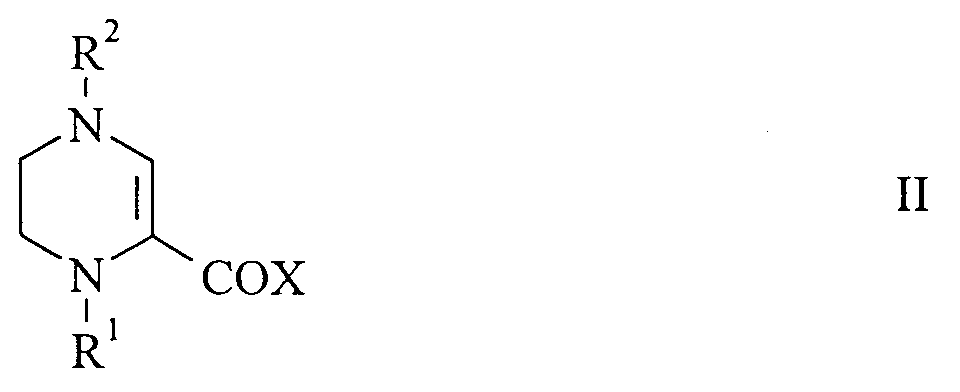
- 1,4,5,6-tetranydro-2-pyrazinecarboxylic acid derivatives of the general formula corresponding to the target compounds wherein R 1 , R 2 and X have the meanings given above can be hydrogenated asymmetrically with hydrogen in the presence of catalytically active optically active rhodium, ruthenium or iridium complexes to the target compounds.
- 1,4,5,6-Tetrahydro-2-pyrazinecarboxylic acid derivatives are preferably used in which R 1 and / or R 2 in each case are C 1-6 alkanoyl, C 2-6 perfluoroalkanoyl, tert- butoxycarbonyl ( Boc ") or benzyloxycarbonyl ( Z ") is.
- R 1 and / or R 2 are in each case formyl or trifluoroacetyl are very particularly preferably used.
- substituents R 1 and R 2 can optionally be split off selectively, namely the formyl group under acidic conditions and the trifluoroacetyl group under basic conditions.
- substituents R 1 and R 2 can optionally be split off selectively, namely the formyl group under acidic conditions and the trifluoroacetyl group under basic conditions.
- 1,4,5,6-tetrahydro-2-pyrazinecarboxylic acid derivatives are the amides in which X is a group of the formula ⁇ NR 3 R 4 and R 3 and R 4 have the meanings given above.
- Amides in which R 3 is hydrogen and R 4 is a C 1-6 alkyl group, in particular a tert- butyl group, are particularly preferred.
- a rhodium complex is preferably used, which by reaction of a Rh ( ) Complex is formed with an optically active metallocenylphosphine.
- Compounds of the general formula are preferably used as optically active metallocenylphosphines where M iron ( ) or ruthenium ( ), Q is nitrogen or phosphorus, R 7 is a C 1-4 alkyl group and R 8 to R 11 independently of one another are C 1-8 alkyl, C 5-8 cycloalkyl, phenyl or substituted phenyl.
- M iron
- ruthenium ruthenium
- Q is nitrogen or phosphorus
- R 7 is a C 1-4 alkyl group
- R 8 to R 11 independently of one another are C 1-8 alkyl, C 5-8 cycloalkyl, phenyl or substituted phenyl.
- the metallocenylphosphines in which M is iron, ie the ferrocenylphosphines, are particularly preferred.
- Q is phosphorus
- metallocenyldiphosphines are likewise particularly preferred.
- Metallocenylphosphines in which R 7 is methyl and R 8 and R 9 are the same and are tert- butyl or cyclohexyl are furthermore particularly preferred.
- These latter metallocenylphosphines include, for example, 1- [1- (di- tert- butylphosphino) ethyl] -2- (diphenylphosphino) ferrocene and 1- [1- (dicyclohexylphosphnino) ethyl] -2- (diphenylphosphino) ferrocene.
- the preparation of these compounds is described in EP-A 0 564 406.
- Rh ( ) Complexes which together with the optically active metallocenylphosphines form the catalytically active optically active rhodium complexes, preferably become neutral dinuclear complexes of the general formula used. It says for one C 4-12 diene or two C 2-12 alkene molecules. A means chlorine, bromine or iodine, preferably chlorine or bromine. Rh (are also preferred ) Complexes of the general formula wherein has the meaning given above and B - is the anion of an oxygen acid or complex acid.
- Anions of oxygen acids are, for example, anions such as ClO 4 - , SO 3 F - , CH 3 SO 3 - or CF 3 SO 3 -
- anions of complex acids are those such as BF 4 - , PF 6 - , AsF 6 - , SbF 6 - or SbCl 6 - .
- Rh ( ) Complexes IV and V are dienes, especially norbornadiene and 1,5-cyclooctadiene. These complexes are known, for example from EP-A 0 302 021 or US-A 5 011 995.
- the asymmetric hydrogenation of the 1,4,5,6-tetrahydropyrazinecarboxylic acid derivatives II is advantageously carried out at a temperature of 20 to 200 ° C. and a hydrogen pressure of 1 to 200 bar.
- the molar ratio of catalyst to starting material is advantageously 1: 100 to 1: 5000, preferably 1: 1000 to 1: 2000.
- suitable solvents for the asymmetric hydrogenation are water, lower alcohols such as methanol, aromatic hydrocarbons such as toluene, ketones such as acetone or carboxylic esters such as ethyl acetate.
- optically active 2-piperazinecarboxylic acid derivatives I in which one of the two substituents R 1 and R 2 is C 1-6 alkanoyl or C 2-6 perfluoroalkanoyl and the other, like X, has the meaning given above, as such, also in Form of their enantiomer mixtures, also a subject of the present invention.
- Mixtures of enantiomers are to be understood here in particular to be those in which one enantiomer is enriched in relation to the other.
- Those compounds in which R 1 is trifluoroacetyl and / or R 2 formyl are particularly preferred.
- the 1,4,5,6-tetrahydropyrazinecarboxylic acid derivatives II are new compounds and are also an object of the present invention. They can be prepared, for example, by using a corresponding pyrazine carboxylic acid derivative of the general formula wherein X has the meaning given above, with hydrogen on a palladium catalyst to give the 1,4,5,6-tetrahydro-2-pyrazinecarboxylic acid derivative of the general formula wherein X has the meaning given above, hydrogenated and then by a known method, for example by acylation with a carboxylic acid anhydride, into which the compound substituted on the ring nitrogen N 1 and / or N 4 is converted.
- the product was acylated without further purification.
- Process B Formylation with acetyl-formyl anhydride (analogously to: JC Sheehan, D.-D. Yang , J Am. Chem. Soc . 1958 , 80 , 1154.),
- the molar ratio of starting material: rhodium, the substituents X, R 1 and R 2 , the reaction conditions, the catalyst used, the conversion and the enantiomeric excess (ee) are given in each case.
- the ( S ) -enantiomer was preferably formed as the product in each case.
Landscapes
- Chemical & Material Sciences (AREA)
- Organic Chemistry (AREA)
- Inorganic Chemistry (AREA)
- Engineering & Computer Science (AREA)
- Materials Engineering (AREA)
- Chemical Kinetics & Catalysis (AREA)
- Pharmaceuticals Containing Other Organic And Inorganic Compounds (AREA)
- Organic Low-Molecular-Weight Compounds And Preparation Thereof (AREA)
- Low-Molecular Organic Synthesis Reactions Using Catalysts (AREA)
Abstract

Description
- Die vorliegende Erfindung betrifft ein Verfahren zur Herstellung von neuen und bekannten optisch aktiven 2-Piperazincarbonsäurederivaten, insbesondere von Estern und Amiden der (R)- oder (S)-2-Piperazincarbonsäure, welche gegebenenfalls an den Ringstickstoffatomen Substituenten tragen und durch die allgemeine Formel

R1 und R2 unabhängig voneinander jeweils Wasserstoff, C1-4-Alkyl, gegebenenfalls substituiertes C1-6-Alkanoyl, C2-6-Perfluoralkanoyl, Aroyl, Arylalkyl, C1-6-Alkoxycarbonyl, Aryloxycarbonyl, Carbamoyl oder eine Aminoschutzgruppe bedeuten und X eine Hydroxygruppe, eine C1-6-Alkoxygruppe oder eine Gruppe der Formel ―NR3R4 ist, worin wiederum - (i) R3 und R4 unabhängig voneinander Wasserstoff, C1-6-Alkyl, C3-6-Cycloalkyl, Aryl oder eine Aminoschutzgruppe bedeuten oder
- (ii) R3 und R4 zusammen mit dem Stickstoffatom einen gegebenenfalls substituierten 5- oder 6-gliedrigen gesättigten heterocyclischen Ring bilden oder
- (iii) R3 Wasserstoff und R4 eine Gruppe der Formel

- Die Erfindung betrifft weiterhin neue 1,4,5,6-Tetrahydro-2-pyrazincarbonsäurederivate als Ausgangsmaterial für die asymmetrische Hydrierung und ein Verfahren zu deren Herstellung.
- Hier und im folgenden sind unter C1-n-Alkyl jeweils geradkettige oder verzweigte primäre, sekundäre oder tertiäre Alkylgruppen mit 1 bis n Kohlenstoffatomen zu verstehen, also beispielsweise unter C1-6-Alkyl Gruppen wie Methyl, Ethyl, Propyl, Butyl, Pentyl, Hexyl, Isopropyl, Isobutyl, tert-Butyl, Isopentyl und Neopentyl. Entsprechend sind unter C1-n-Alkoxy und C1-n-Alkoxycarbonyl die aus C1-n-Alkyl und Sauerstoff bzw. Sauerstoff und Carbonyl zusammengesetzten Gruppen zu verstehen. Unter gegebenenfalls substituiertem C1-n-Alkanoyl (C1-n-Acyl) sind geradkettige oder verzweigte Alkanoylgruppen mit 1 bis n Kohlenstoffatomen (inclusive Carbonylkohlenstoff) zu verstehen, die noch Substituenten wie beispielsweise C1-4-Alkoxygruppen tragen können, also beispielsweise unter C1-6-Alkanoyl Gruppen wie Formyl, Acetyl, Methoxyacetyl, Propionyl, Butyryl, Isobutyryl, Valeryl oder Caproyl. Analog sind unter C2-n-Perfluoralkanoyl die entsprechenden perfluorierten Acylgruppen wie beispielsweise Trifluoracetyl oder Pentafluorpropionyl zu verstehen. Unter Arylalkyl sind insbesondere Gruppen wie Benzyl oder Phenethyl zu verstehen, unter Aryl insbesondere Phenyl oder substituiertes Phenyl und unter Aroyl insbesondere Benzoyl oder substituiertes Benzoyl. Unter C3-6-Cycloalkyl sind Cyclopropyl, Cyclobutyl, Cyclopentyl oder Cyclohexyl zu verstehen. Unter Aminoschutzgruppen sind die in der Peptidchemie üblichen Schutzgruppen wie beispielsweise Benzyloxycarbonyl (Z) oder tert-Butoxycarbonyl (Boc) zu verstehen. Der Ausdruck
 gesättigter heterocyclischer Ring" umfasst auch Ringe mit mehreren, gegebenenfalls auch mehreren verschiedenen Heteroatomen wie beispielsweise Morpholin. Unter dem BegriffSeitengruppen einer Aminosäure" sind die in der allgemeinen Aminosäureformel R-CH(NH2)―COOH mit R bezeichneten Reste zu verstehen, insbesondere diejenigen der natürlichen Aminosäuren.
 - Bisher bekannte Synthesen von Verbindungen der Formel I gehen von der Stammverbindung (R1 = R2 = H, X = OH) aus, die durch klassische Racematspaltung in optisch aktiver Form aus dem Racemat erhalten werden kann (E. Felder et al., Helv. Chim. Acta 1960, 43, 888-896). Zunächst werden die Ringstickstoffatome geschützt und dann die freie Carboxylgruppe in das Amid übergeführt. Das Verfahren ist allenfalls für den Labormassstab geeignet und erfordert der Verwendung teurer Reagenzien. Aufgabe der vorliegenden Erfindung war daher, ein auch in technischem Massstab durchführbares Verfahren bereitzustellen, das ohne Racematspaltung auskommt.
- Erfindungsgemäss wird diese Aufgabe durch das Verfahren gemäss Patentanspruch 1 gelöst.
- Es wurde gefunden, dass sich die den Zielverbindungen entsprechenden 1,4,5,6-Tetranydro-2-pyrazincarbonsäurederivate der allgemeinen Formel
 Boc") oder Benzyloxycarbonyl (Z") ist.
Ganz besonders bevorzugt werden solche 1,4,5,6-Tetrahydro-2-pyrazincarbonsäurederivate eingesetzt, in denen R1 und/oder R2 jeweils Formyl oder Trifluoracetyl ist. Diese Derivate haben den Vorteil, dass sich die Substituenten R1 und R2 gegebenenfalls selektiv abspalten lassen, nämlich die Formylgruppe unter sauren und die Trifluoracetylgruppe unter basischen Bedingungen.
Ebenfalls vorzugsweise werden als 1,4,5,6-Tetrahydro-2-pyrazincarbonsäurederivate die Amide eingesetzt, in denen X eine Gruppe der Formel ―NR3R4 ist und R3 und R4 die obenstehenden Bedeutungen haben.
Besonders bevorzugt sind solche Amide, in denen R3 Wasserstoff und R4 eine C1-6-Alkylgruppe, insbesondere eine tert-Butylgruppe ist. - Als katalytisch wirksamer optisch aktiver Rhodium-, Ruthenium- und/oder Iridiumkomplex wird vorzugsweise ein Rhodiumkomplex eingesetzt, der durch Reaktion eines Rh(
 )-Komplexes mit einem optisch aktiven Metallocenylphosphin gebildet wird.
 - Als optisch aktive Metallocenylphosphine werden vorzugsweise Verbindungen der allgemeinen Formel
 ) oder Ruthenium(), Q Stickstoff oder Phosphor, R7 eine C1-4-Alkylgruppe und R8 bis R11 unabhängig voneinander C1-8-Alkyl, C5-8-Cycloalkyl, Phenyl oder substituiertes Phenyl bedeuten, eingesetzt.
Besonders bevorzugt sind die Metallocenylphosphine, in denen M Eisen ist, d. h. die Ferrocenylphosphine. Ebenfalls besonders bevorzugt sind die Metallocenylphosphine, in denen Q Phosphor ist, also Metallocenyldiphosphine.
Weiterhin besonders bevorzugt sind Metallocenylphosphine, in denen R7 Methyl ist und R8 und R9 gleich sind und tert-Butyl oder Cyclohexyl bedeuten. Zu diesen letztgenannten Metallocenylphosphinen zählen beispielsweise das 1-[1-(Di-tert-butylphosphino)ethyl]-2-(diphenylphosphino)ferrocen und das 1-[1-(Dicyclohexylphospnino)ethyl]-2-(diphenylphosphino)ferrocen. Die Herstellung dieser Verbindungen ist in EP-A 0 564 406 beschrieben.
Weitere optisch aktive Metallocenylphosphine sind beispielsweise in T. Hayashi et al., J. Am. Chem. Soc. 1994, 116, 4221―4226, in EP-A 0 612 758 und in T. Hayashi et al., Bull. Chem. Soc. Jpn. 1980, 53, 1138―1151 beschrieben. - Als Rh()-Komplexe, welche mit den optisch aktiven Metallocenylphosphinen zusammen die katalytisch wirksamen optisch aktiven Rhodiumkomplexe bilden, werden vorzugsweise neutrale zweikernige Komplexe der allgemeinen Formel

 für ein C4-12-Dien oder zwei C2-12-Alkenmoleküle. A bedeutet Chlor, Brom oder Iod, vorzugsweise Chlor oder Brom. Ebenfalls bevorzugt sind Rh()-Komplexe der allgemeinen Formel
 die oben genannte Bedeutung hat und B- das Anion einer Sauerstoffsäure oder Komplexsäure ist. Unter Anionen von Sauerstoffsäuren sind beispielsweise Anionen wie ClO4 -, SO3F-, CH3SO3 - oder CF3SO3 - zu verstehen, unter Anionen von Komplexsäuren solche wie beispielsweise BF4 -, PF6 -, AsF6 -, SbF6 - oder SbCl6 -.
 - Besonders bevorzugt als Ligandenin den Rh()-Komplexen IV und V sind Diene, insbesondere Norbornadien und 1,5-Cyclooctadien. Diese Komplexe sind bekannt, beispielsweise aus EP-A 0 302 021 oder US-A 5 011 995.
- Die asymmetrische Hydrierung der 1,4,5,6-Tetrahydropyrazincarbonsäurederivate II wird vorteilhaft bei einer Temperatur von 20 bis 200 °C und einem Wasserstoffdruck von 1 bis 200 bar durchgeführt. Das molare Verhältnis Katalysator-Edukt liegt vorteilhaft bei 1:100 bis 1:5000, vorzugsweise bei 1:1000 bis 1:2000.
Als Lösungsmittel für die asymmetrische Hydrierung eignen sich beispielsweise Wasser, niedrige Alkohole wie Methanol, aromatische Kohlenwasserstoffe wie Toluol, Ketone wie Aceton oder Carbonsäureester wie Ethylacetat. - Die optisch aktiven 2-Piperazincarbonsäurederivate I, worin einer der beiden Substituenten R1 und R2 C1-6-Alkanoyl oder C2-6-Perfluoralkanoyl ist und der andere ebenso wie X die oben genannte Bedeutung hat, sind als solche, auch in Form ihrer Enantiomerengemische, ebenfalls Gegenstand der vorliegenden Erfindung. Unter Enantiomerengemischen sind hier insbesondere solche zu verstehen, in welchen ein Enantiomer gegenüber dem anderen angereichert ist.
Besonders bevorzugt sind diejenigen Verbindungen, in denen R1 Trifluoracetyl und/oder R2 Formyl ist. - Die 1,4,5,6-Tetrahydropyrazincarbonsäurederivate II sind neue Verbindungen und ebenfalls Gegenstand der vorliegenden Erfindung.
Sie können beispielsweise dadurch hergestellt werden, dass ein entsprechendes Pyrazincarbonsäurederivat der allgemeinen Formel

- Verbindungen II, in denen X eine (substituierte) Aminogruppe ist, können auch ausgehend von 1,4,5,6-Tetrahydropyrazin-2-carbonitril hergestellt werden, beispielsweise durch eine Ritter-Reaktion. Die letztgenannte Verbindung ist nach einem in EP-A 0 175 364 beschriebenen Verfahren leicht zugänglich.
- Die nachfolgenden Beispiele verdeutlichen die Durchführung des erfindungsgemässen Verfahrens und die Herstellung der erfindungsgemässen Verbindungen, ohne dass darin eine Einschränkung zu sehen ist.
- Zu 1200 ml Methanol wurden unter Argon bei 4―6 °C innerhalb von 1 h 106,6 g Thionylchlorid zugetropft. Bei 9 °C wurden 100,1 g Pyrazincarbonsäure zugegeben und das Gemisch 2 h auf 61 °C erwärmt, wobei die Säure vollständig in Lösung ging.
Nach dem Abkühlen auf Raumtemperatur wurde langsam eine Lösung von 145 g Natriumhydrogencarbonat in 1,4 l Wasser zugegeben. Das Methanol wurde am Rotationsverdampfer bei 45 °C Badtemperatur und 50―120 mbar abdestilliert und der Rückstand dreimal mit Dichlormethan (400 ml, 100 ml, 100 ml) extrahiert. Durch Einengen der organischen Phase erhielt man 83,15 g Rohprodukt, das aus ca. 250 g Diisopropylether umkristallisiert wurde. - Ausbeute:
- 70,6 g, zuzüglich 10,28 g aus der Mutterlauge (total 72,5%)
- 1H NMR (CDCl3, 400 MHz): δ =
- 4,08 (s, 3H);
8,75 (d,J= 0,5 Hz, 1H);
8,80 (d,J= 0,5 Hz, 1H);
9,30 (s, 1H). - In einem 500 ml-Autoklaven wurden in 100 ml Methylacetat 7,8 g Pyrazincarbonsäuremethylester (hergestellt nach Beispiel 1) und 1,5 g Palladium auf Aktivkohle (10% Pd) vorgelegt. Der Autoklav wurde zweimal mit Stickstoff und zweimal mit Wasserstoff gespült, indem das Gas bis 8 bar Druck aufgepresst und wieder entspannt wurde. Anschliessend wurde bei 20 °C und 10 bar Wasserstoffdruck unter Rühren 9 h hydriert. Danach wurde mit Stickstoff gespült, das Reaktionsgemisch über eine Filternutsche (0,45 µm Porenweite) filtriert und der Katalysator mit Methylacetat gewaschen. Durch Einengen wurde roher 1,4,5,6-Tetrahydro-2-pyrazincarbonsäuremethylester erhalten.
- 1H NMR (CDCl3, 400 MHz): δ=
- 3,17―3,25 (m, 2H);
3,33―3,42 (m, 2H);
3,71 (s, 3H);
6,93 (br. s, 1H). - Das Produkt wurde ohne weitere Reinigung acyliert.
- Zu 25,00 g (175,9 mmol) 1,4,5,6-Tetrahydro-2-pyrazincarbonsäuremethylester, 250 ml Tetrahydrofuran und 21,30 g (210,5 mmol) Triethylamin wurden bei 0 °C 15,10 g (192,5 mmol) Acetylchlorid innerhalb von 25 min zugetropft. Anschließend wurde auf Raumtemperatur erwärmt und nach 1 h 200 ml Wasser und 200 ml Essigsäureethylester zugegeben. Die Wasserphase wurde noch 3―4 mal mit insgesamt 500 ml Essigsäureethylester gewaschen und die vereinigten organischen Extrakte über Magnesiumsulfat getrocknet. Nach dem Abziehen des Lösungsmittels wurden 22,30 g (69%) der Titelverbindung als gelbes Öl erhalten. Umkristallisation aus Essigsäureethylester lieferte 1-Acetyl-1,4,5,6-tetrahydro-2-pyrazincarbonsäuremethylester als hellgelben, kristallinen Feststoff.
- Schmp.:
- 136―139 °C
- 1H NMR (CDCl3, 400 MHz): δ =
- 2,10 (s, 3H);
3,35 (br. s, 2H);
3,00―5,00 (br. m, 2H);
3,75 (s, 3H);
5,02 (br. s, 1H);
7,32 (d, 1H). - In 200 g Essigsäureanhydrid wurden 10,1 g 1,4,5,6-Tetrahydro-2-pyrazincarbonsäuremethylester 2 h auf 135 °C erhitzt. Anschliessend wurde das überschüssige Essigsäureanhydrid bei 57 °C/55 mbar abdestilliert. Der Rückstand wurde mit 100 g Dichlormethan und 20 g Wasser versetzt. Die organische Phase wurde abgetrennt, mit 30 ml Wasser gewaschen und zur Trockne eingeengt. Als öliger Rückstand wurden 18,1 g Rohprodukt erhalten. Dieses wurde durch Mitteldruck-Säulenchromatographie (Säule 5×40 cm, Silicagel) mit Ethylacetat/Dichlormethan/Methanol (10:5:1) gereinigt.
- Ausbeute:
- 11,6 g (85%)
- 1H NMR (DMSO-d6, 80 °C, 400 MHz):
- δ = 1,98 (s, 3H);
2,25 (s, 3H);
3,60―3,70 (m, 1H);
3,70 (s, 3H);
7,60 (br. d, 1H). - Zu 100 ml (1,75 mol) Essigsäure wurden bei Raumtemperatur langsam 70 g (0,77 mol) Methansulfonsäure und anschliessend 20,0 g (184 mmol) 1,4,5,6-Tetrahydropyrazin-2-carbonitril gegeben. In diese Mischung wurde bei 25 °C 23,0 g (410 mmol) Isobuten eingeleitet und das Gemisch 5 h gerührt.
Anschliessend wurde mit 30%iger Natronlauge neutralisiert, wobei die Temperatur stets unter 30 °C gehalten wurde. Das auf pH 8―10 eingestellte Gemisch wurde dreimal mit je 200 ml Methylethylketon extrahiert. Die vereinigten organischen Phasen wurden über Magnesiumsulfat getrocknet und das Lösungsmittel abdestilliert. Der Rückstand (41,2 g) wurde in 80 ml Ethylacetat in der Hitze gelöst. Nach Abkühlung auf 20 °C wurden 500 ml Hexan zugegeben, weiter auf 0 °C abgekühlt, das ausgefallene Produkt nach 1 h abfiltriert und getrocknet. - Ausbeute:,
- 32,6 g (79%) hellbeiges Pulver
- Schmp.:
- 151,3―152,6 °C
- 1H NMR (CDCl3, 400 MHz): δ =
- 2,08 (s, 3H);
3,35 (br. s, 2H);
3,74 (s, 3H);
2,00―5,00 (br. m, 2H);
7,31 (d,J= 7,0 Hz, 1H). - 13C NMR (CDCl3, 100 MHz): δ =
- 22,38 (CH3);
37,28 (CH2);
42,79 (CH2);
51,15 (OCH3);
103,63 (C=);
135,94 (CH=);
165,21 (COO);
171,85 (CON). - Die Verbindung wurde analog zu Beispiel 5 unter Verwendung von Propionsäure anstelle von Essigsäure hergestellt.
- Ausbeute:
- 75%
- Schmp:
- 172,4―172,6 °C
- 1H NMR (CDCl3, 400 MHz): δ =
- 1,09 (t,J= 7,3 Hz, 3H);
1,37 (s, 9H);
2,39 (q,J= 7,3 Hz, 2H);
3,28 (m, 2H);
3,57 (m, 2H);
5,41 (br. s, 1H);
5,49 (br. s, 1H);
7,09 (d,J= 6,3 Hz, 1H). - 13C NMR (CDCl3, 100 MHz): δ =
- 9,44 (CH3);
27,55 (CH2);
29,12 (CH3);
38,29 (CH2);
42,19 (CH2);
50,92 (C);
106,66 (C);
132,20 (CH);
165,21 (C=O);
177,20 (C=O). - Die Verbindung wurde analog zu Beispiel 5 unter Verwendung von Isobuttersäure anstelle von Essigsäure hergestellt.
- Ausbeute:
- 48%
- Schmp:
- 180,0―184,4 °C
- 1H NMR (CDCl3, 400 MHz): δ =
- 1,07 (d,J= 6,5 Hz, 6H);
1,37 (s, 9H);
2,82 (sept,J= 6,5 Hz, 1H);
3,27 (m, 2H);
3,6 (br. m, 2H);
4,94 (br. s, 1H);
5,48 (br. s, 1H);
7,12 (d,J= 6,3 Hz, 1H). - 13C NMR (CDCl3, 100 MHz): δ =
- 19,36 (CH3);
29,07 (CH3);
32,50 (CH);
38,39 (CH2);
42,42 (CH2);
50,94 (C);
106,73 (C);
132,07 (CH);
165,21 (C=O);
180,85 (C=O). - Zu 20,00 g (88,8 mmol) 1-Acetyl-1,4,5,6-tetrahydro-2-pyrazincarbonsäure-tert-butylamid wurden 16,7 g (163 mmol) Essigsäureanhydrid und 12,4 g (157 mmol) Pyridin gegeben und das Gemisch 4 h bei 25 °C gerührt. Anschliessend wurden 100 ml Wasser zugegeben und mit 30 ml Natronlauge (20%) auf pH 6 eingestellt. Dann wurde dreimal mit je 100 ml Methylethylketon ausgeschüttelt. Die vereinigten organischen Extrakte wurden über Magnesiumsulfat getrocknet, mit Toluol versetzt und eingeengt. Das stark schäumende Rohprodukt kristallisierte und 11,40 g (48%) der Titelverbindung wurden als leicht brauner Feststoff isoliert.
- Schmp.:
- 138,0―139,2 °C
- 1H NMR (CDCl3, 400 MHz): δ =
- 1,41 (s, 9H);
2,14 (s, 3H);
2,32 (s, 3H);
3,71-3,80 (m, 4H);
5,82 (br. s, 1H);
7,34 (s, 1H). - 13C NMR (CDCl3, 100 MHz): δ =
- 21,30 (CH3);
21,58 (CH3);
28,76 (CH3);
39,44 (CH2);
42,43 (CH2);
51,76 (C);
116,61 (C);
123,36 (CH);
163,04 (C=O);
168,56 (C=O);
171,68 (C=O). - 168,7 g (0,705 mol) 1-Propionyl-1,4,5,6-tetrahydro-2-pyjazincarbonsäure-tert-butylamid wurden in 1,92 l Butylacetat/Acetonitril-Gemisch (4:1) vorgelegt. Die Suspension wurde auf 50 °C geheizt und 68,2 g (0,812 mol) Natriumhydrogencarbonat wurden zugegeben. Eine Lösung von 57,0 g (0,726 mol) Acetylchlorid in 120 ml Butylacetat wurde innerhalb von 30 min zugetropft. Anschliessend wurde das Reaktionsgemisch noch 40 min bei 50 °C weitergerührt. Vorsichtig wurden 190 ml Wasser zugegeben, die wässerige Phase abgetrennt und nochmals bei 50 °C mit 200 ml Butylacetat extrahiert. Die vereinigten organischen Extrakte wurden auf 1100 ml aufkonzentriert und zur Kristallisation langsam auf 2 °C gekühlt. Der Feststoff wurde abfiltriert und mit 100 ml kaltem Butylacetat nachgewaschen.
Umkristallisation aus 700 ml Butylacetat ergab 183,8 g (92,7%) der Titelverbindung als weisse Kristalle. - Schmp.:
- 133,5―134,6 °C
- 1H NMR (CDCl3, 400 MHz): δ =
- 1,13 (t,J=7,3 Hz, 3H);
1,40 (s, 9H);
2,32 (s, 3H);
2,38 (q,J= 7,3 Hz; 2H);
3,70 (m, 4H);
5,77 (br. s, 1H);
7,34 (s, 1H). - 13C NMR (CDCl3, 100 MHz): δ =
- 9,27 (CH3);
21,46 (CH3);
27,88 (CH2);
28,75 (CH3);
39,88 (CH2);
42,55 (CH2);
51,72 (C);
116,49 (C);
123,43 (CH);
163,20 (C=O);
168,61 (C=O);
175,6 (C=O). - Analog zu Beispiel 9 wurde aus 1-Acetyl-1,4,5,6-tetrahydro-2-pyrazincarbonsäure-tert-butylamid und Benzoylchlorid die Titelverbindung als weisser kristalliner Feststoff erhalten.
- Schmp.:
- 157,0―157,5 °C
- 1H NMR (CDCl3, 400 MHz): δ =
- 1,37 (s, 9H);
2,17 (s, 3H);
3,78 (m, 2H);
3,89 (m, 2H);
5,74 (br. s, 1H);
7,50 (m, 6H). - 13C NMR (CDCl3, 100 MHz): δ =
- 22,63 (CH3);
28,74 (CH3);
39,41 (CH2);
44,05 (CH2);
51,70 (C);
116,98 (C);
124,19 (C);
128,20 (CH);
128,87 (CH);
131,43 (CH);
133,33 (CH);
163,00 (C=O);
169,48 (C=O);
171,51 (C=O). - Analog zu Beispiel 9 wurde aus 1-Acetyl-1,4,5,6-tetrahydro-2-pyrazincarbonsäure-tert-butylamid und Chlorameisensäuremethylester die Titelverbindung als weisser kristalliner Feststoff erhalten.
- Schmp.:
- 134,0―135,3 °C
- 1H NMR (CDCl3, 400 MHz): δ =
- 1,40 (s, 9H);
2,12 (s, 3H);
3,67 (m, 4H);
3,84 (s, 3H);
5,70 (br. s, 1H);
7,50 (br. s, 1H). - 13C NMR (CDCl3, 100 MHz): δ =
- 22,54 (CH3);
28,77 (CH3);
39,07 (CH2);
44,05 (CH2);
51,63 (C);
53,86 (CH3);
116,32 (C);
122,48 (CH);
152,93 (C=O);
163,26 (C=O);
171,72 (C=O). - Analog dem Beispiel 9 wurde aus 1-Acetyl-1,4,5,6-tetrahydro-2-pyrazincarbonsäure-tert-butylamid und Chlorameisensäurephenylester die Titelverbindung als weisser kristalliner Feststoff erhalten.
- Schmp.:
- 156,4―157,5 °C
- 1H NMR (CDCl3, 400 MHz): δ =
- 1,41 (s, 9H);
2,16 (s, 3H);
3,79 (m, 4H);
5,76 (br. s, 1H);
7,13-7,41 (m, 6H). - 13C NMR (CDCl3, 100 MHz): δ =
- 22,58 (CH3);
28,74 (CH3);
39,20 (CH2);
44,27 (CH2);
51,72 (C);
117,40 (C);
121,35 (CH);
126,23 (CH);
129,59 (CH);
150,59 (C);
150,9 (C=O);
163,10 (C=O);
171,60 (C=O). - Analog zu Beispiel 9 wurde aus 1-Propionyl-1,4,5,6-tetrahydro-2-pyrazincarbonsäure-tert-butylamid und Propionylchlorid die Titelverbindung als weisser kristalliner Feststoff erhalten.
- Schmp.:
- 131,0―132,8 °C
- 1H NMR (CDCl3, 400 MHz): δ =
- 1,13 (t,J= 7,3 Hz, 3H);
1,20 (t,J= 7,3 Hz, 3H);
1,40 (s, 9H);
2,38 (q,J= 7,3 Hz, 2H);
2,60 (q,J= 7,3 Hz, 2H);
3,70 (m, 4H);
5,77 (br. s, 1H);
7,39 (s, 1H). - 13C NMR (CDCl3, 100 MHz): δ =
- 8,81 (CH3);
9,27 (CH3);
26,68 (CH2);
27,85 (CH2);
28,76 (CH3);
39,88 (CH2);
42,67 (CH2);
51,69 (C);
116,29 (C);
122,86 (CH);
163,29 (C=O);
171,93 (C=O);
175,49 (C=O). - Analog zu Beispiel 9 wurde aus 1-Isobutyryl-1,4,5,6-tetrahydro-2-pyrazincarbonsäure-tert-butylamid und Acetylchlorid die Titelverbindung als weisser kristalliner Feststoff erhalten.
- Schmp.:
- 116,3―117,2 °C
- 1H NMR (CDCl3, 400 MHz): δ =
- 1,10 (d,J= 6,6 Hz, 6H);
1,40 (s, 9H);
2,33 (s, 3H);
2,72 (m, 1H):
3,70 (m, 4H);
5,80 (br. s, 1H);
7,37 (s, 1H). - 13C NMR (CDCl3, 100 MHz): δ =
- 19,33 (CH3);
21,46 (CH3);
28,67 (CH3);
33,04 (CH);
39,81 (CH2);
42,67 (CH2);
51,65 (C);
116,17 (C);
123,49 (CH);
163,32 (C=O);
168,60 (C=O);
179,11 (C=O). - Analog zu Beispiel 9 wurde aus 1-Acetyl-1,4,5,6-tetrahydro-2-pyrazincarbonsäure-tert-butylamid und Methoxyacetylchlorid die Titelverbindung als weisser kristalliner Feststoff erhalten.
- Schmp.:
- 109,6―110,7 °C
- 1H NMR (CDCl3, 400 MHz): δ =
- 1,41 (s, 9H);
2,14 (s, 3H);
3,46 (s, 3H);
3,73 (m, 4H);
4,32 (s, 2H);
5,73 (br. s, 1H);
7,32 (s, 1H). - 13C NMR (CDCl3, 100 MHz): δ =
- 22,60 (CH3);
28,76 (CH3);
39,33 (CH2);
42,67 (CH2);
51,82 (C);
59,51 (CH3);
71,31 (CH2);
117,34 (C);
121,88 (CH);
162,89 (C=O);
167,26 (C=O);
171,62 (C=O); - Analog zu Beispiel 9 wurde aus 1-Propionyl-1,4,5,6-tetrahydro-2-pyrazincarbon-säure-tert-butylamid und Trifluoracetylchlorid die Titelverbindung als weisser kristalliner Feststoff erhalten.
- Schmp.:
- 132,6―133,3 °C
- 1H NMR (C2D2Cl4, 400 MHz, 100°C):
- δ = 1,13 (t,J= 7, Hz, 3H);
1,38 (s, 9H);
2,35 (q,J= 7,3 Hz, 2H);
3,80 (m. 4H);
5,66 (br. s, 1H);
7,28 (br. s, 1H). - 13C NMR (C2D2Cl4, 100 MHz, 100 °C):
- δ = 9,15 (CH3);
27,86 (CH2);
28,71 (CH3);
40,10 (CH2);
44,90 (CH2);
51,88 (C);
115,87 (q, 1 J CF= 286 Hz, CF3);
117,75 (CH);
122,05 (C);
154,47 (q, 2 J CF = 38,7 Hz, COCF3);
162,17 (CONH);
173,96 (COEt). - Zu einer Suspension von 70,00 g (0,293 mol) 1-Propionyl-1,4,5,6-tetrahydro-2-pyrazincarbonsäure-tert-butylamid in 350 ml Butylacetat wurde bei 20 °C 70,00 g (1,521 mol) Ameisensäure zugegeben. Zu der erhaltenen gelblichen Lösung wurde innerhalb von 4,5 h eine Lösung aus 63 g Thionylchlorid in 140 ml Butylacetat zugetropft. Die Temperatur wurde dabei unter 25 °C gehalten. Die Reaktionslösung wurde mit 50 ml 5%iger Natriumhydrogencarbonatlösung gewaschen und die wässerige Phase mit 100 ml Dichlormethan nachgewaschen. Beide organische Phasen wurden zusammengegeben und nach dem Entfernen des Lösungsmittels der Rückstand aus Butylacetat umkristallisiert. 71,2 g (82,7%) der Titelverbindung wurden als weisser kristalliner Feststoff erhalten.
- Zu einer Lösung von 31,2 g (0,13 mol) 1-Propionyl-1,4,5,6-tetrahydro-2-pyrazincarbonsäure-tert-butylamid in 40,0 g (0,87 mol) Ameisensäure wurde bei 30 °C ein Gemisch aus 20,0 g (0,196 mol) Essigsäureanhydrid und 18,00 g (0,391 mol) Ameisensäure innerhalb von 30 min zugetropft. Das Reaktionsgemisch wurde noch 20 min bei 30 °C gerührt. Dann wurde 50 ml Wasser zugegeben und die klare Lösung 50 min bei 40 °C gehalten. Das Produkt wurde extrahiert und aus n-Butylacetat kristallisiert. 30,75 g (88%) der Titelverbindung wurden als weisser kristalliner Feststoff erhalten.
- Schmp.:
- 132,1―133,5 °C
- 1H NMR (CDCl3, 400 MHz): δ =
- 1,14 (t,J= 7,3 Hz, 3H);
1,40 (s, 9H);
2,39 (q,J= 7,3 Hz, 2H);
3,66 (m, 2H);
3,74 (m, 2H);
5,75 (br. s, 1H);
7,22 (s, 1H);
8,41 (s, 1H). - 13C NMR (CDCl3, 100 MHz): δ =
- 9,25 (CH3);
27,89 (CH2);
28,67 (CH3);
39,25 (CH2);
45,06 (CH2);
51,79 (C);
118,3 (C);
122,9 (CH);
161,01 (C=O);
162,79 (C=O);
175,4 (C=O). - Die Verbindung wurde analog zu Bsp. 17 (Verf. B) aus 1-Acetyl-1,4,5,6-tetrahydro-2-pyrazincarbonsäure-tert-butylamid und Ac2O/HCOOH als weisser kristalliner Feststoff erhalten.
- Schmp.:
- 131,0―132,9 °C
- 1H NMR (CDCl3, 400 MHz): δ =
- 1,41 (s, 9H);
2,15 (s, 3H);
3,70 (m, 4H);
5,75 (br. s, 1H);
7,21 (s, 1H);
8,41 (s, 1H). - 13C NMR (CDCl3, 100 MHz): δ =
- 22,62 (CH3);
28,73 (CH3);
38,65 (CH2);
44,99 (CH2);
51,85 (C);
118,27 (C);
122,90 (CH);
160,94 (C=O);
162,63 (C=O);
171,7 (C=O). - Ein Autoklav wurde unter Sauerstoffausschluss mit 10 g (37 mmol) 1,4-Diacetyl-1,4,5,6-tetrahydro-2-pyrazincarbonsäure-tert-butylamid, 20,3 mg (37 µmol) 1-[1(R)-(Di-tert-butylphosphino)ethyl]-2(S)-(diphenylphosphino)ferrocen und 9,2 mg (20 µmol) Bicyclo[2.2.1]hepta-2,5-dienrhodium()chlorid-Dimer versehen. Nach Spülen mit Argon wurde 80 ml sauerstofffreies Methanol zugegeben. Bei einem Anfangsdruck von 50 bar und einer Temperatur von 110°C wurde 20 h hydriert. Der Autoklav wurde entspannt und mit Stickstoff gespült. Das Lösungsmittel des Reaktionsgemisches wurde vollständig abdestilliert und man erhielt so 10,50 g (95%) des Titelproduktes. Die GC-Analyse zeigte einen Umsatz von 85%. Die Enantioselektivität der Hydrierung wurde nach Abspaltung der Schutzgruppen mit Salzsäure durch GC-Analyse zu 90,5% ee bestimmt.
- Ein Autoklav wurde unter Sauerstoffausschluss mit 8,00 g (29,9 mmol) 1,4-Diacetyl-1,4,5,6-tetrahydro-2-pyrazincarbonsäure-tert-butylamid, 10,0 mg (18 µmol) 1-[1(R)-(Di-tert-butylphosphino)ethyl]-2(S)-(diphenylphosphino)ferrocen und 6,0 mg (16 µmol) Bis(bicyclo[2.2.1]hepta-2,5-dien)-rhodium()-tetrafluorborat versehen. Nach Spülen mit Argon wurden 80 ml sauerstofffreies Methanol zugegeben. Bei einem Anfangsdruck von 50 bar und einer Temperatur von 110°C wurde 20 h hydriert. Nach Aufarbeitung des Reaktionsgemisches analog zu Beispiel 19 erhielt man 10,50 g (75%) des Titelproduktes. Die GC-Analyse zeigte einen Umsatz von 97%. Die Enantioselektivität der Hydrierung wurde nach Abspaltung der Schutzgruppen mit Salzsäure durch GC-Analyse zu 90,7% ee bestimmt.
- Schmp.:
- 139,9―150,6 °C
- 1H NMR (CDCl3, 400 MHz): δ =
- 1,31; 1,33 (2 s, 9H),
2,10; 2,12; 2,15; 2,17; 2,19; 2,22; 2,26 (7 s, 6H);
2,77―2,83 (m, 1H);
3,18―3,28 (m, 2H);
3,70―3,73 (m, 1H);
4,41―4,49 (m, 2H);
5,04 (br. s, 1H);
5,95 (br. s, 1H). - Ein Autoklav wurde unter Sauerstoffausschluss mit 16,1 g (60,2 mmol) 4-Formyl-1-propionyl-1,4,5,6-tetrahydro-2-pyrazincarbonsäure-tert-butylamid, 19,5 mg (35,9 µmol) 1-[1(R)-(Di-tert-butylphosphino)ethyl]-2(S)-(diphenylphosphino)ferrocen und 11,1 mg (29,6 µmol) Bis(bicyclo[2.2.1]hepta-2,5-dien)-rhodium()-tetrafluorborat versehen. Nach Spülen mit Argon wurde 80 ml sauerstofffreies Methanol zugegeben. Bei einem Anfangsdruck von 12 bar und einer Temperatur von 90°C wurde 8 h hydriert. Der Autoklav wurde entspannt und mit Stickstoff gespült. Das Lösungsmittel des Reaktionsgemisches wurde vollständig abdestilliert und man erhielt 17,00 g (94%) des Titelproduktes. Die GC-Analyse zeigte einen Umsatz von 99%. Die Enantioselektivität der Hydrierung wurde nach Abspaltung der Schutzgruppen mit Salzsäure durch GC-Analyse zu 96,5% ee bestimmt.
- Schmp.:
- 132,1―134,3 °C
- 1H NMR (CDCl3, 400 MHz): δ =
- 1,21 (t,J= 7,3 Hz, 3H);
1,30; 1,31 (2 s, 9H);
2,46 (q,J= 7,3 Hz, 2H);
2,75―2,82 (m, 1H);
3,12―3,18 (m, 2H);
3,60―3,78 (m, 1H);
4,21―4,38 (m, 2H);
5,07 (br. s, 1H);
5,92 (br. s, 1H);
8,10; 8,18 (2 s, 1H). - Analog zu Beispiel 19 wurden verschiedene Tetrahydropyrazin-Derivate II in Anwesenheit von 1-[1(R)-(Di-tert-butylphosphino)ethyl]-2(S)-(diphenylphosphino)ferrocen und [Rh(cod)Cl]2 (A) oder Rh(nbd)2BF4 (B) in Methanol hydriert (cod = 1,5-Cyclooctadien, nbd = Bicyclo[2.2.1]heptadien). Die Ergebnisse sind in der folgenden Tabelle 1 zusammengestellt. Angegeben ist jeweils das molare Verhältnis Edukt : Rhodium, die Substituenten X, R1 und R2, die Reaktionsbedingungen, der verwendete Katalysator, der Umsatz und der Enantiomerenüberschuss (ee). Als Produkt wurde jeweils bevorzugt das (S)-Enantiomer gebildet.
Tabelle 1 Edukt:Rh X/R1/R2 Temp [°C]/Zeit [h] Druck [bar] Katalysator Umsatz [%] ee [%] 500 NH-t-Bu/Ac/Ac 90/4 50 B 94 93,7 1000 NH-t-Bu/EtCO/EtCO 90/22 50 B 91 87,5 1000 NH-t-Bu/EtCO/Ac 90/22 10 B 94 91 1000 NH-t-Bu/Ac/COPh 90/21 50 B 83 89,9 475 NH-t-Bu/Me2CHCO/Ac 90/21 50 B 96,9 86,3 1000 NH-t-Bu/Ac/COOMe 90/20 50 B 97 88,3 480 NH-t-Bu/Ac/CHO 90/1 50 B 99,8 96,9 487 NH-t-Bu/EtCO/CHO 90/2 50 B 99,7 96,5 482 NH-t-Bu/EtCO/CHO 70/6 12 B 99,8 96,8 475 NH-t-Bu/CHO/CHO 70/6 12 B 72,4 91,7 400 NH-t-Bu/EtCO/COCF3 90/17 50 B 95 88,2 400 NH-t-Bu/Ac/MeOCH2CO 70/6 12 B 99 84,5 250 NH-t-Bu/Ac/H 70/20 50 A 87 58 500 NH-t-Bu/EtCO/H 90/24 50 A 78 52 500 NH-t-Bu/COCHMe2/H 90/23 50 B 74 41 500 NH-t-Bu/COCH2OMe/H 90/23 50 B 39 56 25 OMe/H/H 50/20 50 A 87 40 250 OMe/Ac/H 70/20 50 A 87 58 500 OMe/Ac/H 70/22 50 A 59 37,8 245 OMe/Ac/Ac 50/20 50 A 74 95 - In einem 500 ml Kolben wurden 50 ml Trifluoressigsäure unter Argon vorgelegt. Bei 21 °C wurden 12,5 g Methansulfonsäure zugetropft und dann portionsweise 20 g 2-Cyan-1,4,5,6-tetrahydropyrazin-Methansulfonsäuresalz (97 mmol) zugegeben, wobei eine leichte Exothermie beobachtet wurde. Anschliessend wurden innerhalb 1 h bei 20 °C 10 g (178 mmol) Isobuten eingeleitet. Das Reaktionsgemisch wurde noch 2 h bei 20 °C gerührt, dann bei dieser Temperatur tropfenweise mit 13,3 g (111 mmol) Thionylchlorid versetzt und noch weitere 20 h gerührt. Dann wurden 250 ml Dichlormethan und portionsweise 25 g Natriumacetat zugegeben. Nach Filtration der rohen Lösung durch Celite® wurden 30 ml Wasser zugegeben und die Phasen getrennt. Die organische Phase wurde zur Trockne eingeengt. Das zurückbleibende Rohprodukt (27,88 g) wurde mit Ethylacetat/Methanol (4:1) an 300 g Kieselgel chromatographiert.
- Ausbeute (GC):
- 29,2%.
- Schmp.:
- 158―160 °C (aus n-Butylacetat).
- 1H NMR (CDCl3, 400 MHz) δ =
- 1,35 (s, 9H);
3,43 (br. s, 2H);
3,74 (br. s, 2H);
5,32 (br. s, 1H);
5,53 (br. s, 1H);
7,06 (d,J= 6 Hz, 1H). - 13C NMR (CDCl3, 100 MHz) δ =
- 28,9;
42,3;
42,8;
51,2;
105,9;
116,3 (1 J CF= 288 Hz);
133,2;
154,5 (2 J CF= 35 Hz);
163,7. - MS: m/z =
- 57 (100%), 279 (M+, 6,2%).
- Zu einer Lösung von 96,94 g (347,1 mmol) 1-Trifluoracetyl-1,4,5,6-tetrahydropyrazin-2-carbonsäure-tert-butylamid in 465,9 g (10,1 mol) Ameisensäure wurden innerhalb von 40 min bei 20 °C 49,60 g (416,9 mmol) Thionylchlorid zugegeben. Nach 2 h Reaktionsdauer bei 20 °C wurde das Gemisch bei 60 °C und 80 mbar am Rotationsverdampfer eingeengt und der braunschwarze Rückstand mit 400 ml Ethylacetat und 400 ml Wasser aufgenommen. Die wässrige Phase wurde noch zweimal mit je 250 ml Ethylacetat gewaschen und die vereinigten organischen Extrakte über 50,1 g Natriumsulfat getrocknet. Nach Filtration wurde die Lösung am Rotationsverdampfer eingeengt und der dickflüssige Rückstand mit 250 ml Diisopropylether gerührt. Der ausgefallene Feststoff wurde abfiltriert, zweimal mit je 100 ml Diisopropylether gewaschen und getrocknet.
- Ausbeute:
- 96,76 g (91%) farblose Kristalle
- Schmp.:
- 158,4―160,3 °C
- NMR-Daten: Im 1H- und im 13C NMR ist einjeweils ein doppelter Signalsatz sichtbar. Die Signale des Hauptkonformeren sind mit * markiert, soweit eine Zuordnung möglich war.
- 1H NMR (CDCl3, 400 MHz) δ =
- 8,40 (s, 1H)*;
8,14 (s, 1H);
7,41 (s, 1H);
7,14 (s, 1H)*;
5,65 (br. s, 1H);
5,55 (br. s, 1H)*;
3,93―3,80 (m, 2×4H);
1,40 (s, 9H);
1,39 (s, 9H)*. - 13C NMR (CDCl3, 100 MHz) δ =
- 161,69;
161,14;
160,49;
159,61;
122,76;
119,76;
117,42;
115,84 (1 J CF= 288 Hz);
52,04;
52,00;
44,77;
41,83;
41,11;
28,62. - In einem 160 ml Autoklaven wurden 20,6 g (67,0 mmol) 4-Formyl-1-trifluoracetyl-1,4,5,6-tetrahydropyrazin-2-carbonsäure-tert-butylamid, 26,2 mg (64,5 µmol) Bis(1,5-cyclooctadien)rhodium()tetrafluorborat und 41,8 mg (77 µmol) 1-[1(R)-(Di-tert-butylphosphino)ethyl]-2(S)-(diphenylphosphino)ferrocen unter Argon vorgelegt (S/C = 1000). Man gab 70 ml Aceton (entgast) zu und hydrierte 11 h bei 100°C unter 13―10 bar Wasserstoffdruck. Nach dem Abdestillieren des Lösungsmittel wurden 20,5 g (99%) der Titelverbindung als kristalliner Feststoff erhalten.
- ee =
- 96,4%
- Schmp.:
- 172,0―173,0 °C
- 1H NMR (DMSO-d6, 400 MHz, 70 °C) δ =
- 8,06 und 8,02 (2 s, 1H);
7,63 (br.d", 1H);
4,90―2,95 (m, 7H);
1,28 und 1,23 (2 s, 9H). - 13C NMR (DMSO-d6, 100 MHz, 70 °C)
- Ausgewählte Signale:
- δ =
- 166,94;
166,70;
161,05;
160,94;
156,22 (q, 2 J CF= 35 Hz, COCF3);
116,32 (q, 1 J CF= 288 Hz, CF3). - In einem 50 ml Autoklaven wurden 2,50 g (8,95 mmol) 1-Trifluoracetyl-1,4,5,6-tetrahydropyrazin-2-carbonsäure-tert-butylamid, 7,5 mg (18 µmol) Bis(1,5-cyclooctadien)rhodium()tetrafluorborat und 11,5 mg (21 µmol) 1-[1(R)-(Di-tert-butylphosphino)ethyl]-2(S)-(diphenylphosphino)ferrocen unter Argon vorgelegt (Edukt : Katalysator = 486). Dann gab man 0,89 g (9,08 mmol) Schwefelsäure gelöst in 20 ml entgastem Tetrahydrofuran zu. Anschliessend wurde 18 h bei 20°C unter 13―10 bar Wasserstoffdruck hydriert. Nach dem Abdestillieren des Lösungsmittels erhielt man 3,42 g (>99 %) der Titelverbindung als weisses Pulver.
- ee =
- 79,5%
- 1H NMR (DMSO-d6, 400 MHz) δ =
- 9,60―8,30 (m, 2H);
7,88 (br. s, 1H);
4,95―3,05 (m, 7H);
1,32 (s, 9H). - 13C NMR (DMSO-d6, 100 MHz)
- Ausgewählte Signale:
- δ =
- 166,94 (CONH);
115,90 (q, 1 J CF= 288 Hz, CF3). - In einem 50 ml Autoklaven wurden 2,50 g (8,95 mmol) 1-Trifluoracetyl-1,4,5,6-tetrahydropyrazin-2-carbonsäure-tert-butylamid, 7,5 mg (18 µmol) Bis(1,5-cyclooctadien)rhodium()tetrafluorborat und 11,5 mg (21 µmol) 1-[1(R)-(Di-tert-butylphosphino)ethyl]-2(S)-(diphenylphosphino)ferrocen unter Argon vorgelegt (Edukt : Katalysator = 486). Man gab 20 ml entgastes Ethylacetat hinzu und hydrierte 18 h bei 90°C unter 13―10 bar Wasserstoffdruck. Nach dem Abdestillieren des Lösungsmittels erhielt man 2,50 g der rohen Titelverbindung als hellgelbes Pulver.
- ee =
- 47,2%
- 1H NMR (CDCl3, 400 MHz)
- (Nur die Signale des Hauptisomeren sind angegeben.)
- δ =
- 5,88 (br. s, 1H);
4,68―1,65 (d", 1H);
3,85―3,78 (d", 1H);
3,54―3,49 (d", 1H);
3,41―3,32 (dt", 1H);
3,11―3,06 (d", 1H);
2,90―2,78 (m, 2H);
2,07 (s, 1H);
1,34 (s, 9H). - In einem 50 ml Autoklaven wurden 2,50 g (8,95 mmol) 1-Trifluoracetyl-1,4,5,6-tetrahydropyrazin-2-carbonsäure-tert-butylamid, 7,5 mg (18 µmol) Bis(1,5-cyclooctadien)rhodium()tetrafluorborat und 11,5 mg (21 µmol) 1-[1(R)-(Di-tert-butylphosphino)ethyl]-2(S)-(diphenylphosphino)ferrocen unter Argon vorgelegt (Edukt : Katalysator = 488). Man gab eine Lösung von 0,71 g (6,83 mmol) Bortrifluorid-dihydrat in 20 ml entgastem Tetrahydrofuran zu. Anschliessend wurde 18 h bei 90°C unter 13―10 bar Wasserstoffdruck hydriert. Nach dem Abdestillieren des Lösungsmittels erhielt man 3,09 g der rohen Titelverbindung als weisses Pulver.
- ee =
- 51,6%
- Zu 15,0 g (48,5 mmol) (S)-4-Formyl-1-(trifluoracetyl)piperazin-2-carbonsäure-tert-butylamid in 130 ml Isobutylalkohol wurde eine Lösung von 25,5 g (184,5 mmol) Kaliumcarbonat in 130 ml Wasser gegeben und das Gemisch 1 h auf 60―65 °C erhitzt. Nach der Phasentrennung wurde die wässrige Phase mit 100 ml Isobutylalkohol extrahiert und die vereinigten organischen Phasen eingedampft. Es wurden 14,10 g der rohen (noch lösungsmittelhaltigen) Titelverbindung als hellgelbes Öl erhalten.
- MS: m/z =
- 213 (M+, 1%), 198 (1%), 155 (2%), 113 (100%), 85 (36%), 56 (89%).
- 1H NMR (CDCl3, 400 MHz) δ =
- 8,06 und 8,04 (2 br. s, 1H);
6,86 und 6,47 (2 br. s, 1H);
4,32―4,27 und 3,76―3,61 (3 m, 2H);
3,48―3,41 (dd", 1H);
3,28―3,15 (m, 2H);
3,07―2,90 (m, 1H);
2,80―2,71 (m, 1H);
1,35 (s, 9H). - Zu 21,58 g (101,2 mmol) (S)-4-Formylpiperazin-2-carbonsäure-tert-butylamid in 120 ml Tetrahydrofuran wurden 120 ml Essigsäure gegeben und das Gemisch zur Trockne eingedampft. Anschliessend wurden 100 ml Toluol zugegeben und das Gemisch am Rotationsverdampfer eingeengt. Nach der Zugabe von 100 ml 1,4-Dioxan wurde nochmals eingeengt, wobei ein Feststoff ausfiel. Der Rückstand wurde mit 150 ml Ethylacetat aufgeschlämmt und abfiltriert. Nach Waschen mit Ethylacetat und Diethylether und Trocknen wurden 20,10 g (73%) der Titelverbindung als weisser, kristalliner Feststoff erhalten.
- 1H NMR (DMSO-d6, 400 MHz) δ =
- 8,00 und 7,98 (2 s, 1H);
7,37 und 7,33 (2 br. s, 1H);
4,09―4,03 und 3,68-3,43 (4d", 2H);
3,21―3,11 (m, 1H);
3,08―2,99 (m, 1H);
2,96―2,87 (m, 1H);
2,83―2,76 und 2,70―2,61 (2 m, 1 H);
2,59―2,46 (m, 1H);
1,91 (s, 3H);
1,26 (s, 9H). - Zu 32,0 g (103 mmol) (S)-4-Formyl-1-(trifluoracetyl)piperazin-2-carbonsäure-tert-butylamid in 200 ml Aceton wurde eine Mischung von 50,5 g (430 mmol) 32%iger Salzsäure und 50 ml Wasser gegeben und 2,5 h auf 60―65 °C erhitzt. Nach dem Abkühlen auf 20 °C wurde mit Triethylamin so neutralisiert, dass die Temperatur unter 30 °C blieb. Das Lösungsmittel wurde abgedampft und 100 ml Wasser und 200 ml Methylisobutylketon zugegeben. Bei 50 °C wurden die Phasen getrennt und die wässrige Phase noch zweimal mit je 100 ml Methylisobutylketon extrahiert. Die vereinigten organischen Extrakte wurden über Magnesiumsulfat gerührt und zur Trockne eingedampft. Es wurden 23,5 g (80%) der Titelverbindung als leicht rötlicher Feststofferhalten. Umkristallisation aus Toluol/Diisopropylether ergab die Titelverbindung als weisses, kristallines Pulver.
- Schmp.:
- 143,5―144,2 °C
- 1H NMR (CDCl3, 400 MHz)
- (Nur die Signale des Hauptisomeren sind angegeben)
- δ =
- 5,88 (br. s, 1H);
4,68―4,65 (d", 1H);
3,85―3,78 (d", 1H);
3,54―3,49 (d", 1H);
3,41―3,32 (dt", 1H);
3,11―3,06 (d", 1H);
2,90―2,78 (m, 2H);
2,07 (s, 1H);
1,34 (s, 9H). - In einem 1 l Doppelmantelrührwerk wurde das Reaktionsgemisch, aus der asymmetrischen Hydrierung von 50,0 g (162,7 mmol) 4-Formyl-1-trifluoracetyl-1,4,5,6-tetrahydropyrazin-2-carbonsäure-tert-butylamid vorgelegt, mit einer Mischung von 64,75 g (567 mmol) 32%iger Salzsäure und 130 g Wasser versetzt und 2 h zum Rückfluss (ca. 60 °C) erhitzt. Das Reaktionsgemisch wurde auf 20 °C abgekühlt und so mit 73,76 g (729 mmol) Triethylamin versetzt, dass die Temperatur nicht über 30 °C stieg. Anschliessend gab man innerhalb 1 h bei 30 °C eine Lösung von 31,82 g (145,8 mmol) Di-tert-butyl-dicarbonat in 35 g Aceton zu. Nach 15 min Nachreaktionszeit destillierte man das Aceton bei max. 40 °C und 100 mbar ab. Zum Rückstand wurden 300 ml Methanol und eine Lösung von 45,36 g (1,13 mol) Natriumhydroxid in 65 g Wasser gegeben, das Gemisch 2 h zum Rückfluss erhitzt und anschliessend das überschüssige Methanol bei maximal 48 °C und 100 mbar abdestilliert. Danach gab man 100 ml Wasser und 200 ml Methylcyclohexan zu, erhitzte 5 min auf 55 °C und trennte die Phasen. Die wässrige Phase wurde noch zweimal mit je 75ml Methylcyclohexan von 55°C gewaschen und die vereinigten organischen Phasen bei 50―60 °C teilweise eingedampft, wobei die Kristallisation begann. Dann wurde auf 15 °C abgekühlt und die Temperatur 1 h gehalten. Nach einer weiteren Stunde bei 0 °C wurde filtriert und der Rückstand mit 100 ml kaltem Diisopropylether gewaschen. Nach dem Trocknen wurden 35,45 g (77%) der Titelverbindung als weisser, kristalliner Feststoff erhalten.
- ee =
- 98,7%
- 1H NMR (400 MHz, CDCl3) δ =
- 6,75―6,45 (br. s, 1H);
4,13―4,02 (m, 1H);
3,90―3,70 (br. s, 1H);
3,20 (dd,J= 3,7, 9,3 Hz, 1H);
3,05―2,80 (m, 3H);
2,80―2,70 (m, 1H);
2,05―1,90 (br. s, 1H);
1,47 (s, 9H);
1,35 (s, 9H). - 13C NMR (100 MHz, CDCl3) δ =
- 170,27;
154,76;
80,11;
58,93;
50,93;
43,40;
44,17;
44,00;
28,75;
28,43.
Verbindungen dieser Gruppe sind wertvolle Zwischenprodukte, insbesondere für die Herstellung von pharmazeutischen Wirkstoffen. So sind beispielsweise einige bekannte Verbindungen mit X = NH-t-Bu und (S)-Konfiguration Bausteine für HIV-Protease-Inhibitoren (EP-A 541 168).
Claims (21)
- Verfahren zur Herstellung von optisch aktiven 2-Piperazincarbonsäurederivaten der allgemeinen Formel

R1 und R2 unabhängig voneinander jeweils Wasserstoff, C1-4-Alkyl, gegebenenfalls substituiertes C1-6-Alkanoyl, C2-6-Perfluoralkanoyl, Aroyl, Arylalkyl, C1-6-Alkoxycarbonyl, Aryloxycarbonyl, Carbamoyl oder eine Aminoschutzgruppe bedeutet und X Wasserstoff, eine C1-6-Alkoxygruppe oder eine Gruppe der Formel ―NR3R4 ist, worin wiederum(i) R3 und R4 unabhängig voneinander Wasserstoff, C1-6-Alkyl, C3-6-Cycloalkyl, Aryl oder eine Aminoschutzgruppe bedeuten oder(ii) R3 und R4 zusammen mit dem Stickstoffatom einen gegebenenfalls substituierten 5- oder 6-gliedrigen gesättigten heterocyclischen Ring bilden oder(iii) R3 Wasserstoffund R4 eine Gruppe der Formel
- Verfahren nach Anspruch 1, dadurch gekennzeichnet, dass als 1,4,5,6-Tetrahydro-2-pyrazincarbonsäurederivat II eine Verbindung eingesetzt wird, in der R1 und/oder R2 jeweils C1-6-Alkanoyl, C2-6-Perfluoralkanoyl, tert-Butoxycarbonyl oder Benzyloxycarbonyl ist.
- Verfahren nach Anspruch 1 oder 2, dadurch gekennzeichnet, dass als 1,4,5,6-Tetrahydro-2-pyrazincarbonsäurederivat II ein Amid eingesetzt wird, in dem X eine Gruppe der Formel ―NR3R4 ist und R3 und R4 die in Anspruch 1 genannten Bedeutungen haben.
- Verfahren nach Anspruch 3, dadurch gekennzeichnet, dass R3 Wasserstoff und R4 eine C1-6-Alkylgruppe ist.
- Verfahren nach Anspruch 4, dadurch gekennzeichnet, dass R4 eine tert-Butylgruppe ist.
- Verfahren nach einem oder mehreren der Ansprüche 1 bis 5, dadurch gekennzeichnet, dass als optisch aktiver Rhodiumkomplex ein aus einem Rh()-Komplex und einem optisch aktiven Metallocenylphosphin gebildeter Komplex eingesetzt wird.
- Verfahren nach Anspruch 6, dadurch gekennzeichnet, dass als optisch aktives Metallocenylphosphin eine Verbindung der allgemeinen Formel
 ) oder Ruthenium(), Q Stickstoff oder Phosphor, R7 eine C1-4-Alkylgruppe und R8 bis R11 unabhängig voneinander C1-8-Alkyl, C5-8-Cycloalkyl, Phenyl oder substituiertes Phenyl bedeuten, eingesetzt wird.
 - Verfahren nach Anspruch 7, dadurch gekennzeichnet, dass M Eisen() ist.
- Verfahren nach Anspruch 7 oder 8, dadurch gekennzeichnet, dass Q Phosphor ist.
- Verfahren nach einem der Ansprüche 7 bis 9, dadurch gekennzeichnet, dass R7 Methyl ist und R8 und R9 gleich sind und tert-Butyl oder Cyclohexyl bedeuten.
- Verfahren nach einem oder mehreren der Ansprüche 6 bis 10, dadurch gekennzeichnet, dass als Rh()-Komplex ein neutraler Komplex der allgemeinen Formel
 ein C4-12-Dien oder zwei C2-12-Alkenmoleküle bedeutet und A Chlor, Brom oder Iod ist, eingesetzt wird.
 - Verfahren nach einem oder mehreren der Ansprüche 6 bis 10, dadurch gekennzeichnet, dass als Rh()-Komplex ein kationischer Komplex der allgemeinen Formel
 ein C4-12-Dien oder zwei C2-12-Alkenmoleküle bedeutet und B- das Anion einer Sauerstoffsäure oder einer Komplexsäure ist, eingesetzt wird.
 - Verfahren nach Anspruch 11 oder 12, dadurch gekennzeichnet, dassNorbornadien oder 1,5-Cyclooctadien bedeutet.
- Optisch aktive 2-Piperazincarbonsäurederivate der allgemeinen Formel

- Optisch aktive 2-Piperazincarbonsäurederivate nach Anspruch 14, dadurch gekennzeichnet, dass R1 Trifluoracetyl ist.
- Optisch aktive 2-Piperazincarbonsäurederivate der allgemeinen Formel

- Optisch aktive 2-Piperazincarbonsäurederivate nach Anspruch 16, dadurch gekennzeichnet, dass R2 Formyl ist.
- 1,4,5,6-Tetrthydro-2-pyrazincarbonsäurederivate der allgemeinen Formel

- 1,4,5,6-Tetrahydro-2-pyrazincarbonsäurederivate nach Anspruch 18, dadurch gekennzeichnet, dass R1 und/oder R2 gegebenenfalls substituiertes C1-6-Alkanoyl, C2-6-Perfluoralkanoyl, tert-Butoxycarbonyl oder Benzyloxycarbonyl ist.
- 1,4,5,6-Tetrahydro-2-pyrazincarbonsäurederivate nach Anspruch 19, dadurch gekennzeichnet, dass R1 und/oder R2 Formyl, Acetyl oder Trifluoracetyl ist.
- Verfahren zur Herstellung von 1,4,5,6-Tetrahydro-2-pyrazincarbonsäurederivaten gemäss Anspruch 18, dadurch gekennzeichnet, dass ein Pyrazincarbonsäurederivat der allgemeinen Formel


Priority Applications (1)
| Application Number | Priority Date | Filing Date | Title |
|---|---|---|---|
| EP01106243A EP1125930A1 (de) | 1995-05-23 | 1996-05-22 | Optisch aktive 2-Piperazincarbonsäurederivate und Verfahren zu ihrer Herstellung |
Applications Claiming Priority (6)
| Application Number | Priority Date | Filing Date | Title |
|---|---|---|---|
| CH1520/95 | 1995-05-23 | ||
| CH152095 | 1995-05-23 | ||
| CH152095 | 1995-05-23 | ||
| CH3581/95 | 1995-12-19 | ||
| CH358195 | 1995-12-19 | ||
| CH358195 | 1995-12-19 |
Related Child Applications (1)
| Application Number | Title | Priority Date | Filing Date |
|---|---|---|---|
| EP01106243.7 Division-Into | 2001-03-14 |
Publications (3)
| Publication Number | Publication Date |
|---|---|
| EP0744401A2 true EP0744401A2 (de) | 1996-11-27 |
| EP0744401A3 EP0744401A3 (de) | 1997-10-01 |
| EP0744401B1 EP0744401B1 (de) | 2001-11-21 |
Family
ID=25687884
Family Applications (1)
| Application Number | Title | Priority Date | Filing Date |
|---|---|---|---|
| EP96108171A Expired - Lifetime EP0744401B1 (de) | 1995-05-23 | 1996-05-22 | Verfahren zur Herstellung von optisch aktiven 2-Piperazincarbonsäurederivaten |
Country Status (9)
| Country | Link |
|---|---|
| US (1) | US5886181A (de) |
| EP (1) | EP0744401B1 (de) |
| JP (1) | JPH08319278A (de) |
| AT (1) | ATE209190T1 (de) |
| CA (1) | CA2177227C (de) |
| DE (1) | DE59608234D1 (de) |
| DK (1) | DK0744401T3 (de) |
| ES (1) | ES2164187T3 (de) |
| PT (1) | PT744401E (de) |
Cited By (3)
| Publication number | Priority date | Publication date | Assignee | Title |
|---|---|---|---|---|
| EP0803502A3 (de) * | 1996-04-23 | 1997-11-19 | Lonza Ag | Verfahren zur Herstellung von optisch aktiven 2-Piperazincarbonsäurederivaten |
| WO1997044328A1 (de) * | 1996-05-21 | 1997-11-27 | Basf Aktiengesellschaft | 1-(halogenalkanoyl)-2-carboxamido-1,4,5,6-tetrahydropyrazine |
| US5939549A (en) * | 1995-01-23 | 1999-08-17 | Lonza Ag | Process for the production of 1,4,5,6-tetrahydropyrazine-2-carboxylic acid amides |
Families Citing this family (3)
| Publication number | Priority date | Publication date | Assignee | Title |
|---|---|---|---|---|
| US5977364A (en) * | 1998-02-02 | 1999-11-02 | Merck & Co., Inc. | Process for preparing 4-tert-butyloxycarbonyl-(S)-piperazine-2-tert-butylcarboxamide |
| DE10225352A1 (de) * | 2002-06-07 | 2003-12-18 | Bayer Ag | Verfahren zur stereoselektiven Reduktion von 4-Aryl-4-oxobutansäure-derivaten |
| CN109824653B (zh) * | 2019-04-03 | 2020-06-30 | 华北理工大学 | 1,2,3,4-四氢吡嗪-2-羧酸酯类化合物、制备方法及其应用 |
Family Cites Families (12)
| Publication number | Priority date | Publication date | Assignee | Title |
|---|---|---|---|---|
| DE3434525A1 (de) * | 1984-09-20 | 1986-03-27 | Basf Ag, 6700 Ludwigshafen | Verfahren zur herstellung von (alpha),(beta)-diaminoacrylnitrilen |
| US5011995A (en) * | 1987-07-28 | 1991-04-30 | Ciba-Geigy Corporation | Process for the preparation of optically active secondary amines |
| US4996361A (en) * | 1987-07-30 | 1991-02-26 | The University Of British Columbia | Process for the preparation of optically active secondary arylamines |
| JPH01117869A (ja) * | 1987-10-30 | 1989-05-10 | Hokuriku Seiyaku Co Ltd | 2−アミノメチルピペラジン誘導体 |
| ATE163926T1 (de) * | 1991-11-08 | 1998-03-15 | Merck & Co Inc | Hiv-protease-inhibitoren verwendbar in der aids- behandlung |
| SG42936A1 (en) * | 1992-04-02 | 1997-10-17 | Ciba Geigy Ag | Ferrocenyl diphosphines as ligands for homogeneous catalysts |
| DE59410267D1 (de) * | 1993-02-26 | 2003-05-15 | Syngenta Participations Ag | Ferrocenyldiphosphine als Liganden für homogene Katalysatoren |
| US5463067A (en) * | 1993-07-16 | 1995-10-31 | Merck & Co., Inc. | Process for making HIV protease inhibitors |
| IL110255A (en) * | 1993-07-16 | 1998-12-06 | Merck & Co Inc | Formation and resolution of 2-tert-butylcarboxamido-piperazine |
| DE69426979T2 (de) * | 1993-07-16 | 2001-09-20 | Merck & Co., Inc. | Verfahren zur herstellung von hiv-proteasehemmern |
| EP0646590B1 (de) * | 1993-10-01 | 1999-08-25 | Novartis AG | Mit Fluoralkyl substituierte Ferrocenyldiphosphine als Liganden für homogene Katalysatoren |
| US5723615A (en) * | 1995-06-28 | 1998-03-03 | Merck & Co., Inc. | Process for preparing 4-tert-butyloxycarbonyl-(S)-piperazine-2-tert-butylcarboxamide |
-
1996
- 1996-05-22 PT PT96108171T patent/PT744401E/pt unknown
- 1996-05-22 EP EP96108171A patent/EP0744401B1/de not_active Expired - Lifetime
- 1996-05-22 AT AT96108171T patent/ATE209190T1/de not_active IP Right Cessation
- 1996-05-22 DK DK96108171T patent/DK0744401T3/da active
- 1996-05-22 ES ES96108171T patent/ES2164187T3/es not_active Expired - Lifetime
- 1996-05-22 DE DE59608234T patent/DE59608234D1/de not_active Expired - Fee Related
- 1996-05-23 JP JP8128792A patent/JPH08319278A/ja active Pending
- 1996-05-23 US US08/651,260 patent/US5886181A/en not_active Expired - Fee Related
- 1996-05-23 CA CA002177227A patent/CA2177227C/en not_active Expired - Fee Related
Cited By (5)
| Publication number | Priority date | Publication date | Assignee | Title |
|---|---|---|---|---|
| US5939549A (en) * | 1995-01-23 | 1999-08-17 | Lonza Ag | Process for the production of 1,4,5,6-tetrahydropyrazine-2-carboxylic acid amides |
| US6111106A (en) * | 1995-01-23 | 2000-08-29 | Lonza Ltd. | 1,4,5,6-tetrahydropyrazine-2-carboxamides |
| EP0803502A3 (de) * | 1996-04-23 | 1997-11-19 | Lonza Ag | Verfahren zur Herstellung von optisch aktiven 2-Piperazincarbonsäurederivaten |
| US5945534A (en) * | 1996-04-23 | 1999-08-31 | Lonza Ag | Process for the preparation of optically active piperazine-2-carboxylic acid derivatives |
| WO1997044328A1 (de) * | 1996-05-21 | 1997-11-27 | Basf Aktiengesellschaft | 1-(halogenalkanoyl)-2-carboxamido-1,4,5,6-tetrahydropyrazine |
Also Published As
| Publication number | Publication date |
|---|---|
| US5886181A (en) | 1999-03-23 |
| CA2177227C (en) | 2008-09-23 |
| PT744401E (pt) | 2002-05-31 |
| CA2177227A1 (en) | 1996-11-24 |
| ES2164187T3 (es) | 2002-02-16 |
| EP0744401A3 (de) | 1997-10-01 |
| DK0744401T3 (da) | 2002-03-18 |
| DE59608234D1 (de) | 2002-01-03 |
| JPH08319278A (ja) | 1996-12-03 |
| ATE209190T1 (de) | 2001-12-15 |
| EP0744401B1 (de) | 2001-11-21 |
Similar Documents
| Publication | Publication Date | Title |
|---|---|---|
| DE2161200A1 (de) | Neue zweibindige Liganden, ihre Herstellung und Verwendung | |
| EP0717023A2 (de) | Verfahren zur Herstellung von optisch aktiven Alkoholen durch catalytische Reduktion der optisch aktiven Carbonsäuren | |
| EP0138141A1 (de) | Verfahren zur selektiven Hydrierung von C-C-Doppelbindungen in Gegenwart von reduzierbaren, stickstoffhaltigen Gruppen | |
| EP0780157A1 (de) | Rutheniumkomplexe mit einem chiralen, zweizähnigen Phosphinoxazolin-Liganden zur enantioselektiven Transferhydrierung von prochiralen Ketonen | |
| DE3853043T2 (de) | Isochinolinderivate, ihre Herstellung und Verwendung. | |
| DE602004008478T2 (de) | Biphosphinrutheniumkomplexe mit chiralen diaminliganden als katalysatoren | |
| EP1654266B1 (de) | Neue metathesekatalysatoren | |
| EP2099773B1 (de) | Neues verfahren zur herstellung von 4,4'-(1-methyl-1,2-ethandiyl)-bis-(2,6-piperazindion) | |
| EP0744401B1 (de) | Verfahren zur Herstellung von optisch aktiven 2-Piperazincarbonsäurederivaten | |
| EP0751142A2 (de) | Chirale Mangan-triazanonankomplexe und Verfahren zu ihrer Herstellung | |
| EP0785198A1 (de) | Verfahren zur Herstellung von optisch aktivem 3-Chinuclidinol | |
| EP0397042B1 (de) | Herstellung von Isochinolinderivaten | |
| DE69805676T2 (de) | 2-Phenyl-2-(2' piperidinylidene) acetat Derivaten, Verfahren zu ihrer Herstellung , und Verfahren von optisch-active 2-Phenyl-2-(2'-piperidin) acetat Derivaten durch asymmetrische Hydrierung | |
| DE3935910A1 (de) | Verfahren zur herstellung von optisch reinen 1,2,3,4-tetrahydro-3-carboxyisochinolinen | |
| DE69405705T2 (de) | Verfahren zur Herstellung von einem optisch aktiven Diaminohexanonderivat | |
| EP0643052B1 (de) | Verfahren zur enantioselektiven Hydrierung von 2H-Pyran-2-on-Derivaten | |
| EP1299342B1 (de) | Verfahren zur herstellung von 3,3-diarylpropylaminen | |
| EP0492401B1 (de) | Asymmetrische Hydrierung | |
| EP0691325B1 (de) | Asymmetrische Hydrierung von Ketoisophoron-Derivaten | |
| EP1125930A1 (de) | Optisch aktive 2-Piperazincarbonsäurederivate und Verfahren zu ihrer Herstellung | |
| EP0803502B1 (de) | Verfahren zur Herstellung von optisch aktiven 2-Piperazincarbonsäurederivaten | |
| EP0941228B1 (de) | VERFAHREN ZUR HERSTELLUNG VON MeO-Peg-GESCHÜTZTEN DIHYDROCHININ- ODER DIHYDROCHINIDINDERIVATEN, DIHYDROCHININ- ODER DIHYDROCHINIDINDERIVATE SOWIE VERWENDUNG DERSELBEN | |
| EP0749953A1 (de) | Herstellung von chiralen alpha-Halogencarbonsäuren | |
| EP1760055A2 (de) | Eisen-katalysierte allylische Alkylierung | |
| DE19706273A1 (de) | Verfahren zur Herstellung optisch aktiver gamma-Butyrolactame und -lactone |
Legal Events
| Date | Code | Title | Description |
|---|---|---|---|
| PUAI | Public reference made under article 153(3) epc to a published international application that has entered the european phase |
Free format text: ORIGINAL CODE: 0009012 |
|
| AK | Designated contracting states |
Kind code of ref document: A2 Designated state(s): AT BE CH DE DK ES FI FR GB IE IT LI NL PT SE |
|
| PUAL | Search report despatched |
Free format text: ORIGINAL CODE: 0009013 |
|
| AK | Designated contracting states |
Kind code of ref document: A3 Designated state(s): AT BE CH DE DK ES FI FR GB IE IT LI NL PT SE |
|
| 17P | Request for examination filed |
Effective date: 19971023 |
|
| RAP1 | Party data changed (applicant data changed or rights of an application transferred) |
Owner name: LONZA AG |
|
| 17Q | First examination report despatched |
Effective date: 19981117 |
|
| GRAG | Despatch of communication of intention to grant |
Free format text: ORIGINAL CODE: EPIDOS AGRA |
|
| GRAG | Despatch of communication of intention to grant |
Free format text: ORIGINAL CODE: EPIDOS AGRA |
|
| GRAG | Despatch of communication of intention to grant |
Free format text: ORIGINAL CODE: EPIDOS AGRA |
|
| GRAH | Despatch of communication of intention to grant a patent |
Free format text: ORIGINAL CODE: EPIDOS IGRA |
|
| RTI1 | Title (correction) |
Free format text: PROCESS FOR THE PREPARATION OF OPTICALLY ACTIVE 2-PIPERAZINE CARBOXYLIC ACID DERIVATIVES |
|
| GRAH | Despatch of communication of intention to grant a patent |
Free format text: ORIGINAL CODE: EPIDOS IGRA |
|
| GRAA | (expected) grant |
Free format text: ORIGINAL CODE: 0009210 |
|
| AK | Designated contracting states |
Kind code of ref document: B1 Designated state(s): AT BE CH DE DK ES FI FR GB IE IT LI NL PT SE |
|
| REF | Corresponds to: |
Ref document number: 209190 Country of ref document: AT Date of ref document: 20011215 Kind code of ref document: T |
|
| REG | Reference to a national code |
Ref country code: CH Ref legal event code: EP |
|
| RAP2 | Party data changed (patent owner data changed or rights of a patent transferred) |
Owner name: LONZA AG |
|
| REG | Reference to a national code |
Ref country code: IE Ref legal event code: FG4D Free format text: GERMAN |
|
| REG | Reference to a national code |
Ref country code: GB Ref legal event code: IF02 |
|
| REF | Corresponds to: |
Ref document number: 59608234 Country of ref document: DE Date of ref document: 20020103 |
|
| REG | Reference to a national code |
Ref country code: ES Ref legal event code: FG2A Ref document number: 2164187 Country of ref document: ES Kind code of ref document: T3 |
|
| GBT | Gb: translation of ep patent filed (gb section 77(6)(a)/1977) |
Effective date: 20020206 |
|
| NLT2 | Nl: modifications (of names), taken from the european patent patent bulletin |
Owner name: LONZA AG |
|
| REG | Reference to a national code |
Ref country code: DK Ref legal event code: T3 |
|
| REG | Reference to a national code |
Ref country code: PT Ref legal event code: SC4A Free format text: AVAILABILITY OF NATIONAL TRANSLATION Effective date: 20020221 |
|
| PLBE | No opposition filed within time limit |
Free format text: ORIGINAL CODE: 0009261 |
|
| STAA | Information on the status of an ep patent application or granted ep patent |
Free format text: STATUS: NO OPPOSITION FILED WITHIN TIME LIMIT |
|
| 26N | No opposition filed | ||
| PGFP | Annual fee paid to national office [announced via postgrant information from national office to epo] |
Ref country code: IE Payment date: 20090325 Year of fee payment: 14 Ref country code: DK Payment date: 20090325 Year of fee payment: 14 |
|
| PGFP | Annual fee paid to national office [announced via postgrant information from national office to epo] |
Ref country code: PT Payment date: 20090319 Year of fee payment: 14 Ref country code: FI Payment date: 20090325 Year of fee payment: 14 |
|
| PGFP | Annual fee paid to national office [announced via postgrant information from national office to epo] |
Ref country code: GB Payment date: 20090319 Year of fee payment: 14 |
|
| PGFP | Annual fee paid to national office [announced via postgrant information from national office to epo] |
Ref country code: NL Payment date: 20090325 Year of fee payment: 14 Ref country code: ES Payment date: 20090520 Year of fee payment: 14 Ref country code: BE Payment date: 20090325 Year of fee payment: 14 |
|
| PGFP | Annual fee paid to national office [announced via postgrant information from national office to epo] |
Ref country code: SE Payment date: 20090323 Year of fee payment: 14 Ref country code: DE Payment date: 20090325 Year of fee payment: 14 Ref country code: AT Payment date: 20090325 Year of fee payment: 14 |
|
| PGFP | Annual fee paid to national office [announced via postgrant information from national office to epo] |
Ref country code: FR Payment date: 20090326 Year of fee payment: 14 Ref country code: CH Payment date: 20090403 Year of fee payment: 14 |
|
| REG | Reference to a national code |
Ref country code: PT Ref legal event code: MM4A Free format text: LAPSE DUE TO NON-PAYMENT OF FEES Effective date: 20101122 |
|
| BERE | Be: lapsed |
Owner name: *LONZA A.G. Effective date: 20100531 |
|
| REG | Reference to a national code |
Ref country code: NL Ref legal event code: V1 Effective date: 20101201 |
|
| REG | Reference to a national code |
Ref country code: CH Ref legal event code: PL |
|
| REG | Reference to a national code |
Ref country code: DK Ref legal event code: EBP |
|
| GBPC | Gb: european patent ceased through non-payment of renewal fee |
Effective date: 20100522 |
|
| PG25 | Lapsed in a contracting state [announced via postgrant information from national office to epo] |
Ref country code: FI Free format text: LAPSE BECAUSE OF NON-PAYMENT OF DUE FEES Effective date: 20100522 Ref country code: AT Free format text: LAPSE BECAUSE OF NON-PAYMENT OF DUE FEES Effective date: 20100522 |
|
| EUG | Se: european patent has lapsed | ||
| REG | Reference to a national code |
Ref country code: FR Ref legal event code: ST Effective date: 20110131 |
|
| PG25 | Lapsed in a contracting state [announced via postgrant information from national office to epo] |
Ref country code: PT Free format text: LAPSE BECAUSE OF NON-PAYMENT OF DUE FEES Effective date: 20101122 Ref country code: LI Free format text: LAPSE BECAUSE OF NON-PAYMENT OF DUE FEES Effective date: 20100531 Ref country code: CH Free format text: LAPSE BECAUSE OF NON-PAYMENT OF DUE FEES Effective date: 20100531 |
|
| REG | Reference to a national code |
Ref country code: IE Ref legal event code: MM4A |
|
| PG25 | Lapsed in a contracting state [announced via postgrant information from national office to epo] |
Ref country code: IT Free format text: LAPSE BECAUSE OF NON-PAYMENT OF DUE FEES Effective date: 20090522 Ref country code: NL Free format text: LAPSE BECAUSE OF NON-PAYMENT OF DUE FEES Effective date: 20101201 Ref country code: SE Free format text: LAPSE BECAUSE OF NON-PAYMENT OF DUE FEES Effective date: 20100523 Ref country code: BE Free format text: LAPSE BECAUSE OF NON-PAYMENT OF DUE FEES Effective date: 20100531 |
|
| PG25 | Lapsed in a contracting state [announced via postgrant information from national office to epo] |
Ref country code: DE Free format text: LAPSE BECAUSE OF NON-PAYMENT OF DUE FEES Effective date: 20101201 Ref country code: IE Free format text: LAPSE BECAUSE OF NON-PAYMENT OF DUE FEES Effective date: 20100524 Ref country code: DK Free format text: LAPSE BECAUSE OF NON-PAYMENT OF DUE FEES Effective date: 20100531 |
|
| PG25 | Lapsed in a contracting state [announced via postgrant information from national office to epo] |
Ref country code: FR Free format text: LAPSE BECAUSE OF NON-PAYMENT OF DUE FEES Effective date: 20100531 |
|
| REG | Reference to a national code |
Ref country code: ES Ref legal event code: FD2A Effective date: 20110715 |
|
| PG25 | Lapsed in a contracting state [announced via postgrant information from national office to epo] |
Ref country code: GB Free format text: LAPSE BECAUSE OF NON-PAYMENT OF DUE FEES Effective date: 20100522 Ref country code: ES Free format text: LAPSE BECAUSE OF NON-PAYMENT OF DUE FEES Effective date: 20110705 |
|
| PGFP | Annual fee paid to national office [announced via postgrant information from national office to epo] |
Ref country code: IT Payment date: 20090518 Year of fee payment: 14 |
|
| PGRI | Patent reinstated in contracting state [announced from national office to epo] |
Ref country code: IT Effective date: 20110616 |
|
| PG25 | Lapsed in a contracting state [announced via postgrant information from national office to epo] |
Ref country code: ES Free format text: LAPSE BECAUSE OF NON-PAYMENT OF DUE FEES Effective date: 20100523 |
|
| PGRI | Patent reinstated in contracting state [announced from national office to epo] |
Ref country code: IT Effective date: 20110616 |