EP0803502B1 - Verfahren zur Herstellung von optisch aktiven 2-Piperazincarbonsäurederivaten - Google Patents
Verfahren zur Herstellung von optisch aktiven 2-Piperazincarbonsäurederivaten Download PDFInfo
- Publication number
- EP0803502B1 EP0803502B1 EP97106476A EP97106476A EP0803502B1 EP 0803502 B1 EP0803502 B1 EP 0803502B1 EP 97106476 A EP97106476 A EP 97106476A EP 97106476 A EP97106476 A EP 97106476A EP 0803502 B1 EP0803502 B1 EP 0803502B1
- Authority
- EP
- European Patent Office
- Prior art keywords
- process according
- optically active
- complex
- group
- general formula
- Prior art date
- Legal status (The legal status is an assumption and is not a legal conclusion. Google has not performed a legal analysis and makes no representation as to the accuracy of the status listed.)
- Expired - Lifetime
Links
- 238000002360 preparation method Methods 0.000 title abstract description 5
- 238000000034 method Methods 0.000 title description 8
- JSSXHAMIXJGYCS-UHFFFAOYSA-N piperazin-4-ium-2-carboxylate Chemical class OC(=O)C1CNCCN1 JSSXHAMIXJGYCS-UHFFFAOYSA-N 0.000 title description 2
- NIPZZXUFJPQHNH-UHFFFAOYSA-N pyrazine-2-carboxylic acid Chemical class OC(=O)C1=CN=CC=N1 NIPZZXUFJPQHNH-UHFFFAOYSA-N 0.000 abstract description 10
- 239000010948 rhodium Substances 0.000 abstract description 9
- 125000000217 alkyl group Chemical group 0.000 abstract description 6
- 125000002924 primary amino group Chemical group [H]N([H])* 0.000 abstract description 5
- 125000003118 aryl group Chemical group 0.000 abstract description 4
- 125000006239 protecting group Chemical group 0.000 abstract description 4
- 239000003054 catalyst Substances 0.000 abstract description 3
- 125000000623 heterocyclic group Chemical group 0.000 abstract description 3
- 229910052703 rhodium Inorganic materials 0.000 abstract description 3
- MHOVAHRLVXNVSD-UHFFFAOYSA-N rhodium atom Chemical compound [Rh] MHOVAHRLVXNVSD-UHFFFAOYSA-N 0.000 abstract description 3
- 125000003545 alkoxy group Chemical group 0.000 abstract description 2
- 125000000753 cycloalkyl group Chemical group 0.000 abstract description 2
- RFIOZSIHFNEKFF-UHFFFAOYSA-N piperazine-1-carboxylic acid Chemical class OC(=O)N1CCNCC1 RFIOZSIHFNEKFF-UHFFFAOYSA-N 0.000 abstract 1
- OKKJLVBELUTLKV-UHFFFAOYSA-N Methanol Chemical compound OC OKKJLVBELUTLKV-UHFFFAOYSA-N 0.000 description 21
- YMWUJEATGCHHMB-UHFFFAOYSA-N Dichloromethane Chemical compound ClCCl YMWUJEATGCHHMB-UHFFFAOYSA-N 0.000 description 12
- 150000001875 compounds Chemical class 0.000 description 12
- -1 di- tert- butylphosphino Chemical group 0.000 description 9
- 125000001495 ethyl group Chemical group [H]C([H])([H])C([H])([H])* 0.000 description 9
- 239000000203 mixture Substances 0.000 description 8
- 238000006243 chemical reaction Methods 0.000 description 7
- WEVYAHXRMPXWCK-UHFFFAOYSA-N Acetonitrile Chemical compound CC#N WEVYAHXRMPXWCK-UHFFFAOYSA-N 0.000 description 6
- XKRFYHLGVUSROY-UHFFFAOYSA-N Argon Chemical compound [Ar] XKRFYHLGVUSROY-UHFFFAOYSA-N 0.000 description 6
- UFHFLCQGNIYNRP-UHFFFAOYSA-N Hydrogen Chemical compound [H][H] UFHFLCQGNIYNRP-UHFFFAOYSA-N 0.000 description 6
- 238000005481 NMR spectroscopy Methods 0.000 description 6
- 239000001257 hydrogen Substances 0.000 description 6
- 229910052739 hydrogen Inorganic materials 0.000 description 6
- 239000002253 acid Substances 0.000 description 5
- 125000001997 phenyl group Chemical group [H]C1=C([H])C([H])=C(*)C([H])=C1[H] 0.000 description 5
- XDNWPGKDHDBJJD-UHFFFAOYSA-M [Rh]Cl.C1=CC2C=CC1C2 Chemical class [Rh]Cl.C1=CC2C=CC1C2 XDNWPGKDHDBJJD-UHFFFAOYSA-M 0.000 description 4
- 150000001408 amides Chemical class 0.000 description 4
- 150000001450 anions Chemical class 0.000 description 4
- 238000009876 asymmetric hydrogenation reaction Methods 0.000 description 4
- 238000001816 cooling Methods 0.000 description 4
- 125000000999 tert-butyl group Chemical group [H]C([H])([H])C(*)(C([H])([H])[H])C([H])([H])[H] 0.000 description 4
- OEZDMLLCIUSINT-ZETCQYMHSA-N (2s)-n-tert-butylpiperazine-2-carboxamide Chemical compound CC(C)(C)NC(=O)[C@@H]1CNCCN1 OEZDMLLCIUSINT-ZETCQYMHSA-N 0.000 description 3
- 125000005913 (C3-C6) cycloalkyl group Chemical group 0.000 description 3
- 0 *C1N=CC=NC1 Chemical compound *C1N=CC=NC1 0.000 description 3
- QTBSBXVTEAMEQO-UHFFFAOYSA-N Acetic acid Chemical compound CC(O)=O QTBSBXVTEAMEQO-UHFFFAOYSA-N 0.000 description 3
- XEKOWRVHYACXOJ-UHFFFAOYSA-N Ethyl acetate Chemical compound CCOC(C)=O XEKOWRVHYACXOJ-UHFFFAOYSA-N 0.000 description 3
- VEXZGXHMUGYJMC-UHFFFAOYSA-N Hydrochloric acid Chemical compound Cl VEXZGXHMUGYJMC-UHFFFAOYSA-N 0.000 description 3
- ZMXDDKWLCZADIW-UHFFFAOYSA-N N,N-Dimethylformamide Chemical compound CN(C)C=O ZMXDDKWLCZADIW-UHFFFAOYSA-N 0.000 description 3
- HEMHJVSKTPXQMS-UHFFFAOYSA-M Sodium hydroxide Chemical compound [OH-].[Na+] HEMHJVSKTPXQMS-UHFFFAOYSA-M 0.000 description 3
- DKGAVHZHDRPRBM-UHFFFAOYSA-N Tert-Butanol Chemical compound CC(C)(C)O DKGAVHZHDRPRBM-UHFFFAOYSA-N 0.000 description 3
- YXFVVABEGXRONW-UHFFFAOYSA-N Toluene Chemical compound CC1=CC=CC=C1 YXFVVABEGXRONW-UHFFFAOYSA-N 0.000 description 3
- 229910052786 argon Inorganic materials 0.000 description 3
- 239000000460 chlorine Substances 0.000 description 3
- 229910052801 chlorine Inorganic materials 0.000 description 3
- 150000002148 esters Chemical class 0.000 description 3
- 238000004817 gas chromatography Methods 0.000 description 3
- BCHLGVCVVPIQLH-UHFFFAOYSA-N n-tert-butylpyrazine-2-carboxamide Chemical compound CC(C)(C)NC(=O)C1=CN=CC=N1 BCHLGVCVVPIQLH-UHFFFAOYSA-N 0.000 description 3
- IJGRMHOSHXDMSA-UHFFFAOYSA-N nitrogen Substances N#N IJGRMHOSHXDMSA-UHFFFAOYSA-N 0.000 description 3
- 239000002904 solvent Substances 0.000 description 3
- 125000001424 substituent group Chemical group 0.000 description 3
- XLYOFNOQVPJJNP-UHFFFAOYSA-N water Substances O XLYOFNOQVPJJNP-UHFFFAOYSA-N 0.000 description 3
- 125000004169 (C1-C6) alkyl group Chemical group 0.000 description 2
- CSCPPACGZOOCGX-UHFFFAOYSA-N Acetone Chemical compound CC(C)=O CSCPPACGZOOCGX-UHFFFAOYSA-N 0.000 description 2
- WKBOTKDWSSQWDR-UHFFFAOYSA-N Bromine atom Chemical compound [Br] WKBOTKDWSSQWDR-UHFFFAOYSA-N 0.000 description 2
- ZAMOUSCENKQFHK-UHFFFAOYSA-N Chlorine atom Chemical compound [Cl] ZAMOUSCENKQFHK-UHFFFAOYSA-N 0.000 description 2
- CWYNVVGOOAEACU-UHFFFAOYSA-N Fe2+ Chemical group [Fe+2] CWYNVVGOOAEACU-UHFFFAOYSA-N 0.000 description 2
- VQTUBCCKSQIDNK-UHFFFAOYSA-N Isobutene Chemical compound CC(C)=C VQTUBCCKSQIDNK-UHFFFAOYSA-N 0.000 description 2
- YNAVUWVOSKDBBP-UHFFFAOYSA-N Morpholine Chemical compound C1COCCN1 YNAVUWVOSKDBBP-UHFFFAOYSA-N 0.000 description 2
- OAICVXFJPJFONN-UHFFFAOYSA-N Phosphorus Chemical group [P] OAICVXFJPJFONN-UHFFFAOYSA-N 0.000 description 2
- JUJWROOIHBZHMG-UHFFFAOYSA-N Pyridine Chemical compound C1=CC=NC=C1 JUJWROOIHBZHMG-UHFFFAOYSA-N 0.000 description 2
- UIIMBOGNXHQVGW-UHFFFAOYSA-M Sodium bicarbonate Chemical compound [Na+].OC([O-])=O UIIMBOGNXHQVGW-UHFFFAOYSA-M 0.000 description 2
- QAOWNCQODCNURD-UHFFFAOYSA-N Sulfuric acid Chemical compound OS(O)(=O)=O QAOWNCQODCNURD-UHFFFAOYSA-N 0.000 description 2
- HEDRZPFGACZZDS-MICDWDOJSA-N Trichloro(2H)methane Chemical compound [2H]C(Cl)(Cl)Cl HEDRZPFGACZZDS-MICDWDOJSA-N 0.000 description 2
- QVGXLLKOCUKJST-UHFFFAOYSA-N atomic oxygen Chemical compound [O] QVGXLLKOCUKJST-UHFFFAOYSA-N 0.000 description 2
- GDTBXPJZTBHREO-UHFFFAOYSA-N bromine Substances BrBr GDTBXPJZTBHREO-UHFFFAOYSA-N 0.000 description 2
- 229910052794 bromium Inorganic materials 0.000 description 2
- PMSVVUSIPKHUMT-UHFFFAOYSA-N cyanopyrazine Chemical compound N#CC1=CN=CC=N1 PMSVVUSIPKHUMT-UHFFFAOYSA-N 0.000 description 2
- 125000000113 cyclohexyl group Chemical group [H]C1([H])C([H])([H])C([H])([H])C([H])(*)C([H])([H])C1([H])[H] 0.000 description 2
- 150000001993 dienes Chemical class 0.000 description 2
- 125000002887 hydroxy group Chemical group [H]O* 0.000 description 2
- 125000002496 methyl group Chemical group [H]C([H])([H])* 0.000 description 2
- UAEPNZWRGJTJPN-UHFFFAOYSA-N methylcyclohexane Chemical compound CC1CCCCC1 UAEPNZWRGJTJPN-UHFFFAOYSA-N 0.000 description 2
- 239000012452 mother liquor Substances 0.000 description 2
- 229910052757 nitrogen Inorganic materials 0.000 description 2
- 125000004433 nitrogen atom Chemical group N* 0.000 description 2
- 239000012074 organic phase Substances 0.000 description 2
- CTSLXHKWHWQRSH-UHFFFAOYSA-N oxalyl chloride Chemical compound ClC(=O)C(Cl)=O CTSLXHKWHWQRSH-UHFFFAOYSA-N 0.000 description 2
- 239000001301 oxygen Substances 0.000 description 2
- 229910052760 oxygen Inorganic materials 0.000 description 2
- 229910052698 phosphorus Chemical group 0.000 description 2
- 239000011574 phosphorus Chemical group 0.000 description 2
- 239000000047 product Substances 0.000 description 2
- 150000003283 rhodium Chemical class 0.000 description 2
- SYMWANNZAIYCRG-ZETCQYMHSA-N tert-butyl (2s)-piperazine-2-carboxylate Chemical compound CC(C)(C)OC(=O)[C@@H]1CNCCN1 SYMWANNZAIYCRG-ZETCQYMHSA-N 0.000 description 2
- FYSNRJHAOHDILO-UHFFFAOYSA-N thionyl chloride Chemical compound ClS(Cl)=O FYSNRJHAOHDILO-UHFFFAOYSA-N 0.000 description 2
- WNSDZBQLMGKPQS-FHNDMYTFSA-N (2s)-piperazine-1,4-diium-2-carboxylic acid;dichloride Chemical compound Cl.Cl.OC(=O)[C@@H]1CNCCN1 WNSDZBQLMGKPQS-FHNDMYTFSA-N 0.000 description 1
- 125000004178 (C1-C4) alkyl group Chemical group 0.000 description 1
- 125000004191 (C1-C6) alkoxy group Chemical group 0.000 description 1
- 125000006619 (C1-C6) dialkylamino group Chemical group 0.000 description 1
- JSSXHAMIXJGYCS-BYPYZUCNSA-N (S)-piperazine-2-carboxylic acid Chemical compound [O-]C(=O)[C@@H]1CNCC[NH2+]1 JSSXHAMIXJGYCS-BYPYZUCNSA-N 0.000 description 1
- WYQLUUQFARLJDP-UHFFFAOYSA-N 1,2,3,4-tetrahydropyrazine-2-carboxylic acid Chemical class OC(=O)C1CNC=CN1 WYQLUUQFARLJDP-UHFFFAOYSA-N 0.000 description 1
- VYXHVRARDIDEHS-UHFFFAOYSA-N 1,5-cyclooctadiene Chemical compound C1CC=CCCC=C1 VYXHVRARDIDEHS-UHFFFAOYSA-N 0.000 description 1
- 239000004912 1,5-cyclooctadiene Substances 0.000 description 1
- 238000005160 1H NMR spectroscopy Methods 0.000 description 1
- 229910017008 AsF 6 Inorganic materials 0.000 description 1
- VEXZGXHMUGYJMC-UHFFFAOYSA-M Chloride anion Chemical compound [Cl-] VEXZGXHMUGYJMC-UHFFFAOYSA-M 0.000 description 1
- 229910020366 ClO 4 Inorganic materials 0.000 description 1
- ZAFNJMIOTHYJRJ-UHFFFAOYSA-N Diisopropyl ether Chemical compound CC(C)OC(C)C ZAFNJMIOTHYJRJ-UHFFFAOYSA-N 0.000 description 1
- 229910018286 SbF 6 Inorganic materials 0.000 description 1
- 150000007513 acids Chemical class 0.000 description 1
- 239000008186 active pharmaceutical agent Substances 0.000 description 1
- 150000001298 alcohols Chemical class 0.000 description 1
- 150000001336 alkenes Chemical class 0.000 description 1
- 239000008346 aqueous phase Substances 0.000 description 1
- 150000004945 aromatic hydrocarbons Chemical class 0.000 description 1
- 125000001584 benzyloxycarbonyl group Chemical group C(=O)(OCC1=CC=CC=C1)* 0.000 description 1
- 244000309464 bull Species 0.000 description 1
- 125000000484 butyl group Chemical group [H]C([*])([H])C([H])([H])C([H])([H])C([H])([H])[H] 0.000 description 1
- 125000004432 carbon atom Chemical group C* 0.000 description 1
- 125000002915 carbonyl group Chemical group [*:2]C([*:1])=O 0.000 description 1
- 125000003178 carboxy group Chemical group [H]OC(*)=O 0.000 description 1
- 150000001733 carboxylic acid esters Chemical class 0.000 description 1
- 239000003153 chemical reaction reagent Substances 0.000 description 1
- 239000012043 crude product Substances 0.000 description 1
- 125000001995 cyclobutyl group Chemical group [H]C1([H])C([H])([H])C([H])(*)C1([H])[H] 0.000 description 1
- 125000001511 cyclopentyl group Chemical group [H]C1([H])C([H])([H])C([H])([H])C([H])(*)C1([H])[H] 0.000 description 1
- 125000001559 cyclopropyl group Chemical group [H]C1([H])C([H])([H])C1([H])* 0.000 description 1
- 239000000539 dimer Substances 0.000 description 1
- 229910052731 fluorine Inorganic materials 0.000 description 1
- 229910052736 halogen Inorganic materials 0.000 description 1
- 150000002367 halogens Chemical class 0.000 description 1
- 125000005842 heteroatom Chemical group 0.000 description 1
- 125000004051 hexyl group Chemical group [H]C([H])([H])C([H])([H])C([H])([H])C([H])([H])C([H])([H])C([H])([H])* 0.000 description 1
- 239000004030 hiv protease inhibitor Substances 0.000 description 1
- 150000002431 hydrogen Chemical class 0.000 description 1
- 239000005457 ice water Substances 0.000 description 1
- 239000000543 intermediate Substances 0.000 description 1
- PNDPGZBMCMUPRI-UHFFFAOYSA-N iodine Chemical compound II PNDPGZBMCMUPRI-UHFFFAOYSA-N 0.000 description 1
- 125000000959 isobutyl group Chemical group [H]C([H])([H])C([H])(C([H])([H])[H])C([H])([H])* 0.000 description 1
- 125000001972 isopentyl group Chemical group [H]C([H])([H])C([H])(C([H])([H])[H])C([H])([H])C([H])([H])* 0.000 description 1
- 125000001449 isopropyl group Chemical group [H]C([H])([H])C([H])(*)C([H])([H])[H] 0.000 description 1
- 150000002576 ketones Chemical class 0.000 description 1
- 239000003446 ligand Substances 0.000 description 1
- 239000007788 liquid Substances 0.000 description 1
- 238000004519 manufacturing process Methods 0.000 description 1
- ODQZNBWVRPKMKN-YFKPBYRVSA-N methyl (2s)-piperazine-2-carboxylate Chemical compound COC(=O)[C@@H]1CNCCN1 ODQZNBWVRPKMKN-YFKPBYRVSA-N 0.000 description 1
- TWIIRMSFZNYMQE-UHFFFAOYSA-N methyl pyrazine-2-carboxylate Chemical compound COC(=O)C1=CN=CC=N1 TWIIRMSFZNYMQE-UHFFFAOYSA-N 0.000 description 1
- GYNNXHKOJHMOHS-UHFFFAOYSA-N methyl-cycloheptane Natural products CC1CCCCCC1 GYNNXHKOJHMOHS-UHFFFAOYSA-N 0.000 description 1
- 125000001971 neopentyl group Chemical group [H]C([*])([H])C(C([H])([H])[H])(C([H])([H])[H])C([H])([H])[H] 0.000 description 1
- 230000007935 neutral effect Effects 0.000 description 1
- QJGQUHMNIGDVPM-UHFFFAOYSA-N nitrogen group Chemical group [N] QJGQUHMNIGDVPM-UHFFFAOYSA-N 0.000 description 1
- SJYNFBVQFBRSIB-UHFFFAOYSA-N norbornadiene Chemical compound C1=CC2C=CC1C2 SJYNFBVQFBRSIB-UHFFFAOYSA-N 0.000 description 1
- 150000002926 oxygen Chemical class 0.000 description 1
- 125000001147 pentyl group Chemical group C(CCCC)* 0.000 description 1
- 239000012071 phase Substances 0.000 description 1
- UYWQUFXKFGHYNT-UHFFFAOYSA-N phenylmethyl ester of formic acid Natural products O=COCC1=CC=CC=C1 UYWQUFXKFGHYNT-UHFFFAOYSA-N 0.000 description 1
- 239000002574 poison Substances 0.000 description 1
- 231100000614 poison Toxicity 0.000 description 1
- 229910000028 potassium bicarbonate Inorganic materials 0.000 description 1
- 235000015497 potassium bicarbonate Nutrition 0.000 description 1
- 239000011736 potassium bicarbonate Substances 0.000 description 1
- TYJJADVDDVDEDZ-UHFFFAOYSA-M potassium hydrogencarbonate Chemical compound [K+].OC([O-])=O TYJJADVDDVDEDZ-UHFFFAOYSA-M 0.000 description 1
- 229940086066 potassium hydrogencarbonate Drugs 0.000 description 1
- 108090000765 processed proteins & peptides Proteins 0.000 description 1
- 125000001436 propyl group Chemical group [H]C([*])([H])C([H])([H])C([H])([H])[H] 0.000 description 1
- 229960005206 pyrazinamide Drugs 0.000 description 1
- IPEHBUMCGVEMRF-UHFFFAOYSA-N pyrazinecarboxamide Chemical compound NC(=O)C1=CN=CC=N1 IPEHBUMCGVEMRF-UHFFFAOYSA-N 0.000 description 1
- UMJSCPRVCHMLSP-UHFFFAOYSA-N pyridine Natural products COC1=CC=CN=C1 UMJSCPRVCHMLSP-UHFFFAOYSA-N 0.000 description 1
- 239000011541 reaction mixture Substances 0.000 description 1
- YAYGSLOSTXKUBW-UHFFFAOYSA-N ruthenium(2+) Chemical group [Ru+2] YAYGSLOSTXKUBW-UHFFFAOYSA-N 0.000 description 1
- 229910000030 sodium bicarbonate Inorganic materials 0.000 description 1
- 235000017557 sodium bicarbonate Nutrition 0.000 description 1
- 239000007858 starting material Substances 0.000 description 1
- 238000003756 stirring Methods 0.000 description 1
- 238000003786 synthesis reaction Methods 0.000 description 1
- KJUDDWTUIKLRMV-UHFFFAOYSA-N tert-butyl pyrazine-2-carboxylate Chemical compound CC(C)(C)OC(=O)C1=CN=CC=N1 KJUDDWTUIKLRMV-UHFFFAOYSA-N 0.000 description 1
- 125000005931 tert-butyloxycarbonyl group Chemical group [H]C([H])([H])C(OC(*)=O)(C([H])([H])[H])C([H])([H])[H] 0.000 description 1
- 238000004448 titration Methods 0.000 description 1
- 125000002023 trifluoromethyl group Chemical group FC(F)(F)* 0.000 description 1
Classifications
-
- C—CHEMISTRY; METALLURGY
- C07—ORGANIC CHEMISTRY
- C07D—HETEROCYCLIC COMPOUNDS
- C07D241/00—Heterocyclic compounds containing 1,4-diazine or hydrogenated 1,4-diazine rings
- C07D241/02—Heterocyclic compounds containing 1,4-diazine or hydrogenated 1,4-diazine rings not condensed with other rings
- C07D241/04—Heterocyclic compounds containing 1,4-diazine or hydrogenated 1,4-diazine rings not condensed with other rings having no double bonds between ring members or between ring members and non-ring members
-
- Y—GENERAL TAGGING OF NEW TECHNOLOGICAL DEVELOPMENTS; GENERAL TAGGING OF CROSS-SECTIONAL TECHNOLOGIES SPANNING OVER SEVERAL SECTIONS OF THE IPC; TECHNICAL SUBJECTS COVERED BY FORMER USPC CROSS-REFERENCE ART COLLECTIONS [XRACs] AND DIGESTS
- Y02—TECHNOLOGIES OR APPLICATIONS FOR MITIGATION OR ADAPTATION AGAINST CLIMATE CHANGE
- Y02P—CLIMATE CHANGE MITIGATION TECHNOLOGIES IN THE PRODUCTION OR PROCESSING OF GOODS
- Y02P20/00—Technologies relating to chemical industry
- Y02P20/50—Improvements relating to the production of bulk chemicals
- Y02P20/55—Design of synthesis routes, e.g. reducing the use of auxiliary or protecting groups
Definitions
- C 1-n- alkyl is to be understood in each case as straight-chain or branched primary, secondary or tertiary alkyl groups having 1 to n carbon atoms, that is to say, for example, C 1-6 -alkyl, groups such as methyl, ethyl, propyl, butyl, Pentyl, hexyl, isopropyl, isobutyl, tert- butyl, isopentyl and neopentyl.
- C 1 -n - alkoxy is to be understood as meaning the groups composed of C 1 -n-alkyl and oxygen.
- Aryl means in particular groups such as phenyl or substituted phenyl.
- substituents in the "substituted phenyl" are C 1-6 alkyl, fluorinated C 1-6 alkyl such as trifluoromethyl, hydroxy, C 1-6 alkoxy, halogen (in particular F and Cl), amino, (C 1-6 -Alkyl) amino, di (C 1-6 -alkyl) amino, (C 1-6 -alkoxy) carbonyl or generally all substituents which are not changed or eliminated under the reaction conditions and which do not poison the catalyst.
- C 3-6 cycloalkyl means cyclopropyl, cyclobutyl, cyclopentyl or cyclohexyl.
- Amino protective groups are to be understood as the protective groups customary in peptide chemistry, such as, for example, benzyloxycarbonyl ("Z") or tert- butoxycarbonyl ("Boc”).
- the expression “saturated heterocyclic ring” also includes rings with several, optionally also several different heteroatoms, such as, for example, morpholine.
- amides in which X is a group of the formula -NR 1 R 2 and R 1 and R 2 have the meanings given above are preferably used as pyrazinecarboxylic acid derivatives.
- R 1 is hydrogen and R 2 is a C 1-6 alkyl group, in particular a tert- butyl group, are particularly preferred.
- the pyrazine carboxylic acid derivatives II are known compounds or are commercially available available compounds pyrazine carboxylic acid, pyrazine carboxamide and pyrazine carbonitrile available by known methods.
- a rhodium complex is preferably used as the catalytically active optically active rhodium complex used by the reaction of a Rh (I) complex with an optically active Metallocenylphosphine is formed.
- Compounds of the general formula are preferably used as optically active metallocenylphosphines wherein M is iron (II) or ruthenium (II), Q is nitrogen or phosphorus, R 3 is a C 1-4 alkyl group and R 4 to R 7 are independently C 1-8 alkyl, C 5-8 cycloalkyl, phenyl or substituted phenyl used.
- the metallocenylphosphines in which Q is phosphorus are likewise particularly preferred, ie Metallocenyldiphosphine.
- Metallocenylphosphines in which R 3 is methyl and R 4 and R 5 are the same and are tert- butyl or cyclohexyl are furthermore particularly preferred.
- These latter metallocenylphosphines include, for example, 1- [1- (di- tert- butylphosphino) ethyl] -2- (diphenylphosphino) ferrocene and 1- [1- (dicyclohexylphosphino) ethyl] -2- (diphenylphosphino) ferrocene.
- the preparation of these compounds is described in EP-A 0 564 406.
- Rh (I) complexes which together with the optically active metallocenylphosphines form the catalytically active optically active rhodium complexes, are neutral dinuclear complexes of the general formula [Rh (L) A] 2 used.
- L stands for one C 4-12 diene or two C 2-12 alkene molecules.
- A means chlorine, bromine or iodine, preferably chlorine or bromine.
- Rh (I) complexes of the general formula are also preferred [Rh (L) 2 ] + B - where L has the meaning given above and B - is the anion of an oxygen acid or complex acid.
- Anions of oxygen acids are, for example, anions such as ClO 4 - , SO 3 F - , CH 3 SO 3 - or CF 3 SO 3 -
- anions of complex acids are those such as BF 4 - , PF 6 - , AsF 6 - , SbF 6 - or SbCl 6 - .
- Particularly preferred ligands L in the Rh (I) complexes IV and V are dienes, in particular Norbornadiene and 1,5-cyclooctadiene. These complexes are known, for example from EP-A 0 302 021 or US-A 011 995.
- the asymmetric hydrogenation of the pyrazinecarboxylic acid derivatives II is advantageously carried out at a temperature of 20 ° C. to 200 ° C. and a hydrogen pressure of 1 to 200 bar.
- the molar ratio of catalyst to starting material is advantageously 1: 5 to 1: 2000, preferably 1:20 to 1,100
- suitable solvents for the asymmetric hydrogenation are water, lower alcohols such as methanol, aromatic hydrocarbons such as toluene, ketones such as acetone or carboxylic esters such as ethyl acetate.
- Example 8 Analogously to Example 4, 0.52 g (2.85 mmol) of tert-butyl pyrazinecarboxylate (prepared according to Example 2), 25.3 mg (54 ⁇ mol) of bicyclo [2.2.1] hepta-2,5-diene rhodium (I ) chloride dimer and 61.5 mg (113.3 ⁇ mol) 1- [1 ( R ) - (di- tert- butylphosphino) ethyl] -2 ( S ) - (diphenylphosphino) ferrocene in 10 ml methanol at 70 ° C and hydrogenated at 50 bar for 20 h. The conversion was determined to be 67% by means of NMR. The ester was hydrolyzed to determine the ee value (see Example 8).
- Example 4 Analogously to Example 4, 0.52 g (3.5 mmol) of pyrazinecarboxylic acid methyl ester (prepared according to Example 1), 33.6 mg (72.8 ⁇ mol) of bicyclo [2.2.1] hepta-2,5-dienrhodium (I) chloride -Dimer and 92.9 mg (171 ⁇ mol) 1- [1 ( R ) - (di- tert- butylphosphino) ethyl] -2 ( S ) - (diphenylphosphino) ferrocene in 10 ml methanol at 70 ° C and 50 bar Hydrogenated for 20 h. The conversion to 85% was determined by means of NMR. To determine the ee value, the ester was hydrolyzed according to Example 8. ee value: 3.6%
Landscapes
- Chemical & Material Sciences (AREA)
- Organic Chemistry (AREA)
- Organic Low-Molecular-Weight Compounds And Preparation Thereof (AREA)
- Pharmaceuticals Containing Other Organic And Inorganic Compounds (AREA)
- Catalysts (AREA)
- Low-Molecular Organic Synthesis Reactions Using Catalysts (AREA)
- Hydrogenated Pyridines (AREA)
Description


Als Lösungsmittel für die asymmetrische Hydrierung eignen sich beispielsweise Wasser, niedrige Alkohole wie Methanol, aromatische Kohlenwasserstoffe wie Toluol, Ketone wie Aceton oder Carbonsäureester wie Ethylacetat.
Nach dem Abkühlen auf Raumtemperatur wurde langsam eine Lösung von 145 g Natriumhydrogencarbonat in 1,4 l Wasser zugegeben. Das Methanol wurde am Rotationsverdampfer bei 45 °C Badtemperatur und 50-120 mbar abdestilliert und der Rückstand dreimal mit Dichlormethan (400 ml, 100 ml, 100 ml) extrahiert. Durch Einengen der organischen Phase erhielt man 83,15 g Rohprodukt, das aus ca. 250 g Diisopropylether umkristallisiert wurde. Ausbeute: 70,6 g, zuzüglich 10,28 g aus der Mutterlauge (total 72,5%)
- 1H NMR (CDCl3, 400 MHz): δ =
- 4,08 (s, 3H);
8,75 (d, J = 0,5 Hz, 1H);
8,80 (d, J = 0,5 Hz, 1H);
9,30 (s, 1H).
Ausbeute: 9,02 g (62%), Gehalt (GC) 99%
Ausbeute: 246 g, Gehalt (Titration) 99,6%
Aus der eingeengten Mutterlauge wurden weitere 22,5 g Produkt mit einem Gehalt von 99,0% isoliert.
Gesamtausbeute: 268,5 g (78%)
Ausbeute: 0,50 g
Mittels NMR wurde der Umsatz auf 80% bestimmt. Der Enantiomerenüberschuss (ee) betrug nach GC-Analyse 77,6%.
Mittels NMR wurde der Umsatz auf 97% bestimmt. Der Enantiomerenüberschuss (ee) betrug nach GC-Analyse 57,6%.
Mittels NMR wurde der Umsatz auf 85% bestimmt. Der Enantiomerenüberschuss (ee) betrug nach GC-Analyse 49%.
Mittels NMR wurde der Umsatz auf 67% bestimmt. Zu Bestimmung des ee-Wertes wurde der Ester hydrolysiert (siehe Beispiel 8).
Ausbeute: 0,24 g (41%, bezogen auf Pyrazincarbonsäure-tert-butylester)
ee-Wert: 77,6%
Mittels NMR wurde der Umsatz auf 85% bestimmt. Zu Bestimmung des ee-Wertes wurde der Ester nach Beispiel 8 hydrolysiert.
ee-Wert: 3,6%
Claims (12)
- Verfahren zur Herstellung von optisch aktiven 2-Piperazincarbonsäurederivaten der allgemeinen Formelworin X eine Hydroxygruppe, eine C1-6-Alkoxygruppe oder eine Gruppe der Formel -NR1R2 ist, worin wiederum
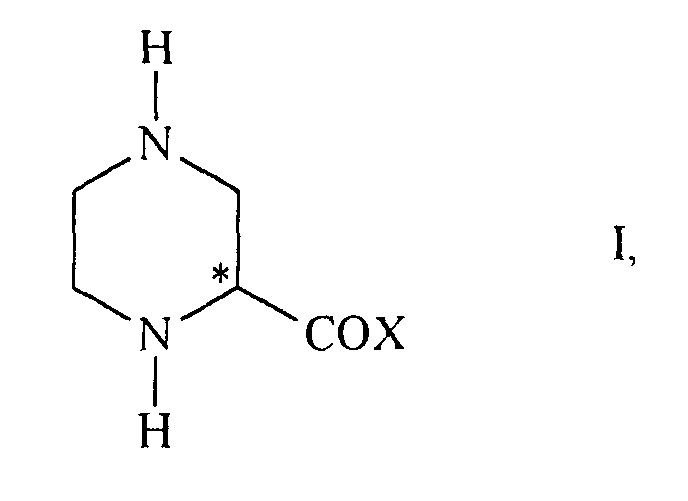 dadurch gekennzeichnet, dass ein entsprechendes Pyrazincarbonsäurederivat der allgemeinen Formel(i) R1 und R2 unabhängig voneinander Wasserstoff, C1-6-Alkyl, C3-6-Cycloalkyl, Aryl oder eine Aminoschutzgruppe bedeuten oder(ii) R1 und R2 zusammen mit dem Stickstoffatom einen gegebenenfalls substituierten 5-oder 6-gliedrigen gesättigten heterocyclischen Ring bilden,worin X die oben genannte Bedeutung hat, in Gegenwart eines katalytisch wirksamen optisch aktiven Rhodiumkomplexes asymmetrisch hydriert wird.
- Verfahren nach Anspruch 1, dadurch gekennzeichnet, dass als Pyrazincarbonsäurederivat II eine Verbindung eingesetzt wird, in der X eine Gruppe der Formel -NR1R2 ist, worin R1 und R2 die oben genannten Bedeutungen haben.
- Verfahren nach Anspruch 2, dadurch gekennzeichnet, dass R1 Wasserstoff und R2 eine C1-6-Alkylgruppe ist.
- Verfahren nach Anspruch 3, dadurch gekennzeichnet, dass R2 eine tert-Butylgruppe ist.
- Verfahren nach einem oder mehreren der Ansprüche 1 bis 4, dadurch gekennzeichnet, dass als optisch aktiver Rhodiumkomplex ein aus einem Rh(I)-Komplex und einem optisch aktiven Metallocenylphosphin gebildeter Komplex eingesetzt wird.
- Verfahren nach Anspruch 5, dadurch gekennzeichnet, dass als optisch aktives Metallocenylphosphin eine Verbindung der allgemeinen Formelworin M Eisen(II) oder Ruthenium(II), Q Stickstoff oder Phosphor, R3 eine C1-4-Alkylgruppe und R4 bis R7 unabhängig voneinander C1-8-Alkyl, C5-8-Cycloalkyl, Phenyl oder substituiertes Phenyl bedeuten, eingesetzt wird.

- Verfahren nach Anspruch 6, dadurch gekennzeichnet, dass M Eisen(II) ist.
- Verfahren nach Anspruch 6 oder 7, dadurch gekennzeichnet, dass Q Phosphor ist.
- Verfahren nach einem der Ansprüche 6 bis 8, dadurch gekennzeichnet, dass R3 Methyl ist und R4 und R5 gleich sind und tert-Butyl oder Cyclohexyl bedeuten.
- Verfahren nach einem oder mehreren der Ansprüche 5 bis 9, dadurch gekennzeichnet, dass als Rh(I)-Komplex ein neutraler Komplex der allgemeinen Formel
- Verfahren nach einem oder mehreren der Ansprüche 5 bis 9, dadurch gekennzeichnet, dass als Rh(I)-Komplex ein kationischer Komplex der allgemeinen Formel
- Verfahren nach Anspruch 10 oder 11, dadurch gekennzeichnet, dass L Norbornadien oder 1,5-Cyclooctadien bedeutet.
Applications Claiming Priority (3)
| Application Number | Priority Date | Filing Date | Title |
|---|---|---|---|
| CH102896 | 1996-04-23 | ||
| CH1028/96 | 1996-04-23 | ||
| CH102896 | 1996-04-23 |
Publications (3)
| Publication Number | Publication Date |
|---|---|
| EP0803502A2 EP0803502A2 (de) | 1997-10-29 |
| EP0803502A3 EP0803502A3 (de) | 1997-11-19 |
| EP0803502B1 true EP0803502B1 (de) | 2002-06-26 |
Family
ID=4200769
Family Applications (1)
| Application Number | Title | Priority Date | Filing Date |
|---|---|---|---|
| EP97106476A Expired - Lifetime EP0803502B1 (de) | 1996-04-23 | 1997-04-18 | Verfahren zur Herstellung von optisch aktiven 2-Piperazincarbonsäurederivaten |
Country Status (9)
| Country | Link |
|---|---|
| US (1) | US5945534A (de) |
| EP (1) | EP0803502B1 (de) |
| JP (1) | JP4138906B2 (de) |
| AT (1) | ATE219769T1 (de) |
| CA (1) | CA2201218C (de) |
| DE (1) | DE59707584D1 (de) |
| DK (1) | DK0803502T3 (de) |
| ES (1) | ES2179238T3 (de) |
| PT (1) | PT803502E (de) |
Family Cites Families (15)
| Publication number | Priority date | Publication date | Assignee | Title |
|---|---|---|---|---|
| US5011995A (en) * | 1987-07-28 | 1991-04-30 | Ciba-Geigy Corporation | Process for the preparation of optically active secondary amines |
| US4996361A (en) * | 1987-07-30 | 1991-02-26 | The University Of British Columbia | Process for the preparation of optically active secondary arylamines |
| CA2081970C (en) * | 1991-11-08 | 1997-07-08 | Joseph P. Vacca | Hiv protease inhibitors useful for the treatment of aids |
| DE59309554D1 (de) * | 1992-04-02 | 1999-06-10 | Novartis Ag | Ferrocenyldiphosphine als Liganden für homogene Katalysatoren |
| DE59410267D1 (de) * | 1993-02-26 | 2003-05-15 | Syngenta Participations Ag | Ferrocenyldiphosphine als Liganden für homogene Katalysatoren |
| US5353193A (en) * | 1993-02-26 | 1994-10-04 | Lsi Logic Corporation | High power dissipating packages with matched heatspreader heatsink assemblies |
| NZ269904A (en) * | 1993-07-16 | 1997-11-24 | Merck & Co Inc | 1,3-oxazole derivatives; preparative process; intermediate compounds |
| IL110255A (en) * | 1993-07-16 | 1998-12-06 | Merck & Co Inc | Formation and resolution of 2-tert-butylcarboxamido-piperazine |
| US5734055A (en) * | 1993-11-22 | 1998-03-31 | Koei Chemical Co. Ltd. | Process for preparing N-tert-butyl-2-pyrazinecarboxamide and N-tert-butyl-2-piperazinecarboxamide |
| TW472047B (en) * | 1994-02-04 | 2002-01-11 | Merck & Co Inc | Process for making HIV protease inhibitors |
| JPH07291943A (ja) * | 1994-04-22 | 1995-11-07 | Koei Chem Co Ltd | 光学活性N−tert−ブチル−2−ピペラジンカルボキサミドを製造する方法 |
| US5612484A (en) * | 1995-05-18 | 1997-03-18 | Merck & Co., Inc. | Process for making HIV protease inhibitors |
| ES2164187T3 (es) * | 1995-05-23 | 2002-02-16 | Lonza Ag | Procedimiento para la preparacion de derivados de acidos 2-piperazina-carboxilicos opticamente activos. |
| GB2302690A (en) * | 1995-06-28 | 1997-01-29 | Merck & Co Inc | Process for preparing chiral 1,4-diacyl-(S)-piperazine-2-carboxamides using a diene/chiral bisphosphine/rhodium or iridium hydrogenation catalyst |
| US5723615A (en) * | 1995-06-28 | 1998-03-03 | Merck & Co., Inc. | Process for preparing 4-tert-butyloxycarbonyl-(S)-piperazine-2-tert-butylcarboxamide |
-
1997
- 1997-03-27 CA CA002201218A patent/CA2201218C/en not_active Expired - Fee Related
- 1997-04-14 US US08/838,887 patent/US5945534A/en not_active Expired - Lifetime
- 1997-04-16 JP JP09926297A patent/JP4138906B2/ja not_active Expired - Fee Related
- 1997-04-18 PT PT97106476T patent/PT803502E/pt unknown
- 1997-04-18 DE DE59707584T patent/DE59707584D1/de not_active Expired - Lifetime
- 1997-04-18 DK DK97106476T patent/DK0803502T3/da active
- 1997-04-18 AT AT97106476T patent/ATE219769T1/de active
- 1997-04-18 ES ES97106476T patent/ES2179238T3/es not_active Expired - Lifetime
- 1997-04-18 EP EP97106476A patent/EP0803502B1/de not_active Expired - Lifetime
Also Published As
| Publication number | Publication date |
|---|---|
| JP4138906B2 (ja) | 2008-08-27 |
| DK0803502T3 (da) | 2002-09-23 |
| US5945534A (en) | 1999-08-31 |
| JPH1045726A (ja) | 1998-02-17 |
| CA2201218A1 (en) | 1997-10-23 |
| CA2201218C (en) | 2004-09-28 |
| ATE219769T1 (de) | 2002-07-15 |
| EP0803502A3 (de) | 1997-11-19 |
| EP0803502A2 (de) | 1997-10-29 |
| DE59707584D1 (de) | 2002-08-01 |
| PT803502E (pt) | 2002-11-29 |
| ES2179238T3 (es) | 2003-01-16 |
Similar Documents
| Publication | Publication Date | Title |
|---|---|---|
| DE10114868C1 (de) | Verfahren zur Herstellung von Diphosphinen und deren Verwendung | |
| EP0612758A1 (de) | Ferrocenyldiphosphine als Liganden für homogene Katalysatoren | |
| EP1414783A1 (de) | Verfahren zur herstellung von aminen durch reduktive aminierung von carbonylverbindungen unter transfer-hydrierungsbedingungen | |
| EP0564406A1 (de) | Ferrocenyldiphosphine als Liganden für homogene Katalysatoren | |
| EP0646590A1 (de) | Mit Fluoralkyl substituierte Ferrocenyldiphosphine als Liganden für homogene Katalysatoren | |
| EP0301457A2 (de) | Verfahren zur Herstellung von optisch aktiven sekundären Aminen | |
| EP0104375A1 (de) | Neue, phosphorhaltige Biphenylderivate und deren Verwendung für asymmetrische Hydrierungen und enantioselektive Wasserstoffverschiebungen | |
| EP0138141B1 (de) | Verfahren zur selektiven Hydrierung von C-C-Doppelbindungen in Gegenwart von reduzierbaren, stickstoffhaltigen Gruppen | |
| EP0579797B1 (de) | Diphosphinliganden | |
| EP0780157B1 (de) | Rutheniumkomplexe mit einem chiralen, zweizähnigen Phosphinoxazolin-Liganden zur enantioselektiven Transferhydrierung von prochiralen Ketonen | |
| DE3853043T2 (de) | Isochinolinderivate, ihre Herstellung und Verwendung. | |
| EP1140890B1 (de) | Chromanderivate | |
| EP0751142A2 (de) | Chirale Mangan-triazanonankomplexe und Verfahren zu ihrer Herstellung | |
| EP0570764B1 (de) | Asymmetrische Hydrierung | |
| EP0744401B1 (de) | Verfahren zur Herstellung von optisch aktiven 2-Piperazincarbonsäurederivaten | |
| EP0397042B1 (de) | Herstellung von Isochinolinderivaten | |
| DE69805676T2 (de) | 2-Phenyl-2-(2' piperidinylidene) acetat Derivaten, Verfahren zu ihrer Herstellung , und Verfahren von optisch-active 2-Phenyl-2-(2'-piperidin) acetat Derivaten durch asymmetrische Hydrierung | |
| DE69520947T2 (de) | Diarinopropanole abgeleitet von aminosäuren | |
| DE69300826T2 (de) | Hydrierung. | |
| CH653996A5 (de) | Tryptaminderivate und verfahren zu deren herstellung. | |
| EP0803502A2 (de) | Verfahren zur Herstellung von optisch aktiven 2-Piperazincarbonsäurederivaten | |
| DE69813297T2 (de) | Asymmetrische hydrierung | |
| EP0512415B1 (de) | Verfahren zur enantioselektiven Synthese von 2(R)-Benzylbernsteinsäuremonoamid-Derivaten | |
| DE69914889T2 (de) | Asymmetrische hydrierung | |
| WO2005049570A1 (de) | Verfahren zur synthese optisch aktiver piperidine durch hydrierung optisch aktiver pyridine |
Legal Events
| Date | Code | Title | Description |
|---|---|---|---|
| PUAI | Public reference made under article 153(3) epc to a published international application that has entered the european phase |
Free format text: ORIGINAL CODE: 0009012 |
|
| PUAL | Search report despatched |
Free format text: ORIGINAL CODE: 0009013 |
|
| AK | Designated contracting states |
Kind code of ref document: A2 Designated state(s): AT BE CH DE DK ES FI FR GB IE IT LI NL PT SE |
|
| AK | Designated contracting states |
Kind code of ref document: A3 Designated state(s): AT BE CH DE DK ES FI FR GB IE IT LI NL PT SE |
|
| 17P | Request for examination filed |
Effective date: 19971215 |
|
| 17Q | First examination report despatched |
Effective date: 20000124 |
|
| GRAG | Despatch of communication of intention to grant |
Free format text: ORIGINAL CODE: EPIDOS AGRA |
|
| RAP1 | Party data changed (applicant data changed or rights of an application transferred) |
Owner name: LONZA AG |
|
| GRAG | Despatch of communication of intention to grant |
Free format text: ORIGINAL CODE: EPIDOS AGRA |
|
| GRAG | Despatch of communication of intention to grant |
Free format text: ORIGINAL CODE: EPIDOS AGRA |
|
| GRAH | Despatch of communication of intention to grant a patent |
Free format text: ORIGINAL CODE: EPIDOS IGRA |
|
| GRAH | Despatch of communication of intention to grant a patent |
Free format text: ORIGINAL CODE: EPIDOS IGRA |
|
| GRAA | (expected) grant |
Free format text: ORIGINAL CODE: 0009210 |
|
| AK | Designated contracting states |
Kind code of ref document: B1 Designated state(s): AT BE CH DE DK ES FI FR GB IE IT LI NL PT SE |
|
| REF | Corresponds to: |
Ref document number: 219769 Country of ref document: AT Date of ref document: 20020715 Kind code of ref document: T |
|
| REG | Reference to a national code |
Ref country code: GB Ref legal event code: FG4D Free format text: NOT ENGLISH |
|
| REG | Reference to a national code |
Ref country code: CH Ref legal event code: EP |
|
| GBT | Gb: translation of ep patent filed (gb section 77(6)(a)/1977) |
Effective date: 20020626 |
|
| REG | Reference to a national code |
Ref country code: IE Ref legal event code: FG4D Free format text: GERMAN |
|
| REF | Corresponds to: |
Ref document number: 59707584 Country of ref document: DE Date of ref document: 20020801 |
|
| REG | Reference to a national code |
Ref country code: DK Ref legal event code: T3 |
|
| ET | Fr: translation filed | ||
| REG | Reference to a national code |
Ref country code: PT Ref legal event code: SC4A Free format text: AVAILABILITY OF NATIONAL TRANSLATION Effective date: 20020924 |
|
| REG | Reference to a national code |
Ref country code: ES Ref legal event code: FG2A Ref document number: 2179238 Country of ref document: ES Kind code of ref document: T3 |
|
| PLBE | No opposition filed within time limit |
Free format text: ORIGINAL CODE: 0009261 |
|
| STAA | Information on the status of an ep patent application or granted ep patent |
Free format text: STATUS: NO OPPOSITION FILED WITHIN TIME LIMIT |
|
| 26N | No opposition filed |
Effective date: 20030327 |
|
| PG25 | Lapsed in a contracting state [announced via postgrant information from national office to epo] |
Ref country code: IT Free format text: LAPSE BECAUSE OF NON-PAYMENT OF DUE FEES Effective date: 20090418 |
|
| PGFP | Annual fee paid to national office [announced via postgrant information from national office to epo] |
Ref country code: DK Payment date: 20110225 Year of fee payment: 15 Ref country code: IE Payment date: 20110317 Year of fee payment: 15 |
|
| PGFP | Annual fee paid to national office [announced via postgrant information from national office to epo] |
Ref country code: NL Payment date: 20110228 Year of fee payment: 15 Ref country code: FI Payment date: 20110224 Year of fee payment: 15 Ref country code: FR Payment date: 20110316 Year of fee payment: 15 Ref country code: CH Payment date: 20110325 Year of fee payment: 15 Ref country code: PT Payment date: 20110223 Year of fee payment: 15 Ref country code: SE Payment date: 20110223 Year of fee payment: 15 |
|
| PGFP | Annual fee paid to national office [announced via postgrant information from national office to epo] |
Ref country code: ES Payment date: 20110418 Year of fee payment: 15 Ref country code: GB Payment date: 20110228 Year of fee payment: 15 Ref country code: DE Payment date: 20110224 Year of fee payment: 15 Ref country code: BE Payment date: 20110222 Year of fee payment: 15 |
|
| PGRI | Patent reinstated in contracting state [announced from national office to epo] |
Ref country code: IT Effective date: 20110616 |
|
| PGFP | Annual fee paid to national office [announced via postgrant information from national office to epo] |
Ref country code: AT Payment date: 20110222 Year of fee payment: 15 |
|
| PGFP | Annual fee paid to national office [announced via postgrant information from national office to epo] |
Ref country code: IT Payment date: 20110422 Year of fee payment: 15 |
|
| REG | Reference to a national code |
Ref country code: PT Ref legal event code: MM4A Free format text: LAPSE DUE TO NON-PAYMENT OF FEES Effective date: 20121018 |
|
| BERE | Be: lapsed |
Owner name: *LONZA A.G. Effective date: 20120430 |
|
| REG | Reference to a national code |
Ref country code: NL Ref legal event code: V1 Effective date: 20121101 |
|
| REG | Reference to a national code |
Ref country code: DK Ref legal event code: EBP |
|
| REG | Reference to a national code |
Ref country code: CH Ref legal event code: PL |
|
| REG | Reference to a national code |
Ref country code: SE Ref legal event code: EUG |
|
| REG | Reference to a national code |
Ref country code: AT Ref legal event code: MM01 Ref document number: 219769 Country of ref document: AT Kind code of ref document: T Effective date: 20120418 |
|
| GBPC | Gb: european patent ceased through non-payment of renewal fee |
Effective date: 20120418 |
|
| REG | Reference to a national code |
Ref country code: IE Ref legal event code: MM4A |
|
| REG | Reference to a national code |
Ref country code: FR Ref legal event code: ST Effective date: 20121228 |
|
| PG25 | Lapsed in a contracting state [announced via postgrant information from national office to epo] |
Ref country code: LI Free format text: LAPSE BECAUSE OF NON-PAYMENT OF DUE FEES Effective date: 20120430 Ref country code: GB Free format text: LAPSE BECAUSE OF NON-PAYMENT OF DUE FEES Effective date: 20120418 Ref country code: IE Free format text: LAPSE BECAUSE OF NON-PAYMENT OF DUE FEES Effective date: 20120418 Ref country code: AT Free format text: LAPSE BECAUSE OF NON-PAYMENT OF DUE FEES Effective date: 20120418 Ref country code: BE Free format text: LAPSE BECAUSE OF NON-PAYMENT OF DUE FEES Effective date: 20120430 Ref country code: CH Free format text: LAPSE BECAUSE OF NON-PAYMENT OF DUE FEES Effective date: 20120430 Ref country code: FI Free format text: LAPSE BECAUSE OF NON-PAYMENT OF DUE FEES Effective date: 20120418 |
|
| REG | Reference to a national code |
Ref country code: DE Ref legal event code: R119 Ref document number: 59707584 Country of ref document: DE Effective date: 20121101 |
|
| PG25 | Lapsed in a contracting state [announced via postgrant information from national office to epo] |
Ref country code: SE Free format text: LAPSE BECAUSE OF NON-PAYMENT OF DUE FEES Effective date: 20120419 Ref country code: FR Free format text: LAPSE BECAUSE OF NON-PAYMENT OF DUE FEES Effective date: 20120430 Ref country code: IT Free format text: LAPSE BECAUSE OF NON-PAYMENT OF DUE FEES Effective date: 20120418 Ref country code: PT Free format text: LAPSE BECAUSE OF NON-PAYMENT OF DUE FEES Effective date: 20121018 |
|
| PG25 | Lapsed in a contracting state [announced via postgrant information from national office to epo] |
Ref country code: NL Free format text: LAPSE BECAUSE OF NON-PAYMENT OF DUE FEES Effective date: 20121101 |
|
| REG | Reference to a national code |
Ref country code: ES Ref legal event code: FD2A Effective date: 20130715 |
|
| PG25 | Lapsed in a contracting state [announced via postgrant information from national office to epo] |
Ref country code: ES Free format text: LAPSE BECAUSE OF NON-PAYMENT OF DUE FEES Effective date: 20120419 |
|
| PG25 | Lapsed in a contracting state [announced via postgrant information from national office to epo] |
Ref country code: DK Free format text: LAPSE BECAUSE OF NON-PAYMENT OF DUE FEES Effective date: 20120430 |
|
| PG25 | Lapsed in a contracting state [announced via postgrant information from national office to epo] |
Ref country code: DE Free format text: LAPSE BECAUSE OF NON-PAYMENT OF DUE FEES Effective date: 20121101 |