EP0768567A2 - Lichtempfindliches photographisches Silberhalogenid-Material - Google Patents
Lichtempfindliches photographisches Silberhalogenid-Material Download PDFInfo
- Publication number
- EP0768567A2 EP0768567A2 EP96306616A EP96306616A EP0768567A2 EP 0768567 A2 EP0768567 A2 EP 0768567A2 EP 96306616 A EP96306616 A EP 96306616A EP 96306616 A EP96306616 A EP 96306616A EP 0768567 A2 EP0768567 A2 EP 0768567A2
- Authority
- EP
- European Patent Office
- Prior art keywords
- silver halide
- soluble polymer
- water soluble
- silver
- mol
- Prior art date
- Legal status (The legal status is an assumption and is not a legal conclusion. Google has not performed a legal analysis and makes no representation as to the accuracy of the status listed.)
- Granted
Links
Images
Classifications
-
- G—PHYSICS
- G03—PHOTOGRAPHY; CINEMATOGRAPHY; ANALOGOUS TECHNIQUES USING WAVES OTHER THAN OPTICAL WAVES; ELECTROGRAPHY; HOLOGRAPHY
- G03C—PHOTOSENSITIVE MATERIALS FOR PHOTOGRAPHIC PURPOSES; PHOTOGRAPHIC PROCESSES, e.g. CINE, X-RAY, COLOUR, STEREO-PHOTOGRAPHIC PROCESSES; AUXILIARY PROCESSES IN PHOTOGRAPHY
- G03C1/00—Photosensitive materials
- G03C1/005—Silver halide emulsions; Preparation thereof; Physical treatment thereof; Incorporation of additives therein
- G03C1/0051—Tabular grain emulsions
- G03C1/0053—Tabular grain emulsions with high content of silver chloride
-
- G—PHYSICS
- G03—PHOTOGRAPHY; CINEMATOGRAPHY; ANALOGOUS TECHNIQUES USING WAVES OTHER THAN OPTICAL WAVES; ELECTROGRAPHY; HOLOGRAPHY
- G03C—PHOTOSENSITIVE MATERIALS FOR PHOTOGRAPHIC PURPOSES; PHOTOGRAPHIC PROCESSES, e.g. CINE, X-RAY, COLOUR, STEREO-PHOTOGRAPHIC PROCESSES; AUXILIARY PROCESSES IN PHOTOGRAPHY
- G03C1/00—Photosensitive materials
- G03C1/005—Silver halide emulsions; Preparation thereof; Physical treatment thereof; Incorporation of additives therein
- G03C1/06—Silver halide emulsions; Preparation thereof; Physical treatment thereof; Incorporation of additives therein with non-macromolecular additives
- G03C1/08—Sensitivity-increasing substances
- G03C1/09—Noble metals or mercury; Salts or compounds thereof; Sulfur, selenium or tellurium, or compounds thereof, e.g. for chemical sensitising
Definitions
- the present invention relates to a silver halide photographic emulsion (hereinafter referred to as silver halide emulsion), a silver halide photographic light sensitive material (hereinafter referred to as light sensitive material) silver halide emulsion) employing the emulsion and a processing method thereof (hereinafter referred to also as a developing method), and particularly to a silver halide emulsion, a light sensitive material or a developing method thereof giving high sensitivity, an excellent rapid processing performance or improved scratch resistance, safelight safety, silver image tone and processing dependency.
- silver halide photographic emulsion hereinafter referred to as silver halide emulsion
- light sensitive material silver halide photographic light sensitive material
- tabular silver halide grains are used in photographic light sensitive material, it is well known that spectral sensitization, covering power, image sharpness or graininess is improved. On the other hand, it is also well known that the tabular silver halide grains have disadvantages in that pressure resistance deterioration, for example, a problem such as blackening due to scratching or bending, is likely to occur probably because of their shape. Recently, tabular silver halide grains having parallel twin planes have been frequently used. These tabular silver halide grains have major ⁇ 111 ⁇ faces, and their shape is triangle or hexagonal owing to a ⁇ 111 ⁇ face lattice structure.
- 5,275,930 is disclosed a technique epitaxial growing tabular grains having a chloride content of not less than 50 %, an aspect ratio of not less than 8 and a ⁇ 100 ⁇ face as a major face.
- US Patent No. 5,314,798 are disclosed a technique regarding a silver halide emulsion comprising tabular silver iodochloride grains having a chloride content of not less than 50 %, an aspect ratio of not less than 2 and a ⁇ 100 ⁇ face as a major face and its manufacturing method.
- silver halide emulsion is chemically sensitized for high sensitivity.
- Reduction sensitization is known as one of chemical sensitizations.
- this method is likely to cause fog, resulting in fog increase during storage or under safelight.
- another sensitization such as gold sensitization or chalcogen sensitization such as sulfur sensitization
- the emulsion is highly sensitized but has a problem such as the above described fog occurrence, especially fog occurrence under safelight. It is reported by H. E. Spencer et al.
- sensitizing nuclei which are produced by reduction sensitization, are more likely to be formed on a ⁇ 100 ⁇ face than a ⁇ 111 ⁇ face. Accordingly, it has been difficult in view of fog occurrence or fog occurrence under safelight that tabular tetragonal silver chloride emulsion having a major ⁇ 100 ⁇ face is noble metal or chalcogen sensitized together with reduction sensitization to obtain high sensitivity.
- An object of the present invention is to provide a silver halide emulsion and its manufacturing method, a light sensitive material employing the emulsion or a developing method thereof giving high sensitivity, an excellent rapid processing performance or improved scratch resistance, safelight safety, silver image tone and processing dependency.
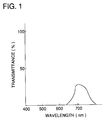
- Fig. 1 shows a transmittance curve of a filter.
- the above-mentioned object on the invention can be attained the following constitution: a silver halide emulsion comprising tabular silver halide grains having a silver chloride content of not less than 50 mol% and two parallel major (100) faces, wherein chemical sensitization is carried out in the presence of the water soluble polymer, or a method for processing a silver halide photographic light sensitive material comprising the above silver halide emulsion in a total processing time (Dry to Dry) of not more than 25 seconds.
- a silver halide emulsion comprising tabular silver halide grains having a silver chloride content of not less than 50 mol% and two parallel major (100) faces, wherein chemical sensitization is carried out in the presence of the water soluble polymer, or a method for processing a silver halide photographic light sensitive material comprising the above silver halide emulsion in a total processing time (Dry to Dry) of not more than 25 seconds.
- a water soluble polymer is preferably added to a silver halide emulsion after addition of a reduction sensitizer.
- the tabular silver halide grains in the emulsion have a major face comprised of a (100) face.
- the tabular silver halide grains used in the present invention are grains having an ordinary average grain size, and the average grain size in the invention is preferably 0.3 to 3.0 ⁇ m, and more preferably 0.5 to 2.0 ⁇ m.
- the average grain size of the tabular silver halide grains referred to in the invention means an average edge length of the major face of the grains.
- the edge ratio of the major face (the longest length/the shortest length) is preferably 1.0 to 1.4, and more preferably 1.0 to 1.2.
- the average value (referred to as average aspect ratio) of grain edge length /thickness (referred to as aspect ratio) in the tabular silver halide grains of the present invention may be an average aspect ratio used in the ordinary silver halide grains, but is preferably 2.0 or more, more preferably 2.0 to 20.0, and still more preferably 4.0 to 15.0. In order to obtain the average aspect ratio, at least 100 samples are measured.
- the average thickness of the tabular silver halide grains of the present invention is an average thickness used in the ordinary tabular silver halide grains, but is preferably 0.5 ⁇ m or less, and more preferably 0.3 ⁇ m or less.
- the major face edge length of the tabular silver halide grains referred to in the invention is defined as an edge length of a square having an area equivalent to a projected area of the grains in the electron microscope photograph of the grains.
- the thickness of the silver halide grains referred to in the invention means the minimum distance (that is, a distance between the major faces) of distances between two parallel largest (100) faces.
- the thickness of the tabular silver halide grains is obtained from an electron microscope photograph with a shadow such as a carbon replica method of the silver halide grains or from an electron microscope photograph of a section of a sample obtained by coating a silver halide emulsion on a support and drying.
- the tabular silver halide grains in the invention have a ⁇ 100 ⁇ face, but the corner or edge of the grains needs not have a (100) face and may have a ⁇ 110 ⁇ or (111) face.
- the tabular silver halide emulsion in the invention may have any dispersion properties, but preferably is monodisperse.
- the monodisperse tabular silver halide emulsion having a different main plane side length, a polydisperse tabular silver halide emulsion having a broad grain size distribution or a normal crystal emulsion comprising a cubic, octahedral or tetradecahedral crystal or a twin plane emulsion comprising silver halide grains having a twin plane may be mixed, as long as the effects of the invention are not inhibited.
- the silver halide emulsion in the invention have a silver chloride content of not less than 50 mol%, but the emulsion in the invention has a silver chloride content of preferably not less than 65 mol%, more preferably not less than 80 mol%.
- the silver halide emulsion of the present invention has a silver chloride content of not less than 50 mol%, but may contain silver iodide.
- the silver halide emulsion contains the silver iodide, its content is not more than 2.0 %, preferably not more than 1.5 %, especially preferably not more than 1.0 % or may be 0.
- the tabular silver halide emulsion in the present invention may be grains in which the halogen composition is uniform, core/shell grains wherein silver iodide is localized in the central portion or grains having a higher silver iodide content on the surface.
- the silver halide emulsion in the invention is manufactured according to a conventional method, and for example, it is possible to refer to US patent Nos. 4,063,951, 4,386,156, 5,275,930 and 5,314,798..
- Size or shape of the tabular silver halide grains in the invention can be controlled by temperature, pAg (pBr, pCl) or pH during formation of the grains and by addition speed of silver salt and an aqueous halogenated solution.
- pAg during formation of the grains is preferably 5.0 to 8.0.
- a silver halide solvent such as ammonia, thioether and thiourea can be used.
- the silver halide emulsion in the invention may be a surface latent image forming emulsion capable of forming a latent image on the grain surface, an inside latent image forming emulsion capable of forming a latent image inside the grain or an emulsion capable of forming a latent image on the grain surface and inside the grain.
- An iron, cadmium, lead, zinc, thallium, ruthenium, osmium, iridium, and rhodium salt or their complex may be added to the emulsion during physical ripening or grain formation.
- a water-washing methods such as a noodle water-washing method and a flocculation precipitation method are allowed to be used.
- a desirable water-washing method a method that uses an aromatic hydrocarbon aldehyde resin containing a sulfo group described in Japanese Patent OPI Publication No. 35-16086/1960 is cited.
- a desirable desalting method a method that uses illustrated coagulation polymers G-3 and G-8 described in Japanese Patent OPI Publication No. 63-158644/1988 is cited. Further, a ultracentrifuge method is preferable.
- gelatin is advantageously used as a protective colloid used in the emulsion during its manufacturing or as a binder of another hydrophilic colloid layer, but hydrophilic colloids other than gelatin can be used.
- Gelatin includes a lime-processed gelatin, acid-processed gelatin, an oxygen-processed gelatin as described in Bull. Soc. Phot. Japan, No. 16, p.30 (1966), and hydrolyzed or emzyme-decomposed gelatin.
- gelatin having a low methionine content that is, a methionine content of less than 30 micromol, especially less than 12 micromol based on 1 g of gelatin is preferably used.
- the chemical sensitization herein referred is carried out from time when chemical sensitizers is added to a silver halide emulsion till time when a chemical sensitization stopping agent is added to the silver halide emulsion to complete the chemical sensitization.
- the addition amount of the water soluble polymer may be basically any amount, but, in the invention, is preferably 1 x 10 -4 to 3 x 10 2 g/mol of Ag, more preferably 1 x 10 -3 to 1 x 10 2 g/mol of Ag, and still more preferably 1 x 10 -2 to 50 g/mol of Ag.
- the solvent of the water soluble polymer can be a hydrophilic organic solvent, but is preferably a mixture solvent of a hydrophilic organic solvent and water and more preferably water.
- the water soluble polymer used in the invention may be a synthetic water soluble polymer or a natural water soluble polymer but for gelatin.
- the preferable water soluble polymer is a polymer having in its molecule a nonionic group, an anionic group, or both of nonionic and anionic groups.
- the nonionic group includes an ether group, a thioether group, an ethyleneoxide group, a hydroxy group, an amido group, and an imidazolyl group
- the anionic group includes a sulfo group or its salt, a carboxyl group or its salt and a phospho group or its salt.
- the water soluble polymer referred to in the invention means a polymer having a water solubility of not less than 0.05 g, preferably not less than 0.1 g based on the 100 g of 20°C water.
- the water soluble polymer includes a synthethic polymer having in its molecule in an amount of 10 to 100 mol% the repeating unit represented by the following Formula (P): wherein R 1 represents a hydrogen atom, an alkyl group, preferably an alkyl group having 1 to 4 carbon atoms which may have a substituent (for example, methyl, ethyl, propyl, butyl), a halogen atom or -CH 2 COOM and preferably a hydrogen atom or methyl, L represents -CONH-, -NHCO-, -COO-, -OCO-, -CO-, or -O- and preferably -OCO- or -O-, J represents an alkylene group, preferably an alkylene group having 1 to 10 carbon atoms which may have a substituent (for example, methylene, ethylene, propylene, trimethylene, butylene, hexylene), an arylene group which may have a substituent (for example,
- R 2 represents an alkyl group having 1 to 4 carbon atoms which may have a substituent (for example, methyl, ethyl, propyl, butyl)
- R 3 , R 4 , R 5 , R 6 , R 7 and R 8 independently represent an alkyl group having 1 to 20 carbon atoms which may have a substituent (for example, methyl, ethyl, propyl, butyl, hexyl, decyl, hexadecyl)
- the substituent including an alkoxy group having 1 to 10 carbon atoms or an alkoxy group containing a thioether group having 1 to 10 carbon atoms
- X represents an anion
- Y represents a hydrogen atom or a carboxy group
- p and q independently represent 0 or 1.
- the water soluble polymer used in the invention is especially preferably a polymer having in its molecule a nonionic group.
- a polymer includes a polyvinyl alcohol, a polyvinyl pyrrolidone, a polyvinyl imidazole, a polyacrylamide, and a polymer having a hydroxyquinoline or a thioether group.
- a polyvinyl alcohol, a polyvinyl pyrrolidone and a a polyacrylic acid are preferable.
- the synthetic water soluble polymer in the invention can be easily synthesized according to various solution, bulk or suspension polymerization methods.
- a mixture of monomers having an appropriate concentration (ordinarily not more than 40 wt%, preferably 10 to 25 wt% based on the solvent) in a solvent is heated to an appropriate temperature (for example, 40-120°C, preferably 50-100°C) in the presence of a polymerization initiator (for example, benzoylperoxide, azobisisobutylonitrile or ammonium persulfate) and copolymerised.
- a polymerization initiator for example, benzoylperoxide, azobisisobutylonitrile or ammonium persulfate
- the average molecular weight of the synthetic water soluble polymer in the invention is 1,000 to 1,000,000, preferably 2,000 to 500,000.
- the average molecular weight is obtained in terms of standard polystyrene by measuring through gel permeation chromatography HLC-802A produced by Toyo Soda Co., Ltd.
- the water soluble polymer in the invention includes lignin, starch, pullulan, cellulose, alginic acid, dextran, dextrin, guar gum, gum arabic, glycogen, laminarin, lichenin, nigeran and its derivatives detailed in "Suiyouseikoubunshi mizubunsangatajusi no sogogijutsushiryoshu" (published by Keiei kaihatsu center shuppanbu).
- the natural water soluble polymer derivative in the invention includes the above water soluble polymer sulfonated, carboxylated, phosphorylated, sulfoalkylated, carboxyakylated or alkyl phosphorylated and their salts.
- a glucose polymer or its derivatives is preferable, and, of the glucose polymer or its derivatives, starch, glycogen, cellulose, lichenin, dextran, nigeran is more preferable, and dextran or its derivatives are especially preferable.
- the natural water soluble polymers may be used in combination.
- the water soluble polymer is preferably added in the polymer solution form to an emulsion. It is preferable that a chemical sensitizer is added in the presence of the water soluble polymer.
- the silver halide emulsion in the invention is preferably sensitized at pH 4.0 or more with noble metal and chalcogen sensitizers. It is preferable in the invention that the noble metal and/or chalcogen sensitizations are carried out in the presence of the water soluble polymer.
- the preferable pH range is 4.5 to 10.0, and the more preferable pH range is 5.0 to 9.0.
- gold sensitization is preferable, and a gold compound, a gold complex such as a gold thiocyanate complex is used.
- the complex other than gold complex includes a complex of platinum, iridium, osmium, palladium, rhodium or ruthenium.
- a gold sensitizer used for the gold sensitization includes, for example, chloroaurate salt, gold thiourea salt, potassium chloroaurate, auric trichloride, potassium auric thiocyanate, potassium iodoaurate, tetracyanoauric amide, ammonium aurothiocyanate and pyridyl trichloro gold.
- the added amount of the above-mentioned gold sensitizers can be changed widely depending upon various conditions. As a target, 5 x 10 -8 to 5 x 10 -3 mol per mol of silver halide is preferred and 1 x 10 -7 to 4 x 10 -4 mol is more preferred.
- the sensitizer used in the sulfur sensitization includes, for example, thiosulfate, alylthiocarbamido thiourea, allylisothiacyanate, systin, p-toluenethiosulfonic acid salt and rhodanine.
- the addition amount of the sulfur sensitizer that is just sufficient to enhance the sensitivity of an emulsion effectively is acceptable. This amount can be changed widely depending upon various conditions such as the size of silver halide grains. As a target, the addition amount is preferably 5 x 10 -8 to 5 x 10 -5 mol per mol of silver, and more preferably 1 x 10 -7 to 1 x 10 -4 mol per mol of silver.
- the selenium and/or tellurium sensitization is preferably carried in combination.
- the selenium sensitization is usually carried out by adding an unstable type selenium compound and/or a non-unstable type selenium compound to a silver halide emulsion and the emulsion is then stirred at a high temperature, preferably, a temperature of not lower than 40°C for a specific time.
- the typical unstable type selenium sensitizers include, for example, an isoselenocyanate (for example, an aliphatic isoselenocyanate such as allylisoselenocyanate), a selenourea, a selenoketone, a selenoamide, a selenocarboxylic acid (for example, 2-selenopropionic acid or 2-selenobutyric acid), an selenoester, a diacylselenide (for example, bis-3-chloro-2,6-dimethoxybenzoylselenide), a selenophosphate, phosphinselenide and collid metal selenium.
- an isoselenocyanate for example, an aliphatic isoselenocyanate such as allylisoselenocyanate
- a selenourea for example, a selenoketone, a selenoamide
- the preferable pattern of an unstable type selenium compounds are stated above.
- the present invention is not limited thereto.
- the structure of unstable selenium compound as a sensitizer for the photographic emulsion is not so important provided that selenium is unstable. It is commonly understood that the organic portion of the selenium sensitizer molecule does not have any role except for carrying selenium and letting it exist in the emulsion in an unstable form..
- the non-unstable type selenium compound include, for example, selenous acid, potassium selenocyanide, a selenazole, a quaternary salt of a selenazole, a diaryl selenide, a diaryl diselenide, a dialkyl selenide, a dialkyl diselenide, 2-thioselenazolidinedione, 2-selenoxazolidinethione and derivatives thereof.
- the addition amount of the selenium sensitizer depends upon kinds of selenium compounds used, kinds of silver halide grains used or chemical ripening conditions, but is preferably not less than 1 x 10 -8 mol per mol of silver halide. It is more preferable that the selenium sensitizer is added in an amount of 1 x10 -7 to 1 x 10 -4 mol per mol of silver halide during chemical sensitization.
- the selenium sensitizer is added with a solution in which the selenium compound is dissolved in water or an organic solvent such as methanol or ethanol or its mixture solvent depending on nature of the selenium compound, a gelatin solution containing the selenium compound or a dispersion solution containing an organic solvent soluble polymer and the selenium compound as disclosed in Japanese Patent O.P.I. Publication Nos. 4-140739/1992.
- tellurium sensitizer preferably used for chemical sensitization in the invention and its sensitizing method will be explained.
- the typical tellurium sensitizer includes colloid tellurium, telluroureas (for example, allyltellurourea, N,N-dimethyltellurourea, tetramethyltellurourea, N-carboxyethyl-N,N'-dimethyltellurourea, N,N'-dimethylethylenetellurourea, N,N'-diphenylethylenetellurourea), isotellurocyanates (for example, allylisotellurocyanate), telluroketones (for example, telluroacetone, telluroacetophenone), telluroamides (for example, telluroacetoamide, N,N-dimethyltellurobenzamide), tellurohydrazides (for example, N,N',N'-trimethyltellurobenzhydrazide), telluroesters (for example, t-butyl-t-hexyltelluroester), phosphintellurides (tributylphosphin
- the addition amount of the tellurium sensitizer depends upon kinds of silver halide grains used or chemical ripening conditions, but is preferably 10 -8 to 10 -2 mol per mol of silver halide, and more preferably 10 -7 to 5 x 10 -3 mol per mol of silver halide.
- the chemical sensitization is not specifically limited, but pAg is preferably 6-11, more preferably 7-10 and temperature is preferably 40-90°C, and more preferably 45-85°C.
- noble metal and/or chalcogen sensitization is preferably carried out together with reduction sensitization.
- the reduction sensitization in the invention can be selected from a method of adding a reduction sensitizer to an emulsion, a method of growing or ripening an emulsion under a lower pAg such as pAg 1 to 7, which is called silver ripening, and a method of growing or ripening an emulsion under a higher pH such as pH 8 to 11, which is called high pH ripening.
- the reduction sensitizer addition method is preferable in order to finely adjust reduction sensitization level.
- a reduction sensitizer Stannous salts, amines or polyamines, hydrazine derivatives, formamidinesulfinic acid, a silane compound or a borane compound are known as a reduction sensitizer.
- the reduction sensitization in the invention can be carried out using these reduction sensitizers, and two or more kinds of reduction sensitizers can be used.
- Stannous chloride, thiourea dioxide and dimethylamine borane are preferable as reduction sensitizers.
- the addition amount of these reduction sensitizers depends upon emulsion manufacturing conditions, but is suitably 10 -8 to 10 -3 mol per mol of silver halide.
- reduction sensitizers are added in a solution in which the sensitizers are dissolved in solvents such as alcohols, glycols, ketones, esters or amides.
- the water soluble polymer is added after addition of a reduction sensitizer.
- the "after addition of a reduction sensitizer" herein referred to comprises the simultaneous addition of the reduction sensitizer and synthetic water soluble polymer.
- the chemical sensitizer is added before addition of the water soluble polymer.
- the reduction sensitization in the invention is especially preferably carried out by addition of ascorbic acid or its derivatives.
- the typical example of the ascorbic acid or its derivatives includes the following compounds.
- the compound may be added, directly or in a solution in which the compound is dissolved in water, methanol, ethanol or a mixture thereof, to the emulsion.
- the ascorbic acid compound used in the invention is preferably added in an amount larger than another conventional reduction sensitizer.
- a reduction sensitizer does not exceed 0.75 x 10 -2 milliequivalent per g of a silver ion (8 x 10 -4 mol/AgX mol), and is effectively 0.1 to 10 mg per 1 kg of silver nitrate (equivalent to 10 -7 to 10 -5 mol/AgX of ascorbic acid).
- US Patent No. 2,487,850 that the addition amount of a stannous compound as a reduction sensitizer 1 x 10 -7 to 44 x 10 -6 mol.
- the addition amount of the ascorbic acid compound depends on grain size, a halogen composition of the grains or temperature, pH or pAg during the emulsion preparation, but is preferably 5 x 10 -5 to 1 x 10 -1 mol per mol of silver halide, more preferably 5 x 10 -4 to 1 x 10 -2 mol per mol of silver halide, and still more preferably 1 x 10 -5 to 1 x 10 -2 mol per mol of silver halide.
- the ascorbic acid compound sensitization can be carried out together with another reduction sensitization.
- the silver halide emulsion in the invention can be spectrally sensitized.
- the spectral sensitizing dye is preferably a methine dye, and includes cyanine dyes, merocyanine dyes, complex cyanine dyes, complex merocyanine dyes, holopolar cyanine dyes, hemicyanine dyes, styryl dyes and hemioxonol dyes.
- the example thereof includes oxacarbocyanines, benzoimidazolocarbocyanines and benzoimidazolooxacarbocyanines disclosed in Japanese Patent O.P.I. Publication Nos. 5-113619/1993, and dyes having a sensitization effect in the blue light range disclosed in Japanese Patent O.P.I. Publication Nos. 6-332102/1994. These spectral sensitizing dyes may be used singly or in combination.
- the spectral sensitizing dye addition is preferably carried out using as a solution in which the dye is dissolved in an organic solvent such as methanol or as a solid dispersion.
- the spectral sensitizing dye addition amount depends on kinds of dyes or emulsion conditions, but is preferably 10-900 mg, more preferably 60-400 mg per mol of silver.
- the spectral sensitizing dye is preferably added or may be added in separate several times, before completion of chemical sensitization.
- the spectral sensitizing dye is added more preferably at a period from completion of grain growth to completion of chemical sensitization, and especially preferably before beginning of chemical sensitization.
- a chemical sensitization stopping agent is preferably used in view of emulsion stability.
- the chemical sensitization stopping agent includes a halide such as potassium bromide or sodium chloride, an anti-foggant and an organic compound well known as a stabilizer (for example, 4-hydroxy-6-methyl-1,3,3a,7-tetraazaindene). These may be used singly or in combination.
- various photographic additives can be added during a physical ripening step or before or after a chemical ripening step.
- conventional additives for example, compounds described in Research Disclosure Nos. 17643, 18716 (November, 1979) and 308119 (December, 1989) are cited.
- Kind of compound and place described in these three RDs are illustrated as follows:
- a plastic film is cited.
- a subbing layer corona discharge for UV irradiation may be provided for the better adhesion of coating layer.
- Seed emulsion A was prepared using the following solutions.
- Solution B1 and Solution D1 were added to Solution Al in 100 minutes at 60°C by a controlled double-jet method. Thereafter, Solution C1 and Solution E1 were further added in 105 minutes by a controlled double-jet method. The stirring speed was 500 rpm.
- this seed emulsion was composed of tetradecylhedral cubic grains having an average grain size of 0.27 ⁇ m and a grain size distribution broadness of 17%, which corner was slightly broken.
- Comparative emulsion EM-1 was prepared using Seed emulsion A and the seven following solutions.
- A2 Ossein gelatin 42.7 g H-(CH 2 CH 2 O) m -[CH(CH 3 )-CH 2 O] 17 -(CH 2 CH 2 O) n -H (m + n 5-7, molecular weight 1700) (10% methanol solution) 9 ml 28% Ammonia water 370 ml 56% Acetic acid solution 530 ml Seed emulsion A in terms of 0.417 mol of silver Water was added to make 4200 ml.
- Solutions B2, C2 and D2 were added to Solution A2 at 75°C in 115 minutes with vigorous stirring.
- the addition rate of solutions B2 and C2 was varied as a function of time to meet a critical grain growing rate. That is, the addition was carried out at an appropriate addition rate not to produce small grains other than the seed grains and not to cause polydispersion due to Ostwald ripening.
- the addition of D2 solution, silver iodide fine grain emulsion was carried out at an addition rate relative to C2 of 0.3, which was varied to the grain size (addition time), and was completed at 3 % addition of the total C2.
- the pAg was kept 7.3 with E2 and F2 before 4.37N potassium bromide solution was added, and pH was kept 7.
- Emulsion EM-1 of pAg 8.5 and pH 5.85 was obtained
- the resulting emulsion had monodisperse cubic core/shell type silver halide grains having an average iodide content of 1 mol%, an average grain size of 0.98 ⁇ m and a grain size distribution broadness of 18%.
- This example was prepared as a light sensitive material used for a medical light sensitive material for X ray.
- EM-2 was prepared employing the following solutions A3 through F3.
- A3 Oxidized gelatin 350.0 g Sodium chloride 3.27 g Potassium iodide 0.25 g Water is added to make 10.0 liter.
- B3 Silver nitrate 51.0 g Water is added to make 150 ml.
- D3 Potassium iodide 0.25 g Water is added to make 150 ml.
- E3 Silver nitrate 794.5 g Water is added to make 9.4 liter.
- F3 Sodium chloride 286.4 g Potassium iodide 3.63 g Water is added to make 10.0 liter.
- Solution B3, C3 and D3 were added to Solution A3 in a reaction vessel in 30 seconds at 40°C while vigorously stirring by a triple-jet method. Thereafter, the reaction mixture was stirred at 40°C for 40 minutes, and Solutions E3 and F3 were added in 40 minutes at an addition speed of 40 ml/minute, and then in about 100 minutes at an addition speed of 80 ml/minute by a double-jet method. During the addition, pCl of the reaction solution was kept 2.30 and pH was constantly 5.8.
- Emulsion EM-2 was obtained.
- EM-3 was prepared employing the following solutions A4 through G4.
- A4 Oxidized gelatin 350.0 g Sodium chloride 3.27 g Potassium iodide 0.25 g Water is added to make 10.0 liter.
- B4 Silver nitrate 51.0 g Water is added to make 150 ml.
- D4 Potassium iodide 0.25 g Water is added to make 150 ml.
- E4 Silver nitrate 794.5 g Water is added to make 9.4 liter.
- F4 Sodium chloride 283.7 g Water is added to make 10.0 liter.
- G4 Silver iodide fine grain emulsion in terms of 4.59 x 10 -2 mol silver Water is added to make 1000 ml.
- Solution B4, C4 and D4 were added to Solution A4 in a reaction vessel in 30 seconds at 40°C while vigorously stirring by a triple-jet method. Thereafter, the reaction mixture was stirred at 40°C for 12 minutes.
- Solutions E4 and F4 were added at an addition speed of 40 ml/minute and Solution G4 at an addition speed of 4 ml/minute by a double-jet method, and then, over about 100 minutes, Solutions E4 and F4 at an addition speed of 80 ml/minute and Solution G4 at an addition speed of 8 ml/minute by a double-jet method.
- pCl of the reaction solution was kept 2.30 and pH was constantly 5.8.
- One hundred grams of phthalated gelatin were added, stirred and desalted in the same manner as in EM-1. in order to remove excess salts. The resulting precipitates were added with an additional gelatin, stirred at 50°C for 30 minutes and cooled to set.
- Emulsion EM-3 having an average iodide content of 1 mol% was obtained.
- a hexahedral tabular seed emulsion was prepared by the following method.
- [A-5] Ossein gelatin 60.2 g H-(CH 2 CH 2 O) m -[CH(CH 3 )-CH 2 O] 17 -(CH 2 CH 2 O) n -H (m + n 5-7) (10% methanol solution) 5.6 ml KBr 26.8 g 10% H 2 SO 4 144 ml Distilled water 20.0 liter
- [C-5] KBr 1029 g KI 29.3 g Distilled water was added to make 3500 ml.
- [D-5] Aqueous 1.75N KBr solution an amount for controlling the following silver potential
- Solutions B5 and C5 After addition of Solutions B5 and C5 was stopped, the temperature of Solution A5 was elevated to 60°C spending 60 minutes. Then, solutions B5 and C5 each were added by means of a double jet method for 50 minutes at a flow rate of 68.5 ml/min. During the addition the silver potential, which was measured by means of a silver ion selecting electrode and a saturated silver-silver chloride reference electrode, was regulated to + 6 mv using Solution D5. After the addition, pH was regulated to 5.0 with 3% KOH. Immediately after that, it was desalted and washed in the same manner as in Seed emulsion A and gelatin was added to obtain a seed emulsion.
- This seed emulsion was observed by an electron microscope and it was proved that this seed emulsion was composed of hexagonal tabular grains having an average thickness of 0.07 ⁇ m, an average diameter (converted to a circle) of 0.5 ⁇ m and a variation coefficient of 25%, 90% or more of the silver halide grains having a maximum adjacent edge ratio of 1.0 to 2.0.
- the tabular silver iodobromide emulsion EM-4 containing 1.3 mol% of silver iodide was prepared using the following Solutions A6 through E6.
- Hexahedral tabular seed emulsion B amount equivalent to 2.65 mol Distilled water was added to make 3000 ml.
- Emulsion EM-4 was observed by an electron microscope and it was proved that this emulsion was composed of hexagonal tabular grains having an average diameter converted to a circle of 0.84 ⁇ m, an average thickness of 0.08 ⁇ m and a grain size variation coefficient of 22%, 90% or more of the total projected area of the silver halide grains having major face (111) and an adjacent edge ratio of 1.0 to 2.0.
- Step i Each of the emulsions EM-1 through EM-4 was subjected to the following sensitization.
- the resulting emulsion was redissolved at 50°C (Step i), 20 minute after, sensitizing dye (5,5'-dichloro-1,1',3,3'-tetraethylbenzimidazolocarbocyanine) was added in an amount of 0.6 mmol per mol of silver in the form of solid fine particle dispersion (Step ii).
- sensitizing dye (5,5'-dichloro-1,1',3,3'-tetraethylbenzimidazolocarbocyanine) was added in an amount of 0.6 mmol per mol of silver in the form of solid fine particle dispersion (Step ii).
- water soluble polymer in the invention was added in an amount as shown in Tables 2 through 4 and at an addition time as shown in Tables 2 through 4.
- the solid fine particle dispersion of a spectral sensitizer was prepared according to a method disclosed in Japanese Patent O.P.I. Publication No. 5-297496/1993.
- the spectral sensitizer was added to water at 27°C.
- the resulting mixture was stirred at 3500 rpm for 30 t0 120 minutes by means of a high speed stirrer (dissolver) to obtain a solid spectral sensitizing dye fine particle dispersion.
- emulsion layer coating solution To each of the thus emulsions were added the following additives to obtain an emulsion layer coating solution. Further, a protective layer coating solution and a filter layer coating solution as described later were prepared. The above coating solutions were double layer coated at a coating speed of 120 m/minute on each side of a support by means of two slide hopper coaters in a silver content of 1.3 g/m 2 and in a gelatin content of 2.5 g/m 2 and dried for 2 minutes and 20 seconds. Thus, silver halide photographic light sensitive material sample Nos. 1 through 72 were prepared.
- An aqueous dispersion was prepared to contain 10 wt % of a copolymer of glycidylmethacrylate, methyl acrylate and butyl acrylate (50:10:49, weight ratio), and gelatin and the following filter dye were added to obtain a filter layer.
- the amount is in terms of a weight amount per mol of silver halide.
- Protective layer coating solution The following protective layer composition was prepared.
- the amount of the additives is in terms of a weight amount per liter of coating solution.
- Each sample was sandwiched between two intensifying screens KO-250 (produced by Konica Corporation), and exposed to X-ray through aluminum wedge at a tube potential of 80kvp and at a tube current of 100 mA for 0.064 seconds.
- the resulting sample was processed using the following developer and fixer in a roller type automatic processor (SRX-503).
- Glacial acetic acid 70 g 5-Nitroindazole 0.6 g N-acetyl-DL-penicillamine 1.2 g Starter Glacial acetic acid 120 g Potassium bromide 225 g HO(CH 2 ) 2 S(CH 2 ) 2 S(CH 2 ) 2 OH 1.0 g CH 3 N(C 3 H 6 NHCONHC 2 HSC 2 H 5 ) 2 1.0 g 5-Methylbenzotriazole 1.5 g Water added to 1000 milliliter.
- Fixer composition Part A (for 18300 milliliter) Ammonium thiosulfate (70 wt/vo%) 4500 g Sodium sulfite 450 g Sodium acetate ⁇ pentahydrate 450 g Boric acid 110 g Tartaric acid 60 g Sodium citrate 10 g Gluconic acid 70 g 1-(N,N-dimethylamino)ethyl-5-mercaptotetrazole 18 g Glacial acetic acid 330 g Aluminum sulfate 62 g Water added to 7200 milliliter.
- Parts A and B of the developer composition were incorporated in 5 liter water while stirring and water was added to make 12 liter.
- the resulting developer was adjusted to pH 10.40 with glacial acetic acid.
- Developer replenisher was prepared.
- fixer replenisher was prepared.
- development temperature was 35°C
- fixing temperature was 33°C
- washing temperature was 20°C
- drying temperature was 50°C.
- the total processing time was 25 seconds in dry to dry time.
- the replenishing amount of the developer and fixer replenishers was 65 ml.
- each sample was exposed to X-ray, and tone of the developed silver was evaluated. That is, the sample was exposed to X-ray from tube (tube voltage 120KVp) using chest phantom and fluorescent screens SRO-250 (produced by Konica Corporation) and processed in the same manner as in sensitometry described above.
- the resulting sample was put on a viewing box and the developed silver tone was observed by the transmitted light.
- No. 1 cannot be put into practical use.
- No. 5 is excellent, and No. 4 and 5 are put into practical use.
- Each sample was processed in the same manner as in sensitometry described above, except that the developer was changed to RD-3 (produced by Fuji Film Co., Ltd.), the fixer was changed to Fuji F (produced by Fuji Film Co., Ltd.), and the total processing time was 90 seconds in dry to dry time.
- the fog difference ( ⁇ F) between fogs of the above samples processed at total processing times of 25 seconds and 90 seconds, and the sensitivity difference ( ⁇ S) between sensitivities of the above samples processed at total processing times of 25 seconds and 90 seconds were calculated. When their values are smaller, the processing dependency is smaller and more excellent.
- Each sample was exposed to white light 1.3 m distant from the sample for 30 minutes, through a red filter having transmitting properties as shown in Fig. 1,.
- the resulting sample was processed in the same manner as in sensitometry above. The fog increment was measured.
- inventive samples give the excellent results even in rapid processing.
- inventive samples give excellent silver image tone and improved scratch resistance and processing dependency.
- comparative, safelight safty samples was not satisfactory in some of the photographic properties.
Landscapes
- Chemical & Material Sciences (AREA)
- Physics & Mathematics (AREA)
- Chemical Kinetics & Catalysis (AREA)
- Engineering & Computer Science (AREA)
- Materials Engineering (AREA)
- General Physics & Mathematics (AREA)
- Spectroscopy & Molecular Physics (AREA)
- Silver Salt Photography Or Processing Solution Therefor (AREA)
Applications Claiming Priority (3)
| Application Number | Priority Date | Filing Date | Title |
|---|---|---|---|
| JP23419895 | 1995-09-12 | ||
| JP23419895 | 1995-09-12 | ||
| JP234198/95 | 1995-09-12 |
Publications (3)
| Publication Number | Publication Date |
|---|---|
| EP0768567A2 true EP0768567A2 (de) | 1997-04-16 |
| EP0768567A3 EP0768567A3 (de) | 1997-04-23 |
| EP0768567B1 EP0768567B1 (de) | 1999-12-08 |
Family
ID=16967230
Family Applications (1)
| Application Number | Title | Priority Date | Filing Date |
|---|---|---|---|
| EP96306616A Expired - Lifetime EP0768567B1 (de) | 1995-09-12 | 1996-09-12 | Lichtempfindliches photographisches Silberhalogenid-Material |
Country Status (4)
| Country | Link |
|---|---|
| US (1) | US5807664A (de) |
| EP (1) | EP0768567B1 (de) |
| JP (1) | JP3557808B2 (de) |
| DE (1) | DE69605524T2 (de) |
Families Citing this family (5)
| Publication number | Priority date | Publication date | Assignee | Title |
|---|---|---|---|---|
| JPH11271900A (ja) * | 1998-01-20 | 1999-10-08 | Fuji Photo Film Co Ltd | ハロゲン化銀乳剤 |
| US6010840A (en) * | 1998-01-27 | 2000-01-04 | Agfa-Gevaert, N.V. | Method for preparing tabular grains rich in silver chloride with reduced thickness growth and improved homogeneity |
| DE10018934A1 (de) * | 2000-04-17 | 2001-10-31 | Agfa Gevaert Ag | Fotografische Silberhalogenidemulsion |
| US20070074767A1 (en) * | 2005-09-30 | 2007-04-05 | Roffey Tony W | Self-charging programmable water valve |
| US7927271B2 (en) | 2006-05-17 | 2011-04-19 | C.R. Bard, Inc. | Endoscope tool coupling |
Family Cites Families (4)
| Publication number | Priority date | Publication date | Assignee | Title |
|---|---|---|---|---|
| JP2920429B2 (ja) * | 1991-02-16 | 1999-07-19 | コニカ株式会社 | ハロゲン化銀乳剤の製造方法 |
| US5275930A (en) * | 1992-08-27 | 1994-01-04 | Eastman Kodak Company | High tabularity high chloride emulsions of exceptional stability |
| US5314798A (en) * | 1993-04-16 | 1994-05-24 | Eastman Kodak Company | Iodide banded tabular grain emulsion |
| US5498511A (en) * | 1993-10-25 | 1996-03-12 | Fuji Photo Film Co., Ltd. | Silver halide photographic material |
-
1996
- 1996-09-06 JP JP23660296A patent/JP3557808B2/ja not_active Expired - Fee Related
- 1996-09-06 US US08/708,930 patent/US5807664A/en not_active Expired - Fee Related
- 1996-09-12 EP EP96306616A patent/EP0768567B1/de not_active Expired - Lifetime
- 1996-09-12 DE DE69605524T patent/DE69605524T2/de not_active Expired - Fee Related
Also Published As
| Publication number | Publication date |
|---|---|
| JP3557808B2 (ja) | 2004-08-25 |
| DE69605524T2 (de) | 2000-05-11 |
| JPH09146205A (ja) | 1997-06-06 |
| US5807664A (en) | 1998-09-15 |
| EP0768567B1 (de) | 1999-12-08 |
| DE69605524D1 (de) | 2000-01-13 |
| EP0768567A3 (de) | 1997-04-23 |
Similar Documents
| Publication | Publication Date | Title |
|---|---|---|
| EP0126644B1 (de) | Lichtempfindliches photographisches Silberhalogenidmaterial für Röntgenphotographie | |
| US5498511A (en) | Silver halide photographic material | |
| JPH0690447B2 (ja) | ハロゲン化銀写真感光材料 | |
| US4689292A (en) | Silver halide photographic radiography light-sensitive material | |
| EP0768567B1 (de) | Lichtempfindliches photographisches Silberhalogenid-Material | |
| EP0844515B1 (de) | Lichtempfindliches photographisches Silberhalogenidmaterial | |
| JPS6343734B2 (de) | ||
| JP3371275B2 (ja) | ハロゲン化銀写真乳剤及びハロゲン化銀カラー写真感光材料 | |
| JP3824710B2 (ja) | ハロゲン化銀写真乳剤 | |
| JP3393271B2 (ja) | ハロゲン化銀写真感光材料及びハロゲン化銀乳剤の増感方法 | |
| US6727055B1 (en) | High bromide cubic grain emulsions | |
| JP3160790B2 (ja) | 感光性ハロゲン化銀写真乳剤、ハロゲン化銀写真感光材料及びハロゲン化銀写真感光材料の処理方法 | |
| EP0614111B1 (de) | Lichtempfindliches farbphotographische Silberhalogenidemulsion mit hoher Empfindlichkeit und Stabilität | |
| JPH0720601A (ja) | ハロゲン化銀写真感光材料の処理方法 | |
| EP0611118A2 (de) | Photographisches lichtempfindliches Silberhalogenidmaterial | |
| JPH08272020A (ja) | ハロゲン化銀乳剤及びそれを用いたハロゲン化銀写真感光材料 | |
| JP2000155382A (ja) | ハロゲン化銀写真感光材料及びその処理方法 | |
| JPH1078636A (ja) | X線画像形成方法及びハロゲン化銀写真感光材料の処理方法 | |
| JPH10206997A (ja) | ハロゲン化銀写真感光材料 | |
| JPH09160183A (ja) | X線画像形成方法 | |
| JPH05134336A (ja) | ハロゲン化銀写真感光材料 | |
| JPH03168738A (ja) | ハロゲン化銀写真感光材料 | |
| JPH09127630A (ja) | ハロゲン化銀写真感光材料 | |
| JPH08286308A (ja) | ハロゲン化銀写真感光材料 | |
| JPH06317874A (ja) | ハロゲン化銀写真感光材料 |
Legal Events
| Date | Code | Title | Description |
|---|---|---|---|
| PUAI | Public reference made under article 153(3) epc to a published international application that has entered the european phase |
Free format text: ORIGINAL CODE: 0009012 |
|
| PUAL | Search report despatched |
Free format text: ORIGINAL CODE: 0009013 |
|
| AK | Designated contracting states |
Kind code of ref document: A2 Designated state(s): DE FR GB IT |
|
| AK | Designated contracting states |
Kind code of ref document: A3 Designated state(s): DE FR GB IT |
|
| 17P | Request for examination filed |
Effective date: 19970926 |
|
| 17Q | First examination report despatched |
Effective date: 19980211 |
|
| GRAG | Despatch of communication of intention to grant |
Free format text: ORIGINAL CODE: EPIDOS AGRA |
|
| GRAG | Despatch of communication of intention to grant |
Free format text: ORIGINAL CODE: EPIDOS AGRA |
|
| GRAH | Despatch of communication of intention to grant a patent |
Free format text: ORIGINAL CODE: EPIDOS IGRA |
|
| GRAH | Despatch of communication of intention to grant a patent |
Free format text: ORIGINAL CODE: EPIDOS IGRA |
|
| GRAA | (expected) grant |
Free format text: ORIGINAL CODE: 0009210 |
|
| AK | Designated contracting states |
Kind code of ref document: B1 Designated state(s): DE FR GB IT |
|
| PG25 | Lapsed in a contracting state [announced via postgrant information from national office to epo] |
Ref country code: IT Free format text: LAPSE BECAUSE OF FAILURE TO SUBMIT A TRANSLATION OF THE DESCRIPTION OR TO PAY THE FEE WITHIN THE PRESCRIBED TIME-LIMIT;WARNING: LAPSES OF ITALIAN PATENTS WITH EFFECTIVE DATE BEFORE 2007 MAY HAVE OCCURRED AT ANY TIME BEFORE 2007. THE CORRECT EFFECTIVE DATE MAY BE DIFFERENT FROM THE ONE RECORDED. Effective date: 19991208 Ref country code: FR Free format text: LAPSE BECAUSE OF FAILURE TO SUBMIT A TRANSLATION OF THE DESCRIPTION OR TO PAY THE FEE WITHIN THE PRESCRIBED TIME-LIMIT Effective date: 19991208 |
|
| REF | Corresponds to: |
Ref document number: 69605524 Country of ref document: DE Date of ref document: 20000113 |
|
| EN | Fr: translation not filed | ||
| PG25 | Lapsed in a contracting state [announced via postgrant information from national office to epo] |
Ref country code: GB Free format text: LAPSE BECAUSE OF NON-PAYMENT OF DUE FEES Effective date: 20000912 |
|
| PLBE | No opposition filed within time limit |
Free format text: ORIGINAL CODE: 0009261 |
|
| STAA | Information on the status of an ep patent application or granted ep patent |
Free format text: STATUS: NO OPPOSITION FILED WITHIN TIME LIMIT |
|
| 26N | No opposition filed | ||
| GBPC | Gb: european patent ceased through non-payment of renewal fee |
Effective date: 20000912 |
|
| PGFP | Annual fee paid to national office [announced via postgrant information from national office to epo] |
Ref country code: DE Payment date: 20060907 Year of fee payment: 11 |
|
| PG25 | Lapsed in a contracting state [announced via postgrant information from national office to epo] |
Ref country code: DE Free format text: LAPSE BECAUSE OF NON-PAYMENT OF DUE FEES Effective date: 20080401 |