EP0773231B1 - Dienpolymere und Diencopolymere mit einer Alkoxysilangruppe - Google Patents
Dienpolymere und Diencopolymere mit einer Alkoxysilangruppe Download PDFInfo
- Publication number
- EP0773231B1 EP0773231B1 EP97100466A EP97100466A EP0773231B1 EP 0773231 B1 EP0773231 B1 EP 0773231B1 EP 97100466 A EP97100466 A EP 97100466A EP 97100466 A EP97100466 A EP 97100466A EP 0773231 B1 EP0773231 B1 EP 0773231B1
- Authority
- EP
- European Patent Office
- Prior art keywords
- group
- functionalized polymer
- weight
- polymer
- aliphatic
- Prior art date
- Legal status (The legal status is an assumption and is not a legal conclusion. Google has not performed a legal analysis and makes no representation as to the accuracy of the status listed.)
- Expired - Lifetime
Links
Images


Classifications
-
- C—CHEMISTRY; METALLURGY
- C08—ORGANIC MACROMOLECULAR COMPOUNDS; THEIR PREPARATION OR CHEMICAL WORKING-UP; COMPOSITIONS BASED THEREON
- C08L—COMPOSITIONS OF MACROMOLECULAR COMPOUNDS
- C08L19/00—Compositions of rubbers not provided for in groups C08L7/00 - C08L17/00
- C08L19/006—Rubber characterised by functional groups, e.g. telechelic diene polymers
-
- C—CHEMISTRY; METALLURGY
- C08—ORGANIC MACROMOLECULAR COMPOUNDS; THEIR PREPARATION OR CHEMICAL WORKING-UP; COMPOSITIONS BASED THEREON
- C08C—TREATMENT OR CHEMICAL MODIFICATION OF RUBBERS
- C08C19/00—Chemical modification of rubber
- C08C19/30—Addition of a reagent which reacts with a hetero atom or a group containing hetero atoms of the macromolecule
- C08C19/42—Addition of a reagent which reacts with a hetero atom or a group containing hetero atoms of the macromolecule reacting with metals or metal-containing groups
- C08C19/44—Addition of a reagent which reacts with a hetero atom or a group containing hetero atoms of the macromolecule reacting with metals or metal-containing groups of polymers containing metal atoms exclusively at one or both ends of the skeleton
-
- C—CHEMISTRY; METALLURGY
- C08—ORGANIC MACROMOLECULAR COMPOUNDS; THEIR PREPARATION OR CHEMICAL WORKING-UP; COMPOSITIONS BASED THEREON
- C08F—MACROMOLECULAR COMPOUNDS OBTAINED BY REACTIONS ONLY INVOLVING CARBON-TO-CARBON UNSATURATED BONDS
- C08F36/00—Homopolymers and copolymers of compounds having one or more unsaturated aliphatic radicals, at least one having two or more carbon-to-carbon double bonds
- C08F36/02—Homopolymers and copolymers of compounds having one or more unsaturated aliphatic radicals, at least one having two or more carbon-to-carbon double bonds the radical having only two carbon-to-carbon double bonds
- C08F36/04—Homopolymers and copolymers of compounds having one or more unsaturated aliphatic radicals, at least one having two or more carbon-to-carbon double bonds the radical having only two carbon-to-carbon double bonds conjugated
Definitions
- the present-invention relates to a functionalized polymer and an elastomeric composition. More particularly, the present invention relates to a functionalized polymer for compunding into a rubber composition and an elastomeric composition therefrom having excellent fracture properties, good abrasion resistance and low hysteresis loss (low rolling resistance and low fuel consumption), and useful for a tire tread.
- cis-1,4-polybutadiene rubber and the like are used for decreasing the hysteresis loss.
- the polybutadiene rubber and the like do not have good fracture properties even though they have good abrasion resistance.
- a solution polymerized butadiene-styrene rubber having a tincarbon bond in the molecular chain has been developed.
- this rubber does not always have a good balance between wet grip and low rolling resistance.
- An elastomeric composition for a tread in which carbon black alone is used as a filler for the rubber described above can realize the desired balance between various properties and performances to some degree.
- simultaneous improvement of wet grip and low rolling resistance to a higher degree has come to be required more urgently in recent years and it is difficult for the rubber described above to satisfy this requirement.
- elastomeric compositions in which white carbon such as silica is used alone or in combination with carbon black as the filler.
- elastomeric composition is an elastomeric composition containing a polymer modified with a silane compound at the end and silica (for example, EP-A-0 299 074, Japanese Patent Publication Showa 52(1977)-5071, Japanese Patent Application Laid-Open Nos. Showa 56(1981)-104906, Showa 62(1987)-50346 and Showa 62(1987)-227908).
- a polymer modified with a silane compound at the end and silica for example, EP-A-0 299 074, Japanese Patent Publication Showa 52(1977)-5071, Japanese Patent Application Laid-Open Nos. Showa 56(1981)-104906, Showa 62(1987)-50346 and Showa 62(1987)-227908).
- satisfactory improvements in the reinforcing property and the dispersion of fillers such as silica, and consequent improvements in the mechanical properties are not exhibited by this polymer because this polymer does not have a sufficient number of alkoxy groups remaining in the polymer and also
- An elastomeric composition (a pneumatic tire) comprising a solution polymerized butadiene-styrene rubber having a specific molecular structure and silica has also been proposed (for example, Japanese Patent Application Laid-Open No. Heisei 3(1991)-239737). Reinforcement with silica is improved in this elastomeric composition to some degree but is still insufficient.
- diene polymers are mainly used in the polymers described above. It has been known that diene polymers have low affinity with white carbon such as silica and it is difficult to obtain a homogeneously dispersed rubber composition by milling. To improve this drawback, a large amount of an expensive silane coupling agent is mixed together in many cases. Because the silane coupling agent is easily hydrolyzed in air, sufficient care must be taken in the handling thereof, and it is difficult to obtain a rubber composition with good reproducibility.
- the elastomeric composition described above do not have sufficient affinity or dispersing property with silica, and it is difficult for the elastomeric compositions to exhibit sufficient reinforcement with silica, to exhibit sufficient fracture properties, and to achieve a high level of balance between various properties such as abrasion resistance, wet grip, low rolling resistance, and the like.
- an object of the present invention is to provide a novel functionalized polymer having excellent fracture properties and low hysteresis loss (low rolling resistance and low fuel consumption) and a novel elastomeric composition using the functionalized polymer.
- the functionalized polymer of the present invention is a diene-type polymer having an alkoxysilane group, wherein the functionalized polymer has a molecular structure represented by the following formula (1): wherein
- the elastomeric composition of the present invention comprises a rubber material containing a functionalized polymer in an amount of 10 or more parts by weight in 100 parts by weight of the rubber material, and a filler of 10 to 100 parts by weight based on 100 parts by weight of the rubber material, wherein the filler contains a white carbon, and the functionalized polymer comprises a diene-type polymer having an alkoxysilane group and has a molecular structure represented by formula (1) described above.
- the functionalized polymer represented by formula (1) of the present invention can be obtained by steps of initiating polymerization of a monomer by using an organolithium compound as an initiator and adding an alkoxysilane compound to the solution of the polymer having a lithium active end obtained in the step of polymerizing.
- lithium compound used in the method of preparation as the polymerization initiator examples include alkyllithiums, such as n-butyllithium, ethyllithium, propyllithium, t-butyllithium, hexyllithium, and the like; alkylene dilithiums, such as 1,4-dilithiobutane, and the like; phenyllithium; stilbenedilithium; and other organolithium compounds, such as reaction products of butyllithium and divinylbenzene, and the like; organometallic lithium compounds, such as tributyltin lithium, and the like; and lithium amides, such as lithium hexamethyleneimide, lithium diethylamide, lithium pyrrolidide, and the like.
- alkyllithiums such as n-butyllithium, ethyllithium, propyllithium, t-butyllithium, hexyllithium, and the like
- the lithium initiator may be used singly or as a mixture of two or more types.
- the lithium compound can be used in an amount in a range of 0.2 to 30 mmol per 100 g of the monomer. An amount of less than 0.2 mmol or more than 30 mmol is not preferable with respect to the processability of the resultant polymer.
- the polymerization solvent used in the method of preparation is not particularly limited.
- the polymerization solvent include aromatic hydrocarbon solvents, such as benzene, toluene, xylene, and the like; aliphatic hydrocarbon solvents, such as n-pentane, n-hexane, n-butane, and the like; alicyclic hydrocarbon solvents, such as methylcyclopentane, cyclohexane, and the like; and mixtures of these solvents.
- the conjugated diene monomer and the vinyl aromatic hydrocarbon monomer used- in the polymerization are the same as those described above.
- a randomizer is preferably used in order to obtain a polymer having a desired molecular structure.
- the randomizer is a compound which controls, for example: the microstructure of a conjugated diene polymer, such as the amount of the 1,2-linkage in polybutadiene or in the butadiene part of a butadiene-styrene copolymer, and the amount of the 3,4-linkage in polyisoprene; and the distribution of monomer units in a conjugated diene-vinyl aromatic hydrocarbon copolymer, such as randomization of the butadiene unit and the styrene unit in a butadiene-styrene copolymer.
- the randomizer used in the present invention is not particularly limited, and all types of generally used randomizer may be used. Examples of the randomizer include:
- the randomizer is described more specifically hereinafter.
- the randomizer may be used singly or as a combination of two or more types.
- (1) ethers, and (4) R(OM 1 )n are preferable because the molecular structure of the diene-type polymers of the present invention can be controlled more easily by these randomizers.
- the randomizer is used in an amount of 0.01 to 1000 mol equivalent per 1 mol equivalent of the organolithium compound.
- the temperature of the polymerization is generally -20 to 150°C, preferably 0 to 100°C.
- the concentration of the monomer in the solution is generally 5 to 50 % by weight, preferably 10 to 35 % by weight.
- the content of the vinyl aromatic hydrocarbon in the initial monomer mixture is 5 to 70 % by weight, preferably 10 to 50 % by weight.
- the polymerization is conducted by bringing the monomers into contact with the initiator in the liquid phase.
- the polymerization is preferably carried out at a pressure essentially sufficient for keeping the polymerization system at the liquid phase. It is preferred that any substances having an adverse effect on the catalytic function are excluded from all of the materials used in the reaction system.
- the reaction by addition of an alkoxysilane compound or an alkoxysilane compound having an epoxy group is conducted after the polymerization in an atmosphere in which the lithium active end of the polymer or the copolymer is not deactivated.
- alkoxysilane compound having an epoxy group examples include 3-glycidoxyethyltrimethoxysilane, 3-glycidoxypropyltrimethoxysilane, 3-glycidoxybutyltrimethoxysilane, 3-glycidoxypropyltriethoxysilane, 3-glycidoxypropyltripropoxysilane, 3-glycidoxypropyltributoxysilane, 3-glycidoxypropyltriphenoxysilane, 3-glycidoxypropylmethyldimethoxysilane, 3-glycidoxypropylethyldimethoxysilane, 3-glycidoxypropylethyldiethoxysilane, 3-glycidoxypropylmethyldiethoxysilane, 3-glycidoxypropylmethyldipropoxysilane, 3-glycidoxypropylmethyldibutoxysilane, 3-glycidoxypropylmethyldiphenoxysilane, 3-glycidoxypropyldi
- the functionalized polymer represented by formula (1) described above has a molecular structure in which a hydrogen atom is bonded to the end part of a conjugated diene polymer or a conjugated diene/vinyl aromatic hydrocarbon copolymer, a functional group having a hydroxyl group is bonded to another part of the polymer or the copolymer, and a silicon atom having at least one alkoxy group is bonded to the functional group having the hydroxyl group.
- the effect of the present invention arises due to the characteristic molecular structure of the functionalized polymer, which is related to at least one of the following three factors.
- the first factor is the reactivity of the alkoxy functional group in the molecular structure of the functionalized polymer with the surface of silica used as the filler.
- the second factor is the large affinity of the hydroxyl group in the molecular structure of the functionalized polymer which is located close to the alkoxy group, with silanol group at-the surface of silica.
- the third factor is the presence of the secondary amino functional group or the imino functional group in the molecular structure of the functionalized polymer.
- P in formula (1) which represent the functionalized polymer of the present invention, represents a diene-type polymer which is selected from a conjugated diene polymer or a conjugated diene/vinyl aromatic hydrocarbon copolymer.
- the conjugated diene polymer is a polymer composed of a conjugated diene unit obtained by polymerization of a conjugated diene monomer.
- the conjugated diene monomer is a conjugated diene hydrocarbon having 4 to 12 carbon atoms, preferably 4 to 8 carbon atoms, in one molecule.
- conjugated diene monomer examples include 1,3-butadiene, isoprene, 2,3-dimethyl-1,3-butadiene, 1,3-pentadiene, octadiene, and the like.
- the conjugated diene monomer may be used singly or as a mixture of two or more types. Among these monomers, 1,3-butadiene is particularly preferable.
- the conjugated diene/vinyl aromatic hydrocarbon copolymer is a copolymer composed of a conjugated diene unit and a vinyl aromatic hydrocarbon unit which are obtained from a conjugated monomer and a vinyl aromatic hydrocarbon monomer, respectively, by copolymerization.
- the vinyl aromatic hydrocarbon monomer include styrene, a-methylstyrene, p-methylstyrene, o-methylstyrene, p-butylstyrene, vinylnaphthalene, and the like.
- styrene is particularly preferable.
- conjugated diene polymer polybutadiene having excellent abrasion resistance is preferable.
- conjugated diene/vinyl aromatic hydrocarbon copolymer butadiene/styrene copolymers having excellent abrasion resistance and aging resistance are preferable.
- the microstructure of the butadiene part (cis-1,4, trans-1,4, and vinyl) in the diene-type polymer, such as polybutadiene and butadiene/styrene copolymer, is not particularly limited, but can be in a range generally obtained by using an organolithium initiator.
- Composition of the conjugated diene/vinyl aromatic hydrocarbon copolymer such as butadiene/styrene copolymer, is not particularly limited, but the ratio by weight of- the conjugate diene unit to the vinyl aromatic hydrocarbon unit is generally 30/70 to 95/5.
- the distribution of the units in the copolymer may be a random distribution, a block distribution, or an intermediate distribution of these distributions. A random distribution and an intermediate distribution are generally preferable.
- R 1 and R 2 in formula (1) each represents a group selected from an aliphatic hydrocarbon group, an alicyclic hydrocarbon group, or an aromatic hydrocarbon group, each having 20 or less, preferably 10 or less, carbon atoms.
- the aliphatic hydrocarbon group include methyl group, ethyl group, propyl group, butyl group, pentyl group, hexyl group, octyl group, and the like.
- Examples of the alicyclic hydrocarbon group include cyclopentyl group, cyclohexyl group, cycloheptyl group, and the like.
- R 1 is preferably an aliphatic hydrocarbon group or an aromatic hydrocarbon group, each having 10 or less carbon atoms.
- R 1 and R 2 are each most preferably methyl group, ethyl group, propyl group, or phenyl group.
- R 3 in formula (1) represents a group selected from an aliphatic hydrocarbon group and an alicyclic hydrocarbon group, each having 20 or less, preferably 6 or less, carbon atoms.
- the aliphatic hydrocarbon group include methyl group, ethyl group, propyl group, butyl group, pentyl group, hexyl group, octyl group, and the like. Methyl group, ethyl group, propyl group, and the like, are preferable among these groups.
- the alicyclic hydrocarbon group include cyclopentyl group, cyclohexyl group, cycloheptyl group, and the like. Cyclohexyl group is preferable among these groups.
- R 4 in formula (1) represents an oxygen atom, methylene group, or methylene group having substituents.
- substituents include methyl group, ethyl group, propyl group, and the like.
- R 4 is preferably an oxygen atom or methylene group.
- R 5 in formula (1) represents an aliphatic hydrocarbon group having 1 to 20, preferably 1 to 10, carbon atoms.
- the aliphatic hydrocarbon group include methyl group, ethyl group, propyl group, butyl group, pentyl group, hexyl group, octyl group, and the like. Methyl group, ethyl group, propyl group, and butyl group are most preferable among these groups.
- x represents an integer of 1 to 3
- y represents an integer of 1 to 3
- z represents an integer of 0 to 2
- x + y + z represents an integer of 2 to 4.
- x, y and z in formula (1) are not particularly limited, but can each vary within a range satisfying the conditions described above.
- the functionalized polymer may be a single compound having fixed values of x, y, and z, or a mixture of compounds having various values of x, y, and z. A mixture is generally used.
- n 0 or 1. This means that >R 3 -(CH 2 )n-OH represents either >R 3 -CH 2 -OH or >R 3 -OH.
- R 3 represents an aliphatic hydrocarbon group
- R 3 represents a group in which n represents either 0 or 1, or a mixture of a group in which n represents 0 and a group in which n represents 1.
- R 3 is an alicylic hydrocarbon
- n is 0 and R 3 can have the structure of >R 3 -OH alone.
- the functionalized polymer of the present invention has a molecular structure comprising a combination of the molecular elements described above.
- the functionalized polymer preferably has a more specific molecular structure represented by formula (1) comprising the following specific molecular elements.
- a hydrogen atom is bonded to one end part of the molecule;
- R 1 represents a group selected from an aliphatic hydrocarbon group and an aromatic hydrocarbon group, each having 10 or less carbon atoms;
- R 2 represents a group selected from an aliphatic hydrocarbon group having 1 to 3 carbon atoms and phenyl group;
- R 3 represents a group selected from an aliphatic hydrocarbon group and an alicyclic hydrocarbon group, each having 6 or less carbon atoms;
- R 4 represents an oxygen atom or methylene group;
- R 5 represents a group selected from aliphatic hydrocarbon groups having 1 to 4 carbon atoms.
- Preferable examples of the functionalized polymer represented by formula (1) include functionalized polymers having molecular structures in which all combinations of the following specific diene-type polymers P and specific groups R 1 , R 2 , R 3 , R 4 , and R 5 are included.
- R 2 may be present or absent in the molecule.
- "R 2 optionally" in the above description means that the listed groups are used for the combinations when R 2 is present in the molecule.
- the functionalized polymer represented by formula (1) is prepared by the above-described latter method.
- Butadiene (B) and styrene (S) are used as the monomers (the copolymer obtained is referred to as BSP.)
- butyllithium is used as an initiator
- 3-glycidoxypropyltrimethoxysilane (GPMOS) is used as the alkoxysilane compound having an epoxy group.
- the resultant functionalized polymers are referred to as A-1, A-2 and/or A-3.
- Preparation Examples B also illustrated hereinafter, the same materials as those in Preparation Example A are used except that ⁇ -(3,4-epoxycyclohexyl)ethyltrimethoxysilane (EHMOS) is used in place of GPMOS.
- EHMOS ⁇ -(3,4-epoxycyclohexyl)ethyltrimethoxysilane
- the resultant functionalized polymers are referred to as B-1, B-2 and/or B-3.
- the structure -CH 2 -CH(OH)-CH 2 - may be replaced by the structure-CH(CH 2 -OH)-CH 2 -.
- a mixed structure of these structures may be contained in A-1, A-2, and A-3.
- the functionalized polymer can be obtained by removing the solvent by blowing steam into the solution of the functionalized polymer, or by coagulating the functionalized polymer by addition of a poor solvent such as methanol, followed by drying with heated rolls or under a vacuum.
- the functionalized polymer can be obtained by removing the solvent directly from the solution of the functionalized polymer using heated rolls or under a vacuum, as well.
- the functionalized polymer described above is used by blending with natural rubber or other synthetic rubbers for practical purposes.
- the functionalized polymer is used as a blend, it is necessary that the rubber material contains 10 parts by weight or more, preferably 40 parts by weight or more, of the functionalized polymer described above in 100 parts by weight of the rubber material.
- the content of the functionalized polymer of the present invention in a blend with natural rubber is less than 10 parts by weight, the balance in the properties required for the elastomeric composition of the present invention deteriorate, and accordingly, such a content is not preferable.
- Examples of the synthetic rubber used for blending with the functionalized polymer include cis-1,4-polyisoprene, styrene-butadiene copolymer, low cis-1,4-polybutadiene, high cis-1,4-polybutadiene, ethylene-propylene-diene terpolymer, chloroprene rubber, halogenated butyl rubber, acrylonitrile-butadiene rubber (NBR), and the like.
- natural rubber, high cis-1,4-polybutadiene, and halogenated butyl rubber are preferable from the standpoints of tensile strength, abrasion resistance, and processability.
- Fillers are comprised in the elastomeric composition of the present invention.
- White carbon is the essential component of the filler.
- Examples of the white carbon used in the elastomeric composition of the present invention include wet silica (hydrated silicic acid), dry silica (anhydrous silicic acid), calcium silicate, aluminum silicate, clay, talc, calcium carbonate, basic magnesium carbonate, hydrated alumina, diatomaceous earth, barium sulfate, mica, aluminum sulfate, titanium oxide, and the like.
- wet silica is preferable because the fracture properties are improved, and wet grip and low rolling resistance are simultaneously exhibited most remarkably.
- the content of the filler in the elastomeric composition is 10 to 100 parts by weight, preferably 20 to 60 parts by weight, based on 100 parts by weight of the rubber material.
- the content is less than 10 parts by weight, the fracture properties are insufficient.
- the content is more than 100 parts by weight, processability is inferior.
- the filler of the present invention may contain the white carbon alone.
- the content of the white carbon in the elastomeric composition is 10 to 100 parts by weight, preferably 20 to 60 parts by weight, based on 100 parts by weight of the rubber material.
- the content is less than 10 parts by weight, the fracture properties are insufficient.
- the content is more than 100 parts by weight, processability is inferior.
- the filler of the present invention may contain the white carbon and carbon black in combination.
- the effect of the filler on the improvement of the physical properties is remarkably enhanced by this combination.
- As the carbon black FEF, SRF, HAF, ISAF, SAF, and the like, are used.
- Carbon blacks having an iodine adsorption number (IA) of 60 mg or more per g, and a dibutyl phthalate absorption number (DBP) of 80 ml or more per 100 g, are preferably used.
- HAF, ISAF and SAF having superior abrasion resistance are particularly preferable.
- the amount of the carbon black used is not particularly limited as long as it is within such a range that the effect of the white carbon is not adversely affected.
- a silane coupling agent may be used in the preparation of the elastomeric composition for the purpose of further enhancing the reinforcement with the white carbon.
- silane coupling agent examples include: bis(3-triethoxysilylpropyl) tetrasulfide, bis(2-triethoxysilylethyl) tetrasulfide, bis(3-trimethoxysilylpropyl) tetrasulfide, bis(2-trimethoxysilylethyl) tetrasulfide, 3-mercaptopropyltrimethoxysilane, 3-mercaptopropyltriethoxysilane, 2-mercaptoethyltrimethoxysilane, 2-mercaptoethyltriethoxysilane, 3-nitropropyltrimethoxysilane, 3-nitropropyltriethoxysilane, 3-chloropropyltrimethoxysilane, 3-chloropropyltriethoxysilane, 3-chloropropyltriethoxysilane, 2-chloroethyltrimethoxysilane, 2-chlor
- bis(3-triethoxysilylpropyl) tetrasulfide, 3-trimethoxysilylpropylbenzothiazol tetrasulfide, and the like are preferable from the standpoint of improving the reinforcing property.
- silane coupling agent examples include: bis(3-diethoxymethylsilylpropyl) tetrasulfide, 3-mercaptopropyldimethoxymethylsilane, 3-nitropropyldimethoxymethylsilane, 3-chloropropyldimethoxymethylsilane, dimethoxymethylsilylpropyl-N,N-dimethylthiocarbamoyl tetrasulfide, dimethoxymethylsilylpropylbenzothiazol tetrasulfide, and the like.
- the amount of the silane coupling agent can be made lower than that in conventional rubber compositions while the properties remain the same as those of the conventional rubber compositions.
- the amount of the silane coupling agent is varied depending on the amount of the white carbon used, and, from the standpoint of the reinforcing property, the amount is generally 0.1 to 10 parts by weight, preferably 0.1 to 5 parts by weight, based on 100 parts by weight of the rubber material.
- the vulcanizing agent examples include sulfur and the like.
- the amount of the vulcanizing agent used is 0.1 to 5 parts by weight, preferably 1 to 2 parts by weight, based on 100 parts by weight of the rubber material. When the amount is less than 0.1 parts by weight, the fracture properties, abrasion resistance, and low hysteresis loss of the vulcanized rubber are inferior. When the amount is more than 5 parts by weight, the rubber elasticity is lost.
- Examples of the process oil which can be used in the elastomeric composition of the present invention include paraffinic process oils, naphthenic process oils, and aromatic process oils.
- aromatic process oils are used.
- naphthenic process oils and paraffinic process oils are used.
- the amount of the process oil used is 0 to 100 parts by weight based on 100 parts by weight of the rubber material. When the amount is more than 100 parts by weight, tensile strength and low hysteresis loss of the vulcanized rubber deteriorate significantly.
- Vulcanization accelerators used in the present invention are not particularly limited.
- the vulcanization accelerator include thiazol vulcanization accelerators, such as M (2-mercaptobenzothiazol), DM (dibenzothiazyl disulfide), CZ (N-cyclohexyl-2-benzothiazylsulfenamide) and the like; and guanidine vulcanization accelerators, such as DPG (diphenylguanidine) and the like.
- the amount of the vulcanization accelerator used is 0.1 to 5 parts by weight, preferably 0.2 to 3 parts by weight, based on 100 parts by weight of the rubber material.
- additives such as antioxidants, zinc oxide, stearic acid, antiozonants, and the like which are conventionally used in the rubber industry may be comprised.
- the elastomeric composition of the present invention can be obtained by milling the components by using a milling apparatus, such as a mill, an internal mixer, and the like. After being molded and vulcanized, the elastomeric composition may be applied to tires, such as tire treads, undertreads, carcasses, side walls, beads, and the like, as well as to other industrial rubbers, such as antivibration rubbers, belts, hoses, and the like.
- the elastomeric composition is particularly preferably used as a rubber for tire treads.
- the functionalized polymer and the elastomeric composition of the present invention exhibit excellent fracture properties, abrasion resistance, and low hysteresis loss (low rolling resistance and low fuel consumption) because the functionalized polymer and the elastomeric composition have the structure and the composition described above.
- part and % mean part by weight and % by weight, respectively, unless otherwise mentioned.
- the number-average molecular weight (Mn) and the weight-average molecular weight (Mw) of the copolymer were measured by gel permeation chromatography (GPC) (an instrument: HLC-8020, a product of Toso Co., Ltd.; columns: GMH-XL, two columns in the series arrangement, a product of Toso Co., Ltd.) using differential refractive index (RI) and were calibrated to polystyrene using monodisperse polystyrene samples as the references.
- GPC gel permeation chromatography
- the microstructure of the polybutadiene part of the polymer was obtained by Morero's method.
- the content of the bound styrene in a butadiene-styrene copolymer was obtained from the integration ratio in the 1 H-NMR spectrum.
- the Mooney viscosity of the rubber composition was measured in accordance with the method of Japanese Industrial Standard K6300 at 130!C.
- tan ⁇ As the index for hysteresis loss and rolling resistance of a vulcanizate of the rubber composition, tan ⁇ (50°C) was used. A rubber composition having a smaller tan ⁇ was evaluated as having a lower hysteresis loss and a lower rolling resistance. Measurement of tan ⁇ (50°C) was conducted by using a viscoelasticity measurement apparatus (a product of Rheometrix Company) at a temperature of 50°C, a strain of 8 %, and a frequency of 15 Hz. Measurement of tan ⁇ (0°C) as the index for the wet grip was conducted by using the same apparatus at a temperature of 0°C, a strain of 1 %, and a frequency of 15 Hz.
- a viscoelasticity measurement apparatus a product of Rheometrix Company
- Fracture properties and 300 % modulus were measured in accordance with the method of Japanese Industrial Standard K6301. Abrasion resistance was measured by using a Lambourne abrasion tester at room temperature with a slip rate of 60 %. The abrasion resistance of the elastomer composition was compared with that of the reference composition which contained the same components except that 50 parts by weight of HAF carbon was used as the filler in the reference composition, and was expressed as an index based on the value of the reference composition set to 100.
- GPC 3-glycidoxypropyltrimethoxysilane
- the functionalized polymer obtained here was a mixture of compounds which were the same as A-1, A-2, and A-3 obtained in Preparation Example A described above.
- the functionalized polymer obtained here was the polymer represented by formula (1).
- the functionalized polymer G-1 was milled with other components in accordance with the formulation shown in Table 1, and the composition was vulcanized at 145°C for 33 minutes. Physical properties of the vulcanizate thus obtained were evaluated. Results are shown in Table 3.
- a rubbery functionalized polymer G-2 was obtained by the same method as that used in Example 1 except that the amounts of 1,3-butadiene monomer and styrene monomer were changed, and potassium t-amylate was used in place of THF.
- This functionalized polymer had the same molecular structure as that of G-1 except that the content of the bound styrene in the copolymer and the vinyl content of the butadiene part were different.
- a rubbery functionalized polymer G-3 was obtained by the same method as that used in Example 1 except that the amounts of 1,3-butadiene monomer and styrene monomer were changed, potassium t-amylate was used in place of THF, and ⁇ -(3,4-epoxycyclohexyl)ethyltrimethoxysilane (EHMOS) was used as the alkoxysilane compound having an epoxy group in place of GPMOS. It was confirmed that the functionalized polymer obtained here was a mixture of compounds which were the same as B-1, B-2, and B-3 obtained in Preparation Example B described above [the functionalized polymers represented by formula (1)].
- a rubbery polymer G-4 was obtained by the same method as that used in Example 1 except that the alkoxysilane compound having an epoxy group GPMOS was not used.
- This polymer was a conventional butadiene-styrene random copolymer.
- a rubbery polymer G-5 was obtained by the same method as that used in Example 1 except that methyltriphenoxysilane having no epoxy group was used in place of the alkoxysilane compound having an epoxy group GPMOS.
- the phenoxysilane group alone was bonded to this copolymer, but neither a functional group containing a hydroxyl group nor a functional group containing nitrogen was bonded to this copolymer.
- the copolymer was modified using GPMOS by the same method as that used in Example 2 to obtain a functionalized polymer g-1. It was confirmed that the functionalized polymer obtained here was a mixture of R-1, R-2, and R-3 obtained in reference Example 1 described above.
- rubber material 100 parts by weight functionalized polymer of the present invention 75 parts by weight natural rubber 25 parts by weight silica 50 parts by weight spindle oil 5 parts by weight stearic acid 2 parts by weight Acting SL 1 parts by weight antioxidant 6C 1 parts by weight zinc oxide 3 parts by weight accelerator DPG 0.6 parts by weight accelerator DM 1.2 parts by weight sulfur 1.5 parts by weight monomer imine compound randomizer silane compound functionalized butadiene (g) styrene (g) type amount (mmol) type amount (mmol) type amount (mmol) polymer No.
- Example 1 48 12 - - THF 27.5 GPMOS 0.5 G- 1
- Example 2 36 24 - - KOR 0.025 GPMOS 0.5 G- 2
- Example 3 36 24 - - KOR 0.025 EHMOS 0.5 G- 3
- Comparative Example 1 48 12 - - THF 27.5 - - G- 4
- Comparative Example 2 48 12 - - THF 27.5 MTPOS 0.25
- G- 5 KOR potassium t-amylate
- GPMOS 3-glycidoxypropyltrimethoxysilane
- EHMOS b-(3,4-epoxycyclohexyl)ethyltrimethoxysilane
- MTPOS methyltriphenoxysilane
- Example 1 240 80 620 90 0.100 G- 1
- Example 2 353 74 590 98 0.106 G- 2
- Example 3 255 70 580 97 0.105 G- 3
- Comparative Example 1 130 37 680 50 0.170 G- 4
- Comparative Example 2 210 60 640 68 0.115 G- 5
- a low molecular weight polymer was prepared as described in the reference example 1.
- a low molecular weight functionalized polymer having an average molecular weight of 2000 was obtained.
- the content of nitrogen in this polymer was determined and found to be 0.6 %.
- the theoretical nitrogen content is 0.7 %.
- Low molecular weight polymers g-1, g-2, and g-3 were obtained by the same method as that used in reference Example 1 except that the amount of BuLi was increased to the amounts illustrated in the following Table 4, and the amounts of the alkoxysilane compound, the imine compound, and the randomizer were increased in such a manner that the mol ratios of these compounds to BuLi were kept the same as those in reference Example 1.
- Mn of the base polymer (4103) Mw/Mn coupling efficiency (%) amount of BuLi (mmol) g-1 5.11 1.06 73 18 g-2 8.11 1.06 62 12 g-3 19.9 1.05 53 6
- this functionalized polymer has a functional group containing nitrogen, a hydroxyl group, and an alkoxysilano group.
- the elastomeric composition comprising the functionalized polymer represented by the formulae (1) has excellent fracture properties, abrasion resistance, and low hysteresis loss (tan ⁇ at 50°C) without any increase in the Mooney viscosity of the composition (compound ML 1+4 ).
Landscapes
- Chemical & Material Sciences (AREA)
- Health & Medical Sciences (AREA)
- Chemical Kinetics & Catalysis (AREA)
- Medicinal Chemistry (AREA)
- Polymers & Plastics (AREA)
- Organic Chemistry (AREA)
- General Chemical & Material Sciences (AREA)
- Addition Polymer Or Copolymer, Post-Treatments, Or Chemical Modifications (AREA)
- Compositions Of Macromolecular Compounds (AREA)
- Graft Or Block Polymers (AREA)
- Tires In General (AREA)
Claims (11)
- Funktionalisiertes Polymer mit einer Molekülstruktur der folgenden allgemeinen Formel:worin
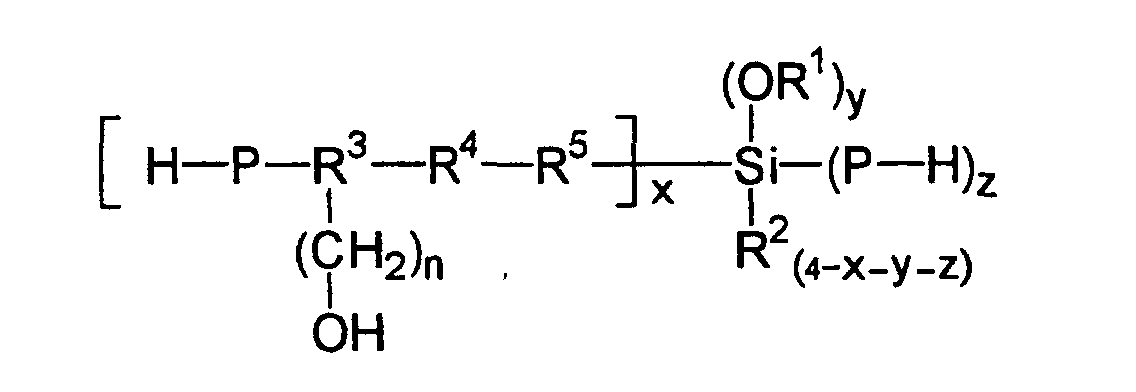 P ein konjugiertes Dien-(Co)polymer darstellt, das aus mindestens einem konjugierten Dien mit 4-12 Kohlenstoffatomen aufgebaut ist, gegebenenfalls zusammen mit einem vinylaromatischen Kohlenwasserstoff;R1 und R2, die identisch oder voneinander verschieden sein können, repräsentieren eine aliphatische, alicyclische und aromatische C1-20-Kohlenwasserstoffgruppe; und R1 kann jeweils die gleiche oder unterschiedliche Gruppen darstellen, wenn mehrere Gruppen OR1 enthalten sind;R3 ist ausgewählt aus aliphatischen und alicyclischen C1-20-Kohlenwasserstoffgruppen;R4 ist ein Sauerstoffatom oder eine gegebenenfalls substituierte Methylengruppe;R5 ist eine aliphatische C1-20-Kohlenwasserstoffgruppe;x ist eine ganze Zahl von 1-3, y ist eine ganze Zahl von 1-3; z ist eine ganze Zahl von 0-2; wobei 2 ≤ x + y + z ≤ 4; und n ist 0 oder 1.
 - Funktionalisiertes Polymer gemäss Anspruch 1, worin P ein Copolymer aus einem konjugierten Dien und einem vinylaromatischen Kohlenwasserstoff ist.
- Funktionalisiertes Polymer gemäss Anspruch 2, worin P ein Butadien/Styrol-Zufallscopolymer ist.
- Funktionalisiertes Polymer gemäss Anspruch 1, worin R1 eine aliphatische oder aromatische C1-10-Kohlenwasserstoffgruppe ist.
- Funktionalisiertes Polymer gemäss Anspruch 1, worin R2 eine aliphatische C1-3-Kohlenwasserstoffgruppe oder eine Phenylgruppe ist.
- Funktionalisiertes Polymer gemäss Anspruch 1, worin R3 eine aliphatische oder aromatische Kohlenwasserstoffgruppe ist, die nicht mehr als 6 Kohlenstoffatome aufweist.
- Funktionalisiertes Polymer gemäss Anspruch 1, worin R4 ein Sauerstoffatom oder eine Methylengruppe ist.
- Funktionalisiertes Polymer gemäss Anspruch 1, worin R5 eine aliphatische C1-4-Kohlenwasserstoffgruppe ist.
- Elastomerzusammensetzung, die ein Gummimaterial und einen Füllstoff umfasst, worin das Gummimaterial ein funktionalisiertes Polymer wie in mindestens einem der Ansprüche 1 bis 8 definiert in einer Menge von 10 Gew.% oder mehr umfasst, und der Füllstoff umfasst weissen Kohlenstoff und ist in einer Menge von 10-100 Gew.-Teilen auf Basis von 100 Gew.-Teilen des Gummimaterials vorhanden.
- Elastomerzusammensetzung gemäss Anspruch 9, worin der weisse Kohlenstoff Silica ist.
- Verwendung eines funktionalisierten Polymers gemäss mindestens einem der Ansprüche 1 bis 8 oder einer Elastomerzusammensetzung gemäss Anspruch 9 oder 10 zur Herstellung einer Reifenlauffläche.
Priority Applications (1)
| Application Number | Priority Date | Filing Date | Title |
|---|---|---|---|
| EP01130207A EP1199313B1 (de) | 1993-12-29 | 1994-12-29 | Dienpolymere und Diencopolymere mit einer Alkoxysilangruppe |
Applications Claiming Priority (13)
| Application Number | Priority Date | Filing Date | Title |
|---|---|---|---|
| JP35239093 | 1993-12-29 | ||
| JP352390/93 | 1993-12-29 | ||
| JP352389/93 | 1993-12-29 | ||
| JP35239093 | 1993-12-29 | ||
| JP35238993 | 1993-12-29 | ||
| JP35238993 | 1993-12-29 | ||
| JP15754094 | 1994-07-08 | ||
| JP15754094A JP3514824B2 (ja) | 1993-12-29 | 1994-07-08 | 重合体及びその重合体組成物 |
| JP157540/94 | 1994-07-08 | ||
| JP30385294A JP3441201B2 (ja) | 1993-12-29 | 1994-12-07 | 重合体及びその重合体組成物 |
| JP30385294 | 1994-12-07 | ||
| JP303852/94 | 1994-12-07 | ||
| EP94120914A EP0661298B1 (de) | 1993-12-29 | 1994-12-29 | Dienpolymere und Diencopolymere mit einer Alkoxysilangruppen |
Related Parent Applications (2)
| Application Number | Title | Priority Date | Filing Date |
|---|---|---|---|
| EP94120914.0 Division | 1994-12-29 | ||
| EP94120914A Division EP0661298B1 (de) | 1993-12-29 | 1994-12-29 | Dienpolymere und Diencopolymere mit einer Alkoxysilangruppen |
Related Child Applications (1)
| Application Number | Title | Priority Date | Filing Date |
|---|---|---|---|
| EP01130207A Division EP1199313B1 (de) | 1993-12-29 | 1994-12-29 | Dienpolymere und Diencopolymere mit einer Alkoxysilangruppe |
Publications (3)
| Publication Number | Publication Date |
|---|---|
| EP0773231A2 EP0773231A2 (de) | 1997-05-14 |
| EP0773231A3 EP0773231A3 (de) | 1997-07-02 |
| EP0773231B1 true EP0773231B1 (de) | 2002-07-10 |
Family
ID=27473487
Family Applications (3)
| Application Number | Title | Priority Date | Filing Date |
|---|---|---|---|
| EP94120914A Expired - Lifetime EP0661298B1 (de) | 1993-12-29 | 1994-12-29 | Dienpolymere und Diencopolymere mit einer Alkoxysilangruppen |
| EP01130207A Expired - Lifetime EP1199313B1 (de) | 1993-12-29 | 1994-12-29 | Dienpolymere und Diencopolymere mit einer Alkoxysilangruppe |
| EP97100466A Expired - Lifetime EP0773231B1 (de) | 1993-12-29 | 1994-12-29 | Dienpolymere und Diencopolymere mit einer Alkoxysilangruppe |
Family Applications Before (2)
| Application Number | Title | Priority Date | Filing Date |
|---|---|---|---|
| EP94120914A Expired - Lifetime EP0661298B1 (de) | 1993-12-29 | 1994-12-29 | Dienpolymere und Diencopolymere mit einer Alkoxysilangruppen |
| EP01130207A Expired - Lifetime EP1199313B1 (de) | 1993-12-29 | 1994-12-29 | Dienpolymere und Diencopolymere mit einer Alkoxysilangruppe |
Country Status (4)
| Country | Link |
|---|---|
| US (1) | US5508333A (de) |
| EP (3) | EP0661298B1 (de) |
| DE (3) | DE69417195T2 (de) |
| ES (3) | ES2179965T3 (de) |
Families Citing this family (105)
| Publication number | Priority date | Publication date | Assignee | Title |
|---|---|---|---|---|
| JPH0987426A (ja) * | 1995-09-20 | 1997-03-31 | Bridgestone Corp | ゴム組成物の製造方法 |
| DE69622235T2 (de) * | 1995-10-04 | 2003-01-23 | Compagnie Generale Des Etablissements Michelin-Michelin & Cie., Clermont-Ferrand | Kautschukmischung basierend auf einem Dienpolymer mit von Organosilanen abgeleiteten Gruppen zur Verwendung in Reifenlaufflächen |
| JP3736580B2 (ja) * | 1996-02-23 | 2006-01-18 | 日本ゼオン株式会社 | ジエン系ゴム |
| JP2954878B2 (ja) * | 1996-06-11 | 1999-09-27 | ニチアス株式会社 | フロン及び/又は冷凍機油用のゴム組成物と加硫シール部品 |
| JP3685572B2 (ja) * | 1996-12-17 | 2005-08-17 | 住友ゴム工業株式会社 | タイヤトレッド用ゴム組成物 |
| US6369138B2 (en) | 1997-07-11 | 2002-04-09 | Bridgestone Corporation | Processability of silica-filled rubber stocks with reduced hysteresis |
| US6221943B1 (en) | 1997-07-11 | 2001-04-24 | Bridgestone Corporation | Processability of silica-filled rubber stocks |
| US6525118B2 (en) | 1997-07-11 | 2003-02-25 | Bridgestone Corporation | Processability of silica-filled rubber stocks with reduced hysteresis |
| US6252007B1 (en) | 1997-07-11 | 2001-06-26 | Bridgestone Corporation | Elastomers having a reduced hysteresis via interaction of polymer with silica surfaces |
| US5916961A (en) * | 1997-07-11 | 1999-06-29 | Bridgestone Corporation | Amine-initiated elastomers having hysteresis reducing interaction with silica |
| US6384117B1 (en) | 1997-07-11 | 2002-05-07 | Bridgestone Corporation | Processability of silica-filled rubber stocks |
| US5866650A (en) * | 1997-07-11 | 1999-02-02 | Bridgestone Corporation | Composition of cyclic amine-initiated elastomers and amorphous silica and process for the production thereof |
| US5872176A (en) | 1997-07-11 | 1999-02-16 | Bridgestone Corporation | Addition of salts to improve the interaction of silica with rubber |
| US6100373A (en) * | 1998-08-24 | 2000-08-08 | Iowa State University Research Foundation, Inc. | Functionalized diene monomers and polymers containing functionalized dienes and methods for their preparation |
| US6344538B1 (en) | 1998-08-24 | 2002-02-05 | Iowa State University Research Foundation, Inc. | Functionalized diene monomers and polymers containing functionalized dienes and methods for their preparation |
| US6362272B1 (en) | 1998-10-07 | 2002-03-26 | Jsr Corporation | Oil extended rubber and rubber composition |
| EP1018521A1 (de) | 1999-01-06 | 2000-07-12 | Société de Technologie Michelin | Verfahren zur Herstellung von Dienpolymeren mit Amino-Gruppen, diese Polymere, Kautschukzusammensetzungen und Reifenlaufflächen daraus |
| US6852785B1 (en) * | 1999-04-22 | 2005-02-08 | Dunlop Tire Corporation | Vulcanizable elastomeric compositions for use as tire treads |
| AU3661699A (en) * | 1999-04-22 | 2000-11-10 | Dunlop Tire Corporation | Vulcanizable elastomeric compositions for use as tire treads |
| DE60041550D1 (de) | 1999-11-12 | 2009-03-26 | Bridgestone Corp | Modifizierte polymere hergestellt mit katalysator auf basys von lanthaniden |
| US6977281B1 (en) * | 1999-11-12 | 2005-12-20 | Bridgestone Corporation | Modified polymers prepared with lanthanide-based catalysts |
| US6279632B1 (en) * | 1999-11-24 | 2001-08-28 | Bridgestone Corporation | Method to control increase in viscosity during aging of siloxane modified polymers |
| WO2001075738A1 (en) * | 2000-03-31 | 2001-10-11 | Front End Capital, Llc | Method of raising capital for early stage companies through broker-dealer |
| US6573412B1 (en) | 2000-05-12 | 2003-06-03 | Bridgestone Corporation | Chain-coupled polymeric alkoxide compounds having controlled viscosity |
| US6313210B1 (en) | 2000-07-31 | 2001-11-06 | Bridgestone Coporation | Silica-reinforced rubber compounds containing moisture stabilized polymers |
| WO2002038615A1 (en) * | 2000-11-10 | 2002-05-16 | Bridgestone Corporation | Functionalized high cis-1,4-polybutadiene prepared using novel functionalizing agents |
| JP2002201310A (ja) | 2000-12-27 | 2002-07-19 | Bridgestone Corp | ゴム組成物 |
| ATE427969T1 (de) * | 2001-09-27 | 2009-04-15 | Jsr Corp | (co)polymerkautschuk auf basis von konjugiertem diolefin, verfahren zur herstellung von (co)polymerkautschuk, kautschukzusammensetzung, verbundwerkstoff und reifen |
| US6806307B2 (en) * | 2001-10-11 | 2004-10-19 | Bridgestone Corporation | Synthesis and use of chain-coupled polymeric sulfide compounds in rubber formulations |
| EP1319673A1 (de) | 2001-12-12 | 2003-06-18 | Bayer Ag | Polymere, die durch funktionelle Gruppen modifiziert sind |
| US7723440B2 (en) * | 2002-08-30 | 2010-05-25 | Bridgestone Corporation | Functionalized polymers and improved vulcanizates therefrom |
| JP5016924B2 (ja) | 2003-06-09 | 2012-09-05 | 株式会社ブリヂストン | 逐次的に停止させたポリマーを含む改良されたヒステリシスを有するエラストマー組成物 |
| TWI385182B (zh) * | 2004-03-15 | 2013-02-11 | Jsr Corp | Conjugated diene (co) poly rubber and method for producing the same |
| JP2007534833A (ja) * | 2004-04-27 | 2007-11-29 | 株式会社ブリヂストン | 改善されたシリカ補強性能を有するタイヤ組成物の製造方法 |
| ES2372057T3 (es) * | 2004-08-10 | 2012-01-13 | Jsr Corporation | Composición de caucho y neumático. |
| EP1812516B1 (de) * | 2004-10-02 | 2009-09-23 | Firestone Polymers, LLC | Polymere und ihre verwendung in asphaltmassen und asphaltbetonen |
| US7836928B2 (en) * | 2004-10-26 | 2010-11-23 | Bridgestone Corporation | Method of producing a tire composition having improved silica reinforcement |
| US7335411B2 (en) * | 2004-10-26 | 2008-02-26 | Bridgestone Corporation | Method of producing a tire composition having improved silica reinforcement |
| US7807756B2 (en) * | 2004-11-10 | 2010-10-05 | Kaneka Corporation | Curable composition |
| CN101137518B (zh) * | 2005-01-14 | 2010-12-08 | 株式会社普利司通 | 具有改进的二氧化硅补强的轮胎组合物和其硫化橡胶 |
| US7879952B2 (en) * | 2005-12-28 | 2011-02-01 | Bridgestone Corporation | Functionalized polymers |
| US7671138B2 (en) * | 2006-05-26 | 2010-03-02 | Bridgestone Corporation | Polymers functionized with hydrobenzamides |
| US20080006833A1 (en) * | 2006-06-02 | 2008-01-10 | Semiconductor Energy Laboratory Co., Ltd. | Lighting device and liquid crystal display device |
| JP2007323544A (ja) * | 2006-06-05 | 2007-12-13 | Sony Corp | 情報処理システム、情報処理装置、および方法、並びにコンピュータ・プログラム |
| CN102344513B (zh) * | 2006-07-24 | 2013-10-16 | 旭化成化学株式会社 | 改性共轭二烯系聚合物及其制造方法 |
| US7732534B2 (en) * | 2006-08-28 | 2010-06-08 | Bridgestone Corporation | Polymers functionalized with nitro compounds |
| US8088868B2 (en) | 2006-12-19 | 2012-01-03 | Bridgestone Corporation | Polymers functionalized with protected oxime compounds |
| ZA200711159B (en) * | 2006-12-28 | 2009-03-25 | Bridgestone Corp | Amine-containing alkoxysilyl-functionalized polymers |
| US7335706B1 (en) | 2007-03-05 | 2008-02-26 | The Goodyear Tire & Rubber Company | Method of making alkoxy functionalized rubbery polymers |
| EP2123687B1 (de) * | 2007-03-15 | 2013-08-21 | JSR Corporation | Konjugierter diolefin-copolymer-kautschuk, verfahren zu dessen herstellung sowie kautschukzusammensetzung und reifen damit |
| US7807747B2 (en) * | 2007-06-22 | 2010-10-05 | Sumitomo Chemical Company, Limited | Conjugated diene polymer, method for producing conjugated diene polymer, and conjugated diene polymer composition |
| JP5345835B2 (ja) * | 2007-12-31 | 2013-11-20 | 株式会社ブリヂストン | ポリジエンの製造のためのバルク重合法 |
| US8268933B2 (en) * | 2007-12-31 | 2012-09-18 | Bridgestone Corporation | Polymers functionalized with polyimine compounds |
| FR2930554B1 (fr) * | 2008-04-29 | 2012-08-17 | Michelin Soc Tech | Melange elastomerique comprenant majoritairement un elastomere dienique couple par un groupe amino-alcoxysilane, composition de caoutchouc le comprenant et leurs procedes d'obtention. |
| RU2504555C2 (ru) | 2008-06-06 | 2014-01-20 | Стирон Юроп Гмбх | Модифицированные эластомерные полимеры |
| US7906592B2 (en) | 2008-07-03 | 2011-03-15 | Bridgestone Corporation | Polymers functionalized with imide compounds containing a protected amino group |
| CN105175582B (zh) * | 2008-10-14 | 2017-10-17 | 旭化成株式会社 | 改性共轭二烯系聚合物、其制造方法、改性共轭二烯系聚合物组合物及轮胎 |
| EP2358762B1 (de) * | 2008-11-11 | 2014-01-22 | Styron Europe GmbH | Verfahren zur entfernung von silanol aus der herstellung eines modifizierten polymers |
| US8188195B2 (en) | 2008-12-31 | 2012-05-29 | Bridgestone Corporation | Polymers functionalized with nitroso compounds |
| CN102361887B (zh) | 2009-01-23 | 2013-06-26 | 株式会社普利司通 | 用包含被保护氨基的腈化合物官能化的聚合物 |
| EP2382241B1 (de) | 2009-01-23 | 2016-11-23 | Bridgestone Corporation | Mit polycyan-verbindungen funktionalisierte polymere |
| KR101730669B1 (ko) * | 2009-06-03 | 2017-04-26 | 주식회사 쿠라레 | 수소 첨가 블록 공중합체의 제조 방법, 그 제조 방법에 의해 얻어진 수소 첨가 블록 공중합체 및 그 조성물 |
| TWI405781B (zh) * | 2009-07-08 | 2013-08-21 | Tsrc Corp | 偶合共聚物及其製造方法 |
| JP5705120B2 (ja) | 2009-10-02 | 2015-04-22 | 旭化成ケミカルズ株式会社 | 変性共役ジエン系重合体の製造方法、変性共役ジエン系重合体、及び変性共役ジエン系重合体組成物 |
| US8338544B2 (en) * | 2009-12-21 | 2012-12-25 | Bridgestone Corporation | Polymers functionalized with polyoxime compounds and methods for their manufacture |
| CN102667634B (zh) * | 2009-12-22 | 2016-02-24 | 佳能株式会社 | 充电构件、电子照相设备和处理盒 |
| JP5316459B2 (ja) * | 2010-03-30 | 2013-10-16 | 住友化学株式会社 | 共役ジエン系重合体、共役ジエン系重合体組成物、及び、共役ジエン系重合体の製造方法 |
| CN102212196B (zh) * | 2010-04-01 | 2013-03-06 | 台橡股份有限公司 | 偶合共聚物及其制造方法 |
| PL2700658T3 (pl) | 2010-04-16 | 2017-09-29 | Asahi Kasei Kabushiki Kaisha | Sposób wytwarzania zmodyfikowanego polimeru ze sprzężonego dienu, zmodyfikowany polimer ze sprzężonego dienu i kompozycja zmodyfikowanego polimeru ze sprzężonego dienu |
| US8592515B2 (en) * | 2010-07-28 | 2013-11-26 | The Goodyear Tire & Rubber Company | Tire with rubber component |
| DE102011109827A1 (de) * | 2010-08-11 | 2012-02-16 | Sumitomo Chemical Company, Ltd. | Polymer auf Basis von konjugiertem Dien, Polymerzusammensetzung auf Basis von konjugiertem Dien und Verfahren zur Herstellung von Polymer auf Basis von konjugiertem Dien |
| DE102011109823B4 (de) * | 2010-08-11 | 2023-10-12 | Sumitomo Chemical Company, Limited | Polymer auf Basis von konjugiertem Dien, Polymerzusammensetzung auf Basis von konjugiertem Dien und Verfahren zur Herstellung von Polymer auf Basis von konjugiertem Dien |
| WO2012054458A1 (en) | 2010-10-18 | 2012-04-26 | Bridgestone Corporation | Tread rubber compounds having improved abrasion resistance using functionalized liquid polybutadiene |
| FR2968006B1 (fr) | 2010-11-26 | 2012-12-21 | Michelin Soc Tech | Bande de roulement de pneumatique |
| FR2968005B1 (fr) | 2010-11-26 | 2012-12-21 | Michelin Soc Tech | Bande de roulement de pneumatique neige |
| US8748531B2 (en) | 2010-12-10 | 2014-06-10 | Bridgestone Corporation | Polymers functionalized with oxime compounds containing an acyl group |
| TWI413648B (zh) * | 2010-12-31 | 2013-11-01 | Chi Mei Corp | 共軛二烯-乙烯基芳香烴共聚物及其製備方法 |
| TWI428357B (zh) * | 2010-12-31 | 2014-03-01 | Chi Mei Corp | 共軛二烯-乙烯基芳香烴共聚物及其製備方法 |
| EA201490496A1 (ru) | 2011-08-26 | 2014-08-29 | Асахи Касеи Кемикалз Корпорейшн | Способ получения модифицированных полимеров сопряженных диенов, модифицированные полимеры сопряженных диенов, композиции модифицированных полимеров сопряженных диенов, композиции каучука и автомобильные шины |
| US8962766B2 (en) | 2011-09-15 | 2015-02-24 | Bridgestone Corporation | Polymers functionalized with polyhydrazone compounds |
| FR2984904B1 (fr) | 2011-12-22 | 2014-01-03 | Michelin Soc Tech | Composition de caoutchouc |
| WO2013183743A1 (ja) | 2012-06-08 | 2013-12-12 | 住友ゴム工業株式会社 | トレッド用ゴム組成物及び空気入りタイヤ |
| KR101365902B1 (ko) * | 2013-01-14 | 2014-03-12 | 금호석유화학 주식회사 | 공역 디엔계 고분자의 말단 변성제 |
| KR101310868B1 (ko) | 2013-02-26 | 2013-10-14 | 금호석유화학 주식회사 | 알콕시실란 유도체에 의해 말단 변성된 공역 디엔계 고분자 |
| JP6124648B2 (ja) | 2013-03-28 | 2017-05-10 | 住友化学株式会社 | 共役ジエン系重合体の製造方法 |
| FR3009557B1 (fr) * | 2013-08-09 | 2015-09-11 | Michelin & Cie | Elastomere dienique modifie comprenant un elastomere dienique couple par un compose aminoalcoxysilane et fonctionnalise amine en extremite de chaine et composition de caoutchouc le comprenant |
| KR101508519B1 (ko) | 2013-08-27 | 2015-04-07 | 금호석유화학 주식회사 | 알콕시실란 단위가 포함된 공역 디엔계 랜덤 공중합체 |
| KR101534101B1 (ko) * | 2013-10-17 | 2015-07-07 | 주식회사 엘지화학 | 변성 공액 디엔계 중합체, 이의 제조방법, 및 이를 포함하는 고무 조성물 |
| US9944741B2 (en) * | 2013-11-15 | 2018-04-17 | Lg Chem, Ltd. | Modified conjugated diene polymer, method for preparing same, and rubber composition containing same |
| US9758639B2 (en) | 2014-04-30 | 2017-09-12 | Bridgestone Corporation | Rubber composition with imidazole-based silica shielding agent |
| US9109073B1 (en) | 2014-08-19 | 2015-08-18 | The Goodyear Tire & Rubber Company | Bifunctionalized polymer |
| US9090730B1 (en) | 2014-08-19 | 2015-07-28 | The Goodyear Tire & Rubber Company | Rubber composition and pneumatic tire |
| JP6330578B2 (ja) * | 2014-08-25 | 2018-05-30 | Jsr株式会社 | 共役ジエン系重合体及びその製造方法、重合体組成物、架橋重合体並びにタイヤ |
| KR101700954B1 (ko) | 2014-11-05 | 2017-01-31 | 금호석유화학 주식회사 | 말단 변성 공액 디엔계 중합체 및 그 제조방법 |
| FR3036115B1 (fr) | 2015-05-11 | 2017-05-19 | Michelin & Cie | Composition de caoutchouc |
| WO2017019878A1 (en) | 2015-07-29 | 2017-02-02 | Bridgestone Corporation | Processes for preparing functionalized polymers, related functionalizing compound and preparation thereof |
| ES2735435T3 (es) * | 2016-10-25 | 2019-12-18 | Evonik Operations Gmbh | 3-glicidiloxipropiltrialcoxisilanos con grupos alcoxi de cadena larga, procedimiento para la producción y empleo |
| FR3061187B1 (fr) | 2016-12-22 | 2019-02-01 | Compagnie Generale Des Etablissements Michelin | Composition de caoutchouc avec une bonne dispersion de quantites elevees de charge inorganique renforcante |
| ES2906698T3 (es) * | 2017-05-15 | 2022-04-20 | Bridgestone Corp | Composición de caucho para neumático, y neumático |
| EP3431511A1 (de) * | 2017-07-19 | 2019-01-23 | ARLANXEO Deutschland GmbH | Sternförmig verzweigter dienkautschuk |
| JP7169375B2 (ja) * | 2018-06-20 | 2022-11-10 | 株式会社ブリヂストン | 高強度水素化ポリマー、及びこれを組み込んだゴム組成物 |
| EP4077528B1 (de) * | 2019-12-17 | 2024-09-18 | ExxonMobil Chemical Patents Inc. | Funktionalisierte polymere als laufflächenadditiv zur verbesserung der leistung von ganzjahresreifen |
| US20230029797A1 (en) * | 2019-12-17 | 2023-02-02 | Exxonmobil Chemical Patents Inc. | Functionalized Polymers Tread Additive For Improved Wet Braking And Rolling Resistance In Low Silica Summer Tire |
| CN111116634A (zh) * | 2019-12-18 | 2020-05-08 | 怡维怡橡胶研究院有限公司 | 一种酰亚胺基封端巯基硅烷偶联剂及其合成方法和应用 |
| WO2022125675A1 (en) | 2020-12-09 | 2022-06-16 | Beyond Lotus Llc | Methods of preparing a composite having elastomer and filler |
Family Cites Families (10)
| Publication number | Priority date | Publication date | Assignee | Title |
|---|---|---|---|---|
| US3764592A (en) * | 1970-06-29 | 1973-10-09 | Dow Corning | Silicon-polybutadiene resins |
| JPS525071A (en) * | 1975-07-01 | 1977-01-14 | Ooizumi Kojo:Kk | Improvement in machining of plummer block |
| GB1597500A (en) * | 1977-12-29 | 1981-09-09 | Shell Int Research | Polymers |
| JPS56104906A (en) * | 1980-01-25 | 1981-08-21 | Asahi Chem Ind Co Ltd | Polymer having reactive end group |
| JPS6250346A (ja) * | 1985-08-30 | 1987-03-05 | Bridgestone Corp | タイヤ用ゴム組成物 |
| JPH0651746B2 (ja) * | 1986-03-31 | 1994-07-06 | 日本合成ゴム株式会社 | シラン化合物変性重合体の製造方法 |
| EP0265070B1 (de) * | 1986-09-26 | 1991-10-09 | Ube Industries, Ltd. | Mit Fasern verstärkte Kautschukmischung, Verfahren zu deren Herstellung und deren Verwendung |
| JPH0713158B2 (ja) * | 1987-01-14 | 1995-02-15 | 株式会社ブリヂストン | タイヤ |
| US4935471A (en) * | 1987-10-15 | 1990-06-19 | The Goodyear Tire & Rubber Company | Capped polydienes |
| US5369175A (en) * | 1993-11-09 | 1994-11-29 | Shell Oil Company | Method for preparing asymmetric radial copolymers having four first arms and two second arms |
-
1994
- 1994-12-29 DE DE69417195T patent/DE69417195T2/de not_active Expired - Lifetime
- 1994-12-29 EP EP94120914A patent/EP0661298B1/de not_active Expired - Lifetime
- 1994-12-29 US US08/365,936 patent/US5508333A/en not_active Expired - Lifetime
- 1994-12-29 EP EP01130207A patent/EP1199313B1/de not_active Expired - Lifetime
- 1994-12-29 DE DE69430958T patent/DE69430958T2/de not_active Expired - Lifetime
- 1994-12-29 ES ES97100466T patent/ES2179965T3/es not_active Expired - Lifetime
- 1994-12-29 ES ES01130207T patent/ES2245339T3/es not_active Expired - Lifetime
- 1994-12-29 ES ES94120914T patent/ES2128500T3/es not_active Expired - Lifetime
- 1994-12-29 DE DE69434472T patent/DE69434472T2/de not_active Expired - Lifetime
- 1994-12-29 EP EP97100466A patent/EP0773231B1/de not_active Expired - Lifetime
Also Published As
| Publication number | Publication date |
|---|---|
| DE69417195T2 (de) | 1999-07-29 |
| EP0661298B1 (de) | 1999-03-17 |
| EP1199313A2 (de) | 2002-04-24 |
| DE69430958D1 (de) | 2002-08-14 |
| US5508333A (en) | 1996-04-16 |
| ES2245339T3 (es) | 2006-01-01 |
| EP0661298A2 (de) | 1995-07-05 |
| DE69430958T2 (de) | 2003-01-23 |
| EP0773231A3 (de) | 1997-07-02 |
| EP0661298A3 (de) | 1995-09-20 |
| DE69434472T2 (de) | 2006-06-14 |
| ES2128500T3 (es) | 1999-05-16 |
| DE69417195D1 (de) | 1999-04-22 |
| EP1199313B1 (de) | 2005-08-24 |
| ES2179965T3 (es) | 2003-02-01 |
| EP1199313A3 (de) | 2003-02-05 |
| EP0773231A2 (de) | 1997-05-14 |
| DE69434472D1 (de) | 2005-09-29 |
Similar Documents
| Publication | Publication Date | Title |
|---|---|---|
| EP1199313B1 (de) | Dienpolymere und Diencopolymere mit einer Alkoxysilangruppe | |
| EP0767179B1 (de) | Verfahren zur Herstellung einer Kautschukzusammensetzung | |
| US6008295A (en) | Diene polymers and copolymers incorporating partial coupling and terminals formed from hydrocarboxysilane compounds | |
| US6228908B1 (en) | Diene polymers and copolymers incorporating partial coupling and terminals formed from hydrocarboxysilane compounds | |
| MXPA02000865A (es) | Composicion de caucho utilizable como banda de rodadura de neumatico. | |
| JPH11189616A (ja) | 重合体の製造方法、得られた重合体、及びそれを用いたゴム組成物 | |
| US20160096909A1 (en) | Method for Producing Modified Conjugated Diene-Based Polymer, Modified Conjugated Diene-Based Polymer, and Modified Conjugated Diene-Based Polymer Composition | |
| KR101624551B1 (ko) | 타이어 트레드용 고무 조성물 및 공기입 타이어 | |
| US11780994B2 (en) | Rubber composition, tread rubber, and tire | |
| US9109071B2 (en) | Process for producing conjugated diene rubber and composite of the same rubber | |
| JP3441201B2 (ja) | 重合体及びその重合体組成物 | |
| JP2001131230A (ja) | 重合体、その製造方法、及びそれを用いたゴム組成物 | |
| JPH08337614A (ja) | 共重合体及びそれを含有するゴム組成物 | |
| JP3949437B2 (ja) | 変性ジエン系重合体、ゴム組成物及び空気入りタイヤ | |
| JP3514824B2 (ja) | 重合体及びその重合体組成物 | |
| JP4801827B2 (ja) | 重合体、その製造方法、及びそれを用いたゴム組成物 | |
| KR102923648B1 (ko) | 변성 공액디엔계 중합체, 이의 제조방법 및 이를 포함하는 고무 조성물 | |
| JP7366050B2 (ja) | 重合体組成物、架橋重合体、及びタイヤ | |
| JP3860317B2 (ja) | ジエン系重合体の製造方法、得られた重合体、及びそれを用いたゴム組成物 | |
| JPH11166020A (ja) | 変性共役ジオレフィン重合体、その製造方法、およびゴム組成物 | |
| KR20220071739A (ko) | 이민기 함유 실록산계 화합물, 이의 유래 작용기를 포함하는 변성 공액디엔계 중합체 및 상기 중합체를 포함하는 고무 조성물 | |
| US20230312889A1 (en) | Polymer composition, method for producing same, formulation, crosslinked product, and tire | |
| US20240002642A1 (en) | Rubber bale, production method therefor, polymer composition, crosslinked object, and tire |
Legal Events
| Date | Code | Title | Description |
|---|---|---|---|
| PUAI | Public reference made under article 153(3) epc to a published international application that has entered the european phase |
Free format text: ORIGINAL CODE: 0009012 |
|
| AC | Divisional application: reference to earlier application |
Ref document number: 661298 Country of ref document: EP |
|
| AK | Designated contracting states |
Kind code of ref document: A2 Designated state(s): DE ES FR GB IT |
|
| PUAL | Search report despatched |
Free format text: ORIGINAL CODE: 0009013 |
|
| AK | Designated contracting states |
Kind code of ref document: A3 Designated state(s): DE ES FR GB IT |
|
| 17P | Request for examination filed |
Effective date: 19971208 |
|
| 17Q | First examination report despatched |
Effective date: 19980525 |
|
| GRAG | Despatch of communication of intention to grant |
Free format text: ORIGINAL CODE: EPIDOS AGRA |
|
| GRAG | Despatch of communication of intention to grant |
Free format text: ORIGINAL CODE: EPIDOS AGRA |
|
| GRAH | Despatch of communication of intention to grant a patent |
Free format text: ORIGINAL CODE: EPIDOS IGRA |
|
| GRAH | Despatch of communication of intention to grant a patent |
Free format text: ORIGINAL CODE: EPIDOS IGRA |
|
| GRAA | (expected) grant |
Free format text: ORIGINAL CODE: 0009210 |
|
| AC | Divisional application: reference to earlier application |
Ref document number: 661298 Country of ref document: EP |
|
| AK | Designated contracting states |
Kind code of ref document: B1 Designated state(s): DE ES FR GB IT |
|
| REG | Reference to a national code |
Ref country code: GB Ref legal event code: FG4D |
|
| REF | Corresponds to: |
Ref document number: 69430958 Country of ref document: DE Date of ref document: 20020814 |
|
| ET | Fr: translation filed | ||
| REG | Reference to a national code |
Ref country code: ES Ref legal event code: FG2A Ref document number: 2179965 Country of ref document: ES Kind code of ref document: T3 |
|
| PLBE | No opposition filed within time limit |
Free format text: ORIGINAL CODE: 0009261 |
|
| STAA | Information on the status of an ep patent application or granted ep patent |
Free format text: STATUS: NO OPPOSITION FILED WITHIN TIME LIMIT |
|
| 26N | No opposition filed |
Effective date: 20030411 |
|
| PGFP | Annual fee paid to national office [announced via postgrant information from national office to epo] |
Ref country code: GB Payment date: 20091223 Year of fee payment: 16 |
|
| PG25 | Lapsed in a contracting state [announced via postgrant information from national office to epo] |
Ref country code: IT Free format text: LAPSE BECAUSE OF NON-PAYMENT OF DUE FEES Effective date: 20091229 |
|
| GBPC | Gb: european patent ceased through non-payment of renewal fee |
Effective date: 20101229 |
|
| PG25 | Lapsed in a contracting state [announced via postgrant information from national office to epo] |
Ref country code: GB Free format text: LAPSE BECAUSE OF NON-PAYMENT OF DUE FEES Effective date: 20101229 |
|
| PGFP | Annual fee paid to national office [announced via postgrant information from national office to epo] |
Ref country code: ES Payment date: 20111228 Year of fee payment: 18 |
|
| PGFP | Annual fee paid to national office [announced via postgrant information from national office to epo] |
Ref country code: DE Payment date: 20131220 Year of fee payment: 20 |
|
| PGFP | Annual fee paid to national office [announced via postgrant information from national office to epo] |
Ref country code: IT Payment date: 20131217 Year of fee payment: 20 |
|
| REG | Reference to a national code |
Ref country code: ES Ref legal event code: FD2A Effective date: 20140307 |
|
| PG25 | Lapsed in a contracting state [announced via postgrant information from national office to epo] |
Ref country code: ES Free format text: LAPSE BECAUSE OF NON-PAYMENT OF DUE FEES Effective date: 20121230 |
|
| PGFP | Annual fee paid to national office [announced via postgrant information from national office to epo] |
Ref country code: FR Payment date: 20131220 Year of fee payment: 20 |
|
| REG | Reference to a national code |
Ref country code: DE Ref legal event code: R071 Ref document number: 69430958 Country of ref document: DE |