EP0789040B1 - Verfahren zur herstellung von polyoxymethylen - Google Patents
Verfahren zur herstellung von polyoxymethylen Download PDFInfo
- Publication number
- EP0789040B1 EP0789040B1 EP95934858A EP95934858A EP0789040B1 EP 0789040 B1 EP0789040 B1 EP 0789040B1 EP 95934858 A EP95934858 A EP 95934858A EP 95934858 A EP95934858 A EP 95934858A EP 0789040 B1 EP0789040 B1 EP 0789040B1
- Authority
- EP
- European Patent Office
- Prior art keywords
- reactor
- trioxane
- discharging port
- weir
- raw materials
- Prior art date
- Legal status (The legal status is an assumption and is not a legal conclusion. Google has not performed a legal analysis and makes no representation as to the accuracy of the status listed.)
- Expired - Lifetime
Links
- -1 polyoxymethylene Polymers 0.000 title claims description 23
- 229920006324 polyoxymethylene Polymers 0.000 title claims description 23
- 229930040373 Paraformaldehyde Natural products 0.000 title claims description 22
- 238000000034 method Methods 0.000 title claims description 18
- 238000007599 discharging Methods 0.000 claims description 45
- BGJSXRVXTHVRSN-UHFFFAOYSA-N 1,3,5-trioxane Chemical compound C1OCOCO1 BGJSXRVXTHVRSN-UHFFFAOYSA-N 0.000 claims description 30
- 239000002994 raw material Substances 0.000 claims description 15
- 238000006243 chemical reaction Methods 0.000 claims description 14
- 238000006116 polymerization reaction Methods 0.000 claims description 13
- 239000000203 mixture Substances 0.000 claims description 8
- 150000001875 compounds Chemical class 0.000 claims description 6
- 238000003756 stirring Methods 0.000 claims description 6
- 238000001816 cooling Methods 0.000 claims description 4
- 238000010438 heat treatment Methods 0.000 claims description 4
- 239000011541 reaction mixture Substances 0.000 description 17
- 239000010419 fine particle Substances 0.000 description 7
- 239000000463 material Substances 0.000 description 7
- 229920000642 polymer Polymers 0.000 description 7
- 239000007788 liquid Substances 0.000 description 6
- WNXJIVFYUVYPPR-UHFFFAOYSA-N 1,3-dioxolane Chemical compound C1COCO1 WNXJIVFYUVYPPR-UHFFFAOYSA-N 0.000 description 5
- IAYPIBMASNFSPL-UHFFFAOYSA-N Ethylene oxide Chemical compound C1CO1 IAYPIBMASNFSPL-UHFFFAOYSA-N 0.000 description 4
- 230000005856 abnormality Effects 0.000 description 4
- WERYXYBDKMZEQL-UHFFFAOYSA-N butane-1,4-diol Chemical compound OCCCCO WERYXYBDKMZEQL-UHFFFAOYSA-N 0.000 description 4
- 239000000498 cooling water Substances 0.000 description 4
- 238000007334 copolymerization reaction Methods 0.000 description 4
- ZOXJGFHDIHLPTG-UHFFFAOYSA-N Boron Chemical compound [B] ZOXJGFHDIHLPTG-UHFFFAOYSA-N 0.000 description 3
- 229910052796 boron Inorganic materials 0.000 description 3
- 238000004140 cleaning Methods 0.000 description 3
- 239000002685 polymerization catalyst Substances 0.000 description 3
- WTEOIRVLGSZEPR-UHFFFAOYSA-N boron trifluoride Chemical compound FB(F)F WTEOIRVLGSZEPR-UHFFFAOYSA-N 0.000 description 2
- 239000003054 catalyst Substances 0.000 description 2
- 125000004122 cyclic group Chemical group 0.000 description 2
- NKDDWNXOKDWJAK-UHFFFAOYSA-N dimethoxymethane Chemical compound COCOC NKDDWNXOKDWJAK-UHFFFAOYSA-N 0.000 description 2
- 230000000694 effects Effects 0.000 description 2
- 238000004519 manufacturing process Methods 0.000 description 2
- QQIVNUPLBOUZMR-UHFFFAOYSA-N trioxepane Chemical compound C1CCOOOC1 QQIVNUPLBOUZMR-UHFFFAOYSA-N 0.000 description 2
- FQERLIOIVXPZKH-UHFFFAOYSA-N 1,2,4-trioxane Chemical compound C1COOCO1 FQERLIOIVXPZKH-UHFFFAOYSA-N 0.000 description 1
- 229910015900 BF3 Inorganic materials 0.000 description 1
- KZMGYPLQYOPHEL-UHFFFAOYSA-N Boron trifluoride etherate Chemical compound FB(F)F.CCOCC KZMGYPLQYOPHEL-UHFFFAOYSA-N 0.000 description 1
- XDTMQSROBMDMFD-UHFFFAOYSA-N Cyclohexane Chemical compound C1CCCCC1 XDTMQSROBMDMFD-UHFFFAOYSA-N 0.000 description 1
- 125000004432 carbon atom Chemical group C* 0.000 description 1
- 238000010538 cationic polymerization reaction Methods 0.000 description 1
- 229920001577 copolymer Polymers 0.000 description 1
- 150000004292 cyclic ethers Chemical class 0.000 description 1
- 229920006351 engineering plastic Polymers 0.000 description 1
- RTZKZFJDLAIYFH-UHFFFAOYSA-N ether Substances CCOCC RTZKZFJDLAIYFH-UHFFFAOYSA-N 0.000 description 1
- 230000007774 longterm Effects 0.000 description 1
- 239000003607 modifier Substances 0.000 description 1
- 125000005702 oxyalkylene group Chemical group 0.000 description 1
- 239000007787 solid Substances 0.000 description 1
- 125000006850 spacer group Chemical group 0.000 description 1
- 239000007858 starting material Substances 0.000 description 1
- MVJKXJPDBTXECY-UHFFFAOYSA-N trifluoroborane;hydrate Chemical compound O.FB(F)F MVJKXJPDBTXECY-UHFFFAOYSA-N 0.000 description 1
Images

Classifications
-
- B—PERFORMING OPERATIONS; TRANSPORTING
- B01—PHYSICAL OR CHEMICAL PROCESSES OR APPARATUS IN GENERAL
- B01J—CHEMICAL OR PHYSICAL PROCESSES, e.g. CATALYSIS OR COLLOID CHEMISTRY; THEIR RELEVANT APPARATUS
- B01J19/00—Chemical, physical or physico-chemical processes in general; Their relevant apparatus
- B01J19/18—Stationary reactors having moving elements inside
- B01J19/20—Stationary reactors having moving elements inside in the form of helices, e.g. screw reactors
-
- C—CHEMISTRY; METALLURGY
- C08—ORGANIC MACROMOLECULAR COMPOUNDS; THEIR PREPARATION OR CHEMICAL WORKING-UP; COMPOSITIONS BASED THEREON
- C08G—MACROMOLECULAR COMPOUNDS OBTAINED OTHERWISE THAN BY REACTIONS ONLY INVOLVING UNSATURATED CARBON-TO-CARBON BONDS
- C08G2/00—Addition polymers of aldehydes or cyclic oligomers thereof or of ketones; Addition copolymers thereof with less than 50 molar percent of other substances
- C08G2/10—Polymerisation of cyclic oligomers of formaldehyde
-
- B—PERFORMING OPERATIONS; TRANSPORTING
- B01—PHYSICAL OR CHEMICAL PROCESSES OR APPARATUS IN GENERAL
- B01J—CHEMICAL OR PHYSICAL PROCESSES, e.g. CATALYSIS OR COLLOID CHEMISTRY; THEIR RELEVANT APPARATUS
- B01J2219/00—Chemical, physical or physico-chemical processes in general; Their relevant apparatus
- B01J2219/00049—Controlling or regulating processes
- B01J2219/00182—Controlling or regulating processes controlling the level of reactants in the reactor vessel
-
- B—PERFORMING OPERATIONS; TRANSPORTING
- B01—PHYSICAL OR CHEMICAL PROCESSES OR APPARATUS IN GENERAL
- B01J—CHEMICAL OR PHYSICAL PROCESSES, e.g. CATALYSIS OR COLLOID CHEMISTRY; THEIR RELEVANT APPARATUS
- B01J2219/00—Chemical, physical or physico-chemical processes in general; Their relevant apparatus
- B01J2219/18—Details relating to the spatial orientation of the reactor
- B01J2219/182—Details relating to the spatial orientation of the reactor horizontal
-
- B—PERFORMING OPERATIONS; TRANSPORTING
- B29—WORKING OF PLASTICS; WORKING OF SUBSTANCES IN A PLASTIC STATE IN GENERAL
- B29K—INDEXING SCHEME ASSOCIATED WITH SUBCLASSES B29B, B29C OR B29D, RELATING TO MOULDING MATERIALS OR TO MATERIALS FOR MOULDS, REINFORCEMENTS, FILLERS OR PREFORMED PARTS, e.g. INSERTS
- B29K2071/00—Use of polyethers, e.g. PEEK, i.e. polyether-etherketone or PEK, i.e. polyetherketone or derivatives thereof, as moulding material
- B29K2071/02—Polyalkylene oxides, e.g. PEO, i.e. polyethylene oxide, or derivatives thereof
Definitions
- the present invention relates to a reactor used for production of a polyoxymethylene widely used as an engineering plastic in electrical parts, automobile parts, mechanical parts, etc., as well as to a process for producing a polyoxymethylene using the reactor. More particularly, the present invention relates to an improved process for producing a powdery polyoxymethylene continuously and efficiently using, as a main starting material, trioxane or a mixture of trioxane and a compound reactive therewith.
- Polyoxymethylenes have been produced by a method of subjecting trioxane to bulk homopolymerization or subjecting trioxane with ethylene oxide or trioxane with a cyclic formal such as dioxolane, trioxepane or the like, to bulk copolymerization in the presence of a cationically active catalyst.
- JP-A-56-59824 proposes a process wherein, in each two adjacent paddles fixed to a rotary shaft of a reactor, the angle of one (back) paddle is advanced by a given amount from the angle of the other (precedent) paddle to control the transfer speed of reaction mixture to increase the filling ratio of the reaction mixture and prolong the residence time of the reaction mixture.
- JP-A-61-238812 proposes a process wherein a reactor is lifted at the discharging port side so that the reactor is tilted as a whole by 1-10° from the horizontal state to prolong the residence time of the reaction mixture.
- the object of the present invention is to provide a process for producing a polyoxymethylene, wherein the residence time of reaction mixture in a reactor is long and thereby the conversion of trioxane can be increased.
- the present inventors made a study in order to solve the above-mentioned problems of the prior art and, as a result, found out that the above object can be achieved by improving the structure of discharging port, discharging means for reaction mixture, of a reactor.
- the finding has led to the completion of the present invention.
- the present invention provides a process for producing a polyoxymethylene using a reactor comprising:
- the reactor according to the present invention has a twin-cylindrical case provided with a jacket capable of heating and cooling the case, which accommodates two rotary shafts along the two central axes of the cylinders.
- the two rotary shafts are each provided with a plurality of paddles and rotated in the same direction.
- the rotary shafts thereby can stir and react the raw materials in small gaps formed between each two facing paddles fixed to the two different shafts and between each paddle and the inner wall of the case.
- the reactor further has, at one end, a raw materials-feeding means for introducing a main raw material, i.e. trioxane or a mixture of trioxane and a compound reactive therewith into the reactor and, at the other end, a discharging means for recovering the powdery polyoxymethylene formed.
- the raw materials-feeding means is preferably a raw materials-feeding port.
- the discharging means is preferably a discharging port having a weir.
- the discharging port is provided so as to extend nearly in a tangent direction to the circumference of the cylinder cross-section of the reactor, or in a radial direction of the cylinder cross-section, with the tangent direction being preferred.
- the discharging port is provided with a weir. The provision of the weir makes longer the residence time of reaction mixture up to discharging, making it possible to increase the conversion of trioxane.
- the weir in the present invention includes any measure capable of controlling the time of reaction mixture up to discharging and prolonging the residence time of reaction mixture, whatever shape and size the measure may have, and should not be limited to the embodiments disclosed in the examples described below and the accompanying drawings.
- the height of the weir of the discharging port from the lowest position of the cylinder inner wall is 0.1 D to 0.8 D, preferably 0.3 D to 0.6 D wherein D is the inside diameter of the reactor cylinder.
- a weir height of less than 0.1 D has a small effect on the prolongation of the residence time, making it impossible to increase the conversion of trioxane.
- a weir height of more than 0.8 D results in insufficient discharge-ability for powdery polyoxymethylene and generation of torque-out, making the reactor operation impossible.
- the height H of the weir of the discharging port from the lowest position of the cylinder inner wall is 0.1 D to 0.4 D, preferably 0.2 D to 0.3 D.
- a weir height of less than 0.1 D has a small effect on the prolongation of the residence time, making it impossible to increase the conversion of trioxane.
- a weir height of more than 0.4 D results in insufficient discharge-ability for powdery polyoxymethylene and generation of torque-out, making the reactor operation impossible.
- a weir height of 0.5 D invites contact between the weir and the rotary shaft; thus, a weir height of 0.5 D or more is impossible to adopt actually.
- the discharging port is provided in the downward direction from the cylindrical case of the reactor, part of the paddle(s) in the vicinity of the discharging port, may have to be removed to fit a weir to the inner wall of the cylindrical case. In that case, a spacer ring 8 or the like can be used in place of the removed paddle for fixation of the paddles present after the discharging port.
- the residence time can be controlled by the height of the weir, irrelevantly to the feeding force of paddles. Even when there is sudden increase in amount of raw materials fed, the flow of the reaction mixture in reactor is dammed up by the weir, and the reaction mixture can be smoothly discharged from the discharging port since the upper surface of the reaction mixture is raised as a whole.
- the weir can be a jacket type so as to enable heating or cooling.
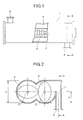
- Fig. 1 is a partly sectional view of an example of the reactor according to the present invention.
- Fig. 2 is a cross-sectional view of the reactor of Fig. 1, taken at the B-B line.
- Fig. 3 is a view when the cross-section at the A-A line of Fig. 2 is seen from the arrow direction, where the section of a weir 7 formed in the discharging port provided in a lateral direction to the reactor cylinder is seen from the side of the reactor.
- the height H of the weir 7 is 0.5 D wherein D is the inside diameter of the reactor cylinder.
- Fig. 4 is a view when the section of a weir 7 formed in the discharging port provided in the downward direction from the reactor cylinder is seen from the side of the reactor. In Fig. 4, the height of the weir is 0.25 D.
- two parallel rotary shafts 2,2' are accommodated in a twin-cylindrical case 1 having a hollow inside having a 8-shaped section formed by the overlapping of two eccentric circles of the same diameter.
- To each of the two rotary shafts 2,2' are fixed a plurality of paddles 3,3' each having a convex lens-shaped section. All the paddles are rotated at the same speed in the same direction so that the front ends of each paddle can scratch the inner wall of the cylindrical case and the surface of a paddle facing the former paddle, fixed to the other shaft.
- This reactor is a continuous stirrer and mixer of self-cleaning type.
- each paddle may be, besides the above-mentioned convex lens shape, a pseudopolygonal shape such as pseudotriangular shape or the like.
- the thickness of each paddle is preferably about 1/30 to 1/2 of the inside diameter of the reactor cylinder.
- Each paddle is fixed to either of the two rotary shafts.
- the gap between the front ends of each paddle and the inner wall of the cylindrical case is 2% or less, preferably 1% or less of the paddle major axis.
- the gap between one front end of any paddle fixed to one rotary shaft and the side of the paddle facing said paddle, fixed to the other rotary shaft is five times or less, preferably two times or less said gap between the front ends of each paddle and the inner wall of the cylindrical case.
- the discharging port 6 is provided in a lateral direction to the reactor cylinder and is fitted with a weir 7 so that the residence time of reaction mixture can be controlled by changing the height H of the weir 7.
- the height H of the weir 7 is 0.1 D to 0.8 D, preferably 0.3 D to 0.6 D wherein D is the inside diameter of the reactor cylinder.
- the rotary shafts 2,2' of reactor shown in Fig. 2 are rotated at a desired number of revolution.
- the number of revolution is not particularly restricted but is set generally at 10-150 rpm.
- cooling water of 5-95°C is allowed to flow through said portions, and the desired cooling water temperatures are 65-95°C in the former half jackets and 5-40°C in the latter half jackets.
- liquid trioxane or a mixture of liquid trioxane and a comonomer e.g. ethylene oxide or 1,3-dioxolane
- a comonomer e.g. ethylene oxide or 1,3-dioxolane
- a polymerization catalyst e.g. 1,3-dioxolane
- a molecular weight modifier e.g. methylal
- the reaction mixture is a high-fluidity or viscous liquid at the reactor portion close to the feeding port; when the reaction proceeds, a bulk polyoxymethylene is formed and, simultaneously therewith, is ground by the paddles and becomes a powdery polyoxymethylene; the powdery polyoxymethylene is moved towards the discharging port 6 of reactor while the polymerization proceeds further, and is taken out from the discharging port 6.
- the process of the present invention is used for trioxane homopolymerization or copolymerization.
- a trioxane/comonomer mixture as a main raw material, such a trioxane/comonomer mixture as to give a copolymer having a polyoxymethylene main chain containing 0.1-20 mole % of oxyalkylene units having 2 or more carbon atoms.
- the comonomer includes cyclic ethers and cyclic formals such as ethylene oxide, 1,3-dioxolane, 1,4-butanediol formal, trioxepane and the like.
- cationic polymerization catalysts of ordinary use are used.
- boron trifluoride, a boron trifluoride hydrate and a boron trifluoride-ether complex are preferable.
- boron trifluoride-diethyl ether complex and boron trifluoride-dibutyl ether complex are preferable.
- the polymerization temperature is in a range of 60-130°C, preferably 65-115°C.
- a reactor shown in Fig. 1 was used.
- the reactor has a cylinder inside diameter of 128 mm and a L/D (length/diameter) ratio of 8, and two rotary shafts are each provided with a feed screw having a length of 1 D right under the raw materials-feeding port 5.
- the reactor has paddles 3,3' as shown in Fig. 2.
- the gap between the front ends of each paddle and the inner wall of the cylindrical case is 4 mm or less.
- the paddles are fitted after the feed screw with the angle of any paddle being advanced by 45° in the rotational direction from the angle of the precedent paddle.
- the height of the weir of the discharging port is 0.5 D.
- Example 2 Using the same reactor as in Example 1, an operation was started under the same conditions with respect to amounts of raw materials fed, polymerization temperature, etc. as in Example 1 except that the height H of the weir 7 of the discharging port 6 was changed to 0.3 D.
- Example 2 Using the same reactor as in Example 1, an operation was started under the same conditions with respect to amounts of raw materials fed, polymerization temperature, etc. as in Example 1 except that the height H of the weir 7 of the discharging port 6 was changed to 0.7 D.
- Example 2 Using the same reactor as in Example 1, an operation was started under the same conditions with respect to amounts of raw materials fed, polymerization temperature, etc. as in Example 1 except that the 1,3-dioxolane used in Example 1 was replaced by 1,4-butanediol formal.
- Example 4 An operation was started under the same conditions with respect to amounts of raw materials fed, polymerization temperature, etc. as in Example 1, using the same reactor as in Example 1 except that the direction of the discharging port 6 was made in a downward direction to the cylindrical case of the reactor and the height H of the weir 7 was made 0.25 D as shown in Fig. 4.
- An operation was started under the same conditions with respect to amounts of raw materials fed, polymerization temperature, etc. as in Example 1, using the same reactor as in Example 1 except that the reactor was tilted by 5° so that the discharging port side of the reactor was higher.
Landscapes
- Chemical & Material Sciences (AREA)
- Organic Chemistry (AREA)
- Chemical Kinetics & Catalysis (AREA)
- Health & Medical Sciences (AREA)
- Medicinal Chemistry (AREA)
- Polymers & Plastics (AREA)
- Polyoxymethylene Polymers And Polymers With Carbon-To-Carbon Bonds (AREA)
Claims (3)
- Verfahren zur Herstellung von Polyoxymethylen unter Verwendung eines Reaktors, der umfaßt:zwei parallele rotierende Wellen zum Rühren und Umsetzen von Ausgangsmaterialien für die Reaktion, wobei jede der Wellen mit mehreren Schaufeln versehen ist und die Wellen in gleicher Richtung rotieren,ein doppelzylindrisches Gehäuse, dessen Innenwand längs der Umfangslinie verläuft, die durch die Vorderenden der einzelnen Schaufeln gebildet wird, wenn die Schaufeln rotieren, welches die beiden rotierenden Wellen einschließt und mit einem Heiz- und Kühlmantel versehen ist,eine Zuführung für die Ausgangsmaterialien zum Einführen von Trioxan oder einem Gemisch aus Trioxan und einer mit diesem reaktiven Verbindung, die an einem Ende des Gehäuses vorgesehen ist, undeine Abführung zum kontinuierlichen Gewinnen des gebildeten pulverförmigen Polyoxymethylens, welche am anderen Ende des Gehäuses vorgesehen ist, wobei die Abführung eine Entnahmeöffnung mit einem Wehr ist,wobei das Verfahren das Einführen von Trioxan oder einem Gemisch aus Trioxan und einer mit diesem reaktiven Verbindung durch die Zuführung für die Ausgangsmaterialien in das Gehäuse, das Rühren und Umsetzen der Ausgangsmaterialien für die Reaktion unter Bewirken der Polymerisation und das kontinuierliche Gewinnen des gebildeten pulverförmigen Polyoxymethylens umfaßt.
- Verfahren nach Anspruch 1, wobei die Entnahmeöffnung des Reaktors in seitlicher Richtung zu dem zylindrischen Gehäuse des Reaktors vorgesehen ist.
- Verfahren nach Anspruch 2, wobei die Höhe des Wehrs der Entnahmeöffnung ausgehend von der untersten Stelle der Innenwand des zylindrischen Gehäuses im Bereich von 0,1 D bis 0, 8 D ist, wobei D der Innendurchmesser des zylindrischen Gehäuses ist.
Applications Claiming Priority (4)
| Application Number | Priority Date | Filing Date | Title |
|---|---|---|---|
| JP28615794 | 1994-10-27 | ||
| JP286157/94 | 1994-10-27 | ||
| JP28615794 | 1994-10-27 | ||
| PCT/JP1995/002161 WO1996013534A1 (en) | 1994-10-27 | 1995-10-20 | Process for producing polyoxymethylene |
Publications (3)
| Publication Number | Publication Date |
|---|---|
| EP0789040A1 EP0789040A1 (de) | 1997-08-13 |
| EP0789040A4 EP0789040A4 (de) | 1998-05-06 |
| EP0789040B1 true EP0789040B1 (de) | 1999-09-22 |
Family
ID=17700684
Family Applications (1)
| Application Number | Title | Priority Date | Filing Date |
|---|---|---|---|
| EP95934858A Expired - Lifetime EP0789040B1 (de) | 1994-10-27 | 1995-10-20 | Verfahren zur herstellung von polyoxymethylen |
Country Status (5)
| Country | Link |
|---|---|
| US (1) | US6139804A (de) |
| EP (1) | EP0789040B1 (de) |
| CN (1) | CN1080731C (de) |
| DE (1) | DE69512429T2 (de) |
| WO (1) | WO1996013534A1 (de) |
Families Citing this family (10)
| Publication number | Priority date | Publication date | Assignee | Title |
|---|---|---|---|---|
| US6433128B2 (en) | 2000-05-22 | 2002-08-13 | Mitsubishi Gas Chemical Co, Inc. | Process for producing oxymethylene copolymer |
| DE10302716A1 (de) * | 2003-01-23 | 2004-08-05 | Basf Ag | Verfahren zur Herstellung von Polyoxymethylenen |
| RU2244723C1 (ru) * | 2003-06-30 | 2005-01-20 | Федеральное государственное унитарное предприятие "Научно-исследовательский институт полимерных материалов" | Способ получения диметиловых эфиров полиоксиметиленгликолей |
| DE102008018966A1 (de) | 2008-04-16 | 2009-10-22 | Ticona Gmbh | Verfahren zur Herstellung von Oxymethylen-Polymeren und dafür geeignete Vorrichtung |
| RU2412953C1 (ru) * | 2009-08-27 | 2011-02-27 | Федеральное государственное унитарное предприятие "Научно-исследовательский институт полимерных материалов" | СПОСОБ ПОЛУЧЕНИЯ γ-ПОЛИОКСИМЕТИЛЕНА |
| EP2546272A1 (de) | 2011-07-15 | 2013-01-16 | Ticona GmbH | Verfahren zur Herstellung von Oxymethylenpolymeren |
| RU2467023C1 (ru) * | 2011-09-06 | 2012-11-20 | Открытое акционерное общество "Научно-исследовательский институт полимерных материалов" | СПОСОБ ПОЛУЧЕНИЯ ВЫСОКОДИСПЕРСНОГО γ-ПОЛИОКСИМЕТИЛЕНА |
| JP6282805B2 (ja) * | 2013-04-25 | 2018-02-21 | ポリプラスチックス株式会社 | ポリアセタール共重合体の製造方法 |
| JP6022993B2 (ja) | 2013-04-25 | 2016-11-09 | ポリプラスチックス株式会社 | ポリアセタール共重合体の製造方法 |
| JP5814414B2 (ja) | 2014-03-31 | 2015-11-17 | ポリプラスチックス株式会社 | ポリアセタール共重合体の製造方法 |
Family Cites Families (8)
| Publication number | Priority date | Publication date | Assignee | Title |
|---|---|---|---|---|
| US4105637A (en) * | 1974-10-11 | 1978-08-08 | Celanese Corporation | Process for producing a polyacetal polymer |
| JPS5659824A (en) * | 1979-10-23 | 1981-05-23 | Mitsubishi Gas Chem Co Inc | Continuous polymerization of trioxane |
| JPS5832619A (ja) * | 1981-08-19 | 1983-02-25 | Asahi Chem Ind Co Ltd | ポリオキシメチレンの製造方法 |
| JPS5993702A (ja) * | 1982-11-18 | 1984-05-30 | Ube Ind Ltd | 気相重合反応装置 |
| JPS59140215A (ja) * | 1983-02-01 | 1984-08-11 | Ube Ind Ltd | ホルムアルデヒドコポリマ−の製法 |
| US4625001A (en) * | 1984-09-25 | 1986-11-25 | Nippon Shokubai Kagaku Kogyo Co., Ltd. | Method for continuous production of cross-linked polymer |
| JPS61238812A (ja) * | 1985-04-17 | 1986-10-24 | Polyplastics Co | トリオキサンの連続重合方法 |
| DE3537276A1 (de) * | 1985-10-19 | 1987-04-23 | Basf Ag | Verfahren zur kontinuierlichen herstellung von vernetzten feinteiligen gelfoermigen polymerisaten |
-
1995
- 1995-10-20 EP EP95934858A patent/EP0789040B1/de not_active Expired - Lifetime
- 1995-10-20 CN CN95195890A patent/CN1080731C/zh not_active Expired - Lifetime
- 1995-10-20 US US08/809,409 patent/US6139804A/en not_active Expired - Lifetime
- 1995-10-20 DE DE69512429T patent/DE69512429T2/de not_active Expired - Lifetime
- 1995-10-20 WO PCT/JP1995/002161 patent/WO1996013534A1/ja not_active Ceased
Also Published As
| Publication number | Publication date |
|---|---|
| US6139804A (en) | 2000-10-31 |
| EP0789040A1 (de) | 1997-08-13 |
| WO1996013534A1 (en) | 1996-05-09 |
| EP0789040A4 (de) | 1998-05-06 |
| DE69512429T2 (de) | 2000-05-11 |
| CN1080731C (zh) | 2002-03-13 |
| DE69512429D1 (de) | 1999-10-28 |
| CN1162321A (zh) | 1997-10-15 |
Similar Documents
| Publication | Publication Date | Title |
|---|---|---|
| US4343929A (en) | Process for continuously polymerizing trioxane | |
| US6139804A (en) | Process for production of polyoxymethylene | |
| CA1074945A (en) | Process for producing a polyacetal polymer | |
| US4115369A (en) | Process for continuous production of oxymethylene polymers | |
| JPS6213367B2 (de) | ||
| KR920001666B1 (ko) | 연속 중합방법 | |
| JPS6213368B2 (de) | ||
| CA1271880A (en) | Method of continuous manufacturing of polymers or copolymers of trioxane | |
| JP2952834B2 (ja) | ポリオキシメチレンの製造方法 | |
| JPWO1996013534A1 (ja) | ポリオキシメチレンの製造方法 | |
| JPH02147616A (ja) | トリオキサンの重合方法 | |
| JPH026529A (ja) | オキシメチレン共重合体の連続的製造方法 | |
| JPS6214163B2 (de) | ||
| JPH0465414A (ja) | トリオキサンの重合方法 | |
| JP3470368B2 (ja) | ポリアセタール樹脂の製造方法 | |
| JP2845452B2 (ja) | ポリオキシメチレンの製造方法 | |
| JPS5832620A (ja) | ポリオキシメチレンを製造する方法 | |
| JPH0641261A (ja) | トリオキサンの重合方法 | |
| JPS61209217A (ja) | オキシメチレン共重合体の製造方法 | |
| JP3151140B2 (ja) | アセタールコポリマーの製造方法 | |
| JPS62156116A (ja) | オキシメチレン重合体の製造方法 | |
| JPH0465412A (ja) | オキシメチレン共重合体の製造方法 | |
| JPS60101108A (ja) | トリオキサンの連続重合法 | |
| JPH023410B2 (de) | ||
| JPH0621139B2 (ja) | オキシメチレンコポリマの製造方法 |
Legal Events
| Date | Code | Title | Description |
|---|---|---|---|
| PUAI | Public reference made under article 153(3) epc to a published international application that has entered the european phase |
Free format text: ORIGINAL CODE: 0009012 |
|
| 17P | Request for examination filed |
Effective date: 19970512 |
|
| AK | Designated contracting states |
Kind code of ref document: A1 Designated state(s): DE |
|
| A4 | Supplementary search report drawn up and despatched |
Effective date: 19980318 |
|
| AK | Designated contracting states |
Kind code of ref document: A4 Designated state(s): DE |
|
| GRAG | Despatch of communication of intention to grant |
Free format text: ORIGINAL CODE: EPIDOS AGRA |
|
| 17Q | First examination report despatched |
Effective date: 19981116 |
|
| GRAG | Despatch of communication of intention to grant |
Free format text: ORIGINAL CODE: EPIDOS AGRA |
|
| GRAH | Despatch of communication of intention to grant a patent |
Free format text: ORIGINAL CODE: EPIDOS IGRA |
|
| GRAH | Despatch of communication of intention to grant a patent |
Free format text: ORIGINAL CODE: EPIDOS IGRA |
|
| GRAA | (expected) grant |
Free format text: ORIGINAL CODE: 0009210 |
|
| AK | Designated contracting states |
Kind code of ref document: B1 Designated state(s): DE |
|
| REF | Corresponds to: |
Ref document number: 69512429 Country of ref document: DE Date of ref document: 19991028 |
|
| PLBE | No opposition filed within time limit |
Free format text: ORIGINAL CODE: 0009261 |
|
| STAA | Information on the status of an ep patent application or granted ep patent |
Free format text: STATUS: NO OPPOSITION FILED WITHIN TIME LIMIT |
|
| 26N | No opposition filed | ||
| PGFP | Annual fee paid to national office [announced via postgrant information from national office to epo] |
Ref country code: DE Payment date: 20141014 Year of fee payment: 20 |
|
| REG | Reference to a national code |
Ref country code: DE Ref legal event code: R071 Ref document number: 69512429 Country of ref document: DE |