EP0825239A2 - Composition de résine acrylique pour filtre colore - Google Patents
Composition de résine acrylique pour filtre colore Download PDFInfo
- Publication number
- EP0825239A2 EP0825239A2 EP97114318A EP97114318A EP0825239A2 EP 0825239 A2 EP0825239 A2 EP 0825239A2 EP 97114318 A EP97114318 A EP 97114318A EP 97114318 A EP97114318 A EP 97114318A EP 0825239 A2 EP0825239 A2 EP 0825239A2
- Authority
- EP
- European Patent Office
- Prior art keywords
- weight
- composition
- color filter
- meth
- acrylic resin
- Prior art date
- Legal status (The legal status is an assumption and is not a legal conclusion. Google has not performed a legal analysis and makes no representation as to the accuracy of the status listed.)
- Granted
Links
Images
Classifications
-
- C—CHEMISTRY; METALLURGY
- C08—ORGANIC MACROMOLECULAR COMPOUNDS; THEIR PREPARATION OR CHEMICAL WORKING-UP; COMPOSITIONS BASED THEREON
- C08L—COMPOSITIONS OF MACROMOLECULAR COMPOUNDS
- C08L33/00—Compositions of homopolymers or copolymers of compounds having one or more unsaturated aliphatic radicals, each having only one carbon-to-carbon double bond, and only one being terminated by only one carboxyl radical, or of salts, anhydrides, esters, amides, imides or nitriles thereof; Compositions of derivatives of such polymers
- C08L33/24—Homopolymers or copolymers of amides or imides
-
- G—PHYSICS
- G02—OPTICS
- G02B—OPTICAL ELEMENTS, SYSTEMS OR APPARATUS
- G02B5/00—Optical elements other than lenses
- G02B5/20—Filters
- G02B5/22—Absorbing filters
- G02B5/223—Absorbing filters containing organic substances, e.g. dyes, inks or pigments
-
- C—CHEMISTRY; METALLURGY
- C08—ORGANIC MACROMOLECULAR COMPOUNDS; THEIR PREPARATION OR CHEMICAL WORKING-UP; COMPOSITIONS BASED THEREON
- C08F—MACROMOLECULAR COMPOUNDS OBTAINED BY REACTIONS ONLY INVOLVING CARBON-TO-CARBON UNSATURATED BONDS
- C08F2/00—Processes of polymerisation
- C08F2/46—Polymerisation initiated by wave energy or particle radiation
- C08F2/48—Polymerisation initiated by wave energy or particle radiation by ultraviolet or visible light
- C08F2/50—Polymerisation initiated by wave energy or particle radiation by ultraviolet or visible light with sensitising agents
-
- C—CHEMISTRY; METALLURGY
- C08—ORGANIC MACROMOLECULAR COMPOUNDS; THEIR PREPARATION OR CHEMICAL WORKING-UP; COMPOSITIONS BASED THEREON
- C08L—COMPOSITIONS OF MACROMOLECULAR COMPOUNDS
- C08L57/00—Compositions of unspecified polymers obtained by reactions only involving carbon-to-carbon unsaturated bonds
-
- C—CHEMISTRY; METALLURGY
- C09—DYES; PAINTS; POLISHES; NATURAL RESINS; ADHESIVES; COMPOSITIONS NOT OTHERWISE PROVIDED FOR; APPLICATIONS OF MATERIALS NOT OTHERWISE PROVIDED FOR
- C09D—COATING COMPOSITIONS, e.g. PAINTS, VARNISHES OR LACQUERS; FILLING PASTES; CHEMICAL PAINT OR INK REMOVERS; INKS; CORRECTING FLUIDS; WOODSTAINS; PASTES OR SOLIDS FOR COLOURING OR PRINTING; USE OF MATERIALS THEREFOR
- C09D133/00—Coating compositions based on homopolymers or copolymers of compounds having one or more unsaturated aliphatic radicals, each having only one carbon-to-carbon double bond, and at least one being terminated by only one carboxyl radical, or of salts, anhydrides, esters, amides, imides, or nitriles thereof; Coating compositions based on derivatives of such polymers
- C09D133/04—Homopolymers or copolymers of esters
- C09D133/06—Homopolymers or copolymers of esters of esters containing only carbon, hydrogen and oxygen, the oxygen atom being present only as part of the carboxyl radical
- C09D133/062—Copolymers with monomers not covered by C09D133/06
- C09D133/064—Copolymers with monomers not covered by C09D133/06 containing anhydride, COOH or COOM groups, with M being metal or onium-cation
-
- C—CHEMISTRY; METALLURGY
- C09—DYES; PAINTS; POLISHES; NATURAL RESINS; ADHESIVES; COMPOSITIONS NOT OTHERWISE PROVIDED FOR; APPLICATIONS OF MATERIALS NOT OTHERWISE PROVIDED FOR
- C09D—COATING COMPOSITIONS, e.g. PAINTS, VARNISHES OR LACQUERS; FILLING PASTES; CHEMICAL PAINT OR INK REMOVERS; INKS; CORRECTING FLUIDS; WOODSTAINS; PASTES OR SOLIDS FOR COLOURING OR PRINTING; USE OF MATERIALS THEREFOR
- C09D5/00—Coating compositions, e.g. paints, varnishes or lacquers, characterised by their physical nature or the effects produced; Filling pastes
- C09D5/44—Coating compositions, e.g. paints, varnishes or lacquers, characterised by their physical nature or the effects produced; Filling pastes for electrophoretic applications
- C09D5/4407—Coating compositions, e.g. paints, varnishes or lacquers, characterised by their physical nature or the effects produced; Filling pastes for electrophoretic applications with polymers obtained by polymerisation reactions involving only carbon-to-carbon unsaturated bonds
- C09D5/4411—Homopolymers or copolymers of acrylates or methacrylates
-
- G—PHYSICS
- G03—PHOTOGRAPHY; CINEMATOGRAPHY; ANALOGOUS TECHNIQUES USING WAVES OTHER THAN OPTICAL WAVES; ELECTROGRAPHY; HOLOGRAPHY
- G03F—PHOTOMECHANICAL PRODUCTION OF TEXTURED OR PATTERNED SURFACES, e.g. FOR PRINTING, FOR PROCESSING OF SEMICONDUCTOR DEVICES; MATERIALS THEREFOR; ORIGINALS THEREFOR; APPARATUS SPECIALLY ADAPTED THEREFOR
- G03F7/00—Photomechanical, e.g. photolithographic, production of textured or patterned surfaces, e.g. printing surfaces; Materials therefor, e.g. comprising photoresists; Apparatus specially adapted therefor
- G03F7/0005—Production of optical devices or components in so far as characterised by the lithographic processes or materials used therefor
- G03F7/0007—Filters, e.g. additive colour filters; Components for display devices
-
- C—CHEMISTRY; METALLURGY
- C08—ORGANIC MACROMOLECULAR COMPOUNDS; THEIR PREPARATION OR CHEMICAL WORKING-UP; COMPOSITIONS BASED THEREON
- C08L—COMPOSITIONS OF MACROMOLECULAR COMPOUNDS
- C08L2201/00—Properties
- C08L2201/02—Flame or fire retardant/resistant
-
- C—CHEMISTRY; METALLURGY
- C08—ORGANIC MACROMOLECULAR COMPOUNDS; THEIR PREPARATION OR CHEMICAL WORKING-UP; COMPOSITIONS BASED THEREON
- C08L—COMPOSITIONS OF MACROMOLECULAR COMPOUNDS
- C08L2201/00—Properties
- C08L2201/08—Stabilised against heat, light or radiation or oxydation
Definitions
- This invention relates to an acrylic resin composition for a color filter, in particular to an acrylic rein composition for a color filter used in color liquid crystal displays or displays of color video cameras.
- the acrylic resin composition of the present invention can provide a colored coating film for a color filter having remarkably improved heat resistance and heat stability.
- acrylic resins or polyimide reins are usually employed as a base material for a colored coating film in a color filter.
- Polyimide resins have excellent heat resistance, but have poor properties in pattern development.
- acrylic resins has excellent properties in pattern development, but have inferior heat resistance to that of polyimide, which will cause discoloration or weight loss of the coating films in pixels, when the substrate is left under high temperature and humidity for a prolonged period of time.
- acrylic resins known as a composition having excellent weatherability and heat resistance is an electrodeposition coating material composition used for vehicles, aluminum material for building, domestic electric appliances, or office machines to improve anti-corrosion properties and surface finish, disclosed, for example in Japanese Laid-open Patent Application Nos. 1-144473 and 1-304162.
- These publications disclose, in particular, that resins obtained by mixing and polymerizing particular amounts of a (meth)acrylic monomer having an acid group, a (meth)acrylic monomer having a hydroxyl group, a (meth)acrylate monomer, and N-alkyl substituted maleimide exhibit excellent resistance to heat and chemicals, as well as superior adhesivity to a material to be coated.
- the electrodeposition coating materials disclosed in these publications are merely clear varnish without any pigments contained.
- the thickness of the coating film to be formed is as thick as 20 to 35 ⁇ m. Therefore, it is not intended to use these reins for a color filter. Still less, the properties of the resins when mixed with coloring pigments have not been studied.
- an acrylic resin composition for a color filter comprising 100 parts by weight of an acrylic resin having acid value of 5 to 100 mgKOH/g (referred to as acrylic resin A hereinafter) and 5 to 90 parts by weight of a coloring pigment, said acrylic resin having been prepared by polymerizing a monomer mixture comprising 1 to 6 % by weight of ⁇ , ⁇ -unsaturated carboxylic acid, 10 to 80 % by weight of ⁇ , ⁇ -unsaturated carboxylate, and 5 to 30 % by weight of N-substituted maleimide.
- the present invention includes the following embodiments: a photocuring resin composition for a color filter comprising the acrylic resin A, a coloring pigment, a compound having at least one ethylenic unsaturated double bond in a molecule thereof, and a photopolymerization initiator; a thermosetting resin composition for a color filter comprising the acrylic resin A and a coloring pigment; and an electrodeposition coating material composition for a color filter comprising the acrylic resin A and a coloring pigment.
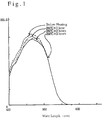
- Fig. 1 is a graph showing spectral distributions of the coating film forming a blue-hued pixel measured in Example 13.
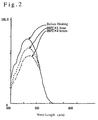
- Fig. 2 is a graph showing spectral distributions of the coating film forming a blue-hued pixel measured in Comparative Example 2.
- the acrylic resin A contained in the composition of the present invention as a requisite component is prepared by polymerizing a monomer mixture containing 1 to 6 % by weight of ⁇ , ⁇ -unsaturated carboxylic acid, 10 to 80 % by weight of ⁇ , ⁇ -unsaturated carboxylate, 5 to 30 % by weight of N-substituted maleimide, and optionally 0 to 60 % by weight of a compound having a double bond other than the above compounds.
- the acrylic resin A has acid value of 5 to 100 mgKOH/g, preferably 10 to 50 mgKOH/g.
- the acid value herein is measured in accordance with JIS K2501.
- the acid value of the acrylic resin A is less than 5 mgKOH/g, the produced coating film will be developed defectively, or sufficient water-dispersibility of the acrylic resin A cannot be achieved when the resin composition is used for preparing an electrodeposition coating material.
- the acid value exceeds 100 mgKOH/g, the resistance of the color filter to moisture and the resistance of the coating film to a developing solution are lowered.
- Examples of the ⁇ , ⁇ -unsaturated carboxylic acid may include acrylic acid, methacrylic acid, itaconic acid, maleic acid, fumaric acid, crotonic acid, citraconic acid, mesaconic acid, and ⁇ -chloroacrylic acid. Two or more kinds of ⁇ , ⁇ -unsaturated carboxylic acid may be used together. Alternatively, functional derivatives of ⁇ , ⁇ -unsaturated carboxylic acid having at least one carboxyl group, for example, partial esters or amides of unsaturated polymerizable di- or poly-carboxylic acid, or mixtures thereof, may be used as the ⁇ , ⁇ -unsaturated carboxylic acid.
- the content of the ⁇ , ⁇ -unsaturated carboxylic acid in the monomer mixture is less than 1 % by weight, the coating film will be developed defectively, or sufficient water-dispersibility of the acrylic resin A cannot be achieved when the resin composition is used for preparing an electrodeposition coating material.
- the content of the ⁇ , ⁇ -unsaturated carboxylic acid in the monomer mixture exceeds 6 % by weight, the resistance of the color filter to moisture and the resistance of the coating film to a developing solution are lowered.
- the ⁇ , ⁇ -unsaturated carboxylate gives suitable hardness to the produced coating film, and improves adhesivity of the coating film to a glass plate. Further, it improves water-dispersibility of the acrylic resin A in preparing an electrodeposition coating material, and improves film forming properties of the electrodeposition coating material upon electrodeposition, thereby allowing efficient electrodeposition.
- Examples of the ⁇ , ⁇ -unsaturated carboxylate may include methyl (meth)acrylate, ethyl (meth)acrylate, butyl (meth)acrylate, isobutyl (meth)acrylate, hexyl (meth)acrylate, lauryl (meth)acrylate, cetyl acrylate, stearyl acrylate, cyclohexyl (meth)acrylate, benzyl (meth)acrylate, isobornyl (meth)acrylate, 2-methoxyethyl (meth)acrylate, 3-methoxybutyl (meth)acrylate, ethylcarbitol (meth)acrylate, phenoxyethyl (meth)acrylate, trifluoroethyl (meth)acrylate, tetrafluoropropyl (meth)acrylate, hexafluoropropyl (meth)acrylate, octafluoropentyl
- the content of the ⁇ , ⁇ -unsaturated carboxylate in the monomer mixture is less than 10 % by weight, the water-dispersibility of the acrylic resin A is lowered, so that the composition hardly exhibits film forming properties under the normal electrodeposition conditions.
- the content of the ⁇ , ⁇ -unsaturated carboxylate exceeds 80 % by weight, the content of N-substituted maleimide monomer which gives heat resistance, as will be described later, will relatively be lowered, so that sufficient heat resistance cannot be achieved.
- N-substituted maleimide examples include N-cyclohexylmaleimide, N-2-methylcyclohexylmaleimide, N-2-ethylcyclohexylmaleimide, N-2-chlorocyclohexylmaleimide, N-phenylmaleimide, N-2-methylphenylmaleimide, N-2-ethylphenylmaleimide, and N-2-chlorophenylmaleimide.
- N-cyclohexylmaleimide, N-2-methylcyclohexylmaleimide, and N-2-ethylcyclohexylmaleimide are particularly preferred to give excellent transparency to the obtained resin. Two or more kinds of N-substituted maleimide may be used together.
- the content of the N-substituted maleimide in the monomer mixture is less than 5 % by weight, coating film having sufficient heat resistance cannot be obtained.
- the content exceeds 30 % by weight the glass transition point of the obtained acrylic resin A becomes exceedingly high to cause whiting of the pixels and defective patterning, or a color filter having the film thickness of less than 2 ⁇ m can hardly be produced. Further, compatibility of the acrylic resin A and the coloring pigment is lowered, thereby weakening the produced coating film and lowering the adhesivity to a glass plate.
- the monomer mixture for preparing the acrylic resin A may further contain a compound having a double bond other than the above requisite components.
- a compound having a double bond may include styrene monomers such as styrene, o-methylstyrene, m-methylstyrene, p-methylstyrene, p-methoxystyrene, p-tert-butylstyrene, p-phenylstyrene, o-chlorostyrene, m-chlorostyrene, or p-chlorostyrene; amides or amide derivatives of ⁇ , ⁇ -unsaturated carboxylic acid such as (meth)acrylamide, methylol(meth)acrylamide, alkoxymethylol(meth)acrylamide, or diacetone(meth)acrylamide; ethylene, propylene, butylene, vinyl chloride, vinyl acetate, acryl
- the content of the compound having a double bond other than the requisite components in the monomer mixture exceeds 60 % by weight, the desired effects of the present invention may not be obtained, thus being not preferred.
- the acrylic resin composition of the present invention is used as a thermosetting resin composition or an electrodeposition coating resin composition
- a curing agent such as melamine may be added to the composition.
- the compound having a double bond other than the requisite components contained in the monomer mixture for preparing the acrylic resin A may preferably be a monomer having a hydroxyalkyl group such as (meth)acrylate having a hydroxyalkyl group for copolymerization with other monomers in the monomer mixture.
- X stands for an o-phenylene group
- Ph stands for a phenyl group in the formulae. Two or more kinds of these monomers having a hydroxyalkyl group may be used together.
- the content thereof in the monomer mixture is preferably 3 to 30 % by weight.
- the polymerization of the monomer mixture may be effected by mixing the monomer mixture under heating in the presence of an organic solvent and a polymerization initiator, and optionally by regulating the reaction by adding a polymerization regulator.
- the monomer mixture may be polymerized by radical polymerization or anionic polymerization.
- solution polymerization, suspension polymerization, emulsion polymerization, precipitation polymerization, or bulk polymerization may be employed. Of these, the solution polymerization is preferred. Conditions for the polymerization may suitably be selected. In the solution polymerization, for example, the suitable polymerization temperature is 40 to 150 °C.
- the organic solvent for polymerization may be methyl alcohol, ethyl alcohol, n-propyl alcohol, isopropyl alcohol, n-butyl alcohol, isobutyl alcohol, methyl ethyl ketone, hexane, butyl cellosolve, diethylene glycol dimethyl ether, triethylene glycol dimethyl ether, or the like.
- the acrylic resin composition of the present invention contains a coloring pigment as a requisite component.
- the coloring pigment may suitably be selected depending on the intended hue. However, it is desired to select a pigment which does not adversely affect the stability and applicability of the coating material, and transparency and durability of the produced coating film.
- organic pigments such as azo lake, quinacridone, phthalocyanine, isoindolinone, anthraquinone, thioindigo, xanthene, indigo, dioxazine, or indanthrene; or inorganic pigments such as chrome yellow, iron oxide, chrome vermilion, chrome green, ultramarine, Prussian blue, cobalt blue, cobalt green, emerald green, titanium white, or carbon black may be used.
- two or more kinds of the above coloring pigments may be mixed depending on the intended hue, as long as the properties of the pigments are not deteriorated.
- Specific examples of the useful coloring pigments may include, phthalocyanine blue (C.I.
- pigment red 177 for example, trade name "RIONOGEN RED GD” manufactured by TOYO INK SEIZO CORPORATION, or trade name “CHROMOPHTHAL RED BRN” manufactured by CIBA GEIGY AG), furnace black (for example, trade name “MA100R”, “#4000”, “#4010”, or “#45” manufactured by MITSUBISHI KASEI CO., LTD., or trade name “MOGUL-L” or “REGAL400R” manufactured by CABLACK CORPORATION), or channel black (for example, trade name “COLOR BLACK FW200", “SPECIAL BLACK 5", or "PRINTEX 75” manufactured by DEGUSSA JAPAN, CO., LTD.). Further, for color adjustment, C.I.
- pigment yellow 83 C.I. pigment yellow 154 (for example, trade name "RIONOGEN YELLOW 3G” manufactured by TOYO INK SEIZO CORPORATION), C.I. pigment violet 23 (for example, trade name "RIONOGEN VIOLET RL” manufactured by TOYO INK SEIZO CORPORATION), or the like may be used.
- C.I. pigment yellow 154 for example, trade name "RIONOGEN YELLOW 3G” manufactured by TOYO INK SEIZO CORPORATION
- C.I. pigment violet 23 for example, trade name "RIONOGEN VIOLET RL” manufactured by TOYO INK SEIZO CORPORATION
- the mixing ratio of the coloring pigment is 5 to 90 parts by weight, preferably 10 to 80 parts by weight, based on 100 parts by weight of the acrylic resin A. If the content of the coloring pigment is less than 5 parts by weight, sufficient contrast of the color filter cannot be obtained, while if the content exceeds 90 parts by weight, crystallization or deterioration of the film quality may occur.
- the coloring pigment may be mixed in the composition of the present invention by dispersing the coloring pigment in the composition using a dispersing apparatus such as a roll mill, a sand mill, a ball mill, or an attriter.
- a dispersing apparatus such as a roll mill, a sand mill, a ball mill, or an attriter.
- a composition wherein a coloring pigment containing carbon black or mixed color black is dispersed can be used for producing a black matrix of a color filter.
- the acrylic resin composition of the present invention may further be mixed with a compound having at least one ethylenic unsaturated double bond in a molecule thereof and a photopolymerization initiator, thereby preparing a photocuring resin composition for a color filter.
- the compound having at least one ethylenic unsaturated double bond in a molecule thereof is preferably, for example, a compound having the boiling point of 100 °C or higher at the normal pressure.
- Examples of the compound having at least one ethylenic unsaturated double bond in a molecule thereof may include polyethylene glycol di(meth)acrylate, polypropylene glycol di(meth)acrylate, trimethylolethane triacrylate, trimethylolpropane triacrylate, trimethylolpropane diacrylate, neopentyl glycol di(meth)acrylate, pentaerythritol tetra(meth)acrylate, pentaerythritol tri(meth)acrylate, dipentaerythritol hexa(meth)acrylate, dipentaerythritol penta(meth)acrylate, hexanedyol di(meth)acrylate, trimethylolpropane tri
- polyester acrylates as disclosed in Japanese Laid-open Patent Application No. 48-64183, Japanese Patent Publication No. 49-43191 or 52-30490, or epoxy acrylates which is a reaction product of an epoxy resin and (meth)acrylic acid.
- epoxy acrylates which is a reaction product of an epoxy resin and (meth)acrylic acid.
- trimethylolpropane tri(meth)acrylate, pentaerythritol tetra(meth)acrylate, dipentaerythritol hexa(meth)acrylate, and dipentaerythritol penta(meth)acrylate are particularly preferred. Two or more kinds of such compounds having at least one ethylenic unsaturated double bond in a molecule thereof may be used together.
- the compound having at least one ethylenic unsaturated double bond in a molecule thereof may also has an acid group such as a carboxyl group.
- an acid group such as a carboxyl group.
- Examples of the compound having both an acid group and an ethylenic unsaturated double bond in a molecule thereof may include carboxylic acid addition product of epoxy (meth)acrylate prepared by reacting an acid anhydride with a hydroxyl group generated by reacting (meth)acrylic acid with an epoxy group contained in a bisphenol A epoxy resin, bisphenol F epoxy resin, novolak epoxy resin, polycarboxylic acid polyglycidyl ester, polyol polyglycidyl ether, aliphatic or alicyclic epoxy resin, an amine epoxy resin, triphenolmethane epoxy resin, or dihydroxybenzene epoxy resin; a copolymer of maleic anhydride and ethylene, propylene, isobutylene, styrene, vinylphenol, acrylic acid, acrylate, or acrylamide, half-esterified by reacting the maleic anhydride portion of the copolymer with an acrylate having an alcoholic hydroxyl group such as hydroxyethyl acrylate or an
- the epoxy compound may include a bisphenol A epoxy resin, bisphenol F epoxy resin, novolak epoxy resin, polycarboxylic acid polyglycidyl ester, polyol polyglycidyl ether, aliphatic or alicyclic epoxy resin, amine epoxy resin, trisphenolmethane epoxy resin, and dihydroxyphenyl epoxy resin.
- the mixing ratio of the epoxy compound is usually not more than 40 parts by weight, preferably 5 to 20 parts by weight, based on 100 parts by weight of the compound having both an acid group and an ethylenic unsaturated double bond in a molecule thereof.
- the mixing ratio of the compound having at least one ethylenic unsaturated double bond in a molecule thereof in preparing the photocuring resin composition is usually 5 to 100 parts by weight, preferably 10 to 80 parts by weight, based on 100 parts by weight of the acrylic resin composition. If the mixing ratio is less than 5 parts by weight, the photocuring time will be extended and the adhesive strength is lowered. If the mixing ratio exceeds 100 parts by weight, the adhesivity of the photocuring layer becomes exceedingly strong, so that, when a soft contact type exposure is used, the photocuring resin will adhere to the photomask, thereby undesirably contaminating the photomask.
- Examples of the photopolymerization initiator to be mixed for preparing a photocuring resin composition may include ⁇ -diketones such as benzyl or diacetyl; acyloins such as benzoin; acyloin ethers such as benzoin methyl ether, benzoin ethyl ether, or benzoin isopropyl ether; thioxanthones such as thioxanthone, 2,4-diethylthioxanthone, thioxanthone-1-sulfonic acid, or thioxanthone-4-sulfonic acid; benzophenones such as benzophenone, 4,4'-bis(dimethylamino)benzophenone, or 4,4'-bis(diethylamino)benzophenone; acetophenones such as acetophenone, p-dimethylaminoacetophenone, ⁇ , ⁇ '-dimethoxyacetoxyaceto
- Particularly preferred examples may include 2-trichloromethyl-4'-butoxystiryl-1,3,4-oxaziazol, 2,4-bis(trichloromethyl)-6-(4'-methoxyphenyl)-s-triazine, 2,4-bis(trichloromethyl)-6-(4'-(N,N-diethoxycarbonylmethylamino)-3'-bromo)phenyl-s-triazine, and 4-(p-N,N-di(ethoxycarbonylmethyl)-2,6-di(trichloromethy)-s-triazine). Two or more kinds of photopolymerization initiator may be used together.
- the mixing ratio of the photopolymerization initiator for preparing the photocuring resin composition is preferably 0.1 to 30 parts by weight, more preferably 0.15 to 15 parts by weight, based on 100 parts by weight of the compound having at least one ethylenic unsaturated double bond in a molecule thereof. If the mixing ratio of the photopolymerization initiator is less than 0.1 parts by weight, sensitivity of the photocuring resin composition is lowered, while the mixing ratio exceeds 30 parts by weight, crystallization or deterioration of the film quality may occur, thus being not preferred.
- the photocuring resin composition may further contain additional additives such as a thermal polymerization inhibitor, an adhesion promoter, a dispersing agent, a plasticizer, a sagging inhibitor, a leveling agent, a defoaming agent, a flame retarder, a brightener, a coloring agent, or the like.
- additional additives such as a thermal polymerization inhibitor, an adhesion promoter, a dispersing agent, a plasticizer, a sagging inhibitor, a leveling agent, a defoaming agent, a flame retarder, a brightener, a coloring agent, or the like.
- a photocuring resin composition layer may be formed on a substrate for producing a color filter by dissolving the components of the composition in an organic solvent to obtain a solution, and applying the solution on the substrate followed by drying, or by applying the solution on a temporary support, drying, and transferring the obtained layer onto the substrate.
- organic solvents used for this purpose may include ketones such as methyl ethyl ketone or cyclohexanone; aromatic hydrocarbons such as toluene or xylene; alkoxyethanols such as methoxyethanol, ethoxyethanol, or butoxyethanol; carbitols such as carbitol or butylcarbitol; acetates such as ethyl acetate, butyl acetate, ethoxyethanol acetate, butoxyethanol acetate, carbitol acetate, or butylcarbitol acetate; or methyl lactate, or ethyl lactate. Two or more kinds of the organic solvents may be used together.
- ketones such as methyl ethyl ketone or cyclohexanone
- aromatic hydrocarbons such as toluene or xylene
- alkoxyethanols such as methoxyethanol, ethoxyethanol, or butoxyethanol
- carbitols such as
- color filter layers may be formed by applying the composition on a substrate, heating the composition on the substrate at a relatively low temperature for drying and adjusting the adhesivity of the surface, and exposing the obtained coating film to light via a pattern mask. Elimination of the adhesivity of the coating film surface by drying the coating film under heating before irradiating the active rays onto the coating film, allows arrangement of the pattern mask for exposure in close contact with the coating film to be cured. Subsequently, the coating film is subjected to development using an alkaline aqueous solution to dissolve uncured coating film portion, thereby forming pixels.
- the photocuring resin composition may be applied onto the substrate by, for example, spin coating method, spray coating method, dipping method, brushing method, roll coating method, flow coating method, curtain coating method, screen printing method, dispenser coating method, or bar coating method.
- spin coating method, bar coating method, roll coating method, curtain coating method, screen printing method, and dispenser coating method are preferred.
- Light source for exposure to be used for photocuring the photocuring resin composition may be, for example, a low-pressure mercury lamp, a medium-pressure mercury lamp, a high-pressure mercury lamp, an ultra-high pressure mercury lamp, a xenon lamp, a metal hydride lamp, or laser beam. It is preferred to use an exposure device having a high-pressure mercury lamp, ultra-high pressure mercury lamp, or metal hydride lamp as a light source, irradiating ultraviolet rays near 300 to 400 nm.
- the alkaline aqueous solution used as a developing solution may be a 0.1 to 10 % by weight aqueous solution of sodium hydroxide, potassium hydroxide, lithium hydroxide, sodium carbonate, potassium carbonate, lithium carbonate, or ammonia.
- amines may be used, including primary amines such as butylamine, hexylamine, benzylamine, or allylamine; secondary amines such as diethylamine or benzylethylamine; tertiary amines such as triethylamine; hydroxyl amines such as ethanolamine, diethanolamine, triethanolamine, or 2-amino-1,3-propanedyol; cyclic amines such as morpholine, pirydine, piperazine, or piperidine; polyamines including hydrazine, ethylenediamine, and hexamehtylenediamine; basic salts of the aforementioned amines such as sulfate, carbonate, bicarbonate, alkaline metal phosphate, or pyrophosphate of the aforementioned amines; or quaternary ammonium hydroxide such as tetramethylammonium hydroxide or choline.
- the acrylic resin composition of the present invention may be used as a thermosetting resin composition for color filter by optionally mixing with a curing agent.
- curing agent may include, for example, melamine, benzoguanamine, uzea, or derivatives of these compounds; amino resins such as a melamine resin or urea resin; phenol resins; and blocked isocyanates.
- fully etherified melamine is particularly preferred since it is stable near the room temperature for a prolonged time period, and reacts near 100 °C.
- the mixing ratio of the curing agent for preparing the thermosetting resin composition is 0 to 100 parts by weight, preferably 5 to 80 parts by weight, based on 100 parts by weight of the acrylic resin composition. If the mixing ratio of the curing agent exceeds 80 parts by weight, the coating film will be weak, thus being not preferred.
- thermosetting resin composition may further contain a variety of assistant agents such as a dispersion assistant agent for dyes or pigments, a leveling agent for improving smoothness of the coating film, a viscosity adjustment agent, or a defoaming agent.
- assistant agents such as a dispersion assistant agent for dyes or pigments, a leveling agent for improving smoothness of the coating film, a viscosity adjustment agent, or a defoaming agent.
- thermosetting resin composition containing the acrylic resin composition of the present invention preferably by a photolithographic method described below. Since an alkaline developing solution is used in this method, the thermosetting resin composition is required to be alkali soluble.
- a black-hued thermosetting resin composition is applied over a support made of glass, polycarbonate, silicon wafer, plastic sheet, paper or the like by an application method such as bar coating, spin coating, roll coating, spray coating, dipping, gravure printing, or screen printing method, and dried to form a black-hued coating film.
- an application method such as bar coating, spin coating, roll coating, spray coating, dipping, gravure printing, or screen printing method, and dried to form a black-hued coating film.
- photoresist which can be developed with alkali is applied by a bar coating, spin coating, roll coating, spray coating, dipping, gravure printing, or screen printing method, dried, and exposed to light through a photomask of a desired pattern.
- the photoresist layer is developed with an alkaline developing solution and removed, while the portions of the black-hued coating film under the removed photoresist layer portions are also dissolved and removed together. Then, the black-hued coating film is heated for curing at as a low temperature as the photoresist will not be deteriorated and becomes unremovable, i.e. 80 to 150 °C. Subsequently, the photoresist is developed and removed, thereby producing a substrate having a black matrix thereon.
- a red-hued thermosetting resin composition is applied in the same way as in producing a black-hued coating film to produce a red-hued coating film.
- photoresist which can be developed with alkali, and treated in the same way as in producing a black matrix, thereby leaving the portions of the red-hued coating film corresponding to the red pixels to embed the film between the black matrix.
- green- and blue-hued thermosetting resin compositions are applied and treated in the same way to produce a color filter.
- the photoresist is applied over the substrate, and portions of the photoresist corresponding to the black matrix to be formed are developed and removed by a photolithographic method.
- the black-hued thermosetting resin composition black-hued coating material
- the remaining portions of the resist are developed and removed to produce a black matrix.
- red-, green- and blue-hued thermosetting resin compositions are applied and treated in the same way for forming colored pixels, thereby producing a color filter.
- the photoresist described above may either be a positive or a negative type photoresist.
- Preferable film thicknesses of the produced color filter coating films are usually 0.2 to 5.0 ⁇ m for both the black matrix and the colored pixels.
- a color filter may be produced by off set printing, intaglio printing, or relief printing, photolithographic method is preferred for its precision.
- the acrylic resin composition of the present invention may be used as an electrodeposition coating material composition for color filter by optionally mixing with a curing agent.
- the curing agent may suitably be selected depending on the acrylic resin to be used.
- examples of such curing agent may include, for example, melamine, benzoguanamine, urea, or derivatives of these compounds; amino resins such as a melamine resin or urea resin; phenol resins; or blocked isocyanates.
- a curing agent which is effective at a relatively low temperature is particularly preferred.
- methylolmelamine at least partially etherified with one or more lower alcohols such as methanol, ethanol, propanol, or butanol, is preferably used.
- the mixing ratio of the curing agent for preparing the electrodeposition coating material composition is suitably 0 to 80 parts by weight, preferably 5 to 60 parts by weight, based on 100 parts by weight of the acrylic resin composition. If the mixing ratio of the curing agent exceeds 80 parts by weight, the obtained coating film becomes weak, thus being not preferred.
- the electrodeposition coating material composition containing the acrylic resin composition of the present invention may be used to prepare a colored electrodeposition coating material.
- a reaction catalyst such as paratoluene sulfonic acid or dibutyltin dilaurate
- an organic solvent
- the dispersion thus obtained is diluted with water to a desired concentration, preferably the solid content of about 4 to 25 % by weight, more preferably 7 to 20 % by weight, thereby preparing a colored electrodeposition coating material.
- the colored electrodeposition coating material thus obtained may be electrodeposited on an electrically conductive layer to form a colored layer.
- the film thickness of the obtained colored layer is not particularly limited, and may suitably be selected depending on the properties required for the color filter.
- Preferred film thickness of the colored layer is usually 0.3 to 5 ⁇ m, preferably about 1 to 3 ⁇ m in dried state.
- Conditions for electrodeposition may suitably be selected depending on the kind of the colored electrodeposition coating material to be used or desired film thickness of the colored layer.
- the voltage is usually 5 to 500 V, preferably 10 to 300 V dc
- the electrodeposition time is usually 5 to 300 seconds, preferably 10 to 200 seconds
- the temperature of the coating material is usually 10 to 35 °C, preferably 15 to 30 °C.
- a color filter may be formed with the electrodeposition coating material composition containing the acrylic resin composition of the present invention by a various electrodeposition methods using a substrate provided with a transparent electrode or a transparent electrically conductive layer.
- Specific methods may include, for example, (1) a method including the steps of forming a black matrix on a glass plate or the like with the colored electrodeposition coating material hued in black, and forming each colored layer one by one with the colored electrodeposition coating materials hued in red, green, and blue, respectively; (2) a method including the steps of forming each colored layer one by one on a glass plate or the like with the colored electrodeposition coating materials hued in red, green, and blue, respectively, and forming a black matrix with the colored electrodeposition coating material hued in black, or (3) a method including the steps of forming a black matrix and each colored layer on separate or the same temporary support, and transferring the black matrix and the colored layers onto the substrate for color filter.
- the acrylic resin composition for a color filter of the present invention exhibits superior heat resistance and heat stability, and can be used as a base material for a coating material containing a photocuring resin composition, a thermosetting resin composition, or an electrodeposition coating material composition for producing colored pixels and a black matrix of a color filter. In the color filter produced with these coating materials, decrease in film thickness even at a high temperature and in chromaticity is hardly observed.
- Polymers B to E were prepared, respectively, in the same way as for preparing the varnish containing polymer A above, except that the compositions of the monomers were changed as shown in Table 1.
- polymer D did not contain N-substituted maleimide
- polymers E and F each contained ⁇ , ⁇ -unsaturated carboxylate and N-substituted maleimide in the amounts outside the range defined for the acrylic resin A of the present invention.
- a photocuring resin composition (H-2) for a color filter was prepared in the same way as in Example 1 except that the blue pigment used in Example 1 was replaced with phthalocyanine green (green pigment, trade name "SAX” manufactured by SANYO SHIKISO CORPORATION).
- a photocuring resin composition (H-3) for a color filter was prepared in the same way as in Example 1 except that the blue pigment used in Example 1 was replaced with an azo metallic salt pigment (red pigment, trade name "PIGMENT RED 4BS” manufactured by SANYO SHIKISO CORPORATION).
- an azo metallic salt pigment red pigment, trade name "PIGMENT RED 4BS” manufactured by SANYO SHIKISO CORPORATION.
- a photocuring resin composition (H-4) for a color filter was prepared in the same way as in Example 1 except that the blue pigment used in Example 1 was replaced with carbon black (trade name "MA-100R” manufactured by MITSUBISHI KASEI CORPORATION).
- Composition (H-4) prepared in Example 4 was applied over a glass plate by a roll coater, and dried at 100 °C for 2 minutes, thereby forming a film of 2 ⁇ m thick.
- the film thus obtained was exposed to light from an ultra-high pressure mercury light in a nitrogen stream via a mask having a predetermined light-shielding pattern to print the light-shielding pattern on the film, and developed with a 1 wt% aqueous solution of sodium carbonate, thereby producing a glass substrate (a) having a black matrix thereon.
- compositions (H-1), (H-2), and (H-3) prepared in Examples 1 to 3, respectively, were applied one by one in the same way as for the composition (H-4) to form coating films providing pixel patterns, thereby producing a color filter (CF-1).
- thermosetting resin composition 160 g of polymer B prepared in Synthesis Example 2 (DMTG solution of 50 % solid content), 20 g of a melamine resin (trade name "SUMIMAL M-66B” manufactured by SUMITOMO CHEMICAL CO., LTD.), 32 g of phthalocyanine blue (blue pigment, trade name "SR-150 C” manufactured by SANYO SHIKISO CORPORATION), and 350 g of cellosolve acetate were mixed to prepare a thermosetting resin composition (N-1) for a color filter.
- a melamine resin trade name "SUMIMAL M-66B” manufactured by SUMITOMO CHEMICAL CO., LTD.
- phthalocyanine blue blue pigment, trade name "SR-150 C” manufactured by SANYO SHIKISO CORPORATION
- cellosolve acetate 350 g of cellosolve acetate
- thermosetting resin composition (N-2) for a color filter was prepared in the same way as in Example 6 except that the blue pigment used in Example 6 was replaced with phthalocyanine green (green pigment, trade name "SAX” manufactured by SANYO SHIKISO CORPORATION).
- thermosetting resin composition (N-3) for a color filter was prepared in the same way as in Example 6 except that the blue pigment used in Example 6 was replaced with an azo metallic salt pigment (red pigment, trade name "PIGMENT RED 4BS” manufactured by SANYO SHIKISO CORPORATION).
- an azo metallic salt pigment red pigment, trade name "PIGMENT RED 4BS” manufactured by SANYO SHIKISO CORPORATION.
- thermosetting resin composition (N-4) for a color filter was prepared in the same way as in Example 6 except that the blue pigment used in Example 6 was replaced with carbon black (trade name "MA-100R” manufactured by MITSUBISHI KASEI CORPORATION).
- Positive type photoresist composed of a naphthoquinonediazido compound and a novolak cresol resin (trade name "OFPR-800" manufactured by TOKYO OHKA KOGYO CO., LTD.) was applied over a glass plate by a spin coating method to form a coating film of a dry thickness of 2 ⁇ m. Then light from an ultra-high pressure mercury lamp was irradiated onto the resist through a mask having a predetermined light-shielding pattern. Subsequently, the resist was developed with a 2.4 wt% aqueous solution of tetramethylammonium hydroxide to selectively remove the portions of the positive type photoresist exposed to light for exposing the corresponding glass surface to outside.
- the composition (N-4) prepared in Example 9 was applied on the plate by a spin coating method, dried at 100 °C, and then developed with a 2.4 wt% aqueous solution of tetramethylammonium hydroxide to remove the positive type photoresist, thereby producing a glass substrate (b) having a black matrix thereon.
- compositions (N-1), (N-2), and (N-3) prepared in Examples 6 to 8, respectively were applied and treated one by one in the same way as for the composition (N-4) to form coating films providing pixel patterns, thereby producing a color filter (CF-2).
- CF-2 was subjected to the same tests as in Example 5. The results are shown in Table 3. It was revealed that the decrease ratios of film thickness of each pixel and the black matrix are low, and difference in the spectral distributions of the color filter (CF-2) before and after the heating was small, showing that the color filter (CF-2) has excellent heat resistance.
- the varnish containing the polymer A prepared in Synthesis Example 1 was concentrated to a solid content of 80 % by weight, neutralized with triethylamine to about pH 8, and mixed with deionized water, thereby preparing an aqueous resin solution (S2).
- aqueous resin solution (S2) carbon black, azo metallic salt red pigment, phthalocyanine green, and phthalocyanine blue were added, respectively, to prepare black-, red-, green-, and blue-hued pigment dispersions, respectively.
- polymer A prepared in Synthesis Example 1 was mixed with a melamine resin (trade name "M-66B” manufactured by SUMITOMO CHEMICAL CO., LTD.), neutralized with triethylamine to about pH 8, and further mixed with deionized water, thereby preparing an aqueous resin solution (T2).
- a melamine resin trade name "M-66B” manufactured by SUMITOMO CHEMICAL CO., LTD.
- the aqueous resin solution (T2) was added to each of the pigment dispersions prepared above, to produce colored coating materials (Bk, R, G, B) each having the composition shown in Table 2.
- the coating materials thus obtained were thermosetting and anionic.
- the particle size distributions of the coating materials were measured by a particle size distribution measuring apparatus LA-910 (manufactured by HORIBA SEISAKUSHO). The results are shown in Table 2.
- Example 12 (Production of Substrate Having Light-shielding Layer)
- Positive type photoresist composed of a naphthoquinonediazido compound and a novolak cresol resin (trade name "OFPR-800" manufactured by TOKYO OHKA KOGYO CO., LTD.) was applied over a 1.1 mm thick CORNING 7059 GLASS (trade name) having a 100 nm thick ITO (indium-tin oxide) film on the surface thereof by a spin coating method to form a coating film of a dry thickness of 3 ⁇ m. Then light from an ultra-high pressure mercury lamp was irradiated onto the resist at 70 mJ/cm 2 through a mask having a predetermined light-shielding pattern.
- OFPR-800 novolak cresol resin
- the resist was developed with a 2.4 wt% aqueous solution of tetramethylammonium hydroxide to selectively remove the portions of the positive type photoresist exposed to light for exposing the corresponding ITO surface to outside.
- electrodeposition was carried out by applying DC voltage of 25V between a stainless steel beaker containing the anionic colored coating material Bk prepared in Example 11 as an anode and the above substrate as a cathode at 25 °C for 60 seconds. Then the substrate was taken out of the stainless steel beaker, washed with ion-exchanged water, and dried at 70 °C for 5 minutes.
- the substrate was heated at 120 °C for 10 minutes, the entire surface of the substrate was exposed to light irradiation from the ultra-high pressure mercury lamp at 100 mJ/cm 2 , and subsequently developed with a 2.4 wt% aqueous solution of tetramethylammonium hydroxide. As a result, no change was observed on the black-hued electrodeposited pattern, and remaining positive type photoresist was removed completely. After the substrate was washed with water and dried, a substrate having a 1.8 ⁇ m thick light-shielding layer of a high precision was obtained.
- the optical density of the light-shielding layer was found to be 3.0, as measured by KONICA DENSITOMETER PDA-65 (trade name) manufactured by KONICA CORPORATION.
- a color filter was produced by electrodeposition to be discussed below using the substrate having a light-shielding layer thereon produced in Example 12 (referred to as substrate 1 hereinbelow).
- Positive type photoresist (trade name "OFPR-800” manufactured by TOKYO OHKA KOGYO CO., LTD.) was applied over the substrate 1 by a spin coating method to form a coating film having a dry thickness of 2.2 ⁇ m.
- the coating film was exposed to light via a mosaic-patterned photomask wherein each light-transmitting portion is larger than the space between the light-shielding patterns by 10 ⁇ m at its top, bottom, right, and left sides, respectively.
- the coating film was developed to remove the portions of the photoresist exposed to light, thereby exposing the ITO film to outside.
- electrodeposition was carried out by applying DC voltage of 40 V between the electrodes at 25 °C for 10 seconds. Then the substrate 1 was taken out of the stainless steel beaker, washed with ion-exchanged water, dried, and heated at 120 °C for 10 minutes. Through these process, a mosaic patterned red-hued layer was formed on the substrate.
- a mosaic patterned green-hued layer was formed by electrodepositing and heating the colored coating material G prepared in Example 11 in the same way as in forming the red-hued layer.
- the same process was repeated for the colored coating material B prepared in Example 11, thereby producing a color filter.
- the developing solution used was a 1 wt% aqueous solution of sodium hydroxide containing 5 % by weight of a surface active agent (trade name "PEREX NBL" manufactured by KAO CO., LTD.).
- the color filter thus obtained was heated at 180 °C for 30 minutes for completing curing, thereby obtaining a color filter (CF-3) having excellent transparency, homogeneity, and smoothness, as well as superior pattern precision.
- CF-3 was subjected to the same tests as in Example 5. The results are shown in Table 3. From these results, it was revealed that the decrease ratios of film thickness of each pixel and the black matrix are low, and difference in the spectral distributions of the color filter (CF-3) before and after the heating was small, showing that the color filter (CF-3) has excellent heat resistance. On the other hand, spectral distributions of the coating film forming the blue-hued pixels of CF-3 before heating, after heating at 250 °C for 1 hour, 2 hours and 3 hours were respectively measured. The results are shown in Fig. 1.
- Photocuring Resin Compositions (H-5 to H-8) for color filter were prepared in the same way as in Examples 1 to 4 except that the polymer A used in Examples 1 to 4 was replaced with polymer D prepared in Synthesis Example 4. Subsequently, a color filter (CF-4) was produced in the same way as in Example 5 except that the compositions (H-1), (H-2), (H-3), and (H-4) used in Example 5 were replaced with compositions (H-5), (H-6), (H-7), and (H-8), respectively.
- CF-4 was subjected to the same tests as in Example 5. The results are shown in Table 3. From these results, it was revealed that the film thicknesses of each pixel and the black matrix were remarkably decreased, and difference in the spectral distributions of the color filter (CF-4) before and after the heating was large, showing that the color filter (CF-4) has poor heat resistance.
- a color filter (CF-5) was produced in the same way as in Examples 12 and 13 using the same materials as in Example 11 except that the polymer A used in Example 11 was replaced with polymer E (content of N-cyclohexylmaleimide is less than 5 % by weight) prepared in Synthesis Example 5.
- CF-5 was subjected to the same tests as in Example 5. The results are shown in Table 3. From these results, it was revealed that the film thicknesses of each pixel and the black matrix were remarkably decreased, and difference in the spectral distributions of the color filter (CF-5) before and after the heating was large, showing that the color filter (CF-5) has poor heat resistance.
- spectral distributions of the coating film forming the blue-hued pixels of CF-5 before heating, after heating at 250 °C for 1 hour, 2 hours, and 3 hours were respectively measured. The results are shown in Fig. 2.
- a color filter was produced in the same way as in Examples 12 and 13 using the same materials as in Example 11 except that the polymer A used in Example 11 was replaced with polymer F (content of N-cyclohexylmaleimide exceeds 30 % by weight) prepared in Synthesis Example 6.
- the black matrix and the pixels could not be electrodeposited in a uniform film thickness of 2 ⁇ m.
- the film thickness exceeds 10 ⁇ m under the normal electrodeposition conditions (discharge at 30 V for 15 seconds), whereas under the conditions at low voltage for a short period of time, the uniform film thickness could not be achieved over the entire surface of the substrate, and the surface of the coating film became rough.
- a color filter (CF-6) was produced in the same way as in Example 10 using the same materials as in Examples 6 to 9 except that the polymer B used in Examples 6 to 9 was replaced with polymer F (content of N-cyclohexylmaleimide exceeds 30 % by weight) prepared in Synthesis Example 6.
- CF-6 was subjected to the same tests as in Example 5. As a result, CF-6 exhibited good heat resistance, but had many whiting portions in the pixels and defectively shaped patterns since the viscosity of the resin was exceedingly high. Further, adhesivity of the coating film to the glass plate tended to be low possibly due to the poor compatibility with the pigments.
Landscapes
- Chemical & Material Sciences (AREA)
- Organic Chemistry (AREA)
- Life Sciences & Earth Sciences (AREA)
- Physics & Mathematics (AREA)
- Chemical Kinetics & Catalysis (AREA)
- Health & Medical Sciences (AREA)
- Materials Engineering (AREA)
- Wood Science & Technology (AREA)
- Engineering & Computer Science (AREA)
- General Physics & Mathematics (AREA)
- Medicinal Chemistry (AREA)
- Polymers & Plastics (AREA)
- Molecular Biology (AREA)
- Optics & Photonics (AREA)
- Optical Filters (AREA)
- Paints Or Removers (AREA)
- Compositions Of Macromolecular Compounds (AREA)
- Liquid Crystal (AREA)
Applications Claiming Priority (3)
| Application Number | Priority Date | Filing Date | Title |
|---|---|---|---|
| JP22110596 | 1996-08-22 | ||
| JP221105/96 | 1996-08-22 | ||
| JP22110596A JPH1060214A (ja) | 1996-08-22 | 1996-08-22 | カラーフィルター用アクリル樹脂組成物 |
Publications (3)
| Publication Number | Publication Date |
|---|---|
| EP0825239A2 true EP0825239A2 (fr) | 1998-02-25 |
| EP0825239A3 EP0825239A3 (fr) | 2001-01-03 |
| EP0825239B1 EP0825239B1 (fr) | 2002-10-23 |
Family
ID=16761573
Family Applications (1)
| Application Number | Title | Priority Date | Filing Date |
|---|---|---|---|
| EP97114318A Expired - Lifetime EP0825239B1 (fr) | 1996-08-22 | 1997-08-19 | Composition de résine acrylique pour filtre colore |
Country Status (5)
| Country | Link |
|---|---|
| US (1) | US6028123A (fr) |
| EP (1) | EP0825239B1 (fr) |
| JP (1) | JPH1060214A (fr) |
| KR (1) | KR100533352B1 (fr) |
| DE (1) | DE69716538T2 (fr) |
Cited By (7)
| Publication number | Priority date | Publication date | Assignee | Title |
|---|---|---|---|---|
| US6524757B2 (en) * | 2000-07-13 | 2003-02-25 | Dainippon Ink And Chemicals, Inc. | Color filter and method for producing the same |
| EP1193513A3 (fr) * | 2000-09-27 | 2003-10-08 | Dainippon Ink And Chemicals, Inc. | Procédé de production d'un filtre de couleur |
| US6639006B1 (en) * | 1998-11-12 | 2003-10-28 | Avecia Limited | Composition based on cross-linkable, water-dissipatable acrylic polymers, process and use |
| CN101109900B (zh) * | 2006-07-18 | 2011-03-09 | 第一毛织株式会社 | 图像传感器滤色片用感光树脂组合物和使用该组合物的图像传感器滤色片 |
| CN102933988A (zh) * | 2010-07-09 | 2013-02-13 | 木本股份有限公司 | 光学设备用遮光部件 |
| CN102985854A (zh) * | 2010-07-09 | 2013-03-20 | 木本股份有限公司 | 光学设备用遮光部件 |
| CN111077733A (zh) * | 2019-12-20 | 2020-04-28 | 上海电动工具研究所(集团)有限公司 | 一种cf基板用光致变色型负性光刻胶的制备方法 |
Families Citing this family (18)
| Publication number | Priority date | Publication date | Assignee | Title |
|---|---|---|---|---|
| US6296695B1 (en) * | 2000-01-28 | 2001-10-02 | Hiram Keaton | Method and mixture for chemically tinting glass |
| JP2004524564A (ja) * | 2001-02-27 | 2004-08-12 | ローム・アンド・ハース・エレクトロニック・マテリアルズ,エル.エル.シー. | 新規ポリマー、ポリマー合成方法およびフォトレジスト組成物 |
| TWI303640B (en) | 2001-09-25 | 2008-12-01 | Dainippon Printing Co Ltd | Alkali-soluble maleimide copolymer and liquid crystal display comprising the same |
| WO2004086145A1 (fr) * | 2003-03-24 | 2004-10-07 | Dai Nippon Printing Co. Ltd. | Composition de resine durcissable, composition de resine durcissable a configuration photosensible, filtre couleur, substrat pour panneau a cristaux liquides et panneau a cristaux liquides |
| US7709533B2 (en) * | 2005-02-01 | 2010-05-04 | Icagen, Inc. | Imines as ion channel modulators |
| JP2007101908A (ja) * | 2005-10-05 | 2007-04-19 | Fuji Xerox Co Ltd | 光変調素子 |
| JP5151028B2 (ja) * | 2005-12-09 | 2013-02-27 | 東洋インキScホールディングス株式会社 | カラーフィルタのフィルタセグメント形成用着色組成物およびカラーフィルタ |
| WO2009066638A1 (fr) * | 2007-11-20 | 2009-05-28 | Hitachi Chemical Company, Ltd. | Composition de résine photosensible, produit de résine photosensible durcie, film de résine photosensible, produit de film de résine photosensible durcie et guide d'ondes optique produit par utilisation de ces produits |
| TWI501027B (zh) * | 2008-11-18 | 2015-09-21 | Sumitomo Chemical Co | Photosensitive resin composition and display device |
| KR20110109944A (ko) * | 2010-03-29 | 2011-10-06 | 가부시키가이샤 닛폰 쇼쿠바이 | 컬러 필터용 감광성 수지 조성물 |
| CN102654732B (zh) * | 2011-08-04 | 2014-09-17 | 京东方科技集团股份有限公司 | 负性感光树脂组合物、彩色滤光片、液晶显示装置 |
| JP5757925B2 (ja) * | 2011-08-31 | 2015-08-05 | 富士フイルム株式会社 | 着色組成物、並びに、これを用いたカラーフィルタの製造方法、カラーフィルタ、及び、固体撮像素子 |
| JP6186702B2 (ja) * | 2011-12-14 | 2017-08-30 | 東洋インキScホールディングス株式会社 | カラーフィルタ用顔料分散体及びそれを用いた感光性着色組成物 |
| TWI708122B (zh) * | 2016-01-29 | 2020-10-21 | 日商富士軟片股份有限公司 | 著色組成物、彩色濾光片、圖案形成方法、固體攝像元件及圖像顯示裝置 |
| KR102643464B1 (ko) * | 2016-02-22 | 2024-03-05 | 삼성전자주식회사 | 컬러 편광 필름, 반사방지 필름 및 표시 장치 |
| WO2018164863A1 (fr) * | 2017-03-09 | 2018-09-13 | E Ink California, Llc | Inhibiteurs de polymérisation induits photo-thermiquement destinés à des supports électrophorétiques |
| KR102421629B1 (ko) * | 2017-07-05 | 2022-07-18 | 삼성디스플레이 주식회사 | 표시 장치 및 이의 제조 방법 |
| US11624953B2 (en) | 2017-07-05 | 2023-04-11 | Samsung Display Co., Ltd. | Display apparatus comprising a color conversion pattern and a light blocking pattern disposed on a data pattern of a thin film transistor |
Family Cites Families (13)
| Publication number | Priority date | Publication date | Assignee | Title |
|---|---|---|---|---|
| JPS6278544A (ja) * | 1985-10-01 | 1987-04-10 | Fuji Photo Film Co Ltd | 感光性組成物 |
| JP2600784B2 (ja) * | 1987-06-12 | 1997-04-16 | 住友化学工業株式会社 | 芳香族ビニル系樹脂成形体の製造方法 |
| JPH0637598B2 (ja) * | 1987-11-30 | 1994-05-18 | ハニー化成株式会社 | 電着塗装用樹脂組成物 |
| JPH0637599B2 (ja) * | 1987-12-08 | 1994-05-18 | ハニー化成株式会社 | 電着塗装方法 |
| JPH01255913A (ja) * | 1988-04-06 | 1989-10-12 | Toshiba Corp | 情報処理装置 |
| JPH0637601B2 (ja) * | 1988-05-31 | 1994-05-18 | ハニー化成株式会社 | 電着塗装用樹脂組成物 |
| JPH02153353A (ja) * | 1988-07-25 | 1990-06-13 | Matsushita Electric Ind Co Ltd | 着色光重合組成物およびカラーフィルタ |
| JPH0678763B2 (ja) * | 1988-11-18 | 1994-10-05 | 三洋電機株式会社 | 固定用の位置決め部材 |
| JPH04272978A (ja) * | 1991-02-28 | 1992-09-29 | Hitachi Chem Co Ltd | コーティング用樹脂組成物およびこれを用いたカラーフィルタ保護膜用樹脂組成物 |
| JP3008512B2 (ja) * | 1991-02-28 | 2000-02-14 | 日立化成工業株式会社 | コーティング用樹脂組成物およびこれを用いたカラーフィルタ保護膜用樹脂組成物 |
| JPH04272977A (ja) * | 1991-02-28 | 1992-09-29 | Hitachi Chem Co Ltd | 被覆硬化用樹脂組成物およびこれを用いたカラーフィルタ保護膜用樹脂組成物 |
| DE4218106A1 (de) * | 1992-06-02 | 1993-12-09 | Herberts Gmbh | Überzugsmittel und dessen Verwendung bei Verfahren zur Herstellung von Mehrschichtenüberzügen |
| DE69316126T2 (de) * | 1992-10-01 | 1998-08-13 | Hitachi Chemical Co Ltd | Harz für eine Kunststofflinse |
-
1996
- 1996-08-22 JP JP22110596A patent/JPH1060214A/ja active Pending
-
1997
- 1997-08-15 US US08/911,232 patent/US6028123A/en not_active Expired - Fee Related
- 1997-08-19 DE DE69716538T patent/DE69716538T2/de not_active Expired - Fee Related
- 1997-08-19 EP EP97114318A patent/EP0825239B1/fr not_active Expired - Lifetime
- 1997-08-22 KR KR1019970040021A patent/KR100533352B1/ko not_active Expired - Fee Related
Cited By (10)
| Publication number | Priority date | Publication date | Assignee | Title |
|---|---|---|---|---|
| US6639006B1 (en) * | 1998-11-12 | 2003-10-28 | Avecia Limited | Composition based on cross-linkable, water-dissipatable acrylic polymers, process and use |
| US6524757B2 (en) * | 2000-07-13 | 2003-02-25 | Dainippon Ink And Chemicals, Inc. | Color filter and method for producing the same |
| KR100716632B1 (ko) * | 2000-07-13 | 2007-05-09 | 다이니혼 잉키 가가쿠 고교 가부시키가이샤 | 컬러 필터 및 그 제조 방법 |
| EP1193513A3 (fr) * | 2000-09-27 | 2003-10-08 | Dainippon Ink And Chemicals, Inc. | Procédé de production d'un filtre de couleur |
| US6929827B2 (en) | 2000-09-27 | 2005-08-16 | Dainippon Ink And Chemicals, Inc. | Method of producing color filter |
| CN101109900B (zh) * | 2006-07-18 | 2011-03-09 | 第一毛织株式会社 | 图像传感器滤色片用感光树脂组合物和使用该组合物的图像传感器滤色片 |
| CN102933988A (zh) * | 2010-07-09 | 2013-02-13 | 木本股份有限公司 | 光学设备用遮光部件 |
| CN102985854A (zh) * | 2010-07-09 | 2013-03-20 | 木本股份有限公司 | 光学设备用遮光部件 |
| CN102933988B (zh) * | 2010-07-09 | 2015-12-16 | 木本股份有限公司 | 光学设备用遮光部件 |
| CN111077733A (zh) * | 2019-12-20 | 2020-04-28 | 上海电动工具研究所(集团)有限公司 | 一种cf基板用光致变色型负性光刻胶的制备方法 |
Also Published As
| Publication number | Publication date |
|---|---|
| JPH1060214A (ja) | 1998-03-03 |
| EP0825239A3 (fr) | 2001-01-03 |
| EP0825239B1 (fr) | 2002-10-23 |
| US6028123A (en) | 2000-02-22 |
| KR19980018879A (ko) | 1998-06-05 |
| KR100533352B1 (ko) | 2006-01-27 |
| DE69716538T2 (de) | 2003-03-06 |
| DE69716538D1 (de) | 2002-11-28 |
Similar Documents
| Publication | Publication Date | Title |
|---|---|---|
| EP0825239B1 (fr) | Composition de résine acrylique pour filtre colore | |
| KR100924009B1 (ko) | 컬러필터용 감광성 수지 조성물 및 이를 이용한 컬러필터 | |
| EP0780731B1 (fr) | Composition photopolymérisable pour filtre couleur, filtre couleur et dispositif d'affichage à cristaux liquides | |
| KR100870020B1 (ko) | 용해 특성을 조절하는 감광성 수지 조성물 및 이를 이용한이층 구조의 패턴 형성 방법 | |
| US20040157140A1 (en) | Photosensitive coloring composition, color filter using the composition and method of producing the same | |
| JPH0667421A (ja) | 黒色光重合性組成物及びその黒色硬化膜及びカラーフィルターの製造方法 | |
| US5821277A (en) | Thermosetting and procuring compositions for color filters and method for making the same | |
| JP2002022925A (ja) | カラーフィルターの製造方法及び着色感光性樹脂組成物 | |
| US5782968A (en) | Method for producing black pigment | |
| JP2949391B2 (ja) | カラーフィルターの製造法 | |
| JP2000214580A (ja) | カラ―フィルタ―用光重合性組成物、およびカラ―フィルタ― | |
| JP2003043685A (ja) | 着色組成物及びカラーフィルター用感光性着色組成物 | |
| US6524757B2 (en) | Color filter and method for producing the same | |
| JP2003035815A (ja) | カラーフィルター用組成物及びカラーフィルター | |
| KR100614400B1 (ko) | 내화학약품성이 우수한 감광성수지 조성물 | |
| JP3572731B2 (ja) | カラーフィルター | |
| JPH0862841A (ja) | 感光性樹脂組成物、これを用いたカラーフィルター及び該カラーフィルターの製造法 | |
| JPH08220328A (ja) | カラーフィルター用重合性組成物 | |
| JP3907221B2 (ja) | カラーフィルター用ブラックマトリックス及びブラックマトリックス用レジスト組成物 | |
| KR100655049B1 (ko) | 현상성이 우수한 고 색재현성 감광성 수지 조성물 및 이를이용한 컬러필터 | |
| KR100930671B1 (ko) | 컬러필터용 감광성 수지 조성물 및 이를 이용한 컬러필터 | |
| JP2007206654A (ja) | 感光性着色組成物およびカラーフィルタ | |
| JP3572730B2 (ja) | カラーフィルター | |
| KR20090067948A (ko) | 컬러필터용 감광성 수지 조성물 및 이를 이용한 컬러필터 | |
| CN101283005A (zh) | 活性能量线固化性组合物 |
Legal Events
| Date | Code | Title | Description |
|---|---|---|---|
| PUAI | Public reference made under article 153(3) epc to a published international application that has entered the european phase |
Free format text: ORIGINAL CODE: 0009012 |
|
| AK | Designated contracting states |
Kind code of ref document: A2 Designated state(s): DE FR GB |
|
| RIN1 | Information on inventor provided before grant (corrected) |
Inventor name: ANDO, MASAYUKI, DAI NIPPON PRINTING CO., LTD. Inventor name: OTSUKI, YUTAKA, NIPPON OIL CO.,LTD. Inventor name: TANIMOTO, JUNICHIRO, NIPPON OIL CO.,LTD. Inventor name: HIRAYAMA, TAKAYUKI, NIPPON OIL CO.,LTD. |
|
| RIN1 | Information on inventor provided before grant (corrected) |
Inventor name: ANDO, MASAYUKI, C/O DAI NIPPON PRINTING CO., LTD. Inventor name: OTSUKI, YUTAKA, C/O NIPPON OIL CO.,LTD. Inventor name: TANIMOTO, JUNICHIRO, C/O NIPPON OIL CO.,LTD. Inventor name: HIRAYAMA, TAKAYUKI, C/O NIPPON OIL CO.,LTD. |
|
| RAP1 | Party data changed (applicant data changed or rights of an application transferred) |
Owner name: DAI NIPPON PRINTING CO., LTD. Owner name: NIPPON MITSUBISHI OIL CORPORATION |
|
| PUAL | Search report despatched |
Free format text: ORIGINAL CODE: 0009013 |
|
| AK | Designated contracting states |
Kind code of ref document: A3 Designated state(s): AT BE CH DE DK ES FI FR GB GR IE IT LI LU MC NL PT SE |
|
| 17P | Request for examination filed |
Effective date: 20010529 |
|
| AKX | Designation fees paid |
Free format text: DE FR GB |
|
| GRAG | Despatch of communication of intention to grant |
Free format text: ORIGINAL CODE: EPIDOS AGRA |
|
| RAP1 | Party data changed (applicant data changed or rights of an application transferred) |
Owner name: DAI NIPPON PRINTING CO., LTD. |
|
| 17Q | First examination report despatched |
Effective date: 20011025 |
|
| GRAG | Despatch of communication of intention to grant |
Free format text: ORIGINAL CODE: EPIDOS AGRA |
|
| GRAH | Despatch of communication of intention to grant a patent |
Free format text: ORIGINAL CODE: EPIDOS IGRA |
|
| GRAH | Despatch of communication of intention to grant a patent |
Free format text: ORIGINAL CODE: EPIDOS IGRA |
|
| GRAA | (expected) grant |
Free format text: ORIGINAL CODE: 0009210 |
|
| AK | Designated contracting states |
Kind code of ref document: B1 Designated state(s): DE FR GB |
|
| REG | Reference to a national code |
Ref country code: GB Ref legal event code: FG4D |
|
| REF | Corresponds to: |
Ref document number: 69716538 Country of ref document: DE Date of ref document: 20021128 |
|
| ET | Fr: translation filed | ||
| PLBE | No opposition filed within time limit |
Free format text: ORIGINAL CODE: 0009261 |
|
| STAA | Information on the status of an ep patent application or granted ep patent |
Free format text: STATUS: NO OPPOSITION FILED WITHIN TIME LIMIT |
|
| 26N | No opposition filed |
Effective date: 20030724 |
|
| PGFP | Annual fee paid to national office [announced via postgrant information from national office to epo] |
Ref country code: FR Payment date: 20050805 Year of fee payment: 9 |
|
| PGFP | Annual fee paid to national office [announced via postgrant information from national office to epo] |
Ref country code: GB Payment date: 20050823 Year of fee payment: 9 |
|
| PGFP | Annual fee paid to national office [announced via postgrant information from national office to epo] |
Ref country code: DE Payment date: 20050909 Year of fee payment: 9 |
|
| PG25 | Lapsed in a contracting state [announced via postgrant information from national office to epo] |
Ref country code: DE Free format text: LAPSE BECAUSE OF NON-PAYMENT OF DUE FEES Effective date: 20070301 |
|
| GBPC | Gb: european patent ceased through non-payment of renewal fee |
Effective date: 20060819 |
|
| REG | Reference to a national code |
Ref country code: FR Ref legal event code: ST Effective date: 20070430 |
|
| PG25 | Lapsed in a contracting state [announced via postgrant information from national office to epo] |
Ref country code: GB Free format text: LAPSE BECAUSE OF NON-PAYMENT OF DUE FEES Effective date: 20060819 |
|
| PG25 | Lapsed in a contracting state [announced via postgrant information from national office to epo] |
Ref country code: FR Free format text: LAPSE BECAUSE OF NON-PAYMENT OF DUE FEES Effective date: 20060831 |