EP0828741B1 - Oxazolidinones a fraction diazinyle et carbazinyle spirocyclique et bicyclique - Google Patents
Oxazolidinones a fraction diazinyle et carbazinyle spirocyclique et bicyclique Download PDFInfo
- Publication number
- EP0828741B1 EP0828741B1 EP96911768A EP96911768A EP0828741B1 EP 0828741 B1 EP0828741 B1 EP 0828741B1 EP 96911768 A EP96911768 A EP 96911768A EP 96911768 A EP96911768 A EP 96911768A EP 0828741 B1 EP0828741 B1 EP 0828741B1
- Authority
- EP
- European Patent Office
- Prior art keywords
- optionally substituted
- phenyl
- alkoxy
- methyl
- following
- Prior art date
- Legal status (The legal status is an assumption and is not a legal conclusion. Google has not performed a legal analysis and makes no representation as to the accuracy of the status listed.)
- Expired - Lifetime
Links
- 0 *CC(*)(*(*)N(C1)c(c(*)c2)c(*)cc2N(C[C@@](CO)O2)C2=O)C1(*)N Chemical compound *CC(*)(*(*)N(C1)c(c(*)c2)c(*)cc2N(C[C@@](CO)O2)C2=O)C1(*)N 0.000 description 10
Classifications
-
- C—CHEMISTRY; METALLURGY
- C07—ORGANIC CHEMISTRY
- C07D—HETEROCYCLIC COMPOUNDS
- C07D471/00—Heterocyclic compounds containing nitrogen atoms as the only ring hetero atoms in the condensed system, at least one ring being a six-membered ring with one nitrogen atom, not provided for by groups C07D451/00 - C07D463/00
- C07D471/02—Heterocyclic compounds containing nitrogen atoms as the only ring hetero atoms in the condensed system, at least one ring being a six-membered ring with one nitrogen atom, not provided for by groups C07D451/00 - C07D463/00 in which the condensed system contains two hetero rings
- C07D471/04—Ortho-condensed systems
-
- A—HUMAN NECESSITIES
- A61—MEDICAL OR VETERINARY SCIENCE; HYGIENE
- A61P—SPECIFIC THERAPEUTIC ACTIVITY OF CHEMICAL COMPOUNDS OR MEDICINAL PREPARATIONS
- A61P31/00—Antiinfectives, i.e. antibiotics, antiseptics, chemotherapeutics
- A61P31/04—Antibacterial agents
-
- C—CHEMISTRY; METALLURGY
- C07—ORGANIC CHEMISTRY
- C07D—HETEROCYCLIC COMPOUNDS
- C07D209/00—Heterocyclic compounds containing five-membered rings, condensed with other rings, with one nitrogen atom as the only ring hetero atom
- C07D209/02—Heterocyclic compounds containing five-membered rings, condensed with other rings, with one nitrogen atom as the only ring hetero atom condensed with one carbocyclic ring
- C07D209/54—Spiro-condensed
-
- C—CHEMISTRY; METALLURGY
- C07—ORGANIC CHEMISTRY
- C07D—HETEROCYCLIC COMPOUNDS
- C07D487/00—Heterocyclic compounds containing nitrogen atoms as the only ring hetero atoms in the condensed system, not provided for by groups C07D451/00 - C07D477/00
- C07D487/02—Heterocyclic compounds containing nitrogen atoms as the only ring hetero atoms in the condensed system, not provided for by groups C07D451/00 - C07D477/00 in which the condensed system contains two hetero rings
- C07D487/04—Ortho-condensed systems
Definitions
- the subject invention discloses new and useful oxazolidinones having a spirocyclic or bicyclic diazinyl or carbazinyl moiety.
- the compounds are useful antimicrobial agents effective against a number of human and veterinary pathogens, including gram-positive aerobic bacteria such as multiply-resistant staphylococci, streptococci and enterococci as well as anerobic organisms such as Bacteroides spp. and Clostridia spp. species, and acid-fast organisms such as Mycobacterium tuberculosis and other mycobacterial species.
- the present compounds are related by their phenyloxazolidinone ring structure to those disclosed in the publications below except that the subject compounds have a spirocyclic or bicyclic diazinyl or carbazinyl moiety.
- the instant compounds have useful antibacterial activity.
- WO-A-95/07271 discloses oxazolidinone antibacterial compounds having either a morpholine or thiomorpholine substituent.
- WO-A-93/23384 application discloses oxazolidinones containing a substituted diazine moiety and their uses as antimicrobials.
- WO-A-93/09103 application discloses substituted aryl and heteroaryl-phenyloxazolidinones useful as antibacterial agents.
- WO-A-90/02744 discloses 5'indolinyl-5 ⁇ -amidomethyloxazolidinones, 3-(fused-ring substituted)phenyl-5 ⁇ -amidomethyloxazolidinones, and 3-(nitrogen substituted)phenyl-5 ⁇ -amidomethyloxazolidinones which are useful as antibacterial agents.
- European Patent Publication 352,781 discloses phenyl and pyridyl substituted phenyl oxazolidinones.
- European Patent Publication 316,594 discloses 3-substituted styryl oxazolidinones.
- European Patent Publication 312,000 discloses phenylmethyl and pyridinylmethyl substituted phenyl oxazolidinones.
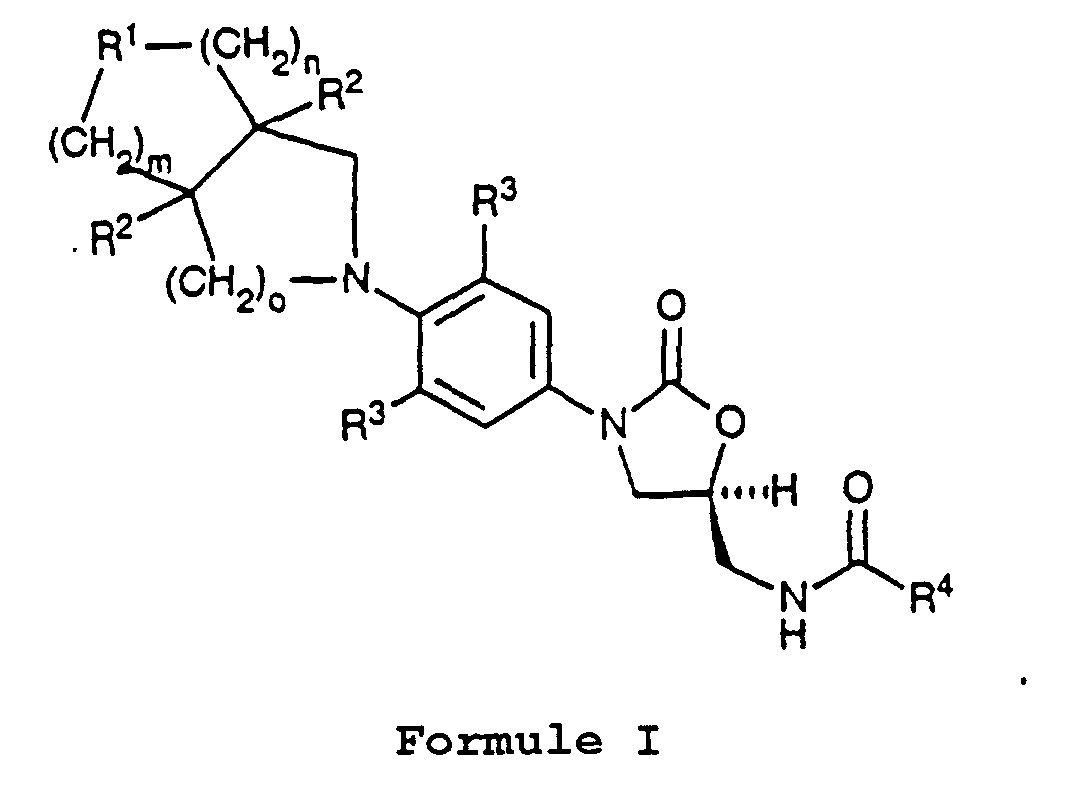
- the subject invention is a compound of structural Formula I:
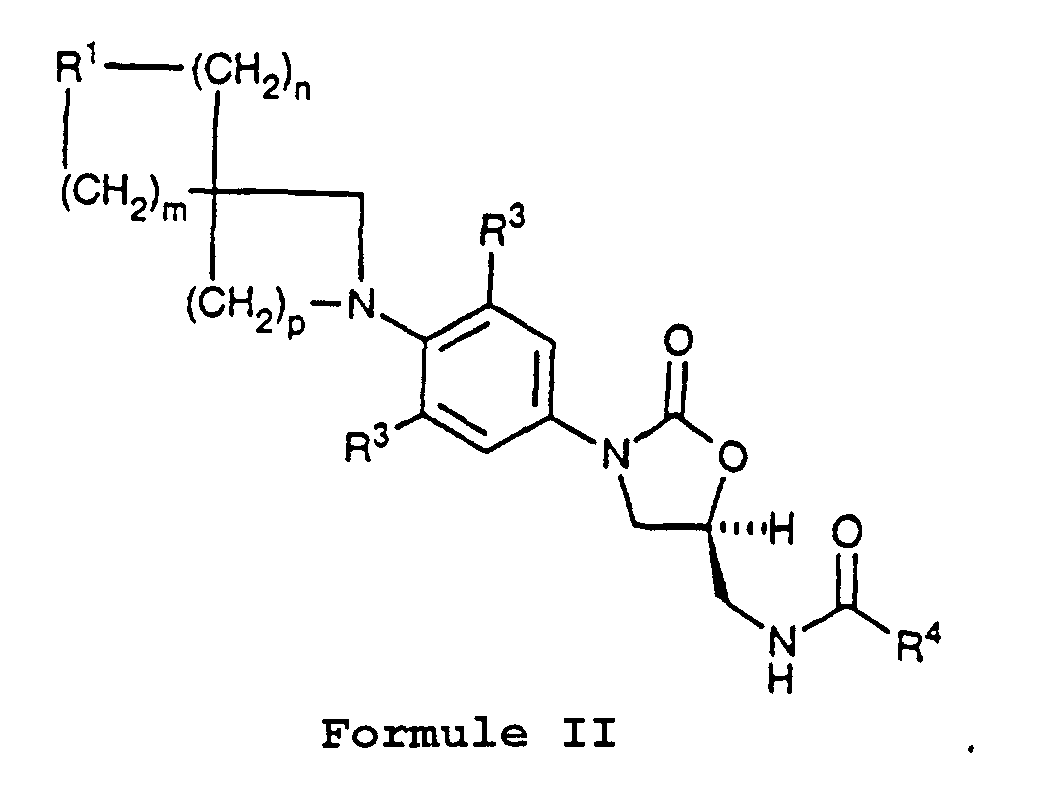
- the subject invention is composed of structural Formula II: or pharmaceutically acceptable salts thereof wherein:
- the subject invention is directed toward the use of a compound of formula I or II for the manufacture of a medicament for treating microbial infections in humans or other warm-blooded animals.
- the compound can be administered in a pharmaceutical composition either orally, parenterally or topically.
- the compound is administered orally or parenterally in an amount of from about 0.1 to about 100 mg(kg of body weight/day, more preferably, from about 3.0 to about 50 mg/kg of body weight/day.
- the present invention discloses novel spirocyclic and fused bicyclic diazinyl and carbazinyl oxazolidinones of structural Formula I and II as described above.
- the compounds are useful antimicrobial agents, effective against a number of human and veterinary pathogens, particularly aerobic gram-positive bacteria, including multiply-resistant staphylococci, streptococci and enterococci, as well as anaerobic organisms such as bacteroides and clostridia species, and acid-fast bacteria such as as Mycobacterium tuberculosis and other mycobacterial species.
- alkyl refers to an aliphatic hydrocarbon radical and includes branched or unbranched forms such as methyl, ethyl, n-propyl, i-propyl, n-butyl, i-butyl, s-butyl, t-butyl, n-pentyl, i-pentyl, neo-pentyl, n-hexyl, i-hexyl, n-heptyl, i-heptyl and n-octyl.
- Acyl refers to those having one to six carbon atoms such as formyl, acetyl, propionyl, etc. and their isomeric forms.
- R 3 substituents are preferably both fluorine and, more preferably, fluorine and hydrogen.
- the R 4 substituent is preferably hydrogen, methyl, difluoromethyl, dichloromethyl, hydroxymethyl or methoxy. More preferably R 4 is methoxy, difluoromethyl, dichloromethyl or methyl. It is most preferred that R 4 is methyl.
- the R 5 substituent is preferably hydroxyacetyl.
- the preferred absolute configuration at C-5 of the oxazolidinone ring of compounds claimed in this invention is as represented in the structures of Formula I and II.
- This absolute configuration is called ( S ) under the Cahn-Ingold-Prelog nomenclature system. It is this ( S )-enantiomer which is pharmacologically active.
- the racemic mixture is useful in the same way and for the same purpose as the pure ( S )-enantiomer; the difference is that twice as much racemic material must be used to produce the same antibacterial effect. It will be apparent to one skilled in the art that when a chiral center is present in the diazinyl or carbazinyl fragment of compounds of structural Formula I and II, then diastereomers are possible. These diastereomers, in racemic and enantiomerically enriched forms, are also within the scope of the compounds of Formula I and II of the invention.
- Both organic and inorganic acids can be employed to form non-toxic pharmaceutically acceptable acid addition salts of the compounds of this invention, where applicable.
- Illustrative acids are sulfuric, nitric, phosphoric, hydrochloric, citric, acetic, lactic, tartaric, pamoic, ethanedisulfonic, sulfamic, succinic, cyclohexylsulfamic, fumaric, maleic, and benzoic acid.
- These salts are readily prepared by methods known in the art.
- compositions of this invention may be prepared by combining the compounds of Formula I or II with a solid or liquid pharmaceutically acceptable carrier and, optionally, with pharmaceutically acceptable adjuvants and excipients employing standard and conventional techniques. Such pharmaceutical compositions can then be used in treating microbial infections in humans or other warm-blooded animals (patients) by various routes of administration in an effective amount or therapeutically effective amount. Typical amounts can be from about 0.1 to about 100 mg/kg of body weight/day, more preferably, from about 3.0 to about 50 mg/kg of body weight/day.
- Solid form compositions include powders, tablets, dispersible granules, capsules, cachets and suppositories.
- a solid carrier can be at least one substance which may also function as a diluent, flavoring agent, solubilizer, lubricant, suspending agent, binder, tablet disintegrating agent, and encapsulating agent.
- Inert solid carriers include magnesium carbonate, magnesium stearate, talc, sugar, lactose, pectin, dextrin, starch, gelatin, cellulosic materials, low melting wax, cocoa butter, and the like.
- Liquid form compositions include solutions, suspensions and emulsions. For example, there may be provided solutions of the compounds of this invention dissolved in water and water-propylene glycol and water-polyethylene glycol systems, optionally containing suitable conventional coloring agents, flavoring agents, stabilizers and thickening agents.
- the pharmaceutical composition is provided employing conventional techniques in unit dosage form containing effective or appropriate amounts of the active component, that is, the compound of Formula I according to this invention.
- the quantity of active component that is the compound of Formula I or II according to this invention, in the pharmaceutical composition and unit dosage form thereof may be varied or adjusted widely depending upon the particular application, the potency of the particular compound, the desired concentration. Generally, the quantity of active component will range between 0.5% to 90% by weight of the composition.
- the compounds or pharmaceutical compositions thereof will be administered orally and/or parenterally at a dosage to obtain and maintain a concentration, that is, an amount, or blood-level of active component in the animal undergoing treatment which will be antibacterially effective.
- a concentration that is, an amount, or blood-level of active component in the animal undergoing treatment which will be antibacterially effective.
- such antibacterially effective amount of dosage of active component will be in the range of about 0.1 to about 100, more preferably about 3.0 to about 50 mg/kg of body weight/day. It is to be understood that the dosages may vary depending upon the requirements of the patient, the severity of the bacterial infection being treated, and the particular compound being used.
- the initial dosage administered may be increased beyond the above upper level in order to rapidly achieve the desired blood-level or the initial dosage may be smaller than the optimum and the daily dosage may be progressively increased during the course of treatment depending on the particular situation. If desired, the daily dose may also be divided into multiple doses for administration, e.g., two to four times per day.
- compositions for parenteral administration will generally contain a pharmaceutically acceptable amount of the compound according to Formula I or II as a soluble salt (acid addition salt or base salt) dissolved in a pharmaceutically acceptable liquid carrier such as, for example, water-for-injection and a buffer to provide a suitably buffered isotonic solution, for example, having a pH of about 3-7.
- a pharmaceutically acceptable liquid carrier such as, for example, water-for-injection and a buffer to provide a suitably buffered isotonic solution, for example, having a pH of about 3-7.
- Suitable buffering agents include, for example, trisodium orthophosphate, sodium bicarbonate, sodium citrate, N-methylglucamine, L(+)-lysine and L(+)-arginine to name but a few representative buffering agents.
- the compound according to Formula I or II generally will be dissolved in the carrier in an amount sufficient to provide a pharmaceutically acceptable injectable concentration in the range of about 1 mg/ml to about 400 mg/ml of solution.
- the resulting liquid pharmaceutical composition will be administered so as to obtain the above-mentioned antibacterially effective amount of dosage.
- Charts II-VI outline the synthesis of oxazolidinone antibacterial agents of structural Formula I and II from diazines or carbazines 1 and 2 .
- a suitable base/solvent combination for example dibasic potassium phosphate in dimethyl sulfoxide or N , N -diisopropylethylamine in acetonitrile or THF
- a suitable temperature typically ambient temperature to 70°C
- R 1 is a benzylamino residue
- the benzyl group is lost under the hydrogenation conditions and is replaced, for example, with a Cbz group during the subsequent urethane forming reaction.
- the urethanes 5 are then deprotonated with a suitable base such as n -butyllithium ( n -BuLi), lithium diisopropylamide (LDA) or lithium bis(trimethylsilyl)amide, in a suitable solvent such as tetrahydrofuran (THF) and at a suitable temperature such as -78 to -60°C to give a lithiated intermediate which is then treated with commercially available (-)-( R )-glycidyl butyrate. Warming to ambient temperature then directly affords the 5-(hydroxymethyl)oxazolidinones 6 in enantiomerically enriched form.
- a suitable base such as n -butyllithium ( n -BuLi), lithium diisopropyl
- the resultant sulfonate derivative 7 is then reacted with an azide source such as sodium or potassium azide in an aprotic solvent such as N,N -dimethylformamide (DMF) or 1-methyl-2-pyrrolidinone optionally in the presence of a catalyst such as 18-crown-6 at a temperature of 50-90 °C to afford the azide 8 .
- an azide source such as sodium or potassium azide
- an aprotic solvent such as N,N -dimethylformamide (DMF) or 1-methyl-2-pyrrolidinone
- a catalyst such as 18-crown-6
- the azide 8 can be reduced by treatment with a trivalent phosphorus compound such as triphenylphosphine in a suitable solvent such as tetrahydrofuran followed by the addition of water.
- the intermediate amine 9 may also be prepared by treatment of the phthalimide derivative 10 (obtained by reacting sulfonate 7 with potassium phthalimide in a suitable solvent, for example, acetonitrile at reflux temperature) with methylamine in ethanol/H 2 O at reflux temperature.
- the amine 9 may be prepared directly from the mesylate 7 by ammonolysis in a solvent system consisting of H 2 O/ispropanol/THF in a sealed reaction vessel immersed in a 70-95 °C oil bath.
- the amine 9 is then acylated by reactions known to those skilled in the art to give oxazolidinones of structure 11 .
- R 4 optionally substituted alkyl
- other carbonyl groups within the scope of this invention can be readily appended to the amine 9 by standard acylation techniques, for example those highlighted in March, J. "Advanced Organic Chemistry", 3rd ed.; John Wiley & Sons: New York, 1985; p 370-375, to give additional examples of 11 .
- the oxazolidinones 11 are examples of structural Formula I, which are the subject of this invention.
- selected alkyl groups can be appended on the nitrogen of 12 by a reductive alkylation procedure as described in March, J. "Advanced Organic Chemistry", 4th ed.; John Wiley & Sons: New York, 1992; p 898-900.
- Compound 12 can also be converted to various acylated derivatives 14 by treatment of 12 with various carbonyl derivatives, such as acid chlorides, anhydrides and the like, in the presence of appropriate bases, and in suitable solvents known to one skilled in the art.
- carbonyl derivatives such as acid chlorides, anhydrides and the like
- sulfonamide derivatives 15 are prepared by reacting 12 with alkyl- and arylsulfonyl chlorides in the presence of suitable amine bases and in appropriate solvents known to one skilled in the art.
- Urethanes 16 are prepared from compound 12 through the action of chloroformates and the like in the presence of appropriate bases and in suitable solvent systems known to one skilled in the art.
- various hydrazone derivatives 18 can be prepared by reacting 17 with hydrazines, as described in Greene, T. W.; Wuts, P. G. M. "Protective Groups in Organic Synthesis", 2nd ed.; John Wiley & Sons: New York, 1991, p 212-213 and March, J.
- Oximes 19 are readily prepared by reacting 17 with, for example, hydroxylamine hydrochloride or methoxylamine hydrochloride in the presence of a suitable base, such as pyridine, and in an appropriate solvent, for instance methanol, at ambient temperature.
- Imines 20 are synthesized by treating 17 with primary amines, as described in March, J. "Advanced Organic Chemistry", 4th ed.; John Wiley & Sons: New York, 1992; p 896-897.
- Olefinic derivatives 21 are prepared by reacting 17 with various olefinating reagents, such as phosphorus ylides and the like, which are known to one skilled in the art. Representative examples are described in March, J. "Advanced Organic Chemistry", 4th ed.; John Wiley & Sons: New York, 1992; p 956-963. The ketone moiety of 17 is amenable to further modification. Reaction of 17 with Lawesson's reagent or alternative reagents, as described in March, J. "Advanced Organic Chemistry", 4th ed.; John Wiley & Sons: New York, 1992; p 893-894, provides the corresponding thioketone 22 .
- olefinating reagents such as phosphorus ylides and the like
- Step 1 cis -3-benzyl-7-(2-fluoro-4-nitrophenyl)-3.7-diazabicyclo[3.3.0]octane
- Step 2 cis -3-(carbobenzyloxy)-7-[4-[(carbobenzyloxy)aminol-2-fluorophenyl]-3,7-diazabicyclo[3.3.0]octane
- Step 3 ( R )-[3-r4-[ cis -3-(carbobenzyloxy)-3.7-diazabicyclo[3.3.0]octan-7-yl]-3-fluorophenyl]-2-oxo-5-oxazolidinyl]methanol
- Step 4 ( S )-N-[[3-[4-[ cis -3-(Carbobenzyloxy)-3.7-diazabicyclo[3.3.0]octan-7-yl]-3-fluorophenyl]-2-oxo-5-oxazolidinyl]methyl]acetamide
- Step 1 cis-3-benzyl-7-(4-nitrophenyl)-3,7-diazabicyclo[3.3.0]octane
- Step 2 cis -3-(carbobenzyloxy)-7-[4-[(carbobenzyloxy)amino]phenyl]-3,7-diazabicyclo[3.3.0]octane
- Step 3 ( R )-[3-[4-[ cis -3-(carbobenzyloxy)-3,7-diazabicyclo[3.3.0]octan-7-yl]phenyl]-2-oxo-5-oxazolidinyl]methanol
- Step 4 ( S )-N-[[3-[4-[ cis -3-(carbobenzyloxy)-3,7-diazabicyclo[3.3.0]octan-7-yl]phenyl]-2-oxo-5-oxazolidinyl]methyl]acetamide
- the nitro aromatic product obtained in Step1 (1.5 g, 5.65 mmol) was dissolved into 50 mL of THF.
- the solution was treated with the catalyst 10% Pd/C under a stream of N 2 .
- the mixture was degassed by evacuation and flushing with N 2 (3 times), followed by evacuation and flush with H 2 (3 times).
- the mixture was maintained at 35 psi of H 2 and was shaken on the parr. After 4 hours of reaction time TLC showed starting material was consumed.
- This solution was diluted with 50 mL of 1:1 acetone/H 2 O and the mixture was cooled to 0°C.
- the reaction mixture was treated with solid NaHCO 3 (1.4 g, 17.0 mmol) followed by benzyl chloroformate (2.0 g, 11.9 mmol).
- Step 2 The product of Step 2 (505 mg, 1.00 mmol) was dissolved into 10 mL of dry THF and the solution was cooled to -78°C. The solution was treated with n -BuLi (1.6 M soln. in hexanes; Aldrich; 656 ⁇ L, 1.05 mmol) via syringe. After 10 minutes ( R )-glycidyl butyrate (151 mg, 1.05 mmol) was added and the mixture was left to stir overnight with warming to room temperature. After 14 hours the mixture was examined by TLC which showed the starting material was consumed. The reaction was poured into a separatory funnel along with EtOAc. The mixture was washed with saturated aqueous NH 4 Cl and brine.
- the alcohol obtained in Step3 (880 mg, 1.90 mmol) was dissolved into 15 mL of dry CH 2 Cl 2 and the solution was cooled to 0°C. The solution was treated with Et 3 N (336 mg, 3.32 mmol) and stirred for 5 minutes. Next solid 3-nitrobenzenesulfonyl chloride (NosylCl, 561 mg, 2.53 mmol) was added and the mixture was stored in the freezer overnight. After 15 hours TLC showed the starting alcohol was consumed with the formation of a new higher R f product. The reaction was poured into a separatory funnel along with CH 2 Cl 2 . The solution was washed with 1.0 N aqueous HCl and saturated sodium bicarbonate. The organic phase was separated and dried over anhydrous Na 2 SO 4 . Filtered and concentrated to give 1.3 g of the nosylate as an orange foam. This material was used without purification.
- the crude nosylate (1.9 mmol) was dissolved into 10 mL of CH 3 CN and the solution was transfered to a resealable tube.
- the solution was diluted with 5 mL of isopropanol and 10 mL of 28% aqueous NH 4 OH.
- the tube was sealed and heated to 65°C. After 15 hours the solution was cooled to ambient temperature and TLC showed that the nosylate was consumed.
- the reaction was poured into a separatory funnel along with CH 2 Cl 2 .
- the solution was washed with saturated aqueous NaHCO 3 and brine.
- the organic phase was separated and dried over anhydrous Na 2 SO 4 . Filtered and concentrated to give the crude amine as a foam.
- the starting material, EXAMPLE 10, (850 mg, 1.7 mmol) was dissolved into 20 mL of MeOH.
- the solution was treated with the catalyst 10% Pd/C (85 mg) under a stream of N 2 .
- the parr bottle was evacuated and flushed with N 2 (3 times) followed by evacuation and flushed with H 2 (3 times).
- the mixture was maintained at 35 psi of H 2 pressure and was shaken on the parr. After 10 hours of reaction time TLC showed starting material was consumed.
- the solution was filtered through celite and the filtrate was concentrated under reduced pressure to give 585 mg of a tan foam. This crude amine was used without purification.
- the starting material, EXAMPLE 12, (325 mg, 0.68 mmol) was dissolved into 6 mL of MeOH. The solution was cooled to 0°C under N 2 . The solution was treated with 3.0 mL of 10% aqueous K 2 CO 3 . The mixture was stirred for 2 hours. After this time TLC showed U-141950 was consumed. The reaction was quenched with 1.0 N aqueous HCl to pH 6.5 (litmus). The reaction mixture was poured into a separatory funnel along with CH 2 Cl 2 . The solution was washed with H 2 O and brine. The organic phase was separated and dried over anhydrous Na 2 SO 4 .
- the oxazolidinone antibacterial agents of this invention have useful activity against a variety of organisms.
- the in vitro activity of compounds of this invention can be assessed by standard testing procedures such as the determination of minimum inhibitory concentration (MIC) by agar dilution as described in "Methods for Dilution Antimicrobial Susceptibility Tests for Bacteria That Grow Aerobically" (MFT) published Jan. 1983 by the National Committee for Clinical Laboratory Standards, 771 East Lancaster Avenue, Villanova, Pennsylvania 19084, USA.
- MFT Minimum Inhibitory Concentration
Landscapes
- Chemical & Material Sciences (AREA)
- Organic Chemistry (AREA)
- Health & Medical Sciences (AREA)
- Chemical Kinetics & Catalysis (AREA)
- Life Sciences & Earth Sciences (AREA)
- General Chemical & Material Sciences (AREA)
- Medicinal Chemistry (AREA)
- Nuclear Medicine, Radiotherapy & Molecular Imaging (AREA)
- Communicable Diseases (AREA)
- Pharmacology & Pharmacy (AREA)
- Oncology (AREA)
- Animal Behavior & Ethology (AREA)
- General Health & Medical Sciences (AREA)
- Public Health (AREA)
- Veterinary Medicine (AREA)
- Nitrogen Condensed Heterocyclic Rings (AREA)
- Pharmaceuticals Containing Other Organic And Inorganic Compounds (AREA)
- Nitrogen And Oxygen Or Sulfur-Condensed Heterocyclic Ring Systems (AREA)
- Heterocyclic Carbon Compounds Containing A Hetero Ring Having Nitrogen And Oxygen As The Only Ring Hetero Atoms (AREA)
Claims (18)
- Composé de formule structurale I :ou ses sels pharmaceutiquement acceptables, formule dans laquelle :
- R1
- représente
- (a) un groupe NR5,
- (b) un groupe CR6R7 ;
- R2
- représente indépendamment H ou un groupe CH3 ;
- R3
- représente indépendamment H, F, Cl ou un groupe méthoxy ;
- R4
- représente
- (a) l'hydrogène,
- (b) un groupe alkyle en C1 à C8 facultativement substitué avec un ou plusieurs des substituants suivants : F, Cl, hydroxy, alkoxy en C1 à C8, acyloxy en C1 à C8,
- (c) un groupe cycloalkyle en C3 à C6,
- (d) un groupe amino,
- (e) un groupe alkylamino en C1 à C8,
- (f) un groupe di-(alkyle en C1 à C8)-amino,
- (g) un groupe alkoxy en C1 à C8,
- R5
- représente
- (a) H,
- (b) un groupe alkyle en C1 à C6 facultativement substitué avec un ou plusieurs des substituants suivants : Cl, F, CN, OH, alkoxy en C1 à C4, amino, hydroxylamino, alkoxylamino, acyloxy en C1 à C4, alkylsulfényle en C1 à C4, alkylsulfinyle en C1 à C4, alkylsulfonyle en C1 à C4, aminosulfonyle, alkylaminosulfonyle en C1 à C4, di-(alkyle en C1 à C4)-aminosulfonyle, 4-morpholinylsulfonyle, phényle (facultativement substitué avec un ou plusieurs substituants F, Cl, CN, OH, alkoxy en C1 à C4), 5-isoxazolyle, éthényloxy, éthynyle,
- (c) un groupe acyle en C1 à C6 facultativement substitué avec un ou plusieurs des substituants suivants : Cl, F, OH, SH, alkoxy en C1 à C4, naphtalénoxy et phénoxy (facultativement substitués avec un ou plusieurs des substituants suivants : Cl, F, OH, alkoxy en C1 à C4, amino, acylamino en C1 à C4, alkyle en C1 à C4), amino, acylamino en C1 à C4, hydroxylamino, alkoxylamino, acyloxy en C1 à C4, phényle, (alkyle en C1 à C4)carbonyle, alkylamino en C1 à C4, di-(alkyle en C1 à C4)-amino, hydroxyacyloxy en C1 à C4, alkylsulfényle en C1 à C4, phtalimido, maléimido, succinimido,
- (d) un groupe alkylsulfonyle en C1 à C6 facultativement substitué avec un ou plusieurs des substituants suivants : Cl, F, OH, alkoxy en C1 à C4, amino, hydroxylamino, alkoxylamino, acyloxy en C1 à C4, phényle,
- (e) un groupe arylsulfonyle facultativement substitué avec un ou plusieurs des substituants suivants : F, Cl, OCH3, OH ou alkyle en C1 à C4,
- (f) un groupe (alkoxy en C1 à C6)carbonyle facultativement substitué avec un ou plusieurs des substituants suivants : Cl, F, OH, alkoxy en C1 à C4, acyloxy en C1 à C4, phényle,
- (g) un groupe aminocarbonyle, (alkyle en C1 à C6)aminocarbonyle ou di-(alkyle en C1 à C6)aminocarbonyle (dans lequel les groupes alkyle sont facultativement substitués avec un ou plusieurs des substituants suivants : Cl, F, OH, alkoxy en C1 à C4, phényle),
- (h) des hétérocycles penta- et hexagonaux facultativement substitués avec un ou plusieurs des substituants suivants : Cl, F, OH, amino, acylamino en C1 à C4, alkylsulfonylamino en C1 à C4, (alkoxy en C1 à C4)carbonylamino, alkoxy en C1 à C4, acyloxy en C1 à C4 et alkyle en C1 à C4 qui peuvent être substitués avec des substituants F, OH ou alkoxy en C1 à C4,
- (i) un groupe (cycloalkyle en C3 à C6)carbonyle facultativement substitué avec un ou plusieurs des substituants suivants : F, Cl, OH, alkoxy en C1 à C4, CN,
- (j) un groupe benzoyle facultativement substitué avec un ou plusieurs des substituants suivants : F, Cl, OH, alkoxy en C1 à C4, alkyle en C1 à C4, amino, acylamino en C1 à C4,
- (k) un groupe pyrrolylcarbonyle facultativement substitué avec un ou plusieurs substituants alkyle en C1 à C4,
- (l) un groupe (acyle en C1 ou C2)oxyacétyle dans lequel le groupe acyle est facultativement substitué avec les substituants suivants : amino, alkylamino en C1 à C4, di-(alkyle en C1 à C4) amino, 4-morpholino, 4-aminophényle, 4-(dialkylamino)phényle, 4-(glycylamino)phényle ;
- R6
- représente
- (a) H,
- (b) un groupe OH,
- (c) un groupe alkoxy en C1 à C6,
- (d) un groupe amino, alkylamino en C1 à C6, di(alkyle en C1 à C6)amino, hydroxylamino ou alkoxylamino en C1 ou C2, tous ces groupes pouvant être facultativement substitués sur l'atome d'azote avec des substituants : acyle en C1 à C6 (facultativement substitué avec un ou deux substituants Cl ou OH), alkylsulfonyle en C1 à C6 facultativement substitué avec un ou deux substituants Cl ou OH) ou (alkoxy en C1 à C6)carbonyle,
- (e) Cl ou F ;
- R7
- représente
- (a) H,
- (b) un groupe alkyle en C1 à C6 facultativement substitué avec un ou plusieurs des substituants suivants : Cl, F, CN, OH, alkoxy en C1 à C4, acyloxy en C1 à C4, amino,
- (c) un groupe CN,
- (d) un groupe phényle facultativement substitué avec un ou plusieurs des substituants suivants : Cl, F, OH, alkoxy en C1 à C4 ; ou bien
- R6 et R7,
- pris conjointement, représentent
- (a) un groupe carbonyle ou thiocarbonyle,
- (b) un groupe éthylène-cétal (-OCH2CH2O-), propylène-cétal (-OCH2CH2CH2O-), éthylène-thiocétal (-SCH2CH2S-), propylène-thiocétal (-SCH2CH2CH2S-), diméthyl-cétal, diéthyl-cétal, diméthyl-thiocétal ou diéthyl-thiocétal,
- (c) une oxime facultativement substituée avec les substituants H, alkyle en C1 à C6 (facultativement substitué avec Cl, F ou alkoxy en C1 à C4), acyle en C1 à C6 (facultativement substitué avec un ou plusieurs des substituants suivants : Cl, F, OH, alkoxy en C1 à C4, acyloxy en C1 à C4),
- (d) une hydrazone facultativement substituée avec des substituants H, alkyle en C1 à C6 (facultativement substitué avec un ou plusieurs substituants Cl, F, OH, alkoxy en C1 à C4, acyloxy en C1 à C4, phényle), acyle en C1 à C6 (facultativement substitué avec un ou plusieurs substituants Cl, F, OH, alkoxy en C1 à C4, acyloxy en C1 à C4, phényle), (alkoxy en C1 à C6)carbonyle (facultativement substitué avec un ou plusieurs des substituants suivants : Cl, F, OH, alkoxy en C1 à C4, acyloxy en C1 à C4, phényle) ou alkylsulfonyle en C1 à C6,
- (e) un groupe imine facultativement substitué avec H ou un substituant alkyle en C1 à C6 (facultativement substitué avec Cl, F, OH, alkoxy en C1 à C4, acyloxy en C1 à C4, ou phényle),
- (f) une double liaison carbone-carbone facultativement substituée avec un substituant H, (alkoxy en C1 à C4) carbonyle, alkyle en C1 à C4 (facultativement substitué avec des substituants Cl, F, OH, alkoxy en C1 à C4 ou phényle) ;
- m
- a une valeur de 0 à 2 ; n a une valeur de 1 à 3 ; o a une valeur de 0 à 3 et p a une valeur de 1 à 3.
- Composé suivant la revendication 1, dans lequel un groupe R3 représente le fluor et l'autre représente l'hydrogène.
- Composé suivant la revendication 1, dans lequel chaque groupe R3 représente le fluor.
- Composé suivant la revendication 1, dans lequel R4 représente l'hydrogène, un groupe méthyle, difluorométhyle, dichlorométhyle, hydroxyméthyle ou méthoxy.
- Composé suivant la revendication 4, dans lequel R4 représente un groupe méthyle, difluorométhyle, dichlorométhyle ou méthoxy.
- Composé suivant la revendication 5, dans lequel R4 représente un groupe méthyle.
- Composé suivant la revendication 1, dans lequel R5 représente un groupe hydroxyacétyle.
- Composé suivant la revendication 1, qui consiste en(a) (S)-N-[[3-[3-fluoro-4-[cis-3-(carbobenzyloxy)-3,7-diazabicyclo[3.3.0]octane-7-yl]phényl]-2-oxo-5-oxazolidinyl]méthyl]acétamide (Exemple 1),(b) (S)-N-[[3-[3-fluoro-4-[cis-3-(benzyloxyacétyl)-3,7-diazabicyclo[3.3.0]octane-7-yl]phényl]-2-oxo-5-oxazolidinyl]méthyl]acétamide (Exemple 2),(c) (S)-N-[[3-[3-fluoro-4-[cis-3-(hydroxyacétyl)-3,7-diazabicyclo[3.3.0]octane-7-yl]phényl]-2-oxo-5-oxazolidinyl]méthyl]acétamide (Exemple 3),(d) (S)-N-[[3-[3-fluoro-4-[cis-3-(5-isoxazolinoyl)-3,7-diazabicyclo[3.3.0]octane-7-yl]phényl]-2-oxo-5-oxazolidinyl]méthyl]acétamide (Exemple 4),(e) (S)-N-[[3-[3-fluoro-4-[cis-3-(2-indolylcarbonyl)-3,7-diazabicyclo[3.3.0]octane-7-yl]phényl]-2-oxo-5-oxazolidinyl]méthyl]acétamide (Exemple 5),(f) (S)-N-[[3-[3-fluoro-4-[cis-3-(carbométhoxy)-3,7-diazabicyclo[3.3.0]octane-7-yl]phényl]-2-oxo-5-oxazolidinyl]méthyl]acétamide (Exemple 6),(g) (S)-N-[[3-[3-fluoro-4-[cis-3-(formyl)-3,7-diazabicyclo[3.3.0]octane-7-yl]phényl]-2-oxo-5-oxazolidinyl]méthyl]acétamide (Exemple 7),(h) (S)-N-[[3-[3-fluoro-4-[cis-3-(acétyl)-3,7-diazabicyclo[3.3.0]octane-7-yl]phényl]-2-oxo-5-oxazolidinyl]méthyl]acétamide (Exemple 8),(i) (S)-N-[[3-[4-[cis-3-(carbobenzyloxy)-3,7-diazabicyclo[3.3.0]octane-7-yl]phényl]-2-oxo-5-oxazolidinyl]méthyl]acétamide (Exemple 9),(j) (S)-N-[[3-[3-fluoro-4-[cis-2-(carbobenzyloxy)-2,8-diazabicyclo [4.3.0]nonane-8-yl]phényl]-2-oxo-5-oxazolidinyl]méthyl]acétamide (Exemple 10),(k) (S)-N-[[3-[3-fluoro-4-[cis-2-(carbométhoxy)-2,8-diazabicyclo[4.3.0]nonane-8-yl]phényl]-2-oxo-5-oxazolidinyl]méthyl]acétamide (Exemple 11),(l) (S)-N-[[3-[3-fluoro-4-[cis-2-(acétoxyacétyl)-2,8-diazabicyclo[4.3.0]nonane-8-yl]phényl]-2-oxo-5-oxazolidinyl]méthyl]acétamide (Exemple 12), ou(m) (S)-N-[[3-[3-fluoro-4-[cis-2-(hydroxyacétyl)-2,8-diazabicyclo[4.3.0]nonane-8-yl]phényl]-2-oxo-5-oxazolidinyl]méthyl]acétamide (Exemple 13).
- Composé de formule structurale II :ou ses sels pharmaceutiquement acceptables, formule dans laquelle :
- R1
- représente
- (a) un groupe NR5,
- (b) un groupe CR6R7 ;
- R2
- représente indépendamment H ou un groupe CH3 ;
- R3
- représente indépendamment H, F, Cl ou un groupe méthoxy ;
- R4
- représente
- (a) l'hydrogène,
- (b) un groupe alkyle en C1 à C8 facultativement substitué avec un ou plusieurs des substituants suivants : F, Cl, hydroxy, alkoxy en C1 à C8, acyloxy en C1 à C8,
- (c) un groupe cycloalkyle en C3 à C6,
- (d) un groupe amino,
- (e) un groupe alkylamino en C1 à C8,
- (f) un groupe di-(alkyle en C1 à C8)-amino,
- (g) un groupe alkoxy en C1 à C8,
- R5
- représente
- (a) H,
- (b) un groupe alkyle en C1 à C6 facultativement substitué avec un ou plusieurs des substituants suivants : Cl, F, CN, OH, alkoxy en C1 à C4, amino, hydroxylamino, alkoxylamino, acyloxy en C1 à C4, alkylsulfényle en C1 à C4, alkylsulfinyle en C1 à C4, alkylsulfonyle en C1 à C4, aminosulfonyle, alkylaminosulfonyle en C1 à C4, di-(alkyle en C1 à C4)-aminosulfonyle, 4-morpholinylsulfonyle, phényle (facultativement substitué avec un ou plusieurs substituants F, Cl, CN, OH, alkoxy en C1 à C4), 5-isoxazolyle, éthényloxy, éthynyle,
- (c) un groupe acyle en C1 à C6 facultativement substitué avec un ou plusieurs des substituants suivants : Cl, F, OH, SH, alkoxy en C1 à C4, naphtalénoxy et phénoxy (facultativement substitués avec un ou plusieurs des substituants suivants : Cl, F, OH, alkoxy en C1 à C4, amino, acylamino en C1 à C4, alkyle en C1 à C4), amino, acylamino en C1 à C4, hydroxylamino, alkoxylamino, acyloxy en C1 à C4, phényle, (alkyle en C1 à C4)carbonyle, alkylamino en C1 à C4, di-(alkyle en C1 à C4)-amino, hydroxyacyloxy en C1 à C4, alkylsulfényle en C1 à C4, phtalimido, maléimido, succinimido,
- (d) un groupe alkylsulfonyle en C1 à C6 facultativement substitué avec un ou plusieurs des substituants suivants : Cl, F, OH, alkoxy en C1 à C4, amino, hydroxylamino, alkoxylamino, acyloxy en C1 à C4, phényle,
- (e) un groupe arylsulfonyle facultativement substitué avec un ou plusieurs des substituants suivants : F, Cl, OCH3, OH ou alkyle en C1 à C4,
- (f) un groupe (alkoxy en C1 à C6) carbonyle facultativement substitué avec un ou plusieurs des substituants suivants : Cl, F, OH, alkoxy en C1 à C4, acyloxy en C1 à C4, phényle,
- (g) un groupe aminocarbonyle, (alkyle en C1 à C6)aminocarbonyle ou di-(alkyle en C1 à C6)aminocarbonyle (dans lequel les groupes alkyle sont facultativement substitués avec un ou plusieurs des substituants suivants : Cl, F, OH, alkoxy en C1 à C4, phényle),
- (h) des hétérocycles penta- et hexagonaux facultativement substitués avec un ou plusieurs des substituants suivants : Cl, F, OH, amino, acylamino en C1 à C4, alkylsulfonylamino en C1 à C4, (alkoxy en C1 à C4)carbonylamino, alkoxy en C1 à C4, acyloxy en C1 à C4 et alkyle en C1 à C4 qui peuvent être substitués avec des substituants F, OH ou alkoxy en C1 à C4,
- (i) un groupe (cycloalkyle en C3 à C6)carbonyle facultativement substitué avec un ou plusieurs des substituants suivants : F, Cl, OH, alkoxy en C1 à C4, CN,
- (j) un groupe benzoyle facultativement substitué avec un ou plusieurs des substituants suivants : F, Cl, OH, alkoxy en C1 à C4, alkyle en C1 à C4, amino, acylamino en C1 à C4,
- (k) un groupe pyrrolylcarbonyle facultativement substitué avec un ou plusieurs substituants alkyle en C1 à C4,
- (l) un groupe (acyle en C1 ou C2)oxyacétyle dans lequel le groupe acyle est facultativement substitué avec les substituants suivants : amino, alkylamino en C1 à C4, di-(alkyle en C1 à C4)amino, 4-morpholino, 4-aminophényle, 4-(dialkylamino)phényle, 4-(glycylamino)phényle ;
- R6
- représente
- (a) H,
- (b) un groupe OH,
- (c) un groupe alkoxy en C1 à C6,
- (d) un groupe amino, alkylamino en C1 à C6, di(alkyle en C1 à C6)amino, hydroxylamino ou alkoxylamino en C1 ou C2, tous ces groupes pouvant être facultativement substitués sur l'atome d'azote avec des substituants : acyle en C1 à C6 (facultativement substitué avec un ou deux substituants Cl ou OH), alkylsulfonyle en C1 à C6 facultativement substitué avec un ou deux substituants Cl ou OH) ou (alkoxy en C1 à C6)carbonyle,
- (e) Cl ou F ;
- R7
- représente
- (a) H,
- (b) un groupe alkyle en C1 à C6 facultativement substitué avec un ou plusieurs des substituants suivants : Cl, F, CN, OH, alkoxy en C1 à C4, acyloxy en C1 à C4, amino,
- (c) un groupe CN,
- (d) un groupe phényle facultativement substitué avec un ou plusieurs des substituants suivants : Cl, F, OH, alkoxy en C1 à C4 ; ou bien
- R6 et R7,
- pris conjointement, représentent
- (a) un groupe carbonyle ou thiocarbonyle,
- (b) un groupe éthylène-cétal (-OCH2CH2O-), propylène-cétal (-OCH2CH2CH2O-), éthylène-thiocétal (-SCH2CH2S-), propylène-thiocétal (-SCH2CH2CH2S-), diméthyl-cétal, diéthyl-cétal, diméthyl-thiocétal ou diéthyl-thiocétal,
- (c) une oxime facultativement substituée avec H, un groupe alkyle en C1 à C6 (facultativement substitué avec un substituant Cl, F ou alkoxy en C1 à C4), acyle en C1 à C6 (facultativement substitué avec un ou plusieurs des substituants suivants : Cl, F, OH, alkoxy en C1 à C4, acyloxy en C1 à C4),
- (d) une hydrazone facultativement substituée avec H, un groupe alkyle en C1 à C6 (facultativement substitué avec un ou plusieurs substituants Cl, F, OH, alkoxy en C1 à C4, acyloxy en C1 à C4, phényle), acyle en C1 à C6 (facultativement substitué avec un ou plusieurs substituants Cl, F, OH, alkoxy en C1 à C4, acyloxy en C1 à C4, phényle), (alkoxy en C1 à C6)carbonyle (facultativement substitué avec un ou plusieurs des substituants suivants : Cl, F, OH, alkoxy en C1 à C4, acyloxy en C1 à C4, phényle) ou alkylsulfonyle en C1 à C6,
- (e) un groupe imine facultativement substitué avec H ou un substituant alkyle en C1 à C6 (facultativement substitué avec un substituant Cl, F, OH, alkoxy en C1 à C4, acyloxy en C1 à C4, phényle),
- (f) une double liaison carbone-carbone facultativement substituée avec un substituant H, (alkoxy en C1 à C4)carbonyle, alkyle en C1 à C4 (facultativement substitué avec un substituant Cl, F, OH, alkoxy en C1 à C4, phényle) ;
- m
- a une valeur de 0 à 2 ; n a une valeur de 1 à 3 ; o a une valeur de 0 à 3 et p a une valeur de 1 à 3.
- Composé suivant la revendication 9, dans lequel un groupe R3 représente le fluor et l'autre représente l'hydrogène.
- Composé suivant la revendication 9, dans lequel chaque groupe R3 représente le fluor.
- Composé suivant la revendication 9, dans lequel R4 représente l'hydrogène, un groupe méthyle, difluorométhyle, dichlorométhyle, hydroxyméthyle ou méthoxy.
- Composé suivant la revendication 12, dans lequel R4 représente un groupe méthyle, difluorométhyle, dichlorométhyle ou méthoxy.
- Composé suivant la revendication 13, dans lequel R4 représente un groupe méthyle.
- Composé suivant la revendication 9, dans lequel R5 représente un groupe hydroxyacétyle.
- Utilisation d'un composé suivant l'une quelconque des revendications précédentes pour la production d'un médicament destiné au traitement d'infections microbiennes chez des animaux à sang chaud.
- Utilisation suivant la revendication 16, dans laquelle le composé est administré en une quantité de 0,1 à 100 mg/kg de poids corporel/jour.
- Utilisation suivant la revendication 17, dans laquelle le composé est administré en une quantité de 3,0 à 50 mg/kg de poids corporel/jour.
Priority Applications (1)
| Application Number | Priority Date | Filing Date | Title |
|---|---|---|---|
| SI9630336T SI0828741T1 (en) | 1995-05-11 | 1996-04-18 | Spirocyclic and bicyclic diazinyl and carbazinyl oxazolidinones |
Applications Claiming Priority (3)
| Application Number | Priority Date | Filing Date | Title |
|---|---|---|---|
| US43870595A | 1995-05-11 | 1995-05-11 | |
| US438705 | 1995-05-11 | ||
| PCT/US1996/005202 WO1996035691A1 (fr) | 1995-05-11 | 1996-04-18 | Oxazolidinones a fraction diazinyle et carbazinyle spirocyclique et bicyclique |
Publications (2)
| Publication Number | Publication Date |
|---|---|
| EP0828741A1 EP0828741A1 (fr) | 1998-03-18 |
| EP0828741B1 true EP0828741B1 (fr) | 2001-08-29 |
Family
ID=23741700
Family Applications (1)
| Application Number | Title | Priority Date | Filing Date |
|---|---|---|---|
| EP96911768A Expired - Lifetime EP0828741B1 (fr) | 1995-05-11 | 1996-04-18 | Oxazolidinones a fraction diazinyle et carbazinyle spirocyclique et bicyclique |
Country Status (18)
| Country | Link |
|---|---|
| US (1) | US6090820A (fr) |
| EP (1) | EP0828741B1 (fr) |
| JP (1) | JPH11506430A (fr) |
| KR (1) | KR100463771B1 (fr) |
| CN (2) | CN1068328C (fr) |
| AT (1) | ATE204874T1 (fr) |
| AU (1) | AU702752B2 (fr) |
| CA (1) | CA2218088A1 (fr) |
| DE (1) | DE69614847T2 (fr) |
| DK (1) | DK0828741T3 (fr) |
| ES (1) | ES2162047T3 (fr) |
| FI (1) | FI974180L (fr) |
| HK (1) | HK1042093A1 (fr) |
| MX (1) | MX9708627A (fr) |
| NO (1) | NO311298B1 (fr) |
| NZ (1) | NZ306310A (fr) |
| PT (1) | PT828741E (fr) |
| WO (1) | WO1996035691A1 (fr) |
Families Citing this family (46)
| Publication number | Priority date | Publication date | Assignee | Title |
|---|---|---|---|---|
| DE69631347T2 (de) * | 1995-09-15 | 2004-10-07 | Upjohn Co | Aminoaryl oxazolidinone n-oxide |
| GB9601666D0 (en) * | 1996-01-27 | 1996-03-27 | Zeneca Ltd | Chemical compounds |
| GB9702213D0 (en) * | 1996-02-24 | 1997-03-26 | Zeneca Ltd | Chemical compounds |
| DK1114819T3 (da) * | 1996-04-11 | 2008-04-14 | Pharmacia & Upjohn Co Llc | Fremgangsmåde til fremstilling af oxazolidinoner |
| GB9609919D0 (en) * | 1996-05-11 | 1996-07-17 | Zeneca Ltd | Chemical compounds |
| GB9717804D0 (en) | 1997-08-22 | 1997-10-29 | Zeneca Ltd | Chemical compounds |
| GB9717807D0 (en) | 1997-08-22 | 1997-10-29 | Zeneca Ltd | Chemical compounds |
| KR100467309B1 (ko) * | 1997-09-04 | 2005-07-18 | 씨제이 주식회사 | 옥사졸리디논유도체및그의제조방법및항균제조성물 |
| KR100463111B1 (ko) * | 1997-10-30 | 2005-06-13 | 씨제이 주식회사 | 신규한옥사졸리디논유도체및제조방법및그를함유하는항균제조성물 |
| GB9725244D0 (en) | 1997-11-29 | 1998-01-28 | Zeneca Ltd | Chemical compounds |
| WO1999064417A2 (fr) | 1998-06-05 | 1999-12-16 | Astrazeneca Ab | Composes chimiques |
| US6413981B1 (en) * | 1999-08-12 | 2002-07-02 | Ortho-Mcneil Pharamceutical, Inc. | Bicyclic heterocyclic substituted phenyl oxazolidinone antibacterials, and related compositions and methods |
| US6297242B1 (en) | 1999-08-12 | 2001-10-02 | Ortho-Mcneil Pharmaceutical, Inc. | N-substituted amidine and guanidine oxazolidinone antibacterials and methods of use thereof |
| US6608081B2 (en) | 1999-08-12 | 2003-08-19 | Ortho-Mcneil Pharmaceutical, Inc. | Bicyclic heterocyclic substituted phenyl oxazolidinone antibacterials, and related compositions and methods |
| GB9928568D0 (en) | 1999-12-03 | 2000-02-02 | Zeneca Ltd | Chemical compounds |
| US6518285B2 (en) | 1999-12-21 | 2003-02-11 | Ortho Mcneil Pharmaceutical, Inc. | Piperidinyloxy and pyrrolidinyloxy oxazolidinone antibacterials |
| GB0009803D0 (en) * | 2000-04-25 | 2000-06-07 | Astrazeneca Ab | Chemical compounds |
| ITVA20000023A1 (it) * | 2000-07-19 | 2002-01-19 | Lamberti Spa | Composizioni di pvc stabili al calore. |
| SE0100326D0 (sv) * | 2001-02-02 | 2001-02-02 | Astrazeneca Ab | New compounds |
| EP1368354A1 (fr) * | 2001-03-07 | 2003-12-10 | Pfizer Products Inc. | Modulateurs de l'activite du recepteur de la chimiokine |
| WO2003048136A1 (fr) * | 2001-11-29 | 2003-06-12 | Merck & Co., Inc. | Antibiotiques de type oxazolidinone contenant de l'hexane cyclopropyle et derives de ceux-ci |
| US7141588B2 (en) | 2002-02-25 | 2006-11-28 | Pfizer, Inc. | N-aryl-2-oxazolidinone-5-carboxamides and their derivatives |
| AR038536A1 (es) | 2002-02-25 | 2005-01-19 | Upjohn Co | N-aril-2-oxazolidinona-5- carboxamidas y sus derivados |
| DE60304360T2 (de) | 2002-08-12 | 2006-11-16 | Pharmacia & Upjohn Co. Llc, Kalamazoo | N-aryl-2-oxazolidinone und deren derivate |
| KR100454099B1 (ko) * | 2002-08-22 | 2004-10-26 | 한국화학연구원 | 제초활성을 갖는9-(5-이속사졸린메톡시페닐)이미노-8-치아-1,6-디아자비시클로[4.3.0]노난-7-온 유도체 |
| ATE344036T1 (de) | 2002-11-21 | 2006-11-15 | Pharmacia & Upjohn Co Llc | N-(4-(piperazin-1-yl)-phenyl-2-oxazolidinon-5- carbonsäureamid-derivate und verwandte verbindungen als antibakterielle mittel |
| ATE471937T1 (de) | 2003-07-02 | 2010-07-15 | Merck Sharp & Dohme | Cyclopropylgruppensubstituierte oxazolidinonantibiotika und derivate davon |
| US7304050B2 (en) | 2003-09-16 | 2007-12-04 | Pfizer Inc. | Antibacterial agents |
| JP2008520644A (ja) * | 2004-11-24 | 2008-06-19 | ファイザー・インク | オクタヒドロピロロ[3,4−c]ピロール誘導体 |
| EP1671972A1 (fr) * | 2004-11-24 | 2006-06-21 | Pfizer Limited | Dérivés d' octahydropyrrolo[3,4-c]pyrrole |
| KR100729344B1 (ko) * | 2006-02-16 | 2007-06-15 | 스마텍(주) | 차량용 사방 감지 카메라의 보호 및 작동 구조 |
| US7728031B2 (en) | 2006-02-24 | 2010-06-01 | Abbott Laboratories | Octahydro-pyrrolo[3,4-b]pyrrole derivatives |
| CN101809021B (zh) | 2007-09-11 | 2013-04-24 | 雅培制药有限公司 | 八氢-吡咯并[3,4-b]吡咯n-氧化物 |
| CN102224151A (zh) | 2008-11-20 | 2011-10-19 | 万能药生物有限公司 | 新的抗微生物剂 |
| KR20120106697A (ko) | 2009-06-26 | 2012-09-26 | 파나세아 바이오테크 리미티드 | 신규 아자비시클로헥산 |
| EP2635589A1 (fr) | 2010-11-03 | 2013-09-11 | Wockhardt Limited | Procédé de synthèse d'ester de mono-(1-{4-[(s)-5-(acétylamino-méthyl)-2-oxo-oxazolidin-3-yl]-2,6-difluoro phényl}-4-méthoxyméthyl-pipéridin-4-yle) d'acide phosphorique |
| KR101271224B1 (ko) | 2011-07-05 | 2013-06-10 | 한국과학기술연구원 | 항균활성을 갖는 신규 이중고리를 포함하는 옥사졸리디논 유도체 및 이의 제조방법 |
| JP5833764B2 (ja) | 2011-09-30 | 2015-12-16 | 山東軒竹医薬科技有限公司 | 縮合環を有するオキサゾリドン(oxazolidone)類の抗菌物質 |
| WO2015173664A1 (fr) | 2014-05-14 | 2015-11-19 | Wockhardt Limited | Procédé pour la préparation de(5s)-n-{3- [3,5-difluoro-4- (4-hydroxy -4-méthoxyméthyl-pipéridine-1-yl)-phényl]-2-oxo-oxazolidine-5-ylméthyl}-acétamide |
| BR112017028318B1 (pt) | 2015-07-02 | 2024-02-20 | Janssen Sciences Ireland Uc | Composto antibacteriano, seu uso, processo para sua preparação,produto que o contém, composição farmacêutica e combinação |
| EA202190167A1 (ru) * | 2015-07-17 | 2021-07-30 | Зе Глобал Эллайенс Фо Тб Драг Девелопмент, Инк. | Замещенные фенилоксазолидиноны для антимикробной терапии |
| CN107400126A (zh) * | 2016-05-19 | 2017-11-28 | 陕西合成药业股份有限公司 | 新型噁唑烷酮类化合物及其制备方法和在医学上的应用 |
| BR112018076126A2 (pt) | 2016-06-16 | 2019-03-26 | Janssen Sciences Ireland Unlimited Company | compostos heterocíclicos como antibacterianos |
| EP4417262A3 (fr) | 2017-03-01 | 2024-11-27 | Janssen Sciences Ireland Unlimited Company | Polythérapie |
| CN108727406B (zh) | 2017-03-28 | 2021-12-07 | 北京协和制药二厂 | 含氮杂环取代的苯并噁嗪噁唑烷酮类化合物及其制备方法和用途 |
| WO2020234636A1 (fr) | 2019-05-17 | 2020-11-26 | Cadila Healthcare Limited | Nouveaux composés pour le traitement d'infections de mammifères |
Family Cites Families (10)
| Publication number | Priority date | Publication date | Assignee | Title |
|---|---|---|---|---|
| US4801600A (en) * | 1987-10-09 | 1989-01-31 | E. I. Du Pont De Nemours And Company | Aminomethyl oxooxazolidinyl cycloalkylbenzene derivatives useful as antibacterial agents |
| US4921869A (en) * | 1987-10-09 | 1990-05-01 | E. I. Du Pont De Nemours And Company | Aminomethyl oxooxazolidinyl cycloalkylbenzene derivatives useful as antibacterial agents |
| CA1320730C (fr) * | 1987-10-16 | 1993-07-27 | The Du Pont Merck Pharmaceutical Company | Derives d'aminomethyloxooxazolidinylaroylbenzene, agents antibacteriens |
| ES2059467T3 (es) * | 1987-10-21 | 1994-11-16 | Du Pont Merck Pharma | Derivados de aminometil-oxooxazolidinil-etenilbenceno utiles como agentes antibacterianos. |
| US4948801A (en) * | 1988-07-29 | 1990-08-14 | E. I. Du Pont De Nemours And Company | Aminomethyloxooxazolidinyl arylbenzene derivatives useful as antibacterial agents |
| JP2865211B2 (ja) * | 1988-09-15 | 1999-03-08 | ファルマシア・アンド・アップジョン・カンパニー | 5’―インドリニル―5β―アミドメチルオキサゾリジン―2―オン類、3―(縮合環置換)フェニル―5β―アミドメチルオキサゾリジン―2―オン類および3―(窒素原子置換)フェニル―5β―アミドメチルオキサゾリジン―2―オン類 |
| EP0610265B1 (fr) * | 1991-11-01 | 1996-12-27 | PHARMACIA & UPJOHN COMPANY | Aryl- et heteroarylphenyloxazolidinones substituees, utilisees comme agents antibacteriens |
| SK283420B6 (sk) * | 1992-05-08 | 2003-07-01 | Pharmacia & Upjohn Company | Antimikrobiálne oxazolidinóny obsahujúce substituované diazínové skupiny |
| MY115155A (en) * | 1993-09-09 | 2003-04-30 | Upjohn Co | Substituted oxazine and thiazine oxazolidinone antimicrobials. |
| JPH0873455A (ja) * | 1994-03-15 | 1996-03-19 | Upjohn Co:The | オキサゾリジノン誘導体及びこれを有効成分とする医薬組成物 |
-
1996
- 1996-04-18 DE DE69614847T patent/DE69614847T2/de not_active Expired - Fee Related
- 1996-04-18 AT AT96911768T patent/ATE204874T1/de not_active IP Right Cessation
- 1996-04-18 JP JP8534070A patent/JPH11506430A/ja not_active Withdrawn
- 1996-04-18 CA CA002218088A patent/CA2218088A1/fr not_active Abandoned
- 1996-04-18 FI FI974180A patent/FI974180L/fi unknown
- 1996-04-18 KR KR1019970707926A patent/KR100463771B1/ko not_active Expired - Fee Related
- 1996-04-18 MX MX9708627A patent/MX9708627A/es not_active IP Right Cessation
- 1996-04-18 NZ NZ306310A patent/NZ306310A/en unknown
- 1996-04-18 CN CN96193861A patent/CN1068328C/zh not_active Expired - Fee Related
- 1996-04-18 PT PT96911768T patent/PT828741E/pt unknown
- 1996-04-18 US US09/202,195 patent/US6090820A/en not_active Expired - Fee Related
- 1996-04-18 AU AU54849/96A patent/AU702752B2/en not_active Ceased
- 1996-04-18 ES ES96911768T patent/ES2162047T3/es not_active Expired - Lifetime
- 1996-04-18 WO PCT/US1996/005202 patent/WO1996035691A1/fr not_active Ceased
- 1996-04-18 DK DK96911768T patent/DK0828741T3/da active
- 1996-04-18 EP EP96911768A patent/EP0828741B1/fr not_active Expired - Lifetime
-
1997
- 1997-11-10 NO NO19975158A patent/NO311298B1/no unknown
-
2000
- 2000-10-31 CN CN00132826A patent/CN1336375A/zh active Pending
-
2002
- 2002-05-31 HK HK02104105.2A patent/HK1042093A1/zh unknown
Also Published As
| Publication number | Publication date |
|---|---|
| NO975158D0 (no) | 1997-11-10 |
| MX9708627A (es) | 1998-02-28 |
| KR100463771B1 (ko) | 2005-05-16 |
| PT828741E (pt) | 2002-02-28 |
| FI974180A0 (fi) | 1997-11-10 |
| CA2218088A1 (fr) | 1996-11-14 |
| AU5484996A (en) | 1996-11-29 |
| CN1068328C (zh) | 2001-07-11 |
| DE69614847T2 (de) | 2002-04-04 |
| CN1184481A (zh) | 1998-06-10 |
| AU702752B2 (en) | 1999-03-04 |
| EP0828741A1 (fr) | 1998-03-18 |
| NO975158L (no) | 1998-01-09 |
| HK1042093A1 (zh) | 2002-08-02 |
| NO311298B1 (no) | 2001-11-12 |
| FI974180A7 (fi) | 1997-11-10 |
| FI974180L (fi) | 1997-11-10 |
| DE69614847D1 (de) | 2001-10-04 |
| ES2162047T3 (es) | 2001-12-16 |
| DK0828741T3 (da) | 2001-11-26 |
| ATE204874T1 (de) | 2001-09-15 |
| US6090820A (en) | 2000-07-18 |
| NZ306310A (en) | 2001-05-25 |
| KR19990008399A (ko) | 1999-01-25 |
| HK1009449A1 (en) | 1999-09-10 |
| WO1996035691A1 (fr) | 1996-11-14 |
| JPH11506430A (ja) | 1999-06-08 |
| CN1336375A (zh) | 2002-02-20 |
Similar Documents
| Publication | Publication Date | Title |
|---|---|---|
| EP0828741B1 (fr) | Oxazolidinones a fraction diazinyle et carbazinyle spirocyclique et bicyclique | |
| EP0792273B1 (fr) | Agents antibacteriens du type oxazolidinone avec un substituant oxazine ou thiazine bicyclique | |
| EP0788498B1 (fr) | Composes antimicrobiens de phenyloxazolidinone | |
| US5547950A (en) | Oxazolidinone antimicrobials containing substituted diazine moieties | |
| US5910504A (en) | Hetero-aromatic ring substituted phenyloxazolidinone antimicrobials | |
| US5688792A (en) | Substituted oxazine and thiazine oxazolidinone antimicrobials | |
| MXPA04007240A (es) | Antibacterianos de feniloxazolidinona sustituidos con biciclico heterociclico, y composiciones y metodos relacionados. | |
| MXPA97003543A (en) | Antibacterials of oxazine biciclica yoxazolidinona tiaz | |
| HUP9901979A2 (hu) | 4 és 8 Közötti gyűrűtagszámú heterociklushoz szén-szén kötéssel kapcsolódó fenil-oxazolidin-származékok és az ezeket tartalmazó gyógyszerkészítmények | |
| SK74695A3 (en) | Antibacterial tropone-substituted oxazolidinones | |
| NZ271805A (en) | Oxazine and thiazine oxazolidinone derivatives and antimicrobial compositions thereof | |
| US6124334A (en) | Hetero-aromatic ring substituted phenyloxazolidinone antimicrobials | |
| US20030176422A1 (en) | Pyridoarylphenyl oxazolidinone antibacterials, and related compositions and methods | |
| KR101271224B1 (ko) | 항균활성을 갖는 신규 이중고리를 포함하는 옥사졸리디논 유도체 및 이의 제조방법 | |
| JP2000229978A (ja) | オキサゾリジノン及び抗菌剤としてのそれらの使用 | |
| HK1009449B (en) | Spirocyclic and bicyclic diazinyl and carbazinyl oxazolidinones |
Legal Events
| Date | Code | Title | Description |
|---|---|---|---|
| PUAI | Public reference made under article 153(3) epc to a published international application that has entered the european phase |
Free format text: ORIGINAL CODE: 0009012 |
|
| 17P | Request for examination filed |
Effective date: 19971205 |
|
| AK | Designated contracting states |
Kind code of ref document: A1 Designated state(s): AT BE CH DE DK ES FI FR GB GR IE IT LI LU MC NL PT SE |
|
| AX | Request for extension of the european patent |
Free format text: AL PAYMENT 971205;LT PAYMENT 971205;LV PAYMENT 971205;SI PAYMENT 971205 |
|
| 17Q | First examination report despatched |
Effective date: 19990311 |
|
| GRAG | Despatch of communication of intention to grant |
Free format text: ORIGINAL CODE: EPIDOS AGRA |
|
| GRAG | Despatch of communication of intention to grant |
Free format text: ORIGINAL CODE: EPIDOS AGRA |
|
| GRAH | Despatch of communication of intention to grant a patent |
Free format text: ORIGINAL CODE: EPIDOS IGRA |
|
| GRAH | Despatch of communication of intention to grant a patent |
Free format text: ORIGINAL CODE: EPIDOS IGRA |
|
| GRAA | (expected) grant |
Free format text: ORIGINAL CODE: 0009210 |
|
| AK | Designated contracting states |
Kind code of ref document: B1 Designated state(s): AT BE CH DE DK ES FI FR GB GR IE IT LI LU MC NL PT SE |
|
| AX | Request for extension of the european patent |
Free format text: AL PAYMENT 19971205;LT PAYMENT 19971205;LV PAYMENT 19971205;SI PAYMENT 19971205 |
|
| REF | Corresponds to: |
Ref document number: 204874 Country of ref document: AT Date of ref document: 20010915 Kind code of ref document: T |
|
| REG | Reference to a national code |
Ref country code: CH Ref legal event code: EP |
|
| REG | Reference to a national code |
Ref country code: IE Ref legal event code: FG4D |
|
| REF | Corresponds to: |
Ref document number: 69614847 Country of ref document: DE Date of ref document: 20011004 |
|
| REG | Reference to a national code |
Ref country code: CH Ref legal event code: NV Representative=s name: E. BLUM & CO. PATENTANWAELTE |
|
| REG | Reference to a national code |
Ref country code: DK Ref legal event code: T3 |
|
| ET | Fr: translation filed | ||
| REG | Reference to a national code |
Ref country code: ES Ref legal event code: FG2A Ref document number: 2162047 Country of ref document: ES Kind code of ref document: T3 |
|
| REG | Reference to a national code |
Ref country code: GB Ref legal event code: IF02 |
|
| REG | Reference to a national code |
Ref country code: PT Ref legal event code: SC4A Free format text: AVAILABILITY OF NATIONAL TRANSLATION Effective date: 20011128 |
|
| REG | Reference to a national code |
Ref country code: GR Ref legal event code: EP Ref document number: 20010402221 Country of ref document: GR |
|
| PLBE | No opposition filed within time limit |
Free format text: ORIGINAL CODE: 0009261 |
|
| STAA | Information on the status of an ep patent application or granted ep patent |
Free format text: STATUS: NO OPPOSITION FILED WITHIN TIME LIMIT |
|
| 26N | No opposition filed | ||
| REG | Reference to a national code |
Ref country code: SI Ref legal event code: IF |
|
| PGFP | Annual fee paid to national office [announced via postgrant information from national office to epo] |
Ref country code: GB Payment date: 20050314 Year of fee payment: 10 Ref country code: DK Payment date: 20050314 Year of fee payment: 10 Ref country code: AT Payment date: 20050314 Year of fee payment: 10 |
|
| PGFP | Annual fee paid to national office [announced via postgrant information from national office to epo] |
Ref country code: NL Payment date: 20050316 Year of fee payment: 10 |
|
| PGFP | Annual fee paid to national office [announced via postgrant information from national office to epo] |
Ref country code: FR Payment date: 20050401 Year of fee payment: 10 |
|
| PGFP | Annual fee paid to national office [announced via postgrant information from national office to epo] |
Ref country code: SE Payment date: 20050404 Year of fee payment: 10 Ref country code: MC Payment date: 20050404 Year of fee payment: 10 |
|
| PGFP | Annual fee paid to national office [announced via postgrant information from national office to epo] |
Ref country code: PT Payment date: 20050407 Year of fee payment: 10 |
|
| PGFP | Annual fee paid to national office [announced via postgrant information from national office to epo] |
Ref country code: FI Payment date: 20050413 Year of fee payment: 10 |
|
| PGFP | Annual fee paid to national office [announced via postgrant information from national office to epo] |
Ref country code: IE Payment date: 20050414 Year of fee payment: 10 |
|
| PGFP | Annual fee paid to national office [announced via postgrant information from national office to epo] |
Ref country code: ES Payment date: 20050418 Year of fee payment: 10 |
|
| PGFP | Annual fee paid to national office [announced via postgrant information from national office to epo] |
Ref country code: GR Payment date: 20050421 Year of fee payment: 10 |
|
| PGFP | Annual fee paid to national office [announced via postgrant information from national office to epo] |
Ref country code: BE Payment date: 20050428 Year of fee payment: 10 |
|
| PGFP | Annual fee paid to national office [announced via postgrant information from national office to epo] |
Ref country code: DE Payment date: 20050429 Year of fee payment: 10 |
|
| PGFP | Annual fee paid to national office [announced via postgrant information from national office to epo] |
Ref country code: LU Payment date: 20050603 Year of fee payment: 10 |
|
| PGFP | Annual fee paid to national office [announced via postgrant information from national office to epo] |
Ref country code: CH Payment date: 20050613 Year of fee payment: 10 |
|
| PG25 | Lapsed in a contracting state [announced via postgrant information from national office to epo] |
Ref country code: IE Free format text: LAPSE BECAUSE OF NON-PAYMENT OF DUE FEES Effective date: 20060418 Ref country code: GB Free format text: LAPSE BECAUSE OF NON-PAYMENT OF DUE FEES Effective date: 20060418 Ref country code: FI Free format text: LAPSE BECAUSE OF NON-PAYMENT OF DUE FEES Effective date: 20060418 Ref country code: AT Free format text: LAPSE BECAUSE OF NON-PAYMENT OF DUE FEES Effective date: 20060418 |
|
| PG25 | Lapsed in a contracting state [announced via postgrant information from national office to epo] |
Ref country code: SE Free format text: LAPSE BECAUSE OF NON-PAYMENT OF DUE FEES Effective date: 20060419 Ref country code: ES Free format text: LAPSE BECAUSE OF NON-PAYMENT OF DUE FEES Effective date: 20060419 |
|
| PG25 | Lapsed in a contracting state [announced via postgrant information from national office to epo] |
Ref country code: MC Free format text: LAPSE BECAUSE OF NON-PAYMENT OF DUE FEES Effective date: 20060430 Ref country code: LU Free format text: LAPSE BECAUSE OF NON-PAYMENT OF DUE FEES Effective date: 20060430 Ref country code: LI Free format text: LAPSE BECAUSE OF NON-PAYMENT OF DUE FEES Effective date: 20060430 Ref country code: CH Free format text: LAPSE BECAUSE OF NON-PAYMENT OF DUE FEES Effective date: 20060430 Ref country code: BE Free format text: LAPSE BECAUSE OF NON-PAYMENT OF DUE FEES Effective date: 20060430 |
|
| PGFP | Annual fee paid to national office [announced via postgrant information from national office to epo] |
Ref country code: IT Payment date: 20060430 Year of fee payment: 11 |
|
| PG25 | Lapsed in a contracting state [announced via postgrant information from national office to epo] |
Ref country code: DK Free format text: LAPSE BECAUSE OF NON-PAYMENT OF DUE FEES Effective date: 20060501 |
|
| PG25 | Lapsed in a contracting state [announced via postgrant information from national office to epo] |
Ref country code: PT Free format text: LAPSE BECAUSE OF NON-PAYMENT OF DUE FEES Effective date: 20061018 |
|
| PG25 | Lapsed in a contracting state [announced via postgrant information from national office to epo] |
Ref country code: NL Free format text: LAPSE BECAUSE OF NON-PAYMENT OF DUE FEES Effective date: 20061101 Ref country code: DE Free format text: LAPSE BECAUSE OF NON-PAYMENT OF DUE FEES Effective date: 20061101 |
|
| REG | Reference to a national code |
Ref country code: DK Ref legal event code: EBP |
|
| REG | Reference to a national code |
Ref country code: CH Ref legal event code: PL |
|
| EUG | Se: european patent has lapsed | ||
| GBPC | Gb: european patent ceased through non-payment of renewal fee |
Effective date: 20060418 |
|
| LTLA | Lt: lapse of european patent or patent extension |
Effective date: 20060418 |
|
| REG | Reference to a national code |
Ref country code: PT Ref legal event code: MM4A Free format text: LAPSE DUE TO NON-PAYMENT OF FEES Effective date: 20061018 |
|
| NLV4 | Nl: lapsed or anulled due to non-payment of the annual fee |
Effective date: 20061101 |
|
| REG | Reference to a national code |
Ref country code: IE Ref legal event code: MM4A |
|
| REG | Reference to a national code |
Ref country code: SI Ref legal event code: KO00 Effective date: 20061228 |
|
| REG | Reference to a national code |
Ref country code: FR Ref legal event code: ST Effective date: 20061230 |
|
| REG | Reference to a national code |
Ref country code: ES Ref legal event code: FD2A Effective date: 20060419 |
|
| BERE | Be: lapsed |
Owner name: *PHARMACIA & UPJOHN CY Effective date: 20060430 |
|
| PG25 | Lapsed in a contracting state [announced via postgrant information from national office to epo] |
Ref country code: FR Free format text: LAPSE BECAUSE OF NON-PAYMENT OF DUE FEES Effective date: 20060502 |
|
| PG25 | Lapsed in a contracting state [announced via postgrant information from national office to epo] |
Ref country code: GR Free format text: LAPSE BECAUSE OF NON-PAYMENT OF DUE FEES Effective date: 20061102 |
|
| PG25 | Lapsed in a contracting state [announced via postgrant information from national office to epo] |
Ref country code: IT Free format text: LAPSE BECAUSE OF NON-PAYMENT OF DUE FEES Effective date: 20070418 |