EP0833143A2 - Zugkraftmessvorrichtung und -verfahren - Google Patents
Zugkraftmessvorrichtung und -verfahren Download PDFInfo
- Publication number
- EP0833143A2 EP0833143A2 EP97202865A EP97202865A EP0833143A2 EP 0833143 A2 EP0833143 A2 EP 0833143A2 EP 97202865 A EP97202865 A EP 97202865A EP 97202865 A EP97202865 A EP 97202865A EP 0833143 A2 EP0833143 A2 EP 0833143A2
- Authority
- EP
- European Patent Office
- Prior art keywords
- roller
- torque
- determining
- web
- rollers
- Prior art date
- Legal status (The legal status is an assumption and is not a legal conclusion. Google has not performed a legal analysis and makes no representation as to the accuracy of the status listed.)
- Withdrawn
Links
Images

Classifications
-
- G—PHYSICS
- G01—MEASURING; TESTING
- G01N—INVESTIGATING OR ANALYSING MATERIALS BY DETERMINING THEIR CHEMICAL OR PHYSICAL PROPERTIES
- G01N19/00—Investigating materials by mechanical methods
- G01N19/02—Measuring coefficient of friction between materials
-
- G—PHYSICS
- G01—MEASURING; TESTING
- G01N—INVESTIGATING OR ANALYSING MATERIALS BY DETERMINING THEIR CHEMICAL OR PHYSICAL PROPERTIES
- G01N2203/00—Investigating strength properties of solid materials by application of mechanical stress
- G01N2203/0014—Type of force applied
- G01N2203/0016—Tensile or compressive
- G01N2203/0017—Tensile
-
- G—PHYSICS
- G01—MEASURING; TESTING
- G01N—INVESTIGATING OR ANALYSING MATERIALS BY DETERMINING THEIR CHEMICAL OR PHYSICAL PROPERTIES
- G01N2203/00—Investigating strength properties of solid materials by application of mechanical stress
- G01N2203/02—Details not specific for a particular testing method
- G01N2203/026—Specifications of the specimen
- G01N2203/0262—Shape of the specimen
- G01N2203/0278—Thin specimens
- G01N2203/0282—Two dimensional, e.g. tapes, webs, sheets, strips, disks or membranes
Definitions
- the invention relates to a traction measurement apparatus and method, and to an apparatus and method for determining the coefficient of friction of a material on a roller.
- the web material In the manufacturing of web material, the web material is typically transported by means of rotatable rollers. If the web material is sensitive to scratches and abrasions, such as photosensitive web material, care must be taken that scratches and abrasions do not occur as the web is transported. Such scratches and abrasions can occur if the web material "slips" on the roller. That is, if during transport of the web material by the rollers, the web material does not move at the same speed as the rotating roller, the web material may slip across the surface of the roller resulting in scratches and abrasions. As the speed of the web material is increased during transport, slippage is more likely to occur. Indeed, depending on a particular set of manufacturing parameters (including transport speed), it may not be possible to transport a specific web material at those parameters without slippage occurring.
- traction refers to an adhesive or static friction. In a web handling environment, traction typically refers to the maximum web tension differential that can be supported across a roller without slippage occurring. Various factors can affect the traction, including tension levels of the web material, the angle of wrap of the web material on the roller, and the frictional properties of the web material and roller. By knowing the traction, slippage can be avoided.
- US-A-4,811,591 relates to a device for checking the surface condition of materials. Two identical wheels are positioned across the width of the material whose surface condition is to be checked. One of the wheels is braked until slip begins. The difference in the rotational speeds of the two wheels and the braking torque is determined. The braking torque provides an indication of the relative value of adhesion and surface condition.
- US-A-4,909,073 relates to an apparatus for measuring the coefficient of friction between a wheel and a road surface, wherein the torque on a torsion bar interconnecting two wheels is monitored as one wheel's speed is changed until slippage occurs.
- the apparatus are not suitable for an on-line, web transport manufacturing process.
- the arrangement of the two wheels across the width of the material measures the coefficient of friction at a particular widthwise location, which may not represent the aggregate coefficient of friction of the web material.
- such an arrangement of the two wheels tends to introduce lateral forces which may steer the material. Steering the material will adversely affect the movement of the web in a manufacturing process.
- forces which are significant at high speeds such as viscous drag, air entrainment, and web material bending, need to be accounted for, as well as the ability to quickly recover from an induced slip condition.
- An automatic traction measurement apparatus and method which can be incorporated on-line in a web transport manufacturing process would ensure that adequate traction levels exist on the manufacturing process at all times, thereby avoiding problems relating to loss of traction.
- Such an apparatus and method should be capable of measuring the overall traction across the web, and should not adversely affect the manufacturing process or the web material.
- the apparatus should be suited for existing web transport rollers, account for forces which are significant at high speeds, and have the ability to quickly recover from a slip condition.
- An object of the invention is to provide a traction measurement apparatus and method which can be used on-line during a manufacturing process.
- Another object of the invention is to provide such an apparatus and method which can be used for handling web material, particularly web material which is photosensitive, and retrofitted to existing web transport rollers.
- Still another object of the invention is to provide such an apparatus and method which can measure the coefficient of friction between the web material and a roller transporting the web material.
- Yet another object of the invention is to provide such an apparatus and method which can compare the traction of various roller surfaces and web at various speeds of web material.
- an apparatus for measuring a coefficient of friction of a material comprising a first roller adapted to contact the material to transport the material.
- Torque means operatively coupled to the first roller, apply (i) a first torque in a first direction to the first roller to cause the material to slip relative to the first roller, and (ii) a second torque in a second direction opposite the first direction to the first roller to cause the material to slip relative to the first roller.
- Computer means control the motor and calculate the coefficient of friction.
- the traction value is calculated.
- a second rotatable roller is employed which contacts the material to transport the material.
- Each of the first and second rollers has an axis of rotation, and the axes are substantially parallel and non-coaxial, with the second roller being unrestrained.
- a method for determining a traction value for a web of material being transported on a first rotatable roller includes mounting a first roller for rotation about a first axis.
- the first roller contacts the web of material to transport the web of material.
- a speed ratio is continuously monitored.
- a first torque is applied in a first direction to the first roller.
- the value of the first torque which causes the web of material to slip relative to the first roller is then determined.
- a second torque is applied to the first roller, however, the second torque is applied in a second direction opposite the first direction. The value of the second torque which causes the web of material to slip relative to the first roller is then determined.
- a coefficient of friction value and a traction value can be calculated using the first and second torque values.
- a second rotatable roller is mounted for free rotation about a second axis of rotation; the second axis being substantially parallel to the first axis and the first and second axes being non-coaxial.
- the present invention provides an automatic traction measurement apparatus and method which can be incorporated on-line in a manufacturing process, ensuring that adequate traction levels exist on the manufacturing process at all times so that problems relating to loss of traction can be avoided.
- the apparatus does not adversely affect the manufacturing process or the web material. Measurements made with the apparatus may be provided as an input to the manufacturing of the web material to improve its frictional characteristics. Further, the coefficient of friction can be a consideration in determining the operating speed of web handling equipment so as to prevent slippage.
- FIG. 1 shows a perspective view of a traction measurement apparatus in accordance with a first embodiment of the present invention.
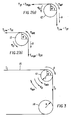
- FIG. 2(a) and 2(b) illustrate a tension differential in the web across a roller.
- FIG. 3 shows a side view of a portion of the apparatus of FIG. 1.
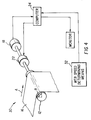
- FIG. 4 shows a perspective view of a traction measurement apparatus in accordance with a second embodiment of the present invention.
- FIG. 1 illustrates a first embodiment of a traction measurement apparatus 10.
- Apparatus 10 includes a first roller 12 (that is, a test roller) and a second roller 14 (that is, a reference roller). Rollers 12,14 are each mounted for rotation about an axis. The axes of the rollers are substantially parallel, but are not co-axial. Second roller 14 is unrestrained, that is, freely rotatable about its axis. Preferably, rollers 12,14 are closely spaced. Web material 16 is transported across rollers 12,14 in a direction noted by arrow A, with a portion of web material wrapped about rollers 12,14. With such an arrangement of the rollers, measurement apparatus 10 does not control the steering of the web material. Thus, apparatus 10 can be used on-line since it does not adversely affect the manufacturing process.
- first roller 12 is r
- second roller 14 is R.
- First and second rollers 12,14 need not be identical.
- the rollers may vary in their size, weight, and surface characteristics. Since the first and second rollers need not be identical, existing rollers in the manufacturing system can be utilized; no new rollers are required. In addition, the amount of wrap of the web about the roller may vary.
- the rollers typically have a length which is at least equal to or greater than the width of the web material. Using such full width rollers minimizes the occurrence of scratches on the web at the edges of the roller, whereas rollers with lengths narrower than the web width may cause scratches, abrasions, or marring.
- First roller 12 further includes a torque source 22, such as a motor, for applying a torque to first roller 12.
- torque source 22 will be referred to as motor 22.
- a monitor 26 coupled with computer means 24 can provide a visual representation of the information being received or calculated by computer means 24.
- motor torque ⁇ M units: inch-pounds
- unknown drag torque ⁇ D units: inch-pounds
- the value of the reverse motor torque ⁇ MR is noted; that is, the value of the torque applied to first roller 12 when the slippage starts to occur.
- the forward and reverse operations can be performed in any order.
- computer means 24 controls the application of the torque and receives signals from encoders 18,20 relating to the speed of first and second rollers 12,14.
- Encoders 18,20 are constantly monitored by computer means 24 while the forward and reverse torques are being applied to first roller 12. With the speed information from the encoders, computer means 24 can constantly determine a speed ratio S of first and second rollers 12,14.
- first and second rollers 12,14 are mounted and web material 16 is transported across the rollers.
- a known tension is applied to the web material.
- forward motor torque ⁇ MF is progressively applied to first roller 12 until slip is detected.
- Motor 22 quickly recovers, and the value of forward motor torque ⁇ MF is stored by computer means 24.
- reverse motor torque ⁇ MR is progressively applied to first roller 12 until slip is detected, wherein motor 22 quickly recovers and the value of reverse motor torque ⁇ MR is stored by computer means 24.
- the coefficient of friction f and traction is then calculated using the method described below.
- tension T OF is applied to the web material.
- tension T OF is a substantially known constant tension applied to the web from externally applied tension control system (not shown) such as a load cell or float roll system controlling the transport of the web material.
- T IF can be a known constant tension value, and T OF can then be calculated. Similarly, either T IF or T OF can be measured.
- tension T OR is applied to the web material.
- tension T OR is a substantially known constant tension applied to the web from externally applied tension control system (not shown) such as a load cell or float roll system controlling the transport of the web material.
- T IR can be a known constant tension value, and T OR can then be calculated. Similarly, either T IR or T OR can be measured.
- Equations 5 and 7 provide two equations with two unknowns, T D and the coefficient of friction f, allowing for the calculation of these values. Traction can then be determined; for the forward operation, traction is T IF - T OF , while for the reverse operation, traction is T OR - T IR .
- Motor 22 can apply the torques in a variety of techniques: (i) as a progressively resisting force, (ii) as a constant resisting force, (iii) as a progressive co-operating force, and (iv) as a constant co-operative force.
- a single roller, first roller 12 is employed.
- a web speed determining means 32 such as a non-contact device, for example a laser, determines the surface velocity of web material 16. The web speed can be determined at the location of first roller 12 or at any location within the transport system.
- a surface velocity of first roller 12 can be determined from speed determining means 18, which can be a non-contact device. Accordingly speed ratio S is calculated from the surface velocity of first roller 12 and the web speed of web material 16.
- Equations 5 and 7 provide two equations with two unknowns, T D and the coefficient of friction f, allowing for the calculation of these values. Traction can then be determined; for the forward operation, traction is T IF - T OF , while for the reverse operation, traction is T OR - T IR .
- the present invention allows measurements of the coefficient of friction at different web speeds, and is suitable for high web speeds.
- High web speeds result in high drag torques, which, if not accounted for, result in inaccurate traction measurements.
- Drag torques have several sources: air entrainment in the nip, bearing drag, web bending, and air drag on the roller. Therefore, using the method of the present invention, normal roller drag is taken into account, and no special actions need be taken to account for it or to minimize it. Variations of T D over time are accounted for by the method of the present apparatus.
Landscapes
- Engineering & Computer Science (AREA)
- Automation & Control Theory (AREA)
- Physics & Mathematics (AREA)
- Health & Medical Sciences (AREA)
- Life Sciences & Earth Sciences (AREA)
- Chemical & Material Sciences (AREA)
- Analytical Chemistry (AREA)
- Biochemistry (AREA)
- General Health & Medical Sciences (AREA)
- General Physics & Mathematics (AREA)
- Immunology (AREA)
- Pathology (AREA)
- Controlling Rewinding, Feeding, Winding, Or Abnormalities Of Webs (AREA)
- Friction Gearing (AREA)
- Force Measurement Appropriate To Specific Purposes (AREA)
Applications Claiming Priority (2)
| Application Number | Priority Date | Filing Date | Title |
|---|---|---|---|
| US724715 | 1996-09-30 | ||
| US08/724,715 US6138496A (en) | 1996-09-30 | 1996-09-30 | Traction measurement apparatus and method |
Publications (2)
| Publication Number | Publication Date |
|---|---|
| EP0833143A2 true EP0833143A2 (de) | 1998-04-01 |
| EP0833143A3 EP0833143A3 (de) | 1998-11-18 |
Family
ID=24911595
Family Applications (1)
| Application Number | Title | Priority Date | Filing Date |
|---|---|---|---|
| EP97202865A Withdrawn EP0833143A3 (de) | 1996-09-30 | 1997-09-18 | Zugkraftmessvorrichtung und -verfahren |
Country Status (3)
| Country | Link |
|---|---|
| US (1) | US6138496A (de) |
| EP (1) | EP0833143A3 (de) |
| JP (1) | JPH10111233A (de) |
Cited By (4)
| Publication number | Priority date | Publication date | Assignee | Title |
|---|---|---|---|---|
| DE10121939A1 (de) * | 2001-05-05 | 2002-11-14 | Kunststoff Zentrum Leipzig | Verfahren und Vorrichtung zur Bestimmung der Reibungskraft und der Reibungszahlen von seilartigen Probekörpern in Gegenwart flüssiger Medien |
| WO2004057311A1 (en) * | 2002-12-20 | 2004-07-08 | Royal Mail Group Plc | A method and an apparatus for friction measurement |
| WO2011019787A1 (en) * | 2009-08-12 | 2011-02-17 | Dow Global Technologies Inc. | Apparatus to determine coefficient of friction |
| CN111474321A (zh) * | 2020-05-20 | 2020-07-31 | 山东理工职业学院 | 一种汽车轴检测装置及检测方法 |
Families Citing this family (4)
| Publication number | Priority date | Publication date | Assignee | Title |
|---|---|---|---|---|
| DE10129889A1 (de) * | 2000-07-14 | 2002-01-24 | Heidelberger Druckmasch Ag | Verfahren und Vorrichtung zur Störungserfassung beim Transport einer Bahn |
| US20020194895A1 (en) * | 2001-05-25 | 2002-12-26 | Eastman Chemical Company | Bottle friction analysis system |
| JP6346592B2 (ja) * | 2015-06-10 | 2018-06-20 | 富士フイルム株式会社 | 保持力測定装置、及び保持力測定方法 |
| US11993264B2 (en) | 2018-12-11 | 2024-05-28 | Gm Cruise Holdings Llc | Systems and methods for autonomous vehicle control based upon observed acceleration |
Family Cites Families (13)
| Publication number | Priority date | Publication date | Assignee | Title |
|---|---|---|---|---|
| US3152468A (en) * | 1963-01-22 | 1964-10-13 | Monsanto Co | Apparatus for testing tires |
| US3520180A (en) * | 1967-11-08 | 1970-07-14 | Gen Motors Corp | Road simulator facility |
| US3813917A (en) * | 1971-05-18 | 1974-06-04 | Applied Magnetics Corp | Method and apparatus for measuring strip material kinetic friction |
| GB1438182A (en) * | 1973-05-23 | 1976-06-03 | Secr Defence | Apparatus for monitoring the dryness of a surface coating |
| US4212063A (en) * | 1978-09-06 | 1980-07-08 | Saab-Scania Aktiebolag | Apparatus for measuring the action of forces between wheeled vehicles and substructure |
| US4324128A (en) * | 1980-02-14 | 1982-04-13 | Mts Systems Corporation | Hydrodynamic support bearing for a belt on a tire testing machine |
| FR2592956B1 (fr) * | 1986-01-13 | 1989-06-02 | Antoine Antoine | Dispositif de controle de l'etat de surface de materiaux. |
| US4909073A (en) * | 1988-10-28 | 1990-03-20 | Kabushiki Kaisha Komatsu Seisakusho | Apparatus for measuring a resistance against slippage on road surface |
| US4995197A (en) * | 1990-01-29 | 1991-02-26 | Shieh Chiung Huei | Method of abrading |
| US5113688A (en) * | 1991-03-19 | 1992-05-19 | The Goodyear Tire & Rubber Company | Laboratory traction test |
| JPH05187993A (ja) * | 1991-05-15 | 1993-07-27 | Sony Corp | 摩擦力測定装置 |
| DE4132950C1 (de) * | 1991-10-04 | 1993-02-04 | Afs Entwicklungs + Vertriebs Gmbh, 8902 Neusaess, De | |
| US5440915A (en) * | 1994-09-09 | 1995-08-15 | Storar; Robert C. | Method and apparatus for measuring friction torque |
-
1996
- 1996-09-30 US US08/724,715 patent/US6138496A/en not_active Expired - Lifetime
-
1997
- 1997-09-18 EP EP97202865A patent/EP0833143A3/de not_active Withdrawn
- 1997-09-24 JP JP9258505A patent/JPH10111233A/ja active Pending
Cited By (6)
| Publication number | Priority date | Publication date | Assignee | Title |
|---|---|---|---|---|
| DE10121939A1 (de) * | 2001-05-05 | 2002-11-14 | Kunststoff Zentrum Leipzig | Verfahren und Vorrichtung zur Bestimmung der Reibungskraft und der Reibungszahlen von seilartigen Probekörpern in Gegenwart flüssiger Medien |
| DE10121939B4 (de) * | 2001-05-05 | 2007-09-27 | Kunststoff-Zentrum in Leipzig gemeinnützige Gesellschaft mbH | Vorrichtung zur Bestimmung der Reibungskraft und der Reibungszahlen von seilartigen Probekörpern |
| WO2004057311A1 (en) * | 2002-12-20 | 2004-07-08 | Royal Mail Group Plc | A method and an apparatus for friction measurement |
| WO2011019787A1 (en) * | 2009-08-12 | 2011-02-17 | Dow Global Technologies Inc. | Apparatus to determine coefficient of friction |
| CN111474321A (zh) * | 2020-05-20 | 2020-07-31 | 山东理工职业学院 | 一种汽车轴检测装置及检测方法 |
| CN111474321B (zh) * | 2020-05-20 | 2022-06-28 | 山东理工职业学院 | 一种汽车轴检测装置及检测方法 |
Also Published As
| Publication number | Publication date |
|---|---|
| US6138496A (en) | 2000-10-31 |
| EP0833143A3 (de) | 1998-11-18 |
| JPH10111233A (ja) | 1998-04-28 |
Similar Documents
| Publication | Publication Date | Title |
|---|---|---|
| US20050004740A1 (en) | Road surface friction sensor and road surface friction coefficient detector, and vehicle antilock braking device | |
| US6839615B2 (en) | Method and apparatus for estimating mass of vehicle, and method and apparatus for estimating gradient employing the method | |
| US6138496A (en) | Traction measurement apparatus and method | |
| US4909073A (en) | Apparatus for measuring a resistance against slippage on road surface | |
| US20080272899A1 (en) | Rollover prediction and warning method | |
| EP0656268B1 (de) | Gerät und verfahren zum detektieren eines druckabfalls im reifen | |
| EP1259790A1 (de) | Transportierbarer rollenprüfstand und verfahren zum prüfen von fahrzeugen | |
| US6985789B2 (en) | Real-time determination of web tension and control using position sensors | |
| CN110446913A (zh) | 用于检测和/或校准试验台的装置和方法 | |
| US6799470B2 (en) | Lateral force-measuring device for a wheel, lateral force-measuring method, and vehicle-inspecting system having the device | |
| US20050179528A1 (en) | Method for warning deflation of tires and system thereof, and judgment program of deflation of tires | |
| JPH02105023A (ja) | 車両計量方法および装置 | |
| EP0805961B1 (de) | Verfahren und vorrichtung zur messung von kräften in zwei richtungen und anwendung zur messung der zugkraft und des variablen ablenkungswinkels einer endlosen materialbahn | |
| CA2442631C (en) | System for detecting sliding of a wheel travelling along a track | |
| JPH07117479B2 (ja) | 車両用差動制限装置の検査方法 | |
| US4646442A (en) | Length measurement | |
| US6035259A (en) | Web material camber measurement apparatus and method | |
| JP3346972B2 (ja) | コンクリ−トミキサ車のドラム積載重量の自重計 | |
| US4811591A (en) | Device for checking the surface condition of materials | |
| US4471531A (en) | Method and apparatus for measuring press roll clearance | |
| CN114509274B (zh) | Asr检测方法 | |
| JPH06317503A (ja) | Abs性能検査装置 | |
| JPH06288798A (ja) | 車両のサスペンション廻りの応力測定装置 | |
| JP2834158B2 (ja) | シヤシダイナモメータ | |
| JP3227108B2 (ja) | 連続鋳造機におけるロール回転異常検出装置 |
Legal Events
| Date | Code | Title | Description |
|---|---|---|---|
| PUAI | Public reference made under article 153(3) epc to a published international application that has entered the european phase |
Free format text: ORIGINAL CODE: 0009012 |
|
| AK | Designated contracting states |
Kind code of ref document: A2 Designated state(s): DE FR GB IT |
|
| PUAL | Search report despatched |
Free format text: ORIGINAL CODE: 0009013 |
|
| AK | Designated contracting states |
Kind code of ref document: A3 Designated state(s): AT BE CH DE DK ES FI FR GB GR IE IT LI LU MC NL PT SE |
|
| 17P | Request for examination filed |
Effective date: 19990424 |
|
| AKX | Designation fees paid |
Free format text: DE FR GB IT |
|
| GRAH | Despatch of communication of intention to grant a patent |
Free format text: ORIGINAL CODE: EPIDOS IGRA |
|
| STAA | Information on the status of an ep patent application or granted ep patent |
Free format text: STATUS: THE APPLICATION IS DEEMED TO BE WITHDRAWN |
|
| 18D | Application deemed to be withdrawn |
Effective date: 20030604 |