EP0838552A1 - Gewöhnliche kreuzung einer beweglichen zunge einer eisenbahnschiene - Google Patents
Gewöhnliche kreuzung einer beweglichen zunge einer eisenbahnschiene Download PDFInfo
- Publication number
- EP0838552A1 EP0838552A1 EP97919409A EP97919409A EP0838552A1 EP 0838552 A1 EP0838552 A1 EP 0838552A1 EP 97919409 A EP97919409 A EP 97919409A EP 97919409 A EP97919409 A EP 97919409A EP 0838552 A1 EP0838552 A1 EP 0838552A1
- Authority
- EP
- European Patent Office
- Prior art keywords
- rail
- tongue
- parts
- rails
- fixed element
- Prior art date
- Legal status (The legal status is an assumption and is not a legal conclusion. Google has not performed a legal analysis and makes no representation as to the accuracy of the status listed.)
- Granted
Links
- 230000001154 acute effect Effects 0.000 title claims abstract description 25
- 229910000617 Mangalloy Inorganic materials 0.000 claims abstract description 24
- 230000008878 coupling Effects 0.000 claims abstract description 14
- 238000010168 coupling process Methods 0.000 claims abstract description 14
- 238000005859 coupling reaction Methods 0.000 claims abstract description 14
- 239000000872 buffer Substances 0.000 claims abstract description 6
- 238000004873 anchoring Methods 0.000 claims abstract description 4
- 238000005096 rolling process Methods 0.000 claims description 13
- 238000003466 welding Methods 0.000 claims description 11
- 238000000034 method Methods 0.000 claims description 10
- 238000004880 explosion Methods 0.000 claims description 6
- 229910000975 Carbon steel Inorganic materials 0.000 claims description 4
- 229910000851 Alloy steel Inorganic materials 0.000 claims description 2
- OKTJSMMVPCPJKN-UHFFFAOYSA-N Carbon Chemical compound [C] OKTJSMMVPCPJKN-UHFFFAOYSA-N 0.000 claims description 2
- 239000000463 material Substances 0.000 description 10
- 230000008901 benefit Effects 0.000 description 8
- 230000035939 shock Effects 0.000 description 7
- 238000012423 maintenance Methods 0.000 description 5
- 238000010276 construction Methods 0.000 description 3
- 238000007669 thermal treatment Methods 0.000 description 3
- 229910000831 Steel Inorganic materials 0.000 description 2
- 239000010962 carbon steel Substances 0.000 description 2
- 230000007547 defect Effects 0.000 description 2
- 239000010959 steel Substances 0.000 description 2
- 241001669679 Eleotris Species 0.000 description 1
- PWHULOQIROXLJO-UHFFFAOYSA-N Manganese Chemical compound [Mn] PWHULOQIROXLJO-UHFFFAOYSA-N 0.000 description 1
- 230000004075 alteration Effects 0.000 description 1
- 238000005452 bending Methods 0.000 description 1
- 230000009286 beneficial effect Effects 0.000 description 1
- 230000015572 biosynthetic process Effects 0.000 description 1
- 230000008030 elimination Effects 0.000 description 1
- 238000003379 elimination reaction Methods 0.000 description 1
- 229910052748 manganese Inorganic materials 0.000 description 1
- 239000011572 manganese Substances 0.000 description 1
- 238000009628 steelmaking Methods 0.000 description 1
- 238000011282 treatment Methods 0.000 description 1
Images




Classifications
-
- E—FIXED CONSTRUCTIONS
- E01—CONSTRUCTION OF ROADS, RAILWAYS, OR BRIDGES
- E01B—PERMANENT WAY; PERMANENT-WAY TOOLS; MACHINES FOR MAKING RAILWAYS OF ALL KINDS
- E01B7/00—Switches; Crossings
- E01B7/10—Frogs
- E01B7/14—Frogs with movable parts
Definitions
- the object of this invention refers, as its title indicates, to an acute crossing of tongue for railways, which can be incorporated to a continuous ribbon-rail, comprising a fixed element and a movable element, presenting important advantages over the methods currently used for this purpose.
- the first known type of acute crossing of tongue includes those crossings carried out entirely assembled, where the housing or casing, that is, the fixed element, is made of rails, preferably joined by brackets and bolts and nuts to a plate assembly, in turn joined to the sleeper, and the movable element is made of machined carbon steel rails or forged elements of the same material.
- the housing or casing that is, the fixed element
- the movable element is made of machined carbon steel rails or forged elements of the same material.
- different thermal hardening treatments have been proposed in said areas.
- the second known type of acute crossing of tongue forming railways groups those crossings in which the fixed element, in its front part, is a cast mono-block, preferably of austenitic manganese steel, and the moving element is entirely made of machined rails.
- the crossings of the second described type represent an improved design with respect to the crossings of the first type, on eliminating the assembled fixed element and replacing the latter by a cast mono-block housing, preferably of austenitic manganese steel and making the movable element of a machined rail.
- the bolted unions are eliminated in the fixed element area subjected to passage of the wheel, with the consequent saving in maintenance costs.
- the beneficial properties of said material with respect to shocks and wear are taken advantage of.
- said material When implemented, said material has a moderate natural surface hardness (approximately 200 HBN), so that in the first moments of its life it undergoes plastic deformations due to the passage of train wheels, provoking the typical lips and burrs on the edges of the rolling platforms.
- said phenomenon causes a maintenance efford consisting of eliminating burrs by grinding when the crossing has achieved its superficial regime hardness (approximately 350 HBN-400 HBN).
- this invention refers to an acute crossing of tongue suitable for being coupled to entrance and exit rails, consisting of a fixed element and another movable element, in which the former consists of a first part made of cast manganese steel and of a second part made in rails, preferably formed by joining two rails to said first part, which are appropriate to act as anchoring elements for accessories such as buffers, buffer-blocks, ribbed plates and expansion joint and whose movable element consists of an element made of cast manganese steel and by two rail parts joined to the former, one of said rails being joined to said part made of rails of said fixed element by means of bolted buffer-blocks and joining the other of said rails to the expansion joint, this latter part of the longitudinal rail sliding in the expansion joint on the side of the diverted line suitable to prevent the assembly formed by said moving element from forming a non-deformable triangle.
- the acute crossing of tongue object of this invention, has sliding means for the movable element inside the fixed element, as well as means for coupling
- Said rail parts, both the fixed element and the moving element, which are joined to the respective parts made of molded manganese steel, as well as the union of the fixed molded part with the entrance rails, is made by means of a welding procedure, preferably by sparking.
- the union or unions of the molded part of the moving element with the rail parts of said moving element are reinforced, preferably by means of safety flanges.
- both of the moving and fixed elements can be made of thermally treated carbon or low alloy steel, and joined to the adjacent rails, that is, both parts of both elements made in rail, and the entrance rails, by means of conventional welding procedures.
- said parts made of cast manganese steel are preferably hardened by explosion in the areas subjected to wear and/or deformation by the train wheels, as well as in the areas of mutual coupling between said parts, up to a hardness of approximately 350 HBN.
- the advantages contributed by the acute crossing of tongue for railways, object of this invention, in its preferable construction can be easily deduced, in this way constituting as a perfecting of the two main existing types of crossing of tongue.
- the advantages contributed by using high manganese content austenitic steel in the rolling areas should be mentioned both of the fixed and the movable elements, since it benefits from the own advantages of said material, is a material that can easily be repaired by welding, is resistant to wear and shocks in the most critical crossing areas and one in which the hard layer of the material is regenerated with the passage of the wheels, as compared with materials hardened by thermal treatment, whose hard layer gradually disappears with wear.
- the use of monolithic parts instead of assembled ones requires less maintenance and involves greater safety.
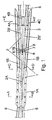
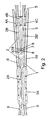
- the acute crossing of tongue for railways, object of this invention consists of a fixed element (1) and another movable element (2).
- the fixed element (1) comprises a first molded part (1A) made of cast manganese steel and a second part made in rails (1B), formed by joining two rails to said first molded part (1A), which are appropriate to act as anchoring elements for accessories such as buffers, buffer-blocks, ribbed plates and expansion joint (3).
- the moving element (2) consists of a first molded part (2A) of a triangular shape made of cast manganese steel and of two rail parts (2B, 2B'), joined to said molded part (2A) at its solepiece, across one or two of its extensions.
- One of said rail parts (2B) is joined to said part made in rails (1B) of said fixed element (1) by means of bolted buffer-blocks (4A, 4B, 4C).
- the other of said rail parts (2B') of the moving element (2) slides longitudinally on the expansion joint (3) formed by the rail part (2B') and the ribbon rail (5), with the purpose of preventing the triangle formed by said moving element (2) joined to the buffer-blocks (4A, 4B, 4C) comprising a non-deformable triangle on making its lateral movement.
- Said parts of rail (2B, 2B') of the moving element (2) may be joined to the molded part (2A) by means of two independent joints, as shown in figures 1 and 2 or by means of a single double joint of both parts of the rail (2B, 2B') with said molded part (2A).
- Figures 1 and 2 show the movable element (2) coupled on the fixed element (1), opening the way to circulation along the direct line and the diverted line, respectively.
- the transfer of rolling between the fixed element (1) and the moving element (2) is performed in the respective parts made of molded manganese steel (1A, 2A), taking advantage of the excellent shock and wear characteristics of said material, since in this area shock and wear loads are produced, especially when worn wheel sets circulate as double flange.
- the molded part (1A) of the fixed element (1) consists of an extended and hollow housing, within which the molded part (2A) of the moving element (2) slides (see figures 3 and 4), being joined on one side to the entrance rails (6) by means of a spark welding procedure and, on the other, to the part made in rails (1B) of the own fixed element (1), the latter being a support part of other items, such as buffers, buffer-blocks, etc.
- the rail part (2B') and the ribbon rail (5) are directly welded to the adjacent rails by means of a procedure such as aluminothermy. Since the manganese steel making up the molded part (1A) of the fixed element (1) and the carbon steel of the adjacent rails (6) cannot be welded in a conventional way, it is necessary to use a special welding procedure, preferably by sparking, for the union of the former.
- Said special welding procedure preferably by sparking, will also be used for the union or unions (7) of the molded part (2A) with the rail parts (2B, 2B') of the moving element (2).
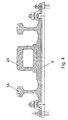
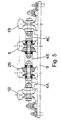
- Figures 3, 4 and 5 show different sections of the crossing of tongue for railways represented in figure 1. More specifically, figure 3 (section AB) corresponds to a coupling section of the molded manganese steel parts (1A, 2A) in the position of the movable element (2) shown in figure 1. Of course, the other position of the movable element (2) will be symmetrical to that shown in said figure 3.
- Figure 4 (section CD) corresponds to a section in the area where there is no direct coupling between the fixed element (1) and the movable element (2).
- figure 5 (section EF) corresponds to a crossing section representing the embedded area between the fixed element (1) and the movable element (2).
- the molded parts (1A, 2A) made of cast manganese steel are preferably hardened by explosion in the areas subjected to wear and/or deformation by the train wheels, as well as in the areas of mutual coupling between said parts, up to a hardness of at least 350 HBN approximately.
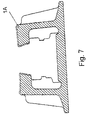
- Figures 6 and 7 show by means of a grid and a dotted dashed line, respectively, different views of the areas to be hardened by explosion of the molded part (1A) of the fixed element (1) corresponding to the rolling platform and the coupling area between the former and the molded part (2A) of the movable element (2).
- figures 8, 9 and 10 show by means of a grid and a dotted dashed line, respectively, different views of the areas to be hardened by explosion of the molded part (2A) of the movable element (2) coinciding with the rolling platform and with the coupling area between the former and the molded part (1A) of the fixed element (1).
- the overall combination of the invention will adjust to the different gradients the rolling elements may take, whether 1:20, 1:30, 1:40 and even 1: ⁇ .
Landscapes
- Engineering & Computer Science (AREA)
- Mechanical Engineering (AREA)
- Architecture (AREA)
- Civil Engineering (AREA)
- Structural Engineering (AREA)
- Railway Tracks (AREA)
- Mutual Connection Of Rods And Tubes (AREA)
- Train Traffic Observation, Control, And Security (AREA)
Applications Claiming Priority (3)
| Application Number | Priority Date | Filing Date | Title |
|---|---|---|---|
| ES9600974 | 1996-04-29 | ||
| ES9600974A ES2137807B1 (es) | 1996-04-29 | 1996-04-29 | Cruzamiento agudo de punta movil para ferrocarril. |
| PCT/ES1997/000104 WO1997041305A1 (es) | 1996-04-29 | 1997-04-24 | Cruzamiento agudo de punta movil para ferrocarril |
Publications (2)
| Publication Number | Publication Date |
|---|---|
| EP0838552A1 true EP0838552A1 (de) | 1998-04-29 |
| EP0838552B1 EP0838552B1 (de) | 2003-05-28 |
Family
ID=8294663
Family Applications (1)
| Application Number | Title | Priority Date | Filing Date |
|---|---|---|---|
| EP97919409A Expired - Lifetime EP0838552B1 (de) | 1996-04-29 | 1997-04-24 | Weiche für eisenbahnschienen |
Country Status (4)
| Country | Link |
|---|---|
| EP (1) | EP0838552B1 (de) |
| ES (2) | ES2137807B1 (de) |
| PT (1) | PT838552E (de) |
| WO (1) | WO1997041305A1 (de) |
Cited By (9)
| Publication number | Priority date | Publication date | Assignee | Title |
|---|---|---|---|---|
| GB2329922A (en) * | 1997-05-20 | 1999-04-07 | Bicc Plc | Railway turnout |
| EP1020562A1 (de) * | 1999-01-15 | 2000-07-19 | Comagep | Herzstück mit beweglicher Spitze und dessen Herstellungsverfahren |
| KR100395576B1 (ko) * | 2000-09-18 | 2003-08-21 | 박장묵 | 철도용 망간크로싱의 육성재생 방법/특결 |
| EP1555347A1 (de) * | 2004-01-16 | 2005-07-20 | Jez Sistemas Ferroviarios, S.l. | Eisenbahnweiche mit flexibler Zunge |
| WO2009043070A1 (de) * | 2007-10-05 | 2009-04-09 | Vae Eisenbahnsysteme Gmbh | Verfahren zum verbinden eines manganhartstahlgussteils mit einer regelschiene sowie zwischenstück für die verwendung in einem derartigen verfahren |
| EP2487293A1 (de) | 2011-02-08 | 2012-08-15 | Jez Sistemas Ferroviarios, S.l. | Spitzes bewegliches Weichenherzstück für Eisenbahnen |
| US8418970B2 (en) | 2008-02-11 | 2013-04-16 | Progress Rail Services Corp | Swing nose crossing |
| WO2013190206A1 (fr) * | 2012-06-21 | 2013-12-27 | Vossloh Cogifer (Société Anonyme) | Jonction d'elements de voie ferroviaire en acier manganese par soudure directe |
| EP3696285A1 (de) * | 2019-02-15 | 2020-08-19 | Progress Rail Services UK Limited | Verbesserter eisenbahnübergang aus stahl |
Families Citing this family (6)
| Publication number | Priority date | Publication date | Assignee | Title |
|---|---|---|---|---|
| DE19758042A1 (de) * | 1997-12-29 | 1999-07-15 | Duerkopp Adler Ag | Kreuzung für einen Hängeförderer |
| ES2265237B1 (es) * | 2004-09-08 | 2007-12-16 | Felguera Melt, S.A. | Dispositivo para la disminucion de los esfuerzos de maniobra en los cruzamientos ferroviarios de punta movil. |
| DE102008023038B3 (de) * | 2008-05-09 | 2009-06-25 | Db Netz Ag | Verfahren zum Herstellen eines Herzstücks mit einem Spitzenblock und zwei an den Spitzenblock anschließenden, zu einem Mittelblock gefügten Anschluss-Schienenabschnitten, sowie Herzstück |
| ES2364827B1 (es) * | 2010-01-25 | 2012-08-03 | Amurrio Ferrocarril Y Equipos, S.A. | Estructura de cruzamiento tranviario de punta movil |
| ES2399735B1 (es) * | 2010-06-15 | 2013-11-13 | Jez Sistemas Ferroviarios, S.L. | Corazon agudo de punta movil para aparatos de via de carril garganta |
| DE102021106050A1 (de) * | 2021-03-12 | 2022-09-15 | Voestalpine Railway Systems GmbH | Herzstück |
Family Cites Families (6)
| Publication number | Priority date | Publication date | Assignee | Title |
|---|---|---|---|---|
| AT312649B (de) * | 1971-03-27 | 1974-01-10 | Krupp Ag Huettenwerke | Zungenweiche mit verschwenkbarem Herzstück |
| FR2142574B1 (de) * | 1971-06-21 | 1973-05-25 | Paris & Outreau Acieries | |
| DE3339442C1 (de) * | 1983-10-29 | 1985-05-02 | Schreck-Mieves GmbH, 4600 Dortmund | Herzstueck fuer Weichen oder Kreuzungen und Verfahren zur Herstellung eines solchen Herzstueckes |
| FR2640294B1 (fr) * | 1988-12-12 | 1991-03-15 | Cogifer Cie Gle Installat Ferr | Procede de fabrication d'un coeur de croisement a pointe mobile et coeur de croisement ainsi obtenu |
| FR2695662B1 (fr) * | 1992-09-11 | 1994-11-18 | Cogifer | Encastrement de la pointe mobile dans le berceau d'un cÓoeur de croisement incorporé dans les longs rails soudés et procédé de réalisation d'un tel encastrement. |
| FR2700344B1 (fr) * | 1993-01-08 | 1995-03-31 | Cogifer | Procédé pour la fabrication d'un élément d'appareil de voie ferroviaire et élément en résultant. |
-
1996
- 1996-04-29 ES ES9600974A patent/ES2137807B1/es not_active Expired - Fee Related
-
1997
- 1997-04-24 PT PT97919409T patent/PT838552E/pt unknown
- 1997-04-24 WO PCT/ES1997/000104 patent/WO1997041305A1/es not_active Ceased
- 1997-04-24 ES ES97919409T patent/ES2208894T3/es not_active Expired - Lifetime
- 1997-04-24 EP EP97919409A patent/EP0838552B1/de not_active Expired - Lifetime
Non-Patent Citations (1)
| Title |
|---|
| See references of WO9741305A1 * |
Cited By (11)
| Publication number | Priority date | Publication date | Assignee | Title |
|---|---|---|---|---|
| GB2329922A (en) * | 1997-05-20 | 1999-04-07 | Bicc Plc | Railway turnout |
| EP1020562A1 (de) * | 1999-01-15 | 2000-07-19 | Comagep | Herzstück mit beweglicher Spitze und dessen Herstellungsverfahren |
| FR2788535A1 (fr) * | 1999-01-15 | 2000-07-21 | Comagep | Coeur de croisement a pointe mobile et procede de fabrication d'un tel coeur de croisement |
| KR100395576B1 (ko) * | 2000-09-18 | 2003-08-21 | 박장묵 | 철도용 망간크로싱의 육성재생 방법/특결 |
| EP1555347A1 (de) * | 2004-01-16 | 2005-07-20 | Jez Sistemas Ferroviarios, S.l. | Eisenbahnweiche mit flexibler Zunge |
| WO2009043070A1 (de) * | 2007-10-05 | 2009-04-09 | Vae Eisenbahnsysteme Gmbh | Verfahren zum verbinden eines manganhartstahlgussteils mit einer regelschiene sowie zwischenstück für die verwendung in einem derartigen verfahren |
| US8418970B2 (en) | 2008-02-11 | 2013-04-16 | Progress Rail Services Corp | Swing nose crossing |
| EP2487293A1 (de) | 2011-02-08 | 2012-08-15 | Jez Sistemas Ferroviarios, S.l. | Spitzes bewegliches Weichenherzstück für Eisenbahnen |
| WO2013190206A1 (fr) * | 2012-06-21 | 2013-12-27 | Vossloh Cogifer (Société Anonyme) | Jonction d'elements de voie ferroviaire en acier manganese par soudure directe |
| FR2992334A1 (fr) * | 2012-06-21 | 2013-12-27 | Vossloh Cogifer | Jonction d'elements de voie ferroviaire en acier manganese par soudure directe |
| EP3696285A1 (de) * | 2019-02-15 | 2020-08-19 | Progress Rail Services UK Limited | Verbesserter eisenbahnübergang aus stahl |
Also Published As
| Publication number | Publication date |
|---|---|
| EP0838552B1 (de) | 2003-05-28 |
| PT838552E (pt) | 2003-09-30 |
| ES2208894T3 (es) | 2004-06-16 |
| ES2137807A1 (es) | 1999-12-16 |
| WO1997041305A1 (es) | 1997-11-06 |
| ES2137807B1 (es) | 2000-08-16 |
Similar Documents
| Publication | Publication Date | Title |
|---|---|---|
| EP0838552A1 (de) | Gewöhnliche kreuzung einer beweglichen zunge einer eisenbahnschiene | |
| CN113026440A (zh) | 一种无缝化组合辙叉 | |
| RU2592178C1 (ru) | Рельсовый путь прямолинейной высокоскоростной железной дороги | |
| Dahl et al. | Repair of rails on-site by welding | |
| EP2487293B1 (de) | Spitzes bewegliches Weichenherzstück für Eisenbahnschienen | |
| Orringer et al. | Thermal cracking in railroad vehicle wheels subjected to high performance stop braking | |
| CN207727363U (zh) | 一种固定型合金钢组合辙叉 | |
| US5704570A (en) | Welded nose rail used for crossing | |
| US6994299B2 (en) | Railroad crossing apparatus having improved rail connection and improved flangeway floor geometry and method incorporating the same | |
| CN219195506U (zh) | 一种有轨电车新型路面轨道板 | |
| EP1555347B1 (de) | Eisenbahnweiche mit flexibler Zunge | |
| CN204959604U (zh) | 一种用于抢修钢梁的板式无砟轨道桥面 | |
| US20070007394A1 (en) | System, method, and apparatus for railroad turnout and derail lift frog | |
| JPH07102502A (ja) | 組立式クロッシングレール | |
| CN1163330C (zh) | 高锰钢辙叉或锰钢轨与普通钢轨的直接闪光对焊连接方法 | |
| US1774263A (en) | Railway-track structure | |
| US3378683A (en) | Cast-steel railway crossing pieces | |
| CA2606126C (en) | Railway diamond crossing | |
| CN1473993A (zh) | 全面治理铁路线路的技术创新方案 | |
| Hübner | The Action Programme of Uic, Cerand Uip “ABATEMENT of Railway Noise Emissions on Goods TRAINS” | |
| JP3129754U (ja) | 鉄道用タイプレート | |
| Baillargeon et al. | Performance of Prototype No. 20 Frogs in Revenue Service [Research Results] | |
| CN120367090A (zh) | 一种短翼轨可动心轨辙叉 | |
| US667198A (en) | Manufacture of structural beams. | |
| JPH0677867B2 (ja) | 溶接クロッシング及びその製造方法 |
Legal Events
| Date | Code | Title | Description |
|---|---|---|---|
| PUAI | Public reference made under article 153(3) epc to a published international application that has entered the european phase |
Free format text: ORIGINAL CODE: 0009012 |
|
| AK | Designated contracting states |
Kind code of ref document: A1 Designated state(s): BE ES GB PT |
|
| 17P | Request for examination filed |
Effective date: 19980430 |
|
| 17Q | First examination report despatched |
Effective date: 20010926 |
|
| GRAH | Despatch of communication of intention to grant a patent |
Free format text: ORIGINAL CODE: EPIDOS IGRA |
|
| RTI1 | Title (correction) |
Free format text: POINTS FOR A RAILWAY LINE |
|
| RTI1 | Title (correction) |
Free format text: POINTS FOR A RAILWAY LINE |
|
| GRAH | Despatch of communication of intention to grant a patent |
Free format text: ORIGINAL CODE: EPIDOS IGRA |
|
| GRAA | (expected) grant |
Free format text: ORIGINAL CODE: 0009210 |
|
| AK | Designated contracting states |
Designated state(s): BE ES GB PT |
|
| REG | Reference to a national code |
Ref country code: GB Ref legal event code: FG4D |
|
| REG | Reference to a national code |
Ref country code: PT Ref legal event code: SC4A Free format text: AVAILABILITY OF NATIONAL TRANSLATION Effective date: 20030807 |
|
| PLBQ | Unpublished change to opponent data |
Free format text: ORIGINAL CODE: EPIDOS OPPO |
|
| PLBI | Opposition filed |
Free format text: ORIGINAL CODE: 0009260 |
|
| PLAX | Notice of opposition and request to file observation + time limit sent |
Free format text: ORIGINAL CODE: EPIDOSNOBS2 |
|
| 26 | Opposition filed |
Opponent name: VOSSLOH COGIFER (S.A.) Effective date: 20040221 |
|
| REG | Reference to a national code |
Ref country code: ES Ref legal event code: FG2A Ref document number: 2208894 Country of ref document: ES Kind code of ref document: T3 |
|
| PLBB | Reply of patent proprietor to notice(s) of opposition received |
Free format text: ORIGINAL CODE: EPIDOSNOBS3 |
|
| PLCK | Communication despatched that opposition was rejected |
Free format text: ORIGINAL CODE: EPIDOSNREJ1 |
|
| APBP | Date of receipt of notice of appeal recorded |
Free format text: ORIGINAL CODE: EPIDOSNNOA2O |
|
| APAY | Date of receipt of notice of appeal deleted |
Free format text: ORIGINAL CODE: EPIDOSDNOA2O |
|
| APBM | Appeal reference recorded |
Free format text: ORIGINAL CODE: EPIDOSNREFNO |
|
| APBP | Date of receipt of notice of appeal recorded |
Free format text: ORIGINAL CODE: EPIDOSNNOA2O |
|
| APAH | Appeal reference modified |
Free format text: ORIGINAL CODE: EPIDOSCREFNO |
|
| APBQ | Date of receipt of statement of grounds of appeal recorded |
Free format text: ORIGINAL CODE: EPIDOSNNOA3O |
|
| APBU | Appeal procedure closed |
Free format text: ORIGINAL CODE: EPIDOSNNOA9O |
|
| PLBN | Opposition rejected |
Free format text: ORIGINAL CODE: 0009273 |
|
| STAA | Information on the status of an ep patent application or granted ep patent |
Free format text: STATUS: OPPOSITION REJECTED |
|
| 27O | Opposition rejected |
Effective date: 20081007 |
|
| PGFP | Annual fee paid to national office [announced via postgrant information from national office to epo] |
Ref country code: GB Payment date: 20160421 Year of fee payment: 20 Ref country code: ES Payment date: 20160413 Year of fee payment: 20 |
|
| PGFP | Annual fee paid to national office [announced via postgrant information from national office to epo] |
Ref country code: BE Payment date: 20160420 Year of fee payment: 20 Ref country code: PT Payment date: 20160421 Year of fee payment: 20 |
|
| REG | Reference to a national code |
Ref country code: GB Ref legal event code: PE20 Expiry date: 20170423 |
|
| PG25 | Lapsed in a contracting state [announced via postgrant information from national office to epo] |
Ref country code: GB Free format text: LAPSE BECAUSE OF EXPIRATION OF PROTECTION Effective date: 20170423 |
|
| REG | Reference to a national code |
Ref country code: ES Ref legal event code: FD2A Effective date: 20170731 |
|
| PG25 | Lapsed in a contracting state [announced via postgrant information from national office to epo] |
Ref country code: PT Free format text: LAPSE BECAUSE OF EXPIRATION OF PROTECTION Effective date: 20170505 |
|
| PG25 | Lapsed in a contracting state [announced via postgrant information from national office to epo] |
Ref country code: ES Free format text: LAPSE BECAUSE OF EXPIRATION OF PROTECTION Effective date: 20170425 |