EP0899089A1 - Verfahren und vorrichtung zur herstellung von mit thermoplastischem kunststoff beschichteten metallblechen - Google Patents
Verfahren und vorrichtung zur herstellung von mit thermoplastischem kunststoff beschichteten metallblechen Download PDFInfo
- Publication number
- EP0899089A1 EP0899089A1 EP97922047A EP97922047A EP0899089A1 EP 0899089 A1 EP0899089 A1 EP 0899089A1 EP 97922047 A EP97922047 A EP 97922047A EP 97922047 A EP97922047 A EP 97922047A EP 0899089 A1 EP0899089 A1 EP 0899089A1
- Authority
- EP
- European Patent Office
- Prior art keywords
- resin film
- metal sheet
- thermoplastic resin
- roll
- heating
- Prior art date
- Legal status (The legal status is an assumption and is not a legal conclusion. Google has not performed a legal analysis and makes no representation as to the accuracy of the status listed.)
- Granted
Links
Images


Classifications
-
- B—PERFORMING OPERATIONS; TRANSPORTING
- B32—LAYERED PRODUCTS
- B32B—LAYERED PRODUCTS, i.e. PRODUCTS BUILT-UP OF STRATA OF FLAT OR NON-FLAT, e.g. CELLULAR OR HONEYCOMB, FORM
- B32B15/00—Layered products comprising a layer of metal
- B32B15/04—Layered products comprising a layer of metal comprising metal as the main or only constituent of a layer, which is next to another layer of the same or of a different material
- B32B15/08—Layered products comprising a layer of metal comprising metal as the main or only constituent of a layer, which is next to another layer of the same or of a different material of synthetic resin
-
- B—PERFORMING OPERATIONS; TRANSPORTING
- B32—LAYERED PRODUCTS
- B32B—LAYERED PRODUCTS, i.e. PRODUCTS BUILT-UP OF STRATA OF FLAT OR NON-FLAT, e.g. CELLULAR OR HONEYCOMB, FORM
- B32B15/00—Layered products comprising a layer of metal
- B32B15/18—Layered products comprising a layer of metal comprising iron or steel
-
- B—PERFORMING OPERATIONS; TRANSPORTING
- B32—LAYERED PRODUCTS
- B32B—LAYERED PRODUCTS, i.e. PRODUCTS BUILT-UP OF STRATA OF FLAT OR NON-FLAT, e.g. CELLULAR OR HONEYCOMB, FORM
- B32B15/00—Layered products comprising a layer of metal
- B32B15/20—Layered products comprising a layer of metal comprising aluminium or copper
-
- B—PERFORMING OPERATIONS; TRANSPORTING
- B32—LAYERED PRODUCTS
- B32B—LAYERED PRODUCTS, i.e. PRODUCTS BUILT-UP OF STRATA OF FLAT OR NON-FLAT, e.g. CELLULAR OR HONEYCOMB, FORM
- B32B37/00—Methods or apparatus for laminating, e.g. by curing or by ultrasonic bonding
- B32B37/04—Methods or apparatus for laminating, e.g. by curing or by ultrasonic bonding characterised by the partial melting of at least one layer
-
- B—PERFORMING OPERATIONS; TRANSPORTING
- B32—LAYERED PRODUCTS
- B32B—LAYERED PRODUCTS, i.e. PRODUCTS BUILT-UP OF STRATA OF FLAT OR NON-FLAT, e.g. CELLULAR OR HONEYCOMB, FORM
- B32B38/00—Ancillary operations in connection with laminating processes
- B32B38/0036—Heat treatment
- B32B38/004—Heat treatment by physically contacting the layers, e.g. by the use of heated platens or rollers
-
- B—PERFORMING OPERATIONS; TRANSPORTING
- B32—LAYERED PRODUCTS
- B32B—LAYERED PRODUCTS, i.e. PRODUCTS BUILT-UP OF STRATA OF FLAT OR NON-FLAT, e.g. CELLULAR OR HONEYCOMB, FORM
- B32B2309/00—Parameters for the laminating or treatment process; Apparatus details
- B32B2309/06—Angles
-
- B—PERFORMING OPERATIONS; TRANSPORTING
- B32—LAYERED PRODUCTS
- B32B—LAYERED PRODUCTS, i.e. PRODUCTS BUILT-UP OF STRATA OF FLAT OR NON-FLAT, e.g. CELLULAR OR HONEYCOMB, FORM
- B32B2311/00—Metals, their alloys or their compounds
-
- B—PERFORMING OPERATIONS; TRANSPORTING
- B32—LAYERED PRODUCTS
- B32B—LAYERED PRODUCTS, i.e. PRODUCTS BUILT-UP OF STRATA OF FLAT OR NON-FLAT, e.g. CELLULAR OR HONEYCOMB, FORM
- B32B2398/00—Unspecified macromolecular compounds
- B32B2398/20—Thermoplastics
-
- Y—GENERAL TAGGING OF NEW TECHNOLOGICAL DEVELOPMENTS; GENERAL TAGGING OF CROSS-SECTIONAL TECHNOLOGIES SPANNING OVER SEVERAL SECTIONS OF THE IPC; TECHNICAL SUBJECTS COVERED BY FORMER USPC CROSS-REFERENCE ART COLLECTIONS [XRACs] AND DIGESTS
- Y10—TECHNICAL SUBJECTS COVERED BY FORMER USPC
- Y10T—TECHNICAL SUBJECTS COVERED BY FORMER US CLASSIFICATION
- Y10T156/00—Adhesive bonding and miscellaneous chemical manufacture
- Y10T156/17—Surface bonding means and/or assemblymeans with work feeding or handling means
- Y10T156/1702—For plural parts or plural areas of single part
- Y10T156/1712—Indefinite or running length work
- Y10T156/1741—Progressive continuous bonding press [e.g., roll couples]
Definitions
- the present invention relates to a method and an apparatus for manufacturing a thermoplastic resin coated metal sheet (hereinafter referred to simply as a resin coated metal sheet), which can effect high speed production thereof. More particularly, it relates to a method and an apparatus for manufacturing a resin coated metal sheet, which make it possible to reduce bubbles generated in a laminate when a thermoplastic resin film (hereinafter referred to simply as a resin film) is laminated onto a metal sheet at high speed, and also make it possible to manufacture a resin coated metal sheet having excellent adhesion after forming of a laminated resin film to a metal sheet at high speed.
- a resin coated metal sheet which make it possible to reduce bubbles generated in a laminate when a thermoplastic resin film (hereinafter referred to simply as a resin film) is laminated onto a metal sheet at high speed, and also make it possible to manufacture a resin coated metal sheet having excellent adhesion after forming of a laminated resin film to a metal sheet at high speed.
- thermoplastic resin film such as polyester resin film
- a resin coated metal sheet used for such heavily formed cans is manufactured by a method of heat bonding a resin film to a metal sheet or a method of laminating a resin film onto a metal sheet by means of a thermosetting adhesive therebetween.
- the resultant resin coated metal sheet has bubbles included between the laminated resin film and the metal sheet and a ratio of the thus included bubbles to the resin coated metal sheet comes to about 10 to 30% by an area ratio.
- Such inclusion of bubbles not only causes decrease in the adhesion after forming of the laminated resin film but also causes surface roughness of the resin coated metal sheet, which results in flaws of the resin coated metal sheet at the time of forming. Therefore, the lamination speed at the time of laminating a resin film to a metal sheet has been limited to a low speed from the view of reducing bubbles at present.
- the object of the present invention is to provide a method and an apparatus for manufacturing a resin coated metal sheet, which make it possible to reduce bubbles included between a laminated resin film and a metal sheet when the resin film is continuously laminated onto the metal sheet at a high speed of at least 200m/min., and which make it also possible to impart excellent adhesion after forming to the laminated resin film of the resin coated metal sheet thus manufactured.
- the present invention comprises a method of manufacturing a thermoplastic resin coated metal sheet, which includes the steps of heating a metal sheet strip, which advances continuously, to a temperature of or higher than a melting point of a thermoplastic resin film, bringing the thermoplastic resin film into contact with at least one surface of the metal sheet, and nipping the metal sheet and the thermoplastic resin film by a pair of laminating rolls to laminate them, wherein the thermoplastic resin film, which is heated to a temperature of at least a surface temperature of the laminating rolls and below a softening temperature of the thermoplastic resin film, is brought into contact with at least one surface of the metal sheet and the metal sheet and the thermoplastic resin film are nipped by the laminating rolls to be laminated to each other.
- the method is characterized in that when said heated thermoplastic resin film is brought into contact with said metal sheet and both are nipped to be laminated to each other by said laminating rolls, said heated thermoplastic resin film and said laminating rolls are made to contact with each other within 0.1 second.
- the present invention comprises an apparatus for manufacturing a thermoplastic resin coated metal sheet, which includes a metal sheet supplying means for continuously feeding a metal sheet strip, a heating means for heating the metal sheet to a temperature of at least a melting point of a thermoplastic resin film, a pair of laminating rolls, and a thermoplastic resin film supplying means for continuously feeding a thermoplastic resin film between the laminating rolls and the metal sheet, the apparatus further including a thermoplastic resin film heating means for heating the thermoplastic resin film to a temperature of at least a surface temperature of the laminating rolls and below a softening temperature of the thermoplastic resin film directly before the thermoplastic resin film is made to contact with the metal sheet.
- the apparatus is characterized in that a first deflector roll is provided between the thermoplastic resin film supplying means and the laminating rolls so as to come into contact with one surface of the thermoplastic resin film and it is movably disposed so as to permit a winding angle of the thermoplastic resin film around the laminating roll to be changed.
- thermoplastic resin film heating means is a heating roll which is disposed between the thermoplastic resin film supplying means and the laminating rolls so as to come into contact with one surface of the thermoplastic resin film.
- the heating roll also serves as a deflector roll which is disposed movable in the direction perpendicular to the advance direction of the metal sheet so as to permit the winding angle of the thermoplastic resin film around the laminating roll to be changed.
- thermoplastic resin film is provided between the heating roll and the laminating rolls.
- the second heating means is an infrared heater.
- thermoplastic resin film supplying means and the heating roll so as to come into contact with one surface of the thermoplastic resin film and it is disposed movably in the direction perpendicular to the advance direction of the thermoplastic resin film .
- the method of manufacturing a thermoplastic resin (hereinafter referred to simply as a resin) coated metal sheet comprises the steps of heating a metal sheet strip, which advances continuously, bringing a resin film, which is heated to a predetermined temperature of at least a surface temperature of a laminating roll and below a softening temperature of the resin film, into contact with at least one surface of the metal sheet, wherein the resin film is made to contact with the laminating roll in a very short contacting duration, and nipping the resin film and the metal sheet in contact with each other by a pair of laminating rolls to laminate them, so that it is possible to reduce bubbles included between the laminated resin film and the metal sheet and particularly it is possible to effectively reduce such bubbles when the resin film is laminated onto the metal sheet at high speed.
- Fig. 1 is a schematic view showing a main structure by way of an example of the embodiment of the apparatus according to the present invention.
- Fig. 1 shows an example of the apparatus for laminating a resin film 5 onto both surfaces of a metal sheet 1, in which symbol 2 is a heating means for continuously heating a metal sheet strip, which is fed from a metal sheet supplying means (not shown) and continuously advances downward from the upside in Fig.
- a final heating means 3 for controlling the temperature of the heated metal sheet 1 to a predetermined temperature is disposed below the heating means 2, and further below the heating means, a pair of laminating rolls 7 are disposed for nipping the heated metal sheet 1 and a resin film 5 fed from a resin film supplying means 4 and applying a pressure to them to heat-bond them.
- a heating roll 6 is provided as a heating means for heating the resin film 5 fed from the resin film supplying means 4 to a predetermined temperature.
- the heating roll 6 is disposed so as to come into contact with one surface of the resin film 5 and may be a deflector roll movable in a direction perpendicular to the advance direction of the metal sheet 1.
- the heating roll 6 may serves as the deflector roll as mentioned above, or may be a deflector roll provided with or without a heating means and another heating means 12 may be provided between this deflector roll and the laminating roll 7 as shown in Fig. 3. Further, a second deflector roll 11 is provided between the resin film supplying means 4 and the lamination roll 7 so as to come into contact with one surface of the resin film 5 and it is movable in a direction perpendicular to the advance direction of the resin film 5. Besides, a known device for controlling a tension of the resin film (not shown) is provided between the resin film supplying means 4 and the locating means 6. Further, a quenching tank 9 is provided below the pair of laminating rolls for quenching an obtained resin coated metal sheet 8 to a normal temperature and a coiling means 10 is disposed on the downstream thereof for coiling the resin coated metal sheet 8.
- heating means 2 for heating the metal sheet 1, the final heating means 3 for controlling the temperature of the metal sheet 1 to a predetermined temperature, and the heating means 6 for heating the resin film known heating devices such as heating rolls using induction heating or superheated steam as heating means, a high-frequency heating device, a resistance heating device, and a hot blast hearth may be applicable.
- a metallic heating roll which incorporates an induction coil may be used more preferably from the viewpoint of accurately controlling the surface temperature of the roll.
- the present invention is explained with respect to a case of using the heating roll as the heating means 6.
- the heating roll 6 is rotatable with its both ends supported by bearings (not shown), wherein both bearings are synchronized with each other by an air cylinder or the like so as to serve as a deflector roll which is movable in any direction of right and left directions, up- and downward directions, an oblique direction, and an arc direction on the plane of Fig. 1.
- the heating roll 6 is permitted to move for varying a winding angle of the resin film 5 around the laminating roll 7 so that it is possible to vary the contacting duration of the resin film 5 with the laminating roll 7.
- the heating roll 6 can be moved in any direction of right and left directions, up- and downward directions an oblique direction, and an arc direction of the plane of Fig.
- the heating roll 6 may be a deflector roll, which is provided with or without a heating means, and another heating means 12, an infrared heater, for instance, may be provided between this deflector roll and the laminating roll 7.
- the resin film 5 fed from the resin film supplying means 4 to change its advance direction by a deflector roll 11, which is disposed so as to come into contact with one surface of the resin film 5 and movable in a direction perpendicular to the advance direction of the resin film 5.
- This deflector roll 11 also serves to adjust the winding angle of the resin film 5 around the resin film heating roll 6 so as to permit the contacting duration of the resin film 5 with the resin film heating roll 6 to be controlled, similarly to the above mentioned adjustment for the movement of the resin film heating roll 6.
- the manufacturing apparatus for the resin coated metal sheet of the present invention constructed as mentioned above is operated as follows. First, a metal sheet strip is heated by heating means 2 and heated to a predetermined temperature of at least a melting point of a resin film 5 by the final heating means 3. At least one surface of the thus heated metal sheet 1 is made to contact with resin film 5.
- the resin film 5 comes into contact with the laminating roll 7, it is fed, within 0.1 second, into the pair of laminating rolls 7 together with the metal sheet 1 and they are nipped by the lamination rolls 7 to be laminated to each other.
- the laminating operation is completed.
- the resultant resin coated metal sheet 8 is guided into the quenching tank 9 and quenched, then dried by a drying device (not shown), and winded in a coil form by a resin coated metal sheet coiling means 10.
- the present invention is characterized in that, in the above mentioned manufacturing method for the resin coated metal sheet, the resin film to be laminated onto the metal sheet is heated to a predetermined temperature of at least the surface temperature of the laminating roll and below the softening temperature of the resin film and brought into contact with the laminating roll, and thereafter within 0.1 second it is made to contact with the metal sheet, and both of them are nipped together to be laminated.
- the method is more specifically explained.
- the temperature of the resin film to be laminated which has been heated to a temperature of at least the surface temperature of the laminating roll and below the softening temperature of the resin film, so that the temperature of the resin film should not be lowered below the surface temperature of the laminating roll until the resin film is laminated onto the metal sheet in a nip of the lamination rolls.
- the temperature of the resin film becomes same as the surface temperature of the laminating roll before the resin film is fed in a nip of the laminating rolls, resulting in loss of preheating effect. Therefore, the heated resin film needs to come in contact with the laminating roll as soon as possible after heating so as not to be cooled by the atmosphere, and it is necessary to restrict the laminating duration within 0.1 second, which is the duration from when the resin film comes in contact with the laminating roll to when the resin film is made to contact with the metal sheet and both of them are nipped to be laminated to each other.
- the contacting duration of the resin film with the laminating roll is determined on the basis of a supplying speed of the metal sheet and a nip length of the laminating rolls, as far as the diameter of the laminating roll is fixed.
- laminating rolls having a fixed diameter is used and the feeding speed of the metal sheet and the nip length are adjusted to control the contacting duration.
- the nip length is adjusted in accordance with a pressure at the time of pressure-bonding the metal sheet and the resin film by the pair of laminating rolls, so the surface of the laminating roll should essentially be provided with a lining of an elastic material such as rubber.
- the resin film when the temperature of the resin film is lower than the surface temperature of the laminating roll, the resin film is heated by the laminating roll while it is in contact with the laminating roll. However, even when the temperature of the resin film becomes highest, it is substantially equal to the surface temperature of the laminating roll.
- the temperature of the resin film about to come in a nip of the laminating rolls is lower than the surface temperature of the laminating roll, and when the resin film is pressure-bonded to the metal sheet by the pair of laminating rolls, the temperature of the resin film is not so raised through the thermal transfer from the heated metal sheet, which forms a melting layer (bonding layer) only little, resulting in decreased adhesion after forming of the laminated resin film.
- the laminating speed for the resin film increases, not only an increasing amount of bubbles are included in the laminate but also the adhesion after forming of the laminated resin film is remarkably decreased.
- the locating temperature of the resin film is limited up to the softening temperature of the resin film.
- This softening temperature of the resin film is determined on the basis of a shrinkage amount of the resin film which the resin film is laminated. This shrinkage of the resin film inevitably occurs because a certain extent of tension is imparted to the resin film at the time of lamination.
- the area of the resin film to be laminated is decreased by the shrinkage amount thereof and therefore, defective portions of the resin coated metal sheet increase.
- the produced resin coated metal sheet is cut at both edges thereof by 1.5% with regard to the full width thereof, respectively.
- the resultant resin coated metal sheet has its defective portions, which are not laminated with the resin film, completely cut-off and thus there is no unusable portion remaining in the resin coated metal sheet. Therefore, in the state that the resin film is heated and a tension is imparted to the resin film, a heating temperature which causes a shrinkage of at least 3% of the resin film in the width direction is prescribed as a softening temperature of the resin film at the time of lamination and determined as the upper limit of the heating temperature.
- the resin film is a non-oriented film, although it depends on a kind of the resin, its softening temperature is higher than the glass transition temperature by 10 to 30° C, and if the resin film is a biaxially oriented film, its softening temperature is higher than the glass transition temperature by 100° C.
- the resin film 5 is heated to a predetermined temperature by the heating roll.
- the contacting duration of the resin film 5 with the resin film heating roll 6 becomes shorter and hence the temperature of the resin film is less raised. Therefore, it is preferable to move the resin film heating roll 6 and the deflector roll 11 so that the winding angle of the resin film around the resin film heating roll 6 can be increased so as to increase contacting portions of the resin film 5 with the resin film heating roll 6.
- a second heating means 12 may be provided between the heating roll 6 and the laminating roll 7.
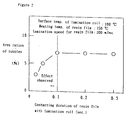
- the surface temperature of the laminating roll 7 is set to a low temperature for cooling the resin film 5 so as to prevent the whole resin film 5 from being melted. Accordingly, the temperature of the heated resin film 5 is rapidly lowered when it comes into contact with the laminating roll 7. Therefore, the shorter the contracting duration of the resin film 5 with the laminating roll 7 is the resin film 5 can be fed in the nip of the laminating rolls at the higher temperature than the surface temperature of the laminating roll 7. As one example, Fig.
- the adjustment of the winding angle can be performed by shifting the heating roll 6.
- the resin film 5 is heated by the contact with the heating roll 6.
- the second deflector roll 11 may be moved in the up-and downward directions as mentioned above, or may be moved in the left and right directions, an oblique direction or an arc-shaped direction.
- the second deflector roll 11 may be provided with a heating device for preheating the resin film 5 so as to assist the heating by the heating roll 6.
- a second heating means 12 may be provided between the heating roll 6 and the laminating roll 7. In this case, since both the heating roll 6 and the heating means 12 co-operate for heating, the resin film 5 can be sufficiently heated to a predetermined temperature and can be laminated onto the metal sheet 1 at higher speed. Also, the resin film 5 can be heated closely until it comes in contact with the laminating roll 7.
- the heating roll 6 may be permitted not to permit the heating roll 6 to work as heating means but work as only deflector roll and permit only the second heating means 12 to heat the resin film 5, or permit both the second deflector roll 11 equipped with the heating device and the second heating means 12 to heat the resin film 5.
- the second heating means 12 an infrared heater may preferably be used since it is capable of quickly heating.
- tension impacting means can be provided, for example, as a mechanism for selecting a supplying speed of the resin film 5 by the resin film supplying means 4 to be lower than the supplying speed of the metal sheet 1 by the metal sheet supplying means (not shown).
- a single layer or multi-layer resin film mainly including a resin selected from the group consisting of polyester resin, polyolefin resin, polyamid resin, polycarbonate resin, and so on, or blended resin film including two or more resins selected from the above mentioned group, or a copolymerization resin film can be suitably selected for uses.
- a polycarbonate resin film or a blended resin film including polycarbonate resin and at least one polyester resin selected from the above mentioned polyester resins, or a multi-layer resin film having a layer of polycarbonate and at least two layers of polyester resins selected from the above mentioned polyester resins laminated to each other can be used.
- Such a resin film may preferably be prepared by forming at least one resin into a film using a known extruder, then biaxially orienting the resin film, and heat setting it to produce a biaxially oriented resin film.
- the resin film for laminating may preferably have a thickness of 5 to 50 ⁇ m and more preferably 10 to 30 ⁇ m.
- the thickness of the resin film is 5 ⁇ m or less, it is difficult to laminate such resin film to the metal sheet continuously at high speed.
- the thickness of the resin film for lamination is 50 ⁇ m or more, this is economically unfavorable compared with epoxy-base resin coating which is widely used for the manufacture of cans.
- a surface-treated steel strip or aluminum alloy strip can be used as a metal sheet for use in the resin coated metal sheet of the present invention.
- the steel sheet it is not necessary to restrict its steel composition in particular as far as it is endurable to heavy forming.
- a low carbon cold rolled steel sheet of 0.15 to 0.30mm in thickness, which is much used for cans, may preferably be used.
- a steel sheet provided with a surface layer of hydrated chromium oxide for attaining excellent adhesion after forming thereof to a resin film to be laminated thereon and especially, a steel sheet provided with a dual-layered film composed of a metallic chromium as the lower layer and a hydrated chromium oxide as the upper layer (so-called Tin-Free-Steel (TFS)) may preferably be used.
- a steel sheet, the surface of which is at first provided with a multi-layer coating or an alloy coating composed of one or more selected from the group of Sn, Ni, Al and the like, and then provided with the above mentioned dual-layered film thereon as the upper layer can be used.
- the aluminum alloy sheet also it is not necessary to restrict its alloy composition as far as it is endurable to heavy forming.
- a 3000 series or 5000 series of aluminum alloy sheet which are much used for cans, may preferably be used from the viewpoint of cost and formability.
- an aluminum alloy sheet which is surface treated by known techniques such as treatment in electrolytic chromic acid solution, dipping treatment in chromic acid solution, phosphoric acid chromating, etching by the use of an alkali solution or an acid solution, and anodizing, may more preferably be used.
- the coating weight of hydrated chromium oxide may preferably be 3 to 25mg/m 2 and more preferably 7 to 20mg/ m 2 as chromium in view of adhesion after forming thereof to the resin film to be laminated thereon.
- the metallic chromium is not specifically limited but may preferably be 10 to 200mg/m 2 and more preferably 30 to 100mg/m 2 in view of corrosion resistance thereof after forming and adhesion after forming thereof to the resin film to be laminated thereon.
- the resin film 5 can be directly laminated onto the metal sheet 1.
- a thermosetting adhesive layer of epoxy-phenol resin or the like can be provided between the resin film 5 and the metal sheet 1 so as to laminate them together. Namely, either a surface of the resin film 5 or a surface of the metal sheet 1, i.e., the surface that is to be bonded to the other, is in advance coated with the thermosetting adhesive so that the resin film can be laminated to the metal sheet with the thermosetting adhesive layer interposed between them.
- a coil around which a 0.20mm thick TFS strip (denoted by symbol 1 in Fig. 1 and containing 105mg/m 2 of metallic chromium and 15mg/m 2 of hydrated chromium oxide by the weight of chromium) is coiled and is inserted in an uncoiler.
- the TFS strip is continuously uncoiled at a certain supplying speed as shown in Table 1, and made to contact with a jacket roll (2 in Fig. 1) having a heat temperature of 230° C so as to be heated, and further made to contact with a pair of heating rolls (3 in Fig. 1) for final heating to be heated to 245° C.
- the resin film is made to contact with a resin film heating roll (6 in Fig. 1) having a certain heat temperature as shown in Table 1 to be heated. Further, the heated biaxial oriented copolyester resin film and the before-mentioned heated TFS are nipped by a pair of laminating rolls (7 in Fig. 1) having a heat temperature of 120° C, and the lamination of the resin film and the TFS is completed in a certain duration as shown in Table 1. Thereafter, the TFS, which is thus coated with the biaxially oriented copolyester resin film (8 in Fig. 1), is guided into a quenching tank (9 in Fig. 1) disposed below the laminating rolls and filled with water to be rapidly quenched and dried. Then, the resin coated TFS is coiled around a coiler (10 in Fig. 1).
- the obtained resin coated metal sheet was cut into pieces of 50mm ⁇ 50mm. Optionally selected three pieces among them were respectively measured with an area occupied by bubbles in a field of view of 1mm ⁇ 1mm thereof through a scanning acoustic microscope. A ratio of the area occupied by bubbles to the whole measured area was expressed by a percentage (%) and a mean value of all area ratios was defined as an area ratio of bubbles.
- the obtained resin coated metal sheet was blanked out with a diameter of 160mm and formed into a drawn can of 100mm in diameter. Then, it was redrawn to be a redrawn can of 80mm in diameter. The redrawn can was stretched and ironed simultaneously by the composite forming to be a drawn and ironed can of 66mm in diameter. This composite forming was carried out under the following conditions.
- the obtained can body was observed with regard to a peel-off degree of the resin film from the can wall thereof through a naked eye and evaluated on the basis of the following standard.
- thermoplastic resin film is laminated onto a metal sheet strip, which advances continuously according to the manufacturing method for a resin coated metal sheet of the present invention, it is possible to reduce bubbles included between the laminated resin film and the metal sheet even when the resin film is laminated at a high speed of at least 200m/min. It is therefore possible to manufacture a resin coated metal sheet excellent in adhesion after forming. Thus, the manufacturing method of the present invention is excellent in productivity and highly valuable in the industrial field.
- the laminating condition of the resin film and the characteristics of the resin coated metal sheet (1) Sample No. Supplying speed of metal sheet (m/min.) Temp.
- Sample No 6 The resin film is elongated in the longitudinal direction and shrinked in the wiedth direction at the time of lamination The laminating condition of the resin film and the characteristics of the resin coated metal sheet (2) Sample No Supplying speed of metal sheet (m/min.) Temp. of resin film laminating roll(°C) Tension of resin film (N/mm 2 ) Contacting duration of resin film wih lamination roll (second) Area ratio of bubbles Formable adhesion Division 11 200 150 16 0.06 3% ⁇ Comp. 12 200 150 10 0.04 ⁇ 3% o ⁇ Ex. 13 200 150 10 0.08 5% o ⁇ Ex. 14 200 150 10 0.10 11% ⁇ Ex. 15 200 150 10 0.15 15% X Comp. 16 300 150 10 0.03 5% o ⁇ Ex. 17 400 150 10 0.02 7% o ⁇ Ex. 18 150 150 10 0.20 8% X Comp.
Landscapes
- Physics & Mathematics (AREA)
- Thermal Sciences (AREA)
- Laminated Bodies (AREA)
- Lining Or Joining Of Plastics Or The Like (AREA)
Applications Claiming Priority (4)
| Application Number | Priority Date | Filing Date | Title |
|---|---|---|---|
| JP14237796 | 1996-05-14 | ||
| JP142377/96 | 1996-05-14 | ||
| JP14237796 | 1996-05-14 | ||
| PCT/JP1997/001622 WO1997043118A1 (fr) | 1996-05-14 | 1997-05-14 | Procede et dispositif de fabrication d'une feuille metallique recouverte d'une resine thermoplastique |
Publications (3)
| Publication Number | Publication Date |
|---|---|
| EP0899089A1 true EP0899089A1 (de) | 1999-03-03 |
| EP0899089A4 EP0899089A4 (de) | 2002-08-14 |
| EP0899089B1 EP0899089B1 (de) | 2005-01-19 |
Family
ID=15313968
Family Applications (1)
| Application Number | Title | Priority Date | Filing Date |
|---|---|---|---|
| EP97922047A Expired - Lifetime EP0899089B1 (de) | 1996-05-14 | 1997-05-14 | Verfahren und vorrichtung zur herstellung von mit thermoplastischem kunststoff beschichteten metallblechen |
Country Status (7)
| Country | Link |
|---|---|
| US (1) | US6200409B1 (de) |
| EP (1) | EP0899089B1 (de) |
| JP (1) | JP3080657B2 (de) |
| KR (1) | KR100366985B1 (de) |
| AU (1) | AU2788497A (de) |
| DE (1) | DE69732292T2 (de) |
| WO (1) | WO1997043118A1 (de) |
Cited By (1)
| Publication number | Priority date | Publication date | Assignee | Title |
|---|---|---|---|---|
| FR2821013A1 (fr) * | 2001-02-16 | 2002-08-23 | S N C Astori & Ferretti O T I | Dispositif de preparation d'un film plastique en vue de sa stratification sur une feuille metallique |
Families Citing this family (18)
| Publication number | Priority date | Publication date | Assignee | Title |
|---|---|---|---|---|
| NL1010620C2 (nl) * | 1998-11-20 | 2000-05-23 | Klieverik Heli Bv | Laminator. |
| US20030034119A1 (en) * | 2000-04-27 | 2003-02-20 | Serge Molinari | Liquid assisted lamination of polyvinylbutyral films |
| JP4537673B2 (ja) * | 2002-10-17 | 2010-09-01 | 新日本製鐵株式会社 | ラミネート金属板の製造方法 |
| KR20040095557A (ko) * | 2003-05-09 | 2004-11-15 | 금정산업 주식회사 | 열융착형 다층 점착필름의 제조방법 및 장치 |
| DE60331007D1 (de) * | 2003-08-18 | 2010-03-04 | Nippon Steel Corp | Laminiertes blech und herstellungsverfahren dafür |
| KR100700726B1 (ko) * | 2005-06-13 | 2007-03-27 | (주)블루버드 소프트 | 모바일 단말기 |
| US9186875B1 (en) | 2005-09-13 | 2015-11-17 | Mark V. Loen | Processing improvements in applying polyester onto a metal substrate |
| US7942991B1 (en) * | 2005-09-13 | 2011-05-17 | Loen Mark V | Laminating polyester onto metal substrate |
| US7678213B1 (en) * | 2005-09-13 | 2010-03-16 | Design Analysis Inc. | Operating methods for a batch commercial metal coil laminating line |
| US8343291B1 (en) * | 2005-09-13 | 2013-01-01 | Loen Mark V | Operating methods for a batch commercial metal coil laminating line |
| US9358766B2 (en) | 2005-09-13 | 2016-06-07 | Toray Plastics (America), Inc. | Applying biaxially oriented polyester onto a metal substrate |
| CN102548341A (zh) * | 2010-12-10 | 2012-07-04 | 旭丽电子(广州)有限公司 | 散热壳体结构 |
| JP2014160327A (ja) * | 2013-02-19 | 2014-09-04 | Dainippon Printing Co Ltd | 積層体、積層体製造方法 |
| KR102058220B1 (ko) | 2013-09-03 | 2019-12-20 | 삼성전자주식회사 | 키 버튼을 포함하는 전자 장치 |
| WO2017155113A1 (ja) * | 2016-03-10 | 2017-09-14 | 新日鐵住金株式会社 | レトルト密着性に優れるフィルムラミネート金属板およびその製造方法 |
| CN107538881B (zh) * | 2016-06-28 | 2019-12-27 | 宝山钢铁股份有限公司 | 一种覆膜金属板的生产方法及设备 |
| WO2018091571A1 (de) * | 2016-11-18 | 2018-05-24 | Sms Group Gmbh | Verfahren und vorrichtung zur herstellung eines kontinuierlichen bandförmigen verbundmaterials |
| JP2024148859A (ja) * | 2023-04-06 | 2024-10-18 | Jfeスチール株式会社 | 樹脂被覆金属板およびその製造方法 |
Family Cites Families (21)
| Publication number | Priority date | Publication date | Assignee | Title |
|---|---|---|---|---|
| US3959567A (en) * | 1974-09-12 | 1976-05-25 | Surface Activation Corporation | Method and apparatus for making laminates |
| JPS62216730A (ja) * | 1986-03-18 | 1987-09-24 | Gunze Ltd | 熱圧着ラミネ−ト方法及び装置 |
| JPS63280627A (ja) | 1987-05-13 | 1988-11-17 | Toyo Kohan Co Ltd | 高鮮映積層金属板およびその製造法 |
| JPH082613B2 (ja) | 1987-12-11 | 1996-01-17 | 日新製鋼株式会社 | 樹脂積層金属板の製造方法 |
| US5318648A (en) * | 1989-06-08 | 1994-06-07 | Cmb Foodcan Plc | Laminates of metal and polyester film |
| JP3245437B2 (ja) * | 1991-04-05 | 2002-01-15 | 株式会社クラレ | 積層体の製造方法 |
| DE4136679A1 (de) * | 1991-11-07 | 1993-05-13 | Hoechst Ag | Vorrichtung und verfahren zum herstellen eines mehrschichtigen folienverbundes |
| JPH05269857A (ja) | 1992-03-25 | 1993-10-19 | Nippon Steel Corp | ラミネート法 |
| DE69311202T2 (de) * | 1992-04-23 | 1998-01-15 | Fujikura Ltd | Vorrichtung und Verfahren bei der Herstellung flexiblen Flachkabels durch Verbinden von Blattmaterial |
| JPH068336A (ja) | 1992-06-25 | 1994-01-18 | Nippon Steel Corp | 気泡巻き込みのないフイルム積層金属帯の製造方法 |
| JPH068335A (ja) | 1992-06-25 | 1994-01-18 | Nippon Steel Corp | 泡巻き込みのないフイルム積層金属帯の製造方法 |
| JPH06270363A (ja) | 1993-03-17 | 1994-09-27 | Nippon Steel Corp | 気泡の巻き込みのないラミネート法 |
| GB9306158D0 (en) * | 1993-03-25 | 1993-05-19 | Metal Box Plc | Process and apparatus for producing laminated materials |
| GB9306140D0 (en) * | 1993-03-25 | 1993-05-19 | Metal Box Plc | Process & apparatus for producing laminated materials |
| GB9306243D0 (en) * | 1993-03-25 | 1993-05-19 | Metal Box Plc | Process & apparatus for producing coated metal |
| JPH07214724A (ja) | 1994-01-28 | 1995-08-15 | Nippon Steel Corp | ラミネート気泡巻き込み防止法 |
| AU681793B2 (en) * | 1994-05-06 | 1997-09-04 | Tennessee Valley Patent Development Company | Improvements in carpet making |
| SE503619C2 (sv) * | 1994-12-13 | 1996-07-22 | Moelnlycke Ab | Anordning för att förbinda en materialbana av plast med en materialbana av absorberande material |
| DE19529583A1 (de) * | 1995-08-11 | 1997-02-13 | Basf Lacke & Farben | Vorrichtung zum Beschichten von Metallbahnen |
| TW343178B (en) * | 1995-11-02 | 1998-10-21 | Toyo Koban Kk | Process for producing a laminated metal sheet and production facility therefor (1) |
| US5738754A (en) * | 1996-04-23 | 1998-04-14 | Eastman Kodak Company | Lamination equipment |
-
1997
- 1997-05-14 US US09/180,718 patent/US6200409B1/en not_active Expired - Lifetime
- 1997-05-14 JP JP09540739A patent/JP3080657B2/ja not_active Expired - Lifetime
- 1997-05-14 WO PCT/JP1997/001622 patent/WO1997043118A1/ja not_active Ceased
- 1997-05-14 AU AU27884/97A patent/AU2788497A/en not_active Abandoned
- 1997-05-14 DE DE69732292T patent/DE69732292T2/de not_active Expired - Lifetime
- 1997-05-14 EP EP97922047A patent/EP0899089B1/de not_active Expired - Lifetime
- 1997-05-14 KR KR10-1998-0709139A patent/KR100366985B1/ko not_active Expired - Fee Related
Cited By (2)
| Publication number | Priority date | Publication date | Assignee | Title |
|---|---|---|---|---|
| FR2821013A1 (fr) * | 2001-02-16 | 2002-08-23 | S N C Astori & Ferretti O T I | Dispositif de preparation d'un film plastique en vue de sa stratification sur une feuille metallique |
| EP1241121A1 (de) * | 2001-02-16 | 2002-09-18 | T & I Technische und Industrielle Beratungen GmbH | Vorrichtung zur Vorbereitung eines Kunststoffilms |
Also Published As
| Publication number | Publication date |
|---|---|
| DE69732292D1 (de) | 2005-02-24 |
| US6200409B1 (en) | 2001-03-13 |
| EP0899089B1 (de) | 2005-01-19 |
| KR20000010990A (ko) | 2000-02-25 |
| AU2788497A (en) | 1997-12-05 |
| DE69732292T2 (de) | 2006-01-12 |
| KR100366985B1 (ko) | 2003-09-19 |
| EP0899089A4 (de) | 2002-08-14 |
| JP3080657B2 (ja) | 2000-08-28 |
| WO1997043118A1 (fr) | 1997-11-20 |
Similar Documents
| Publication | Publication Date | Title |
|---|---|---|
| EP0899089B1 (de) | Verfahren und vorrichtung zur herstellung von mit thermoplastischem kunststoff beschichteten metallblechen | |
| JPWO1997043118A1 (ja) | 熱可塑性樹脂被覆金属板の製造方法および製造装置 | |
| AU3640893A (en) | Laminated metal sheet | |
| EP1226935B1 (de) | Verfahren und Vorrichtung zum Herstellen laminierten Materials | |
| US6080260A (en) | Method and equipment for production of laminated metal sheet | |
| US6106658A (en) | Method and apparatus for producing laminate board | |
| US6164358A (en) | Equipment for manufacturing laminated metal sheet | |
| EP0900648B1 (de) | Mit thermoplastischem kunststoff beschichtete metallplatte sowie verfahren und vorrichtung zu seiner herstellung | |
| JPWO1997044190A1 (ja) | 熱可塑性樹脂被覆金属板、その製造方法および製造装置 | |
| CN113580684A (zh) | 多层复合铜板及制造方法 | |
| JP3069307B2 (ja) | アルミニウム缶の製法 | |
| JP3032154B2 (ja) | 成形加工性に優れた熱可塑性樹脂被覆金属板、その製造方法及び製造装置 | |
| JP3470526B2 (ja) | 両面樹脂被覆金属ラミネート材の製法 | |
| JP2004237549A (ja) | 熱可塑性樹脂被覆金属板の製造方法 | |
| JP3034801B2 (ja) | 熱可塑性樹脂被覆金属板の製造方法およびその製造装置 | |
| JP4203407B2 (ja) | 製缶時の耐疵付き性に優れたラミネート鋼板およびその製造方法 | |
| JP2001162718A (ja) | 密着性および加工性に優れた樹脂被覆アルミニウム板の製造方法 | |
| CA2207272C (en) | Method and apparatus for producing laminate sheet | |
| JP3125157B2 (ja) | 加工密着性に優れた樹脂被覆鋼板の製造方法 | |
| JP2001212906A (ja) | 熱可塑性樹脂フィルム被覆アルミニウム板の製造方法 | |
| JP2002178406A (ja) | 強度および加工性、密着性に優れた熱可塑性樹脂フィルム被覆アルミニウム板の製造方法 | |
| JP4675454B2 (ja) | 樹脂被覆金属板 | |
| JP2001322152A (ja) | 溶融樹脂のラミネート方法及び装置 | |
| JP4149218B2 (ja) | 樹脂被覆アルミニウム合金板の製造方法 | |
| JPH0525875Y2 (de) |
Legal Events
| Date | Code | Title | Description |
|---|---|---|---|
| PUAI | Public reference made under article 153(3) epc to a published international application that has entered the european phase |
Free format text: ORIGINAL CODE: 0009012 |
|
| 17P | Request for examination filed |
Effective date: 19981211 |
|
| AK | Designated contracting states |
Kind code of ref document: A1 Designated state(s): DE FR GB NL |
|
| A4 | Supplementary search report drawn up and despatched |
Effective date: 20020628 |
|
| AK | Designated contracting states |
Kind code of ref document: A4 Designated state(s): DE FR GB NL |
|
| RIC1 | Information provided on ipc code assigned before grant |
Free format text: 7B 32B 15/08 A, 7B 32B 31/20 B |
|
| 17Q | First examination report despatched |
Effective date: 20030207 |
|
| GRAP | Despatch of communication of intention to grant a patent |
Free format text: ORIGINAL CODE: EPIDOSNIGR1 |
|
| GRAS | Grant fee paid |
Free format text: ORIGINAL CODE: EPIDOSNIGR3 |
|
| GRAA | (expected) grant |
Free format text: ORIGINAL CODE: 0009210 |
|
| AK | Designated contracting states |
Kind code of ref document: B1 Designated state(s): DE FR GB NL |
|
| REG | Reference to a national code |
Ref country code: GB Ref legal event code: FG4D |
|
| REF | Corresponds to: |
Ref document number: 69732292 Country of ref document: DE Date of ref document: 20050224 Kind code of ref document: P |
|
| PLBE | No opposition filed within time limit |
Free format text: ORIGINAL CODE: 0009261 |
|
| STAA | Information on the status of an ep patent application or granted ep patent |
Free format text: STATUS: NO OPPOSITION FILED WITHIN TIME LIMIT |
|
| ET | Fr: translation filed | ||
| 26N | No opposition filed |
Effective date: 20051020 |
|
| REG | Reference to a national code |
Ref country code: FR Ref legal event code: PLFP Year of fee payment: 20 |
|
| PGFP | Annual fee paid to national office [announced via postgrant information from national office to epo] |
Ref country code: NL Payment date: 20160519 Year of fee payment: 20 |
|
| PGFP | Annual fee paid to national office [announced via postgrant information from national office to epo] |
Ref country code: GB Payment date: 20160520 Year of fee payment: 20 Ref country code: DE Payment date: 20160421 Year of fee payment: 20 |
|
| PGFP | Annual fee paid to national office [announced via postgrant information from national office to epo] |
Ref country code: FR Payment date: 20160520 Year of fee payment: 20 |
|
| REG | Reference to a national code |
Ref country code: DE Ref legal event code: R071 Ref document number: 69732292 Country of ref document: DE |
|
| REG | Reference to a national code |
Ref country code: NL Ref legal event code: MK Effective date: 20170513 |
|
| REG | Reference to a national code |
Ref country code: GB Ref legal event code: PE20 Expiry date: 20170513 |
|
| PG25 | Lapsed in a contracting state [announced via postgrant information from national office to epo] |
Ref country code: GB Free format text: LAPSE BECAUSE OF EXPIRATION OF PROTECTION Effective date: 20170513 |