EP0909228B1 - Aus pulver gepresste doppelschraubenräder und ihre herstellung - Google Patents
Aus pulver gepresste doppelschraubenräder und ihre herstellung Download PDFInfo
- Publication number
- EP0909228B1 EP0909228B1 EP97917969A EP97917969A EP0909228B1 EP 0909228 B1 EP0909228 B1 EP 0909228B1 EP 97917969 A EP97917969 A EP 97917969A EP 97917969 A EP97917969 A EP 97917969A EP 0909228 B1 EP0909228 B1 EP 0909228B1
- Authority
- EP
- European Patent Office
- Prior art keywords
- dies
- punch
- die
- punches
- tool set
- Prior art date
- Legal status (The legal status is an assumption and is not a legal conclusion. Google has not performed a legal analysis and makes no representation as to the accuracy of the status listed.)
- Expired - Lifetime
Links
- 239000000843 powder Substances 0.000 title claims abstract description 111
- 238000000034 method Methods 0.000 title claims abstract description 35
- 230000033001 locomotion Effects 0.000 claims abstract description 41
- 230000013011 mating Effects 0.000 claims description 22
- 239000012255 powdered metal Substances 0.000 claims description 2
- 238000004891 communication Methods 0.000 claims 4
- 239000002184 metal Substances 0.000 abstract description 29
- 239000011295 pitch Substances 0.000 description 22
- 238000005056 compaction Methods 0.000 description 19
- 230000000712 assembly Effects 0.000 description 17
- 238000000429 assembly Methods 0.000 description 17
- 239000000969 carrier Substances 0.000 description 5
- NJPPVKZQTLUDBO-UHFFFAOYSA-N novaluron Chemical compound C1=C(Cl)C(OC(F)(F)C(OC(F)(F)F)F)=CC=C1NC(=O)NC(=O)C1=C(F)C=CC=C1F NJPPVKZQTLUDBO-UHFFFAOYSA-N 0.000 description 5
- 230000006835 compression Effects 0.000 description 4
- 238000007906 compression Methods 0.000 description 4
- 238000006073 displacement reaction Methods 0.000 description 4
- 238000004519 manufacturing process Methods 0.000 description 4
- 239000000428 dust Substances 0.000 description 3
- 239000000945 filler Substances 0.000 description 3
- 230000003993 interaction Effects 0.000 description 3
- 230000007704 transition Effects 0.000 description 3
- 230000003466 anti-cipated effect Effects 0.000 description 2
- 230000007423 decrease Effects 0.000 description 2
- 238000005096 rolling process Methods 0.000 description 2
- 238000010008 shearing Methods 0.000 description 2
- 206010039509 Scab Diseases 0.000 description 1
- 239000000956 alloy Substances 0.000 description 1
- 229910045601 alloy Inorganic materials 0.000 description 1
- 230000000694 effects Effects 0.000 description 1
- 238000005516 engineering process Methods 0.000 description 1
- 230000012447 hatching Effects 0.000 description 1
- 239000000463 material Substances 0.000 description 1
- 230000007935 neutral effect Effects 0.000 description 1
- 238000004663 powder metallurgy Methods 0.000 description 1
- 238000003825 pressing Methods 0.000 description 1
- 239000007787 solid Substances 0.000 description 1
- 238000010408 sweeping Methods 0.000 description 1
Images







Classifications
-
- B—PERFORMING OPERATIONS; TRANSPORTING
- B22—CASTING; POWDER METALLURGY
- B22F—WORKING METALLIC POWDER; MANUFACTURE OF ARTICLES FROM METALLIC POWDER; MAKING METALLIC POWDER; APPARATUS OR DEVICES SPECIALLY ADAPTED FOR METALLIC POWDER
- B22F5/00—Manufacture of workpieces or articles from metallic powder characterised by the special shape of the product
- B22F5/08—Manufacture of workpieces or articles from metallic powder characterised by the special shape of the product of toothed articles, e.g. gear wheels; of cam discs
- B22F5/085—Manufacture of workpieces or articles from metallic powder characterised by the special shape of the product of toothed articles, e.g. gear wheels; of cam discs with helical contours
-
- B—PERFORMING OPERATIONS; TRANSPORTING
- B21—MECHANICAL METAL-WORKING WITHOUT ESSENTIALLY REMOVING MATERIAL; PUNCHING METAL
- B21K—MAKING FORGED OR PRESSED METAL PRODUCTS, e.g. HORSE-SHOES, RIVETS, BOLTS OR WHEELS
- B21K1/00—Making machine elements
- B21K1/28—Making machine elements wheels; discs
- B21K1/30—Making machine elements wheels; discs with gear-teeth
-
- B—PERFORMING OPERATIONS; TRANSPORTING
- B21—MECHANICAL METAL-WORKING WITHOUT ESSENTIALLY REMOVING MATERIAL; PUNCHING METAL
- B21K—MAKING FORGED OR PRESSED METAL PRODUCTS, e.g. HORSE-SHOES, RIVETS, BOLTS OR WHEELS
- B21K1/00—Making machine elements
- B21K1/28—Making machine elements wheels; discs
- B21K1/30—Making machine elements wheels; discs with gear-teeth
- B21K1/305—Making machine elements wheels; discs with gear-teeth helical
-
- B—PERFORMING OPERATIONS; TRANSPORTING
- B22—CASTING; POWDER METALLURGY
- B22F—WORKING METALLIC POWDER; MANUFACTURE OF ARTICLES FROM METALLIC POWDER; MAKING METALLIC POWDER; APPARATUS OR DEVICES SPECIALLY ADAPTED FOR METALLIC POWDER
- B22F5/00—Manufacture of workpieces or articles from metallic powder characterised by the special shape of the product
- B22F5/08—Manufacture of workpieces or articles from metallic powder characterised by the special shape of the product of toothed articles, e.g. gear wheels; of cam discs
-
- B—PERFORMING OPERATIONS; TRANSPORTING
- B30—PRESSES
- B30B—PRESSES IN GENERAL
- B30B11/00—Presses specially adapted for forming shaped articles from material in particulate or plastic state, e.g. briquetting presses, tabletting presses
- B30B11/02—Presses specially adapted for forming shaped articles from material in particulate or plastic state, e.g. briquetting presses, tabletting presses using a ram exerting pressure on the material in a moulding space
-
- B—PERFORMING OPERATIONS; TRANSPORTING
- B22—CASTING; POWDER METALLURGY
- B22F—WORKING METALLIC POWDER; MANUFACTURE OF ARTICLES FROM METALLIC POWDER; MAKING METALLIC POWDER; APPARATUS OR DEVICES SPECIALLY ADAPTED FOR METALLIC POWDER
- B22F2998/00—Supplementary information concerning processes or compositions relating to powder metallurgy
Definitions
- This invention relates to the field of compacting presses for powder materials, and in particular to such presses as are used to compact powder metal into the form of gears, helical gears, and most particularly to opposed double helical, or herringbone, gears. (e.g. US-A-390 9167).
- Powder compacting presses have been known for many years. They typically involve at least three interacting pans: a die, an upper punch and a lower punch. Initially the top punch is separated from the die and powder is introduced into a cavity formed within the die above the lower punch. Subsequent motion of the opposed punches reduces the internal cavity volume to compress the powdered metal to desired density. The resulting green formed pan is removed from the cavity and sintered. For a part having sections of differing thickness additional movable top or bottom punches may be added to promote transfer of powder within the cavity.
- Powder metal gears with offset, phased or undercut upper and lower portions have been produced.
- the finished pans can comprise at least two gear profiles formed in opposing dies which separate on a parting plane.
- helical gears it would be advantageous to be able to produce a gear having a helical profile to one side of the parting plane of the dies, and a different profile to the other side, whether an opposed helix, a helix of different pitch of the same hand, or out of phase helix, or a spur gear, whether of the same diameter or tooth height or not.
- a typical application of this kind of technology relates to the production of symmetrical opposed helical gears, most often referred to as herringbone gears.
- herringbone gears from compacted and sintered powder metal since it is difficult and expensive to machine herringbone gears in the conventional manner.
- Conventional powder metallurgy may instead require back to back placement and juncture of two opposite-handed helical gears. This limits the sire and delicacy of the metal herringbone gears that can be manufactured, and also their quality. If welded together such gears may not be true. If mechanically fastened such gears may be unnecessarily bulky.
- the Takahashi device also relies on auto-rotation to move the upper punch, die, and lower outer punch all at once. Take can be used to make two helical gears of the same hand, but once again cannot make herringbone gears and is limited to producing helical gears that vary in diameter by at least the height of the teeth to be produced.
- the present invention concerns a multiply-acting powder compacting press and methods for operating that press to produce two pan gears of a variety of types, in particular for producing powder metal symmetrically opposed helical, or herringbone, gears and two pan helical gears whose diameters are substantially the same.
- a powder metal multiply-acting press for the purposes of the present invention has a tool set having a core rod, an inner lower, or transfer, punch; an outer lower punch; a lower die; an upper die; and an upper punch.
- the upper portion (for example Sheet 2 of 2) may comprise an upper outer punch and an upper inner, or pre-lift, punch to aid lateral transfer of powder.
- the present invention pertains to tool sets in which either two or three elements rotate during the compaction and withdrawal steps of pressing a green powder metal compact.
- a tool set for making double helical gear compacts comprising a lower punch having a first helical gear profile and a lower die having a mating negative helical profile for helically sliding engagement with the lower punch; an upper, opposed punch having a second helical profile , an upper die having a mating negative helical profile for helically sliding engagement with that upper, opposed punch; that upper punch disposed in opposition to said lower punch; and those lower and upper dies movable to abut at a parting plane.
- the press includes a tool set for making opposed, double helical gear compacts, the tool set comprising a first punch having a Dust helical gear profile; a Dust die having a negative helical profile for mating with the Dust punch; a second, opposed punch having a second , opposite handed, helical profile; a second die having a negative helical profile for mating with the second, opposed punch.
- the tool set is movable to a filling position for receiving a charge of powder metal; a transfer position; a compaction position; and a withdrawal position; a) in the transfer position the dies are disposed in longitudinally abutting, unrotated relationship; the punches are in a first, retracted, opposed, spaced apart relationship; whereby a cavity for containing the powder metal charge is defined longitudinally by the opposed faces of the punches and peripherally by the dies; b) in a compaction position the punches are in a second, advanced, opposed, spaced apart relationship; the dies remain in abutting relationship; and the dies are moved to a partially rotated position whereby the cavity is reduced in size to compact the powder; c) in a withdrawal position the punches remain in an advanced, opposed, spaced apart relationship; and the dies are disposed in a fully rotated position whereby moving the dies to a fully rotated position causes the dies to separate and expose a compressed workpiece.
- the tool set may comprise a transfer punch surrounded by the first punch; and in the transfer position such transfer punch being in an advanced position to urge the powder charge to spread throughout the cavity.
- the invention may further involve a pitch drive for coordinating rotation of the dies during longitudinal translation of the punches, the pitch drive receiving mechanical input from the motion of at least one of die punches and providing output to at least one of the dies; and that pitch drive may be a cam and roller mechanism, one of a) a cam or b) a roller in rigid structural relationship to one of the punches whether upper or lower; the other of a) the roller or b) the cam in rigid structural relationship with the corresponding upper or lower die, whereby longitudinal translation of that one of the punches relative to that one of the dies compels rolling engagement of the roller and the cam and consequential relative rotation of that die with respect to that punch.
- a third aspect of the invention involves a method for using a tool set to make powder metal opposed helical gear compacts, that tool set having a First punch having a first helical gear profile; a first die having a mating helical profile for mating with the first punch; a second, opposed punch having a second, opposite handed helical profile; a second die having a helical profile for mating with the second, opposed punch; and a transfer punch, the method comprising moving the tool set to a filling position; introducing a charge of powder metal to the tool set; moving the tool set to a transfer position in which the dies are in longitudinal abutting relationship and the punches are in a retracted, spaced apart relationship, a cavity being formed within the dies between the opposed punches; moving the transfer punch relative to the cavity to distribute the charge throughout the cavity; compacting the powder in the cavity to form a workpiece; withdrawing the dies to expose the workpiece; and removing the workpiece.
- the step of compacting the powder may be achieved by maintaining the first punch in one position. advancing the second punch toward the first punch; translating the dies longitudinally in the same direction as the second punch while simultaneously rotating the dies, the step of moving the transfer punch may be achieved by holding the transfer punch stationary and advancing the other punches and the dies in unison.
- a method for making asymmetric double helical gear compacts in a multiply acting press comprising the steps of a) filling a cavity lower portion with a charge of powder; displacing the upper and lower dies to abut at a parting plane with opposing distal end faces of upper and lower punches proportionately distant from a parting plane; c) displacing a transfer punch to distribute the charge of powder throughout the cavity; d) compacting the charge of powder to form a powder compact by advancing upper, lower, and transfer punches proportionately toward the parting plane while the upper punch rotates relative to the upper die and the lower punch rotates relative to the lower die; e) withdrawing both of i) the upper die along said upper punch, and ii) the lower die along the lower punch, during relative rotation of the dies relative to the punches and the powder compact, to a first withdrawal position in which one of the dies clears the powder compact; withdrawing the other of the dies along its
- gears that can be produced with the tool sets described.
- Those gears include double helical, sintered powder metal gears that differ in pitch diameter only by a small amount, such as twice the sum of the dedendum of the larger gear, the addendum of the smaller gear and 2 millimetres.
- That aspect of the invention includes gears of substantially equal diameter, and, in particular. herringbone gears.
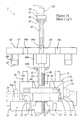
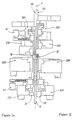
- Figure 1 is an exploded view of two embodiments of the powder metal press of the present invention.
- Sheet I of 3 of Figure 1 illustrates the lower portions of a tool set of the present invention including a core rod, lower inner punch assembly, lower outer punch assembly and rotating lower die assembly.
- Sheet 2 of 3 of Figure 1 illustrates a corresponding upper portion of the tool set of the present invention including a rotating upper die assembly, upper outer punch assembly, and inner punch assembly.
- Sheet 3 of 3 of Figure 1 illustrates an alternate embodiment of the lower portions of the tool set of the present invention, differing from Sheet 1 in having a rotating lower outer punch assembly.
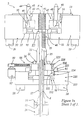
- Figure 2 is an exploded view of a third embodiment of the powder metal press of the invention of Figure 1.
- Sheet 1 of 2 illustrates the lower portions of a tool set of the invention of Figure 1 differing therefrom by a rotating lower outer punch assembly and a non-rotating lower die assembly.
- Sheet 2 of 2 of Figure 2 illustrates the upper portions of a tool set of the invention of Figure 1 differing therefrom by a rotating upper outer punch assembly and a non-rotating upper die assembly.
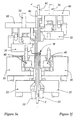
- Figure 3 shows a sequence of views, being Figures 3a through 3f which illustrate a progression of steps by which the invention as illustrated in sheets 1 and 2 of 3 of Figure 1 is used to compress powder metal to form a powder metal powder compact
- Figure 3a shows a cross-section of a tool set in the filling position.
- Figure 3b shows the same tool set with upper and lower portions brought together prior to the transfer step.
- Figure 3c shows the tool set after transfer and before compaction.
- Figure 3d shows the tool set after compaction and before withdrawal.
- Figure 3e shows the tool set after withdrawal and before ejection.
- Figure 3f shows the tool set in the ejection position.
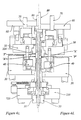
- Figure 4 shows a sequence of views, being Figures 4a through 4f which illustrates the progression of steps by which the invention as illustrated in sheets 2 and 3 of 3 of Figure 1 is used to form a green powder metal compact, Figures 4a, 4b, 4c, 4d and 4f corresponding to Figures 3a, 3b, 3c, 3d and 3f and Figure 4e illustrating a tool set after top ram retraction (ejection).
- Figure 5 shows a sequence of views, being Figures 5a through 5f, corresponding generally to Figures 3a through 3f, for the embodiment present invention shown in Figure 2, Figure 5e showing a partial withdrawal position, and Figure 5f showing a full withdrawal and ejection position.
- Figure 6 shows a variety of gears which may be produced with one or more of the embodiments of the invention of Figure 1.
- Figures 1 through 5 are all cross sectional views of powder metal compact press tool sets. Cross hatching has been omitted for clarity.
- a preferred embodiment of the tool set of the multiply acting powder compacting press of the present invention is shown on Sheet 1 of 3 of Figure 1 as 2, and has a central vertical axis 4. It comprises a number of assemblies which if described as distinct groups may facilitate understanding of the description of operation of the press hereinbelow.
- a core rod is shown as 6.
- Grouped assemblies are indicated as an inner lower transfer punch assembly 10, an outer lower punch assembly 20, a lower die support assembly 30, a lower die carrier 40, an upper die carrier SO, an upper, outer punch assembly 60, an upper die support assembly 70, and an upper, inner, pre-lift punch assembly 80.
- four sets of bearings are shown. They are a lower thrust bearing 91, a circumferential captured ball bearing race, or lower rotational bearing 92, an upper thrust bearing 93, and an upper rotational bearing 94.
- core rod 6 is a solid shaft which may be moved vertically along central axis 4, of press 2.
- Rod 6 may also comprise a radially extending spline 8, or splines, as desired.
- a single such spline with rectangular cross section may be used to form a keyway in the resultant part.
- Male spline 8 may as easily be a straight keyway or straight spur gear profile.
- Inner lower transfer punch assembly 10 includes an inner lower transfer punch 11, having a radially extending flange 12, a retaining ring 14, and an inner pedestal 16 which may be vertically driven by a ram. Retaining ring 14 captures flange 12 against pedestal 16.
- transfer punch 11, and indeed all of transfer punch assembly 10 is mounted concentrically about axis 4 in close tolerance sliding relationship about rod 6.
- Inner lower transfer punch 11 has an annular distal end face 17 perpendicular to, and concentric about, axis 4.
- the external, outer face of transfer punch 11 is smooth in the vertical direction, having neither helical splines nor threads, but, as noted, under same circumstances an external spline, or spur gear profile could be used, in a manner similar to male spline 8 of core rod 6.
- Outer lower punch assembly 20 includes an outer lower punch 21 having a radially extending flange 22, a support plate 24, a retaining ring 26, and a pair of driving rams 28 or a mechanical equivalent.
- Support plate 24 has a central passage 25 to allow outer lower punch assembly 20 to be disposed concentrically about inner lower punch assembly 10, and a cavity 27 to accommodate relative travel of inner lower transfer punch 11.
- the distal end circumferential outer desired face 29 of outer lower punch has a helical gear profile corresponding to the profile of the final pan .
- Retaining ring 26 mounts to support plate 24 concentrically about axis 4 thus capturing flange 22 of lower outer punch 21.
- Lower outer punch 21 has an annular distal end face 23 perpendicular to and concentric with axis 4.
- Lower die support assembly 30 is also carried concentrically about axis 4. It comprises a main plate 31, a bearing locating ring 32, a filler wear plate 33, and a bearing retainer 34 having an outer bearing race 35.
- Main bearing plate 31 comprises a counterbore 36 terminating at a radially inwardly extending shoulder 37.
- Lower die assembly 30 is mounted on rams 39.
- rams 39 like rams 28, may actually be connecting rods driven by remotely located rams, not shown. In all cases the purpose of rams 39, or a mechanically equivalent substitute, is to control the position and motion of lower die assembly 30.
- Lower die carrier 40 is also mounted concentrically about axis 4 and comprises a lower die 41 , a clamping ring 42, having blind holes 43 in which transfer pins 44 are fixedly located.
- Lower die 41 has an inner face 45 which has the negative profile of the helical gear part desired and is suited for close tolerance helically sliding engagement of the externally threaded gear profile of outer face 29 of lower outer punch 21.
- Lower die carrier assembly 40 also comprises a carrier base 46.
- Bearing locating ring 32 is mounted upon shoulder 37 within bore 36, and serves as a radial retainer for a lower thrust bearing 91.
- Base 46 rests upon thrust bearing 91.
- Bearing retainer 34 is bolted to locating ring 32 to trap lower rotational bearing 92 between an inner bearing race 48 and outer bearing race 35, thus capturing base 46 and preventing vertical displacement of base 46 relative to main plate 31.
- a thick flange 47 of die 41 rests on base 46.
- Clamping ring 42 seats about die 41, capturing flange 47 as it is bolted to base 46.
- Filler wear plate 33 is mounted to main plate 31 about lower die carrier 40 to prevent wear of main plate 31 during repeated sweeping of powder metal.
- Upper die carrier 50 is also mounted concentrically about axis 4, and comprises an upper die 51; a main plate 52 into which die 51 seats; a bearing backing ring 53 to support main plate 52; at least one crank arm 54 mounted to, and at a location near the periphery of, main plate 52 and extending upwardly therefrom; a stub shaft 56a extending laterally from the distal end of crank arm 54; a roller 56 mounted in a conventional manner to rotate about stub shaft 56a; and a number of blind indexing holes 57 for intermittent enregistration of such torque transmitting stub shafts 44 as may protrude upwardly from assembly 40.
- An inner face 58 of die 51 carries the negative image of the helical gear face to be produced, but will be of an opposite hand to that of lower die 41.
- the outer circumferential face of backing ring 53 is provided with an inner bearing surface, or inner race 59 for engagement of bearing 94.
- Locking ring 55 is utilized to capture die 51 within plate 52.
- Upper outer punch assembly 60 again concentrically mounted about axis 4, includes upper outer punch 61 having a radially extending flange 62; a pedestal 63a to which upper outer punch 61 is mounted when flange 62 is captured by a retaining ring 63b; a main platen 65 to which pedestal 63a is fixedly mounted; at least one depending cam 66 affixed to an outer portion thereof, depending cam 66 itself having a cam surface 67; a central passage 64a to accommodate pre-lift assembly 80; and at least two through passages 64b and 64c for accommodating upper die support assembly 70.
- cam 66 depends in such a manner as to present cam surface 67 at a suitable radius from axis 4 to co-operate with roller 56, whose mutual interaction is more fully described hereinbelow.
- the downwardly extending, circumferential surface of outer upper punch 61 carries adjacent its distal end, a close tolerance mating male helical external profile 68 suitable for engagement with inner face 58 of upper die 51, again being oppositely handed to lower outer punch 21.
- Upper outer punch 61 comprises an annular, distal end face 69 perpendicular to axis 4.
- Upper die support assembly 70 co-axially mounted about axis 4, includes a disc 1 having a thick, downwardly extending skirt 72; an upper circumferential outer bearing ring 73 depending from skin 72, bearing retaining ring 73 comprising on its inwardly facing surface an outer bearing retaining race 74 which co-operates with inner race 59 of backing ring 53 to contain bearing 94; and at least two symmetrical pistons 75 Fixedly abutting the upper surface, or base, of disc 71.
- pistons 75 may be any mechanical equivalent of a piston, a ram or a connecting rod for controlling the reciprocating motion of upper die support assembly 70.
- disc 71 has a central aperture 79 through which pre-lift assembly 80, outer upper punch 61 and pedestal 63a are introduced and, in use, which aperture 79 accommodates the longitudinal reciprocating motion thereof.
- Downwardly extending skin 72 has an inner face 76 of a diameter chosen to surround in close tolerance upper thrust bearing 93, which seats therein and against the downwardly exposed inside face of the base of disc 71.
- the opposite, downward face of thrust bearing 93 engages the upward face of backing ring 53.
- Upper inner pre-lift assembly 80 is disposed concentrically along axis 4 in the same manner as the other assemblies. It includes upper inner, or pre- lift punch 81, having a radially extending flange 82; a footing 83 against which pre-lift punch 81 is held in abutting relationship by a retaining ring 84; and piston 86 which abuts the opposite face of footing 83.
- Prelift punch 81 comprises a distal annular face 85 perpendicular to axis 4.
- Upper die 51 and lower die 41 need not necessarily be of the same diameter; they need not be in phase, that is to say, the addendum of a tooth on one half may, for example, be aligned opposite the dedendum between teeth on the opposite side. It is nonetheless anticipated that the majority of pans manufactured by the instant apparatus and method will be opposed double helical, symmetrical, in phase gears, commonly referred to as herringbone gears.
- a tool set may be defined as comprising core rod 6, inner lower transfer punch 11, lower outer punch 21, lower die 41, upper die 51, upper outer punch 61 and pre-lift punch 81.
- the tool set comprises those pans which contact the powder, and which constitute the negative images of the faces of the compact eventually produced.
- the tool set need not always include a pre-lift punch, and, although uncommon, may not necessarily include a core rod.
- Figure 3a illustrates a filling position in which the upper and lower pans of press 2 are separated.
- Rod 6 is at its first position, and stands flush with the upper face of lower die 41.
- Inner lower transfer punch 11 is at its lowest, retracted position.
- Outer lower punch 21 is at its first, highest, extended position.
- Lower die 41 is at its First, highest position, which is also the reference position of zero degrees of rotation.
- a lower cavity 100 is defined by the annular pocket formed between rod 6 and lower die 41, that pocket having two depths, a deep inner portion above lower inner transfer punch 11, and a shallower portion above outer lower punch 21.
- a charge of metal powder of the desired alloy, indicated as "A" is loaded into cavity 100, and swept level as shown in Figure 3b.
- core rod 6 has been advanced, thereby preventing powder from entering the central passage in pre-lift punch 81, and then the upper assemblies, that is, upper die carrier 50, upper outer punch assembly 60, upper die support assembly 70, and upper pre-lift assembly 80, have been advanced in unison such that the lower face of upper die 51 abuts the upper, mating face of lower die 41 at a parting plane 'P' defined by these abutting faces.
- This advance is a question of relative motion, since it may be achieved by moving either the upper assemblies or lower assemblies, whether singly or both at once.
- the lower assemblies that is inner lower transfer punch assembly 10, outer lower punch assembly 20, lower die support assembly 30, and lower die carrier 40, remain stationary while the upper assemblies 50, 60, 70 and 80 advance.
- Stub shafts 44 register within indexing holes 57.
- Disc 71 is at its maximum extension from platen 65.
- Roller 56 is at its first, zero degrees of rotation position relative to cam face 67.
- Upper die 51 is at its first, most extended position relative to upper outer punch 61.
- Upper inner, pre-lift punch 81 is at its maximum, extended position relative to platen 65.
- Upper cavity 102 is defined by the annular space between rod 6 and the inner face of upper die 61, the top of the cavity being stepped, a first step corresponding to the distal end face 85 of pre-lift punch 81, and the second, outer step corresponding to the distal end 69 of outer upper punch 61.
- Transition from Figure 3b to Figure 3c is the step of transferring uncompressed powder to fill cavity 102 with powder transferred from cavity 100 as the volume of cavity 100 decreases due to the advance of inner lower transfer punch 11.
- inner lower punch assembly 10 remains stationary while rod 6 and all of assemblies 20, 30, 40, 50, 60, 70, and 80 advance downwardly together to a second, longitudinal, transfer position.
- the relatively raised position of prelift punch 81 encourages powder to travel radially to fill the radial gear tooth extremities of dies 41 and 51.
- pressure builds against pre-lift punch 81 and it retracts relative to outer upper punch 61. The limit of this retraction is reached when footing 83 abuts main platen 65.
- the last step in the process is to eject the finished part by advancing punch 11. Once workpiece 'B' has been removed punch 11 may be withdrawn, and all other assemblies returned to the positions shown in figure 3a to await a subsequent charge of powder metal.
- the relationship of the helical threads of the dies 41 and 51 relative to punches 21 and 61 respectively ensures that roller 56 is once again positioned in the first, zero degrees of rotation position before the next cycle starts.
- the process of operation of the preferred embodiment has been described with reference to the body of the press. It may also be described relative to the workpiece, or relative to a press whose upper and lower assemblies have equal and opposite motion relative to a fixed datum.
- the press would appear, in terms of relative motion to move from a first, transfer position in which dies 41 and 51 are in longitudinal (relative to axis 4) abutting relationship and the outer punches 21 and 61 are in a retracted, spaced apart relationship, a cavity 104, the sum of cavities 100 and 102, being formed within the space bounded peripherally by dies 41 and 51 and the punches 11, 21, and 61, and 81 if present.
- Punch 11 would appear to move relative to the plane of abutment 'P' of dies 41 and 51, which may be considered a longitudinal datum, to distribute powder throughout cavity 104.
- punches 11, 21, and 61, and 81 if present, appear to move equally toward the datum of plane 'P' to a second, advanced, spaced apart position while simultaneously rotating dies 41 and 51 through an angle along the helices of punches 21 and 61 between the retracted and advanced positions such that dies 41 and 51 are maintained in their abutting relationship.
- punches 21 and 61 appear stationary relative to datum plane 'P', and dies 41 and 51 continue turning to a fully rotated position, such as may be chosen, which causes them to separate.
- the partially rotated position may be 300 and the fully rotated position may be 600. These values depend on the choices of helix angle and gear thickness.
- Herringbone gears having a helical pitch angle less than 15 or 20 degrees and modest thickness may usually be made with auto-rotating dies. The likelihood of jamming and excessive wear of punches and dies increases as helical pitch angle increases. For helical pitch angles greater than 30 degrees a rotational drive is usually necessary. Between 15 and 30 degrees one may require tests to be conducted to determine whether auto-rotation will be satisfactory.
- the preferred embodiment shown in Figures 3a through 3f can be used to make double opposed helical gears, whether in or out of phase, and whether of an equal number of teeth or not, and whether of similar diameter or not, provided that the upper and lower helical threads are of opposite hands and provided that the upper and lower dies 41 and 51 rotate through the same angle during compression. If dies 41 and 51 do not rotate through the same angle and if compression is not proportionate to the final upper and lower pan thickness above and below the die parting plane 'P' the powder charge is subject to shearing.
- the preferred use of this embodiment is for making symmetrical, double opposed helical gears, or herringbone gears, shown in Figure 6 as item 110 without a hub, and as item 115 with a hub.
- Other pans that can be produced with the tool set of Figures 3a through 3f are a split phase double opposed herringbone gear 120; opposed helices of differing number of teeth, but the same pitch angle, 125; an under-cut opposed double helical gear 130 having an upper gear of smaller diameter than the lower gear, and an overcut gear 135 having an upper gear of greater diameter than the lower gear ; and asymmetrical double opposed helical gears having the same total angle of rotation, such as item 140.
- Item 140 illustrated in Figure 6, is a double helical gear with an upper gear portion 142 thrice as thick as the lower gear portion 144.
- the relative advance of punch 61 in die 51 would also be thrice the relative advance of punch 21 within die 41 to maintain the neutral plane of the powder charge at, or near, parting plane 'P' of dies 51 and 41.
- the present invention permits the fabrication of double helical gears having upper and lower gear portions, that are of substantially equal diameter or whose diameters vary by less than the sum of (a) the dedendum of the larger diameter gear portion, (b) the addenda of the smaller diameter gear portion, and (c) 2 millimetres.
- lower outer punch assembly 20 has been modified to include a rotational drive, and as modified is shown as rotationally driven lower outer punch assembly 220.
- Outer lower punch 21, radially extending flange 22, retaining ring 26 and rams 28 remain as before.
- Outer lower punch 21 is supported by driven support plate 223, itself mounted on inner ring 224.
- the remainder of driven lower outer punch assembly 220 comprises retaining ring 225, main base 227, ball bearings 95, thrust bearing 96, a motor 97 and drive, such as a timing chain 98.
- Main base 227 is provided with an internal radially extending shoulder, or shelf, 221, on which thrust bearing 96 rests, surmounted in turn by inner ring 224, which is provided with an outward and upwardly facing ball race 222 for accommodating ball bearings 95.
- Retaining ring 225 is provided with a bearing race 226 and is located on main base 227 above ball bearings 95.
- Motor 97 may be mounted to main base 227. In the figures motor 97 is shown, for convenience of drawing, in the plane of the drawing. in practical use motor 97 would be mounted out of the plane of the drawing to interfere least with vertical reciprocation of lower die support assembly 30, and specifically, not to interfere with rams 39.
- Driven support plate 223 may carry a gear tooth profile 228 for engagement with timing chain 98, itself driven by a pinion 99 mounted to motor 97.
- motor 97 will cause rotation of driven support plate 223, and, consequently, lower outer punch 21.
- driven lower outer punch assembly 220 could be caused to turn in a number of ways.
- gears of low pitch angle, and thin or moderate thickness auto-rotation of lower outer punch 21 within lower die 41 as rams 28 are driven vertically relative to rams 39 may be suitable.
- a motor, as shown, or a cam system, or other known mechanical or electromechanical device could be used to achieve equivalent friction counteracting torque and motion.
- FIG. 4a through 4f A typical operating sequence for the second embodiment of the tool set of the present invention is illustrated in Figures 4a through 4f, in this case to produce a green powder compact of strongly differing helical pitch angles.
- Figures 4a, 4b and 4c correspond to the filling and pre-compaction steps of Figures 3a, 3b and 3c.
- lower outer punch 21 is driven in the appropriate direction at the appropriate speed to achieve the same vertical rate of compaction as upper outer punch 61 relative to parting plane 'P'. If dies 51 and 41 are not of equal depth lower outer punch 21 can be caused to rotate at an appropriate rate to achieve proportionate compaction above and below parting plane 'P'. For example, if it is desired to produce a lower gear of thrice the thickness of the upper gear, yet with an equal, opposite pitch angle, and diameter, lower outer punch 21 may be rotated through twice the angle of rotation of dies 41 and 51, and advanced thrice as far within lower die 41 as upper outer punch 61 is advanced within upper die 51.
- distal face 23 of lower outer punch 21 to the lower face of powder charge 'A' precludes the introduction of keyways between inner lower punch 11 and outer lower punch 21, and limits the location of drive slots or eccentric features in the compacted pan in the region adjacent distal face 23.
- distal face 23 must be of constant cross section at any given radius about axis 4, preferably flat, to avoid imposing excessive shear in the powder.
- rotation of lower outer punch 21 relative to the body of powder charge "A" is less likely to cause shearing of teeth at the interface of the upper and lower dies, or vice versa.
- asymmetric die withdrawal and ejection are possible.
- the dies are withdrawn at the same rate of rotation until one die, for example die 51, clears workpiece 'B' at which time pins 44 also clear indexing holes 57, after which time in the second phase of withdrawal the other die, in the example die 41, can be rotated relative to punch 21 as desired to clear the remainder of workpiece 'B', and the part may be ejected.
- pins 44 do not clear indexing holes 57 at the start of the second withdrawal phase, in which case upper punch 61 would protrude through die 51.
- Upper punch 61 and upper die 51 may be retracted longitudinally away from workpiece 'B' between the first and second phases of withdrawal.
- driving lower outer punch 21 rotationally permits one to form, in addition to items 110, 115, 120, 125, 130, 135, and 140, with appropriately configured die and punch gear profiles, a combination helical gear and spur gear 145, and gears having the same or different pitches and different thicknesses, 150.
- any of the gears produced may have the same or different numbers of teeth, and the same or different diameter, and may be in or out of phase.
- a spur gear profile is produced in the special case in which one helix angle is set at zero degrees.
- the apparatus of the present invention may be used to make a gear having two helical gears of the same hand but different helix angles, as illustrated in item 160, but in that instance upper and lower die carriers 40 and 50 would, in the general case, apparently require independent rotational motions (i.e. autorotational or driven) without any interlink mechanism such as pins 44 and indexing holes 57. That is, it appears that two pan helical gears of the same hand but unequal pitch may be made by providing independent rotational motions to either (a) both dies and one outer punch or (b) one die and both outer punches. Drives for the independent rotational motions may be provided to reduce friction.
- the two stage withdrawal may also be achieved, with independent rotation of upper and lower punches, in two completely separate phases.
- upper die 51 is withdrawn along punch 61 until clear of workpiece 'B'.
- second phase lower die 41 is withdrawn along punch 21 to expose the part.
- a press that involves three independent rotational motions, whether driven, or especially if auto-rotating, may be expected to be more difficult to produce than one requiring only two drives, and much more difficult than one requiring only a single rotational drive.
- the practical difficulties of constructing a suitable press, tool rig, (ie. hold all tool elements) and tool set may militate against its actual production, particularly as the helical pitch angle increases. This same cautionary- consideration might well be applied to a lesser extent to all gears more complex than the matched herringbone gears of the preferred embodiment.
- a third embodiment of a tool set, for producing double opposed helical gears is shown in exploded form in Figure 2.
- neither of the upper or lower dies is mounted for rotation, whereas both upper and lower outer punches are rotatably mounted.
- Lower outer punch assembly 220 is as described above.
- Lower die assembly 230 comprises a lower die 231, a die carrier or platen 232, a retainer 233, a filler wear plate 234, and rams 239, or equivalent.
- Lower die 231 is mounted in carrier 232, which is captured in place by retainer 233 .
- Vertical reciprocation of lower die assembly 230 is controlled by driven rams 239 mounted to carrier 232.
- die 231 is unable to rotate relative to carrier 232 or rams 239, and is no longer provided with a drive mechanism or transfer pins.
- Die 231 has a negative helical gear profile 236 for mating with helical profile 29 of punch 21.
- Upper outer die assembly 250 comprises upper die 251 mounted in upper die carrier 252, and locked in place with retaining ring 253.
- Rams 254 mounted to the upper face of upper outer punch assembly 250 control its vertical reciprocation.
- Upper outer punch assembly 260 comprises an upper outer punch, 261, having a radially extending flange 262, a retaining ring 263, a support base 264, ball bearings 291, a thrust bearing 292, a capture ring 266, a disc 265 having depending capture ring 266, and platen 267 which may be mounted to rams, connecting rods, or other mechanical equivalents, not shown.
- a drive, shown as 297, has a timing chain 298 driven by a pinion 299.
- drive 297, chain 298, and pinion 299 are shown for the convenience of drawing in the plane of sheet 2 of 2 of Figure 2, but would, in practice, be disposed out of the plane of the page to avoid interference with the vertical reciprocation of other assemblies, such as upper die assembly 250, and in particular, rams 254.
- Upper die 251 has a negative helical gear profile for mating with a helical gear profile 268 of punch 261.
- motor 297 and timing chain 298 are shown for rotationally driving lower outer punch 21 and upper outer punch 261, auto-rotation may be adequate in some circumstances, and alternative mechanically or electromechanically equivalent variations could be used.
- This third embodiment of the invention can be used to form herringbone gear workpieces.
- the same restrictions to the use of splines, keyways, and eccentric features noted above apply to the third embodiment since both upper and lower punches may experience rotation with respect to the powder charge during compaction.
- the motion is relative motion, since parting plane 'P' may move relative to the stationary press.
- the transfer step will end with the opposing distal face 270 of upper outer punch 261 6 cm apart from distal face 23 of lower outer punch 21, with face 270 2 cm above plane 'P', and face 23 4 cm below plane 'P ⁇ .
- the relative vertical advance of upper outer punch 261 must be half that of lower outer punch 21, and must occur at half the rate.
- this proportionate advance will dictate the angle and rate of rotation necessary for the upper and lower outer punches. For example, if the chosen lower helix angle is 15° and upper chosen helix angle is 45° then the upper outer punch 261 must rotate (1/2)(1.5/2.5)(TAN45°/TAN 15°) times as far, and as fast, as lower outer punch 21.
- the withdrawal step may then be said to be sub-divided into a lust gear clearing portion, in which punches 261 and 21 rotate through an equal angle relative to dies 231 and 251 to disengage a First die from workpiece 'B', and a second gear clearing portion in which workpiece 'B' and at least one of punches 261 or 21 rotate relative to the die, 231 or 251, which continues to engage workpiece 'B' until that die also clears workpiece 'B'.
- a lust gear clearing portion in which punches 261 and 21 rotate through an equal angle relative to dies 231 and 251 to disengage a First die from workpiece 'B'
- a second gear clearing portion in which workpiece 'B' and at least one of punches 261 or 21 rotate relative to the die, 231 or 251, which continues to engage workpiece 'B' until that die also clears workpiece 'B'.
- the third embodiment of the invention can be used to make herringbone gears and opposite handed gears.
- Examples of the gears which may be produced with the third embodiment include items 110, 115, 120, 125, and 130.
- the upper and lower punches are permitted to rotate independently of each other one can also form items 135 and 140.
- Item 145 can be produced with non-rotating dies and a single rotating, lower punch using a two stage withdrawal in which the upper assemblies of the press are withdrawn first to expose the spur gear.
- one embodiment of the present invention includes a tool set for making double helical gear green powder compacts, that tool set comprising a lower punch 21 having a first helical gear profile 29 and a lower die 41 having a mating negative helical profile 45 for helically sliding engagement with punch 21, an upper, opposed punch 261 having a second helical profile 268 from punch 21, an upper die 251 having a mating negative helical profile 268 for helically sliding engagement with punch 261, punch 261 disposed in opposition to punch 21 and dies 41 and 251 movable to abut at a parting plane 'P'.
- the present invention may further include, as installed in a multiply-acting press having an axis 4 of reciprocation, a core rod 6 and a transfer punch 11, punch 21 being concentric with transfer punch 11 and having a distal end face 23 for contacting a charge of powder 'A', upper punch 261 concentric with axis 4 and having a distal end face 270 for contacting that charge of powder 'A', the tool set movable to a filling position for receiving that charge of powder; a closed position in which dies 41 and 251 define the periphery of a cavity 104 having an upper portion bounded by die 251 and a lower portion bounded by die 41; a transfer position; a compaction position; at least one withdrawal position; and an ejection position.
- helical gear profile 29 may be of the same hand or opposite hand as second helical gear profile 268 and chosen from the group of helical gear profiles that are at least one of a) out of phase with; b) of different diameter from; c) of different helical pitch from; d) of a differing number of teeth from; or e) of a different helical tooth profile from, helical gear profile 268.
- the tool set may include a set of as many as three drives chosen from a) a first drive for independently rotating upper die 251, a second drive for independently rotating upper punch 261, and a third drive for independently rotating lower punch 21; or b) a first drive for independently rotating upper die 251, a second drive for independently rotating lower die 41, and a third drive for independently rotating one of i) lower punch 21 or ii) upper punch 261.
- This invention may further include a method for making double helical gear powder compacts with the tool set described above in a multiply acting powder press, that method including a) filling that cavity lower portion with a charge of powder 'A'; b) displacing dies 41 and 251 to abut at parting plane 'P'; c) displacing transfer punch 11 to distribute metal powder throughout cavity 100; d) compacting the charge of powder to form a green compact by advancing upper and lower punches 261 and 21 simultaneously and proportionately toward plane 'P' while upper punch 261 rotates relative to die 251 and lower punch 21 rotates relative to die 41; e) withdrawing one of (a) die 251 by retracting it along upper punch 261 while rotating die 251 along helical profile 268 ; or (b) die 41 by retracting it along lower punch 21 while rotating die 41 along helical profile 29, to a first withdrawal position in which that die clears compact 'B'; withdrawing the other die by retracting it along the other punch while rotating
- helical gear profile 29 being of opposite hand to helical gear profile 270, with or without a set of drives chosen from a) a first drive for independently rotating die 251, a second drive for independently rotating punch 261, and a third drive for independently rotating punch 21; or b) a first drive for independently rotating die 251, a second drive for independently rotating die 41, and a third drive for independently rotating one of i) punch 21 ii) punch 261.
- the invention may be practiced with a tool set in which dies 41 and 251 are constrained to have the same angular orientation about the axis, and the tool set may include drives chosen from a) a first drive for rotating die 251 and die 41 together, and a second drive for independently rotating one of i) punch 261 or ii) punch 21; or b) a first drive for independently rotating punch 261 and a second drive for independently rotating punch 21, in which case one may use a method for making asymmetric double helical gear green powder compacts of the same hand, that method comprising the steps of a) filling cavity 104 lower portion with a charge of powder 'A'; b) displacing dies 41 and 251 to abut at plane 'P' with said opposing distal end faces 23 and 270 proportionately distant from plane 'P'; c) displacing transfer punch 11 to distribute the charge of powder 'A' throughout cavity 100; d) compacting charge of powder 'A' to form a green powder
- the invention may also be practiced with a tool set in which dies 41 and 251 are constrained to maintain a fixed angular orientation relative to axis 4.
- the invention includes a tool set for making herringbone gear green powder compacts, that tool set comprising a first punch 21 having a helical gear profile 29, a first die 231 having a mating negative helical profile for helically sliding engagement with punch 21; a second, opposed punch 261 having an equal, opposite handed helical profile 268; a second die 251 having a mating negative helical profile for helically sliding engagement with punch 261; dies 231 and 251 movable to abut at parting plane 'P'.
- That tool set may be installed in a multiply acting press having an axis 4, and may further comprise a core rod 6 concentric with axis 4 and a transfer punch 11 concentric therewith; punch 21 concentric with punch 11 and having a distal end face 29 for contacting a charge of powder 'A'; punch 261 concentric with axis 4 and having a distal end face 270 for contacting powder; the tool set movable to a filling position for receiving charge of powder 'A'; a closed position in which dies 231 and 251 define the periphery of a cavity 104, that cavity having an upper portion bounded by upper die 251 and a lower portion bounded by die 231; a transfer position; a compaction position; at least one withdrawal position; and an ejection position.
- dies 231 and 251 are constrained to have the same angular orientation relative to axis 4 and punches 261 and 21 are constrained to have a fixed angular orientation relative thereto.
- punches 261 and 21 may have the same angular orientation relative to axis 4 and dies 231 and 251 may be constrained to have a fixed angular orientation relative thereto.
- the tool set may include a drive for rotating dies 231 and 251 relative to punches 261 and 21.
- an upper die 51 is carried in an upper die carrier 50 and lower die 41 is carried in a lower die carrier 40, one of the upper or lower die carriers having registration sockets, or holes 57 and the other of said upper die carrier or said lower die carrier comprising transfer pins, or stub shafts 44, for registration therein; and the drive may comprise a cam mounted fixedly to one of upper punch 61 or upper die carrier 50; and a cam follower, for example roller 56, linked to the other; the cam follower disposed to ride along the cam whereby displacement between the upper punch 61 and upper die carrier 50 compels the cam follower to ride along the cam and compels dies 41 and 51 to rotate relative to upper punch 61.
- the tool set is movable to a filling position for receiving a charge of powder metal 'A'; a transfer position; a compaction position; and a withdrawal position.
- dies 41 and 51 are disposed in longitudinally abutting, unrotated relationship; punches 21 and 61 are in a first, retracted, opposed, spaced apart relationship; whereby cavity 104 for containing the powder metal charge 'A' is defined longitudinally by opposed faces 23 and 69 and peripherally by dies 41 and 51;
- punches 21 and 61 are in a second, advanced, opposed, spaced apart relationship, dies 41 and 51 remaining in abutting relationship; then dies 41 and 51 are moved to a partially rotated position whereby cavity 104 is reduced in size to compact powder charge 'A'; and in the withdrawal position punches 21 and 61 remain in the advanced, opposed, spaced apart relationship; and dies 41 and 51 are disposed in a fully rotated position whereby moving dies 41 and 51 to the fully rotated
- the tool set may have a pitch drive for coordinating rotation of dies 41 and 51 during longitudinal translation of punches 21 and 61 , the pitch drive receiving mechanical input from the motion of punch 21 or 61 and providing output to die 41 or 51; that pitch drive may be a cam and roller mechanism with one of a) a cam or b) a roller in rigid structural relationship to one of lower or upper punches 21 or 61; the other being in rigid structural relationship with the corresponding lower or upper one of dies 41 or 51, whereby longitudinal translation of that punch relative to that die compels rolling engagement of the roller and cam, yielding consequential rotation of the die relative to the punch. Dies 41 and 51 may be constrained to rotate conjointly.
- the invention includes a method for making herringbone gear powder compacts using that tool set in a multiply acting press, that method comprising a) filling a lower portion of cavity 104 with a charge of powder 'A'; b) displacing dies 41 and 51 to abut at parting plane 'P' with opposing distal end faces 69 and 23 of punches 21 and 61 proportionately distant from said plane 'P'; c) displacing transfer punch 11 to distribute the charge of powder throughout cavity 104; d) compacting charge of powder 'A' to form a compact 'B' by advancing punches 21 and 61 equally, and transfer punch 11 proportionately, toward parting plane 'P' while dies 41 and 51 rotate equally relative to punches 21 and 61; e) withdrawing both of i) die 51 along punch 61, and ii) lower die 41 along punch 21, during equal relative rotation of dies 41 and 51 relative to punches 21 and 61 and compact 'B', to a
Landscapes
- Engineering & Computer Science (AREA)
- Mechanical Engineering (AREA)
- Manufacturing & Machinery (AREA)
- Powder Metallurgy (AREA)
- Preparation Of Clay, And Manufacture Of Mixtures Containing Clay Or Cement (AREA)
- Press Drives And Press Lines (AREA)
- Physical Or Chemical Processes And Apparatus (AREA)
Claims (31)
- Werkzeuggarnitur zum Pressen eines Bauteils aus einer Metallpulvercharge mitdadurch gekennzeichnet, dass die Stempel (61, 21) in fester räumlicher Zuordnung zueinander haltbar sind, um das Bauteil während der Bewegung der Gesenke (51, 41) aus der Schließstellung in die Abzugstellung abzustützen, wobei eines der Gesenke (41) bei der Bewegung aus der Schließstellung in die Abzugstellung relativ zum zugehörigen Stempel (21) drehbar ist.einem Paar Gesenke (51, 41) jeweils mit einer Kammer (102, 100), die mindestens einen Teil des Bauteils definiert, und einem Paar Stempel (61, 21), die jeweils einem der Gesenke (51, 41) zugeordnet und relativ zu dem zugehörigen Gesenk bewegbar sind, um die Kapazität der zugehörigen Kammer zu verändern,wobei die Gesenke (51, 41) zwischen eine Offenstellung, in der sie voneinander getrennt sind, und einer Schließstellung relativ zueinander bewegbar sind, in der sie zusammenwirkend einen geschlossenen Formhohlraum (104) bilden, undwobei die Stempel bei in der Schließstellung befindlichen Gesenken entlang einer Achse (4) zueinander bewegbar sind, um die Charge zu verpressen und das Bauteil zu erzeugen,
- Werkzeuggarnitur nach Anspruch 1, dadurch gekennzeichnet, dass weiterhin das drehbare Gesenk (41) ein Schrägprofil zum Eingriff mit einem Schrägprofil auf dem zugehörigen Stempel (21) hat, wobei das Schrägprofil eine Relativbewegung zwischen dem drehbaren Gesenk und dem zugehörigen Stempel einschränkt.
- Werkzeuggarnitur nach Anspruch 1, dadurch gekennzeichnet, dass weiterhin das drehbare Gesenk und der zugehörige Stempel zueinander passende Wendelprofile (29, 45) aufweisen, so dass eine Bewegung des Gesenks aus der Schließ- in die Abzugstellung eine Drehung des Gesenks um den zugehörigen Stempel bewirkt.
- Werkzeuggarnitur nach Anspruch 1, dadurch gekennzeichnet, dass weiterhin die Gesenke (51, 41) bei der Bewegung aus der Schließstellung in die Abzugstellung gemeinsam relativ zu den Stempeln (61, 21) drehbar sind.
- Werkzeuggarnitur nach Anspruch 1, dadurch gekennzeichnet, dass weiterhin in der Offenstellung einer der Stempel (21) relativ zum zugehörigen Gesenk (41) eine Füllstellung einnimmt derart, dass die zugehörige Kammer (100) die Kapazität zur Aufnahme der Pulvercharge hat.
- Werkzeuggarnitur nach Anspruch 5, dadurch gekennzeichnet, dass in der Schließstellung der eine Stempel (21) entlang de Achse (4) in eine Übergabestellung bewegbar ist, in der die zugehörige Kammer (100) ein vermindertes Volumen aufweist, wobei eine Bewegung des Stempels (21) in die Übergabestellung Pulver in die andere der Kammern (102) überführt.
- Werkzeuggarnitur nach Anspruch 1, dadurch gekennzeichnet, dass weiterhin die Stempel (61, 21) in in der Offenstellung und in der Schließstellung in die zugehörigen Gesenke (51, 41) eingreifen.
- Werkzeuggarnitur zur Ausbildung eines Pulverpresslings mit einem Paar gegenüber liegender Gesenk-Stempel-Sätze jeweils mit einem Gesenk (51, 41) und einem Stempel (61, 21), die zusammenwirken, um zugehörige Kammern (102, 100) zu bilden, wobei die Gesenke (51, 41) relativ zu einander aus einer Offenstellung, in der sie getrennt sind, in eine Schließstellung bewegbar sind, in der sie mit ineinander übergehenden Kammern (102, 100) aneinander liegen, um einen geschlossenen Formhohlraum (104) zu bilden, und wobei die Stempel (61, 21) in der Schließstellung zueinander hin bewegbar sind, um das Pulver zu verdichten und so den Pressling auszubilden, dadurch gekennzeichnet, dass die Gesenke (51, 41) durch Bewegung entlang einer Achse (4) aus der Schließstellung heraus lösbar sind, um den Pressling freizulegen, wobei die Gesenke (51, 41) beim Freilegen des Presslings sich gemeinsam drehen.
- Werkzeuggarnitur zur Ausbildung eines Pulverpresslings mit einem Paar gegenüber liegender Gesenk-Stempel-Sätze jeweils mit einem Gesenk (51, 41) und einem Stempel (61, 21), die zusammen wirken, um zugehörige Kammern (102, 100) zu bilden, wobei die Gesenke (51, 41) relativ zu einander aus einer Offenstellung, in der sie getrennt sind, in eine Schließstellung bewegbar sind, in der sie mit ineinander übergehenden Kammern (102, 100) aneinander liegen, um eine geschlossenen Formhohlraum (104) zu bilden, dadurch gekennzeichnet, dass einer der Sätze einen Stempel (21) aufweist, der in der Schließstellung relativ zum Gesenk (41) entlang einer Achse (4) in einer Übergabestellung bewegbar Achse (4) in einer Übergabestellung bewegbar ist, in der die eine Kammer (100) ein vermindertes Volumen hat und Pulver in die andere Kammer (102) überführt wird, wobei die Gesenke (51, 41) durch Relativbewegung entlang der Achse (4) aus der Schließstellung lösbar sind und bei einer solchen Bewegung entlang der Achse (4) zum Freilegen des Presslings mindestens eines der Gesenke (51, 41) relativ zum zugehörigen Stempel (61, 21) dreht.
- Werkzeuggarnitur nach Anspruch 9, dadurch gekennzeichnet, dass weiterhin in der Offenstellung die Gesenke (51, 41) jeweils im Eingriff mit dem zugehörigen Stempel (61, 21) bleiben.
- Werkzeuggarnitur nach Anspruch 9, dadurch gekennzeichnet, dass weiterhin bei der translatorischen Bewegung entlang der Achse (4) relativ zu einem der Stempel (61, 21) beide Gesenke (51, 41) um die Achse (4) drehbar sind.
- Werkzeuggarnitur nach Anspruch 9, dadurch gekennzeichnet, dass weiterhin die Gesenke (51, 41) gemeinsam um die Achse (4) drehbar sind.
- Werkzeuggarnitur nach Anspruch 9, dadurch gekennzeichnet, dass weiterhin das drehbare Gesenk (41) ein Schrägprofil zum Eingriff mit einem Schrägprofil des zugehörigen Stempels (21) aufweist, wobei das Schrägprofil eine Bewegung des drehenden Gesenks relativ zum zugehörigen Stempel einschränkt.
- Werkzeuggarnitur nach Anspruch 13, dadurch gekennzeichnet, dass weiterhin das Schrägprofil ein Wendelprofil (29, 45) ist.
- Werkzeuggarnitur nach Anspruch 9, dadurch gekennzeichnet, dass weiterhin in der Schließstellung die Stempel (61, 21) zueinander bewegbar sind, um die Charge zu verpressen und so den Pressling auszubilden, und dass beim Abziehen der Gesenke (51, 41) zum Freilegen des Presslings die Stempel (61, 21) in einer festen beabstandeten Zuordnung haltbar sind.
- Werkzeuggarnitur nach Anspruch 15, dadurch gekennzeichnet, dass weiterhin die Gesenke (51, 41) gemeinsam um die Achse (4) drehbar sind.
- Werkzeuggarnitur nach Anspruch 9, dadurch gekennzeichnet, dass weiterhin der eine Gesenk-Stempel-Satz einen zweiten Stempel (11) aufweist, der in das zugehörige Gesenk (41) eingesetzt ist.
- Werkzeuggarnitur nach Anspruch 9, dadurch gekennzeichnet, dass weiterhin der eine Stempel (21) relativ zum anderen Stempel (61) um die Achse drehbar ist.
- Verfahren zum Herstellen eines Pulverpresslings in einer Werkzeuggarnitur mit einem Paar gegenüber liegender Gesenk-Stempel-Sätze jeweils mit einem Gesenk (51, 41) und einem Stempel (61, 21), die zusammenwirken, um jeweils eine Kammer (102, 100) zu bilden, mit folgenden Schritten:a. Verbringen der Garnitur in eine Schließstellung, in der die Kammern (102, 100) miteinander in Verbindung stehen, um einen geschlossenen Hohlraum (104) zu bilden, der eine Pulvercharge enthält,b. Vorschieben der Stempel (61, 21) zueinander entlang einer Achse (4), um die Pulvercharge zu verdichten und so den Pressling auszubilden,c. Vorhalten der Stempel (61, 21) in einem festen gegenseitigen Abstand, während die Gesenke (51, 41) entlang der Achse (4) bewegt werden, um sie zu trennen und den Pressling freizulegen,d. Drehen mindestens eines der Gesenke (41) um die Achse (4) bei der Bewegung entlang der Achse (4) unde. Auswerfen des Presslings aus der Werkzeuggarnitur.
- Verfahren nach Anspruch 19, bei dem die Gesenke (51, 41) während des Trennens gemeinsam gedreht werden.
- Verfahren nach Anspruch 19, bei dem mindestens ein Gesenk (41) und ein Stempel (21) entlang eines Profils im Eingriff stehen, das relativ zu einer Hin- und Her-Verschiebungsachse der Garnitur geschrägt ist, und die Drehung durch den gegenseitigen Eingriff des Gesenks (41) mit dem Stempel (21) bei der Relativbewegung entlang der Achse (4) erzeugt wird.
- Verfahren nach Anspruch 22, bei dem das Gesenk (21) und der Stempel (21) entlang eines Wendelprofils (29, 45) im Eingriff stehen und die Drehung durch den Eingriff des Gesenks (41) und des Stempels (21) bei der Relativbewegung entlang der Achse (4) erzeugt wird.
- Verfahren nach Anspruch 22, bei dem im Schritt (c) einer der Stempel (21) relativ zum anderen der Stempel (61) um die Achse (4) gedreht wird.
- Verfahren nach Anspruch 19, bei dem im Schritt (a)(a) (i.) mit getrennten Gesenken (51, 41) und bei mit den Gesenken (51, 41) im Eingriff stehenden Stempeln (61, 21) begonnen wird und(a) (ii.) die Gesenke (51, 41) zur Schließstellung hin bewegt werden, während man den Eingriff der zugehörigen Stempel (61, 21) mit den Gesenken (51, 41) aufrecht erhält.
- Verfahren nach Anspruch 24, bei dem weiterhin der eine Stempel (21) entlang der Achse (4) in die Schließstellung bewegt wird, um Pulver aus der einen Kammer (100) zur anderen Kammer (102) zu übertragen.
- Verfahren nach Anspruch 24, bei dem die Gesenke (51, 41) ständig im Eingriff mit den Stempeln (61, 21) gehalten werden.
- Verfahren zum Herstellen eines Pulverpresslings in einer Werkzeuggarnitur mit einem Paar gegenüberliegender Gesenk-Stempel-Sätze jeweils mit einem Gesenk (51, 41) und einem Stempel (61, 21), der mit letzterem unter Bildung einer zugehörigen Kammer (102, 100) zusammenwirkt, mit folgenden Schritten:a. Es wird mit getrennten Gesenken (51, 41) begonnen;b. einer der Stempel (21) wird im zugehörigen Gesenk (41) in eine Füllposition gebracht, in der die zugehörige Kammer (100) eine Pulvercharge aufnehmen kann;c. die Gesenke (51, 41) werden in eine Schließstellung gefahren, in der sie aneinanderliegen, wobei die Kammern (102, 100) ineinander übergehen, um einen geschlossenen Hohlraum (106) zu bilden, der die Pulvercharge enthält;d. die Stempel (61, 21) werden entlang einer Achse (4) zueinander gefahren, um die Pulvercharge zu verdichten und damit einen Pulverpressling auszubilden;e. die Gesenke (51, 41) werden zum Freilegen des Presslings getrennt, indem man sie entlang der Ach-Achse (4) in entgegengesetzter Richtung bewegt, während mindestens eines der Gesenke (41) um die Achse gedreht wird; undf. der Pressling wird aus der Werkzeuggarnitur ausgeworfen.
- Verfahren nach Anspruch 27, bei dem im Schritt (e) die Gesenke (51, 41) gleichzeitig mit dem Trennen gedreht werden.
- Verfahren nach Anspruch 27, bei dem im Schritt (e) das Gesenk entlang eines Wendelprofils (25, 45) abgezogen wird.
- Verfahren nach Anspruch 27, bei dem im Schritt (c) in der Schließstellung einer der Stempel (21) relativ zum zugehörigen Gesenk (41) bewegt wird, um Pulver aus einer Kammer (100) zur anderen Kammer (102) zu überführen.
- Verfahren nach Anspruch 27, bei dem in den Schritten (a), (b) und (c) die Gesenke (51, 41) mit dem zugehörigen Stempel (61, 21) ständig im Eingriff gehalten werden.
Applications Claiming Priority (3)
| Application Number | Priority Date | Filing Date | Title |
|---|---|---|---|
| US647057 | 1991-01-29 | ||
| US08/647,057 US6165400A (en) | 1996-05-09 | 1996-05-09 | Compacted-powder opposed twin-helical gears and method |
| PCT/CA1997/000317 WO1997043067A1 (en) | 1996-05-09 | 1997-05-09 | Compacted-powder opposed twin-helical gears and method |
Publications (2)
| Publication Number | Publication Date |
|---|---|
| EP0909228A1 EP0909228A1 (de) | 1999-04-21 |
| EP0909228B1 true EP0909228B1 (de) | 2001-10-17 |
Family
ID=24595527
Family Applications (1)
| Application Number | Title | Priority Date | Filing Date |
|---|---|---|---|
| EP97917969A Expired - Lifetime EP0909228B1 (de) | 1996-05-09 | 1997-05-09 | Aus pulver gepresste doppelschraubenräder und ihre herstellung |
Country Status (9)
| Country | Link |
|---|---|
| US (1) | US6165400A (de) |
| EP (1) | EP0909228B1 (de) |
| JP (1) | JP4183280B2 (de) |
| AT (1) | ATE206976T1 (de) |
| AU (1) | AU2629797A (de) |
| CA (1) | CA2253491C (de) |
| DE (1) | DE69707456T2 (de) |
| ES (1) | ES2166075T3 (de) |
| WO (1) | WO1997043067A1 (de) |
Cited By (1)
| Publication number | Priority date | Publication date | Assignee | Title |
|---|---|---|---|---|
| RU2457069C1 (ru) * | 2010-12-28 | 2012-07-27 | Федеральное государственное бюджетное образовательное учреждение высшего профессионального образования "Московский государственный индустриальный университет" (ФГБОУ ВПО "МГИУ") | Способ штамповки осесимметричных тонкостенных деталей из порошковых материалов |
Families Citing this family (28)
| Publication number | Priority date | Publication date | Assignee | Title |
|---|---|---|---|---|
| US5865239A (en) * | 1997-02-05 | 1999-02-02 | Micropump, Inc. | Method for making herringbone gears |
| JP3341981B2 (ja) * | 1997-08-27 | 2002-11-05 | 本田技研工業株式会社 | はすば歯車のサイジング装置及びサイジング方法 |
| US6338289B1 (en) | 1998-06-02 | 2002-01-15 | New Bright Industrial Co., Ltd. | Gear box having plastic helical gears and L-shaped axles |
| GB2360825B (en) * | 2000-03-30 | 2004-11-17 | Formflo Ltd | Gear wheels roll formed from powder metal blanks |
| JP3687492B2 (ja) * | 2000-06-21 | 2005-08-24 | 株式会社村田製作所 | 誘電体ブロックのプレス成形方法 |
| DE10142805C2 (de) * | 2001-08-31 | 2003-10-16 | Gkn Sinter Metals Gmbh | Einteiliger Gelenkkörper |
| US7364803B1 (en) | 2004-07-14 | 2008-04-29 | Keystone Investment Corporation | High density dual helical gear and method for manufacture thereof |
| US7235201B2 (en) * | 2004-12-20 | 2007-06-26 | Borgwarner Inc. | Split die and method for production of compacted powder metal parts |
| KR101215038B1 (ko) * | 2005-03-18 | 2012-12-24 | 가부시키가이샤 제이텍트 | 금속원료용의 브리켓의 압축 성형기, 금속원료용의 브리켓의 제조장치, 및, 그 압축 성형방법 |
| JP4755436B2 (ja) * | 2005-03-18 | 2011-08-24 | 株式会社ジェイテクト | 金属原料用のブリケットの圧縮成形機、及び、金属原料用のブリケットの製造装置 |
| JP4506734B2 (ja) * | 2006-03-31 | 2010-07-21 | Tdk株式会社 | 成形装置 |
| US8033805B2 (en) | 2007-11-27 | 2011-10-11 | Kennametal Inc. | Method and apparatus for cross-passageway pressing to produce cutting inserts |
| JP4584301B2 (ja) * | 2007-12-20 | 2010-11-17 | トヨタ自動車株式会社 | プレス成形金型及びダブルヘリカルギヤの製造方法 |
| US8246415B2 (en) * | 2009-11-18 | 2012-08-21 | New Bright Industrial Co., Ltd. | Gear box for use in toy vehicles |
| DE102012207241A1 (de) * | 2012-05-02 | 2013-11-07 | Bielomatik Leuze Gmbh + Co. Kg | Vorrichtung zum Bearbeiten von blatt- oder bogenförmigen Gütern |
| EP2853322A1 (de) * | 2013-09-30 | 2015-04-01 | Seco Tools AB | Presse zur Herstellung eines Werkzeug-Grünkörpers mit einer spiralförmigen Nut, Verfahren zur Herstellung eines Werkzeug-Grünkörpers mit einem spiralförmigen Nut, und Werkzeug-Grünkörper mit einer spiralförmigen Nut |
| DE102014003726A1 (de) * | 2014-03-18 | 2015-09-24 | Gkn Sinter Metals Engineering Gmbh | Presse zum Herstellen maßhaltiger Grünlinge und Verfahren zum Herstellen |
| KR101692984B1 (ko) * | 2016-07-06 | 2017-01-17 | 정삼균 | 헬리컬 기어 제조용 분말 야금 프레스 금형 |
| DE102017114457B4 (de) | 2017-06-29 | 2019-08-08 | Gkn Sinter Metals Engineering Gmbh | Ebenenplatte eines Pressenwerkzeugs |
| DE102017114455B3 (de) * | 2017-06-29 | 2018-10-31 | Gkn Sinter Metals Engineering Gmbh | Ebenenplatte eines Pressenwerkzeugs |
| DE102017114458B4 (de) * | 2017-06-29 | 2019-10-10 | Gkn Sinter Metals Engineering Gmbh | Ebenenplatte eines Pressenwerkzeugs |
| DE102017114456B4 (de) * | 2017-06-29 | 2019-08-08 | Gkn Sinter Metals Engineering Gmbh | Ebenenplatte eines Pressenwerkzeugs |
| GB2572775A (en) * | 2018-04-10 | 2019-10-16 | Rolls Royce Plc | Methods of Manufacture |
| US11480239B2 (en) * | 2019-01-08 | 2022-10-25 | American Axle & Manufacturing, Inc. | Tooling and method for fabricating helical sector gear and related helical sector gear |
| US11707786B2 (en) * | 2020-04-17 | 2023-07-25 | PMG Indiana LLC | Apparatus and method for internal surface densification of powder metal articles |
| AT524440B1 (de) * | 2021-03-05 | 2022-06-15 | Miba Sinter Austria Gmbh | Vorrichtung zur Herstellung eines Zahnradgrünlings |
| CN114309604B (zh) * | 2021-12-15 | 2025-05-30 | 深圳市山柏智能设备有限公司 | 一种盘式凸轮压粉成型机构 |
| CN121535190B (zh) * | 2026-01-19 | 2026-05-12 | 厦门海洋职业技术学院 | 一种齿轮生产用金属粉末成型装置 |
Family Cites Families (37)
| Publication number | Priority date | Publication date | Assignee | Title |
|---|---|---|---|---|
| US2561735A (en) * | 1949-07-21 | 1951-07-24 | Haller John | Machine for molding helical gears |
| NL253507A (de) * | 1960-07-28 | |||
| GB1091321A (en) * | 1963-12-18 | 1967-11-15 | R Laurent Sa Atel | Apparatus for the production of helically toothed mechanical parts from sintered metals |
| BE759661A (fr) * | 1969-12-01 | 1971-04-30 | Hitachi Powdered Metals Cy Ltd | Dispositif de compression de poudre pour former un engrenage helicoidalcomprime |
| ZA715429B (en) * | 1970-09-10 | 1972-04-26 | Olivetti & Co Spa | A device for moulding parts to be sintered |
| GB1361684A (en) * | 1970-09-22 | 1974-07-30 | Olivetti & Co Spa | Device for moulding sinterin blanks |
| US4008021A (en) * | 1971-08-10 | 1977-02-15 | Schwelmer Eisenwerk Muller & Co. Gmbh | Apparatus for forming a sinterable compact of a powder |
| IT976216B (it) * | 1972-12-29 | 1974-08-20 | Olivetti & Co Spa | Dispositivo di formatura di pezzi elicoidali mediante compattazione di materiali in polvere |
| US3842646A (en) * | 1973-04-20 | 1974-10-22 | Gleason Works | Process and apparatus for densifying powder metal compact to form a gear having a hub portion,and preferred powder metal compact shape for use therewith |
| US3891367A (en) * | 1973-05-08 | 1975-06-24 | Olivetti & Co Spa | Apparatus for moulding helical gears by compression of powders |
| US4061452A (en) * | 1975-10-06 | 1977-12-06 | Wolverine Aluminum Corporation | Apparatus for producing spherical articles |
| US4061453A (en) * | 1975-10-06 | 1977-12-06 | Wolverine Aluminum Corporation | Tooling for a powder compacting press |
| US4047864A (en) * | 1975-10-06 | 1977-09-13 | Wolverine Aluminum Corporation | Apparatus for producing spherical articles |
| US4043385A (en) * | 1976-08-23 | 1977-08-23 | Mercury Machine Co. | Molding apparatus |
| US4053267A (en) * | 1976-10-22 | 1977-10-11 | Wolverine Aluminum Corporation | Die and punch assembly for compacting powder material |
| US4087221A (en) * | 1977-01-31 | 1978-05-02 | Remington Arms Company, Inc. | Apparatus for molding powder metal parts |
| US4153399A (en) * | 1977-09-08 | 1979-05-08 | Ptx-Pentronix, Inc. | Multiple punch tool set for powder compacting press |
| DE2924704A1 (de) * | 1979-06-19 | 1981-01-15 | Dorst Keramikmasch | Einrichtung zur festlegung der hoehe von pressteilen an einer presse, insbesondere zum pressen von pressteilen aus pulverfoermigem ausgangsmaterial |
| US4401614A (en) * | 1981-09-08 | 1983-08-30 | Ptx-Pentronix, Inc. | Anvil assembly for a powder-compacting anvil press |
| DE3142126A1 (de) * | 1981-10-23 | 1983-05-11 | Dorst-Keramikmaschinen-Bau Otto Dorst U. Dipl.-Ing. Walter Schlegel, 8113 Kochel | "presse zum herstellen masshaltiger presslinge aus pulverfoermigem material" |
| US4573895A (en) * | 1982-09-20 | 1986-03-04 | Ptx-Pentronix, Inc. | Adjustable die and punch assembly for compacting powder material |
| US4666389A (en) * | 1985-01-25 | 1987-05-19 | The Texas A&M University System | Apparatus for forming compacts from solid particles |
| EP0316475B1 (de) * | 1987-11-19 | 1991-03-20 | Gräbener Pressensysteme GmbH & Co. KG | Presse, insbesondere zum Herstellen masshaltiger Presslinge aus pulverförmigen Werkstoffen |
| US4853180A (en) * | 1987-11-19 | 1989-08-01 | Martin Sprocket & Gear, Inc. | Method of manufacturing bushings with powdered metals |
| DE3909757A1 (de) * | 1989-03-23 | 1990-09-27 | Dorst Masch & Anlagen | Presse mit einem in die presse einsetzbaren werkzeuggestell |
| DE3917277C2 (de) * | 1989-05-24 | 1994-01-20 | Mannesmann Ag | Verfahren und Vorrichtung zur Herstellung von Fertigteilen als Verbundkörper aus pulverförmigen Werkstoffen |
| DE3919821C2 (de) * | 1989-06-15 | 1994-04-07 | Mannesmann Ag | Verfahren und Vorrichtung zum Herstellen von maßhaltigen Preßlingen |
| DE3919847A1 (de) * | 1989-06-15 | 1990-12-20 | Mannesmann Ag | Verfahren und vorrichtung zur herstellung masshaltiger presslinge |
| JPH07115233B2 (ja) * | 1990-08-10 | 1995-12-13 | 株式会社ヨシツカ精機 | 粉末成形プレス |
| JPH04136107A (ja) * | 1990-09-25 | 1992-05-11 | Sumitomo Electric Ind Ltd | 焼結斜歯歯車の成形装置 |
| JP2856929B2 (ja) * | 1991-01-31 | 1999-02-10 | 日立粉末冶金株式会社 | 渦巻状焼結部品のプレス成形装置 |
| JPH05140609A (ja) * | 1991-02-08 | 1993-06-08 | Keita Hirai | 段付品汎用成型プレス |
| JPH05195011A (ja) * | 1991-08-17 | 1993-08-03 | Werkzeugbau Alvier Ag | 螺旋形状の輪郭を有する工作物をプレス成形するモジュラー装置 |
| JP2980484B2 (ja) * | 1993-06-14 | 1999-11-22 | コータキ精機株式会社 | ダイセット式粉末成形プレス機 |
| US5401153A (en) * | 1993-11-23 | 1995-03-28 | Yoshizuka Seiki Co., Ltd. | Press for powder metallurgy |
| AU5556894A (en) * | 1993-11-24 | 1995-06-13 | Stackpole Limited | Undercut split die |
| AU5556994A (en) * | 1993-11-24 | 1995-06-13 | Stackpole Limited | Phased split die |
-
1996
- 1996-05-09 US US08/647,057 patent/US6165400A/en not_active Expired - Lifetime
-
1997
- 1997-05-09 AT AT97917969T patent/ATE206976T1/de not_active IP Right Cessation
- 1997-05-09 CA CA002253491A patent/CA2253491C/en not_active Expired - Lifetime
- 1997-05-09 ES ES97917969T patent/ES2166075T3/es not_active Expired - Lifetime
- 1997-05-09 JP JP54033797A patent/JP4183280B2/ja not_active Expired - Fee Related
- 1997-05-09 AU AU26297/97A patent/AU2629797A/en not_active Abandoned
- 1997-05-09 EP EP97917969A patent/EP0909228B1/de not_active Expired - Lifetime
- 1997-05-09 DE DE69707456T patent/DE69707456T2/de not_active Expired - Lifetime
- 1997-05-09 WO PCT/CA1997/000317 patent/WO1997043067A1/en not_active Ceased
Cited By (1)
| Publication number | Priority date | Publication date | Assignee | Title |
|---|---|---|---|---|
| RU2457069C1 (ru) * | 2010-12-28 | 2012-07-27 | Федеральное государственное бюджетное образовательное учреждение высшего профессионального образования "Московский государственный индустриальный университет" (ФГБОУ ВПО "МГИУ") | Способ штамповки осесимметричных тонкостенных деталей из порошковых материалов |
Also Published As
| Publication number | Publication date |
|---|---|
| US6165400A (en) | 2000-12-26 |
| JP2000510048A (ja) | 2000-08-08 |
| WO1997043067A1 (en) | 1997-11-20 |
| DE69707456T2 (de) | 2002-06-20 |
| ATE206976T1 (de) | 2001-11-15 |
| CA2253491C (en) | 2007-01-09 |
| ES2166075T3 (es) | 2002-04-01 |
| EP0909228A1 (de) | 1999-04-21 |
| DE69707456D1 (de) | 2001-11-22 |
| AU2629797A (en) | 1997-12-05 |
| CA2253491A1 (en) | 1997-11-20 |
| JP4183280B2 (ja) | 2008-11-19 |
Similar Documents
| Publication | Publication Date | Title |
|---|---|---|
| US6165400A (en) | Compacted-powder opposed twin-helical gears and method | |
| US6440357B1 (en) | Compacted-powder opposed twin-helical gears and method | |
| CA2154557C (en) | Phased split die | |
| US3909167A (en) | Apparatus for moulding helical parts by compacting powdered materials | |
| US5366363A (en) | Modular apparatus for compression forming or calibrating of powder metal workpieces | |
| US6099772A (en) | Undercut split die | |
| US3677672A (en) | Apparatus for the manufacture of powder metal helical gears | |
| CA2303683A1 (en) | Multifunction split powder metal die | |
| KR101128380B1 (ko) | 언더컷 베벨기어 단조장치 | |
| MXPA98009393A (es) | Engranes bihelicoidales opuestos de polvo compactado y metodo para elaborarlos | |
| JP3753829B2 (ja) | はすば歯車の粉末成形装置 | |
| JP2542913B2 (ja) | はす歯歯車類の歯形サイジング方法 | |
| JPS5935603A (ja) | 圧粉体の成形装置 | |
| JP3662902B2 (ja) | 特殊形状円筒状部品のサイジング方法 | |
| CN118848585B (zh) | 一种铸铁型材加工用夹持机构 | |
| JP3360776B2 (ja) | 粉末成形用機械プレス | |
| SU521998A1 (ru) | Пресс-форма дл прессовани порошка | |
| SU897399A1 (ru) | Устройство дл прессовани изделий из металлических порошков | |
| SU1738442A1 (ru) | Устройство дл обработки деталей накаткой | |
| JPH0252141A (ja) | 歯車の鍛造成形装置 | |
| SU1398983A1 (ru) | Способ изготовлени заготовок сверл глубокого сверлени с V-образным пазом | |
| JPS63230801A (ja) | 焼結ヘリカルギヤの成形方法 | |
| JPS60204808A (ja) | はすば歯車の製造方法および製造装置 | |
| JP2002102989A (ja) | 内歯ギアの仕上げ鍛造装置及びその仕上げ鍛造方法 | |
| CN1550271A (zh) | 压力加工制造或成型制造螺旋形滚道的装置和方法 |
Legal Events
| Date | Code | Title | Description |
|---|---|---|---|
| PUAI | Public reference made under article 153(3) epc to a published international application that has entered the european phase |
Free format text: ORIGINAL CODE: 0009012 |
|
| 17P | Request for examination filed |
Effective date: 19981123 |
|
| AK | Designated contracting states |
Kind code of ref document: A1 Designated state(s): AT DE ES FR GB IE IT NL PT SE |
|
| 17Q | First examination report despatched |
Effective date: 19990813 |
|
| GRAG | Despatch of communication of intention to grant |
Free format text: ORIGINAL CODE: EPIDOS AGRA |
|
| GRAG | Despatch of communication of intention to grant |
Free format text: ORIGINAL CODE: EPIDOS AGRA |
|
| GRAH | Despatch of communication of intention to grant a patent |
Free format text: ORIGINAL CODE: EPIDOS IGRA |
|
| GRAH | Despatch of communication of intention to grant a patent |
Free format text: ORIGINAL CODE: EPIDOS IGRA |
|
| GRAA | (expected) grant |
Free format text: ORIGINAL CODE: 0009210 |
|
| AK | Designated contracting states |
Kind code of ref document: B1 Designated state(s): AT DE ES FR GB IE IT NL PT SE |
|
| PG25 | Lapsed in a contracting state [announced via postgrant information from national office to epo] |
Ref country code: NL Free format text: LAPSE BECAUSE OF FAILURE TO SUBMIT A TRANSLATION OF THE DESCRIPTION OR TO PAY THE FEE WITHIN THE PRESCRIBED TIME-LIMIT Effective date: 20011017 Ref country code: AT Free format text: LAPSE BECAUSE OF FAILURE TO SUBMIT A TRANSLATION OF THE DESCRIPTION OR TO PAY THE FEE WITHIN THE PRESCRIBED TIME-LIMIT Effective date: 20011017 |
|
| REF | Corresponds to: |
Ref document number: 206976 Country of ref document: AT Date of ref document: 20011115 Kind code of ref document: T |
|
| REG | Reference to a national code |
Ref country code: IE Ref legal event code: FG4D |
|
| REF | Corresponds to: |
Ref document number: 69707456 Country of ref document: DE Date of ref document: 20011122 |
|
| REG | Reference to a national code |
Ref country code: GB Ref legal event code: IF02 |
|
| ET | Fr: translation filed | ||
| PG25 | Lapsed in a contracting state [announced via postgrant information from national office to epo] |
Ref country code: SE Free format text: LAPSE BECAUSE OF FAILURE TO SUBMIT A TRANSLATION OF THE DESCRIPTION OR TO PAY THE FEE WITHIN THE PRESCRIBED TIME-LIMIT Effective date: 20020117 Ref country code: PT Free format text: LAPSE BECAUSE OF FAILURE TO SUBMIT A TRANSLATION OF THE DESCRIPTION OR TO PAY THE FEE WITHIN THE PRESCRIBED TIME-LIMIT Effective date: 20020117 |
|
| REG | Reference to a national code |
Ref country code: ES Ref legal event code: FG2A Ref document number: 2166075 Country of ref document: ES Kind code of ref document: T3 |
|
| NLV1 | Nl: lapsed or annulled due to failure to fulfill the requirements of art. 29p and 29m of the patents act | ||
| PLBE | No opposition filed within time limit |
Free format text: ORIGINAL CODE: 0009261 |
|
| STAA | Information on the status of an ep patent application or granted ep patent |
Free format text: STATUS: NO OPPOSITION FILED WITHIN TIME LIMIT |
|
| PGFP | Annual fee paid to national office [announced via postgrant information from national office to epo] |
Ref country code: IE Payment date: 20020920 Year of fee payment: 6 |
|
| 26N | No opposition filed | ||
| PG25 | Lapsed in a contracting state [announced via postgrant information from national office to epo] |
Ref country code: IE Free format text: LAPSE BECAUSE OF NON-PAYMENT OF DUE FEES Effective date: 20030509 |
|
| REG | Reference to a national code |
Ref country code: IE Ref legal event code: MM4A |
|
| REG | Reference to a national code |
Ref country code: GB Ref legal event code: 732E Free format text: REGISTERED BETWEEN 20111117 AND 20111123 |
|
| REG | Reference to a national code |
Ref country code: DE Ref legal event code: R082 Ref document number: 69707456 Country of ref document: DE Representative=s name: KLUNKER, SCHMITT-NILSON, HIRSCH, DE |
|
| REG | Reference to a national code |
Ref country code: DE Ref legal event code: R082 Ref document number: 69707456 Country of ref document: DE Representative=s name: KLUNKER, SCHMITT-NILSON, HIRSCH, DE Effective date: 20120626 Ref country code: DE Ref legal event code: R081 Ref document number: 69707456 Country of ref document: DE Owner name: STACKPOLE POWERTRAIN INTERNATIONAL ULC, ANCAST, CA Free format text: FORMER OWNER: STACKPOLE LTD., MISSISSAUGA, ONTARIO, CA Effective date: 20120626 Ref country code: DE Ref legal event code: R081 Ref document number: 69707456 Country of ref document: DE Owner name: STACKPOLE POWERTRAIN INTERNATIONAL ULC, CA Free format text: FORMER OWNER: STACKPOLE LTD., MISSISSAUGA, CA Effective date: 20120626 |
|
| REG | Reference to a national code |
Ref country code: FR Ref legal event code: PLFP Year of fee payment: 20 |
|
| PGFP | Annual fee paid to national office [announced via postgrant information from national office to epo] |
Ref country code: GB Payment date: 20160527 Year of fee payment: 20 Ref country code: DE Payment date: 20160527 Year of fee payment: 20 Ref country code: ES Payment date: 20160526 Year of fee payment: 20 |
|
| PGFP | Annual fee paid to national office [announced via postgrant information from national office to epo] |
Ref country code: FR Payment date: 20160530 Year of fee payment: 20 Ref country code: IT Payment date: 20160520 Year of fee payment: 20 |
|
| REG | Reference to a national code |
Ref country code: DE Ref legal event code: R071 Ref document number: 69707456 Country of ref document: DE |
|
| REG | Reference to a national code |
Ref country code: GB Ref legal event code: PE20 Expiry date: 20170508 |
|
| PG25 | Lapsed in a contracting state [announced via postgrant information from national office to epo] |
Ref country code: GB Free format text: LAPSE BECAUSE OF EXPIRATION OF PROTECTION Effective date: 20170508 |
|
| REG | Reference to a national code |
Ref country code: ES Ref legal event code: FD2A Effective date: 20170825 |
|
| PG25 | Lapsed in a contracting state [announced via postgrant information from national office to epo] |
Ref country code: ES Free format text: LAPSE BECAUSE OF EXPIRATION OF PROTECTION Effective date: 20170510 |