EP0919627B2 - Neue defektive Adenoviren und passende transkomplementierende Zelllinien - Google Patents
Neue defektive Adenoviren und passende transkomplementierende Zelllinien Download PDFInfo
- Publication number
- EP0919627B2 EP0919627B2 EP98124039A EP98124039A EP0919627B2 EP 0919627 B2 EP0919627 B2 EP 0919627B2 EP 98124039 A EP98124039 A EP 98124039A EP 98124039 A EP98124039 A EP 98124039A EP 0919627 B2 EP0919627 B2 EP 0919627B2
- Authority
- EP
- European Patent Office
- Prior art keywords
- cell line
- region
- complementation
- adenovirus
- fragment
- Prior art date
- Legal status (The legal status is an assumption and is not a legal conclusion. Google has not performed a legal analysis and makes no representation as to the accuracy of the status listed.)
- Expired - Lifetime
Links
Images




Classifications
-
- C—CHEMISTRY; METALLURGY
- C07—ORGANIC CHEMISTRY
- C07K—PEPTIDES
- C07K14/00—Peptides having more than 20 amino acids; Gastrins; Somatostatins; Melanotropins; Derivatives thereof
- C07K14/005—Peptides having more than 20 amino acids; Gastrins; Somatostatins; Melanotropins; Derivatives thereof from viruses
-
- C—CHEMISTRY; METALLURGY
- C07—ORGANIC CHEMISTRY
- C07K—PEPTIDES
- C07K14/00—Peptides having more than 20 amino acids; Gastrins; Somatostatins; Melanotropins; Derivatives thereof
- C07K14/37—Peptides having more than 20 amino acids; Gastrins; Somatostatins; Melanotropins; Derivatives thereof from fungi
- C07K14/39—Peptides having more than 20 amino acids; Gastrins; Somatostatins; Melanotropins; Derivatives thereof from fungi from yeasts
- C07K14/395—Peptides having more than 20 amino acids; Gastrins; Somatostatins; Melanotropins; Derivatives thereof from fungi from yeasts from Saccharomyces
-
- C—CHEMISTRY; METALLURGY
- C07—ORGANIC CHEMISTRY
- C07K—PEPTIDES
- C07K14/00—Peptides having more than 20 amino acids; Gastrins; Somatostatins; Melanotropins; Derivatives thereof
- C07K14/435—Peptides having more than 20 amino acids; Gastrins; Somatostatins; Melanotropins; Derivatives thereof from animals; from humans
- C07K14/46—Peptides having more than 20 amino acids; Gastrins; Somatostatins; Melanotropins; Derivatives thereof from animals; from humans from vertebrates
- C07K14/47—Peptides having more than 20 amino acids; Gastrins; Somatostatins; Melanotropins; Derivatives thereof from animals; from humans from vertebrates from mammals
- C07K14/4701—Peptides having more than 20 amino acids; Gastrins; Somatostatins; Melanotropins; Derivatives thereof from animals; from humans from vertebrates from mammals not used
- C07K14/4712—Cystic fibrosis
-
- C—CHEMISTRY; METALLURGY
- C07—ORGANIC CHEMISTRY
- C07K—PEPTIDES
- C07K14/00—Peptides having more than 20 amino acids; Gastrins; Somatostatins; Melanotropins; Derivatives thereof
- C07K14/435—Peptides having more than 20 amino acids; Gastrins; Somatostatins; Melanotropins; Derivatives thereof from animals; from humans
- C07K14/52—Cytokines; Lymphokines; Interferons
- C07K14/555—Interferons [IFN]
- C07K14/57—IFN-gamma
-
- C—CHEMISTRY; METALLURGY
- C12—BIOCHEMISTRY; BEER; SPIRITS; WINE; VINEGAR; MICROBIOLOGY; ENZYMOLOGY; MUTATION OR GENETIC ENGINEERING
- C12N—MICROORGANISMS OR ENZYMES; COMPOSITIONS THEREOF; PROPAGATING, PRESERVING, OR MAINTAINING MICROORGANISMS; MUTATION OR GENETIC ENGINEERING; CULTURE MEDIA
- C12N15/00—Mutation or genetic engineering; DNA or RNA concerning genetic engineering, vectors, e.g. plasmids, or their isolation, preparation or purification; Use of hosts therefor
- C12N15/09—Recombinant DNA-technology
- C12N15/63—Introduction of foreign genetic material using vectors; Vectors; Use of hosts therefor; Regulation of expression
- C12N15/79—Vectors or expression systems specially adapted for eukaryotic hosts
- C12N15/85—Vectors or expression systems specially adapted for eukaryotic hosts for animal cells
- C12N15/86—Viral vectors
-
- C—CHEMISTRY; METALLURGY
- C12—BIOCHEMISTRY; BEER; SPIRITS; WINE; VINEGAR; MICROBIOLOGY; ENZYMOLOGY; MUTATION OR GENETIC ENGINEERING
- C12N—MICROORGANISMS OR ENZYMES; COMPOSITIONS THEREOF; PROPAGATING, PRESERVING, OR MAINTAINING MICROORGANISMS; MUTATION OR GENETIC ENGINEERING; CULTURE MEDIA
- C12N7/00—Viruses; Bacteriophages; Compositions thereof; Preparation or purification thereof
-
- A—HUMAN NECESSITIES
- A61—MEDICAL OR VETERINARY SCIENCE; HYGIENE
- A61K—PREPARATIONS FOR MEDICAL, DENTAL OR TOILETRY PURPOSES
- A61K35/00—Medicinal preparations containing materials or reaction products thereof with undetermined constitution
- A61K35/12—Materials from mammals; Compositions comprising non-specified tissues or cells; Compositions comprising non-embryonic stem cells; Genetically modified cells
-
- A—HUMAN NECESSITIES
- A61—MEDICAL OR VETERINARY SCIENCE; HYGIENE
- A61K—PREPARATIONS FOR MEDICAL, DENTAL OR TOILETRY PURPOSES
- A61K38/00—Medicinal preparations containing peptides
-
- A—HUMAN NECESSITIES
- A61—MEDICAL OR VETERINARY SCIENCE; HYGIENE
- A61K—PREPARATIONS FOR MEDICAL, DENTAL OR TOILETRY PURPOSES
- A61K48/00—Medicinal preparations containing genetic material which is inserted into cells of the living body to treat genetic diseases; Gene therapy
-
- C—CHEMISTRY; METALLURGY
- C12—BIOCHEMISTRY; BEER; SPIRITS; WINE; VINEGAR; MICROBIOLOGY; ENZYMOLOGY; MUTATION OR GENETIC ENGINEERING
- C12N—MICROORGANISMS OR ENZYMES; COMPOSITIONS THEREOF; PROPAGATING, PRESERVING, OR MAINTAINING MICROORGANISMS; MUTATION OR GENETIC ENGINEERING; CULTURE MEDIA
- C12N2710/00—MICROORGANISMS OR ENZYMES; COMPOSITIONS THEREOF; PROPAGATING, PRESERVING, OR MAINTAINING MICROORGANISMS; MUTATION OR GENETIC ENGINEERING; CULTURE MEDIA dsDNA viruses
- C12N2710/00011—Details
- C12N2710/10011—Adenoviridae
- C12N2710/10311—Mastadenovirus, e.g. human or simian adenoviruses
- C12N2710/10322—New viral proteins or individual genes, new structural or functional aspects of known viral proteins or genes
-
- C—CHEMISTRY; METALLURGY
- C12—BIOCHEMISTRY; BEER; SPIRITS; WINE; VINEGAR; MICROBIOLOGY; ENZYMOLOGY; MUTATION OR GENETIC ENGINEERING
- C12N—MICROORGANISMS OR ENZYMES; COMPOSITIONS THEREOF; PROPAGATING, PRESERVING, OR MAINTAINING MICROORGANISMS; MUTATION OR GENETIC ENGINEERING; CULTURE MEDIA
- C12N2710/00—MICROORGANISMS OR ENZYMES; COMPOSITIONS THEREOF; PROPAGATING, PRESERVING, OR MAINTAINING MICROORGANISMS; MUTATION OR GENETIC ENGINEERING; CULTURE MEDIA dsDNA viruses
- C12N2710/00011—Details
- C12N2710/10011—Adenoviridae
- C12N2710/10311—Mastadenovirus, e.g. human or simian adenoviruses
- C12N2710/10341—Use of virus, viral particle or viral elements as a vector
- C12N2710/10343—Use of virus, viral particle or viral elements as a vector viral genome or elements thereof as genetic vector
-
- C—CHEMISTRY; METALLURGY
- C12—BIOCHEMISTRY; BEER; SPIRITS; WINE; VINEGAR; MICROBIOLOGY; ENZYMOLOGY; MUTATION OR GENETIC ENGINEERING
- C12N—MICROORGANISMS OR ENZYMES; COMPOSITIONS THEREOF; PROPAGATING, PRESERVING, OR MAINTAINING MICROORGANISMS; MUTATION OR GENETIC ENGINEERING; CULTURE MEDIA
- C12N2710/00—MICROORGANISMS OR ENZYMES; COMPOSITIONS THEREOF; PROPAGATING, PRESERVING, OR MAINTAINING MICROORGANISMS; MUTATION OR GENETIC ENGINEERING; CULTURE MEDIA dsDNA viruses
- C12N2710/00011—Details
- C12N2710/10011—Adenoviridae
- C12N2710/10311—Mastadenovirus, e.g. human or simian adenoviruses
- C12N2710/10351—Methods of production or purification of viral material
- C12N2710/10352—Methods of production or purification of viral material relating to complementing cells and packaging systems for producing virus or viral particles
-
- C—CHEMISTRY; METALLURGY
- C12—BIOCHEMISTRY; BEER; SPIRITS; WINE; VINEGAR; MICROBIOLOGY; ENZYMOLOGY; MUTATION OR GENETIC ENGINEERING
- C12N—MICROORGANISMS OR ENZYMES; COMPOSITIONS THEREOF; PROPAGATING, PRESERVING, OR MAINTAINING MICROORGANISMS; MUTATION OR GENETIC ENGINEERING; CULTURE MEDIA
- C12N2710/00—MICROORGANISMS OR ENZYMES; COMPOSITIONS THEREOF; PROPAGATING, PRESERVING, OR MAINTAINING MICROORGANISMS; MUTATION OR GENETIC ENGINEERING; CULTURE MEDIA dsDNA viruses
- C12N2710/00011—Details
- C12N2710/10011—Adenoviridae
- C12N2710/10311—Mastadenovirus, e.g. human or simian adenoviruses
- C12N2710/10361—Methods of inactivation or attenuation
- C12N2710/10362—Methods of inactivation or attenuation by genetic engineering
-
- C—CHEMISTRY; METALLURGY
- C12—BIOCHEMISTRY; BEER; SPIRITS; WINE; VINEGAR; MICROBIOLOGY; ENZYMOLOGY; MUTATION OR GENETIC ENGINEERING
- C12N—MICROORGANISMS OR ENZYMES; COMPOSITIONS THEREOF; PROPAGATING, PRESERVING, OR MAINTAINING MICROORGANISMS; MUTATION OR GENETIC ENGINEERING; CULTURE MEDIA
- C12N2830/00—Vector systems having a special element relevant for transcription
-
- C—CHEMISTRY; METALLURGY
- C12—BIOCHEMISTRY; BEER; SPIRITS; WINE; VINEGAR; MICROBIOLOGY; ENZYMOLOGY; MUTATION OR GENETIC ENGINEERING
- C12N—MICROORGANISMS OR ENZYMES; COMPOSITIONS THEREOF; PROPAGATING, PRESERVING, OR MAINTAINING MICROORGANISMS; MUTATION OR GENETIC ENGINEERING; CULTURE MEDIA
- C12N2830/00—Vector systems having a special element relevant for transcription
- C12N2830/001—Vector systems having a special element relevant for transcription controllable enhancer/promoter combination
- C12N2830/002—Vector systems having a special element relevant for transcription controllable enhancer/promoter combination inducible enhancer/promoter combination, e.g. hypoxia, iron, transcription factor
-
- C—CHEMISTRY; METALLURGY
- C12—BIOCHEMISTRY; BEER; SPIRITS; WINE; VINEGAR; MICROBIOLOGY; ENZYMOLOGY; MUTATION OR GENETIC ENGINEERING
- C12N—MICROORGANISMS OR ENZYMES; COMPOSITIONS THEREOF; PROPAGATING, PRESERVING, OR MAINTAINING MICROORGANISMS; MUTATION OR GENETIC ENGINEERING; CULTURE MEDIA
- C12N2830/00—Vector systems having a special element relevant for transcription
- C12N2830/15—Vector systems having a special element relevant for transcription chimeric enhancer/promoter combination
-
- C—CHEMISTRY; METALLURGY
- C12—BIOCHEMISTRY; BEER; SPIRITS; WINE; VINEGAR; MICROBIOLOGY; ENZYMOLOGY; MUTATION OR GENETIC ENGINEERING
- C12N—MICROORGANISMS OR ENZYMES; COMPOSITIONS THEREOF; PROPAGATING, PRESERVING, OR MAINTAINING MICROORGANISMS; MUTATION OR GENETIC ENGINEERING; CULTURE MEDIA
- C12N2830/00—Vector systems having a special element relevant for transcription
- C12N2830/60—Vector systems having a special element relevant for transcription from viruses
-
- C—CHEMISTRY; METALLURGY
- C12—BIOCHEMISTRY; BEER; SPIRITS; WINE; VINEGAR; MICROBIOLOGY; ENZYMOLOGY; MUTATION OR GENETIC ENGINEERING
- C12N—MICROORGANISMS OR ENZYMES; COMPOSITIONS THEREOF; PROPAGATING, PRESERVING, OR MAINTAINING MICROORGANISMS; MUTATION OR GENETIC ENGINEERING; CULTURE MEDIA
- C12N2840/00—Vectors comprising a special translation-regulating system
- C12N2840/20—Vectors comprising a special translation-regulating system translation of more than one cistron
Definitions
- the invention relates to novel complementation cell lines complementing in trans the essential viral functions which have been deleted from the genome of defective adenoviral vectors allowing the transfer and expression of genes of interest in a host eukaryotic cell or organism.
- the invention is of particular interest for gene therapy perspectives, particularly in humans.
- Adenoviruses are DNA viruses that have a broad host spectrum. They have been shown in many animal species and many cell types. There are several serotypes that differ in particular in the sequence of their genomes. Most human adenoviruses are low pathogenic and usually produce only mild symptoms.
- the adenovirus enters the permissive host cell via a specific receptor, then it is internalized and passes into endosomes. Their acidification contributes to a change of conformation of the virus and its exit in the cytoplasm. Then, the viral DNA associated with certain viral proteins required for the first steps of the replicative cycle, enters the nucleus of the infected cells where its transcription is initiated by cellular enzymes. Replication of adenoviral DNA takes place in the nucleus of infected cells and does not require cell replication. The assembly of new virions also takes place in the kernel. In a first step, the viral proteins assemble to form empty capsids of icosahedral structure, in which the adenoviral DNA is then encapsidated. The viral particles or virions are released from the infected cells and are capable of infecting other permissive cells.
- the adenoviral genome consists of a linear, double-stranded DNA molecule about 36kb long that contains the sequences encoding more than 30 proteins. At each of its ends, is present a short sequence of 100 to 150 nucleotides according to the serotypes, inverted and designated ITR (Inverted Terminal Repeat). ITRs are involved in the replication of the adenoviral genome. The encapsidation region, of about 300 nucleotides, is located at the 5 'end of the genome just after the 5' ITR.
- the early genes are divided into 4 regions that are dispersed in the adenoviral genome, designated E1 to E4 (E for "Early" meaning early in English). Early regions include at least six transcriptional units that have their own promoters. Expression of early genes is itself regulated, with some genes being expressed before others. Three regions, respectively E1, E2 and E4, are essential for viral replication. Thus, if an adenovirus is defective for one of these functions, that is to say if it can not produce at least one protein encoded by one of these regions, it must be provided in trans.
- the E1 early region is located at the 5 'end of the adenoviral genome and contains 2 viral transcription units, E1A and E1B, respectively. This region encodes proteins that intervene very early in the viral cycle and are essential for the expression of almost all other adenovirus genes.
- the transcription unit E1A codes for a trans-activator protein for the transcription of the other viral genes, which induces transcription from the promoters of the E1B, E2A, E2B and E4 regions.
- E2 region which also comprises two E2A and E2B transcription units, are directly involved in the replication of the viral DNA.
- This region governs in particular the synthesis of a protein of 72kDa, which has a high affinity for single-stranded DNA and a DNA polymerase.
- the E3 region is not essential for replication of the virus. It encodes at least six proteins that would be responsible for inhibiting the host's immune response to adenovirus infection.
- the gp19kDa glycoprotein would prevent the CTL response, responsible for the cytolysis of cells infected with cytotoxic T cells of the host.
- the E4 region is located at the 3 'end of the adenoviral genome. It encodes many polypeptides that are involved in late gene expression, late messenger (mRNA) stability, passage from early to late phase, and inhibition of cellular protein synthesis.
- mRNA late messenger
- the transcription of the late genes begins. These occupy the majority of the adenoviral genome and partly cover the transcription units of early genes. But they are transcribed from different promoters and according to an alternative splicing mode, so that the same sequences are used for different purposes. Most late genes are transcribed from the late major promoter MLP (Major Late Promoter). This promoter allows the synthesis of a long primary transcript which is then matured into about 20 messenger RNAs (mRNAs) from which virion capsid proteins are produced. The gene coding for the IX structural protein comprising the capsid is located at the 5 'end of the adenoviral genome and covers the E1B region at its 3' end. The transcriptional unit of protein IX utilizes the same transcription termination signal as the E1B transcriptional unit.
- MLP Major Late Promoter
- adenoviruses are now well characterized genetically and biochemically. Such is the case of the human adenovirus type 5 (Ad5) whose sequence is disclosed in the Genebank database under the reference M73260.
- the different genes could be located precisely on the adenoviral genome which comprises from 5 'to 3' the 5 'ITR 5' of 103 bp followed by the encapsidation region (Hearing et al., 1987, J. Virol., 61, 2555-2558) about 300 bp, then early and late regions whose location is schematically shown in Figure 1, and finally the ITR 3 '.
- adenoviruses possess interesting characteristics which make them vectors of choice for the transfer of genes of interest. Many recombinant adenoviruses are described in the literature (Rosenfeld et al., 1991, Science, 252 , 431-434, Rosenfeld et al., 1992, Cell, 68 , 143-155). In general, they derive from Ad5 and are defective for the function E1, in order to avoid their dissemination in the environment and the host organism. In addition, the non-essential E3 region can also be deleted. The exogenous sequences are integrated in place of the E1 or E3 region.
- these defective adenoviruses can be propagated only in a cell line complementing in trans the E1 function essential for viral replication.
- the only useful complementation cell line is embryonic kidney line 293 (Graham et al., 1977. J. Gen. Virol., 36 , 59-72), which results from integration into its chromosomes, donation fragment of the genome of the Ad5 comprising in particular the 5 'end of the viral genome; so that line 293 complements the defective adenoviruses for function E1.
- the 293 cells contain sequences that are also in the defective recombinant adenovirus, such as the 5 'ITR, the encapsidation region and the 3' portion of the E1B region with early protein coding sequences.
- a recombination event is enough to restore the E1 function and generate a non-defective recombinant adenovirus capable of spreading in the environment. It is also conceivable that a wild-type adenovirus co-infecting the same cell as a defective adenovirus could complement the latter for the E1 function, causing a co-dissemination of the two viruses. Finally, certain types of eukaryotic cells produce proteins with E1A-like activity that are also likely to partially complement the defective adenoviruses that infect them.
- the term “deletion” or “lacking” refers to the deletion of at least one nucleotide in the targeted region and of course it may be a continuous or discontinuous deletion. By all or part, we mean either the entirety or only part of the region considered. Deletions that prevent the production of at least one expression product encoded by said region are preferred. They may therefore be located in a coding region or in a regulatory region such as the promoter region and may concern at least one nucleotide so as to destroy the reading frame of a gene or render a promoter region non-functional. They may also be partial deletions of one or more genes from said region or from the entire region.
- An adenoviral vector as described above is defective for replication but capable of being replicated and packaged in a complementation cell providing it in trans the product (s) for which it is defective in order to generate an adenoviral particle (still designated defective adenovirus) unable to autonomously replicate in a host cell but nonetheless infectious because having the ability to deliver the vector into a host cell.
- the adenoviral vector derives from the genome of a natural or wild-type adenovirus by deletion of all or part of the E1A region and the part of the E1B region comprising all the sequences coding for the early proteins. According to a preferred embodiment, it relates to the promoter and the sequences coding for the expression products of the E1B region, ie the early proteins, and does not include all or part of the transcription termination signal which covers the sequences. coding for late protein IX.
- said deletion comprises at least the sequences between nucleotides 1634 and 3509 of the adenoviral genome whose sequence is as disclosed in the Genebank data bank under the reference M73260.
- This deletion is intended to reduce or eliminate the common sequences between an adenoviral vector as described above and the adenoviral genome fragment integrated in a complementation cell line, for example the 293 line. Moreover, it eliminates a vector adenovirus according to the invention sequences whose expression products are potentially oncogenic, at least in conjunction with the expression products of the E1A region.
- the adenoviral vector may comprise one of the above three deletions or two of sites in any combination or all of the deletions.
- the adenoviral vector is deleted from only a part of the E3 region and preferably from the part that does not include the sequences coding for the 19kDa gp protein.
- the presence of the coding sequence for the gp19kDa protein in the adenoviral vector will allow the infected cells to escape host immunosurveillance: an important criterion when the therapeutic protocol requires several repeated administrations.
- the sequences coding for gp19kDa will preferably be placed under the control of appropriate elements allowing their expression in the host cell, namely the elements necessary for the transcription of said sequences into mRNA and the translation of the latter into protein. These elements include in particular a promoter.
- the selected promoter will preferably be a constitutive promoter which can not be activated by one of the expression products of the E1A region.
- the promoter of the HMG gene Hydroxy-Methyl Glutaryl Coenzyme A Reductase
- the early promoter of the SV40 virus Simian Virus 40
- the LTR Long Terminal Repeat
- the RSV Rous Sarcoma Virus
- the promoter of a higher eukaryotic PGK gene phosphoglycerate kinase.
- the adenoviral vector may optionally be deleted from that portion of the E3 region corresponding to the promoter region, which will be substituted by a heterologous promoter region, such as one of those mentioned above.
- the adenoviral vector may furthermore be devoid of all or part of the E1B and / or E3 regions and, in particular, according to one embodiment as mentioned above (as the deletion of the part of the E1B region comprising the all the sequences coding for the early proteins and the part of the E3 region not coding for the gp19kDa protein).
- the adenoviral vector derives from the genome of an adenovirus by deletion of all or part of the E1A region and a part of the encapsidation region.
- a partial deletion of the encapsidation region significantly reduces the probability of uncontrolled dissemination of the adenoviral vector, when the latter is in the presence of a wild-type adenovirus.
- Such a deletion makes it possible to affect its encapsidation functions so that even in the case of trans complementation of the defective function thereof by a wild-type adenovirus, it can not be packaged effectively with respect to the genome of the adenovirus. wild competitor.
- the deletions of the encapsidation region will be chosen according to two criteria: a reduced capacity to be encapsidated but simultaneously a residual efficiency compatible with industrial production.
- the encapsidation function of an adenoviral vector according to the invention is substantially maintained, though to a lesser extent. Attenuation can be determined by conventional infection titration techniques of an appropriate line and evaluation of the number of lysis ranges. Such techniques are known to those skilled in the art.
- the encapsidation efficiency is reduced by a factor of 2 to 50, advantageously 3 to 20 and preferably 5 to 10 relative to a control adenovirus having a wild type encapsidation region.
- the attenuated adenoviral vector may further comprise at least one or any combination of the aforementioned deletions.
- the adenoviral vector is derived from the genome of a natural or wild adenovirus, advantageously a canine, avian or human adenovirus, preferably a type 2, 3, 4, 5 or 7 human adenovirus and, quite simply preferred, a human adenovirus type 5 (Ad5).
- Ad5 human adenovirus type 5
- the adenoviral vector has the object of transferring and expressing an exogenous nucleotide sequence in a host cell.
- exogenous nucleotide sequence is meant a nucleic acid which comprises coding sequences and regulatory sequences allowing the expression of said coding sequences and in which the coding sequences are sequences which are not normally present. in the genome of an adenovirus.
- the regulatory sequences may be of any origin.
- the exogenous nucleotide sequence is introduced into the adenoviral vector by conventional techniques of genetic engineering, between the encapsidation region and the 3 'ITR.
- An exogenous nucleotide sequence may consist of one or more gene (s) of interest and, preferably, of therapeutic interest.
- a gene of interest can encode either an antisense RNA or an mRNA which will then be translated into the protein of interest.
- a gene of interest may be genomic type, complementary DNA type (cDNA) or mixed type (minigene, in which at least one intron is deleted). It can encode a mature protein, a precursor of a mature protein, including a precursor to be secreted and thereby comprising a signal peptide, a chimeric protein from the sequence fusion of diverse origin or a mutant of a natural protein with improved or modified biological properties. Such a mutant can be obtained by mutation, deletion, substitution and / or addition of one or more nucleotide (s) of the gene encoding the natural protein.
- a gene of interest can be placed under the control of elements appropriate to its expression in a host cell.
- appropriate elements is meant all the elements necessary for its transcription into RNA (antisense RNA or mRNA) and the translation of an mRNA into protein.
- the sponsor is of particular importance. It can be a constitutive promoter or a regulatable promoter and it can be isolated from any gene of eukaryotic or viral origin and even adenoviral. Alternatively, it may be the natural promoter of the gene of interest in question.
- a promoter used in the present invention may be modified to contain regulatory sequences.
- a gene of interest used in the present invention is placed under the control of the immunoglobulin gene promoter when it is sought to target its transfer into lymphocyte host cells.
- the promoter of the TK-HSV-1 gene thymidine kinase of the herpes virus type 1
- the adenoviral MLP promoter in particular of the human adenovirus type 2, allowing expression in a large number of cells. of cell types.
- the adenoviral vector may further comprise a non-therapeutic gene coding for a non-adenoviral transcription trans-activator protein.
- a non-adenoviral transcription trans-activator protein the expression of which would risk making the adenovirus non-defective.
- the gene coding for the Gal4 protein of Saccharomyces cerevisiae will preferably be chosen . Its expression will allow the propagation of the vector in a complementation line such as that described below. Such a line is more sophisticated and makes it possible to overcome any problems of toxicity due to the continuous production of adenoviral complementation proteins.
- the gene coding for a trans-activating transcription protein may be placed, if necessary, under the control of elements appropriate to its expression; for example those that allow the expression of a gene of interest.
- the adenoviral vector can be included in a host eukaryotic cell in the form of an adenoviral vector or in the form of an adenoviral particle.
- Said cell is advantageously a mammalian cell and, preferably, a human cell and may comprise said vector in integrated form in the genome or, preferably, in non-integrated form (episome).
- the adenoviral particle may be prepared by passage into any complementation cell line providing in trans the functions for which the adenoviral vector as described above is defective, for example the line 293 of the prior art. These preparation techniques are known to those skilled in the art (Graham and Preveo, 1991, Methods in Molecular Biology, Vol 7, 109-128, Ed: EJ Murey, The Human Press Inc.).
- the adenoviral particle may be generated in a complementation cell line according to the invention as described below.
- the term "complementation cell line” refers to a eukaryotic cell capable of providing in trans the function (s) for which (s) an adenoviral vector is defective.
- it is capable of producing the early proteins of the E1A region and the early proteins of the E1B region necessary for the replication of said adenoviral vector, early proteins which it can not itself produce and which are necessary for the constitution of a viral particle.
- a defective human adenoviral vector for E1 function will have to be propagated in a complementation cell line for E1 (capable of providing in trans the whole or all of the proteins encoded by the E1 region that the vector can not produce).
- the E3 region is nonessential, and does not need to be specifically supplemented.
- a complementation cell line according to the invention may be derived either from an immortalized cell line capable of dividing indefinitely or from a primary line.
- a complementation cell line according to the invention is useful for encapsidation of any defective adenoviral vector and, in particular, a defective adenoviral vector as described above.
- defective adenoviral vector when the term "defective adenoviral vector" will be used hereinafter, it should be understood that it refers to any defective vector, prior art or as described above.
- the "complementation element” is integrated into the genome of a complementation cell line, according to the invention.
- the methods for introducing a vector or a nucleic acid into a cell line and optionally integrating it into the genome of a cell are conventional techniques well known to those skilled in the art, as well as the vectors that can be used for such purposes. purposes.
- the complementation element may be introduced into a complementation line according to the invention, previously or concomitantly with a defective adenoviral vector.
- a complementation cell line according to the invention is intended to complement in trans an adenoviral vector which is derived from a human adenovirus and which is defective for the function E1.
- Such a line has the advantage of reducing the risks of recombination since, unlike the conventional line 293, it is devoid of the 5 'ITR present in the vectors.
- a complementation cell line according to the invention is devoid of the E1A region.
- the portion of the adenoviral genome encoding the early proteins of said E1A region is under the control of a suitable and functional heterologous promoter in said complementation cell line. It can be isolated from any eukaryotic or viral gene. However, avoid using an adenoviral promoter from an early region. It can be a constitutive promoter. By way of examples, mention may be made of the promoters of the SV40 virus, the TK-HSV-1 gene and the PGK murine gene.
- the retained promoter can be regulatable and advantageously inducible by non-adenoviral transcription trans-activator protein. It may be a promoter isolated from a naturally inducible gene or from any promoter modified by the addition of activation sequences (or UAS, for Upstream Activating Sequence in English) corresponding to said trans-activator protein. . More particularly, it is preferred to use a promoter inducible by the Saccharomyces cerevisiae Gal4 protein and, preferably, a hybrid promoter consisting of a "minimum" promoter containing only the transcription initiation sequences (TATA box and site).
- any gene e.g., TK-HSV-1 gene, upstream of which at least one activation sequence of the Saccharomyces cerevisiae Gal10 gene has been inserted (Webster et al., 1988, Cell, 52).
- the latter may be chemically synthesized or isolated from the Gal10 gene, using conventional techniques of genetic engineering, thus the hybrid promoter will not be activated and will not induce the expression of the genes encoded by the E1A region placed under its control, only in the presence of the Gal4 protein.
- the induction can be triggered in the presence of a defective adenoviral vector as described above expressing the Gal4 protein.
- such a line can also be used to prepare any defective adenoviral vector, provided, however, that the Gal4 protein is provided in trans mode.
- the means for providing a trans protein are known to those skilled in the art.
- a complementation cell line comprises a portion of the genome of a human adenovirus which is advantageously derived from a human adenovirus type 2 or 5.
- a complementation cell line according to the invention may comprise a complementation element comprising, in addition, a gene coding for a selection marker allowing the detection and isolation of the cells comprising it.
- a selection marker it may be any gene coding for a selection marker, these genes being generally known to those skilled in the art, advantageously from a resistance gene to a antibiotic and, preferably, the gene coding for puromycin acetyl transferase (pac gene) conferring puromycin resistance.
- the gene coding for a selection marker may be placed under the control of the appropriate elements allowing its expression. It may be a constitutive promoter, such as the SV40 early promoter. Such a combination will introduce a selection pressure to maintain the expression of E1A region genes in a complementation cell line according to the invention.
- the retained promoter may be modified by deletion, mutation, substitution and / or addition of nucleotides.
- a complementation cell line according to the invention is derived from a pharmaceutically acceptable cell line.
- pharmaceutically acceptable cell line is meant a characterized cell line (whose origin and history is known) and / or which has already been used for the large-scale production of products intended for a particular purpose. human use (constitution of batches for advanced clinical trials or consignments for sale). Such lines are available in organisms such as ATCC. In this regard, mention may be made of African Vero green monkey kidney lines, human derived from lung carcinoma A549, human lung MRC5 and human pulmonary W138.
- a complementation cell line according to the invention may be derived from primary cells and in particular from retinal cells taken from a human embryo.
- the invention also relates to the use of a complementation cell line according to the invention for the preparation of a pharmaceutical composition for transferring DNA molecules into a eukaryotic cell or organism.
- the present invention finally relates to a pharmaceutical composition
- a pharmaceutical composition comprising, as a therapeutic or prophylactic agent, a complementation cell according to the invention, in combination with a pharmaceutically acceptable carrier.
- a pharmaceutical composition according to the invention can be manufactured in a conventional manner.
- a therapeutically effective amount of a therapeutic or prophylactic agent is associated with a carrier such as a diluent.
- a composition according to the invention may be administered by aerosol or by any conventional route in use in the field of the art, in particular orally, subcutaneously, intramuscularly, intravenously, intraperitoneally intrapulmonary or intra-tracheally. The administration may take place in single or repeated doses one or more times after a certain interval interval.
- the appropriate route of administration and dosage vary depending on various parameters, for example, the individual treated or the disease to be treated or the gene (s) of interest to be transferred.
- a pharmaceutical composition according to the invention comprises a dose of adenovirus according to the invention of between 10 4 and 10 14 , advantageously 10 5 and 10 19 and preferably 10 6 and 10 11 .
- a pharmaceutical composition, particularly for prophylactic purposes, may further comprise a pharmaceutically acceptable adjuvant.
- Figure 1 is a schematic representation of the genome of human adenovirus type 5 (shown in arbitrary units from 0 to 100), indicating the location of the different genes.
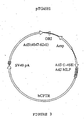
- Figure 2 is a schematic representation of the vector pTG6548.
- Figure 3 is a schematic representation of the vector pTG6581.
- Figure 4 is a schematic representation of the vector pTG6303.
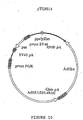
- Figure 5 is a schematic representation of the vectors pTG1660 and pTG1661.
- Figure 6 is a schematic representation of the vectors pTG1653, pTG1654 and pTG1655.
- Figure 7 is a schematic representation of the vector pTG5913.
- Figure 8 is a schematic representation of the vector pTG8512
- Figure 9 is a schematic representation of the vector pTG8513.
- Figure 10 is a schematic representation of the vector pTG8514.
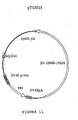
- Figure 11 is a schematic representation of the vector pTG8515.
- the cells are transfected according to the standard techniques well known to those skilled in the art. There may be mentioned the calcium phosphate technique (Maniatis et al., Supra). But other protocols for introducing a nucleic acid into a cell can also be used, such as the DEAE dextran technique, electroporation, osmotic shock-based methods, microinjection of a selected cell or methods. based on the use of liposomes.
- EXAMPLE 1 Generation of an "attenuated" adenovirus comprising a deletion of a part of the encapsidation region .
- the Eco RI and Eco RV sites of the M13TG131 vector are cloned into the Eco RI Sma I fragment isolated from pMLP11.
- This construct is derived from pMLP10 (Levrero et al., 1991, Gene, 101 , 195-202) and differs from the parental vector in introducing a Sma I site at the Hind III site.
- the vector M13TG6501 is obtained. This is subjected to site-directed mutagenesis to delete the sequences between nucleotides 184 to 273 of the packaging region.
- the site-directed mutagenesis is carried out using a commercial kit (Amersham) according to the supplier's recommendations, and uses the oligonucleotide OTG4174 reported in the sequence identifier No. 1 (SEQ ID NO: 1).
- the mutated vector is designated M13TG6502.
- the encapsidation region thus deleted is reintroduced in the form of an Eco RI- Bgl II fragment, the Bgl II site being made blunt by treatment with Klenow DNA polymerase, in the vector pMLP11 digested with Eco RI and Sma 1.
- the vector obtained, pTG6500 is partially digested with PsI , treated with T4 phage DNA polymerase and then digested with Pvu l.
- This vector is inserted into the Pvu I -Hpa I fragment isolated from pTG5955 (derived from pMLP11). This fragment contains the transcription termination signal of the SV40 virus and the part of the genome of Ad5 extending from nucleotide 3329 to nucleotide 6241.
- the vector pTG6505 thus generated is partially digested with Sph I, treated with DNA polymerase. phage T4 and religated, this in order to destroy the site Sph l located 5 'of the polylinker.
- pTG6511 in which, after digestion with Bam HI and Klenow DNA polymerase treatment, the human CFTR cDNA is cloned in the form of a blunt-ended fragment generated by Xho I and Ava I digestion and treatment with Klenow DNA polymerase.
- PTG6525 is obtained.
- the CFTR cDNA is isolated from a plasmid of the prior art, such as pTG5960 (Dalemans et al., 1991, Nature, 354 , 526-528).
- the M13TG6501 vector is subjected to site-directed mutagenesis using the oligonucleotide OTG4173 (SEQ ID NO: 2). Then the mutated fragment is reintroduced into pMLP11, as previously indicated, to generate the pTG6501 vector.
- the latter is digested with Sph.sub.1 , treated with phage T4 DNA polymerase and then with Pvu.sub.1 .
- PTG6546 (FIG. 2) was obtained by cloning the Pvu I- Kpn I fragment (the Kpn I site having been made blunt) isolated from pTG6525 and comprising the human CFTR cDNA.
- the vector M13TG6501 is subjected to site-directed mutagenesis to delete the sequences between nucleotides 287 and 358 of the encapsidation region and to modify thymines at positions 275 and 276 to guanines to introduce an Nco 1 site .
- Mutagenesis is performed using oligonucleotide OTG4191 (SEQ ID NO: 3) to give M13TG6507. The latter is cleaved with Bgl II, treated with Klenow DNA polymerase and then digested with Eco RI and purified fragment corresponding mutated is introduced into pMLP11 digested with Ec ori and Sma l.
- PTG6504 is generated, from which the Sph I fragment (site rendered free by treatment with T4 phage DNA polymerase) is isolated by inserting it between the Kpn I sites (made blunt by treatment with T4 polymerase) and Pvu l of pTG6511.
- PTG6513 is obtained which is treated with Bam HI and Klenow DNA polymerase before inserting the fragment Ava l and Xho l of pTG5960 to give pTG6526.
- the recombinant defective adenoviruses are generated by co-transfection into 293 cells either pTG6525, pTG6526 or pTG6546 linearized by Cla l and genomic DNA from the Ad-dl324 (Thimmappaya et al., 1982, Cell, 31, 543- 551) also digested with Cla I , so as to generate a recombinant virus by homologous recombination. After 8 to 10 days, the individual plaques are isolated, amplified in 293 cells and analyzed by restriction mapping. Viral stocks (AdTG6525, AdTG6526 and AdTG6546) are constituted and their title determined according to conventional techniques.
- AdTG6546 virus is placed in competition by co-infection with Ad-CFTR (Rosenfeld et al., 1992, Cell, 68 , 143-155) which has a wild-type encapsidation region. 293 cells were infected with 5 pfu (plaque forming unit) of Ad-CFTR and 5 pfu of AdTG6546 per cell. The total viral DNA is isolated in parallel by the method of Hirt (Gluzman and Van Doren, 1983, J.
- the level of expression of the CFTR protein in 293 cell extracts infected with AdTG6546 is measured.
- the analysis is carried out by Western blotting according to the technique described in Dalemans et al. (1991, Nature, supra) using the monoclonal antibody MATG1031. But, any other antibody recognizing antigenic epitopes of the CFTR protein can be used.
- a product with an expected molecular weight of about 170 kDa is revealed. As an indication, the level of production is approximately equivalent to that obtained in cell extracts infected with the non-attenuated Ad-CFTR virus.
- EXAMPLE 2 Generation of a defective adenovirus deleted from the E1A region and all the sequences coding for the early proteins of the E1B region.
- the Ad5 genome fragment extending from nucleotide 4047 to nucleotide 4614 is amplified by PCR from Ad5 genomic DNA.
- the PCR reaction uses the forward primer OTG5021 (SEQ ID NO: 4), comprising at its 5 'end a Bam HI site intended to facilitate the subsequent cloning steps, and the antisense primer OTG5157 (SEQ ID NO 5.)
- the fragment thus generated is treated with Klenow DNA polymerase before being cloned into the Sma I site of M13mp18 (Gibco BRL), giving rise to M13G6517.
- the sequence of the PCR generated fragment is verified according to the conventional enzymatic method (Sanger et al., 1977, Proc Natl Acad Sci USA, 74 , 5463).
- the Pvu I- Sma I fragment is isolated from pMLP11. It is cloned between the Pvu I and Kpn I sites of pTG6511 (Example 1.1), the Kpn I site having been made blunt by T4 phage DNA polymerase treatment according to standard methods. The vector pTG6547 is thus generated.
- the latter is digested with Sal I and Bst XI enzymes and ligated to two fragments, on the one hand Bam HI- Bst XI purified M13TG6517 and, secondly, the fragment Xho l- Bgl l pTG6185.
- the latter comprises in particular the transcription termination signal of the SV40 virus flanked by the restriction sites Xho I and Bgl II . But, any other plasmid with the same termination sequence and suitable restriction sites could be used.
- the vector pTG6555 is obtained, in which an adapter containing two restriction sites generating blunt ends, Eco RV and Hpa l, is inserted into the unique Bam HI site.
- the corresponding recombinant adenovirus AdTG6581 is generated by cotransfection of pTG6581 and Ad d1324 cleaved by Cla l in a complementation line for the E1 function, such as line 293 or a line of Example 6, according to the conventional protocol.
- the vector pTG6303 (FIG. 4) is obtained by cloning into the Hpa I site of pTG6580 of the Hpa I- Sma I fragment of M13TG2437. The latter comes from the cloning in a M13TG130 vector (Kleny et al., 1983, supra ) of the gene encoding interferon gamma (IFN ⁇ ) whose sequence is as specified in Gray et al. (1982, Nature, 295 , 503-508).
- IFN ⁇ interferon gamma
- the recombinant adenovirus AdTG6303 is obtained according to standard techniques by homologous recombination resulting from the co-transfection of pTG6303 and Cla I linearized Ad d1324 into a complementation line for the E1 function.
- the vector pTG1670 is obtained by cloning between the sites Aat II and Bam HI of the vector p poly11 (Lathe et al., 1987, Gene 57 , 193-201), a PCR fragment comprising the LTR3 '(Long Terminal Repeat) of the RSV virus (Rous Sarcoma Virus).
- the PCR reaction employs the vector pRSV / L (De Wet et al, 1987, Mol Cell Biol 7, 725-737.7) As template and the primers OTG5892 and OTG5893 (SEQ ID NO: 8 and 9 ).
- the 5 'portion of the E3 region is amplified by PCR from the vector pTG1659 and using primers OTG5920 and OTG5891 (SEQ ID NO: 10 and 11). The latter is built in several stages.
- the Bam HI -Avr II fragment (nucleotides 21562 to 28752) is obtained from the genomic DNA of Ad5 and then cloned between the same sites of pTG7457 to generate pTG1649.
- the pTG7457 vector is a pUC19 (Gibco BRL) modified at the level of the polylinker so as to contain in particular an Avr II site .
- the Eco RI fragment of Ad5 corresponding to nucleotides 27331 to 30049 is isolated from a genomic DNA preparation and subcloned into pBluescript-Sk + (Stratagene) previously cleaved with Eco RI.
- PTG1669 is obtained. This is mutated (Amersham kit) by introduction of a Bam HI site either at position 27867 (mutagenic oligonucleotide OTG6079: SEQ ID NO: 12) or at position 28249 (mutagenic oligonucleotide OTG6080, SEQ ID NO: 13). PTG1672 and pTG1673 are respectively obtained.
- the pTG1679 vector results from the cloning of the Bst EII- Kpn I fragment (site made clear by T4 polymerase treatment) of pTG6590 (Example 3.1) between the Bst EII- Bam HI sites (site made free by treatment with the Klenow polymerase) of pTG65B4 (Example 3.1).
- An adenovirus particle is generated by homologous recombination in a complementation line for the E1 function, between the Aat II fragment of pTG 1679-E3 + and an adenoviral vector such as Ad d1324 or Ad-RSV ⁇ -gal.
- Ad d1324 or Ad-RSV ⁇ -gal contains the ⁇ -galactosidase gene in place of the E1 region (Stratford-Perricaudet et al., 1992, J. Clin Invest, 90 , 626-630).
- EXAMPLE 3 Construction of a recombinant adenoviral vector with improved cloning capacity by partial deletion of the E1 and E3 regions
- the fragment carrying the part of the genome of Ad5 between nucleotides 27325 and 27871; is amplified by PCR from a genomic DNA preparation of Ad5 and using primers OTG6064 and OTG6065 (SEQ ID NO: 14 and 15).
- OTG6065 comprises at its 5 'end a Bsm I site, also present in the E3 region (at position 30750).
- the amplified fragment is cloned into the Sma I site of M13mp18, to give M13TG6523.
- the Eco RI-Bsm I fragment is isolated from the latter to be introduced into the pTG6590 vector cleaved with the same enzymes.
- PTG6590 ⁇ 3 is obtained, which contains the 3 'portion of the adenoviral genome (nucleotides 27082 to 35935) deleted from the E3 region between nucleotides 27872 to 30740, whereas pTG6590 is deleted from a smaller part of the E3 region (position 28592 to 30470).
- the vector pTG6590 is obtained in the following manner: a fragment extending from nucleotides 35228 to 35935 (comprising the 3 'ITR) is generated by PCR from a genomic preparation of Ad5 and using the primers OTG5481 and OTG5482 (SEQ ID NO: 16 and 17). This is then cloned into the Sma I site of M13mp18 to give M13TG6519.
- the vector pTG6584 is digested with Xba I and then religated in order to eliminate the corresponding fragment of the E3 region.
- PTG6589 which is cleaved with Bam HI, treated with Klenow and then digested with Bst EII.
- the purified Eco RI (Klenow) - Bst EII fragment of M13TG6519 is introduced into the vector thus treated to generate pTG6590.
- the pTG6584 vector is a pUC19 vector (Gibco BRL) which contains the Ad5 sequences extending from the unique Spe 1 site (position 27082) to the beginning of the promoter region of the E4 region (position 35826). . It is obtained by digestion of pTG1659 (Example 2.3) with Sal I and Spe I, treated with Klenow DNA polymerase followed by religation.
- the portion of the E3 region of Ad5 coding for gp19kDa is obtained by PCR from a genomic DNA preparation of Ad5 and using primers OTG5455 and OTG5456 (SEQ ID NO: 18 and 19).
- the generated fragment is introduced into the Sma I site of M13mp18 to give M13TG6520.
- the Eco RI- Xba I fragment was isolated from the latter and cloned into the Aaf II site of pTG1670 (Example 2.3), the sites having been made blunt by treatment with Klenow DNA polymerase. Then, the purified Xba I fragment of the vector of the preceding step is inserted into the Xba I site of the vector pTG6590 ⁇ E3 (Example 3.1).
- the recombinant viral particles are obtained by ligation of the Spe I fragments isolated from the genomic DNA of AdTG6303 or AdTG6581 and from one or other of the vectors of Examples 3.1 and 3.2. Then, the ligation mixture is transfected into a complementation line for function E1.
- EXAMPLE 4 Construction of an adenovirus deleted from the E1 and E4 regions.
- Portions of the adenoviral genome extending from nucleotides 31803 to 32799 and 35827 to 35935 are amplified from a genomic DNA preparation of Ad5 and primers OTG5728 and OTG5729 (SEQ ID NO: 20 and 21) and OTG5730 and OTG5481 (SEQ ID NO: 22 and 16) respectively. After a dozen amplification cycles, the reaction is continued from an aliquot of the two reaction mixtures using oligonucleolides OTG5728 and OTG5781. The amplified fragment extends from nucleotides 31803 to 35935 with a deletion of the entire E4 region (positions 32800 to 35826). After digestion with Eco RI and Hind III , it is cloned between the same sites of M13mp18 to give M13TG6521.
- M13TG6521 is digested with E. coli, treated with klenow DNA polymerase and then cleaved with Bsf Xl.
- the 0.46 kb fragment containing the 3 'ITR is inserted between the Bam HI site made blunt by DNA polymerase klenow treatment and the site BstX 1 of pTG6584 (Example 3.1).
- PTG6587 is obtained, which is then digested with Xb al religated on itself to give pTG6588 (E3 deletion).
- a fragment of synthetic DNA from the reassociation of oligonucleotides OTG6060, OTG6061, OTG6062 and OTG6063 (SEQ ID NO: 23-26) is introduced into the Pac I site of pTG6588. It results pTG8500 in which the transcription termination signals of the late genes L5 are improved.
- An adenoviral particle (Ad ⁇ E4) whose genome is deleted from the entirety of the E4 region (nucleotides 32800 to 35826) and the Xba I fragment of the E3 region (nucleotides 28592 to 30470) is generated by ligation of isolated Spe I fragments. pTG8500 or pTG6588 and Ad5.
- the ligation mixture is transfected into a complementation cell line for the E4 function, for example the W162 line (Weinberg and Ketner, 1983, Proc Natl Acad Sci USA, 80, 5383-5386).
- a defective adenovirus for the E1 and E4 functions ( ⁇ E1, ⁇ E4) is obtained by transfection into a complementation line for E1 and E4 (for example the line of Example 8) of the ligation mixture between the genome of Ad dl324. and plasmid pTG8500 or pTG6588 linearized with Spe I.
- the isolated Spe I- Sca I fragment of pTG1659 (Example 2.3) was cloned into the pTG6588 vector cleaved with these same enzymes to obtain pTG6591.
- the latter comprises the sequences of the Ad5 nucleotides 21062 to 35935 but, as previously, deleted the entire region E4 and fragment Xba I of the E3 region.
- the synthetic DNA fragment described above is introduced into the Pac I digested vector pTG6591 and pTG6597 is generated.
- the adenoviral particles can be obtained by homologous recombination between genomic DNA of Spe I-cleaved Ad d1324 and Bam HI-cleaved plasmids pTG6591 or pTG6597.
- EXAMPLE 6 Constitution of a complementation cell capable of complementing the function E1 in trans .
- the construction is carried out in several stages detailed below.
- the vector p polyIII-I * (Lathe et al., 1987. Gene, 57 , 193-201) is digested with enzymes Acc I and Eco RI.
- the Eco RI -Cla I fragment isolated from the plasmid pTG6164 is cloned into the vector thus treated.
- the vector pTG6528 is obtained.
- Plasmid pTG6164 is derived from pLXSN (Miller D, 1989, Bio / Techniques, 7, 980) and comprises the pac gene placed under the control of the SV40 early promoter. Briefly, the Hind III- Kpn I fragment of pLXSN is introduced into M13TG131 to produce M13TG4194. Is inserted into the latter, digested with Nhe I and Kpn I, the Kpn l el Nh fragment of pMPSV H2 K IL2R (Takeda et al., 1988, Growth Factors, 1, 59-66) to produce M13TG4196.
- the pTG6528 vector is digested with Psf I and the Pst I fragment isolated from pTG6185 (Example 2-1) containing the SV40 transcription termination signal is introduced at this site.
- PTG6529 is obtained.
- the latter is subjected to an Eco RI- HPaI digestion and ligated to two fragments, on the one hand a Bsp EI- Bcg I fragment (positions 826 to 5297) purified from the genomic DNA of Ad5 and on the other hand a PCR generated fragment at Eco RI and Bsp EI ends , to give pTG6531.
- the PCR fragment is generated by gene amplification from genomic DNA of Ad5 and primers OTG4564 and OTG4565 (reported in SEQ ID NO: 27 and 28).
- the amplified fragment is digested with Eco RI and Bsp EI enzymes and ligated as indicated in the previous paragraph.
- the pTG6531 vector comprises the 2 transcription units (that of the E1 region and that of the pac gene) in the same orientation. To avoid transcriptional interferences, they are placed in a head-to-tail orientation (reverse to each other) by treating Bam HI with pTG6531 and religating.
- the vector pTG6533 corresponds to a clone having the reverse orientation of the two units.
- the vector pTG6533 is transfected into a mammalian cell line, for example the Vero line (ATCC, CCL81) or A549 (ATCC, CCL185) by the calcium phosphate technique.
- the transfected cells are cultured according to the supplier's recommendations and are placed 24 hours after the transfection in a selective medium containing puromycin (concentration 6 ⁇ g / ml).
- the expression of the sequences coding for the early proteins of the E1 region by Northern blot analysis is analyzed using appropriate probes labeled with the 32 P isotope.
- the production of the proteins encoded by the E1A region is detected by immunoprecipitation after labeling of the cells. the 35 S isotope and with the aid of a commercial antibody (Oncogene Science Inc., reference DP11).
- CAT Chloramphenicol Acetyl Transferase
- these cells can be infected by Ad-RSV- ⁇ gal (Stratford-Perricaudet et al., 1992, supra ) and titrate the virus by the agar technique as soon as a cytopathic effect is observed.
- Ad-RSV- ⁇ gal Stratford-Perricaudet et al., 1992, supra
- titrate the virus by the agar technique as soon as a cytopathic effect is observed.
- the procedure is as follows: the cells are infected with an ego (multiplicity of infection) of 10. About 48 hours after the infection, the cytopathic effect being visible, the cells are lysed and the dose is measured. ⁇ -galactosidase activity according to the conventional protocol (see for example Maniatis et al., 1989, supra). Positive clones are reinfected to a weaker moi. 48 hours after infection, the supernatant and the cells are harvested according to conventional techniques. The viral titer is determined by the agar
- any nucleotide sequences for example isolated from pBR322 (Bolivar et al., 1977, Gene, 2 , 95-113), can also be introduced between the expression cassettes of the pac gene and of the E1 region; to avoid possible transcriptional interferences.
- the part of the genome of Ad5 from nucleotide 505 to nucleotide B26 is amplified by PCR from a genomic preparation and primers OTG5013 which comprises at 5 'a Pst 1 site useful for the cloning steps. subsequent (SEQ ID NO: 29) and OTG4565 overlapping the Bsp EI site (SEQ ID NO: 28).
- the fragment generated by PCR is treated with Klenow DNA polymerase and then introduced into the Sma I site of M13mp18 giving rise to M13TG6512. The sequence of the PCR fragment is verified.
- the vector pTG6533 (Example 6.1) is digested with Eco RI and Bsp E1 enzymes .
- One league with the thus treated vector first, the fragment Pst -Bsp E1 isolated from M13TG6512 and, secondly, the fragment EcoRI-Ps tl isolated from pK-1.
- the latter comprises the portion of the PGK murine gene promoter, located between nucleotides -524 and -19, the sequence of which is reported in Adra et al. (1987, Gene, 60 , 65-74) ,.
- This step gives rise to pTG6552 and makes it possible to insert the promoter of the PGK murine gene upstream of the E1 region of the starting Ad5 at nucleotide 505.
- the Xho I- Bam HI fragment whose end generated by Xho I is made blunt following treatment with Klenow DNA polymerase, is purified from pBCMG Neo (Karasuyama et al., 1989, J. Exp. 169 , 13-25).
- This fragment which comprises the transcription termination signal of the rabbit ⁇ -globin gene, is introduced between the Sma I and Bam HI sites of the polyll-Sfi / Not-14 * vector p (Lathe et al., 1987, Gene , 57 , 193-201).
- the resulting pTG6551 vector is in turn digested with the enzymes Sph I and Eco RV in order to insert a fragment of the genome of Ad5 ranging from nucleotide 3665 to nucleotide 4034.
- This fragment is generated by PCR according to the standard protocol .
- a genomic Ad5 DNA preparation is used as the template and the OTG5015 primers cover the Sph I internal site at position 3665 (SEQ ID NO: 30) and OTG 5014 comprising at 5 'a Bgl I site (SEQ ID NO: 31).
- the PCR fragment is treated with Klenow DNA polymerase before being cloned into the Sma I site of M13mp18, generating M13TG6516. After verification of its sequence, the PCR fragment is resumed by digestion with BglII , treatment with Klenow DNA polymerase and digestion with Sph . It is inserted between the Sph I and Eco RV sites of pTG6551. This resulted in pTG6554.
- the vector pTG6529 (Example 6.1) is subjected to digestion with the enzymes Hpa I and Hind III .
- the 2.9 kb fragment containing the pac gene followed by the SV40 transcription termination signal is purified. This is ligated to the Sma I- Hind III fragment isolated from pE2 Lac (Boeuf et al., 1990, Oncogene, 5 , 691-699) which carries the E2A promoter of Ad2.
- the vector pTG6556 is obtained.
- pTG6556 is digested with Eco RI and Bam HI enzymes.
- the Eco RI- Sac I fragment isolated from pTG6552 and the Sac I- Bam HI fragment isolated from pTG6554 are inserted between these sites.
- the vector pTG6558 is obtained.
- the same step performed on pTG6550 and pTG1643 (example 7.1) generates pTG6557 and pTG6559 respectively.
- pTG6557 and pTG6558 are digested with Eco RV, a unique site located between the two expression cassettes (gene pac and region E1).
- Eco RV a unique site located between the two expression cassettes (gene pac and region E1).
- a 1.88kb Eco RV-Pvu II fragment isolated from pBR322 (Bolivar et al., Supra) was cloned into this site to drive the two promoters apart.
- PTG6564 and pTG6565 are generated respectively.
- the vectors pTG6557, pTG6558, pTG6559, pTG6564 and pTG6565 are transfected into the A549 cell line.
- the puromycin resistant clones are selected and the expression of the E1 region is verified.
- Clones expressing E1 are intended to amplify and propagate adenovirus defective for E1 function.
- the production of the expression products of E1 is accompanied by a cytotoxic effect, but the Southern analysis does not make it possible to demonstrate vector rearrangements.
- These vectors comprise, as previously, the portion of the E1 region of Ad5 from nucleotide 505 to 4034.
- the expression of the sequences of the E1A region is placed under the control of an inducible promoter constituted on the one hand by the minimal promoter Ad2 MLP (TATA box and transcription initiation signal, nucleotides-34 to +33) and on the other hand an activation sequence of the Gal4 protein activatable Gal gene.
- the 17 nucleotide activation consensus sequence (17MX) which corresponds to the Gal4 binding site is specified in Webster et al. (1988. Cell, 52 , 169).
- the transcription termination signal of the rabbit ⁇ -globin gene is placed 3 'of the transcriptional unit E1B.
- a first DNA fragment comprising a dimer of the sequence 17MX (SEQ ID NO: 32 and 33) followed by the minimal promoter MLP of Ad2 and provided at its 5 'end with a Sal I site and at its end 3 is synthesized. of a Bam HI site.
- the Sal I site is made clear by treatment with DNA polymerase klenow.
- a second DNA fragment comprising a pentamer of the sequence followed by the same promoter and provided at 5 'and 3' sites Xba I and Bam HI is synthesized. After digestion with Xba I, the end is made blunt by Klenow polymerase treatment.
- Each of these fragments is introduced into the Bgl II site of p poly II to generate respectively pTG1656 and pTG1657.
- the following two fragments are then introduced into each of the vectors previously digested with Pst I- Bam HI: the Pst I- Xba I fragment isolated from pTG6552 (Example 6.2) and the Xba I- Bam HI fragment isolated from pTG6559 (Example 6.2) .
- PTG1660 and pTG1661 respectively are obtained (FIG. 5).
- A549 cells are cotransfected with pTG1643 (pac gene expression vector) and either pTG1660 or pTG1661.
- the clones are selected for their puromycin resistance and studied as indicated above.
- About 50% of the clones A549-1660 and A549-1661 produce expression products of the E1 region. However, the production is accompanied by a cytotoxic effect, modifying the morphological aspect of the cells.
- the integration and non-rearrangement of the plasmids in the cellular genome is verified by Southern. No substantial modification of the integrated plasmids (pTG1643, pTG1660 and pTG1661) can be demonstrated in the producer clones analyzed. It is also possible to verify the inducibility of the expression of the sequences encoded by the E1A region in the presence of Gal4 (by transformation with a plasmid allowing the constitutive expression of the Gal4 protein).
- two A549-1660 clones are capable of amplifying the viral stock by a factor greater than 100.
- a vector comprising the entire adenoviral genome of Ad5 is constructed with the exception of the 5 'ITR, the 3' ITR and the encapsidation region.
- the vector pTG6528 (Example 6.1) is digested with the Pst 1 and Bgl 11 enzymes, between which a DNA fragment synthesized according to the standard protocol consisting of the oligonucleotides of OTG5039 and OTG5040 (SEQ ID NO: 34 and 35) is inserted.
- the sequence of the oligonucleotides is designed so as not to reconstitute the Pst I cloning site and introduce an E coRV site.
- PTG1639 is obtained, which is linearized by digestion with E coRV and ligated to an Xba I- Bam HI fragment whose ends are made blunt by treatment with Klenow DNA polymerase. This fragment carries the SV40 virus transcription termination signal. Any plasmid with a signal surrounded by appropriate restriction sites can be used at this stage.
- the vector pTG1640 thus generated is digested with Bam HI and Bg / ll fragment and the carrier of the expression cassette of the pac gene is introduced into the BglII site of the vector lt pPolyII-Sfi / Not-14 *.
- PTG1641 is obtained. This is linearized with Not I and treated with Klenow DNA polymerase. Is introduced Bam Hl-Sa l l 0.276 kb isolated from pBR322 (Bolivar et al., Supra) also treated with Klenow DNA polymerase. This gives rise to pTG1643.
- the pTG1643 is linearized with Xho I and is inserted in this site a Xho I hybrid fragment comprising a 17MX dimer followed by the minimum promoter of the IK-HSV-1 gene (nucleotides 303 to 450 of the sequence disclosed in the Genebank database under the reference V00467 and completed in 3 'of an Xho site l).
- Xho I hybrid fragment comprising a 17MX dimer followed by the minimum promoter of the IK-HSV-1 gene (nucleotides 303 to 450 of the sequence disclosed in the Genebank database under the reference V00467 and completed in 3 'of an Xho site l).
- pTG1647 serves as a base vector for introducing between the Pst I and Bam HI sites a fragment of the Ad5 genome from nucleotide 505 to nucleotide 35826.
- pTG1647 is digested with Pst I and Bam HI then ligated, on the one hand, to the Pst I -Cla I fragment of pTG6552 (Example 6.2) comprising the part of the Ad5 genome of nucleotides 505 to 918 and, on the other hand, to the Cla I- Bam HI fragment. (positions 918 to 21562) prepared from the genomic DNA of Ad5.
- the vector thus obtained comprises the 5 'part of the Ad5 with the exception of the ITR5' and the encapsidation region.
- the 3 'part of the genome of Ad5 is assembled in the vector ppolyll-Sfi / Not-14 *.
- This is linearized with Bam HI and introducing the fragment Bam HI- April ll (nucleotides 21562 28752) of the Ad5 genome and a PCR fragment corresponding to nucleotides 35463 to 35826 of Ad5.
- the latter is generated from the genomic DNA of Ad5 and primers OTG5024 (SEQ ID NO: 36) and OTG5025 (SEQ ID NO: 37) and comprises at 5 'a Bam HI site.
- the vector obtained is digested with Avr 11 and the Avr II fragment isolated from the genomic DNA of Ad5 and extending from positions 28753 to 35462 is inserted.
- the Bam HI fragment comprising the adenoviral sequences is introduced into the Bam HI site of the vector of the preceding step comprising the 5 'portion of the adenoviral genome lacking the 5' ITR and the encapsidation region.
- a complementation cell line capable of complementing all the functions of a defective adenovirus is generated by transfection in a cell line, such as A549, according to the protocol described in the preceding examples.
- a complementation cell line is generated by co-transfection of the above vector and pTG1643 and the puromycin resistant clones are isolated. This line is more particularly intended to amplify and package the adenoviral vectors of Example 5 defective for the functions E1, E2 and E4 and the late functions.
- the vector thus generated is introduced into a cell line according to the protocol described above, to form a complementation line for the functions E1 and E4.
- the E4 region of the Ad5 genome (nucleotides 32800 to 35826) is reconstituted in several steps.
- the portion from nucleotides 33116 to 32800 is synthesized by PCR from Ad5 genomic DNA with primer pair OTG5078 and OTG5079 (SEQ ID NO: 38 and 39) and inserted into the Eco RV site of M73TG130. , to generate M13TG1645.
- the Bam HI- Afl II fragment of the latter is engaged in a ligation reaction with the fragment Afl II- April lt Ad5 (nucleotides 33104-35463) and pTG7457 vector digested with Bam HI and April ll. PTG1650 is obtained.
- the region E4 is completed by obtaining the fragment corresponding to nucleotides 35826 to 35457 by PCR from a genomic DNA preparation of Ad5 and primers OTG5024 and OTG5025 (SEQ ID NO: 36 and 37). This one is inserted in the site Sma l of M13mp18 to give M13TG1646. Fragment April -Eco RI It is isolated from the latter and cloned between the sites in April II and Eco RI pTG1650. We obtain pTG1652.
- the Bam HI fragment including the E4 region of Ad5 is isolated from pTG1652 and cloned into the BamHI site of pTG1643, pTG6559 of (Example 62) or in the SspI site of pTG6564 (Example 6.2) after checking francs sites for generate pTG1653, pTG1654 and pTG1655 ( Figure 6) respectively.
- the expression of the products of the E1 and E4 regions is accompanied by a cytotoxic effect.
- a number of 293-1653 clones are capable of complementing both adenoviruses deleted from E1 and adenoviruses deleted from E4.
- the M13TG1646 vector is subjected to site-directed mutagenesis with the mutagenic oligonucleotide OTG5991 (SEQ ID NO: 40) for the purpose of deleting the promoter from the E4 region and inserting a Hpa I site.
- the mutated vector is designated M13TG6522. It is digested with Pst I, treated with phage T4 DNA polymerase followed by April ll and ligated with an Eco RI fragment (Klenow) - Apr ll) purified from pTG1652 (Example B), to give pTG6595. The latter is cleaved with Hpa I and the 0.8 kb fragment obtained from pTG5913 (FIG.
- PTG6596 is generated in which the E4 region (positions 32800 to 35826) is placed under the control of the TK promoter.
- pTG5913 carries the TK-HSV-1 gene fragment and the Bgl II- Bam HI corresponds to the promoter of this gene (Wagner et al, 1981, Proc Natl Acad Sci, USA, 78, 1441 Weg - 1445).
- pTG1643 and pTG6559 vector are linearized with Bam HI and inserting a synthetic fragment from the reassociation of oligonucleotides OTG6141 and OTG6142 (SEQ ID NO: 41 and 42), to obtain pTG8508 and pTG8507, respectively.
- the latter are cleaved with Bam HI before introducing the purified Bam HI fragment of pTG6596 comprising the E4 expression cassette.
- the vectors pTG8512 (FIG. 8) and pTG8513 (FIG. 9) are generated.
- the cell lines transfected with pTG8512 or pTG8515 will make it possible to complement a defective adenovirus for the E4 function, whereas those resulting from the transfection of pTG8513 or pTG8514 are intended to amplify and propagate adenoviruses defective for the E1 and E4 functions. Similarly, transfection of pTG8512 or pTG8515 into 293 cells will compliment E1 and E4 defective adenoviruses.
Landscapes
- Health & Medical Sciences (AREA)
- Chemical & Material Sciences (AREA)
- Life Sciences & Earth Sciences (AREA)
- Organic Chemistry (AREA)
- Genetics & Genomics (AREA)
- Biochemistry (AREA)
- General Health & Medical Sciences (AREA)
- Zoology (AREA)
- Biophysics (AREA)
- Medicinal Chemistry (AREA)
- Molecular Biology (AREA)
- Engineering & Computer Science (AREA)
- Gastroenterology & Hepatology (AREA)
- Proteomics, Peptides & Aminoacids (AREA)
- Bioinformatics & Cheminformatics (AREA)
- Wood Science & Technology (AREA)
- Biotechnology (AREA)
- Virology (AREA)
- Biomedical Technology (AREA)
- General Engineering & Computer Science (AREA)
- Microbiology (AREA)
- Mycology (AREA)
- Toxicology (AREA)
- Plant Pathology (AREA)
- Pulmonology (AREA)
- Immunology (AREA)
- Physics & Mathematics (AREA)
- Micro-Organisms Or Cultivation Processes Thereof (AREA)
- Medicines Containing Material From Animals Or Micro-Organisms (AREA)
- Medicines That Contain Protein Lipid Enzymes And Other Medicines (AREA)
- Glass Compositions (AREA)
- Fuses (AREA)
- Separation By Low-Temperature Treatments (AREA)
- Measuring Or Testing Involving Enzymes Or Micro-Organisms (AREA)
- Organic Insulating Materials (AREA)
- Thermistors And Varistors (AREA)
- Medicines Containing Antibodies Or Antigens For Use As Internal Diagnostic Agents (AREA)
Claims (15)
- Komplementationszelllinie, die zur Herstellung von Adenoviruspartikeln geeignet ist, die für eine therapeutische oder prophylaktische Verwendung beim Menschen bestimmt sind, wobei die Komplementationszelllinie ein Komplementationselement enthält; wobei das Komplementationselement dadurch gekennzeichnet ist, dass es als einzige Adenovirus-DNA den Teil der E1A-Region enthält, der die frühen Proteine der E1A-Region codiert, sowie die Gesamtheit der Sequenzen, die die frühen Proteine der E1 B-Region codieren, die unter die Kontrolle ihres eigenen Promotors gestellt ist, und das dadurch gekennzeichnet ist, dass die Expression des Teils der E1A-Region unter die Kontrolle eines heterologen Promotors gestellt ist; und
wobei das Komplementationselement(a) fähig ist, einen Adenovirusvektor in trans zu komplementieren, der von einem humanen Adenovirus abgeleitet ist und der für die Funktion E1 defekt ist; und(b) in das Genom der Komplementationszelllinie integriert ist. - Komplementationszelllinie nach Anspruch 1, in der das Adenovirus ein Typ-5-Menschen-Adenovirus ist.
- Komplementationszelllinie nach Anspruch 1 oder 2, in der die E1A-Region unter die Kontrolle eines Promotors gestellt ist, der durch ein nichtadenovirales Transkriptions-Transaktivierungsprotein induzierbar ist.
- Komplementationszelllinie nach Anspruch 3, in der das nicht-adenovirale Transkriptions-Transaktivierungsprotein von einem rekombinanten Adenovirusvektor codiert wird, wobei dieser Adenovirusvektor unter die Kontrolle von Elementen gestellt ist, die für seine Expression in einer Wirtszelle erforderlich sind, und ein Gen enthält, das insbesondere ein Gal4-Transkriptions-Transaktivierungsprotein von Saccharomyces cerevisiae codiert.
- Komplementationszellline nach Anspruch 3 oder 4, in dem die E1A-Region unter die Kontrolle eines Promotors gestellt ist, der durch ein Gal4-Transkriptions-Transaktivierungsprotein von Saccharomyces cerevisiae induzierbar ist.
- Komplementationszelllinie nach einem der Ansprüche 1 bis 5, die unter anderem ein einen Selektionsmarker codierendes Gen umfasst.
- Komplementationszelllinie nach Anspruch 6, wobei das Selektionsgen Puromycinacetyl-Transferase codiert.
- Komplementationszelllinie nach einem der Ansprüche 1 bis 7, die von einer pharmazeutisch verträglichen Zelllinie abgeleitet ist.
- Komplementationszelllinie nach Anspruch 8, die von einer aus den Linien Vero, A549, MRC5 und W138 ausgewählten Zelllinie abgeleitet ist.
- Komplementationszelllinie nach einem der Ansprüche 1 bis 8, die von einer Netzhautzelle eines menschlichen Embryos abgeleitet ist.
- Komplementationszelllinie nach einem der Ansprüche 1 bis 10, dadurch gekennzeichnet, dass der heterologe Promotor der Promotor des murinen PGK-Gens ist.
- Komplementationszelllinie nach Anspruch 11, dadurch gekennzeichnet, dass das Komplementationselement der E1-Funktion unter die Kontrolle eines heterologen Transkriptionsterminationssignals gestellt ist, insbesondere desjenigen des β-Globingens von Kaninchen.
- Arzneimittel, das als therapeutischen oder prophylaktischen Wirkstoff eine Komplemetationszelllinie nach einem der Ansprüche 1 bis 12 in Verbindung mit einem pharmazeutisch verträglichen Träger enthält.
- Verwendung einer Komplementationszelllinie nach einem der Ansprüche 1 bis 12 zur Herstellung eines Arzneimittels zum Einbringen von DNA-Molekülen in eine Zelle oder in einen eukaryontischen Organismus.
- Verfahren zur Herstellung eines Adenoviruspartikels, der einen replikationsdefekten Adenovirusvektor enthält, der durch Deletion von mindestens der gesamten oder einem Teil der E1A-Region vom Genom eines Adenovirus abgeleitet ist, wobei(i) ein Adenovirusvektor in eine Komplementationszelllinie nach einem der Ansprüche 1 bis 12 eingeführt wird, die fähig ist, den Adenovirusvektor in trans zu komplementieren, um eine transfizierte Komplementationszelllinie zu erhalten;(ii) die transfizierte Komplementationszelllinie unter Bedingungen gezüchtet wird, die geeignet sind, die Produktion des Adenoviruspartikels zu ermöglichen; und(iii) das Adenoviruspartikel aus der Zellkultur gewonnen wird.
Applications Claiming Priority (3)
| Application Number | Priority Date | Filing Date | Title |
|---|---|---|---|
| FR9306482 | 1993-05-28 | ||
| FR9306482A FR2705686B1 (fr) | 1993-05-28 | 1993-05-28 | Nouveaux adénovirus défectifs et lignées de complémentation correspondantes. |
| EP94917063A EP0652968B1 (de) | 1993-05-28 | 1994-05-27 | Defekte adenoviren |
Related Parent Applications (1)
| Application Number | Title | Priority Date | Filing Date |
|---|---|---|---|
| EP94917063A Division EP0652968B1 (de) | 1993-05-28 | 1994-05-27 | Defekte adenoviren |
Publications (4)
| Publication Number | Publication Date |
|---|---|
| EP0919627A2 EP0919627A2 (de) | 1999-06-02 |
| EP0919627A3 EP0919627A3 (de) | 1999-07-28 |
| EP0919627B1 EP0919627B1 (de) | 2000-09-20 |
| EP0919627B2 true EP0919627B2 (de) | 2007-03-14 |
Family
ID=9447589
Family Applications (6)
| Application Number | Title | Priority Date | Filing Date |
|---|---|---|---|
| EP01111931A Withdrawn EP1149916A3 (de) | 1993-05-28 | 1994-05-27 | Defekte Adenoviren und entsprechende transkomplementäre Zelllinien |
| EP98124037A Expired - Lifetime EP0919625B1 (de) | 1993-05-28 | 1994-05-27 | Defekte Adenoviren |
| EP98124039A Expired - Lifetime EP0919627B2 (de) | 1993-05-28 | 1994-05-27 | Neue defektive Adenoviren und passende transkomplementierende Zelllinien |
| EP98124036A Withdrawn EP0919624A3 (de) | 1993-05-28 | 1994-05-27 | Defekte Adenoviren und entsprechende transkomplementäre Zelllinien |
| EP98124038A Withdrawn EP0919626A3 (de) | 1993-05-28 | 1994-05-27 | Defektive Adenoviren und entsprechende transkomplementante Zelllinien |
| EP94917063A Expired - Lifetime EP0652968B1 (de) | 1993-05-28 | 1994-05-27 | Defekte adenoviren |
Family Applications Before (2)
| Application Number | Title | Priority Date | Filing Date |
|---|---|---|---|
| EP01111931A Withdrawn EP1149916A3 (de) | 1993-05-28 | 1994-05-27 | Defekte Adenoviren und entsprechende transkomplementäre Zelllinien |
| EP98124037A Expired - Lifetime EP0919625B1 (de) | 1993-05-28 | 1994-05-27 | Defekte Adenoviren |
Family Applications After (3)
| Application Number | Title | Priority Date | Filing Date |
|---|---|---|---|
| EP98124036A Withdrawn EP0919624A3 (de) | 1993-05-28 | 1994-05-27 | Defekte Adenoviren und entsprechende transkomplementäre Zelllinien |
| EP98124038A Withdrawn EP0919626A3 (de) | 1993-05-28 | 1994-05-27 | Defektive Adenoviren und entsprechende transkomplementante Zelllinien |
| EP94917063A Expired - Lifetime EP0652968B1 (de) | 1993-05-28 | 1994-05-27 | Defekte adenoviren |
Country Status (14)
| Country | Link |
|---|---|
| US (3) | US6040174A (de) |
| EP (6) | EP1149916A3 (de) |
| JP (2) | JP4226071B2 (de) |
| AT (3) | ATE223968T1 (de) |
| AU (1) | AU6850394A (de) |
| CA (1) | CA2141212C (de) |
| DE (4) | DE69425989T3 (de) |
| DK (3) | DK0919625T3 (de) |
| ES (3) | ES2151310T5 (de) |
| FR (1) | FR2705686B1 (de) |
| GR (2) | GR3034956T3 (de) |
| PT (3) | PT919627E (de) |
| SG (1) | SG55199A1 (de) |
| WO (1) | WO1994028152A1 (de) |
Families Citing this family (330)
| Publication number | Priority date | Publication date | Assignee | Title |
|---|---|---|---|---|
| US5585362A (en) * | 1989-08-22 | 1996-12-17 | The Regents Of The University Of Michigan | Adenovirus vectors for gene therapy |
| JPH08503855A (ja) * | 1992-12-03 | 1996-04-30 | ジェンザイム・コーポレイション | 嚢胞性線維症に対する遺伝子治療 |
| WO1994023582A1 (en) * | 1993-04-08 | 1994-10-27 | Genetic Therapy, Inc. | Adenoviral vectors including dna encoding lung surfactant protein |
| US6133028A (en) * | 1993-05-28 | 2000-10-17 | Transgene S.A. | Defective adenoviruses and corresponding complementation lines |
| FR2705686B1 (fr) | 1993-05-28 | 1995-08-18 | Transgene Sa | Nouveaux adénovirus défectifs et lignées de complémentation correspondantes. |
| EP0710288B1 (de) | 1993-06-10 | 2006-04-05 | Genetic Therapy, Inc. | Adenovirale vektoren für die behandlung der hämophilie |
| US20020136708A1 (en) | 1993-06-24 | 2002-09-26 | Graham Frank L. | System for production of helper dependent adenovirus vectors based on use of endonucleases |
| CN1115414C (zh) * | 1993-07-13 | 2003-07-23 | 罗纳-布朗克罗莱尔股份有限公司 | 用于基因治疗的病毒载体 |
| US5631236A (en) | 1993-08-26 | 1997-05-20 | Baylor College Of Medicine | Gene therapy for solid tumors, using a DNA sequence encoding HSV-Tk or VZV-Tk |
| US5830686A (en) * | 1994-01-13 | 1998-11-03 | Calydon | Tissue-specific enhancer active in prostate |
| US6057299A (en) * | 1994-01-13 | 2000-05-02 | Calydon, Inc. | Tissue-specific enhancer active in prostate |
| US5698443A (en) * | 1995-06-27 | 1997-12-16 | Calydon, Inc. | Tissue specific viral vectors |
| DE69533295T3 (de) * | 1994-02-16 | 2009-07-16 | The Government Of The United States Of America, As Represented By The Secretary, The Department Of Health And Human Services | Melanoma-assoziierte Antigene, Epitope davon und Impstoffe gegen Melanoma |
| US7252989B1 (en) * | 1994-04-04 | 2007-08-07 | Board Of Regents, The University Of Texas System | Adenovirus supervector system |
| WO1995029993A1 (en) * | 1994-04-28 | 1995-11-09 | The University Of Michigan | Gene delivery vector using plasmid dna packaged into an adenovirus and a packaging cell line |
| US6451571B1 (en) | 1994-05-02 | 2002-09-17 | University Of Washington | Thymidine kinase mutants |
| CA2192442C (en) * | 1994-06-10 | 2007-09-25 | Imre Kovesdi | Complementary adenoviral vector systems and cell lines |
| US5851806A (en) * | 1994-06-10 | 1998-12-22 | Genvec, Inc. | Complementary adenoviral systems and cell lines |
| US6204052B1 (en) | 1994-08-16 | 2001-03-20 | Introgene B.V. | Adenoviral vectors with reduced TNF response and partial E3 region deletion |
| FR2725213B1 (fr) * | 1994-10-04 | 1996-11-08 | Rhone Poulenc Rorer Sa | Vecteurs viraux et utilisation en therapie genique |
| FR2725726B1 (fr) * | 1994-10-17 | 1997-01-03 | Centre Nat Rech Scient | Vecteurs viraux et utilisation en therapie genique |
| FR2726285B1 (fr) * | 1994-10-28 | 1996-11-29 | Centre Nat Rech Scient | Adenovirus depourvus de particules contaminantes viables, preparation et utilisation |
| DK0787200T3 (da) | 1994-10-28 | 2005-08-15 | Univ Pennsylvania | Forbedret adenovirus og fremgangsmåder til anvendelse heraf |
| US5872005A (en) * | 1994-11-03 | 1999-02-16 | Cell Genesys Inc. | Packaging cell lines for adeno-associated viral vectors |
| CA2206683A1 (en) * | 1994-12-12 | 1996-06-20 | Genetic Therapy, Inc. | Improved adenoviral vectors and producer cells |
| IL116816A (en) * | 1995-01-20 | 2003-05-29 | Rhone Poulenc Rorer Sa | Cell for the production of a defective recombinant adenovirus or an adeno-associated virus and the various uses thereof |
| FR2741891B1 (fr) * | 1995-06-01 | 1998-01-09 | Centre Nat Rech Scient | Cellules pour la production d'adenovirus recombinants |
| FR2738575B1 (fr) * | 1995-09-08 | 1997-10-10 | Centre Nat Rech Scient | Cellules pour la production d'adenovirus recombinants |
| FR2729674B1 (fr) * | 1995-01-20 | 1997-04-11 | Centre Nat Rech Scient | Cellules pour la production d'adenovirus recombinants |
| FR2730411B1 (fr) * | 1995-02-14 | 1997-03-28 | Centre Nat Rech Scient | Association medicamenteuse utile pour la transfection et l'expression in vivo d'exogenes |
| US6251957B1 (en) | 1995-02-24 | 2001-06-26 | Trustees Of The University Of Pennsylvania | Method of reducing an immune response to a recombinant virus |
| US6372208B1 (en) | 1999-09-28 | 2002-04-16 | The Trustees Of The University Of Pennsylvania | Method of reducing an immune response to a recombinant virus |
| FR2731710B1 (fr) * | 1995-03-14 | 1997-04-30 | Rhone Poulenc Rorer Sa | Virus recombinants exprimant la lecithine cholesterol acyltransferase et utilisations en therapie genique |
| JP3770333B2 (ja) * | 1995-03-15 | 2006-04-26 | 大日本住友製薬株式会社 | 組換えdnaウイルスおよびその製造方法 |
| US5707618A (en) * | 1995-03-24 | 1998-01-13 | Genzyme Corporation | Adenovirus vectors for gene therapy |
| FR2732357B1 (fr) * | 1995-03-31 | 1997-04-30 | Rhone Poulenc Rorer Sa | Vecteurs viraux et utilisation pour le traitement des desordres hyperproliferatifs, notamment de la restenose |
| EP0821739B1 (de) * | 1995-04-17 | 2003-06-18 | The Board Of Regents, The University Of Texas System | Adenovirus helfervirus system |
| US5698202A (en) * | 1995-06-05 | 1997-12-16 | The Wistar Institute Of Anatomy & Biology | Replication-defective adenovirus human type 5 recombinant as a rabies vaccine carrier |
| US5756283A (en) * | 1995-06-05 | 1998-05-26 | The Trustees Of The University Of Pennsylvania | Method for improved production of recombinant adeno-associated viruses for gene therapy |
| AU6261696A (en) | 1995-06-05 | 1996-12-24 | Trustees Of The University Of Pennsylvania, The | A replication-defective adenovirus human type 5 recombinant as a vaccine carrier |
| US6281010B1 (en) | 1995-06-05 | 2001-08-28 | The Trustees Of The University Of Pennsylvania | Adenovirus gene therapy vehicle and cell line |
| US5985846A (en) * | 1995-06-07 | 1999-11-16 | Baylor College Of Medicine | Gene therapy for muscular dystrophy |
| US6783980B2 (en) | 1995-06-15 | 2004-08-31 | Crucell Holland B.V. | Packaging systems for human recombinant adenovirus to be used in gene therapy |
| US6265212B1 (en) | 1995-06-15 | 2001-07-24 | Introgene B.V. | Packaging systems for human recombinant adenovirus to be used in gene therapy |
| KR100470180B1 (ko) * | 1995-06-15 | 2005-02-04 | 크루셀 홀란드 비.브이. | 유전자 요법에 사용할 수 있는 인간의 재조합아데노바이러스 패키징 시스템 |
| FR2735789B1 (fr) | 1995-06-23 | 1997-07-25 | Centre Nat Rech Scient | Adenovirus recombinants, leur utilisation pour preparer des aav, lignee cellulaire complementaire et compositions pharmaceutiques les contenant |
| US6676935B2 (en) | 1995-06-27 | 2004-01-13 | Cell Genesys, Inc. | Tissue specific adenoviral vectors |
| US7163925B1 (en) | 1995-07-17 | 2007-01-16 | Board Of Regents, The University Of Texas System | p16 expression constructs and their application in cancer therapy |
| SK6598A3 (en) | 1995-07-17 | 1998-09-09 | Univ Texas | P16 expression constructs and their application in cancer therapy |
| FR2737222B1 (fr) * | 1995-07-24 | 1997-10-17 | Transgene Sa | Nouveaux vecteurs viraux et lignee pour la therapie genique |
| FR2737221B1 (fr) * | 1995-07-24 | 1997-10-17 | Transgene Sa | Nouveaux vecteurs viraux pour la therapie genique |
| WO1997005266A1 (en) * | 1995-07-25 | 1997-02-13 | Introgene B.V. | Methods and means for targeted gene delivery |
| FR2737501B1 (fr) | 1995-07-31 | 1997-10-24 | Transgene Sa | Nouveaux virus auxiliaires pour la preparation de vecteurs viraux recombinants |
| US5837511A (en) * | 1995-10-02 | 1998-11-17 | Cornell Research Foundation, Inc. | Non-group C adenoviral vectors |
| US6004797A (en) * | 1995-11-09 | 1999-12-21 | Avigen, Inc. | Adenovirus helper-free recombinant AAV Virion production |
| JP2006075171A (ja) * | 1995-11-09 | 2006-03-23 | Avigen Inc | 組換えaavビリオン産生における使用のための補助機能 |
| US5891690A (en) * | 1996-04-26 | 1999-04-06 | Massie; Bernard | Adenovirus E1-complementing cell lines |
| EP0954591A2 (de) * | 1996-05-31 | 1999-11-10 | Baxter International Inc. | Mini-adenoviraler vektor |
| CZ438398A3 (cs) * | 1996-07-01 | 1999-03-17 | Rhone-Poulenc Rorer S. A. | Způsob přípravy rekombinantních adenovirů |
| FR2750433B1 (fr) * | 1996-07-01 | 1998-08-14 | Rhone Poulenc Rorer Sa | Procede de production d'adenovirus recombinants |
| US20040156861A1 (en) * | 1996-07-11 | 2004-08-12 | Figdor Carl Gustav | Melanoma associated peptide analogues and vaccines against melanoma |
| US6544523B1 (en) | 1996-11-13 | 2003-04-08 | Chiron Corporation | Mutant forms of Fas ligand and uses thereof |
| US7008776B1 (en) * | 1996-12-06 | 2006-03-07 | Aventis Pharmaceuticals Inc. | Compositions and methods for effecting the levels of high density lipoprotein (HDL) cholesterol and apolipoprotein AI very low density lipoprotein (VLDL) cholesterol and low density lipoprotein (LDL) cholesterol |
| KR100516561B1 (ko) | 1996-12-06 | 2005-09-22 | 아벤티스 파마슈티칼스 인크. | 사람 리파제-유사 유전자에 의해 암호화된 폴리펩타이드, 조성물 및 방법 |
| US6403370B1 (en) | 1997-02-10 | 2002-06-11 | Genstar Therapeutics Corporation | Oncolytic/immunogenic complementary-adenoviral vector system |
| WO1998037185A2 (en) * | 1997-02-20 | 1998-08-27 | The Board Of Regents Of The University Of Texas System | Vectors for controlled gene expression |
| FR2761689B1 (fr) | 1997-04-02 | 1999-06-25 | Transgene Sa | Fibre adenovirale modifiee et adenovirus cibles |
| US6638502B1 (en) | 1997-04-28 | 2003-10-28 | Gencell Sas | Adenovirus-mediated intratumoral delivery of an angiogenesis antagonist for the treatment of tumors |
| US5849561A (en) * | 1997-05-22 | 1998-12-15 | Cornell Research Foundation, Inc. | Method for the production of non-group C adenoviral vectors |
| WO1998054345A1 (en) * | 1997-05-30 | 1998-12-03 | Baxter International Inc. | Mini-adenoviral vector |
| FR2766091A1 (fr) | 1997-07-18 | 1999-01-22 | Transgene Sa | Composition antitumorale a base de polypeptide immunogene de localisation cellulaire modifiee |
| US6696423B1 (en) | 1997-08-29 | 2004-02-24 | Biogen, Inc. | Methods and compositions for therapies using genes encoding secreted proteins such as interferon-beta |
| JP4303418B2 (ja) * | 1997-10-24 | 2009-07-29 | ライフ テクノロジーズ コーポレーション | 組換え部位を有する核酸を使用する組換えクローニング |
| US6653088B1 (en) | 1997-10-24 | 2003-11-25 | Aventis Pharma S.A. | Interaction test for the investigation of inhibitory molecules of the interaction between a presenilin and the β-amyloid peptide |
| EP1900818A3 (de) | 1997-11-06 | 2008-06-11 | Novartis Vaccines and Diagnostics S.r.l. | Neissersche Antigene |
| JP2002500039A (ja) | 1998-01-08 | 2002-01-08 | アベンティス ファーマスーティカルズ プロダクツ インコーポレイテッド | 機能あるヒトリポタンパク質(a)を発現するトランスジェニックウサギ |
| WO1999036544A2 (en) | 1998-01-14 | 1999-07-22 | Chiron S.P.A. | Neisseria meningitidis antigens |
| DE69933856D1 (de) | 1998-02-13 | 2006-12-14 | Koester Hubert | Verwendung von ribozymen zur bestimmung der funktion von genen |
| US5981225A (en) * | 1998-04-16 | 1999-11-09 | Baylor College Of Medicine | Gene transfer vector, recombinant adenovirus particles containing the same, method for producing the same and method of use of the same |
| US6670188B1 (en) | 1998-04-24 | 2003-12-30 | Crucell Holland B.V. | Packaging systems for human recombinant adenovirus to be used in gene therapy |
| EP2261347A3 (de) | 1998-05-01 | 2012-01-11 | Novartis Vaccines and Diagnostics, Inc. | Antigene und Zusammensetzungen gegen Neisseria meningitidis |
| US6225456B1 (en) | 1998-05-07 | 2001-05-01 | University Technololy Corporation | Ras suppressor SUR-5 |
| US6506889B1 (en) | 1998-05-19 | 2003-01-14 | University Technology Corporation | Ras suppressor SUR-8 and related compositions and methods |
| US6413776B1 (en) | 1998-06-12 | 2002-07-02 | Galapagos Geonomics N.V. | High throughput screening of gene function using adenoviral libraries for functional genomics applications |
| CA2340276A1 (en) | 1998-08-28 | 2000-03-09 | Duke University | Adenoviruses deleted in the iva2, 100k and/or preterminal protein sequences |
| DE19856065A1 (de) * | 1998-12-04 | 2000-06-15 | Centeon Pharma Gmbh | Rekombinanter, adenoviraler Vektor mit limitierter Autoreplikationsfähigkeit in vivo |
| US6225113B1 (en) * | 1998-12-04 | 2001-05-01 | Genvec, Inc. | Use of trans-activation and cis-activation to modulate the persistence of expression of a transgene in an at least E4-deficient adenovirus |
| FR2787465A1 (fr) | 1998-12-21 | 2000-06-23 | Transgene Sa | Procede d'inactivation des virus enveloppes dans une preparation virale de virus non enveloppes |
| EP1016726A1 (de) * | 1998-12-30 | 2000-07-05 | Introgene B.V. | Gentherapie zur Förderung der Angiogenesis |
| US6441156B1 (en) | 1998-12-30 | 2002-08-27 | The United States Of America As Represented By The Department Of Health And Human Services | Calcium channel compositions and methods of use thereof |
| JP2004501602A (ja) * | 1999-02-18 | 2004-01-22 | メルク アンド カンパニー インコーポレイテッド | エンドヌクレアーゼの使用に基づくヘルパー依存アデノウイルスベクターの生産のためのシステム |
| ES2162551B1 (es) * | 1999-04-09 | 2002-07-01 | Univ Madrid Autonoma | Procedimiento para la replicacion selectiva de adenovirus defectivos en celulas tumorales. |
| US6490775B1 (en) * | 1999-04-23 | 2002-12-10 | Veri-Tek Inc. | Press operation verification system |
| CA2372235A1 (en) | 1999-04-30 | 2000-11-09 | Rino Rappuoli | Conserved neisserial antigens |
| US20030166252A1 (en) * | 1999-05-18 | 2003-09-04 | Kaio Kitazato | Paramyxovirus-derived RNP |
| US7226786B2 (en) * | 1999-05-18 | 2007-06-05 | Dnavec Research Inc. | Envelope gene-deficient Paramyxovirus vector |
| GB9911683D0 (en) | 1999-05-19 | 1999-07-21 | Chiron Spa | Antigenic peptides |
| FR2794771B1 (fr) * | 1999-06-11 | 2001-08-10 | Aventis Pharma Sa | Adenovirus recombinants codant pour le transporteur specifique de l'iode (nis) |
| WO2001002607A1 (en) * | 1999-07-06 | 2001-01-11 | Merck & Co., Inc. | Adenovirus carrying gag gene hiv vaccine |
| GB9916529D0 (en) | 1999-07-14 | 1999-09-15 | Chiron Spa | Antigenic peptides |
| FR2799472B1 (fr) | 1999-10-07 | 2004-07-16 | Aventis Pharma Sa | Preparation d'adenovirus recombinants et de banques adenovirales |
| EP1226253A2 (de) | 1999-10-29 | 2002-07-31 | Chiron S.P.A. | Antigene peptide aus neisseria |
| CN1254719A (zh) * | 1999-11-19 | 2000-05-31 | 钱其军 | 一种缺陷型腺病毒及其构建方法 |
| US6558948B1 (en) | 1999-11-23 | 2003-05-06 | Stefan Kochanek | Permanent amniocytic cell line, its production and use for the production of gene transfer vectors |
| CA2871789C (en) | 2000-01-17 | 2017-04-04 | Novartis Vaccines And Diagnostics S.R.L. | Outer membrane vesicle (omv) vaccine comprising n. meningitidis serogroup b outer membrane proteins |
| GB0018307D0 (en) | 2000-07-26 | 2000-09-13 | Aventis Pharm Prod Inc | Polypeptides |
| NZ521786A (en) | 2000-03-31 | 2004-07-30 | Aventis Pharma Inc | NFIF-14b and NFIF-7a (nuclear factor kappa B inducing factor) polypeptides and nulciec acids and their use in compositions for inhibiting inflammation |
| US20040204379A1 (en) * | 2000-06-19 | 2004-10-14 | Cheng Seng H. | Combination enzyme replacement, gene therapy and small molecule therapy for lysosomal storage diseases |
| EP1167533A1 (de) * | 2000-06-23 | 2002-01-02 | Vereniging Voor Christelijk Wetenschappelijk Onderwijs | Verfahren und Mittel zur Komplementation von viraler Proteinexpression in stabilen Zelllinien |
| US7198924B2 (en) | 2000-12-11 | 2007-04-03 | Invitrogen Corporation | Methods and compositions for synthesis of nucleic acid molecules using multiple recognition sites |
| US6733993B2 (en) * | 2000-09-15 | 2004-05-11 | Merck & Co., Inc. | Enhanced first generation adenovirus vaccines expressing codon optimized HIV1-gag, pol, nef and modifications |
| AU2001294562B2 (en) * | 2000-09-15 | 2007-05-24 | Merck & Co., Inc. | Enhanced First Generation Adenovirus Vaccines Expressing Codon Optimized HIV1-Gag, Pol, Nef and Modifications |
| US20040101957A1 (en) * | 2001-09-14 | 2004-05-27 | Emini Emilio A. | Enhanced first generation adenovirus vaccines expressing codon optimized hiv1-gag, pol.nef and modifications |
| US6916635B2 (en) * | 2000-10-02 | 2005-07-12 | The Research Foundation Of State University Of New York | Hybrid adenovirus/adeno-associated virus vectors and methods of use thereof |
| ATE439372T1 (de) | 2000-10-27 | 2009-08-15 | Novartis Vaccines & Diagnostic | Nukleinsäuren und proteine von gruppen a und b- streptokokken |
| US7060442B2 (en) | 2000-10-30 | 2006-06-13 | Regents Of The University Of Michigan | Modulators on Nod2 signaling |
| JP2002142770A (ja) * | 2000-11-08 | 2002-05-21 | Dnavec Research Inc | 循環系への遺伝子送達用パラミクソウイルスベクター |
| US7118756B2 (en) | 2000-12-28 | 2006-10-10 | Wyeth | Recombinant protective protein from Streptococcus pneumoniae |
| US6614692B2 (en) | 2001-01-18 | 2003-09-02 | Saifun Semiconductors Ltd. | EEPROM array and method for operation thereof |
| GB0107661D0 (en) | 2001-03-27 | 2001-05-16 | Chiron Spa | Staphylococcus aureus |
| GB0107658D0 (en) | 2001-03-27 | 2001-05-16 | Chiron Spa | Streptococcus pneumoniae |
| AUPR518501A0 (en) | 2001-05-22 | 2001-06-14 | Unisearch Limited | Yin yang-1 |
| US6682929B2 (en) | 2001-07-23 | 2004-01-27 | Genvec, Inc. | Adenovector complementing cells |
| US6677156B2 (en) | 2001-07-23 | 2004-01-13 | Genvec, Inc. | Non-adenoviral gene product-based complementing cells for adenoviral vectors |
| MX339524B (es) | 2001-10-11 | 2016-05-30 | Wyeth Corp | Composiciones inmunogenicas novedosas para la prevencion y tratamiento de enfermedad meningococica. |
| EP2168596B1 (de) | 2001-12-12 | 2012-05-23 | Novartis Vaccines and Diagnostics S.r.l. | Immunisierung gegen Chlamydia trachomatis |
| US20030158112A1 (en) | 2002-02-15 | 2003-08-21 | Johns Hopkins University School Of Medicine | Selective induction of apoptosis to treat ocular disease |
| JP4495588B2 (ja) | 2002-04-25 | 2010-07-07 | クルセル ホランド ベー ヴェー | 安定なアデノウイルスベクターおよびその増殖方法 |
| EP1504766A4 (de) * | 2002-04-30 | 2006-11-02 | Dnavec Research Inc | Arzneimittel- oder genträgerzusammensetzung mit verringerter hämagglutinin-aktivität |
| NZ536475A (en) | 2002-05-24 | 2008-06-30 | Schering Corp | Neutralizing human anti-igfr antibody |
| US20040219516A1 (en) * | 2002-07-18 | 2004-11-04 | Invitrogen Corporation | Viral vectors containing recombination sites |
| US7977049B2 (en) | 2002-08-09 | 2011-07-12 | President And Fellows Of Harvard College | Methods and compositions for extending the life span and increasing the stress resistance of cells and organisms |
| CA2421269A1 (en) | 2002-08-09 | 2004-02-09 | President And Fellows Of Harvard College | Methods and compositions for extending the life span and increasing the stress resistance of cells and organisms |
| US7785608B2 (en) | 2002-08-30 | 2010-08-31 | Wyeth Holdings Corporation | Immunogenic compositions for the prevention and treatment of meningococcal disease |
| US20040052161A1 (en) * | 2002-09-17 | 2004-03-18 | Steven Liao | Mechanical clock having wireless manipulation and adjustment function |
| WO2004038029A1 (ja) * | 2002-10-24 | 2004-05-06 | Dnavec Research Inc. | T細胞に遺伝子を導入する方法 |
| EP1563074B1 (de) | 2002-11-12 | 2018-01-10 | VAXum, LLC. | Adenovirusvektor-impfstoff |
| US20040225077A1 (en) | 2002-12-30 | 2004-11-11 | Angiotech International Ag | Drug delivery from rapid gelling polymer composition |
| GB0308198D0 (en) | 2003-04-09 | 2003-05-14 | Chiron Srl | ADP-ribosylating bacterial toxin |
| JPWO2005001082A1 (ja) * | 2003-06-30 | 2006-08-10 | 株式会社ディナベック研究所 | 高変異領域が改変された遺伝子を搭載するマイナス鎖rnaウイルスベクター |
| BRPI0412279A (pt) * | 2003-07-02 | 2006-09-19 | Diversa Corp | glucanases, ácidos nucléicos codificando as mesmas e métodos para preparar e aplicar os mesmos |
| US7026164B2 (en) * | 2003-07-03 | 2006-04-11 | Cell Genesys, Inc. | Adenovirus packaging cell lines |
| DE602004031681D1 (de) | 2003-07-21 | 2011-04-14 | Transgene Sa | Multifunktionelle Cytokine |
| CN1826410B (zh) | 2003-07-21 | 2011-10-26 | 特兰斯吉恩股份有限公司 | 具有改良的胞嘧啶脱氨酶活性的多肽 |
| WO2005051991A2 (en) | 2003-11-24 | 2005-06-09 | Sidney Kimmel Cancer Center | Mucin antigen vaccine |
| US8304189B2 (en) * | 2003-12-01 | 2012-11-06 | Life Technologies Corporation | Nucleic acid molecules containing recombination sites and methods of using the same |
| US8828957B2 (en) * | 2003-12-11 | 2014-09-09 | Microvax, Llc | Methods for generating immunity to antigen |
| WO2005058369A2 (en) * | 2003-12-15 | 2005-06-30 | The University Of Iowa Research Foundation | Compositions of l-caldesmon for treating viral infection |
| KR20070004637A (ko) * | 2004-01-22 | 2007-01-09 | 가부시키가이샤 디나벡크 겐큐쇼 | 바이러스 벡터의 제조방법 |
| US7432057B2 (en) | 2004-01-30 | 2008-10-07 | Michigan State University | Genetic test for PSE-susceptible turkeys |
| ES2329607T3 (es) * | 2004-02-23 | 2009-11-27 | Crucell Holland B.V. | Metodos de purificacion de virus. |
| US8268324B2 (en) | 2004-03-29 | 2012-09-18 | Galpharma Co., Ltd. | Modified galectin 9 proteins and use thereof |
| JP2007532656A (ja) | 2004-04-12 | 2007-11-15 | アメリカ合衆国 | アデノウイルスベクターを用いて免疫応答を誘導するための方法 |
| US7604798B2 (en) | 2004-07-15 | 2009-10-20 | Northwestern University | Methods and compositions for importing nucleic acids into cell nuclei |
| ATE527281T1 (de) | 2004-07-16 | 2011-10-15 | Us Gov Health & Human Serv | Impfstoffe gegen aids umfassend cmv/r nucleinsäurekonstrukte |
| WO2006013564A2 (en) * | 2004-08-04 | 2006-02-09 | S.A.E. Afikim Computerized Dairy Management Systems | A method and a system for locating objects in a defined area |
| US7535765B2 (en) | 2004-12-09 | 2009-05-19 | Saifun Semiconductors Ltd. | Non-volatile memory device and method for reading cells |
| JP2008536479A (ja) | 2005-02-11 | 2008-09-11 | ユニバーシティ オブ サザン カリフォルニア | ジスルフィド架橋を有するタンパク質の発現法 |
| US8574595B2 (en) * | 2005-04-11 | 2013-11-05 | Crucell Holland B.V. | Virus purification using ultrafiltration |
| ES2564823T3 (es) | 2005-05-27 | 2016-03-29 | Ospedale San Raffaele S.R.L. | Vector génico que comprende miARN |
| WO2006130525A2 (en) * | 2005-05-31 | 2006-12-07 | Sidney Kimmel Cancer Center | Methods for immunotherapy of cancer |
| AU2006284756B2 (en) | 2005-08-31 | 2012-06-07 | Genvec, Inc. | Adenoviral vector-based malaria vaccines |
| WO2007030588A1 (en) * | 2005-09-07 | 2007-03-15 | The Government Of The United States Of America As Represented By The Secretary Of The Department Of Health And Human Services | Use of replicators to prevent gene silencing |
| DK1950307T3 (en) | 2005-10-28 | 2016-02-15 | Id Pharma Co Ltd | Luftvejsepitelstamcelle for gene transfer using a lentiviral vector, which is pseudo typified by RNA virus spike protein |
| AU2006311752A1 (en) * | 2005-11-07 | 2007-05-18 | Sidney Kimmel Cancer Center | CD40 ligand fusion protein vaccine |
| CA2629163C (en) | 2005-11-10 | 2017-03-21 | Genvec, Inc. | Adenoviral vector-based foot-and-mouth disease vaccine |
| US8008256B2 (en) * | 2006-05-01 | 2011-08-30 | University Of Southern California | Combination therapy for treatment of cancer |
| ATE522541T1 (de) | 2006-06-09 | 2011-09-15 | Novartis Ag | Bakterielle adhäsine konformere |
| AU2007276793B2 (en) | 2006-07-28 | 2014-01-16 | Sanofi | Composition and method for treatment of tumors |
| EP2068921B1 (de) | 2006-10-19 | 2014-07-09 | CSL Limited | Hochaffine antikörper-antagonisten des interleukin-13-rezeptors alpha 1 |
| DK2068922T3 (da) | 2006-10-19 | 2012-10-08 | Csl Ltd | Anti-IL-13Ralfa1-antistoffer samt deres anvendelser |
| AR064642A1 (es) | 2006-12-22 | 2009-04-15 | Wyeth Corp | Polinucleotido vector que lo comprende celula recombinante que comprende el vector polipeptido , anticuerpo , composicion que comprende el polinucleotido , vector , celula recombinante polipeptido o anticuerpo , uso de la composicion y metodo para preparar la composicion misma y preparar una composi |
| PE20081723A1 (es) | 2007-01-30 | 2008-12-14 | Transgene Sa | Vacuna contra el papilomavirus |
| US8470977B2 (en) | 2008-03-14 | 2013-06-25 | Transgene S.A. | Antibody against the CSF-1R |
| ES2337973B8 (es) | 2008-05-16 | 2011-07-21 | Proyecto De Biomedicina Cima, S.L. | Adenovirus auxiliares auto-inactivantes para la produccion de adenovirus recombinantes de alta capacidad. |
| WO2010060719A1 (en) | 2008-11-03 | 2010-06-03 | Crucell Holland B.V. | Method for the production of adenoviral vectors |
| CN107050442B (zh) | 2008-11-05 | 2022-09-13 | 惠氏有限责任公司 | 用于预防β-溶血链球菌(BHS)疾病的多组分免疫原性组合物 |
| US8802394B2 (en) | 2008-11-13 | 2014-08-12 | Radu O. Minea | Method of expressing proteins with disulfide bridges with enhanced yields and activity |
| MX2011007494A (es) | 2009-01-13 | 2011-08-12 | Transgene Sa | Uso de una fraccion de la mitocondria de acidos nucleicos de saccharomyces cerevisiae para la estimulacion inmune. |
| MX2011007386A (es) | 2009-01-20 | 2011-08-03 | Transgene Sa | Icam-1 soluble como un biomarcador para la prediccion de una respuesta terapeutica. |
| WO2010096561A1 (en) | 2009-02-18 | 2010-08-26 | The United States Of America, As Represented By The Secretary, Department Of Health And Human Services | Synthetic hiv/siv gag proteins and uses thereof |
| WO2010108908A1 (en) | 2009-03-24 | 2010-09-30 | Transgene Sa | Biomarker for monitoring patients |
| JP5661738B2 (ja) | 2009-04-17 | 2015-01-28 | トランジェーヌ、ソシエテ、アノニムTransgene S.A. | 患者をモニターするためのバイオマーカー |
| CA2767458A1 (en) | 2009-07-10 | 2011-01-13 | Bruce Acres | Biomarker for selecting patients and related methods |
| BR112012002628B1 (pt) | 2009-08-07 | 2021-09-08 | Transgene Sa | Composição imunogênica, molécula de ácido nucleico, vetor, partícula viral infecciosa, micro-organismo transgênico, composição, usos da composição imunogênica e kit de partes |
| CN102575233B (zh) | 2009-10-15 | 2014-07-16 | 克鲁塞尔荷兰公司 | 从高细胞密度培养物纯化腺病毒的方法 |
| PL2488636T3 (pl) | 2009-10-15 | 2014-07-31 | Crucell Holland Bv | Sposób oczyszczania cząsteczek adenowirusów z hodowli o wysokim zagęszczeniu komórkowym |
| US20120219583A1 (en) | 2009-10-16 | 2012-08-30 | Los Alamos National Security, Llc | Nucleic acid sequences encoding expandable hiv mosaic proteins |
| WO2011057254A2 (en) | 2009-11-09 | 2011-05-12 | The United States Of America, As Represented By The Secretary, Department Of Health And Human Services | Simian adenoviral vector-based vaccines |
| PH12012500908A1 (en) | 2009-11-09 | 2017-08-23 | Genvec Inc | Methods of propagating monkey adenoviral vectors |
| KR101820980B1 (ko) | 2010-02-15 | 2018-01-22 | 얀센 백신스 앤드 프리벤션 비.브이. | Ad 26 아데노바이러스 벡터를 제조하는 방법 |
| EP2547362B1 (de) | 2010-03-17 | 2021-08-25 | Cornell University | Unterbrochener impfstoff auf adenovirusbasis gegen drogenmissbrauch |
| WO2012021730A2 (en) | 2010-08-11 | 2012-02-16 | Genvec, Inc. | Respiratory syncytial virus (rsv) vaccine |
| RU2580620C2 (ru) | 2010-08-23 | 2016-04-10 | ВАЙЕТ ЭлЭлСи | СТАБИЛЬНЫЕ КОМПОЗИЦИИ АНТИГЕНОВ Neisseria meningitidis rLP2086 |
| WO2012032489A1 (en) | 2010-09-10 | 2012-03-15 | Wyeth Llc | Non-lipidated variants of neisseria meningitidis orf2086 antigens |
| CN103118702A (zh) | 2010-09-20 | 2013-05-22 | 克鲁塞尔荷兰公司 | 活动性结核病的治疗性接种 |
| MX354752B (es) | 2010-09-27 | 2018-03-20 | Janssen Vaccines & Prevention Bv | Regimen de vacunacion de sensibilizacion y refuerzo heterologo contra malaria. |
| WO2012083297A2 (en) | 2010-12-17 | 2012-06-21 | Genvec, Inc. | Adenoviral vectors with modified hexon regions |
| WO2012088041A1 (en) | 2010-12-20 | 2012-06-28 | Genvec, Inc. | Adenoviral vector-based dengue fever vaccine |
| WO2012108195A1 (ja) | 2011-02-08 | 2012-08-16 | 国立大学法人三重大学 | 遺伝子導入用ウイルスベクターの製造方法 |
| EP2708600A4 (de) | 2011-04-28 | 2015-01-07 | Univ Yamaguchi | Umkehrungs-primer mit einer beendigungssequenz für überexpression und lineare dns |
| WO2012162428A1 (en) | 2011-05-23 | 2012-11-29 | The United States Of America, As Represented By The Secretary, Department Of Health & Human Services | Prime-boost vaccination for viral infection |
| TWI623618B (zh) | 2011-07-12 | 2018-05-11 | 傳斯堅公司 | Hbv聚合酶突變體 |
| WO2013045658A1 (en) | 2011-09-29 | 2013-04-04 | Transgene Sa | Immunotherapy composition and regimen for treating hepatitis c virus infection |
| WO2013045668A2 (en) | 2011-09-29 | 2013-04-04 | Transgene Sa | Immunotherapy composition and regimen for treating hepatitis c virus infection |
| EP2764011B1 (de) | 2011-10-05 | 2021-04-07 | GenVec, Inc. | Auf adenovirenvektoren-basierender impfstoff gegen das respiratorische synzytialvirus (rsv) |
| CN107937440A (zh) | 2011-10-05 | 2018-04-20 | 金维克有限公司 | 猴腺病毒(大猩猩)或腺病毒载体及其使用方法 |
| BR112014008167B1 (pt) | 2011-10-05 | 2022-05-24 | Genvec Inc | Adenovírus ou vetor adenoviral e composição os compreendendo |
| EP2764014B1 (de) | 2011-10-05 | 2022-02-09 | GenVec, Inc. | Adenovirusvektoren und verwendungsverfahren dafür |
| US20130122038A1 (en) | 2011-11-14 | 2013-05-16 | The United States Of America As Represented By The Secretary Of The Department | Heterologous prime-boost immunization using measles virus-based vaccines |
| EP2809346A1 (de) | 2012-02-02 | 2014-12-10 | GenVec, Inc. | Auf adenoviralen vektoren basierender malaria-impfstoff |
| CA2865745C (en) | 2012-03-09 | 2018-01-09 | Pfizer Inc. | Neisseria meningitidis compositions and methods thereof |
| SA115360586B1 (ar) | 2012-03-09 | 2017-04-12 | فايزر انك | تركيبات لعلاج الالتهاب السحائي البكتيري وطرق لتحضيرها |
| SI2825640T1 (sl) | 2012-03-12 | 2016-08-31 | Crucell Holland B.V. | Šarže rekombinantnega adenovirusa s spremenjenimi konci |
| US8932607B2 (en) | 2012-03-12 | 2015-01-13 | Crucell Holland B.V. | Batches of recombinant adenovirus with altered terminal ends |
| US9125870B2 (en) | 2012-03-22 | 2015-09-08 | Crucell Holland B.V. | Vaccine against RSV |
| MY169352A (en) | 2012-03-22 | 2019-03-25 | Janssen Vaccines & Prevention Bv | Vaccine against rsv |
| WO2013180967A1 (en) | 2012-05-29 | 2013-12-05 | Genvec, Inc. | Herpes simplex virus vaccine |
| WO2013181128A1 (en) | 2012-05-29 | 2013-12-05 | Genvec, Inc. | Modified serotype 28 adenoviral vectors |
| WO2014009438A2 (en) | 2012-07-10 | 2014-01-16 | Transgene Sa | Mycobacterial antigen vaccine |
| WO2014009433A1 (en) | 2012-07-10 | 2014-01-16 | Transgene Sa | Mycobacterium resuscitation promoting factor for use as adjuvant |
| EP3587455A1 (de) | 2012-10-23 | 2020-01-01 | Emory University | Gm-csf- und il-4-konjugate, zusammensetzungen und zugehörige verfahren |
| WO2014107739A1 (en) | 2013-01-07 | 2014-07-10 | Eleven Biotherapeutics, Inc. | Antibodies against pcsk9 |
| US9802987B2 (en) | 2013-03-08 | 2017-10-31 | Pfizer Inc. | Immunogenic fusion polypeptides |
| AU2014249045A1 (en) | 2013-03-11 | 2015-10-29 | University Of Florida Research Foundation, Inc. | Delivery of CARD protein as therapy for occular inflammation |
| PT2970398T (pt) | 2013-03-13 | 2024-06-07 | The Us Secretary Department Ofhealth And Human Servic | Proteínas f de pré-fusão do vsr e sua utilização |
| AU2014259474B2 (en) | 2013-04-25 | 2018-09-13 | Janssen Vaccines & Prevention B.V. | Stabilized soluble prefusion RSV F polypeptides |
| CN105408348B (zh) | 2013-06-17 | 2021-07-06 | 扬森疫苗与预防公司 | 稳定化的可溶性融合前rsv f多肽 |
| RU2662968C2 (ru) | 2013-09-08 | 2018-07-31 | Пфайзер Инк. | Иммуногенная композиция против neisseria meningitidis (варианты) |
| CN105530917B (zh) | 2013-09-19 | 2020-06-05 | 扬森疫苗与预防公司 | 改进的腺病毒配制品 |
| US10765731B2 (en) | 2014-01-09 | 2020-09-08 | Transgene Sa | Fusion of heterooligomeric mycobacterial antigens |
| EP3107939B1 (de) | 2014-02-19 | 2020-06-17 | University of Florida Research Foundation, Inc. | Abgabe einer nrf2-therapie zum schutz gegen reaktive sauerstoffspezies |
| WO2016037154A1 (en) | 2014-09-04 | 2016-03-10 | The United States Of America, As Represented By The Secretary, Department Of Health & Human Services | Recombinant hiv-1 envelope proteins and their use |
| AU2015341926B2 (en) | 2014-11-04 | 2018-09-27 | Vidamune B.V. | Therapeutic HPV16 vaccines |
| IL292999A (en) | 2014-11-14 | 2022-07-01 | Voyager Therapeutics Inc | Compositions and methods of treating amyotrophic lateral sclerosis (als) |
| US10420834B2 (en) | 2014-12-24 | 2019-09-24 | The United States Of America, As Represented By The Secretary, Department Of Health And Human Services | Recombinant metapneumovirus F proteins and their use |
| ES3058017T3 (en) | 2015-01-20 | 2026-03-06 | Us Health | Recombinant human/bovine parainfluenza virus 3 (b/hpiv3) expressing a chimeric rsv/bpiv3 f protein and uses thereof |
| ES3011733T3 (en) | 2015-02-13 | 2025-04-08 | Transgene | Immunotherapeutic vaccine and antibody combination therapy |
| AU2016221318B2 (en) | 2015-02-19 | 2020-06-25 | Pfizer Inc. | Neisseria meningitidis compositions and methods thereof |
| WO2016131945A1 (en) | 2015-02-20 | 2016-08-25 | Transgene Sa | Combination product with autophagy modulator |
| US10301377B2 (en) | 2015-02-24 | 2019-05-28 | The United States Of America, As Represented By The Secretary, Department Of Health And Human Services | Middle east respiratory syndrome coronavirus immunogens, antibodies, and their use |
| WO2016146844A1 (en) | 2015-03-18 | 2016-09-22 | Janssen Vaccines & Prevention B.V. | Assays for recombinant expression systems |
| JP6960396B2 (ja) | 2015-04-07 | 2021-11-05 | ザ ジェイ. デビッド グラッドストーン インスティテューツ、 ア テスタメンタリー トラスト エスタブリッシュド アンダー ザ ウィル オブ ジェイ. デビッド グラッドストーン | 分裂終了細胞の細胞分裂を誘発するための方法 |
| CA2981841A1 (en) | 2015-04-14 | 2016-10-20 | Janssen Vaccines & Prevention B.V. | Recombinant adenovirus expressing two transgenes with a bidirectional promoter |
| JP6840718B2 (ja) | 2015-07-07 | 2021-03-10 | ヤンセン ファッシンズ アンド プリベンション ベーフェーJanssen Vaccines & Prevention B.V. | 安定化された可溶性融合前rsv fポリペプチド |
| CA2991002C (en) | 2015-07-07 | 2023-11-28 | Janssen Vaccines & Prevention B.V. | Vaccine against rsv |
| BR112018003019A2 (pt) | 2015-08-20 | 2018-09-25 | Janssen Vaccines & Prevention Bv | vacinas terapêuticas contra hpv18 |
| US20180280519A1 (en) | 2015-10-06 | 2018-10-04 | Janssen Vaccines & Prevention B.V. | Methods for preventing plastic-induced degradation of biologicals |
| WO2017139392A1 (en) | 2016-02-08 | 2017-08-17 | The United States Of America, As Represented By The Secretary, Department Of Health And Human Services | Recombinant hiv-1 envelope proteins and their use |
| EP3426291A1 (de) | 2016-03-09 | 2019-01-16 | The U.S.A. as represented by the Secretary, Department of Health and Human Services | Rekombinante hiv-1-hüllproteine und deren verwendung |
| PT3439672T (pt) | 2016-04-05 | 2021-02-24 | Janssen Vaccines & Prevention Bv | Proteína f do rsv pré-fusão solúvel e estabilizada para uso na profilaxia de infeção por rsv |
| KR102500970B1 (ko) | 2016-04-05 | 2023-02-17 | 얀센 백신스 앤드 프리벤션 비.브이. | Rsv에 대한 백신 |
| MX2018013340A (es) | 2016-05-02 | 2019-08-21 | Janssen Vaccines & Prevention Bv | Combinaciones de vacunas terapeuticas para el vph. |
| EP3452081A1 (de) | 2016-05-04 | 2019-03-13 | Transgene SA | Kombinationstherapie mit cpg-tlr9-liganden |
| JP7046835B2 (ja) | 2016-05-12 | 2022-04-04 | ヤンセン ファッシンズ アンド プリベンション ベーフェー | 強力でバランスのとれた双方向性プロモーター |
| KR102421049B1 (ko) | 2016-05-30 | 2022-07-15 | 얀센 백신스 앤드 프리벤션 비.브이. | 안정화된 융합-전 rsv f 단백질 |
| CN109312362B (zh) | 2016-06-20 | 2022-06-28 | 扬森疫苗与预防公司 | 有效和平衡的双向启动子 |
| US10744196B2 (en) | 2016-07-14 | 2020-08-18 | Janssen Vaccines & Prevention B.V. | HPV vaccines |
| CA3038968A1 (en) | 2016-09-30 | 2018-04-05 | Genvec, Inc. | Adenovectors for delivery of therapeutic genetic material into t cells |
| US11602559B2 (en) | 2016-10-03 | 2023-03-14 | The United States Of America, As Represented By The Secretary, Department Of Health And Human Services | HIV-1 Env fusion peptide immunogens and their use |
| EP3522920A2 (de) | 2016-10-10 | 2019-08-14 | Transgene SA | Immuntherapeutisches produkt und mdsc-modulator-kombinationstherapie |
| EP4599847A3 (de) | 2016-10-25 | 2025-11-12 | Trustees of Dartmouth College | Präfusionscoronavirus-spike-proteine und deren verwendung |
| US11826423B2 (en) | 2016-11-16 | 2023-11-28 | Immunomic Therapeutics, Inc. | Nucleic acids for treatment of allergies |
| WO2018109220A2 (en) | 2016-12-16 | 2018-06-21 | Institute For Research In Biomedicine | Novel recombinant prefusion rsv f proteins and uses thereof |
| US10183070B2 (en) | 2017-01-31 | 2019-01-22 | Pfizer Inc. | Neisseria meningitidis compositions and methods thereof |
| SG11201906271QA (en) | 2017-02-09 | 2019-08-27 | Janssen Vaccines & Prevention Bv | Potent and short promoter for expression of heterologous genes |
| US11235056B2 (en) | 2017-03-24 | 2022-02-01 | The United States Of America, As Represented By The Secretary, Department Of Health And Human Services | Glycan-masked engineered outer domains of HIV-1 gp120 and their use |
| US11203629B2 (en) | 2017-04-22 | 2021-12-21 | Immunomic Therapeutics, Inc. | LAMP constructs |
| CA3061950A1 (en) | 2017-05-02 | 2018-11-08 | Immunomic Therapeutics, Inc. | Lamp (lysosomal associated membrane protein) constructs comprising cancer antigens |
| JP2020519663A (ja) | 2017-05-17 | 2020-07-02 | ヤンセン ファッシンズ アンド プリベンション ベーフェーJanssen Vaccines & Prevention B.V. | Rsv感染に対する防御免疫を誘導するための方法及び組成物 |
| US11229695B2 (en) | 2017-09-15 | 2022-01-25 | Janssen Vaccines & Prevention B.V. | Method for the safe induction of immunity against RSV |
| EP4454654A3 (de) | 2017-10-16 | 2025-02-19 | Voyager Therapeutics, Inc. | Behandlung von amyotropher lateralsklerose (als) |
| US11434502B2 (en) | 2017-10-16 | 2022-09-06 | Voyager Therapeutics, Inc. | Treatment of amyotrophic lateral sclerosis (ALS) |
| EP3697440A1 (de) | 2017-10-16 | 2020-08-26 | The United States of America, as represented by the Secretary, Department of Health and Human Services | Rekombinante hiv-1-hüllproteine und deren verwendung |
| EP3704139A1 (de) | 2017-10-31 | 2020-09-09 | Janssen Vaccines & Prevention B.V. | Adenovirus und verwendungen davon |
| JP7366014B2 (ja) | 2017-10-31 | 2023-10-20 | ヤンセン ファッシンズ アンド プリベンション ベーフェー | アデノウイルス及びその用途 |
| EP3704256A1 (de) | 2017-10-31 | 2020-09-09 | Janssen Vaccines & Prevention B.V. | Adenovirus-vektoren und verwendungen davon |
| JP7551496B2 (ja) | 2017-10-31 | 2024-09-17 | カリヴィル イムノセラピューティクス, インコーポレイテッド | 全身送達のためのプラットフォーム腫瘍溶解性ベクター |
| SG11202003200VA (en) | 2017-10-31 | 2020-05-28 | Janssen Vaccines & Prevention Bv | Adenovirus and uses thereof |
| PT3743106T (pt) | 2018-01-23 | 2022-08-24 | Janssen Vaccines & Prevention Bv | Vacinas contra o vírus da influenza e suas utilizações |
| US12404306B2 (en) | 2018-03-06 | 2025-09-02 | Precigen, Inc. | Human papillomavirus vaccines and uses of the same |
| IL277128B2 (en) | 2018-03-06 | 2025-11-01 | Precigen Inc | Hepatitis b vaccines and uses of the same |
| EP3793595A1 (de) | 2018-05-15 | 2021-03-24 | Immunomic Therapeutics, Inc. | Verbesserte lamp-konstrukte mit allergenen |
| CA3103963A1 (en) | 2018-07-02 | 2020-01-09 | Voyager Therapeutics, Inc. | Treatment of amyotrophic lateral sclerosis and disorders associated with the spinal cord |
| WO2020010035A1 (en) | 2018-07-02 | 2020-01-09 | Voyager Therapeutics, Inc. | Cannula system |
| EP3833398A4 (de) | 2018-09-21 | 2021-12-22 | University of Connecticut | Zusammensetzungen und verfahren zur wiederherstellung der paternalen ube3a-genexpression bei angelman-syndrom beim menschen |
| AU2019368218B2 (en) | 2018-10-22 | 2026-02-12 | New York University | Recombinant GP120 protein with V1-loop deletion |
| CN113164583A (zh) | 2018-11-13 | 2021-07-23 | 扬森疫苗与预防公司 | 稳定的融合前rsv f蛋白 |
| TWI852977B (zh) | 2019-01-10 | 2024-08-21 | 美商健生生物科技公司 | 前列腺新抗原及其用途 |
| MX2021012991A (es) | 2019-04-25 | 2021-12-10 | Janssen Vaccines & Prevention Bv | Antigenos de gripe recombinantes. |
| EP3969044A1 (de) | 2019-05-15 | 2022-03-23 | Janssen Vaccines & Prevention B.V. | Gleichzeitige verabreichung eines saisonalen grippeimpfstoffs und eines adenovirus-basierten impfstoffs gegen das respiratorische synzytialvirus |
| US20220193219A1 (en) | 2019-05-15 | 2022-06-23 | Janssen Vaccines & Prevention B.V. | Prophylactic treatment of respiratory syncytial virus infection with an adenovirus based vaccine |
| CA3152957A1 (en) | 2019-09-05 | 2021-03-11 | Janssen Vaccines & Prevention B.V. | Influenza virus vaccines and uses thereof |
| EP4034157A1 (de) | 2019-09-27 | 2022-08-03 | Pfizer Inc. | Neisseria-meningitidis-zusammensetzungen und verfahren dafür |
| JP7711050B2 (ja) | 2019-10-03 | 2025-07-22 | ヤンセン ファッシンズ アンド プリベンション ベーフェー | アデノウイルスベクターおよびその使用 |
| JP7640538B2 (ja) | 2019-10-08 | 2025-03-05 | トラスティーズ オブ ボストン カレッジ | 複数の異なる非天然アミノ酸を含有するタンパク質、並びにそのようなタンパク質の製造方法及び使用方法 |
| JP2022551732A (ja) | 2019-10-18 | 2022-12-13 | イミュノミック セラピューティックス, インコーポレイテッド | がん抗原を含む改良lamp構築物 |
| CN114980920A (zh) | 2019-11-18 | 2022-08-30 | 詹森生物科技公司 | 基于突变体calr和jak2的疫苗及其用途 |
| MX2022009836A (es) | 2020-02-11 | 2022-11-30 | Us Health | Vacuna para sars-cov-2. |
| TW202144388A (zh) | 2020-02-14 | 2021-12-01 | 美商健生生物科技公司 | 在卵巢癌中表現之新抗原及其用途 |
| TW202144389A (zh) | 2020-02-14 | 2021-12-01 | 美商健生生物科技公司 | 在多發性骨髓瘤中表現之新抗原及其用途 |
| US11213482B1 (en) | 2020-03-05 | 2022-01-04 | University of Pittsburgh—Of the Commonwealth System of Higher Educat | SARS-CoV-2 subunit vaccine and microneedle array delivery system |
| AU2021357520A1 (en) | 2020-03-05 | 2022-09-29 | Neotx Therapeutics Ltd. | Methods and compositions for treating cancer with immune cells |
| US11773391B2 (en) | 2020-04-01 | 2023-10-03 | University of Pittsburgh—of the Commonwealth System of Higher Education | Therapeutic and diagnostic target for SARS-CoV-2 and COVID-19 |
| EP4135757A1 (de) | 2020-04-13 | 2023-02-22 | Janssen Biotech, Inc. | Psma- und steap1-impfstoffe und ihre verwendungen |
| EP4142785A2 (de) | 2020-04-29 | 2023-03-08 | The United States of America, as represented by the Secretary, Department of Health and Human Services | Rekombinante menschliche metapneumovirus f proteine und deren verwendung |
| WO2021247995A2 (en) | 2020-06-04 | 2021-12-09 | Voyager Therapeutics, Inc. | Compositions and methods of treating neuropathic pain |
| US20230024133A1 (en) | 2020-07-06 | 2023-01-26 | Janssen Biotech, Inc. | Prostate Neoantigens And Their Uses |
| WO2022009051A1 (en) | 2020-07-06 | 2022-01-13 | Janssen Biotech, Inc. | A method for determining responsiveness to prostate cancer treatment |
| WO2022009052A2 (en) | 2020-07-06 | 2022-01-13 | Janssen Biotech, Inc. | Prostate neoantigens and their uses |
| CN116322740A (zh) | 2020-07-13 | 2023-06-23 | 特兰斯吉恩股份有限公司 | 免疫抑制的治疗 |
| WO2022035860A2 (en) | 2020-08-10 | 2022-02-17 | The United States Of America, As Represented By The Secretary, Department Of Health And Human Services | Replication-competent adenovirus type 4-hiv env vaccines and their use |
| PE20231175A1 (es) | 2020-11-19 | 2023-08-01 | Kalivir Immunotherapeutics Inc | Inmunoterapia oncolitica por remodelacion del microambiente tumoral |
| US20240228549A1 (en) | 2021-04-29 | 2024-07-11 | The U.S.A., As Represented By The Secretary, Department Of Health And Human Services | Prefusion-stabilized lassa virus glycoprotein complex and its use |
| IL316712B2 (en) | 2021-04-30 | 2025-12-01 | Kalivir Immunotherapeutics Inc | Oncolytic viruses for modified mhc expression |
| AU2022323509A1 (en) | 2021-08-03 | 2024-02-08 | The United States Of America, As Represented By The Secretary, Department Of Health And Human Services | Hiv-1 vaccination and samt-247 microbicide to prevent hiv-1 infection |
| AU2022368907A1 (en) | 2021-10-20 | 2024-05-02 | University Of Copenhagen | Rejuvenation treatment of age-related white matter loss |
| US20230270818A1 (en) | 2021-11-02 | 2023-08-31 | University Of Rochester | Tcf7l2 mediated remyelination in the brain |
| US20250018060A1 (en) | 2021-11-19 | 2025-01-16 | Christiana Care Gene Editing Institute, Inc. | Adenovirus delivery system for cancer treatment |
| WO2023192835A1 (en) | 2022-03-27 | 2023-10-05 | The United States Of America, As Represented By The Secretary, Department Of Health And Human Services | Base-covered hiv-1 envelope ectodomains and their use |
| WO2023196898A1 (en) | 2022-04-07 | 2023-10-12 | The United States Of America, As Represented By The Secretary, Department Of Health And Human Services | Beta globin mimetic peptides and their use |
| CA3247515A1 (en) | 2022-04-10 | 2023-10-19 | Immunomic Therapeutics, Inc. | Bicistronic lamp constructions comprising genes that enhance the immune response and methods of their use |
| WO2023213764A1 (en) | 2022-05-02 | 2023-11-09 | Transgene | Fusion polypeptide comprising an anti-pd-l1 sdab and a member of the tnfsf |
| EP4338727A1 (de) | 2022-09-14 | 2024-03-20 | Roquette Freres | Adenovirus-formulierungen |
| WO2024091824A1 (en) | 2022-10-26 | 2024-05-02 | Ada Forsyth Institute, Inc. | Differentiation and reprogramming of chondrocyte |
| EP4658294A2 (de) | 2023-02-02 | 2025-12-10 | University of Rochester | Kompetitiver ersatz von gliazellen |
| WO2024249626A1 (en) | 2023-05-30 | 2024-12-05 | The United States Of America, As Represented By The Secretary, Department Of Health And Human Services | Hiv-1 envelope triple tandem trimers and their use |
| WO2025090427A1 (en) | 2023-10-23 | 2025-05-01 | University Of Rochester | Glial-targeted relief of hyperexcitability in neurodegenerative diseases |
| WO2025158316A1 (en) | 2024-01-26 | 2025-07-31 | Janssen Biotech, Inc. | Ovarian neoantigens and use thereof |
| WO2026030724A1 (en) | 2024-08-01 | 2026-02-05 | The United States Of America, As Represented By The Secretary, Department Of Health And Human Services | Sars-cov-2 vaccine |
Family Cites Families (25)
| Publication number | Priority date | Publication date | Assignee | Title |
|---|---|---|---|---|
| ZA858044B (en) * | 1984-11-01 | 1987-05-27 | American Home Prod | Oral vaccines |
| GB9001766D0 (en) * | 1990-01-25 | 1990-03-28 | Univ Court Of The University O | Vaccines |
| US5670488A (en) * | 1992-12-03 | 1997-09-23 | Genzyme Corporation | Adenovirus vector for gene therapy |
| GB9114437D0 (en) * | 1991-07-03 | 1991-08-21 | Health Lab Service Board | Recombinant adenoviruses and the use thereof for detecting the presence in eukaryotic cells of the expression products of specific genes |
| FR2681786A1 (fr) * | 1991-09-27 | 1993-04-02 | Centre Nat Rech Scient | Vecteurs recombinants d'origine virale, leur procede d'obtention et leur utilisation pour l'expression de polypeptides dans des cellules musculaires. |
| US6099831A (en) | 1992-09-25 | 2000-08-08 | Centre National De La Recherche Scientifique | Viral recombinant vectors for expression in muscle cells |
| FR2688514A1 (fr) * | 1992-03-16 | 1993-09-17 | Centre Nat Rech Scient | Adenovirus recombinants defectifs exprimant des cytokines et medicaments antitumoraux les contenant. |
| JPH08501686A (ja) * | 1992-09-25 | 1996-02-27 | ローン−プーラン・ロレ・ソシエテ・アノニム | 中枢神経系、特に脳における細胞への外来遺伝子の転移のためのアデノウィルスベクター |
| WO1994011506A1 (en) * | 1992-11-18 | 1994-05-26 | Arch Development Corporation | Adenovirus-mediated gene transfer to cardiac and vascular smooth muscle |
| JPH08503855A (ja) * | 1992-12-03 | 1996-04-30 | ジェンザイム・コーポレイション | 嚢胞性線維症に対する遺伝子治療 |
| WO1994023582A1 (en) * | 1993-04-08 | 1994-10-27 | Genetic Therapy, Inc. | Adenoviral vectors including dna encoding lung surfactant protein |
| FR2704234B1 (fr) * | 1993-04-22 | 1995-07-21 | Centre Nat Rech Scient | Virus recombinants, preparation et utilisation en therapie genique. |
| FR2704556B1 (fr) * | 1993-04-30 | 1995-07-13 | Rhone Poulenc Rorer Sa | Virus recombinants et leur utilisation en thérapie génique. |
| AU6829994A (en) * | 1993-05-10 | 1994-12-12 | Regents Of The University Of Michigan, The | Gene transfer into pancreatic and biliary epithelial cells |
| FR2705686B1 (fr) | 1993-05-28 | 1995-08-18 | Transgene Sa | Nouveaux adénovirus défectifs et lignées de complémentation correspondantes. |
| US6133028A (en) | 1993-05-28 | 2000-10-17 | Transgene S.A. | Defective adenoviruses and corresponding complementation lines |
| EP0710288B1 (de) * | 1993-06-10 | 2006-04-05 | Genetic Therapy, Inc. | Adenovirale vektoren für die behandlung der hämophilie |
| US5543328A (en) | 1993-08-13 | 1996-08-06 | Genetic Therapy, Inc. | Adenoviruses having modified fiber proteins |
| CA2192442C (en) | 1994-06-10 | 2007-09-25 | Imre Kovesdi | Complementary adenoviral vector systems and cell lines |
| JP3770333B2 (ja) * | 1995-03-15 | 2006-04-26 | 大日本住友製薬株式会社 | 組換えdnaウイルスおよびその製造方法 |
| KR100470180B1 (ko) * | 1995-06-15 | 2005-02-04 | 크루셀 홀란드 비.브이. | 유전자 요법에 사용할 수 있는 인간의 재조합아데노바이러스 패키징 시스템 |
| FR2737222B1 (fr) | 1995-07-24 | 1997-10-17 | Transgene Sa | Nouveaux vecteurs viraux et lignee pour la therapie genique |
| US5837511A (en) * | 1995-10-02 | 1998-11-17 | Cornell Research Foundation, Inc. | Non-group C adenoviral vectors |
| US5981275A (en) | 1997-04-14 | 1999-11-09 | Genzyme Corporation | Transgene expression system for increased persistence |
| US5849561A (en) * | 1997-05-22 | 1998-12-15 | Cornell Research Foundation, Inc. | Method for the production of non-group C adenoviral vectors |
-
1993
- 1993-05-28 FR FR9306482A patent/FR2705686B1/fr not_active Expired - Lifetime
-
1994
- 1994-05-27 DK DK98124037T patent/DK0919625T3/da active
- 1994-05-27 SG SG1996009706A patent/SG55199A1/en unknown
- 1994-05-27 DE DE69425989T patent/DE69425989T3/de not_active Expired - Lifetime
- 1994-05-27 EP EP01111931A patent/EP1149916A3/de not_active Withdrawn
- 1994-05-27 AU AU68503/94A patent/AU6850394A/en not_active Abandoned
- 1994-05-27 ES ES98124039T patent/ES2151310T5/es not_active Expired - Lifetime
- 1994-05-27 AT AT98124037T patent/ATE223968T1/de active
- 1994-05-27 PT PT98124039T patent/PT919627E/pt unknown
- 1994-05-27 PT PT94917063T patent/PT652968E/pt unknown
- 1994-05-27 DK DK94917063T patent/DK0652968T3/da active
- 1994-05-27 ES ES98124037T patent/ES2182212T3/es not_active Expired - Lifetime
- 1994-05-27 EP EP98124037A patent/EP0919625B1/de not_active Expired - Lifetime
- 1994-05-27 DE DE69426722T patent/DE69426722T2/de not_active Expired - Lifetime
- 1994-05-27 EP EP98124039A patent/EP0919627B2/de not_active Expired - Lifetime
- 1994-05-27 DE DE0919627T patent/DE919627T1/de active Pending
- 1994-05-27 EP EP98124036A patent/EP0919624A3/de not_active Withdrawn
- 1994-05-27 WO PCT/FR1994/000624 patent/WO1994028152A1/fr not_active Ceased
- 1994-05-27 PT PT98124037T patent/PT919625E/pt unknown
- 1994-05-27 DE DE69431372T patent/DE69431372T2/de not_active Expired - Lifetime
- 1994-05-27 CA CA002141212A patent/CA2141212C/fr not_active Expired - Lifetime
- 1994-05-27 EP EP98124038A patent/EP0919626A3/de not_active Withdrawn
- 1994-05-27 JP JP50031795A patent/JP4226071B2/ja not_active Expired - Lifetime
- 1994-05-27 DK DK98124039T patent/DK0919627T4/da active
- 1994-05-27 AT AT98124039T patent/ATE196502T1/de active
- 1994-05-27 AT AT94917063T patent/ATE199262T1/de active
- 1994-05-27 US US08/379,452 patent/US6040174A/en not_active Expired - Lifetime
- 1994-05-27 EP EP94917063A patent/EP0652968B1/de not_active Expired - Lifetime
- 1994-05-27 ES ES94917063T patent/ES2155090T3/es not_active Expired - Lifetime
-
2000
- 2000-11-30 US US09/725,720 patent/US7005277B2/en not_active Expired - Lifetime
- 2000-11-30 GR GR20000402659T patent/GR3034956T3/el unknown
- 2000-12-19 US US09/739,007 patent/US7067309B2/en not_active Expired - Lifetime
-
2001
- 2001-05-09 GR GR20010400689T patent/GR3035841T3/el unknown
-
2008
- 2008-09-26 JP JP2008248884A patent/JP5410721B2/ja not_active Expired - Lifetime
Also Published As
Similar Documents
| Publication | Publication Date | Title |
|---|---|---|
| EP0919627B1 (de) | Neue Komplementations-Zelllinien für defekte adenovirale Vektoren | |
| EP0667912B1 (de) | Defekte adenovirus-vektoren und deren verwendung in der gentherapie | |
| JP4733795B2 (ja) | ヒツジアデノウイルスベクターを用いた遺伝子治療 | |
| WO1997004119A1 (fr) | Vecteurs viraux et lignee pour la therapie genique | |
| EP0842279B1 (de) | Hilfsvirus für die herstellung von rekombinanten virusvektoren | |
| EP0742834A1 (de) | Verfahren zur herstellung von viren-vektor bei intermolekulärliche homologe rekombinierung | |
| EP1032695B1 (de) | Adenovirale vektoren und eine methode zur reduktion von homologer rekombination | |
| FR2707664A1 (fr) | Vecteurs viraux et utilisation en thérapie génique. | |
| EP0783585B1 (de) | Defektive rekombinante adenoviren mit einem inaktivierten gen iv a 2 | |
| EP1078094B1 (de) | Methoden und zusammensetzungen für die produktion von viruspartikeln | |
| EP1002120B1 (de) | Chimäre adenovirale vektoren | |
| FR2748753A1 (fr) | Nouveaux vecteurs adenoviraux pour la therapie genique | |
| FR2743818A1 (fr) | Constructions d'adn et vecteurs d'expression derives du gene de l'arn va i d'adenovirus | |
| FR2718749A1 (fr) | Vecteurs viraux et utilisation en thérapie génique. | |
| HK1041499A (en) | Defective adenoviruses and corresponding transcomplementant cell lines |
Legal Events
| Date | Code | Title | Description |
|---|---|---|---|
| PUAI | Public reference made under article 153(3) epc to a published international application that has entered the european phase |
Free format text: ORIGINAL CODE: 0009012 |
|
| 17P | Request for examination filed |
Effective date: 19981217 |
|
| AC | Divisional application: reference to earlier application |
Ref document number: 652968 Country of ref document: EP |
|
| AK | Designated contracting states |
Kind code of ref document: A2 Designated state(s): AT BE CH DE DK ES FR GB GR IE IT LI LU MC NL PT SE |
|
| PUAL | Search report despatched |
Free format text: ORIGINAL CODE: 0009013 |
|
| AK | Designated contracting states |
Kind code of ref document: A3 Designated state(s): AT BE CH DE DK ES FR GB GR IE IT LI LU MC NL PT SE |
|
| 17Q | First examination report despatched |
Effective date: 19990920 |
|
| GBC | Gb: translation of claims filed (gb section 78(7)/1977) | ||
| TCNL | Nl: translation of patent claims filed | ||
| GRAG | Despatch of communication of intention to grant |
Free format text: ORIGINAL CODE: EPIDOS AGRA |
|
| GRAG | Despatch of communication of intention to grant |
Free format text: ORIGINAL CODE: EPIDOS AGRA |
|
| GRAH | Despatch of communication of intention to grant a patent |
Free format text: ORIGINAL CODE: EPIDOS IGRA |
|
| GRAH | Despatch of communication of intention to grant a patent |
Free format text: ORIGINAL CODE: EPIDOS IGRA |
|
| DET | De: translation of patent claims | ||
| RIC1 | Information provided on ipc code assigned before grant |
Free format text: 7C 12N 5/16 A, 7C 12N 15/861 B, 7C 12N 15/34 B, 7A 61K 48/00 B, 7C 12N 7/04 B, 7A 61K 39/235 B |
|
| RTI1 | Title (correction) |
Free format text: NEW TRANSCOMPLEMENTING CELLLINES FOR DEFECTIVE ADENOVIRUSES |
|
| RTI1 | Title (correction) |
Free format text: NEW COMPLEMENTING CELL LINES FOR DEFECTIVE ADENOVIRAL VECTORS |
|
| GRAA | (expected) grant |
Free format text: ORIGINAL CODE: 0009210 |
|
| AC | Divisional application: reference to earlier application |
Ref document number: 652968 Country of ref document: EP |
|
| AK | Designated contracting states |
Kind code of ref document: B1 Designated state(s): AT BE CH DE DK ES FR GB GR IE IT LI LU MC NL PT SE |
|
| REF | Corresponds to: |
Ref document number: 196502 Country of ref document: AT Date of ref document: 20001015 Kind code of ref document: T |
|
| REG | Reference to a national code |
Ref country code: CH Ref legal event code: EP |
|
| REF | Corresponds to: |
Ref document number: 69425989 Country of ref document: DE Date of ref document: 20001026 |
|
| REG | Reference to a national code |
Ref country code: IE Ref legal event code: FG4D Free format text: FRENCH |
|
| GBT | Gb: translation of ep patent filed (gb section 77(6)(a)/1977) |
Effective date: 20001031 |
|
| ITF | It: translation for a ep patent filed | ||
| REG | Reference to a national code |
Ref country code: ES Ref legal event code: FG2A Ref document number: 2151310 Country of ref document: ES Kind code of ref document: T3 |
|
| REG | Reference to a national code |
Ref country code: PT Ref legal event code: SC4A Free format text: AVAILABILITY OF NATIONAL TRANSLATION Effective date: 20001006 |
|
| REG | Reference to a national code |
Ref country code: CH Ref legal event code: NV Representative=s name: A. BRAUN, BRAUN, HERITIER, ESCHMANN AG PATENTANWAE |
|
| REG | Reference to a national code |
Ref country code: DK Ref legal event code: T3 |
|
| PLBQ | Unpublished change to opponent data |
Free format text: ORIGINAL CODE: EPIDOS OPPO |
|
| PLBQ | Unpublished change to opponent data |
Free format text: ORIGINAL CODE: EPIDOS OPPO |
|
| PLBI | Opposition filed |
Free format text: ORIGINAL CODE: 0009260 |
|
| PLBF | Reply of patent proprietor to notice(s) of opposition |
Free format text: ORIGINAL CODE: EPIDOS OBSO |
|
| 26 | Opposition filed |
Opponent name: NOVARTIS AG PATENT AND TRADEMARK DEPT. Effective date: 20010620 Opponent name: GENVEC, INC. Effective date: 20010618 |
|
| NLR1 | Nl: opposition has been filed with the epo |
Opponent name: NOVARTIS AG PATENT AND TRADEMARK DEPT. Opponent name: GENVEC, INC. |
|
| PLBF | Reply of patent proprietor to notice(s) of opposition |
Free format text: ORIGINAL CODE: EPIDOS OBSO |
|
| REG | Reference to a national code |
Ref country code: GB Ref legal event code: IF02 |
|
| PLBF | Reply of patent proprietor to notice(s) of opposition |
Free format text: ORIGINAL CODE: EPIDOS OBSO |
|
| PLBF | Reply of patent proprietor to notice(s) of opposition |
Free format text: ORIGINAL CODE: EPIDOS OBSO |
|
| PLBP | Opposition withdrawn |
Free format text: ORIGINAL CODE: 0009264 |
|
| PLBQ | Unpublished change to opponent data |
Free format text: ORIGINAL CODE: EPIDOS OPPO |
|
| PLAB | Opposition data, opponent's data or that of the opponent's representative modified |
Free format text: ORIGINAL CODE: 0009299OPPO |
|
| NLR1 | Nl: opposition has been filed with the epo |
Opponent name: NOVARTIS AG PATENT AND TRADEMARK DEPT. |
|
| RTI2 | Title (correction) |
Free format text: NEW TRANSCOMPLEMENTING CELLLINES FOR DEFECTIVE ADENOVIRUSES |
|
| APBP | Date of receipt of notice of appeal recorded |
Free format text: ORIGINAL CODE: EPIDOSNNOA2O |
|
| APBP | Date of receipt of notice of appeal recorded |
Free format text: ORIGINAL CODE: EPIDOSNNOA2O |
|
| APAA | Appeal reference recorded |
Free format text: ORIGINAL CODE: EPIDOS REFN |
|
| APBQ | Date of receipt of statement of grounds of appeal recorded |
Free format text: ORIGINAL CODE: EPIDOSNNOA3O |
|
| APBQ | Date of receipt of statement of grounds of appeal recorded |
Free format text: ORIGINAL CODE: EPIDOSNNOA3O |
|
| APBQ | Date of receipt of statement of grounds of appeal recorded |
Free format text: ORIGINAL CODE: EPIDOSNNOA3O |
|
| PLAQ | Examination of admissibility of opposition: information related to despatch of communication + time limit deleted |
Free format text: ORIGINAL CODE: EPIDOSDOPE2 |
|
| PLAR | Examination of admissibility of opposition: information related to receipt of reply deleted |
Free format text: ORIGINAL CODE: EPIDOSDOPE4 |
|
| PLBQ | Unpublished change to opponent data |
Free format text: ORIGINAL CODE: EPIDOS OPPO |
|
| PLAB | Opposition data, opponent's data or that of the opponent's representative modified |
Free format text: ORIGINAL CODE: 0009299OPPO |
|
| R26 | Opposition filed (corrected) |
Opponent name: NOVARTIS AGPATENT AND TRADEMARK DEPT. Effective date: 20010620 |
|
| NLR1 | Nl: opposition has been filed with the epo |
Opponent name: NOVARTIS AG PATENT AND TRADEMARK DEPT. |
|
| APAH | Appeal reference modified |
Free format text: ORIGINAL CODE: EPIDOSCREFNO |
|
| APBU | Appeal procedure closed |
Free format text: ORIGINAL CODE: EPIDOSNNOA9O |
|
| RTI2 | Title (correction) |
Free format text: NEW DEFECTIVE ADENOVIRUS AND CORRESPONDING TRANSCOMPLEMENTING CELLLINES |
|
| PUAH | Patent maintained in amended form |
Free format text: ORIGINAL CODE: 0009272 |
|
| STAA | Information on the status of an ep patent application or granted ep patent |
Free format text: STATUS: PATENT MAINTAINED AS AMENDED |
|
| 27A | Patent maintained in amended form |
Effective date: 20070314 |
|
| AK | Designated contracting states |
Kind code of ref document: B2 Designated state(s): AT BE CH DE DK ES FR GB GR IE IT LI LU MC NL PT SE |
|
| REG | Reference to a national code |
Ref country code: CH Ref legal event code: AEN Free format text: MAINTIEN DU BREVET DONT L'ETENDUE A ETE MODIFIEE |
|
| NLR2 | Nl: decision of opposition |
Effective date: 20070314 |
|
| REG | Reference to a national code |
Ref country code: SE Ref legal event code: RPEO |
|
| REG | Reference to a national code |
Ref country code: GR Ref legal event code: EP Ref document number: 20070401437 Country of ref document: GR |
|
| REG | Reference to a national code |
Ref country code: DK Ref legal event code: T4 |
|
| GBTA | Gb: translation of amended ep patent filed (gb section 77(6)(b)/1977) | ||
| NLR3 | Nl: receipt of modified translations in the netherlands language after an opposition procedure | ||
| REG | Reference to a national code |
Ref country code: ES Ref legal event code: DC2A Date of ref document: 20070511 Kind code of ref document: T5 |
|
| REG | Reference to a national code |
Ref country code: CH Ref legal event code: PFA Owner name: TRANSGENE S.A. Free format text: TRANSGENE S.A.#11, RUE DE MOLSHEIM#67082 STRASBOURG CEDEX (FR) -TRANSFER TO- TRANSGENE S.A.#11, RUE DE MOLSHEIM#67082 STRASBOURG CEDEX (FR) |
|
| PGFP | Annual fee paid to national office [announced via postgrant information from national office to epo] |
Ref country code: ES Payment date: 20120523 Year of fee payment: 19 |
|
| PGFP | Annual fee paid to national office [announced via postgrant information from national office to epo] |
Ref country code: AT Payment date: 20120523 Year of fee payment: 19 |
|
| PGFP | Annual fee paid to national office [announced via postgrant information from national office to epo] |
Ref country code: GB Payment date: 20130529 Year of fee payment: 20 Ref country code: MC Payment date: 20130520 Year of fee payment: 20 Ref country code: CH Payment date: 20130529 Year of fee payment: 20 Ref country code: DK Payment date: 20130521 Year of fee payment: 20 Ref country code: DE Payment date: 20130628 Year of fee payment: 20 Ref country code: SE Payment date: 20130521 Year of fee payment: 20 Ref country code: LU Payment date: 20130527 Year of fee payment: 20 Ref country code: IE Payment date: 20130516 Year of fee payment: 20 |
|
| PGFP | Annual fee paid to national office [announced via postgrant information from national office to epo] |
Ref country code: PT Payment date: 20130424 Year of fee payment: 20 Ref country code: BE Payment date: 20130521 Year of fee payment: 20 Ref country code: IT Payment date: 20130525 Year of fee payment: 20 Ref country code: NL Payment date: 20130516 Year of fee payment: 20 Ref country code: FR Payment date: 20130605 Year of fee payment: 20 Ref country code: GR Payment date: 20130529 Year of fee payment: 20 |
|
| REG | Reference to a national code |
Ref country code: DE Ref legal event code: R071 Ref document number: 69425989 Country of ref document: DE |
|
| REG | Reference to a national code |
Ref country code: DE Ref legal event code: R071 Ref document number: 69425989 Country of ref document: DE |
|
| BE20 | Be: patent expired |
Owner name: S.A. *TRANSGENE Effective date: 20140527 |
|
| REG | Reference to a national code |
Ref country code: DK Ref legal event code: EUP Effective date: 20140527 |
|
| REG | Reference to a national code |
Ref country code: NL Ref legal event code: V4 Effective date: 20140527 Ref country code: PT Ref legal event code: MM4A Free format text: MAXIMUM VALIDITY LIMIT REACHED Effective date: 20140527 |
|
| REG | Reference to a national code |
Ref country code: CH Ref legal event code: PL |
|
| REG | Reference to a national code |
Ref country code: GB Ref legal event code: PE20 Expiry date: 20140526 |
|
| REG | Reference to a national code |
Ref country code: SE Ref legal event code: EUG |
|
| REG | Reference to a national code |
Ref country code: IE Ref legal event code: MK9A |
|
| REG | Reference to a national code |
Ref country code: AT Ref legal event code: MK07 Ref document number: 196502 Country of ref document: AT Kind code of ref document: T Effective date: 20140527 |
|
| PG25 | Lapsed in a contracting state [announced via postgrant information from national office to epo] |
Ref country code: IE Free format text: LAPSE BECAUSE OF EXPIRATION OF PROTECTION Effective date: 20140527 Ref country code: GB Free format text: LAPSE BECAUSE OF EXPIRATION OF PROTECTION Effective date: 20140526 |
|
| REG | Reference to a national code |
Ref country code: GR Ref legal event code: MA Ref document number: 20070401437 Country of ref document: GR Effective date: 20140528 |
|
| PG25 | Lapsed in a contracting state [announced via postgrant information from national office to epo] |
Ref country code: PT Free format text: LAPSE BECAUSE OF EXPIRATION OF PROTECTION Effective date: 20140604 Ref country code: DE Free format text: LAPSE BECAUSE OF EXPIRATION OF PROTECTION Effective date: 20140528 |
|
| REG | Reference to a national code |
Ref country code: ES Ref legal event code: FD2A Effective date: 20140926 |
|
| PG25 | Lapsed in a contracting state [announced via postgrant information from national office to epo] |
Ref country code: ES Free format text: LAPSE BECAUSE OF EXPIRATION OF PROTECTION Effective date: 20140528 |