EP0925507B1 - Verwendung eines nichtdenaturierenden tensids zur vorbeugung einer probenbeschichtung auf automatisierten analysegeräten - Google Patents
Verwendung eines nichtdenaturierenden tensids zur vorbeugung einer probenbeschichtung auf automatisierten analysegeräten Download PDFInfo
- Publication number
- EP0925507B1 EP0925507B1 EP97936825A EP97936825A EP0925507B1 EP 0925507 B1 EP0925507 B1 EP 0925507B1 EP 97936825 A EP97936825 A EP 97936825A EP 97936825 A EP97936825 A EP 97936825A EP 0925507 B1 EP0925507 B1 EP 0925507B1
- Authority
- EP
- European Patent Office
- Prior art keywords
- reagent
- surfactant
- assay
- probe
- denaturing
- Prior art date
- Legal status (The legal status is an assumption and is not a legal conclusion. Google has not performed a legal analysis and makes no representation as to the accuracy of the status listed.)
- Expired - Lifetime
Links
Images

Classifications
-
- G—PHYSICS
- G01—MEASURING; TESTING
- G01N—INVESTIGATING OR ANALYSING MATERIALS BY DETERMINING THEIR CHEMICAL OR PHYSICAL PROPERTIES
- G01N33/00—Investigating or analysing materials by specific methods not covered by groups G01N1/00 - G01N31/00
- G01N33/48—Biological material, e.g. blood, urine; Haemocytometers
- G01N33/50—Chemical analysis of biological material, e.g. blood, urine; Testing involving biospecific ligand binding methods; Immunological testing
- G01N33/53—Immunoassay; Biospecific binding assay; Materials therefor
- G01N33/5306—Improving reaction conditions, e.g. reduction of non-specific binding, promotion of specific binding
-
- G—PHYSICS
- G01—MEASURING; TESTING
- G01N—INVESTIGATING OR ANALYSING MATERIALS BY DETERMINING THEIR CHEMICAL OR PHYSICAL PROPERTIES
- G01N33/00—Investigating or analysing materials by specific methods not covered by groups G01N1/00 - G01N31/00
- G01N33/48—Biological material, e.g. blood, urine; Haemocytometers
- G01N33/50—Chemical analysis of biological material, e.g. blood, urine; Testing involving biospecific ligand binding methods; Immunological testing
- G01N33/53—Immunoassay; Biospecific binding assay; Materials therefor
- G01N33/543—Immunoassay; Biospecific binding assay; Materials therefor with an insoluble carrier for immobilising immunochemicals
- G01N33/54313—Immunoassay; Biospecific binding assay; Materials therefor with an insoluble carrier for immobilising immunochemicals the carrier being characterised by its particulate form
- G01N33/54326—Magnetic particles
-
- G—PHYSICS
- G01—MEASURING; TESTING
- G01N—INVESTIGATING OR ANALYSING MATERIALS BY DETERMINING THEIR CHEMICAL OR PHYSICAL PROPERTIES
- G01N33/00—Investigating or analysing materials by specific methods not covered by groups G01N1/00 - G01N31/00
- G01N33/48—Biological material, e.g. blood, urine; Haemocytometers
- G01N33/50—Chemical analysis of biological material, e.g. blood, urine; Testing involving biospecific ligand binding methods; Immunological testing
- G01N33/53—Immunoassay; Biospecific binding assay; Materials therefor
- G01N33/543—Immunoassay; Biospecific binding assay; Materials therefor with an insoluble carrier for immobilising immunochemicals
- G01N33/54393—Improving reaction conditions or stability, e.g. by coating or irradiation of surface, by reduction of non-specific binding, by promotion of specific binding
-
- G—PHYSICS
- G01—MEASURING; TESTING
- G01N—INVESTIGATING OR ANALYSING MATERIALS BY DETERMINING THEIR CHEMICAL OR PHYSICAL PROPERTIES
- G01N33/00—Investigating or analysing materials by specific methods not covered by groups G01N1/00 - G01N31/00
- G01N33/48—Biological material, e.g. blood, urine; Haemocytometers
- G01N33/50—Chemical analysis of biological material, e.g. blood, urine; Testing involving biospecific ligand binding methods; Immunological testing
- G01N33/74—Chemical analysis of biological material, e.g. blood, urine; Testing involving biospecific ligand binding methods; Immunological testing involving hormones or other non-cytokine intercellular protein regulatory factors such as growth factors, including receptors to hormones and growth factors
- G01N33/78—Thyroid gland hormones, e.g. T3, T4, TBH, TBG or their receptors
-
- C—CHEMISTRY; METALLURGY
- C11—ANIMAL OR VEGETABLE OILS, FATS, FATTY SUBSTANCES OR WAXES; FATTY ACIDS THEREFROM; DETERGENTS; CANDLES
- C11D—DETERGENT COMPOSITIONS; USE OF SINGLE SUBSTANCES AS DETERGENTS; SOAP OR SOAP-MAKING; RESIN SOAPS; RECOVERY OF GLYCEROL
- C11D2111/00—Cleaning compositions characterised by the objects to be cleaned; Cleaning compositions characterised by non-standard cleaning or washing processes
- C11D2111/40—Specific cleaning or washing processes
-
- Y—GENERAL TAGGING OF NEW TECHNOLOGICAL DEVELOPMENTS; GENERAL TAGGING OF CROSS-SECTIONAL TECHNOLOGIES SPANNING OVER SEVERAL SECTIONS OF THE IPC; TECHNICAL SUBJECTS COVERED BY FORMER USPC CROSS-REFERENCE ART COLLECTIONS [XRACs] AND DIGESTS
- Y10—TECHNICAL SUBJECTS COVERED BY FORMER USPC
- Y10T—TECHNICAL SUBJECTS COVERED BY FORMER US CLASSIFICATION
- Y10T436/00—Chemistry: analytical and immunological testing
- Y10T436/11—Automated chemical analysis
Definitions
- the present invention relates to methods and compositions for preventing coating of hydrophobic material on a probe of an automated analyzer during an assay.
- Certain assays which are performed using an automated analyzer often result in coating of the probe of the automated analyzer with hydrophobic material from assay reagents and/or products.
- Such probe coating can interfere with the accuracy of the assay results. It can result in crossover contamination from one type of assay to another if different assays are run sequentially. It can also result in inaccuracies for sequential assays of the same type, e.g., early assays in which the probe is either uncoated or partially coated, can give skewed results when compared to later-run similar assays which are run when the probe is completely coated.
- It is yet another object of the invention is to be able to run accurate assays for unsaturated thyroid binding proteins in serum or plasma using a random access mode on an automated analyzer.
- Still another object of the invention is to enhance the stability of reagents used in certain assays.
- a method for substantially preventing coating of hydrophobic material on a probe of an automated analyzer during an assay is provided.
- An automated analyzer having a probe is provided.
- a composition comprising a non-denaturing surfactant and a reagent for use in an assay is provided.
- the non-denaturing surfactant is capable of substantially preventing coating of the probe with hydrophobic material during the assay.
- the probe is contacted with the composition during the assay such that hydrophobic material is substantially prevented from coating the probe on the automated analyzer.
- the non-denaturing surfactant can be, e.g., an anion surfactant, a zwitterion surfactant, a cation surfactant, or mixtures thereof.
- the non-denaturing surfactant is sodium cholate or a sodium cholate analogue.
- the surfactant is, e.g., deoxycholic acid, glycocholic acid, lithocholic acid, taurocholic acid, CHAPS, CHAPSO, or their sodium salt derivatives.
- the assay is assessing unsaturated thyroid binding proteins in serum or plasma.
- the reagent can be, e.g., labeled triiodothyronine-BGG, unlabeled triiodothyronine, anti-triiodothyronine antibody coupled to magnetic particles, labeled thyroxine, unlabeled thyroxine, or anti-thyroxine antibody coupled to magnetic particles.
- the hydrophobic material can be, e.g., triiodothyronine or thyroxine.
- Another aspect of the invention is a method for performing an assay using a random access mode of an automated analyzer.
- An automated analyzer having a probe and a random access mode is provided.
- a composition comprising a non-denaturing surfactant and a reagent for use in an assay is provided.
- the non-denaturing surfactant is capable of substantially preventing coating of the probe with hydrophobic material when performing the assay.
- the random access mode of the automated analyzer is used so as to perform the assay.
- the assay is the assessment of unsaturated thyroid binding proteins in serum or plasma.
- compositions for substantially preventing coating of hydrophobic material on a probe of an automated analyzer during an assay comprises a non-denaturing surfactant and a reagent for use in the assay.
- Another aspect of the invention is a method for enhancing the stability of a reagent used in assaying unsaturated thyroid binding proteins.
- a reagent for use in assaying unsaturated thyroid binding proteins is provided.
- a composition comprising a non-denaturing surfactant, e.g., an anion surfactant, a zwitterion surfactant or a cation surfactant, capable of enhancing the stability of the reagent is provided.
- the composition is contacted with the reagent such that the stability of the reagent is enhanced.
- the non-denaturing surfactant is sodium cholate, a sodium cholate analogue, or mixtures thereof.
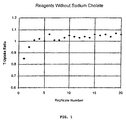
- FIG. 1 depicts data for the T uptake ratio versus replicate number for assays assessing unsaturated thyroid binding proteins in serum performed using reagents without sodium cholate.
- FIG. 2 depicts data for the T uptake ratio versus replicate number for assays assessing unsaturated thyroid binding proteins in serum performed using reagents with sodium cholate.
- This invention provides a method for substantially preventing coating of hydrophobic material on a probe of an automated analyzer during an assay.
- An automated analyzer having a probe is provided.
- a composition comprising a non-denaturing surfactant and a reagent for use in an assay is provided.
- the non-denaturing surfactant is capable of substantially preventing coating of the probe with hydrophobic material during the assay.
- the probe is contacted with the composition during the assay such that hydrophobic material is substantially prevented from coating the probe on the automated analyzer.
- automated analyzer an instrument system which combines reagents and samples in an automated fashion to produce test results.
- An example of an automated analyzer is the ACS:180 analyzer (Ciba-Corning, East Walpole, MA).
- probe is meant a member of the automated analyzer which dispenses and/or mixes material, e.g., reagents, e.g., ligands, receptors, samples, cells, extracts, serum, plasma, labels, enzymes, antibodies, or any other material used for an assay that is to be performed by the automated analyzer.
- the automated analyzer functions by using any one or more modes for sample analysis, e.g., batch mode or random access mode.
- batch mode is meant an operation on an automated analyzer which runs the same assay for a group of samples.
- random access mode is meant an operation on an automated analyzer which runs multiple different assays for a group of samples. The running sequence of these different assays for a group of samples can be arranged in a random or non-random order.
- the present invention is particularly useful for automated analyzers that utilize the random access mode.
- the assay can be any assay which can be performed by an automated analyzer, e.g., immunoassays, enzymatic assays, chemical assays or biological assays.
- the assay is one in which a material being dispensed or being formed is a hydrophobic material.
- hydrophobic material is meant a material that dissolves poorly in water.
- Hydrophobic materials include, e.g., proteins, peptides, fats, oils and compounds such as triiodothyronine and thyroxine, and their analogues. Hydrophobic material accumulates on the probe of the automated analyzer because of the material's hydrophobic properties. This probe coating problem has generally limited such assays in the past to the batch mode only.
- Preventing coating of hydrophobic material on the probe during an assay is meant to include, e.g., before, during, or subsequent to the actual reaction step.
- the invention includes preventing coating of the probe during probe dispension of an initial material, as well as preventing coating of the probe during probe dispension of a subsequent material.
- Prevention of probe coating during an assay is meant to include assays in which the probe comes into contact with either one or more materials, e.g., reagents, products, solutions, samples, or controls, either at the same time or sequentially.
- any assay in which coating of the probe by a material, e.g., a hydrophobic material, is a problem, can be performed using this'invention.
- Such assays include, e.g., thyroxine (T4), triiodothyronine (T3), free thyroxine (free T4), free triiodothyronine (free T3), T uptake, or any other assay which uses hydrophobic molecules in the reagent formulation.
- the assay is the assessment of unsaturated thyroid binding proteins in serum or plasma.
- Thyroid hormones L-3,3',5-triiodothyronine (T 3 ) and thyroxine (T 4 ), are able to bind to thyroxine-binding globulin, thyroxine-binding prealbumin and albumin.
- the assay measures the number of unoccupied binding sites on these proteins in a sample, e.g., a serum sample, and is thus an indirect indicator of thyroid status.
- the sample is incubated with a first reagent which comprises labeled T 3 -bovine gamma globulin (BGG), e.g., acridinium ester (AE)-labeled T 3 -BGG, and unlabeled T 3 , preferably in phosphate buffer, EDTA and sodium azide.
- BGG labeled T 3 -bovine gamma globulin
- AE acridinium ester
- the AE-labeled T 3 -BGG and unlabeled T 3 compete for anti-T 3 antibody, e.g., monoclonal mouse anti-T 3 antibody, present in a second reagent.
- the second reagent comprises monoclonal mouse anti-T 3 antibody bound to goat anti-mouse antibody, which is coupled, e.g., covalently coupled, to magnetic, e.g., paramagnetic particles, preferably in phosphate buffer, EDTA and sodium azide.
- magnetic e.g., paramagnetic particles
- a greater amount of unlabeled T 3 binding to the binding proteins in the sample results in more AE-labeled T 3 -BGG binding to the monoclonal antibody, an indication of a higher amount of unsaturated binding proteins.
- a direct relationship exists between the unsaturated binding proteins of a sample and the relative light units detected by an automated analyzer.
- the assay for the assessment of unsaturated thyroid binding proteins in serum or plasma utilizes T 4 instead of T 3 .
- the first reagent comprises labeled T 4 -BGG, e.g., AE-labeled T 4 -BGG, and unlabeled T 4
- the second reagent comprises anti-T 4 antibody, e.g, monoclonal mouse anti-T 4 antibody bound to goat anti-mouse antibody, which is coupled, e.g., covalently coupled, to magnetic , e.g., paramagnetic particles.
- the hydrophobic material is T 4
- the non-denaturing surfactant in the composition substantially prevents coating of the probe with T 4 during the assay.
- surfactant is meant a compound that reduces surface tension when dissolved in water, or which reduces interfacial tension between two liquids, or between a liquid and a solid, e.g., detergents, wetting agents or emulsifiers.
- An advantage of using a non-denaturing surfactant is that it will not denature the reagents and/or products with which it comes into contact.
- non-denaturing surfactants include anion surfactants, zwitterion surfactants, and cation surfactants.
- the non-denaturing surfactant is sodium cholate or a sodium cholate analogue.
- non-denaturing surfactants examples include deoxycholic acid, glycocholic acid, lithocholic acid, taurocholic acid, CHAPS and CHAPSO, as well as the sodium salt derivatives of the above compounds.
- Other examples that can be used are surfactants which have a steroid backbone and sodium salts of these compounds.
- a single non-denaturing surfactant can be used, or mixtures of non-denaturing surfactants can be used.
- the concentration of the non-denaturing surfactant used is that concentration which is capable of substantially preventing coating of the probe with hydrophobic material during the assay.
- the optimum concentration may differ depending upon the specific non-denaturing surfactant that is used and the particular hydrophobic material that is present, and can be determined by one of ordinary skill in the art using no more than routine experimentation.
- the concentration of the non-denaturing surfactant in the composition which also comprises a reagent for use in the assay is about 0.01% to about 10%, more preferably is about 0.05% to about 5%, and most preferably is about 0.1% to about 3%.
- the non-denaturing surfactant can be added to either one or more of the different reagents to form different compositions.
- concentrations of the non-denaturing surfactant can be the same or different in these various compositions with the different reagents.
- the concentrations of the surfactant e.g., sodium cholate, contained in the first reagent and second reagent be different.
- the first reagent preferably contains about a 150-fold excess of unlabeled T 3 versus AE-labeled T 3 -BGG based on molar ratio.
- the hydrophobic T 3 molecules are the cause of the coating problem on the probe.
- the concentration of the surfactant in the first reagent is about 0.1% to about 3%, more preferably is about 0.1% to about 1%, and most preferably is about 0.2%.
- the assay is performed by first pipetting the second reagent into the probe, followed by the first reagent. Subsequently, the first reagent is delivered into a reaction cuvette after the sample, followed by the second reagent.
- the part of the probe which has a T 3 coating problem is the portion that contains the first reagent, and not the portion that contains the second reagent. Therefore, a lower concentration of sodium cholate is preferred for the second reagent.
- the concentration is such as to be able to scavenge any residual amount of T 3 left on the probe after delivery of the first reagent.
- the concentration of the surfactant in the second reagent is about 0% to about 1%, more preferably about 0.01% to about 1%, more preferably yet about 0.02% to about 0.5%, and most preferably about 0.05%.
- the concentration of the non-denaturing surfactant in the actual reaction mixture may be reduced. For example, if two reagent compositions are added to a sample to form a reaction mixture, the concentration of the surfactant in the actual reaction mixture is calculated according to the following formula:(% surfactant in reagent I x reagent I volume) + (% surfactant in reagent II x reagent II volume) divided by (sample volume + reagent I volume + reagent II volume).
- Reagent is meant to include, e.g., any material which is needed for the assay, e.g., enzymes, antibodies, samples, cells, extracts, serum, plasma, labels, receptors, ligands, or any other chemical or biological moiety utilized as a reactant in the assay.
- Examples of reagents in the embodiments discussed above in which the assay is the assessment of unsaturated thyroid binding proteins in serum or plasma, are labeled T 3 -BGG, unlabeled T 3 , anti-T 3 antibody, labeled T 4 -BGG, unlabeled T 4 and anti-T 4 antibody.
- the label can be, e.g, chemiluminescent, radioactive, enzymatic, latex agglutinant, bioluminescent, or fluorescent.
- a preferred label is acridinium ester.
- the invention also includes a method for performing an assay using a random access mode of an automated analyzer.
- An automated analyzer having a probe and a random access mode is provided.
- a composition comprising a non-denaturing surfactant and a reagent for use in an assay is provided.
- the non-denaturing surfactant is capable of substantially preventing coating of the probe with hydrophobic material when performing the assay.
- the random access mode of the automated analyzer is used so as to perform the assay.
- the assay is the assessment of unsaturated thyroid binding proteins in serum or plasma.
- the invention also includes the use of a composition for substantially preventing coating of hydrophobic material on a probe of an automated analyzer during an assay.
- the composition comprises a non-denaturing surfactant and a reagent for use in the assay.
- the non-denaturing surfactant can be, e.g., an anion surfactant, a zwitterion surfactant, or mixtures thereof.
- the non-denaturing surfactant is sodium cholate, a sodium cholate analogue, or mixtures thereof.
- the assay is the assessment of unsaturated thyroid binding proteins in serum or plasma.
- the reagent can be, e.g., labeled triiodothyronine-BGG, unlabeled triiodothyronine, anti- triiodothyronine antibody, labeled thyroxine, unlabeled thyroxine, and anti-thyroxine antibody.
- the composition comprises sodium cholate and unlabeled triiodothyronine. In another preferred embodiment, the composition comprises sodium cholate and unlabeled thyroxine. In another preferred embodiment, the composition comprises sodium cholate and anti-triiodothyronine antibody. In another preferred embodiment, the composition comprises sodium cholate and anti-thyroxine antibody. In yet other preferred embodiments, a sodium cholate analogue is used instead of sodium cholate in each of the above-described compositions.
- the invention also includes a method for enhancing the stability of a reagent used in assaying unsaturated thyroid binding proteins.
- a reagent for use in assaying unsaturated thyroid binding proteins is provided.
- a composition comprising a non-denaturing surfactant capable of enhancing the stability of the reagent is provided. The composition is contacted with the reagent such that the stability of the reagent is enhanced.
- a reagent for assaying unsaturated thyroid binding proteins includes, e.g., reagents comprising labeled triiodothyronine-BGG and unlabeled triiodothyronine, or anti-triiodothyronine antibody coupled to magnetic particles, or labeled thyroxine and unlabeled thyroxine, or anti-thyroxine antibody coupled to magnetic particles.
- the invention also may use other reagent formulations that can be used in assaying unsaturated thyroid binding proteins.
- enhancing the stability of a reagent is meant increasing the retention of activity of the reagent when the reagent is aged.
- the activity of the reagent is usually reflected in signals, such as chemiluminescence, fluorescence or radioactivity.
- the stored calibration stability is enhanced; in other embodiments, the on-board stability of the reagent is enhanced; in yet other embodiments, both the stored calibration and the on-board stabilities are enhanced.
- stored calibration stability is meant the extent of deviation of control dose recovery from 100% as a reagent is aged under the specified storage condition. The dose recovery is measured from the time 0 stored calibration point and compared with the control dose recovery at time 0.
- on-board stability is meant the extent of deviation of the control dose recovery from 100% as a reagent is placed on the instrument under the running. conditions for a prolonged time.
- the dose recovery is measured from the time 0 stored calibration point and compared with the control dose recovery at time 0.
- the non-denaturing surfactant can be, e.g., an anion surfactant, a zwitterion surfactant, a cation surfactant, or mixtures thereof.
- Preferred non-denaturing surfactants are sodium cholate, a sodium cholate analogue, or mixtures thereof.
- the concentration of the non-denaturing surfactant will vary depending upon the specific reagent used and the specific non-denaturing surfactant used, and can be determined by one skilled in the art using no more than routine experimentation.
- the concentration of the surfactant in the reagent is about 0.01% to about 3%, more preferably is about 0.02% to about 1%, and most preferably is about 0.05% to about 0.2%.
- Example 1 Comparison Studies of Uptake Ratios of Thyroid Binding Proteins Using Reagents With and Without Sodium Cholate
- This example illustrates that the addition of sodium cholate to the reagents in repeated assays for assessing unsaturated thyroid binding proteins resulted in about 0% difference between the first and subsequent replicates, as compared to using reagents without sodium cholate which resulted in about a 19% difference between the first and subsequent replicates.
- the assays were performed as follows, using an ACS:180 analyzer and Reagent Probe 2 (Ciba-Corning, East Walpole, MA): 35 ⁇ l of serum sample was dispensed into a cuvette; 100 ⁇ l of reagent I (AE-labeled T 3 -BGG, unlabeled T 3 , phosphate buffer, EDTA and sodium azide (0.1%), was then dispensed; 450 ⁇ l of reagent II (monoclonal mouse anti-T 3 antibody bound to goat anti-mouse antibody covalently coupled to paramagnetic particles, phosphate buffer, EDTA and sodium azide (0.1%)), was then dispensed; the mixture was incubated for 5 minutes at 37°C; the cuvette was separated, aspirated and washed with deionized water; 300 ⁇ l of an acid reagent (a mixture of 0.1 N nitric acid and 0.5% hydrogen peroxide) and 300 ⁇ l of a base reagent (a
- the above reagents for this assay can be obtained from Ciba-Corning, East'Walpole, MA (ACS:180 TUptake Assay Package).
- the assays were performed either with no addition of sodium cholate, or with sodium cholate (0.2% final concentration) added to reagent I, and sodium cholate (0.05% final concentration) added to reagent II.
- the addition of sodium cholate to the reagents eliminated the probe coating problem completely. See Figure 1 (experiments performed without sodium cholate) and Figure 2 (experiments performed with sodium cholate).
- the percent difference in T uptake ratios between the first replicate and the mean of replicates from the thirteenth to the twentieth was 19.0 for the reagents without sodium cholate and 0 for the reagents with sodium cholate.
- the percent difference was calculated as [(mean of replicates 13 through 20) - (first replicate)] x (100) divided by (mean of replicates 13 through 20).
- Example 2 Addition of Sodium Cholate in Thyroid Protein Binding Assays Results in the Absence of T 3 in Washes of the Probes
- the assays were performed with and without sodium cholate as described in Example 1.
- the assays were run fifty times each on two different ACS:180 analyzers. At the end of the run, the probes on the analyzers were washed and soaked in 3 ml methanol. The methanol wash was analyzed and showed that about 10 ng/ml of T 3 was contained in the wash from the assays without the sodium cholate and was not detectable from the assays with sodium cholate.
- Example 3 Addition of Sodium Cholate in Thyroid Protein Binding Assays Does Not Interfere With Other Assays Using a Random Access Mode
- This example illustrates that the use of sodium cholate in assays for assessing unsaturated thyroid binding proteins using a random access mode on an automated analyzer did not interfere with other types of assays performed in the random access mode.
- the assay for assessing unsaturated thyroid binding proteins was performed as described in Example 1, using reagents which contained 0.2% sodium cholate in reagent I and 0.05% sodium cholate in reagent II. This assay was tested in a random access mode on an ACS:180 analyzer with other probe 2 assays: cortisol, testosterone, progesterone, folate 2, estradiol-6 and TSH 3 assays. See Ciba Corning (Medfield, MA) ACS:180 package inserts for these assays as in use for the year 1996. The results showed that the presence of sodium cholate in the thyroid binding protein assay did not interfere with any of the other assays tested, and that none of these other assays interfered with the thyroid binding protein assay.
- Example 4 Comparison Studies of Uptake Ratios of Thyroid Binding Proteins Using Reagents With and Without Various Non-Denaturing Surfactants
- This example illustrates that sodium cholate analogue surfactants resulted in substantially preventing probe coating when added to the reagents in assays for assessing unsaturated thyroid binding proteins.
- the assays were performed as described in Example 1, except that a variety of sodium cholate analogues were added to the reagents instead of sodium cholate.
- the analogues used were: sodium salt of deoxycholic acid, sodium salt of glycocholic acid, lithocholic acid, sodium salt of taurocholic acid, CHAPS and CHAPSO.
- the concentration of the surfactant in reagent I and reagent II was 0.5%.
- the comparison study results among the various analogues are shown in Table 1.
- This example illustrates that the addition of sodium cholate to reagents used in assays for assessing unsaturated thyroid binding proteins enhanced the stability of the reagents.
- a calibration point from the reagent formulations I and II (described in Example 1) was stored on an ACS:180 analyzer. A time-course study using the stored calibration point was followed subsequently for 28 days. The reagents were stored at 2°-8°C in a separate refrigerator.
- the reagents as described in (a) were continuously stressed in a stability chamber (Webber Manufacturing Co., Inc., Indianapolis, IN) at 30°C and 20% relative humidity for 48 hours.
- ACS:180 reagent wheels were placed inside of the stability chamber.
- the reagent II bottles were constantly rotated on the reagent wheel to prevent the settling of paramagnetic particles.
- Both reagent I and reagent II bottles were partially open on the reagent wheel inside the stability chamber throughout the entire study. These conditions were designated to simulate the ACS:180 instrument running conditions. At a specific time point, an aliquot of the reagent was removed and discarded to simulate actual usage; the remaining reagent bottles were retired to storage at 2°-8° C.
- the retired reagents were tested and analyzed based on a stored calibration from the time 0 reagents. The percent of control recoveries with respect to that of time 0 were determined. Lower percent recoveries were observed in the reagent formulations without sodium cholate, whereas near 100% recoveries were observed in the reagent formulations with sodium cholate. Statistical analysis of the recoveries confirmed that there was a significant difference for the on-board stability over 48 hours between the reagent formulations with and without sodium cholate. Thus, the addition of sodium cholate improved the on-board stability of the reagents in the unsaturated thyroid binding protein assay.
Landscapes
- Health & Medical Sciences (AREA)
- Life Sciences & Earth Sciences (AREA)
- Immunology (AREA)
- Engineering & Computer Science (AREA)
- Chemical & Material Sciences (AREA)
- Molecular Biology (AREA)
- Biomedical Technology (AREA)
- Hematology (AREA)
- Urology & Nephrology (AREA)
- Food Science & Technology (AREA)
- General Physics & Mathematics (AREA)
- Cell Biology (AREA)
- Biotechnology (AREA)
- Medicinal Chemistry (AREA)
- Physics & Mathematics (AREA)
- Analytical Chemistry (AREA)
- Biochemistry (AREA)
- General Health & Medical Sciences (AREA)
- Microbiology (AREA)
- Pathology (AREA)
- Chemical Kinetics & Catalysis (AREA)
- Endocrinology (AREA)
- Investigating Or Analysing Biological Materials (AREA)
- Sampling And Sample Adjustment (AREA)
- Automatic Analysis And Handling Materials Therefor (AREA)
- Measuring Or Testing Involving Enzymes Or Micro-Organisms (AREA)
- Investigating Or Analysing Materials By The Use Of Chemical Reactions (AREA)
Claims (31)
- Verfahren zum Verhindern oder Vermindern des Aufschichtens eines hydrophoben Materials auf eine Sonde eines automatisierten Analysegeräts während eines Assays, umfassend:Bereitstellung eines automatisierten Analysegeräts, das eine Sonde hat;Bereitstellung einer Zusammensetzung, umfassend ein nicht denaturierendes oberflächenaktives Mittel und ein Reagenz zur Verwendung bei einem Assay, wobei das nicht denaturierende oberflächenaktive Mittel dazu imstande ist, das Beschichten der Sonde mit dem hydrophoben Material während des Assays zu verhindern oder zu vermindern; undKontaktierung der Sonde mit der genannten Zusammensetzung während des Assays derart, dass das Beschichten der Sonde mit dem hydrophoben Material verhindert oder vermindert wird.
- Verfahren nach Anspruch 1, dadurch gekennzeichnet, dass das nicht denaturierende oberflächenaktive Mittel ein anionisches oberflächenaktives Mittel ist.
- Verfahren nach Anspruch 1, dadurch gekennzeichnet, dass das nicht denaturierende oberflächenaktive Mittel ein zwitterionenartiges oberflächenaktives Mittel ist.
- Verfahren nach Anspruch 1, dadurch gekennzeichnet, dass das nicht denaturierende oberflächenaktive Mittel ein kationisches oberflächenaktives Mittel ist.
- Verfahren nach Anspruch 1, dadurch gekennzeichnet, dass das nicht denaturierende oberflächenaktive Mittel Natriumcholat ist.
- Verfahren nach Anspruch 1, dadurch gekennzeichnet, dass das nicht denaturierende oberflächenaktive Mittel ein Natriumcholat-Analoges ist.
- Verfahren nach Anspruch 1, dadurch gekennzeichnet, dass das nicht denaturierende oberflächenaktive Mittel aus der Gruppe bestehend aus Desoxicholsäure, Glycocholsäure, Lithocholsäure, Taurocholsäure, CHAPS, CHAPSO, ihren Natriumsalzderivaten und Gemischen davon ausgewählt wird.
- Verfahren nach Anspruch 1, dadurch gekennzeichnet, dass die Konzentration des nicht denaturierenden oberflächenaktiven Mittels in der Zusammensetzung etwa 0,01% bis etwa 10% beträgt.
- Verfahren nach Anspruch 1, dadurch gekennzeichnet, dass die Konzentration des nicht denaturierenden oberflächenaktiven Mittels in der Zusammensetzung etwa 0,1% bis etwa 3% beträgt.
- Verfahren nach Anspruch 1, dadurch gekennzeichnet, dass die Konzentration des nicht denaturierenden oberflächenaktiven Mittels in der Zusammensetzung etwa 0,01% bis etwa 1% beträgt.
- Verfahren nach Anspruch 1, dadurch gekennzeichnet, dass das Reagenz zur Bestimmung von ungesättigten Thyroidbindungsproteinen im Serum oder Plasma vorgesehen ist.
- Verfahren nach Anspruch 11, dadurch gekennzeichnet, dass das Reagenz markiertes Triiodthyronin-Rindergammaglobulin und nicht markiertes Triiodthyronin umfasst.
- Verfahren nach Anspruch 11, dadurch gekennzeichnet, dass das Reagenz an magnetische Teilchen gekuppelten .Anti-Triiodthyronin-Antikörper umfasst.
- Verfahren nach Anspruch 11, dadurch gekennzeichnet, dass das Reagenz markiertes Thyroxin-Rindergammaglobulin und nicht markiertes Thyroxin umfasst.
- Verfahren nach Anspruch 11, dadurch gekennzeichnet, dass das Reagenz an magnetische Teilchen gekuppelten Anti-Thyroxin-Antikörper umfasst.
- Verfahren nach Anspruch 11, dadurch gekennzeichnet, dass das hydrophobe Material Triiodthyronin ist.
- Verfahren nach Anspruch 11, dadurch gekennzeichnet, dass das hydrophobe Material Thyroxin ist.
- Verfahren zur Durchführung eines Assays unter Verwendung eines Modus mit wahlfreiem Zugriff eines automatisierten Analysegeräts, umfassend:Bereitstellung eines automatisierten Analysegeräts, das eine Sonde und einen Modus mit wahlfreiem Zugriff aufweist;Bereitstellung einer Zusammensetzung, umfassend ein nicht denaturierendes oberflächenaktives Mittel und ein Reagenz zur Verwendung bei einem Assay, wobei das nicht denaturierende oberflächenaktive Mittel dazu imstande ist, das Beschichten der Sonde mit hydrophobem Material beim Durchführen des Assays zu verhindern oder zu vermindern; undVerwendung des Modus mit wahlfreiem Zugriff des automatisierten Analysegeräts, um den Assay durchzuführen.
- Verfahren nach Anspruch 18, dadurch gekennzeichnet, dass der Assay für die Bestimmung von ungesättigten Thyroidbindungsproteinen im Serum oder Plasma vorgesehen ist.
- Verwendung einer Zusammensetzung zum Verhindern oder Vermindern des Aufschichtens eines hydrophoben Materials auf eine Sonde eines automatisierten Analysegeräts während eines Assays zur Bestimmung von ungesättigten Thyroidbindungsproteinen im Serum oder Plasma, wobei die Zusammensetzung ein nicht denaturierendes oberflächenaktives Mittel, ausgewählt aus der Gruppe bestehend aus einem antionischen oberflächenaktiven Mittel, einem kationischen oberflächenaktiven Mittel, einem zwitterionenartigen oberflächenaktiven Mittel und Gemischen davon; und ein Reagenz zur Verwendung bei dem Assay umfasst.
- Verwendung nach Anspruch 20, dadurch gekennzeichnet, dass das oberflächenaktive Mittel ein Material ausgewählt aus der Gruppe bestehend aus Natriumcholat, einem Natriumcholat-Analogen und Gemischen davon umfasst.
- Verwendung nach Anspruch 20, dadurch gekennzeichnet, dass das Reagenz ein Material ausgewählt aus der Gruppe bestehend aus markiertem Triiodthyronin-Rindergammaglobulin, nicht markiertem Triiodthyronin, Anti-Triiodthyronin-Antikörper, markiertem Thyroxin, nicht markiertem Thyroxin und Anti-Thyroxin-Antikörper ausgewählt wird.
- Verfahren zur Erhöhung der Stabilität eines Reagenzes, das bei der Bestimmung von ungesättigten Thyroidbindungsproteinen verwendet wird, umfassend:Bereitstellung eines Reagenzes zur Verwendung bei der Bestimmung von ungesättigten Thyroidbindungsproteinen;Bereitstellung einer Zusammensetzung, umfassend ein nicht denaturierendes oberflächenaktives Mittel, das dazu imstande ist, die Stabilität des Reagenzes zu erhöhen; undKontaktierung der Zusammensetzung mit dem Reagenz derart, dass die Stabilität des Reagenzes erhöht wird.
- Verfahren nach Anspruch 23, dadurch gekennzeichnet, dass das Reagenz markiertes Triiodthyronin-Rindergammaglobulin und nicht markiertes Triiodthyronin umfasst.
- Verfahren nach Anspruch 23, dadurch gekennzeichnet, dass das Reagenz an magnetische Teilchen gekuppelten Anti-Triiodthyronin-Antikörper umfasst.
- Verfahren nach Anspruch 23, dadurch gekennzeichnet, dass das Reagenz markiertes Thyroxin-Rindergammaglobulin und nicht markiertes Thyroxin umfasst.
- Verfahren nach Anspruch 23, dadurch gekennzeichnet, dass das Reagenz an magnetische Teilchen gekuppelten Anti-Thyroxin-Antikörper umfasst.
- Verfahren nach Anspruch 23, dadurch gekennzeichnet, dass das nicht denaturierende oberflächenaktive Mittel aus der Gruppe bestehend aus einem anionischen oberflächenaktiven Mittel, einem zwitterionenartigen oberflächenaktiven Mittel, einem kationischen oberflächenaktiven Mittel und Gemischen davon ausgewählt wird.
- Verfahren nach Anspruch 23, dadurch gekennzeichnet, dass das nicht denaturierende oberflächenaktive Mittel aus der Gruppe bestehend aus Natriumcholat; einem Natriumcholat-Analogen und Gemischen davon ausgewählt ist.
- Verfahren nach Anspruch 23, dadurch gekennzeichnet, dass die On-Board-Stabilität des Reagenzes verbessert wird.
- Verfahren nach Anspruch 23, dadurch gekennzeichnet, dass die Stabilität der gespeicherten Kalibrierung des Reagenzes verbessert wird.
Applications Claiming Priority (3)
| Application Number | Priority Date | Filing Date | Title |
|---|---|---|---|
| US08/712,829 US5786153A (en) | 1996-09-12 | 1996-09-12 | Prevention of probe coating on automated analyzers using a non-denaturing surfactant |
| US712829 | 1996-09-12 | ||
| PCT/IB1997/001064 WO1998011441A1 (en) | 1996-09-12 | 1997-09-08 | Prevention of probe coating on automated analyzers using a non-denaturing surfactant |
Publications (2)
| Publication Number | Publication Date |
|---|---|
| EP0925507A1 EP0925507A1 (de) | 1999-06-30 |
| EP0925507B1 true EP0925507B1 (de) | 2002-07-24 |
Family
ID=24863719
Family Applications (1)
| Application Number | Title | Priority Date | Filing Date |
|---|---|---|---|
| EP97936825A Expired - Lifetime EP0925507B1 (de) | 1996-09-12 | 1997-09-08 | Verwendung eines nichtdenaturierenden tensids zur vorbeugung einer probenbeschichtung auf automatisierten analysegeräten |
Country Status (10)
| Country | Link |
|---|---|
| US (1) | US5786153A (de) |
| EP (1) | EP0925507B1 (de) |
| JP (1) | JP3929499B2 (de) |
| AT (1) | ATE221205T1 (de) |
| AU (1) | AU3951697A (de) |
| DE (1) | DE69714272T2 (de) |
| DK (1) | DK0925507T3 (de) |
| ES (1) | ES2181018T3 (de) |
| PT (1) | PT925507E (de) |
| WO (1) | WO1998011441A1 (de) |
Family Cites Families (8)
| Publication number | Priority date | Publication date | Assignee | Title |
|---|---|---|---|---|
| US4115313A (en) * | 1974-10-08 | 1978-09-19 | Irving Lyon | Bile acid emulsions |
| EP0061541A1 (de) * | 1981-03-27 | 1982-10-06 | Biospecia Limited | Immunologische Analyse und biochemisches Mittel hierfür |
| US5512659A (en) * | 1989-08-04 | 1996-04-30 | Syntex (U.S.A.) Inc. | Compositions useful in heterogeneous immunoassays |
| US5066336A (en) * | 1989-12-01 | 1991-11-19 | Akzo N.V. | Method for cleaning reagent delivery probes |
| US5464749A (en) * | 1991-07-22 | 1995-11-07 | Bayer Corporation | Immunoassay of free substances in biological fluids |
| US5395545A (en) * | 1993-10-21 | 1995-03-07 | Akzo N.V. | Cleaning solution for automated analyzers |
| FR2715566B1 (fr) * | 1994-02-03 | 1996-03-08 | Synthelabo | Solutions aqueuses concentrées d'argatroban. |
| US5888752A (en) * | 1995-05-16 | 1999-03-30 | Bayer Corporation | Universal rinse reagent and method for use in hematological analyses of whole blood samples |
-
1996
- 1996-09-12 US US08/712,829 patent/US5786153A/en not_active Expired - Lifetime
-
1997
- 1997-09-08 AU AU39516/97A patent/AU3951697A/en not_active Abandoned
- 1997-09-08 ES ES97936825T patent/ES2181018T3/es not_active Expired - Lifetime
- 1997-09-08 EP EP97936825A patent/EP0925507B1/de not_active Expired - Lifetime
- 1997-09-08 DK DK97936825T patent/DK0925507T3/da active
- 1997-09-08 JP JP51343298A patent/JP3929499B2/ja not_active Expired - Lifetime
- 1997-09-08 WO PCT/IB1997/001064 patent/WO1998011441A1/en not_active Ceased
- 1997-09-08 AT AT97936825T patent/ATE221205T1/de not_active IP Right Cessation
- 1997-09-08 DE DE69714272T patent/DE69714272T2/de not_active Expired - Lifetime
- 1997-09-08 PT PT97936825T patent/PT925507E/pt unknown
Also Published As
| Publication number | Publication date |
|---|---|
| DK0925507T3 (da) | 2002-09-09 |
| JP2001504215A (ja) | 2001-03-27 |
| DE69714272T2 (de) | 2002-11-14 |
| DE69714272D1 (de) | 2002-08-29 |
| JP3929499B2 (ja) | 2007-06-13 |
| EP0925507A1 (de) | 1999-06-30 |
| ES2181018T3 (es) | 2003-02-16 |
| AU3951697A (en) | 1998-04-02 |
| US5786153A (en) | 1998-07-28 |
| PT925507E (pt) | 2002-11-29 |
| WO1998011441A1 (en) | 1998-03-19 |
| ATE221205T1 (de) | 2002-08-15 |
Similar Documents
| Publication | Publication Date | Title |
|---|---|---|
| US5225325A (en) | Immunohistochemical staining method and reagents therefor | |
| US4536478A (en) | Method for reducing non-specific interferences in agglutination immunoassays | |
| EP0524502B1 (de) | Immunoassay für freie Analyten | |
| JP3560979B2 (ja) | 安定化された水性ステロイド免疫検定用標準 | |
| JPH0667960B2 (ja) | 結合蛋白質に結合した分析質を分離する方法及び血清中のビタミンb12測定用試料準備試薬 | |
| Kane | Use of sodium salicylate as a blocking agent for cortisol-binding-globulin in a radioimmunoassay for cortisol on unextracted plasma | |
| EP0155104A2 (de) | Test für unbehindertes Analyt | |
| JPS6271861A (ja) | 免疫反応成分測定法及び該方法を実施するための試薬 | |
| EP0925507B1 (de) | Verwendung eines nichtdenaturierenden tensids zur vorbeugung einer probenbeschichtung auf automatisierten analysegeräten | |
| EP2309265B1 (de) | Verfahren zur untersuchung eines komplexes und darin zu verwendendes kit | |
| US6387711B1 (en) | Liquid intact parathyroid hormone (PTH) standards | |
| EP0565949A2 (de) | Verfahren zur quantitation Bestimmung einer freien Form einer Substanz in biologischen Flüssigkeiten | |
| JP3042753B2 (ja) | 解離剤を使用する免疫検定法 | |
| WO1986007462A1 (en) | Enzyme assay of body fluids | |
| US6607891B1 (en) | Method of assaying insulin-like growth factor | |
| EP0125368B1 (de) | Verfahren zur immunologischen Bestimmung durch Reaktionsgeschwindigkeits-Potentiometrie unter Verwendung von fluoridionenselektiver Elektrode | |
| JP3228791B2 (ja) | 検体中の抗原又は抗体の測定法 | |
| JP3711543B2 (ja) | 化学発光測定試薬及び測定方法 | |
| JPH06102275A (ja) | ステロイドホルモンの測定方法 | |
| JP3401903B2 (ja) | ステロイド・ホルモンまたはビタミン類の測定法 | |
| JP2001099838A (ja) | 化学発光反応に基づく糖尿病診断のための多項目検査項目の同時測定方法 | |
| JPH0634636A (ja) | ステロイドホルモンの測定法 | |
| EP1162462B1 (de) | Testverfahren für Hämoglobin unter Verwendung von Lipoproteinen | |
| JPS6071958A (ja) | 酵素免疫測定法 | |
| Alain et al. | Adaptation of the Syva EMIT-cad digoxin enzyme immunoassay technique on the Instrumentation Laboratory Multistat-III microcentrifugal analyzer |
Legal Events
| Date | Code | Title | Description |
|---|---|---|---|
| PUAI | Public reference made under article 153(3) epc to a published international application that has entered the european phase |
Free format text: ORIGINAL CODE: 0009012 |
|
| 17P | Request for examination filed |
Effective date: 19990301 |
|
| AK | Designated contracting states |
Kind code of ref document: A1 Designated state(s): AT BE CH DE DK ES FI FR GB GR IE IT LI LU MC NL PT SE |
|
| RAP1 | Party data changed (applicant data changed or rights of an application transferred) |
Owner name: BAYER CORPORATION |
|
| GRAG | Despatch of communication of intention to grant |
Free format text: ORIGINAL CODE: EPIDOS AGRA |
|
| RTI1 | Title (correction) |
Free format text: PREVENTION OF PROBE COATING ON AUTOMATED ANALYZERS USING A NON-DENATURING SURFACTANT |
|
| 17Q | First examination report despatched |
Effective date: 20011126 |
|
| GRAG | Despatch of communication of intention to grant |
Free format text: ORIGINAL CODE: EPIDOS AGRA |
|
| GRAG | Despatch of communication of intention to grant |
Free format text: ORIGINAL CODE: EPIDOS AGRA |
|
| GRAH | Despatch of communication of intention to grant a patent |
Free format text: ORIGINAL CODE: EPIDOS IGRA |
|
| GRAH | Despatch of communication of intention to grant a patent |
Free format text: ORIGINAL CODE: EPIDOS IGRA |
|
| GRAA | (expected) grant |
Free format text: ORIGINAL CODE: 0009210 |
|
| AK | Designated contracting states |
Kind code of ref document: B1 Designated state(s): AT BE CH DE DK ES FI FR GB GR IE IT LI LU MC NL PT SE |
|
| REF | Corresponds to: |
Ref document number: 221205 Country of ref document: AT Date of ref document: 20020815 Kind code of ref document: T |
|
| REG | Reference to a national code |
Ref country code: GB Ref legal event code: FG4D |
|
| REG | Reference to a national code |
Ref country code: CH Ref legal event code: NV Representative=s name: PATENTANWAELTE SCHAAD, BALASS, MENZL & PARTNER AG Ref country code: CH Ref legal event code: EP |
|
| REG | Reference to a national code |
Ref country code: IE Ref legal event code: FG4D |
|
| REF | Corresponds to: |
Ref document number: 69714272 Country of ref document: DE Date of ref document: 20020829 |
|
| REG | Reference to a national code |
Ref country code: DK Ref legal event code: T3 |
|
| REG | Reference to a national code |
Ref country code: PT Ref legal event code: SC4A Free format text: AVAILABILITY OF NATIONAL TRANSLATION Effective date: 20020923 |
|
| REG | Reference to a national code |
Ref country code: GR Ref legal event code: EP Ref document number: 20020403449 Country of ref document: GR |
|
| ET | Fr: translation filed | ||
| REG | Reference to a national code |
Ref country code: ES Ref legal event code: FG2A Ref document number: 2181018 Country of ref document: ES Kind code of ref document: T3 |
|
| PLBE | No opposition filed within time limit |
Free format text: ORIGINAL CODE: 0009261 |
|
| STAA | Information on the status of an ep patent application or granted ep patent |
Free format text: STATUS: NO OPPOSITION FILED WITHIN TIME LIMIT |
|
| 26N | No opposition filed |
Effective date: 20030425 |
|
| PGFP | Annual fee paid to national office [announced via postgrant information from national office to epo] |
Ref country code: AT Payment date: 20030821 Year of fee payment: 7 |
|
| PGFP | Annual fee paid to national office [announced via postgrant information from national office to epo] |
Ref country code: NL Payment date: 20030825 Year of fee payment: 7 Ref country code: MC Payment date: 20030825 Year of fee payment: 7 |
|
| PGFP | Annual fee paid to national office [announced via postgrant information from national office to epo] |
Ref country code: SE Payment date: 20030919 Year of fee payment: 7 |
|
| PGFP | Annual fee paid to national office [announced via postgrant information from national office to epo] |
Ref country code: FI Payment date: 20030922 Year of fee payment: 7 Ref country code: PT Payment date: 20030922 Year of fee payment: 7 Ref country code: DK Payment date: 20030922 Year of fee payment: 7 |
|
| PGFP | Annual fee paid to national office [announced via postgrant information from national office to epo] |
Ref country code: LU Payment date: 20030929 Year of fee payment: 7 |
|
| PGFP | Annual fee paid to national office [announced via postgrant information from national office to epo] |
Ref country code: GR Payment date: 20030930 Year of fee payment: 7 |
|
| PGFP | Annual fee paid to national office [announced via postgrant information from national office to epo] |
Ref country code: BE Payment date: 20031017 Year of fee payment: 7 |
|
| PG25 | Lapsed in a contracting state [announced via postgrant information from national office to epo] |
Ref country code: LU Free format text: LAPSE BECAUSE OF NON-PAYMENT OF DUE FEES Effective date: 20040908 Ref country code: FI Free format text: LAPSE BECAUSE OF NON-PAYMENT OF DUE FEES Effective date: 20040908 Ref country code: AT Free format text: LAPSE BECAUSE OF NON-PAYMENT OF DUE FEES Effective date: 20040908 |
|
| PG25 | Lapsed in a contracting state [announced via postgrant information from national office to epo] |
Ref country code: SE Free format text: LAPSE BECAUSE OF NON-PAYMENT OF DUE FEES Effective date: 20040909 |
|
| PG25 | Lapsed in a contracting state [announced via postgrant information from national office to epo] |
Ref country code: MC Free format text: LAPSE BECAUSE OF NON-PAYMENT OF DUE FEES Effective date: 20040930 Ref country code: DK Free format text: LAPSE BECAUSE OF NON-PAYMENT OF DUE FEES Effective date: 20040930 Ref country code: BE Free format text: LAPSE BECAUSE OF NON-PAYMENT OF DUE FEES Effective date: 20040930 |
|
| PG25 | Lapsed in a contracting state [announced via postgrant information from national office to epo] |
Ref country code: PT Free format text: LAPSE BECAUSE OF NON-PAYMENT OF DUE FEES Effective date: 20050308 |
|
| BERE | Be: lapsed |
Owner name: *BAYER CORP. Effective date: 20040930 |
|
| PG25 | Lapsed in a contracting state [announced via postgrant information from national office to epo] |
Ref country code: NL Free format text: LAPSE BECAUSE OF NON-PAYMENT OF DUE FEES Effective date: 20050401 |
|
| PG25 | Lapsed in a contracting state [announced via postgrant information from national office to epo] |
Ref country code: GR Free format text: LAPSE BECAUSE OF NON-PAYMENT OF DUE FEES Effective date: 20050405 |
|
| EUG | Se: european patent has lapsed | ||
| REG | Reference to a national code |
Ref country code: PT Ref legal event code: MM4A Free format text: LAPSE DUE TO NON-PAYMENT OF FEES Effective date: 20050308 |
|
| NLV4 | Nl: lapsed or anulled due to non-payment of the annual fee |
Effective date: 20050401 |
|
| REG | Reference to a national code |
Ref country code: DK Ref legal event code: EBP |
|
| PGFP | Annual fee paid to national office [announced via postgrant information from national office to epo] |
Ref country code: IE Payment date: 20050920 Year of fee payment: 9 |
|
| PG25 | Lapsed in a contracting state [announced via postgrant information from national office to epo] |
Ref country code: IE Free format text: LAPSE BECAUSE OF NON-PAYMENT OF DUE FEES Effective date: 20060908 |
|
| REG | Reference to a national code |
Ref country code: IE Ref legal event code: MM4A |
|
| BERE | Be: lapsed |
Owner name: *BAYER CORP. Effective date: 20040930 |
|
| REG | Reference to a national code |
Ref country code: CH Ref legal event code: PUE Owner name: BAYER HEALTHCARE LLC Free format text: BAYER CORPORATION#100 BAYER ROAD#PITTSBURGH, PA 15205 (US) -TRANSFER TO- BAYER HEALTHCARE LLC#555 WHITE PLAINS ROAD#TARRYTOWN, NY 10591 (US) Ref country code: CH Ref legal event code: PUE Owner name: SIEMENS HEALTHCARE DIAGNOSTICS INC. Free format text: BAYER HEALTHCARE LLC#555 WHITE PLAINS ROAD#TARRYTOWN, NY 10591 (US) -TRANSFER TO- SIEMENS HEALTHCARE DIAGNOSTICS INC.#511 BENEDICT AVENUE#TARRYTOWN, NY 10591 (US) Ref country code: CH Ref legal event code: PFA Owner name: BAYER CORPORATION Free format text: BAYER CORPORATION#333 CONEY STREET#EAST WALPOLE, MA 02032 (US) -TRANSFER TO- BAYER CORPORATION#100 BAYER ROAD#PITTSBURGH, PA 15205 (US) Ref country code: CH Ref legal event code: NV Representative=s name: SIEMENS SCHWEIZ AG |
|
| REG | Reference to a national code |
Ref country code: GB Ref legal event code: 732E Free format text: REGISTERED BETWEEN 20101104 AND 20101110 |
|
| REG | Reference to a national code |
Ref country code: FR Ref legal event code: TP |
|
| REG | Reference to a national code |
Ref country code: FR Ref legal event code: PLFP Year of fee payment: 20 |
|
| PGFP | Annual fee paid to national office [announced via postgrant information from national office to epo] |
Ref country code: GB Payment date: 20160914 Year of fee payment: 20 |
|
| PGFP | Annual fee paid to national office [announced via postgrant information from national office to epo] |
Ref country code: FR Payment date: 20160914 Year of fee payment: 20 |
|
| PGFP | Annual fee paid to national office [announced via postgrant information from national office to epo] |
Ref country code: CH Payment date: 20161202 Year of fee payment: 20 Ref country code: DE Payment date: 20161121 Year of fee payment: 20 |
|
| PGFP | Annual fee paid to national office [announced via postgrant information from national office to epo] |
Ref country code: IT Payment date: 20160928 Year of fee payment: 20 Ref country code: ES Payment date: 20161026 Year of fee payment: 20 |
|
| REG | Reference to a national code |
Ref country code: DE Ref legal event code: R071 Ref document number: 69714272 Country of ref document: DE |
|
| REG | Reference to a national code |
Ref country code: CH Ref legal event code: PL |
|
| REG | Reference to a national code |
Ref country code: GB Ref legal event code: PE20 Expiry date: 20170907 |
|
| PG25 | Lapsed in a contracting state [announced via postgrant information from national office to epo] |
Ref country code: GB Free format text: LAPSE BECAUSE OF EXPIRATION OF PROTECTION Effective date: 20170907 |
|
| REG | Reference to a national code |
Ref country code: ES Ref legal event code: FD2A Effective date: 20180508 |
|
| PG25 | Lapsed in a contracting state [announced via postgrant information from national office to epo] |
Ref country code: ES Free format text: LAPSE BECAUSE OF EXPIRATION OF PROTECTION Effective date: 20170909 |