EP0932079B1 - Photographisches lichtempfindliches Silberhalogenidfarbmaterial und Verfahren zur Bilderzeugung, das dieses verwendet - Google Patents
Photographisches lichtempfindliches Silberhalogenidfarbmaterial und Verfahren zur Bilderzeugung, das dieses verwendet Download PDFInfo
- Publication number
- EP0932079B1 EP0932079B1 EP99101049A EP99101049A EP0932079B1 EP 0932079 B1 EP0932079 B1 EP 0932079B1 EP 99101049 A EP99101049 A EP 99101049A EP 99101049 A EP99101049 A EP 99101049A EP 0932079 B1 EP0932079 B1 EP 0932079B1
- Authority
- EP
- European Patent Office
- Prior art keywords
- group
- formula
- light
- sensitive material
- color
- Prior art date
- Legal status (The legal status is an assumption and is not a legal conclusion. Google has not performed a legal analysis and makes no representation as to the accuracy of the status listed.)
- Expired - Lifetime
Links
- -1 Silver halide Chemical class 0.000 title claims abstract description 540
- 229910052709 silver Inorganic materials 0.000 title claims abstract description 151
- 239000004332 silver Substances 0.000 title claims abstract description 151
- 239000000463 material Substances 0.000 title claims abstract description 135
- 238000000034 method Methods 0.000 title claims description 57
- 150000001875 compounds Chemical class 0.000 claims abstract description 231
- 125000004432 carbon atom Chemical group C* 0.000 claims abstract description 142
- 125000000217 alkyl group Chemical group 0.000 claims abstract description 139
- 125000003118 aryl group Chemical group 0.000 claims abstract description 115
- 125000003342 alkenyl group Chemical group 0.000 claims abstract description 26
- 239000000839 emulsion Substances 0.000 claims description 193
- 125000001424 substituent group Chemical group 0.000 claims description 121
- 239000003381 stabilizer Substances 0.000 claims description 108
- 125000000623 heterocyclic group Chemical group 0.000 claims description 78
- 229920000642 polymer Polymers 0.000 claims description 74
- 125000003545 alkoxy group Chemical group 0.000 claims description 55
- 229920001577 copolymer Polymers 0.000 claims description 50
- 125000005843 halogen group Chemical group 0.000 claims description 49
- 239000003795 chemical substances by application Substances 0.000 claims description 42
- 125000004442 acylamino group Chemical group 0.000 claims description 38
- 125000001931 aliphatic group Chemical group 0.000 claims description 38
- 125000004453 alkoxycarbonyl group Chemical group 0.000 claims description 38
- 239000000178 monomer Substances 0.000 claims description 32
- 125000004423 acyloxy group Chemical group 0.000 claims description 31
- 125000003917 carbamoyl group Chemical group [H]N([H])C(*)=O 0.000 claims description 31
- 239000004816 latex Substances 0.000 claims description 28
- 229920000126 latex Polymers 0.000 claims description 28
- 125000004397 aminosulfonyl group Chemical group NS(=O)(=O)* 0.000 claims description 27
- 125000004104 aryloxy group Chemical group 0.000 claims description 27
- 125000004093 cyano group Chemical group *C#N 0.000 claims description 25
- 238000011161 development Methods 0.000 claims description 24
- 125000004414 alkyl thio group Chemical group 0.000 claims description 23
- 125000002252 acyl group Chemical group 0.000 claims description 21
- 238000005859 coupling reaction Methods 0.000 claims description 21
- 125000000449 nitro group Chemical group [O-][N+](*)=O 0.000 claims description 20
- 239000000084 colloidal system Substances 0.000 claims description 19
- 125000002496 methyl group Chemical group [H]C([H])([H])* 0.000 claims description 19
- 125000003277 amino group Chemical group 0.000 claims description 18
- 125000005161 aryl oxy carbonyl group Chemical group 0.000 claims description 18
- 125000002887 hydroxy group Chemical group [H]O* 0.000 claims description 18
- 125000005420 sulfonamido group Chemical group S(=O)(=O)(N*)* 0.000 claims description 18
- 229910052801 chlorine Inorganic materials 0.000 claims description 17
- 125000005110 aryl thio group Chemical group 0.000 claims description 16
- 125000004429 atom Chemical group 0.000 claims description 16
- 125000000472 sulfonyl group Chemical group *S(*)(=O)=O 0.000 claims description 16
- 125000004466 alkoxycarbonylamino group Chemical group 0.000 claims description 14
- 229920001519 homopolymer Polymers 0.000 claims description 14
- 125000000753 cycloalkyl group Chemical group 0.000 claims description 13
- 125000000475 sulfinyl group Chemical group [*:2]S([*:1])=O 0.000 claims description 13
- WKBOTKDWSSQWDR-UHFFFAOYSA-N Bromine atom Chemical compound [Br] WKBOTKDWSSQWDR-UHFFFAOYSA-N 0.000 claims description 12
- 125000003282 alkyl amino group Chemical group 0.000 claims description 12
- 125000000751 azo group Chemical group [*]N=N[*] 0.000 claims description 12
- 125000001820 oxy group Chemical group [*:1]O[*:2] 0.000 claims description 12
- 125000005162 aryl oxy carbonyl amino group Chemical group 0.000 claims description 11
- 125000004391 aryl sulfonyl group Chemical group 0.000 claims description 11
- 125000004390 alkyl sulfonyl group Chemical group 0.000 claims description 9
- 125000004644 alkyl sulfinyl group Chemical group 0.000 claims description 8
- 125000005135 aryl sulfinyl group Chemical group 0.000 claims description 8
- 229910052755 nonmetal Inorganic materials 0.000 claims description 8
- 125000005499 phosphonyl group Chemical group 0.000 claims description 8
- 125000003107 substituted aryl group Chemical group 0.000 claims description 8
- 229920002554 vinyl polymer Polymers 0.000 claims description 8
- 125000005199 aryl carbonyloxy group Chemical group 0.000 claims description 7
- 125000000547 substituted alkyl group Chemical group 0.000 claims description 7
- 239000000539 dimer Substances 0.000 claims description 6
- 238000006386 neutralization reaction Methods 0.000 claims description 6
- 125000000843 phenylene group Chemical group C1(=C(C=CC=C1)*)* 0.000 claims description 6
- ZMZDMBWJUHKJPS-UHFFFAOYSA-M Thiocyanate anion Chemical group [S-]C#N ZMZDMBWJUHKJPS-UHFFFAOYSA-M 0.000 claims description 5
- 125000005035 acylthio group Chemical group 0.000 claims description 5
- 150000001768 cations Chemical class 0.000 claims description 5
- 125000002813 thiocarbonyl group Chemical group *C(*)=S 0.000 claims description 5
- 125000000391 vinyl group Chemical group [H]C([*])=C([H])[H] 0.000 claims description 5
- 125000000732 arylene group Chemical group 0.000 claims description 3
- 125000003943 azolyl group Chemical group 0.000 claims description 3
- GDTBXPJZTBHREO-UHFFFAOYSA-N bromine Substances BrBr GDTBXPJZTBHREO-UHFFFAOYSA-N 0.000 claims description 2
- 229910052794 bromium Inorganic materials 0.000 claims description 2
- 229910052736 halogen Inorganic materials 0.000 claims 6
- 150000002367 halogens Chemical class 0.000 claims 6
- 125000000923 (C1-C30) alkyl group Chemical group 0.000 claims 5
- 125000002924 primary amino group Chemical group [H]N([H])* 0.000 claims 3
- 125000006273 (C1-C3) alkyl group Chemical group 0.000 claims 2
- 125000000739 C2-C30 alkenyl group Chemical group 0.000 claims 2
- ZMZDMBWJUHKJPS-UHFFFAOYSA-N hydrogen thiocyanate Chemical group SC#N ZMZDMBWJUHKJPS-UHFFFAOYSA-N 0.000 claims 2
- CRDYSYOERSZTHZ-UHFFFAOYSA-M selenocyanate Chemical compound [Se-]C#N CRDYSYOERSZTHZ-UHFFFAOYSA-M 0.000 claims 2
- 125000004209 (C1-C8) alkyl group Chemical group 0.000 claims 1
- ZAMOUSCENKQFHK-UHFFFAOYSA-N Chlorine atom Chemical compound [Cl] ZAMOUSCENKQFHK-UHFFFAOYSA-N 0.000 claims 1
- 239000000460 chlorine Substances 0.000 claims 1
- 125000004435 hydrogen atom Chemical group [H]* 0.000 abstract description 69
- 239000010410 layer Substances 0.000 description 203
- 239000000243 solution Substances 0.000 description 110
- 239000000975 dye Substances 0.000 description 71
- 239000002904 solvent Substances 0.000 description 62
- 238000012545 processing Methods 0.000 description 61
- 239000000203 mixture Substances 0.000 description 56
- 108010010803 Gelatin Proteins 0.000 description 49
- 229920000159 gelatin Polymers 0.000 description 48
- 235000019322 gelatine Nutrition 0.000 description 48
- 235000011852 gelatine desserts Nutrition 0.000 description 48
- 239000008273 gelatin Substances 0.000 description 47
- XLYOFNOQVPJJNP-UHFFFAOYSA-N water Substances O XLYOFNOQVPJJNP-UHFFFAOYSA-N 0.000 description 47
- 238000000576 coating method Methods 0.000 description 46
- 239000011248 coating agent Substances 0.000 description 45
- XEKOWRVHYACXOJ-UHFFFAOYSA-N Ethyl acetate Chemical compound CCOC(C)=O XEKOWRVHYACXOJ-UHFFFAOYSA-N 0.000 description 39
- 239000006185 dispersion Substances 0.000 description 32
- BQCADISMDOOEFD-UHFFFAOYSA-N Silver Chemical compound [Ag] BQCADISMDOOEFD-UHFFFAOYSA-N 0.000 description 31
- 230000001235 sensitizing effect Effects 0.000 description 31
- OKKJLVBELUTLKV-UHFFFAOYSA-N Methanol Chemical compound OC OKKJLVBELUTLKV-UHFFFAOYSA-N 0.000 description 30
- 239000006096 absorbing agent Substances 0.000 description 30
- 230000000694 effects Effects 0.000 description 28
- 239000002585 base Substances 0.000 description 27
- CERQOIWHTDAKMF-UHFFFAOYSA-N Methacrylic acid Chemical compound CC(=C)C(O)=O CERQOIWHTDAKMF-UHFFFAOYSA-N 0.000 description 24
- SJOOOZPMQAWAOP-UHFFFAOYSA-N [Ag].BrCl Chemical compound [Ag].BrCl SJOOOZPMQAWAOP-UHFFFAOYSA-N 0.000 description 23
- 238000011156 evaluation Methods 0.000 description 23
- 238000002156 mixing Methods 0.000 description 20
- 239000003960 organic solvent Substances 0.000 description 18
- 229910021607 Silver chloride Inorganic materials 0.000 description 16
- 125000001309 chloro group Chemical group Cl* 0.000 description 16
- HKZLPVFGJNLROG-UHFFFAOYSA-M silver monochloride Chemical compound [Cl-].[Ag+] HKZLPVFGJNLROG-UHFFFAOYSA-M 0.000 description 16
- VEXZGXHMUGYJMC-UHFFFAOYSA-N Hydrochloric acid Chemical compound Cl VEXZGXHMUGYJMC-UHFFFAOYSA-N 0.000 description 15
- 238000006243 chemical reaction Methods 0.000 description 15
- 238000009835 boiling Methods 0.000 description 14
- 239000006081 fluorescent whitening agent Substances 0.000 description 14
- 125000001997 phenyl group Chemical class [H]C1=C([H])C([H])=C(*)C([H])=C1[H] 0.000 description 14
- 125000004149 thio group Chemical group *S* 0.000 description 14
- 101100221809 Neurospora crassa (strain ATCC 24698 / 74-OR23-1A / CBS 708.71 / DSM 1257 / FGSC 987) cpd-7 gene Proteins 0.000 description 13
- 238000009826 distribution Methods 0.000 description 13
- 239000003112 inhibitor Substances 0.000 description 13
- VLKZOEOYAKHREP-UHFFFAOYSA-N n-Hexane Chemical compound CCCCCC VLKZOEOYAKHREP-UHFFFAOYSA-N 0.000 description 13
- ADZWSOLPGZMUMY-UHFFFAOYSA-M silver bromide Chemical compound [Ag]Br ADZWSOLPGZMUMY-UHFFFAOYSA-M 0.000 description 13
- OAKJQQAXSVQMHS-UHFFFAOYSA-N Hydrazine Chemical compound NN OAKJQQAXSVQMHS-UHFFFAOYSA-N 0.000 description 12
- PPBRXRYQALVLMV-UHFFFAOYSA-N Styrene Chemical compound C=CC1=CC=CC=C1 PPBRXRYQALVLMV-UHFFFAOYSA-N 0.000 description 12
- 125000003178 carboxy group Chemical group [H]OC(*)=O 0.000 description 12
- 125000001495 ethyl group Chemical group [H]C([H])([H])C([H])([H])* 0.000 description 12
- 239000000758 substrate Substances 0.000 description 12
- 238000002360 preparation method Methods 0.000 description 11
- 239000004094 surface-active agent Substances 0.000 description 11
- CSNNHWWHGAXBCP-UHFFFAOYSA-L Magnesium sulfate Chemical compound [Mg+2].[O-][S+2]([O-])([O-])[O-] CSNNHWWHGAXBCP-UHFFFAOYSA-L 0.000 description 10
- BAPJBEWLBFYGME-UHFFFAOYSA-N Methyl acrylate Chemical compound COC(=O)C=C BAPJBEWLBFYGME-UHFFFAOYSA-N 0.000 description 10
- 125000001951 carbamoylamino group Chemical group C(N)(=O)N* 0.000 description 10
- 125000000113 cyclohexyl group Chemical group [H]C1([H])C([H])([H])C([H])([H])C([H])(*)C([H])([H])C1([H])[H] 0.000 description 10
- 125000001449 isopropyl group Chemical group [H]C([H])([H])C([H])(*)C([H])([H])[H] 0.000 description 10
- 230000003595 spectral effect Effects 0.000 description 10
- 125000000999 tert-butyl group Chemical group [H]C([H])([H])C(*)(C([H])([H])[H])C([H])([H])[H] 0.000 description 10
- WEVYAHXRMPXWCK-UHFFFAOYSA-N Acetonitrile Chemical compound CC#N WEVYAHXRMPXWCK-UHFFFAOYSA-N 0.000 description 9
- LYCAIKOWRPUZTN-UHFFFAOYSA-N Ethylene glycol Chemical compound OCCO LYCAIKOWRPUZTN-UHFFFAOYSA-N 0.000 description 9
- 239000012190 activator Substances 0.000 description 9
- CQEYYJKEWSMYFG-UHFFFAOYSA-N butyl acrylate Chemical compound CCCCOC(=O)C=C CQEYYJKEWSMYFG-UHFFFAOYSA-N 0.000 description 9
- 239000004065 semiconductor Substances 0.000 description 9
- 239000011734 sodium Substances 0.000 description 9
- SOGAXMICEFXMKE-UHFFFAOYSA-N Butylmethacrylate Chemical compound CCCCOC(=O)C(C)=C SOGAXMICEFXMKE-UHFFFAOYSA-N 0.000 description 8
- 125000005194 alkoxycarbonyloxy group Chemical group 0.000 description 8
- 238000002845 discoloration Methods 0.000 description 8
- 239000010419 fine particle Substances 0.000 description 8
- 230000002401 inhibitory effect Effects 0.000 description 8
- 150000002734 metacrylic acid derivatives Chemical class 0.000 description 8
- 230000008569 process Effects 0.000 description 8
- QEIQICVPDMCDHG-UHFFFAOYSA-N pyrrolo[2,3-d]triazole Chemical compound N1=NC2=CC=NC2=N1 QEIQICVPDMCDHG-UHFFFAOYSA-N 0.000 description 8
- 239000000126 substance Substances 0.000 description 8
- 238000003786 synthesis reaction Methods 0.000 description 8
- LFQSCWFLJHTTHZ-UHFFFAOYSA-N Ethanol Chemical compound CCO LFQSCWFLJHTTHZ-UHFFFAOYSA-N 0.000 description 7
- GWEVSGVZZGPLCZ-UHFFFAOYSA-N Titan oxide Chemical compound O=[Ti]=O GWEVSGVZZGPLCZ-UHFFFAOYSA-N 0.000 description 7
- 230000015572 biosynthetic process Effects 0.000 description 7
- 125000000392 cycloalkenyl group Chemical group 0.000 description 7
- 125000001511 cyclopentyl group Chemical group [H]C1([H])C([H])([H])C([H])([H])C([H])(*)C1([H])[H] 0.000 description 7
- 230000006872 improvement Effects 0.000 description 7
- 230000003287 optical effect Effects 0.000 description 7
- 125000004430 oxygen atom Chemical group O* 0.000 description 7
- 239000002245 particle Substances 0.000 description 7
- 238000003756 stirring Methods 0.000 description 7
- 229910052717 sulfur Inorganic materials 0.000 description 7
- QTBSBXVTEAMEQO-UHFFFAOYSA-N Acetic acid Chemical compound CC(O)=O QTBSBXVTEAMEQO-UHFFFAOYSA-N 0.000 description 6
- CSCPPACGZOOCGX-UHFFFAOYSA-N Acetone Chemical compound CC(C)=O CSCPPACGZOOCGX-UHFFFAOYSA-N 0.000 description 6
- YNAVUWVOSKDBBP-UHFFFAOYSA-N Morpholine Chemical compound C1COCCN1 YNAVUWVOSKDBBP-UHFFFAOYSA-N 0.000 description 6
- 239000004698 Polyethylene Substances 0.000 description 6
- 239000004372 Polyvinyl alcohol Substances 0.000 description 6
- WCUXLLCKKVVCTQ-UHFFFAOYSA-M Potassium chloride Chemical compound [Cl-].[K+] WCUXLLCKKVVCTQ-UHFFFAOYSA-M 0.000 description 6
- KWYUFKZDYYNOTN-UHFFFAOYSA-M Potassium hydroxide Chemical compound [OH-].[K+] KWYUFKZDYYNOTN-UHFFFAOYSA-M 0.000 description 6
- WQDUMFSSJAZKTM-UHFFFAOYSA-N Sodium methoxide Chemical compound [Na+].[O-]C WQDUMFSSJAZKTM-UHFFFAOYSA-N 0.000 description 6
- YXFVVABEGXRONW-UHFFFAOYSA-N Toluene Chemical compound CC1=CC=CC=C1 YXFVVABEGXRONW-UHFFFAOYSA-N 0.000 description 6
- 150000001252 acrylic acid derivatives Chemical class 0.000 description 6
- 125000000304 alkynyl group Chemical group 0.000 description 6
- 125000005200 aryloxy carbonyloxy group Chemical group 0.000 description 6
- 239000003086 colorant Substances 0.000 description 6
- 230000000052 comparative effect Effects 0.000 description 6
- 239000013078 crystal Substances 0.000 description 6
- 125000004122 cyclic group Chemical group 0.000 description 6
- 238000000605 extraction Methods 0.000 description 6
- 238000005562 fading Methods 0.000 description 6
- RAXXELZNTBOGNW-UHFFFAOYSA-N imidazole Natural products C1=CNC=N1 RAXXELZNTBOGNW-UHFFFAOYSA-N 0.000 description 6
- 125000001160 methoxycarbonyl group Chemical group [H]C([H])([H])OC(*)=O 0.000 description 6
- 229910052757 nitrogen Inorganic materials 0.000 description 6
- 125000004433 nitrogen atom Chemical group N* 0.000 description 6
- 125000005740 oxycarbonyl group Chemical group [*:1]OC([*:2])=O 0.000 description 6
- 229920000573 polyethylene Polymers 0.000 description 6
- 229920002451 polyvinyl alcohol Polymers 0.000 description 6
- 229920006395 saturated elastomer Polymers 0.000 description 6
- GEHJYWRUCIMESM-UHFFFAOYSA-L sodium sulfite Chemical compound [Na+].[Na+].[O-]S([O-])=O GEHJYWRUCIMESM-UHFFFAOYSA-L 0.000 description 6
- PQUCIEFHOVEZAU-UHFFFAOYSA-N Diammonium sulfite Chemical compound [NH4+].[NH4+].[O-]S([O-])=O PQUCIEFHOVEZAU-UHFFFAOYSA-N 0.000 description 5
- MHAJPDPJQMAIIY-UHFFFAOYSA-N Hydrogen peroxide Chemical compound OO MHAJPDPJQMAIIY-UHFFFAOYSA-N 0.000 description 5
- 239000002250 absorbent Substances 0.000 description 5
- 230000002745 absorbent Effects 0.000 description 5
- 125000002777 acetyl group Chemical group [H]C([H])([H])C(*)=O 0.000 description 5
- NIXOWILDQLNWCW-UHFFFAOYSA-N acrylic acid group Chemical group C(C=C)(=O)O NIXOWILDQLNWCW-UHFFFAOYSA-N 0.000 description 5
- 125000002490 anilino group Chemical group [H]N(*)C1=C([H])C([H])=C([H])C([H])=C1[H] 0.000 description 5
- 125000003710 aryl alkyl group Chemical group 0.000 description 5
- 229910052799 carbon Inorganic materials 0.000 description 5
- 125000005708 carbonyloxy group Chemical group [*:2]OC([*:1])=O 0.000 description 5
- 230000008878 coupling Effects 0.000 description 5
- 238000010168 coupling process Methods 0.000 description 5
- GVGUFUZHNYFZLC-UHFFFAOYSA-N dodecyl benzenesulfonate;sodium Chemical compound [Na].CCCCCCCCCCCCOS(=O)(=O)C1=CC=CC=C1 GVGUFUZHNYFZLC-UHFFFAOYSA-N 0.000 description 5
- 238000001035 drying Methods 0.000 description 5
- 239000003995 emulsifying agent Substances 0.000 description 5
- 230000001804 emulsifying effect Effects 0.000 description 5
- 125000002883 imidazolyl group Chemical group 0.000 description 5
- 229910052943 magnesium sulfate Inorganic materials 0.000 description 5
- 235000019341 magnesium sulphate Nutrition 0.000 description 5
- 125000004170 methylsulfonyl group Chemical group [H]C([H])([H])S(*)(=O)=O 0.000 description 5
- 125000001436 propyl group Chemical group [H]C([*])([H])C([H])([H])C([H])([H])[H] 0.000 description 5
- 125000003226 pyrazolyl group Chemical group 0.000 description 5
- 230000002829 reductive effect Effects 0.000 description 5
- 229920005989 resin Polymers 0.000 description 5
- 239000011347 resin Substances 0.000 description 5
- 125000004469 siloxy group Chemical group [SiH3]O* 0.000 description 5
- 239000012463 white pigment Substances 0.000 description 5
- KCXVZYZYPLLWCC-UHFFFAOYSA-N EDTA Chemical compound OC(=O)CN(CC(O)=O)CCN(CC(O)=O)CC(O)=O KCXVZYZYPLLWCC-UHFFFAOYSA-N 0.000 description 4
- DGAQECJNVWCQMB-PUAWFVPOSA-M Ilexoside XXIX Chemical compound C[C@@H]1CC[C@@]2(CC[C@@]3(C(=CC[C@H]4[C@]3(CC[C@@H]5[C@@]4(CC[C@@H](C5(C)C)OS(=O)(=O)[O-])C)C)[C@@H]2[C@]1(C)O)C)C(=O)O[C@H]6[C@@H]([C@H]([C@@H]([C@H](O6)CO)O)O)O.[Na+] DGAQECJNVWCQMB-PUAWFVPOSA-M 0.000 description 4
- VVQNEPGJFQJSBK-UHFFFAOYSA-N Methyl methacrylate Chemical compound COC(=O)C(C)=C VVQNEPGJFQJSBK-UHFFFAOYSA-N 0.000 description 4
- FXHOOIRPVKKKFG-UHFFFAOYSA-N N,N-Dimethylacetamide Chemical compound CN(C)C(C)=O FXHOOIRPVKKKFG-UHFFFAOYSA-N 0.000 description 4
- NQRYJNQNLNOLGT-UHFFFAOYSA-N Piperidine Chemical compound C1CCNCC1 NQRYJNQNLNOLGT-UHFFFAOYSA-N 0.000 description 4
- JUJWROOIHBZHMG-UHFFFAOYSA-N Pyridine Chemical compound C1=CC=NC=C1 JUJWROOIHBZHMG-UHFFFAOYSA-N 0.000 description 4
- PJANXHGTPQOBST-VAWYXSNFSA-N Stilbene Natural products C=1C=CC=CC=1/C=C/C1=CC=CC=C1 PJANXHGTPQOBST-VAWYXSNFSA-N 0.000 description 4
- QAOWNCQODCNURD-UHFFFAOYSA-N Sulfuric acid Chemical compound OS(O)(=O)=O QAOWNCQODCNURD-UHFFFAOYSA-N 0.000 description 4
- WYURNTSHIVDZCO-UHFFFAOYSA-N Tetrahydrofuran Chemical compound C1CCOC1 WYURNTSHIVDZCO-UHFFFAOYSA-N 0.000 description 4
- 235000010724 Wisteria floribunda Nutrition 0.000 description 4
- 125000003668 acetyloxy group Chemical group [H]C([H])([H])C(=O)O[*] 0.000 description 4
- 125000005279 aryl sulfonyloxy group Chemical group 0.000 description 4
- 125000003236 benzoyl group Chemical group [H]C1=C([H])C([H])=C(C([H])=C1[H])C(*)=O 0.000 description 4
- 125000001231 benzoyloxy group Chemical group C(C1=CC=CC=C1)(=O)O* 0.000 description 4
- 125000004744 butyloxycarbonyl group Chemical group 0.000 description 4
- 230000008859 change Effects 0.000 description 4
- 125000004185 ester group Chemical group 0.000 description 4
- 235000019441 ethanol Nutrition 0.000 description 4
- 229910052731 fluorine Inorganic materials 0.000 description 4
- 125000001153 fluoro group Chemical group F* 0.000 description 4
- 150000002688 maleic acid derivatives Chemical class 0.000 description 4
- 238000002844 melting Methods 0.000 description 4
- 230000008018 melting Effects 0.000 description 4
- FQPSGWSUVKBHSU-UHFFFAOYSA-N methacrylamide Chemical compound CC(=C)C(N)=O FQPSGWSUVKBHSU-UHFFFAOYSA-N 0.000 description 4
- 125000005948 methanesulfonyloxy group Chemical group 0.000 description 4
- 125000001624 naphthyl group Chemical group 0.000 description 4
- QJGQUHMNIGDVPM-UHFFFAOYSA-N nitrogen group Chemical group [N] QJGQUHMNIGDVPM-UHFFFAOYSA-N 0.000 description 4
- 239000012044 organic layer Substances 0.000 description 4
- PNJWIWWMYCMZRO-UHFFFAOYSA-N pent‐4‐en‐2‐one Natural products CC(=O)CC=C PNJWIWWMYCMZRO-UHFFFAOYSA-N 0.000 description 4
- 125000006678 phenoxycarbonyl group Chemical group 0.000 description 4
- 125000003170 phenylsulfonyl group Chemical group C1(=CC=CC=C1)S(=O)(=O)* 0.000 description 4
- 229920013716 polyethylene resin Polymers 0.000 description 4
- BWHMMNNQKKPAPP-UHFFFAOYSA-L potassium carbonate Substances [K+].[K+].[O-]C([O-])=O BWHMMNNQKKPAPP-UHFFFAOYSA-L 0.000 description 4
- 150000003254 radicals Chemical class 0.000 description 4
- 230000035945 sensitivity Effects 0.000 description 4
- 229910052708 sodium Inorganic materials 0.000 description 4
- PJANXHGTPQOBST-UHFFFAOYSA-N stilbene Chemical compound C=1C=CC=CC=1C=CC1=CC=CC=C1 PJANXHGTPQOBST-UHFFFAOYSA-N 0.000 description 4
- 235000021286 stilbenes Nutrition 0.000 description 4
- 238000012360 testing method Methods 0.000 description 4
- 238000002834 transmittance Methods 0.000 description 4
- 125000001425 triazolyl group Chemical group 0.000 description 4
- 125000002889 tridecyl group Chemical group [H]C([*])([H])C([H])([H])C([H])([H])C([H])([H])C([H])([H])C([H])([H])C([H])([H])C([H])([H])C([H])([H])C([H])([H])C([H])([H])C([H])([H])C([H])([H])[H] 0.000 description 4
- 238000005406 washing Methods 0.000 description 4
- SMZOUWXMTYCWNB-UHFFFAOYSA-N 2-(2-methoxy-5-methylphenyl)ethanamine Chemical compound COC1=CC=C(C)C=C1CCN SMZOUWXMTYCWNB-UHFFFAOYSA-N 0.000 description 3
- ZWEHNKRNPOVVGH-UHFFFAOYSA-N 2-Butanone Chemical compound CCC(C)=O ZWEHNKRNPOVVGH-UHFFFAOYSA-N 0.000 description 3
- 125000002941 2-furyl group Chemical group O1C([*])=C([H])C([H])=C1[H] 0.000 description 3
- 125000003903 2-propenyl group Chemical group [H]C([*])([H])C([H])=C([H])[H] 0.000 description 3
- HCXJFMDOHDNDCC-UHFFFAOYSA-N 5-$l^{1}-oxidanyl-3,4-dihydropyrrol-2-one Chemical group O=C1CCC(=O)[N]1 HCXJFMDOHDNDCC-UHFFFAOYSA-N 0.000 description 3
- HRPVXLWXLXDGHG-UHFFFAOYSA-N Acrylamide Chemical compound NC(=O)C=C HRPVXLWXLXDGHG-UHFFFAOYSA-N 0.000 description 3
- ZMXDDKWLCZADIW-UHFFFAOYSA-N N,N-Dimethylformamide Chemical compound CN(C)C=O ZMXDDKWLCZADIW-UHFFFAOYSA-N 0.000 description 3
- GRYLNZFGIOXLOG-UHFFFAOYSA-N Nitric acid Chemical compound O[N+]([O-])=O GRYLNZFGIOXLOG-UHFFFAOYSA-N 0.000 description 3
- RWRDLPDLKQPQOW-UHFFFAOYSA-N Pyrrolidine Chemical compound C1CCNC1 RWRDLPDLKQPQOW-UHFFFAOYSA-N 0.000 description 3
- HEMHJVSKTPXQMS-UHFFFAOYSA-M Sodium hydroxide Chemical compound [OH-].[Na+] HEMHJVSKTPXQMS-UHFFFAOYSA-M 0.000 description 3
- NINIDFKCEFEMDL-UHFFFAOYSA-N Sulfur Chemical compound [S] NINIDFKCEFEMDL-UHFFFAOYSA-N 0.000 description 3
- ISWQCIVKKSOKNN-UHFFFAOYSA-L Tiron Chemical compound [Na+].[Na+].OC1=CC(S([O-])(=O)=O)=CC(S([O-])(=O)=O)=C1O ISWQCIVKKSOKNN-UHFFFAOYSA-L 0.000 description 3
- GSEJCLTVZPLZKY-UHFFFAOYSA-N Triethanolamine Chemical compound OCCN(CCO)CCO GSEJCLTVZPLZKY-UHFFFAOYSA-N 0.000 description 3
- 239000002253 acid Substances 0.000 description 3
- 239000000654 additive Substances 0.000 description 3
- 239000003513 alkali Substances 0.000 description 3
- 125000005422 alkyl sulfonamido group Chemical group 0.000 description 3
- 125000005278 alkyl sulfonyloxy group Chemical group 0.000 description 3
- XYLMUPLGERFSHI-UHFFFAOYSA-N alpha-Methylstyrene Chemical compound CC(=C)C1=CC=CC=C1 XYLMUPLGERFSHI-UHFFFAOYSA-N 0.000 description 3
- XYXNTHIYBIDHGM-UHFFFAOYSA-N ammonium thiosulfate Chemical compound [NH4+].[NH4+].[O-]S([O-])(=O)=S XYXNTHIYBIDHGM-UHFFFAOYSA-N 0.000 description 3
- 125000005421 aryl sulfonamido group Chemical group 0.000 description 3
- IRERQBUNZFJFGC-UHFFFAOYSA-L azure blue Chemical compound [Na+].[Na+].[Na+].[Na+].[Na+].[Na+].[Na+].[Na+].[Al+3].[Al+3].[Al+3].[Al+3].[Al+3].[Al+3].[S-]S[S-].[O-][Si]([O-])([O-])[O-].[O-][Si]([O-])([O-])[O-].[O-][Si]([O-])([O-])[O-].[O-][Si]([O-])([O-])[O-].[O-][Si]([O-])([O-])[O-].[O-][Si]([O-])([O-])[O-] IRERQBUNZFJFGC-UHFFFAOYSA-L 0.000 description 3
- 239000001045 blue dye Substances 0.000 description 3
- UOCJDOLVGGIYIQ-PBFPGSCMSA-N cefatrizine Chemical group S([C@@H]1[C@@H](C(N1C=1C(O)=O)=O)NC(=O)[C@H](N)C=2C=CC(O)=CC=2)CC=1CSC=1C=NNN=1 UOCJDOLVGGIYIQ-PBFPGSCMSA-N 0.000 description 3
- ZUIVNYGZFPOXFW-UHFFFAOYSA-N chembl1717603 Chemical compound N1=C(C)C=C(O)N2N=CN=C21 ZUIVNYGZFPOXFW-UHFFFAOYSA-N 0.000 description 3
- 239000012295 chemical reaction liquid Substances 0.000 description 3
- 238000003851 corona treatment Methods 0.000 description 3
- 125000006165 cyclic alkyl group Chemical group 0.000 description 3
- 125000000596 cyclohexenyl group Chemical group C1(=CCCCC1)* 0.000 description 3
- JIJSGQYJSRWCLG-UHFFFAOYSA-L disodium;2-[hydroxy(2-sulfonatoethyl)amino]ethanesulfonate Chemical compound [Na+].[Na+].[O-]S(=O)(=O)CCN(O)CCS([O-])(=O)=O JIJSGQYJSRWCLG-UHFFFAOYSA-L 0.000 description 3
- 239000004815 dispersion polymer Substances 0.000 description 3
- 125000003754 ethoxycarbonyl group Chemical group C(=O)(OCC)* 0.000 description 3
- PCHJSUWPFVWCPO-UHFFFAOYSA-N gold Chemical compound [Au] PCHJSUWPFVWCPO-UHFFFAOYSA-N 0.000 description 3
- 229910052737 gold Inorganic materials 0.000 description 3
- 239000010931 gold Substances 0.000 description 3
- 150000004820 halides Chemical class 0.000 description 3
- 238000010438 heat treatment Methods 0.000 description 3
- 229940057995 liquid paraffin Drugs 0.000 description 3
- 229920003145 methacrylic acid copolymer Polymers 0.000 description 3
- 238000012986 modification Methods 0.000 description 3
- 230000004048 modification Effects 0.000 description 3
- 125000004108 n-butyl group Chemical group [H]C([H])([H])C([H])([H])C([H])([H])C([H])([H])* 0.000 description 3
- 125000004123 n-propyl group Chemical group [H]C([H])([H])C([H])([H])C([H])([H])* 0.000 description 3
- 230000003647 oxidation Effects 0.000 description 3
- 238000007254 oxidation reaction Methods 0.000 description 3
- 229920000728 polyester Polymers 0.000 description 3
- 239000004848 polyfunctional curative Substances 0.000 description 3
- IOLCXVTUBQKXJR-UHFFFAOYSA-M potassium bromide Inorganic materials [K+].[Br-] IOLCXVTUBQKXJR-UHFFFAOYSA-M 0.000 description 3
- 229910000027 potassium carbonate Inorganic materials 0.000 description 3
- 239000001103 potassium chloride Substances 0.000 description 3
- 235000011164 potassium chloride Nutrition 0.000 description 3
- 239000011241 protective layer Substances 0.000 description 3
- 230000005070 ripening Effects 0.000 description 3
- CRDYSYOERSZTHZ-UHFFFAOYSA-N selenocyanic acid Chemical group [SeH]C#N CRDYSYOERSZTHZ-UHFFFAOYSA-N 0.000 description 3
- 238000000926 separation method Methods 0.000 description 3
- 235000010265 sodium sulphite Nutrition 0.000 description 3
- 239000007787 solid Substances 0.000 description 3
- 239000011593 sulfur Substances 0.000 description 3
- 125000004434 sulfur atom Chemical group 0.000 description 3
- 230000002194 synthesizing effect Effects 0.000 description 3
- 125000005147 toluenesulfonyl group Chemical group C=1(C(=CC=CC1)S(=O)(=O)*)C 0.000 description 3
- 125000002023 trifluoromethyl group Chemical group FC(F)(F)* 0.000 description 3
- 229920001567 vinyl ester resin Polymers 0.000 description 3
- 229920003169 water-soluble polymer Polymers 0.000 description 3
- 229910052724 xenon Inorganic materials 0.000 description 3
- FHNFHKCVQCLJFQ-UHFFFAOYSA-N xenon atom Chemical compound [Xe] FHNFHKCVQCLJFQ-UHFFFAOYSA-N 0.000 description 3
- MYRTYDVEIRVNKP-UHFFFAOYSA-N 1,2-Divinylbenzene Chemical compound C=CC1=CC=CC=C1C=C MYRTYDVEIRVNKP-UHFFFAOYSA-N 0.000 description 2
- MRHCHKRKUVXUGE-UHFFFAOYSA-N 1-methyl-3-[2-(5-sulfanylidene-2h-tetrazol-1-yl)phenyl]urea Chemical compound CNC(=O)NC1=CC=CC=C1N1C(=S)N=NN1 MRHCHKRKUVXUGE-UHFFFAOYSA-N 0.000 description 2
- ALAVMPYROHSFFR-UHFFFAOYSA-N 1-methyl-3-[3-(5-sulfanylidene-2h-tetrazol-1-yl)phenyl]urea Chemical compound CNC(=O)NC1=CC=CC(N2C(=NN=N2)S)=C1 ALAVMPYROHSFFR-UHFFFAOYSA-N 0.000 description 2
- SBASXUCJHJRPEV-UHFFFAOYSA-N 2-(2-methoxyethoxy)ethanol Chemical compound COCCOCCO SBASXUCJHJRPEV-UHFFFAOYSA-N 0.000 description 2
- JAHNSTQSQJOJLO-UHFFFAOYSA-N 2-(3-fluorophenyl)-1h-imidazole Chemical compound FC1=CC=CC(C=2NC=CN=2)=C1 JAHNSTQSQJOJLO-UHFFFAOYSA-N 0.000 description 2
- OEPOKWHJYJXUGD-UHFFFAOYSA-N 2-(3-phenylmethoxyphenyl)-1,3-thiazole-4-carbaldehyde Chemical compound O=CC1=CSC(C=2C=C(OCC=3C=CC=CC=3)C=CC=2)=N1 OEPOKWHJYJXUGD-UHFFFAOYSA-N 0.000 description 2
- GOXQRTZXKQZDDN-UHFFFAOYSA-N 2-Ethylhexyl acrylate Chemical compound CCCCC(CC)COC(=O)C=C GOXQRTZXKQZDDN-UHFFFAOYSA-N 0.000 description 2
- BDOYKFSQFYNPKF-UHFFFAOYSA-N 2-[2-[bis(carboxymethyl)amino]ethyl-(carboxymethyl)amino]acetic acid;sodium Chemical compound [Na].[Na].OC(=O)CN(CC(O)=O)CCN(CC(O)=O)CC(O)=O BDOYKFSQFYNPKF-UHFFFAOYSA-N 0.000 description 2
- XLLIQLLCWZCATF-UHFFFAOYSA-N 2-methoxyethyl acetate Chemical compound COCCOC(C)=O XLLIQLLCWZCATF-UHFFFAOYSA-N 0.000 description 2
- 125000004200 2-methoxyethyl group Chemical group [H]C([H])([H])OC([H])([H])C([H])([H])* 0.000 description 2
- 125000004204 2-methoxyphenyl group Chemical group [H]C1=C([H])C(*)=C(OC([H])([H])[H])C([H])=C1[H] 0.000 description 2
- CFVWNXQPGQOHRJ-UHFFFAOYSA-N 2-methylpropyl prop-2-enoate Chemical compound CC(C)COC(=O)C=C CFVWNXQPGQOHRJ-UHFFFAOYSA-N 0.000 description 2
- 125000000175 2-thienyl group Chemical group S1C([*])=C([H])C([H])=C1[H] 0.000 description 2
- NIXOWILDQLNWCW-UHFFFAOYSA-M Acrylate Chemical compound [O-]C(=O)C=C NIXOWILDQLNWCW-UHFFFAOYSA-M 0.000 description 2
- NLHHRLWOUZZQLW-UHFFFAOYSA-N Acrylonitrile Chemical compound C=CC#N NLHHRLWOUZZQLW-UHFFFAOYSA-N 0.000 description 2
- QGZKDVFQNNGYKY-UHFFFAOYSA-N Ammonia Chemical compound N QGZKDVFQNNGYKY-UHFFFAOYSA-N 0.000 description 2
- QGZKDVFQNNGYKY-UHFFFAOYSA-O Ammonium Chemical compound [NH4+] QGZKDVFQNNGYKY-UHFFFAOYSA-O 0.000 description 2
- KAKZBPTYRLMSJV-UHFFFAOYSA-N Butadiene Chemical compound C=CC=C KAKZBPTYRLMSJV-UHFFFAOYSA-N 0.000 description 2
- OYPRJOBELJOOCE-UHFFFAOYSA-N Calcium Chemical compound [Ca] OYPRJOBELJOOCE-UHFFFAOYSA-N 0.000 description 2
- XXAXVMUWHZHZMJ-UHFFFAOYSA-N Chymopapain Chemical compound OC1=CC(S(O)(=O)=O)=CC(S(O)(=O)=O)=C1O XXAXVMUWHZHZMJ-UHFFFAOYSA-N 0.000 description 2
- 229920001174 Diethylhydroxylamine Polymers 0.000 description 2
- IAZDPXIOMUYVGZ-UHFFFAOYSA-N Dimethylsulphoxide Chemical compound CS(C)=O IAZDPXIOMUYVGZ-UHFFFAOYSA-N 0.000 description 2
- QXNVGIXVLWOKEQ-UHFFFAOYSA-N Disodium Chemical compound [Na][Na] QXNVGIXVLWOKEQ-UHFFFAOYSA-N 0.000 description 2
- JIGUQPWFLRLWPJ-UHFFFAOYSA-N Ethyl acrylate Chemical compound CCOC(=O)C=C JIGUQPWFLRLWPJ-UHFFFAOYSA-N 0.000 description 2
- XPDWGBQVDMORPB-UHFFFAOYSA-N Fluoroform Chemical compound FC(F)F XPDWGBQVDMORPB-UHFFFAOYSA-N 0.000 description 2
- WSFSSNUMVMOOMR-UHFFFAOYSA-N Formaldehyde Chemical compound O=C WSFSSNUMVMOOMR-UHFFFAOYSA-N 0.000 description 2
- XEEYBQQBJWHFJM-UHFFFAOYSA-N Iron Chemical compound [Fe] XEEYBQQBJWHFJM-UHFFFAOYSA-N 0.000 description 2
- FYYHWMGAXLPEAU-UHFFFAOYSA-N Magnesium Chemical compound [Mg] FYYHWMGAXLPEAU-UHFFFAOYSA-N 0.000 description 2
- GYCMBHHDWRMZGG-UHFFFAOYSA-N Methylacrylonitrile Chemical compound CC(=C)C#N GYCMBHHDWRMZGG-UHFFFAOYSA-N 0.000 description 2
- LRHPLDYGYMQRHN-UHFFFAOYSA-N N-Butanol Chemical compound CCCCO LRHPLDYGYMQRHN-UHFFFAOYSA-N 0.000 description 2
- WHNWPMSKXPGLAX-UHFFFAOYSA-N N-Vinyl-2-pyrrolidone Chemical compound C=CN1CCCC1=O WHNWPMSKXPGLAX-UHFFFAOYSA-N 0.000 description 2
- KAESVJOAVNADME-UHFFFAOYSA-N Pyrrole Chemical compound C=1C=CNC=1 KAESVJOAVNADME-UHFFFAOYSA-N 0.000 description 2
- UIIMBOGNXHQVGW-UHFFFAOYSA-M Sodium bicarbonate Chemical compound [Na+].OC([O-])=O UIIMBOGNXHQVGW-UHFFFAOYSA-M 0.000 description 2
- KKEYFWRCBNTPAC-UHFFFAOYSA-N Terephthalic acid Chemical compound OC(=O)C1=CC=C(C(O)=O)C=C1 KKEYFWRCBNTPAC-UHFFFAOYSA-N 0.000 description 2
- DKGAVHZHDRPRBM-UHFFFAOYSA-N Tert-Butanol Chemical compound CC(C)(C)O DKGAVHZHDRPRBM-UHFFFAOYSA-N 0.000 description 2
- DHXVGJBLRPWPCS-UHFFFAOYSA-N Tetrahydropyran Chemical group C1CCOCC1 DHXVGJBLRPWPCS-UHFFFAOYSA-N 0.000 description 2
- YPWFISCTZQNZAU-UHFFFAOYSA-N Thiane Chemical group C1CCSCC1 YPWFISCTZQNZAU-UHFFFAOYSA-N 0.000 description 2
- XTXRWKRVRITETP-UHFFFAOYSA-N Vinyl acetate Chemical compound CC(=O)OC=C XTXRWKRVRITETP-UHFFFAOYSA-N 0.000 description 2
- 238000010521 absorption reaction Methods 0.000 description 2
- 239000003377 acid catalyst Substances 0.000 description 2
- 230000002378 acidificating effect Effects 0.000 description 2
- 230000000996 additive effect Effects 0.000 description 2
- 125000004656 alkyl sulfonylamino group Chemical group 0.000 description 2
- 125000006598 aminocarbonylamino group Chemical group 0.000 description 2
- SWLVFNYSXGMGBS-UHFFFAOYSA-N ammonium bromide Chemical compound [NH4+].[Br-] SWLVFNYSXGMGBS-UHFFFAOYSA-N 0.000 description 2
- 239000003945 anionic surfactant Substances 0.000 description 2
- 125000001769 aryl amino group Chemical group 0.000 description 2
- 125000004657 aryl sulfonyl amino group Chemical group 0.000 description 2
- KZTASAUPEDXWMQ-UHFFFAOYSA-N azane;iron(3+) Chemical compound N.[Fe+3] KZTASAUPEDXWMQ-UHFFFAOYSA-N 0.000 description 2
- 239000012267 brine Substances 0.000 description 2
- FUSUHKVFWTUUBE-UHFFFAOYSA-N buten-2-one Chemical compound CC(=O)C=C FUSUHKVFWTUUBE-UHFFFAOYSA-N 0.000 description 2
- 125000000484 butyl group Chemical group [H]C([*])([H])C([H])([H])C([H])([H])C([H])([H])[H] 0.000 description 2
- 239000011575 calcium Substances 0.000 description 2
- 229910052791 calcium Inorganic materials 0.000 description 2
- 239000001913 cellulose Substances 0.000 description 2
- 229920002678 cellulose Polymers 0.000 description 2
- 235000010980 cellulose Nutrition 0.000 description 2
- 239000003638 chemical reducing agent Substances 0.000 description 2
- 238000011109 contamination Methods 0.000 description 2
- 238000007796 conventional method Methods 0.000 description 2
- 238000001816 cooling Methods 0.000 description 2
- 230000001808 coupling effect Effects 0.000 description 2
- 238000002425 crystallisation Methods 0.000 description 2
- 230000008025 crystallization Effects 0.000 description 2
- 125000000582 cycloheptyl group Chemical group [H]C1([H])C([H])([H])C([H])([H])C([H])([H])C([H])(*)C([H])([H])C1([H])[H] 0.000 description 2
- 150000001934 cyclohexanes Chemical group 0.000 description 2
- JHIVVAPYMSGYDF-UHFFFAOYSA-N cyclohexanone Chemical compound O=C1CCCCC1 JHIVVAPYMSGYDF-UHFFFAOYSA-N 0.000 description 2
- 125000000640 cyclooctyl group Chemical group [H]C1([H])C([H])([H])C([H])([H])C([H])([H])C([H])(*)C([H])([H])C([H])([H])C1([H])[H] 0.000 description 2
- FVCOIAYSJZGECG-UHFFFAOYSA-N diethylhydroxylamine Chemical compound CCN(O)CC FVCOIAYSJZGECG-UHFFFAOYSA-N 0.000 description 2
- 238000009792 diffusion process Methods 0.000 description 2
- 239000002270 dispersing agent Substances 0.000 description 2
- 238000004821 distillation Methods 0.000 description 2
- FJKIXWOMBXYWOQ-UHFFFAOYSA-N ethenoxyethane Chemical compound CCOC=C FJKIXWOMBXYWOQ-UHFFFAOYSA-N 0.000 description 2
- SUPCQIBBMFXVTL-UHFFFAOYSA-N ethyl 2-methylprop-2-enoate Chemical compound CCOC(=O)C(C)=C SUPCQIBBMFXVTL-UHFFFAOYSA-N 0.000 description 2
- FKRCODPIKNYEAC-UHFFFAOYSA-N ethyl propionate Chemical compound CCOC(=O)CC FKRCODPIKNYEAC-UHFFFAOYSA-N 0.000 description 2
- 230000005284 excitation Effects 0.000 description 2
- JYVHOGDBFNJNMR-UHFFFAOYSA-N hexane;hydrate Chemical compound O.CCCCCC JYVHOGDBFNJNMR-UHFFFAOYSA-N 0.000 description 2
- PBOSTUDLECTMNL-UHFFFAOYSA-N lauryl acrylate Chemical compound CCCCCCCCCCCCOC(=O)C=C PBOSTUDLECTMNL-UHFFFAOYSA-N 0.000 description 2
- 239000011777 magnesium Substances 0.000 description 2
- 229910052749 magnesium Inorganic materials 0.000 description 2
- 229910021645 metal ion Inorganic materials 0.000 description 2
- 125000000956 methoxy group Chemical group [H]C([H])([H])O* 0.000 description 2
- 125000006626 methoxycarbonylamino group Chemical group 0.000 description 2
- LVHBHZANLOWSRM-UHFFFAOYSA-N methylenebutanedioic acid Natural products OC(=O)CC(=C)C(O)=O LVHBHZANLOWSRM-UHFFFAOYSA-N 0.000 description 2
- 239000012046 mixed solvent Substances 0.000 description 2
- OMNKZBIFPJNNIO-UHFFFAOYSA-N n-(2-methyl-4-oxopentan-2-yl)prop-2-enamide Chemical compound CC(=O)CC(C)(C)NC(=O)C=C OMNKZBIFPJNNIO-UHFFFAOYSA-N 0.000 description 2
- 125000001280 n-hexyl group Chemical group C(CCCCC)* 0.000 description 2
- PNLJKMRPJPRAST-UHFFFAOYSA-N n-morpholin-4-ylcarbamoyl chloride Chemical compound ClC(=O)NN1CCOCC1 PNLJKMRPJPRAST-UHFFFAOYSA-N 0.000 description 2
- 239000002736 nonionic surfactant Substances 0.000 description 2
- ANISOHQJBAQUQP-UHFFFAOYSA-N octyl prop-2-enoate Chemical compound CCCCCCCCOC(=O)C=C ANISOHQJBAQUQP-UHFFFAOYSA-N 0.000 description 2
- 239000012074 organic phase Substances 0.000 description 2
- 125000002958 pentadecyl group Chemical group [H]C([*])([H])C([H])([H])C([H])([H])C([H])([H])C([H])([H])C([H])([H])C([H])([H])C([H])([H])C([H])([H])C([H])([H])C([H])([H])C([H])([H])C([H])([H])C([H])([H])C([H])([H])[H] 0.000 description 2
- 150000002978 peroxides Chemical class 0.000 description 2
- CMCWWLVWPDLCRM-UHFFFAOYSA-N phenidone Chemical compound N1C(=O)CCN1C1=CC=CC=C1 CMCWWLVWPDLCRM-UHFFFAOYSA-N 0.000 description 2
- 125000004193 piperazinyl group Chemical group 0.000 description 2
- 125000003386 piperidinyl group Chemical group 0.000 description 2
- 239000003505 polymerization initiator Substances 0.000 description 2
- 238000006116 polymerization reaction Methods 0.000 description 2
- 230000000379 polymerizing effect Effects 0.000 description 2
- USHAGKDGDHPEEY-UHFFFAOYSA-L potassium persulfate Chemical compound [K+].[K+].[O-]S(=O)(=O)OOS([O-])(=O)=O USHAGKDGDHPEEY-UHFFFAOYSA-L 0.000 description 2
- 230000002265 prevention Effects 0.000 description 2
- 238000003672 processing method Methods 0.000 description 2
- PNXMTCDJUBJHQJ-UHFFFAOYSA-N propyl prop-2-enoate Chemical compound CCCOC(=O)C=C PNXMTCDJUBJHQJ-UHFFFAOYSA-N 0.000 description 2
- UMJSCPRVCHMLSP-UHFFFAOYSA-N pyridine Natural products COC1=CC=CN=C1 UMJSCPRVCHMLSP-UHFFFAOYSA-N 0.000 description 2
- 125000000246 pyrimidin-2-yl group Chemical group [H]C1=NC(*)=NC([H])=C1[H] 0.000 description 2
- 230000005855 radiation Effects 0.000 description 2
- 230000035484 reaction time Effects 0.000 description 2
- 238000001953 recrystallisation Methods 0.000 description 2
- 238000010992 reflux Methods 0.000 description 2
- 238000011160 research Methods 0.000 description 2
- 150000003839 salts Chemical class 0.000 description 2
- HPALAKNZSZLMCH-UHFFFAOYSA-M sodium;chloride;hydrate Chemical compound O.[Na+].[Cl-] HPALAKNZSZLMCH-UHFFFAOYSA-M 0.000 description 2
- 230000000087 stabilizing effect Effects 0.000 description 2
- 238000003860 storage Methods 0.000 description 2
- 238000006467 substitution reaction Methods 0.000 description 2
- 125000000020 sulfo group Chemical group O=S(=O)([*])O[H] 0.000 description 2
- BDHFUVZGWQCTTF-UHFFFAOYSA-M sulfonate Chemical compound [O-]S(=O)=O BDHFUVZGWQCTTF-UHFFFAOYSA-M 0.000 description 2
- 238000010189 synthetic method Methods 0.000 description 2
- ISXSCDLOGDJUNJ-UHFFFAOYSA-N tert-butyl prop-2-enoate Chemical compound CC(C)(C)OC(=O)C=C ISXSCDLOGDJUNJ-UHFFFAOYSA-N 0.000 description 2
- JOXIMZWYDAKGHI-UHFFFAOYSA-N toluene-4-sulfonic acid Chemical compound CC1=CC=C(S(O)(=O)=O)C=C1 JOXIMZWYDAKGHI-UHFFFAOYSA-N 0.000 description 2
- QAEDZJGFFMLHHQ-UHFFFAOYSA-N trifluoroacetic anhydride Chemical compound FC(F)(F)C(=O)OC(=O)C(F)(F)F QAEDZJGFFMLHHQ-UHFFFAOYSA-N 0.000 description 2
- NGDOLKDENPCYIS-UHFFFAOYSA-N (2-chlorocyclohexyl) prop-2-enoate Chemical compound ClC1CCCCC1OC(=O)C=C NGDOLKDENPCYIS-UHFFFAOYSA-N 0.000 description 1
- MRIKSZXJKCQQFT-UHFFFAOYSA-N (3-hydroxy-2,2-dimethylpropyl) prop-2-enoate Chemical compound OCC(C)(C)COC(=O)C=C MRIKSZXJKCQQFT-UHFFFAOYSA-N 0.000 description 1
- WXUAQHNMJWJLTG-VKHMYHEASA-N (S)-methylsuccinic acid Chemical compound OC(=O)[C@@H](C)CC(O)=O WXUAQHNMJWJLTG-VKHMYHEASA-N 0.000 description 1
- MPUZDPBYKVEHNH-BQYQJAHWSA-N (e)-2-methyl-3-phenylprop-2-enamide Chemical compound NC(=O)C(/C)=C/C1=CC=CC=C1 MPUZDPBYKVEHNH-BQYQJAHWSA-N 0.000 description 1
- OGYGFUAIIOPWQD-UHFFFAOYSA-N 1,3-thiazolidine Chemical compound C1CSCN1 OGYGFUAIIOPWQD-UHFFFAOYSA-N 0.000 description 1
- HSOOIVBINKDISP-UHFFFAOYSA-N 1-(2-methylprop-2-enoyloxy)butyl 2-methylprop-2-enoate Chemical compound CC(=C)C(=O)OC(CCC)OC(=O)C(C)=C HSOOIVBINKDISP-UHFFFAOYSA-N 0.000 description 1
- BHKKSKOHRFHHIN-MRVPVSSYSA-N 1-[[2-[(1R)-1-aminoethyl]-4-chlorophenyl]methyl]-2-sulfanylidene-5H-pyrrolo[3,2-d]pyrimidin-4-one Chemical compound N[C@H](C)C1=C(CN2C(NC(C3=C2C=CN3)=O)=S)C=CC(=C1)Cl BHKKSKOHRFHHIN-MRVPVSSYSA-N 0.000 description 1
- HNTGIJLWHDPAFN-UHFFFAOYSA-N 1-bromohexadecane Chemical compound CCCCCCCCCCCCCCCCBr HNTGIJLWHDPAFN-UHFFFAOYSA-N 0.000 description 1
- GXZPMXGRNUXGHN-UHFFFAOYSA-N 1-ethenoxy-2-methoxyethane Chemical compound COCCOC=C GXZPMXGRNUXGHN-UHFFFAOYSA-N 0.000 description 1
- OZFIGURLAJSLIR-UHFFFAOYSA-N 1-ethenyl-2h-pyridine Chemical compound C=CN1CC=CC=C1 OZFIGURLAJSLIR-UHFFFAOYSA-N 0.000 description 1
- AZEOFJAORYORAE-UHFFFAOYSA-M 1-ethyl-2-hexylpyridin-1-ium;chloride Chemical compound [Cl-].CCCCCCC1=CC=CC=[N+]1CC AZEOFJAORYORAE-UHFFFAOYSA-M 0.000 description 1
- LMAUULKNZLEMGN-UHFFFAOYSA-N 1-ethyl-3,5-dimethylbenzene Chemical compound CCC1=CC(C)=CC(C)=C1 LMAUULKNZLEMGN-UHFFFAOYSA-N 0.000 description 1
- IXPNQXFRVYWDDI-UHFFFAOYSA-N 1-methyl-2,4-dioxo-1,3-diazinane-5-carboximidamide Chemical compound CN1CC(C(N)=N)C(=O)NC1=O IXPNQXFRVYWDDI-UHFFFAOYSA-N 0.000 description 1
- ZFYKDNCOQBBOST-UHFFFAOYSA-N 1-phenylbut-3-en-1-one Chemical compound C=CCC(=O)C1=CC=CC=C1 ZFYKDNCOQBBOST-UHFFFAOYSA-N 0.000 description 1
- KUIZKZHDMPERHR-UHFFFAOYSA-N 1-phenylprop-2-en-1-one Chemical compound C=CC(=O)C1=CC=CC=C1 KUIZKZHDMPERHR-UHFFFAOYSA-N 0.000 description 1
- 125000001462 1-pyrrolyl group Chemical group [*]N1C([H])=C([H])C([H])=C1[H] 0.000 description 1
- TZMSYXZUNZXBOL-UHFFFAOYSA-N 10H-phenoxazine Chemical compound C1=CC=C2NC3=CC=CC=C3OC2=C1 TZMSYXZUNZXBOL-UHFFFAOYSA-N 0.000 description 1
- HECLRDQVFMWTQS-RGOKHQFPSA-N 1755-01-7 Chemical compound C1[C@H]2[C@@H]3CC=C[C@@H]3[C@@H]1C=C2 HECLRDQVFMWTQS-RGOKHQFPSA-N 0.000 description 1
- VEPOHXYIFQMVHW-XOZOLZJESA-N 2,3-dihydroxybutanedioic acid (2S,3S)-3,4-dimethyl-2-phenylmorpholine Chemical compound OC(C(O)C(O)=O)C(O)=O.C[C@H]1[C@@H](OCCN1C)c1ccccc1 VEPOHXYIFQMVHW-XOZOLZJESA-N 0.000 description 1
- QJUCCGSXGKTYBT-UHFFFAOYSA-N 2,4,4-trimethylpent-2-enamide Chemical compound NC(=O)C(C)=CC(C)(C)C QJUCCGSXGKTYBT-UHFFFAOYSA-N 0.000 description 1
- BUZAXYQQRMDUTM-UHFFFAOYSA-N 2,4,4-trimethylpentan-2-yl prop-2-enoate Chemical compound CC(C)(C)CC(C)(C)OC(=O)C=C BUZAXYQQRMDUTM-UHFFFAOYSA-N 0.000 description 1
- VLEHKYDBUSECFA-UHFFFAOYSA-N 2,4-dichloro-1-[(2,4-dichlorophenyl)methylperoxymethyl]benzene Chemical compound ClC1=CC(Cl)=CC=C1COOCC1=CC=C(Cl)C=C1Cl VLEHKYDBUSECFA-UHFFFAOYSA-N 0.000 description 1
- 125000004201 2,4-dichlorophenyl group Chemical group [H]C1=C([H])C(*)=C(Cl)C([H])=C1Cl 0.000 description 1
- 125000001917 2,4-dinitrophenyl group Chemical group [H]C1=C([H])C(=C([H])C(=C1*)[N+]([O-])=O)[N+]([O-])=O 0.000 description 1
- OIXQKWDQCODZGF-UHFFFAOYSA-N 2,6-ditert-butyl-4-methylcyclohexan-1-ol Chemical compound CC1CC(C(C)(C)C)C(O)C(C(C)(C)C)C1 OIXQKWDQCODZGF-UHFFFAOYSA-N 0.000 description 1
- ZKLMKZINKNMVKA-UHFFFAOYSA-N 2-(2-hydroxypropoxy)propan-1-ol;2-methylprop-2-enoic acid Chemical compound CC(=C)C(O)=O.CC(O)COC(C)CO ZKLMKZINKNMVKA-UHFFFAOYSA-N 0.000 description 1
- XMNIXWIUMCBBBL-UHFFFAOYSA-N 2-(2-phenylpropan-2-ylperoxy)propan-2-ylbenzene Chemical compound C=1C=CC=CC=1C(C)(C)OOC(C)(C)C1=CC=CC=C1 XMNIXWIUMCBBBL-UHFFFAOYSA-N 0.000 description 1
- MTYMFDYTLIZQDI-UHFFFAOYSA-N 2-(3-sulfinophenyl)acetic acid Chemical compound OC(=O)CC1=CC=CC(S(O)=O)=C1 MTYMFDYTLIZQDI-UHFFFAOYSA-N 0.000 description 1
- DPBJAVGHACCNRL-UHFFFAOYSA-N 2-(dimethylamino)ethyl prop-2-enoate Chemical compound CN(C)CCOC(=O)C=C DPBJAVGHACCNRL-UHFFFAOYSA-N 0.000 description 1
- QMYCJCOPYOPWTI-UHFFFAOYSA-N 2-[(1-amino-1-imino-2-methylpropan-2-yl)diazenyl]-2-methylpropanimidamide;hydron;chloride Chemical compound Cl.NC(=N)C(C)(C)N=NC(C)(C)C(N)=N QMYCJCOPYOPWTI-UHFFFAOYSA-N 0.000 description 1
- MZGMQAMKOBOIDR-UHFFFAOYSA-N 2-[2-(2-hydroxyethoxy)ethoxy]ethyl 2-methylprop-2-enoate Chemical compound CC(=C)C(=O)OCCOCCOCCO MZGMQAMKOBOIDR-UHFFFAOYSA-N 0.000 description 1
- UFIOPCXETLAGLR-UHFFFAOYSA-N 2-acetyloxyethyl prop-2-enoate Chemical compound CC(=O)OCCOC(=O)C=C UFIOPCXETLAGLR-UHFFFAOYSA-N 0.000 description 1
- CDZAAIHWZYWBSS-UHFFFAOYSA-N 2-bromoethyl prop-2-enoate Chemical compound BrCCOC(=O)C=C CDZAAIHWZYWBSS-UHFFFAOYSA-N 0.000 description 1
- SZTBMYHIYNGYIA-UHFFFAOYSA-N 2-chloroacrylic acid Chemical compound OC(=O)C(Cl)=C SZTBMYHIYNGYIA-UHFFFAOYSA-N 0.000 description 1
- 125000001340 2-chloroethyl group Chemical group [H]C([H])(Cl)C([H])([H])* 0.000 description 1
- WHBAYNMEIXUTJV-UHFFFAOYSA-N 2-chloroethyl prop-2-enoate Chemical compound ClCCOC(=O)C=C WHBAYNMEIXUTJV-UHFFFAOYSA-N 0.000 description 1
- 125000004182 2-chlorophenyl group Chemical group [H]C1=C([H])C(Cl)=C(*)C([H])=C1[H] 0.000 description 1
- AEPWOCLBLLCOGZ-UHFFFAOYSA-N 2-cyanoethyl prop-2-enoate Chemical compound C=CC(=O)OCCC#N AEPWOCLBLLCOGZ-UHFFFAOYSA-N 0.000 description 1
- SVONRAPFKPVNKG-UHFFFAOYSA-N 2-ethoxyethyl acetate Chemical compound CCOCCOC(C)=O SVONRAPFKPVNKG-UHFFFAOYSA-N 0.000 description 1
- WFUGQJXVXHBTEM-UHFFFAOYSA-N 2-hydroperoxy-2-(2-hydroperoxybutan-2-ylperoxy)butane Chemical compound CCC(C)(OO)OOC(C)(CC)OO WFUGQJXVXHBTEM-UHFFFAOYSA-N 0.000 description 1
- MNXWGROWIZESDV-UHFFFAOYSA-N 2-hydroxy-3-methylidenebutanedinitrile Chemical compound N#CC(O)C(=C)C#N MNXWGROWIZESDV-UHFFFAOYSA-N 0.000 description 1
- GASMGDMKGYYAHY-UHFFFAOYSA-N 2-methylidenehexanamide Chemical compound CCCCC(=C)C(N)=O GASMGDMKGYYAHY-UHFFFAOYSA-N 0.000 description 1
- RUMACXVDVNRZJZ-UHFFFAOYSA-N 2-methylpropyl 2-methylprop-2-enoate Chemical compound CC(C)COC(=O)C(C)=C RUMACXVDVNRZJZ-UHFFFAOYSA-N 0.000 description 1
- AGBXYHCHUYARJY-UHFFFAOYSA-N 2-phenylethenesulfonic acid Chemical compound OS(=O)(=O)C=CC1=CC=CC=C1 AGBXYHCHUYARJY-UHFFFAOYSA-N 0.000 description 1
- IMOLAGKJZFODRK-UHFFFAOYSA-N 2-phenylprop-2-enamide Chemical compound NC(=O)C(=C)C1=CC=CC=C1 IMOLAGKJZFODRK-UHFFFAOYSA-N 0.000 description 1
- 125000004105 2-pyridyl group Chemical group N1=C([*])C([H])=C([H])C([H])=C1[H] 0.000 description 1
- KGIGUEBEKRSTEW-UHFFFAOYSA-N 2-vinylpyridine Chemical compound C=CC1=CC=CC=N1 KGIGUEBEKRSTEW-UHFFFAOYSA-N 0.000 description 1
- ZAWQXWZJKKICSZ-UHFFFAOYSA-N 3,3-dimethyl-2-methylidenebutanamide Chemical compound CC(C)(C)C(=C)C(N)=O ZAWQXWZJKKICSZ-UHFFFAOYSA-N 0.000 description 1
- FRIBMENBGGCKPD-UHFFFAOYSA-N 3-(2,3-dimethoxyphenyl)prop-2-enal Chemical compound COC1=CC=CC(C=CC=O)=C1OC FRIBMENBGGCKPD-UHFFFAOYSA-N 0.000 description 1
- JBTDFRNUVWFUGL-UHFFFAOYSA-N 3-aminopropyl carbamimidothioate;dihydrobromide Chemical compound Br.Br.NCCCSC(N)=N JBTDFRNUVWFUGL-UHFFFAOYSA-N 0.000 description 1
- XHULUQRDNLRXPF-UHFFFAOYSA-N 3-ethenyl-1,3-oxazolidin-2-id-4-one Chemical compound C(=C)N1[CH-]OCC1=O XHULUQRDNLRXPF-UHFFFAOYSA-N 0.000 description 1
- NYUTUWAFOUJLKI-UHFFFAOYSA-N 3-prop-2-enoyloxypropane-1-sulfonic acid Chemical compound OS(=O)(=O)CCCOC(=O)C=C NYUTUWAFOUJLKI-UHFFFAOYSA-N 0.000 description 1
- 125000003349 3-pyridyl group Chemical group N1=C([H])C([*])=C([H])C([H])=C1[H] 0.000 description 1
- DBCAQXHNJOFNGC-UHFFFAOYSA-N 4-bromo-1,1,1-trifluorobutane Chemical compound FC(F)(F)CCCBr DBCAQXHNJOFNGC-UHFFFAOYSA-N 0.000 description 1
- MSZCRKZKNKSJNU-UHFFFAOYSA-N 4-chlorobutyl prop-2-enoate Chemical compound ClCCCCOC(=O)C=C MSZCRKZKNKSJNU-UHFFFAOYSA-N 0.000 description 1
- KFDVPJUYSDEJTH-UHFFFAOYSA-N 4-ethenylpyridine Chemical compound C=CC1=CC=NC=C1 KFDVPJUYSDEJTH-UHFFFAOYSA-N 0.000 description 1
- YKXAYLPDMSGWEV-UHFFFAOYSA-N 4-hydroxybutyl 2-methylprop-2-enoate Chemical compound CC(=C)C(=O)OCCCCO YKXAYLPDMSGWEV-UHFFFAOYSA-N 0.000 description 1
- 125000004172 4-methoxyphenyl group Chemical group [H]C1=C([H])C(OC([H])([H])[H])=C([H])C([H])=C1* 0.000 description 1
- QZHXKQKKEBXYRG-UHFFFAOYSA-N 4-n-(4-aminophenyl)benzene-1,4-diamine Chemical compound C1=CC(N)=CC=C1NC1=CC=C(N)C=C1 QZHXKQKKEBXYRG-UHFFFAOYSA-N 0.000 description 1
- INRQKLGGIVSJRR-UHFFFAOYSA-N 5-hydroxypentyl prop-2-enoate Chemical compound OCCCCCOC(=O)C=C INRQKLGGIVSJRR-UHFFFAOYSA-N 0.000 description 1
- RYHAZBFRQQCSOJ-UHFFFAOYSA-N 5-methoxypent-1-en-3-one Chemical compound COCCC(=O)C=C RYHAZBFRQQCSOJ-UHFFFAOYSA-N 0.000 description 1
- 125000003341 7 membered heterocyclic group Chemical group 0.000 description 1
- 102000009027 Albumins Human genes 0.000 description 1
- 108010088751 Albumins Proteins 0.000 description 1
- DKPFZGUDAPQIHT-UHFFFAOYSA-N Butyl acetate Natural products CCCCOC(C)=O DKPFZGUDAPQIHT-UHFFFAOYSA-N 0.000 description 1
- 101100172879 Caenorhabditis elegans sec-5 gene Proteins 0.000 description 1
- 101100172886 Caenorhabditis elegans sec-6 gene Proteins 0.000 description 1
- 229920002134 Carboxymethyl cellulose Polymers 0.000 description 1
- 229920002284 Cellulose triacetate Polymers 0.000 description 1
- VEXZGXHMUGYJMC-UHFFFAOYSA-M Chloride anion Chemical compound [Cl-] VEXZGXHMUGYJMC-UHFFFAOYSA-M 0.000 description 1
- RYGMFSIKBFXOCR-UHFFFAOYSA-N Copper Chemical compound [Cu] RYGMFSIKBFXOCR-UHFFFAOYSA-N 0.000 description 1
- 229920002307 Dextran Polymers 0.000 description 1
- IEPRKVQEAMIZSS-UHFFFAOYSA-N Di-Et ester-Fumaric acid Natural products CCOC(=O)C=CC(=O)OCC IEPRKVQEAMIZSS-UHFFFAOYSA-N 0.000 description 1
- QOSSAOTZNIDXMA-UHFFFAOYSA-N Dicylcohexylcarbodiimide Chemical compound C1CCCCC1N=C=NC1CCCCC1 QOSSAOTZNIDXMA-UHFFFAOYSA-N 0.000 description 1
- IEPRKVQEAMIZSS-WAYWQWQTSA-N Diethyl maleate Chemical compound CCOC(=O)\C=C/C(=O)OCC IEPRKVQEAMIZSS-WAYWQWQTSA-N 0.000 description 1
- SNRUBQQJIBEYMU-UHFFFAOYSA-N Dodecane Natural products CCCCCCCCCCCC SNRUBQQJIBEYMU-UHFFFAOYSA-N 0.000 description 1
- 239000004129 EU approved improving agent Substances 0.000 description 1
- CWYNVVGOOAEACU-UHFFFAOYSA-N Fe2+ Chemical compound [Fe+2] CWYNVVGOOAEACU-UHFFFAOYSA-N 0.000 description 1
- MZNHUHNWGVUEAT-XBXARRHUSA-N Hexyl crotonate Chemical compound CCCCCCOC(=O)\C=C\C MZNHUHNWGVUEAT-XBXARRHUSA-N 0.000 description 1
- 239000004354 Hydroxyethyl cellulose Substances 0.000 description 1
- 229920000663 Hydroxyethyl cellulose Polymers 0.000 description 1
- WOBHKFSMXKNTIM-UHFFFAOYSA-N Hydroxyethyl methacrylate Chemical compound CC(=C)C(=O)OCCO WOBHKFSMXKNTIM-UHFFFAOYSA-N 0.000 description 1
- PWHULOQIROXLJO-UHFFFAOYSA-N Manganese Chemical compound [Mn] PWHULOQIROXLJO-UHFFFAOYSA-N 0.000 description 1
- CERQOIWHTDAKMF-UHFFFAOYSA-M Methacrylate Chemical compound CC(=C)C([O-])=O CERQOIWHTDAKMF-UHFFFAOYSA-M 0.000 description 1
- NTIZESTWPVYFNL-UHFFFAOYSA-N Methyl isobutyl ketone Chemical compound CC(C)CC(C)=O NTIZESTWPVYFNL-UHFFFAOYSA-N 0.000 description 1
- UIHCLUNTQKBZGK-UHFFFAOYSA-N Methyl isobutyl ketone Natural products CCC(C)C(C)=O UIHCLUNTQKBZGK-UHFFFAOYSA-N 0.000 description 1
- 229920000881 Modified starch Polymers 0.000 description 1
- PCNDJXKNXGMECE-UHFFFAOYSA-N Phenazine Natural products C1=CC=CC2=NC3=CC=CC=C3N=C21 PCNDJXKNXGMECE-UHFFFAOYSA-N 0.000 description 1
- 229920003171 Poly (ethylene oxide) Polymers 0.000 description 1
- NPYPAHLBTDXSSS-UHFFFAOYSA-N Potassium ion Chemical compound [K+] NPYPAHLBTDXSSS-UHFFFAOYSA-N 0.000 description 1
- XBDQKXXYIPTUBI-UHFFFAOYSA-M Propionate Chemical compound CCC([O-])=O XBDQKXXYIPTUBI-UHFFFAOYSA-M 0.000 description 1
- WTKZEGDFNFYCGP-UHFFFAOYSA-N Pyrazole Chemical compound C=1C=NNC=1 WTKZEGDFNFYCGP-UHFFFAOYSA-N 0.000 description 1
- KEAYESYHFKHZAL-UHFFFAOYSA-N Sodium Chemical compound [Na] KEAYESYHFKHZAL-UHFFFAOYSA-N 0.000 description 1
- DWAQJAXMDSEUJJ-UHFFFAOYSA-M Sodium bisulfite Chemical compound [Na+].OS([O-])=O DWAQJAXMDSEUJJ-UHFFFAOYSA-M 0.000 description 1
- FKNQFGJONOIPTF-UHFFFAOYSA-N Sodium cation Chemical compound [Na+] FKNQFGJONOIPTF-UHFFFAOYSA-N 0.000 description 1
- DBMJMQXJHONAFJ-UHFFFAOYSA-M Sodium laurylsulphate Chemical compound [Na+].CCCCCCCCCCCCOS([O-])(=O)=O DBMJMQXJHONAFJ-UHFFFAOYSA-M 0.000 description 1
- QAOWNCQODCNURD-UHFFFAOYSA-L Sulfate Chemical compound [O-]S([O-])(=O)=O QAOWNCQODCNURD-UHFFFAOYSA-L 0.000 description 1
- LCXXNKZQVOXMEH-UHFFFAOYSA-N Tetrahydrofurfuryl methacrylate Chemical compound CC(=C)C(=O)OCC1CCCO1 LCXXNKZQVOXMEH-UHFFFAOYSA-N 0.000 description 1
- OKKRPWIIYQTPQF-UHFFFAOYSA-N Trimethylolpropane trimethacrylate Chemical compound CC(=C)C(=O)OCC(CC)(COC(=O)C(C)=C)COC(=O)C(C)=C OKKRPWIIYQTPQF-UHFFFAOYSA-N 0.000 description 1
- BZHJMEDXRYGGRV-UHFFFAOYSA-N Vinyl chloride Chemical compound ClC=C BZHJMEDXRYGGRV-UHFFFAOYSA-N 0.000 description 1
- QYKIQEUNHZKYBP-UHFFFAOYSA-N Vinyl ether Chemical class C=COC=C QYKIQEUNHZKYBP-UHFFFAOYSA-N 0.000 description 1
- HCHKCACWOHOZIP-UHFFFAOYSA-N Zinc Chemical compound [Zn] HCHKCACWOHOZIP-UHFFFAOYSA-N 0.000 description 1
- NNLVGZFZQQXQNW-ADJNRHBOSA-N [(2r,3r,4s,5r,6s)-4,5-diacetyloxy-3-[(2s,3r,4s,5r,6r)-3,4,5-triacetyloxy-6-(acetyloxymethyl)oxan-2-yl]oxy-6-[(2r,3r,4s,5r,6s)-4,5,6-triacetyloxy-2-(acetyloxymethyl)oxan-3-yl]oxyoxan-2-yl]methyl acetate Chemical compound O([C@@H]1O[C@@H]([C@H]([C@H](OC(C)=O)[C@H]1OC(C)=O)O[C@H]1[C@@H]([C@@H](OC(C)=O)[C@H](OC(C)=O)[C@@H](COC(C)=O)O1)OC(C)=O)COC(=O)C)[C@@H]1[C@@H](COC(C)=O)O[C@@H](OC(C)=O)[C@H](OC(C)=O)[C@H]1OC(C)=O NNLVGZFZQQXQNW-ADJNRHBOSA-N 0.000 description 1
- ULQMPOIOSDXIGC-UHFFFAOYSA-N [2,2-dimethyl-3-(2-methylprop-2-enoyloxy)propyl] 2-methylprop-2-enoate Chemical compound CC(=C)C(=O)OCC(C)(C)COC(=O)C(C)=C ULQMPOIOSDXIGC-UHFFFAOYSA-N 0.000 description 1
- JUDXBRVLWDGRBC-UHFFFAOYSA-N [2-(hydroxymethyl)-3-(2-methylprop-2-enoyloxy)-2-(2-methylprop-2-enoyloxymethyl)propyl] 2-methylprop-2-enoate Chemical compound CC(=C)C(=O)OCC(CO)(COC(=O)C(C)=C)COC(=O)C(C)=C JUDXBRVLWDGRBC-UHFFFAOYSA-N 0.000 description 1
- XCFIVNQHHFZRNR-UHFFFAOYSA-N [Ag].Cl[IH]Br Chemical compound [Ag].Cl[IH]Br XCFIVNQHHFZRNR-UHFFFAOYSA-N 0.000 description 1
- HOLVRJRSWZOAJU-UHFFFAOYSA-N [Ag].ICl Chemical compound [Ag].ICl HOLVRJRSWZOAJU-UHFFFAOYSA-N 0.000 description 1
- DQVUUGHMHQPVSI-UHFFFAOYSA-N [chloro(phenyl)methyl] 2-methylprop-2-enoate Chemical compound CC(=C)C(=O)OC(Cl)C1=CC=CC=C1 DQVUUGHMHQPVSI-UHFFFAOYSA-N 0.000 description 1
- CXSXCWXUCMJUGI-UHFFFAOYSA-N [methoxy(phenyl)methyl] prop-2-enoate Chemical compound C=CC(=O)OC(OC)C1=CC=CC=C1 CXSXCWXUCMJUGI-UHFFFAOYSA-N 0.000 description 1
- 230000001133 acceleration Effects 0.000 description 1
- DHKHKXVYLBGOIT-UHFFFAOYSA-N acetaldehyde Diethyl Acetal Natural products CCOC(C)OCC DHKHKXVYLBGOIT-UHFFFAOYSA-N 0.000 description 1
- 150000001241 acetals Chemical class 0.000 description 1
- 125000000738 acetamido group Chemical group [H]C([H])([H])C(=O)N([H])[*] 0.000 description 1
- 150000001242 acetic acid derivatives Chemical class 0.000 description 1
- 150000003926 acrylamides Chemical class 0.000 description 1
- 150000001253 acrylic acids Chemical class 0.000 description 1
- 150000001299 aldehydes Chemical class 0.000 description 1
- 150000001336 alkenes Chemical class 0.000 description 1
- 125000006323 alkenyl amino group Chemical group 0.000 description 1
- 125000005092 alkenyloxycarbonyl group Chemical group 0.000 description 1
- 125000005108 alkenylthio group Chemical group 0.000 description 1
- 150000004703 alkoxides Chemical class 0.000 description 1
- 125000005250 alkyl acrylate group Chemical group 0.000 description 1
- 125000004448 alkyl carbonyl group Chemical group 0.000 description 1
- 125000002947 alkylene group Chemical group 0.000 description 1
- 125000005225 alkynyloxycarbonyl group Chemical group 0.000 description 1
- 125000003368 amide group Chemical group 0.000 description 1
- 150000001408 amides Chemical class 0.000 description 1
- 229910021529 ammonia Inorganic materials 0.000 description 1
- ROOXNKNUYICQNP-UHFFFAOYSA-N ammonium peroxydisulfate Substances [NH4+].[NH4+].[O-]S(=O)(=O)OOS([O-])(=O)=O ROOXNKNUYICQNP-UHFFFAOYSA-N 0.000 description 1
- VAZSKTXWXKYQJF-UHFFFAOYSA-N ammonium persulfate Chemical compound [NH4+].[NH4+].[O-]S(=O)OOS([O-])=O VAZSKTXWXKYQJF-UHFFFAOYSA-N 0.000 description 1
- 229910001870 ammonium persulfate Inorganic materials 0.000 description 1
- 239000002280 amphoteric surfactant Substances 0.000 description 1
- 239000012736 aqueous medium Substances 0.000 description 1
- 125000006615 aromatic heterocyclic group Chemical group 0.000 description 1
- 125000005098 aryl alkoxy carbonyl group Chemical group 0.000 description 1
- 125000005129 aryl carbonyl group Chemical group 0.000 description 1
- 239000012752 auxiliary agent Substances 0.000 description 1
- XNSQZBOCSSMHSZ-UHFFFAOYSA-K azane;2-[2-[bis(carboxylatomethyl)amino]ethyl-(carboxymethyl)amino]acetate;iron(3+) Chemical compound [NH4+].[Fe+3].[O-]C(=O)CN(CC([O-])=O)CCN(CC([O-])=O)CC([O-])=O XNSQZBOCSSMHSZ-UHFFFAOYSA-K 0.000 description 1
- AOJOEFVRHOZDFN-UHFFFAOYSA-N benzyl 2-methylprop-2-enoate Chemical compound CC(=C)C(=O)OCC1=CC=CC=C1 AOJOEFVRHOZDFN-UHFFFAOYSA-N 0.000 description 1
- 125000001797 benzyl group Chemical group [H]C1=C([H])C([H])=C(C([H])=C1[H])C([H])([H])* 0.000 description 1
- GCTPMLUUWLLESL-UHFFFAOYSA-N benzyl prop-2-enoate Chemical compound C=CC(=O)OCC1=CC=CC=C1 GCTPMLUUWLLESL-UHFFFAOYSA-N 0.000 description 1
- 125000001584 benzyloxycarbonyl group Chemical group C(=O)(OCC1=CC=CC=C1)* 0.000 description 1
- 239000011230 binding agent Substances 0.000 description 1
- 230000008033 biological extinction Effects 0.000 description 1
- 239000007844 bleaching agent Substances 0.000 description 1
- BTANRVKWQNVYAZ-UHFFFAOYSA-N butan-2-ol Chemical compound CCC(C)O BTANRVKWQNVYAZ-UHFFFAOYSA-N 0.000 description 1
- 125000004106 butoxy group Chemical group [*]OC([H])([H])C([H])([H])C(C([H])([H])[H])([H])[H] 0.000 description 1
- 150000001719 carbohydrate derivatives Chemical class 0.000 description 1
- 239000001768 carboxy methyl cellulose Substances 0.000 description 1
- 235000010948 carboxy methyl cellulose Nutrition 0.000 description 1
- 125000002843 carboxylic acid group Chemical group 0.000 description 1
- 239000008112 carboxymethyl-cellulose Substances 0.000 description 1
- 239000005018 casein Substances 0.000 description 1
- BECPQYXYKAMYBN-UHFFFAOYSA-N casein, tech. Chemical compound NCCCCC(C(O)=O)N=C(O)C(CC(O)=O)N=C(O)C(CCC(O)=N)N=C(O)C(CC(C)C)N=C(O)C(CCC(O)=O)N=C(O)C(CC(O)=O)N=C(O)C(CCC(O)=O)N=C(O)C(C(C)O)N=C(O)C(CCC(O)=N)N=C(O)C(CCC(O)=N)N=C(O)C(CCC(O)=N)N=C(O)C(CCC(O)=O)N=C(O)C(CCC(O)=O)N=C(O)C(COP(O)(O)=O)N=C(O)C(CCC(O)=N)N=C(O)C(N)CC1=CC=CC=C1 BECPQYXYKAMYBN-UHFFFAOYSA-N 0.000 description 1
- 235000021240 caseins Nutrition 0.000 description 1
- 239000003054 catalyst Substances 0.000 description 1
- 239000003093 cationic surfactant Substances 0.000 description 1
- WOWHHFRSBJGXCM-UHFFFAOYSA-M cetyltrimethylammonium chloride Chemical compound [Cl-].CCCCCCCCCCCCCCCC[N+](C)(C)C WOWHHFRSBJGXCM-UHFFFAOYSA-M 0.000 description 1
- 239000003153 chemical reaction reagent Substances 0.000 description 1
- 125000003016 chromanyl group Chemical group O1C(CCC2=CC=CC=C12)* 0.000 description 1
- HNEGQIOMVPPMNR-IHWYPQMZSA-N citraconic acid Chemical compound OC(=O)C(/C)=C\C(O)=O HNEGQIOMVPPMNR-IHWYPQMZSA-N 0.000 description 1
- 229940018557 citraconic acid Drugs 0.000 description 1
- FCSHDIVRCWTZOX-DVTGEIKXSA-N clobetasol Chemical compound C1CC2=CC(=O)C=C[C@]2(C)[C@]2(F)[C@@H]1[C@@H]1C[C@H](C)[C@@](C(=O)CCl)(O)[C@@]1(C)C[C@@H]2O FCSHDIVRCWTZOX-DVTGEIKXSA-N 0.000 description 1
- 238000009833 condensation Methods 0.000 description 1
- 230000005494 condensation Effects 0.000 description 1
- 229910052802 copper Inorganic materials 0.000 description 1
- 239000010949 copper Substances 0.000 description 1
- LDHQCZJRKDOVOX-NSCUHMNNSA-N crotonic acid Chemical compound C\C=C\C(O)=O LDHQCZJRKDOVOX-NSCUHMNNSA-N 0.000 description 1
- 238000005520 cutting process Methods 0.000 description 1
- 125000005170 cycloalkyloxycarbonyl group Chemical group 0.000 description 1
- OIWOHHBRDFKZNC-UHFFFAOYSA-N cyclohexyl 2-methylprop-2-enoate Chemical compound CC(=C)C(=O)OC1CCCCC1 OIWOHHBRDFKZNC-UHFFFAOYSA-N 0.000 description 1
- KBLWLMPSVYBVDK-UHFFFAOYSA-N cyclohexyl prop-2-enoate Chemical compound C=CC(=O)OC1CCCCC1 KBLWLMPSVYBVDK-UHFFFAOYSA-N 0.000 description 1
- 125000001559 cyclopropyl group Chemical group [H]C1([H])C([H])([H])C1([H])* 0.000 description 1
- 230000003247 decreasing effect Effects 0.000 description 1
- 125000002704 decyl group Chemical group [H]C([H])([H])C([H])([H])C([H])([H])C([H])([H])C([H])([H])C([H])([H])C([H])([H])C([H])([H])C([H])([H])C([H])([H])* 0.000 description 1
- FWLDHHJLVGRRHD-UHFFFAOYSA-N decyl prop-2-enoate Chemical compound CCCCCCCCCCOC(=O)C=C FWLDHHJLVGRRHD-UHFFFAOYSA-N 0.000 description 1
- 230000007547 defect Effects 0.000 description 1
- 239000008367 deionised water Substances 0.000 description 1
- 229910021641 deionized water Inorganic materials 0.000 description 1
- 238000013461 design Methods 0.000 description 1
- 230000006866 deterioration Effects 0.000 description 1
- 230000002542 deteriorative effect Effects 0.000 description 1
- JBSLOWBPDRZSMB-BQYQJAHWSA-N dibutyl (e)-but-2-enedioate Chemical compound CCCCOC(=O)\C=C\C(=O)OCCCC JBSLOWBPDRZSMB-BQYQJAHWSA-N 0.000 description 1
- JBSLOWBPDRZSMB-FPLPWBNLSA-N dibutyl (z)-but-2-enedioate Chemical compound CCCCOC(=O)\C=C/C(=O)OCCCC JBSLOWBPDRZSMB-FPLPWBNLSA-N 0.000 description 1
- OGVXYCDTRMDYOG-UHFFFAOYSA-N dibutyl 2-methylidenebutanedioate Chemical compound CCCCOC(=O)CC(=C)C(=O)OCCCC OGVXYCDTRMDYOG-UHFFFAOYSA-N 0.000 description 1
- XSBSXJAYEPDGSF-UHFFFAOYSA-N diethyl 3,5-dimethyl-1h-pyrrole-2,4-dicarboxylate Chemical compound CCOC(=O)C=1NC(C)=C(C(=O)OCC)C=1C XSBSXJAYEPDGSF-UHFFFAOYSA-N 0.000 description 1
- IEPRKVQEAMIZSS-AATRIKPKSA-N diethyl fumarate Chemical compound CCOC(=O)\C=C\C(=O)OCC IEPRKVQEAMIZSS-AATRIKPKSA-N 0.000 description 1
- HPNMFZURTQLUMO-UHFFFAOYSA-N diethylamine Chemical compound CCNCC HPNMFZURTQLUMO-UHFFFAOYSA-N 0.000 description 1
- ZWWQRMFIZFPUAA-UHFFFAOYSA-N dimethyl 2-methylidenebutanedioate Chemical compound COC(=O)CC(=C)C(=O)OC ZWWQRMFIZFPUAA-UHFFFAOYSA-N 0.000 description 1
- LDCRTTXIJACKKU-ONEGZZNKSA-N dimethyl fumarate Chemical compound COC(=O)\C=C\C(=O)OC LDCRTTXIJACKKU-ONEGZZNKSA-N 0.000 description 1
- 229960004419 dimethyl fumarate Drugs 0.000 description 1
- LDCRTTXIJACKKU-ARJAWSKDSA-N dimethyl maleate Chemical compound COC(=O)\C=C/C(=O)OC LDCRTTXIJACKKU-ARJAWSKDSA-N 0.000 description 1
- 238000004649 discoloration prevention Methods 0.000 description 1
- MTKBLDWVUKWLHT-UHFFFAOYSA-L disodium;dodecyl-dioxido-oxo-$l^{5}-phosphane Chemical compound [Na+].[Na+].CCCCCCCCCCCCP([O-])([O-])=O MTKBLDWVUKWLHT-UHFFFAOYSA-L 0.000 description 1
- 125000003438 dodecyl group Chemical group [H]C([H])([H])C([H])([H])C([H])([H])C([H])([H])C([H])([H])C([H])([H])C([H])([H])C([H])([H])C([H])([H])C([H])([H])C([H])([H])C([H])([H])* 0.000 description 1
- QGVQVNIIRBPOAM-UHFFFAOYSA-N dodecyl naphthalene-1-sulfonate;sodium Chemical compound [Na].C1=CC=C2C(S(=O)(=O)OCCCCCCCCCCCC)=CC=CC2=C1 QGVQVNIIRBPOAM-UHFFFAOYSA-N 0.000 description 1
- 230000007613 environmental effect Effects 0.000 description 1
- 150000002148 esters Chemical class 0.000 description 1
- CMXXMZYAYIHTBU-UHFFFAOYSA-N ethenyl 2-hydroxybenzoate Chemical compound OC1=CC=CC=C1C(=O)OC=C CMXXMZYAYIHTBU-UHFFFAOYSA-N 0.000 description 1
- GLVVKKSPKXTQRB-UHFFFAOYSA-N ethenyl dodecanoate Chemical compound CCCCCCCCCCCC(=O)OC=C GLVVKKSPKXTQRB-UHFFFAOYSA-N 0.000 description 1
- UIWXSTHGICQLQT-UHFFFAOYSA-N ethenyl propanoate Chemical compound CCC(=O)OC=C UIWXSTHGICQLQT-UHFFFAOYSA-N 0.000 description 1
- 125000005670 ethenylalkyl group Chemical group 0.000 description 1
- 125000005745 ethoxymethyl group Chemical group [H]C([H])([H])C([H])([H])OC([H])([H])* 0.000 description 1
- FKIRSCKRJJUCNI-UHFFFAOYSA-N ethyl 7-bromo-1h-indole-2-carboxylate Chemical compound C1=CC(Br)=C2NC(C(=O)OCC)=CC2=C1 FKIRSCKRJJUCNI-UHFFFAOYSA-N 0.000 description 1
- STVZJERGLQHEKB-UHFFFAOYSA-N ethylene glycol dimethacrylate Substances CC(=C)C(=O)OCCOC(=O)C(C)=C STVZJERGLQHEKB-UHFFFAOYSA-N 0.000 description 1
- 229910001448 ferrous ion Inorganic materials 0.000 description 1
- 238000001914 filtration Methods 0.000 description 1
- DWXAVNJYFLGAEF-UHFFFAOYSA-N furan-2-ylmethyl 2-methylprop-2-enoate Chemical compound CC(=C)C(=O)OCC1=CC=CO1 DWXAVNJYFLGAEF-UHFFFAOYSA-N 0.000 description 1
- 125000002541 furyl group Chemical group 0.000 description 1
- 239000007789 gas Substances 0.000 description 1
- 125000002350 geranyl group Chemical group [H]C([*])([H])/C([H])=C(C([H])([H])[H])/C([H])([H])C([H])([H])C([H])=C(C([H])([H])[H])C([H])([H])[H] 0.000 description 1
- 125000002686 geranylgeranyl group Chemical group [H]C([*])([H])/C([H])=C(C([H])([H])[H])/C([H])([H])C([H])([H])/C([H])=C(C([H])([H])[H])/C([H])([H])C([H])([H])/C([H])=C(C([H])([H])[H])/C([H])([H])C([H])([H])C([H])=C(C([H])([H])[H])C([H])([H])[H] 0.000 description 1
- 239000011521 glass Substances 0.000 description 1
- VOZRXNHHFUQHIL-UHFFFAOYSA-N glycidyl methacrylate Chemical compound CC(=C)C(=O)OCC1CO1 VOZRXNHHFUQHIL-UHFFFAOYSA-N 0.000 description 1
- 229910001385 heavy metal Inorganic materials 0.000 description 1
- UKACHOXRXFQJFN-UHFFFAOYSA-N heptafluoropropane Chemical compound FC(F)C(F)(F)C(F)(F)F UKACHOXRXFQJFN-UHFFFAOYSA-N 0.000 description 1
- 125000005842 heteroatom Chemical group 0.000 description 1
- 150000002391 heterocyclic compounds Chemical class 0.000 description 1
- FUZZWVXGSFPDMH-UHFFFAOYSA-M hexanoate Chemical compound CCCCCC([O-])=O FUZZWVXGSFPDMH-UHFFFAOYSA-M 0.000 description 1
- LNCPIMCVTKXXOY-UHFFFAOYSA-N hexyl 2-methylprop-2-enoate Chemical compound CCCCCCOC(=O)C(C)=C LNCPIMCVTKXXOY-UHFFFAOYSA-N 0.000 description 1
- LNMQRPPRQDGUDR-UHFFFAOYSA-N hexyl prop-2-enoate Chemical compound CCCCCCOC(=O)C=C LNMQRPPRQDGUDR-UHFFFAOYSA-N 0.000 description 1
- IXCSERBJSXMMFS-UHFFFAOYSA-N hydrogen chloride Substances Cl.Cl IXCSERBJSXMMFS-UHFFFAOYSA-N 0.000 description 1
- 229910000041 hydrogen chloride Inorganic materials 0.000 description 1
- 229920001477 hydrophilic polymer Polymers 0.000 description 1
- 125000000687 hydroquinonyl group Chemical class C1(O)=C(C=C(O)C=C1)* 0.000 description 1
- 125000002349 hydroxyamino group Chemical group [H]ON([H])[*] 0.000 description 1
- 235000019447 hydroxyethyl cellulose Nutrition 0.000 description 1
- 230000001771 impaired effect Effects 0.000 description 1
- 238000005470 impregnation Methods 0.000 description 1
- 239000012535 impurity Substances 0.000 description 1
- 125000001041 indolyl group Chemical group 0.000 description 1
- RSAZYXZUJROYKR-UHFFFAOYSA-N indophenol Chemical compound C1=CC(O)=CC=C1N=C1C=CC(=O)C=C1 RSAZYXZUJROYKR-UHFFFAOYSA-N 0.000 description 1
- 150000007529 inorganic bases Chemical class 0.000 description 1
- 229910052742 iron Inorganic materials 0.000 description 1
- 125000000959 isobutyl group Chemical group [H]C([H])([H])C([H])(C([H])([H])[H])C([H])([H])* 0.000 description 1
- 125000005929 isobutyloxycarbonyl group Chemical group [H]C([H])([H])C([H])(C([H])([H])[H])C([H])([H])OC(*)=O 0.000 description 1
- 125000005928 isopropyloxycarbonyl group Chemical group [H]C([H])([H])C([H])(OC(*)=O)C([H])([H])[H] 0.000 description 1
- 150000002576 ketones Chemical class 0.000 description 1
- CDOSHBSSFJOMGT-UHFFFAOYSA-N linalool Chemical compound CC(C)=CCCC(C)(O)C=C CDOSHBSSFJOMGT-UHFFFAOYSA-N 0.000 description 1
- 229910052748 manganese Inorganic materials 0.000 description 1
- 239000011572 manganese Substances 0.000 description 1
- 238000004519 manufacturing process Methods 0.000 description 1
- 229910052751 metal Inorganic materials 0.000 description 1
- 239000002184 metal Substances 0.000 description 1
- ANGDWNBGPBMQHW-UHFFFAOYSA-N methyl cyanoacetate Chemical compound COC(=O)CC#N ANGDWNBGPBMQHW-UHFFFAOYSA-N 0.000 description 1
- XJRBAMWJDBPFIM-UHFFFAOYSA-N methyl vinyl ether Chemical compound COC=C XJRBAMWJDBPFIM-UHFFFAOYSA-N 0.000 description 1
- SNVLJLYUUXKWOJ-UHFFFAOYSA-N methylidenecarbene Chemical compound C=[C] SNVLJLYUUXKWOJ-UHFFFAOYSA-N 0.000 description 1
- 150000007522 mineralic acids Chemical class 0.000 description 1
- 235000019426 modified starch Nutrition 0.000 description 1
- 125000001419 myristoyl group Chemical group O=C([*])C([H])([H])C([H])([H])C([H])([H])C([H])([H])C([H])([H])C([H])([H])C([H])([H])C([H])([H])C([H])([H])C([H])([H])C([H])([H])C([H])([H])C([H])([H])[H] 0.000 description 1
- 125000001421 myristyl group Chemical group [H]C([*])([H])C([H])([H])C([H])([H])C([H])([H])C([H])([H])C([H])([H])C([H])([H])C([H])([H])C([H])([H])C([H])([H])C([H])([H])C([H])([H])C([H])([H])C([H])([H])[H] 0.000 description 1
- MGQPJLWKFQNTOZ-UHFFFAOYSA-N n,n-bis(prop-2-enyl)carbamoyl chloride Chemical compound C=CCN(C(=O)Cl)CC=C MGQPJLWKFQNTOZ-UHFFFAOYSA-N 0.000 description 1
- NPKFETRYYSUTEC-UHFFFAOYSA-N n-[2-(4-amino-n-ethyl-3-methylanilino)ethyl]methanesulfonamide Chemical compound CS(=O)(=O)NCCN(CC)C1=CC=C(N)C(C)=C1 NPKFETRYYSUTEC-UHFFFAOYSA-N 0.000 description 1
- CLJDCQWROXMJAZ-UHFFFAOYSA-N n-[2-(4-amino-n-ethyl-3-methylanilino)ethyl]methanesulfonamide;sulfuric acid Chemical compound OS(O)(=O)=O.CS(=O)(=O)NCCN(CC)C1=CC=C(N)C(C)=C1 CLJDCQWROXMJAZ-UHFFFAOYSA-N 0.000 description 1
- YRVUCYWJQFRCOB-UHFFFAOYSA-N n-butylprop-2-enamide Chemical compound CCCCNC(=O)C=C YRVUCYWJQFRCOB-UHFFFAOYSA-N 0.000 description 1
- HVYCQBKSRWZZGX-UHFFFAOYSA-N naphthalen-1-yl 2-methylprop-2-enoate Chemical compound C1=CC=C2C(OC(=O)C(=C)C)=CC=CC2=C1 HVYCQBKSRWZZGX-UHFFFAOYSA-N 0.000 description 1
- RXOHFPCZGPKIRD-UHFFFAOYSA-N naphthalene-2,6-dicarboxylic acid Chemical compound C1=C(C(O)=O)C=CC2=CC(C(=O)O)=CC=C21 RXOHFPCZGPKIRD-UHFFFAOYSA-N 0.000 description 1
- 125000005186 naphthyloxy group Chemical group C1(=CC=CC2=CC=CC=C12)O* 0.000 description 1
- 230000007935 neutral effect Effects 0.000 description 1
- 235000012149 noodles Nutrition 0.000 description 1
- 238000007344 nucleophilic reaction Methods 0.000 description 1
- 125000003261 o-tolyl group Chemical group [H]C1=C([H])C(*)=C(C([H])=C1[H])C([H])([H])[H] 0.000 description 1
- HMZGPNHSPWNGEP-UHFFFAOYSA-N octadecyl 2-methylprop-2-enoate Chemical compound CCCCCCCCCCCCCCCCCCOC(=O)C(C)=C HMZGPNHSPWNGEP-UHFFFAOYSA-N 0.000 description 1
- NZIDBRBFGPQCRY-UHFFFAOYSA-N octyl 2-methylprop-2-enoate Chemical compound CCCCCCCCOC(=O)C(C)=C NZIDBRBFGPQCRY-UHFFFAOYSA-N 0.000 description 1
- 229940065472 octyl acrylate Drugs 0.000 description 1
- 125000002347 octyl group Chemical group [H]C([*])([H])C([H])([H])C([H])([H])C([H])([H])C([H])([H])C([H])([H])C([H])([H])C([H])([H])[H] 0.000 description 1
- 125000001117 oleyl group Chemical group [H]C([*])([H])C([H])([H])C([H])([H])C([H])([H])C([H])([H])C([H])([H])C([H])([H])C([H])([H])/C([H])=C([H])\C([H])([H])C([H])([H])C([H])([H])C([H])([H])C([H])([H])C([H])([H])C([H])([H])C([H])([H])[H] 0.000 description 1
- 150000007524 organic acids Chemical class 0.000 description 1
- 150000007530 organic bases Chemical class 0.000 description 1
- 150000002894 organic compounds Chemical class 0.000 description 1
- FWFGVMYFCODZRD-UHFFFAOYSA-N oxidanium;hydrogen sulfate Chemical compound O.OS(O)(=O)=O FWFGVMYFCODZRD-UHFFFAOYSA-N 0.000 description 1
- 239000007800 oxidant agent Substances 0.000 description 1
- RPQRDASANLAFCM-UHFFFAOYSA-N oxiran-2-ylmethyl prop-2-enoate Chemical compound C=CC(=O)OCC1CO1 RPQRDASANLAFCM-UHFFFAOYSA-N 0.000 description 1
- 229910052760 oxygen Inorganic materials 0.000 description 1
- 125000003854 p-chlorophenyl group Chemical group [H]C1=C([H])C(*)=C([H])C([H])=C1Cl 0.000 description 1
- 239000003002 pH adjusting agent Substances 0.000 description 1
- 125000000913 palmityl group Chemical group [H]C([*])([H])C([H])([H])C([H])([H])C([H])([H])C([H])([H])C([H])([H])C([H])([H])C([H])([H])C([H])([H])C([H])([H])C([H])([H])C([H])([H])C([H])([H])C([H])([H])C([H])([H])C([H])([H])[H] 0.000 description 1
- 230000036961 partial effect Effects 0.000 description 1
- GYDSPAVLTMAXHT-UHFFFAOYSA-N pentyl 2-methylprop-2-enoate Chemical compound CCCCCOC(=O)C(C)=C GYDSPAVLTMAXHT-UHFFFAOYSA-N 0.000 description 1
- ULDDEWDFUNBUCM-UHFFFAOYSA-N pentyl prop-2-enoate Chemical compound CCCCCOC(=O)C=C ULDDEWDFUNBUCM-UHFFFAOYSA-N 0.000 description 1
- 239000012071 phase Substances 0.000 description 1
- QIWKUEJZZCOPFV-UHFFFAOYSA-N phenyl 2-methylprop-2-enoate Chemical compound CC(=C)C(=O)OC1=CC=CC=C1 QIWKUEJZZCOPFV-UHFFFAOYSA-N 0.000 description 1
- WRAQQYDMVSCOTE-UHFFFAOYSA-N phenyl prop-2-enoate Chemical compound C=CC(=O)OC1=CC=CC=C1 WRAQQYDMVSCOTE-UHFFFAOYSA-N 0.000 description 1
- HKOOXMFOFWEVGF-UHFFFAOYSA-N phenylhydrazine Chemical compound NNC1=CC=CC=C1 HKOOXMFOFWEVGF-UHFFFAOYSA-N 0.000 description 1
- 229940067157 phenylhydrazine Drugs 0.000 description 1
- UYWQUFXKFGHYNT-UHFFFAOYSA-N phenylmethyl ester of formic acid Natural products O=COCC1=CC=CC=C1 UYWQUFXKFGHYNT-UHFFFAOYSA-N 0.000 description 1
- 229910052698 phosphorus Inorganic materials 0.000 description 1
- 230000000704 physical effect Effects 0.000 description 1
- 239000002985 plastic film Substances 0.000 description 1
- 229920006255 plastic film Polymers 0.000 description 1
- 229920000191 poly(N-vinyl pyrrolidone) Polymers 0.000 description 1
- 229920002006 poly(N-vinylimidazole) polymer Polymers 0.000 description 1
- 229920002401 polyacrylamide Polymers 0.000 description 1
- 229920000139 polyethylene terephthalate Polymers 0.000 description 1
- 239000005020 polyethylene terephthalate Substances 0.000 description 1
- 229920001296 polysiloxane Polymers 0.000 description 1
- 229910001414 potassium ion Inorganic materials 0.000 description 1
- RWPGFSMJFRPDDP-UHFFFAOYSA-L potassium metabisulfite Chemical compound [K+].[K+].[O-]S(=O)S([O-])(=O)=O RWPGFSMJFRPDDP-UHFFFAOYSA-L 0.000 description 1
- 229940043349 potassium metabisulfite Drugs 0.000 description 1
- 235000010263 potassium metabisulphite Nutrition 0.000 description 1
- LPNYRYFBWFDTMA-UHFFFAOYSA-N potassium tert-butoxide Chemical compound [K+].CC(C)(C)[O-] LPNYRYFBWFDTMA-UHFFFAOYSA-N 0.000 description 1
- 239000002243 precursor Substances 0.000 description 1
- 125000001844 prenyl group Chemical group [H]C([*])([H])C([H])=C(C([H])([H])[H])C([H])([H])[H] 0.000 description 1
- 239000003755 preservative agent Substances 0.000 description 1
- 230000002335 preservative effect Effects 0.000 description 1
- HJWLCRVIBGQPNF-UHFFFAOYSA-N prop-2-enylbenzene Chemical compound C=CCC1=CC=CC=C1 HJWLCRVIBGQPNF-UHFFFAOYSA-N 0.000 description 1
- BOQSSGDQNWEFSX-UHFFFAOYSA-N propan-2-yl 2-methylprop-2-enoate Chemical compound CC(C)OC(=O)C(C)=C BOQSSGDQNWEFSX-UHFFFAOYSA-N 0.000 description 1
- LYBIZMNPXTXVMV-UHFFFAOYSA-N propan-2-yl prop-2-enoate Chemical compound CC(C)OC(=O)C=C LYBIZMNPXTXVMV-UHFFFAOYSA-N 0.000 description 1
- BWJUFXUULUEGMA-UHFFFAOYSA-N propan-2-yl propan-2-yloxycarbonyloxy carbonate Chemical compound CC(C)OC(=O)OOC(=O)OC(C)C BWJUFXUULUEGMA-UHFFFAOYSA-N 0.000 description 1
- NHARPDSAXCBDDR-UHFFFAOYSA-N propyl 2-methylprop-2-enoate Chemical compound CCCOC(=O)C(C)=C NHARPDSAXCBDDR-UHFFFAOYSA-N 0.000 description 1
- 235000018102 proteins Nutrition 0.000 description 1
- 108090000623 proteins and genes Proteins 0.000 description 1
- 102000004169 proteins and genes Human genes 0.000 description 1
- 125000004309 pyranyl group Chemical group O1C(C=CC=C1)* 0.000 description 1
- USPWKWBDZOARPV-UHFFFAOYSA-N pyrazolidine Chemical compound C1CNNC1 USPWKWBDZOARPV-UHFFFAOYSA-N 0.000 description 1
- DNXIASIHZYFFRO-UHFFFAOYSA-N pyrazoline Chemical compound C1CN=NC1 DNXIASIHZYFFRO-UHFFFAOYSA-N 0.000 description 1
- 125000000168 pyrrolyl group Chemical group 0.000 description 1
- 239000007870 radical polymerization initiator Substances 0.000 description 1
- 239000011541 reaction mixture Substances 0.000 description 1
- 230000009467 reduction Effects 0.000 description 1
- 239000011369 resultant mixture Substances 0.000 description 1
- 238000012552 review Methods 0.000 description 1
- 125000002914 sec-butyl group Chemical group [H]C([H])([H])C([H])([H])C([H])(*)C([H])([H])[H] 0.000 description 1
- 238000010008 shearing Methods 0.000 description 1
- ZUNKMNLKJXRCDM-UHFFFAOYSA-N silver bromoiodide Chemical compound [Ag].IBr ZUNKMNLKJXRCDM-UHFFFAOYSA-N 0.000 description 1
- ZIWRUEGECALFST-UHFFFAOYSA-M sodium 4-(4-dodecoxysulfonylphenoxy)benzenesulfonate Chemical compound [Na+].CCCCCCCCCCCCOS(=O)(=O)c1ccc(Oc2ccc(cc2)S([O-])(=O)=O)cc1 ZIWRUEGECALFST-UHFFFAOYSA-M 0.000 description 1
- 239000000661 sodium alginate Substances 0.000 description 1
- 235000010413 sodium alginate Nutrition 0.000 description 1
- 229940005550 sodium alginate Drugs 0.000 description 1
- 235000017557 sodium bicarbonate Nutrition 0.000 description 1
- 229910000030 sodium bicarbonate Inorganic materials 0.000 description 1
- BTURAGWYSMTVOW-UHFFFAOYSA-M sodium dodecanoate Chemical compound [Na+].CCCCCCCCCCCC([O-])=O BTURAGWYSMTVOW-UHFFFAOYSA-M 0.000 description 1
- 229940083575 sodium dodecyl sulfate Drugs 0.000 description 1
- 239000012312 sodium hydride Substances 0.000 description 1
- 229910000104 sodium hydride Inorganic materials 0.000 description 1
- 229940079827 sodium hydrogen sulfite Drugs 0.000 description 1
- 235000010267 sodium hydrogen sulphite Nutrition 0.000 description 1
- 229910001415 sodium ion Inorganic materials 0.000 description 1
- 229940082004 sodium laurate Drugs 0.000 description 1
- 235000019333 sodium laurylsulphate Nutrition 0.000 description 1
- RCIJACVHOIKRAP-UHFFFAOYSA-M sodium;1,4-dioctoxy-1,4-dioxobutane-2-sulfonate Chemical compound [Na+].CCCCCCCCOC(=O)CC(S([O-])(=O)=O)C(=O)OCCCCCCCC RCIJACVHOIKRAP-UHFFFAOYSA-M 0.000 description 1
- HFQQZARZPUDIFP-UHFFFAOYSA-M sodium;2-dodecylbenzenesulfonate Chemical compound [Na+].CCCCCCCCCCCCC1=CC=CC=C1S([O-])(=O)=O HFQQZARZPUDIFP-UHFFFAOYSA-M 0.000 description 1
- CYSFCDDXAUBSIS-UHFFFAOYSA-M sodium;3-hydroxytetradecane-1-sulfonate Chemical compound [Na+].CCCCCCCCCCCC(O)CCS([O-])(=O)=O CYSFCDDXAUBSIS-UHFFFAOYSA-M 0.000 description 1
- HOENSJVLHSUCJP-UHFFFAOYSA-M sodium;tetradec-2-ene-1-sulfonate Chemical compound [Na+].CCCCCCCCCCCC=CCS([O-])(=O)=O HOENSJVLHSUCJP-UHFFFAOYSA-M 0.000 description 1
- 238000010186 staining Methods 0.000 description 1
- 125000004079 stearyl group Chemical group [H]C([*])([H])C([H])([H])C([H])([H])C([H])([H])C([H])([H])C([H])([H])C([H])([H])C([H])([H])C([H])([H])C([H])([H])C([H])([H])C([H])([H])C([H])([H])C([H])([H])C([H])([H])C([H])([H])C([H])([H])C([H])([H])[H] 0.000 description 1
- 150000003440 styrenes Chemical class 0.000 description 1
- 230000002195 synergetic effect Effects 0.000 description 1
- MUTNCGKQJGXKEM-UHFFFAOYSA-N tamibarotene Chemical compound C=1C=C2C(C)(C)CCC(C)(C)C2=CC=1NC(=O)C1=CC=C(C(O)=O)C=C1 MUTNCGKQJGXKEM-UHFFFAOYSA-N 0.000 description 1
- SJMYWORNLPSJQO-UHFFFAOYSA-N tert-butyl 2-methylprop-2-enoate Chemical compound CC(=C)C(=O)OC(C)(C)C SJMYWORNLPSJQO-UHFFFAOYSA-N 0.000 description 1
- BWSZXUOMATYHHI-UHFFFAOYSA-N tert-butyl octaneperoxoate Chemical compound CCCCCCCC(=O)OOC(C)(C)C BWSZXUOMATYHHI-UHFFFAOYSA-N 0.000 description 1
- 125000005931 tert-butyloxycarbonyl group Chemical group [H]C([H])([H])C(OC(*)=O)(C([H])([H])[H])C([H])([H])[H] 0.000 description 1
- 239000012085 test solution Substances 0.000 description 1
- YLQBMQCUIZJEEH-UHFFFAOYSA-N tetrahydrofuran Natural products C=1C=COC=1 YLQBMQCUIZJEEH-UHFFFAOYSA-N 0.000 description 1
- 125000003831 tetrazolyl group Chemical group 0.000 description 1
- 125000001544 thienyl group Chemical group 0.000 description 1
- 125000003396 thiol group Chemical group [H]S* 0.000 description 1
- OGIDPMRJRNCKJF-UHFFFAOYSA-N titanium oxide Inorganic materials [Ti]=O OGIDPMRJRNCKJF-UHFFFAOYSA-N 0.000 description 1
- 238000000954 titration curve Methods 0.000 description 1
- 125000003944 tolyl group Chemical group 0.000 description 1
- LDHQCZJRKDOVOX-UHFFFAOYSA-N trans-crotonic acid Natural products CC=CC(O)=O LDHQCZJRKDOVOX-UHFFFAOYSA-N 0.000 description 1
- 150000003852 triazoles Chemical class 0.000 description 1
- 125000003866 trichloromethyl group Chemical group ClC(Cl)(Cl)* 0.000 description 1
- 125000000876 trifluoromethoxy group Chemical group FC(F)(F)O* 0.000 description 1
- 125000001889 triflyl group Chemical group FC(F)(F)S(*)(=O)=O 0.000 description 1
- 238000000108 ultra-filtration Methods 0.000 description 1
- 239000006097 ultraviolet radiation absorber Substances 0.000 description 1
- KOZCZZVUFDCZGG-UHFFFAOYSA-N vinyl benzoate Chemical compound C=COC(=O)C1=CC=CC=C1 KOZCZZVUFDCZGG-UHFFFAOYSA-N 0.000 description 1
- 239000002699 waste material Substances 0.000 description 1
- 229910052725 zinc Inorganic materials 0.000 description 1
- 239000011701 zinc Substances 0.000 description 1
Classifications
-
- G—PHYSICS
- G03—PHOTOGRAPHY; CINEMATOGRAPHY; ANALOGOUS TECHNIQUES USING WAVES OTHER THAN OPTICAL WAVES; ELECTROGRAPHY; HOLOGRAPHY
- G03C—PHOTOSENSITIVE MATERIALS FOR PHOTOGRAPHIC PURPOSES; PHOTOGRAPHIC PROCESSES, e.g. CINE, X-RAY, COLOUR, STEREO-PHOTOGRAPHIC PROCESSES; AUXILIARY PROCESSES IN PHOTOGRAPHY
- G03C7/00—Multicolour photographic processes or agents therefor; Regeneration of such processing agents; Photosensitive materials for multicolour processes
- G03C7/30—Colour processes using colour-coupling substances; Materials therefor; Preparing or processing such materials
- G03C7/3003—Materials characterised by the use of combinations of photographic compounds known as such, or by a particular location in the photographic element
- G03C7/3005—Combinations of couplers and photographic additives
- G03C7/3008—Combinations of couplers having the coupling site in rings of cyclic compounds and photographic additives
-
- G—PHYSICS
- G03—PHOTOGRAPHY; CINEMATOGRAPHY; ANALOGOUS TECHNIQUES USING WAVES OTHER THAN OPTICAL WAVES; ELECTROGRAPHY; HOLOGRAPHY
- G03C—PHOTOSENSITIVE MATERIALS FOR PHOTOGRAPHIC PURPOSES; PHOTOGRAPHIC PROCESSES, e.g. CINE, X-RAY, COLOUR, STEREO-PHOTOGRAPHIC PROCESSES; AUXILIARY PROCESSES IN PHOTOGRAPHY
- G03C7/00—Multicolour photographic processes or agents therefor; Regeneration of such processing agents; Photosensitive materials for multicolour processes
- G03C7/30—Colour processes using colour-coupling substances; Materials therefor; Preparing or processing such materials
- G03C7/392—Additives
- G03C7/39208—Organic compounds
- G03C7/39232—Organic compounds with an oxygen-containing function
Definitions
- the present invention relates to a silver halide color photographic light-sensitive material that is enhanced in fastness of cyan dye image.
- the present invention relates to a silver halide color photographic light-sensitive material that is enhanced in color reproduction and fastness (stability) of dye image formed, through the use of a pyrrolotriazole cyan coupler and a specific vinyl compound in combination.
- the present invention also relates to a silver halide color photographic light-sensitive material increased in processing stability.
- the present invention relates to a silver halide color photographic light-sensitive material, and more particularly to a silver halide color photographic light-sensitive material that has a nondiffusion cyan dye-forming coupler built in a silver halide emulsion layer, and that, when processed with a color developer containing a color-developing agent, forms a color image excellent in color reproduction and dye image fastness.
- the present invention also relates to a method for forming an image using the photographic material.
- the present invention relates to a silver halide color photographic light-sensitive material, and more particularly to a silver halide color photographic light-sensitive material excellent in color forming property, color reproduction, and rapid processability, which color photographic light-sensitive material is increased in fastness of a formed dye image.
- silver halide color photographic light-sensitive materials it is well known that, with an exposed silver halide serving as an oxidizer, an oxidized aromatic primary amine-series color-developing agent and a coupler are reacted to produce a dye, such as indophenol, indoaniline, indamine, azomethine, phenoxazine, and phenazine, to form an image.
- a dye such as indophenol, indoaniline, indamine, azomethine, phenoxazine, and phenazine.
- the subtractive color process is used, wherein a color image is formed by yellow, magenta, and cyan dyes.
- pyrrolotriazole couplers described in US-A-5 256 526 and European patent No. 0545300 are proposed. Although these couplers are excellent in hue of a formed dye and coupling activity, it is found that further improvement is required, because the color photographic light-sensitive material in which these couplers are used is not satisfactory in fastness of the formed dye image, and in particular fastness to light of the formed dye image is inferior to an image formed with a conventional phenol-series coupler.
- JP-A-9-288337 As a means for improving fastness to light of the above pyrrolotriazole couplers, a method in which they are used in combination with phenol-series couplers is proposed in JP-A-9-288337 ("JP-A" means unexamined published Japanese patent application).
- JP-A means unexamined published Japanese patent application.
- phenol-series couplers damage color reproduction as mentioned above, they also have the problem (referred to as so-called blix discoloration (blix fading)) that the color forming property is lowered by their change to leuco dyes (reduction and decoloring of part of the dyes) when bleach-fixing is carried out.
- JP-A-9-171240 describes that blix discoloration of cyan dyes is improved by means of a certain polymer, the conventional technique still cannot secure excellent color reproduction and satisfactory dye image fastness without deteriorating the processability; for example, without causing the blix discoloration.
- US-4,904 561 relates to a light-sensitive material comprising a light-sensitive layer containing silver halide, a reducing agent and a polymerizable compound provided on a support.
- This light sensitive material can be used in an image-forming method in which a latent image of silver halide is formed, and then an image is formed by thermal development.
- acrylic esters and methacrylate esters are mentioned.
- methacrylate esters examples include methyl methacrylate, butyl methacrylate, ethylene glycol dimethacrylate, butanediol dimethacrylate, neopentylglycol dimethacrylate, trimethylolpropane trimethacrylate, pentaerythritol trimethacrylate and pentaerythritol tetramethacrylate.
- a further object of the present invention is to provide a silver halide color photographic light-sensitive material that forms a cyan dye image excellent in dye image fastness for a wide wavelength range from ultraviolet light to visible light.
- a still further object of the present invention is to provide a method for forming an image by using the photographic light-sensitive material.
- a further object of the present invention is to provide a silver halide color photographic light-sensitive material excellent in color reproduction and fastness to light of dye image by using a pyrrolotriazole cyan coupler in combination with a specific compound.
- a still further object of the present invention is to provide a silver halide color photographic light-sensitive material that causes no cyan stain in non-image areas when processed.
- a group on a compound includes both a group having a substituent thereon and a group having no substituent (i.e. an unsubstituted group), unless otherwise specified.
- the silver halide color photographic light-sensitive material in the above (1) of the present invention is excellent in fastness of dye image, through the inclusion of a vinyl compound represented by formula (I).
- This silver halide color photographic light-sensitive material can take each of the following embodiments.
- the color photographic light-sensitive material of (1) can improve color reproduction, in addition to fastness of dye image, by including, as a cyan coupler, a pyrrolotriazole cyan coupler represented by formula (II).
- the color photographic light-sensitive material of (1) can further improve processing stability, in addition to the improvement of fastness of dye image, by including, as a cyan coupler, a phenol-series cyan coupler represented by formula (C), and a polymer latex represented by formula (L).
- the color photographic light-sensitive material of (1) can improve fastness of dye image, to a light for a wide wavelength range from ultraviolet light to visible light, by including, as a cyan coupler, a pyrrolotriazole cyan coupler represented by formula (1) and a phenol-series cyan coupler represented by formula (B).
- the color photographic light-sensitive material of (1) has fastness to light of dye image, color reproduction, and high color-forming property, by including, as a cyan coupler, a pyrrolotriazole cyan coupler represented by formula (II), and a compound represented by formula (3).
- the color photographic light-sensitive material of (1) can further suppress cyan stain, by including a phenidone compound represented by formula (4).
- the Hammett rule is an empirical rule suggested by L.P. Hammett in 1935 in order to deal quantitatively with the influence of substituents on reactions or equilibria of benzene derivatives, and nowadays its validity is widely accepted.
- the substituent constants determined by the Hammett rule include ⁇ p values and ⁇ m values, many of which can be found in general books and are described in detail, for example, edited by J.A. Dean in "Lange's Handbook of Chemistry," 12th edition, 1979 (McGraw-Hill), in "Kagaku no Ryoiki” Zokan, No.
- substituents are in some cases stipulated or explained by the Hammett substituent constant ⁇ p values (hereinbelow, also referred to as, simply, ⁇ p values), but the present invention should, of course, not be construed as being limited to the substituents whose values are known and described in literature in the above books; rather the present invention includes substituents whose Hammett substituent constant values are not known in the literature but will fall within the above range when measured in accordance with the Hammett rule.
- the compound represented by formula (II) for use in the present invention is not a benzene derivative, but, as a scale for indicating the electron effect of the substituent, the ⁇ p value is used irrespective of the substitution position. In the present invention, hereinafter, the ⁇ p value is used in this sense. Further, “lipophilic” referred to in the present invention means that the solubility in water at room temperature is 10% or less.
- Aliphatic in this specification may be one that is straight-chain, or branched-chain, and may be saturated or unsaturated, and further it may include cyclic ones, and, for example, represents alkyl, alkenyl, alkynyl, cycloalkyl, or cycloalkenyl, which may be further substituted.
- aromatic represents aryl, which may be further substituted; and
- heterocyclic means a ring having a hetero atom(s) in the ring, including an aromatic heterocyclic group, which may be further substituted.
- substituents and the substituents that may be possessed by these aliphatic, aromatic, and heterocyclic, may be groups that can substitute unless otherwise specified, and examples of these substituents include an aliphatic group, an aromatic group, a heterocyclic group, an acyl group, an acyloxy group, an acylamino group, an aliphatic oxy group, an aromatic oxy group, a heterocyclic oxy group, an aliphatic oxycarbonyl group, an aromatic oxycarbonyl group, a heterocyclic oxycarbonyl group, an aliphatic carbamoyl group, an aromatic carbamoyl group, an aliphatic sulfonyl group, an aromatic sulfonyl group, an aliphatic sulfamoyl group, an aromatic sulfamoyl group, an aromatic sulfamoyl group, an aliphatic sulfamoyl group, an aromatic sulfamoyl group,
- R 11 represents a hydrogen atom, a substituted or unsubstituted alkyl group having 1 to 30 carbon atoms (e.g., methyl, ethyl, n-propyl, n-butyl, n-octyl, isopropyl, n-eicosyl, 2-hydroxylethyl, 2-methoxyethyl, and 3-(n-octyloxy)-propyl), a substituted or unsubstituted alkenyl group having 2 to 30 carbon atoms (e.g., vinyl, allyl, prenyl, geranyl, geranylgeranyl, and 2-methoxycarbonylvinyl), or a substituted or unsubstituted aryl group (preferably having 6 to 30 carbon atoms and more preferably having 6 to 10 carbon atoms, e.g., phenyl, tolyl, naphthyl, and p-oct
- R 11 represents an alkyl group, preferably it is an unsubstituted alkyl group having 1 to 10 carbon atoms, and most preferably an unsubstituted alkyl group having 1 to 3 carbon atoms.
- R 11 represents an alkenyl group, preferably it is an unsubstituted alkenyl group having 2 to 10 carbon atoms, and more preferably an unsubstituted alkenyl group having 2 to 4 carbon atoms.
- R 11 represents an aryl group, preferably it is an unsubstituted aryl group having 6 to 10 carbon atoms, with a phenyl group being most preferred.
- the alkyl group is preferable.
- R 12 , R 13 , R 14 , R 15 , R 16 , and R 17 which are the same or different, each independently represent a hydrogen atom, or a substituted or unsubstituted alkyl group having 1 to 30 carbon atoms. Specific examples of the alkyl group include those described for R 11 .
- R 12 , R 13 , R 14 , R 15 and R 16 each represent a hydrogen atom, or an unsubstituted alkyl group having 1 to 3 carbon atoms, and more preferably a hydrogen atom.
- R 12 and R 13 represent a hydrogen atom.
- R 14 represents a hydrogen atom or a methyl group.
- R 17 represents a hydrogen atom or an unsubstituted alkyl group having 1 to 3 carbon atoms.
- n is 0 or 1.
- n is 0.
- the compound of formula (I) may form a polymer by bonding two or more molecules of the compound at R 11 .
- the substituent when the groups represented by R 11 , R 12 , R 13 , R 14 , R 15 , and R 16 have a substituent, the substituent is not particularly limited and includes generally known atoms and groups. Specific examples of the substituent include a halogen atom, an alkyl group, an alkoxy group, an aryl group, an aryloxy group, a sulfonamido group, a sulfamoyl group, a carbonamido group, a carbamoyl group, an acyl group, and an acyloxy group.
- R 11 , R 12 , R 13 , R 17 , and n in the intermediate A have the same meanings as those defined in formula (I). This is a simple trihydric or dihydric alcohol, and it is readily available.
- R 14 , R 15 , and R 16 in the intermediate B have the same meanings as those defined in formula (I).
- X represents a hydroxyl group, a halogen atom (preferably a chlorine atom), or an activated oxygen atom (a so-called split-off group).
- X in the intermediate B is a halogen atom, like a chlorine atom, it is reacted with the intermediate A in the presence of a deoxidizer (an inorganic or organic base). Alternatively, it is reacted without using any deoxidizer, while the produced hydrogen chloride is removed to the outside of the system.
- a deoxidizer an inorganic or organic base
- an inorganic acid such as hydrochloric acid and sulfuric acid
- an organic acid such as p-toluenesulfonic acid
- a condensing agent is added to the intermediate A, wherein X is a hydroxyl group and the oxygen atom is activated in the reaction system, to allow the intermediate A to react with the intermediate B.
- the condensing agent an acid halide, dicyclohexylcarbodiimide, or the like can be used.
- A-1 and A-2 can be purchased as reagents commercially numbered T 0912 and T 0949, respectively, that are produced by Tokyo Kasei Kogyo Co., Ltd.
- R 3 represents a hydrogen atom or a substituent, and as the substituent, can be mentioned a halogen atom, an alkyl group, an aryl group, a heterocyclic group, a cyano group, a hydroxyl group, a nitro group, a carboxyl group, a sulfo group, an amino group, an alkoxy group, an aryloxy group, an acylamino group, an alkylamino group, an anilino group, a ureido group, a sulfamoylamino group, an alkylthio group, an arylthio group, an alkoxycarbonylamino group, a sulfonamido group, a carbamoyl group, a sulfamoyl group, a sulfonyl group, an alkoxycarbonyl group, a heterocyclic oxy group, an azo group, an acyloxy group, a carbam
- R 3 represents a hydrogen atom, a halogen atom (e.g., a chlorine atom and a bromine atom), an alkyl group (e.g., a straight-chain or branched-chain alkyl group, an aralkyl group, an alkenyl group, an alkynyl group, a cycloalkyl group, and a cycloalkenyl group, each having 1 to 32 carbon atoms, and specifically, for example, methyl, ethyl, propyl, isopropyl, t-butyl, tridecyl, 2-methanesulfonylethyl, 3-(3-pentadecylphenoxy)propyl, 3- ⁇ 4- ⁇ 2-[4-(4-hydroxyphenylsulfonyl)phenoxy]dodecaneamido ⁇ phenyl ⁇ propyl, 2-ethoxytridecyl, trifluoromethyl, cyclopentyl
- R 3 preferably can be mentioned an alkyl group, an aryl group, a heterocyclic group, a cyano group, a nitro group, an acylamino group, an anilino group, a ureido group, a sulfamoylamino group, an alkylthio group, an arylthio group, an alkoxycarbonylamino group, a sulfonamido group, a carbamoyl group, a sulfamoyl group, a sulfonyl group, an alkoxycarbonyl group, a heterocyclic oxy group, an acyloxy group, a carbamoyloxy group, an aryloxycarbonylamino group, an imido group, a heterocyclic thio group, a sulfinyl group, a phosphonyl group, an aryloxycarbonyl group, and an acyl group.
- an alkyl group or an aryl group further preferably, in view of cohesiveness, an alkyl group or aryl group having at least one substituent, and furthermore preferably an alkyl group or aryl group having, as a substituent, at least one alkyl group, alkoxy group, sulfonyl group, sulfamoyl group, carbamoyl group, acylamido group or sulfonamido group, is mentioned.
- an alkyl group or aryl group having, as a substituent, at least one alkyl group, acylamido group, or sulfonamido group is mentioned.
- the aryl group if the aryl group has these substituents, more preferably the aryl group has the substituent at least in the ortho position or the para position.
- each of R 1 and R 2 is an electron-attracting group whose Hammet substituent constant ⁇ p value is 0.20 or more, and the sum of the ⁇ p values of R 1 and R 2 is 0.65 or more, thereby forming color as a cyan image.
- the sum of the ⁇ p values of R 1 and R 2 is preferably 0.70 or more, and the upper limit is in the order of 2.0.
- R 1 and R 2 each are an electron-attracting group whose Hammett substituent constant ⁇ p value is 0.20 or more and preferably 0.30 or more, with the upper limit being 1.0 or less.
- R 1 and R 2 that are electron-attracting groups whose ⁇ p value is 0.20 or more, can be mentioned an acyl group, an acyloxy group, a carbamoyl group, an alkoxycarbonyl group, an aryloxycarbonyl group, a cyano group, a nitro group, a dialkylphosphono group, a diarylphosphono group, a diarylphosphinyl group, an alkylsulfinyl, an arylsulfinyl group, an alkylsulfonyl group, an arylsulfonyl group, a sulfonyloxy group, an acylthio group, a sulfamoyl group, a thiocyanate group, a thiocarbonyl group, a halogenated alkyl group, a halogenated alkoxy group, a halogenated aryloxy group, a halogenated al
- alkyl of the group having an alkyl moiety in R 1 and R 2 , means straight-chain or branched-chain alkyl, aralkyl, alkenyl, alkynyl, cycloalkyl, and cycloalkenyl, as defined for the alkyl group of R 3 .
- the alkoxycarbonyl group includes a straight- or branched-chain alkoxycarbonyl group, an aralkyloxycarbonyl group, an alkenyloxycarbonyl group, an alkynyloxycarbonyl group, a cycloalkyloxycarbonyl group, and a cycloalkenoxycarbonyl group.
- the electron-attracting group whose ⁇ p value is 0.20 or more represents an acyl group (e.g., acetyl, 3-phenylpropanoyl, benzoyl, and 4-dodecyloxybenzoyl), an acyloxy group (e.g., acetoxy), a carbamoyl group (e.g., carbamoyl, N-ethylcarbamoyl, N-phenylcarbamoyl, N,N-dibutylcarbamoyl, N-(2-dodecyloxyethyl)carbamoyl, N-(4-n-pentadecanamido)phenylcarbamoyl, N-methyl-N-dodecylcarbamoyl, and N- ⁇ 3-(2,4-di-t-amylphenoxy)propyl ⁇ carbamoyl), an acyl group (e.g., ace
- R 1 and R 2 can be mentioned an acyl group, an acyloxy group, a carbamoyl group, an alkoxycarbonyl group, an aryloxycarbonyl group, a cyano group, a nitro group, an alkylsulfinyl group, an arylsulfinyl group, an alkylsulfonyl group, an arylsulfonyl group, a sulfamoyl group, a halogenated alkyl group, a halogenated alkyloxy group, a halogenated alkylthio group, a halogenated aryloxy group, an aryl group substituted by two or more another electron-attracting groups whose ⁇ p value is 0.20 or more, and a heterocyclic group; and more preferably an alkoxycarbonyl group, a nitro group, a cyano group, an arylsulfonyl group, a carbamoyl group, an
- X represents a hydrogen atom or a group capable of being split-off upon coupling reaction with the oxidized product of an aromatic primary amine color-developing agent, and specifically examples of the group capable of being split-off include a halogen atom, an alkoxy group, an aryloxy group, an acyloxy group, an alkyl- or arylsulfonyloxy group, an acylamino group, an alkyl- or arylsulfonamido group, an alkoxycarbonyloxy group, an aryloxycarbonyloxy group, an alkylthio, arylthio, or heterocyclic thio group, a carbamoylamino group, a carbamoyloxy group, a heterocyclic carbonyloxy group, a 5-or 6-membered nitrogen-containing heterocyclic group, an imido group, an arylazo group, and the like, each of which may further be substituted by the group that is an allowable substituent of R 3
- examples of X include a halogen atom (e.g. fluorine atom, chlorine atom, and bromine atom), an alkoxy group (e.g. ethoxy, dodecyloxy, methoxyethylcarbamoylmethoxy, carboxypropyloxy, methanesulfonylethoxy, and ethoxycarbonylmethoxy), an aryloxy group (e.g. 4-methylphenoxy, 4-chlorophenoxy, 4-methoxyphenoxy, 4-carboxyphenoxy, 3-ethoxycarbonylphenoxy, 3-acetylaminophenoxy, and 2-carboxyphenoxy), an acyloxy group (e.g.
- a halogen atom e.g. fluorine atom, chlorine atom, and bromine atom
- an alkoxy group e.g. ethoxy, dodecyloxy, methoxyethylcarbamoylmethoxy, carboxypropyl
- acetoxy, tetradecanoyloxy, and benzoyloxy an alkyl- or aryl-sulfonyloxy group (e.g. methansulfonyloxy, and toluenesulfonyloxy), an acylamino group (e.g. dichloroacetylamino and heptafluorobutyrylamino), an alkyl- or arylsulfonamido group (e.g. methanesulfonylamino, trifuloromethanesulfonylamino, and p-toluenesufonylamino), an alkoxycarbonyloxy group (e.g.
- ethoxycarbonyloxy and benzyloxycarbonyloxy an aryloxycarbonyloxy group (e.g. phenoxycarbonyloxy), an alkylthio, arylthio, or heterocyclic thio group (e.g. dodecylthio, 1-carboxydodecylthio, phenylthio, 2-butoxy-5-t-octylphenylthio, tetrazolylthio), a carbamoylamino group (e.g. N-methylcarbamoylamino and N-phenylcarbamoylamino), a carbamoyloxy group (e.g.
- X takes the form of a bis-type coupler that is obtained by condensing a four-equivalent coupler with aldehydes or ketones, as a split-off group bonded through a carbon atom. Further, X may contain a photographically useful group, such as a development inhibitor and a development accelerator.
- Preferable X is a halogen atom, an alkoxy group, an aryloxy group, an alkyl- or aryl-thio group, an alkyloxycarbonyloxy group, an aryloxycarbonyloxy group, a carbamoyloxy group, a heterocyclic carbonyloxy group, or a 5- or 6-membered nitrogen-containing heterocyclic group bonded through the nitrogen atom to the coupling active site.
- X is a halogen atom, an alkyl- or aryl-thio group, an alkyloxycarbonyloxy group, an aryloxycarbonyloxy group, a carbamoyloxy group, or a heterocyclic carbonyloxy group, and particularly preferably a carbamoyloxy group or a heterocyclic carbonyloxy group.
- the group represented by R 1 , R 2 , R 3 or X may be a divalent group, to form a dimer or a higher polymer, or to bond to a polymer chain to form a homopolymer or a copolymer.
- the homopolymer or the copolymer formed by bonding to a polymer chain is typically a honopolymer or a copolymer of an addition polymer ethylenically unsaturated compound having a residue of a cyan coupler represented by formula (II).
- the polymer may contain one or more types of the cyan color-forming repeating units having the residue of the cyan coupler represented by formula (II), and the copolymer may be a copolymer containing one or more types of non-color-forming ethylenically monomers as a copolymer component.
- the cyan color-forming repeating unit having a residue of a cyan coupler represented by formula (II) is preferably represented by the following formula (P): wherein R represents a hydrogen atom, an alkyl group having 1 to 4 carbon atoms, or a chlorine atom, A represents -CONH-, -COO-, or a substituted or unsubstituted phenylene group, B represents a substituted or unsubstituted alkylene group, phenylene group, or aralkylene group, L represents -CONH-, -NHCONH-, -NHCOO-, -NHCO-, -OCONH-, -NH-, -COO-, -OCO-, -CO-, -O-, -S-, -SO 2 -, -NHSO 2 - or -SO 2 NH-; a, b, and c each represent 0 or 1; and Q represents a cyan coupler residue formed by releasing
- a copolymer of a cyan-color-forming monomer represented by the coupler unit of formula (II) with a non-color-forming ethylenically monomer that does not couple with the oxidized product of an aromatic primary amine developing agent is preferable.
- non-color-forming ethylenically monomer that does not couple with the oxidized product of an aromatic primary amine developing agent
- acrylic acid ⁇ -chloroacrylic acid
- an ⁇ -alkyl acrylic acids e.g., methacrylic acid and the like
- amides or esters derived from these acrylic acids e.g., acrylamide, methacrylamide, n-butylacrylamide, t-butylacrylamide, diacetone acrylamide, methyl acrylate, ethyl acrylate, n-propyl acrylate, n-butyl acrylate, t-butyl acrylate, iso-butyl acrylate, 2-ethylhexyl acrylate, n-octyl acrylate, lauryl acrylate, methyl methacrylate, ethyl methacrylate, n-butyl methacrylate, and ⁇ -hydroxymethacryl
- acrylates, methacrylates, and maleates are preferable.
- the non-color-forming ethylenically monomers used herein can be used in the form of a combination of two or more; for example, methyl acrylate and butyl acrylate, butyl acrylate and styrene, butyl methacrylate and methacrylic acid, methyl acrylate and diacetone acrylamide, and the like may be used.
- the ethylenically unsaturated monomer to be copolymerized with the vinyl-series monomer corresponding to the above formula (II) can be chosen so that the physical properties and/or the chemical properties of the copolymer to be formed -- for example, the solubility, the compatibility with the binder of photographic colloid compositions, such as gelatin; the flexibility, the heat stability, and the like -- may be favorably influenced.
- the cyan coupler for use in the present invention into the silver halide light-sensitive material preferably into a red-sensitive silver halide emulsion layer, preferably the cyan coupler is made into a so-called incorporated coupler, and to do so, preferably at least one group of R 1 , R 2 , R 3 , and X is a so-called ballasting group (preferably having 10 or more carbon atoms in total), and more preferably the number of carbon atoms in total is 10 to 50.
- R 3 has a ballasting group.
- the cyan coupler represented by formula (II) is more preferably a compound having a structure represented by the following formula (III): wherein R 21 , R 22 , R 23 , R 24 , and R 25 , which are the same or different, each represent a hydrogen atom or a substituent.
- R 21 , R 22 , R 23 , R 24 , and R 25 which are the same or different, each represent a hydrogen atom or a substituent.
- R 21 , R 22 , R 23 , R 24 , and R 25 which are the same or different, each represent a hydrogen atom or a substituent.
- R 21 , R 22 , R 23 , R 24 , and R 25 which are the same or different, each represent a hydrogen atom or a substituent.
- R 21 , R 22 , R 23 , R 24 , and R 25 which are the same or different, each represent a hydrogen atom or a substituent.
- R 25 a substituted or unsubstituted
- R 21 and R 22 preferably represent an aliphatic group, for example, a straight-chain, branched-chain or cyclic alkyl group, aralkyl group, alkenyl group, alkynyl group, or cycloalkenyl group, each having 1 to 36 carbon atoms, and specifically, for example, methyl, ethyl, propyl, isopropyl, t-butyl, t-amyl, t-octyl, tridecyl, cyclopentyl, or cyclohexyl.
- the aliphatic group has more preferably 1 to 12 carbon atoms.
- R 23 , R 24 , and R 25 represent a hydrogen atom or an aliphatic group. As the aliphatic group, those mentioned above for R 21 and R 22 can be mentioned. Particularly preferably R 23 , R 24 , and R 25 are a hydrogen atom.
- Z represents a group of non-metal atoms required to form a 5- to 8-membered ring, which ring may be substituted and may be a saturated ring or have a unsaturated bond.
- non-metal atoms a nitrogen atom, an oxygen atom, a sulfur atom, and a carbon atom can be mentioned, and a carbon atom is more preferable.
- a cyclopentane ring for example, a cyclohexane ring, a cycloheptane ring, a cyclooctane ring, a cyclohexene ring, a piperazine ring, an oxane ring, and a thiane ring can be mentioned.
- These rings may be substituted by such substituents as represented by R 3 described above.
- the ring formed by Z is preferably an optionally substituted cyclohexane ring, and particularly preferably a cyclohexane ring whose 4-position is substituted by an alkyl group having 1 to 24 carbon atoms (that may be substituted by such a substituent as represented by R 3 described above).
- R 3 in formula (III) has the same meaning as R 3 in formula (II), and it is particularly preferably an alkyl group or an aryl group, and more preferably a substituted aryl group.
- the substituent of the aryl group is preferably a substituted or unsubstituted alkyl group, and inter alia an unsubstituted alkyl group is most preferable. Particularly, an unsubstituted alkyl group having 1 to 30 carbon atoms is preferable.
- X 2 represents a hydrogen atom or a substituent.
- X 2 is, out of them, a heterocyclic ring, a substituted or unsubstituted amino group, or an aryl group.
- a heterocyclic ring a 5- to 8-membered ring having a nitrogen atom(s), an oxygen atom(s), or a sulfur atom(s) and 1 to 36 carbon atoms is preferable.
- a 5- or 6-membered ring bonded through a nitrogen atom is more preferable, with particular preference given to a 6-membered ring.
- These rings may form a condensed ring with a benzene ring or a heterocycle.
- imidazole, pyrazole, triazole, lactam compounds, piperidine, pyrrolidine, pyrrole, morpholine, pyrazolidine, thiazolidine, pyrazoline, and the like can be mentioned, with preference given to morpholine and piperidine and particular preference to morpholine.
- an aliphatic group, an aryl group, or a heterocyclic group can be mentioned.
- the substituents of R 3 mentioned above can be mentioned, which may further be substituted by a cyano group, an alkoxy group (e.g., methoxy), an alkoxycarbonyl group (e.g., ethoxycarbonyl), a chlorine atom, a hydroxyl group, a carboxyl group, or the like.
- a di-substituted amino group is preferred over a mono-substituted amino group.
- the substituent is preferably an alkyl group.
- aryl group one having 6 to 36 carbon atoms is preferable, and a single ring is more preferable.
- phenyl, 4-t-butylphenyl, 2-methylphenyl, 2,4,6-trimethylphenyl, 2-methoxyphenyl, 4-methoxyphenyl, 2,6-dichlorophenyl, 2-chlorophenyl, 2,4-dichlorophenyl, and the like can be mentioned.
- the cyan coupler represented by formula (III) used in the present invention has, in the molecule, a group that makes it soluble in an oil (hereinbelow referred to as a solubilizing-in-oil group), so that the cyan coupler may be easily soluble in a high-boiling organic solvent, and that this cyan coupler itself and the dye formed by the oxidation coupling of this cyan coupler with a color-forming reducing agent (developing agent) are nondiffusible in hydrophilic colloid layers.
- a solubilizing-in-oil group a group that makes it soluble in an oil
- this cyan coupler itself and the dye formed by the oxidation coupling of this cyan coupler with a color-forming reducing agent (developing agent) are nondiffusible in hydrophilic colloid layers.
- R 3 may contain a residue of a coupler represented by formula (III) to form a dimer or a higher polymer, or R 3 may contain a polymer chain to form a homopolymer or a copolymer.
- the homopolymer or the copolymer containing a polymer chain is typically a homopolymer or a copolymer of an addition copolymer ethylenically unsaturated compound having a residue of a coupler represented by formula (III).
- the cyan color-forming repeating unit having a residue of a coupler represented by formula (III) one or more kinds of such cyan color-forming repeating units may be contained in the polymer.
- the copolymer may contain, as a copolymer component(s), one, or two or more non-color-forming ethylenically monomers that do not couple with the oxidation product of an aromatic primary amine developing agent, such as acrylates, methacrylates, and maleates.
- an aromatic primary amine developing agent such as acrylates, methacrylates, and maleates.
- the compound represented by formula (II) can be synthesized by the known method, for example, by methods described in JP-A-5-150423, JP-A-5-255333, JP-A-5-202004, JP-A-7-48376, and JP-A-9-189988.
- Exemplified Compound (1) was synthesized according to the following route.
- the amount to be added of the compound represented by formula (I) is preferably 1 to 300 mol %, more preferably 10 to 200 mol %, and most preferably 30 to 150 mol %, to the cyan coupler.
- the compound represented by formula (I) is contained in the layer containing the cyan coupler represented by formula (II).
- the cyan dye-forming coupler represented by formula (1) (hereinafter referred to as the coupler represented by formula (1)) has excellent performance as a cyan coupler through the introduction of a strong electron-attracting group.
- R 41 and R 42 each are an electron-attracting group whose Hammett substituent constant ⁇ p value is 0.20 or more, preferably 0.35 or more, and more preferably 0.6 or more, with the upper limit of the ⁇ p value being in the order of 1.0 or less.
- the sum of the ⁇ P values of R 41 and R 42 is 0.65 or more, and the upper limit is in the order of 1.8.
- R 41 and R 42 that each are an electron-attracting group whose ⁇ p value is 0.20 to about 1.0
- the ⁇ p values of representative electron-attracting groups having a ⁇ p value of 0.2 to 1.0 represented by the above R 41 and R 42 are as follows: a bromine atom (0.23), a chlorine atom (0.23), a cyano group (0.66), a nitro group (0.78), a trifluoromethyl group (0.54), a tribromomethyl group (0.29), a trichloromethyl group (0.33), a carboxyl group (0.45), an acetyl group (0.50), a benzoyl group (0.43), an acetyloxy group (0.31), a trifluoromethanesulfonyl group (0.92), a methanesulfonyl group (0.72), a benzenesulfonyl group (0.70), a methanesulfinyl group (0.49), a carbamoyl group (0.36), a methoxycarbonyl group (0.45), an ethoxy
- R 41 and R 42 in formula (1) preferably are an acyl group, an acyloxy group, a carbamoyl group, an alkoxycarbonyl group, an aryloxycarbonyl group, a cyano group, a nitro group, an alkylsulfinyl group, an arylsulfinyl group, an alkylsulfonyl group, an arylsulfonyl group, a sulfamoyl group, a halogenated alkyl group, a halogenated alkyloxy group, a halogenated alkylthio group, a halogenated aryloxy group, a halogenated aryl group, an aryl group substituted by two or more nitro groups, and a heterocyclic group.
- R 41 and R 42 in formula (1) are more preferably an acyl group, an alkoxycarbonyl group, an aryloxycarbonyl group, a nitro group, a cyano group, an arylsulfonyl group, a carbamoyl group, and a halogenated alkyl group, further preferably a cyano group, an alkoxycarbonyl group, an aryloxycarbonyl group, and a halogenated alkyl group, and particularly preferably a cyano group, an alkoxycarbonyl group, and an aryloxycarbonyl group.
- R 41 is a cyano group
- R 42 is a straight-chain, branched, or cyclic alkoxycarbonyl group, preferably a cyclic alkoxycarbonyl group.
- R 42 in formula (1) is an aliphatic oxycarbonyl group represented by formula (2): wherein, in formula (2), R' 1 and R' 2 each represent an aliphatic group (e.g., a straight-chain or branched-chain alkyl group, aralkyl group, alkenyl group, alkynyl group, cycloalkyl group, or cycloalkenyl group, having 1 to 36 carbon atoms), and specifically represent, for example, methyl, ethyl, propyl, isopropyl, t-butyl, t-amyl, t-octyl, tridecyl, cyclopentyl, and cyclohexyl.
- R' 1 and R' 2 each represent an aliphatic group (e.g., a straight-chain or branched-chain alkyl group, aralkyl group, alkenyl group, alkynyl group, cycloalkyl group, or cycl
- R' 1 and R' 2 each preferably represent an alkyl group (e.g., t-butyl) or a cyclohexyl group.
- R' 3 , R' 4 , and R' 5 each represent a hydrogen atom or an aliphatic group.
- the aliphatic group includes those listed for R' 1 and R' 2 .
- R' 3 , R' 4 , and R' 5 each preferably represent a hydrogen atom.
- Z 61 represents a group of non-metal atoms required to form a 5- to 8-membered ring, which ring may be a saturated ring or have a unsaturated bond.
- a nitrogen atom, an oxygen atom, a sulfur atom, and a carbon atom can be mentioned, and a carbon atom is more preferable.
- the ring formed by Z 61 may be substituted by a substituent, and as the substituent, those mentioned later as a substituent represented by R 43 in formula (1) can be applied.
- Z 61 as the ring formed by Z 61 , for example, a cyclopentane ring, a cyclohexane ring, a cycloheptane ring, a cyclooctane ring, a cyclohexene ring, a piperazine ring, an oxane ring, and a thiane ring can be mentioned.
- Z 61 may be substituted by such a substituent(s) as represented by R 43 in formula (1) described below.
- the ring formed by Z 61 is preferably an optionally substituted cyclohexane ring, and particularly preferably a cyclohexane ring whose 4-position is substituted by an alkyl group having 1 to 36 carbon atoms (that may be substituted by such a substituent as represented by R 43 ).
- R 43 represents a substituent, and as the substituent, can be mentioned a halogen atom (e.g., a fluorine atom, a chlorine atom, and a bromine atom); an aliphatic group (e.g., a straight-chain or branched-chain alkyl group, aralkyl group, alkenyl group, alkynyl group, cycloalkyl group, and cycloalkenyl group, each having 1 to 36 carbon atoms, and specifically, for example, methyl, ethyl, propyl, isopropyl, t-butyl, tridecyl, t-amyl, t-octyl, 2-methanesulfonylethyl, 3-(3-pentadecylphenoxy)propyl, 3- ⁇ 4- ⁇ 2-[4-(4-hydroxyphenylsulfonyl)phenoxy]dodecanamido ⁇ phenyl
- R 43 preferably can be mentioned an alkyl group, an aryl group, a heterocyclic group, a cyano group, a nitro group, an acylamino group, an arylamino group, a ureido group, a sulfamoylamino group, an alkylthio group, an arylthio group, an alkoxycarbonylamino group, a sulfonamido group, a carbamoyl group, a sulfamoyl group, a sulfonyl group, an alkoxycarbonyl group, an aryoxycarbonyl group, a heterocyclic oxy group, an acyloxy group, a carbamoyloxy group, an aryloxycarbonylamino group, an imido group, a heterocyclic thio group, a sulfinyl group, a phosphonyl group, and azolyl group.
- R 43 is more preferably an alkyl group and an aryl group, and further preferably a substituted-aryl group.
- X 41 represents a hydrogen atom, or a group capable of being split-off upon the reaction of the coupler represented by formula (1) with the oxidized product of an aromatic primary amine color-developing agent (hereinafter referred to as "the split-off group").
- split-off group examples include a halogen atom, an aryloxy group, an alkylacyloxy, arylacyloxy, substituted-amino acyloxy, or heterocyclic acyloxy group, an alkylsulfonyloxy, arylsulfonyloxy, or heterocyclic sulfonyloxy group, a dialkylphosphonooxy or diarylphosphonooxy group, an alkoxycarbonyloxy group, an aryloxycarbdnyloxy group, a heterocyclic oxycarbonyloxy group, a carbamoyloxy group, an alkylsulfonyl, arylsulfonyl, or heterocyclic sulfonyl group, an alkylsulfinyl, arylsulfinyl, or heterocyclic sulfinyl group, an alkylthio, arylthio, or heterocyclic thio group, an imido
- examples of the split-off group include a fluorine atom, a chlorine atom, a bromine atom, an aryloxy group having 6 to 30 carbon atoms (e.g. 4-methylphenoxy, 4-chlorophenoxy, 4-methoxyphenoxy, 2-methoxyphenoxy, 4-ethoxycarbonylphenoxy, and 3-acetylaminophenoxy), an alkyl- or heterocyclic-acyloxy group having 2 to 30 carbon atoms (e.g. acetoxy, tetradecanoyloxy, and morpholinocarbonyloxy), an alkyl-, aryl-, or heterocyclic-sulfonyloxy group having 1 to 30 carbon atoms (e.g.
- methansulfonyloxy, and toluenesulfonyloxy a dialkyl- or diarylphosphonoxy group having 1 to 30 carbon atoms (e.g. diethylphosphonoxy, and diphenylphosphonoxy), an alkoxycarbonyloxy group having 2 to 30 carbon atoms (e.g. ethoxycarbonyloxy and (i)-butoxycarbonyloxy), an arylcarbonyloxy group having 6 to 40 carbon atoms (e.g. benzoyloxy, 2,6-dichlorobezoyloxy, and 4-octadecyloxybenzoyloxy), an aryloxycarbonyloxy group having 6 to 40 carbon atoms (e.g.
- phenoxycarbonyloxy a carbamoyloxy group having 1 to 30 carbon atoms (e.g. diehylcarbamoyloxy, diallylcarbamoyloxy), an alkyl-, aryl-, or heterocyclic-sulfonyl group having 1 to 30 carbon atoms (e.g. methanesulfonyloxy and toluenesulfonyloxy), an alkyl-, aryl- or heterocyclic sulfinyl group having 1 to 30 carbon atoms (e.g.
- phenylsulfinyl an alkylthio, arylthio, or heterocyclic thio group having 1 to 30 carbon atoms (e.g. ethylthio, 2-butoxy-5-t-octylphenylthio, and tetrazolylthio), a heterocyclic oxy group (e.g. pyrimidinoxy, and triazinoxy), imidazolyl, pyrazolyl, triazolyl, 2-dihydro-2-oxo-1-pyridyl, phenylazo, and 4-methoxyphenylazo.
- the split-off group may contain a photographically useful group, such as a development inhibitor and a development accelerator.
- X 41 is a hydrogen atom, a halogen atom, an aryloxy group, a heterocyclic acyloxy group, dialkylphosphonoxy group, an arylcarbonyloxy group, an arylsulfonyloxy group, an alkoxycarbonyloxy group, or a carbamoyloxy group. More preferably X 41 is a hydrogen atom, a halogen atom, a heterocyclic-acyloxy group, an arylcarbonyloxy group, or a carbamoyloxy group, and particularly preferably a heterocyclic-acyloxy group, an arylcarbonyloxy group, or a carbamoyloxy group.
- Y 41 represents a hydrogen atom or a substituent.
- the substituent is preferably a group capable of being split-off upon the coupling reaction of the coupler represented by formula (1) with the oxidized product of a developing agent, such as a group capable of being split-off under alkali conditions described, for example, in JP-A-61-228444, and a substituent capable of coupling split-off upon the reaction with a developing agent, as described in JP-A-56-133734.
- Y 41 represents a hydrogen atom.
- the group represented by R 41 , R 42 , R 43 or X 41 may include a residue of the coupler represented by formula (1), to form a dimer or a higher polymer, or the group represented by R 41 , R 42 , R 43 or X 41 may include a polymer chain, to form a homopolymer or a copolymer.
- the homopolymer or copolymer including a polymer chain is typically a homopolymer or a copolymer (an addition polymer) of an ethylenically unsaturated compound having a residue of a coupler represented by formula (1).
- the polymer may contain one or more types of the cyan color-forming repeating unit having the residue of the coupler represented by formula (1), and the copolymer may be a copolymer containing one or more types of non-color-forming ethylenically monomer that does not couple with the oxidized product of an aromatic primary amine developing agent, such as acrylates, methacrylates, and maleates, as a copolymer component.
- an aromatic primary amine developing agent such as acrylates, methacrylates, and maleates
- coupler represented by formula (1) include the above Exemplified Compounds (1), (2), (4) to (6), (8), (9), (11) to (22), and (24) to (32), and the following Exemplified Compounds C-1 to C-26, but the present invention is not limited to them.
- the compound represented by formula (B) is a phenol-series cyan coupler, and a carbostyryl-series cyan coupler that includes a 5- to 7-membered ring formed by bonding R 52 and X 51 is also preferable, and as the above condensed ring-type cyan coupler, an oxyindole-series cyan coupler and an imidazole-2-one-series cyan coupler are particularly preferable.
- R 51 represents a chain or cyclic aliphatic group preferably having 1 to 32 carbon atoms (e.g., methyl, butyl, pentadecyl, and cyclohexyl), an aromatic group (e.g., phenyl and naphthyl), a heterocyclic group (e.g., 2-pyridyl, 3-pyridyl, 2-furanyl, and 2-oxazolyl), or an amino group.
- R 51 represents a chain or cyclic aliphatic group preferably having 1 to 32 carbon atoms (e.g., methyl, butyl, pentadecyl, and cyclohexyl), an aromatic group (e.g., phenyl and naphthyl), a heterocyclic group (e.g., 2-pyridyl, 3-pyridyl, 2-furanyl, and 2-oxazolyl), or an amino group.
- the group represented by R 51 is preferably substituted by a substituent(s).
- substituents include an alkyl group, an aryl group, an alkyloxy or aryloxy group (e.g., methoxy, dodecyloxy, methoxyethoxy, phenyloxy, 2,4-di-tert-amylphenoxy, 3-tert-butyl-4-hydroxyphenyloxy, and naphthyloxy), a carboxyl group, an alkylcarbonyl or arylcarbonyl group (e.g., acetyl, tetradecanoyl, and benzoyl), an alkyloxycarbonyl or aryloxycarbonyl group (e.g., methoxycarbonyl, benzyloxycarbonyl, and phenoxycarbonyl), an acyloxy group (e.g., acetyl, benzoyloxy, and phenylcaronyloxy), a sulfam
- R 52 represents an alkyl group having 1 to 20 carbon atoms (e.g., methyl, ethyl, butyl, and pentadecyl) or an acylamino group (e.g., tetradecanoylamino, benzoylamino, and 2-(2,4-di-tert-amylphenoxy)butanamido).
- X 51 represents a hydrogen atom, a halogen atom, an aliphatic group (e.g., methyl, propyl, and allyl), an alkoxy group (e.g., methoxy and butoxy), or an acylamino group (e.g., acetamido).
- an aliphatic group e.g., methyl, propyl, and allyl
- an alkoxy group e.g., methoxy and butoxy
- an acylamino group e.g., acetamido
- Y 51 represents -NHCO- or -CONH-.
- Z 51 represents a hydrogen atom or a group capable of being split-off upon coupling reaction with the oxidized product of a developing agent (hereinafter referred to as "a split-off group").
- the split-off group include a halogen atom (e.g., a fluorine atom, a chlorine atom, and a bromine atom), an alkoxy group (e.g., ethoxy, dodecyloxy, methoxycarbamoylmethoxy, carboxypropyloxy, and methylsulfonylethoxy), an aryloxy group (e.g., 4-chlorophenoxy, 4-methoxyphenoxy, and 4-carboxyphenoxy), an acyloxy group (e.g., acetoxy, tetradecanoyloxy, and benzoyloxy), a sulfonyloxy group (e.g., methanesulfonyloxy and toluenesul
- R 52 and X 51 may bond together, to form a 5- to 7-membered ring.
- R 52 is preferably an alkyl group having 1 to 15 carbon atoms, and more preferably an alkyl group having 1 to 4 carbon atoms.
- X 51 is preferably a halogen atom.
- Z 51 is preferably a hydrogen atom or a halogen atom, with particular preference given to a halogen atom.
- the compounds represented by formula (B) can be easily synthesized by the similar method for synthesizing, for example, 2-acylamino-5-alkylphenol-series couplers, as described in US-A-2,369,929, US-A-2,801,171, US-A-2,772,162, US-A-2,895,826, and US-A-3,772,002; 2,5-diacylaminophenol-series couplers, as described in US-A-2,772,162, US-A-3,758,308, US-A-4,126,396, US-A-4,334,011, and US-A-4,327,173, West Germany Patent Publication No.
- the amount of the coupler represented by formula (1) to be used is preferably 0.35 to 0.80 mmol/m 2 , and more preferably 0.4 to 0.6 mmol/m 2 , in the case of a four-equivalent coupler, wherein the split-off group is a hydrogen atom, and it is preferably 0.18 to 0.4 mmol/m 2 , and more preferably 0.20 to 0.35 mmol/m 2 , in the case of a two-equivalent coupler.
- the amount of the compound represented by formula (I) to be used is preferably 5 to 400%, more preferably 30 to 300%, and particularly preferably 50 to 200%, to the weight of the coupler represented by formula (1). If the amount to be used is too large, the hue becomes easily deteriorated, and since the oil-soluble component increases, the film thickness of the light-sensitive material becomes thick, easily leading to such a problem as the deterioration of processability, unpreferably.
- the amount of the compound represented by formula (B) to be used is preferably 1 to 160%, more preferably 2 to 80%, and particularly preferably 5 to 60%, to the weight of the coupler represented by formula (1). If the amount to be used is too large, the hue is inclined to be deteriorated.
- the weight ratio of the used amount of the compound represented by formula (B) to the compound represented by formula (I) is preferably from 1/10 to 2/1, and more preferably from 3/10 to 1/1.
- the light-sensitive material of the present invention is preferably improved in fastness to light by incorporating the cyan coupler represented by formula (C) therein.
- Y 11 represents -NHCO- or -CONH-.
- R 31 represents an aliphatic group, an aryl group, a heterocyclic group, or a substituted or unsubstituted amino group.
- the aliphatic group is preferably a substituted or unsubstituted alkyl group, alkenyl group, cycloalkyl group, or cycloalkenyl group.
- the substituent that substitutes the aliphatic group includes those listed as examples of the substituent described for R 3 of formula (II).
- the aryl group is a substituted or unsubstituted aryl group having 6 to 20 carbon atoms.
- substituent include those listed as examples of the substituent described for R 3 .
- heterocyclic group is a substituted or unsubstituted heterocyclic group having 3 to 20 carbon atoms.
- heterocyclic group includes those listed as examples of the substituent described for R 3 .
- the amino group is a substituted or unsubstituted amino group having 3 to 20 carbon atoms.
- Specific examples are a dioctylamino group and a group having the following structure:
- X 11 represents a hydrogen atom, a halogen atom, an alkoxy group, or an acylamino group.
- the halogen atom is preferably a chlorine atom or a bromine atom.
- the alkoxy group is preferably a substituted or unsubstituted alkoxy group having 1 to 30 carbon atoms.
- the acylamino group is preferably a substituted or unsubstituted acylamino group having 2 to 30 carbon atoms.
- X 11 is a chlorine atom or a hydrogen atom.
- R 32 represents an alkyl group or an acylamino group, or X 11 and R 32 together represent a group of nonmetallic atoms to form a 5- to 7-membered ring.
- the alkyl group is preferably an unsubstituted alkyl group having 1 to 5 carbon atoms, with more preference given to a methyl group and an ethyl group.
- the acylamino group is preferably a substituted or unsubstituted acylamino group having 2 to 30 carbon atoms.
- Z 11 represents a hydrogen atom or a group capable of split-off upon coupling with the oxidized product of a developing agent.
- Z 11 is preferably a chlorine atom.
- Preferable specific compound examples of the cyan coupler represented by formula (C) include Compound Examples (C-1) to (C-54) described in JP-A-9-288337, pages 17 to 26. Among them, preferable examples include the above Exemplified Compounds (B-1), (B-2), (B-3), (B-11) and (B-52), and the following compounds.
- the compound represented by formula (C) is , generally, added to the layer containing the cyan coupler represented by formula (II), and its amount to be used is in the range of generally 1 to 50 mol %, preferably 5 to 40 mol %, and more preferably 10 to 30 mol %, to the cyan coupler of formula (II).
- L represents a single bond or an arylene group (preferably having 6 to 36 carbon atoms, for example, phenylene and naphtylene).
- R a1 , R a2 , and R a3 which are the same or different, each represent an alkyl group (preferably a straight-chain, branched-cahin, or cyclic alkyl group having 1 to 36 carbon atoms, for example, methyl, ethyl, isopropyl, t-butyl, cyclohexyl, octyl, sec-octyl, t-octyl, decyl, dodecyl, i-tridecyl, tetradecyl, hexadecyl, and octadecyl), an alkenyl group (preferably a straight-chain, branched-chain, or cyclic alkenyl group having 2 to 36 carbon atoms, for example, vinyl, allyl, cyclohexenyl, oleyl), an aryl group (preferably having 6 to 36 carbon atoms, for example, phenyl and
- R a1 When L is a single bond, R a1 may also represent a radical electron ( ⁇ ). R a3 may also represent a hydrogen atom. R a1 and L, R a2 and L, R a3 and L, R a1 and R a2 , R a1 and R a3 , and R a2 and R a3 , each pair may bond together, to form a 5- to 7-membered ring.
- Each of the groups in formula (3) may be substituted by a substituent(s), and, as the substituent, can be mentioned, for example, an alkyl group, an alkenyl group, an aryl group, a heterocyclic group, a halogen atom, a cyano group, a nitro group, a hydroxyl group, an alkoxy group, an alkenoxy group, an aryloxy group, a heterocyclic oxy group, an alkylthio group, an alkenylthio group, an arylthio group, a heterocyclic thio group, an amino group, an alkylamino group, an alkenylamino group, an arylamino group, a heterocyclic amino group, an acylamino group, a sulfonamido group, an acyl group, an acyloxy group, an alkoxycarbonyl group, an alkenoxycarbonyl group, an aryloxycarbonyl group, a heterocyclic-
- the compound represented by formula (3) may be take the form of a bis-type or tetra-type, and further it may take the form of a polymer (for example, a polymer bonded to a polymer chain).
- L is a single bond or a phenylene group, and more preferably a single bond.
- each of R a1 , R a2 , and R a3 is an alkyl group or an alkenyl group.
- the sum of the numbers of carbon atoms of R a1 , R a2 , R a3 , and L is 10 or more, and more preferably 15 or more.
- a more preferable one can be represented by the following formula (3a): wherein, in formula (3a), R a1 has the same meaning as in formula (3).
- Z a1 represents a divalent group wherein both the two atoms bonded to the N are carbon atoms, and wherein Z a1 represents a group of non-metal atoms required to form a 5- to 7-membered ring, together with the N.
- L a1 represents a single bond or a phenylene group.
- R a1 has the same meaning as in formula (3).
- R a4 represents an alkyl group, an alkenyl group, or a radical (•), and R a5 represents a substituent.
- n represents an integer of 0,1 to 4.
- Z a2 represents a group of non-metal atoms required to form a 6-membered ring.
- Z a1 has the same meaning as in formula (3a).
- Z a2 is preferably a group required to form a piperidine ring.
- R a1 is an alkyl group or an alkenyl group, and more preferably R a1 is in the para position to the ring consisting of NZ a1 .
- the compound represented by formula (3) used in the present invention can easily be synthesized in accordance with methods described, for example, in JP-B-6-75175 ("JP-B" means examined Japanese patent publication), JP-A-1-132562, JP-A-1-113368, US-A-4 921 962, and US-A-4 639 415.
- the amounts to be added of the compound represented by formula (I) and the compound represented by formula (3) are each preferably 50 to 500 mol%, more preferably 50 to 300 mol%, and further preferably 50 to 200 mol%, to the added compound represented by formula (II). If the amounts to be added of the compound represented by formula (I) and the compound represented by formula (3) each are too small to the added compound represented by formula (II), it is not preferable, since sufficient improvement effects on fastness to light can not be attained. On the other hand, if the amounts of these compounds each are too large, it is also not preferable, since oil components become too much, thereby the image to be formed may diffuse.
- a silver halide color photographic light-sensitive material excellent in color reproduction and fastness to light of dye image can be provided.
- the compound represented by formula (I) or the compound represented by formula (3) is added alone, the effect for improving the fastness to light is saturated, even when the amount of the addition is increased, it seems that the use of both compounds in combination brings about a synergistic effect to improve drastically the effect for improving the fastness to light.
- the addition of the compound represented by formula (I) lowers, a little, the color-forming property, but the addition of the compound represented by formula (3) can improve the color-forming property.
- the addition of the compound represented by formula (II), the compound represented by formula (I), and the compound represented by formula (3) can improve color-forming property and fastness to light, and the cyan stain sometimes occurring due to this addition can be suppressed effectively by the addition of the phenidone represented by formula (4).
- R a1 or R a2 in formula (4) is an alkyl group
- the total number of carbon atoms including those in the substituent is preferably in the range of 1 to 30, and more preferably 1 to 20.
- the total number of carbon atoms including those in the substituent is preferably 6 to 30.
- R a3 or R a4 is an alkyl group
- the total number of carbon atoms including those in the substituent is preferably in the range of 1 to 24, and more preferably 1 to 18.
- R a3 or R a4 is an aryl group
- the total number of carbon atoms including those in the substituent is preferably in the range of 6 to 24.
- the group that can substitute on the alkyl group represented by one of R a1 to R a4 is not particularly limited, and it is preferably a halogen atom, an alkoxy group, an aryl group, an aryloxy group, an acyl group, an acyloxy group, an alkoxycarbonyl group, a sulfonyl group, a phosphoryl group, an alkylthio group, an arylthio group, an acylamino group, a carbamoyl group, a sulfamoyl group, a sulfonamido group, a carbamoylamino group, and an alkoxycarbonylamino group, and particularly preferably a halogen atom, an alkoxy group, an acyloxy group, an alkoxycarbonyl group, an aryloxy group, and an acylamino group. Further the group that can substitute on the alkyl group may contain an unsaturated bond.
- R a1 to R a4 each represent an aryl group
- the group that can substitute on the aryl group can be the substituent for the above alkyl group by way of example, and the group is preferably an alkyl group, a halogen atom, an alkoxy group, an acyloxy group, and an acylamino group.
- the number of carbon atoms of R a5 is preferably in the range of 6 to 40, more preferably 6 to 30, and further preferably 6 to 24.
- the group that can substitute on R a5 can be the same as those substitutable on the aryl group of R a1 to R a4, and preferable substituents are also the same as those preferable substitutable on R a1 to R a4 .
- the compound of formula (4) is used by fixing it in oil droplets and dispersing them in a hydrophilic colloid. To that end, the compound is required to be made lipophilic.
- a lipophilic group (solubilizing-in-oil group) is introduced into at least one of R a1 to R a5 , and the total number of carbon atoms of R a1 to R a5 is needed to be at least 14, preferably in the range of 16 to 40, and more preferably 18 to 36.
- Preferable groups to which a solubilizing-in-oil group is to be introduced are those represented by R a1 or R a5 .
- the solubilizing-in-oil group is an unsubstituted straight-chain or branched alkyl group, alkoxy group, aryloxy group, or acyl group having 12 to 24 carbon atoms, or an alkyl group having 12 to 36 carbon atoms, particularly preferably 14 to 20, and substituted by an alkoxycarbonyl group.
- R a5 may or may not be substituted, but more preferably it is unsubstituted.
- the solubilizing-in-oil group is an alkyl group, alkoxy group, acyloxy group, or acylamino group having 12 to 30 carbon atoms, and particularly preferably an alkoxy group having 12 to 24 carbon atoms.
- R a3 and R a4 each are preferably a hydrogen atom.
- a compound represented by formula (IV) and/or a compound represented by formula(V) is preferably used.
- R a and R b each independently represent a substituted or unsubstituted aryl group or a substituted or unsubstituted alkyl group having 1 to 30 carbon atoms in all, inclusive of the carbon atoms in the substituent.
- R a and R b each represent an aryl group
- the substituent on the aryl group is the same as those described for R 3 in formula (II) (or R a1 in formula (4), hereinbelow the same is applied) and specific examples thereof are also those described for R 3 (R a1 ).
- an alkyl group an alkoxy group, an acylamino group, a halogen atom, an aminocarbonylamino group, and an alkoxycarbonylamino group.
- alkyl group having 1 to 10 carbon atoms
- a halogen atom a chlorine atom and a bromine atom
- an alkoxy group having 1 to 10 carbon atoms
- R a and R b each represent an aryl group, preference is given to an unsubstituted aryl group over a substituted aryl group.
- R a and R b each represent an alkyl group
- the number of carbon atoms is 1 to 30 for each of R a and R b , inclusive of the carbon atoms in the substituent thereof.
- the unsubstituted alkyl group may be straight-chain or branched.
- straight-chain alkyl one having 1 to 26 carbon atoms (e.g., methyl, ethyl, n-propyl, n-butyl, n-hexyl, n-octyl, n-decyl, n-octadecyl, and n-eicosyl) is preferable, and as the branched alkyl group, one having 3 to 26 carbon atoms (e.g., i-propyl, t-butyl, and 2-ethylhexyl) is preferable.
- 1 to 26 carbon atoms e.g., methyl, ethyl, n-propyl, n-butyl, n-hexyl, n-octyl, n-decyl, n-octadecyl, and n-eicosyl
- branched alkyl group one having 3 to 26 carbon atoms (e.g
- R a and R b each represent a substituted alkyl group
- the substituent may be those described for R 3 in formula (II), and the total number of carbon atoms including the carbon atoms in the substituent is preferably 1 to 20. Specific examples thereof include those described for R 3 , and ethoxymethyl, acetoxymethyl, stearoyloxymethyl, p-phenoxymethyl, 1-nitrophenoxymethyl, and 1-chlorooctyl can be mentioned.
- R a3 and R a4 each represent a hydrogen atom, a substituted or unsubstituted alkyl group, or a substituted or unsubstituted aryl group.
- the substituent may be the substituent described for R 3 in formula (II), and specific examples thereof include those described for R 3 .
- R a3 and R a4 each represent an alkyl group
- the number of carbon atoms is preferably 1 to 20. Preference is given to an unsubstituted alkyl group over a substituted alkyl group.
- R a3 and R a4 each represent an aryl group
- the number of carbon atoms is preferably 6 to 20.
- at least one of R a3 and R a4 is a hydrogen atom, and most preferably each of R a3 and R a4 is a hydrogen atom.
- R a5 represents a substituted or unsubstituted aryl group, and the substituent on the aryl group is the same as the substituent described for R 3 in formula (II). Specific examples of the substituent include those described for in formula (II).
- the substituent includes an alkyl group (having 1 to 20 carbon atoms, e.g., methyl, ethyl, i-propyl, t-butyl, and n-octyl), an alkoxy group (having 1 to 20 carbon atoms, e.g., methoxy, ethoxy, i-propoxy, t-butoxy, n-octyloxy, n-tetradecyloxy, n-hexadecyloxy, and n-octadecyloxy), an acylamino group (having 1 to 20 carbon atoms, e.g., acetylamino, propionylamino, and stearoylamino), an alkoxycarbonylamino group (having 2 to 20 carbon atoms, e.g., methoxycarbonylamino, ethoxycarbonylamino, and octyloxycarbon
- At least one of R a , R b , R a3 , R a4 , and R a5 has a so-called ballasting group.
- the molecular weight is 200 or more, more preferably 250 or more, further preferably 300 or more, and most preferably 350 or more.
- R a3 , R a4 , and R a5 of formula (V) have the same meanings as those of formula (IV). Specific examples and preferable examples thereof are the same as those of formula (IV).
- R c represents a substituted or unsubstituted alkyl group or a substituted or unsubstituted aryl group.
- R c represents an alkyl group or an aryl group
- the substituent thereof includes those described for R 3 of formula (II). Specific examples thereof include those described for R 3 .
- R c is preferably an alkyl group (having 1 to 20 carbon atoms, e.g., methyl, ethyl, i-propyl, t-butyl, n-octyl, n-dodecyl, n-hexadecyl, n-octadecyl, i-octadecyl, 2-ethylhexyl, 2-methoxyethyl, and 2-chloroethyl) or an aryl group (having 6 to 20 carbon atoms, e.g., phenyl, naphthyl, p-chlorophenyl, m-methoxyphenyl, and o-methylphenyl).
- alkyl group having 1 to 20 carbon atoms, e.g., methyl, ethyl, i-propyl, t-butyl, n-octyl, n-d
- At least one of R c , R a3 , R a4 , and R a5 has a so-called ballasting group.
- the molecular weight is 200 or more, more preferably 250 or more, further preferably 300 or more, and most preferably 350 or more.
- a more preferable compound is one represented by formula (IV), if it is added to a non-light-sensitive layer. If it is added to a light-sensitive layer, the compound represented by formula (V) is more preferable.
- R c is an alkyl group
- each of R a3 and R a4 is a hydrogen atom
- R a5 is a substituted or unsubstituted aryl group.
- aryl group represented by R a5 is unsubstituted -- or the substituent thereof is an alkoxy group, an acylamino group, an alkylsulfonylamino group, or an arylsulfonylamino group -- is preferable, and one wherein the aryl group represented by R a5 is unsubstituted -- or the substituent is an alkoxy group -- is more preferable.
- an unsubstituted alkyl group is preferred to a substituted alkyl group.
- R c is an unsubstituted alkyl group
- each of R a3 and R a4 represents a hydrogen atom
- R a5 is an unsubstituted aryl group.
- Compound (V)-A and Hydrazine are condensed to form a ring, thereby synthesizing a compound represented by formula (V).
- R d is an alkyl group or an aryl group
- R c , R a3 , and R a4 have the same meanings as those of R c , R a3 , and R a4 of formula (V).
- R a5 of the hydrazine has the same meaning as that of R a5 of formula (V).
- one equivalent or more of a base is permitted to act, in a suitable solvent.
- a salt of the hydrazine preferably two equivalents or more of a base are used, to cause the hydrazine to be free.
- a base an alkoxide is preferable, and potassium t-butoxide, sodium methoxide, and the like exemplify the base.
- the solvent n-butanol, t-butanol, dimethyl sulfoxide, dimethylacetamide, and the like can be mentioned.
- the reaction can be carried out under the reaction temperature at generally -20 °C to 180 °C, preferably 0 °C to 120 °C, and more preferably 30 °C to 90 °C.
- reaction time is suitably 5 min to 24 hours, preferably 30 min to 6 hours, and more preferably 1 hour to 3 hours.
- the ratio of the hydrazine and Compound (V)-A to be used is 2 : 1 to 1 : 2, and more preferably 1.2 : 1 to 1 : 1.2, in terms of molar ratio.
- Formula (IV)-A and the hydrazine are reacted, to synthesize a compound represented by formula (IV).
- R a , R b , R a3 , and R a4 in formula (IV)-A have the same meanings as those of R a , R b , R a3 , and R a4 in formula (IV).
- L 1 and L 2 are a group that splits off in a nucleophilic reaction.
- L 1 is a halogen atom, or an oxygen atom activated with a condensation agent.
- L 2 is a hydroxyl group or a halogen atom.
- the reaction can be carried out under the reaction temperature at generally -20 °C to 180 °C, preferably 0 °C to 120 °C, and more preferably 30 °C to 90 °C.
- reaction time is suitably 5 min to 24 hours, and preferably 1 hour to 6 hours.
- reaction from Compound (IV)-B to (IV) is preferably carried out under acidic conditions when L 2 is a hydroxyl group.
- reaction may be carried out under either neutral, acidic or alkaline conditions.
- the effect obtained by means of the compound represented by formula (4), preferably the compound represented by formula (IV) and/or the compound represented by formula (V) used in the present invention improves such problems as cyan fogging, cyan stain, and processing color contamination, which are eminently noticed when a highly active cyan coupler having a pKa of 8.7 or less is used, without affecting other photographic properties, and it is an effect noticed commonly in a combination thereof with a cyan coupler having a pKa of 8.7 or less.
- the cyan coupler e.g. a cyan coupler represented by formula (II)
- the cyan coupler for use in the present invention is characteristically low in pKa, due to its structure, and use of the compound of formula (4), preferably the compound of formula (IV) and/or the compound of formula (V) is particularly effective.
- the effect is particularly high when the cyan coupler used in the present invention has a pKa of 8.0 or less, and the effect is further increased particularly preferably when the pKa is 7.5 or less.
- the compound represented by formula (4) for use in the present invention can be used in combination with a cyan coupler in a cyan color-forming layer.
- a cyan coupler in a cyan color-forming layer.
- one having the structure represented by formula (V) is more preferred, since its effect is higher with less affection of lowering of color forming property and the like.
- the compound represented by formula (4) can be used in a non-light-sensitive colloid layer.
- the compound is desirably used in combination with a known color-mixing inhibitor, such as hydroquinones.
- the compound having the structure represented by formula (IV) is more preferred.
- a preferable coating amount of the cyan coupler used in the present invention varies depending on the molar extinction coefficient of the particular cyan coupler, and it is in the range of generally 0.01 to 1 g/m 2 , and preferably 0.05 to 0.5 g/m 2 .
- a preferable amount to be used is in the range of 0.01 to 0.6 g/m 2 , more preferably 0.05 to 0.4 g/m 2 , and further preferably 0.1 to 0.3 g/m 2 .
- the ratio of the amount to be used of the cyan coupler and the silver halide varies depending on the equivalence of the coupler, and in the case of two-equivalent couplers, the Ag/coupler ratio is generally in the range of from 1.5 to 8, and in the case of four-equivalent couplers, the Ag/coupler ratio is generally in the range of from 3 to 16.
- the Ag/coupler ratio is generally in the range of from 1.5 to 8, preferably from 2 to 6, and more preferably from 2.5 to 5.
- the compound represented by formula (4), (IV), or (V) can be used in a non-light-sensitive hydrophilic colloid layer, together with such an organic compound as a high-boiling organic solvent, a color-mixing inhibitor, an ultraviolet absorber, or a polymer dispersant, by dispersing them with a dispersing auxiliary agent, such as a surfactant.
- a dispersing auxiliary agent such as a surfactant.
- the amount to be used is in the range of generally 0.1 to 200 mol %, preferably 1 to 100 mol %, and more preferably 5 to 50 mol %, to the cyan coupler to be applied.
- the compound represented by formula (4), (IV), or (V) used in the present invention is preferably used in a cyan color-forming layer also in addition to a non-light-sensitive hydrophilic colloid layer.
- the amount to be used in the cyan color-forming layer is generally in the range of 1 to 100 mol %, and preferably 5 to 50 mol %, to the cyan coupler. It is also preferable to add the compound of formula (4), (IV), or (V) also to a layer other than the above layers, and in that case, the total amount to be used is in the range of generally 1 to 200 mol %, preferably 5 to 100 mol %, and more preferably 10 to 50 mol %, to the cyan coupler.
- cyan coupler used in the present invention, it is preferable to use any one of compounds represented by formula (VI), (VII), (VIII), or (IX), in addition to the above compounds, in view of hue adjustment and color formation acceleration. These compounds may be used by combining them in conformity with the purpose.
- the substituent R s represents an alkyl group, an alkoxy group, an acyl group, an alkoxycarbonyl group, an acyloxy group, an acylamino group, a sulfonamido group, a carbamoyl group, a sulfamoyl group, or a sulfonyl group, which may be further substituted by a halogen atom, a hydroxyl group, an alkyl group, an aryl group, an alkoxy group, an ester group, or the like.
- the substituent R s preferably represents an alkoxy group or an alkoxycarbonyl group, and an alkoxy group is most preferable.
- the position of the substituent R s may be the ortho-position, the meta-position, or the para-position to the COOH group, but the ortho-position is preferable, in view of the hue adjustment function.
- the benzene ring may further be substituted, and examples of the substituent include a halogen atom and an alkyl group.
- the substituent R t represents an alkyl group, an alkoxy group, an acyl group, an alkoxycarbonyl group, an acyloxy group, an acylamino group, a sulfonamido group, a carbamoyl group, a sulfamoyl group, or a sulfonyl group, which may be further substituted by a halogen atom, a hydroxyl group, an alkyl group, an aryl group, an alkoxy group, an ester group, or the like.
- the substituent R t preferably represents an alkoxy group or an alkoxycarbonyl group, and an alkoxy group is most preferable.
- the position of the substituent R t may be the ortho-position, the meta-position, or the para-position to the CONH 2 group, but the ortho-position is preferable, in view of the hue adjustment function.
- the benzene ring may further be substituted, and examples of the substituent include a halogen atom and an alkyl group.
- the substituents R u , R v , R w , and R x which are the same or different, each represent a hydrogen atom, an alkyl group, an aryl group, an alkoxycarbonyl group, or an acyl group, which may further have a substituent, such as a halogen atom, a hydroxyl group, an alkyl group, an aryl group, an alkoxy group, an ester group, and the like.
- the substituents R u , R v , R w , and R x each represent a hydrogen atom, an alkyl group (a straight-chain, branched, or cyclic alkyl group), or an aryl group, more preferably a branched alkyl group or a cycloalkyl group, and most preferably a cycloalkyl group.
- the substitution positions of the two carbamoyl groups may be any of the ortho-position, the meta-position, and the para-position, but the meta-position is particularly preferable, in view of the hue adjustment function.
- the benzene ring may further be substituted, and examples of the substituent include a halogen atom and an alkyl group.
- the substituent Q represents a group >N-R y or a group >C(R y1 )R y2 .
- the substituents R y , R y1 and R y2 each represent a hydrogen atom, an alkyl group, an aryl group, an alkoxycarbonyl group, or an acyl group.
- the substituent R z represents a hydrogen atom, an alkyl group, an alkoxy group, an aryloxy group, or an acyloxy group. These substituents may further be substituted, and examples of the substituent include a halogen atom, a hydroxyl group, an alkyl group, an aryl group, an alkoxy group, and an ester group.
- the substituent R y represents an alkyl group or an aryl group, with more preference given to a straight-chain or branched alkyl group or an alkyl group substituted by an aryl group.
- the substituent R z represents an alkyl group or an alkoxy group, with more preference given to an alkoxy group.
- R y1 and R y2 each represent a hydrogen atom or an alkyl group.
- a known dispersion method can be used, such as an oil-in-water dispersion method that uses a high-boiling organic solvent described later, the latex dispersion method, or the polymer dispersion method, wherein they are co-emulsified together with an oil-soluble polymer, as described, for example, in Research Disclosure, February 1995, Item 37038.
- any compound having a melting point of 100 °C or less, and a boiling point of 140 °C or more, that is immiscible with water, and that is a good solvent for the coupler can be used.
- the melting point of the high-boiling organic solvent is preferably 80 °C or less, and the boiling point of the high-boiling organic solvent is preferably 160 °C or more, and more preferably 170 °C or more. Details of these high-boiling organic solvents are described in JP-A-62-215272, page 137, right lower column, to page 144, right upper column.
- known dispersion methods using a polymer can be used.
- Specific examples of steps, effects, and latexes for impregnation of the latex dispersion method which is one polymer dispersion method, are described, for example, in US-A-4,199,363, West Germany Patent Application (OLS) Nos. 2,541,274 and 2,541,230, JP-B-53-41091, and EP-A-029104.
- OLS Patent Application
- a dispersion method using a water-insoluble and organic solvent-soluble polymer is described, for example, in PCT international publication No. WO 88/00723, EP-A-324476, US-A-4,857,449, and US-A-5,006,453, and such dispersion method using a water-insoluble and organic solvent-soluble polymer is particularly preferable.
- an auxiliary solvent in dissolving the coupler, an auxiliary solvent may further be used.
- an auxiliary solvent means an organic solvent useful in emulsifying and dispersing, which can finally be removed substantially from the light-sensitive material after the drying step at the time of applying.
- auxiliary solvent examples include acetates of a lower alcohol, such as ethyl acetate and butyl acetate; ethyl propionate, secondary butyl alcohol, methyl ethyl ketone, methyl isobutyl ketone, ⁇ -ethoxyethyl acetate, methyl cellosolve acetate, methyl carbitol acetate, methyl carbitol propionate, and cyclohexanone.
- acetates of a lower alcohol such as ethyl acetate and butyl acetate
- ethyl propionate secondary butyl alcohol
- methyl ethyl ketone methyl isobutyl ketone
- ⁇ -ethoxyethyl acetate examples include cellosolve acetate, methyl carbitol acetate, methyl carbitol propionate, and cyclohexanone.
- an organic solvent that is completely miscible with water such as methyl alcohol, ethyl alcohol, acetone, tetrahydrofuran, and dimethylformamide, can be used in combination with the above solvent.
- organic solvents can be used in combination with two or more.
- the auxiliary solvent may be removed in its entirety or part of it, for example, by distillation under reduced pressure, noodle washing, or ultrafiltration.
- the average particle size of the lipophilic fine particle dispersion obtained in this way is 0.04 to 0.50 ⁇ m, more preferably 0.05 to 0.30 ⁇ m, and most preferably 0.08 to 0.20 ⁇ m.
- the average particle size can be measured, for example, by using a Coulter Submicron Particle Analyzer model N4 (trade name, manufactured by Coulter Electronics Co.).
- the average particle size of the lipophilic fine particles containing the coupler used in the present invention is not particularly limited, but in view of the improvement in color forming property, it is preferably 0.05 to 0.8 ⁇ m, more preferably 0.05 to 0.4 ⁇ m, and most preferably 0.05 to 0.3 ⁇ m.
- the average particle size of the lipophilic fine particles it is attained, for example, by choosing the type of surfactant, increasing the amount of the surfactant used, increasing the viscosity of the hydrophilic colloid solution, lowering the viscosity of the lipophilic organic layer by additional use of a low-boiling organic solvent; increasing the shearing force, for example, by increasing the rotational frequency of the stirring blades of an emulsifier; or prolonging the emulsifying time.
- the weight ratio of the high-boiling organic solvent to the total weight of all the cyan couplers used may be chosen arbitrarily, and preferably it is 0.1 or more, but 10.0 or less; more preferably 0.1 or more, but 8.0 or less, further preferably 0.3 or more, but 7.0 or less; further more preferably 0.3 or more, but 6.0 or less; still further preferably 0.5 or more, but 5.0 or less; and most preferably 0.5 or more, but 4.0 or less. Further, it is also possible not to use a high-boiling organic solvent at all.
- 2-acylamino-5-alkylphenol-type cyan couplers 2,5-diacylaminophonol-type cyan couplers, and 2-carbamoyl-1-naphthol-type cyan couplers that have been conventionally used can be used in combination.
- combination use with 2-acylamino-5-alkylphenol-type cyan couplers is particularly preferable.
- the amount to be added of the additional cyan coupler used in combination is in the range of generally 1 to 50 mol %, preferably 5 to 40 mol %, and more preferably 10 to 30 mol %, to the coupler for use in the present invention.
- cyan coupler represented by formula (C) that is preferably used in combination with the cyan coupler represented by formula (II) used in the present invention
- phenol-series and naphthol-series cyan couplers that have been conventionally used can also be used in combination with the cyan coupler represented by formula (II) used in the present invention.
- the amount to be added of the additional cyan coupler used in combination is in the range of generally 1 to 50 mol %, preferably 5 to 40 mol %, and more preferably 10 to 30 mol %, to the cyan coupler represented by formula (II) for use in the present invention.
- a method in which a polymer that is soluble in organic solvents but insoluble in water is co-dispersed in oil droplets is also preferably used.
- the polymer is a polymer of styrene, acrylamide, methacrylamide, acrylate or methacrylate-series, or a copolymer thereof, and it preferably has a number-average molecular weight in the range of 20,000 to 200,000.
- an oligomer molecule having a molecular weight of the order of 500 to 5,000 is preferably used, and a styrene oligomer, an ⁇ -methylstyrene oligomer, and the like are preferable.
- a styrene oligomer, an ⁇ -methylstyrene oligomer, and the like are preferable.
- an oligomer of styrene and ⁇ -methylstyrene is preferable, because of its solubility.
- an amphiphatic polymer to the coating solution.
- a copolymer of acrylic acid or methacrylic acid with acrylates or methacrylates is more preferable.
- a copolymer of methacrylic acid with butyl acrylate is a particularly preferable compound, because the effect is great.
- the use of the polymer represented by formula (L) is preferable, because the decrease in the cyan color density (blix discoloration) owing, for example, to an increase in the ferrous ion concentration or a decrease in the pH in the bleach-fix processing solution, can be prevented, to improve the processing stability at the time of running processing.
- the polymer represented by formula (L) may be used in any layer, and most preferably it is added particularly to the layer containing the cyan coupler represented by formula (C), in view of the prevention of blix discoloration.
- the polymer represented by formula (L) may be a polymer in solution, more preferably the polymer represented by formula (L) is in the form of the below-shown polymer latex, because, in that case, the blix discoloration prevention effect is excellent.
- the polymer latex of formula (L) may be in the form of a salt of -COOM, to such an extent that it does not become soluble, wherein the cation represented by M includes a metal ion (e.g. a sodium ion and a potassium ion) and an ammonium ion.
- R P1 represents a hydrogen atom or a methyl group
- R P2 represents an alkyl group having 1 to 8 carbon atoms or a cycloalkyl group.
- R P2 represents an unsubstituted alkyl group having 1 to 7 carbon atoms and preferably 2 to 6 carbon atoms, a halogen-substituted or phenyl-substituted alkyl group, an unsubstituted cycloalkyl group, or a halogen-substituted cycloalkyl group.
- R P2 include methyl, ethyl, n-propyl, isopropyl, n-butyl, sec-butyl, t-butyl, isobutyl, n-amyl, n-hexyl, cyclopropyl, cyclopentyl, cyclohexyl, benzyl, 3-chloropropyl, and 3-bromopropyl.
- R P2 include methyl, ethyl, n-propyl, isopropyl, n-butyl, sec-butyl, t-butyl, isobutyl, n-amyl, n-hexyl, cyclopropyl, cyclopentyl, cyclohexyl, benzyl, 3-chloropropyl, and 3-bromopropyl.
- an unsubstituted straight-chain or branched alkyl or cycloalkyl is particularly preferable
- Examples of the ethylenically unsaturated monomer represented by B include acrylates, specifically methyl acrylate, ethyl acrylate, n-propyl acrylate, isopropyl acrylate, n-butyl acrylate, isobutyl acrylate, sec-butyl acrylate, tert-butyl acrylate, amyl acrylate, hexyl acrylate, 2-ethylhexyl acrylate, octyl acrylate, tert-octyl acrylate, 2-chloroethyl acrylate, 2-bromoethyl acrylate, 4-chlorobutyl acrylate, cyanoethyl acrylate, 2-acetoxyethyl acrylate, dimethylaminoethyl acrylate, benzyl acrylate, methoxybenzyl acrylate, 2-chlorocyclohexyl acrylate, cycl
- a monomer that will form a water-insoluble homopolymer is preferably used as the ethylenically unsaturated monomer represented by B.
- the proportion of the monomer, which will form a water-soluble homopolymer, out of B, is preferably about 0 to 20%, to all the polymer.
- D represents a repeating unit made of an ethylenically unsaturated monomer, and preferably a repeating unit made of an ethylenically unsaturated monomer selected from monomers, except the group of monomers shown in B by way of example. More preferably D represents a repeating unit made of an ethylenically unsaturated monomer selected from the group of monomers, except A and B shown above.
- the ethylenically unsaturated monomer represented by D includes acrylates and methacrylates: specific examples thereof includes compounds shown as the specific examples of B above plus alkyl acrylates (e.g., n-decyl acrylate and n-dodecyl acrylate), aryl acrylates (e.g., phenyl acrylate), acrylic acid heterocyclic esters (e.g., furfuryl acrylate and tetrahydrofurfuryl acrylate), alkyl methacrylates (e.g...
- alkyl acrylates e.g., n-decyl acrylate and n-dodecyl acrylate
- aryl acrylates e.g., phenyl acrylate
- acrylic acid heterocyclic esters e.g., furfuryl acrylate and tetrahydrofurfuryl acrylate
- alkyl methacrylates e.g..
- stearyl methacrylate e.g., phenyl methacrylate, cresyl methacrylate, and naphthyl methacrylate
- methacrylic acid heterocyclic esters e.g., furfuryl methacrylate and tetrahydrofurfuryl methacrylate
- vinyl esters e.g., vinyl acetate, vinylphenyl acetate, vinyl benzoate, and vinyl salicylate
- acrylamides e.g., acrylamide, butylacrylamide, and phenylacrylamide
- methacrylamides e.g., methacrylamide, tert-butylmethacrylamide, and phenylmethacrylamide
- olefins e.g., dicyclopentadiene, vinyl chloride, and butadiene
- styrenes e.g., styrene and ⁇ -methylstyrene
- vinyl ethers e
- Examples include butyl crotonate, hexyl crotonate, dimethyl itaconate, dibutyl itaconate, diethyl maleate, dimethyl maleate, dibutyl maleate, diethyl fumarate, dimethyl fumarate, dibutyl fumarate, methyl vinyl ketone, phenyl vinyl ketone, methoxyethyl vinyl ketone, glycidyl acrylate, glycidyl methacrylate, N-vinyloxazolidone, N-vinylpyrrolidone, acrylonitrile, methacrylonitrile, methylenemalonitrile, and vinylidene chloride.
- acrylate monomers As the monomer represented by D, preferable ones are acrylate monomers, methacrylate monomers, and vinyl ester monomers.
- Z is 0 to 30 and preferably 0 to 20, and in particular, two or more of the monomers represented by A, B, or D wherein Z is 0, may be used in combination.
- the -COOH group may be neutralized to an extent wherein the latex is not dissolved in water, and the lower the rate of the neutralization is, the more preferable it is, in view of the ability to prevent blix discoloration. Therefore, the rate of neutralization of the -COOH group is preferably 0 to 20%, and particularly preferably 0 to 10%.
- the rate of neutralization of the carboxylic acid group is defined as COOM, wherein M represents a cation, in the polymer latex (specifically the -CH 2 -C(CH 3 )COOM component in formula (L))/[COOH + COOM wherein M represents a cation].
- insoluble in water means that the solubility of the polymer latex is 1 g or less per 100 ml of water (25 °C).
- the polymer latex used in the present invention can be prepared by the generally well-known emulsifying and polymerizing method.
- the emulsifying and polymerizing method is preferably carried out in such a manner that a monomer is emulsified in water, or a mixed solvent of a water-miscible organic solvent (e.g. methanol, ethanol, and acetone) with water, using at least one emulsifier, and polymerization is conducted using a radial polymerization initiator, generally at a temperature of 30 to about 100 °C, and preferably 40 to about 90 °C.
- the amount of the water-miscible organic solvent is generally 0 to 100%, and preferably 0 to 50%, by volume to the water.
- the polymerization reaction is carried out using a radical polymerization initiator, generally in an amount of 0.05 to 5% by weight to the monomer to be polymerized, and if necessary an emulsifier in an amount of 0.1 to 10% by weight to that monomer.
- a radical polymerization initiator generally in an amount of 0.05 to 5% by weight to the monomer to be polymerized, and if necessary an emulsifier in an amount of 0.1 to 10% by weight to that monomer.
- an azobis compound, a peroxide, a hydroperoxide, or a redox catalyst can be used, and specific examples include potassium persulfate, ammonium persulfate, tert-butyl peroctoate, benzoly peroxide, isopropyl percarbonate, 2,4-dichlorobenzyl peroxide, methyl ethyl ketone peroxide, cumene hydroperoxide, dicumyl peroxide, 2,2'-azobisisobutylate and 2,2'-azobis(2-amidinopropane)-hydrochloride, as well as a combination of potassium persulfate with sodium hydrogensulfite.
- an anionic surfactant sodium dodecylsulfate, sodium 1-octoxycarbonylmethyl-1-octoxycarbonylmethanesulfonate, sodium laurylnaphthalenesulfonate, sodium laurylbenzenesulfonate, sodium laurylphosphonate, cetyltrimethylammonium chloride, dodecyltrimethyleneammonium chloride, N-2-ethylhexylpyridinium chloride, polyoxyethylene nonylphenyl ether, polyoxyethylene sorbitane lauryl ester, sodium dodecyl-diphenyl ether disulfonate, sodium 2-tetradecene-1-sulfonate, sodium 3-hydroxytetradecane
- the content of the polymer represented by formula (L) is preferably 1 to 100% by weight, more preferably 5 to 50% by weight, and most preferably 10 to 30% by weight, to the dye-forming coupler. If the amount of the polymer is too small, the blix discoloration improvement effect is weak, while if the amount is too large, the polymer lowers the film strength, unpreferably.
- the particle diameter of the polymer latex is not particularly limited, and in view of the stability and the like it is generally 1.0 ⁇ m or less, preferably 0.7 ⁇ m or less, and particularly preferably 0.5 ⁇ m or less, and the lower limit thereof is preferably 0.00001 ⁇ m or more.
- the polymer latex exhibits an excellent effect without respect to its molecular weight, and taking the diffusion into other layers when applied or processed and the viscosity of the coating solution into account, a preferable molecular weight is 5 x 10 3 to 1 x 10 7 , more preferably 1 x 10 4 to 5 x 10 6 , and particularly preferably 2 x 10 4 to 3 x 10 6 , in terms of weight-average molecular weight.
- the polymer latex may be directly mixed with a hydrophilic colloid, and the mixture in the form of an aqueous medium dispersion may be applied.
- gelatin As a hydrophilic colloid that is mixed with the polymer latex, gelatin is used preferably.
- gelatin in addition to a lime-processed gelatin, an acid-processed gelatin, and an enzyme-processed gelatin can be used, further a hydrolyzate or enzymolyzate of gelatin can also be used.
- hydrophilic colloids other than gelatin can be used, for example, a protein, such as albumin and casein; a cellulose derivative, such as hydroxyethylcellulose, carboxymethylcellulose, and cellulose sulfate ester; sodium alginate, dextran, a saccharide derivative, such as a starch derivative; and many synthetic hydrophilic polymers, including homopolymers and copolymers, such as a polyvinyl alcohol, a polyvinyl alcohol partial acetal, a poly-N-vinylpyrrolidone, a polyacrylamide, a polyvinylimidazole, and a polyvinylpyrazole.
- a protein such as albumin and casein
- a cellulose derivative such as hydroxyethylcellulose, carboxymethylcellulose, and cellulose sulfate ester
- sodium alginate dextran
- saccharide derivative such as a starch derivative
- synthetic hydrophilic polymers including homopolymers and copolymers,
- the light-sensitive silver halide emulsion (1), the lipophilic fine particle coupler dispersion (2), and the polymer latex used in the present invention (3) that constitute the photographic coating solution used in the present invention may be mixed in any order.
- a gelatin dispersion solution prepared by previously adding the polymer latex to an aqueous gelatin solution or the coupler dispersion, is mixed with the light-sensitive silver halide emulsion.
- a pH adjuster and any other photographically useful compound may be arbitrarily added to the coating solution used in the present invention.
- a preferable method for preparing the photographic coating solution used in the present invention includes one in which the polymer latex is added to a mixture of the coupler dispersion and the silver halide emulsion dissolved by heating to 30 to 50 °C, and then photographically useful compounds and the like are added, to obtain the coating solution, and a more preferable method is one in which the polymer latex is added to a silver halide emulsion dissolved by heating to 30 to 50 °C, and then the coupler dispersion, other photographically useful compounds, and the like are added, to obtain the coating solution.
- the heating to 30 to 50 °C in the above preparation is preferably to 35 to 45 °C.
- Another preferable preparation method uses a gelatin dispersion containing the polymer latex. That is, a method wherein a gelatin dispersion containing the polymer latex is mixed with the silver halide emulsion and the coupler dispersion, to obtain the coating solution, can be mentioned.
- the photographic coating solution used in the present invention has a pH of 4.0 or more, but 6.0 or less, and more preferably 4.5 or more, but 5.8 or less. If the pH of the coating solution used in the present invention is too high, the effect of the polymer latex used in the present invention is lowered unpreferably, while if the pH of the coating solution is too low, the photographic properties are affected; for example, the components in the coating solution deposit and the fogging is increased, which is not preferred.
- the polymer latex used in the present invention has a pH of generally 2.0 or more, but 6.5 or less, preferably 4.0 or more, but 6.0 or less, and most preferably 4.5 or more, but 5.5 or less.
- the gelatin dispersion of the polymer latex used in the present invention has a pH of generally 3 or more, but 6.5 or less, and preferably 4.0 or more, but 6.0 or less.
- the lipophilic fine particle coupler dispersion used in the photographic coating solution for use in of the present invention has preferably a pH of 4.0 or more, but 6.5 or less, and more preferably 4.5 or more, but 6.0 or less.
- the silver halide photographic light-sensitive material of the present invention can be used as color negative films, color positive films, color reversal films, color reversal photographic printing papers, color photographic printing papers, and the like, and it is preferably used for color photographic printing papers inter alia.
- any support can be used if it is a support on which a photographic emulsion layer can be coated (applied), such as glass, paper, and a plastic film, and a transparent-type base or a reflective-type base can be used, with preference given to a reflective-type base.
- a transparent film such as a cellulose triacetate film and a polyethylene terephthalate film; and one wherein a film, for example, of a polyester of 2,6-naphthalenedicarboxylic acid (NDCA) and ethylene glycol (EG) or a polyester of NDCA, terephthalic acid, and EG, is provided with an information recording layer, such as a magnetic layer, are preferably used.
- NDCA 2,6-naphthalenedicarboxylic acid
- EG ethylene glycol
- an information recording layer such as a magnetic layer
- a reflective-type base particularly, a reflective-type base, wherein a laminate has a plurality of polyethylene layers or polyester layers and wherein at least one of such water-resistant resin layers (laminated layers) contains a white pigment, such as titanium oxide, is preferable.
- the above water-resistant resin layers preferably contain a fluorescent whitening agent.
- a fluorescent whitening agent may be dispersed in the hydrophilic colloid layer of the light-sensitive material.
- the fluorescent whitening agent preferably a benzoxazole-series fluorescent whitening agent, a cumarin-series fluorescent whitening agent, or a pyrazoline-series fluorescent whitening agent can be used, and more preferably a benzoxazolylnaphthalene-series fluorescent whitening agent or a benzoxazolylstilbene-series fluorescent whitening agent is used.
- the fluorescent whitening agent that is contained in a water-resistant resin layer include 4,4'-bis(benzoxazolyl)stylbene, 4,4'-bis(5-methylbenzoxazolyl)stylbene, and mixture of these.
- the amount to be used is not particularly limited, but preferably it is 1 to 100 mg/m 2 .
- the mixing proportion is 0.0005 to 3% by weight, and more preferably 0.001 to 0.5% by weight, to the resin.
- the reflective-type base may be one wherein a hydrophilic colloid layer containing a white pigment is applied on a transparent-type base or a reflective-type base described in the above.
- the reflective-type base may be a base having a specular reflective- or a second-type diffusion reflective metal surface.
- the silver halide emulsion for use in the present invention for example, a silver (iodo)chloride, a silver chloro(iodo)bromide, a silver (iodo)bromide emulsion can be used.
- the silver halide emulsion for use in the present invention is preferably a silver chloride or silver chlorobromide emulsion having a silver chloride content of 95 mol% or more, and more preferably it is a silver halide emulsion having a silver chloride content of 98 mol% or more.
- a silver halide emulsion having a silver bromide localized phase on the surface of silver chloride grains are particularly preferable, because high sensitivity can be obtained and the photographic properties can be stabilized.
- silver halide emulsions as well as different metal ion species to be doped into silver halide grains, antifoggants or storage stabilizers of silver halide emulsions, chemical sensitizing methods (sensitizers), and spectrally sensitizing methods (spectral sensitizers) for silver halide emulsions, cyan, magenta, and yellow couplers and methods for emulsifying and dispersing them, dye-image-preservability improving agents (antistaining agents and anti-fading agents), dyes (colored layers), gelatins, layer structures of light-sensitive materials, the pH of coatings of light-sensitive materials, and the like, those described in the patents shown in Tables 1 to 2 can be preferably applied in the present invention.
- couplers described in JP-A-62-215272 page 91, right upper column, line 4 to page 121, left upper column, line 6; JP-A-2-33144, page 3, right upper column, line 14 to page 18, left upper column, the last line, and page 30, right upper column, line 6 to page 35, right lower column, line 11; and EP-A-0 355 660 (A2), page 4, line 15 to line 27, page 5, line 30 to page 28, the last line, page 45, line 29 to line 31, and page 47, line 23 to page 63, line 50, are also useful.
- fungiproofing/mildewproofing agents that can be used in the present invention, those described in JP-A-63-271247 are useful.
- a hydrophilic colloid used in photographic layers that constitute the light-sensitive material gelatin is preferable, and in particular, heavy metals contained as impurities, such as iron, copper, zinc, and manganese are 5 ppm or less and more preferably 3 ppm or less.
- the light-sensitive material of the present invention is for use in not only printing systems that use usual negative printers, it is also suitable for scanning exposure systems using cathode rays (CRT).
- CRT cathode rays
- cathode ray tube exposure apparatuses are simple and compact and make the cost low. Further, the adjustment of optical axes and colors is easy.
- the cathode ray tubes used for image exposure use is made of various emitters that emit light in spectral regions as required. For example, any one of, or a mixture of two or more of, a red emitter, a green emitter, and a blue emitter may be used.
- the spectral region is not limited to the above red, green, and blue, and an emitter that emits a color in the yellow, orange, purple, or infrared region may also be used.
- a cathode ray tube that emits white light by mixing these phosphors is often used.
- multiple colors may be exposed at a time; namely, image signals of multiple colors are inputted into the cathode ray tube, to emit lights from the tube surface.
- a method in which exposure is made in such a manner that image signals for respective colors are inputted successively, to emit the respective colors successively, and they are passed through films for cutting out other colors may be employed, and generally the surface-successive exposure is preferred to make image quality high, since a high-resolution cathode ray tube can be used.
- the light-sensitive material of the present invention is preferably used for digital scanning exposure system that uses monochromatic high-density light, such as a second harmonic generating light source (SHG) that comprises a combination of a nonlinear optical crystal with a semiconductor laser or a solid state laser using a semiconductor laser as an excitation light source, a gas laser, a light-emitting diode, or a semiconductor laser.
- a semiconductor laser or a second harmonic generating light source (SHG) that comprises a combination of a nonlinear optical crystal with a semiconductor laser or a solid state laser.
- the use of a semiconductor laser is preferable, and it is preferable to use a semiconductor laser for at least one of the exposure light sources.
- the spectral sensitivity maximum wavelength of the light-sensitive material of the present invention can arbitrarily be set by the wavelength of the light source for the scanning exposure to be used.
- an SHG light source obtained by combining a nonlinear optical crystal with a semiconductor laser or a solid state laser that uses a semiconductor laser as an excitation light source
- the spectral sensitivity maximum of the light-sensitive material can be present in each of the usual three wavelength regions, the blue region, the green region and the red region.
- the exposure time in this scanning exposure is defined as the time for which a picture element size is exposed to light with the density of the picture element being 400 dpi, preferably the exposure time is 10 -4 sec or less, more preferably 10 -6 sec or less.
- Preferable scanning exposure used in the present invention is that in which the overlapped width between rasters is preferably 5 to 95%, more preferably 15 to 85%, and most preferably 20 to 80%, of the effective beam diameter.
- the effective beam diameter is found in the same manner as described in JP-A-5-19423, page 4, left lower part. That is, the light-sensitive material to be used is exposed to light to one line segment using the beam of laser light of an output of 50% of the laser light strength enough to give the maximum color density in the image to be formed, and it is subjected to color-development, to obtain a linear color-formed image. The density profile of this color-formed image is measured vertically to the line segment by using a microdensitometer. The line width of the density D 1/5 corresponding to 1/5 of the maximum density D max of this profile is defined as the effective beam diameter.
- the effective beam diameter in scanning exposure can be determined from the picture (pixel) density of the intended output image, and a preferable pixel density for a pictorial image is generally in the range of 50 to 2,000 dpi. This is about 10 to 500 ⁇ m in terms of the size of the pixel. In principle, it is impossible to write a pattern finer than the effective beam diameter, but it is also possible to use an effective beam diameter larger than the pixel.
- An effective beam diameter preferably used in the present invention is 5 to 200 ⁇ m, and more preferably 10 to 100 ⁇ m.
- a preferable scanning pitch in the present invention is defined by the above described distance between the rasters of the beam that scans the surface of the light-sensitive material to be exposed.
- the effective beam diameter is required to be greater than the image scanning pitch.
- a preferable scanning pitch in the present invention is 0.25 to 190 ⁇ m, and most preferably 2 to 80 ⁇ m.
- a preferable beam scanning used in the present invention can be carried out by the so-called drum scanning, wherein the light-sensitive material is wound around a cylindrical drum, the drum is rotated at a high speed, to carry out the main scanning, and the light of a light source is moved gradually in the direction of the axis of the cylinder, to carry out the sub-scanning; but a method wherein the beam of light of a light source is allowed to fall on a polygonal mirror surface (polygon mirror) that is rotated at a high speed, to carry out the main scanning, and the light-sensitive material is moved in the direction vertical to that, to carry out the sub-scanning, is more preferable.
- drum scanning wherein the light-sensitive material is wound around a cylindrical drum, the drum is rotated at a high speed, to carry out the main scanning, and the light of a light source is moved gradually in the direction of the axis of the cylinder, to carry out the sub-scanning
- the number of mirrors (planes) of the polygon mirror is not particularly limited, but it is preferably 2 to 36, and particularly preferably 6 to 14.
- the stable rotational frequency of the polygon mirror is preferably in the range of 4,000 to 36,000 rpm. The number of scanning lines per hour can be found by multiplying this rotational frequency by the number of mirrors.
- a preferable wavelength of the light beam in the present invention can be set arbitrarily based on the spectral maximum of the light-sensitive material. Further, preferably, in the present invention, the exposure time per pixel is 10 -4 sec or less, and more preferably 10 -6 sec or less.
- processing materials and processing methods described in JP-A-2-207250, page 26, right lower column, line 1, to page 34, right upper column, line 9, and in JP-A-4-97355, page 5, left upper column, line 17, to page 18, right lower column, line 20, can be preferably applied.
- preservative used for this developing solution compounds described in the patents listed in the above Tables are preferably used.
- a wet system such as the conventional method, in which development is carried out by using a developing solution containing an alkali agent and a developing agent, and a method in which a developing agent is built in the light-sensitive material and the development is carried out by using an activator solution, such as an alkali solution, free from any developing agent, as well as a heat development system that does not use a processing solution, can be used.
- an activator solution such as an alkali solution
- the developing agent or its precursor to be built in the light-sensitive material for example, hydrazine-type compounds described in JP-A-8-234388, JP-A-9-152686, JP-A-9-152693, JP-A-9-160193, and JP-A-8-287288 are preferable.
- a development method in which the coated amount of silver in the light-sensitive material is decreased, and an image intensification processing (intensification processing) is carried out using hydrogen peroxide is also preferably used.
- this method for the activator method it is preferable to use this method for the activator method.
- a desilvering process is generally carried out, but in the image intensifying process in which a light-sensitive material with the amount of silver lowered is used, the desilvering process can be omitted, and a simple process, such as a washing process or a stabilizing process, can be carried out. Further, in a system in which image information is read from a light-sensitive material by a scanner or the like, a processing mode without requiring a desilvering process can be employed, even when a light-sensitive material having a large amount of silver, such as a light-sensitive material for shooting (photographing), is used.
- the desilvering solution (bleach/fix solution), the processing material of washing and stabilizing solution, and the processing method that are used in the present invention
- known ones can be used.
- those described in Research Disclosure Item 36544 (September 1994), pages 536 to 541, and JP-A-8-234388, can be used.
- the silver halide photographic light-sensitive material of the present invention is excellent in color reproduction and fastness of dye image, it is improved with respect to processing color contamination and cyan stain, and it is good in processing stability against color-mixing.
- the present invention can provide a silver halide color photographic light-sensitive material that can form a cyan dye image excellent in dye image fastness in the wide range of wavelength ranging from ultraviolet light to visible light.
- the present invention can provide a silver halide color photographic light-sensitive material excellent in color reproduction and fastness to light of dye image. Still further, the present invention can provide a silver halide color photographic light-sensitive material that does not bring about cyan stain in non-image areas at the time of processing.
- the coating solutions for each photographic constitutional layer were prepared as follows.
- an average grain size in the following description means a diameter of a circle corresponding to the area of a grain that is measured by the so-called projected area method.
- a cyan coupler (1) 250 g of a color-image-stabilizer (Cpd-1), 10 g of a color-image-stabilizer (Cpd-9), 10 g of a color-image-stabilizer (Cpd-10), 20 g of a color-image-stabilizer (Cpd-12), 14 g of an ultraviolet absorbing agent (UV-1), 50 g of an ultraviolet absorbing agent (UV-2), 40 g of an ultraviolet absorbing agent (UV-3), and 60 g of an ultraviolet absorbing agent (UV-4) were dissolved in 230 g of a solvent (Solv-6) and 350 ml of ethyl acetate, and the resulting solution was emulsified and dispersed in 6500 g of a 10% aqueous gelatin solution containing 200 ml of 10% sodium dodecylbenzensulfonate, to prepare an emulsified dispersion C.
- a solvent Solv-6
- a silver chlorobromide emulsion C (cubes, a mixture of a large-size emulsion C having an average grain size of 0.50 ⁇ m, and a small-size emulsion C having an average grain size of 0.41 ⁇ m (1 : 4 in terms of mol of silver), the deviation coefficients of the grain size distributions being 0.09 and 0.11 respectively, and each emulsion having 0.5 mol% of silver bromide locally contained in part of the grain surface whose substrate was made up of silver chloride) was prepared.
- the above emulsified dispersion C and this silver chlorobromide emulsion C were mixed and dissolved, and a fifth-layer coating solution was prepared so that it would have the composition shown below.
- the coating amount of the emulsion is in terms of silver.
- the coating solutions for the first layer to fourth layer and the sixth layer to seventh layer were prepared in the similar manner as that for the fifth layer coating solution.
- As the gelatin hardener for each layer 1-oxy-3,5-dichloro-s-triazine sodium salt was used.
- the sensitizing dyes A, B, and C were added, respectively, to the large-size emulsion, in an amount of 1.4 x 10 -4 mol per mol of the silver halide, and to the small-size emulsion in an amount of 1.7 x 10 -4 mol per mol of the silver halide.
- the sensitizing dye D was added to the large-size emulsion in an amount of 3.0 x 10 -4 mol per mol of the silver halide, and to the small-size emulsion in an amount of 3.6 x 10 -4 mol per mol of the silver halide;
- the sensitizing dye E was added to the large-size emulsion in an amount of 4.0 x 10 -5 mol per mol of the silver halide, and to the small-size emulsion in an amount of 7.0 x 10 -5 mol per mol of the silver halide;
- the sensitizing dye F was added to the large-size emulsion in an amount of 2.0 x 10 -4 mol per mol of the silver halide, and to the small-size emulsion in an amount of 2.8 x 10 -4 mol per mol of the silver halide.
- the sensitizing dyes G and H were added, respectively, to the large-size emulsion, in an amount of 6.0 x 10 -5 mol per mol of the silver halide, and to the small-size emulsion in an amount of 9.0 x 10 -5 mol per mol of the silver halide.
- the fourth layer was added in amounts of 0.2 mg/m 2 , 0.2 mg/m 2 , 0.6 mg/m 2 , and 0.1 mg/m 2 , respectively.
- disodium catechol-3,5-disulfonate in amounts of 6 mg/m 2 , 6 mg/m 2 , and 18 mg/m 2 , respectively.
- the following dyes were added to the emulsion layers (the coating amount is shown in parentheses).
- each layer is shown below.
- the numbers show coating amounts (g/m 2 ).
- the coating amount is in terms of silver.
- the polyethylene resin on the first layer side contained a white pigment (TiO 2 : content of 16 wt%, ZnO: content of 4 wt%), a fluorescent whitening agent (a mixture of 4,4'-bis(benzoxazoryl)stilbene and 4,4'-bis(5-methylbenzoxazoryl)stilbene (8 : 2): content of 0.05 wt%), and a blue dye (ultramarine)]
- a silver chlorobromide emulsion (Cubes, a mixture of a large-size emulsion A having an average grain size of 0.72 ⁇ m, and a small-size emulsion A having an average grain size of 0.60 ⁇ m (3 : 7 in terms of mol of silver).
- the deviation coefficients of the grain size distributions were 0.08 and 0.10, respectively, and each emulsion had 0.3 mol% of AgBr locally contained in part of the grain surface whose substrate was made up of silver chloride.) 0.26 Gelatin 1.35 Yellow coupler (ExY) 0.62 Color-image stabilizer (Cpd-1) 0.08 Color-image stabilizer (Cpd-2) 0.04 Color-image stabilizer (Cpd-3) 0.08 Solvent (Solv-1) 0.23
- Second Layer Color-Mixing Inhibiting Layer
- a silver chlorobromide emulsion B (Cubes, a mixture of a large-size emulsion B having an average grain size of 0.45 ⁇ m, and a small-size emulsion B having an average grain size of 0.35 ⁇ m (1 : 3 in terms of mol of silver).
- a silver chlorobromide emulsion C (Cubes, a mixture of a large-size emulsion C having an average grain size of 0.50 ⁇ m, and a small-size emulsion C having an average grain size of 0.41 ⁇ m (1 : 4 in terms of mol of silver).
- the deviation coefficients of the grain size distributions were 0.09 and 0.11, respectively, and each emulsion had 0.5 mol% of silver bromide locally contained in part of the grain surface whose substrate was made up of silver chloride.) 0.20 Gelatin 1.11 Cyan coupler (1) 0.16 Ultraviolet absorbing agent (UV-1) 0.14 Ultraviolet absorbing agent (UV-2) 0.05 Ultraviolet absorbing agent (UV-3) 0.04 Ultraviolet absorbing agent (UV-4) 0.06 Color-image stabilizer (Cpd-1) 0.25 Color-image stabilizer (Cpd-9) 0.01 Color-image stabilizer (Cpd-10) 0.01 Color-image stabilizer (Cpd-12) 0.02 Solvent (Solv-6) 0.23
- UV-1 0.19 Ultraviolet absorbing agent
- UV-2 0.06
- UV-3 0.06
- UV-4 0.05
- UV-5 0.09
- Solvent Solv-7) 0.25
- Color-image stabilizer Cpd-19
- Light-Sensitive Materials 102 to 115 were prepared in the same manner as the Light-Sensitive Material 101, except that the composition in the fifth layer was changed as shown in Table 3 shown below. In these changes, the couplers of formula (II) were changed but used in equivalent moles. Further, the average grain sizes of the coupler-containing lipophilic fine grains prepared in the preparation of these samples were all in the range of 0.17 to 0.19 ⁇ m. The proportion of the compound of formula (I) and the compound of formula (II) is shown in molar ratio(%). Sample No.
- Coupler of formula(II) Compound of formula(I) Ratio of (I) to (II) Fastness to light (remaining ratio %) Remarks 101 1 - - 65 Comparative example 102 1 a 30 69 " 103 1 b 30 71 " 104 1 A-1 30 89 This invention 105 1 A-2 30 89 " 106 1 A-3 30 87 “ 107 1 A-4 30 89 " 108 1 A-8 30 90 " 109 1 A-10 30 86 " 110 2 A-1 15 84 " 111 3 A-2 20 87 " 112 4 A-3 10 79 " 113 5 A-4 20 85 " 114 6 A-5 20 84 " 115 7 A-6 15 81 "
- Light-Sensitive Material 104 was exposed to light image-wise, so that about 30% of the coated amount of silver would be subjected to development, and it was continuously processed using a paper processor, until the replenishment rate of the color-developing solution in the following processing steps became twice the volume of the tank.
- Tank Replenisher Color Developing Solution solution Water 700 ml 700 ml Sodium triisopropylene( ⁇ ) sulfonate 0.1 g 0.1 g Ethylenediaminetetraacetic acid 3.0 g 3.0 g Disodium 1,2-dihydroxybenzene-4,6-disulfonate 0.5 g 0.5 g Triethanolamine 12.0 g 12.0 g Potassium chloride 6.5 g - Potassium bromide 0.03 g - Potassium carbonate 27.0 g 27.0 g Fluorescent whitening agent (WHITEX 4, trade name, made by Sumitomo Chemical Ind.
- WHITEX 4 trade name, made by Sumitomo Chemical Ind.
- Ion-exchanged water (calcium and magnesium each were 3 ppm or below.)
- the respective samples were subjected to gradation exposure to light through a three-color separation optical wedge for sensitometry using a sensitometer (FWH type, manufactured by Fuji Photo Film Co., Ltd.; color temperature of the light source: 3,200 °K). This exposure was carried out such that the exposure amount would be 250 CMS by the exposure time of 0.1 sec.
- FWH type manufactured by Fuji Photo Film Co., Ltd.; color temperature of the light source: 3,200 °K
- the exposed samples were processed with the above running solutions by using a paper processor.
- the maximum color density (Dmax) of cyan in the cyan color-formed section (red-exposed section) of each of the processed samples was measured by an X-Rite 350 densitometer (manufactured by The X-Rite Company).
- samples containing the compound according to the present invention was excellent in fastness to light, than samples containing a conventionally known compound a or b, from the comparison between samples 102, 103 and 104 to 115.
- Samples 201 to 210 were prepared in the same manner as in Sample 101 in Example 1, except that the composition in the fifth layer was changed as shown in Table 4 shown below. Thereafter Samples 201 to 210 were exposed to light and subjected to development in the same manner as in Example 1, to evaluate various items. In passing, in the evaluation of fastness to light, the data of the initial density of 2.0 (Do: 2.0) are shown. Sample No.
- Sample 301 was prepared in the same manner as Sample 101 in Example 1, except that the coating solution for the fifth layer was changed as shown below.
- Samples 302 to 308 were prepared in the same manner as the thus-prepared Light-sensitive material 301, further adding the compound of formula (I) shown in Table 5 below. The obtained results are shown in Table 5.
- Sample No. Compound of formula(II) Compound of formula(I) Fastness to light (remaining ratio %) Stain at processing Remarks 301 ⁇ 91 0.01 Comparative example 302 1 A-1 95 0.01 This invention 303 1 A-3 96 0.01 " 304 1 A-4 94 0.01 " 305 2 A-6 95 0.01 " 306 3 A-10 96 0.01 " 307 4 A-11 95 0.01 " 308 13 A-13 95 0.01 "
- a silver chlorobromide emulsion C (Cubes, a mixture of a large-size emulsion C having an average grain size of 0.50 ⁇ m, and a small-size emulsion C having an average grain size of 0.41 ⁇ m (1 : 4 in terms of mol of silver).
- Light-Sensitive Materials (401) to (408) were prepared in the same manner as in Light-Sensitive Material 104 prepared in Example 1, except that the constitution of the fifth layer was changed in such a manner that the used amounts of the cyan couplers represented by formula (II) or (C) were changed as shown in Table 6 below, and that the polymer latex represented by formula (L) was used.
- the following color reproduction evaluation and processing stability evaluation were carried out, and the fastness to light was evaluated in the same manner as in Example 1. As a result, the results shown in Table 7 below were obtained.
- the value of the yellow density at a cyan color-formed density of 1.8 was designated D-y. It is indicated that the smaller the value of D-y is, the smaller the yellow component in the cyan color-formed section is, and the better the color reproduction is.
- the coating solutions for each photographic constitutional layer were prepared as follows.
- a silver chlorobromide emulsion C (cubes, a mixture of a large-size emulsion C having an average grain size of 0.50 ⁇ m, and a small-size emulsion C having an average grain size of 0.41 ⁇ m (1 : 4 in terms of mol of silver), the deviation coefficients of the grain size distributions being 0.09 and 0.11 respectively, and each emulsion having 0.8 mol% of silver bromide locally contained in part of the grain surface whose substrate was made up of silver chloride) was prepared.
- the above emulsified dispersion C and this silver chlorobromide emulsion C were mixed and dissolved, to prepare a fifth-layer coating solution.
- the coating amount of the emulsion is in terms of silver.
- the coating solutions for the first layer to fourth layer and the sixth layer to seventh layer were prepared in the similar manner as that for the fifth layer coating solution, using each composition for the layer constitution described blow. These coating solutions were coated within 15 minutes after the preparation.
- As the gelatin hardener for each layer 1-oxy-3,5-dichloro-s-triazine sodium salt was used.
- each layer were added the following AS-1, AS-2, AS-3, and AS-4, so that the total amounts would be 15.0 mg/m 2 , 6.0 mg/m 2 , 5.0 mg/m 2 , and 10.0 mg/m 2 , respectively.
- the silver chlorobromide emulsions A and B for each photosensitive emulsion layer were prepared in the same manner as the chloroboromide emulsion C, except that the following spectral sensitizing dyes were used, and the additive X was not added.
- the following sensitizing dyes A, B, and C were added, respectively, to the large-size emulsion, in an amount of 1.4 x 10 -4 mol per mol of the silver halide, and to the small-size emulsion in an amount of 1.7 x 10 -4 per mol of the silver halide.
- the sensitizing dye D was added to the large-size emulsion in an amount of 3.0 x 10 -4 mol per mol of the silver halide, and to the small-size emulsion in an amount of 3.6 x 10 -4 mol per mol of the silver halide;
- the sensitizing dye E was added to the large-size emulsion in an amount of 4.0 x 10 -5 mol per mol of the silver halide, and to the small-size emulsion in an amount of 7.0 x 10 -5 mol per mol of the silver halide;
- the sensitizing dye F was added to the large-size emulsion in an amount of 2.0 x 10 -4 mol per mol of the silver halide, and to the small-size emulsion in an amount of 2.8 x 10 -4 mol per mol of the silver halide.
- the fourth layer was added in amounts of 0.2 mg/m 2 , 0.2 mg/m 2 , 0.6 mg/m 2 , and 0.1 mg/m 2 , respectively.
- each layer is shown below.
- the numbers show coating amounts (g/m 2 ).
- the coating amount is in terms of silver.
- the polyethylene on the first layer side contained a white pigment (TiO 2 : content of 15 wt%), and a blue dye (ultramarine)]
- a silver chlorobromide emulsion A (Cubes, a mixture of a large-size emulsion A having an average grain size of 0.88 ⁇ m, and a small-size emulsion A having an average grain size of 0.70 ⁇ m (3 : 7 in terms of mol of silver).
- Second Layer Color-Mixing Inhibiting Layer
- a silver chlorobromide emulsion B (Cubes, a mixture of a large-size emulsion B having an average grain size of 0.55 ⁇ m, and a small-size emulsion B having an average grain size of 0.39 ⁇ m (1 : 3 in terms of mol of silver).
- a silver chlorobromide emulsion C (Cubes, a mixture of a large-size emulsion C having an average grain size of 0.55 ⁇ m, and a small-size emulsion C having an average grain size of 0.42 ⁇ m (1 : 4 in terms of mol of silver).
- UV-C Ultraviolet absorbing agent
- Cpd-7 Color-image stabilizer
- Solv-9 Solvent
- Acid-processed gelatin 1.0 Acryl-modified copolymer of polyvinyl alcohol (modification degree: 17 %) 0.043 Liquid paraffin 0.020 Surface-active agent (Cpd-11) 0.026
- Light-Sensitive Materials 502 to 526 were prepared in the same manner as the Light-Sensitive Material 501, except that in the composition in the fifth layer, the coupler represented by formula (1) was changed as shown in Table 8 shown below and the compound represented by formula (I) and/or the compound represented by formula (B) were additionally added. In these changes, the coupler of formula (1) was changed but used in equivalent moles. Further, the average grain sizes of the coupler-containing lipophilic fine grains prepared in the preparation of these samples were all in the range of 0.13 to 0.15 ⁇ m. The thus-prepared light-sensitive materials were stored at room temperature for 14 days, and then they were subjected to the following evaluations.
- Light-Sensitive Materials 501 to 526 were exposed to light image-wise, so that about 30% of the coated amount of silver would be subjected to development, and they were continuously processed using a paper processor, until the replenishment rate of the color-developing solution in the following processing steps became twice the volume of the tank.
- each processing solution is shown below.
- Color Developing Solution Tank solution Replenisher Water 700 ml 700 ml Sodium triisopropylene( ⁇ ) sulfonate 0.1 g 0.1 g Ethylenediaminetetraacetic acid 3.0 g 3.0 g Disodium 1,2-dihydroxybenzene-4,6-disulfonate 0.5 g 0.5 g Triethanolamine 12.0 g 12.0 g Potassium chloride 6.5 g - Potassium bromide 0.03 g - Potassium carbonate 27.0 g 27.0 g Fluorescent whitening agent (WHITEX 4, trade name, made by Sumitomo Chemical Ind.
- Ion-exchanged water (calcium and magnesium each were 3 ppm or below)
- the respective light-sensitive materials were subjected to gradation exposure to light through a three-color separation optical wedge for sensitometry using a sensitometer (FWH type, manufactured by Fuji Photo Film Co., Ltd.; color temperature of the light source: 3,200 °K). This exposure was carried out such that the exposure amount would be 250 CMS by the exposure time of 0.1 sec.
- FWH type manufactured by Fuji Photo Film Co., Ltd.
- color temperature of the light source 3,200 °K
- Each of the light-sensitive materials processed was irradiated with light for 8 days using a xenon irradiator of a light illuminance of 200,000 lux.
- the coating solutions for each photographic constitutional layer were prepared as follows.
- a cyan coupler (ExC-2), 44 g of a cyan coupler (ExC-3), 900 g of gelatin, 73 g of a color-image-stabilizer (Cpd-1), 120 g of a color-image-stabilizer (Cpd-6), 29 g of a color-image-stabilizer (Cpd-7), 58 g of a color-image-stabilizer (Cpd-9), 15 g of a color-image-stabilizer (Cpd-10), 15 g of color-image-stabilizer (Cpd-14), 280 g of a color-image-stabilizer (Cpd-15), 132 g of a color-image-stabilizer (Cpd-16), 132 g of a color-image-stabilizer (Cpd-17) were dissolved in 219 g of a solvent (Solv-5), 73 g of a solvent (Solv-8), 146 g of a solvent (Solv-9) and 250 ml
- red-sensitive emulsion C a silver chlorobromide emulsion (cubes, a mixture of a large-size emulsion C having an average grain size of 0.50 ⁇ m, and a small-size emulsion C having an average grain size of 0.41 ⁇ m (1 : 4 in terms of mol of silver), the deviation coefficients of the grain size distributions being 0.09 and 0.11 respectively, and each emulsion having 0.5 mol% of silver bromide locally contained in part of the grain surface whose substrate was made up of silver chloride) was prepared.
- the above emulsified dispersion C and this silver chlorobromide emulsion C were mixed and dissolved, and a fifth-layer coating solution was prepared so that it would have the composition shown below.
- the coating amount of the emulsion is in terms of silver.
- the coating solutions for the first layer to fourth layer and the sixth layer to seventh layer were prepared in the similar manner as that for the fifth layer coating solution.
- As the gelatin hardener for each layer 1-oxy-3,5-dichloro-s-triazine sodium salt was used.
- the silver chlorobromide emulsion of each photosensitive emulsion layer was as follows.
- the sensitizing dyes A, B, and C shown below were added, respectively, to the large-size emulsion A, in an amount of 1.4 x 10 -4 mol per mol of the silver halide, and to the small-size emulsion A in an amount of 1.7 x 10 -4 per mol of the silver halide, to obtain a blue-sensitive emulsion A for use in this Example.
- the sensitizing dye D shown below was added to the large-size emulsion B in an amount of 3.0 x 10 -4 mol per mol of the silver halide, and to the small-size emulsion B in an amount of 3.6 x 10 -4 mol per mol of the silver halide; the sensitizing dye E was added to the large-size emulsion B in an amount of 4.0 x 10 -5 mol per mol of the silver halide, and to the small-
- the blue-sensitive emulsion layer the green-sensitive emulsion layer, and the red-sensitive emulsion layer, was added 1-(3-methylureidophenyl)-5-mercaptotetrazole in amounts of 3.3 x 10 -4 mol, 1.0 x 10 -3 mol, and 5.9 x 10 -4 mol, per mol of the silver halide, respectively.
- the fourth layer, the sixth layer, and the seventh layer it was added in amounts of 0.2 mg/m 2 , 0.2 mg/m 2 , 0.6 mg/m 2 , and 0.1 mg/m 2 , respectively.
- red-sensitive emulsion layer was added a copolymer of methacrylic acid and butyl acrylate (1 : 1 in weight ratio; average molecular weight, 200,000 to 400,000) in an amount of 0.05g/m 2 .
- disodium catechol-3,5-disulfonate in amounts of 6 mg/m 2 , 6 mg/m 2 , and 18 mg/m 2 , respectively.
- the following dyes were added to the emulsion layers (the coating amount is shown in parentheses).
- each layer is shown below.
- the numbers show coating amounts (g/m 2 ).
- the coating amount is in terms of silver.
- a polyethylene resin-laminated paper having following configuration was used as a base.
- the polyethylene resin on the first layer side contained a white pigment (TiO 2 : content of 16 wt%, ZnO: content of 4 wt%), a fluorescent whitening agent (a mixture of 4,4'-bis(benzoxazoryl)stilbene and 4,4'-bis(5-methylbenzoxazoryl)stilbene (8 : 2): content of 0.05 wt%), and a blue dye (ultramarine).
- a white pigment TiO 2 : content of 16 wt%, ZnO: content of 4 wt%
- a fluorescent whitening agent a mixture of 4,4'-bis(benzoxazoryl)stilbene and 4,4'-bis(5-methylbenzoxazoryl)stilbene (8 : 2): content of 0.05 wt%)
- a blue dye (ultramarine).
- Second Layer Color-Mixing Inhibiting Layer
- Green-sensitive emulsion B 0.14 Gelatin 1.36 Magenta coupler 0.15 Ultraviolet absorbing agent (UV-1) 0.05 Ultraviolet absorbing agent (UV-2) 0.03 Ultraviolet absorbing agent (UV-3) 0.02 Ultraviolet absorbing agent (UV-4) 0.04 Color-image stabilizer (Cpd-2) 0.02 Color-image stabilizer (Cpd-4) 0.002 Color-image stabilizer (Cpd-6) 0.09 Color-image stabilizer (Cpd-8) 0.02 Color-image stabilizer (Cpd-9) 0.03 Color-image stabilizer (Cpd-10) 0.01 Color-image stabilizer (Cpd-11) 0.0001 Solvent (Solv-3) 0.11 Solvent (Solv-4) 0.22 Solvent (Solv-5) 0.20
- UV-1 0.19 Ultraviolet absorbing agent
- UV-2 0.06 Ultraviolet absorbing agent
- UV-3 0.06 Ultraviolet absorbing agent
- UV-4 0.05 Ultraviolet absorbing agent
- UV-5) 0.09
- Solvent (Solv-7) 0.25
- Samples 602 to 621 were prepared in the same manner as the silver halide color photographic light-sensitive material 601, except that the composition in the fifth layer was changed as shown below.
- Fifth Layer (Red-Sensitive Emulsion Layer)
- the fifth layer in each Samples 602 to 621 was prepared in the same manner as in Sample 601, except for using, as Emulsified Dispersion C, one prepared wherein the compound of formula (II) was changed, if necessary, as shown in Table 9 and the compound of formulas (I) and/or the compound of formula (3) were added in an amount as shown in Table 9. In these change, the compound represented by formula (II) was changed but used in equivalent moles. Further, the average grain sizes of the coupler-containing lipophilic fine grains prepared in the preparation of these samples were all in the range of 0.10 to 0.20 ⁇ m. Sample No.
- the compositions of the processing solutions were as follows.
- the tank solution refers to the processing solution in each tank before the start of the above running test, and the particular composition was kept almost unchanged even during the running test.
- the replenishment refers to the processing solution that, in the running test, replenishes the processing solution in the tank, in accordance with "the replenishment rate" in the above processing step, and the composition of the replenishment was set to allow the composition of the tank solution to be kept constant.
- pH was adjusted to be the above values by using potassium hydroxide and sulfuric acid.
- pH was adjusted to be the above values by using acetic acid and ammonia.
- Tank solution Replenisher Sodium chlorinated-isocyanurate 0.02 g 0.02 g Deionized water (having a conductivity of 5 ⁇ s/cm or below) 1000 ml 1000 ml pH 6.5 6.5
- the respective samples were subjected to gradation exposure to light through a three-color separation optical wedge for sensitometry, using a sensitometer (FWH type, manufactured by Fuji Photo Film Co., Ltd.; color temperature of the light source: 3,200 °K). This exposure was carried out such that the exposure amount would be 250 CMS by the exposure time of 0.1 sec.
- FWH type manufactured by Fuji Photo Film Co., Ltd.
- color temperature of the light source 3,200 °K
- Each of the exposed sample was processed with the above running solutions using the paper processor.
- Each of the thus-obtained samples was irradiated with light for 14 days using a xenon irradiator of 100,000 lux.
- the maximum color density (Dmax) of cyan in the cyan color-formed section (red-exposed section) of each of the processed samples were measured by an X-Rite 350 densitometer (manufactured by The X-Rite Company).
- Samples 701 to 710 were prepared in the same manner as the silver halide color photographic light-sensitive material 601 prepared in Example 6, except that the composition in the fifth layer was changed as shown below.
- the fifth layer in each Samples 701 to 710 was prepared in the same manner as in Sample 601, except for using, as Emulsified Dispersion C, one prepared wherein the compound of formula (II) was changed as shown in Table 11, and the compound of formula (I) and the compound of formula (3), and if necessary the compound of formula (4), were added as shown in Table 11.
- the compound represented by formula (II) was changed but used in an equivalent molar amount.
- the average particle size of the coupler-containing lipophilic fine particles prepared for the production of these samples was in the range of 0.10 to 0.20 ⁇ m in all cases.
- a bleach-fix solution for cyan stain at the time of processing was prepared by changing the bleach-fix solution (described in Example 6), such that 40 g of ammonium sulfite contained therein was changed to 4.0 g, and the pH was changed from 4.8 to 8.0.
Landscapes
- Physics & Mathematics (AREA)
- General Physics & Mathematics (AREA)
- Spectroscopy & Molecular Physics (AREA)
- Silver Salt Photography Or Processing Solution Therefor (AREA)
- Plural Heterocyclic Compounds (AREA)
- Non-Silver Salt Photosensitive Materials And Non-Silver Salt Photography (AREA)
Claims (35)
- Lichtempfindliches farbfotografisches Silberhalogenidmaterial, umfassend wenigstens eine Silberhalogenid-Emulsionsschicht, die einen Blaugrünkuppler, der in der Lage ist, durch Kupplungsreaktion mit einem oxidierten Produkt eines aromatischen primären Amin-Farbentwicklungsmittels einen Farbstoff zu bilden, sowie eine Verbindung der Formel (I) enthält:worin R11 H, C1-30-Alkyl, C2-30-Alkenyl oder Aryl ist; R12 bis R17, die gleich oder verschieden sind, jeweils unabhängig H oder C1-30-Alkyl bedeuten, und n 0 oder 1 ist.
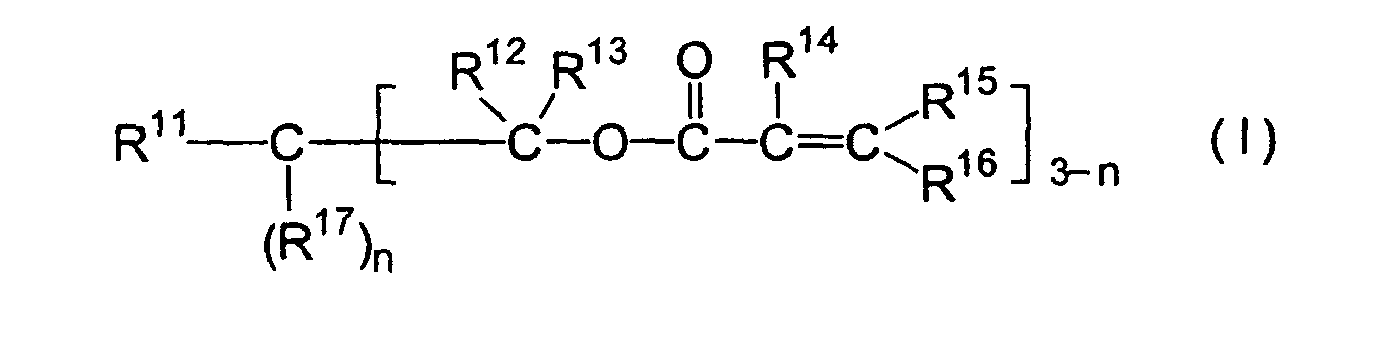
- Lichtempfindliches Material gemäss Anspruch 1, welches ausserdem wenigstens eine Silberhalogenid-Emulsionsschicht mit einem Gelbkuppler und wenigstens eine Silberhalogenid-Emulsionsschicht mit einem Purpurkuppler enthält, wobei der Gelbkuppler und der Purpurkuppler in der Lage sind, durch Kupplungsreaktion mit einem oxidierten Produkt eines aromatischen primären Amin-Farbentwicklungsmittels einen Farbstoff zu bilden.
- Lichtempfindliches Material gemäss Anspruch 1, worin R11 C1-30-Alkyl ist.
- Lichtempfindliches Material gemäss Anspruch 1, worin R11 unsubstituiertes C1-3-Alkyl ist.
- Lichtempfindliches Material gemäss Anspruch 1, worin R12 bis R17 jeweils H oder unsubstituiertes C1-3-Alkyl bedeuten.
- Lichtempfindliches Material gemäss Anspruch 1, worin R12 und R13 jeweils H bedeuten.
- Lichtempfindliches Material gemäss Anspruch 1, worin R14 H oder Methyl bedeutet.
- Lichtempfindliches Material gemäss Anspruch 1, worin die Verbindung der Formel (I) durch Bindung von zwei oder mehreren Molekülen der Verbindung an R11 ein Polymer bildet.
- Lichtempfindliches Material gemäss Anspruch 1, worin die Menge der Verbindung der Formel (I) 1 bis 300 mol-%, bezogen auf den Blaugrünkuppler, beträgt.
- Lichtempfindliches Material gemäss Anspruch 1, worin der Blaugrünkuppler eine Verbindung der Formel (II) ist:worin eine Gruppe aus Za und Zb -C(R3)= ist und die andere Gruppe -N= ist; R1 und R2 jeweils eine elektronenziehende Gruppe mit einer Hammett-Substituentenkonstante σp von 0,20 oder mehr darstellen, wobei die Summe der σp-Werte von R1 und R2 0,65 oder mehr beträgt; R3 ist H oder ein Substituent; X ist H oder eine Gruppe, die in der Lage ist, bei der Kupplungsreaktion mit dem oxidierten Produkt eines aromatischen primären Amin-Farbentwicklungsmittels abgespalten zu werden; und R1, R2, R3 oder X können eine zweiwertige Gruppe sein, so dass sie ein Dimer oder höheres Polymer bilden oder unter Bildung eines Homopolymers oder Copolymers an eine Polymerkette binden.
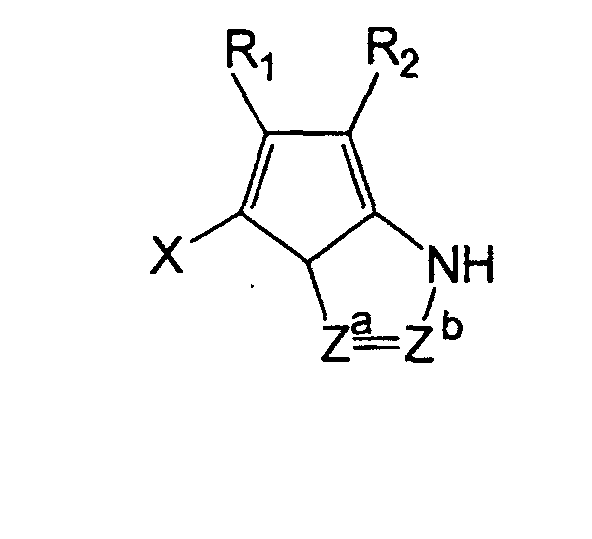
- Lichtempfindliches Material gemäss Anspruch 10, worin R1 und R2 jeweils Acyl, Acyloxy, Carbamoyl, Alkoxycarbonyl, Aryloxycarbonyl, Cyano, Nitro, Dialkylphosphono, Diarylphosphono, Diarylphosphinyl, Alkylsulfinyl, Arylsulfinyl, Alkylsulfonyl, Arylsulfonyl, Sulfonyloxy, Acylthio, Sulfamoyl, Thiocyanat, Thiocarbonyl, halogeniertes Alkyl, halogeniertes Alkoxy, halogeniertes Aryloxy, halogeniertes Alkylamino, halogeniertes Alkylthio, Aryl substituiert mit einer weiteren elektronenziehenden Gruppe mit einem σp-Wert von 0,20 oder mehr, eine heterocyclische Gruppe, Halogen, Azo oder Selenocyanat bedeuten.
- Lichtempfindliches Material gemäss Anspruch 10, worin R3 ein Halogenatom, Alkyl, Aryl, eine heterocyclische Gruppe, Cyano, Hydroxyl, Nitro, Carboxyl, Sulfo, Amino, Alkoxy, Aryloxy, Acylamino, Alkylamino, Anilino, Ureido, Sulfamoylamino, Alkylthio, Arylthio, Alkoxycarbonylamino, Sulfonamido, Carbamoyl, Sulfamoyl, Sulfonyl, Alkoxycarbonyl, eine heterocyclische Oxygruppe, Azo, Acyloxy, Carbamoyloxy, Silyloxy, Aryloxycarbonylamino, Imido, heterocyclisches Thio, Sulfinyl, Phosphonyl, Aryloxycarbonyl oder Acyl ist.
- Lichtempfindliches Material gemäss Anspruch 10, worin der Blaugrünkuppler eine Verbindung der Formel (III) ist:worin R21 bis R25, die gleich oder verschieden sind, jeweils H oder einen Substituenten bedeuten; Z eine Gruppe aus nicht-metallischen Atomen ist, die zur Bildung eines 5- bis 8-gliedrigen Rings erforderlich sind, R3 die gleiche Bedeutung wie in Formel (II) hat, und X2 H oder ein Substituent ist.

- Lichtempfindliches Material gemäss Anspruch 10, worin die Menge des Blaugrünkupplers der Formel (II) 0,01 bis 0,06 g/m2 beträgt.
- Lichtempfindliches Material gemäss Anspruch 10, welches ausserdem wenigstens eine Verbindung der folgenden Formel (4) umfasst:worin Ra1 und Ra2 jeweils unabhängig H, gegebenenfalls substituiertes Alkyl oder gegebenenfalls substituiertes Aryl bedeuten; Ra3 und Ra4 jeweils H, gegebenenfalls substituiertes Alkyl oder gegebenenfalls substituiertes Aryl bedeuten, und Ra5 gegebenenfalls substituiertes Aryl ist; mit der Massgabe, dass die Gesamtzahl der Kohlenstoffatome von Ra1 bis Ra5 mehr als 13 beträgt.
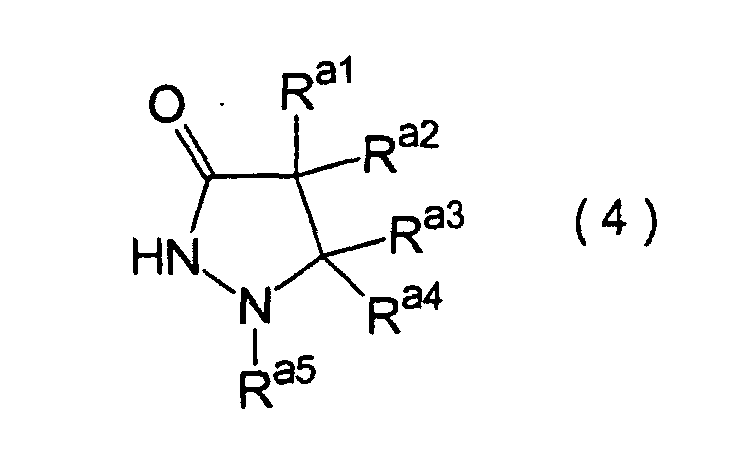
- Lichtempfindliches Material gemäss Anspruch 10, worin die Blaugrünkuppler-enthaltende Schicht ausserdem einen Blaugrünkuppler der Formel (C) und einen Polymerlatex der Formel (L) enthält:worin Y11 -NHCO- oder -CONH- ist; R31 eine aliphatische Gruppe, Aryl, eine heterocyclische Gruppe oder eine gegebenenfalls substituierte Aminogruppe ist; X11 H, Halogen, Alkoxy oder Acylamino ist; R32 Alkyl oder Acylamino ist; oder X11 und R32 zusammen eine Gruppe aus nicht-metallischen Atomen bedeuten, die einen 5- bis 7-gliedrigen Ring bilden, und Z11 ist H oder eine Gruppe, die bei der Kupplungsreaktion mit einem oxidierten Produkt eines Entwicklungsmittels abgespalten werden kann;
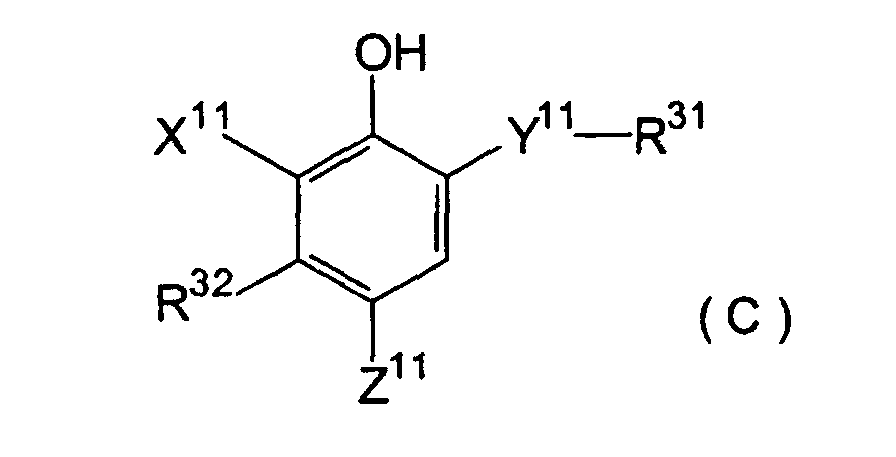 worin RP1 H oder Methyl ist, RP2 C1-8-Alkyl oder Cycloalkyl ist, D eine Grundeinheit ist, die sich von einem ethylenisch ungesättigten Monomer ableitet; x, y und z jeweils die Gew.% der jeweiligen Komponente darstellen, wobei x = 25 bis 60, y = 75 bis 40 und z = 0 bis 30 ist, und x + y + z = 100 ist; und der Neutralisierungsgrad von -COOM, worin M H oder ein Kation bedeutet, 0 bis 50 % beträgt.
- Lichtempfindliches Material gemäss Anspruch 16, worin die Menge des Blaugrünkupplers der Formel (C) 1 bis 50 mol-%, bezogen auf den Blaugrünkuppler der Formel (II), beträgt.
- Lichtempfindliches Material gemäss Anspruch 16, worin D eine Grundeinheit ist, die sich aus Monomeren der Acrylatreihe, Methacrylatreihe oder Vinylesterreihe ableitet.
- Lichtempfindliches Material gemäss Anspruch 16, worin die Menge des Polymerlatex der Formel (L), bezogen auf den Blaugrünkuppler, 1 bis 100 Gew.% beträgt.
- Lichtempfindliches Material gemäss Anspruch 1, umfassend wenigstens eine Silberhalogenid-Emulsionsschicht auf einem Träger, wobei die Emulsionsschicht wenigstens einen blaugrünbildenden Kuppler der Formel (1) und wenigstens eine Verbindung der Formel (B) enthält:worin R41 und R42 jeweils eine elektronenziehende Gruppe mit einer Hammett-Substituentenkonstante σp von 0,20 oder mehr bedeuten, wobei die Summe der σp-Werte von R41 und R42 0,65 oder mehr beträgt; R43 ist ein Substituent; X41 ist H oder eine Gruppe, die bei der Kupplungsreaktion mit dem oxidierten Produkt eines aromatischen primären Amin-Farbentwicklungsmittels abgespalten werden kann; und Y41 ist H oder ein Substituent;
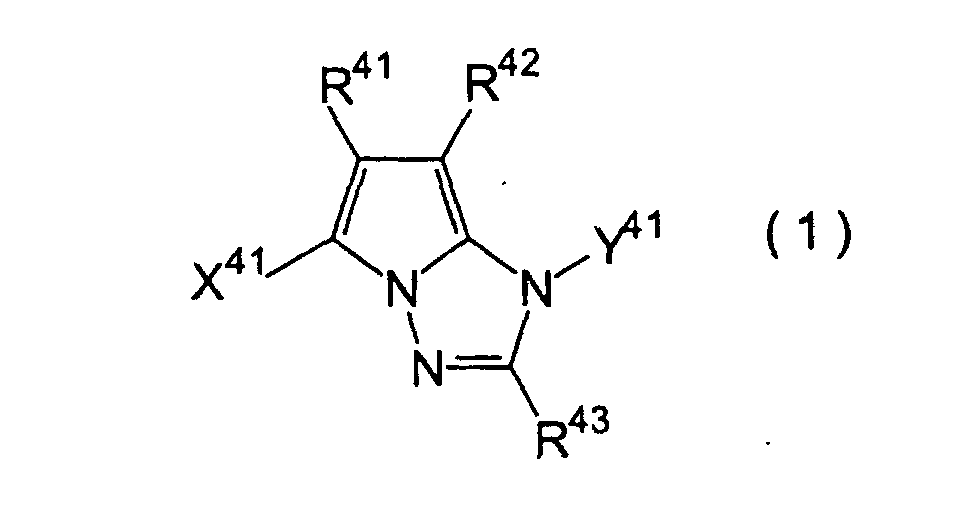 worin R51 eine aliphatische, aromatische oder heterocyclische Gruppe oder Amino ist; R52 Alkyl oder Acylamino ist; X51 H, Halogen, eine aliphatische Gruppe, Alkoxy oder Acylamino ist; Y51 -NHCO- oder -CONH- darstellt; Z51 H oder eine Gruppe bedeutet, die bei der Kupplungsreaktion mit dem oxidierten Produkt eines Entwicklungsmittels abgespalten werden kann, und X51 und R52 miteinander unter Bildung eines 5- bis 7-gliedrigen Rings verbunden sein können.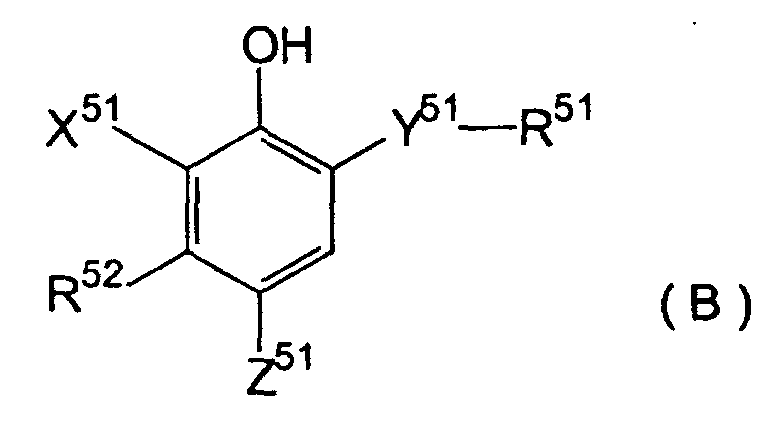
- Lichtempfindliches Material gemäss Anspruch 20, worin R41 und R42 jeweils Acyl, Acyloxy, Carbamoyl, aliphatisches Oxycarbonyl, Aryloxycarbonyl, Cyano, Nitro, Dialkylphosphono, Diarylphosphono, Diarylphosphinyl, Alkylsulfinyl, Arylsulfinyl, Alkylsulfonyl, Arylsulfonyl, Sulfonyloxy, Acylthio, Sulfamoyl, Thiocyanat, Thiocarbonyl; Alkyl, Alkoxy, Aryloxy, Alkylamino oder Alkylthio, jeweils substituiert mit wenigstens 2 Halogenatomen; Aryl, substituiert mit einer weiteren elektronenziehenden Gruppe mit einem σp-Wert von 0,20 oder mehr, eine heterocyclische Gruppe, Chlor, Brom, Azo oder Selenocyanat bedeuten.
- Lichtempfindliches Material gemäss Anspruch 20, worin R43 Halogen; eine aliphatische, Aryl- oder heterocyclische Gruppe; Cyano, Hydroxyl, Nitro, Carboxyl, Amino, Alkoxy, Aryloxy, Arylcarbonyloxy, Arylamino, Alkylamino, Anilino, Ureido, Sulfamoylamino, Alkylthio, Arylthio, Alkoxycarbonylamino, Sulfonamido, Carbamoyl, Sulfamoyl, Sulfonyl, Alkoxycarbonyl, heterocyclisches Oxy, Azo, Acyloxy, Carbamoyloxy, Silyloxy, Aryloxycarbonylamino, Imido, heterocyclisches Thio, Sulfinyl, Alkyloxycarbonyl, Aryloxycarbonyl, heterocyclisches Oxycarbonyl, Alkyloxycarbonylamino, Aryloxycarbonylamino, heterocyclisches Oxycarbonylamino, Sulfonamido, Carbamoyl, Sulfamoyl, Phosphonyl, Sulfamido, Imido, Azolyl, Hydroxyl, Cyano, Carboxyl, Nitro, Sulfo oder unsubstituiertes Amino ist.
- Lichtempfindliches Material gemäss Anspruch 20, worin Y41 H oder eine Gruppe ist, die bei der Kupplungsreaktion des blaugrünfarbstoffbildenden Kupplers der Formel (1) mit dem oxidierten Produkt eines Entwicklungsmittels abgespalten werden kann.
- Lichtempfindliches Material gemäss Anspruch 20, worin R41 Cyano und R42 Alkoxycarbonyl ist.
- Lichtempfindliches Material gemäss Anspruch 20, worin R52 C1-15-Alkyl ist, X51 Halogen ist und Z51 H oder Halogen ist.
- Lichtempfindliches Material gemäss Anspruch 20, wobei die Menge des blaugrünfarbstoffbildenden Kupplers der Formel (1) 0,35 bis 0,80 mmol/m2 ist, wenn es ein Vier-Äquivalent-Kuppler ist, oder 0,18 bis 0,4 mmol/m2 ist, wenn es ein Zwei-Äquivalent-Kuppler ist.
- Lichtempfindliches Material gemäss Anspruch 20, worin die Menge der Verbindung der Formel (B) 1 bis 160 Gew.%, bezogen auf die Menge des blaugrünfarbstoffbildenden Kupplers der Formel (1), beträgt.
- Lichtempfindliches Material gemäss Anspruch 10, umfassend auf einem Träger wenigstens eine lichtempfindliche Silberhalogenid-Emulsionsschicht, die eine gelbe Farbe bildet, wenigstens eine lichtempfindliche Silberhalogenid-Emulsionsschicht, die Purpurfarbe bildet, und wenigstens eine lichtempfindliche Silberhalogenid-Emulsionsschicht, die eine blaugrüne Farbe bildet, und wenigstens eine nicht-lichtempfindliche, nicht-farbbildende, hydrophile Kolloidschicht, wobei die wenigstens eine blaugrünfarbstoffbildende lichtempfindliche Silberhalogenid-Emulsionsschicht wenigstens einen blaugrünfarbstoffbildenden Kuppler der Formel (II) und wenigstens eine Verbindung der Formel (3) enthält:worin L eine Einfachbindung oder eine Arylengruppe ist; Ra1, Ra2 und Ra3, die gleich oder verschieden sind, jeweils Alkyl, Alkenyl, Aryl oder eine heterocyclische Gruppe bedeuten; wenn L eine Einfachbindung ist, kann Ra1 ausserdem ein Radikal (o) bedeuten; Ra3 kann ausserdem H darstellen; Ra1 und L, Ra2 und L, Ra3 und L, Ra1 und Ra2, Ra1 und Ra3, und Ra2 und Ra3 können jeweils miteinander unter Bildung eines 5- bis 7-gliedrigen Rings verbunden sein.
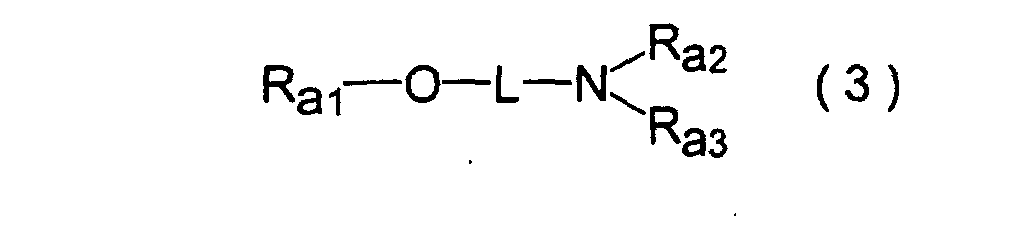
- Lichtempfindliches Material gemäss Anspruch 28, worin die Verbindung der Formel (3) eine Verbindung mit der folgenden Formel (3a) ist:worin Ra1 wie in Anspruch 28 definiert ist, Za1 eine zweiwertige Gruppe aus nicht-metallischen Atomen ist, die zusammen mit dem N zur Bildung eines 5- bis 7-gliedrigen Rings erforderlich ist, worin beide mit dem N verbundenen Atome Kohlenstoffatome sind; und La1 ist eine Einfachbindung oder Phenylen.

- Lichtempfindliches Material gemäss Anspruch 28, worin die Menge der Verbindung der Formel (3), bezogen auf den blaugrünfarbstoffbildenden Kuppler der Formel (II), 50 bis 500 mol-% beträgt.
- Lichtempfindliches Material gemäss Anspruch 28, welches ausserdem in einer oder beiden Schichten aus der blaugrünfarbstoffbildenden lichtempfindlichen Silberhalogenid-Emulsionsschicht und der nichtfarbbildenden hydrophilen Kolloidschicht wenigstens eine Verbindung der Formel (4) gemäss Anspruch 15 enthält.
- Lichtempfindliches Material gemäss Anspruch 31, worin in der Verbindung der Formel (4) entweder Ra1 und Ra2 jeweils unabhängig gegebenenfalls substituiertes Alkyl oder gegebenenfalls substituiertes Aryl bedeuten, welche insgesamt einschliesslich aller Substituenten 1 bis 30 Kohlenstoffatome aufweisen; oder Ra1 ist H und Ra2 ist Alkyl oder Aryl.
- Verfahren zur Erzeugung eines Bildes, umfassend die Rasterbelichtung eines lichtempfindlichen farbfotografischen Silberhalogenidmaterials gemäss Anspruch 1 mit einem Lichtstrahl, der aufgrund einer Bildinformation moduliert ist, und dann Entwicklung des Materials zur Bildung eines Farbbildes.
- Verfahren gemäss Anspruch 33, worin die Emulsionsschicht des lichtempfindlichen farbfotografischen Silberhalogenidmaterials ein lichtempfindliches Material gemäss Anspruch 20 ist.
- Verwendung einer Verbindung der Formel (I):worin R11 H, C1-30-Alkyl, C2-30-Alkenyl oder Aryl ist; R12 bis R17, die gleich oder verschieden sind, jeweils unabhängig H oder C1-30-Alkyl bedeuten, und n 0 oder 1 ist, als Stabilisator des Blaugrünfarbstoffbildes in einem farbfotografischen Silberhalogenidmaterial.

Applications Claiming Priority (10)
| Application Number | Priority Date | Filing Date | Title |
|---|---|---|---|
| JP2520898 | 1998-01-23 | ||
| JP2520898 | 1998-01-23 | ||
| JP7659698 | 1998-03-10 | ||
| JP7659698 | 1998-03-10 | ||
| JP7851298 | 1998-03-12 | ||
| JP8036898 | 1998-03-12 | ||
| JP08036898A JP3761710B2 (ja) | 1998-03-12 | 1998-03-12 | ハロゲン化銀カラー写真感光材料 |
| JP7851298 | 1998-03-12 | ||
| JP28870898 | 1998-09-28 | ||
| JP28870898A JP3818781B2 (ja) | 1998-01-23 | 1998-09-28 | ハロゲン化銀カラー写真感光材料 |
Publications (2)
| Publication Number | Publication Date |
|---|---|
| EP0932079A1 EP0932079A1 (de) | 1999-07-28 |
| EP0932079B1 true EP0932079B1 (de) | 2005-04-06 |
Family
ID=27520701
Family Applications (1)
| Application Number | Title | Priority Date | Filing Date |
|---|---|---|---|
| EP99101049A Expired - Lifetime EP0932079B1 (de) | 1998-01-23 | 1999-01-22 | Photographisches lichtempfindliches Silberhalogenidfarbmaterial und Verfahren zur Bilderzeugung, das dieses verwendet |
Country Status (4)
| Country | Link |
|---|---|
| US (1) | US6068969A (de) |
| EP (1) | EP0932079B1 (de) |
| AT (1) | ATE292812T1 (de) |
| DE (1) | DE69924543T2 (de) |
Families Citing this family (8)
| Publication number | Priority date | Publication date | Assignee | Title |
|---|---|---|---|---|
| CN1222513C (zh) | 1997-02-03 | 2005-10-12 | 富士写真菲林株式会社 | 卤化银彩色照相感光材料和其中所用的菲尼酮化合物以及这类化合物的制备方法 |
| EP1160622A1 (de) * | 2000-05-27 | 2001-12-05 | Agfa-Gevaert N.V. | Bleichfixierlösungskonzentrat |
| JP4171425B2 (ja) * | 2002-03-05 | 2008-10-22 | チバ ホールディング インコーポレーテッド | カラー写真記録材料 |
| US6887657B2 (en) * | 2003-05-12 | 2005-05-03 | Fuji Photo Film Co., Ltd. | Silver halide color photographic photosensitive material and image-forming method |
| JP4660147B2 (ja) * | 2004-09-27 | 2011-03-30 | 富士フイルム株式会社 | ピロロトリアゾール化合物 |
| WO2014124225A1 (en) | 2013-02-08 | 2014-08-14 | Endoshape, Inc. | Radiopaque polymers for medical devices |
| CN105209078B (zh) * | 2013-03-15 | 2021-11-09 | 恩多沙普公司 | 具有增强的不透射线性的聚合物组合物 |
| WO2020218259A1 (ja) * | 2019-04-22 | 2020-10-29 | 三菱ケミカル株式会社 | 電子写真感光体及びその製造方法、電子写真感光体カートリッジ並びに画像形成装置 |
Family Cites Families (15)
| Publication number | Priority date | Publication date | Assignee | Title |
|---|---|---|---|---|
| US4105793A (en) * | 1976-07-28 | 1978-08-08 | Celanese Corporation | Multifunctional acrylates as foliar fungicides |
| JPS57198455A (en) * | 1981-06-01 | 1982-12-06 | Fuji Photo Film Co Ltd | Formation of picture |
| JPS6067938A (ja) * | 1983-09-24 | 1985-04-18 | Konishiroku Photo Ind Co Ltd | ハロゲン化銀写真感光材料 |
| JPH07101310B2 (ja) * | 1986-11-19 | 1995-11-01 | 富士写真フイルム株式会社 | 感光材料 |
| JPH0820710B2 (ja) * | 1988-02-29 | 1996-03-04 | 富士写真フイルム株式会社 | ハロゲン化銀写真感光材料 |
| US5077188A (en) * | 1989-02-06 | 1991-12-31 | Konica Corporation | Silver halide photographic light-sensitive material |
| JP2684276B2 (ja) * | 1991-11-27 | 1997-12-03 | 富士写真フイルム株式会社 | ハロゲン化銀カラー写真感光材料 |
| JPH07270967A (ja) * | 1994-04-01 | 1995-10-20 | Konica Corp | 画像形成方法 |
| JPH0844021A (ja) * | 1994-08-03 | 1996-02-16 | Fuji Photo Film Co Ltd | ハロゲン化銀カラー写真感光材料 |
| JPH0844015A (ja) * | 1994-08-03 | 1996-02-16 | Fuji Photo Film Co Ltd | ハロゲン化銀カラー感光材料 |
| JP3438966B2 (ja) * | 1994-10-12 | 2003-08-18 | 富士写真フイルム株式会社 | ハロゲン化銀カラー感光材料 |
| EP0756200B1 (de) * | 1995-07-26 | 1999-11-10 | Konica Corporation | Farbphotographisches lichtempfindliches Silberhalogenidmaterial |
| JP3571459B2 (ja) * | 1995-11-06 | 2004-09-29 | 富士写真フイルム株式会社 | ハロゲン化銀カラー感光材料 |
| JP3585316B2 (ja) * | 1996-04-23 | 2004-11-04 | 富士写真フイルム株式会社 | ハロゲン化銀感光材料 |
| JP3585070B2 (ja) * | 1996-04-23 | 2004-11-04 | 富士写真フイルム株式会社 | ハロゲン化銀カラー写真感光材料 |
-
1999
- 1999-01-22 US US09/235,548 patent/US6068969A/en not_active Expired - Lifetime
- 1999-01-22 DE DE69924543T patent/DE69924543T2/de not_active Expired - Lifetime
- 1999-01-22 EP EP99101049A patent/EP0932079B1/de not_active Expired - Lifetime
- 1999-01-22 AT AT99101049T patent/ATE292812T1/de not_active IP Right Cessation
Also Published As
| Publication number | Publication date |
|---|---|
| DE69924543D1 (de) | 2005-05-12 |
| ATE292812T1 (de) | 2005-04-15 |
| US6068969A (en) | 2000-05-30 |
| DE69924543T2 (de) | 2006-02-09 |
| EP0932079A1 (de) | 1999-07-28 |
Similar Documents
| Publication | Publication Date | Title |
|---|---|---|
| EP0932079B1 (de) | Photographisches lichtempfindliches Silberhalogenidfarbmaterial und Verfahren zur Bilderzeugung, das dieses verwendet | |
| US6258521B1 (en) | Silver halide color photographic light-sensitive material, phenidone compound for use therein, and method of producing the same | |
| JPH10333297A (ja) | ハロゲン化銀カラー写真感光材料 | |
| JPWO1998033760A1 (ja) | ハロゲン化銀カラー写真感光材料とそれに用いるフェニドン化合物、及びその製造方法 | |
| US6495313B2 (en) | Silver halide color photographic light-sensitive material | |
| US5445924A (en) | Laser color imaging method using a cyan dye coupler | |
| JP2879497B2 (ja) | ハロゲン化銀カラー写真感光材料 | |
| JPH10221825A (ja) | ハロゲン化銀カラー写真感光材料 | |
| JP3818781B2 (ja) | ハロゲン化銀カラー写真感光材料 | |
| EP0800113B1 (de) | Photographisches lichtempfindliches Silberhalogenidfarbmaterial | |
| JP3761710B2 (ja) | ハロゲン化銀カラー写真感光材料 | |
| JP3630267B2 (ja) | ハロゲン化銀カラー写真感光材料 | |
| JP4139845B2 (ja) | ハロゲン化銀カラー写真感光材料とそれに用いるフェニドン化合物、及びフェニドン化合物 | |
| JPH11109576A (ja) | ハロゲン化銀カラー写真感光材料およびカラー画像形成方法 | |
| JP3761738B2 (ja) | ハロゲン化銀カラー写真感光材料、及びそれを用いた画像形成方法 | |
| JPH11271940A (ja) | ハロゲン化銀カラー写真感光材料 | |
| JP2002287312A (ja) | ハロゲン化銀カラー写真感光材料 | |
| JP2003107643A (ja) | ハロゲン化銀カラー写真感光材料 | |
| JPH11282138A (ja) | ハロゲン化銀カラー写真感光材料 | |
| JPH11344793A (ja) | ハロゲン化銀カラー写真感光材料 | |
| JP2001226608A (ja) | ハロゲン化銀カラー写真感光材料、退色防止剤および色素会合抑制剤 | |
| JP2001228590A (ja) | ハロゲン化銀カラー写真感光材料、退色防止剤および色素会合抑制剤 | |
| JP2003107642A (ja) | ハロゲン化銀カラー写真感光材料 | |
| JPH1124217A (ja) | ハロゲン化銀カラー写真感光材料 | |
| JP2001228588A (ja) | ハロゲン化銀カラー写真感光材料 |
Legal Events
| Date | Code | Title | Description |
|---|---|---|---|
| PUAI | Public reference made under article 153(3) epc to a published international application that has entered the european phase |
Free format text: ORIGINAL CODE: 0009012 |
|
| AK | Designated contracting states |
Kind code of ref document: A1 Designated state(s): AT BE CH CY DE DK ES FI FR GB GR IE IT LI LU MC NL PT SE |
|
| AX | Request for extension of the european patent |
Free format text: AL;LT;LV;MK;RO;SI |
|
| 17P | Request for examination filed |
Effective date: 19991220 |
|
| AKX | Designation fees paid |
Free format text: AT BE CH CY DE DK ES FI FR GB GR IE IT LI LU MC NL PT SE |
|
| 17Q | First examination report despatched |
Effective date: 20000602 |
|
| GRAP | Despatch of communication of intention to grant a patent |
Free format text: ORIGINAL CODE: EPIDOSNIGR1 |
|
| GRAS | Grant fee paid |
Free format text: ORIGINAL CODE: EPIDOSNIGR3 |
|
| GRAA | (expected) grant |
Free format text: ORIGINAL CODE: 0009210 |
|
| RAP1 | Party data changed (applicant data changed or rights of an application transferred) |
Owner name: FUJI PHOTO FILM CO., LTD. |
|
| AK | Designated contracting states |
Kind code of ref document: B1 Designated state(s): AT BE CH CY DE DK ES FI FR GB GR IE IT LI LU MC NL PT SE |
|
| PG25 | Lapsed in a contracting state [announced via postgrant information from national office to epo] |
Ref country code: NL Free format text: LAPSE BECAUSE OF FAILURE TO SUBMIT A TRANSLATION OF THE DESCRIPTION OR TO PAY THE FEE WITHIN THE PRESCRIBED TIME-LIMIT Effective date: 20050406 Ref country code: LI Free format text: LAPSE BECAUSE OF FAILURE TO SUBMIT A TRANSLATION OF THE DESCRIPTION OR TO PAY THE FEE WITHIN THE PRESCRIBED TIME-LIMIT Effective date: 20050406 Ref country code: IT Free format text: LAPSE BECAUSE OF FAILURE TO SUBMIT A TRANSLATION OF THE DESCRIPTION OR TO PAY THE FEE WITHIN THE PRESCRIBED TIME-LIMIT;WARNING: LAPSES OF ITALIAN PATENTS WITH EFFECTIVE DATE BEFORE 2007 MAY HAVE OCCURRED AT ANY TIME BEFORE 2007. THE CORRECT EFFECTIVE DATE MAY BE DIFFERENT FROM THE ONE RECORDED. Effective date: 20050406 Ref country code: FI Free format text: LAPSE BECAUSE OF FAILURE TO SUBMIT A TRANSLATION OF THE DESCRIPTION OR TO PAY THE FEE WITHIN THE PRESCRIBED TIME-LIMIT Effective date: 20050406 Ref country code: CH Free format text: LAPSE BECAUSE OF FAILURE TO SUBMIT A TRANSLATION OF THE DESCRIPTION OR TO PAY THE FEE WITHIN THE PRESCRIBED TIME-LIMIT Effective date: 20050406 Ref country code: BE Free format text: LAPSE BECAUSE OF FAILURE TO SUBMIT A TRANSLATION OF THE DESCRIPTION OR TO PAY THE FEE WITHIN THE PRESCRIBED TIME-LIMIT Effective date: 20050406 Ref country code: AT Free format text: LAPSE BECAUSE OF FAILURE TO SUBMIT A TRANSLATION OF THE DESCRIPTION OR TO PAY THE FEE WITHIN THE PRESCRIBED TIME-LIMIT Effective date: 20050406 |
|
| REG | Reference to a national code |
Ref country code: GB Ref legal event code: FG4D |
|
| REG | Reference to a national code |
Ref country code: CH Ref legal event code: EP |
|
| REG | Reference to a national code |
Ref country code: IE Ref legal event code: FG4D |
|
| REF | Corresponds to: |
Ref document number: 69924543 Country of ref document: DE Date of ref document: 20050512 Kind code of ref document: P |
|
| PG25 | Lapsed in a contracting state [announced via postgrant information from national office to epo] |
Ref country code: SE Free format text: LAPSE BECAUSE OF FAILURE TO SUBMIT A TRANSLATION OF THE DESCRIPTION OR TO PAY THE FEE WITHIN THE PRESCRIBED TIME-LIMIT Effective date: 20050706 Ref country code: GR Free format text: LAPSE BECAUSE OF FAILURE TO SUBMIT A TRANSLATION OF THE DESCRIPTION OR TO PAY THE FEE WITHIN THE PRESCRIBED TIME-LIMIT Effective date: 20050706 Ref country code: DK Free format text: LAPSE BECAUSE OF FAILURE TO SUBMIT A TRANSLATION OF THE DESCRIPTION OR TO PAY THE FEE WITHIN THE PRESCRIBED TIME-LIMIT Effective date: 20050706 |
|
| PG25 | Lapsed in a contracting state [announced via postgrant information from national office to epo] |
Ref country code: ES Free format text: LAPSE BECAUSE OF FAILURE TO SUBMIT A TRANSLATION OF THE DESCRIPTION OR TO PAY THE FEE WITHIN THE PRESCRIBED TIME-LIMIT Effective date: 20050717 |
|
| PG25 | Lapsed in a contracting state [announced via postgrant information from national office to epo] |
Ref country code: PT Free format text: LAPSE BECAUSE OF FAILURE TO SUBMIT A TRANSLATION OF THE DESCRIPTION OR TO PAY THE FEE WITHIN THE PRESCRIBED TIME-LIMIT Effective date: 20050908 |
|
| NLV1 | Nl: lapsed or annulled due to failure to fulfill the requirements of art. 29p and 29m of the patents act | ||
| REG | Reference to a national code |
Ref country code: CH Ref legal event code: PL |
|
| PG25 | Lapsed in a contracting state [announced via postgrant information from national office to epo] |
Ref country code: GB Free format text: LAPSE BECAUSE OF NON-PAYMENT OF DUE FEES Effective date: 20060122 |
|
| PG25 | Lapsed in a contracting state [announced via postgrant information from national office to epo] |
Ref country code: IE Free format text: LAPSE BECAUSE OF NON-PAYMENT OF DUE FEES Effective date: 20060123 |
|
| PG25 | Lapsed in a contracting state [announced via postgrant information from national office to epo] |
Ref country code: MC Free format text: LAPSE BECAUSE OF NON-PAYMENT OF DUE FEES Effective date: 20060131 Ref country code: LU Free format text: LAPSE BECAUSE OF NON-PAYMENT OF DUE FEES Effective date: 20060131 |
|
| PLBE | No opposition filed within time limit |
Free format text: ORIGINAL CODE: 0009261 |
|
| STAA | Information on the status of an ep patent application or granted ep patent |
Free format text: STATUS: NO OPPOSITION FILED WITHIN TIME LIMIT |
|
| 26N | No opposition filed |
Effective date: 20060110 |
|
| EN | Fr: translation not filed | ||
| GBPC | Gb: european patent ceased through non-payment of renewal fee |
Effective date: 20060122 |
|
| REG | Reference to a national code |
Ref country code: IE Ref legal event code: MM4A |
|
| PG25 | Lapsed in a contracting state [announced via postgrant information from national office to epo] |
Ref country code: FR Free format text: LAPSE BECAUSE OF FAILURE TO SUBMIT A TRANSLATION OF THE DESCRIPTION OR TO PAY THE FEE WITHIN THE PRESCRIBED TIME-LIMIT Effective date: 20050406 Ref country code: CY Free format text: LAPSE BECAUSE OF FAILURE TO SUBMIT A TRANSLATION OF THE DESCRIPTION OR TO PAY THE FEE WITHIN THE PRESCRIBED TIME-LIMIT Effective date: 20050406 |
|
| PGFP | Annual fee paid to national office [announced via postgrant information from national office to epo] |
Ref country code: DE Payment date: 20111229 Year of fee payment: 14 |
|
| PG25 | Lapsed in a contracting state [announced via postgrant information from national office to epo] |
Ref country code: DE Free format text: LAPSE BECAUSE OF NON-PAYMENT OF DUE FEES Effective date: 20130801 |
|
| REG | Reference to a national code |
Ref country code: DE Ref legal event code: R119 Ref document number: 69924543 Country of ref document: DE Effective date: 20130801 |