EP0961031A2 - Soupape de régulation pour compresseur à plateau en biais à capacité variable et méthode pour son assemblage - Google Patents
Soupape de régulation pour compresseur à plateau en biais à capacité variable et méthode pour son assemblage Download PDFInfo
- Publication number
- EP0961031A2 EP0961031A2 EP99109303A EP99109303A EP0961031A2 EP 0961031 A2 EP0961031 A2 EP 0961031A2 EP 99109303 A EP99109303 A EP 99109303A EP 99109303 A EP99109303 A EP 99109303A EP 0961031 A2 EP0961031 A2 EP 0961031A2
- Authority
- EP
- European Patent Office
- Prior art keywords
- valve
- chamber
- pressure sensing
- pressure
- refrigerant
- Prior art date
- Legal status (The legal status is an assumption and is not a legal conclusion. Google has not performed a legal analysis and makes no representation as to the accuracy of the status listed.)
- Withdrawn
Links
- 238000006073 displacement reaction Methods 0.000 title claims abstract description 96
- 238000000034 method Methods 0.000 title claims description 10
- 230000001105 regulatory effect Effects 0.000 title 1
- 239000003507 refrigerant Substances 0.000 claims abstract description 78
- 230000007246 mechanism Effects 0.000 claims abstract description 55
- 239000012530 fluid Substances 0.000 claims description 43
- 230000008859 change Effects 0.000 claims description 13
- 230000004044 response Effects 0.000 claims description 9
- 238000001514 detection method Methods 0.000 claims description 7
- 238000003825 pressing Methods 0.000 claims description 3
- 239000007769 metal material Substances 0.000 claims description 2
- 238000005553 drilling Methods 0.000 abstract 1
- 238000004891 communication Methods 0.000 description 5
- 238000004519 manufacturing process Methods 0.000 description 5
- 239000000463 material Substances 0.000 description 3
- 229910000838 Al alloy Inorganic materials 0.000 description 2
- 229910001369 Brass Inorganic materials 0.000 description 2
- 239000010951 brass Substances 0.000 description 2
- 230000006835 compression Effects 0.000 description 2
- 238000007906 compression Methods 0.000 description 2
- 230000009467 reduction Effects 0.000 description 2
- 238000005299 abrasion Methods 0.000 description 1
- 239000000956 alloy Substances 0.000 description 1
- 230000001186 cumulative effect Effects 0.000 description 1
- 238000003754 machining Methods 0.000 description 1
- 230000004048 modification Effects 0.000 description 1
- 238000012986 modification Methods 0.000 description 1
Images


Classifications
-
- F—MECHANICAL ENGINEERING; LIGHTING; HEATING; WEAPONS; BLASTING
- F04—POSITIVE - DISPLACEMENT MACHINES FOR LIQUIDS; PUMPS FOR LIQUIDS OR ELASTIC FLUIDS
- F04B—POSITIVE-DISPLACEMENT MACHINES FOR LIQUIDS; PUMPS
- F04B27/00—Multi-cylinder pumps specially adapted for elastic fluids and characterised by number or arrangement of cylinders
- F04B27/08—Multi-cylinder pumps specially adapted for elastic fluids and characterised by number or arrangement of cylinders having cylinders coaxial with, or parallel or inclined to, main shaft axis
- F04B27/14—Control
- F04B27/16—Control of pumps with stationary cylinders
- F04B27/18—Control of pumps with stationary cylinders by varying the relative positions of a swash plate and a cylinder block
- F04B27/1804—Controlled by crankcase pressure
-
- F—MECHANICAL ENGINEERING; LIGHTING; HEATING; WEAPONS; BLASTING
- F04—POSITIVE - DISPLACEMENT MACHINES FOR LIQUIDS; PUMPS FOR LIQUIDS OR ELASTIC FLUIDS
- F04B—POSITIVE-DISPLACEMENT MACHINES FOR LIQUIDS; PUMPS
- F04B27/00—Multi-cylinder pumps specially adapted for elastic fluids and characterised by number or arrangement of cylinders
- F04B27/08—Multi-cylinder pumps specially adapted for elastic fluids and characterised by number or arrangement of cylinders having cylinders coaxial with, or parallel or inclined to, main shaft axis
-
- F—MECHANICAL ENGINEERING; LIGHTING; HEATING; WEAPONS; BLASTING
- F04—POSITIVE - DISPLACEMENT MACHINES FOR LIQUIDS; PUMPS FOR LIQUIDS OR ELASTIC FLUIDS
- F04B—POSITIVE-DISPLACEMENT MACHINES FOR LIQUIDS; PUMPS
- F04B27/00—Multi-cylinder pumps specially adapted for elastic fluids and characterised by number or arrangement of cylinders
- F04B27/08—Multi-cylinder pumps specially adapted for elastic fluids and characterised by number or arrangement of cylinders having cylinders coaxial with, or parallel or inclined to, main shaft axis
- F04B27/14—Control
- F04B27/16—Control of pumps with stationary cylinders
- F04B27/18—Control of pumps with stationary cylinders by varying the relative positions of a swash plate and a cylinder block
- F04B27/1804—Controlled by crankcase pressure
- F04B2027/1809—Controlled pressure
- F04B2027/1813—Crankcase pressure
-
- F—MECHANICAL ENGINEERING; LIGHTING; HEATING; WEAPONS; BLASTING
- F04—POSITIVE - DISPLACEMENT MACHINES FOR LIQUIDS; PUMPS FOR LIQUIDS OR ELASTIC FLUIDS
- F04B—POSITIVE-DISPLACEMENT MACHINES FOR LIQUIDS; PUMPS
- F04B27/00—Multi-cylinder pumps specially adapted for elastic fluids and characterised by number or arrangement of cylinders
- F04B27/08—Multi-cylinder pumps specially adapted for elastic fluids and characterised by number or arrangement of cylinders having cylinders coaxial with, or parallel or inclined to, main shaft axis
- F04B27/14—Control
- F04B27/16—Control of pumps with stationary cylinders
- F04B27/18—Control of pumps with stationary cylinders by varying the relative positions of a swash plate and a cylinder block
- F04B27/1804—Controlled by crankcase pressure
- F04B2027/1822—Valve-controlled fluid connection
- F04B2027/1827—Valve-controlled fluid connection between crankcase and discharge chamber
-
- F—MECHANICAL ENGINEERING; LIGHTING; HEATING; WEAPONS; BLASTING
- F04—POSITIVE - DISPLACEMENT MACHINES FOR LIQUIDS; PUMPS FOR LIQUIDS OR ELASTIC FLUIDS
- F04B—POSITIVE-DISPLACEMENT MACHINES FOR LIQUIDS; PUMPS
- F04B27/00—Multi-cylinder pumps specially adapted for elastic fluids and characterised by number or arrangement of cylinders
- F04B27/08—Multi-cylinder pumps specially adapted for elastic fluids and characterised by number or arrangement of cylinders having cylinders coaxial with, or parallel or inclined to, main shaft axis
- F04B27/14—Control
- F04B27/16—Control of pumps with stationary cylinders
- F04B27/18—Control of pumps with stationary cylinders by varying the relative positions of a swash plate and a cylinder block
- F04B27/1804—Controlled by crankcase pressure
- F04B2027/184—Valve controlling parameter
- F04B2027/1859—Suction pressure
-
- Y—GENERAL TAGGING OF NEW TECHNOLOGICAL DEVELOPMENTS; GENERAL TAGGING OF CROSS-SECTIONAL TECHNOLOGIES SPANNING OVER SEVERAL SECTIONS OF THE IPC; TECHNICAL SUBJECTS COVERED BY FORMER USPC CROSS-REFERENCE ART COLLECTIONS [XRACs] AND DIGESTS
- Y10—TECHNICAL SUBJECTS COVERED BY FORMER USPC
- Y10S—TECHNICAL SUBJECTS COVERED BY FORMER USPC CROSS-REFERENCE ART COLLECTIONS [XRACs] AND DIGESTS
- Y10S137/00—Fluid handling
- Y10S137/907—Vacuum-actuated valves
Definitions
- the present invention relates generally to a variable displacement type refrigerant compressor. More particularly, the present invention relates to a variable displacement refrigerant compressor accommodating therein a novel displacement control valve, which can be easily and accurately assembled in a compressor housing and can be an inexpensive mechanical element. The present invention further relates to a method of assembling the novel displacement control valve in the compressor housing.
- U.S. Patent No. 4,688,997 discloses a typical variable displacement type refrigerant compressor adapted to be incorporated in a vehicle climate control system.
- the variable refrigerant compressor has a compressor housing in which a suction chamber, a discharge chamber, a crank chamber, a reciprocating piston mechanism to compress a refrigerant in a cylinder bore, a piston actuating mechanism including a cam plate mounted around a drive shaft to convert the rotation of the drive shaft in the reciprocation of the piston mechanism, and a displacement control valve unit, are mounted.
- the displacement control valve unit of the refrigerant compressor of U.S. Pat. '997 includes a fluid supply passage extending from the discharge chamber to the crank chamber to supply a refrigerant at a high pressure into the crank chamber, a valve unit arranged in a portion of the fluid supply passage to open and close the portion of the fluid supply passage, a fluid withdrawal passage extending from the crank chamber to the suction chamber to maintain a constant fluid communication between both chambers, and a valve control mechanism to control the opening and closing operation of the valve unit.
- the valve control mechanism operates in such a manner that when the pressure in the crank chamber is reduced to below a predetermined reference value, it operates the valve unit to move to its open position where the refrigerant at a high pressure is supplied from the discharge chamber into the crank chamber. Further, when the pressure in the crank chamber goes up beyond the predetermined reference value, the valve control mechanism operates the valve unit to be moved to its closed position where the supply of the refrigerant at a high pressure from the discharge chamber to the crank chamber is stopped.
- the valve unit and the valve control mechanism constitute an integral displacement control valve unit.
- the valve unit of the displacement control valve unit When a reduction in the pressure in the crank chamber is lowered to a level below the predetermined reference value, the valve unit of the displacement control valve unit is moved to its opening position. Therefore, a refrigerant at a high pressure is supplied from the discharge chamber into the crank chamber to increase a pressure in the crank chamber.
- the valve unit of the displacement control valve unit When the pressure in the crank chamber is increased to go up beyond the predetermined value, the valve unit of the displacement control valve unit is moved to its closing position to close the aforementioned portion of the fluid supply passage. Therefore, the pressure increase in the crank chamber is stopped, and the pressure in the crank chamber is held substantially at the predetermined value during the ordinary operation of the compressor.
- a difference between the pressure in the crank chamber and the suction pressure of the compressor relying on a change in the refrigerating load of the climate control system adjustably changes the reciprocating stroke of the piston mechanism to thereby control the displacement of the compressor.
- the above-mentioned displacement control valve unit is arranged so as to control the opening and closing operation of the valve unit thereof in response to detection of a change in the pressure prevailing in the crank chamber
- the controlling operation of the displacement control valve unit may be carried out in a different manner.
- the displacement control valve unit may be constructed to operate in such a manner that the movement of the valve unit thereof to its open and closed positions is controlled in response to detection of a change in the suction pressure of the refrigerant compressor.
- the displacement control valve unit may include a valve unit thereof arranged in a portion of the fluid withdrawal passage in the refrigerant compressor so as to control withdrawing of the refrigerant from the crank chamber into the suction chamber.
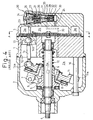
- FIG. 4 typically illustrates a conventional control valve unit 20 assembled in a rear housing 3.
- the control valve unit 20 is provided with a suction pressure chamber 21 functioning as a pressure sensing chamber, and a discharge pressure chamber 22 arranged axially opposed to the suction pressure chamber 21 and functioning as a valve chamber.
- the suction pressure chamber 21 is arranged so as to communicate with the suction chamber 3a of the refrigerant compressor via a passage 23 formed in the rear housing 3
- the discharge pressure chamber 22 is arranged so as to communicate with the discharge chamber 3b of the refrigerant compressor via a passage 24 formed in the rear housing 3.
- a bellows element 26 is centrally arranged so as to axially expand or contract and to define therein an atmospheric chamber 25.
- a spring 27 is arranged so as to constantly urge the bellows element 26 toward its extended position, i.e., toward the discharge pressure chamber.
- the discharge pressure chamber 22 has a valve hole 28 formed at an end thereof confronting the suction pressure chamber 21 so as to communicate with a valve port 29 which is arranged to communicate with the crank chamber 2a of the refrigerant compressor via a fluid supply passage 30.
- a valve rod 31 connected at its one end to the bellows element 26 extends toward the discharge pressure chamber 22 so that the other end thereof enters into the discharge pressure chamber 22 via the valve port 29 and the valve hole 28.
- a valve element 32 is attached to the other end of the above-mentioned valve rod 31 within the discharge pressure chamber 22 so as to oppose to the valve hole 28.
- the valve element 32 is thus able to open and close the valve hole 28, in response to the expanding and contracting movement of the bellows element 26, and is constantly urged by the spring force of a spring 33 toward the closed position thereof to close the valve hole 28. Therefore, when the suction pressure introduced into the suction pressure chamber 21 goes down below a predetermined set value, the bellows element 26 is expanded to move the valve rod 31 so that the valve element 32 is moved away from the valve hole 28. Namely, the valve hole 28 is opened, and accordingly, the refrigerant gas at a discharge pressure (a high pressure) is supplied from the discharge chamber 3b into the crank chamber 2a via the valve hole 28, the valve port 29 and the fluid supply passage 30.
- a discharge pressure a high pressure
- the displacement control valve unit 20 is constructed so that the suction pressure chamber 21 in which the suction pressure Ps is introduced via the passage 23 to be sensed by the accommodated movable bellows element 26, the discharge pressure chamber 22 having two holes opening toward the fluid supply passage 30 and the discharge chamber 3b and accommodating therein the valve element 32 to open and close the valve hole 28, and the valve rod 31 transmitting the expanding and contracting movement of the bellows element 26 to the valve element 32 to thereby move the valve element 32, are integrally incorporated in a single member forming a casing member 34 of the displacement control valve unit 20 as shown in Figs. 3 and Figs. 5A and 5B.
- the casing member 34 must be provided as an indispensable element of the displacement control valve unit 20, and the bellows element 26 must be seated on and welded to a seat 37 (37a or 37b) before the bellows element 26 is accommodated in the suction pressure chamber 21 of the casing member 34.
- the casing member 34 of the valve control unit 20 must be provided with a plurality of grooves to contain therein o-rings 35 in order to fixedly disposed in an assembling bore of the rear housing 3 (or the cylinder block 1) when the control valve unit 20 is assembled in a compressor body.
- a large assembling space is needed to accommodate the control valve unit 20 in the body of the refrigerant compressor.
- the assembling of the control valve unit 20 requires delicate assembling operation performed by an operator and thus, causes an increase in the manufacturing cost.
- the bellows element 26 functioning as the pressure sensing element is a movable element permitted to expand and contract over a range of only 1 through 2 millimeters, the whole length of the casing member 34, the position to dispose the bellows element 26 within the suction pressure chamber 21, the bore depth in the casing member 34 which forms the suction pressure chamber 21 and the discharge pressure chanter 22 must be formed by machining at a very high accuracy to minimize a cumulative error due to addition of dimensional tolerances of the machined portions of the casing member 34.
- An object of the present invention is therefore to solve the described many problems encountered by the conventional control valve unit assembled in the body of a variable displacement type refrigerant compressor.
- Another object of the present invention is to provide a variable displacement type refrigerant compressor incorporating a novel valve control unit assembled in a simple assembling operation.
- a further object of the present invention is to provide a valve control unit capable of being produced and assembled in a relatively small mounting space formed in a body of a variable displacement type refrigerant compressor at a low manufacturing cost, and with a high production accuracy.
- a still further object of the present invention is to provide a method of assembling the above-mentioned novel valve control unit into a body of a variable displacement type refrigerant compressor.
- a variable displacement refrigerant compressor including a compressor housing forming an outer framework and provided internally with a compressing mechanism for compressing a refrigerant, a displacement varying mechanism for adjustably varying an amount of the refrigerant compressed and discharged by the compressing mechanism, and a displacement control valve unit adjustably controlling the operation of the displacement varying mechanism due to detecting a change in a pressure acting thereon, wherein the compressor housing is provided with a pressure sensing chamber for receiving a pressure to be detected and a valve chamber forming a fluid passage through which the refrigerant at a high pressure is permitted to flow to be used for changing a compressor displacement, the pressure sensing and valve chambers being bored in the compressor housing, and wherein the displacement control valve unit comprises: a pressure sensing mechanism arranged in the pressure sensing chamber and having a movable element moving in response to detection of a change in a pressure prevailing in the pressure sensing chamber; and a valve element arranged in the valve chamber and operating
- the compressor housing is further provided internally with a plurality of cylinder bores, a suction chamber, a discharge chamber, and a crank chamber
- the refrigerant compressor is further provided with a drive shaft rotatably supported by the compressor housing, a cam plate arranged in the crank chamber to be rotatable together with the drive shaft and permitted to vary an angle of inclination thereof with respect to a reference plane, and a plurality of pistons operatively engaged with the cam plate and reciprocating in the plurality of cylinder bores, the cam plate being arranged to change the angle of inclination thereof, on the basis of a difference between a first pressure prevailing in the crank chamber and a second pressure prevailing in the plurality of cylinder bores to thereby constitute the above-mentioned displacement varying mechanism.
- the fluid passage is provided as a fluid supply passage extending between the discharge chamber and the crank chamber to supply the refrigerant at a discharge pressure from the discharge chamber to the crank chamber.
- the compressor housing of the variable displacement type refrigerant compressor preferably may have a first and second ends opposite to one another along a predetermined axis, and the pressure sensing chamber is formed by a first bore bored from the first end while valve chamber is formed by a second bore bored from the second end. Further, a third bore is formed between the first and second bores so as to permit a valve rod to be movably inserted therein so that the valve rod transmits the movement of the pressure sensing mechanism to the valve element.
- valve chamber formed in the compressor housing is provided with a valve seat formed as a separate element from the compressor housing and fixedly disposed in the valve chamber to cooperate with the valve element.
- the pressure sensing mechanism preferably includes a bellows element having a flange portion formed at one end thereof and fixedly sandwiched between a shoulder portion formed in the compressor housing and a fixing means cooperating with the shoulder portion.
- the other end of the bellows element opposite to the above-mentioned end having the flange portion preferably has a reduced diameter projection functioning as a guide portion, and the guide portion is fitted in a guide recess formed in the pressure sensing chamber so that the bellows element stably expands and contracts under the guidance of the guide portion of the bellows element in the guide recess.
- a method of assembling a displacement control valve unit in a variable displacement type refrigerant compressor including a compressor housing having internally a compressing mechanism for compressing a refrigerant, and a displacement varying mechanism for adjustably varying an amount of the refrigerant compressed and discharged by the compressing mechanism, wherein the method comprises the steps of:
- the valve unit of the displacement control valve unit includes a valve element movable to open and close a valve port formed in said fluid passage, a valve seat having an opening thereof acting as the valve port in the fluid passage and cooperating with the valve element to open and close the valve port, and a valve rod arranged in the valve rod bore to engage the pressure sensing mechanism with the valve element, and the step of inserting the valve unit comprises:
- variable displacement type refrigerant compressor shown on the left of the line A-A of Fig. 4, illustrates a constructional portion common to a variable displacement type refrigerant compressor in which a displacement control valve unit according to the present invention is assembled and the compressor incorporates therein the conventional control valve unit 20. Therefore, the description of the compressor in which a displacement control valve unit 70 according to the present invention is assembled is provided hereinbelow with reference to Fig. 4.
- the variable displacement type refrigerant compressor is provided with a cylinder block 1, which forms a part of an outer framework of the compressor.
- the compressor is further provided with a front housing 2 which is attached to a frontmost end of the cylinder block 1 to define a crank chamber 2a, and a rear housing 3 attached to a rear most end of the cylinder block 1 to define a suction chamber 3a and a discharge chamber 3b therein.
- a drive shaft 4 is rotatably supported by the front housing 2 and the cylinder block 1 and axially extends through the crank chamber 2a.
- the cylinder block 1, the front housing 2, and the rear housing 3 constitute a compressor housing capable of functioning as an outer framework of the compressor.
- the compressor housing is made of an aluminum alloy from the viewpoint of light weight and easy machinability.
- a rotary support element 5 is fixedly mounted on the drive shaft 4 to have a rearwardly extending support arm 6.
- the support arm 6 of the rotary support element 5 is provided with an extended aperture 6a in which a pin 7 connected to a rotary drive plate 8 is slidably fitted.
- the rotary drive plate 8 can function as a rotary cam plate or a rotary swash plate arranged inclinably around the drive shaft 4.
- the rotary cam plate 8 and a hinge mechanism formed by the support arm 6 of the rotary support element 5 and the pin 7 connected to the cam plate 8 constitute a displacement varying mechanism for varying a discharge amount of the compressor.
- a sleeve element 9 is slidably fitted on the drive shaft 4 at a position adjacent to a rear end of the rotary support element 5 and is constantly urged toward the rotary support element 5 by a coil spring 10.
- the sleeve element 9 is provided with a pair of laterally projecting pivots 9a (only one is shown in Fig. 4) which are engaged in a pair of holes (not shown) formed in the rotary cam plate 8.
- the rotary cam plate 8 is supported by the sleeve element 9 and is able to turn about the pivots 9a, 9a.
- the rotary cam plate 8 has a rear face and a rear boss portion on which a wobble plate 11 is non-rotatably mounted.
- a thrust bearing is interposed between the rear face of the rotary cam plate 8 and the wobble plate 11.
- the wobble plate 11 has an outer periphery in which a guide recess lla is formed to be engaged with an axial through-bolt 16 inserted from a front side of the front housing 2 and fixed to the cylinder block 1.
- the wobble plate 11 is prevented from rotating together with the rotary cam plate 8, and is permitted to turn about the above-mentioned pivots 9a, 9a together with the cam plate 8.
- the wobble plate 11 is engaged with a plurality of pistons 13 via respective connecting rods 14 having spherical ends 14a and 14b, respectively.
- the pistons 13 are slidably fitted in the plurality of axial cylinder bores 12 formed in the cylinder block 1. Therefore, when the drive shaft 4 is rotated by an external drive power, the rotation of the drive shaft 4 is converted into a wobbling motion of the wobble plate 11 via the rotary cam plate 8, and the wobbling motion of the wobble plate 11 causes a reciprocating motion of the respective pistons 13 in the corresponding cylinder bores 12.
- the amount of discharge of the compressed refrigerant i.e., the displacement of the compressor is adjustably changed.
- the pressure prevailing in the crank chamber 2a is controlled by a displacement control valve unit 70, which will be described with reference to Figs. 1 and 2.
- crank chamber 2a constantly communicates with the suction chamber 3a via a fluid withdrawal passage (not shown in Fig. 4).
- the displacement control valve unit 70 is assembled in a mounting area 40 appropriately defined in either the cylinder block 1 or the rear housing 3.
- the mounting area 40 is formed to have a first side 40a and a second side 40b, which are preferably arranged to be axially opposite to one another.
- the displacement control valve unit 70 is provided with a suction pressure chamber 61 formed as an axial bore drilled from the first side 40a, and the suction pressure chamber 61 can function as a pressure sensing chamber.
- the displacement control valve unit 70 is also provided with a discharge pressure chamber 62 which can function as a valve chamber and is formed as a bore coaxial with and axially opposed to the suction pressure chamber 61.
- the coaxial suction and discharge pressure sensing chambers 61 and 62 are connected by an axial bore which is also coaxial with the above-mentioned two chambers 61 and 62 and functions as a valve rod bore 41 in which a valve rod 71 is slidably fitted.
- the suction pressure chamber 61 of the displacement control valve unit 70 includes a large diameter bore 42 having screw threads formed at an upper portion thereof so as to permit a fixing screw 46 is threadedly engaged.
- the suction chamber 61 is also provided with a coaxial middle diameter bore formed as a bellows-receiving chamber 43 for receiving a bellows element 66 which functions as a pressure-sensing element.
- the bellows receiving chamber 43 is continuous with the upper large diameter bore 42 and is formed to fluidly communicate with the suction chamber 3a via a fluid passage 63.
- a suction pressure Ps prevails in the bellows-receiving chamber 43, when the valve unit 70 is completely assembled, so as to be sensed by the bellows element 66.
- the suction pressure sensing chamber 61 is further provided with a reduced diameter bore functioning as a guide bore 45 in which a cylindrical guide projection 44 formed in a closed end of the bellows element 66 is received and guided during the expanding and contracting movement of the bellows element 66.
- the fixing screw 46 is provided with a rear end portion having screw threads formed at an outer circumference thereof, and accordingly, the fixing screw 46 can be threadedly engaged in the screw threads of the large diameter bore 42 of the suction pressure sensing chamber 61.
- the fixing screw 46 is provided with a central bore 48 having a partly threaded portion with which a later-described adjusting screw 47 is engaged.
- the fixing screw 46 is further provided with a tubular spring holder portion 50 which extends coaxially with the central bore 48 and holds therein a coil spring 49.
- the bellows element 66 is provided with the afore-mentioned cylindrical guide projection 44 at one closed end thereof and a flange portion 51 formed at the periphery of the opposite open end thereof.
- the guide projection 44 is received in the guide bore 45.
- the flange portion 51 of the bellows element 66 is formed to be loosely fitted in the upper large diameter bore 42 and is seated on a shoulder portion 52 formed between the upper large diameter bore 42 and the bellows receiving chamber 43 via an appropriate gasket member 53.
- the fixing screw 46 is threadedly engaged in the upper large diameter bore 42, the flange portion 51 is fixed to the shoulder portion 52.
- the tubular spring holder portion 50 When the fixing screw 46 is engaged in the upper large diameter bore 42, the tubular spring holder portion 50 is inserted in the interior of the bellows element 66, and a coil spring 49 is held in the tubular spring holder portion 50 of the fixing screw 46.
- An upper end of the coil spring 49 is engaged with a washer member 55 which is engaged with the adjusting screw 48 via a ball member 54.
- a lower end of the coil spring 49 is pressed against an inner face of the guide projection 44 of the bellows element 66 so that a spring force is applied to the bellows element 66 in a direction in which the bellows element 66 expands.
- the discharge pressure chamber 62 formed by boring from the second side 40b of the mounting area 40 is provided with an aperture opening toward a fluid passage 64 which extends toward the discharge chamber 3b of the rear housing 3.
- the discharge pressure chamber 62 fluidly communicates with the discharge chamber 3b.
- the discharge pressure chamber 62 includes a valve operating chamber 56 in which a discharge pressure Pd is introduced from the discharge chamber 3b and an innermost valve seat chamber 57 in which a valve seat 76 is inserted and fixed.
- the valve seat chamber 57 has a port opening toward a fluid passage 65 communicating with the crank chamber 2a.
- a crank pressure Pc is introduced from the crank chamber 2a into the valve seat chamber 57.
- valve element 72 is held in the valve operating chamber 56 of the discharge pressure chamber 62 and is constantly urged toward the valve seat 76 by a spring 59 having one end engaged with the valve element 72 and the other end engaged with a ball-like lid member 58.
- the valve element 72 and the valve seat 76 constitute a valve mechanism 77 which controls fluid communication between the discharge chamber 3b and the crank chamber 2a via a fluid supply passage formed by the fluid passage 64, the valve operating chamber 56, the valve seat chamber 57 and the fluid passage 65. Accordingly, the valve mechanism 77 controls a supply of the refrigerant at a high discharge pressure from the discharge chamber 3b to the crank chamber 2a.
- the valve seat 76 is a tubular member made of a brass material and having an inner bore permitting a valve rod 71 to extend therethrough.
- the valve seat 76 is inserted in the valve operating chamber 56 of the discharge pressure chamber 62 and is press-fitted in position in the valve seat chamber 57.
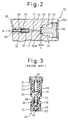
- a specified jig tool 60 shown in Fig. 2 is used.
- the jig tool 60 is provided with a central recess 60a formed at an extreme end thereof to have an axial depth corresponding to a predetermined amount of movement "L" of the bellows element 66.
- the jig tool 60 is inserted in the upper large diameter bore 42, so that the extreme end thereof having the above-mentioned recess 60a is pressed against the bottom of the upper large diameter bore 42 and that the central recess 60a is in alignment with the valve rod bore 41.
- the jig tool 60 is fixed in the upper large diameter bore 42, due to the threaded engagement between the jig tool 60 and the threaded portion of the bore 42. Subsequently, the valve rod 71 having the valve element 72 at one end thereof is inserted through the bore of the valve seat 76 and the valve rod bore 41 until the other end of the valve rod 71 comes close to the bottom end face of the recess 60a of the jig tool 60. At this time, the valve element 72 is held to be in contact with an end of the valve seat 76.
- valve element 72 is tapped by an appropriate rod-like tool 80 in a direction shown by an arrow "A" until the other end of the valve rod 71 comes into contact with the bottom end face of the recess 60a of the jig tool 60.
- the valve seat 76 is assembled and fixed in position in the valve seat chamber 57 of the discharge pressure chamber 62 via the valve element 72. Namely, the valve element 72 and the valve seat 76 are set in position ready for accurately opening and closing a valve port in the end of the valve seat 76, in response to a control movement of the pressure sensing means including the bellows element 66.
- the urging spring 59 and the ball-like lid 58 are assembled in the valve operating chamber 56 to press the valve element 72 against the valve seat 76 on the basis of a predetermined spring force of the urging spring 59.
- the jig tool 60 is removed from the upper large diameter bore 42 of the pressure sensing chamber 61, in order to assemble the pressure-sensing mechanism including the bellows element 66, the coil spring 49, the fixing screw 46, and the adjusting screw 47 in the pressure sensing chamber 61.
- the displacement control valve unit 70 is arranged so as to perform a controlling operation on the basis of detecting the suction pressure Ps of the compressor. Namely, the valve unit 70 controls the crank pressure Pc in the crank chamber 2a in response to detection of a change in the suction pressure Ps. More specifically, when the refrigerating load applied from an external refrigerating system to the refrigerant compressor is large to generate a high suction pressure Ps, the high suction pressure Ps is introduced into the suction pressure chamber 61 via the fluid passage 63.
- the bellows element 66 contracts due to the high suction pressure Ps, so that the valve element 72 is pulled via the valve rod 71 to be pressed against the valve seat 76 and closes the valve port of the valve seat 76. Therefore, a fluid communication between the valve operating chamber 56 and the valve seat chamber 57 is stopped to interrupt a fluid communication between the discharge chamber 3b and the crank chamber 2a. Since the crank chamber 2a constantly communicates with the suction chamber 3a via the fluid withdrawal passage, the crank pressure Pc in the crank chamber 2a is lowered to a level equivalent to the suction pressure Ps.
- the rotary cam plate 8 rotating together with the drive shaft 4 is turned about the pivots 9a, 9a to take a maximum angle of inclination with respect to a reference plane perpendicular to the axis of rotation of the drive shaft 4. Therefore, the amount of discharge of the compressed refrigerant is kept at a maximum.
- the low suction pressure Ps is introduced into the suction pressure chamber 61 of the displacement control valve unit 70 to permit the bellows element 66 to be expanded.
- the valve rod 71 is pressed by the bellows element 66 so as to move the valve element 72 in a direction away from the valve seat 76 against the spring force of the urging spring 59.
- the valve element 72 opens the valve port of the valve seat 76 to establish a fluid communication between the discharge chamber 3b and the crank chamber 2a via the fluid passages 64 and 65 so that the compressed refrigerant at a high pressure Pd is supplied from the discharge chamber 3b to the crank chamber 2a.
- crank pressure Pc in the crank chamber 2a is increased. Accordingly, the rotating cam plate 8 together with the non-rotatable wobble plate 11 are turned about the pivots 9a, 9a toward its minimum angle of inclination while the suction pressure Ps is reduced. Consequently, the amount of the compressed refrigerant discharged from the compressor is reduced to the minimum.
- the flange portion 51 of the bellows element 66 is fixedly sandwiched via the gasket 53 between the fixing screw 46 and the shoulder portion 52 in the suction pressure chamber 61.
- the bellows receiving chamber 43 forming the suction chamber 61 is completely sealed against the atmosphere.
- the bellows element 66 fixed at its flange portion 51 to the shoulder portion 52, is permitted to expand and contract along a longitudinal direction by the guide of the guide bore 45, which constantly receives the cylindrical guide projection 44 of the bellows element 66.
- the movement of the bellows element 66 can be always stable due to the guidance of the guide bore 45.
- the tubular spring holder portion 50 of the fixing screw 46 also contributes to the stable movement of the bellows element 66.
- the stable movement of the bellows element 66 is effective for preventing the bellows element 66 from contacting with the wall of the bellows-receiving chamber 43, and accordingly, the bellows element 66 can be prevented from being frictionally abraded.
- the valve seat chamber 57 of the discharge pressure chamber 62 is formed in the mounting area 40 (e.g., the rear housing 3) of the compressor made of aluminum alloy material. Nevertheless, the valve seat 76 is made of brass material, and is press-fitted in the valve seat chamber 57. Namely, the material of the valve seat 76 is selected to be hard enough to avoid physical deformation and abrasion due to contacting of the valve seat 76 with the valve element 72 which is also made of hard metallic material.
- the important elements of the displacement control valve unit 70 i.e. , the bellows element 66, the valve rod 71, the valve element 72, and the valve seat 76 are all assembled in the mounting area 40 of the compressor body by using the specific jig tool 60, these elements can be accurately assembled in the compressor body even if the mounting area 40, i.e., the rear housing 3 or the cylinder block 1 is rather roughly machined.
- the control operation of the displacement control valve unit 70 can be accurate.
- the displacement control valve unit 70 does not have a valve casing, and a part of the compressor body is used as a casing of the valve unit 70. Further, no o-ring element is incorporated in the valve unit 70, and accordingly, production and assembly of the displacement control valve unit 70 can be easy and simple to reduce the manufacturing cost of the valve unit 70 per se and of the variable displacement type refrigerant compressor.
- valve unit may be equivalently used with many different variable displacement type refrigerant compressors such as a variable capacity refrigerant compressor as disclosed in U. S. Patent No. 5,873,704 to Ota et al., which has a single plate-like cam plate engaged with a plurality of single-headed pistons via shoes, a rotary type variable displacement refrigerant compressor including a vane type refrigerant compressor and a scroll type refrigerant compressor.
Landscapes
- Engineering & Computer Science (AREA)
- Mechanical Engineering (AREA)
- General Engineering & Computer Science (AREA)
- Compressors, Vaccum Pumps And Other Relevant Systems (AREA)
- Control Of Positive-Displacement Pumps (AREA)
Applications Claiming Priority (2)
| Application Number | Priority Date | Filing Date | Title |
|---|---|---|---|
| JP10145961A JPH11336660A (ja) | 1998-05-27 | 1998-05-27 | 可変容量圧縮機およびその組み付け方法 |
| JP14596198 | 1998-05-27 |
Publications (2)
| Publication Number | Publication Date |
|---|---|
| EP0961031A2 true EP0961031A2 (fr) | 1999-12-01 |
| EP0961031A3 EP0961031A3 (fr) | 2000-03-01 |
Family
ID=15397029
Family Applications (1)
| Application Number | Title | Priority Date | Filing Date |
|---|---|---|---|
| EP99109303A Withdrawn EP0961031A3 (fr) | 1998-05-27 | 1999-05-27 | Soupape de régulation pour compresseur à plateau en biais à capacité variable et méthode pour son assemblage |
Country Status (6)
| Country | Link |
|---|---|
| US (1) | US6217292B1 (fr) |
| EP (1) | EP0961031A3 (fr) |
| JP (1) | JPH11336660A (fr) |
| KR (1) | KR100323636B1 (fr) |
| CN (1) | CN1237694A (fr) |
| BR (1) | BR9901661A (fr) |
Cited By (2)
| Publication number | Priority date | Publication date | Assignee | Title |
|---|---|---|---|---|
| EP1420162A3 (fr) * | 2002-11-14 | 2004-09-15 | Kabushiki Kaisha Toyota Jidoshokki | Soupape de contrôle pour un compresseur à capacité variable |
| EP2963293A1 (fr) * | 2014-06-19 | 2016-01-06 | TGK CO., Ltd. | Soupape de contrôle pour compresseur de déplacement variable |
Families Citing this family (16)
| Publication number | Priority date | Publication date | Assignee | Title |
|---|---|---|---|---|
| KR100340606B1 (ko) * | 1999-09-10 | 2002-06-15 | 이시카와 타다시 | 용량 가변형 압축기의 제어밸브 |
| US20040238780A1 (en) * | 2003-06-02 | 2004-12-02 | Gethmann Doug P. | Control valve with integrated hardened valve seat |
| US20060064982A1 (en) * | 2004-09-30 | 2006-03-30 | Mitten Manufacturing | Valve for dynamic control of fuel flow rate in gas turbine power plant, power plant and components thereof employing such valve, and method of constructing such valve |
| JP2006189115A (ja) * | 2005-01-07 | 2006-07-20 | Tgk Co Ltd | 制御弁の取り付け構造 |
| US7611335B2 (en) * | 2006-03-15 | 2009-11-03 | Delphi Technologies, Inc. | Two set-point pilot piston control valve |
| WO2011042008A1 (fr) * | 2009-10-05 | 2011-04-14 | Schaeffler Technologies Gmbh & Co. Kg | Dispositif de pompe hydraulique |
| JP2011163313A (ja) * | 2010-02-15 | 2011-08-25 | Shinhan Electro-Mechanics Co Ltd | 可変容量圧縮機の容量制御弁、およびその組み立て方法 |
| CN102270940A (zh) * | 2011-07-20 | 2011-12-07 | 太原理工大学 | 用于电力监测装置的电场感应式供电方法 |
| DE102018007307A1 (de) * | 2018-09-17 | 2020-03-19 | Vat Holding Ag | Stifthubvorrichtung |
| US11754194B2 (en) | 2019-04-03 | 2023-09-12 | Eagle Industry Co., Ltd. | Capacity control valve |
| CN113646531A (zh) | 2019-04-03 | 2021-11-12 | 伊格尔工业股份有限公司 | 容量控制阀 |
| JP7399950B2 (ja) * | 2019-04-03 | 2023-12-18 | イーグル工業株式会社 | 容量制御弁 |
| CN116518113A (zh) | 2019-04-03 | 2023-08-01 | 伊格尔工业股份有限公司 | 容量控制阀 |
| EP3961075A4 (fr) | 2019-04-24 | 2023-01-04 | Eagle Industry Co., Ltd. | Soupape de régulation de capacité |
| EP3961033B1 (fr) | 2019-04-24 | 2025-03-12 | Eagle Industry Co., Ltd. | Vanne de régulation de capacité |
| KR102862886B1 (ko) | 2020-04-22 | 2025-09-23 | 이구루코교 가부시기가이샤 | 용량 제어 밸브 |
Citations (1)
| Publication number | Priority date | Publication date | Assignee | Title |
|---|---|---|---|---|
| US4688997A (en) | 1985-03-20 | 1987-08-25 | Kabushiki Kaisha Toyoda Jidoshokki Seisakusho | Variable displacement compressor with variable angle wobble plate and wobble angle control unit |
Family Cites Families (10)
| Publication number | Priority date | Publication date | Assignee | Title |
|---|---|---|---|---|
| US4108197A (en) * | 1977-02-23 | 1978-08-22 | Robertshaw Controls Company | Condition response differential vacuum regulator and method of making the same |
| CA1123402A (fr) | 1978-04-17 | 1982-05-11 | Richard E. Widdowson | Soupape hydraulique regulatrice de debit a commande par pression |
| JPS62206277A (ja) * | 1986-03-06 | 1987-09-10 | Toyoda Autom Loom Works Ltd | 揺動斜板型圧縮機におけるワツブルプレ−トの揺動傾斜角戻し機構 |
| US4732544A (en) * | 1986-06-12 | 1988-03-22 | Diesel Kiki Co., Ltd. | Variable capacity wobble plate compressor |
| JPH02115577A (ja) * | 1988-10-24 | 1990-04-27 | Sanden Corp | 容量可変形揺動式圧縮機 |
| EP0536989B1 (fr) | 1991-10-07 | 1995-05-03 | Sanden Corporation | Compresseur à plateau en biais avec dispositif à déplacement variable |
| US5681150A (en) * | 1994-05-12 | 1997-10-28 | Kabushiki Kaisha Toyoda Jidoshokki Seisakusho | Piston type variable displacement compressor |
| JPH0886279A (ja) | 1994-09-16 | 1996-04-02 | Toyota Autom Loom Works Ltd | 往復動型圧縮機 |
| JP3728387B2 (ja) * | 1998-04-27 | 2005-12-21 | 株式会社豊田自動織機 | 制御弁 |
| JPH11325293A (ja) * | 1998-05-15 | 1999-11-26 | Fujikoki Corp | 可変容量型圧縮機用の圧力調整弁 |
-
1998
- 1998-05-27 JP JP10145961A patent/JPH11336660A/ja active Pending
-
1999
- 1999-04-13 KR KR1019990012971A patent/KR100323636B1/ko not_active Expired - Fee Related
- 1999-05-26 US US09/318,889 patent/US6217292B1/en not_active Expired - Fee Related
- 1999-05-27 CN CN99108095A patent/CN1237694A/zh active Pending
- 1999-05-27 EP EP99109303A patent/EP0961031A3/fr not_active Withdrawn
- 1999-05-27 BR BR9901661-3A patent/BR9901661A/pt unknown
Patent Citations (1)
| Publication number | Priority date | Publication date | Assignee | Title |
|---|---|---|---|---|
| US4688997A (en) | 1985-03-20 | 1987-08-25 | Kabushiki Kaisha Toyoda Jidoshokki Seisakusho | Variable displacement compressor with variable angle wobble plate and wobble angle control unit |
Cited By (2)
| Publication number | Priority date | Publication date | Assignee | Title |
|---|---|---|---|---|
| EP1420162A3 (fr) * | 2002-11-14 | 2004-09-15 | Kabushiki Kaisha Toyota Jidoshokki | Soupape de contrôle pour un compresseur à capacité variable |
| EP2963293A1 (fr) * | 2014-06-19 | 2016-01-06 | TGK CO., Ltd. | Soupape de contrôle pour compresseur de déplacement variable |
Also Published As
| Publication number | Publication date |
|---|---|
| BR9901661A (pt) | 2000-03-14 |
| KR19990087914A (ko) | 1999-12-27 |
| US6217292B1 (en) | 2001-04-17 |
| EP0961031A3 (fr) | 2000-03-01 |
| KR100323636B1 (ko) | 2002-02-07 |
| JPH11336660A (ja) | 1999-12-07 |
| CN1237694A (zh) | 1999-12-08 |
Similar Documents
| Publication | Publication Date | Title |
|---|---|---|
| US6217292B1 (en) | Variable displacement type refrigerant compressor | |
| US6010312A (en) | Control valve unit with independently operable valve mechanisms for variable displacement compressor | |
| US5531572A (en) | Capacity control valve for a variable capacity refrigerant compressor | |
| US5964578A (en) | Control valve in variable displacement compressor | |
| US5145326A (en) | Variable capacity wobble plate type compressor with capacity regulating valve | |
| US5890876A (en) | Control valve in variable displacement compressor | |
| US5174728A (en) | Variable capacity swash plate type compressor | |
| US6626645B2 (en) | Control valve for variable capacity compressors | |
| US6146106A (en) | Electromagnetic valve | |
| EP0953766B1 (fr) | Soupape de contrôle | |
| CA1324361C (fr) | Compresseur a piston, a element incline a ressort | |
| JP5222447B2 (ja) | 可変容量圧縮機 | |
| KR20090042171A (ko) | 가변 용량형 압축기에 있어서의 용량 제어 밸브 | |
| US5975859A (en) | Control valve in variable displacement compressor and its assembling method | |
| GB2155115A (en) | Controlling swash-plate pumps | |
| EP0300831B1 (fr) | Compresseur à plateau en biais avec mécanisme à déplacement variable | |
| US5567124A (en) | Variable capacity swash-plate type compressor with an improved capacity control means | |
| KR970001762B1 (ko) | 압축기 | |
| US6074173A (en) | Variable displacement compressor in which a liquid refrigerant can be prevented from flowing into a crank chamber | |
| JPH11351140A (ja) | 可変容量圧縮機の容量制御弁機構 | |
| US6129519A (en) | Variable displacement compressor in which a displacement control is improved at an initial stage of the start-up thereof | |
| KR100311171B1 (ko) | 압축기 | |
| EP1033489A2 (fr) | Soupape de contrôle pour compresseurs à capacité variable | |
| EP0260667A1 (fr) | Compresseur à plateau en biais avec mécanisme à déplacement variable | |
| EP2927493A2 (fr) | Compresseur à plateau oscillant à déplacement variable |
Legal Events
| Date | Code | Title | Description |
|---|---|---|---|
| PUAI | Public reference made under article 153(3) epc to a published international application that has entered the european phase |
Free format text: ORIGINAL CODE: 0009012 |
|
| 17P | Request for examination filed |
Effective date: 19990527 |
|
| AK | Designated contracting states |
Kind code of ref document: A2 Designated state(s): DE FR IT |
|
| AX | Request for extension of the european patent |
Free format text: AL;LT;LV;MK;RO;SI |
|
| PUAL | Search report despatched |
Free format text: ORIGINAL CODE: 0009013 |
|
| AK | Designated contracting states |
Kind code of ref document: A3 Designated state(s): AT BE CH CY DE DK ES FI FR GB GR IE IT LI LU MC NL PT SE |
|
| AX | Request for extension of the european patent |
Free format text: AL;LT;LV;MK;RO;SI |
|
| AKX | Designation fees paid |
Free format text: DE FR IT |
|
| RAP1 | Party data changed (applicant data changed or rights of an application transferred) |
Owner name: KABUSHIKI KAISHA TOYOTA JIDOSHOKKI |
|
| STAA | Information on the status of an ep patent application or granted ep patent |
Free format text: STATUS: THE APPLICATION HAS BEEN WITHDRAWN |
|
| 18W | Application withdrawn |
Effective date: 20040228 |