EP1056426B1 - Flüssigkeitstransfervorrichtung für phiole und verfahren - Google Patents
Flüssigkeitstransfervorrichtung für phiole und verfahren Download PDFInfo
- Publication number
- EP1056426B1 EP1056426B1 EP99908450A EP99908450A EP1056426B1 EP 1056426 B1 EP1056426 B1 EP 1056426B1 EP 99908450 A EP99908450 A EP 99908450A EP 99908450 A EP99908450 A EP 99908450A EP 1056426 B1 EP1056426 B1 EP 1056426B1
- Authority
- EP
- European Patent Office
- Prior art keywords
- vial
- tubular
- stopper
- piercing
- transfer member
- Prior art date
- Legal status (The legal status is an assumption and is not a legal conclusion. Google has not performed a legal analysis and makes no representation as to the accuracy of the status listed.)
- Expired - Lifetime
Links
- 238000000034 method Methods 0.000 title claims description 46
- 238000012546 transfer Methods 0.000 claims description 246
- 239000012530 fluid Substances 0.000 claims description 84
- 238000007789 sealing Methods 0.000 claims description 67
- 239000003814 drug Substances 0.000 claims description 47
- 238000004891 communication Methods 0.000 claims description 38
- 230000000717 retained effect Effects 0.000 claims description 8
- 239000013536 elastomeric material Substances 0.000 claims description 4
- 230000036512 infertility Effects 0.000 claims description 3
- 229910052751 metal Inorganic materials 0.000 claims description 3
- 239000002184 metal Substances 0.000 claims description 3
- 230000013011 mating Effects 0.000 claims description 2
- 238000002788 crimping Methods 0.000 claims 2
- 230000000149 penetrating effect Effects 0.000 claims 2
- 230000003313 weakening effect Effects 0.000 claims 2
- 239000007788 liquid Substances 0.000 description 32
- 229940079593 drug Drugs 0.000 description 15
- 239000003085 diluting agent Substances 0.000 description 11
- 238000001990 intravenous administration Methods 0.000 description 11
- 239000002904 solvent Substances 0.000 description 11
- 238000011109 contamination Methods 0.000 description 9
- 229910052782 aluminium Inorganic materials 0.000 description 8
- XAGFODPZIPBFFR-UHFFFAOYSA-N aluminium Chemical compound [Al] XAGFODPZIPBFFR-UHFFFAOYSA-N 0.000 description 8
- 239000000463 material Substances 0.000 description 7
- 239000000243 solution Substances 0.000 description 6
- 238000004519 manufacturing process Methods 0.000 description 5
- 230000004323 axial length Effects 0.000 description 3
- 238000013461 design Methods 0.000 description 3
- 210000003811 finger Anatomy 0.000 description 3
- 239000004033 plastic Substances 0.000 description 3
- 239000011324 bead Substances 0.000 description 2
- 230000006835 compression Effects 0.000 description 2
- 238000007906 compression Methods 0.000 description 2
- 230000000881 depressing effect Effects 0.000 description 2
- 239000011521 glass Substances 0.000 description 2
- 238000012423 maintenance Methods 0.000 description 2
- 230000035515 penetration Effects 0.000 description 2
- 239000004417 polycarbonate Substances 0.000 description 2
- 229920000515 polycarbonate Polymers 0.000 description 2
- 210000003813 thumb Anatomy 0.000 description 2
- 230000004913 activation Effects 0.000 description 1
- 238000013459 approach Methods 0.000 description 1
- 230000000712 assembly Effects 0.000 description 1
- 238000000429 assembly Methods 0.000 description 1
- 239000000470 constituent Substances 0.000 description 1
- 238000009826 distribution Methods 0.000 description 1
- 238000012377 drug delivery Methods 0.000 description 1
- 238000004108 freeze drying Methods 0.000 description 1
- 239000008155 medical solution Substances 0.000 description 1
- 238000012986 modification Methods 0.000 description 1
- 230000004048 modification Effects 0.000 description 1
- 238000000465 moulding Methods 0.000 description 1
- 230000008520 organization Effects 0.000 description 1
- 230000002028 premature Effects 0.000 description 1
- 230000001681 protective effect Effects 0.000 description 1
- 230000001954 sterilising effect Effects 0.000 description 1
- 238000004659 sterilization and disinfection Methods 0.000 description 1
- 238000003860 storage Methods 0.000 description 1
- 229960005486 vaccine Drugs 0.000 description 1
- XLYOFNOQVPJJNP-UHFFFAOYSA-N water Substances O XLYOFNOQVPJJNP-UHFFFAOYSA-N 0.000 description 1
Images

Classifications
-
- A—HUMAN NECESSITIES
- A61—MEDICAL OR VETERINARY SCIENCE; HYGIENE
- A61J—CONTAINERS SPECIALLY ADAPTED FOR MEDICAL OR PHARMACEUTICAL PURPOSES; DEVICES OR METHODS SPECIALLY ADAPTED FOR BRINGING PHARMACEUTICAL PRODUCTS INTO PARTICULAR PHYSICAL OR ADMINISTERING FORMS; DEVICES FOR ADMINISTERING FOOD OR MEDICINES ORALLY; BABY COMFORTERS; DEVICES FOR RECEIVING SPITTLE
- A61J1/00—Containers specially adapted for medical or pharmaceutical purposes
- A61J1/14—Details; Accessories therefor
- A61J1/20—Arrangements for transferring or mixing fluids, e.g. from vial to syringe
- A61J1/2096—Combination of a vial and a syringe for transferring or mixing their contents
-
- A—HUMAN NECESSITIES
- A61—MEDICAL OR VETERINARY SCIENCE; HYGIENE
- A61J—CONTAINERS SPECIALLY ADAPTED FOR MEDICAL OR PHARMACEUTICAL PURPOSES; DEVICES OR METHODS SPECIALLY ADAPTED FOR BRINGING PHARMACEUTICAL PRODUCTS INTO PARTICULAR PHYSICAL OR ADMINISTERING FORMS; DEVICES FOR ADMINISTERING FOOD OR MEDICINES ORALLY; BABY COMFORTERS; DEVICES FOR RECEIVING SPITTLE
- A61J1/00—Containers specially adapted for medical or pharmaceutical purposes
- A61J1/14—Details; Accessories therefor
- A61J1/1412—Containers with closing means, e.g. caps
-
- A—HUMAN NECESSITIES
- A61—MEDICAL OR VETERINARY SCIENCE; HYGIENE
- A61J—CONTAINERS SPECIALLY ADAPTED FOR MEDICAL OR PHARMACEUTICAL PURPOSES; DEVICES OR METHODS SPECIALLY ADAPTED FOR BRINGING PHARMACEUTICAL PRODUCTS INTO PARTICULAR PHYSICAL OR ADMINISTERING FORMS; DEVICES FOR ADMINISTERING FOOD OR MEDICINES ORALLY; BABY COMFORTERS; DEVICES FOR RECEIVING SPITTLE
- A61J1/00—Containers specially adapted for medical or pharmaceutical purposes
- A61J1/14—Details; Accessories therefor
- A61J1/20—Arrangements for transferring or mixing fluids, e.g. from vial to syringe
- A61J1/2003—Accessories used in combination with means for transfer or mixing of fluids, e.g. for activating fluid flow, separating fluids, filtering fluid or venting
- A61J1/2006—Piercing means
- A61J1/201—Piercing means having one piercing end
Definitions
- This invention relates to an improved vial connector assembly or transferset, a method of affixing a transferset to a vial and a method of establishing fluid communication between a vial and syringe, IV set or the like which permits the use of a conventional or standard vial and syringe or the like to transfer fluid from a syringe to a vial or withdraw liquid medicament, for example, from a vial to a syringe.
- the improved transferset and method of this invention results in improved aspiration or reaspiration of a vial and improved sealing of the communication between a vial and a syringe.
- a conventional vial includes an open end, a rim surrounding the open end and a reduced diameter neck portion adjacent the rim.
- the vial is conventionally sealed with an elastomeric stopper which includes a portion inserted into the neck of the vial and a planar rim portion which overlies the vial rim.
- the stopper is normally secured to the vial rim with an aluminum collar or cap.
- the aluminum collar includes a tubular portion which surrounds the rim portions of the stopper and vial, an inwardly projecting annular portion which overlies the rim portion of the stopper and a distal portion which is crimped into the vial neck beneath the vial rim portion. Because aluminum is malleable, the collar accommodates the buildup of tolerances of the dimensions of the stopper and vial rim.
- the dimensions and tolerances of standard vials and stoppers are set by the International Standards Organization (ISO).
- a powdered drug is generally reconstituted by inserting the needle of a syringe through the pierceable stopper on the vial and injecting a diluent, such as water, or a solvent into the vial.
- a diluent such as water
- the reconstituted drug is then reaspirated from the vial with the same or a different syringe after mixing the diluent or solvent with the dry drug.
- this method exposes the healthcare worker to being pricked by the needle of the syringe and contamination of the needle or the drug.
- the prior art has therefore proposed various fluid or liquid transfer assemblies which may be secured to a vial under sterile conditions and which may then utilized to transfer liquid, such as a diluent or solvent, from a syringe to a vial and reconstituted medicament from the vial to a syringe which prevent contamination of the liquid medicament.
- the assembly is protected from contamination by a cap or cover which is removed only prior to use.
- the transfer assembly includes a needle which pierces the stopper of the vial and the liquid is transferred through the needle lumen as disclosed, for example, in U.S. Patent No. 5,429,256.
- the conventional vial stopper is eliminated in favor of a fluid transfer assembly having a rubber stopper which is inserted into the neck of the vial without a planar rim portion.
- the stopper remains within the vial until such time as reconstitution of the drug is required.
- the transfer assembly is actuated, the stopper is urged toward the interior of the vial to open the neck, thereby permitting fluid flow through the transfer assembly into the vial body.
- Examples of such embodiments include the MONOVIAL® line of drug delivery devices manufactured and sold by Becton Dickinson Pharmaceutical Systems of Le Pont de Claix, France and exemplified by U.S. Patent No. 5,358,501.
- this embodiment is an excellent drug reconstitution system having superior properties, particularly convenience of use and maintenance of the sterile conditions of the drug in the vial, particularly where the vial is of a relatively large size, typically twelve milliliters or more, pharmaceutical companies have expressed an interest in an approach where the vial may also be a smaller size.
- US-A-3 977 555 relates to a protective safety cap for a medicament vial having a tubular extension and a needle structure adapted to pierce the stopper of the vial held therein.
- the needle structure extends beyond the tubular extension.
- the needle structure is surrounded by a closed cover which is slideably attached at the outer surface of the tubular extension.
- the cover is pressed down thereby driving the needle structure through the stopper. Then the cover is removed and a syringe is attached to the needle structure to extract the medicament contained in the vial.
- US-A-5 358 501 discloses a storage bottle containing a constituent of a medical solution and a transfer device for transferring the solution into a container.
- An elongate element in form of a needle is placed inside the transfer device, wherein the tip is directed away from the bottle and the blunt end is located inside the transfer device.
- the elongate element comprises two longitudinal channels for establishing communication between the bottle and the container.
- the bottle is closed by an elastomeric plug which is removed by the blunt end of the elongate element when it is driven with its tip into the stopper of the container.
- the needle must therefore be withdrawn during aspiration of the vial or reaspiration where the medicament is reconstituted in the vial following delivery of a diluent or solvent to the vial.
- liquid medicament remains in the vial because the only liquid communication with the syringe is through the needle lumen. This may be a problem particularly where the vial is relatively small. For example, assuming a twenty millimeter long needle which pierces a two to three millimeter thick stopper, if the needle is pushed all the way through the stopper, there may be distance of as much as seventeen millimeters between the needle opening and the inner surface of the stopper. This amount below the needle lumen will not be reaspirated unless the needle is substantially withdrawn.
- the vial transferset or fluid transfer assembly of this invention is adapted to establish fluid communication between a syringe, intravenous (IV) device or the like and a sealed vial.
- the syringe and vial may be conventional and manufactured according to ISO standards.
- a conventional vial as presently used by the pharmaceutical companies includes an open end, a rim surrounding the open end and a reduced diameter neck portion adjacent the rim.
- the vial is sealed with a pierceable resilient stopper generally formed of an elastomeric material and most commonly includes a portion which is inserted into the neck of the vial and a planar rim portion which is received over the vial rim.
- the central portion of the planar rim portion which overlies the opening through the neck portion of the vial generally has a thickness of about two to three millimeters and the portion of the stopper which is received in the neck portion of the vial is generally tubular having an external diameter which is slightly greater than the internal diameter of the vial neck portion to assure a secure seal.
- the transferset or transfer assembly of this invention includes a generally tubular transfer member having an open proximate end which is sealingly supported on the stopper rim portion for example in general coaxial alignment with the vial open end and an opened distal end adapted to receive a syringe or the like in sealed communication.
- a component such as the tubular transfer member is the end closest to the planar rim portion of the stopper and the distal end is the end furthest from the rim portion of the stopper.
- these terms are used solely to simplify the explanation of the invention and are not intended to define structure.
- the transferset of this invention further includes a piercing member which is received within the tubular transfer member and reciprocally supported within the tubular transfer member by an internal surface of the tubular transfer member.
- the piercing member includes a distal end and an opposed relatively sharp preferably pointed piercing proximate end opposite the stopper rim portion adapted to pierce the stopper when the syringe is driven against the distal end of the piercing member.
- the tubular transfer member provides fluid communication between the vial and a syringe, although the vial transferset of this invention may also be used to transfer fluid or liquid from a vial to another container, such as a second vial or an intravenous set.
- the piercing member includes at least one external generally longitudinal channel or groove rather than an internal lumen, thereby eliminating the problems associated with a conventional needle.
- the channel may take various forms and may include an internal channel, in the most preferred embodiment the channel is an external channel which extends generally longitudinally along at least a portion of the piercing member.
- the external channel in the piercing member extends generally longitudinally along the piercing member, but may extend spirally around the piercing member or include external and internal channels or multiple channels.
- the external channel in the piercing member provides full fluid or liquid communication between the vial and the tubular transfer member.
- the tubular transfer member when the tubular transfer member is sealingly connected to a syringe, IV or the like, the tubular transfer member then provides fluid communication between the vial and the syringe.
- the preferred embodiment of the tubular transfer member then includes an annular or circular projecting sealing lip which is biased against the planar rim portion of the stopper assuring sealed communication between the vial and the tubular transfer member.
- the sealing lip includes a relatively sharp edge which bites into the resilient stopper.
- the sealing lip of the tubular transfer member is preferably biased against the rim portion of the stopper sufficiently to stretch or prestress the rim portion of the stopper which overlies the vial opening.
- the preferred embodiment of the transferset of this invention further includes a cup-shaped cap which encloses the assembly and maintains the sterility of the transferset assembly.
- the cup-shaped cap preferably includes a radial rim portion adjacent an open end of the cup-shaped cap which preferably sealingly engages the stopper rim portion, a tubular portion surrounding the tubular transfer member and a closed distal end enclosing the distal ends of the tubular transfer member and the piercing member.
- the cap may include a separate cover portion which is integral or separate from the remainder of the cap, in the most preferred embodiment, the cap is integrally formed, such that the distal end portion may be removed prior to use.
- the tubular portion of the cap spaced from the rim portion includes a radial groove or grooves which weaken the tubular wall forming a frangible connection.
- the distal end of the cap portion may then be removed simply by twisting the distal end of the cap, thereby breaking the frangible connection.
- the transfer assembly is secured to the vial by a generally tubular collar having a radially inwardly projecting portion or annular portion which is received over the cap radial rim portion, a tubular portion surrounding the cap radial rim portion and the vial rim and a distal radial rim portion which is received in the vial neck beneath the rim portion of the vial permanently securing the transfer assembly to the vial.
- the collar is formed of a malleable material such aluminum and the radial distal portion of the collar is then crimped into the neck portion of the vial beneath the vial rim portion.
- the collar of the transferset of this invention thus replaces the aluminum collar of a conventional vial and stopper assembly and easily accommodates the dimensional tolerances of the vial and stopper assembly.
- the vial is conventionally formed of glass or plastic.
- the planar radial rim portion of the vial stopper is preferably stretched and prestressed over the open end of the vial during assembly of the transferset on the vial.
- the proximate end of the tubular transfer member includes a projecting sealing lip having a diameter less than the internal diameter of the vial open end.
- the sealing lip has a relatively sharp edge which may also bite into the resilient stopper.
- the piercing member is reciprocally supported by an internal surface of the tubular transfer member, such that the piercing member can move toward the stopper to pierce the stopper, but the piercing member is prevented from moving away from the stopper and the relatively sharp piercing proximate end of the piercing member extends beyond the proximate end of the tubular transfer member.
- the piercing end of the piercing member Upon assembly of the transferset on the vial, the piercing end of the piercing member then deforms and, in one disclosed embodiment, partially penetrates the planar rim portion of the stopper which is preferably stretched and prestressed over the vial opening by the sealing lip of the tubular transfer member, as described above.
- the piercing end of the piercing member is slightly rounded and the external channel does not extend through the proximate end, such that the relatively sharp piercing end does not initially penetrate the rim portion of the stopper, but stretches the stopper as described. This embodiment strengthens the piercing end.
- the tubular transfer member includes an internal diameter adjacent its distal end which is smaller than the internal diameter adjacent its proximate end and the piercing member includes a radial lip having a diameter greater than the smaller internal diameter of the tubular transfer member adjacent its distal end.
- the tubular transfer member has a larger counter bore adjacent its proximate end.
- the piercing member is thus free to move telescopically in the tubular transfer member toward the stopper, but prevented from moving away from the stopper.
- the piercing member has a reduced diameter portion adjacent its proximate end and a pointed piercing end further reducing the force required to drive the piercing member through the planar rim portion of the stopper.
- the most preferred embodiment of the transferset of this invention further includes a second seal surrounding the seal provided by the sealing lip of the tubular transfer member.
- the second seal is provided by an annular or circular lip which projects from the radial rim portion of the cap.
- the radial rim portion of the cap includes at least one relatively sharp sealing lip which bites into the planar rim portion of the stopper providing an improved seal which maintains the sterile condition of the content of the transferset and prevents contamination.
- the transferset of this invention may be affixed on a conventional vial and stopper assembly by the pharmaceutical companies under sterile conditions when the vial is filled and the transferset of this invention prevents contamination of the contents of the vial.
- the cap of the transferset seals the transfer assembly and the collar permanently secures the assembly on the vial, particularly where a malleable collar is utilized.
- the radially inwardly projecting or annular lip portion of the collar is preferably compressed against the radial rim portion of the cap as the distal end of the collar is crimped into the reduced diameter neck portion of the vial beneath the vial rim during assembly.
- the piercing end of the piercing member is also partially driven into the prestressed rim portion of the stopper overlying the open end of the vial, reducing the stroke required to drive the piercing member through the rim portion of the stopper as described above.
- the transferset of this invention may be utilized to transfer fluid from a vial to a syringe or IV set or any container; however, the disclosed embodiment of the transferset is specifically adapted to transfer liquid from a vial to a syringe or IV set or from a syringe or IV set to a vial.
- the distal end of the tubular transfer member includes a connector adapted to connect the tubular transfer member to a syringe to establish fluid communication between the tubular transfer member and the interior of a syringe, such as a Luer lock or Luer connector.
- a conventional syringe includes a tubular portion, a plunger having a head or fluid piston reciprocally mounted in sealed relation within the tubular portion and a reduced diameter tubular nozzle portion opposite the plunger head.
- the inside diameter of the tubular transfer member of the transferset is preferably greater than the outside diameter of the tubular nozzle portion of the syringe and the outside diameter of the syringe nozzle portion is generally approximately equal to the diameter of the distal end of the piercing member.
- the syringe nozzle portion may be telescopically received within the distal end of the tubular transfer member, wherein it is driven against the distal end of the piercing member.
- the reduced diameter nozzle portion is generally recessed within the tubular portion of the syringe, such that the proximate end of the syringe tubular portion surrounds the nozzle portion forming a tubular collar.
- the proximate end of the tubular collar includes a connector, such as a female Luer lock.
- the distal end of the tubular transfer member includes a male Luer lock connector adapted to mate with the female Luer lock of the syringe.
- the method of transferring fluid or liquid medicament from the vial to a syringe or other container then includes first connecting the connector on the syringe to the connector on the distal end of the tubular transfer member which drives the reduced diameter nozzle portion of the syringe into the distal open end of the tubular transfer member and the free end of the syringe nozzle portion is then driven against the distal end of the piercing member, driving the piercing end of the piercing member through the planar rim portion of the stopper.
- the method includes connecting the syringe to the distal end of the tubular transfer member, establishing fluid communication between the syringe through the nozzle portion and driving the piercing end of the piercing member through the rim portion of the stopper. Fluid communication is thus established between the inside of the vial and the syringe through the tubular transfer member.
- the method further includes a first step of removing the cover portion of a cap to provide access to the tubular transfer member and the piercing member.
- a radial groove is provided in the tubular portion of the cap spaced from the radial portion of the cap providing a frangible connection, such that the cover portion can be removed from the rim portion of the cap simply by twisting the distal end of the cap, breaking the frangible connection and permitting removal of the cover portion which includes the distal end of the tubular portion of the cap the closed end.
- the transferset and vial assembly is now ready for use.
- this communication is established through the external generally longitudinal channel in the piercing member.
- the channel in the piercing member extends from adjacent the piercing end to at least the enlarged portion of the piercing member and most preferably through at least an extended portion of the length of the piercing member.
- the connector on the syringe is most preferably a threaded connection, such as a Luer lock.
- this threaded connection has several turns whereby the proximate end of the piercing member is driven completely through the planar rim portion of the stopper by threading the threaded connection of the syringe on the distal end of the tubular transfer member.
- the proximate end of the piercing member is driven through the stopper by fluid pressure from the syringe.
- the elongated piercing member is inserted into the tubular transfer member, wherein the internal surface of the tubular transfer member telescopically supports the piercing member.
- the tubular transfer member includes an enlarged counterbore adjacent its proximate end and the piercing member includes a radial lip as described, the distal end of the piercing member is inserted through the proximate end of the tubular transfer member and the relatively sharp piercing end of the piercing member extends beyond the proximate end of the tubular transfer member. Then the distal end of the tubular transfer member is inserted into the open proximate end of the cup-shaped cap.
- the proximate end of the tubular transfer member includes a radial lip portion which is received within a counterbore of the radial rim portion of the cap, fixing the tubular transfer member in the cap, such that the projecting sealing lip of the tubular transfer member engages the planar rim of the stopper as described.
- the piercing member is preferably releasably retained in the tubular transfer member, such that the components of the transferset and the collar may be preassembled and delivered in bulk to a pharmaceutical company, for example, for sterile assembly on vials. Finally, the assembled piercing member, tubular transfer member and cap are assembled on the vial and affixed by the collar.
- the collar is most preferably formed of a malleable material such as aluminum and the radial rim portion of the collar is compressed against the rim portion of the cap as the distal end of the generally tubular cap is crimped into the reduced diameter neck portion of the vial beneath the vial rim.
- the compression of the radial rim portion of the collar against the rim portion of the cap compresses the resilient planar rim portion of the stopper, compressing the sealing lips into the rim portion of the stopper, stretching and pre-stressing the central portion of the planar rim portion of the stopper, assuring sealed communication between the vial and the tubular transfer member.
- this invention further includes driving the piercing end of the piercing member simultaneously into the planar radial rim of the stopper, deforming and may partially penetrate the stopper radial rim to reduce the stroke required to drive the piercing member through the stopper.
- the piercing member in the transferset of this invention has several important advantages over the prior art.
- the longitudinal channel may be a V-shaped channel for example which extends the entire length of the piercing member.
- Such a channel is easier to manufacture than a needle having very small lumen as presently used.
- a piercing member having an external channel assures complete aspiration or reaspiration of the vial without requiring partial withdrawal of the needle which exposes the healthcare worker to being pricked by the needle (if inadvertently fully withdrawn) and contamination of the liquid medicament.
- the external channel provides full communication of the liquid content of the vial, whereas a needle with a lumen requires substantial withdrawal of the needle from the vial to provide full communication through the stopper as described above. Fluid communication between the syringe and the vial is then provided by the tubular transfer member rather than the needle in the transferset of this invention.
- the described piercing member provides several important advantages in the transferset of this invention/over the prior art.
- the transferset of this invention may be utilized to reconstitute dry or powdered drugs into liquid form with an appropriate diluent or solvent solution prior to administration to a patient.
- the syringe may contain a solvent solution or diluent which is injected into the vial through the tubular transfer member and the external channel of the piercing member by depressing the plunger head of the syringe.
- the reconstituted drug or medicament may then be reaspirated from the vial to the same syringe by withdrawing the plunger head for administration to a patient.
- the healthcare worker is never exposed to a needle during this operation and the piercing member remains with the transferset and vial assembly because it is never connected to the syringe.
- the tubular transfer member is then removed from the syringe and replaced with a needle for application of the liquid medicament to a patient or connected directly to an IV line.
- tubular and tubular portion are used herein to connote a generally tubular shape.
- the disclosed embodiments are generally cylindrical tubes which are more convenient to manufacture, the tubular portions may be of any convenient shape, including polygonal.
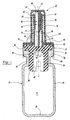
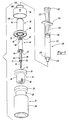
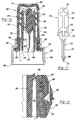
- the fluid transfer assembly or transferset 20 of this invention is adapted for establishing fluid communication with a conventional sealed vial 22 as shown in Figure 1.
- the vial includes a side wall portion 24, a bottom wall portion 26, a reduced diameter neck portion 28 and a rim portion 30.
- the vial is conventionally formed of glass or plastic and includes an interior 32 for receipt for example of a dry or liquid medicament, such as a dry vaccine 33.
- the vial is sealed with an elastomeric stopper 34 which includes a tubular portion 36 and a planar rim portion 38.
- the tubular portion 36 of the stopper preferably has an external diameter slightly greater than the internal diameter 44 of the open end of the vial and, as will be understood by those skilled in the art, the end of the tubular portion may include axial slots 40 in order to perform freeze drying of liquid in the vial.
- the vial may also include a gas, for example, to protect the liquid content of the vial, and thus the transferset of this invention is referred to as a fluid, rather than liquid transferset.
- the central portion 42 of the planar rim portion 38 is flexible and thus may be resiliently biased into the tubular portion 36, prestressing the central portion 42 as described below.
- the transferset 20 of this invention preferably includes four components, including a tubular transfer member 46, a central piercing member 48 which is reciprocally supported in the tubular transfer member, a cup-shaped cap 50 which encloses and seals the assembly and a collar member 52 which secures the transferset to the vial as shown in Figure 1.
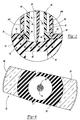
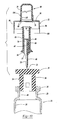
- the proximate end of the tubular transfer member 46 includes a circular or annular sealing lip 54 as shown in Figures 1 and 2, which preferably includes a sharp distal edge 56 as shown in Figure 2.
- the proximate end of the tubular transfer member 46 may include a plurality of sealing lips, such as the concentric sealing lips 86 of the cap 50 described below.
- the proximate end of the tubular transfer member 46 further includes a radial connector portion 58 as shown in Figure 2 which is described more fully hereinbelow.
- a connector such as a Luer lock 60, is provided adjacent the open distal end 62 of the tubular transfer member.
- the internal surface of the tubular transfer member 46 includes a first smaller preferably conical diameter 64 adjacent the distal end 62 and a second larger generally cylindrical diameter 66 or counterbore adjacent the proximate end.
- the distal end 67 of the piercing member 48 includes a generally cylindrical barrel portion 68 having an external diameter generally equal to or slightly less than the internal diameter 64 of the tubular transfer member 46, such that the piercing member is telescopically supported in the tubular transfer member 46 for movement toward the stopper 34 as described below.
- the piercing portion 70 adjacent the proximate end of the piercing member 48 may also be generally cylindrical and preferably has a diameter substantially less than the diameter of the barrel portion 68.
- the portion 73 of the piercing member between the radial rib 75 and the barrel portion 68 is conical.
- the proximate end of the piercing member 48 includes a relatively sharp, preferably pointed piercing end 72 and the piercing member 48 includes an external generally longitudinal channel 74 which provides communication between the interior 32 of the vial and the interior of the tubular transfer member 46 as described below.
- the piercing member 48 further includes a radial rib 75 which has a diameter greater than the inside diameter 64 of the tubular transfer member 46 adjacent its distal end and slightly smaller than the inside diameter 66 of the counter-bore, such that the piercing member 48 can move toward the planar radial rim portion 38 of the stopper for piercing of the stopper, but cannot move away from the stopper as shown in Figure 1.
- the sharp piercing end 72 of the piercing member 48 is thus retained in the tubular transfer member 46, such that the relatively sharp piercing end portion 72 of the piercing member deforms the central portion 42 of the stopper and may partially penetrate the stopper as shown, thereby reducing the stroke required to drive the piercing member through the stopper as described below.
- the cap 50 includes a tubular portion 76 which surrounds the tubular transfer member 46 preferably is spaced relation, a radial rim portion 78 at its proximate end and a closed distal end portion 80 which encloses the distal ends of the tubular transfer member 62 and the piercing member 67.
- the cap 50 is thus generally described as "cup-shaped"; however, the cap may have an open distal end which is closed by a separate removable closure, for example, such that the combination is cup-shaped.
- the tubular portion 76 of the cap includes a radial v-shaped external groove 82, such that the proximate end of the tubular portion 76 is retained to the distal portion by a relatively thin frangible connection 84 as shown in Figure 2.
- the groove 82 in the disclosed embodiment of the tubular portion 76 of the cap 50 is in the external surface as shown; however the groove may also be formed in the internal surface forming a frangible connection adjacent the external surface.
- the groove 82 may also be continuous as shown or interrupted.
- the cover portion may be connected to the remainder of the cap by spaced frangible connector portions. As described below, the distal portion of the cap or cover portion may then be removed by twisting the distal end of the cap for connection of the transferset to a syringe or the like.
- the radial rim portion 78 includes annular or preferably circular concentric sealing lips 86 which surround the sealing lip 54 of the tubular transfer member.
- the circular lips 86 on the radial portion 78 of the cap surround the sealing lip 54 on the tubular transfer member, providing a safety seal primarily to maintain sterility inside the cap 50 prior to use, thereby extending the shelf life of the product.
- the disclosed embodiment includes two concentric sealing lips 86 on the cap, it will be understood that one sealing lip may be utilized or a plurality of nonconcentric lips.
- the sealing lips 86 preferably have a relatively sharp edge and are V-shaped, such that the lips 86 bite into the resilient planar rim portion 38 of the stopper.
- the disclosed embodiment of the cap 50 further includes an outer longitudinal rim portion 88 having an inside diameter generally equal to or slightly smaller than the outside diameter of the planar rim portion 38 of the stopper as shown in Figure 1, such that the transferset 20 is accurately located on the stopper 34 and the rim portion 30 of the vial 22 with the tubular transfer member 46 generally coaxially aligned with the opening 44 through the neck portion 28 of the vial.
- the piercing member 48 is supported in the tubular transfer member 46 with its longitudinal axis X coincident with the longitudinal axis of the vial and stopper. It may be desirable, however, in certain applications to provide a nonconcentric arrangement and thus the present invention is not limited to the concentric arrangement shown.
- the tubular transfer member 46 is accurately located and supported within the cap 50 by a radial rim 90 on the radial connector portion 58 as shown in Figure 2, which is received in a recess 92 in the cap.
- the cap further includes a V-shaped radially inwardly projecting rib 93, which is received in or snapped into a V-shaped groove 94 in the tubular transfer member as shown in Figure 2, providing accurate secure location of the tubular transfer member 46 in the cap 50.
- the V-shaped interlock further permits preassembly of the tubular transfer member 46 and piercing member 48 in the cap 50 for bulk supply of the transferset and collar 52 to pharmaceutical companies, for example, for attachment to a vial, following filling of the vial with medicament, using the collar 52.
- the tubular transfer member is retained in the cap 350 for bulk supply by an interlocking rib and depression on opposed surfaces of the tubular transfer member and the cap, preferably spaced inwardly or proximately from the frangible connection.
- the piercing member is releasably retained in the tubular transfer member for bulk assembly and supply to the applicator responsible for filling the container or vial 22.
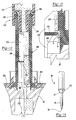
- the piercing member 48 includes a small ramped radial rib 73, spaced distally from the radial rib 75, which provides an interference fit with the internal surface 64 of the tubular transfer member 46 as best shown in Figures 5, 6, 9 and 10. This interference fit releasably retains the piercing member 48 in the tubular transfer member 46 upon assembly of the piercing member in the tubular transfer member.
- the components of the transferset 20 are retained as an assembly for bulk sale and use as described.
- the collar 52 is most preferably formed of a malleable material such as aluminum to accommodate the thickness tolerances of the stopper 34 and the rim portion 30 of the vial.
- the collar 52 includes a tubular portion 96 which surrounds the radial and longitudinal rim portions 78 and 88 of the cap 50, the planar radial rim portion 38 of the stopper and the rim portion 30 of the vial, a radially inwardly projecting portion 98 which overlies the radial rim portion 78 of the cap and a distal radial portion 100 which in the preferred embodiment is crimped into the reduced diameter neck 28 of the vial beneath the vial rim 30.
- the collar 52 further includes a distal tubular portion 102 which surrounds the proximate end of the tubular portion 76 of the cap and the radial V-shaped external groove 82 as shown in Figure 2.
- This tubular portion 102 reduces the likelihood of accidental removal of the distal portion of the cap 50 and the distal end of the tubular portion 102 includes a rounded bead 104 which prevents the healthcare worker from engaging a sharp metal edge when removing the distal end of the cap during use.
- the distal removable portion of the cap is referred to hereinafter as the cover portion.
- the cover portion may be threaded onto the proximate end of the tubular portion 76 of the cap or connected by a "living hinge.”
- the preferred embodiment of the cap 50 having a frangible connection 84 as shown in Figures 1 and 2 reduces the cost of the cap of the transferset and assures maintenance of the sterile conditions prior to use.
- the method of assembling the transferset on a vial is best shown in Figures 9 and 10.
- the distal end 67 of the piercing member 48 is inserted into the proximate end of the tubular transfer member 46.
- the barrel portion 68 of the piercing member is first received in the larger internal diameter 66, wherein the radial rib 75 is generally equal to the diameter of the internal surface 66.
- the barrel portion 68 of the piercing member is then received in the smaller diameter surface 64 until the radial rib 75 engages the radial surface 65 between the internal surfaces 66 and 64 ( Figure 10) as shown in Figure 1.
- the distal ends 62 of the tubular transfer member and 67 of the piercing member are then received in the open proximate end of the cap 50 and the tubular portion 76 of the cap 50 is then received over the tubular portion 102 of the collar and the assembly is received over the radial planar rim portion 38 of the stopper 34 and the rim portion of the vial 22.
- the tubular transfer member 46 is accurately aligned within and supported by the cap 50.
- the radial rib 90 of the tubular transfer member is received within the radial groove 92 of the cap 50 and the V-shaped rib 93 on the cap snaps into the mating V-shaped groove 94 in the tubular transfer member.
- the outer longitudinal rim 88 on the cap is received over the radial planar portion 38 of the stopper, such that the entire transferset assembly is accurately aligned on the stopper 34.
- the piercing member 48 is accurately aligned and supported within the tubular transfer member 46, such that the relatively sharp piercing end 72 extends beyond the proximate end of the tubular transfer member 46 and the piercing member 48 is able to move toward the stopper, but is restrained from withdrawing from the stopper by the radial rib 75.
- the distal open end 100 of the tubular portion 96 is initially coincident with the tubular portion 76 as shown in phantom in Figure 1. Upon assembly, however, the end 100 is deformed or crimped into the neck portion 28 of the vial beneath the rim portion 30, permanently securing the transferset 20 on the vial 22.
- the radial rim portion 78 of the cap 50 is simultaneously compressed against the planar rim portion 38 of the resilient stopper as the distal end 100 of the collar 52 is crimped, such that the piercing end 72 of the piercing member 48 is pressed into the central portion 42 of the stopper, which causes the piercing end 72 to resiliently deform the unsupported central portion 42 of the stopper and, in the embodiment disclosed in Figures 1 to 4, the piercing end 72 may partially penetrate the central portion 42 of the stopper as shown in Figure 2.
- the piercing end 72 of the piercing member may not be desirable in some applications for the piercing end 72 of the piercing member to partially penetrate the central portion 42 of the stopper when the transferset is assembled on the vial, particularly where the vial and transferset assembly of this invention is to be stored for an extended period of time.
- the piercing end 372 of the piercing member 348 is slightly rounded to avoid prepenetration of the stopper.
- the relative sharpness of the piercing end 72 and 372 of the piercing member 48 and 348 may be selected to either stretch or deform and prestress the central portion 42 of the planar rim portion 38 of the stopper 34 or deform and partially penetrate the central portion 42 of the stopper, as shown in Figures 1 to 4. Further, the sharpness of the pointed end 72 and 372 of the piercing member will depend upon the material used to form the piercing member 48 and the material may be selected to either partially pierce the stopper or simply deform and stretch the central portion 42 of the stopper.
- the annular sealing lip 54 of the tubular transfer member 46 is also simultaneously driven into the central portion 42 of the stopper, stretching and prestressing the central portion 42 of the stopper as shown in Figure 2, and the sealing lips 86 of the cap 50 are driven into the resilient stopper providing an additional seal encircling the sealing lip 54.
- the sharp piercing edge 56 of the sealing lip 54 of the tubular transfer member 46 slightly penetrates the central portion 42 of the stopper, providing an improved seal surrounding the communication between the interior 32 of the vial 24 and the tubular transfer member 46 when the piercing member 48 fully penetrates the stopper 34 as now described.
- the transferset 20 may be assembled on the vial 22 and stopper 34 by the pharmaceutical company when the vial 22 is filled under sterile conditions.
- the vial is filled with a dry or powdered medicament which may be reconstituted into liquid form with an appropriate diluent or solvent solution prior to administration to a patient.
- the diluent or solvent solution is first injected into the vial by a syringe, such as the conventional syringe 110 shown in Figures 4 to 6 and 9.
- a conventional syringe includes a tubular body portion 112, a tubular nozzle portion 114 which extends beyond the tubular body portion 112, a plunger 116 having a head portion 118 having external seals 120, such as the O-ring seals shown in Figures 4 to 6.
- the plunger shaft 122 is generally cruciform in shape and may be integral with the head 118.
- the plunger 116 may be driven through or reciprocate through the interior 128 of the tubular body portion 112 to eject or withdraw liquid through the nozzle portion 114.
- a collar portion or tubular extension 129 of the tubular body portion 112 extends beyond the distal portion of the nozzle 114, the interior surface of which includes a female Luer lock or female threads which are normally used to connect a needle to the syringe.
- the shaft 122 of the plunger 116 generally includes a thumb or push button 132 and the body portion includes a radial, outwardly extending finger grip 134, such that the plunger head may be reciprocated through the tubular body portion 112 by gripping the radial finger grip 134 and the plunger head 118 is driven through the interior of the tubular body portion by engaging the push button 132 with the thumb.
- details of the design of various syringes are well known in the art and the transferset of this invention is not limited for use with any particular syringe design.
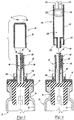
- the cover portion of the cap 50 Prior to use of the vial and transferset of this invention by a healthcare worker, for example, the cover portion of the cap 50 must first be removed as shown in Figure 3. This is accomplished with the disclosed embodiment of the transferset 20 simply by twisting the distal end portion of the cap 50 as shown by arrow A in Figure 3. This twisting motion breaks the frangible connection 84 formed by the radial groove 82. The cover portion then comprises the distal portion of the tubular portion 76 and the closed distal end portion 80 as shown in Figure 3. The cover portion of the cap 50 is thus removed from the transferset 20 exposing the distal end 67 of the piercing member 48 and the tubular transfer member 46 as shown in Figure 3. As described above, the distal tubular portion 102 of the collar includes a rounded bead 104 which protects the fingers of the healthcare worker during removal of the cover portion of the cap 50 which will now be more fully understood from Figure 3.
- the transferset 20 with the cover portion of the cap 50 removed is now ready for receipt of an IV set or a conventional syringe 110 as shown in Figure 4.
- the syringe 110 is coaxially aligned with the axis of the tubular transfer member 46.
- the diameter of the barrel portion 68 of the piercing member 48 is equal to or greater than the diameter of the nozzle portion 114 of the syringe, such that the nozzle portion 114 of the syringe will engage the distal end 67 of the piercing member 48.
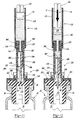
- the syringe 110 is then secured to the tubular transfer member 46 and the piercing portion 70 of the piercing member 48 is driven through the central portion 42 of the resilient stopper 34 as shown in Figures 5 and 6.
- the tubular nozzle portion 114 of the syringe 110 is driven into the open distal end 64 of the tubular transfer member 46, the free end of the nozzle portion 114 is driven against the distal 67 of the piercing member 48, which drives the piercing end 72 through the central portion 42 of the stopper 34 as shown in Figure 5.
- the reduced diameter piercing portion 70 of the piercing member 48 is then driven through the central portion 42 of the stopper by threading the male thread of the Luer lock 60 at the distal end of the tubular transfer member 46 into the female thread 130 of the Luer lock on the extension or collar 129 of the syringe as shown in Figure 6.
- the threading of the syringe on the distal end of the tubular transfer member 46 drives the tubular nozzle portion 114 of the syringe 110 into the internal surface 64 of the tubular transfer member 46 and the free end of the tubular nozzle portion against the distal end 67 of the barrel portion 68 of the piercing member 48, which drives the piercing portion 70 of the piercing member through the central portion 42 of the stopper 34, establishing fluid communication through the external channel 74 and the interior 32 of the vial 22 as discussed more fully hereinbelow.
- the piercing of the center portion 42 of the stopper 34 by the piercing member 48 is facilitated by the circular sealing lip 54 on the proximate end of the tubular transfer member 46, which stretches and prestresses the unsupported central portion 42 of the stopper which overlies the tubular portion 36.
- the liquid diluent or solvent may now be transferred to the interior of the vial 22 simply by depressing the plunger 116 of the vial 110 as shown by arrow B in Figure 6.
- the liquid in the interior 128 of the syringe is thus ejected through the tubular nozzle portion 114 into the external channel 74 of the piercing member 48 into the tubular portion 34 of the stopper and thus into the interior 32 of the vial 22.
- one configuration of the generally longitudinal channel 74 in the piercing member 48 is a V-shaped channel 74 which is relatively simple to manufacture. Further, the use of a V-shaped channel having an angle of about 15° to 60° does not materially weaken the piercing member and provides adequate communication between the interior 32 of the vial and the tubular transfer member 46 through the channel 74. A larger angle of about 45° to 60° may be preferred to limit manufacturing problems and avoid potential blockage of the groove. Further, the channel 74 may be of any convenient shape, including rectangular.
- the resilient elastomeric central rim portion 42 of the stopper will be deformed into and partially fill the channel 74 in the piercing member when the piercing portion 70 penetrates the stopper.
- the deformation and stretching of the central portion 42 of the stopper over the opening of the vial by the sealing lip 54 of the tubular transfer member however reduces the volume of elastomeric material which is deformed into the channel 74, thereby improving fluid communication through the external channel 74.
- the liquid medicament is fully reconstituted by shaking the assembly as shown in Figure 7.
- the liquid medicament 136 may then be reaspirated into the same or a different syringe simply by withdrawing the plunger 116 into the tubular body portion 112 in the opposite direction from arrow B in Figure 6. It is important to note from Figure 7 that the liquid medicament 136 is transferred from the vial 122 through the external channel 74, then from the external channel into the tubular transfer member 46 to the syringe (not shown).
- Figures 11 to 15 illustrate an alternative embodiment of the vial transferset and method of this invention, wherein the fluid pressure in the syringe is utilized to drive the piercing member through the central portion of the stopper rather than mechanical force as described above in regard to Figures 1 to 10.
- the components of the transferset 220 have been numbered in the same sequence as the transferset 20 shown in Figures 1 to 10, except that the components of the transferset 220 are numbered in the 200 series for ease of description and reference to Figures 1 to 10 described above.
- the vial 22, stopper 34 and syringe 110 may, however, be identical to the same components described above and are therefore numbered the same.
- the tubular transfer member 246 has an axial length which is greater than the axial length of the piercing member 248, such that the distal end 267 of the piercing member is recessed in the smaller diameter opening 264 of the tubular transfer member a distance equal to or greater than the length of the tubular nozzle 114 of the syringe 110. This can be accomplished either by reducing the axial length of the piercing member 248 or increasing the length of the tubular transfer member 246 as shown in Figures 11 to 15.
- the piercing end 272 of the piercing member 248 is then driven through the center portion 42 of the stopper 34 by moving the head 118 of the plunger 116 of syringe 110 toward the nozzle 114 of the syringe, which drives the liquid 140 in the tubular body portion 112 of the syringe against the radial rib 275 of the piercing member 248.
- the radial rib 275 on the piercing member 248 of the transferset 220 shown in Figures 11 to 15 provides a fluid seal.
- the radial sealing rim 275 extends into the external generally longitudinal channel 274 and the radial sealing rib 275 has an external diameter generally equal to or slightly greater than the internal diameter of the internal cylindrical surface 266 of the tubular transfer member 46.
- the tubular transfer member includes a second enlarged bore 280 adjacent the proximate end having an internal diameter greater than the external diameter of the radial sealing rib 275.
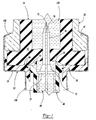
- the preferred alternative embodiment of the transferset 320 shown in Figures 16 to 18 operates and is assembled in the same manner as the embodiment of the transferset 20 shown in Figures 1 to 10.
- the components of the transferset 320 are generally the same, including a tubular transfer member 346, a piercing member 348, a generally cup-shaped cap 350 and a collar member 352.
- the components of the transferset 320 are numbered in the same sequence as the components of the transferset 20 shown in Figures 1 to 10 except that the components of the embodiment of the transferset 320 shown in Figures 16 to 18 are numbered in the 300 series.
- the features of the components are also numbered in the same sequence for ease of reference to the above description and to avoid duplication of the description of this embodiment.
- the tubular transfer member 346 includes an annular or circular sealing lip 354, a Luer lock connector 360 at its distal end, a first smaller internal diameter 364 and a larger proximate internal diameter 366 as described above.
- the following description of the components of the transferset 320 shown in Figures 16 to 18 will therefore be limited to the features which differ from the features of the transferset 20 shown in Figures 1 to 10.
- the tubular transfer member 346 includes an integral generally tubular connector portion 402, which in this embodiment, surrounds the proximate end of the tubular transfer member and is integrally joined to the remainder of the tubular transfer member at 404.
- the external surface of the connector portion 402 includes a radially projecting rounded rib 358 which is received in a groove 392 formed in the inner wall of the cap, providing a simplified snap-in interlock between the tubular transfer member 346 and the cap 350.
- the threaded Luer connector 360 on the tubular transfer member is also slightly modified; however, the Luer connector 360 is also conventional.
- the inner wall of the tubular portion 376 of the cap 350 also includes a plurality of sealing ribs 406 in this embodiment which engage the outer wall of the connector portion 402 of the tubular transfer member 346 which seal the connection between the cap and the tubular transfer member and prevent contamination of the transferset.
- the piercing member 348 has also been modified in this embodiment.
- the piercing end 372 of the piercing member 348 is slightly rounded to prevent premature penetration of the planar rim portion 38 of the stopper 34 shown, for example, in Figure 1. That is, the slightly rounded piercing end 372 will deform and stretch the planar rim portion 38 of the stopper, but will not partially penetrate the rim portion as shown in Figure 1.
- the piercing end 372, however, is "relatively sharp" and will pierce the planar rim portion of the elastomeric stopper 34 when the piercing member 348 is driven into the stopper as described above.
- the external channel 374 in the piercing member 348 terminates short of the piercing end as shown in Figure 17, such that the channel 374 includes a rounded end wall 408 spaced slightly from the proximate end of the relatively sharp piercing end 372. Terminating the external channel 374 a few millimeters (e.g. 7 mm) short of the piercing end 372 strengthens the piercing end 372 for penetration of the planar rim portion 38 of the stopper.
- the piercing member 348 is releasably retained in the tubular transfer member by an interlocking rib and groove as best shown in Figures 16 and 17.
- the piercing member includes an arcuate groove 410 adjacent the radial rib 375 and the internal surface 364 of the tubular transfer member 346 includes an interlocking arcuate rib 412 as shown in Figure 16 which releasably retains the piercing member 348 in the tubular transfer member 346.
- the barrel portion includes two spaced flats 414 which receive the mold ejector pins (not shown) which make it easier to remove the piercing member from the mold, but the flats do not form a functional part of the invention.
- the transferset 320 shown in Figures 16 may be preassembled in bulk with the collar for distribution to pharmaceutical companies, for example, for attachment to a vial under sterile conditions.
- the barrel portion 368 of the tubular transfer member further includes spaced flats which receive ejector pins in a mold to simplify release of the piercing member 348 from the mold, but are not functional in the transferset assembly 320.
- the distal end 367 of the piercing member 348 is rounded which also simplifies molding of the piercing member 348.
- the components of the transferset 328 are assembled and secured to a vial 22 as described above.
- the end 300 of the tubular portion 396 is crimped into the reduced diameter neck portion 28 of the vial as described above.
- the assembly of the transferset 320 on the vial drive the sealing lips 354 and 386 of the tubular transfer member into the planar radial rim portion 38 of the stopper, sealing the assembly.
- the cover portion of the cap 350 is then removed by twisting the distal end, breaking the frangible connection 384 as described.
- the transferset may then be utilized to transfer fluid to or from the vial by connecting a syringe 110 or IV set (not shown) to the Luer lock connector 360 as described above.
- the operation of the transferset 320 in transferring fluid to or from a vial is the same as described above in regard to Figures 1 to 10.
- the tubular transfer member 46, 246 and 346 may be polygonal, in which case, the barrel portion 68, 268 and 368 of the piercing member 48, 248 and 348 may be similarly polygonal and the tubular portion 76, 276 and 376 of the cap may either by cylindrical or polygonal.
- the collar 52, 252 and 352 may be formed of any suitable malleable material or may also be formed of a suitable plastic although in the disclosed embodiment the collar may be formed of aluminum.
- the piercing member and tubular transfer member may be formed of various materials including, for example, a medical grade polycarbonate having the appropriate strength and suitable for sterilization.
- the cap 50, 250 and 350 may also be formed of a medical grade polycarbonate.
- the external generally longitudinal channel 74, 274 and 374 in the piercing member 48, 248 and 348 respectively may be of various configuration including, for example, a spiral or a discontinuous longitudinal groove.
Landscapes
- Health & Medical Sciences (AREA)
- Pharmacology & Pharmacy (AREA)
- Life Sciences & Earth Sciences (AREA)
- Animal Behavior & Ethology (AREA)
- General Health & Medical Sciences (AREA)
- Public Health (AREA)
- Veterinary Medicine (AREA)
- Medical Preparation Storing Or Oral Administration Devices (AREA)
Claims (28)
- Fluidübertragungsanordnung zur Herstellung einer Fluidverbindung zwischen einer Spritze (110) oder dergleichen und einer versiegelten Phiole (22), wobei die Phiole (22) ein offenes Ende, einen das offene Ende umgebenden Rand (30), einen Halsabschnitt mit verringertem Durchmesser (28) nahe dem Rand (30) und einen durchstechbaren Stopfen (34) aufweist, der in dem offenen Ende der Phiole aufgenommen ist und dieses abdichtet, wobei der Stopfen (34) einen Randbereich (38) aufweist, der über dem Phiolenrand (30) sitzt, wobei die Übertragungsanordnung (20, 220, 320) aufweist:dadurch gekennzeichnet, daßein rohrförmiges Übertragungsteil (46, 246, 346) mit einem offenen proximalen Ende, das dichtend am Stopfenrandbereich (38) mit dem offenen Ende der Phiole fluchtend gestützt ist, und einem offenen distalen Ende zum Aufnehmen einer Spritzenspitze in dichter Verbindung;ein in dem rohrförmigen Übertragungsteil (46, 246, 346) aufgenommenes Durchstechteil (48, 248, 348), das reziprok durch eine Innenfläche (64) des Übertragungsteils (46, 246, 346) gestützt ist, wobei das Durchstechteil (48, 248, 348) ein distales Ende und ein Durchstechende (72, 372) gegenüber dem Stopfenrandbereich (38) aufweist; undeine Kappe (50, 250, 350) mit einem proximalen radialen Randbereich (78) nahe einem offenen Ende, einem rohrförmigen Abschnitt (76), der das rohrförmige Übertragungsteil (46, 246, 346) umgibt, und einem geschlossenen distalen Ende (67), der das offene distale Ende des Übertragungsteils (46,246,346) und das distale Ende (67) des Durchstechteils (48) umschließt,das Durchstechteil (48, 248, 348) den Stopfen (34) durchsticht, wenn, nach dem Entfernen der Kappe (50, 250, 350), die Spritze (110) gegen das distale Ende (67) des Durchstechteils (48, 248, 348) getrieben wird; undein Kragen (52, 252, 352) vorgesehen ist, der einen radialen Abschnitt (78), der über dem radialen Randbereich (78) der Kappe aufgenommen ist, einen rohrförmigen Abschnitt (96), der den radialen Randbereich (78) der Kappe und den Phiolenrand (30) umgibt, und ein in dem Phiolenhalsabschnitt (28) der Phiole (22) unter dem Phiolenrand (30) aufgenommenen distalen radialen Abschnitt (100) aufweist, der die Übertragungsanordnung (20, 220, 320) fest mit der Phiole (22) verbindet.
- Fluidübertragungsanordnung nach Anspruch 1, bei der das Durchstechteil (48) einen externen im wesentlichen längsgerichteten Kanal (74, 274, 374) aufweist, der eine Verbindung zwischen dem offenen Phiolenende und dem rohrförmigen Übertragungsteil (46, 246, 346) bildet, wenn das Durchstechteil (48) den Stopfen (34) durchsticht.
- Fluidübertragungsanordnung nach Anspruch 1, bei der das Durchstechende des Durchstechteils (48, 248, 348) sich über das rohrförmige Übertragungsteil (46, 246, 346) hinaus erstreckt und das Durchstechteil (48, 248, 348) lösbar in dem rohrförmigen Übertragungsteil (46, 246, 346) gehalten ist, wobei das scharfe Durchstechende (72, 372) teilweise den Stopfen (34) durchdringt.
- Fluidübertragungsanordnung nach Anspruch 1, bei der der rohrförmige Abschnitt (76) der Kappe (50, 250, 350) eine Radialnut (82) aufweist, welche die Wand des rohrförmigen Abschnitts (76) zum Entnehmen des geschlossenen distalen Endes aus der Fluidübertragungsanordnung (20, 220, 320) vor dem Gebrauch schwächt.
- Fluidübertragungsanordnung nach Anspruch 1, bei der das offene distale Ende (62) des Übertragungsteils (46, 246, 346) einen externen Luer-Verbinder (60, 260, 360) zum Aufnehmen eines Luer-Verbinders (130) der Spritze (110) aufweist.
- Fluidübertragungsanordnung nach Anspruch 1, bei der der radiale Randbereich des rohrförmigen Übertragungsteils (46, 246, 346)eine vorstehende kreisförmige Dichtlippe (54, 354) aufweist, die den rohrförmigen Abschnitt des Übertragungsteils (46, 246, 346) umgibt, das an den Stopfenrandbereich (38) angreift, wobei der Stopfenrandbereich (38) verformt und über das offene Ende der Phiole gestreckt wird, wodurch die Verbindung zwischen dem offenen Ende der Phiole und dem rohrförmigen Übertragungsteil (46, 246, 346)abgedichtet ist, wenn das Durchstechteil (48, 248, 348) den Stopfen (34) durchsticht.
- Fluidübertragungsanordnung nach Anspruch 6, bei der die kreisförmige Lippe (54, 354) des Übertragungsteils (46, 246, 346) sich im wesentlichen senkrecht zum radialen Randbereich des Übertragungsteils (46, 246, 346) erstreckt und eine spitze Kante aufweist, die in den Randbereich (38) des Stopfens (34) eindringt.
- Fluidübertragungsanordnung nach Anspruch 6, bei der der radiale Randbereich der Kappe (50, 250, 350) eine kreisförmige Dichtlippe aufweist, die den rohrförmigen Abschnitt (76) der Kappe (50, 250, 350) umgibt und an dem Stopfenrandbereich (38) dichtend angreift, wodurch eine Dichtung zum Aufrechterhalten der Sterilität der Fluidübertragungsanordnung (20, 220, 320) gegeben ist, wenn diese an der Phiole (22) angebracht ist.
- Fluidübertragungsanordnung nach Anspruch 1, bei der der rohrförmige Abschnitt (76) der Kappe (50, 250, 350) eine Radialnut (82) aufweist, welche die Wand des rohrförmigen Abschnitts (76) schwächt, um das geschlossene distale Ende der Kappe (50, 250, 350) zu entnehmen, und wobei der radiale Abschnitt des Kragens einen rohrförmigen Abschnitt aufweist, der die Nut (82) in der Kappe (50, 250, 350) überlagert.
- Fluidübertragungsanordnung nach Anspruch 1, bei der das distale Ende des Durchstechteils zylindrisch ist, wobei der Außendurchmesser im wesentlichen gleich der Innenfläche des rohrförmigen Übertragungsteils (46, 246, 346) nahe dem distalen Ende des Übertragungsteils (46, 246, 346) ist, welches das Durchstechteil (48, 248, 348) im wesentlichen senkrecht zum Randbereich (30) des Stopfens (34) stützt.
- Fluidübertragungsanordnung nach Anspruch 10, bei der das Durchstechteil (48, 248, 348) eine radiale Lippe (75, 275, 375) aufweist, die in einer erweiterten Gegenbohrung (280) im rohrförmigen Übertragungsteil (46, 246, 346) aufgenommen ist und welche das Durchstechteil (48, 248, 348) lösbar in dem rohrförmigen Übertragungsteil (46, 246, 346) hält, wobei das scharfe Durchstechende (72, 372) den Stopfen (34) vor dem Gebrauch teilweise durchdringt.
- Fluidübertragungsanordnung nach Anspruch 1, bei der das proximale Ende des rohrförmigen Übertragungsteils (46, 246, 346) einen radialen Flansch aufweist, der mit der Kappe (50, 250, 350) zusammengreift.
- Fluidübertragungsanordnung nach Anspruch 1, bei der der Kragen (52, 252, 352) aus relativ dünnem schmiedbarem Metall besteht und der rohrförmige Abschnitt (96) in den Phiolenhals unter den Phiolenrand (30) gecrimpt ist, wodurch das Übertragungsteil (46, 246, 346) fest mit der Phiole (22) verbunden ist.
- Verfahren zum Übertragen flüssiger Medikamente zwischen einer herkömmlichen abgedichteten Phiole (22) und eine zweiten Behälter (110), wobei die Phiole (22) ein offenes Ende, einen das offene Ende umgebenden Rand (30), einen Halsabschnitt mit verringertem Durchmesser (28) nahe dem Rand (30) und einen durchstechbaren Stopfen (34) aufweist, der in dem offenen Ende der Phiole aufgenommen ist und dieses abdichtet, wobei der Stopfen (34) einen Randbereich (38) aufweist, der über dem Phiolenrand (30) sitzt, wobei der zweite Behälter (110) ein rohrförmiges Übertragungsteil (46, 246, 346) aufweist, und wobei das Verfahren die folgenden Schritte umfaßt:Anbringen einer Fluidübertragungsanordnung (20, 220, 320) an der Phiole, wobei die Übertragungsanordnung (20, 220, 320) aufweist: ein rohrförmiges Übertragungsteil (46, 246, 346) mit einem offenen proximalen Ende, das dichtend am Stopfenrand (38) der Phiole (32) mit dem offenen Ende der Phiole fluchtend gestützt ist, und einem offenen distalen Ende (62) mit einem Verbinder, der mit dem Verbinderbereich des zweiten Behälters (110) verbindbar ist, ein in dem rohrförmigen Übertragungsteil (46,246,346) aufgenommenes Durchstechteil (48, 248, 348), das reziprok durch eine Innenfläche (64) des rohrförmigen Übertragungsteils (46, 246, 346) gestützt ist, wobei das Durchstechteil (48, 248, 348) ein im wesentlichen scharfes Durchstechende (72, 372), ein entgegengesetztes distales Ende (67) und einen externen Kanal (74, 274, 374) sowie einen rohrförmigen Kragen (52, 252, 352) aufweist, wobei das Verfahren den Schritt des Befestigens der Fluidübertragungsanordnung (20, 220, 320) an der Phiole (22) durch Befestigen des Kragens (52, 252, 353) am Halsabschnitt (28) der Phiole (22) unter dem Rand (30) umfaßt, wobei das rohrförmige Übertragungsteil (46, 246, 346) dichtend am Stopfenrandbereich (38) angreift, das Durchstechteil (48, 248, 348) koaxial mit dem offenen Ende der Phiole ausgerichtet ist und das Durchstechende (48, 248, 348) dem Stopfen (34) benachbart ist;Anbringen des Verbinderbereichs des zweiten Behälters (110) an dem Verbinder des rohrförmigen Übertragungsteils (46, 246, 346), Treiben des im wesentlichen scharfen Durchstechendes (72, 372) des Durchstechteil (48, 248, 348) durch den Stopfenrandbereich (38), wenn der zweite Behälter (110) gegen das distale Ende (67) des Durchstechteil (48, 248, 348) getrieben wird, wobei der externe Kanal (74, 274, 374) im Durchstechteil (48, 248, 348) die Fluidverbindung zwischen der Phiole (22) und dem zweiten Behälter (110) durch das rohrförmige Übertragungsteil (46, 246, 346) herstellt, wodurch die Übertragung von Fluid vom zweiten Behälter (110) an die Phiole (22) oder von der Phiole (22) an den zweiten Behälter (110) ermöglicht wird.
- Verfahren zum Übertragen von flüssigen Medikamenten zwischen einer herkömmlichen Phiole (22) und einem zweiten Behälter (110) nach Anspruch 14, wobei die Fluidübertragungsanordnung (20, 220, 320) aufweist: eine becherförmige Kappe (50, 250, 350) mit einem radialen Randbereich (78) nahe einem offenen Ende, wobei das Verfahren den Schritt des Anbringens der Kappe (50, 250, 350) mit dem radialen Stopfenrandbereich (58) gegenüberliegendem Randbereich (78) umfaßt, einen rohrförmigen Abschnitt (96), der das Übertragungsteil (46, 246, 346) umschließt, und einen Abdeckbereich, der das offene distale Ende (62) des Übertragungsteils (46, 246, 346) und das distale Ende (67) des Durchstechteils (48, 248, 348) umschließt, wobei der Abdeckbereich an dem rohrförmigen Abschnitt (96) durch einen zerstörbaren Verbinder (84) angebracht ist, wobei das Verfahren das Anbringen der Fluidübertragungsanordnung (20, 220, 320) an der Phiole (22) unter sterilen Bedingungen vorsieht, wobei die becherförmige Kappe (50, 250, 350) die Übertragungsanordnung (20, 220, 320) umschließt, wodurch das rohrförmige Übertragungsteil (46, 246, 346) und das Durchstechteil (48, 248, 348) bis zum Gebrauch unter sterilen Bedingungen gehalten werden, anschließend der Abdeckbereich durch Zerstören des zerstörbaren Verbinders (84) entfernt und der zweite Behälter (110) wie eine Spritze an dem rohrförmigen Übertragungsteil (46, 246, 346) angebracht wird.
- Verfahren zum Übertragen von flüssigen Medikamenten zwischen einer herkömmlichen Phiole (22) und einem zweiten Behälter (110) nach Anspruch 14, wobei der Kragen (52, 252, 352) aus relativ dünnem verformbarem Metall mit einem rohrförmigen Abschnitt (96) und einem radialen Abschnitt besteht, wobei das Verfahren das teleskopartige Aufnehmen des Kragens (52, 252, 352) über den Teilen der Fluidübertragungsanordnung (20, 220, 320) und dem Phiolenrand (30) vorsieht, wobei der radiale Abschnitt die Teile der Übertragungsanordnung (20, 220, 320) überlagert und der rohrförmige Abschnitt (96) den Phiolenrand (30) aufnimmt, und anschließend ein freies Ende (100) des rohrförmigen Abschnitts (96) unter dem Phiolenrand (30) in den Phiolenhals gecrimpt wird, wodurch die Übertragungsanordnung (20, 220, 320) an der Phiole (22) fest angebracht wird.
- Verfahren zum Übertragen von flüssigen Medikamenten zwischen einer herkömmlichen Phiole (22) und einem zweiten Behälter (110) nach Anspruch 16, wobei das rohrförmige Übertragungsteil (46, 246, 346) eine im wesentlichen kreisförmige Dichtlippe (54, 354) aufweist, die den rohrförmigen Abschnitt des Übertragungsteils (46, 246, 346) umgibt und im wesentlichen mit dem rohrförmigen Abschnitt fluchtet, wobei das Verfahren das Drücken der Dichtlippe (54, 354)gegen den Randbereich (98) des Stopfens (34) beim Crimpen des Kragens (52, 252, 352) an die Phiole (22) vorsieht, wobei der Randbereich (38) des Stopfens (34) vor dem Durchstechen des Stopfens (34) durch das Durchstechteil (48, 248, 348) gestreckt wird.
- Verfahren zum Übertragen von flüssigen Medikamenten zwischen einer herkömmlichen Phiole (22) und einem zweiten Behälter (110) nach Anspruch 17, wobei die kreisförmige Dichtlippe (54, 354) des rohrförmigen Übertragungsteils (46, 246, 346) eine spitze Kante aufweist, wobei das Verfahren das Drücken der Dichtlippe (54, 354) gegen den Randbereich (98) des Stopfens (34) umfaßt, derart daß die spitze Kante der Dichtlippe (54, 354) in den Stopfenrandbereich (38) eindringt, wodurch eine bessere Abdichtung der Verbindung zwischen dem offenen Ende der Phiole und dem rohrförmigen Übertragungsteil (46, 246, 346) geschaffen ist, wenn das Durchstechteil (48, 248, 348) den Stopfen (34) durchsticht.
- Verfahren zum Übertragen von flüssigen Medikamenten zwischen einer herkömmlichen Phiole (22) und einem zweiten Behälter (110) nach Anspruch 17, wobei das Durchstechteil (48, 248, 348) lösbar in dem rohrförmigen Übertragungsteil (46, 246, 346) gehalten ist, wobei sich das Durchstechende (72, 372) über das rohrförmige Übertragungsteil (46, 246, 346) hinaus erstreckt, wobei das Verfahren das Drücken der Dichtlippe des rohrförmigen Übertragungsteils (46, 246, 346) und des Durchstechendes (72, 372) des Durchstechteils (48, 248, 348) gegen den Randbereich (38) des Stopfens (34) beim Crimpen des Kragens (52, 252, 352) an die Phiole (22) umfaßt, wobei das Durchstechende des Durchstechteils (48, 248, 348) den Randbereich (38) des Stopfens (34) elastisch verformt.
- Verfahren zum Übertragen von flüssigen Medikamenten zwischen einer herkömmlichen Phiole (22) und einem zweiten Behälter (110) nach Anspruch 14, wobei der Verbinder (60, 260, 360) des rohrförmigen Übertragungsteils (46, 246, 346) und der Verbinderbereich (130) des zweiten Behälters (110) zusammenpassende Gewindeverbinder sind und der Verbinderbereich (130) des zweiten Behälters (110) sich über einen Körperbereich (112) des zweiten Behälters (110) erstreckt, wobei das Verfahren das Aufschrauben des Gewindeverbinderbereichs (130) des zweiten Behälters (110) auf den Gewindeverbinder (60, 260, 360) des rohrförmigen Übertragungsteils (46, 246, 346) (46, 246, 346) umfaßt, wodurch der Düsenbereich des zweiten Behälters (110) gegen das distale Ende (67) des Durchstechteils (48, 248, 348) und das scharfe Ende des Durchstechteils (48, 248, 348) durch den Stopfenrandbereich (38) getrieben wird, wodurch die Fluidverbindung zwischen dem zweiten Behälter (110) und der Phiole (22) hergestellt wird.
- Verfahren zum Übertragen von flüssigen Medikamenten zwischen einer herkömmlichen Phiole (22) und einem zweiten Behälter (110) nach Anspruch 14, wobei der zweite Behälter (110) eine Spritze mit einem zu Beginn mit Fluid gefüllten rohrförmigen Körperteil (112) ist, die einen in dem rohrförmigen Spritzenkörperteil (112) zurückgezogenen Kolben (116) und einen rohrförmigen Düsenteil (114) mit kleinerem Durchmesser, der sich über den rohrförmigen Körperteil (112) hinaus erstreckt, aufweist, wobei das Durchstechteil (48, 248, 348) einen radialen Dichtungsbereich aufweist, der an einer Innenfläche (64) des rohrförmigen Übertragungsteils (46, 246, 346) angreift, wobei das Verfahren das Anbringen der Spritze (110) an dem Verbinder (60, 260, 360) des rohrförmigen Übertragungsteils (46, 246, 346) vorsieht, wodurch eine Fluidverbindung zwischen dem Düsenteil (114) der Spritze (110) und dem distalen Ende (62) des rohrförmigen Übertragungsteils (46, 246, 346) hergestellt wird, danach der Kolben (116) der Spritze (110) in Richtung des Düsenteils (114) getrieben wird, wodurch Fluid gegen den radialen Dichtungsbereich des Durchstechteils (48, 248, 348) bewegt und das Durchstechende (72, 372) des Durchstechteils durch den Stopfen (34) getrieben wird, wodurch die Verbindung zwischen der Spritze (110) und der Phiole (22) hergestellt wird.
- Verfahren zum Übertragen von flüssigen Medikamenten zwischen einer herkömmlichen Phiole (22) und einem zweiten Behälter (110) nach Anspruch 14, wobei die Fluidübertragungsanordnung (20, 220, 320) eine becherförmige Kappe (50, 250, 350) aufweist, die einen rohrförmigen Abschnitt (76) mit einem Innendurchmesser hat, der größer als das rohrförmige Übertragungsteil (46, 246, 346) ist, sowie ein offenes proximales Ende, einen dem offenen Ende benachbarten radialen Randbereich und ein geschlossenes distales Ende (80), wobei das rohrförmige Übertragungsteil (46, 246, 346) eine kreisförmige Dichtlippe (54, 354) aufweist, welche den rohrförmigen Abschnitt des rohrförmigen Übertragungsteil (46, 246, 346) umgibt, wobei das Verfahren vorsieht, daß die Fluidübertragungsanordnung (20, 220, 320) zusammengesetzt wird, indem das Durchstechteil (48, 248, 348) mit dem proximalen Ende des rohrförmigen Übertragungsteils (46, 246, 346) benachbarten Durchstechende (72, 372) in das rohrförmige Übertragungsteil (46, 246, 346) eingesetzt wird, die Kappe (50, 250, 350) über dem rohrförmigen Übertragungsteil (46, 246, 346) aufgenommen wird, wobei das geschlossene distale Ende die distalen Enden des rohrförmigen Übertragungsteils (46, 246, 346) und des Durchstechteils (48, 248, 348) umschließt, anschließend das rohrförmige Übertragungsteil (46, 246, 346), das Durchstechteil (48, 248, 348) und die Kappe (50, 250, 350) an dem Randbereich (38) des Stopfens (34) angebracht werden, wobei das rohrförmige Übertragungsteil (46, 246, 346) und das Durchstechteil (48, 248, 348) im wesentlichen koaxial mit dem offenen Ende der Phiole (22) und im wesentlichen senkrecht zum Stopfenrandbereich (38) ausgerichtet sind, danach die Anordnung an der Phiole (22) mittels des Kragens (52, 252, 352) befestigt und gleichzeitig das proximale Ende des rohrförmigen Übertragungsteils (46, 246, 346) gegen den Stopfen (34) gedrückt wird, wodurch die kreisförmige Dichtlippe (54, 354) gegen den Stopfenrandbereich (38) gedrückt, der Lippenabschnitt (54, 354) über das offene Phiolenende gedehnt und die Verbindung zwischen dem externen Kanal (74, 274, 374) und dem rohrförmigen Übertragungsteil (46, 246, 346) abgedichtet wird, wenn das Durchstechteil (48, 248, 348) den Stopfen (34) durchsticht.
- Verfahren zum Übertragen von flüssigen Medikamenten zwischen einer herkömmlichen Phiole (22) und einem zweiten Behälter (110) nach Anspruch 22, wobei das Durchstechteil (48, 248, 348) mit sich über das proximale Ende des rohrförmigen Übertragungsteils hinaus erstreckendem Durchstechende (72, 372) in dem rohrförmigen Übertragungsteil (46, 246, 346) angebracht wird, wobei das Verfahren dann das Zusammendrücken des rohrförmigen Übertragungsteils (46, 246, 346) auf dem Stopfenrandbereich (38) vorsieht, wobei das Durchstechende (72, 372) des Durchstechteils (48, 248, 348) (48, 248, 348) den Stopfen (34) verformt.
- Verfahren zum Übertragen von flüssigen Medikamenten zwischen einer herkömmlichen Phiole (22) und einem zweiten Behälter (110) nach einem der Ansprüche 15-23, wobei der radiale Randbereich der Kappe (50, 250, 350) eine kreisförmige Dichtlippe aufweist, welche den rohrförmigen Abschnitt der Kappe (50, 250, 350) nahe dem rohrförmigen Abschnitt umgibt, wobei das Verfahren das Drücken der kreisförmigen Dichtlippe der Kappe (50, 250, 350) gegen den Randbereich (38) des Stopfens (34) vorsieht, wodurch eine das Durchstechteil (48, 248, 348) umgebende Dichtung geschaffen wird.
- Verfahren zum Anbringen einer Fluidübertragungsanordnung (20, 220, 320) nach einem der Ansprüche 1-13 an einer herkömmlichen Anordnung aus einer Phiole (22) und einem Stopfen (34), wobei die Phiole (22) ein offenes Ende, einen das offene Ende umgebenden radialen Randbereich (30) und einen dem offenen Ende benachbarten Halsabschnitt (28) mit verringertem Durchmesser, wobei der Stopfen (34) aus einem elastomeren Material besteht und einen rohrförmigen Abschnitt, der in dem offenen Ende der Phiole aufgenommen ist, und einen einstückigen, im wesentlichen planaren Randbereich (38) aufweist, der den Phiolenrandbereich (30) überlagert, wobei das Verfahren umfaßt:Anbringen der Fluidübertragungsanordnung (20, 220, 320) an der im wesentlichen planaren Stopfenrandfläche (38), wobei die Fluidübertragungsanordnung (20, 220, 320) eine im wesentlichen flache Ringfläche aufweist, welche den planaren Randbereich (38) des Stopfens (34) überlagert und eine von der im wesentlichen flachen Ringfläche aufragenden kreisförmige Dichtlippe aufweist;Befestigen der Fluidübertragungsanordnung (20, 220,320) an der Anordnung aus Phiole (22) und Stopfen (34) mittels des Kragens (52, 252, 352) wobei das Verfahren vorsieht, den rohrförmigen Kragenabschnitt (96) über der Fluidübertragungsanordnung (20, 220, 320) und dem Phiolenrandbereich (36) anzuordnen, wobei der radial nach innen ragende Ringabschnitt des Kragens (52, 252, 352) die im wesentlichen flache Ringfläche der Fluidübertragungsanordnung (20, 220, 320) aufnimmt, wobei die von der flachen Ringfläche in den im wesentlichen planaren Randbereich (38) des Stopfens (34) ragende kreisförmige Dichtlippe zusammengedrückt wird und das distale Ende (100) des rohrförmigen Kragenabschnitts (96) in den Phiolenhals unter den Phiolenrand (30) gecrimpt wird.
- Verfahren zum Anbringen einer Fluidübertragungsanordnung an einer herkömmlichen Anordnung aus einer Phiole und einem Stopfen nach Anspruch 25, bei dem eine kreisförmige Dichtlippe einen scharfen Rand mit einem Durchmesser aufweist, der größer als der Innendurchmesser des offenen Phiolenendes ist, so daß die kreisförmige Dichtlippe einen Teil des im wesentlichen planaren Randbereichs (38) des Stopfens (34) überlagert, der den radialen Randbereich (30) der Phiole überlagert, wobei das Verfahren das Drücken des scharfen Randes der kreisförmigen Dichtlippe in den im wesentlichen planaren Randbereich (38) des Stopfens (34) während des Crimpens des distalen Endes (100) des Kragens (52, 252, 352) in den Phiolenhalsbereich (28) vorsieht, wobei der scharfe Rand der Dichtlippe in den im wesentlichen planaren Randbereich (38) des Stopfens eindringt und die Verbindung zwischen dem offenen Phiolenende und der Fluidübertragungsanordnung (20, 220, 320) abdichtet.
- Verfahren zum Anbringen einer Fluidübertragungsanordnung an einer herkömmlichen Anordnung aus einer Phiole und einem Stopfen nach Anspruch 25, bei dem die kreisförmige Dichtlippe einen Durchmesser hat, der kleiner als der Innendurchmesser des offenen Phiolenendes und des rohrförmigen Stopfenabschnitts ist, so daß die kreisförmige Dichtlippe einen ungestützten Mittelbereich des im wesentlichen planaren Randbereichs (38) des Stopfens überlagert, wobei das Verfahren vorsieht, die kreisförmige Dichtlippe in den im wesentlichen planaren Randbereich (38) des Stopfens zu drücken, wenn das distale Ende (100) des rohrförmigen Abschnitts (96) des Kragens in den Phiolenhalsabschnitt (28) gecrimpt wird, wobei die kreisförmige Dichtlippe den Mittelbereich der planaren Randfläche (38) des Stopfens dehnt und vorspannt.
- Verfahren zum Anbringen einer Fluidübertragungsanordnung an einer herkömmlichen Anordnung aus einer Phiole und einem Stopfen nach Anspruch 27, bei dem das Durchstechende (72, 372) des Durchstechteils (48, 248, 348) in den im wesentlichen planaren Randbereich (38) des Stopfens gedrückt wird, um den im wesentlichen planaren Randbereich (38) des Stopfens (34) beim Crimpen des rohrförmigen Kragenabschnitts (96) in den Phiolenhalsbereich (28) teilweise, jedoch nicht vollständig zu durchdringen.
Applications Claiming Priority (3)
| Application Number | Priority Date | Filing Date | Title |
|---|---|---|---|
| US31302 | 1998-02-26 | ||
| US09/031,302 US6003566A (en) | 1998-02-26 | 1998-02-26 | Vial transferset and method |
| PCT/US1999/004077 WO1999043282A1 (en) | 1998-02-26 | 1999-02-25 | Vial transferset and method |
Publications (2)
| Publication Number | Publication Date |
|---|---|
| EP1056426A1 EP1056426A1 (de) | 2000-12-06 |
| EP1056426B1 true EP1056426B1 (de) | 2002-10-02 |
Family
ID=21858695
Family Applications (1)
| Application Number | Title | Priority Date | Filing Date |
|---|---|---|---|
| EP99908450A Expired - Lifetime EP1056426B1 (de) | 1998-02-26 | 1999-02-25 | Flüssigkeitstransfervorrichtung für phiole und verfahren |
Country Status (6)
| Country | Link |
|---|---|
| US (3) | US6003566A (de) |
| EP (1) | EP1056426B1 (de) |
| JP (1) | JP4216466B2 (de) |
| AU (1) | AU746615B2 (de) |
| DE (1) | DE69903266T2 (de) |
| WO (1) | WO1999043282A1 (de) |
Families Citing this family (163)
| Publication number | Priority date | Publication date | Assignee | Title |
|---|---|---|---|---|
| JP3777587B2 (ja) * | 1999-04-09 | 2006-05-24 | ニプロ株式会社 | 液体容器 |
| IL114960A0 (en) | 1995-03-20 | 1995-12-08 | Medimop Medical Projects Ltd | Flow control device |
| US5954104A (en) * | 1997-02-28 | 1999-09-21 | Abbott Laboratories | Container cap assembly having an enclosed penetrator |
| US6003566A (en) * | 1998-02-26 | 1999-12-21 | Becton Dickinson And Company | Vial transferset and method |
| US6681946B1 (en) | 1998-02-26 | 2004-01-27 | Becton, Dickinson And Company | Resealable medical transfer set |
| US6382442B1 (en) | 1998-04-20 | 2002-05-07 | Becton Dickinson And Company | Plastic closure for vials and other medical containers |
| US6904662B2 (en) | 1998-04-20 | 2005-06-14 | Becton, Dickinson And Company | Method of sealing a cartridge or other medical container with a plastic closure |
| US6957745B2 (en) | 1998-04-20 | 2005-10-25 | Becton, Dickinson And Company | Transfer set |
| US6378714B1 (en) * | 1998-04-20 | 2002-04-30 | Becton Dickinson And Company | Transferset for vials and other medical containers |
| US6209738B1 (en) | 1998-04-20 | 2001-04-03 | Becton, Dickinson And Company | Transfer set for vials and medical containers |
| US6475183B1 (en) * | 1998-06-03 | 2002-11-05 | Baxter International Inc. | Direct dual filling device for sealing agents |
| JP3852672B2 (ja) * | 1999-04-20 | 2006-12-06 | 株式会社ジェイ・エム・エス | 容器用キャップ及び液体連通用アダプタ |
| SE9902610D0 (sv) * | 1999-07-07 | 1999-07-07 | Astra Ab | Förslutningsanordning vid medicinsk behållare |
| US6607508B2 (en) | 2000-04-27 | 2003-08-19 | Invivotech, Inc. | Vial injector device |
| USD447229S1 (en) | 2000-05-11 | 2001-08-28 | Elan Corporation, Plc | Drug reconstitution and injection device |
| US6269976B1 (en) * | 2000-08-17 | 2001-08-07 | Saint-Gobain Calmar Inc. | Vial access spike adapter for pump sprayer |
| JP2002087968A (ja) * | 2000-09-14 | 2002-03-27 | Otsuka Pharmaceut Factory Inc | へパリン液剤 |
| FR2819174B1 (fr) * | 2001-01-08 | 2003-06-13 | Pierre Frezza | Ampoule pour le conditionnement et le transfert d'un liquide ou d'une poudre a usage medical dans un contenant |
| US6474375B2 (en) | 2001-02-02 | 2002-11-05 | Baxter International Inc. | Reconstitution device and method of use |
| US20030032935A1 (en) * | 2001-08-10 | 2003-02-13 | Scimed Life Systems, Inc. | Packages facilitating convenient mixing and delivery of liquids |
| US7131997B2 (en) | 2002-03-29 | 2006-11-07 | Scimed Life Systems, Inc. | Tissue treatment |
| US7094369B2 (en) | 2002-03-29 | 2006-08-22 | Scimed Life Systems, Inc. | Processes for manufacturing polymeric microspheres |
| US7462366B2 (en) | 2002-03-29 | 2008-12-09 | Boston Scientific Scimed, Inc. | Drug delivery particle |
| US7053134B2 (en) | 2002-04-04 | 2006-05-30 | Scimed Life Systems, Inc. | Forming a chemically cross-linked particle of a desired shape and diameter |
| CA2485295C (en) * | 2002-05-10 | 2010-07-27 | Santen Pharmaceutical Co., Ltd. | Antipollution cap |
| WO2003105917A2 (en) | 2002-06-12 | 2003-12-24 | Scimed Life Systems, Inc. | Bulking agents |
| US6874522B2 (en) * | 2002-06-18 | 2005-04-05 | Baxter International Inc. | Luer-actuated solution path connector with membrane and container using the connector and a method for establishing fluid communication with the container |
| US7449236B2 (en) | 2002-08-09 | 2008-11-11 | Boston Scientific Scimed, Inc. | Porous polymeric particle comprising polyvinyl alcohol and having interior to surface porosity-gradient |
| US7842377B2 (en) | 2003-08-08 | 2010-11-30 | Boston Scientific Scimed, Inc. | Porous polymeric particle comprising polyvinyl alcohol and having interior to surface porosity-gradient |
| US8012454B2 (en) | 2002-08-30 | 2011-09-06 | Boston Scientific Scimed, Inc. | Embolization |
| US7883490B2 (en) | 2002-10-23 | 2011-02-08 | Boston Scientific Scimed, Inc. | Mixing and delivery of therapeutic compositions |
| US7588825B2 (en) | 2002-10-23 | 2009-09-15 | Boston Scientific Scimed, Inc. | Embolic compositions |
| USD545448S1 (en) * | 2002-12-18 | 2007-06-26 | Biotage Ab | Vial and tubing therefor |
| DK1454609T3 (da) * | 2003-03-05 | 2013-02-11 | Csl Behring Gmbh | Overføringsindretning |
| US20040206416A1 (en) * | 2003-04-21 | 2004-10-21 | Paradis Joseph R. | Safety shield needle protector |
| US6948522B2 (en) * | 2003-06-06 | 2005-09-27 | Baxter International Inc. | Reconstitution device and method of use |
| JP3883527B2 (ja) * | 2003-07-17 | 2007-02-21 | ニプロ株式会社 | トランスファーニードル |
| EP1647226B1 (de) * | 2003-07-18 | 2013-02-13 | Sekisui Chemical Co., Ltd. | Hermetisch abgeschlossener behälter und vakuum-testsubstanz-aufnahme-behälter |
| FR2858931B1 (fr) | 2003-08-21 | 2007-04-13 | Becton Dickinson France | Dispositif d'administration orale d'un medicament |
| US7976823B2 (en) | 2003-08-29 | 2011-07-12 | Boston Scientific Scimed, Inc. | Ferromagnetic particles and methods |
| SI2463201T1 (sl) | 2003-10-30 | 2014-06-30 | Teva Medical Ltd. | Naprava za varno obdelavo zdravila |
| DE102004005435B3 (de) | 2004-02-04 | 2005-09-15 | Haindl, Hans, Dr. | Medizinisches Transfergerät |
| US7736671B2 (en) | 2004-03-02 | 2010-06-15 | Boston Scientific Scimed, Inc. | Embolization |
| US8173176B2 (en) | 2004-03-30 | 2012-05-08 | Boston Scientific Scimed, Inc. | Embolization |
| IL161660A0 (en) | 2004-04-29 | 2004-09-27 | Medimop Medical Projects Ltd | Liquid drug delivery device |
| US7311861B2 (en) | 2004-06-01 | 2007-12-25 | Boston Scientific Scimed, Inc. | Embolization |
| US7615041B2 (en) * | 2004-07-29 | 2009-11-10 | Boston Scientific Scimed, Inc. | Vial adaptor |
| US8425550B2 (en) | 2004-12-01 | 2013-04-23 | Boston Scientific Scimed, Inc. | Embolic coils |
| EP1853333A1 (de) * | 2004-12-23 | 2007-11-14 | Bracco Research S.A. | Flüssigkeitstransfervorrichtung für medizinische ausgabebehälter |
| US20060184103A1 (en) * | 2005-02-17 | 2006-08-17 | West Pharmaceutical Services, Inc. | Syringe safety device |
| US7727555B2 (en) | 2005-03-02 | 2010-06-01 | Boston Scientific Scimed, Inc. | Particles |
| US7858183B2 (en) | 2005-03-02 | 2010-12-28 | Boston Scientific Scimed, Inc. | Particles |
| US7963287B2 (en) | 2005-04-28 | 2011-06-21 | Boston Scientific Scimed, Inc. | Tissue-treatment methods |
| US9463426B2 (en) | 2005-06-24 | 2016-10-11 | Boston Scientific Scimed, Inc. | Methods and systems for coating particles |
| EP1909735A1 (de) * | 2005-08-01 | 2008-04-16 | Medimop Medical Projects Ltd. | System zur abgabe eines flüssigenarzneimittels |
| ATE529088T1 (de) | 2005-08-11 | 2011-11-15 | Medimop Medical Projects Ltd | Transfervorrichtungen für flüssige arzneimittel zur ausfallsicheren korrekten rastverbindung auf medizinischen ampullen |
| US8007509B2 (en) | 2005-10-12 | 2011-08-30 | Boston Scientific Scimed, Inc. | Coil assemblies, components and methods |
| DE102005057547A1 (de) * | 2005-11-30 | 2007-05-31 | Clinico Gmbh | Vorrichtung zum Überleiten von Flüssigkeiten, Suspensionen und/oder Feststoffen von einem ersten Gefäß in ein zweites Gefäß |
| US8101197B2 (en) | 2005-12-19 | 2012-01-24 | Stryker Corporation | Forming coils |
| US8152839B2 (en) | 2005-12-19 | 2012-04-10 | Boston Scientific Scimed, Inc. | Embolic coils |
| US7501179B2 (en) | 2005-12-21 | 2009-03-10 | Boston Scientific Scimed, Inc. | Block copolymer particles |
| US7947368B2 (en) | 2005-12-21 | 2011-05-24 | Boston Scientific Scimed, Inc. | Block copolymer particles |
| US20070202186A1 (en) | 2006-02-22 | 2007-08-30 | Iscience Interventional Corporation | Apparatus and formulations for suprachoroidal drug delivery |
| DE102006009611A1 (de) * | 2006-03-02 | 2007-09-06 | Bernd Hansen | System zum Zubereiten und Bereitstellen eines durch Vermischen einer Trockensubstanz mit einem Fluid gebildeten fließfähigen Mediums |
| ES2425579T3 (es) | 2006-05-25 | 2013-10-16 | Bayer Healthcare, Llc | Dispositivo de reconstitución |
| US8414927B2 (en) | 2006-11-03 | 2013-04-09 | Boston Scientific Scimed, Inc. | Cross-linked polymer particles |
| IL182605A0 (en) | 2007-04-17 | 2007-07-24 | Medimop Medical Projects Ltd | Fluid control device with manually depressed actuator |
| US8317743B2 (en) | 2007-09-18 | 2012-11-27 | Medimop Medical Projects Ltd. | Medicament mixing and injection apparatus |
| IL186290A0 (en) | 2007-09-25 | 2008-01-20 | Medimop Medical Projects Ltd | Liquid drug delivery devices for use with syringe having widened distal tip |
| WO2009060419A2 (en) * | 2007-11-08 | 2009-05-14 | Elcam Medical A.C.A..L. Ltd | Vial adaptor and manufacturing method therfor |
| US7905873B2 (en) * | 2008-07-03 | 2011-03-15 | Baxter International Inc. | Port assembly for use with needleless connector |
| WO2010052707A1 (en) * | 2008-11-04 | 2010-05-14 | Situ Gen Ltd. | Dually activated connector |
| US8864725B2 (en) | 2009-03-17 | 2014-10-21 | Baxter Corporation Englewood | Hazardous drug handling system, apparatus and method |
| USD641080S1 (en) | 2009-03-31 | 2011-07-05 | Medimop Medical Projects Ltd. | Medical device having syringe port with locking mechanism |
| JP5685579B2 (ja) | 2009-04-14 | 2015-03-18 | ユーコン・メディカル,リミテッド・ライアビリティ・カンパニー | 流体移送装置 |
| EP3284494A1 (de) | 2009-07-30 | 2018-02-21 | Tandem Diabetes Care, Inc. | Tragbares infusionspumpensystem |
| US8281807B2 (en) | 2009-08-31 | 2012-10-09 | Medrad, Inc. | Fluid path connectors and container spikes for fluid delivery |
| CA2678198A1 (en) * | 2009-09-08 | 2011-03-08 | Duoject Medical Systems Inc. | Ez-linking device for fluid transfer |
| FR2950272B1 (fr) * | 2009-09-23 | 2012-06-01 | Oreal | Distributeur de produit cosmetique sur une surface de reception, dispositif de distribution et procede associe. |
| USD630732S1 (en) | 2009-09-29 | 2011-01-11 | Medimop Medical Projects Ltd. | Vial adapter with female connector |
| JP5416529B2 (ja) * | 2009-09-29 | 2014-02-12 | テルモ株式会社 | 薬剤投与具および薬剤容器装着済み薬剤投与具 |
| IL201323A0 (en) | 2009-10-01 | 2010-05-31 | Medimop Medical Projects Ltd | Fluid transfer device for assembling a vial with pre-attached female connector |
| IL202070A0 (en) | 2009-11-12 | 2010-06-16 | Medimop Medical Projects Ltd | Inline liquid drug medical device |
| IL202069A0 (en) | 2009-11-12 | 2010-06-16 | Medimop Medical Projects Ltd | Fluid transfer device with sealing arrangement |
| EP2359799A1 (de) * | 2010-02-16 | 2011-08-24 | Fresenius Kabi Deutschland GmbH | Verschlusskappe für ein Behältnis zur Aufnahme von medizinischen Flüssigkeiten und Behältnis |
| DK2512398T3 (da) | 2010-02-24 | 2014-10-13 | Medimop Medical Projects Ltd | Overføringsindretning for flydende medikament med udluftet ampuladapter |
| EP2512399B1 (de) | 2010-02-24 | 2015-04-08 | Medimop Medical Projects Ltd. | Flüssigkeitstransportanordnung mit belüftungsanordnung |
| EP2371342A1 (de) * | 2010-04-01 | 2011-10-05 | Siemens Healthcare Diagnostics Products GmbH | Vorrichtung zum Lagern und Dosieren eines Lösungsmittels |
| FR2962218B1 (fr) * | 2010-07-02 | 2012-07-27 | Instrumentation Scient De Laboratoire Isl | Procede d'injection d'un echantillon a analyser dans le tube d'injection d'une cellule de mesure, en particulier d'un densimetre |
| EP3235489A1 (de) | 2010-08-25 | 2017-10-25 | Baxalta GmbH | Anordnung für benutzerrekonstitution |
| US8734420B2 (en) | 2010-08-25 | 2014-05-27 | Baxter International Inc. | Packaging assembly to prevent premature activation |
| US20120078215A1 (en) * | 2010-09-28 | 2012-03-29 | Tyco Healthcare Group Lp | Two-piece vial transfer needle assembly |
| US20120271272A1 (en) | 2010-10-15 | 2012-10-25 | Iscience Interventional Corporation | Device for ocular access |
| USD669980S1 (en) | 2010-10-15 | 2012-10-30 | Medimop Medical Projects Ltd. | Vented vial adapter |
| IL209290A0 (en) | 2010-11-14 | 2011-01-31 | Medimop Medical Projects Ltd | Inline liquid drug medical device having rotary flow control member |
| IL212420A0 (en) | 2011-04-17 | 2011-06-30 | Medimop Medical Projects Ltd | Liquid drug transfer assembly |
| WO2012151295A2 (en) * | 2011-05-02 | 2012-11-08 | Mouse Trap Design, Llc | Mixing and dispensing device |
| US8672883B2 (en) | 2011-07-11 | 2014-03-18 | C. Garyen Denning | Fluid delivery device and methods |
| US20130053815A1 (en) * | 2011-08-23 | 2013-02-28 | Allergan, Inc. | High recovery vial adaptor |
| IL215699A0 (en) | 2011-10-11 | 2011-12-29 | Medimop Medical Projects Ltd | Liquid drug reconstitution assemblage for use with iv bag and drug vial |
| USD720451S1 (en) | 2012-02-13 | 2014-12-30 | Medimop Medical Projects Ltd. | Liquid drug transfer assembly |
| USD674088S1 (en) | 2012-02-13 | 2013-01-08 | Medimop Medical Projects Ltd. | Vial adapter |
| USD737436S1 (en) | 2012-02-13 | 2015-08-25 | Medimop Medical Projects Ltd. | Liquid drug reconstitution assembly |
| EP3747486A3 (de) | 2012-03-08 | 2021-01-13 | Becton, Dickinson and Company | System zur arzneimittelrekonstitution |
| IL219065A0 (en) | 2012-04-05 | 2012-07-31 | Medimop Medical Projects Ltd | Fluid transfer device with manual operated cartridge release arrangement |
| WO2013155012A1 (en) * | 2012-04-09 | 2013-10-17 | Becton, Dickinson And Company | Vial dosing systems and methods |
| US9180242B2 (en) | 2012-05-17 | 2015-11-10 | Tandem Diabetes Care, Inc. | Methods and devices for multiple fluid transfer |
| IL221634A0 (en) | 2012-08-26 | 2012-12-31 | Medimop Medical Projects Ltd | Universal drug vial adapter |
| IL221635A0 (en) | 2012-08-26 | 2012-12-31 | Medimop Medical Projects Ltd | Drug vial mixing and transfer device for use with iv bag and drug vial |
| JP5868555B2 (ja) | 2012-09-13 | 2016-02-24 | メディモップ・メディカル・プロジェクツ・リミテッド | 入れ子式雌薬瓶アダプタ |
| USD734868S1 (en) | 2012-11-27 | 2015-07-21 | Medimop Medical Projects Ltd. | Drug vial adapter with downwardly depending stopper |
| KR102127358B1 (ko) | 2013-03-13 | 2020-06-29 | 지니위브 바이오사이언시스, 인코포레이티드 | 비-복제 형질도입 입자 및 형질도입 입자-기반 리포터 시스템 |
| US9481903B2 (en) | 2013-03-13 | 2016-11-01 | Roche Molecular Systems, Inc. | Systems and methods for detection of cells using engineered transduction particles |
| US9173998B2 (en) | 2013-03-14 | 2015-11-03 | Tandem Diabetes Care, Inc. | System and method for detecting occlusions in an infusion pump |
| JP6255163B2 (ja) * | 2013-04-05 | 2017-12-27 | テルモ株式会社 | 薬剤調製用具 |
| IL225734A0 (en) | 2013-04-14 | 2013-09-30 | Medimop Medical Projects Ltd | A ready-to-use medicine vial device including a medicine vial closure, and a medicine vial closure for it |
| SG10201702674PA (en) | 2013-05-03 | 2017-06-29 | Clearside Biomedical Inc | Apparatus and methods for ocular injection |
| BR112015027555B1 (pt) | 2013-05-10 | 2022-02-01 | Medimop Medical Projects Ltd | Dispositivo médico para uso com uma seringa sem agulha, um frasco e um veículo líquido para preencher a seringa sem agulha com uma solução de injeção para injeção em um paciente |
| USD767124S1 (en) | 2013-08-07 | 2016-09-20 | Medimop Medical Projects Ltd. | Liquid transfer device with integral vial adapter |
| USD765837S1 (en) | 2013-08-07 | 2016-09-06 | Medimop Medical Projects Ltd. | Liquid transfer device with integral vial adapter |
| KR200486088Y1 (ko) | 2013-08-07 | 2018-04-02 | 메디모프 메디컬 프로젝트스 리미티드. | 주입 액체 용기와 함께 사용하기 위한 액체 전달 장치 |
| US20150096646A1 (en) | 2013-10-08 | 2015-04-09 | Stephanie Davidson | Needle-less vial assembly for use with needle-free system |
| US9540675B2 (en) | 2013-10-29 | 2017-01-10 | GeneWeave Biosciences, Inc. | Reagent cartridge and methods for detection of cells |
| EP3087010B1 (de) * | 2013-12-27 | 2018-12-12 | William Beaumont Hospital | Behälterverschluss, behälteranordnung und verfahren zur verwendung davon |
| USD757933S1 (en) | 2014-09-11 | 2016-05-31 | Medimop Medical Projects Ltd. | Dual vial adapter assemblage |
| WO2016110838A1 (en) | 2015-01-05 | 2016-07-14 | Medimop Medical Projects Ltd | Dual vial adapter assemblages with quick release drug vial adapter for ensuring correct usage |
| US9862531B2 (en) * | 2015-01-21 | 2018-01-09 | Liqui-Box Corporation | Piercing fitment assembly for flexible container |
| CN107635527B (zh) | 2015-03-10 | 2021-04-23 | 里珍纳龙药品有限公司 | 无菌刺穿系统和方法 |
| BR112018000062B1 (pt) | 2015-07-16 | 2022-05-03 | Medimop Medical Projects Ltd | Dispositivo de transferência de fármaco líquido para encaixe telescópico flexível seguro em frasco de injeção |
| US10351893B2 (en) | 2015-10-05 | 2019-07-16 | GeneWeave Biosciences, Inc. | Reagent cartridge for detection of cells |
| EP3362114B1 (de) * | 2015-10-13 | 2024-03-27 | Cormed Ltd | Automatische compoundierungsvorrichtung für geschlossenes flüssigkeitsübertragungssystem |
| USD801522S1 (en) | 2015-11-09 | 2017-10-31 | Medimop Medical Projects Ltd. | Fluid transfer assembly |
| EP3380058B1 (de) | 2015-11-25 | 2020-01-08 | West Pharma Services IL, Ltd. | Dualphiolenadapteranordnung mit arzneimittelphiolenadapter mit selbstverschliessendem zugangsventil |
| US10022531B2 (en) | 2016-01-21 | 2018-07-17 | Teva Medical Ltd. | Luer lock adaptor |
| IL245800A0 (en) | 2016-05-24 | 2016-08-31 | West Pharma Services Il Ltd | A device with two vial adapters includes two identical vial adapters |
| IL245803A0 (en) | 2016-05-24 | 2016-08-31 | West Pharma Services Il Ltd | Devices with two vial adapters include an aerated drug vial adapter and an aerated liquid vial adapter |
| IL246073A0 (en) | 2016-06-06 | 2016-08-31 | West Pharma Services Il Ltd | A fluid transport device for use with a slide-driven piston medicine pump cartridge |
| US20180028987A1 (en) * | 2016-07-29 | 2018-02-01 | Meissner Filtration Products, Inc. | Powder transfer bags and rehydration system |
| EP3496680B1 (de) | 2016-08-12 | 2024-10-02 | Clearside Biomedical, Inc. | Vorrichtung zur einstellung der einsatztiefe einer kanüle zur medikamentenabgabe |
| IL247376A0 (en) | 2016-08-21 | 2016-12-29 | Medimop Medical Projects Ltd | Injector assembly |
| USD832430S1 (en) | 2016-11-15 | 2018-10-30 | West Pharma. Services IL, Ltd. | Dual vial adapter assemblage |
| IL249408A0 (en) | 2016-12-06 | 2017-03-30 | Medimop Medical Projects Ltd | Liquid transfer device for use with infusion liquid container and pincers-like hand tool for use therewith for releasing intact drug vial therefrom |
| IL251458A0 (en) | 2017-03-29 | 2017-06-29 | Medimop Medical Projects Ltd | Liquid drug delivery devices are user-operated for use in pre-prepared liquid drug delivery assemblies (rtu) |
| KR102540409B1 (ko) | 2017-05-05 | 2023-06-09 | 리제너론 파아마슈티컬스, 인크. | 자동 주사기 |
| US11077444B2 (en) | 2017-05-23 | 2021-08-03 | Roche Molecular Systems, Inc. | Packaging for a molecular diagnostic cartridge |
| IL254802A0 (en) | 2017-09-29 | 2017-12-31 | Medimop Medical Projects Ltd | A device with two vial adapters includes two identical perforated vial adapters |
| US11291802B2 (en) | 2017-10-09 | 2022-04-05 | Becton, Dickinson And Company | Fluid storage unit, systems, and methods for catheter priming |
| USD903864S1 (en) | 2018-06-20 | 2020-12-01 | West Pharma. Services IL, Ltd. | Medication mixing apparatus |
| JP1630477S (de) | 2018-07-06 | 2019-05-07 | ||
| USD923812S1 (en) | 2019-01-16 | 2021-06-29 | West Pharma. Services IL, Ltd. | Medication mixing apparatus |
| JP1648075S (de) | 2019-01-17 | 2019-12-16 | ||
| WO2020148748A1 (en) | 2019-01-18 | 2020-07-23 | West Pharma. Services IL, Ltd. | Liquid transfer devices for use with intravenous (iv) bottles |
| EP3917486B1 (de) | 2019-01-31 | 2023-03-08 | West Pharma. Services IL, Ltd | Flüssigkeitstransfervorrichtung |
| WO2020195363A1 (ja) * | 2019-03-26 | 2020-10-01 | テルモ株式会社 | 接続構造及び薬液投与器具 |
| CN113677382B (zh) | 2019-04-09 | 2023-06-09 | 西医药服务以色列有限公司 | 具有集成式注射器的液体输送装置 |
| IL277446B2 (en) | 2019-04-30 | 2024-02-01 | West Pharma Services Il Ltd | Device for transporting liquids with a double-canal infusion tip |
| US11464914B2 (en) * | 2019-10-21 | 2022-10-11 | Ripple Therapeutics Corporation | Intravitreal injector |
| EP4115928B1 (de) | 2020-03-09 | 2026-02-18 | Terumo Kabushiki Kaisha | Spritzenset, spritze und set |
| US11103641B1 (en) * | 2020-04-26 | 2021-08-31 | Paul D. Doubet | Container adapter for removably attachable syringe |
| USD956958S1 (en) | 2020-07-13 | 2022-07-05 | West Pharma. Services IL, Ltd. | Liquid transfer device |
| USD1007676S1 (en) | 2021-11-16 | 2023-12-12 | Regeneron Pharmaceuticals, Inc. | Wearable autoinjector |
| WO2024086108A1 (en) * | 2022-10-18 | 2024-04-25 | Colder Products Company | Vials and methods for filling vials |
| KR200498387Y1 (ko) * | 2024-07-15 | 2024-09-27 | 전남대학교산학협력단 | 소독액 및 다른 약제를 저장할 수 있는 이종액상용기 |
Family Cites Families (260)
| Publication number | Priority date | Publication date | Assignee | Title |
|---|---|---|---|---|
| US52412A (en) * | 1866-02-06 | Chaelbs g | ||
| US555588A (en) * | 1896-03-03 | Valve for piping | ||
| US37221A (en) * | 1862-12-23 | Improved can or bottle stopper | ||
| US659519A (en) * | 1900-06-28 | 1900-10-09 | Edgar H Finfrock | Toe-cap for boots or shoes. |
| DE501172C (de) * | 1928-02-20 | 1930-06-28 | Modern Concrete Dev Company Lt | Verschluss-Vorrichtung fuer drehbare Behaelter, insbesondere Betonmischmaschinen |
| US2342215A (en) | 1942-08-03 | 1944-02-22 | Harold N Perelson | Dispensing and sealing stopper |
| US2388634A (en) | 1944-12-07 | 1945-11-06 | Ace Glass Inc | Container for aseptic filling and dispensing of sterile liquids |
| US2607503A (en) * | 1946-03-04 | 1952-08-19 | Mid West Bottle Cap Co | Bottle closure |
| FR950625A (fr) * | 1947-07-28 | 1949-10-03 | Dispositif de bouchage | |
| US2524365A (en) | 1947-12-12 | 1950-10-03 | Arthur E Smith | Closure |
| US2653609A (en) | 1950-08-26 | 1953-09-29 | Arthur E Smith | Container closure |
| US2659370A (en) | 1950-08-26 | 1953-11-17 | Arthur E Smith | Closure |
| US2667986A (en) * | 1951-12-22 | 1954-02-02 | Harold N Perelson | Self-sealing dispensing device |
| US2669233A (en) * | 1952-10-21 | 1954-02-16 | Homer C Friend | Article of feminine hygiene |
| FR1071487A (fr) * | 1953-02-26 | 1954-09-01 | Aiguille pour la préparation des solutions antibiotiques et le remplissage des seringues | |
| US2783919A (en) * | 1954-06-28 | 1957-03-05 | S H Ansell & Sons | Fluid dispenser |
| US3033202A (en) * | 1955-10-07 | 1962-05-08 | Baxter Laboratories Inc | Parenteral solution equipment and method of using same |
| US2953132A (en) * | 1955-10-27 | 1960-09-20 | Baxter Laboratories Inc | Parenteral solution equipment |
| US3227158A (en) * | 1961-05-08 | 1966-01-04 | Aquatec Corp | Method and apparatus for oral hygiene |
| GB999159A (en) * | 1961-07-05 | 1965-07-21 | Taylor Pty Ltd Samuel | Improvements in or relating to caps for containers, bottles or the like |
| US3164303A (en) * | 1961-12-04 | 1965-01-05 | Semco Res Inc | Storage and mixing cartridge |
| US3206080A (en) * | 1962-07-23 | 1965-09-14 | Abbott Lab | Dispensing assembly |
| US3278063A (en) * | 1963-02-02 | 1966-10-11 | Faensen Kleinmetall | Sealing device |
| US3370214A (en) * | 1964-07-27 | 1968-02-20 | Aymar Julian Robert | Stable recharging stand for battery operated toothbrush |
| US3297558A (en) * | 1965-03-12 | 1967-01-10 | Instrumentation Labor Inc | Fluid control apparatus |
| US3356093A (en) * | 1965-03-25 | 1967-12-05 | Oel Inc | Valved catheter |
| US3357427A (en) * | 1965-04-21 | 1967-12-12 | John M Wittke | Aerosol introducer device for dispensing a measured charge of therapeutic composition into body cavities |
| FR1487413A (fr) * | 1966-05-20 | 1967-07-07 | Perfectionnements aux bouchons-verseurs | |
| US3502072A (en) * | 1966-09-23 | 1970-03-24 | Theodore Stillman | Water jet tooth cleansing and therapeutic implement |
| US3420228A (en) * | 1966-11-17 | 1969-01-07 | Jack W Kalbfeld | Massaging and cleaning dental syringe |
| US3487828A (en) * | 1967-03-06 | 1970-01-06 | A J Armstrong Co Inc | Spray nozzle |
| US3572375A (en) * | 1967-06-02 | 1971-03-23 | David Rosenberg | Twin valve t-connector |
| US3783364A (en) * | 1967-06-21 | 1974-01-01 | Sunbeam Corp | Electric appliance |
| US3496933A (en) * | 1967-08-07 | 1970-02-24 | Sales Research Dev Co | Oral cleaning device |
| US3499440A (en) * | 1968-05-08 | 1970-03-10 | Alan Gibbs | Cleaning device |
| US3501203A (en) * | 1968-05-17 | 1970-03-17 | Wagner Electric Corp | Control valve |
| ES370617A1 (es) | 1968-08-28 | 1971-05-01 | Pfizer | Dispositivo de inyector de camara doble, especialmente parafines veterinarios. |
| US3674028A (en) * | 1969-06-04 | 1972-07-04 | Ims Ltd | Multi-mix |
| US3651576A (en) * | 1970-05-18 | 1972-03-28 | Dynamics Corp America | Electroacoustic massager for the gums |
| US3838689A (en) * | 1970-11-04 | 1974-10-01 | M Cohen | Disposable syringe with slit valve |
| US3636947A (en) * | 1970-12-03 | 1972-01-25 | Ultrasonic Systems | Ultrasonic home dental instrument and method |
| US3826260A (en) | 1971-12-27 | 1974-07-30 | Upjohn Co | Vial and syringe combination |
| US3779371A (en) * | 1972-03-13 | 1973-12-18 | W Rovinski | Package of separated materials to be mixed |
| US3810469A (en) | 1972-05-24 | 1974-05-14 | Ampoules Inc | Multiple compartment hypodermic devices |
| US3874506A (en) * | 1972-10-24 | 1975-04-01 | Allied Ind | Article display and storage structure |
| US3872992A (en) | 1973-08-06 | 1975-03-25 | Pharmaco Inc | Medicament vial stopper piercing and needle positioning device |
| US3943628A (en) * | 1974-03-19 | 1976-03-16 | Kronman Joseph H | Spoon excavator for applying chemically acting tooth decay attacking fluid |
| US3977555A (en) * | 1974-05-07 | 1976-08-31 | Pharmaco, Inc. | Protective safety cap for medicament vial |
| US3940003A (en) | 1974-05-07 | 1976-02-24 | Pharmaco, Inc. | Safety cap for medicament vial having puncturable seal |
| US4001526A (en) * | 1974-07-12 | 1977-01-04 | Molex Incorporated | Alternate action switch |
| IL45391A (en) * | 1974-08-02 | 1977-01-31 | Bron Dan | Fluid-operated hypodermic syringe used for domestic animals |
| NL173477C (nl) | 1974-09-12 | 1984-02-01 | Duphar Int Res | Injektiespuit met teleskopisch orgaan tussen patroon en medicamentflesje. |
| FR2311727A1 (fr) | 1975-05-21 | 1976-12-17 | Tuboplast France | Recipient de conditionnement pour preparation extemporanee de solutions a plusieurs composants |
| US4004302A (en) * | 1975-05-23 | 1977-01-25 | Sanji Hori | Air-foam generating apparatus for bath |
| US4153057A (en) | 1975-07-24 | 1979-05-08 | Merck Patent Gesellschaft Mit Beschrankter Haftung | Stopper for two-chamber mixing syringe |
| DE2533036A1 (de) | 1975-07-24 | 1977-02-10 | Merck Patent Gmbh | Zweikammerspritze |
| DE2533189B2 (de) * | 1975-07-24 | 1978-01-12 | Siemens AG, 1000 Berlin und 8000 München | Zahnaerztliches handstueck |
| DE2544534C3 (de) * | 1975-10-04 | 1981-03-19 | Kuno Moser, GmbH, Fabrik für Feinmechanik und Elektrotechnik, 7731 Unterkirnach | Spritzvorrichtung zur Reinigung und Pflege von Zähnen und Zahnfleisch |
| US4144646A (en) * | 1975-12-05 | 1979-03-20 | Lion Hamigaki Kabushiki Kaisha | Torsional ultrasonic vibrators |
| CH604678A5 (de) * | 1975-12-09 | 1978-09-15 | Lpa Les Produits Associes | |
| DE2558064C3 (de) * | 1975-12-22 | 1987-01-22 | Siemens AG, 1000 Berlin und 8000 München | Zahnärztliche Handstückanordnung |
| US4020839A (en) * | 1976-02-26 | 1977-05-03 | Parke, Davis & Company | Medicament-dispensing package |
| US4149315A (en) * | 1977-02-14 | 1979-04-17 | Den-Tal-Ez Mfg. Co. | Dental syringe |
| DE2727737C2 (de) * | 1977-06-21 | 1982-07-29 | Franz Pohl, Metall- und Kunststoffwarenfabrik GmbH, 7500 Karlsruhe | Bördelkapsel |
| US4370131A (en) * | 1977-06-24 | 1983-01-25 | Surgical Design | Ultrasonic transducer tips |
| DE2817102C2 (de) * | 1978-04-19 | 1985-01-24 | Dr. Eduard Fresenius, Chemisch-pharmazeutische Industrie KG, 6380 Bad Homburg | Anschlußstück für Kunststoffkanülen oder Venenkatheter |
| US4210255A (en) * | 1978-06-30 | 1980-07-01 | The Continental Group, Inc. | Self-venting end unit for pressure packaging |
| US4187893A (en) * | 1978-07-19 | 1980-02-12 | Abbott Laboratories | Combined additive and administration port for a container |
| US4248589A (en) * | 1978-12-29 | 1981-02-03 | A-Dec, Inc. | Dental syringe with quick disconnect tip |
| DE2901136C2 (de) * | 1979-01-12 | 1982-03-18 | Bosch-Siemens Hausgeräte GmbH, 7000 Stuttgart | Handgerät für Zahnpflege oder Zahnbehandlung |
| US4249899A (en) * | 1979-02-14 | 1981-02-10 | A-Dec, Inc. | Warm water dental syringe |
| US4262799A (en) * | 1979-08-07 | 1981-04-21 | Synthes Ag | Support post body |
| US4296786A (en) * | 1979-09-28 | 1981-10-27 | The West Company | Transfer device for use in mixing a primary solution and a secondary or additive substance |
| US4319568A (en) * | 1979-10-29 | 1982-03-16 | Vickers Limited | Liquid dispensing apparatus |
| US4336891A (en) * | 1980-06-09 | 1982-06-29 | Smithy, Inc. | Adapter closure |
| DE3104861A1 (de) * | 1981-02-11 | 1982-08-26 | Milupa Ag, 6382 Friedrichsdorf | Saugerflasche |
| FR2506264A1 (fr) * | 1981-05-20 | 1982-11-26 | Bedout Annie | Recipient sous forme de poche souple pour liquide a lyophiliser et procede d'utilisation |
| US4374354A (en) * | 1981-06-23 | 1983-02-15 | Teledyne Industries, Inc. | Rechargeable electric portable appliance |
| US4493348A (en) | 1981-06-29 | 1985-01-15 | Pur/Acc Corporation | Method and apparatus for orally dispensing liquid medication |
| US4624393A (en) | 1981-07-02 | 1986-11-25 | Survival Technology, Inc. | Split hub assembly for a necked down cartridge tube |
| DE3206843A1 (de) * | 1982-02-26 | 1983-09-15 | Gimelli & Co. AG, 3052 Zollikofen | Mundpflege-einrichtung |
| US4418827A (en) * | 1982-03-31 | 1983-12-06 | Butterfield Group | Tamper-alerting device for vials and syringes |
| US4425120A (en) * | 1982-04-15 | 1984-01-10 | Sampson Norma A | Shielded hypodermic syringe |
| SE455165B (sv) * | 1982-06-01 | 1988-06-27 | Haustrup Plastic As | Anordning vid behallare |
| NZ205033A (en) * | 1982-08-12 | 1986-07-11 | Univ Alabama | Dispensing syringe with longitudinal slits in barrel |
| US4824368A (en) * | 1982-08-23 | 1989-04-25 | Teledyne Industries, Inc. | Oral hygiene appliances |
| US4442831A (en) * | 1982-09-30 | 1984-04-17 | Teledyne Industries, Inc. | On/off handle for oral hygiene apparatus |
| US4792053A (en) * | 1982-11-12 | 1988-12-20 | Tbl Development Corporation | Tamper-indicating capped container with angularly movable tine |
| US4507113A (en) | 1982-11-22 | 1985-03-26 | Derata Corporation | Hypodermic jet injector |
| US4505709A (en) | 1983-02-22 | 1985-03-19 | Froning Edward C | Liquid transfer device |
| SE434700B (sv) | 1983-05-20 | 1984-08-13 | Bengt Gustavsson | Anordning for lufttet overforing av substans fran ett kerl till ett annat |
| CA1215945A (en) | 1983-03-20 | 1986-12-30 | Bengt Gustavsson | Fluid transfer system |
| DE3312451A1 (de) * | 1983-04-07 | 1984-10-11 | Gimelli & Co. AG, Zollikofen | Mund- und zahnspritzgeraet |
| DE3316016A1 (de) * | 1983-05-03 | 1984-11-08 | Gimelli & Co. AG, Zollikofen | Mund- und zahnspritzgeraet |
| USD283374S (en) * | 1983-05-09 | 1986-04-15 | Blue Box Toy Factory Limited | Combined electric toothbrush holder and stand |
| US4512769A (en) * | 1983-07-05 | 1985-04-23 | George Kozam | Patient employed digital operated syringe device for irrigating periodontal pockets and other soft tissue spaces |
| IT1173370B (it) * | 1984-02-24 | 1987-06-24 | Erba Farmitalia | Dispositivo di sicurezza per collegare una siringa alla imboccatura di un flacone contenente un farmaco o di un tubicino per l'erogazione del farmaco della siringa |
| US4619651A (en) | 1984-04-16 | 1986-10-28 | Kopfer Rudolph J | Anti-aerosoling drug reconstitution device |
| US5088996A (en) * | 1984-04-16 | 1992-02-18 | Kopfer Rudolph J | Anti-aerosoling drug reconstitution device |
| US4573976A (en) * | 1984-05-24 | 1986-03-04 | Dolores A. Smith | Shielded needle |
| DE3420213A1 (de) * | 1984-05-30 | 1985-12-05 | Gimelli & Co. AG, Zollikofen | Handgeraet zur koerperpflege |
| US4588403A (en) | 1984-06-01 | 1986-05-13 | American Hospital Supply Corporation | Vented syringe adapter assembly |
| DE3500085C2 (de) * | 1985-01-03 | 1995-06-22 | Kaltenbach & Voigt | Zahnärztliches Funktionshandstück |
| EP0198675B2 (de) * | 1985-04-11 | 1994-04-13 | CEM Corporation | Selbstregulierendes Ventil in einem Mikrowellen- und Behältersystem |
| US4650475A (en) * | 1985-07-18 | 1987-03-17 | Carol Smith | Method and apparatus for the injection of pharmaceuticals |
| FR2584916B1 (fr) * | 1985-07-19 | 1990-05-25 | Satelec Soc | Appareil de curetage ou d'exerese de tissus biologiques par un instrument vibrant a des frequences ultrasonores |
| US4675020A (en) | 1985-10-09 | 1987-06-23 | Kendall Mcgaw Laboratories, Inc. | Connector |
| EP0242373A1 (de) * | 1985-10-11 | 1987-10-28 | Physionic Gesellschaft Für Medizin- Und Systemtechnik Gmbh | Injektionsspritze |
| US4662878A (en) | 1985-11-13 | 1987-05-05 | Patents Unlimited Ltd. | Medicine vial adaptor for needleless injector |
| US4636198A (en) * | 1985-11-18 | 1987-01-13 | Mallinckrodt, Inc. | Power syringe with volume reducing adapter |
| SE451942B (sv) | 1986-02-26 | 1987-11-09 | Broden Bengt Inge | Anordning for att hantera organiska kroppsvetskor |
| US4834152A (en) * | 1986-02-27 | 1989-05-30 | Intelligent Medicine, Inc. | Storage receptacle sealing and transfer apparatus |
| GB8605298D0 (en) * | 1986-03-04 | 1986-04-09 | United Glass Ltd | Container-closure assembly |
| US4647831A (en) * | 1986-04-04 | 1987-03-03 | John Zink Company | Rechargeable battery operated appliance system |
| DE3611690A1 (de) * | 1986-04-08 | 1987-10-15 | Pfeiffer Erich Gmbh & Co Kg | Austragvorrichtung fuer mischmedien |
| DE3618158A1 (de) * | 1986-05-30 | 1987-12-03 | Schiwa Gmbh | Konnektor fuer einen infusionsbehaelter |
| CA1277160C (en) * | 1986-06-17 | 1990-12-04 | John Baum | Irrigation appliance |
| IE60235B1 (en) | 1986-09-18 | 1994-06-15 | Kabi Pharmacia Ab | "Connector and disposable assembly utilising said connector" |
| DE3772773D1 (de) | 1986-11-06 | 1991-10-10 | Bengt Gustavsson | Behaelter fuer lagerung oder sammlung von fluessigkeiten und trockenen substanzen. |
| US4822351A (en) * | 1987-03-25 | 1989-04-18 | Ims Limited | Powder spike holder |
| US4798292A (en) * | 1987-04-03 | 1989-01-17 | Biomedical Laser Industries | Sterilization, storage, and presentation container for surgical instruments |
| US4820152A (en) * | 1987-04-21 | 1989-04-11 | Dentsply Research & Development Corp. | Single multi-function handpiece for dental instruments |
| US4818229A (en) * | 1987-04-29 | 1989-04-04 | Engler Engineering Corporation | Dental ultrasonic endodontic unit |
| US4768568A (en) * | 1987-07-07 | 1988-09-06 | Survival Technology, Inc. | Hazardous material vial apparatus providing expansible sealed and filter vented chambers |
| US5364369A (en) * | 1987-07-08 | 1994-11-15 | Reynolds David L | Syringe |
| US4826491A (en) * | 1987-07-27 | 1989-05-02 | Schramm James J | Needle bearing medical device with three-position shield |
| US5178607A (en) | 1987-07-31 | 1993-01-12 | Lynn Lawrence A | Blood aspiration assembly septum and blunt needle aspirator |
| IT211830Z2 (it) * | 1987-09-22 | 1989-05-25 | Farmitalia Carl Erba S P A | Dispositivo di sicurezza perl'introduzione ed il prelievo di liquidi in e da flaconi di farmaci e simili. |
| US4803974A (en) * | 1987-10-07 | 1989-02-14 | Powell James R | Oral lavage apparatus |
| DE3734861A1 (de) * | 1987-10-14 | 1989-04-27 | Kaltenbach & Voigt | Zahnaerztliches spritzhandstueck |
| DE3734862C2 (de) * | 1987-10-14 | 1993-10-21 | Kaltenbach & Voigt | Zahnärztliches Spritzhandstück |
| US4998880A (en) * | 1987-11-09 | 1991-03-12 | Robert Nerli | Dental syringe safety sheath apparatus |
| GB8800448D0 (en) * | 1988-01-09 | 1988-02-10 | Smiths Industries Plc | Liquid containers |
| US5411499A (en) | 1988-01-25 | 1995-05-02 | Baxter International Inc. | Needleless vial access device |
| US5275299A (en) | 1988-04-15 | 1994-01-04 | C. A. Greiner & Sohne Gesellschaft Mbh | Closure device for an in particular evacuable cylindrical housing |
| US4907744A (en) * | 1988-05-03 | 1990-03-13 | Les Produits Associes Lpa-Broxo S.A. | Oral hygiene device |
| US4906187A (en) * | 1988-08-01 | 1990-03-06 | Koichi Okano | Device for scaling at the gum pocket |
| US4903687A (en) * | 1988-08-18 | 1990-02-27 | Lih Sheng Ke | Portable dental cleaning system |
| US5514117A (en) | 1988-09-06 | 1996-05-07 | Lynn; Lawrence A. | Connector having a medical cannula |
| US4884703A (en) * | 1988-09-27 | 1989-12-05 | Cp Packaging Inc. | Container and closure assembly |
| EP0558162B1 (de) | 1988-09-30 | 1996-03-06 | David S. Utterberg | Geschützte Nadeleinheit |
| US5215539A (en) | 1988-10-12 | 1993-06-01 | Schoolman Scientific Corporation | Vacuum strip apparatus for surgery |
| CA2006582A1 (fr) * | 1988-12-27 | 1990-06-27 | Gabriel Meyer | Flacon de stockage et de transfert concu pour stocker deux composants dune substance medicamenteuse |
| CA2006584C (en) * | 1988-12-27 | 1998-11-10 | Gabriel Meyer | Storage and transfer bottle for storing a component of a medicinal substance |
| US5169385A (en) | 1989-01-26 | 1992-12-08 | Turnbull Christopher J | Safety I. V. drug introducer set |
| US4923447A (en) * | 1989-02-17 | 1990-05-08 | Morgan Michael W | Syringe assembly |
| US5035689A (en) | 1989-03-13 | 1991-07-30 | Schroeder Thomas J | Luer-loc-tipped vial--syringe combination |
| US5098291A (en) * | 1989-04-14 | 1992-03-24 | Colgate-Palmolive Company | Pressurized medicant applicator |
| US5197460A (en) * | 1989-06-20 | 1993-03-30 | Ricoh Elemex Corporation | Mouth cavity sanitary device |
| US5197458A (en) * | 1989-06-23 | 1993-03-30 | Ricoh Elemex Corporation | Mouth cavity sanitary device |
| EP0448656B1 (de) * | 1989-09-14 | 1993-12-01 | Becton Dickinson France S.A. | Länglicher behälter mit zwei getrennten kammern auf der gleichen längsachse |
| ATE95415T1 (de) * | 1989-11-13 | 1993-10-15 | Medicorp Holding | Vorratsbehaelter fuer einen bestandteil einer medikamentenloesung. |
| US5409125A (en) | 1989-12-11 | 1995-04-25 | Aktiebolaget Astra | Unit dose container |
| ATE111725T1 (de) * | 1990-01-08 | 1994-10-15 | Becton Dickinson France | Aufbewahrungs- und umfüllflasche mit doppelter kammer. |
| US5024256A (en) | 1990-04-02 | 1991-06-18 | Vadher Dinesh L | Vial construction and method |
| US5662230A (en) * | 1990-07-13 | 1997-09-02 | J. G. Finneran Associates | Crimp top seal for vials |
| US5092840A (en) | 1990-07-16 | 1992-03-03 | Healy Patrick M | Valved medicine container |
| US5060812A (en) | 1990-09-06 | 1991-10-29 | International Medication Systems, Limited | Medication container stopper which can be punctured by nozzle of a hypodermic syringe |
| US5352196A (en) * | 1990-11-19 | 1994-10-04 | Habley Medical Technology Corporation | Mixing vial |
| US5232029A (en) | 1990-12-06 | 1993-08-03 | Abbott Laboratories | Additive device for vial |
| US5171214A (en) * | 1990-12-26 | 1992-12-15 | Abbott Laboratories | Drug storage and delivery system |
| US5086756A (en) * | 1991-01-03 | 1992-02-11 | Powell James R | Hand operated oral irrigation device for packaged liquids |
| GB9103291D0 (en) | 1991-02-15 | 1991-04-03 | Waverley Pharma Ltd | Transfer adaptor |
| CA2062238C (en) | 1991-03-19 | 1996-06-25 | Rudolf Bucheli | Closure for reagent container |
| US5095893A (en) * | 1991-04-23 | 1992-03-17 | Rawden Jr Walter J | Faucet connected oral cleaning device with pulsating flow |
| US5116326A (en) * | 1991-04-25 | 1992-05-26 | Schmidt Industries, Inc. | Hypodermic needle sheath |
| GB2257635B (en) * | 1991-05-20 | 1995-03-15 | Air Brush Ltd | Dental device |
| US5490779A (en) * | 1991-05-23 | 1996-02-13 | Malmin; Oscar | Dental irrigating and aspiration system |
| US5203697A (en) * | 1991-05-23 | 1993-04-20 | Oscar Malmin | Dental irrigating and aspiration system |
| US5217433A (en) * | 1991-05-24 | 1993-06-08 | Merck & Co., Inc. | Medication container for mixing two components |
| US5776125A (en) * | 1991-07-30 | 1998-07-07 | Baxter International Inc. | Needleless vial access device |
| CA2117088A1 (en) | 1991-09-05 | 1993-03-18 | David R. Holmes | Flexible tubular device for use in medical applications |
| EP0540800B1 (de) * | 1991-11-04 | 1996-06-05 | Les Produits Associes L.P.A. Broxo S.A. | Handstück mit Düse zur Körperpflege |
| US5183035A (en) * | 1991-11-22 | 1993-02-02 | Weir Roy A | Oral hygiene device |
| US5360413A (en) * | 1991-12-06 | 1994-11-01 | Filtertek, Inc. | Needleless access device |
| US5474541A (en) | 1992-01-10 | 1995-12-12 | Astra Pharma, Inc. | Valved nozzle for re-usable reservoir of a flowable product |
| US5487877A (en) * | 1992-02-01 | 1996-01-30 | Choi; Min K. | Restroom organizer and sterilizing apparatus |
| US5215538A (en) * | 1992-02-05 | 1993-06-01 | Abbott Laboratories | Connector-activated in-line valve |
| US5282745A (en) * | 1992-03-29 | 1994-02-01 | Dental Components, Inc. | Dental handpiece purging device |
| US5423791A (en) * | 1992-03-31 | 1995-06-13 | Bartlett; J. Mark | Valve device for medical fluid transfer |
| US5199871A (en) * | 1992-04-03 | 1993-04-06 | Dci International, Inc. | Actuator for a control valve of a dental syringe |
| JPH05317383A (ja) | 1992-05-19 | 1993-12-03 | Nissho Corp | 薬剤容器との連通手段を備えた溶解液容器 |
| US5279576A (en) | 1992-05-26 | 1994-01-18 | George Loo | Medication vial adapter |
| US5204004A (en) * | 1992-05-29 | 1993-04-20 | Johnston Simon E | Method and apparatus for preventing bacteriological contamination by a dental tool water line |
| US5232109A (en) * | 1992-06-02 | 1993-08-03 | Sterling Winthrop Inc. | Double-seal stopper for parenteral bottle |
| US5286192A (en) * | 1992-06-19 | 1994-02-15 | Dixon David J | Oral irrigation apparatus |
| US5385546A (en) * | 1992-06-24 | 1995-01-31 | Science Incorporated | Mixing and delivering system |
| MY131353A (en) | 1992-08-07 | 2007-08-30 | West Co | Needleless access stopper |
| GB2270725B (en) | 1992-09-07 | 1995-08-02 | Bespak Plc | Connecting apparatus for medical conduits |
| JPH0631708U (ja) * | 1992-10-09 | 1994-04-26 | 株式会社中西歯科器械製作所 | 歯科用ハンドピース装置 |
| US5376073A (en) | 1992-11-23 | 1994-12-27 | Becton, Dickinson And Company | Locking safety needle assembly |
| DE4242731A1 (de) | 1992-12-17 | 1994-06-23 | Heidelberger Druckmasch Ag | Vorrichtung zum seitlichen Ausrichten von Bogen in Druckmaschinen |
| US5281139A (en) * | 1993-01-21 | 1994-01-25 | Frank Glenn R | Dental equipment cleaning device |
| USD356864S (en) * | 1993-03-01 | 1995-03-28 | Les Produits Associes-LPA Broxo S.A. | Combined therapeutic water jet and housing |
| US5425465A (en) * | 1993-03-03 | 1995-06-20 | Healy; Patrick M. | Valved medication container |
| USD353490S (en) * | 1993-04-16 | 1994-12-20 | Braun Aktiengesellschaft | Combined charging unit and electric toothbrush |
| US5364386A (en) | 1993-05-05 | 1994-11-15 | Hikari Seiyaku Kabushiki Kaisha | Infusion unit |
| US5494170A (en) * | 1993-05-06 | 1996-02-27 | Becton Dickinson And Company | Combination stopper-shield closure |
| US5421814A (en) | 1993-06-03 | 1995-06-06 | Innovations For Access, Inc. | Hemodialysis infusion port and access needle |
| US5286201A (en) * | 1993-06-21 | 1994-02-15 | Yu Chih Ming | Air dryer device for a dental 3-way syringe |
| USD403511S (en) * | 1993-06-25 | 1999-01-05 | Teledyne Industries, Inc. | Combined toothbrush handle and irrigator appliance unit |
| CA2124970A1 (en) | 1993-06-29 | 1994-12-30 | R. Hayes Helgren | Pointed adapter for blunt entry device |
| AU7474094A (en) * | 1993-08-03 | 1995-02-28 | I-Flow Corporation | Valve for filling iv solution bag |
| US5397303A (en) | 1993-08-06 | 1995-03-14 | River Medical, Inc. | Liquid delivery device having a vial attachment or adapter incorporated therein |
| US5399089A (en) * | 1993-08-11 | 1995-03-21 | Teledyne Industries, Inc. | Oral hygiene appliance |
| US5342319A (en) | 1993-08-17 | 1994-08-30 | Watson Robert L | Transdermal injection appliance |
| US5378149A (en) * | 1993-08-30 | 1995-01-03 | Stropko; John J. | Fluid dispensing assembly and adapter means therefor |
| US5533983A (en) * | 1993-11-26 | 1996-07-09 | Haining; Michael L. | Valved medical connector |
| AU1332795A (en) | 1993-11-30 | 1995-06-19 | Medex, Inc. | Plastic needleless valve housing for standard male luer locks |
| AU1433995A (en) * | 1993-12-28 | 1995-07-17 | Jaleh Shaban-Watson | Bottle with closure element for receiving a syringe |
| US5429256A (en) * | 1994-01-24 | 1995-07-04 | Kestenbaum; Alan D. | Drug withdrawal system for container |
| US5620434A (en) * | 1994-03-14 | 1997-04-15 | Brony; Seth K. | Medicine vial link for needleless syringes |
| US5454805A (en) | 1994-03-14 | 1995-10-03 | Brony; Seth K. | Medicine vial link for needleless syringes |
| US5484281A (en) * | 1994-03-21 | 1996-01-16 | Renow; Alex | Showerhead tooth cleansing apparatus |
| IT233201Y1 (it) | 1994-03-24 | 2000-01-26 | Bracco Spa | Dispositivo a due componenti per la somministrazione di farmaci |
| US5474544A (en) | 1994-05-25 | 1995-12-12 | Lynn; Lawrence A. | Luer-receiving medical valve |
| US5616130A (en) | 1994-06-20 | 1997-04-01 | Nima Enterprises, Inc. | Needleless injection site |
| US5470319A (en) | 1994-06-20 | 1995-11-28 | Critical Device Corporation | Needleless injection site |
| EP0692235A1 (de) * | 1994-07-14 | 1996-01-17 | International Medication Systems (U.K.) Ltd. | Vorrichtung zum Mengen und Abgeben |
| US5415374A (en) | 1994-07-18 | 1995-05-16 | Sloan Valve Company | Flush valve improvements for controlling flushing volume |
| US5520661A (en) * | 1994-07-25 | 1996-05-28 | Baxter International Inc. | Fluid flow regulator |
| US5514116A (en) | 1994-10-24 | 1996-05-07 | Vlv Associates | Connector |
| US5520666A (en) | 1994-12-06 | 1996-05-28 | Abbott Laboratories | Valved intravenous fluid line connector |
| US5501676A (en) | 1995-01-13 | 1996-03-26 | Sanofi Winthrop, Inc. | Coupling system for safety cannula |
| US5613291A (en) * | 1995-01-25 | 1997-03-25 | Becton, Dickinson And Company | Method for providing a sterility seal in a medicinal storage bottle |
| US5566729A (en) * | 1995-04-06 | 1996-10-22 | Abbott Laboratories | Drug reconstitution and administration system |
| US5573526A (en) | 1995-05-08 | 1996-11-12 | Minntech Corporation | Soft shell reservoir |
| US5685845A (en) * | 1995-07-11 | 1997-11-11 | Becton, Dickinson And Company | Sterile resealable vial connector assembly |
| FR2738550B1 (fr) * | 1995-09-11 | 1997-11-07 | Biodome | Dispositif d'obturation d'un recipient lui-meme ferme, ensemble pour dispenser un produit comprenant un tel recipient et un tel dispositif d'obturation |
| US5573516A (en) | 1995-09-18 | 1996-11-12 | Medical Connexions, Inc. | Needleless connector |
| US5702019A (en) * | 1995-09-27 | 1997-12-30 | Becton Dickinson France S.A. | Vial having resealable membrane assembly activated by a medical delivery device |
| DK0769456T3 (da) * | 1995-10-18 | 2000-12-18 | Daikyo Seiko Ltd | Plasthætte og fremgangsmåde til fremstilling af denne |
| US5709545A (en) * | 1995-11-01 | 1998-01-20 | Scitech Dental, Inc. | Method and apparatus for protecting against cross contamination of patients caused by oral reflux in dental instrument water and air lines |
| US5716007A (en) * | 1995-12-29 | 1998-02-10 | Nottingham-Spirk Design Associates, Inc. | Battery operated fluid dispenser |
| EP0895466A1 (de) * | 1996-04-22 | 1999-02-10 | Abbott Laboratories | Behälterverschlusssystem |
| US5776124A (en) * | 1996-07-15 | 1998-07-07 | Wald; Arnold | Reusable adapter for uniting a syringe and vial |
| US5931828A (en) | 1996-09-04 | 1999-08-03 | The West Company, Incorporated | Reclosable vial closure |
| US5785701A (en) | 1996-09-17 | 1998-07-28 | Becton Dickinson And Company | Sterile vial connector assembly for efficient transfer of liquid |
| US5873872A (en) | 1996-09-17 | 1999-02-23 | Becton Dickinson And Company | Multipositional resealable vial connector assembly for efficient transfer of liquid |
| FR2753624B1 (fr) * | 1996-09-25 | 1999-04-16 | Biodome | Dispositif de connexion, en particulier entre un recipient avec bouchon perforable et une seringue |
| US5803284A (en) | 1996-09-27 | 1998-09-08 | Becton Dickinson And Company | Sterile closure assembly for sealing a medicament container |
| US5819964A (en) | 1996-09-27 | 1998-10-13 | Becton Dickinson And Company | Lyophilization closure assembly for a medicament container for use during a lyophilization process |
| GB9701413D0 (en) * | 1997-01-24 | 1997-03-12 | Smithkline Beecham Biolog | Novel device |
| US5954104A (en) | 1997-02-28 | 1999-09-21 | Abbott Laboratories | Container cap assembly having an enclosed penetrator |
| USD406334S (en) * | 1997-07-22 | 1999-03-02 | Inventive Care Technologies | Portable dental irrigator for pets |
| JPH1157261A (ja) | 1997-08-21 | 1999-03-02 | Brother Ind Ltd | 縫い目様式設定方法及びその装置並びに記憶媒体 |
| US5876201A (en) * | 1997-08-28 | 1999-03-02 | Wilson; Audrey J. | Dental device and methods |
| US5925029A (en) | 1997-09-25 | 1999-07-20 | Becton, Dickinson And Company | Method and apparatus for fixing a connector assembly onto a vial with a crimp cap |
| US6019750A (en) | 1997-12-04 | 2000-02-01 | Baxter International Inc. | Sliding reconstitution device with seal |
| US6003566A (en) * | 1998-02-26 | 1999-12-21 | Becton Dickinson And Company | Vial transferset and method |
| US6030215A (en) * | 1998-09-04 | 2000-02-29 | Ellion; M. Edmund | Hand-held self-contained oral irrigation device |
| US6056710A (en) * | 1998-12-18 | 2000-05-02 | Teledyne Industries, Inc. | Oral irrigator housing |
| USD435905S1 (en) * | 1998-12-18 | 2001-01-02 | Water Pik, Inc., a California corporation | Oral irrigator handle |
| USD470660S1 (en) * | 1999-11-11 | 2003-02-25 | Smithkline Beecham Gmbh & Co., Kg | Toothbrush |
| US6622333B1 (en) * | 2002-09-04 | 2003-09-23 | Rehco, Llc | Pneumatic-operated toothbrush |
| USD486573S1 (en) * | 2002-12-31 | 2004-02-10 | Water Pik, Inc. | Hand held oral irrigator |
| US7080980B2 (en) * | 2003-07-03 | 2006-07-25 | Michael Klupt | Dental hygiene device |
| USD513638S1 (en) * | 2004-01-20 | 2006-01-17 | Ya Horng Electronic Co., Ltd. | Tooth flushing machine |
| USD565175S1 (en) * | 2006-02-24 | 2008-03-25 | Water Pik, Inc. | Water jet base |
| US7670141B2 (en) * | 2006-07-07 | 2010-03-02 | Water Pik, Inc. | Oral irrigator |
-
1998
- 1998-02-26 US US09/031,302 patent/US6003566A/en not_active Expired - Lifetime
-
1999
- 1999-02-25 DE DE69903266T patent/DE69903266T2/de not_active Expired - Lifetime
- 1999-02-25 AU AU27884/99A patent/AU746615B2/en not_active Ceased
- 1999-02-25 WO PCT/US1999/004077 patent/WO1999043282A1/en not_active Ceased
- 1999-02-25 EP EP99908450A patent/EP1056426B1/de not_active Expired - Lifetime
- 1999-02-25 JP JP2000533083A patent/JP4216466B2/ja not_active Expired - Fee Related
- 1999-12-06 US US09/454,453 patent/US6189580B1/en not_active Expired - Lifetime
-
2001
- 2001-06-07 US US09/876,543 patent/US6378576B2/en not_active Expired - Lifetime
Also Published As
| Publication number | Publication date |
|---|---|
| WO1999043282A1 (en) | 1999-09-02 |
| US6189580B1 (en) | 2001-02-20 |
| DE69903266T2 (de) | 2003-06-12 |
| EP1056426A1 (de) | 2000-12-06 |
| DE69903266D1 (de) | 2002-11-07 |
| JP4216466B2 (ja) | 2009-01-28 |
| US6003566A (en) | 1999-12-21 |
| JP2002504396A (ja) | 2002-02-12 |
| US6378576B2 (en) | 2002-04-30 |
| US20010025672A1 (en) | 2001-10-04 |
| AU746615B2 (en) | 2002-05-02 |
| AU2788499A (en) | 1999-09-15 |
Similar Documents
| Publication | Publication Date | Title |
|---|---|---|
| EP1056426B1 (de) | Flüssigkeitstransfervorrichtung für phiole und verfahren | |
| EP0298585B1 (de) | Injektionsspritze | |
| EP0888794B1 (de) | Verfahren zum Befüllen von Spritzen | |
| US6840291B2 (en) | Attachment for a medical device | |
| US6681946B1 (en) | Resealable medical transfer set | |
| EP1011603B1 (de) | Behälterkappe mit integriertem penetrator | |
| US5746733A (en) | Syringe filling and delivery device | |
| US5832971A (en) | Syringe filling and delivery device | |
| US8985162B2 (en) | Device for connection between a recipient and a container and method for assembling and using such a device | |
| EP0799063B1 (de) | Füllgerät für eine nadellose einspritz-ampulle | |
| US20030125671A1 (en) | Syringe-type container for liquid medicine | |
| EP0820779B1 (de) | Vorrichtung zum Befüllen und zum Verabreichen des Inhalts von Spritzen | |
| CN1303307A (zh) | 预注入的容器 |
Legal Events
| Date | Code | Title | Description |
|---|---|---|---|
| PUAI | Public reference made under article 153(3) epc to a published international application that has entered the european phase |
Free format text: ORIGINAL CODE: 0009012 |
|
| 17P | Request for examination filed |
Effective date: 20000725 |
|
| AK | Designated contracting states |
Kind code of ref document: A1 Designated state(s): BE DE FR GB |
|
| 17Q | First examination report despatched |
Effective date: 20001215 |
|
| GRAG | Despatch of communication of intention to grant |
Free format text: ORIGINAL CODE: EPIDOS AGRA |
|
| GRAG | Despatch of communication of intention to grant |
Free format text: ORIGINAL CODE: EPIDOS AGRA |
|
| GRAH | Despatch of communication of intention to grant a patent |
Free format text: ORIGINAL CODE: EPIDOS IGRA |
|
| GRAH | Despatch of communication of intention to grant a patent |
Free format text: ORIGINAL CODE: EPIDOS IGRA |
|
| GRAA | (expected) grant |
Free format text: ORIGINAL CODE: 0009210 |
|
| AK | Designated contracting states |
Kind code of ref document: B1 Designated state(s): BE DE FR GB |
|
| REG | Reference to a national code |
Ref country code: GB Ref legal event code: FG4D |
|
| REF | Corresponds to: |
Ref document number: 69903266 Country of ref document: DE Date of ref document: 20021107 |
|
| ET | Fr: translation filed | ||
| PLBE | No opposition filed within time limit |
Free format text: ORIGINAL CODE: 0009261 |
|
| STAA | Information on the status of an ep patent application or granted ep patent |
Free format text: STATUS: NO OPPOSITION FILED WITHIN TIME LIMIT |
|
| 26N | No opposition filed |
Effective date: 20030703 |
|
| PGFP | Annual fee paid to national office [announced via postgrant information from national office to epo] |
Ref country code: DE Payment date: 20140227 Year of fee payment: 16 |
|
| PGFP | Annual fee paid to national office [announced via postgrant information from national office to epo] |
Ref country code: FR Payment date: 20140220 Year of fee payment: 16 Ref country code: BE Payment date: 20140228 Year of fee payment: 16 |
|
| PGFP | Annual fee paid to national office [announced via postgrant information from national office to epo] |
Ref country code: GB Payment date: 20140227 Year of fee payment: 16 |
|
| PG25 | Lapsed in a contracting state [announced via postgrant information from national office to epo] |
Ref country code: BE Free format text: LAPSE BECAUSE OF NON-PAYMENT OF DUE FEES Effective date: 20150228 |
|
| REG | Reference to a national code |
Ref country code: DE Ref legal event code: R119 Ref document number: 69903266 Country of ref document: DE |
|
| GBPC | Gb: european patent ceased through non-payment of renewal fee |
Effective date: 20150225 |
|
| REG | Reference to a national code |
Ref country code: FR Ref legal event code: ST Effective date: 20151030 |
|
| PG25 | Lapsed in a contracting state [announced via postgrant information from national office to epo] |
Ref country code: DE Free format text: LAPSE BECAUSE OF NON-PAYMENT OF DUE FEES Effective date: 20150901 Ref country code: GB Free format text: LAPSE BECAUSE OF NON-PAYMENT OF DUE FEES Effective date: 20150225 |
|
| PG25 | Lapsed in a contracting state [announced via postgrant information from national office to epo] |
Ref country code: FR Free format text: LAPSE BECAUSE OF NON-PAYMENT OF DUE FEES Effective date: 20150302 |