EP1056741B1 - Verfahren zur herstellung von dimeren zyklischen estern - Google Patents
Verfahren zur herstellung von dimeren zyklischen estern Download PDFInfo
- Publication number
- EP1056741B1 EP1056741B1 EP99905980A EP99905980A EP1056741B1 EP 1056741 B1 EP1056741 B1 EP 1056741B1 EP 99905980 A EP99905980 A EP 99905980A EP 99905980 A EP99905980 A EP 99905980A EP 1056741 B1 EP1056741 B1 EP 1056741B1
- Authority
- EP
- European Patent Office
- Prior art keywords
- process according
- ester
- acid
- less
- stage
- Prior art date
- Legal status (The legal status is an assumption and is not a legal conclusion. Google has not performed a legal analysis and makes no representation as to the accuracy of the status listed.)
- Expired - Lifetime
Links
- 125000004122 cyclic group Chemical group 0.000 title claims abstract description 16
- 238000004519 manufacturing process Methods 0.000 title claims abstract description 9
- JVTAAEKCZFNVCJ-UHFFFAOYSA-N lactic acid Chemical compound CC(O)C(O)=O JVTAAEKCZFNVCJ-UHFFFAOYSA-N 0.000 claims abstract description 79
- 238000000034 method Methods 0.000 claims abstract description 76
- 230000008569 process Effects 0.000 claims abstract description 62
- 150000002148 esters Chemical class 0.000 claims abstract description 49
- 238000007363 ring formation reaction Methods 0.000 claims abstract description 42
- AEMRFAOFKBGASW-UHFFFAOYSA-N Glycolic acid Chemical compound OCC(O)=O AEMRFAOFKBGASW-UHFFFAOYSA-N 0.000 claims abstract description 22
- 238000006471 dimerization reaction Methods 0.000 claims abstract description 22
- 238000005886 esterification reaction Methods 0.000 claims abstract description 21
- 230000032050 esterification Effects 0.000 claims abstract description 20
- 238000000605 extraction Methods 0.000 claims abstract description 10
- 238000002156 mixing Methods 0.000 claims abstract description 4
- 238000006243 chemical reaction Methods 0.000 claims description 62
- 239000003054 catalyst Substances 0.000 claims description 53
- JJTUDXZGHPGLLC-UHFFFAOYSA-N lactide Chemical compound CC1OC(=O)C(C)OC1=O JJTUDXZGHPGLLC-UHFFFAOYSA-N 0.000 claims description 52
- 239000000203 mixture Substances 0.000 claims description 31
- 239000002904 solvent Substances 0.000 claims description 26
- 239000002253 acid Substances 0.000 claims description 25
- 239000000539 dimer Substances 0.000 claims description 21
- -1 cyclic ester Chemical class 0.000 claims description 18
- 238000004821 distillation Methods 0.000 claims description 15
- 239000000047 product Substances 0.000 claims description 15
- 238000005809 transesterification reaction Methods 0.000 claims description 14
- OXBLHERUFWYNTN-UHFFFAOYSA-M copper(I) chloride Chemical compound [Cu]Cl OXBLHERUFWYNTN-UHFFFAOYSA-M 0.000 claims description 10
- 238000001953 recrystallisation Methods 0.000 claims description 10
- JJTUDXZGHPGLLC-IMJSIDKUSA-N 4511-42-6 Chemical compound C[C@@H]1OC(=O)[C@H](C)OC1=O JJTUDXZGHPGLLC-IMJSIDKUSA-N 0.000 claims description 9
- 239000000126 substance Substances 0.000 claims description 9
- VYPSYNLAJGMNEJ-UHFFFAOYSA-N Silicium dioxide Chemical compound O=[Si]=O VYPSYNLAJGMNEJ-UHFFFAOYSA-N 0.000 claims description 8
- 150000001875 compounds Chemical class 0.000 claims description 8
- JOXIMZWYDAKGHI-UHFFFAOYSA-N toluene-4-sulfonic acid Chemical compound CC1=CC=C(S(O)(=O)=O)C=C1 JOXIMZWYDAKGHI-UHFFFAOYSA-N 0.000 claims description 8
- 239000003377 acid catalyst Substances 0.000 claims description 7
- 239000000178 monomer Substances 0.000 claims description 7
- 230000001737 promoting effect Effects 0.000 claims description 7
- 150000003839 salts Chemical class 0.000 claims description 7
- JJTUDXZGHPGLLC-ZXZARUISSA-N (3r,6s)-3,6-dimethyl-1,4-dioxane-2,5-dione Chemical compound C[C@H]1OC(=O)[C@H](C)OC1=O JJTUDXZGHPGLLC-ZXZARUISSA-N 0.000 claims description 6
- 239000012442 inert solvent Substances 0.000 claims description 6
- 239000013638 trimer Substances 0.000 claims description 6
- 125000003118 aryl group Chemical group 0.000 claims description 5
- 125000002887 hydroxy group Chemical group [H]O* 0.000 claims description 5
- 239000010409 thin film Substances 0.000 claims description 5
- 125000001931 aliphatic group Chemical group 0.000 claims description 4
- 150000002170 ethers Chemical class 0.000 claims description 4
- 238000005342 ion exchange Methods 0.000 claims description 4
- 150000002576 ketones Chemical class 0.000 claims description 4
- 229920001296 polysiloxane Polymers 0.000 claims description 4
- 239000000377 silicon dioxide Substances 0.000 claims description 4
- 102000004190 Enzymes Human genes 0.000 claims description 3
- 108090000790 Enzymes Proteins 0.000 claims description 3
- 229910019142 PO4 Inorganic materials 0.000 claims description 3
- 238000006482 condensation reaction Methods 0.000 claims description 3
- 229910052751 metal Inorganic materials 0.000 claims description 3
- 239000002184 metal Substances 0.000 claims description 3
- 235000021317 phosphate Nutrition 0.000 claims description 3
- 150000003013 phosphoric acid derivatives Chemical class 0.000 claims description 3
- 239000007787 solid Substances 0.000 claims description 3
- 239000010457 zeolite Substances 0.000 claims description 3
- 230000004913 activation Effects 0.000 claims description 2
- 150000001735 carboxylic acids Chemical group 0.000 claims description 2
- 239000012159 carrier gas Substances 0.000 claims description 2
- 239000007795 chemical reaction product Substances 0.000 claims description 2
- 238000011084 recovery Methods 0.000 claims description 2
- 238000004508 fractional distillation Methods 0.000 claims 2
- 150000007824 aliphatic compounds Chemical class 0.000 claims 1
- 150000001491 aromatic compounds Chemical class 0.000 claims 1
- 239000003039 volatile agent Substances 0.000 claims 1
- 238000000746 purification Methods 0.000 abstract description 11
- 239000000463 material Substances 0.000 abstract description 3
- 239000002994 raw material Substances 0.000 abstract description 2
- 239000004310 lactic acid Substances 0.000 description 30
- 235000014655 lactic acid Nutrition 0.000 description 30
- 230000015572 biosynthetic process Effects 0.000 description 24
- IJGRMHOSHXDMSA-UHFFFAOYSA-N Atomic nitrogen Chemical compound N#N IJGRMHOSHXDMSA-UHFFFAOYSA-N 0.000 description 19
- 238000005755 formation reaction Methods 0.000 description 16
- XLYOFNOQVPJJNP-UHFFFAOYSA-N water Substances O XLYOFNOQVPJJNP-UHFFFAOYSA-N 0.000 description 16
- LZCLXQDLBQLTDK-UHFFFAOYSA-N ethyl 2-hydroxypropanoate Chemical compound CCOC(=O)C(C)O LZCLXQDLBQLTDK-UHFFFAOYSA-N 0.000 description 13
- 238000006116 polymerization reaction Methods 0.000 description 13
- 229920000747 poly(lactic acid) Polymers 0.000 description 10
- 238000003786 synthesis reaction Methods 0.000 description 10
- 229910021591 Copper(I) chloride Inorganic materials 0.000 description 9
- XLOMVQKBTHCTTD-UHFFFAOYSA-N Zinc monoxide Chemical compound [Zn]=O XLOMVQKBTHCTTD-UHFFFAOYSA-N 0.000 description 9
- ZCHWSOYFFAYRLF-UHFFFAOYSA-N ethyl 2,4-dihydroxy-2-methyl-3-oxopentanoate Chemical compound CCOC(=O)C(C)(O)C(=O)C(C)O ZCHWSOYFFAYRLF-UHFFFAOYSA-N 0.000 description 9
- 229910052757 nitrogen Inorganic materials 0.000 description 9
- RKDVKSZUMVYZHH-UHFFFAOYSA-N 1,4-dioxane-2,5-dione Chemical compound O=C1COC(=O)CO1 RKDVKSZUMVYZHH-UHFFFAOYSA-N 0.000 description 8
- JVTAAEKCZFNVCJ-REOHCLBHSA-N L-lactic acid Chemical compound C[C@H](O)C(O)=O JVTAAEKCZFNVCJ-REOHCLBHSA-N 0.000 description 8
- 238000013459 approach Methods 0.000 description 8
- HFPZCAJZSCWRBC-UHFFFAOYSA-N p-cymene Natural products CC(C)C1=CC=C(C)C=C1 HFPZCAJZSCWRBC-UHFFFAOYSA-N 0.000 description 8
- 229920000642 polymer Polymers 0.000 description 7
- LFQSCWFLJHTTHZ-UHFFFAOYSA-N Ethanol Chemical compound CCO LFQSCWFLJHTTHZ-UHFFFAOYSA-N 0.000 description 6
- 238000005516 engineering process Methods 0.000 description 6
- 229940116333 ethyl lactate Drugs 0.000 description 6
- 238000006460 hydrolysis reaction Methods 0.000 description 6
- 239000012535 impurity Substances 0.000 description 6
- 230000006340 racemization Effects 0.000 description 6
- 238000009833 condensation Methods 0.000 description 5
- 230000005494 condensation Effects 0.000 description 5
- 230000007423 decrease Effects 0.000 description 5
- 230000007062 hydrolysis Effects 0.000 description 5
- 230000003287 optical effect Effects 0.000 description 5
- 238000010992 reflux Methods 0.000 description 5
- 239000000243 solution Substances 0.000 description 5
- CURLTUGMZLYLDI-UHFFFAOYSA-N Carbon dioxide Chemical compound O=C=O CURLTUGMZLYLDI-UHFFFAOYSA-N 0.000 description 4
- 229930182843 D-Lactic acid Natural products 0.000 description 4
- JVTAAEKCZFNVCJ-UWTATZPHSA-N D-lactic acid Chemical compound C[C@@H](O)C(O)=O JVTAAEKCZFNVCJ-UWTATZPHSA-N 0.000 description 4
- QAOWNCQODCNURD-UHFFFAOYSA-N Sulfuric acid Chemical compound OS(O)(=O)=O QAOWNCQODCNURD-UHFFFAOYSA-N 0.000 description 4
- RDOXTESZEPMUJZ-UHFFFAOYSA-N anisole Chemical compound COC1=CC=CC=C1 RDOXTESZEPMUJZ-UHFFFAOYSA-N 0.000 description 4
- 150000001732 carboxylic acid derivatives Chemical class 0.000 description 4
- 229940022769 d- lactic acid Drugs 0.000 description 4
- 230000000694 effects Effects 0.000 description 4
- 230000007246 mechanism Effects 0.000 description 4
- 239000012429 reaction media Substances 0.000 description 4
- 239000011787 zinc oxide Substances 0.000 description 4
- RFFLAFLAYFXFSW-UHFFFAOYSA-N 1,2-dichlorobenzene Chemical compound ClC1=CC=CC=C1Cl RFFLAFLAYFXFSW-UHFFFAOYSA-N 0.000 description 3
- CSCPPACGZOOCGX-UHFFFAOYSA-N Acetone Chemical compound CC(C)=O CSCPPACGZOOCGX-UHFFFAOYSA-N 0.000 description 3
- UHOVQNZJYSORNB-UHFFFAOYSA-N Benzene Chemical compound C1=CC=CC=C1 UHOVQNZJYSORNB-UHFFFAOYSA-N 0.000 description 3
- YXFVVABEGXRONW-UHFFFAOYSA-N Toluene Chemical compound CC1=CC=CC=C1 YXFVVABEGXRONW-UHFFFAOYSA-N 0.000 description 3
- 238000009835 boiling Methods 0.000 description 3
- ORTQZVOHEJQUHG-UHFFFAOYSA-L copper(II) chloride Chemical compound Cl[Cu]Cl ORTQZVOHEJQUHG-UHFFFAOYSA-L 0.000 description 3
- 239000013078 crystal Substances 0.000 description 3
- 238000002425 crystallisation Methods 0.000 description 3
- 230000008025 crystallization Effects 0.000 description 3
- 238000010790 dilution Methods 0.000 description 3
- 239000012895 dilution Substances 0.000 description 3
- 238000001704 evaporation Methods 0.000 description 3
- 230000008020 evaporation Effects 0.000 description 3
- 238000000855 fermentation Methods 0.000 description 3
- 230000004151 fermentation Effects 0.000 description 3
- 239000010408 film Substances 0.000 description 3
- 238000001914 filtration Methods 0.000 description 3
- 238000010438 heat treatment Methods 0.000 description 3
- 229910052739 hydrogen Inorganic materials 0.000 description 3
- 239000001257 hydrogen Substances 0.000 description 3
- 150000001261 hydroxy acids Chemical group 0.000 description 3
- 150000003903 lactic acid esters Chemical class 0.000 description 3
- 239000007791 liquid phase Substances 0.000 description 3
- VLKZOEOYAKHREP-UHFFFAOYSA-N n-Hexane Chemical compound CCCCCC VLKZOEOYAKHREP-UHFFFAOYSA-N 0.000 description 3
- 238000012549 training Methods 0.000 description 3
- 239000012808 vapor phase Substances 0.000 description 3
- DPZNOMCNRMUKPS-UHFFFAOYSA-N 1,3-Dimethoxybenzene Chemical compound COC1=CC=CC(OC)=C1 DPZNOMCNRMUKPS-UHFFFAOYSA-N 0.000 description 2
- OHBQPCCCRFSCAX-UHFFFAOYSA-N 1,4-Dimethoxybenzene Chemical compound COC1=CC=C(OC)C=C1 OHBQPCCCRFSCAX-UHFFFAOYSA-N 0.000 description 2
- CHLICZRVGGXEOD-UHFFFAOYSA-N 1-Methoxy-4-methylbenzene Chemical compound COC1=CC=C(C)C=C1 CHLICZRVGGXEOD-UHFFFAOYSA-N 0.000 description 2
- QQZOPKMRPOGIEB-UHFFFAOYSA-N 2-Oxohexane Chemical compound CCCCC(C)=O QQZOPKMRPOGIEB-UHFFFAOYSA-N 0.000 description 2
- ZPVFWPFBNIEHGJ-UHFFFAOYSA-N 2-octanone Chemical compound CCCCCCC(C)=O ZPVFWPFBNIEHGJ-UHFFFAOYSA-N 0.000 description 2
- NPDACUSDTOMAMK-UHFFFAOYSA-N 4-Chlorotoluene Chemical compound CC1=CC=C(Cl)C=C1 NPDACUSDTOMAMK-UHFFFAOYSA-N 0.000 description 2
- RTZKZFJDLAIYFH-UHFFFAOYSA-N Diethyl ether Chemical compound CCOCC RTZKZFJDLAIYFH-UHFFFAOYSA-N 0.000 description 2
- IMNFDUFMRHMDMM-UHFFFAOYSA-N N-Heptane Chemical compound CCCCCCC IMNFDUFMRHMDMM-UHFFFAOYSA-N 0.000 description 2
- CTQNGGLPUBDAKN-UHFFFAOYSA-N O-Xylene Chemical group CC1=CC=CC=C1C CTQNGGLPUBDAKN-UHFFFAOYSA-N 0.000 description 2
- URLKBWYHVLBVBO-UHFFFAOYSA-N Para-Xylene Chemical group CC1=CC=C(C)C=C1 URLKBWYHVLBVBO-UHFFFAOYSA-N 0.000 description 2
- QQONPFPTGQHPMA-UHFFFAOYSA-N Propene Chemical compound CC=C QQONPFPTGQHPMA-UHFFFAOYSA-N 0.000 description 2
- 229910052782 aluminium Inorganic materials 0.000 description 2
- XAGFODPZIPBFFR-UHFFFAOYSA-N aluminium Chemical compound [Al] XAGFODPZIPBFFR-UHFFFAOYSA-N 0.000 description 2
- ADCOVFLJGNWWNZ-UHFFFAOYSA-N antimony trioxide Chemical compound O=[Sb]O[Sb]=O ADCOVFLJGNWWNZ-UHFFFAOYSA-N 0.000 description 2
- 229910052799 carbon Inorganic materials 0.000 description 2
- 239000001569 carbon dioxide Substances 0.000 description 2
- 229910002092 carbon dioxide Inorganic materials 0.000 description 2
- MVPPADPHJFYWMZ-UHFFFAOYSA-N chlorobenzene Chemical compound ClC1=CC=CC=C1 MVPPADPHJFYWMZ-UHFFFAOYSA-N 0.000 description 2
- RWGFKTVRMDUZSP-UHFFFAOYSA-N cumene Chemical compound CC(C)C1=CC=CC=C1 RWGFKTVRMDUZSP-UHFFFAOYSA-N 0.000 description 2
- 230000001419 dependent effect Effects 0.000 description 2
- XBDQKXXYIPTUBI-UHFFFAOYSA-N dimethylselenoniopropionate Natural products CCC(O)=O XBDQKXXYIPTUBI-UHFFFAOYSA-N 0.000 description 2
- 238000002474 experimental method Methods 0.000 description 2
- 230000005484 gravity Effects 0.000 description 2
- CATSNJVOTSVZJV-UHFFFAOYSA-N heptan-2-one Chemical compound CCCCCC(C)=O CATSNJVOTSVZJV-UHFFFAOYSA-N 0.000 description 2
- 150000002431 hydrogen Chemical class 0.000 description 2
- 239000000543 intermediate Substances 0.000 description 2
- 238000000622 liquid--liquid extraction Methods 0.000 description 2
- IVSZLXZYQVIEFR-UHFFFAOYSA-N m-xylene Chemical group CC1=CC=CC(C)=C1 IVSZLXZYQVIEFR-UHFFFAOYSA-N 0.000 description 2
- VNWKTOKETHGBQD-UHFFFAOYSA-N methane Chemical compound C VNWKTOKETHGBQD-UHFFFAOYSA-N 0.000 description 2
- UZKWTJUDCOPSNM-UHFFFAOYSA-N methoxybenzene Substances CCCCOC=C UZKWTJUDCOPSNM-UHFFFAOYSA-N 0.000 description 2
- 244000005700 microbiome Species 0.000 description 2
- BKIMMITUMNQMOS-UHFFFAOYSA-N nonane Chemical compound CCCCCCCCC BKIMMITUMNQMOS-UHFFFAOYSA-N 0.000 description 2
- 238000006384 oligomerization reaction Methods 0.000 description 2
- 239000003960 organic solvent Substances 0.000 description 2
- XNLICIUVMPYHGG-UHFFFAOYSA-N pentan-2-one Chemical compound CCCC(C)=O XNLICIUVMPYHGG-UHFFFAOYSA-N 0.000 description 2
- YWAKXRMUMFPDSH-UHFFFAOYSA-N pentene Chemical compound CCCC=C YWAKXRMUMFPDSH-UHFFFAOYSA-N 0.000 description 2
- 229920000728 polyester Polymers 0.000 description 2
- 238000010926 purge Methods 0.000 description 2
- 238000007151 ring opening polymerisation reaction Methods 0.000 description 2
- 239000000523 sample Substances 0.000 description 2
- 238000000926 separation method Methods 0.000 description 2
- 238000000638 solvent extraction Methods 0.000 description 2
- ABDKAPXRBAPSQN-UHFFFAOYSA-N veratrole Chemical compound COC1=CC=CC=C1OC ABDKAPXRBAPSQN-UHFFFAOYSA-N 0.000 description 2
- ZPQOPVIELGIULI-UHFFFAOYSA-N 1,3-dichlorobenzene Chemical compound ClC1=CC=CC(Cl)=C1 ZPQOPVIELGIULI-UHFFFAOYSA-N 0.000 description 1
- OCJBOOLMMGQPQU-UHFFFAOYSA-N 1,4-dichlorobenzene Chemical compound ClC1=CC=C(Cl)C=C1 OCJBOOLMMGQPQU-UHFFFAOYSA-N 0.000 description 1
- DURPTKYDGMDSBL-UHFFFAOYSA-N 1-butoxybutane Chemical compound CCCCOCCCC DURPTKYDGMDSBL-UHFFFAOYSA-N 0.000 description 1
- IBSQPLPBRSHTTG-UHFFFAOYSA-N 1-chloro-2-methylbenzene Chemical compound CC1=CC=CC=C1Cl IBSQPLPBRSHTTG-UHFFFAOYSA-N 0.000 description 1
- OSOUNOBYRMOXQQ-UHFFFAOYSA-N 1-chloro-3-methylbenzene Chemical compound CC1=CC=CC(Cl)=C1 OSOUNOBYRMOXQQ-UHFFFAOYSA-N 0.000 description 1
- ZWEHNKRNPOVVGH-UHFFFAOYSA-N 2-Butanone Chemical compound CCC(C)=O ZWEHNKRNPOVVGH-UHFFFAOYSA-N 0.000 description 1
- 229940077398 4-methyl anisole Drugs 0.000 description 1
- GUBGYTABKSRVRQ-XLOQQCSPSA-N Alpha-Lactose Chemical compound O[C@@H]1[C@@H](O)[C@@H](O)[C@@H](CO)O[C@H]1O[C@@H]1[C@@H](CO)O[C@H](O)[C@H](O)[C@H]1O GUBGYTABKSRVRQ-XLOQQCSPSA-N 0.000 description 1
- QGZKDVFQNNGYKY-UHFFFAOYSA-O Ammonium Chemical compound [NH4+] QGZKDVFQNNGYKY-UHFFFAOYSA-O 0.000 description 1
- 241000894006 Bacteria Species 0.000 description 1
- 241000132028 Bellis Species 0.000 description 1
- 241001436672 Bhatia Species 0.000 description 1
- OKTJSMMVPCPJKN-UHFFFAOYSA-N Carbon Chemical compound [C] OKTJSMMVPCPJKN-UHFFFAOYSA-N 0.000 description 1
- 229910001018 Cast iron Inorganic materials 0.000 description 1
- XDTMQSROBMDMFD-UHFFFAOYSA-N Cyclohexane Chemical compound C1CCCCC1 XDTMQSROBMDMFD-UHFFFAOYSA-N 0.000 description 1
- ZAFNJMIOTHYJRJ-UHFFFAOYSA-N Diisopropyl ether Chemical compound CC(C)OC(C)C ZAFNJMIOTHYJRJ-UHFFFAOYSA-N 0.000 description 1
- 241000233866 Fungi Species 0.000 description 1
- WQZGKKKJIJFFOK-GASJEMHNSA-N Glucose Natural products OC[C@H]1OC(O)[C@H](O)[C@@H](O)[C@@H]1O WQZGKKKJIJFFOK-GASJEMHNSA-N 0.000 description 1
- UFHFLCQGNIYNRP-UHFFFAOYSA-N Hydrogen Chemical compound [H][H] UFHFLCQGNIYNRP-UHFFFAOYSA-N 0.000 description 1
- 102000004157 Hydrolases Human genes 0.000 description 1
- 108090000604 Hydrolases Proteins 0.000 description 1
- JVTAAEKCZFNVCJ-UHFFFAOYSA-M Lactate Chemical compound CC(O)C([O-])=O JVTAAEKCZFNVCJ-UHFFFAOYSA-M 0.000 description 1
- 241000186660 Lactobacillus Species 0.000 description 1
- 241000194036 Lactococcus Species 0.000 description 1
- GUBGYTABKSRVRQ-QKKXKWKRSA-N Lactose Natural products OC[C@H]1O[C@@H](O[C@H]2[C@H](O)[C@@H](O)C(O)O[C@@H]2CO)[C@H](O)[C@@H](O)[C@H]1O GUBGYTABKSRVRQ-QKKXKWKRSA-N 0.000 description 1
- 239000002841 Lewis acid Substances 0.000 description 1
- 239000002879 Lewis base Substances 0.000 description 1
- 241000192001 Pediococcus Species 0.000 description 1
- 239000004721 Polyphenylene oxide Substances 0.000 description 1
- 240000005384 Rhizopus oryzae Species 0.000 description 1
- 235000013752 Rhizopus oryzae Nutrition 0.000 description 1
- 229920002472 Starch Polymers 0.000 description 1
- 241000194017 Streptococcus Species 0.000 description 1
- CZMRCDWAGMRECN-UGDNZRGBSA-N Sucrose Chemical compound O[C@H]1[C@H](O)[C@@H](CO)O[C@@]1(CO)O[C@@H]1[C@H](O)[C@@H](O)[C@H](O)[C@@H](CO)O1 CZMRCDWAGMRECN-UGDNZRGBSA-N 0.000 description 1
- 229930006000 Sucrose Natural products 0.000 description 1
- ULUAUXLGCMPNKK-UHFFFAOYSA-N Sulfobutanedioic acid Chemical class OC(=O)CC(C(O)=O)S(O)(=O)=O ULUAUXLGCMPNKK-UHFFFAOYSA-N 0.000 description 1
- ATJFFYVFTNAWJD-UHFFFAOYSA-N Tin Chemical compound [Sn] ATJFFYVFTNAWJD-UHFFFAOYSA-N 0.000 description 1
- 239000005862 Whey Substances 0.000 description 1
- 102000007544 Whey Proteins Human genes 0.000 description 1
- 108010046377 Whey Proteins Proteins 0.000 description 1
- IKHGUXGNUITLKF-XPULMUKRSA-N acetaldehyde Chemical compound [14CH]([14CH3])=O IKHGUXGNUITLKF-XPULMUKRSA-N 0.000 description 1
- 238000007171 acid catalysis Methods 0.000 description 1
- 150000007513 acids Chemical class 0.000 description 1
- 239000004480 active ingredient Substances 0.000 description 1
- 230000002411 adverse Effects 0.000 description 1
- DIZPMCHEQGEION-UHFFFAOYSA-H aluminium sulfate (anhydrous) Chemical compound [Al+3].[Al+3].[O-]S([O-])(=O)=O.[O-]S([O-])(=O)=O.[O-]S([O-])(=O)=O DIZPMCHEQGEION-UHFFFAOYSA-H 0.000 description 1
- 125000000129 anionic group Chemical group 0.000 description 1
- 239000007864 aqueous solution Substances 0.000 description 1
- 239000003849 aromatic solvent Substances 0.000 description 1
- 230000008901 benefit Effects 0.000 description 1
- 229910052790 beryllium Inorganic materials 0.000 description 1
- ATBAMAFKBVZNFJ-UHFFFAOYSA-N beryllium atom Chemical compound [Be] ATBAMAFKBVZNFJ-UHFFFAOYSA-N 0.000 description 1
- WQZGKKKJIJFFOK-VFUOTHLCSA-N beta-D-glucose Chemical compound OC[C@H]1O[C@@H](O)[C@H](O)[C@@H](O)[C@@H]1O WQZGKKKJIJFFOK-VFUOTHLCSA-N 0.000 description 1
- 239000005388 borosilicate glass Substances 0.000 description 1
- 239000006227 byproduct Substances 0.000 description 1
- 125000004432 carbon atom Chemical group C* 0.000 description 1
- 125000002091 cationic group Chemical group 0.000 description 1
- 239000003153 chemical reaction reagent Substances 0.000 description 1
- 238000005660 chlorination reaction Methods 0.000 description 1
- 238000001816 cooling Methods 0.000 description 1
- 239000006184 cosolvent Substances 0.000 description 1
- 238000007872 degassing Methods 0.000 description 1
- 229910001873 dinitrogen Inorganic materials 0.000 description 1
- 238000000909 electrodialysis Methods 0.000 description 1
- 230000008030 elimination Effects 0.000 description 1
- 238000003379 elimination reaction Methods 0.000 description 1
- 238000005265 energy consumption Methods 0.000 description 1
- 230000007613 environmental effect Effects 0.000 description 1
- 125000004494 ethyl ester group Chemical group 0.000 description 1
- 230000003631 expected effect Effects 0.000 description 1
- 239000007789 gas Substances 0.000 description 1
- 238000004817 gas chromatography Methods 0.000 description 1
- 239000008246 gaseous mixture Substances 0.000 description 1
- 239000011521 glass Substances 0.000 description 1
- 239000008103 glucose Substances 0.000 description 1
- 230000006872 improvement Effects 0.000 description 1
- 230000001939 inductive effect Effects 0.000 description 1
- 239000011261 inert gas Substances 0.000 description 1
- 229940039696 lactobacillus Drugs 0.000 description 1
- WOFDVDFSGLBFAC-UHFFFAOYSA-N lactonitrile Chemical compound CC(O)C#N WOFDVDFSGLBFAC-UHFFFAOYSA-N 0.000 description 1
- 239000008101 lactose Substances 0.000 description 1
- 229910000464 lead oxide Inorganic materials 0.000 description 1
- 239000011968 lewis acid catalyst Substances 0.000 description 1
- 150000007517 lewis acids Chemical class 0.000 description 1
- 150000007527 lewis bases Chemical class 0.000 description 1
- 239000007788 liquid Substances 0.000 description 1
- 239000012263 liquid product Substances 0.000 description 1
- 238000002844 melting Methods 0.000 description 1
- 230000008018 melting Effects 0.000 description 1
- AUHZEENZYGFFBQ-UHFFFAOYSA-N mesitylene Substances CC1=CC(C)=CC(C)=C1 AUHZEENZYGFFBQ-UHFFFAOYSA-N 0.000 description 1
- 125000001827 mesitylenyl group Chemical group [H]C1=C(C(*)=C(C([H])=C1C([H])([H])[H])C([H])([H])[H])C([H])([H])[H] 0.000 description 1
- VUZPPFZMUPKLLV-UHFFFAOYSA-N methane;hydrate Chemical compound C.O VUZPPFZMUPKLLV-UHFFFAOYSA-N 0.000 description 1
- 125000002496 methyl group Chemical group [H]C([H])([H])* 0.000 description 1
- 235000013379 molasses Nutrition 0.000 description 1
- 238000006386 neutralization reaction Methods 0.000 description 1
- 238000006396 nitration reaction Methods 0.000 description 1
- 229940078552 o-xylene Drugs 0.000 description 1
- TVMXDCGIABBOFY-UHFFFAOYSA-N octane Chemical compound CCCCCCCC TVMXDCGIABBOFY-UHFFFAOYSA-N 0.000 description 1
- 125000005474 octanoate group Chemical group 0.000 description 1
- YEXPOXQUZXUXJW-UHFFFAOYSA-N oxolead Chemical compound [Pb]=O YEXPOXQUZXUXJW-UHFFFAOYSA-N 0.000 description 1
- 125000000352 p-cymenyl group Chemical group C1(=C(C=C(C=C1)C)*)C(C)C 0.000 description 1
- 239000003348 petrochemical agent Substances 0.000 description 1
- 229910052698 phosphorus Inorganic materials 0.000 description 1
- 229920003023 plastic Polymers 0.000 description 1
- 239000004033 plastic Substances 0.000 description 1
- 239000004014 plasticizer Substances 0.000 description 1
- 238000006068 polycondensation reaction Methods 0.000 description 1
- 229920000570 polyether Polymers 0.000 description 1
- 238000001556 precipitation Methods 0.000 description 1
- 238000002360 preparation method Methods 0.000 description 1
- 235000019260 propionic acid Nutrition 0.000 description 1
- 102000004169 proteins and genes Human genes 0.000 description 1
- 108090000623 proteins and genes Proteins 0.000 description 1
- IUVKMZGDUIUOCP-BTNSXGMBSA-N quinbolone Chemical compound O([C@H]1CC[C@H]2[C@H]3[C@@H]([C@]4(C=CC(=O)C=C4CC3)C)CC[C@@]21C)C1=CCCC1 IUVKMZGDUIUOCP-BTNSXGMBSA-N 0.000 description 1
- 239000011541 reaction mixture Substances 0.000 description 1
- 230000035484 reaction time Effects 0.000 description 1
- 230000009257 reactivity Effects 0.000 description 1
- 238000007142 ring opening reaction Methods 0.000 description 1
- 239000008107 starch Substances 0.000 description 1
- 235000019698 starch Nutrition 0.000 description 1
- 230000000707 stereoselective effect Effects 0.000 description 1
- 239000000758 substrate Substances 0.000 description 1
- 239000005720 sucrose Substances 0.000 description 1
- 239000004094 surface-active agent Substances 0.000 description 1
- 230000002194 synthesizing effect Effects 0.000 description 1
- 239000008399 tap water Substances 0.000 description 1
- 235000020679 tap water Nutrition 0.000 description 1
- 150000003512 tertiary amines Chemical class 0.000 description 1
- IUTCEZPPWBHGIX-UHFFFAOYSA-N tin(2+) Chemical compound [Sn+2] IUTCEZPPWBHGIX-UHFFFAOYSA-N 0.000 description 1
- 239000010936 titanium Substances 0.000 description 1
- 229910052719 titanium Inorganic materials 0.000 description 1
- 238000004448 titration Methods 0.000 description 1
- 238000012546 transfer Methods 0.000 description 1
- ITMCEJHCFYSIIV-UHFFFAOYSA-N triflic acid Chemical compound OS(=O)(=O)C(F)(F)F ITMCEJHCFYSIIV-UHFFFAOYSA-N 0.000 description 1
- 238000009834 vaporization Methods 0.000 description 1
- 230000008016 vaporization Effects 0.000 description 1
- 229910052727 yttrium Inorganic materials 0.000 description 1
- VWQVUPCCIRVNHF-UHFFFAOYSA-N yttrium atom Chemical compound [Y] VWQVUPCCIRVNHF-UHFFFAOYSA-N 0.000 description 1
Images
Classifications
-
- C—CHEMISTRY; METALLURGY
- C07—ORGANIC CHEMISTRY
- C07D—HETEROCYCLIC COMPOUNDS
- C07D319/00—Heterocyclic compounds containing six-membered rings having two oxygen atoms as the only ring hetero atoms
- C07D319/10—1,4-Dioxanes; Hydrogenated 1,4-dioxanes
- C07D319/12—1,4-Dioxanes; Hydrogenated 1,4-dioxanes not condensed with other rings
Definitions
- the present invention relates to a process for producing dimeric cyclic esters, in particular lactide or glycolide.
- cyclic esters are compounds of general formula: where R 1 , R 2 , R 3 and R 4 can be either hydrogen, or a substituted or unsubstituted aliphatic group, or an aromatic group having from 1 to 10 carbon atoms If R 1 and R 3 are hydrogen and R 2 and R 4 a methyl, the lactide is obtained. If R 1 to R 4 represent hydrogen, the glycolide is obtained.
- cyclic esters form a very useful class of compounds which can be transformed into polymeric material.
- Such polymeric materials are particularly useful for the preparation of biodegradable and resorbable plastic substances when used in medical applications.
- Polymers made in start of the polymerization of cyclic esters, such as lactide for example, are particularly appreciated because they can be degraded over time by hydrolysis aqueous under most environmental conditions. Hydroxy acid units (eg lactic acid) resulting therefrom, or oligomers of the latter, are then easily absorbed by microorganisms into the environment and thus converted under aerobic conditions in carbon dioxide and water and under anaerobic conditions in carbon dioxide and methane.
- Cyclic esters are also particularly useful as plasticizer and intermediates for the manufacture of surface active agents.
- Lactic acid or hydroxy-2-propanoic acid is an ⁇ -hydroxylated carboxylic acid which can be produced by fermentation of various pure carbon substrates (glucose, sucrose, lactose, ...) or impure (hydrolysis products of starch, molasses, whey, etc.) using microorganisms such as bacteria of the genera Lactobacillus, Pediococcus, Lactococcus and Streptococcus, or certain fungi such as Rhizopus Oryzae .
- the lactic acid in solution diluted in water must then be purified either by precipitation in the form of metallic lactates followed by a neutralization reaction at sulfuric acid (Maesato K., Komori A., Taki Chem. Co, JP 6,272,646 (25/03/85)), either by esterification with an alcohol, distillation and hydrolysis of the ester formed (Boroda T.A., Polovko V.N., Chistyakova E.A., Pishch.Prom. 1966, 4, 35-8), either by electrodialysis (Jacquement J.C., Rhone-Poulenc, DE 1,957,395 (14/11/68)).
- a method of more recent purification consists in extracting lactic acid by liquid-liquid extraction by means of at least one organic solvent immiscible with water, in the presence or not at least one Lewis base such as a tertiary amine.
- the acid lactic acid must be recovered in a second step by a liquid-liquid extraction in return. This step allows the lactic acid to be transferred back to the water (Baniel A.M., Blumberg R., Hadju K., IMI, DE 2,329,480 (06/19/72); Baniel A.M., Miles Lab., EP 49.429 (10/06/80)).
- lactic acid in acid form and / or in lactate form ammonium or metallic lactate can be purified by passing over cationic and / or anionic ion exchange columns (Napierala W., Siminski M., Przem Ferment. Roln ⁇ . 1972, 16 (12), 4-10, Shkurino O.V., Dauksha V.E., Khim-Farm.Zh.
- L-lactic acid L-lactic acid
- D-LA D-lactic acid
- lactide a cyclic dimer of lactic acid
- D-LD D-lactide
- L-LD L-lactide
- meso (D, L) -lactide meso (D, L) -lactide
- the desired cyclic esters were synthesized by carrying out a first condensation of the lactic acid, into a prepolymer oligomeric with a relatively large molecular weight. The latter being then depolymerized at high temperature and low pressure in a heated reactor to to form a crude of cyclic esters. Important purification processes were then necessary to obtain cyclic esters of sufficient purity to allow the synthesis of polymers of defined molecular weight.
- the first technique is to extract water from an aqueous solution of lactic acid until lactic acid oligomers (8 ⁇ DP ⁇ 25) are then obtained depolymerize these oligomers (reaction referred to as “back-bitting” reaction) in presence of a Lewis acid catalyst, either under reduced pressure (5 mb), at temperature high (T ⁇ 230 ° C) (TSUYOSHI E et al, Mitsui Toatsu Chem., JP 05,105,745; O'BRIEN W. et al, Ecological Chemical Products Company, WO 96 06092) or relatively high (T ⁇ 170 ° C) (MÜLLER, M.
- the second method uses an average DP oligomer between 1.5 and 2.5 which can be produced in vapor phase at high temperature (200 °) (BENECKE, H et al, Battelle Memorial Institute WO 92 05168) or in the liquid phase in the presence of a co-solvent forming an azeotrope with water (VERSER D.W, Biopack Technology LTD, WO 95 09142).
- This oligomer can be cyclized into lactide under conditions all the less drastic that an aromatic solvent is used to extract the lactide from the medium reaction (T ° ⁇ 200 ° C, P ⁇ 10-100mbars) (SINCLAIR R.G.
- the crude obtained following these various synthesis routes contains a whole series of protic impurities (carboxylic acids, hydroxylated compounds, water, etc.) which must be extracted in order to obtain sufficient purity to be able to '' integrate into the opening cycle polymerization process.
- protic impurities carboxylic acids, hydroxylated compounds, water, etc.
- the present invention consists of a process for producing cyclic esters dimeric, in particular lactide and glycolide, starting from a "crude esterification partial "as described in the claims.
- the crude esterification includes a mixture of lactic and / or glycolic acid (monomer), (preferably as a minority compound), and a lactic ester and / or glycolic (LR), (preferably majority compound).
- This crude esterification maybe obtained either by simple mixing of the pure products, or from lactic acid and / or glycolic or its derivatives from a fermentation process and possibly purified by any technique known to those skilled in the art such as, for example, extraction liquid-liquid.
- the lactic acid derivative in aqueous or organic solution is esterified by an alcohol.
- a preferred technique would be to simultaneously produce alcohol and lactic and / or glycolic acid by heterofermentation or mixed fermentation.
- the synthesis process described in this invention has the advantage of making it possible to obtain a very high quality lactide with a high mass efficiency and minimum energy consumption. We hear by very high quality, sufficient purity to be used as a monomer for PLA synthesis by cycle opening.
- two qualities of dimeric cyclic ester can be obtained in the course of this invention. The first provides a lactide of very high chemical purity but not optical, which will reduce its potential field of application but which remains nevertheless interesting because the residual meso-lactide content is less than 2%.
- the second delivers a product of great chemical and optical purity, which allows to generalize its application.
- the minimum energy aspect is achieved due to the temperature conditions and relatively low residence times required for the dimerization steps of the ester and of cyclization of the ester dimerized into lactide and / or glycolide.
- the starting mixture corresponds to a relative ester composition lactic and / or glycolic acid and lactic and / or glycolic acid between 50 and 99% in ester and preferably between 70 and 95%.
- This mixture that we will call “Crude esterification” can be obtained by mixing pure products, but a preferred approach of the present invention is to extract the mixture at a time well determined from the esterification step.
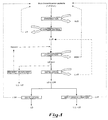
- Figure 1 illustrates the process for synthesizing lactide as referred to in the present invention. This process essentially comprises the following three stages:
- the first step (dimerization) considered in the context of the invention consists of a dimerization, preferably gentle and selective of the lactic ester by promoting the reaction of condensation between the hydroxyl function of the ester and the carboxylic acid function acid to the detriment of hydrolysis reactions (rupture of the ester link by water) and intermolecular transesterification (oligomerization of the lactic ester).
- this dimerization step is carried out on the one hand, under conditions very gentle reactions and a relatively short residence time, which, unlike to the procedures currently in force, are sufficient to initiate and complete the reaction of dimerization.
- a privileged approach of the present invention considers that reaction temperatures not exceeding 190 ° C, preferably below 175 ° C, more preferably below 165 ° C and more preferably still lower at 150 ° C, and residence times preferably between 0.1 and 60 min, more preferably between 0.1 and 30 min, more preferably still between 0.1 and 15 min, and more preferably still between 0.1 and 5 min are sufficient to initiate and complete the reaction, eliminating any problem of racemization and reducing drastically energy expenditure.
- the selectivity linked to this stage is very high.
- high selectivity is meant within the framework of this stage of the invention, reactivity total with respect to lactic acid (LA) and / or glycolic acid (residual acidity due at zero LA), and a content of trimer and tetramer (only oligomers present) of the ester less than 10%, preferably less than 5% and more preferably still less at 2%.
- esterification catalysts could be used in the context of this invention for the formation of lactides.
- the acid catalysts solid and heterogeneous such as aluminum, eta-, theta-, delta- and gamma aluminum, yttrium, silica, antimony trioxide, lead oxide beryllium, aluminum sulfate; organic metal salt catalysts such as octoate tin; acid and soluble catalysts such as sulfuric acid, acid methanosulfonic, paratoluene sulfonic acid, trifluoromethane sulfonic acid and toluenesulfonic acid-titanium; micellar catalysts such as salts of sulfosuccinates; acid ion exchange catalysts; phosphates, catalysts based on silica such as amino silicates, enzymes such as hydrolases, zeolites, non-polar catalysts such as polyoxyethylene nonyl phenol;
- the Brönsted acids requiring low activation energy and promoting reactions esterification rather than transesterification, will be used as a catalyst for dimerization and more particularly para-toluene sulfonic acid (APTS).
- APTS para-toluene sulfonic acid
- the recommended catalyst contents depend on the nature of the catalyst, the composition of the initial mixture and the reaction conditions but nevertheless remain, in the context of this invention, between 0 and 5% and preferably between between 0.1 and 2%.
- the configuration of the reactor plays a role in order to maintain a high selectivity for the dimerization reaction and to avoid the formation of oligomers lactic and / or glycolic ester.
- the reactor can advantageously be designed to ability to offer, on the one hand, a significant volatilization capacity in order to eliminate water produced (and part of the excess starting ester) and shift the equilibrium towards the formation of the dimer, on the other hand, sufficient reaction time for it to be complete, and finally a non-excessive residence time to avoid reactions oligomerization. Therefore, in the context of this invention, any reactor capable of meet these constraints such as for example the family of thin film reactors can advantageously be used.
- This step of the invention consists in starting with the dimerized ester obtained in (1) and characterized by a relative dimerized ester composition of between 50 and 100% and preferably between 70 and 100%, and a content of trimer and tetramer (only oligomers present in the lactic ester) less than 15%, preferably less than 10%, more preferably less than 5% and more preferably still less than 2%, in a selective cyclization into lactide and / or glycolide favoring the reactions of intramolecular transesterifications to the detriment of intermolecular reactions such that racemization (generating meso-LD), cycle opening or transesterifications (generating oligomers with a degree of polymerization greater than two).
- a relative dimerized ester composition of between 50 and 100% and preferably between 70 and 100%, and a content of trimer and tetramer (only oligomers present in the lactic ester) less than 15%, preferably less than 10%, more preferably less than 5% and more preferably still
- This step advantageously makes it possible to synthesize the dimeric cyclic ester in extremely mild conditions never encountered in conventional processes.
- a preferred approach of the present invention considers that temperatures reaction temperatures not exceeding 190 ° C and preferably less than 175 ° C and more preferably still below 165 ° C are sufficient for the dimer cyclization step linear. This advantageously reduces energy costs, investments in expensive equipment, but also to limit the training of by-products or impurities which it is necessary to remove in a later stage of purification.
- the purification consists essentially in the separation of the dimeric cyclic ester from the linear dimer, while that the quantity of linear trimer and tetramer is less than 10% and preferably less than 5% and more preferably still less than 2%.
- a preferred approach of the present invention to promote selectivity and therefore the cyclization at the expense of polymerization consists in favoring the reactions intramolecular rather than intermolecular reactions of dimer molecules linear.
- Any technique known to a person skilled in the art aiming at this objective is conceivable and, preferably, in the context of this invention, carrying out the reaction in solution in a preferably inert solvent capable of recrystallizing the dimeric cyclic ester from cold, or carry out the reaction in vapor phase with or without carrier gas (inert gas N2, ..).
- the solvents capable of being used and known to those skilled in the art are ketones, ethers, aromatic, aliphatic solvents, silicone-based solvents and halogenated solvents such as for example: acetone, 2-butanone, 2-pentanone, 2-hexanone, 2-heptanone, anisole, ethyl ether, isopropyl ether, butyl ether, methyl phenyl ether, benzene, cumene, p-cyne, p-xylene, o-xylene, m-xylene, toluene, cyclohexane, hexane, heptane, octane, nonane, 1-pentene, 2-octanone, 4-methyl anisole, 1,2-dimethoxybenzene, 1,3-dimethoxybenzene, 1,4-dimethoxybenzene, mesitylene, chlorobenzene, 1,2-dichlorobenzene
- esterification catalysts listed in point (1) could be used for this second cyclization step. However, as part of this invention, we will preferably retain all the catalysts which do not favor the synthesis of lactic acid polymer (PLA) from lactide as it is well known in the state of the art of ring opening polymerization. In an approach of the present invention, para-toluene sulfonic acid (APTS) and chloride copper (CuCl) have been shown to be particularly effective and selective. The contents in recommended catalyst are dependent on the nature of the catalyst, the composition of the initial mixture and reaction conditions but remain, however, in the context of this invention, preferably between 0 and 5% and more preferably between between 0.1 and 2%.
- APTS para-toluene sulfonic acid
- CuCl chloride copper
- the cyclization reaction is typically slower than the dimerization reaction.
- this dimerization is a condensation reaction between an acid function carboxylic and a hydroxyl group releasing water, while the reaction of cyclization involves a reaction between a less reactive ethyl ester group than a carboxylic acid, and a hydroxyl function. Therefore, a simple reactor of batch type under a nitrogen flow or any other reactor known to those skilled in the art likely to facilitate the extraction of the alcohol produced and allowing a residence time preferably between 0.1 and 120 min, more preferably between 0.1 and 60 min and more preferably still between 0.1 and 30 min, could be considered in the part of this invention.
- This step of the invention consists, starting from a crude dimeric cyclic ester (lactide or impure glycolide) obtained in (2) and preferably characterized by a composition relative in monomer and linear dimer between 0 and 80%, more preferably between 10 and 60%, and more preferably still between 10 and 40%, a meso-LD content preferably between 0 and 5%, more preferably between between 0 and 2% and more preferably still less than 1%, a trimer content and tetramer (only oligomers present in the lactic ester) preferably less than 15%, more preferably less than 10%, more preferably still less than 5% and more preferably still less than 2%, the balance being L-LD, in one purification by elimination of protic impurities in order to obtain a quality lactide sufficient to be able to be used as a monomer for the synthesis of PLA by cycle opening.
- a composition relative in monomer and linear dimer between 0 and 80%, more preferably between 10 and 60%, and more preferably still
- lactide two qualities can be obtained in the context of this invention.
- the first (a) characterized by double distillation. provides a lactide of very high chemical purity but will not be pure optically. Indeed, although the cyclization process generates only very little meso-lactide, it cannot be eliminated because the distillation process is not stereospecific.
- the lactide obtained can nevertheless be used in polymerization (acidity, low water content), because the meso-lactide content remains low ( ⁇ 2% or even ⁇ 1%).
- the mechanical properties of PLA are highly dependent on the content of meso-lactide of the monomer, it can be used for specific applications.
- This first route (a) consists in feeding the gaseous mixture from the reaction medium in a first distillation column which will allow the recovery of the components the most volatile (LR or L2R) at the top of the column. Heavy compounds, i.e. lactide and the lactic acid esters (L2R, L3R & L4R), are then fed into a second column which will make it possible to recover a pure lactide at the head.
- a preferred approach of the present invention considers the case of the ethyl ester of lactic acid.
- ethyl lactate and the dimer linear will come out at the head of the column and can be fully recycled at the cyclization stage.
- a purge may however be instituted in order to avoid a too high concentration of "monomeric" ester. This purge is not one in reality, because the extracted product can be re-injected at the esterification stage.
- this second separation does not require a large number of theoretical platforms and, ultimately, a simple flash process could be considered. It could even be envisaged to incorporate the flash process with extraction in vapor form at the distillation flask of the first column and therefore avoid the complexity associated with managing two adjoining units.
- the second route (b), delivers a product of great chemical and optical purity, which makes it possible to generalize its application for polymerization.
- two possibilities are envisaged depending on whether the cyclization step is carried out in a solvent or in the vapor phase.
- One of the two possibilities (b1) is to correctly select the solvent intended to promote intramolecular reactions and to decrease the probability of intermolecular reactions.
- the solvent should advantageously be characterized by a sufficiently high boiling temperature in order to avoid limiting the cyclization temperature, by its capacity to dissolve the L-LD at reaction temperature and to insolubilize it at room temperature and , by its selectivity with respect to meso-LD.
- the L-LD is then separated by filtration and the solvent is extracted by any technique known to those skilled in the art, such as for example evaporation, extraction, etc.
- the solvents which may be used are ketones, ethers, aromatic, aliphatic solvents, silicone-based solvents and halogenated solvents as previously mentioned.
- the other possibility (b2) is close to that described in (a) but will be adapted to ensure the stereospecificity of the process. Indeed, given the low content of heavy esters ( ⁇ 5% or even ⁇ 2% in L3Et & L4Et), the second distillation column, according to economic considerations, perhaps be maintained and a recrystallization process in added molten medium, either substituted by a flash process incorporated or not in the first column and by a recrystallization process in a molten medium or either simply by a recrystallization process in a molten medium.
- the product processed by this technology undergoes controlled cooling which will initiate crystallization. During this stage, the impurities are concentrated in the liquid phase surrounding the crystals.
- the liquid phase is extracted from the crystallizer by gravity, which leaves a crystal coated with a film charged with impurities.
- a cast iron partial of the crystals is operated.
- the liquid product thus obtained mixes with the film and is evacuated by gravity out of the crystallizer. Finally, when the desired purity is reached, the contents of the crystallizer are melted and recovered.
- a mixture from the dimerization step is fed continuously into a borosilicate glass evaporator, with a mechanically agitated thin film with internal condenser (short-path) of UIC brand having heating and condensation surfaces of 0.06 m 2 , preceded a degasser-preheater whose temperature is adjusted by circulation of heat transfer oil.
- the cyclization reaction of ethyl lactyllactate to lactide was carried out in a batch type reactor similar to that used for the dimerization step.
- the reaction was carried out at atmospheric pressure with different catalysts present at a rate of 1% by weight and at different temperatures.
- Table 7 presents the results obtained for various catalysts: paratoluene sulfonic acid (APTS), bis 2-ethylhexanotate of tin (II) (Sn (Oct) 2), zinc oxide (II) (ZnO) and copper chloride ( I) (CuCl). Influence of the nature of the catalyst (1% wt) on the mass cyclization reaction of ethyl lactyllactate in a batch type reactor under nitrogen flow.
- composition of the starting mixture is as follows, expressed in percent and determined by GC: LEt 5.4, L2Et 77.1, L3Et 16.2, L4Et 1.0, L5Et 0.3.
- Catalyst t (min) GC standardized according to the distillates PLA Acid.
- Example 6 Influence of the addition of a solvent on the reaction of the cyclization of the dimerized ester.
- an inert solvent so as to dilute the reaction medium and increase the mean free path.
- Table 6 summarizes the results for different dilutions when the cyclization reaction is catalyzed by Sn (Oct) 2 at 145 ° C in a batch reactor.
- the dilution of the cyclization medium promotes the formation of lactide and strongly limits the intermolecular reactions of transesterification, of opening of the cycle and even of racemization.
- the lactide yield remains low and the presence of ubiquitous polymer. Therefore, if the very principle of increasing the average free path of molecules via the addition of a solvent holds water, it is preferable to turn to other more selective catalysts, such as APTS or copper (I) chloride.
- Example 7 Selective cyclization in dilute medium and purification of the lactide obtained.
- the temperature of the mixture obtained after 30 min of reaction with APTS as catalyst was brought to room temperature, which had the effect of insolubilizing the lactide which could be extracted by simple filtration (72% of the lactide was could be recovered).
- the lactide harvested after filtration has been found to have a purity determined by GC of 96.3% in L-LD (2.5% of p-cymene remains) and an acidity determined by titration in a nonaqueous medium of 20 meq / kg.
- composition of the dimerization products of ethyl lactyllactate (L2Et 76.8%) into lactide in a batch type reactor under nitrogen flow and in the presence of 95% by weight of p-cymene and 1% by weight of catalyst.
Landscapes
- Chemical & Material Sciences (AREA)
- Organic Chemistry (AREA)
- Nitrogen Condensed Heterocyclic Rings (AREA)
- Polyesters Or Polycarbonates (AREA)
- Organic Low-Molecular-Weight Compounds And Preparation Thereof (AREA)
- Heterocyclic Compounds That Contain Two Or More Ring Oxygen Atoms (AREA)
Claims (29)
- Verfahren zur Herstellung von dimeren zyklischen Estern ausgehend von einem Rohprodukt einer partiellen Veresterung, umfassend die folgenden Schritte:(a) Gewinnung eines Rohprodukts einer partiellen Veresterung, nämlich einer Mischung aus Milchsäure und/oder Glykolsäure und einem Milchsäure- und/oder Glykolsäureester;(b) Dimerisierung des in (a) erhaltenen Ausgangsmaterials zu einem geradkettigen Dimeren des Esters durch Kondensation zwischen der Hydroxyfunktion des Esters und der Carbonsäurefunktion der Säure;(c) Zyklisierung der in (b) hergestellten geradkettigen Dimeren zu dimeren zyklischen Estern unter Begünstigung der intramolekularen Umesterungsreaktionen gegenüber den intermolekularen Reaktionen;(d) Extraktion des in (c) hergestellten rohen dimeren zyklischen Esters und Gewinnung des gereinigten dimeren zyklischen Esters.
- Verfahren nach Anspruch 1, dadurch gekennzeichnet, daß das Rohprodukt der partiellen Veresterung durch Mischen von reinen Produkten oder vorteilhaft durch Entfernen zu einem genau bestimmten Zeitpunkt des Schritts der Veresterung der Milchsäure und/oder Glykolsäure zum Ester erhalten wird.
- Verfahren nach Anspruch 1 oder 2, dadurch gekennzeichnet, daß das Rohprodukt der partiellen Veresterung eine relative Zusammensetzung aus Ester und Säure in monomerer Form von 50 bis 99% Ester, vorzugsweise 70 bis 95% Ester, aufweist.
- Verfahren nach einem der vorhergehenden Ansprüche, dadurch gekennzeichnet, daß der Dimerisationsschritt (b) bei Temperaturen, die 190°C nicht überschreiten, vorzugsweise 175°C, stärker bevorzugt unter 165°C und noch stärker bevorzugt unter 150°C, durchgeführt wird.
- Verfahren nach einem der vorhergehenden Ansprüche, dadurch gekennzeichnet, daß bei dem Dimerisationsschritt (b) ein vollständiger Umsatz der Milchsäure und/oder Glykolsäure erzielt wird, die restliche Acidität aufgrund der Säure Null beträgt und der Gehalt an Oligomeren des Milchsäureund/oder Glykolsäureesters in den Reaktionsprodukten unter 10%, vorzugsweise unter 5%, noch stärker bevorzugt unter 2%, liegt.
- Verfahren nach Anspruch 5, wobei die Oligomere des Esters ausschließlich in Form von Trimeren oder Tetrameren des Milchsäure- und/oder Glykolsäureesters vorliegen.
- Verfahren nach einem der vorhergehenden Ansprüche, dadurch gekennzeichnet, daß der Dimerisationsschritt (b) durch einen Veresterungskatalysator aus der Gruppe saure, feste und heterogene Katalysatoren, Katalysatoren auf Basis von organischen Metallsalzen, sauren und löslichen Katalysatoren, miellenartigen Katalysatoren, sauren Ionenaustauscherkatalysatoren, Phosphate, Katalysatoren auf Silikabasis, Enzyme, Zeolithe, unpolare Katalysatoren sowie schließlich Salze eingeleitet wird.
- Verfahren nach Anspruch 7, dadurch gekennzeichnet, daß es sich bei dem Katalysator um eine Brönsted-Säure handelt, die nur wenig Aktivierungsenergie benötigt und Veresterungsreaktionen gegenüber Umesterungsreaktionen begünstigt, wie zum Beispiel para-Toluolsulfonsäure (PTSA).
- Verfahren nach Anspruch 7 oder 8, dadurch gekennzeichnet, daß die Katalysatorgehalte zwischen 0 und 5%, vorzugsweise zwischen 0,1 und 2%, liegen.
- Verfahren nach einem der vorhergehenden Ansprüche, dadurch gekennzeichnet, daß bei dem Dimerisationsschritt (b) ein Reaktor mit einer hohen Verflüchtigungskapazität und einer Verweildauer von 0,1 bis 60 Minuten, vorzugsweise 0,1 bis 30 Minuten, stärker bevorzugt 0,1 bis 15 Minuten, noch stärker bevorzugt 0,1 bis 5 Minuten, wie zum Beispiel ein Dünnschichtreaktor, verwendet wird.
- Zusammensetzung von geradkettigen Dimeren von Milchsäure- und/oder Glykolsäureester, die in Schritt (b) erhalten wird, dadurch gekennzeichnet, daß sie 50 bis 100%, vorzugsweise 70 bis 100%, dimerisierten geradkettigen Ester sowie einen Gehalt an Oligomeren von Milchsäure- und/oder Glykolsäureester unter 15%, vorzugsweise unter 10%, stärker bevorzugt unter 5%, noch stärker bevorzugt unter 2%, aufweist.
- Verfahren nach einem der Ansprüche 1 bis 10, dadurch gekennzeichnet, daß Schritt (c) ausschließlich aus einer Zyklisierung des geradkettigen Dimeren und nicht aus einer Entpolymerisation von Oligomeren des Milchsäureund/oder Glykolsäureesters besteht.
- Verfahren nach einem der vorhergehenden Verfahrensansprüche, dadurch gekennzeichnet, daß der Zyklisierungsschritt (c) bei Temperaturen, die 190°C nicht überschreiten, vorzugsweise unter 175°C, noch stärker bevorzugt unter 165°C, durchgeführt wird.
- Verfahren nach einem der vorhergehenden Ansprüche, dadurch gekennzeichnet, daß man im Zyklisierungsschritt (c) die intramolekularen Reaktionen der Moleküle der geradkettigen Dimeren gegenüber der Wahrscheinlichkeit von intermolekularen Reaktionen begünstigt.
- Verfahren nach Anspruch 14, dadurch gekennzeichnet, daß man zur Begünstigung der intramolekularen Reaktionen der Moleküle von geradkettigen Dimeren die Reaktion entweder in einem Lösungsmittel, vorzugsweise einem inerten Lösungsmittel, oder in der Dampfphase mit oder ohne Trägergas durchführt.
- Verfahren nach Anspruch 15, dadurch gekennzeichnet, daß das Lösungsmittel aus der Gruppe Ketone, Ether, aromatische oder aliphatische Lösungsmittel, Lösungsmittel auf Silikonbasis oder halogenierte Lösungsmittel stammt.
- Verfahren nach Anspruch 15 oder 16, dadurch gekennzeichnet, daß mit dem Lösungsmittel der dimere zyklische Ester in der Kälte umkristallisiert werden kann.
- Verfahren nach einem der vorhergehenden Ansprüche, dadurch gekennzeichnet, daß der Zyklisierungsschritt (c) durch einen Veresterungskatalysator aus der Gruppe saure, feste und heterogene Katalysatoren, Katalysatoren auf Basis von organischen Metallsalzen, sauren und löslichen Katalysatoren, miellenartigen Katalysatoren, sauren Ionenaustauscherkatalysatoren, Phosphate, Katalysatoren auf Silikabasis, Enzyme, Zeolithe, unpolare Katalysatoren sowie schließlich Salze eingeleitet wird.
- Verfahren nach Anspruch 18, dadurch gekennzeichnet, daß es sich bei dem Katalysator um para-Toluolsulfonsäure (PTSA) oder Kupferchlorid (CuCl) handelt.
- Verfahren nach Anspruch 18 oder 19, dadurch gekennzeichnet, daß die Katalysatorgehalte zwischen 0 und 5%, vorzugsweise zwischen 0,1 und 2%, liegen.
- Verfahren nach einem der vorhergehenden Verfahrensansprüche, dadurch gekennzeichnet, daß im Zyklisierungsschritt (c) ein Reaktor mit einer hohen Kapazität zur Entfernung einer flüchtigen Verbindung und einer Verweildauer von 0,1 bis 120 Minuten, vorzugsweise 0,1 bis 60 Minuten, noch stärker bevorzugt 0,1 bis 30 Minuten, verwendet wird.
- Verfahren nach einem der vorhergehenden Verfahrensansprüche, dadurch gekennzeichnet, daß Schritt (d) eine zweifache fraktionierte Destillation des in (c) erhaltenen rohen dimeren zyklischen Esters umfaßt, wodurch man einen dimeren zyklischen Ester in sehr hoher chemischer Reinheit erhält.
- Verfahren nach Anspruch 22, dadurch gekennzeichnet, daß die zweite Destillationskolonne und/oder die erste Destillationskolonne ein Flash-Verfahren beinhaltet.
- Verfahren nach einem der vorhergehenden Verfahrensansprüche, dadurch gekennzeichnet, daß Schritt (d) eine fraktionierte Destillation mit oder ohne in den Destillationskolben integriertes oder nicht integriertes Flash-Verfahren, die mit einer Umkristallisation in der Schmelze des in (c) erhaltenen rohen dimeren zyklischen Esters gekoppelt ist, umfaßt.
- Verfahren nach einem der vorhergehenden Verfahrensansprüche, dadurch gekennzeichnet, daß Schritt (d) eine Umkristallisation des in (c) erhaltenen rohen dimeren zyklischen Esters in einem Lösungsmittel beinhaltet.
- Verfahren nach Anspruch 25, dadurch gekennzeichnet, daß es sich bei dem Lösungsmittel für die Umkristallisation um das bei dem Zyklisierungsschritt (c) eingeführte inerte Lösungsmittel oder um ein zweites Lösungsmittel aus der gleichen Familie aus der Gruppe der Ketone, Ether, aromatischen und aliphatischen Verbindungen, Verbindungen auf Silikonbasis und halogenierten Verbindungen handelt.
- Verfahren nach einem der vorhergehenden Ansprüche, dadurch gekennzeichnet, daß es sich bei dem dimeren zyklischen Ester um das Lactid handelt.
- Zusammensetzung aus dimeren zyklischen Estern, die in Schritt (c) eines Verfahrens nach Anspruch 27 erhalten wurden, dadurch gekennzeichnet, daß sie 0 bis 80%, vorzugsweise 10 bis 60%, noch stärker bevorzugt 10 bis 40%, geradkettige Dimere und Monomere enthält, einen meso-LD-Gehalt von 0 bis 5%, vorzugsweise 0 bis 2%, noch stärker bevorzugt unter 1%, und einen Trimeren- und Tetramerengehalt unter 15%, vorzugsweise unter 10%, stärker bevorzugt unter 5%, noch stärker bevorzugt unter 2%, aufweist, wobei der Rest aus L-LD besteht.
- Verfahren nach Anspruch 27, dadurch gekennzeichnet, daß die L-Lactid-Reinheit 99,0 bis 99,9, vorzugsweise 99,5 bis 99,8, beträgt und das meso-Lactid-Gehalt 0 bis 2%, vorzugsweise 0 bis 0,5%, stärker bevorzugt 0 bis 0,2%, noch stärker bevorzugt 0 bis 0,1%, beträgt.
Applications Claiming Priority (3)
| Application Number | Priority Date | Filing Date | Title |
|---|---|---|---|
| BE9800142 | 1998-02-24 | ||
| BE9800142A BE1011759A3 (fr) | 1998-02-24 | 1998-02-24 | Procede de production d'esters cycliques. |
| PCT/BE1999/000027 WO1999043669A1 (fr) | 1998-02-24 | 1999-02-24 | Procede de production d'esters cycliques dimeriques |
Publications (2)
| Publication Number | Publication Date |
|---|---|
| EP1056741A1 EP1056741A1 (de) | 2000-12-06 |
| EP1056741B1 true EP1056741B1 (de) | 2003-01-22 |
Family
ID=3891118
Family Applications (1)
| Application Number | Title | Priority Date | Filing Date |
|---|---|---|---|
| EP99905980A Expired - Lifetime EP1056741B1 (de) | 1998-02-24 | 1999-02-24 | Verfahren zur herstellung von dimeren zyklischen estern |
Country Status (7)
| Country | Link |
|---|---|
| EP (1) | EP1056741B1 (de) |
| AT (1) | ATE231503T1 (de) |
| AU (1) | AU2604499A (de) |
| BE (1) | BE1011759A3 (de) |
| DE (1) | DE69905016T2 (de) |
| ES (1) | ES2189392T3 (de) |
| WO (1) | WO1999043669A1 (de) |
Families Citing this family (5)
| Publication number | Priority date | Publication date | Assignee | Title |
|---|---|---|---|---|
| AT506038B1 (de) | 2007-11-14 | 2015-02-15 | Jungbunzlauer Austria Ag | Verfahren zur herstellung zyklischer diester von l-, d- und d,l-milchsäure |
| AT506768B1 (de) | 2008-04-16 | 2013-10-15 | Jungbunzlauer Austria Ag | Verfahren zur reinigung zyklischer diester der l- bzw. d-milchsäure |
| AT507580B1 (de) * | 2008-11-19 | 2011-10-15 | Jungbunzlauer Austria Ag | Verfahren zur reinigung zyklischer diester der milchsäure |
| WO2016120893A2 (en) * | 2015-01-29 | 2016-08-04 | Council Of Scientific & Industrial Research | A novel process for the preparation of hydroxyl functional esters and polyesters therefrom |
| BE1029038B1 (fr) | 2021-01-21 | 2022-08-22 | Noosa | Procede de preparation d'acide polylactique au depart d'acide lactique provenant du recyclage de rouleaux supports de bobines de fil ou film et rouleaux supports destines a cet effet |
Family Cites Families (4)
| Publication number | Priority date | Publication date | Assignee | Title |
|---|---|---|---|---|
| US5319107A (en) * | 1990-09-18 | 1994-06-07 | Biopak Technology, Ltd. | Method to produce cyclic esters |
| US5326887A (en) * | 1991-02-27 | 1994-07-05 | E. I. Du Pont De Nemours And Company | Process for the preparation of 1,4-dioxane-2,5-diones |
| US6326458B1 (en) * | 1992-01-24 | 2001-12-04 | Cargill, Inc. | Continuous process for the manufacture of lactide and lactide polymers |
| DE4407035A1 (de) * | 1994-03-03 | 1995-09-07 | Basf Ag | Verfahren zur Herstellung von Dilactonen aus alpha-Hydroxycarbonsäureestern |
-
1998
- 1998-02-24 BE BE9800142A patent/BE1011759A3/fr not_active IP Right Cessation
-
1999
- 1999-02-24 AU AU26044/99A patent/AU2604499A/en not_active Abandoned
- 1999-02-24 WO PCT/BE1999/000027 patent/WO1999043669A1/fr not_active Ceased
- 1999-02-24 EP EP99905980A patent/EP1056741B1/de not_active Expired - Lifetime
- 1999-02-24 DE DE69905016T patent/DE69905016T2/de not_active Expired - Lifetime
- 1999-02-24 ES ES99905980T patent/ES2189392T3/es not_active Expired - Lifetime
- 1999-02-24 AT AT99905980T patent/ATE231503T1/de not_active IP Right Cessation
Also Published As
| Publication number | Publication date |
|---|---|
| DE69905016T2 (de) | 2003-10-09 |
| EP1056741A1 (de) | 2000-12-06 |
| ES2189392T3 (es) | 2003-07-01 |
| ATE231503T1 (de) | 2003-02-15 |
| BE1011759A3 (fr) | 1999-12-07 |
| AU2604499A (en) | 1999-09-15 |
| WO1999043669A1 (fr) | 1999-09-02 |
| DE69905016D1 (de) | 2003-02-27 |
Similar Documents
| Publication | Publication Date | Title |
|---|---|---|
| EP2222658B1 (de) | Verfahren zur gewinnung von lactid | |
| EP0722433B1 (de) | Verfahren zur herstellung von cyclischen estern | |
| KR0171432B1 (ko) | 수성 락트산 공급원료의 탈수에 의한 락타이드의 제조방법 | |
| KR101698915B1 (ko) | 락티드 유도체의 혼합물의 생성 방법 | |
| WO2004014889A1 (fr) | Procede de production de polylactide au depart d'une solution d'acide lactique ou d'un de ses derives. | |
| JP3255413B2 (ja) | 二量体環状エステル生成のための薄膜解重合 | |
| EP1276735B1 (de) | Verfahren zur reinigung von zyklischen estern | |
| CN102439001B (zh) | 由内消旋-丙交酯流回收乳酸值 | |
| JP2024531592A5 (de) | ||
| KR20140077877A (ko) | 분리방법 | |
| JP6505107B2 (ja) | ポリ乳酸のバックバイティングによるメソラクチド、d−ラクチドおよびl−ラクチドの製造 | |
| BE1011759A3 (fr) | Procede de production d'esters cycliques. | |
| US9035076B2 (en) | Recovery of lactic acid values from a meso-lactide stream | |
| JP2025502407A (ja) | ラクチドを処理する方法 | |
| EP0702667B1 (de) | Verfahren zur herstellung von hoch enantiomerenreinen difunktionellen verbindungen | |
| CN121925412A (zh) | 制造丙交酯的工艺 | |
| BE1021574B1 (fr) | Procede continu de synthese d'oligoesters a partir d'un sel d'ammonium d'un acide dicarboxylique et d'un diol et dispositif de mise en oeuvre. | |
| WO2023232427A1 (fr) | Synthese de l'acide levulinique par hydratation d'alcool furfurylque en presence d'un catalyseur homogene acide et d'un solvant a base d'ether et/ou d'acetals | |
| EP4140978A1 (de) | Verfahren zur herstellung von acrylsäure oder acrylsäureester durch katalytische dehydratisierung aus einem rücklaufstrom eines polymilchsäure-herstellungsverfahrens | |
| CH540948A (fr) | Procédé de production de polyesters-polyols | |
| HK1157785B (en) | Process for preparing a mixture of lactide derivatives |
Legal Events
| Date | Code | Title | Description |
|---|---|---|---|
| PUAI | Public reference made under article 153(3) epc to a published international application that has entered the european phase |
Free format text: ORIGINAL CODE: 0009012 |
|
| 17P | Request for examination filed |
Effective date: 20000824 |
|
| AK | Designated contracting states |
Kind code of ref document: A1 Designated state(s): AT BE DE DK ES FI FR GB IE IT NL SE |
|
| GRAH | Despatch of communication of intention to grant a patent |
Free format text: ORIGINAL CODE: EPIDOS IGRA |
|
| GRAH | Despatch of communication of intention to grant a patent |
Free format text: ORIGINAL CODE: EPIDOS IGRA |
|
| GRAA | (expected) grant |
Free format text: ORIGINAL CODE: 0009210 |
|
| AK | Designated contracting states |
Kind code of ref document: B1 Designated state(s): AT BE DE DK ES FI FR GB IE IT NL SE |
|
| PG25 | Lapsed in a contracting state [announced via postgrant information from national office to epo] |
Ref country code: IT Free format text: LAPSE BECAUSE OF FAILURE TO SUBMIT A TRANSLATION OF THE DESCRIPTION OR TO PAY THE FEE WITHIN THE PRESCRIBED TIME-LIMIT;WARNING: LAPSES OF ITALIAN PATENTS WITH EFFECTIVE DATE BEFORE 2007 MAY HAVE OCCURRED AT ANY TIME BEFORE 2007. THE CORRECT EFFECTIVE DATE MAY BE DIFFERENT FROM THE ONE RECORDED. Effective date: 20030122 Ref country code: IE Free format text: LAPSE BECAUSE OF FAILURE TO SUBMIT A TRANSLATION OF THE DESCRIPTION OR TO PAY THE FEE WITHIN THE PRESCRIBED TIME-LIMIT Effective date: 20030122 Ref country code: GB Free format text: LAPSE BECAUSE OF FAILURE TO SUBMIT A TRANSLATION OF THE DESCRIPTION OR TO PAY THE FEE WITHIN THE PRESCRIBED TIME-LIMIT Effective date: 20030122 Ref country code: FI Free format text: LAPSE BECAUSE OF FAILURE TO SUBMIT A TRANSLATION OF THE DESCRIPTION OR TO PAY THE FEE WITHIN THE PRESCRIBED TIME-LIMIT Effective date: 20030122 Ref country code: AT Free format text: LAPSE BECAUSE OF FAILURE TO SUBMIT A TRANSLATION OF THE DESCRIPTION OR TO PAY THE FEE WITHIN THE PRESCRIBED TIME-LIMIT Effective date: 20030122 |
|
| REG | Reference to a national code |
Ref country code: GB Ref legal event code: FG4D Free format text: NOT ENGLISH |
|
| REG | Reference to a national code |
Ref country code: IE Ref legal event code: FG4D Free format text: FRENCH |
|
| REF | Corresponds to: |
Ref document number: 69905016 Country of ref document: DE Date of ref document: 20030227 Kind code of ref document: P |
|
| PG25 | Lapsed in a contracting state [announced via postgrant information from national office to epo] |
Ref country code: SE Free format text: LAPSE BECAUSE OF FAILURE TO SUBMIT A TRANSLATION OF THE DESCRIPTION OR TO PAY THE FEE WITHIN THE PRESCRIBED TIME-LIMIT Effective date: 20030422 Ref country code: DK Free format text: LAPSE BECAUSE OF FAILURE TO SUBMIT A TRANSLATION OF THE DESCRIPTION OR TO PAY THE FEE WITHIN THE PRESCRIBED TIME-LIMIT Effective date: 20030422 |
|
| REG | Reference to a national code |
Ref country code: ES Ref legal event code: FG2A Ref document number: 2189392 Country of ref document: ES Kind code of ref document: T3 |
|
| GBV | Gb: ep patent (uk) treated as always having been void in accordance with gb section 77(7)/1977 [no translation filed] |
Effective date: 20030122 |
|
| REG | Reference to a national code |
Ref country code: IE Ref legal event code: FD4D Ref document number: 1056741E Country of ref document: IE |
|
| PLBE | No opposition filed within time limit |
Free format text: ORIGINAL CODE: 0009261 |
|
| STAA | Information on the status of an ep patent application or granted ep patent |
Free format text: STATUS: NO OPPOSITION FILED WITHIN TIME LIMIT |
|
| 26N | No opposition filed |
Effective date: 20031023 |
|
| REG | Reference to a national code |
Ref country code: NL Ref legal event code: SD Effective date: 20100903 |
|
| BECH | Be: change of holder |
Owner name: FUTERRO S.A. Effective date: 20100907 |
|
| REG | Reference to a national code |
Ref country code: FR Ref legal event code: TP |
|
| REG | Reference to a national code |
Ref country code: ES Ref legal event code: PC2A Owner name: FUTERRO Effective date: 20110601 |
|
| REG | Reference to a national code |
Ref country code: FR Ref legal event code: PLFP Year of fee payment: 18 |
|
| PGFP | Annual fee paid to national office [announced via postgrant information from national office to epo] |
Ref country code: DE Payment date: 20160218 Year of fee payment: 18 Ref country code: ES Payment date: 20160210 Year of fee payment: 18 |
|
| PGFP | Annual fee paid to national office [announced via postgrant information from national office to epo] |
Ref country code: BE Payment date: 20160217 Year of fee payment: 18 Ref country code: NL Payment date: 20160217 Year of fee payment: 18 Ref country code: FR Payment date: 20160218 Year of fee payment: 18 |
|
| PG25 | Lapsed in a contracting state [announced via postgrant information from national office to epo] |
Ref country code: BE Free format text: LAPSE BECAUSE OF NON-PAYMENT OF DUE FEES Effective date: 20170228 |
|
| REG | Reference to a national code |
Ref country code: DE Ref legal event code: R119 Ref document number: 69905016 Country of ref document: DE |
|
| REG | Reference to a national code |
Ref country code: NL Ref legal event code: MM Effective date: 20170301 |
|
| PG25 | Lapsed in a contracting state [announced via postgrant information from national office to epo] |
Ref country code: NL Free format text: LAPSE BECAUSE OF NON-PAYMENT OF DUE FEES Effective date: 20170301 |
|
| REG | Reference to a national code |
Ref country code: FR Ref legal event code: ST Effective date: 20171031 |
|
| PG25 | Lapsed in a contracting state [announced via postgrant information from national office to epo] |
Ref country code: DE Free format text: LAPSE BECAUSE OF NON-PAYMENT OF DUE FEES Effective date: 20170901 Ref country code: FR Free format text: LAPSE BECAUSE OF NON-PAYMENT OF DUE FEES Effective date: 20170228 |
|
| REG | Reference to a national code |
Ref country code: BE Ref legal event code: MM Effective date: 20170228 |
|
| REG | Reference to a national code |
Ref country code: ES Ref legal event code: FD2A Effective date: 20180629 |
|
| PG25 | Lapsed in a contracting state [announced via postgrant information from national office to epo] |
Ref country code: ES Free format text: LAPSE BECAUSE OF NON-PAYMENT OF DUE FEES Effective date: 20170225 |