EP1066248B1 - Derives de methyl-biphenyle, leur procede de preparation et leur utilisation - Google Patents
Derives de methyl-biphenyle, leur procede de preparation et leur utilisation Download PDFInfo
- Publication number
- EP1066248B1 EP1066248B1 EP99909013A EP99909013A EP1066248B1 EP 1066248 B1 EP1066248 B1 EP 1066248B1 EP 99909013 A EP99909013 A EP 99909013A EP 99909013 A EP99909013 A EP 99909013A EP 1066248 B1 EP1066248 B1 EP 1066248B1
- Authority
- EP
- European Patent Office
- Prior art keywords
- temperature
- derivative
- process according
- tolyl
- benzaldimine
- Prior art date
- Legal status (The legal status is an assumption and is not a legal conclusion. Google has not performed a legal analysis and makes no representation as to the accuracy of the status listed.)
- Expired - Lifetime
Links
- NPLCNUQXVHFKLP-GDNBJRDFSA-N Cc(cc1)ccc1-c1ccccc1/C=N\O Chemical compound Cc(cc1)ccc1-c1ccccc1/C=N\O NPLCNUQXVHFKLP-GDNBJRDFSA-N 0.000 description 1
- 0 Cc(cc1)ccc1-c1ccccc1C=N* Chemical compound Cc(cc1)ccc1-c1ccccc1C=N* 0.000 description 1
Classifications
-
- C—CHEMISTRY; METALLURGY
- C07—ORGANIC CHEMISTRY
- C07C—ACYCLIC OR CARBOCYCLIC COMPOUNDS
- C07C251/00—Compounds containing nitrogen atoms doubly-bound to a carbon skeleton
- C07C251/32—Oximes
- C07C251/34—Oximes with oxygen atoms of oxyimino groups bound to hydrogen atoms or to carbon atoms of unsubstituted hydrocarbon radicals
- C07C251/48—Oximes with oxygen atoms of oxyimino groups bound to hydrogen atoms or to carbon atoms of unsubstituted hydrocarbon radicals with the carbon atom of at least one of the oxyimino groups bound to a carbon atom of a six-membered aromatic ring
-
- C—CHEMISTRY; METALLURGY
- C07—ORGANIC CHEMISTRY
- C07C—ACYCLIC OR CARBOCYCLIC COMPOUNDS
- C07C251/00—Compounds containing nitrogen atoms doubly-bound to a carbon skeleton
- C07C251/02—Compounds containing nitrogen atoms doubly-bound to a carbon skeleton containing imino groups
- C07C251/24—Compounds containing nitrogen atoms doubly-bound to a carbon skeleton containing imino groups having carbon atoms of imino groups bound to carbon atoms of six-membered aromatic rings
Definitions
- the present invention relates, in general, to a new methyl-biphenyl derivative, its preparation process and its use as a synthesis intermediate.
- the subject of the invention is o-tolyl-benzaldoxime of formula: this compound being considered in the form of its individual isomers or mixtures thereof.
- OTBO oxime derivative of formula I
- OTBN o- (p-tolyl) -benzonitrile
- the latter can itself be widely used as an intermediate particularly interesting since it constitutes the key intermediary in the synthesis of numerous active principles of drugs which act in particular against hypertension by an angiotensin II inhibition mechanism.
- the o (p-tolyl) -benzaldoxime can be obtained with excellent yields and less than 6% by-product bis-tolyl by coupling reaction using p-tolylmagnesium bromide and not 2-chlorobenzaldoxime but a 2-haiogenobenzaldimine N-substituted to form an o- (p-tolyl) -benzaldimine N-substituted easily transformable into the desired oxime.
- this oxime of formula I is obtained by reaction of a hydroxylamine salt, with a benzaldimine derivative of general formula: wherein R represents an alkyl group, linear or branched C 3 -C 7 cycloalkyl or C 3 -C 7, this compound of formula II being considered as individual isomers or mixture thereof, which provides the desired compounds.
- This reaction usually takes place at a temperature between 0 ° C and 10 ° C, preferably between 0 ° C and 5 ° C and in an aprotic solvent.
- aprotic solvent is meant, in the context of the present invention, a solvent such as an ether generally an aliphatic or alicyclic ether by example tetrahydrofuran, methyl tert-butyl ether, dibutyl ether or dioxane, an aliphatic or aromatic hydrocarbon such as benzene, toluene or a xylene or a halogenated hydrocarbon such as dichloromethane, dichloroethane, chloroform or tetrachloroethane.
- an ether generally an aliphatic or alicyclic ether by example tetrahydrofuran, methyl tert-butyl ether, dibutyl ether or dioxane
- an aliphatic or aromatic hydrocarbon such as benzene, toluene or a xylene
- a halogenated hydrocarbon such as dichloromethane, dichloroethane, chloroform or t
- ether for example solvent tetrahydrofuran.
- the hydroxylamine salt such as the hydrochloride or preferably the sulfate, intervenes at a rate of 1.5 to 2.5 molar equivalents per equivalent benzaldimine derivative molar of formula II.
- the OTBO can be obtained with yields of in the range of 90 to 93% by weight.
- methyl-biphenyl derivatives of formula II are new and, as such, constitute another object of the invention whether they are in the form of isomers individual or a mixture thereof.
- the invention also relates, as new intermediate products, the formula II benzaldimine derivative wherein R represents an alkyl group, linear or branched C 3 -C 7 cycloalkyl or C 3 - C 7 , these benzaldimine derivatives being in the form of individual isomers or mixtures thereof.
- the compounds of formula II can be prepared by reacting, in the presence of a mineral manganese derivative, a benzaldimine derivative of general formula: wherein R has the same meaning as above and Hal represents a halogen atom such as chlorine or bromine, this compound being in the form of individual isomers or mixtures thereof, with a p-tolylmagnesium halide such as p-tolylmagnesium chloride or bromide, which provides the desired compounds.
- this coupling reaction is carried out in an appropriate solvent and at a temperature between -10 ° C. and the reflux temperature, preferably at the reflux temperature of the reaction medium.
- an ether-type compound such as than an aliphatic or alicyclic ether, for example tetrahydrofuran, methyl tert-butyl ether, dibutyl ether or dioxane.
- tetrahydrofuran is a preferred solvent.
- excess p-tolylmagnesium halide is generally used. in particular at a rate of 1 to 2 molar equivalents per molar equivalent of compound of formula II, usually about 1.5 equivalents.
- the mineral derivative of manganese intervenes in the reaction at a rate of 0.1 to 0.5 molar equivalent per molar equivalent of benzaldimine derivative of formula II, preferably from 0.15 to 0.30 molar equivalent.
- the manganous salt preferably corresponds to MnCl 2 or to MnCl 4 Li 2 , the latter possibly being formed in situ by adding two molar equivalents of LiCl and one molar equivalent of MnCl 2 .
- the compounds of formula II can be obtained with yields of at least 85% and with less than 6% of bis-tolyl derivative.
- benzaldimine derivatives of formula III these can be prepared by reaction at a temperature between room temperature and the reflux temperature and in an aprotic solvent, preferably an ether between a 2-chloro- or 2-bromo- benzaldehyde and an amine of general formula: R - NH 2 in which R has the same meaning as previously, which makes it possible to obtain the desired compounds.
- This reaction taking place with the formation of water it may be advantageous to undertake it in the presence of a dehydrating agent of the reaction medium such as than anhydrous magnesium sulfate.
- a dehydrating agent of the reaction medium such as than anhydrous magnesium sulfate.
- the oxime derivative of formula I can be used for the preparation of the OTBN.
- the invention relates to o (p-tolyl) -benzaldoxime as as intermediary for the final synthesis of the OTBN.
- the OTBN can be obtained from the oxime derivative of formula I, by example by subjecting it to the action of a dehydrating agent.
- the resulting reaction is usually carried out at a temperature between ambient temperature and the reflux temperature of the medium, and in an aprotic solvent, preferably an ether such as tetrahydrofuran.
- an aprotic solvent preferably an ether such as tetrahydrofuran.
- dehydrating agent in the context of the invention, an agent capable of transforming the oxime function into a nitrile function such as for example formic acid, phosphoric anhydride, phosphorus oxychloride, pyridine or dicyclohexylcarbodiimide.
- the dehydration reaction usually takes place in a aprotic solvent preferably and advantageously in an ether such as by example tetrahydrofuran and at a temperature between room temperature and reflux temperature, preferably at reflux temperature of the reaction medium.
- a aprotic solvent preferably and advantageously in an ether such as by example tetrahydrofuran and at a temperature between room temperature and reflux temperature, preferably at reflux temperature of the reaction medium.
- the oxime of formula I and the benzaldimine derivatives of formula II involved in the final synthesis of OTBN can be used after isolation of the medium where they are formed.
- the OTBN is prepared in the very environment in which the OTBO is formed without isolation of the latter.
- the final mixture is then brought to 50 ° C for 2 hours then to 127 ° C for 1 hour in a Dean & Stark type assembly so as to eliminate water and after 30 minutes of reflux the reaction is stopped.
- the solution is cooled to room temperature and the toluene is evaporated to the rotary evaporator.
- the suspension becomes dark, goes through an ephemeral green color, turns blood red and ends with dark brown.
- the reflux is maintained for 1 hour then a sample is taken which is treated with a water / ice mixture and extracted with diethyl ether.
- Example 1 The reaction mixture obtained in Example 1 is cooled to temperature ambient and without agitation in order to settle the inorganic species which precipitate (brown powder), then pour it slowly with stirring into 150ml of an ice-cold solution (0 ° C to 5 ° C) of 23.37 g (0.1424 mole; 2 equivalents) of hydroxylamine sulfate.
- the biphasic mixture is then vigorously stirred for one hour and allowed to return to room temperature.
- the oxime thus obtained can be recrystallized (dichloromethane / petroleum ether) to give white flakes. Purity: 100%.
- the reaction is then stopped by introduction into a 200 ml mixture of water / ice and extracted with 3 times 100 ml of dichloromethane after filtration on paper with a very viscous brown deposit.
- the total organic phase is dried over mangesium sulphate, filter then evaporate under vacuum, which provides 16.29 g of a viscous brownish liquid.
- the liquid obtained is absorbed on silica and the solid formed at the head of a silica column prepared with petroleum ether (fraction 30-40 ° C). Eluted with this solvent until all of the bis-tolyl be collected. 0.79 g (4.34 mmol) of a solid is thus recovered crystalline.
- pH of the aqueous phase 1).
- the solution is cooled to room temperature, it is poured into water and extracted with diethyl ether.
- the ethereal phase is washed with a solution 0.5N sodium hydroxide until the wash water is basic (pH about 9) then with water until the washings are neutral (pH approximately 7).
- the layer of dehydrating agent turns pink and the OTBO is recovered by mixture with bis-tolyl ( ⁇ 5% by mass). After washing the diaper phosphoric anhydride with tetrahydrofuran, the solvent is evaporated.
- the o (p-tolyl) -benzonitrile is obtained with the yields following: EX. X T (° C) OTBO / OTBN mixture (% by weight) OTBN performance 7 1.9 20 55/45 about 92% 8 2.2 65 55/45 " 9 3.1 90 75/25 "
- the ethereal phase is washed with 0.5N sodium hydroxide solution and then with water until neutral.
Landscapes
- Chemical & Material Sciences (AREA)
- Organic Chemistry (AREA)
- Organic Low-Molecular-Weight Compounds And Preparation Thereof (AREA)
Description


Généralement, cette réaction de couplage s'effectue dans un solvant approprié et à une température comprise entre -10°C et la température de reflux, de préférence à la température de reflux du milieu réactionnel.
soit :
- (b) par réaction de cette imine avec l'acide hydroxylamine-O-sulfonique (H2N-O-SO3H)
dans un milieu biphasique formé d'eau et d'un solvant aprotique et à
une température comprise entre la température ambiante et la température de
reflux, pour obtenir transitoirement et sans isolement l'oxime de formule I en
mélange avec l'OTBN, mélange que l'on traite au moyen d'un agent
déshydratant à une température comprise entre la température ambiante et la
température de reflux, ce qui fournit le composé désiré.
Cette méthode, qui se déroule habituellement dans un solvant aprotique, fournit d'abord un mélange transitoire d'OTBN/OTBO, généralement un mélange de 55 à 75% en poids d'OTBN/45 à 25% en poids d'OTBO, ensuite l'OTBN lui-même avec un rendement global supérieur à 90% et moins de 6% de composé bis-tolyle.
- (c) par hydrolyse de cette imine, dans un solvant aprotique, pour obtenir l'o-(p-tolyl)-benzaldéhyde
que l'on fait réagir avec un sel d'hydroxylamine à une
température comprise entre 0°C et 10°C, ce qui fournit transitoirement et sans
isolement l'oxime de formule I que l'on traite, avec un agent déshydratant à
une température comprise entre la température ambiante et la température de
reflux du milieu, ce qui fournit le composé désiré.
Suivant des mises en oeuvre alternatives, on peut préparer l'OTBO et par la suite l'OTBN au départ des dérivés imine de formule III sans isolement des produits intermédiaires formés.
Par exemple, on fait réagir, dans un éther tel que le tétrahydrofuranne, un dérivé imine de formule III en question avec un halogénure de p-tolylmagnésium en présence d'un dérivé minéral du manganèse et, généralement, à une température comprise entre -10°C et la température de reflux, pour former un dérivé benzaldimine de formule II que l'on transforme alors, sans isolement, de son milieu réactionnel en OTBO de formule I puis, en OTBN selon l'une des méthodes (a), (b) ou (c) ci-dessus.
- CG :
- chromatographie gazeuse
- SM :
- spectre de masse
- IR :
- spectre infra-rouge
- RMN :
- résonance magnétique nucléaire
- OTBCI :
- o-tolyl-N-cyclohexyl-benzaldimine
- OTBO:
- o-(p-tolyl)-benzaldoxime
- OTBA :
- o-(p-tolyl)-benzaldéhyde
- OTBTBI :
- o-(p-tolyl)-tertiobutyl-benzaldimine
- t :
- temps de rétention.
IR (CCl4) : ν (cm-1) : 3071 (faible, élongation CH aromatique) ; 2931 et 2856 (fortes, élongation CH alkyle) ; 1636 (forte, élongation CN) ; 1592, 1568, 1470, 1450 et 1440 (médium à fortes, élongation CC aromatique) ; 1383, 1346, 1274 (médium à fortes, déformation dans le plan CH aromatique).
Rendement : 94%
GC/MS : t = 5,85min; m/z (ion,%) = 197 (M+/Cl 37,1) ; 196 (M+-H/Cl 37,1) ; 195 (M+/Cl 35,5) ; 194 (M+-H/Cl 35,5)
I.R. (CCl4) : ν (cm-1) : 3080, 2940 (faibles, élongation CH aromatique) ; 2970 (forte, élongation CH alkyle) ; 1636 (forte, élongation CN) ; 1593, 1568, 1471 et 1441 (médium à fortes, élongation CC aromatique) ; 1372 à 1274 (médium à fortes, déformation dans le plan CH aromatique).
CG/SM : t (OTBCI) : 13,47 min ; m/z (ion,%) = 277 (M+, 20) ; 276 (M+-H, 100) ; 194 (M+-cyclohexyle, 70).
CG/SM : t (OTBTBI) : 10,87 min ; m/z (ion, %) = 251 (M+,5) ; 250 (M+-H,10) ; 236 (M+-CH3, 70) ; 194 (M+-tertiobutyle, 100) ; 179 (M+-tertiobutyl-CH3, 100).
Rendement global brut : 67,5% à partir du 2-chlorobenzaldéhyde.
CG/SM : t (OTBO) : 10,97 min ; m/z (ion, %) = 211 (M+, 25) ; 210 (M+,H, 100) ; 194 (M+-OH, 60).
IR (CCl4) : ν (cm-1) : 3596 (forte, élongation OH libre, solution diluée) ; 3312 (faible, élongation OH associé) ; 3061, 3026 et 2924 (faibles, élongation CH aromatique) ; 1516, 1480, 1447 et 1397 (faibles à médium, élongation CC aromatique) ; 1260, 1200 et 1112 (faibles à médium, déformation dans le plan CH aromatique) : 952 (forte, élongation NO)
1H RMN : (CDCl3) δ (ppm) : 2,45 (large s, 3H, CH3) ; 7,28 (large m, 4H, H8-H9-H11-H12) ; 7,43 (large m, 3H, H4-H5 et CHN) ; 7,95 (large m, 1H, H3) ; 8,22 (large s, 1H, H2) et 9,27 (large, 1H, OH).
13C RMN : (CDCl3) δ (ppm) : 21,22(CH3) ; 126,20 ; 127,53 ; 129, 15 ; 129,59 ; 129,69 ; 129,84 et 130,37 (CH aromatiques) ; 136,56 ; 137,42 et 142, 36 (C aromatique) et 149, 85 (CH = NOH).
Rendement : 72%
CG/SM : t (OTBA) : 8,78 min ; m/z (ion, %) = 196 (M+, 75) ; 195 (M+-H, 50) ; 181 (M+-CH3, 100) ; 167 (M+-CHO, 40).
IR (CCl4) : δ (cm-1) : 3066, 3028, 2924, 2848 et 2751 (faibles, élongation CH aromatique) 1598, 1517, 1476, 1445 et 1392 (faibles à médium, élongation CC aromatique) ; 1256 et 1194 (faibles à médium, déformation dans le plan CH aromatique).
1H RMN : (CDCl3) δ (ppm) : 2,44 (s, 3H, CH3) ; 7,26-7,28 (m, 4H, H8-H9-H11-H12) ; 7,42-7,52 (m, 2H, H4-H5) ; 7,59-7,64 (m, 1H, H3) ; 8,00-8,05 (m, 1H, H2) et 10,00 (s, 1H, CHO).
13C RMN : (CDCl3) δ (ppm) : 21,21 (CH3) ; 127,56 ; 128,95 ; 129,19 ; 129,87 130,06 ; 130,81 et 133,53 (CH aromatiques) ; 133,80 ; 134,84 ; 138,04 et 146,01 (C aromatique et 192,51 (CHO).
Rendement : 93%.
Pureté : > 95%.
suivants :
| EX. | X | T(°C) | Mélange d'OTBO/OTBN (% en poids) | Rendement en OTBN |
| 7 | 1,9 | 20 | 55/45 | environ 92% |
| 8 | 2,2 | 65 | 55/45 | " |
| 9 | 3,1 | 90 | 75/25 | " |
| EX. | Agent déshydratant | Solvant | T(°C) | H (heure) | % d'OTBN | |
| Brut | Purifié (cristallisé) | |||||
| 10 | Anhydride phosphorique (10 équivalents molaires) | 20 | 1 | 100 | 92 | |
| 11 | DCC (équivalent molaire) | Chlorure de méthylène | 20 | 24 | 100 | 86 |
| 12 | DCC (1 équivalent molaire) | THF | 90 | 4 | 100 | 90 |
Claims (25)
- Dérivés de méthyl-biphényle de formule générale :dans laquelle R représente un groupement alkyle, linéaire ou ramifié en C3-C7 ou un groupement cycloalkyle en C3-C7, ces composés étant considérés sous forme de leurs isomères individuels ou de mélanges de ceux-ci.

- Dérivé de méthyl-biphényle de formule :ce composé étant considéré sous la forme de ses isomères individuels ou de mélanges de ceux-ci.
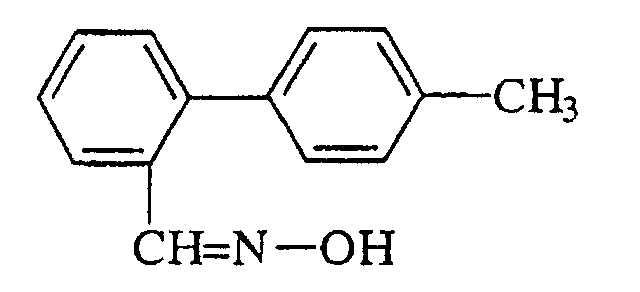
- Dérivé de méthyl-biphényle selon la Revendication 1, caractérisé en ce que R représente cyclohexyle.
- Dérivé de méthyl-biphényie selon la Revendication 1, caractérisé en ce que R représente tertiobutyle.
- Procédé de préparation du dérivé de méthyl-biphényle selon la Revendication 2, caractérisé en ce que l'on fait réagir un sel d'hydroxylamine avec un dérivé benzaldimine selon une des Revendications 1, 3 ou 4, ce qui fournit le composé désiré.
- Procédé selon la Revendication 5, caractérisé en ce que la réaction a lieu à une température comprise entre 0°C et 10°C.
- Procédé selon la Revendication 5 ou 6, caractérisé en ce que la réaction s'effectue dans un solvant aprotique.
- Procédé selon la Revendication 7, caractérisé en ce que le solvant aprotique est un éther aliphatique ou alicyclique, un hydrocarbure aliphatique ou aromatique ou un hydrocarbure halogéné.
- Procédé selon la Revendication 7 ou 8, caractérisé en ce que le solvant aprotique est le tétrahydrofuranne, le méthyl-tertiobutyléther, le dibutyléther ou le dioxane.
- Procédé de préparation de dérivés de méthyl-biphényle selon une des Revendications 1, 3 ou 4, caractérisé en ce que l'on fait réagir, en présence d'un dérivé minéral du manganèse, un dérivé benzaldimine de formule générale:dans laquelle R représente un groupement alkyle, linéaire ou ramifié, en C3-C7 ou cycloalkyle en C3-C7 et Hal représente un atome d'halogène, ce composé étant sous forme d'isomères individuels ou de mélanges de ceux-ci, avec un halogénure de p-tolylmagnésium, ce qui fournit les composés désirés.

- Procédé selon la Revendication 10, caractérisé en ce que la réaction a lieu à une température comprise entre -10°C et la température de reflux.
- Procédé selon une des Revendications 10 ou 11, caractérisé en ce que la réaction s'effectue dans un éther aliphatique ou alicyclique.
- Procédé selon une des Revendications 10 ou 11, caractérisé en ce que l'éther est le tétrahydrofuranne, le méthyl-tertiobutyléther, le dibutyléther ou le dioxane.
- Procédé selon une des Revendications 10 à 13, caractérisé en ce que l'on utilise de 1 à 2 équivalents molaires de chlorure ou de bromure de p-tolylmagnésium par équivalent molaire de dérivé de benzaldimine de formule III.
- Procédé selon une des Revendications 10 à 14, caractérisé en ce que le dérivé minéral du manganèse est un sel de manganèse ou un oxyde de manganèse.
- Procédé selon la Revendication 15, caractérisé en ce que le sel de manganèse est un sel manganeux et l'oxyde de manganèse est l'oxyde manganeux.
- Procédé selon la Revendication 16, caractérisé en ce que le sel manganeux est MnCl2 ou MnCl4 Li2.
- Procédé selon une des Revendications 10 à 17, caractérisé en ce que le dérivé minéral du manganèse intervient à raison de 0,1 à 0,5 équivalent molaire par équivalent molaire de dérivé de benzaldimine de formule III.
- Procédé de préparation du o-(p-tolyl)-benzonitrile, caractérisé en ce que l'on soumet le dérivé de méthyl-biphényle selon la Revendication 2 à l'action d'un agent déshydratant.
- Procédé selon la Revendication 19, caractérisé en ce que la réaction produite s'effectue à une température comprise entre la température ambiante et la température de reflux du milieu.
- Procédé selon la Revendication 19 ou 20, caractérisé en ce que la réaction se déroule dans un solvant aprotique.
- Procédé selon la Revendication 21 caractérisé en ce que le solvant aprotique est un éther.
- Procédé selon une des Revendications 19 à 22, caractérisé en ce que l'agent déshydratant est l'acide formique, l'anhydride phosphorique, l'oxychlorure de phosphore, la pyridine ou le dicyclohexylcarbodiimide.
- Procédé de préparation du o-(p-tolyl)-benzonitrile selon la Revendication 19, caractérisé en ce que l'on transforme un dérivé benzaldimine de formule II selon la Revendication 1 :
soit :soit :(a) par réaction avec un sel d'hydroxylamine, dans un solvant aprotique et à une température comprise entre 0°C et 10°C, de manière à former transitoirement et sans isolement l'o-(p-tolyl)-benzaldoxime que l'on traite au moyen d'un agent déshydratant à une température comprise entre la température ambiante et la température de reflux, ce qui fournit le composé désiré,soit :(b) par réaction avec l'acide hydroxylamine-O-sulfonique dans un milieu biphasique formé d'eau et d'un solvant aprotique et à une température comprise entre la température ambiante et la température de reflux, pour obtenir transitoirement et sans isolement l'o-(p-tolyl)-benzaldoxime en mélange avec l'o-(p-tolyl)-benzonitrile, mélange que l'on traite au moyen d'un agent déshydratant à une température comprise entre la température ambiante et la température de reflux, ce qui fournit le composé désiré,(c) par hydrolyse dans un solvant aprotique, pour obtenir l'o-(p-tolyl)-benzaldéhyde que l'on fait réagir avec un sel d'hydroxylamine à une température comprise entre 0°C et 10°C, ce qui fournit transitoirement et sans isolement l'o-(p-tolyl)-benzaldoxime que l'on traite avec un agent déshydratant à une température comprise entre la température ambiante et la température de reflux du milieu, ce qui fournit le composé désiré. - Procédé selon la Revendication 24, caractérisé en ce que le dérivé benzaldimine de formule II est obtenu par réaction entre un dérivé benzaldimine de formule générale :dans laquelle R représente un groupement alkyle, linéaire ou ramifié, en C3-C7 ou cycloalkyle en C3-C7, ce composé étant sous forme d'isomères individuels ou de mélanges de ceux-ci, avec un halogénure de p-tolylmagnésium en présence d'un dérivé minéral du manganèse, puis transformé sans isolement de son milieu réactionnel.

Applications Claiming Priority (3)
| Application Number | Priority Date | Filing Date | Title |
|---|---|---|---|
| FR9803621A FR2776658B3 (fr) | 1998-03-24 | 1998-03-24 | Derives de methyl-biphenyle, leur procede de preparation et leur utilisation |
| FR9803621 | 1998-03-24 | ||
| PCT/FR1999/000593 WO1999048861A1 (fr) | 1998-03-24 | 1999-03-17 | Derives de methyl-biphenyle, leur procede de preparation et leur utilisation |
Publications (2)
| Publication Number | Publication Date |
|---|---|
| EP1066248A1 EP1066248A1 (fr) | 2001-01-10 |
| EP1066248B1 true EP1066248B1 (fr) | 2003-06-18 |
Family
ID=9524434
Family Applications (1)
| Application Number | Title | Priority Date | Filing Date |
|---|---|---|---|
| EP99909013A Expired - Lifetime EP1066248B1 (fr) | 1998-03-24 | 1999-03-17 | Derives de methyl-biphenyle, leur procede de preparation et leur utilisation |
Country Status (12)
| Country | Link |
|---|---|
| US (1) | US6417400B1 (fr) |
| EP (1) | EP1066248B1 (fr) |
| JP (1) | JP4278301B2 (fr) |
| AT (1) | ATE243189T1 (fr) |
| AU (1) | AU2840899A (fr) |
| BR (1) | BR9909038B1 (fr) |
| CA (1) | CA2325000C (fr) |
| DE (1) | DE69908922T2 (fr) |
| FR (1) | FR2776658B3 (fr) |
| HU (1) | HU224352B1 (fr) |
| NO (1) | NO329128B1 (fr) |
| WO (1) | WO1999048861A1 (fr) |
Family Cites Families (1)
| Publication number | Priority date | Publication date | Assignee | Title |
|---|---|---|---|---|
| FR2689887B1 (fr) | 1992-04-13 | 1995-06-23 | Sanofi Elf | Procede de preparation d'un derive de biphenyle. |
-
1998
- 1998-03-24 FR FR9803621A patent/FR2776658B3/fr not_active Expired - Lifetime
-
1999
- 1999-03-17 EP EP99909013A patent/EP1066248B1/fr not_active Expired - Lifetime
- 1999-03-17 BR BRPI9909038-4B1A patent/BR9909038B1/pt active IP Right Grant
- 1999-03-17 JP JP2000537846A patent/JP4278301B2/ja not_active Expired - Lifetime
- 1999-03-17 WO PCT/FR1999/000593 patent/WO1999048861A1/fr not_active Ceased
- 1999-03-17 US US09/646,629 patent/US6417400B1/en not_active Expired - Lifetime
- 1999-03-17 CA CA002325000A patent/CA2325000C/fr not_active Expired - Lifetime
- 1999-03-17 HU HU0102618A patent/HU224352B1/hu active IP Right Grant
- 1999-03-17 AU AU28408/99A patent/AU2840899A/en not_active Abandoned
- 1999-03-17 AT AT99909013T patent/ATE243189T1/de not_active IP Right Cessation
- 1999-03-17 DE DE69908922T patent/DE69908922T2/de not_active Expired - Lifetime
-
2000
- 2000-09-22 NO NO20004764A patent/NO329128B1/no not_active IP Right Cessation
Also Published As
| Publication number | Publication date |
|---|---|
| CA2325000A1 (fr) | 1999-09-30 |
| BR9909038B1 (pt) | 2013-07-23 |
| FR2776658A1 (fr) | 1999-10-01 |
| FR2776658B3 (fr) | 2000-05-26 |
| BR9909038A (pt) | 2000-12-05 |
| ATE243189T1 (de) | 2003-07-15 |
| CA2325000C (fr) | 2008-01-29 |
| HUP0102618A3 (en) | 2003-12-29 |
| HU224352B1 (hu) | 2005-08-29 |
| DE69908922D1 (de) | 2003-07-24 |
| AU2840899A (en) | 1999-10-18 |
| WO1999048861A1 (fr) | 1999-09-30 |
| NO20004764L (no) | 2000-11-24 |
| EP1066248A1 (fr) | 2001-01-10 |
| HUP0102618A2 (hu) | 2002-05-29 |
| NO20004764D0 (no) | 2000-09-22 |
| DE69908922T2 (de) | 2004-05-19 |
| JP4278301B2 (ja) | 2009-06-10 |
| NO329128B1 (no) | 2010-08-30 |
| JP2002507593A (ja) | 2002-03-12 |
| US6417400B1 (en) | 2002-07-09 |
Similar Documents
| Publication | Publication Date | Title |
|---|---|---|
| CA2640041C (fr) | Nouveau procede de synthese du ranelate de strontium et de ses hydrates | |
| JPH0262854A (ja) | 置換フェノキシアセトアルデヒドオキシム類の製造方法 | |
| KR20040026626A (ko) | 5-[비스(카르복시메틸)아미노]-3-카르복시메틸-4-시아노-2-티오펜카르복실산의 테트라에스테르의 산업적 합성 방법및 라넬산의 이가염 또는 그 수화물의 합성에의 적용 | |
| WO2007105793A1 (fr) | Méthode de nitration de l'isourée | |
| EP0406112A1 (fr) | 1-Benzhydrylazétidines, leur préparation et leur application comme intermédiaires pour la préparation de composés à activité antimicrobienne | |
| JP2004511475A (ja) | ラセミ体チオクト酸の製造方法 | |
| CN111885917B (zh) | 5-氯-2-[(3,4,4-三氟-3-丁烯-l-基)硫代]-噻唑的合成 | |
| EP1066248A1 (fr) | Derives de methyl-biphenyle, leur procede de preparation et leur utilisation | |
| SK20192000A3 (sk) | Soli n-terc-butylhydroxylamínu | |
| CA2054821C (fr) | Procede d'obtention de 3-aminocrotononitrile | |
| CA2265438C (fr) | Procede pour la preparation d'un cyanobiphenyle | |
| EP2874995A1 (fr) | Procede de preparation du diaminomaleonitrile | |
| FR2551747A1 (fr) | Procede de production d'aminobenzylamines | |
| JP3628380B2 (ja) | 1,4−架橋シクロヘキサン系カルボン酸誘導体の製造方法 | |
| JP2009518380A (ja) | 2−クロロエトキシ−酢酸−n,n−ジメチルアミドの製法 | |
| FR2505327A1 (fr) | Procede d'halogenation en meta de n-(o,o'-dialkyl phenyl) alaninates et homologues | |
| EP0068979A1 (fr) | Procédé de préparation de dérivés des (thiényl-2)- et (thiényl-3)-2 éthylamines et produits ainsi obtenus | |
| BE856317Q (fr) | Procede de preparation d'acides arylalcanoiques | |
| EP2938595B1 (fr) | Procede de synthese d'une hydrazine utile dans le traitement du virus du papillome | |
| JPH03504603A (ja) | O‐置換オキシム化合物の合成方法 | |
| JPH09512805A (ja) | O−フェノキシアルキルヒドロキシルアミンまたはo−フェノキシアルキルオキシム異性体混合物を製造する方法 | |
| FR2505332A1 (fr) | Composes pour la synthese de prostaglandines et prostacyclines contenant de l'azote, et procede pour leur preparation | |
| JP4218310B2 (ja) | 光学活性2−アミノ−2−フェニルエタノール類の製造方法およびその中間体 | |
| MXPA00009304A (en) | Methyl-phenyl derivatives, preparation method and use | |
| FR2848212A1 (fr) | Derives de la colchicine, procede de preparation, produits obtenus par ce procede et utilisation |
Legal Events
| Date | Code | Title | Description |
|---|---|---|---|
| PUAI | Public reference made under article 153(3) epc to a published international application that has entered the european phase |
Free format text: ORIGINAL CODE: 0009012 |
|
| 17P | Request for examination filed |
Effective date: 20001024 |
|
| AK | Designated contracting states |
Kind code of ref document: A1 Designated state(s): AT BE CH CY DE DK ES FI FR GB GR IE IT LI LU MC NL PT SE |
|
| AX | Request for extension of the european patent |
Free format text: AL PAYMENT 20001024;LT PAYMENT 20001024;LV PAYMENT 20001024;MK PAYMENT 20001024;RO PAYMENT 20001024;SI PAYMENT 20001024 |
|
| RTI1 | Title (correction) |
Free format text: METHYL-BIPHENYL DERIVATIVES, PREPARATION METHOD AND USE |
|
| GRAH | Despatch of communication of intention to grant a patent |
Free format text: ORIGINAL CODE: EPIDOS IGRA |
|
| GRAH | Despatch of communication of intention to grant a patent |
Free format text: ORIGINAL CODE: EPIDOS IGRA |
|
| GRAA | (expected) grant |
Free format text: ORIGINAL CODE: 0009210 |
|
| AK | Designated contracting states |
Designated state(s): AT BE CH CY DE DK ES FI FR GB GR IE IT LI LU MC NL PT SE |
|
| AX | Request for extension of the european patent |
Extension state: AL LT LV MK RO SI |
|
| PG25 | Lapsed in a contracting state [announced via postgrant information from national office to epo] |
Ref country code: FI Free format text: LAPSE BECAUSE OF FAILURE TO SUBMIT A TRANSLATION OF THE DESCRIPTION OR TO PAY THE FEE WITHIN THE PRESCRIBED TIME-LIMIT Effective date: 20030618 Ref country code: CY Free format text: LAPSE BECAUSE OF FAILURE TO SUBMIT A TRANSLATION OF THE DESCRIPTION OR TO PAY THE FEE WITHIN THE PRESCRIBED TIME-LIMIT Effective date: 20030618 Ref country code: AT Free format text: LAPSE BECAUSE OF FAILURE TO SUBMIT A TRANSLATION OF THE DESCRIPTION OR TO PAY THE FEE WITHIN THE PRESCRIBED TIME-LIMIT Effective date: 20030618 |
|
| REG | Reference to a national code |
Ref country code: GB Ref legal event code: FG4D Free format text: NOT ENGLISH |
|
| REG | Reference to a national code |
Ref country code: CH Ref legal event code: EP |
|
| REG | Reference to a national code |
Ref country code: IE Ref legal event code: FG4D Free format text: FRENCH |
|
| REF | Corresponds to: |
Ref document number: 69908922 Country of ref document: DE Date of ref document: 20030724 Kind code of ref document: P |
|
| PG25 | Lapsed in a contracting state [announced via postgrant information from national office to epo] |
Ref country code: SE Free format text: LAPSE BECAUSE OF FAILURE TO SUBMIT A TRANSLATION OF THE DESCRIPTION OR TO PAY THE FEE WITHIN THE PRESCRIBED TIME-LIMIT Effective date: 20030918 Ref country code: PT Free format text: LAPSE BECAUSE OF FAILURE TO SUBMIT A TRANSLATION OF THE DESCRIPTION OR TO PAY THE FEE WITHIN THE PRESCRIBED TIME-LIMIT Effective date: 20030918 Ref country code: GR Free format text: LAPSE BECAUSE OF FAILURE TO SUBMIT A TRANSLATION OF THE DESCRIPTION OR TO PAY THE FEE WITHIN THE PRESCRIBED TIME-LIMIT Effective date: 20030918 Ref country code: DK Free format text: LAPSE BECAUSE OF FAILURE TO SUBMIT A TRANSLATION OF THE DESCRIPTION OR TO PAY THE FEE WITHIN THE PRESCRIBED TIME-LIMIT Effective date: 20030918 |
|
| PG25 | Lapsed in a contracting state [announced via postgrant information from national office to epo] |
Ref country code: ES Free format text: LAPSE BECAUSE OF FAILURE TO SUBMIT A TRANSLATION OF THE DESCRIPTION OR TO PAY THE FEE WITHIN THE PRESCRIBED TIME-LIMIT Effective date: 20030929 |
|
| GBT | Gb: translation of ep patent filed (gb section 77(6)(a)/1977) | ||
| LTIE | Lt: invalidation of european patent or patent extension |
Effective date: 20030618 |
|
| PG25 | Lapsed in a contracting state [announced via postgrant information from national office to epo] |
Ref country code: LU Free format text: LAPSE BECAUSE OF NON-PAYMENT OF DUE FEES Effective date: 20040317 |
|
| PG25 | Lapsed in a contracting state [announced via postgrant information from national office to epo] |
Ref country code: MC Free format text: LAPSE BECAUSE OF NON-PAYMENT OF DUE FEES Effective date: 20040331 Ref country code: BE Free format text: LAPSE BECAUSE OF NON-PAYMENT OF DUE FEES Effective date: 20040331 |
|
| PLBE | No opposition filed within time limit |
Free format text: ORIGINAL CODE: 0009261 |
|
| STAA | Information on the status of an ep patent application or granted ep patent |
Free format text: STATUS: NO OPPOSITION FILED WITHIN TIME LIMIT |
|
| 26N | No opposition filed |
Effective date: 20040319 |
|
| BERE | Be: lapsed |
Owner name: *SANOFI-SYNTHELABO Effective date: 20040331 |
|
| REG | Reference to a national code |
Ref country code: CH Ref legal event code: NV Representative=s name: KIRKER & CIE SA |
|
| REG | Reference to a national code |
Ref country code: CH Ref legal event code: PFA Owner name: SANOFI-AVENTIS Free format text: SANOFI-SYNTHELABO#174, AVENUE DE FRANCE#75013 PARIS (FR) -TRANSFER TO- SANOFI-AVENTIS#174, AVENUE DE FRANCE#75013 PARIS (FR) |
|
| NLT1 | Nl: modifications of names registered in virtue of documents presented to the patent office pursuant to art. 16 a, paragraph 1 |
Owner name: SANOFI -AVENTIS |
|
| REG | Reference to a national code |
Ref country code: FR Ref legal event code: CD |
|
| REG | Reference to a national code |
Ref country code: DE Ref legal event code: R082 Ref document number: 69908922 Country of ref document: DE Representative=s name: TER MEER STEINMEISTER & PARTNER GBR PATENTANWA, DE |
|
| REG | Reference to a national code |
Ref country code: DE Ref legal event code: R082 Ref document number: 69908922 Country of ref document: DE Representative=s name: TER MEER STEINMEISTER & PARTNER PATENTANWAELTE, DE Effective date: 20130205 Ref country code: DE Ref legal event code: R082 Ref document number: 69908922 Country of ref document: DE Representative=s name: TER MEER STEINMEISTER & PARTNER GBR PATENTANWA, DE Effective date: 20130205 Ref country code: DE Ref legal event code: R081 Ref document number: 69908922 Country of ref document: DE Owner name: SANOFI-AVENTIS, FR Free format text: FORMER OWNER: SANOFI-AVENTIS, PARIS, FR Effective date: 20130205 Ref country code: DE Ref legal event code: R081 Ref document number: 69908922 Country of ref document: DE Owner name: SANOFI, FR Free format text: FORMER OWNER: SANOFI-AVENTIS, PARIS, FR Effective date: 20130205 |
|
| REG | Reference to a national code |
Ref country code: FR Ref legal event code: PLFP Year of fee payment: 18 |
|
| REG | Reference to a national code |
Ref country code: FR Ref legal event code: PLFP Year of fee payment: 19 |
|
| REG | Reference to a national code |
Ref country code: DE Ref legal event code: R082 Ref document number: 69908922 Country of ref document: DE Representative=s name: TER MEER STEINMEISTER & PARTNER PATENTANWAELTE, DE Ref country code: DE Ref legal event code: R081 Ref document number: 69908922 Country of ref document: DE Owner name: SANOFI, FR Free format text: FORMER OWNER: SANOFI-AVENTIS, 75013 PARIS, FR |
|
| REG | Reference to a national code |
Ref country code: FR Ref legal event code: PLFP Year of fee payment: 20 |
|
| PGFP | Annual fee paid to national office [announced via postgrant information from national office to epo] |
Ref country code: CH Payment date: 20180314 Year of fee payment: 20 Ref country code: NL Payment date: 20180314 Year of fee payment: 20 Ref country code: GB Payment date: 20180314 Year of fee payment: 20 Ref country code: DE Payment date: 20180306 Year of fee payment: 20 |
|
| PGFP | Annual fee paid to national office [announced via postgrant information from national office to epo] |
Ref country code: IE Payment date: 20180312 Year of fee payment: 20 Ref country code: IT Payment date: 20180321 Year of fee payment: 20 Ref country code: FR Payment date: 20180223 Year of fee payment: 20 |
|
| REG | Reference to a national code |
Ref country code: DE Ref legal event code: R071 Ref document number: 69908922 Country of ref document: DE |
|
| REG | Reference to a national code |
Ref country code: NL Ref legal event code: MK Effective date: 20190316 |
|
| REG | Reference to a national code |
Ref country code: CH Ref legal event code: PL |
|
| REG | Reference to a national code |
Ref country code: GB Ref legal event code: PE20 Expiry date: 20190316 |
|
| REG | Reference to a national code |
Ref country code: IE Ref legal event code: MK9A |
|
| PG25 | Lapsed in a contracting state [announced via postgrant information from national office to epo] |
Ref country code: IE Free format text: LAPSE BECAUSE OF EXPIRATION OF PROTECTION Effective date: 20190317 Ref country code: GB Free format text: LAPSE BECAUSE OF EXPIRATION OF PROTECTION Effective date: 20190316 |