EP1077791B1 - Articles abrasifs comportant un systeme de liaison a couche abrasive derive de particules precurseurs de liants enrobees a sec et solides comportant un composant fusible durcissable par radiation - Google Patents
Articles abrasifs comportant un systeme de liaison a couche abrasive derive de particules precurseurs de liants enrobees a sec et solides comportant un composant fusible durcissable par radiation Download PDFInfo
- Publication number
- EP1077791B1 EP1077791B1 EP99915130A EP99915130A EP1077791B1 EP 1077791 B1 EP1077791 B1 EP 1077791B1 EP 99915130 A EP99915130 A EP 99915130A EP 99915130 A EP99915130 A EP 99915130A EP 1077791 B1 EP1077791 B1 EP 1077791B1
- Authority
- EP
- European Patent Office
- Prior art keywords
- sample
- particles
- radiation curable
- abrasive
- solid
- Prior art date
- Legal status (The legal status is an assumption and is not a legal conclusion. Google has not performed a legal analysis and makes no representation as to the accuracy of the status listed.)
- Expired - Lifetime
Links
- 239000002245 particle Substances 0.000 title claims description 210
- 230000005855 radiation Effects 0.000 title claims description 166
- 239000011230 binding agent Substances 0.000 title claims description 146
- 239000007787 solid Substances 0.000 title claims description 116
- 239000002243 precursor Substances 0.000 claims description 148
- 239000000843 powder Substances 0.000 claims description 93
- 239000000178 monomer Substances 0.000 claims description 92
- 239000000203 mixture Substances 0.000 claims description 81
- 238000000576 coating method Methods 0.000 claims description 65
- 229920000642 polymer Polymers 0.000 claims description 56
- 239000011248 coating agent Substances 0.000 claims description 54
- 238000000034 method Methods 0.000 claims description 52
- 235000014113 dietary fatty acids Nutrition 0.000 claims description 37
- 229930195729 fatty acid Natural products 0.000 claims description 37
- 239000000194 fatty acid Substances 0.000 claims description 37
- 150000004665 fatty acids Chemical class 0.000 claims description 36
- 229910052751 metal Inorganic materials 0.000 claims description 36
- 239000002184 metal Substances 0.000 claims description 36
- 229920002521 macromolecule Polymers 0.000 claims description 34
- ISWSIDIOOBJBQZ-UHFFFAOYSA-N phenol group Chemical group C1(=CC=CC=C1)O ISWSIDIOOBJBQZ-UHFFFAOYSA-N 0.000 claims description 29
- 150000003839 salts Chemical class 0.000 claims description 28
- CJZGTCYPCWQAJB-UHFFFAOYSA-L calcium stearate Chemical compound [Ca+2].CCCCCCCCCCCCCCCCCC([O-])=O.CCCCCCCCCCCCCCCCCC([O-])=O CJZGTCYPCWQAJB-UHFFFAOYSA-L 0.000 claims description 25
- 239000004593 Epoxy Substances 0.000 claims description 24
- -1 aromatic dicarboxylic acids Chemical class 0.000 claims description 24
- 239000008116 calcium stearate Substances 0.000 claims description 23
- 235000013539 calcium stearate Nutrition 0.000 claims description 23
- 125000003118 aryl group Chemical group 0.000 claims description 20
- 238000001723 curing Methods 0.000 claims description 20
- 125000002887 hydroxy group Chemical group [H]O* 0.000 claims description 20
- 229920003986 novolac Polymers 0.000 claims description 19
- 239000004643 cyanate ester Substances 0.000 claims description 17
- 239000000155 melt Substances 0.000 claims description 17
- NIXOWILDQLNWCW-UHFFFAOYSA-M Acrylate Chemical compound [O-]C(=O)C=C NIXOWILDQLNWCW-UHFFFAOYSA-M 0.000 claims description 16
- XOOUIPVCVHRTMJ-UHFFFAOYSA-L zinc stearate Chemical compound [Zn+2].CCCCCCCCCCCCCCCCCC([O-])=O.CCCCCCCCCCCCCCCCCC([O-])=O XOOUIPVCVHRTMJ-UHFFFAOYSA-L 0.000 claims description 15
- 229920000728 polyester Polymers 0.000 claims description 12
- QYKIQEUNHZKYBP-UHFFFAOYSA-N Vinyl ether Chemical compound C=COC=C QYKIQEUNHZKYBP-UHFFFAOYSA-N 0.000 claims description 10
- IISBACLAFKSPIT-UHFFFAOYSA-N bisphenol A Chemical compound C=1C=C(O)C=CC=1C(C)(C)C1=CC=C(O)C=C1 IISBACLAFKSPIT-UHFFFAOYSA-N 0.000 claims description 9
- 229920000647 polyepoxide Polymers 0.000 claims description 9
- 239000003822 epoxy resin Substances 0.000 claims description 7
- 150000002148 esters Chemical class 0.000 claims description 7
- 230000009969 flowable effect Effects 0.000 claims description 7
- 125000005647 linker group Chemical group 0.000 claims description 7
- 125000000217 alkyl group Chemical group 0.000 claims description 6
- LNEPOXFFQSENCJ-UHFFFAOYSA-N haloperidol Chemical compound C1CC(O)(C=2C=CC(Cl)=CC=2)CCN1CCCC(=O)C1=CC=C(F)C=C1 LNEPOXFFQSENCJ-UHFFFAOYSA-N 0.000 claims description 6
- HRPVXLWXLXDGHG-UHFFFAOYSA-N Acrylamide Chemical compound NC(=O)C=C HRPVXLWXLXDGHG-UHFFFAOYSA-N 0.000 claims description 5
- 125000004432 carbon atom Chemical group C* 0.000 claims description 5
- 150000001913 cyanates Chemical class 0.000 claims description 5
- 229910052739 hydrogen Inorganic materials 0.000 claims description 5
- 230000007704 transition Effects 0.000 claims description 5
- 125000000623 heterocyclic group Chemical group 0.000 claims description 4
- 239000001257 hydrogen Substances 0.000 claims description 4
- ZFSLODLOARCGLH-UHFFFAOYSA-N isocyanuric acid Chemical compound OC1=NC(O)=NC(O)=N1 ZFSLODLOARCGLH-UHFFFAOYSA-N 0.000 claims description 3
- UFHFLCQGNIYNRP-UHFFFAOYSA-N Hydrogen Chemical compound [H][H] UFHFLCQGNIYNRP-UHFFFAOYSA-N 0.000 claims description 2
- 229920000193 polymethacrylate Polymers 0.000 claims description 2
- 238000000151 deposition Methods 0.000 claims 4
- 150000001408 amides Chemical class 0.000 claims 2
- 239000007790 solid phase Substances 0.000 claims 2
- 230000001678 irradiating effect Effects 0.000 claims 1
- 238000003847 radiation curing Methods 0.000 claims 1
- 230000000052 comparative effect Effects 0.000 description 88
- 239000000463 material Substances 0.000 description 37
- 102100038248 Cis-aconitate decarboxylase Human genes 0.000 description 34
- 101001032339 Homo sapiens Cis-aconitate decarboxylase Proteins 0.000 description 34
- 238000002360 preparation method Methods 0.000 description 30
- 239000000126 substance Substances 0.000 description 28
- 238000012360 testing method Methods 0.000 description 28
- 229920005989 resin Polymers 0.000 description 25
- 239000011347 resin Substances 0.000 description 25
- WSFSSNUMVMOOMR-UHFFFAOYSA-N Formaldehyde Chemical compound O=C WSFSSNUMVMOOMR-UHFFFAOYSA-N 0.000 description 24
- 238000002844 melting Methods 0.000 description 23
- 230000008018 melting Effects 0.000 description 23
- 239000002904 solvent Substances 0.000 description 23
- 239000007788 liquid Substances 0.000 description 22
- 238000001548 drop coating Methods 0.000 description 21
- 238000009472 formulation Methods 0.000 description 21
- 238000002156 mixing Methods 0.000 description 21
- 238000000227 grinding Methods 0.000 description 19
- 239000011159 matrix material Substances 0.000 description 19
- WYURNTSHIVDZCO-UHFFFAOYSA-N Tetrahydrofuran Chemical compound C1CCOC1 WYURNTSHIVDZCO-UHFFFAOYSA-N 0.000 description 18
- 239000004615 ingredient Substances 0.000 description 17
- 239000003795 chemical substances by application Substances 0.000 description 16
- 239000000376 reactant Substances 0.000 description 16
- 238000006243 chemical reaction Methods 0.000 description 15
- DAKWPKUUDNSNPN-UHFFFAOYSA-N Trimethylolpropane triacrylate Chemical compound C=CC(=O)OCC(CC)(COC(=O)C=C)COC(=O)C=C DAKWPKUUDNSNPN-UHFFFAOYSA-N 0.000 description 14
- YIMQCDZDWXUDCA-UHFFFAOYSA-N [4-(hydroxymethyl)cyclohexyl]methanol Chemical compound OCC1CCC(CO)CC1 YIMQCDZDWXUDCA-UHFFFAOYSA-N 0.000 description 13
- LSQZJLSUYDQPKJ-NJBDSQKTSA-N amoxicillin Chemical compound C1([C@@H](N)C(=O)N[C@H]2[C@H]3SC([C@@H](N3C2=O)C(O)=O)(C)C)=CC=C(O)C=C1 LSQZJLSUYDQPKJ-NJBDSQKTSA-N 0.000 description 13
- 229920001568 phenolic resin Polymers 0.000 description 13
- 238000012545 processing Methods 0.000 description 13
- 239000005011 phenolic resin Substances 0.000 description 12
- KXGFMDJXCMQABM-UHFFFAOYSA-N 2-methoxy-6-methylphenol Chemical compound [CH]OC1=CC=CC([CH])=C1O KXGFMDJXCMQABM-UHFFFAOYSA-N 0.000 description 10
- 238000004519 manufacturing process Methods 0.000 description 10
- 229920003987 resole Polymers 0.000 description 10
- 230000008901 benefit Effects 0.000 description 9
- 239000000243 solution Substances 0.000 description 9
- YLQBMQCUIZJEEH-UHFFFAOYSA-N tetrahydrofuran Natural products C=1C=COC=1 YLQBMQCUIZJEEH-UHFFFAOYSA-N 0.000 description 9
- 230000001070 adhesive effect Effects 0.000 description 8
- 229920006217 cellulose acetate butyrate Polymers 0.000 description 8
- 238000004132 cross linking Methods 0.000 description 8
- LJRSZGKUUZPHEB-UHFFFAOYSA-N 2-[2-(2-prop-2-enoyloxypropoxy)propoxy]propyl prop-2-enoate Chemical compound C=CC(=O)OC(C)COC(C)COC(C)COC(=O)C=C LJRSZGKUUZPHEB-UHFFFAOYSA-N 0.000 description 7
- 239000000853 adhesive Substances 0.000 description 7
- 239000007864 aqueous solution Substances 0.000 description 7
- 239000013067 intermediate product Substances 0.000 description 7
- TWNQGVIAIRXVLR-UHFFFAOYSA-N oxo(oxoalumanyloxy)alumane Chemical compound O=[Al]O[Al]=O TWNQGVIAIRXVLR-UHFFFAOYSA-N 0.000 description 7
- ZMANZCXQSJIPKH-UHFFFAOYSA-N Triethylamine Chemical compound CCN(CC)CC ZMANZCXQSJIPKH-UHFFFAOYSA-N 0.000 description 6
- 229910001610 cryolite Inorganic materials 0.000 description 6
- GYZLOYUZLJXAJU-UHFFFAOYSA-N diglycidyl ether Chemical compound C1OC1COCC1CO1 GYZLOYUZLJXAJU-UHFFFAOYSA-N 0.000 description 6
- 125000003700 epoxy group Chemical group 0.000 description 6
- 229910052500 inorganic mineral Inorganic materials 0.000 description 6
- 238000010128 melt processing Methods 0.000 description 6
- 235000010755 mineral Nutrition 0.000 description 6
- 239000011707 mineral Substances 0.000 description 6
- 239000000047 product Substances 0.000 description 6
- 238000010998 test method Methods 0.000 description 6
- 229920001169 thermoplastic Polymers 0.000 description 6
- KUBDPQJOLOUJRM-UHFFFAOYSA-N 2-(chloromethyl)oxirane;4-[2-(4-hydroxyphenyl)propan-2-yl]phenol Chemical compound ClCC1CO1.C=1C=C(O)C=CC=1C(C)(C)C1=CC=C(O)C=C1 KUBDPQJOLOUJRM-UHFFFAOYSA-N 0.000 description 5
- 229920003261 Durez Polymers 0.000 description 5
- 229910020261 KBF4 Inorganic materials 0.000 description 5
- 108091092920 SmY RNA Proteins 0.000 description 5
- 241001237710 Smyrna Species 0.000 description 5
- 239000006061 abrasive grain Substances 0.000 description 5
- 150000001875 compounds Chemical class 0.000 description 5
- 239000012530 fluid Substances 0.000 description 5
- 238000010438 heat treatment Methods 0.000 description 5
- 238000005507 spraying Methods 0.000 description 5
- 229920001187 thermosetting polymer Polymers 0.000 description 5
- 239000004416 thermosoftening plastic Substances 0.000 description 5
- 239000001993 wax Substances 0.000 description 5
- KWVGIHKZDCUPEU-UHFFFAOYSA-N 2,2-dimethoxy-2-phenylacetophenone Chemical compound C=1C=CC=CC=1C(OC)(OC)C(=O)C1=CC=CC=C1 KWVGIHKZDCUPEU-UHFFFAOYSA-N 0.000 description 4
- IJGRMHOSHXDMSA-UHFFFAOYSA-N Atomic nitrogen Chemical compound N#N IJGRMHOSHXDMSA-UHFFFAOYSA-N 0.000 description 4
- VTYYLEPIZMXCLO-UHFFFAOYSA-L Calcium carbonate Chemical compound [Ca+2].[O-]C([O-])=O VTYYLEPIZMXCLO-UHFFFAOYSA-L 0.000 description 4
- 241000870659 Crassula perfoliata var. minor Species 0.000 description 4
- UQSXHKLRYXJYBZ-UHFFFAOYSA-N Iron oxide Chemical compound [Fe]=O UQSXHKLRYXJYBZ-UHFFFAOYSA-N 0.000 description 4
- OFOBLEOULBTSOW-UHFFFAOYSA-N Malonic acid Chemical compound OC(=O)CC(O)=O OFOBLEOULBTSOW-UHFFFAOYSA-N 0.000 description 4
- IMNFDUFMRHMDMM-UHFFFAOYSA-N N-Heptane Chemical compound CCCCCCC IMNFDUFMRHMDMM-UHFFFAOYSA-N 0.000 description 4
- 239000004952 Polyamide Substances 0.000 description 4
- 239000004820 Pressure-sensitive adhesive Substances 0.000 description 4
- VYPSYNLAJGMNEJ-UHFFFAOYSA-N Silicium dioxide Chemical compound O=[Si]=O VYPSYNLAJGMNEJ-UHFFFAOYSA-N 0.000 description 4
- MCMNRKCIXSYSNV-UHFFFAOYSA-N Zirconium dioxide Chemical compound O=[Zr]=O MCMNRKCIXSYSNV-UHFFFAOYSA-N 0.000 description 4
- 239000003082 abrasive agent Substances 0.000 description 4
- 239000002253 acid Substances 0.000 description 4
- 150000002118 epoxides Chemical class 0.000 description 4
- 238000011156 evaluation Methods 0.000 description 4
- 230000009477 glass transition Effects 0.000 description 4
- 238000005065 mining Methods 0.000 description 4
- 239000011941 photocatalyst Substances 0.000 description 4
- 229920002647 polyamide Polymers 0.000 description 4
- 230000008569 process Effects 0.000 description 4
- HBMJWWWQQXIZIP-UHFFFAOYSA-N silicon carbide Chemical compound [Si+]#[C-] HBMJWWWQQXIZIP-UHFFFAOYSA-N 0.000 description 4
- 229920005992 thermoplastic resin Polymers 0.000 description 4
- XEKOWRVHYACXOJ-UHFFFAOYSA-N Ethyl acetate Chemical compound CCOC(C)=O XEKOWRVHYACXOJ-UHFFFAOYSA-N 0.000 description 3
- OKKJLVBELUTLKV-UHFFFAOYSA-N Methanol Chemical compound OC OKKJLVBELUTLKV-UHFFFAOYSA-N 0.000 description 3
- 238000009825 accumulation Methods 0.000 description 3
- 239000000654 additive Substances 0.000 description 3
- 230000015572 biosynthetic process Effects 0.000 description 3
- 229910052799 carbon Inorganic materials 0.000 description 3
- 239000008199 coating composition Substances 0.000 description 3
- 238000001035 drying Methods 0.000 description 3
- 238000010894 electron beam technology Methods 0.000 description 3
- 230000007613 environmental effect Effects 0.000 description 3
- 239000000835 fiber Substances 0.000 description 3
- 239000006260 foam Substances 0.000 description 3
- 239000011521 glass Substances 0.000 description 3
- HGPXWXLYXNVULB-UHFFFAOYSA-M lithium stearate Chemical compound [Li+].CCCCCCCCCCCCCCCCCC([O-])=O HGPXWXLYXNVULB-UHFFFAOYSA-M 0.000 description 3
- 150000002739 metals Chemical class 0.000 description 3
- 229910052757 nitrogen Inorganic materials 0.000 description 3
- QIQXTHQIDYTFRH-UHFFFAOYSA-N octadecanoic acid Chemical compound CCCCCCCCCCCCCCCCCC(O)=O QIQXTHQIDYTFRH-UHFFFAOYSA-N 0.000 description 3
- 229910052760 oxygen Inorganic materials 0.000 description 3
- 229920002635 polyurethane Polymers 0.000 description 3
- 239000004814 polyurethane Substances 0.000 description 3
- 230000002028 premature Effects 0.000 description 3
- 229910010271 silicon carbide Inorganic materials 0.000 description 3
- 239000007921 spray Substances 0.000 description 3
- 238000001029 thermal curing Methods 0.000 description 3
- ILWRPSCZWQJDMK-UHFFFAOYSA-N triethylazanium;chloride Chemical compound Cl.CCN(CC)CC ILWRPSCZWQJDMK-UHFFFAOYSA-N 0.000 description 3
- INQDDHNZXOAFFD-UHFFFAOYSA-N 2-[2-(2-prop-2-enoyloxyethoxy)ethoxy]ethyl prop-2-enoate Chemical compound C=CC(=O)OCCOCCOCCOC(=O)C=C INQDDHNZXOAFFD-UHFFFAOYSA-N 0.000 description 2
- GTELLNMUWNJXMQ-UHFFFAOYSA-N 2-ethyl-2-(hydroxymethyl)propane-1,3-diol;prop-2-enoic acid Chemical class OC(=O)C=C.OC(=O)C=C.OC(=O)C=C.CCC(CO)(CO)CO GTELLNMUWNJXMQ-UHFFFAOYSA-N 0.000 description 2
- OMIGHNLMNHATMP-UHFFFAOYSA-N 2-hydroxyethyl prop-2-enoate Chemical compound OCCOC(=O)C=C OMIGHNLMNHATMP-UHFFFAOYSA-N 0.000 description 2
- KUDUQBURMYMBIJ-UHFFFAOYSA-N 2-prop-2-enoyloxyethyl prop-2-enoate Chemical compound C=CC(=O)OCCOC(=O)C=C KUDUQBURMYMBIJ-UHFFFAOYSA-N 0.000 description 2
- 229920003319 Araldite® Polymers 0.000 description 2
- DJBSUMRYTZSPKT-UHFFFAOYSA-N C=CC(=O)OCCC1(C(=O)O)C=CC(CCOC(=O)C=C)(C(O)=O)C=C1 Chemical compound C=CC(=O)OCCC1(C(=O)O)C=CC(CCOC(=O)C=C)(C(O)=O)C=C1 DJBSUMRYTZSPKT-UHFFFAOYSA-N 0.000 description 2
- OYPRJOBELJOOCE-UHFFFAOYSA-N Calcium Chemical compound [Ca] OYPRJOBELJOOCE-UHFFFAOYSA-N 0.000 description 2
- OKTJSMMVPCPJKN-UHFFFAOYSA-N Carbon Chemical compound [C] OKTJSMMVPCPJKN-UHFFFAOYSA-N 0.000 description 2
- HEDRZPFGACZZDS-UHFFFAOYSA-N Chloroform Chemical compound ClC(Cl)Cl HEDRZPFGACZZDS-UHFFFAOYSA-N 0.000 description 2
- RTZKZFJDLAIYFH-UHFFFAOYSA-N Diethyl ether Chemical compound CCOCC RTZKZFJDLAIYFH-UHFFFAOYSA-N 0.000 description 2
- 229920003345 Elvax® Polymers 0.000 description 2
- BRLQWZUYTZBJKN-UHFFFAOYSA-N Epichlorohydrin Chemical compound ClCC1CO1 BRLQWZUYTZBJKN-UHFFFAOYSA-N 0.000 description 2
- LYCAIKOWRPUZTN-UHFFFAOYSA-N Ethylene glycol Chemical compound OCCO LYCAIKOWRPUZTN-UHFFFAOYSA-N 0.000 description 2
- XEEYBQQBJWHFJM-UHFFFAOYSA-N Iron Chemical compound [Fe] XEEYBQQBJWHFJM-UHFFFAOYSA-N 0.000 description 2
- 239000005062 Polybutadiene Substances 0.000 description 2
- WCUXLLCKKVVCTQ-UHFFFAOYSA-M Potassium chloride Chemical compound [Cl-].[K+] WCUXLLCKKVVCTQ-UHFFFAOYSA-M 0.000 description 2
- ATUOYWHBWRKTHZ-UHFFFAOYSA-N Propane Chemical compound CCC ATUOYWHBWRKTHZ-UHFFFAOYSA-N 0.000 description 2
- FAPWRFPIFSIZLT-UHFFFAOYSA-M Sodium chloride Chemical compound [Na+].[Cl-] FAPWRFPIFSIZLT-UHFFFAOYSA-M 0.000 description 2
- 235000021355 Stearic acid Nutrition 0.000 description 2
- 229910000831 Steel Inorganic materials 0.000 description 2
- KKEYFWRCBNTPAC-UHFFFAOYSA-N Terephthalic acid Chemical compound OC(=O)C1=CC=C(C(O)=O)C=C1 KKEYFWRCBNTPAC-UHFFFAOYSA-N 0.000 description 2
- GWEVSGVZZGPLCZ-UHFFFAOYSA-N Titan oxide Chemical compound O=[Ti]=O GWEVSGVZZGPLCZ-UHFFFAOYSA-N 0.000 description 2
- 229920001807 Urea-formaldehyde Polymers 0.000 description 2
- 229920005822 acrylic binder Polymers 0.000 description 2
- VSCWAEJMTAWNJL-UHFFFAOYSA-K aluminium trichloride Chemical compound Cl[Al](Cl)Cl VSCWAEJMTAWNJL-UHFFFAOYSA-K 0.000 description 2
- 230000009286 beneficial effect Effects 0.000 description 2
- 239000004841 bisphenol A epoxy resin Substances 0.000 description 2
- PXKLMJQFEQBVLD-UHFFFAOYSA-N bisphenol F Chemical compound C1=CC(O)=CC=C1CC1=CC=C(O)C=C1 PXKLMJQFEQBVLD-UHFFFAOYSA-N 0.000 description 2
- 239000011575 calcium Substances 0.000 description 2
- 229910052791 calcium Inorganic materials 0.000 description 2
- 229910000019 calcium carbonate Inorganic materials 0.000 description 2
- 239000000919 ceramic Substances 0.000 description 2
- 239000012141 concentrate Substances 0.000 description 2
- 235000008504 concentrate Nutrition 0.000 description 2
- 238000005520 cutting process Methods 0.000 description 2
- 125000004386 diacrylate group Chemical group 0.000 description 2
- 238000000113 differential scanning calorimetry Methods 0.000 description 2
- 125000005442 diisocyanate group Chemical group 0.000 description 2
- 230000009977 dual effect Effects 0.000 description 2
- 239000010433 feldspar Substances 0.000 description 2
- 239000002657 fibrous material Substances 0.000 description 2
- VOZRXNHHFUQHIL-UHFFFAOYSA-N glycidyl methacrylate Chemical compound CC(=C)C(=O)OCC1CO1 VOZRXNHHFUQHIL-UHFFFAOYSA-N 0.000 description 2
- 238000003621 hammer milling Methods 0.000 description 2
- 239000012943 hotmelt Substances 0.000 description 2
- 125000004435 hydrogen atom Chemical group [H]* 0.000 description 2
- 239000003999 initiator Substances 0.000 description 2
- QQVIHTHCMHWDBS-UHFFFAOYSA-N isophthalic acid Chemical compound OC(=O)C1=CC=CC(C(O)=O)=C1 QQVIHTHCMHWDBS-UHFFFAOYSA-N 0.000 description 2
- HQKMJHAJHXVSDF-UHFFFAOYSA-L magnesium stearate Chemical compound [Mg+2].CCCCCCCCCCCCCCCCCC([O-])=O.CCCCCCCCCCCCCCCCCC([O-])=O HQKMJHAJHXVSDF-UHFFFAOYSA-L 0.000 description 2
- 230000007246 mechanism Effects 0.000 description 2
- QSHDDOUJBYECFT-UHFFFAOYSA-N mercury Chemical compound [Hg] QSHDDOUJBYECFT-UHFFFAOYSA-N 0.000 description 2
- 229910052753 mercury Inorganic materials 0.000 description 2
- 238000012986 modification Methods 0.000 description 2
- 230000004048 modification Effects 0.000 description 2
- 239000004570 mortar (masonry) Substances 0.000 description 2
- OQCDKBAXFALNLD-UHFFFAOYSA-N octadecanoic acid Natural products CCCCCCCC(C)CCCCCCCCC(O)=O OQCDKBAXFALNLD-UHFFFAOYSA-N 0.000 description 2
- 125000000466 oxiranyl group Chemical group 0.000 description 2
- 239000003973 paint Substances 0.000 description 2
- XNGIFLGASWRNHJ-UHFFFAOYSA-N phthalic acid Chemical compound OC(=O)C1=CC=CC=C1C(O)=O XNGIFLGASWRNHJ-UHFFFAOYSA-N 0.000 description 2
- 229920001200 poly(ethylene-vinyl acetate) Polymers 0.000 description 2
- 229920002857 polybutadiene Polymers 0.000 description 2
- 229920006267 polyester film Polymers 0.000 description 2
- 229920000570 polyether Polymers 0.000 description 2
- 229920005596 polymer binder Polymers 0.000 description 2
- 239000002491 polymer binding agent Substances 0.000 description 2
- 229910052700 potassium Inorganic materials 0.000 description 2
- 238000011084 recovery Methods 0.000 description 2
- 239000008117 stearic acid Substances 0.000 description 2
- 239000010959 steel Substances 0.000 description 2
- 238000003756 stirring Methods 0.000 description 2
- 239000000758 substrate Substances 0.000 description 2
- 238000012956 testing procedure Methods 0.000 description 2
- 229940096522 trimethylolpropane triacrylate Drugs 0.000 description 2
- 229920002818 (Hydroxyethyl)methacrylate Polymers 0.000 description 1
- 229910020027 (NH4)3AlF6 Inorganic materials 0.000 description 1
- OGBWMWKMTUSNKE-UHFFFAOYSA-N 1-(2-methylprop-2-enoyloxy)hexyl 2-methylprop-2-enoate Chemical compound CCCCCC(OC(=O)C(C)=C)OC(=O)C(C)=C OGBWMWKMTUSNKE-UHFFFAOYSA-N 0.000 description 1
- ZDQNWDNMNKSMHI-UHFFFAOYSA-N 1-[2-(2-prop-2-enoyloxypropoxy)propoxy]propan-2-yl prop-2-enoate Chemical compound C=CC(=O)OC(C)COC(C)COCC(C)OC(=O)C=C ZDQNWDNMNKSMHI-UHFFFAOYSA-N 0.000 description 1
- VOBUAPTXJKMNCT-UHFFFAOYSA-N 1-prop-2-enoyloxyhexyl prop-2-enoate Chemical compound CCCCCC(OC(=O)C=C)OC(=O)C=C VOBUAPTXJKMNCT-UHFFFAOYSA-N 0.000 description 1
- RNFJDJUURJAICM-UHFFFAOYSA-N 2,2,4,4,6,6-hexaphenoxy-1,3,5-triaza-2$l^{5},4$l^{5},6$l^{5}-triphosphacyclohexa-1,3,5-triene Chemical compound N=1P(OC=2C=CC=CC=2)(OC=2C=CC=CC=2)=NP(OC=2C=CC=CC=2)(OC=2C=CC=CC=2)=NP=1(OC=1C=CC=CC=1)OC1=CC=CC=C1 RNFJDJUURJAICM-UHFFFAOYSA-N 0.000 description 1
- NEBBLNDVSSWJLL-UHFFFAOYSA-N 2,3-bis(2-methylprop-2-enoyloxy)propyl 2-methylprop-2-enoate Chemical compound CC(=C)C(=O)OCC(OC(=O)C(C)=C)COC(=O)C(C)=C NEBBLNDVSSWJLL-UHFFFAOYSA-N 0.000 description 1
- PUGOMSLRUSTQGV-UHFFFAOYSA-N 2,3-di(prop-2-enoyloxy)propyl prop-2-enoate Chemical compound C=CC(=O)OCC(OC(=O)C=C)COC(=O)C=C PUGOMSLRUSTQGV-UHFFFAOYSA-N 0.000 description 1
- SMZOUWXMTYCWNB-UHFFFAOYSA-N 2-(2-methoxy-5-methylphenyl)ethanamine Chemical compound COC1=CC=C(C)C=C1CCN SMZOUWXMTYCWNB-UHFFFAOYSA-N 0.000 description 1
- NIXOWILDQLNWCW-UHFFFAOYSA-N 2-Propenoic acid Natural products OC(=O)C=C NIXOWILDQLNWCW-UHFFFAOYSA-N 0.000 description 1
- YIJYFLXQHDOQGW-UHFFFAOYSA-N 2-[2,4,6-trioxo-3,5-bis(2-prop-2-enoyloxyethyl)-1,3,5-triazinan-1-yl]ethyl prop-2-enoate Chemical compound C=CC(=O)OCCN1C(=O)N(CCOC(=O)C=C)C(=O)N(CCOC(=O)C=C)C1=O YIJYFLXQHDOQGW-UHFFFAOYSA-N 0.000 description 1
- NGNBDVOYPDDBFK-UHFFFAOYSA-N 2-[2,4-di(pentan-2-yl)phenoxy]acetyl chloride Chemical class CCCC(C)C1=CC=C(OCC(Cl)=O)C(C(C)CCC)=C1 NGNBDVOYPDDBFK-UHFFFAOYSA-N 0.000 description 1
- HWSSEYVMGDIFMH-UHFFFAOYSA-N 2-[2-[2-(2-methylprop-2-enoyloxy)ethoxy]ethoxy]ethyl 2-methylprop-2-enoate Chemical compound CC(=C)C(=O)OCCOCCOCCOC(=O)C(C)=C HWSSEYVMGDIFMH-UHFFFAOYSA-N 0.000 description 1
- SHKUUQIDMUMQQK-UHFFFAOYSA-N 2-[4-(oxiran-2-ylmethoxy)butoxymethyl]oxirane Chemical compound C1OC1COCCCCOCC1CO1 SHKUUQIDMUMQQK-UHFFFAOYSA-N 0.000 description 1
- JMWGZSWSTCGVLX-UHFFFAOYSA-N 2-ethyl-2-(hydroxymethyl)propane-1,3-diol;2-methylprop-2-enoic acid Chemical class CC(=C)C(O)=O.CC(=C)C(O)=O.CC(=C)C(O)=O.CCC(CO)(CO)CO JMWGZSWSTCGVLX-UHFFFAOYSA-N 0.000 description 1
- QBJWYMFTMJFGOL-UHFFFAOYSA-N 2-hexadecyloxirane Chemical compound CCCCCCCCCCCCCCCCC1CO1 QBJWYMFTMJFGOL-UHFFFAOYSA-N 0.000 description 1
- IEVADDDOVGMCSI-UHFFFAOYSA-N 2-hydroxybutyl 2-methylprop-2-enoate Chemical compound CCC(O)COC(=O)C(C)=C IEVADDDOVGMCSI-UHFFFAOYSA-N 0.000 description 1
- 229940095095 2-hydroxyethyl acrylate Drugs 0.000 description 1
- UPMLOUAZCHDJJD-UHFFFAOYSA-N 4,4'-Diphenylmethane Diisocyanate Chemical compound C1=CC(N=C=O)=CC=C1CC1=CC=C(N=C=O)C=C1 UPMLOUAZCHDJJD-UHFFFAOYSA-N 0.000 description 1
- DBCAQXHNJOFNGC-UHFFFAOYSA-N 4-bromo-1,1,1-trifluorobutane Chemical compound FC(F)(F)CCCBr DBCAQXHNJOFNGC-UHFFFAOYSA-N 0.000 description 1
- HMBNQNDUEFFFNZ-UHFFFAOYSA-N 4-ethenoxybutan-1-ol Chemical compound OCCCCOC=C HMBNQNDUEFFFNZ-UHFFFAOYSA-N 0.000 description 1
- NDWUBGAGUCISDV-UHFFFAOYSA-N 4-hydroxybutyl prop-2-enoate Chemical compound OCCCCOC(=O)C=C NDWUBGAGUCISDV-UHFFFAOYSA-N 0.000 description 1
- OECTYKWYRCHAKR-UHFFFAOYSA-N 4-vinylcyclohexene dioxide Chemical compound C1OC1C1CC2OC2CC1 OECTYKWYRCHAKR-UHFFFAOYSA-N 0.000 description 1
- 229910001350 4130 steel Inorganic materials 0.000 description 1
- UXQFGCIAJSWBTO-UHFFFAOYSA-N 5-methyl-4-[(5-methyl-7-oxabicyclo[4.1.0]heptan-4-yl)methyl]-7-oxabicyclo[4.1.0]heptane-4-carboxylic acid Chemical compound C1CC2OC2C(C)C1(C(O)=O)CC1CCC2OC2C1C UXQFGCIAJSWBTO-UHFFFAOYSA-N 0.000 description 1
- ULKLGIFJWFIQFF-UHFFFAOYSA-N 5K8XI641G3 Chemical compound CCC1=NC=C(C)N1 ULKLGIFJWFIQFF-UHFFFAOYSA-N 0.000 description 1
- XAYDWGMOPRHLEP-UHFFFAOYSA-N 6-ethenyl-7-oxabicyclo[4.1.0]heptane Chemical compound C1CCCC2OC21C=C XAYDWGMOPRHLEP-UHFFFAOYSA-N 0.000 description 1
- RBHIUNHSNSQJNG-UHFFFAOYSA-N 6-methyl-3-(2-methyloxiran-2-yl)-7-oxabicyclo[4.1.0]heptane Chemical compound C1CC2(C)OC2CC1C1(C)CO1 RBHIUNHSNSQJNG-UHFFFAOYSA-N 0.000 description 1
- YXALYBMHAYZKAP-UHFFFAOYSA-N 7-oxabicyclo[4.1.0]heptan-4-ylmethyl 7-oxabicyclo[4.1.0]heptane-4-carboxylate Chemical compound C1CC2OC2CC1C(=O)OCC1CC2OC2CC1 YXALYBMHAYZKAP-UHFFFAOYSA-N 0.000 description 1
- QGZKDVFQNNGYKY-UHFFFAOYSA-O Ammonium Chemical compound [NH4+] QGZKDVFQNNGYKY-UHFFFAOYSA-O 0.000 description 1
- QYEXBYZXHDUPRC-UHFFFAOYSA-N B#[Ti]#B Chemical compound B#[Ti]#B QYEXBYZXHDUPRC-UHFFFAOYSA-N 0.000 description 1
- 229910052580 B4C Inorganic materials 0.000 description 1
- 229910052582 BN Inorganic materials 0.000 description 1
- LSNNMFCWUKXFEE-UHFFFAOYSA-M Bisulfite Chemical compound OS([O-])=O LSNNMFCWUKXFEE-UHFFFAOYSA-M 0.000 description 1
- PZNSFCLAULLKQX-UHFFFAOYSA-N Boron nitride Chemical compound N#B PZNSFCLAULLKQX-UHFFFAOYSA-N 0.000 description 1
- 0 CCC(C)(CCC1C)CC(CC(*)(*)C(CCC(*)(C*=O)C*2CC(*)(*)C(C(C(C)C3)O)C=CC3(C3*CCC3)C=*)C2O)C1O Chemical compound CCC(C)(CCC1C)CC(CC(*)(*)C(CCC(*)(C*=O)C*2CC(*)(*)C(C(C(C)C3)O)C=CC3(C3*CCC3)C=*)C2O)C1O 0.000 description 1
- CTKINSOISVBQLD-UHFFFAOYSA-N Glycidol Chemical compound OCC1CO1 CTKINSOISVBQLD-UHFFFAOYSA-N 0.000 description 1
- WOBHKFSMXKNTIM-UHFFFAOYSA-N Hydroxyethyl methacrylate Chemical compound CC(=C)C(=O)OCCO WOBHKFSMXKNTIM-UHFFFAOYSA-N 0.000 description 1
- 229910001209 Low-carbon steel Inorganic materials 0.000 description 1
- TWRXJAOTZQYOKJ-UHFFFAOYSA-L Magnesium chloride Chemical compound [Mg+2].[Cl-].[Cl-] TWRXJAOTZQYOKJ-UHFFFAOYSA-L 0.000 description 1
- CERQOIWHTDAKMF-UHFFFAOYSA-M Methacrylate Chemical compound CC(=C)C([O-])=O CERQOIWHTDAKMF-UHFFFAOYSA-M 0.000 description 1
- 238000005481 NMR spectroscopy Methods 0.000 description 1
- 239000004642 Polyimide Substances 0.000 description 1
- 239000004721 Polyphenylene oxide Substances 0.000 description 1
- ZLMJMSJWJFRBEC-UHFFFAOYSA-N Potassium Chemical compound [K] ZLMJMSJWJFRBEC-UHFFFAOYSA-N 0.000 description 1
- 108091006629 SLC13A2 Proteins 0.000 description 1
- 239000006087 Silane Coupling Agent Substances 0.000 description 1
- AWMVMTVKBNGEAK-UHFFFAOYSA-N Styrene oxide Chemical compound C1OC1C1=CC=CC=C1 AWMVMTVKBNGEAK-UHFFFAOYSA-N 0.000 description 1
- NINIDFKCEFEMDL-UHFFFAOYSA-N Sulfur Chemical compound [S] NINIDFKCEFEMDL-UHFFFAOYSA-N 0.000 description 1
- 229910033181 TiB2 Inorganic materials 0.000 description 1
- ATJFFYVFTNAWJD-UHFFFAOYSA-N Tin Chemical compound [Sn] ATJFFYVFTNAWJD-UHFFFAOYSA-N 0.000 description 1
- RTAQQCXQSZGOHL-UHFFFAOYSA-N Titanium Chemical compound [Ti] RTAQQCXQSZGOHL-UHFFFAOYSA-N 0.000 description 1
- OKKRPWIIYQTPQF-UHFFFAOYSA-N Trimethylolpropane trimethacrylate Chemical compound CC(=C)C(=O)OCC(CC)(COC(=O)C(C)=C)COC(=O)C(C)=C OKKRPWIIYQTPQF-UHFFFAOYSA-N 0.000 description 1
- 239000012963 UV stabilizer Substances 0.000 description 1
- ORLQHILJRHBSAY-UHFFFAOYSA-N [1-(hydroxymethyl)cyclohexyl]methanol Chemical compound OCC1(CO)CCCCC1 ORLQHILJRHBSAY-UHFFFAOYSA-N 0.000 description 1
- ULQMPOIOSDXIGC-UHFFFAOYSA-N [2,2-dimethyl-3-(2-methylprop-2-enoyloxy)propyl] 2-methylprop-2-enoate Chemical compound CC(=C)C(=O)OCC(C)(C)COC(=O)C(C)=C ULQMPOIOSDXIGC-UHFFFAOYSA-N 0.000 description 1
- JUDXBRVLWDGRBC-UHFFFAOYSA-N [2-(hydroxymethyl)-3-(2-methylprop-2-enoyloxy)-2-(2-methylprop-2-enoyloxymethyl)propyl] 2-methylprop-2-enoate Chemical compound CC(=C)C(=O)OCC(CO)(COC(=O)C(C)=C)COC(=O)C(C)=C JUDXBRVLWDGRBC-UHFFFAOYSA-N 0.000 description 1
- HVVWZTWDBSEWIH-UHFFFAOYSA-N [2-(hydroxymethyl)-3-prop-2-enoyloxy-2-(prop-2-enoyloxymethyl)propyl] prop-2-enoate Chemical compound C=CC(=O)OCC(CO)(COC(=O)C=C)COC(=O)C=C HVVWZTWDBSEWIH-UHFFFAOYSA-N 0.000 description 1
- KNSXNCFKSZZHEA-UHFFFAOYSA-N [3-prop-2-enoyloxy-2,2-bis(prop-2-enoyloxymethyl)propyl] prop-2-enoate Chemical compound C=CC(=O)OCC(COC(=O)C=C)(COC(=O)C=C)COC(=O)C=C KNSXNCFKSZZHEA-UHFFFAOYSA-N 0.000 description 1
- 150000001252 acrylic acid derivatives Chemical class 0.000 description 1
- 229920006243 acrylic copolymer Polymers 0.000 description 1
- HFBMWMNUJJDEQZ-UHFFFAOYSA-N acryloyl chloride Chemical compound ClC(=O)C=C HFBMWMNUJJDEQZ-UHFFFAOYSA-N 0.000 description 1
- 239000008186 active pharmaceutical agent Substances 0.000 description 1
- 230000002411 adverse Effects 0.000 description 1
- GZCGUPFRVQAUEE-SLPGGIOYSA-N aldehydo-D-glucose Chemical compound OC[C@@H](O)[C@@H](O)[C@H](O)[C@@H](O)C=O GZCGUPFRVQAUEE-SLPGGIOYSA-N 0.000 description 1
- 229910045601 alloy Inorganic materials 0.000 description 1
- 239000000956 alloy Substances 0.000 description 1
- 125000005336 allyloxy group Chemical group 0.000 description 1
- XYLMUPLGERFSHI-UHFFFAOYSA-N alpha-Methylstyrene Chemical group CC(=C)C1=CC=CC=C1 XYLMUPLGERFSHI-UHFFFAOYSA-N 0.000 description 1
- PNEYBMLMFCGWSK-UHFFFAOYSA-N aluminium oxide Inorganic materials [O-2].[O-2].[O-2].[Al+3].[Al+3] PNEYBMLMFCGWSK-UHFFFAOYSA-N 0.000 description 1
- 229910052787 antimony Inorganic materials 0.000 description 1
- WATWJIUSRGPENY-UHFFFAOYSA-N antimony atom Chemical compound [Sb] WATWJIUSRGPENY-UHFFFAOYSA-N 0.000 description 1
- 239000002216 antistatic agent Substances 0.000 description 1
- 238000013459 approach Methods 0.000 description 1
- 239000012298 atmosphere Substances 0.000 description 1
- 239000003899 bactericide agent Substances 0.000 description 1
- 238000000498 ball milling Methods 0.000 description 1
- 239000002585 base Substances 0.000 description 1
- AIKZXVUWCRXZFS-UHFFFAOYSA-N bis(2-methylbutan-2-yl) oxalate Chemical compound CCC(C)(C)OC(=O)C(=O)OC(C)(C)CC AIKZXVUWCRXZFS-UHFFFAOYSA-N 0.000 description 1
- IDSLNGDJQFVDPQ-UHFFFAOYSA-N bis(7-oxabicyclo[4.1.0]heptan-4-yl) hexanedioate Chemical compound C1CC2OC2CC1OC(=O)CCCCC(=O)OC1CC2OC2CC1 IDSLNGDJQFVDPQ-UHFFFAOYSA-N 0.000 description 1
- LMMDJMWIHPEQSJ-UHFFFAOYSA-N bis[(3-methyl-7-oxabicyclo[4.1.0]heptan-4-yl)methyl] hexanedioate Chemical compound C1C2OC2CC(C)C1COC(=O)CCCCC(=O)OCC1CC2OC2CC1C LMMDJMWIHPEQSJ-UHFFFAOYSA-N 0.000 description 1
- 229910052797 bismuth Inorganic materials 0.000 description 1
- JCXGWMGPZLAOME-UHFFFAOYSA-N bismuth atom Chemical compound [Bi] JCXGWMGPZLAOME-UHFFFAOYSA-N 0.000 description 1
- 229910021418 black silicon Inorganic materials 0.000 description 1
- INAHAJYZKVIDIZ-UHFFFAOYSA-N boron carbide Chemical compound B12B3B4C32B41 INAHAJYZKVIDIZ-UHFFFAOYSA-N 0.000 description 1
- 229910052793 cadmium Inorganic materials 0.000 description 1
- BDOSMKKIYDKNTQ-UHFFFAOYSA-N cadmium atom Chemical compound [Cd] BDOSMKKIYDKNTQ-UHFFFAOYSA-N 0.000 description 1
- 239000011203 carbon fibre reinforced carbon Substances 0.000 description 1
- 150000001732 carboxylic acid derivatives Chemical class 0.000 description 1
- 230000015556 catabolic process Effects 0.000 description 1
- 239000003054 catalyst Substances 0.000 description 1
- 125000002091 cationic group Chemical group 0.000 description 1
- 150000001768 cations Chemical class 0.000 description 1
- CETPSERCERDGAM-UHFFFAOYSA-N ceric oxide Chemical compound O=[Ce]=O CETPSERCERDGAM-UHFFFAOYSA-N 0.000 description 1
- 229910000422 cerium(IV) oxide Inorganic materials 0.000 description 1
- XENVCRGQTABGKY-ZHACJKMWSA-N chlorohydrin Chemical compound CC#CC#CC#CC#C\C=C\C(Cl)CO XENVCRGQTABGKY-ZHACJKMWSA-N 0.000 description 1
- 229910017052 cobalt Inorganic materials 0.000 description 1
- 239000010941 cobalt Substances 0.000 description 1
- GUTLYIVDDKVIGB-UHFFFAOYSA-N cobalt atom Chemical compound [Co] GUTLYIVDDKVIGB-UHFFFAOYSA-N 0.000 description 1
- 239000002131 composite material Substances 0.000 description 1
- 238000001816 cooling Methods 0.000 description 1
- 229920001577 copolymer Polymers 0.000 description 1
- 229920006037 cross link polymer Polymers 0.000 description 1
- 239000011353 cycloaliphatic epoxy resin Substances 0.000 description 1
- DNWBGZGLCKETOT-UHFFFAOYSA-N cyclohexane;1,3-dioxane Chemical compound C1CCCCC1.C1COCOC1 DNWBGZGLCKETOT-UHFFFAOYSA-N 0.000 description 1
- ZWAJLVLEBYIOTI-UHFFFAOYSA-N cyclohexene oxide Chemical group C1CCCC2OC21 ZWAJLVLEBYIOTI-UHFFFAOYSA-N 0.000 description 1
- 238000006731 degradation reaction Methods 0.000 description 1
- 230000000593 degrading effect Effects 0.000 description 1
- 229910003460 diamond Inorganic materials 0.000 description 1
- 239000010432 diamond Substances 0.000 description 1
- QDOXWKRWXJOMAK-UHFFFAOYSA-N dichromium trioxide Chemical compound O=[Cr]O[Cr]=O QDOXWKRWXJOMAK-UHFFFAOYSA-N 0.000 description 1
- 150000005690 diesters Chemical class 0.000 description 1
- 239000000539 dimer Substances 0.000 description 1
- 238000009826 distribution Methods 0.000 description 1
- 239000002706 dry binder Substances 0.000 description 1
- 239000000975 dye Substances 0.000 description 1
- 238000007590 electrostatic spraying Methods 0.000 description 1
- 239000012156 elution solvent Substances 0.000 description 1
- 125000004185 ester group Chemical group 0.000 description 1
- STVZJERGLQHEKB-UHFFFAOYSA-N ethylene glycol dimethacrylate Substances CC(=C)C(=O)OCCOC(=O)C(C)=C STVZJERGLQHEKB-UHFFFAOYSA-N 0.000 description 1
- 239000005038 ethylene vinyl acetate Substances 0.000 description 1
- OJCSPXHYDFONPU-UHFFFAOYSA-N etoac etoac Chemical compound CCOC(C)=O.CCOC(C)=O OJCSPXHYDFONPU-UHFFFAOYSA-N 0.000 description 1
- 239000000945 filler Substances 0.000 description 1
- 239000012065 filter cake Substances 0.000 description 1
- 239000003063 flame retardant Substances 0.000 description 1
- SLGWESQGEUXWJQ-UHFFFAOYSA-N formaldehyde;phenol Chemical compound O=C.OC1=CC=CC=C1 SLGWESQGEUXWJQ-UHFFFAOYSA-N 0.000 description 1
- 229910021485 fumed silica Inorganic materials 0.000 description 1
- 239000000417 fungicide Substances 0.000 description 1
- 239000002223 garnet Substances 0.000 description 1
- 239000000499 gel Substances 0.000 description 1
- 229910002804 graphite Inorganic materials 0.000 description 1
- 239000010439 graphite Substances 0.000 description 1
- 150000004820 halides Chemical class 0.000 description 1
- 229910052736 halogen Inorganic materials 0.000 description 1
- 150000002367 halogens Chemical class 0.000 description 1
- 230000002209 hydrophobic effect Effects 0.000 description 1
- WGCNASOHLSPBMP-UHFFFAOYSA-N hydroxyacetaldehyde Natural products OCC=O WGCNASOHLSPBMP-UHFFFAOYSA-N 0.000 description 1
- 238000002329 infrared spectrum Methods 0.000 description 1
- 230000000977 initiatory effect Effects 0.000 description 1
- 229910052742 iron Inorganic materials 0.000 description 1
- CDOSHBSSFJOMGT-UHFFFAOYSA-N linalool Chemical compound CC(C)=CCCC(C)(O)C=C CDOSHBSSFJOMGT-UHFFFAOYSA-N 0.000 description 1
- 239000011344 liquid material Substances 0.000 description 1
- 238000011068 loading method Methods 0.000 description 1
- 239000000314 lubricant Substances 0.000 description 1
- 235000019359 magnesium stearate Nutrition 0.000 description 1
- YDKNBNOOCSNPNS-UHFFFAOYSA-N methyl 1,3-benzoxazole-2-carboxylate Chemical compound C1=CC=C2OC(C(=O)OC)=NC2=C1 YDKNBNOOCSNPNS-UHFFFAOYSA-N 0.000 description 1
- 238000003801 milling Methods 0.000 description 1
- 150000002898 organic sulfur compounds Chemical class 0.000 description 1
- 235000011837 pasties Nutrition 0.000 description 1
- 150000002989 phenols Chemical class 0.000 description 1
- 229910052698 phosphorus Inorganic materials 0.000 description 1
- 239000000049 pigment Substances 0.000 description 1
- 229920003023 plastic Polymers 0.000 description 1
- 239000004033 plastic Substances 0.000 description 1
- 239000004014 plasticizer Substances 0.000 description 1
- 229920002492 poly(sulfone) Polymers 0.000 description 1
- 229920000515 polycarbonate Polymers 0.000 description 1
- 239000004417 polycarbonate Substances 0.000 description 1
- 229940113115 polyethylene glycol 200 Drugs 0.000 description 1
- 229940068918 polyethylene glycol 400 Drugs 0.000 description 1
- 229920001721 polyimide Polymers 0.000 description 1
- ODGAOXROABLFNM-UHFFFAOYSA-N polynoxylin Chemical compound O=C.NC(N)=O ODGAOXROABLFNM-UHFFFAOYSA-N 0.000 description 1
- 239000004800 polyvinyl chloride Substances 0.000 description 1
- 229920000915 polyvinyl chloride Polymers 0.000 description 1
- 239000011591 potassium Substances 0.000 description 1
- 239000001103 potassium chloride Substances 0.000 description 1
- 235000011164 potassium chloride Nutrition 0.000 description 1
- KCTAWXVAICEBSD-UHFFFAOYSA-N prop-2-enoyloxy prop-2-eneperoxoate Chemical compound C=CC(=O)OOOC(=O)C=C KCTAWXVAICEBSD-UHFFFAOYSA-N 0.000 description 1
- 239000001294 propane Substances 0.000 description 1
- 150000003254 radicals Chemical class 0.000 description 1
- 239000012262 resinous product Substances 0.000 description 1
- 238000007142 ring opening reaction Methods 0.000 description 1
- 229920006395 saturated elastomer Polymers 0.000 description 1
- 150000004756 silanes Chemical class 0.000 description 1
- 229910002027 silica gel Inorganic materials 0.000 description 1
- 239000000741 silica gel Substances 0.000 description 1
- 150000004760 silicates Chemical class 0.000 description 1
- 239000000377 silicon dioxide Substances 0.000 description 1
- 229920002050 silicone resin Polymers 0.000 description 1
- 239000011780 sodium chloride Substances 0.000 description 1
- 239000011343 solid material Substances 0.000 description 1
- 239000012265 solid product Substances 0.000 description 1
- 238000001228 spectrum Methods 0.000 description 1
- 239000010935 stainless steel Substances 0.000 description 1
- 229910001220 stainless steel Inorganic materials 0.000 description 1
- 229910052717 sulfur Inorganic materials 0.000 description 1
- 239000011593 sulfur Substances 0.000 description 1
- 239000006188 syrup Substances 0.000 description 1
- 235000020357 syrup Nutrition 0.000 description 1
- LXEJRKJRKIFVNY-UHFFFAOYSA-N terephthaloyl chloride Chemical compound ClC(=O)C1=CC=C(C(Cl)=O)C=C1 LXEJRKJRKIFVNY-UHFFFAOYSA-N 0.000 description 1
- 238000004809 thin layer chromatography Methods 0.000 description 1
- 150000003568 thioethers Chemical class 0.000 description 1
- XOLBLPGZBRYERU-UHFFFAOYSA-N tin dioxide Chemical compound O=[Sn]=O XOLBLPGZBRYERU-UHFFFAOYSA-N 0.000 description 1
- 229910001887 tin oxide Inorganic materials 0.000 description 1
- 229910052719 titanium Inorganic materials 0.000 description 1
- 239000010936 titanium Substances 0.000 description 1
- DVKJHBMWWAPEIU-UHFFFAOYSA-N toluene 2,4-diisocyanate Chemical compound CC1=CC=C(N=C=O)C=C1N=C=O DVKJHBMWWAPEIU-UHFFFAOYSA-N 0.000 description 1
- DQZNLOXENNXVAD-UHFFFAOYSA-N trimethoxy-[2-(7-oxabicyclo[4.1.0]heptan-4-yl)ethyl]silane Chemical compound C1C(CC[Si](OC)(OC)OC)CCC2OC21 DQZNLOXENNXVAD-UHFFFAOYSA-N 0.000 description 1
- BPSIOYPQMFLKFR-UHFFFAOYSA-N trimethoxy-[3-(oxiran-2-ylmethoxy)propyl]silane Chemical compound CO[Si](OC)(OC)CCCOCC1CO1 BPSIOYPQMFLKFR-UHFFFAOYSA-N 0.000 description 1
- MTPVUVINMAGMJL-UHFFFAOYSA-N trimethyl(1,1,2,2,2-pentafluoroethyl)silane Chemical compound C[Si](C)(C)C(F)(F)C(F)(F)F MTPVUVINMAGMJL-UHFFFAOYSA-N 0.000 description 1
- WFKWXMTUELFFGS-UHFFFAOYSA-N tungsten Chemical compound [W] WFKWXMTUELFFGS-UHFFFAOYSA-N 0.000 description 1
- 229910052721 tungsten Inorganic materials 0.000 description 1
- 239000010937 tungsten Substances 0.000 description 1
- UONOETXJSWQNOL-UHFFFAOYSA-N tungsten carbide Chemical compound [W+]#[C-] UONOETXJSWQNOL-UHFFFAOYSA-N 0.000 description 1
- 229920006163 vinyl copolymer Polymers 0.000 description 1
- 239000004636 vulcanized rubber Substances 0.000 description 1
- XLYOFNOQVPJJNP-UHFFFAOYSA-N water Substances O XLYOFNOQVPJJNP-UHFFFAOYSA-N 0.000 description 1
- 238000005303 weighing Methods 0.000 description 1
- 229910052724 xenon Inorganic materials 0.000 description 1
- FHNFHKCVQCLJFQ-UHFFFAOYSA-N xenon atom Chemical compound [Xe] FHNFHKCVQCLJFQ-UHFFFAOYSA-N 0.000 description 1
- 239000008096 xylene Substances 0.000 description 1
- 150000003738 xylenes Chemical class 0.000 description 1
Images



Classifications
-
- B—PERFORMING OPERATIONS; TRANSPORTING
- B24—GRINDING; POLISHING
- B24D—TOOLS FOR GRINDING, BUFFING OR SHARPENING
- B24D11/00—Constructional features of flexible abrasive materials; Special features in the manufacture of such materials
- B24D11/001—Manufacture of flexible abrasive materials
-
- B—PERFORMING OPERATIONS; TRANSPORTING
- B24—GRINDING; POLISHING
- B24D—TOOLS FOR GRINDING, BUFFING OR SHARPENING
- B24D11/00—Constructional features of flexible abrasive materials; Special features in the manufacture of such materials
- B24D11/001—Manufacture of flexible abrasive materials
- B24D11/005—Making abrasive webs
-
- B—PERFORMING OPERATIONS; TRANSPORTING
- B24—GRINDING; POLISHING
- B24D—TOOLS FOR GRINDING, BUFFING OR SHARPENING
- B24D3/00—Physical features of abrasive bodies, or sheets, e.g. abrasive surfaces of special nature; Abrasive bodies or sheets characterised by their constituents
- B24D3/02—Physical features of abrasive bodies, or sheets, e.g. abrasive surfaces of special nature; Abrasive bodies or sheets characterised by their constituents the constituent being used as bonding agent
- B24D3/20—Physical features of abrasive bodies, or sheets, e.g. abrasive surfaces of special nature; Abrasive bodies or sheets characterised by their constituents the constituent being used as bonding agent and being essentially organic
- B24D3/28—Resins or natural or synthetic macromolecular compounds
-
- B—PERFORMING OPERATIONS; TRANSPORTING
- B24—GRINDING; POLISHING
- B24D—TOOLS FOR GRINDING, BUFFING OR SHARPENING
- B24D3/00—Physical features of abrasive bodies, or sheets, e.g. abrasive surfaces of special nature; Abrasive bodies or sheets characterised by their constituents
- B24D3/34—Physical features of abrasive bodies, or sheets, e.g. abrasive surfaces of special nature; Abrasive bodies or sheets characterised by their constituents characterised by additives enhancing special physical properties, e.g. wear resistance, electric conductivity, self-cleaning properties
- B24D3/342—Physical features of abrasive bodies, or sheets, e.g. abrasive surfaces of special nature; Abrasive bodies or sheets characterised by their constituents characterised by additives enhancing special physical properties, e.g. wear resistance, electric conductivity, self-cleaning properties incorporated in the bonding agent
- B24D3/344—Physical features of abrasive bodies, or sheets, e.g. abrasive surfaces of special nature; Abrasive bodies or sheets characterised by their constituents characterised by additives enhancing special physical properties, e.g. wear resistance, electric conductivity, self-cleaning properties incorporated in the bonding agent the bonding agent being organic
-
- Y—GENERAL TAGGING OF NEW TECHNOLOGICAL DEVELOPMENTS; GENERAL TAGGING OF CROSS-SECTIONAL TECHNOLOGIES SPANNING OVER SEVERAL SECTIONS OF THE IPC; TECHNICAL SUBJECTS COVERED BY FORMER USPC CROSS-REFERENCE ART COLLECTIONS [XRACs] AND DIGESTS
- Y10—TECHNICAL SUBJECTS COVERED BY FORMER USPC
- Y10T—TECHNICAL SUBJECTS COVERED BY FORMER US CLASSIFICATION
- Y10T428/00—Stock material or miscellaneous articles
- Y10T428/24—Structurally defined web or sheet [e.g., overall dimension, etc.]
- Y10T428/24355—Continuous and nonuniform or irregular surface on layer or component [e.g., roofing, etc.]
- Y10T428/24372—Particulate matter
-
- Y—GENERAL TAGGING OF NEW TECHNOLOGICAL DEVELOPMENTS; GENERAL TAGGING OF CROSS-SECTIONAL TECHNOLOGIES SPANNING OVER SEVERAL SECTIONS OF THE IPC; TECHNICAL SUBJECTS COVERED BY FORMER USPC CROSS-REFERENCE ART COLLECTIONS [XRACs] AND DIGESTS
- Y10—TECHNICAL SUBJECTS COVERED BY FORMER USPC
- Y10T—TECHNICAL SUBJECTS COVERED BY FORMER US CLASSIFICATION
- Y10T428/00—Stock material or miscellaneous articles
- Y10T428/24—Structurally defined web or sheet [e.g., overall dimension, etc.]
- Y10T428/24355—Continuous and nonuniform or irregular surface on layer or component [e.g., roofing, etc.]
- Y10T428/24372—Particulate matter
- Y10T428/24413—Metal or metal compound
Definitions
- This invention is in the field of abrasive articles. More specifically, this invention relates to abrasive articles in which a powder of fusible particles is dry coated, liquefied, and then cured to form at least a portion of the bond system of the abrasive article.
- Coated abrasive articles generally comprise a backing to which a multiplicity of abrasive particles are bonded by a suitable bond system.
- a common type of bond system includes a make coat, a size coat, and optionally a supersize coat.
- the make coat includes a tough, resilient polymer binder that adheres the abrasive particles to the backing.
- the size coat also including a tough resilient polymer binder that may be the same or different from the make coat binder, is applied over the make coat to reinforce the particles.
- the supersize coat including one or more antiloading ingredients or perhaps grinding aids, may then be applied over the size coat if desired.
- the ingredients that are used to form the make coat are dispersed or dissolved, as the case may be, in a sufficient amount of a solvent, which may be aqueous or nonaqueous, to provide the make coat formulation with a coatable viscosity.
- the fluid formulation is then coated onto the backing, after which the abrasive particles are applied to the make coat formulation.
- the make coat formulation is then dried to remove the solvent and at least partially cured.
- the ingredients that are used to form the size coat are also dispersed in a solvent, and the resultant fluid formulation is then applied over the make coat and abrasive particles, dried and cured.
- a similar technique is then used to apply the supersize coat over the size coat.
- Typical make and size coat formulations may include 10 to 50 weight percent of solvent.
- Supersize coating formulations require even more solvent in order to form useful coatings having the desired coating weight and viscosity.
- Solvents can be expensive to purchase and/or to handle properly. Solvents also must be removed from the coatings, involving substantial drying costs in terms of capital equipment, energy costs, and cycle time. There are also further costs and environmental concerns associated with solvent recovery or disposal. Solvent-based coating formulations also typically require coating methods involving contact with underlying layers at the time of coating. Such contact can disrupt the orientation of the coated abrasive particles, adversely affecting abrading performance.
- WO 97/25185 describes forming a binder for abrasive particles from dry powders.
- the dry powders comprise thermally curable phenolic resins that are dry coated onto a suitable backing. After coating, the particles are melted. Abrasive particles are then applied to the melted formulation. The melted formulation is then thermally cured to form a solid, make coat binder matrix.
- a size coat may be applied in the same way.
- the make and size coats are formed without any solvent, and the size coat powder may be deposited without contacting, and hence disrupting, the underlying abrasive particles.
- the powders described in this document incorporate resins that are thermally cured.
- the use of such resins poses substantial challenges during manufacture.
- Thermally cured resins generally tend to be highly viscous at reasonable processing temperatures, and thus are difficult to get to flow well. This makes it somewhat challenging to cause the binder particles to melt and fuse together in a uniform manner.
- the thermally curable resins also typically require relatively high temperatures to achieve curing. This limits the kinds of materials that can be incorporated into an abrasive article. In particular, many kinds of otherwise desirable backing materials could be damaged or degraded upon exposure to the temperatures required for curing. It is also difficult to control the start and rate of thermal curing.
- thermal curing begins as soon as heat is applied to melt the powder particles. As a consequence, the cure reaction may proceed too far before the powder particles are adequately fused. Further, the resultant bond between the cured binder and the adhesive particles may end up being weaker than is desired.
- the present invention as described in the claims involves the use of powder coating methods to form coated abrasives.
- the powder is in the form of a multiplicity of binder precursor particles comprising a radiation curable component.
- the powder comprises at least one metal salt of a fatty acid and an organic component selected from a radiation curable binder precursor.
- the powder exists as a solid under the desired dry coating conditions, but is easily melted at relatively low temperatures and then solidified also at reasonably low processing temperatures.
- the principles of the present invention can be applied to form make coats, size coats, and/or supersize coats, as desired.
- the present invention offers several advantages. Firstly, because melting and curing occur at relatively low temperatures, abrasive articles prepared in accordance with the present invention can be used with a wider range of other components, for example, backing materials, that otherwise would be damaged at higher temperatures. The ability to use lower processing temperatures also means that the present invention has lower energy demands, making the invention more efficient and economical in terms of energy costs. Additionally, the powder coatings can be applied at 100% solids with no solvent whatsoever. Therefore, emission controls, solvent handling procedures, solvent drying, solvent recovery, solvent disposal, drying ovens, energy costs associated with solvents, and the significant costs thereof, are entirely avoided. Powder coating is a noncontact coating method.
- powder coating methods are noncontact and, therefore, avoid the kind of coating contact that might otherwise disrupt coated abrasive particles. This advantage is most noticeable when applying size and supersize coats over underlying make coat and abrasive particles. Powder coating methods are versatile and can be applied to a broad range of materials.
- dry powder particles comprising a radiation curable component and/or a metal salt of a fatty acid is particularly advantageous in that excellent control is provided over the curing process. Specifically, one can precisely control not only when cure begins, but the rate of cure as well. Thus, the premature crosslinking problems associated with conventional thermosetting powders is avoided. The result is that a binder derived from binder particles and/or powders of the present invention tends to bond more strongly to abrasive particles and is more consistently fully fused prior to curing, making manufacture much easier.
- the binder parties of the present invention comprising a radiation curable component can be formed using low molecular weight, radiation curable materials that have relatively low viscosity when melted, providing much better flow and fusing characteristics than thermally curable, resinous counterparts.
- the present invention provides an abrasive article comprising a plurality of abrasive particles incorporated into a bond system, wherein at least a portion of the bond system comprises a cured binder matrix derived from ingredients comprising a plurality of solid, binder precursor particles, said binder precursor particles comprising a radiation curable component that is fluidly flowable at a temperature in the range from 35 °C to 180 °C.
- the present invention relates to a method of forming an abrasive article, comprising the steps of (a) incorporating a plurality of abrasive particles into a bond system; and (b) deriving at least a portion of the bond system from a plurality of solid, binder precursor particles, said binder precursor particles comprising an actinic radiation or accelerated particles curable component that is fluidly flowable at a temperature in the range from 35 °C to 180 °C, as described in claims 1 and 2.
- the present invention provides a powder, comprising an actinic radiation or accelerated particles radiation curable component that is a solid at temperatures below 35 °C and is fluidly flowable at a temperature in the range from 35 °C to 180 °C, as described in claim 3.
- the present invention also relates to a method of forming a supersize coating on an underlying abrasive layer of an abrasive article, as described in claim 4.
- a fusible powder is dry coated onto the abrasive layer, wherein the fusible powder comprises at least one metal salt of a fatty acid and a radiation curable binder precursor.
- the fusible powder is liquefied to form a supersize melt layer.
- the supersize melt layer is solidified, whereby the supersize coating is formed.
- cured binder matrix refers to a matrix comprising a crosslinked, polymer network in which chemical linkages exist between polymer chains.
- a preferred cured binder matrix is generally insoluble in solvents in which the corresponding, crosslinkable binder precursor(s) is readily soluble.
- binder precursor refers to monomeric, oligomeric, and/or polymeric materials having pendant functionality allowing the precursors to be crosslinked to form the corresponding cured binder matrix.
- the cured binder matrix of the present invention may be in the form of an interpenetrating polymer network (IPN) in which the binder matrix includes separately crosslinked, but entangled networks of polymer chains.
- IPN interpenetrating polymer network
- the cured binder matrix may be in the form of a semi-IPN comprising uncrosslinked components, for example, thermoplastic oligomers or polymers that generally do not participate in crosslinking reactions, but nonetheless are entangled in the network of crosslinked polymer chains.
- macromolecule shall refer to an oligomer, a polymer, and combinations thereof.
- the radiation curable, fusible binder precursor particles of the present invention may be incorporated into a wide range of different kinds of abrasive articles with beneficial results.
- the radiation curable, fusible binder precursor particles will be described with respect to the particular flexible, coated abrasive article 10 illustrated in Fig. 1.
- the embodiments of the present invention described in connection with Fig. 1 are not intended to be exhaustive or to limit the invention to the precise forms disclosed in the following detailed description. Rather the embodiments are chosen and described so that others skilled in the art may appreciate and understand the principles and practices of the present invention.
- Abrasive article 10 generally includes backing 12 and abrasive layer 14 bonded to backing 12.
- Backing 12 may be any suitable backing and typically may be comprised of paper, vulcanized rubber, a polymeric film (primed or unprimed), a woven or nonwoven fibrous material, composites of these and the like.
- Backings made from paper typically may have a basis weight in the range from 25 g/m 2 to 300 g/m 2 or more.
- Backings made from paper or fibrous materials optionally may be treated with a presize, backsize, and/or saturant coatirig in accordance with conventional practices.
- Specific materials suitable for use as backing 12 are well known in the art and have been described, for example, in U.S. Patent Nos. 5,436,063; 4,991,362; and 2,958,593.
- Abrasive coating 14 includes a plurality of abrasive particles 16 functionally distributed in bond system 18 generally comprising make coat 20, size coat 22, and optional supersize coat 24.
- Abrasive particles 16 may comprise any suitable abrasive material or combination of materials having abrading capabilities.
- Abrasive particles 16 preferably comprise at least one material having a Mohs hardness of at least 8, more preferably at least 9.
- abrasive particles 16 may include a surface coating to enhance the performance of the particles in accordance with conventional practices.
- the surface coating can be formed from a material, such as a silane coupling agent, that increases adhesion between abrasive particles 16 and the binders used in make coat 20, size coat 22, and/or supersize coat 24.
- Abrasive particles 16 can be present in any suitable size(s) and shape(s).
- preferred abrasive particles 16 typically have an average size in the range from 0.1 micrometers to 2500 micrometers, more preferably from 1 micrometer to 1300 micrometers.
- Abrasive particles 16 may also have any shape suitable for carrying out abrading operations. Examples of such shapes include rods, triangles, pyramids, cones, solid spheres, hollow spheres, combinations of these, and the like.
- Abrasive particles 16 may be present in substantially nonagglomerated form or, alternatively, may be in the form of abrasive agglomerates in which individual particles are adhered together. Examples of abrasive agglomerates are described in U.S. Patent No. 4,652,275 and U.S. Patent No. 4,799,939.
- Make coat 20 helps adhere abrasive particles 16 to backing 12.
- Size coat 22 is applied over make coat 20 and abrasive particles 16 in order to reinforce particles 16.
- Optional supersize coat 24 may be included over size coat 22 in order to prevent or reduce the accumulation of swarf (the material abraded from a workpiece) among abrasive particles 16 during abrading operations. Swarf accumulation might otherwise dramatically reduce the cutting ability of abrasive article 10 over time.
- supersize coat 24 may also be included over size coat 22 in order to incorporate grinding aids into abrasive article 10. Supersize coatings are further described in EP-B-486, 308.
- the binder precursor particles of the present invention generally include a radiation curable component that may be formed from any one or more radiation curable, fusible materials that can be dry coated in particulate form, then liquefied to convert the precursor material into a fluid, melt layer, and then cured by exposure to a suitable source of curing energy to convert the fluid melt layer into a thermoset, solid, cured binder matrix component of bond system 18.
- radiation curable refers to functionaility directly or indirectly pendant from a monomer, oligomer, or polymer backbone (as the case may be) that participate in crosslinking reactions upon exposure to a suitable source of curing energy.
- Such functionality generally includes not only groups that crosslink via a cationic mechanism upon radiation exposure but also groups that crosslink via a free radical mechanism.
- Representative examples of radiation crosslinkable groups suitable in the practice of the present invention include epoxy groups, (meth)acrylate groups, olefinic carbon-carbon double bonds, allyloxy groups, alpha-methyl styrene groups, (meth)acrylamide groups, cyanate ester groups, vinyl ethers groups, combinations of these, and the like.
- the energy sources used for achieving crosslinking of the radiation curable functionality are actinic radiation (for example, radiation having a wavelength in the ultraviolet or visible region of the spectrum) or accelerated particles (for example, electron beam radiation).
- the energy is actinic radiation or accelerated particles, because such energy provides excellent control over the initiation and rate of crosslinking.
- actinic radiation and accelerated particles can be used for curing at relatively low temperatures. This avoids degrading components of abrasive article 10 that might be sensitive to the relatively high temperatures that might be required to initiate crosslinking of the radiation curable groups when using thermal curing techniques.
- Suitable sources of actinic radiation include a mercury lamp, a xenon lamp, a carbon arc lamp, a tungsten filament lamp, sunlight, and the like. Ultraviolet radiation, especially from a medium pressure mercury arc lamp, is most preferred.
- the amount of curing energy to be used for curing depends upon a number of factors, such as the amount and the type of reactants involved, the energy source, web speed, the distance from the energy source, and the thickness of the bond layer to be cured. Generally, the rate of curing tends to increase with increased energy intensity. The rate of curing also may tend to increase with increasing amounts of photocatalyst and/or photoinitiator being present in the composition.
- actinic radiation typically involves a total energy exposure from 0.1 to 10 J/cm 2
- electron beam radiation typically involves a total energy exposure in the range from less than 1 Megarad to 100 Megarads or more, preferably 1 to 10 Mrads. Exposure times may be from less than 1 second up to 10 minutes or more. Radiation exposure may occur in air or in an inert atmosphere such as nitrogen.
- the particle size of the binder precursor particles of the present invention is not particularly limited so long as the particles can be adequately fused and then cured to form desired portions of bond system 18 with the desired level of uniformity and performance. If the particles are too big, it is more difficult to control the uniformity of coating thickness. Larger particles are also not as free flowing as smaller particles. Therefore, particles with a smaller average particle size such that the particles are in the form of a free flowing powder are preferred. However, extremely small particles may pose a safety hazard. Additionally, control over coating thickness also may become more difficult when using extremely small particles. Accordingly, as general guidelines, preferred binder precursor particles generally have an average particle size of less than 500 micrometers, preferably less than 125 micrometers, and more preferably 10 to 90 micrometers. In the practice of the present invention, the average particle size of the particles may be determined by laser diffraction using an instrument commercially available under the trade designation "HORIBA LA-910" from Horiba Ltd.
- the radiation curable component of the fusible binder precursor particles comprises one or more radiation curable monomers, oligomers, and/or polymers that, at least in combination, exist as a solid at about room temperature, for example, 20 °C to 25 °C, to facilitate dry coating under ambient conditions, but then melt or otherwise become fluidly flowable at moderate temperatures in the range from 35 °C to 180 °C, preferably 40 °C to 140 °C, to facilitate fusing and curing without resort to higher temperatures that might otherwise damage other components of abrasive article 10:
- the term "monomer” as used herein refers to a single, one unit molecule capable of combination with itself or other monomers to form oligomers or polymers.
- oligomer refers to a compound that is a combination of 2 to 20 monomer units.
- polymer refers to a compound that is a combination of 21 or more monomer units.
- the radiation curable component may exist as a solid only at relatively cool temperatures below ambient conditions. However, such embodiments would involve carrying out dry coating at correspondingly cool temperatures to ensure that the radiation curable component was solid during dry coating. Similarly, in other alternative embodiments, the radiation curable component may exist as a solid up to higher temperatures above about 180 °C. However, such embodiments would involve carrying out melting and curing at correspondingly higher temperatures as well, which could damage other, temperature sensitive components of abrasive article 10.
- any radiation curable monomer, oligomer, and/or polymer, or combinations thereof, that is solid under the desired dry coating conditions and that may be melted under the desired melt processing conditions may be incorporated into the radiation curable component. Accordingly, the present invention is not intended to be limited to specific kinds of radiation curable monomers, oligomers, and polymers so long as these processing conditions are satisfied.
- particularly preferred radiation curable components that have excellent flow characteristics when liquefied generally comprise at least one polyfunctional, radiation curable monomer and at least one polyfunctional, radiation curable macromolecule (that is, an oligomer or polymer, preferably an oligomer), wherein at least one of the monomer and/or the macromolecule has a solid to nonsolid phase transition at a sufficiently high temperature such that the combination of the monomer and macromolecule is a solid below 35 °C, but is liquefied at a temperature in the range from 35 °C to 180 °C, preferably 40 °C to 140 °C. More preferably, it is the monomer that is a solid, by itself, and the macromolecule, by itself, may or may not be a solid under the noted temperature ranges.
- radiation curable components comprising one or more monomers and one or more oligomers are preferred over embodiments including polymers.
- Blends of oligomers and monomers tend to have lower viscosity and better flow characteristics at lower temperatures, thus easing melting and fusing of the particles during processing.
- representative embodiments of radiation curable components suitable in the practice of the present invention include the following components: Embodiment Compounds 1 a solid, radiation curable, polyfunctional monomer having a melting point in the range from 35 °C to 180 °C 2 a solid, radiation curable, polyfunctional macromolecule having a glass transition temperature in the range from 35 °C to 180 °C 3 a solid blend including 10 to 90 parts by weight of a solid, radiation curable, polyfunctional monomer and 10 to 90 parts by weight of a solid, radiation curable, polyfunctional macromolecule 4 a solid blend including 10 to 90 parts by weight of a solid, radiation curable, polyfunctional monomer and 10 to 90 parts by weight of a liquid, radiation curable, polyfunctional macromolecule 5 a solid blend including 10 to 80 parts by weight of a liquid, radiation curable, polyfunctional monomer and 10 to 80 parts by weight of a solid, radiation curable, polyfunctional macromolecule 6 a solid blend comprising 0.1 to 10 parts by weight of a liquid, radiation curable, polyfunctional monomer having
- the solid to nonsolid phase transition is typically the melting point of the monomer.
- the solid to nonsolid phase transition is typically the glass transition temperature of the macromolecule.
- glass transition temperature, Tg is determined using differential scanning calorimetry (DSC) techniques.
- DSC differential scanning calorimetry
- polyfunctional with respect to the monomer or macromolecule means that the material comprises, on average, more than 1 radiation curable group, preferably two or more radiation curable groups, per molecule. Polyfunctional monomers, oligomers, and polymers cure quickly into a crosslinked network due to the multiple radiation curable groups available on each molecule. Further, polyfunctional materials are preferred in this invention to encourage and promote polymeric network formation in order to provide bond system 18 with toughness and resilience.
- Preferred monomers, oligomers, and polymers of the present invention are aromatic and/or heterocyclic.
- Aromatic and/or heterocyclic materials generally tend to be thermally stable when melt processed and also tend to have melting point and/or Tg characteristics in the preferred temperature ranges noted above.
- at least one of the monomer and the macromolecule, preferably the macromolecule further comprises OH, that is, hydroxyl, functionality. While not wishing to be bound by theory, it is believed that the OH functionality helps promote adhesion between abrasive particles 16 and the corresponding portion of bond system 18.
- the macromolecule includes, on average, 0.1 to 1 OH groups per monomeric unit incorporated into the macromolecule.
- Fig. 2 schematically shows reaction scheme 30 by which hydroxyl functional (meth)acrylate reactant 32 reacts with dicarboxylic acid reactant 34 to form radiation curable, poly(meth)acrylate functional polyester monomer 36.
- the moiety W of reactant 34 desirably comprises an aromatic moiety for the reasons described above.
- the moiety Z is any suitable divalent linking group. Any kinds of hydroxyl functional (meth)acrylate reactant 32 and such aromatic dicarboxylic acid reactant 34 may be reacted together so long as the resultant radiation curable component is a solid under the desired dry coating conditions and has a melting point in the desired processing range.
- hydroxyl functional (meth)acrylate reactant 32 examples include hydroxyethyl acrylate, hydroxyethyl methacrylate, hydroxybutyl acrylate, hydroxybutyl methacrylate, combinations of these, and the like.
- aromatic dicarboxylic acid reactant 34 examples include terephthalic acid, isophthalic acid, phthalic acid, combinations of these, and the like. Although reactant 34 is shown as a dicarboxylic acid, an acid dihalide, diester, or the like could be used instead.
- the moiety X in monomer 36 is a divalent linking group typically identical to Z.
- R is hydrogen or a lower alkyl group of 1 to 4 carbon atoms, preferably -H or -CH 3 .
- Fig. 3 shows a particularly preferred embodiment of a radiation curable monomer 38 prepared in accordance with the reaction scheme of Fig. 2.
- Radiation curable monomer 38 has a melting point of 97 °C.
- the radiation curable monomers 36 and 38 of Figs. 2 and 3, and methods of making such monomers are further described in U.S. Patent No. 5,523,152.
- FIG. 4 Another representative class of monomers in the form of radiation curable vinyl ether monomer 40 suitable in the practice of the present invention is shown as the product in Fig. 4 of a reaction between diisocyanate reactant 42 and hydroxyl functional vinyl ether reactant 44.
- the moiety W' desirably includes an aromatic moiety in the backbone for the reasons described above, and Z' is a suitable divalent linking group.
- R is as defined above in Fig 2. Any kinds of hydroxyl functional vinyl ether reactant 44 and diisocyante reactant 42 may be reacted together so long as the resultant radiation curable component is a solid under the desired dry coating conditions and has a melting point in the desired processing range.
- diisocyanate reactant 42 examples include diphenylmethane-4, 4-diisocyanate, toluene diisocyanate, combinations of these, and the like.
- the reaction scheme of Fig. 4 may also be carried out using a compound such as a hydroxyl functional (meth)acrylate in place of hydroxyl functional vinyl ether reactant 44.
- Fig. 5 shows a particularly preferred embodiment of a radiation curable vinyl ether monomer 50 prepared in accordance with the reaction scheme of Fig. 4.
- Radiation curable vinyl ether monomer 50 has a melting point of 60 - 65 °C.
- Fig. 6 shows another example of a suitable radiation curable, aromatic monomer 60 commonly referred to in the art as tris (2-hydroxyethyl) isocyanurate triacrylate, or "TATHEIC" for short.
- This monomer has a melting point in the range from 35 °C to 40 °C.
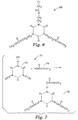
- the TATHEIC monomer is generally formed by reaction scheme 70 of Fig. 7 in which hydroxyl functional isocyanurate 72 is reacted with carboxylic acid 74 to form acrylated isocyanurate 76.
- the X" moiety may be any suitable divalent linking group such as -CH 2 CH 2 - or the like.
- the acrylate form is shown in Fig. 6, but monomer 60 could be a methacrylate or the like as well.
- Fig. 8A shows another example of a radiation curable, aromatic monomer in the form of an aromatic cyanate ester 80.
- This monomer has a melting point of 78 °C to 80 °C.
- This and similar monomers have been described in U.S. Patent No. 4,028,393.
- Other cyanate esters are described in U.S. Patent Nos. 5,215,860; 5,294,517; and 5,387,492, the cyanate ester descriptions incorporated by reference herein.
- Preferred radiation curable oligomers of the present invention generally have a number average molecular weight in the range from 400 to 5000, preferably 800 to 2500 and either are solid at ambient conditions, or if not solid under ambient conditions, nonetheless form solid blends in combination with other ingredients of the radiation curable component.
- preferred oligomers of the present invention also preferably include pendant hydroxyl functionality and are aromatic.
- One preferred class of radiation curable, hydroxyl functional, aromatic oligomers found to be suitable in the practice of the present invention includes the class of radiation curable; novolak-type phenolic oligomers.
- a representative radiation curable, aromatic novolak-type phenolic oligomer 90 having pendant cyanate ester functionality is shown in Fig. 8B, wherein n has a value in the range from 3 to 20, preferably 3 to 10.
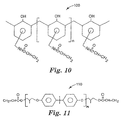
- Another representative, radiation curable oligomer 100 having pendant acrylamide functionality and hydroxyl functionality (a combination of functionality that is particularly beneficial when incorporated into a make coat formulation) is shown in Fig. 10, wherein n has an average value in the range from 3 to 20, preferably 3 to 10. In a particularly preferred embodiment, n has an average value of 3 to 5.
- oligomer for which the average value of n is 3 to 5 tends to have a taffy-like consistency under ambient conditions.
- oligomer readily forms solid particles when combined with other solid, radiation curable monomers, oligomers, and polymers to facilitate dry coating, but flows easily when heated after dry coating, facilitating formation of uniform, fused binder matrices:
- the class of radiation curable, novolak-type phenolic oligomers, including the particular oligomer 100 shown in Fig. 10 has been described generally in U.S. Patent Nos. 4,903,440 and 5,236,472.
- Another preferred class of radiation curable, hydroxyl functional, aromatic oligomers found to be suitable in the practice of the present invention includes the class of epoxy oligomers obtained, for example, by chain extending bisphenol A up to a suitable molecular weight and then functionalizing the resultant oligomer with radiation curable functionality.
- Fig. 11 illustrates such an epoxy oligomer 110 which has been reacted with an acrylic acid to provide radiation curable functionality.
- n of Fig. 11 has a value such that oligomer 110 has a number average molecular weight in the range from 800 to 5000, preferably 1000 to 1200.
- Such materials typically are viscous liquids under ambient conditions but nonetheless form solid powders when blended with other solid materials such as solid monomers, solid macromolecules, and/or calcium and/or zinc stearate. Accordingly, such materials also can be easily dry coated in solid form under ambient conditions, but then demonstrate excellent flow characteristics upon heating to facilitate formation of binder matrices having desired performance characteristics. Indeed, any oligomer that has this dual liquid/solid behavior under ambient conditions would be particularly advantageous with respect to achieving such processing advantages. Acrylate oligomers according to Fig. 11 are available under the trade designations "RSX29522" and "EBECRYL 3720", respectively, from UCB Chemicals Corp., Smyrna, GA.
- oligomers suitable in the practice of the present invention are not limited solely to the preferred novolak-type phenolic oligomers or epoxy oligomers described above.
- other radiation curable oligomers that are solid at room temperature, or that form solids at room temperature in blends with other ingredients, include polyether oligomers such as polyethylene glycol 200 diacrylate having the trade designation "SR259” and polyethylene glycol 400 diacrylate having the trade designation "SR344,” both being commercially available from Sartomer Co., Exton, PA; and acrylated epoxies available under the trade designations "CMD 3500,” “CMD 3600,” and “CMD 3700,” from Radcure Specialties.
- radiation curable polymers also can be beneficially incorporated into the radiation curable component, although polymers tend to be more viscous and do not flow as easily upon heating as compared to monomers and oligomers.
- Representative radiation curable polymers of the present invention comprise vinyl ether functionality, cyanate ester functionality, (meth)acrylate functionality, (meth)acrylamide functionality, cyanate ester functionality, epoxy functionality, combinations thereof, and the like.
- Representative examples of polymers that may be functionalized with one or more of these radiation curable groups include polyamides, phenolic resins, epoxy resins, polyurethanes, vinyl copolymers, polycarbonates, polyesters, polyethers, polysulfones, polyimides, combinations of these, and the like.
- the radiation curable polymer may be an epoxy functional resin having at least one oxirane ring polymerizable by a ring opening reaction. These materials generally have, on the average, at least two epoxy groups per molecule (preferably more than two epoxy groups per molecule).
- the polymeric epoxides include linear polymers having terminal epoxy groups (for example, a diglycidyl ether of a polyoxyalkylene glycol), polymers having skeletal oxirane units (for example, polybutadiene polyepoxide), and polymers having pendent epoxy groups (for example, a glycidyl methacrylate polymer or copolymer).
- the number average molecular weight of the epoxy functional resin most typically may vary from 1000 to 5000 or more.
- Another useful class of epoxy functional macromolecules includes those which contain cyclohexene oxide groups derived from monomers such as the epoxycyclohexanecarboxylates, typified by 3,4-epoxycyclahexylmethyl-3,4-epoxycyclohexane carboxylate, 3,4-epoxy-2-methylcyclohexylmethyl-3,4-epoxy-2-methylcyclohexane carboxylate, and bis(3,4-epoxy-6-methylcyclohexylmethyl) adipate.
- cyclohexene oxide groups derived from monomers such as the epoxycyclohexanecarboxylates, typified by 3,4-epoxycyclahexylmethyl-3,4-epoxycyclohexane carboxylate, 3,4-epoxy-2-methylcyclohexylmethyl-3,4-epoxy-2-methylcyclohexane carboxylate, and bis(3,4-epoxy-6-methylcyclo
- epoxy functional macromolecules which are particularly useful in the practice of this invention include resins incorporating glycidyl ether monomers of the formula: where R' is alkyl or aryl and n is an integer of 1 to 6.
- R' is alkyl or aryl and n is an integer of 1 to 6.
- examples are the glycidyl ethers of polyhydric phenols obtained by reacting a polyhydric phenol with an excess of chlorohydrin such as epichlorohydrin, for example, the diglycidyl ether of 2,2-bis-2,3-epoxypropoxyphenol propane.
- chlorohydrin such as epichlorohydrin
- epoxides of this type are described in U.S. Patent No. 3,018,262.
- epoxy macromolecules there are also several commercially available epoxy macromolecules that can be used in this invention.
- epoxides which are readily available include octadecylene oxide, epichlorohydrin, styrene oxide, vinyl cyclohexene oxide, glycidol, glycidyl-methacrylate, diglycidyl ether of Bisphenol A (for example, those available under the trade designations "EPON 828,” “EPON 1004,” and “EPON 1001F” from Shell Chemical Co., and “DER-332” and “DER-334,” from Dow Chemical Co.), diglycidyl ether of Bisphenol F (for example, "ARALDITE GY281" from Ciba-Geigy), vinylcyclohexene dioxide (for example, having the trade designation "ERL 4206” from Union Carbide Corp.), 3,4-epoxycyclohexyl-methyl-3,4'-epoxycyclohexene carboxylate (
- the binder precursor particles of the present invention may also include a thermoplastic resin in order to adjust the properties of the particles and/or the resultant cured binder matrix.
- thermoplastic resins can be incorporated into the particles in order to adjust flow properties of the particles upon being melted, to allow the melt layer to display pressure sensitive adhesive properties so that abrasive particles more aggressively adhere to the melt layer prior to curing (desirable for a make coat), to adjust the flexibility characteristics of the resultant cured binder matrix, combinations of these objectives, and the like.
- thermoplastic polymers useful in the present invention include polyester, polyurethane, polyamide, combinations of these, and the like.
- the binder precursor particles may include up to 30 parts by weight of a thermoplastic component per 100 parts by weight of the radiation curable component.
- the fusible powder may also include a binder comprising one or more monomers and/or macromolecules that may be thermoplastic, thermally curable, and/or radiation curable as described above in connection with the binder precursor particles.
- the fusible powder comprises 70 to 95 parts by weight of at least one metal salt of a fatty acid and 0 to 30 parts by weight of the binder.
- the metal salts of a fatty acid ester suitable for use in the fusible powder generally may be represented by formula 90 shown in Fig. 9 wherein R' is a saturated or unsaturated moiety, preferably an alkyl group having at least 10, preferably 12 to 30, carbon atoms, M is a metal cation having a valence of n, wherein n typically is 1 to 3.
- R' is a saturated or unsaturated moiety, preferably an alkyl group having at least 10, preferably 12 to 30, carbon atoms
- M is a metal cation having a valence of n, wherein n typically is 1 to 3.
- Specific examples of compounds according to formula 90 of Fig. 9 include lithium stearate, zinc stearate, calcium stearate, magnesium stearate combinations of these, and the like.
- the metal salt of a fatty acid preferably is calcium stearate, zinc stearate, or a combination thereof wherein the weight ratio of calcium stearate to zinc stearate is in the range from 1:1 to 9:1.
- the use of a powder comprising a combination of calcium and zinc stearates also provides an excellent way to control the melting characteristics of the powder. For example, if it is desired to increase the melting temperature of the powder, the amount of calcium stearate being used can be increased relative to the amount of zinc stearate. Conversely, if it is desired to lower the melting temperature of the powder, the amount of zinc stearate being used can be increased relative to the amount of calcium stearate.
- Calcium stearate is unique in that this material never truly melts. However, in fine powder form, for example, a powder having an average particle size of less than about 125 micrometers, calcium stearate can be used by itself, or in combination with other materials, to provide powders that readily flow when heated at moderately low processing temperatures.
- metal salts of fatty acids for example, the metal stearates
- the metal stearates may be blended with liquid monomers, oligomers, and/or polymers to form blends that, nonetheless, are solid and can be ground to form fine powders.
- Such powders have excellent viscosity, fusing, and flow characteristics when melt processed at reasonably low melt processing temperatures. Embodiments demonstrating this advantage of the invention will be described further below in the examples.
- the fusible powder of the present invention may include one or more fatty acids.
- a fatty acid makes it easier to melt process the fusible powder at reasonably low processing temperatures, for example, 35 °C to 180 °C.
- a preferred embodiment of a fusible powder of the present invention might include calcium stearate (a metal salt of a fatty acid) as a major component.
- a fusible powder including just calcium stearate by itself tends to be difficult to melt process, because calcium stearate never truly melts.
- the resultant blend can be readily melt processed at convenient temperatures.
- preferred embodiments of the present invention include a sufficient amount of a fatty acid so that the fusible powder can be melt processed at the desired temperature, for example a temperature in the range from 35 °C to 180 °C.
- Preferred fusible powders of the present invention incorporate up to 30, preferably about 10, parts by weight of one or more fatty acids per 70 to 100, preferably about 90, parts by weight of the metal salt of a fatty acid.
- a preferred fatty acid is the corresponding acid form of the metal salt of a fatty acid being used.
- stearic acid is a preferred fatty acid when the metal salt of a fatty acid is a stearate, for example, zinc stearate or calcium stearate.
- the binder precursor particles and/or fusible powder of the present invention may also include one or more grinding aids.
- grinding aids include waxes, organic halide compounds, halide salts, metals, and alloys of metals.
- Organic halide compounds typically break down during abrading and release a halogen acid or a gaseous halide compound.
- organic halides include chlorinated waxes, such as tetrachloronapthalene, pentachloronapthalene, and polyvinyl chloride. Chlorinated waxes can also be considered to be waxes.
- halide salts include sodium chloride (NaC1), potassium chloride (KC1), potassium fluoroborate (KBF 4 ), ammonium cryolite (NH4) 3 AlF 6 ), cryolite (Na 3 AlF 6 ),and magnesium chloride (MgCl 2 ).
- metals include tin, lead, bismuth, cobalt, antimony, cadmium, iron, and titanium.
- Other grinding aids include sulfur and organic sulfur compounds, graphite, and metallic sulfides. Combinations of grinding aids can be used.
- the preferred grinding aid for stainless steel is potassium fluoroborate.
- the preferred grinding aid for mild steel is cryolite.
- the ratio of the fusible organic component to grinding aid ranges from 0 to 95, preferably ranges from 10 to 85, more preferably 15 to 60, parts by weight of a fusible organic component to 5 to 100, preferably 15 to 85, more preferably 40 to 85, parts by weight grinding aid.
- the binder precursor particles and/or fusible powder of the present invention additionally may comprise one or more optional additives, such as, plasticizers, other antiloading agents (that is, materials useful for reducing or preventing swarf accumulation), grinding aids, surface modification agents, fillers, flow agents, curing agents, hydroxyl containing additives, tackifiers, grinding aids, expanding agents, fibers, antistatic agents, lubricants, pigments, dyes, UV stabilizers, fungicides, bacteriocides, and the like.
- additives such as, plasticizers, other antiloading agents (that is, materials useful for reducing or preventing swarf accumulation), grinding aids, surface modification agents, fillers, flow agents, curing agents, hydroxyl containing additives, tackifiers, grinding aids, expanding agents, fibers, antistatic agents, lubricants, pigments, dyes, UV stabilizers, fungicides, bacteriocides, and the like.
- additives such as, plasticizers
- binder precursor particles and/or fusible powder for a particular application will depend, to a large extent, upon the portion of bond system 18 into which the particles will be incorporated. Different compositions may be more desirable depending upon whether the binder precursor particles are to be incorporated into make coat 20, size coat 22, and/or supersize coat 24. Further, not all binder precursor particles to be incorporated into bond system 18 need be the same. Binder precursor particles of one composition, for instance, may be incorporated into make coat 20 and size coat 22, while binder precursor particles of a second composition are incorporated into supersize coat 24.
- a preferred binder precursor particle composition (Make/Size Composition I) comprises 100 parts by weight of a radiation curable binder component, about 1 to 5 parts by weight of a flow control agent, and about 0.5 to 5 parts by weight of a photoinitiator or photocatalyst.
- the preferred radiation curable binder component comprises a (i) solid, radiation curable monomer and (ii) a solid radiation curable oligomer and/or polymer, wherein the weight ratio of the monomer to the oligomer/polymer is in the range from 1:10 to 10:1, preferably 1:4 to 4:1, more preferably about 1:1.
- Preferred examples of the solid monomer include the monomer of Fig. 3, the cyanate ester of Fig. 8, and the TATHEIC monomer of Fig. 6.
- Preferred examples of the solid oligomer/polymer include the epoxy functional resin commercially available under the trade designation "EPON 1001F” from Shell Chemical Co. and the acrylate functional oligomer available under the trade designation "RSX 29522” from UCB Chemicals Corp.
- Preferred flow control agents include waxes and acrylic copolymers commercially available under the trade designation Modarez MFP-V from Synthron, Inc., metal stearates such as zinc stearate and/or calcium stearate, combinations of these, and the like. These ingredients may be melt blended together, cooled, and then ground into a free flowing powder of the desired average particle size.
- a composition (Make/Size Composition II) identical to Make/Size Composition 1 is used, except that a liquid oligomer and/or polymer is substituted for the solid oligomer/polymer.
- the liquid oligomer or polymer is highly viscous. "Highly viscous" means that the material is a liquid at 25 °C and has a weight average molecular weight of at least 5000, preferably at least 8000, more preferably at least 10,000.
- Preferred examples of highly viscous oligomers and polymers include the oligomer of Fig. 10 in which n is about 5, as well as the acrylate functional resin of Fig. 11.
- a preferred binder precursor particle composition comprises 75 to 95 parts by weight of a solid metal salt of a fatty acid, 5 to 25 parts by weight of a liquid, radiation curable monomer, oligomer and/or polymer, and 1 to 5 parts by weight of a photoinitiator or photocatalyst. Notwithstanding the liquid character of the radiation curable monomer, oligomer, and/or polymer, the ingredients can be melt blended, cooled, and then ground to form a free flowing, solid powder.
- Preferred metal salts of a fatty acid include zinc stearate, calcium stearate, and combinations of these.
- Preferred liquid materials include acrylate functional epoxy oligomers available under the trade designations "EBECRYL 3720 and 302", acrylate functional polyester available under the trade desigriafion “EBECRTL 450”, acrylate functional polyurethanes available under the trade designation “EBECRYL 8804 and 270”, ethoxylated trimethylol propane triacrylate, and the novolak-type phenolic oligomer of Fig. 10, wherein n is about 5.
- a preferred binder precursor particle composition (Supersize Composition II) is identical to Supersize Composition I except that one or more solid radiation curable monomers, oligomers, and/or polymers is substituted for the liquid radiation curable materials.
- Preferred examples of the solid radiation curable material include the monomer of Fig. 3, the cyanate ester of Fig. 8, and the TATHEIC monomer of Fig. 6.
- Preferred examples of the solid oligomer/polymer include the epoxy functional resin commercially available under the trade designation "EPON 1001F" and the acrylate functional oligomer available under the trade designation "RSX 29522".
- a preferred binder precursor particle composition comprises 70 to 95 parts by weight of a metal salt of a fatty acid as described above, 5 to 30 parts by weight of a thermoplastic resin, and 5 to 30 parts by weight of a solid or liquid radiation curable component as described above.
- thermoplastic resins include polyamides, polyesters, ethylene vinyl acetate copolymers, combinations of these, and the like.
- a particularly preferred resin is available from Union Camp Chemical Product Division under the trade designation "UNIREZ 2221".
- the binder precursor particles and/or fusible powder of the present invention are easily made by a process in which all of the ingredients to be incorporated into the particles or powder, as the case may be, are first blended together to form a homogeneous, solid admixture.
- Blending can be accomplished by dry blending the ingredients together in powder form, but more preferably is accomplished by melt processing in which at least the radiation curable ingredients of the particles are liquefied during blending.
- melt processing occurs at a temperature above the glass transition temperatures and/or melting points of at least some of the radiation curable ingredients, while nonetheless occurring at a sufficiently low temperature to avoid premature crosslinking of the binder components.
- the melt processing temperature is also below temperatures that might degrade any temperature sensitive ingredients of the particles.
- melt processing and blending is not critical, and any convenient technique can be used.
- processing the ingredients through an extruder to form a solid, blended extrudate is suitable, so long as extruder temperature is carefully monitored to avoid premature crosslinking of, and degradation to, the ingredients.
- the resultant solid can then be milled, for example, ground, into particles of the desired particle size.
- the type of milling technique is not critical and representative examples include cryogenic grinding, hammer milling (either cold or at room temperature), using a mortar and pestle, using a coffee grinder, ball milling, and the like. Hammer milling at room temperature is presently preferred.
- the dry particles can then be used, without use of any solvent whatsoever, to form the binder matrix component of make coat 20, size coat 22, and/or supersize coat 24, as desired.
- the particles may be applied to an underlying surface of abrasive article 10 using any convenient dry coating technique such as drop coating, electrostatic spraying, electrostatic fluidized bed coating, hot melt spraying, and the like.
- the particles are liquefied, preferably by heating, in a manner such that the particles fusibly flow together to form a uniform, fluid melt layer.
- the melt layer can then be exposed to a suitable source of energy in order to cure the melt layer so that a thermoset, solid, binder matrix is formed.
- abrasive particles 16 to be incorporated may be codeposited with the dry binder precursor particles if desired.
- the binder precursor particles can be dry coated and liquefied first, after which abrasive particles 16 are coated into the melt layer prior to curing.
- Fig. 12 is a schematic representation of an apparatus 200 suitable for forming abrasive article 10.
- Fig. 12 shows forming each of make coat 20, size coat 22, and supersize coat 24 of abrasive article 10 from binder precursor particles of the present invention.
- the present invention is not limited to the illustrated application in which the entirety of bond system 18 is formed from the binder precursor particles, but rather is applicable to circumstances in which any one or more portions of bond system 18 is derived from such binder precursor particles.
- Fig. 12 shows backing 202 being transported from supply roll 204 to take-up roll 206.
- backing 202 may be transported at a speed in the range from 0.1 m/min to as much as 100 m/min or more.
- backing 202 is supported upon suitable number of guide rollers 208 as backing 202 passes through coating stations 210, 212, and 214.
- Make coat 20, size coat 22, and supersize coat 24 are applied at stations 210, 212, and 214, respectively.
- binder precursor particles 216 corresponding to the binder matrix of make coat 20 are drop coated onto backing 202 from dry coating apparatus 220.
- Backing 202 then passes through oven 224 in which particles 216 are heated to form a liquefied make coat melt layer.
- Abrasive particles 16 are then electrostatically coated into the make coat melt layer from mineral coater 226.
- the coated backing then passes ultraviolet light source 228, where the make coat melt layer is exposed to ultraviolet radiation to crosslink and cure the make coat.
- the crosslinked make coat now firmly bonds abrasive particles 16 to backing 202.
- the coated backing 202 passes through station 212 to form size coat 22.
- Binder precursor particles 230 corresponding to the binder matrix of size coat 22 are drop coated onto make coat 20 from dry coating apparatus 232.
- the coated backing 202 then passes through oven 234 in which particles 230 are heated to form a liquefied size coat melt layer.
- the coated backing then passes ultraviolet light source 238, where the size coat melt layer is exposed to ultraviolet radiation to crosslink and cure the size coat.
- the crosslinked size coat now helps reinforce the attachment of abrasive particles 16 to backing 202.
- the coated backing 202 passes through station 214 to form supersize coat 24.
- Binder precursor particles 240 corresponding to the binder matrix of supersize coat 24 are drop coated onto size coat 22 from dry coating apparatus 242.
- the coated backing 202 then passes through oven 244 in which particles 240 are heated to form a liquefied supersize coat melt layer.
- the coated backing 202 then passes ultraviolet light source 248, where the supersize coat melt layer is exposed to ultraviolet radiation to crosslink and cure the supersize coat.
- the crosslinked supersize coat now helps provide abrasive article 10 with desired performance characteristics, for example, anti-loading capabilities if supersize coat 24 incorporates an antiloading agent.
- the finished abrasive article 10 is then stored on take-up roll 206, after which abrasive article may be cut into a plurality of sheets, discs or the like, depending upon the desired application.
- abrasive article 10 may be transported directly to a cutting apparatus to form sheets or discs, after which the sheets or discs may be stored, packaged for distribution, used, or the like.
- Ethyl Acetate is commercially available from Aldrich Chemical, Milwaukee, WI
- abrasive articles used a backing that was a 95 g/m 2 paper backing C90233 EX commercially available from Kimberly-Clark, Neenah, WI.
- a make coat precursor was prepared from DS1227 (20.7 parts), EP1 (30.5 parts), EP2 (33.7 parts), CHDM (2.9 parts), COM (0.6 part), KB1 ( 1.0 part) and AMOX (0.6 parts).
- the batch was prepared by melting DS1227 and EP2 together at 140°C, mixing, then adding EP1 and CHDM.
- TMPTA (4.5 parts) was added with mixing at 100°C.
- To this sample was added COM, AMOX, and KB1 followed by mixing at 100 °C.
- the make coat precursor was applied at 125 °C by means of a knife coater to the paper backing at a weight of about 20 g/m 2 .
- the sample was then irradiated (3 passes at 18.3 m/min) with one 400 W/cm "D" bulb immediately before P 180 AO abrasive particles were electrostatically projected into the make coat precursor at a weight of about 85 g/m 2 .
- the intermediate product was thermally cured for 15 minutes at a temperature of 100 °C.
- a size coat precursor was roll coated over the abrasive grains at a weight of about 50 g/m 2 .
- the size coat precursor included a 100% solids blend of EP 1 (40 parts), ERL 4221 (30 parts), TMPTA (30 parts), KB1 (1 part), and COM (1 part).
- the sample was then irradiated (3 passes at 18.3 m/min) with one 400 W/cm "D" bulb followed by a thermal cure for 10 minutes at 100 °C.
- Abrasive article B was prepared by the same methodology as described above using the formulations shown in Table 1.
- Abrasive articles used a backing that was a 95 g/m 2 paper backing C90233 EX commercially available from Kimberly-Clark, Neenah, WI.
- a make coat precursor was prepared from DS1227 (20.7 parts), EP1 (30.5 parts), EP2 (33.7 parts), CHDM (2.9 parts), COM (0.6 part), KB1 (1.0 part) and AMOX (0.6 parts).
- the batch was prepared by melting DS1227 and EP2 together at 140 °C, mixing, then adding EP1 and CHDM. Then, TMPTA (4.5 parts) was added with mixing at 100 °C. To this sample was added COM, AMOX, and KB1 followed by mixing at 100 °C.
- Make coat precursors were applied at 125 °C by means of a knife coater to the paper backing at a weight of about 20 g/m 2 .
- the sample was then irradiated (3 passes at 18.3 m/min) with one 400 W/cm "D" bulb immediately before P180 AO abrasive particles were electrostatically projected into the make coat precursor at a weight of about 85 g/m 2 .
- the intermediate product was thermally cured for 15 minutes at a temperature of 100°C.
- a size coat precursor was roll coated over the abrasive grains at a weight of about 50 g/m 2 .
- the size coat precursor included a 100% solids blend of EP1 (40 parts), ERL 4221 (30 parts), TMPTA (30 parts), KB1 (1 part), and COM (1 part).
- the samples were then irradiated (3 passes at 18.3 m/min) with one 400 W/cm "D" bulb followed by a thermal cure for 10 minutes at 100 °C.
- the sample was supersized at a weight of about 35 g/m 2 with a calcium stearate solution (50% solids aqueous calcium stearate/acrylic binder solution) available from Witco Chemical Corporation, Memphis, TN.
- Comparative Article L was prepared by the same methodology as described above for Abrasive Article A using the formulations shown in Table 1.
- Comparative Articles A, C, G, I, O, AA, CC are commercially available from Minnesota Mining and Manufacturing Company, St. Paul, MN under trade designation "216U P180 Fre-Cut Production Paper A Weight".
- Samples of binder precursor particles according to the present invention were prepared from the formulations in Table 2. To make each sample, the ingredients were either (1) melt blended together, solidified, and ground into a powder or (2) dry blend mixed and ground into powders. The samples were ground into fine powders by mortar and pestle or hammer mill, unless otherwise indicated. A few examples are given below to illustrate the methodology.
- binder precursor particles comprising a combination of ZnSt2/CaSt2/EB1/IRG1 (45/45/10/1)
- a 0.5 L.jar was charged with 45 g of ZnSt2, 45 g of CaSt2 and 10 g of EB1.
- the materials were melted at 120-160 °C, mixed, and 1 g of IRG1 was added.
- the material was cooled, and the resultant solid was ground into a fine powder.
- binder precursor particles comprising a combination of ZnSt2/UF1 (80/20)
- a 0.5 L. jar was charged with 80 g of ZnSt2 and 20 g of UF1. The solids were dry blended in a grinder.
- binder precursor particles comprising a combination of ZnSt2/CaSt2/EP2/IMID (50/50/14/1)
- Binder precursor particle samples 1-38H were dry coated onto Abrasive Articles A and/or B (see Table 3), melted, and then solidified to form supersize coats according to the following procedures. The details of the resultant abrasive articles are disclosed in Table 3.
- the binder precursors samples 2-15,16, 22-36, and 38A-38B were respectively coated onto Abrasive Article A or B.
- the binder precursor particles were powder coated at about 7.0 to 23g/m 2 onto the abrasive articles by drop coating with a mesh sifter, spray coating with a fluidized or electrostatic fluidized spray gun, or coating with an electrostatic fluidized bed coater.
- the binder precursor particles were then melted by placing the abrasive article in an oven at a temperature of from about 120° to about 165 °C for about 5-15 minutes.
- the resultant melt layer was then cured by passing the abrasive article through a UV lamp (1 pass at 7.6 m/min. with 157W/cm bulb).
- Adhesive sheeting was attached to the backside of the abrasive article and 10.2 cm or 15.2 cm discs were died out of the abrasive articles. The discs were used for Schiefer or Off hand DA testing, described below.
- Adhesive sheeting was attached to the backside of the abrasive article and 10.2 cm or 15.2 cm discs were died out of the abrasive articles. The discs were used for Schiefer or Offhand DA testing, describe below.
- Supersize coat samples formed from binder precursor particles 38B-G, respectively, were prepared identically to samples 2-14,16 22-36, and 38A except that the amount of time that the samples were placed in the oven was extended to 30-90 minutes to thermally cure the resultant melt layer.
- Adhesive sheeting was attached to the backside of the abrasive articles and 10.2 cm or 15.2 cm discs were died out of the abrasive articles. The discs were used for Schiefer tests, described below.
- Supersize coat samples formed from binder precursor particles 17-21, respectively, were prepared identically to samples 2-14,16 22-36, and 38A except that, prior to powder coating, a composition comprising 50 g of radiation curable monomer (TRPGDA), 50 g of ethyl acetate and 1 g of initiator (IRG1) were combined and placed in a spray bottle. The solution was sprayed onto 15.2 cm x 20.3 cm sections of Abrasive Article A and allowed to air dry. About 8 g/m 2 were then applied to the corresponding abrasive article by electrostatic fluidizing spray gun. The abrasive article was then placed in an oven at a temperature in the range of from about 120 °C to about 165 °C to melt the particles.
- TRPGDA radiation curable monomer
- IRG1 initiator
- the resultant melt layer was cured by passing the abrasive article through a UV lamp (1 pass at 7.6 m/min. with a 157 W/cm bulb). Adhesive sheeting was attached to the backside of the abrasive article and 10.2 cm or 15.2 cm discs were died out of the abrasive articles. The discs were used in testing, described below. Samples of Abrasive Articles Powder Coated with Supersize Coat Sample No.
- Each 10.2 cm diameter disc of the abrasive articles of each Sample 1-38H and Comparative Samples A-O and AA-JJ(See Tables 4-7) was secured to a foam back-up pad by means of a pressure sensitive adhesive.
- Each coated abrasive disc and back-up pad assembly was installed on a Schiefer testing machine, and the coated abrasive disc was used to abrade a cellulose acetate butyrate polymer of predetermined weight. The load was 4.5 kg. The test was considered complete after 500 revolution cycles of the coated abrasive disc. The cellulose acetate butyrate polymer was then weighed, and the amount of cellulose acetate butyrate polymer removed was recorded.
- Comparative BB 2.916 100 Sample 38B 3.408 117 Comparative Ranking Relative to DD Comparative DD 2.932 100 Sample 38C 3.236 110 Comparative Ranking Relative to FF Comparative FF 2.756 100 Sample 38D 3.219 117 Schiefer Testing for Samples 38E-38H and Comparative Samples HH, JJ and AA Sample No. Cut (g) Comparative Ranking Relative to HH. Comparative HH 2.720 100 Sample 38E 3.013 111 Sample 38F 2.936 108 Comparative Ranking Relative to AA Comparative AA 2.346 100 Sample 38G 2.764 118 Comparative Ranking Relative to JJ Comparative KK 3.323 100 Sample 38H 3.717 112
- a paint panel that is, a steel substrate with an e-coat, primer, base coat, and clear coat typically used in automotive paints, was abraded in each case with coated abrasives made in accordance with the invention and with coated abrasives as comparative examples.
- Each coated abrasive had a diameter of 15.2 cm and was attached to a random orbital sander (available under the trade designation "DAQ", from National Detroit, Inc., Rockford, IL).
- the abrading pressure was about 19.6 kPa (0.2 kg/cm 2 ), while the sander operated at about 60 PSI(@TOOL (413 kPa).
- the painted panels were purchased from ACT Company of Hillsdale, MI.
- a make coat precursor was prepared from DS1227 (20.7 parts), EP1 (30.5 parts), EP2 (33.7 parts), CHDM (2.9 parts), COM (0.6 part), KB1 ( 1.0 part) and AMOX (0.6 parts).
- the batch was prepared by melting DS1227 and EP2 together at 140 °C, mixing,'and then adding EP1 and CHDM and mixing.
- TMPTA (4.5 parts) was added with mixing at 100 °C.
- the make coat precursor was applied at 125 °C by means of a knife coater to the paper backing at a weight of about 20 g/m 2 .
- the sample was then irradiated (3 passes at 18.3 m/min) with one 400 W/cm "D" bulb immediately before P180 AO abrasive particles were electrostatically projected into the make coat precursor at a weight of about 85 g/m 2 .
- the intermediate product was thermally cured for 15 minutes at a temperature of 100 °C.
- abrasive articles used a backing that was a 95 g/m 2 paper backing C90233 EX commercially available from Kimberly-Clark, Neenah, WI.
- a make coat precursor was prepared from DS1227 (20.7 parts), EP1 (30.5 parts), EP2 (33.7 parts), CHDM (2.9 parts), COM (0.6.part), KB1 ( 1.0 part) and AMOX (0.6 parts).
- the batch was prepared by melting DS1227 and EP2 together at 140 °C, mixing, and then adding EP1 and CHDM.
- TMPTA (4.5 parts) was added with mixing at 100 °C.
- To this sample was added COM, AMOX, and KB1 followed by mixing at 100 °C.
- Make coat precursors were applied at 125 °C by means of a knife coater to the paper backing at a weight of about 20 g/m 2 .
- the sample was then irradiated (3 passes at 18.3 m/min) with one 400 W/cm "D" bulb immediately before P180 AO abrasive particles were electrostatically projected into the make coat precursor at a weight of about 85 g/m 2 .
- the intermediate product was thermally cured for 15 minutes at a temperature of 100 °C.
- a size coat precursor was roll coated over the abrasive grains at a weight of about 50 g/m 2 .
- the size coat precursor included a 100% solids blend of EP1 (40 parts), ERL 4221 (30 parts), TMPTA (30 parts), KB1 (1 part), and COM (1 part).
- the samples were then irradiated (3 passes at 18.3 m/min) with one 400 W/cm "D" bulb followed by a thermal cure for 10 minutes at 100 °C.
- An abrasive article used a 5 mil thick polyester backing with a backing that can be obtained commercially from Minnesota Mining and Manufacturing Company, Paul, MN.
- a make coat precursor comprising an aqueous solution ofUF2, a 75% solid aqueous resole phenolic resin with a with a formaldehyde/phenol ratio of approximately 1.1-3.)/1 and pH of 9, ACL, and PTSOH (85/15/2/1) was roll coated onto the backing at an approximate weight of 40g/m 2 .
- a blend of P180 and AlO/CUB abrasive particles 50-90/10-50 was electrostatically projected into the make coat precursor at a weight of about 155g/m 2 .
- the make resin was cured in an oven at 93 °C for 30 minutes.
- a size coat precursor comprising a 75% solids aqueous solution of resole phenolic resin with a formaldehyde/phenol ratio of approximately 1.1-3.0/1, pH of 9 and feldspar (70/35) was coated onto the make coat at an approximate weight of 200 g/m 2 .
- the size resin was cured by placing the sample in an oven at 100-110 °C for 1-2 hours.
- PDAP p-Di(acryloyloxyethyl)Terephthalate
- the product was found to have a T m of about 97 °C, by DSC. Thin layer chromatography showed the product to be pure, as evidenced by a single spot (elution solvent of 10% methanol/90% chloroform, using F254 silica gel coated glass plates). The infrared spectrum showed a characteristic ester peak at 1722 cm -1 .
- the triethylamine hydrochloride readily formed.
- the contents were stirred for an additional 2 hours at ambient temperature, then filtered.
- the filter cake was rinsed with dry THF and concentrated to a viscous, resinous-like syrup on a rotoevaporator, while heating the concentrate to 70 °C.
- the resinous product was transferred to a glass jar, with gentle heating of the flask walls to aid in its flow. NMR analysis of this resin showed some traces of triethylamine hydrochloride still present, and approximately 10 weight percent of THF.
- the main product showed approximately 0.2 mol of acrylate ester per ring of phenol.
- the novolak had a calculated formaldehyde to phenol ratio of about 0.8
- AMN was prepared as described in US Patent Nos. 4,903,440 and 5,236,472.
- binder precursor particles comprising a combination of AMN/PDAP/CAB-O-SIL/IRG1 (50/50/0.2/2)
- a 0.5 L. jar was charged with 100 g of AMN (a viscous liquid), 100 g of PDAP and 0.4 g of CAB-O-SIL. The sample was heated to 110-115 °C for 30 minutes and mixed. Next, 4 g of IRG1 was added to the molten mixture, mixed and cooled to room temperature. The resulting solid was ground into a fine powder with a grinder.
- AMN a viscous liquid
- PDAP a viscous liquid
- CAB-O-SIL CAB-O-SIL
- binder precursor particles comprising of a combination of PAN/PDAP/IRG1/MOD (50/50/2/0.2)
- a 0.25 L. jar was charged with 25 g of a viscous liquid ,PAN, and 25g of PDAP.
- the sample was heated to 110-115 °C for 30 minutes and mixed.
- 1g. of IRG1 and 0.1 g of MOD was added to the molten mixture, mixed and cooled to room temperature.
- the resulting solid was ground into a fine powder with a grinder. The addition of liquid nitrogen to the cooling solid aided in grinding.
- binder precursor particles comprising a combination of AMN/PDAP /CRY/IRG1(50/50/100/2)
- a 0.5 L jar was charged with 50 g of AMN (a viscous liquid), 50 g of PDAP, and 100 g of CRY The sample was heated to 110-115 °C for 30 minutes and mixed. Next, 2 g of IRG1 was added to the molten mixture, mixed and cooled to room temperature. The resulting solid was ground into a fine powder.
- AMN a viscous liquid
- PDAP a viscous liquid
- CRY 100 g
- binder precursor particles comprising a combination of EP1/EP2/SD 7280/COM (20/60/20/1)
- a 0.5 Ljar was charged with 20 g of EP1, 60 g of EP2, and 20 g of SD 7280. The sample was heated to 120 °C for 60 minutes and mixed. Next, 1 g of COM was added to the molten mixture, mixed and cooled to room temperature. The resulting solid was ground into a fine powder.
- binder precursor particles comprising a combination of EP1/EP2/SD 7280/CRY/COM (20/60/20/100/2)
- binder precursor particles comprising a combination of PT60/COM (100/1)
- a 0.5 L jar was charged with 100g of PT-60 and heated to 90 °C. 1 g of COM was added, and the resultant solid was cooled to room temperature. The solid was ground into a fine powder with a grinder.
- binder precursor particles comprising a combination PT60/CRY/IRG1 (50/50/1)
- a 0.5 L jar was charged with 50 g of 100/1 PT60/COM solid. Next 50 g of CRY was added. The two solids were mixed and ground into a fine powder with a grinder.
- binder precursor particles comprising a combination EP2/PDAP/IRG1/COM (70/30/1/1)
- a 0.5 L. jar was charged with 70 g EP1 (a solid embodiment), and 30 g PDAP.
- the sample was heated to 110-115 °C for 30 minutes and mixed.
- 1 g of IRG1 and 1 g of COM was added to the molten mixture, mixed and cooled to room temperature.
- the resulting solid was ground into a fine powder with a grinder,
- Binder precursor particles sample 39-50 were coated onto one or more of Abrasive Articles C and D to form size coats according to the following procedure.
- the binder precursor particle samples 39-46 and 48 were coated onto Abrasive Article D, while binder precursor particle sample 45 and 47 were coated onto Abrasive Article C.
- the binder precursor particles were powder coated unto the abrasive articles at 30 to 160 g/m 2 by drop coating with a mesh sifter.
- the binder precursor particles were then melted by placing the abrasive article in an oven at a temperature in the range from about 120 °C to about 165 °C for 5-15 minutes.
- the size coat was then cured by passing the abrasive through a UV lamp (1 pass at 7.6 m/min. with a 157 W/cm bulb).
- Samples 46 and 47 were placed in an oven for 10 minutes at 100 °C.Adhesive sheeting was attached to the abrasive articles and 10.2 cm discs were died out of the abrasive articles.
- the binder precursor particle samples 49 and 50 were coated onto Abrasive Article C. Specifically, the binder precursor particles were powder coated onto the abrasive articles by drop coating with a mesh sifter. The abrasive samples were placed in an oven at a temperature in the range from about 105 °C to about 140 °C for about 2 hours. Adhesive sheeting was attached to the abrasive articles and 10.2 cm discs were died out of the abrasive articles.
- Each 10.2 cm diameter disc of the abrasive articles of each Sample 39-50 and Comparative Samples R-V was secured to a foam back-up pad by means of a pressure sensitive adhesive.
- Each coated abrasive disc and back-up pad assembly were installed on a Schiefer testing machine, and the coated abrasive disc was used to abrade a properly sized cellulose acetate butyrate polymer of predetermined weight. The load was 4.5 kg. The test was considered completed after 500 revolution cycles of the coated abrasive disc. The cellulose acetate butyrate polymer was then weighed, and the amount of cellulose acetate butyrate polymer removed was recorded.
- Abrasive articles used a backing that was a 95 g/m 2 paper backing C90233 EX commercially available from Kimberly-Clark, Neenah, WI.
- a make coat precursor was prepared from DS1227 (20.7 parts), EP1 (30.5 parts), EP2 (33.7 parts), CHDM (2.9 parts), COM (0.6 part), KB1 (1.0 part) and AMOX (0.6 parts).
- the batch was prepared by melting DS1227 and EP2 together at 140 °C, mixing, and then adding EP1 and CHDM followed by further mixing. Then, TMPTA (4.5 parts) was added with mixing at 100 °C. To this sample was added COM, AMOX, and KB1 followed by mixing at 100 °C.
- the make coat precursor was applied at 125 °C by means of a knife coater to the paper backing at a weight of about 30g/m 2 .
- the sample was then irradiated (3 passes at 18.3 m/min) with one 400 W/cm "D" bulb immediately before P180 AO abrasive particles were electrostatically projected into the make coat precursor at a weight of about 85g/m 2 .
- the intermediate product was thermally cured for 15 minutes at a temperature of 100 °C.
- a size coat precursor was roll coated over the abrasive grains at a wet weight of about 50 g/m 2 .
- the size coat precursor included a 100% solids blend of EP1 (40 parts), ERL 4221 (30 parts), TMPTA (30 parts), KB1 (1 part), and COM (1 part).
- the sample was then irradiated (3 passes at 18.3 m/min) with one 400 W/cm "D" bulb followed by a thermal cure for 10 minutes at 100 °C.
- binder precursor particles comprising a combination of PDAP/IRG1 (100/1)
- a 0.5 L. jar was charged with 100 g of PDAP.
- the sample was heated to 110-115 °C for 30 minutes and mixed.
- 1g. of IRG1 was added to the molten mixture, mixed and cooled to room temperature.
- the resulting solid was ground into a fine powder with a grinder.
- binder precursor particles comprising a combination of AMN/PDAP/IRG1 (70/30/1)
- a 0.5 L. jar was charged with 70 g of AMN (a viscous liquid) and 30 g of PDAP. The sample was heated to 1.10-115 °C for 30 minutes and mixed. Next, 1 g of IRG1 was added to the molten mixture, mixed and cooled to room temperature. The resulting solid was ground into a fine powder with a grinder.
- AMN a viscous liquid
- PDAP a viscous liquid
- binder precursor particles comprising a combination of PAN/PDAP/IRG1 (50/50/1)
- a 0.24 L (8oz) jar was charged with 25 g of , a viscous liquid PAN and 25g of PDAP.
- the sample was heated to 110-115 °C for 30 minutes and mixed.
- 1 g. of IRGACURE 651 was added to the molten mixture, mixed and cooled to room temperature. The resulting solid was ground into a fine powder with a grinder.
- binder precursor particles comprising a combination of EP2/PDAP/IRG1/COM/ (70/30/1/1)
- Sample 51A PDAP/IRG1 100/10 Sample 51B PDAP/IRG1 (100/10 Sample 52A AMN/PDAP (70/30/1) Sample 52B AMN/PDAP (70/30/1) Sample 53A EP2/PDAP/COM/IRG1 (70/30/1/1) Sample 53B EP2/PDAP/COM/IRG1 (70/30/1/1) Sample 54A PAN/PDAP/IRG1 (50/50/1) Sample 54B PAN/PDAP/IRG1 (50/50/1)
- Binder precursor particle samples 51-54 were drop coated onto paper backing EX C90233 which is commercially available from Kimberly-Clark, Neenah, WI. The specific make weights can be found in Table 15. Next, the binder precursor particles were melted onto the backing in an oven at 100-140 °C, and P180 AO mineral was drop coated onto the make coat at a weight of 115 g/m 2 . The sample was then irradiated (3 passes at 18.3 m/min) with one 400 W/cm "D" bulb.
- a size coat precursor was roll coated over the abrasive grains at a wet weight of about 100 g/m 2 .
- the size coat precursor included a 100% solids blend of EP1 (40 parts), ERL 4221 (30 parts), TMPTA (30 parts), KB1 (1 part), and COM (1 part).
- the sample was then irradiated (3 passes at 18.3 m/min) with one 400 W/cm "D" bulb followed by a thermal cure for 10 minutes at 100 °C.
- the coated abrasive article for each example was converted into a 10.2 cm diameter disc and secured to a foam back-up pad by means of a pressure sensitive adhesive.
- the coated abrasive disc and back-up pad assembly were installed on a Schiefer testing machine, and the coated abrasive disc was used to abrade a cellulose acetate butyrate polymer.
- the load was 4.5 kg.
- the endpoint of the test was 500 revolutions or cycles of the coated abrasive disc.
- the amount of cellulose acetate butyrate polymer removed is recorded.
- radiation curable binder precursor particles show utility as make coats, especially when the oligomeric material has hydroxyl functionality, for example, AMN and EP2.
- Schiefer Testing Abrasive Articles Comprising A Make Coat Sample No Cut (g) Ranking Relative to Comparative Abrasive Article W Comparative W 1.042 100 Sample 51A 0.036 3 Sample 51B 0.423 41 Sample 52A 0.840 81 Sample 52B 0.787 76 Sample 53A 0.862 83 Sample 53B 0.946 91 Sample 54A 0.386 37 Sample 54B 0.630 60
- Abrasive articles used a backing that was a 1080 g/m 2 fiber disk (17.8 cm diameter disc) commercially available from Kimberly-Clark, Neenah, WI.
- a make coat precursor was prepared from a 75% solids aqueous solution of a phenolic resole (formaldehyde/phenolic ratio of 1.1-3.0/1, pH of about 9), CaCO 2 and FEO (50/50/2).
- the make coat precursor was applied to the backing with a paint brush.
- grade 50 AZ mineral was electrostatically projected into the make coat precursor at a weight of about 685 g/m 2 .
- the intermediate product was thermally cured for 45 minutes at a temperature of 90 °C.
- a size coat precursor was applied with a paint brush at a weight of 405 g/m 2 .
- the size coat precursor was prepared from a 75% solids aqueous solution of a phenolic resole (formaldehyde/phenolic ratio of 1.1-3.0/1, pH of about 9), CRY, and FEO (50/60/2)
- the sample was cured thermally for 6 hours at 115 °C.
- Abrasive articles used a backing that was a 1080 g/m 2 fiber disk (17.8 cm diameter disc) commercially available from Kimberly-Clark, Neenah, WI.
- a make coat precursor was prepared from a 75% solids aqueous solution of a phenolic resole (formaldehyde/phenolic ratio of 1.1-3.0/1, pH of about 9), CaCO 2 and FEO (50/50/2).
- the make coat precursor was applied to the backing with a paint brush.
- grade 50 AZ mineral was electrostatically projected into the make coat precursor at a weight of about 685 g/m 2 .
- the intermediate product was thermally cured for 45 minutes at a temperature of 90 °C.
- a size coat precursor was applied with a paint brush at a weight of 405 g/m 2 .
- the size coat precursor was prepared from a 75% solids aqueous solution of a phenolic resole (formaldehyde/phenolic ratio of 1.1-3.0/1, pH of about 9), CRY, and FEO (50/60/2)
- the sample was cured thermally for 6 hours at 115 °C.
- binder precursor particles comprising a combination of PDAP/KBF4/ZnSt2/IRG1 (30/60/10/1)
- Binder precursor particlc sample 55 were drop coated with a mesh sifter onto Abrasive Article E.
- the specific supersize weights can be found in Table 18.
- the binder precursor particles were melted onto the abrasive article in an oven at 100-140 °C, The samples were then irradiated (1 pass at 18.3 m/min) with one 400 W/cm "D" bulb. (Sample 55 is not within claim 4)
- Abrasive article samples (17.8 cm diameter discs and 2.2 cm center diameter hole and 0.76 mm thickness) were attached to a backup pad and secured to the Swing Arm tester with a metal screw fastener.
- a 4130 steel workpiece (35 cm diameter) was weighed and secured to the Swing Arm tester with a metal fastener. The pressure was 4.0 kg. The endpoint of the test was 8 min at 350 rpm. The amount of steel removed was recorded.
- radiation curable binder precursor particles show utility as grinding aid supersize coats.
Landscapes
- Engineering & Computer Science (AREA)
- Mechanical Engineering (AREA)
- Manufacturing & Machinery (AREA)
- Polishing Bodies And Polishing Tools (AREA)
Claims (15)
- Procédé de formation d'un article abrasif, comprenant les étapes consistant à :(a) incorporer une pluralité de particules abrasives dans une pluralité de particules de précurseur de liant solides sans solvant pour former un mélange particulaire, lesdites particules de précurseur de liant comprenant un composant durcissable par un rayonnement actinique ou par des particules accélérées, dans lequel ledit composant peut couler de façon fluide à une température dans la gamme de 35°C à 180°C;(b) déposer le mélange particulaire sur une surface sous-jacente de l'article abrasif par une technique de revêtement à sec ;(c) liquéfier ledit précurseur de liant pour former une couche de matière fondue ; et(d) exposer la couche de matière fondue à un rayonnement actinique ou à des particules accélérées pour former un liant durci.
- Procédé de formation d'un article abrasif comprenant les étapes consistant à :(a) déposer des particules de précurseur de liant solides sans solvant sur une surface sous-jacente de l'article abrasif par une technique de revêtement à sec, lesdites particules de précurseur de liant comprenant un composant durcissable par un rayonnement actinique ou par des particules accélérées, dans lequel ledit composant peut couler de façon fluide à une température dans la gamme de 35°C à 180°C;(b) liquéfier les particules de précurseur de liant pour former une couche de matière fondue ;(c) déposer une pluralité de particules abrasives sur la couche de matière fondue; et(d) exposer la couche de matière fondue à un rayonnement actinique ou à des particules accélérées pour former un liant durci.
- Poudre sans solvant à utiliser dans un système de collage d'un article abrasif, comprenant un composant durcissable par un rayonnement actinique ou par des particules accélérées qui est un solide aux températures inférieures à 35°C et qui possède une transition de phase solide à non solide à une température dans la gamme de 35°C à 180°C,
dans laquelle le composant durcissable comprend(i) au moins un monomère polyfonctionnel réticulable, durcissable par un rayonnement, et(ii) au moins une macromolécule polyfonctionnelle, réticulable, durcissable par un rayonnement, choisie parmi un oligomère, un polymère, ou une combinaison d'au moins un oligomère et d'au moins un polymère, dans lequel le rapport pondéral du monomère à la macromolécule est dans la gamme d'environ 1:10 à environ 10:1, et dans lequel le monomère et la macromolécule sont choisis dans le groupe constitué par les polyesters à fonction (méth)acrylamide, les esters à fonction (méth)acrylate d'acides dicarboxyliques aromatiques, les amides à fonction (méth)acrylate d'acides dicarboxyliques aromatiques, les esters cyanate, les mélanges d'esters cyanate et de résines époxy, les novolaques d'acrylamidométhyle, et leurs combinaisons. - Procédé de formation d'un revêtement de super-encollage sur une couche abrasive sous-jacente d'un article abrasif comprenant les étapes consistant à :(a) enduire à sec une poudre sans solvant fusible sur la couche abrasive, la poudre fusible comprenant au moins un sel métallique d'un acide gras et jusqu'à 30 parties en poids d'un constituant organique fusible choisi parmi un précurseur de liant durcissable par un rayonnement, pour 100 parties en poids du sel métallique d'un ester d'acide gras, et pouvant être traitée à l'état fondu à une température dans la gamme de 35°C à 180°C ;(b) liquéfier la poudre fusible pour former une couche de matière fondue de super-encollage; et(c) solidifier la couche de matière fondue de super-encollage pour former le revêtement de super-encollage.
- Procédé selon la revendication 1 ou la revendication 2, dans lequel le composant durcissable par un rayonnement comprend au moins un précurseur de liant durcissable par un rayonnement ayant une chaíne principale contenant un groupement aromatique ou hétérocyclique.
- Procédé selon la revendication 1 ou la revendication 2, dans lequel le composant durcissable par un rayonnement comprend au moins un précurseur de liant durcissable par un rayonnement contenant une pluralité de groupes durcissables par un rayonnement et une pluralité de groupes OH.
- Procédé selon la revendication 1 ou la revendication 2, dans lequel le composant durcissable par un rayonnement comprend (i) au moins un monomère polyfonctionnel durcissable par un rayonnement, et (ii) au moins une macromolécule polyfonctionnelle durcissable par un rayonnement choisie parmi un oligomère, un polymère et une combinaison d'au moins un oligomère et d'au moins un polymère, dans lequel le rapport pondéral du monomère à la macromolécule est dans la gamme de 1:10 à 10:1.
- Procédé selon la revendication 7, dans lequel le monomère est choisi parmi un polyester à fonction poly(méth)acrylate, un (méth)acrylate d'isocyanurate, un ester cyanate, un éther vinylique, et leurs combinaisons.
- Procédé selon la revendication 7, dans lequel l'oligomère est choisi dans le groupe constitué par un oligomère phénolique de type novolaque fonctionnalisé avec une pluralité de groupes durcissables par un rayonnement, un oligomère époxy de type bisphénol A à chaíne allongée, fonctionnalisé avec une pluralité de groupes durcissables par un rayonnement, un oligomère à fonction époxy, un oligomère de type novolaque fonctionnalisé avec une fonction ester cyanate, et leurs combinaisons.
- Procédé selon la revendication 1 ou la revendication 2, dans lequel le composant durcissable par un rayonnement comprend un monomère de formule :dans laquelle W est un groupement aromatique divalent, X est un groupe de liaison divalent, et R est choisi parmi un atome d'hydrogène ou un groupe alkyle inférieur de 1 à 4 atomes de carbone.

- Procédé selon la revendication 1 ou la revendication 2, ou poudre selon la revendication 3, dans lequel ou dans laquelle les particules de précurseur de liant ou la poudre comprennent en outre un sel métallique d'un acide gras.
- Procédé selon la revendication 1 ou la revendication 2, dans lequel l'étape (d) comprend le fait d'irradier la couche de matière fondue avec une quantité d'énergie de durcissement par un rayonnement qui permet le durcissement.
- Procédé selon la revendication 4, dans lequel la poudre fusible comprend du stéarate de calcium et du stéarate de zinc, dans lequel le rapport pondéral du stéarate de calcium au stéarate de zinc est dans la gamme de 1:1 à 9:1.
- Utilisation d'une poudre comprenant un composant durcissable par un rayonnement actinique ou par des particules accélérées qui est un solide aux températures inférieures à 35°C et qui possède une transition de phase solide à non solide à une température dans la gamme de 35°C à 180°C,
dans laquelle le composant durcissable comprendpour former un système de collage d'un article abrasif.(i) au moins un monomère polyfonctionnel, réticulable, durcissable par un rayonnement, et(ii) au moins une macromolécule polyfonctionnelle, réticulable, durcissable par un rayonnement, choisie parmi un oligomère, un polymère, ou une combinaison d'au moins un oligomère et d'au moins un polymère, dans lequel le rapport pondéral du monomère à la macromolécule est dans la gamme de 1:10 à 10:1, et dans lequel le monomère et la macromolécule sont choisis dans le groupe constitué par les polyesters à fonction (méth)-acrylamide, les esters à fonction (méth)acrylate d'acides dicarboxyliques aromatiques, les amides à fonction (méth)acrylate d'acides dicarboxyliques aromatiques, les esters cyanate, les mélanges d'esters cyanate et de résines époxy, les novolaques d'acrylamidométhyle, et leurs combinaisons, - Procédé de formation d'une couche d'encollage d'un article abrasif comprenant les étapes consistant à:(a) déposer des particules de précurseur de liant solides sans solvant sur l'encollage du support d'un article abrasif par une technique de revêtement à sec, lesdites particules de précurseur de liant comprenant un composant durcissable par un rayonnement actinique ou par des particules accélérées, dans lequel ledit composant peut couler de façon fluide à une température dans la gamme de 35°C à 180°C;(b) liquéfier les particules de précurseur de liant pour former une couche de matière fondue ; et(c) exposer la couche de matière fondue à un rayonnement actinique ou à des particules accélérées pour former un liant durci.
Priority Applications (1)
| Application Number | Priority Date | Filing Date | Title |
|---|---|---|---|
| EP04011951A EP1493535B1 (fr) | 1998-05-01 | 1999-03-30 | Procédé de fabrication d'une surcouche |
Applications Claiming Priority (3)
| Application Number | Priority Date | Filing Date | Title |
|---|---|---|---|
| US09/071,263 US6228133B1 (en) | 1998-05-01 | 1998-05-01 | Abrasive articles having abrasive layer bond system derived from solid, dry-coated binder precursor particles having a fusible, radiation curable component |
| US71263 | 1998-05-01 | ||
| PCT/US1999/006962 WO1999056914A1 (fr) | 1998-05-01 | 1999-03-30 | Articles abrasifs comportant un systeme de liaison a couche abrasive derive de particules precurseurs de liants enrobees a sec et solides comportant un composant fusible durcissable par radiation |
Related Child Applications (1)
| Application Number | Title | Priority Date | Filing Date |
|---|---|---|---|
| EP04011951A Division EP1493535B1 (fr) | 1998-05-01 | 1999-03-30 | Procédé de fabrication d'une surcouche |
Publications (2)
| Publication Number | Publication Date |
|---|---|
| EP1077791A1 EP1077791A1 (fr) | 2001-02-28 |
| EP1077791B1 true EP1077791B1 (fr) | 2004-11-10 |
Family
ID=22100265
Family Applications (2)
| Application Number | Title | Priority Date | Filing Date |
|---|---|---|---|
| EP04011951A Expired - Lifetime EP1493535B1 (fr) | 1998-05-01 | 1999-03-30 | Procédé de fabrication d'une surcouche |
| EP99915130A Expired - Lifetime EP1077791B1 (fr) | 1998-05-01 | 1999-03-30 | Articles abrasifs comportant un systeme de liaison a couche abrasive derive de particules precurseurs de liants enrobees a sec et solides comportant un composant fusible durcissable par radiation |
Family Applications Before (1)
| Application Number | Title | Priority Date | Filing Date |
|---|---|---|---|
| EP04011951A Expired - Lifetime EP1493535B1 (fr) | 1998-05-01 | 1999-03-30 | Procédé de fabrication d'une surcouche |
Country Status (6)
| Country | Link |
|---|---|
| US (3) | US6228133B1 (fr) |
| EP (2) | EP1493535B1 (fr) |
| JP (1) | JP4303421B2 (fr) |
| AU (1) | AU3372299A (fr) |
| DE (2) | DE69943189D1 (fr) |
| WO (1) | WO1999056914A1 (fr) |
Families Citing this family (146)
| Publication number | Priority date | Publication date | Assignee | Title |
|---|---|---|---|---|
| US6077601A (en) * | 1998-05-01 | 2000-06-20 | 3M Innovative Properties Company | Coated abrasive article |
| JP4080141B2 (ja) * | 2000-05-22 | 2008-04-23 | 株式会社リコー | ワイヤ工具の製造方法 |
| EP1770143A3 (fr) * | 2000-10-06 | 2008-05-07 | 3M Innovative Properties Company | Grain abrasif aggloméré et procédé de production |
| US6521004B1 (en) | 2000-10-16 | 2003-02-18 | 3M Innovative Properties Company | Method of making an abrasive agglomerate particle |
| EP1326940B1 (fr) | 2000-10-16 | 2010-03-31 | 3M Innovative Properties Company | Procede de fabrication de particules d'agregat de ceramique |
| EP1326941B1 (fr) * | 2000-10-16 | 2008-01-02 | 3M Innovative Properties Company | Procede de fabrication de particules agglomerees |
| US7632434B2 (en) | 2000-11-17 | 2009-12-15 | Wayne O. Duescher | Abrasive agglomerate coated raised island articles |
| US8545583B2 (en) * | 2000-11-17 | 2013-10-01 | Wayne O. Duescher | Method of forming a flexible abrasive sheet article |
| US7520800B2 (en) * | 2003-04-16 | 2009-04-21 | Duescher Wayne O | Raised island abrasive, lapping apparatus and method of use |
| EP1207015A3 (fr) | 2000-11-17 | 2003-07-30 | Keltech Engineering, Inc. | Article abrasif comportant des ílots surélevés, procédé d'utilisation et dispositif de polissage |
| US8256091B2 (en) * | 2000-11-17 | 2012-09-04 | Duescher Wayne O | Equal sized spherical beads |
| US8062098B2 (en) | 2000-11-17 | 2011-11-22 | Duescher Wayne O | High speed flat lapping platen |
| US6709738B2 (en) * | 2001-10-15 | 2004-03-23 | 3M Innovative Properties Company | Coated substrate with energy curable cyanate resin |
| US6758734B2 (en) | 2002-03-18 | 2004-07-06 | 3M Innovative Properties Company | Coated abrasive article |
| US6833014B2 (en) * | 2002-07-26 | 2004-12-21 | 3M Innovative Properties Company | Abrasive product, method of making and using the same, and apparatus for making the same |
| US7297170B2 (en) * | 2002-07-26 | 2007-11-20 | 3M Innovative Properties Company | Method of using abrasive product |
| US7044989B2 (en) * | 2002-07-26 | 2006-05-16 | 3M Innovative Properties Company | Abrasive product, method of making and using the same, and apparatus for making the same |
| US6858292B2 (en) * | 2002-09-06 | 2005-02-22 | 3M Innovative Properties Company | Abrasive articles with resin control additives |
| US20070026754A1 (en) * | 2003-04-25 | 2007-02-01 | Carmen Martin Rivera | Scouring material |
| US20050261462A1 (en) * | 2004-05-20 | 2005-11-24 | Nichols Carl S | Methods of making titanium-catalyzed polyester resins |
| US20060286884A1 (en) * | 2003-05-22 | 2006-12-21 | Stephane Thioliere | Wiping articles having a scouring surface |
| GB0311803D0 (en) * | 2003-05-22 | 2003-06-25 | 3M Innovative Properties Co | Wiping articles having a scouring surface |
| JPWO2005000928A1 (ja) * | 2003-06-27 | 2006-08-03 | 株式会社カネカ | 金型離型性を有する硬化性組成物 |
| US6843815B1 (en) | 2003-09-04 | 2005-01-18 | 3M Innovative Properties Company | Coated abrasive articles and method of abrading |
| US20050210756A1 (en) * | 2004-03-25 | 2005-09-29 | Saint-Gobain Ceramics & Plastics, Inc. | Coated abrasive products and processes for forming same |
| US20050227590A1 (en) * | 2004-04-09 | 2005-10-13 | Chien-Min Sung | Fixed abrasive tools and associated methods |
| GB0418633D0 (en) * | 2004-08-20 | 2004-09-22 | 3M Innovative Properties Co | Method of making abrasive article |
| MX2007012389A (es) * | 2005-04-08 | 2007-12-13 | Saint Gobain Abrasives Inc | Articulo abrasivo que tiene cromoforo activado por reaccion. |
| DE102005022782A1 (de) * | 2005-05-12 | 2006-11-16 | Tesa Ag | Haftklebemassen und Verfahren zu deren Herstellung |
| US20060265967A1 (en) * | 2005-05-24 | 2006-11-30 | 3M Innovative Properties Company | Abrasive articles and methods of making and using the same |
| US20060265966A1 (en) * | 2005-05-24 | 2006-11-30 | Rostal William J | Abrasive articles and methods of making and using the same |
| US7375144B2 (en) * | 2005-06-16 | 2008-05-20 | Eastman Chemical Company | Abrasion resistant coatings |
| US7344574B2 (en) * | 2005-06-27 | 2008-03-18 | 3M Innovative Properties Company | Coated abrasive article, and method of making and using the same |
| US7344575B2 (en) * | 2005-06-27 | 2008-03-18 | 3M Innovative Properties Company | Composition, treated backing, and abrasive articles containing the same |
| US20070020457A1 (en) * | 2005-07-21 | 2007-01-25 | 3M Innovative Properties Company | Composite particle comprising an abrasive grit |
| US7618306B2 (en) * | 2005-09-22 | 2009-11-17 | 3M Innovative Properties Company | Conformable abrasive articles and methods of making and using the same |
| US20070066186A1 (en) * | 2005-09-22 | 2007-03-22 | 3M Innovative Properties Company | Flexible abrasive article and methods of making and using the same |
| US7491251B2 (en) * | 2005-10-05 | 2009-02-17 | 3M Innovative Properties Company | Method of making a structured abrasive article |
| WO2007095241A2 (fr) * | 2006-02-13 | 2007-08-23 | Creatv Microtech, Inc. | Microstructures ayant un rapport longueur/diametre eleve et procede de fabrication de microstructures ayant un rapport longueur/diametre eleve a partir de composites en poudre |
| GB0603276D0 (en) * | 2006-02-17 | 2006-03-29 | 3M Innovative Properties Co | Method of making an abrasive article comprising a non-porous abrasive element |
| GB0603192D0 (en) * | 2006-02-17 | 2006-03-29 | 3M Innovative Properties Co | Sleeve for use in making abrasive articles |
| GB0603278D0 (en) * | 2006-02-17 | 2006-03-29 | 3M Innovative Properties Co | Abrasive article comprising individual abrasive elements such as flaps, and manufacture thereof |
| GB0603275D0 (en) * | 2006-02-17 | 2006-03-29 | 3M Innovative Properties Co | An abrasive article for hand-held, or similar, use and preparation thereof |
| GB0603277D0 (en) * | 2006-02-17 | 2006-03-29 | 3M Innovative Properties Co | An abrasive article having a backing suitable for attachment to a rotable shaft, and preparation thereof |
| JP5448289B2 (ja) * | 2006-06-15 | 2014-03-19 | スリーエム イノベイティブ プロパティズ カンパニー | 研磨ディスク |
| US20080003425A1 (en) * | 2006-06-29 | 2008-01-03 | Spencer James T | Systems and Methods of the Formation of Solid State Metal Boride and Oxide Coatings |
| DE102006034333A1 (de) * | 2006-07-19 | 2008-01-31 | Leibniz-Institut Für Polymerforschung Dresden E.V. | Verfahren zur Strahlenmodifizierung von Polyamiden |
| US20080102720A1 (en) * | 2006-10-30 | 2008-05-01 | 3M Innovative Properties Company | Abrasive article and method of making and using the same |
| EP2111326A4 (fr) * | 2006-12-20 | 2013-01-16 | 3M Innovative Properties Co | Disque abrasif enduit et son procede de fabrication |
| CN103468204B (zh) * | 2007-01-23 | 2015-10-28 | 圣戈本磨料股份有限公司 | 包含聚集体的涂布研磨产品 |
| RU2009134876A (ru) * | 2007-03-21 | 2011-04-27 | 3М Инновейтив Пропертиз Компани (3M Innovative Properties Company) (US) | Способы устранения дефектов поверхностей |
| US20080233845A1 (en) | 2007-03-21 | 2008-09-25 | 3M Innovative Properties Company | Abrasive articles, rotationally reciprocating tools, and methods |
| CN101778718B (zh) * | 2007-08-13 | 2013-07-31 | 3M创新有限公司 | 涂覆层压磨盘及其制备方法 |
| JP2010537844A (ja) * | 2007-09-21 | 2010-12-09 | サン ゴバン アブレシブ インコーポレーティド | 研磨製品用メラミンメチロール |
| EP2200780B1 (fr) | 2007-09-24 | 2011-05-04 | Saint-Gobain Abrasives, Inc. | Produits abrasifs comprenant des charges actives |
| US8226737B2 (en) * | 2008-07-03 | 2012-07-24 | 3M Innovative Properties Company | Fixed abrasive particles and articles made therefrom |
| KR20130038958A (ko) * | 2008-07-22 | 2013-04-18 | 생-고벵 아브라시프 | 집합체들을 함유하는 코팅된 연마 제품들 |
| GB0818186D0 (en) * | 2008-10-06 | 2008-11-12 | 3M Innovative Properties Co | Scouring material comprising natural fibres |
| AU2009313814B2 (en) * | 2008-11-17 | 2013-09-26 | Saint-Gobain Abrasifs | Carboxylic acid ester color-stabilized phenolic bound abrasive products and methods for making same |
| US20100227531A1 (en) * | 2008-11-17 | 2010-09-09 | Jony Wijaya | Acrylate color-stabilized phenolic bound abrasive products and methods for making same |
| US20110218273A1 (en) * | 2009-01-06 | 2011-09-08 | Dow Global Technologies Llc | Metal stabilizers for epoxy resins and advancement process |
| US20100266812A1 (en) * | 2009-04-17 | 2010-10-21 | 3M Innovative Properties Company | Planar abrasive articles made using transfer articles and method of making the same |
| DE102009002642A1 (de) * | 2009-04-24 | 2010-10-28 | Leibniz-Institut Für Polymerforschung Dresden E.V. | Verfahren zur Herstellung thermoplastischer Polymercompounds |
| USD606827S1 (en) | 2009-06-18 | 2009-12-29 | 3M Innovative Properties Company | Small, portable power tool |
| USD610430S1 (en) | 2009-06-18 | 2010-02-23 | 3M Innovative Properties Company | Stem for a power tool attachment |
| CN102470511B (zh) | 2009-07-28 | 2014-12-24 | 3M创新有限公司 | 涂覆磨料制品以及烧蚀涂覆磨料制品的方法 |
| WO2011020109A2 (fr) * | 2009-08-14 | 2011-02-17 | Saint-Gobain Abrasives, Inc. | Objets abrasifs comprenant des particules abrasives liées à un corps allongé, et leurs procédés de formation |
| JP5542938B2 (ja) | 2009-08-14 | 2014-07-09 | サンーゴバン アブレイシブズ,インコーポレイティド | 細長い物体に結合させた研磨粒子を含む研磨物品 |
| CN102107397B (zh) | 2009-12-25 | 2015-02-04 | 3M新设资产公司 | 研磨砂轮的制造方法及研磨砂轮 |
| CN102009038A (zh) * | 2010-09-17 | 2011-04-13 | 淄博理研泰山涂附磨具有限公司 | 一种涂附磨具的热熔型超涂层涂附方法 |
| WO2012092619A2 (fr) | 2010-12-30 | 2012-07-05 | Saint-Gobain Abrasives, Inc. | Agrégats abrasifs revêtus et produits les contenant |
| TW201507812A (zh) | 2010-12-30 | 2015-03-01 | 聖高拜磨料有限公司 | 磨料物品及形成方法 |
| EP2551057B1 (fr) * | 2011-07-25 | 2016-01-06 | sia Abrasives Industries AG | Procédé de fabrication d'un agent abrasif stratifié, agent abrasif stratifié et utilisation d'un agent abrasif stratifié |
| CN103857494B (zh) | 2011-09-16 | 2017-07-11 | 圣戈班磨料磨具有限公司 | 研磨制品和形成方法 |
| WO2013049526A2 (fr) | 2011-09-29 | 2013-04-04 | Saint-Gobain Abrasives, Inc. | Produits abrasifs et procédés de finition de surfaces dures |
| EP2760638A4 (fr) | 2011-09-29 | 2015-05-27 | Saint Gobain Abrasives Inc | Articles abrasifs comprenant des particules abrasives fixées sur un corps de substrat allongé comportant une couche barrière et leurs procédés de fabrication |
| US9321947B2 (en) | 2012-01-10 | 2016-04-26 | Saint-Gobain Abrasives, Inc. | Abrasive products and methods for finishing coated surfaces |
| CH708019B1 (fr) | 2012-03-16 | 2015-09-15 | Saint Gobain Abrasives Inc | Produits abrasifs de finition de surfaces. |
| WO2013147892A1 (fr) * | 2012-03-30 | 2013-10-03 | Saint-Gobain Abrasives, Inc. | Article abrasif et procédé de formation |
| WO2013149197A1 (fr) | 2012-03-30 | 2013-10-03 | Saint-Gobain Abrasives, Inc. | Produits abrasifs et procédés pour le polissage fin de lentilles ophtalmiques |
| CN103481208A (zh) * | 2012-06-13 | 2014-01-01 | 台山市兰宝磨具有限公司 | 一种磨具及其制备方法 |
| TWI477343B (zh) | 2012-06-29 | 2015-03-21 | Saint Gobain Abrasives Inc | 研磨物品及形成方法 |
| TW201402274A (zh) * | 2012-06-29 | 2014-01-16 | 聖高拜磨料有限公司 | 研磨物品及形成方法 |
| TW201404527A (zh) | 2012-06-29 | 2014-02-01 | 聖高拜磨料有限公司 | 研磨物品及形成方法 |
| EP2978567B1 (fr) * | 2013-03-29 | 2023-12-27 | 3M Innovative Properties Company | Articles abrasifs non tissés et leurs procédés de fabrication |
| TW201441355A (zh) | 2013-04-19 | 2014-11-01 | 聖高拜磨料有限公司 | 研磨製品及其形成方法 |
| US20140357425A1 (en) * | 2013-05-31 | 2014-12-04 | Nike, Inc. | Golf ball with visible light-cured coating and method |
| DE102013112296A1 (de) * | 2013-11-08 | 2015-05-13 | Klingspor Ag | Schleifmittel |
| KR20160148590A (ko) | 2014-04-21 | 2016-12-26 | 쓰리엠 이노베이티브 프로퍼티즈 컴파니 | 연마 입자 및 이를 포함하는 연마 용품 |
| MX2016003928A (es) * | 2014-05-01 | 2016-06-17 | 3M Innovative Properties Co | Articulo abrasivo flexible y metodo de uso de este. |
| TWI583730B (zh) | 2014-05-29 | 2017-05-21 | 聖高拜磨料有限公司 | 具有包含聚合物材料之核的磨料製品 |
| US9873180B2 (en) * | 2014-10-17 | 2018-01-23 | Applied Materials, Inc. | CMP pad construction with composite material properties using additive manufacturing processes |
| US10821573B2 (en) | 2014-10-17 | 2020-11-03 | Applied Materials, Inc. | Polishing pads produced by an additive manufacturing process |
| US10875145B2 (en) | 2014-10-17 | 2020-12-29 | Applied Materials, Inc. | Polishing pads produced by an additive manufacturing process |
| US9776361B2 (en) | 2014-10-17 | 2017-10-03 | Applied Materials, Inc. | Polishing articles and integrated system and methods for manufacturing chemical mechanical polishing articles |
| US11745302B2 (en) | 2014-10-17 | 2023-09-05 | Applied Materials, Inc. | Methods and precursor formulations for forming advanced polishing pads by use of an additive manufacturing process |
| US10875153B2 (en) | 2014-10-17 | 2020-12-29 | Applied Materials, Inc. | Advanced polishing pad materials and formulations |
| SG10202002601QA (en) | 2014-10-17 | 2020-05-28 | Applied Materials Inc | Cmp pad construction with composite material properties using additive manufacturing processes |
| US10399201B2 (en) | 2014-10-17 | 2019-09-03 | Applied Materials, Inc. | Advanced polishing pads having compositional gradients by use of an additive manufacturing process |
| JP6735286B2 (ja) * | 2015-03-30 | 2020-08-05 | スリーエム イノベイティブ プロパティズ カンパニー | 被覆研磨物品及びその製造方法 |
| TWI621505B (zh) | 2015-06-29 | 2018-04-21 | 聖高拜磨料有限公司 | 研磨物品及形成方法 |
| CN113103145B (zh) | 2015-10-30 | 2023-04-11 | 应用材料公司 | 形成具有期望ζ电位的抛光制品的设备与方法 |
| US10593574B2 (en) | 2015-11-06 | 2020-03-17 | Applied Materials, Inc. | Techniques for combining CMP process tracking data with 3D printed CMP consumables |
| DE102015226418A1 (de) * | 2015-12-22 | 2017-09-07 | Robert Bosch Gmbh | Verfahren zur trockenen Herstellung einer Gleitschicht |
| US10391605B2 (en) | 2016-01-19 | 2019-08-27 | Applied Materials, Inc. | Method and apparatus for forming porous advanced polishing pads using an additive manufacturing process |
| EP3442748A1 (fr) | 2016-04-13 | 2019-02-20 | 3M Innovative Properties Company | Article abrasif |
| WO2017192426A1 (fr) | 2016-05-06 | 2017-11-09 | 3M Innovative Properties Company | Composition durcissable, article abrasif et son procédé de fabrication |
| US10328311B2 (en) | 2017-06-09 | 2019-06-25 | Acushnet Company | Golf ball incorporating at least one cast layer of thermoset polymer mixture having a centering time that is independent of cure time and is lower than the centering time of the thermoset polymer composition portion of the mixture |
| US10427003B2 (en) | 2017-06-28 | 2019-10-01 | Acushnet Company | Golf ball having at least one layer consisting of a mixture of a thermoset or thermoplastic composition and a plurality of alkoxylated siloxane-surface treated particles and/or polyether-modified siloxane-surface treated particles |
| US11471999B2 (en) | 2017-07-26 | 2022-10-18 | Applied Materials, Inc. | Integrated abrasive polishing pads and manufacturing methods |
| WO2019032286A1 (fr) | 2017-08-07 | 2019-02-14 | Applied Materials, Inc. | Tampons à polir à distribution abrasive et leurs procédés de fabrication |
| JP6899490B2 (ja) | 2017-11-21 | 2021-07-07 | スリーエム イノベイティブ プロパティズ カンパニー | 被覆研磨ディスク並びにその製造方法及び使用方法 |
| EP3713714B1 (fr) | 2017-11-21 | 2022-04-13 | 3M Innovative Properties Company | Disque abrasif revêtu et ses procédés de fabrication et d'utilisation |
| WO2020050932A1 (fr) | 2018-09-04 | 2020-03-12 | Applied Materials, Inc. | Formulations de tampons à polir avancés |
| KR20210089728A (ko) | 2018-11-15 | 2021-07-16 | 쓰리엠 이노베이티브 프로퍼티즈 컴파니 | 코팅된 연마 벨트 및 그의 제조 및 사용 방법 |
| WO2020099969A1 (fr) | 2018-11-15 | 2020-05-22 | 3M Innovative Properties Company | Bande abrasive revêtue et procédés de fabrication et d'utilisation de cette bande |
| WO2020128719A1 (fr) | 2018-12-18 | 2020-06-25 | 3M Innovative Properties Company | Article abrasif revêtu ayant des particules d'espacement, procédé de fabrication et appareil associé |
| WO2020128720A2 (fr) | 2018-12-18 | 2020-06-25 | 3M Innovative Properties Company | Réception améliorée de particules lors de la création d'articles abrasifs |
| US12263558B2 (en) | 2018-12-18 | 2025-04-01 | 3M Innovative Properties Company | Camouflage for abrasive articles |
| US11981000B2 (en) | 2018-12-18 | 2024-05-14 | 3M Innovative Properties Company | Coated abrasive articles and methods of making coated abrasive articles |
| EP3898093B1 (fr) | 2018-12-18 | 2024-08-21 | 3M Innovative Properties Company | Réceptacle d'épissure d'outillage pour la production d'articles abrasifs |
| WO2020128716A1 (fr) | 2018-12-18 | 2020-06-25 | 3M Innovative Properties Company | Dispositif de fabrication d'article abrasif à vitesse d'outillage différentielle |
| EP3898086A1 (fr) | 2018-12-18 | 2021-10-27 | 3M Innovative Properties Company | Ensemble de transfert de particules abrasives mises en forme |
| CN113195162A (zh) | 2018-12-18 | 2021-07-30 | 3M创新有限公司 | 图案化磨料基底和方法 |
| CN113474122B (zh) | 2019-02-11 | 2024-04-26 | 3M创新有限公司 | 磨料制品及其制备和使用方法 |
| CN110405640A (zh) * | 2019-07-02 | 2019-11-05 | 青岛瑞克尔新材料科技有限公司 | 一种含有陶瓷微晶磨料的错层植砂的涂附磨具及其制备方法 |
| JP7335426B2 (ja) * | 2019-09-05 | 2023-08-29 | サンーゴバン アブレイシブズ,インコーポレイティド | 改善されたスーパーサイズコートを有する被覆研磨剤 |
| EP4045230B1 (fr) | 2019-10-17 | 2023-12-27 | 3M Innovative Properties Company | Articles abrasifs enrobés et son procédé de fabrication |
| CN114901430B (zh) | 2019-12-09 | 2024-10-25 | 3M创新有限公司 | 带涂层磨料制品及制备带涂层磨料制品的方法 |
| CN111021136B (zh) * | 2019-12-20 | 2021-12-31 | 淄博理研泰山涂附磨具有限公司 | 一种新型环保砂纸防堵涂料及其制备方法 |
| CN114901432A (zh) * | 2019-12-25 | 2022-08-12 | 圣戈班磨料磨具有限公司 | 具有增强的顶胶组合物的涂覆磨料 |
| WO2021152444A1 (fr) | 2020-01-31 | 2021-08-05 | 3M Innovative Properties Company | Articles abrasifs revêtus |
| WO2021229392A1 (fr) | 2020-05-11 | 2021-11-18 | 3M Innovative Properties Company | Corps abrasif et procédé de fabrication de celui-ci |
| EP4153381A1 (fr) | 2020-05-19 | 2023-03-29 | 3M Innovative Properties Company | Article abrasif revêtu poreux et son procédé de réalisation |
| US20230226664A1 (en) | 2020-05-20 | 2023-07-20 | 3M Innovative Properties Company | Composite abrasive article, and method of making and using the same |
| US11806829B2 (en) | 2020-06-19 | 2023-11-07 | Applied Materials, Inc. | Advanced polishing pads and related polishing pad manufacturing methods |
| EP3960370A1 (fr) * | 2020-08-31 | 2022-03-02 | Hermes Schleifmittel GmbH | Procédé d'application d'un revêtement de substance active sur un abrasif |
| US11878389B2 (en) | 2021-02-10 | 2024-01-23 | Applied Materials, Inc. | Structures formed using an additive manufacturing process for regenerating surface texture in situ |
| WO2023180880A1 (fr) | 2022-03-21 | 2023-09-28 | 3M Innovative Properties Company | Composition durcissable, article abrasif revêtu la contenant et procédés de fabrication et d'utilisation de celle-ci |
| US20260027675A1 (en) | 2022-03-21 | 2026-01-29 | 3M Innovative Properties Company | Curable composition, treated backing, coated abrasive articles including the same, and methods of making and using the same |
| WO2023209518A1 (fr) | 2022-04-26 | 2023-11-02 | 3M Innovative Properties Company | Articles abrasifs, procédés de fabrication et utilisation associés |
| CN120693232A (zh) | 2022-12-15 | 2025-09-23 | 3M创新有限公司 | 磨料制品及其制造方法 |
| CN116444977B (zh) * | 2023-06-16 | 2023-09-05 | 山东一诺威聚氨酯股份有限公司 | 聚氨酯弹性体及利用其制备抛光磨块的方法 |
| WO2025149867A1 (fr) | 2024-01-10 | 2025-07-17 | 3M Innovative Properties Company | Articles abrasifs, procédé de fabrication et utilisation associés |
| WO2025238411A1 (fr) | 2024-05-13 | 2025-11-20 | 3M Innovative Properties Company | Article abrasif, adhésif et procédé de fabrication d'article abrasif |
| WO2026027975A1 (fr) | 2024-07-30 | 2026-02-05 | 3M Innovative Properties Company | Capteurs d'articles abrasifs, systèmes et procédés d'utilisation associés |
Family Cites Families (116)
| Publication number | Priority date | Publication date | Assignee | Title |
|---|---|---|---|---|
| US2128905A (en) | 1935-02-06 | 1938-09-06 | Carborundum Co | Coated abrasive product and method of manufacturing the same |
| US2071549A (en) | 1936-05-19 | 1937-02-23 | Carborundum Co | Method of manufacturing abrasive articles |
| US2128907A (en) | 1936-10-08 | 1938-09-06 | Carborundum Co | Method of making abrasive coated material |
| US2768886A (en) * | 1954-06-29 | 1956-10-30 | Norton Co | Sandpaper |
| DE1694594C3 (de) | 1960-01-11 | 1975-05-28 | Minnesota Mining And Manufacturing Co., Saint Paul, Minn. (V.St.A.) | Reinigungs- und Polierkörper |
| US3018262A (en) | 1957-05-01 | 1962-01-23 | Shell Oil Co | Curing polyepoxides with certain metal salts of inorganic acids |
| NL128404C (fr) | 1959-12-24 | |||
| US3464948A (en) | 1966-10-28 | 1969-09-02 | Atlantic Richfield Co | System for obtaining filled vinyl acetate-epoxy resins |
| DE1922756B2 (de) * | 1968-05-04 | 1973-09-27 | Sumitomo Electric Industries, Ltd., Osaka (Japan) | Verbessern der Abriebsbeständigkeit und Gleitfähigkeit von Kunststofformkörpern durch Zusatz von Schmieröl |
| GB1240709A (en) | 1968-07-18 | 1971-07-28 | Ciba Ltd | Curable compositions containing an epoxide resin and a copolymer of an olefine hydrocarbon with an olefine ester |
| DE2146369B2 (de) | 1971-09-16 | 1977-04-14 | Hoechst Ag, 6000 Frankfurt | Verfahren zur herstellung von flexiblen schleifmittelgebilden |
| US3925219A (en) * | 1973-06-29 | 1975-12-09 | Minnesota Mining & Mfg | Pressure-fixable developing powder containing a thermoplastic resin and wax |
| US4105449A (en) * | 1973-08-17 | 1978-08-08 | Sekisui Kagaku Kogyo Kabushiki Kaisha | Extruded electrophotographic recording material |
| US3959539A (en) * | 1973-11-28 | 1976-05-25 | E. I. Du Pont De Nemours And Companny | Coating material of polymers and salts of fatty acids |
| US4058401A (en) | 1974-05-02 | 1977-11-15 | General Electric Company | Photocurable compositions containing group via aromatic onium salts |
| US4028393A (en) | 1975-02-22 | 1977-06-07 | Bayer Aktiengesellschaft | Process for the production of polyfunctional cyanic acid esters |
| US4026705A (en) | 1975-05-02 | 1977-05-31 | General Electric Company | Photocurable compositions and methods |
| US4009224A (en) | 1975-08-11 | 1977-02-22 | Minnesota Mining And Manufacturing Company | Epoxy resin powder including ethylene vinyl acetate |
| US4256828A (en) | 1975-09-02 | 1981-03-17 | Minnesota Mining And Manufacturing Company | Photocopolymerizable compositions based on epoxy and hydroxyl-containing organic materials |
| JPS5275842A (en) | 1975-12-22 | 1977-06-25 | Design Res:Kk | Stack building for dwelling |
| JPS5342280A (en) | 1976-09-30 | 1978-04-17 | Nitto Electric Ind Co Ltd | Composite sheet |
| US4173476A (en) | 1978-02-08 | 1979-11-06 | Minnesota Mining And Manufacturing Company | Complex salt photoinitiator |
| US4427481A (en) | 1978-02-27 | 1984-01-24 | R & D Chemical Company | Magnetized hot melt adhesive and method of preparing same |
| US4198364A (en) * | 1978-09-18 | 1980-04-15 | Fiberite Corporation | Printing matrix or mold component formed from an aminoplast resin-polyvinyl alcohol reaction product |
| JPS55118973A (en) | 1979-03-07 | 1980-09-12 | Kansai Paint Co Ltd | Composite film-forming slurry coating composition |
| US4250053A (en) | 1979-05-21 | 1981-02-10 | Minnesota Mining And Manufacturing Company | Sensitized aromatic iodonium or aromatic sulfonium salt photoinitiator systems |
| JPS5669074A (en) * | 1979-10-31 | 1981-06-10 | Sankyo Rikagaku Kk | Water dispersive antiloading treatment method for coated abrasive |
| JPS5825391B2 (ja) | 1980-02-29 | 1983-05-27 | 日東電工株式会社 | 可撓性エポキシ樹脂粉末組成物 |
| US4643960A (en) * | 1980-06-02 | 1987-02-17 | Minnesota Mining And Manufacturing Company | Developing powder composition containing a fatty acid amide component |
| JPS5725379A (en) | 1980-07-21 | 1982-02-10 | Suriibondo:Kk | Heat-reactive adhesive composition and production thereof |
| JPS57125276A (en) | 1981-01-26 | 1982-08-04 | Takeda Chem Ind Ltd | Thermosetting adhesive composition |
| US4560579A (en) * | 1981-11-02 | 1985-12-24 | W. R. Grace & Co. | Process for coating of substrates with heat curable coating |
| EP0084693B1 (fr) * | 1982-01-19 | 1986-06-04 | Agfa-Gevaert N.V. | Toner fusible pouvant être attiré électrostatiquement |
| US4517340A (en) | 1982-08-25 | 1985-05-14 | Raychem Corporation | Adhesive composition |
| US5089536A (en) | 1982-11-22 | 1992-02-18 | Minnesota Mining And Manufacturing Company | Energy polmerizable compositions containing organometallic initiators |
| US5191101A (en) | 1982-11-22 | 1993-03-02 | Minnesota Mining And Manufacturing Company | Energy polymerizable compositions containing organometallic initiators |
| DE3243383A1 (de) | 1982-11-24 | 1984-05-24 | Beiersdorf Ag, 2000 Hamburg | Klebfolie |
| GB2138008A (en) | 1983-04-09 | 1984-10-17 | Exxon Research Engineering Co | Ethylene Copolymers for Low Viscosity Hot Melt Systems |
| SU1183519A1 (ru) | 1983-06-21 | 1985-10-07 | Предприятие П/Я В-2913 | Адгезионна композици |
| US4789712A (en) | 1983-07-25 | 1988-12-06 | The Dow Chemical Company | Stable dispersions of polymers in polyepoxides |
| US4708996A (en) | 1983-07-25 | 1987-11-24 | The Dow Chemical Company | Stable dispersions of polymers in polyepoxides |
| US4612209A (en) | 1983-12-27 | 1986-09-16 | Ciba-Geigy Corporation | Process for the preparation of heat-curable adhesive films |
| JPS60137980A (ja) | 1983-12-27 | 1985-07-22 | Toagosei Chem Ind Co Ltd | 粉末状接着剤組成物 |
| JPS60228527A (ja) | 1984-04-26 | 1985-11-13 | Dainichi Nippon Cables Ltd | 紫外線硬化型樹脂組成物 |
| US4614674A (en) * | 1984-05-11 | 1986-09-30 | Ciba-Geigy Corporation | Powder coating compositions for the preparation of matt coatings |
| US4684678A (en) | 1985-05-30 | 1987-08-04 | Minnesota Mining And Manufacturing Company | Epoxy resin curing agent, process, and composition |
| DE3526270A1 (de) | 1985-07-23 | 1987-02-05 | Herberts Gmbh | Waermehaertbare klebfolie |
| US4652275A (en) | 1985-08-07 | 1987-03-24 | Minnesota Mining And Manufacturing Company | Erodable agglomerates and abrasive products containing the same |
| US5071914A (en) | 1986-01-29 | 1991-12-10 | H. B. Fuller Company | Thermoplastic hot melt adhesive containing epoxy adduct |
| US4693775A (en) | 1986-03-06 | 1987-09-15 | United Technologies Automotive, Inc. | Hot melt, synthetic, magnetic sealant |
| US4751138A (en) | 1986-08-11 | 1988-06-14 | Minnesota Mining And Manufacturing Company | Coated abrasive having radiation curable binder |
| US4850871A (en) | 1986-11-18 | 1989-07-25 | Minnesota Mining And Manufacturing Company | Method for thermoset-thermoplastic molded article |
| JPS63144964A (ja) | 1986-12-10 | 1988-06-17 | Showa Denko Kk | 電解砥石 |
| US4799939A (en) | 1987-02-26 | 1989-01-24 | Minnesota Mining And Manufacturing Company | Erodable agglomerates and abrasive products containing the same |
| DE3889482T2 (de) | 1987-03-02 | 1994-12-15 | Raychem Ltd | Beschichteter Artikel. |
| US4997717A (en) | 1987-03-27 | 1991-03-05 | Ciba-Geigy Corporation | Photocurable abrasives |
| US4735632A (en) * | 1987-04-02 | 1988-04-05 | Minnesota Mining And Manufacturing Company | Coated abrasive binder containing ternary photoinitiator system |
| EP0289632A1 (fr) | 1987-05-04 | 1988-11-09 | American Cyanamid Company | Adhésifs durcissables par induction ayant une haute résistance dans un état non durci |
| JPH0628269B2 (ja) | 1987-07-15 | 1994-04-13 | 株式会社巴川製紙所 | ダイボンデイング用接着テ−プ |
| JPH06431B2 (ja) * | 1987-09-25 | 1994-01-05 | 神崎製紙株式会社 | 多色感熱記録体 |
| US4910184A (en) * | 1987-09-25 | 1990-03-20 | Kanzaki Paper Manufacturing Company, Ltd. | Heat-sensitive recording materials |
| JPH0768439B2 (ja) | 1987-10-13 | 1995-07-26 | 三菱電機株式会社 | 紫外線硬化型樹脂組成物 |
| US4920182A (en) | 1987-12-18 | 1990-04-24 | Ciba-Geigy Corporation | Epoxy resin compositions containing polyester flexibilizer and metallocene complex initiator |
| US5215860A (en) | 1988-08-19 | 1993-06-01 | Minnesota Mining And Manufacturing Company | Energy-curable cyanate compositions |
| US4927431A (en) * | 1988-09-08 | 1990-05-22 | Minnesota Mining And Manufacturing Company | Binder for coated abrasives |
| US4991362A (en) | 1988-09-13 | 1991-02-12 | Minnesota Mining And Manufacturing Company | Hand scouring pad |
| US4903440A (en) | 1988-11-23 | 1990-02-27 | Minnesota Mining And Manufacturing Company | Abrasive product having binder comprising an aminoplast resin |
| US5014468A (en) | 1989-05-05 | 1991-05-14 | Norton Company | Patterned coated abrasive for fine surface finishing |
| US4988554A (en) * | 1989-06-23 | 1991-01-29 | Minnesota Mining And Manufacturing Company | Abrasive article coated with a lithium salt of a fatty acid |
| DE3938376A1 (de) | 1989-11-18 | 1991-05-23 | Beiersdorf Ag | Pulverfoermiger, heisshaertender klebstoff fuer hochfeste verbunde |
| US5242980A (en) | 1990-02-06 | 1993-09-07 | Exxon Chemical Patents Inc. | Ethylene-unsaturated alcohol or acid copolymer and epoxy crosslinker |
| US5095046A (en) | 1990-02-06 | 1992-03-10 | Exxon Chemical Patents Inc. | Hot melt adhesive of ethylene/unsaturated acid copolymer and epoxy crosslinker |
| CA2036502A1 (fr) | 1990-03-15 | 1991-09-16 | Ellen O. Aeling | Resine d'ether polyvinylique |
| US5059701A (en) | 1990-09-20 | 1991-10-22 | Minnesota Mining And Manufacturing Company | Methods for preparation of cyclopentadienyliron (II) arenes |
| CA2054554A1 (fr) | 1990-11-14 | 1992-05-15 | Chong Soo Lee | Abrasif applique avec enrobage fait d'une resine d'epoxy applicable en milieu aqueux contenant un adjuvant d'abrasion |
| JPH0772233B2 (ja) | 1991-02-19 | 1995-08-02 | 日本ゼオン株式会社 | エポキシ樹脂系発泡性組成物 |
| US5236472A (en) | 1991-02-22 | 1993-08-17 | Minnesota Mining And Manufacturing Company | Abrasive product having a binder comprising an aminoplast binder |
| EP0585360A1 (fr) | 1991-05-16 | 1994-03-09 | Minnesota Mining And Manufacturing Company | Adhesif a base d'epoxide |
| FR2684387A1 (fr) | 1991-11-29 | 1993-06-04 | Bostik Sa | Systemes pour adhesifs thermofusibles reticulables, leur preparation et procede d'assemblage les utilisant. |
| US5252694A (en) | 1992-01-22 | 1993-10-12 | Minnesota Mining And Manufacturing Company | Energy-polymerization adhesive, coating, film and process for making the same |
| DE4207258A1 (de) | 1992-03-07 | 1993-09-09 | Ruetgerswerke Ag | Schleifmittel |
| EP0639212A1 (fr) | 1992-05-05 | 1995-02-22 | Minnesota Mining And Manufacturing Company | Procede de formation de structures en relief |
| US5551961A (en) * | 1992-09-15 | 1996-09-03 | Minnesota Mining And Manufacturing Company | Abrasive articles and methods of making same |
| US5436063A (en) * | 1993-04-15 | 1995-07-25 | Minnesota Mining And Manufacturing Company | Coated abrasive article incorporating an energy cured hot melt make coat |
| CA2115888A1 (fr) | 1993-04-15 | 1994-10-16 | Clayton A. George | Compositions thermofusibles a base d'epoxy et de polyester |
| US5441549A (en) | 1993-04-19 | 1995-08-15 | Minnesota Mining And Manufacturing Company | Abrasive articles comprising a grinding aid dispersed in a polymeric blend binder |
| US5407978A (en) | 1993-05-07 | 1995-04-18 | Minnesota Mining And Manufacturing Company | Rapid curing powder epoxy coating compositions having increased flexibility, incorporating minor amounts of aliphatic triepoxides |
| BE1007373A3 (nl) | 1993-07-30 | 1995-05-30 | Dsm Nv | Stralingsuithardbare bindmiddelsamenstelling voor poederverfformuleringen. |
| GB2282144B (en) * | 1993-08-11 | 1997-10-15 | Minnesota Mining & Mfg | Element comprising abrasive particles embedded in hot-melt adhesive on a substrate |
| US5523152A (en) | 1993-10-27 | 1996-06-04 | Minnesota Mining And Manufacturing Company | Organic compounds suitable as reactive diluents, and binder precursor compositions including same |
| CA2134156A1 (fr) | 1993-11-22 | 1995-05-23 | Thomas P. Klun | Compositions applicables, articles appliques fabriques a partir de telles compositions, et methodes servant a fabriquer et a utiliser ces articles |
| EP0750540B1 (fr) * | 1994-03-16 | 2003-06-04 | Minnesota Mining and Manufacturing Company | Articles abrasifs et procedes de fabrication |
| DE4413436A1 (de) | 1994-04-18 | 1995-10-19 | Basf Lacke & Farben | Verfahren zur Lackierung von Gegenständen unter Verwendung strahlungshärtbarer Pulverlacke |
| JPH0885780A (ja) | 1994-09-16 | 1996-04-02 | Sumitomo Electric Ind Ltd | 耐熱接着剤及びそれを用いた熱収縮物品 |
| US5674122A (en) * | 1994-10-27 | 1997-10-07 | Minnesota Mining And Manufacturing Company | Abrasive articles and methods for their manufacture |
| EP0721975B1 (fr) | 1995-01-12 | 2000-02-02 | Showa Denko Kabushiki Kaisha | Composition de résine adhésive, laminés utilisant cette composition et son procédé de fabrication |
| WO1996031574A1 (fr) | 1995-04-04 | 1996-10-10 | Hitachi Chemical Company, Ltd. | Adhesif, pellicule adhesive et feuille metallique a envers adhesif |
| US5578343A (en) | 1995-06-07 | 1996-11-26 | Norton Company | Mesh-backed abrasive products |
| JP3539532B2 (ja) * | 1995-07-04 | 2004-07-07 | 株式会社リコー | 感熱記録材料 |
| US5709948A (en) | 1995-09-20 | 1998-01-20 | Minnesota Mining And Manufacturing Company | Semi-interpenetrating polymer networks of epoxy and polyolefin resins, methods therefor, and uses thereof |
| EP0857186A4 (fr) | 1995-10-05 | 1998-10-28 | Henkel Corp | Compositions de resines thermodurcissables |
| US5702811A (en) * | 1995-10-20 | 1997-12-30 | Ho; Kwok-Lun | High performance abrasive articles containing abrasive grains and nonabrasive composite grains |
| DE19541923C2 (de) | 1995-11-10 | 2001-07-12 | Sika Werke Gmbh | Reaktiver thermoplastischer Heißschmelzklebstoff |
| JPH09176600A (ja) | 1995-12-26 | 1997-07-08 | Bridgestone Corp | 光硬化性接着剤組成物 |
| JPH09176599A (ja) | 1995-12-26 | 1997-07-08 | Bridgestone Corp | 熱硬化性接着剤組成物 |
| JP3565235B2 (ja) | 1995-12-28 | 2004-09-15 | 株式会社ブリヂストン | 光硬化性接着剤組成物 |
| JPH09235390A (ja) | 1995-12-28 | 1997-09-09 | Bridgestone Corp | 研磨材 |
| US5681361A (en) * | 1996-01-11 | 1997-10-28 | Minnesota Mining And Manufacturing Company | Method of making an abrasive article and abrasive article produced thereby |
| EP0912293B1 (fr) | 1996-05-03 | 2003-03-26 | Minnesota Mining And Manufacturing Company | Procede de fabrication d'un article abrasif foramine |
| US5667542A (en) * | 1996-05-08 | 1997-09-16 | Minnesota Mining And Manufacturing Company | Antiloading components for abrasive articles |
| US5704952A (en) | 1996-05-08 | 1998-01-06 | Minnesota Mining And Manufacturing Company | Abrasive article comprising an antiloading component |
| KR100218008B1 (ko) | 1996-08-20 | 1999-09-01 | 윤종용 | 음성입출력단자박스가 내장 및 노출되는 디스플레이장치 |
| US5766277A (en) | 1996-09-20 | 1998-06-16 | Minnesota Mining And Manufacturing Company | Coated abrasive article and method of making same |
| US5922473A (en) * | 1996-12-26 | 1999-07-13 | Morton International, Inc. | Dual thermal and ultraviolet curable powder coatings |
| US5833724A (en) * | 1997-01-07 | 1998-11-10 | Norton Company | Structured abrasives with adhered functional powders |
| US6024824A (en) * | 1997-07-17 | 2000-02-15 | 3M Innovative Properties Company | Method of making articles in sheet form, particularly abrasive articles |
-
1998
- 1998-05-01 US US09/071,263 patent/US6228133B1/en not_active Expired - Lifetime
-
1999
- 1999-03-30 EP EP04011951A patent/EP1493535B1/fr not_active Expired - Lifetime
- 1999-03-30 DE DE69943189T patent/DE69943189D1/de not_active Expired - Lifetime
- 1999-03-30 DE DE69921803T patent/DE69921803T2/de not_active Expired - Lifetime
- 1999-03-30 EP EP99915130A patent/EP1077791B1/fr not_active Expired - Lifetime
- 1999-03-30 AU AU33722/99A patent/AU3372299A/en not_active Abandoned
- 1999-03-30 WO PCT/US1999/006962 patent/WO1999056914A1/fr not_active Ceased
- 1999-03-30 JP JP2000546916A patent/JP4303421B2/ja not_active Expired - Fee Related
-
2001
- 2001-01-16 US US09/761,371 patent/US6441058B2/en not_active Expired - Lifetime
- 2001-12-20 US US10/028,160 patent/US6753359B2/en not_active Expired - Lifetime
Also Published As
| Publication number | Publication date |
|---|---|
| DE69943189D1 (de) | 2011-03-24 |
| US6753359B2 (en) | 2004-06-22 |
| US20020123548A1 (en) | 2002-09-05 |
| US20010011108A1 (en) | 2001-08-02 |
| DE69921803T2 (de) | 2005-12-15 |
| AU3372299A (en) | 1999-11-23 |
| US6441058B2 (en) | 2002-08-27 |
| EP1493535A1 (fr) | 2005-01-05 |
| US6228133B1 (en) | 2001-05-08 |
| WO1999056914A1 (fr) | 1999-11-11 |
| JP4303421B2 (ja) | 2009-07-29 |
| DE69921803D1 (de) | 2004-12-16 |
| EP1493535B1 (fr) | 2011-02-09 |
| EP1077791A1 (fr) | 2001-02-28 |
| JP2002513685A (ja) | 2002-05-14 |
Similar Documents
| Publication | Publication Date | Title |
|---|---|---|
| US6228133B1 (en) | Abrasive articles having abrasive layer bond system derived from solid, dry-coated binder precursor particles having a fusible, radiation curable component | |
| EP0855948B1 (fr) | Article abrasif contenant un orthophosphate metallique inorganique | |
| EP0932477B1 (fr) | Article abrasif applique et son procede de production | |
| AU659263B2 (en) | A method of making a coated abrasive article | |
| US5667542A (en) | Antiloading components for abrasive articles | |
| EP0696945B1 (fr) | Articles abrasifs comprenant un auxiliaire de meulage disperse dans un liant a melange polymere | |
| EP1075354B1 (fr) | Article abrasif revetu | |
| EP0912295A1 (fr) | Articles abrasifs dotes d'un composant anti-encrassement | |
| WO2004094110A1 (fr) | Utilisation d'un article abrasif avec agglomerats | |
| US20030176156A1 (en) | Coated abrasive article | |
| US6270543B1 (en) | Abrasive article containing an inorganic metal orthophosphate |
Legal Events
| Date | Code | Title | Description |
|---|---|---|---|
| PUAI | Public reference made under article 153(3) epc to a published international application that has entered the european phase |
Free format text: ORIGINAL CODE: 0009012 |
|
| 17P | Request for examination filed |
Effective date: 20001128 |
|
| AK | Designated contracting states |
Kind code of ref document: A1 Designated state(s): DE FR GB |
|
| 17Q | First examination report despatched |
Effective date: 20020125 |
|
| GRAP | Despatch of communication of intention to grant a patent |
Free format text: ORIGINAL CODE: EPIDOSNIGR1 |
|
| GRAS | Grant fee paid |
Free format text: ORIGINAL CODE: EPIDOSNIGR3 |
|
| GRAA | (expected) grant |
Free format text: ORIGINAL CODE: 0009210 |
|
| AK | Designated contracting states |
Kind code of ref document: B1 Designated state(s): DE FR GB |
|
| REG | Reference to a national code |
Ref country code: GB Ref legal event code: FG4D |
|
| REF | Corresponds to: |
Ref document number: 69921803 Country of ref document: DE Date of ref document: 20041216 Kind code of ref document: P |
|
| ET | Fr: translation filed | ||
| PLBE | No opposition filed within time limit |
Free format text: ORIGINAL CODE: 0009261 |
|
| STAA | Information on the status of an ep patent application or granted ep patent |
Free format text: STATUS: NO OPPOSITION FILED WITHIN TIME LIMIT |
|
| 26N | No opposition filed |
Effective date: 20050811 |
|
| PGFP | Annual fee paid to national office [announced via postgrant information from national office to epo] |
Ref country code: GB Payment date: 20070327 Year of fee payment: 9 |
|
| PGFP | Annual fee paid to national office [announced via postgrant information from national office to epo] |
Ref country code: FR Payment date: 20070319 Year of fee payment: 9 |
|
| GBPC | Gb: european patent ceased through non-payment of renewal fee |
Effective date: 20080330 |
|
| REG | Reference to a national code |
Ref country code: FR Ref legal event code: ST Effective date: 20081125 |
|
| PG25 | Lapsed in a contracting state [announced via postgrant information from national office to epo] |
Ref country code: FR Free format text: LAPSE BECAUSE OF NON-PAYMENT OF DUE FEES Effective date: 20080331 |
|
| PG25 | Lapsed in a contracting state [announced via postgrant information from national office to epo] |
Ref country code: GB Free format text: LAPSE BECAUSE OF NON-PAYMENT OF DUE FEES Effective date: 20080330 |
|
| PGFP | Annual fee paid to national office [announced via postgrant information from national office to epo] |
Ref country code: DE Payment date: 20160322 Year of fee payment: 18 |
|
| REG | Reference to a national code |
Ref country code: DE Ref legal event code: R119 Ref document number: 69921803 Country of ref document: DE |
|
| PG25 | Lapsed in a contracting state [announced via postgrant information from national office to epo] |
Ref country code: DE Free format text: LAPSE BECAUSE OF NON-PAYMENT OF DUE FEES Effective date: 20171003 |